
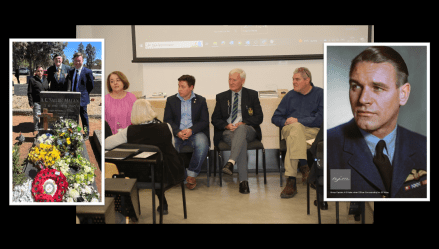
There are occasions when I do something I will always treasure, an honouring Sailor Malan is one of them. On the 60th anniversary of his death due to rapid onset Parkinson’s Disease, caused in all likelihood by combat stress, this ‘freedom fighter’ was not only a Battle of Britain and D Day hero and fighter ace – he also led South Africa’s first anti Apartheid mass protest movement. A patriot and military hero in every way. A short report to the SA Legion on it:
On the 16th and 17th September 2023, Peter Dickens from the South African Legion was invited to attend the 60th anniversary of Sailor Malan’s passing in Kimberley by the Malan family. Two events were held, a memorial lecture by Dr Yvonne Malan (a distant relative of Sailor’s) at Sol Plaatjie University (SPU) was held on the 16th September and was hosted by the McGregor Museum and Sol Plaatjie University.
All present at the memorial speech were welcomed by the SPU Vice-Chancellor and Principal, Prof Andrew Crouch who stated “Sailor truly feared no man in the cause of justice. His legacy endures, and still, it inspires us. We should thank God that such men lived. Our lives are their legacy, and their lives are our duty.” (SPU release).
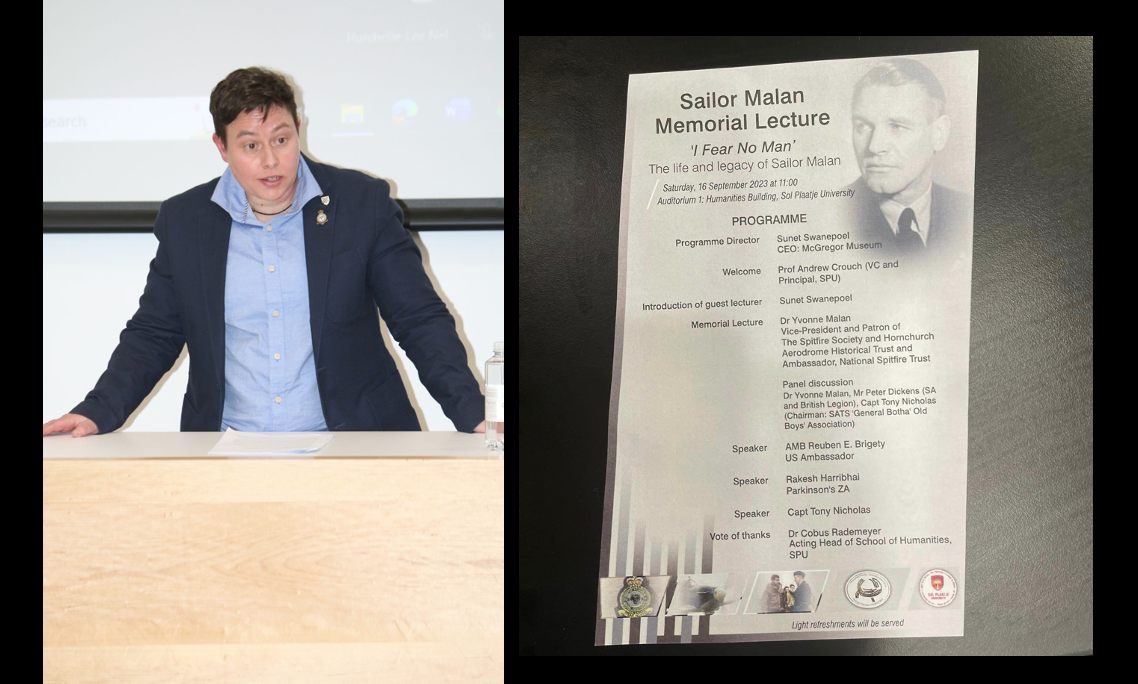
Dr Yvonne Malan’s lecture called ‘I Fear No Man’ shred light on Sailor Malan’s personal life, his journey to adulthood as a naval cadet and officer cadet and his World War 2 wartime experiences and sheer acts of bravery as the Squadron Leader of 74 Squadron during the Battle of Britain and as a RAF Group Captain during D-Day. Her speech also focussed on Sailor Malan’s moral and political convictions and his anti-Apartheid stance as the President of the Torch Commando after the war. Dr Yvonne Malan concluded the insights on Sailor Malan with a reflection of bravery, sacrifice and moral conviction that only a very few demonstrate when circumstances compel them to do so.
In her speech, Dr Malan explained that the words ‘I Fear No Man’ are not only words, but were the motto that Sailor Malan conquered the war by. “I fear no man is not a declaration, it is a call to courage that requires us to be brave. A call to be better, a reminder that the act of courage is upon all of us, but yet we don’t act on it.”
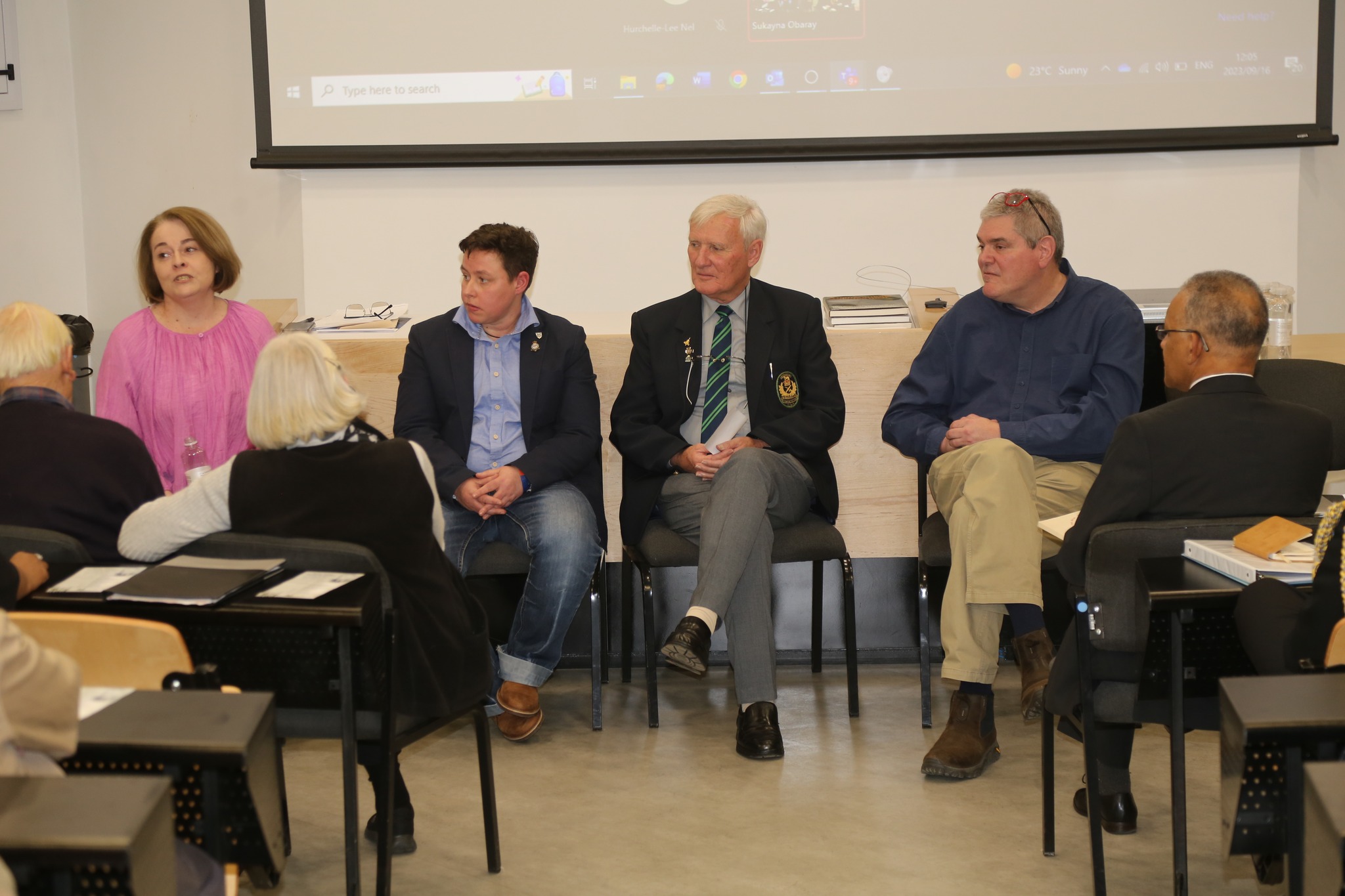
Joining Dr Yvonne Malan on a discussion panel after her lecture were Lgr Peter Dickens, essentially to discuss Sailor Malan’s political and anti-Apartheid stance, Captain Tony Nicholas of the SATS ‘General Botha’ Old Boys Association to discuss Sailor’s time as cadet and Ms Sunet Swanepoel, the CEO of the McGregor Museum.
The US Ambassador to South Africa, Reuben E Brigety II was the esteemed invited speaker, he highlighted Sailor Malan’s American connections as a merchantman, the involvement of the USA in the war and the presence American uniformed representation at Sailor Malan’s funeral in defiance of the Apartheid government wishes. He outlined the importance of Sailor Malan’s politics at a time when both the South African nation and the United States of America where crippled by legalised segregation and racial bigotry.
Dr Kobus Rademeyer, the acting Head of Humanities SPU concluded the lecture with thanks.
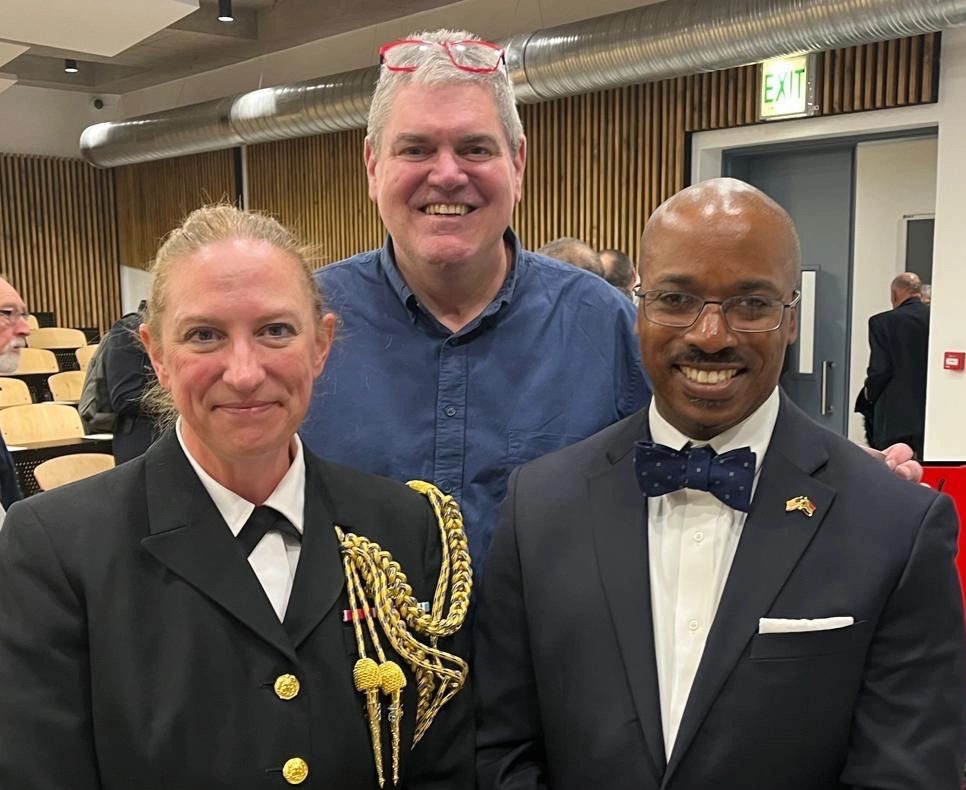
Peter Dickens, Captain M Lowe, the US Defence Attache and the US Ambassador Reuben E Brigety II. Photo Karen Dickens
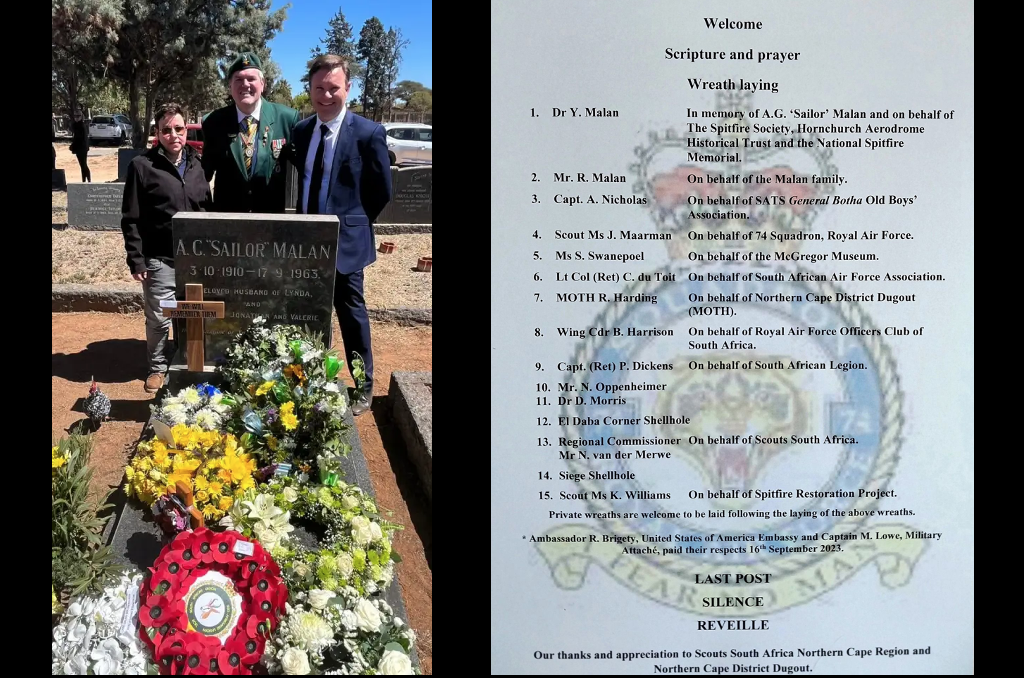
The following day, 17th September 2023, a de-dedication was held at Sailor Malan’s gravesite in commemoration of the 60th year of his funeral. A wreath was laid the day before by the US Ambassador Reuben E Brigety II on behalf of the Embassy of United States of America. The American Military Attache’ to South Africa Captain M Lowe was present in his place on the 17th. Wreaths were laid in memory of A.G. ‘Sailor’ Malan, The Spitfire Society and Hornchuch Aerodrome Historical Trust and the National Spitfire Memorial by Dr Yvonne Malan, Mr Riel Malan laid a wreath on behalf of the Malan family.
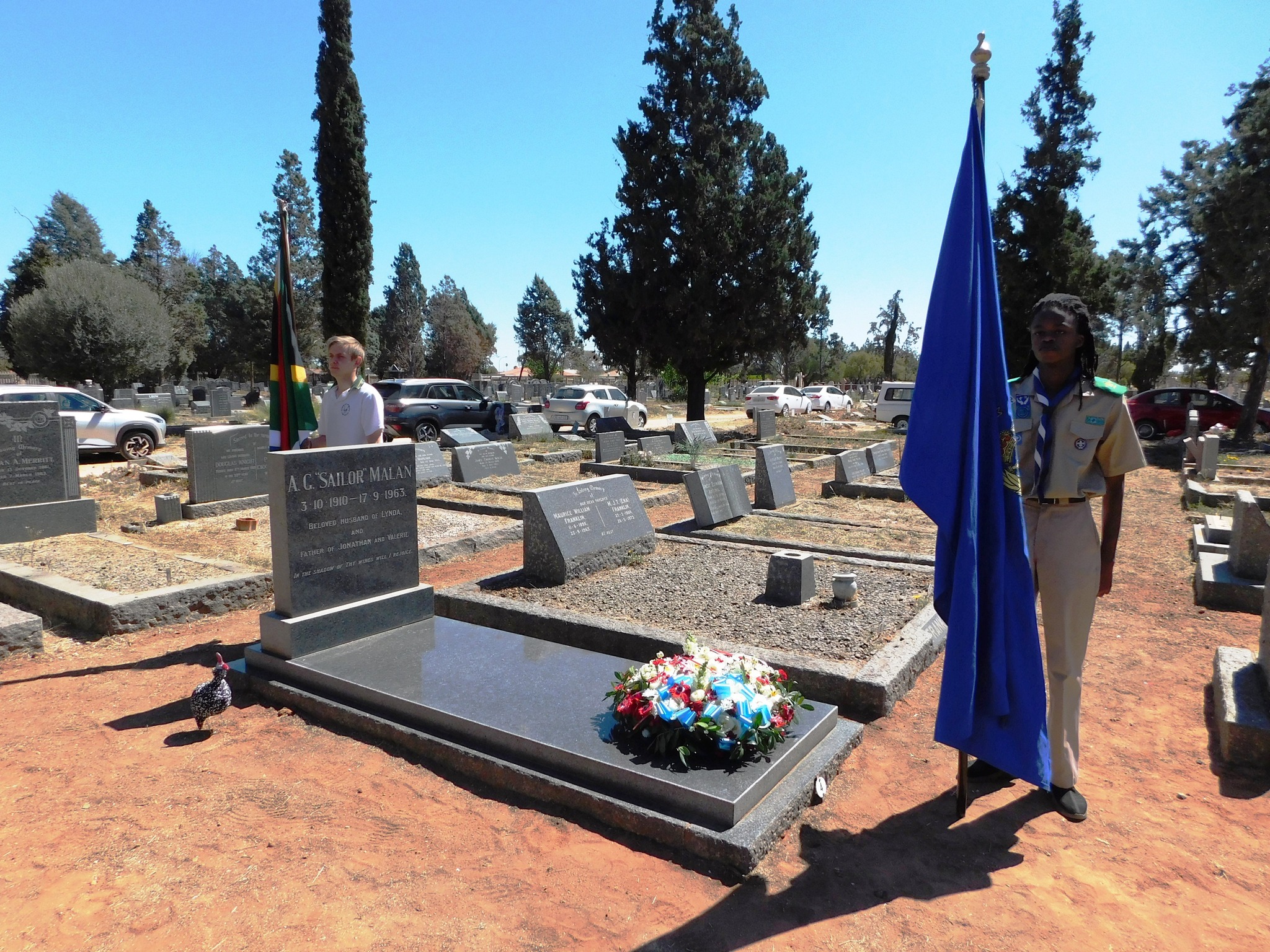
Also of importance was a wreath laid by Lt. Col C. du Toit (retired) of The South African Air Force Association, in acknowledgement of Sailor but also to correct a past wrong, the South African Air Force’s was specifically forbidden from laying a wreath at Sailor Malan’s funeral in 1963 by a vindictive Nationalist government.
Wreaths were laid by the MOTH R Harding on behalf of the MOTH Northern Cape District Dugout, the MOTH Seige Shellhole also laid a wreath. The wreath on behalf of the South African Legion was laid by Lgr. Peter Dickens. Wreaths were also laid by for RAF 72 Squadron, the RAF Officers Association and the Scouts.
The Scout movement acted as honour guard and flag bearers, the last post and reveille, the Dean of St Cyprian’s Cathedral in Kimberley, Reginald Leeuw, led the service.
Quick summary on why Sailor Malan is important to us as provided by Sol Plaatjie University:
The life and legacy of Sailor Malan
“A born leader and natural pilot, Adolph Gysbert “Sailor” Malan is one of the most highly regarded fighter pilots of the Second World War and one of the best fighter pilots South Africa has ever produced. During his exceptional career, he was awarded the and Distinguished Flying Cross and received the Distinguished Service Order.
He returned to South Africa after the war and became the personal and political assistant to Harry Oppenheimer, Head of the De Beers and the Anglo-American Corporation, who facilitated Sailor Malan’s move to farming on the Benfontein farm outside Kimberley where he worked at the Oppenheimer racehorse stud farm Mauritzfontein. It was the leasing of Benfontein to Sailor Malan that saw dramatic improvement in the quality of life for those who lived there. Electricity was installed at the farm from Kimberley, and major renovations and rebuilding of places of the Homestead were made with costs covered by the De Beers Company.
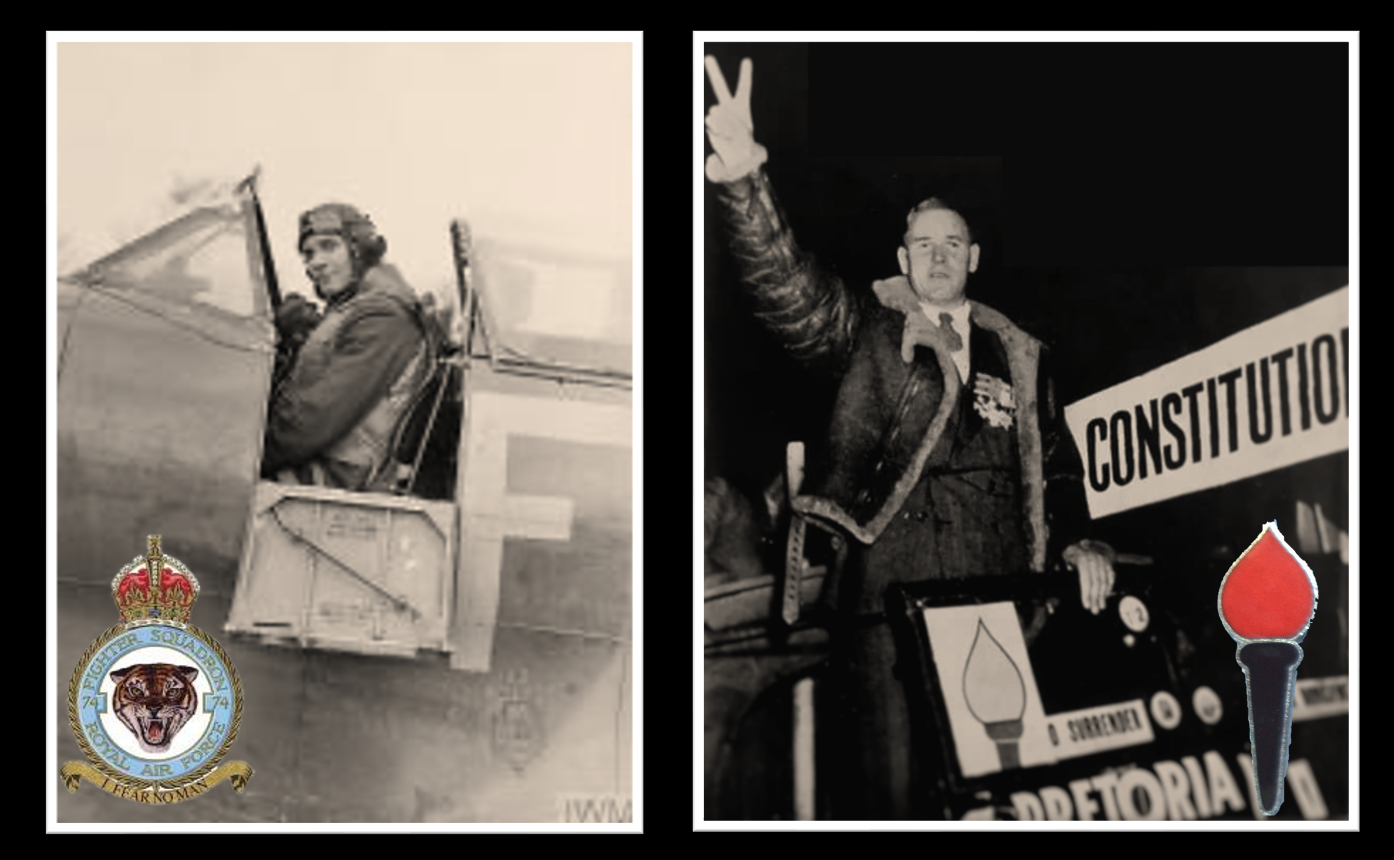
A political fighter, anti-apartheid campaigner and champion for racial equality, Sailor Malan became president of the Torch Commando: a protest group of ex-servicemen in the early 1950s. This was a liberal anti-authoritarian organisation that opposed the introduction of the apartheid system and the National Party’s plans to remove Cape Coloured voters from the common voter’s roll.
The Torch Commando at its zenith had 250 000 members, and in landmark protests across South Africa it brought of tens of thousands of protestors carrying torches of light and freedom into physical defiance of the Nationalist government. The Torch Rally in Cape Town attracted 50 000 and in Johannesburg nearly 75 000 people protested the National Party governments and its apartheid ideologies.
At age 52, Sailor Malan succumbed to Parkinson’s Disease on 17 September 1963. Due to his prominent role in opposing apartheid, the then South African government sought to sideline the event of his passing to further erase any legacy of the Torch Commando. The Apartheid government banned members of the South African military from attending in uniform, censored newspaper obituaries and eventually wrote him out of the country’s history over the decades. The South African Air Force was also instructed not to give any tribute to his passing. The United States Air Force, Britain’s Royal Air Force and the Royal Rhodesian Air Force – decided to send representatives in uniform to Sailor’s funeral to honour his service and to protest the Apartheid regime’s prohibition on giving Sailor the military honours he deserved.
Apart from his aerial combat skills, Sailor Malan can also be counted as one of the very first anti-apartheid struggle heroes. Although he has received little recognition for his work as leader of the Torch Commando, he continues to remain an activist and front-runner for equality in the history books.” (SPU release – Persome Oliphant).
Quotes, and Sailor Malan summary courtesy Sol Plaatjie University press release.


Why was the British Military Attache not there representing the RAF?
LikeLike
Not sure Brian, the Malan family coordinated the occasion.
LikeLike
OK. Just seems strange given Malan’s prominence within the wartime RAF.
LikeLike
It may be an issue of location, this was Kimberley after all, maybe priorities, availability – I’m not sure, I can check with the organisers.
LikeLike
Mr Dickens once more a good item on a subject little understood. Many outside (and inside) South Africa know very little it anything in the series of items that you have written re this.
Our moth knew Malan quite well, they worked together in the early days, until her and her brood were given the marching orders to get out of the Union!
In the magnificent volume, SHORES Christopher, WILLIAMS, Clive. Aces High. Grub Street, London, 1994. Hard cover, 663p., photographs.
The authors make comment as to the quality of Malan, as a combat flyer and a leader of men. On no less that eleven occasions, after attacking a target and damaging it, he would back off and send his No Two in to destroy the aircraft and claim the kill.
Blooding the pilot in order to gain the confident and ability to kill the Germans. These aircraft always Heinkel III or Junkers 88 bombers, never fighters as even damaged they always dangerous.
In a amendment, volume SHORES Christopher. Aces High Volume 2. Grubb Street, London, 1999. Hard cover, 256p., photographs. Malan’s was enhanced to 14 occasions where a ‘sprog’ pilot claimed a kill (again all bombers).
This would have greatly enhanced his record, it he had actually killed those 14 aircraft. As it stood, impressive; 27 kills destroyed, 7 shared destroyed and 2 unconfirmed, 3 probables and 16 damaged, you could say that he in fact had 21 shared destroyed or 30 damaged!
He and his fellow great South African pilot Pat Pattle who certainly shot down 40 enemy aircraft and quite possibily 51, strangely never met.
Yours,
G/.
LikeLike