
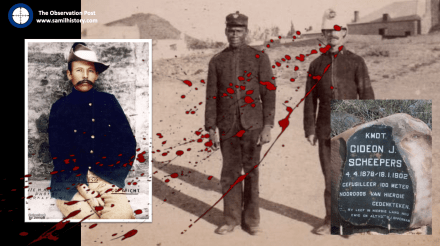
In a new endeavour to take things a little easier, I’ve also recommitted myself to being honest and cut through the crap – and nothing beats the usual crap on Boer War appreciation groups where we get people putting up a picture of poor old Gideon Scheepers, the ‘Yster’ (stand-up) man the ‘Volks-held’ (People’s Hero), the dreadful British shot him unfairly – the end of a beautiful, young and courageous life.
So, what’s with Scheepers that he gets an annual re-post on just about every Boer War social media group, and what’s with all the admiration – we know he sprang Boer prisoners from gaol and tied a Union Jack to his horses arse, what’s not to like … he epitomises the Afrikaner spirit! … or does he?
There’s good reason he was executed, not withstanding a court case – but his case was such that the retribution, the sheer hatred the ‘British’ (actually read ‘community’) felt toward him was both palatable and certain.
Let’s put it this way – the British made dead sure he would not get the honour of a coup de grâce, in that they used dum dum (expanding) bullets to kill him upfront1 – and the officer ordered that he was not to be lowered but “dropped” into the grave – like a sad mielie sack on the command ‘Let him Drop’!2. It even left one of the British soldiers witness to the burial sick to the stomach at the disrespect shown to Scheepers in his death.3 That, and he was not afforded a marked grave (and his grave site still has not been found). Simply put the British did not want a hero made of him – EVER.
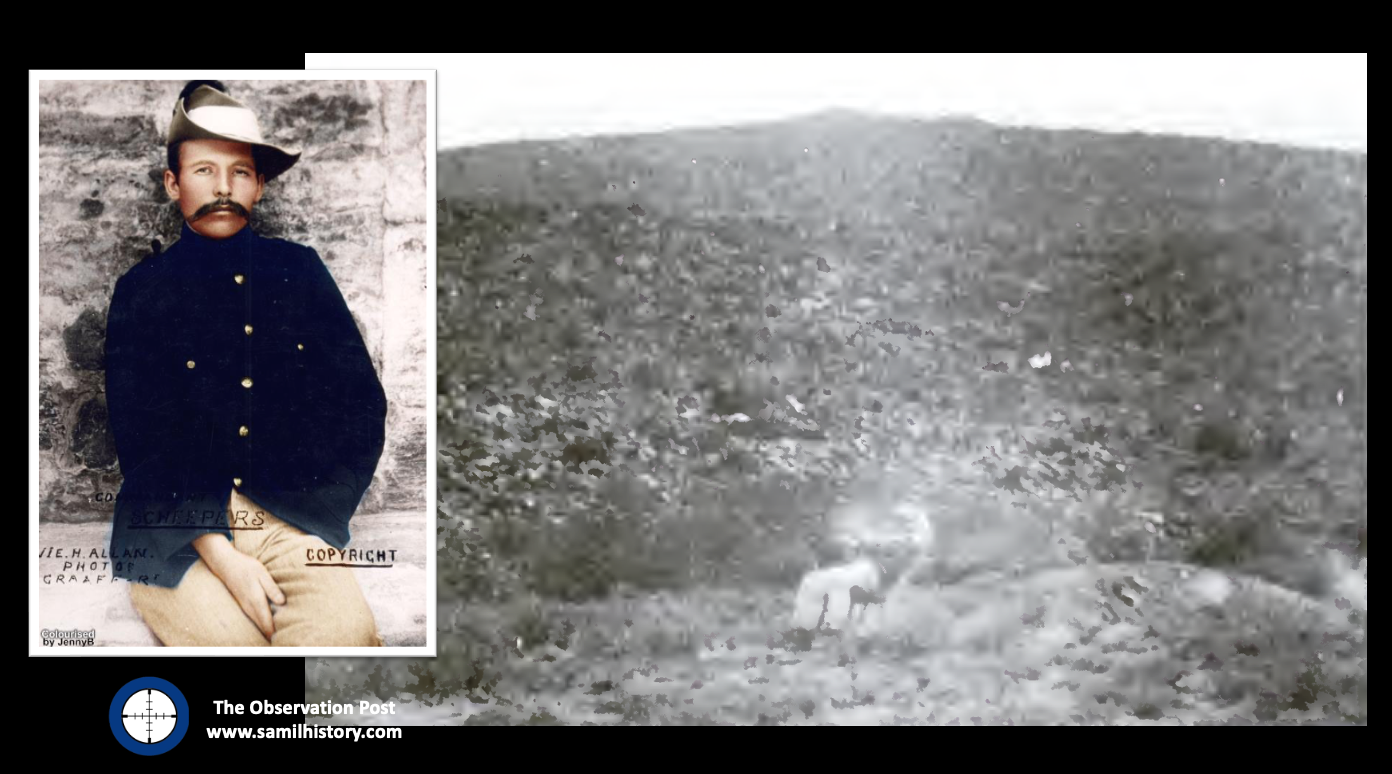
Now, you have to ask yourself – why the retribution, why the disrespect? It seems a little extreme, and at the time it was, even by war and ‘Victorian’ standards.
The answer lies in what Scheepers did – he was racist murderer and murdered blacks and coloureds indiscriminately, whether POW or not – even in context of his time and history he was viewed much like the “wit wolf” Barend Strydom is viewed now – and like ‘Breaker’ Morant who faced the same fate, he was guilty – soldier he was not, murderer he was, post war Afrikaner Nationalist propaganda and romanticism aside.
At the time Gideon Scheepers was loathed as he conducted a marauding campaign all over the British Cape Colony, train-wrecking, looting, burning down public buildings and houses belonging to loyalists, and murdering native policemen solely because of their colour. Scheepers even attempted to rob the Murraysburg branch of Standard Bank, sjambokking the manager when he refused to cooperate.
He avoided pitched battle where possible and according to H.M. Wilson, he instead
‘…confined his attention to the more genial work of robbing, burning and devastating. In his operations there was no military object; he meant, he said, to make Cape Colony a desert.’4
Even as the British ‘hunts’ after him started to chase him down and began cutting up his raids and running his Commando to ground, Scheepers found time to commit atrocities. One famous incident involved two coloured scouts who were captured by Scheepers’ Commando. Scheepers decided to be judge, juror and executioner and to murder them, despite their being in uniform and unarmed (so officially classified as Prisoners of War and subject to those conditions). The two were forced to draw lots, and the loser was immediately shot. The other was beaten and released to stagger to the nearest British outpost to tell the story as a warning to other Coloureds and Blacks who had joined the British forces.5
As to all the romanticism, consider Scheepers’ own testimony and statements.
Gideon Scheepers’ last words on the issue:
‘Thirty accusations were brought against me of “murder”, seven of “arson”, “rough” handling of prisoners, “barbaric” treatment of kaffrs etc.’6
Scheepers was particularly incensed at the accusations that he had ill-treated blacks, and that blacks were allowed to testify in court and even act as gaolers. He wrote:
‘We Afrikaners, will never find justice under the English. Everything is for the kaffirs.’7
During his trial General Christiaan de Wet tries to intervene and stay the execution of Scheepers (and that of Hans Lötter who faced similar charges of murdering “blacks” and a firing squad). De Wet writes to Lord Kitchener requesting clemency for the Boer Kommandant’s executing of Black (coloured) soldiers and civilians out of hand as he had personally given the order, he wrote:
‘the ungovernable barbarity of the natives realises itself in practice in such a manner that we felt ourselves obliged to give quarter to no native and for these reasons we gave general instructions to our Officers to have all armed natives and native spies shot.’8
De Wet then said that if anybody was responsible for shooting natives it was himself and his government.
Kitchener rejected the appeal, replying to General De Wet that Boer officers were personally responsible for their actions, and he wrote:
‘[I am] astonished at the barbarous instructions you have given as regards the murder of natives who have behaved in my opinion, in an exemplary manner during the war.’9
Kitchener then notifies de Wet that Boer officers will face the full consequences for the murder of natives and Scheepers had been found guilty and had already been executed for the crime in any event.
Conan-Doyle would say of it in his book, The Great Boer War, that Scheepers was tried
‘…for repeated breaches of the laws of war, including the murder of several natives. He was condemned to death and executed in December. Much sympathy was excited by his gallantry and his youth—he was only twenty-three. On the other hand, our word was pledged to protect the natives, and if he whose hand had been so heavy upon them escaped, all confidence would have been lost in our promises and our justice.’10
It’s little wonder that the old National Party loved Gideon Scheepers – his mother spending years searching for the grave of her son, a heart rendering story if there ever was one, and he’s one of ‘them’ – a white supremacist giving no quarter to blacks from resisting their whites-only hegemony and God-ordained claim to absolute power. The Nationalists unveiled a memorial to Scheepers on 27 May 1978 near the place of his execution as part of the events to celebrate thirty years of Apartheid (the monument is still there). Prime Minister John Vorster was the guest of honour.
In his address, John Vorster said:
‘If we are asked why in 1978 a memorial should be erected for a man who died in 1902, then the answer is simple. The life and work of this man was such that history placed him in the heroes’ gallery and nothing and no one can deprive him of that place.’11
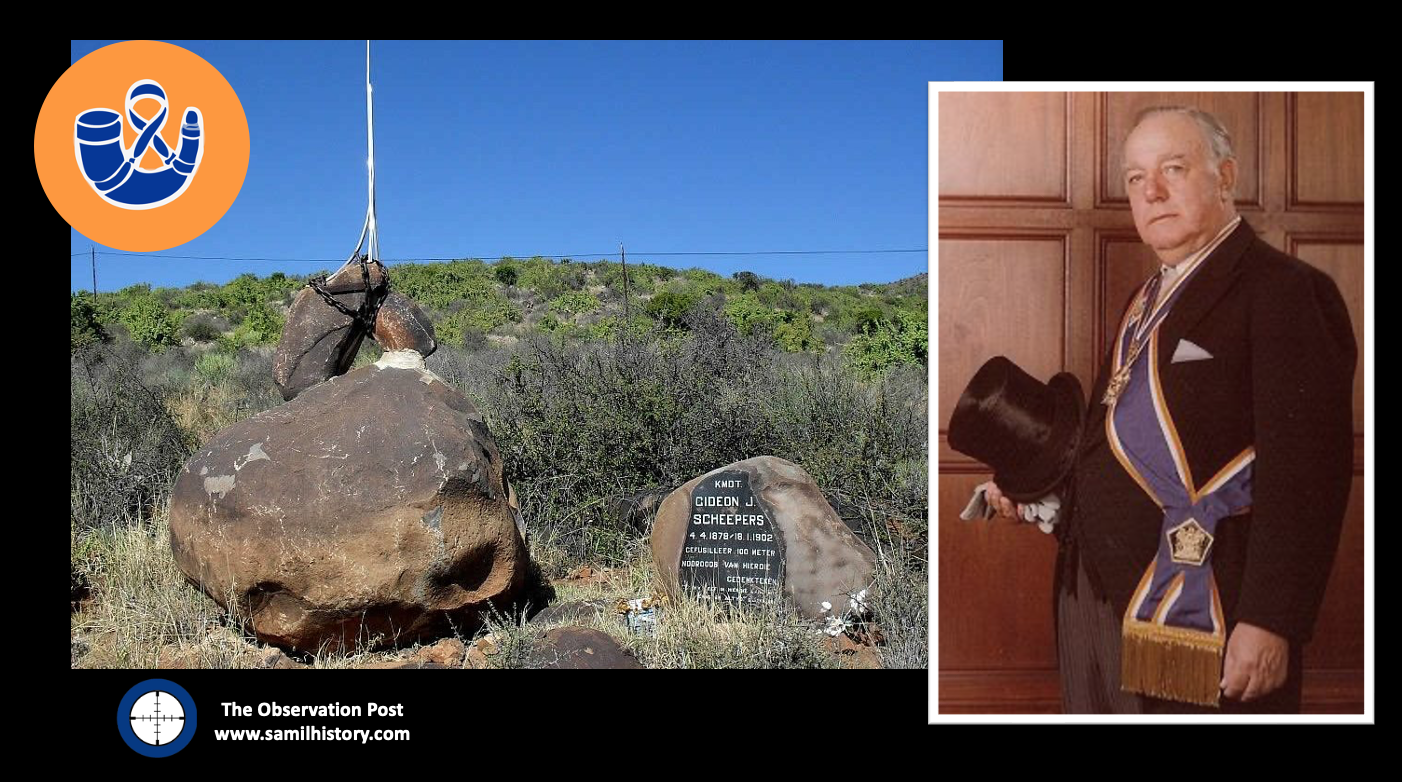
Problem is, John Vorster could not even stand the idea of TV as the ‘devils message’ from the ‘Devils Box’ – ‘liberal’ thoughts and access to information would be freely available outside of all the ‘bans’ he imposed – and a mere generation later they could not hold back the tide of critical thinking, especially as to the Boer War and their hegemony of white power and claim to absolute rule. I would hate to think what the average modern South African in the ‘Information Age’ thinks of Scheepers as an Apartheid ‘hero’ now, and whether he truly deserves his place in the annuals of Afrikaner heroes according to Vorster.
I also get it, Lord Kitchener calling General de Wet a murderer, this from a man many Afrikaners like to consider a genocidal murderer in any event. I do get the irony, but whatever we may think, there are some very clear cut cases in the Boer War historiography and Scheepers does not come up as a wholesome people’s champion for Afrikanerdom. He’s in the same category as Breaker Morant, no matter how much post war sympathy 120 odd years later and no matter how many attempts at historical revisionism, it’s not going to change the fact he was a racist marauding murderer.
In my mind it would be very handy if people really understand the history before re-posting all this hero worship all the while holding onto an BJ Vorster issued Apartheid security blanket thinking the people around them are either ignorant of “their” history or if they are “English” or “Black” they are naturally biased to it anyway (as if that somehow changes the facts).
Written and researched by Peter Dickens
Colourised insert picture of Gideon Scheepers thanks to Jenny B Colourising. Main pictures shows a Black Cape Colonial policeman of the Boer War period in uniform.
References:
HM Wilson. After Pretoria: The Guerrilla War. London: Harmsworth Brothers Ltd, 1901.
AC Doyle. The Great Boer War. London: Smith, Elder & Co Publishers, Revision 1902.
D Harrison. The White Tribe of Africa – South Africa in perspective. Los Angeles: Berkley California Press, 1981.
D Judd & K Surridge, The Boer War. London: John Murray Publishers, 2002.
C Ash. Kruger’s War – the truth behind the myths of the Boer War. Durban: 30 degrees South Publishers, 2017.
Footnotes
- Correspondence with South African War historian Dr Garth Benneyworth – 20/6/2024 ↩︎
- Harrison, White Tribe of Africa. p 43 ↩︎
- Ibid. 43 ↩︎
- Wilson, After Pretoria: The Guerrilla War. p 78 ↩︎
- Ibid. 80 ↩︎
- Harrison, White Tribe of Africa. p 42 ↩︎
- Idid. 42 ↩︎
- Judd & Surridge, The Boer War. p 235 ↩︎
- Idid. 235 ↩︎
- Doyle, The Great Boer War. p 655 ↩︎
- Harrison. White Tribe of Africa. p 43 ↩︎
 The Observation Post
Thanks for this very insightful article. I have seen Gideon Scheeper’s memorial and I have always wondered why a memorial is simply dedicated to this ‘Boer’. Once again your balanced article has called into play the importance of perspective.
LikeLiked by 1 person