
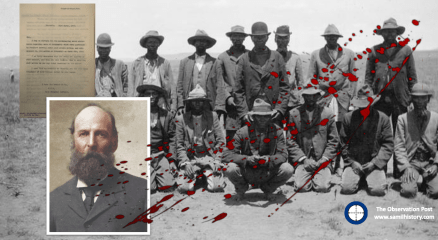
One of the most stand out things in the way the Boer War is recorded by modern historians is the vast difference between the ‘Old School’ Afrikaner historians still peddling a romantic narrative of Bittereinder Boer Pimpernels tying the British up in knots – and then there are the modern ‘British’ and ‘Black’ historians, who post Apartheid have been gradually uncovering a narrative of war crime, atrocity, genocide and massacre – but not of ‘white’ Boer women and children – but of ‘Blacks’ – on nearly all levels of age and sex and all definitions. Upfront let’s be clear on this – it’s an atrocity committed by both sides – so nobody comes out smelling of roses – not the Boers and not the Brits.
So much so, as Dr Garth Benneyworth, a leading South African War historian pointed out recently on The Observation Post that a significant research gap on the historiography of the South African War (1899-1902) needs to be investigated.
A Genocidal Order
This specific literacy gap evolves around a policy decision taken by Bittereinder Boer Commanders in the ‘Guerrilla Phase’ of the South African War (1899-1902) to shoot out of hand any Black, Coloured or Indian civilian, contractor or soldier deemed as being in support of the British military. The order is tantamount to genocide as ‘Natives’ can be simply be killed on the basis of the colour of their skin and a simple “suspicion” of spying or working for the British – which becomes highly problematic in the British Colonies, especially the Cape Colony as many hold a colour blind franchise and are equal to whites, they hold British citizenships and most ‘work’ for the British in one way or another. No recourse to the law or a trial of any kind is afforded them – they could just be shot on the spot by any Boer invader.
An example of the ruthlessness of this order in practice is the murder of a coloured blacksmith named Abraham Esau in Calvinia, Namaqualand, British Colony. As the guerrilla war continued, there were ongoing Boer Commando raids in the area, and demands for tribute, whippings, looting, and even exemplary executions were common.1 Esau organised a militia to resist these incursions, however his British patriotism and bravery made him a marked man, so when a Orange Free State Commando (600 strong) fell on Calvinia on 7 January 19012, Esau was one of those sought out amidst the plunder of the town. Esau was beaten, bludgeoned and then lashed – he survived this torture until 5 February when he was eventually shackled in irons, dragged for five miles behind a pair of horses, and, after a final beating, shot dead.3
So, where is this order sourced? In fact it’s a ‘General Order’ and can therefore be regarded as ‘Policy’. General Christiaan de Wet would inform Lord Kitchener that he personally issued the order …
‘the ungovernable barbarity of the natives realises itself in practice in such a manner that we felt ourselves obliged to give quarter to no native and for these reasons we gave general instructions to our Officers to have all armed natives and native spies shot.’4
Not one senior Boer Commander in the field is not guilty of implementing this policy, even captured junior officers like Gideon Scheepers and Hans Lötter both face charges of “murdering” black and coloured civilians and captured ‘coloured’ British soldiers in the British Cape Colony – and they both faced firing squads for this – Kitchener responds to de Wet:
‘….. (I am) astonished at the barbarous instructions you (General de Wet) have given as regards the murder of natives who have behaved in my opinion, in an exemplary manner during the war.‘5
Kitchener then notifies de Wet that Boer Commanders guilty of this crime will face charges of murder and Scheepers had already been found guilty and executed.
However, this policy is widespread, it spreads from the Bittereinder raids into the British Colonies to the two Republics themselves, and these executions happen under of the watch of great Boer Commanders – even the great General Koos de la Rey can’t escape it, de la Rey is almost unapproachable in Afrikaner lore – no Afrikaner historian would dare accuse him of a war crime like this. But the sad fact is it did happen under his watch and it happened at one of his greatest victories.
Massacre at The battle of Tweebosch
The battle of Tweebosch on 7 March 1902 is famous because of General De la Rey’s compassionate and kind treatment of the wounded Lord Methuen and saving his life. It’s also an astounding Boer victory, it occurs towards the end of the war and reassures the Boers of the marshal ability of this, one of their greatest Commanders.
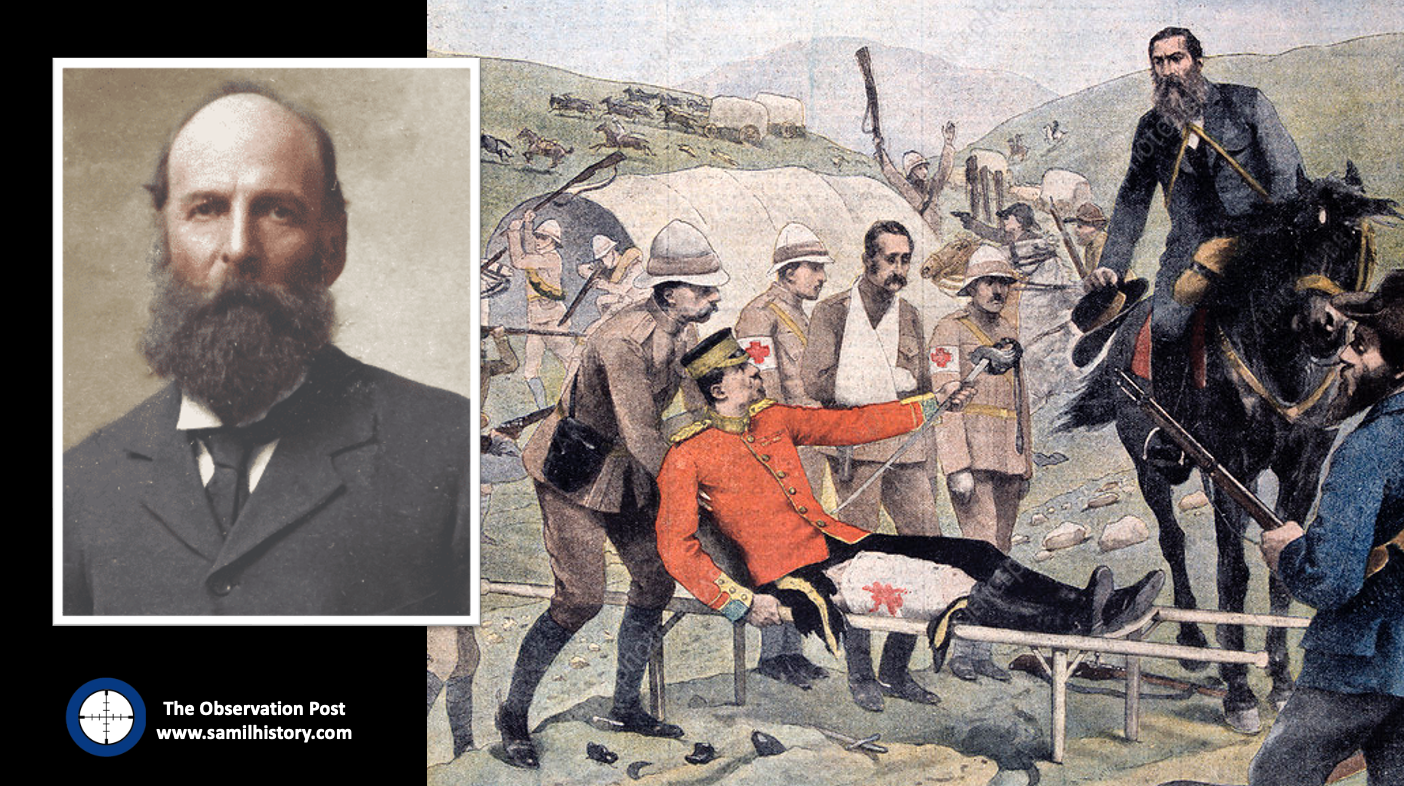
What is not often recorded at the Battle of Tweebosch in the narrative is the killing spree De la Rey’s commando members go on, its a war crime and atrocity, as they execute about 30 unarmed Black wagon drivers and servants in service of the British column as well as black and Indian soldiers having surrendered.
This spurred Lord Kitchener to write to General de La Rey and forward all the witness reports of the executions. The intention was to get de la Rey to take action against the perpetrators and cease and desist – de la Rey does none of these.6
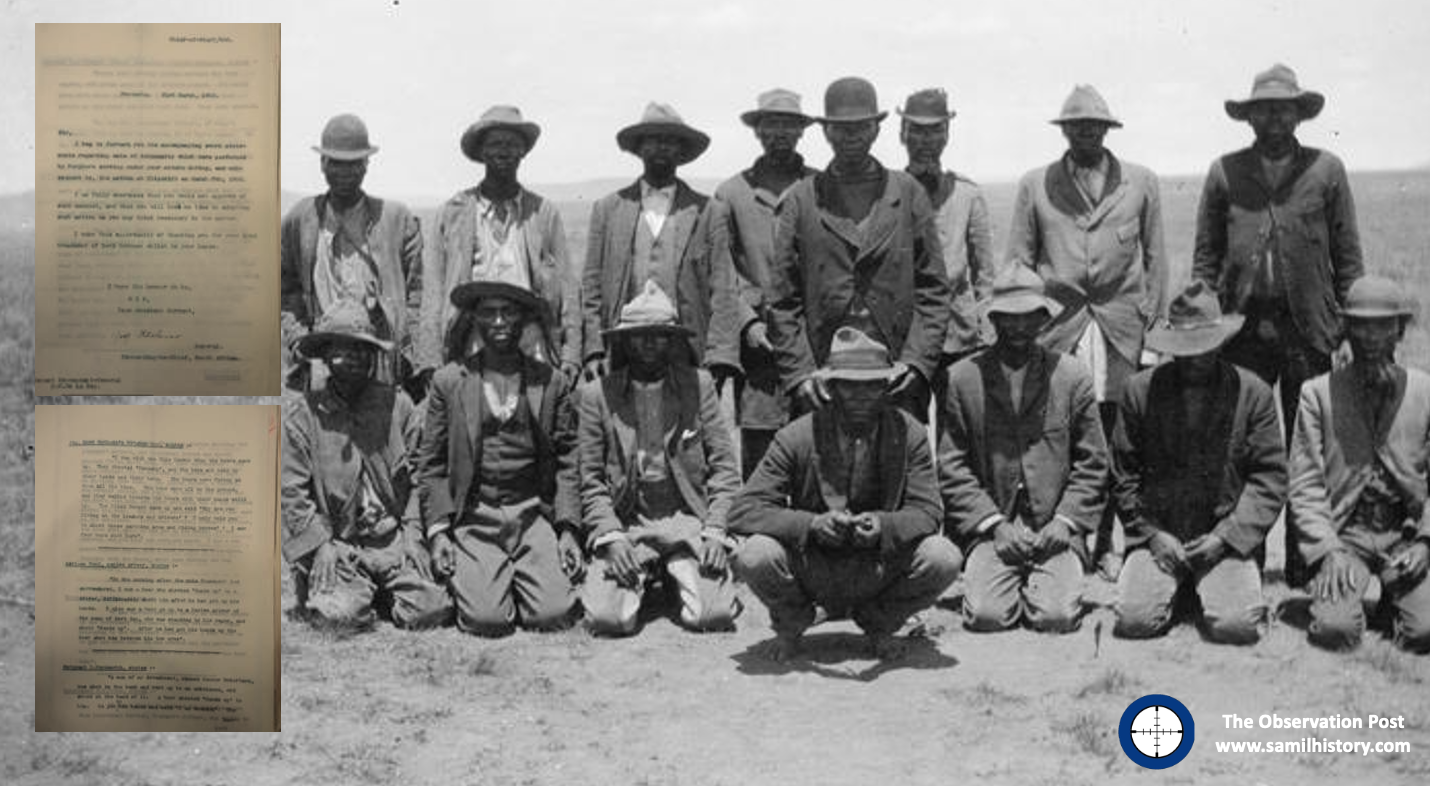
Kitchener’s missive is sent on the 31st of March, 1902 and reads:
Sir,
I beg to forward you the accompanying sworn statements regarding acts of inhumanity which were performed by Burghers serving under your orders during, and subsequent to, the action at Klipdrift (Tweebosch) on March 7th, 1902.
I am fully convinced that you would not approve of such conduct, and that you will lose no time in adopting such action as you may think necessary in the matter.
I take this opportunity of thanking you for your kind treatment of Lord Methuen whilst in your hands.
The following testimonies are then attached:
Captain W.A. Tilney, Deputy Assistance Adjutant-General, states:-
“Boers were already riding amongst the rear wagons, off which some of the drivers jumped. Two knelt down with their hands above their heads, when a Boer pulled up his horse, and shot both dead. They were unarmed.
On the 8th, Commandant Joubert, of Kemp’s Commando, took me over to General De la Rey’s laager. On the way, we passed over the field of action at Klipdrift. Parties of men, women and children were engaged in stripping the dead. There were periodical shots which were not at horses, as there were no wounded animals about that part of the field. All the men we buried that day were stripped naked, including Lieutenants Venning and Nesham, Royal Artillery.
On the 9th instant, the convoy of wounded on its way from Klipdrift to Taaiboschpan trekked along the line of retirement of the mounted troops. We passed many dead, stripped naked, most of whom had three or four bullets through the head and chest. There were so scorched and blistered by the sun as to be beyond all recognition. The Boers whom I met on the 8th instant admitted that their men had deliberately shot down the transport Natives with a view, they asserted, of deterring others from enlisting in our services”.
Lieutenant S.H. McCallum, states:-
“I saw a dismounted white man, unarmed, and with only shirt and breeches on, standing about 40 yards from me with his hands up. I saw a mounted Boer deliberately shoot him about two yards off him.
A few minutes later I saw a Native, who appeared to be a Driver, with his hands up. He was unarmed in front of a Mounted Boer, who deliberately shot him”.
Trooper Hermann S. Van Eeden (nice old English name), states:-
“I saw a native boy coming from our front, saying ‘if you please, Baas…’, and holding up his hands. He was unarmed. A Boer shot him from about 10 yards off. The boy appeared to be a Driver. He was killed.
A few minutes afterwards, I heard a shot from my rear. I looked round and saw a man get up. He said:- ‘You Dutch bastard; you shot me in cold blood’. He was shot in the chest. When I saw him he was unarmed. I spoke to him and he said he had ‘hands up’ when he was shot”.
Trooper F. Jackson, states:-
“I was riding alongside a men who I think was B.S.A.Police. We were in amongst the Boers before we knew it. A Boer told him to ‘hands up’. He was handing up his rifle when another Boer came up and shot him. We had halted. He was killed”.
Trooper C.J.J. Van Rensberg (another fine ‘Jingo’ name), states:-
“I saw four Cape boys, unarmed and dismounted, come towards the Boers with their hands up. They were shot dead”.
Corporal H. Christopher, states:-
“I saw a young Native boy riding a horse and leading another. He was unarmed. A Boer road up to him and told him to dismount. No sooner had he done so than the Boers shot him in the back of the head and killed him”.
Sergeant T. Barrow, states:-
“After surrendering, I saw Captain Tuckey’s native boy, called ‘Clean Boy’, in the act of surrendering with his hands up over his head. I saw a Boer shoot him. He was unarmed.
I also saw two other native boys shot. They were Transport boys and unarmed.
I heard a Boer say plainly in English:- ‘What shall we do? Shall we shoot the blacks and spare the whites, or what?’”.
Tom, Native Driver, states:-
“I saw six boys taken away from the mule convoy, and made to dig a hole. They were then lined up to the side of the hole and shot. I saw them shot. I also saw 13 boys taken away from the mule Transport into a bush on the right. I heard shots, A Boer told me that they had shot the boys”.
Trooper C. Davies, states:-
“I saw a Boer go up to a native boy who was driving a mule wagon and shout ‘hands up’. The boy threw his whip down on the side of the wagon the Boer was, and the Boer fired point-blank at the boy, who fell off the wagon. He was unarmed. Then the Boer turned round to a Scotch Cart and shot the native boy who was driving. Afterwards I saw the Boers shoot four small native boys, who were camp followers. They were running after the Mounted troops on foot, and were unarmed”.
Trooper T. Bradley, states:-
“I was in a sluit with about 30 others, and there were two wounded men laying in the spruit. Some Boers came galloping on to the sluit and fired at the wounded men, and hit one in the neck. They were quite close to them when they fired”.
Jim, Lord Methuen’s Kitchen Boy, states:-
I was with the Mule Convoy when the Boers came up. They shouted ‘hands up’, and the boys all held up their hands and their hats. The Boers were firing at them all the time. The boys were all on the ground, and they walked towards the Boers with their hands still up. The Field Cornet came up and said, ‘Why are you firing at the leaders and drivers? I only told you to shoot those carrying arms and riding horses!’ I saw four boys shot here”.
Adriaan Pohl, native driver, states:-
In the morning after the mule Transport had surrendered, I saw a Boer who shouted ‘hands up’ to a driver, deliberately shoot him after he had put up his hands. I also saw a Boer go up to a Native driver of the name of Gert Gey, who was standing by his wagon, and shout ‘hands up’. He had put his hands up the Boer shot him between his two eyes”.
These testimony’s go on, there are loads – but its enough to get the point. This entire document is found in the files WO 108-117 in the United Kingdom’s National Archives, yet it is seldom referenced by one sector of South African Boer War historians. Why? Because it flies in the face of painting a romantic picture of the Boer Bittereinder Generals and the victimhood narrative – the eternal anvil on which ‘British’ tyranny on the Boer citizenry is forever hammered by these authors.
It does not stop at all the Black Wagon Captains, Handlers etc. Even the Regimental History also records the unlawful killing of Indian veterinarians at the Battle of Tweebosch, a direct violation of the rules of war at the time:
“…the whole Indian and Kaffir establishment of the F.V.H. (Field Veterinary Hospital) … One Farrier Sergeant of the Indian Native Cavalry and two Indian Veterinary Assistants (men carrying no arms) were ruthlessly shot dead after the surrender, and nine Hospital Kaffirs were either killed in action or murdered later.”7
(British Cavalry – Regimental History).
Conclusion
This is part of the problem with writing any history on the Boer War, if you bring up thorny issues like this – and especially start to criticise holy cows like de la Rey, de Wet and even Smuts the immediate reaction is a tirade of abuse, accusations of bias – and the “Boertjies” in social media groups laager around their ‘heroes’, some administrators of large format Boer War groups will even ‘ban’ you – de Wets’ and de la Rey’s reputations are guarded regardless of the history and it smacks of an old School Aparthied ‘banning’ technique. Nobody remains the wiser, and the very important ‘Black’ history of the Boer War is either ignored or used an another stick to beat the British with by these Anglophobes.
At the end of the day these ‘gatekeepers’ keep the actual history away or continue to reinforce the old National Christian and Apartheid mythology and bias surrounding this war. In the end no-body on their forums learns anything. It also says something about these gatekeepers, by holding back on full historiography of The South African War (1899-1902) and peddling a learned Christian Nationalism bias they are preventing the ownership of this conflict by ‘all’ South Africans and maintaining it for the benefit of “white Afrikaners only” as a “white man’s war” – and then they wonder why ‘Black’ South Africans pay no respect to them or their history.
However, that’s not the case in the modern age of information, there is just no way anyone can stop the dissemination of history as it has already been written, the ‘Black’ contribution to the Boer War is an under researched truism, the extreme white racist hegemony that was the Zuid-Afrikaansche Republiek (ZAR) and its claim to absolute authority for white protestant Afrikaners only and policies such as this one to deliver on it is a truism, the ruthless massacres of ‘Black’, ‘Indian’ and ‘Coloured’ citizens and contractors by Boer Generals and Commandants at Tweebosch, Leliefontein, Modderfontein, Uniondale, Calvinia and many other places are all truisms … there is no shaking it, it happened, it’s history. That the ZAR’s extreme policies of race and lack of human rights for people of colour is taken forward to the Afrikaner Revolt of 1914 and then to Aparthied in 1948 by the next generation of these exact men is also an intrinsic part of the historic ‘sweep’ – its a truism.
Next look out for an article which controversiality shows Jan Smuts to be guilty of the same atrocity at Modderfontein – and here I am “sacrificing” a personal hero of mine – but that’s the nature of history and the promotion of the sound and balanced understanding of great men – ‘war is cruelty’ the British were guilty of it, so too the Boers and all great Commanders are flawed – Buller, Kitchener, Roberts, de la Rey, Smuts, de Wet, Botha – all of them, the lot, there’s no escaping it.
Written and Researched by Peter Dickens
References:
B Nasson. Abraham Esau’s War: A Black South African War in the Cape, 1899–1902. African Study Series 68, Cambridge University Press, 2003
D Judd & K Surridge. The Boer War. London: John Murray Publishers, 2002.
Files WO 108-117 United Kingdom National Archives.
Correspondence with Dr Garth Benneyworth, South African War historian on the Observation Post Scuttlebutt – 25 August 2024
C Ash. Kruger’s War – the truth behind the myths of the Boer War. Durban: 30 degrees South Publishers, 2017.
Footnotes
 The Observation Post
I never knew this.
LikeLiked by 1 person
Hi Peter
I have not forgotten about the Scheepers PTSD , I am going to rescan the file in and email it to you probably on Monday . have a great weekend and keep up the great research.
Regards
LikeLiked by 1 person
Good history Pete.
“War makes monsters of us all”, not sure who said that, but it is a truism.
There are grey areas and without condoning it, or even legalising it, everyone in the free world has done.
Say you were in hot pursuit of terrorists who had bombshelled and you get one of them. After he discloses the RV of his group, without transport or any other means to make him a prisoner, what do you do?
The Allies and the Axis powers were responsible for exactly the same sort of thing in WW2. WW1 was probably the last conflict which showed any kind of fair play.
Germany in the persecution of the Jews in Europe and the Herero’s in Namibia. Turkey and the Armenians, Russia and the Jewish pogroms.
White America and the Native Americans, White Australia and the Aboriginal peoples (one of the oldest societies on our planet). The British and Americans in Afghanistan (Ordinary citizens look exactly like the Taliban). The same thing in Iraq. The British in Northern Ireland.
The Boere had been fighting wars with the tribes constantly, for whatever reason, mostly the Zulu’s and the Matabele. These conflicts well within the living memory of Boere fighting in the ABW.
Everyone was guilty of these type of atrocities, even, as you say, the person we admire most, JC Smuts.
I am not condoning it, nor do I agree with it, but it happened, we both know that, all for the reasons above and the fear of letting someone go, who you may well have to fight again at some stage.
“War makes monsters of us all”
This is why Grandads and Dads do not talk about their war with their children and only open up with people who were with them at the time.
Paychopaths, a different story and we all encountered those too. They did whatever they thought they could get away with.
I do believe there is a law on most statute books, that no soldier can be charged for acts committed while fighting a war, or a version of it at least.
I remember the Sgt charged recently in the UK for killing a wounded Taliban operator, who had actually just killed his oppo an the trial he had to undergo in the UK. A travesty, I thought. If someone shot you for eg, I must say, I would be inclined to cull him. It is normal human behaviour.
I am not justifying anything, merely commenting.
LikeLiked by 1 person
Pingback: The Tweebosch Massacre – good stuff by Peter Dickens – Chris Ash – Author