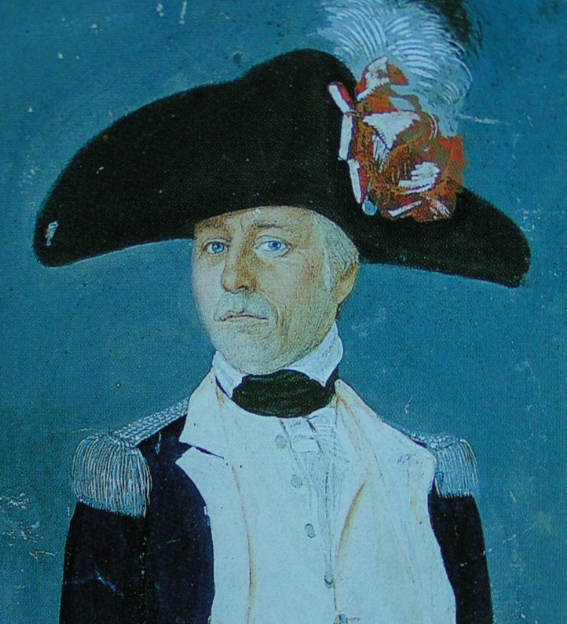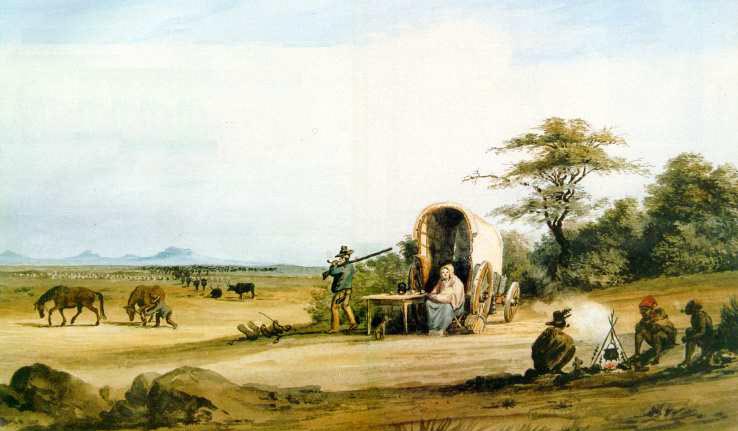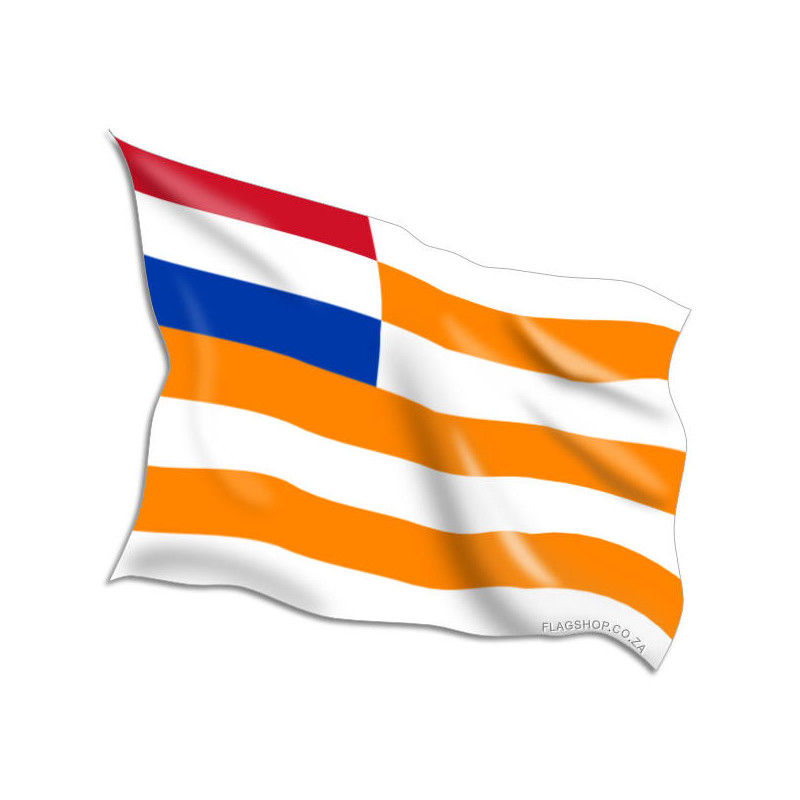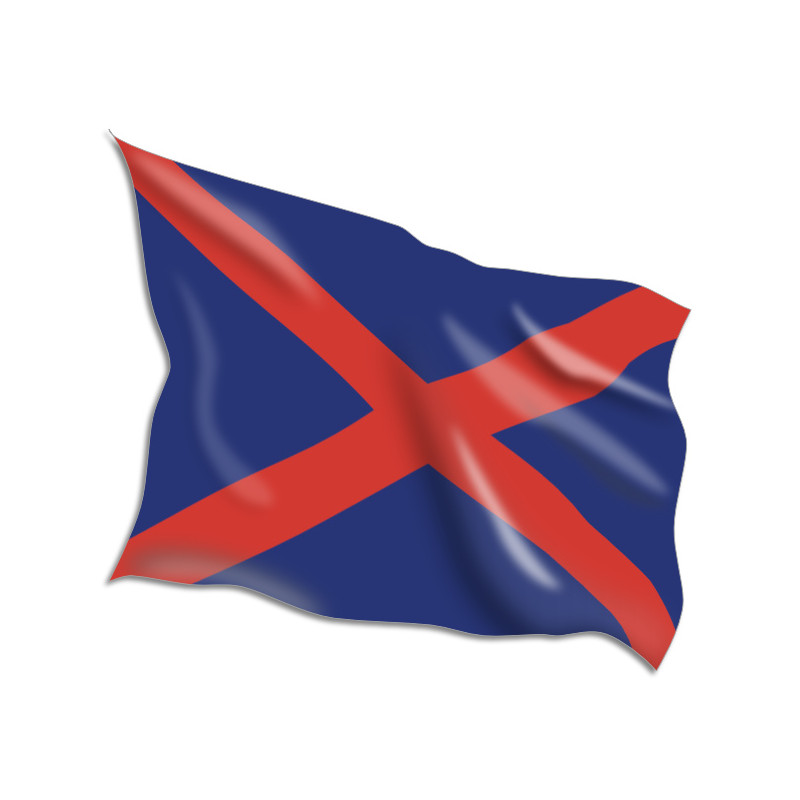
Herrenvolk blood for an Afrikaner volk

The German orphan program to boost the white Afrikaner ‘volk’ bloodline

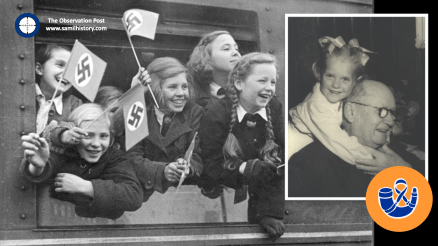
This story verges on the bizarre, but the funny thing is that it’s true and you just can’t make this sort of thing up when it came to South Africa’s old Afrikaner Nationalists. This was a program initiated by right wing Nationalists after World War 2 (1939-1945) to boost the white Afrikaner ‘bloodline’ by importing 10,000 hand-picked German ‘Herrenvolk’ orphans to South Africa for adoption. It is another example of the extreme type of ‘social engineering’ embarked on the by the Afrikaner Nationalists and it underpins the ideologies and thinking that were beginning to formulate in the National Party post war.

The idea carried obvious benevolence to adopt displaced German children who had lost both parents during the war, so in that respect it held a certain moral high-ground, however it is in the objectives and the methodology used that we find sinister Weimar Eugenics at play, the implementation of Nuremberg Race Law ideology, political protest and the manipulation of demographics to advance political gain.

Had the program attained its full quota and objectives, the ‘boost’ to the white Afrikaner pool would have been significant in the three odd generations to come after World War 2. If population growth is anything to go by, in three generations we would be nearing half a million extra white Afrikaners with Aryan German heritage with roots this post war orphan program. As pointed out by Werner van der Merwe in his UNISA journal in 1988, its impact and commemoration would now rival the millennial Second World War anniversary, the French Huguenot anniversary or the next millennial anniversary of the Great Trek.1

Clearly in 2024 we can conclude that this seismic shift in white Afrikaner demographics did not take place, and the reason is this quota of 10,000 ‘Aryan’ orphans was never reached, but that’s not to say the attempt was not made, the program did exist and it had some successes and failures of which there are good underpinning reasons for both. So let’s have a look at the Afrikaner Nationalist’s Dietse Kinderfonds (DKF) – the German Children Fund, its background and its purpose.

Background on the Nazification of the Afrikaner right

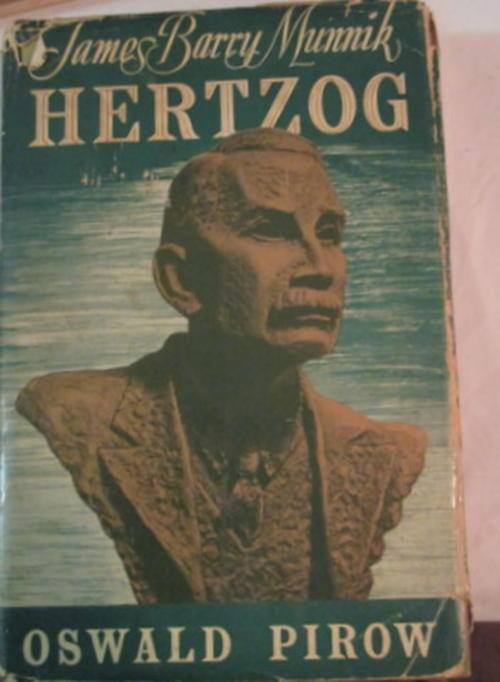
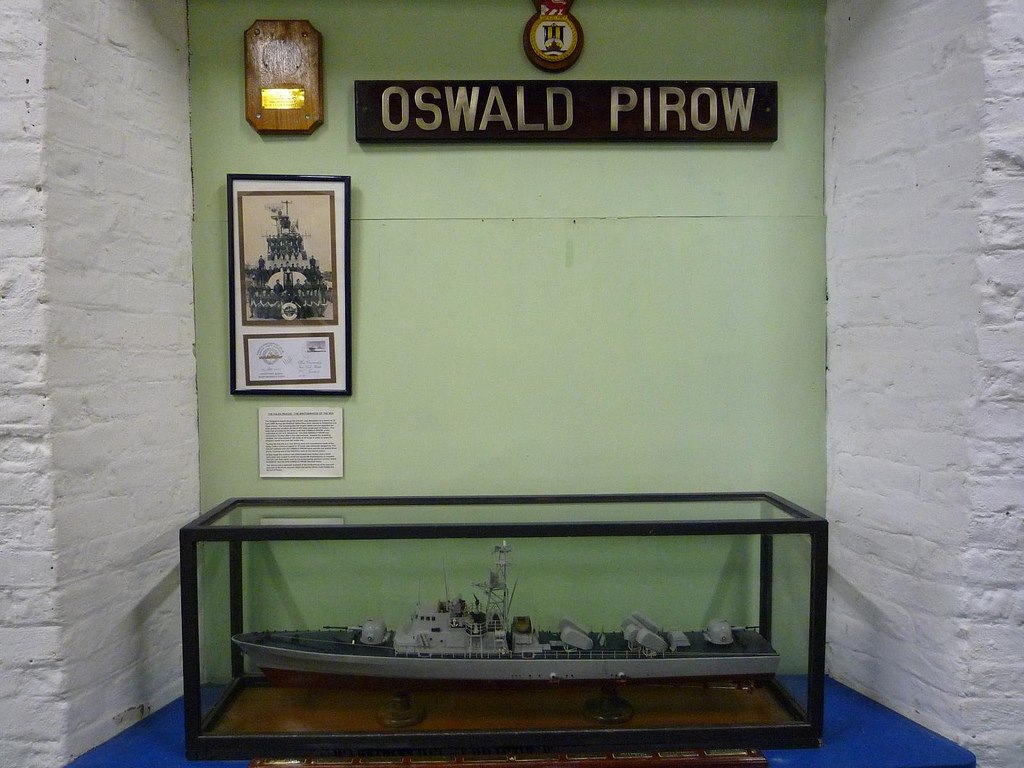
In South Africa, this particular story starts the inter-war years (1918-1939), with the rise of National Socialism in Germany and Fascism in Italy from the mid 1920s, many Afrikaner Nationalists increasingly came under the influence of Adolf Hitler and his specific brand of German National Socialism (Nazism). Oswald Pirow, Prime Minister Barry Hertzog’s Minister of Defence (1933-1939), was one of the most influential Afrikaners to fall under Hitler’s spell. Pirow met with Hitler, Hermann Göring, Benito Mussolini and Francisco Franco as an envoy on behalf of the United Party government2. Pirow received Nazi Germany’s feedback on German South West Africa and the ‘new order’ should Germany go to war with Britain and her allies. Pirow gambled his career on a Nazi Germany victory in what he saw as an inevitable war. On 25 September 1940, he founded the national socialist ‘New Order’(NO) for South Africa. He positioned it as a study group within the reformulated National Party (HNP), and based it on Hitler’s new order plans for Africa3. In terms of the NO’s values, Pirow espoused Nazi ideals and advocated an authoritarian state4.

In addition to Oswald Pirow’s NO, other leading and influential Afrikaner Nationalists were forming German National Socialist movements in South Africa during the interwar period. As a committed antisemite, Louis Weichardt broke with the National Party on the 26 October 1933. He founded South Africa’s Nazi party equivalent – The South African Christian National Socialist Movement. This included a paramilitary ‘security’ or ‘body-guard’ section (modelled on Nazi Germany’s brown-shirted Sturmabteilung) called the “Gryshemde” or “Grey-shirts”. In May 1934, the Grey-shirts merged with the South African Christian National Socialist Movement and formed a new enterprise called ‘The South African National Party’ (SANP). The SANP would continue wearing Grey-shirts as their identifying dress and would also make use of other Nazi iconography, including extensive use of the swastika5. Overall, Weichardt saw democracy as an outdated system and an invention of British imperialism and Jews6.
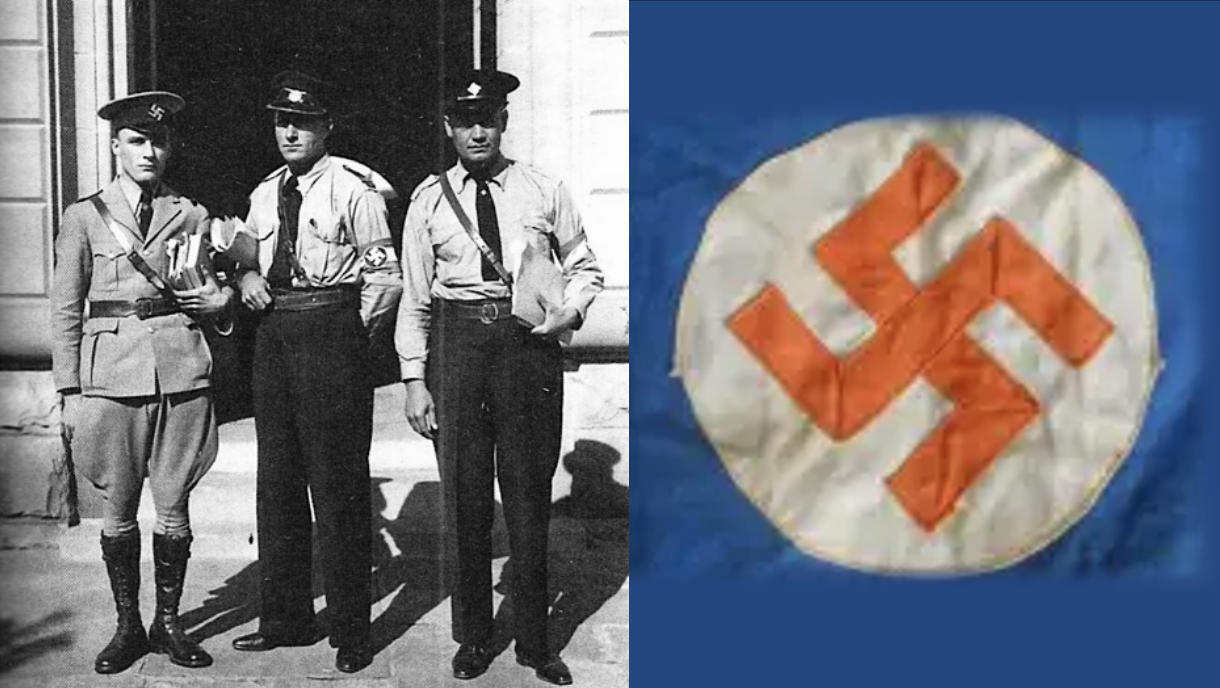
South African Grey-shirts in Grahamstown and their insignia

Other neo-Nazi and fascist groupings either spun out of the SANP Grey-shirts, or mushroomed as National Socialists movements with the German model front and centre in their own right. Also included was Manie Wessels’ ‘South African National Democratic Movement’ (Nasionale Demokratiese Beweging) known as the “Black-shirts”. The Black-shirts themselves would splinter into another Black-shirt movement called the ‘South African National People’s Movement’ (Suid Afrikaanse Nasionale Volksbeweging, started by Chris Havemann and based in Johannesburg, these Black-shirts advanced a closer idea of National Socialism7. Another National Socialist movement known as the ‘African Gentile Organisation’ was also formed in Cape Town by HS Terblanche. In September 1934, Dr AJ Bruwer formed the ‘National Workers Union’ (Bond van Nasionale Werkers) in Pretoria – also known as the “Brown-shirts”. Additionally, Frans Erasmus formed another national party militant group called the “Orange-shirts”8.

In a leadership purge, three National Socialist movements broke away from the SANP Grey-shirts, SANP leader JHH de Waal resigned and formed the ‘Gentile Protection League’ whose sole aim was to fight the ‘Jewish menace in South Africa9’ Johannes von Moltke, Weichardt’s right hand man broke away from the SANP and formed a new organisation called ‘The South African Fascists’ who wore Nazi iconography, blue trousers, and Grey-shirts.

Additionally, Manie Maritz, a veteran of the South African War and influential leader of the 1914 Afrikaner Rebellion, also admired German National Socialism and split from his association with the SANP Grey-shits and joined Chris Havemann’s Black-shirts. A converted antisemite, Maritz even blamed the South African War on a Jewish conspiracy. Moving from the Black-shirts Martiz founded the anti-parliamentary, pro National Socialist, antisemitic ‘Volksparty’, in Pietersburg in July 194010 This evolved and merged into ‘Die Boerenasie’ (The Boer Nation), a party with National Socialist leanings originally led by JCC Lass (the first Commandant General of the Ossewabrandwag) but briefly taken over by Maritz until his accidental death in December 1940.

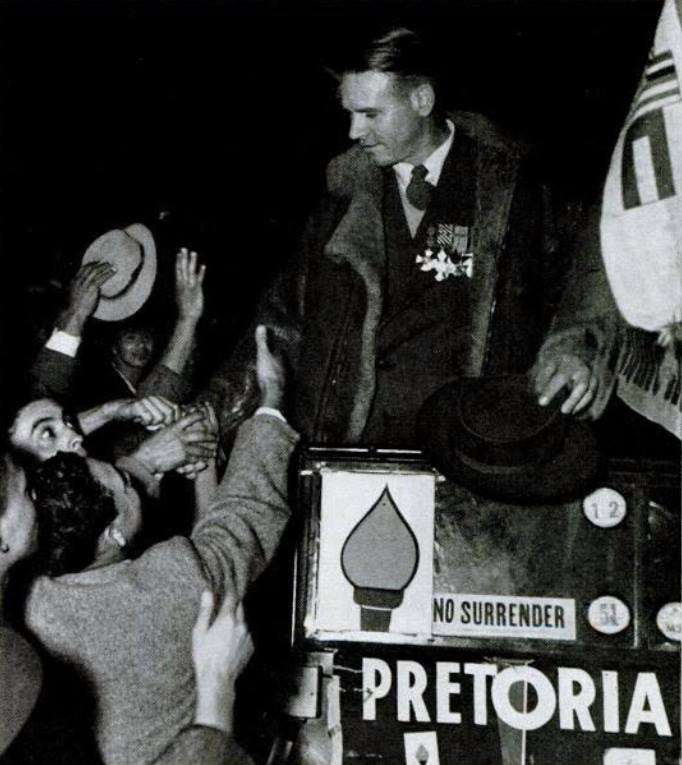
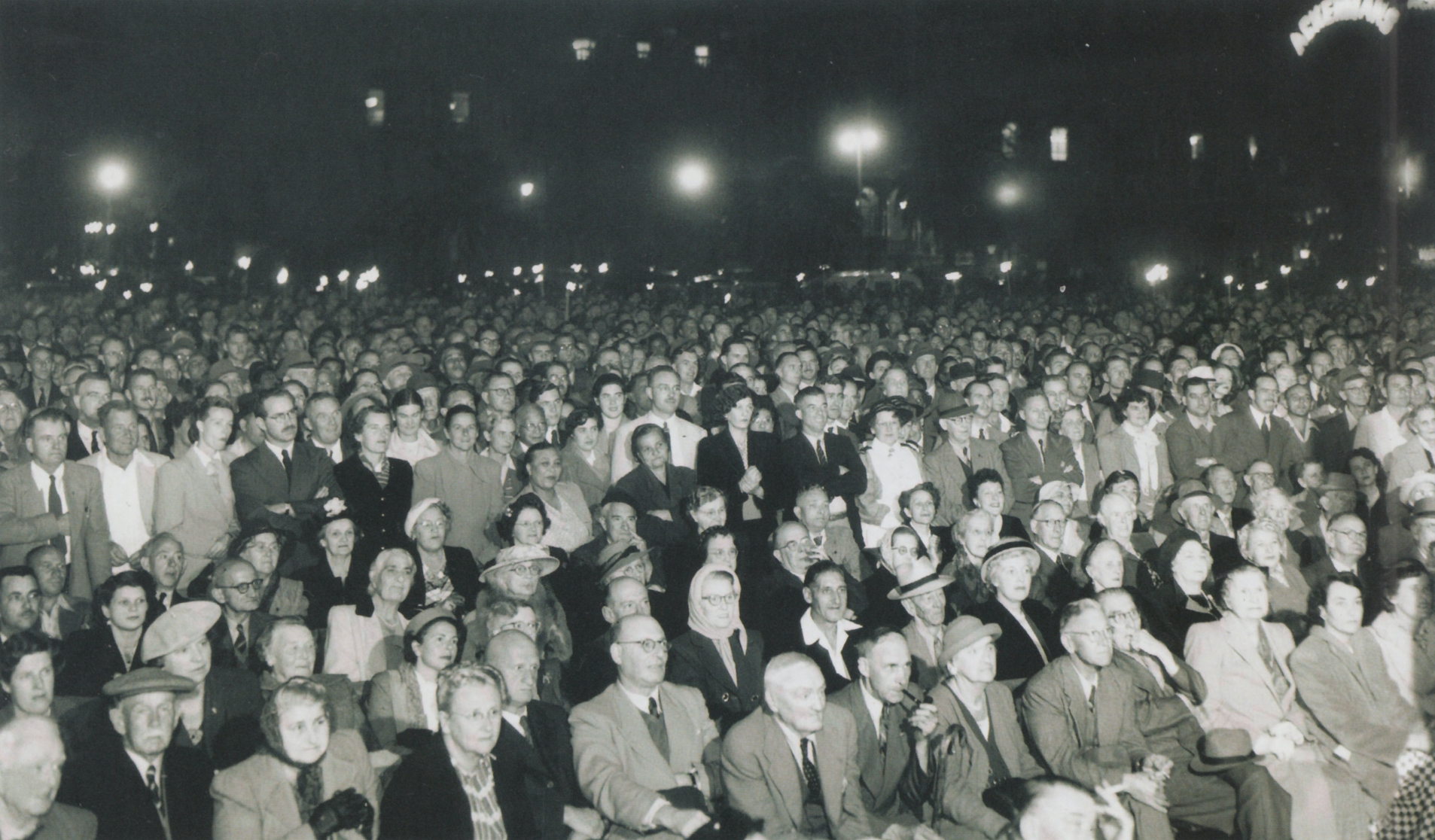
Aside from all these various parties, the Ossewabrandwag (OB, the Ox-Wagon Sentinel) was the largest and most successful Afrikaner Nationalist organisation with pro-Nazi sympathies prior to and during the Second World War. The Ossewabrandwag was formed on the back of the 1938 Great Trek Centennial celebration – the centennial was planned under the directive of the “Afrikaner Broederbond” (Brotherhood) and championed by its Chairman,  Henning Klopper. They sought to use the centenary anniversary of the 1828 Great Trek to unite the “Cape Afrikaners” and the “Boere Afrikaners” under the pioneering symbology of the Great Trek and to literally map a “path to a South African Republic” under a white Afrikaner hegemony. The trek re-enactment was very successful, and Klopper managed to realign white Afrikaner identity under the Broederbond’s Christian Nationalist ideology calling on providence and declaring it a ‘sacred happening’ 11.

Henning Klopper (seated right), Chairman of the Broederbond at the start of the 1938 Great Trek Centennial

The OB was tasked with spreading the Broederbond’s (and the PNP’s) ideology of Christian Nationalism like “wildfire” across the country (hence the name Ox wagon “Firewatch”’ or “Sentinel”). The OB’s national socialist leanings are seen in correlation with other world ideologies of the time, and specifically to that of Nazi Germany12 . Afrikaner Christian Nationalism, although grounded in “Krugerism” as an ideology, can be regarded as a derivative of German National Socialism and Italian Fascism and is identified as such by OB leaders like John Vorster in 194213. Earlier, the future leader of the OB, Dr Hans Van Rensburg, whilst a Union Defence Force officer, had met with Adolf Hitler and became an avowed admirer of both Hitler and Nazim. As leader of the OB, he then later infused the organisation with National Socialist ideology, whereafter the organisation took on a distinctive fascist appearance, with Nazi ritual, insignia, structure, oaths and salutes. 

Ideologically speaking the OB adopted a number of Nazi characteristics: they opposed communism, and approved of antisemitism. The OB adopted the Nazi creed of “Blut und Boden” (Blood and Soil) in terms of both racial purity and an historical bond and rights to the land. They embraced the “Führer Principle” and the “anti-democratic” totalitarian state (rejecting “British” parliamentary democracy). They also used a derivative of the Nazi creed of “Kinder, Küche, Kirche” (Children, Kitchen, Church) as to the role of women and the role of the church in relation to state. In terms of economic policy, the OB also adopted a derivative of the Nazi German economic policy calling for the expropriation of “Jewish monopoly capital” without compensation and adding “British monopoly capital” to the mix14.
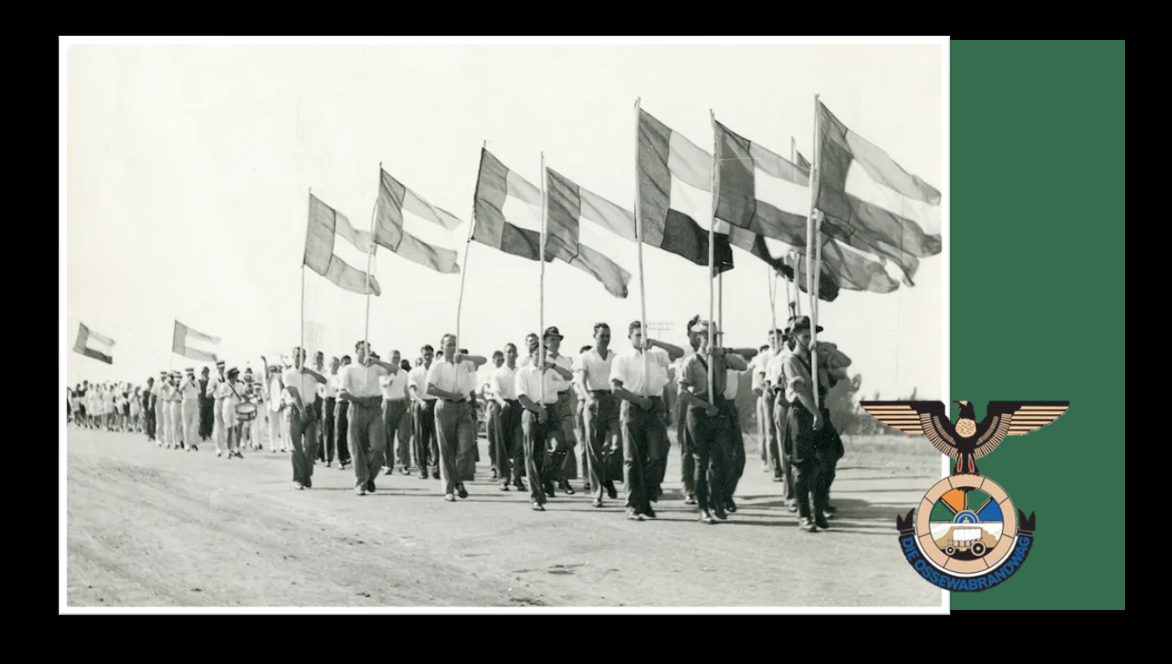
Ossewabrandwag militants on parade with Vierkleur ZAR flags

By the early 1940’s the OB gained its own militaristic wing, called the “Stormjaers”, who countered the South African war effort through sabotage of infrastructure and targeting Jewish businesses. The OB during the war also directly aided the Nazi war efforts aimed at sedition, espionage, spy smuggling, and collecting intelligence in the Union. The post-war Barrett Commission investigation into South African renegades even contains a personal confession ‘van Rensburg vs. Rex’ as to van Rensburg’s regular and treasonous collaboration with Nazi Germany over a set period of time during the war15.

By July 1939, the Black-shirts were formally incorporated into the OB and focussed on the recruiting of “Christian minded National Aryans” into the OB infusing it with more National Socialist “volkisch” Nationalism. This took the OB well beyond its original intention of functioning as a wholesome cultural organ of Afrikanerdom and the National Party16.

The quest for bloodline purity

On the National Party front, the ‘Baster Plakaat’ appeared in the ‘Die Vaderland’ – the National Party’s mouthpiece and the sister newspaper to ’Die Transvaaler’. It appeared on 12 May 1938 and marks the trigger point where ‘Race Law’ starts to enter into National Party thinking from the political front. It marks the advent of a combination of the Nazi Nuremberg Race laws (which banned ‘mixed’ blood marriages of different races and Jews) and Jim Crow American segregation laws (the separation of blacks and whites on which the Nazi German lawyers based their Nuremberg Laws).

The political illustration, known as the “Baster Plakkaat” (miscegenation) released a torrent of criticism and became a media sensation of its time, it caused a lot of discontent between the United Party and the Pure National Party – and for good reason. The essential Law at play in the National Party media mouthpieces is the Nazi law – The Law for the Protection of German Blood and German Honour – propagated in 1935. In the context of the Afrikaner Nationalist mouth-piece this finds expression in a ‘Pure’ Voortrekker woman, in prayer to God and in ‘pure’ white traditional kappie and dress – now “tainted” with “Kaffir” blood, the words ‘dans met Kaffirs’ (dances, i.e to have sexual relations with the black native ‘Kaffirs’) writ in blood … a warning to keep races apart and prevent intercourse lest the purity of soul and the honour of white Afrikanerdom is compromised17.
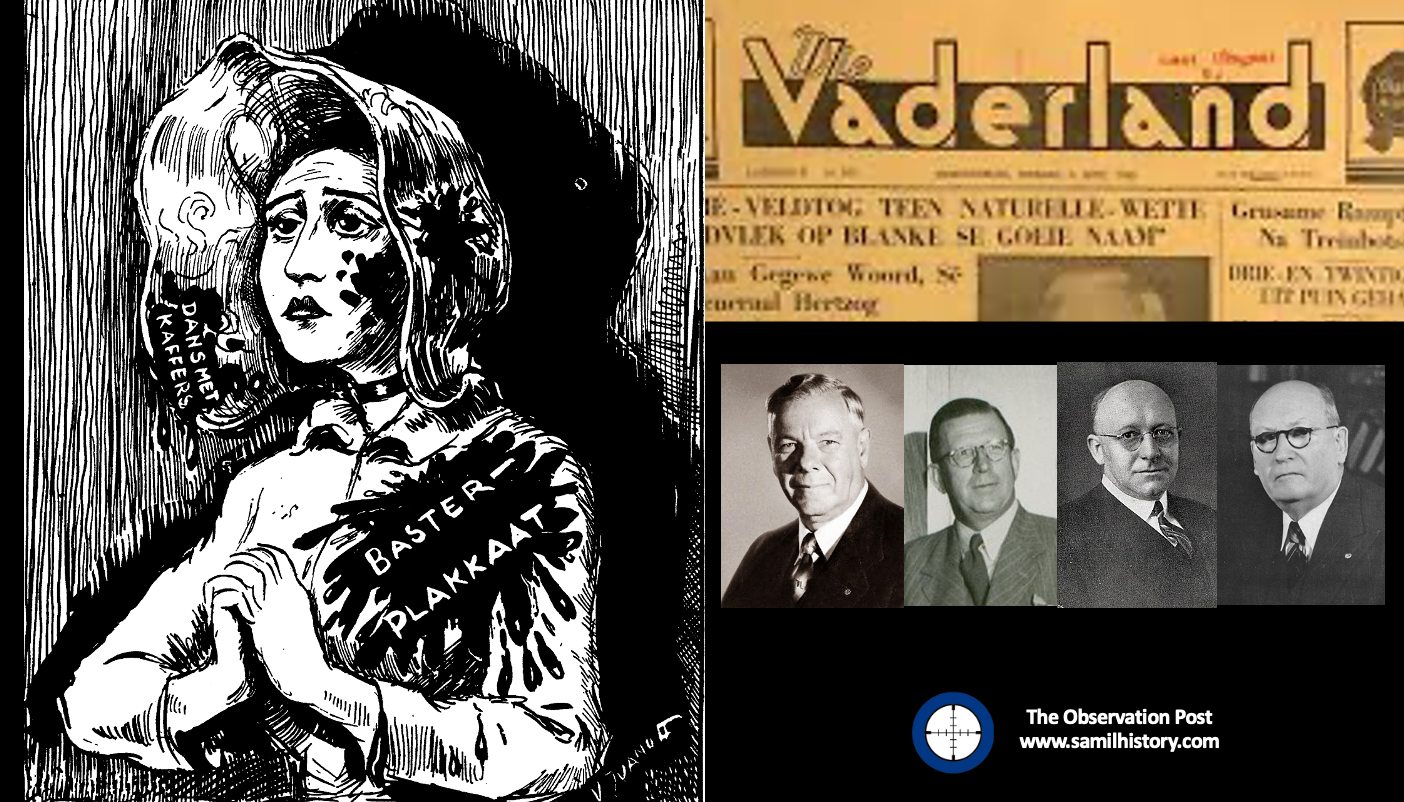
Baster Plakkat in ‘Die Vaderland’ and the Afrikaans media editors – Verwoerd, Dönges, Diederichs, and Malan.

It marks the coming together of two distinctive factions in the National Party. On the one hand the Nederduitse Gereformeerde Kerk (NGK) or Dutch Reformed Church, the “Dominees” (Preachers) in the National Party like Dr. D.F. Malan, whose 1931 – Orange Free State Synod rejects social equality with Blacks and declares Blacks should develop ‘on their own terrain, separate and apart’18 – the idea of mixed marriages and soiling the bloodline of ‘pure’ white Afrikaners discouraged by the NGK. Dr. Malan is also one of the first editors of ‘Die Burger’ another Afrikaner Nationalist mouthpiece.

On the other hand are the Afrikaner “Germanophiles” in the National Party, the ones in open admiration of Hitler and Nazi Germany in the late 1930’s and in lock step with German thinking on race. They all fall part of the National Party’s political think tank, all academic intellectuals – these are primarily Dr. Hendrik Verwoerd (the editor of ‘Die Transvaaler’ and Sociologist), Dr. Nico Diederichs (the Chairman of the Broederbond and Political Scientist) and Dr. Eben Dönges (‘Die Burger’ journalist/lawyer who introduced race-based population registration). 

These are the collectively known as “architects” of Apartheid and it is no surprise given that they all hold positions as editors that the kernel of “race law” thinking – both on the political and theological fronts starts to formulate in the Nationalist media.

Aryan Immigrants only

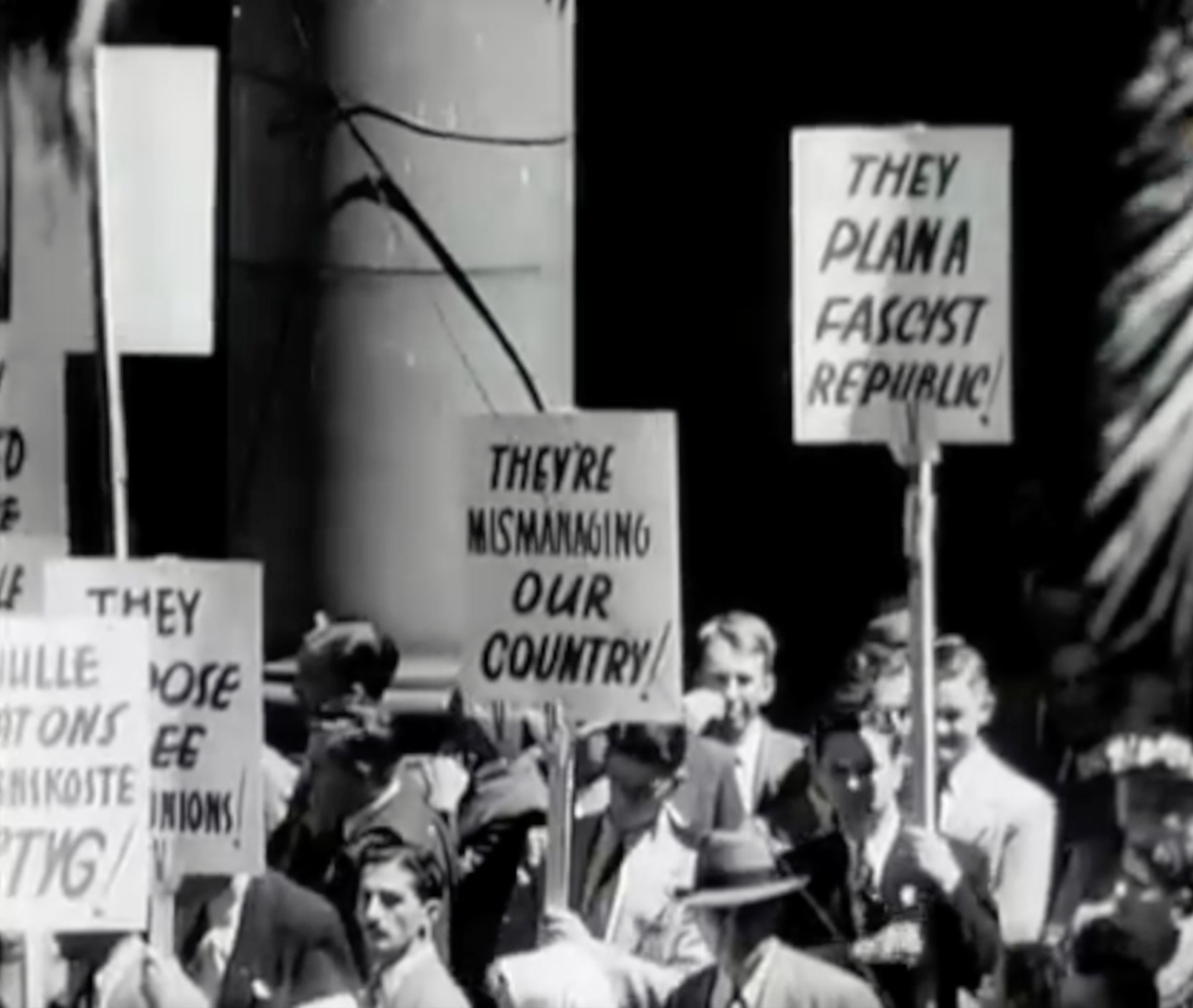
Insofar as Afrikaner “Germanophiles” collaboration and co-operation with Nazi Germany. Prior to the war the Pure National Party was in the process of framing up its policies. The arrival of the S.S. Stuttgart in Cape Town on the 27th October 1936 packed with 537 Jewish refugees on board19 sharply brought the National Party’s policies of immigration and race into focus – it defined what sort of ‘demographics’ the Pure National Party were prepared to focus on to augment the ‘white races’ in South Africa and which were the ‘undesirables’. The arrival of the SS Stuttgart was met with a mass protest of some 3,000 South African Nazi ‘Grey-shirts’20.

Dr. Hendrik Verwoerd was Dutch by birth, but he honed his studies in sociology and psychology in Germany and there is no doubt he was exposed to German politics and the rise of Nazism. Verwoerd showed his antisemitic colours early on when he and a deputation of four fellow minded Nationalist academics – Christiaan Schumann, Dr. Johannes Basson and Dr. Eben Dönges from Stellenbosch University and Frans Labuschagne of Potchefstroom University joined hands with the Nazi Grey-shirts and lodged protest with Hertzog’s’ government as to the immigration of Jews from Nazi Germany.21 At this point these academics were concerning themselves with the poor white problem and ‘völkisch‘ mobilisation warning that Jews were ‘unassailable‘ to the Afrikaner Volk , they met to protest the SS Stuttgart at the University of Stellenbosch on 27 October 1936 and resolved that Jews were ‘undesirable‘ on account of ‘religion’ and ‘blood mingling‘ and that ‘cultural cooperation‘ with them was impossible22.
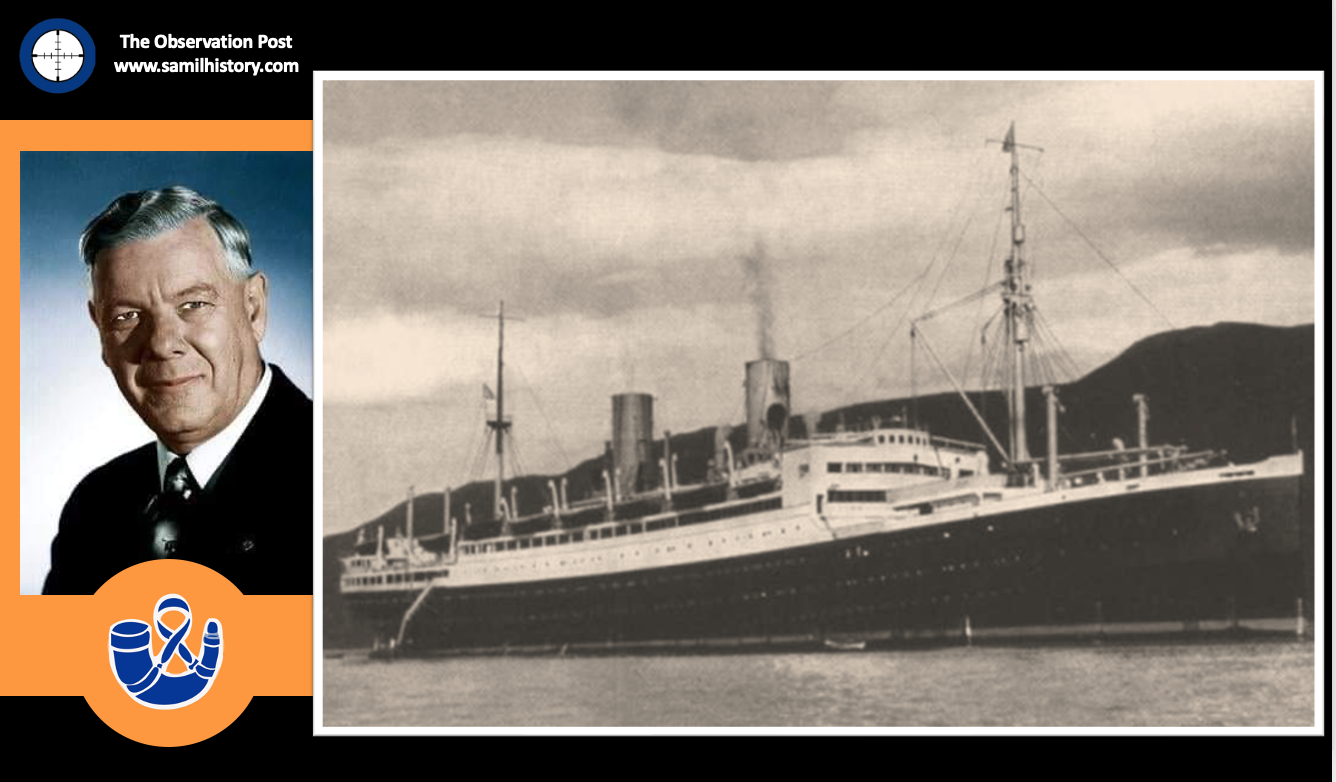
The SS Stuttgart and Dr HF Verwoerd

Frans Erasmus (the future National Party Minister of Defence) would go further on the matter and even officially thank the Grey-shirts on behalf of The National Party for bringing the attention of the ‘Jewish problem to the Afrikaner volk.‘ This in turn spurred Dr. DF Malan to table an Immigration and Naturalisation Bill which sought to exclude immigrants who were ‘unassailable‘ with the culture and even economics of the Afrikaner Volk and deal with ‘the Jewish problem’ as he termed it. This in turn led to the ‘Aliens Bill’ being passed in 193723 by the Hertzog led United Party government which although a watered down version of Malan’s original proposal, still pandered to issue of cultural and economic ‘assimilation’ to prevailing ‘European’ white culture in South Africa – opening the way for the “right kind” of European immigrants (the Aryan kind) and not the wrong kind (the Jewish kind).

The Clouds and Fog of War

With the clouds of war looming in 1939, on the right of Afrikaner political spectrum, all the various movements with Nazi ideologies and/or pro Nazi war effort sympathies inherent in them, the main ones being the New Order, the Grey-Shirts, the Ossewabrandwag, and the Purified National Party with its combination of “Dominees” and think tank “Afrikaner “Germanophiles”, all found themselves in lock step with Nazi Germany.

Enough so that Dr. Nico Diederichs on 9 May 1939, in his capacity of the Chairman of the Broederbond, would meet Herr. H. Kirchner, a Nazi foreign ministry representative in South Africa. Diederichs assures Kirchner that the divisions in Afrikanerdom had been overcome by the purging of Freemasons from Broederbond (which he had personally seen to) – he would go on to say that the Pure National Party (PNP) was a committed anti-semitic party and as policy had hung its hat on it, he assures Kirchner that despite recent statements by Dr DF Malan, Malan is also a committed anti-semitic. Diederichs however feels that more needs to be done to frame up National Party policies in line with National Socialism and confides in Kirchner that he does not think Dr. DF Malan is the man to do it, rather the implementation of the ‘anti-democratic’ and other national socialist principles should he left to Dr. Hans van Rensburg (a PNP member in the Orange Free State and the leader of the Ossewabrandwag) who he also feels would be ideal leader of the Purified National Party going forward24.

In South Africa the overt and even tacit support for Nazi Germany in the white Afrikaner community became openly apparent when Britain and France declared war against Nazi Germany on 3 September 1939. The Hertzog led United Party found itself in a dilemma and a parliamentary three-way debate would take place almost immediately after Britain’s’ declaration. This debate, primarily between the two factions in the United Party (Hertzog’s old National Party cabal and Smut’s old South African Party cabal) and the Purified Nationalists, was whether South Africa should go to war against Germany or remain neutral. General Smuts’ argument surprisingly won the day and Smuts’ amendment to Hertzog’s Motion of Neutrality was carried by 80 votes to 67 votes on the 4 September 1939, and as a result South Africa found itself at war against Nazi Germany. Surprised at the outcome, Hertzog promptly resigned and along with 36 of his supporters left the United Party, thereby leaving the South African Premiership and the leadership of the United Party to Smuts25.

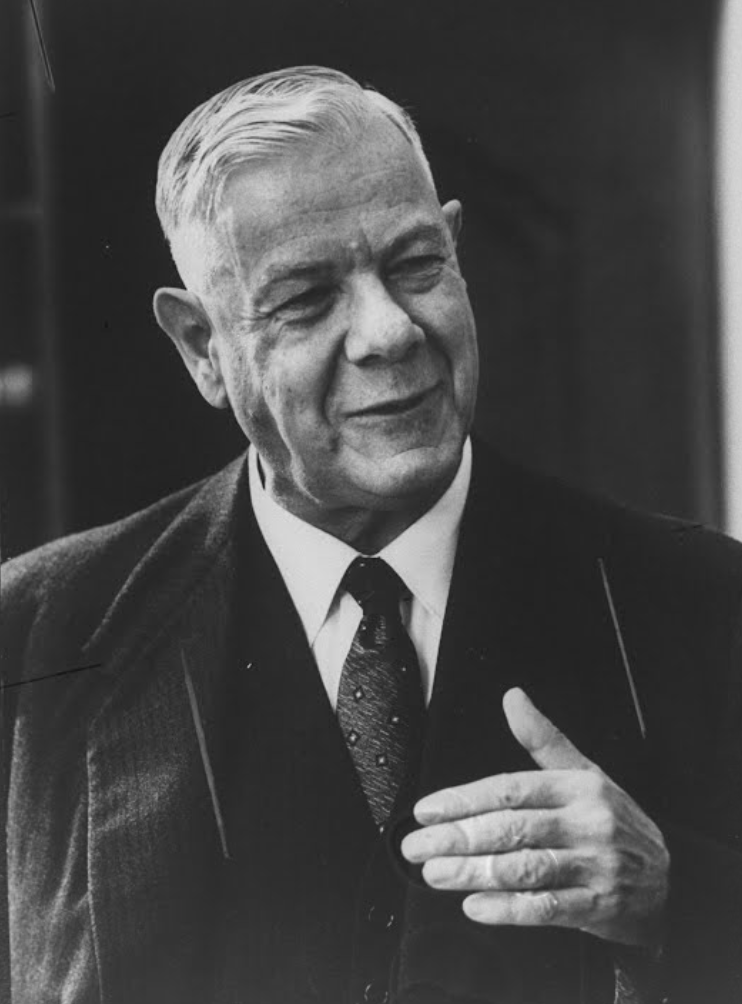
The Purified National Party’s “Malanites” (with its Dominees and its academic think tank Germanophiles) and the United Party’s old National Party fusion “Hertzognites” were able to ultimately reconcile their differences sans Hertzog, all under the leadership of Dr. DF Malan and they reconstituted themselves as the Herenigde Nasionale Party (Reunited National Party) HNP on 29 Jan 1940.

Dr. Malan took a position to remain officially ‘neutral’ as to South Africa’s role in the war, whilst at the same time tacitly approving the Nazi war effort and hoping for their victory. Among the Afrikaners who opposed the war with Nazi Germany, many legally directed their outrage through political expression26 in the HNP. Various splinter group cultural organisations like the Ossewabrandwag and political entities like the Grey-shirts and the New Order surrounding the National Party took a different approach and overtly engaged High Treason activities in support of Nazi Germany’s war effort. These activities were subversive and clandestine actions by nature and aimed at disrupting the South African war effort through bombings, sabotage and intimidation. The Ossewabrandwag’s militant wing Stormjaers were responsible for many of these actions of sabotage, but other groups, such as the Tereurgroep, the x-Group and Robey Leibbrandt’s National Socialist Rebels, were equally active.27

Smuts’ wartime government issued Proclamation 201 of 1939 and the War Measures Act of 1940 (Act 13 of 1940), which provided the government with arbitrary powers for the suppression of subversive organisations and declared them illegal if they presented a danger to the defence of the Union and the Mandated Territory (SWA), public safety and order and the conduct of war28. The suppression of the right wing Afrikaner nationalists involved in sedition, treason and sabotage became a necessity, suspects were held under the Act without trial and interned along with enemy spies and foreign nationals suspected of subversive acts. They were held at six internment camps, namely Baviaanspoort, Leeukop, Andalusia, Ganspan, Sonderwater and Koffiefontein during the war. Col. EG Malherbe, Director of Military Intelligence, noted in his biography that 6,636 people (including POW and German Nationals) were interned during the war29.

Leeuwkop Internment Camp songbook and emergency relief poster for Afrikaner ‘political prisoners’

Of the “political prisoners” interned, the generally accepted number is approximately 2,000 right wing white Nationalists, some future famous names include BJ Vorster (an OB General and future Prime Minister of South Africa), his brother, the Rev. Koot Vorster (an OB General and NGK stalwart), Louis Theodor Weichardt – the leader of the SANP Grey-shirts and Hendrik van den Bergh (an OB stalwart and the future head of the Apartheid regime’s division of State Security).

Post War Reconciliation

At the end of the Second World War, with Nazi Germany’s fate sealed on 7 May 1945, the issue of German National Socialism (Nazism) and Italian Fascism as a viable political undertakings in South Africa became moot. The peripheral Neo Nazi and fascist ‘shirt’ movements, National Socialist ‘volks’ parties, the New Order and the Ossewabrandwag were all gradually welcomed into the Reunited National Party (HNP) under Malan and the Afrikaner Party under Nicolaas Havenga.

Unlike other Allied partners in the war effort against Germany, the Smuts government took a cautious and reconciliatory approach to all its dissonant and irreconcilable white Afrikaner voters who had supported Germany due to cultural and political affiliations prior to and during the war. This affinity for Germany stemmed from the many Afrikaners who had German ancestry as a result of Germans settling in South Africa that by the nineteenth century 33.4% of Afrikaners were of German ancestry, 35.5% of Dutch ancestry, 13.9% of French ancestry, 2.9% of British ancestry and 14.3% of other nations30. As a voter block in a whites dominated franchise this presented a significant demographic to Smuts, and one whose support he needed to remain in power.

Inside South Africa the Nazis had failed in the short-term, but the success of the pro-Nazi and anti-war groupings planted a fertile seed bed for the future authoritarianism of the Apartheid state. The constant depreciation of liberal democracy in this demographic of Afrikaners alongside an almost ‘hysterical exaltation’ for both ‘racist’ and a ‘Völkisch‘ group ethics were to have long term effects31. In essence, although Nazi ideology and dogma was no longer permissible in the political sphere, no measures were put in place by the Smuts government to prevent it from flourishing. Afrikaner Nationalists entertaining strong National Socialist ideologies and having committed high treason and sedition, who in European countries would have been hanged for war crimes, landed up back in mainstream party politics under the banner of the National Party and many even ended their days in Parliament32.

Reigniting Herrenvolk and Weimar Eugenics

Regardless of the outcome of World War 2, Afrikaners who had come under the influence of National Socialist dogma still held Germany in such high esteem that they were prepared to do everything in their power to ensure that the Afrikaners would benefit from Germany’s defeat in 1945 by obtaining for the Afrikaner Volk some of the “valuable blood of the German Herrenvolk”33.

Before and during the war Nazi German emissaries and agents had promised both Dr. DF Malan and Dr. Hans van Rensburg that Germany would help them to establish an Afrikaner hegemony state in Southern Africa along oligarchy and racially differentiated lines, this would include all of South Africa and the British colonies and protectorates of Swaziland, Southern Rhodesia (Zimbabwe), Bechuanaland (Botswana) and Lesotho – but it would exclude German South West Africa (Namibia) which they insisted South Africa return to Germany.

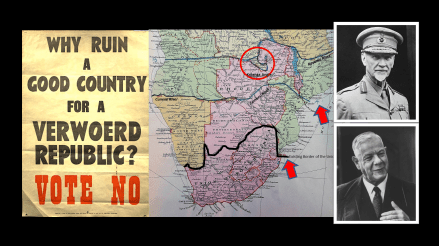
The idea of the re-establishment of the old Boer Republics and the realisation of the vision of an ‘Afrikaans Empire from the Zambezi to the Cape’, a plan announced publicly by senior officials of the ZAR government and Afrikaner bondsmen as early as 188434 – this plan was highly appealing to Afrikaner nationalists. So too was the addressing of the long held animosity to Britain and redressing the loss of the Boer ‘fountain of youth’ in the concentration camps during the South African War – a total of 22,074 children under the age of 1635 (the majority of whom had died of an measles epidemic which swept the camps, the rest succumbing to other diseases – mainly typhoid) . In both instances Nazi Germany would be the enabler of this vision and replenishment of white Afrikaner sovereignty should they win the war – boosted somewhat by the immigration of German ‘Ayans’ to Southern Africa. The outcome of the war did not change this sentiment, vision or objective. Dr DF Malan still pledged that Aryan German immigrants were necessary to cultivate a ‘broad Nordic front to counter Communism, Blacks and Jews’36.
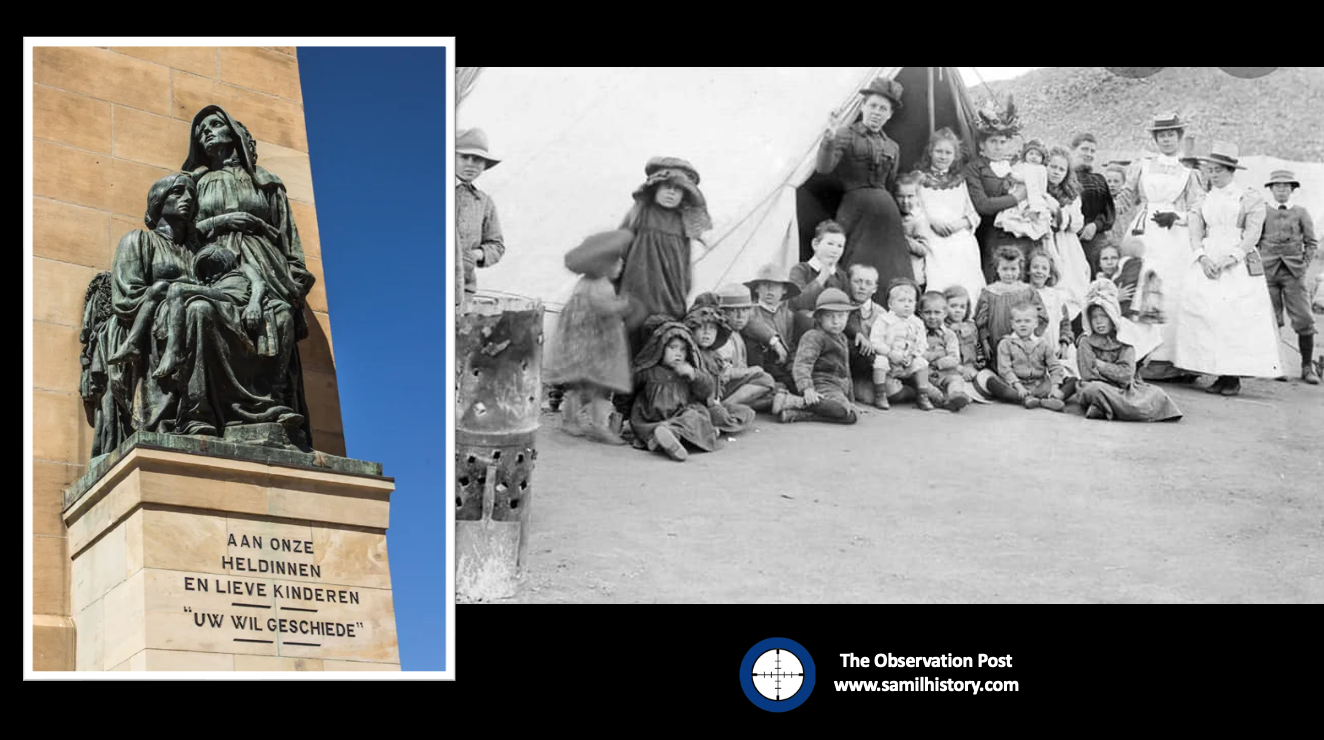
Image of a South African War (1899-1902) bell tent in a concentration camp and the women and children’s memorial to the camps in Bloemfontein

To realise this vision in South Africa post war, the DAHA (Deutsch Afrikanischer Hilfsausschuss) and the VNLK (Women’s Lending Committee) operating under the oversight of the ‘Broederbond’ gathered a quarter of a million pounds between 1945 and 1957 to undertake emergency relief work in post-war Germany. Mrs. Nellie Liebenberg from the VNLK and a previous member of Oswald Pirow’s New Order, alongside her friend Dr. TEW Schumann propose a mission to Germany with the aim of identifying 10,000 handpicked ‘elite’ Aryan orphans and relocating them to South Africa and ‘strengthen their own Afrikaner Volk with the blood of “prestigious” German-Aryan Herrenvolk’37.

This plan to adopt a large number of Nazi war orphans fell under the authority of Dr. Vera Bührmann and Dr. Schalk Botha, and was called the Duitse Kinderfonds (German Children’s Fund), the DKF, once established it attracted huge support the Afrikaner Nationalist elite.

As Werner van der Merwe (an adopted child in the DKF program himself) would summarise in his paper:

‘Some organisations such as the New Order and the Ossewabrandwag overtly favoured a Nazi-like anti-democratic ‘Volkstaat’ for South Africa. It is therefore not surprising that these people were shocked, and even felt betrayed by the Smuts government, when Germany was defeated in 1945. The idea to bring German orphans to (South Africa) was therefore a kind of protest against the defeat of Germany and against South Africa’s participation in the war on the side of Britain. Furthermore, most of the founding members of the DKF were staunch members of either the New Order or the Ossewabrandwag.38

The German Children’s Fund (DKF)

Schalk Botha and Dr. Vera Bührmann (a medical doctor tasked with checking the orphan’s health – as only healthy children will be accepted) fly to Germany on behalf of the DKF on 27 April 1948. They aim to locate healthy White, German, Protestant orphans aged between 3 and 8 years old. They target the Schleswig-Holstein region, for two reasons – firstly it is in the most Northern German state bordering Denmark and would offer the most ‘Aryan’ and ‘Nordic’ orphans, secondly it is occupied by the British and has 1.2 million displaced refugees. Botha hopes to gain sympathy from the British for his ambitious plan and alleviate the humanitarian aid pressure on them. From 22 May 1948, Botha broadly advertised in the local papers looking for children who could emigrate to South Africa, with the prerequisite that they should be German, white and Protestant39.

Shortly after the arrival of the DKF in Germany, there is step-change in South African governance when the National Party, against the odds, wins the General Election on 26 May 1948. With any impediments of the Smuts government out the way Botha is confident of his plan and the support of the local Schleswig-Holstein authorities. However his plan hits its first real impediment when the Schleswig-Holstein government meets on 30 May 1948 and rejects the adoption of children for collective emigration. This forces Botha, as a last ditch effort, to approach the Interior Minister of Schleswig-Holstein, Wilhelm Käber, Käber is known to have “pro-Boer” sentiments and influenced by the pre-war “Ohm Krüger” (Uncle Kruger) sentiment and propaganda. Käber takes sympathy and despite reservations and criticisms agrees to a limited collective emigration. This is later ratified by his government on the proviso it is limited to orphans only40.
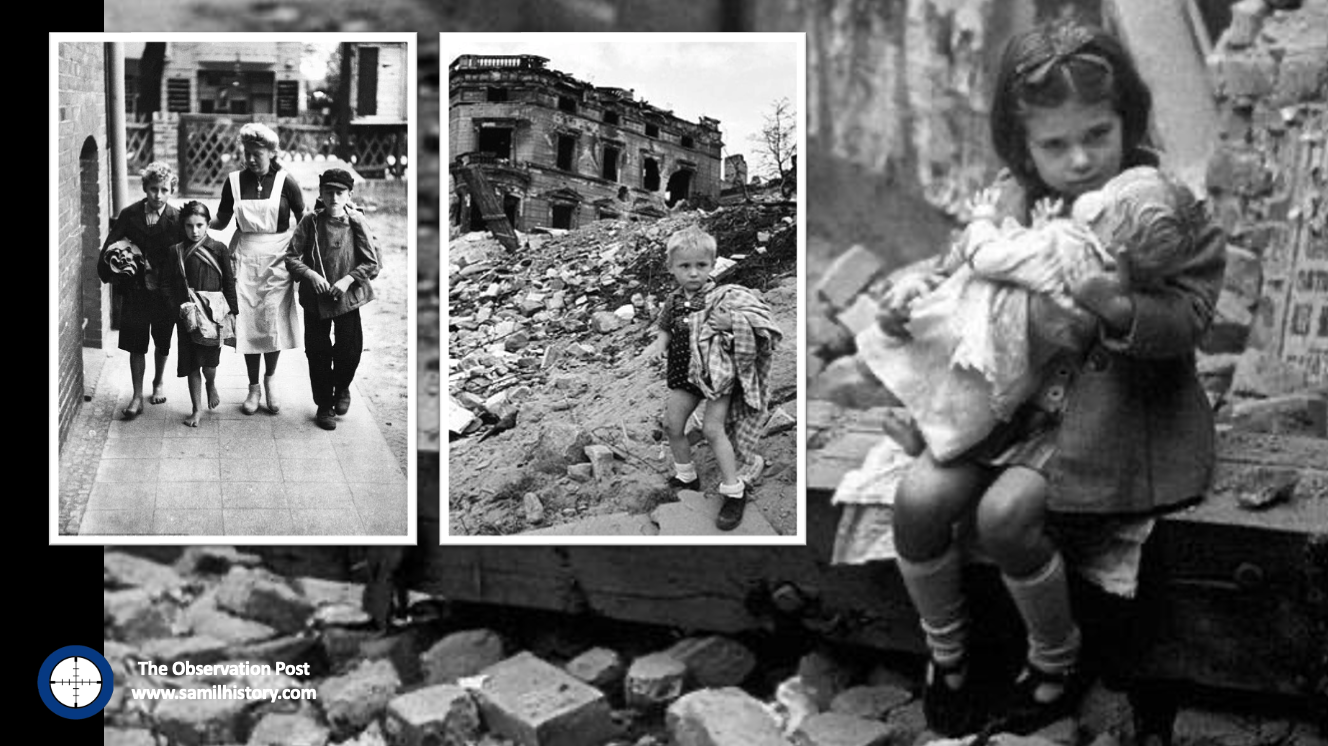
Post war Germany 1945 and displaced or orphaned children

The DKF hits another significant setback when they start their adoption campaign. Most children don’t meet the profile of ‘orphan’ and many have existing parents which due to war are displaced or traumatised and have offered their children to homes. However a greater problem is found on the ‘health’ front, Dr. Vera Bührmann rejects a significant number of children due to malnutrition, mental trauma or tuberculosis, so much so that Botha reports to the board of the DKF that numbers are insufficient and the age limits and orphan status need to change to throw the net wider.

In the end the age criteria is changed from 2 to 13 years old and Botha and Bührmann are able to only identify 87 children, many of which are not really orphans and almost all of them still have families. However, a general apathy sets in and nobody in the German authority gives the necessary oversight to control this. The initial 83 children are packed off to South Africa on 20 August 1948 via the United Kingdom, boarding a Union Castle line to Cape Town (the other 4 would join later)41 .
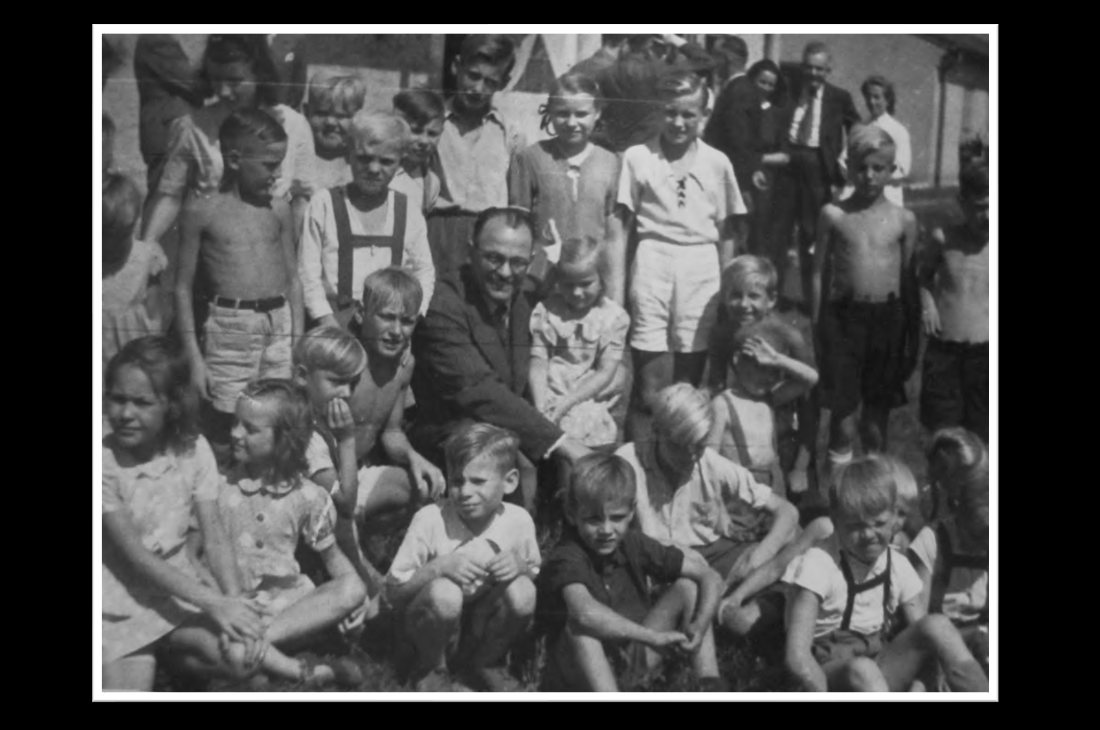
Group portrait of the children on their way to South Africa, Schalk Botha is seated in the middle.

Back home in South Africa, the Afrikaner press carried advertisements for volunteer parents. Only Afrikaans speakers and members of the Dutch Reformed Church were eligible to adopt a child. 450 parent couples expressed interest in adopting a child. With limited numbers, preference was given to families regarded as ‘Afrikaner elite’. The children arrived in Cape Town on 8 September 1948 to a media scrum. They were taken to the German Club to meet more press and prospective parents. The older children would describe the scene as a “cattle market”.42

Some good, some mixed results

Prime Minister D.F. Malan, wrote to the The German Children’s Fund to express his interest in adopting a child. It went without saying that the application of a person of his stature would be successful, it would create all the necessary hype, and he and his wife Maria would have first choice from the new arrivals in Cape Town. However the Malan’s only want a little girl. Maria Malan selects four-year-old Hermine from Deezbüll near Husum and gives her a new name: Marietjie. To Maria, it was a “spiritual birth” to the new child – Marietjie means “little Maria” however “Marietjie” also has alongside her, her inseparable two-year-old brother Gerhard, so as siblings they are dutifully torn apart43.

It takes approximately a week until all the children are distributed to their new parents. Some travelled by train to Pretoria, and are welcomed by the Kappiekommando – a woman’s brigade strictly of ‘Boer’ heritage (known for wearing the traditional Dutch ‘kappie’ head-dress). Most of the adoptive parents were well to do Afrikaner nationalists who had served in the higher structures of the Broederbond, the National Party, the Ossewabrandwag, New Order and the Grey-shirts. It is no surprise really that many of these children went on to receive privileged lifestyles and educations. Some making important contributions.
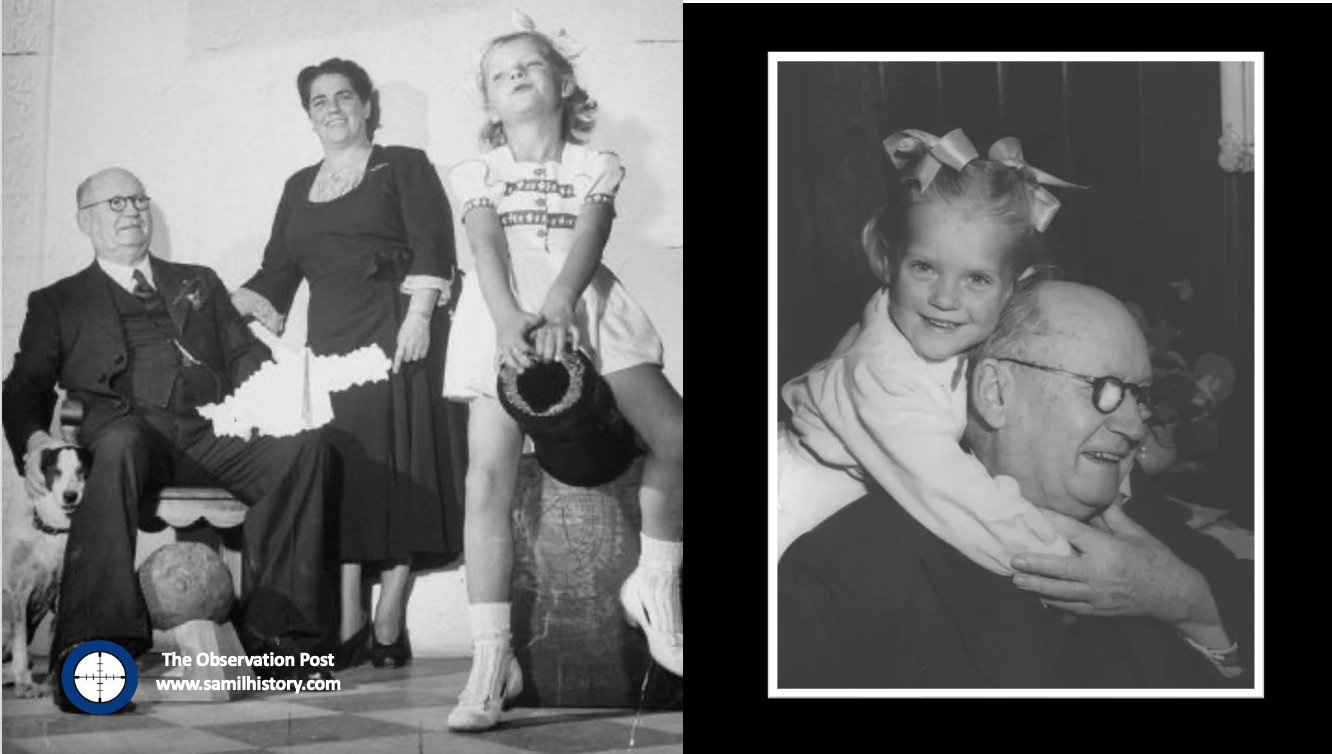
Press Release photographs of Marieke Malan and her adoptive parents Dr. DF Malan and Maria Malan

Marietjie Malan, would soon wrap the Prime Minister around her little finger. Members of the press, accustomed to running into a brick wall when they attempted to interview Malan, witnessed Malan’s stern features softening when Marietjie appeared. She was the only person who was able to circumvent Maria’s strict rule that Malan was generally not to be disturbed. Yet, while Malan strolled and played with his new daughter the violent outcome of Malan’s intense race politics was beginning to play out in South Africa.

Werner Nel, one of the more famous of the children, became an internationally renowned operatic baritone, and later a professor of music at Potchefstroom University.  He even went on to receive the South African Academy of Science and Art award, the Huberte Rupert Prize for classical music. Other predominant children from this program included Professor Eike de Lange, Professor Siegfried Petrick (Veterinary Science) and Professor Werner van der Merwe (History).

There were some mixed results, some of the orphans even had a tough time. Future pig farmer Herbert Leenen found himself used as no more than a farm labourer by his new family and eventually broke ties with his new “parents”.

Some very bad results!

However, here were also some “bad eggs” – here, the issue points to nurture and not nature. One particular adopted child is standout, as not only does he effectively assimilate into his new environment, he brings to it just about everything the Nazi regime stands for and is feared for. Whilst in Germany, when Schalk Botha arranged for the lifting of the age requirement of the DKF to 13 years old – a problem would arise with pre-nurtured and pre-conditioned children exposed to Nazism. Aware of this, Dr. Vera Bührmann took pity on one such Prussian teenager – 13 year old Lothar Paul Tietz, whose brother and sister had made the cut and he was ‘on the edge’ of the spectrum. Coming from a committed Nazi family how their parents were killed is not known, what is known is that towards the end of the war the Tietz siblings were moved to an orphanage in Elbing, here Bührmann was able to interview them, Lothar Tietz later recalled in a SABC TV interview that he pleaded with “Tanti Vera” to keep the three of them together, an impressive boy, Lothar Teitz was tall and polite – he had received five years of National Socialist education and had been exposed to the Hitler Youth44.

As the oldest of all the 83 children allocated to the initial voyage to Cape Town, Lothar Teitz took the role of ‘head boy’ in organising the children. Once in South Africa the Tietz children were separated. Lothar Tietz was handpicked for adoption by the Chairman of the Pretoria branch of the DKF, Dr. JC Neethling. Dr. Neethling had himself been interned by the Smuts government during WW2 for pro-Nazi sedition, he had been a ‘Grey-shirt’ and later a ‘Black-shirt’. Eager to assimilate into his new culture and desperate for a sense of “order”, Lothar adopted the Neethling surname, cut ties with Germany and was to quote him “pleased to adopt my new fatherland “45.

Lothar Neethling did his utmost to ingratiate himself with his hosts by becoming a better Afrikaner than his classmates – excelling in rugby, school work, and absorbing every nuance of Afrikaner culture. The very astute and bright Lothar Neethling would grow up to become a General in the South African Police Force, and eventually Chief Deputy Commissioner of the Police (scientific and technical services) during the Apartheid era.

He also became a respected scientist in his own right, earning two doctorates in forensics – one from the University of California – and was honoured by several prestigious international scientific associations. He became a member of the Afrikaans Academy of Arts and Science and his scientific work earned him awards including a golden award from AAAS and a medal from the Taiwanese government. In 1971, Neethling founded The South African Police’s forensic unit. His work in the unit earned him seven SAP awards and three years later he was appointed Chief Deputy Commissioner.

However some serious clouds were brewing over General Lothar Neethling. In November 1989 Captain Dirk Coetzee, the former commander of the “Vlakplaas” South African Police “death squad”, pulled the plug on “hit squads” with a newspaper scoop. Among his allegations was that Neethling used the police forensic laboratories he controlled to supply him with “knock-out drops” for the murder of anti-Apartheid activists. Coetzee alleged that he would collect the poison – known to him as “Lothar’s potion”, from Neethling’s home or from his laboratory, and administer to it to suspects and kill them. It would eventually earn Lothar Neethling the monstrous title of South Africa’s “Dr. Mengele”46.
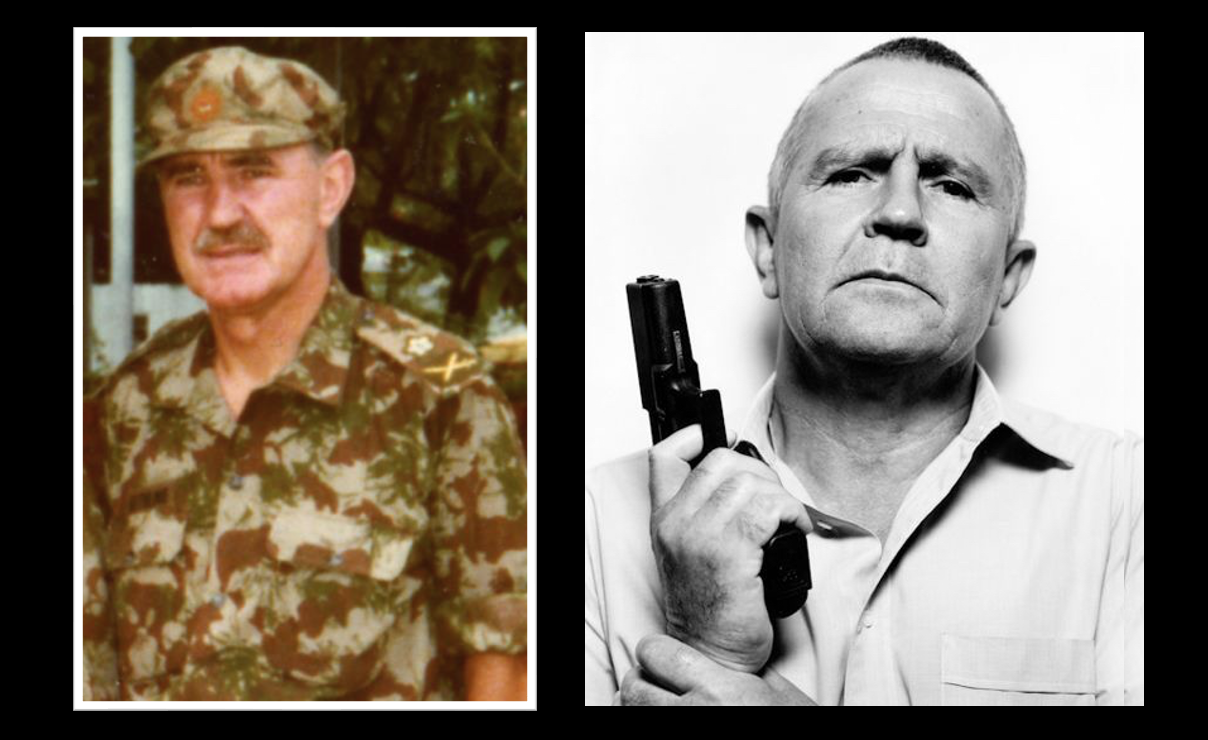
General Lothar Neethling (left) courtesy Nonquai and Captain Dirk Coetzee (right)

The Truth and Reconciliation commission also established the role played by Neethling’s laboratories in the production and supply of poisons to assassinate anti-apartheid activists, and also revealed Lothar Neethling was the number-two man in Dr. Wouter Basson’s biological and chemical warfare programme. Numerous court cases followed finding Neethling’s testimony unreliable or inconclusive. In a hail of controversy, charges and allegations, Lothar Neethling died of lung cancer in Pretoria on 11 July 2005, aged 69.  Whether the allegations were founded or not, his legacy and that of the DKF’s adoption program would be forever tarnished. Whether earned or not, his legacy as South Africa’s “Dr. Mengele” has now entered into the Apartheid lexicon47.

In Conclusion

There has been a long standing debate in academic circles, and it evolves around Apartheid’s origins and historiography. Two sides emerged from the debate, both agree that the origin of Apartheid is slavery in the Dutch Cape Colony, however after that the two arguments go separate ways.

One group points to the Voortrekker’s Puritan religious standpoint which brought the idea of “separate worship” for Blacks and Whites into Dutch Reformed Church (NGK) policy. The epicentre is the Zuid-Afrikaansche Republiek (ZAR) NGK Synod in 1857 and subsequent Synods and NGK Dominees come to define Apartheid along the lines of Jim Crow Laws, Darwinist Eugenics and Southern American State Segregation policies. This group defines Apartheid as a derivative of American Segregation along ecclesiastical lines.

The other group points to the advent of National Socialism (Nazism) in the mid 1930’s as the key political driver of Apartheid’s origin, and they name the National Party’s ‘Think Tank’ Professors and academics who are all enamoured and besotted with Nazi Germany, anti-Semitism, Nuremberg Race Laws and Weimar Eugenics as the chief proponents of it. This group would define Apartheid as a derivative of National Socialism along party political and ideological lines.

Stepping into the fray to sort the argument out once and for all in 2003 was the heavy-weight Afrikaner historian – Professor Hermann Giliomee. He concluded in his work ‘the making of Apartheid’ that the essence and origin of Apartheid lay along the NGK’s ecclesiastical lines and had nothing to with Nazism. He cites a famous speech by Dr. DF Malan in 1947, and taking it at face value he formats it as the crux of his argument, it’s a speech where Malan declares that it is not the state that took the lead with Apartheid, it was the NGK Church who led it and the NGK Synod in 1857 marks the start of it48.

What Professor Giliomee loses sight of by quoting DF Malan, is it is this very man who is front a centre in a very Weimar Eugenic based Aryan adoption program to boost the bloodline of white Afrikaners with Nazi German Herrenvolk blood and to advance an Völkisch ideology in South Africa. Malan not only opens the way for this ideology and thinking by the “Germanophiles” and wartime pro-Nazi leaders in his party, he even adopts one of the children. The DKF is not only inspired by National Socialist dogma, it is a vert practical and realistic application of it in South Africa.

Giliomee also loses sight of the fact that Malan makes this declaration in 1947, after the end of the war in 1945 and the exposure of Nazism and its ideological connection to the holocaust, and by deflecting to the NGK church (to which he is pre-disposed to do as a Dominee anyway) he is gaslighting for the plethora of “Germanophiles” who have been advocating National Socialism in all the various Afrikaner Nationalist cultural, media and political structures and who have all subsequently been warmly welcomed into the HNP’s fold and its leadership caucus. Especially after their 1948 election win and the merger with the Afrikaner Party to reconstitute the HNP as the “National Party” (NP).

To be fair to Giliomee, what he does not have sight of in 2003 is all the recently uncovered archive files and materials found 20 years later. Documents on the Ossewabrandwag pointing to Nazi collusion – files, court records, letters, memos and confessions from South African Nazi renegades within Afrikaner nationalism captured and interrogated in the Rein Commission and published in the Barrett Commission findings after the war – files which were, until recently, regarded as either missing or embargoed. Even the recent findings and academic works on the Nazi German propaganda program in South Africa makes for an eye-opening historiography of Apartheid.

Previously embargoed or missing files – primary source material – have now finally put the nail into the ecclesiastical argument as the sole origin and development of Apartheid and we can now finally conclude that not only was Apartheid ‘invented’ by the NGK, it was subsequently infused with National Socialism – and although not Nazism in its purest form it is indeed a derivative of Nazism. The German Herrenvolk blood for the Afrikaner Volk adoption program run by the DKF after the war is just one such practical example which underscores this conclusion.


Written and Researched by Peter Dickens

References:

  • Wener van der Merwe. Herrenvolk Bloed vir die Afrikaner: Veertig Jaar Duitse wees kinders (1948-1988) UNISA on line journal.
  • Wener van der Merwe, Vir ‘n ‘Blanke Volk’: Die Verhaal van die Duitse Weeskinders van 1948 (Johannesburg: 
Perskor-Uitgewery, 1988)
  • Jonathan Hyslop. White Working Class Women and the Invention of Aparthied: ‘Purified’ Afrikaner Agitation for Legislation against Mixed Marriages 1934-1939. Journal of African History Vol 36, No 1 (1995) published by Cambridge University Press 
  • Andries M Fokkens. Afrikaner unrest within South Africa during the Second World War and measures taken to suppress it. Faculty of Military Science, Stellenbosch University. Journal 37(2) 2012.
  • Hermann Giliomee. The Making of the Apartheid Plan, 1929-1948. Journal of Southern African Studies , Vol. 29, No. 2 (2003). Publisher, Taylor & Francis.
  • Furlong, Patrick J. Pro-Nazi Subversion in South Africa, 1939-1941. 1988. Ufahamu: A Journal of African Studies, 16(1)
  • Maritz, Manie ‘My Lewe en Strewe’ Pretoria 1939
  • Karl Dahmen. Wer hat Angst vor dem schwarzen Land? Die kollektive Adoption norddeutscher Kinder nach Südafrika (Who’s afraid of the black country? The collective adoption of north German children to South Africa), Demokratische Geschichte / Gesellschaft für Politik und Bildung Schleswig-Holstein e.V, 2010.
  • Gavin Evans. The man with the deadly past. Mail and Guardian, 28 August 1998. Interview with General Lothar Neethling
  • Max Du Preez. SA’s own bemedalled Dr Mengele is dead. IOL, 13 July 2005.
  • Chris Ash. Kruger’s War – the truth behind the myths of the Boer War. Durban: 30 degrees South Publishers, 2017.
  • Bunting, Brian. The Rise of the South African Reich. Penguin Books. 1964
  • Harrison, David. The White Tribe of Africa: South Africa in Perspective. Macmillian Publishers. 1981
  • Kleynhans, Evert – Hitler’s Spies, Secret agents and the intelligence war in South Africa, 1939 to 1945. Jonathan Ball. 2021
  • Milton, Shain. A Perfect Storm – Antisemitism in South Africa 1930-1948. Jonathan Ball. 2015
  • Mouton, F.A. The Opportunist: The Political Life of Oswald Pirow, 1915-1959. Pretoria: Protea Boekhuis. 2022
  • Shirer, William. The Rise and Fall of the Third Reich: A History of Nazi Germany. Simon and Schuster. 1974 edition.
  • Strydom, Hans. For Volk and Führer: Robey Leibbrandt & Operation Weissdorn. Jonathan Ball. 1982
  • Visser, George C. OB: Traitors or Patriots. Macmillian. 1976
  • Bloomberg, Charles. Christian Nationalism and the Rise of the Afrikaner Broederbond in South Africa, 1918 to 1948. Indiana University Press. 1989 
  • Bouwer, Werner. National Socialism and Nazism in South Africa: The case of L.T. Weichardt and his Greyshirt movements, 1933-1946
  • Fokkens, A.M. Afrikaner unrest within South Africa during the Second World War and the measures taken to supress it. Journal for Contemporary History 37/2. 2012
  • Furlong, Patrick J. Allies at War? Britain and the Southern African Front in the Second World War. South African Historical Journal 54/1. 2009
  • Furlong Patrick Jonathan – National Socialism, the National Party and the radical right in South Africa, 1933-1948 (D.Phil. Thesis, University of California, 1990
  • Furlong, Patrick J. Pro-Nazi Subversion in South Africa, 1939-1941. 1988. Ufahamu: A Journal of African Studies, 16(1) 
  • Grundlingh, Albert. ‘The King’s Afrikaners? Enlistment and Ethnic Identity in the Union of South Africa’s Defence Force during the Second World War 1939-45’. Journal of African History 40 (1999).
  • Marx, Christoph. Ox wagon Sentinel: Radical Afrikaner Nationalism and the History of the Ossewabrandwag. South African University Press. 2008
  • Monama, Frankie. Wartime Propaganda In the Union of South Africa, 1939 – 1945. Dissertation, University of Stellenbosch. 2014
  • Mouton, F.A. 2018 ‘Beyond the Pale’ Oswald Pirow, Sir Oswald Mosley, the ‘enemies of the Soviet Union’ and Apartheid 1948 – 1959. UNISA, Journal for Contemporary History 2018
  • Scher, David M. Echoes of David Irving – The Greyshirt Trial of 1934.
  • Werner, Bouwer. National Socialism and Nazism in South Africa: The case of L.T. Weichardt and his Greyshirt movements, 1933-1946 

Footnotes

  1. van der Merwe, Herrenvolk Bloed vir die Afrikaner, Page 78 ↩︎
  2. Bunting, The Rise of the South African Reich, 57 ↩︎
  3. FA Mouton, ‘Beyond the Pale’ Oswald Pirow, Sir Oswald Mosley, the ‘enemies of the Soviet Union’ and Apartheid 1948 – 1959,  Journal for Contemporary History, 43, 2 (2018), 18. ↩︎
  4. FL Monama, Wartime Propaganda in the Union of South Africa, 1939 – 1945 (Dissertation for the degree of history, University of Stellenbosch. Stellenbosch, 2014), 62. ↩︎
  5. M Shain, ‘A Perfect Storm’, Antisemitism in South Africa 1930-1948, (Johannesburg: Jonathan Ball Publishers, 2015) , 55–58. ↩︎
  6. W Bouwer, National Socialism and Nazism in South Africa: The case of L.T. Weichardt and his Greyshirt movements, 1933-1946. (MA Thesis, University of the Free State, Bloemfontein 2021), 18. ↩︎
  7. Shain, A Perfect Storm, 84 ↩︎
  8. Shain, A Perfect Storm, 76. ↩︎
  9. Shain, A Perfect Storm, 82. ↩︎
  10. Shain, A Perfect Storm, 230. ↩︎
  11. Harrison, The White Tribe of Africa, 103 – 106. ↩︎
  12. DP Olivier, A special kind of colonist: An analytical and historical study of the Ossewa-Brandwag as an anti-colonial resistance movement (thesis, University of the North West, Potchefstroom 2021),  ↩︎
  13. Bunting, The Rise of the South African Reich, 84 ↩︎
  14. Bunting, The Rise of the South African Reich, 92 – 93 ↩︎
  15. EP Kleynhans, Hitler’s Spies, Secret agents and the intelligence war in South Africa, 1939 to 1945. (Johannesburg: Jonathan Ball, 2021), 199. ↩︎
  16. Shain, A Perfect Storm, 238 ↩︎
  17. J Hyslop. White Working Class Women and the Invention of Aparthied: ‘Purified’ Afrikaner Agitation for Legislation against Mixed Marriages 1934-1939, 76 ↩︎
  18. H Giliomee. The Making of the Apartheid Plan, 1929-1948. Journal of Southern African Studies , Vol. 29, No. 2 (2003), 382 ↩︎
  19. Shain, A Perfect Storm,131 ↩︎
  20. Shain, A Perfect Storm,134 ↩︎
  21. Shain, A Perfect Storm,132 – 133 ↩︎
  22. Shain, A Perfect Storm,133 ↩︎
  23. Shain, A Perfect Storm, 143-149 ↩︎
  24. Rein Commission. Unpublished ↩︎
  25. Bunting, The Rise of the South African Reich, 85. ↩︎
  26. AM Fokkens. Afrikaner unrest within South Africa during the Second World War and measures taken to suppress it. Journal 37, No. 2 (2012), 142 ↩︎
  27. AM Fokkens. Afrikaner unrest within South Africa during the Second World War and measures taken to suppress it. Journal 37, No. 2 (2012), 142 ↩︎
  28. DODA: DC 3841, file DF/1887, proclamation 44 of 1941 ↩︎
  29. AM Fokkens. Afrikaner unrest within South Africa during the Second World War and measures taken to suppress it. Journal 37, No. 2 (2012), 135 ↩︎
  30. AM Fokkens. Afrikaner unrest within South Africa during the Second World War and measures taken to suppress it. Journal 37, No. 2 (2012), 129 ↩︎
  31. PJ Furlong. Pro-Nazi Subversion in South Africa, 1939-1941. 1988. Ufahamu: A Journal of African Studies, 16(1)  ↩︎
  32. PJ Furlong. Pro-Nazi Subversion in South Africa, 1939-1941. 1988. Ufahamu: A Journal of African Studies, 16(1) ↩︎
  33. Werner van der Merwe. Herrenvolk Bloed vir die Afrikaner: Veertig Jaar Duitse wees kinders (1948-1988) UNISA on line journal, 78 ↩︎
  34. C Ash, Krugers War, the phrase initiated the ZAR official Rev. SJ Du Toit after the London convention in 1884 ‘The South African Flag shall yet wave from Table Bay to the Zambezi, be that end accomplished by blood or by ink. If blood it is to be, we shall not lack men to spill it.’ is repeated by ZAR politicians and Afrikaner bondsmen up to and including Jan Smuts’ final statement in Oct 1899 prior to the start The South African War. ↩︎
  35. Maritz, ‘My Lewe en Strewe’, 269 ↩︎
  36. W van der Merwe. Herrenvolk Bloed vir die Afrikaner, 81 ↩︎
  37. W van der Merwe. Herrenvolk Bloed vir die Afrikaner, 85 ↩︎
  38. W van der Merwe. Herrenvolk Bloed vir die Afrikaner, 78 ↩︎
  39. K Dahmen. Wer hat Angst vor dem schwarzen Land?, 114 – 115 ↩︎
  40. K Dahmen. Wer hat Angst vor dem schwarzen Land?,115 ↩︎
  41. K Dahmen. Wer hat Angst vor dem schwarzen Land?,119 ↩︎
  42. K Dahmen. Wer hat Angst vor dem schwarzen Land?,119 ↩︎
  43. K Dahmen. Wer hat Angst vor dem schwarzen Land?,122 ↩︎
  44. Evans. The man with the deadly past. M&G 1998. ↩︎
  45. Evans. The man with the deadly past. M&G 1998 ↩︎
  46. Du Preez. SA’s own bemedalled Dr Mengele is dead. ↩︎
  47. Du Preez. SA’s own bemedalled Dr Mengele is dead. ↩︎
  48. H Giliomee. The Making of the Apartheid Plan, 383. ↩︎
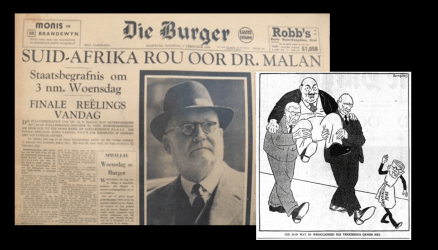
Just whistling an innocent ‘toon’

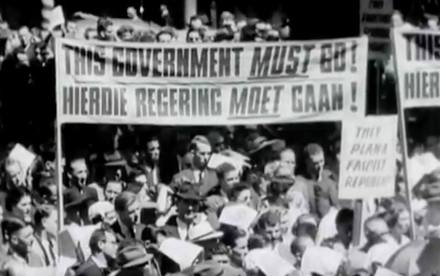
There are still people out there who will tell you that the old National party was just whistling on a innocent tune, they were merely on a ‘anti-British’ ticket thanks to the Boer War, without a shred of consideration of exactly what ticket it was really on, and a good example is the political cartoon (or ‘toon’) and newspaper reflected on the banner.

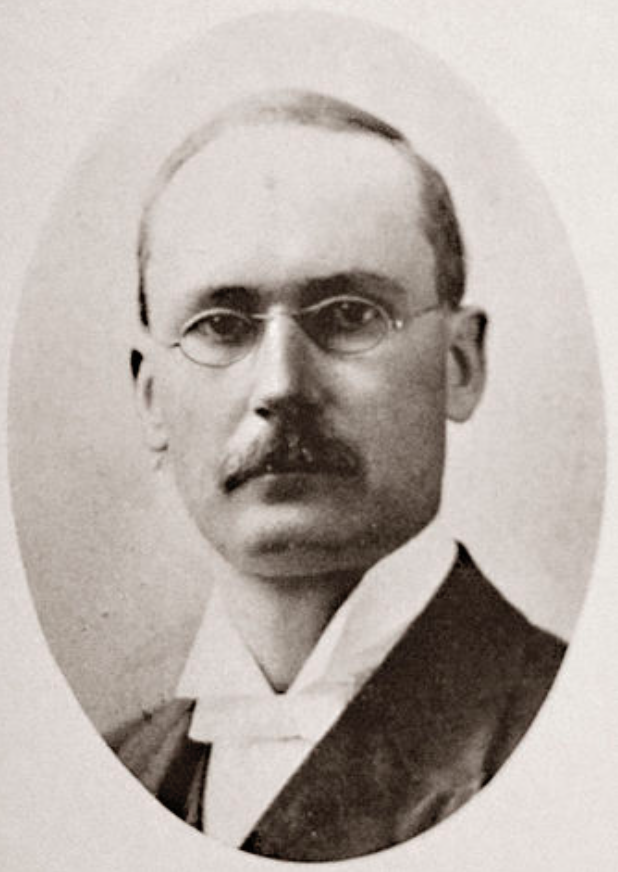
Dr D.F. Malan in 1915

In addition to being ‘anti-British’ – the Nationalists in 1938 had also taken on a strong ‘anti-Semitic’ guise – strongly influenced prior to the war by Nazi Germany and splinter right wing ‘shirt’ movements – the Greyshirts and Blackshirts in South Africa supporting Nazi ideology and even by the National Party’s leadership itself. This pro-Nazi Germany, National Socialist and anti-Semitic positioning found its way into cultural groupings affiliated to the National Party such as the Ossewabrandwag, Pirow’s New Order and others. It would really start to manifest itself publicly around two events – the 1938 Great Trek Centennial and the arrival of Jewish refugees on the S.S. Stuttgart in 1936.

Dr Hendrik Verwoerd (Broederbond member and future National Party Prime Minister) showed his colours early on when, prior to the war, The South African Christian National Socialist Movement  (i.e. South African Nazi Party, SANP or ‘Greyshirts’) and their affiliated ‘Blackshirts’ held a large rally and protested the arrival of the S.S. Stuttgart in Cape Town from Nazi Germany on the 27th October 1936 with 600 Jewish refugees on board. The Nationalists joined hands with the SANP and a few days later on 4 November, Dr Theophilus E. Dönges (future NP Acting National Party Prime Minister) would nail the Nationalists colours to the mast on the matter and said: “the Jew is an insoluble element in every national life.” 

They were joined by Dr Verwoerd and five fellow professors from the University of Stellenbosch who all went in deputation to the government to protest against Jewish Refugees arriving from Nazi Germany. Frans Erasmus (Ossewabrandwag member and future National Party MP) would go further on the matter and even officially thank the South African Nazi Party on behalf of The National Party for bringing the attention of the “Jewish problem to the Afrikaner ‘volk’.”

By the time the Broederbond’s Chairman, Henning Klopper, inspired the Ox Wagon Centennial in 1938, this anti-semitism had really taken root, making it very clear in written notification that their event off limits for “Jews”. When Solly Sachs requested his garment union’s participation in the 1938 Ox Wagon centennial (Sachs sympathised with the poor living and working conditions of many rural Afrikaner girls who came to work in the Johannesburg garment industry during the Great Depression), he received a letter from the Centennial organisers which read: 

“The Afrikaner nation is busy uniting, to mobilise its forces against you and your sort. The thousands of Afrikaner daughters whom you have in your clutches will settle with you … Our people do not want anything to do with Communists and Jews, the high priests thereof, least of all. The day when we Afrikaners begin to settle with you Jews, you will find out that Germany is a Jewish paradise compared with what South Africa will be.”

Such was the nature of the Centennial organisers, who in turn went on to start the overtly pro-Nazi, Ossewabrandwag (Ox-Wagon Fire Watch) on the back of the centenary. One also has to remember that the Transvaal branch of the ‘Pure’ National Party as late as 1943 truly nailed their colours to the mast once and for all and officially ‘banned’ Jews from joining the National Party, such was the depth of anti-Semitism in the Afrikaner right.

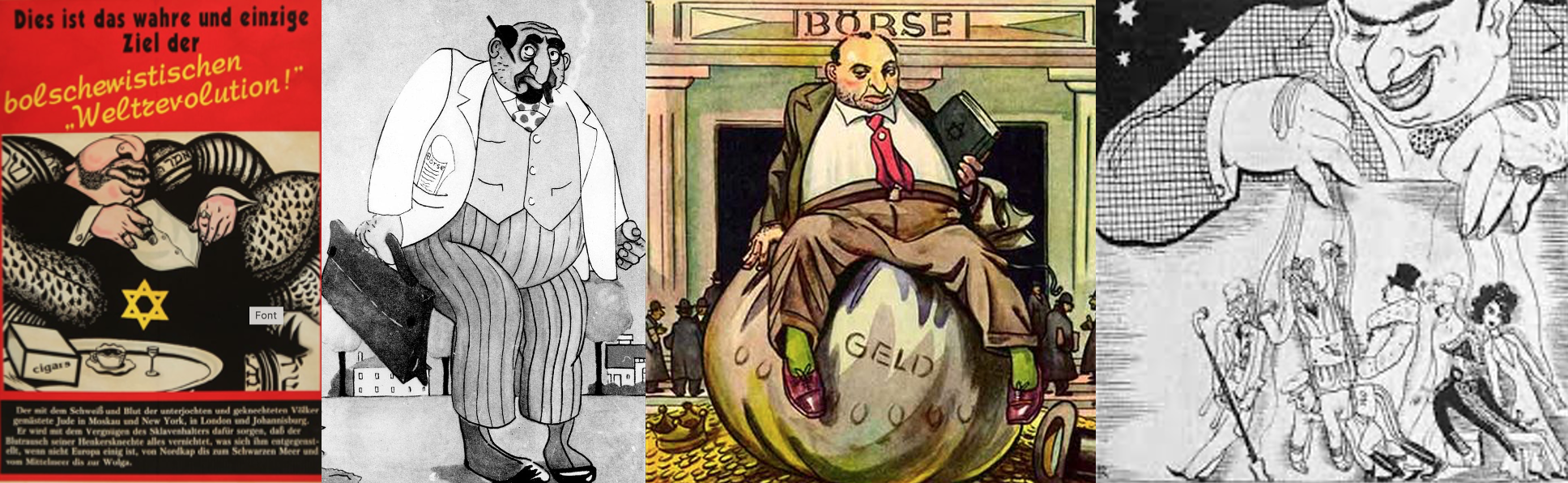
So, over to this cartoon, Die Burger was established by the Nationalists as their official mouthpiece in 1915 and Dr D.F. Malan as its first editor – an ‘anti-Smuts’ paper it was going to be from the get-go. By the mid 1930’s it had become popular in right leaning European newspapers in countries like Germany to target Jews with what is now known as “the great Jewish Capitalist conspiracy lie” – Jews were demonised as ‘fat cats’ using capital exploitation to the detriment of ‘ordinary’ non Jewish folk and this image and symbology found itself into all visual media – including (and especially) political cartoons.

Images: Nazi period demonisation of Capitalist Jews, known as the ‘banker’ – depicted as fat, cigar smoking, balding and greedy – either pulling the strings or holding onto the money bag .

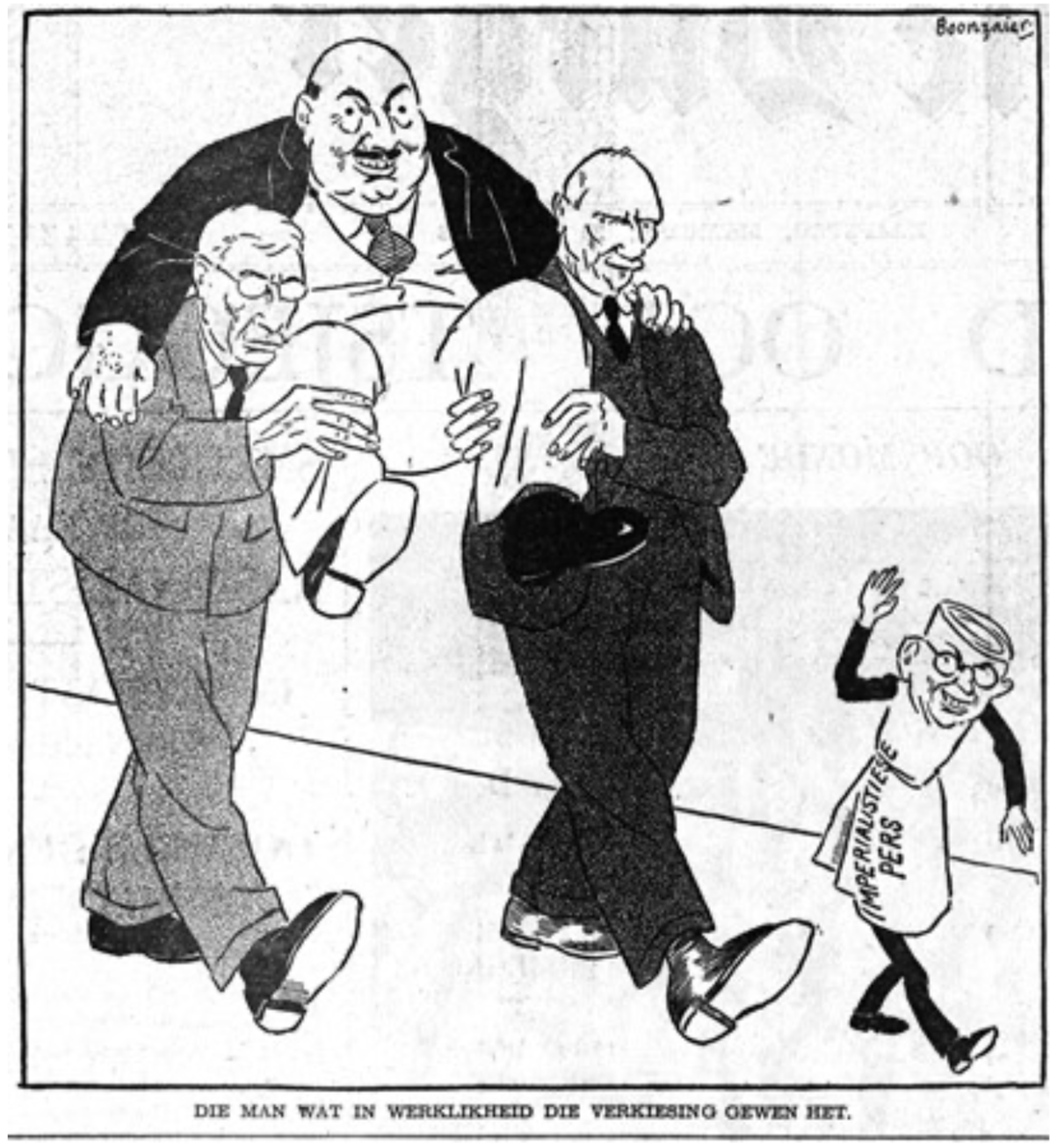
In South Africa, this trend for demonising Jews in political cartooning found favour in publications like the Die Burger, and especially in the works of D.C. Boonzaier, himself an anti-imperialist, pro-republican, pro-nationalism and anti-capitalist. He created a caricature figure called Hoggenheimer specifically for Die Burger – a derogatory figure designed to depict a fat and bloated Jewish capitalist with a play on ‘hog” or pig, the character made a number of appearances and also served to lampoon Ernest Oppenheimer, the German Jewish Mining Industrialist who made South Africa his home.

This cartoon by D.C. Boonzaier was published in Die Burger, 23 May, 1938. The bloated caricature Hoggenheimer is been carried on the shoulders of JBM Hertzog and Jan Smuts following the United Party’s landslide victory in the general election of 1938 over the ‘purified’ Nationalists. Smuts and Hertzog were in “Fusion” at this time and the National Party had split, with D.F. Malan heading up the “Purified” National Party – so it’s no surprise Die Burger also took aim at Hertzog as a ‘puppet’ of ‘British’ Imperialism along with Smuts. 

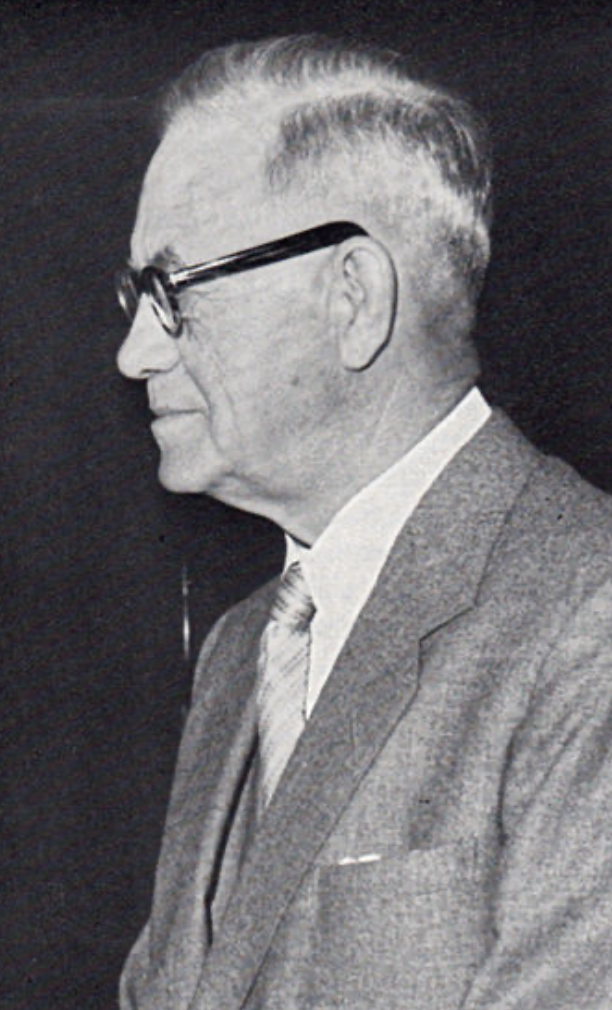
Albertus Lourens Geyer

The caption alludes to ‘Jewish Capital’ as the real winners of the election and Hoggenheimer’s finance the sinister reason behind D.F. Malan’s defeat, the winners – the United Party – a puppet in servitude to its Jewish master, and the image also alludes to the “Imperial” i.e. English press as leading the way.

The editor of Die Burger at the time this cartoon was published was Albertus Lourens Geyer – who edited Die Burger after Dr Malan from 1924 to 1945, he was awarded for his loyalty to the Nationalist cause in 1950 when the National Party appointed him the South African High Commissioner to Britain. In one his first speeches to the Rotary Club in the UK he asserted that the Black man should be grateful to the White man for ‘white’ sacrifices during WW2 against Nazim – the irony that he, his paper and the Nats supported Nazim lost on him and in addition he passed off “Apartheid” as really meaning “Partnership” between White and Black – the irony lost on him again. Such was the politics of the editor.

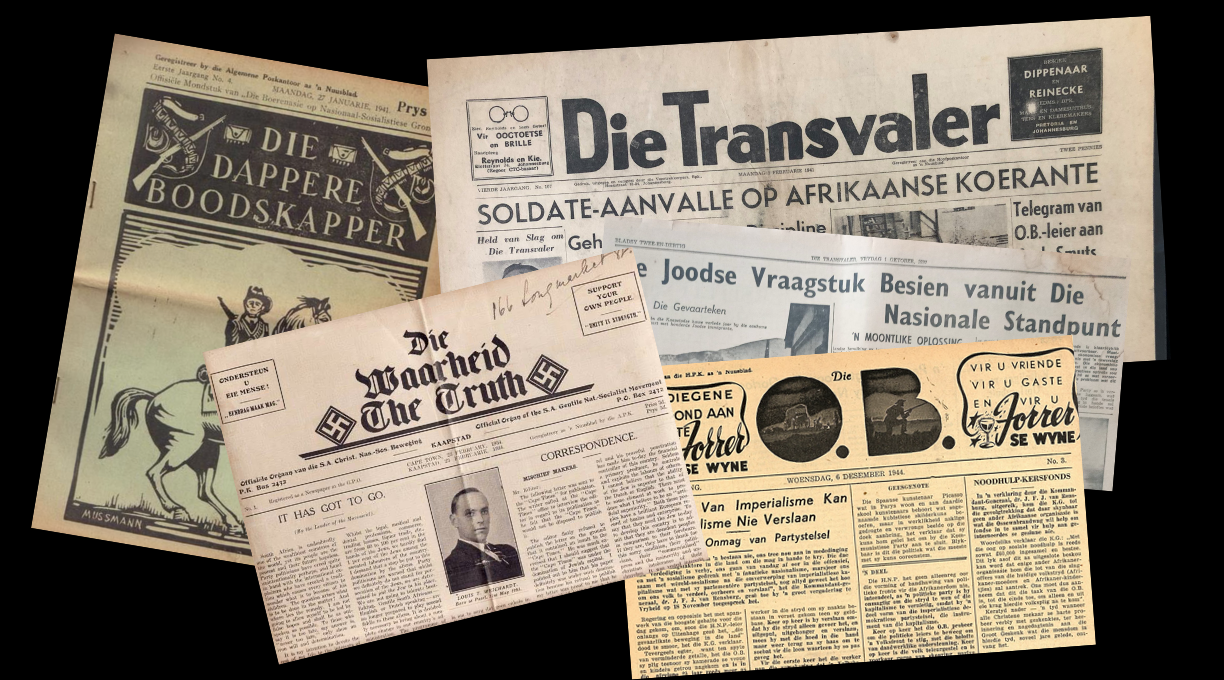
It also remains ironic, Julius Streicher, the infamous Nazi propagandist is the only German civilian executed by hanging for war times after the Nuremberg Trials, precisely for “vitriolic antisemitic propaganda” which “incited genocide” whist he was the publisher of the Newspaper ‘Der Stürmer’ – whereas no such fate awaited Albertus Lourens Geyer who published similar sentiment in ‘Die Burger’. The difference is Albertus Lourens Geyer of ‘Die Burger’, and the publishers and editors of ‘Die Waarheid’, ‘Die Transvaaler’, Die O.B. and ‘Die Dappere Boodskapper’ who all also published antisemitic and pro-Nazi rhetoric are promoted to high offices in The National Party after the war and richly rewarded for their efforts, much to the bewilderment of the Jewish community.

In conclusion, I’ll say this, in Germany there was a concerted effort to educate and reconcile a nation scarred by this type of propaganda and the hurt (and death) it caused the Jewish Community, it continues to this day as the nation is sensitised to this past. In South Africa, no such efforts have taken place, no apologies, I don’t even think Die Burger has apologised to the Jewish community for publishing stuff like this (surprise me if they have – point to note, Die Burger today is a far cry from its Nationalist past and severed its association to this type of politics years ago).

Believe it or not, many still live with the lie peddled by the Nationalists that their flirtation with Nazism was all because of the British concentration camps, nothing more and had nothing really to do with South Africa’s Jews – no harm done. Funnily enough even to this day a published Boer War historian was still trying to make this case on social media – the ‘harm’ to the Jewish community it created and continues to create .. completely ignored – the irony lost on him too.


Written and Researched by Peter Dickens

Reference; The White Tribe of Africa by David Harrison and the Rise of the Afrikaner Reich by Brian Bunting, also “histories of catastrophic dreaming’ on-line file archive and Die Burger on-line and the Anti-semitism policy trust – anti-Semitic imagery and caricatures.

Related work:

South Africa’s Nazi ‘Neuordnung’ and Oswald Pirow

“Mein Kampf shows the way to greatness for South Africa” – The Ossewabrandwag

Blood Oaths on the Führer principle

South Africa’s Nazi Party; The ‘Gryshemde

Treason! Robey Leibbrandt

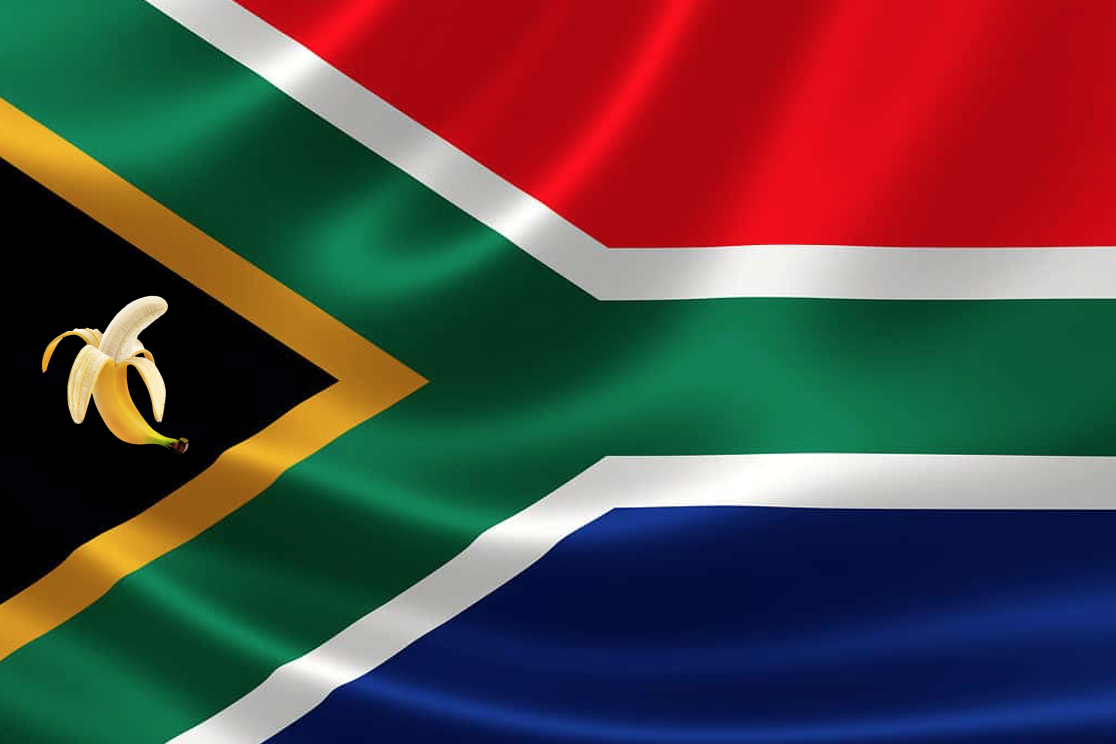
From Union to Banana Republic!

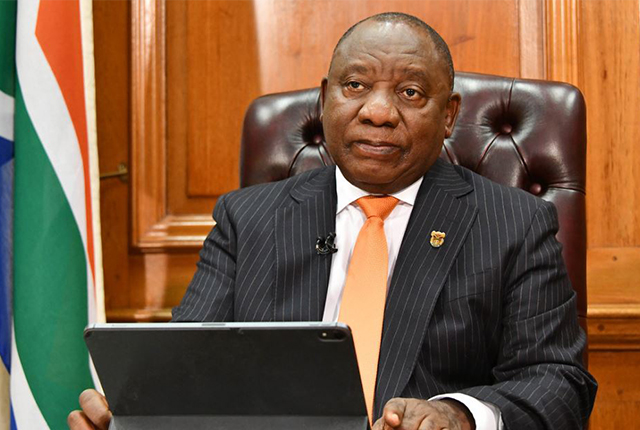
Sitting here in 2023 listening to yet another Nationalist, this time an African Nationalist President urging a Constitutional workshop to forward Nationalistic aims of land appropriation and ‘economic transformation’ in the guise of building a national ‘rainbow’ identity to redress the past, to pass off his own parties political inadequacies and flaws as been a ‘constitutional’ right to fight the wrongs committed “on the many” by what he termed “the state that came before us”

Typical, comes the universal cry, the ANC playing the ‘Apartheid’ card yet again, corrupt as ever now even trying to manipulate the constitution for their own duplicitous aims. Our beloved and hard fought South African Republic becoming like the Republic of Zimbabwe, another ‘Banana Republic’. 

The ‘politics of pain’ rearing its political head, the ‘race card’ played again and again – however playing the race card is nothing new to Nationalists, it has been played for many decades by any ‘nation’ seeking freedom and ‘identity’– and herein lies a deep irony when it comes to creating Republics out of the ideology of  singular ‘nationhood’ – there is always another ‘race’ to blame for it – a license to target another national group as the origins of all their economic, social and political woes.

Even President Ramaposha did not shy away from it one bit – the ‘state before’ his (i.e., the Old National Party ‘Apartheid’ Republic) excelled in it, the idea that a ‘wounded’ nation, dealt a terrible misdeed, must for the survival of its identity and ‘nationhood’ oppress other nationalities/cultures/languages and even entire nation states. 

Republic to Union and back again!

As military veterans we stand by our hard-fought freedoms, from those who fought the ‘cold’ war of communism versus capitalism, and those of us who served to see the country through transition to an all embracing democracy. We all covet the ideals of freedoms so protected in our Republic’s constitution – it came with a lot of blood and toil. 

To see clearly how these ideals of a ‘Democratically Free Republic’ are transitioning to a ‘Banana Republic’ as all the government owned and run utilities and the SANDF, slowly collapses around us is distressing. The fear of another ‘Zimbabwe’ looming large as Eskom turns the country’s economy on and off. 

So, how did South Africa go from its lofty ideals of a Union, a ‘federation of states and nations’ in 1910, to a Banana Republic? Intriguing question and it has to do with the old argument between British Imperialists and Boer Imperialists as to under whose ‘influence’ Southern Africa should be managed (only if it was ‘European’ civilisation leading it mind) – an argument with started long before The South African War (1899-1902) and one that leads directly to the Union of South Africa and it is one which eventually leads to the formation of the Republic of South Africa – as the likes of two Afrikaners, Jan Smuts and D.F. Malan would go hammer and tongs at each other over the issue for decades. 

The white Afrikaner Nationalist right wing and their continued obsession with creating a Afrikaner led Republic from the “Limpopo to the Cape”, and the white English and many moderate white Afrikaners happy with a ‘Union’ along Federal lines of all states in Southern Africa (Colonial, Protectorate and Republic) with British Dominion oversight – like Australia and Canada. The net outcome of it all today – the fully democratic Republic of South Africa – or ‘Banana Republic’ as it is sarcastically referred to, ironically by these same white Republicans and Unionists, who either inadvertently or even directly created it for themselves.

Written as far back as 1900 by Leo Amery, in the middle of the South African War (1899-1902) in his History of the Boer War, was this completely differing outlook, those of the Unionists and those of the Republicans and it is clearly mapped out. It’s very insightful for the time. Here it is:

“Those who believe in progress, in honest government, in political liberty and equality, must upon true statement of the facts, be on the side of England. Those to whom nationalism is all in all, who hold the creation of a nation state, with racial and linguistic characteristics of its own, is the one supreme object of political development – an object justifying every means for its attainment – will naturally be on the side of the Afrikaner Republics.”

Please note: By 1900, Britain regarded itself as a Constitutional Monarchy (where Parliament and Royalty for all intents and purposes of actual governance – are separate) and Parliament considered a ‘Liberal Democracy’ – a tussle between ‘Whigs’ (Liberals) and ‘Tories’ (Conservatives) with a ‘human rights’ agenda (equality and suffrage), secular in nature and with an acculturation focus i.e., getting various cultural groupings to adopt British values and governing principles as their own, whilst at the same time keeping their cultural identity and individual liberties – even in the context of Empire, that was (and remains) the basis of Britain’s Parliamentary system and it needs to read into the context of its time in history and the franchise – which believe it or not was ‘multi-cultural’ and ‘qualified’ – even for 1900. Funnily, the same philosophy even exists to this day, in essence it has not changed. 

Also please note: The Boer Republics at the time were regarded Nationalist Republics run entirely opposite to the British, they were seen as ‘oligarchies’ or even as devolved ‘theocracies’ (not secular at all – State and Church are linked) whose focus was on cultural prejudice (not acculturation in any real respect) i.e., ‘them and us’ and a complete separation of Boer values from all others, almost a cultural assimilation of imposition – and in so combining their ‘Nationalism’ and ‘identity’ into a unilateral ‘nation state’. This manifested itself in the Boer Republic’s Parliamentary systems and needs to be read into the context of its time in history and the franchise as well (which at the time was exclusively ‘Boer’ and ‘white’). Funnily, the same philosophy resurfaced in 1961 when the whole of the Union of South Africa declared itself a Republic.

Obsessing over Republics

So, what’s with the ‘Boer’ obsession with the ideals of Republics and the idea of Boers tacking their identity to them – sheer nationalism?

As far back as South Africa’s initial colonisation goes, Republican ideology has accompanied it. It starts with the Dutch East India Company (VOC) in the Cape Colony with the establishment of ‘Free Burghers’ – these ‘Free Burgers’ held their freedom as paramount, many of them escaping religious and nationality persecution in Europe. The Cape Colony fell under a Dutch Republic government with the VOC as an administrator and the ‘Free Burgher’ colonies fell under it, this Dutch Republic was later replaced by a French Republic vassal state called the Batavian Republic.

Contrary to a mainstream belief, these ‘Free Burghers’ and their fierce need for independence from a meddling state would not start with the British, it would start with the Dutch! .. Huh, how so? Well, here’s some little known history not usually found in a school history book ..

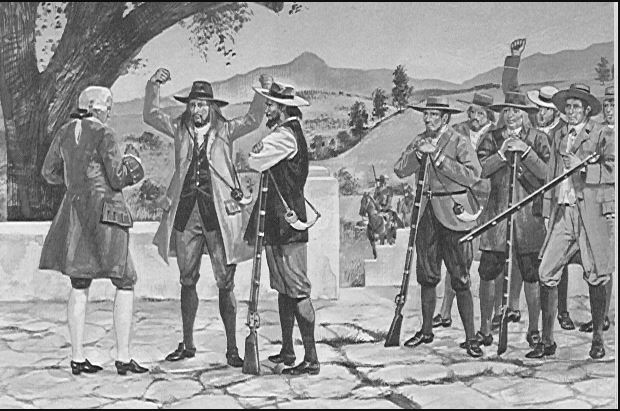
By 1795, dissatisfaction with the Dutch East India Company caused the Free Burghers of Swellendam to declare their own Republic, and Hermanus Steyn its President of the ‘Republic of Swellendam’. It lasted until the 1st British occupation of the Cape. Not just The Republic of Swellendam, the Free Burghers of Graaf-Reinet, also in 1795, had issues with the Dutch East India Company on policies regarding the frontier and tax, and they too declared the Republic of Graaf-Reinet, it also lasted until the 1st British occupation of the Cape in its war against the French. 

Images: The declaration of the Republic of Swellendam, and Southern Africa’s first real President, President Hermanus Steyn of the Republic of Swellendam 1795.

The 2nd British occupation of the Cape after the defeat of the Batavian Republic and the French Republic brought with it policies some of the Dutch speaking Burghers could not abide by. The British had been protecting the Dutch aristocracy during their Napoleonic and Batavian exile – after the Battle of Waterloo in 1815 finally settled the matter, the Dutch sold their Cape Colony to the British to aid in the re-establishment of their country (£6,000,000 then, now worth £150,000,000 or ZAR 3,380,000,000 – more or less). So here’s another inconvenient truth, the British did not ‘steal’ the Cape Colony from the Dutch, the Dutch sold it fair and square to the British to help them re-build the Netherlands after the Napoleonic wars.

The British outlook on suffrage as opposed to the Dutch one would clash in their new colony from the get go. Dissatisfaction started when the British banned Dutch slave traders from entering any Cape port from 15th June 1814, squeezing labour supply, then the British announced the abolition of slavery completely in 1834, they also announced a universal qualified franchise vote putting some ex-slaves and black citizens on the same footing as some white ones. 

To top this indignity to the Burghers, the British announced English as the only official language in the Cape Colony and issued terms for the compensation of slaves which were viewed as unacceptable. Burghers had to go to Britain to get their compensation, an impossibility for many slave owners on the frontiers especially – and the amount been compensated was deemed as way under-valued in any event. With this indignity, and with their fierce need for independence – language, identity and religion, some Cape Burghers on the far-flung Colony’s frontiers (estimated at only 7.8% of the total population) upped sticks a year later in 1835 in a “Great” Trek to form a whole bunch of new Republics north of the Cape Colony’s border. 

Consider why a Republic, Republics by now are based on their lofty French Republic ideals of Liberty, Equality and Fraternity are highly appealing to anyone seeking ‘Freedom’, they also should be free of domination and oversight (theoretically) by other states, and for a people seeking a separate national identity and nation state this is very appealing. But and it’s a BIG BUT, the types of Republics these Burghers were seeking to establish would manifest a version of racial servitude taken with them, strict in Calvinism and steeped in the Old Testament  these ‘Burghers’ saw themselves as God’s ‘Chosen People’ in Africa – a superior race, certainly to their slaves and local African inhabitants, which they simply dismissed as “Kafir” (an Arabic term adopted from Muslim slaves and banished exiles from the Dutch East Indies) meaning “heathens” and therefore unworthy under God – the idea the hated British came up with – that slaves and heathens could hold the same rights as them in future – was an abhorrent one – and herein would lie a future problem (and future derogatory term).

A heady concoction of the ideals Liberty, Equality and Fraternity – but only for the white ‘Free-Burgher’ Nation – within their strong confines of identity, and one in which the ‘servitude’ of other racial groups played a key role – they would have to either barter or shoot their way in to gain land to establish Republics, and they did both. They would also need a disenfranchised labour class to work the vast tracks of arid farmland or in household servitude, they would source this labour either locally when they got there, primarily through a old Dutch/VOC indentured slavery system called the “inboekstelsel” system or take labour and servants with them – and they did both.

It is estimated in some historical sources that the ratio of Voortrekker/Trek Boer to Servant/Labour taken with them from the Cape Colony commencing in 1835 was as much as 1:1. This ratio is easily seen in this sad statistic, of the recorded 282 white Voortrekkers killed along the Bloukrans during the Zulu attacks of the 16th and 17th February 1838, there are 250 ‘black’ servants also recorded as killed by the Zulu’s in addition to their white benefactors. A homogeneous trek of white trekkers the Great Trek was not.

The inboekselings system was widely used by the Boers in the region that would ultimately comprise the Transvaal, the system had its origins in driving Khoi-Khoi to labour in the Cape by the Dutch/VOC, and was still in use by the Batavian Republic (French) when they controlled the Cape. It was a system of ‘indentured slavery’ (indentured or contracted labour with limited or no rights) – primarily of Black women and children captured by force and indentured to their Boer masters till 25 years of age for the men and 21 years of age for women, it also formed a lucrative trade for struggling farmers on the frontiers of the Transvaal known as ‘Black Gold’. It is also not a ‘tiny’ or isolated affair, as numbers go, Keith Breckenridge in ‘his work ‘power without knowledge’ estimates the ratio between inboekstelsel labour and white Voortrekker by 1866 as 1:10 (10% of the population).

Trekboers crossing the Karoo by Charles Davidson Bell, unusual, but do note the Black servants and labour in foreground – an omission from many (if not most) contemporary Nationalist inspired Voortrekker and Trekboer paintings, sculptures and illustrations of the trekkers.

In either event – and another inconvenient truth, between the labour taken with them by the Boer trekkers and the labour acquired when they got to their destinations, within all the future Republics declared by the trekking Boers, there would exist from the very beginning a very large class of displaced black servants and indentured black labourers who were given no rights whatsoever – no right to own land, no right to political representation and no suffrage whatsoever. Most inboekselings remained with the farmers after their indenture period terminated as employed farm labour and servants and in this way the Boer Republican governments also sought to create a ‘black’ buffer class between themselves and the tribal Africans. They would exist on Boer farms in separated conditions in their ‘kraal’ – a very large separated sub-class and disenfranchised social construct which would remain with the Afrikaner communities for nearly two centuries and one that can still be seen in rural areas to this day.

The British, as a world Super-power at this time also found itself playing ‘Global Policeman’ with the abolition of slavery, world over and engaging its Navy to stop the trade, especially along the west and east coasts of Africa. But it did not stop at just its Navy, it uses every means at its disposal, military and legal. On indentured labour/slavery, British policy would remain a little hazy as they practiced the system in Natal bringing indentured labour to work primarily on the sugar cane farms – both servitude and highly exploitative in nature Indian indentured labourers started arriving in Natal from 16 November 1860, albeit a less forceful version that the old Dutch inboekstelsel system, the ‘Coolie’ system (now a derogatory term) focussed on adult labourers free willing to enter into a contract for five years in ‘bonded’ labour with no rights and thereafter as ‘free-men’ they were able to buy or rent land, houses and open businesses – and even form political groups – albeit these concessions (clipped by harsh ‘immigration laws’) were highly limited in terms of both opportunities and human rights (all of which however was certainly not the case in the inboekstelsel system where there were literally no real concessions at all).

The Orange Free State Republic

The Orange Free State Republic was established by a combination of ‘trek Boers’ and ‘Voortrekkers’ having settled there (there is a slight difference between these Boers depending on when these Boers left the Cape, one set are natural migrants, the other set protested the British. But here’s the confusing part and the rather inconvenient truth when it comes to the general narrative, it was a British territory BEFORE it became a Boer Republic. 

So, when these ‘Voortrekkers’ and ‘Trek Boers’ entered the Transorangia territory, re-named the British Orange River Sovereignty in 1848, they were subject to anti-slavery laws – these laws remained in place when it was later mutually agreed at the Orange River Convention in 1854 that Britain’s Sovereignty be administrated by Boers and they could declare a Republic of their own, but only as a proviso that the Orange Free State Republic established 23 February 1854, remain a British Suzerainty state (vassal state) under British oversight – so no slavery allowed in the Republic of Orange Free State from the get go. Also, the Orange Free State would never attain full independence since its inception to its end, it would at all times be a British Suzerainty, even up to and including the South African War (1899-1902) i.e. The Boer War.

The Orange Free State, chose to ally itself with its sister state, the Zuid-Afrikaanse Republiek (ZAR), in their dispute with the British leading to the South African War (1899 – 1902) and joined with the ZAR to invade the surrounding British Colonies and Protectorates in Oct 1899. The result to their declaration of war against Britain is a counter-attack which would see the Orange Free State Republic annexed by the British in March 1900 when they took their capital Bloemfontein, a mere 6 months after the Orange Free State declared war against Britain and it was officially renamed and ratified as the ‘Orange River Colony’ by the British a the end of hostilities in 1902.

A conglomeration of Boer Republics

The British at the Sand River Convention in January 1852 would allow the establishment and amalgamation of Boer Republics north of the Vaal River as fully autonomous, only on the proviso that they were not to practice slavery (indentured slavery was a different matter). Unable to practice slavery proper, they enjoyed their autonomy and they would come up with legal and social compacts which defined class structures and franchise along racial and ‘national’ lines, as at 1852 most would become part of the ZAR, however due to the very isolated nature of these Boer groupings the ZAR did not really start to take shape until 1860. So let’s look at all these Republics and consider the number of Republics formed by trekking Boers (Voortrekkers and Trek Boers) and what happened to them; 

The Republic of Zoutpansberg (1835-1864), incorporated into the Zuid-Afrikaanse Republiek (ZAR) as a result of the 1st Boer War against the British (Transvaal War).

The Republic of Winburg (1836 -1844) and The Republic of Potchefstroom (1837-1844) amalgamated after 1844 to form the Winburg-Potchefstroom Republic till 1848. Eventually incorporated into the Zuid-Afrikaanse Republiek (ZAR).

Natalia Republic (1839 -1843), established after the Voortrekker victory over the Zulu nation at the Battle of Blood River, named Natália after the Portuguese term for Christmas (the day they discovered Natal). The Republic came to an end in 1843 when British forces annexed it to form the Natal Colony, most of the local Voortrekkers then trekked northwest into the the Zuid-Afrikaanse Republiek (ZAR) – which held massive swathes of Northern Natal.

The Republic of Klip River (1847-1848), established by Voortrekkers and is now modern-day Ladysmith, the British annexed it as part of the Natal Colony, naming the township ‘Windsor’ and then later re-naming it ‘Lady Smith’ after Sir Harry Smith’s Spanish wife.

Lydenberg Republic (1849 – 1860), established by Voortrekkers, it merged with a second Voortrekker Republic, the Utrecht Republic (1852-1858) and then both merged with the Zuid-Afrikaanse Republiek (ZAR).

Klien Vrystaat Republic (1876 – 1891), established by Voortrekkers on land bought from the Swazi King Mbandzini around a township they established called Piet Retief, now controversially renamed eMkhondo. The Republic was incorporated into the Zuid-Afrikaanse Republiek (ZAR).

The Republic of Stellaland (1882 – 1883) and the State of Goshen (1882 – 1883), both Republics established by Boer mercenaries awarded the land by the Twana Chief Moshoette for their assistance in his battles against the Mankurwane and Montshiwa Tswana factions. The two Republics merged to become the United States of Stellaland until 1885. In a land grab the Zuid-Afrikaanse Republiek (ZAR) annexed it, in response to the Tswana chiefs requesting protection from Boer expansion and aggression, in 1885 the British annexed Bechuanaland in two parts, the Bechuanaland Protectorate (modern Botswana) and British Bechuanaland (later part of the Cape Colony), the United States of Stellaland was annexed as part of British Bechuanaland. 

New Republic (1884 – 1888), also established by Boer mercenaries brought in by the Zulu King Dinuzulu to defeat his Zulu rivals, their compensation was land along the Mfolozi River. The Boers declared it a Republic and ‘Vryheid’ its capital. Long and short after a lot of conformation between the British and the Boers and the British and the Zulu, it was incorporated into Zuid-Afrikaanse Republiek (ZAR) and after the South African War (1899-1902) it was incorporated into the Natal Colony by the British.

Republic of Upingtonia/Lijdensrust (1885 – 1887). Declared on 20 October 1885 as a Boer Republic, it was originally named Upingtonia, but changed its name soon after. In 1887, it was merged into German South West Africa (Namibia).

The British did it too!

So, here’s an inconvenient truth – one your school text book would have gleaned over, its not just a Boer disposition to declaring mini Republics everywhere in South Africa, British settlers in South Africa did it too. When diamonds were discovered in South Africa in 1866 a flood of treasure hunters, especially from England, streamed to the diamond Fields around Kimberley.

Ownership of the diamond fields was contested by the Boer Republics of the Orange Free State and the ZAR, as well as various other groups, including the Cape Colony, the Griquas under the leadership of Andries Waterboer, and the Batlhaping, who were ruled by Chief Mankuroane. Before the issue could be arbitrated, the ZAR President Andries Pretorius decided to act unilaterally and declare the Diamond Fields as theirs in 1870. The Immigrant miners were so enraged, a former British sailor called Stafford Parker organised his fellow countrymen and drove all the ZAR officials out of the area and on the 30th July 1870, the Klipdrift Republic was declared and by December of the same year about 10,000 British settlers had made their home in the new republic.

Parker was elected as the President of the new republic, which was also called the Digger’s Republic and the Republic of Griqualand West. The Republic existed for an extremely short time, on 27 October, 1871 the British took possession of it after the matter of the diamond fields was arbitrated, and declared as belonging to the Griquas and it subsequently became a British protectorate (the Griquas fearing future Boer aggression, and unable to effectively administrate diamond claims and foreign miners – called in the British).

Zuid-Afrikaanse Republiek (1852-1877, 1881-1902)

The Zuid-Afrikaanse Republiek – sometimes outlined as the Zuid-Afrikaansche Republiek (South African Republic) or Transvaal Republic or ZAR has two lives, the ZAR (1852-1877) was initially established by Voortrekkers, whereupon its Parliament (Raad) voluntarily dissolved its status as a Republic and requested the British to convert it to a British Colony called the British Colony of the Transvaal (1877-1881) instead. Dispute, mainly over taxes, land concessions to African tribes made by the British and issues surrounding Boer sovereignty, eventually kicked off  the ‘Transvaal War 1880-1881’ (or 1st Anglo Boer War) and the Republic was re-established as a Boer Republic after their victory over the British at the Battle of Majuba in 1881 – but only on PROVISO it too became a British Suzerainty state (vassal state) under British oversight – much the same status as the Orange Free State Republic.

The re-established ZAR (1881-1902) was again the main protagonist in the dispute with the British (over many reasons to be discussed another day) leading to the ‘South African War’ (1899-1902) hence the official name of the name of the war (not the “Boer War”). The ZAR’s invasion of British Colonies and Protectorates in Oct 1899 (not just the Cape and Natal Colonies, the ZAR and OFS Republican forces also invaded the Bechuanaland protectorate i.e. Botswana and Southern Rhodesia) and it would signal the official declaration of war, the British counter-attack would see the ZAR conventionally capitulate its capital 9 months later. The ZAR would cease to be a Republic and became a British colony again when it was re-proclaimed as the ‘British Colony of the Transvaal’ again on 1st September 1900 (after Pretoria fell to the British in the June of that year) and ratified it as a British colony at the end of hostilities in 1902. It remained The British Colony of the Transvaal (1902-1910) again until Union.

As a ‘fully independent’ Boer Republic, free of another Nation states’ oversight (Britain), the ZAR only really existed for a mere 15 years – but this did not deter the desire for ‘freedom’ from Britain by many of its white Boer population, and this was reinforced by the devastation to their society and economy caused by the South African War (1899-1902) or 2nd Anglo Boer War.

The idea of a ‘Union’

The ‘British’ i.e., the United Kingdom is essentially a union of four separate nation states with varying degrees of devolved authority. It is not a leap in logic to see how the idea of a union has resonance with them. As early as 1875 The Earl of Carnarvon, Henry Herbert – the British Colonial Secretary, approached the Orange Free State and the Transvaal Republics and tried to organise a federation of the British and Boer territories modelled on the 1867 federation of the French and English provinces of Canada. 

The liberal Cape government also objected to the plan for ideological concerns; Its formal response, conveyed to London via Sir Henry Barkly had been that any federation with what were regarded as “illiberal” Boer republics would compromise the rights and franchise of the Cape’s Black citizens, and was therefore unacceptable.

The 4th Earl of Carnarvon, Henry Herbert

Although this initial attempt of Federation by Henry Herbert failed, the concept remained. By 1902 the landscape of Southern Africa had changed with many more British territories bordering the old Boer ones, not just the Cape Colony and the Natal Colony, it included Rhodesia South (now Zimbabwe) and North (now Zambia) and the British Protectorates of Bechuanaland (now Botswana), Lesotho and Swaziland in addition. Some sort of peace and balance between these two antagonists was needed to allow for a stable governance of the region, the Boer Republics lay in tatters after the war, but the desire and fight to re-establish them remained. 

The British were only able to secure a Peace treaty with the Boers at the end of the South African War (1899-1902) – on the CONDITION that Boer self-governance would be re-examined again in the near future. The British had also insisted that The Cape Franchise (a vote for Blacks based on a qualified franchise) be extended to include the old Boer Republics as a Peace Term to end the Boer War, bringing the issue of political emancipation for the region’s Black population sharply into focus. 

General Jan Smuts attending the Peace negotiations with the British, was not only a skilful ‘Bitter-einder’ Boer General but also a skilful lawyer. Smuts was able to convince the British to put this issue of ‘black franchise’ on a back burner to be dealt with by a ‘future’ and ‘independent’ government in South Africa making its laws suitable to the region and not Britain insisting on applying its Westminster laws on the unwilling Boers. This would allow the old conservative Boer Republic’s laws on race division and exclusion to be upheld in their regions and the more liberal Cape Colony and British Protectorate laws on race inclusion to exist in their regions, at least for a little longer until the well-meaning British Colonial and Boer Republic ‘white’ politicians living in South Africa could resolve it.  

The British would leave the amalgamation of their interests in Southern Africa with those of the Boer Republics interests to a future government in which the Boer Generals would have a significant say. So, long and short, something had to be done.

So, here’s some inconvenient truths, very often on Boer War forums, a grouping of Boer Romantics still hung up on Pakenham’s idea that the war was all about gold and diamonds, flat ignore the British historians who repeatedly point out it was about suffrage and human rights (both ‘miners’ in the ZAR and the black population groups inside or adjacent to the two Boer Republics). The Boer Romantics dismiss this as Britain paying “lip service” to African rights and not really that serious about it. However, look at this way – to end the Boer War, the first proper round of peace negotiations where held at Middleburg in February 1901, and the British demanded a “colour blind” qualified franchise, as existed in the Cape and other British territories be extended to the Boer Republics in addition as a peace term. The British also insisted on ‘representative’ governance of the Boer Republics after the war (mainly dealing with the quick inclusion for disenfranchised ‘foreign’ white miners in the ZAR in their political process and the establishment of their political ambitions).

The First attempt at Peace during the 2nd Boer War – Middleburg 28th Feb 1901

So important to the Boers that their racial laws and franchise constructs remain in place, that they rejected these terms outright and walked away from the peace table. The uneasy truth is they were prepared to continue the ‘Guerrilla Phase’ i.e. Bittereinder campaign and endure the scorched earth farm burning policies and the displacement and death of their women and children in concentration camps for 13 more months of really savage war, rather than concede to a more representational system of government – and the British on the other hand were well prepared to continue such was their resolve.

The issue of a ‘black’ franchise would remain on the cards and even laid down again in May 1902 at the Treaty of Vereeniging (literally there were little real changes from the Middleburg Feb 1901 conference’s terms of surrender other than some British concessions on the Cape Rebels and an increase in war compensation funds to fix damaged farms), and here the issue of black enfranchisement was kicked into the long grass with the assurances and promises from ALL the Boer Generals (not just Botha and Smuts) that it would be dealt with in a future self-governance construct (the future ‘Union’). This is NOT just “lip service” as to human rights on behalf of the British, or for that matter the Boers – the issue was costing lives and of course this was not the only issue the Boers walked away from the negotiation table over in 1901, but it certainly is a major and on-going ideological dispute between Boer and Brit.

A well-meaning congress of ‘Closer Union’ 

So, all the protagonists put aside their vast differences aside after the end of the South African (Boer) war in 1902 and got together to nut out a solution in 1908 and 1909, known as ‘The Closer Union Convention’ it was the CODESA of its day, a ‘whose who’ of modern Southern African history .., the old ‘Boer’ Generals – de la Rey, Hertzog, Smuts, Botha, de Wet and Burger even sucked it up long enough to sit opposite the likes of Starr Jameson and be nice. Notably, it also includes Southern Rhodesia (more on this later). Have a look at this photo of it, it’s a stella cast of the heads and ministers of every British colony and ex-Republic (now a British colony) in Southern Africa.  

Front row (left to right): Hon. J.W. Saner, (Commissioner for Public Works); Hon. J.X. Merriman, (Prime Minister, Cape Colony): Hon. M.T. Steyn (Vice-President of Convention); Hon. A. Fischer, (Prime Minister, Orange River Colony), Lord J.H. de Villiers (President of the Convention), Right Hon. General Louis Botha, (Prime Minister, Transvaal); Right Hon. F.R. Moor, (Prime Minister, Natal), Sir W.H. Milton (Administrator of Southern Rhodesia), Sir J.P. Fitzpatrick. 

Second row: Hon. E.H. Walton; Hon. Colonel E.M. Greene (Minister of Railways and Harbours); Mr H.C. van de Heerden; Dr J.H.M. Beck, Mr G.H. Maasdorp, Mr H.L. Lindsay; Hon. F.S. Malan (Secretary for Agriculture); General S.W. Burger; Hon. Dr T.W. Smartt; Hon. General C.R. de Wet (Minister of Agriculture); Right Hon Dr L.S. Jameson; Hon. H.C. Hall (Treasurer); Hon. General J.B.M. Hertzog (Attorney General); Mr C.F. Kilpin (Clerk of House of Assembly and Chief Secretary of Convention). 

Third row: General J. H. de la Rey; Mr W.R. Morcom; Hon A. Brown; Mr T. Hyslop; Mr J.W. Jagger; Hon. C.J. Smythe; Sir G.H. Farrar; Hon. General J.C. Smuts (Colonial Secretary); Mr A.M.N. de Villiers (Clerk to House of Assembly, ORC and Secretary of Convention). 

Fourth row: Mr G.T. Plowman (Secretary to the Prime Minister of Natal and Secretary to Convention); Mr W.E. Bok (Private Secretary to Prime Minister of Transvaal); Mr G.F. Hofmeyr (Clerk of House of Assembly Transvaal and Secretary to Convention); Colonel W.E.M. Stanford; Hon. C.P.J Coghlan.

Mahatma Gandhi would even speak at the Conversion and bring up the issues surrounding Indian indentured labour immigration, Indian ‘free passengers’ and all of their rights. The solution they all came up with, a ‘Union’ was needed, a grouping of federated states, much the same as had been proposed in 1875 by Henry Herbert along his ‘Canadian model’. It would publish ‘The Framework of Union’ explaining the ‘Union’s’ constitutional frameworks as following the likes of the United States of America and Canada. It would then go on to lay down the constitutional framework for the future South African Union.

However, key to this ‘balance’ of British and Boer interests and unity would be the eventual inclusion of Rhodesia in the South African Union, also key would be the eventual inclusion in the South African Union of the British Protectorates of Bechuanaland (Botswana), Lesotho and Swaziland.

What’s missing from this well-meaning congress? Clearly it was the Black African political representatives, this idea of Union was to be progressed without their input. Clearly, they needed a political voice as a homogenous group of ‘Africans’, and it’s a large reason why The African National Congress was formed just 4 years later in 1912, originally as the South African Native National Congress (SANNC) and made up of a ‘conservative’ African intellectual class – ‘Christian’ in its central ideology.

Also, from the outset, the degree of ‘devolved authority’ to the ‘federated states’ was an issue. The Union of South Africa would carry a highly ‘centralised’ government and the likes of Olive Schreiner who was vehemently opposed to a centralised system of government for the new Union and advocated a highly devolved confederation instead, and berated the negotiators as being “men selling their souls and the future.” She, was not wrong, and as we will see in the future, the ‘centralisation’ of government would undermine the future ideals of ‘greater union’ after 1910 and also find a happy matrimonial bed for the South African ‘Banana’ Republic to thrive after 1994.

The South African Union … and it’s not what you think!

This is an expansive subject, bear with me, I’ll make it as brisk as possible. Let’s look at the ‘Union’ argument for South Africa, and upfront this is going to shock many – The South African Union as we know it, is not the South African Union that Smuts and his cronies envisioned, not by a long shot.

The central mechanism to attain ‘Union’ from the Boer perspective starts is a little known political party called ‘Het Volk’ – a party essentially led by a Louis Botha and Jan Smuts in partnership, and a party that would eventually pull together all the old Boer war Generals (including Hertzog) and the leading British Colonial parties into a unified entity – ‘The South African Party’ (the SAP or ‘Sappe’). Its mantra was ‘Union’, its chief philosophy was ‘reconcilliation’ and its chief visionary – Smuts.

For all the ballyhoo of Nelson Mandela being the ‘father of South Africa’ that’s not true, the ‘father of South Africa’ was Jan Smuts – period, and Smuts did not envisage South Africa on its current borders – it was much much bigger. Even before The South African War (Boer War) 1899-1906, the Afrikaner Bond, established in 1881 had as its stated aim a unitary Afrikaner Republic from “the Cape to the Zambezi”, even Smuts had already started articulating his views a greater ZAR incorporating the British colonies from 1895, Kruger and his cabal had always been expansionists – bear in mind ‘Swaziland’ was not a British protectorate at the start of the Boer War, it was annexed by the  Zuid-Afrikaanse Republic (ZAR) in an expansionist grab, along with more bits of Zululand in a bid to extend the borders to include a eastern sea port, plans and threats were even afoot for a Boer invasion of southern Rhodesia – the Adendorff trek. In fact ‘Botswana’ as we know it now was established to protect the Tswana from Kruger’s ever westward expansionism – now, not many people know that!

Cecil Rhodes thought the same way with his British South Africa Company, only his idea specified ‘British influence’ – hence the clash of under ‘whose influence’ and whose ‘laws’ all this expansionism and regional control would take place (British Unionist or Boer Republican) – its an ideological clash between Boer and Brit.

To conclude the Boer War, the Peace Treaty at Vereeniging settled the issue under whose influence all this imperialism, expansionism and unionism would take place – either Boer or Brit. The British demanding a settlement as long as South Africa remained part of the British family of nations, and with the goal of ‘self government’ for the entire region – to be shared by both ex-Boer Republic and ex-British Colony leadership.

By the conclusion of the Union Congress in 1909, the declaration of Union in 1910, and the conclusion of World War 1 in 1918, Smuts’ vision for a Greater South African Union bordered on a ‘United States of Africa’ on a federalism ideology. A proper Union, a system of inter-dependent states pivoted around Smuts’ central philosophy of ‘union is strength’ a philosophy which would all eventually evolve into his philosophy of ‘holism’.

Smuts’ expansionist thinking took South Africa’s borders over the Zambezi River – literally all the way to the equator. Here’s Smuts’ map of it, and note his personal marks of A and B, the map is in three phases:

Image: Jan Smuts’ map marking the phases of Union

Phase 1, the initial South African ‘Union’, which would incorporate Lesotho and Swaziland.

Phase 2, this would be followed by the incorporation of Bechuanaland (Botswana), German South West Africa (Namibia), the southern half of Portuguese East Africa (Mozambique – Delagoa bay) and Southern Rhodesia (Zimbabwe). 

Phase 3,’Greater South Africa’ does not stop at Phase 2, the next phase would see half of modern Angola, the rest of modern Mozambique (the north part of Portuguese East Africa), the whole of modern Zambia (Northern Rhodesia) and the whole of modern Malawi joining the South African ‘Union’.

So, what went wrong with a Federation?

Field Marshal Jan Smuts

So, we nearly had a ‘United States of Africa’ a Federation of individual states like Australia, the USA, United Kingdom and Canada – bet you didn’t learn that in your history books. Life may have seen substantially different – Apartheid would probably not have happened, Rhodesian UDI would probably not have happened, even the Angolan Border War would probably not have happened (Southern Angola and SWA would have been part of the Union). So, what was right with the thinking and what was wrong?

On the right side was Smuts’ ideals of globalism and holism – the inter-dependency of peoples, nations and cultures on one another (politically and economically) – this thinking would see Smuts steer in the ideals of the Commonwealth of Nations (instead of ‘Empire’), the United Nations (instead of the League of Nations), and the same philosophy has been implemented after Smuts’ death in 1950 – we’ve seen European Economic Union and closer to home ‘BRIX’ and the Southern African Development Community (SADC) zone.

On the down-side was this persistent problem of Afrikaner Nationalists demanding Republicanism in their likeness, and the on-going issues of segregation and ‘white’ Imperialism in the territories concerned. Even Smuts saw this ‘United States of Africa’ under some sort of white patronage with a qualification franchise to gradually bring Black indigenous tribes into the edicts of western democracy – a gradual transformation to full political emancipation within institutions of western governance – and who can blame Smuts here, even as liberal globalist and a man ‘ahead’ of his time, he was also a pragmatist and a man ‘of’ his time. Smuts understood and often said “a politician cannot move faster than his electorate” (or lose his ticket) – and in his case his electorate was mainly ‘white’ and intensively racially divided and very fearful of a ‘Black’ future.

However, the two big de-railers of this ‘United States of Africa’ were the white voters, suitably enfranchised in South Africa and Rhodesia – oddly, both diametrically apposed and in fear of one another.

At Union in 1910, it was hoped that British Protectorates of Bechuanaland (Botswana), Lesotho and Swaziland would be incorporated. The difficulty in Smuts’ dream was the word British ‘Protectorate’ – they were not British ‘Colonies’. They could not be legally forced into Federation; they were tribal Kingdoms (and still are) and had all requested British protection in response to Boer expansionism and to avoid being swallowed up by the Boer republics.

These Protectorates opted on a ‘wait and see’ strategy – wait to see what ‘Rhodesia’ would do, as this would ‘balance’ Afrikaner nationalism and its race laws which were still apparent in the old Transvaal and Orange Free State legal constructs, Botha and Smuts had still not been able to institute the black qualification franchise vote as required by the British at the end of Boer War in 1902.

Thomas Pakenham (a travel writer and Irish Republican) would make one very good conclusion in his first authoritative work considered history ‘The Boer War’ – and its one which we can agree on, he said the Boer nation would never concede a vote franchise to the Blacks, regardless of promises given and would conclude that the nation which truly came off the worse in Boer War 2 was not the Afrikaner one – despite the white concentration camps and scorched earth policies, but it was the Tribal Blacks and their nationhood who would be the greatest losers. Try as they might Botha and Smuts would never be able to shift this needle. If anyone is wondering why South Africa has great big holes in the middle of it comprising the Kingdoms of Lesotho and Swaziland – this is why.  Botha and Smuts however went ahead with Union in the hope that this burning question of black franchise qualification would be settled by Southern Rhodesia (Zimbabwe). 

With Southern Rhodesia on board, as was planned at the ‘The Closer Union Convention’ a year before in 1909, and even with the South African Act passed in 1909 which outlined ‘Union’ as it made way for the inclusion of Rhodesia as the 5th province in the Union. It would now be up to Rhodesia who would provide the balance between the main British territories of Rhodesia, Natal and Cape Colony – with their more liberated approaches to enfranchisement than those of the two old Boer Republics – and in the end the ‘majority’ of progressively minded whites in the region would win out and the small but burgeoning desire for ‘white’ Afrikaner Republics would be kept at bay by sheer democracy and a willingness for greater Union.

So, up to the Rhodesians to decide the future South African Union and political balance then. Winston Churchill once said, “The best argument against democracy is a five-minute conversation with the average voter” (incidentally Churchill was also then the Colonial Secretary to Southern Africa) and in the case of Union this became a truism as the Rhodesians took the matter to a referendum, they called a vote on the matter on the 27th October 1922.  Option 1: ‘Responsible Government’ (own independence) or Option 2: ‘Union with South Africa’.

In Rhodesia, the prevailing government opinion was that Union with South Africa was inevitable, it was supported by the United Kingdom’s government, the South African government, and the British South Africa Company – all of whom favoured the Union option. But (like BREXIT recently), the government was out of touch. The Rhodesian enfranchised voters (mainly white, some black) were afraid of ‘Boer’ policy interfering in Rhodesian politics and fearing the extreme segregationist and race law issues latent in South Africa’s old Boer Republic provinces opted out of Union voting 59% in favour of ‘Responsible Government’ instead. 

Thus ‘nearly’ ended any dreams Smuts had of a ‘Greater South Africa’ or ‘United States of Africa’. It was only 1922, and there was still time and the whole of German South West Africa to consider, which after it was annexed by the Union of South Africa during World War 1 was a South African ‘mandate’ with League of Nations oversight. Jan Smuts have even proposed it be re-named after his friend, fellow Boer General and now the Union’s first Prime Minister – Louis Botha as “Bothaland” (bet you did not see that in your school books either). Bothaland did not go ahead, but Smuts, determined that Union through ‘annexation’ go ahead and ignoring the League of Nations mandates he even tried (again) to name South West Africa as a 5th Province of the Union of South Africa as late as the 17th October 1946. The new United Nation’s defeating Smuts claims in 1946, reducing the Union’s powers over the territory and placing it under ‘Trusteeship’ instead (primarily concerned over black rights) – that was really the end of Smuts’ expansionist Greater South African Union as South Africa never really had ‘full’ legal authority over South West Africa in the past and now going into future, as hard Smuts tried, it never would have full authority and its mandate over the territory was later set by the United Nations to expire in 1966.

Many ex-Rhodesians today lament their decision, as without the power of a large Southern African Federation behind them, they would be left alone to deal with mounting political pressure, especially over the issues of franchise and political emancipation. It laid the bed-rock conflict and for ‘right wing’ Rhodesians trying to hold onto segregation and the qualified franchise system within a white parliamentary construct as long as possible to come to power and declare a “Unilateral Declaration of Independence” in 1965, led by a very conservative Ian Smith and form … you guessed it, a Republic! The Republic of Rhodesia 1970-79.

So, let’s look again to the other problematic part of the Union’s mandate – South West Africa (Namibia) for which act of full Union was (and remained) elusive, the voting population by way of white settlers was small, an all-white affair made up of conservative German settlers who were almost equalled in numbers by Afrikaner settlers venturing into the territory. They would eventually deliver the final blow and bring about the ultimate collapse of the ‘Union of South Africa’ and the forwarding of a ‘expansionist’ white Afrikaner Republic instead.

What! South West Africa (SWA) ended the South African Union – no way! Well, it did, and its also the reason the Nats hung onto it as tightly and as long as they did, even occupying it with sheer military and police force when the South African mandate over the territory expired in 1966 – kicking off the Border War 1966-1989, so here’s why SWA was so important to the National Party and how they did it:

The Nats and their South African Republic.

The return of the idea of a Republic starts with the formation of the National Party in 1914 by Afrikaner Nationalists soon after the establishment of the Union of South Africa. Its founding was rooted in disagreements of ‘Union’ among South African Party politicians (remember ‘Het Volk’ and the formation of the SAP), particularly Prime Minister Louis Botha who sought a ‘unitary’ Unionist state with singular purpose called ‘one-stream’ and his first Minister of Justice, General J.B.M. Hertzog who sought a ‘two-stream’ state which separated English and Afrikaners. 

Incorporated into the ‘Two-Stream’ ideology was the fierce adherence to ‘Krugerism’ – the racial separation and ideological purpose of the old Zuid-Afrikaanse Republic (ZAR) separating not just Afrikaner and English but also all the ‘Bantu’ in addition. With a oligarchy philosophy underpinning it, and the sense of ‘Boer’ Nationalism ahead of all other races in servitude to the Boer cause, the religious reincorporation of the ‘Chosen Race’ – white supremacy in effect. The ‘Politics of Pain’ also factored into the Nationalist ideology – i.e. the need to preserve Afrikaner identity by what was defined as a century long British tyranny, which ultimately manifested itself in the destruction of Boer farms and families during the 2nd Boer War. In essence it generated a victim mentality, and this preservation of Boer Nationalism and identity was paramount to the survival of the ‘Boer’ race – and if that required the subjugation by force of the ‘British’ and all other races and cultures threatening its ‘survival’ for that matter, then so be it.

The formation of the National Party was directly at odds with the aims and objectives of the Closer Union Convention of 1909 – the convention designed to end the Boer and British antagonism for once and for all.

Apartheid as an ideology had not really fully and clearly taken shape at this stage, the Nationalists were pretty loose in defining exactly how they intended to implement ‘Krugerism’, they sat in the pound seats running South Africa in coalition with the Labour Party (the ‘Communists’ in effect) after the Miners’ Strike in 1922  and in ‘Fusion’ with Smuts’ United Party in 1934 generally supporting British Dominion and ‘Union’ – this caused a breakaway called the ‘Purified National Party’ on the 5th July 1935 which stood to the far right politically, under the leadership of Dr D.F. Malan – and it stood in abject rejection of Union and demanding the return to Afrikaner Republicanism along with clearer ideology on racial segregation called Apartheid – this was all ultimately resolved by two events really – the Great Trek Centenary Trek in 1938 and the Second World War (1939-1945).

Henning Klopper, the Chairman of a young and up and coming ‘Broederbond’ initiated the 1938 Great Trek Centenary Trek to artificially bind and brand ‘all’ Afrikaners as decedents of the pioneers (Voortrekkers), symbolic of a ‘white’ Afrikaner hegemony paving the path of future unitary South Africa under white Afrikaner patronage. Long and short, although very fantastical and completely historically incorrect – it worked. 

Afrikaner Christian Nationalism as an ideology outlined by the Broederbond as their official ideology, using the ‘Voortrekkers’ as a binding source of National pride and identity, would ultimately come to define ‘Afrikanerdom’. Even today, if you search ‘Afrikanerdom’ on-line you get a ‘whites-only’ Nationalistic hegemony of what qualifies an Afrikaner.


Smuts (right) and D.F. Malan (left)

Dr D.F. Malan would define the National Party’s ideology of Afrikanerdom when he said in November 1939. “An Afrikaner is one who, whether speaking the same language or attending the same church as myself or not, cherished the same Nationalist ideas. That is why I willingly fight against General Smuts. I do not consider him an Afrikaner.” An Afrikaner, in other words, was one who was prepared to accept the hegemony of the National Party and not those Afrikaners inclined to Unionism, Libertarianism or Liberal Democracy in the United Party and certainly not those like Bram Fischer in the Communist Party. This idea of ‘Afrikanerdom’ also did not extend to Black and Coloured Afrikaners or even Jewish Afrikaners who identified themselves as such.

Christian Nationalism would also be adopted by the Ossewabrandwag – the Ox-Wagon Fire Watch or OB which originated because of 1938 Centenary Great Trek (named because the Centenary trek spread Christian Nationalism and Afrikaner Nationalism like ‘wildfire’), an organisation which drew over 250,000 plus Afrikaner members under the auspices of a ‘cultural society’ on a ‘anti-British’ ticket – and was ultimately infiltrated and coupled to the ideologies of National Socialism (Nazism) through its leadership and their love affair with Nazi Germany and Adolf Hitler. 

The Ossewabrandwag along with other Pro-Nazi Germany organisations like the ‘South African Gentile National Socialist Movement’ or Greyshirts, the ‘National Socialist Rebels’, the ‘Blackshirts’ and Oswald Pirows’ ‘New Order’ ensured that the ideology of National Socialism and Christian Nationalism was fused when all these movements were folded into the ‘Purified National Party’ – now re-named just the ‘Herenigde’ (Re-united) National Party’ after Hertzog resigned over Smuts’ decision to go to war against Nazi Germany. Only this time the Re-United National Party and its Afrikaner nationalists are now powered by a white supremacist nationalist cocktail of Nazism, Christian Nationalism and Apartheid – focussed solely on doing away with Union and implementing a ‘White’ Afrikaner Republic instead, they would undo all the work done by progressive Afrikaners like Smuts and Botha and well-meaning English South Africans of British origin  – D.F. Malan and his cabal went on the political path with this sole objective in mind and time and again declared their aim for a Afrikaner Republic – where ‘English’ citizenship would take a de-facto secondary status along with all other ‘Non-Afrikaners’ like Jews, Indians, Coloureds and Blacks.

We all know about Jan Smuts’ shock defeat in 1948, where an Afrikaner Party coalition comprising The Re-United National Party and the Afrikaner Party squeezed out the United Party on the back of substantive gerrymandering and a fear campaign driving discontent over future black enfranchisement, after winning the two Afrikaner Parties merged to re-establish their original name – the National Party – however, a significant problem existed for the National Party’s dreams and promises of a Republic – their win was not a popular (majority) vote win at all – the majority of whites (English and great many Afrikaners) and the Cape Coloureds did not vote for Apartheid (in 1948 more or less as numbers go – 550,000 voted against Apartheid as opposed to 450,000 who voted in favour), and therefore the National Party still did not have the majority necessary in Parliament to change the South African constitution from a Union to a Republic (another inconvenient truth to the current ANC narratives – the majority of whites, regardless of privilege – did not vote for ‘Apartheid’).

So, what did the National Party do to get their Republican dream, well they cheated really, to gain their majority of 2/3 for a constitutional change they needed to pack the senate with more National Party friendly seats, and they needed to get rid of the Coloured Franchise (remember – in the Western Cape ‘Coloureds’ and Whites were on the same voters roll since the abolishment of slavery and ‘apprenticeships’ from 1853).

The National Party proposed legislation called ‘the Separate Representation Act’ in 1951 to remove ‘Coloureds’ from the Common Voters Roll. Amongst other measures to negate and by-pass the judiciary, they turned to ‘South West Africa’ to push their majority.

Images : The Torch Commando, 250,000 white people alone in open protest countrywide against the removal of Coloureds from the common voters roll and the advent of a ‘Facist Republic’ (see rally placard) – a quarter of the white vote bloc on the streets protesting and demanding the resignation of the National Party government.

As discussed earlier, convenient for the National Party was Smuts’ old Unionist expansion plan, where Smuts had looked to Rhodesia to ‘balance’ Republican politics in South Africa, now with Rhodesia out of the equation, the nationalists looked to South West Africa to reinforce their Republican politics (and if you are an old SADF vet who still thinks you were only in SWA to fight communists – this next bit is going to sting a little manne).

Dr H.F. Verwoerd

One of the first acts passed when the National Party came to power in 1948, was the South West Africa Affairs Act of 1949 Amendment, which went against the wishes of South West Africa’s Trusteeship in the United Nations – it ‘illegally’ gave representation in the South African Parliament to whites only in South West Africa, it gave them 6 seats in the South African House of Assembly and 4 seats in the Senate and it also illegally gave all whites in South West Africa a vote in South African affairs and elections.

This was to the advantage of the National Party who enjoyed strong support by the ethnic Germans as the National Party had through many of its organs expressed support for Imperial Germany and subsequently Nazi Germany during the two war world wars. Such was the support that from 1950 to 1977 all of South West Africa’s parliamentary seats in South Africa’s Parliament were held by the National Party.

On the Cape Coloured Franchise, The Separate Representation Act as put forward by the National Party in 1951 went ahead after the National Party overcame the powers of the judiciary through packing it to by-pass the constitution. The ultimate removal of the Cape Coloureds (some 50,000 voters) from the Common Voters roll in 1956 would pave the way for future and more sinister racially based Apartheid legislation, the complete marginalisation of ‘black’ political representation and it would open the way to the National Party’s dream of a Referendum to take South Africa out of its British Dominion and ‘Union’ status completely to become a White Afrikaner Republic.

By 1960 the National Party was ready, Dr H.F. Verwoerd was now at the helm and a referendum on the matter of Union vs. Republic was held. Single question “In Favour of a Union or Republic” – yes or no. The heavy media campaign to propose the Republic was a “Unite and Keep South Africa White” proposition and the promise of white’s only enclave in South Africa (and SWA). The entire campaign and proposal rejected outright by the majority of South Africans. It went ahead on 5th Oct 1960 and the National Party won it, but by a sliver – 1%, only 70,000 votes – and here’s how the maths worked to do it. 

Image: National Party Campaigner 1960

The illegal ‘white only’ sympathetic South West African (Namibian) voters gave Verwoerd 20,000 Pro-Republic votes and by unconstitutionally removing the Cape Coloureds from the Common Voters Roll he was able to minus 50,000 Anti-Republic votes. Then by ‘banning’ or ‘gagging’ almost all strong opposing ‘white’ voices in the Liberal Party, Congress of Democrats, United Party and Labour Party using the Anti-Communist Act and the ‘Treason Trial’ (which lasted from 1956 to 1961) – basically, silencing many white Unionist opposition almost completely. The Net result was the sliver of 1% – the 70,000 votes he needed for a ‘Republic’. 

The result was a White’s Only Apartheid Republic, declared on the 31st May 1961 in which a foreign country’s white voters played a significant role in establishing the Republic, a Republic rejected by the British Commonwealth of Nations (from which South Africa almost immediately resigned – also read ‘kicked out’) and the near majority of voters in South Africa itself (whites), the Coloured community now disenfranchised and the Black Community when the ANC and Nelson Mandela personally formally rejected the referendum, his letter on the matter of Unions and Republics is most insightful when he said, rather prophetically:

“The adoption of this part of the resolution did not mean that (the ANC) conference preferred a monarchy to a republican form of government. Such considerations were unimportant and irrelevant. The point at issue, and which was emphasised over and over again by (ANC) delegates, was that a minority Government had decided to proclaim a White Republic under which the living conditions of the African people would continue to deteriorate.”

Images: 1960 Union vs Republic campaign.

On track to a Banana Republic

We all know the history of Apartheid, 1960 was the turning point, the massacre at Sharpeville took place on the 21 March 1960 and a white Liberal Party activist attempted to assassinate Verwoerd on the 9th April 1960 at the Rand Show by shooting him in the head. The immediate jackbooted swoop down on the progressive whites (English and Afrikaans) in the United Party, the Liberal Party, the Labour Party and all ‘Black’, ‘Coloured’ and ‘Indian’ political movements and parties by the South African police in 1960/61 was unprecedented, as they literally imprisoned, banned, gagged and deported many of the country’s leadership deemed ‘unpatriotic’ to the Afrikaner Nationalist cause. That action was to change the course of South Africa as it was to change the course of the African National Congress.

So what does the Apartheid Republic of H.F. Verwoerd possibly have to do with the mess we are in now, the ANC are responsible for the mess were in – not the Nats right? It’s an ANC Republic now. Well, wrong – the Afrikaner Nationalists and their desire for a Republic are as much responsible for African Nationalists and their desire for a Republic and the main reason … the “Politics of Pain”. Let me explain.

Remember the ‘Closer Union Convention’ of 1909 to remedy the antagonisms which under-pinned the South African War (1899-1902). The National Party came about in 1914 as they simply could not “bury the hatchet” and focus on Unionism – as a small fringe party at that stage (and they have always been ‘fringe’ in the greater sense of the population of South Africa), they were still determined in their focus of reinstating ‘Krugerism’ and the ultimate dream of a White Afrikaner Republic spanning from Cape Point to the Zambezi, sans British interference. The British had caused them substantial harm, starting with the indignation kicking off the Great Trek and ending with Boer War 2 as the British used scorched earth and concentration camp policies to ultimately win the Guerrilla Phase of the war – which had a massive impact on ‘Boer’ society and psyche.

Added to this in 1914 was the decision to go to war against German Imperial Axis forces in World War 1, by an independent Union of South Africa. By a vast majority vote in the South African Union Parliament comprising a majority Boer (SAP) government – a staggering 92 MP’s voted in favour of invading South West Africa and siding with Great Britain and only 4, yup – only 4 MP’s voted against (an inconvenient truth that’s often conveniently ignored by contemporary Boer Romantics today who repeatedly state the ‘majority’ were against “Smuts’ war”), this kicked off the Maritz Revolt in the same year 1914 – which again sought in its stated objectives to create a Afrikaner Republic, from the Cape to the Zambezi – and with the aid of the Imperial Germany via South West Africa they hoped see the British out (of South Africa and all its surrounding British protectorates) – aid which was never really forthcoming and a revolt doomed from the get go because of lack of any significant support and resolve, from either the Afrikaans or English communities. 

At the same time, and forming in parallel to the National Party in 1914 is the South African Native National Congress (the original ANC), formed in 1914 also in response to Closer Union Convention’ of 1909 and the announcement of The South African Union in 1910, only this time they are on a mission of ‘inclusion’ – as they had been ‘excluded’ from the convention and their political aspirations and desires had not been properly accounted – sending their delegation to the United Kingdom in 1914 and again in 1919.  Small beginnings, like their Afrikaner Nationalist counterparts they are also just burgeoning. 

The 1914 South African Native National Congress delegation to Britain (Left to Right: Walter Rubusana, Thomas Mapikela, Saul Msane, John Dube and Sol Plaatjie.

The ANC sought inclusion, representation and political emancipation throughout South Africa’s tenure as a ‘Union’ and calling on the United Kingdom to assist in this quest became their mission. At this stage the ANC is no means ‘radicalised’ – its central tenants are for the recognition of an African national identity. In fact, like the Afrikaner Nationalists, they were ‘Conservatives’ on the political spectrum – focused on protecting a moral and social order they correctly perceived to be under attack. They are also nationalists in the pure sense of it, aspiring to a unified National identity for all Black South Africans (regardless of tribe).

At this stage the ANC is also relatively happy with the idea of Union’s independence with British dominion oversight and protection as it is far more disposed to working with them to gain political emancipation than any Afrikaner Republic would. The ‘Politics of Pain’ although beginning to germinate had not yet fully entered their ideology and rhetoric as a full blown foundation stone, the advent of Apartheid in 1948 would see to that.

The Politics of Pain

This ‘Republicanism’ and ‘anti-British’ desire the Afrikaner Nationalists had was underpinned by the belief that the British had done the Boer nation an injustice, not just in 1899, this started with the abolition of their slaves in 1834 when small groups decided to leave the Cape Colony and start forming their own Boer Republics along racist lines, with their basis solidly rooted in Afrikaner “Nationalism”.  This ‘injustice’ to their ‘freedoms’ begins the ‘politics of pain’ central to the concept of Nationalism – an injustice caused by the tyranny of another ‘nation’ on it, such that the survival of the repressed nation depends on it usurping its power over anything that would threaten it again and controlling its own destiny.

This led directly to the desire, and the eventual realisation of the Apartheid Republic. But in realising this Apartheid state in 1961, the ANC and all other opposition to it (including white) would need to be banned, murdered, imprisoned, gagged or exiled.

By 1960/1961 the ANC, a previous ‘conservative’ congress, was also forced into armed resistance and into coalition with the Pan African Congress (far left radicalised African Nationalists) and a tripartite alliance with ‘Labour’ – The Congress of South African Trade Unions (COSATU) and the Communist Party of South Africa (CPSA). With that came the journey of ANC from a ‘Conservative and Christian’ African Nationalist platform to ‘Sankarism’ and ‘African Socialism’ a heady concoction that at times even borders on National Socialism (similar to the old edicts of Afrikaner Christian Nationalism). This African Nationalist love affair with out-dated Communist and Socialist ideologies is something the ANC carries proudly on its sleeve and even through the world has moved on they continue to try and resurrect this socio-economic system – that it has been historically proven unworkable time and time gain and even seen by many ex-Communist countries as a crime against humanity is simply ignored. Yet on we go.

The politics of pain again, and it rears itself throughout the ‘Struggle’ years – injustice, pain and trauma caused to the Black population by the Apartheid state – and by the ‘white settlers’ not part of nation’s soil – foreigners, seeking to exploit their minerals and labour. To overcome this was the need to for a unified black consciousness who when it comes to power will seek to usurp its power over anything that would threaten the ‘Mzanzi’ Nation – a term now firmly entrenched in the South African national identity and lexicon. The penalty for ‘Apartheid’ – land and capital appropriation without compensation from the ‘white’ owners of it (in much the same way Nazi Germans appropriated through the same legislation – land and capital belonging to Jews). 

Nationalism in a nutshell

Let’s examine ‘Nationalism’ for a minute – and this is Nationalism in the context of Hegemonic Nationalism, as said – to be this sort of Nationalist you need an extreme sense of ‘identity’ formed by a ‘trauma’ and a political and economic ‘enemy’.  In the case of the Weimar Republic or German Reich (realm) 1871-1945 … before World War 2, the Nationalist Socialists (Nazi party) believing in a ‘Aryan’ (white) supremacy as to be a ‘proper German’ or sense of national identity, forms on the back of great injustice dealt to it by the ‘Allies’ (mainly France) during World War 1 – the war, its death and destruction and the indignation of the Treaty of Versailles leaves an enduring scar on the psyche on the German nation. So that’s the ‘Political’ enemy sorted, now for the economic -‘Jewish Monopoly Capital’ – the Jews profiteering from the misery of World War 1 and exploiting ordinary white Germans. The result – a German Reich run on extreme Nationalist lines with a very high incidence of state involvement and an Aryan nation’s survival guaranteed by drawing compensation from the state and its captured Jewish Capital, a race of peoples they were very happy to wipe off the face of the planet for their own ‘Aryan’ survival.

Afrikaner Nationalism – similar belief to National Socialism in Christian Nationalism i.e., a belief in an all-White Afrikaner hegemony to be a ‘proper Afrikaner’. Dealt a great injustice by the ‘British’ during Boer War 2 – the war, its death and destruction and indignation of the peace treaty leaves an enduring scar on the psyche on the Afrikaner nation. So that’s the ‘Political’ enemy sorted, now for the economic -‘British (and Jewish) Monopoly Capital’ the British profiteering from the misery of war stealing the Boer’s rightful claim to gold and diamonds and exploiting ordinary white Afrikaners. The result – a Afrikaner Republic run on extreme Nationalist lines with a very high incidence of state involvement to ensure the survival of the Afrikaner nation whilst drawing compensation from the state – and they went about it with all manner of cronyism setting up mineral and farm produce price fixing boards and creating monopolies and duopolies and state owned companies – even legislating ‘job reservation barriers’ and ‘colour bars’ ostensibly for White Afrikaner economic advancement only (the ‘poor white’ problem argued as a result of, you guessed it – the British and their Boer War 2 scorched earth policy).

African Nationalism, and here we look at African Nationalism as practiced under the principles of Sankarism and Pan-Africanism, which is central to the philosophy put forward by the African National Congress, its ‘RET’ Radical Economic Transformation faction and their related cousins – the Economic Freedom Fighters (the EFF). Again, a ‘Black’ Pan-African hegemony or identification with it. Dealt a great injustice by ‘Apartheid and Colonisation’ (the Europeans – read ‘whites’) and ‘the struggle’ – i.e. the war, its death and socio-economic destruction and indignation leaves an enduring scar on the psyche on the Black African nation. So that’s the ‘Political’ enemy, now for the economic -‘White Monopoly Capital’ the ‘whites’ profiteering from the capital and minerals rightfully belonging to the Africans and exploiting ‘Black’ labour to do it. The result – a ‘Banana’ Republic run on extreme Nationalist lines to ensure the liberty of the ‘Black’ nation with a very high incidence toward state involvement and control (nationalisation) whilst also drawing compensation from both the state and private concerns for the past economic “hobbling” of a enslaved and exploited black nation (pitched as ‘the previously disenfranchised’).

Jerm just nails this historic twist in his political cartoon.

In Conclusion

Nationalism, whether practiced by African Nationalists or Afrikaner Nationalists are two different peas in the same pod. The current ‘Banana’ Republic is a direct consequence of the Apartheid Republic which came before it. The Apartheid Republic was a consequence of Union, the Union was a consequence of the conflict between Boer Republicanism and British Imperialism.

The ‘Keep South Africa White” Republic pipe-dream of Dr. H.F. Verwoerd and his cabal in 1960 was an abhorrent and short lived testament to Boer independence with disastrous consequences for just about everyone – and Boer Generals like Smuts and Botha recognised the danger of hanging onto this idea from the get-go, General Jan Smuts even going so far as to say of National Party’s concept of Apartheid –

“The idea that the natives must all be removed and confined in their own kraals is in my opinion the greatest nonsense I have ever heard.”

This love affair with Nationalism is ultimately reflected in one of the greatest ironies, but not surprising if we understand Nationalism, when the Afrikaner National Party (NP – repositioned as the ‘New’ NP after 1997) folded up shop on the 5th August 2005 and all their members “walked the floor” to join their African nationalist cousins in the African National Congress (ANC) in coalition and membership. Proof positive of the ideological conjugal bed.

The cyclical nature of history has always shown that minorities cannot hold control over majorities indefinitely – and the two always roll over on one another, and where consensus elects a fiercely Nationalistic government, there is a tendency for that government to gravitate to Kleptocracy – and the Afrikaner Nationalists did it, so too now the African Nationalists – a rule by a elitist grouping (a real minority), consolidating absolute power (which corrupts absolutely) and helping itself to the state’s wealth. History fortunately shows us the majority will eventually see them out again (and the sooner the better for the ‘democratic’ South African Republic really).

On the left is a political cartoon from the 1950’s by Bob Connolly – it’s part of a series called “Fat Nat” and targets the National Party’s appetite for Kleptocracy – as does the political cartoon on the right lampooning President Ramaphosa and the ANC.

This also an historic truism, in the great fight of ‘right’ against ‘wrong’ world over – history has always sided with those who fight for human suffrage and emancipation as been on the side of the morally ‘good’ fight. The defenders of regimes which oppress and deny human suffrage and emancipation are always deemed as been on the side of the morally ‘bad’ fight. The net result has seen regimes like Verwoerd’s Afrikaner Republic come and go, often discarded to the scrapheap of history and irreconcilable within decades, whereas Unions which have individual liberties enshrined in their constitutions tend to last (as bumpy as the road gets at times) – the USA’s Bill of Rights, the Swiss Federal Charter and Bills of Rights and the British Magna Carta and all its subsequent Charters and legal interpretations have generally ensured the survival of these Unions over centuries.

Now, what about ‘Unionism’ were Smuts, Botha, Merriman and their ilk on the right track? Well, consider this, the Southern African Development Community (SADC) comprises all of Smuts’ 3rd Phase ‘Greater South Africa’ countries: Angola, Botswana, Eswatini, Lesotho, Malawi, Mozambique, Namibia, South Africa, Zambia and Zimbabwe. And it’s even bigger now as this political, security and economic alliance now also includes the Comoros, Democratic Republic of Congo, Madagascar, Mauritius, Seychelles and Tanzania. Also, strangely enough the ideals of Pan-Africanism as aspired to by the ANC and EFF (and obviously the Pan Africanist Congress) speaks very strongly to a unified African construct.

The mission of SADC is similar to that of the Greater South African Union, that is to promote sustainable and co-dependent and equitable economic growth and socio-economic development throughout the region. The obvious difference, Smuts saw ‘Pretoria’ as the capital and the regional economic driver as Johannesburg, with Federated control from Pretoria (like Washington D.C. controls the USA’s ‘Union’ and New York its business hub) … and, here’s the problem child – only with ‘white civilisation’ guiding progress.

This ‘white stewardship’ of the Victorian period clearly would not work out after World War 2 and with historic hindsight would never have been sustainable going forward, however Jan Smuts played ‘the long game’ – by January 1942, even Jan Smuts had seen the end of ‘white Imperialism’ when he admitted at an Institution of Race Relations conference that “segregation has fallen on evil days” and by the time Smuts drafted and ratified the preamble of another “Union” the United Nations (UN) in October 1945 he was all about human rights and suffrage, subscribing to reaffirming “faith in fundamental human rights, in the dignity and worth of the human person, in the equal rights of men and women and of nations large and small.” (preamble to the UN as drafted by Smuts).

One has to wonder, had Jan Smuts and the Greater South African Union been given time and space, and had the Afrikaner nationalist ideals of a White’s Only Republic not resurfaced as a reality, Apartheid not implemented with such Nationalist vigour, and a less radicalised view of Pan-Africanism in Southern Africa not come around because of Apartheid and Colonial whites clutching onto power once their mandates were well past their ‘sell-by’ dates – whether we would have been on a substantively different trajectory than what we have today … I wonder.


Written and Researched by Peter Dickens

‘New’ rare footage of The Torch Commando in action, the first mass protests against Apartheid by WW2 veterans.


Sometimes you come across gems, and occasionally more information on The Torch Commando surfaces.  This is more very rare footage showing South Africa’s first mass protests against Apartheid, led by Sailor Malan, a World War 2 fighter Ace and Battle of Britain hero.

The inconvenient truth to the modern African National Congress driven narrative of what and who qualify ‘struggle heroes’ is that this movement was the first really significant ‘mass’ protest movement against Apartheid, and it was made up of mainly of white war veterans, led by a white Afrikaner – that’s a fact.  By no means was The Torch Commando small either, at its peak it boasted 250 000 members and their protests attracted between 30 000 to 75 000 people.

Since publishing the first video and articles on The Torch Commando, a number of people have fed back to The Observation Post to dispute this above basic fact.  To see a fuller article on The Torch Commando and other footage, follow this link:

The Torch Commando led South Africa’s first mass anti-apartheid protests, NOT the ANC!

They highlight the following:

The Torch Commando concerned itself only with the Coloured Franchise – This is incorrect.

The Torch Commando Manifesto called for Liberty, Freedom of Speech, Liberty from Tyranny and Freedom of Religion. Sailor Malan’s personal politics which he brought into the Torch revolved around addressing poverty in the black community and economic empowerment. Franchise and political reform is actually something Sailor Malan saw as secondary.  Funnily, Sailor Malan was years ahead of time in this regard, as it is only now that politics in South Africa is focusing on freedom from economic emancipation ahead of political emancipation.

14715460_689736611196074_2236990259246984822_o

Torch Commando Manifesto

The Torch Commando focussed on protesting against DF Malan’s National Party’s 1948 election win with its proposals of Apartheid.  It saw itself as a ‘pro-democracy’ movement and regarded the National Party’s policies as ‘anti-democratic’.  The Cape Coloured franchise removal was the first action of the National Party to implement the edicts of Apartheid, so it stood to reason that this was the first issue to protest against.

The Torch Commando in Natal was particularly focussed on the cessation of Natal from the Union of South Africa in 1950, now that Afrikaner nationalists were in absolute power in controlling the Union.  Natal had a predominately English speaking voting public who were very loyal to their British origins.  This issue of cessation in Natal brought The Torch Commando into direct conflict with the United Party (Smuts’ old party and by then it was now the official party in opposition) and The National Party in that province.

A key objective underpinning the Torch was to remove the National Party from power by calling for an early election, the 1948 ‘win’ by The National Party was not a ‘majority’ win, but a constitutional one, and the Torch wanted a groundswell to swing the ‘service’ vote (200 000 in a voting population of a 1 000 000).  The Torch at its core was absolutely against The National Party’s Apartheid ideology and viewed their government as  ‘unconstitutional’ when they started implementing policy.  This is why the Torch Commando found itself in bed with Smuts’ old United Party in opposition in the first place.

Other issues also sat at the core of the Torch, one issue was the Nationalist’s headstrong policy to make South Africa a Republic, whereas the ‘servicemen’ had fought alongside the British commonwealth – and they wanted South Africa to retain its Dominion status, remain a ‘Union’ and remain part of the Commonwealth of Nations.

21743765_2021324431429878_9049818004730303472_o

It is also incorrect to assume that The Torch Commando did not feel the sting of repressive and violent government counter actions.  There is a recorded case of a clash of Torch Commando protestors in Cape Town and the Police, who were sent to break up a secondary march onto Parliament, it was also met with further threats of violent repression by the Nationalist government after that incident.

The 1780 Xhosa Rebellions and other tribal uprisings precede The Torch Commando as the first mass uprisings against Apartheid – This is incorrect.

With regard the Xhosa wars, South Africa was not a country in 1780.  The South African Union was established in 1910.  Preceding that the various British Colonies and Boer Republics that would ultimately become a Union had different policies on race relations and the conflicts against these policies need to be viewed in relation to the Colony or Republic concerned, as they all differ very much from one another in both policy and historical context (even between the two British colonies of the Cape and Natal).

Movements like the 1913 Women’s Anti-Pass movement, the founding of the ANC in 1912, the 1946 African Miners Strike, Mahatma Ghandi’s civil dissonance campaign – all precede the Torch Commando as the first Anti Apartheid mass movements.  This is incorrect.

13450028_10154250644792329_4746410985414422490_nThe is a very big separation between race politics in the Smuts epoch and the Apartheid epoch. Race politics existed in South Africa during the Smuts era, of that there is no doubt.  However Smuts was addressing it and political resistance on a really ‘mass’ basis from from these communities did not really exist at the time.  Smuts and his politics are complex, he initiated violent counter action to any dissonance by striking miners or Afrikaner rebellions (whether Black or White, it mattered not a jot to him) but more often than not used dialogue, and a lot can be said to the fact that the ANC in fact supported Smuts’ decision to take the country to war in 1939/40.
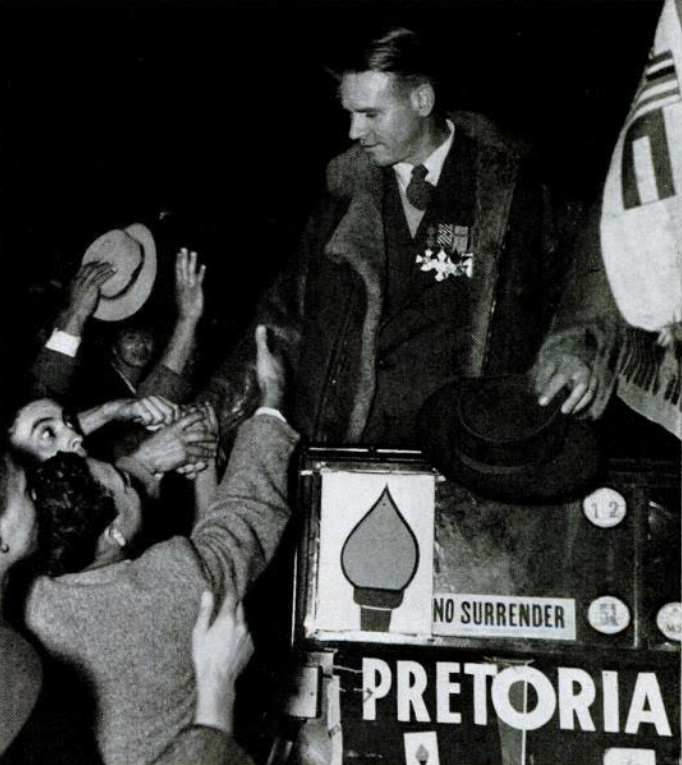
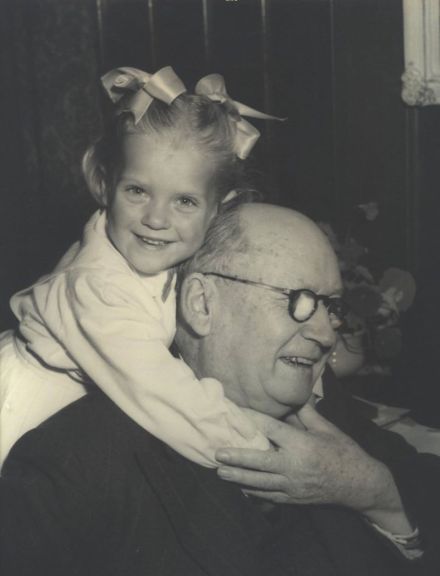
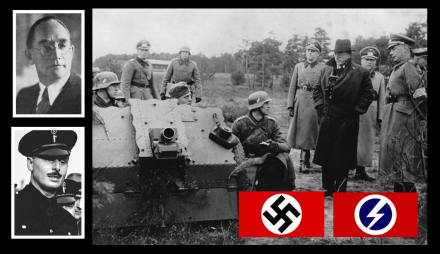
The fact is that prior to 1948 ‘resistance’ on a mass level to Smuts’ policies came from the white sector, and it came from fierce Afrikaner nationalists who had joined organisations like the Ossewabrandwag and Nazi grey shirts, whose objective was to topple the Smuts’ government by force of arms.  The Ossewabrandwag had about 200 000 supporters, these were the true resistance and mass movements facing the Smuts epoch.  They were the biggest threat to the Union of South Africa and Smuts’ biggest political headache.

The 1946 miners strike, was a one week mass strike action which ended in violence with government forces, the underpinning problem was a wage dispute, it was settled with a 10 shilling per day minimum wage (an increase from 2 shillings), and improved working conditions as the basis of the strikers demands.  This action needs to be viewed as dispute on wages and conditions of miners with the mine companies primarily.  It was not really a political protest against an entire system of government.

The 1912 Anti Pass Women’s movement needs to be viewed in context with the British Suffrage Movement which they chose to follow, and revolved around a worldwide problem of female political representation (in Europe as in Africa). Gandhi’s Satyagraha campaign against pass laws eventually succeeded in 1914.  Smuts’ and Gandhi actually became friends over the process and admired each other greatly till the day they died.

Post World War 2, Smut’s approached the 1948 elections with the idea of giving franchise to South Africa’s Black population on a phased and qualification basis.  He had promised Black Community leaders to give more political representation to the Black community if they supported the war effort – which they did.  It was these proposals and policies which went up against the National Party’s Apartheid policies in the 1948 elections.  It was Smuts’ willingness to address the African franchise issue that led to his failure in the elections, with the Nationalists playing into ‘white fears’ of Black African political empowerment which swung the vote to them.

Apartheid as an institutionalised policy started in 1948.  The first mass protests against this institution started in 1951.  The people who led this mass protest action were The Torch Commando, and not the ANC, their ‘Defiance Campaign’ came later.  Prior to this the proper ‘mass action’ against the Smuts’ government came primarily from disaffected and militant Afrikaner nationalists in their hundreds of thousands wanting an Apartheid state. That’s a fact.

The Observation Post is re-writing history.  This is incorrect

The intention of highlighting The Torch Commando is that it was ‘written out of history’ by The National Party and remains ‘written out’ for political expedience by the current government.  It is a ‘inconvenient truth’ as it highlights a mass movement of pro-democratic white people not in alignment with Apartheid.  It challenges the prevailing malaise of thinking in South Africa – that everything prior to 1994 was ‘evil’ and white South Africans must therefore share a collective ‘guilt’.  The purpose is to highlight great men like Sailor Malan and movements like the Torch Commando, uncover their hidden history and enter their contributions into the annuals of progressive South Africans who sought change and universal franchise and honour them as such.

15541961_689668087869593_6848483991317263370_n

Sailor Malan at a Torch Commando Rally in Cape Town


Written by Peter Dickens.  Video footage Associated Press copyright.

The Torch Commando led South Africa’s first mass anti-apartheid protests, NOT the ANC!

The ‘Torch’, an inconvenient truth!

Now, this rare short movie clip exposes an inconvenient truth to the current political narrative of the “struggle”, the first mass anti-Apartheid protests were led by this highly decorated Afrikaner war hero – Adolph “Sailor” Malan – and the mass protesters were not led by the ANC and its supporters, this very first mass mobilisation was made up of returning WW2 veterans – this rare video footage captures some of this fascinating and largely ‘hidden’ South African history.

Many people may know of the South African “Battle of Britain” Ace – Adolph ‘Sailor’ Malan DSO & Bar, DFC & Bar – he is one of the most highly regarded fighter pilots of the war, one of the best fighter pilots South Africa has ever produced and he stands as one of the “few” which turned back Nazi Germany from complete European dominance in the Battle of Britain – his rules of aerial combat helped keep Britain in the war, and as a result he, and a handful of others, changed the course of history. But not many people are aware of Sailor Malan as a political fighter, anti-apartheid campaigner and champion for racial equality.

‘Sailor’ Malan can be counted as one of the very first anti-apartheid ‘struggle’ heroes. The organisation he formed “The Torch Commando” was the first real anti-apartheid mass protest movement – and it was made up of South African ex-servicemen, not disenfranchised civilians. Yet today that is conveniently forgotten in South Africa as it does not fit the current political rhetoric or agenda.

After the Second World War, Sailor Malan left the Royal Air Force and returned to South Africa in 1946. He was surprised by the unexpected win of the National Party over the United Party in the General Election of 1948 on their proposal of ‘Apartheid’ as this was in direct opposition to the freedom values he and all the South African veterans in World War 2 had been fighting for.

What he and other returning World War 2 servicemen saw instead was far right pro Nazi Germany South African reactionaries elected into office. By the early 1950’s the South African National Party government was littered with men, who, prior to the war where strongly sympathetic to the Nazi cause and had actually declared themselves as full-blown National Socialists during the war as members of organisations like the Ossewabrandwag, the SANP Greyshirts and the Nazi expansionist “New Order”: Oswald Pirow, B.J. Vorster, Hendrik van den Bergh, Johannes von Moltke, P.O. Sauer, F. Erasmus , C.R. Swart, P.W. Botha and Louis Weichardt to name a few, and there is no doubt that their brand of politics was influencing government policy.

This was the very philosophy the returning South African servicemen and women had been fighting against, the “war for freedom” against the anti-Judea/Christian “crooked cross” (swastika) philosophy and its false messiah as Smuts had called Germany’s National Socialism doctrine and Adolph Hitler.

In the 1951 in reaction to this paradigm shift in South African politics to the very men and political philosophy the servicemen went to war against, a mass mobilisation protest movement was formed by  group of ex-servicemen.  They called it the “ Torch Commando” (The Torch), as their protests were held at night with each member carrying a ‘fire’ torch – a symbol of light, freedom and hope. In effect it became an anti-apartheid mass movement and Sailor Malan took the position of National President.

The Torch’s first activity was to fight the National Party’s plans to remove ‘Cape Coloured’ voters from the common roll which were been rolled out by the National Party two years into office in 1950.

The ‘Cape Coloured’ franchise was protected in the Union Act of 1910 by an entrenched clause stating there could be no change without a two-thirds majority of both houses of Parliament sitting together. The Nationalist government, with unparalleled cynicism, passed the High Court of Parliament Act, effectively removing the autonomy of the judiciary, packing the Senate with National Party sympathisers and thus disenfranchising the ‘coloured’ voters. This was the first move by the National Party to secure a “whites only” voting franchise for South Africa (reinforcing and in fact embedding them in power for years to come).

The plight of the Cape Coloured community was close to most White ex-servicemen as during WW1 and WW2, the Cape Coloureds had fought alongside their White counterparts as fully armed combatants. In effect forging that strong bond of brothers in arms which so often transcends racial barriers.

The Torch Commando strategy was to bring the considerable mass of “moderate’ South African war veterans from apolitical organisations such as the Memorable Order of Tin Hats (MOTH) and South African Legion (BESL) into allegiance with more ‘leftist’ veterans from an organisation called the Springbok Legion – of which Joe Slovo, who himself was also a South African Army World War 2 veteran and was a key leader, his organisation – The Springbok Legion, led by a group of white war veterans who embraced Communism was already very actively campaigning against Apartheid legislation and highly politically motivated.

The commando’s main activities were the torchlight marches. The largest march attracted 75 000 protesters. This ground swell of mass support attracted the United Party to form a loose allegiance with The Torch Commando in the hope of attracting voters to its campaign to oust the National Party in the 1953 General Election (The United Party was now run by J.G.N. Strauss after Jan Smut’s death and was seeking to take back the narrow margins that brought the National Party into power in 1948).

In a speech at a massive Torch Commando rally outside City Hall in Johannesburg – 75000 people on protest, “Sailor” Malan made reference to the ideals for which the Second World War was fought:

“The strength of this gathering is evidence that the men and women who fought in the war for freedom still cherish what they fought for. We are determined not to be denied the fruits of that victory.”

During the Torch Commando anti-apartheid rally in Cape Town (The movie clip shows the leader of the Torch heading to this exact rally) – 10 000 South African WW2 veterans went on protest. Sailor Malan famously accused the national party government at this rally of;

“Depriving us of our freedom, with a fascist arrogance that we have not experienced since Hitler and Mussolini met their fate”.

Wartime singing icon Perla Gibson also attended the Torch Commando anti apartheid rally in Cape Town and sang to the protesters in support. Perla was known as the ‘Lady in white” and sang to incoming and outgoing troops in Durban harbour during WW2 to beef up morale.

Also of extreme interest was co-leader of the Torch Commando rally in Cape Town – Kmdt. Dolf de la Rey (seen here in the video) – he famously captured Winston Churchill during the Boer War fighting for the Boers and became a Torch Commando activist, another one of the rich tapestry of Afrikaner war heroes in conflict with National Party politics and philosophy.

During the Cape Town “Torch” 50 000 civilians joined the 10 000 veterans when the protest moved to hand over a petition at the Parliament buildings in Cape Town. The police barred the way and a scuffle broke out. 160 Protesters where injured along with 15 Policemen. As tensions grew over the protest the National Party MP Johannes Streydom finally warned them that he would use the South African security forces against “those who are playing with fire and speaking of civil war and rebellion”.

DF Malan’s government was so alarmed by the number of judges, public servants and military officers joining The Torch that those within the public service or military were prohibited from enlisting, lest they lose their jobs – this pressure quickly led to the erosion of the organisation’s “moderate” members, many of whom still had association to the armed forces, with reputations and livelihoods to keep.

The “leftist” members of The Torch where eroded by anti-communist legislation implemented by the National Party, which effectively ended the Springbok Legion forcing its members underground (many of it’s firebrand communist leaders, including Joe Slovo, went on to join the ANC’s MK armed wing and lend it their military expertise instead).

In essence, the newly governing National Party at that time could not afford to have the white voter base split over its narrow hold on power and the idea that the country’s armed forces community was standing in direct opposition to their policies of Apartheid posed a real and significant threat – bearing in mind one in four white males in South Africa (English and Afrikaans) had volunteered to go to war and support Smuts – this made up a very significant portion of the voting public, notwithstanding the fact that there all now very battle hardened with extensive military training, should they decide to overthrow the government by force of arms.

Also the National Party government, being extremely concerned about the influence this movement might have, especially under the leadership of the war hero, acted ‘decisively’ (as was its usual modus operandi) and went about discrediting the Torch Commando and its leaders through means of negative propaganda.

For the rest of his life, Sailor would be completely ridiculed by the Nationalist government. The National Party press caricatured him  ‘a flying poodle’, dressed in his leathers and flying goggles, in the service of Jan Smuts and the Jewish mine-bosses, who were referred to as the “Hochenheimers”.  The National Party openly branded him as an Afrikaner of a ‘different’ and ‘unpatriotic’ kind, a traitor to his country and ‘Volk’ (people).

In addition to the National Party’s efforts, the Torch Commando also ultimately failed because it could not un-couple itself as a political arm of the United Party and establish itself as independent mass action movement, it found itself curtailed by moderate party politics. One political cartoon of the time lampoons The Torch Commando as a hindrance to the United Party.

Sailor Malan’s political career was effectively ended and the “Torch” effectively suppressed by the National Party, so he returned to his hometown of Kimberly. Sadly, Sailor Malan succumbed on 17th September 1963 aged 53 to Parkinson’s Disease about which little was known at the time. Some research now supports the notion that Post Traumatic Stress Disorder (PTSD) can bring on an early onset of Parkinson’s Disease, and it is now thought that Sailor Malan’s high exposure to combat stress may have played a part in his death at such a relatively young age.

Although he fought in the blue sky over England in the most epic aerial battle to change the course of history, one of the “few” to which Churchill recorded that the free world owes a massive debt of gratitude to, he lies today under an African sun in Kimberley – a true hero and son of South Africa.

It is to the embarrassment now as to his treatment as a South African WW2 military hero that all enlisted South African military personnel who attended his funeral where instructed not to wear their uniforms by the newly formatted SADF. The government did not want a Afrikaner, as Malan was, idealised as a military hero in death in the fear that he would become a role model to future Afrikaner youth.

The “official” obituary issued for Sailor Malan published in all national newspapers made no mention of his role as National President of The Torch Commando or referenced his political career. The idea was that The Torch Commando would die with Sailor Malan.

All requests to give him a full military funeral were turned down and even the South African Air Force were instructed not to give him any tribute. Ironically this action now stands as testimony to just how fearful the government had become of him as a political fighter.

A lot can be said of Sailor Malan as a brilliant fighter pilot, even more can be said of political affiliation to what was right and what was wrong. He had no problem taking on the German Luftwaffe in the greatest air battle in history, and he certainly had no problem taking on the entire Nationalist regime of Apartheid South Africa – he was a man who, more than any other, could quote the motto of the Royal Air Force’s 74 Squadron which he eventually commanded, and say in all truth:

“I fear no man”

The campaign to purge the national consciousness of The Torch Commando, The Springbok Legion and Sailor Malan was highly effective as by the 1970’s and 1980’s the emergent generation of South Africans have little to no knowledge of The Torch, it is highly unlikely that anyone today remembers Sailor Malan’s speech to 75000 Torch Commando protesters in the centre of Johannesburg.

This “scrubbing” of history by the National Party in aid of their political narrative strangely also aids the ANC’s current political narrative that it is the organisation which started mass protests against Apartheid with the onset of the “Defiance Campaign” on the 6th of April 1952, led mainly by ‘black’ South Africans.  The truth of that matter is that the first formalised mass protests in their tens of thousands against Apartheid where in fact mainly led by ‘white’ South African military veterans, starting a year earlier in 1951.

Another inconvenient truth – luckily history has a way of re-emerging with some facts, and the historical record (like this rare footage) shows in plain day an overlooked mass movement against Apartheid, a movement no longer referenced or even properly documented in South Africa today.

Indeed, Sailor Malan is also not publicly accredited as a significant ‘struggle hero’ in countless current-day dedications, let alone his value as a Battle of Britain hero, and here he is widely praised in Britain, but not in his homeland.  It is also currently unlikely that any streets, institutions or buildings will be named after him or any of the other leaders of The Torch Commando for that matter (other than Joe Slovo).  The ‘race politics’ that Sailor Malan fought against, which sadly still exist in South Africa today, dictate that – so he and his organisation remain anonymous but to a few.

Written and researched by Peter Dickens

Editors Note: Since publishing this, more footage of the Torch Commando has been released by AP and it’s a new wealth of insight, please refer to this new Observation Post for this amazing footage and answers to some of the received comments and criticisms stemming this article. ‘New’ rare footage of The Torch Commando in action, the first mass protests against Apartheid by WW2 veterans.


References: South African History On-Line (SAHO), South African History Association, Wikipedia ,Neil Roos: Ordinary Springboks: White Servicemen and Social Justice in South Africa, 1939-1961. Life Magazine, 25 June 1951.  Video footage, Associated Press – source Youtube.

The Nat’s Nazi German orphan adoption program .. some good results, some very bad!

Please note, this article has been re-pressed and updated, please follow the link below for its revision:

‘Herrenvolk blood for a Afrikaner Volk’ Herrenvolk blood for an Afrikaner volk

South Africa’s Nazi ‘Neuordnung’ and Oswald Pirow

Oswald_Pirow

Oswald Pirow

So when is it right to re-name a national landmark road?  We’re all up in arms that Edwin Swales VC Drive, named after our famous Victoria Cross winner for gallantry in World War 2 was re-named as Solomon Kalushi Mahlangu Drive after a controversial Umkhonto we Sizwe operative.  But what of Oswald Pirow Street in Cape Town, is there a case to justify this street name change?

Read on for a little more on who Oswald Pirow really was, learn some more on South African “hidden” military history; the Pro Nazi paramilitary organisations who sought to destabilise South Africa and the Union during the Second World War and bring South Africa into a one party ‘Fuhrer’ state run along ‘national socialism’ lines.

In all there were three movements which supported Nazi Germany and embraced its ideology in South Africa, the Ossewabrandwag, the shirts including the ‘Blackshirts’ and the SANP Greyshirts (see Pro Nazi movements in wartime South Africa – the SANP “Greyshirts”) and the ‘global’ Nazi movement – The ‘New Order’ – led by our subject for the day, the well-known South African Nationalist Politician and Public Prosecutor – Oswald Pirow.

10460708_459305080905896_5196244094119877880_n

Oswald Pirow in Nazi Germany, November 1938  in Berlin inspecting a honour guard from the German Luftwaffe (Air Force), to his left is Wilhelm Canaris, to his right Ernst Seifert.

In a relatively little known part of South African history, Oswald Pirow was sent on ‘quasi-official’ visits on behalf of the Hertzog government to Nazi Germany and Fascist Italy.  His mission was one of appeasement, to meet with Hitler, Ribbentrop and Goering and try to establish Anglo-German rapprochement as well as assure them of South Africa’s neutrality under the Hertzog government.

Pirow’s solution to easing British and German tension prior to the war, which he proposed to Hitler, was for the British to agree with the Nazi policy of “Drang nach Osten” (meaning yearning or ‘thrust’ towards the East for ‘living space’ as Hitler put it in his book ‘Mein Kamph’) and in return Hitler should allow all the Jewish people living in Germany to leave.  In reality this offer would never have happened as it would have required Britain, by way of a parliamentary agreement, to renege on its commitment to Poland as an ally.  However, Pirow also had another mission, that of building a South African partnership for a post war Nazi world.

So how is it that these lessor known South African missions and special envoy on ‘quasi official’ visits come about, what was he doing and what made Oswald Pirow tick?

Background

Oswald Pirow was born in Aberdeen (Cape Province, South Africa) on 14th August 1890, and was the grandson of a German missionary and son of a Doctor. Pirow studied law in Potchefstroom, Germany and London, and then practised as an advocate in Pretoria.  Oswald spoke perfect German and was insistent that only German was spoken by his family at home in South Africa (it was said by those who knew them that the Pirow family was more German in identity than South African).

He came to fame as a lawyer defending the Communist ring-leaders and instigators of The Rand Revolt in 1922 (see South Africa’s very own Communist Revolution – The Rand Revolt of 1922), an odd start for him as he became an ardent hater of anything Communist and would later come up with plans to ‘eradicate’ communism from the planet in its entirety (not just South Africa).

He made several unsuccessful attempts to enter parliament and finally in 1924 he was elected for Zoutpansberg. Smuts defeated him in 1929 in Standerton but he returned to Parliament and in the same year and he was appointed Minister of Justice in General Hertzog’s cabinet. The Hertzog government was in coalition, so it could not fully unleash Nationalist proposals for a Republic (of which Pirow was a keen supporter).

As Justice Minister, typical to form as a fierce anti-communist he passed the first anti-communist legislation in South Africa. In 1933 he was appointed Minister of Railways and Harbours, and from 1933 to 1939 he was Minister of Defence.

25074984_2060834677478853_5650117780720895916_o

Oswald Pirow (in civilian dress) on tour inspecting German military capability in 1938

Unofficial Envoy 

In 1936 Pirow attended the Olympic Games in National Socialist (Nazi) Germany and in 1938 again visited Europe, including Spain, Portugal and Germany. These visits confirmed his admiration for this new style of government in Europe and, in particular, for National Socialism (Nazism). A vehement anti-communist – Pirow vowed to legislate communism out of existence, he also became an admirer of Adolf Hitler – especially after meeting him in 1933.

11425451_459347364235001_7335473098897133162_n

Oswald Pirow ( left) at a reception of the Nazi Foreign Minister Joachim von Ribbentrop in conversation with Erhard Milch (right) and Walter Hevel on November 19, 1938

During this tours he also met Benito Mussolini, António de Oliveira Salazar and Francisco Franco and became convinced that a European war was imminent, with a resounding Nazi victory assured.  The future Pirow predicted was one of global nazism and it was a future he liked.

The Nationalists were strongly in favour of Nazi Germany, primarily as the antagonists for war in their eyes were the British, and they simply hated the British.  This hatred stemmed from the punitive deportation and containment measures used by The British against Boer families along with the destruction of their farmsteads during The 2nd Anglo-Boer War.

Publicly the Nationalists declared neutrality as to Nazi Germany and to the impending war with Germany, whilst covertly their members (and even leaders) in the tens of thousands joined pro Nazi organisations like the Ossawabrandwag and the SANP Grey Shirts, which very publicly nailed their colours to mast strongly in support of Nazi Germany.

When General Jan Smuts committed South Africa to war against Nazi Germany, Pirow found his position in government as a Minister of Parliament and especially as Minister of Defence untenable. He had given his support in 1939 to Hertzog’s neutrality policy and had been on appeasement missions to Nazi Germany in support of them.  He then resigned along with Hertzog and took no part in Smuts’ reformatted war-time government.

South Africa’s ‘New Order’ 

By September 1940, with Nazi Germany on the ascendancy having invaded most of Western Europe, Pirow launched the South African version of the “New Order” within the breakaway National Party – the Herenigde Nasionale Party (HNP), backing a Nazi style dictatorship.

His new political grouping took its name from his 1940 ‘New Order in South Africa’ pamphlet in which Pirow embraced the ideology of Nazi globalisation.

To understand what the concept of the “New Order” was – the New Order (German: Neuordnung) was the political order which Nazi Germany wanted to impose on the conquered areas under its dominion.

The establishment of the New Order was publicly proclaimed by Adolf Hitler and entailed the creation of a pan-German racial state structured according to Nazi ideology to ensure the supremacy of an Aryan-Nordic master race, massive territorial expansion into Eastern Europe through its colonization with German settlers, the physical annihilation of the Jews and others considered to be “unworthy of life”, and the extermination, expulsion, or enslavement of most of the Slavic peoples and others regarded as “racially inferior”.

third-reich-2

Hitler’s New Order for Africa

Hitler’s ‘New Order’ plan involved global expansion, it focussed primarily on Eastern Europe (‘living space’) however it also extend to Asia, India, South America and North America in ‘post war’ fascist dominated world. Like any plan for globalisation, Africa also played a role in the New Order.

Hitler’s overall intentions for the future organisation of Africa was based on a plan which divided the continent into three big parts. The northern third of Africa was to be assigned to Germany’s Axis partner – Italy. The central part of Africa would fall under German rule. The remaining southern sector would be controlled by a pro-Nazi Afrikaner state built along racial grounds.

Foreign Minister Ribbentrop had communicated this plan with South African leaders sympathetic to Nazism, and a key channel for this communication were his meetings with Oswald Pirow whilst he was on his ‘quasi official’ South African State visits to Nazi Germany on behalf of the Hertzog government.

25188738_2060834724145515_6204150310272340344_o

Oswald Pirow as a special South African envoy inspecting German Infantry and military capability in 1938

Ribbentrop informed the Afrikaner Nationalist leaders that once Germany had won the war, Germany was to reclaim its former colony of German South-West Africa (now Namibia), then a mandate would be given to an Afrikaner Nationalist led South Africa as a sort of ‘war compensation’ which would include the territorial acquisitions of the British protectorates of  Swaziland, Basutoland (Lesotho), Bechuanaland (Botswana) and the colony of Southern Rhodesia (Zimbabwe).

On the division of French African colonies between the Spanish and Italian governments Hitler refused to provide any official promises during the war, fearful of losing the support of Vichy France

Decline of Pirow’s New Order 

240px-DFMalanPortret

Dr. DF Malan

Dr D.F. Malan, leader of the National Party initially tolerated the actions of Oswald Pirow’s South African adaption of the 3rd Reich’s ‘New Order’ however very soon Malan came to realise what the extreme ideology of  The New Order was about and he immediately saw it as a divisive influence on the Afrikaner nationalist movement.

Fearful of a split in Afrikaner nationalism over support for extreme Nazism and for Hitler’s plans for the African ‘new order’, at the Nationalists Transvaal party congress of August 1941, Malan forced through a motion ending the New Order’s propaganda activities, particularly their insistence on a one-party state on a ‘Führer’ principle.

To understand more about the National Party and its associations to pro Nazi movements do follow this link “Mein Kampf shows the way to greatness for South Africa” – The Ossewabrandwag

Although restricted by DF Malan, the New Order continued to exist and Pirow and 17 of his New Order supporters continued to be associated with the HNP and continued to attend their caucus meetings.

The New Order  finally broke from the HNP altogether in 1942 after both D.F. Malan and J.G. Strijdom publicly rejected the Nazis.

Partnership with Sir Oswald Mosley 

537202579

Oswald Mosley

With the outcome of the war firmly against Nazi Germany, Oswald Pirow’s political career within the Afrikaner Nationalists was effectively over, he returned to legal practice, and during this time became a friend of Sir Oswald Mosley.

Mosley was ex-British MP and an infamous British Nazi, he led the British Union of Fascists (BUF), a Neo-nazi British organisation following the edicts of the ‘New Order’ in the United Kingdom.

Mosley was imprisoned at the outbreak of World War 2 in 1940 for his extreme views in support of the enemy (Nazi Germany) and the BUF was outlawed. He was released in 1943.

Oswald Pirow and Mosley, having similar political views decided to collaborate together and they developed an idea for the division of Africa into exclusively black and white areas.

505808586

Oswald Pirow and Oswald Mosley

The two met after Pirow read a copy of Mosley’s book ‘The Alternative’ and by 1947 they were in discussion over founding an anti-communist group to be known as the “enemies of the Soviet Union” (although this plan never reached fruition).

buf_flag

Mosley’s British Union of Fascists (BUF) Flag

The two Oswalds co-operation started in earnest when Pirow visited Mosley in London in April 1948 and spent the weekend at his house.  In collaboration with Mosley, Oswald Pirow started writing articles for the Union Movement journals and The European, some of which were reprinted in German magazine Nation Europa.

In addition to writing for far right wing publications, the two Oswalds came up with what were known as the Mosley-Pirow Proposals, which advocated the extension of the South African National Party’s Apartheid ideology and concept to include the entire continent of Africa.  The idea they came up with was that two-thirds of sub saharan Africa would be advocated for ‘Black States’ and one-third would be for ‘White states’.  Where the two of them differed on their concept of ‘Eurafrica’ (which they coined) is that Pirow felt that ‘sweated labour’ would need to be forced whereas Mosley felt that unskilled Labour, needed in the ‘white states,’ was to be traded for from the ‘black states’ in return for technical assistance at some ‘later stage’.

The relationship with Pirow and Mosley started to break down after their ‘Eurafrica proposals’ were launched. Pirow came to realise that virtually nobody took Mosley seriously, people generally dismissed both him and his economic and political treatise out of hand as an extreme oddity.

The Treason Trial

Nelson Mandela, treason trial, Pretoria, 1958

Nelson Mandela at The Treason Trial 1956

Very famously Pirow, now back in South Africa and back in his legal guise, acted as the public prosecutor on behalf of the Nationalist State during the Treason Trial of 1956. The Treason Trial was a trial in which 156 people, including Nelson Mandela, were arrested in a raid and accused of treason in South Africa in 1956. The main trial lasted until 1961, when all of the defendants were found not guilty. During the trials, Oliver Tambo left the country and was exiled. Some of the defendants, including Nelson Mandela were later convicted in the Rivonia Trial in 1964.

Following the Treason Trial Pirow largely lived in retirement, publishing several books, especially on JB Hertzog of who he was an admirer, he also wrote books on wildlife and adventure books for boys. He died of heart failure. He was cremated and his ashes are kept at his Valhalla Farm residence near Pilgrim’s Rest.

11401548_459339007569170_7553625890068332822_n

Influence on Apartheid 

Oswald Pirow’s influence in South African politics and Apartheid is far-reaching. The Tomlinson Commission – which investigated the validity of the idea Apartheid was not a new creation, and its findings were based in part on findings made by the Native Economic Commission in 1932 and on preparatory work done by Oswald Pirow.

Very little is known in South Africa today of the frustration and disillusionment returning South African combatants from World War 2 felt and the motivation behind their eventual mass protests against Apartheid policies in the 1950’s (known as the ‘Torch’ Commando rallies – attracting  tens of thousands of war veterans – see The Torch Commando led South Africa’s first mass anti-apartheid protests, NOT the ANC!).

Effectively the returning South African statute force veterans had gone to war to rid the world of Nazism, only to come home and in a few short years find significant “home grown” Nazi’s in government or playing a key role in public prosecution (as was the case with Pirow) when the National Party narrowly beat Smuts’ United Party into power in 1948.

The likes of famous World War 2 heroes like Adolph “Sailor” Malan would have none of it and they took to the streets in the first mass protests against Apartheid and the Nationalist government who had only come into power a couple of years before hand and where already removing the cape coloured vote from the register – see Sailor Malan; Fighter Ace & Freedom Fighter!.

The Torch Commando and veteran protests where ultimately suppressed by The National Party (including Sailor Malan) and the Nationalists where free to promote their heroes – Oswald Pirow had the foreshore road in Cape Town named after him  as well as a South African navy strike craft – the SAS Oswald Pirow – much to the disillusionment of many of South Africa’s war veterans, the disenfranchised voters and the South African Jewish community.

Re-naming 

Since 1994, proposals were to put forward to re-name the strike craft and Cape Town’s foreshore road.

The SAS Oswald Pirow was re-named the SAS Rene Sethren after a famous Navy stocker Rene Sethren who was on board a South African minesweeper in World War 2. In June 1941 his ship was escorting a convoy to Tobruk when they came under heavy attack from enemy planes. He took over an anti-aircraft gun and did not stop firing until the attack was over. He was wounded 27 times during the attack and fortunately survived, he received his gallantry decoration from King George V.

It was also discovered that although Dr Christiaan Barnard had performed the world’s first heart transplant nothing in the way of Cape Town’s streets honoured this, since 2011 most Captonians now know this landmark road which was ‘Oswald Pirow Street’ as ‘Christiaan Barnard Street’.

Oswald Pirow

There is an argument that says we should not be re-naming things in the interests of preserving history, with all its spots, however world over institutions named after Nazis have been re-named and/or scrubbed of anything glorifying this history.  Munich – the birthplace of Nazism is virtually clean of any old references, such is its blight to the entire human race caused by this ideology, and in this respect South Africa has acted no differently.

What is surprising is that even during the 70’s and the 80’s, the National Party were unapologetic in the glorification of individuals so closely associated to National Socialist ideology and Nazism, no matter how hurtful to the vast majority of South Africans, well after the horrors of this ideology had been exposed and universally condemned (even in South Africa).

Pirow was allowed to continue as the State Prosecutor and advise Apartheid policy, his controversial plans for the Nazification of Southern Africa were just glazed over and conveniently swept under the rug – the modern South African generation would grow up fairly oblivious of Oswald Pirow’s really dark past.

11406645_459696484200089_3957396089513991556_o

Display of the SAS Oswald Pirow at the SA Naval Museum, it was renamed the renamed SAS Rene Sethren on April 1, 1997


Written and Researched by Peter Dickens.

Feature photo copyright the German Federal Archives copyright. ‘Very Deeply Dyed in Black’ Sir Oswald Mosley  and the Resurrection of British Fascism After 1945 by Graham Macklin. NSDAP Office of Colonial Policy  Brian Bunting’s 1964 book, The Rise of the South African Reich.  Ribbontrop’s proposals to South Africa, The Rise and Fall of the Third Reich,  by William Shirer, 1974 edition.

Published by New York: Crest, 1962, New York (1962