South Africa’s “Vietnam” – the tactical use of the helicopter during the Bush War

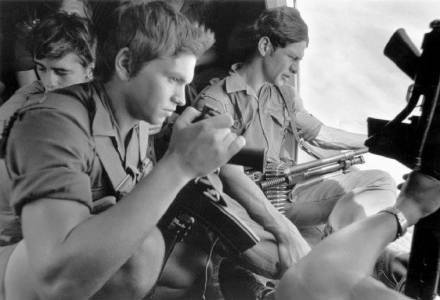
South Africa’s ‘Vietnam’ in a Bush War photo not too dissimilar to a Vietnam War image, an elite South African rapid response unit prepares to be debused from a South African Air Force Puma helicopter somewhere on the Angolan and South West African Border. What a great photo by Peter Marlow.

Not interested in keeping permanent “firebases” in Angola to stem insurgency,  similar to the American tactics used in Vietnam the South Africans extensively used the helicopter to shuttle reaction forces directly to an identified target and take them back once their “search and destroy” mission had been completed.

Image copyright – Peter Marlow

The SAAF’s Fighting Hornets in East Africa – No. 3 Squadron

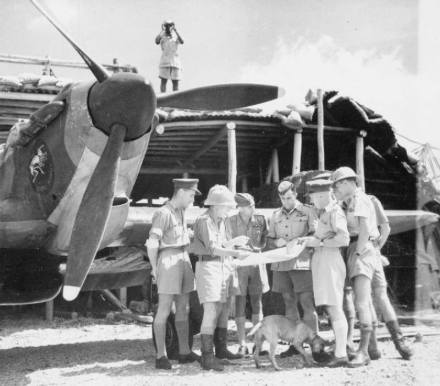
1941, East African Campaign. Major J D Pretorius, the Commanding Officer of No. 3 Squadron South African Air Force, briefs his pilots in front of a SAAF Hawker Hurricane Mark I at Addis Ababa, during mopping-up operations in Abyssinia.  Note 3 Squadron’s unit badge of a hornet with boxing gloves on the starboard side of the Hawker Hurricane’s nose, this is the original “fighting hornet,” the later version used by the SAAF is a little more refined.

Photo copyright – Imperial War Museum Collection.

Britain’s “Simonstown Agreement” included the SAAF’s Buccaneers

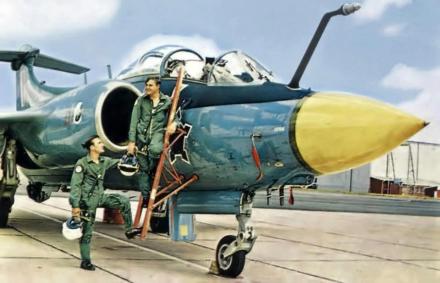
Hawker Siddeley Buccaneer S Mark 50 1970. South Africa was the only country other than the UK to operate the Buccaneer, where it was in service with the South African Air Force from 1965 to 1991. In January 1963, even before the H.S. Buccaneer S had entered squadron service, South Africa had purchased 16 Spey-powered Buccaneers. The aircraft order was part of the “Simonstown Agreement”, in which the UK obtained use of the Simonstown naval base in South Africa in exchange for maritime weapons.

The SAAF “Boston Shuttle Service”

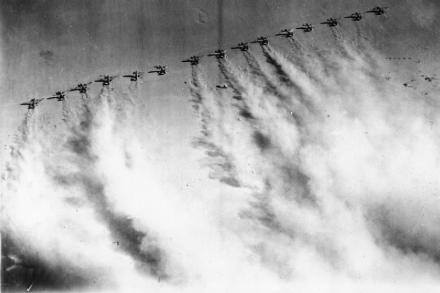
South African Air Force (SAAF) Operations in North Africa during World War 2..  Here SAAF pilots perform the “Boston Shuttle Service” a squadron of Douglas Boston Mark IIIs of No. 3 Wing SAAF positioned for their famous simultaneous take-off manoeuvre on a landing ground in the Western Desert. This commenced with all aircraft turning into wind in line abreast. The leading aircraft, on the right-hand side, then commenced its take-off run with the remainder following in echelon port so that each aircraft avoided the dust of the one ahead.

The term “Boston Shuttle Service”,  was given to the SAAF’s single most memorable feat in North Africa in which eighteen aircraft of 12 and 24 Squadrons showered hundreds of tons of bombs, primarily using Boston Medium bombers, on the Afrika Korps as it relentlessly pushed the Eighth Army back towards Egypt during the “Gazala Gallop” in the first half of 1942.

No. 3 (S.A.) Wing was a South African Air Force commanded formation during World War II that served in North Africa, Sicily and Italy. It was formed on 28 August 1941 and initially consisted of Royal Air Force and South African Air Force squadrons under South African command, known as No. 261 Medium Bomber Wing but became a fully fledged South African formation on 23 September 1942 when the RAF Squadrons were transferred from it leaving 12, 21 and 24 Squadrons SAAF as its assigned units.

Reference Imperial War Museum, SAAF History – SAAF website and Wikipedia. Image copyright Imperial War Museum.

Flying Cheetahs – the South African Air Force in the Korean War

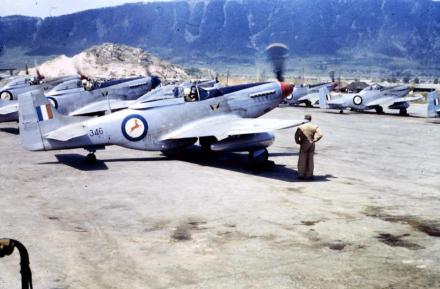
Not many South Africans are aware that South Africa took part in the Korean War, well here is a rare original colour photograph of a North American F-51D Mustang fighters of No. 2 Squadron of the South African Air Force in Korea. Here they are seen conducting run-ups during the Korean War in 1951. This F-51 Mustang No. 346 crashed on 29/11/1951 tragically killing the pilot Capt Janse van Rensburg.

This rare photo courtesy and thanks to Ian Pretorius from his Dad’s collection, then Lt M S (Mike) Pretorius.