
Often on Boer war social media appreciation sites, and even on simple things like wikipedia we see this statement “it took 500,000 British to defeat 20,000 Boers” – the much-touted ratio in this type of media is that the Boers were outnumbered 25 to 1, at a staggering disadvantage during The South African War 1899-1902 a.k.a Boer War 2.
The story goes that these plucky Boers held the mighty British empire at bay. Now that’s a figure designed to paint the Boer fighter as some sort of super-man and the British military as bumbling, monolithic and ineffective. But the truth is far from this and this figure is completely erroneous designed to drive Afrikaner nationalist political rhetoric – it has nothing to do with actual numbers on the ground.
This is why I love economic history and not political history – economic history speaks the raw numbers, the statistics – the unassailable mathematical facts, and it tends to drive great holes into the ‘political’ history and its inherit political rhetoric – its the point when the facts talk and the bull walks.
Let the numbers speak!
Now, here’s the truth – at no point in Boer war 2 were there ever 500,000 British troops in South Africa as boots on the ground at any one point in time – in total, over the course of the war the British called up 550,000 men – that bit is true, yes. HOWEVER the British rotated their Regiments in and out of South Africa on ‘tours of duty’ – never really sending a full regiment into the operational theatre at once, retaining many at home and in their other colonies around the world. The “high water mark” i.e., the maximum number of British Troops in South Africa at any one point in time is 230,000 men. Even pro-Boer chronologies like that of Pieter Cloete’s Boer War facts and figures reluctantly has to admit this fact.
This high-water mark of 230,000 (including African Auxiliaries) is only peaked briefly during the late Guerrilla Phase of the war – and at least 50,000 of these troops are being used to man the rather extensive blockhouse defence system stretching from the top to bottom and side to side across the whole of South Africa (as referenced by Simon C. Green in his Blockhouses of the Boer War) – over thousands of kilometres both ways. On average during the Guerrilla Phase of the war – September 1900 to April 1902, the British enjoy 190,000 troops on the ground.
But let’s stick to the high-water marks for a proper account – the high water for the Boer forces, total Republican forces strength is 87,365 men – including 21,043 burghers who add onto the original ZAR and OFS Commando call-up later (initial call-up is 48,216), the statutory Boer forces (2,686), foreign volunteers (2,120) and Cape Rebels (13,300).
The Boer figure is possibly higher if we add African auxiliaries and rear echelon support – the “tooth to tail” non-combatant ratio – which is accounted in the British numbers in terms of administrators, doctors, pharmacists and medics, batmen, chefs, farriers, holsters, labourers, wagon drivers etc. but NOT in the Boer numbers as this would start to add women, agteryers, servants and farm hands as people acting in Boer combat supporting roles in a non-combatant capacity.
That means a conservative ratio between Brit and Boer at the high-water marks = 230,000 Brits and 87,300 Boers – a ratio of 3:1 – total Imperial forces versus total republican forces (sans the tooth to tail ratio in the Boer number). It’s a far cry from the emotionally charged and erroneously touted figure of 25:1.
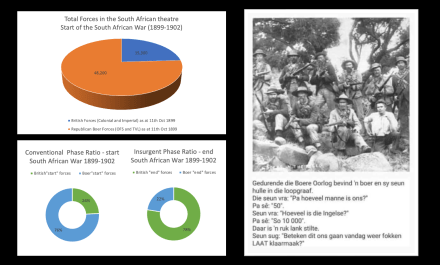
Consider the size of the Republican Forces at the beginning of Boer War 2, versus that of the British. At the Boer declaration of war on the 11th October 1899 when the Boers invade sovereign British territories: The total British Forces in the field = 15,300 men. Total Boer forces assembled to attack = 48,216 men.
The ratio is heavily in favour of the Boers – Boer Forces outnumber the British 3 to 1.

“On the high seas” as at the 11th October 1899 are an additional 7,418 British Troops on their way to South Africa from India and Australia – called up to bolster an inadequate British force strength in the event of war. Even with their arrival at the end of October 1899 (after the war has been declared and the Boer invasions commence) bringing the British number up to 22,708 – British Forces are still woefully inadequate, and the invading Boer Forces still outnumber them 2 to 1.
If we want to account Boer War 2 properly and view it with balance, it would be correct and very true to say at the beginning of the war the Boers outnumber the Brits 3:1 – as the war progresses there is a juxtaposing of numbers (they start to match capability in numbers from February 1900) … and by the end of war the Brits account 190,000 troops in country, Boers account 24,300 left in the field and 47,300 POW in the bag (factoring out the ‘Hensoppers’ and ‘joiners’ and factoring in the Cape Rebel POW) = 71,600 or a 3:1 ratio – Brits outnumber Boers, a reversal of the advantageous 3:1 ratio the Boers enjoyed at the start of the war.

Let the doctrine speak!
In terms of military doctrine, the above estimation on a 3:1 ratio is about right given Boer War 2 is fought in two distinctive phases, the Conventional warfare Phase (Oct 1899 to August 1900) and the Guerrilla warfare phase (September 1900 to May 1902) – to invade the British territory in Oct 1899 the Boers need a 3 to 1 advantage to be successful … and to counter attack and hold the Boer territory the British need to be at a 3 to 1 advantage – and even by Guerrilla Warfare standards and the doctrine used to fight one, this number is very low. Consider the following:
American Brigadier-General Nelson Miles was put in charge of hunting down Geronimo and his followers in April 1886. Miles commanded 5,600 troops deemed necessary to find and destroy Geronimo and his 24 warriors. In Malaya in 1950 it took 200,000 British, Australian and allied troops to defeat 5,000 Communist guerrillas. In Ireland over the 30-year course of ‘the troubles’ a total of 300,000 British troops were used to contain 10,000 IRA guerrillas. Closer to home, so the arm chair Boer war generals get this – over the course of the Angolan Border War (1966-1988) and the ‘Struggle’ (1960-1994) the SADF would call up 650,000 conscripts and then hold them in reserve – MK and other non-statutory force ‘guerrillas’ at their high water mark in 1990 only have 40,000.
The modern-day theoretical ratio of counter-insurgency forces to guerrillas needed to defeat an insurgent/guerrilla campaign is 10:1. In 2007, the US Department of Defence produced a document entitled Handbook on Counter Insurgency which quotes this as the rule-of-thumb ratio for all such operations – and that is even with the advent of modern technology in warfare fighting mere insurgents or guerrillas. Little wonder that General David Petraeus needed 180,000 coalition force troops (the same size as the full invasion force) on the ground in 2007 just to deal with the Iraqi guerrilla “surge” spearheaded by an insignificant but determined bunch of suicide bombers.
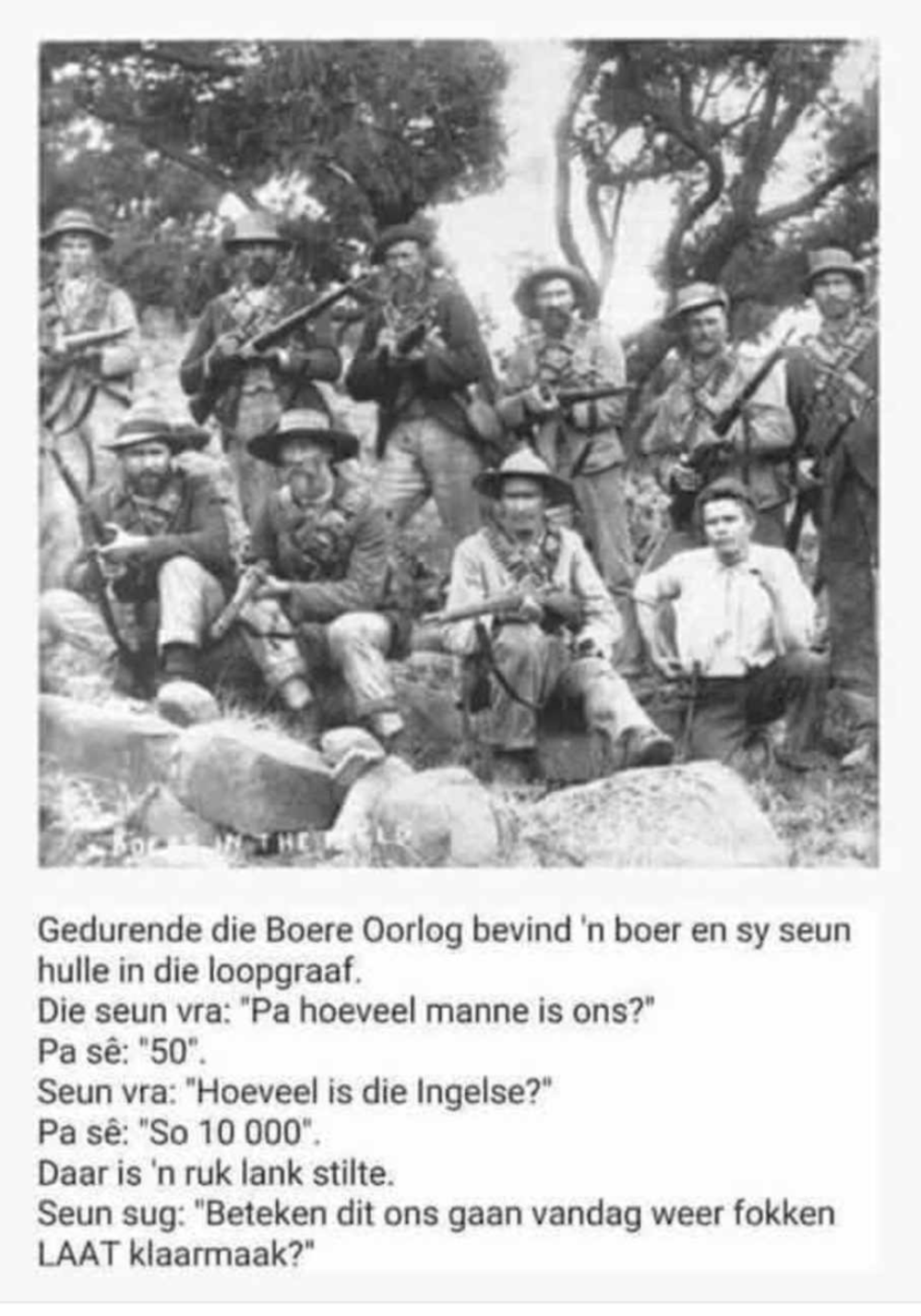
Just kidding!
The idea that it took half a million British troops to subdue a couple of thousand boers is very erroneous .. the old ‘super’ Afrikaner joke – on witnessing an advancing British ‘rooineck’ column a Boer kid asks his Dad “how many Boers are we Dad? – Answer “50 son”, and “how many British Dad?” – Answer “10,000 son”. Punchline … “Dad, does this mean we’re going to finish late again?” A joke that re-appears in different formats in countless forums, and it’s as funny as it’s statistically false and fantastical.
Written and Researched by Peter Dickens
References – all quoted statistics
Leopold Charles Maurice Stennett Amery “The Second Boer War – The Times History of the War in South Africa 1899-1902” – Volumes 1 to 7.
History of the war in South Africa 1899-1902. By Maj. General Sir Frederick Maurice and staff. Volumes 1 to 4, published 1906
The Anglo-Boer war: A chronology. By Cloete, Pieter G
Anglo-Boer War Blockhouses – a Field Guide by Simon C. Green, fact checking and correspondence – 2023.
The Boer War: By Thomas Pakenham – re-published version, 1st October 1991.
Correspondence and interviews with Dr. Garth Bennyworth, Boer War historian – Sol Plaatjies University, Kimberley – 2023.
Correspondence on fact checking British doctrine with Chris Ash, BSc FRGS FRHistS, 2023 – Boer War historian, Fellow of the Royal Historical Society and Fellow of the Royal Geographical Society.
Kruger’s War – the truth behind the myths of the Boer War: By Chris Ash, published 2014.
Related work:
Boer War by the numbers: Boer War by the numbers!
 The Observation Post