A German of French descent shot down by a South African of German descent in a country occupied by Italy ….

Another amazing and very human story about one of our World War 2 South African heroes. This one where two former enemies became close friends long after they met in the skies of North Africa during Word War 2. A German and a South African pilot fought to the death, the South African shooting down the German, later only to become friends.

IMG_0794.jpg.opt824x867o0,0s824x867

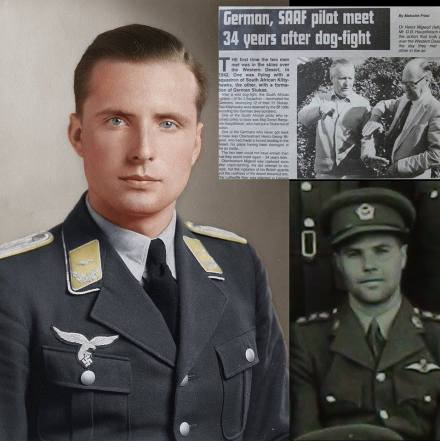
The colorised image is Stuka pilot Lt. Heinz-Georg Migeod, shot down in Libya, 11/11/1942 by SAAF fighter pilot DB “Hoefie” Hauptfleisch (in the black and white portrait insert).

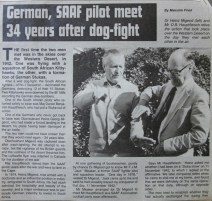
After the war Heinz relocated to South Africa where he met Hoefie and they became good friends. Hoefie passed away in 2009 and Heinz in 2010.

Tinus Le Roux was fortunate to have met Heinz. He once said to Tinus that the incident on 11 Nov 1942 was very funny: “a German of French descent was shot down by a South African from German descent in an African country occupied by Italy”

Now that is sheer irony.

Watch Tinus’ interview of the German Stuka pilot Heinz-Georg Migeod on the day he was shot down by Hoefie Haupfeish, its historic gold and gives an excellent insight into the manner the war was fought in North Africa.


Researched by Peter Dickens. With thanks to Tinus Le Roux for the colorised image and story as well as the families of Heinz Migeod and Hoefie Hauptfleisch for their stories, pictures and memories. Image and video copyright – Tinus Le Roux

The Horrible History and many names of Thaba Tshwane

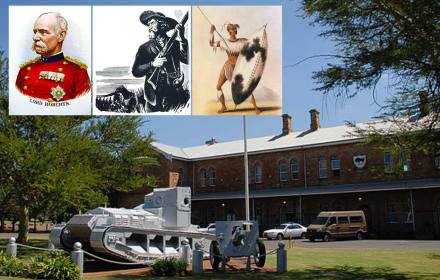
The featured photo of the South African Army College in Thaba Tshwane has a lot of hidden history. South Africans just love re-naming things in pursuit of one political party’s agenda over that of another one, all in the interests of political narrative – all of them serving to either change or hide South Africa’s strong military and cultural heritage to suite this or that political likeness.

Take the military compound in Pretoria as an example – First it was called Roberts Heights – then Voortrekkerhoogte – now Thaba Tshwane  – even the changes in language used in the name and subsequent name changes speaks volumes.
25136980491_0dce82938e_b

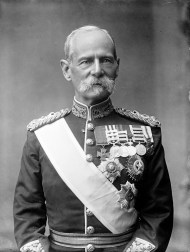
Lord Roberts

The complex was founded around 1905, just after the 2nd Anglo Boer War by the British Army to garrison the city of Pretoria, and they called their new garrison area Roberts Heights after Lord Roberts.

Field Marshal Frederick Roberts (Lord Roberts) VC, KP, GCB, OM, GCSI, GCIE, KStJ, VD, Pc was one the most successful British commanders of the 19th century and the overall commander of British Forces during the 2nd Anglo Boer War.

It was however. renamed Voortrekkerhoogte (“Voortrekker Heights”) to commemorate The Great Trek in a flurry of Afrikaner nationalism which accompanied the Great Trek centenary – and what better than re-naming the hated “English occupiers” military base and removing the name of Lord Roberts – a man loathed by Afrikaners – and for good reason for many Afrikaners – the Boer war left this community deeply scarred, how the British and English South Africans felt about it at the time – different matter, to many of them Lord Roberts is a hero.  So, a controversial move that deepened social differences.

Following the end of the National Party and their influence of Afrikaner Nationalism as an ideology to govern South Africa, it was renamed again on the 19 May 1998 by the incoming ANC regime, this time called Thaba Tshwane instead.   This was done by the ANC to rid the area’s heritage of both its much hated ‘Colonial’ heritage and ‘Apartheid’ heritage with something more ‘universally shared’.
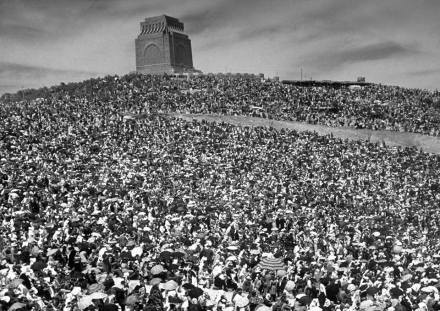
Voor

The inaugural ceremony of the Voortrekker monument at Voortrekkerhoogte, held on 16 December1949

So, Thaba Tshwane it is then, meaning of which is a little lost in translation, but some say its named after Tshwane, son of Chief Mushi, an Ndebele leader who settled near the Apies River, although there is some debate to whether he actually even existed as a historical figure (there’s a problem – there is no written or historic record – its all deeply back in a mystical oral tradition).
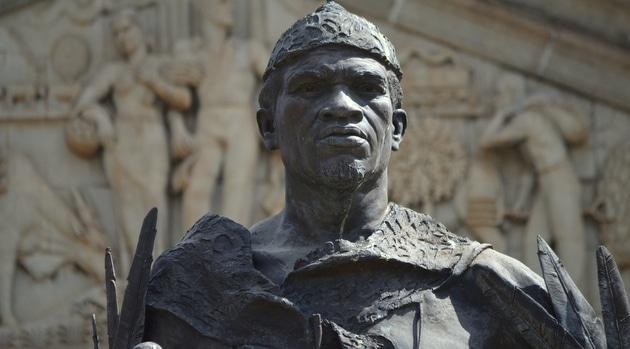
DSC_0594

Chief Tshwane statue

In any event, the name was changed again, and once again it was done to suit the next incoming regimes’ political narrative – the replacement of Black African culture and history over that of White African culture and history and scrubbing out anything the National Party or United Party or even the British did in the name of Afrikaner or English identity and heritage in South Africa.

The casualty in all this re-naming and one-upmanship is the actual history, the actual legacy, the golden thread that links our combined journey together – that it was British military compound established and named after Lord Roberts – was sadly even lost on the thousands of  South Africans who served there in the 70’s and 80’s who simply knew it as Voortrekkerhoogte and now even that will be sadly lost to the next generation of South Africans who serve there – who will in time just know it as Thaba Tshwane.  The actual “History and Heritage” lost forever.

To give an idea of  just how much of this rich tapestry is lost in ‘Thaba Tshwane’ can be found in one simple little cornerstone. The oldest building in the military complex is the one pictured – the “South African Garrison Institute” what is now re-named as the “South African Army College”. But here’s the really interesting bit – Lord Kitchener laid the cornerstone of this College on the 12th June 1902.
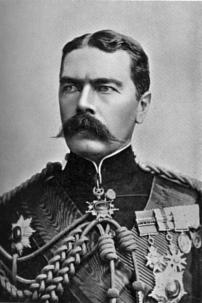
kitchener-photo-boer-war-site1

Lord Kitchener

During the Second Boer War, both Lord Kitchener and Lord Roberts (the chap they originally named Thaba Tshwane after) arrived in South Africa together on the RMS Dunottar Castle – along with massive British reinforcements in December 1899.

Following the defeat of the conventional Boer forces, Kitchener succeeded Roberts as overall commander of British Forces in November 1900. He subsequently inherited and expanded the successful strategies devised by Roberts to force the “Bittereinder” (Bitter End) unconventional Boer forces to submit.

The “Bittereinder” Boer Commandos had changed their tactics and were now using highly controversial and relatively new “hit and run” guerrilla tactics. The British in turn – in order to figure out how to stop “guerrilla war” – came up with the idea of containing the Boer’s supply line (their horse feed, shelter and food which where been provided by their families/homesteads) and placing all involved in supply (families and farm workers /servants alike) into both “White” and “Black” concentration camps respectively – and then burning the farms (a policy known as “scorched earth”).

Conditions in the concentration camps, which had been conceived by Roberts as a form of control of the families whose farms his forces had destroyed, began to degenerate rapidly as the large influx of Boers outstripped the ability of the minuscule British force to cope. The camps lacked space, food, sanitation, medicine, and medical care, leading to rampant disease and a very high death rate – especially among women and children (children particularly).
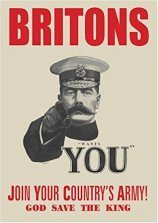
41cMeyjGDRL._SY450_You’ll recognise Lord Kitchener anywhere – he became the poster model for the “Your Country Needs You” campaign to spur British and Commonwealth men to sign up and fight in the trenches of World War 1. The poster is funnily seeing a little contemporary resurgence in celebration of the centenary of WW1.

It’s a “Horrible” history – but it’s history none the less – and for this very reason – that it is “horrible” that this history really needs to be told – lest we forget the sacrifice that it took.

Covering over it by re-naming everything, for the sake of a political one-upmanship merely washes out the country’s history, heritage and cultural understanding – it cleanses the rich tapestry that makes us unique as a nation.

In effect it takes us ‘off’ our combined journey as South Africans and does exactly the opposite of all the ‘good’ intentions for getting us to the best and most ‘shared’ option  – it separates us again, it deepens racial and cultural divide and perpetuates South Africa’s deepest problem, its on-going race politics.


Written by Peter Dickens

South Africans in the Royal Navy during WW2

Due to the fact that Britain was able to operate a naval base from Simon’s Town in South Africa, South Africans who volunteered to join the South African Navy usually landed up seconded in the service of the Royal Navy in WW2.

To the point where hardly a ship in the Royal Navy did not carry a South African contingent.  Also, any tragedy – involving high combat loss or a sinking of a Royal Navy ship during WW2 usually carries with it a South African (SANVR) honour roll.

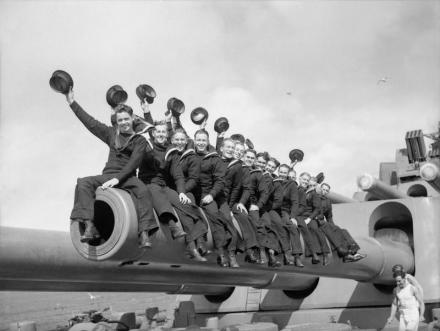
Here is a photo of the members of the South African Division of the Royal Naval Volunteers Reserve on board HMS NELSON posing for the camera sitting on one of the enormous 16 inch guns of A turret. July 1941.

Image – Imperial War Museum copyright.

“Browns”

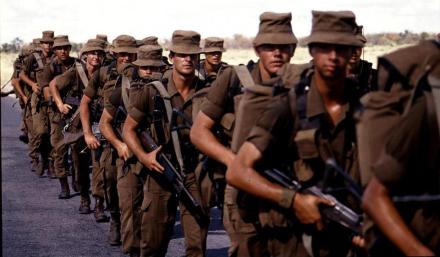
Great photo of South African infantry troops in the distinctive ‘brown’ nutria combat fatigues of the period. Here SADF troops return to their Ruacana base. March 26 1989. The nutria uniform was affectionally and officially known as ‘Browns’ and over time, sun and extensive washing and ironing exposure it became a ‘lighter’ brown with ‘houding’ (attitude) – browns with extensive exposure turned a milky brown eventually and this became the hallmark of a ‘ouman’ (old man) who had been serving for a while. The distinctive browns issue bush hats are also seen with a little ‘bush houding’ – a grenade ring pull and ‘toggle’ attaching it to the owner (and the stitch line was always worn at the back, never the front).

Camouflage fatigues – as part of the SADF’s “Soldier 2000” program began to replace “browns” in 1992/3

Photo copyright and courtesy: John Liebenberg

SAAF action camera close up

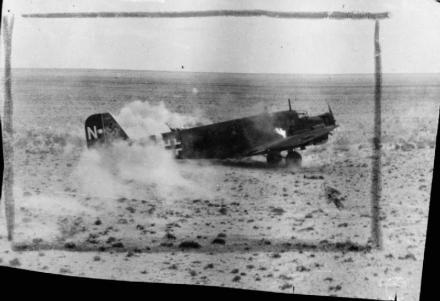
Not often seen is a close up of like this of the South African Air Force in action during the North African campaign – WW2.  Here  cannon shells can be seen as they explode around the tail of a German Junkers Ju 52 forced down in the Western Desert by three Bristol Bisleys of No. 15 Squadron South African Air Force, 12 October 1942.

The starboard (right) engine is already on fire, and a member of the JU 52 crew can be seen trying to take cover lying face down on the ground beneath it. The Bisleys, escorted by four Bristol Beaufighters of No. 252 Squadron Royal Air Force, intercepted the German transport aircraft while returning from a strike on an enemy train.

The Beaufighters shot down a Ju 52 and damaged one of the escorting Messerschmitt Bf 110s, while the Bisleys forced down a second Ju 52 and subsequently destroyed it with their bombs. One of the Bisleys was shot down by return fire.

Image Copyright Imperial War Museum

Carrying the “Torch of Remembrance” for the South African Fallen

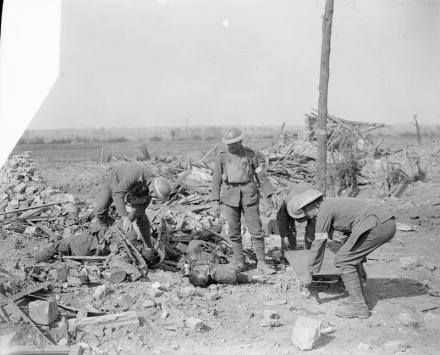
Probably about the most disturbing and hard hitting photograph that I am likely to post, but it brings home why we remember on Remembrance Sunday and on Armistice Day and why the date and time 11am, on the 11th day in the 11th month is so significant and what it means. This is the day and time the guns fell silent on the western front in 1918, it’s at this time on this day that we recount the massive sacrifice made in war – not just for WW1, but for all war.

This is the capture of Meteren by the 9th Division. Stretcher-bearers of the Royal Scots Fusiliers collecting the dead after The South African Brigade attack on the 20th July 1918.

It is our privilege as veterans to carry the torch of remembrance, we carry the thread that binds us all the way to these fallen South Africans lying in the mud and devastation that was World War 1.  It’s this torch that we carry that marks all of our fallen in 1918, our fallen in 1945 our fallen in 1989 and it’s the same torch that marks our fallen in 2015 – it binds everyone who has served their country – and it stands as the marker of sacrifice.  As veterans, to hold this responsibility is a great honour and we are indeed a privileged few.

Rest in Peace brothers … We WILL Remember.

Photograph – Imperial War Museum copyright.  Posted by Peter Dickens

Maj. Edwin Swales VC – a true South African hero’s legacy now under threat

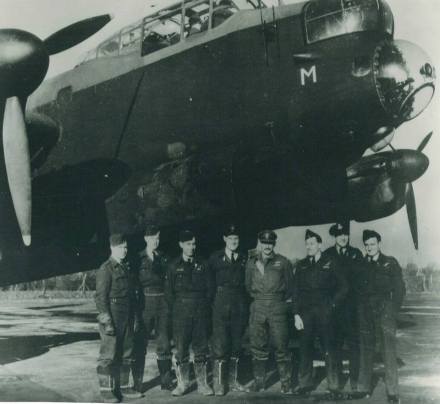
A very notable South African hero and Victoria Cross winner, Captain Edwin (Ted) Swales VC, DFC (pictured in the centre with his crew) was born in Inanda, Natal, South Africa, he went to Durban High School (DHS) and then joined Natal Mounted Rifles, seeing action in Africa before he transferring to the South African Air Force and then went onto serve with the Royal Air Force (RAF).

In 1945, while with the RAF Pathfinders (No. 582 Squadron), Captain Swales was the Master Bomber and captain of Avro Lancaster III PB538. On 23 February 1945, the very same day as his D.F.C. award was gazetted, Swales led the bombing raid on Pforzheim, Germany.

Swales’ Victoria Cross citation:

“Captain Swales was ‘Master Bomber’ of a force of aircraft which attacked Pforzheim on the night of February 23, 1945. As Master Bomber he had the task of locating the target area with precision and of giving aiming instructions to the main force of bombers in his wake.

Soon after he reached the target area he was engaged by an enemy aircraft and one of his engines was put out of action. His rear guns failed. His crippled aircraft was an easy prey for further attacks. Unperturbed, he carried on with his allotted task; clearly and precisely he issued aiming instructions to the main force. Meanwhile the enemy fighter closed the range and fired again. A second engine of Captain Swales’ aircraft was put out of action. Almost defenceless, he stayed over the target area issuing his aiming instructions until he was satisfied that the attack had achieved its purpose.

It is now known that the attack was one of the most concentrated and successful of the war. Captain Swales did not, however, regard his mission as completed. His aircraft was damaged. Its speed had been so much reduced that it could only with difficulty be kept in the air. The blind-flying instruments were no longer working. Determined at all costs to prevent his aircraft and crew from falling into enemy hands, he set course for home.

After an hour he flew into thin-layered cloud. He kept his course by skilful flying between the layers, but later heavy cloud and turbulent air conditions were met. The aircraft, by now over friendly territory, became more and more difficult to control; it was losing height steadily. Realising that the situation was desperate Captain Swales ordered his crew to bail out. Time was very short and it required all his exertions to keep the aircraft steady while each of his crew moved in turn to the escape hatch and parachuted to safety.

Hardly had the last crew-member jumped when the aircraft plunged to earth. Captain Swales was found dead at the controls. Intrepid in the attack, courageous in the face of danger, he did his duty to the last, giving his life that his comrades might live”

Citation ends:

Although often referred to as being a “Captain” at the time of his last flight,  Swales was in fact an ‘Acting’ Major. The S.A.A.F. was using the army ranking system, hence the ranks of ‘Captain’ and of ‘Major’. At the time of his death on 23 February 1945, Swales was aged 29 years. In 1958, the British Air Ministry wrote to the Commonwealth War Graves Commission informing them that the South African Air Force authorities had confirmed that at the time of his death, Swales had in fact held the rank of Major.

A Personal View

It is a great pity that in South Africa that the main Highway in Durban – Edwin Swales Drive has been renamed in support of some of other political narrative rather than to continue to acknowledge such a massive contribution to South Africa’s “honour” by this truly international hero – in whose memory the naming of the highway was originally intended.  This is how South Africa’s military heritage is destroyed and it’s how the country’s multi cultural fabric is insidiously removed to support one groups political ideology over that of another.

My personal view.  Part of the problem is also the “allowist” nature of South Africans with British roots for whom this man is a hero, they would rather put the issue into a “too hard box” and pursue individual security instead – they themselves are “allowing” this insidious rot to fester rather than really challenging it in a manner South African politicians today are accustomed.

Take a leaf out of the “Student Handbook” if you want things changed in South Africa – I’m not condoning violence in any way – but as a community, students really know how to mobilise in the digital and media age and challenge the status quo. People who want things like this changed and would like to impact a real difference should take a leaf out of that book.

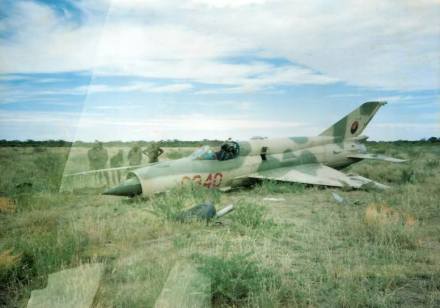
Lost MiG – pilot Lt Vinez never “defected” to South Africa

Much has been speculated and written regarding the circumstances under which this Angolan MiG-21bis (C340), piloted by Lt Vinez landed up on Schneider-Waterberg’s farm near Otjiwarongo, South West Africa (now Namibia).  However this is the true story.

On 14/12/1988 a MiG-21bis Fishbed of FAPA, took-off from the airfield at Lubango (FNBU position 14:56South 13:35East). Lt Vinez at the controls of the aircraft climbed to altitude on a general heading of 090 degree for a routine ferry flight from FNBU to the airfield at Menongue (FNME 14:39South 17:41East). The aircraft encountered clouds along the route, and Lt Vinez continued eastwards as planned. However on a number of occasions the aircraft entered clouds and upon regaining visual contact with the ground, he no longer could orientate himself as to where he was. After a while, he elected to divert to Cuito Cuanavale (FNCV), South East of FNME.

According to Lt Vinez, he had lost all his visual queues, he had been used to use when navigating between these airfields.

After setting a South Easterly heading, he continued believing that he would soon pick up the beacons of FNCV, this never happened (he was way to the west of the planned route) at this time. The only maps carried in FAPA aircraft were standard ‘Shell’ road maps, these maps are near to useless in the aviation environment, let-alone use it during an Instrument Flight Rules mission!

He continued, after approximately 20 minutes, he had crossed a major river (the Cubago), which he believed to be the Cuito River. The area to the East of the Cuito River was UNITA occupied territory. Continuing on his present course, the aircraft began giving the pilot a ‘Low Fuel’ warning. At that time he elected to attempt an emergency landing, after preparing the aircraft for the Forced Landing, he selected an open field, and executed a near prefect ‘normal’ landing. The aircraft only sustained minor damage.

Fuelled by National Party propaganda and state owned media in South Africa – this event was set up as “defection” to South Africa – in much the same way that Soviet and Cuban Communists defected to the “West” during the Cold War. The truth of the matter is Lt Vinez had no intent on defecting to the Republic of South Africa/South West Africa. During discussions at the accident site with him, his greatest concern was that he was indeed in UNITA occupied territory. It took some time to convince him otherwise.

Content courtesy of the SAAF forum

SAAF Boston Bombers in living colour

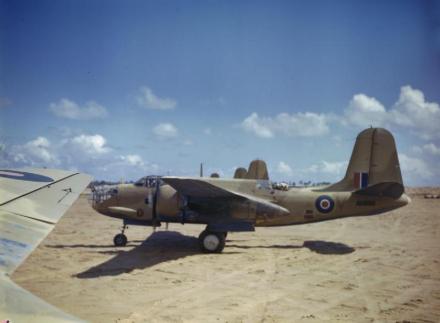
Sometimes some well preserved original colour photography can take you right back to South Africans taking part in World War 2 as if it was yesterday.  Here, in Libya March 1943, are Douglas Boston light bomber aircraft of No 24 Squadron, South African Air Force lined up at Zuara, Tripolitania. The nearest Boston is AL683/`V’.

On 5 March 1941 24 Squadron SAAF was formed when No.14 Squadron SAAF and its Maryland bombers were moved from Kenya to Egypt, and renumbered as No.24 Squadron. The squadron then operated alongside No. 39 Squadron RAF as a daytime tactical bomber unit carrying out bombing sorties against targets in the Mediterranean theatre. 24 Squadron was later in the year re-equipped with Bostons.

In December 1943, the squadron was relocated to Algeria and re-equipped with the B-26 Marauders and in 1944 flew to a new base at Pescara, Italy, before later advancing to Jesi, Italy. At the end of the war the squadron used its Marauders as transport aircraft, before moving to Egypt in October 1945 and disbanding on 6 November 1945.

The squadron was reactivated when the Buccaneer entered SAAF service in 1965. 24 Squadron SAAF Buccaneers saw active service during the Border War in South-West Africa,. They flew over Angola and Namibia in the 1970s and 1980s, and attacked SWAPO guerrilla camps with rockets and bombs.

The squadron was disbanded in March 1991 at AFB Waterkloof, Pretoria.

Photo copyright – Imperial War Museum, source IWM and wikipedia

.

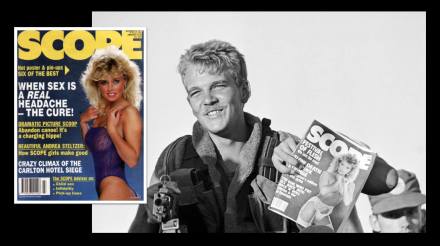
SCOPE Magazine – any troopie’s ‘must have’ reading material

SCOPE magazine – the ‘must have’ reading material for any troop serving in the SADF during the 70’s and the 80’s, many a SCOPE centre-fold model adorned signal/Ops rooms, tents and bungalow walls during the Border War.

By today’s standards SCOPE would be seen as a pretty tame mens lifestyle magazine, but then it pushed the barriers of soft porn and allowable content banned by the government of the day’s censorship board.

The magazine was launched in 1966 by Winston Charles Hyman and Jack Shepherd Smith became the long-time editor. Scope magazine would achieve iconic status in South African media as a publication that petitioned for freedom of the press with its censorship-defying content. The magazine was also known for placing strategically placed black stars concealing certain body parts of the nude female models per the censorship regulations.

The magazine had an on-going battle with the National Party’s Apartheid era policies of media censorship.  In 1972, the censor board of South Africa banned the weekly magazine, but this was overturned by the Supreme Court. This marked the seventh time in four years that the board had banned the magazine. The censor board had taken exception to a photograph published in May by the magazine, that showed a black man in New York embracing a white woman. They also took exception to a semi-nude shoot of a model in the forest and at the beach. In other attempts, the board had formerly attempted to ban the magazine because of a cover article on abortion and a story on test tube babies. In 1975, editor Shepherd Smith maintained that fair censorship was impossible in South Africa because of the cultural diversity of the nation “Whose particular way of life are the censors going to help to uphold?”. In May 1976, again the censor board issued a notice banning the magazine.

2408527183_43e82ca21d_b

However believe it or not, SCOPE also had excellent editorial content and investigative journalism receiving a number of industry awards.

The magazine also covered important crime stories. In 1984 the weekly published a telephone interview with South Africa’s most-wanted bank robber Allan Heyl of the Stander Gang who was in hiding in Britain at the time. The newspaper has also covered political stories and interviewed figures such as the spy Craig Williamson.

Stories also appeared during the South African Border War that celebrated the military training of SADF soldiers and contributed to a sense of heroism. The weekly also published a series on the experiences of Horace Morgan, an ex-psychiatric patient who spent 37 years in mental institutions. Scope conducted interviews with Morgan (who had been admitted in 1937 after losing his memory) and reported the hostility of the institutions and Morgan’s inability to escape the fate of a “wasted, tragic life in a cage”.

Several notable journalists have contributed to the magazine. In 1990, former Sunday Times writer, Jani Allan launched the self-titled Jani Allan column at Scope.  An article written by Allan on 5 October 1990, volume 25, number 20 in the magazine was presented to the South African parliament in 1991 in support of a legislation issue.

996516_183881248448282_1581793463_n

As the apartheid policies and governance crumbled in the 1990s, so too did the magazine.  Ironic considering it had played such an iconic role in countenance to Apartheid and it’s policies.  In a sense its success lay in the ability to challenge the status quo and to sensationalise it – it was taken up and enjoyed by thousands of young white South African men seeking an avenue to express their sense of independence and individualism. It was especially appealing to those serving in the armed forces where conformity and censorship was the order of the day.  With no status quo and censorship laws left to challenge, the magazine found itself without a mission.  It suffered from heavy circulation losses and the final issue was published in 1996.

For a great insight into the magazine in its heyday, order ‘The Journey Man” a biography by Chris Marais, Chis was a contributing journalist and his insights into the magazine are second to none – here’s a link The Journey Man by Chris Marais


Researched by Peter Dickens. Source wikipedia.  Photo copyright John Liebenberg