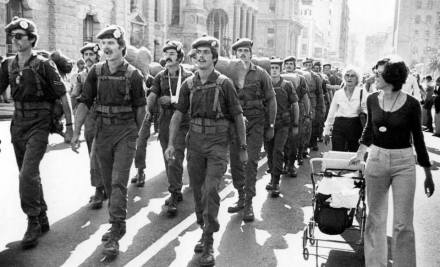
Sometimes, years later, the human story of a simple border war picture carries so much, especially as to the sacrifice families make when a father or brother gets “called up” to fight a war. This from Lorraine Beer when this photo was published on the South African Legion’s social media.
“This photo is very special to my family, my brother Trevor Leo is on the right has his wife Lynette with his first born, as yet unseen son Craig in the pram and his mother Madeleine behind her.”
Here the Cape Town Highlanders stage a homecoming parade in Darling Street, Cape Town upon their return from the Angolan border operational area on the 17th of March 1976.
What a fantastic memory to have, and what a pure insight into the simple human truths that come along when men and women are called to serve their country – thank you Lorraine.
February is usually remembered in South Africa as the “Three Ships” month as it marks three of South Africa’s maritime military losses in three separate wartime epochs, the SS Mendi (WW1), the HMSAS Southern Floe (WW2) and the SAS President Kruger (Border War).
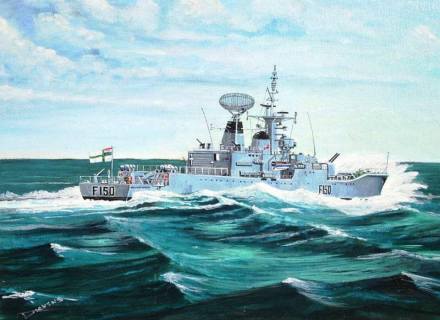
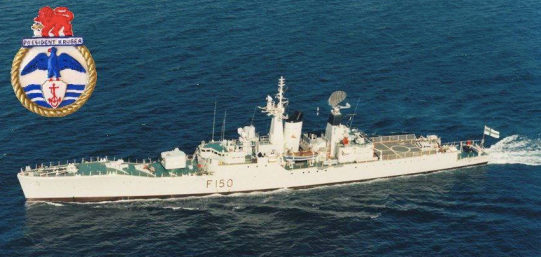
Today we remember the sinking of the SAS President Kruger, and we remember this South African Navy Frigate as she was in her heyday in this painting by Derrick Dickens, we also reflect on how true the SAS President Kruger’s motto is “Out of the Storm came Courage” came to be.
The “PK” as she was affectionately known was a flagship and the pride of The South African Navy, her loss on the 18th February 1982 made such a profound impact that the ramifications to the South African Naval fraternity are still be felt to this day.
In the early morning of the 18th February 1982. The SAS President Kruger was involved in a collision with the fleet replenishment ship, the SAS Tafelberg during exercises in the South Atlantic Ocean.
The complex exercises were being conducted with her sister ship the SAS President Pretorius, the submarine SAS Emily Hobhouse and the replenishment ship SAS Tafelberg. The exercises progressed over several days, with different candidate submarine captains being given an opportunity of executing a mock attack against the Tafelberg.
At approximately 4 am, the whole formation had to change direction by 154 degrees, a near complete reversal in direction. The frigates, sailing in front of the Tafelberg, had to change direction first to maintain their protective positions ahead of Tafelberg on the new heading.
The President Kruger was in front and to the port (left) side of the Tafelberg, the appointed officer of the watch (OOW) on the President Kruger was unqualified for the role and took an instruction from the Principle Warfare Officer in the Ops room to turn to starboard (right) “inwards” towards the Tafelberg, however the OOW elected to initiate a 10 degree of rudder turn, whereas operational procedure called for a tighter 15 degree of rudder turn. The 10 degree turn had a larger radius and would take longer to execute than the 15 degree of rudder turn, thereby allowing Tafelberg more time to close on the ship turning in front of her.
Partway through the turn, the operations room lost radar contact with the Tafelberg in the ocean clutter and high seas. At that point, an argument ensued between the OOW and the Principal Warfare Officer over the degree of wheel to apply. The OOW was unable to recover the situation, and the bows of the much heavier Tafelberg impacted the President Kruger on her port side.
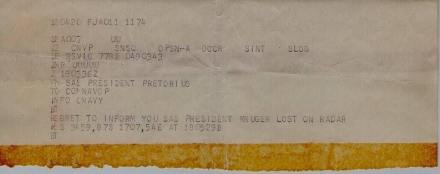
The force of the collision buckled the plates and crushed Mess 12 on the President Kruger where the Petty Officers sleeping quarters were located, killing or trapping all those inside. The ship began to take on water and list and an order to abandon ship was given. The President Kruger then sank in 45 minutes 78 nautical miles (144 km) south-west of Cape Point.
The honour roll of the South Africans lost that tragic day is as follows:
05507629 PE Chief Petty Officer Johannes Petrus Booysen
77060150PE Chief Petty Officer Hartmut Wilfried Smit
69443794PE Chief Petty Officer Willem Marthinus Gerhardus Van Tonder
07467392PE Chief Petty Officer Donald Webb
05208145PE Petty Officer Stephanus Petrus Bothma
70351226PE Petty Officer Graham Alexander Frank Brind
65718058PE Petty Officer Robin Centlivre Bulterman
73317695PE Petty Officer Granville Williams De Villiers
66510579PE Petty Officer Evert Koen
08302440PE Petty Officer Hjalmar Lotter
70343553PE Petty Officer Roy Anthony McMaster
72362379PE Petty Officer Roy Frederick Skeates
72265465PE Petty Officer William Russel Smith
75060863PN Petty Officer Michael Richard Bruce Whiteley
72249998PE Petty Officer Coenraad Johannes Wium
80100167PE Able Seaman Gilbert Timothy Benjamin
Chief Petty Officer Donald Webb and Able Seaman Gilbert Timothy Benjamin were not trapped inside the sinking ship and were both seen to abandon ship by jumping overboard into the sea. The following morning, the body of CPO Webb was sighted and recovered from the sea by SAS Protea. He now rests in the Simonstown (Dido Valley) War Cemetery. Able Seaman Gilbert Timothy Benjamin remains unaccounted for.
Considering the exceptionally high seas on that day and the speed at which the President Kruger sank it remains a small miracle that the vast majority of the crew were recovered from the water safely (177 in total), and that stands as testament to the caliber of the South African Navy. However such an unnecessary loss has dreadful ramifications which are still felt in South Africa’s Naval Fraternity to this day, and it remains a truly tragic event.
In the aftermath, a naval board of inquiry was commissioned, leading to a finding of a lack of seamanship by the captain and officers of the ship. The Minister of Justice introduced a retrospective change in law to allow him to hold an inquest into the death of one of the seamen. The inquest apportioned blame on the captain and PWO. However none of the officers was court-martialled
As a result of an international arms embargo against South Africa at the time, the ship could not be replaced, and was therefore a great loss to the capability and morale of the navy for many years afterwards.
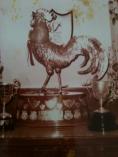
The Navy’s prestigious ‘Cock of the Fleet’ trophy, which had been won by her ship’s crew in the annual rowing regatta, was also lost with the ship and lies on the bottom of the ocean now.
The story of the sinking and rescue of the personnel of the SAS President Kruger, as well as the impact to families of both the survivors and the men lost, truly comes back to the PK’s motto “Out of the Storm came Courage”.
In. conclusion, for an in-depth overview of this tragedy, this documentary by Marc Bow is a must, take the time to watch it and you’ll appreciate the deep emotional scares this event has left behind.
Researched and written by Peter Dickens. Painting of the SAS President Kruger “The PK”, acrylic on canvass by Derrick Dickens copyright Peter Dickens, video copyright Marc Bow. Roll of honour courtesy Col Graham Du Toit.
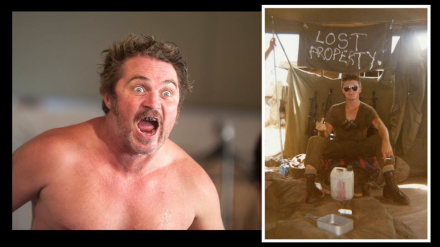
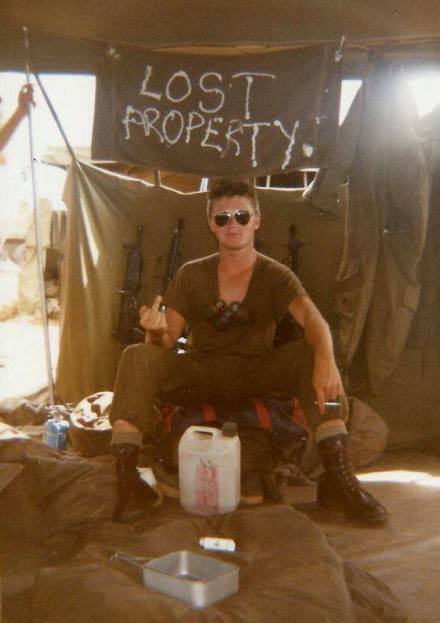
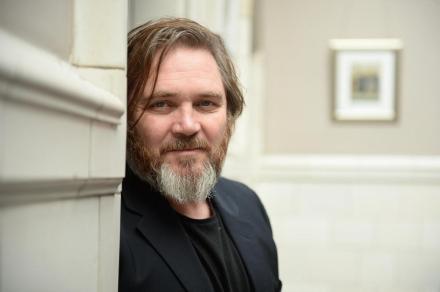
The Border War also saw some pretty famous future personalities and this is one for all the EastEnders fans (the famous on going British soap opera), this fun photo is Alex Ferns during his stint in the South African Army on the Angolan border – Alex is best known for his EastEnders role as Trevor Morgan, “Britain’s most-hated soap villain”.
Alex was a 2 Special Service Battalion (SSB) Gunner in 1989 and affectionately regarded by his fellow brothers in arms as “hell raiser of epic proportions” he was their units “go to guy” during heavy physical training exercises and he used to sing his heart out and always lifted the spirits of the men around him. They had many an ‘oppie’ (a ‘beasting’ or Punishment PT’) together and many a dust up with other units. Because Scotland is his country of birth they regarded him as the ” mad Scotsman” often rousing his buddies to the call. Highly likeable, inspirational and great bloke to all who knew him.
We wish him the best of luck in his television career that has vaulted him to the dizzy heights of a true ‘soap star’ and British cultural icon.
Alex Ferns’ Bio
Alex Ferns also made an appearance in The Ghost and the Darkness (1996) before various television roles, including Trevor Morgan in the BBC soap opera EastEnders from 2000 to 2002. In 2005, Ferns played Lieutenant Gordon in the highly acclaimed trilingual film Joyeux Noël, which was nominated for Best Foreign Language Film at the Oscars, Golden Globe Awards and the BAFTAs.
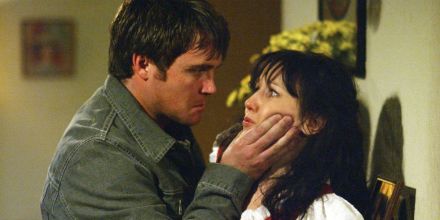
Trevor and Mo, in the domestic abuse storyline for EastEnders, Alex Ferns as hard-man and abuser with Kacey Ainsworth
In 2003 Ferns appeared as Draco Malfoy in a Harry Potter sketch for Comic Relief.
In 2004 he played Commander Martin Brooke, the lead role, in the short-lived ITV series Making Waves. In the same year he appeared in Man Dancin’, a Festival Film & TV production, which won a number of awards on the festival circuit, including Outstanding Original Screenplay at the Sacramento Film Festival. He has also appeared on Coronation Street.
He has also appeared in the 2006 movie Shadow Man, as Schmitt, also starring Steven Seagal.
His theatrical work includes the role of the “tapeworm” (a hallucination) in I.D., a play about Dimitri Tsafendas and his assassination of South African Prime Minister Hendrik Verwoerd, the 2008 national tour of Agatha Christie’s murder mystery And Then There Were None, and Little Shop of Horrors as the Dentist. In 2011 he took the role of Scottish gangster Jimmy Boyle in the play about his life, The Hardman, during a Scottish tour to positive reviews.
Recent photograph of Alex Ferns with a possible comeback to EastEnders
He also made a brief appearance in the Smirnoff Vodka advert in 2009. Ferns took part in TV series Celebrity Coach Trip, partnered with friend Ricky Groves. He starred as Luther in the 2011 London revival and subsequent UK tour of South Pacific. In 2013, he starred as Lee in True West at Glasgow’s Citizen’s Theatre. In 2014, he starred in 24: Live Another Day.
Born in Lennoxtown, Scotland, Alex lived in South Africa for 17 years and studied drama at the University of Cape Town before returning to the United Kingdom in 1991. Whilst in South Africa the military conscription regulations were changed to include ‘white’ foreign nationals with South African residencies, and Alex was conscripted into the South African Defence Force as a ‘National Serviceman’ or he would certainly have faced deportation and even imprisonment.
Alex Ferns has been married to South African-born actress Jennifer Woodburne since 1996. They currently live in London with their two sons, Cameron and Mackenzie.
To see Alex’s skill transforming from ‘nice guy’ to ‘hard-man’ in EastEnders, have a cuppa tea (as EastEnders fans do) and take a look at this famous clip from the series;
Photo courtesy of BJ Taylor and story on Alex in the SADF courtesy of Gary Smith. Video clip BBC EastEnders. Feature image Alex Ferns in True West Rehearsals Photo: Tim Morozzo
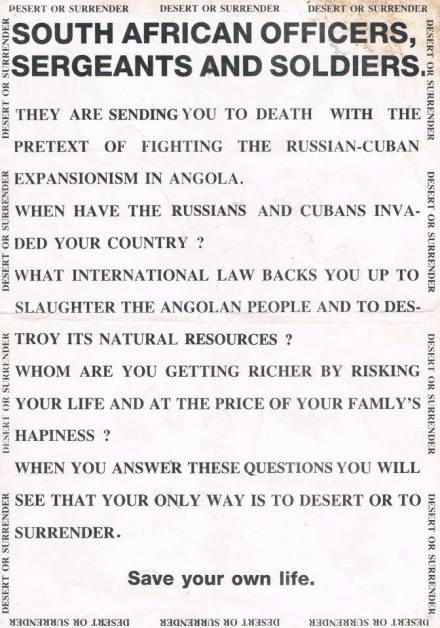
Bush War era propaganda leaflet distributed by FAPLA – The People’s Armed Forces for the Liberation of Angola (FAPLA or Forças Armadas Populares de Libertação de Angola) and its communist backers – Cuba and the USSR.
The purpose of this type of propaganda was to sow dissent in the South African Defence Force ranks and urge desertion – however there is no evidence of this actually working – notwithstanding the high discipline and motivation of SADF troops – but also for the most part SADF troops treated such propaganda with amusement. In fact it served to reinforce the held ideal that they were involved in a true “cold” war conflict against communism.
To put it in context – at the time there was no diplomatic interface between the capitalist ‘West’ and the Soviet Union and Cuba – not even a telephone call between the Western superpowers and the Kremlin. So the threat of communist ideals in Africa and the socialist nationalisation of private property was a very real one. The western world in the mid 1980’s stood against a real threat of “World war 3”, and the campaign was been played out in regional conflicts all over Africa, South America and the Middle East.
FAPLA was originally the armed wing of the People’s Movement for the Liberation of Angola (MPLA), a party with communist leanings which was backed financially and militarily by the Soviet Union and Cuba. There was no way the average SADF trooper would see it as anything other than yet another Communist “plot”.
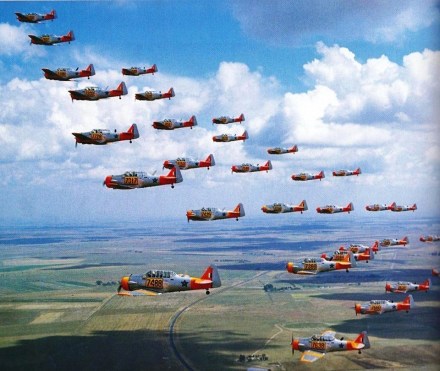
An image (and sound) some of us remember very well, the sky full of droning SAAF Harvards training our pilots.
The first Harvards arrived in South Africa in October 1942 for use by the Joint Air Training Scheme schools. By July 1944, 633 Harvard Mk IIA and III aircraft had been shipped to South Africa, with 555 surviving in October 1945 (379 MkIIAs and 176 Mk IIIs).
As the Harvards had been supplied on lend-lease by the US, 300 were shipped back to the UK from 1946, with the remainder being purchased by South Africa.
65 AT-6Ds (7634 to 7698) and 30 T-6Gs (7699 to 7728) were purchased from the USA during 1952-1956.
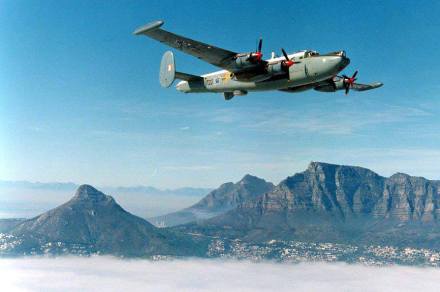
Stunning image of a South African Air Force Avro Shackleton flying over table mountain. The Avro Shackleton MR 3 was operated by 35 Squadron SAAF. Missions were mostly patrols of the sea lanes around the Cape of Good Hope, but some occasionally ranged as far as Antarctica.
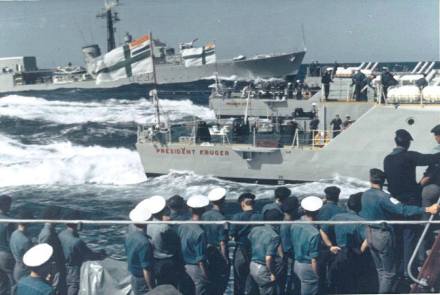
Stunning image of the South African Navy Frigates in their heyday. Here are the three President Class Frigates together, the SAS President Kruger, the SAS President Steyn and the SAS President Pretorius – neck to neck with the SAS Simon van der Stel – an old World War 2 era W Class Destroyer in the background, she was the oldest and the fastest of all these ships. Look at the bit between her teeth as she races forward.
Interestingly, the SAS Simon van der Stel started her illustrious life as HMS Whelp, saw WW2 service in the Far East and was even present at the formal Japanese surrender in Tokyo Bay.
Photo courtesy of the SAS President Steyn Old Boys and thanks to Norman Sander for the caption.
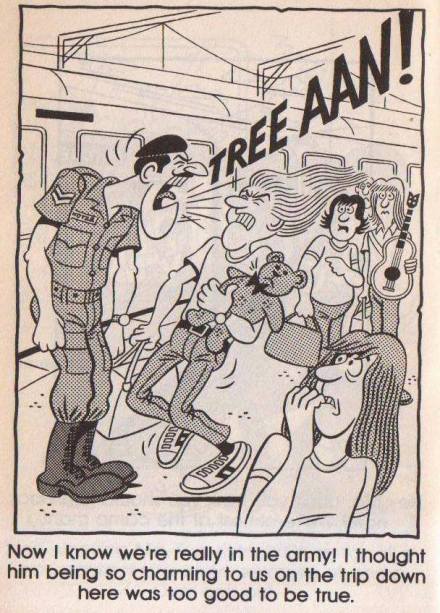
The beginning of the new year in the 1960’s, 1970’s and 1980’s (even the early 1990’s) meant the dreaded “January Intake” and thousands of white South African men would be starting the new year in uniform. This cartoon by Keith and Lorna Stevens in ‘Bytvas’ perfectly captures the surprise awaiting the new national servicemen at their respective intake mustering points.
In reality the yelling Army corporals at the mustering points were usually “campers” (civilian force members who had completed the initial national service period) from Reception Depot units (RCD/OVD) attached to the various regional commands – the RCD/OVD units were responsible for the two annual “intakes” and the security of the convoys of recruits to all the respective training units, the largest such unit was 15 RCD/OVD which was attached to Witwatersrand Command (the largest catchment area).
Such was the radical changeover from “civvie street” that to every person who ever served as a conscript in the SADF – the first day in the SADF is emblazoned in their memories forever.
“Tree Aan” is the Afrikaans command to “form up” on parade.
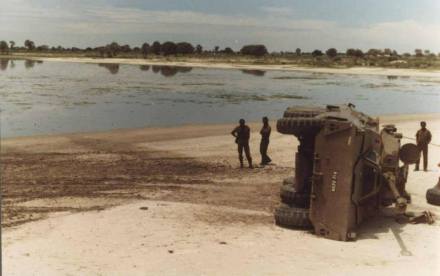
South West Africa/Namibia border 1987, 61 Mechanised Infantry Battalion Group and Charlie Squadron is joyriding in a SADF “Ratel” (honey badger) Infantry Fighting Vehicle (IFV) .. the picture says a thousand words.
Some say, the driver is still getting an oppie .. all we know is he’s called the Stig!
This example stands testament to many instances of highly valued military equipment wrecked by 19 year old odd National Servicemen taking full advantage of having a little fun.
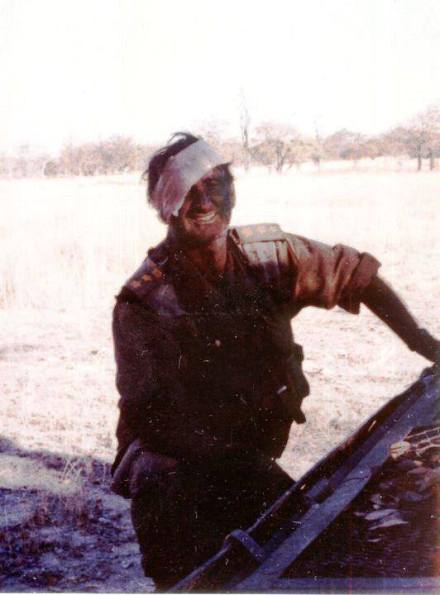
Two men who stands head and shoulders above other men. Col Jan Breytenbach seen here after been blown clear from his vehicle when it hit a anti tank land mine whilst on operations in southern Angola on the 29th August 1981. Col Breytenbach immediately returned to rescue Dave Barr, his gunner, who was pinned under the vehicle – a special forces ‘Sabre’ – and pulled him free from exploding ammunition and burning fuel.
Dave Barr, an American serving with the SADF unfortunately lost both legs in the incident, however testament to Dave – as a double amputee, ex Vietnam War and Bush War veteran, he then went on to circumnavigate parts of the planet by motorcycle raising funds for the disabled, setting world records and inspiring people.

 The Observation Post