Today we have a heartwarming story of a forgotten heroine of World War 2 which carries with it a South African twist.
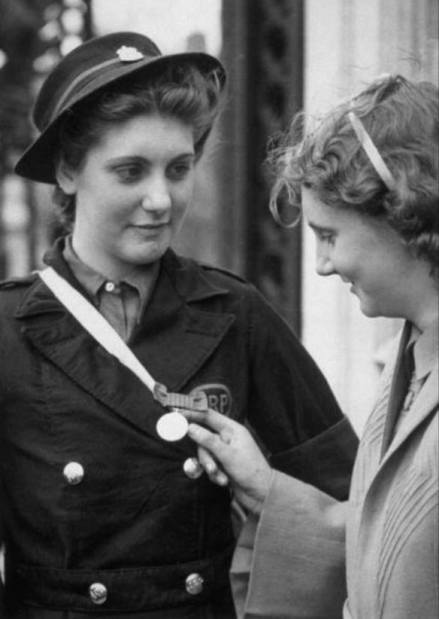
1941: Betty Quinn, 17, the youngest recipient of the George Medal, at the Investiture Ceremony at Buckingham Palace, London. She saved seven people from a bombed air raid shelter while serving as an ARP Warden in Coventry during WW2.
Betty Quinn, a St. John Ambulance cadet, was awarded the George Medal for her bravery on 14 November 1940 during the heaviest night of the Coventry Blitz. She was giving first aid at an ARP post when a shower of incendiary bombs fell in the district: “Without waiting for assistance she ran outside. AA batteries were putting up a heavy barrage and shrapnel was falling all round. Bombs began to fall and a man was injured by one. Miss Quinn assisted him to a private shelter. A report came in of an Anderson shelter receiving a direct hit and although bombs were still falling, Miss Quinn ran there and commenced digging in the crater with a spade. She assisted to dig out seven persons who had been trapped and then attended to their injuries. She stayed until all had been removed by ambulance, although shells were bursting overhead most of the time. She then returned to the post and carried on with her duties.”
Betty Quinn was tracked down in 2005 for an invite to attend the unveiling of the Women of WW2 Memorial, next to the Cenotaph in Whitehall, London. Betty was living in Cape Town, South Africa where she had been living for 63 years, a direct result of what happened in 1940. Following her fame which spread throughout the Empire after her award, she received a marriage proposal from a South African, which was obviously too good to refuse.
In 1940, during the height of The Blitz there was a strong desire to reward the many acts of civilian courage. The existing awards open to civilians were not judged suitable to meet the new situation, therefore it was decided that the George Medal would be instituted to recognise both civilian gallantry in the face of enemy action and brave deeds more generally.
Photo by Keystone/Getty Images, reference British and Commonwealth Forces Facebook page.
Dame Vera Lynn recently turned 100 years old and we look at two iconic women from the Second World War, one British and one South African. Both friends and both famed for singing to troops on quaysides. Here is Dame Vera Lynn (known to the troops as “The Forces Sweetheart”) on the left and Perla Siedle Gibson (Known to the troops as “The Lady In White”) on the right whilst Vera Lynn was on tour in South Africa in the 1950’s.
This photo was taken at the M.O.T.H. Headquarters in Durban (Warrior’s Gate), in the centre between these two iconic women is South African military veteran Harold William (Nobby) Clarke who was a Custodian of Warrior’s Gate.
Dame Vera Lynn, DBE (born Vera Margaret Welch on 20 March 1917), widely known as “The Forces’ Sweetheart”, she is an English singer, songwriter and actress whose musical recordings and performances were enormously popular during the Second World War. During the war she toured Egypt, India and Burma, giving outdoor concerts for the troops. The songs most associated with her are “We’ll Meet Again”, “The White Cliffs of Dover”, “A Nightingale Sang in Berkeley Square” and “There’ll Always Be an England”.
She remained popular after the war, appearing on radio and television in the UK and the US and recording such hits as “Auf Wiederseh’n Sweetheart” and her UK Number one single “My Son, My Son”. Her last single, “I Love This Land”, was released to mark the end of the Falklands War. In 2009, at age 92, she became the oldest living artist to top the UK Albums Chart.
She has devoted much time and energy to charity work connected with ex-servicemen, disabled children, and breast cancer. She is held in great affection by veterans of the Second World War to this day and in 2000 was named the Briton who best exemplified the spirit of the 20th century.
On 20th March 2017, Dame Vera celebrated her 100th birthday.
Vera Lynn (later Dame Vera Lynn) with British servicemen in World War II
Perla Siedle Gibson was a South African soprano and artist who became internationally celebrated during the Second World War as the Lady in White, when she sang troopships in and out of Durban harbour.
Gibson was born in Durban in 1888. In the early twentieth century she studied music and art in Europe and the US and gave recitals in London and New York. Her youngest brother was Jack Siedle, the South African Test cricketer.
During World War 2 Durban was an extremely busy way station for convoys of ships en route to the fronts in North Africa and the Far East. Gibson became famous among thousands of Allied troops when she serenaded them as their ships passed in and out.
She went on to sing to more than 5,000 ships and a total of about a quarter of a million Allied servicemen. Clad in white with a red hat, she would stand at a spot at the mouth of Durban Bay where ships entering and leaving the harbour pass quite close, and sing patriotic and sentimental songs through a megaphone from a torpedoed ship, which grateful British soldiers had given her.
She died in 1971, shortly before her 83rd birthday. The year later a bronze plaque donated by men of the Royal Navy was erected to her memory on Durban’s North Pier on the spot where she used to sing. In 1995 Queen Elizabeth II unveiled a statue of Perla Gibson near the Ocean Terminal in Durban harbour.
The debt of gratitude owed by a collective world free of Nazi Germany, Imperial Japan and Fascist Italy to both these women is massive – it cannot be accounted such is the value.
Researched and written by Peter Dickens. Travers Barret Photographer copyright and grateful thanks to Kevin Lamprecht for sharing his Grandfather’s photograph and memories. Vera Lynn video clipped from Youtube. ‘We’ll meet again’ sung by Vera Lynn.
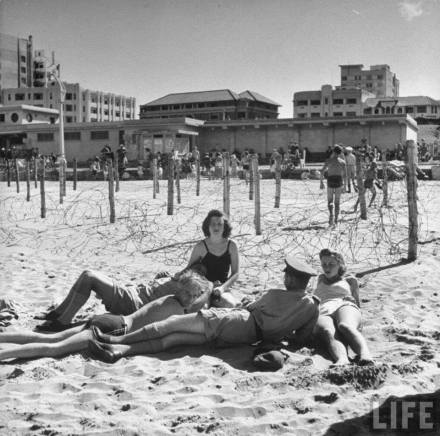
During the Second World War South Africa became a central destination for British, South African as well as other Commonwealth nurses, soldiers, sailors and airmen for a little ‘R&R” (Rest and Recuperation) – especially Durban and Cape Town. Seen here in this famous LIFE magazine image are servicemen on South Africa’s beaches enjoying some of the prettier sights and sun that South Africa has to offer.
In fact many veterans fondly remember South Africa’s hospitality during the war years as the country really opened their arms and welcomed them.
Note during wartime even both the strategic ports of Cape Town and Durban’s beaches were heavily guarded against invasion with barbed wire beach obstacles.
Lisa Shearin in ‘Bewitched and Betrayed’ said “It’s not treason if you win” and this rings very true to South African traitors from the past and now the present. How history repeating itself in South Africa can be ironic at the best of times, the country’s ethnic diversity will always ensure that one community’s freedom fighter is another community’s terrorist.
This was as true of the Afrikaner Nationalists during the Second World War, as much as it was true to the African Nationalists during the political and armed “struggle” in the more recent past. Both produced ‘traitors’, both had leaders incarcerated, both went on to ultimately govern South Africa and both produced Presidents who were themselves imprisoned as “traitors to the state”. Ironically – both went on to pardon their fellow activists and make heroes of them. The issue of ‘treachery’ set aside by the ‘winner’.
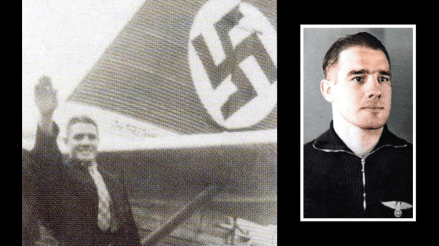
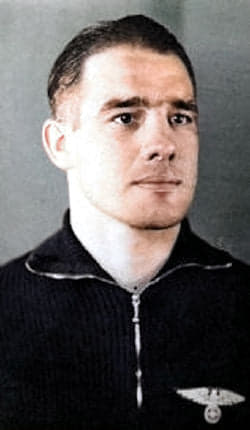
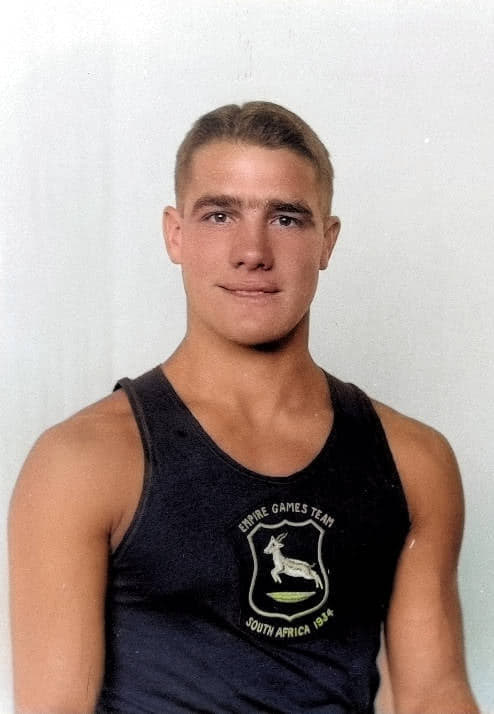
Robey Leibbrandt
This is the story of one such South African national – Sidney Robey Leibbrandt, who was led by the German military intelligence (Abwehr) during the Second World War under the pseudonym ‘Robert Leibbrand’.
Born in Potchefstroom Leibbrandt was an Afrikaner Nationalist of both German and Irish decent. He was also a South African Olympic boxer, however his political ideology drove him to become a German secret agent and ‘freedom fighter’ – primarily against the British influence and political power within South Africa.
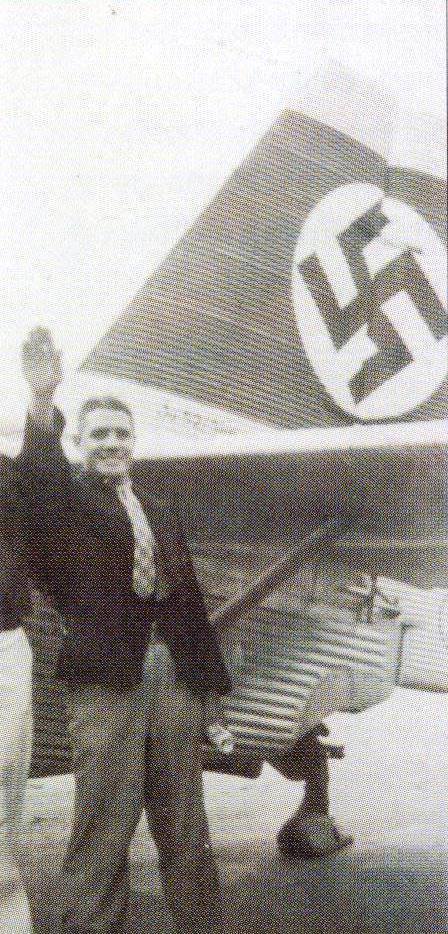
Leibbrandt went to Germany in 1938 to study at the Reich Academy for Gymnastics, and stayed on when war broke out. He joined the German Army, where he became the first South African to be trained as a Fallschirmjäger (paratrooper) and glider pilot. Leibbrandt was trained with the Comrades of the Brandenburgers at a sabotage training course of Abwehr II (Abwehrschool “Quenzgut”) near Brandenburg an der Havel, west of Berlin.
Operation Weissdorn
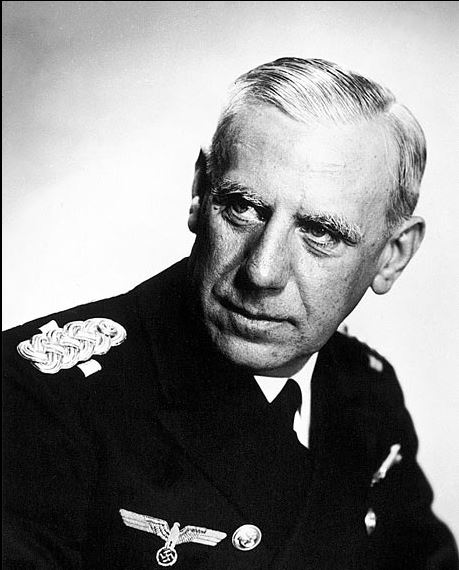
Admiral Wilhelm Canaris
The German Admiral Wilhelm Canaris ordered “Operation Weissdorn” a plan for a coup d’état to overthrow the South African government of General Jan Smuts and assassinate Smuts. Central to the plan was Leibbrandt, who left Germany on 5 April 1941 to lead and execute it.
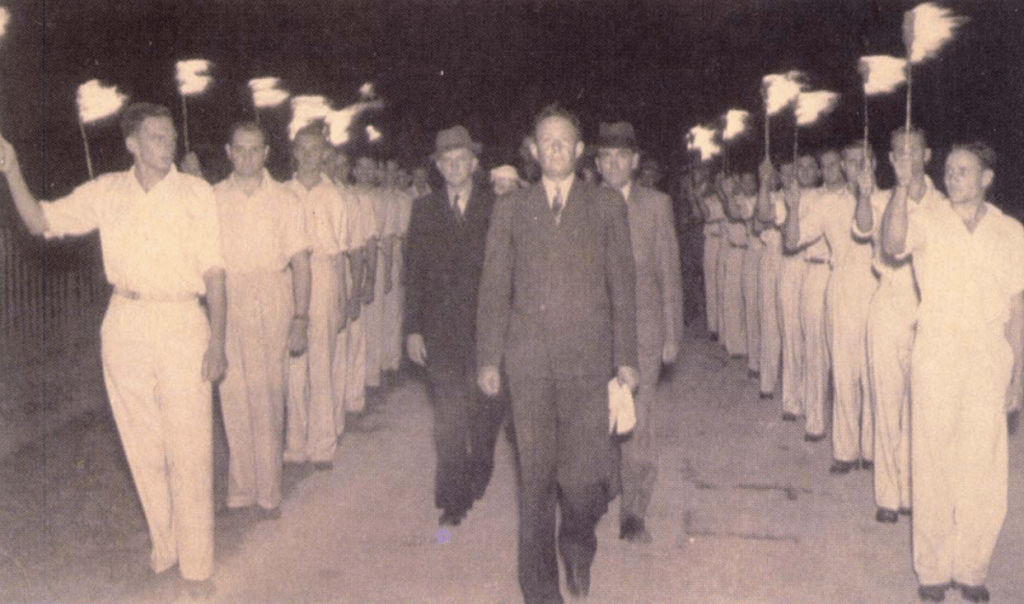
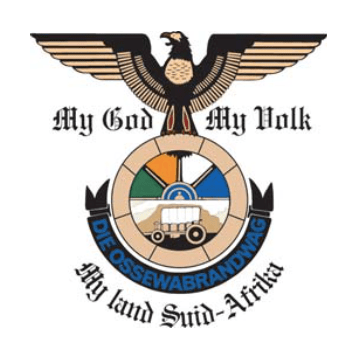
In June 1941, under the code name Walter Kempf, Leibbrandt was dropped on the Namaqualand coast north of Cape Town (Mitchell’s Bay) by a confiscated French sailboat (the Kyloe). His mission was to make contact with the South African pro-Nazi movement, the Ossewabrandwag, and expand his ranks of ‘freedom fighters’.
In the 1930’s the chief vehicle of Afrikaner nationalism was the Purified National Party of Dr D.F. Malan, (which went on to become the National Party as we know it today) and in 1938 the National Party celebrated the centennial anniversary of the Great Trek – the Ossewabrandwag was established in commemoration of the Trek, it was led by Dr Johannes Van Rensburg who was a lawyer and also a dedicated admirer of Nazi Germany.
Afrikaner Nationalist Resistance
The role of the Ossewabrandwag (OB) evolved to become a militant one – the nationalist members were unsympathetic to Britain because of the Boer War and became increasingly hostile when South Africa declared war on Germany in 1939. As sympathizers with Nazi Germany they felt their only solution was armed struggle.
Within the ranks of the Ossewabrandwag was a formation of Stormjaers (Assault troops). The nature of the Stormjaers was evidenced by the oath sworn by new recruits: “If I retreat, kill me. If I die, avenge me. If I advance, follow me”
The Stormjaers engaged in sabotage against the South African government. They dynamited electrical power lines and railroads, and cut telegraph and telephone lines (These types of acts were going too far for most Afrikaners and Malan later ordered the National Party to break with the Ossewabranwag in 1942)
Robey Leibbrandt, on landing in Mitchell’s Bay hoped to tap into this large resource of Afrikaner ‘Stormjaers’ in his plan to assassinate Smuts and overthrow the government. He made his way to Cape Town to meet and make arrangements with Dr van Rensburg in Pretoria. However, rather disappointingly he found van Rensburg unsympathetic to his plan. Nothing came of the negotiations. Leibbrandt’s megalomania was enough to deter anyone from cooperating with him, and Dr van Rensburg refused to be drawn. Some sources even point to a physical alternation between van Rensburg and Leibbrandt in their final meeting.
Undeterred Leibbrandt continued in his attempts to drum up support from the Afrikaaner Nationalists winning converts from the Ossewabrandwag and the National Party to support his cause with fiery speeches at meetings held in the Orange Free State and in the Transvaal. These converts to Liebbrandt’s band of ‘Stormjaers’ called ‘The National Socialist Rebels’ took a specific Nazi Blood Oath, and trained in bomb making and sabotage. Their blood oath partly read:
“All my fight and striving is for the freedom and independence of the Afrikaner people of South Africa and for the building up of a National Socialist State in accordance with the ideas of Adolf Hitler.”
Leibbrandt was fully determined in his plot to overthrow the government by force of arms and assassinate Jan Smuts, he famously said the following before leaving for South Africa.
“The signal for the coup d’ etat will shake South Africa to its very foundations. The whole world will understand it. The gigantic leading figure of General Smuts will be felled like a heavy oak tree at the psychological moment. I will commit this deed on my own. It will happen without help or support.” Sydney Robey Leibbrandt (Berlin, March 20, 1941)
Capture
Leibbrandt’s small group of National Socialist Rebels kept the South African government on high alert by committing various sabotage acts. However, the quiet truce between Leibbrandt and van Rensburg quickly developed into open hostility. Leibbrandt, disappointed that the OB did not officially support his mission and its resultant failure began to openly attack Dr van Rensburg as an ‘agent’ of Smuts. This sealed his fate. The OB felt Leibbrandt a liability to their cause.
After Liebbrandt and his group of Stormjaers got into a confrontation and gunfight with UDF soldiers in the autumn of 1942, Leibbrandt went on the run and evaded the police. He was betrayed by fellow nationalists in the Ossewabrandwag who disclosed his location and he was eventually arrested in Pretoria in December 1942. Ironically the arresting officer was Claude Sterley, a fellow Springbok boxer and friend.
To get on top of all the wartime dissent and armed resistance from the nationalists, the South African government also cracked down very heavily on the Ossewabrandwag and the Stormjaers, placing thousands of them in internment camps for the duration of the war. Among the internees was future Prime Minister B. J. Vorster, who was a regional leader (General) of the Ossewabrandwag.
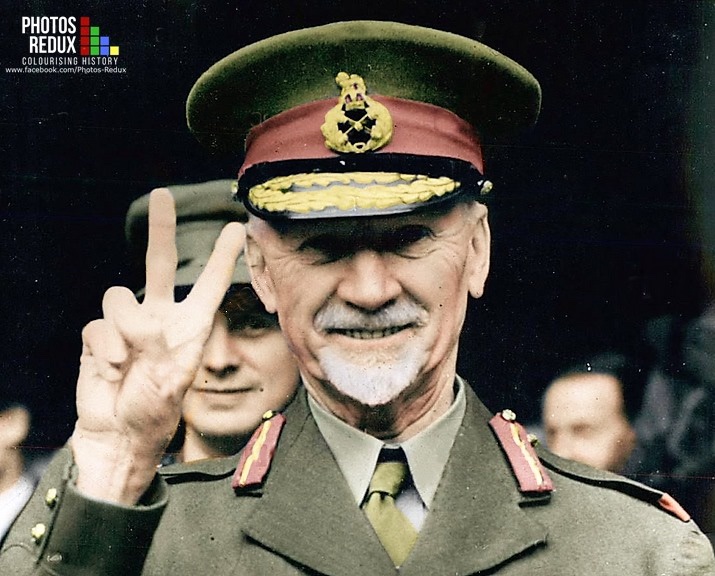
Field Marshal Jan Smuts
On 11 March 1943 Leibbrandt was sentenced to death for high treason. Although Leibbrandt refused to give evidence at any stage in the trial, he claimed that he had acted “for Volk and Führer” and gave the German Salute (Hitler Salute) when he first entered the court, to which several spectators responded and calling “Sieg Heil”. After being sentenced to death, Leibbrandt shouted loudly and clearly “I greet death”.
General Jan Smuts however later commuted his sentence to life imprisonment, confiding that he did not want the blood of another Jopie Fourie on his hands. In this respect Smuts, as an Afrikaner throughout his career usually bowed to a policy of appeasement politics when it came to Afrikaner issues and his ‘Volk’.
This can clearly be seen in the treatment of both ‘traitors’ and enemies of the state – Smuts took a heavy hand to executing the ring leaders of the Rand Revolt who were mainly ‘English’ Communists, but when it came to the Boer Revolt everyone involved was freed, except Jopie Fourie (who had not resigned from the Union Defence Force as an officer when becoming a rebel and therefore had a different case of treason and was court marshalled by the military instead – whereas all the other rebels had resigned). Smuts took the same relatively ‘light handed’ approach to the Ossewabrandwag and clear cases of sedition and treason as was the case with Leibbrandt and chose not to execute them.
It’s not treason if you win
When the National Party was elected to rule in South Africa in 1948, D. F. Malan issued an amnesty over all their fellow war offenders, including the likes of Liebbrandt and the future President BJ Vorster. The National Party then folded the Ossewabrandwag and absorbed their members and structures into the party.
Leibbrandt left the prison and was greeted by crowds of Afrikaner right-wingers and Nationalists as a “folk hero”. The returning servicemen from World War felt it a slap in the face, a blatant political statement as to how much the Afrikaner Nationalists disregarded those who had gone to war against Nazism. To them it was an affront to the sacrifice and loss of thousands of their compatriot South Africans in the war.
Leibbrandt remained politically active in his later life, founding the organisation Anti-Kommunistiese Beskermingsfront (Anti-Communist Protection Front) in 1962, and producing a series of pamphlets titled Ontwaak Suid-Afrika (Wake up South Africa). He was also a passionate sportsman and hunter. Robey Leibbrandt, “Der treue Gefolgsmann” (the loyal follower) died on 1 August 1966 from a heart attack.
The irony is that once in power the rise of African Nationalism (ANC) and their decision to embark on armed resistance mirrors that of the Afrikaner Nationalism. Like the armed wing of the Afrikaner Nationalists – the Ossewabrandwag ‘terrorists’ and ‘traitors’ were imprisoned as enemies of the state, so too were the armed wing of the ANC – Umkhonto we Sizwe. Once in power the Afrikaner Nationalists – the NP – behaved no different to the African Nationalists – the ANC – they built heroes and legacies around their military ‘heroes’, issued pardons and amnesties – and also renamed streets and institutions after them.
In Conclusion
But most ironic is that from the ranks of imprisoned ANC leaders emerged Nelson Mandela, and from the ranks of imprisoned National Party members emerged BJ Vorster – both of whom went on to become President. Strange how history turns and repeats itself.
Both entirely different now, history now looks favourably on Mandela and the African Nationalists (ANC) and its cabal and dismisses their acts of treason in light of a ‘honourable cause’ (liberation from oppression) and history now views Vorster, the Afrikaner Nationalists (NP) and their cabal, like Robey Liebrand and their various acts of treason very unfavourably and point to a ‘dishonourable cause’ (suppression of liberation by oppression).
This brings another famous quote on what qualifies and defines treason, it’s from T.S. Elliot and is very applicable and rings true to the above statement;
“The last temptation is the greatest treason: to do the right deed for the wrong reason”.
Written and Researched by Peter Dickens. Reference: Wikipedia and extracts from “Volk and Fuhrer” by Hans Strydom. Colourised images of Robey Leibbrandt with thanks to Frans Bedford-Visser. Colourised image of Jan Smuts thanks to Photo Redux.
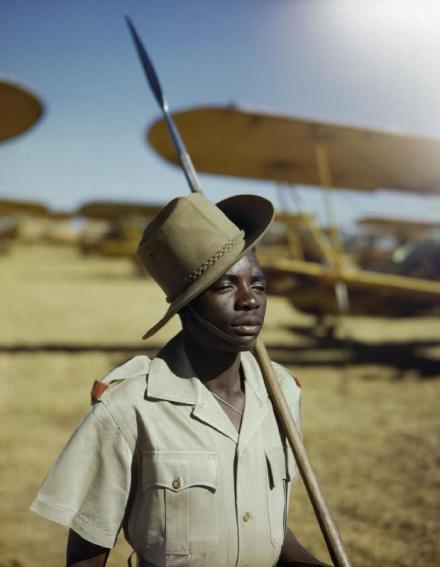
Another rare and wonderful original colour photo. During WW2, Great Britain used the Commonwealth to train pilots from all over the world, under a scheme called the Commonwealth Joint Training Plan, a key part of this plan included Waterkloof in Pretoria.
Here a South African soldier from the ‘Native Military Corps’ (NMC) is seen on guard duty at No. 23 Air School at Waterkloof, Pretoria, South Africa, January 1943. The NMC where attached to the South African Army and the South African Air Force in ‘non-combat’ roles.
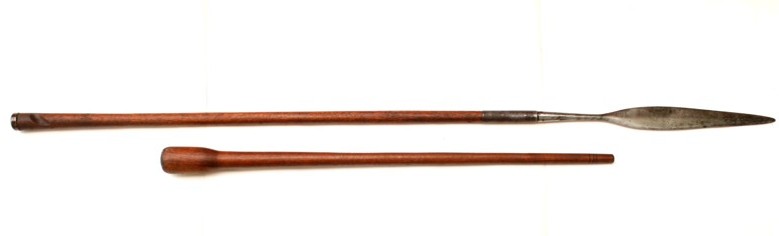
Conventions of time excluded “Black” soldiers from been armed with firearms, however “traditional” weapons (spears and assagais) where settled on as a compromise (see below UDF issued weapons for the NMC).
At the time the government was only willing to utilise Black South African manpower in non-combatant roles such as drivers, mechanics, carpenters, chefs, engineers, stretcher bearers including medical aids and general administration roles. Although it was not uncommon in cases of emergencies that the members of the NMC where provided with firearms to defend positions from enemy attacks (especially during the North Africa and Italy campaigns).
Note the slouch hat worn by all Native Military Corps members (also worn by the South African Native Labour Corps in WW1) and the “Red Oath” Volunteer tabs on his epaulettes, worn by all members of the South African Armed Forces who volunteered to take part in WW2 and join the services (from all ethnic and cultural origins).
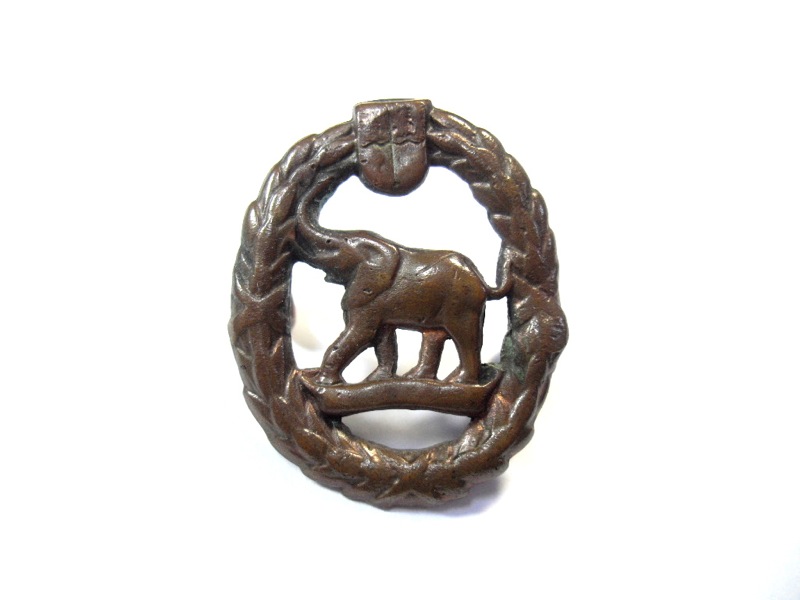
This picture is an excellent example of this corps weapon, uniform, dress and bearing. The NMC insignia consisted of an African Elephant with the South African coat of arms and encapsulated in a wreath.
As war was declared in 1939 the need for manpower from South Africa increased. During 1939 at the ANC passed a resolution of Loyalty to the British Commonwealth and Black South African political and traditional leaders expressed their willingness to support Jan Smuts’ declaration of war against Nazi Germany and get behind South Africa’s war efforts, on the condition that they would be able to win concessions and greater political recognition for “Black” South Africans after the war.
The “Native Military Guards” (which went on to become the NMC) was established in 1940 and had 4 Battalions:
1 st Battalion: amaZulu’s from Zululand now KZN
2nd Battalion: Africans from Northern Transvaal now Mpumalanga & Limpopo
3rd Battalion: amaXhosa from Transkei (Previous Homeland) Eastern Cape
4th Battalion (Witwatersrand Battalion) Were made up of Africans in Urban Areas
Unfortunately a few years after the war, in 1948, the National Party came to power and did not honour any concessions agreed by the ANC with the Smuts government – setting “Black” political representation in South Africa back somewhat and disregarding the fine legacy, sacrifice and history of the NMC and its members.
Image Copyright – Imperial War Museum Collection Copyright.
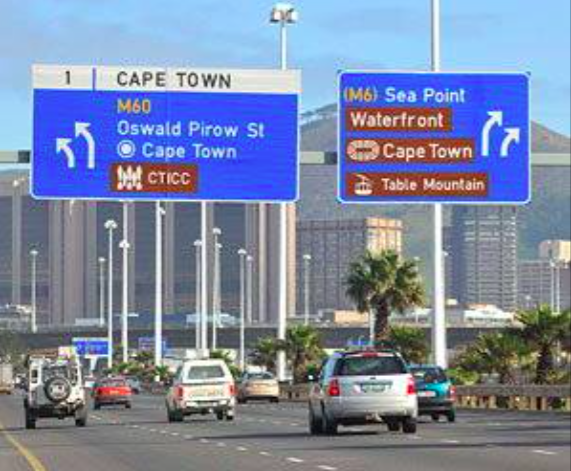
So when is it right to re-name a national landmark road? We’re all up in arms that Edwin Swales VC Drive, named after our famous Victoria Cross winner for gallantry in World War 2 was re-named as Solomon Kalushi Mahlangu Drive after a controversial Umkhonto we Sizwe operative. But what of Oswald Pirow Street in Cape Town, is there a case to justify this street name change?
Read on for a little more on who Oswald Pirow really was, learn some more on South African “hidden” military history; the Pro Nazi paramilitary organisations who sought to destabilise South Africa and the Union during the Second World War and bring South Africa into a one party ‘Fuhrer’ state run along ‘national socialism’ lines.
In all there were three movements which supported Nazi Germany and embraced its ideology in South Africa, the Ossewabrandwag, the shirts including the ‘Blackshirts’ and the SANP Greyshirts (see Pro Nazi movements in wartime South Africa – the SANP “Greyshirts”) and the ‘global’ Nazi movement – The ‘New Order’ – led by our subject for the day, the well-known South African Nationalist Politician and Public Prosecutor – Oswald Pirow.
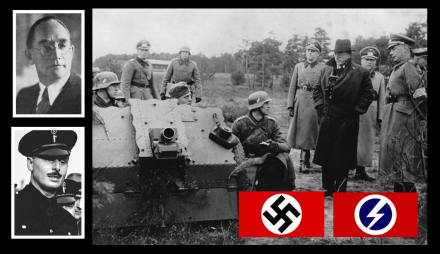
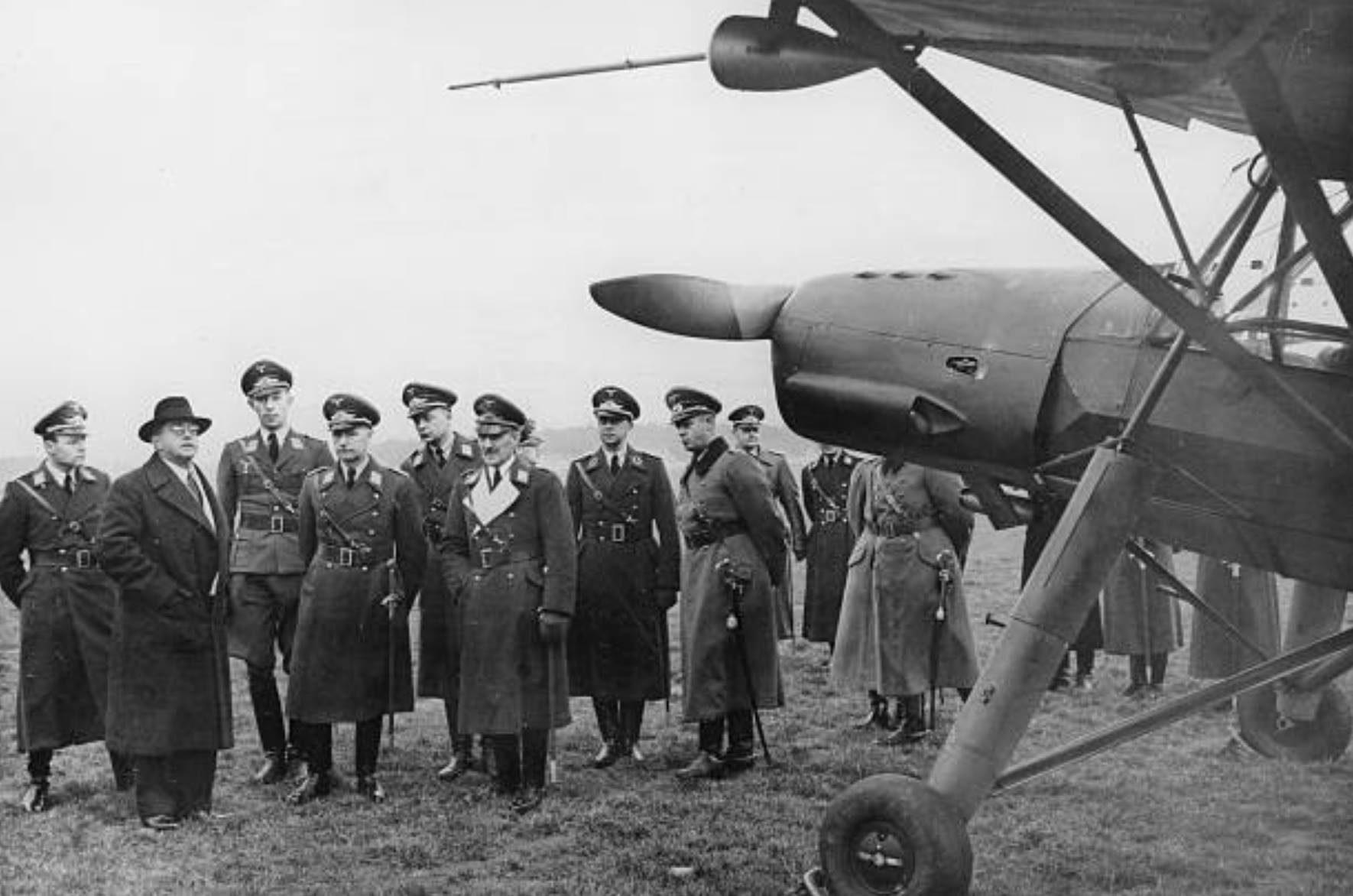
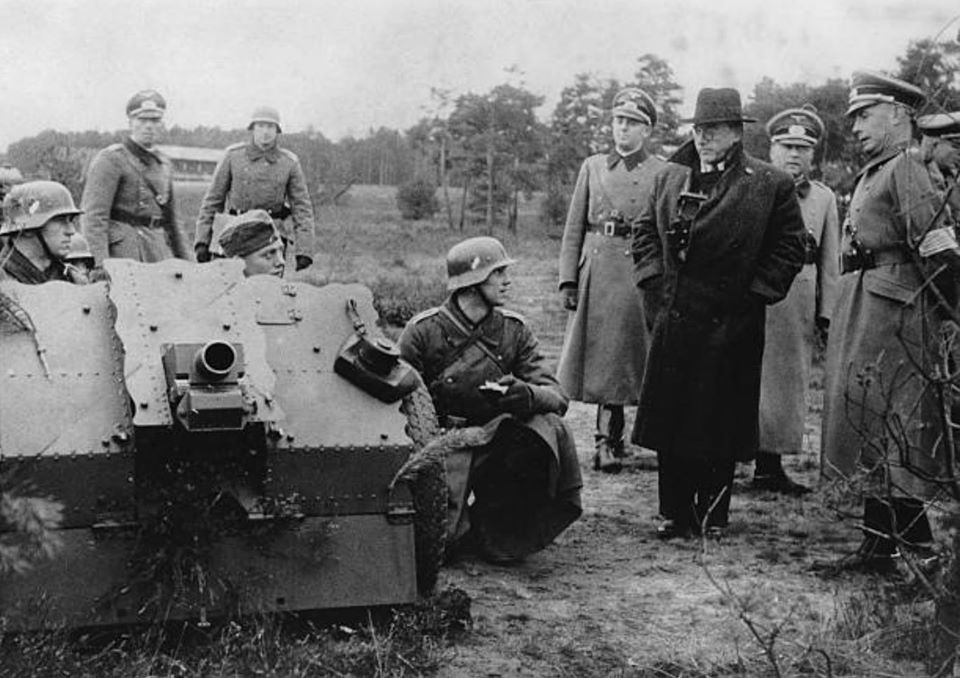
Oswald Pirow in Nazi Germany, November 1938 in Berlin inspecting a honour guard from the German Luftwaffe (Air Force), to his left is Wilhelm Canaris, to his right Ernst Seifert.
In a relatively little known part of South African history, Oswald Pirow was sent on ‘quasi-official’ visits on behalf of the Hertzog government to Nazi Germany and Fascist Italy. His mission was one of appeasement, to meet with Hitler, Ribbentrop and Goering and try to establish Anglo-German rapprochement as well as assure them of South Africa’s neutrality under the Hertzog government.
Pirow’s solution to easing British and German tension prior to the war, which he proposed to Hitler, was for the British to agree with the Nazi policy of “Drang nach Osten” (meaning yearning or ‘thrust’ towards the East for ‘living space’ as Hitler put it in his book ‘Mein Kamph’) and in return Hitler should allow all the Jewish people living in Germany to leave. In reality this offer would never have happened as it would have required Britain, by way of a parliamentary agreement, to renege on its commitment to Poland as an ally. However, Pirow also had another mission, that of building a South African partnership for a post war Nazi world.
So how is it that these lessor known South African missions and special envoy on ‘quasi official’ visits come about, what was he doing and what made Oswald Pirow tick?
Background
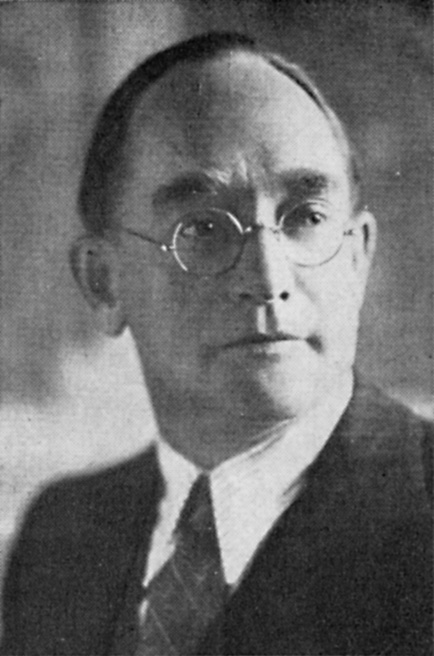
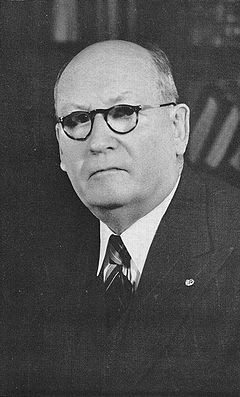
Oswald Pirow was born in Aberdeen (Cape Province, South Africa) on 14th August 1890, and was the grandson of a German missionary and son of a Doctor. Pirow studied law in Potchefstroom, Germany and London, and then practised as an advocate in Pretoria. Oswald spoke perfect German and was insistent that only German was spoken by his family at home in South Africa (it was said by those who knew them that the Pirow family was more German in identity than South African).
He came to fame as a lawyer defending the Communist ring-leaders and instigators of The Rand Revolt in 1922 (see South Africa’s very own Communist Revolution – The Rand Revolt of 1922), an odd start for him as he became an ardent hater of anything Communist and would later come up with plans to ‘eradicate’ communism from the planet in its entirety (not just South Africa).
He made several unsuccessful attempts to enter parliament and finally in 1924 he was elected for Zoutpansberg. Smuts defeated him in 1929 in Standerton but he returned to Parliament and in the same year and he was appointed Minister of Justice in General Hertzog’s cabinet. The Hertzog government was in coalition, so it could not fully unleash Nationalist proposals for a Republic (of which Pirow was a keen supporter).
As Justice Minister, typical to form as a fierce anti-communist he passed the first anti-communist legislation in South Africa. In 1933 he was appointed Minister of Railways and Harbours, and from 1933 to 1939 he was Minister of Defence.
Oswald Pirow (in civilian dress) on tour inspecting German military capability in 1938
Unofficial Envoy
In 1936 Pirow attended the Olympic Games in National Socialist (Nazi) Germany and in 1938 again visited Europe, including Spain, Portugal and Germany. These visits confirmed his admiration for this new style of government in Europe and, in particular, for National Socialism (Nazism). A vehement anti-communist – Pirow vowed to legislate communism out of existence, he also became an admirer of Adolf Hitler – especially after meeting him in 1933.
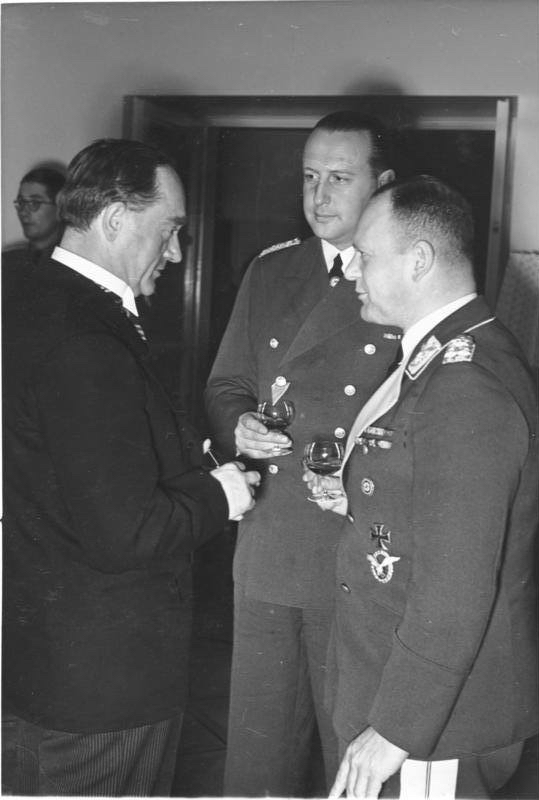
Oswald Pirow ( left) at a reception of the Nazi Foreign Minister Joachim von Ribbentrop in conversation with Erhard Milch (right) and Walter Hevel on November 19, 1938
During this tours he also met Benito Mussolini, António de Oliveira Salazar and Francisco Franco and became convinced that a European war was imminent, with a resounding Nazi victory assured. The future Pirow predicted was one of global nazism and it was a future he liked.
The Nationalists were strongly in favour of Nazi Germany, primarily as the antagonists for war in their eyes were the British, and they simply hated the British. This hatred stemmed from the punitive deportation and containment measures used by The British against Boer families along with the destruction of their farmsteads during The 2nd Anglo-Boer War.
Publicly the Nationalists declared neutrality as to Nazi Germany and to the impending war with Germany, whilst covertly their members (and even leaders) in the tens of thousands joined pro Nazi organisations like the Ossawabrandwag and the SANP Grey Shirts, which very publicly nailed their colours to mast strongly in support of Nazi Germany.
When General Jan Smuts committed South Africa to war against Nazi Germany, Pirow found his position in government as a Minister of Parliament and especially as Minister of Defence untenable. He had given his support in 1939 to Hertzog’s neutrality policy and had been on appeasement missions to Nazi Germany in support of them. He then resigned along with Hertzog and took no part in Smuts’ reformatted war-time government.
South Africa’s ‘New Order’
By September 1940, with Nazi Germany on the ascendancy having invaded most of Western Europe, Pirow launched the South African version of the “New Order” within the breakaway National Party – the Herenigde Nasionale Party (HNP), backing a Nazi style dictatorship.
His new political grouping took its name from his 1940 ‘New Order in South Africa’ pamphlet in which Pirow embraced the ideology of Nazi globalisation.
To understand what the concept of the “New Order” was – the New Order (German: Neuordnung) was the political order which Nazi Germany wanted to impose on the conquered areas under its dominion.
The establishment of the New Order was publicly proclaimed by Adolf Hitler and entailed the creation of a pan-German racial state structured according to Nazi ideology to ensure the supremacy of an Aryan-Nordic master race, massive territorial expansion into Eastern Europe through its colonization with German settlers, the physical annihilation of the Jews and others considered to be “unworthy of life”, and the extermination, expulsion, or enslavement of most of the Slavic peoples and others regarded as “racially inferior”.
Hitler’s New Order for Africa
Hitler’s ‘New Order’ plan involved global expansion, it focussed primarily on Eastern Europe (‘living space’) however it also extend to Asia, India, South America and North America in ‘post war’ fascist dominated world. Like any plan for globalisation, Africa also played a role in the New Order.
Hitler’s overall intentions for the future organisation of Africa was based on a plan which divided the continent into three big parts. The northern third of Africa was to be assigned to Germany’s Axis partner – Italy. The central part of Africa would fall under German rule. The remaining southern sector would be controlled by a pro-Nazi Afrikaner state built along racial grounds.
Foreign Minister Ribbentrop had communicated this plan with South African leaders sympathetic to Nazism, and a key channel for this communication were his meetings with Oswald Pirow whilst he was on his ‘quasi official’ South African State visits to Nazi Germany on behalf of the Hertzog government.
Oswald Pirow as a special South African envoy inspecting German Infantry and military capability in 1938
Ribbentrop informed the Afrikaner Nationalist leaders that once Germany had won the war, Germany was to reclaim its former colony of German South-West Africa (now Namibia), then a mandate would be given to an Afrikaner Nationalist led South Africa as a sort of ‘war compensation’ which would include the territorial acquisitions of the British protectorates of Swaziland, Basutoland (Lesotho), Bechuanaland (Botswana) and the colony of Southern Rhodesia (Zimbabwe).
On the division of French African colonies between the Spanish and Italian governments Hitler refused to provide any official promises during the war, fearful of losing the support of Vichy France
Decline of Pirow’s New Order
Dr. DF Malan
Dr D.F. Malan, leader of the National Party initially tolerated the actions of Oswald Pirow’s South African adaption of the 3rd Reich’s ‘New Order’ however very soon Malan came to realise what the extreme ideology of The New Order was about and he immediately saw it as a divisive influence on the Afrikaner nationalist movement.
Fearful of a split in Afrikaner nationalism over support for extreme Nazism and for Hitler’s plans for the African ‘new order’, at the Nationalists Transvaal party congress of August 1941, Malan forced through a motion ending the New Order’s propaganda activities, particularly their insistence on a one-party state on a ‘Führer’ principle.
Although restricted by DF Malan, the New Order continued to exist and Pirow and 17 of his New Order supporters continued to be associated with the HNP and continued to attend their caucus meetings.
The New Order finally broke from the HNP altogether in 1942 after both D.F. Malan and J.G. Strijdom publicly rejected the Nazis.
Partnership with Sir Oswald Mosley
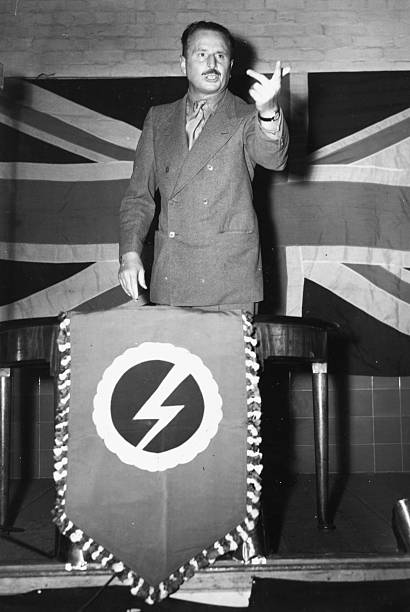
Oswald Mosley
With the outcome of the war firmly against Nazi Germany, Oswald Pirow’s political career within the Afrikaner Nationalists was effectively over, he returned to legal practice, and during this time became a friend of Sir Oswald Mosley.
Mosley was ex-British MP and an infamous British Nazi, he led the British Union of Fascists (BUF), a Neo-nazi British organisation following the edicts of the ‘New Order’ in the United Kingdom.
Mosley was imprisoned at the outbreak of World War 2 in 1940 for his extreme views in support of the enemy (Nazi Germany) and the BUF was outlawed. He was released in 1943.
Oswald Pirow and Mosley, having similar political views decided to collaborate together and they developed an idea for the division of Africa into exclusively black and white areas.
Oswald Pirow and Oswald Mosley
The two met after Pirow read a copy of Mosley’s book ‘The Alternative’ and by 1947 they were in discussion over founding an anti-communist group to be known as the “enemies of the Soviet Union” (although this plan never reached fruition).
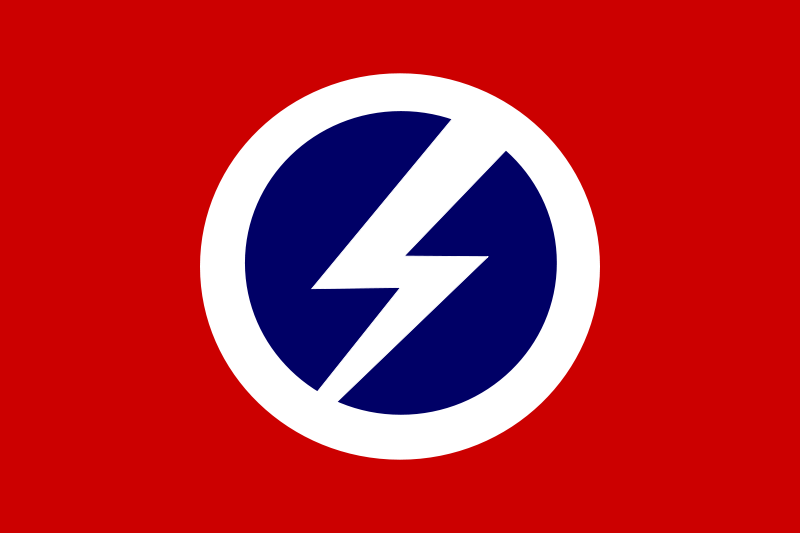
Mosley’s British Union of Fascists (BUF) Flag
The two Oswalds co-operation started in earnest when Pirow visited Mosley in London in April 1948 and spent the weekend at his house. In collaboration with Mosley, Oswald Pirow started writing articles for the Union Movement journals and The European, some of which were reprinted in German magazine Nation Europa.
In addition to writing for far right wing publications, the two Oswalds came up with what were known as the Mosley-Pirow Proposals, which advocated the extension of the South African National Party’s Apartheid ideology and concept to include the entire continent of Africa. The idea they came up with was that two-thirds of sub saharan Africa would be advocated for ‘Black States’ and one-third would be for ‘White states’. Where the two of them differed on their concept of ‘Eurafrica’ (which they coined) is that Pirow felt that ‘sweated labour’ would need to be forced whereas Mosley felt that unskilled Labour, needed in the ‘white states,’ was to be traded for from the ‘black states’ in return for technical assistance at some ‘later stage’.
The relationship with Pirow and Mosley started to break down after their ‘Eurafrica proposals’ were launched. Pirow came to realise that virtually nobody took Mosley seriously, people generally dismissed both him and his economic and political treatise out of hand as an extreme oddity.
The Treason Trial
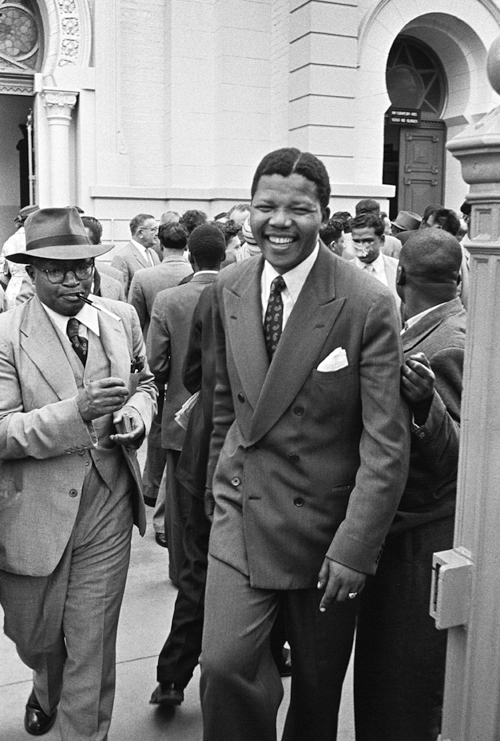
Nelson Mandela at The Treason Trial 1956
Very famously Pirow, now back in South Africa and back in his legal guise, acted as the public prosecutor on behalf of the Nationalist State during the Treason Trial of 1956. The Treason Trial was a trial in which 156 people, including Nelson Mandela, were arrested in a raid and accused of treason in South Africa in 1956. The main trial lasted until 1961, when all of the defendants were found not guilty. During the trials, Oliver Tambo left the country and was exiled. Some of the defendants, including Nelson Mandela were later convicted in the Rivonia Trial in 1964.
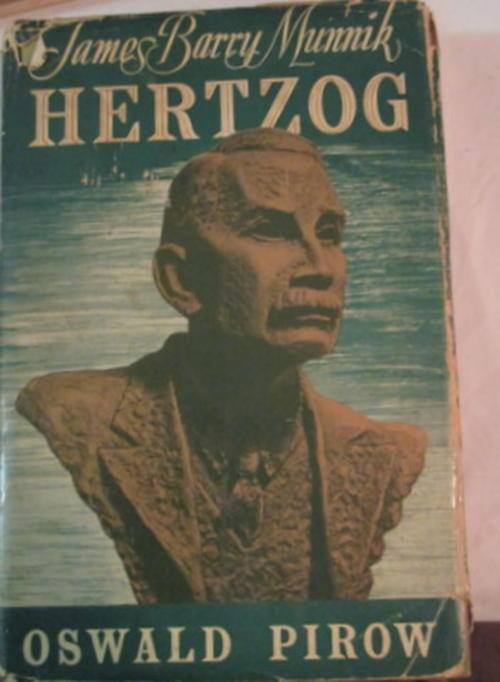
Following the Treason Trial Pirow largely lived in retirement, publishing several books, especially on JB Hertzog of who he was an admirer, he also wrote books on wildlife and adventure books for boys. He died of heart failure. He was cremated and his ashes are kept at his Valhalla Farm residence near Pilgrim’s Rest.
Influence on Apartheid
Oswald Pirow’s influence in South African politics and Apartheid is far-reaching. The Tomlinson Commission – which investigated the validity of the idea Apartheid was not a new creation, and its findings were based in part on findings made by the Native Economic Commission in 1932 and on preparatory work done by Oswald Pirow.
Very little is known in South Africa today of the frustration and disillusionment returning South African combatants from World War 2 felt and the motivation behind their eventual mass protests against Apartheid policies in the 1950’s (known as the ‘Torch’ Commando rallies – attracting tens of thousands of war veterans – see The Torch Commando led South Africa’s first mass anti-apartheid protests, NOT the ANC!).
Effectively the returning South African statute force veterans had gone to war to rid the world of Nazism, only to come home and in a few short years find significant “home grown” Nazi’s in government or playing a key role in public prosecution (as was the case with Pirow) when the National Party narrowly beat Smuts’ United Party into power in 1948.
The likes of famous World War 2 heroes like Adolph “Sailor” Malan would have none of it and they took to the streets in the first mass protests against Apartheid and the Nationalist government who had only come into power a couple of years before hand and where already removing the cape coloured vote from the register – see Sailor Malan; Fighter Ace & Freedom Fighter!.
The Torch Commando and veteran protests where ultimately suppressed by The National Party (including Sailor Malan) and the Nationalists where free to promote their heroes – Oswald Pirow had the foreshore road in Cape Town named after him as well as a South African navy strike craft – the SAS Oswald Pirow – much to the disillusionment of many of South Africa’s war veterans, the disenfranchised voters and the South African Jewish community.
Re-naming
Since 1994, proposals were to put forward to re-name the strike craft and Cape Town’s foreshore road.
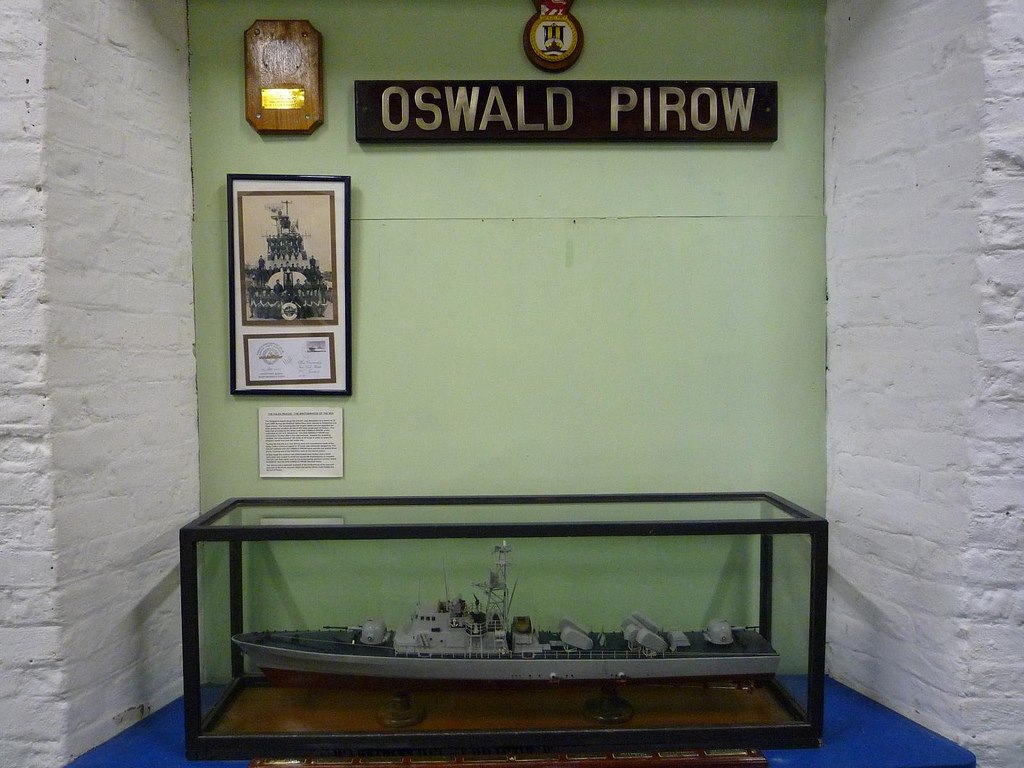
The SAS Oswald Pirow was re-named the SAS Rene Sethren after a famous Navy stocker Rene Sethren who was on board a South African minesweeper in World War 2. In June 1941 his ship was escorting a convoy to Tobruk when they came under heavy attack from enemy planes. He took over an anti-aircraft gun and did not stop firing until the attack was over. He was wounded 27 times during the attack and fortunately survived, he received his gallantry decoration from King George V.
It was also discovered that although Dr Christiaan Barnard had performed the world’s first heart transplant nothing in the way of Cape Town’s streets honoured this, since 2011 most Captonians now know this landmark road which was ‘Oswald Pirow Street’ as ‘Christiaan Barnard Street’.
There is an argument that says we should not be re-naming things in the interests of preserving history, with all its spots, however world over institutions named after Nazis have been re-named and/or scrubbed of anything glorifying this history. Munich – the birthplace of Nazism is virtually clean of any old references, such is its blight to the entire human race caused by this ideology, and in this respect South Africa has acted no differently.
What is surprising is that even during the 70’s and the 80’s, the National Party were unapologetic in the glorification of individuals so closely associated to National Socialist ideology and Nazism, no matter how hurtful to the vast majority of South Africans, well after the horrors of this ideology had been exposed and universally condemned (even in South Africa).
Pirow was allowed to continue as the State Prosecutor and advise Apartheid policy, his controversial plans for the Nazification of Southern Africa were just glazed over and conveniently swept under the rug – the modern South African generation would grow up fairly oblivious of Oswald Pirow’s really dark past.
Display of the SAS Oswald Pirow at the SA Naval Museum, it was renamed the renamed SAS Rene Sethren on April 1, 1997
Written and Researched by Peter Dickens.
Feature photo copyright the German Federal Archives copyright. ‘Very Deeply Dyed in Black’ Sir Oswald Mosley and the Resurrection of British Fascism After 1945 by Graham Macklin. NSDAP Office of Colonial Policy Brian Bunting’s 1964 book, The Rise of the South African Reich. Ribbontrop’s proposals to South Africa, The Rise and Fall of the Third Reich, by William Shirer, 1974 edition.
Published by New York: Crest, 1962, New York (1962
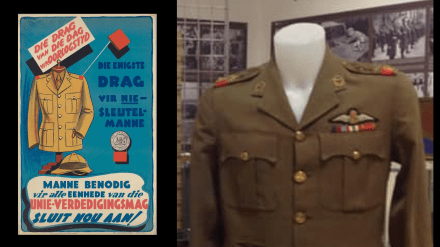
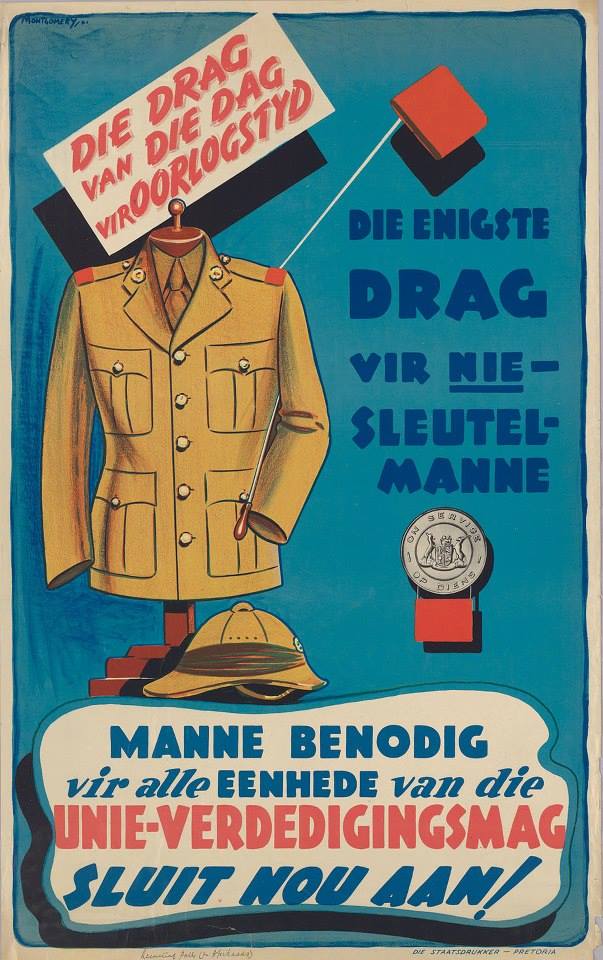
Pride in “Rooi Lussies”(red tabs), worn by most, branded “Rooi Luisies” (Red Lice) by some.
At the start of World War 2, the South African armed forces were woefully understrength having only 3,500 permanent force members and 14,000 volunteers in citizen force regiments and rifle associations (Active Citizen Force). General Jan Smuts needed to increase these numbers dramatically, and he did not want to institute conscription to do so, the call to fight would be based on volunteerism. The idea was to initiate a Oath declaring the free willing and voluntary nature South Africans felt in going to war against Nazi Germany, Fascist Italy and eventually Imperial Japan. The success of this call for volunteerism is staggering – in the end a total of 342,792 South Africans volunteered to participate in World War 2.
Also of that statistic nearly one quarter of the total ‘white’ adult population at the time volunteered for service, consider what Smuts had achieved, the Nationalists were unable to raise anywhere near these numbers in 1966 to their cause and had to implement forced conscription for the SADF.
The ‘Red Oath’ or ‘Service Oath’ was taken by all these volunteers when joining the South African Union Defence Force (UDF) from 1939, it was a Service Oath to legally enable the Union to send soldiers outside the borders of South Africa (soldiers in the UDF were only legally obliged to protect South Africa itself if it were invaded). The oath read:
“That I will be faithful and bear true allegiance to His Majesty King George VI and his heirs and successors according to law … That I will perform to the best of my ability the duties assigned to me as a volunteer member of the Union Defence Forces … That I will serve anywhere for the duration of the present war and for a period of six months thereafter unless otherwise legally discharged.”
This manifested itself in ‘red epaulettes’ issued to all service-personal who ‘volunteered’ to serve in the armed forces during the war and took the ‘Red Oath’. Sensitive to sympathetic political feelings many Afrikaners had towards Germany, by implementing the oath the Smuts government gave the opportunity for permanent force members sympathetic to Germany to remain in the Union’s forces, and not go to war against them – they just didn’t get to wear the red tabs.
The original ‘red’ oath specified service anywhere in “Africa” and was called the ‘Africa Service Oath’ (ASO), it was changed to the ‘General Service Oath’ (GSO) once the Axis Forces in North Africa were defeated so that volunteers could be used in the European theatre and the word “Africa” was changed to “anywhere”. Those who did not want to fight in Europe and who had taken the ‘Africa’ oath only were returned to the Union.
A handful of permanent force UDF members did not take either red oath, some felt inevitably ‘singled out’ by not wearing the tabs (and in some cases resigned), whilst others took pride in their political convictions and wore their ‘clean’ epaulettes, sans the red strip with pride.
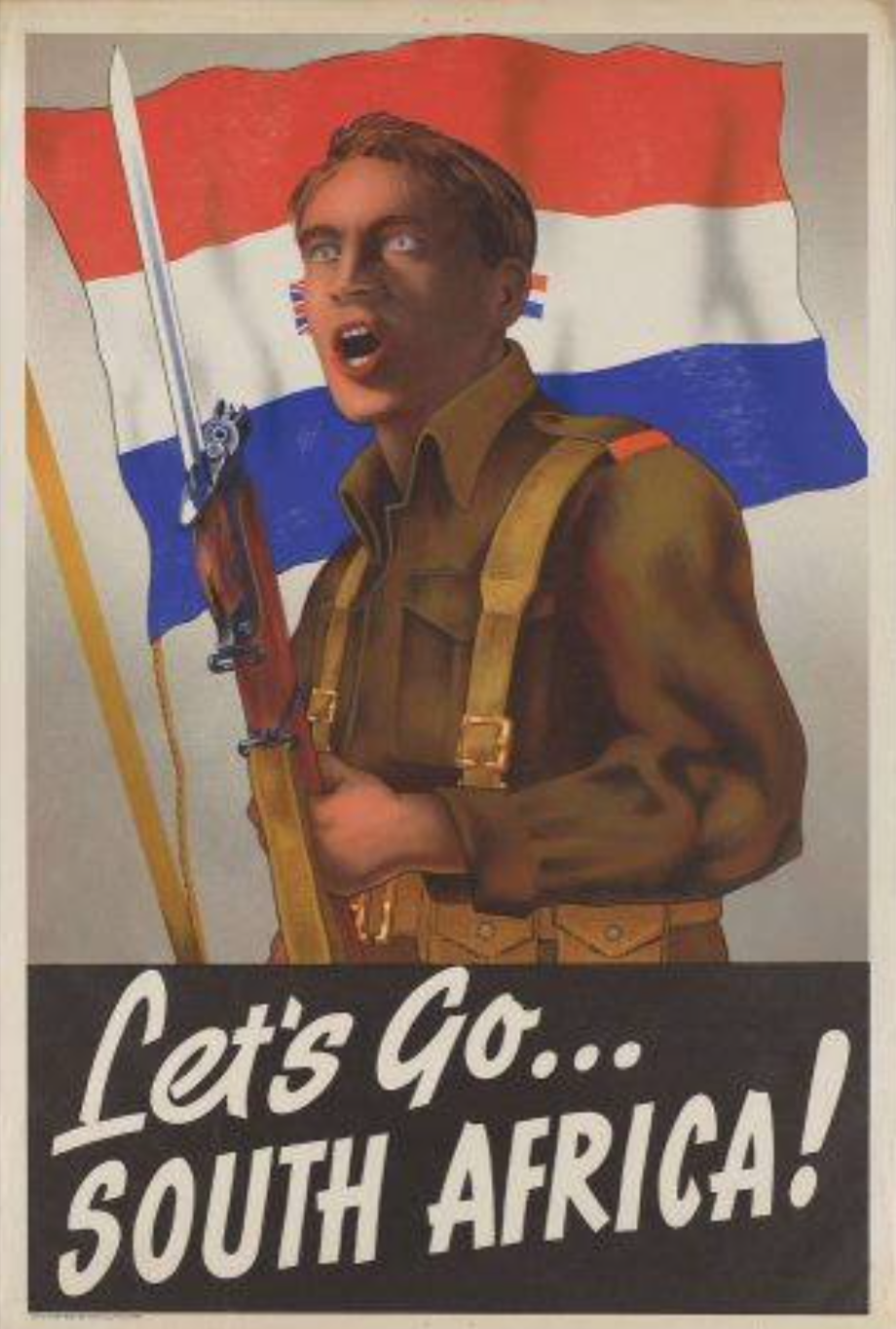
Images: Pride in the Red tabs and Let’s Go South Africa, showing proudly the tabs propaganda posters.
This WW2 South African propaganda poster, promoting the ‘Red Oath’ and the special volunteer epaulette flash worn by all who took the oath and volunteered for service during World War 2 was designed to swing opinion in the Afrikaans community where the wearing of the red flash was seen as an oath to the British and viewed by some as betrayal. In these sections of the Afrikaans community they where called ‘Rooi Luisies’ (Red Lice) instead of ‘Rooi Lussies” (Red Tabs), as a means of degrading those who volunteered.
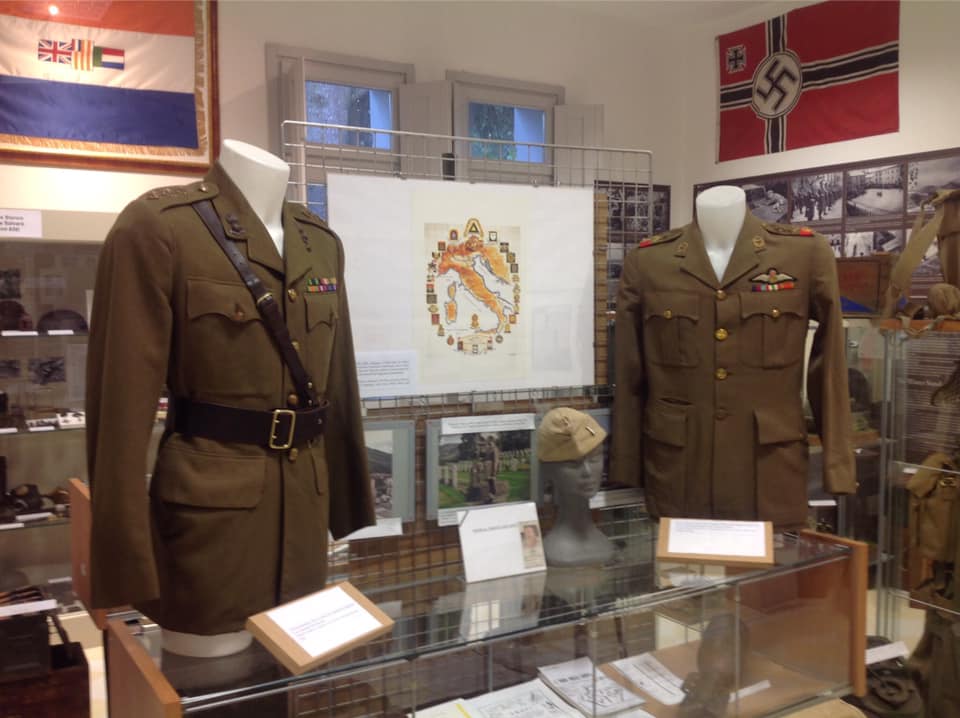
Image: British (left) and South African (right) uniforms from the Italy Campaign during WW2, note the red tabs on the epaulettes.
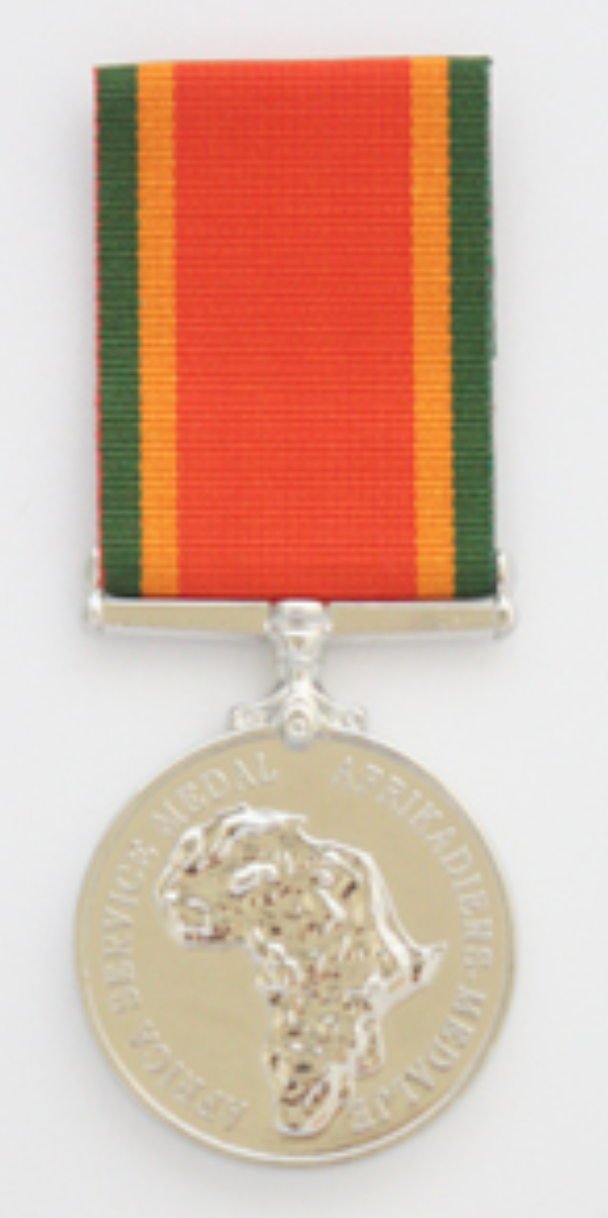
Of interest is the ‘Africa Service Medal’ awarded to all who served in South African Forces during the Second World War, the ‘red tab’ in this medal’s ribbon is symbolic of the The Red Oath taken and the tabs worn.
The ‘Erasmus Reforms’ to the defence force was implemented by FC Erasmus after the Afrikaner Nationalists came to power in 1948. Deemed more necessary when the Nationalists converted the South African Union’s Defence Force to that of the Republic’s Defence Force in 1961 and these reforms would see the idea of the ‘red’ oaths to the British royal family as the symbolic head of South Africa and red tabs removed. Some citizen force regiments however carried on with the tradition as a historical nod to their participation in the Second World War on their step out uniforms, the Cape Town Highlanders a case in point.
Written and Researched by Peter Dickens
References:
The Smuts Government Justification of Emergency Regulations and the impact thereof on The Ossewabrandwag (1939-1945) by Anna La Grange
The Springbok Record – published by the South African Legion
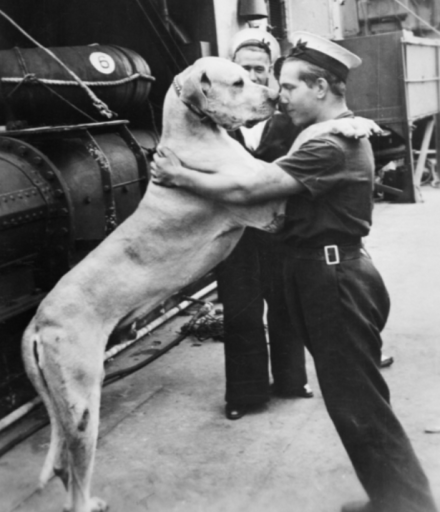
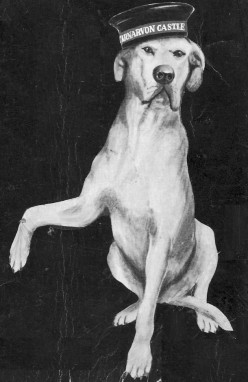
In 1939 the British Royal Navy did the unthinkable… Strange but true, they enlisted a South African dog who then went on to win the hearts and minds of sailors on two continents and become a legend.
Able Seaman ‘Just Nuisance’ is one very famous South African, and as he was an enlisted rating he received rank, pay, rations and duties – the same privileges as any other rating with the rank of ‘Able Seaman’ (AB). This is how he got there.
He was a Great Dane who between 1939 and 1944 served at HMS Afrikander, a Royal Navy shore establishment in Simon’s Town, South Africa. He died in 1944 at the age of seven years and was buried with full military honours.
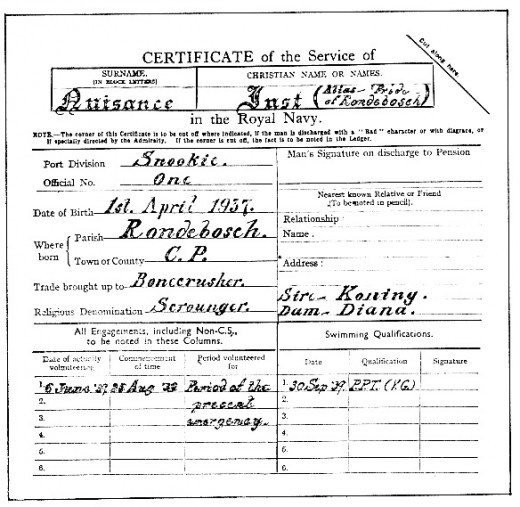
Although the exact date of Just Nuisance’s birth is not known, it is usually stated that he was born on 1 April 1937 in Rondebosch, a suburb of Cape Town. He was sold to Benjamin Chaney, who later moved to Simon’s Town to run the United Services Institute (USI). Just Nuisance quickly became popular with the patrons of the institute and in particular the ratings, who would feed him snacks and take him for walks. He began to follow them back to the naval base and dockyards, where he would lie on the decks of ships that were moored at the wharf. His preferred resting place was the top of the gangplank. Since he was a large dog even for a Great Dane (he was almost 2 metres (6.6 ft) tall when standing on his hind legs), he presented a sizeable obstacle for those trying to board or disembark and he became affectionately known as Nuisance.
Nuisance was allowed to roam freely and, following the sailors, he began to take day trips by train as far afield as Cape Town, 22 miles (35 km) away. Despite the seamen’s attempts to conceal him, the conductors would put him off the trains as soon as he was discovered. This did not cause the dog any difficulty, as he would wait for the next train, or walk to another station, where he would board the next train that came along. Amused travellers would occasionally offer to pay his fare but officials of the State-owned railway company (South African Railways and Harbours) eventually warned Chaney that Nuisance would have to be put down unless he was prevented from boarding the trains or had his fares paid.
The news that Nuisance was in danger of being put down spurred many of the sailors and locals to write to the Navy, pleading for something to be done. Although somebody offered to buy him a season ticket, naval command instead decided to enlist him by the book. As a member of the armed forces, he would be entitled to free rail travel, so the fare-dodging would no longer be a problem. It proved to be an excellent idea. For the next few years he would be a morale booster for the troops serving in World War II.
He was enlisted on 25 August 1939. His surname was entered as “Nuisance” and, rather than leaving the forename blank, he was given the moniker “Just”. His trade was listed as “Bonecrusher” and his religious affiliation as “Scrounger”, although this was later altered to the more charitable “Canine Divinity League (Anti-Vivisection)”. To allow him to receive rations and because of his longstanding unofficial service, he was promoted from Ordinary Seaman to Able Seaman.
He never went to sea but fulfilled a number of roles ashore. He continued to accompany sailors on train journeys and escorted them back to base when the pubs closed. While many of his functions were of his own choosing, he also appeared at many promotional events, including his own ‘wedding’ to another Great Dane, Adinda. Adinda produced five pups as a result, two of which, named Victor and Wilhelmina, were auctioned off in Cape Town to raise funds for the war effort.
Nuisance’s service record was not exemplary. Aside from the offences of travelling on the trains without his free pass, being absent without leave (AWOL), losing his collar and refusing to leave the pub at closing time, his record shows that he was sentenced to having all bones removed for seven days for sleeping in an improper place — in the bed of one of the Petty Officers. He also fought with the mascots of ships that put in at Simon’s Town, resulting in the in the deaths of at least two of them, one of them was the ship mascot of the HMS Shropshire, for which AB Nuisance was charged.
Nuisance was at some point involved in a car accident. This caused thrombosis, which gradually paralysed him, so on 1 January 1944 he was discharged from the Navy. His condition continued to deteriorate, on 1 April 1944 he was taken to Simon’s Town Naval Hospital where, on the advice of the naval veterinary surgeon, he was put to sleep. The next day he was taken to Klaver Camp, where his body was draped with a Royal Naval White Ensign and he was buried with full naval honours, including a gun salute and the playing of the Last Post. A simple granite headstone marks his grave, which is on the top of the hill at Klawer, at the former SA Navy Signal School. A statue was erected in Jubilee Square in Simon’s Town to commemorate his life.
The Simon’s Town Museum has an exhibition dedicated to his story and since 2000 there has been an annual parade of Great Danes from which a lookalike is selected.
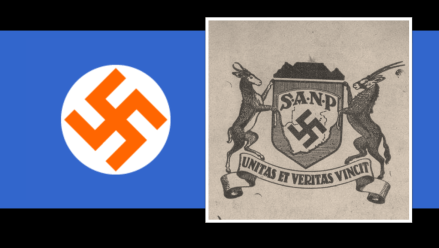
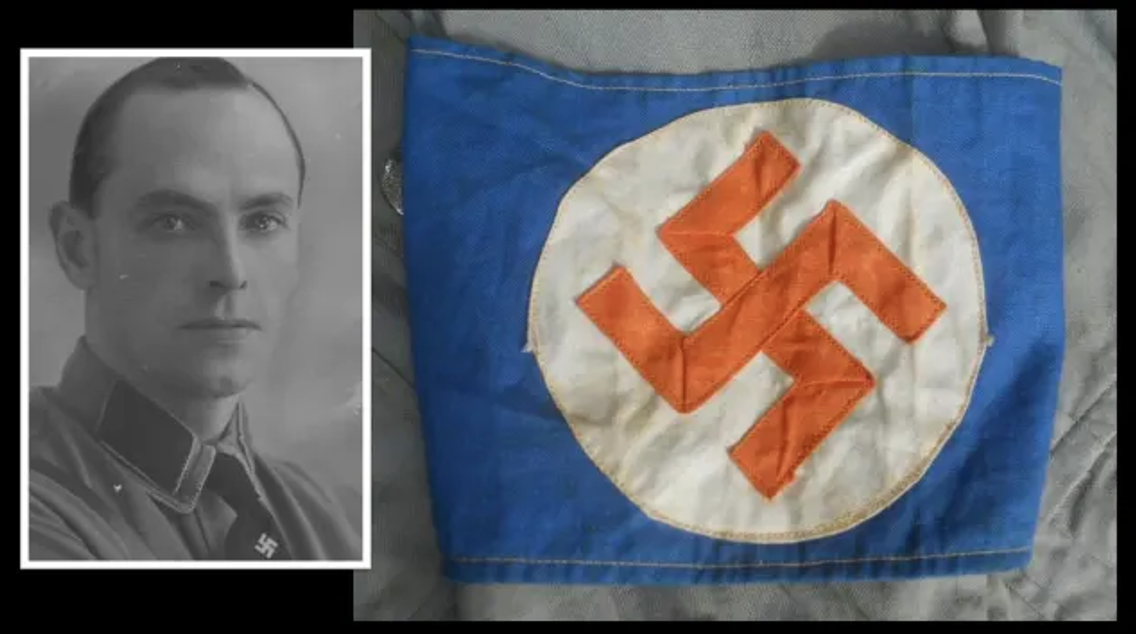
Here is a rare and very unique display of South Africa’s very own Nazi Party’s shirts, flags and bunting. Of interest, is the use of Orange, Blue and White in the Nazi swastika configuration – this was intentionally done to reflect the national colours of the South African flag at the time, the ‘Oranje-blanje-blou’ (Orange, White and Blue).
These items belong to South Africa’s ‘Greyshirts’, read on for an in-depth chapter in South Africa’s hidden history, here we focus on the SANP – The South African Christian National Socialist Movement (SANP) also referenced as the South African Gentile National Socialist Movement. More commonly they were also known at the time as the ‘Gryshemde’ in Afrikaans and ‘Grey-shirts’ in English.
SANP bunting, flags, armbands and shirts, image courtesy Ulrich Duebe, the current owner of the collection.
South African statute forces had fought a hard war against Italian Fascism and German Nazism, and the same war had been fought on the ‘home-front’ in South Africa itself, as with the USA and the United Kingdom, South Africa also had its own National Socialist (Nazism) parties prior to the war (it had actually been a quite popular doctrine across many “Western” European states prior to the war). During the war the Smuts’ government took severe action against pro-Nazi South African movements on the Afrikaner right-wing political fringe – the SANP (the Grey-shirts), the South African Democratic National Movement – the ‘Black-shirts’, the National Workers Bond – the ‘Brown-shits’, The ‘New Order’ and the Ossewabrandwag amongst others and jailed some of their leaders for the duration of the war.
Imagine the sheer frustration felt by the South African war veterans returning after winning ‘The War for Freedom’ (as Smuts had called WW2 at the time). This war had been fought with a massive cost in South African lives to rid the world of Nazism and Fascism in the “good fight” – only to come home in 1945 and within three short years in 1948 find South African ‘home grown’ pre-war Nazi and Neo Nazi politicians swept into government. The very men and their philosophy they had gone to war against in the first place. Many of these movement’s leaders and members were folded into National party after the war to one day become South Africa’s political elite (including a Ossawabrandwag General – BJ Vorster who became a future Prime Minister and State President of South Africa).
Louis Theodor Weichardt
One such South African politician was Louis Theodor Weichardt (21 May 1894 – 26 October 1985) and this is his relatively unknown story of South Africa’s very own Nazi Party, the largest and most significant of the Pro-Nazi South African ‘Shirt movements’ – the Grey-shirts .
Louis Theodor Weichardt
Louis Theodor Weichardt was born in Paarl of German extraction on the 23 May 1894, he attended German school in Pretoria and in New Hanover Natal. At the outbreak of World War 1, Weichardt found himself in Germany. His military service to the German state is shrouded in a little mystery, some accounts point towards three years service in the German Army, others point to non-combatant service in a Labour Corps. As a South African national there is an account that he was arrested after the war for High Treason, however the charges were never brought.
In Germany Louis Weichardt became a rabid antisemite, in travelling Europe he recalled that in the Ottoman Empire that the Turks were being “bled to death by Jewish extortioners and money lenders” and in Germany he said he:
“had the privilege of witnessing the first beginnings of the national German uprising against Jewish domination”. 1
Returning to South Africa in 1923, Louis Weichardt joined Hertzog’s National Party, however he became increasingly disillusioned in the National Party as he was unable to bring fellow members to his vision of National Socialism – he blamed been “checkmated” in his endeavours by external influences he called “powerful financial interests, predominantly Jewish”. When Hertzog merged the National Party with Smuts’ United Party, which was seen as by the ‘pure’ nationalists as underpinned by ‘Anglo-Jewish Capital’ (Oppenheimer) – Weichardt took the opportunity to break away from the National Party altogether and start his own party.
In Cape Town, on 26 October 1933, he founded South Africa’s Nazi party equivalent – The South African Christian National Socialist Movement with a paramilitary ‘security’ or ‘body-guard’ section (modelled on Nazi Germany’s brown-shirted Sturmabteilung) called the ‘Gryshemde’ (Afrikaans) or Grey-shirts (English). In May 1934, it was agreed to combine the ‘Grey-shirts’ with the South African Christian National Socialist Movement and form a new enterprise called ‘The South African National Party’ (SANP) – not to be confused with the National Party. The SANP would all keep with the ‘grey-shirts’ as their dress.
Johannes Von Moltke at this time was Louis Weichardt’s right hand man, the leader of the SANP’s stronghold in the Eastern Cape (his SANP office in Port Elizabeth proudly flying a swastika flag outside it every day). Johannes Von Moltke was of 1820 settler and German heritage, born in Senekal in the OFS he became a firm Republican and Afrikaner Nationalist, working for the Afrikaner Pers Group and the ‘Die Burger’, he met Weichardt in October 1933 and the two decided to collaborate.
Louis Weichardt was very proficient in English and he intended the SANP to appeal to both ‘English’ and ‘Afrikaner’ whites – citing that they were both of “Nordic” races. Some English joined the organisation, but the backbone found itself in rural and ‘poor white’ Afrikaner communities. It must be noted here that Nazism appealed to many Afrikaners as Hitler took an “anti-British” stance and the legacy of the South African War (1899-1902) was still strong within Afrikaner communities by the 1930’s, many within living memory of it. However Nazism was no means the exclusive pursuit of Afrikaners in South Africa, the handful of ‘English’ that supported the SANP were vicious in their anti-Semitic leanings – as were the British fascists at the time Oswald Mosley a case in point in England. This sentiment can be be seen in the University of Cape Town Law and SANP supporter – Professor Kerr Wylie, who said of Jews in a letter to University of Cape Town Principal Sir Carruthers Beattie:
“Everything point to the fact that the Jews’ game in South Africa is up, and, if they have any sense, they will realise the fact and try to effect compromise. But history shows that the greed for gold and lust for power is so engrained in the Jewish race that they will cling to their gold and power until it is too late”.2
As a movement the SANP also saw themselves as a ‘popular’ movement for National Socialism and initially did not contend by-elections and municipal elections as a political party – choosing instead to put forward their members as “independents” in elections. A future Grey-shirt breakaway called the ‘Black-shirts’ would however put party candidates forward which ironically caused issues for the ‘Pure’ National Party as the support or the Black-shirts split their vote.. Overall, Weichardt saw democracy as an outdated system and an invention of British imperialism and Jews.3
The SANP would eventually contest elections and Louis Weichardt would stand as a MP candidate in Port Elizabeth, he was not very successful and would later try another safer seat without success either – predictably he blamed his election losses on a Jewish conspiracy.
The SANP grew to about 4,000 members in South Africa (with their largest support base in the Eastern Cape – spurred by ‘poor white’ rural and urban issues in the area), central to their cause in the 1930’s where Jewish immigrants escaping Nazi Germany to South Africa, and their numbers were growing significantly over the decade – in response the SANP launched a campaign calling for an end to Jewish migration and even arranged mass protests in Cape Town. Their primary communication mouthpiece was a newspaper called ‘Die Waarheid/The truth’ which was nothing more than a vehicle to spread Nazi doctrine in South Africa – the Nazi emblem emblazoned on the masthead.
Louis Weichardt would spell out his ‘Nordic’ argument and vision in the ‘Die Waarheid/The truth’ and trace South Africa’s problems to one source – the Jews. He claimed Jewish ‘domination’ of the legal, medical, dental, commerce, trading, liquor trade etc. as between 60% to 100%, and he would write:
“We are determined to put the Jew in his place. We are not going to tolerate bootlicking, Gentile South Africans – English or Dutch speaking – are no longer prepared to play second fiddle to these aliens”.4
The main target of the SANP was Hertzog’s old National Party’s inspired Quota Act of 1930 which sought to curtail Jewish immigration. As far as the SANP was concerned the National Party had not gone far enough in their endeavours to clip Jewish immigration specifically. They proposed revoking South African citizenships granted to all Jews entering South Africa after 1918, the prevention of Jews gaining government jobs and the prevention of Jews from owning immovable property and dominating any particular industrial or trade sector. They would however support an immigration policy that brought in whites of ‘nordic’ (aryan) races that would assimilate with a white culture in South Africa sans the “insoluble” element of Jews.
The Protocols of the Elders of Zion
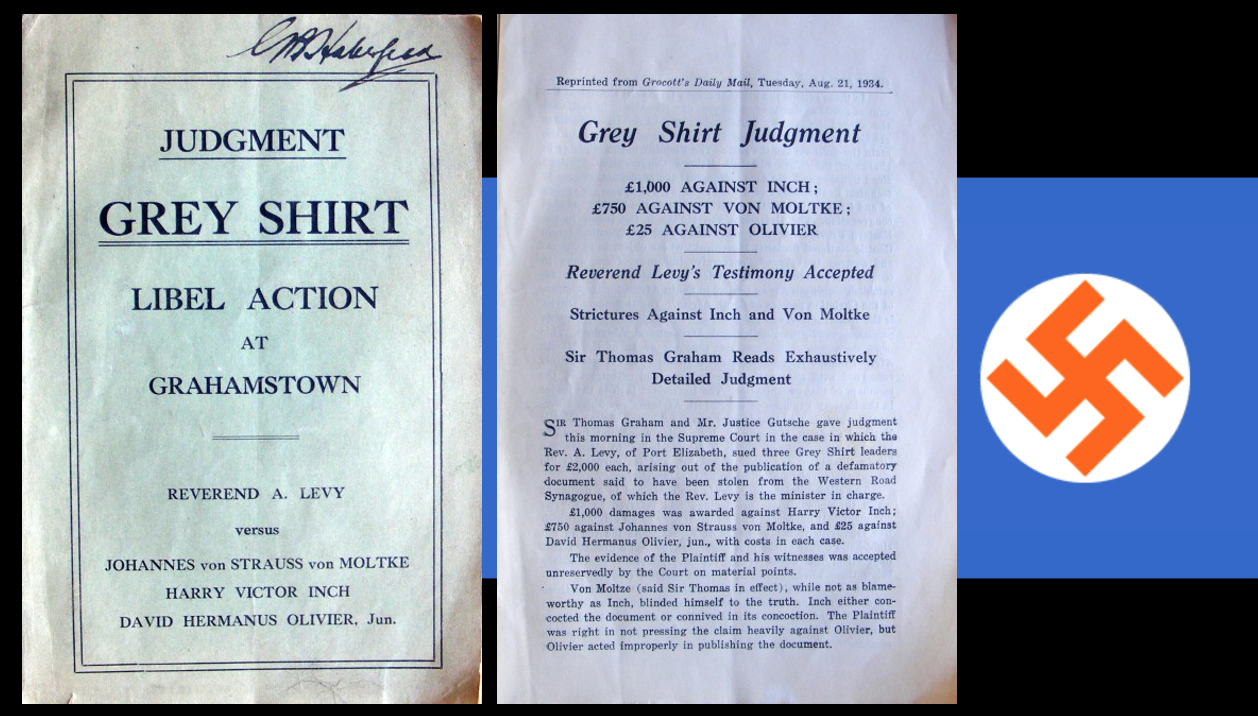
The nature of the movement was clearly seen in March 1934 when the SANP held a rally in Aberdeen in the Eastern Cape, Harry Victor Inch – one of the Greyshirt leaders – announced that he had in his possession a ‘stolen’ document from a Port Elizabeth synagogue – signed by its Rabbi – which outlined a secret plot by the Jews to destroy the Christian religion and civilisation.
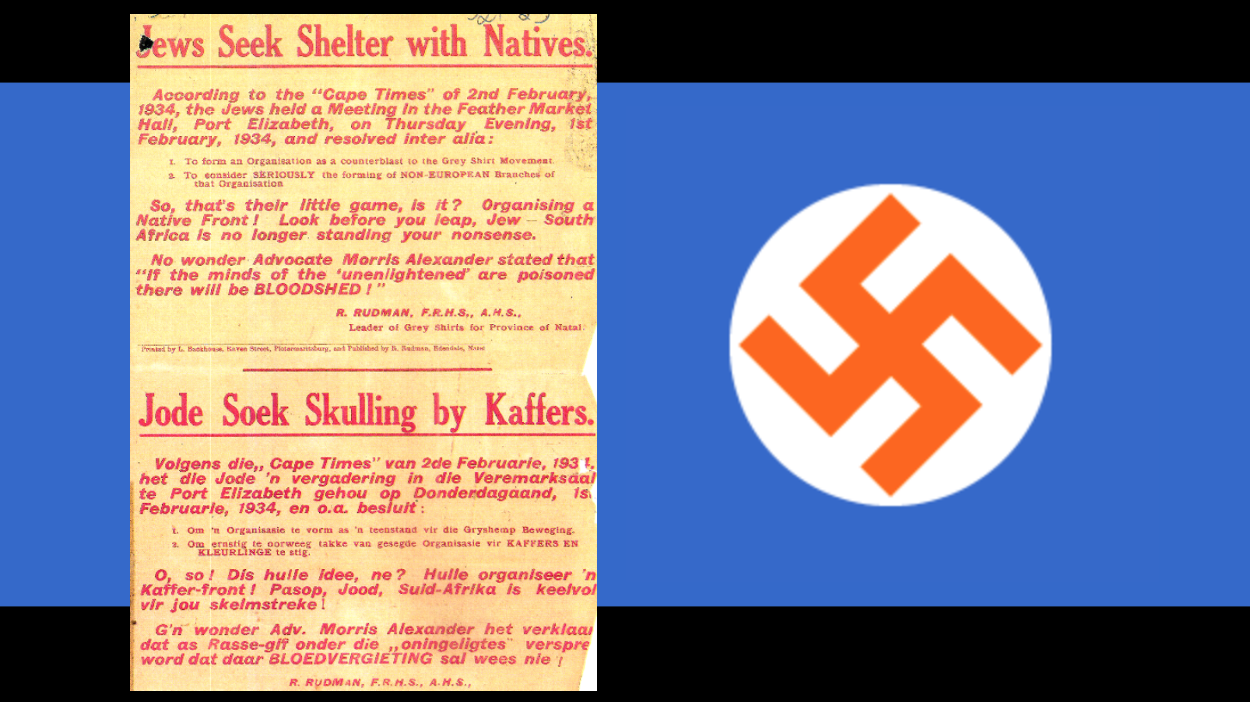
SANP propaganda leaflet accusing Jews of inciting Native (Black) violence against whites.
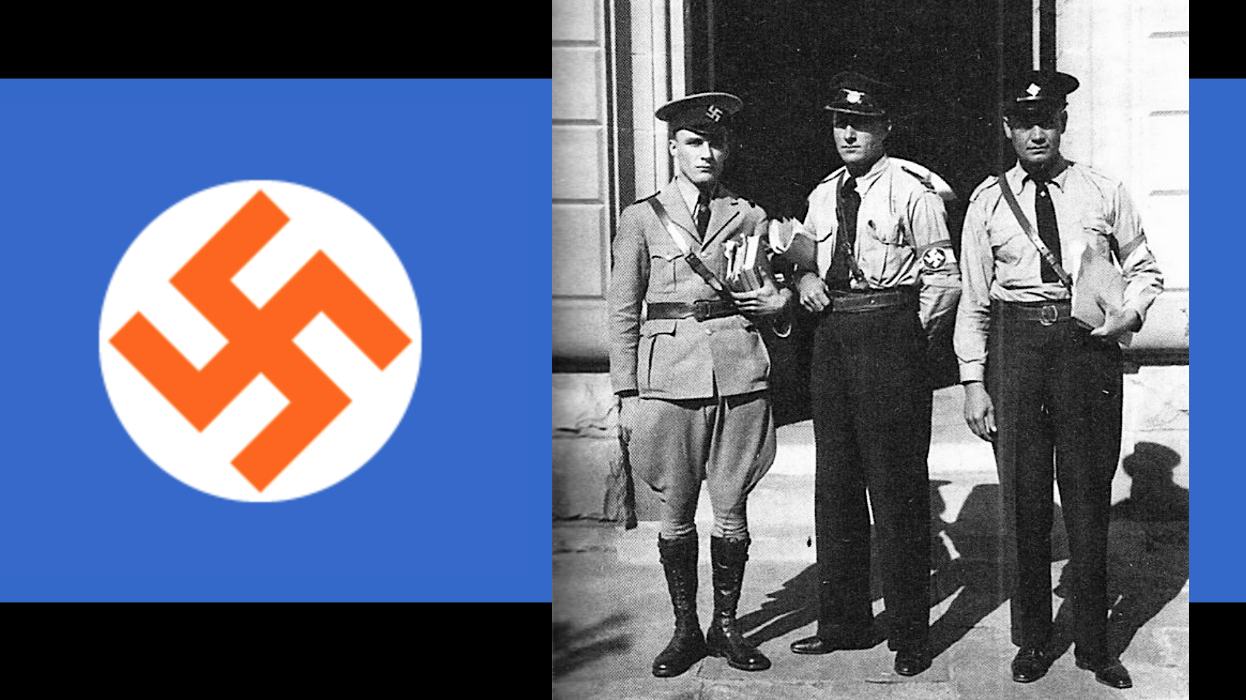
The Rabbi in question was not in fact a Rabbi, he was a Jewish Reverent, Reverent Abraham Levy, and he took the SANP Grey-shirt leadership in the Eastern Cape to court in Grahamstown in a landmark case. The SANP accused; Johannes von Strauss Moltke who was the Regional SANP leader, Harry Inch, who allegedly ‘stole’ the document and David Olivier, who had printed the document for circulation as the owner and publisher of “Rapport”, another media organ of the ‘shirt’ movements. All now have to account for themselves – the case billed as a mighty ‘Gentile vs. Jew’ showdown and a legal test of the ‘Great Jewish Conspiracy.’ `
The document in question followed the “Protocols of the Elders of Zion, a pamphlet of some 70 pages purporting to be the actual minutes of 24 speeches made by Jewish leaders during the First Zionist Congress in 1897. The pamphlet detailed a satanic plot by Jewish/Zionist conspirators to conquer the world. Alleging that Jews controlled much of the world’s finance, the media, the educational institutions, the court systems and many of the world’s governments, the Protocols claimed that the Jews indulged in all forms of trickery and deceit to tighten their hold. They deliberately spread diseases and immorality to weaken Gentiles, and did not hesitate to use murder and terrorism to destroy all religions except their own. Jews were striving to establish their own autocracy based on a false Messiah, the “Son of David”, and posed a fiendishly devious omnipresent peril to the rest of mankind.”5
‘Die Waarheid/The truth’ would pick up this ‘Protocols of the Elders of Zion’ and really twist it for a South African audience claiming:
“the disastrous Anglo-Boer War 1899-1902 was deliberately brought about by the Jewish mine magnets who circumvented Rhodes and Kruger alike”.6
In addition, Jews were accused of inciting blacks against whites and controlling the economy, exploiting ordinary Afrikaners as part of an international Jewish conspiracy. The ‘Die Waarheid/The truth’ statements were accompanied by a propaganda leaflet printed by the SANP and distributed in Port Elizabeth.
Left to Right – standing outside the courthouse in Grahamstown in full SANP dress is Johannes von Strauss Moltke, Harry Inch and David Olivier.
The ‘stolen’ document was scrutinised legally, it was found to be based on an entirely discredited antisemitic ‘international Jewish conspiracy’ document called ‘the Protocols of the Elders of Zion’ and given a South African twist by the SANP. The ‘Protocols of the Elders of Zion’ was a composition based on a 1860’s anti-Napoleon III pamphlet and a German antisemitic novel by Herman Gödshe ‘Biarritz’ – used by the Nazi Party in Germany.
In a carefully considered 30,000 word judgement, the court concluded inter alia;
“the protocols are an impudent forgery, obviously published for the purposes of anti-Jewish propaganda”.7
As a result three Greyshirt leaders all were fined, Harry Victor Inch was found guilty of perjury and forging documents defaming the Jewish race and swearing under oath that those documents were genuine – and fined £1,000 and later handed a short prison sentence. David Hermanus Olivier was fined £25 for acting improperly and printing the document and Johannes von Moltke was fined £750 for “playing a leading role in the plot”.
The result has been widely hailed here as a complete vindication of the Jewish people and of Rev. Abraham Levy who brought the lawsuit against the Grey-shirt leaders.
Splits in the Shirts
Later that year, the SANP Grey-shirts would hold their first National Congress in Observatory, Cape Town. Louis Weichardt in his keynote address would dismiss Johannes von Moltke as a “traitor” to the SANP and no longer a member having “misbehaved” in releasing Harry Inch’s anti-Jewish protocols. In fact Johannes von Moltke had broken away from the SANP along with most of his the Eastern Cape SANP supporters and leaders and formed a new organisation called ‘The South African Fascists’ who wore blue trousers and grey shirts.
Other Nazi splinter parties and ‘shirt’ organisations also began to form – ‘The South African National Democratic Movement’ (Nasionale Demokratiese Beweging) which became known as ‘the Black-shirts’ was formed in Johannesburg by Manie Wessels and operated in the Orange Free State and the Transvaal – the Black-shirts themselves would splinter into another Black-shirt movement as an off-shoot called the South African National People’s Movement (Suid Afrikaanse Nasionale Volksbeweging) – based in Johannesburg, started by Chris Havemann and advanced a closer idea of National Socialism – this Blackshirt splinter group by 1937 boasted 265 branches (mainly in the Transvaal), their official mouthpiece was called “The Swastika”8.
The black-shirts by July 1939 were formally incorporated into the Ossewabrandwag focussing on the recruiting of ‘Christian minded National Aryans’ into the Ossewabrandwag infusing it with a “volkisch” Nationalism and took it beyond just being a cultural organ of Afrikanerdom and the National Party. 9
Another ‘Volksbeveging’ (People’s movement) also known as ‘African Gentile Organisation’ was also formed in Cape Town by H.S. Terblanche. The National Workers Union (Bond van Nasionale Werkers) – known as the Brown-shirts was established by Dr. A.J. Bruwer in Pretoria in September 1934. Finally a group called the ‘Orange-shirts’ under Frans Erasmus, who at that stage was the Secretary to the Federal Council of the National Party and the Minister of Parliament for Moorreesburg, Erasmus would go onto become the National Party’s Minister of Defence after 1948.10
In addition, the SANP leader J.H.H. de Waal resigned from the SANP over leadership issues with Weichardt and formed the The ‘Gentile Protection League’ whose sole aim was to:
De Waal’s organisation would focus on the Western Cape, he would also advance a Jewish store boycott in the southern Orange Free State where antisemitism was rife, he was a popular lawyer of political stock and he would eventually claim his organisation as 5,000 members strong. De Waal would comment in his memoir “My Ontwaking” (my awakening) and blame Jan Smuts for promoting the Jewish agenda in South Africa and call him “The King of the Jews”.12
An ‘insoluble’ element
So, where does the ‘purified’ National Party under Dr. D.F. Malan sit on the ‘Jewish’ question in the mid 1930’s and what influence do these Nazi ‘shirt’ organisations have on it?
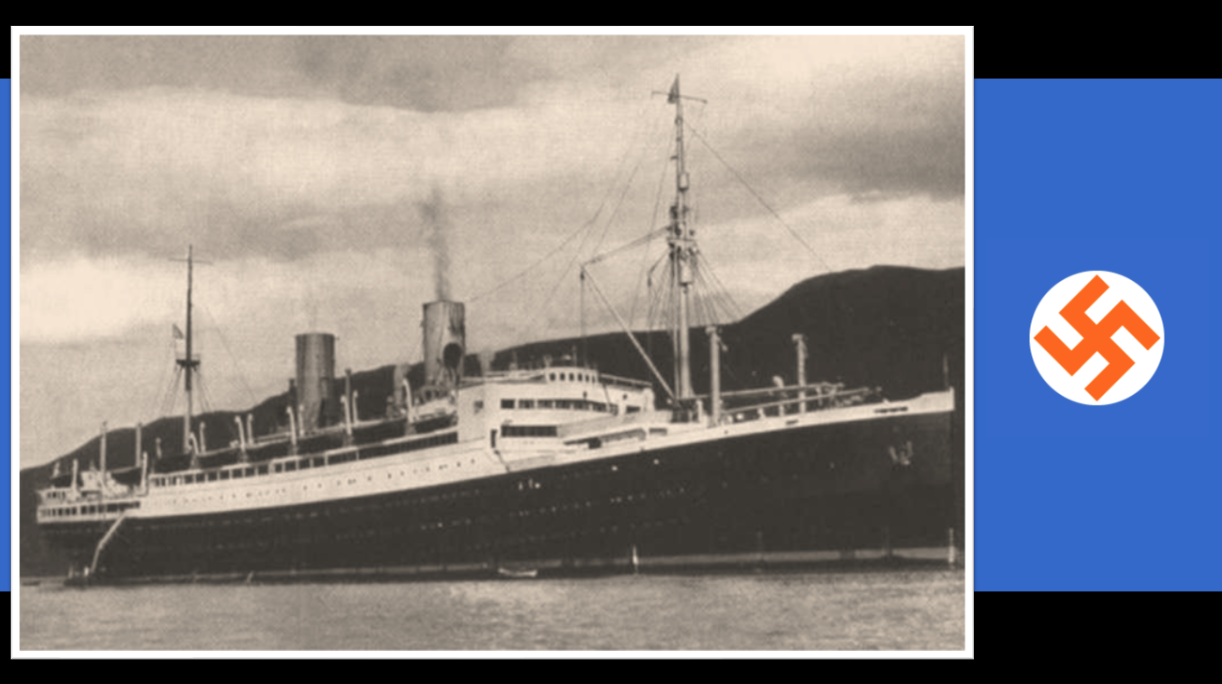
Prior to the war and sitting in the wings of the Broederbond was Dr. Hendrik Verwoerd (the Architect of Apartheid), he was a predominant Broederbond member, National Party leader and would become a future Prime Minister of South Africa. Dutch by birth, he honed his studies in sociology and psychology in Germany and there is no doubt he was exposed to German politics and the rise of Nazism at the time. Verwoerd showed his colours early on when, the ‘Black shirts’ held a large rally and protested the arrival of the S.S. Stuttgart in Cape Town on the 27th October 1936 with 600 Jewish refugees on board.
S.S. Stuttgart in Cape Town
The Nationalists joined hands with the Black-shirts in support of their protest and a few days later on 4 November, Dr Theophilus E. Dönges (future NP Acting Prime Minister) and admirer of Nazism would nail the Nationalists colours to the mast and said:
“The Jew is an insoluble element in every national life.”
The Black-shirts were joined by Dr Verwoerd and five fellow professors from Stellenbosch University who all went in deputation to the government to protest against the immigration of Jews from Nazi Germany. Frans Erasmus (the future National Party Minister of Defence) would go further on the matter and even officially thank the Black-shirts on behalf of The National Party for bringing the attention of the;
“Jewish problem to the Afrikaner ‘volk’.”
Dr Verwoerd would forward the National Party’s views on Jews in the Transvaaler where he wrote that there was a “botsing van belange” (clash of interests) between Jew and Afrikaner because the Jew had risen to wealth in key economic sectors whilst protecting themselves as a community, and as guests in the country they had purposefully excluded the Afrikaner (he referenced as the ‘majority’) from taking their rightful place in accessing the country’s wealth. He would outline the Jew as an enemy of Afrikanerdom, he would write:
“This population group (the Jews), which still keeps itself separate and apart within the population, and which is indifferent or even hostile to the national aspirations of Afrikanerdom, is thus regarded as the group which also stands in the way of the Afrikaner’s economic prosperity”.13
Dr. D.F. Malan, the National Party leader would go further and refer to the Jews as a:
“undigested and unabsorbed and unabsorbable minority … that leads to all sorts of difficulties”14
D.F. Malan would however try and sanitise the The National Party to the Jewish Community, but as they were a firmly “Christian” movement in terms of constitution his words carried little weight to the South African Jewish Council who saw the National Party for what it was. The National Party would openly lock-step with the “shirt” movements when it came to demonising Jews and Jewish Capital in the form of “Hoggenheimer” in their mouthpieces “The Transvaaler” (of which Verwoerd was the editor) and “Die Burger” (of which Dr. Malan was a founding editor).
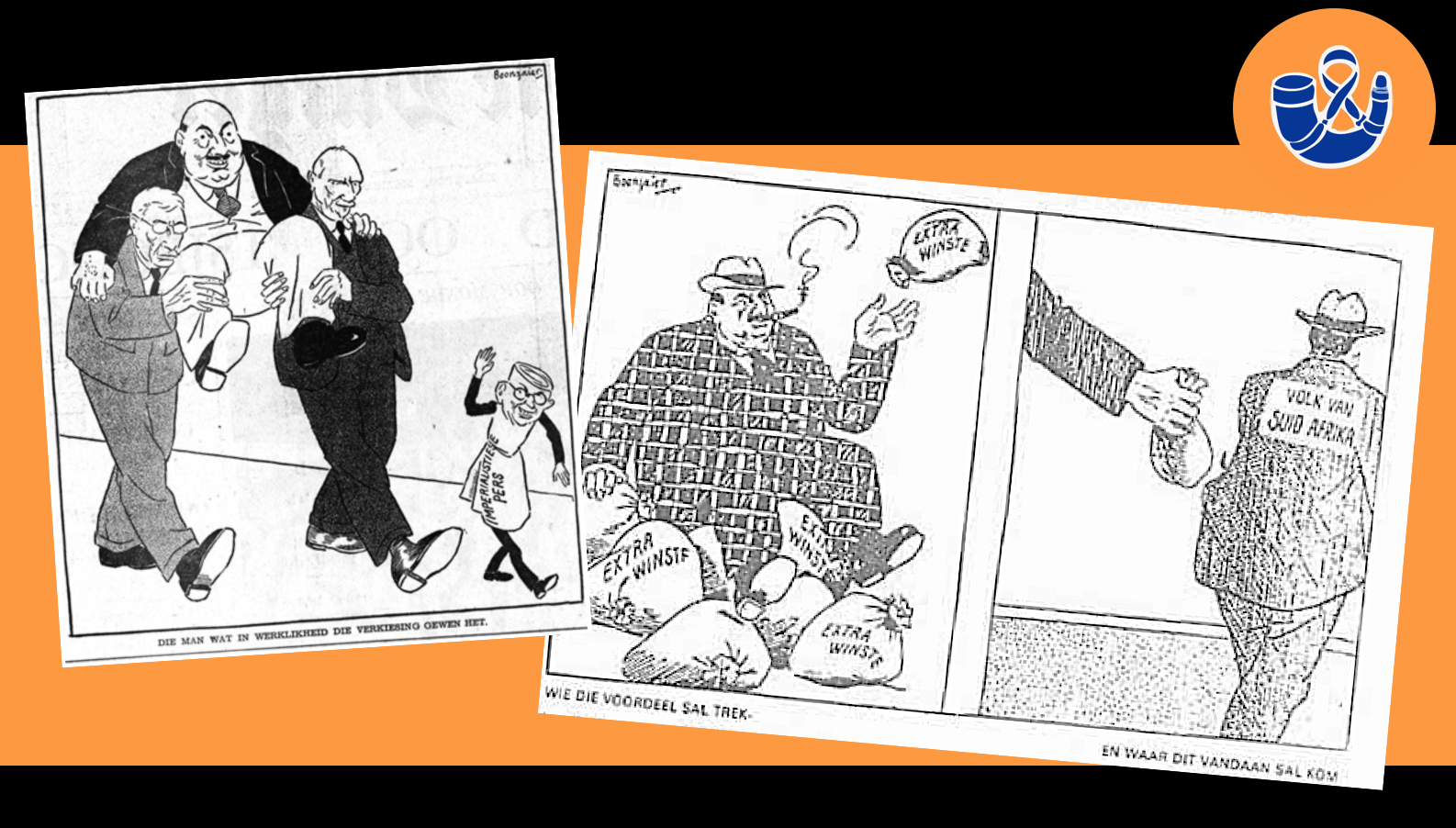
‘Hoggenheimer’ would become a cartoon in the same vein as “the banker” – a Nazi demonisation of Capitalist Jews and ‘the Jewish Conspiracy’ – depicted as fat, cigar smoking, balding and greedy – either pulling the strings or holding onto the money bag . The work of D.C. Boonzaier his caricature was developed specifically for Die Burger – a derogatory figure designed to depict a fat and bloated Jewish capitalist with a play on ‘hog” or pig, the character made a number of appearances and also served to lampoon Ernest Oppenheimer, the German Jewish Mining Industrialist who made South Africa his home. The Nationalists would even go as far as referring to Oppenheimer and Jewish Capital openly in Parliament and in speeches as “Hoggenheimer”.
Hoggenheimer by D.C. Boonzaier – Die Burger
It is undeniable that these “shirt” and antisemite fringe effectively “succeeded in shifting the ‘Jewish Question’ from the political margins of South African public life to its centre” … “Malan, under pressure from the ultra-right Greyshirts, focussed increasingly on the Jew as an explanation for the Afrikaners political misfortunes. It was Hendrik Verwoerd, however, who stood at the vanguard of anti-Jewish agitation”15
This sentiment would be taken up broadly across the Afrikaner Nationalist front – an example is the Nationalist MP for Bethlehem – Roelof van der Merwe, who on a call to boycott Nazi German goods, would warn the Jews:
“They (the Jews) are exploiting our people (the Afrikaners) and are nothing more than parasites.”16
World War 2 Nazi collaboration
During the Second World War, Louis Weichardt would even work in conjunction with the Ossewabrandwag to aid Nazi Germany’s war effort. He would take two Nazi spies under his wing, spies been smuggled by the Ossewabrandwag – the German spies Lothar Sitting and Nils Pashe would present themselves at a house in Stellenbosch and meet Weichardt – he would ensure they be driven and hidden by SANP men on a farm near Barrydale for two days after which one SANP man took them to Pretoria and back into the Ossewabrandwag’s network on 13 June 1940.17
Weichardt was arrested and imprisoned for the remainder of World War II at Koffiefontein detention barracks by the Smuts’ government as an ‘enemy of the state’ – along with all the other far right pro Nazi Germany, anti-British militants.
Merging of interests
With the end of the Nazi regime in Germany in 1945, Nazism became an anathema worldwide, Weichardt subsequently disbanded his SANP Nazi party in 1948. Moving on, Weichardt then gave his full attention and allegiance to D.F. Malan and the ‘Reunited’ National Party (NP) itself. He had a very successful political career with the National Party and went on to become the National Party’s senator from Natal Province from 1956 to 1970. Remaining elements of the Greyshirts distanced themselves from open Nazism and renamed themselves the White Workers Party in 1949. However, by this time most of the membership had been lost to the National Party and so the ‘Greyshirts’ and their reconstituted party faded .
By the early 1950’s the South African National Party government was littered with men, who, prior to the war where strongly sympathetic to the Nazi cause and had actually declared themselves full-blown National Socialists along Nazi political doctrine lines: Oswald Pirow, B.J. Vorster (a future President of South Africa), Hendrik van den Bergh, Piet Meyer, Johannes von Moltke and Louis Weichardt to name a few, and there is no doubt that their brand of far right politics, known collectively as Christian Nationalism (a form of Nazism) was influencing the National Party’s government policy.
By the early to mid 1950’s, this state of affairs led to open Anti-Apartheid protests from the South African military veterans community returning from WW2 – in their hundreds of thousands – in all The Torch Commando would rise to 250,000 members openly protesting the on-set of Nazism in the guise of the National Party, and it also ultimately led to the marginalisation of South African World War 2 veterans and their veteran associations by the ruling party when it was crushed under anti-communist legislation put forward in 1950 by the National Party.
The folding in of key National Socialist organisations, including Louis Weichardt and his SANP, Johannes von Moltke and his South African Fascists into the National Party’s political sphere would have a resounding impact on the future of not only the majority of ‘Black’ South Africans (who were viewed as ‘Inferior’ peoples by these hard liners), but also minority white ethnic groups like South Africa’s very large Jewish community.
The arrogance of this underpinning politics is seen with Louis Weichardt himself, who, on becoming an elected National Party Parliamentarian quickly covered up his dubious history as a full blown card carrying Nazi, and rather infamously declared that he had never been against the ‘Jewish race’ but only against the actions of certain ‘Jewish communists’. Not a single Jew, in his ‘opinion’ had suffered through his actions.18
Johannes Von Moltke the ex SANP and ex SA Fascist leader also later became a National Party Member of Parliament and exhibited the same arrogance, gaslighting and covering up of his antisemitic tracks as his old grey-shirt colleague. “The (UP)Jewish Minister of Parliament, Morris Kentridge, once recalled with some amusement that Von Moltke frequently buttonholed him in the lobby of the House of Assembly to explain that he had been misled by Inch (his fellow Grey-shirt collaborator) and was a great friend of the State of Israel!”19
Researched and written by Peter Dickens.
My thanks and acknowledgements to Ulrich Duebe, the current owner of the collection as illustrated.
References:
“Echoes of David Irving – The Greyshirt Trial of 1934” by Dr. David M. Scher – December 2004.
A Perfect Storm – Antisemitism in South Africa 1930-1940, Jonathan Ball Publishers, 2015 – By Milton Shain.
National Socialism and Nazism in South Africa: The case of L.T. Weichardt and his Greyshirt movements, 1933-1946: By Werner Bouwer.
Hendrik Verwoerd’s ‘possible solution’ to the Jewish Question in South Africa, 1937 – Die Transvaler, 1 October 1937.
“Hitler’s Spies: Secret Agents and the Intelligence War in South Africa 1939-1945” by Every Kleynhans – Jonathan Ball Publishers 2021
The Rise of the South African Reich by Brian Bunting.
Footnotes
A Perfect Storm – Antisemitism in South Africa 1930-1940 By Milton Shain page 55 ↩︎
The South African Jewish Board of Deputies – Jewish Matters – newsletter ↩︎
National Socialism and Nazism in South Africa: The case of L.T. Weichardt and his Greyshirt movements, 1933-1946: By Werner Bouwer – Page 18 ↩︎
A Perfect Storm – Antisemitism in South Africa 1930-1940 By Milton Shain page 58 ↩︎
Echoes of David Irving – The Greyshirt Trial of 1934 by David M. Scher – Dec 2004 ↩︎
A Perfect Storm – Antisemitism in South Africa 1930-1940 By Milton Shain page 58 ↩︎
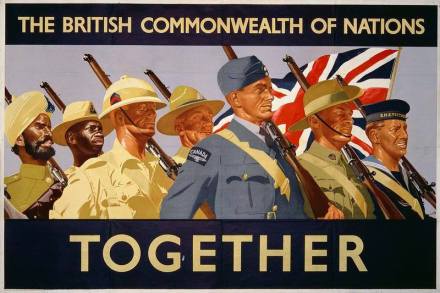
Iconic propaganda poster from World War 2 calling for the unification of the British Commonwealth in what was termed at the time in South Africa by Jan Smuts as the “fight for the freedom of the human spirit” – essentially against Fascist and Nazi ideologies of the time.
It’s widely reported now that Britain “stood alone” at the beginning World War 2, but that is not strictly true (for a short while after the fall of Dunkirk, it may have felt like it, but it was not the case) very quickly coming to aid Britain “in her hour of need” and reinforce her troops, airman and seamen where the armed forces of the British Commonwealth – and not only the armed forces but also the raw materials and industry of the likes of Australia, India, South Africa and Canada – an all in effort to aid the United Kingdom, push back the advances of Fascist thinking and change the course of European history.
It’s generally misunderstood – but within a day of the United Kingdom and France declaring war on Germany on 3 September 1939, New Zealand and Australia had declared war on Germany as well. It was just 3 short days later that an independent parliament in South Africa declared war on Germany on the 6th September 1939 (very early on if you think about it – the fifth country to declare war on Nazism). Quickly followed by Canada who just four days after South Africa’s declaration also declared war on Germany – 10th September 1939.
In context – the United States of America came to the table much later on declaring war on Germany on the 11th December 1941. In this respect it can be better argued that Britain AND her Commonwealth of Nations stood alone against Nazism and other forms of Fascism for about two years.
Seen in this poster are the United Kingdom’s key ‘dominions’ – South Africa, Australia and Canada feature in the most pronounced positions in this poster as the leading nations of the Commonwealth.
Representatives of Commonwealth Armed Forces marching toward the right, with a Union flag behind the front figures. Left to right they are soldiers from India, East Africa, a South Africa soldier (in his distinctive “Pith helmet”), New Zealand, a Canadian airman, an Australian soldier (in his distinctive “slouch hat”) and a Royal Navy sailor (in senior position as the Navy is the senior service).

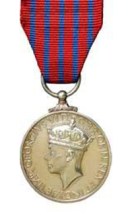 In 1940, during the height of The Blitz there was a strong desire to reward the many acts of civilian courage. The existing awards open to civilians were not judged suitable to meet the new situation, therefore it was decided that the George Medal would be instituted to recognise both civilian gallantry in the face of enemy action and brave deeds more generally.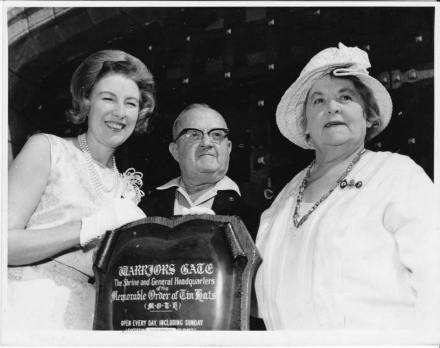










 The Observation Post