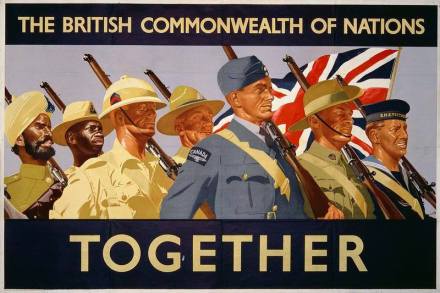
Iconic propaganda poster from World War 2 calling for the unification of the British Commonwealth in what was termed at the time in South Africa by Jan Smuts as the “fight for the freedom of the human spirit” – essentially against Fascist and Nazi ideologies of the time.
It’s widely reported now that Britain “stood alone” at the beginning World War 2, but that is not strictly true (for a short while after the fall of Dunkirk, it may have felt like it, but it was not the case) very quickly coming to aid Britain “in her hour of need” and reinforce her troops, airman and seamen where the armed forces of the British Commonwealth – and not only the armed forces but also the raw materials and industry of the likes of Australia, India, South Africa and Canada – an all in effort to aid the United Kingdom, push back the advances of Fascist thinking and change the course of European history.
It’s generally misunderstood – but within a day of the United Kingdom and France declaring war on Germany on 3 September 1939, New Zealand and Australia had declared war on Germany as well. It was just 3 short days later that an independent parliament in South Africa declared war on Germany on the 6th September 1939 (very early on if you think about it – the fifth country to declare war on Nazism). Quickly followed by Canada who just four days after South Africa’s declaration also declared war on Germany – 10th September 1939.
In context – the United States of America came to the table much later on declaring war on Germany on the 11th December 1941. In this respect it can be better argued that Britain AND her Commonwealth of Nations stood alone against Nazism and other forms of Fascism for about two years.
Seen in this poster are the United Kingdom’s key ‘dominions’ – South Africa, Australia and Canada feature in the most pronounced positions in this poster as the leading nations of the Commonwealth.
Representatives of Commonwealth Armed Forces marching toward the right, with a Union flag behind the front figures. Left to right they are soldiers from India, East Africa, a South Africa soldier (in his distinctive “Pith helmet”), New Zealand, a Canadian airman, an Australian soldier (in his distinctive “slouch hat”) and a Royal Navy sailor (in senior position as the Navy is the senior service).
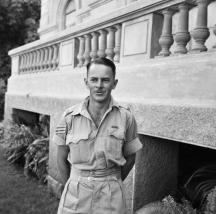
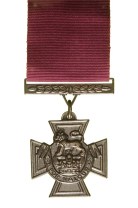
Now this is a very notable South African, and a true hero – Sgt Quentin George Murray Smythe VC, who won the Victoria Cross in the Western Desert on 5 June 1942. The Victoria Cross (VC) is the highest military decoration awarded for valour “in the face of the enemy” to members of the British armed forces and various Commonwealth countries (of which South Africa is one).
Quentin George Murray Smythe, was born in Nottingham Road, Natal, South Africa on 6 August 1916 as son of Edric Smythe. He was the grandson of the First Administrator of Natal, Charles Smyhte. Quentin Smythe attended the Estcourt High School in Estcourt. After his education he started farming in Richmond.
During the Second World War, Quentin Smythe served with the 1st Battalion Royal Natal Carabineers, 1st SA Infantry Division, South African Forces in the East Africa Campaign against the Italians before moving to the Western Desert against the German and Italian Axis Forces.
On May 26, 1942, Rommel’s Afrika Korps attacked the British Army ( which had just been weakened by losing two divisions, an Armoured Brigade and some squadrons of the Desert Air Force to the Far East ) in order to pre-empt a new British offensive. The Germans hoped to capture Tobruk and, ultimately, to drive the British back to Alexandria, although this attempt was finally checked at El Alamein by Auchinleck the next month.
A German gun crew manning a 3.7 cm Pak 36 anti-tank gun in the Western Desert, during the Gazala offensive, June 1942.
The initial attack caught the British off-balance, but they recovered and fought back, forcing the Germans to take up a defensive position, which became known as ‘The Cauldron’. Unfortunately, the British were at this stage equipped with tanks and guns which were inferior to the Germans’, and after a number of desperate battles they had to fall back.
On June 5 the South African forces were holding a position in the north of the line (which consisted of defensive “boxes” separated by minefields), and when Rommel launched a heavy attack in the northern sector he encountered strong and determined resistance. The cost in casualties on both sides was high. Smythe, who was then a sergeant, realised that there was no officer to command his platoon and took charge himself, leading his men in an attack on the enemy’s strong point at Alem Hamza, 20 miles south of Gazala
His citation in attacking Axis Forces says just about everything as to how this hero earned his VC and reads as follows:
No. 4458 Sergeant Quentin George Murray Smythe, South African Forces.
For conspicuous gallantry in action in the Alem Hamza area on the 5th June,
“1942. During the attack on an enemy strong point in which his officer was severely wounded; Sergeant Smythe took command of the platoon although suffering from a shrapnel wound in the forehead. The strong point having been overrun, our troops came under enfilade fire from an enemy machine-gun nest. Realising the threat to his position, Sergeant Smythe himself stalked and destroyed the nest with hand grenades, capturing, the crew. Though weak from loss of blood, he continued to lead the advance, and on encountering an anti-tank gun position again attacked it single-handed and captured the crew. He was directly responsible for killing several of the enemy, shooting some and bayonetting another as they withdrew.
After consolidation he received orders for a withdrawal, which he successfully executed, defeating skilfully an enemy attempt at encirclement.
Throughout the engagement Sergeant Smythe displayed remarkable disregard for danger, and his leadership and courage were an inspiration to his men.”
Citation was gazetted on 11 September 1942, see this rare Associated Press video of the actual award ceremony where Sgt. Smythe received his Victoria Cross from Maj. General Dan Pienaar.
When Sgt. Smythe VC returned to South Africa, he returned a national hero, he had won the country’s first Victoria Cross in the Second World War. In all five South African’s won the Victoria Cross during World War 2, of which there are only two very well known recipients, these been our hero today, Quentin Smythe VC and Edwin Swales VC (see Edwin Swales VC DFC, a South African Hero whose legacy has been eroded!)
Sgt Smythe is well known because he enjoyed great media attention and was presented to the Premier Jan Smuts and this PAHÉ footage captures the occasion.
On leaving the Department of Defence he returned to farming in the Richmond area of Natal. He was an outstanding marksman, a passionate conservationist and animal lover. He died from cancer in Durban, aged 81 in October 1997 and was buried with military honours by his Regiment – The Natal Carabineers. He left three sons, a daughter and 11 grandchildren.
His Victoria Cross is now part of Lord Ashcroft’s collection and is kept in the Imperial War Museum in London.
Researched by Peter Dickens. Image Copyrights – Imperial War Museum. Video copyrights Associated Press and British PATHÉ respectively.
Winston Churchill and Field Marshal Jan Smuts accompanied one another just after the D Day landings to General Sir Bernard Montgomery’s headquarters, 12 June 1944.
Left to right: Lieutenant-General Sir Richard O’Connor, commanding VIII Corps; Churchill; Field Marshal Jan Smuts; Montgomery; Field Marshal Sir Alan Brooke, Chief of the Imperial General Staff. Here these Allied commanders are seen looking up at aircraft activity overhead.
An interesting snippet of history happened during this visit by Smuts and Churchill to Monty’s headquarters. While visiting the headquarters and as senior officers stood outside with the Prime Minister (Churchill), Field Marshal Smuts sniffed the air and said, ‘There are some Germans near us now…I can always tell!’” and low and behold, just two days later, “two fully armed German paratroopers emerged from a nearby Rhododendron bush, where they had been hiding all along (they had become isolated from their unit, seeing that they were unable to rejoin they chose to surrender). Had they used their guns and grenades on Churchill (and Smuts), everything would have changed.
There you have it, Smuts’ keen sense of smell and intuition is another attribute you can add to the very very long list of honours attributed to this great South African.
Reference: Nicholas Rankin “Churchill’s Wizards”. Image copyright – The Imperial War Museum.

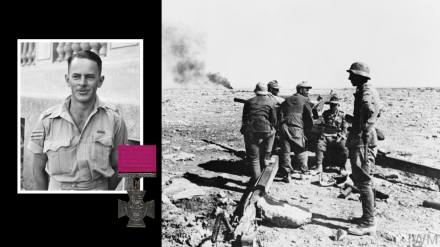
 Now this is a very notable South African, and a true hero – Sgt Quentin George Murray Smythe VC, who won the Victoria Cross in the Western Desert on 5 June 1942. The Victoria Cross (VC) is the highest military decoration awarded for valour “in the face of the enemy” to members of the British armed forces and various Commonwealth countries (of which South Africa is one).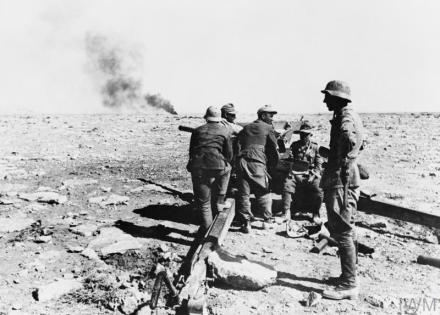
 No. 4458 Sergeant Quentin George Murray Smythe, South African Forces.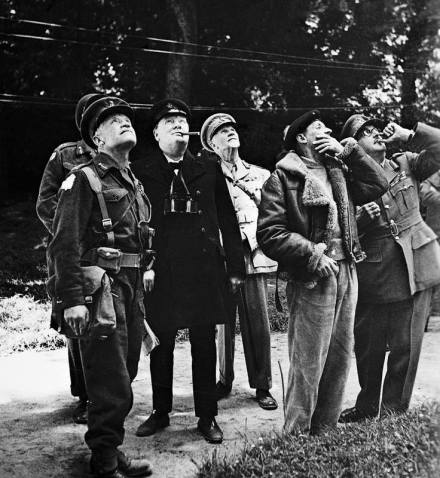
 The Observation Post