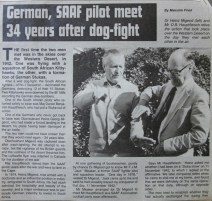
Another amazing and very human story about one of our World War 2 South African heroes. This one where two former enemies became close friends long after they met in the skies of North Africa during Word War 2. A German and a South African pilot fought to the death, the South African shooting down the German, later only to become friends.
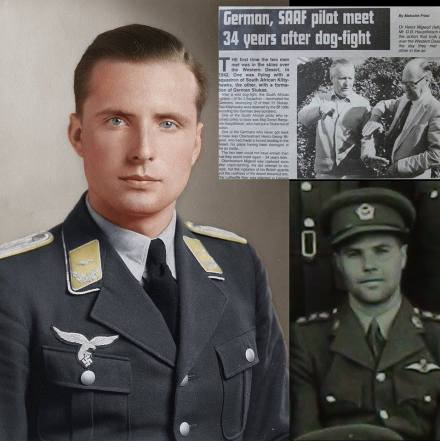
The colorised image is Stuka pilot Lt. Heinz-Georg Migeod, shot down in Libya, 11/11/1942 by SAAF fighter pilot DB “Hoefie” Hauptfleisch (in the black and white portrait insert).
After the war Heinz relocated to South Africa where he met Hoefie and they became good friends. Hoefie passed away in 2009 and Heinz in 2010.
Tinus Le Roux was fortunate to have met Heinz. He once said to Tinus that the incident on 11 Nov 1942 was very funny: “a German of French descent was shot down by a South African from German descent in an African country occupied by Italy”
Now that is sheer irony.
Watch Tinus’ interview of the German Stuka pilot Heinz-Georg Migeod on the day he was shot down by Hoefie Haupfeish, its historic gold and gives an excellent insight into the manner the war was fought in North Africa.
Researched by Peter Dickens. With thanks to Tinus Le Roux for the colorised image and story as well as the families of Heinz Migeod and Hoefie Hauptfleisch for their stories, pictures and memories. Image and video copyright – Tinus Le Roux
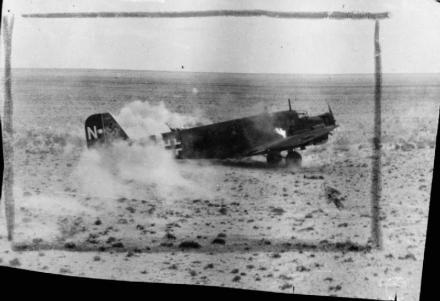
Not often seen is a close up of like this of the South African Air Force in action during the North African campaign – WW2. Here cannon shells can be seen as they explode around the tail of a German Junkers Ju 52 forced down in the Western Desert by three Bristol Bisleys of No. 15 Squadron South African Air Force, 12 October 1942.
The starboard (right) engine is already on fire, and a member of the JU 52 crew can be seen trying to take cover lying face down on the ground beneath it. The Bisleys, escorted by four Bristol Beaufighters of No. 252 Squadron Royal Air Force, intercepted the German transport aircraft while returning from a strike on an enemy train.
The Beaufighters shot down a Ju 52 and damaged one of the escorting Messerschmitt Bf 110s, while the Bisleys forced down a second Ju 52 and subsequently destroyed it with their bombs. One of the Bisleys was shot down by return fire.
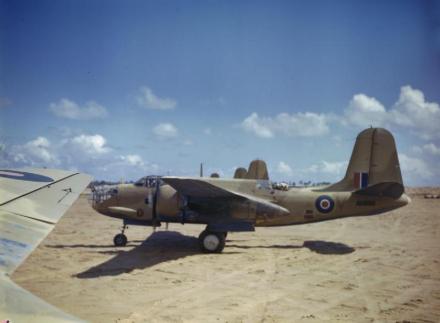
Sometimes some well preserved original colour photography can take you right back to South Africans taking part in World War 2 as if it was yesterday. Here, in Libya March 1943, are Douglas Boston light bomber aircraft of No 24 Squadron, South African Air Force lined up at Zuara, Tripolitania. The nearest Boston is AL683/`V’.
On 5 March 1941 24 Squadron SAAF was formed when No.14 Squadron SAAF and its Maryland bombers were moved from Kenya to Egypt, and renumbered as No.24 Squadron. The squadron then operated alongside No. 39 Squadron RAF as a daytime tactical bomber unit carrying out bombing sorties against targets in the Mediterranean theatre. 24 Squadron was later in the year re-equipped with Bostons.
In December 1943, the squadron was relocated to Algeria and re-equipped with the B-26 Marauders and in 1944 flew to a new base at Pescara, Italy, before later advancing to Jesi, Italy. At the end of the war the squadron used its Marauders as transport aircraft, before moving to Egypt in October 1945 and disbanding on 6 November 1945.
The squadron was reactivated when the Buccaneer entered SAAF service in 1965. 24 Squadron SAAF Buccaneers saw active service during the Border War in South-West Africa,. They flew over Angola and Namibia in the 1970s and 1980s, and attacked SWAPO guerrilla camps with rockets and bombs.
The squadron was disbanded in March 1991 at AFB Waterkloof, Pretoria.
Photo copyright – Imperial War Museum, source IWM and wikipedia
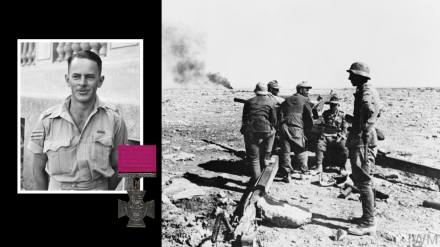
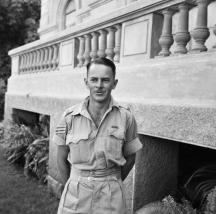
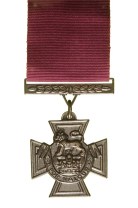
Now this is a very notable South African, and a true hero – Sgt Quentin George Murray Smythe VC, who won the Victoria Cross in the Western Desert on 5 June 1942. The Victoria Cross (VC) is the highest military decoration awarded for valour “in the face of the enemy” to members of the British armed forces and various Commonwealth countries (of which South Africa is one).
Quentin George Murray Smythe, was born in Nottingham Road, Natal, South Africa on 6 August 1916 as son of Edric Smythe. He was the grandson of the First Administrator of Natal, Charles Smyhte. Quentin Smythe attended the Estcourt High School in Estcourt. After his education he started farming in Richmond.
During the Second World War, Quentin Smythe served with the 1st Battalion Royal Natal Carabineers, 1st SA Infantry Division, South African Forces in the East Africa Campaign against the Italians before moving to the Western Desert against the German and Italian Axis Forces.
On May 26, 1942, Rommel’s Afrika Korps attacked the British Army ( which had just been weakened by losing two divisions, an Armoured Brigade and some squadrons of the Desert Air Force to the Far East ) in order to pre-empt a new British offensive. The Germans hoped to capture Tobruk and, ultimately, to drive the British back to Alexandria, although this attempt was finally checked at El Alamein by Auchinleck the next month.
A German gun crew manning a 3.7 cm Pak 36 anti-tank gun in the Western Desert, during the Gazala offensive, June 1942.
The initial attack caught the British off-balance, but they recovered and fought back, forcing the Germans to take up a defensive position, which became known as ‘The Cauldron’. Unfortunately, the British were at this stage equipped with tanks and guns which were inferior to the Germans’, and after a number of desperate battles they had to fall back.
On June 5 the South African forces were holding a position in the north of the line (which consisted of defensive “boxes” separated by minefields), and when Rommel launched a heavy attack in the northern sector he encountered strong and determined resistance. The cost in casualties on both sides was high. Smythe, who was then a sergeant, realised that there was no officer to command his platoon and took charge himself, leading his men in an attack on the enemy’s strong point at Alem Hamza, 20 miles south of Gazala
His citation in attacking Axis Forces says just about everything as to how this hero earned his VC and reads as follows:
No. 4458 Sergeant Quentin George Murray Smythe, South African Forces.
For conspicuous gallantry in action in the Alem Hamza area on the 5th June,
“1942. During the attack on an enemy strong point in which his officer was severely wounded; Sergeant Smythe took command of the platoon although suffering from a shrapnel wound in the forehead. The strong point having been overrun, our troops came under enfilade fire from an enemy machine-gun nest. Realising the threat to his position, Sergeant Smythe himself stalked and destroyed the nest with hand grenades, capturing, the crew. Though weak from loss of blood, he continued to lead the advance, and on encountering an anti-tank gun position again attacked it single-handed and captured the crew. He was directly responsible for killing several of the enemy, shooting some and bayonetting another as they withdrew.
After consolidation he received orders for a withdrawal, which he successfully executed, defeating skilfully an enemy attempt at encirclement.
Throughout the engagement Sergeant Smythe displayed remarkable disregard for danger, and his leadership and courage were an inspiration to his men.”
Citation was gazetted on 11 September 1942, see this rare Associated Press video of the actual award ceremony where Sgt. Smythe received his Victoria Cross from Maj. General Dan Pienaar.
When Sgt. Smythe VC returned to South Africa, he returned a national hero, he had won the country’s first Victoria Cross in the Second World War. In all five South African’s won the Victoria Cross during World War 2, of which there are only two very well known recipients, these been our hero today, Quentin Smythe VC and Edwin Swales VC (see Edwin Swales VC DFC, a South African Hero whose legacy has been eroded!)
Sgt Smythe is well known because he enjoyed great media attention and was presented to the Premier Jan Smuts and this PAHÉ footage captures the occasion.
On leaving the Department of Defence he returned to farming in the Richmond area of Natal. He was an outstanding marksman, a passionate conservationist and animal lover. He died from cancer in Durban, aged 81 in October 1997 and was buried with military honours by his Regiment – The Natal Carabineers. He left three sons, a daughter and 11 grandchildren.
His Victoria Cross is now part of Lord Ashcroft’s collection and is kept in the Imperial War Museum in London.
Researched by Peter Dickens. Image Copyrights – Imperial War Museum. Video copyrights Associated Press and British PATHÉ respectively.
Great image of a South African made Marmon-Herrington armoured car in World War 2, as the crew stops to take a compass bearing during a patrol. These South African armoured car units were successfully used in North Africa for reconnaissance duties and as part of mobile columns despatched to harrass the enemy. Some captured Marmon-Herringtons even landed up been used by The German DAK (Afrika Korps).
The use of captured goods was not uncommon – have a look at the side of this armoured car and you will see a “Jerry Can” for water which is a piece of German kit adopted by the Allied soldiers who found it infinity better in design than their own cans (which were prone to splitting). Hence the word “Jerry” (derogatory term used by Allies for Germans) for the name of the can, a name which survives to this day for this style of container.

 Now this is a very notable South African, and a true hero – Sgt Quentin George Murray Smythe VC, who won the Victoria Cross in the Western Desert on 5 June 1942. The Victoria Cross (VC) is the highest military decoration awarded for valour “in the face of the enemy” to members of the British armed forces and various Commonwealth countries (of which South Africa is one).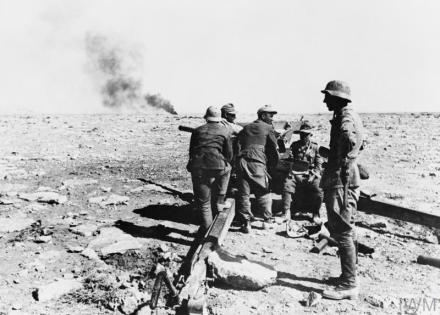
 No. 4458 Sergeant Quentin George Murray Smythe, South African Forces.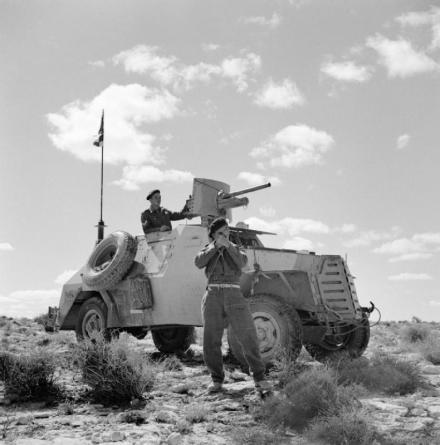
 The Observation Post