‘Totsiens’ Herr Hess

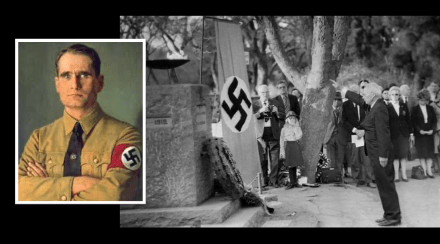
I am currently doing some research into Radio Zeesen, the Nazi German foreign service radio station broadcasting worldwide (much the way BBC world service still broadcasts today), and this image cropped up, now imagine – its 20 August 1987, 40 years after the end of World War 2 and in full view of the Nazi holocaust, and here’s Dr. Erich Holm and his supporters happily giving Nazi salutes and draping Nazi flags over a German war memorial, located rather surprisingly, in a cemetery in central Pretoria, South Africa.

Naturally it kicked up a fuss at the time – after all, it’s 1987 – the formal honouring of Nazi Flags and Nazi leaders in a country scarred by the war against Nazism is simply outrageous and insulting to the majority of modern South Africans – especially those whose forebears were lost or who took part in World War 2 or those military veterans who are still alive, most aged around 60 years old then. Not to mention the vast majority of South Africans who see this symbology in light of racial subjugation – rather unsurprisingly in the middle of all of this furore is the leader of the Afrikaner Resistance Movement (Afrikaner Weerstandsbeweging) – the AWB .. now what’s going on?
So, here’s a little background to this scandal. During World War 2 (1939-1945), Hitler’s propaganda Minister engaged Radio Zeesen for all outbound broadcasting of Nazi propaganda, a specific market for this was identified in South Africa in the form of far right Afrikaner radicals – a variety of political parties and cultural organs – mainly the ‘Reformed’ or ‘Pure’ National Party, the Ossewabrandwag, the New Order, the Grey Shirts, the Black Shirts, the Boerenasie Party – the list goes on.

Three South African nationals were in Germany at the time World War 2 kicked off – Dr. Sidney Erich Holm, Dr. Jan Adriaan Strauss and Johannes Jacobus Snoek were recruited by the German Propaganda Ministry to run their ‘Afrikaans’ service on Radio Zeesen – which broadcasted worldwide in a variety of languages on short-wave transmissions. The positioning taken by Radio Zeesen with regard South Africa was a suggested National Socialism (Nazi) alliance with Afrikaner Nationalism, it also focussed on subverting the Smuts government and disseminated general anti-British sentiment in South Africa – it used talk, news and cultural programs to forward these aims – using these three Afrikaner broadcasters – all using the alias “Neef” meaning “cousin”, the main Afrikaner broadcaster was Erich Holm – his alias was Neef Holm.1

After the war ended in 1945, Holm, Straus, Pienaar and Snoek were all arrested for high treason on the basis of conducting subversive activities against the Union of South Africa during war-time, voluntarily working with Nazi Germany in forwarding their objectives and endangering South African lives. They were all prosecuted in South Africa, to ‘beat the rope’ or avoid lengthy jail terms their defence revolved around being mere employees of the German state radio service – they did not commit any “hostile intent” against South Africa – the argument used was a common one used in cases like this in South Africa at the time – that there is a difference between a ‘Land Veraaier’ (traitor to your country) and a ‘Volk Veraaier’ (traitor to your people) – they were merely warning South Africans and in their estimation they were still South African patriots – only they had a different view, that’s all.

Regardless of this rather convoluted sense of what constitutes treason, they were all however found guilty of high treason on the legal precedents thereof. Dr. Erich Holm is given a ten year sentence. Fortuitously for all of them, when the National Party walked into power in 1948, one of their first acts was to grant full amnesty to all South Africans convicted of war-time treason – so they all walked out their prosecutions free men, Dr. Holm having served three years of his sentence.2

Farewell Herr Hess

Now, spool on 40 years or so, Rudolf Hess, the only surviving member of Hitler’s inner circle has been sitting in Spandau prison in Germany on a life sentence for crimes against humanity – for all this time on a sentence that really meant ‘Life’. He’s now 93 years old and despite years of campaigning by a small group for release on compassionate grounds of old age, Hess continued to be an unapologetic Nazi and a devout antisemite. On 17 August 1987 he is found dead hanging in the prison grounds from a chord, having committed suicide (some contested that on the basis of his frailty in age).

Saddened by the loss of his old Nazi hero, enter stage left our old South African Radio Zeesen broadcaster, Dr. Erich Holm, emboldened by his National Party amnesty he truly nails his Swastika to the mast – literally. In conduction with some like-minded Nazi German friends who had found South Africa a welcoming home under the Afrikaner Nationalists and some members of Eugène Terre’Blanche’s Afrikaner Resistance Movement (AWB), Holm decided to arrange a suitable ‘auf Wiedersehen’ (farewell) for Rudolph Hess.

Their Memorial Service for Rudolf Hess is held at a German War Memorial in Pretoria, its a cenotaph to the German Fallen of both war – World War 1: 1914-1918 (written on one side) and World War 2: 1939-1945 (written on the other side), complete with metal wreath and eternal flame with accompanying dish. The cenotaph is strangely enough located in the middle the Pretoria West Cemetery – also known as New Cemetery, Newclare Cemetery, Pretoria West Cemetery – address: 322 Rebecca St, Philip Nel Park, Pretoria. It’s still there.3
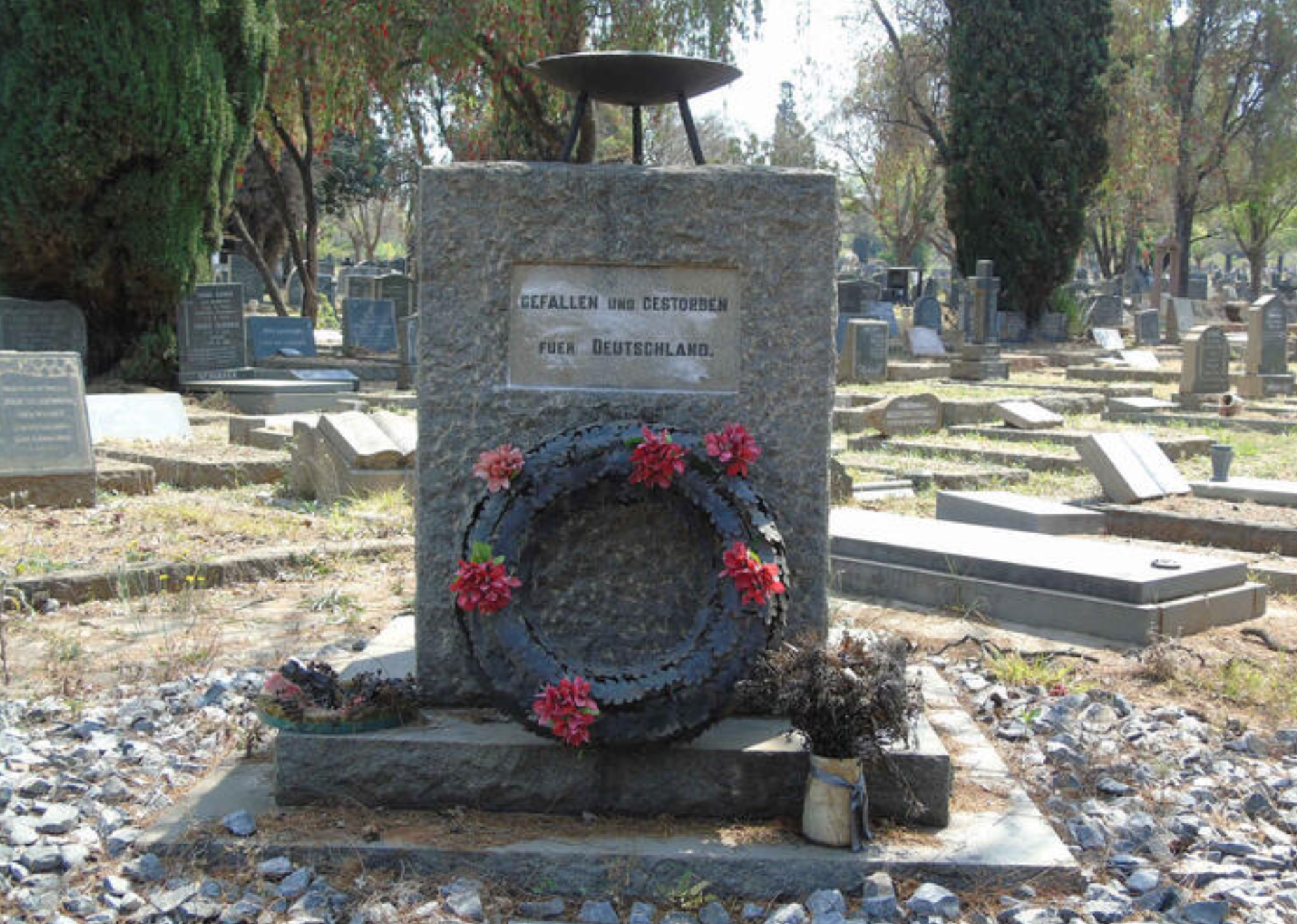
German War Cenotaph Pretoria West Cemetery – eGGSA Library, open file.

How a German War Cenotaph finds its way into a Pretoria cemetery is anyone’s guess – it is unusual to find German war cenotaphs in countries who fought against Germany in both the wars commemorated. In any event, on 20 August 1987 (three days after Rudolf Hess passes), in full public view, Dr Eric Holm and his pals light the flame of remembrance, drape the cenotaph in gigantic red, white and black Nazi Swastika flag, hold a service to Rudolf Hess, salute the Cenotaph (and by that way Rudolf Hess) using the Nazi styled strait armed ‘Heil Hitler’ salute and play Nazi German period music over a Public Address system.

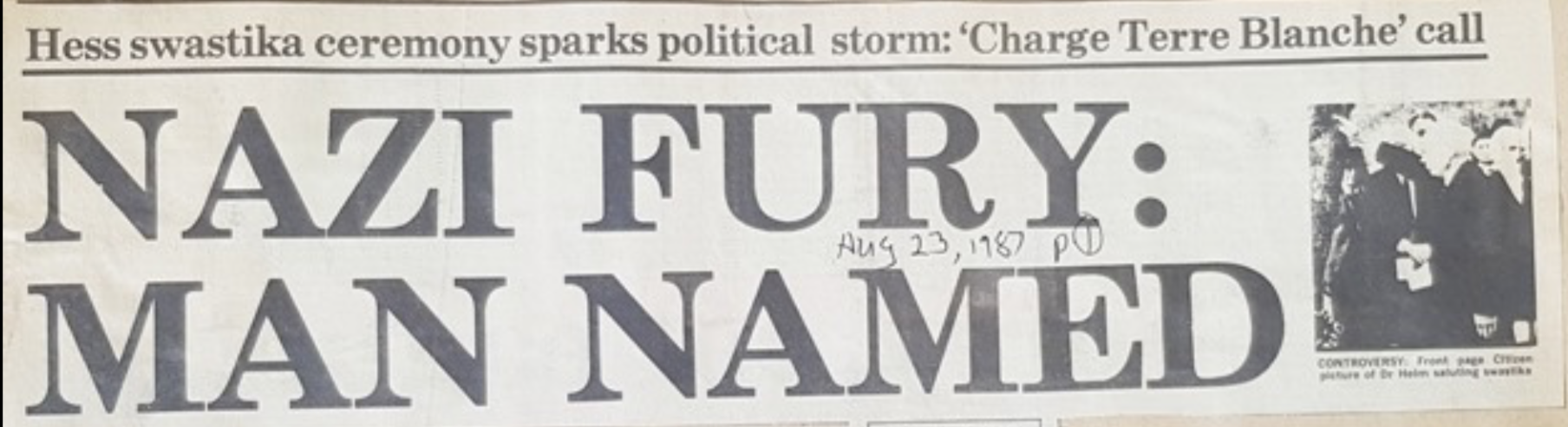
The media get wind of this Memorial Service to Rudolf Hess but are uninvited and in fact warned to stay away, a reporter from The Citizen and photo journalist – Neville Petersen are sent out to the memorial service, Petersen climbs over the fence while the reporter stays in the car. He hides behind a large headstone far enough away so as not be seen but close enough to take a photograph. Which he does of one the elderly Nazi attendees saluting Rudolf Hess, the memorial and the Nazi flag – once taken he’s back over the fence and into his awaiting get away car.4
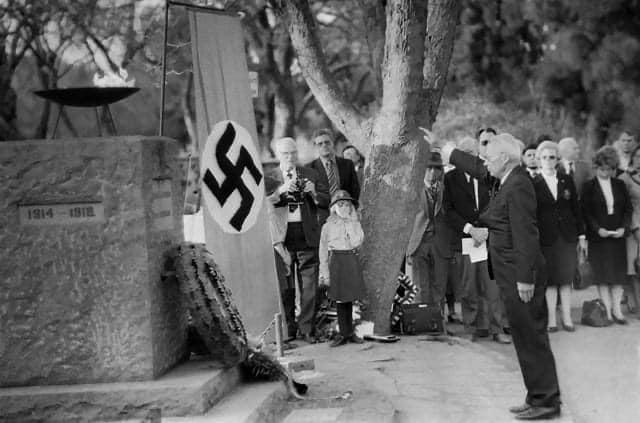
Photo courtesy (and copyright) Neville Petersen with his kind permission.

Unrepentant

The published photo resulted in a media frenzy, driven by investigative journalists of the Sunday Times with the matter later landing up in Parliament, opposition MP’s demanding heads. The journalists, De Wet Potgieter and Jannie Lazarus identified Dr. Erich Holm at the centre of the controversy and interviewed him. What he said to them says just about everything:
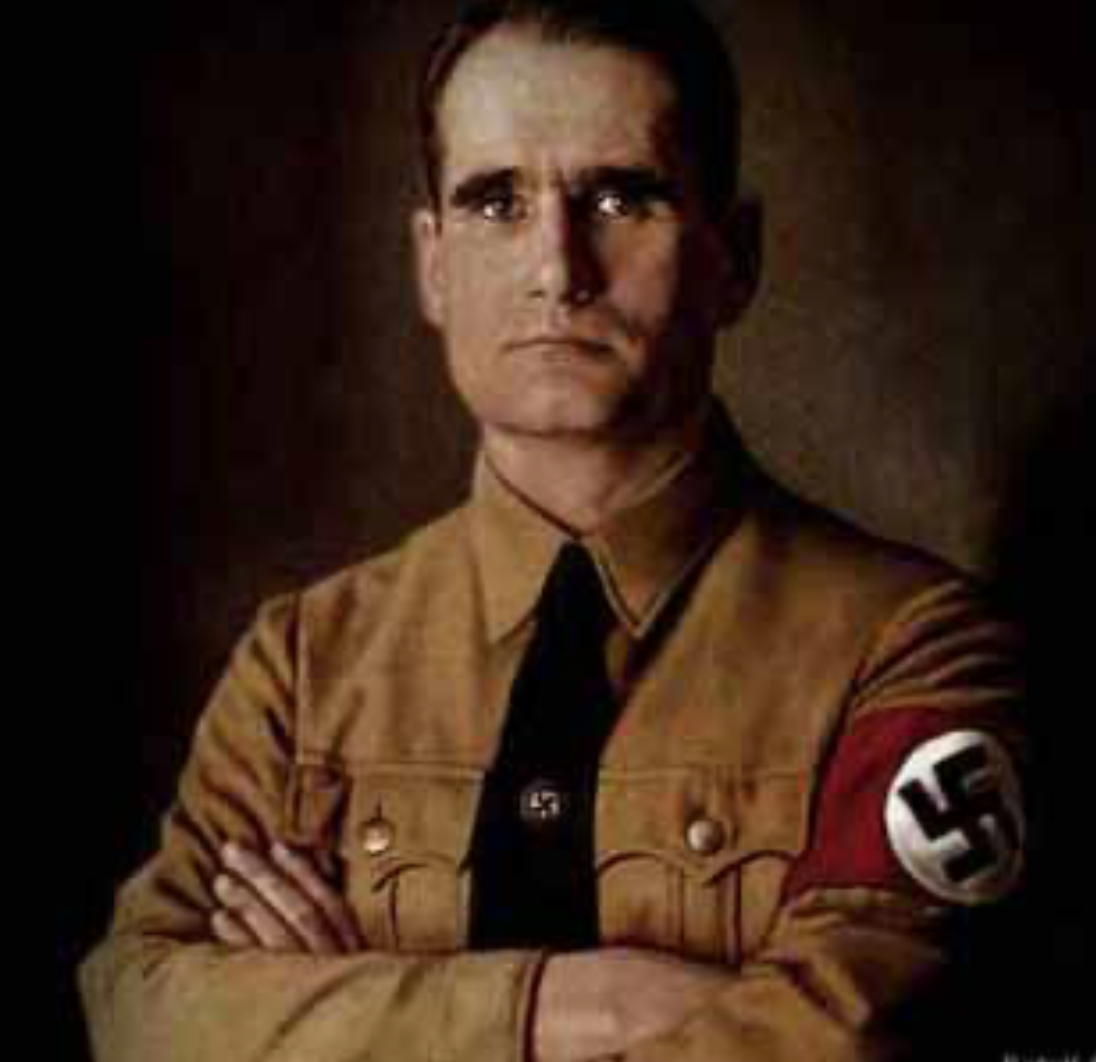
Rudolf Hess

Dr. Holm put forward that Rudolf Hess was a man of “peace” (somewhat mentally unhinged Hess parachuted into Britain on 10 May 1941 in the hopes of negotiating surrender terms for a Germany) and “never touched a hair on the head of any Jew (as) it would have been beneath him” .. Holm then accuses the Jews and says “its the jews who have refused to declare peace since the end of the war”.5

So for Erich Holm, the entire Holocaust should just be something the Jews should get over and move on, notwithstanding the fact it’s still in living memory of many Nazi Holocaust survivors in 1987, including many in South Africa

Holm bitterly recalled that the imprisonment of Hess was because “the Jews and the British were afraid of him” and that he “was locked up in an inhuman way” because of it.

On a personal level he once again suggested complete innocence for his role in Radio Zeesen’s Nazi propaganda stating he was never a member of the Nazi Party and merely as “a South African (who) broadcasted news, music and entertainment to South Africa”. 6

As a sort of fun throwaway, interest fact, Dr. Erich Holm said that Hitler was in favour of the white Afrikaner nation and a keen admirer of the Guerrilla tactics used by the Boer Republican forces during the South African War (1899-1902) and said:

“In fact Hitler told me personally of his admiration for the way the Boer Generals had fought the British, and singled out General Christiaan de Wet for special mention.” 7

Once again reinforcing his old Radio Zeesen propaganda brief without even giving it a thought, inadvertently and unwittingly linking Afrikaner Nationalism and Boer War “folks-helde” (people’s heroes) to National Socialism and Nazi Germany’s admiration for the white Afrikaner people. Something his defence team in his treason trial tried very hard to prove he did not do. The hard reality – the Leopard never really changed his spots. For more on Hitler and the Boer War follow this link: Hitler’s Boer War

What becomes increasingly clear from Dr. Holm’s comments is there is a fundamental disconnect in how he views Nazism and what Nazism was proven to ultimately be, an almost sociopathic distancing from really understanding and emotionally assimilating the genocide, trauma, death and hurt caused by National Socialism – something in which he was an active and willing participant, and something in hindsight he should have regretted.

Legacy

On celebrating Nazism and here’s the critical difference to how hero worship of Nazi elite was treated in Europe and the Soviet Union/Russia in the 1980’s and 1990’s – as opposed to how it was treated in South Africa.

In Germany, and even in death Rudolph Hess continued to be controversial, unlike his Hitler inner circle colleagues who shot themselves, were shot or hung and were buried in unmarked and unallocated graves or whose mortal remains are untraced to his day, Hess had asked that he be buried with his parents in the Wunsiedel cemetery and his wishes were complied with – making his grave the only real physical connection to formative Nazi leader.

Problem was – as the only real grave marker to a Nazi leader from the inner circle, each year on the anniversary of his death, neo-Nazis far right extremists from all over the world attempted to stage a march to the cemetery and salute the grave and gravestone epitaph “Ich hab’s gewagt” (“I have dared”). This despite court rulings banning it, causing the town to be shut-down with heavy police presence. It became such a menace, that when the graves lease expired 2001, the Hess’ remains were removed and cremated, the headstone removed and destroyed, and Hess’ ashes were scattered at sea by his surviving family.8 A move which was welcomed by the good people of Wunsiedel and just about every civic association and the Jewish German community. Even Spandau prison was demolished entirely to prevent it becoming a Neo-Nazi shrine.

In Afrikaner Nationalist South Africa however, no such police action was afforded to prevent such commemorations and open admiration of Nazism. The Afrikaner Resistance Movements (AWB) continued well into the 1990’s to openly fly Nazi Swastika flags alongside their very similar flags with impunity. Other organisations as well, investigative journalists found their way into commemorations of Hitler’s birthday at the time held by organisations like Koos Vermeulen’s World Apartheid Movement (WAB) and World Preservatist Movement (WPB).
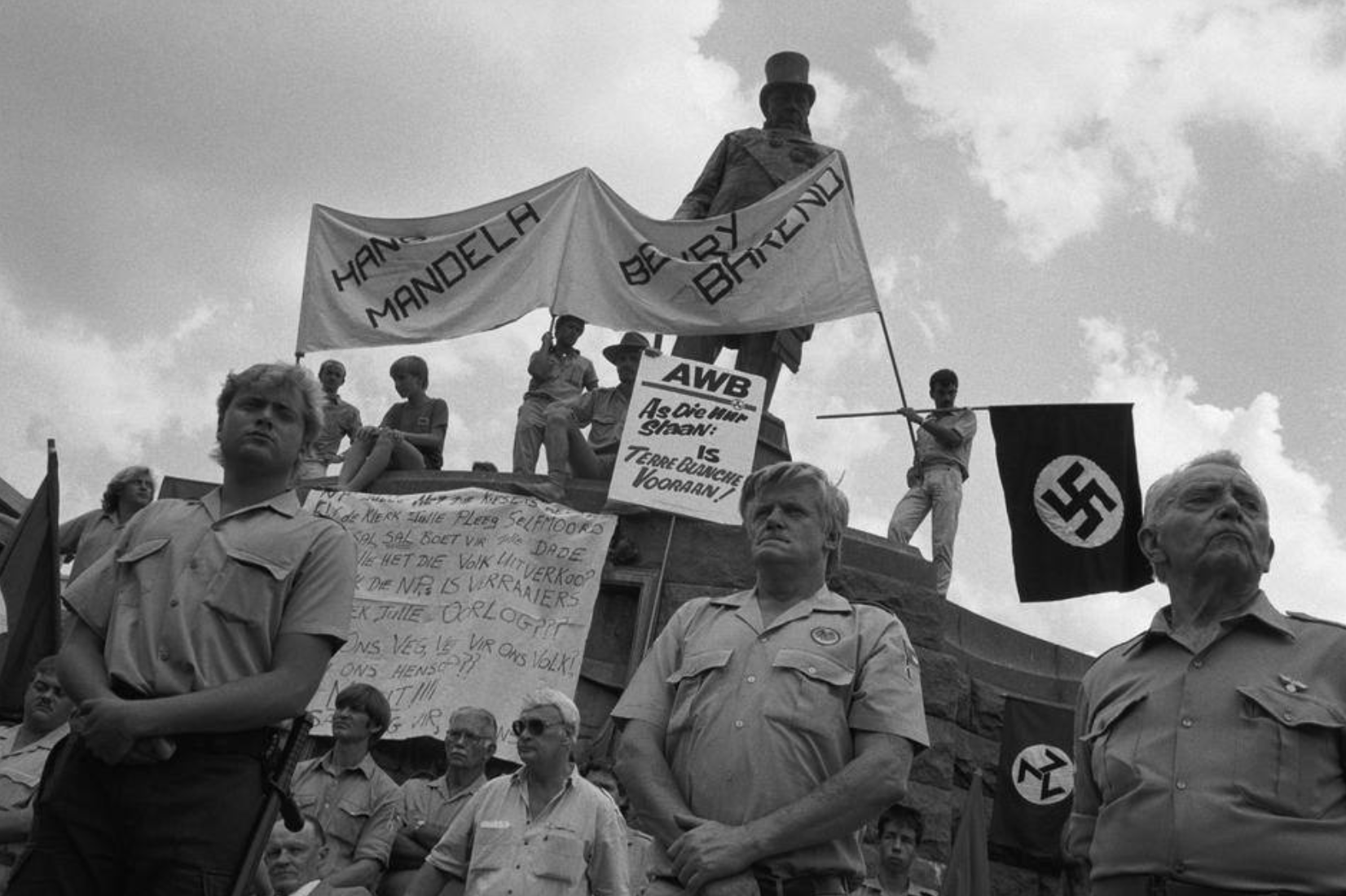
AWB rally at Paul Krugers’ statue in Pretoria – note German Swastika Flag.

Unlike in Germany, Russia and all over Europe, up until 1994, there is something that can most certainly be derived from the tacit approval and lack of real action by the Apartheid state to readily stamp out the use of Nazi symbology, emblems and hero worship. Also, unlike in Germany and Europe, where active steps were taken by the state to educate and expose the entire population to the evils of Nazism by way of sensitivity training, there is also something that can be said of no such steps having ever been really taken place in South Africa by the Apartheid state – and that is evidenced by the sheer arrogance and lack of understanding demonstrated by likes of the Dr Erich Holm.


Written and Researched by Peter Dickens

Related work:

Hitler’s South African Spies Hitler’s Spies and the Ossewabrandwag

The Nazification of the Afrikaner right The Nazification of the Afrikaner Right

References:

“Hitler’s Spies: Secret Agents and the Intelligence War in South Africa 1939-1945” by Evert Kleynhans – Jonathan Ball Publishers 2021.

F.L. Monama, Wartime propaganda in the Union of South Africa, 1939-1945 (PhD thesis, Stellenbosch University, 2014).

C. Marx, ‘“Dear Listeners in South Africa”: German Propaganda Broadcasts to South Africa, 1940–1941’, South African Historical Journal (1992).

Footnotes

  1. C. Marx, ‘“Dear Listeners in South Africa”: German Propaganda Broadcasts to South Africa, 1940–1941’, South African Historical Journal (1992). ↩︎
  2. Sunday Times – Page 2, Nazi Radio man took part in Hess Service: 30 August 1982 by De Wet Potgieter and Jannie Lazarus ↩︎
  3. German War Cenotaph Pretoria West Cemetery – eGGSA Library ↩︎
  4. Neville Petersen recalls, Nagkantoor Facebook Social Media Group ↩︎
  5. Sunday Times – Page 2, Nazi Radio man took part in Hess Service: 30 August 1982 by De Wet Potgieter and Jannie Lazarus ↩︎
  6. Ibid ↩︎
  7. Idid ↩︎
  8. Grave of Hitler aide destroyed – 22 July Al Jazeera News 2011 ↩︎

Photo copyright of Rudolf Hess Commendation Pretoria: Neville Petersen.
Where did all the statues go?

So, if you like me and love your beer, and as a brewery owner I can’t help myself – Munich (or München in German) is THE place to go. Bavaria’s capital and it’s the venue of the Octoberfest and there is much ‘Ein Prosit der Gemütlichkeit’ (cheers to the sociability), Zigge, Zagge, Hoi, Hoi, Hoi and clunking of large vessels of beer called Steinzeugkrug full of cold, hoppy, golden nectar. It’s a fun place, I certainly love it, it’s a beer lover’s Mecca – no doubt.

But as a purveyor of fine history snippets too, my love of history also kicks in, and in Munich, there is a very sinister and dark past, and there’s tonnes of, literally tonnes of inconvenient history. You would not notice it today as an average tourist “in it for the beer,” Munich has been ‘scrubbed clean’. There is almost no evidence of its history as the epicentre and cultural pilgrimage of Nazism. In fact they go a long way in Munich not to celebrate World War 2 historic tourism, but that has not stopped a couple of freelance ‘independent and opportunist’ tour guides pulling an informal crowd for the unofficial Nazi tour of beer-houses and locations attended by the likes of Hitler and his cronies.

The sterility of Munich got me thinking, at what point is the removal of statues and memorials deemed ‘offensive’ perfectly acceptable and what point is it not? At what point do we, like the city of Munich .. ‘scrub’ out our past completely, disregard the idea of preserving it for the purposes of a history teaching (even a lesson on the evilness it incurred) and hide it for fear of offending victims of it.

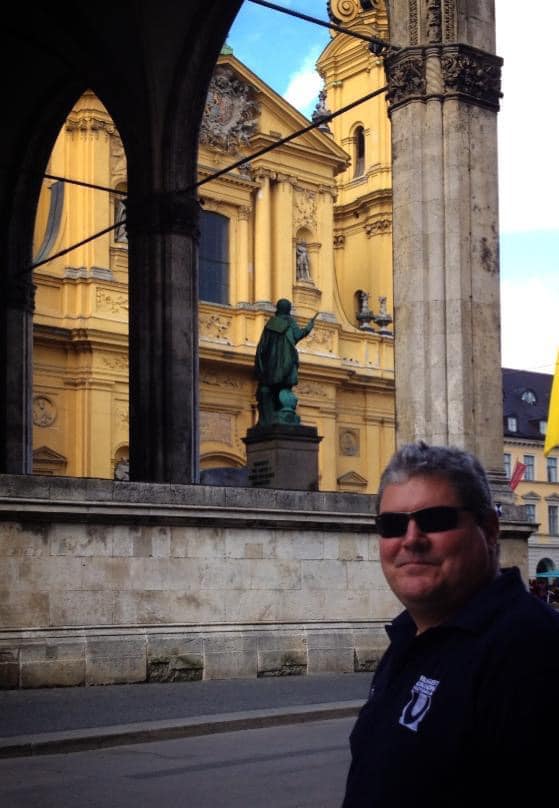
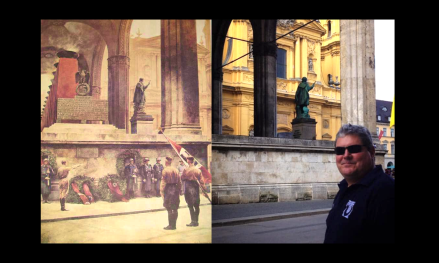
So what’s the big deal of this totally bland corner of the Feldherrnhalle monument (Field Marshal’s Hall – built in 1841 by King Ludwig I to celebrate the Bavarian Army), located on the Odeonsplatz – Munich’s town square. Here I am with my usual ironic grin celebrating the complete nothingness of what was a ‘holy’ site to Nazism – that exact nondescript corner – the site of huge pilgrimages and parades. The only evidence left, some plug holes in the original monument that held up the gigantic Nazi add-ons. Heck, this corner was so important that as an average Munich citizen you saluted the corner of this building – ‘Nazi style’ – whenever you walked passed it. Now there is nothing, not even an information plaque.

The importance of beer halls in establishing Nazism

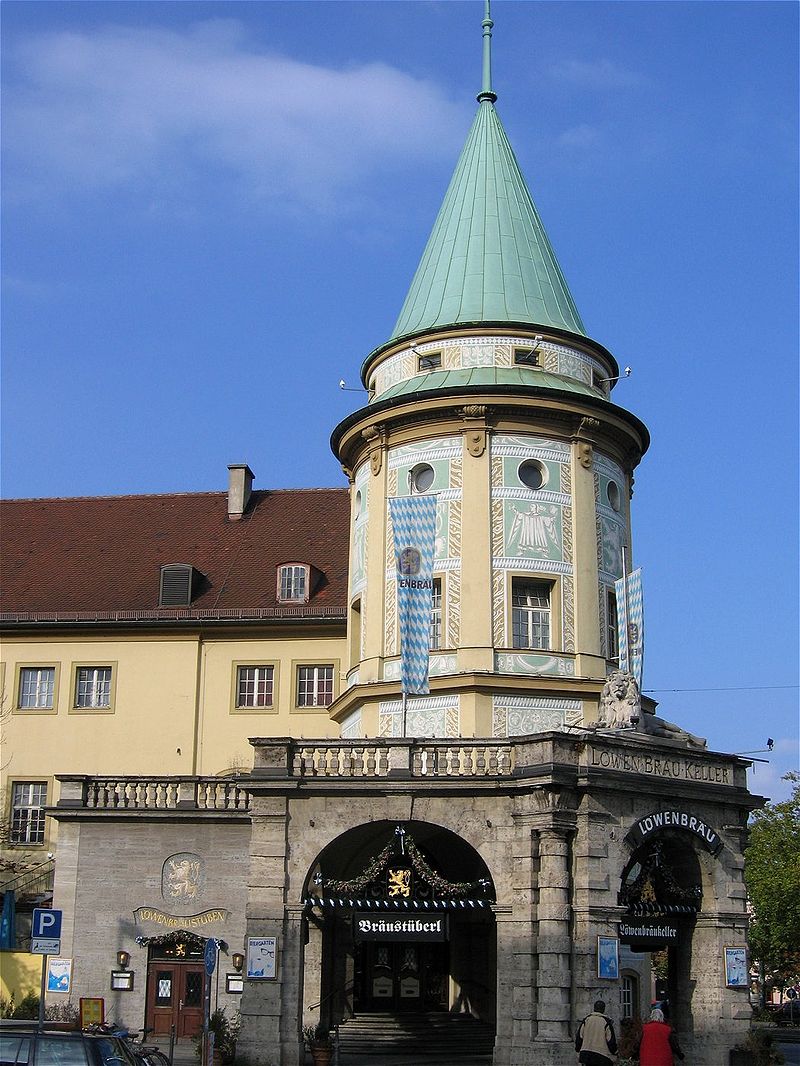
Well, apart from being a historic monument to Bavaria, the Feldherrnhalle is also central to all the traditional beer halls and beer gardens located around is, and it’s in two of these nearby beer halls that this story begins. The famous Bürgerbräukeller beer hall – completely demolished now and replaced with a modern culture, music and arts centre, and the Löwenbräukeller beer hall. You can still visit the Löwenbräukeller (I have) and give a complimentary Ein Prosit and Zigge Zagga to the resident Oompa band, and again – nothing, zilch, nada on its Nazi history – not even on their website.

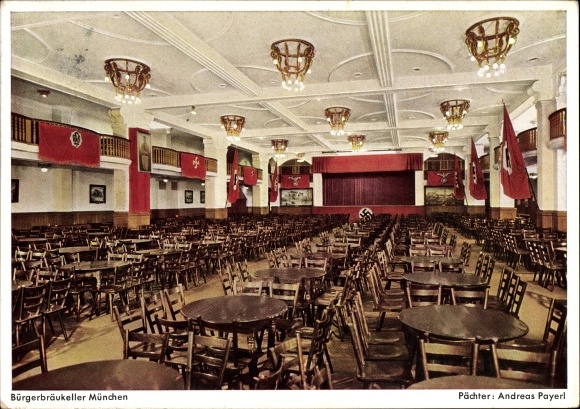
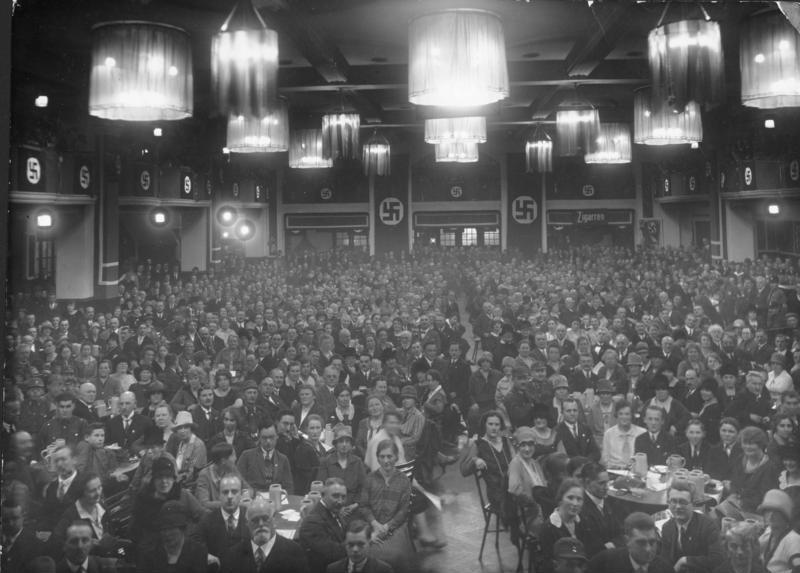
So, in the Bürgerbräukeller beer hall, Nazism as an ideology was effectively born and took hold. Central to the beer hall was a rectangular grand hall which could accommodate up to 3,000 people and a large cellar, ideal for political meetings and rallies. From 1920 to 1923, the Bürgerbräukeller was one of the main gathering places of the Nazi Party, it was effectively established there, and it was from there that Adolf Hitler launched the infamous Beer Hall Putsch (revolt) on the 8th November 1923. Also known as the Munich Putsch, in essence Hitler and his fellow Nazi cronies attempted to pull off a military coup and overthrow the Weimar Republic.

Images: Bürgerbräukeller’s Great Hall left as it was then, Löwenbräu keller, as it is now.

Throughout 1923, the economic and political crisis struck. The Nazi Party and other nationalists believed that an armed takeover of Bavaria was possible and could even overthrow the Republic in Berlin. Hitler and the Nazi Party collaborated with others such as General Erich Ludendorff  and Gustav von Kahr (a founding right wing Nationalist leader) to put a plan together to attempt a military coup. By August 1923, the plan was set and weapons and transport were gathered. However by November 1923, some of the Nazi conspirators got cold feet as news came in that the German Army in Berlin would support the government and not the conspirators.

Hitler, realising that von Kahr sought only to control him and did not have it in him to initiate a coup, utterly frustrated by it all Hitler was determined that the plan would go ahead. On the 8 November 1923, he and a contingent of the party’s SA (Storm Detachment/Troopers) marched into the Bürgerbräukeller beer hall whilst von Kahr was giving a speech to 3,000 people there. The SA surrounded the hall and set up a machine gun. Hitler, surrounded by his associates including Hermann Goring, Rudolf Hess, Alfred Rosenberg, Adolf Lenk, Max Erwin von Scheubner-Richter, Wilhelm Adam, Robert Wagner and others (20 in total) then jumped up a chair, fired a gun-shot and shouted “The national revolution has broken out! The hall is surrounded by six hundred men. Nobody is allowed to leave.”

He went on to state that the Bavarian government was deposed and declared the formation of a new government with General Ludendorff as the head. At gun-point Von Kahr gave his support to Hitler. Dispatches were sent to trigger Ernst Röhm and his paramilitary group the Bund Reichskriegsflagge (Imperial War Flag Society) waiting at the Löwenbräukeller Beer Hall and Gerhard Rossbach who had a detachment right wing students at a nearby infantry officers school.

The Putsch was on. After his speeches Hitler received resounding applause from the crowd at the Bürgerbräukeller beer hall and Von Kahr and other members of the Bavarian government were taken into custody, Hitler departed the hall later in the evening to deal with another crisis, and mistakenly Von Kahr and his associates were released (they later took the opportunity to denounce the Nazi Party as illegal and join the government).

The night was marked by confusion and unrest among government officials, armed forces, police units, and individuals deciding where their loyalties lay. Early in the morning on the 9th November 1923 (around 3am), the first shots fired in the Putsch occurred when a local Reichswehr Army detachment loyal to the government spotted Röhm’s men coming out of the Löwenbräukeller Beer Hall. Encountering heavy fire Röhm and his men were forced to fall back. In the meantime, the Reichswehr officers put the garrison on alert and called for reinforcements.

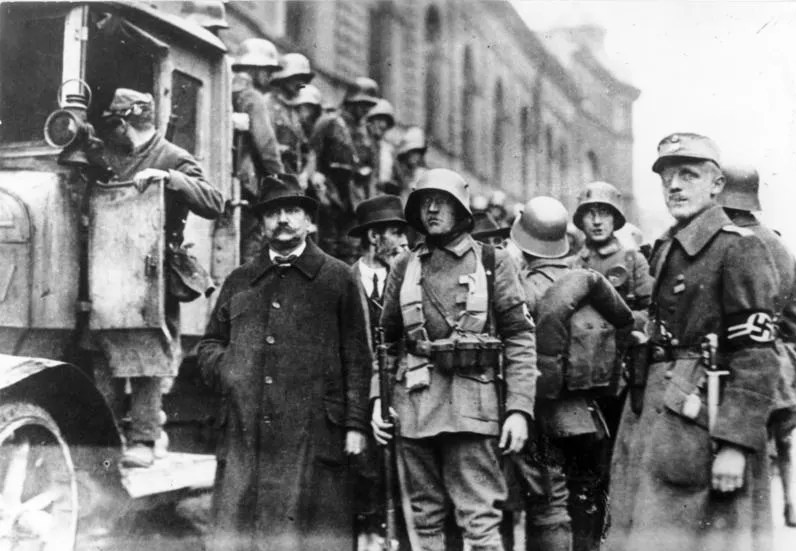
Later that morning on 9 November, Hitler realised the Putsch had stalled, about to give up, and not sure what to do, the Putschists were rallied again by General Ludendorff who shouted “We will March” and with that Röhm’s force together with Hitler’s force (approximately 2000 men) marched out – but with no specific destination in mind. On the spur of the moment, General Ludendorff decided to lead them to the Bavarian Defence Ministry – which would take them past the ….. Feldherrnhalle and the Odeonsplatz … and here is where the corner of the Feldherrnhalle becomes important, because as they rounded this unremarkable corner of the monument they were met with 130 government soldiers and police blocking their way – and they found themselves in what is a fairly narrow road aside the monument in a sort of ‘Mexican Stand-off.’

Image: Nazi Putsch members – 9 November 1923

The two groups exchanged fire with one another, in all 4 were killed in the government’s forces and 16 Nazi Putschists were killed. In the firefight a couple of key things happened – most importantly the equivalent of a rather crooked ‘Sacred Cross’ legend was born .. the ‘Blutfahne’ (‘blood flag’). The Flag Bearer of the Nazi Flag was a SA member, Heinrich Trambauer, and he was badly wounded dropping the flag splattered with his blood, a second SA man, Andreas Bauriedl, was shot dead and fell dead onto the fallen flag, covering it in more blood. Secondly. Hermann Göring was badly wounded – and this wound would haunt him his entire life, leading to his violent morphine drug addiction which resulted in irrational decision making during the Second World War. The game was up, the Nazis scattered or were arrested. Göring escaped and was smuggled to Innsbruck. Finally, Hitler now on the run was arrested two days later on the 11th November 1923.

Hitler was sent to Landsberg Prison and put on trial for treason. Hitler’s trial took place from the 26 February to the 1 April 1924, he was ultimately found guilty of treason, but, with a sympathetic judge, he was sentenced to just five years in prison. Of this five years, Hitler only served nine months. But most importantly for the Nazi movement and to the detriment of the rest of world, Hitler was imprisoned alongside Rudolf Hess, Hess was a Hitler groupie – and held a fanatical admiration of him. He was also very articulate and ‘balanced’ Hitler enough to assist in writing Mein Kampf by Adolf Hitler (My Struggle) which honed Nazi ideology and philosophy.

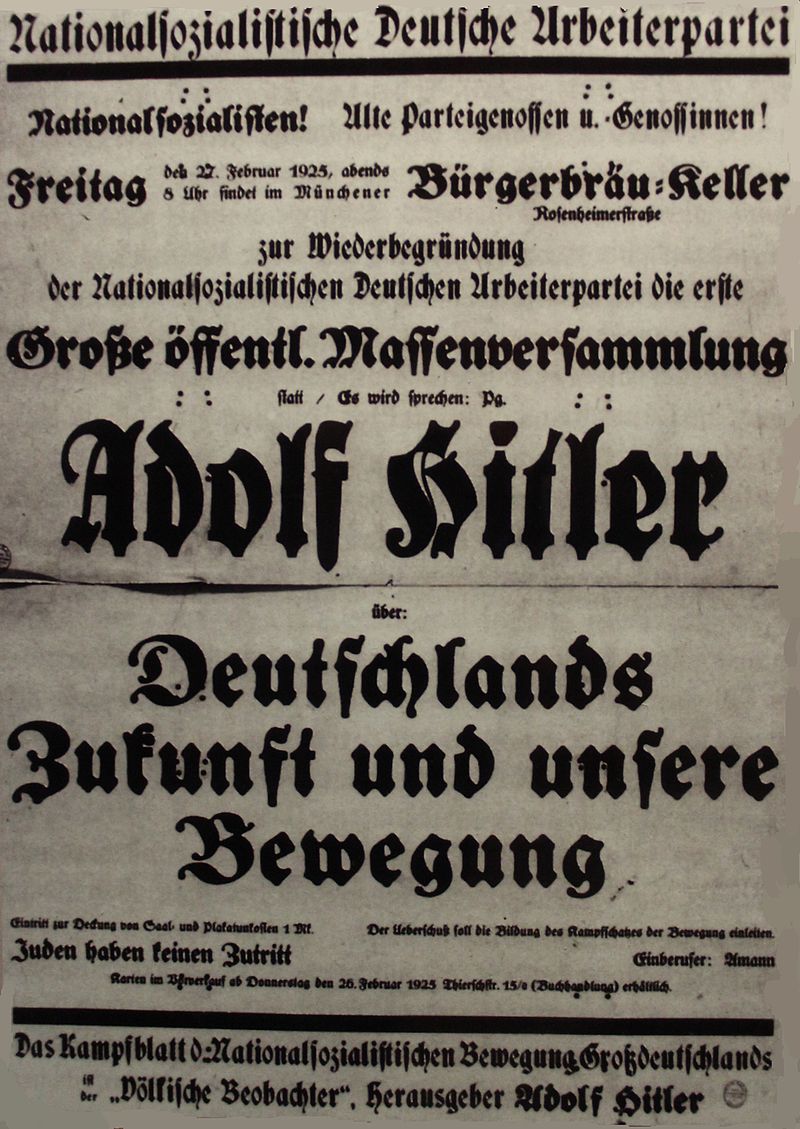
Back to the beer halls of Munich, not long after been released, Hitler was back in his old haunt – the Bürgerbräukeller Beer Hall, where he promptly officially ‘re-established’ the Nazi party on 27 February 1925. Not to be left out, during the war, Adolf Hitler delivered his infamous 8 Nov 1942, Stalingrad speech from Löwenbräukeller Beer Hall.

Images: Left – the notice to reestablish the Nazi Party at a ceremony at the Bürgerbräukeller and the Bürgerbräukeller Great Hall hosting a Nazi rally.

The Nazification of the Feldherrnhalle

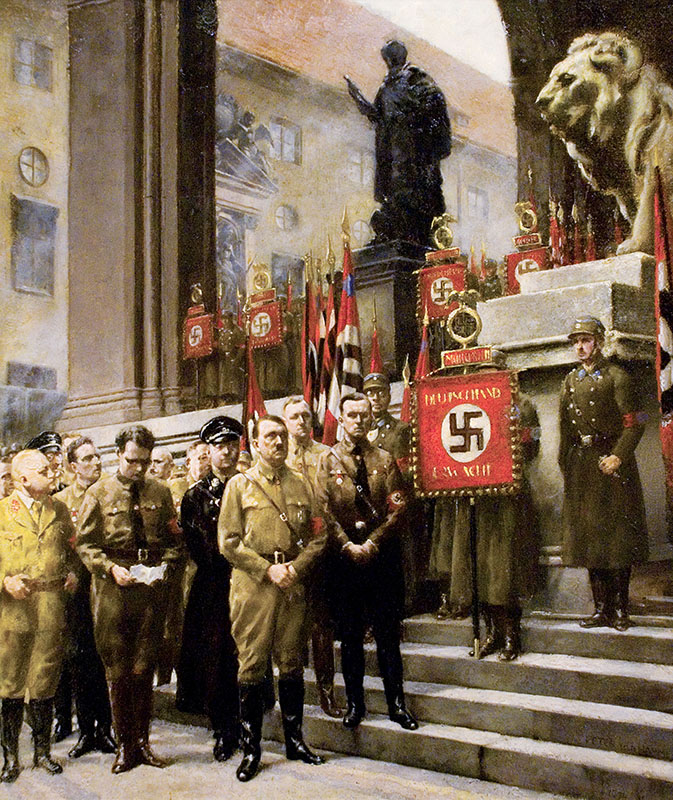
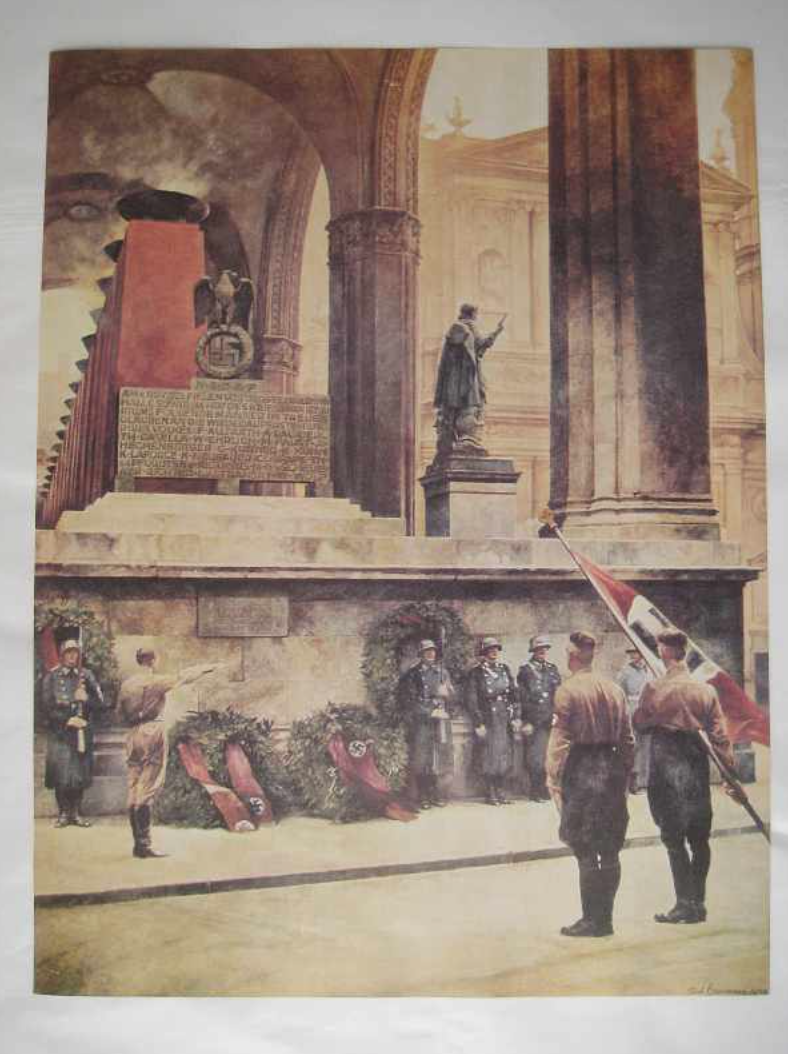
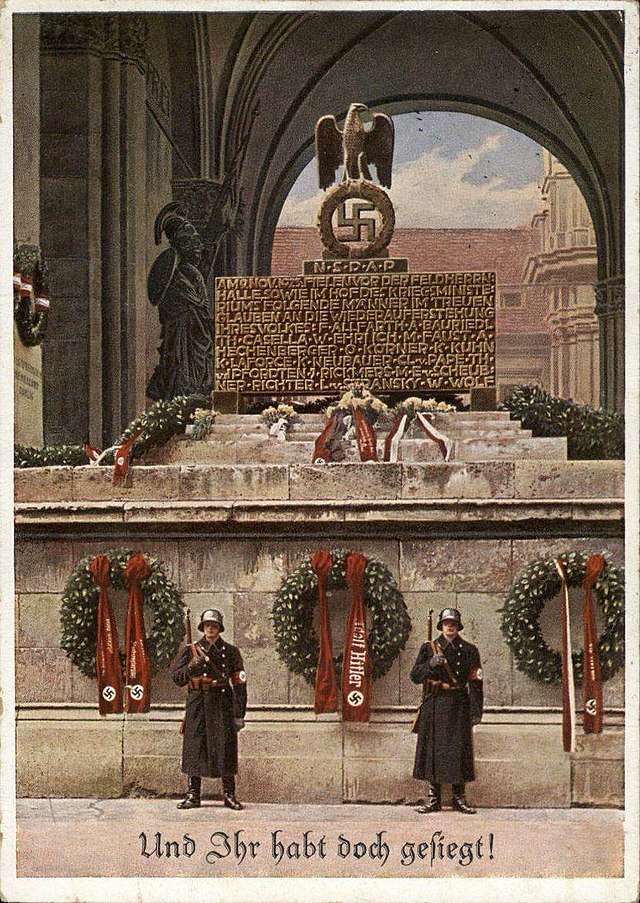
After the Nazis took power in 1933, Hitler turned the Feldherrnhalle into a memorial to the Nazis killed during the failed putsch. A memorial to the fallen SA men was put up on its east side, opposite the location of the shootings – crowning it with a Swastika. A Nazi add-on monument was mounted, the Mahnmal der Bewegung (Memorial to the Movement), basically a rectangular structure listing the names of the Nazi martyrs faced anyone standing at the corner of Feldherrnhalle monument. The back of the memorial read Und ihr habt doch gesiegt! (‘And you triumphed nevertheless!’). Around it flowers and wreaths were laid.

This memorial was under perpetual ceremonial guard by the SS. The Odeonsplatz square in front of the Feldherrnhalle was used for both SS parades and commemorative rallies. During some of these events the 16 Nazi dead were each commemorated by a temporary pillar placed in the Feldherrnhalle topped by a flame. Many new SS recruits took their oath of loyalty to Hitler in front of the memorial.

Passers-by were expected to hail the site with the Nazi salute. Those not wishing to salute, used a detour lane to by-pass the memorial and honour guard, sarcastically earning its nickname “Drückebergergasse” (meaning the ‘shirker’s lane’).

On 9 November 1935, the 16 Beer Hall Putsch Nazi dead were taken from their graves and to the Feldherrnhalle. The SA and SS carried them down to the Königsplatz, where two Ehrentempel (‘honour temples’) had been constructed. In each of the structures eight of the dead Nazis were interred in a sarcophagus bearing their name.

The 16 Beer Hall Putsch Nazi dead were regarded as the first ‘blood martyrs’ of the Nazi Party, and here’s where the Blutfahne – the ‘Blood Flag’ would make its appearance.  It was brought out for the swearing-in of new recruits in front of the Feldherrnhalle and the taking of their oath of allegiance to Adolf Hitler specifically. It was also brought out for Der neunte Elfte – 9 November, literally ‘the ninth of the eleventh’ or 9/11 (not to be confused with the current 9/11 Twin Towers commemoration) and it became one of the most important dates on the Nazi calendar.

Notably, the chosen day to celebrate the Putsch is not the 9th November, when the 16 Nazi martyrs were killed, it was the 11th November – the day Hitler was arrested – so to his megalomaniac mind the more important date as his personal arrest signalled the end of the Putsch (never-mind Göring and others who were still at large).

Every year the Putsch would be commemorated nationwide, with the major wreath laying event taking place at the Feldherrnhalle. On the night of 8 November, Hitler would open the ceremonies and address the Alte Kämpfer (‘Old Fighters’ – veterans of the Putsch) in the Bürgerbräukeller Beer Hall.

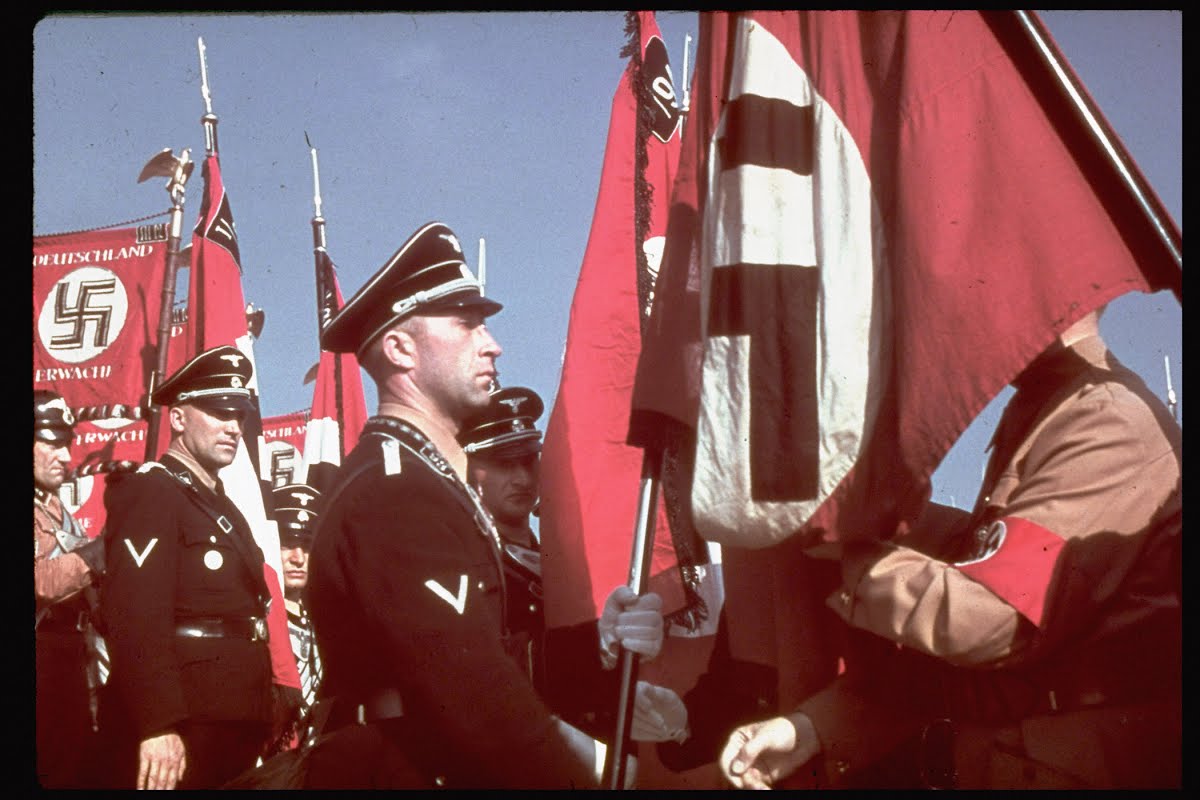
The Blutfahne – the ‘Blood Flag’ was treated as a sacred object by the Nazi Party and carried by SS-Sturmbannführer Jakob Grimminger at various other Nazi Party ceremonies. One of the most visible uses of the flag was when Hitler, at the Party’s annual Nuremberg rallies, touched other Nazi banners with the Blutfahne, thereby “sanctifying” them. This was done in a special ceremony called the “flag consecration” (Fahnenweihe).

Image: Hitler behind the ‘Blood Flag’ performs a ‘flag consecration’ on a SS Banner.

Rather mysteriously, and its akin to any good ‘who done it’ mystery – the Blutfahne was last seen in public at the Volksstrum induction ceremony on 18 October 1944, thereafter it vanished, which for such a significant artefact and ‘national treasure’ remains a puzzle. Its current whereabouts are still unknown.

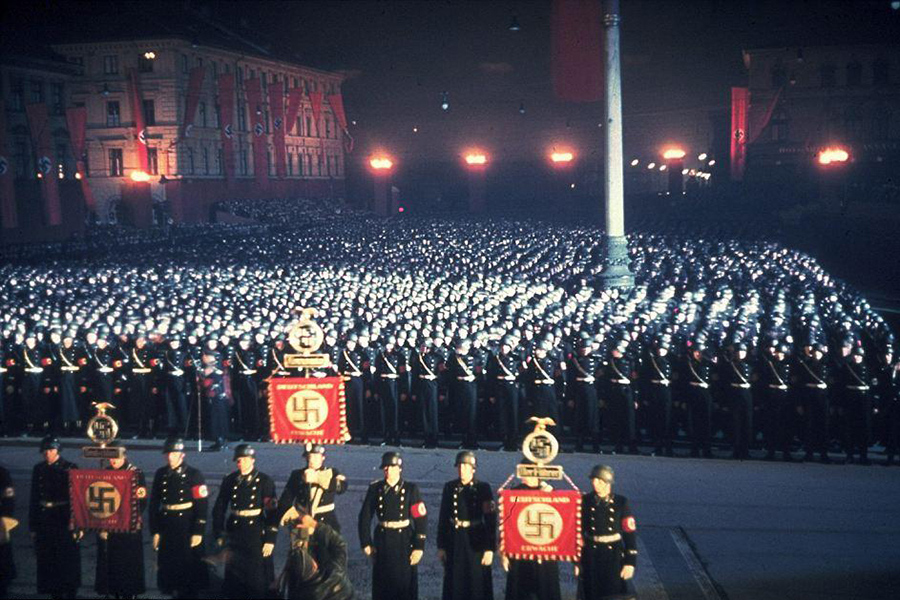
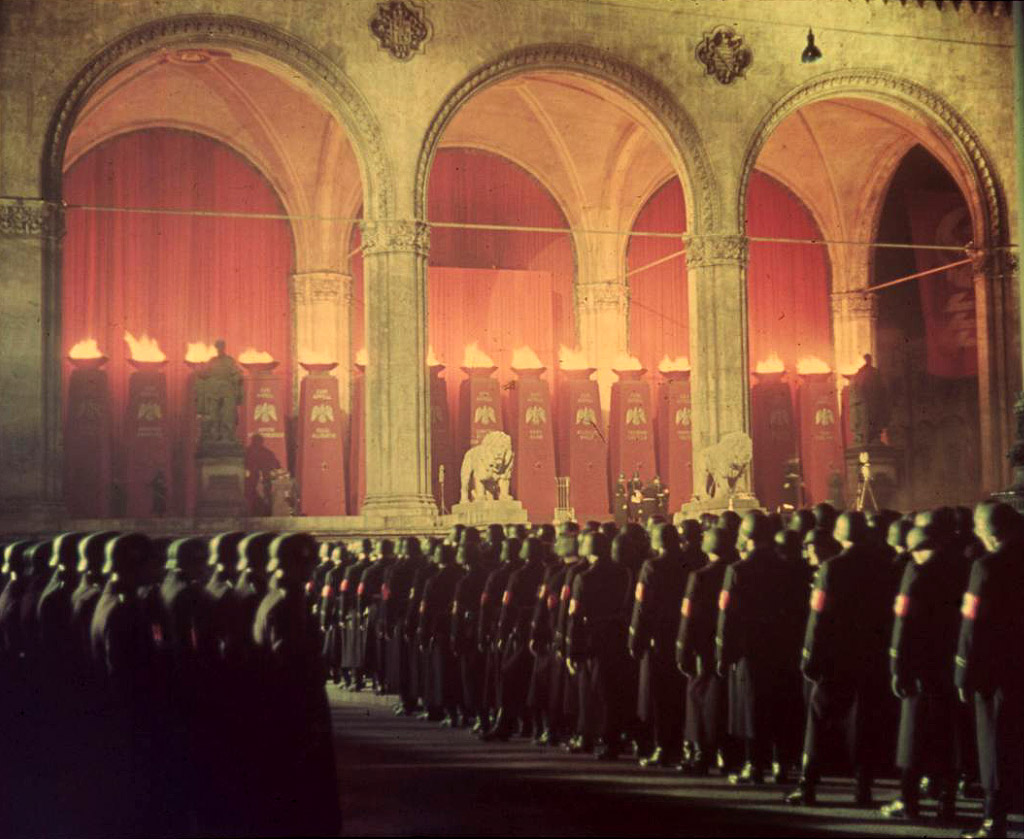
Throughout the Second World War, the 9/11 anniversary ceremony continued, propagandists pitched the 16 fallen as the first losses and the ceremony was an occasion to commemorate everyone who had died for Nazi Germany – the ceremony now akin in Nazi Germany to what is 11/11 today and the Whitehall Cenotaph parade. As the war went on, residents of Munich came increasingly to dread the approach of the anniversary, concerned that the presence of the top Nazi leaders in their city would act as a magnet for Allied bombers.

Images: Original colour images of the German 9/11 anniversary parade in front of the Feldherrnhalle monument on the Odeonsplatz town-square.

The End

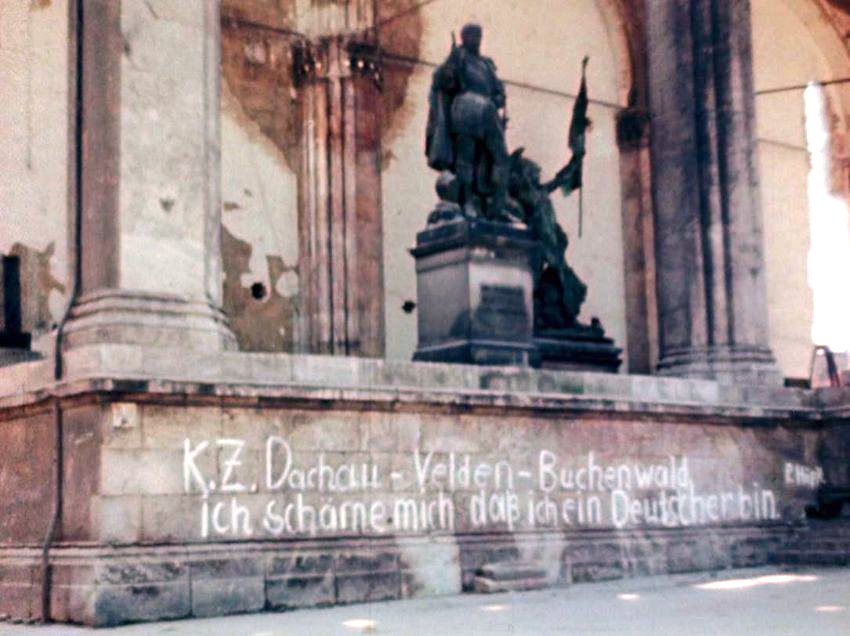
Understandably the memorial was going to cause considerable controversy at the end of the war, and it did. Local Munich residents angrily and spontaneously smashed the Mahnmal der Bewegung to pieces on the 3rd June 1945. It was also famously defaced when a guilt ridden German painted graffiti on the memorial with the words “Concentration camps Dachau – Velden – Buchenwald, I am ashamed that I am a German.”

However it remains a site for Nazi pilgrimage, and even as late as April 1995, a World War 2 Veteran named Reinhold Elstner, took the opportunity to commit self-immolation suicide in front of Feldhernhalle to protest against “the ongoing official slander and demonization of the German people and German soldiers”. Each year neo-Fascist/neo-Nazi groups from various European countries and Germany itself try to hold a commemorative ceremony for him, which Bavarian authorities constantly try to prevent through state and federal courts.

So, very understandable the need to sanitise this memorial and discourage neo-Nazi and neo-Fascist groupings from using it to honour an ideology that provided such significant misery to millions of people. But I can’t but think there is no point sanitising it completely as has been done, use it to educate rather – at least an information board or story board which explains the tyranny the site once fostered, a lesson to humanity not to do it again, maybe even Holocaust Memorial sanctioned tour guides to balance and educate and do away with the freelance cowboys (maybe they’ve done it, but that was not the case when I was last in Munich) – lest we completely forget, lest the ‘blood flag’ suddenly re-appear from its secret stash and we open up more ‘clean’ space in which Neo-nazism and holocaust denial/conspiracy theory can thrive (there’s no ‘proof’ to see now, moving on – its been removed, so prove it).

The same can be said of South Africa, at what point do we decide to allow WOKE thinking to remove all ‘white’ history and scrub that culture on the basis of the evils of Apartheid and Colonialism – too offensive to the majority. Take down ALL the statues, another … “where have all the statues gone”.. rather initiate the Communist and Revolutionist zeal for the ‘Year One’ calendar, and let’s all start our history from 1994 shall we comrades. No, history is history, warts and all, we need to ‘have the conversation’ at least, it’s the lesson to mankind to know where it comes from and therefore to know where it’s going to, it gives us our moral north .. sanitising it moves the compass south.


Written and Researched by Peter Dickens

Smuts Barracks; Berlin

Not only did Jan Smuts have a Kibbutz named after him in Israel, as well as pub named after him in London, the famous ‘Smuts Barracks’ in Berlin was also named after him.  The barracks were the home to an SS Panzer Division during the Second World War and was occupied by the British after the war, the barracks is particularly well-known because it was on constant high alert during the Cold War and Berlin Wall divide.

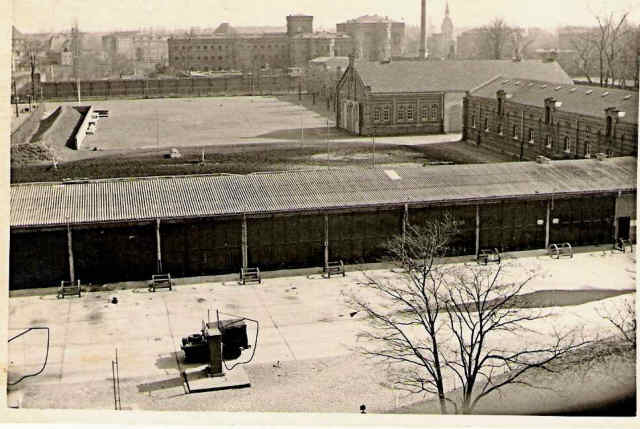
Smuts Barracks was situated on Wilhelmstraße, a street in the Spandau district of Berlin, and the base of the British armoured contingent to Germany, it’s located next to what was the famous ‘Spandau Prison’ . Also in Wilhelmstraße, Spandau Prison was completed in 1881. It was occupied by seven Nazi war criminals, convicted in the Nuremberg Trials after World War 2, including Rudolf Hess, who remained its only prisoner there for many years until he committed suicide. After Hess’ death the prison was demolished and replaced by a shopping centre.

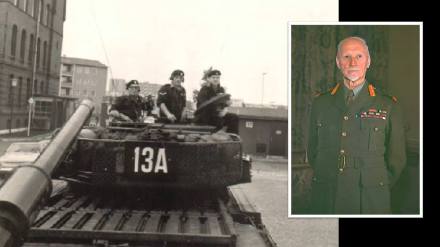
Berlin, Smuts, 1 RTR (2)

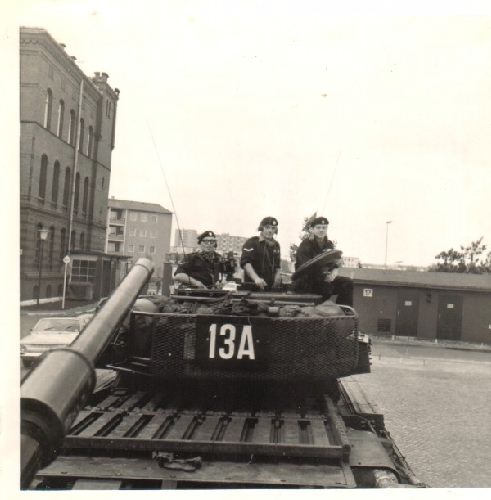
Smuts Barracks (above and below), taken during 1 RTR’s tour of duty between Feb 67 and Jan 69.

The British armoured squadron based at Smuts Barracks consisted of 18 modified Chieftain tanks, painted in their renown urban camouflage, and were at a constant state of readiness. This “bombed up” state, ensured a speedy counter attack should the Soviet Union (Russia and East Germany mainly) breach the Berlin wall.

The last unit/squadron to be based here was C Squadron, The 14th/20th Royal King’s Hussars (1989-1993), a Cavalry Regiment of the Royal Armoured Corps. The squadron bar was known as the “Lion and Bear”.

Berlin, Smuts, 1 RTR

RTR at Smuts Barracks

Between 1948 and 1952, the Smuts Barracks was used by the following Regiments stationed in Germany:

Feb 1948 Sqn, 11 Hussars (armoured cars)
May 1949 ‘A’ Sqn, Royal Dragoons (armoured cars)
Mar 1950 ‘A’ Sqn, Royal Horse Guards (armoured cars)
Feb 1951 Sqn, 3rd Hussars

In Feb 1952 a permanent unit was formed, designated 1st Independent Sqn Royal Tank Regt. It was disbanded December 1957. Between December  1957 and Aug 1962, the squadron came from the APC (Armoured Personnel Carrier) regiment in BAOR:

Dec 1957 ‘B’ Sqn, l4lh/20th Hussars
Nov 1960 ‘C’ Sqn, 4th Royal Tank Regt

Another permanent unit was established in March 1963, designated Independent Sqn Royal Tank Regt; it was disbanded November 1965.

After that date, the squadron normally came from the training regiment at Catterick:

Feb 1965 Sqn, Queens Own Hussars
Feb 1967 A Sqn, 1st Royal Tank Regt
Jan 1969 Sqn, 9th/l2th Lancers
Dec 1970 Sqn, 1st Queen’s DG
Dec 1972 ‘A’ Sqn, 4th Royal Tank Regt
Dec 1974 ‘B’ Sqn, 5th Royal Inniskilling DG
Dec 1976 ‘B’ Sqn, Royal Scots DG
Apr 1979 ‘D’ Sqn, Royal Hussars
Feb 1981 ‘D’ Sqn, 4th/7th DG
Apr 1983 ‘D’ Sqn, Queens Own Hussars
May 1985 ‘B’ Sqn, 14th/20th Hussars

From 1985, the squadron came from the 14th/20th Hussars who were based at Münster:
Jan 1988 ‘C’ Sqn took over. The squadron was withdrawn in 1991.

30425700_2124617117767275_8530343007735181590_o

Jan Smuts

Also based at Smuts Barracks  were 38 (Berlin) Field Squadron RE. 38 Field Company was stationed in West Germany as part of 23 Field Engineer Regiment when in 1957 it was amalgamated with the RE Troops Berlin to become 38 (Berlin) Field Squadron Royal Engineers. The Squadron remained in Berlin providing engineer support to the Berlin Brigade until 1994 when it was disbanded as part of options for change.

Smuts Barracks was also the home of the Sapper Berlin Field Squadron (38 Fd Sqn RE).

So there you have it, another legacy of Jan Smuts and an island of South Africa’s contribution to the Second World War and the Cold War after it.  The Barracks is now closed and under private ownership.

Related work and links

Jan Smuts: A Kibbutz called Jan Smuts

Jan Smuts: “The force of his intellect has enriched the wisdom of the whole human race”- the death of Jan Smuts.


Researched by Peter Dickens.  Large reference, photos and extract from BAOR Locations – Smuts Barracks on-line.