Glossary of South African Military Terms

This is for the benefit of those not always understanding the language of a South African military veteran.  This is a glossary of South African military terms compiled by Peter Dickens, David Kiley, Norman Sander and other veterans in The South African Legion, it is by no means definitive of all the terms used, quite a lot can be happily added and please feel free to notify me of any omissions.

Please note this list contains words that can be judged as offensive and objectionable – however as a historic document to capture the slang and terminology it needs to be as objective as possible.

SOUTH AFRICAN DEFENCE FORCE TERMINOLOGY AND SLANG

A)
Aapjas – A long, hooded coat usually with a fake fur lining ( post 1983 issue version ).
Aapkas (1) – metal platform / cage , sited on a radio mast in SWA / Angola ops bases; used as a lookout post / fire director station for base defence mortars.
Aap Kas (2) – also know as the jump simulation cable rig at 44 Para
Aangekla/kla-ed aan – Put on a charge.
AB – Navy.Able Seaman (Lance Corporal)
Adjudant – ( 1 ) commissioned officer appointed as executive officer to unit OC / 2IC .
Adjudant – ( 2 ) abridged Afrikaans form of address for rank of Warrant Officer ( SA Police).

Continue reading

Precision landing with Rudder and Elevators shot away = SAAF Hero!

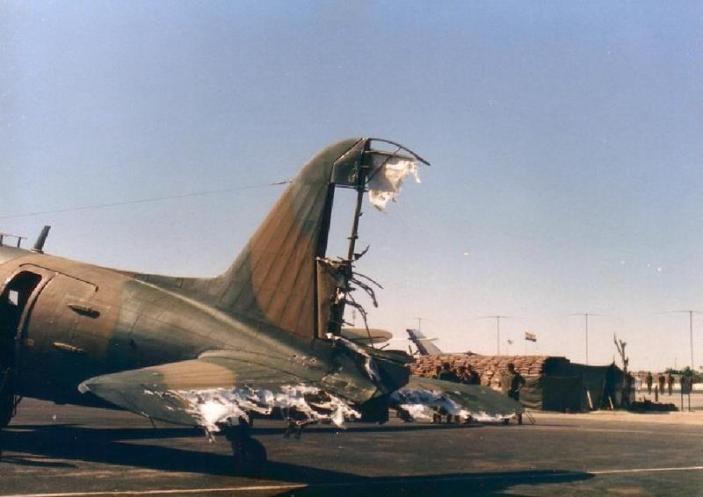
Now there are pilots with skills and then there are a cut above, this pilot is a cut above. On 1 May 1986, a South African Air Force Dakota while on a flight to Ondangwa at about 8000 ft was hit with a soviet SAM-7 shoulder fired surface to air missile. The explosion ripped off most of the Dakota’s tail. To add additional pressure to the crew, the Dakota was full of military VIP passengers including the Chief of the Army.

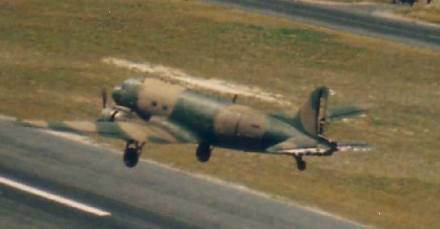
Captain Colin Green slowed the Dakota down to 100 knots in order to keep it under control and put in a mayday call. There was a SAAF helicopter in the area which formatted on him and relayed the damage to him. The helicopter crew also took this amazing picture showing the landing.

1383731_216630021840071_1160172803_n

To note from this picture is that the Dakota has lost all of it’s rudder and both sections of the elevator. This is an unrecoverable situation in most aircraft types and also a situation most pilots cannot recover the aircraft from in any event.

To compensate on the loss of stability Captain Green ordered the passengers around the aircraft to regulate the centre of gravity before going into land. Using flaps and throttle power to control the pitch (up and down) and thus control his decent rate and air speed, he landed it onto the tarmac, ‘greasing’ the centre line in a perfect landing.

Captain Colin Green was later awarded The Chief of the SADF Commendation for his exceptional flying skills.

13124557_1766085276953796_1208176927466124088_n

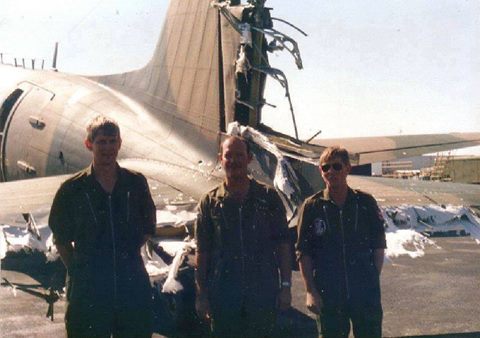
From left to right:
National Serviceman Private Walsh (loadmaster)
Captain Colin Green (aircraft commander)
Lieutenant Mark Moses (co-pilot)

All Heroes.


Written and researched by Peter Dickens.  Images available on Internet, origin unknown .

Edward Backhouse as he comes home

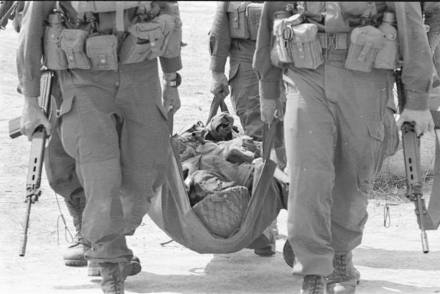
This week we especially remember the fallen from the Angolan/SWA Border War and the ‘Battle of Cassinga’ on the 4th May 1978 – in this very emotional picture we remember Rifleman Edward James Backhouse from 3 Parachute Battalion as he comes home.

There is an unwritten law to all servicemen – you don’t leave your buddies behind in a fire fight. Eddie was Killed in Action during the Battle of Cassinga. He was 22.

As a mark of respect, especially due to the highly controversial circumstances that surrounded this action, lets remember the immense sacrifice and loss experienced by all who participated in this battle and not get into any political platforming, it will only serve to disrespect the fallen.

Thank you to Graham Du Toit for the image and reference.

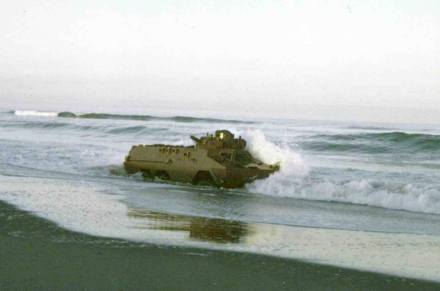
SADF Ratel becomes a sea monster!

How this SADF Ratel IFV landed up in the ocean is told by Lt Mike Muller (Translated by WO1 Dennis Green from the original Afrikaans)

“Following the participation by D Squadron, 2 SA Infantry Battalion Group in Ops REINDEER, Maj P.W. de Jager, the squadron commander, thought it a good idea to give the members of the squadron a “day off” along the coast at Wortel about 15 km south of Walvis Bay. The aim was to provide the members with an enjoyable break following the intensive tension of the abovementioned operation.

This leisure day activity of 25 May 1978 was very successful and with the return on Friday 26 May at 07:00, the drama of the “Ratel in the Sea” began. As fate would have it, or rather as normal, four of the six Bedford’s would not start. After a lot of struggle, five of the Bedford’s were started and the NSM were taken back to Rooikop and the Squadron lines. Cpl Grassy Green returned to Wortel with Ratel R27029 to recover the remaining Bedford.

As a result of the loose sand and a sand dune over which the Ratel would have to tow the Bedford, Cpl Green decided to drive along the beach to a point where it would be more suitable to get onto the road to Walvis Bay. Because of certain problems, Grassy decided to stop and the Ratel immediately sunk into the sea sand, lying on its axles and gearbox. A further disastrous problem was that the waves were coming to a stop about 20 cm from the Ratel, and this was at the low point of the low tide. The Ratel was stuck and did not want to move; and the tide was turning. Little did Cpl Green realise this would be the hardest and longest recovery effort that D Squadron ever participated in.

Cpl Kanes returned to the base to get help and at 15:00, he informed Maj de Jager and Lt Muller of the events. Immediately the organising began and at 17:30, Lt Muller moved to Wortel with the other Ratels and enough recovery equipment.

A big shock awaited Lt Muller. The Ratel and the Bedford were standing about 20 metres in the sea, isolated and lonely, while the night, mist and cold approached.

The situation was further complicated in that the waves were almost breaking over the vehicles, the Bedford was almost rolled over a few times. Plans were made and preparations begun to recover the vehicles at the next low tide at 00:30 on Saturday 27 May 1978. Because of the loose desert sand, a hard surface had to be built for the Ratels to stand to recover the vehicles. In the cold, the big sweat began and fifteen members had to work against time to get this ‘road’ ready before the next low tide. During this low tide, these members had only 30 minutes to try to dig open the vehicles, but these efforts were not successful.

At this stage the Bedford was the biggest worry and it was first to be re-covered. This successful recovery encouraged the men. With enthusiasm and courage, the recovery effort of the Ratel began, but the tow cable (folded double) broke like cotton threads each time. At 03:00, the recov-ery effort was stopped and the exhausted members enjoyed bread and wine sent out by Sgt Snyman. Sgt Snyman acted as SSM.

Lt Muller decided that everybody must return to base to go and rest and the recovery effort would be started again at the next low tide. Fate de-cided that it would be misty and during the movement back to base, two more Ratels got stuck in the swampy lagoon south of Walvis Bay. They missed the road by 20 metres. It was decided to rest just there while at 06:00 Lt Muller went to report the situation to Maj de Jager. Calm and collected, Maj de Jager summarised the situation and arranged two re-covery vehicles from 55 Field Workshop.

On Saturday 27 May 78 at 11:00, Lt Muller, accompanied by the recovery vehicles drove out to the Ratel in the Sea. In the mean time, Sers Snyman with two corporals who had not slept yet, Cpls Kanes and Louw, recovered the two Ratels in the Lagoon swamp.

Just before low tide, the recovery personnel arrived at the Ratel in the sea. It was a lovely day, blue skies and the sea was calm and tranquil. It seemed that the water was pulling back further than the normal low tide level. The recovery vehicles and one Ratel were used for the recovery and there were many hands to dig away the sand in front of the stricken Ratel.

The engine of Ratel R27029 switched on as if no drop of water had fallen on it. After a few unsuccessful attempts, during which the towropes broke, the 18 tonner was lifted out of it’s almost water grave. A shout of triumph and victory went up from all the people involved. Satisfied but tired the 20 members of D Squadron returned to base as the leisure day could now be closed.

With this document, I would like to mention the names of those members who participated with good leadership and endurance:
• Sgt W.F. Snyman
• Cpl R. G. Kanes
• Cpl J .F. Louw
• Cpl D.A. Green
• Cpl J .H. de Bruin
• Cpl R. Mosich

NOTE: The consequences of the “Monster in the Sea” for the commander of D Squadron at the officer commanding 2 S A Infantry Battalion Group
are not discussed here, also not the big publicity which it caused in the colourless life of the civilian of Walvis Bay – Maj P.W. de Jager.

What happened on Monday 29 May 1978? Cpl Grassy Green was taken on orders in front of Maj PW de Jager and told to clean the Ratel of all sea sand and seawater.

Cpl Green, with help from the Squadron LWT, stripped the Ratel, serviced the engine, cleaned out all the sea sand and seawater and thoroughly washed the vehicle with fresh water. The only component that had to be replaced was the firing button on the turret hand wheel.

When Cpl Green left Walvis Bay in December 1979, Ratel R27029 was still in use by the Squadron.”

What happened to them?
Maj P.W. de Jager, later Commandant – businessman in Pretoria
Lt MJ Muller = later Col Mike Muller, OC 61 Mech Bn Gp, lovingly known as “Mad Max” – Cape Town
Sgt W.F. Snyman (Kat) = later WO 1 and RSM of 1 SSB and the School of Armour = working in Saudi Arabia
Cpl R.G. Kanes (Robbie) = later WO 2 at 1 SSB and SA Army Combat Training Centre, also awarded the Honoris Crux
Cpl JF Louw (Klagga) = working in Saudi Arabia
Cpl J.H. de Bruin (Johan) crew commander of R27029 = Wing Sergeant Major, Support Wing, School of Armour
Cpl D.A. Green (Dennis) driver of Ratel R27029 = Wing Sergeant Major, Simulator Centre, School of Armour
Cpl R. Mosich (Reinhard) = running a successful game farm in the Erongo Mountains near Omoruru, Namibia

Others involved:
S Sgt F.J.S. Scheepers = later WO 1 and SM of the SANDF
Cpl A.J. Crous (Abé) = later WO 1, RSM of WP Comd Workshop, 1 SSB and the School of Armour = Ceremonial WO, Army Support Base Bloemfontein
Cpl M. Winterbach (Marius) = Owner of a Dry Cleaning firm in Windhoek, Namibia
Cpl A. de Beer (Abrie) = Working in Afganistan

Story, photo and reference thanks to Richard Lambert, article thanks to Mike Muller.

Recovering an irreplaceable aircraft – Capt. I.C. du Plessis HC

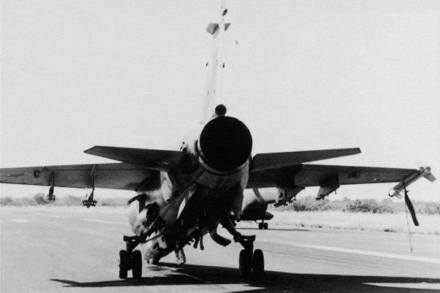
7 June 1980. The South African Air Force Mirage F1AZ 237 of Captain Isak C. du Plessis on the runway at Ruacana, after making an emergency landing when he sustained substantial battle damage.

His SAAF Mirage was part of a 16 ship F1AZ force attacking a SWAPO base near Lubango in Angola, it was damaged by two SA-3 ground to air missiles. Losing hydraulic pressure, the use of the nozzle flaps and the navigation computer he radioed for aid.

Whilst Capt. du Plessis struggled to keep the Mirage airborne, Captain “Budgie” Burgers flying a Impala as Telstar radio relay for the mission realised that the aircraft would not make it back to its base at AFB Ondangwa.  He used his considerable navigation experience in the operational area to redirect Capt. du Plessis, using bearings, to AFB Ruacana – a closer forward air base.

Capt. du Plessis managed to land the stricken aircraft at the Ruacana forward airstrip located in South West Africa (now Namibia) without the use of the nose-wheel whilst performing a flapless landing.

Capt. I.C. du Plessis awarded an Honoris Crux – 2nd type for bravery in the recovery of an irreplaceable stricken aircraft and airmanship.

SADF Ratel IFV taking out a Soviet T-54/55 Tank in close combat

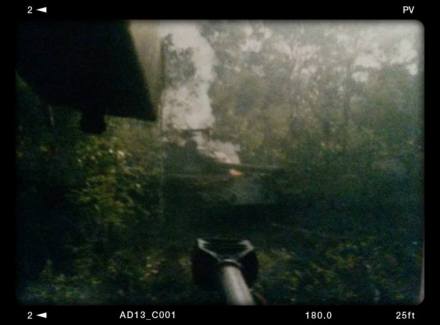
The “cold war” at its height in Angola gets very “hot” – 14 February 1988. Extraordinary and very rare combat photograph of South Africans in combat during the South West African/Angolan Border War. Here a South African Ratel 90 takes out a FAPLA Soviet made T-54/55 tank during Operation Hooper. The Ratel had fired three heat rounds into the tank before it stopped.

To the crew of the much lighter armoured Ratel (it is after all an Infantry Fighting Vehicle IFV not a Tank) this would have been highly nerve racking, especially given the proximity of combat and the thick bush in Southern Angola – which as can be seen in this picture – was very thick, and very close. All kudos to the skill and training of this Ratel’s crew for the steady nerves.

This remarkable photograph was taken by the Ratel’s commander Lt Duncan, call sign 31C.

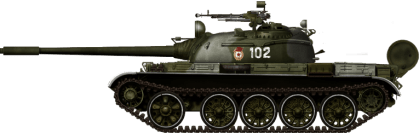
To compare the differences, this is the T-54/55 Tank, the armour is substantial, 80 mm on the sides, 30 mm on the roof and 20 mm on the bottom. The hull front hull 100 mm at 60° angle, turret front 205 mm (rounded).  The main gun is the D-10T 100 mm rifled tank gun. It has a four man crew.  The T54/55 was the main battle tank of the post World War 2 Soviet era for the USSR and its Allies.

T-54B_Red-Guards

T54B

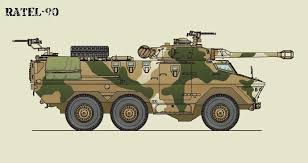
This is a Ratel 90 Infantry Fighting Vehicle, much more lightly armoured – only 20mm, the primary weapon is a 90 mm (3.54 in) GT-2 semi-automatic gun.  It is used primarily in anti-armour, support, and reconnaissance elements within a battalion. The vehicle usually carries a crew of three men, with a seven-man infantry squad.

Unknown

Ratel 90 IFV

Picture copyright, thanks and story content courtesy Sean Buckley.

“Pongos” dare to be buzzed by the SAAF’s best!

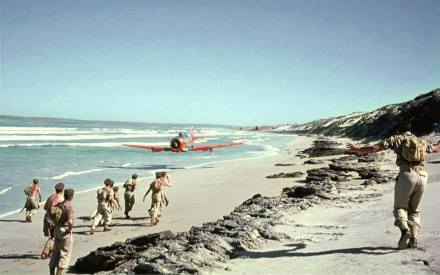
This extremely low flying South African Air Force Harvard was flown as a ‘dare’ to the pilot by the South African ‘pongo’ (army) personnel about to be buzzed.  ‘Pongo’ is a derogatory term used by other arms of the forces, such as the Navy or the Air Force to describe the Army – comes from the British army tradition of saying .. “where the pong (smell) goes – the army goes”.

The pilot of the Harvard is Quentin Mouton, who is currently Chief Pilot of Mango Airlines in South Africa. He said the following about these pictures taken on 2nd October 1964 on a South African aviation forum:

“We were 590 hr pilots at the time and the whole thing was illegal, stupid and needless to say, dangerous. The low flying limit was 200ft (or above, not below).

I would have been court-martialled if the SAAF knew. Too late now.. These pictures were taken 2nd October 64. I was the pilot. The pictures are original and not ‘touched up’.

The ‘Pongos’ were on a route march from Langebaan by the sea to Saldanha.

The previous night in the pub one of them had said: “Julle dink julle kan laag vlieg maar julle sal my nooit laat lê nie” (“You think you can fly low, but you’ll never make me lie down”). Hullo!!!

I went to look for them on the beach in the morning and was alone for the one picture. I was pulling up to avoid them. In the afternoon I had a formation with me and you can see the other aircraft behind me. (piloted by van Zyl, Kempen and Perold)

A friend by the name of Leon Schnetler (one of the pongos) took the pics.

The guy that said “Jy sal my nie laat lê nie” (“You won’t make me lie down”) said afterwards that he was saying to himself as I approached: “Ek sal nie lê nie, ek sal nie lê nie” (“I won’t lie down, I won’t lie down”) and when I had passed he found himself flat on the ground”

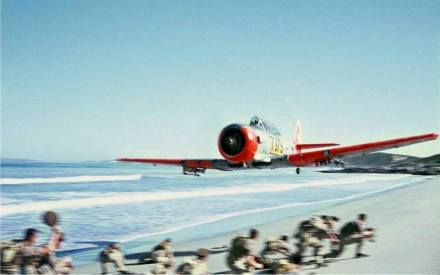
This subsequent photograph shows the “Pongos” hitting the deck and just how low that Harvard is.  Certainly not something that would be approved of today, but it does demonstrate the exemplary flying ability and training of SAAF pilots.

1509915_237922069710866_1366684550_n

Memories from the past.

Quentin Mouton – 23,000 hrs, everything up to B747-400, presently Chief pilot MANGO Airlines and still actively flying the B737-800.

Band of Brothers – 101 Romeo Mikes

This great photograph of Cpl Stephen Bothma captures the grit and camaraderie of a 101 Battalion ‘Romeo Mike’ unit in action somewhere on the Angolan/South West Africa (Namibia) border. The ‘Romeo Mikes’ meant Reaksie Mag (Reaction Force) and these units where designed as long range special forces of the South West African Territorial Force (SWATF) and their purpose was to relentlessly track and then surround insurgents.

By 1981 101 Battalion had been established as a light infantry battalion.  By 1983 at least 2700 men had been recruited and trained, many converted SWAPO insurgents. 101 Battalion translated Police tracking concepts to suit Army operations. These formed two Reaction Force companies: 901 and 903 Special Service Companies. These Companies concentrated on external operations and pursuit of infiltrators. By 1985 101 Battalion fought under its own command instead of being detached to external units.

The Romeo Mike and 101 engagements were intense to say the least.  This Battalion saw an extraordinary amount of combat and it can be put down to the Romeo Mike strategy and tactics to deal with insurgency (long range patrolling).  To give an idea of the intensity of combat 101 Battalions reaction force teams (Romeo Mikes) averaged about 200 “contacts” annually, a “contact” was usually refereed to an armed military skirmish between SWAPO PLAN insurgents and conventional forces.   It can be argued that the vast bulk of the fighting against insurgents on the South West African (Namibian)/Angolan Border was left to the SWATF formations (units including 101 Battalion), Police formations like Koevoet, 32 Battalion and search and destroy missions by SADF Recce (Reconnaissance) and Parabat (Parachute) formations.

Note the parallel two strips on Stephen’s shoulder in the feature picture – this shows his designated rank as a “full” corporal.  The SWATF rank structure insignia differed slightly from the South West African Defence Force (SADF) rank structure who used downward pointing “chevrons” for Non Commissioned Officer (NCO) insignia (i.e. Corporals and Sergeants), as is done in British rank structure.

These are South West African Territorial Force Rank insignia:

These are South Africa Defence Force Rank Insignia

This is because South West Africa was after all seen as a “separate” country to South Africa with its own defence force, therefore it had its own insignia.  However, in realty the equipment, clothing, weapons and even many of the officers and non commissioned officers were supplied by South Africa.

One thing that was clearly very different with all of the South West African formations, and especially 101 Battalion, was the very high degree of racial integration, the ethnic make-up of these Battalions was very reflective of the South West African (SWA) demographic. Division along the lines of race in the military structures did not really exist to the same degree that it did in the South African Defence Force.

Certainly on this level – fighting together as a 101 Romeo Mike unit, any sort of racial differentiation did not exist at all.  There was an old saying on the Border – there is “no Apartheid in a fox hole.”   Veterans in both the SADF and the SWATF will always attest that they do not care for colour as it matters not a jot in a firefight, and regardless of anything else, men in this situation (the hard trials of combat or serving in a combat area) will always bond as brothers.


All 101 images photo copyright Stephen Bothma.  Written by Peter Dickens

A picture is worth a thousand words

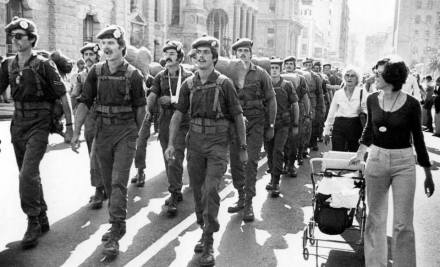
Sometimes, years later, the human story of a simple border war picture carries so much, especially as to the sacrifice families make when a father or brother gets “called up” to fight a war.  This from Lorraine Beer when this photo was published on the South African Legion’s social media.

“This photo is very special to my family, my brother Trevor Leo is on the right has his wife Lynette with his first born, as yet unseen son Craig in the pram and his mother Madeleine behind her.”

Here the Cape Town Highlanders stage a homecoming parade in Darling Street, Cape Town upon their return from the Angolan border operational area on the 17th of March 1976.

What a fantastic memory to have, and what a pure insight into the simple human truths that come along when men and women are called to serve their country  – thank you Lorraine.

Photo copyright, The Argus.

Simonstown Agreement – a thorn in the UN’s position on South Africa

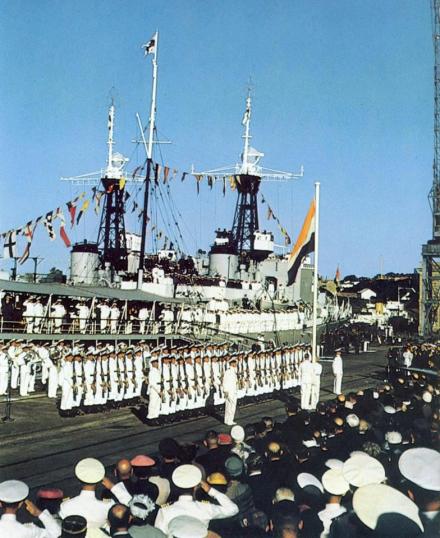
After the signing of The “Simonstown Agreement”, in this colourful ceremony, the Simon’s Town Naval base was handed over by the British to the Union of South Africa on the 2nd April 1957 – after being in British hands since 1813.

The Simonstown Agreement between the United Kingdom and South Africa had been signed less than two years before this ceremony on 30 June 1955. Under the agreement, the Royal Navy gave up its naval base at Simon’s Town, South Africa, and transferred command of the South African Navy to the government of South Africa.

In return, South Africa promised the use of the Simon’s Town base to Royal Navy ships. The agreement also permitted South Africa to buy six anti submarine frigates, ten coastal minesweepers and four seaward defence boats from the UK valued at £18 million over the next eight years. In effect, the agreement was a mutual defence arrangement aimed at protecting sea routes between the UK and the Middle East.

The agreement was controversial, especially with the United Nations, because of South Africa’s policy of Apartheid. The Agreement stood in stark contrast to United Nations resolutions against South Africa as the United Kingdom was still supporting the South African military by way of this quid pro quo agreement.

The United Kingdom terminated the agreement on 16 June 1975. However, ships of the Royal Navy still continued to call periodically at Simon’s Town and other South African ports, although the Royal Navy was not able to use any South African ports by the time the  Falklands War started in 1982.

South Africa was a member of the Commonwealth at the time the agreement was signed (South Africa left the Commonwealth in 1961), so the United Kingdom and South Africa took the position that the agreement was not an international treaty requiring registration with the United Nations under Article 102 of the United Nations Charter and continued regardless of the United Nations’ protests.

A personal perspective 

I often hear this old one from many people “we fought in the First and Second Wold Wars for Britain and in our hour of need they abandoned us” (referring to sanctions and fighting “terrorists”).  Well, that’s not strictly true, the Simonstown Agreement saw to it that South Africa was using British produced Buccaneer Fighter Bombers and Naval vessels at the onset of the Border War and the internal armed insurgency and well into it.  It’s obvious that after 1976 (the Soweto riots) that even this relationship would be strained let alone the implementation of Apartheid Legislation and the withdrawal by the National Party from the British Commonwealth of Nations – which would have made supporting South Africa exceptionally difficult for the United Kingdom in any event – and even then they continued military support well up to, and beyond the point where it became truely internationally impossible to continue to do so.