
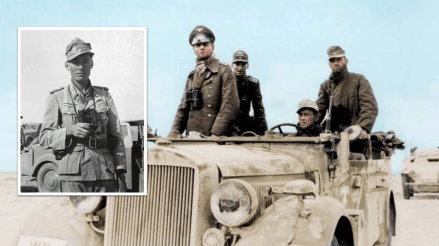
Now this chap poses an interesting figure in South African Military history – his name is Lt. Hellmut von Liepzig (18 July 1921 — 24 October 2016). He was Brandenburger officer (German special forces). He joined the DAK (German Africa Corps) in 1941. Leutnant (Lt) von Liepzig was Field Marshal’s Erwin Rommel’s driver and part of his staff during the DAK’s North Africa campaign.
But here is the interesting bit to South African military history, as Rommel’s forces and South Africa’s forces were very much at odds with one another during this campaign. Lt. Hellmut von Liepzig is the second ’South African’ on Field Marshal’s Erwin Rommel staff, the other is Lt. Heinz Werner Schmidt, Rommel’s aide-de-camp (you can read more on Heinz Werner Schmidt here: Rommel’s aide-de-camp was a South African).
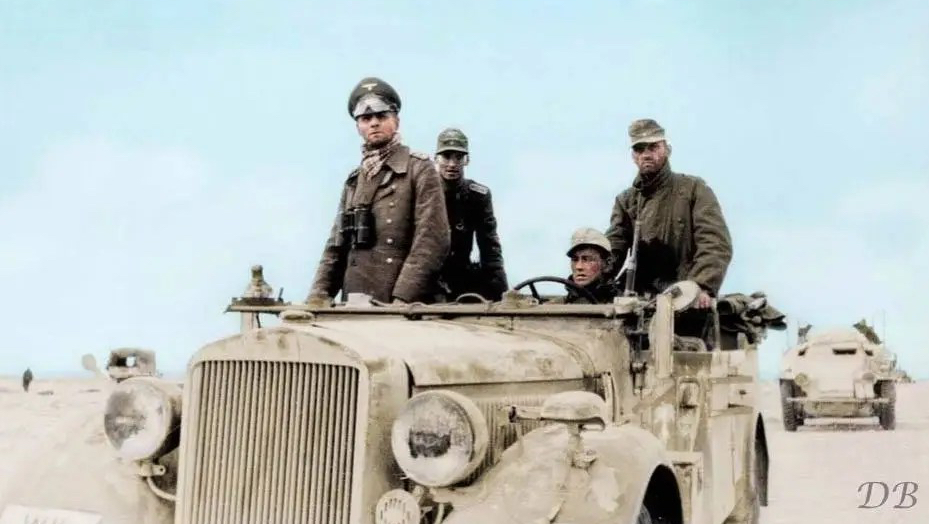
To be fair to Hellmut von Liepzig, he is a South West African and was born in Keetmanshoop to German parents. However, he was born in South West Africa in 1921, after it becomes a South African mandated territory in 1919 – so he’ falls under South Africa’s nationalisation regulations.
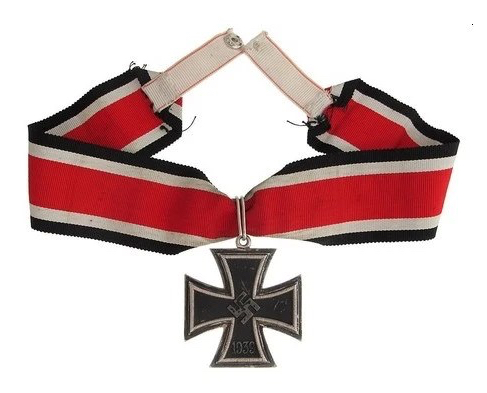
A Knights Cross
Lt. Hellmut von Liepzig is not just a mere driver, he’s a fully competent Wehrmacht officer and lands up commanding his own units, in fact he is a very brave and skilful fighter, he earned a Iron Cross 2nd Class and then 1st Class – and ended up even earning a Knights Cross on the Russian front, his citation for this decoration below says everything about him:
“In April 1945 the Panzergrenadier-Division “Brandenburg” was in action around Bautzen. On the 24.04.1945 Leutnant Leipzig and his Zug were in reserve north of Milkel when they received the alarm. The Soviets had succeeded in breaking into the German frontline around the Milkel castle with strong forces. Recognizing the situation, Leutnant Leipzig led his men into battle around 12:00 on that day and was able to seal off the enemy penetration.
During this counterthrust Leipzig took note of further enemy forces that were approaching the German positions from a streambed to the north. He decided to launch a flank attack into this group. The surprised enemy were defeated in close combat and forced back to their jump off positions with heavy losses. This was in spite of the fact that Leipzig and his men were almost out of ammunition and had to fight mostly with melee weapons. Leipzig himself used his last MPi magazine to eliminate the crew of a knocked out enemy tank.
The result of this battle in the streambed was between 20-30 Soviet dead, for the cost of three wounded from Leipzig’s Zug. More importantly however the crisis in the German frontline in this area had been resolved by the bold counterattack of Leutnant Leipzig and his men. For this act he would be decorated with the Knight’s Cross.”
In 1945 he became a Prisoner of War (POW) under the Soviets – for 10 years. After his release in the 50’s he retired back to his homeland South West Africa to re-start his life.
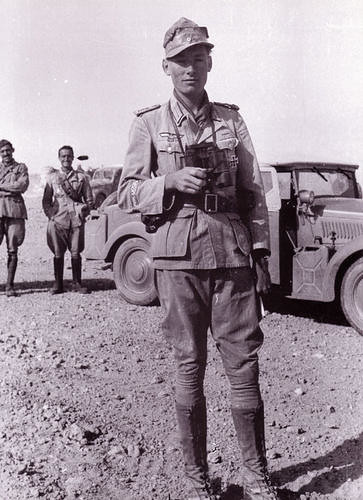
He resided in Namibia for most his life, where he founded the German Cultural Council, the largest organisation of the German-speaking community in Namibia. He chaired the organisation from 1986 to 1997. He also sat on the board of The Association of German School Societies in Namibia (AGDS). He died in Windhoek in 2016 after a long and fulfilling life.
Treason
On the question of treason, having taken up arms against his fellow country-men and their Allies. After the war, a commission called the Barrett Commission was assembled to look into all South Africans and South West African’s who had joined Nazi German forces during the war. The purpose was to find them, test their citizenship and nationality status and hold them to account on charges of treason if in breach. The commission’s findings and lists were completed in late 1947, and withheld pending outcome of the 1948 elections.
When the National Party won the elections in 1948, two Nationalist MP’s – Frans Erasmus and Blackie Swart removed all copies of the Barrett report and all the intelligence files on German collaboration and embargoed them (some of these files have only recently been re-opened). The National Party then issued a general amnesty for all South Africans and South West Africans tried for treason or awaiting sentence and/or interrogation … and in 1948 they all walked free.
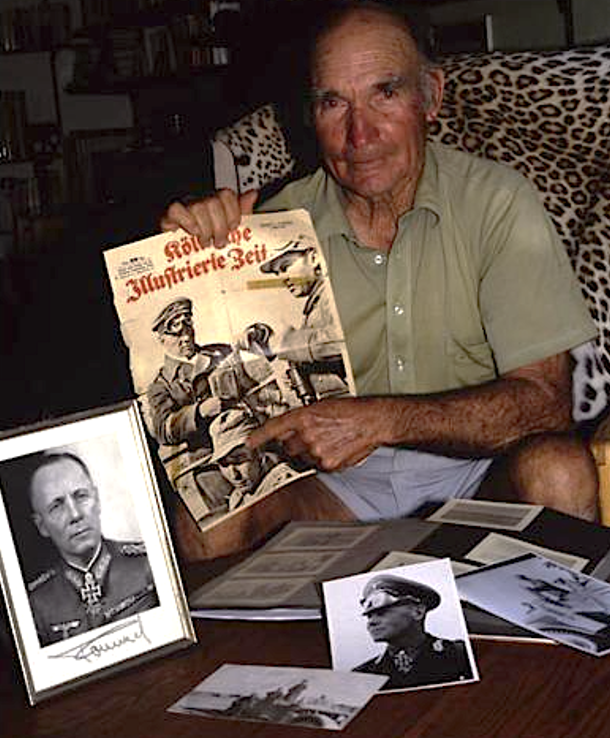
It was into this environment that Hellmut von Liepzig was able to re-settle back in South West Africa and not be held account nor have his nationality status tested. Others like Heinz Werner Schmidt enjoyed the same status, Schmidt would go on and become a well known and highly successful Natal businessman and would publish a book on his time under Rommel as a staff member of his. Hellmut von Liepzig would even be re-united with Rommel’s famous staff vehicle which he drove during the desert campaign in a documentary called “I drove Rommel” screened in 2009:
Written and Researched by Peter Dickens
Related work:
Rommel’s aide-de-camp was a South African
Reference:
Traces of War: On-line website


Really interesting post, thanks very much!
LikeLiked by 1 person
Interesting. A man makes a choice, fights a war against the enemy of choice and loses. Seems unfair that he would be judged for making that choice. I understand the legalities, but as a frontline soldier, who apparently had nothing to do with the mores and excesses of German war crimes, I think a pardon would have been in order. Anyway, they both went on to live useful lives as it was.
JMHO
LikeLiked by 1 person
Norm, most of these cases were tried, they were almost always found guilty of high treason, however across most commonwealth countries these ‘rank and file’ frontline soldiers were given short sentences of a couple of months and a fine.
LikeLiked by 1 person
Herr Von Leipzig (note correct spelling), as we used to call him, farmed up the road from us, close to Otavi in northern Namibia. I remember him from Farmers’ Association meetings as a child. He was quiet and very well respected, a real gentleman. I perceived an aura of discipline around him, even though he was in his late 80s by that time.
I was fortunate to have attended his funeral at the German Evangelical Lutheran Church in Otavi in 2016 during university holidays. It is a privilege to have known him and have had him as part of our farming community.
LikeLike