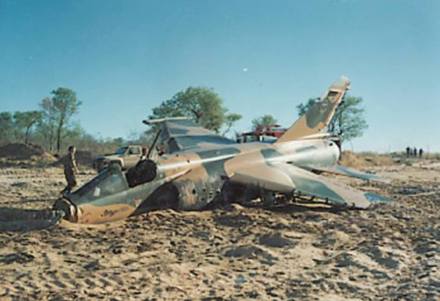
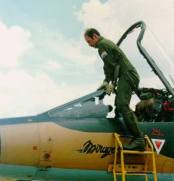
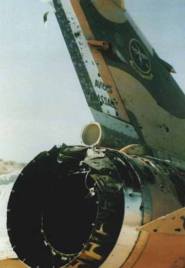
Honouring another true South African hero – this is SAAF pilot Arthur Douglas Piercy’s crashed Mirage, here is his story:
This is my recollection of events leading up to the accident.
“It was approximately 1500B (local) on 27 September 1987 when all hell broke loose. There had been numerous call-outs previously which proved to be nothing at all, so when the hot line started ringing there was very little reaction. However this time the call wasn’t to go on cockpit standby like before, but rather to scramble immediately.
The letter home I was writing went flying as I scrambled to get into the cockpit. In a matter of minutes we were screaming down the runway. I was lucky I was number two in the formation as it was about 45 deg C outside and the take-off was hair raising. How numbers three, four, five and six got airborne I don’t know.
After take-off we remained low level and set heading for the combat zone. It was our intentions to remain low level for as long as possible to avoid being detected by the Angolan radar’s.
The order came to pitch about 10 minutes after take-off and up we soared like homesick angels. We leveled of at about 30 000′ and the mission controller sounded like a horse racing commentator with all the instructions he was giving us to intercept the targets. Next came the order to jettison the drop tanks. This command is a little strange for me, because one never throws the tanks away in training so only when I saw a 1 200 liter tank falling away from the lead aircraft did I know this was no training sortie. It was serious. The adrenaline was flowing.
The next thing I saw was a Mig 23 flying through the formation about 300′ below us. My first reaction was WOW what a great looking aircraft. This was the first time I had seen one in the flesh so to speak. When he started turning only then did I see the second Mig. I called the engagement and started turning. I was doing Mach 1.3 (about 1600 km per hour) and he was going like hell so the turn was so wide I almost lost sight of him.
This where I get a little frustrated. For 10 years I have trained for this day and the majority of the fight I cannot recall. WHY! Anyway the next thing I remember is this Mig coming head on at me from about my one, two o’clock position. Still turning towards him I remember flicking the trigger safety over to the cannon position. If he was going to fly through my sights I was going to squeeze off a few rounds. Unfortunately for me he got off the first shot.
There was a bright orange flash from his left wing and then this incredibly fast telephone pole came hurtling towards me trailing a solid white smoke trail. What more is that it was cork screwing so I was never sure where it was going.
In all our training we were taught to break towards the missile. This could or should create a tracking problem for the missile and cause it to possibly overshoot.
But faced with reality I found it took a lot of willpower to fly towards something I knew was trying to kill me. However, I kept breaking towards it and I watched it corkscrew over my right wing and disappear behind me. I thought it had missed until I I heard a dull thud and felt a light bump on the aircraft. I immediately scanned all the gauges but there was not indication of any damage. When I looked up again the Mig flew over the canopy and disappeared behind me as well.
I immediate informed the leader that I thought I might have been hit and his reaction was: “OK let’s go home.” I did not need a second invitation and I rolled the aircraft onto its back and headed for the ground.
With hindsight it appeared that the whole fight whole fight lasted no more than 60 seconds from the time we pitched until I got the ‘go home’ command.
This is perhaps where I got a fright for the first time. I had not retarded the throttle any and I was rushing at the ground in a vertical dive. When I pulled the stick into my stomach to recover from the dive all that initially happen was the aircraft changed attitude but not direction. The momentum was so great the aircraft carried on descending. Just when I thought that is the end of me, the aircraft bottomed out just above the trees.
With all this rolling and diving I was separated from my leader and had no idea where he could be. Just then I started getting a radar warning audio in my helmet from my 6 o’clock (from behind). Some radar was looking at me. Was it the anti aircraft batteries or was it the Mig? I radioed to the boss that I thought someone was behind me. His reaction was to tell me get as low as I can, as fast as I can and not to turn to look behind me.
My first reaction was – I was so low I was raising a dust cloud like those crazy American Road Runner cartoons. The leader said he could set any dust trails so I eased the aircraft lower. The radio alt read 50′ and the speed approximate 730-740 knots.
At this stage I was beginning to think that I’d over-reacted and that I might not have been hit. Had I got out of the fight too early? The aircraft was performing as if there was nothing wrong with it. No vibrations and no handling difficulties. Oh well tomorrow I’ll be back I thought.
It was now about five minutes later and half-way home when the first warning light flashed on. EP pump failure. Instinct must have taken over because I thought my first reaction was to call the boss and tell him I have a failure. He pulled out his emergency check list, and started reading the failure procedures for me. All the necessary switches had be set. I don’t remember doing them.
While he was reading the EP pump failure I got the second failure, a right hand fuel pump failure. This is not too serious under normal operating conditions as the engine can gravity feed. While the boss was reading the fuel pump failure procedure and I was confirming that they were done the following light on the warning panel appeared. A HYD 2 system failure.
This caused a little concern initially as the aircraft’s main systems use hydraulic fluid. Undercarriage, flaps, controls, airbrakes and of course wheel brakes. After a quick and careful analysis of the situation I relaxed a little. The HYD 2 system is basically a standby system for the main HYD 1 system. All I had really lost with the HYD 2 failure was the nose-wheel steering. It could have been worse.
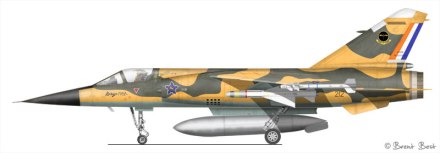
Artwork of the incident by Ryno Cilliers
By now we were far enough away from the combat zone and the dangers associated with it, so I started to climb to try and conserve fuel.
The next thing that happened is that I was getting an audio warning but no visual warning when I looked at the panel. The hours of simulator training came into action – a pending OIL failure. This concerned me a little more than the rest of them. There are two critical components that use oil. The throttle and the nozzle flaps on the engine.
Flying the aircraft on the emergency throttle (electrically operated) is not easy. The throttle is very slow and unresponsive.
At this time the leader pulled in next to me to inspect for any damage. He reported fuel leaking out the aircraft and the drag chute was missing. As he said that the 500 liter warning light came on. The fuel gauges still read 1700 liters so now which one is right. A little more pressure was applied to little old me.
Landing a perfectly serviceable aircraft on a 7500′ runway requires some work. I was going to have to do it on emergency throttle and without a drag chute – a task I felt I could handle.
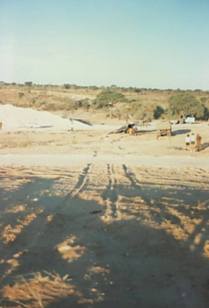
I planned to land the aircraft short on a new stretch of runway that was being constructed. This would give me an additional 500′ to play with on the landing roll. I got her down at the threshold but when I applied the brakes the only thing that happened was the expression on my face changed. I pulled the nose higher so that there would be some form of aerodynamic braking but this did not help. About a 1500′ from the end of the runway I applied the emergency hand brake with little effect. The arrester bed or sand pit at the end of the runway was my next hope of stopping this machine.
The aircraft went through the arrester bed like a hot knife through butter. No braking effect whatsoever. The next ‘obstacle’ was the security fence.
Where does ones sense of humor come from in at a time like this? I was about to go AWOL (absent without leave) with a multimillion rand aircraft. The board of enquiry are probably going to ask me who authorized this illegal departure from the security area. At the same time I was scared I was going to drown in the river just beyond the fence. My seat has a land survival pack in it and not an inflatable dingy!!
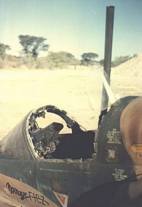
When I went through the fence I remember putting my hands in front of my face. It was at this precise moment that there was a loud bang. I remember smelling cordite or gunpowder and then everything went black. I felt the rush of wind over my face and the feeling of silk on my cheek. With hindsight I realized that when the ejection seat went off, my helmet must have come off as well and the silk I felt on the cheek was the ejection seat’s stabilizing parachute and not my personal parachute.
When I regained my senses I was lying in the sand on my right hand side. The first thing I attempted to do was to roll onto my back and when I pushed on the sand with my left arm there was this incredible piercing pain in my arm. The left arm was broken just above the elbow. I then looked down at my legs to see why they had not moved and I could not feel them at all. I realized that the ejection seat was still strapped to my back and thought that this might have something to do with the lack of movement in my legs. I had no idea that the neck was dislocated.
I then started looking around and the first thing I saw was that I was lying directly in front of my aircraft. Here was a F1 Mirage pointing straight at me. The problem wasn’t that the aircraft was pointing at me but rather that there was a fire just behind the left air intake. I know there is a fuel tank there but even worse was the fact that the ammo bins (with over a hundred rounds of 30mm ammunition) was just under the fire. If those rounds started going off I was in the line of fire.
When the fire brigade arrived on the scene they naturally came to my aid first. My immediate advice to them was that no one touches me until a doctor pitches up and that they immediately tend to the fire on the aircraft. There is no way that I want to be shot at by my own aircraft.
When the doctors arrived with the ambulance my first concern was they treat my arm for pain, then they can worry about the rest. Even after 2 morphine injections there was still not relief from the pain. I was later told that the adrenaline in the body was so high that the morphine had no effect.
Just before they pushed me into the back of the ambulance I passed out only to wake up in 1 Military Hospital in Pretoria 10 days later.
It was another seven months before I left the hospital with a C6, C7 fracture of the neck and permanently confined to using a wheelchair”.
Posted on behalf of Arthur Douglas Piercy, image copyrights – Arthur Douglas Piercy. Artwork image copyright Ryno Cilliers
“Hou my vas korporaal’ (hold me tight Corporal) by James Phillips’s alter ego ‘Bernaldus Niemand’ released in 1986. Most military veterans will remember this song with a wry smile.
James grew up in Springs and this song of his ‘Hou my vas Korporaal’ was a poke at South African military conscription, and was quickly taken up and enjoyed by SADF National Servicemen at the time who enjoyed its satirical military humour (James did complete his two year ‘national service’ military call-up obligation and was a ‘veteran’ in his own right).
Equally ironic, this song now is heralded as part of the Afrikaans rock revolution in the late 80’s which shook the foundations of the Nationalist culture as the Afrikaner youth started to demand political change via this music movement. ‘Hou my vas Korporaal’ is, and remains, more of an ‘Anti-Apartheid’ statement than a nostalgic look at conscripted ‘whites only’ military service.
A man of many musical incarnations, from early Springs band Corporal Punishment and short-lived summer holiday band Illegal Gathering, through his turn as satirical Afrikaans alter-ego Bernoldus Niemand, to his time as a Lurcher.
In 1994 Phillips stood in South Africa’s first fully democratic election in 1994 as a candidate for the very eccentric “Soccer Party”. The Party had some odd concepts, like a policy which said that it could not criticise another party, and one of its chief causes was the legalisation of Marijuana.
His life ended early when he died of injuries sustained in a motorcar accident, just outside of Grahamstown, where he’d been doing a series of solo concerts at the National Arts Festival.
He died never having gained the recognition from the public over an important body of work. In his memorial concert a few weeks after his death, Vusi Mahlasela, Johnny Clegg, David Kramer, Lesego Rampolokeng with the Kalahari Surfers, Johannes Kerkorrel and others gathered to pay tribute to James’ influence as an artist. And yet to the majority of South Africans he remains completely unknown.
Here is the full song, pinned by a veteran having a nostalgic look back at conscription in the SADF on YouTube, copyright Shifty Records. This video carries in it images which tell the story with the same irony and sarcasm that James Philips intended in his song.
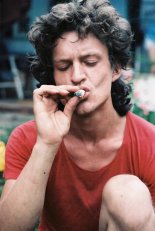
Image of the singles album cover courtesy SAHA – the South African History Association. Mast image photo of James Phillips by John Hogg.
Sometimes someone sends you something priceless. This is a letter written in the Area of Operations in 1982, during the SWA/Angola Border War. It is written by Angelo Angelides to his son, Ryan who was just 3 years old at the time.
In it he expresses his reasons for fighting in a manner only a small 3 year old can try to understand. It also shows the deep sense of anguish and fore longing caused by conscripts called up to duty away from their families.
9 Nov 1982
Dear Ryan
Thanks for your letter son with all squighs and circles I got the message. You love me. Well son the same goes for you I love and miss you and it is not long now before I am home again.
Don’t forget that I am up here today for your tomorrow.
Well your Mom say’s you are naughty. Don’t worry I am not cross with you because I love you. Don’t cry for your Dad because I am home soon.
Lots of Love
Angelo wrote it whilst he was a member of the Transvaal Scottish and off fighting in Angola at the time.
Angelo Angelides (left with beard) and his brother Basil, serving with him at the same time – pictured 1978
My deepest thanks to Ryan Angelides for sharing this priceless memory.
The Battle of Cassinga was the very first South African airborne attack, it was also the first full-scale airborne attack in Southern Africa. The target was a South West African People’s Organisation (SWAPO) military base at the former town of Cassinga in Angola on 4 May 1978. As it was a ‘first’ in many respects it would also carry with it many learnings and many controversies.
Upfront let’s dispel with the untruths and challenge the prevailing myths and truths. The Battle of Cassinga is today mourned in Namibia as a public holiday, politically it is referenced as an Apartheid “massacre” of ‘innocents’ – the deliberate targeting of refugees and civilians in a refugee camp. However, this is a political narrative to gain political currency and simply put this is a myth, it is an untruth.
That civilians were killed in the cross fire during the battle, unfortunately that is truth, that a large number of civilians died at Cassinga, that is also a truth. That civilians are very often the casualties of war, any war the world over, this is also unfortunately a prevailing truth.
Also, a truth is that there are extensive records and photographs covering the SADF’s planning and actions around the operation (declassified since the change of government in 1994), no SWAPO records exist at all. The only other things that exist is the photographic evidence of a mass grave, which was re-opened after the battle for journalists to take photos, photos of the camp taken by journalists prior to the attack showing a military recruitment base with a large component of civilians in support of it and photos taken by the SADF Commanding Officer on the ground – Colonel Lewis Gerber, from the Camp Commander’s desk which show a SWAPO recruitment operation at Cassinga.
That Cassinga was a military base housing PLAN (SWAPO military personnel) there is absolutely no doubt, and therefore it was a legitimate SADF military target, that is also a truth. That there were misjudgments in planning and execution, like any military operation anywhere, this is also a truth. That the definition of what type of military base it was i.e. a recruitment depot, that definition was unclear to the SADF at the time of striking it and that is also an unfortunate truth.
So let’s have a look at how this Operation, Operation Reindeer, stacks up as a military battle, and lets examine how civilians came into the cross-fire.
A Military base or Refugee Camp?
Aside from the overwhelming volume of Intelligence gathered by the SADF prior to the attack pointing to the fact it was a legitimate military base and target, the case was taken to The Truth and Reconciliation Commission (TRC) in the 1990’s. The TRC themselves challenged all sides of the story, and it’s the TRC records which found Cassinga base to be the following:
A SWAPO (PLAN) unit posted at Cassinga consisted of approximately 300 male and female PLAN cadres. The military section of Cassinga was easily partitioned from the non-military sections. The overall commander of PLAN in town was Dimo Amaambo, who responsible for the co-ordination of all PLAN actions in Southern Angola, including incursions into South West Africa/Namibia. A headquarters such as Cassinga was second in importance only to Lubango, which was the overall SWAPO military headquarters in Angola. Aside from the system of trenches and bunkers, defensive equipment included two ZPU 14.5 mm anti-aircraft guns, one ZU-23-2 23 mm gun, and around one or two ZSU 12.7 mm guns. These were all capable of being used in a ground attack role.
The simple fact is that the SADF encountered trained and armed SWAPO (PLAN) combatants, large AA guns, defensive structures, SWAPO military commanders and depots full of weapons and ammunition of all sizes. This was a military base, but what sort of base?
So where does this argument of ‘refugee’ and ‘refugee transit camp’ come from?
According to one source, in the weeks preceding the attack, civilian numbers were growing rapidly inside Cassinga. This build up consisted of a number Namibians going into ‘exile’ to join SWAPO in the months preceding the attack and the intake in this camp of these civilian ‘exiles’ joining SWAPO was particularly high. It was normative at the time that a civilian recruit joining SWAPO/PLAN as a combatant often went into ‘exile’ with his or her family (in whole or in part) in support.
A truck usually picked up these SWAPO/PLAN recruits and their civilian entourage at Cassinga and took them onward to their training bases in Jamba and Lubango. Cassinga operated as a Recruiting Depot and a Holding Depot to verify recruits. This truck to take them to their training bases did not arrive in the preceding weeks before the attack . The result was a bottleneck at Cassinga of people (Recruits, Civilians and Armed Soldiers) who under normal circumstances would have left the camp within days.
Another source agues that the civilians in the camp were made up of both soldier’s family members and dependents and some 200 civilians ‘abducted’ by SWAPO in northern South West Africa a few months earlier, and brought to Cassinga in a bid to convince UN aid agencies that they needed food and funding, which they duly received.
The ‘abduction’ of civilians for ‘re-training’, especially children, was a tactic to build numbers and used extensively by ‘liberation movements’ all over the Southern Africa in the late 70’s. The ‘liberation movements’ on the other hand argue that these were willing exiles fighting the cause or that it was necessary to deconstruct tribal people of their colonial indoctrination.
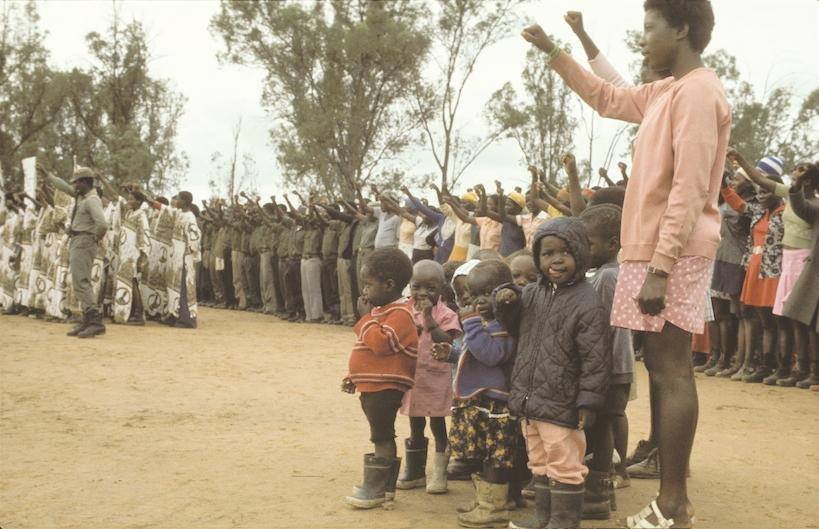
What is also telling as to the military nature of the camp and the indoctrination into the military of incoming ‘exiles’ comes from SWAPO photographic and witness evidence of how they conducted the daily parade and roll call. It was held on a parade ground near the SWAPO (PLAN) offices. This source recalls that all would assemble in the groups in which they had arrived at Cassinga, each of which was organised according to ‘sections’ and ‘platoons’ with the earliest arrivals in Cassinga queuing first and the most recent queuing last. They would march on, the SWAPO Commanders would march on last, after liberation songs were sung a roll call would be taken, the commanders then handed out the daily tasks and finally dismissed the parade. It is reasonable to assume from this account that ‘exiles’ entering the camp where in fact ‘military recruits’ and treated as such.
Photo clearly showing the daily military parade at Cassinga with the mix of combatants and non combatants as well as dependents and children
So, whichever way it’s looked at, there was a large military camp and there was a large contingent of newly arrived Namibian civilians at Cassinga (how many were SWAPO ‘exiles’ or PLAN ‘new recruits’ will never be known) and a very large number of family members and dependents of the PLAN combatants at the base. That the military planners in the SADF had accounted for the unusual ramp up in civilians numbers of ‘exiles’ just prior to the attack, the sad truth and answer is no, they were not really aware of it. In fact ‘Intel’ for the SADF pointed to a PLAN combatant base, when it should really have been pointing to a PLAN military recruitment depot complete with a civilian and untrained recruit ensemble.
Errors in Planning
In the truth that errors occurred, some started in the planning phase. Reconnaissance air-photo interpreters of the Cassinga military base put the wrong scale on some of the maps that were used in the planning, despite the altimeter readings being clearly visible in the original reconnaissance photographs.
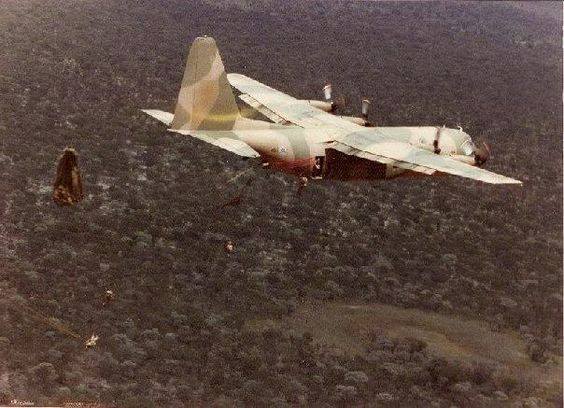
Consequently, the Air-Force planners overestimated the size of the Drop Zone (DZ) believing it was long and wide enough to drop the paratroopers, when in fact it wasn’t. This ‘scale error’ also mis-positioned the ‘Warning’ and ‘Drop’ points on the run-in to the drop. Compounding this error, the pilot of the lead aircraft was momentarily distracted by the effects of the bombing, and issued the ‘jump’ signal a few seconds late. The net effect was that many SADF paratroopers overshot their intended Drop Zones, many landing beyond the river – and some in it.
The SADF also underestimated the Cuban military presence in the area, In briefing the strike aircrew, the SAAF Chief of Staff Intelligence was specific that there was no known large Cuban military formation within 130 km of the Cassinga base. They had intelligence that pointed to Cuban armour and that some 144 personnel was present at the village Techamutete 15 km south of Cassinga. To this end they planned communication jamming (which proved a wise decision in the end as it resulted in a delay) and a detachment was earmarked to ambush any Cuban armour on the road from Techamutete.
However unknown to the SADF planners was that this force was somewhat bigger than anticipated, in fact there was a well sized Cuban mechanised battalion at Techamutete consisting of at least 4 T-34 tanks, 17 BTR-152 armoured personnel carriers, 7 trucks and 4 anti-aircraft guns, accompanied by around 400 Cuban troops.
The Devastating Opening Bombing Run
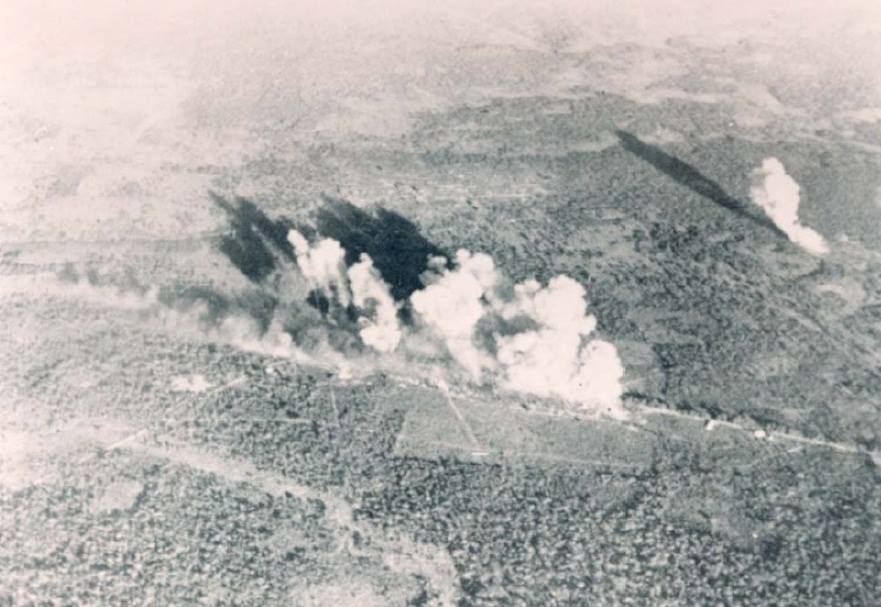
The attack opened with a SAAF Canberra bombers and SAAF Buccaneer bombers hitting the target. Timed for 08:00 to coincide with SWAPO’s daily roll-call on the parade ground, most of the people in the camp were assembled in the open when the Canberras initiated their low-level bomb run. This was followed by the Buccaneers and then SAAF Mirage IIIs. Fragmentation and conventional 1000lb bombs hit a zone of some 800 metres by 500 metres, causing most of SWAPO’s and civilian casualties and ‘hard target’ building destruction on the day.
SAAF Canberra bomb run on Cassinga
The bombing run, according to the SADF Paratroop Commanders when they go to the base, did almost all of the damage. Colonel Gerber was to report on a disturbing sight of what he thought were many old-school brown ‘cardboard’ school suitcases littering the drop zone, on closer inspection these turned out to be bodies whose limbs and heads had been severed by the intensity of the cluster bomb shrapnel and sonic blasts, the lone torsos looking like those old suitcases.
The Shambolic Drop
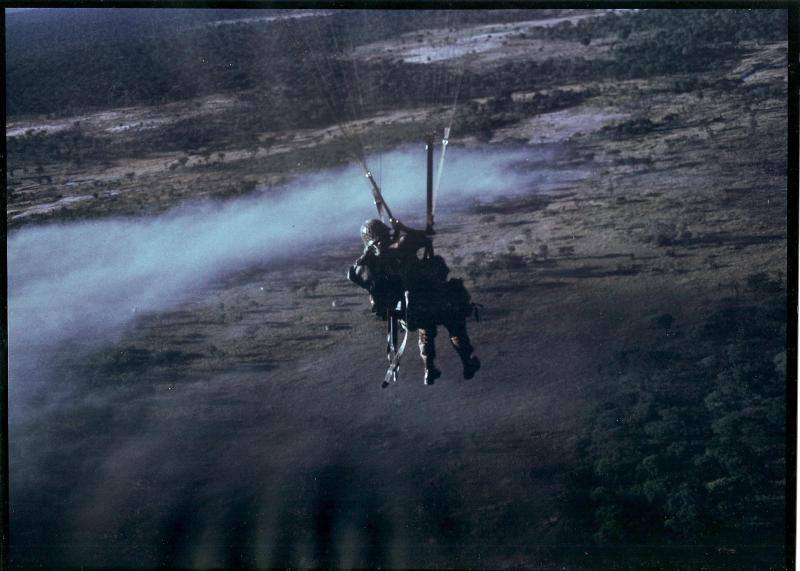
At 08:04, 367 SADF ‘Parabats’ (Paratroopers) were dropped from 6 aircraft. Due to the reconnaissance photo scaling error, and obscured pilot visibility of the tracking and distance markers (caused by smoke from the bombing) the drop was a shambles. Nearly all paratroopers did not land on the intended target zone, many been scattered into positions that put them into serious danger. Some dropped right on top of the enemy, some landed kilometres away from their intended positions, some in trees, some into tall maize fields, others into the river and some on the wrong bank of the river.
The resultant confusion caused numerous delays, ruining the schedule of the ‘drop-to-contact’ plan, and much of the advantage of surprise. As a result a number of top PLAN commanders, including Dimo Amaambo and Greenwell Matongo (two principal targets of the attack) escaped (Amaambo later became the first head of the Namibian Defence Force in 1990).
The loss of the element of surprise, also allowed the surviving SWAPO (PLAN) soldiers from the bombing ample time to set themselves up in the extensive trench and bunker system that surrounded the camp. Instead of the short, sharp skirmish planned, the attack was now going to be an extended affair. The camp defenders brought their anti-aircraft guns to bear on the SADF ‘Parabats’ and onto the aircraft, these powerful guns were not all silenced for some hours to come.
Regrouping and on the Attack
After regrouping the ‘Parabat’ companies commenced the assault, training and professionalism of officers and men on the ground played a key role in consolidating and adapting their initial tasks to the changed circumstances. Instead of attacking eastwards as initially planned, the two companies attacked the base in a northerly direction.
Initially, they encountered very little resistance, though this changed dramatically once sections of paratroopers neared the centre of the base. Heavy sniper fire was directed at the paratroopers from a number of trees inside the base, they were subjected to B-10 Recoilless Rifle fire, and some PLAN soldiers had regrouped, using houses as cover from which to fire at the SADF paratroopers, critically wounding two paratroopers.
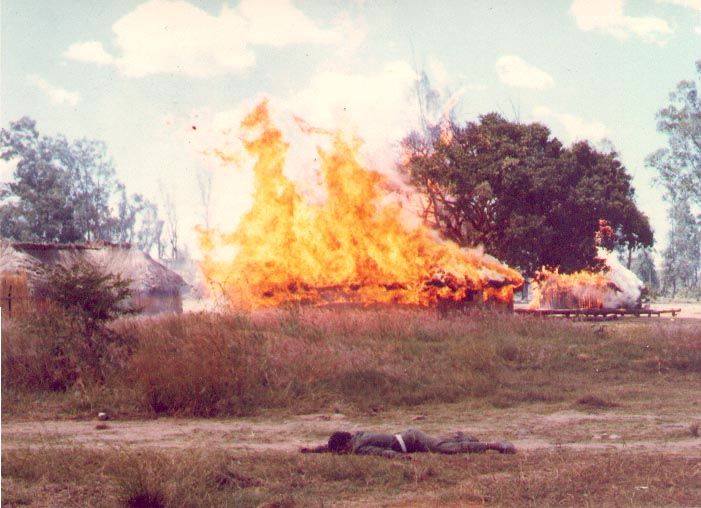
The attack on Cassinga from the ground, note the dead SWAPO combatant in Cuban/Soviet issue green uniform in the foreground
However, the paratroopers faced their greatest challenge when they were fired upon by a number of multi-barrel anti-aircraft guns now been used in the ground role. This brought both assault companies to a complete halt. A SAAF Buccaneer tasked with Close Air Support could not conduct a strike on the guns for fear of hitting the paratroopers close by.
Colonel Breytenbach then ordered the commander of D-Company to take some men and work up towards the guns by attacking the trenches to the west of Cassinga. He also ordered the mortar platoon to begin attacking the guns. In reality according to Colonel Gerber, these particular guns pinned down Colonel Breytenbach and his men for some time, literally preventing them from taking any significant role until this gun was ultimately silenced toward the end of the battle. Colonel Gerber’s section, having reset their assault, advanced from the south and met little resistance until in the town itself and here they were able to quickly over-power the defenders.
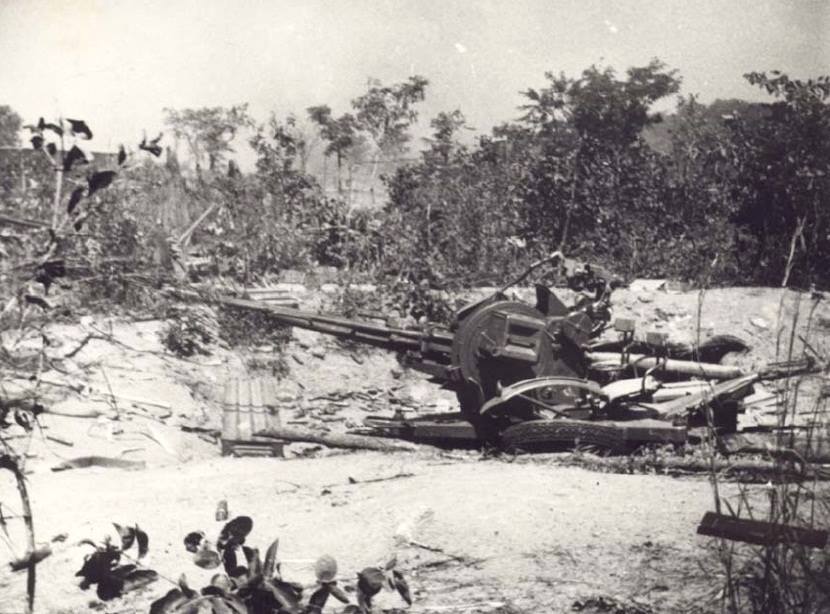
Silenced Soviet 23mm ZU-23-2 Anti-Aircraft Gun at Cassinga
Civilians in the Trenches
Situated all around Cassinga was a network of trenches, these had been identified in the air photography intelligence before the battle, this network was complex, expertly laid out and very extensive and its one of the reasons why SADF planners believed the Cassinga to be a well defended and significant military base.
Colonel Gerber in his sections advance on Cassinga did not encounter any significant resistance from the trench network facing him, although he did notice some civilian dead in the trenches which he concluded were people trying to take cover in the tenches during the bombing run or mortally wounded people in the bomb run who had may their way to the trenches.
Different story for D-Company’s assault on the trench system facing them, as these had been occupied by PLAN combatants opening fire on them. Upon entering the trenches, the Paratroopers from D-Company were surprised to find a number of civilians in them in and amongst the combatant SWAPO (PLAN) fighters.
At the TRC hearings, the witness accounts from the paratroopers involved maintain that these civilians were being used as human shields by the SWAPO combatants taking cover inside the trenches. Accounts from SWAPO maintain that the civilians of Cassinga had taken cover in the trenches to protect themselves from the bombing and shooting.
In either event, the fact remains that civilians had found themselves in the trench network and were mixed in with SWAPO fighters who immediately opened fire on the paratroopers, leading the paratroopers to enter what they described later as a mode of “kill or be killed”, in which preventing the deaths of the civilians in the trenches became impossible.
The paratroopers moved successfully through all the trenches and strong points up to the guns and after the fall of the guns, all major resistance in Cassinga ended.
Mopping up and extraction
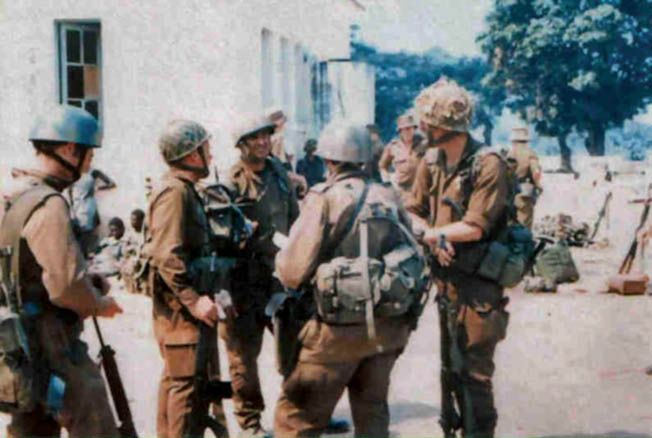
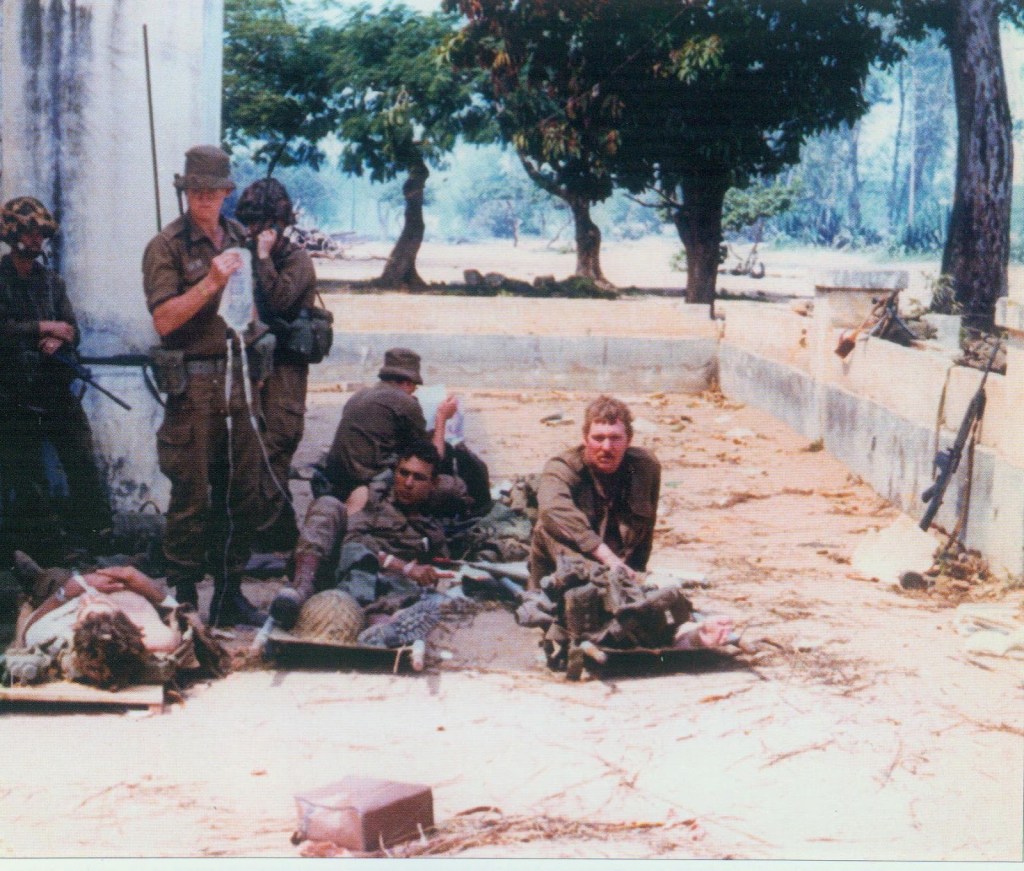
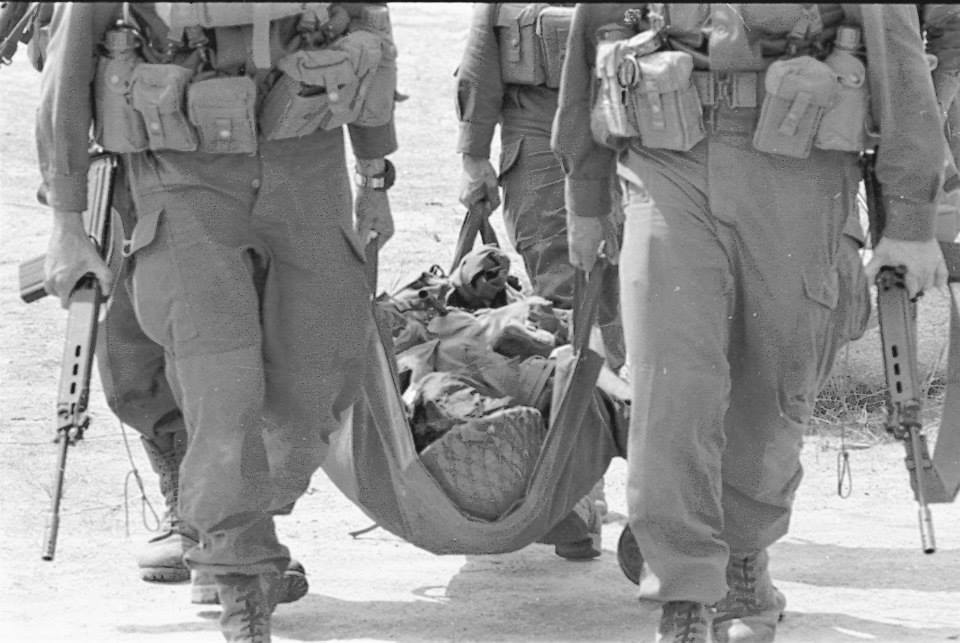
With hostilities over in Cassinga, the paratroopers immediately set up a HQ and Aid-Post next to the SWAPO hospital, and began treating the worst of the injured.
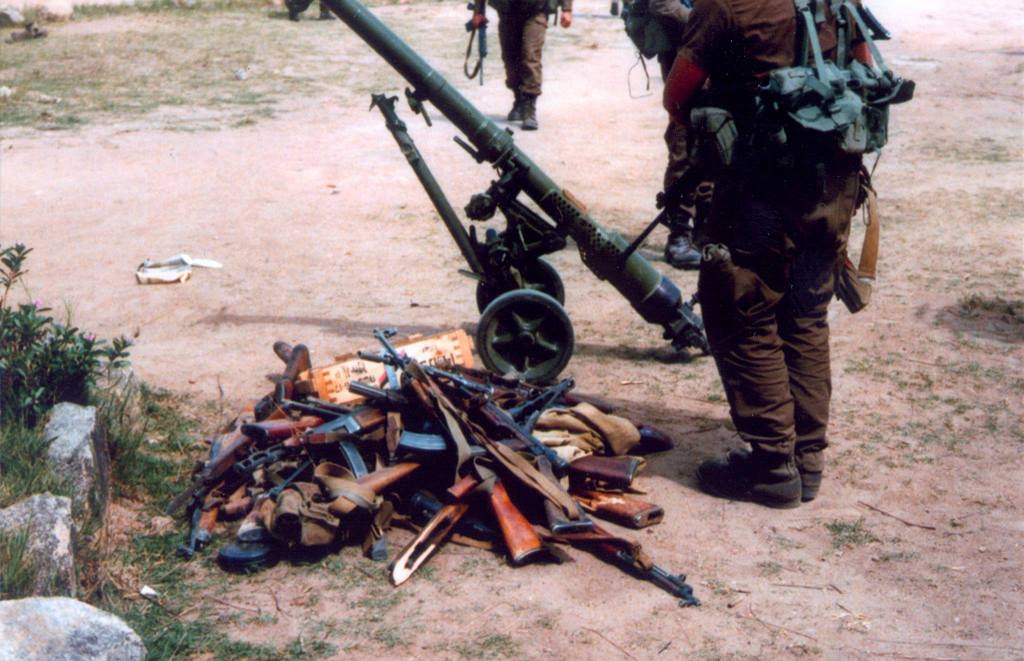
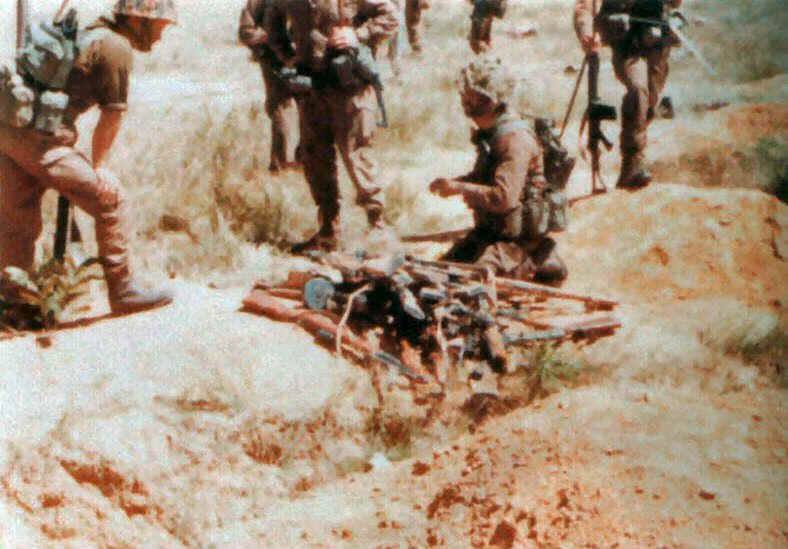
In ‘mopping up’ in Cassinga the paratroopers recovered a relatively small number of mainly Soviet weapons, these included a B-10 Recoilless Rifle, AK-47, AKM and SKS Assault rifles and carbines, boxes of RGD-5, RG-42 and F1 Hand Grenades, some TM-57 Anti-Tank Mines, RPG-7 Anti-Tank Rockets and 82mm B-10 recoilless Rockets still in their tin transit canisters. Uniforms (Soviet and East Bloc supplied) and combat boots, AK-47 and AKM Bayonets and some crates of AK-47 Ammunition were also recovered. However, as can be seen in these photos of the PLAN arms recovered, the quantity was small.
Of extreme interest in the mopping up operations, on approaching the head quarters building, they found some children hiding and were able to get them to safety. It was a small facility, a room really, and once secured the desk of the Cassinga camp commandant was searched and documents and photos of camp life extracted.
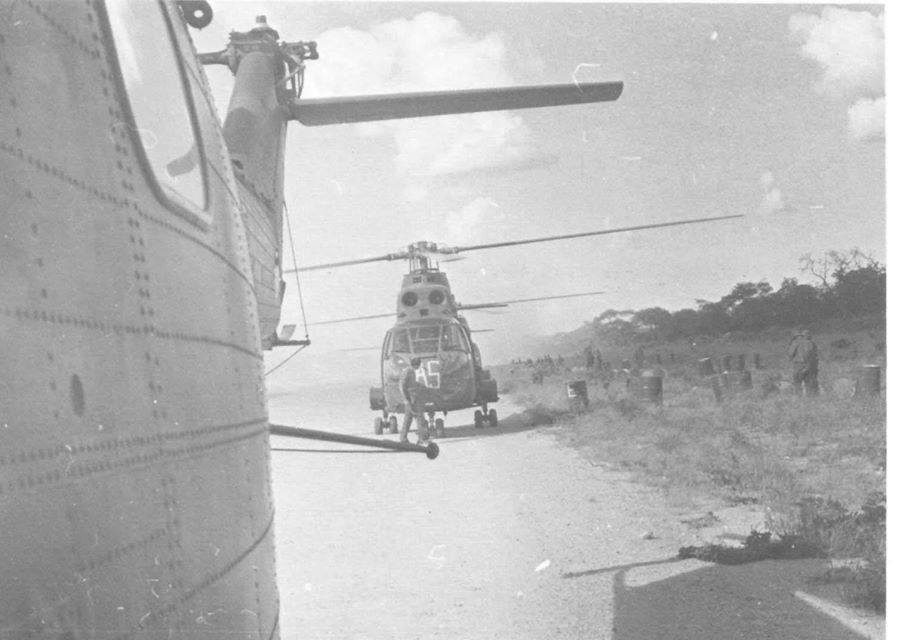
The first wave of SAAF Puma helicopters extracted half the ‘Parabats’, leaving the remainder to continue to mop up while waiting to be evacuated themselves. Now at half their strength, the Parabats were warned by a circling SAAF Buccaneer in Close Air Support (CAS) that a column of twenty armored vehicles was approaching the base . The Cuban mechanised battalion from nearby Techamutete was now on the counter attack.
The Cuban Counter Attack
During the air drop attack phase, D-Company had already dispatched the anti-tank platoon to lay a tank ambush on the road to Techamutete. The lead Cuban Soviet era T-34 tank was destroyed by one of the anti-tank mines, while the paratroopers destroyed four of the BTR-152s using their RPG-7s. They also killed approximately 40 of the Cuban troops before making their ‘fighting retreat’ back along the road towards the Helicopter Landing Zone.
Mirage III destroying a vehicle in the Cuban column
This was a grave threat to the few remaining Parabats. Their LZ’s came under tank fire and APCs full of Cubans threatened to swamp the remaining Parabats. Support was called in to rescue the beleaguered paratroopers, a Buccaneer and two Mirage III’s appeared, the Mirage III’s destroying a further 10 BTR 152s before running low on fuel and returning to base.
The sole Buccaneer remained and destroyed at least two tanks, an anti-aircraft gun (which as firing at it) and a number of other vehicles.
The Buccaneer ran out of ammunition at this point, and this coincided with the arrival of the 17 helicopters to extract the remaining paratroopers in the second wave. The Cuban armoured column then advanced on the helicopter’s landing zone. In a desperate attempt to prevent the Cuban tanks from firing at the vulnerable helicopters and the assembling South African troops waiting to be picked up, the Buccaneer pilot dived his aircraft dangerously low, nearly hitting trees as he flew close over the top of the tanks in mock attacks. This brave and dangerous action by the pilot disorientated the Cuban tank crews and forced them to break off their developing attack on the paratrooper’s’ positions.
The destruction of the Cuban column
Ten minutes after the last of the SAAF helicopters took off, two of the Puma helicopters were directed to return to Cassinga, as it was feared that some of the paratroopers might have been left behind. They spotted a group of people huddled together, but closer inspection revealed that they were the 40 prisoners of war who had been mistakenly left behind. No more paratroopers were found.
In the mid afternoon SAAF Mirage IIIs returned to Cassinga, and once again strafed the Cuban vehicles that were still on the road. About a kilometre south of Cassinga, another Buccaneer attacked another column of vehicles, coming under heavy anti-aircraft fire in the process.
In the late afternoon SAAF Buccaneers and Mirages surprised the Cubans moving through the ruins and destroyed more Cuban T-34 tanks and anti-aircraft guns.
The result was that by nightfall nearly the entire Cuban battalion had been destroyed, accounting for Cuba’s biggest single-day casualty rate during its military involvement in Angola up to that point.
A complete Angolan tank brigade relief force, arriving at dusk, was too late to have any impact and found only scenes of destruction at what had once been Cassinga.
Aftermath
According to an Angolan government white paper, the official toll of the Cassinga Raid was a total of 624 dead and 611 injured comprising civilians as well as combatants. Among the dead were 167 women and 298 teenagers and children. Since many of the combatants were female or teenagers and many combatants did not wear uniforms, the exact number of civilians among the dead could not be established.
The South Africans declared the attack on Cassinga to be a military success, and it set the SADF strategy for dealing with SWAPO bases in Angola for the next 10 years (although in future, the larger strikes were primarily armoured based not airbourne). A SWAPO propaganda campaign on the other hand labelled the attack on Cassinga as a civilian massacre.
The position of SWAPO and all the organizations and governments that were supporting it by 1978 benefited from the moral outrage incited by a ‘surprise attack’ on a ‘refugee camp.’ In the aftermath of the raid, SWAPO received unprecedented support in the form of humanitarian aid sent to it from sympathetic governments.
It was however clear to the South Africans that Cassinga was a military facility rather than essentially a refugee camp or refugee transit facility, as SWAPO claimed. They had the proof.
The Mass Grave Propaganda Campaign
Although a military success, politically it was a disaster for the National Party government of South Africa. SWAPO and Angola press statements described the base as a refugee camp and claimed the SADF had slaughtered 600 defenceless refugees.
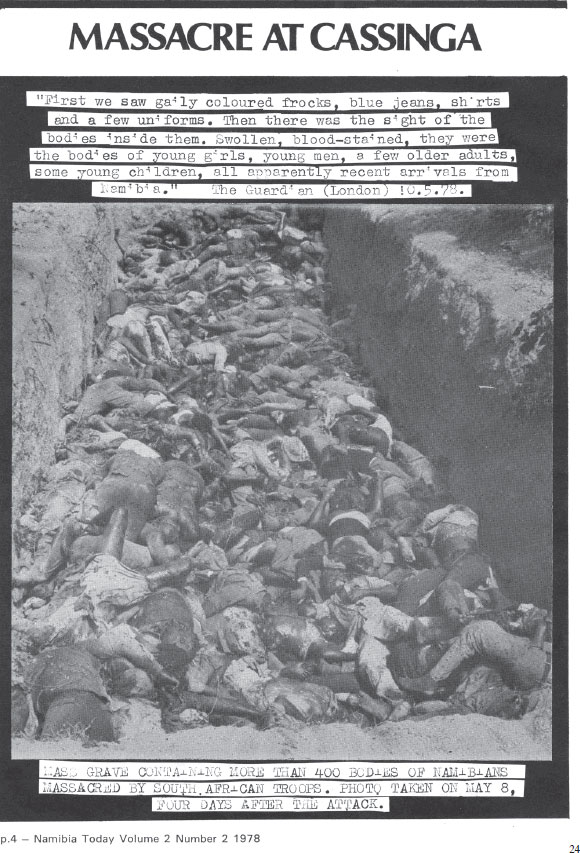
The bodies were buried in two mass graves. Pictures of one of the mass graves (the larger one) was used extensively for propaganda purposes, and for many people these pictures became the imagery and symbology associated with Cassinga.
Taken from the grave’s edge, the mass grave photos are close enough to the corpses for individual bodies, and in some cases the clothing, wounds and flies covering them, to be discernible. The photos demand an emotional reaction, the photographs are set in such a way as to look like a WW2 styled premeditated massacre, appearing as if the SADF had dug a grave and piled in the ‘civilian’ bodies.
SWAPO propaganda in the weeks following the attack used “text” on posters to draw attention to the ‘civilian’ qualities of the bodies, the suffering of Namibians under colonialism, and the violence committed against oppressed people in other settings. In so doing, they associated the mass grave at Cassinga with the history of the ‘refugee’ camp.
In truth the SADF paratroopers did not dig a mass grave, nor did they have the heavy equipment to dig such a grave, the urgency of the extraction meant they left most of the dead where they lay.
The holes used for the mass graves were originally built by SWAPO as food storage spaces. Following the attack, the survivors at Cassinga, together with Namibian, Cuban and Angolan soldiers, collected the dead scattered in and around the camp and laid them to rest in the two holes and interned them in with sand and soil closing the holes.
Some days later, survivors and others were instructed to re-open the larger of the two graves to show international journalists who would be arriving at the camp on 8th May. People took turns digging up the sand and brushing it away from the bodies so that it would not obscure the journalists’ view.
The attending journalists noted that they assumed that the larger grave had not yet been covered and made no mention of how the grave was prepared for them.
A detailed examination of the mass grave photographs indicates that the bodies are those of adults more than teenagers, though some of them are certainly young adults. The overwhelming majority of them are men, with only a few women. Most of the men are wearing uniforms and there is little evidence of the ‘brightly coloured frocks’ although several of the photographs are in colour.
In conclusion
The truth and reconciliation commission special report on Cassinga could not attribute any ‘war crimes’ to any specific SADF personnel and officers taking part in attack on Cassinga.
In the end the Operation can be regarded as a military success, it was a classic daring paratrooper styled assault with the usual high risk associated with it, if it had gone wrong it would have gone very wrong. In total the SADF casualties where very light for an assault of this nature.
There were however some fundamental failures. Primarily this was the failure of the SADF Intelligence Services to account for the high number of civilians in the camp in the lead up to the attack, and failure of SADF Planners to envisage the high probability of these civilians entering into the cross fire or been subjected to the bombing run’s killing zone.
No modern statutory military force bound by the Geneva Conventions intends to purposefully kill civilians, and the South African Defence Force was no different. However the simple truth is that using fragmentation bombs at the beginning of the assault accounted for most of the civilian casualties. ‘Dumb’ ordinance like this is indiscriminate (‘smart’ bombing had not been invented in the late 70’s) and in this sense such bombing is no different to WW2 ordinance and like the Allied WW2 bombings it is a sad truth that many civilians are killed when using it. The sheltering of civilians in the trenches from the bombing added to the tragedy which was to come.
To put aside the obvious tragedy of civilians in the cross-fire, we also need to be truthful when reviewing Cassinga, there is still the very awkward question of what qualifies a ‘civilian’ and what qualifies a ‘civilian in support of combat operations’? It’s one that modern reviews of Cassinga tend to skirt well around, but the stated SWAPO survivor testimony points to a Cassinga as a ‘exile’ clearing camp of people making their way into Angola to be trained and join the war effort, in this sense they qualify as ‘military recruits’ and therefore a wartime target by any definitions of it.
Then there is also the thorny question of civilians supporting armies by way of preparing food and other resources which would otherwise be considered as an auxiliary military role. This argument was used to justify the ANC MK bombing of the Southern Cross Fund offices (a civilian support group of the SADF providing care parcels) to qualify it as a ‘military target’. It’s was also an argument used by the British to inter Boer families supporting commandos in the field during the 2nd Anglo Boer War – with devastating civilian casualties.
That said no doubt amoungst the dead were actual ‘innocents’ too, especially children and family dependents, which by any account of war is always regrettable, to both sides. This ‘fog of war’ is a shared trauma that haunts the survivors of Cassinga and SADF Paratroopers alike.
In the end, although Cassinga was a military success, it was a political failure. The South African government sought a highly aggressive settlement to Namibia with the agreement to hit the base at Cassinga and not a passive or negotiated one. The backlash of world-wide condemnation was something many of the National Party politicians did not really foresee.
Today
After independence, the new government of Namibia declared 4 May as “Cassinga Day” a public holiday to commemorate the loss of life. In 2007, the names of the Cuban soldiers who were killed were carved into the wall of Freedom Park in South Africa.
Official celebration of this event by the SANDF ended in 1996. Veterans of the various South African parachute battalions still privately commemorate Cassinga Day, and many stand in remembrance of all who died that day and all those traumatised by it – from both sides of the conflict.
SADF Honour Roll
71384234BT Rifleman Edward James Backhouse from 3 Parachute Battalion. He was 22. 68546134BT Rifleman Martin Kaplan from 2 Parachute Battalion. He was 25. 70510813BT Rifleman Jacob Conrad De Waal from 2 Parachute Battalion. He was 23. 65383390BT Rifleman Andries Petrus Human from 3 Parachute Battalion. Reported Missing in Action after jumping from the aircraft at Cassinga.. For administrative purposes, he was officially declared dead on 22 January 1980. He was 29. Recent discovery points to a grave dug by a village headman to bury him and funds are been raised to examine this and bring him home.
May all the people lost in this attack rest in peace, and if you had to ask any of these veterans of this attack and who have really ‘seen’ war, they mourn the destruction and loss caused in all war, civilian and combatant alike.
Rifleman Edward James Backhouse as he came home
Written and Researched by Peter Dickens. Colour SADF photographs of the battle, and photo of Edward Backhouse – credit and copyright to Mike McWilliams, with his kind permission. Other images of the battle including Mike under his canopy copyright Des Steenkamp.
Collaborated input on this article by Colonel Lewis Gerber, OC 3 Para Bn, SO1 Ops at 44 Para Bde and SSO Airborne at CArmy (Retired)
Images for the Camp Commandant’s desk courtesy and thanks for Colonel Lewis Gerber, so too some of his maps and photos.
Source Wikipedia, South African History on-line, On-Line veterans SADF forums and witness accounts. Truth and Reconciliation commission reports. Remember Cassinga by Christian A Williams.
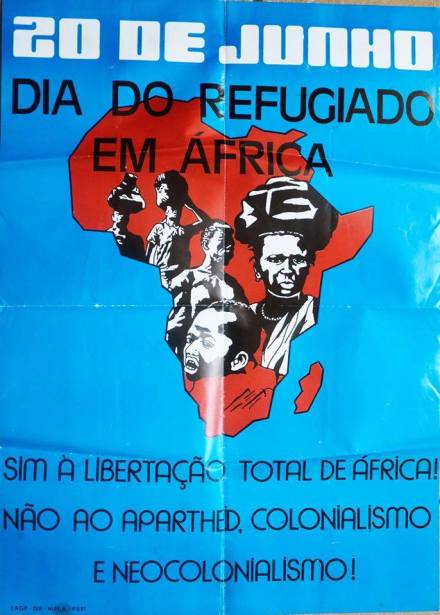
Bush War in Angola – this is an example of a MPLA propaganda poster which was retrieved by the SADF (by the hundred) from SWAPO bases in Angola in the aftermath of Ops Protea in 1981.
It calls for the Liberation of ALL of Africa, saying NO to Apartheid, Colonisation and Neo-Colonisation. These posters were gathered primarily by SADF Intelligence personnel investigating the over-run SWAPO bases.
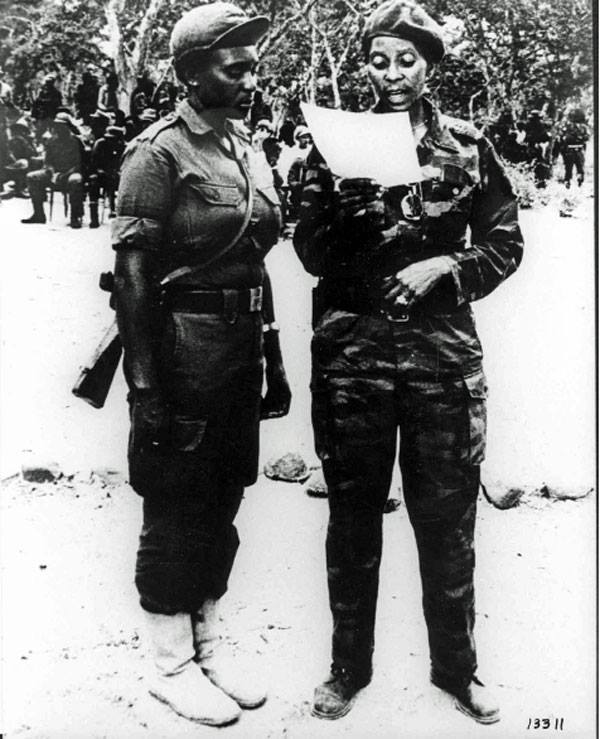
The MPLA i.e. The People’s Movement for the Liberation of Angola, ruled Angola since the country’s independence from Portugal in 1975 on the simple premise that it “held” Luanda, the capital city, after the Portuguese left it. This put it in immediate conflict with fellow anti-colonial movements in other parts of the country which disputed the MPLA’s claim, primarily the National Union for the Total Independence of Angola (UNITA). It however supported SWAPO, the South West Africa People’s Organisation and allowed its military arm (PLAN) to operate armed insurgencies (terror attacks in reality) into South West Africa (Namibia) from territories it controlled. The armed wing of the MPLA was FAPLA, the People’s Armed Forces of Liberation of Angola.
Allowing SWAPO bases to operate brought the SADF into conflict with the MPLA and FAPLA. Operation Protea was launched by The South African Defence Force on 23 August 1981. Its objectives were to destroy the SWAPO command and training centres at Xangongo and its logistic bases at Xangongo and Ongiva.
The Operation was a planned strike into Angola and regarded as a SADF success. Notably for not only capturing loads of intelligence, like these posters, but also all the captured Soviet equipment which South African units in Battle Group 10 (61 Mech) brought back to their bases in South West Africa (Nambia), somewhere around 3,500 tonnes of it.
Ops Protea, SADF Crossing at Xangongo with Captured Enemy 23mm AA Guns.
In the aftermath, the SWAPO bases were destroyed, Soviet casualties stood at thirteen: nine officers and four civilians, while one soldier was captured. South African casualties included 10 dead and 64 wounded. PLAN and FAPLA casualties were high with 831 dead and 25 captured.
Such is the course of history and changing times, that the MPLA are still the party in charge of Angola and most of this military hardware is still in South Africa, some in museums but also at military depots and displayed at army bases.
The MPLA has sofened somewhat now from the fire-brand anti-colonisation messages and propaganda slogans of the 70’s and 80’s, it is regarded as “centre-left” politically now and uses the slogan “Peace, Work and Liberty”.
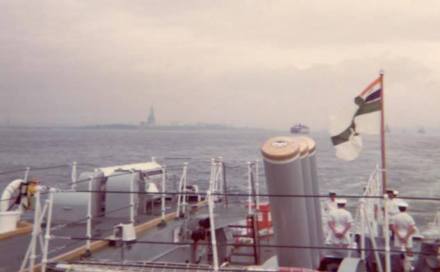
The Statue of Liberty as seen from the “grey ambassador” SAS President Kruger on a “flag showing” exercise. In this historic cruise the SAS President Kruger also became the first South African Navy ship to visit the United States of America.
The SAS President Kruger was invited to participate in the 200th anniversary of the independence of the USA in 1976. The trip was not without controversy. Due to policies of Apartheid diplomatic relations between the Republic of South Africa and the United States of America were very strained by mid 1976. However militarily speaking South Africa was supporting USA policies in Angola, and assisting CIA covert missions in the region just six months previously.
This meant meant that South Africa only received a last-minute invitation to send a warship to the USA. One of South Africa’s Flagships the President Kruger, known affectionately as the “PK” left Simon’s Town on 3 June 1976, and sailed for the USA via Walvis Bay, Abidjan and Las Palmas to Norfolk, Virginia, and sailed from there, as part of a fleet of 53 warships (representing 22 countries) to New York where a naval revue took place on 4 July.
Members of the ship’s crew participated on 6 July in a parade through the streets of New York, after which the frigate sailed to Charleston, South Carolina. From there, the ship sailed via Las Palmas to Simon’s Town (return date 6 August).
‘Grey ambassadors’ (as these warships are called on diplomatic exercises) on “flag showing” cruises are very important for international relations between countries. During this cruise to the USA the Soweto Riots began in South Africa and such was the political strain that exactly twenty years would pass before a South African grey diplomat would again visit the USA.
Unfortunately in the intervening years the SAS President Kruger lost in a tragic accident at sea on 18 February 1982, and in 1996 the Navy’s most respected grey diplomat, SAS Drakensberg would return to the USA,
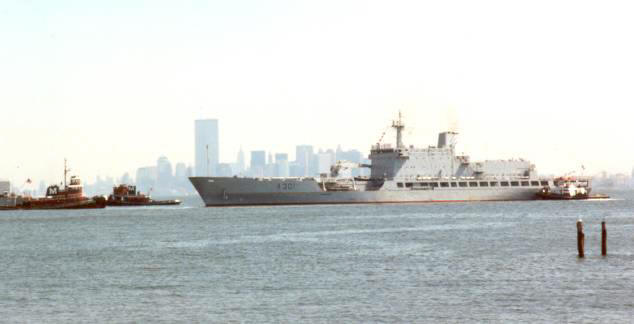
The Drakensberg left Simon’s Town on 14 June 1996 and participated with approximately 25 other warships from seventeen countries in naval manoeuvres, referred to as “Operation Unitas”, the ship visited the large US naval base at Norfolk, Virginia, as well as New York and Newport. Here she is seen alongside Staten Island in 1996.
Reference – South African Navy website and Wikipedia
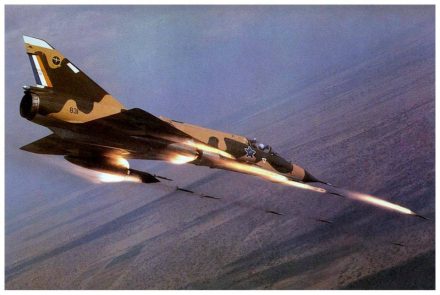
Just because it’s just such an iconic photograph – taken by the late and much loved Herman “the German” Potgieter and it adorned the room of many a small boy as a poster in the 80’s.
SAAF Mirage IIIEZ 831 firing a ripple of 68mm SNEB High Explosive Unguided Rockets.
Taken in 1978 at Roodewal. Derek Kirkland flying the Mirage and Herman Potgieter took the photo in a D2Z chase piloted by the late Chris Britz.
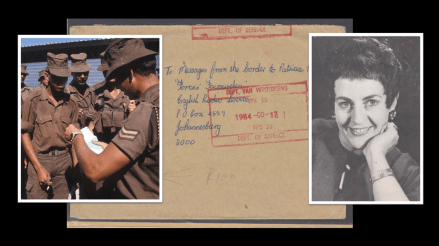
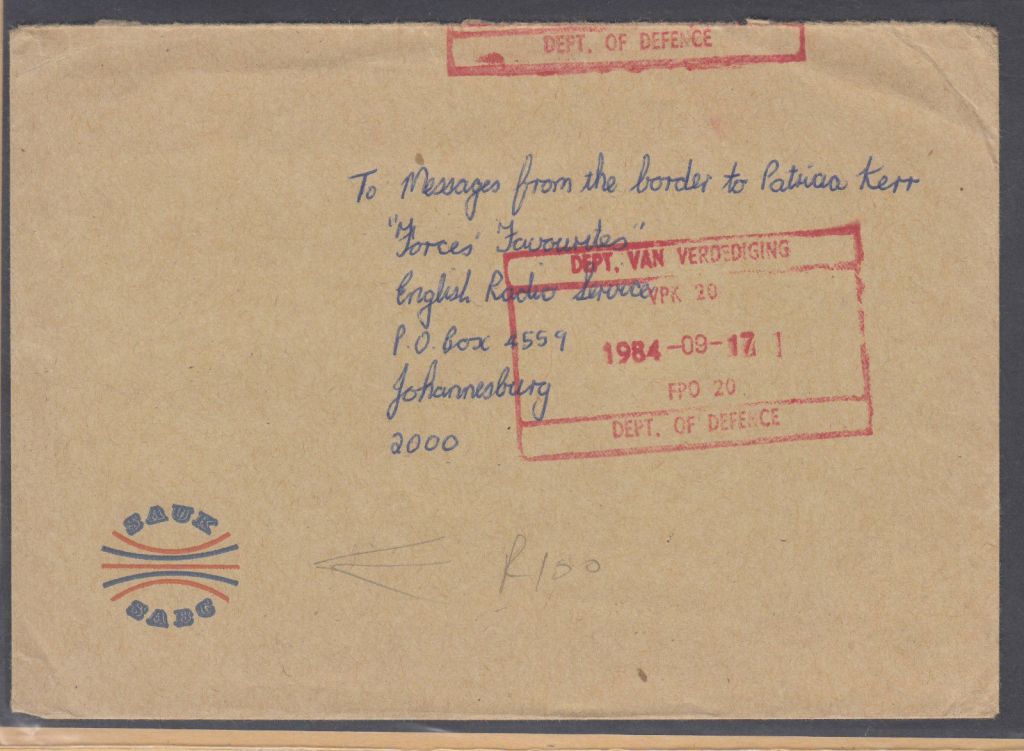
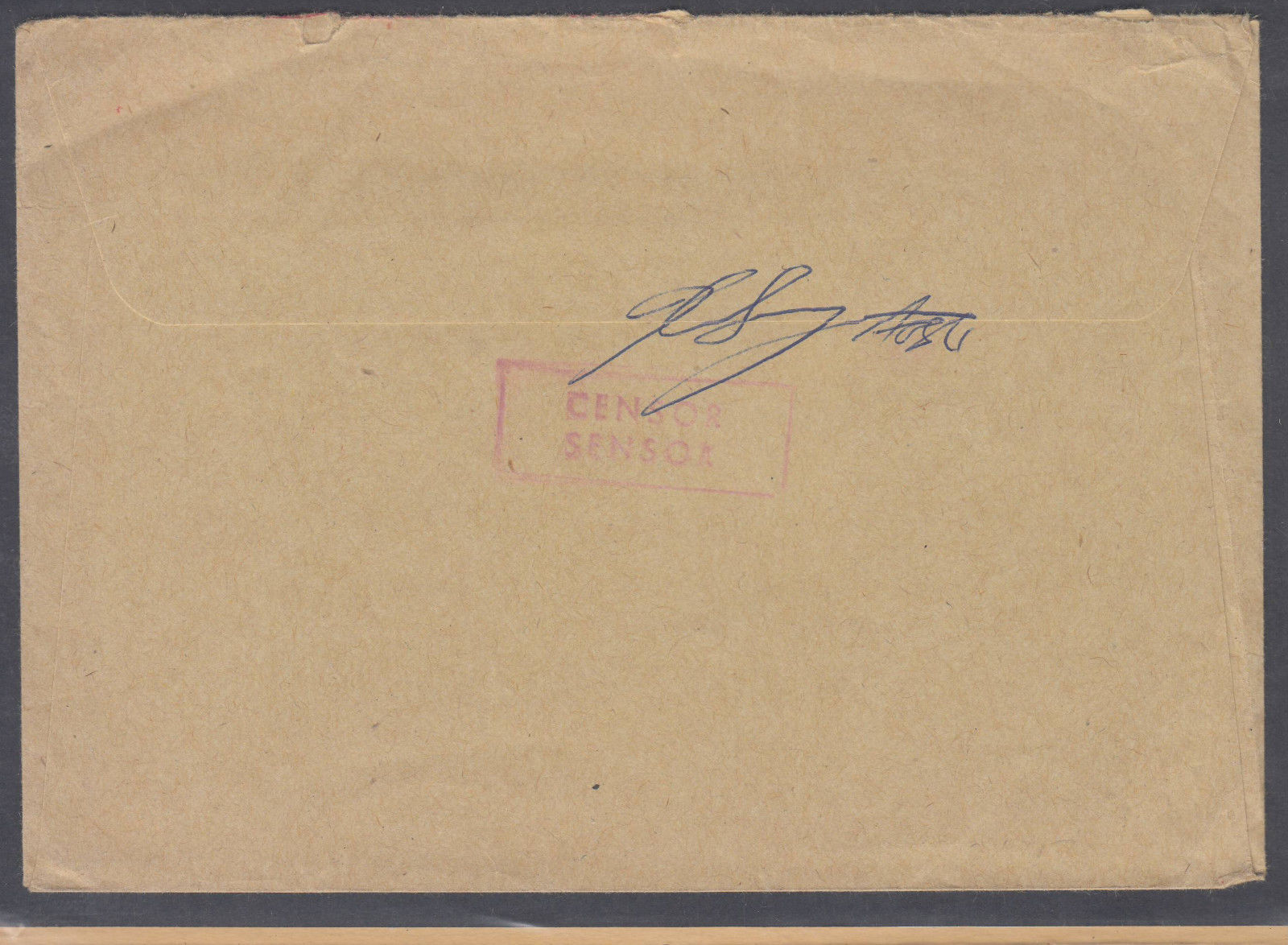
To the untrained eye this is a dull grey ‘government’ envelope, to the trained eye it is SO MUCH more. This is a “SABC” envelope and it contains one simple thing, a message from a SADF troop serving on the Border to a loved one and a song request. It has been through the army censor (see stamps) and is on its way to a true radio legend in her time – Pat Kerr, host of “Forces Favourites” on the SABC’s English Service to be read out on air.
To the troop who penned the note, the request meant everything, cast your minds eye to solitary SADF soldier fighting on the Angolan border, exhausted, weary and writing a note of love to his sweetheart back home, hoping it would be read to the nation and that his girlfriend would be tuned in on her radio to the English Services at the allotted time. It would certainly “make his day”.
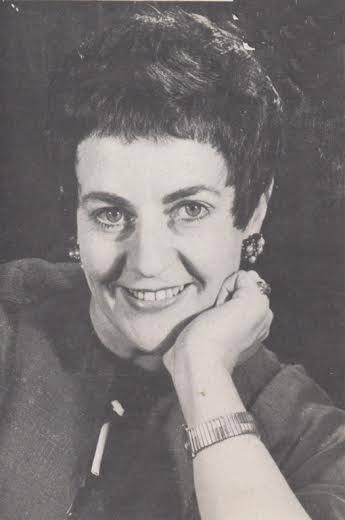
The sad thing is that “Forces Favourites” was an iconic radio show in its time, it was the voice for English speaking national servicemen, and Patricia (Pat) Kerr was a leading radio personality, however her passing and the radio show she championed has slipped into obscurity.
Then known as a voice of South Africa, Pat’s authoritative tones later echoed across Farnham in England when she settled there in 1992. When 90-year-old Patricia Murray Chinnery – stated by a former colleague to be ‘an institution on South African radio’ passed away at her home at Headley Down on February 4th 2015, very few people were aware of her death – yet she was known by millions of radio listeners in the country of her birth – South Africa – and many more in Farnham.
Pat, who used her maiden surname of Kerr for broadcasting purposes as well as Scully and Chinnery surnames of her two husbands, both of whom pre-deceased her) had an unforgettable voice.
An actress, as well as a presenter of radio programmes, Pat Kerr was also a character voice (that of Enid Blyton’s Noddy) in countless episodes of Little Peoples Playtime on South Africa‘s English Service.
She was best be remembered for her programme Forces Favourites on South Africa’s English Service from 1962 to 1989. Her service to the armed forces cannot be underestimated, Pat Kerr was even awarded The Order of the Star of South Africa Knights Cross (Civil Division), by the then State President, P.W. Botha. The award notification appeared in General Orders 177/81 dated 27 November 1981. This was awarded to civilians for outstanding service to the country.
Her obituary was covered in the local Farnham Newspaper in England, and other than actions by a close friend to notify the SABC, her passing would have gone absolutely unknown in South Africa, in fact this article will come as shocking news to many in the military veterans fraternity.
Her show “Forces Favourites” was disbanded at the end of hostilities on the South West African Border in 1989, and programming format changes at the SABC have left this unique part of South African broadcasting history slip. A nationwide phenomenon which if you did a “Google Search” on it now would reveal very little.
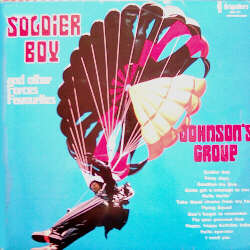
To give some insight to her personality and love for the “troops” these are her words on compilation album called “Soldier Boy” which she worked on with The Johnson’s Group.
“It was with some trepidation that I approached the task given me by Brigadiers Records of selecting what I thought were the most popular tunes in “Forces Favourites” . Although I have been presenting this programme for a number of years on the English Service of the South African Broadcasting Corporation and have come to know the tastes of the young people who listen to this programme (which is broadcast to the young men doing their National Service, their families and girl-friends) it is always difficult to pick a short list of favourite songs …. The boys do their National Service every year, and there are so many men in the Permanent Defence Force, to whom these songs mean a great deal. I hope you will all enjoy the selection, whether you are in uniform, or not, and that my special friends in the Flying Squad, the Police Forces everywhere, the Army, Navy and Airforce personnel, and Top Brass, will remain listeners to this record “Soldier Boy, and other Forces’ Favourites” as long as the grooves last”.
Pat‘s funeral was held at the Guildford Crematorium in England, March 10th 2015. Well Pat, the “grooves” still stay with us veterans. Thank you for your service and may you Rest In Peace in the full knowledge that you “made our day”.
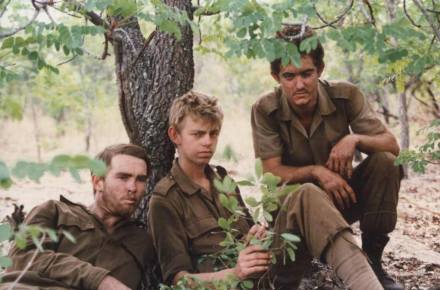
Three members of the SADF’s 61 Mechanised Battalion Group take a rest during the fighting on the Lomba river in Angola in 1987.
These young SADF national servicemen – most of them having just written a High School matric a year or two before and barely 18 or 19 years old – have just shattered the Angolan/Cuban coalition’s mechanised offensive, turning the tide at the height of this “cold war” in what was arguably one of the fiercest and most decisive mechanised battles fought on African soil since the Second World War.
These men – fighting in Ratel Infantry fighting vehicles against Russian T 55 Tanks knew that victory would boil down to strategy, innovation, decisiveness, leadership, teamwork, discipline and training – and not superior equipment or numbers.
Notice the presence of the “thousand yard stare” brought about from fatigue and extensive exposure to combat, ageing them well beyond their years.
Thank you to the 61 Mechanised Battalion veteran fraternity for the image.
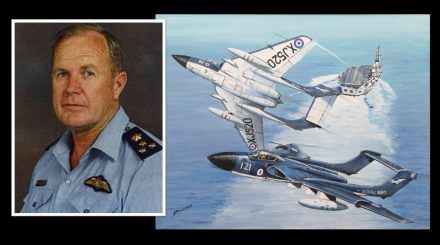
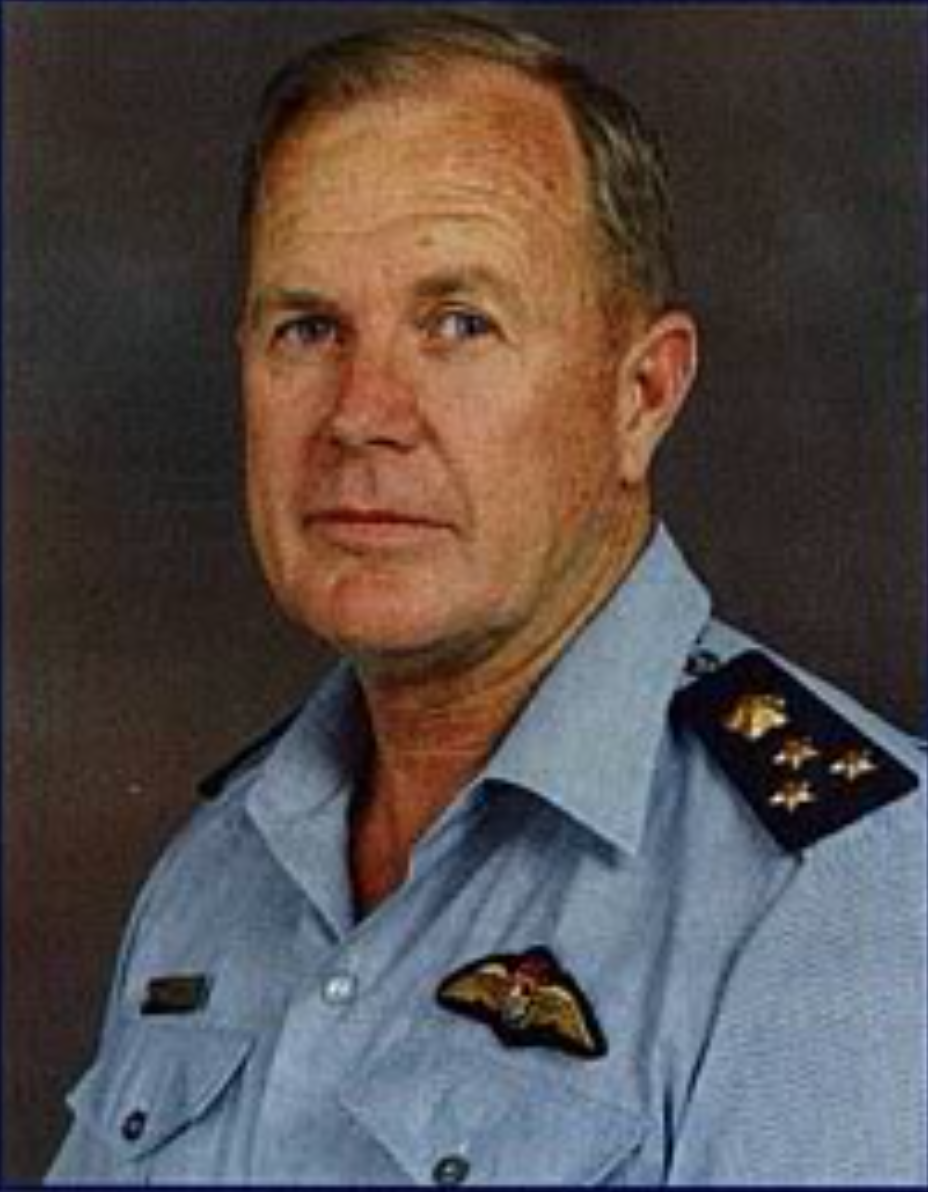
Richard Stanley Lord (nickname “Dick”) was born on June 20 1936 in Johannesburg, and educated at Parktown Boys’ High School. His fascination with flying took hold playing “Biggles” high up in Johannesburg’s famous jacaranda trees.
In the late 1950’s Dick Lord wanted to join the South African Air Force. However at the time the governing National Party had targeted South Africa’s defence forces for “transformation”, effectively ridding the defence arms of all their “British” heritage and socially engineering the forces using job reservation, political appointment and nepotism to progress white Afrikaners.
In this changing political environment Dick Lord was despaired of a career in the SAAF, his Afrikaans was limited and his strong “English” heritage was against him in the now Afrikaner-dominated South African Services.
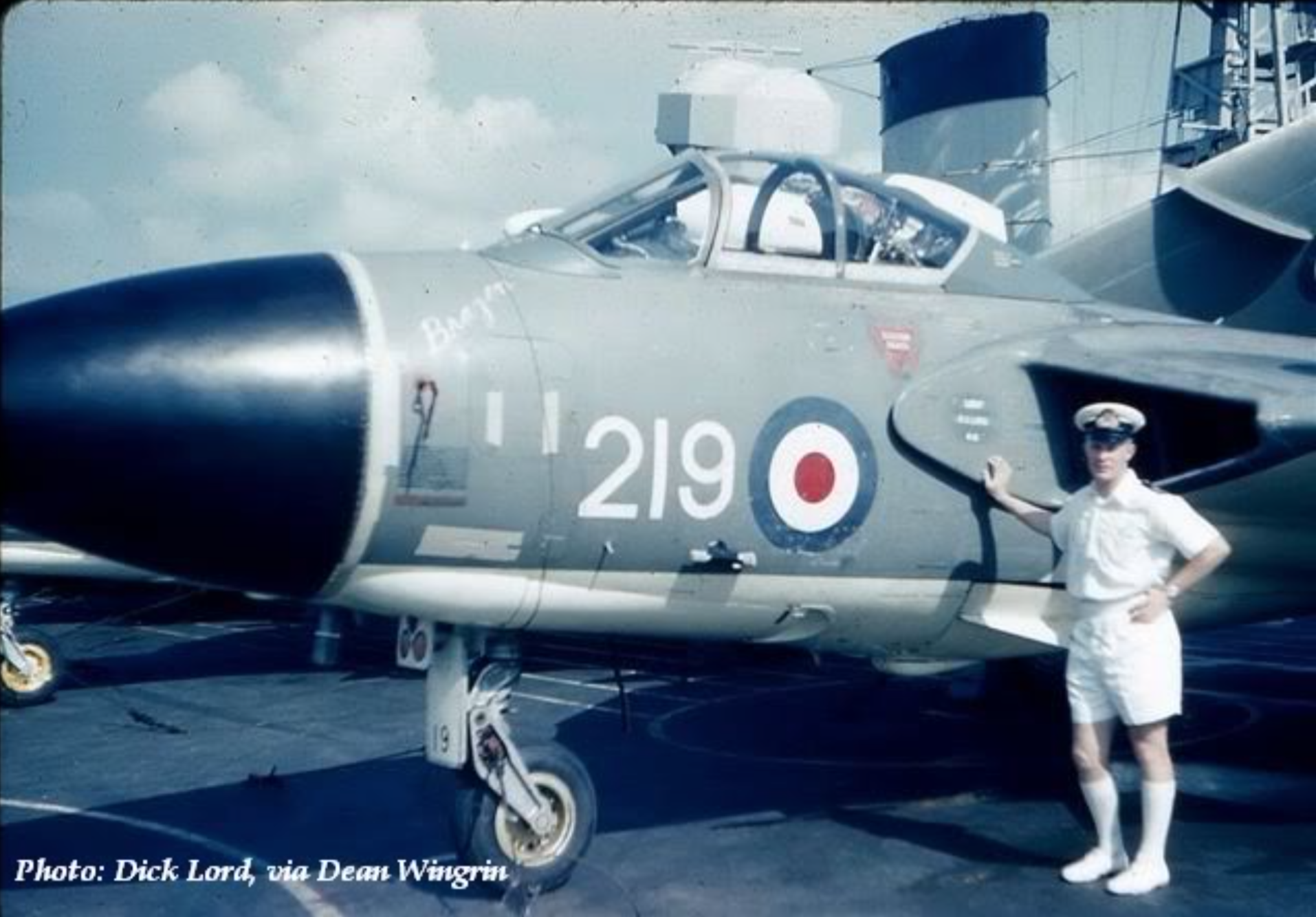
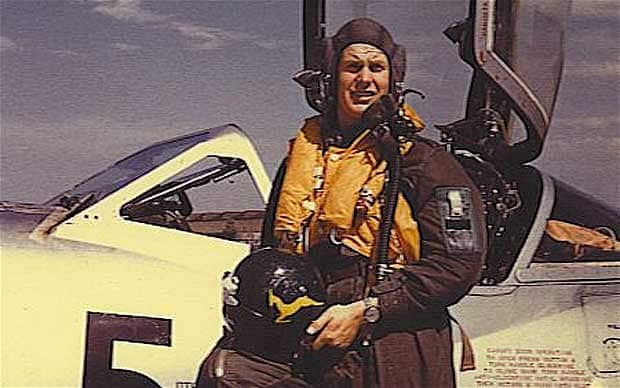
So instead he, joined the Royal Navy. His initial naval training was at the Royal Naval Engineering College, Manadon, and he gained his wings in the Fleet Air Arm in June 1959, flying Sea Venom and Sea Vixen fighters from the aircraft carriers HMS Centaur, HMS Victorious, HMS Hermes and HMS Ark Royal.
A very eventful FAA Legacy
In 1966 Dick Lord found himself in the Royal Navy’s Fleet Air Arm flying from Ark Royal off Beira, Mozambique, to enforce the oil blockade of Rhodesia following its Unilateral Declaration of Independence. After one mission to intercept a suspected blockade-runner, he returned to find that the carrier had been overtaken by a tropical storm and that her flight deck was pitching through 65ft: his aircraft caught the third arrester wire and damaged its undercarriage – reckoned a near perfect landing in the conditions.
An American “Top Gun”
Dick Lord was instrumental in the development of America’s Top Gun fighter pilot academy, made famous by the film of the same name. He established his unusual role in 1968, when he was the foremost British instructor sent on exchange at Miramar, California, to train American pilots then suffering significant losses at the hands of MiG-21s flown by the North Vietnamese.
While some criticised the performance of America’s multi-million dollar Phantom jet, Lord concentrated on sharpening his pupils’ Air Combat Manoeuvring (ACM) skills to improve their odds in a dogfight.
He and a handful of other Fleet Air Arm graduates of the Royal Navy’s gruelling Air Warfare Instructors (AWI) school in Lossiemouth, Scotland, introduced rigorous new methods for recording and scrutinising the performance of trainees during exercises.
Lord, for example, scribbled notes on a pad on the knee of his flight suit during mock dogfights, which he then exhaustively analysed on a blackboard at post-flight debriefs.
Such was the trust placed in Lord that he was granted access to classified American military documents comparing the performance of US aircraft against that of enemy fighters. This access allowed him to write, with others, the US Navy’s Air Combat Manoeuvring manual.
A year after Lord’s arrival, the tuition and methods introduced by British pilots, all graduates of the AWI school at Lossiemouth, made their way into the US Navy Fighter Weapons School, which was set up in 1969. Better known as Top Gun, it remains the most famous programme in the history of naval aviation. Soon after it was established a Phantom flown by one of its first students shot down a MiG-21, the first time a US Navy aircraft had succeeded in aerial combat in two years.
Lord enjoyed the film Top Gun, but mused that it was “remarkable that any history book studiously avoids mention of any British involvement” and added that the film had not “given us due justice”. He remained proud of his involvement, however, and during his time at Miramar had insisted on using the call sign “Brit 1”. This meant that his wingman, though American, was forced to use the call sign “Brit 2”.
Dick Lord’s wife June Beckett, a BOAC air-hostess said of the movie “Top Gun” that while Dick complained about it, she contended that the film’s portrayal of big-talking fighter pilots was extremely true-to-life, and she should know.
On his return to the Royal Navy he was senior instructor with 764 Naval Air Squadron where he passed on the skills and confidence that had made such an impact in America.
Back to South Africa
Dick yearned to return to South Africa, he resigned from the Royal Navy and in 1970 returned to South Africa where he converted to commercial flying and became a civil aviation instructor pilot.
However the Royal Navy would intervene in his life again, this time after a visit to Cape Town by HMS Ark Royal where a “deep chord” was struck in Dick’s heart, rekindling his love of more adventurous military flying.
Joining the SAAF
Although Dick Lord was still unable to pass the Afrikaans language test, he was able to join the South African Air Force this time due to capability gaps in SAAF caused by all their social engineering and transformation policies, it was also now at war and in need of very skilled and experienced military pilots. Conscription in the SADF had also been implemented by this time, and it involved both English and Afrikaans speaking white South Africans, so policies had to be softened somewhat.
During South Africa’s involvement in the South West Africa (Namibia)/Angola Border War and whilst in the SAAF Dick Lord flew Impalas, Sabres and Mirage Ills.
Dick Lord’s leadership skills were quickly apparent and he ultimately commanded No 1 Squadron SAAF from 1981 to 1983, later directing SAAF operations during the Border War from Oshakati and Windhoek as well as flying SAAF Mirage F1AZs.
He ended his career in charge of the Air Force Command Post in Pretoria, where he was given high accolade for his role in helping to organise the rescue operations that saved all 581 passengers and crew of the Greek cruise-liner Oceanos, which sank off South Africa’s eastern coast on August 4 1991.
Another highlight of his career was to organise, in 1994, the fly-past at the inauguration of Nelson Mandela as President of South Africa. Lord then retired as a Brigadier General and began writing about his life as an aviator.
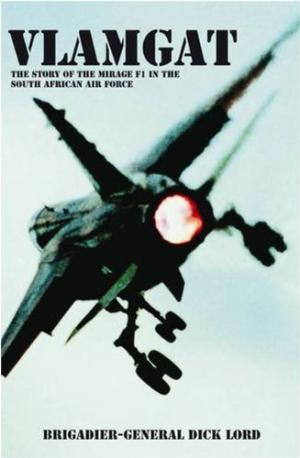
He also wrote a number of books including
Fire, Flood and Ice (1998) about SAAF Search and Rescue missions
From Tailhooker to Mudmover (2000) – a biography
Vlamgat (2000) – a history of the Mirage fighter jet in South Africa
From Fledgling to Eagle: the South African Air Force during the Border War (2008)
Apart from flying, his passion was military music, his favourite piece being Sarie Marais, the march of the Royal Marines, which is based on an Afrikaner folk song.
Brigadier General Dick Lord died on the 26th October 2011 after a long illness. He is still sorely missed to this day.
Researched by Peter Dickens. References: The Daily Telegraph, Article on Dick Lord by Rostislav Belyakov. Military History Journal Vol 15 No 4 – December 2011. Feature photo via Dean Wingrin. Painting of Royal Navy Fleet Air Arm Sea Vixens in the masthead by Derrick Dickens, copyright Peter Dickens.

 After take-off we remained low level and set heading for the combat zone. It was our intentions to remain low level for as long as possible to avoid being detected by the Angolan radar’s.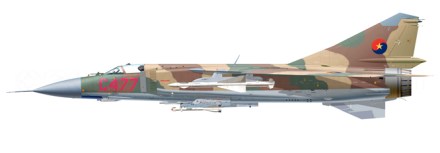
 It was now about five minutes later and half-way home when the first warning light flashed on. EP pump failure. Instinct must have taken over because I thought my first reaction was to call the boss and tell him I have a failure. He pulled out his emergency check list, and started reading the failure procedures for me. All the necessary switches had be set. I don’t remember doing them.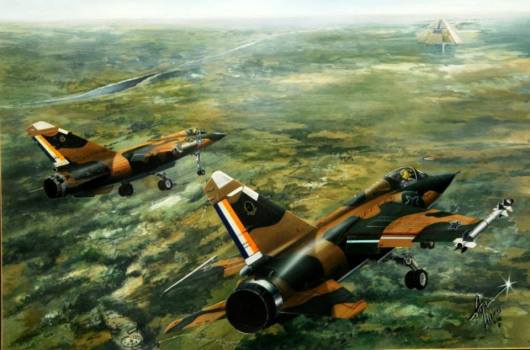
 Landing a perfectly serviceable aircraft on a 7500′ runway requires some work. I was going to have to do it on emergency throttle and without a drag chute – a task I felt I could handle.
 When I regained my senses I was lying in the sand on my right hand side. The first thing I attempted to do was to roll onto my back and when I pushed on the sand with my left arm there was this incredible piercing pain in my arm. The left arm was broken just above the elbow. I then looked down at my legs to see why they had not moved and I could not feel them at all. I realized that the ejection seat was still strapped to my back and thought that this might have something to do with the lack of movement in my legs. I had no idea that the neck was dislocated.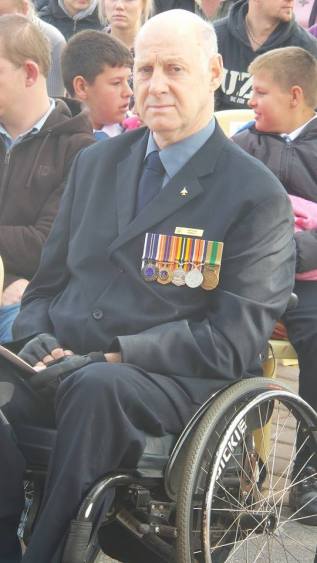
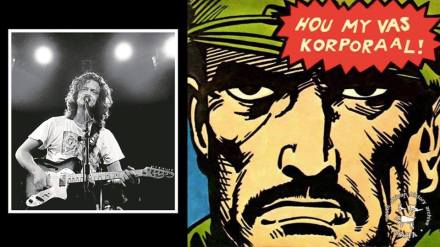
 “Hou my vas korporaal’ (hold me tight Corporal) by James Phillips’s alter ego ‘Bernaldus Niemand’ released in 1986. Most military veterans will remember this song with a wry smile.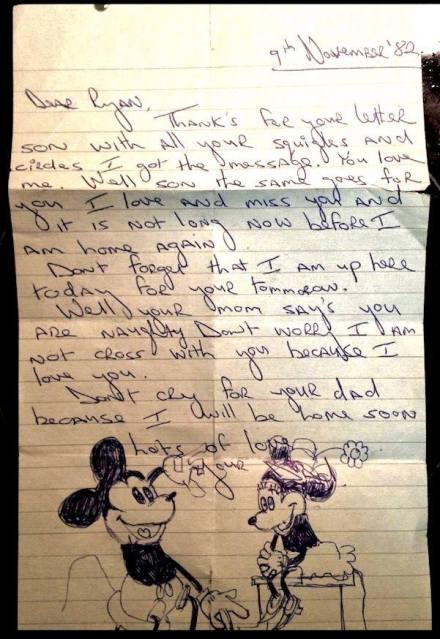


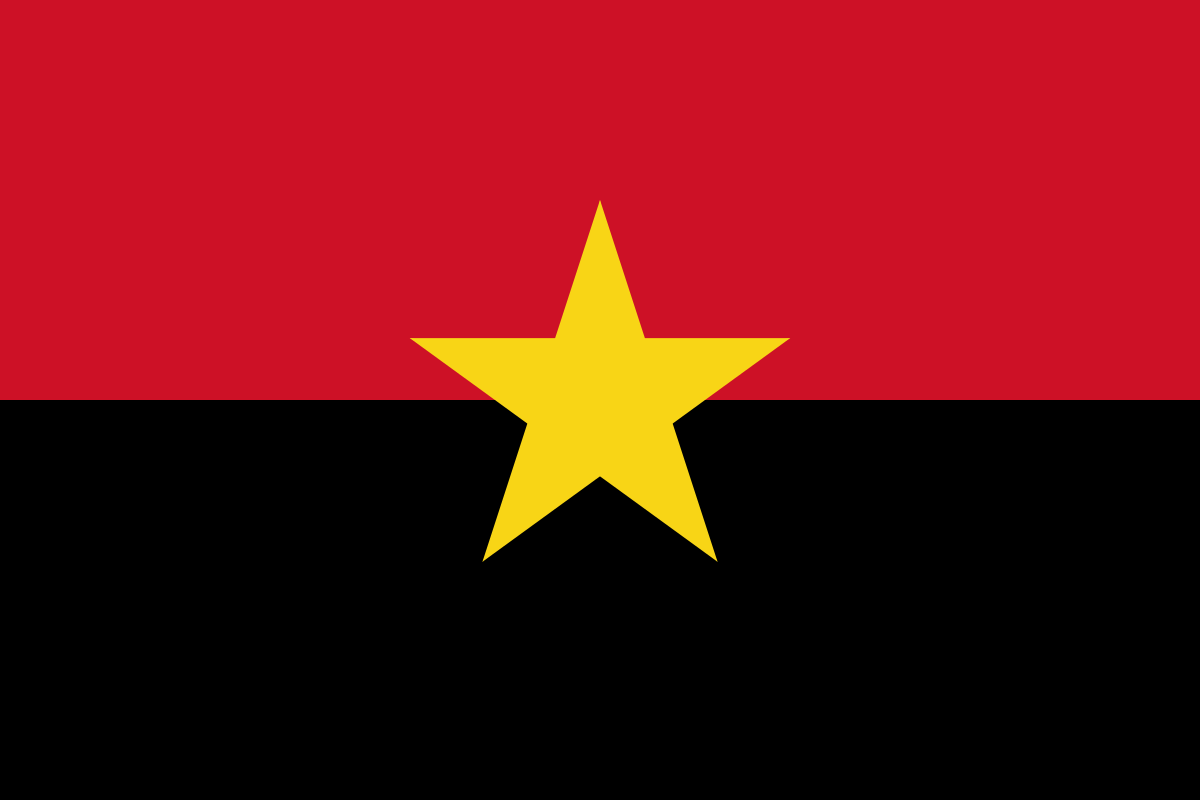 The MPLA i.e. The People’s Movement for the Liberation of Angola, ruled Angola since the country’s independence from Portugal in 1975 on the simple premise that it “held” Luanda, the capital city, after the Portuguese left it. This put it in immediate conflict with fellow anti-colonial movements in other parts of the country which disputed the MPLA’s claim, primarily the National Union for the Total Independence of Angola (UNITA). It however supported SWAPO, the South West Africa People’s Organisation and allowed its military arm (PLAN) to operate armed insurgencies (terror attacks in reality) into South West Africa (Namibia) from territories it controlled. The armed wing of the MPLA was FAPLA, the People’s Armed Forces of Liberation of Angola.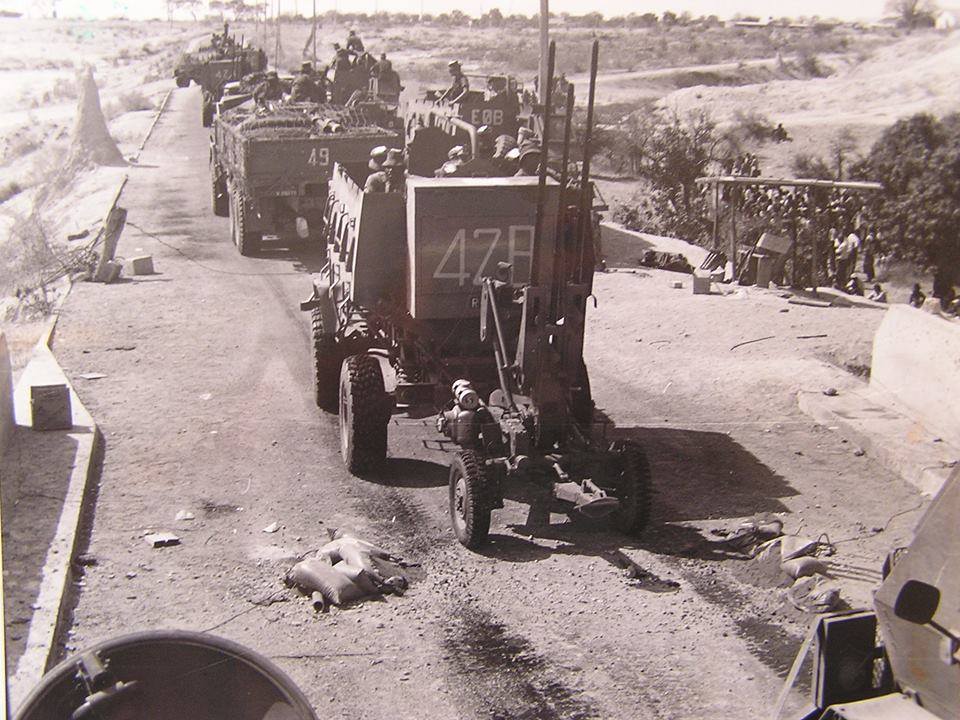


 The Observation Post