A simple thank you would be nice!

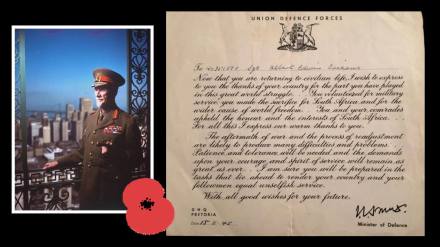
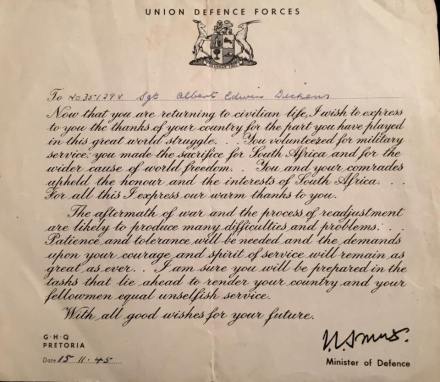
This is a letter of thanks from Field Marshal Jan Smuts sent to every single South African who served in the armed forces during World War 2.  It formed part of his demobilisation debrief . This particular one belongs to my Grandfather – Sgt. Albert Edwin Dickens – and he cherished it so much that it survives to this day.

13221753_10154020914611480_5346472831885527386_n

A simple thank you goes a very long way, decades later I was to serve in the South African Defence Force as a conscript and no such thank you letter was ever given to me – not even so much as a verbal thanks let alone in writing.  Not just me, generally thousands of South Africans called into service of country as conscripts (and even permanent force) received nothing for it by way of a thank you, or even a simple demobilisation debrief in many cases.

Some units in the ‘old’ SADF were a little better than others and some have received thanks from Unit, Regiment, Corps, Squadron, Ship or Battalion commanders, some even received a formalised demobilisation debrief, but many did not (in fact most).  As a result many South African military veterans are now left with deep-seated disgruntled attitude of “what was it all for”.  My Grandfather and his generation of military veterans had no such dilemma.

This simple letter of thanks from the Prime Minister goes a long way to demonstrate the vast difference in attitude between South African forces which operated under Smuts as opposed to those who operated in the statute forces under the National Party. Herein lies a key difference between the United Party under Jan Smuts and the National Party under P.W. Botha. When it came to serving the country, the one displayed gratitude the other often displayed arrogance.

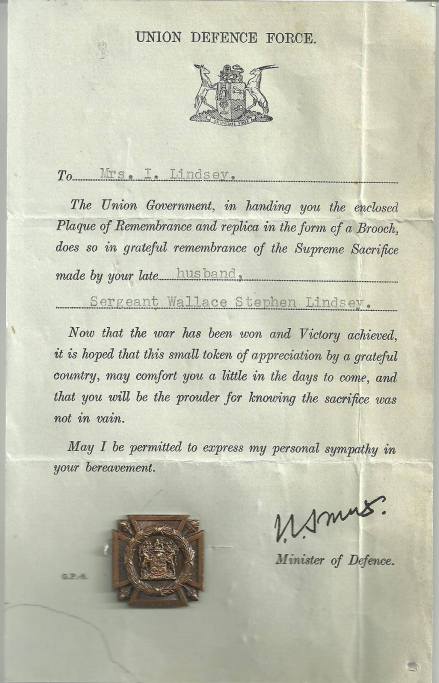
Jan Smuts even went further, at the end of the war he sent a thank you letter to all the South African families who had lost loved ones during the war along with a special commemoration plaque, here’s an example of it.

44840021_10217757323621831_5955157771505631232_o

In addition to these letters and brooches, Jan Smuts also issued commemorative plaques to families who lost members in the war bearing the person’s name.

As to arrogance, it is also not only the Afrikaner Nationalists, in 1994, I volunteered to remain with the newly formatted SANDF as a Reservist and to date have not received anything from an African National Congress State appointed State President of South Africa by way of a simple thanks.  As to a signed letter from the State President sent to other SANDF members demobilising – I’ve not yet seen one issued to anyone.

We, as South Africans generally treat our veterans very badly.  The National Party threw the South African Union Defence Force (UDF) members and their military reputation, colours and victories under the bus in 1960, they again threw their reformatted South African Defence Force (SADF) members and thier honours under the bus in 1994, the ANC is now doing a good job throwing the current South African National Defence Force (SANDF) under the bus by under financing it and tainting it with corruption.  In all of this, South Africans in general have no special regard for anyone who has worn the country’s military uniform.

Perhaps there is a lesson to the current SANDF to invest in a simple personalised pro-forma letter.   It will go a very long way to install pride and purpose in someone who has risked their life to serve in a South African uniform.


As is very much the custom in the USA, the UK, Australia, Canada and New Zealand, when next you see a UDF, SADF or SANDF military veteran on parade or veteran members of the South African Legion of Military Veterans and MOTH collecting funds for poppies of remembrance or participating in charitable contribution – be sure to walk up to them, shake their hands and give them a simple thank you, it will mean the world to them – because to date there is a very good chance nobody else has.

Capt. Peter Albert Dickens (retired)

P.S. A sincere thank you to Maureen Lindsey Paine for allowing me to share her Mother’s letter and brooch which she now wears with pride every Remembrance Day. 

supporting-poppy-appeal

‘Bake-off’ South African style!

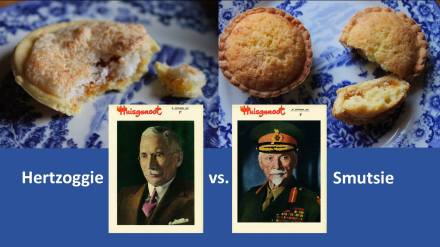
The politics of the jam tart. At one stage the politics of division between Jan Smuts’  politics of reconciliation’ and Barry Hertzog’s ‘politics of separation’ even entered into the kitchen, and this is one very hot political cup cake.

In 1924 during the General Election women showed their political support from the kitchen. During this time the little jam tart in honour of JBM Hertzog or the ‘Hertzoggie’ started to grace the tea tables of staunch  National Party supporting women.

Going head to head in the bake off with a jam tart of their own, women supporting Jan Smuts’ South African Party came up with the ‘Smutsie’ or the Jan Smuts Cookie (also known as a General Smuts cookie).

The irony is that they are baked in nearly the same way with an apricot jam filling, the difference is in the topping. The Smutsie cookie has a creamed butter and sugar topping (similar to a penuche frosting) whereas a Hertzoggie has a much paler macaroon-style of topping made of egg white and coconut.

It is said that those supporting the one style of cookie refused to bake or eat the opponents offering.  Such was the intense political rivalry and deep division between the two.

The recipe of the Smutsie seems to have varied over time and from what I can see the Sugar Butter topping has been lost from more recent recipes, whereas the Hertzoggie has been quite popular and commonly found. So, here’s a challenge to the bake-off enthusiasts out there – rejuvenate the Smutsie with its original topping!

This is one for the ‘The Great South African Bake-off  2018’ challenge I would love to see, one half doing a take on the Hertzoggie using ‘ouma se resepte’ and the other half sprinting around the kitchen frantically stealing each others recipes trying to figure out a Smutsie.  All the while both groups shout ‘veraaier’ at one another.  How South African is that!

A Smutsie with a penuche frosting as a topping, now that’s the Smutsie for me …. although I am told that a Hertzoggie made on a braai (yup, a braai – believe it) is to die for. As a ‘Soutie’ married to a ‘Boertjie’ to keep peace in the house I might just find the safe political middle ground and go with her excellent Springbok rugby player inspired  … Jan Ellis Pudding.


Written by Peter Dickens

A Kibbutz called Jan Smuts

Did you know that Jan Smuts has a kibbutz named after him because of his support in founding the state of Israel, and that this kibbutz was at the centre of the 1948 Arab Israeli War (or sometimes known as the Israeli War of Independence)?

1917-Balfour-declaration_original

The Balfour Declaration

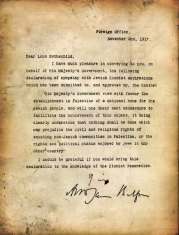
Jan Smuts was a supporter of the Balfour Declaration, first adopted in November of 1917 and then again reaffirmed in 1922 in the League of Nations British Mandate for Palestine which set forth British policy towards the establishment of a Jewish national homeland in Palestine.

Smuts became personal friends with Chaim Weitzman, who would go on to become the first President of Israel and Smuts and he saw to it that his government voted in the United Nations in support of the creation of the State of Israel. As a consequence of this a Kibbutz near Haifa is named after him, Ramat Yohanan.

Smuts’ relationship with the idea of a Jewish state started when South African supporters of Theodor Herzl contacted Smuts in 1916. It was in London that met and became friends with Chaim Weizmann, the President of the Zionist Organization. Weizmann went on to become the first President of Israel. He was elected on 16 February 1949, and served until his death in 1952.

In 1943 Weizmann wrote to Smuts, detailing a plan to develop Britain’s African colonies to compete with the United States – essentially a United States of Southern Africa – something which appealed to Jan Smut’s ideology of “Union” of former colonies and states in Africa for the greater good of all (his philosophy of Holism at work).

When South Africa became a “union” in 1910 it was originally envisaged that Bechuanaland (modern-day Botswana) and Southern Rhodesia (modern day Zimbabwe) would also form part of the newly created South Africa.

Political manoeuvring (mainly by the British) meant it was not to be and South Africa forged ahead as a union of the British Colonies of the Cape and Natal and the two Boer Republics – the Orange Free State and Transvaal (South African Republic) only. The idea of a regional superpower union was never really lost though and only fully put to bed when the National Party came to power in 1948 effectively ending any further union ideas with commonwealth countries in Southern Africa.

During his service as Premier, Smuts also personally fundraised for multiple Zionist organisations.

Now to Ramat Yohanan (Hebrew: רָמַת יוֹחָנָן, meaning Yohanan Heights), a kibbutz in northern Israel, named after the then South African Prime Minister and wartime leader – Jan Smuts.

It was the location of the Battle of Ramat Yohanan during the 1948 Israeli War of Independence. In April 1948, The Druze Regiment of the Arab Liberation Army was engaged by Jewish Haganah soldiers in a hard fought battle at the kibbutz.

The Druze attacked Ramat Yohanan and other neighbouring kibbutzim in order to try to take the roads leading to Haifa. The attack was unsuccessful and the Druze withdrew to their base in Shefa-‘Amr with a high number of casualties, this action led to a non-aggression treaty which was signed by the Haganah with the Druze. Throughout the kibbutz, there are still scattered defence towers used by the kibbutz to defend itself.

The Haganah was a Jewish paramilitary organization operating in the then British Mandate of Palestine, which went on to become the core of the Israel Defence Force (IDF).

As an interesting fact, in 1941, Yitzhak Rabin joined the Palmach section of the Haganah during his stay at Jan Smuts’ kibbutz – Ramat Yohanan. He was the fifth Prime Minister of Israel, serving two terms in office, 1974–77 and 1992 until his assassination in 1995.

Today, the kibbutz grows produce including mainly avocado, lychee and citrus fruits, raises both meat and dairy cattle, and is the home of a Palram plastics factory. They also produce a small quantity of olive oil and dairy products, much of which is used and sold on the kibbutz. For several years, Ramat Yochanan has run an ulpan program that serves primarily American and Russian students.

Modern day Shavout festival at Ramat Yohanan

The last official act Jan Smuts carried out before leaving office in 1948 was to recognise the independent State of Israel, fulfilling his long standing commitment to Chaim Weitzmann.

Most of Jan Smuts’ history has been downplayed significantly in the years since his death, his politics and endeavours largely glossed over by a Nationalist government and overshadowed by the implementation by the Nationalists of Apartheid in 1948.

This history lies largely forgotten to most South Africans today, but the fact remains, that other than Nelson Mandela, not too many South African leaders since Smuts have had such a presence and role in shaping world politics as we know it today,

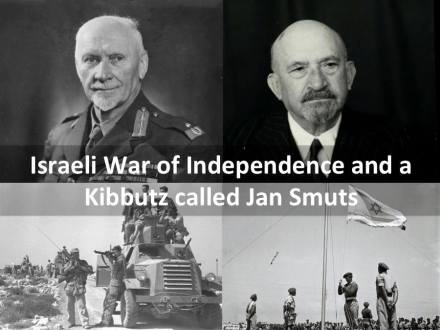
The featured image today shows Jan Smuts and Chaim Weitzmann and early IDF soldiers using adapted South African designed and manufactured Marmon-Herrington Armoured Cars – as well the flag raising of the Israeli flag once independence was fully established.

A lost SAAF legacy

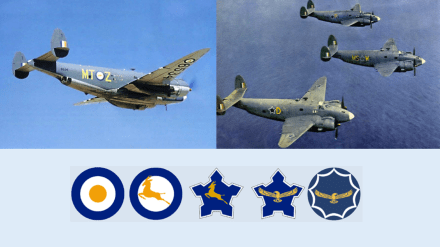
Rare colour image of South African Air Force 22 Squadron Venturas on the right in a formation flight over Table Bay in 1959.  Of interest, if you look closely is that their markings have just been changed, compare it to the SAAF Ventura on the left.

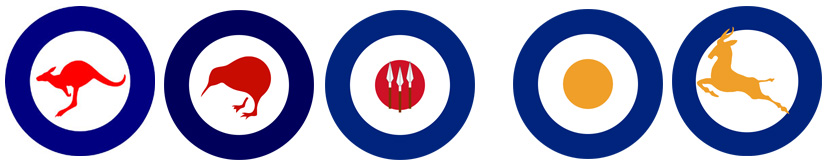
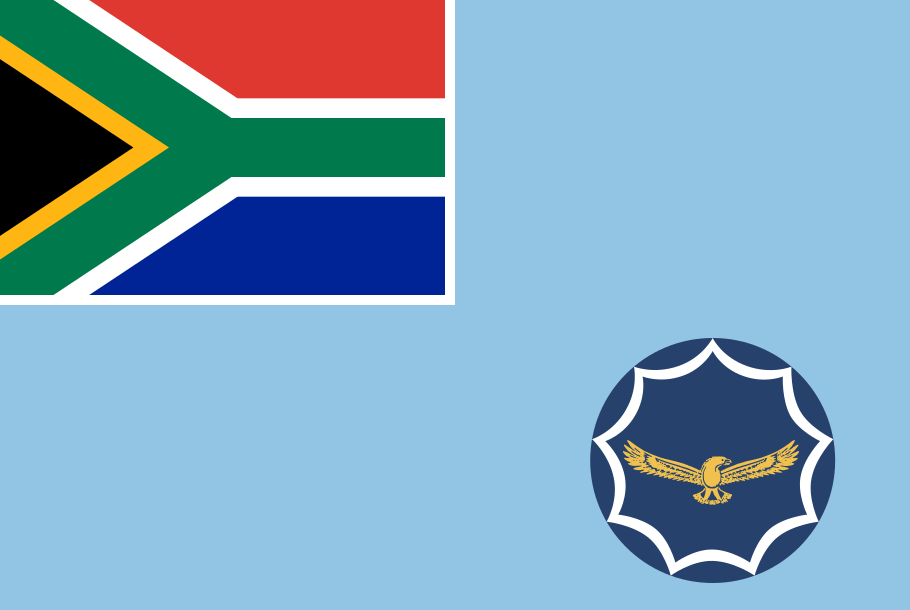
These three on the right are seen flying in the revised SADF livery which had just been introduced at the time i.e the Springbok inside an image of the Castle of Good Hope – introduced a year earlier in 1958 – which replaced the traditional Commonwealth aircraft identifier roundel – which had an orange Springbok in the centre of it.

commonwealthrounds

Commonwealth aircraft rondel markings, left to right – Australia, New Zealand, Rhodesia and South Africa.  Note, Australia and New Zealand still use this rondel marking to this day as a nod to maintaining their Commonwealth heritage.

These Ventura are Ventura PV-1 an American aircraft made by lockheed and were extensively used during World War 2 by the Allies. The SAAF also operated the aircraft during the war and continued to do so after the war for many years.

The changes formed part of the Nationalist government’s wish to break the SADF’s military identity and association from its British Commonwealth historical legacy. The changes where far reaching and included insignia, rank terminology, uniform changes, disbandment and reformulation of infantry regiments, renaming of institutions and bases, military hardware deals, new medal orders etc. etc.

Note: these changes to the defence force livery occurred before South Africa ‘resigned’ from the Commonwealth of Nations, so the plans to make this change were entirely domestically driven by the government of the day.

Note, the Springbok in the centre was further changed again to an eagle in line with the new SADF composite mark.

Funnily, and rather tragically to many parts of our military heritage and legacy – this is a process which seems to repeat itself historically whenever South Africa changes political dynasties.  The SAAF livery was changed again in response to the new SANDF re-branding the armed forces – literally everything connecting the past has to go (rank, uniform, medals etc), the military structures changes again (the Commandos went), the ruling edict is to break its connection and legacy with National Party’s “Apartheid” South Africa.  These changes were initiated in 2003.

I can’t but think that military tradition is been lost through the political epochs and this initial fundamental re-vamp of the SAAF emblems by the National Party and their resignation from the Commonwealth means that the new revamp, done when South Africa had re-joined the Commonwealth, has lost sight with its very rich military tradition and legacy.

When the emblems came under review in 2003 no consideration to the proud legacy of South African involvement in WW2 (and especially our Air Force) was given at all, so far had it receded from collective consciousness by this stage.  Again, I can’t but think that the loss of general public awareness and the military of this very proud moment in South African history is nothing short of tragic – especially considering the sacrifice of Black and White South Africans alike to it.

‘Tradition’ and maintaining ‘memory’ of those who have served is a fundamental cornerstone of soldiering, but unfortunately this was not a political priority – to either National Party or to the African National Congress.

Researched by Peter Dickens

Jan Smuts drafted the Preamble to the United Nations Charter

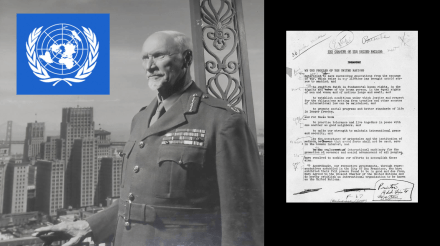
Imposing photograph of Jan Smuts at the San Francisco Conference in 1945 – the historic conference which founded the United Nations (UN).

One of Jan Smuts’ last acts as the Prime Minister for South Africa was the establishment of the United Nations. In fact he wrote the original opening lines of the Preamble to the United Nations Charter as …

“The High Contracting Parties, determined to prevent a recurrence of the fratricidal strife which twice in our generation has brought untold sorrow and loss upon mankind..”

Not only did Smuts do the first draft of the Preamble to the United Nations Charter, he also played a key role in putting together the United Nations Charter itself. Smuts even presided over the first meeting of Commission II, General Assembly of the United Nations on 30 May 1945, held at the San Francisco Opera House.

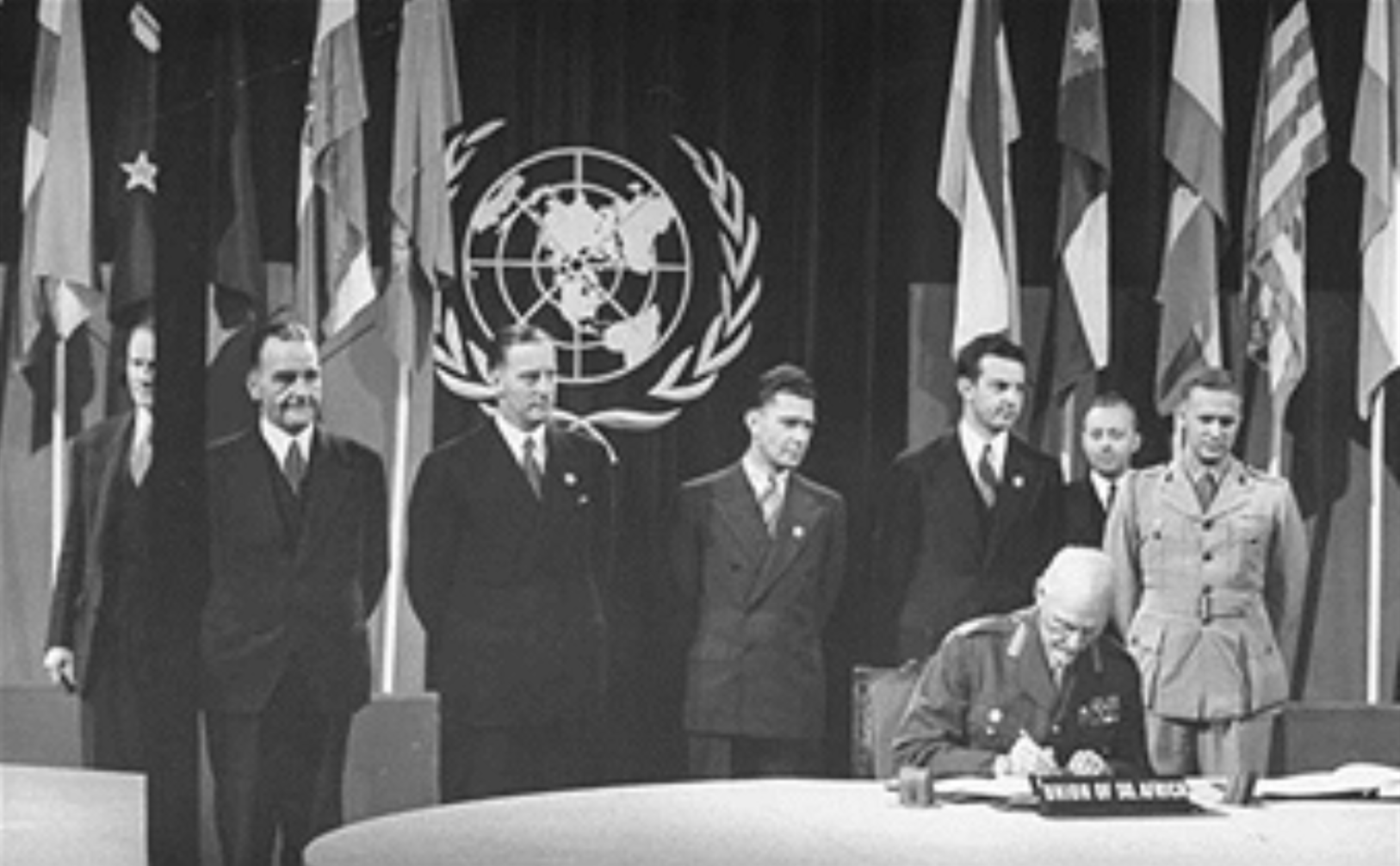
Jan Smuts was also present at the historic signing ceremony of the United Nations Charter on the 26th June 1945 and signed the Charter on behalf of South Africa.


Screen Shot 2017-04-28 at 09.23.10

Subsequent to these historic meetings and ceremonies in San Francisco the Charter and United Nations as we know it came into full existence on the 24 October 1945.

Now, this was truly one of South Arica’s most philanthropic leaders, a man years ahead of his time, only to have his legacy tarnished by successive political posturing after his death five years later in 1950, which continues even to this day.

By the time of Smuts’ death in 1950, even the United Nations, which South Africa had played such a pivot role in establishing in 1945, was at loggerheads with the “new” South African Nationalist government which came to power over Smuts’ party in 1948.   From that date onward the United Nations started to pass resolution after resolution in damnation of the then newly elected National Party’s policy of Apartheid.

During the next 46 years in the United Nations, South Africa went from the heady heights of a founding signatory of The United Nations to the lows of a pariah state – and this forever diminished and damaged South Africa’s influence in the United Nations and as a leader in future global politics. Something Jan Smuts even foresaw in 1948 and warned the country against, but to no avail.

However, history is the ultimate decider and Jan Smut’s track record of achievements cements the simple fact that he remains one of the greatest men the country has ever produced.

J_Smuts_sign

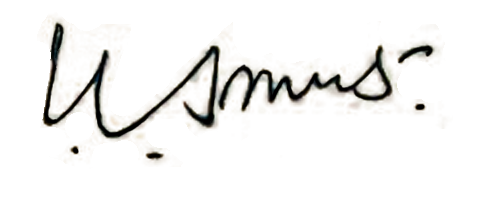
Jan Smuts’ signature 

“… I am not worthy to stand in the shoes of so great a man”

Jan Smuts’ history is well documented but let me share something that is less known about the man himself.

It’s a common misconception that Jan Smuts and Mahatma Gandhi’s relationship was one of animosity. It is a little known fact that both men actually respected each other, remaining life long admirers of one another.

Gandhi tried, at all times, to look for the positive in Smuts and said of him that he had a “high place among the politicians of the British Empire and even of the world”.

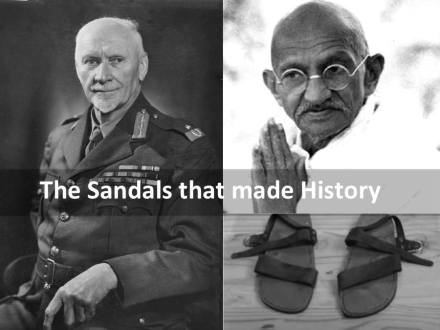
Rather famously, when Gandhi finished his work in South Africa and left with his wife in July 1914, just before he departed, he sent General Smuts a gift of a pair of sandals he made himself.

Gandhi had learnt to make sandals at Tolstoy Farm, a cooperative colony he set up near Johannesburg, from which he ran his campaign of satyagraha (non-violence).

Jan Smuts wore the sandals every summer at his farm, next to the town of Irene, and then returned the sandals to Gandhi on Gandhi’s seventieth birthday, remarking:

“I have worn these sandals for many a summer, even though I may feel that I am not worthy to stand in the shoes of so great a man”.

Smuts went on to say:

“It was my fate to be the antagonist of a man for whom, even then, I had the highest respect”.

A replica of the sandals can be found at the Constitution Hill Museum in Johannesburg.  Appropriately and oddly enough a statue of Jan Smuts stands just opposite a statue of Mahatma Gandhi on Parliament Square in London, in recognition of two world visionaries and their impact in the development of the modern political sphere.

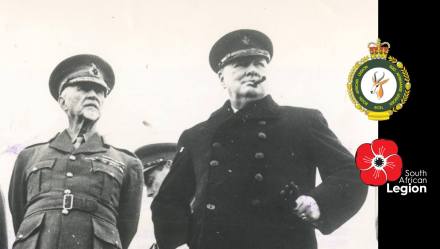
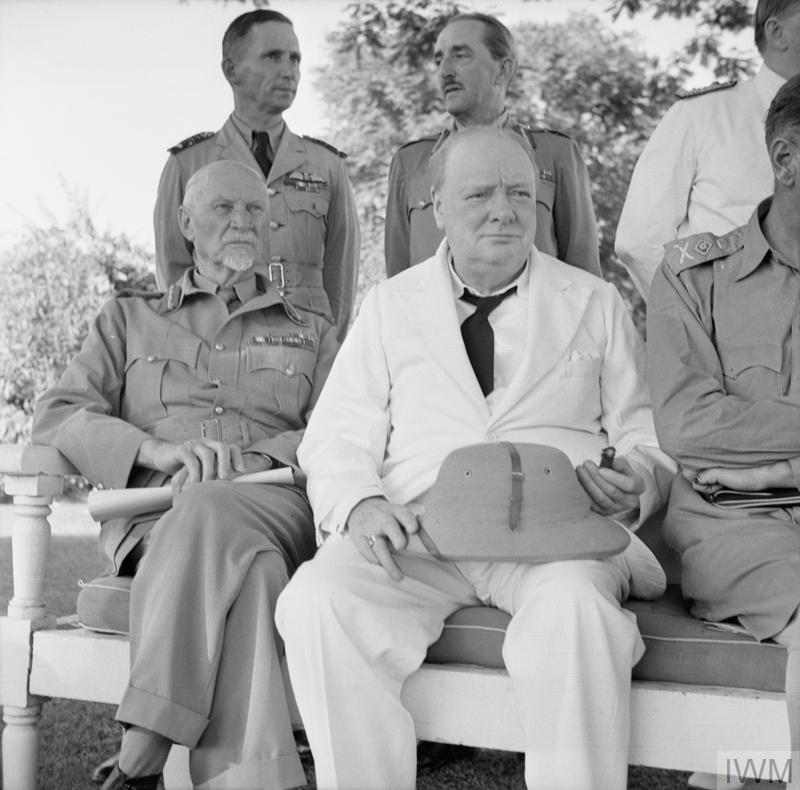
Two fellow members of The South African Legion – Churchill and Smuts

SALegion_FinalLogoLayout_GreenPrintTextThe interesting part of digging up all the “hidden” history of the South African veteran movements after World War 2, is that occasionally you come across some hidden history about the military veterans organisation which you belong to. Did you know that both Jan Smuts AND Winston Churchill are both members of the South African Legion of Military Veterans?

Well – they are. Field Marshal Jan Smuts was awarded the “Gold Life Membership Badge of the South African Legion of the BESL” in November 1945, and Sir Winston Churchill received the same Gold Life Membership Badge to the South African Legion in July 1948.

Smuts02

And here they are – two fellow Legionnaires, the two great prime ministers of Great Britain and South Africa, Prime Ministers, Winston Churchill and Field Marshal Jan Smuts, at the British Embassy in Cairo, 5 August 1942.

Did you also know that Jan Smuts played a pivot role in not only formulating the South African Legion, but also in bringing all the primary war veterans organisations from Britain and around the British Commonwealth under one oversight body? It was formed in 1921 in Cape Town and called The British Empire Service League (BESL) under patronage of the King.  This organisation still exists to this day as the Royal Commonwealth Ex-Services League (RCESL) with Queen Elizabeth II as the head Patron, located at The Royal British Legion’s head office at Haig House in London – and South Africa is still a founding member (represented by the South African Legion).

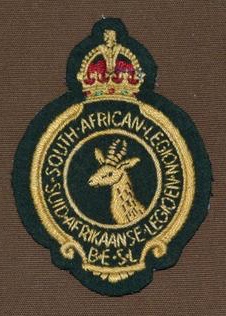
413928_141126095245_DSC_0380This is a standard South African Legion blazer Badge with “Kings crown” from the 2nd World War period.  Note the BESL at the bottom – which stands for the “British Empire Services League” – the South African Legion along with the Royal British Legion, Royal Canadian Legion, Royal Scottish Legion, New Zealand Returned Services Association and the Australian Returned Services League are all founder members of it.

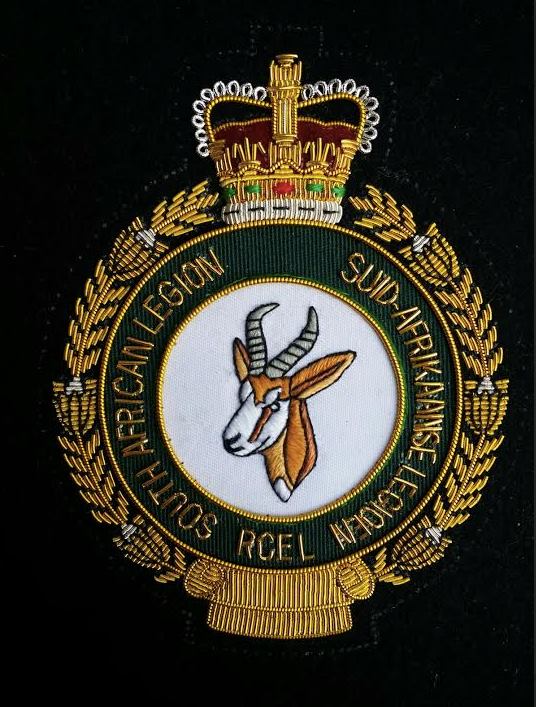
embroidered_nModern South African Legion blazer badge – note the use of modern BESL the RCEL “Royal Commonwealth Ex-Services League” and Queen’s Crown” for Queen Elizabeth II who is the current Patron.

The RCEL mission and objective is to provide aid and support to any members of the British Commonwealth who have served under ‘crown’ in British Armed Forces or Commonwealth Armed Forces whilst under British Patronage.  These include South Africa’s old World War 2 veterans and newer veterans who have served under the Commonwealth agreement in Her Majesty’s Armed Forces in recent conflicts like Iraq and Afghanistan.

Related Work and Links 

Legions and Poppies: Legions and Poppies … and their South African root

Churchills Desk: Churchill’s Desk

Jan Smuts, Churchill and D-Day: Jan Smuts, Winston Churchill and D-Day


Researched and written by Peter Dickens

Image copyright – The Imperial War Museum. Reference “Not For Ourselves” – a history of the South African Legion by Arthur Blake.


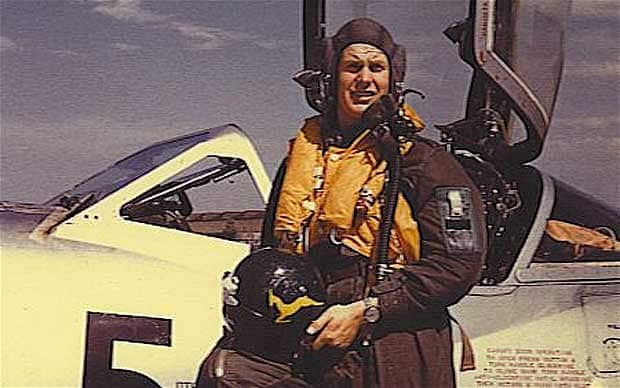
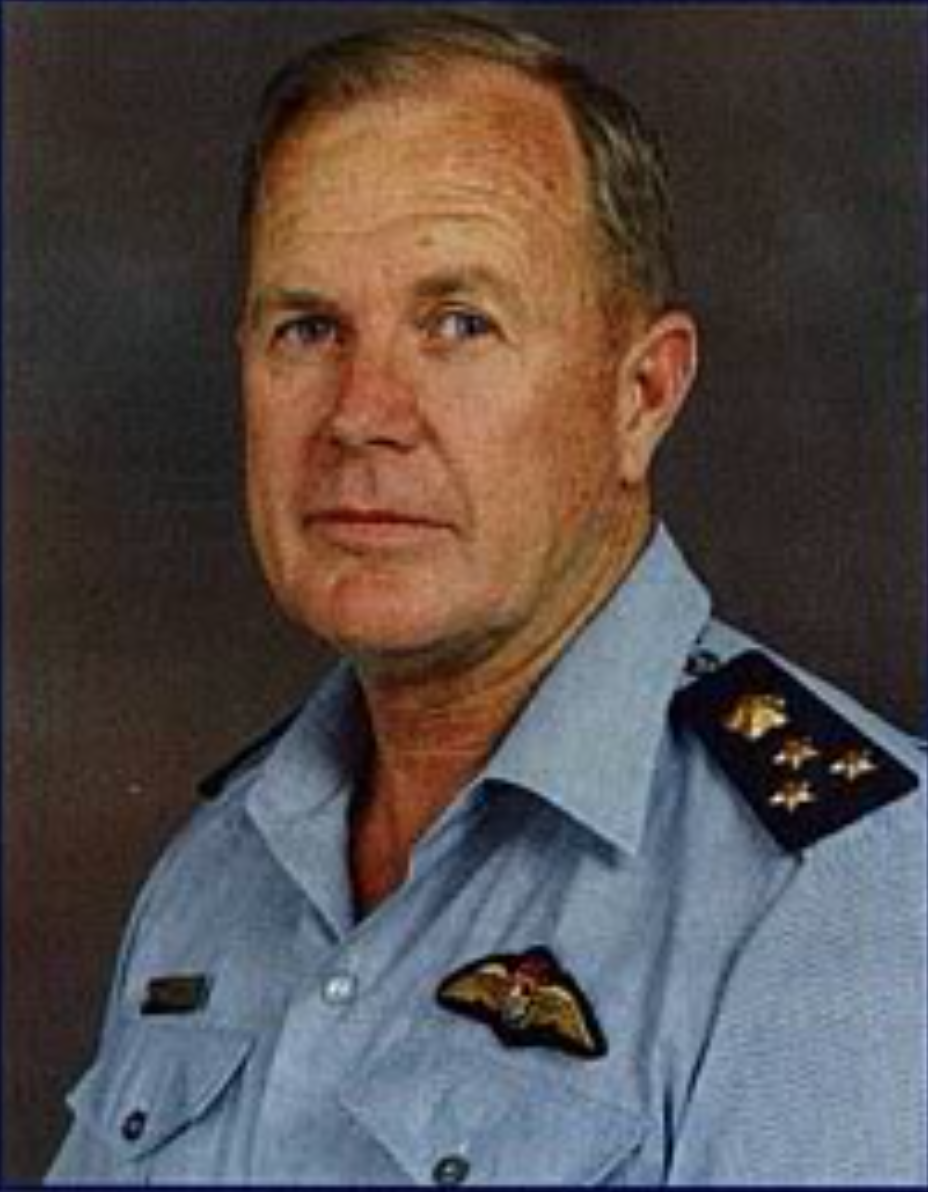
Dick Lord – the combat legend who took learnings from the Royal Navy’s Fleet Air Arm to the SAAF

Richard Stanley Lord (nickname “Dick”) was born on June 20 1936 in Johannesburg, and educated at Parktown Boys’ High School.  His fascination with flying took hold playing “Biggles” high up in Johannesburg’s famous jacaranda trees.

In the late 1950’s Dick Lord wanted to join the South African Air Force.  However at the time the governing National Party had targeted South Africa’s defence forces for “transformation”, effectively ridding the defence arms of all their “British” heritage and socially engineering the forces using job reservation, political appointment and nepotism to progress white Afrikaners.

In this changing political environment Dick Lord was despaired of a career in the SAAF, his Afrikaans was limited and his strong “English” heritage was against him in the now Afrikaner-dominated South African Services.

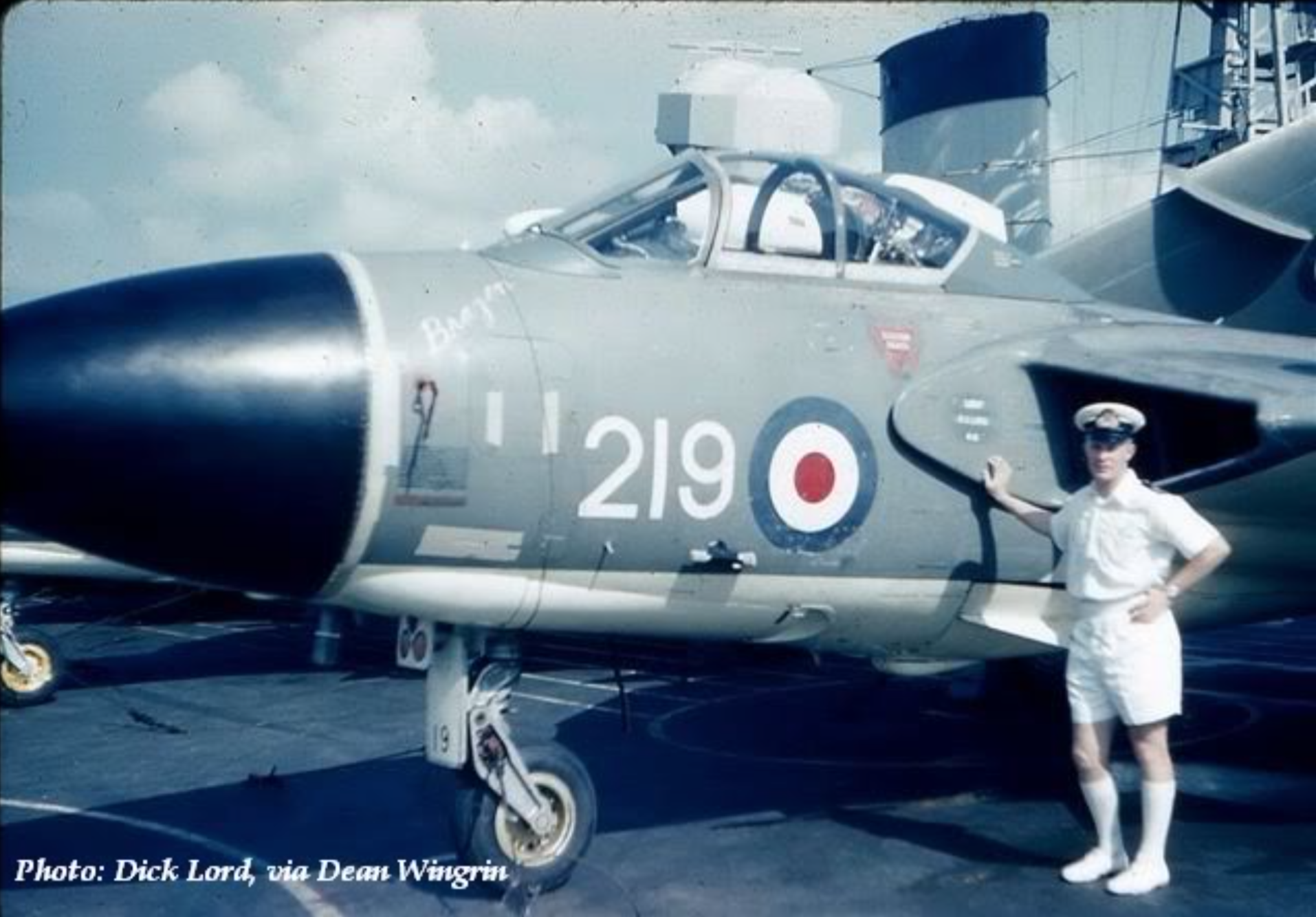
So instead he, joined the Royal Navy. His initial naval training was at the Royal Naval Engineering College, Manadon, and he gained his wings in the Fleet Air Arm in June 1959, flying Sea Venom and Sea Vixen fighters from the aircraft carriers HMS Centaur, HMS Victorious, HMS Hermes and HMS Ark Royal.

Screen Shot 2017-04-01 at 13.24.23

A very eventful FAA Legacy

In 1966 Dick Lord found himself in the Royal Navy’s Fleet Air Arm flying from Ark Royal off Beira, Mozambique, to enforce the oil blockade of Rhodesia following its Unilateral Declaration of Independence. After one mission to intercept a suspected blockade-runner, he returned to find that the carrier had been overtaken by a tropical storm and that her flight deck was pitching through 65ft: his aircraft caught the third arrester wire and damaged its undercarriage – reckoned a near perfect landing in the conditions.

An American “Top Gun”

Dick Lord was instrumental in the development of America’s Top Gun fighter pilot academy, made famous by the film of the same name. He established his unusual role in 1968, when he was the foremost British instructor sent on exchange at Miramar, California, to train American pilots then suffering significant losses at the hands of MiG-21s flown by the North Vietnamese.

While some criticised the performance of America’s multi-million dollar Phantom jet, Lord concentrated on sharpening his pupils’ Air Combat Manoeuvring (ACM) skills to improve their odds in a dogfight.

He and a handful of other Fleet Air Arm graduates of the Royal Navy’s gruelling Air Warfare Instructors (AWI) school in Lossiemouth, Scotland, introduced rigorous new methods for recording and scrutinising the performance of trainees during exercises.

Lord, for example, scribbled notes on a pad on the knee of his flight suit during mock dogfights, which he then exhaustively analysed on a blackboard at post-flight debriefs.
Such was the trust placed in Lord that he was granted access to classified American military documents comparing the performance of US aircraft against that of enemy fighters. This access allowed him to write, with others, the US Navy’s Air Combat Manoeuvring manual.

A year after Lord’s arrival, the tuition and methods introduced by British pilots, all graduates of the AWI school at Lossiemouth, made their way into the US Navy Fighter Weapons School, which was set up in 1969. Better known as Top Gun, it remains the most famous programme in the history of naval aviation. Soon after it was established a Phantom flown by one of its first students shot down a MiG-21, the first time a US Navy aircraft had succeeded in aerial combat in two years.

Lord enjoyed the film Top Gun, but mused that it was “remarkable that any history book studiously avoids mention of any British involvement” and added that the film had not “given us due justice”. He remained proud of his involvement, however, and during his time at Miramar had insisted on using the call sign “Brit 1”. This meant that his wingman, though American, was forced to use the call sign “Brit 2”.

Dick Lord’s wife June Beckett, a BOAC air-hostess said of the movie “Top Gun” that while Dick complained about it, she contended that the film’s portrayal of big-talking fighter pilots was extremely true-to-life, and she should know.

lord_2047777b

On his return to the Royal Navy he was senior instructor with 764 Naval Air Squadron where he passed on the skills and confidence that had made such an impact in America.

Back to South Africa

Dick yearned to return to South Africa, he resigned from the Royal Navy and in 1970 returned to South Africa where he converted to commercial flying and became a civil aviation instructor pilot.

However the Royal Navy would intervene in his life again, this time after a visit to Cape Town by HMS Ark Royal where a “deep chord” was struck in Dick’s heart, rekindling his love of more adventurous military flying.

Joining the SAAF

Although Dick Lord was still unable to pass the Afrikaans language test, he was able to join the South African Air Force this time due to capability gaps in SAAF caused by all their social engineering and transformation policies, it was also now at war and in need of very skilled and experienced military pilots.  Conscription in the SADF had also been implemented by this time, and it involved both English and Afrikaans speaking white South Africans, so policies had to be softened somewhat.

During South Africa’s involvement in the South West Africa (Namibia)/Angola Border War and whilst in the SAAF Dick Lord flew Impalas, Sabres and Mirage Ills.

Dick Lord’s leadership skills were quickly apparent and he ultimately commanded No 1 Squadron SAAF from 1981 to 1983, later directing SAAF operations during the Border War from Oshakati and Windhoek as well as flying SAAF Mirage F1AZs.

He ended his career in charge of the Air Force Command Post in Pretoria, where he was given high accolade for his role in helping to organise the rescue operations that saved all 581 passengers and crew of the Greek cruise-liner Oceanos, which sank off South Africa’s eastern coast on August 4 1991.

Another highlight of his career was to organise, in 1994, the fly-past at the inauguration of Nelson Mandela as President of South Africa. Lord then retired as a Brigadier General and began writing about his life as an aviator.

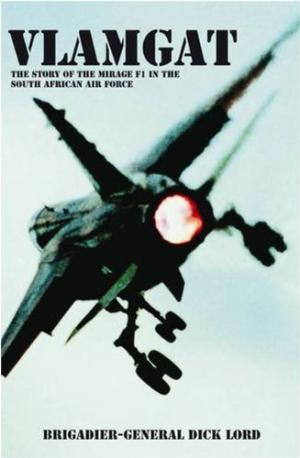
He also wrote a number of books including

9781920143367-us-300

Fire, Flood and Ice (1998) about SAAF Search and Rescue missions
From Tailhooker to Mudmover (2000) – a biography
Vlamgat (2000) – a history of the Mirage fighter jet in South Africa
From Fledgling to Eagle: the South African Air Force during the Border War (2008)

Apart from flying, his passion was military music, his favourite piece being Sarie Marais, the march of the Royal Marines, which is based on an Afrikaner folk song.

Brigadier General Dick Lord died on the 26th October 2011 after a long illness.  He is still sorely missed to this day.

Screen Shot 2017-04-01 at 15.11.13


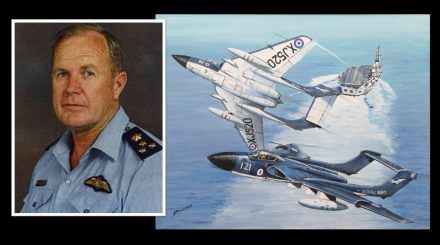
Researched by Peter Dickens.  References:  The Daily Telegraph, Article on Dick Lord by Rostislav Belyakov. Military History Journal Vol 15 No 4 – December 2011.  Feature photo via Dean Wingrin.  Painting of Royal Navy Fleet Air Arm Sea Vixens in the masthead by Derrick Dickens, copyright Peter Dickens.

The inconvenient and unknown history of South Africa’s national flags

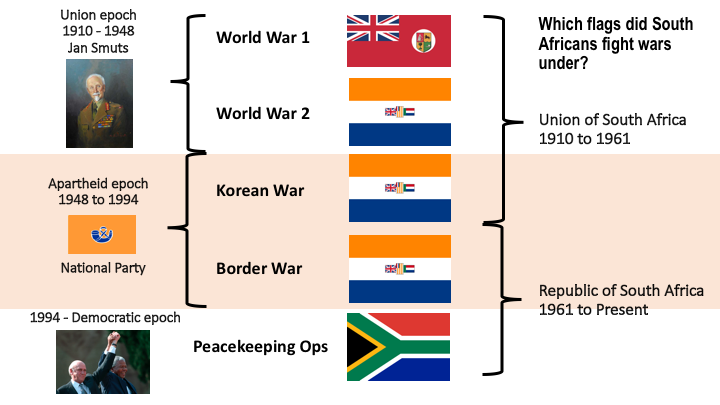
Here’s another interesting back of the chappie gum wrapper fact – Guess which is the correct South African flag South Africans fought under during World War 1?  Bet most people will think of the old “Orange White and Blue” South African flag, but that would be wrong.

As a serving officer in the South African Army I had to be familiar with flag protocol and etiquette, it’s a key part of soldiering when national flags go on parade. However the funny thing in South Africa is just how poor our collective knowledge is of our own national flags.

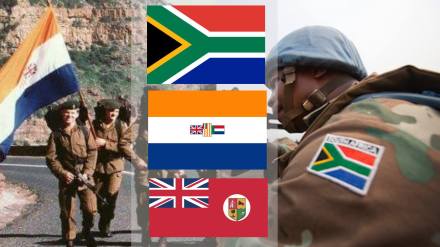
These are in fact all of South Africa’s national flags:17309179_1539170599434728_8929150928988660165_nMany times in military veteran circles there is steaming debate on when to use the “old” national flag and in what context – however few people in South Africa know what flag to use, what they really mean and even less know what the first South African flag actually looked like.

Here is a classic case of the misunderstandings surrounding South African national flags – This is the painting the “Birth of the Union” James E McConnell.  The painting was so poorly researched he used the wrong flag.
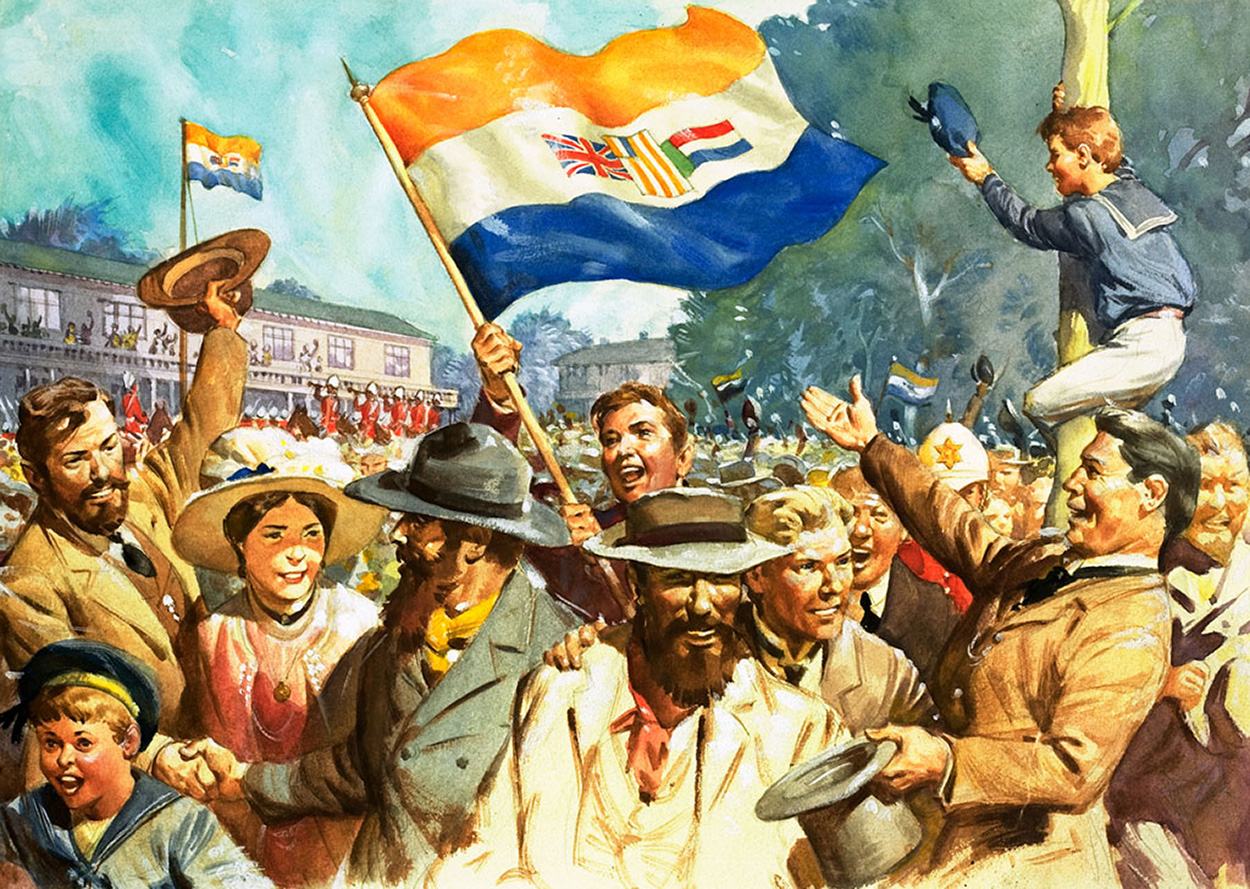
Birth of the Union of South Africa

This is a modern day photo-shop version of McConnell’s painting and it shows his original on the left and a more correct South African Union flag at union on the right.
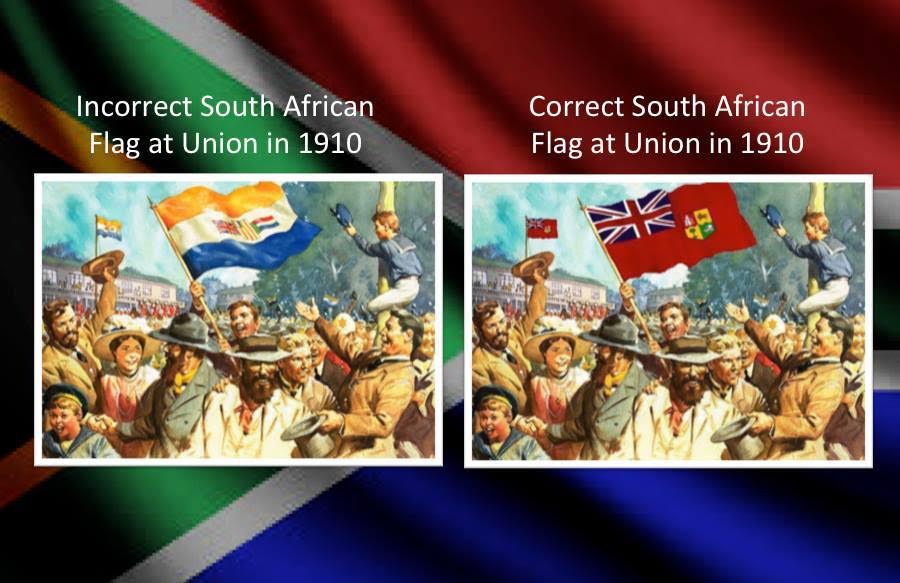
one

The flag he used for his painting was the oranje-blanje-blou (known more commonly as the “OBB”) which all South Africans will recognise. However the flag of South Africa at the time of Union in 1910 was the South African “ensign flag” (British Union Jack top left and the South African National Coat of Arms inserted bottom right). Known as a “Red Duster” – now not too many South Africans today have ever seen that flag.

To show what the first South African national flag, the “Red Duster,” actually looked like here it is:
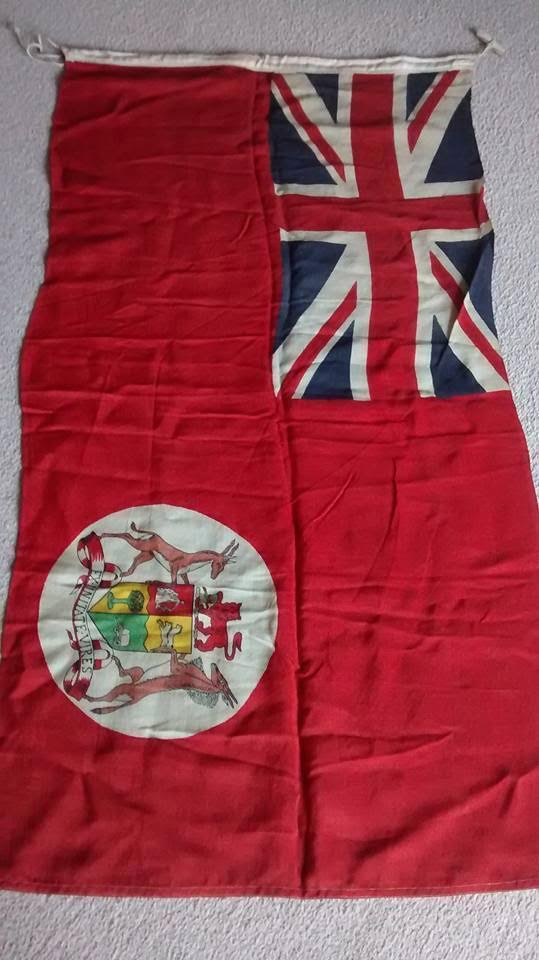
threeIt is very doubtful that there would have been huge public elation of Boers and Brits embracing one another under this National Flag as depicted in the painting, although this was the National Flag that South Africa fought under during the First World War (there where two versions of this ensign flag which they used – one Red and one Blue).
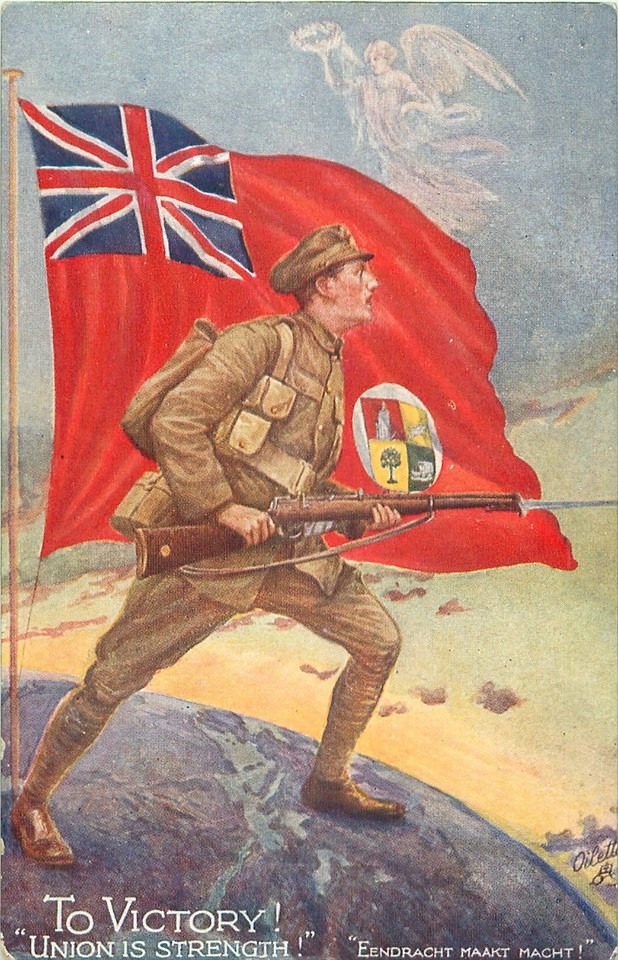
13686500_616785705157832_3286773017917395641_nIronically, the Boer Commandos that joined the South African Union’s Defence Force at Union in 1910, used and fought under this “South African Ensign” in the South West African and the East African campaigns of World War 1 from 1914 to 1918.

As noted, there was another variant of the “Red Duster” which is an ensign with the respective nation’s emblem against a Blue Background and a British Union flag in the left hand corner (you’ll still see this variant used in New Zealand and Australia for their National flag).

Both South Africa’s “Ensign” flags – Red and Blue qualify as the de facto South African national flags from 1910 to 1928, however the Red one was more common.

The Red Duster variant was the primary flag adopted by South Africa and Canada (Canada used their ensign version during WW1 and WW2 – it was only changed to the Maple Leaf in 1965)
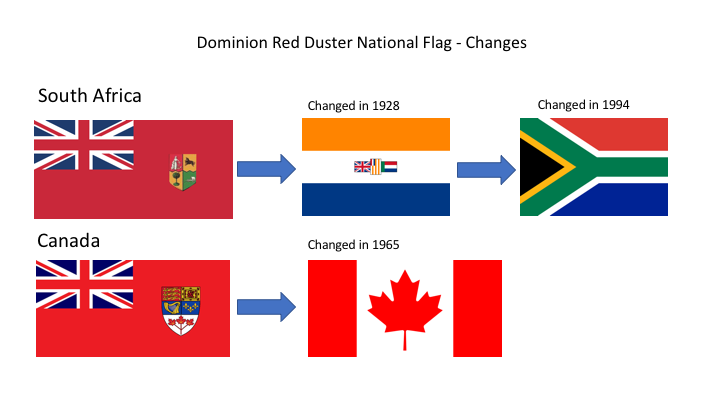
Slide4Given the Ensigns were the flags usually adopted for British “Colonies” and “Dominions”, the South African Union government (which was in fact an independent Parliament to Westminster and made its own laws) felt differently. To the South African Union the national flag of 1910 was “still born” and not reflective of the history of the Boer Republics which made up the other half of the “Union” nor did it adequately reflect on South Africa’s Dutch colony origins.

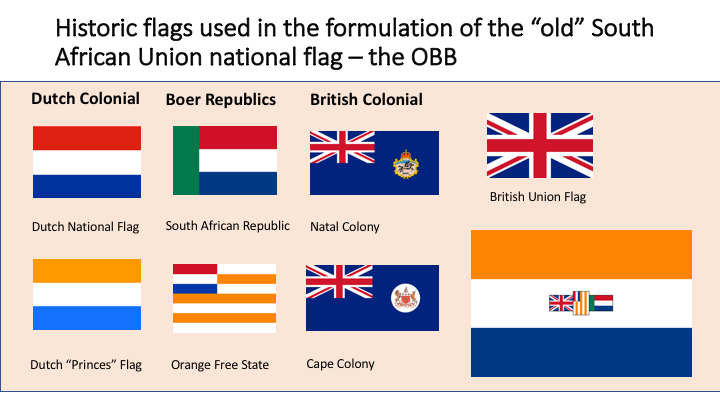
The oranje-blanje-blou (“OBB”) was adopted by the South African Union Parliament as the “new” national flag in 1928. It was proudly flown as the flag of “Union” representing the old British Colonies of the Cape and Natal and the old Boer Republics of the Transvaal (South African Republic) and the Orange Free State. The use of the British Union flag inserted in the OBB, placed closest to the flag mast/pole (the most honoured and senior position for any “inserted” national flag on any flag format) ahead of the two Boer Republic flags, which take a lessor position, calmed down and appeased the “English” detractors who objected to such a dramatic flag change away from the standard Dominion Red Duster.
Slide5

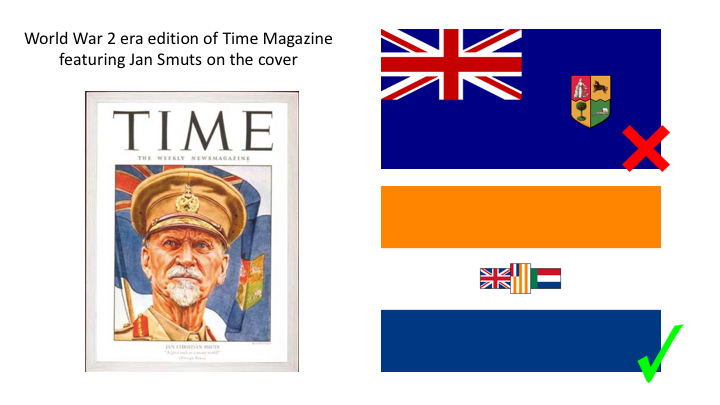
However, confusion as to South Africa’s national flag to use even reigned at this time.  Here Jan Smuts makes the front cover of a late 1940’s edition of “Time” magazine with the National Flag in the background and this time they are incorrectly using the “old” blue ensign flag and should have been using the”new” OBB.
Slide3

So here’s another fun fact, the OBB is not the “Apartheid” flag, the National party when they came to power in 1948 put forward a proposal to have it amended and remove what they called the “Bloed Vlek” (Blood Stain) which was the British Union Flag inserted in the OBB. This was a National party pet hate as it reminded many Afrikaner nationalists of British decimation of Boer families and farms during the Boer war – the campaign to change the OBB flag was stepped up by the National Party under Hendrik Verwoerd when South Africa became a Republic and when he withdrew South Africa from the British Commonwealth of Nations in 1961.

However broader public pressure at the time prevented the initial National Party proposals for a flag change from been passed by the South African Republic’s Parliament and the idea was eventually shelved. In effect the initial campaign to change the OBB died with Verwoerd in 1966, but the National Party attempts to change the OBB to a “new” Republic flag did not stop there.  In 1968, the National Party Prime Minister, John Vorster, again proposed the adoption of a new flag to replace the OBB from 1971, the rational was to commemorate the tenth anniversary of the declaration of South Africa as a Republic.  Even though a National newspaper campaign was run asking the public for suggested flag designs, Vorster’s proposal did not get momentum in Parliament and the flag change never materialised.

Historically speaking, although the hardline National Party members hated the “OBB” and its inserted British “Union Jack”, but they disliked the original South African ensign “Red Duster” national flag with its massive “Union Jack” even more, they hated this flag so much it was literally erased from the South African collective consciousness and very few examples of it survive to this day. It certainly was not top of mind when McConnell painted his “Birth of the Union” painting in 1976.

That the flag of South African Union was kept during the implementation of Apartheid by the National Party from 1948 to 1994 is unfortunate as it detracts from it’s rich heritage as the flag of the South African “Union” and as such it is not the flag of the South African “Republic” nor was it ever intended to be a Republic’s flag – it especially detracts from all the kudos that South Africa received during World War 2 fighting alongside British and American forces under the South African Union’s OBB.
Slide6

The “new” (new) South African flag adopted in 1994 was actually  intended as a “five year interim” flag, however, it proved so highly popular it became the national flag almost instantly and was officially adopted by the government of South Africa on the election day, 27th April 1994.

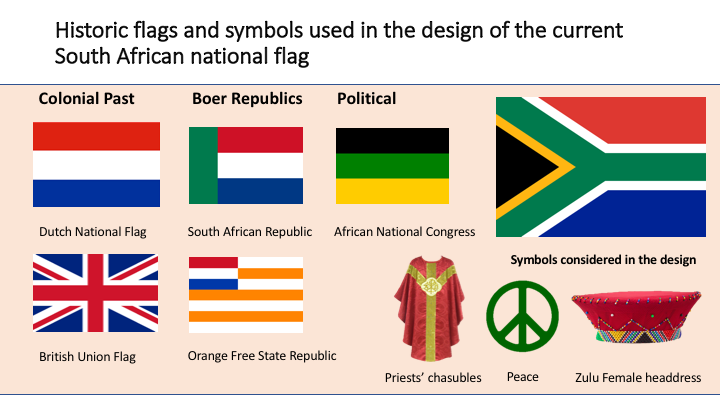
According to its designer Fred Bromnell – It is actually a combination of the two “Colonial era” flags – The national flag of the Netherlands (Dutch flag) – Red, White, Blue and the the British Union flag – Blue, White, Red.  Then the two former Boer Republic flags – the South African Republic (Transvaal) “Vier Kleur” – Green, Red, White and Blue and the Orange Free State Republic Flag (using the Dutch insert flag and the white) and then finally the African National Congress (ANC) Flag – Black, Green and Gold (colours also present in the Inkatha Freedom Party and Pan African Congress flags).

The V symbolises inclusion and unification. In essence it is another flag of “Union” (unity) only this time acknowledging the county’s Black population and its historical heritage.  Symbols considered in the design of the “new” flag included Catholic and Anglican Priest’s Classic Chasubles, the universal symbol of Peace and the married Zulu female traditional head-dress.

There are some claims that the “New” South African flag is just a “design” with no meaning or symbolism – but that’s not the opinion of the man who actually designed it – Frederick Gordon Brownell.  Also, I find that whenever that when this argument is used  it’s usually to deny meaning to the new South Africa flag and to degrade the country, describing it as “jockey Y front underpants,” when in fact the truth is the opposite and the flag is stuffed full of meaning and symbolism.

In fact the “New” South African flag reflects all the old flags of South Africa, these exist right there for all to see, plain as day to the trained eye (and even the untrained eye) – symbolically placed in the new flag – and that’s an inconvenient truth to both the “new” flag’s detractors and the detractors of the “old” OBB.
Slide2

The funny thing is the “New” (new) flag was only meant to be an interim one, hence the mash of historical South African flags.  The irony kills me whenever I see the “new” South African youth and current South African political class with the flag they are now saluting, flying and even wearing – and it consists of their much despised “Colonial” Dutch, British and Boer Republic flags, and most of the “Apartheid” flag – irony lost on them but not on me.

Here’s the another irony – the “old” South African flag i.e. the “OBB” Union flag was born out of the ideals of Union led by Jan Smuts and Louis Botha. Not under the Apartheid ideals of  DF Malan and HF Verwoed. I personally see a lot of irony when hard-line right wing Afrikaners slam Jan Smuts and brand his values of consolidation and union with the British as an act of treason to the Afrikaner people – when at the same time they fully support, and at times even fly, the very flag created in honour of his very Unionist ideal – with its British “Blood Stain” symbolising Smuts’ reconciliation in full and proud senior position.

Furthermore it is ironic that after many years of trying to change the National flag after South Africa was declared a Republic in 1961, it was the National Party that finally achieved its goal in February 1994 when they, as the National Party government, briefed Frederick Gordon Brownell at the government’s own heraldry department to design a new flag (funnily in some sort of déjà vu – they had to involve the country’s National Herald this time after another newspaper campaign for designs from the public had failed, albeit 20 years later).  The result is the current flag we see today.  It was designed literally in a week and the only change in the decades long National Party narrative on changing the OBB this time was that both FW de Klerk and Nelson Mandela had to approve the new design.

So, lump it or leave it – there is nothing in “Union” flags that appeal to “all” people and everything in “Union” flags that appeal to “all” people.

All I can say is that the “new” South African flag has been the most cross cultural flag ever composed in South African history and it has been the least controversial i.e. it has been the most universally accepted by all South Africans (the very vast majority) with the least amount of disgruntled political posturing to change it.

In summary, to the “old” South Africa OBB supporters I would say:

  1.  The OBB was not the only South African national flag both Afrikaner and English South Africans fought under prior to 1994.
  2. The OBB pays a very high homage to The British Union National Flag in terms of the Vexillology of Flags and Flag Etiquette, especially in terms of the superior/senior position it takes relative to the two Boer Republic flags.
  3. The OBB symbolises the union of Afrikaner and English races – a central philosophy of Jan Christiaan Smuts and that of  “Union” Political Coalition partners and Governments.  Not those ideals of nationalist Afrikaners like Malan, Verwoed and Vorster, whose central political premise was that of an independent “Republic” and “Apartheid”.
  4. The OBB, although a flag of Union with the British, is now very dated.  Times and history changed since South Africa declared itself a Republic, so too the demographic and even social landscape of South Arica.  It cannot work as a current national flag in modern South Africa, change was inevitable – even Smuts would have seen that, and knowing his way of governance he would have welcomed a new flag to reflect it had he been around (in his time he served and lived under four different national flags).
  5. Many key Commonwealth countries have traded in their “Colonial” ensigns and Union flags – Canada, Jamaica, Kenya, Singapore, Hong Kong to name a few, and those still holding onto theirs – Australia and New Zealand, are under strong popular pressure to change them ahead of changing times.

To the “new” South Africa, current National flag supporters I say:

  1. The OBB is the flag of “Union” and it is one of the two Union flags used to bring   South Africa into existence as a country on the central principles of “reconciliation” and “tolerance” between two previously warring races (Boers and Brits), it is not the flag of “Apartheid”- in fact it was developed long before Apartheid was instituted as an ideology (in 1948) and symbolically it’s the complete opposite of Apartheid.
  2. Even the hard-line Apartheid Nationalists hated the old South African OBB, so much they wanted to change it – and eventually they did, and ironically it is the flag you now support, salute, fly and even wear – it was designed by a brief from the outgoing Apartheid Nationalist government in its final throws of office.
  3. The “new” flag very strongly and powerfully associates the flags of South Africa’s “Colonisers” and “Boers” in its design and in fact it celebrates this history – in addition to celebrating the history of the Black peoples of South Africa.
  4. The “new” South African flag does an excellent job balancing South Africa’s history and is very relevant to the current time.  I can’t possibly think of a better solution, and if the ANC and EFF one day decide to change it because of all its “colonial” and “white” legacy, I would hate to see what some Gupta owned design agency in India comes up with, because that really would round off a ‘state capture’.

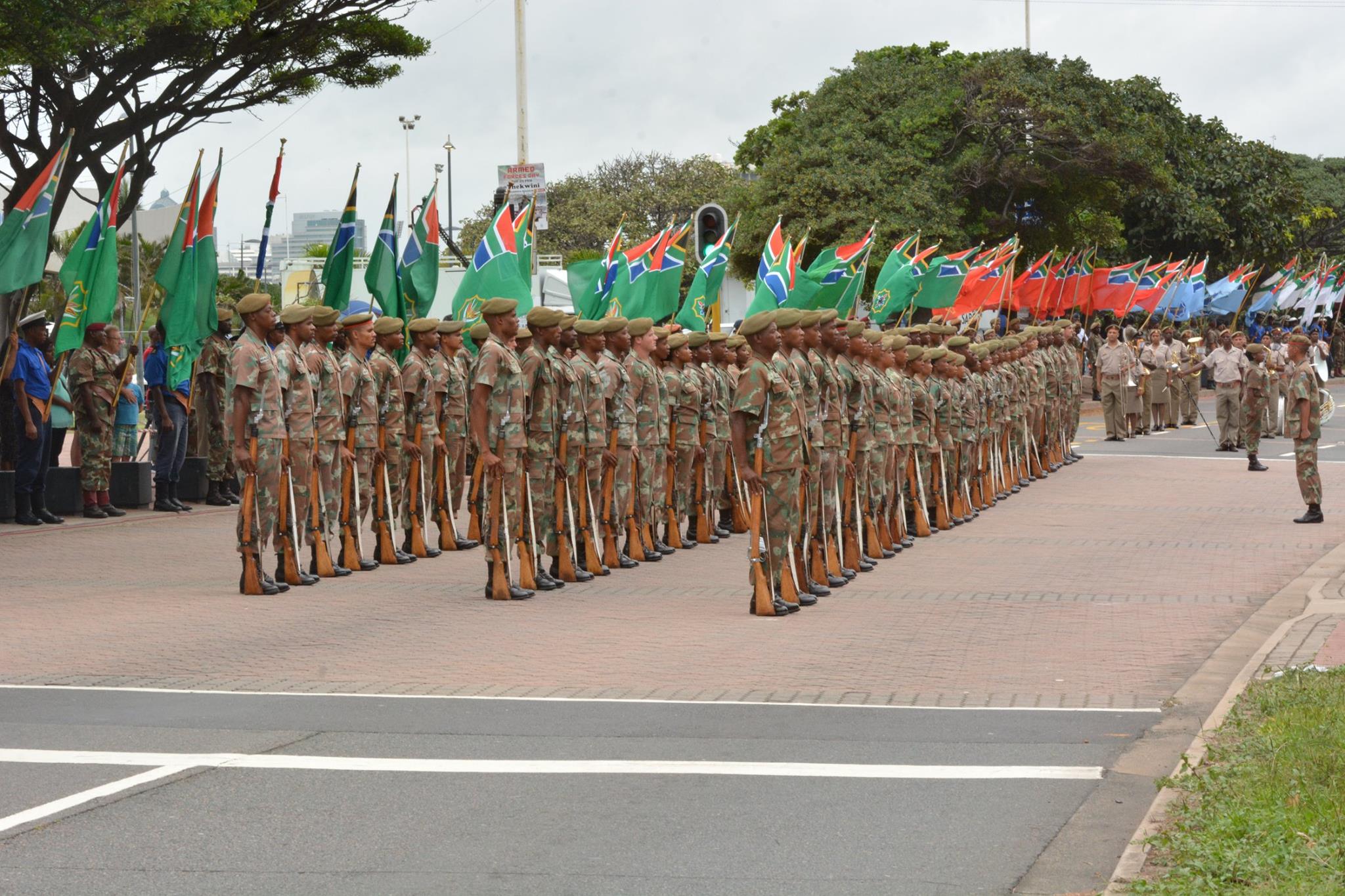
This is why I allow myself a wry ironic smirk every-time South African flags are so hotly debated.
16905042_239550126507219_5077322311342536422_o


Researched and written by Peter Dickens.

Featured image by James E McConnell, Watercolour on Board 1973, photo-shopped version and background information courtesy Nicholas Pnematicatos.

SAAF Ventura down

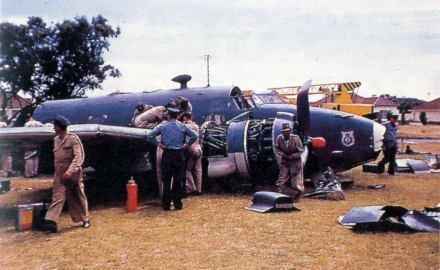
A little bit of Cape Town’s rich history.  Here is a South African Air Force Ventura 6515 from 17 squadron went down in an open field following a engine failure shortly after take-off from Ysterplaat on 26 November 1956.

The crew members – 2Lt R.C. Pelk and 2Lt J.H. Nel survived the crash landing.  Naturally it became a bit of a public spectacle as this image shows.

3936484617_658e907d8b_o

The Ventura PV-1 was an American aircraft made by lockheed and they were extensively used during World War 2 by the Americans, British and Commonwealth forces. The SAAF also operated the aircraft during the war and continued to do so after the war in a coastal patrol role for many years.