Herrenvolk blood for an Afrikaner volk

The German orphan program to boost the white Afrikaner ‘volk’ bloodline

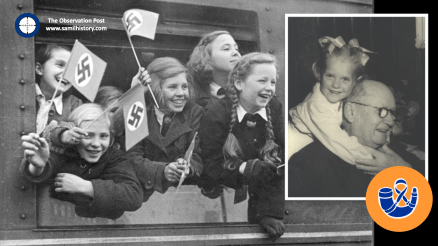
This story verges on the bizarre, but the funny thing is that it’s true and you just can’t make this sort of thing up when it came to South Africa’s old Afrikaner Nationalists. This was a program initiated by right wing Nationalists after World War 2 (1939-1945) to boost the white Afrikaner ‘bloodline’ by importing 10,000 hand-picked German ‘Herrenvolk’ orphans to South Africa for adoption. It is another example of the extreme type of ‘social engineering’ embarked on the by the Afrikaner Nationalists and it underpins the ideologies and thinking that were beginning to formulate in the National Party post war.

The idea carried obvious benevolence to adopt displaced German children who had lost both parents during the war, so in that respect it held a certain moral high-ground, however it is in the objectives and the methodology used that we find sinister Weimar Eugenics at play, the implementation of Nuremberg Race Law ideology, political protest and the manipulation of demographics to advance political gain.

Had the program attained its full quota and objectives, the ‘boost’ to the white Afrikaner pool would have been significant in the three odd generations to come after World War 2. If population growth is anything to go by, in three generations we would be nearing half a million extra white Afrikaners with Aryan German heritage with roots this post war orphan program. As pointed out by Werner van der Merwe in his UNISA journal in 1988, its impact and commemoration would now rival the millennial Second World War anniversary, the French Huguenot anniversary or the next millennial anniversary of the Great Trek.1

Clearly in 2024 we can conclude that this seismic shift in white Afrikaner demographics did not take place, and the reason is this quota of 10,000 ‘Aryan’ orphans was never reached, but that’s not to say the attempt was not made, the program did exist and it had some successes and failures of which there are good underpinning reasons for both. So let’s have a look at the Afrikaner Nationalist’s Dietse Kinderfonds (DKF) – the German Children Fund, its background and its purpose.

Background on the Nazification of the Afrikaner right

In South Africa, this particular story starts the inter-war years (1918-1939), with the rise of National Socialism in Germany and Fascism in Italy from the mid 1920s, many Afrikaner Nationalists increasingly came under the influence of Adolf Hitler and his specific brand of German National Socialism (Nazism). Oswald Pirow, Prime Minister Barry Hertzog’s Minister of Defence (1933-1939), was one of the most influential Afrikaners to fall under Hitler’s spell. Pirow met with Hitler, Hermann Göring, Benito Mussolini and Francisco Franco as an envoy on behalf of the United Party government2. Pirow received Nazi Germany’s feedback on German South West Africa and the ‘new order’ should Germany go to war with Britain and her allies. Pirow gambled his career on a Nazi Germany victory in what he saw as an inevitable war. On 25 September 1940, he founded the national socialist ‘New Order’(NO) for South Africa. He positioned it as a study group within the reformulated National Party (HNP), and based it on Hitler’s new order plans for Africa3. In terms of the NO’s values, Pirow espoused Nazi ideals and advocated an authoritarian state4.

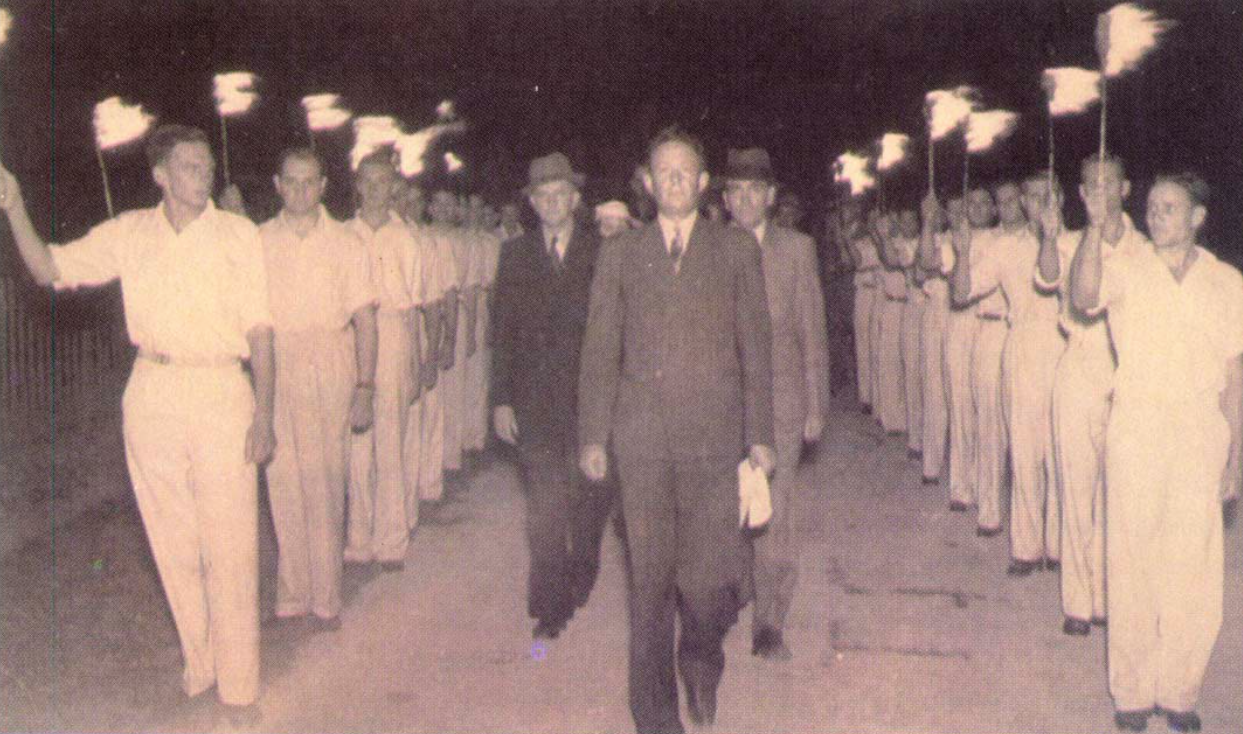
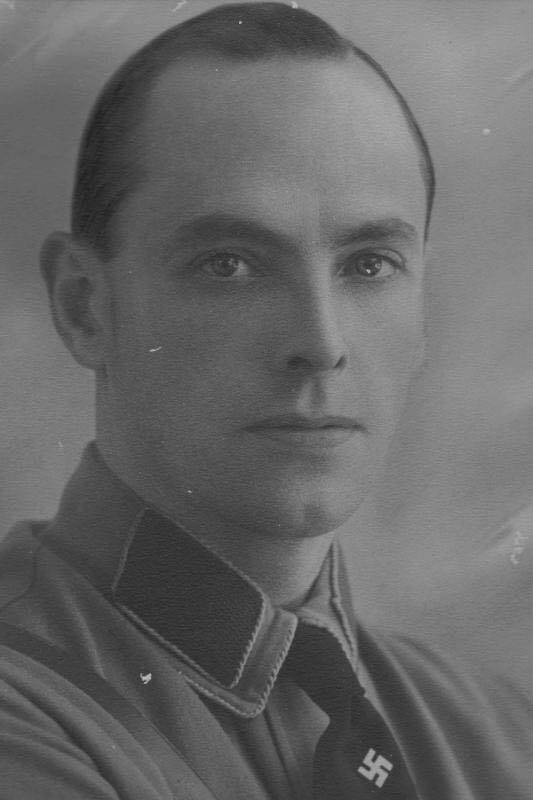
In addition to Oswald Pirow’s NO, other leading and influential Afrikaner Nationalists were forming German National Socialist movements in South Africa during the interwar period. As a committed antisemite, Louis Weichardt broke with the National Party on the 26 October 1933. He founded South Africa’s Nazi party equivalent – The South African Christian National Socialist Movement. This included a paramilitary ‘security’ or ‘body-guard’ section (modelled on Nazi Germany’s brown-shirted Sturmabteilung) called the “Gryshemde” or “Grey-shirts”. In May 1934, the Grey-shirts merged with the South African Christian National Socialist Movement and formed a new enterprise called ‘The South African National Party’ (SANP). The SANP would continue wearing Grey-shirts as their identifying dress and would also make use of other Nazi iconography, including extensive use of the swastika5. Overall, Weichardt saw democracy as an outdated system and an invention of British imperialism and Jews6.
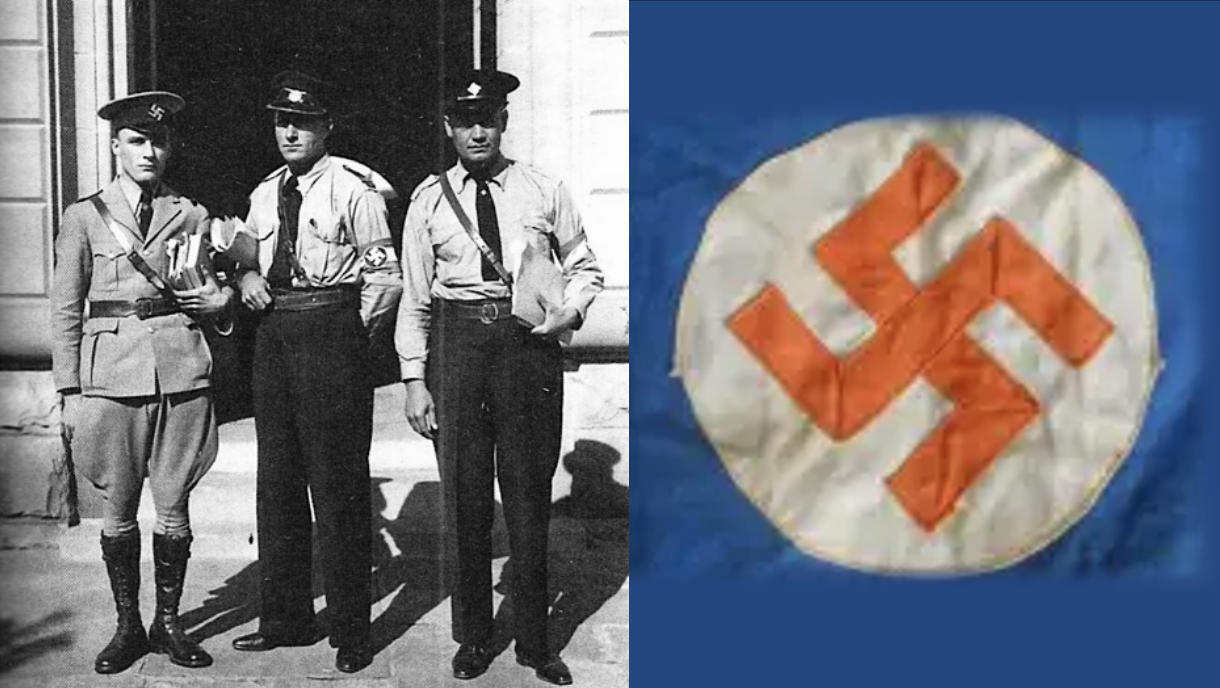
South African Grey-shirts in Grahamstown and their insignia

Other neo-Nazi and fascist groupings either spun out of the SANP Grey-shirts, or mushroomed as National Socialists movements with the German model front and centre in their own right. Also included was Manie Wessels’ ‘South African National Democratic Movement’ (Nasionale Demokratiese Beweging) known as the “Black-shirts”. The Black-shirts themselves would splinter into another Black-shirt movement called the ‘South African National People’s Movement’ (Suid Afrikaanse Nasionale Volksbeweging, started by Chris Havemann and based in Johannesburg, these Black-shirts advanced a closer idea of National Socialism7. Another National Socialist movement known as the ‘African Gentile Organisation’ was also formed in Cape Town by HS Terblanche. In September 1934, Dr AJ Bruwer formed the ‘National Workers Union’ (Bond van Nasionale Werkers) in Pretoria – also known as the “Brown-shirts”. Additionally, Frans Erasmus formed another national party militant group called the “Orange-shirts”8.

In a leadership purge, three National Socialist movements broke away from the SANP Grey-shirts, SANP leader JHH de Waal resigned and formed the ‘Gentile Protection League’ whose sole aim was to fight the ‘Jewish menace in South Africa9’ Johannes von Moltke, Weichardt’s right hand man broke away from the SANP and formed a new organisation called ‘The South African Fascists’ who wore Nazi iconography, blue trousers, and Grey-shirts.

Additionally, Manie Maritz, a veteran of the South African War and influential leader of the 1914 Afrikaner Rebellion, also admired German National Socialism and split from his association with the SANP Grey-shits and joined Chris Havemann’s Black-shirts. A converted antisemite, Maritz even blamed the South African War on a Jewish conspiracy. Moving from the Black-shirts Martiz founded the anti-parliamentary, pro National Socialist, antisemitic ‘Volksparty’, in Pietersburg in July 194010 This evolved and merged into ‘Die Boerenasie’ (The Boer Nation), a party with National Socialist leanings originally led by JCC Lass (the first Commandant General of the Ossewabrandwag) but briefly taken over by Maritz until his accidental death in December 1940.

Aside from all these various parties, the Ossewabrandwag (OB, the Ox-Wagon Sentinel) was the largest and most successful Afrikaner Nationalist organisation with pro-Nazi sympathies prior to and during the Second World War. The Ossewabrandwag was formed on the back of the 1938 Great Trek Centennial celebration – the centennial was planned under the directive of the “Afrikaner Broederbond” (Brotherhood) and championed by its Chairman,  Henning Klopper. They sought to use the centenary anniversary of the 1828 Great Trek to unite the “Cape Afrikaners” and the “Boere Afrikaners” under the pioneering symbology of the Great Trek and to literally map a “path to a South African Republic” under a white Afrikaner hegemony. The trek re-enactment was very successful, and Klopper managed to realign white Afrikaner identity under the Broederbond’s Christian Nationalist ideology calling on providence and declaring it a ‘sacred happening’ 11.

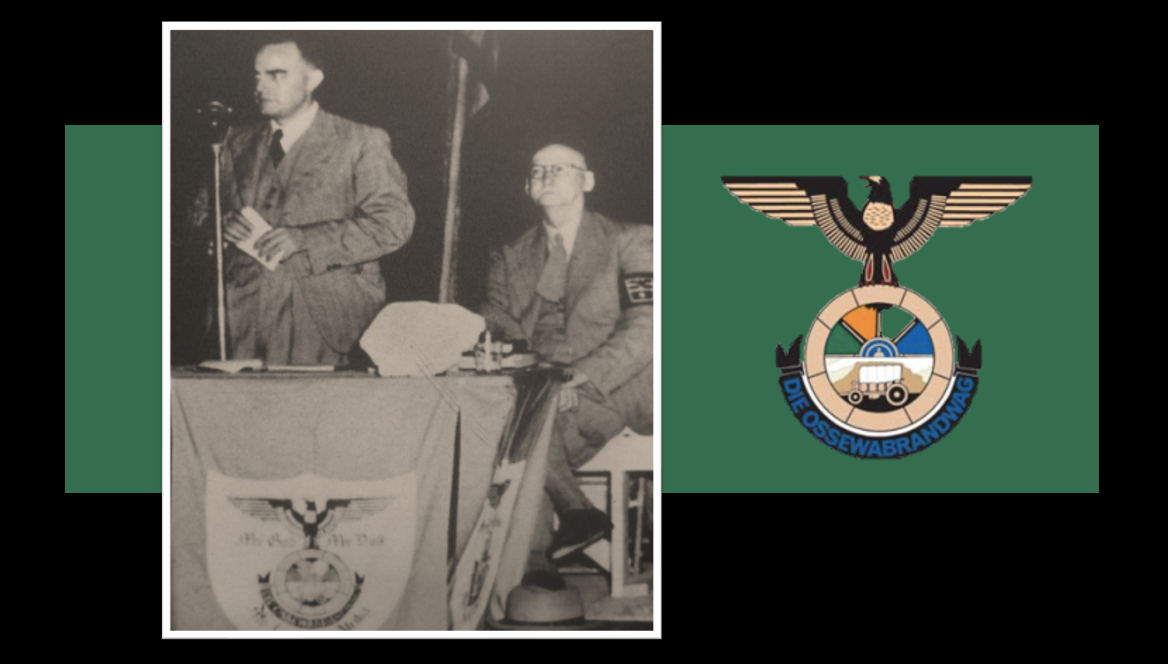
Henning Klopper (seated right), Chairman of the Broederbond at the start of the 1938 Great Trek Centennial

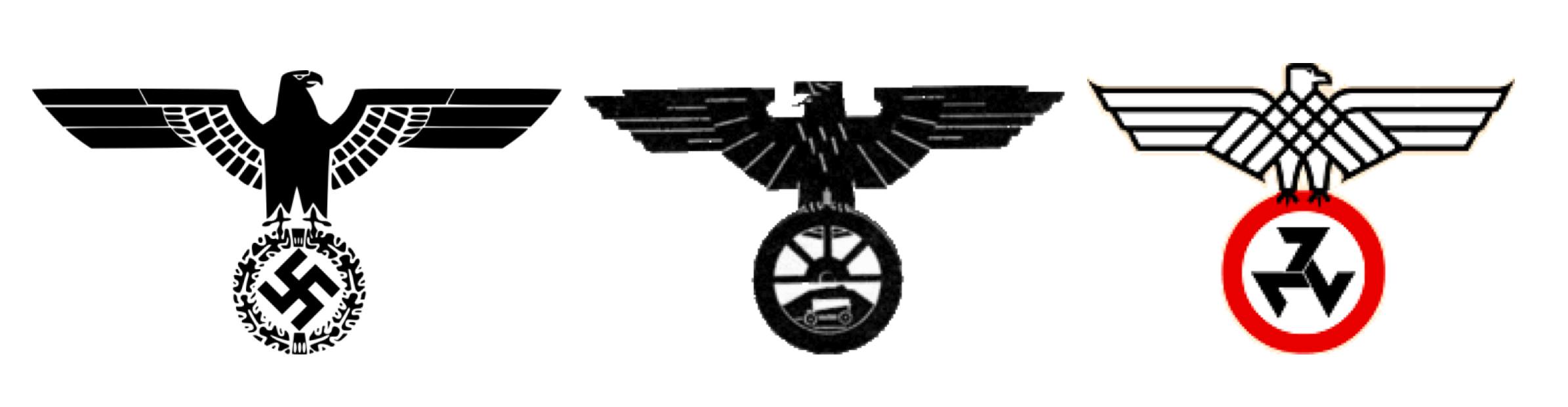
The OB was tasked with spreading the Broederbond’s (and the PNP’s) ideology of Christian Nationalism like “wildfire” across the country (hence the name Ox wagon “Firewatch”’ or “Sentinel”). The OB’s national socialist leanings are seen in correlation with other world ideologies of the time, and specifically to that of Nazi Germany12 . Afrikaner Christian Nationalism, although grounded in “Krugerism” as an ideology, can be regarded as a derivative of German National Socialism and Italian Fascism and is identified as such by OB leaders like John Vorster in 194213. Earlier, the future leader of the OB, Dr Hans Van Rensburg, whilst a Union Defence Force officer, had met with Adolf Hitler and became an avowed admirer of both Hitler and Nazim. As leader of the OB, he then later infused the organisation with National Socialist ideology, whereafter the organisation took on a distinctive fascist appearance, with Nazi ritual, insignia, structure, oaths and salutes. 

Ideologically speaking the OB adopted a number of Nazi characteristics: they opposed communism, and approved of antisemitism. The OB adopted the Nazi creed of “Blut und Boden” (Blood and Soil) in terms of both racial purity and an historical bond and rights to the land. They embraced the “Führer Principle” and the “anti-democratic” totalitarian state (rejecting “British” parliamentary democracy). They also used a derivative of the Nazi creed of “Kinder, Küche, Kirche” (Children, Kitchen, Church) as to the role of women and the role of the church in relation to state. In terms of economic policy, the OB also adopted a derivative of the Nazi German economic policy calling for the expropriation of “Jewish monopoly capital” without compensation and adding “British monopoly capital” to the mix14.
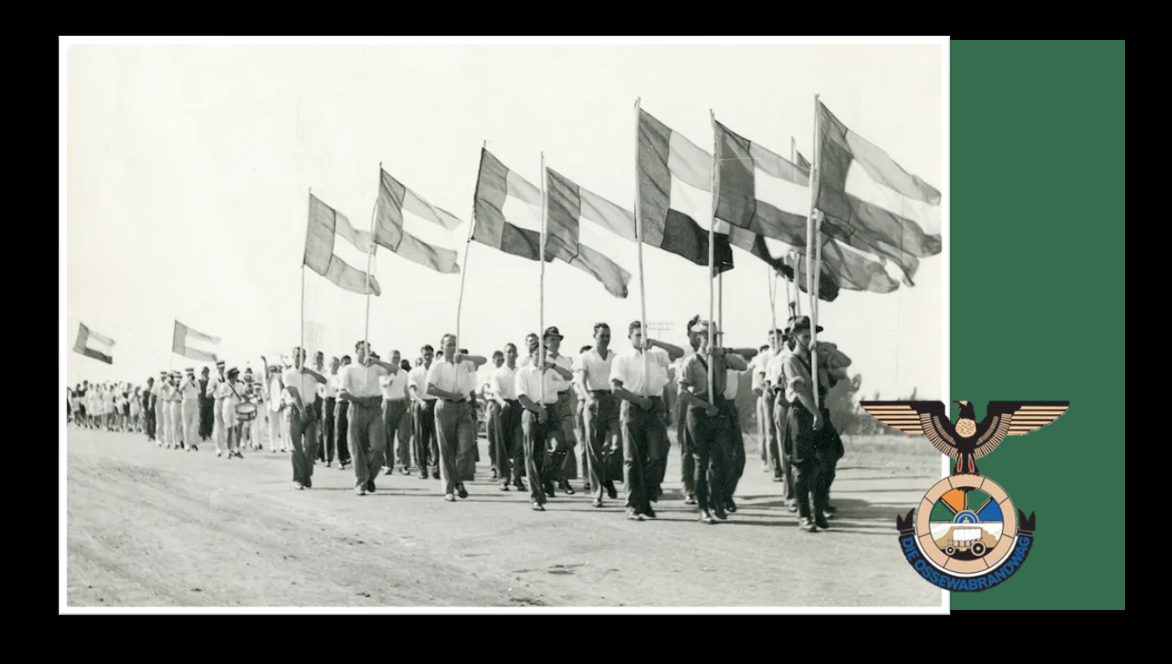
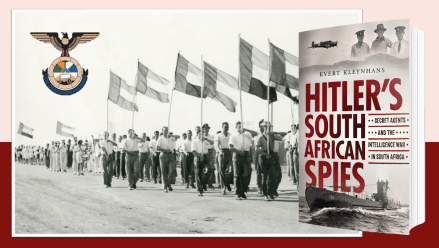
Ossewabrandwag militants on parade with Vierkleur ZAR flags

By the early 1940’s the OB gained its own militaristic wing, called the “Stormjaers”, who countered the South African war effort through sabotage of infrastructure and targeting Jewish businesses. The OB during the war also directly aided the Nazi war efforts aimed at sedition, espionage, spy smuggling, and collecting intelligence in the Union. The post-war Barrett Commission investigation into South African renegades even contains a personal confession ‘van Rensburg vs. Rex’ as to van Rensburg’s regular and treasonous collaboration with Nazi Germany over a set period of time during the war15.

By July 1939, the Black-shirts were formally incorporated into the OB and focussed on the recruiting of “Christian minded National Aryans” into the OB infusing it with more National Socialist “volkisch” Nationalism. This took the OB well beyond its original intention of functioning as a wholesome cultural organ of Afrikanerdom and the National Party16.

The quest for bloodline purity

On the National Party front, the ‘Baster Plakaat’ appeared in the ‘Die Vaderland’ – the National Party’s mouthpiece and the sister newspaper to ’Die Transvaaler’. It appeared on 12 May 1938 and marks the trigger point where ‘Race Law’ starts to enter into National Party thinking from the political front. It marks the advent of a combination of the Nazi Nuremberg Race laws (which banned ‘mixed’ blood marriages of different races and Jews) and Jim Crow American segregation laws (the separation of blacks and whites on which the Nazi German lawyers based their Nuremberg Laws).

The political illustration, known as the “Baster Plakkaat” (miscegenation) released a torrent of criticism and became a media sensation of its time, it caused a lot of discontent between the United Party and the Pure National Party – and for good reason. The essential Law at play in the National Party media mouthpieces is the Nazi law – The Law for the Protection of German Blood and German Honour – propagated in 1935. In the context of the Afrikaner Nationalist mouth-piece this finds expression in a ‘Pure’ Voortrekker woman, in prayer to God and in ‘pure’ white traditional kappie and dress – now “tainted” with “Kaffir” blood, the words ‘dans met Kaffirs’ (dances, i.e to have sexual relations with the black native ‘Kaffirs’) writ in blood … a warning to keep races apart and prevent intercourse lest the purity of soul and the honour of white Afrikanerdom is compromised17.
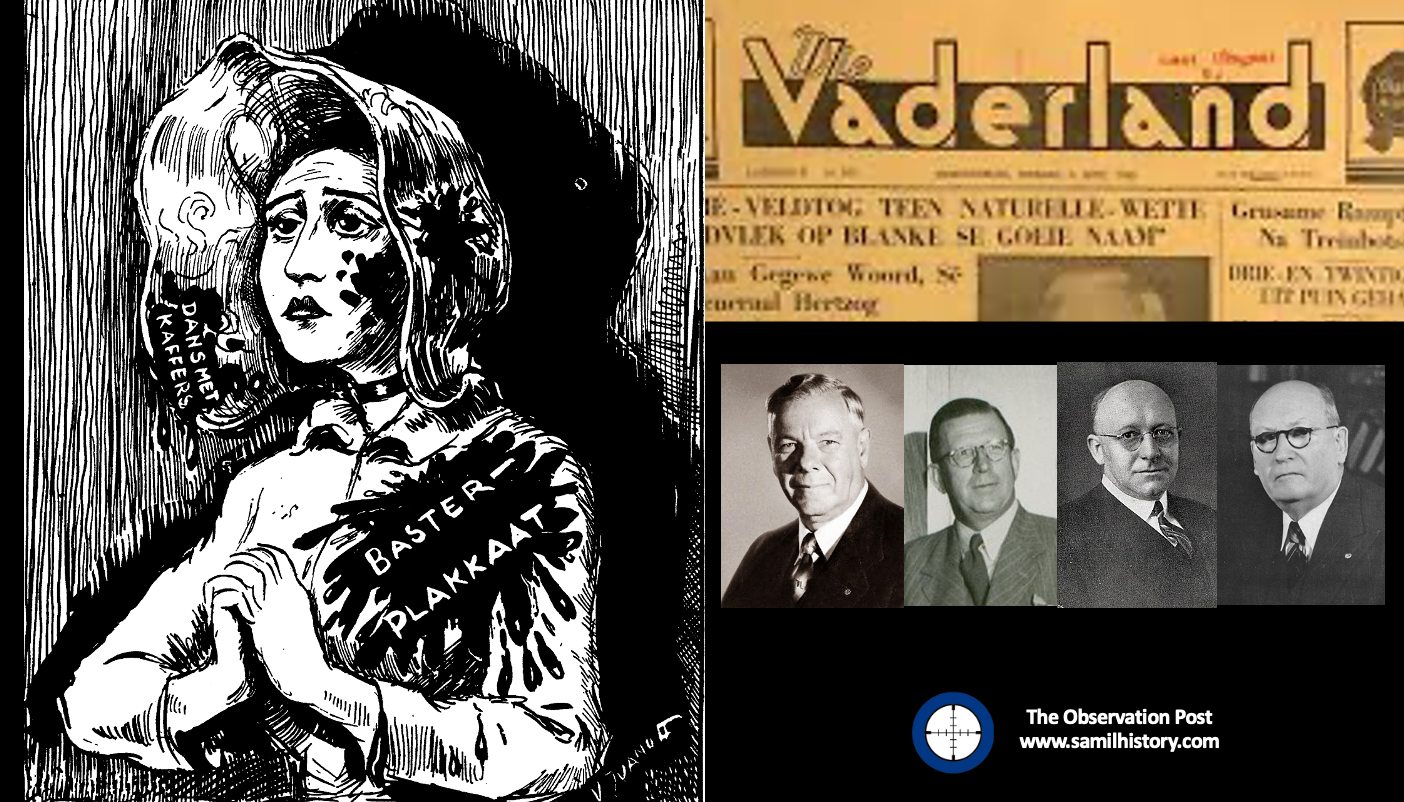
Baster Plakkat in ‘Die Vaderland’ and the Afrikaans media editors – Verwoerd, Dönges, Diederichs, and Malan.

It marks the coming together of two distinctive factions in the National Party. On the one hand the Nederduitse Gereformeerde Kerk (NGK) or Dutch Reformed Church, the “Dominees” (Preachers) in the National Party like Dr. D.F. Malan, whose 1931 – Orange Free State Synod rejects social equality with Blacks and declares Blacks should develop ‘on their own terrain, separate and apart’18 – the idea of mixed marriages and soiling the bloodline of ‘pure’ white Afrikaners discouraged by the NGK. Dr. Malan is also one of the first editors of ‘Die Burger’ another Afrikaner Nationalist mouthpiece.

On the other hand are the Afrikaner “Germanophiles” in the National Party, the ones in open admiration of Hitler and Nazi Germany in the late 1930’s and in lock step with German thinking on race. They all fall part of the National Party’s political think tank, all academic intellectuals – these are primarily Dr. Hendrik Verwoerd (the editor of ‘Die Transvaaler’ and Sociologist), Dr. Nico Diederichs (the Chairman of the Broederbond and Political Scientist) and Dr. Eben Dönges (‘Die Burger’ journalist/lawyer who introduced race-based population registration). 

These are the collectively known as “architects” of Apartheid and it is no surprise given that they all hold positions as editors that the kernel of “race law” thinking – both on the political and theological fronts starts to formulate in the Nationalist media.

Aryan Immigrants only

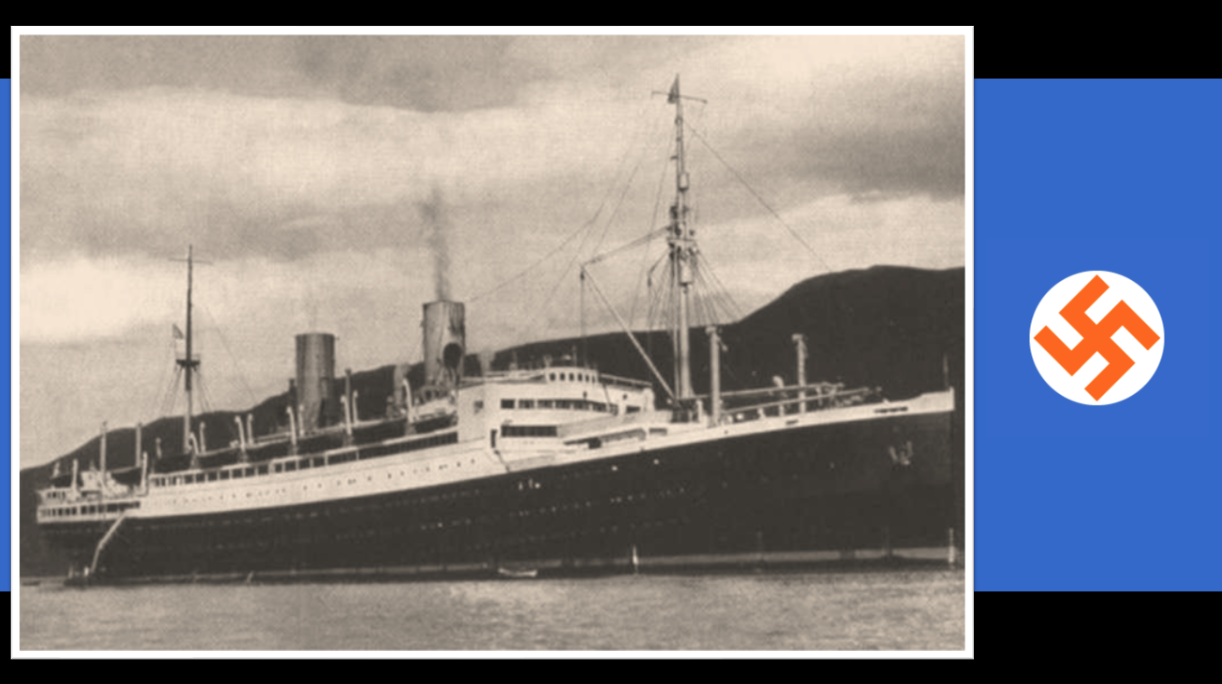
Insofar as Afrikaner “Germanophiles” collaboration and co-operation with Nazi Germany. Prior to the war the Pure National Party was in the process of framing up its policies. The arrival of the S.S. Stuttgart in Cape Town on the 27th October 1936 packed with 537 Jewish refugees on board19 sharply brought the National Party’s policies of immigration and race into focus – it defined what sort of ‘demographics’ the Pure National Party were prepared to focus on to augment the ‘white races’ in South Africa and which were the ‘undesirables’. The arrival of the SS Stuttgart was met with a mass protest of some 3,000 South African Nazi ‘Grey-shirts’20.

Dr. Hendrik Verwoerd was Dutch by birth, but he honed his studies in sociology and psychology in Germany and there is no doubt he was exposed to German politics and the rise of Nazism. Verwoerd showed his antisemitic colours early on when he and a deputation of four fellow minded Nationalist academics – Christiaan Schumann, Dr. Johannes Basson and Dr. Eben Dönges from Stellenbosch University and Frans Labuschagne of Potchefstroom University joined hands with the Nazi Grey-shirts and lodged protest with Hertzog’s’ government as to the immigration of Jews from Nazi Germany.21 At this point these academics were concerning themselves with the poor white problem and ‘völkisch‘ mobilisation warning that Jews were ‘unassailable‘ to the Afrikaner Volk , they met to protest the SS Stuttgart at the University of Stellenbosch on 27 October 1936 and resolved that Jews were ‘undesirable‘ on account of ‘religion’ and ‘blood mingling‘ and that ‘cultural cooperation‘ with them was impossible22.
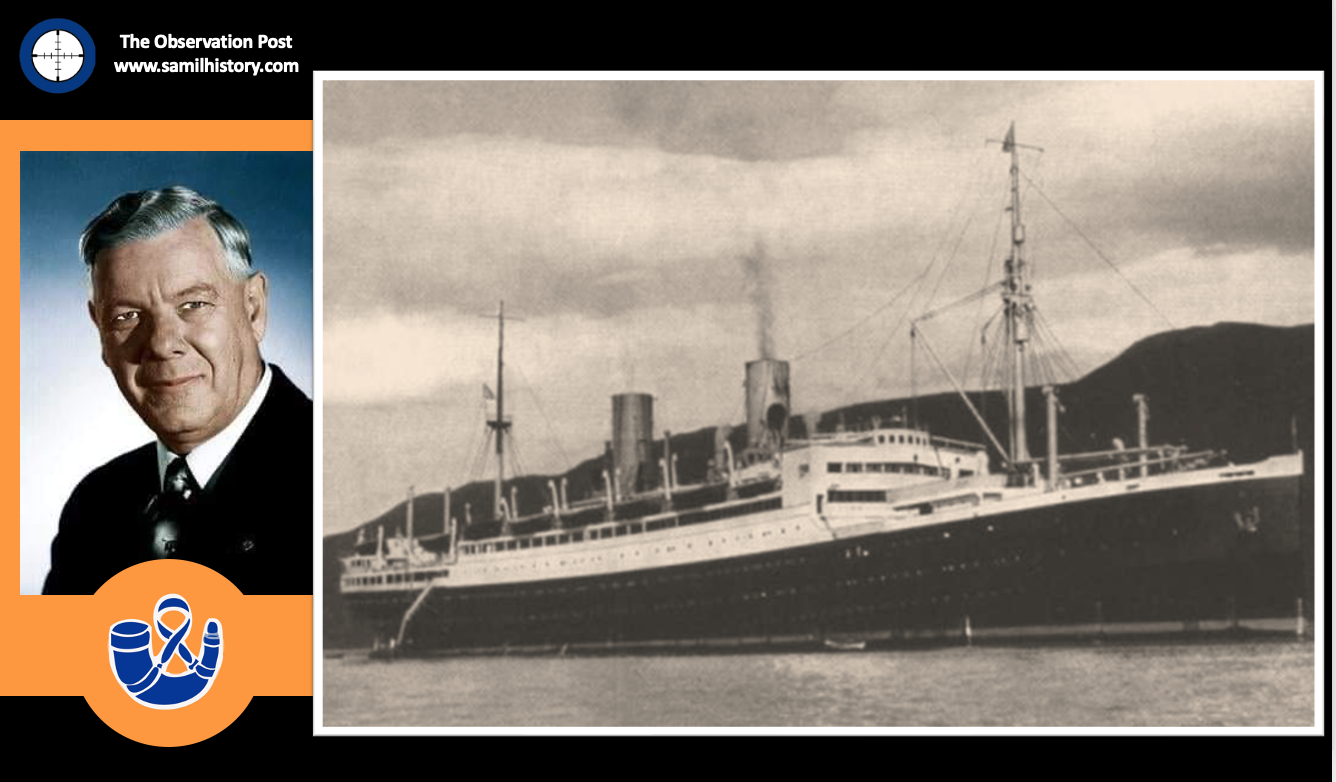
The SS Stuttgart and Dr HF Verwoerd

Frans Erasmus (the future National Party Minister of Defence) would go further on the matter and even officially thank the Grey-shirts on behalf of The National Party for bringing the attention of the ‘Jewish problem to the Afrikaner volk.‘ This in turn spurred Dr. DF Malan to table an Immigration and Naturalisation Bill which sought to exclude immigrants who were ‘unassailable‘ with the culture and even economics of the Afrikaner Volk and deal with ‘the Jewish problem’ as he termed it. This in turn led to the ‘Aliens Bill’ being passed in 193723 by the Hertzog led United Party government which although a watered down version of Malan’s original proposal, still pandered to issue of cultural and economic ‘assimilation’ to prevailing ‘European’ white culture in South Africa – opening the way for the “right kind” of European immigrants (the Aryan kind) and not the wrong kind (the Jewish kind).

The Clouds and Fog of War

With the clouds of war looming in 1939, on the right of Afrikaner political spectrum, all the various movements with Nazi ideologies and/or pro Nazi war effort sympathies inherent in them, the main ones being the New Order, the Grey-Shirts, the Ossewabrandwag, and the Purified National Party with its combination of “Dominees” and think tank “Afrikaner “Germanophiles”, all found themselves in lock step with Nazi Germany.

Enough so that Dr. Nico Diederichs on 9 May 1939, in his capacity of the Chairman of the Broederbond, would meet Herr. H. Kirchner, a Nazi foreign ministry representative in South Africa. Diederichs assures Kirchner that the divisions in Afrikanerdom had been overcome by the purging of Freemasons from Broederbond (which he had personally seen to) – he would go on to say that the Pure National Party (PNP) was a committed anti-semitic party and as policy had hung its hat on it, he assures Kirchner that despite recent statements by Dr DF Malan, Malan is also a committed anti-semitic. Diederichs however feels that more needs to be done to frame up National Party policies in line with National Socialism and confides in Kirchner that he does not think Dr. DF Malan is the man to do it, rather the implementation of the ‘anti-democratic’ and other national socialist principles should he left to Dr. Hans van Rensburg (a PNP member in the Orange Free State and the leader of the Ossewabrandwag) who he also feels would be ideal leader of the Purified National Party going forward24.

In South Africa the overt and even tacit support for Nazi Germany in the white Afrikaner community became openly apparent when Britain and France declared war against Nazi Germany on 3 September 1939. The Hertzog led United Party found itself in a dilemma and a parliamentary three-way debate would take place almost immediately after Britain’s’ declaration. This debate, primarily between the two factions in the United Party (Hertzog’s old National Party cabal and Smut’s old South African Party cabal) and the Purified Nationalists, was whether South Africa should go to war against Germany or remain neutral. General Smuts’ argument surprisingly won the day and Smuts’ amendment to Hertzog’s Motion of Neutrality was carried by 80 votes to 67 votes on the 4 September 1939, and as a result South Africa found itself at war against Nazi Germany. Surprised at the outcome, Hertzog promptly resigned and along with 36 of his supporters left the United Party, thereby leaving the South African Premiership and the leadership of the United Party to Smuts25.

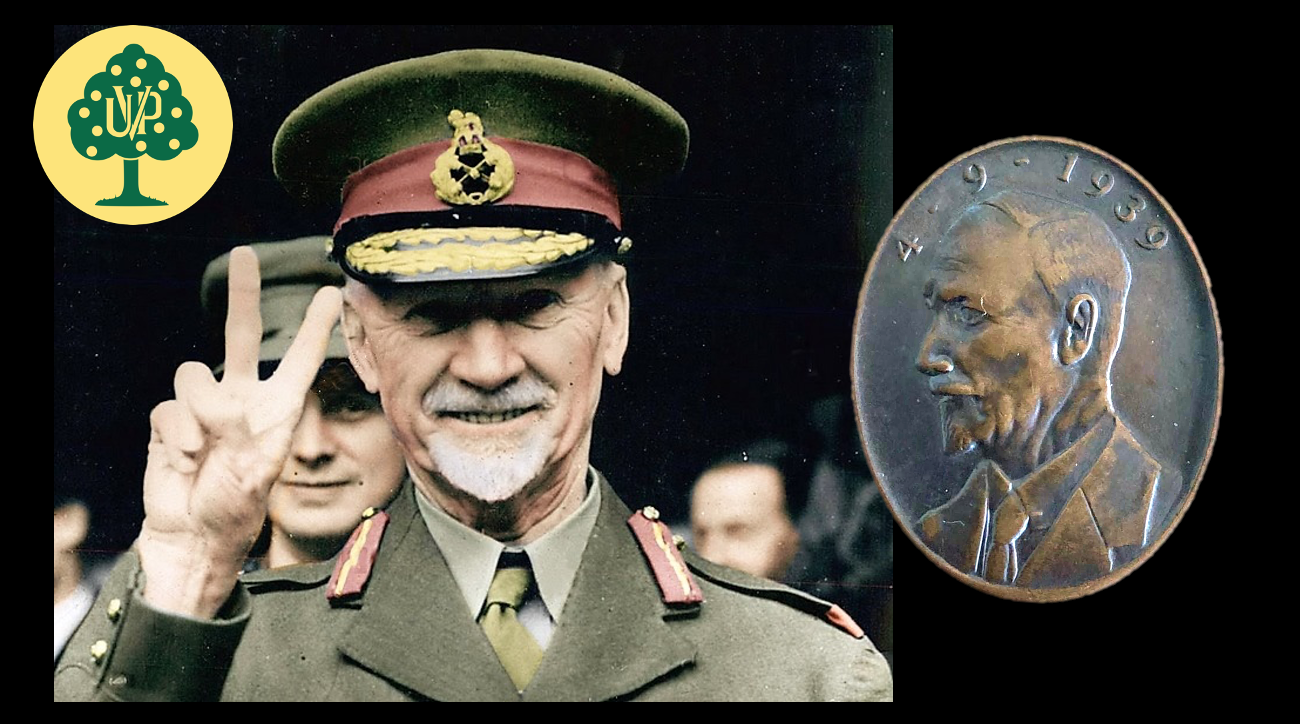
The Purified National Party’s “Malanites” (with its Dominees and its academic think tank Germanophiles) and the United Party’s old National Party fusion “Hertzognites” were able to ultimately reconcile their differences sans Hertzog, all under the leadership of Dr. DF Malan and they reconstituted themselves as the Herenigde Nasionale Party (Reunited National Party) HNP on 29 Jan 1940.

Dr. Malan took a position to remain officially ‘neutral’ as to South Africa’s role in the war, whilst at the same time tacitly approving the Nazi war effort and hoping for their victory. Among the Afrikaners who opposed the war with Nazi Germany, many legally directed their outrage through political expression26 in the HNP. Various splinter group cultural organisations like the Ossewabrandwag and political entities like the Grey-shirts and the New Order surrounding the National Party took a different approach and overtly engaged High Treason activities in support of Nazi Germany’s war effort. These activities were subversive and clandestine actions by nature and aimed at disrupting the South African war effort through bombings, sabotage and intimidation. The Ossewabrandwag’s militant wing Stormjaers were responsible for many of these actions of sabotage, but other groups, such as the Tereurgroep, the x-Group and Robey Leibbrandt’s National Socialist Rebels, were equally active.27

Smuts’ wartime government issued Proclamation 201 of 1939 and the War Measures Act of 1940 (Act 13 of 1940), which provided the government with arbitrary powers for the suppression of subversive organisations and declared them illegal if they presented a danger to the defence of the Union and the Mandated Territory (SWA), public safety and order and the conduct of war28. The suppression of the right wing Afrikaner nationalists involved in sedition, treason and sabotage became a necessity, suspects were held under the Act without trial and interned along with enemy spies and foreign nationals suspected of subversive acts. They were held at six internment camps, namely Baviaanspoort, Leeukop, Andalusia, Ganspan, Sonderwater and Koffiefontein during the war. Col. EG Malherbe, Director of Military Intelligence, noted in his biography that 6,636 people (including POW and German Nationals) were interned during the war29.

Leeuwkop Internment Camp songbook and emergency relief poster for Afrikaner ‘political prisoners’

Of the “political prisoners” interned, the generally accepted number is approximately 2,000 right wing white Nationalists, some future famous names include BJ Vorster (an OB General and future Prime Minister of South Africa), his brother, the Rev. Koot Vorster (an OB General and NGK stalwart), Louis Theodor Weichardt – the leader of the SANP Grey-shirts and Hendrik van den Bergh (an OB stalwart and the future head of the Apartheid regime’s division of State Security).

Post War Reconciliation

At the end of the Second World War, with Nazi Germany’s fate sealed on 7 May 1945, the issue of German National Socialism (Nazism) and Italian Fascism as a viable political undertakings in South Africa became moot. The peripheral Neo Nazi and fascist ‘shirt’ movements, National Socialist ‘volks’ parties, the New Order and the Ossewabrandwag were all gradually welcomed into the Reunited National Party (HNP) under Malan and the Afrikaner Party under Nicolaas Havenga.

Unlike other Allied partners in the war effort against Germany, the Smuts government took a cautious and reconciliatory approach to all its dissonant and irreconcilable white Afrikaner voters who had supported Germany due to cultural and political affiliations prior to and during the war. This affinity for Germany stemmed from the many Afrikaners who had German ancestry as a result of Germans settling in South Africa that by the nineteenth century 33.4% of Afrikaners were of German ancestry, 35.5% of Dutch ancestry, 13.9% of French ancestry, 2.9% of British ancestry and 14.3% of other nations30. As a voter block in a whites dominated franchise this presented a significant demographic to Smuts, and one whose support he needed to remain in power.

Inside South Africa the Nazis had failed in the short-term, but the success of the pro-Nazi and anti-war groupings planted a fertile seed bed for the future authoritarianism of the Apartheid state. The constant depreciation of liberal democracy in this demographic of Afrikaners alongside an almost ‘hysterical exaltation’ for both ‘racist’ and a ‘Völkisch‘ group ethics were to have long term effects31. In essence, although Nazi ideology and dogma was no longer permissible in the political sphere, no measures were put in place by the Smuts government to prevent it from flourishing. Afrikaner Nationalists entertaining strong National Socialist ideologies and having committed high treason and sedition, who in European countries would have been hanged for war crimes, landed up back in mainstream party politics under the banner of the National Party and many even ended their days in Parliament32.

Reigniting Herrenvolk and Weimar Eugenics

Regardless of the outcome of World War 2, Afrikaners who had come under the influence of National Socialist dogma still held Germany in such high esteem that they were prepared to do everything in their power to ensure that the Afrikaners would benefit from Germany’s defeat in 1945 by obtaining for the Afrikaner Volk some of the “valuable blood of the German Herrenvolk”33.

Before and during the war Nazi German emissaries and agents had promised both Dr. DF Malan and Dr. Hans van Rensburg that Germany would help them to establish an Afrikaner hegemony state in Southern Africa along oligarchy and racially differentiated lines, this would include all of South Africa and the British colonies and protectorates of Swaziland, Southern Rhodesia (Zimbabwe), Bechuanaland (Botswana) and Lesotho – but it would exclude German South West Africa (Namibia) which they insisted South Africa return to Germany.

The idea of the re-establishment of the old Boer Republics and the realisation of the vision of an ‘Afrikaans Empire from the Zambezi to the Cape’, a plan announced publicly by senior officials of the ZAR government and Afrikaner bondsmen as early as 188434 – this plan was highly appealing to Afrikaner nationalists. So too was the addressing of the long held animosity to Britain and redressing the loss of the Boer ‘fountain of youth’ in the concentration camps during the South African War – a total of 22,074 children under the age of 1635 (the majority of whom had died of an measles epidemic which swept the camps, the rest succumbing to other diseases – mainly typhoid) . In both instances Nazi Germany would be the enabler of this vision and replenishment of white Afrikaner sovereignty should they win the war – boosted somewhat by the immigration of German ‘Ayans’ to Southern Africa. The outcome of the war did not change this sentiment, vision or objective. Dr DF Malan still pledged that Aryan German immigrants were necessary to cultivate a ‘broad Nordic front to counter Communism, Blacks and Jews’36.
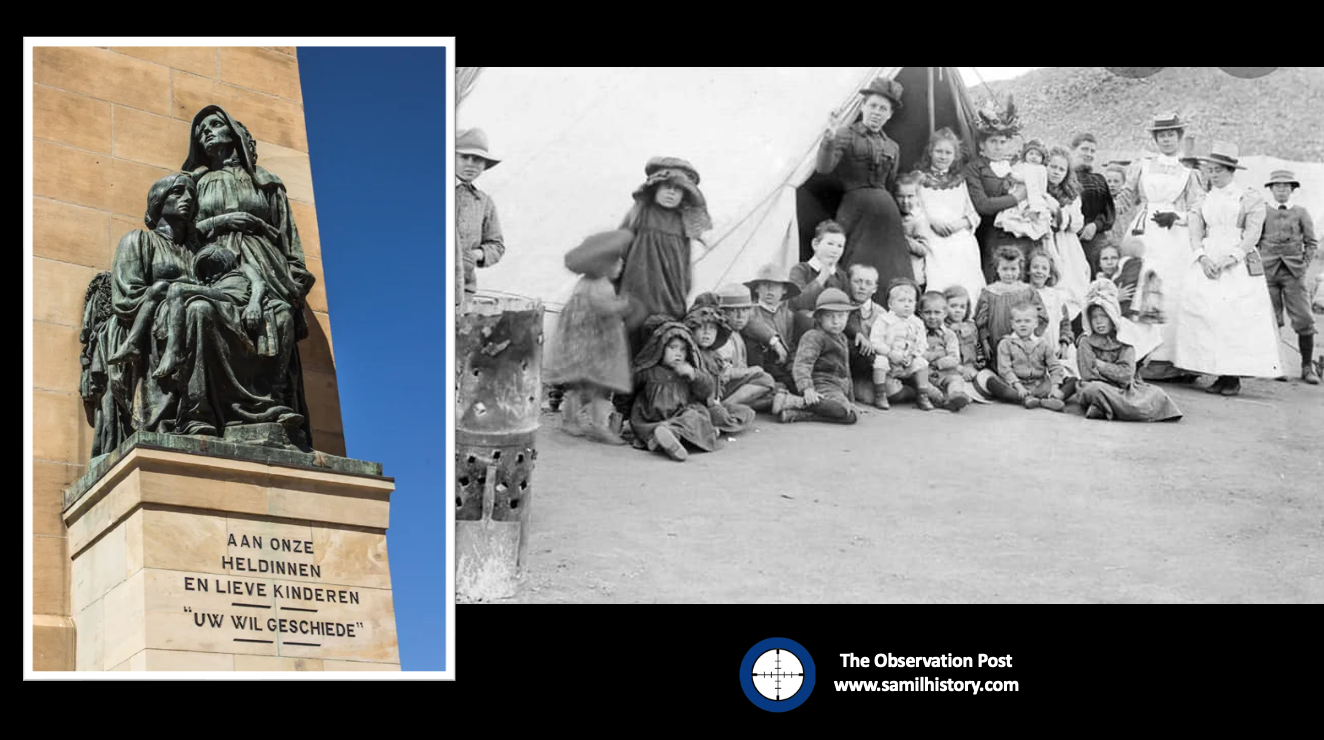
Image of a South African War (1899-1902) bell tent in a concentration camp and the women and children’s memorial to the camps in Bloemfontein

To realise this vision in South Africa post war, the DAHA (Deutsch Afrikanischer Hilfsausschuss) and the VNLK (Women’s Lending Committee) operating under the oversight of the ‘Broederbond’ gathered a quarter of a million pounds between 1945 and 1957 to undertake emergency relief work in post-war Germany. Mrs. Nellie Liebenberg from the VNLK and a previous member of Oswald Pirow’s New Order, alongside her friend Dr. TEW Schumann propose a mission to Germany with the aim of identifying 10,000 handpicked ‘elite’ Aryan orphans and relocating them to South Africa and ‘strengthen their own Afrikaner Volk with the blood of “prestigious” German-Aryan Herrenvolk’37.

This plan to adopt a large number of Nazi war orphans fell under the authority of Dr. Vera Bührmann and Dr. Schalk Botha, and was called the Duitse Kinderfonds (German Children’s Fund), the DKF, once established it attracted huge support the Afrikaner Nationalist elite.

As Werner van der Merwe (an adopted child in the DKF program himself) would summarise in his paper:

‘Some organisations such as the New Order and the Ossewabrandwag overtly favoured a Nazi-like anti-democratic ‘Volkstaat’ for South Africa. It is therefore not surprising that these people were shocked, and even felt betrayed by the Smuts government, when Germany was defeated in 1945. The idea to bring German orphans to (South Africa) was therefore a kind of protest against the defeat of Germany and against South Africa’s participation in the war on the side of Britain. Furthermore, most of the founding members of the DKF were staunch members of either the New Order or the Ossewabrandwag.38

The German Children’s Fund (DKF)

Schalk Botha and Dr. Vera Bührmann (a medical doctor tasked with checking the orphan’s health – as only healthy children will be accepted) fly to Germany on behalf of the DKF on 27 April 1948. They aim to locate healthy White, German, Protestant orphans aged between 3 and 8 years old. They target the Schleswig-Holstein region, for two reasons – firstly it is in the most Northern German state bordering Denmark and would offer the most ‘Aryan’ and ‘Nordic’ orphans, secondly it is occupied by the British and has 1.2 million displaced refugees. Botha hopes to gain sympathy from the British for his ambitious plan and alleviate the humanitarian aid pressure on them. From 22 May 1948, Botha broadly advertised in the local papers looking for children who could emigrate to South Africa, with the prerequisite that they should be German, white and Protestant39.

Shortly after the arrival of the DKF in Germany, there is step-change in South African governance when the National Party, against the odds, wins the General Election on 26 May 1948. With any impediments of the Smuts government out the way Botha is confident of his plan and the support of the local Schleswig-Holstein authorities. However his plan hits its first real impediment when the Schleswig-Holstein government meets on 30 May 1948 and rejects the adoption of children for collective emigration. This forces Botha, as a last ditch effort, to approach the Interior Minister of Schleswig-Holstein, Wilhelm Käber, Käber is known to have “pro-Boer” sentiments and influenced by the pre-war “Ohm Krüger” (Uncle Kruger) sentiment and propaganda. Käber takes sympathy and despite reservations and criticisms agrees to a limited collective emigration. This is later ratified by his government on the proviso it is limited to orphans only40.
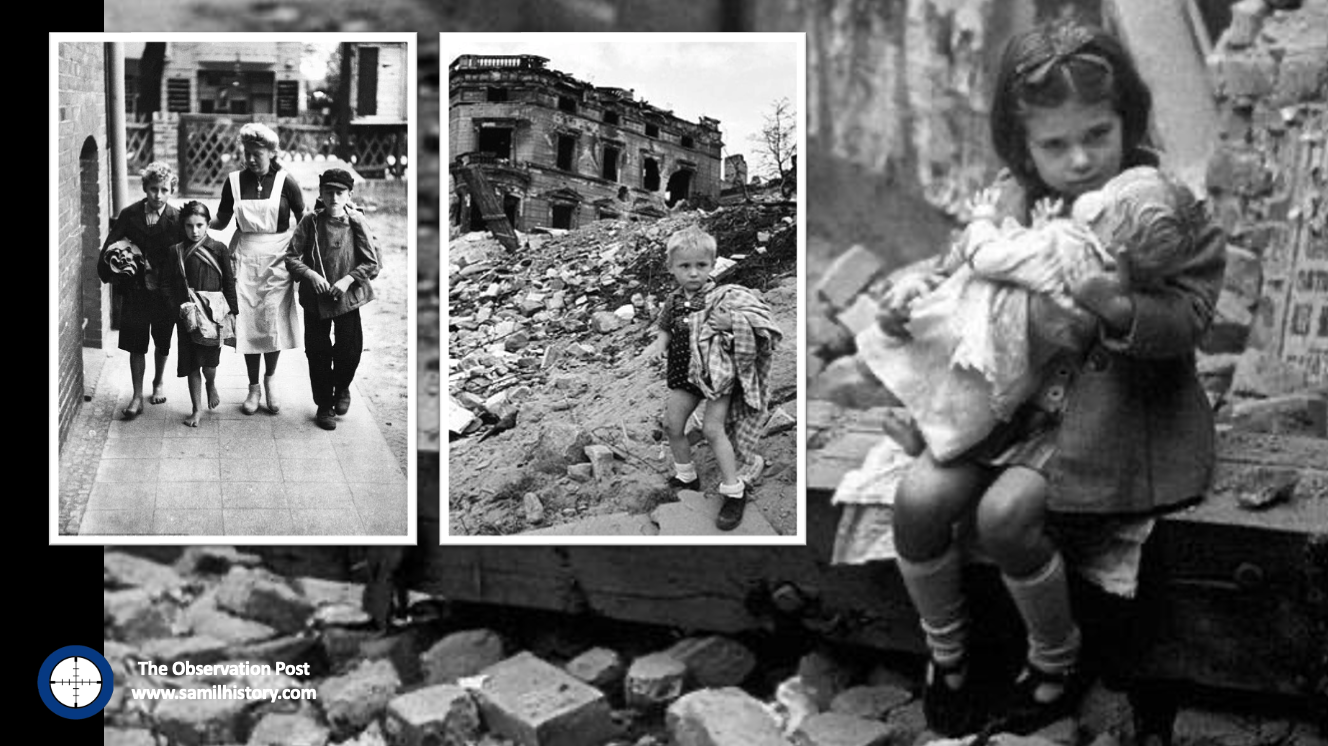
Post war Germany 1945 and displaced or orphaned children

The DKF hits another significant setback when they start their adoption campaign. Most children don’t meet the profile of ‘orphan’ and many have existing parents which due to war are displaced or traumatised and have offered their children to homes. However a greater problem is found on the ‘health’ front, Dr. Vera Bührmann rejects a significant number of children due to malnutrition, mental trauma or tuberculosis, so much so that Botha reports to the board of the DKF that numbers are insufficient and the age limits and orphan status need to change to throw the net wider.

In the end the age criteria is changed from 2 to 13 years old and Botha and Bührmann are able to only identify 87 children, many of which are not really orphans and almost all of them still have families. However, a general apathy sets in and nobody in the German authority gives the necessary oversight to control this. The initial 83 children are packed off to South Africa on 20 August 1948 via the United Kingdom, boarding a Union Castle line to Cape Town (the other 4 would join later)41 .
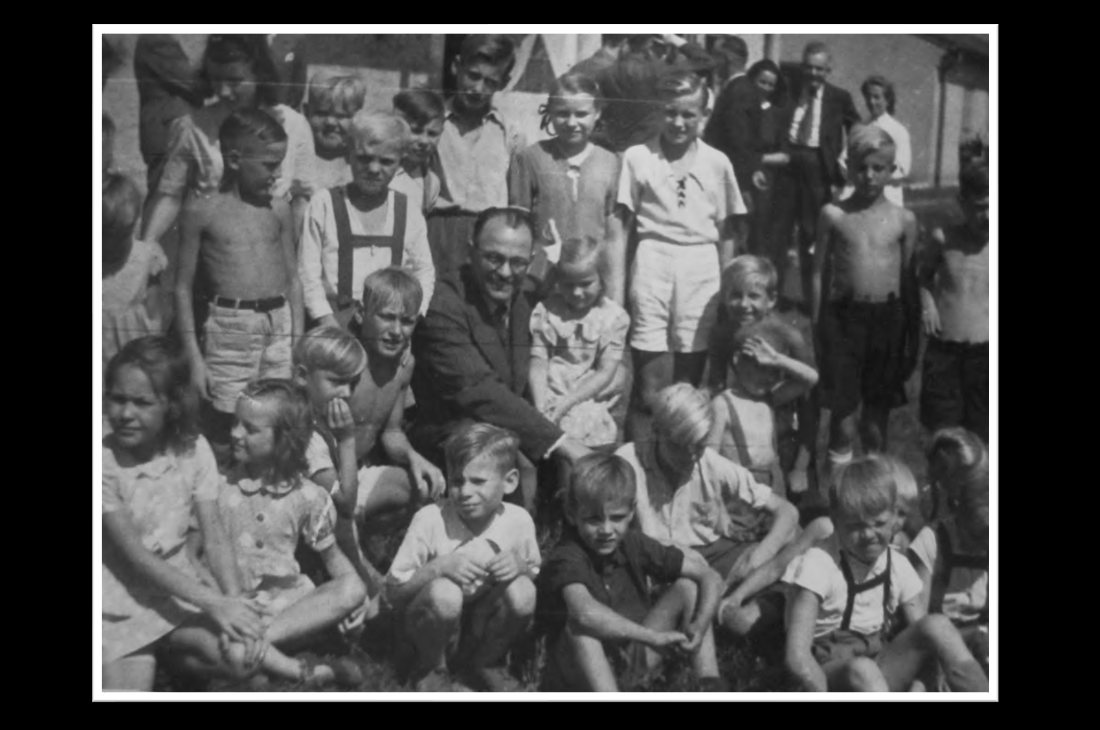
Group portrait of the children on their way to South Africa, Schalk Botha is seated in the middle.

Back home in South Africa, the Afrikaner press carried advertisements for volunteer parents. Only Afrikaans speakers and members of the Dutch Reformed Church were eligible to adopt a child. 450 parent couples expressed interest in adopting a child. With limited numbers, preference was given to families regarded as ‘Afrikaner elite’. The children arrived in Cape Town on 8 September 1948 to a media scrum. They were taken to the German Club to meet more press and prospective parents. The older children would describe the scene as a “cattle market”.42

Some good, some mixed results

Prime Minister D.F. Malan, wrote to the The German Children’s Fund to express his interest in adopting a child. It went without saying that the application of a person of his stature would be successful, it would create all the necessary hype, and he and his wife Maria would have first choice from the new arrivals in Cape Town. However the Malan’s only want a little girl. Maria Malan selects four-year-old Hermine from Deezbüll near Husum and gives her a new name: Marietjie. To Maria, it was a “spiritual birth” to the new child – Marietjie means “little Maria” however “Marietjie” also has alongside her, her inseparable two-year-old brother Gerhard, so as siblings they are dutifully torn apart43.

It takes approximately a week until all the children are distributed to their new parents. Some travelled by train to Pretoria, and are welcomed by the Kappiekommando – a woman’s brigade strictly of ‘Boer’ heritage (known for wearing the traditional Dutch ‘kappie’ head-dress). Most of the adoptive parents were well to do Afrikaner nationalists who had served in the higher structures of the Broederbond, the National Party, the Ossewabrandwag, New Order and the Grey-shirts. It is no surprise really that many of these children went on to receive privileged lifestyles and educations. Some making important contributions.
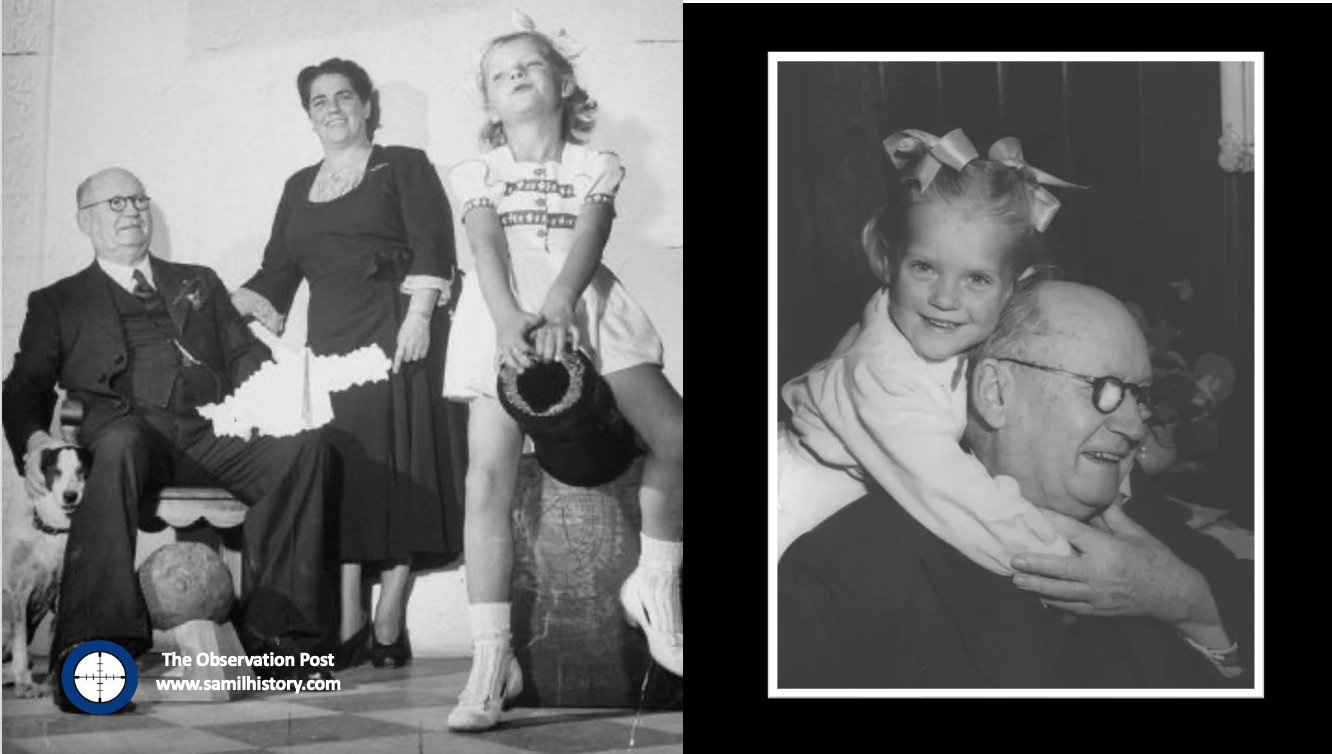
Press Release photographs of Marieke Malan and her adoptive parents Dr. DF Malan and Maria Malan

Marietjie Malan, would soon wrap the Prime Minister around her little finger. Members of the press, accustomed to running into a brick wall when they attempted to interview Malan, witnessed Malan’s stern features softening when Marietjie appeared. She was the only person who was able to circumvent Maria’s strict rule that Malan was generally not to be disturbed. Yet, while Malan strolled and played with his new daughter the violent outcome of Malan’s intense race politics was beginning to play out in South Africa.

Werner Nel, one of the more famous of the children, became an internationally renowned operatic baritone, and later a professor of music at Potchefstroom University.  He even went on to receive the South African Academy of Science and Art award, the Huberte Rupert Prize for classical music. Other predominant children from this program included Professor Eike de Lange, Professor Siegfried Petrick (Veterinary Science) and Professor Werner van der Merwe (History).

There were some mixed results, some of the orphans even had a tough time. Future pig farmer Herbert Leenen found himself used as no more than a farm labourer by his new family and eventually broke ties with his new “parents”.

Some very bad results!

However, here were also some “bad eggs” – here, the issue points to nurture and not nature. One particular adopted child is standout, as not only does he effectively assimilate into his new environment, he brings to it just about everything the Nazi regime stands for and is feared for. Whilst in Germany, when Schalk Botha arranged for the lifting of the age requirement of the DKF to 13 years old – a problem would arise with pre-nurtured and pre-conditioned children exposed to Nazism. Aware of this, Dr. Vera Bührmann took pity on one such Prussian teenager – 13 year old Lothar Paul Tietz, whose brother and sister had made the cut and he was ‘on the edge’ of the spectrum. Coming from a committed Nazi family how their parents were killed is not known, what is known is that towards the end of the war the Tietz siblings were moved to an orphanage in Elbing, here Bührmann was able to interview them, Lothar Tietz later recalled in a SABC TV interview that he pleaded with “Tanti Vera” to keep the three of them together, an impressive boy, Lothar Teitz was tall and polite – he had received five years of National Socialist education and had been exposed to the Hitler Youth44.

As the oldest of all the 83 children allocated to the initial voyage to Cape Town, Lothar Teitz took the role of ‘head boy’ in organising the children. Once in South Africa the Tietz children were separated. Lothar Tietz was handpicked for adoption by the Chairman of the Pretoria branch of the DKF, Dr. JC Neethling. Dr. Neethling had himself been interned by the Smuts government during WW2 for pro-Nazi sedition, he had been a ‘Grey-shirt’ and later a ‘Black-shirt’. Eager to assimilate into his new culture and desperate for a sense of “order”, Lothar adopted the Neethling surname, cut ties with Germany and was to quote him “pleased to adopt my new fatherland “45.

Lothar Neethling did his utmost to ingratiate himself with his hosts by becoming a better Afrikaner than his classmates – excelling in rugby, school work, and absorbing every nuance of Afrikaner culture. The very astute and bright Lothar Neethling would grow up to become a General in the South African Police Force, and eventually Chief Deputy Commissioner of the Police (scientific and technical services) during the Apartheid era.

He also became a respected scientist in his own right, earning two doctorates in forensics – one from the University of California – and was honoured by several prestigious international scientific associations. He became a member of the Afrikaans Academy of Arts and Science and his scientific work earned him awards including a golden award from AAAS and a medal from the Taiwanese government. In 1971, Neethling founded The South African Police’s forensic unit. His work in the unit earned him seven SAP awards and three years later he was appointed Chief Deputy Commissioner.

However some serious clouds were brewing over General Lothar Neethling. In November 1989 Captain Dirk Coetzee, the former commander of the “Vlakplaas” South African Police “death squad”, pulled the plug on “hit squads” with a newspaper scoop. Among his allegations was that Neethling used the police forensic laboratories he controlled to supply him with “knock-out drops” for the murder of anti-Apartheid activists. Coetzee alleged that he would collect the poison – known to him as “Lothar’s potion”, from Neethling’s home or from his laboratory, and administer to it to suspects and kill them. It would eventually earn Lothar Neethling the monstrous title of South Africa’s “Dr. Mengele”46.
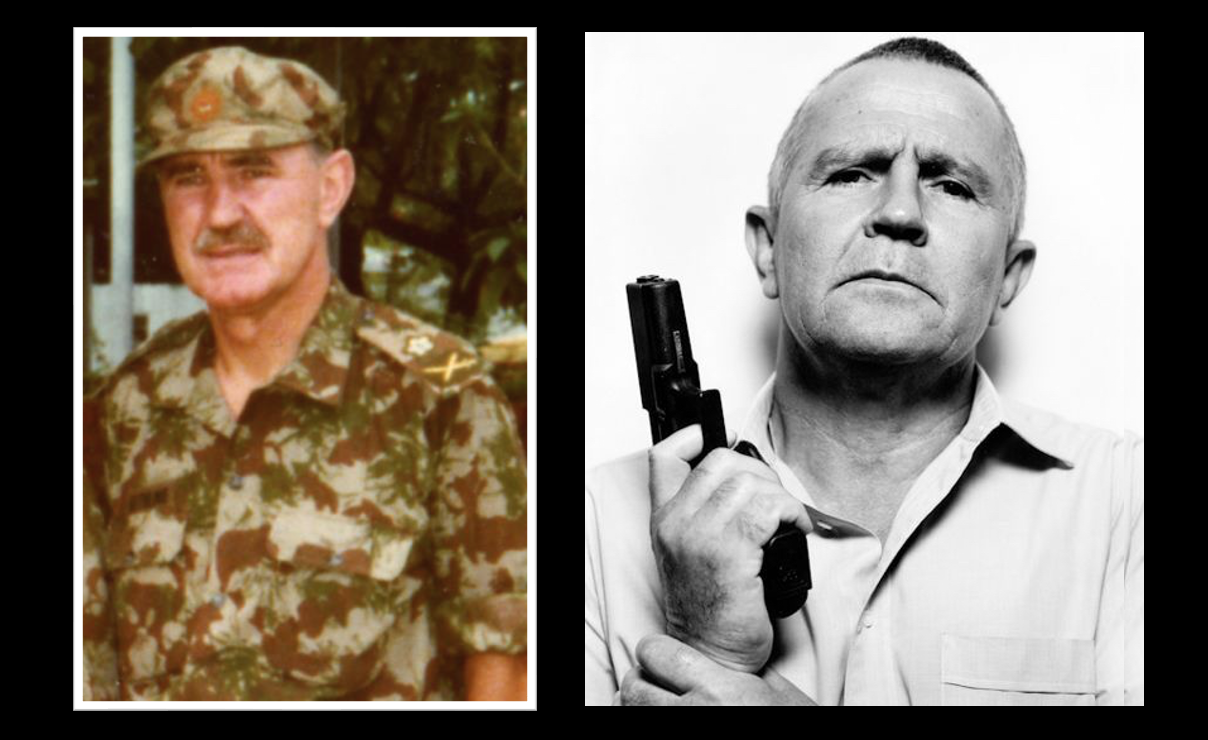
General Lothar Neethling (left) courtesy Nonquai and Captain Dirk Coetzee (right)

The Truth and Reconciliation commission also established the role played by Neethling’s laboratories in the production and supply of poisons to assassinate anti-apartheid activists, and also revealed Lothar Neethling was the number-two man in Dr. Wouter Basson’s biological and chemical warfare programme. Numerous court cases followed finding Neethling’s testimony unreliable or inconclusive. In a hail of controversy, charges and allegations, Lothar Neethling died of lung cancer in Pretoria on 11 July 2005, aged 69.  Whether the allegations were founded or not, his legacy and that of the DKF’s adoption program would be forever tarnished. Whether earned or not, his legacy as South Africa’s “Dr. Mengele” has now entered into the Apartheid lexicon47.

In Conclusion

There has been a long standing debate in academic circles, and it evolves around Apartheid’s origins and historiography. Two sides emerged from the debate, both agree that the origin of Apartheid is slavery in the Dutch Cape Colony, however after that the two arguments go separate ways.

One group points to the Voortrekker’s Puritan religious standpoint which brought the idea of “separate worship” for Blacks and Whites into Dutch Reformed Church (NGK) policy. The epicentre is the Zuid-Afrikaansche Republiek (ZAR) NGK Synod in 1857 and subsequent Synods and NGK Dominees come to define Apartheid along the lines of Jim Crow Laws, Darwinist Eugenics and Southern American State Segregation policies. This group defines Apartheid as a derivative of American Segregation along ecclesiastical lines.

The other group points to the advent of National Socialism (Nazism) in the mid 1930’s as the key political driver of Apartheid’s origin, and they name the National Party’s ‘Think Tank’ Professors and academics who are all enamoured and besotted with Nazi Germany, anti-Semitism, Nuremberg Race Laws and Weimar Eugenics as the chief proponents of it. This group would define Apartheid as a derivative of National Socialism along party political and ideological lines.

Stepping into the fray to sort the argument out once and for all in 2003 was the heavy-weight Afrikaner historian – Professor Hermann Giliomee. He concluded in his work ‘the making of Apartheid’ that the essence and origin of Apartheid lay along the NGK’s ecclesiastical lines and had nothing to with Nazism. He cites a famous speech by Dr. DF Malan in 1947, and taking it at face value he formats it as the crux of his argument, it’s a speech where Malan declares that it is not the state that took the lead with Apartheid, it was the NGK Church who led it and the NGK Synod in 1857 marks the start of it48.

What Professor Giliomee loses sight of by quoting DF Malan, is it is this very man who is front a centre in a very Weimar Eugenic based Aryan adoption program to boost the bloodline of white Afrikaners with Nazi German Herrenvolk blood and to advance an Völkisch ideology in South Africa. Malan not only opens the way for this ideology and thinking by the “Germanophiles” and wartime pro-Nazi leaders in his party, he even adopts one of the children. The DKF is not only inspired by National Socialist dogma, it is a vert practical and realistic application of it in South Africa.

Giliomee also loses sight of the fact that Malan makes this declaration in 1947, after the end of the war in 1945 and the exposure of Nazism and its ideological connection to the holocaust, and by deflecting to the NGK church (to which he is pre-disposed to do as a Dominee anyway) he is gaslighting for the plethora of “Germanophiles” who have been advocating National Socialism in all the various Afrikaner Nationalist cultural, media and political structures and who have all subsequently been warmly welcomed into the HNP’s fold and its leadership caucus. Especially after their 1948 election win and the merger with the Afrikaner Party to reconstitute the HNP as the “National Party” (NP).

To be fair to Giliomee, what he does not have sight of in 2003 is all the recently uncovered archive files and materials found 20 years later. Documents on the Ossewabrandwag pointing to Nazi collusion – files, court records, letters, memos and confessions from South African Nazi renegades within Afrikaner nationalism captured and interrogated in the Rein Commission and published in the Barrett Commission findings after the war – files which were, until recently, regarded as either missing or embargoed. Even the recent findings and academic works on the Nazi German propaganda program in South Africa makes for an eye-opening historiography of Apartheid.

Previously embargoed or missing files – primary source material – have now finally put the nail into the ecclesiastical argument as the sole origin and development of Apartheid and we can now finally conclude that not only was Apartheid ‘invented’ by the NGK, it was subsequently infused with National Socialism – and although not Nazism in its purest form it is indeed a derivative of Nazism. The German Herrenvolk blood for the Afrikaner Volk adoption program run by the DKF after the war is just one such practical example which underscores this conclusion.


Written and Researched by Peter Dickens

References:

  • Wener van der Merwe. Herrenvolk Bloed vir die Afrikaner: Veertig Jaar Duitse wees kinders (1948-1988) UNISA on line journal.
  • Wener van der Merwe, Vir ‘n ‘Blanke Volk’: Die Verhaal van die Duitse Weeskinders van 1948 (Johannesburg: 
Perskor-Uitgewery, 1988)
  • Jonathan Hyslop. White Working Class Women and the Invention of Aparthied: ‘Purified’ Afrikaner Agitation for Legislation against Mixed Marriages 1934-1939. Journal of African History Vol 36, No 1 (1995) published by Cambridge University Press 
  • Andries M Fokkens. Afrikaner unrest within South Africa during the Second World War and measures taken to suppress it. Faculty of Military Science, Stellenbosch University. Journal 37(2) 2012.
  • Hermann Giliomee. The Making of the Apartheid Plan, 1929-1948. Journal of Southern African Studies , Vol. 29, No. 2 (2003). Publisher, Taylor & Francis.
  • Furlong, Patrick J. Pro-Nazi Subversion in South Africa, 1939-1941. 1988. Ufahamu: A Journal of African Studies, 16(1)
  • Maritz, Manie ‘My Lewe en Strewe’ Pretoria 1939
  • Karl Dahmen. Wer hat Angst vor dem schwarzen Land? Die kollektive Adoption norddeutscher Kinder nach Südafrika (Who’s afraid of the black country? The collective adoption of north German children to South Africa), Demokratische Geschichte / Gesellschaft für Politik und Bildung Schleswig-Holstein e.V, 2010.
  • Gavin Evans. The man with the deadly past. Mail and Guardian, 28 August 1998. Interview with General Lothar Neethling
  • Max Du Preez. SA’s own bemedalled Dr Mengele is dead. IOL, 13 July 2005.
  • Chris Ash. Kruger’s War – the truth behind the myths of the Boer War. Durban: 30 degrees South Publishers, 2017.
  • Bunting, Brian. The Rise of the South African Reich. Penguin Books. 1964
  • Harrison, David. The White Tribe of Africa: South Africa in Perspective. Macmillian Publishers. 1981
  • Kleynhans, Evert – Hitler’s Spies, Secret agents and the intelligence war in South Africa, 1939 to 1945. Jonathan Ball. 2021
  • Milton, Shain. A Perfect Storm – Antisemitism in South Africa 1930-1948. Jonathan Ball. 2015
  • Mouton, F.A. The Opportunist: The Political Life of Oswald Pirow, 1915-1959. Pretoria: Protea Boekhuis. 2022
  • Shirer, William. The Rise and Fall of the Third Reich: A History of Nazi Germany. Simon and Schuster. 1974 edition.
  • Strydom, Hans. For Volk and Führer: Robey Leibbrandt & Operation Weissdorn. Jonathan Ball. 1982
  • Visser, George C. OB: Traitors or Patriots. Macmillian. 1976
  • Bloomberg, Charles. Christian Nationalism and the Rise of the Afrikaner Broederbond in South Africa, 1918 to 1948. Indiana University Press. 1989 
  • Bouwer, Werner. National Socialism and Nazism in South Africa: The case of L.T. Weichardt and his Greyshirt movements, 1933-1946
  • Fokkens, A.M. Afrikaner unrest within South Africa during the Second World War and the measures taken to supress it. Journal for Contemporary History 37/2. 2012
  • Furlong, Patrick J. Allies at War? Britain and the Southern African Front in the Second World War. South African Historical Journal 54/1. 2009
  • Furlong Patrick Jonathan – National Socialism, the National Party and the radical right in South Africa, 1933-1948 (D.Phil. Thesis, University of California, 1990
  • Furlong, Patrick J. Pro-Nazi Subversion in South Africa, 1939-1941. 1988. Ufahamu: A Journal of African Studies, 16(1) 
  • Grundlingh, Albert. ‘The King’s Afrikaners? Enlistment and Ethnic Identity in the Union of South Africa’s Defence Force during the Second World War 1939-45’. Journal of African History 40 (1999).
  • Marx, Christoph. Ox wagon Sentinel: Radical Afrikaner Nationalism and the History of the Ossewabrandwag. South African University Press. 2008
  • Monama, Frankie. Wartime Propaganda In the Union of South Africa, 1939 – 1945. Dissertation, University of Stellenbosch. 2014
  • Mouton, F.A. 2018 ‘Beyond the Pale’ Oswald Pirow, Sir Oswald Mosley, the ‘enemies of the Soviet Union’ and Apartheid 1948 – 1959. UNISA, Journal for Contemporary History 2018
  • Scher, David M. Echoes of David Irving – The Greyshirt Trial of 1934.
  • Werner, Bouwer. National Socialism and Nazism in South Africa: The case of L.T. Weichardt and his Greyshirt movements, 1933-1946 

Footnotes

  1. van der Merwe, Herrenvolk Bloed vir die Afrikaner, Page 78 ↩︎
  2. Bunting, The Rise of the South African Reich, 57 ↩︎
  3. FA Mouton, ‘Beyond the Pale’ Oswald Pirow, Sir Oswald Mosley, the ‘enemies of the Soviet Union’ and Apartheid 1948 – 1959,  Journal for Contemporary History, 43, 2 (2018), 18. ↩︎
  4. FL Monama, Wartime Propaganda in the Union of South Africa, 1939 – 1945 (Dissertation for the degree of history, University of Stellenbosch. Stellenbosch, 2014), 62. ↩︎
  5. M Shain, ‘A Perfect Storm’, Antisemitism in South Africa 1930-1948, (Johannesburg: Jonathan Ball Publishers, 2015) , 55–58. ↩︎
  6. W Bouwer, National Socialism and Nazism in South Africa: The case of L.T. Weichardt and his Greyshirt movements, 1933-1946. (MA Thesis, University of the Free State, Bloemfontein 2021), 18. ↩︎
  7. Shain, A Perfect Storm, 84 ↩︎
  8. Shain, A Perfect Storm, 76. ↩︎
  9. Shain, A Perfect Storm, 82. ↩︎
  10. Shain, A Perfect Storm, 230. ↩︎
  11. Harrison, The White Tribe of Africa, 103 – 106. ↩︎
  12. DP Olivier, A special kind of colonist: An analytical and historical study of the Ossewa-Brandwag as an anti-colonial resistance movement (thesis, University of the North West, Potchefstroom 2021),  ↩︎
  13. Bunting, The Rise of the South African Reich, 84 ↩︎
  14. Bunting, The Rise of the South African Reich, 92 – 93 ↩︎
  15. EP Kleynhans, Hitler’s Spies, Secret agents and the intelligence war in South Africa, 1939 to 1945. (Johannesburg: Jonathan Ball, 2021), 199. ↩︎
  16. Shain, A Perfect Storm, 238 ↩︎
  17. J Hyslop. White Working Class Women and the Invention of Aparthied: ‘Purified’ Afrikaner Agitation for Legislation against Mixed Marriages 1934-1939, 76 ↩︎
  18. H Giliomee. The Making of the Apartheid Plan, 1929-1948. Journal of Southern African Studies , Vol. 29, No. 2 (2003), 382 ↩︎
  19. Shain, A Perfect Storm,131 ↩︎
  20. Shain, A Perfect Storm,134 ↩︎
  21. Shain, A Perfect Storm,132 – 133 ↩︎
  22. Shain, A Perfect Storm,133 ↩︎
  23. Shain, A Perfect Storm, 143-149 ↩︎
  24. Rein Commission. Unpublished ↩︎
  25. Bunting, The Rise of the South African Reich, 85. ↩︎
  26. AM Fokkens. Afrikaner unrest within South Africa during the Second World War and measures taken to suppress it. Journal 37, No. 2 (2012), 142 ↩︎
  27. AM Fokkens. Afrikaner unrest within South Africa during the Second World War and measures taken to suppress it. Journal 37, No. 2 (2012), 142 ↩︎
  28. DODA: DC 3841, file DF/1887, proclamation 44 of 1941 ↩︎
  29. AM Fokkens. Afrikaner unrest within South Africa during the Second World War and measures taken to suppress it. Journal 37, No. 2 (2012), 135 ↩︎
  30. AM Fokkens. Afrikaner unrest within South Africa during the Second World War and measures taken to suppress it. Journal 37, No. 2 (2012), 129 ↩︎
  31. PJ Furlong. Pro-Nazi Subversion in South Africa, 1939-1941. 1988. Ufahamu: A Journal of African Studies, 16(1)  ↩︎
  32. PJ Furlong. Pro-Nazi Subversion in South Africa, 1939-1941. 1988. Ufahamu: A Journal of African Studies, 16(1) ↩︎
  33. Werner van der Merwe. Herrenvolk Bloed vir die Afrikaner: Veertig Jaar Duitse wees kinders (1948-1988) UNISA on line journal, 78 ↩︎
  34. C Ash, Krugers War, the phrase initiated the ZAR official Rev. SJ Du Toit after the London convention in 1884 ‘The South African Flag shall yet wave from Table Bay to the Zambezi, be that end accomplished by blood or by ink. If blood it is to be, we shall not lack men to spill it.’ is repeated by ZAR politicians and Afrikaner bondsmen up to and including Jan Smuts’ final statement in Oct 1899 prior to the start The South African War. ↩︎
  35. Maritz, ‘My Lewe en Strewe’, 269 ↩︎
  36. W van der Merwe. Herrenvolk Bloed vir die Afrikaner, 81 ↩︎
  37. W van der Merwe. Herrenvolk Bloed vir die Afrikaner, 85 ↩︎
  38. W van der Merwe. Herrenvolk Bloed vir die Afrikaner, 78 ↩︎
  39. K Dahmen. Wer hat Angst vor dem schwarzen Land?, 114 – 115 ↩︎
  40. K Dahmen. Wer hat Angst vor dem schwarzen Land?,115 ↩︎
  41. K Dahmen. Wer hat Angst vor dem schwarzen Land?,119 ↩︎
  42. K Dahmen. Wer hat Angst vor dem schwarzen Land?,119 ↩︎
  43. K Dahmen. Wer hat Angst vor dem schwarzen Land?,122 ↩︎
  44. Evans. The man with the deadly past. M&G 1998. ↩︎
  45. Evans. The man with the deadly past. M&G 1998 ↩︎
  46. Du Preez. SA’s own bemedalled Dr Mengele is dead. ↩︎
  47. Du Preez. SA’s own bemedalled Dr Mengele is dead. ↩︎
  48. H Giliomee. The Making of the Apartheid Plan, 383. ↩︎
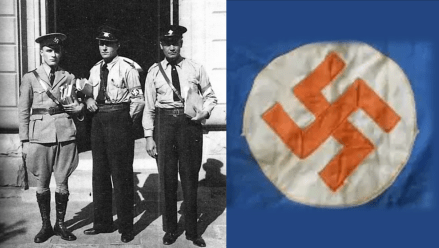
South African Nazi … the ‘Shirts’

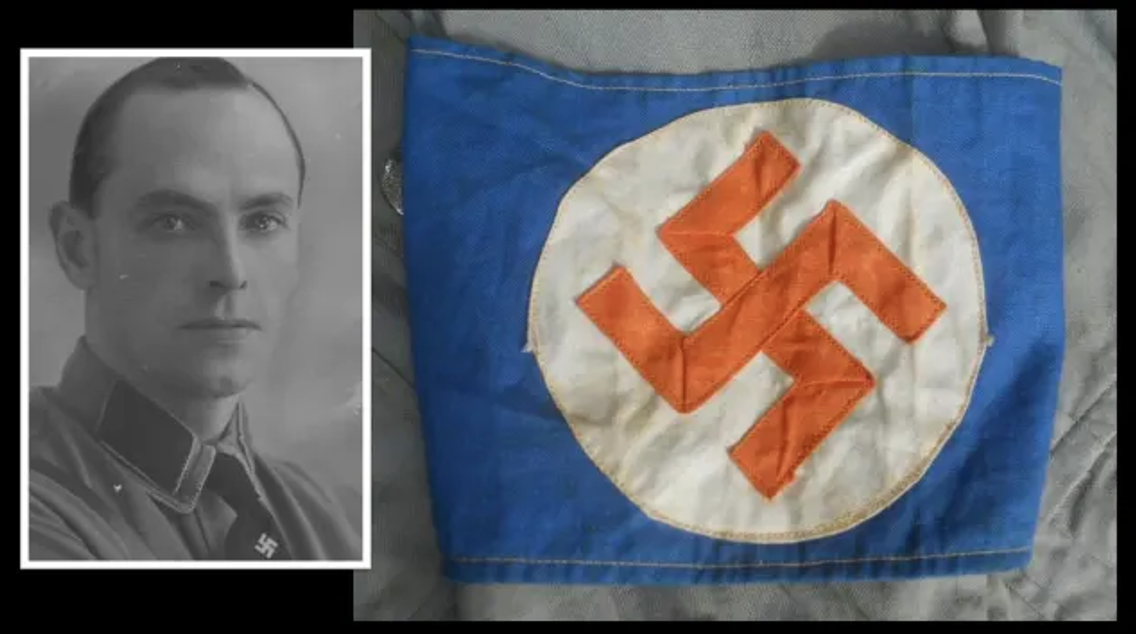
Here is a rare and very unique display of South Africa’s very own Nazi Party’s shirts, flags and bunting.  Of interest, is the use of Orange, Blue and White in the Nazi swastika configuration – this was intentionally done to reflect the national colours of the South African flag at the time, the ‘Oranje-blanje-blou’ (Orange, White and Blue).

These items  belong to  South Africa’s ‘Greyshirts’, read on for an in-depth chapter in South Africa’s hidden history, here we focus on the SANP  – The South African Christian National Socialist Movement also referenced as the South African Gentile National Socialist Movement. More commonly they were also known at the time as the SANP – The South African National Party – ‘Gryshemde’ in Afrikaans and ‘Grey-shirts’ in English.

SANP bunting, flags, armbands and shirts, image courtesy Ulrich Duebe, the current owner of the collection.

South African statute forces had fought a hard war against Italian Fascism and German Nazism, and the same war had been fought on the ‘home-front’ in South Africa itself, as with the USA and the United Kingdom, South Africa also had its own National Socialist (Nazism) parties prior to the war (it had actually been a quite popular doctrine across many “Western” European states prior to the war). During the war the Smuts’ government took severe action against pro-Nazi South African movements on the Afrikaner right-wing political fringe – the SANP (the Grey-shirts), the South African Democratic National Movement – the ‘Black-shirts’, the National Workers Bond – the ‘Brown-shirts’, The ‘New Order’ and the Ossewabrandwag amongst others and jailed some of their leaders for the duration of the war.

Imagine the sheer frustration felt by the South African war veterans returning after winning ‘The War for Freedom’ (as Smuts had called WW2 at the time). This war had been fought with a massive cost in South African lives to rid the world of Nazism and Fascism in the “good fight” – only to come home in 1945 and within three short years in 1948 find South African ‘home grown’ pre-war Nazi and Neo Nazi politicians swept into government. The very men and their philosophy they had gone to war against in the first place. Many of these movement’s leaders and members were folded into National party after the war to one day become South Africa’s political elite (including a  Ossawabrandwag General – BJ Vorster who became a future Prime Minister and State President of South Africa).  

Louis Theodor Weichardt

One such South African politician was Louis Theodor Weichardt (21 May 1894 – 26 October 1985) and this is his relatively unknown story of South Africa’s very own Nazi Party, the largest and most significant of the Pro-Nazi South African ‘Shirt movements’ – the Grey-shirts .

Louis Theodor Weichardt

Louis Theodor Weichardt was born in Paarl of German extraction on the 23 May 1894, he attended German school in Pretoria and in New Hanover Natal. At the outbreak of World War 1 (1914-1918), Weichardt found himself in Germany. His military service to the German state is shrouded in a little mystery, some accounts point towards three years service in the German Army, others point to non-combatant service in a Labour Corps. As a South African national there is an account that he was arrested after the war for High Treason, however the charges were never brought.

In Germany Louis Weichardt became a rabid antisemite, in travelling Europe he recalled that in the Ottoman Empire that the Turks were being “bled to death by Jewish extortioners and money lenders” and in Germany he said he:

“had the privilege of witnessing the first beginnings of the national German uprising against Jewish domination”. 1

Returning to South Africa in 1923, Louis Weichardt joined Hertzog’s National Party, however he became increasingly disillusioned in the National Party as he was unable to bring fellow members to his vision of National Socialism – he blamed been “checkmated” in his endeavours by external influences he called “powerful financial interests, predominantly Jewish”. When Hertzog merged the National Party with Smuts’ United Party, which was seen as by the ‘pure’ nationalists as underpinned by ‘Anglo-Jewish Capital’ (Oppenheimer) – Weichardt took the opportunity to break away from the National Party altogether and start his own party.

In Cape Town, on 26 October 1933, he founded South Africa’s Nazi party equivalent – The South African Christian National Socialist Movement with a paramilitary ‘security’ or ‘body-guard’ section (modelled on Nazi Germany’s brown-shirted Sturmabteilung) called the ‘Gryshemde’ (Afrikaans) or Grey-shirts (English). In May 1934, it was agreed to combine the ‘Grey-shirts’ with the South African Christian National Socialist Movement and form a new enterprise called ‘The South African National Party’ (SANP) – not to be confused with the National Party. The SANP would all keep with the ‘grey-shirts’ as their dress.

Johannes Von Moltke at this time was Louis Weichardt’s right hand man, the leader of the SANP’s stronghold in the Eastern Cape (his SANP office in Port Elizabeth proudly flying a swastika flag outside it every day). Johannes Von Moltke was of 1820 settler and German heritage, born in Senekal in the OFS he became a firm Republican and Afrikaner Nationalist, working for the Afrikaner Pers Group and the ‘Die Burger’, he met Weichardt in October 1933 and the two decided to collaborate.

Louis Weichardt was very proficient in English and he intended the SANP to appeal to both ‘English’ and ‘Afrikaner’ whites – citing that they were both of “Nordic” races. Some English joined the organisation, but the backbone found itself in rural and ‘poor white’ Afrikaner communities. It must be noted here that Nazism appealed to many Afrikaners as Hitler took an “anti-British” stance and the legacy of the South African War (1899-1902) was still strong within Afrikaner communities by the 1930’s, many within living memory of it. However Nazism was no means the exclusive pursuit of Afrikaners in South Africa, the handful of ‘English’ that supported the SANP were vicious in their anti-Semitic leanings – as were the British fascists at the time, Oswald Mosley a case in point in England. This sentiment can be be seen in the University of Cape Town Law and SANP supporter – Professor Kerr Wylie, who said of Jews in a letter to University of Cape Town Principal Sir Carruthers Beattie:

“Everything point to the fact that the Jews’ game in South Africa is up, and, if they have any sense, they will realise the fact and try to effect compromise. But history shows that the greed for gold and lust for power is so engrained in the Jewish race that they will cling to their gold and power until it is too late”.2

As a movement the SANP also saw themselves as a ‘popular’ movement for National Socialism and initially did not contend by-elections and municipal elections as a political party – choosing instead to put forward their members as “independents” in elections. A future Grey-shirt breakaway called the ‘Black-shirts’ would however put party candidates forward which ironically caused issues for the ‘Pure’ National Party as the support or the Black-shirts split their vote.. Overall, Weichardt saw democracy as an outdated system and an invention of British imperialism and Jews.3

The SANP would eventually contest elections and Louis Weichardt would stand as a MP candidate in Port Elizabeth, he was not very successful and would later try another safer seat without success either – predictably he blamed his election losses on a Jewish conspiracy.

The SANP grew to about 4,000 members in South Africa (with their largest support base in the Eastern Cape – spurred by ‘poor white’ rural and urban issues in the area), central to their cause in the 1930’s where Jewish immigrants escaping Nazi Germany to South Africa, and their numbers were growing significantly over the decade – in response the SANP launched a campaign calling for an end to Jewish migration and even arranged mass protests in Cape Town. Their primary communication  mouthpiece was a newspaper called ‘Die Waarheid/The truth’ which was nothing more than a vehicle to spread Nazi doctrine in South Africa – the Nazi emblem emblazoned on the masthead.

Louis Weichardt would spell out his ‘Nordic’ argument and vision in the ‘Die Waarheid/The truth’ and trace South Africa’s problems to one source – the Jews. He claimed Jewish ‘domination’ of the legal, medical, dental, commerce, trading, liquor trade etc. as between 60% to 100%, and he would write:

“We are determined to put the Jew in his place. We are not going to tolerate bootlicking, Gentile South Africans – English or Dutch speaking – are no longer prepared to play second fiddle to these aliens”.4

The main target of the SANP was Hertzog’s old National Party’s inspired Quota Act of 1930 which sought to curtail Jewish immigration. As far as the SANP was concerned the National Party had not gone far enough in their endeavours to clip Jewish immigration specifically. They proposed revoking South African citizenships granted to all Jews entering South Africa after 1918, the prevention of Jews gaining government jobs and the prevention of Jews from owning immovable property and dominating any particular industrial or trade sector. They would however support an immigration policy that brought in whites of ‘nordic’ (aryan) races that would assimilate with a white culture in South Africa sans the “insoluble” element of Jews.

The Protocols of the Elders of Zion

The nature of the movement was clearly seen in March 1934 when the SANP held a rally in Aberdeen in the Eastern Cape, Harry Victor Inch – one of the Greyshirt leaders – announced that he had in his possession a ‘stolen’ document from a Port Elizabeth synagogue – signed by its Rabbi – which outlined a secret plot by the Jews to destroy the Christian religion and civilisation.

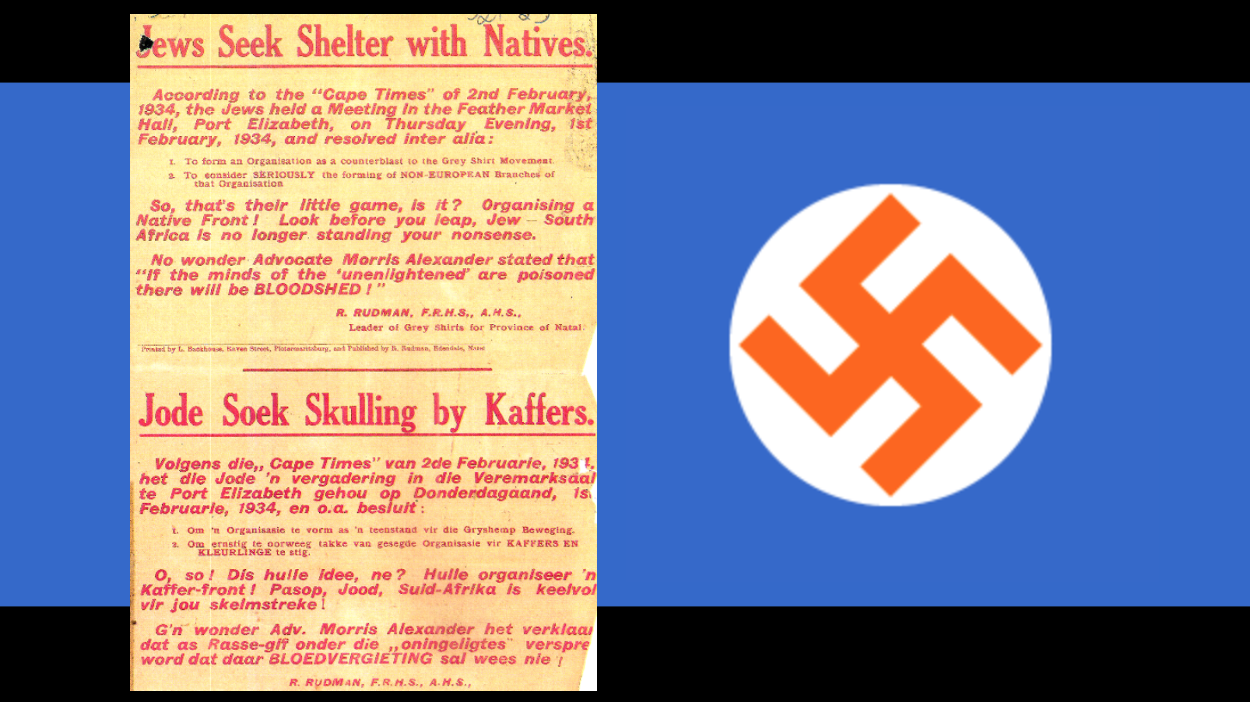
SANP propaganda leaflet accusing Jews of inciting Native (Black) violence against whites.

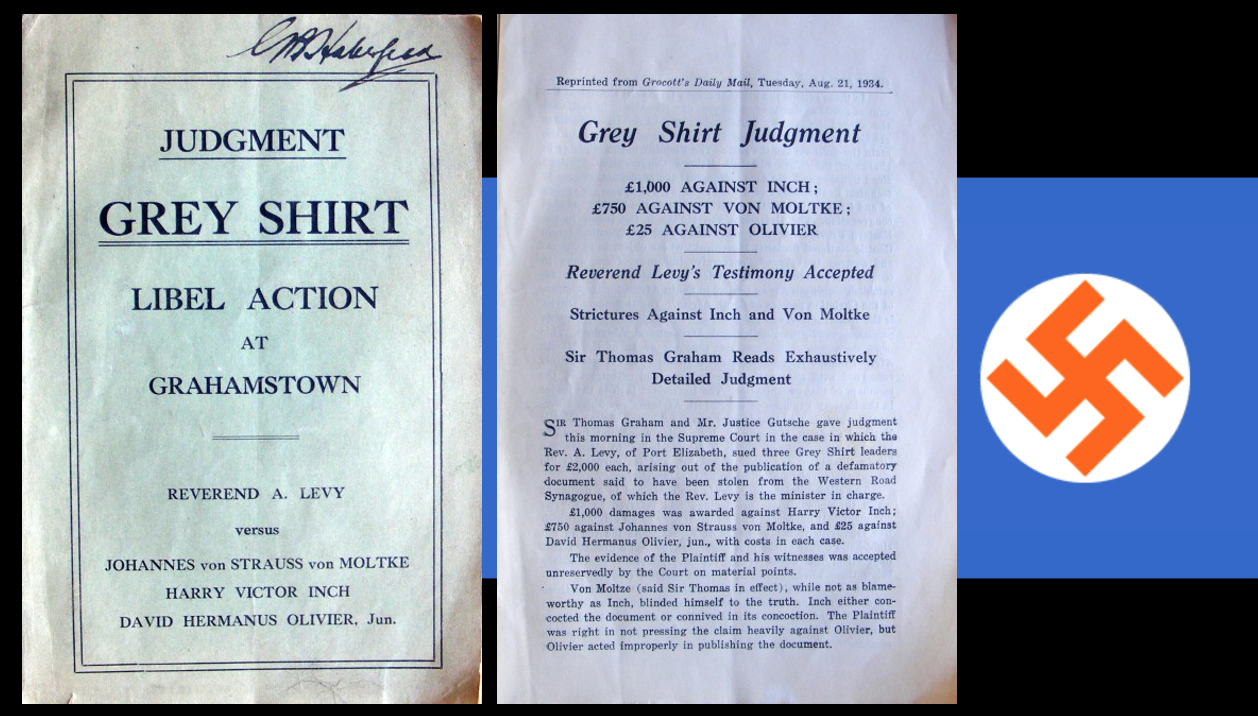
The Rabbi in question was not in fact a Rabbi, he was a Jewish Reverent, Reverent Abraham Levy, and he took the SANP Grey-shirt leadership in the Eastern Cape to court in Grahamstown in a landmark case. The SANP accused; Johannes von Strauss Moltke who was the Regional SANP leader, Harry Inch, who allegedly ‘stole’ the document and David Olivier, who had printed the document for circulation as the owner and publisher of “Rapport”, another media organ of the ‘shirt’ movements. All now have to account for themselves – the case billed as a mighty ‘Gentile vs. Jew’ showdown and a legal test of the ‘Great Jewish Conspiracy.’ `

The document in question followed the “Protocols of the Elders of Zion, a pamphlet of some 70 pages purporting to be the actual minutes of 24 speeches made by Jewish leaders during the First Zionist Congress in 1897. The pamphlet detailed a satanic plot by Jewish/Zionist conspirators to conquer the world. Alleging that Jews controlled much of the world’s finance, the media, the edu­cational institutions, the court systems and many of the world’s governments, the Pro­tocols claimed that the Jews indulged in all forms of trickery and deceit to tighten their hold. They deliberately spread diseases and immorality to weaken Gentiles, and did not hesitate to use murder and terrorism to destroy all religions except their own. Jews were striving to establish their own autocracy based on a false Messiah, the “Son of David”, and posed a fiendishly devious omnipresent peril to the rest of mankind.”5

‘Die Waarheid/The truth’ would pick up this ‘Protocols of the Elders of Zion’ and really twist it for a South African audience claiming:

“the disastrous Anglo-Boer War 1899-1902 was deliberately brought about by the Jewish mine magnets who circumvented Rhodes and Kruger alike”.6

In addition, Jews were accused of inciting blacks against whites and controlling the economy, exploiting ordinary Afrikaners as part of an international Jewish conspiracy. The ‘Die Waarheid/The truth’ statements were accompanied by a propaganda leaflet printed by the SANP and distributed in Port Elizabeth.

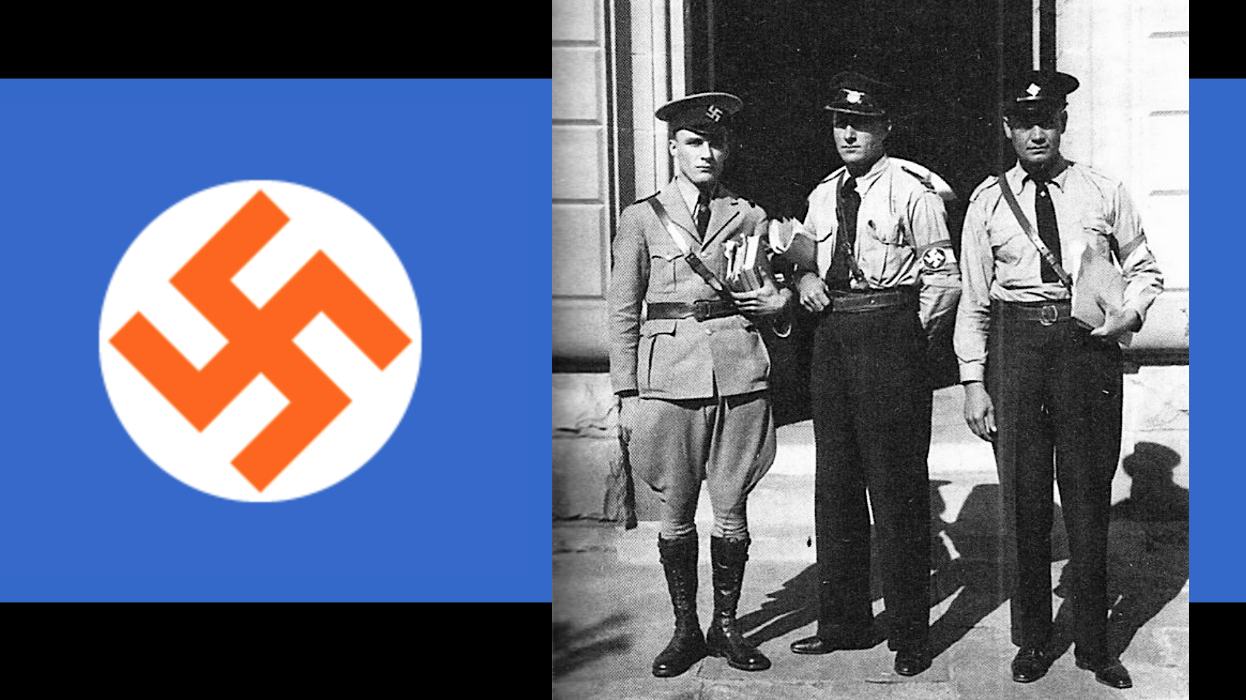
Left to Right – standing outside the courthouse in Grahamstown in full SANP dress is Johannes von Strauss Moltke, Harry Inch and David Olivier.

The ‘stolen’ document was scrutinised legally, it was found to be based on an entirely discredited antisemitic ‘international Jewish conspiracy’ document called ‘the Protocols of the Elders of Zion’ and given a South African twist by the SANP. The ‘Protocols of the Elders of Zion’ was a composition based on a 1860’s anti-Napoleon III pamphlet and a German antisemitic novel by Herman Gödshe ‘Biarritz’ – used by the Nazi Party in Germany.

In a carefully considered 30,000 word judgement, the court concluded inter alia;

“the protocols are an impudent forgery, obviously published for the purposes of anti-Jewish propaganda”.7

As a result three Greyshirt leaders all were fined, Harry Victor Inch was found guilty of perjury and forging documents defaming the Jewish race and swearing under oath that those documents were genuine – and fined £1,000, later also receiving a short prison sentence.8 David Hermanus Olivier was fined £25 for acting improperly and printing the document and Johannes von Moltke was fined £750 for “playing a leading role in the plot”.

The result has been widely hailed here as a complete vindication of the Jewish people and of Rev. Abraham Levy who brought the lawsuit against the Grey-shirt leaders.

Splits in the Shirts

Later that year, the SANP Grey-shirts would hold their first National Congress in Observatory, Cape Town. Louis Weichardt in his keynote address would dismiss Johannes von Moltke as a “traitor” to the SANP and no longer a member having “misbehaved” in releasing Harry Inch’s anti-Jewish protocols. In fact Johannes von Moltke had broken away from the SANP along with most of his the Eastern Cape SANP supporters and leaders and formed a new organisation called ‘The South African Fascists’ who wore blue trousers and grey shirts.

Other Nazi splinter parties and ‘shirt’ organisations also began to form – ‘The South African National Democratic Movement’ (Nasionale Demokratiese Beweging) which became known as ‘the Black-shirts’ was formed in Johannesburg by Manie Wessels and operated in the Orange Free State and the Transvaal – the Black-shirts themselves would splinter into another Black-shirt movement as an off-shoot called the South African National People’s Movement (Suid Afrikaanse Nasionale Volksbeweging) – based in Johannesburg, started by Chris Havemann and advanced a closer idea of National Socialism – this Blackshirt splinter group by 1937 boasted 265 branches (mainly in the Transvaal), their official mouthpiece was called “The Swastika”9.

The black-shirts by July 1939 were formally incorporated into the Ossewabrandwag focussing on the recruiting of ‘Christian minded National Aryans’ into the Ossewabrandwag infusing it with a “volkisch” Nationalism and took it beyond just being a cultural organ of Afrikanerdom and the National Party. 10

Another ‘Volksbeveging’ (People’s movement) also known as ‘African Gentile Organisation’ was also formed in Cape Town by H.S. Terblanche. The National Workers Union (Bond van Nasionale Werkers) – known as the Brown-shirts was established by Dr. A.J. Bruwer in Pretoria in September 1934. Finally a group called the ‘Orange-shirts’ under Frans Erasmus, who at that stage was the Secretary to the Federal Council of the National Party and the Minister of Parliament for Moorreesburg, Erasmus would go onto become the National Party’s Minister of Defence after 1948.11

In addition, the SANP leader J.H.H. de Waal resigned from the SANP over leadership issues with Weichardt and formed the The ‘Gentile Protection League’ whose sole aim was to:

“Fight the Jewish menace in South Africa12.”

De Waal’s organisation would focus on the Western Cape, he would also advance a Jewish store boycott in the southern Orange Free State where antisemitism was rife, he was a popular lawyer of political stock and he would eventually claim his organisation as 5,000 members strong. De Waal would comment in his memoir “My Ontwaking” (my awakening) and blame Jan Smuts for promoting the Jewish agenda in South Africa and call him “The King of the Jews”.13

An ‘insoluble’ element

So, where does the ‘purified or reunified’ National Party under Dr. D.F. Malan sit on the ‘Jewish’ question in the mid 1930’s and what influence do these Nazi ‘shirt’ organisations have on it?

Prior to the war and sitting in the wings of the Broederbond was Dr. Hendrik Verwoerd (the Architect of Apartheid), he was a predominant Broederbond member, National Party leader and would become a future Prime Minister of South Africa. Dutch by birth, he honed his studies in sociology and psychology in Germany and there is no doubt he was exposed to German politics and the rise of Nazism at the time. Verwoerd showed his colours early on when, the ‘Black shirts’ held a large rally and protested the arrival of the S.S. Stuttgart in Cape Town on the 27th October 1936 with 600 Jewish refugees on board. 

S.S. Stuttgart in Cape Town

The Nationalists joined hands with the Black-shirts in support of their protest and a few days later on 4 November, Dr Theophilus E. Dönges (future NP Acting Prime Minister) and admirer of Nazism would nail the Nationalists colours to the mast and said: 

“The Jew is an insoluble element in every national life.”

The Black-shirts were joined by Dr Verwoerd and five fellow professors from Stellenbosch University who all went in deputation to the government to protest against the immigration of Jews from Nazi Germany. Frans Erasmus (the future National Party Minister of Defence) would go further on the matter and even officially thank the Black-shirts on behalf of The National Party for bringing the attention of the;

 “Jewish problem to the Afrikaner ‘volk’.”

Dr Verwoerd would forward the National Party’s views on Jews in the Transvaaler where he wrote that there was a “botsing van belange” (clash of interests) between Jew and Afrikaner because the Jew had risen to wealth in key economic sectors whilst protecting themselves as a community, and as guests in the country they had purposefully excluded the Afrikaner (he referenced as the ‘majority’) from taking their rightful place in accessing the country’s wealth. He would outline the Jew as an enemy of Afrikanerdom, he would write:

“This population group (the Jews), which still keeps itself separate and apart within the population, and which is indifferent or even hostile to the national aspirations of Afrikanerdom, is thus regarded as the group which also stands in the way of the Afrikaner’s economic prosperity”.14

Dr. D.F. Malan, the National Party leader would go further and refer to the Jews as a:

“undigested and unabsorbed and unabsorbable minority … that leads to all sorts of difficulties”15

D.F. Malan would however try and sanitise the The National Party to the Jewish Community, but as they were a firmly “Christian” movement in terms of constitution his words carried little weight to the South African Jewish Council who saw the National Party for what it was. The National Party would openly lock-step with the “shirt” movements when it came to demonising Jews and Jewish Capital in the form of “Hoggenheimer” in their mouthpieces “The Transvaaler” (of which Verwoerd was the editor) and “Die Burger” (of which Dr. Malan was a founding editor).

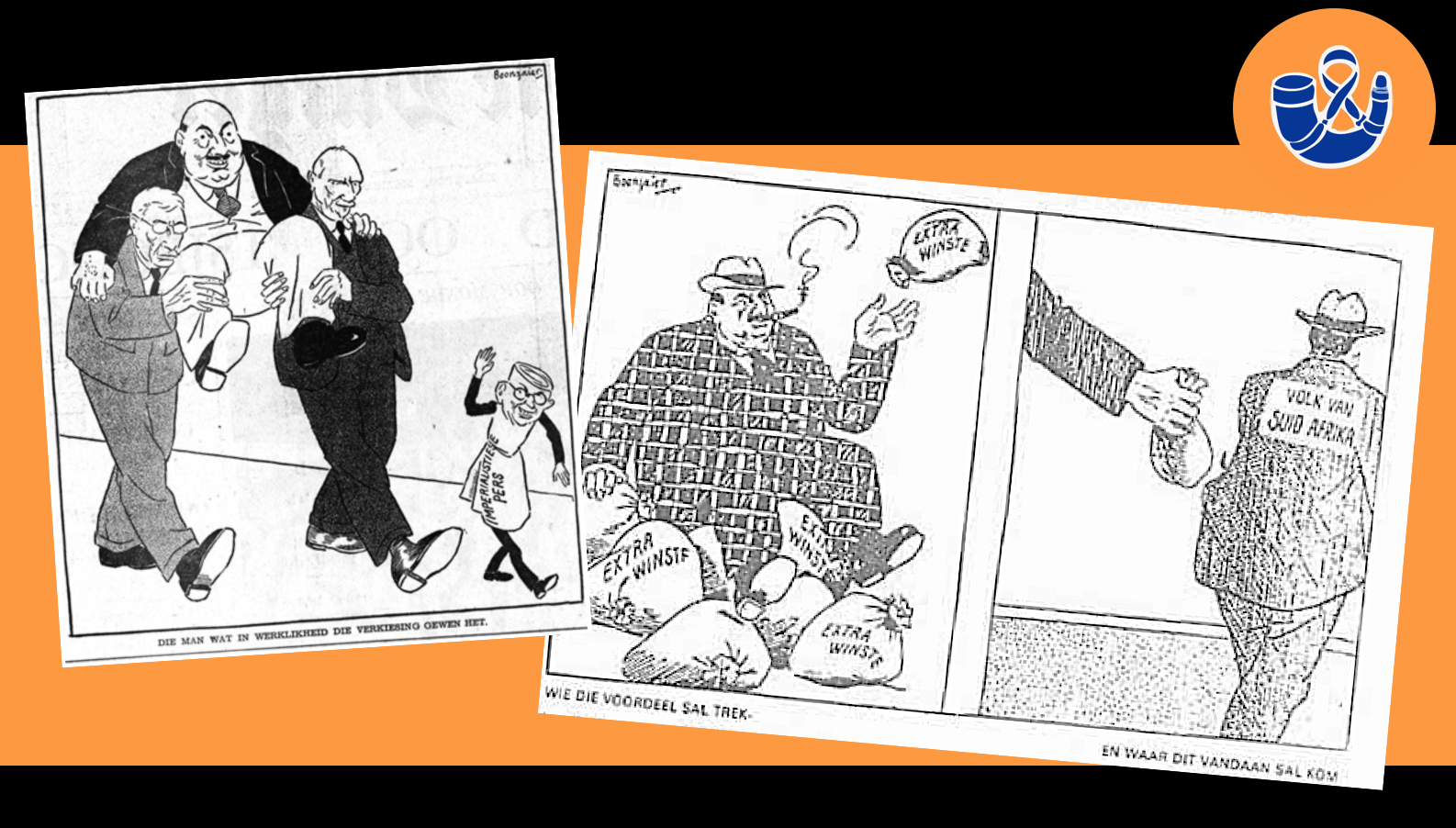
‘Hoggenheimer’ would become a cartoon in the same vein as “the banker” – a Nazi demonisation of Capitalist Jews and ‘the Jewish Conspiracy’ – depicted as fat, cigar smoking, balding and greedy – either pulling the strings or holding onto the money bag . The work of D.C. Boonzaier his caricature was developed specifically for Die Burger – a derogatory figure designed to depict a fat and bloated Jewish capitalist with a play on ‘hog” or pig, the character made a number of appearances and also served to lampoon Ernest Oppenheimer, the German Jewish Mining Industrialist who made South Africa his home. The Nationalists would even go as far as referring to Oppenheimer and Jewish Capital openly in Parliament and in speeches as “Hoggenheimer”.

Hoggenheimer by D.C. Boonzaier – Die Burger

It is undeniable that these “shirt” and antisemite fringe effectively “succeeded in shifting the ‘Jewish Question’ from the political margins of South African public life to its centre” … “Malan, under pressure from the ultra-right Greyshirts, focussed increasingly on the Jew as an explanation for the Afrikaners political misfortunes. It was Hendrik Verwoerd, however, who stood at the vanguard of anti-Jewish agitation”16

This sentiment would be taken up broadly across the Afrikaner Nationalist front – an example is the Nationalist MP for Bethlehem – Roelof van der Merwe, who on a call to boycott Nazi German goods, would warn the Jews:

“They (the Jews) are exploiting our people (the Afrikaners) and are nothing more than parasites.”17

World War 2 Nazi collaboration

During the Second World War, Louis Weichardt would even work in conjunction with the Ossewabrandwag to aid Nazi Germany’s war effort. He would take two Nazi spies under his wing, spies been smuggled by the Ossewabrandwag – the German spies Lothar Sitting and Nils Pashe would present themselves at a house in Stellenbosch and meet Weichardt – he would ensure they be driven and hidden by SANP men on a farm near Barrydale for two days after which one SANP man took them to Pretoria and back into the Ossewabrandwag’s network on 13 June 1940.18

Weichardt was arrested and imprisoned for the remainder of World War II at Koffiefontein detention barracks by the Smuts’ government as an ‘enemy of the state’ – along with all the other far right pro Nazi Germany, anti-British militants.

Merging of interests

With the end of the Nazi regime in Germany in 1945, Nazism became an anathema worldwide, Weichardt subsequently disbanded his SANP Nazi party in 1948. Moving on, Weichardt then gave his full attention and allegiance to D.F. Malan and the ‘Reunited’ National Party (NP) itself. He had a very successful political career with the National Party and went on to become the National Party’s senator from Natal Province from 1956 to 1970. Remaining elements of the Greyshirts distanced themselves from open Nazism and renamed themselves the White Workers Party in 1949. However, by this time most of the membership had been lost to the National Party and so the ‘Greyshirts’ and their reconstituted party faded .

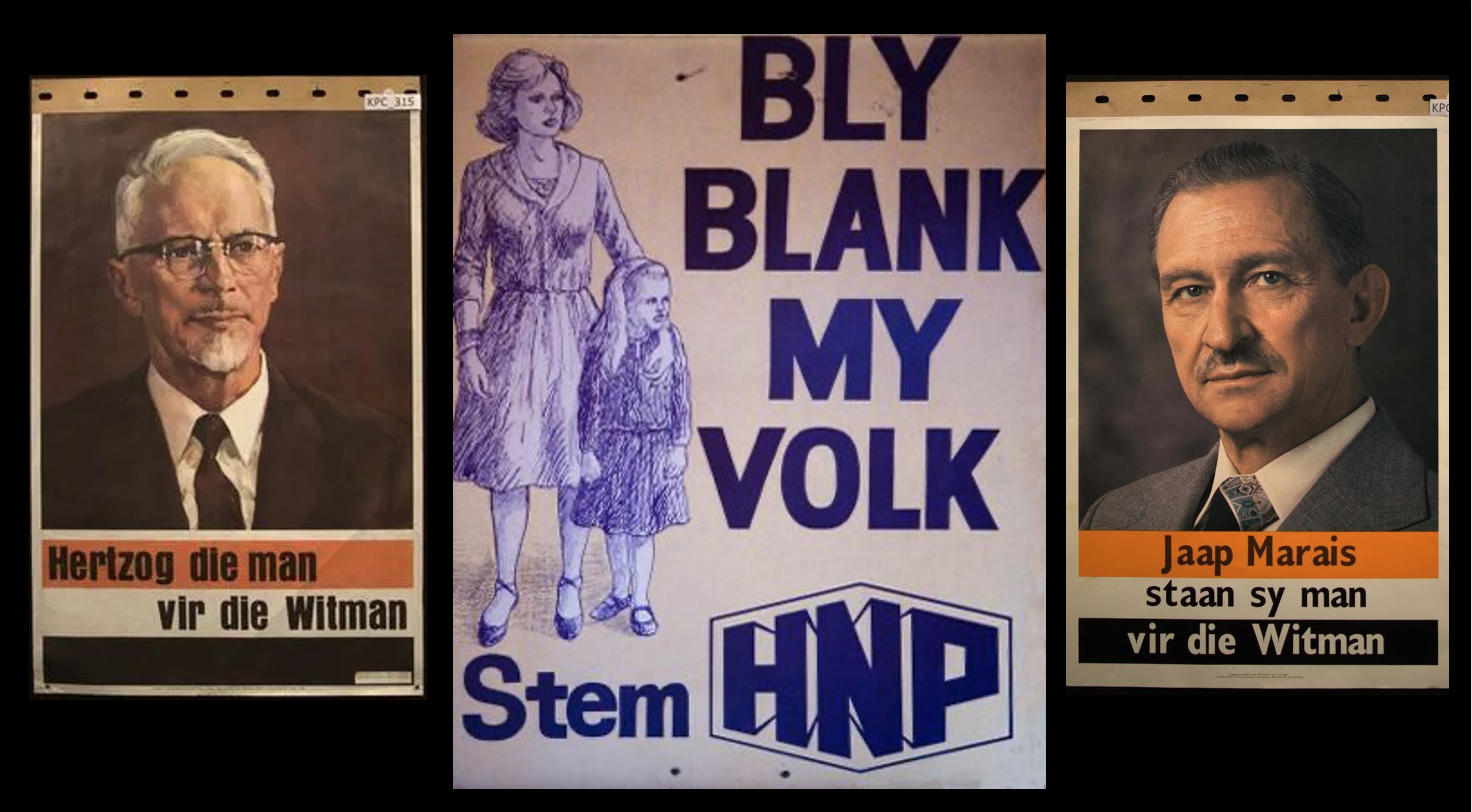
By the early 1950’s the South African National Party government was littered with men, who, prior to the war where strongly sympathetic to the Nazi cause and had actually declared themselves full-blown National Socialists along Nazi political doctrine lines: Men like, B.J. Vorster – Broederdond, Ossewabrandwag – OB – ‘General’ and future NP Prime Minister and President of South Africa, Oswald Pirow – Founder of the New Order – NP Cabinet Minister and future National Prosecutor, Hendrik van den Bergh – Ossewabrandwag – future NP head of State Security, P.O. Sauer – Ossewabrandwag ‘General’ – now NP Cabinet Minister, Frans Erasmus – Ossewabrandwag ‘General’, founder of the ‘Orange Shirts’ – now NP Cabinet Minister, Dr Hendrik Verwoerd – Broederbond and future Prime Minister, C.R. Swart – Ossewabranwag member – future NP State President, P.W. Botha – Broederbond, Ossewabrandwag member – and future President of South Africa, Eric Louw Ossewabrandwag – future NP Cabinet Minister, Dr Nico Diedericks – Broederbond and future NP State President, Jaap Marais – Ossewabrandwag – now NP Cabinet Minister and future co-founder of the ultra-right Herstigte Nasionale Party, Dr Albert Hertzog – now a NP minister and future co-founder of the ultra-right Herstigte Nasionale Party, Piet Meyer – Broederbond, Ossewabrandwag and future head of SABC … to name just a few, and there is no doubt that their brand of far right politics, known collectively as Christian Nationalism (a form of Nazism) was influencing the National Party’s government policy.

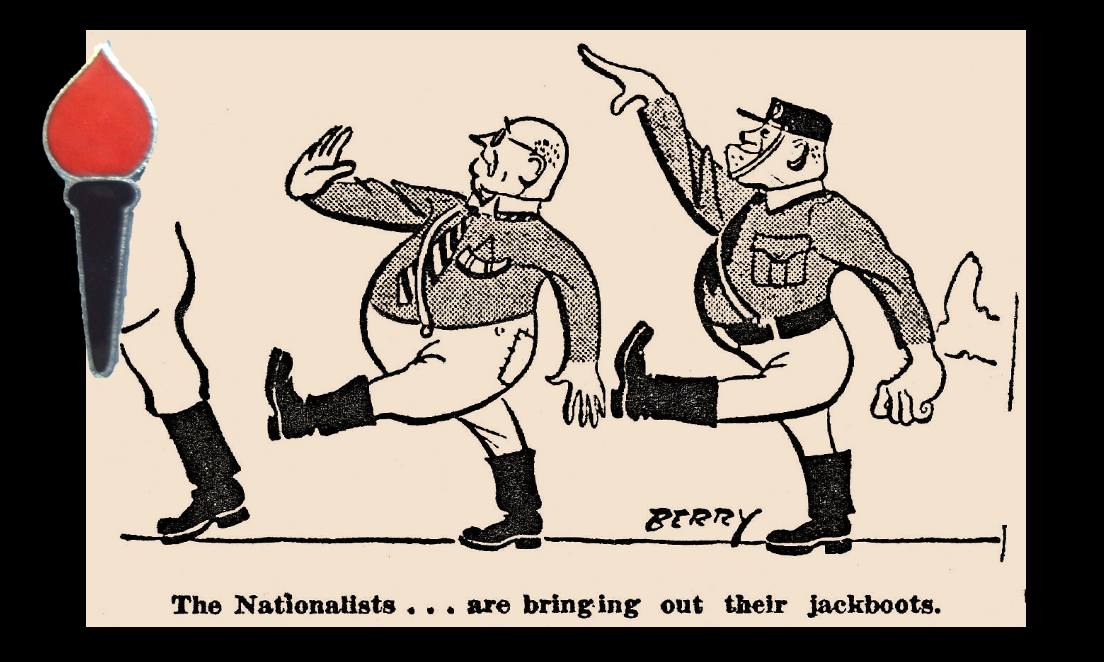
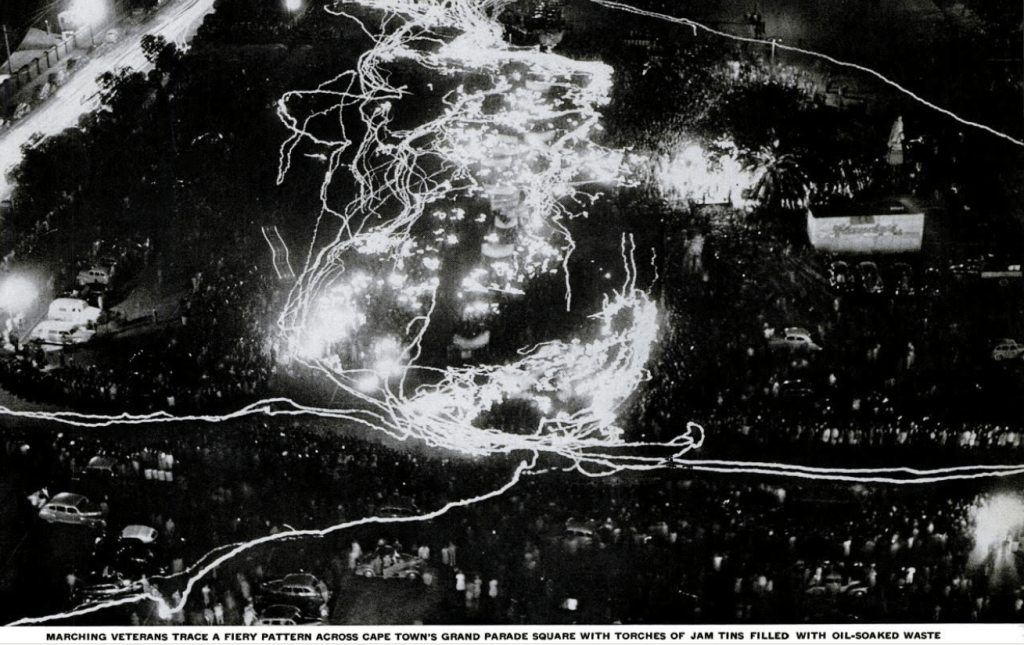
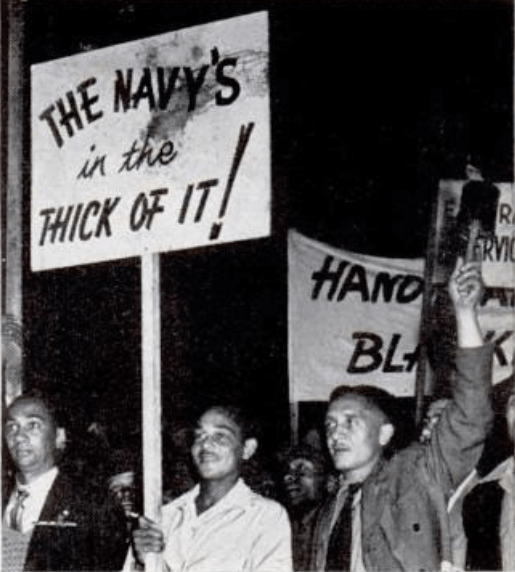
By the early to mid 1950’s, this state of affairs led to open Anti-Apartheid protests from the South African military veterans community returning from WW2 – in their hundreds of thousands – in all The Torch Commando would rise to 250,000 members openly protesting the on-set of Nazism in the guise of the National Party, and it also ultimately led to the marginalisation of South African World War 2 veterans and their veteran associations by the ruling party when it was crushed under anti-communist legislation put forward in 1950 by the National Party.

The folding in of key National Socialist organisations, including Louis Weichardt and his SANP, Johannes von Moltke and his South African Fascists into the National Party’s political sphere would have a resounding impact on the future of not only the majority of ‘Black’ South Africans (who were viewed as ‘Inferior’ peoples by these hard liners), but also minority white ethnic groups like South Africa’s very large Jewish community.  

The arrogance of this underpinning politics is seen with Louis Weichardt himself, who, on becoming an elected National Party Parliamentarian quickly covered up his dubious history as a full blown card carrying Nazi, and rather infamously declared that he had never been against the ‘Jewish race’ but only against the actions of certain ‘Jewish communists’. Not a single Jew, in his ‘opinion’ had suffered through his actions.19

Johannes Von Moltke the ex SANP and ex SA Fascist leader also later became a National Party Member of Par­liament and the National Party’s leader in South West Africa and exhibited the same arrogance, gaslighting and covering up of his antisemitic tracks and blame his old grey-shirt colleague instead. “The (UP) Jewish Minister of Parliament, Morris Kentridge, once recalled with some amuse­ment that Von Moltke frequently buttonholed him in the lobby of the House of Assembly to explain that he had been misled by Inch (his fellow Grey-shirt collaborator) and was a great friend of the State of Israel!”20


Researched and written by Peter Dickens.  

My thanks and acknowledgements to Ulrich Duebe, the current owner of the collection as illustrated.

References:

“Echoes of David Irving – The Greyshirt Trial of 1934” by Dr. David M. Scher – December 2004.

A Perfect Storm – Antisemitism in South Africa 1930-1940, Jonathan Ball Publishers, 2015 – By Milton Shain.

National Socialism and Nazism in South Africa: The case of L.T. Weichardt and his Greyshirt movements, 1933-1946: By Werner Bouwer.

Hendrik Verwoerd’s ‘possible solution’ to the Jewish Question in South Africa, 1937 – Die Transvaler, 1 October 1937.

“Hitler’s Spies: Secret Agents and the Intelligence War in South Africa 1939-1945” by Every Kleynhans – Jonathan Ball Publishers 2021

The Rise of the South African Reich by Brian Bunting.

Related Work:

The Nazification of the Afrikaner Right – Torch Commando The Nazification of the Afrikaner Right

Footnotes

  1. A Perfect Storm – Antisemitism in South Africa 1930-1940 By Milton Shain page 55 ↩︎
  2. The South African Jewish Board of Deputies – Jewish Matters – newsletter ↩︎
  3. National Socialism and Nazism in South Africa: The case of L.T. Weichardt and his Greyshirt movements, 1933-1946: By Werner Bouwer – Page 18 ↩︎
  4. A Perfect Storm – Antisemitism in South Africa 1930-1940 By Milton Shain page 58 ↩︎
  5. Echoes of David Irving – The Greyshirt Trial of 1934 by David M. Scher – Dec 2004 ↩︎
  6. A Perfect Storm – Antisemitism in South Africa 1930-1940 By Milton Shain page 58 ↩︎
  7. Ibid page 73 ↩︎
  8. Echoes of David Irving – The Greyshirt Trial of 1934 by David M. Scher ↩︎
  9. Ibid page 84 ↩︎
  10. Ibid page 238 ↩︎
  11. Ibid page 76 ↩︎
  12. Ibid page 82 ↩︎
  13. Ibid page 137 ↩︎
  14. Hendrik Verwoerd’s ‘possible solution’ to the Jewish Question in South Africa, 1937 – Die Transvaler, 1 October 1937. ↩︎
  15. A Perfect Storm – Antisemitism in South Africa 1930-1940 By Milton Shain page 14 ↩︎
  16. The South African Jewish Board of Deputies – Jewish Matters newsletter – Antisemitism in South Africa PESACH 2009 by Dr. Milton Shain ↩︎
  17. A Perfect Storm – Antisemitism in South Africa 1930-1940 By Milton Shain page 113 ↩︎
  18. Hitler’s Spies: Secret Agents and the Intelligence War in South Africa 1939-1945 by Every Kleynhans page 99 ↩︎
  19. Echoes of David Irving – The Greyshirt Trial of 1934 by David M. Scher – Dec 2004 ↩︎
  20. Ibid ↩︎

Hitler’s Spies and the Ossewabrandwag

You can tell it’s the holidays as I am getting to some book reviews I’ve been promising – and this book by Dr Evert Kleynhans “Hitler’s Spies: Secret Agents and the Intelligence War in South Africa: 1939 – 1945” had me reacting like the ‘Strictly Come Dancing’ Judge Anton Du Beke when a celebrity performer receives a 10/10. Du Beke usually becomes highly animated, jumps up, fist pumps and joyously shouts out … YES! BRILLIANT! NAILED IT! FINALLY! I KNEW IT ALL ALONG!!!!! … my wife found me putting down Evert’s book after I finishing it and very amusingly behaving like a rather euphoric and unhinged Du Beke.

So why so happy? There’s a bit of a backstory to this delirious happiness, so bear with me. Over six years ago in 2017 – I published an Observation Post called “Mein Kampf shows the way to greatness for South Africa” – The Ossewabrandwag. I had sought to find and publish the proof of conversion to Nazism by this “cultural front” to Afrikaner Nationalism. 

I had managed to build this Nazi link easily with movements like the ‘Grey-shirts’ – The South African Christian National Socialist Party (SANP) – led by Louis Weichardt and the ‘Black-shirts’ – the Volksbeweging (People’s Movement) or ‘African Gentile Organisation’ led by H.S. Terblanche – these shirt movements with their “Blue, White and Orange” arm-band swastikas were clearly Nazi to the core . The National Socialist Rebels – led by Robey Leibbrandt were also easy and really obvious given he was a covert Nazi appointed operator. The National Socialist Boerenasie (Boer Nation) movement – led by the Boer Revolt hero and rabid anti-sematic Manie Maritz was equally clear – all these movements had fully adopted National Socialism in their missions and even swastika iconography into their images, mastheads and positioning – so proving them as out and out Nazi was easy.

Not so the Ossewabrandwag (OB) – proving their Nazi affiliations is somewhat more difficult. It’s the veneer of the Ossewabrandwag (OB) that’s the issue – their clear “anti-British” stance due to Boer War 2, and their clear positioning as the “cultural front” of Afrikaner Nationalism, with the National Party operating as the “Political front” – this makes it so difficult to pin a case of Nazism on them. The Ossewabrandwag’s Voortrekker origins and mission as “mapping a path” to a ‘white’ South African Republic with a white Afrikaner hegemony using these voortrekkers (pioneers) as the vehicle – all working very succinctly with the National Party which adopted the same voortrekker iconography and mission in its image and political its resolve for a future Republic. 

Image: OB ‘General’ B.J. ‘John’ Vorster at a OB rally

To smear an organisation like the OB which boasted about 300,000 active middle of the road Afrikaners (to whom nearly a million modern Afrikaners are now related) with a “Nazi Brush” is not an easy task – it is as Afrikaans as a Hertzoggie cookie. 

You can argue that the introduction of the Stormjaers within the OB with their military ranks, insignia, salutes and blood oaths are distinctively Nazi, so too their armed ‘sabotage’ campaign can be seen as ‘assisting’ Nazi Germany in their war effort and by their very actions treasonous. You can argue that the OB’s ‘Commandant-General’ Johannes (Hans) van Rensburg was a disciple of Nazim and admirer of Adolf Hitler and built into the OB the distinctive Nazi ideologies of “blut und Boden” (Blood and Soil), their “Give us a master” call for the implementation of the “Führer principle”, their call for the removal and expropriation of “British-Jewish” controlled capital. Their racial constructs and policies which relegated “English speaking” South Africans to secondary citizenship and lumped Jews and Blacks as “Untermensch” – racially inferior and “insoluble” in white Afrikaner every-day life. All of that is distinctively Nazi right?

Dr Hans van Rensburg being sworn in – OB swearing in ceremony

You can even pick out choice statements by key OB leaders as to the OB’s distinctive Nazi roots – ‘from the horse’s mouth’ so to speak. The firebrand nature of the Ossewabrandwag appealed to B.J. Vorster (a future nationalist Prime Minister and President of South Africa) more than the National Party. On Nazism and the OB and said in 1942:

“We stand for Christian Nationalism which is an ally of National Socialism. You can call this anti-democratic principle dictatorship if you wish. In Italy it is called Fascism, in Germany National Socialism (Nazism) and in South Africa, Christian Nationalism.”

The Rev. Koot Vorster (B.J. Vorster’s brother), a Dutch Reformed Church minister, and like his brother was also a predominant Ossewabrandwag leader, crystalised this idea of Afrikaner totalitarianism when he summed up the pro-Hitler and Pro-Nazi standpoint of the OB during an address to a student group on September 15, 1940 and said:

“Hitler’s ‘Mein Kampf’ shows the way to greatness – the path of South Africa. Hitler gave the Germans a calling. He gave them a fanaticism which causes them to stand back for no one. We must follow this example because only by such holy fanaticism can the Afrikaner nation achieve its calling.”

Kowie Marais, an OB member and key member of the Broederbond, years later recalled in an interview the admiration he and his friends held for Hitler: 

“We thought (Hitler) might rejuvenate western civilization … against the communist-socialist trends that were creeping in from the east. We thought it was the dawn of a new era.”

All these links to Nazism matter not a jot to many Afrikaners still convinced that the OB was merely a “cultural organisation” to spread the edicts of Christian Nationalism as outlined by Henning Klopper, then the Chairman of Broederbond, in his famous 1938 centenary of the Great Trek. To literally spread this new ideology of Afrikaner nationalism like ‘wildfire’ throughout the country and unite the white ‘Cape’ Afrikaners with the ‘Boer’ Afrikaners up north (hence the name Ox Wagon Sentinel or ‘Fire Watch’), a job it did very successfully, so much so Klopper praised it as a divine event and called it a “sacred happening” – God had ordained it (according to the Broederbond at least) – and to a audience of Calvinists and Puritan Christian Protestants this had meaning .

Nothing to see here!

But how come this general malaise? How is it that all this Nazism is ignored? It boils down to the simple fact that by the end of World War 2, just about every National Party minister had been in the OB or in organisations affiliated to it, only a handful of ministers – men like D.F. Malan had not flirted directly with Nazism. The Nationalists had to be squeaky clean and re-invent themselves completely if they stood any chance to win the 1948 elections and then hold onto power. The reason they “sat out” the war with Nazi Germany was not because of any great affinity to Adolf Hitler and his cabal, it was because they were purely anti-British. They were simply against Jan Smuts’ ideals of Union and sought national independence and self-determination by way an Afrikaner Republic – they were just avowed Republicans whose identity was forged by Britain’s treatment of their women and children in the Boer War concentration camps. 

Image: The “Path to Nationhood” OB Poster

B.J. Vorster would cry complete innocence, often declaring in interview after interview that Smuts had unjustly imprisoned him during the war and the only reason given to him for his incarceration was because he was merely “anti-British”. The true reason for his imprisonment which was that he harboured previously interned fugitives on the run during the war was conveniently buried, in fact by the mid 70’s it was all under embargo and ‘lost’.

Even the OB leader – Johannes (Hans) van Rensburg – did a compete about face once Nazi Germany lost the war in 1945, he turned around and rather regretfully said:

“It was the greatest disaster in my spiritual life to realise suddenly that the people I had thought to be the heroes of a new era in western civilisation should in fact turn out to be just a band of murderers and nothing else.”

He went further in his autobiography to state his fight was always one of Afrikaner patriotism and a simple fight against Smuts and his policies – he reiterated that as the leader of the OB he had instructed his Stormjaers to sabotage the Union’s war effort so as to keep the soldiers in South Africa and prevent ‘sons of the soil’ – Afrikaners – been sent overseas to die for Great Britain. He was clear in his instructions that no Union soldier would die by the hand of an OB Stormjaer. So – nothing to do with high treason and nothing to do with actively supporting Nazi Germany by way of killing any UDF members, and everything to do with Afrikaner patriotism instead.

He would remark on the OB’s achievements in his autobiography:

“I fought (Smuts’) war effort and I fought it bitterly with all the means at my disposal – which were considerable…. There is no doubt that they (the Ossewabrandwag) seriously hampered the government’s war effort. Hampered it because the government was forced to draw off considerable manpower to guard many strategic points and essential services. A not inconsiderable military element also had to be retained in South Africa as a strategic reserve for possible emergency.”

That in reality the OB played no significant tactical, operational or strategic role in curtailing South Africa’s war effort whatsoever mattered not a jot to van Rensburg, in his mind he did a great service and was pure of Afrikaner heart.

The cover up

During the war, the South African intelligence services under Colonel Ernie Malherbe and the British intelligence services had collected a wealth of information directly linking the OB and the Broederbond to the Nazi German war effort. After the war ended, the Smuts’ government found itself having to implement commissions to investigate all the cases of High Treason, committed by organisations like the Ossewabrandwag, the Grey Shirts, the Broederbond, the New Order etc – additionally treasonous acts by South African nationals joining the German military directly, or joining German propaganda and intelligence services directly and also German and foreign nationals operating in South Africa as spies were to be investigated. Called the Barrett Commission it published its findings to limited ‘eyes-only’ circulation at the end of 1947, but these findings were deemed as political fireworks and embargoed pending the outcome of the 1948 elections scheduled early in the new year.

The fateful 1948 election and unexpected National Party win would change all of that, the newly appointed National Party Minister of Defence (and ex-OB member) Frans Erasmus would walk into the South African Intelligence Services archive, he fired the Officer Commanding on the spot and removed “two lorries” worth of incriminating evidence – never to seen again! The newly appointed National Party Minister of Justice (and ex-OB member) C.R. “Blackie” Swart would obtain the original Barrett Report and recall all the circulated copies of the Barrett report and all its appendixes and supporting documents – never to seen again! 

The Felix transmitter and Lothar Sittig – codename Felix – images courtesy Dr Brian Austin

The National Party in 1948 went another remarkable step further, they granted full amnesty to all Nazi German collaborators and spies, all imprisoned right wing Nazi sympathisers, murderers and saboteurs and all the treasonous South Africans who joined the German military or its propaganda and intelligence forces – all those been held in detention for interrogation or who had been given prison sentences for high treason and wartime crimes and serving time – simply walked free – with no obligation or pressure whatsoever to divulge their activities, the names of their collaborators or their sources and materials to anyone.  

The Afrikaner Nationalists were from here out just a bunch of anti-British Afrikaner republicans, pure Christians at heart and true patriots – no Nazism, no high treason, or traitors to seen here … moving on. Any young whippersnapper journalist or academic trying to pin Nazism on people like B.J. Vorster, H.F. Verwoerd, P.W. Botha, J. van Rensburg, Jaap Marais etc, or even trying to link Apartheid to Nazism would simply be met with a smug “prove it”.

Enter an archive bloodhound 

This is the reason for all my YES! And FINALLY! expletives. Dr. Evert Kleynhans, now an Associate Professor at the South African Military Academy spent years – literally years unlocking the parts of the Ossewabrandwag archive previously embargoed or denied to the all the other historians writing on the Ossewabrandwag. He added to this by digging around in the private collections and archives of all key players. Over and above this he tackled the British intelligence archives – MI5 and more. 

For most modern historians, the credibility of their work is seen in their mastery of the ‘secondary sources’ and you find it in the cross references – an example of this is a reference number to say X book by X author on X page e.g. “Visser, OB: Traitors or Patriots? P.183” However, if a historian gets into the ‘primary sources’ as their major reference source, that is where he or she gets into the archive and the original documents, photographs, signals, messages, letters, speeches, reports etc etc, then their work moves onto an entirely different level. It’s at this point the work moves away from being simply sound and good historical research and into a world where the work becomes a trailblazing and seminal one, one by which future historians will build on and reference.

You can see how Evert has tackled this, as in tackling the primary sources, his reference notations look entirely different, they read like this X Box, X File, X Date e.g. “Box 1621. File: Part 2 Secret Report on cases of high treason, 19 March 1946”. It is here, in the use of primary material that Evert Kleynhan’s “Hitler’s Spies” stands out as more than just a historical treatise it is a seminal work. Evert has fully ‘unlocked’ the Ossewabrandwag’s archive and he has meticulously and steadily pieced together all the missing testament such that the case he presents is water-tight, unquestionable and as close to a truism you can get with all the information at hand.

Image: An Ossewabrandwag ‘Kommandant’ in full para-military uniform with lapel badges, ‘crested eagle’ epaulettes and ‘lightning bolt’ cap badge insignia. In addition he is wearing a sam-browne belt and lanyard. His ‘green’ arm band signifies his rank – using the ‘crested eagle’ again and horizontal lines for scale of seniority.

Here’s a bit of a spoiler alert, but necessary for my argument on the Ossewabrandwag (OB), what Evert does in Hitler’s Spies using all this primary data is bash the ‘High Treason’ and ‘Nazi’ nails into the Ossewabrandwag’s coffin good and solid. The case of High Treason that “Hitler’s Spies: Secret Agents and the Intelligence War in South Africa” brings against the Ossewabrandwag’s high command, inner circle leaders and its Commander in Chief – Johannes (Hans) van Rensburg – is both water-tight by sheer weight of evidence and it is one of eternal damnation. Evert Kleynhans through empirical and extensive research is able to firmly prove that the Ossewabrandwag and its leaders and inner circle ticked all the boxes defining High Treason that would under the laws of the time may have had them all swinging from the end of a rope – alongside their Nazi brethren in Germany ‘Nuremberg Judgement’ style.

What Evert Kleynhans is able to do, and what the likes of B.J.Vorster and others tried very hard for many years to prevent, is that he has been able to “Prove it”.  The OB and its leaders stand as full Nazi collaborators and zealot devotees to Nazism as an ideology and its expansionist new order ambitions and racist constructs, directly assisting their war effort to the detriment of and living threat to every single South African – Afrikaner or otherwise, whether serving in the Union’s Defence force or even just existing as an ‘Untermensch’ in the South African Union and surrounding British territories. 

It’s evidence that is not even inferred by MI5 and SA Intelligence operators and their reporting, Evert even gets his hands on the only remaining copy of the Barrett Report – ironically buried deep in C.R. Swart’s personal archive – the man charged with destroying it, somehow and rather inexplicably decided to hold onto one copy (maybe he figured in the shady world of nationalist politics and political backstabbing he would one day need the leverage of political blackmail to prevent him from getting the chop). The evidence is even more water tight than the commission’s report, Evert even gets holds of confessions, all of them – spies, collaborators – the lot, the most remarkable is Johannes van Rensburg’s personal confession to all manner of High Treason charges called “Rex versus van Rensburg” which he penned in anticipation of his arrest when the war ended and the net was closing in on him (a document so incriminating he buried it and did not really refer to it in his autobiography).

A page turner

Now, one would think that with all this primary source and data that Dr Evert Kleynhans’ “Hitler’s Spies: Secret Agents and the Intelligence War in South Africa” is a dour romp through dusty archival records – but it is anything but, it reads like a Spy Thriller – stuffed full of espionage, spies, double agents, prison escapes, collaborators, honey traps and traitors. It would make it on the spy novel fiction shelf next to a John le Carré novel such is all the intrigue and danger, the frightening bit – John le Carré’s novels are fantastic and entertaining yarns – yet Evert’s work is a truth, it all actually happened, and in this context it will leave you utterly gobsmacked.

The book will take you through the full historiography of espionage in South Africa during World War 2, it covers in full the Ossewabrandwag’s association and collaboration with the Nazi Abwehr (intelligence) Roosebloom Operation and their Felix Operation in South Africa. In between it covers the Nazi Abwehr Operations in Mozambique and Operation Weissdorn and many other cases of espionage, propaganda warfare (Radio Zeesen), message couriering, prison breaks and spy smuggling.

U-156 and U-507 assisting survivors sinking the Laconia in the Indian Ocean, 15 Sept 1942

Even for the ‘anorak’ history enthusiasts looking for all the technical stuff, Evert’s ‘Hitler’s Spies’ does not disappoint, what you also get a force majeure tour into the mechanics of transmitting, frequencies and signal vectoring, the methodologies and systems used in World War 2 of collecting intelligence and conducting counter-intelligence. For the real history buffs, you even get the intelligence, data, signals and tonnage sunk and reporting of the German submarine hunter packs operating off South Africa’s coastline – and all in addition to the submarine activities of the Italians and the Japanese.

I must commend Evert on one very critical point in making this book a page turner, and that’s his writing style. If you think you’re about to get a dull historical treatise sans paragraphs – academic style – think again. Evert, for an academic, uses very good journalistic and storytelling skills – his opening paragraph alone starts with a sinister quote from Carl Emmermann, the Commander of U-172, part of the Eisbär (Polar) submarine hunter group as he peers at Cape Town through his submarine’s telescope.  Evert even brings in skills like “send-up” to link the stories – a case in point here is the wager of a bottle of whiskey taken between two interrogators that they would not be able to break a Dutch national (held in detention after the war) who operated as a Nazi spy in South Africa. I’ll leave it to the reader to find out if the bottle of scotch was won or lost – but this is a human story telling element which has no real historical bearing and could easily have been left out – yet luckily, we find it in this history book – it makes it highly readable. 

The final word?

Is Evert’s book ‘Hitler’s Spies’ the final and definitive word on the Nazification of the Afrikaner Right? It’s solid enough that it can be, but to be honest it’s not – there is loads to this subject not covered in Hitler’s Spies and there is very good reason for this. As said this work is a seminal one, Evert could have broadened each subject he tackled exponentially taking the book which is focussed on submarine warfare and espionage into a massive historical tome instead – but he chooses not to and keeps the book and its story focussed and succinct, what he does instead is open the door to other historians and authors to pick up on any empirical thread Hitler’s Spies throws out and become bloodhounds in their own right.

A case in point here – during the war the OB’s leader – Johannes van Rensburg, is accused by the leader of the National Socialist Rebels – Robey Leibbrandt of being a double-agent – Leibbrandt is open in his accusation that van Rensburg is a “Smuts-man” in disguise. Whilst it is very clear in Evert’s book Hitler’s Spies that there is collaboration between the Smuts government and the OB, it would take another historian – Dr Garth Bennyworth from Sol Plaatjies University, to unearth in a MI5 file the proof positive that van Rensberg had indeed acted as a double agent to betray Liebbrandt. To note here, this skulduggery is not so much van Rensburg’s intentions as a patriot Afrikaner to protect Afrikaners – its more to his adherence to the Führer principle. Both Robey Leibbrandt and Johannes van Rensburg are megalomanic enough to assume they will be South Africa’s new absolute Führer should Germany win – you need to view Liebbrandt as a sort of Ernst Röhm brownshirt thug, and like Hitler eliminates Röhm, van Rensburg eliminates Liebbrandt. What this double agent conspiracy does – it also gives van Rensburg his “get out of jail free card” should Germany lose the war and he knew it, it would stop him from swinging by a rope for High Treason – the truth is he’s looking out for number 1. 

Image: Carnage from a OB bomb blast

Were does this leave the final word on all the Osswabrandwag’s leader element and inner circle – all the people complicit in Nazism and High treason? All the future National Party leaders, Presidents and Prime Minister’s – the likes of:

  • B.J. Vorster – Ossewabrandwag ‘General’, Broederbond and future National Party Prime Minister of South Africa and President of South Africa.
  • Oswald Pirow – Founder of the Neo Nazi ‘New Order’ and devout Nazi – National Party Cabinet Minister prior to the war and future National Party appointed State Prosecutor.
  • Hendrik van den Bergh – Ossewabrandwag future National Party appointed head of State Security.
  • Johannes von Moltke – leader of the Christian National Socialist Movement (SANP)’ in the Eastern Cape and future National Party Minister and the National Party leader in South West Africa/Namibia.
  • P.O. Sauer – Ossewabrandwag ‘General’ – future National Party Cabinet Minister.
  • Frans Erasmus – Ossewabrandwag ‘General’ – future National Party Cabinet Minister. 
  • C.R. Swart – Ossewabrandwag – future National Party Cabinet Minister and State President.
  • P.W. Botha – Ossewabrandwag and Broederbond – future National Party Cabinet Minister and State President of South Africa.
  • Eric Louw – Ossewabrandwag, devout anti-semite – future National Party Cabinet Minister (Foreign Minister). 
  • Jaap Marais – Ossewabrandwag – future National Party Cabinet Minister and future co-founder of the ultra-right Herstigte Nasionale Party.
  • Louis Weichardt – founder and leader of the Neo Nazi ‘South African Christian National Socialist Movement’ (SANP) and future National Party Minister.
  • The Rev. Koot Vorster – Ossewabrandwag General, Broederbond – brother of BJ Vorster and future NGK leader.
  • Dr Hendrik Verwoerd – editor of Die Transvaaler, found guilty of transforming it to a Nazi mouthpiece during WW2, Broederbond and future National Party Prime Minister of South Africa.
  • Henning Klopper – founder and Chairman of the Broederbond, National Party Minister and Speaker of the National Assembly.
  • Albert Hertzog – son of General J.B.M. Hertzog, Broederbond, future National Party Minister and co-founder of the ultra-right Herstigte Nasionale Party.
  • Dr Nico Diedericks – Chairman of the Broederbond during the war, a future National Party State President – prior to the war attended the Nazi Party’s Anti-Comintern training in Berlin. 
  • Piet Meyer – Chairman of the Broederbond and Ossewabrandwag General, future National Party appointed Head of the SABC. So admired Nazi Germany he befriended Hitler’s chief of staff, Rudolf Hess, who even taught him how to ski.
  • General Rudolph Hiemstra, UDF WW2 objector due to strong pro-Nazi convictions, re-instated by Frans Erasmus after the war in 1948 and eventually became the National Party’s appointed Commandant General of The South African Defence Force.
  • Dr Eben Dönges – Ossewabrandwag, Broederbond stalwart, future National Party Cabinet Minister, Acting Prime Minister and State President elect.

The truth is final word has been left wide open, these stalwart Afrikaner nationalists are now open to investigation and more digging, the secrets have now been unlocked, the archives are open, the documents found, the path mapped. The ‘veneer’ has finally fallen off. My honest recommendation to any military history enthusiast interested in South African history – buy this book – and buy it now. It’s still available on-line and in all major retailers.

Dr Evert Kleynhans – Associate Professor, South African Military Academy

Also, look out for a future Observation Post on the Felix Transmitter, an abridged version of The Story of the Nazi Spy in South Africa with the kind permission of Dr Brian Austin and Vincent Harrison.

As to last words, Dr Evert Kleynhans wrote in a personal message to me in the beginning of my copy of his book ‘Hitler’s Spies’ – it reads “Dear Peter. Happy Reading and look forward to working with you – Evert”, my last word on this review is this:

“It’s the other way round Evert – I look forward to working with you! – Peter” 


Written, researched and reviewed by Peter Dickens

References:

“Hitler’s Spies: Secret Agents and the Intelligence War in South Africa 1939-1945” by Dr. Evert Kleynhans – Jonathan Ball Publishers 2021

Felix Transmitter – The Story of the Nazi Spy in South Africa by Dr Brian Austin and Vincent Harrison.

Dr. Garth Benneyworth – Sol Plaatje University – Correspondence 16/2/2023

Pro-Nazi Subversion in South Africa, 1939-1941: By Patrick J. Furlong.

The Rise of the South African Reich: 1964: By Brian Bunting

The White Tribe of Africa: 1981: By David Harrison

National Socialism and Nazism in South Africa: The case of L.T. Weichardt and his Greyshirt movements, 1933-1946: By Werner Bouwer

The Final Prize: The Broederbond by Norman Levy: South African History On-line (SAHO) War and the formation of Afrikaner nationalism: By Anne Samson: Great War in Africa Association.

Volk and Fuhrer. By Hans Strydom. 

Ribbontrop’s proposals to South Africa, The Rise and Fall of the Third Reich. By William Shirer, 1974 edition.

Related Work

Kruger, the man the mystery and the movie Oom Kruger, the man, the movie, the myth!

Oswald Pirow South Africa’s Nazi ‘Neuordnung’ and Oswald Pirow

Greyshirts South Africa’s Nazi Party; The ‘Gryshemde’

Ossewabrandwag “Mein Kampf shows the way to greatness for South Africa” – The Ossewabrandwag

Broederbond and media Just whistling an innocent ‘toon’

Torch Commando – The Nazification of the Afrikaner Right

General Hertzog’s volte-face towards Nazism

I’m currently researching the Torch Commando for an academic seminar I’m involved in on Sailor Malan to be held in Kimberley in September 2023, part of this is researching the ‘Nazification of the Afrikaner Right’ which triggered the returning South African WW2 veterans into mass protest when the National Party came to power in 1948. In doing this we uncover more “inconvenient history” and nothing more inconvenient to our general understanding is the sudden conversion of the much loved (in white South African circles at least) Prime Minister, General J.B.M. Hertzog … to Nazism. 

What! No way, we’ve heard about all the ‘Pure’ Afrikaner Nationalists flirting with Nazim, how now General James Barry Munnik Hertzog? He was all about the South African ‘Union’ with Jan Smuts! This was no ‘Nazi ‘surely!

But I’m afraid here’s some more history that your Apartheid period schoolteacher either glossed over or had no clue about. But let’s cover a little of Hertzog’s background to this infamous U-turn first.

Hertzog’s political career in a nutshell

Much is written about General Barry Hertzog. A complex character, his popularity amongst Afrikaners was cemented when as a ‘Bittereinder’ Boer War General, he played a pivot role alongside Generals Louis Botha, Koos de la Rey and Jan Smuts in the Peace agreement that ended the Boer War. He joined Botha, and Smuts to form the South African Party (SAP) and was key to the establishment of ‘Union’ which saw a South African Union formed out of the two old Boer Republics and two primary British Colonies under the British family of nations, established in 1910, with Louis Botha as the country’s first Prime Minister.  

Issues within the SAP would however start to come to head between Hertzog and Botha when Hertzog chose neutrality when the First World War broke out with Imperial Germany in 1914, Hertzog then joined a small minority of Ministers who voted against invading German South West Africa (the vote was 92: In Favour and 12: Against – going to war against Imperial Germany).

He would ultimately break away from the SAP later in 1914, found and head up the National Party after a disagreement with Prime Minister Botha, who favoured a ‘one-stream’ policy (English and Afrikaners together policy) as opposed to Hertzog’s ‘Two-Stream’ which sought a separate development of English and Afrikaans to protect Afrikaans culture (an early form of Apartheid). He would state of British Imperialism at this time, that he would remain committed to it, on the proviso that it benefited the white Afrikaner, the minute it did not, he would happily break with it.

After the Miner’s Strike (Rebellion) in 1922, Jan Smuts’ Prime Ministership and the reign of the SAP was lost, and Hertzog was able to come into power under the National Party banner by climbing into bed with the Labour Party (‘English’ white ‘Bolsheviks’ in effect) in a very uneasy coalition. Although clipped somewhat by the Labour Party as to the maintenance of Union under the British flag (Hertzog leaned to Republicanism) the ‘majority’ National Party was now able to pass extensive ‘segregation’ based legislation, and even change the national flag from the ‘Red Duster’ to the OBB (Orange, White and Blue) incorporating the old Boer Republic flags.

With respect to the South African Union, despite at times harbouring deep wishes for the re-establishment of Boer Republicanism and the possible unbundling of the Union. After the Belfour Declaration of 1926, of which Hertzog was the South African representative and signatory, he remained committed to Union, and to South Africa’s status as a British Dominion. Having played a key role in the agreement he believed that the Balfour Declaration of 1926 had granted sufficient autonomy to British dominions and negated any idea of any overt British Imperialism or influence playing any sort of significant role in South Africa’s future. South Africa (like Canada and Australia) had ‘figurehead’ British monarchist representation, but could crack on with its own laws and independence, completely free of Westminster.

The Balfour Declaration 1924: King George V (front, centre) with his prime ministers at the 1926 Imperial Conference – Monroe (Newfoundland), Coates (New Zealand), Bruce (Australia), Hertzog (South Africa), Cosgrave (Irish Free State), Mackenzie King (Canada) and Baldwin (United Kingdom).

The Balfour Declaration of 1926 would be Hertzog’s crowning achievement and personal pride. However dynamics within the electorate in by 1934, would see the Hertzog’s National Party out of its coalition with Labour and into “Fusion” with Jan Smuts’ opposition South African Party to maintain its authority and Hertzog’s Premiership over South Africa. The decision in this “Fusion” would see Hertzog and Smuts shelve their respective parties and form a new entity called The United Party (UP) – essentially to consolidate a white hegemony in South Africa with a better balance between white English and Afrikaans speakers.

By this stage Hertzog would become the longest serving South Africa Premier in history, presiding over no less than 4 governments. Hertzog’s mantra as Prime Minister revolved around the reconciliation of white Afrikaans and English speakers as the only viable path for South Africa, in this respect he became an intense supporter of “English Rights” and he continued his commitment to South Africa remaining a British Dominion. Hertzog and his Nationalist cabal within the UP are however still able to continue to with segregationist and race-based policies, albeit these were ‘softened’ significantly by the more liberal Smuts and his cabal. 

Hertzog’s United Party cabinet, a curious mix of hard conservatives like Jan Kemp and democratic progressives like Jan Smuts and Patrick Duncan.

A small group of disgruntled nationalists ‘on the rump’ of the party would however break away from Hertzog’s nationalists and form the ‘Pure’ National Party or Herenigde Nasionale Party (Reunited National Party) – under the leadership of Dr. D.F. Malan. They would turn their vitriol against Hertzog, who they now regarded as traitorous as Smuts and a British puppet.

On the other hand, within The United Party, by the late 1930’s things had started to come to a head between Hertzog and Smuts. One issue was South West Africa (Namibia), now under South African Union mandate, and part of Smuts’ and the Union’s vision for ‘Greater South Africa’.

Hertzog’s right hand-man, Oswald Pirow – the National Party’s Minister of Defence and a devout Nazi supporter and admirer of Adolf Hitler had been sent by Hertzog to the Nazi German state on a number of ‘unofficial’ state visits – in doing so Pirow would meet Hitler and assure him of Afrikaner support of the Reich and that should there be war against the British – South Africa would remain neutral and should Germany win they could re-claim their old colony of South West Africa as German (something Hitler re-iterated to Pirow as a fait accompli).

Oswald Pirow in Nazi Germany, November 1938  in Berlin inspecting a honour guard from the German Luftwaffe (Air Force), to his left is Wilhelm Canaris, to his right Ernst Seifert.

Things would really come to a full head when Britain and France declared war against Nazi Germany in 1939. A Parliamentary three-way debate would take place at the beginning of September 1939 primarily between the two factions in the United Party and the Pure Nationalists now in opposition, as to whether South Africa should go to war against Germany or remain neutral. As the United Party was loaded with Hertzog’s Nationalists and there was also Malan’s Nationalists in opposition, Hertzog was very confident he had the majority to carry his motion of neutrality.

Prime Minister Hertzog would argue in his speech that Hitler’s invasion of Poland and annexations of Austria and Czechoslovakia was not an indication that Hitler aspired to world conquest, and Afrikaners well understood the Germans right to struggle for their own self-determination against the hostility of the outside world. Germany’s actions constituted no threat to South African security whatsoever and a policy of neutrality under these circumstances was the only logical policy to adopt.

General Smuts would reply in his speech that since the fate of South West Africa would depend on the outcome of the war, South Africa’s interests were virtually involved. Furthermore, South Africa was part of the Commonwealth whose fate now hung in the balance, to stand aside from the conflict would be to expose the whole civilised world to danger.

Smuts’ amendment to Hertzog’s Motion of Neutrality was carried by 80 votes to 67 votes on the 4th September 1939 and South Africa found itself at war against Nazi Germany. Surprised at the outcome, Hertzog promptly resigned, leaving the South African Premiership and the leadership of the United Party to General Jan Smuts and both he and some of his supporters left the United Party.

Field Marshal Smuts with a ‘V’ for Victory and the pin commemorating his win over Hertzog’s motion of neutrality on the 4-9-1939

On the 23rd November 1939 the National Party’s “Malanites” and “Hertzognites” met and tried to reconcile their differences, they could not, the stumbling block was Republicanism – the ‘Pure’ Malanite Nationalists wanted a Republic regardless, Hertzog felt that a break from Union and the declaration of Republic could only take place if both Afrikaner and English whites were in agreement with the idea. 

To the ‘Malanite’ Nationalists, the UP’s decision to go to war had vindicated their intensive segregationist policies which they had been following since 1934, and that Hertzog’s flirtation with English speakers ‘rights’ was delusional (the Malanites classified English speakers as secondary citizens, albeit they made up around 40% of the white population). Unable to reconcile, Dr. D.F. Malan seized the opportunity to take over leadership of all ‘Afrikanerdom’ and cast Hertzog out into the political wilderness. Hertzog tried again on 5th November 1940 at the National Party’s Convention to reaffirm his position on English-speakers rights, falling on deaf ears, he grabbed his hat and walked out of the National Party – forever.

In his retirement from politics, and in his private life, no longer walking ‘coalition’ and ‘fusion’ political tightropes and toeing UP party-political lines, Hertzog felt confident to reveal his true colours. He performed an especially remarkable volte-face (U-Turn) when, just after leaving the National Party over his defence of English-speakers’ rights, he suddenly became a champion of full-blown National Socialism (Nazism).

Angered by his treatment by Dr D.F. Malan and the endless machinations of National party politicians, General Hertzog issued a press statement in October 1941 in which he excoriated “liberal capitalism” and the democratic party system, while praising National Socialism, as in keeping with the traditions of the Afrikaner, and as a system National Socialism simply had to be adapted to South African needs under the oversight of a one-party state dictatorship.

General Hertzog’s press release led to frenzied activity as the various Afrikaner pro-Nazi and anti-war factions tried to reunite. In the months following Hertzog’s pro-Nazi declaration Germany was joined by Japan, and the Axis forces won victory after victory. This was the point where Smuts was at his most perilous and the Smuts Government really feared that all could easily be lost. The National Party at this point even gave Dr. D.F. Malan dictatorial powers over his party to meet the Hertzog induced “crisis.”

The United Party’s Secretary Louis Esselen even wrote to Sidney Waterson, the wartime Minister of Transport that General Hertzog was ready to be proclaimed saviour of the Afrikaner volk once the war was lost.

According to Hertzog’s officially appointed biographer C.M. van den Heever, in his ‘General J.B.M Hertzog’ published in 1944; the following on Hertzog’s volte-face towards Nazism over this period is noted:

“Hertzog became “bitterly disappointed in the democratic system, with its capitalist foundations and press influence, for he had cause to know that the voice of the majority is not only the voice of wisdom … he was convinced that a new world order was on its way … after his retirement … he became more inclined towards National Socialism, by which he meant the adaption of the old Free State model republic to modern conditions, using the best from recent European experiments. … He regarded National Socialism as suited to the moral and religious outlook of the Afrikaner; indeed, he considered that the constitution of the old Free State Republic was based on it.”

As it happened the Malan’s Nationalists were not able to reconcile with all the pro-Nazi Afrikaner factions – the Ossewabrandwag, the Greyshirts (and the other ‘shirt’ movements), the New Order and the Boerenasie. The ‘Greyshirts’ – The South African Christian National Socialist Movement (SANP) themselves were unable to convince anyone to accept their rather opportunistic leader Louis Weichardt to be appointed as Führer under Hertzog’s ceremonial patronage. Dr. D.F. Malan was certainly unwilling to be usurped by anybody as the leader of “Afrikanerdom” – he had fought very hard to get to this position and rid the party of Hertzog, and even the Ossewabrandwag leader Dr Hans van Rensberg, a man who also converted the idea of Führer for himself, would ultimately find himself on the wrong side of Malan.

Also, according to C.M. van den Heever, Hertzog became increasingly private and isolated. Also noted is that Hertzog started to become seriously ill a year later in 1942 passing away on the 21st November 1942 aged 74. Some apologists to Hertzog’s volte-face and sojourn with Nazism point to his illness and him becoming ‘senile’ – however he was also considered by many to have been well within his faculties a year before in 1941 when he published his pro-National Socialist press release.

That said, his turn to Nazism, given his entire political career and his strong position on ‘Fusion’ and equality between English and Afrikaans speakers along with ‘Union’ – his turn to Nazism seems a little out of character – his illness and realisation that he was closing in on his twilight years may have played a role in that he may have wanted ‘to get it off his chest’, or he may have genuinely become completely mentally discombobulated. 

Like father like son?

Barry and Albert Hertzog

However, it’s in his private life and not in his public life that we find a more compelling clue, and in retirement especially he was very much focussed on his family. They say ‘the apple does not fall far from the tree’ and here we find General Hertzog’s son, Dr. Albert Hertzog who followed his fathers’ footsteps into politics.

Dr. Albert Hertzog was a key figure in the Afrikaner Broederbond, in 1948 he stood as a National Party candidate, becoming a Minister of Parliament. Dr. Albert Hertzog’s views were extreme, he wanted to nationalise the gold mines and as devout National Socialist he looked to reforming Afrikaner and white labour unions – especially the Afrikaner Bond of Mineworkers. He even advocated state control of the entire economy. 

So extremely right wing in his views, Dr. Albert Hertzog eventually found the National Party too ‘liberal’ for his liking and came to loggerheads with them – he was removed from the party, and he moved to establish the Herstigte Nasionale Party (Reconstituted National Party) or HNP in 1969 and head it up as a breakaway to the extreme right of the NP. Joining him as his deputy was Jaap Marais, an ex-Ossewabrandwag stalwart and National Party Minister, who along with Dr Albert Hertzog harboured such extreme National Socialist views that he too was removed from the NP.

The HNP bordered on a Neo-Nazi party in its mandate, advocating complete racial segregation with ‘Pure’ white Afrikaners in full control, dictatorial government, ‘Blood and Land’ ideals and the only official language in South Africa was to be Afrikaans. The party would see the likes of Eugène Terre’Blanche emerge from it (forming the neo-Nazi – afrikaner weerstandsbeweging – AWB) and believe it or not the HNP still exists in modern South Africa today with a mandate to revert to Verwoerdian Apartheid – such is our free democracy, but how they realistically intend to do this is anyone’s guess.  

Legacy

General Hertzog was a much-loved leader, and that’s attested by his oversight over 4 governments, he carefully balanced Smuts’ ‘liberals’ against the more conservative Nationalists and as a result had a tenure over South Africa that even exceeded Smuts’ – and this has not been matched by a South African premier since – even in the modern democratic era. His disposition to ‘reconciliation’ of Afrikaners and English with Smuts alongside him was his downfall in the face of the extreme Afrikaner Nationalists advocating a return to ‘Krugerism’, and an all-encompassing Afrikaner ‘white’ Republic, with the emerging Broederbond advocating a Weimar Eugenics and National Socialist infused definition of Afrikaner ‘Christian Nationalism’ in addition. 

Had it remained there, history would have been kinder to General Barry Hertzog.  Unfortunately, his volte-face to accept National Socialism (Nazism) at the very end of his career will forever tarnish his legacy, as there is literally no way it can be shaken off.  In this respect he joins the likes of all the other National Party members who embraced National Socialism as an ideology prior to and during the war (some even after the war) – B.J. Vorster, Oswald Pirow, Hendrik van den Bergh, Johannes von Moltke, P.O. Sauer, Frans Erasmus, C.R. Swart, P.W. Botha, Eric Louw, General Manie Maritz, Jaap Marais, Louis Weichardt, The Rev. Koot Vorster, Dr. Hendrik Verwoerd, Henning Klopper, Dr. Nico Diedericks, Piet Meyer, General Rudolph Hiemstra, Dr. Eben Dönges, Dr. Hans van Rensberg and even his own son …  Dr. Albert Hertzog.

The Springbok Legion and the Torch Commando, consisting of returning World War 2 veterans repeatedly warned that the under the thin veneer of Afrikaner Nationalism dwelt full blown National Socialism (Nazism), and they pointed repeatedly at the likes of Pirow, Vorster, Erasmus, Verwoerd and Swart. At the helm of the National Party during the 1950’s was Dr. D.F. Malan, and he was just about the only Afrikaner Nationalist in the NP’s leader element who had not either partly or fully embraced Nazism as a political ideology prior to and during World War 2. 

The ‘Malanazi’ as published in ‘Blikfakkel’ the Torch Commando’s mouthpiece in June 1952 – political cartoon by Berry – served to ridicule Dr. D.F. Malan, the Prime Minister and leader of The National Party, humorously depicted as a poor cousin of Nazism.

The National Party spent years covering up its National Socialist affiliations, declaring they were just “anti-British” during WW2 and promoted “neutrality” and not war with Nazi Germany – a “no, Nazi to be seen here .. move on!” approach. But this argument starts to really fall about when you look at General Hertzog’s conversion to Nazism in addition to the rest, the National Party’s founder, its most successful premier and cornerstone for the party for over three decades. 


Written and Researched by Peter Dickens

References:

Pro-Nazi Subversion in South Africa, 1939-1941: By Patrick J. Furlong.

General J.B.M Hertzog: Official biography published 1944: By C.M. van den Heever.

The Rise of the South African Reich: 1964: By Brian Bunting

The White Tribe of Africa: 1981: By David Harrison 

National Socialism and Nazism in South Africa: The case of L.T. Weichardt and his Greyshirt movements, 1933-1946: By Werner Bouwer

The Final Prize: The Broederbond by Norman Levy: South African History On-line (SAHO) War and the formation of Afrikaner nationalism: By Anne Samson: Great War in Africa Association 

Colourised photo of Smuts contract Photos Redux

Related work:

Robey Leibbrand’s National Socialist Rebels Blood Oaths on the Führer principle

Oswald Pirow’s New Order: South Africa’s Nazi ‘Neuordnung’ and Oswald Pirow

Ossewabrandwag: “Mein Kampf shows the way to greatness for South Africa” – The Ossewabrandwag

Greyshirts: South Africa’s Nazi Party; The ‘Gryshemde’

Manie Martiz Boerenasie : A differing outlook

The ‘Devil’s Box’

Ever the scientific mind, Jan Smuts inspects a television camera just after World War 2 (cira 1948/9). Knowing Smuts’ he would have fully embraced this new medium given his nature and inquisitive mind, his opposition the National Party saw television very differently – they called it the ‘devils box’ and feared it would unleash corruption of the mind.

Their staunch National Christian principles demanded that television not be brought to South Africa and they resisted the introduction of television until 1976 – nearly 30 years after most the world embraced the technology. Rhodesia introduced TV in 1960 and Rhodesians though South Africa an oddity with no gambling and no TV.

Albert_Hertzog

Dr Albert Hertzog

Dr. Albert Hertzog, Minister for Posts and Telegraphs at the time, said that TV would come to South Africa “over [his] dead body,” denouncing it as “only a miniature bioscope which is being carried into the house and over which parents have no control.”

He also argued that “South Africa would have to import films showing race mixing; and advertising would make Africans dissatisfied with their lot.” The new medium was then regarded as the “devil’s own box, for disseminating communism and immorality”.

The issue of whether to bring television to South Africa was back on the Parliamentary debate when South Africa was about the only country in the advanced world to completely miss Neil Armstrong’s famous worlds and landing on the moon – beamed live on TV to planet earth (except, inter-alia – South Africa) in 1969.  The moon landing and live Apollo missions to the moon into the mid 1970’s had sealed television as the primary media mouthpiece of the foreseeable future – it could simply no longer be ignored.

In 1971, the National Party appointed a “Commission of Inquiry into Matters Relating to Television”, headed by Piet Meyer, chairman of the Afrikaner Broederbond and later of the SABC. itself.  A majority of its members, of whom nine were Broederbond members, recommended that a television service be introduced, provided that “effective control” was exercised “to the advantage of our nation and country”.

26758216_2074745419421112_7302667263471838729_o

Still taken from ‘Television in Action’ the first Test Broadcast in 1975 which used the SADF as a subject.

Instead of fearing the advancement of communication via television, the National Party now embraced the power of television to mould the nation’s mind in favour their prevailing political narrative – if it was very carefully censored and controlled by the state.  Albeit that they were still very wary as is seen here is John Vosters’ opening speech on the first broadcast on the 5th January 1976.

In the English part of his short bilingual address BJ Vorster went on to say.

‘After years of thorough preparations, we have now reached the stage where television becomes a part of our daily lives,’ Vorster explained. ‘… It is still too early to say or even to predict what influence it is going to have on our daily lives. But what is clear, is that we are dealing with a medium that, as it has already been experienced by all other countries, can have a powerful influence, whether for good or for bad.’

Vorster then outlined his vision for South African television:

The approach should still be that we want to use the medium to provide fresh and correct information, and healthy entertainment, and to be part of the education of the nation … Objectivity and balance should still be our keyword. It is a big task, not only to bring the world to South Africa, but also (and perhaps especially) to show South Africa to the world as it is in its rich diversity and everything it has to offer.

The possibility of using television as a government propaganda tool was thus clear from the beginning. When TV was finally introduced is was very limited to a handful of hours at night for many years split equally between English and Afrikaans and heavily censored and controlled with heavy religious and Afrikaner nationalist cultural content.

Broadcasting started and ended with a Christian Bible reading and prayer which was then concluded with the playing of the national anthem before switching to the ever-present ‘test pattern’.

hqdefaultSunday broadcasts were dominated by a NG Church service streamed onto television and Afrikaans entertainment hours were dominated by ‘Boeremusik’ programming and showcasing ‘boere-orchestras’ and smiliar music shows.  The only news channel was ‘SABC’ News – which was very carefully managed.

In 1976, despite initially denying involvement of the SADF in Angola, world media and soldiers and their families themselves could no longer keep it a secret.  To take the high ground the National Party was very quick to jump on the TV bandwagon to publish a very politically and factually skewed ‘docu-drama’ in 1976 called ‘Brug 14’ to paint the forces of good (SADF) against the forces of evil (Cuban Communism) as an early foray into using the SABC as a propaganda tool.  It proved very successful and set the bench for docu-drama’s and documentaries to come.

By 1978, the British Actors’ Equity ban was extended to television programmes recorded on film.  The ban had first been put on South Africa in the 1960s in protest against Apartheid policies, and stated that Equity members would not perform in South Africa if they were not allowed to play to multi-racial audiences. When the boycott was extended to television, it meant that programmes using a performance by any Equity member could not be broadcast over South African television. This created difficulties in the procurement of shows from overseas, as Britain was an important source of material.

Ever resourceful to keep the ‘business as usual’ sanitised approach, the SABC managed to find their way around the ban by importing programmes from other countries and even by adapting British programmes, for example the animated children’s programme, Rupert the Bear. To get around the ban, the SABC dubbed the programme from English into English, as it originally featured performances by Equity voice artists.

Only by 1982 was television opened up to other languages and cultures, and Black South African audiences could finally enjoy some ‘sanitised’ content aimed at them. ‘Independent’ television from state-owned control – M-Net – was only finally launched in 1986, and only on the proviso that they were not allowed to have a news channel.  It was to be an entertainment channel only, the Nationalists continued to maintain a heavy grip on what South African’s could and could not see by way of how the Apartheid experiment was getting along.

cb_logo_defaultIn 1988, M-Net, keen on doing some kind of news actuality programming, found its way around the ‘no news channel’ clause with the launch of Carte Blanche (meaning ‘anything goes’) a once a week ‘Investigative journalism’ program which they billed as ‘entertainment’.  It is still South Africa’s only real source of real unbiased local TV news broadcasting having uncovered many of South Africa’s most famous scandals of human rights abuse, corruption and consumer affairs.
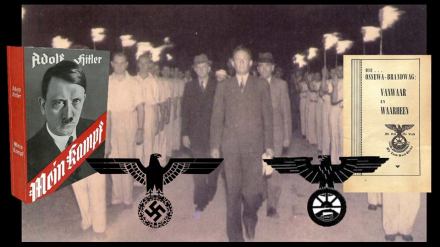
Very often, this website – The Observation Post, comes under criticism whenever it is mentioned that the Nationalist system skewed history or news or went about covering up tracks – one only has to cast your mind back to the heavy state control of media, especially mass media and the ‘blackout’ of anything broadcasted on a national basis which would counteract state policy.

South Africans were fed a careful diet of Nationalist Afrikaner dogma for decades, and as a result either have limited or no knowledge of our own contemporary history or if we do have some idea it is often connected with an equally skewed state ‘National Christian’ education policy and it is very biased and often very incorrect.

To get more in-depth as to this ‘influence’ on the general mindset of South Africans living under Apartheid, this documentary ‘SABC 20 years – the untold story’ is a must watch, it  looks at the start up of television in South Africa in 1976 and the manner in which it was directly controlled by the Nationalist Party Government to propagate Apartheid ideology.

Given the modern power of state-owned broadcasters and the advent of ‘fake-news’ in our current political narrative, with the SABC now firmly in the hands of the African National Congress (ANC), the ANC have proved themselves to be no different to the old ‘Nats’, as this powerful medium is once again wielded in favour of the prevailing political narrative – this time it’s all about ‘Black African nationalism’ and no longer ‘Afrikaner nationalism’.

The ANC have indeed learned from the previous ‘masters’ as to the power of manipulating TV media to mould the mind of the nation and we as a ‘rainbow’ nation of South Africans still await a truly politically uninfluenced free to air news channel, a full quarter of a decade into ‘true’ democracy later.

The ANC have even gone as far as launching their very own ’24 hour news’ channel in the form of ANN7 owned by the Gupta family which so blatantly biased towards ANC doctrine and their own news information it’s shameful.

In this sense Dr. Albert Hertzog was dead right – it is indeed the ‘Devil’s Box’ but as has been proved – it very much depends on whose Devil is in control of it.

600x400


Written by Peter Dickens, references and extracts from Wikipedia and ‘Television Comes to South Africa’ published by the University of Pretoria  – Bevan, C (2008).  Cartoon copyright Zapiro.  “SABC TV 20 YEARS – the untold story” 1996 copyright Kevin Harris

“Mein Kampf shows the way to greatness for South Africa” – The Ossewabrandwag

History is always a three-way prism. As with South African statute forces fighting communism on two fronts – the Angolan Border ‘Bush’ War and the internal ‘struggle’ movements in the 70’s and 80’s – so it was during the Second World War as well, this time the ‘struggle’ movement was a little different and South African statute forces were fighting Fascism and Nazism (National Socialism) on two fronts, both on the international stage and on the domestic front at home.

Little is known of the domestic conflict during World War 2 as it was effectively shielded and even erased from the state’s educational history curriculum – to the point that little is known about it by subsequent generations of South Africans even to this day. By far the biggest of all the domestic pro Nazi organizations in South Africa at this time was a movement called the “Ossewabrandwag” (abbreviated to OB).

The feature image shows a Ossewabrandwag rally and its leadership along with an inserted emblem of the organization. Read on for a fascinating and relatively unknown part of South African military history.

Background and formation

screen-shot-2016-03-05-at-16-38-42

The Ossewabrandwag (OB), meaning in English Ox-wagon Sentinel was an anti-British and pro-Nazi German organization in South Africa during World War II. It was officially formed in Bloemfontein on 4 February 1939.

As a background to it, in the South African War (1899–1902), Britain conquered the Boer Republics. Germany supported the Boer cause. After the war, there was a general reconciliation between Afrikaners and Britain, culminating in the formation of the Union of South Africa in 1910, under the leadership of former Boer fighters, Louis Botha and Jan Smuts. South African troops, including tens of thousands of Afrikaners, served in the British and South African Union forces during World War 1 and again in World War 2.

Nonetheless, many Boers from the ex Transvaal and Orange Free State Republics remembered the extremely brutal tactics used by Britain in the Boer War and remained resentful of British rule. They were especially resentful of the concentration camp and scorched earth policies engaged by the British to bring to bring an end to the guerilla tactics used by ‘Bitter einders’ at the close of the war.

In the 1930’s the chief vehicle of Afrikaner nationalism was the ‘Purified National Party’ of D. F. Malan, which later became the ‘National Party’. As in 1914, the Second World War appeared to a relatively small group of far right-wing Afrikaner nationalists as a golden opportunity to establish Afrikaner nationalist rule and move to make South Africa a republic independent of Britain.

‘We are now ceaselessly on the road to our goal: the Republic of South Africa – the only status under which we can truly exercise the right to self-determination as a country,’ said D.F. Malan on 6 September 1939 at the on-set of the Second World War.

Prior to this, 1938 was also the centennial anniversary of the Great Trek (the migration of Boers to the interior). The Ossewabrandwag was established in commemoration of this Great Trek. Most of the migrants traveled in ox-drawn wagons, hence the group’s name. The group’s leader was Dr Johannes Van Rensburg, a lawyer who had served previously as Secretary of Justice, in 1933 he had been to Germany in his capacity as Secretary and met both Hitler and Goering as well as other Nazi officials, he was deeply impressed with both the leadership and discipline offered by Nazism and became an admirer.  The OB at the on-set of the centennial was loosely associated to Malan’s National Party.

The relationship with the National Party 

There were however sharp differences between Dr van Rensburg and Dr D.F. Malan over the right course of action to be followed when South Africa declared war on Germany in 1939. Both believed that everything depended on the outcome of the war, both believed that Germany would win it, however Malan relied on negotiation with Germany to achieve his objectives, van Rensburg on the other hand believed that at some stage freedom would have to be fought for and began to formulate a militant opposition to the South African government to undermine South Africa’s war effort.

At first, relations between the National Party and the Ossewabrandwag were cordial, with most members of the Ossewabrandwag belonging to the party as well. At the higher levels, National Party leaders like P.O. Sauer and F. Erasmus (later to be made Cabinet Ministers when Malan came to power) were members of the OB.

Three future National Party South African Prime Ministers/State Presidents held key leadership positions in the Ossewabrandwag. ‘Generals’ like C.R. Swart (later South Africa’s first State President) was a member of the Groot Raad (Chief Council) of the Ossewabrandwag, B.J. Vorster (later to become Prime Minister of South Africa) was a keynote OB leader and formed the OB’s Cape Branch and even PW Botha (future South African State President) joined the Ossewabrandwag and worked with Vorster to establish the OB’s Cape branch.

Other National Party stalwarts where also prominent in the Ossewabrandwag organisation, Eric Louw, for example – who later to become the National Party’s Foreign Minister.  That to say the National Party and the Ossewabrandwag were, to coin a phrase, “two peas in the same pod” is an absolute truism.

Combining the impact of the war and the very dynamic personality of Dr van Rensburg, the Ossewabrandwag soon grew into a significant force, a mass movement whose membership at its peak was estimated to be between 200,000 and 400,000 members.

The relationship between the Ossewabrandwag and National Party at first was very well-defined and D.F. Malan even met with OB leaders in Bloemfontein which resulted in declaration known as the ‘Cradock Agreement’. It specified the two operating spheres of the two respective organizations. They undertook not to meddle in each others affairs and the National Party endeavoured to focus on Afrikanerdom in the party political sphere, while the Ossewabrandwag was to operate on the other fronts of the ‘volk’ (white Afrikaans people’s).

‘Nazification’ of the far right 

In 1940 the Ossewabrandwag created within in structures an elite organization known as the Stormjaers – the storm troopers of Afrikanerdom. The formation of the Stormjaers (English meaning: Assault troops) was in essence a paramilitary wing of the OB. The nature of the Stormjaers was drawn upon the lines of Nazi Germany’s army ‘Storm troopers’, as were the Nazi and fascist rituals and salutes, this is evidenced by the oath sworn in a by new recruits (in some instances a firearm was levelled at them whilst they read the oath): “If I retreat, kill me. If I die, avenge me. If I advance, follow me” (Afrikaans: As ek omdraai, skiet my. As ek val, wreek my. As ek storm, volg my).

screen-shot-2016-12-11-at-11-17-41
Johannes van Rensburg been sworn into the Ossewabrandwag

The Stormjaers were deployed in variety of military operations ranging from the defence of Nationalist political platforms to pure sabotage, they dynamited post offices and railway lines and cut telephone wires. Van Rensburg even wrote “The Ossewabrandwag regards itself as the soldiery of the (South African) Republic . . . the Ossewabrandwag is the political action front of Afrikanerdom.”

The ideologies of the Nazis were penetrating deep into right-wing Afrikaner political identity. In 1940, directly after Nazi German decisive victories in Europe, Otto du Plessis (later to become Administrator of the Cape under the National Party) published a pamphlet – The Revolution of the Twentieth Century – in which he openly espoused the Ossewabrandwag’s policy of totalitarianism.

B.J. Vorster’s brother, Rev. Koot Vorster, who was a Dutch Reformed Church minister, was also a predominant Ossewabrandwag leader. He summed up the pro-Hitler and Pro-Nazi standpoint of the OB during an address to a student group on September 15, 1940:

book_mein_kampf_verlag

“Hitler’s ‘Mein Kampf’ shows the way to greatness – the path of South Africa. Hitler gave the Germans a calling. He gave them a fanaticism which causes them to stand back for no one. We must follow this example because only by such holy fanaticism can the Afrikaner nation achieve its calling.”

Kowie Marais, an OB member, years later recalled in an interview the admiration he and his friends held for Hitler: “We thought he (Hitler) might rejuvenate western civilization…against the communist-socialist trends that were creeping in from the east. We thought it was the dawn of a new era.”

Oswald Pirow also publicly identified himself with National-Socialist doctrines and Nazi Germany and established the Nazi expansionist ‘New Order’ movement inside the ranks of the former Hertzogites.

There even existed South Africa’s own Nazi party called the SANP and it’s militant wing the ‘Greyshirts’ led by Louis Theodor Weichardt (who later became the National Party Senator for Natal). This pure Nazi movement had 5000 odd loyal followers.

Dr Van Rensburg from the OB had always professed been a National Socialist, as an open admirer of Nazi Germany and Adolph Hitler, and the ideas and rituals of membership put forward by his organization had a distinctive Nazi leaning as a result.

According to OB political thinking, Afrikaans would be the only official language in a free, independent, Christian-National Republic. The English-speaking South Africans, regarded as an “un-national” element, would be condemned to an inferior status. Anti-Communism was an important backbone of OB policy in line with Nazi hatred of communism.

The emphasis of the OB was also on race and racial purity. Members were exhorted to ‘think with your blood’, and the Nazi creed of ‘Blut und Boden’ (Blood and Soil) was promoted as an OB value. ‘Family, blood, and native soil – that is, next to our religion and our love of freedom, our greatest and our most sacred national heritage’ (Die O.B. 28 October 1942).

The OB always displayed an exaggerated interest in physical culture and the need for dictatorial discipline. “Give us a master ! Give us bonds which tie us to a stable way of life” wrote van Rensburg.

On issues of family value, the leaders of the OB proclaimed that the duty of the man was to work and fight and the duty of the woman to create and tend the home and family.

In essence the Ossewabrandwag was based on the Führer principle, fighting against the British Empire, anti-capitalist in nature – they called for the removal and expropriation of “British-Jewish” controlled capital, the communists, the Jews and the system of parliamentarism. All based on the principles national socialism.

An irony is not lost here, in modern South Africa the African National Congress (ANC) now call this ‘British-Jewish controlled capital’ a new name – ‘white monopoly capital’ and call for the same capture of this elusive capital as a justification for their cause too.

Screen Shot 2016-03-05 at 16.38.22
Johannes van Rensburg at a Ossewabrandwag torch rally

Insurrection 

From the outset of the war a series of violent incidents took place between statutory force South African soldiers and the Ossewabrandwag. This was to cumulate on Friday 31 January 1941, when van Rensburg was due to hold a meeting at the Johannesburg City Hall when a riot broke out between OB Stormjaers and South African Union Defence Force soldiers who were determined not to allow van Rensburg to have a platform for his support of Nazi Germany – with whom they were now at war with.

The Stormjaers were armed with sticks,pipes, batons, knives, sjamboks and even bicycle chains, while the soldiers were for the most part unarmed and the battle raged in downtown Johannesburg for two days. Armoured cars were brought in while enraged UDF soldiers set fire to Nationalist newspaper offices and set police vans alight. Tear-gas canisters were hurled in every direction between the two antagonists and the Police.

Before a commission of inquiry on the Johannesburg riot, Dr van Rensburg declared that it was only OB discipline and restraint which had prevented reinforcements in outlying areas from being brought into town and broadening the scope of the battle.

In support of OB activities the National Party even came out in direct support of the OB against Smuts’ government resolution to detain and ban members of the OB. Dr D.F. Malan defended the OB in a speech on 5 March 1941, saying:

“The Ossewabrandwag has been accused of lending itself to subversive activities and also of encouraging them. Now I say: Carry out your threat. Ban it. Prevent it and prevent its meetings. If the Ossewabrandwag decides to be passively disobedient and refuses to be dissolved . . . I shall share the consequences with the Ossewabrandwag. At this stage I am prepared to say to you that if the government decides upon that act and the Ossewabrandwag decides not to submit, I shall keep my pledge”.

It was a clear sign to Smuts’ government that unity in the ranks of the Afrikanerdom movements was as unified as ever since the outbreak of the Second World War.

To give an idea of sabotage and violent attacks, at the height of the Second World War – 1942, Ossewabrandwag Stormjaer activities included:

Explosions over a large area of mines at Klerksdorp, Vereeniging, Delmas and in Potchefstroom the OB blew up power lines – 29 January 1942. All telegraph and telephone communication between Bloemfontein and the rest of South Africa were dislocated in one attack in February 1942.

Railway, telegraph and telephone lines in various parts of the Free State were destroyed in February 1942. Fifty-eight Stormjaers were eventually charged with high treason, and a quantity of hand grenades were found. Stormjaers also blew up two telephone poles behind the Pretoria Central Jail, but were never captured.

10402583_560135767489493_4510500168473141319_n

Two other Stormjaers, Visser and van Blerk were convicted of a bombing at the Benoni Post Office, as a result of which an innocent bystander was killed, they were both sentenced to death. The sentence was commuted to life imprisonment.

A few members of the OB were shot while trying to escape from internment camps or jails, the most known was the dramatic pursuit OB General, Johannes van der Walt, who was shot while on the run near Krugersdorp.

A number of arms cache’ and hiding places for the Stormjaers can still be found, the inserted picture shows Ossewabrandwag graffiti in a cave in the Excelsior area.

B.J. Vorster

One very predominant leader of the Ossewabrandwag was Balthazar Johannes (B.J.) Vorster, South Africa’s future Prime Minister. Along with like-minded OB colleagues he regarded the war as an opportunity to get rid of the hated domination of the United Kingdom of South Africa and welcomed the Nazis as allies in their fight.

The firebrand nature of the Ossewabrandwag appealed to Vorster more than the National Party, so while South African troops were helping to make the world safe from Hitler’s National Socialism, Vorster was appointed as a ‘General’ in the Ossewabrandwag for the Port Elizabeth district to promote the National Socialism doctrine back home. On his politics he famously announced the Ossewabrandwag’s position on Nazism and said in 1942:

‘We stand for Christian Nationalism which is an ally of National Socialism. You can call this anti-democratic principle dictatorship if you wish. In Italy it is called Fascism, in Germany National Socialism and in South Africa, Christian Nationalism”.

vorster
BJ Vorster addressing a OB meeting

Vorster was eventually arrested under the emergency regulations in September 1942, he immediately went on hunger strike and after two months was transferred to Koffiefontein internment camp as prisoner No. 2229/42 in Hut 48, Camp 1. B.J. Vorster was eventually released on parole in January 1944 and placed under house arrest.

Interned alongside BJ Vorster was another Ossewabrandwag member Hendrik Johan van den Bergh who eventually went on to found the Bureau of State Security (B.O.S.S.), an intelligence agency created under the National Party on 16 May 1969 to coordinate military and domestic intelligence. Van den Bergh was to become known as the “tall assassin” given his physical height.

Direct German intervention

The German Nazis themselves saw the activities of the Ossewabrandwag as very positive to their fight. Van Rensburg was even played up over Zeesen radio as the real leader of the Afrikaner people.

In June 1941 Robey Leibbrandt was landed from a German yacht on the Namaqualand coast with 10,000 dollars, a radio transmitter, and instructions to make contact with van Rensburg and investigate the possibilities of joint action with the Ossewabrandwag. His mission, overseen by German Admiral Wilhelm Canaris was Operation Weissdorn, a plan for a coup d’état to overthrow the government of General Jan Smuts.

Leibbrandt was a South African Olympic boxer who later came a fervent Nazi follower. He joined the German Army, where he became the first South African to be trained as a Fallschirmjäger (paratrooper) and glider pilot. Leibbrandt was trained with comrades of the Brandenburgers at a sabotage training course of Abwehr II (Abwehrschool “Quenzgut”) near Brandenburg an der Havel, west of Berlin.

Once in South Africa he soon made contact with the Stormjaers and was brought to Pretoria to see van Rensburg.

Nothing, however, came of the negotiations. Leibbrandt’s megalomania was enough to deter anyone from cooperating with him, and van Rensburg refused to be drawn. At the same time Leibbrandt’s fanaticism attracted a number of members of the Ossewabrandwag over to his side, and within a short while Leibbrandt was leading his own group, calling themselves ‘The National Socialist Rebels’ whose members were bound to one another by a blood oath which partly read:

“All my fight and striving is for the freedom and independence of the Afrikaner people of South Africa and for the building up of a National Socialist State in accordance with the ideas of Adolf Hitler.”

The quite truce between Leibbrandt and van Rensburg quickly developed into open hostility. Leibbrandt, disappointed that the OB did not officially support his mission and its resultant failure began to openly attack van Rensburg as an ‘agent’ of Smuts. This sealed his fate. After a few months in South Africa he was ‘sold out’ by OB insiders, his location now known to the Smuts government, he was arrested, together with a number of leading Stormjaers.

Placed on trial Leibbrandt was sentenced to death for treason, but the sentence was commuted to life imprisonment after much lobbying from Afrikaner Nationalist organisations.  Mindful of the deep-seated split in his own Afrikaans community, to quote Jan Smuts at the time his sentence was commuted to life “I did not want the blood of another Jopie Fourie on my hands”.

The Stormjaers sabotage activities were getting too violent for DF Malan’s National Party policy of negotiated settlement with Germany when (and if) they won the war. Many of these acts of violence were going too far for the majority of moderate Afrikaners, and Malan ordered the National Party to break all ties with the OB later in 1942.

The South African Union government then cracked down heavily on the OB and the Stormjaers, placing thousands of them in internment camps for the duration of the war.

Summing up the achievements of the Ossewabrandwag’s campaign of sabotage, van Rensburg wrote this in his autobiography which was published after the war:

“I fought (Smuts’) war effort and I fought it bitterly with all the means at my disposal – which were considerable…. There is no doubt that they (the Ossewabrandwag) seriously hampered the government’s war effort. Hampered it because the government was forced to draw off considerable manpower to guard many strategic points and essential services. A not inconsiderable military element also had to be retained in South Africa as a strategic reserve for possible emergency.”

At the end of the war, the Ossewabrandwag was absorbed back into the National Party and ceased to exist as a separate body, many of its members achieving political notoriety as members of the National Party government on their accent to power with the National Party electoral win over Smut’s United Party in 1948.

Returning war veterans react

Imagine the sheer frustration felt by the veterans after “The War for Freedom” (as WW2 was known) had been fought with the massive cost in South African lives (literally tens of thousands), to rid the world of Nazism and Fascism in the ‘good fight’ – only to come home in 1945 and within three short years find the ‘home grown’ pro Nazi Germany and pro Nazi philosophy politicians swept into government. The very men and their philosophy they had gone to war against in the first place.

By the early 1950’s the South African nationalist government was littered with men, who, prior to the war where strongly sympathetic to the Nazi cause and had actually declared themselves as full-blown National Socialists: Oswald Pirow, B.J. Vorster, Hendrik van den Bergh, Johannes von Moltke, P.O. Sauer, F. Erasmus , C.R. Swart and Louis Weichardt to name a few, and there is no doubt that their brand of politics was influencing government policy.

Louis Weichardt was the South African Nazi ‘grey-shirts’ founder (he later became a National Party MP) in the left image and Oswald Pirow (Nazi ‘New Order’ founder in South Africa) inspecting German Luftwaffe troops on a ‘unofficial’ visit to Nazi Germany on behalf of the ‘old’ National Party – later he became a key Public Prosecutor under the ‘new’ National Party.

Also by the early 1950’s, this state of affairs in the make up and philosophy underpinning South Africa’s ‘new’ ruling party, led to open Anti-Apartheid protests from the South African military veterans community – in their tens of thousands, led by Adolph ‘Sailor’ Malan and other returning war heroes in Torch Commando rallies (The Torch) and it ultimately led to the marginalization of South African war veterans, their veteran associations and the ultimate suppression of anti-Apartheid movements like the Torch by the National Party.

Images of Sailor Malan at an anti-apartheid Torch Commando rally in Cape Town attended by over 10 000 returning South African World War 2 veterans.

Sailor Malan famously accused the national party government at this rally of “depriving us of our freedom, with a fascist arrogance that we have not experienced since Hitler and Mussolini met their fate”.

Covering Tracks

In the interests of consolidating themselves in power and in the interests of securing the ‘white’ vote from both English and Afrikaans voters (especially English-speaking white South Africans of British extraction) much of this legacy was a political hot potato for the National Party.  Nazism, Fascism and National Socialism was purged from Europe with the loss of millions of lives, and exposed for what it is – a crime against humanity.

Political careers – especially those of future National Party State Presidents and Prime Ministers would not be helped if their associations to Nazi Germany, Nazi political philosophy and even anti-British ideals where openly promoted. Especially when National Service was instituted and the National Party called on Jewish and English-speaking white South Africans of British heritage and even moderate or leftist Afrikaners to rally behind their cause to ‘fight communism’ and serve in the statutory armed forces as conscripts.

the-real-face-of-apartheid-vorster-and-hitler-1970s

So it was shielded – in formal secondary education it was not formally taught at all and it was never really widely reported on by the state media apparatus when referring the political legacies of the likes of B.J. Vorster or P.W. Botha. In 1948, two months after taking office the National Party even went so far as removing two truck loads of intelligence on the Broederbond and Ossewabrandwag accrued by the Smuts government from their archive, and it especially included Broederbond plans on how South Africans would be educated along Christian Nationalism lines, this intelligence was never to be seen again. This would give B.J. Vorster his favourite fall-back line of “prove it” whenever someone challenged him on his Nazi sympathising past. Except ‘banned’ overseas anti-apartheid movements, they went to town on the link of Apartheid to Nazism and broadly promoted it to anyone who would listen. This was of course gagged in South Africa under emergency regulations and banned organisation listings. The result is that little is left of it in the modern historical narrative on South Africa in the country itself.

At best, in South Africa, it was re-branded as a ‘fight against the British’ because of the atrocities committed by the British during the Boer War, a sort of retribution, cleverly phasing moral correctiveness to justify it.  What this narrative also aimed to do was unbundle all the underlying Nazi ideology, philosophy, ritual and politics which had been coupled so openly during the war to the Ossewabrandwag’s ideals of Christian Nationalism by future National Party leaders.  Covering it up with ‘moral outrage’ instead.  Whilst retribution for the Boer War was a primary driver of the Ossewabrandwag, and there is good reason behind this objective, it was not the only driver, and ignoring the entire underpinning ideology of the group is only to look at half of the whole.

Many historians have asked if Nazism played a role in the creation of Apartheid as philosophy, and frankly the answer is yes it did, both directly and indirectly by the architects of Apartheid who so readily adopted Nazi ideals, rituals and philosophy during the war, in open and on the public record.  It is this for this reason that National Party did not want any open or constant linkages made to this, their darker past, because when in power the ideals behind Nazism were so abhorrent to the majority of white South Africans that it would have certainly lost them their authority.

In Conclusion

In the end it all disappeared into a politically generated one-sided nationalist narrative of South Africa’s history, and was lost or ‘re-presented’ as retribution for the Boer War to future generations. It even remains a very dark and relatively unknown topic even to this day, however, so strong is this legacy that it has continued to lurk in the Afrikaner far right for many years and resurfaced openly again in the ‘Afrikaner Weerstandsbeweging’ – Afrikaner Resistance Movement (abbreviated to ‘AWB’) in the early 1990’s. When German Nazi swastika flags made a regular appearance next to the AWB flags – which were also styled after the swastika. In addition to German National Socialism finding itself back into the AWB ideology itself, it also wound its way into AWB identity – including insignia and uniform.

1978902_10152242649431480_1182899123_n
AWB Rally in Pretoria

This legacy is far-reaching, and it also remains an irony that the Ossewabrandwag (and later the AWB) embarked on acts of armed insurrection which by any modern definition would be considered a ‘terrorist’ act, and the same people involved in them would readily brand the ANC for ‘terrorism’ with no hindsight to their own time spent as a ‘terrorist’, fighting to destabilise the government of the day with bullets and bombs in very much the same way.

Ironic that the future ‘struggle’ of South Africa’s Black people (and many White people too) against the political philosophy of these men would emulate the same ‘struggle’ these men initiated against ‘British rule’ – and in both instances it carried with it armed insurrection, detention of ‘heroes’, imprisonment of a future President and the promotion of a political “ism”, albeit that ‘Communism’ and ‘African Socialism’ were diametrically opposite to ‘Fascism’, ‘Nazism’ and ‘Christian Nationalism’ – far left and far right of the political sphere respectively.

The net result, the importance and legacy that the Ossewabrandwag has left us with, is that ‘race politics’ continues to haunt us and ‘centre’ balanced moderate politics in South Africa has been completely elusive since 1948.

20157330_10155293323996480_5447290221746340136_o
Evolution of Symbology (L-R) Nazism, Ossewabrandwag, Afrikaner Weerstandsbeweging

Written and Researched by Peter Dickens.

Related works and Links

Louis Weichardt was the South African Nazi ‘grey-shirts’ South Africa’s Nazi Party; The ‘Gryshemde’

Oswald Pirow and the South African Nazi ‘New Order’ South Africa’s ‘Neuordnung’ and Oswald Pirow

Sailor Malan and Torch Commando see Sailor Malan; Fighter Ace & Freedom Fighter! and The Torch Commando led South Africa’s first mass anti-apartheid protests, NOT the ANC!)

The AWB bombing campaign The largest act of terrorism in Johannesburg’s history – a lesson learned?

References from South African History On-Line, Wikipedia and “The Rise of the South African Reich” 1964 written by Brian Bunting, “Echoes of David Irving – The Greyshirt Trial of 1934” by David M. Scher. “Not for ourselves” – a history of the SA Legion” by Arthur Blake. Lazerson, “Whites in the Struggle Against Apartheid”. Neil Roos. “Ordinary Springboks: White Servicemen and Social Justice in South Africa, 1939-1961″. David Harrison “The White Tribe of Africa, South Africa in Perspective” 1981.

The inconvenient and unknown history of South Africa’s national flags

Here’s another interesting back of the chappie gum wrapper fact – Guess which is the correct South African flag South Africans fought under during World War 1?  Bet most people will think of the old “Orange White and Blue” South African flag, but that would be wrong.

As a serving officer in the South African Army I had to be familiar with flag protocol and etiquette, it’s a key part of soldiering when national flags go on parade. However the funny thing in South Africa is just how poor our collective knowledge is of our own national flags.

These are in fact all of South Africa’s national flags:17309179_1539170599434728_8929150928988660165_nMany times in military veteran circles there is steaming debate on when to use the “old” national flag and in what context – however few people in South Africa know what flag to use, what they really mean and even less know what the first South African flag actually looked like.
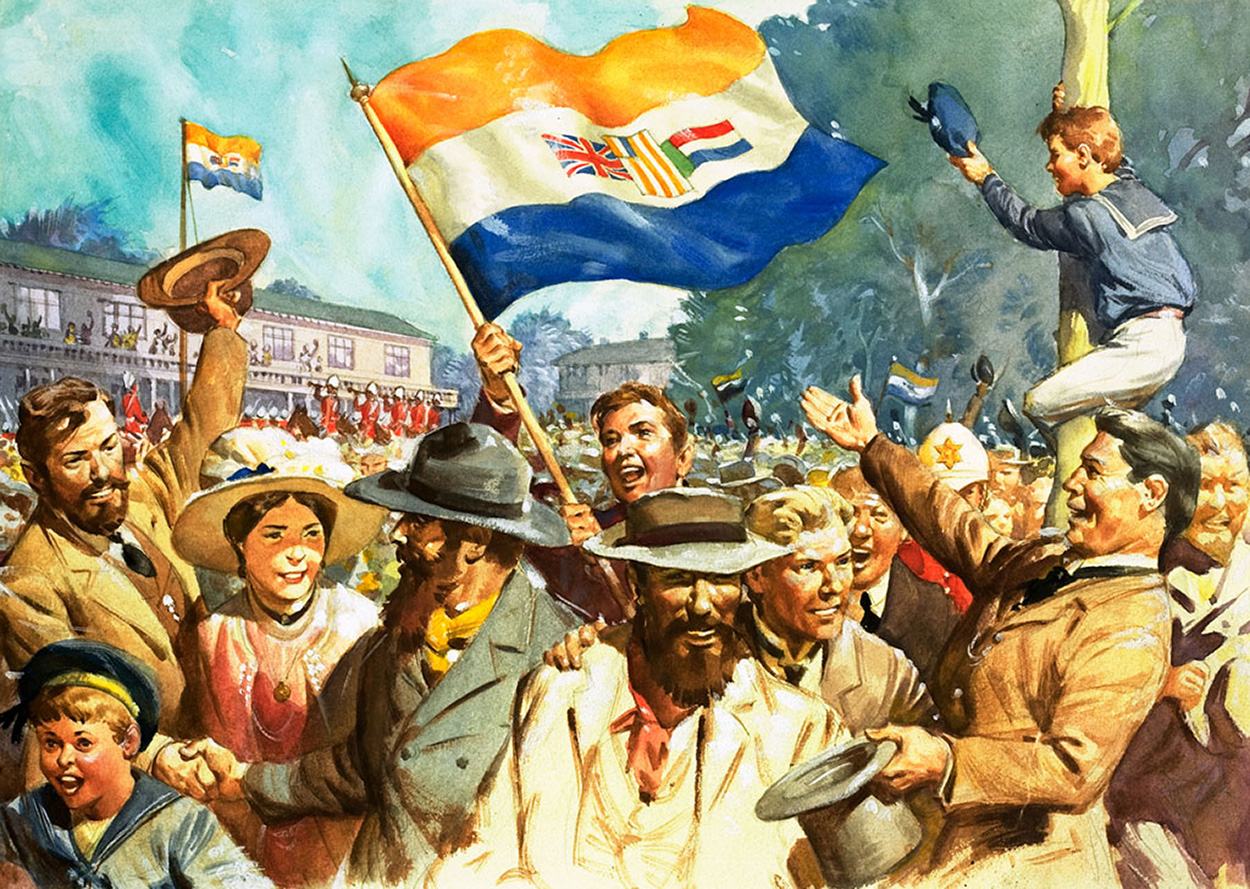
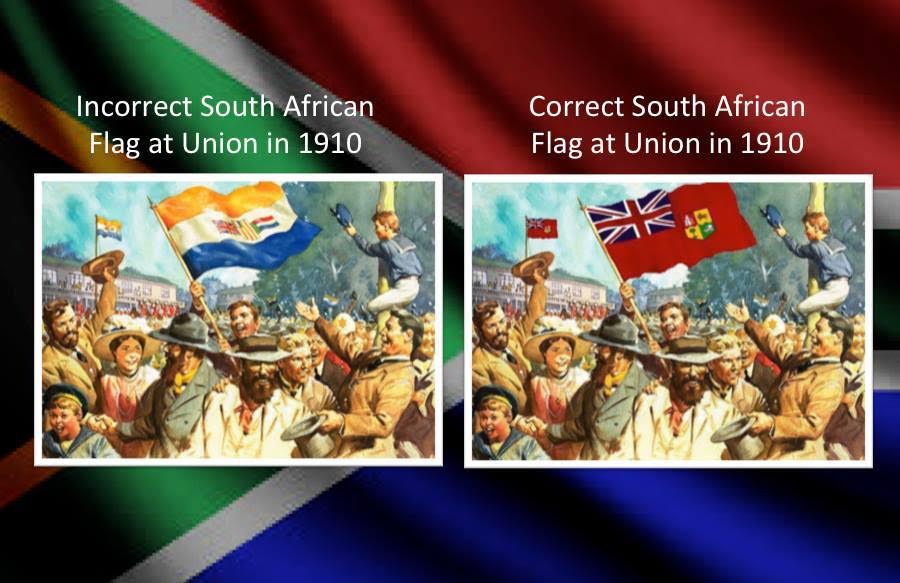
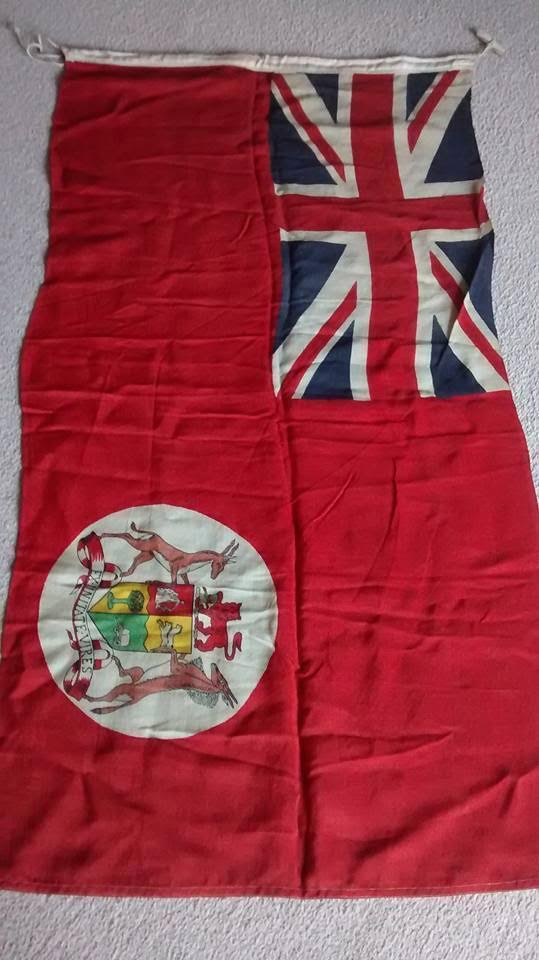
Here is a classic case of the misunderstandings surrounding South African national flags – This is the painting the “Birth of the Union” James E McConnell.  The painting was so poorly researched he used the wrong flag.

Birth of the Union of South Africa

This is a modern day photo-shop version of McConnell’s painting and it shows his original on the left and a more correct South African Union flag at union on the right.

one

The flag he used for his painting was the oranje-blanje-blou (known more commonly as the “OBB”) which all South Africans will recognise. However the flag of South Africa at the time of Union in 1910 was the South African “ensign flag” (British Union Jack top left and the South African National Coat of Arms inserted bottom right). Known as a “Red Duster” – now not too many South Africans today have ever seen that flag.

To show what the first South African national flag, the “Red Duster,” actually looked like here it is:

threeIt is very doubtful that there would have been huge public elation of Boers and Brits embracing one another under this National Flag as depicted in the painting, although this was the National Flag that South Africa fought under during the First World War (there where two versions of this ensign flag which they used – one Red and one Blue).
13686500_616785705157832_3286773017917395641_nIronically, the Boer Commandos that joined the South African Union’s Defence Force at Union in 1910, used and fought under this “South African Ensign” in the South West African and the East African campaigns of World War 1 from 1914 to 1918.

As noted, there was another variant of the “Red Duster” which is an ensign with the respective nation’s emblem against a Blue Background and a British Union flag in the left hand corner (you’ll still see this variant used in New Zealand and Australia for their National flag).

Both South Africa’s “Ensign” flags – Red and Blue qualify as the de facto South African national flags from 1910 to 1928, however the Red one was more common.

The Red Duster variant was the primary flag adopted by South Africa and Canada (Canada used their ensign version during WW1 and WW2 – it was only changed to the Maple Leaf in 1965)

Slide4Given the Ensigns were the flags usually adopted for British “Colonies” and “Dominions”, the South African Union government (which was in fact an independent Parliament to Westminster and made its own laws) felt differently. To the South African Union the national flag of 1910 was “still born” and not reflective of the history of the Boer Republics which made up the other half of the “Union” nor did it adequately reflect on South Africa’s Dutch colony origins.
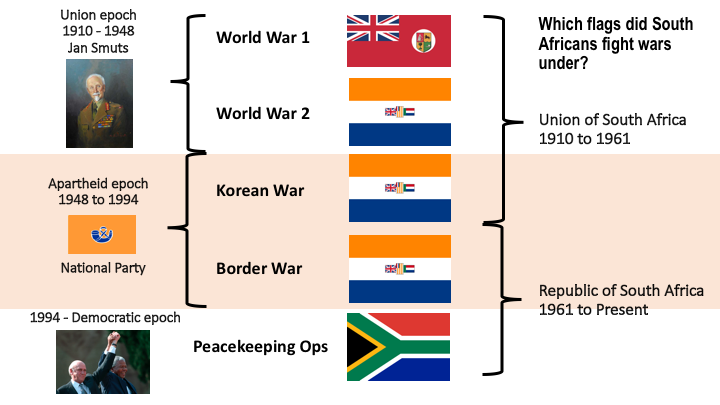
The oranje-blanje-blou (“OBB”) was adopted by the South African Union Parliament as the “new” national flag in 1928. It was proudly flown as the flag of “Union” representing the old British Colonies of the Cape and Natal and the old Boer Republics of the Transvaal (South African Republic) and the Orange Free State. The use of the British Union flag inserted in the OBB, placed closest to the flag mast/pole (the most honoured and senior position for any “inserted” national flag on any flag format) ahead of the two Boer Republic flags, which take a lessor position, calmed down and appeased the “English” detractors who objected to such a dramatic flag change away from the standard Dominion Red Duster.

Slide5

However, confusion as to South Africa’s national flag to use even reigned at this time.  Here Jan Smuts makes the front cover of a late 1940’s edition of “Time” magazine with the National Flag in the background and this time they are incorrectly using the “old” blue ensign flag and should have been using the”new” OBB.

Slide3

So here’s another fun fact, the OBB is not the “Apartheid” flag, the National party when they came to power in 1948 put forward a proposal to have it amended and remove what they called the “Bloed Vlek” (Blood Stain) which was the British Union Flag inserted in the OBB. This was a National party pet hate as it reminded many Afrikaner nationalists of British decimation of Boer families and farms during the Boer war – the campaign to change the OBB flag was stepped up by the National Party under Hendrik Verwoerd when South Africa became a Republic and when he withdrew South Africa from the British Commonwealth of Nations in 1961.

However broader public pressure at the time prevented the initial National Party proposals for a flag change from been passed by the South African Republic’s Parliament and the idea was eventually shelved. In effect the initial campaign to change the OBB died with Verwoerd in 1966, but the National Party attempts to change the OBB to a “new” Republic flag did not stop there.  In 1968, the National Party Prime Minister, John Vorster, again proposed the adoption of a new flag to replace the OBB from 1971, the rational was to commemorate the tenth anniversary of the declaration of South Africa as a Republic.  Even though a National newspaper campaign was run asking the public for suggested flag designs, Vorster’s proposal did not get momentum in Parliament and the flag change never materialised.

Historically speaking, although the hardline National Party members hated the “OBB” and its inserted British “Union Jack”, but they disliked the original South African ensign “Red Duster” national flag with its massive “Union Jack” even more, they hated this flag so much it was literally erased from the South African collective consciousness and very few examples of it survive to this day. It certainly was not top of mind when McConnell painted his “Birth of the Union” painting in 1976.

That the flag of South African Union was kept during the implementation of Apartheid by the National Party from 1948 to 1994 is unfortunate as it detracts from it’s rich heritage as the flag of the South African “Union” and as such it is not the flag of the South African “Republic” nor was it ever intended to be a Republic’s flag – it especially detracts from all the kudos that South Africa received during World War 2 fighting alongside British and American forces under the South African Union’s OBB.

Slide6

The “new” (new) South African flag adopted in 1994 was actually  intended as a “five year interim” flag, however, it proved so highly popular it became the national flag almost instantly and was officially adopted by the government of South Africa on the election day, 27th April 1994.

According to its designer Fred Bromnell – It is actually a combination of the two “Colonial era” flags – The national flag of the Netherlands (Dutch flag) – Red, White, Blue and the the British Union flag – Blue, White, Red.  Then the two former Boer Republic flags – the South African Republic (Transvaal) “Vier Kleur” – Green, Red, White and Blue and the Orange Free State Republic Flag (using the Dutch insert flag and the white) and then finally the African National Congress (ANC) Flag – Black, Green and Gold (colours also present in the Inkatha Freedom Party and Pan African Congress flags).

The V symbolises inclusion and unification. In essence it is another flag of “Union” (unity) only this time acknowledging the county’s Black population and its historical heritage.  Symbols considered in the design of the “new” flag included Catholic and Anglican Priest’s Classic Chasubles, the universal symbol of Peace and the married Zulu female traditional head-dress.

There are some claims that the “New” South African flag is just a “design” with no meaning or symbolism – but that’s not the opinion of the man who actually designed it – Frederick Gordon Brownell.  Also, I find that whenever that when this argument is used  it’s usually to deny meaning to the new South Africa flag and to degrade the country, describing it as “jockey Y front underpants,” when in fact the truth is the opposite and the flag is stuffed full of meaning and symbolism.

In fact the “New” South African flag reflects all the old flags of South Africa, these exist right there for all to see, plain as day to the trained eye (and even the untrained eye) – symbolically placed in the new flag – and that’s an inconvenient truth to both the “new” flag’s detractors and the detractors of the “old” OBB.

Slide2

The funny thing is the “New” (new) flag was only meant to be an interim one, hence the mash of historical South African flags.  The irony kills me whenever I see the “new” South African youth and current South African political class with the flag they are now saluting, flying and even wearing – and it consists of their much despised “Colonial” Dutch, British and Boer Republic flags, and most of the “Apartheid” flag – irony lost on them but not on me.

Here’s the another irony – the “old” South African flag i.e. the “OBB” Union flag was born out of the ideals of Union led by Jan Smuts and Louis Botha. Not under the Apartheid ideals of  DF Malan and HF Verwoed. I personally see a lot of irony when hard-line right wing Afrikaners slam Jan Smuts and brand his values of consolidation and union with the British as an act of treason to the Afrikaner people – when at the same time they fully support, and at times even fly, the very flag created in honour of his very Unionist ideal – with its British “Blood Stain” symbolising Smuts’ reconciliation in full and proud senior position.

Furthermore it is ironic that after many years of trying to change the National flag after South Africa was declared a Republic in 1961, it was the National Party that finally achieved its goal in February 1994 when they, as the National Party government, briefed Frederick Gordon Brownell at the government’s own heraldry department to design a new flag (funnily in some sort of déjà vu – they had to involve the country’s National Herald this time after another newspaper campaign for designs from the public had failed, albeit 20 years later).  The result is the current flag we see today.  It was designed literally in a week and the only change in the decades long National Party narrative on changing the OBB this time was that both FW de Klerk and Nelson Mandela had to approve the new design.

So, lump it or leave it – there is nothing in “Union” flags that appeal to “all” people and everything in “Union” flags that appeal to “all” people.

All I can say is that the “new” South African flag has been the most cross cultural flag ever composed in South African history and it has been the least controversial i.e. it has been the most universally accepted by all South Africans (the very vast majority) with the least amount of disgruntled political posturing to change it.

In summary, to the “old” South Africa OBB supporters I would say:

  1.  The OBB was not the only South African national flag both Afrikaner and English South Africans fought under prior to 1994.
  2. The OBB pays a very high homage to The British Union National Flag in terms of the Vexillology of Flags and Flag Etiquette, especially in terms of the superior/senior position it takes relative to the two Boer Republic flags.
  3. The OBB symbolises the union of Afrikaner and English races – a central philosophy of Jan Christiaan Smuts and that of  “Union” Political Coalition partners and Governments.  Not those ideals of nationalist Afrikaners like Malan, Verwoed and Vorster, whose central political premise was that of an independent “Republic” and “Apartheid”.
  4. The OBB, although a flag of Union with the British, is now very dated.  Times and history changed since South Africa declared itself a Republic, so too the demographic and even social landscape of South Arica.  It cannot work as a current national flag in modern South Africa, change was inevitable – even Smuts would have seen that, and knowing his way of governance he would have welcomed a new flag to reflect it had he been around (in his time he served and lived under four different national flags).
  5. Many key Commonwealth countries have traded in their “Colonial” ensigns and Union flags – Canada, Jamaica, Kenya, Singapore, Hong Kong to name a few, and those still holding onto theirs – Australia and New Zealand, are under strong popular pressure to change them ahead of changing times.

To the “new” South Africa, current National flag supporters I say:

  1. The OBB is the flag of “Union” and it is one of the two Union flags used to bring   South Africa into existence as a country on the central principles of “reconciliation” and “tolerance” between two previously warring races (Boers and Brits), it is not the flag of “Apartheid”- in fact it was developed long before Apartheid was instituted as an ideology (in 1948) and symbolically it’s the complete opposite of Apartheid.
  2. Even the hard-line Apartheid Nationalists hated the old South African OBB, so much they wanted to change it – and eventually they did, and ironically it is the flag you now support, salute, fly and even wear – it was designed by a brief from the outgoing Apartheid Nationalist government in its final throws of office.
  3. The “new” flag very strongly and powerfully associates the flags of South Africa’s “Colonisers” and “Boers” in its design and in fact it celebrates this history – in addition to celebrating the history of the Black peoples of South Africa.
  4. The “new” South African flag does an excellent job balancing South Africa’s history and is very relevant to the current time.  I can’t possibly think of a better solution, and if the ANC and EFF one day decide to change it because of all its “colonial” and “white” legacy, I would hate to see what some Gupta owned design agency in India comes up with, because that really would round off a ‘state capture’.

This is why I allow myself a wry ironic smirk every-time South African flags are so hotly debated.

16905042_239550126507219_5077322311342536422_o


Researched and written by Peter Dickens.

Featured image by James E McConnell, Watercolour on Board 1973, photo-shopped version and background information courtesy Nicholas Pnematicatos.