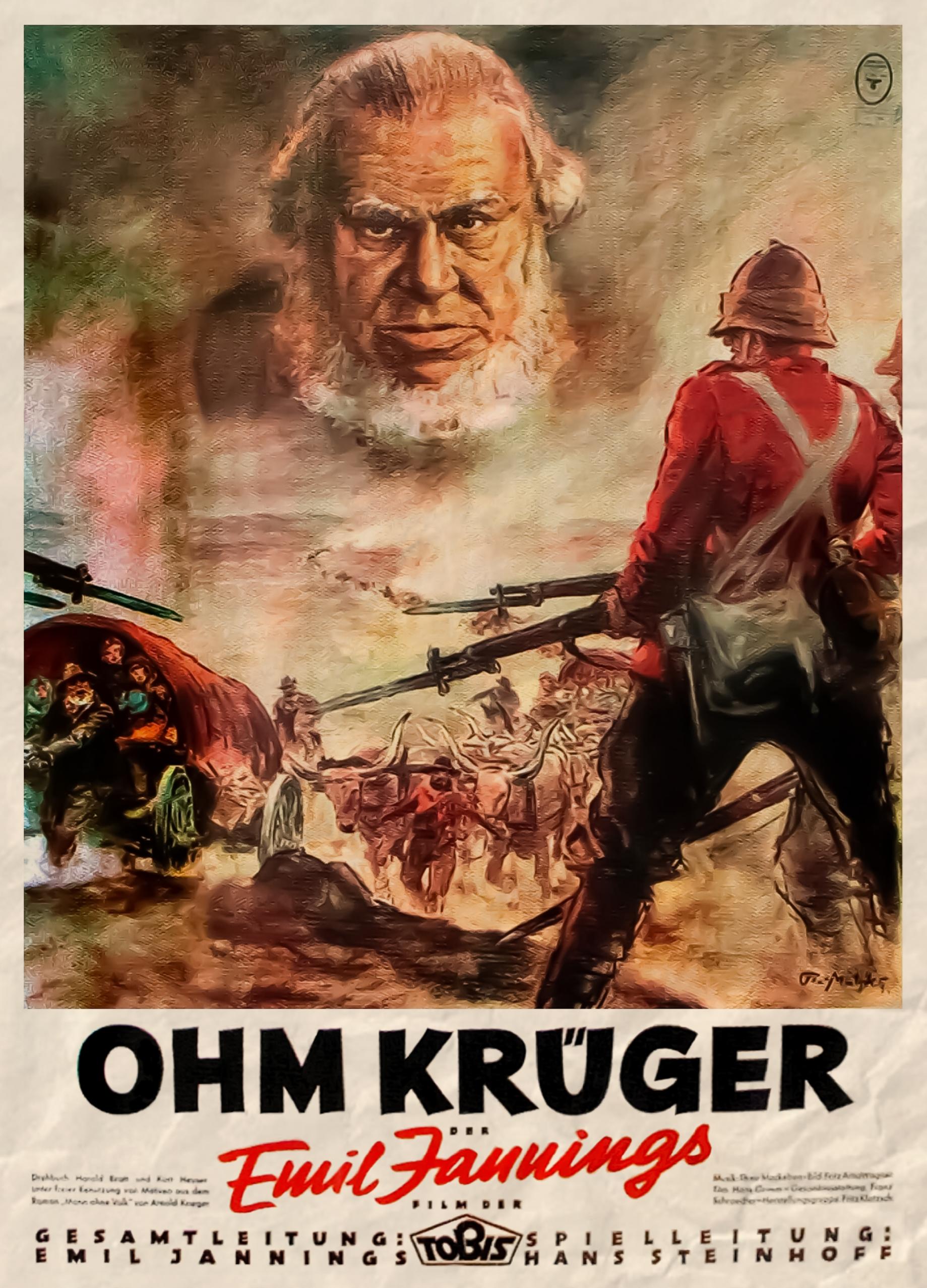
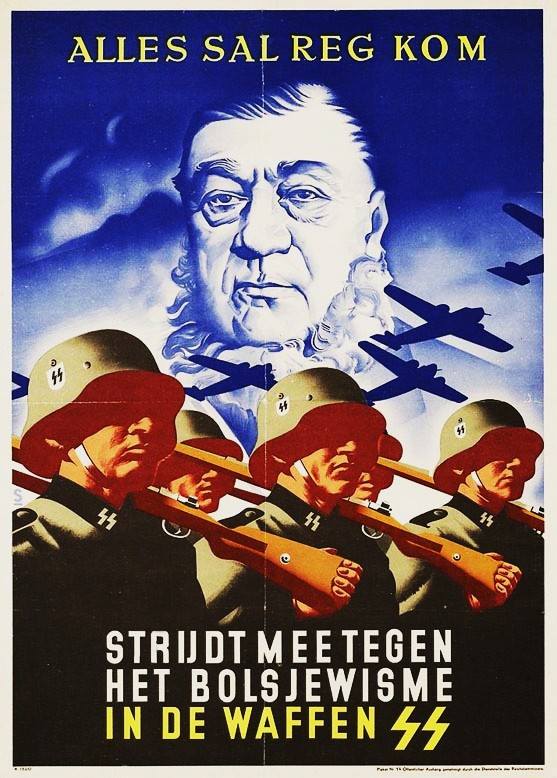
Boer Bashing and other Bull

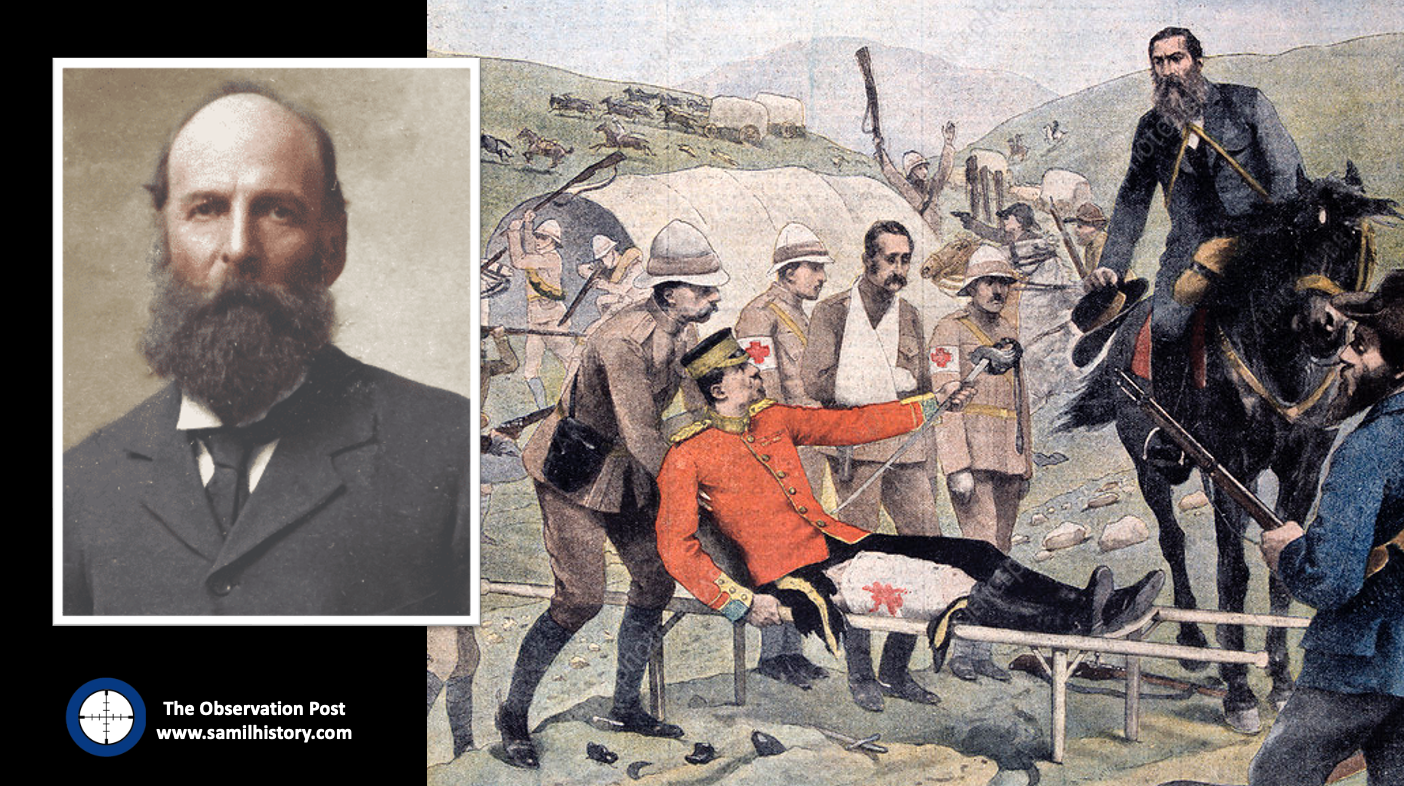
I was taken to task by a well known Afrikaner author, Albert Blake on Facebook pages and accused of ‘Boer Bashing’ on my website and social media and warned to keep my neck in. He even went as far to say he had included this in his new book on Jopie Fourie and to quote him he had investigated my:

‘deeper motives for (my) apparently predetermined “findings” (on Jopie Fourie) … and … the charges that were levelled against (me) in the past regarding severe “Boer/Afrikaner bashing”.’

All a bit rich, I don’t know Blake personally, I’ve never really interacted or debated anything with him, he’s never challenged or even opened a discussion with me in the past, and as to investigating anything, I’m in plain sight, we work in the same circle, he could have merely contacted me and asked the question, it would be the professional thing to do before willy-nilly publishing something that may or may not be libellous and slanderous. Bit odd considering he’s also a lawyer and nobody has “proven” any case of ‘Boer Bashing’ on anything I’ve ever written, nor has any alleged ‘bias’ been proven – ever! By being ‘Anti-Afrikaner’ or ‘Boer Bashing’ as he has alleged, he’s venturing into accusing me of ‘hate speech’ – and you better have some solid proof if you’re going to do that, let’s see, so far he’s provided nothing.

Not unusual that there is no evidence to back up Blake’s accusation and ‘investigation’. As to whenever this “Boer Bashing” accusation is levelled at me I’ve simply asked one question “prove it” and nobody has to date. I’ve also never belittled or insulted anyone on the basis of their ‘Afrikaner’ ethnicity, there is nothing in my media and it’s all ‘public’ – so feel to search my entire website and public social media pages … oh … and good luck.

I’ve even been accused of having an “anti-afrikaner bias” by a handful of detractors and a couple of social media trolls, when challenged they feel it just “comes across” that way, a sort of “out there” sense they have – that this is not a basis for argument or logic is lost on them.

Blake’s sudden assertion is all a bit of a surprise to me to be honest, I’m sure my very Afrikaans family must find it amusing to learn how much I hate them, it’s all rather counterintuitive and illogical – so, I’ll explain my position and I’ll do everyone a favour to stop any speculation, slander and other libellous conjecture right here – they can have it “straight from the horse’s mouth” so to speak.

Specialism

Now, many of my articles and almost all of my research revolves around one period in South African history. It started when I took to researching Nazi movements in South Africa prior and during the Second World War (1939 – 1945). I started researching and blogging on this about 10 years ago, and the response was surprising – many people wrote in to me say “I never knew this” and urged more research. This took me into the politics of returning South African servicemen from WW2 and their reaction to the Nazi enamoured Afrikaner nationalists who found themselves in power from 1948. This cumulated in a large research body on The Torch Commando and early South African political, civil, para-military and military reactions to Apartheid. This took my specialised research period from 1935 to 1955 – about 20 years of specialism as historic ‘scope’ goes.

During this period – 1935 to 1955, the right wing fringe of the Afrikaner Nationalist movement became highly Nazified. Nazi dogma, laws, and ideology started to enter the thinking of Afrikaner Nationalist leaders and heavily influence them – especially from 1935 to 1944 – it manifested itself in Christian Nationalism as an ideology, which grounded itself on ‘Krugerism’ – especially from 1938, it in turn became infused with a cocktail of Nazi purity and race laws, national socialism and weimar eugenics to eventually become “Apartheid” as we knew it from 1948 to 1994.

In terms of historic sweep, from the implementation of Apartheid in 1948, as a derivative of Nazism comes this idea of a police state to command and control a ‘whites only’ Afrikaner led hegemony over all South Africans – an oligarchy of minority rule with brutal state security apparatus, highly centralised government and a ‘command economy’ to maintain this status quo. This under-pinning Nazi philosophy eventually manifesting itself in various ‘Boerenasie’ and Afrikaner resistance movements (the AWB et al) starting in the mid 1980’s and its still lurking in South Africa to this day as a minority counter culture demanding a ‘Herrenvolk’ populated ‘Volkstaat‘ in places like Orania, and it can also still be found in various security services, political parties, cultural movements, historical reenactments and the internet. To illustrate the point, the Herstigte National Party still exists in South Africa, believe it or not, the extreme right wing party with its proto-Nazi origins everyone tries to forget. It has lost its ‘ticket’ but still exists and its stated mandate is the return of Verwoerdian Aparthied, and there are others like it.
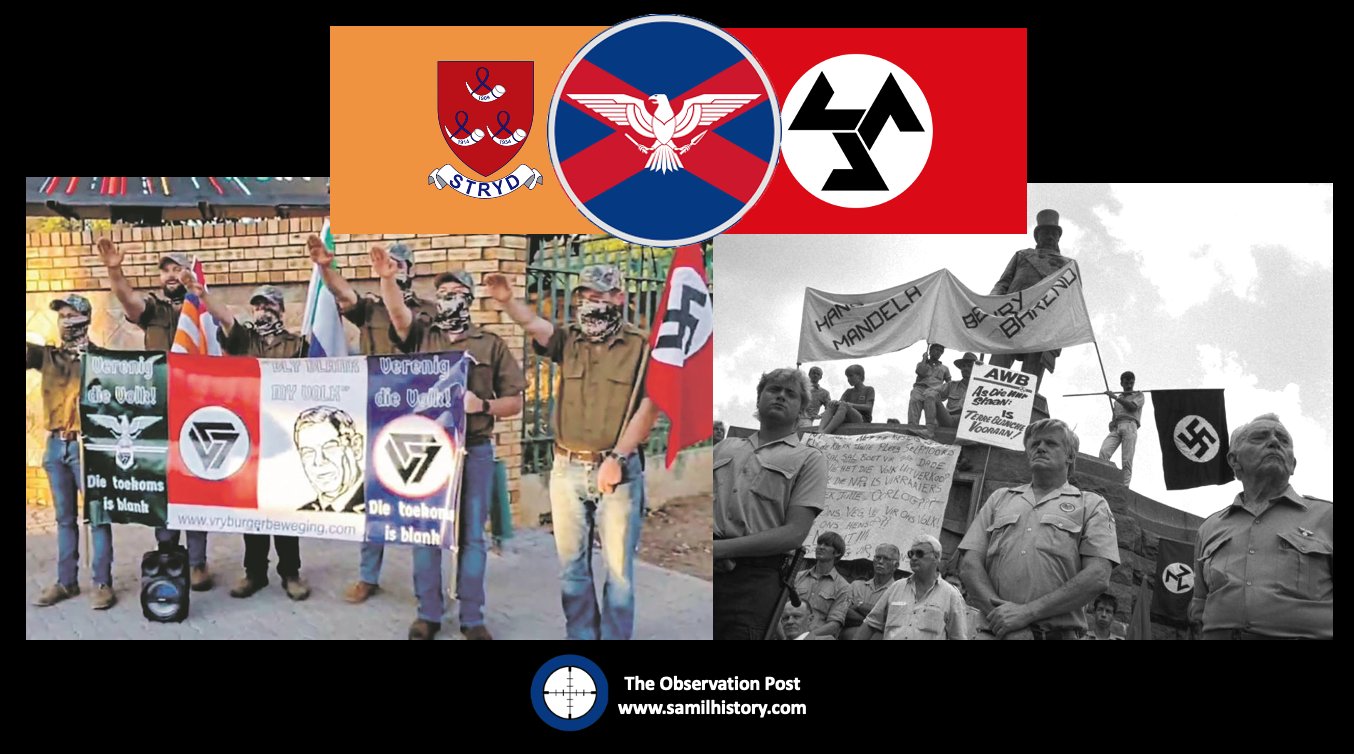
AWB Protest circa 1993 and Vryburger movement protest 2022.

In researching this period (1935 to 1955) two distinctive groups of Afrikaners emerge. On the one side we find Afrikaners who embrace unity, seek reconciliation and are open to race relations to build a South Africa open to all. Many of these men are soldiers – military men, many having taken part in World War 2 fighting Nazism and all of them highly regarded, in terms of ‘history’, history treats them kindly for the most part. As a military veteran myself there is much in these men to like, actually for me it verges on complete admiration to be honest, but that’s a personal thing – they include the following Afrikaners:

Field Marshal Jan Smuts, Kommandant Dolf de la Rey, Group Captain Adolph “Sailor” Malan, General Daniel Pienaar, Group Captain Petrus “Dutch” Hugo, Mattheus Uys Krige, General Kenneth Reid van der Spuy, General George Brink, Major Jacob Pretorius, Lt (Dr) Jan Steytler, Pieter Beyleveld, Captain (Sir) Devilliers Graaff, Lt Harold Strachan, Major Pieter van der Byl, Colonel Danie Craven, Colonel Ernst Gideon Malherbe to name the leadership caucus of anti-Apartheid and ‘liberal’ or ‘libertarian’ Afrikaners during and post war.

On the other side in my research period, we find Afrikaners who embrace Nazism, either partly or in whole – they seek division and race hate as a political model, central to their philosophy is the ‘politics of pain’ – a ‘victimhood’ ethos and a deep seated Anglophobia alongside a heightened admiration of Nazi Germany and Adolf Hitler. They either sit out of World War 2 and tacitly support Nazi Germany or they become directly involved in treason and sedition supporting the Nazi state – they include the following Afrikaners:

B.J. Vorster, Oswald Pirow, Dr. Johannes Van Rensburg, Hendrik van den Bergh, Johannes von Moltke, P.O. Sauer, Frans Erasmus, Dr. Hendrik Verwoerd, C.R. Swart, P.W. Botha, Eric Louw, Dr Nico Diedericks, Jaap Marais, Dr Albert Hertzog, Louis Weichardt, Piet Meyer, ‘General’ Manie Maritz, ‘General’ Jan Kemp, Dr. Eben Dönges, J.G. Strydom, Koot Vorster – to name some of the far right Nationalist leadership caucus with overt Nazi leanings pre, during and/or post war.

Even the Nationalist leaders who took up a ‘neutral’ positioning as to the war, tacitly supported Nazi Germany and/or its dogma – both Dr. D.F. Malan and Prime Minister Barry Hertzog fall into the category, in fact Hertzog declared that National Socialism was the path for Afrikanerdom before he died, Malan also leaned heavily to anti-semitism and Völkisch nationalism.

Through their actions all these right wing Afrikaner Nationalists bring about the system of Apartheid, a system that is now regarded as a crime against humanity, and as such history does not treat them kindly. As historians, we try and contextualise and I’m pretty sure that out of Adolf Hitler, Heinrich Himmler, Albert Speer, Martin Bormann, Hermann Goering, Joseph Goebbels, Rudolf Hess and Reinhard Heydrich, some were stand-up guys – polite, popular and sociable to family and friends. But history does spend too much time on this and instead as we move nearer to the centurion celebration of WW2 they are viewed in the context of sociopaths, megalomaniacs, deviants, murderers and psychopaths. As sure as the sun rises, the Afrikaners who came up with Apartheid will all eventually be viewed the same way – they are the “bad guys”. In this respect it is almost impossible to paint any of the Apartheid leadership in a benign, loveable and sympathetic way, you can “contextualise” them to a degree, be as honest as you can with them, but as they say in marketing “you can’t polish a turd” – it’s a complete waste of effort and in fact its impossible to make them “look good” – certainly without been called out as an “Apartheid apologist” or “Nazi sympathiser” – so there is a very fine line.
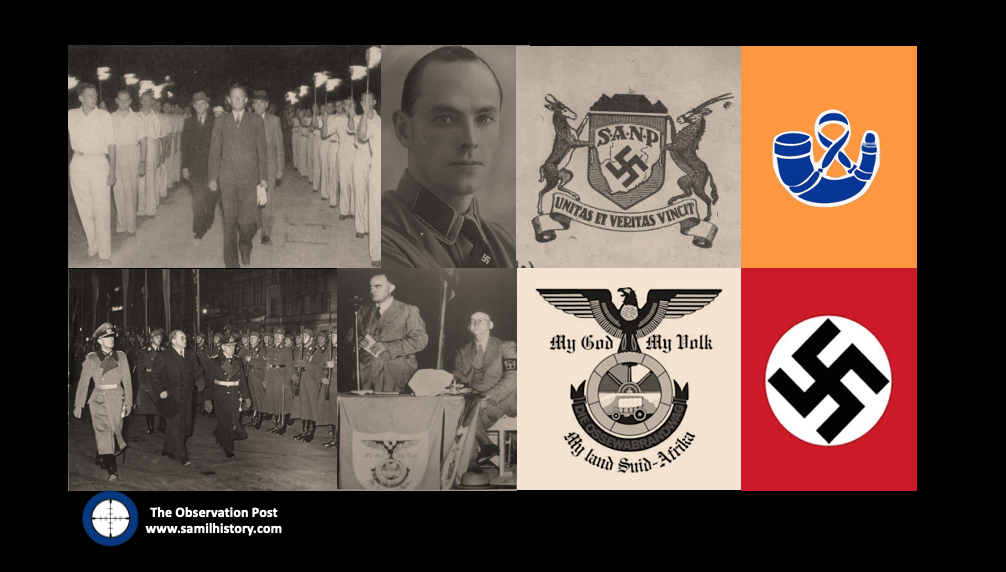
Nazification of the Afrikaner right – Grey-shirts, Black-shirts, Orange-shirts, New Order, National Socialist Rebels, Boerenasie and Ossewabrandwag

My research into the Nazification of the Afrikaner right is always going to show this far right segment on the rump of Afrikanerdom in a highly critical way, certainly to most modern readers in 2024 who understand ‘Nazism’ in hindsight, these people will automatically be viewed in a repulsive and repugnant light, it’s almost unavoidable. Once identifying an association and/or sympathy to Nazism, in any way, there is just no way anyone is going to come out of it smelling of roses and held up as the true disciples of Afrikanerdom, people with a benevolent Christian veneer and a mere love of all things German. If anything they are easily viewed as the vanquished incubus of Afrikanerdom, the Judas to their denomination and creed.

These Apartheid protagonist Afrikaner Nationalists are no different to the Nazi heroes they worshipped and modern South Africans are no different in the way they view Aparthied as the majority of German’s treat Nazism now. That’s just a truism, these Afrikaners committed a crime against humanity, they came into power on a ‘minority’ ticket, dominated South African politics for nearly 50 years and represented the rump end of an ethic minority – barely 4% and they “committed a crime” which impacted the majority, the other 96% of South Africans. In the process they took nearly “all” white South Africans along with them – nothing we can do about it, it’s not salvageable, it happened. However, to say a historian researching the Nazification of the Afrikaner right is “anti-Afrikaner” is the same as to say a historian researching Nazism is somehow “anti-German” – it’s just plain counterintuitive and deflective – its red herring argument, prejudiced and plainly untrue.

This majority – the 96% of the country – now feel very differently about the “Architects of Apartheid” to the odd small Afrikaner cultural grouping trying to hold onto redeeming qualities in them. It’s a herculean task just to educate a fraction of modern South Africans to be more tolerant of ‘white’ history in South Africa and it’s also sad that of this ‘majority’, a massive swathe blame “all white Afrikanerdom” for Apartheid, some even go as far as to say “all whites” – and that has manifested in deadly hatred in some instances, certainly if farm killings of ‘Boere’ are anything to go by. This is where ‘historical balance’ is necessary – to prove that not all ‘whites’ and not all ‘Afrikaners’ bought into the whole idea of Apartheid, that they even resisted it. It becomes very important to prove that Apartheid was an ideological conflict and not a race conflict – all races were affected by it, including many whites – and not just a handful, but large swathes of 100’s of thousands of whites actively resisted Apartheid, a ‘critical mass’ argument – and here’s the fun part, we can easily prove it and dispense with the ‘revolutionist’ history that is the current political narrative.

Considering my research area and span (1935 to 1955) by historical confluence and not by design there emerges a “good guys” versus “bad guys” argument on the Afrikaner front. It also has the numbers, the critical mass to dispense with this idea that all “whites” and especially all “Afrikaners” upheld their privilege and exploited and repressed all “blacks” by keeping the Afrikaner Nationalist Party in power. Numbers alone tell a story, the 1948 election win by the National Party was not a majority win … and by 1953 a massive voting bloc of 250,000 white people (i.e. 25% of an electorate of 1,000,000 odd whites) had joined The Torch Commando – a war veterans based anti-Apartheid mass movement – paid up members in almost equal balance of ‘Afrikaans’ and ‘English’ and all protesting Apartheid in massive rallies countrywide – some well over 50,000 strong, a campaign which lasted about 5 years until the Nationalists (as was their fashion) started to crush it with legislation.

This research vindicates many white Afrikaners of Apartheid – fact. It is far more helpful to understand their story, study this history, find out how and why it was repressed and manipulated by a radical Afrikaner far right and not try and promote an unattainable and factually impossible redemption for the radical Afrikaner far right. In fact, the reaction I got to this work by Afrikaners was intensely positive, many Afrikaans people have written to personally, to say “thank you” and things like “finally” I can talk about my family heritage, my ‘Ouman’ or ‘Oupa’ (even Ouma) was one of these hundreds of thousands of ‘Smutsmen’ – our history has been flattened out by decades of National Party propaganda and rhetoric, in fact the term often used is “repressed”. Devoid of a voice by historical circumstance for over 50 years of ‘Apartheid censorship’ this work has given it back to them.
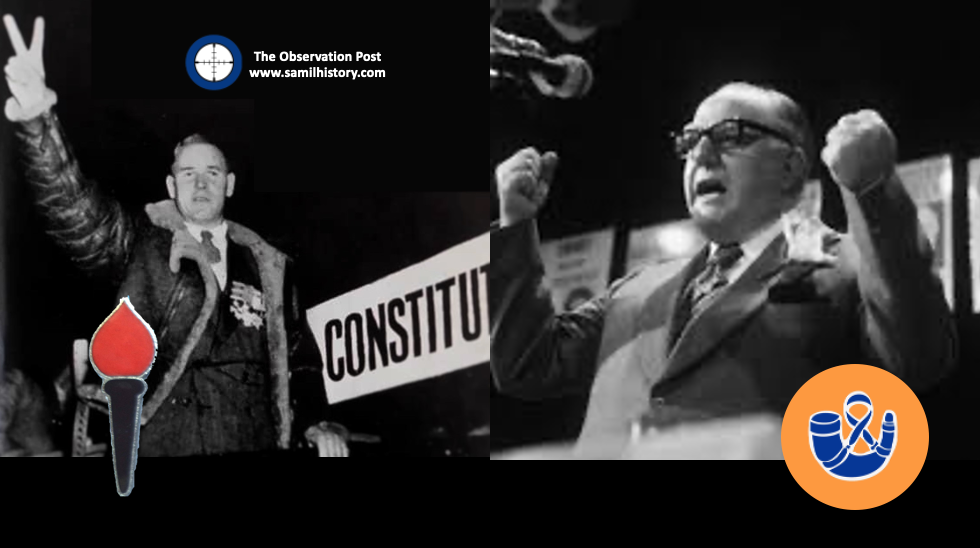
Sailor Malan (left) and his opposite nemesis BJ Vorster (right) – both identified themselves as Afrikaners. The Nationalists regarded Sailor Malan as a “Afrikaner of another kind” – a traitor to his people.

How uplifting ‘redeemable’ Afrikaners, the ones in history who resisted Apartheid and whose history was ‘forgotten’ and ‘censored’, the ones who sought reconciliation and understanding and now we are finally bringing their politics and their stories to life, giving them a long lost platform, how that possibly constitutes an “Anti-Afrikaner” standpoint is simply beyond me, it defies logic and even common sense.

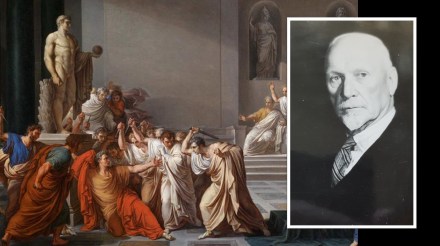
But somehow it does, this position does not detract from the odd troglodyte emerging, like Ludwig Rode who on social media made an unhinged, libellous and unsupported comment to support Albert Blake by way of a justification of my alleged ‘Boer-bashing’ and said:

“Dickens hates Boers … (he is) trying to put the British and Joiners and anyone left of the Boers or against their freedom aspirations on the moral high ground. No balance at all”.

So, by Mr Rode’s logic highlighting those ‘leftist’ Afrikaners who resisted Apartheid and “joined” Smuts’ ‘khakis’ as opposed to the ‘rightist’ Afrikaners – i.e. those right wingers whose aspirations for “freedom” meant flirting with Nazism and trampling on the rights, freedoms and emancipation of everyone else – especially Blacks, Coloureds, Indians, English South Africans and Jews, and subjugating them to jackboot Nazism and violent oppression instead – this to Mr Rode is a bad thing. Now, I thought ‘separating’ them and opening them up so we can see the difference between these two vastly different factions of Afrikanerdom was a good thing – it provides a far more ‘balanced’ and insightful argument. Clearly Mr Rode does not see it this way, not sure how he sees ‘balance’ – maybe I should tar all Afrikaners with his idea of jackboot “Freedom” – in any event his sheer prejudices and adherence to Apartheid period historical doctrine are plain to see in the language he uses.
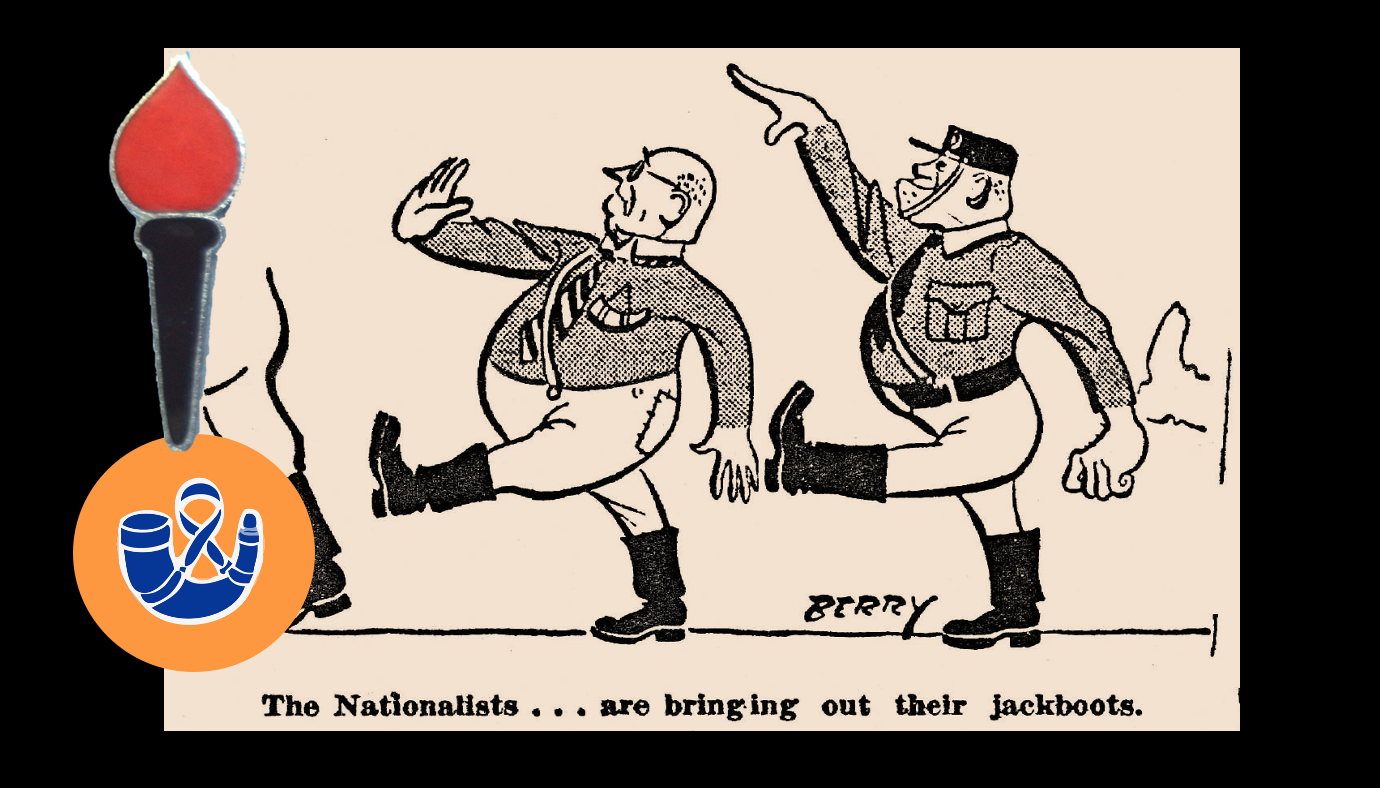
‘Talking Jackboots’ – Torch Commando cartoon highlighting the Nazification of the National Party

Also, as to historic sweep, sorry to say this to Mr Rode, but as to a ‘moral high ground’, these ‘lefty’ Afrikaners I highlight are already on it – I didn’t ‘put them there’, and as to the far right ‘Nazi’ Afrikaners I highlight – as South Africans they are all in our collective memory’s rubbish bin – and I didn’t put them there either, they did that bit all by themselves – sad but true, I can ‘contextualise’ them, put them into their ‘period’, understand ‘Nazism’ in the context of historical popularism – but that’s about it. To find out more about how they landed up with all our modern day collective contempt for them – read the thousands, I mean thousands of history papers, books, essays, memoirs, manuscripts, reports and confessions written on the ills of Apartheid brought about by these individuals … Some ‘freedom’ he refers!

Also, as a specialism I write a lot about the subject of the Nazification of the Afrikaner right, its full on, so anything coming out from me can seem a little infatuated with Afrikaners and Nazism as the published articles are numerous and frequent – there’s “a lot” of it, it can even be a little overwhelming and over saturating – to the point that one chap wrote to me to say it’s all a ‘bit much’ – let ‘bygones be bygones’ and I should find something ‘new’, something he likes and thinks would be more agreeable … now that’s just plain daft and it reinforces my thinking that I have not yet written enough on this subject – its like a modern Italian saying to a historian specialising in Fascism and Mussolini that they don’t like the work, its not “nice”, there’s “too much” and he should focus on the evolution of professional football in Italy instead – much better, less controversial and far more agreeable. I honestly had to go back to this detractor to say I’m pretty happy with my specialism and won’t be changing it anytime soon.
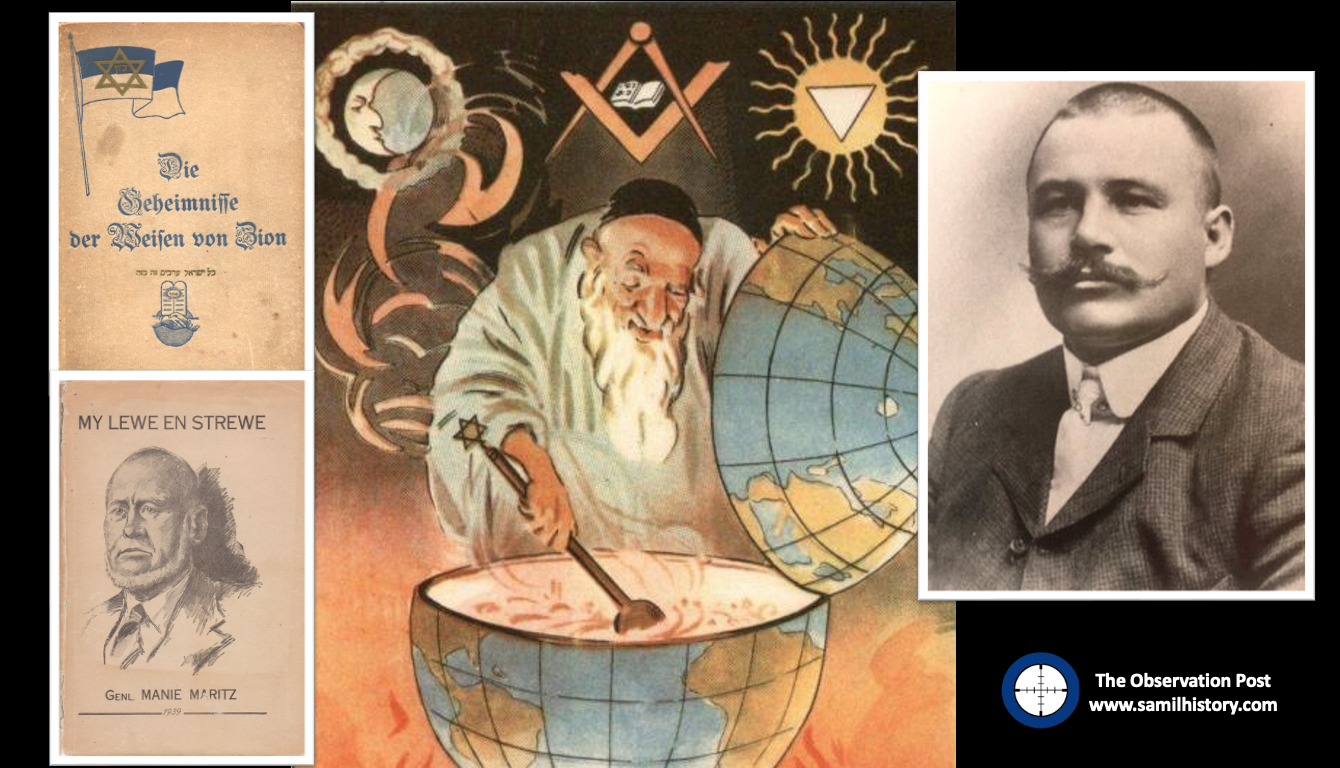
Banner for an upcoming blog on Manie Maritz, a ‘Volks-Held’ and the Boer Rebellion leader, and his conversion to Nazism.

Sometimes this extends to a second category of person, one who does not like the conclusions reached as it does not suit their identity, culture or socialisation – any form of preconceived narrative really … their ‘bias’ in effect. These people (and even Albert Blake made this mistake) usually come back with “you can do better” – in other words keep re-writing your article until you come up with a conclusion I can agree with.

As to giving a platform to historic Afrikaner characters who have made positive contributions to the broader society in which they live, believe it or not, there is a group of Afrikaners who still just simply don’t “get it” – like Mr Rode they are still conditioned in this old Afrikaner nationalist ‘Völkisch’ idea of Afrikanerdom. They hand to heart believe that ‘liberal’ Afrikaners are traitors to the Afrikaner cause, and they sincerely believe that ‘Verwoerdian Aparthied’ will make a ‘Volkstaat’ comeback – a place in the sun for the ‘Herrenvolk’. This bit I like to call “bringing back porch-monkey.”

Porch Monkey 4 Life

‘I’m bringing back Porch-monkey” – this quote comes from a movie ‘Clerks 2’ and its a line from a complete idiot clerk with zero emotional IQ, he’s convinced that because the “old timers” like his Grandmother used terms like “Porch-monkey” (the American equivalent for a black ‘House-Boy’) it is perfectly acceptable language and not a racial slur – he makes it his life’s mission to “Bring Back Porch-monkey” and make it acceptable again – the scene is comic genius as he goes about insulting Black people with imbecilic oblivion. Obviously he’s on an offensive highway to nowhere, he’s an ingrained racist, he is moronically obtuse – and he still “doesn’t get it” even after he is challenged on racism by his best friend – he simply does not understand that he’s an utter idiot or even a racist – it makes for great comedy.
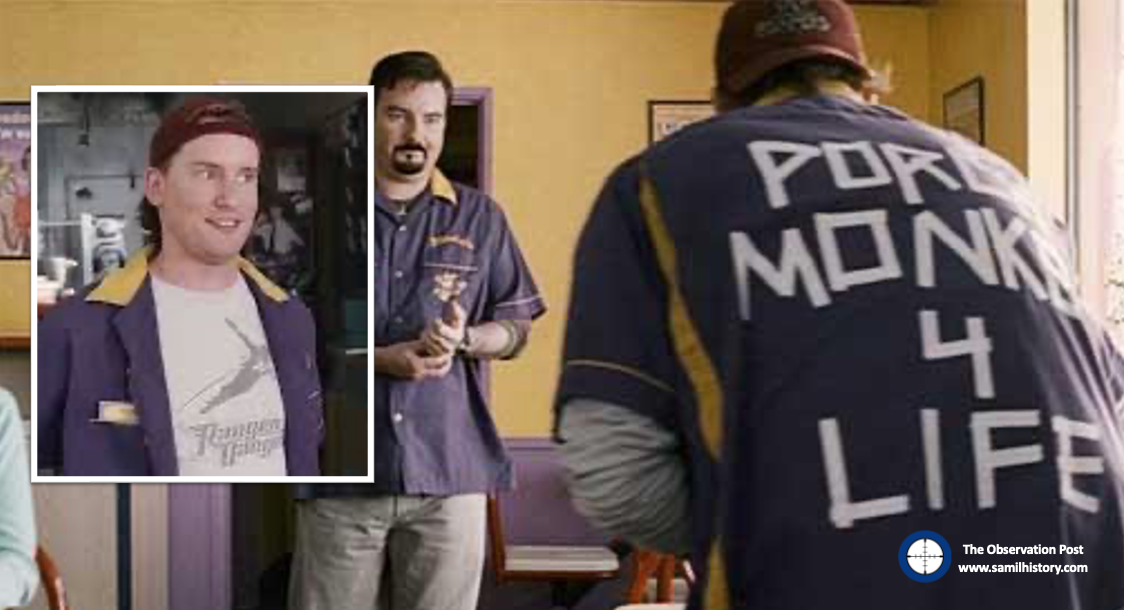
Clerks 2 scene – bringing back porch monkey.

I’ve met a couple of proponents of the idea of bringing back “Porch-monkey” – the one is an Afrikaner historian (actually he’s a choreographer of the Boer War) who went round the tree with me on social media for three days solid trying to convince the world that Dr. H.F. Verwoerd did not have any Nazi leanings or connections to Nazism whatsoever (despite a court case proving otherwise and his own actions and writings) and he was a virtuous and admirable man worthy of word-wide admiration for his ideas of ‘good neighbourliness’ and detente (how dare I even suggest otherwise) – that he is trying to bring back a true ‘porch-monkey’ is lost on him.

Another was a local councillor for the Freedom Front Plus, a man who has published two novels of fictional ‘Boer history’. He pulled me up after I highlighted an old ‘Citizen’ newspaper propaganda piece called ‘Call to Afrikaners by an Englishman’ written in 1990 by ‘anonymous’ – which he was plugging on his social media was well … erm … nothing more than a well known Nationalist government propaganda piece in a state sponsored rag and its ‘bringing back porch monkey’. So, before booting me off his social media he messaged me to say that I was ‘Boer Bashing’ as I only regarded Afrikaners “with British hearts” as acceptable, and that I should be grateful for the “thin white line” of protection that he provides against the riotous black hordes who live next door to me. His own ingrained sense of pomposity, misconstrued history, nationalist indoctrination and sheer prejudice lost completely on him.

Another chap was a fellow military veteran in a Veterans Association I chaired in the UK who figured that the Oranje, Blanje, Blou (the old “Aparthied” National Flag) had a bad rap and everyone in the old SADF should be proud of the “flag they fought under” so he planted it outside an African speciality shop in the middle of Peckham London (a suburb known for its ‘black’ multiculturalism – nearly half its population identifies as Black, Black British, Caribbean or African) … this sort of ‘bringing back porch monkey’ takes a special kind of determination and its no surprise to learn that after his SADF national service he joined Eugène Terre’Blanche’s special AWB bodyguard. That he planted a ‘porch monkey’ (whether we agree with it or not) was lost on him.

Now, I’m all for the correct demonstration of historic flags, from the “Vierkleur” to the OBB (same with statues and monuments), I’m also for ‘non-fiction’ and even ‘fiction’ based ‘Boer’ history if it’s grounded correctly and not grounded in identity politics and propaganda, and I’m all for chronologically recording Afrikaner history correctly – good and bad – warts and all. There is a careful balance to contextualising history and presenting it in an even-handed manner – and there’s also a point when you simply cannot bring back ‘porch monkey’.

Sweeping up the Boer Wars

Which brings me to the Voortrekkers and especially the “Boer Wars” as this is always a social media hot potato – all three of them, the Transvaal Revolt (1880 – 1881) the South African War (1899-1902) and the subsequent Afrikaner Rebellion (1914 – 1915). Hoo Boy!

Let me upfront say this, understanding the ‘Boer Wars’ is important to my preferred historic period on the Nazification of the Afrikaner right and the Torch Commando (1935 to 1955) because it provides for a back-drop, it’s in the “historical sweep” … without the Transvaal Revolt we don’t have “Krugerism” as an ideology … without “Krugerism” we don’t have The South African War and again the attempt to re-instate “Krugerism” is the object of the Afrikaner Rebellion. “Krugerism” – and the old ZAR constitution with its central 1860 racist tenet ‘The people are not prepared to allow any equality of the non-white with the white inhabitants, either in church or state’ is the adopted political philosophy by Hertzog’s breakaway National Party in 1914, and it is the epicentre on which the ideology of Aparthied is based. So, very important to the Nazification of the Afrikaner right and the anti-Aparthied Torch Commando.

Upfront I must also say this – the ‘Boer Wars’ are not my “specialism” but they are important for context and sweep, I generally leave the in’s and out’s of the Boer Wars to the historians who make these wars their “specialism”. However what the Boer Wars do provide is a lot of interest and “traffic” on my website. If there is conflict that is completely misunderstood in the historiography of the Afrikaner nation it’s the three Boer wars, and the reason for this is over five decades of Afrikaner nationalist propaganda and conditioning – “Half a Century” of propagandist history and Afrikaner identity politics, think about that, from the Centenary celebrations of the Great Trek in 1938 all the way to the democratic election of 1994.

The “Christian Nationalist” education agenda was spread through every avenue of social conditioning and socialisation, from Sunday School, to Primary School, to High School, to ‘Veld’ School, to University, to cultural clubs and youth movements, to National Service in the military, and to all state owned Television, Radio and Print media, even ‘SABC’ financed movies – Brug 14 (1976), Jopie Fourie (1979) and Gideon Scheepers (1982) etc. etc. It was on-going, relentless indoctrination and propaganda. The people pushing out all this ‘Christian Nationalism’ dogma were the Broederbond and everything they touched attempted to condition and convert every single ‘white’ person in South Africa, be they English or Afrikaans – even Jewish (strangely enough, they tried), to their particular brand of ‘nationalism’.

To do this top flight Broederbond members were placed everywhere – especially Education Boards and School Inspectors, government run ‘white’ Primary and High Schools in keynote positions like headmasters, ‘Afrikaans’ Universities – notably the University of Pretoria and RAU et al as Chancellors and academics, the South African Police (SAP), the South African Defence Force (SADF) especially after all the ‘Erasmus Reforms’, the South African Broadcasting Corporation (SABC), the Dutch Reformed Church, cultural organisations like FAK, and a number of other government SOE’s and security apparatus.
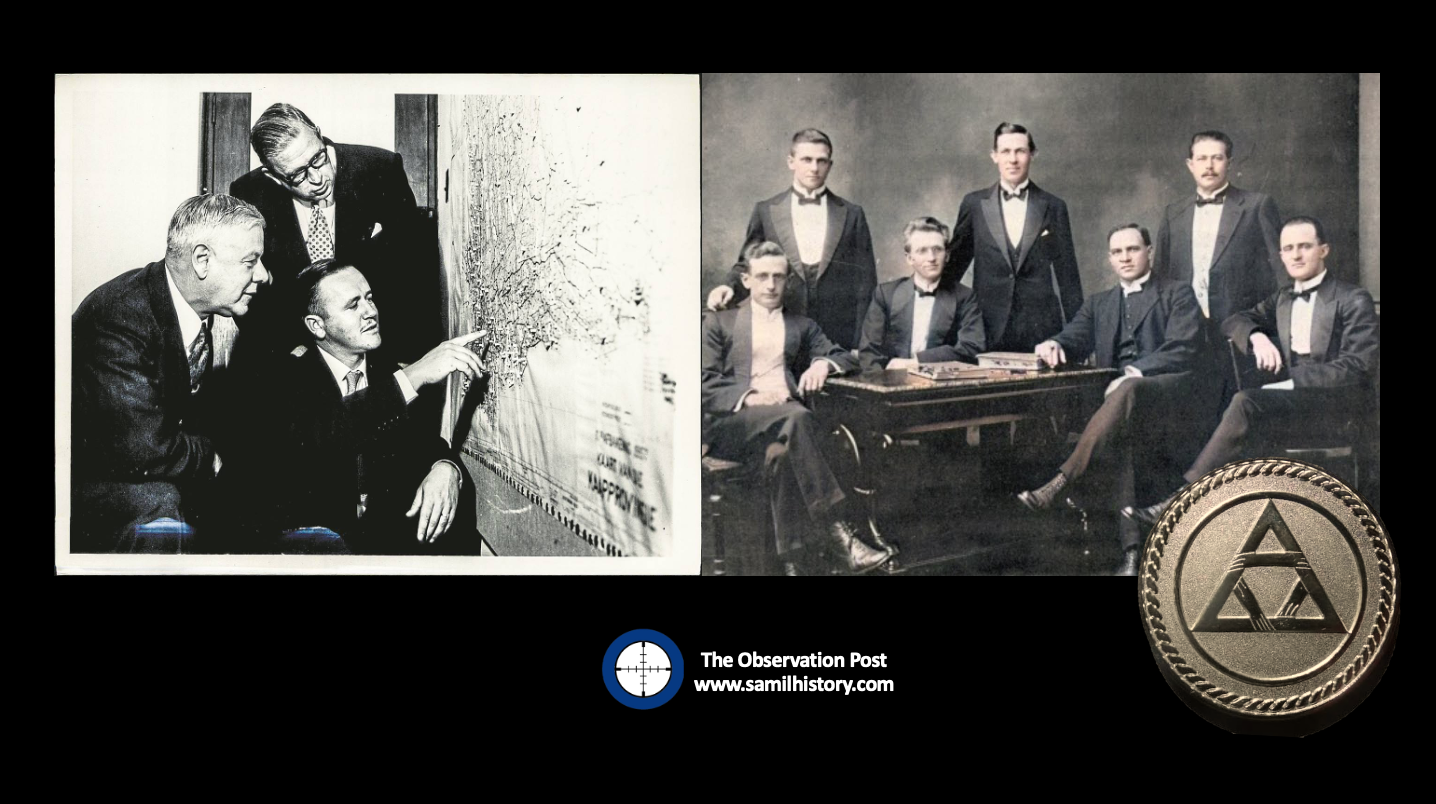
Broederbonders: HF Verwoerd would say “Brothers, the Broederbond must control all it lays its hands on, in every sphere of life in South Africa”

Also, this is not ‘conspiracy theory’ on my behalf, there are entire academic papers, thesis and books on this subject of Christian Nationalism and indoctrination thereof. So when Albert Blake and one of his acolytes Juan de Vries, called me out on overstating ‘Afrikaner Nationalist rhetoric’ just because the Afrikaner Rebellion (1914-1915) was never taught in a Christian National Education Curriculum ‘high school text-book during the Apartheid era’, really is a transparent attempt at gaslighting and a rather sloppy attempt at deflection given the scope of Broederbond’s activities and the stated factual history of it – that or Blake has not researched the subject enough, either way its a blatantly condescending and unscholarly remark.

As a net result of the Broederbond’s stated aims, the “Boer Wars” are arguably riddled with more “myths” than any South African wars before or after. So much so, that as to Boer War 2 (the main one), there is a vast gap between the histories and personal accounts written at the time (primary data or primary source) – Leo Amery, Jan Smuts, Deneys Reitz, Winston Churchill, Fredrick Maurice, Arthur Conan-Doyle, Clement Stott, Regimental histories etc. and those written almost 70 years after the fact by ‘Republican’ historians like Thomas Pakenham, Professor Hermann Gillomee, Professor Fransjohan Pretorius, Professor John Boje, Professor Burridge Spies etc, many of whom by their own admission were writing (and some still write) within the context of the “history of the Afrikaner” – and here I would even allocate Albert Blake as he only publishers in Afrikaans, writes on traditional ‘Afrikaans’ historical debates and he sells his work to a very specific and narrow Afrikaans audience. On a political scale for simplicity sake let’s call the first lot of historians the ‘Imperial School’ and the second lot the ‘Republican School’.

New School

There is however a third lot, another school on the Boer Wars, and it a relatively ‘new’ one – so let’s call it “New School” as it only really starts to come into its own after 1994, after South Africa’s universities are unhinged from towing an Afrikaner Nationalist ‘white’ history agenda, and ‘Black’, ‘Coloured’, Indian and even ‘English’ academics and their history’ is now pushed forward in order to ‘balance’ the history of the Boer Wars and incorporate the histories and ambitions of all South Africans – to make it universally relevant to everyone who took part in the Boer Wars. So much so they move to change the terminology and lexicon of the war at academic levels to the more universally accepted “The South African War (1899-1902)”.

This ‘New School’ consists of historians who seriously challenge – not only the ‘Imperial School’ but also the ‘Republican School’ narratives of the war and they have punched massive holes into it, especially the ‘Republican School’ as its still a contemporary school and its been busy with a lot of ‘revisionism’ – these ‘New School’ historians include: Dr. Garth Bennyworth, Professor Bill Nasson, Dr. Peter Warwick, Dr Elizabeth van Heyningen, Professor Elizabeth Stanley, Professor John Laband etc. and even British accredited ‘Boer War’ historians like Dr. Donal Lowry, Dr. Damian O’ Connor, Andrew Roberts FRSL FRHistS and Chris Ash FRGS FRHistS … all working to unravel this politically inspired mythology, navigate this quagmire of Afrikaner Nationalism surrounding the Boer Wars and get to the truth.

Imagine the complete train-smash when social media really took off from about 2005, and all these historians came out their musky libraries and people started sharing website links, blogs, vlogs etc. of their stuff on-line. Suddenly the ‘Republican School’ historians found themselves at odds with the ‘New School’ historians in public space, and social media platforms experienced ‘melt downs’ as two separate camps of enthusiasts went hammer and tongs at one another (they still do). The ‘English’ enthusiasts accusing the ‘Afrikaner’ enthusiasts of peddling Apartheid period (Republican School) propaganda and the Afrikaners accusing the ‘English’ of peddling a new form of ‘revisionist’ history (New School) and ‘jingoistic’ (Imperial School) history. The poor ‘administrators’ – most of them local ‘Republican School’ amateur enthusiasts with ingrained cultural and identity bias – all spinning endlessly as they are not professional historians, and they don’t know much outside their ‘Christian Nationalist’ upbringings – they just figured its a good idea to open a Facebook appreciation ‘group’ – and they are especially untrained to deal with all this historical revisionism as its all ‘new’ to them.

Now, it’ll come as no surprise to anyone that I am a BIG fan of “New School” historians, I like the old “Imperial School” – Smuts, Amery, Reitz etc. because they are closer to source, some are even classified as ‘primary source’ themselves which is what any good historian should reference first – its critical to writing history. I also like the ‘New School’ precisely because they have unraveled large bodies of the Republican histories, disproven much of it as politically driven rhetoric, and simply got on with ‘correcting’ the narrative.
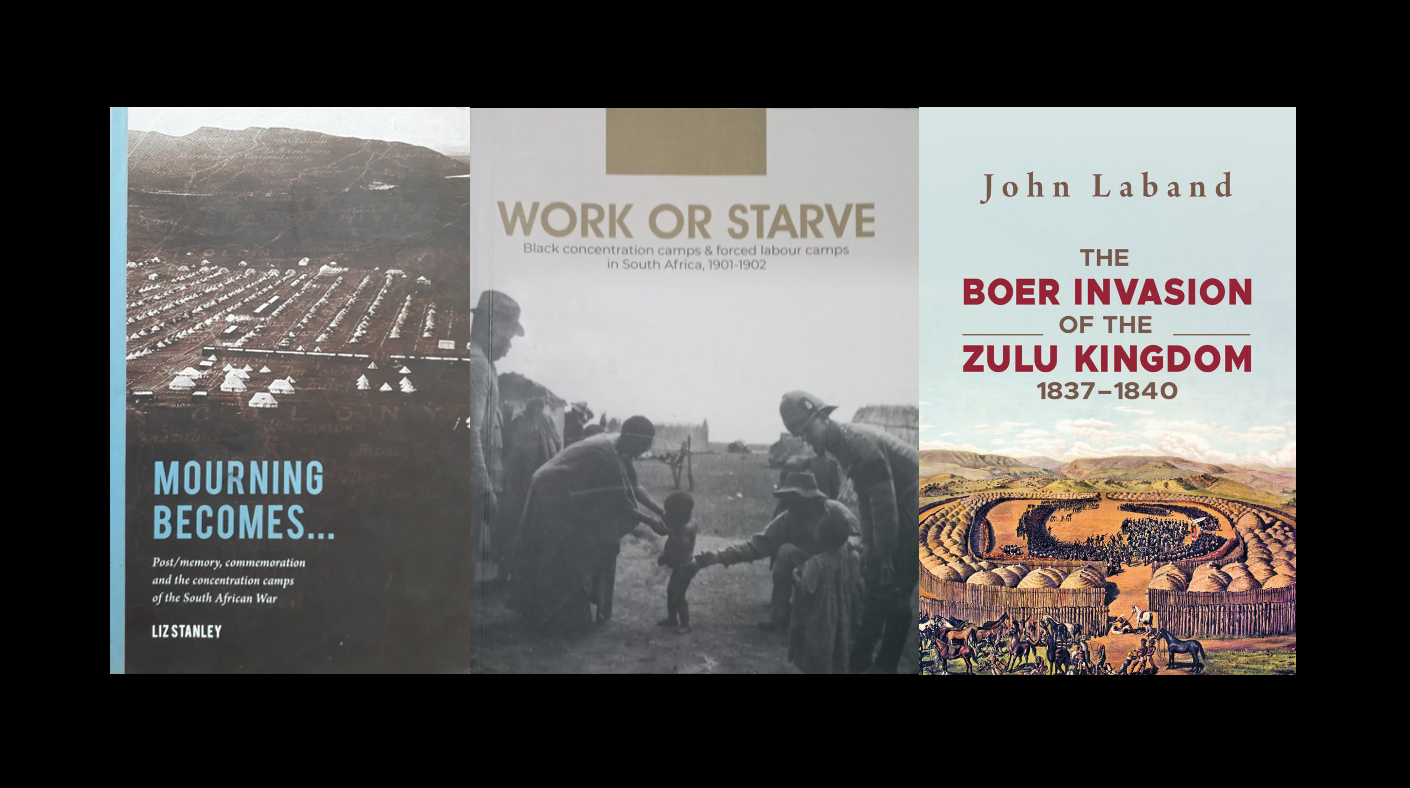
“New School” – Stanley, Benneyworth and Laband

It may however come as surprise to some, but absolutely nothing I have written about the Boer Wars cannot be supported by a ‘New School’ historian. Not one single article I’ve written does not have grounding, and there is nothing I’ve said that’s new, everything I’ve said has already been published by a very accredited historian. That I believe the white concentration camps are highly nuanced and not ‘genocide’ is largely due to the work of Elizabeth van Heyningen, that I believe much Afrikaner identity had a flawed underpinning is due to David Harrison, Liz Stanley and Andrew Roberts, that I believe the Boers targeted civilians during sieges is due to Garth Benneyworth and his work, that I believe the NG Church and not the British invented Apartheid is because of the work of Herman Giliomee and Damian O’Connor, that I believe that causes belli of the war was about the ZAR’s suzerainty and not ‘stealing gold’ is because of historians like Bill Nasson and even Leo Amery.

It’s not ‘conspiracy theory’ – Tinus le Roux, the chap who colourises Boer War photos, accused me of peddling ‘conspiracies’ without remotely offering a rational or proof behind his accusation, unfortunately Mr Le Roux, everything I’ve ever posted on the Boer Wars is already grounded in solid history by top flight historians – and it can all be verified and validated. I don’t make conclusions of my own on the Boer Wars as simply put – its not my specialism – it is however the specialism of these historians – so I use them extensively. The only difference is that of all these ‘New School’ historians, I am the only one that uses a website and blog with trailed social media – twitter (x), Facebook and Instragram accounts – so my ‘reach’ and ‘medium’ brings their message to a much broader audience in snap sized, fast consumption, historical interest pieces.

To take what is already concluded by many accredited historians and then turn around and say by using their findings I’m somehow suddenly “Boer Bashing” is indicative on just how uneducated, ignorant and biased these detractors are – they are simply not ‘read’ and what’s driving their view is an emotional state and not a learned state. As to Tinus le Roux, he ignored references I gave him (Benneyworth’s ‘Magersfontein’ and Stott’s ‘Boer invasion of Natal’) and refused to change his view – he should really stick to colourising pictures and get a proper historian to caption his work before he commercialises it and completely embarrasses himself.

Fools rush in

This bit is important, it’s not just the ‘Facebook’ amateur enthusiasts, even heavy weight South African historians of the old ‘Republican School’ and the ‘New School’ give each other ‘both barrels’. A case in point is Professor Fransjohan Pretorius, the ‘go-to’ Afrikaner Boer War historian from the University of Pretoria, semi-retired now but still firing. Prof Pretorius gave both barrels to Dr Elizabeth van Heyningen at the University of Cape Town and Prof Liz Stanley, now at the University of Edinburgh, for their papers and books on the white Boer concentration camps of Boer War 2. Pretorius penning scathing criticism of both van Heyningen and Stanley in a paper titled ‘The white concentration camps of the Anglo Boer War: a debate without end.’ on the basis that they ignored Afrikaner political and cultural nuances, and their research and findings were therefore academically sloppy. Stanley ignored him, but van Heyningen would have none of it and responded to Pretorius and said his remarks reinforce and ‘demonstrate the continued power of myth making among ordinary Afrikaners’ in a very erudite academic reply on white Boer Concentration Camps titled ‘Fools rush in: writing a history of the concentration camps of South Africa’.
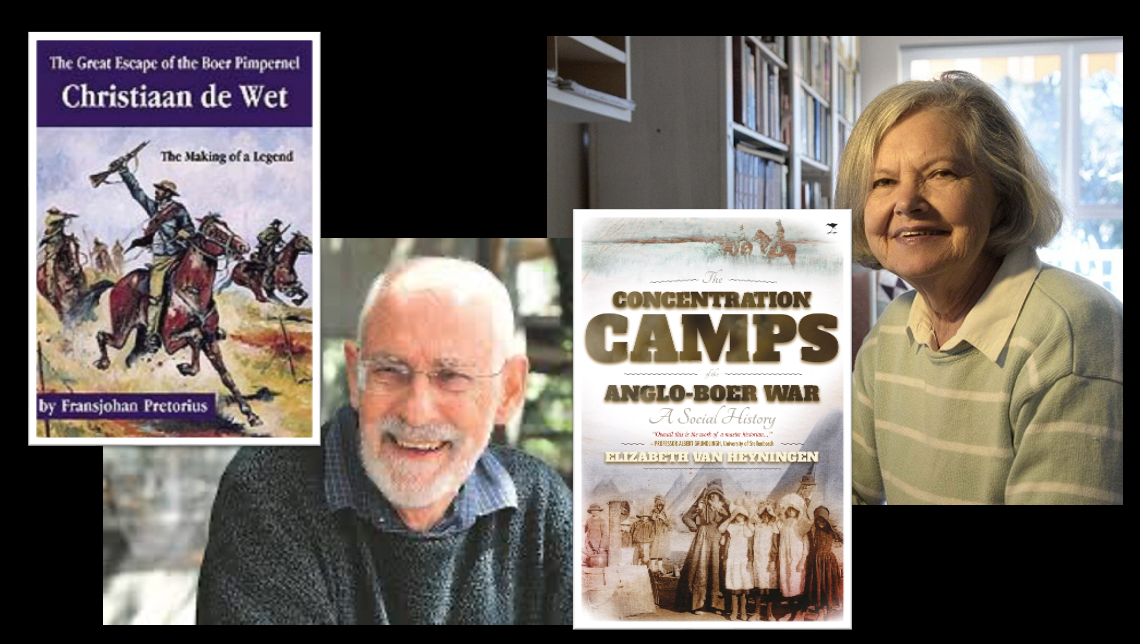
Fransjohan Pretorius and Elizabeth van Heyningen

This ‘bun-fight’ is not just between local ‘New School’ historians and Professor Fransjohan Pretorius, it extends to the overseas ‘British’ new school historians and Fellows of the Royal Historical Society, some of Britain’s leading historians. Prof. Pretorius recently went out in the media and claimed ‘many English-speaking South Africans at present, let alone Englishmen from England’ fail ‘to understand the presence, goals and effect of British imperialism’. This of course pricked the interest of ‘English’ historians who rightly questioned as to why only Afrikaners, like Prof. Pretorius – who studied at institutions heavily financially subsidised by the National Party regime and controlled by the Broederbond, are the only ones who are wise enough to truly understand British Imperialism. Not only the derogatory and disparaging language used, but the supreme arrogance to assume that the specialists in Victorian and British Empire history and the ‘English’ themselves are not adequately equipped to understand their own Imperialist history. Naturally the strong rebuttal from qualified ‘English’ historians to these remarks by Pretorius were quickly deleted by the website owner – litnet, an Afrikaans website geared to Afrikaner academia .
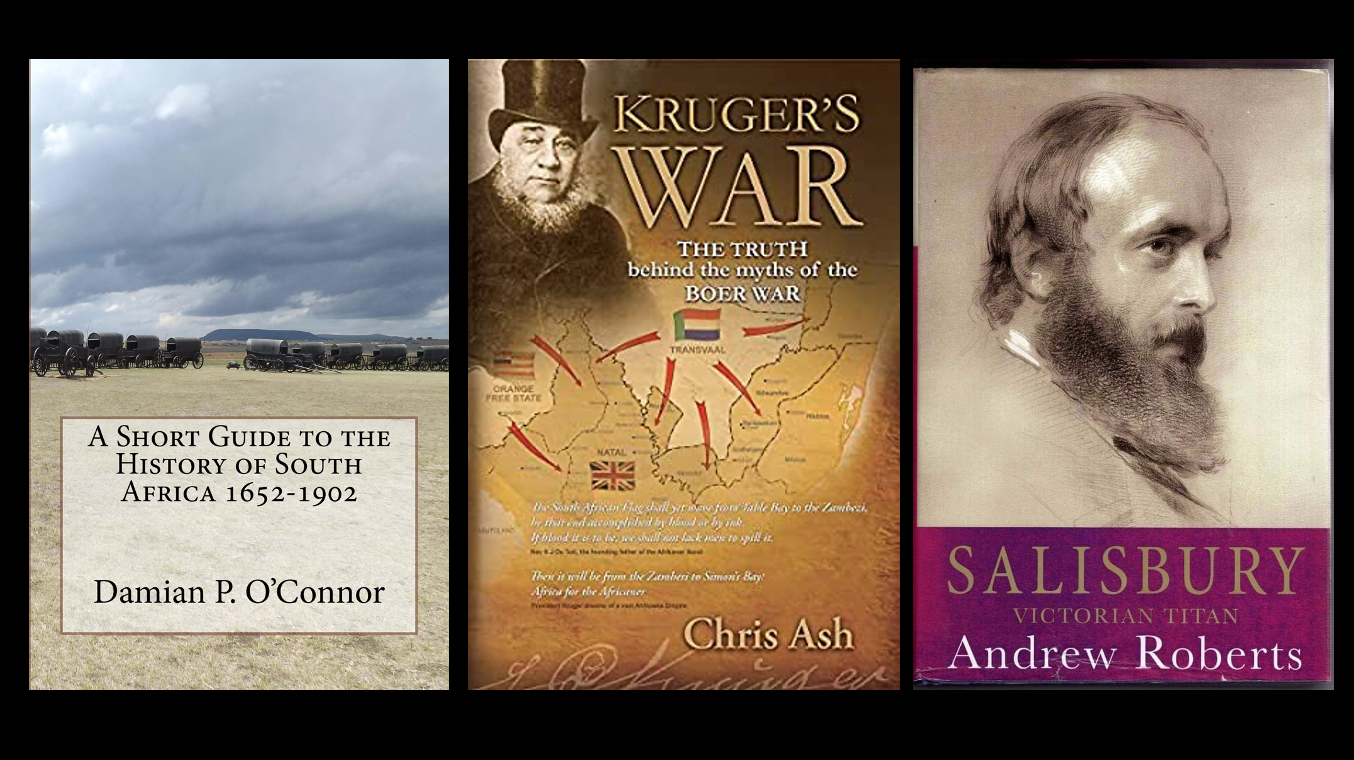
‘New School’ British historians, O’Connor, Ash and Roberts – all with diametrically opposite views to that of Prof. Fransjohan Pretorius.

This supreme sense of arrogance and bias was even expressed by Albert Blake when he said of me in social media:

‘Dickens by his own words has a problem mastering Afrikaans. If you cannot read Afrikaans you will never be able to properly understand the Afrikaans way of thinking. Dickens lack thereof is apparent in his work.’

Really? Does he honestly think a historian has to be fluent in a language before he can write its history – he’s just dismissed just about every historian on the planet. I’m sure the English historian Sir Antony Beevor FRSL, whose written highly acclaimed WW2 history books on Stalingrad and the Russian conflict is not fluent in Russian – nor is he born into a German or Spanish hertitage, yet he’s written some highly acclaimed military history books on them. I’m also pretty sure the English historian Sir Ian Kershaw FRHistS FBA is not fully conversant in Yiddish and Hebrew or a born a Jew, yet he wrote some compelling works on the Jewish Holocaust. Closer to home I’d hate to know what Blake thinks of Dr. David Katz, a friend of mine and published SA Military historian, now David’s grasp of Afrikaans is the same as mine, does that make him and his work somehow unqualified?

That’s the other thing, I told Blake that I had a ‘colloquial’ grasp of Afrikaans – I can certainly speak, read and write it and at one stage in my life as a SADF officer I not only commanded in Afrikaans I thought in the language. I also have a Afrikaner heritage (two Great Grandparents), I have a Afrikaans wife (married for over 30 years) and I have a Afrikaans family, and the net result of all that is most my friendship circle is Afrikaans – so how I don’t understand the nuances of Afrikanerdom, Afrikaners and Afrikaans is anyone’s guess (methinks he’s grabbing at straws in his efforts to play to a peanut gallery) – Blake is also being hypocritical, you can reverse his logic and argue that because he is not ‘English’ himself, so he cannot comment on British history just because he cannot really understand the ‘English peoples’.

There is only really one key bias driving people like Prof. Pretorius and Albert Blake, and it has nothing to do with a home ‘language’ and everything to do with a home ‘identity’ – it’s an ingrained “victim mentality” and some older Afrikaners generally still tend to have it – brought on by decades of Broederbond indoctrination that says because of the white Concentration Camps of the Boer War, only the Afrikaner can comment on Britain’s history in South Africa, their victimhood makes their self righteousness and Anglophobia perfectly understandable. If you took this idiotic logic one step further you could conclude that ‘Black’ South Africans are the only ones who can comment on Afrikaner history because they were the victims of Apartheid – that’s how disjointed and self serving this thinking is.

But what’s with all this ‘identity’ overriding logic? Funnily its the ‘Broederbond’ at the centre of it again and for this bit – I like refer to the American satirist PJ O’Rourke’s book on holidaying in South Africa during Apartheid in a chapter he called ‘in whitest Africa’.

In Whitest Africa

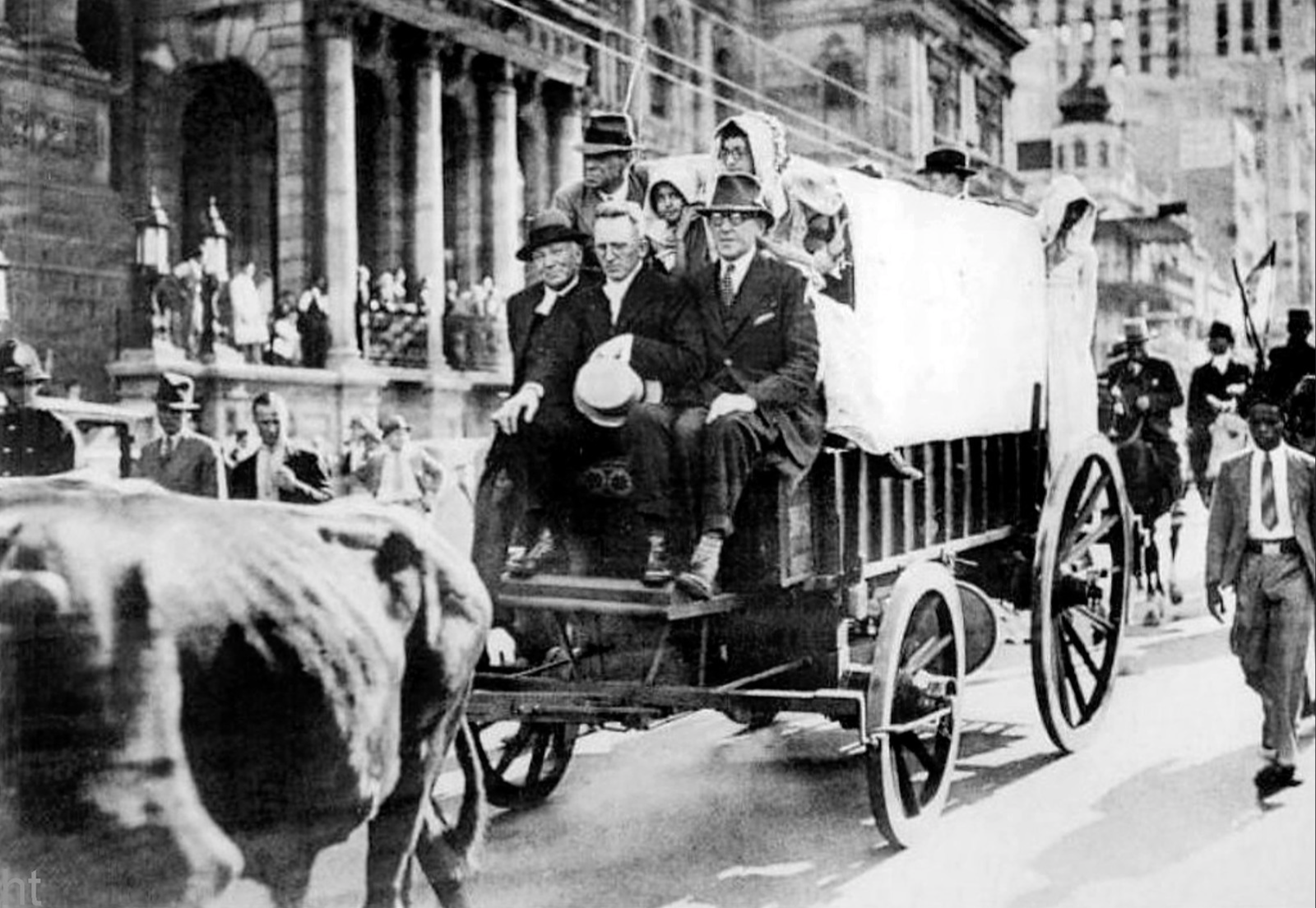
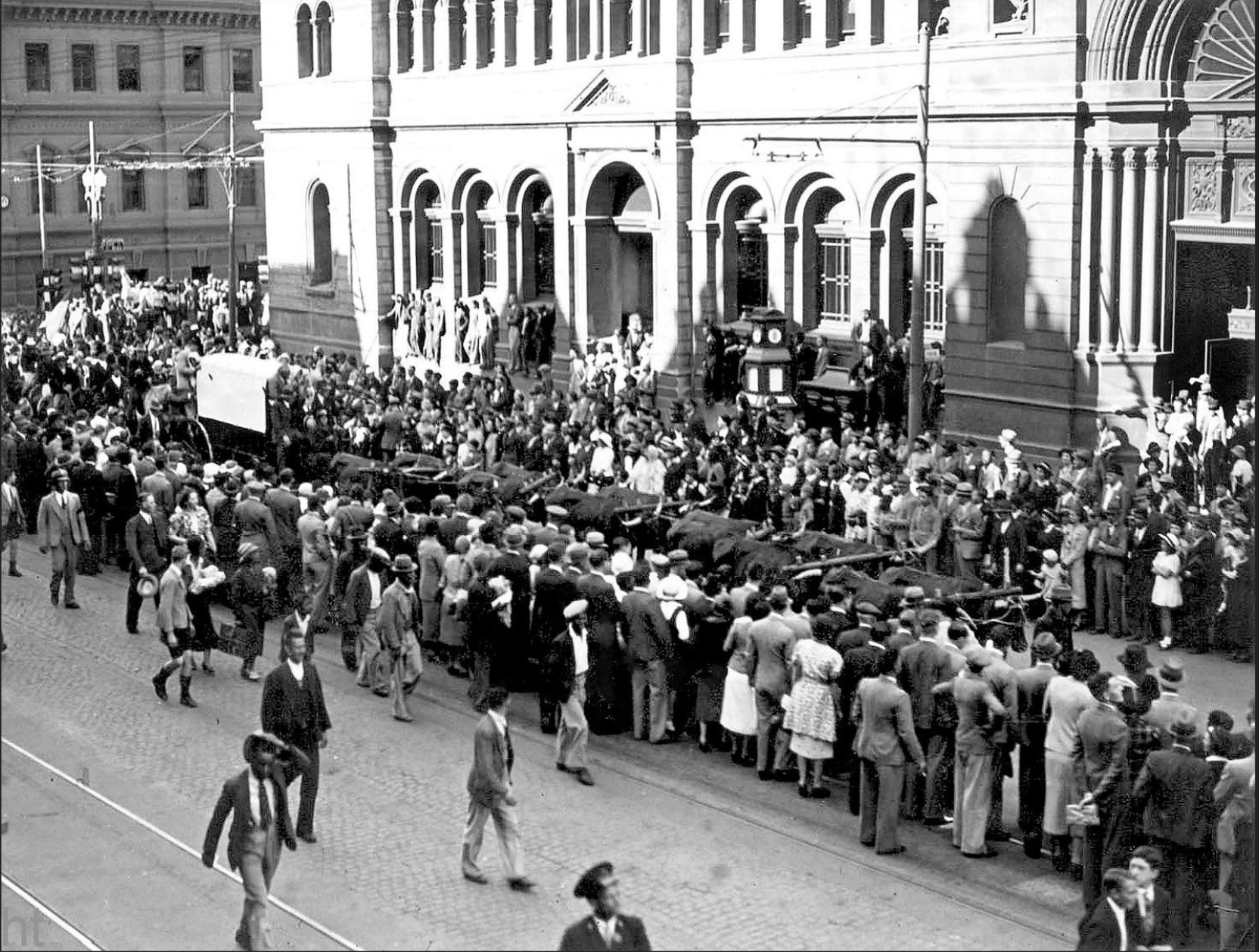
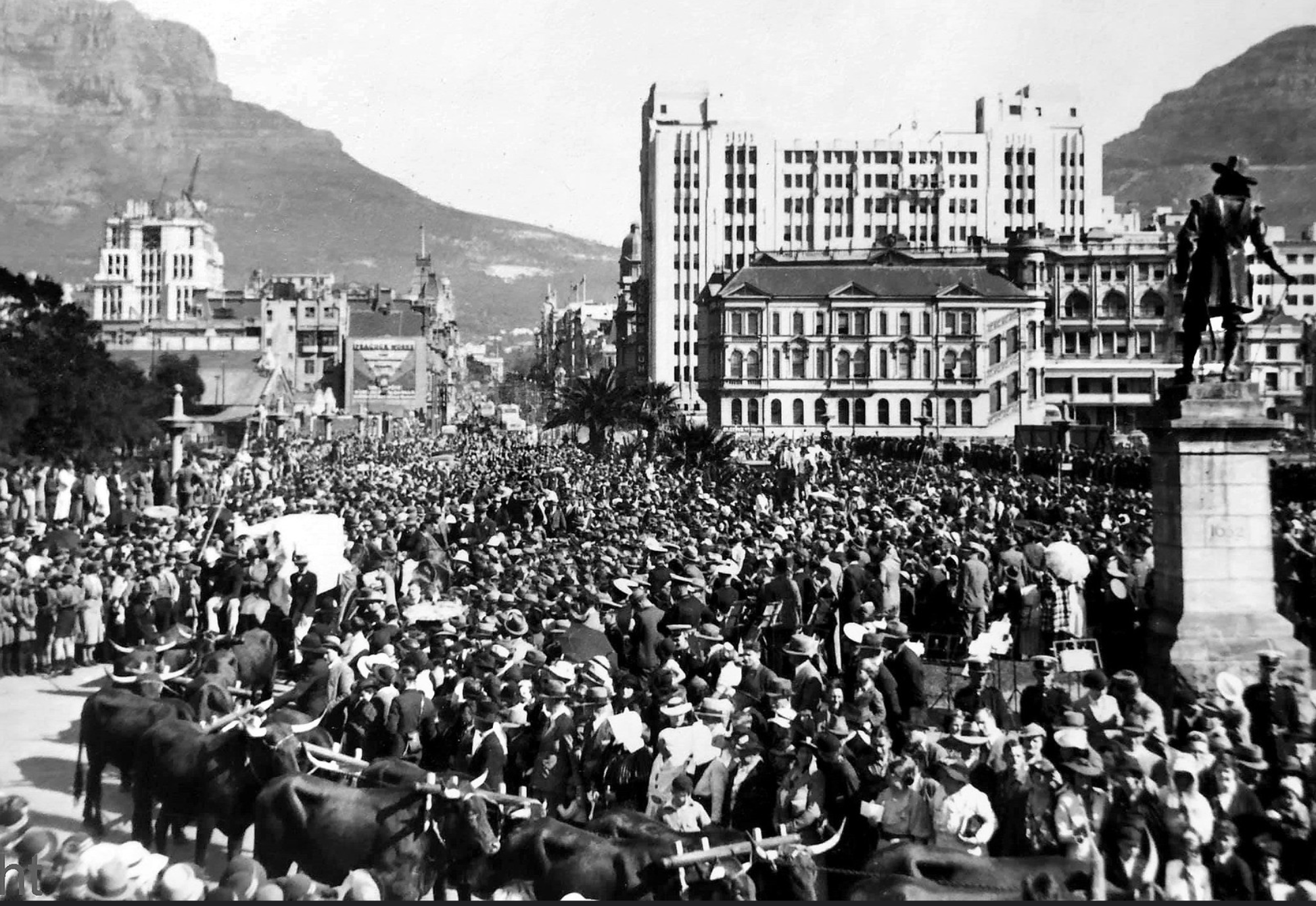
So here’s the history of Afrikaner ‘identity’ not many people know about. In 1938, Henning Klopper, then the chairman of the Broederbond (and later a National Party speaker) initiated the Great Trek millennial re-enactment, his mission to bring the ‘Cape Afrikaner’ together with the ‘Boer Afrikaner’ – which he called the two separate hearts of Afrikanerdom forced apart by the Boer War and a separate history. The idea was that they would both merge with the ‘Voortrekker’ iconography, identity and historiography and jointly ‘map a path’ to a future Afrikaner hegemony, an oligarchy state with strong Christian theological belief in separate worship and all desirous of implementing a ‘whites only’ Republican paramountcy.

Long and short – it worked, Klopper would step back from his success and call it providence, divine intervention …. to quote him – a “sacred happening”. The Ossewabrandwag would carry this new Afrikaner unification under its singular identity like a ‘flame torch’, spread it like ‘wildfire’ (hence the name) from the centenary celebrations into every Afrikaner cultural organisation. The Broederbond sat with the Ossewabrandwag (OB) and the National Party (NP) and agreed the ‘Cradock Agreement’ – the spreading of this Afrikaner nationalist identity on the ‘Cultural Front’ of Afrikanerdom would be the ambit of the OB, whereas on the ‘Political Front’ of Afrikanerdom – the National Party (and the Volks Party, Afrikaner Party as well as other political organs like the ‘Boerenasie’ and ‘New Order’) would carry this identity through – and they would carry it well past the 1948 National Party election win, the 1961 ‘forward to a white Republic’ plebiscite win, all the way through ‘Apartheid’ and it’s still prevalent in modern Afrikanerdom to this day.
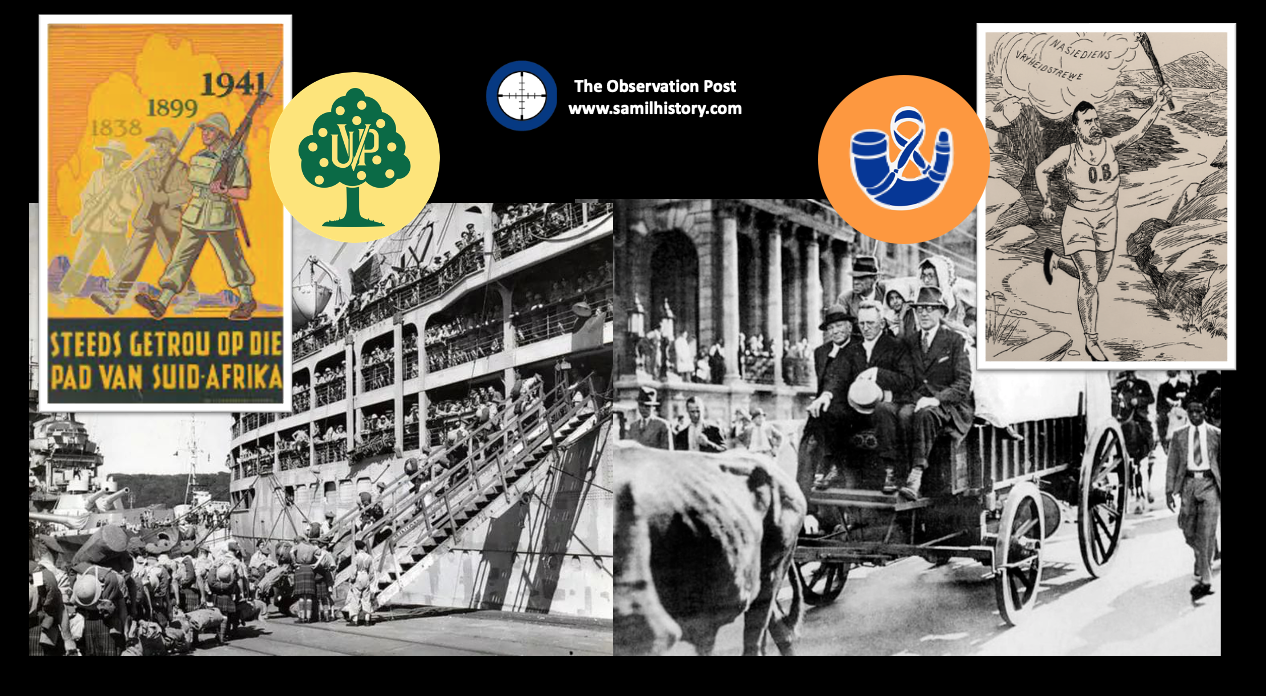
Two separate Afrikaner ‘paths’ to South Africa, Henning Klopper’s Centennial Oxwagon and OB ‘path’ poster to a whites only republic and Jan Smuts’ ‘path’ poster – a call to arms for Allied support and Union. One pro-British and one pro Nazi Germany.

That this is a completely artificial construct, an ideological make-believe, a Jungian archetype – that it has nothing to do with the actual historiography of large swathes of the Afrikaner community is immaterial – only some can claim this all-white ‘Voortrekker’ identity but many (in fact most) can’t. However, a great deal of modern Afrikaners have just bought into this identity – 60 years of steady indoctrination will do this.

This ‘identity’ history is also not conspiracy theory – monuments and artefacts to the 1938 Voortrekker centennial litter nearly every single town in South Africa, even in towns which never saw a Voortrekker, hundreds of thousands of people took part and it cumulated in the laying of the cornerstone of the Voortrekker monument, manually hauled up the hill by teams of the faithful. Whole thesis, academic papers and even books have been written about the phenomenon that was this event and the identity and political philosophy it created.
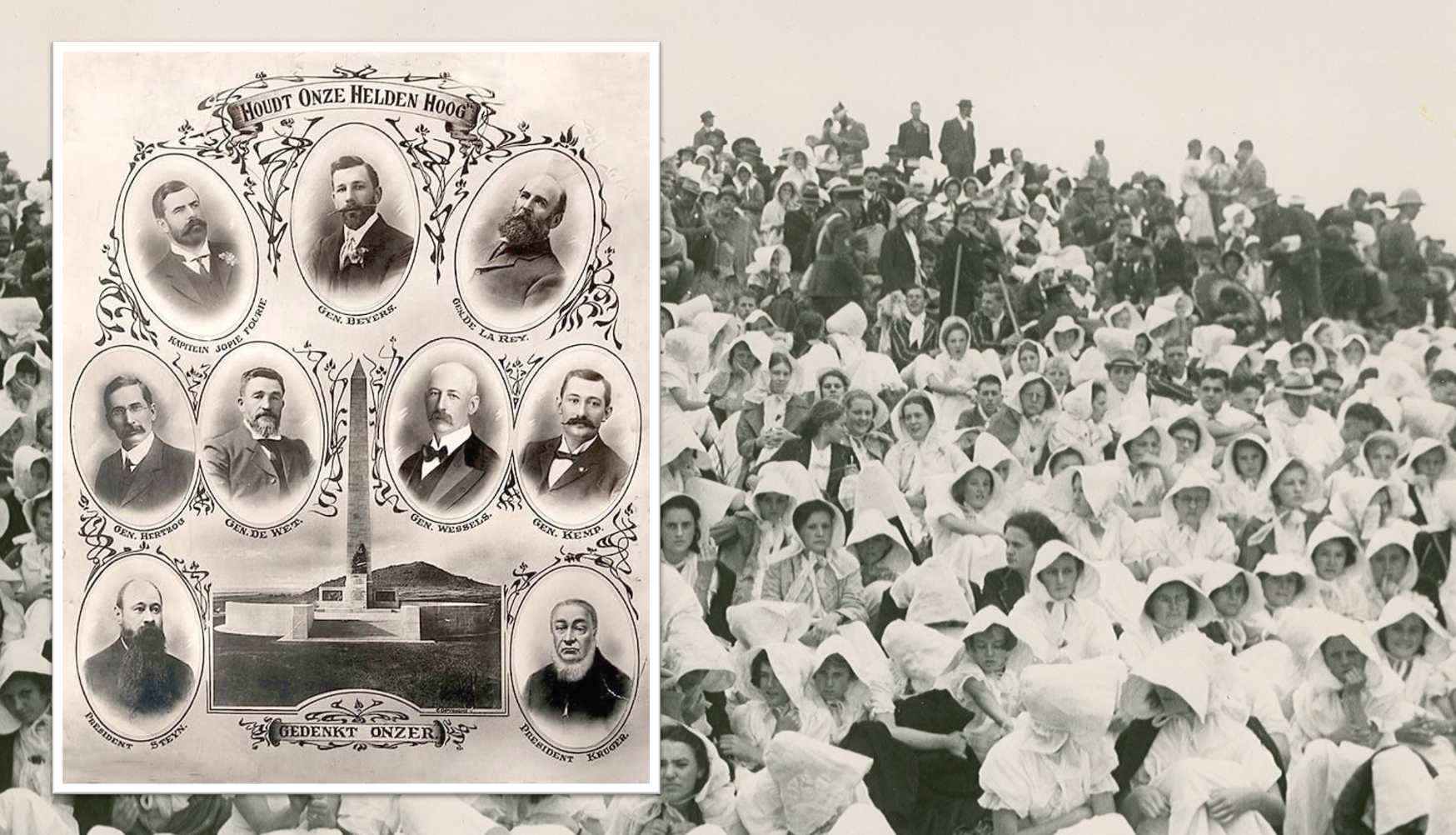
A ‘Kappie Kommando’ in white purity during the Trek Centenary and Nationalist media highlighting specific Afrikaner leaders the ‘volks heroes’ who ascribed to division and a whites only hegemony and leaving off those who ascribed union and an integrated society.

Here’s the thing, as to the development of Afrikaner Christian Nationalism and the keynote authors of it, Henning Klopper was a mere child with a smattering of a memory of the Boer War, however he concluded the concentration camps were – to quote him – ‘organised murder‘.  The mythology spun out from there by organisations like FAK (a Broederbond mouthpiece) amongst others – the British “stole” the gold and diamonds, the British “murdered” 28,000 Boer women and children, the British “raped” Boer women en-masse, the British committed systematic “genocide”, the British were the “warmongers” declaring the war and then the British invaded “sovereign” Boer Republics. The British “invented” the concentration camp and the “Nazis” followed their example. The British used Boer civilians – women and children as “hostage collateral” to win the war. The British were solely responsible for all the farm burnings and rural destruction. The British unfairly and illegally executed Boer commanders. The Boer War started the collapse of the British Empire. The Boers were “superior” fighters in every way but denied their victory by unscrupulous scorched earth tactics and overwhelming numbers – it goes on – it even ends with highly improbable claims – Boers inventing trench warfare, sniping, bush craft and camouflage.

Let alone all the ‘New School’ Boer War historians – just one ‘Imperial School’ book – Amery’s 7 volumes of official history of the Boer War as a starter will show that absolutely none of what I have written above is true – but this is immaterial, not one statement expressed above is historically proven, not even remotely correct, none of it factually supported – but no matter, let’s go with it – its political spin so it must be true.

Problem with writing modern South African military history is that very often you meet white Afrikaners who conflate this identity politics inspired by the Broederbond with the historiography of the Afrikaner nation. If you write any history which does not conform to the acquired belief structure or challenges it, there is a literal meltdown, they feel it is an assault on their world – their literal understanding of the way of things, their values, their personality, their language, their culture – there is a separation, cognitive dissonance takes hold and they get defensive, sometimes very irrationally so.

A case in point of conflagulated identity – Chris Pretorius, an administrator of large format Boer War Facebook group cannot compute analytical thought on any of his ‘Boer Heroes’. His stated claim is that he will not accept any criticism of General Christian de Wet for example, such heretic will be met with an immediate ban or a gag. To him, some of this ‘New School’ history is the result of “Ashism” – a concept he came up with to gag or ban anyone using ‘new school’ history and lumping them as a “disciple” of a “banned” Fellow of Royal Historical Society historian – Chris Ash – who consistently, and using sound factual support, sources and cross referencing, challenges Pretorius’ and his cabal’s very understanding of Boer War history (albeit abrasively so) – now Ash is his own historian, and I’ve seldom referenced him in the past, but no matter. These Boer War sites are truly like watching the Dunning Kruger effect in full fledge and its the reason I undertook to leave Pretorius’ media and others like it about nine months ago.

But that has not stopped some rather nasty individuals who really conflate identity with reality from cropping up, and almost all of them can be found in Facebook groups and pages run by the likes of Chris Pretorius, Tinus le Roux and John Elsegood. These individuals are so unhinged that they resort to criminal slander and even resort to sending me on-line threats, sometimes even directly – and it’s a lesson in open and brazen racism, prejudice and anti-Semitism. Everything the old ‘Afrikaner nationalists’ were about – alive and well and bubbling over in these Voortrekker and Boer War social media groups.

Amusing Fan Mail

Let’s get to the peanut gallery in these Boer War aligned social media platforms, these are some of the comments and social media mails sent to me – either directly or on my media platforms, they speak for themselves,I won’t go into all of it, but here’s some choice examples:

First out the blocks are people who because of my surname somehow think I’m British and only in South Africa at the behest of the Boere – just plain old prejudice and warped thinking. Earlier I said that as an officer in the SADF I became very astute as to Afrikaans and Afrikaners.

I recall when I entered the SADF at 5 SAI in Ladysmith as a conscript, there were a grouping of Afrikaner NCO’s with support of other Afrikaner troopies who took great delight in “bashing” (and at times literally bashing) the “English” guys accusing us of murdering their Great Grandmothers, stealing their country and their wealth  – we were called everything under the sun from “Jingo’s” to “murderers” to “rooi-nek” to “soutie”. Much delight was taken when guys were singled out with “English” surnames – “Mason” and the like, and mine – “Dickens” came in for a lot of attention and slander.
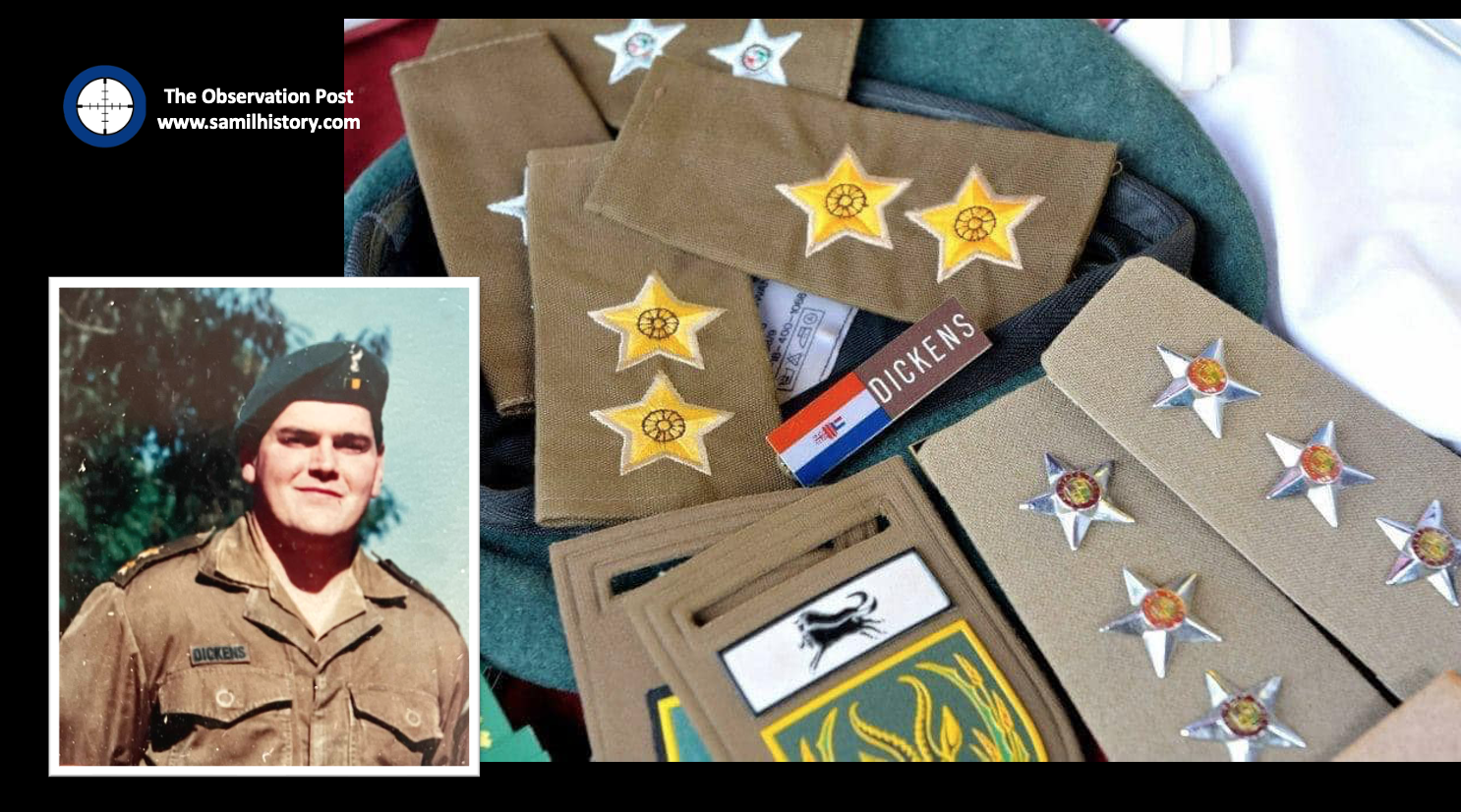
That my family were Pretoria Loyalists – my Great Grandfather born there in 1877 and he a descendent of an 1820 settler meant nothing, they had all married into Afrikaner families, I have not one but two actual Voortrekkers which are blood relatives on my paternal line (that’s more Voortrekker heritage than most Afrikaners can point to) – but this meant nothing, not a jot, as far as they were concerned I was an “Uitlander” a “Jingo”.  My “English” University (Rhodes) did not help either – because now I was also just lumped as a “fokkin Kommunis” in addition.

I can see these “clowns” coming a mile away – here’s some of them.
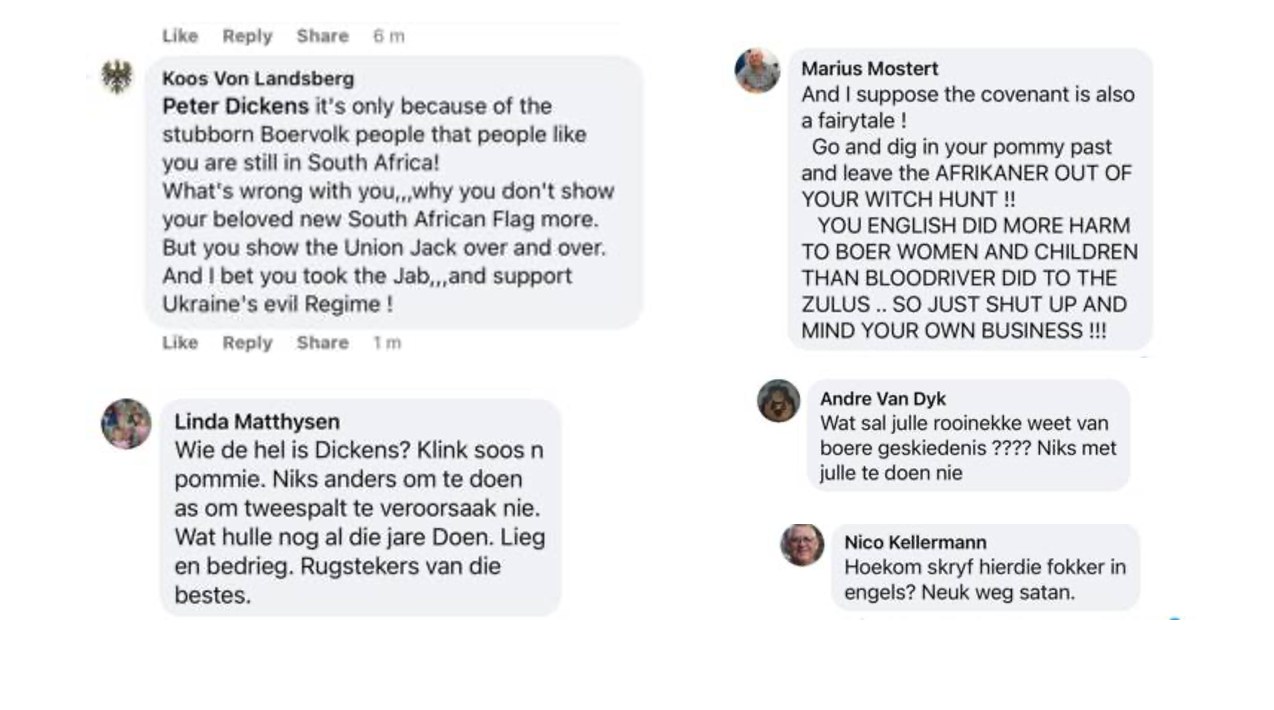
Then there are believers in ‘General’ Manie Maritz and his autobiography which promoted the anti-semitic and anti-masonic and highly discredited ‘Protocols of the Elders of Zion’ to the Boer nation – these clowns are so unhinged that pure racism, prejudice and anti-semitism is perfectly acceptable in an on-line space when writing to me.
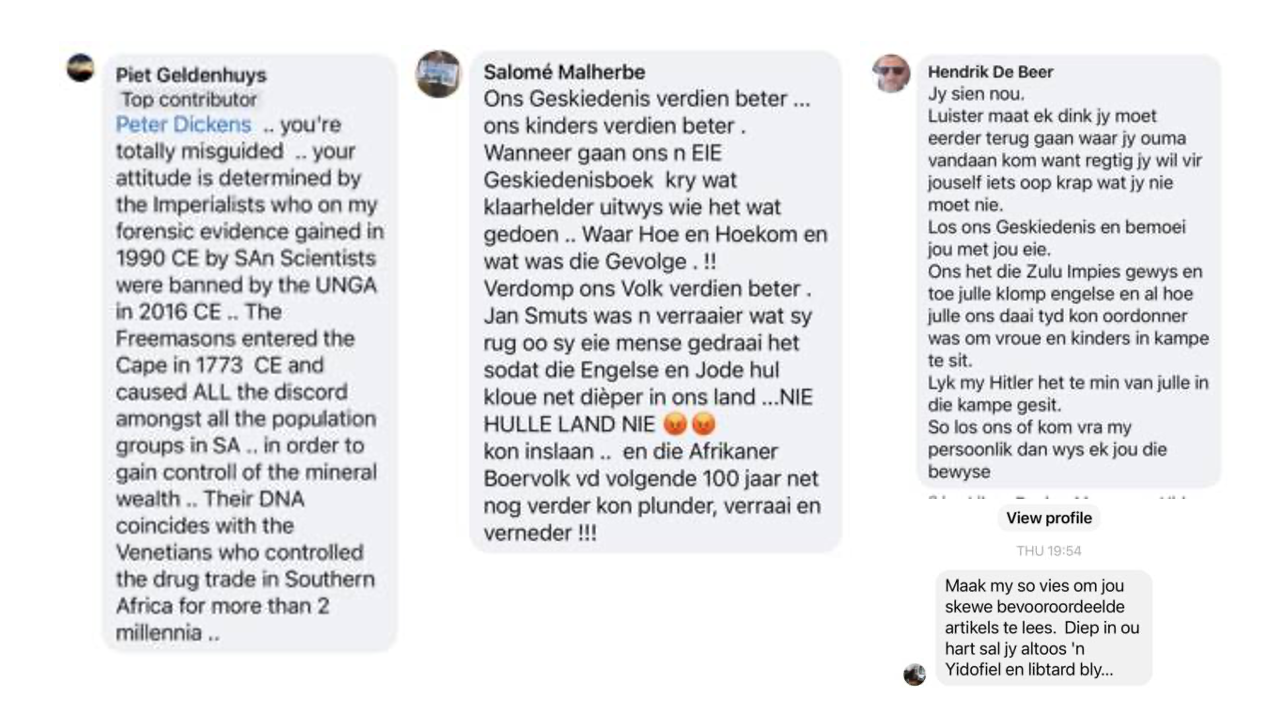
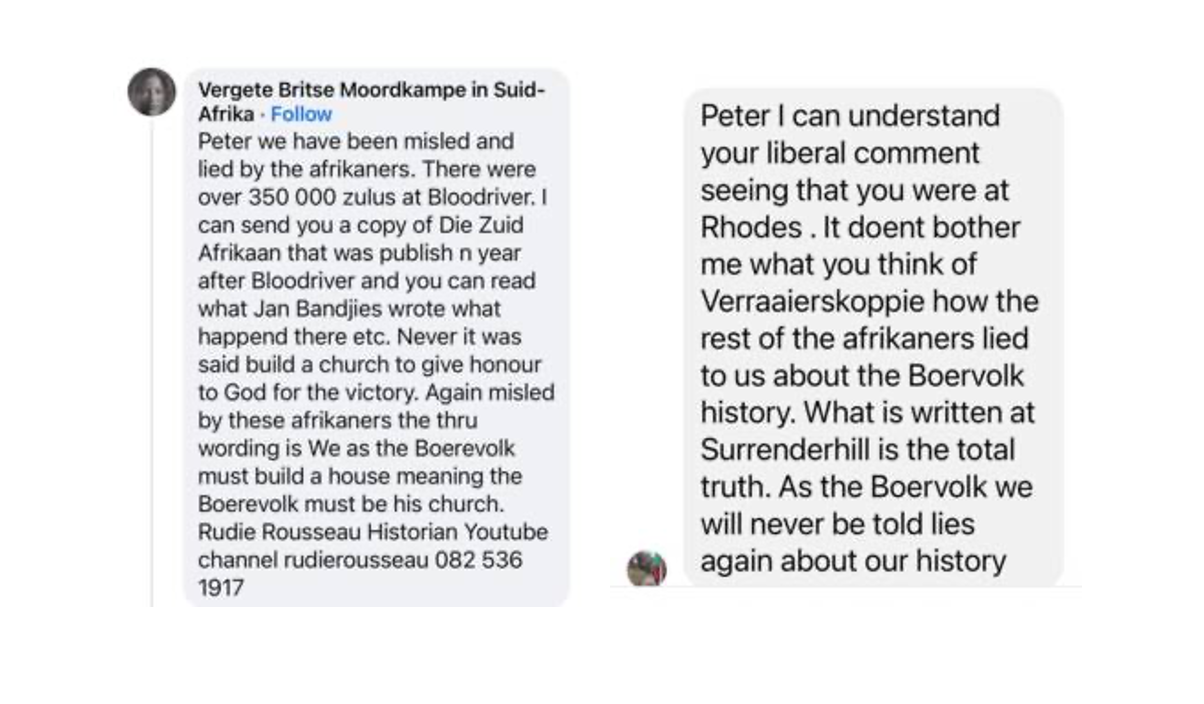
Then there’s these gems from Rudi Rousseau, I took on one of his acolytes in a Boer War group and the next minute a PM appeared in my mailbox. I maintained that Rousseau, who is a self appointed historian for “Boere media”, defaced the monument at Surrender Hill in the Free State when he cemented a granite plaque to it which called the surrendering Boere “verraaiers” (traitors) and absolved Christian de Wet of abandoning his command – his action really no dissimilar to any defacing of a war memorial and as unhinged. The next one relates to a Blood River post, and Rousseau is so conflated with mythology and the idea of a “super-Boer” that he honestly believes a handful of Boers fought off 350,000 Zulu at the Battle of Blood River in 1838 – as stated earlier this kind of thing is not unusual in some circles.
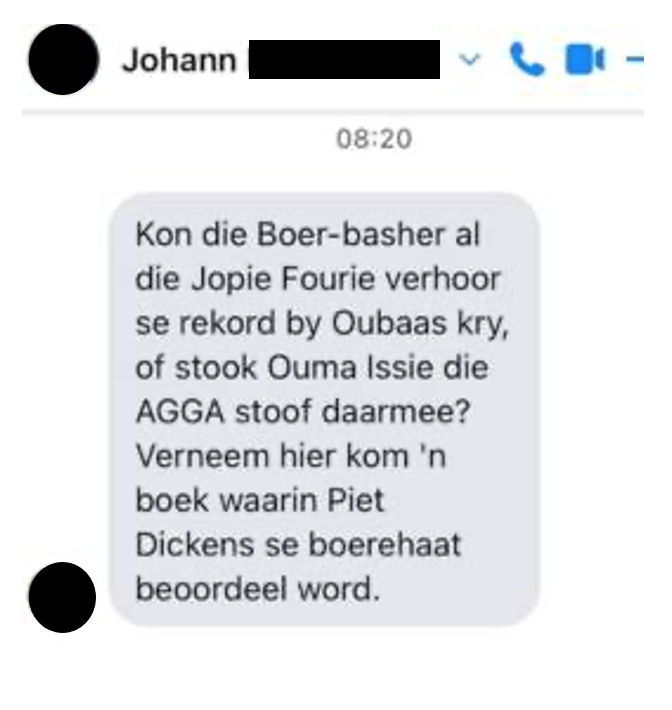
It’s not only the nut-jobs, racists and anti-semites – I’ve even received a threat from a Dominee in the NG Church, a senior member of one of their Synods. He took the time out to write to me and say my “Boer hate” will be exposed in a future book. The background to this is a Jopie Fourie discussion where I attested that Jan Smuts was not present in his house when the Malan contingent arrived and the rightful person as Prime Minister to receive such a contingent was Louis Botha. His reference is to a conspiracy he believes in – that Smuts burned the Fourie case court records. I’ve blanked out his surname and picture as if this sort of crap continues he will lose his job for ‘bearing false witness’ against me and good ‘ol basic libel and slander – and he happens to be on Albert Blake’s Facebook friend profile. If there is a link, the gloves in this matter will come off and some very public naming and shaming will follow.

On Blake again, he also went into social media with this prize comment – and its pure “hearsay”, surprising here for a lawyer again, its up there with Jeremy Clarkson on Top Gear and the famous “some say”:

….. “some say” he sleeps upside down, all we know is he’s called the Stig!

Blake said of me:

‘Dickens has been called “Jingo Dickens” and labelled a “Boer /Afrikaner basher” by others. He should seek the true reasons thereof. He clearly thrives on the sensational.’

Now, I’ve just posted the choice individuals who have called me a “jingo” in the past and I know the reasons, as anyone can see most of it is nut job slander and has no credibility whatsoever. As to hearsay and the “some say” principle, this would be like me going out on a public forum and saying of him:

‘… “some say” Blake is a Plagiarist, I’ve heard from others he’s known as “Copycat Al” and he should find out why.’

The Dam’s Geese

I will conclude this in a language Albert Blake will understand, and it’s a courtesy to him, as this cess-pool from which he is trying to “investigate” my alleged “Boer hate” is now open for him to review, and I say this to him in pure honesty:

‘Luister nou mooi makker, hierdie is nie ons dam se ganse. Meng jou met die semelsdan vreet die varke jou.’


Written by Peter Dickens 
Romancing the Rebellion

Seems there is a lot of social media chatter surrounding Albert Blake’s new Afrikaans book on Jopie Fourie. One Afrikaner pundit after reading the book declaring anyone not familiar with the ‘truth’ about Jopie as a ‘Volksheld’ and the Rebellion is now a liar and this in his world includes any other qualified historians, other than Albert. Albert Blake himself even declaring his new work is the definitive one and the only medium to be referenced (problem is, only people who are fully literate in Afrikaans can read it).

There is undoubtably some truth in the old saying ‘history is written by the winners’, however very often the ‘plucky loser’ is a perennial favourite of propagandists, myth makers and entertainers (including Hollywood), they are often romanticised and idealised, given virtuous christian outlooks, a civilised veneer and great martial abilities – the little guy taking on the big bully. This is especially true of the 1914 Afrikaner Revolt and Jopie Fourie … and many of its local Afrikaner historians and laymen enthusiasts.

All this Boer romanticism and the portrayal of old Zuid-Afrikaansche Republiek (ZAR) as a benign place for a freedom loving people merely wanting it back – a foreign example of this is the Confederacy in the American Civil War (1861 to 1865), and here a Royal Historical Society historian, Chris Ash made a rather humorous comment and it rings especially true:

“Until very recently, they were certainly viewed by most as the more ‘glamorous’ of the two sides… gallant, good looking Southern gen’lemen who ‘frankly didn’t give a damn’, galloping off to fight against impossible odds against a massed industrialised hordes of a faceless enemy who wanted to end their bucolically halcyon way of life. Throw in a few gorgeous Georgia Peaches – called things like Emma-Lou and Daisy-Belle – all with heaving bosoms barely contained by beautiful ball gowns, and you’ve got all the makings of a heroic myth of doomed failure… well, as long as you ignore that the South started the war, and that they were fighting to retain slavery!”

There is an old proverb, and its especially true to historians “never meet your heroes” .. because in getting to the actual historical figures, you need to analyse who they are as people, how they view the society they live in at the time, and how that society views them. In their context of their time, you as as historian need to overcome your prejudices and start to look at things in a critical way.

This is especially true if you grow up with a ‘rebel’ as a person central to your entire identity, because as true as the sun rises that ‘rebel’ is going to be controversial and for good reason – and very much of this hero will depend on what they are fighting for … and “freedom” is the usual caveat … but then you start to really meet your hero when you ask the next question “freedom for whom?” Here it is where the hero worship of the 1914 Afrikaner rebellion leaders like Christiaan de Wet, Manie Maritz, Jan Kemp, Christiaan Beyers and Jopie Fourie starts to wobble somewhat .. sure they are fighting to free themselves from British oppression – they all said so, including Fourie the day before his colleagues shot him, but he like the others – Maritz, de Wet, Kemp and Beyers are also fighting for their stated aim of the Rebellion, and that’s a completely different kettle of fish.

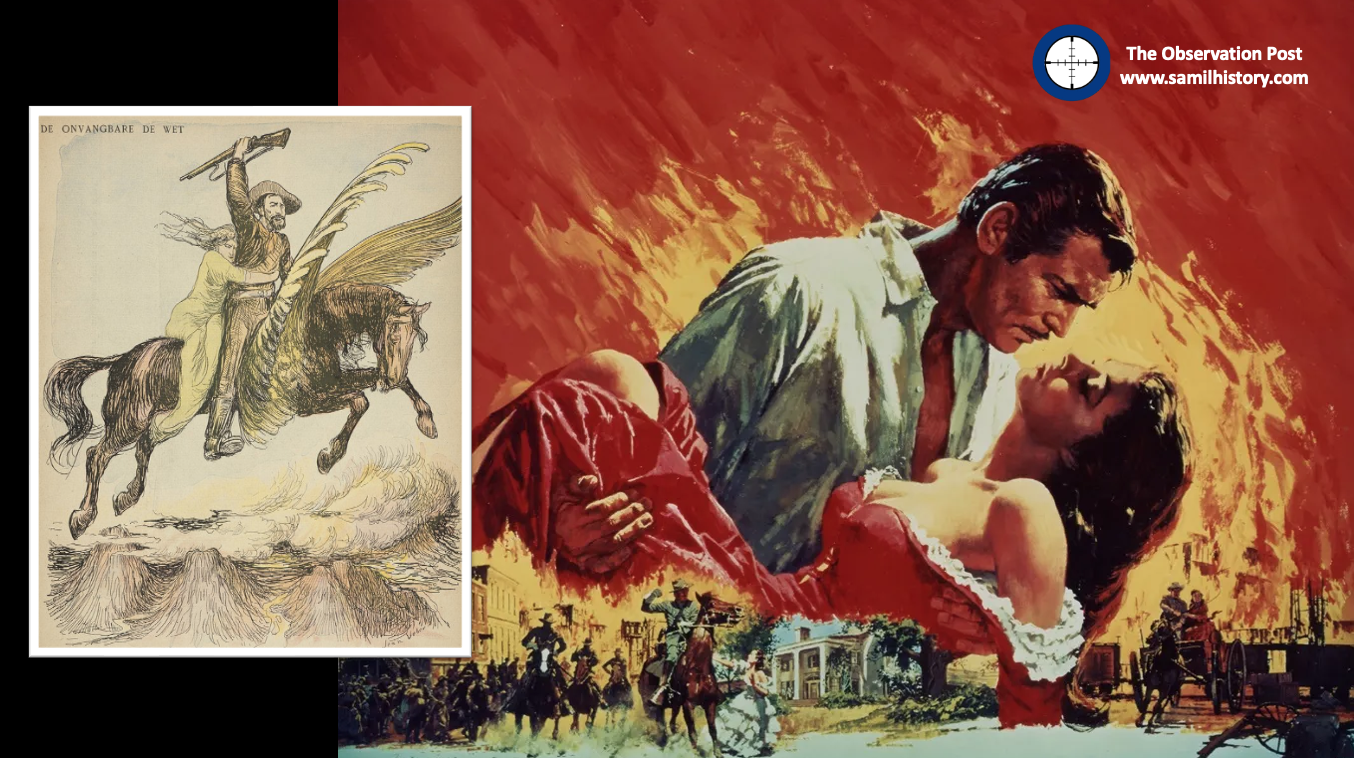
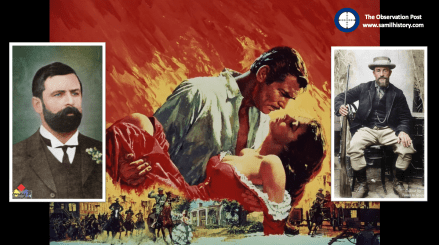
Insert – Christiaan de Wet on winged horse with damsel holding onto him. Main image – the movie poster from Gone with the Wind.

Now, there is a small problem with the history of the Rebellion – and one of them is the complete lack of history books in English and even less written at the time of the revolt – the complete Afrikaner romanticism of the rebellion all comes much later with the advent and rise of Afrikaner nationalism and a plethora of Afrikaner academic papers, novels and books.

For simplicity sake, there is a ‘English’ side to the 1914 Afrikaner Rebellion story – the majority in the country if we consider all races and nationalities caught up in the Rebellion and there is a ‘Afrikaans’ side of the story, a minority – driven initially by Hertzog and his breakaway cabal of pro Republican Afrikaner Nationalists from the Botha/Smuts South African Party (SAP) in 1914 and then it is heavily driven by a far right grouping of ‘pure’ nationalists after their break with the Hertzog/Smuts Fusion before World War 2 (1939-1945) – and they went about using mass media, aligned academics in ‘Afrikaans’ universities and all manner of propaganda to ‘set the Rebel story strait’ – even Radio Zeesen from Nazi Germany with its renegade Nationalist broadcasters went full tilt at glorifying Fourie, the Rebellion and demonising Smuts during World War 2.

For any historian to take a grip on the 1914 Afrikaner Revolt in 2024, the bank of both primary and secondary source becomes invaluable and it sets up the validity of what you are going to say, ensure whatever it is holds up to academic scrutiny by your peers. In respect to using both primary and secondary sources, the closest you are to the historical figure in question the more accurate and valid the work – so here we find original accounts by people involved in the events as the key.

There has only ever been one comprehensive history book written in English on the Afrikaner Revolt and luckily for us its very close to the events of 1914, it is published a year later in 1915 and its written by a journalist very closely tied to the whole 1914 Revolt having interviewed the principle characters personally and been witness to the events himself. The book is called “The Capture of De Wet” and it’s written by PJ Sampson.

Now, unlike all the Afrikaner historians writing for a Afrikaner market on the 1914 Afrikaner Rebellion who come after PJ Sampson (many come decades after him), Sampson is just not interested in presenting a counter-case for High Treason for the Rebellion – the old Afrikaner Nationalist’s “volks-veraairer” versus “land-veraairer” (traitor to your ‘people’ as opposed to traitor to your ‘country’) argument which has been going round and round Afrikaner family kitchen tables for 110 years and still rages on – nope, Sampson records none of that, in fact he sees the ‘treason’ argument as clear cut one in 1914 and the execution of Fourie as inevitable.

Sampson is not alone, I published an article on my visit to Scapa Flow where unarmed German sailors responsible for sinking their surrendered Imperial fleet were executed for sedition on the spot as they came ashore – some by way of bayonet. 1914 and World War 1 (1914-1918) veterans looked at treason and the execution of traitors very differently to the way we look at it now. Fourie is lucky he got a trial and not a drumhead trial and on the spot execution, at that time if you committed treason or sedition, with war declared and domestic state of emergency regulations in place – you got dragged through an administrative formality which lasted barely a day, then taken out back in the morning and shot – that is what happened to Fourie and that was the way of things then.

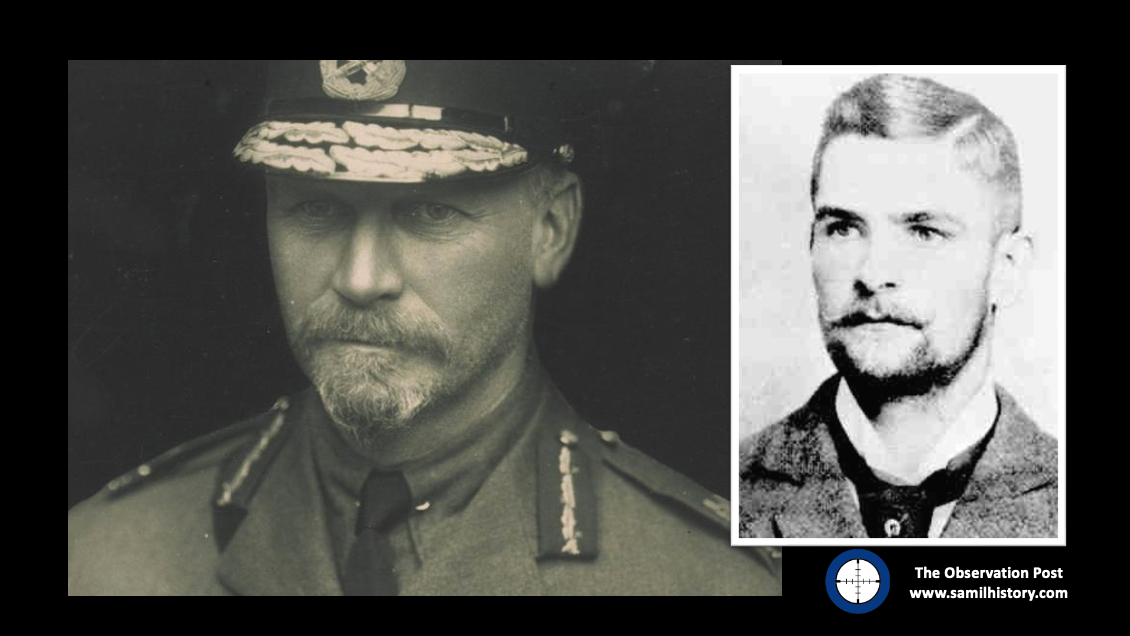
Smuts during WW1 and a young Fourie in the insert.

I’m also not alone, one of the principle characters in the Jopie Fourie story is General Jan Smuts, Jan Smuts himself would regard Fourie as having “shed more blood than any other officer.” With the rebellion lost, Beyers drowned and General de Wet surrendered … Smuts would say:

“Only Fourie’s band remained contumacious. Twelve of our men were killed at Nooitgedacht. There was no justification for that. Some of them were shot at a range of twelve yards … A court martial was appointed, strictly according to military law. One of its members told me he felt compunction about serving, because he was a friend of Fourie’s. I replied that that was an additional reason why he should be on the tribunal. On Saturday Fourie was unanimously condemned to death…”1

Smuts would go on to say:

“Had I refused to confirm the sentence, I could not have faced the parents of the young men who met their deaths through Fourie’s fault. There is something to be said for many a rebel, but in this case I conferred a great benefit on the State by carrying out my most unpleasant duty..”2

Smuts remained convinced that a fair trial had taken place, the correct legal framework in place, as to all the rebels Fourie was an exception and Smuts was unrepentant in the outcome, in fact he saw Fourie’s execution as unavoidable and it was his duty to see it through – his attitude had hardened, his son – Jannie Smuts in his biography of his father would write very little on Fourie in the entire appraisal of Jan Smuts’ life and career, Fourie is barely a footnote, a wayward rebel, nothing more.

A lot is also written about by Neo-Nationalist historians and disgruntled Afrikaner commentators on Smuts’ so-called “refusal” to entertain last minute efforts to intervene and reprieve Fourie, Jannie Smuts Junior is however dismissive of this and confident his father “would not have interfered in the course of justice” in any event. So this entire episode in the story really is a non-starter.

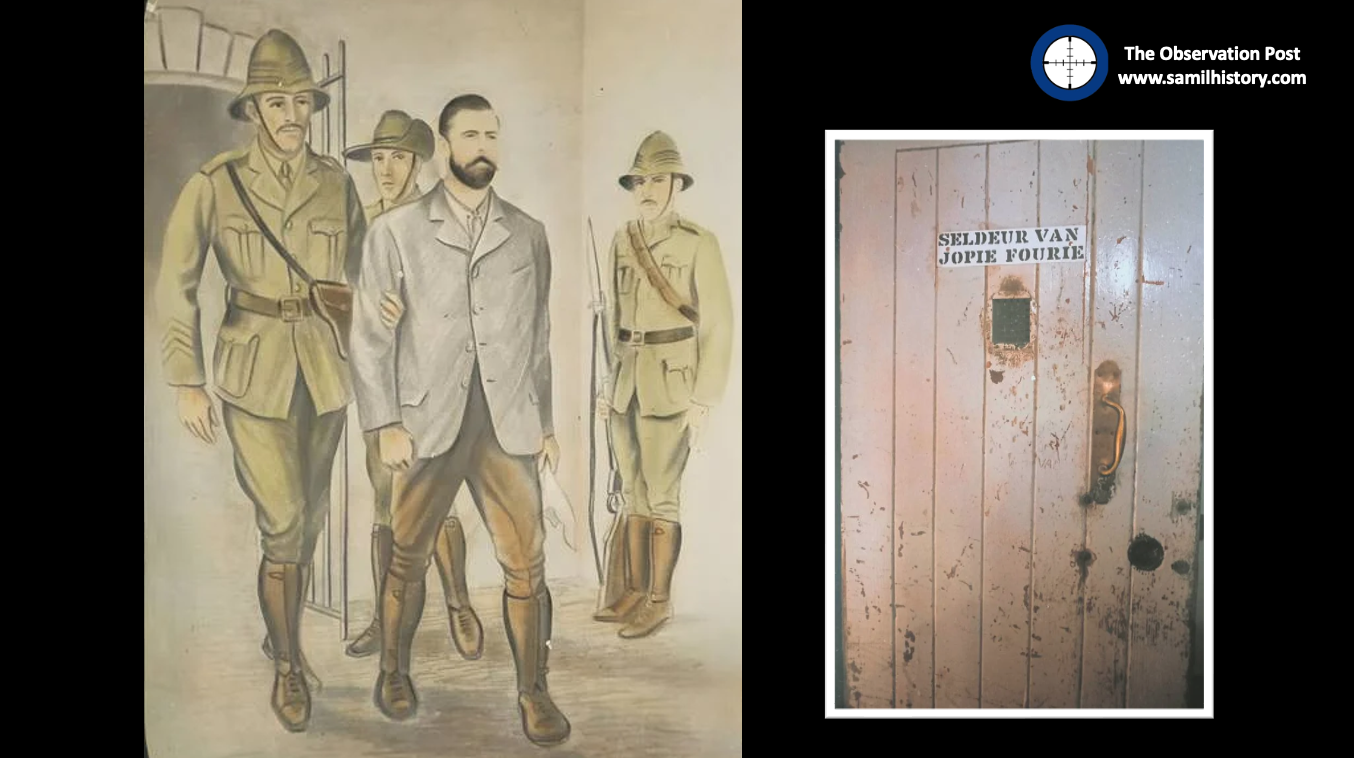
The execution of Fourie, the South African Policemen who executed him removed his cell-door as a keepsake to commemorate the occasion (reference Nongqai).

In fact Sampson views Fourie as somewhat deluded and misled, he even sets aside an entire appendix to demonstrate the flaws in Fourie’s understanding of history, his thinking and the flawed nature of his defence testimony, which Sampson tears apart completely and simply dismisses as unreasonable and deluded – instead Sampson takes pity on Fourie as someone who cuts a tragic figure having been misled by less scrupulous men like Maritz, his execution a foregone and unpleasant conclusion.

The main thrust of Sampson’s book is however on the objectives, mission and stated aims of the Rebellion. Although the long-standing Anglophobia caused by the Boer War is considered, it is not Sampson’s focus, simply because he, like many English commentators of his time, they understand the tragedy of the concentration camps and the pain they caused at face value, they see the deaths in context of measles and typhoid epidemics which sweep the camps due to hardship and unsanitary conditions brought about by war – a tragedy and nothing more. The ideas of ‘genocide’ and ‘murder’ of the Afrikaner nation are completely foreign to Sampson and other British historians like Amery of the time and this thinking would qualify fantastical thought at best.

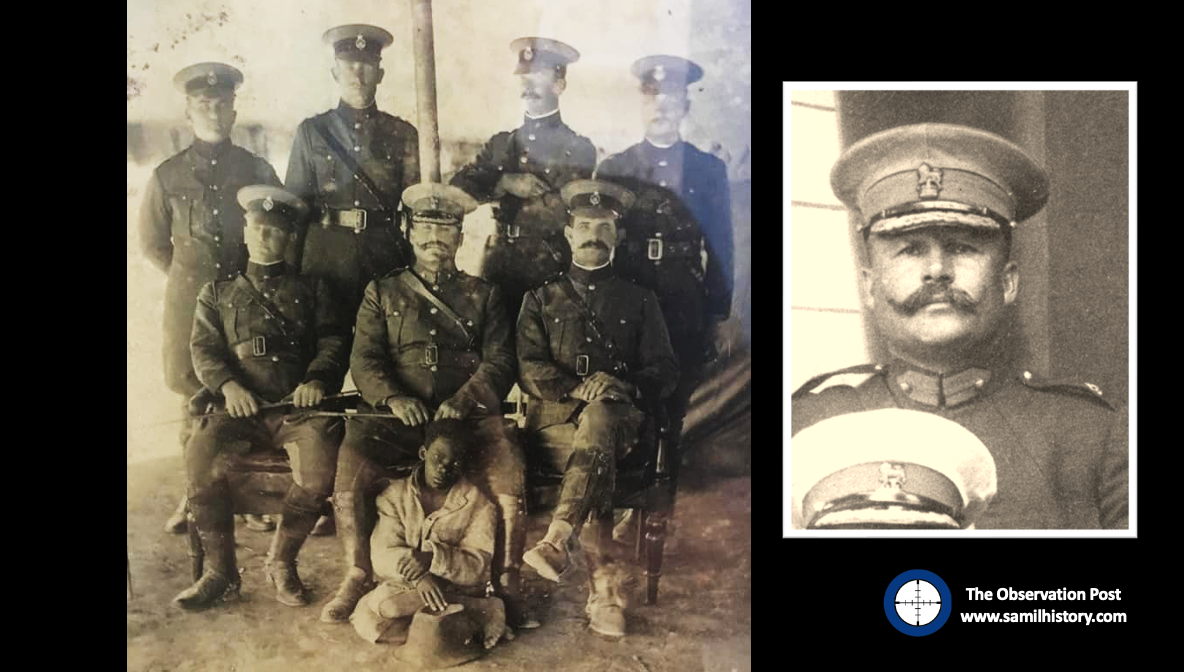
Manie Maritz in this South African Union Defence Force uniform and staff prior to the 1914 Afrikaner Revolt (Maritz Revolt). Lt. Col Maritz is seated front and centre with his ‘Agterryer’ (man-servant) at his heels. It’s the man-servant’s expression and position that is most interesting as in many ways it gives away the complete disregard Maritz felt for people of colour.

Sampson is more interested in the politics of the Afrikaner Revolt and the politics of the leaders taking part in it, the political circumstances in South Africa in effect (and less so the geo-political circumstances). Here Sampson argues that the ‘colour blind franchise’ and human rights for ‘natives’ are also key motivations for the rebellion – the rebels intent on maintaining a Afrikaner led hegemony, an oligarchy based on “Krugerism” as an ideology – which means no franchise, emancipation and limited human rights (if any) to anyone of colour. The declaration of war presents an opportunity for these Afrikaner leaders, with the assistance of Germany, to take over the whole of South Africa and implement this political construct of theirs, much like the post American Civil War traitors like John Wilks Booth and his rebels in 1865 trying to “raise the South” again and reclaim slavery. Sampson refers to the animosity between the ‘Free State’ Boers like Christiaan de Wet against the ‘Transvaal Boers’ of Smuts and Botha over the colour blind franchise, de Wet fearful that Smuts and Botha are ushering it in and it’s all very unacceptable to him.

Now, to anyone paying attention to the history, the colour blind qualified franchise across the entire country (not just in the old British Cape Colony) is one of the key demands by the British for a peaceful settlement of the South African War (1899-1902) ie. Boer War 2. It is the only clause that is dropped out the Peace of Vereeniging agreement as the Boers absolutely refuse to abide it and its a deal breaker. It is only dropped on the proviso that a future Union government, when it is granted self governance, will implement it – Smuts assures the British that he is the man to see it through and all the Boer signatories to the agreement promise they will address it when a Union and self determination is declared (this includes de Wet, Kemp and de la Rey et al)

The South African Union and self determination/responsible government is granted by the British to Botha’s ’South African Party’ (SAP) in 1910. However inside the SAP, Smuts and Botha are simply unable to move on the colour blind qualified franchise as the likes of de Wet and Hertzog will have none of it, 4 Years later it’s beginning to become a problem as an entire black population waits for its emancipation (and its rewards for taking part in the Boer War, the majority of them supporting the British).

Say what! It’s not all about the hatred of the British, Concentration Camps, forced to fight for the British against friendly brethren Germans …. Its about the … blacks!

What you smoking? Yup, I’m afraid there it is, commentators at the time like Sampson were pointing to issues of race – the internal politics at play, not just the geo-politics. To set up the ‘race’ argument Sampson goes in depth into each of the leaders of the revolt by way of outlining their character and disposition to race.

Beyers is described as a very religious man, however he was inordinately vain of his personal appearance (which looking at his pandering to his hair, a monumentally stylised moustache and his disposition to fine and dandy clothing sounds about correct), and regarded as megalomaniac by the man in the street, in fact they “used a more expressive term” to describe him – one not for polite publication. Beyers after the Boer War took to entertaining “veldt Boers” coming in for ‘indabas’ in Pretoria and he earned a reputation as a Anglophobe with a “with a particularly venomous tongue.”3

De Wet is described by Sampson as a different sort of person to Beyers. De Wet too is religious but religion does not dictate his actions – politics does. He is angry with Botha and Smuts for removing Hertzog from cabinet. As a Free Stater he is unhappy with these “Transvaal Boers” entertaining the British request of ‘colour blind qualification franchise’ (which is in fact a Boer War 2 peace treaty pre-requisite). It’s here that we see a common thread in many of the rebel leaders, sheer racism and a desire to maintain an white Afrikaner led oligarchy in South Africa with no rights whatsoever to anyone of colour.

Sampson places De Wet into what he calls a “Old School” Boer whose:

“Abiding fear always has been that British government in South Africa meant that the ascendancy of the whites over the blacks would cease, and one day the kaffirs would be permitted to be on an equality with the whites.”4

Sampson cites this fear of Black ascendancy over Whites as a primary rally call for the Boer Republican armies during the South Africa War (1899-1902). He goes on to outline De Wet deep hatred for Black people as his primary motivator for going into the 1914 Rebellion, he writes:

“De Wet always has treated kaffirs with severity, regarding them as little better than animals, whom he believed he ought to have the right to thrash as he would a dog, it only needed a fine for ill-treating a native to bring on a raging brainstorm that drove him headlong into the maelstrom of rebellion. To fine him, De Wet, was the greatest outrage conceivable, and clear proof that the time had come to strike a blow for freedom!”5

This sentiment and motive for De Wet going into Rebellion as outlined by Sampson is borne out by Jan Smuts, who later uses the fine De Wet gets for assaulting the said black man with a shambok – which was 5 shillings. In broad media, Smuts belittles both De Wet and his purposes behind the revolt by calling it the “5 Shilling Rebellion”.

Christiaan de Wet would go on to say of the Colour Blind Qualified Franchise policy and the fact its still upheld in the Cape Providence:

“The ungodly policy of Botha has gone on long enough, and the South African Dutch are going to stand as one man to crush this unholy scandal.”6

Manie Maritz is also described within his deep-seated racism – he is noted as a man of:

“Enormous strength, inordinate vanity, little education, and the one, perhaps, of all the rebels most open to the influence of German gold.”7

Jopie Fourie is described by Sampson as a religious mans and a very pleasant man – however his Anglophobia seemed to have grown on him like a disease starting with his resentment because of a permanent limp, caused by a bullet wound in the knee during The South African War (1899-1902), and this:

“intensified the bitterness to one who had been a fine footballer and athlete”.8

What follows in ‘The capture of De Wet’ is the ‘Black’ part of the 1914 Afrikaner Revolt, the declaration from Maritz stating that any blacks standing in the way of the rebels will simply be executed. His declaration Maritz states:

“Several cases are known where the enemy has armed natives and coloured people to fight against us, and as this tends to arouse contempt among the black nations for the white, an emphatic warning is issued that all coloured people and natives who are captured with arms, as well as their officers, will be made to pay the penalty with their lives.”9

The killing of Allan William King, the Native representative by Fourie’s Commando. The declaration by the said ‘Natives’ to avenge King and enter the war on their own terms and wipe Fourie’s Commando out by themselves – they are held back by King’s wife who pleads with them for restraint. Sampson notes of ‘rise’ of the ‘Natives’ to avenge King:

‘The natives of the district were almost crazy with rage at the loss of their ” Father,” as they deemed Allan King …. They sent a deputation of chiefs and headmen into Pretoria to see the wife of their dead “inkosi,” to assure her of their love for him … and said to her “Say the word, and we will kill every one of these bad men, and also their wives and children !”10

But Mrs. King shook her head and forbade them to raise a finger, for well she realized the horrors that might follow if once the natives commenced reprisals. The rebels have to thank the wife of the man they so unfairly shot that all their throats were not cut that night, their wives and children assegaied, and their homes given to the flames.’11

The position of Sol Plaatje as to the revolt and Native rights also becomes important. So too is the lambasting of Christiaan de Wet and his martial abilities – and even his influence, his reputation shattered.

Not only Sampson, General Jan Smuts was highly critical of Christiaan de Wet’s fighting abilities and strategic acumen. His son Captain Jannie Smuts would record his father’s disposition, it gives an interesting insight on de Wet and his disposition to making irresponsible strategic and operational decisions – driven instead by emotion and irrational ideals, here it is:

“It might here be noted that there was considerable divergence of opinion amongst the (1914) rebel leaders on their course of action. Beyers wanted a relatively passive though armed form of resistance – the type that came to be known as a “coup” in the Second World War. He was against civil war. De Wet, more fiery and impetuous, was for vigorous action and pushing through to connect up with Maritz. In his zeal he forgot that he was poorly armed, had no field guns, and was short of ammunition. He also failed to reckon with the mobility afforded the Government by the much-extended railway system, or the advent of the petrol driven motor-car”.12

In other words, as a pivot leader of the Boer Revolt of 1914, Christiaan de Wet was flying by the seat of his pants (a trait not uncommon with his approach to the South Africa War 1899-1902) – completely unprepared he was bent on full sedition and revolt to reinstate ZAR republicanism, an oligarchy run on a Boer paramountcy and its severe laws of racial exclusivity and repression throughout the South African Union – paying little regard to the strategic ramifications, operational requirements or even modern military advancements, completely underestimating his enemy, just blindly pursuing his “impetuous” pipe dream. 

Yup, its a WHOLE different view of the Afrikaner revolt and its not one you get from your Afrikaner Christian Nationalist education and its certainly not one you get from modern day Afrikaner historians. They have been telling you it’s all about ‘the British’ for decades … and meanwhile, the one and only ‘English’ historian to write on the matter at the time is simply dismissed, completely bypassed – his work simply discarded as ‘jingoism’ – so not relevant.

One thing is a truism, and its true of many Boer War or Boer Revolt books and academic papers directed to Afrikaner consumers in the past, is that the works tend to cater to a specific Afrikaner ‘Volksgeist’, one which has little resonance outside of white Afrikaans culture. These works tend to highlight the ‘whiteness’ of the conflict, and focus primarily on Afrikaner cultural dynamics. One hopes that any new book on the 1914 Afrikaner Rebellion brings something new to the table, one in which the ‘Black’ and the ‘English’ part of the 1914 Rebellion is fully appraised, researched and understood, an in-depth appraisal of race politics of the time, the role played by Black Africans, Coloureds, Indian and even English speaking white South Africans in the revolt i.e. the majority of South Africans – their political representations, reactions and aspirations – what they were “fighting for”, their “freedom” in effect.

Without this, the majority of South Africans will find themselves, once again, as by-standers to this history and they will pay no attention to it whatsoever. The ‘new’ work having no real resonance to modern South African society – just a re-packaged, re-marketed regurgitation of the old white Afrikaner Nationalist debates targeted at a fresh new Afrikaner audience for a little commercial gain.

As a very reputed historian – Dr. Damian P. O’Connor, also pointed out recently, the problem with removing or brushing over sources, especially written accounts such as this one from the period, on the basis of ‘jingoism’ or just ‘not conveniently fitting’ into a Afrikaner nationalist political narrative or even an Afrikaner author’s bias brought about by years of nationalist identity politics and socialisation … is that once we’ve dismissed a first hand written account we are left with nothing, just pure hearsay and verbal tradition .. empty space in effect, and into that ‘empty space’ anyone can write anything they like, we can just make it up. It becomes revisionist history – pure ‘gone with the wind’ romantic drivel.


Written and Researched by Peter Dickens

References:

  • The Capture of De Wet. The South African Rebellion 1914 – Sampson, Philip J. Published Edward Arnold, London. 1915
  • JC Smuts. Jan Christian Smuts by his son J.C. Smuts. Heinemann & Cassell Publisher, 1952.

Footnotes

  1. Smuts, Smuts by his son, 239 ↩︎
  2. Smuts, Smuts by his son, 240 ↩︎
  3. Sampson, Capture of De Wet, 5 ↩︎
  4. Sampson, Capture of De Wet, vii ↩︎
  5. Sampson, Capture of De Wet, vii ↩︎
  6. Sampson, Capture of De Wet, 148 ↩︎
  7. Sampson, Capture of De Wet, vii ↩︎
  8. Sampson, Capture of De Wet, vii ↩︎
  9. Sampson, Capture of De Wet, 252 ↩︎
  10. Sampson, Capture of De Wet, 191 – 193 ↩︎
  11. Sampson, Capture of De Wet, 193 ↩︎
  12. Smuts, Smuts by his son, 234 ↩︎

The Boer War’s Freemasons

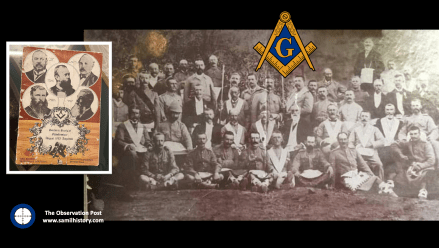
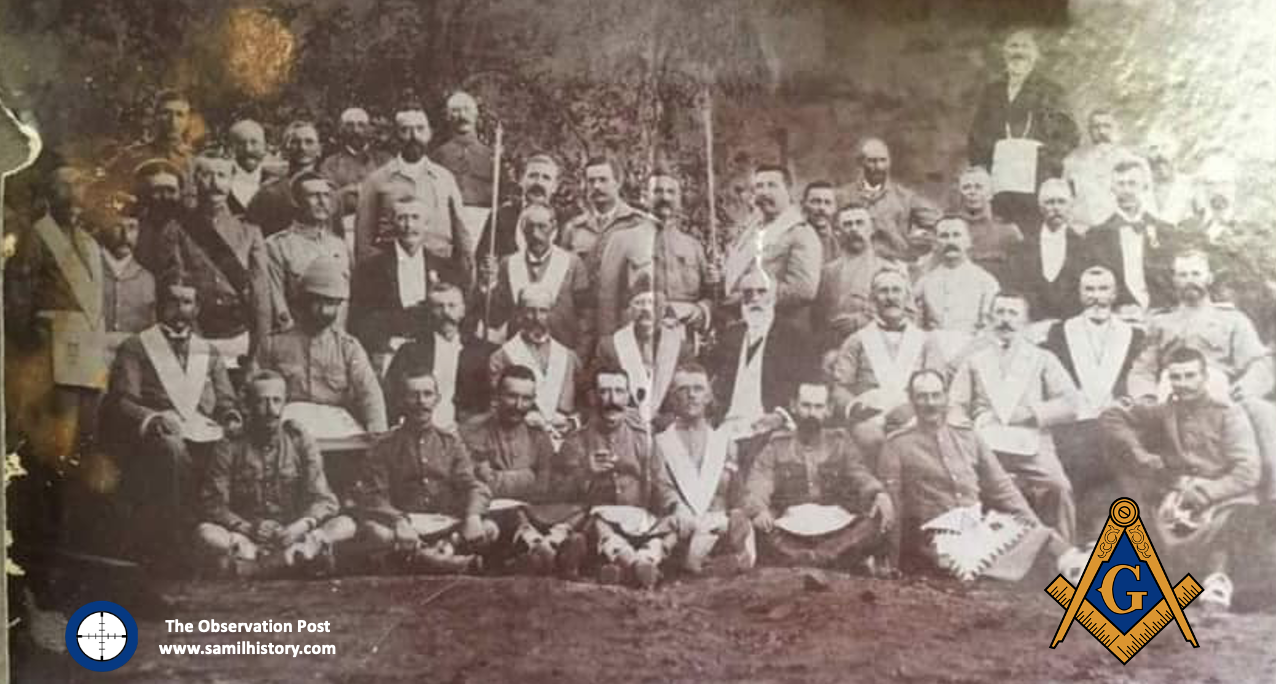
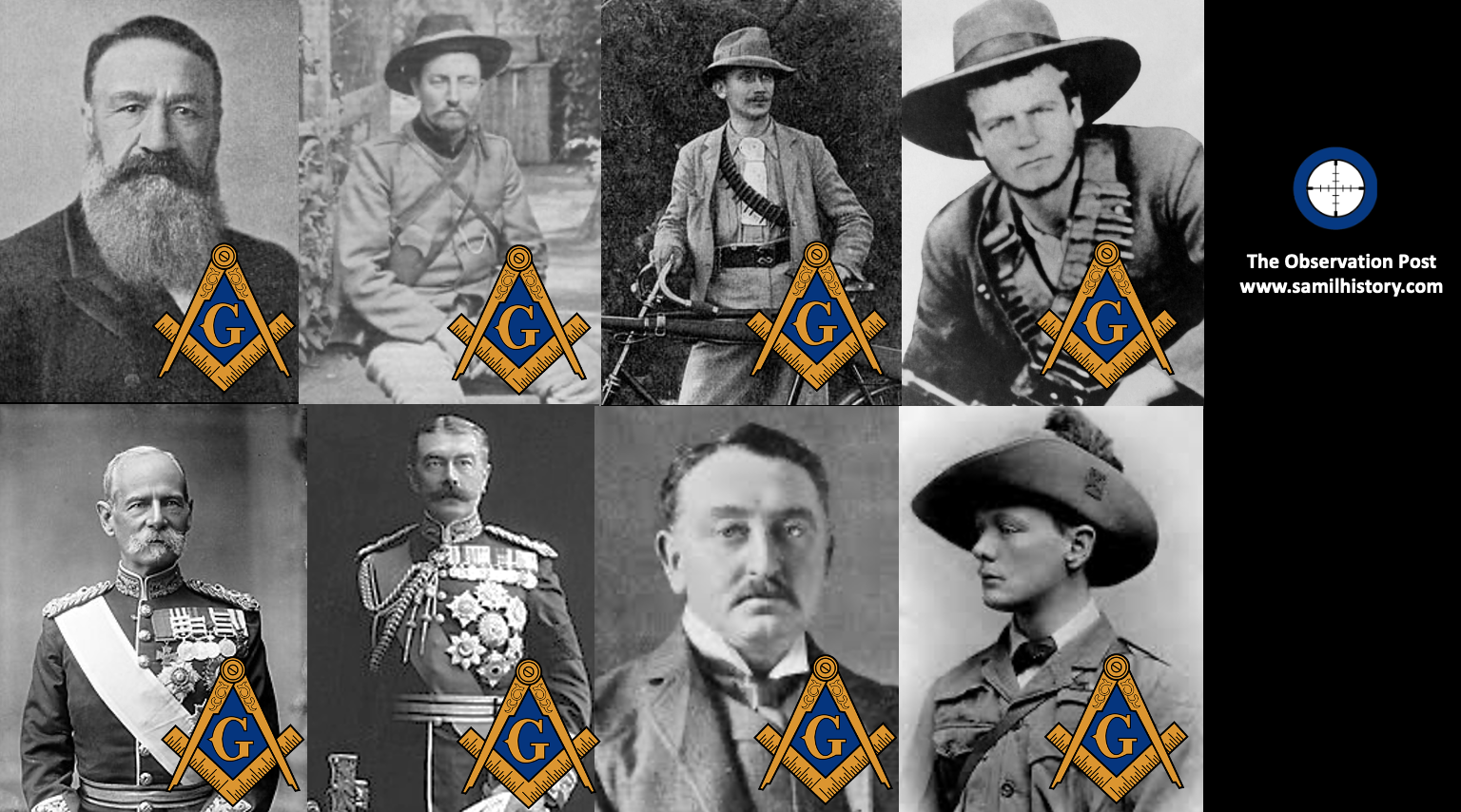
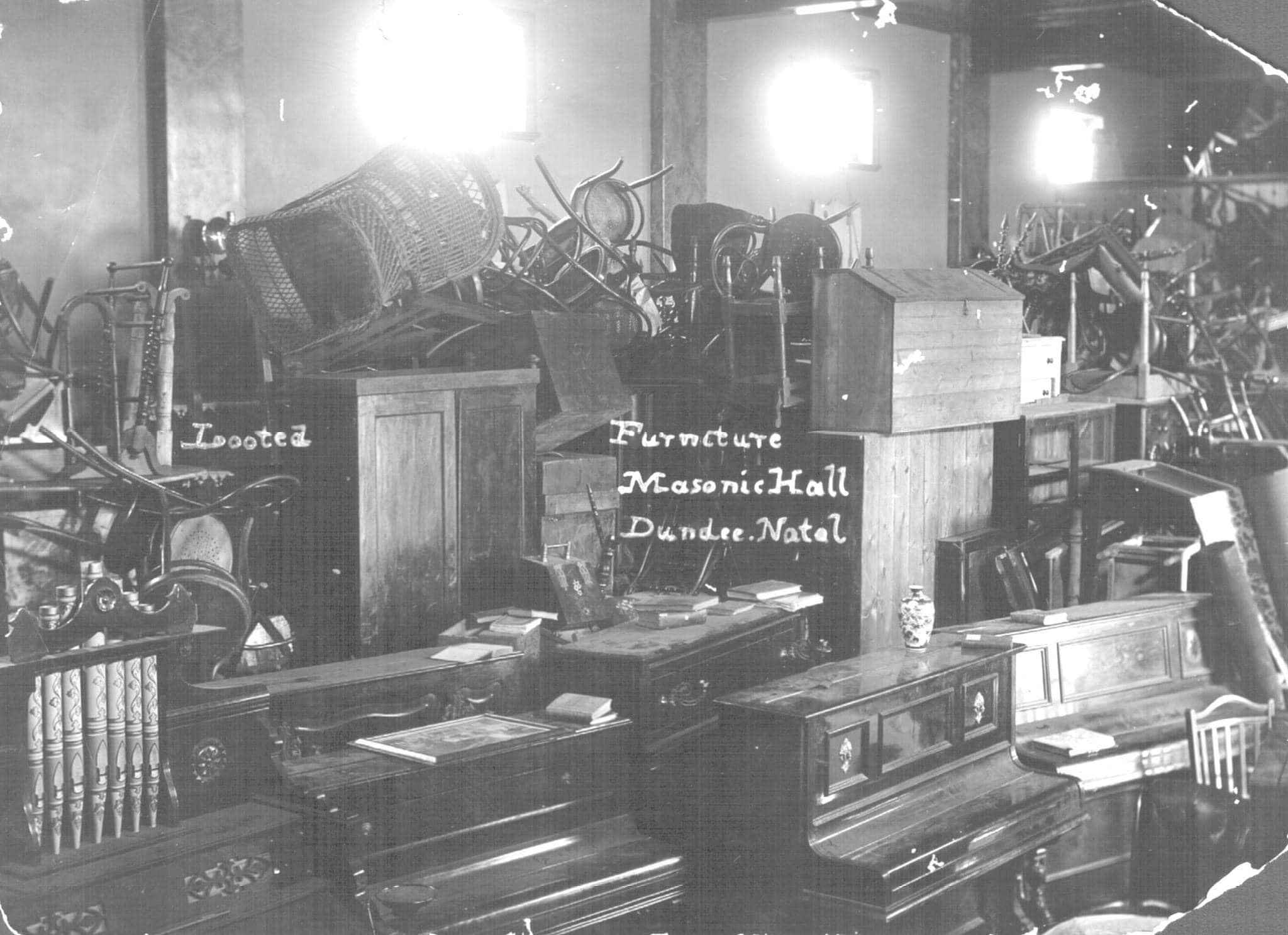
To answer a question recently posted on Boer War appreciation media as to whether Freemasonry and the Boer War are in some way linked. The origin of this bizarre statement lies in Manie Maritz, the 1914 Afrikaner Revolt leader, who became convinced of a Masonic and Jewish conspiracy to start the second Boer War. More on insane machinations of Maritz later, however to answer the question – no – Freemasonry as a fraternity and the two Boer Wars – the Transvaal Revolt (1880-1881) and The South African War (1899-1902) – have nothing to do with one another, as much as some deluded conspiracy theory driven arm-chair historians would like to to make a connection. In fact, as in many wars over centuries in many countries, Freemasons have landed up on opposing sides shooting one another – the most significant example of this is The American Civil War (1861-1865).  For those ‘in the know’ Freemasonry plays no role whatsoever in starting (or preventing) wars, which is not surprising as Freemasonry is a charitable fraternity with principles relating to self actualisation and brotherhood.

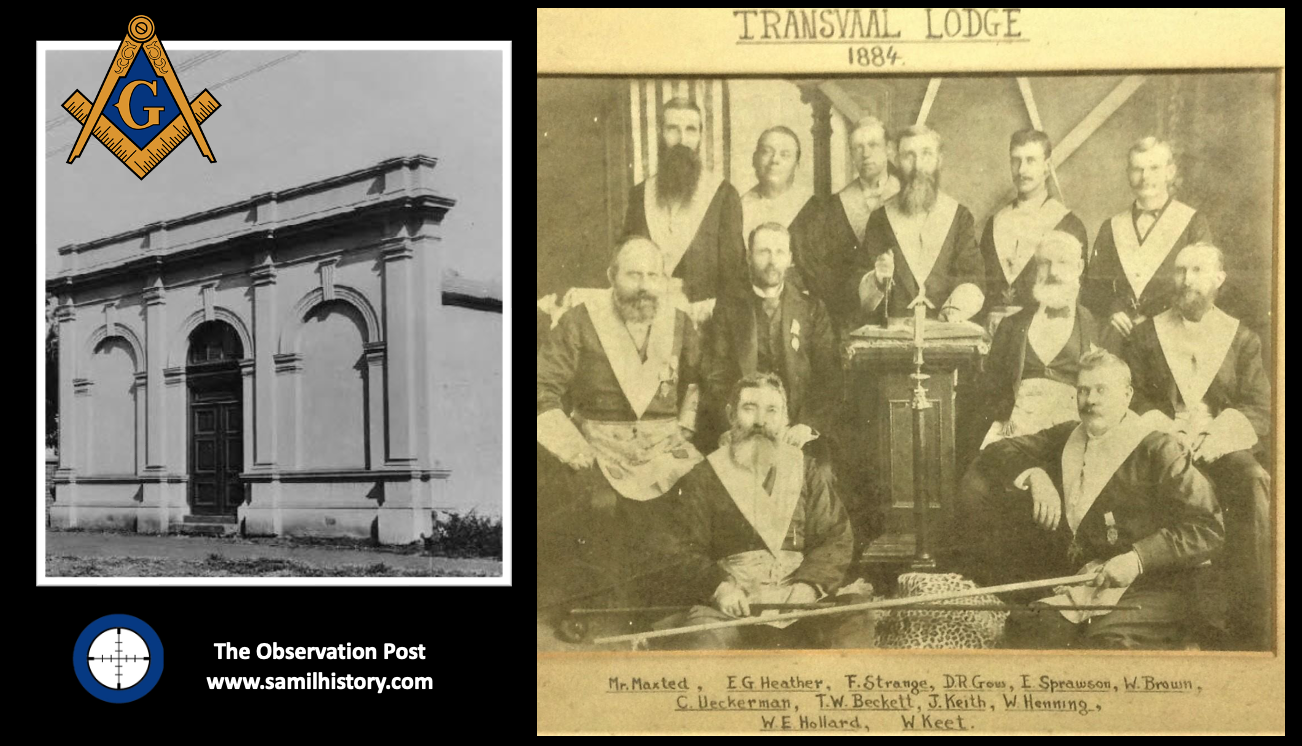
It’s also not a ‘British’ thing. Freemasonry started in South Africa under the Dutch Grand Lodge, the Orient of the Netherlands in 1772 .. long before the British played any role in South Africa. The oldest Lodge is South Africa is a Dutch Constitution one – De Goede Hoop Loosie – its temple is located inside the Parliamentary buildings complex. It also does not mean the Dutch and English speaking South Africans are separated by English and Dutch constitutions, you’ll find English and Afrikaners in both. Case in point are the early Voortrekker leaders who were Freemasons – Andries Pretorius was a Freemason, he even opened up a Dutch constitution Lodge in Pretoria. Piet Retief was also a Freemason, but of the English Constitution whilst he was living in the Eastern Cape.

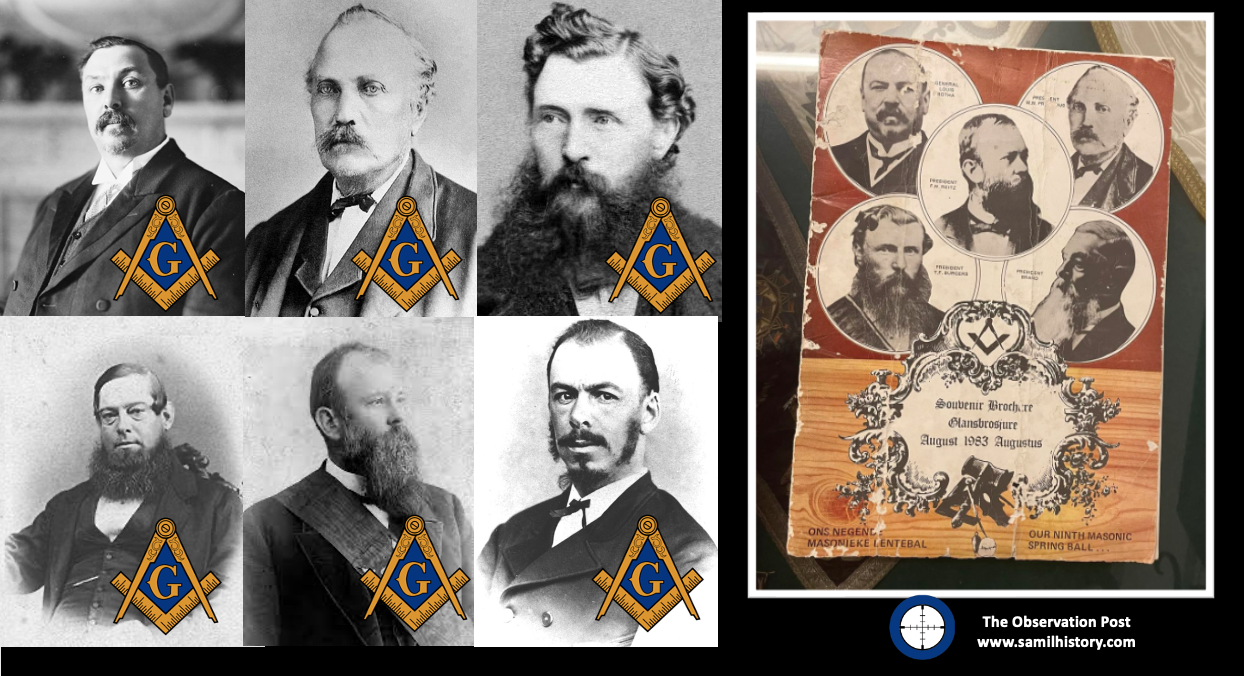
Here’s an interesting artefact, this one is located at the Pinelands Masonic complex’s historic display (my photo) – commemorating past South African state land Boer Republic leaders who were Freemasons. For interest, and it’s all in Public space – just ‘Google’it. As notable Boer Freemason Presidents and Prime Ministers go these include:

  • General Louis Botha – Boer War Bittereinder General. 1st South African Prime Minister of the Union of South Africa: 1 May 1910 – 27 August 1919, Prime Minister of the Transvaal: 4 March 1907 – 31 May 1910
  • President Johannes Brand – 4th President of the Orange Free State: 2 February 1864 – 14 July 1888. Awarded a British Knighthood.
  • President Marthinus Wessel Pretorius – 1st State President of the Zuid-Afrikaansche Republiek (Transvaal Republic): 22 October 1866 – 20 November 1871. Established the ZAR and its constitution.
  • President Thomas François Burgers – 4th State President of the Zuid-Afrikaansche Republiek (Transvaal Republic): 1 July 1872 – 12 April 1877. Introduced the ZAR’s currency.
  • President Francis William Rietz – 5th State President of the Orange Free State: 10 January 1889 – 11 December 1895 and State Secretary of the ZAR in the lead up to Boer War 2.
  • Acting President Pieter Blignaut – Acting State President of the Orange Free State: 14 July 1888 – 10 January 18891
Top Row left to right: Brothers Louis Botha, Marthinus Pretoruis and Thomas Burgers. Bottom Row left to right:: Brothers Johannes Brand, Francis Reitz and Pieter Blignaut

A very good barometer of the early development of the ZAR (Transvaal) and the very cosmopolitan nature of Pretoria with its Voortrekkers, NGK Churches, Jewish traders, British loyalists and Anglican Churches – before the discovery of significant gold deposits and the establishment of Johannesburg – is to look at Freemasonry in the ZAR. The first Freemasons Lodge was a Dutch constitution Lodge in 1862, the Aurora Lodge .

The corner stone of the new temple for this Lodge was laid by President Burgers, as noted, a freemason himself, on 27 May 1876. On the Freemason’s English constitution side, the ZAR voluntarily dissolved itself (led by President Burgers ironically) and it became The British Colony of the Transvaal in 1877 (the first version, there are two). The first English constitution lodge was established a year later on 15 January 1878, called the Transvaal Lodge – and its was established a mere 2 years after the Dutch’s Aurora temple was built. The Aurora temple was destroyed during a severe thunderstorm, disheartened and not keen to start all over again, the Dutch constitution freemasons joined the English constitution freemasons at the Transvaal Lodge (and here’s a rare photo of them).

The Masonic Hall in Pretoria and the Transvaal Lodge in 1884

Here’s another interesting wartime photo – Dutch and English/Scottish/Irish constituted freemasons getting together in the middle of the South African War (1899-1902) a.k.a. Boer War 2 near Bloemfontein. On 12 December 1900, in the middle of the fighting a meeting was held in Jagersfontein, attended by both British (English constitution) and Boer Freemasons (some of which were Dutch constitution) – both on separate sides, but happy to meet one another under a banner of brotherhood. Here’s a fascinating picture of the occasion.

Freemason meeting – Jagersfontein, December 1900

Other famous ‘Boer War’ Freemasons on the ‘Republican’ side include:

  • Commandant General Petrus ‘Piet’ Jacobus Joubert, Commandant General of the ZAR Forces, Vice President to Kruger and Boer War 1 and Boer War 2 veteran. The overall commander of Boer Forces at the start of the war. and political opposition to Kruger.
  • General Benjamin Johannes “Ben” Viljoen, Bittereinder Boer War 2 veteran and American Boer colony pioneer.
  • Commandant Danie Theron, renowned Boer War 2 scout, bittereinder, commander and national Boer hero.
  • Deneys Reitz – veteran Boer War officer and the author of ‘Commando’, although it his noted that he only became a Freemason after the Boer War, as noted his father President FW Reitz was also a Freemason.2

Of the famous ‘Boer War’ Freemasons on the ‘British’ side, these include:

  • Field Marshal Lord Roberts Frederick Sleigh Roberts, 1st Earl Roberts and a Lodge in South Africa is named after him.
  • Field Marshal Herbert Kitchener, 1st Earl Kitchener
  • Sir Winston Churchill but only became a Freemason after he left South Africa after his service in the Boer War and returned to the UK.
  • Sir Charles Warren was a notable Freemason
  • Cecil John Rhodes was a very committed lifelong Freemason.3
Significant Freemasons of the South African War (1899-1902) Boer and Brit.

Of the famous authors associated with the Boer War, Joseph Rudyard Kipling, the famous author of the Jungle Book was a Freemason, so too was Arthur Conan Doyle. Leo Amery, who penned the first official history of the Boer War for the Times was also a Freemason.  

As to co-operation, during the Boer War, many lodges closed. Some of the buildings used by the Freemasons were used for hospitals such as the Masonic Lodge in Mafeking and the Masonic Temple in Johannesburg. During the Boer invasions of northern Natal at start of the war in October 1899, the Masonic Lodge in Dundee was plundered by the Boer Republican Forces, however the Lodge’s artefacts were found and respectfully returned to the Lodge by Boer Freemasons.

Loot taken from the Masonic Lodge in Dundee by Boer Republican Forces. Image courtesy of the Talana Museum Archive.

Noted here, is there is NO General Jan Smuts – there is no evidence whatsoever that he was a Freemason. Many historians have tried to confirm the ‘conspiracy theories’ and there is no evidence, zilch, nothing – not here in South Africa nor in Britain. Smuts is not a Freemason, no matter how much many people wish he was (conspiracists and Freemasons alike).

Of the other ye olde Boer Republic Freemasons in leadership roles the only other significant ones who were NOT Freemasons were President Paul Kruger (his Dopper approach would not have allowed him) and Prime Minister Barry Hertzog. Of the British ‘hawks’ in starting the Boer War, there is absolutely no conclusive evidence that either Alfred Milner or Joseph Chamberlain were Freemasons – sorry for all those conspiracy theorists again. Maybe the decision to go to war should have been left to the Freemasons to negotiate and there would not have been war in the first place … and look there – I’ve created a conspiracy with no grounding whatsoever.

Image: President Paul Kruger and the British Colonial Secretary, Joseph Chamberlain, having a dust-up both were NOT Freemasons and no brotherly love lost.

Another point in the respect of famous people associated to the Boer War by way of historic sweep who are NOT freemasons .. all the ‘Pure’ National Party’s Presidents and Prime Ministers were members of the Broederbond – from D.F. Malan all the way to their last one, F.W. de Klerk and as a result of their rather perverse public animosity to Freemasonry, none of them were Freemasons. Also, none of them were ‘significant’ Afrikaners in the formation of ZAR, OFS or Union of South Africa, nor did any of them play any significant role in the Boer War – Dr D.F. Malan sat out of the war in safety – for that matter all of them sat out WW1 and during WW2 they either tacitly or overtly supported Nazism while sitting out of that war too. The best they could come up with was a ‘keep South Africa white’ South African Republic in 1961 and Freemasonry must surely thank its lucky stars that it is spared from any association with it for a change, conspiracy or otherwise.

As noted in the beginning, one origin of this bizarre link of Freemasonry to the Boer Wars is ‘General’ Manie Maritz, the Boer War Commander, 1914 Afrikaner Revolt leader and leader of the National Socialist Boerenasie movement. In the mid 1930’s Maritz would become a convert to the racist and anti-Semitic mythical and completely discredited ‘the Protocols of the Elders of Zion’ and convinced of a Jewish and Freemason conspiracy to world domination. He would make the ‘Protocols of Zion’ his life’s meaning and his mission to educate the Afrikaner people (his ‘Volk’) to it – and in it he would blame the ‘hidden hand’ of the Jews as the true conspiracists behind starting the Boer War. He would then go into mortal combat with General Jan Smuts calling him the King of the Jews and therefore a traitor to the Afrikaner people.4 Yet, believe it or not there are still some people out there who would gobble this sort of crap up.

If you want to see how this conspiracy theory nut job rubbish Maritz promulgated in action, consider this, the Broederbond opposed Freemasonry – as a net result the post 1948, the National party’s Minister of Justice C.R. “Blackie” Swart (a Broederbonder himself) famously accused the Freemasons and the ‘Sons of England’ (another South African lodge based fraternity) in the media of infiltrating Sailor Malan’s ‘Torch Commando’ political protest movement in 1952 and in so plotting to militarily overthrow his Apartheid government.5 Pure unfounded gobbledygook and you just can’t make this stuff up!

In my book none of these ‘Pure’ Afrikaner Nationalists really qualified ‘great’ Afrikaners in any event – the simple truth is that they were a fringe party of far right-wing nutters .. nothing more. Also, point to note, no – by bringing up famous Boer leaders who either were or were not part of the Freemason fraternity, I’m not “Boer Bashing” and discrediting Afrikanerdom – because that would be equally daft.


Written and Researched by Peter Dickens

References:

  • 250 Years of Freemasonry in South Africa – Commemorative Publication 2022, all Constitutions. Published by the Grand Lodge of South Africa
  • United Grand Lodge of England. On-line repository
  • Maritz, Manie ‘My Lewe en Strewe’ Pretoria 1939

Footnotes

  1. 250 Years of Freemasonry in South Africa ↩︎
  2. Ibid ↩︎
  3. Ibid ↩︎
  4. Maritz, My Lewe en Stewe‘, pages 97 – 270 ↩︎
  5. P Dickens, The Rise and Fall of the Torch Commando – Part 4, on-line record for The Observation Post ↩︎

The Tweebosch Massacre

One of the most stand out things in the way the Boer War is recorded by modern historians is the vast difference between the ‘Old School’ Afrikaner historians still peddling a romantic narrative of Bittereinder Boer Pimpernels tying the British up in knots – and then there are the modern ‘British’ and ‘Black’ historians, who post Apartheid have been gradually uncovering a narrative of war crime, atrocity, genocide and massacre – but not of ‘white’ Boer women and children – but of ‘Blacks’ – on nearly all levels of age and sex and all definitions. Upfront let’s be clear on this – it’s an atrocity committed by both sides – so nobody comes out smelling of roses – not the Boers and not the Brits.

So much so, as Dr Garth Benneyworth, a leading South African War historian pointed out recently on The Observation Post that a significant research gap on the historiography of the South African War (1899-1902) needs to be investigated.

A Genocidal Order

This specific literacy gap evolves around a policy decision taken by Bittereinder Boer Commanders in the ‘Guerrilla Phase’ of the South African War (1899-1902) to shoot out of hand any Black, Coloured or Indian civilian, contractor or soldier deemed as being in support of the British military. The order is tantamount to genocide as ‘Natives’ can be simply be killed on the basis of the colour of their skin and a simple “suspicion” of spying or working for the British – which becomes highly problematic in the British Colonies, especially the Cape Colony as many hold a colour blind franchise and are equal to whites, they hold British citizenships and most ‘work’ for the British in one way or another. No recourse to the law or a trial of any kind is afforded them – they could just be shot on the spot by any Boer invader.

An example of the ruthlessness of this order in practice is the murder of a coloured blacksmith named Abraham Esau in Calvinia, Namaqualand, British Colony. As the guerrilla war continued, there were ongoing Boer Commando raids in the area, and demands for tribute, whippings, looting, and even exemplary executions were common.1 Esau organised a militia to resist these incursions, however his British patriotism and bravery made him a marked man, so when a Orange Free State Commando (600 strong) fell on Calvinia on 7 January 19012, Esau was one of those sought out amidst the plunder of the town. Esau was beaten, bludgeoned and then lashed – he survived this torture until 5 February when he was eventually shackled in irons, dragged for five miles behind a pair of horses, and, after a final beating, shot dead.3

So, where is this order sourced? In fact it’s a ‘General Order’ and can therefore be regarded as ‘Policy’. General Christiaan de Wet would inform Lord Kitchener that he personally issued the order …

‘the ungovernable barbarity of the natives realises itself in practice in such a manner that we felt ourselves obliged to give quarter to no native and for these reasons we gave general instructions to our Officers to have all armed natives and native spies shot.’4

Not one senior Boer Commander in the field is not guilty of implementing this policy, even captured junior officers like Gideon Scheepers and Hans Lötter both face charges of “murdering” black and coloured civilians and captured ‘coloured’ British soldiers in the British Cape Colony – and they both faced firing squads for this – Kitchener responds to de Wet:

‘….. (I am) astonished at the barbarous instructions you (General de Wet) have given as regards the murder of natives who have behaved in my opinion, in an exemplary manner during the war.5

Kitchener then notifies de Wet that Boer Commanders guilty of this crime will face charges of murder and Scheepers had already been found guilty and executed.

However, this policy is widespread, it spreads from the Bittereinder raids into the British Colonies to the two Republics themselves, and these executions happen under of the watch of great Boer Commanders – even the great General Koos de la Rey can’t escape it, de la Rey is almost unapproachable in Afrikaner lore – no Afrikaner historian would dare accuse him of a war crime like this. But the sad fact is it did happen under his watch and it happened at one of his greatest victories.

Massacre at The battle of Tweebosch

The battle of Tweebosch on 7 March 1902 is famous because of General De la Rey’s compassionate and kind treatment of the wounded Lord Methuen and saving his life. It’s also an astounding Boer victory, it occurs towards the end of the war and reassures the Boers of the marshal ability of this, one of their greatest Commanders.

General Methuen surrendering to General de la Rey (insert picture), image from Le Petit Journal 1902.

What is not often recorded at the Battle of Tweebosch in the narrative is the killing spree De la Rey’s commando members go on, its a war crime and atrocity, as they execute about 30 unarmed Black wagon drivers and servants in service of the British column as well as black and Indian soldiers having surrendered.

This spurred Lord Kitchener to write to General de La Rey and forward all the witness reports of the executions. The intention was to get de la Rey to take action against the perpetrators and cease and desist – de la Rey does none of these.6

Kitchener’s missive is sent on the 31st of March, 1902 and reads:

Sir,

I beg to forward you the accompanying sworn statements regarding acts of inhumanity which were performed by Burghers serving under your orders during, and subsequent to, the action at Klipdrift (Tweebosch) on March 7th, 1902.

I am fully convinced that you would not approve of such conduct, and that you will lose no time in adopting such action as you may think necessary in the matter.
I take this opportunity of thanking you for your kind treatment of Lord Methuen whilst in your hands.

The following testimonies are then attached:

Captain W.A. Tilney, Deputy Assistance Adjutant-General, states:-

“Boers were already riding amongst the rear wagons, off which some of the drivers jumped. Two knelt down with their hands above their heads, when a Boer pulled up his horse, and shot both dead. They were unarmed.

On the 8th, Commandant Joubert, of Kemp’s Commando, took me over to General De la Rey’s laager. On the way, we passed over the field of action at Klipdrift. Parties of men, women and children were engaged in stripping the dead. There were periodical shots which were not at horses, as there were no wounded animals about that part of the field. All the men we buried that day were stripped naked, including Lieutenants Venning and Nesham, Royal Artillery.

On the 9th instant, the convoy of wounded on its way from Klipdrift to Taaiboschpan trekked along the line of retirement of the mounted troops. We passed many dead, stripped naked, most of whom had three or four bullets through the head and chest. There were so scorched and blistered by the sun as to be beyond all recognition. The Boers whom I met on the 8th instant admitted that their men had deliberately shot down the transport Natives with a view, they asserted, of deterring others from enlisting in our services”.

Lieutenant S.H. McCallum, states:-

“I saw a dismounted white man, unarmed, and with only shirt and breeches on, standing about 40 yards from me with his hands up. I saw a mounted Boer deliberately shoot him about two yards off him.

A few minutes later I saw a Native, who appeared to be a Driver, with his hands up. He was unarmed in front of a Mounted Boer, who deliberately shot him”.

Trooper Hermann S. Van Eeden (nice old English name), states:-

“I saw a native boy coming from our front, saying ‘if you please, Baas…’, and holding up his hands. He was unarmed. A Boer shot him from about 10 yards off. The boy appeared to be a Driver. He was killed.

A few minutes afterwards, I heard a shot from my rear. I looked round and saw a man get up. He said:- ‘You Dutch bastard; you shot me in cold blood’. He was shot in the chest. When I saw him he was unarmed. I spoke to him and he said he had ‘hands up’ when he was shot”.

Trooper F. Jackson, states:-

“I was riding alongside a men who I think was B.S.A.Police. We were in amongst the Boers before we knew it. A Boer told him to ‘hands up’. He was handing up his rifle when another Boer came up and shot him. We had halted. He was killed”.

Trooper C.J.J. Van Rensberg (another fine ‘Jingo’ name), states:-

“I saw four Cape boys, unarmed and dismounted, come towards the Boers with their hands up. They were shot dead”.

Corporal H. Christopher, states:-

“I saw a young Native boy riding a horse and leading another. He was unarmed. A Boer road up to him and told him to dismount. No sooner had he done so than the Boers shot him in the back of the head and killed him”.

Sergeant T. Barrow, states:-

“After surrendering, I saw Captain Tuckey’s native boy, called ‘Clean Boy’, in the act of surrendering with his hands up over his head. I saw a Boer shoot him. He was unarmed.

I also saw two other native boys shot. They were Transport boys and unarmed.
I heard a Boer say plainly in English:- ‘What shall we do? Shall we shoot the blacks and spare the whites, or what?’”.

Tom, Native Driver, states:-

“I saw six boys taken away from the mule convoy, and made to dig a hole. They were then lined up to the side of the hole and shot. I saw them shot. I also saw 13 boys taken away from the mule Transport into a bush on the right. I heard shots, A Boer told me that they had shot the boys”.

Trooper C. Davies, states:-

“I saw a Boer go up to a native boy who was driving a mule wagon and shout ‘hands up’. The boy threw his whip down on the side of the wagon the Boer was, and the Boer fired point-blank at the boy, who fell off the wagon. He was unarmed. Then the Boer turned round to a Scotch Cart and shot the native boy who was driving. Afterwards I saw the Boers shoot four small native boys, who were camp followers. They were running after the Mounted troops on foot, and were unarmed”.

Trooper T. Bradley, states:-

“I was in a sluit with about 30 others, and there were two wounded men laying in the spruit. Some Boers came galloping on to the sluit and fired at the wounded men, and hit one in the neck. They were quite close to them when they fired”.

Jim, Lord Methuen’s Kitchen Boy, states:-

I was with the Mule Convoy when the Boers came up. They shouted ‘hands up’, and the boys all held up their hands and their hats. The Boers were firing at them all the time. The boys were all on the ground, and they walked towards the Boers with their hands still up. The Field Cornet came up and said, ‘Why are you firing at the leaders and drivers? I only told you to shoot those carrying arms and riding horses!’ I saw four boys shot here”.

Adriaan Pohl, native driver, states:-

In the morning after the mule Transport had surrendered, I saw a Boer who shouted ‘hands up’ to a driver, deliberately shoot him after he had put up his hands. I also saw a Boer go up to a Native driver of the name of Gert Gey, who was standing by his wagon, and shout ‘hands up’. He had put his hands up the Boer shot him between his two eyes”.

These testimony’s go on, there are loads – but its enough to get the point. This entire document is found in the files WO 108-117 in the United Kingdom’s National Archives, yet it is seldom referenced by one sector of South African Boer War historians. Why? Because it flies in the face of painting a romantic picture of the Boer Bittereinder Generals and the victimhood narrative – the eternal anvil on which ‘British’ tyranny on the Boer citizenry is forever hammered by these authors.

It does not stop at all the Black Wagon Captains, Handlers etc. Even the Regimental History also records the unlawful killing of Indian veterinarians at the Battle of Tweebosch, a direct violation of the rules of war at the time:

“…the whole Indian and Kaffir establishment of the F.V.H. (Field Veterinary Hospital) … One Farrier Sergeant of the Indian Native Cavalry and two Indian Veterinary Assistants (men carrying no arms) were ruthlessly shot dead after the surrender, and nine Hospital Kaffirs were either killed in action or murdered later.”7

(British Cavalry – Regimental History).

‘Native’ wagon handlers and staff in a British Column during the South African War (1899-1902) – Imperial War Museum. Insert shows examples of Kitchener’s letter and testimonies to de la Rey (courtesy Chris Ash).

Conclusion

This is part of the problem with writing any history on the Boer War, if you bring up thorny issues like this – and especially start to criticise holy cows like de la Rey, de Wet and even Smuts the immediate reaction is a tirade of abuse, accusations of bias – and the “Boertjies” in social media groups laager around their ‘heroes’, some administrators of large format Boer War groups will even ‘ban’ you – de Wets’ and de la Rey’s reputations are guarded regardless of the history and it smacks of an old School Aparthied ‘banning’ technique. Nobody remains the wiser, and the very important ‘Black’ history of the Boer War is either ignored or used an another stick to beat the British with by these Anglophobes.

At the end of the day these ‘gatekeepers’ keep the actual history away or continue to reinforce the old National Christian and Apartheid mythology and bias surrounding this war. In the end no-body on their forums learns anything. It also says something about these gatekeepers, by holding back on full historiography of The South African War (1899-1902) and peddling a learned Christian Nationalism bias they are preventing the ownership of this conflict by ‘all’ South Africans and maintaining it for the benefit of “white Afrikaners only” as a “white man’s war” – and then they wonder why ‘Black’ South Africans pay no respect to them or their history.

However, that’s not the case in the modern age of information, there is just no way anyone can stop the dissemination of history as it has already been written, the ‘Black’ contribution to the Boer War is an under researched truism, the extreme white racist hegemony that was the Zuid-Afrikaansche Republiek (ZAR) and its claim to absolute authority for white protestant Afrikaners only and policies such as this one to deliver on it is a truism, the ruthless massacres of ‘Black’, ‘Indian’ and ‘Coloured’ citizens and contractors by Boer Generals and Commandants at Tweebosch, Leliefontein, Modderfontein, Uniondale, Calvinia and many other places are all truisms … there is no shaking it, it happened, it’s history. That the ZAR’s extreme policies of race and lack of human rights for people of colour is taken forward to the Afrikaner Revolt of 1914 and then to Aparthied in 1948 by the next generation of these exact men is also an intrinsic part of the historic ‘sweep’ – its a truism.

Next look out for an article which controversiality shows Jan Smuts to be guilty of the same atrocity at Modderfontein – and here I am “sacrificing” a personal hero of mine – but that’s the nature of history and the promotion of the sound and balanced understanding of great men – ‘war is cruelty’ the British were guilty of it, so too the Boers and all great Commanders are flawed – Buller, Kitchener, Roberts, de la Rey, Smuts, de Wet, Botha – all of them, the lot, there’s no escaping it.


Written and Researched by Peter Dickens

References:

B Nasson. Abraham Esau’s War: A Black South African War in the Cape, 1899–1902. African Study Series 68, Cambridge University Press, 2003

D Judd & K Surridge. The Boer War. London: John Murray Publishers, 2002.

Files WO 108-117 United Kingdom National Archives.

Correspondence with Dr Garth Benneyworth, South African War historian on the Observation Post Scuttlebutt – 25 August 2024

C Ash. Kruger’s War – the truth behind the myths of the Boer War. Durban: 30 degrees South Publishers, 2017.

Footnotes

  1. Nasson, Abraham Esau’s War, p 122 ↩︎
  2. Ibid. 128 ↩︎
  3. Ibid. 131 ↩︎
  4. Judd & Surridge, The Boer War. p 235 ↩︎
  5. Idid. 235  ↩︎
  6. Files WO 108-117 United Kingdom National Archives ↩︎
  7. Ash, Kruger’s War, p 324 ↩︎

Churchill behind the mask

Sir Winston Churchill the drunk? Nazi propaganda did a very good job painting Churchill as a drunk and glutton, in the Nazi Propaganda Ministry’s block buster of about the Boer War “Uncle Kruger” Ohm Krüger (1941), Churchill is depicted as a Concentration Camp Commandant, complete with bulldog, which whilst feasting himself he also feeds prime cuts to his bulldog, all the time whilst his Boer women and children in the camp are being starved to death.1

Churchill as depicted in Ohm Krüger (1941)

In another propaganda poster – this one from Serbia during World War 2, called ‘Churchill behind the mask’. After taking off his mask shown to the public, halo and all, a Jewish star now above his head and showing a drunken, haggard face and whiskey bottle in his pocket.

The poster falls part of an anti-Semitic campaign called ‘The Grand Anti-Masonic Exhibition’, which opened in Belgrade, in occupied Serbia on 22 October 1941. Financed by Nazi Germans and opened with the support of collaborationist leader Milan Nedić. Although being anti-Masonic in its title, the primary purpose was to promote antisemitic ideology and intensify hatred of Jews – ironically Churchill was a Freemason for a short time, but that is coincidental.

A famous quote has also entered the lexicon of Winston Churchill as proof positive he was a ‘drunk’ (bear in mind its the only quote) – Churchill was accompanied Ronald Golding his bodyguard and whilst exiting the Parliament building and he was confronted by Bessie Braddock, a fellow MP, who said:

Bessie Braddock: “Winston, you are drunk, and what’s more you are disgustingly drunk.”

Churchill replied: “Bessie, my dear, you are ugly, and what’s more, you are disgustingly ugly. But tomorrow I shall be sober and you will still be disgustingly ugly.”

A lush surely this Churchill fellow must be, he said so – right? Turns out Ronald Golding later admitted Churchill was not drunk that night, merely exhausted and unsteady. Being tired he gave Braddock both barrels, and what he quoted was from his rather photographic memory, and it was a W.C Fields character in the movie “its a gift” who when told he is drunk, responds, “Yeah, and you’re crazy. But I’ll be sober tomorrow and you’ll be crazy the rest of your life.” So, the Bessie Braddock encounter was really Churchill editing and reciting W. C. Fields.2

Was Churchill known for drinking? In fact no member of his family ever saw Churchill the worse for drink, they saw him drink yes, but never ‘drunk’. Richard M. Langworth spent 40 years researching Churchill and only found one reference of him been drunk … it came from a military staffer who helped Churchill and Eden on a wobbly walk back to the British Embassy in Teheran, this after a late-night of mutual toasts with the Russians.3

Whilst it is true that at the on-set of the South African War (1899-1902) – Churchill, the son of a Baron and part of British well-to-do society, aged 25 and acting as a correspondent on the Morning Post took with him 36 bottles of wine, 18 bottles of ten-year old scotch, and 6 bottles of vintage brandy. Such was the arrogance of aristocracy in addition to this booze cabinet he also took a valet with him to South Africa. However, if you step back from this and see that Churchill took with him a full year’s supply, then that ‘booze’ cabinet hardly makes a mark.4

With this Churchill became synonymous with two things according to modern writers – alcohol and war.

In one famous wartime episode during World War 2, when George VI set a personal example to the troops by giving up alcohol, Churchill declared the whole idea absurd and announced he would not be giving up drink just because the King had.5

He also became synonymous with excess when it came to food, cigars and alcohol, he was known to consume high degrees of relatively low ABV Champagne and watered down brandy. On the food front he detested the idea of the ‘French’ manner of serving seven courses starting with an aperitif and ending with a small dessert. On the ‘formal 7 course’ menu he would start with the meal he enjoyed the most and end on the one he enjoyed least.6

He started the day (every-day) with a small whiskey and water, his daughter would recall it as the “Papa Cocktail” – a smidgen of Johnnie Walker covering the bottom of a tumbler, which was then filled with water and sipped throughout the morning. This practice Winston Churchill learned as a Victorian habit – as a young man in India and South Africa (see My Early Life) he writes that the water was unfit to drink, and one had to add whisky and, “by dint of careful application I learned to like it.”7 Jock Colville, his private secretary would say of the ‘papa cocktail’ that it was so watered down it was akin to mouthwash.8

He however was renowned, not for drinking whiskey, but for drinking brandy and champagne both at lunchtime and dinner, and he was renowned for putting away copious amounts of it. He averaged on 500ml of 12.5% ABV Pol Roger Champagne for lunch and 500ml of Pol Roger Champagne for dinner along with a couple of diluted brandy glasses per day – in all this is estimated about 150ml AA per day. It certainly is ‘heavy drinking’ by any standard but in context of his time Russian delegations meeting him, thought of him as a ‘lightweight’ on this front. Having also said that, large amounts of adult population in South Africa still consume a bottle of wine and a couple of spirit chasers a day – 150ml AA. Only on reaching 76 years of age did Churchill decide to ‘cut down’ a little and said:

“I am trying to cut down on alcohol. I have knocked off brandy and take Cointreau instead. I disliked whiskey at first. It was only when I was a subaltern in India, and there was a choice between dirty water and dirty water with some whiskey in it, that I got to like it. I have always, since that time, made a point of keeping in practice.”9

Churchill would also not “nurse” a bottle of alcohol the way a alcoholic would, and seldom drank ‘neat’ spirits (preferring not to), unlike alcoholics he also did not drink randomly during the day, sticking to mealtimes instead, and even then none of his colleagues ever reported seeing Churchill the worse for drink. Thus Churchill’s famous quip:

“I have taken more out of alcohol than alcohol has taken out of me.”10

Very famously, Churchill was knocked down by a car New York in 1931 during the American Prohibition 1920 – 1933 on alcohol (he was looking the wrong way), Dr. Otto C. Pickhardt attended to him, actually issued a medical note that Churchill’s medical condition “necessitates the use of alcoholic spirits especially at mealtimes,” specifying 250cc per day as the minimum. A little cheeky to overcome the rigours of Prohibition perhaps, but this is not a sign of dependency – 5 years after this incident in 1936 he took a bet with Rothermere that he could abstain from hard spirits for a year – which apparently he did.11

Churchill’s famous ‘Doctor’s note’

After World War 2, he developed a reputation for really enjoying food and drink, One visitor from the period noted: “There is always some alcohol in his blood, and it reaches its peak late in the evening after he has had two or three scotches, several glasses of champagne, at least two brandies, and a highball… but his family never sees him the worst for drink.”

That is the point with Churchill, he drank copious amounts of alcohol – no doubt, but he ‘held his booze’ remarkably well, he was never really totally inebriated or ‘drunk’ in fact he detested drunks and could not stand been out of control of his faculties and senses. He was raised as an aristocrat, he believed drunkenness to be contemptible and disgusting, and a fault in which no gentleman indulged.

He also had a very healthy mental appreciation for alcohol and remarked, “my father taught me to have the utmost contempt for people who get drunk.” adding to this he said that a glass of Champagne lifts the spirits, sharpens the wits, but “a bottle produces the opposite effect.”12 Here we also note that Churchill throughout his life kept his wits about him and kept them as sharp as ever.

Churchill with his favourite tipple – Pol Roger champagne

The image of excess is often even associated with Churchill’s disposition to smoking cigars. However very few people know that he seldom smoked more than a third of a cigar, allowing the cigar to burn itself out instead and if anything he took to chewing the end, using it more as image prop than anything else.13

On the physical health front, Churchill did have a heart attack during World War 2, how much of that was excess and how much of it stress is anyone’s guess, however he did recover remarkably well, Dr. Mather, his Doctor reported that Churchill’s blood pressure was a very healthy and very consistent 140/80 well into his eighties.14 In fact most of Churchill’s accompanying younger male military personnel and politicians complained that they could hardly keep up with him, his energy and pace, the speed at which he did everything was legendary. He lived to 90 years old, and died of a stroke – a very long and fruitful innings and not one marred by any alcohol related sickness like liver failure/disease.16

Was he an alcoholic? The general opinion amongst some medical practitioners and historians is that he was not. He demonstrated no real medical signs of a person associated with alcoholism. Did he ‘abuse’ alcohol in our 21st century understanding of excessive drinking and functional alcoholism – yes, no doubt in this context you would place him as someone who abused alcohol for his own edification and enjoyment (of course he would have no idea what you were talking about, as a Victorian born in 1874 faced with a 2024 definition of alcoholism – the modern-day idea simply would not compute).

As to the propaganda, the relentless drive by Hitler and his Nazi Propaganda Ministry to paint Churchill as a glutton and a drunk – rather surprisingly that is the legacy which carries to this day. As an example I once posted Churchill’s medals on a Boer War social media group, it was met with a particular nasty Anglophobic Afrikaner who warned users that Churchill was a rabid alcoholic and his alcohol addled, warmongering mind was responsible for the deaths of hundreds of thousands of people – the devil reincarnate – and I should be ‘very weary’ of who I regard as ‘my hero’ or he would have a few more things to say about him.

Now, I’m a South African – the simple fact he thinks of Churchill as ‘mine’ denotes a massive bias on his behalf and ironically I fear alcohol in the form of far too much ‘branders’ has fuelled his outlook – however, it is interesting to note that in this grouping Churchill’s legacy is still viewed by some in the light of propaganda and not the actual historiography of the man.


Written and Researched by Peter Dickens

Footnotes

  1. H Steinhoff, Ohm Krüger (1941, Tobis Film, Screenshot from YouTube) ↩︎
  2. R Langworth, Drunk and Ugly: The Rumour Mill, International Churchill Society 10 January 2011 [accessed 12 August 2024] ↩︎
  3. Langworth, Drunk and Ugly: The Rumour Mill ↩︎
  4. PA Dickens, How South Africa Forged Churchill, 22 April 2018 [accessed 12 August 2024] ↩︎
  5. Langworth, Drunk and Ugly: The Rumour Mill ↩︎
  6. B Johnson, The Churchill Factor: How One Man Made History (London: Hodder & Stoughton), 2015 ↩︎
  7. WS Churchill, My Early Life: 1874-1904 (London: Thornton Butterworth) 1930 ↩︎
  8. M Richards, Alcohol Abuser, International Churchill Society 29 August 2008 [accessed 12 August 2024] ↩︎
  9. Langworth, Drunk and Ugly: The Rumour Mill ↩︎
  10. Richards, Alcohol Abuser ↩︎
  11. Ibid ↩︎
  12. Idid ↩︎
  13. Ibid ↩︎
  14. Ibid ↩︎
  15. Johnson, The Churchill Factor ↩︎

Where’s Breaker?

Recently, a Boer War historian, Chris Ash published some interesting works on Breaker Morant on his blog, and it’s not what you may think of this hero to some and villain to others, ultimately executed for the murder of unarmed Boers during the South African War 1899 – 1902. It was not his trial, or the murders he committed or controversy around his execution by the British, nor the controversy of nationalists making a hero of him in latter years – simply because they saw him as a British scapegoat. It was also not the repeated attempts by current Australian social activists trying to embolden Morant as a National Australian Hero and their repeated and unsuccessful attempts to get the British government to issue a “pardon” for him and apologise for shooting him. Nah! None of that … turns out Breaker Morant was an accomplished poet – and Chris Ash simply published some of his poems.

I wrote to Chris Ash on one of the published poems and stated that it remained ironic, for all the hullabaloo over Breaker Morant and calls for his reinterment on Australian soil as a National Australian hero .. his grave in Pretoria was in fact empty, there’s nothing in it. This came as a surprise to him – and to others I’m sure as its a very little known fact.

Lt. Harry “The Breaker” Harbord Morant

Empty! Huh – no Morant, what happened and where the hell is Breaker? Well, here again there’s a little more controversy to this very controversial man.  

A while back in early February 2024 I published an Observation Post on the Boer War 2 titled ‘War is Cruelty’ War is Cruelty – a very esteemed Australian based historian, Gordon Mackinlay wrote some of the content and he wrote to me to say, according to his research, Breaker Morant was gone – so too Hancock buried with him, the result of a grave robbery in the 80’s – the grave site near the hallowed acre of Afrikaner heroes in Pretoria had been tampered with – detectives found no bodies, so they put it down to a grave robbery for African “Muti” purposes. The conclusion that the bones of men executed held mystical powers and of value to practitioners of traditional African “Muti” medicine. The Australian government sponsored a nice new slab for the grave in the knowledge that neither Morant or Hancock are in it.1

On the Observation Post’s scuttlebutt Facebook group, this question was again raised, along with Danie Theron, the famous Boer Scout, whose grave was also robbed. A good friend, fellow historian and regular contributor to the Observation Post, Johann Hamman gave us some fresh insight.

Johann is a leading Afrikaans battlefield historian and I generally sit up and listen to him. The feedback as follows:

The remains of Danie Theron had indeed been stolen from his grave. 2He had been taken by two Afrikaner Weerstandsbewegin (Afrikaner Resistance Movement – AWB) members from Carltonville, but his remains had since been recovered. He was re-buried and the site was re-secured at Eikenhof. The AWB men robbed the grave of his remains because they did not want their ‘white’ Boer hero to lie among the ‘Black’ Africans buried in the same cemetery from the nearby modern township.

On Breaker Morant – he is most certainly not present in his grave anymore, however, according to Johann it is not because of any Muti-theft in the 80’s – the detectives are mistaken. When Morant was buried they poured two bags of unslaked lime on top of him, and what they buried there is no longer there as a result. There is nothing to steal.3

Johann Hamman and Gerald Leach among others, researched Morant as thoroughly as possible, and they blocked an attempt to have him pardoned as an Australian hero by Queen Elizabeth twice. 

The argument was that Morant, Handcock and Taylor had been responsible for the murder of at least 36 people, of whom the youngest were Boer children of 11 years, they were murderous and their execution justified. Morant himself admitted to 12 killings at his court-martial, one was the Reverend Heese, who was the great-grandfather of Johan’s friend – the late Hendrik Neethling.4

Just to note, the British poured unslaked lime on everyone they executed in Boer War 2, Cape Rebels and Boers wearing British Khaki uniform included. There has been some research on whether unslaked lime speeds up decomposition or in fact aids preservation of the corpse, however even here school is out, some medical journals and specialists specify preservation others demonstrate the opposite – rapid decomposition.

Now, I’m pretty sure that the case on Morant is forever open to endless debate, especially in Australia, but the general conclusion most historians come to is regardless of legalise, and whether Morant was even an Australian – he was by all accounts a maverick from the get-go, his execution an inevitability and for very justifiable reasons (many in fact just conclude that ‘he had it coming’). There are countless Australian heroes from their statutory forces over the years, and to be honest they can find amongst them far more suitable candidates to honour than Morant.

Either way we cut it, whether the bones were stolen, whether they are completely destroyed by unslaked lime – or not – Breaker Morant is not there, the grave is empty. 


Written by Peter Dickens 
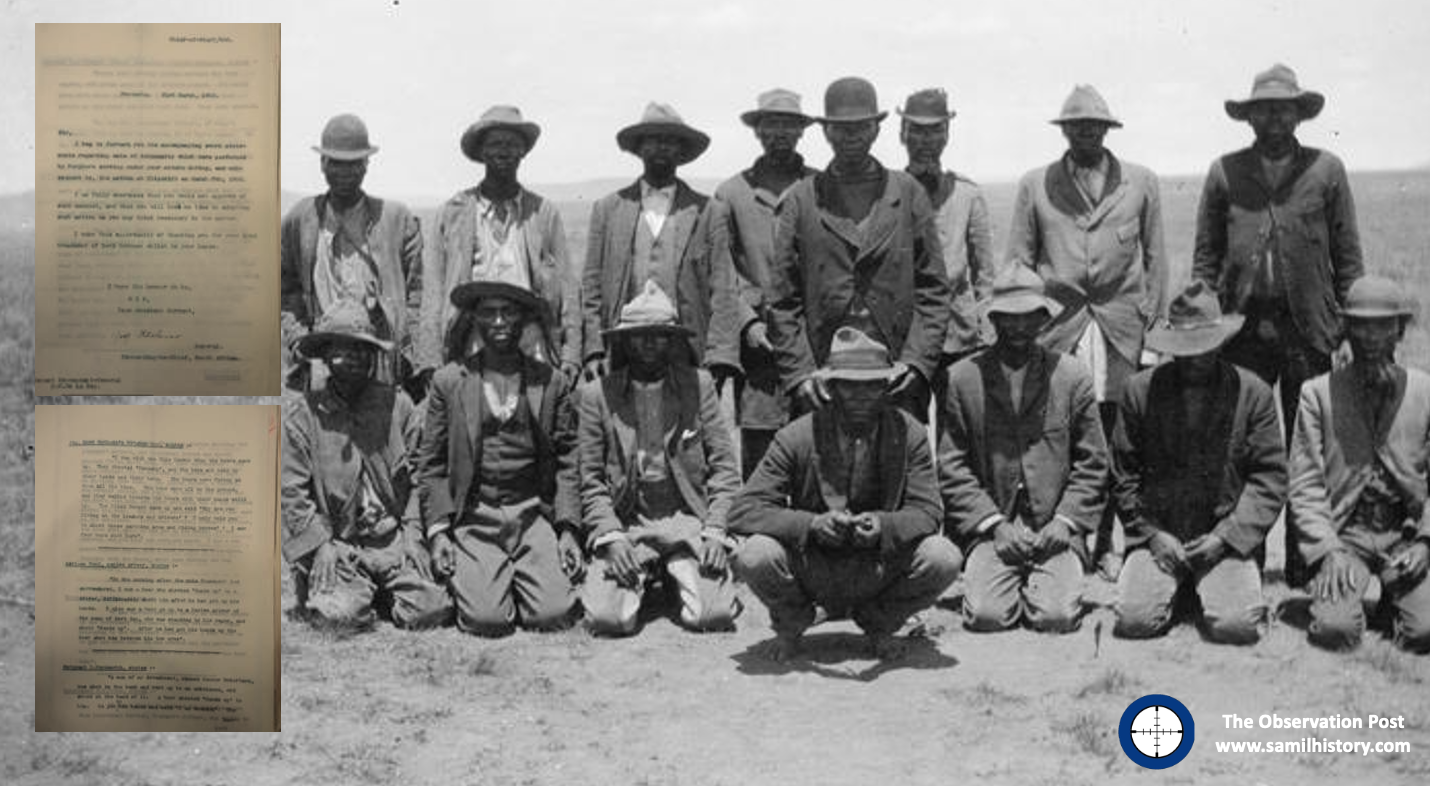
Referenced Observation Post: https://samilhistory.com/2024/02/04/war-is-cruelty/

Referenced poetry by Breaker Morant – Westward Ho:

Westward Ho by Breaker Morant
Butchered to make a Dutchman’s Holiday by Breaker Morant
At the River Crossing by Breaker Morant

With thanks to Johann Hamman, Robin Smith, Dirk Lombard, Gordon Mackinlay and Chris Ash.

Footnotes

  1. Correspondence Gordon Mackinlay and Peter Dickens – February 2024 ↩︎
  2. Boer hero’s remains stolen by Annie Olivier – News 24, 21 Feb 2003 ↩︎
  3. Correspondence Johann Hamman and Peter Dickens 2 May 2024 ↩︎
  4. Ibid ↩︎

What are the chances?

I was having a banter with an old SADF army pal of mine, and we recalled the great divisions between the “English” okes in the platoon and the “Afrikaans” okes in the platoon. There was always banter, and general unity and respect, we all faced the same hardship and threats, and we needed one another to survive so we were closer than blood brothers. That of course did not stop ‘the great divide’ caused by a Afrikaner nationalist identity, the ingrained idea that the “English” were the source of all Afrikaner trauma, the fierce need to be free of Britain’s tyranny and the mass exodus of Afrikaners from the British colonies in protest – the Great Trek, this would be followed by later by the indignation of the British invading their free republics and the fierce fight for independence again, a fight to the bitter end to protect an Afrikaner rebel hegemony and the right to the country.

Time and again, two key themes would re-appear – the idea that they all belonged to a ‘pioneer’ class of hard fighting frontiersmen – Voortrekkers and the idea they also all belonged to an equally hard fighting bunch of ‘bittereinders’ – all the time seeking independence from their traditional foe – the ‘English’ and all the time desirous of an Afrikaner Republic. It’s a repeat theme – you still see it even today then the Springbok XV meet the England XV. In the army, us ‘English’ okes were constantly singled out as the physical manifestation of this ‘foe’ – sometimes in jest but also sometimes taking a lot of abuse and you had to tread very lightly when accusations like “you put my Grandmother in a concentration camp” started kicking about – not that your forebears had anything to do with it whosoever.

Problem is – not all Afrikaners share a “pioneer” and “bittereinder” identity, they were artificially jelled into this identity in the late 1930’s by an all-white, all-Afrikaans and Broederbond driven Centenary celebration of the Great Trek. Pulled under a singular banner of Christian Nationalism. So much so that even if you look up ‘Afrikanerdom’ today you find it defined as:

Noun. (in South Africa) Afrikaner nationalism based on pride in the Afrikaans language and culture, conservative Calvinism, and a sense of heritage as pioneers (Voortrekkers).

But what are the chances? What are the chances that Afrikaners all share this unified ‘Pioneer’ and ‘Bittereinder’ identity – the coming together of which Henning Klopper, the Chairman on the Broederbond famously declared in 1938 as “a sacred happening” – God, according to Klopper, had ordained it. What are the chances indeed?

This is where economic history, hard stats, the maths, starts to punch massive holes into ‘political’ history and ‘identity’ politics. So, let’s begin at the very beginning.

The “Great” Trek

Let’s start with the “Great Trek”. There’s a lot of false and inflated numbers as to The Great Trek, but most accredited historians refer these Cape Colony figures.

From the commencement of British rule in 1806 – the Cape Colony had about 27,000 white burghers, 35,000 registered ‘ex-slaves’ and 17,000  Khoi Khoi descendants  – 79,000 total population. Of that total population only approximately 6,000 ‘Boers’ including an equal number of their ‘coloured’ servants and labourers on a 1:1 ratio (so 12,000 in total), left in the waves considered the Great Trek itself – and their jump points – Grahamstown, Uitenhage and Graaff-Reinet were hundreds of kilometres away from metropolitan Cape Town (in fact it was as far to travel to Bloemfontein from these jump points as it was to Cape Town). 

We need to think of them as the American white ‘pioneers’ settling the wild west in trailblazing wagon convoys – trying to negotiate land in “Indian” territory. The interior of South Africa above the Cape Colony and Natal Colony was not “empty” or “undiscovered” – like the “Wild West” it was already partly mapped by frontiersmen, nomadic farmers (trek-boers), hunters and missionaries. They would provide the network of ‘supply’ support to our plucky pioneers (Voortrekkers).

The “exploratory” first wave is not very successful. Louis Tregardt’s group is all but wiped out by disease – 52 people make it to Portuguese East Africa and return to Port Natal. Hans van Rensburg’s group (51 people) is wiped out by the Zulu – 2 children survive. Hendrik Potgieter and Sarel Cilliers have a party of 200. Gerrit Maritz has a party of about 700 (including servants). Piet Retief’s party starts with about 100 people, it links up with the other Voortrekkers and over 100 (including black servants/labour) are initially wiped out by the Zulu – the Zulu then wipe out more of Retief’s combined trek 282 Voortrekkers and 250 of their servants (there’s that 1:1 ratio) were killed along the Bloukrans during the Zulu attacks of the 16th and 17th February 1838. Piet Uys has a party of 100, and both he and his son are wiped out by the Zulu.

As we can see, there is already a major issue in trying to account the size of these treks – some account ‘white’ families only (and we have no knowledge of the number of servants – they are referenced but that’s about it), whilst others account both. Much work on the “Black History” of the Great Trek has yet to be done – the guardians of its ‘white’ history resisted it for decades.

Either way, whichever way you cut it, the chances of anyone been related by a direct blood line to the exploratory wave of the great trek are extremely slim if the published numbers are anything to go by – in fact it’s about 1% considering about half didn’t make it. Also, the ‘Zulu’ pose more of a threat to the Voortrekkers as a traditional ‘foe’ than the British ever did – it seems counter-intuitive to believe they would rather face certain death than face a British tax administrator and a colour blind Cape Franchise. There is clearly a lot more motivating this initial expedition and its highly nuanced.

That aside, let’s we stick to all the parties of Voortrekkers, the figure expressed in The Afrikaners : biography of a people by the famous Afrikaner historian, Hermann Giliomee – he notes 6,000 white Afrikaners over the period of the trek 1835 – 1840 (5 years) leaving the colony (so that’s 12,000 including Black Labour/servants on a 1:1 ratio – which tallies up with other references). So, given the size of the Cape Colony population and demographic there is only a 22% chance of any modern day white Afrikaner been related directly by bloodline to a white Voortrekker (Gillomee uses a different base and puts this figure at 10% – but let’s go with the higher figure and the benefit of the doubt). 78% of white Afrikaners are bloodline related to those who stay put in the Cape Colony and have nothing to do with the great trek whatsoever.

But, but .. but, there are loads of us “Boere” – you talking “kak” man comes a great retort from a great many. Well, not really would be my answer, let’s look at the economic history and the numbers.

There is, of course a natural economic migration of people, from the British Colonies and other places into the hinterland and into the small Voortrekker republics as they grow from strength to strength – from about 1840 (when the initial trek ends) all the way to the start of the South African War (1899-1902) a.k.a Boer War 2 – 60 odd years. It’s an incredibly slow migration, but speeds up substantially only from 1886 with the discovery of minerals in the ZAR (the OFS remains very sparsely populated). The economic migrants over this 60 year period consist of many white Afrikaners seeking bigger farms, mineral wealth or they settle as urbanised people seeking a “tabula rasa” opportunity with a trade, skill or service – shop owners, doctors, lawyers, miners, teachers – you name it. It’s not just white Afrikaners, they are joined by thousands of “English” 1820 settlers, other Europeans and even many Jews also seeking bigger farms, mining, commerce, service or trading opportunities.

Here’s the primary difference though, all these people are economic migrants seeking better business, wealth and lifestyle opportunities – they are not migrating because of any deep ‘hatred’ for the British or because the British took away their slaves. On the “numbers”, you would think from all the propaganda spewed out by Afrikaner Nationalists that a mass exodus of “true” Afrikaners had taken place and by the beginning of Boer War 2 most of them are “free-men” living in a Boer Republic, BUT – there’s a problem with this idea, its still NOT the case – not even after 60 years of migration and not even after the discovery of mineral wealth in the ZAR – the majority of Afrikaners, believe it or not, are STILL in the Cape Colony. Here are the numbers at the start of Boer War 2:

Boer War 2

The population of South Africa in 1899 was approximately 4.7 million persons with 3.5 million Africans making up 74% of the total. Whites, numbering 830,000 made up only 18% of the entire population. Asians and Coloureds total 400,000 or 8%. So whichever way you cut it, the ‘whites’ – Boer and British together, are a ‘minority’. 

But what of these two ‘white’ tribes? Where are they located after The Great Trek and economic migrations of the last 60 years. The white population are distributed among the two colonies and the two republics, In total 480,000 are Afrikaans-speaking, 58% of the total white population. Less than half of the Afrikaners lived in urban areas, most the ‘English-speaking’ population are urbanised and constitute 42% of the white population.

Also, most importantly, where are all these Afrikaners? Here’s the kicker, the majority of them are STILL in the Cape Colony – Great Trek aside. Afrikaners in the Cape Colony qualified as a bigger population of Afrikaners than the Orange Free State and Transvaal Afrikaners COMBINED. Data sources differ a little in the Transvaal I.e. ZAR, but it is generally understood that Afrikaners only really made up about half (50%) percent of the white population in the ZAR in any event, the other half are classified as ‘Uitlanders’ – mainly ‘British’ (it’s this imbalance that this is the principle Casus Belli advanced by the British as their reason for the 2nd Boer War). 

The Transvaal’s Afrikaners made up only 31% of the total number of Afrikaners in South Africa, with the Orange Free State having mere 15%. This total of 46% (approximately 219,000 people) shows that when Boer War 2 broke out, less than half of the total Afrikaners in South Africa were in the two republics that declared war on Britain. The Cape Colony and Natal, containing 54% of the Afrikaners, or 260,000 persons, never rose up and declared war against the British.

Although some 10,000 odd Cape Afrikaners did join the Republics forces as ‘Cape Rebels’ – this force when viewed against that of the general Cape Afrikaner populace is insignificant. Cape Afrikaners, and for that matter Natal Afrikaners too, simply did not rise up in any significant number to join the ZAR and OFS invasions of the two British colonies. Add to this that just about as many Cape and Natal Afrikaners joined the British forces which also counter-balances the argument somewhat.

The bottom line – the majority of Afrikaners simply decided not to rise up against their lawfully elected governments in the Cape and Natal, many decided to remain neutral and as a majority grouping of Afrikaners in general they simply did not participate in the war at all – that’s a fact. View it this way, the Cape franchise is such, that if the Afrikaner – the majority of voters – did not want someone like Cecil Rhodes in government. they could easily have voted him out.

The underpinning reality is that the Boer Generals planning the war and the Boer politicians claiming “Africa for the Afrikaner” failed to appreciate that many of the Cape Afrikaners were pretty happy under British administration for the near 100 years they are subjected to it, contented with the Cape franchise, many of them urbanised middle class and well to do and of the landed class many were very wealthy – as a demographic they are fundamentally different to their isolated frontier farming (Boer) Afrikaner brethren ‘up north’ facing an extremely hostile environment.

Poverty, famine and hardship was not an overarching issues in the British Colonies for many whites’ (Boer and Brit) in 1899 – nor does it seem that there was any fundamental discontent with their governance, representation and political disposition – and many simply did not view the ZAR’s “Krugerism” as a viable ideology or system of governance for Southern Africa – in fact Prime Minister William Schreiner, John X. Merriman and Jacobus Sauer had moved many in the Cape Colony’s branch of the Afrikaner Bond and Afrikaners in the Cape Colony in general closer to the British way of thinking. 

In a nutshell, half the available Afrikaners failed to take up arms against the British and the Boers fought the South African War 1899-1902 at half strength. So, in essence – they went off “half-cocked” against a world super-power to quote John L Scott’s conclusion on the numbers and the Boer Republics’ decision to invade British colonies.

So, here’s the statistical truth to a modern white Afrikaner – There is a 22% chance that their direct bloodline forebear was a Voortrekker, and a 54% chance that their direct bloodline forebear never took part in the Boer War, at all – the majority of Afrikaners simply did not take up arms, even when their northern brethren expected them to, even demanding they do it, still nothing happened.

The big question now, is of that minority – the 46% of Afrikaners who can claim a bloodline forebear who took part in the 2nd Boer War, how many of them joined the British and fought for them – the hated “joiners”, how many of them preferred neutrality “hensoppers” and how many qualify as the “true” patriotic Afrikaner irreconcilables – the “bittereinders”?

Bittereinders and Joiners

Let’s go with the most “conservative” Afrikaner chronology experts on this one, Pieter Cloete, and give some benefit of the doubt as numbers on the Boer War to the Boers as they vary considerably depending on whose recording them. Cloete in his chronology maintains there are 5,464 joiners (Republican Boers joining the British army to fight against their own countrymen) versus 20,779 recorded Bittereinders registered as still on Commando at the end of the war. So for every 5 Boers left in the field – 4 were fighting for the Republics and 1 was fighting for the British – a 4:1 ratio. Not a common or acknowledged bit of Boer War history – 26% of the Boers fighting at the end of the war were fighting FOR the British – a quarter of them, it’s a significant statistic.

This Figure becomes a little more skewered and complicated when you add the ‘Hensoppers’ and the ‘Prisoners of War’ – those that took the oath of neutrality and those that did not, those that went back on their oaths as well as the war dead and injured – but suffice to say that the stated majority of white Afrikaners are still not with the Boer Republic’s causes … at all. In fact many are even prepared to go to war with one another over it such is the extent of the disagreement.

This figure of white Afrikaner support for the Boer Republican ideal starts to really pale into insignificance after South Africa is made a Union in 1910. So let’s have a look at the Boer Revolt in 1914 as much Afrikaner legacy and Nationalist ‘volk’ heroes stem from it.

The Boer Revolt 1914

Upfront let’s look at the fighting numbers, in all during World War 1 (1914 to 1918) – no fewer than 146,000 South African whites volunteer to fight alongside Britain and France. A mere 7,100 South Africans volunteer to fight alongside Germany for the reinstatement of the Boer Republican paramountcy in South Africa – that’s only 5% of the entire white population volunteering to fight for one side or the other.

In the case of a proportion of these Boer Revolt fighters in relation to Afrikaners only – during WW1 every white in the census classifies themselves as ‘British’, and there are 1,400,000 of them. It’s hard to say who are English and who are Afrikaans, but if we apply the 40/60 ratio which exits most the way through our history – Afrikaners would account 840,000 – if we double the amount of Boer Rebels to include their wives in support – they would account 2% of the overall Afrikaner diaspora, even if we triple or quadruple the ‘Rebels’ number for sympathetic friends – they still remain a tiny minority – 3% to 4% odd.

And it’s not as if their leaders are in support of the Boer Republican cause and remaining neutral during the World War 1 either, this idea that the decision to go to war against Germany was rejected by the “majority” of Afrikaners is pure Hollywood – 92 members of the South African Parliament voted in favour of the war against Imperial Germany, and only 12 vote against. In the Afrikaner Party – the SAP, the vote is 82% in favour and only 18% against.

There is no doubt that Barry Hertzog’s break away from Botha and Smuts to form the National Party in 1914 re-kindled Afrikaner Nationalism in many white Afrikaners – primarily in the Orange Free State, a region hit by severe drought and an extensive share cropping farmer problem (bywoners) as a result of Boer War 2. Hertzog was a very popular Afrikaner Bittereinder General and held large sway. However, even this romanticising with nationalism the Afrikaner Nationalists are still a minority in the Afrikaner diaspora and even more so in the white diaspora at large. When the National Party first contend the General Elections in 1915 they win 29% of the votes (mainly in the OFS), whilst their brethren Afrikaners in the SAP get 37%. The ‘English’ parties alone match the National Party in size and have around 34% of the vote. This split down the middle in the Afrikaner diaspora is however beginning to rear its head again.

The 1938 Centenary Great Trek

What follows once the National Party get into power as a minority government, in a coalition with the Labour Party on the back of the Rand Rebellion in 1922 – is 15 years of unrelenting glorification of the 1914 Boer Revolt leaders, the execution of Jopie Fourie and the vilifying of General Smuts and General Botha. But even by 1938 the National Party still don’t have the stable majority they need, and there is still a massive split in the diaspora between the ‘Cape Afrikaner’ and the ‘Boere’ Afrikaner. That would all change with the 1938 Centenary of the Great Trek.

In 1938, the Broederbond under the directive of its Chairman, Henning Klopper sought to use the centenary of Great Trek to unite the ‘Cape Afrikaners’ and the ‘Boere Afrikaners’ under the symbology of the Great trek. In this endeavour artificially creating a shared heritage. He started a Great Trek re-enactment with two Ox-Wagons in Cape Town and addressed the large crowd of 20,000 spectators by saying;

“We ask the entire Afrikanerdom to take part in the festival celebration in this spirit. We long that nothing shall hinder the Afrikaner people as a whole from taking part. This movement is born from the People; may the People carry it in their hearts all the way to Pretoria and Blood River. Let us build up a monument for Afrikaner hearts. May this simple trek bind together in love those Afrikaner hearts which do not yet beat together. We dedicate these wagons to our People and to our God.”

By that he hoped to combine the ‘Cape white Afrikaners’ with the ‘Boer white Afrikaners’ in the symbology of the Great Trek under a fabricated Nationalist ideal of Christian Nationalism – and only meant ‘White’ Afrikaners in the Broederbond’s definition of what constituted ‘Afrikanerdom’ and not really the Afrikaans speaking peoples as a ‘whole’ – certainly not the Coloured and Black Afrikaners. The Trek celebration would be pitched as an assertion of Afrikaner white power in South Africa and the Trek as the true path to a overall South African nationhood and identity and ignore the histories of everyone else – black and white – in creating a future South African identity. 

Images: The 1938 Centennial Great Trek

In any event the trek re-enactment was very successful in re-aligning white Afrikaner identity under the Christian Nationalist ideal.  In the end eight wagons from all around the country threaded their way to Pretoria to lay the cornerstone of the Voortrekker monument – in front of a crowd of 200,000 people. Whilst at the same time, four ox-wagons went to the site of the battle at Blood River for a commemoration service on the 16th December. The wagons stopping in countless towns and villages all around the country along the way to re-name street after street after one or another Voortrekker hero, and laying imprints of the wagons wheels in freshly laid cement at many halts (there are still ‘imprints’ at my hometown in Hermanus – despite the fact that not one single Voortrekker came from this region).

The Centenary trek gave the Broederbond and the National Party symbology – the ox-wagon, gun-powder horns etc. on which to pin Afrikaner Nationalism that did not exist before. Gideon Roos would say of it:

“We (the Afrikaners) never had a symbol before; the ox-wagon became that symbol.”

The Broederbond had staggered onto the ideal way to ‘unify’ the Afrikaner – a round the country travelling carnival  – from the cities to the platteland, on to far flung corners and everything in between. Henning Klopper himself amazed at the reaction and the success of it all – so much so he turned to divine intervention and said:

“Although I organised it and had everything to do with it, I felt it was taken completely out of my hands. The whole feeling of the (centenary) trek was the working not of man, not of any living being. It was the will and the work of the Almighty God. It was a pilgrimage, a sacred happening.

A “sacred happening” – a miracle indeed.

It’s a Miracle!

What is a real miracle however, is that the ‘majority’ of Afrikaners would adopt this Voortrekker hegemony even when it is proven that most of them had nothing to do with the Great Trek, and that the two ‘separate’ hearts from Boer War 2 would only find commonality in the Bittereinders 40 years after the war. It’s a sheer miracle that the Broederbond managed to pull this off – and it’s no wonder that Smuts during World War 2 had to appoint a “Truth Legion” to counteract all the propaganda stemming from the Broederbond, re-setting identity and changing Afrikaner minds. So much so Smuts would call the Broederbond:

“a dangerous, cunning, political fascist organization”

He was not wrong, but the 1948 elections sealed it for the Broederbond, and Smuts was dead by 1950. The next 40 years are dominated by unrelenting Afrikaner Nationalism ideals and the banning, violent repression and gagging of any voices of dissent – including many Afrikaners.

A careful construct was put together which found Afrikaner heroes who were either Bittereinder Generals or 1914 Boer Rebels elevated to national worship. The irony is only those who were enamoured with racial segregation in their central politics were highlighted – and as leaders, either Boer War or 1914 Rebel, they had represented a minority of Afrikaners.

Whereas Afrikaners which sought unification and reconciliation – and were largely the most popular and effective leaders were airbrushed out – Jan Smuts and Louis Botha specifically, and so too all the Afrikaner military heroes who followed them, the military and political likes of Kommandant Dolf de la Rey, Group Captain Adolph “Sailor” Malan, General Daniel Pienaar, Group Captain Petrus “Dutch” Hugo, Mattheus Uys Krige, General Kenneth Reid van der Spuy, General George Brink, Major Jacob Pretorius, Lieutenant (Dr) Jan Steytler, Captain (Sir) De-villiers Graaff, Major Pieter van der Byl, Jan Hendrik Hofmeyr … the list goes on.

By the time I found myself in the Army most my Afrikaner brothers in arms were pretty convinced their heritage and identity lay with Voortrekkers and the Boer War concentration camps – and such is the power of identity many still believe in that – an entire nation baptised into a identity the majority had no connection to in the first place. Dr D.F. Malan would try to cement his sentiment when he said of Afrikanerdom:

To be a true patriot you have to embrace this Afrikaner Nationalism take on history – to do otherwise is not to be an Afrikaner.”

So – according to the National Party leader, as an Afrikaner, whether you are related to a Voortrekker, Bitteriender Republican or a 1914 Rebel or whether you are not, whether its your history or not (the irony, statistically speaking chances are you’re not). This is your heritage, history and identity, like it or not – or you’re not an Afrikaner – simple.

He went on to define this further, later Dr. Malan would say:

“An Afrikaner is one who, whether speaking the same language or attending the same church as myself or not, cherished the same Nationalist ideas. That is why I willingly fight against General Smuts. I do not consider him an Afrikaner.”

So, if your forebear joined Jan Smuts’ call to arms in World War 1, World War 2 or even voted for his “United Party” – and you’ve not adopted the Afrikaner Nationalist identity politics and their take on Afrikaner history – according to these Nationalists – you’re not considered an Afrikaner – you’ve somehow turned ‘English’. This attitude, believe it or not, still survives today. I took criticism from a local Freedom Front Plus councillor who authors Afrikaner history romanticism that my focus on was not on the true Afrikaners and I only praised selected Afrikaners who had sold out to the “crown” the ones with ‘English’ hearts – in that way he called me “anti-afrikaner” which is pretty odd considering the size of his bias and his total misconception of the Afrikaner diaspora.

Dr. Malan is not alone either, Adolf Hitler managed to do exactly the same to the German nation prior to Word War 2, using the same techniques, a similar ideology and the same brand of Nationalism. A miracle in every sense. It took a genocide and sheer destruction of their entire country and cultural construct to shake the German nation out of this malaise such is the power of it – its testament to what a determined minority government can do with the politics of pain and hatred if they really set their minds to it.

So, what are the chances – well the chances of the vast majority of Afrikaners been related to a Voortrekker is nil – maybe one in five are. The chances their bloodline forebear took part in the Boer War as a hard fighting Bittereinder Republican – maybe a one in three chance. Chances are that their forebear was a Boer Rebel is incredibly slim, there’s a far better probability that he fought against the rebels and joined up with Jan Smuts – chances of that happening are pretty good. Which makes it odd is that the Afrikaner leadership, when in the pound seats from 1948 to 1994, chose to force the traitorous 1914 Boer Rebels onto just about everyone as national heroes (Beyers, Fourie, de Wet, Kemp, Martiz etc.) in just about every medium, when in fact they are an anathema to the general public, black and white – including a great many Afrikaners.

The chances of anyone hitting the trifecta jackpot, a bloodline direct link between a Voortrekker, Bittereinder and a Rebel to make up a “Pure” Afrikaner at heart (as is the basis of the Afrikaner nationalist myth) – this is a very slim chance statistically speaking – its incredibly rare. However the Federasie van Afrikaanse Kidtuurverenigings (FAK) the old Broederbond front organ still co-ordinates events promoting this mythology and identity to the modern Afrikaner generation … and unless they too are exposed to the extent of the National Party’s nefarious ways and flawed ideologies chances of many of them putting any of this identity politics into proper perspective are equally slim.


Written and researched by Peter Dickens

References:

The Afrikaners : biography of a people (Reconsiderations in Southern African History) Published 2010 by Hermann Giliomee

British Concentration Camps of the second South African War (the Transvaal 1900 to 1902), Masters thesis – published 2007 by John L Scott

1899 Population data comes from state almanacs and is found in an essay by Andre Wessels ‘Afrikaners at War’, John Gooch (editor), The Boer War. Published 2000

The White Tribe of Africa – South Africa in Perspective: Published 1981 by David Harrison

The Union of South Africa censuses 1911-1960: an incomplete record: By A.J. Christopher

The Anglo-Boer war: A chronology. By Cloete, Pieter G

The Economic History of the Boer nation from 1880 to 1980. Rhodes University Economic History paper – 1988 by Peter Dickens

Related Work

Smuts’ Truth Legion A search for the … Truth … Legion!


Something is rotten in the state of Denmark!

Shakespeare provides us with a wonderful quote from Hamlet, it’s in the opening act, and it’s said by Marcellus on seeing the King’s ghost: “Something is rotten in the state of Denmark” – it’s a forewarning that there is sedition afoot in the state, real trouble is coming. It is appropriate when viewing the newly formed Union of South Africa, as within a year of its formation the old Boer War hero – General Louis Botha can already sense sedition in their camp. As Prime Minister, he tasks General Smuts as his Minister of Defence to set up the South African Union’s Defence Force and amalgamate the old Boer Republic’s Commandos with the old Cape and Natal Colonial Regiments.

Walking a political tight-rope of “reconciliation” post the South African War (1899-1902), Smuts appoints a staunch Boer “Bittereinder” General, Christiaan Beyers, as the head of the South African Union Defence Force’s Active Citizen Force (the largest contingent within the force made up by a majority of Afrikaners). His appointment largely a symbolic gesture to the “irreconcilables” in the Afrikaner diaspora.

On the 4th July 1911, Louis Botha in his capacity as Prime Minister wrote to General Jan Smuts to express his bewilderment that Smuts had appointed General Christiaan Beyers as the head of the Active Citizen Force. He does not hold back and what he says is very telling:

“Dear Jannie, You really are lazy to write so little. How is it possible that you have appointed Beyers? I do hope that you did not agree to it, because you certainly have no greater enemy there. He is not a persona grata (welcome person) with our people and still less so with the English. The Bar, no doubt, also does not approve of it and the Judges will be angry. I can swallow anything but this is impossible.”

Christiaan Beyers, would go on with his appointment, and only just 2 years after his appointment in the Union Defence Force, he would try and scuttle the Union’s decision to go war against German South West Africa. He unsuccessfully campaigns to get resignations from the UDF so as to render it toothless. Thereafter he unsuccessfully campaigns for De La Rey to join his treasonous plot. He joins hands with Manie Maritz, Christiaan de Wet and Jan Kemp in a treasonous soup and initiates the Boer Revolt of 1914 – inadequately planned and inadequately resourced the revolt is an outright failure – strategically, operationally and tactically. Lasting mere months and attaining none of its stated objectives. Beyers would drown in the Vaal river trying to escape his hunt on the 8th December 1914 (later supporters of Beyers would point out that he never fired his handgun when his body was recovered, as if to somehow say he didn’t really intend to kill fellow Afrikaners – but that’s merely an apologist’s stretch, Beyers had every intent given his Commando’s actions and his entire act was that of high treason whichever way you cut it).

The revolt does however pitch Afrikaner against Afrikaner, driving deep scars into the Afrikaner psyche. It would drive a political wedge into the Afrikaner diaspora, and in the strangest turns of fate, many Afrikaners by the 1980’s, after decades of Afrikaner Nationalist propaganda, would oddly juxtaposition the concept of “treason” – and start calling Smuts the “traitor” and Beyers the “hero” (even to this day he is cited in this community as a “volks” hero). Also, rather inexplicably Louis Botha somehow escapes this ‘traitor’ paint-brush as the Afrikaner Nationalist vitriol is almost exclusively targeted at Smuts. 

Botha in this letter to Smuts is being nothing more than prophetic – calling out Beyers as an ‘enemy’ and a ‘persona non grata’ (an unacceptable person) to the Afrikaner nation. There is obviously no love lost between these two men and Botha sees Beyers as a treasonous snake not with the program of a peaceful coexistence between English and Afrikaans South Africans and at odds with the vast majority of South Africans in general. Smuts, eternally seeking a careful balance of everyone’s opinions in the Afrikaner diaspora, has his efforts backfire on him considerably. 

To read more on the Boer Revolt, follow this link: Boer War 3 and beyond!


Written and Researched by Peter Dickens
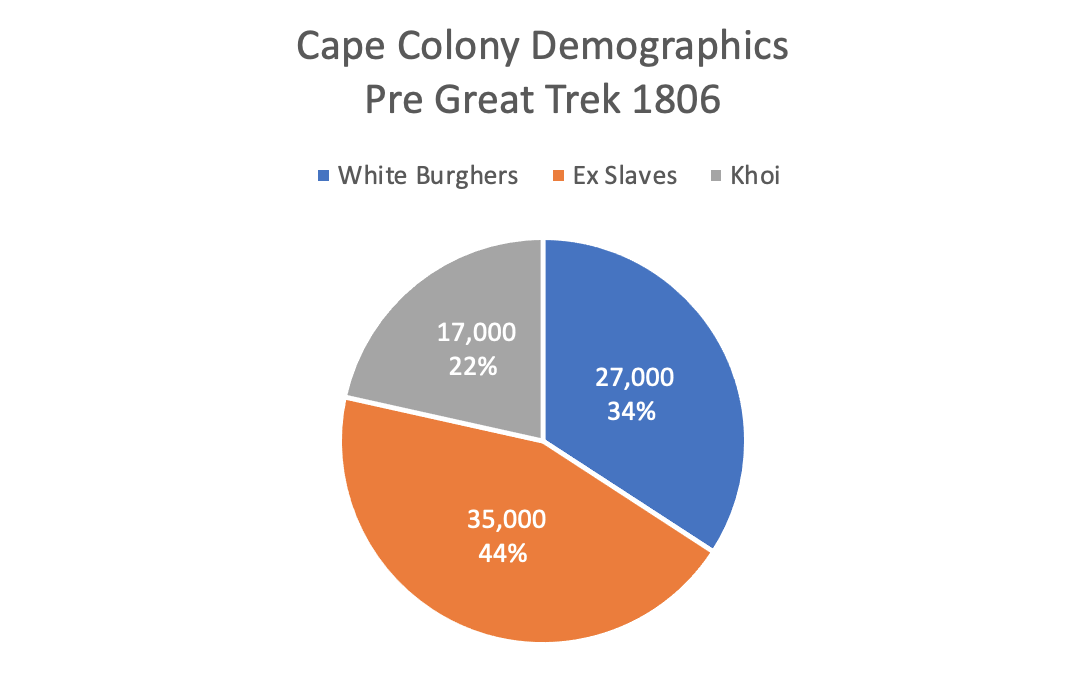
Quoted Reference: Selected Smuts Papers – Volume III by W.K. Hancock 

William Shakespeare, Hamlet: Act 1 Scene 4

Thanks to Jenny B Colourising for the two great images of Botha and Beyers.

Classical Smuts

What I love about General Jan Smuts is his ‘classics’ education and intellect, it’s used to rapier effect and you need to be on your toes when reading his material.

Here’s an example, this is a letter – June 1902, from Jan Smuts’ to his wife Isie directly after the South African War (1899-1902), there are two parts which are noteworthy, the opening statement for its raw frankness and humility – it gives insight into how the guerrilla campaign is fought and the peace conditions it was fought for, and then the part where he informs Isie of President Steyn’s health. Here’s the first part:

“My darling Isie, The tragedy is over. The curtain falls over the Boers as British subjects, and the plucky little Republics are no more. Peace was signed last night at Pretoria. You can imagine my feelings on the subject; you will perhaps not be surprised to hear that I worked for peace. I did my best for our cause as long as there was any chance; but I had become convinced that the struggle had become hopeless. So we shall start afresh, working along the lines opened by the new conditions. I accept my fate – that is the only manly course left.”

The next bit on President Steyn’s health is where you need to pull out your copies of Shakespeare. Smuts informs Issie of the following news:

“I shall be very glad to hear how your health is progressing; write to me c/o General Sir John French and don’t forget I have reverted to plain J. C. Smuts. I am very sorry to tell you that President Steyn’s health is quite gone; sort of gradual paralysis; he cannot last long. He was the last of the Romans.”

Now, what does he mean by … ‘he was the last of the Romans’? It comes from Shakespeare’s Julias Caesar and it’s a quote from Brutus when he sees Cassius’ dead body, he says:

“The last of all the Romans, fare thee well! It is impossible that ever Rome should breed thy fellow. Friends, I owe more tears to this dead man than you shall see me pay. I shall find time, Cassius, I shall find time. Come, therefore, and to Thasos send his body.”

In other words Jan is saying to Isie that President Steyn was the last of a special breed of Afrikaner, the likes of which will not be seen again. He is under no illusions that Steyn will die shortly, and he is implying that he must get to work on immediate important issues (which is to secure amnesty for the Cape Rebels) and will mourn the death when he has the time.

Now, that’s deep. Luckily Isie was a well renowned intellectual herself and trained in ‘classics’ – so she would have understood exactly what Jan was trying to say to her.

Classics eh! You can’t beat it, Plato’s Philosopher King in action.


Written and Researched by Peter Dickens

Quoted Reference: Selected Smuts Papers – Volume II by W.K. Hancock

Hitler’s Boer War

This is a famous speech, 30th January 1940 at the Sportspalast by Adolf Hitler and it had a significant impact on South Africa which very few people know about today. It’s Hitler’s take on the South African War (1899-1902) a.k.a. Boer War 2.

The speech is a lash out against Britain for declaring war against Nazi Germany for the invasion of Poland. Hitler in his speech seeks to paint Britain and the warmonger – and not Germany who we paints as Britain’s victim after the Treaty of Versailles – which he equates as Britain’s “Bible” as they have forsaken God and Christianity in favour of greed and materialism (unlike the God fearing Germans who keep a puritan faith).

To view Hitler’s speech on 30th January 1940 at the Sportspalast in full, here’s the YouTube link:

To ground his argument he uses the Boer War, and makes two significant points, he says:

“They (Britain) waged war for gold mines and mastery over diamond mines.”

Then later in the speech Hitler says:

“When has England ever stopped at women and children? After all, this entire blockade warfare is nothing other than a war against women and children just as once was the case in the Boer War, a war on women and children. It was there (South Africa) that the concentration camps were invented, in an English brain this idea was born. We only had to look up the term in the dictionary and later copy it .. with only one difference, England locked up women and children in their camps. Over 20,000 Boer women (and children) died wretchedly at the time. So why would England fight differently today?” 

Now, I’ve seen people on social media immediately conclude that this is yet another rant of a mad-man, Hitler was a megalomaniac with more mental issues than you wave a stick at. As for Nazism – that’s pure evil, nothing to do with good Christians, Afrikaners and the Boer War thanks – no words from the madman here, linking Hitler and World War 2 to the Boer War is mischievous and contentious!

But here is a problem, this is 1940, Hitler is at the absolute pinnacle of his power. Nazism is at the absolute zenith of its popularity – millions, literally millions of Europeans are in favour of the “The Third Reich”. People today don’t really understand what the ‘The Third Reich’ was all about … in a modern construct its a early form of the European Union, only the EU head office is not in Brussels its in Berlin – the Third Reich is all about free trade, semi-open borders, freedom of movement and freedom to assimilate and commercially transact in Europe – its a wealth generator. It’s about respect for “cultural boundaries” according to Hitler – but in reality he’s hoodwinking again – behind the scenes it is in fact a “vampire economy” as Germany gears all its production from food to armaments to war and directs all economies to itself and its nefarious ends.

Adolf Hitler giving a speech at the Berlin Sportspalast

You can hear about all of this in the first 10 minutes of Adolf Hitler’s speech – its a utopian concept, and millions across Europe – in Germany, Austria, Fascist Italy, Hungary, Romania, Fascist Spain – even Belgium, Norway and the Netherlands and literally the whole of the south of France (Vichy France) are into this free trade union with Germany (in fact by definitions of the EU they still are – and immediately after the war ended they strove to get back to it only this time with a different leadership construct without the ‘vampire economy’ ideal).

The speech is also music to the ears of South African Neo-Nazi movements on the far right political spectrum in South Africa, the “cultural fronts” of Afrikaner Nationalism – The Ossewabrandwag, the Grey Shirts, the Black Shirts, The Boerenasie Party and the New Order. All have adopted National Socialism in one form or another and all have declared open admiration for Adolf Hitler – and he’s saying the right stuff, Britain is the warmonger, Britain is greedy for Boer gold and diamonds and Britain waged genocide against Boer women and children. A European world leader, an iconoclast in 1940, a national hero to millions said so. This speech streaming into Afrikaner homes across South Africa by Radio Zeesen (the Nazi Germany’s foreign radio service also broadcasting in Afrikaans).

Mein Kampf

And what’s not to like about Hitler in 1940, he’s a firm fan of the Afrikaner Nationalist cause and shares the ‘politics of pain’ of the Boer War with them. Hitler would write of the Boer War in his autobiography Mein Kampf in 1935: 

“The Boer War came, like a glow of lightning on the far horizon. Day after day I used to gaze intently at the newspapers … overjoyed to think that I could witness that heroic struggle.”

Hitler would put his money where his mouth is and engage his propaganda ministry to drive his opinion on the Boer War, Joseph Goebbels on 19 April 1940, on Hitler’s birthday speech, would broadcast over Radio Zeesen (and others), and he said:

“Get rid of the Führer or so-called Hitlerism … British plutocracy had tried to persuade the Boers during the South African war of the same thing. Britain was only fighting Krugerism. As is well known, that did not stop them from allowing countless thousands of women and children to starve in English concentration camps” 

Dr Erik Holm – the South African Afrikaans broadcaster for Radio Zeesen would recall Hitler’s open admiration for General Christiaan De Wet during the Boer War and his guerrilla tactics in flummoxing the British – from conversations he personally had with the Führer on the Boer War.

Ohm Krüger

Then there is Ohm Krüger (1941), a movie about the Boer War – Joseph Goebbels’ masterpiece. Winner of the Reich Propaganda Ministry’s “Film of the Nation” rating (one of only 4). A propaganda masterpiece which would reach millions all across Europe, complete with a massacre at the end of hundreds of Boer women as they are mowed down execution style by a skirmish line of British tommies (a scene repeated by Nazi Germany against Jews all over Europe).

Directed by Hans Steinhoff and starring Emil Jannings, Lucie Höflich and Werner Hinz. Although the plot has nothing to do with Germany, the story centres around a character which the Germans could admire, “Uncle” Paul Kruger – a man the Propaganda Minister wants to draw parallels to Adolf Hitler, who he deems is also a man with a common touch, from a simple background and one who is thrust into extraordinary circumstances due to international aggression and a conspiracy of greedy ‘foreigners’.

Waffen SS

The Boer War and Paul Kruger are even used by the Nazi propaganda ministry for recruitment into Dutch Corps of the Waffen SS. In fact the Dutch and Belgians in the Waffen SS Regiment Westland and other SS corps and Wehrmacht formations made up over 25,000 members – the backbone of the Waffen SS.

Press Junkets

During a press interview Hermann Göring (the spokesperson on behalf of Adolf Hitler), took a leaf out his Führer’s leader’s book on the Boer War when he deflected a challenge from Sir Nevile Henderson, the British ambassador to Berlin who protested about the German government’s use of concentration camps for the political ‘re-education’ of German’s dissonant non-believers in Nazism and opposition in 1935, and using a ‘press stunt’ Göring dramatically sprung up, walked over to a bookcase and like a thespian actor, grabbed a German encyclopaedia opening it at “Konzentratinslager” (concentration camp) he read out loud: 

“First used by the British, in the South African War”.

Although factually incorrect, his action served as a skilful stroke of deflection of which Hermann Göring was a past master.

Nationalism – two separate peas, same pod!

That the Boer War is nuanced was not on Hitler’s agenda, the fact that the British did not “invent” the concentration camp, the fact that diamonds were already on British soil, the fact that the gold mines in the Transvaal were already owned by British and German private consortiums, the fact that the Boers also first brought ‘British’ women and children into the conflict by driving the ‘Uitlander’ population out of Johannesburg, including all the black mine labour, then declaring war and invading British sovereign territories and laying their towns to siege (with British citizens – black and white – in them). All this mattered not a jot to Adolf Hitler.

Hitler in his speech and radio broadcasts is also reinforcing Anglophobia and Republicanism, he is giving re-assurance to the Afrikaner nationalist cause from Berlin. To understand this better, Afrikaner Nationalism starts in earnest with the establishment of the National Party in 1914 – at this stage it has as its central ideology ‘Krugerism’ – Kruger’s political philosophy and the old ZAR’s (Transvaal) Republicanism constitution and race laws (Grondwet) at its centre. An Oligarchy bordering on a Theocracy with no political emancipation for Black Africans whatsoever (the majority), and racially based franchise and citizenship restrictions for white ‘foreigners’ (read “British” and Jews).

By 1940 this party has evolved its ‘Krugerism’ ideology to a ‘Christian Nationalism’ ideology – a political philosophy which B.J. Vorster (a future South African head of state) famously equated with National Socialism (Nazism) in 1942 when he said:

“We stand for Christian Nationalism which is an ally of National Socialism. You can call this anti-democratic principle dictatorship if you wish. In Italy it is called Fascism, in Germany National Socialism and in South Africa, Christian Nationalism”.

Two people in history play a significant role in generating myths around the Boer War, building into it Afrikaner nationalism constructs and identifying trigger areas for the “politics of pain” necessary for a Christian Nationalism or National Socialism ideology to surface and survive. Known as Hegemonic Nationalism this shared type of Nationalism needs an identified “internal” economic enemy and a “external” political enemy – all grounded on a specified nation’s ‘trauma’. In the case of German National Socialism, it’s World War 1, the Treatise of Versailles is the villainous instrument, the economic enemy is “Judaeo-Capital” profiteering off their misery. In the case of Afrikaner Christian Nationalism it’s Boer War 2, the British concentration camps the villainous instrument, the economic enemy is “British-Judaeo Capital” (“Hoggenheimer”) profiteering off their misery.

The first chap to build up all this nationalism is a fellow by the name of Henning Klopper – he is the Chairman of Afrikaner Broederbond in 1940, Klopper survives a Boer War concentration camp at the tender age of 6 and cannot understand why his older brother is isolated with measles, assuming that Britain murdered him and its all a campaign of genocide – Klopper would use this to principally guide Christian Nationalism as the Broederbond’s official ideology.

The other person is Adolf Hitler himself, one cannot under-estimate his influence, it still influences how the Boer War is seen and understood in Europe to this day – an example is the British “invention” of concentration camps – a myth which still holds right across Europe, the British used the concept of concentrating civilians in camps whilst they fought a guerrilla war (like the Spanish and the United States before them) no doubt there, but they certainly did not “invent” the concept (the Spanish did). To dismiss Hitler as irrelevant to the Boer War is to dismiss factual and relevant history and in fact to censor it for no good reason serves only to distort history.

In Conclusion

On linking Nazism, Kruger, Krugerism and Christian Nationalism, I’m afraid the hard truth is that linking Kruger to Hitler was done very effectively by the German propaganda ministry in Europe prior to and during World War 2. The Afrikaner Nationalist ‘right’ in their support of Nazi Germany during WW2 and infusing the ideology of Krugerism with Weimar Eugenics to create Afrikaner Christian Nationalism certainly creates a linear relationship and reinforces the argument on exactly who is culpable for the ideals of Apartheid.


Written and Researched by Peter Dickens

Related work:

The Nazification of the Afrikaner Right – Torch Commando series – Link here: The Nazification of the Afrikaner Right
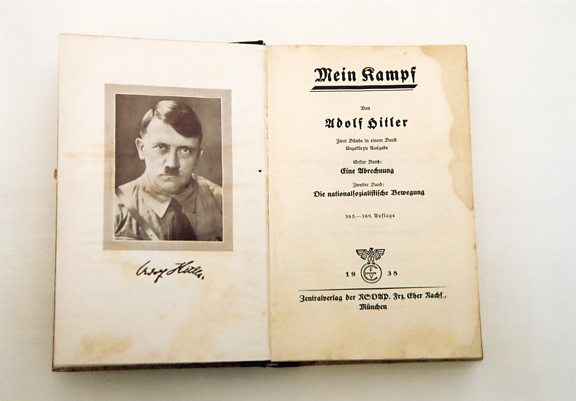
Uncle Kruger – the movie and the myth – link here: Oom Kruger, the man, the movie, the myth!

British-Judaeo Capital – Hoggenheimer – Link here: Just whistling an innocent ‘toon’

The myth around the invention of concentration camps – Link here: Debunking the myth that the British invented the ‘concentration camp’

References:

National Socialism and Nazism in South Africa: The case of L.T. Weichardt and his Greyshirt movements, 1933-1946. By Werner Bouwer.

Ohm Kruger/Uncle Kruger: The notorious of Nazi Germany’s Anti-British Statements. By Blaine Taylor.

Pro-Nazi Subversion in South Africa, 1939-1941: By Patrick J. Furlong.

The Rise of the Afrikaner Reich: Published 1964. By Brian Bunting