
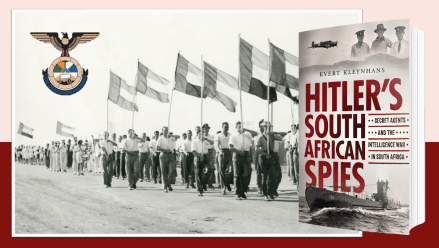
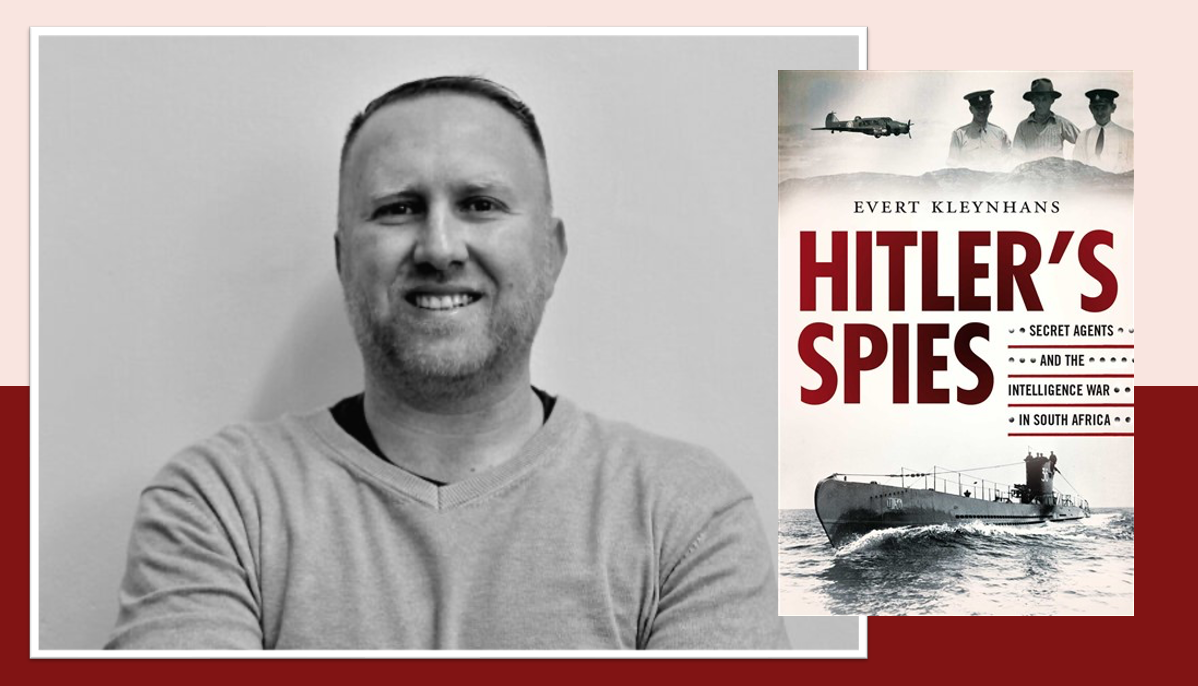
You can tell it’s the holidays as I am getting to some book reviews I’ve been promising – and this book by Dr Evert Kleynhans “Hitler’s Spies: Secret Agents and the Intelligence War in South Africa: 1939 – 1945” had me reacting like the ‘Strictly Come Dancing’ Judge Anton Du Beke when a celebrity performer receives a 10/10. Du Beke usually becomes highly animated, jumps up, fist pumps and joyously shouts out … YES! BRILLIANT! NAILED IT! FINALLY! I KNEW IT ALL ALONG!!!!! … my wife found me putting down Evert’s book after I finishing it and very amusingly behaving like a rather euphoric and unhinged Du Beke.
So why so happy? There’s a bit of a backstory to this delirious happiness, so bear with me. Over six years ago in 2017 – I published an Observation Post called “Mein Kampf shows the way to greatness for South Africa” – The Ossewabrandwag. I had sought to find and publish the proof of conversion to Nazism by this “cultural front” to Afrikaner Nationalism.
I had managed to build this Nazi link easily with movements like the ‘Grey-shirts’ – The South African Christian National Socialist Party (SANP) – led by Louis Weichardt and the ‘Black-shirts’ – the Volksbeweging (People’s Movement) or ‘African Gentile Organisation’ led by H.S. Terblanche – these shirt movements with their “Blue, White and Orange” arm-band swastikas were clearly Nazi to the core . The National Socialist Rebels – led by Robey Leibbrandt were also easy and really obvious given he was a covert Nazi appointed operator. The National Socialist Boerenasie (Boer Nation) movement – led by the Boer Revolt hero and rabid anti-sematic Manie Maritz was equally clear – all these movements had fully adopted National Socialism in their missions and even swastika iconography into their images, mastheads and positioning – so proving them as out and out Nazi was easy.
Not so the Ossewabrandwag (OB) – proving their Nazi affiliations is somewhat more difficult. It’s the veneer of the Ossewabrandwag (OB) that’s the issue – their clear “anti-British” stance due to Boer War 2, and their clear positioning as the “cultural front” of Afrikaner Nationalism, with the National Party operating as the “Political front” – this makes it so difficult to pin a case of Nazism on them. The Ossewabrandwag’s Voortrekker origins and mission as “mapping a path” to a ‘white’ South African Republic with a white Afrikaner hegemony using these voortrekkers (pioneers) as the vehicle – all working very succinctly with the National Party which adopted the same voortrekker iconography and mission in its image and political its resolve for a future Republic.
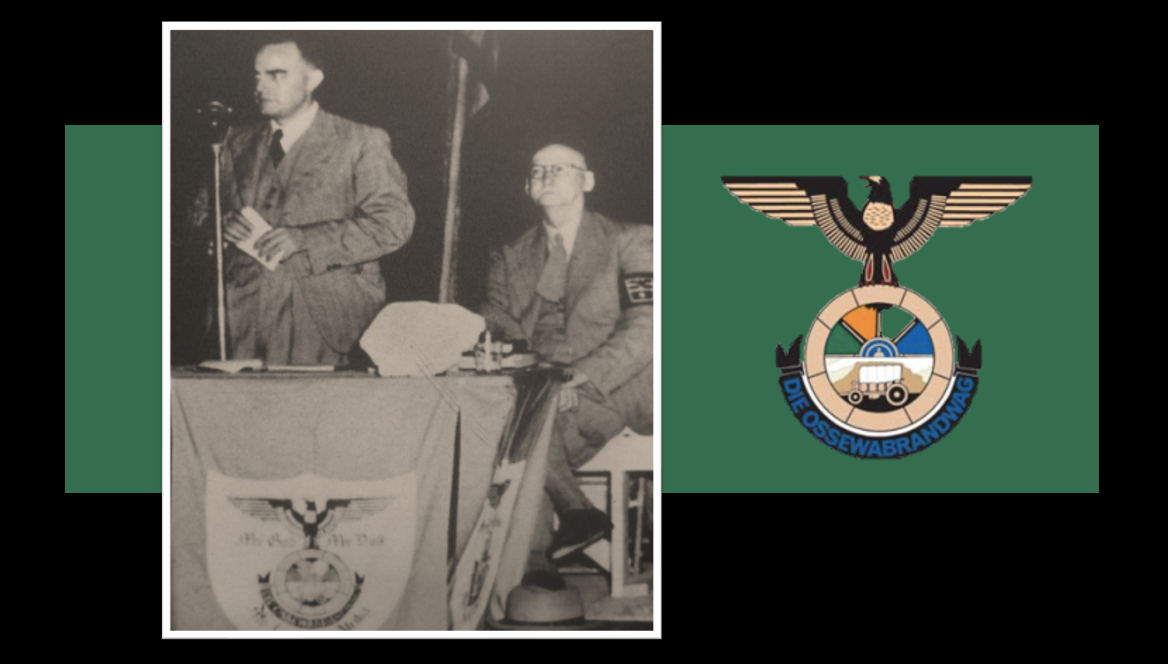
To smear an organisation like the OB which boasted about 300,000 active middle of the road Afrikaners (to whom nearly a million modern Afrikaners are now related) with a “Nazi Brush” is not an easy task – it is as Afrikaans as a Hertzoggie cookie.
You can argue that the introduction of the Stormjaers within the OB with their military ranks, insignia, salutes and blood oaths are distinctively Nazi, so too their armed ‘sabotage’ campaign can be seen as ‘assisting’ Nazi Germany in their war effort and by their very actions treasonous. You can argue that the OB’s ‘Commandant-General’ Johannes (Hans) van Rensburg was a disciple of Nazim and admirer of Adolf Hitler and built into the OB the distinctive Nazi ideologies of “blut und Boden” (Blood and Soil), their “Give us a master” call for the implementation of the “Führer principle”, their call for the removal and expropriation of “British-Jewish” controlled capital. Their racial constructs and policies which relegated “English speaking” South Africans to secondary citizenship and lumped Jews and Blacks as “Untermensch” – racially inferior and “insoluble” in white Afrikaner every-day life. All of that is distinctively Nazi right?

You can even pick out choice statements by key OB leaders as to the OB’s distinctive Nazi roots – ‘from the horse’s mouth’ so to speak. The firebrand nature of the Ossewabrandwag appealed to B.J. Vorster (a future nationalist Prime Minister and President of South Africa) more than the National Party. On Nazism and the OB and said in 1942:
“We stand for Christian Nationalism which is an ally of National Socialism. You can call this anti-democratic principle dictatorship if you wish. In Italy it is called Fascism, in Germany National Socialism (Nazism) and in South Africa, Christian Nationalism.”
The Rev. Koot Vorster (B.J. Vorster’s brother), a Dutch Reformed Church minister, and like his brother was also a predominant Ossewabrandwag leader, crystalised this idea of Afrikaner totalitarianism when he summed up the pro-Hitler and Pro-Nazi standpoint of the OB during an address to a student group on September 15, 1940 and said:
“Hitler’s ‘Mein Kampf’ shows the way to greatness – the path of South Africa. Hitler gave the Germans a calling. He gave them a fanaticism which causes them to stand back for no one. We must follow this example because only by such holy fanaticism can the Afrikaner nation achieve its calling.”
Kowie Marais, an OB member and key member of the Broederbond, years later recalled in an interview the admiration he and his friends held for Hitler:
“We thought (Hitler) might rejuvenate western civilization … against the communist-socialist trends that were creeping in from the east. We thought it was the dawn of a new era.”
All these links to Nazism matter not a jot to many Afrikaners still convinced that the OB was merely a “cultural organisation” to spread the edicts of Christian Nationalism as outlined by Henning Klopper, then the Chairman of Broederbond, in his famous 1938 centenary of the Great Trek. To literally spread this new ideology of Afrikaner nationalism like ‘wildfire’ throughout the country and unite the white ‘Cape’ Afrikaners with the ‘Boer’ Afrikaners up north (hence the name Ox Wagon Sentinel or ‘Fire Watch’), a job it did very successfully, so much so Klopper praised it as a divine event and called it a “sacred happening” – God had ordained it (according to the Broederbond at least) – and to a audience of Calvinists and Puritan Christian Protestants this had meaning .
Nothing to see here!
But how come this general malaise? How is it that all this Nazism is ignored? It boils down to the simple fact that by the end of World War 2, just about every National Party minister had been in the OB or in organisations affiliated to it, only a handful of ministers – men like D.F. Malan had not flirted directly with Nazism. The Nationalists had to be squeaky clean and re-invent themselves completely if they stood any chance to win the 1948 elections and then hold onto power. The reason they “sat out” the war with Nazi Germany was not because of any great affinity to Adolf Hitler and his cabal, it was because they were purely anti-British. They were simply against Jan Smuts’ ideals of Union and sought national independence and self-determination by way an Afrikaner Republic – they were just avowed Republicans whose identity was forged by Britain’s treatment of their women and children in the Boer War concentration camps.

B.J. Vorster would cry complete innocence, often declaring in interview after interview that Smuts had unjustly imprisoned him during the war and the only reason given to him for his incarceration was because he was merely “anti-British”. The true reason for his imprisonment which was that he harboured previously interned fugitives on the run during the war was conveniently buried, in fact by the mid 70’s it was all under embargo and ‘lost’.
Even the OB leader – Johannes (Hans) van Rensburg – did a compete about face once Nazi Germany lost the war in 1945, he turned around and rather regretfully said:
“It was the greatest disaster in my spiritual life to realise suddenly that the people I had thought to be the heroes of a new era in western civilisation should in fact turn out to be just a band of murderers and nothing else.”
He went further in his autobiography to state his fight was always one of Afrikaner patriotism and a simple fight against Smuts and his policies – he reiterated that as the leader of the OB he had instructed his Stormjaers to sabotage the Union’s war effort so as to keep the soldiers in South Africa and prevent ‘sons of the soil’ – Afrikaners – been sent overseas to die for Great Britain. He was clear in his instructions that no Union soldier would die by the hand of an OB Stormjaer. So – nothing to do with high treason and nothing to do with actively supporting Nazi Germany by way of killing any UDF members, and everything to do with Afrikaner patriotism instead.
He would remark on the OB’s achievements in his autobiography:
“I fought (Smuts’) war effort and I fought it bitterly with all the means at my disposal – which were considerable…. There is no doubt that they (the Ossewabrandwag) seriously hampered the government’s war effort. Hampered it because the government was forced to draw off considerable manpower to guard many strategic points and essential services. A not inconsiderable military element also had to be retained in South Africa as a strategic reserve for possible emergency.”
That in reality the OB played no significant tactical, operational or strategic role in curtailing South Africa’s war effort whatsoever mattered not a jot to van Rensburg, in his mind he did a great service and was pure of Afrikaner heart.
The cover up
During the war, the South African intelligence services under Colonel Ernie Malherbe and the British intelligence services had collected a wealth of information directly linking the OB and the Broederbond to the Nazi German war effort. After the war ended, the Smuts’ government found itself having to implement commissions to investigate all the cases of High Treason, committed by organisations like the Ossewabrandwag, the Grey Shirts, the Broederbond, the New Order etc – additionally treasonous acts by South African nationals joining the German military directly, or joining German propaganda and intelligence services directly and also German and foreign nationals operating in South Africa as spies were to be investigated. Called the Barrett Commission it published its findings to limited ‘eyes-only’ circulation at the end of 1947, but these findings were deemed as political fireworks and embargoed pending the outcome of the 1948 elections scheduled early in the new year.
The fateful 1948 election and unexpected National Party win would change all of that, the newly appointed National Party Minister of Defence (and ex-OB member) Frans Erasmus would walk into the South African Intelligence Services archive, he fired the Officer Commanding on the spot and removed “two lorries” worth of incriminating evidence – never to seen again! The newly appointed National Party Minister of Justice (and ex-OB member) C.R. “Blackie” Swart would obtain the original Barrett Report and recall all the circulated copies of the Barrett report and all its appendixes and supporting documents – never to seen again!
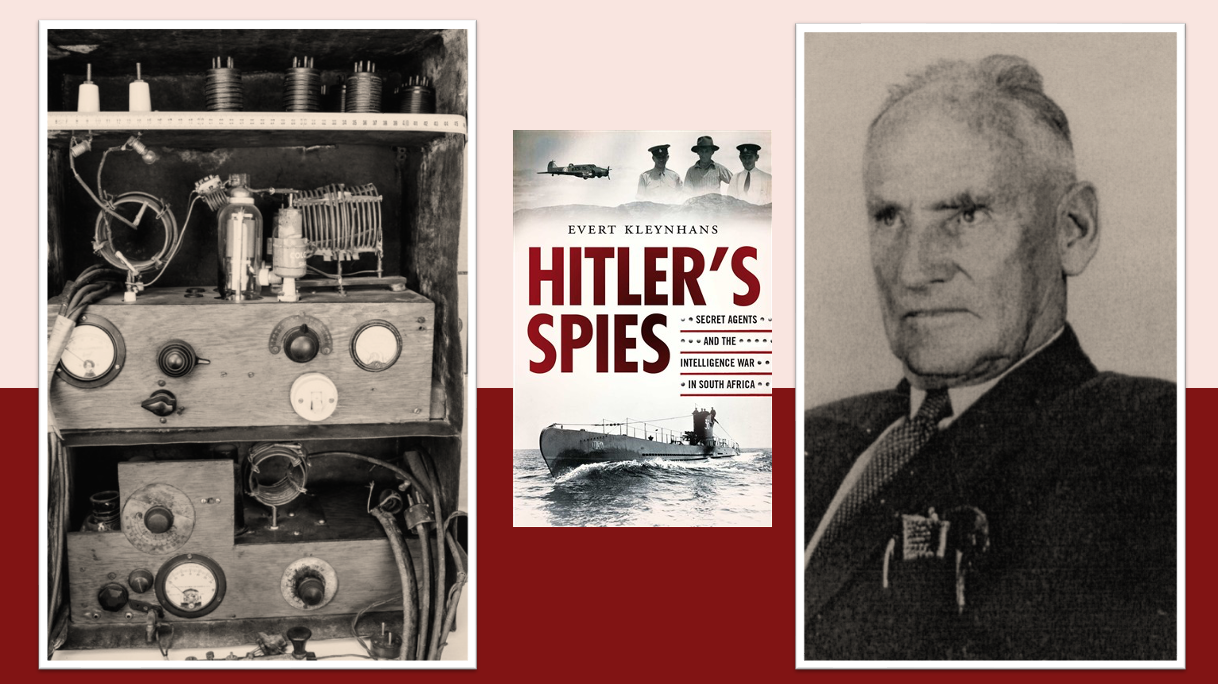
The National Party in 1948 went another remarkable step further, they granted full amnesty to all Nazi German collaborators and spies, all imprisoned right wing Nazi sympathisers, murderers and saboteurs and all the treasonous South Africans who joined the German military or its propaganda and intelligence forces – all those been held in detention for interrogation or who had been given prison sentences for high treason and wartime crimes and serving time – simply walked free – with no obligation or pressure whatsoever to divulge their activities, the names of their collaborators or their sources and materials to anyone.
The Afrikaner Nationalists were from here out just a bunch of anti-British Afrikaner republicans, pure Christians at heart and true patriots – no Nazism, no high treason, or traitors to seen here … moving on. Any young whippersnapper journalist or academic trying to pin Nazism on people like B.J. Vorster, H.F. Verwoerd, P.W. Botha, J. van Rensburg, Jaap Marais etc, or even trying to link Apartheid to Nazism would simply be met with a smug “prove it”.
Enter an archive bloodhound
This is the reason for all my YES! And FINALLY! expletives. Dr. Evert Kleynhans, now an Associate Professor at the South African Military Academy spent years – literally years unlocking the parts of the Ossewabrandwag archive previously embargoed or denied to the all the other historians writing on the Ossewabrandwag. He added to this by digging around in the private collections and archives of all key players. Over and above this he tackled the British intelligence archives – MI5 and more.
For most modern historians, the credibility of their work is seen in their mastery of the ‘secondary sources’ and you find it in the cross references – an example of this is a reference number to say X book by X author on X page e.g. “Visser, OB: Traitors or Patriots? P.183” However, if a historian gets into the ‘primary sources’ as their major reference source, that is where he or she gets into the archive and the original documents, photographs, signals, messages, letters, speeches, reports etc etc, then their work moves onto an entirely different level. It’s at this point the work moves away from being simply sound and good historical research and into a world where the work becomes a trailblazing and seminal one, one by which future historians will build on and reference.
You can see how Evert has tackled this, as in tackling the primary sources, his reference notations look entirely different, they read like this X Box, X File, X Date e.g. “Box 1621. File: Part 2 Secret Report on cases of high treason, 19 March 1946”. It is here, in the use of primary material that Evert Kleynhan’s “Hitler’s Spies” stands out as more than just a historical treatise it is a seminal work. Evert has fully ‘unlocked’ the Ossewabrandwag’s archive and he has meticulously and steadily pieced together all the missing testament such that the case he presents is water-tight, unquestionable and as close to a truism you can get with all the information at hand.

Here’s a bit of a spoiler alert, but necessary for my argument on the Ossewabrandwag (OB), what Evert does in Hitler’s Spies using all this primary data is bash the ‘High Treason’ and ‘Nazi’ nails into the Ossewabrandwag’s coffin good and solid. The case of High Treason that “Hitler’s Spies: Secret Agents and the Intelligence War in South Africa” brings against the Ossewabrandwag’s high command, inner circle leaders and its Commander in Chief – Johannes (Hans) van Rensburg – is both water-tight by sheer weight of evidence and it is one of eternal damnation. Evert Kleynhans through empirical and extensive research is able to firmly prove that the Ossewabrandwag and its leaders and inner circle ticked all the boxes defining High Treason that would under the laws of the time may have had them all swinging from the end of a rope – alongside their Nazi brethren in Germany ‘Nuremberg Judgement’ style.
What Evert Kleynhans is able to do, and what the likes of B.J.Vorster and others tried very hard for many years to prevent, is that he has been able to “Prove it”. The OB and its leaders stand as full Nazi collaborators and zealot devotees to Nazism as an ideology and its expansionist new order ambitions and racist constructs, directly assisting their war effort to the detriment of and living threat to every single South African – Afrikaner or otherwise, whether serving in the Union’s Defence force or even just existing as an ‘Untermensch’ in the South African Union and surrounding British territories.
It’s evidence that is not even inferred by MI5 and SA Intelligence operators and their reporting, Evert even gets his hands on the only remaining copy of the Barrett Report – ironically buried deep in C.R. Swart’s personal archive – the man charged with destroying it, somehow and rather inexplicably decided to hold onto one copy (maybe he figured in the shady world of nationalist politics and political backstabbing he would one day need the leverage of political blackmail to prevent him from getting the chop). The evidence is even more water tight than the commission’s report, Evert even gets holds of confessions, all of them – spies, collaborators – the lot, the most remarkable is Johannes van Rensburg’s personal confession to all manner of High Treason charges called “Rex versus van Rensburg” which he penned in anticipation of his arrest when the war ended and the net was closing in on him (a document so incriminating he buried it and did not really refer to it in his autobiography).
A page turner
Now, one would think that with all this primary source and data that Dr Evert Kleynhans’ “Hitler’s Spies: Secret Agents and the Intelligence War in South Africa” is a dour romp through dusty archival records – but it is anything but, it reads like a Spy Thriller – stuffed full of espionage, spies, double agents, prison escapes, collaborators, honey traps and traitors. It would make it on the spy novel fiction shelf next to a John le Carré novel such is all the intrigue and danger, the frightening bit – John le Carré’s novels are fantastic and entertaining yarns – yet Evert’s work is a truth, it all actually happened, and in this context it will leave you utterly gobsmacked.
The book will take you through the full historiography of espionage in South Africa during World War 2, it covers in full the Ossewabrandwag’s association and collaboration with the Nazi Abwehr (intelligence) Roosebloom Operation and their Felix Operation in South Africa. In between it covers the Nazi Abwehr Operations in Mozambique and Operation Weissdorn and many other cases of espionage, propaganda warfare (Radio Zeesen), message couriering, prison breaks and spy smuggling.
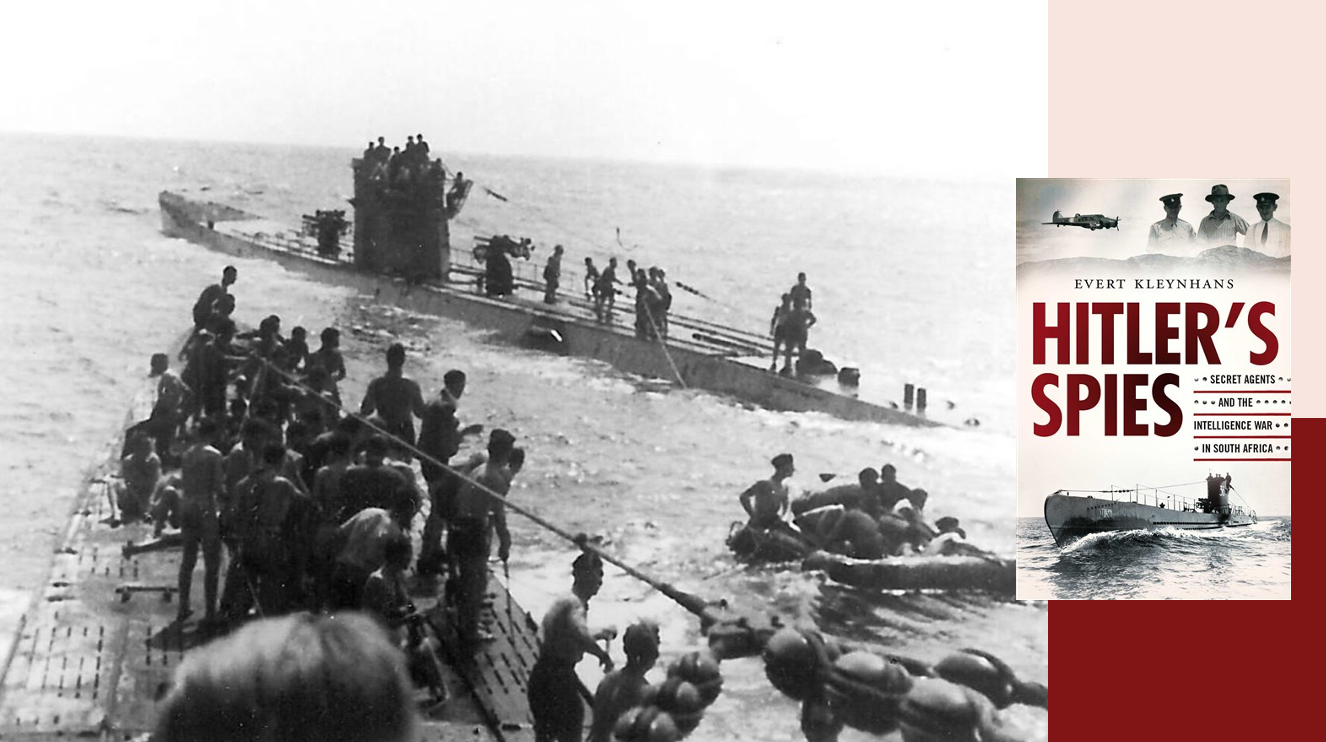
Even for the ‘anorak’ history enthusiasts looking for all the technical stuff, Evert’s ‘Hitler’s Spies’ does not disappoint, what you also get a force majeure tour into the mechanics of transmitting, frequencies and signal vectoring, the methodologies and systems used in World War 2 of collecting intelligence and conducting counter-intelligence. For the real history buffs, you even get the intelligence, data, signals and tonnage sunk and reporting of the German submarine hunter packs operating off South Africa’s coastline – and all in addition to the submarine activities of the Italians and the Japanese.
I must commend Evert on one very critical point in making this book a page turner, and that’s his writing style. If you think you’re about to get a dull historical treatise sans paragraphs – academic style – think again. Evert, for an academic, uses very good journalistic and storytelling skills – his opening paragraph alone starts with a sinister quote from Carl Emmermann, the Commander of U-172, part of the Eisbär (Polar) submarine hunter group as he peers at Cape Town through his submarine’s telescope. Evert even brings in skills like “send-up” to link the stories – a case in point here is the wager of a bottle of whiskey taken between two interrogators that they would not be able to break a Dutch national (held in detention after the war) who operated as a Nazi spy in South Africa. I’ll leave it to the reader to find out if the bottle of scotch was won or lost – but this is a human story telling element which has no real historical bearing and could easily have been left out – yet luckily, we find it in this history book – it makes it highly readable.
The final word?
Is Evert’s book ‘Hitler’s Spies’ the final and definitive word on the Nazification of the Afrikaner Right? It’s solid enough that it can be, but to be honest it’s not – there is loads to this subject not covered in Hitler’s Spies and there is very good reason for this. As said this work is a seminal one, Evert could have broadened each subject he tackled exponentially taking the book which is focussed on submarine warfare and espionage into a massive historical tome instead – but he chooses not to and keeps the book and its story focussed and succinct, what he does instead is open the door to other historians and authors to pick up on any empirical thread Hitler’s Spies throws out and become bloodhounds in their own right.
A case in point here – during the war the OB’s leader – Johannes van Rensburg, is accused by the leader of the National Socialist Rebels – Robey Leibbrandt of being a double-agent – Leibbrandt is open in his accusation that van Rensburg is a “Smuts-man” in disguise. Whilst it is very clear in Evert’s book Hitler’s Spies that there is collaboration between the Smuts government and the OB, it would take another historian – Dr Garth Bennyworth from Sol Plaatjies University, to unearth in a MI5 file the proof positive that van Rensberg had indeed acted as a double agent to betray Liebbrandt. To note here, this skulduggery is not so much van Rensburg’s intentions as a patriot Afrikaner to protect Afrikaners – its more to his adherence to the Führer principle. Both Robey Leibbrandt and Johannes van Rensburg are megalomanic enough to assume they will be South Africa’s new absolute Führer should Germany win – you need to view Liebbrandt as a sort of Ernst Röhm brownshirt thug, and like Hitler eliminates Röhm, van Rensburg eliminates Liebbrandt. What this double agent conspiracy does – it also gives van Rensburg his “get out of jail free card” should Germany lose the war and he knew it, it would stop him from swinging by a rope for High Treason – the truth is he’s looking out for number 1.

Were does this leave the final word on all the Osswabrandwag’s leader element and inner circle – all the people complicit in Nazism and High treason? All the future National Party leaders, Presidents and Prime Minister’s – the likes of:
- B.J. Vorster – Ossewabrandwag ‘General’, Broederbond and future National Party Prime Minister of South Africa and President of South Africa.
- Oswald Pirow – Founder of the Neo Nazi ‘New Order’ and devout Nazi – National Party Cabinet Minister prior to the war and future National Party appointed State Prosecutor.
- Hendrik van den Bergh – Ossewabrandwag future National Party appointed head of State Security.
- Johannes von Moltke – leader of the Christian National Socialist Movement (SANP)’ in the Eastern Cape and future National Party Minister and the National Party leader in South West Africa/Namibia.
- P.O. Sauer – Ossewabrandwag ‘General’ – future National Party Cabinet Minister.
- Frans Erasmus – Ossewabrandwag ‘General’ – future National Party Cabinet Minister.
- C.R. Swart – Ossewabrandwag – future National Party Cabinet Minister and State President.
- P.W. Botha – Ossewabrandwag and Broederbond – future National Party Cabinet Minister and State President of South Africa.
- Eric Louw – Ossewabrandwag, devout anti-semite – future National Party Cabinet Minister (Foreign Minister).
- Jaap Marais – Ossewabrandwag – future National Party Cabinet Minister and future co-founder of the ultra-right Herstigte Nasionale Party.
- Louis Weichardt – founder and leader of the Neo Nazi ‘South African Christian National Socialist Movement’ (SANP) and future National Party Minister.
- The Rev. Koot Vorster – Ossewabrandwag General, Broederbond – brother of BJ Vorster and future NGK leader.
- Dr Hendrik Verwoerd – editor of Die Transvaaler, found guilty of transforming it to a Nazi mouthpiece during WW2, Broederbond and future National Party Prime Minister of South Africa.
- Henning Klopper – founder and Chairman of the Broederbond, National Party Minister and Speaker of the National Assembly.
- Albert Hertzog – son of General J.B.M. Hertzog, Broederbond, future National Party Minister and co-founder of the ultra-right Herstigte Nasionale Party.
- Dr Nico Diedericks – Chairman of the Broederbond during the war, a future National Party State President – prior to the war attended the Nazi Party’s Anti-Comintern training in Berlin.
- Piet Meyer – Chairman of the Broederbond and Ossewabrandwag General, future National Party appointed Head of the SABC. So admired Nazi Germany he befriended Hitler’s chief of staff, Rudolf Hess, who even taught him how to ski.
- General Rudolph Hiemstra, UDF WW2 objector due to strong pro-Nazi convictions, re-instated by Frans Erasmus after the war in 1948 and eventually became the National Party’s appointed Commandant General of The South African Defence Force.
- Dr Eben Dönges – Ossewabrandwag, Broederbond stalwart, future National Party Cabinet Minister, Acting Prime Minister and State President elect.
The truth is final word has been left wide open, these stalwart Afrikaner nationalists are now open to investigation and more digging, the secrets have now been unlocked, the archives are open, the documents found, the path mapped. The ‘veneer’ has finally fallen off. My honest recommendation to any military history enthusiast interested in South African history – buy this book – and buy it now. It’s still available on-line and in all major retailers.
Also, look out for a future Observation Post on the Felix Transmitter, an abridged version of The Story of the Nazi Spy in South Africa with the kind permission of Dr Brian Austin and Vincent Harrison.
As to last words, Dr Evert Kleynhans wrote in a personal message to me in the beginning of my copy of his book ‘Hitler’s Spies’ – it reads “Dear Peter. Happy Reading and look forward to working with you – Evert”, my last word on this review is this:
“It’s the other way round Evert – I look forward to working with you! – Peter”
Written, researched and reviewed by Peter Dickens
References:
“Hitler’s Spies: Secret Agents and the Intelligence War in South Africa 1939-1945” by Dr. Evert Kleynhans – Jonathan Ball Publishers 2021
Felix Transmitter – The Story of the Nazi Spy in South Africa by Dr Brian Austin and Vincent Harrison.
Dr. Garth Benneyworth – Sol Plaatje University – Correspondence 16/2/2023
Pro-Nazi Subversion in South Africa, 1939-1941: By Patrick J. Furlong.
The Rise of the South African Reich: 1964: By Brian Bunting
The White Tribe of Africa: 1981: By David Harrison
National Socialism and Nazism in South Africa: The case of L.T. Weichardt and his Greyshirt movements, 1933-1946: By Werner Bouwer
The Final Prize: The Broederbond by Norman Levy: South African History On-line (SAHO) War and the formation of Afrikaner nationalism: By Anne Samson: Great War in Africa Association.
Volk and Fuhrer. By Hans Strydom.
Ribbontrop’s proposals to South Africa, The Rise and Fall of the Third Reich. By William Shirer, 1974 edition.
Related Work
Kruger, the man the mystery and the movie Oom Kruger, the man, the movie, the myth!
Oswald Pirow South Africa’s Nazi ‘Neuordnung’ and Oswald Pirow
Greyshirts South Africa’s Nazi Party; The ‘Gryshemde’
Ossewabrandwag “Mein Kampf shows the way to greatness for South Africa” – The Ossewabrandwag
Broederbond and media Just whistling an innocent ‘toon’
Torch Commando – The Nazification of the Afrikaner Right
 The Observation Post