South African Nazi … the ‘Shirts’

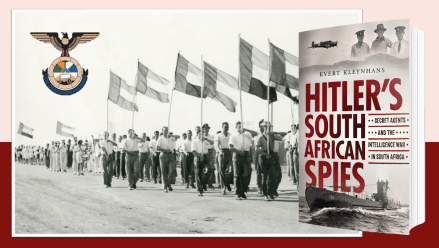
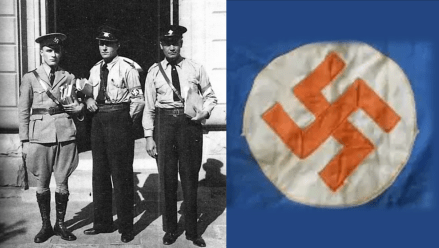
Here is a rare and very unique display of South Africa’s very own Nazi Party’s shirts, flags and bunting.  Of interest, is the use of Orange, Blue and White in the Nazi swastika configuration – this was intentionally done to reflect the national colours of the South African flag at the time, the ‘Oranje-blanje-blou’ (Orange, White and Blue).

These items  belong to  South Africa’s ‘Greyshirts’, read on for an in-depth chapter in South Africa’s hidden history, here we focus on the SANP  – The South African Christian National Socialist Movement also referenced as the South African Gentile National Socialist Movement. More commonly they were also known at the time as the SANP – The South African National Party – ‘Gryshemde’ in Afrikaans and ‘Grey-shirts’ in English.

SANP bunting, flags, armbands and shirts, image courtesy Ulrich Duebe, the current owner of the collection.

South African statute forces had fought a hard war against Italian Fascism and German Nazism, and the same war had been fought on the ‘home-front’ in South Africa itself, as with the USA and the United Kingdom, South Africa also had its own National Socialist (Nazism) parties prior to the war (it had actually been a quite popular doctrine across many “Western” European states prior to the war). During the war the Smuts’ government took severe action against pro-Nazi South African movements on the Afrikaner right-wing political fringe – the SANP (the Grey-shirts), the South African Democratic National Movement – the ‘Black-shirts’, the National Workers Bond – the ‘Brown-shirts’, The ‘New Order’ and the Ossewabrandwag amongst others and jailed some of their leaders for the duration of the war.

Imagine the sheer frustration felt by the South African war veterans returning after winning ‘The War for Freedom’ (as Smuts had called WW2 at the time). This war had been fought with a massive cost in South African lives to rid the world of Nazism and Fascism in the “good fight” – only to come home in 1945 and within three short years in 1948 find South African ‘home grown’ pre-war Nazi and Neo Nazi politicians swept into government. The very men and their philosophy they had gone to war against in the first place. Many of these movement’s leaders and members were folded into National party after the war to one day become South Africa’s political elite (including a  Ossawabrandwag General – BJ Vorster who became a future Prime Minister and State President of South Africa).  

Louis Theodor Weichardt

One such South African politician was Louis Theodor Weichardt (21 May 1894 – 26 October 1985) and this is his relatively unknown story of South Africa’s very own Nazi Party, the largest and most significant of the Pro-Nazi South African ‘Shirt movements’ – the Grey-shirts .
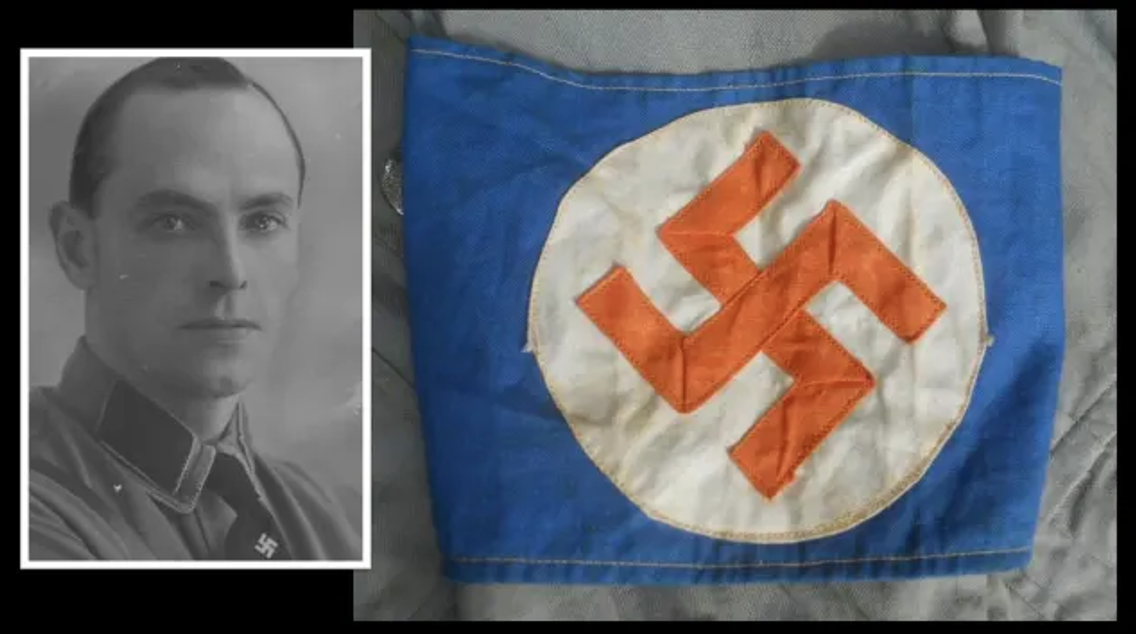
Louis Theodor Weichardt

Louis Theodor Weichardt was born in Paarl of German extraction on the 23 May 1894, he attended German school in Pretoria and in New Hanover Natal. At the outbreak of World War 1 (1914-1918), Weichardt found himself in Germany. His military service to the German state is shrouded in a little mystery, some accounts point towards three years service in the German Army, others point to non-combatant service in a Labour Corps. As a South African national there is an account that he was arrested after the war for High Treason, however the charges were never brought.

In Germany Louis Weichardt became a rabid antisemite, in travelling Europe he recalled that in the Ottoman Empire that the Turks were being “bled to death by Jewish extortioners and money lenders” and in Germany he said he:

“had the privilege of witnessing the first beginnings of the national German uprising against Jewish domination”. 1

Returning to South Africa in 1923, Louis Weichardt joined Hertzog’s National Party, however he became increasingly disillusioned in the National Party as he was unable to bring fellow members to his vision of National Socialism – he blamed been “checkmated” in his endeavours by external influences he called “powerful financial interests, predominantly Jewish”. When Hertzog merged the National Party with Smuts’ United Party, which was seen as by the ‘pure’ nationalists as underpinned by ‘Anglo-Jewish Capital’ (Oppenheimer) – Weichardt took the opportunity to break away from the National Party altogether and start his own party.

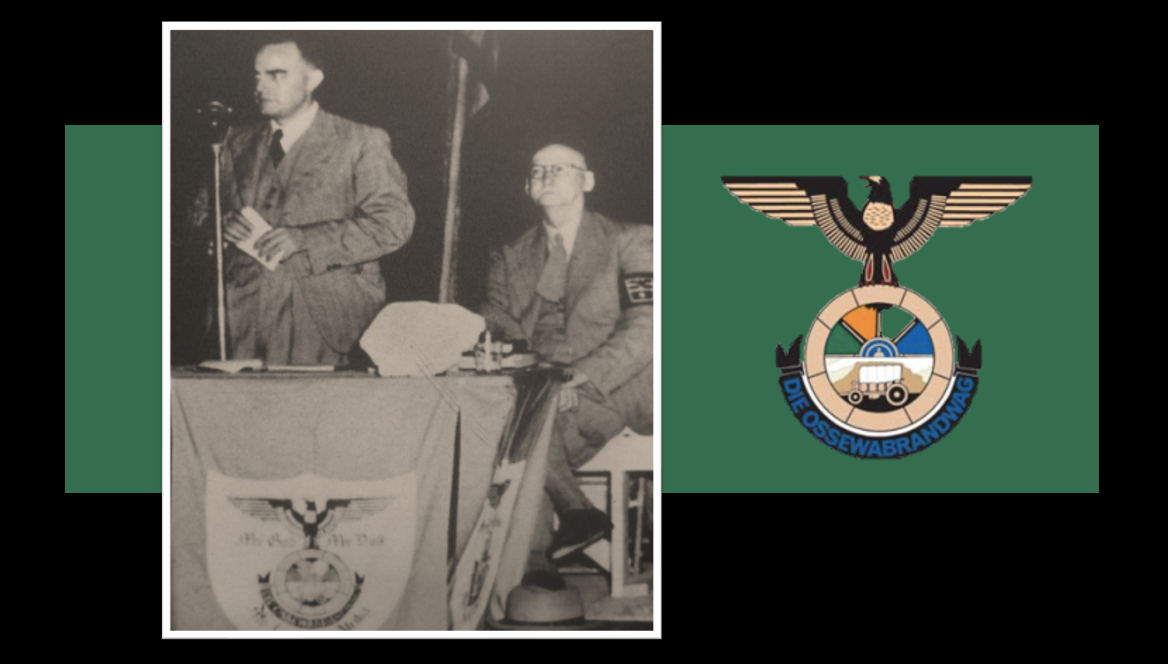
In Cape Town, on 26 October 1933, he founded South Africa’s Nazi party equivalent – The South African Christian National Socialist Movement with a paramilitary ‘security’ or ‘body-guard’ section (modelled on Nazi Germany’s brown-shirted Sturmabteilung) called the ‘Gryshemde’ (Afrikaans) or Grey-shirts (English). In May 1934, it was agreed to combine the ‘Grey-shirts’ with the South African Christian National Socialist Movement and form a new enterprise called ‘The South African National Party’ (SANP) – not to be confused with the National Party. The SANP would all keep with the ‘grey-shirts’ as their dress.

Johannes Von Moltke at this time was Louis Weichardt’s right hand man, the leader of the SANP’s stronghold in the Eastern Cape (his SANP office in Port Elizabeth proudly flying a swastika flag outside it every day). Johannes Von Moltke was of 1820 settler and German heritage, born in Senekal in the OFS he became a firm Republican and Afrikaner Nationalist, working for the Afrikaner Pers Group and the ‘Die Burger’, he met Weichardt in October 1933 and the two decided to collaborate.

Louis Weichardt was very proficient in English and he intended the SANP to appeal to both ‘English’ and ‘Afrikaner’ whites – citing that they were both of “Nordic” races. Some English joined the organisation, but the backbone found itself in rural and ‘poor white’ Afrikaner communities. It must be noted here that Nazism appealed to many Afrikaners as Hitler took an “anti-British” stance and the legacy of the South African War (1899-1902) was still strong within Afrikaner communities by the 1930’s, many within living memory of it. However Nazism was no means the exclusive pursuit of Afrikaners in South Africa, the handful of ‘English’ that supported the SANP were vicious in their anti-Semitic leanings – as were the British fascists at the time, Oswald Mosley a case in point in England. This sentiment can be be seen in the University of Cape Town Law and SANP supporter – Professor Kerr Wylie, who said of Jews in a letter to University of Cape Town Principal Sir Carruthers Beattie:

“Everything point to the fact that the Jews’ game in South Africa is up, and, if they have any sense, they will realise the fact and try to effect compromise. But history shows that the greed for gold and lust for power is so engrained in the Jewish race that they will cling to their gold and power until it is too late”.2

As a movement the SANP also saw themselves as a ‘popular’ movement for National Socialism and initially did not contend by-elections and municipal elections as a political party – choosing instead to put forward their members as “independents” in elections. A future Grey-shirt breakaway called the ‘Black-shirts’ would however put party candidates forward which ironically caused issues for the ‘Pure’ National Party as the support or the Black-shirts split their vote.. Overall, Weichardt saw democracy as an outdated system and an invention of British imperialism and Jews.3

The SANP would eventually contest elections and Louis Weichardt would stand as a MP candidate in Port Elizabeth, he was not very successful and would later try another safer seat without success either – predictably he blamed his election losses on a Jewish conspiracy.

The SANP grew to about 4,000 members in South Africa (with their largest support base in the Eastern Cape – spurred by ‘poor white’ rural and urban issues in the area), central to their cause in the 1930’s where Jewish immigrants escaping Nazi Germany to South Africa, and their numbers were growing significantly over the decade – in response the SANP launched a campaign calling for an end to Jewish migration and even arranged mass protests in Cape Town. Their primary communication  mouthpiece was a newspaper called ‘Die Waarheid/The truth’ which was nothing more than a vehicle to spread Nazi doctrine in South Africa – the Nazi emblem emblazoned on the masthead.

Louis Weichardt would spell out his ‘Nordic’ argument and vision in the ‘Die Waarheid/The truth’ and trace South Africa’s problems to one source – the Jews. He claimed Jewish ‘domination’ of the legal, medical, dental, commerce, trading, liquor trade etc. as between 60% to 100%, and he would write:

“We are determined to put the Jew in his place. We are not going to tolerate bootlicking, Gentile South Africans – English or Dutch speaking – are no longer prepared to play second fiddle to these aliens”.4

The main target of the SANP was Hertzog’s old National Party’s inspired Quota Act of 1930 which sought to curtail Jewish immigration. As far as the SANP was concerned the National Party had not gone far enough in their endeavours to clip Jewish immigration specifically. They proposed revoking South African citizenships granted to all Jews entering South Africa after 1918, the prevention of Jews gaining government jobs and the prevention of Jews from owning immovable property and dominating any particular industrial or trade sector. They would however support an immigration policy that brought in whites of ‘nordic’ (aryan) races that would assimilate with a white culture in South Africa sans the “insoluble” element of Jews.

The Protocols of the Elders of Zion

The nature of the movement was clearly seen in March 1934 when the SANP held a rally in Aberdeen in the Eastern Cape, Harry Victor Inch – one of the Greyshirt leaders – announced that he had in his possession a ‘stolen’ document from a Port Elizabeth synagogue – signed by its Rabbi – which outlined a secret plot by the Jews to destroy the Christian religion and civilisation.
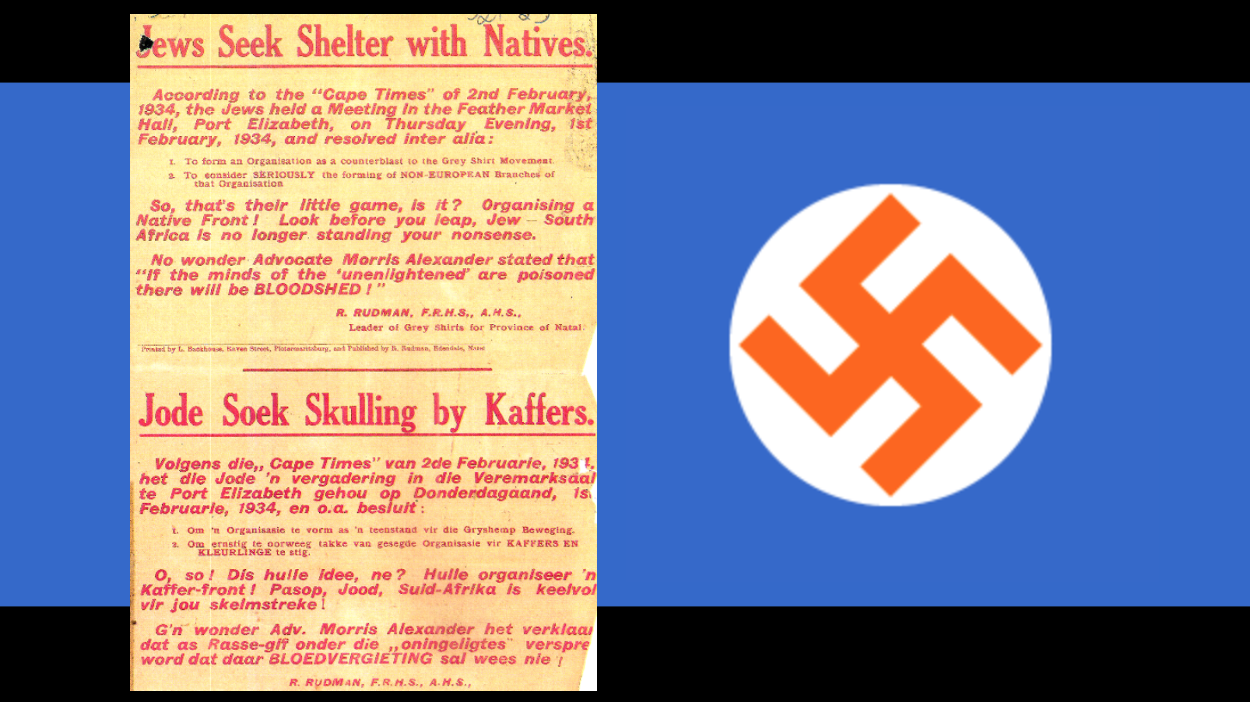
SANP propaganda leaflet accusing Jews of inciting Native (Black) violence against whites.

The Rabbi in question was not in fact a Rabbi, he was a Jewish Reverent, Reverent Abraham Levy, and he took the SANP Grey-shirt leadership in the Eastern Cape to court in Grahamstown in a landmark case. The SANP accused; Johannes von Strauss Moltke who was the Regional SANP leader, Harry Inch, who allegedly ‘stole’ the document and David Olivier, who had printed the document for circulation as the owner and publisher of “Rapport”, another media organ of the ‘shirt’ movements. All now have to account for themselves – the case billed as a mighty ‘Gentile vs. Jew’ showdown and a legal test of the ‘Great Jewish Conspiracy.’ `

The document in question followed the “Protocols of the Elders of Zion, a pamphlet of some 70 pages purporting to be the actual minutes of 24 speeches made by Jewish leaders during the First Zionist Congress in 1897. The pamphlet detailed a satanic plot by Jewish/Zionist conspirators to conquer the world. Alleging that Jews controlled much of the world’s finance, the media, the edu­cational institutions, the court systems and many of the world’s governments, the Pro­tocols claimed that the Jews indulged in all forms of trickery and deceit to tighten their hold. They deliberately spread diseases and immorality to weaken Gentiles, and did not hesitate to use murder and terrorism to destroy all religions except their own. Jews were striving to establish their own autocracy based on a false Messiah, the “Son of David”, and posed a fiendishly devious omnipresent peril to the rest of mankind.”5

‘Die Waarheid/The truth’ would pick up this ‘Protocols of the Elders of Zion’ and really twist it for a South African audience claiming:

“the disastrous Anglo-Boer War 1899-1902 was deliberately brought about by the Jewish mine magnets who circumvented Rhodes and Kruger alike”.6

In addition, Jews were accused of inciting blacks against whites and controlling the economy, exploiting ordinary Afrikaners as part of an international Jewish conspiracy. The ‘Die Waarheid/The truth’ statements were accompanied by a propaganda leaflet printed by the SANP and distributed in Port Elizabeth.
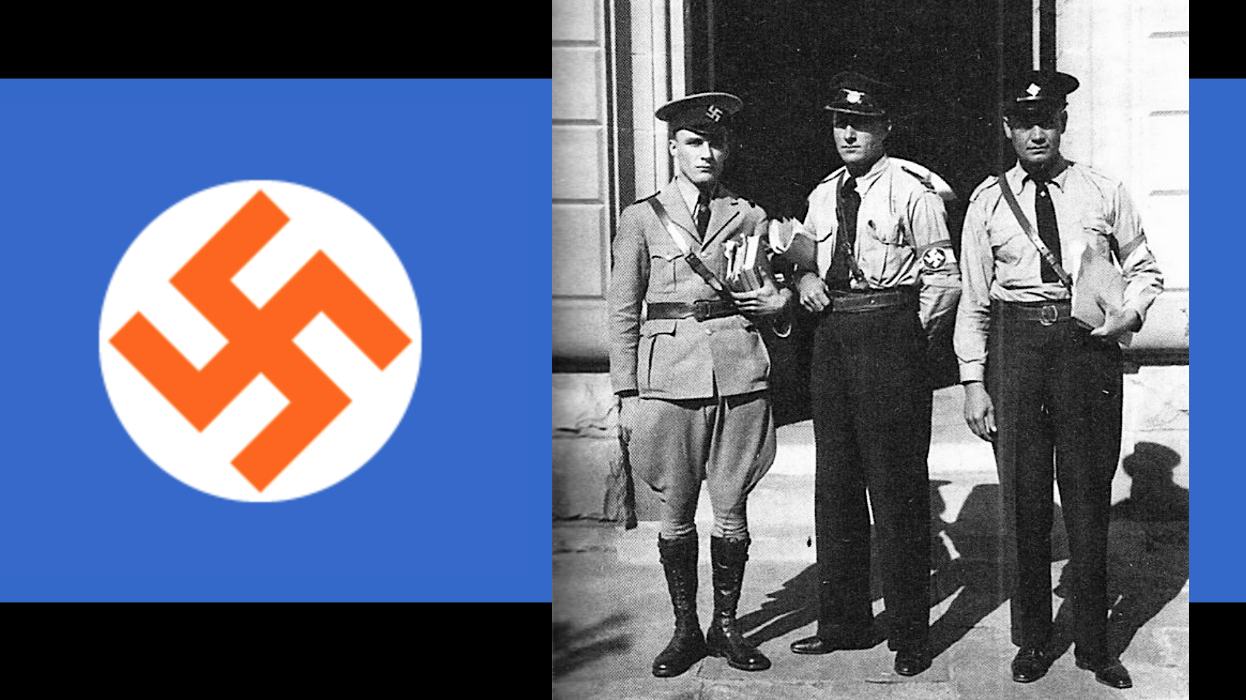
Left to Right – standing outside the courthouse in Grahamstown in full SANP dress is Johannes von Strauss Moltke, Harry Inch and David Olivier.

The ‘stolen’ document was scrutinised legally, it was found to be based on an entirely discredited antisemitic ‘international Jewish conspiracy’ document called ‘the Protocols of the Elders of Zion’ and given a South African twist by the SANP. The ‘Protocols of the Elders of Zion’ was a composition based on a 1860’s anti-Napoleon III pamphlet and a German antisemitic novel by Herman Gödshe ‘Biarritz’ – used by the Nazi Party in Germany.

In a carefully considered 30,000 word judgement, the court concluded inter alia;

“the protocols are an impudent forgery, obviously published for the purposes of anti-Jewish propaganda”.7

As a result three Greyshirt leaders all were fined, Harry Victor Inch was found guilty of perjury and forging documents defaming the Jewish race and swearing under oath that those documents were genuine – and fined £1,000, later also receiving a short prison sentence.8 David Hermanus Olivier was fined £25 for acting improperly and printing the document and Johannes von Moltke was fined £750 for “playing a leading role in the plot”.
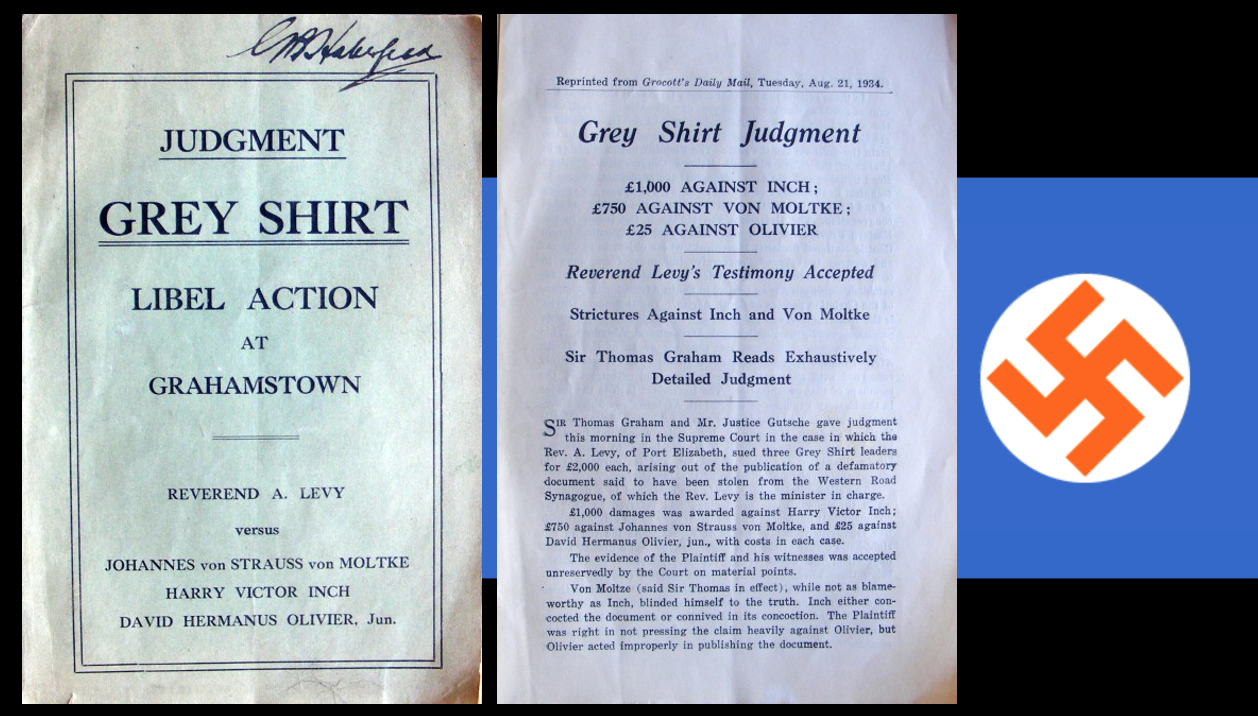
The result has been widely hailed here as a complete vindication of the Jewish people and of Rev. Abraham Levy who brought the lawsuit against the Grey-shirt leaders.

Splits in the Shirts

Later that year, the SANP Grey-shirts would hold their first National Congress in Observatory, Cape Town. Louis Weichardt in his keynote address would dismiss Johannes von Moltke as a “traitor” to the SANP and no longer a member having “misbehaved” in releasing Harry Inch’s anti-Jewish protocols. In fact Johannes von Moltke had broken away from the SANP along with most of his the Eastern Cape SANP supporters and leaders and formed a new organisation called ‘The South African Fascists’ who wore blue trousers and grey shirts.

Other Nazi splinter parties and ‘shirt’ organisations also began to form – ‘The South African National Democratic Movement’ (Nasionale Demokratiese Beweging) which became known as ‘the Black-shirts’ was formed in Johannesburg by Manie Wessels and operated in the Orange Free State and the Transvaal – the Black-shirts themselves would splinter into another Black-shirt movement as an off-shoot called the South African National People’s Movement (Suid Afrikaanse Nasionale Volksbeweging) – based in Johannesburg, started by Chris Havemann and advanced a closer idea of National Socialism – this Blackshirt splinter group by 1937 boasted 265 branches (mainly in the Transvaal), their official mouthpiece was called “The Swastika”9.

The black-shirts by July 1939 were formally incorporated into the Ossewabrandwag focussing on the recruiting of ‘Christian minded National Aryans’ into the Ossewabrandwag infusing it with a “volkisch” Nationalism and took it beyond just being a cultural organ of Afrikanerdom and the National Party. 10

Another ‘Volksbeveging’ (People’s movement) also known as ‘African Gentile Organisation’ was also formed in Cape Town by H.S. Terblanche. The National Workers Union (Bond van Nasionale Werkers) – known as the Brown-shirts was established by Dr. A.J. Bruwer in Pretoria in September 1934. Finally a group called the ‘Orange-shirts’ under Frans Erasmus, who at that stage was the Secretary to the Federal Council of the National Party and the Minister of Parliament for Moorreesburg, Erasmus would go onto become the National Party’s Minister of Defence after 1948.11

In addition, the SANP leader J.H.H. de Waal resigned from the SANP over leadership issues with Weichardt and formed the The ‘Gentile Protection League’ whose sole aim was to:

“Fight the Jewish menace in South Africa12.”

De Waal’s organisation would focus on the Western Cape, he would also advance a Jewish store boycott in the southern Orange Free State where antisemitism was rife, he was a popular lawyer of political stock and he would eventually claim his organisation as 5,000 members strong. De Waal would comment in his memoir “My Ontwaking” (my awakening) and blame Jan Smuts for promoting the Jewish agenda in South Africa and call him “The King of the Jews”.13

An ‘insoluble’ element

So, where does the ‘purified or reunified’ National Party under Dr. D.F. Malan sit on the ‘Jewish’ question in the mid 1930’s and what influence do these Nazi ‘shirt’ organisations have on it?

Prior to the war and sitting in the wings of the Broederbond was Dr. Hendrik Verwoerd (the Architect of Apartheid), he was a predominant Broederbond member, National Party leader and would become a future Prime Minister of South Africa. Dutch by birth, he honed his studies in sociology and psychology in Germany and there is no doubt he was exposed to German politics and the rise of Nazism at the time. Verwoerd showed his colours early on when, the ‘Black shirts’ held a large rally and protested the arrival of the S.S. Stuttgart in Cape Town on the 27th October 1936 with 600 Jewish refugees on board. 
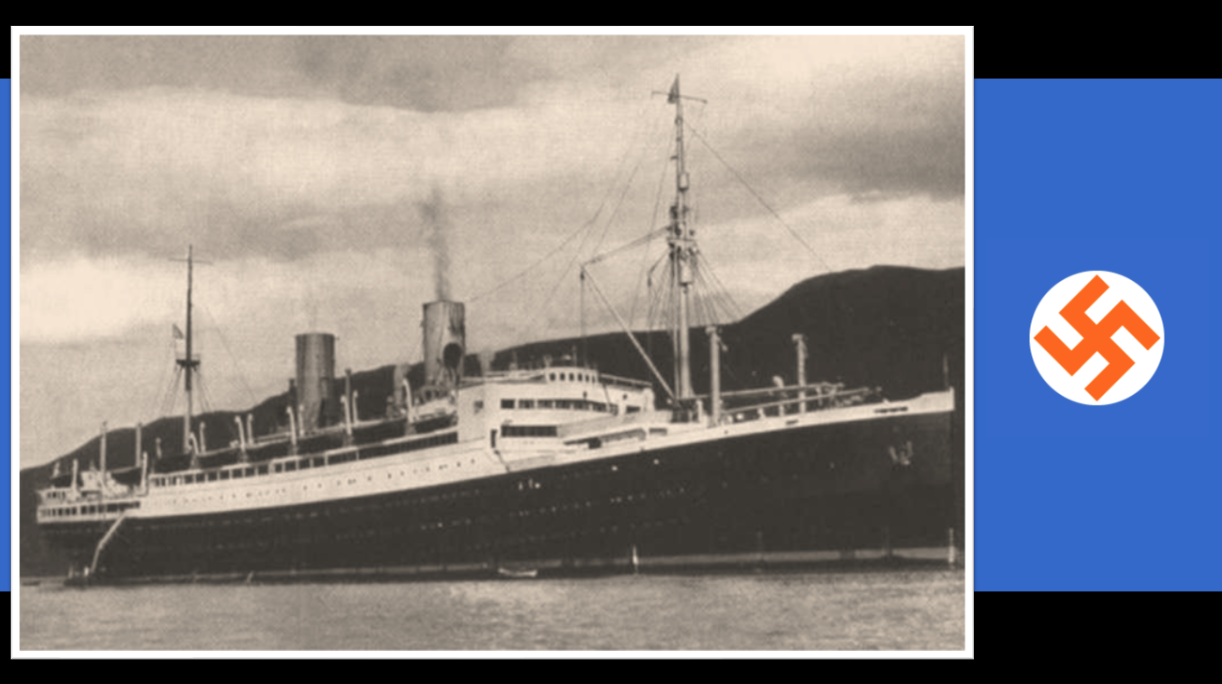
S.S. Stuttgart in Cape Town

The Nationalists joined hands with the Black-shirts in support of their protest and a few days later on 4 November, Dr Theophilus E. Dönges (future NP Acting Prime Minister) and admirer of Nazism would nail the Nationalists colours to the mast and said: 

“The Jew is an insoluble element in every national life.”

The Black-shirts were joined by Dr Verwoerd and five fellow professors from Stellenbosch University who all went in deputation to the government to protest against the immigration of Jews from Nazi Germany. Frans Erasmus (the future National Party Minister of Defence) would go further on the matter and even officially thank the Black-shirts on behalf of The National Party for bringing the attention of the;

 “Jewish problem to the Afrikaner ‘volk’.”

Dr Verwoerd would forward the National Party’s views on Jews in the Transvaaler where he wrote that there was a “botsing van belange” (clash of interests) between Jew and Afrikaner because the Jew had risen to wealth in key economic sectors whilst protecting themselves as a community, and as guests in the country they had purposefully excluded the Afrikaner (he referenced as the ‘majority’) from taking their rightful place in accessing the country’s wealth. He would outline the Jew as an enemy of Afrikanerdom, he would write:

“This population group (the Jews), which still keeps itself separate and apart within the population, and which is indifferent or even hostile to the national aspirations of Afrikanerdom, is thus regarded as the group which also stands in the way of the Afrikaner’s economic prosperity”.14

Dr. D.F. Malan, the National Party leader would go further and refer to the Jews as a:

“undigested and unabsorbed and unabsorbable minority … that leads to all sorts of difficulties”15

D.F. Malan would however try and sanitise the The National Party to the Jewish Community, but as they were a firmly “Christian” movement in terms of constitution his words carried little weight to the South African Jewish Council who saw the National Party for what it was. The National Party would openly lock-step with the “shirt” movements when it came to demonising Jews and Jewish Capital in the form of “Hoggenheimer” in their mouthpieces “The Transvaaler” (of which Verwoerd was the editor) and “Die Burger” (of which Dr. Malan was a founding editor).

‘Hoggenheimer’ would become a cartoon in the same vein as “the banker” – a Nazi demonisation of Capitalist Jews and ‘the Jewish Conspiracy’ – depicted as fat, cigar smoking, balding and greedy – either pulling the strings or holding onto the money bag . The work of D.C. Boonzaier his caricature was developed specifically for Die Burger – a derogatory figure designed to depict a fat and bloated Jewish capitalist with a play on ‘hog” or pig, the character made a number of appearances and also served to lampoon Ernest Oppenheimer, the German Jewish Mining Industrialist who made South Africa his home. The Nationalists would even go as far as referring to Oppenheimer and Jewish Capital openly in Parliament and in speeches as “Hoggenheimer”.
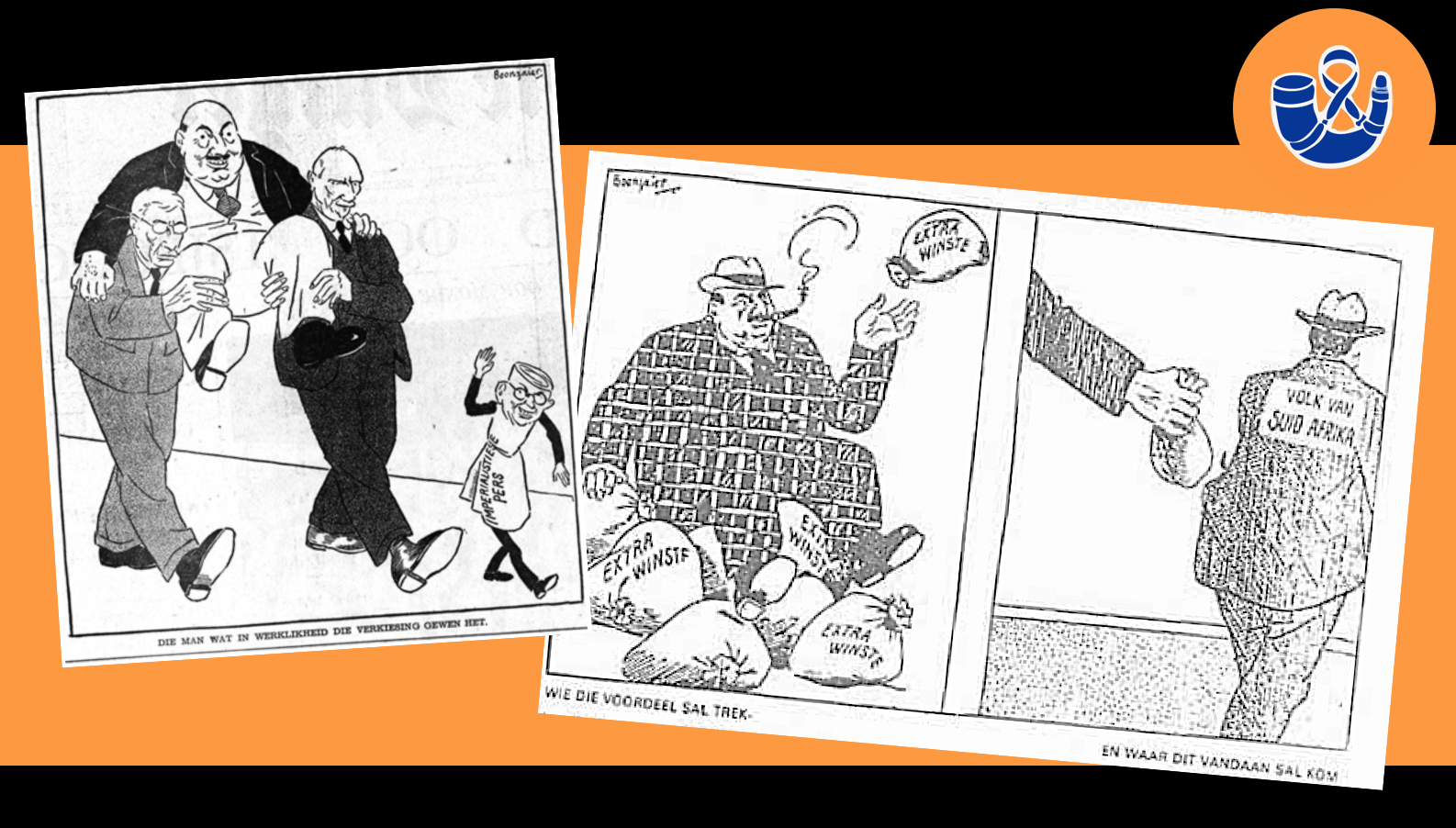
Hoggenheimer by D.C. Boonzaier – Die Burger

It is undeniable that these “shirt” and antisemite fringe effectively “succeeded in shifting the ‘Jewish Question’ from the political margins of South African public life to its centre” … “Malan, under pressure from the ultra-right Greyshirts, focussed increasingly on the Jew as an explanation for the Afrikaners political misfortunes. It was Hendrik Verwoerd, however, who stood at the vanguard of anti-Jewish agitation”16

This sentiment would be taken up broadly across the Afrikaner Nationalist front – an example is the Nationalist MP for Bethlehem – Roelof van der Merwe, who on a call to boycott Nazi German goods, would warn the Jews:

“They (the Jews) are exploiting our people (the Afrikaners) and are nothing more than parasites.”17

World War 2 Nazi collaboration

During the Second World War, Louis Weichardt would even work in conjunction with the Ossewabrandwag to aid Nazi Germany’s war effort. He would take two Nazi spies under his wing, spies been smuggled by the Ossewabrandwag – the German spies Lothar Sitting and Nils Pashe would present themselves at a house in Stellenbosch and meet Weichardt – he would ensure they be driven and hidden by SANP men on a farm near Barrydale for two days after which one SANP man took them to Pretoria and back into the Ossewabrandwag’s network on 13 June 1940.18

Weichardt was arrested and imprisoned for the remainder of World War II at Koffiefontein detention barracks by the Smuts’ government as an ‘enemy of the state’ – along with all the other far right pro Nazi Germany, anti-British militants.

Merging of interests

With the end of the Nazi regime in Germany in 1945, Nazism became an anathema worldwide, Weichardt subsequently disbanded his SANP Nazi party in 1948. Moving on, Weichardt then gave his full attention and allegiance to D.F. Malan and the ‘Reunited’ National Party (NP) itself. He had a very successful political career with the National Party and went on to become the National Party’s senator from Natal Province from 1956 to 1970. Remaining elements of the Greyshirts distanced themselves from open Nazism and renamed themselves the White Workers Party in 1949. However, by this time most of the membership had been lost to the National Party and so the ‘Greyshirts’ and their reconstituted party faded .

By the early 1950’s the South African National Party government was littered with men, who, prior to the war where strongly sympathetic to the Nazi cause and had actually declared themselves full-blown National Socialists along Nazi political doctrine lines: Men like, B.J. Vorster – Broederdond, Ossewabrandwag – OB – ‘General’ and future NP Prime Minister and President of South Africa, Oswald Pirow – Founder of the New Order – NP Cabinet Minister and future National Prosecutor, Hendrik van den Bergh – Ossewabrandwag – future NP head of State Security, P.O. Sauer – Ossewabrandwag ‘General’ – now NP Cabinet Minister, Frans Erasmus – Ossewabrandwag ‘General’, founder of the ‘Orange Shirts’ – now NP Cabinet Minister, Dr Hendrik Verwoerd – Broederbond and future Prime Minister, C.R. Swart – Ossewabranwag member – future NP State President, P.W. Botha – Broederbond, Ossewabrandwag member – and future President of South Africa, Eric Louw Ossewabrandwag – future NP Cabinet Minister, Dr Nico Diedericks – Broederbond and future NP State President, Jaap Marais – Ossewabrandwag – now NP Cabinet Minister and future co-founder of the ultra-right Herstigte Nasionale Party, Dr Albert Hertzog – now a NP minister and future co-founder of the ultra-right Herstigte Nasionale Party, Piet Meyer – Broederbond, Ossewabrandwag and future head of SABC … to name just a few, and there is no doubt that their brand of far right politics, known collectively as Christian Nationalism (a form of Nazism) was influencing the National Party’s government policy.

By the early to mid 1950’s, this state of affairs led to open Anti-Apartheid protests from the South African military veterans community returning from WW2 – in their hundreds of thousands – in all The Torch Commando would rise to 250,000 members openly protesting the on-set of Nazism in the guise of the National Party, and it also ultimately led to the marginalisation of South African World War 2 veterans and their veteran associations by the ruling party when it was crushed under anti-communist legislation put forward in 1950 by the National Party.

The folding in of key National Socialist organisations, including Louis Weichardt and his SANP, Johannes von Moltke and his South African Fascists into the National Party’s political sphere would have a resounding impact on the future of not only the majority of ‘Black’ South Africans (who were viewed as ‘Inferior’ peoples by these hard liners), but also minority white ethnic groups like South Africa’s very large Jewish community.  

The arrogance of this underpinning politics is seen with Louis Weichardt himself, who, on becoming an elected National Party Parliamentarian quickly covered up his dubious history as a full blown card carrying Nazi, and rather infamously declared that he had never been against the ‘Jewish race’ but only against the actions of certain ‘Jewish communists’. Not a single Jew, in his ‘opinion’ had suffered through his actions.19

Johannes Von Moltke the ex SANP and ex SA Fascist leader also later became a National Party Member of Par­liament and the National Party’s leader in South West Africa and exhibited the same arrogance, gaslighting and covering up of his antisemitic tracks and blame his old grey-shirt colleague instead. “The (UP) Jewish Minister of Parliament, Morris Kentridge, once recalled with some amuse­ment that Von Moltke frequently buttonholed him in the lobby of the House of Assembly to explain that he had been misled by Inch (his fellow Grey-shirt collaborator) and was a great friend of the State of Israel!”20


Researched and written by Peter Dickens.  

My thanks and acknowledgements to Ulrich Duebe, the current owner of the collection as illustrated.

References:

“Echoes of David Irving – The Greyshirt Trial of 1934” by Dr. David M. Scher – December 2004.

A Perfect Storm – Antisemitism in South Africa 1930-1940, Jonathan Ball Publishers, 2015 – By Milton Shain.

National Socialism and Nazism in South Africa: The case of L.T. Weichardt and his Greyshirt movements, 1933-1946: By Werner Bouwer.

Hendrik Verwoerd’s ‘possible solution’ to the Jewish Question in South Africa, 1937 – Die Transvaler, 1 October 1937.

“Hitler’s Spies: Secret Agents and the Intelligence War in South Africa 1939-1945” by Every Kleynhans – Jonathan Ball Publishers 2021

The Rise of the South African Reich by Brian Bunting.

Related Work:

The Nazification of the Afrikaner Right – Torch Commando The Nazification of the Afrikaner Right

Footnotes

  1. A Perfect Storm – Antisemitism in South Africa 1930-1940 By Milton Shain page 55 ↩︎
  2. The South African Jewish Board of Deputies – Jewish Matters – newsletter ↩︎
  3. National Socialism and Nazism in South Africa: The case of L.T. Weichardt and his Greyshirt movements, 1933-1946: By Werner Bouwer – Page 18 ↩︎
  4. A Perfect Storm – Antisemitism in South Africa 1930-1940 By Milton Shain page 58 ↩︎
  5. Echoes of David Irving – The Greyshirt Trial of 1934 by David M. Scher – Dec 2004 ↩︎
  6. A Perfect Storm – Antisemitism in South Africa 1930-1940 By Milton Shain page 58 ↩︎
  7. Ibid page 73 ↩︎
  8. Echoes of David Irving – The Greyshirt Trial of 1934 by David M. Scher ↩︎
  9. Ibid page 84 ↩︎
  10. Ibid page 238 ↩︎
  11. Ibid page 76 ↩︎
  12. Ibid page 82 ↩︎
  13. Ibid page 137 ↩︎
  14. Hendrik Verwoerd’s ‘possible solution’ to the Jewish Question in South Africa, 1937 – Die Transvaler, 1 October 1937. ↩︎
  15. A Perfect Storm – Antisemitism in South Africa 1930-1940 By Milton Shain page 14 ↩︎
  16. The South African Jewish Board of Deputies – Jewish Matters newsletter – Antisemitism in South Africa PESACH 2009 by Dr. Milton Shain ↩︎
  17. A Perfect Storm – Antisemitism in South Africa 1930-1940 By Milton Shain page 113 ↩︎
  18. Hitler’s Spies: Secret Agents and the Intelligence War in South Africa 1939-1945 by Every Kleynhans page 99 ↩︎
  19. Echoes of David Irving – The Greyshirt Trial of 1934 by David M. Scher – Dec 2004 ↩︎
  20. Ibid ↩︎

Hitler’s Spies and the Ossewabrandwag

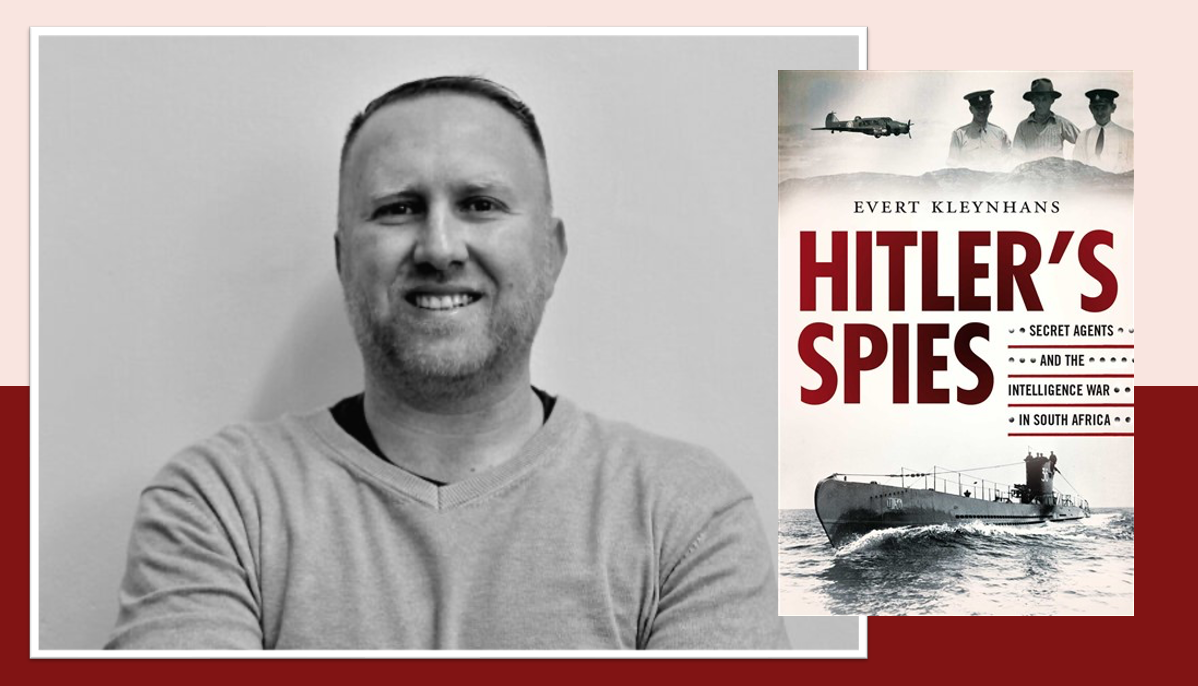
You can tell it’s the holidays as I am getting to some book reviews I’ve been promising – and this book by Dr Evert Kleynhans “Hitler’s Spies: Secret Agents and the Intelligence War in South Africa: 1939 – 1945” had me reacting like the ‘Strictly Come Dancing’ Judge Anton Du Beke when a celebrity performer receives a 10/10. Du Beke usually becomes highly animated, jumps up, fist pumps and joyously shouts out … YES! BRILLIANT! NAILED IT! FINALLY! I KNEW IT ALL ALONG!!!!! … my wife found me putting down Evert’s book after I finishing it and very amusingly behaving like a rather euphoric and unhinged Du Beke.

So why so happy? There’s a bit of a backstory to this delirious happiness, so bear with me. Over six years ago in 2017 – I published an Observation Post called “Mein Kampf shows the way to greatness for South Africa” – The Ossewabrandwag. I had sought to find and publish the proof of conversion to Nazism by this “cultural front” to Afrikaner Nationalism. 

I had managed to build this Nazi link easily with movements like the ‘Grey-shirts’ – The South African Christian National Socialist Party (SANP) – led by Louis Weichardt and the ‘Black-shirts’ – the Volksbeweging (People’s Movement) or ‘African Gentile Organisation’ led by H.S. Terblanche – these shirt movements with their “Blue, White and Orange” arm-band swastikas were clearly Nazi to the core . The National Socialist Rebels – led by Robey Leibbrandt were also easy and really obvious given he was a covert Nazi appointed operator. The National Socialist Boerenasie (Boer Nation) movement – led by the Boer Revolt hero and rabid anti-sematic Manie Maritz was equally clear – all these movements had fully adopted National Socialism in their missions and even swastika iconography into their images, mastheads and positioning – so proving them as out and out Nazi was easy.

Not so the Ossewabrandwag (OB) – proving their Nazi affiliations is somewhat more difficult. It’s the veneer of the Ossewabrandwag (OB) that’s the issue – their clear “anti-British” stance due to Boer War 2, and their clear positioning as the “cultural front” of Afrikaner Nationalism, with the National Party operating as the “Political front” – this makes it so difficult to pin a case of Nazism on them. The Ossewabrandwag’s Voortrekker origins and mission as “mapping a path” to a ‘white’ South African Republic with a white Afrikaner hegemony using these voortrekkers (pioneers) as the vehicle – all working very succinctly with the National Party which adopted the same voortrekker iconography and mission in its image and political its resolve for a future Republic. 

Image: OB ‘General’ B.J. ‘John’ Vorster at a OB rally

To smear an organisation like the OB which boasted about 300,000 active middle of the road Afrikaners (to whom nearly a million modern Afrikaners are now related) with a “Nazi Brush” is not an easy task – it is as Afrikaans as a Hertzoggie cookie. 

You can argue that the introduction of the Stormjaers within the OB with their military ranks, insignia, salutes and blood oaths are distinctively Nazi, so too their armed ‘sabotage’ campaign can be seen as ‘assisting’ Nazi Germany in their war effort and by their very actions treasonous. You can argue that the OB’s ‘Commandant-General’ Johannes (Hans) van Rensburg was a disciple of Nazim and admirer of Adolf Hitler and built into the OB the distinctive Nazi ideologies of “blut und Boden” (Blood and Soil), their “Give us a master” call for the implementation of the “Führer principle”, their call for the removal and expropriation of “British-Jewish” controlled capital. Their racial constructs and policies which relegated “English speaking” South Africans to secondary citizenship and lumped Jews and Blacks as “Untermensch” – racially inferior and “insoluble” in white Afrikaner every-day life. All of that is distinctively Nazi right?

Dr Hans van Rensburg being sworn in – OB swearing in ceremony

You can even pick out choice statements by key OB leaders as to the OB’s distinctive Nazi roots – ‘from the horse’s mouth’ so to speak. The firebrand nature of the Ossewabrandwag appealed to B.J. Vorster (a future nationalist Prime Minister and President of South Africa) more than the National Party. On Nazism and the OB and said in 1942:

“We stand for Christian Nationalism which is an ally of National Socialism. You can call this anti-democratic principle dictatorship if you wish. In Italy it is called Fascism, in Germany National Socialism (Nazism) and in South Africa, Christian Nationalism.”

The Rev. Koot Vorster (B.J. Vorster’s brother), a Dutch Reformed Church minister, and like his brother was also a predominant Ossewabrandwag leader, crystalised this idea of Afrikaner totalitarianism when he summed up the pro-Hitler and Pro-Nazi standpoint of the OB during an address to a student group on September 15, 1940 and said:

“Hitler’s ‘Mein Kampf’ shows the way to greatness – the path of South Africa. Hitler gave the Germans a calling. He gave them a fanaticism which causes them to stand back for no one. We must follow this example because only by such holy fanaticism can the Afrikaner nation achieve its calling.”

Kowie Marais, an OB member and key member of the Broederbond, years later recalled in an interview the admiration he and his friends held for Hitler: 

“We thought (Hitler) might rejuvenate western civilization … against the communist-socialist trends that were creeping in from the east. We thought it was the dawn of a new era.”

All these links to Nazism matter not a jot to many Afrikaners still convinced that the OB was merely a “cultural organisation” to spread the edicts of Christian Nationalism as outlined by Henning Klopper, then the Chairman of Broederbond, in his famous 1938 centenary of the Great Trek. To literally spread this new ideology of Afrikaner nationalism like ‘wildfire’ throughout the country and unite the white ‘Cape’ Afrikaners with the ‘Boer’ Afrikaners up north (hence the name Ox Wagon Sentinel or ‘Fire Watch’), a job it did very successfully, so much so Klopper praised it as a divine event and called it a “sacred happening” – God had ordained it (according to the Broederbond at least) – and to a audience of Calvinists and Puritan Christian Protestants this had meaning .

Nothing to see here!

But how come this general malaise? How is it that all this Nazism is ignored? It boils down to the simple fact that by the end of World War 2, just about every National Party minister had been in the OB or in organisations affiliated to it, only a handful of ministers – men like D.F. Malan had not flirted directly with Nazism. The Nationalists had to be squeaky clean and re-invent themselves completely if they stood any chance to win the 1948 elections and then hold onto power. The reason they “sat out” the war with Nazi Germany was not because of any great affinity to Adolf Hitler and his cabal, it was because they were purely anti-British. They were simply against Jan Smuts’ ideals of Union and sought national independence and self-determination by way an Afrikaner Republic – they were just avowed Republicans whose identity was forged by Britain’s treatment of their women and children in the Boer War concentration camps. 

Image: The “Path to Nationhood” OB Poster

B.J. Vorster would cry complete innocence, often declaring in interview after interview that Smuts had unjustly imprisoned him during the war and the only reason given to him for his incarceration was because he was merely “anti-British”. The true reason for his imprisonment which was that he harboured previously interned fugitives on the run during the war was conveniently buried, in fact by the mid 70’s it was all under embargo and ‘lost’.

Even the OB leader – Johannes (Hans) van Rensburg – did a compete about face once Nazi Germany lost the war in 1945, he turned around and rather regretfully said:

“It was the greatest disaster in my spiritual life to realise suddenly that the people I had thought to be the heroes of a new era in western civilisation should in fact turn out to be just a band of murderers and nothing else.”

He went further in his autobiography to state his fight was always one of Afrikaner patriotism and a simple fight against Smuts and his policies – he reiterated that as the leader of the OB he had instructed his Stormjaers to sabotage the Union’s war effort so as to keep the soldiers in South Africa and prevent ‘sons of the soil’ – Afrikaners – been sent overseas to die for Great Britain. He was clear in his instructions that no Union soldier would die by the hand of an OB Stormjaer. So – nothing to do with high treason and nothing to do with actively supporting Nazi Germany by way of killing any UDF members, and everything to do with Afrikaner patriotism instead.

He would remark on the OB’s achievements in his autobiography:

“I fought (Smuts’) war effort and I fought it bitterly with all the means at my disposal – which were considerable…. There is no doubt that they (the Ossewabrandwag) seriously hampered the government’s war effort. Hampered it because the government was forced to draw off considerable manpower to guard many strategic points and essential services. A not inconsiderable military element also had to be retained in South Africa as a strategic reserve for possible emergency.”

That in reality the OB played no significant tactical, operational or strategic role in curtailing South Africa’s war effort whatsoever mattered not a jot to van Rensburg, in his mind he did a great service and was pure of Afrikaner heart.

The cover up

During the war, the South African intelligence services under Colonel Ernie Malherbe and the British intelligence services had collected a wealth of information directly linking the OB and the Broederbond to the Nazi German war effort. After the war ended, the Smuts’ government found itself having to implement commissions to investigate all the cases of High Treason, committed by organisations like the Ossewabrandwag, the Grey Shirts, the Broederbond, the New Order etc – additionally treasonous acts by South African nationals joining the German military directly, or joining German propaganda and intelligence services directly and also German and foreign nationals operating in South Africa as spies were to be investigated. Called the Barrett Commission it published its findings to limited ‘eyes-only’ circulation at the end of 1947, but these findings were deemed as political fireworks and embargoed pending the outcome of the 1948 elections scheduled early in the new year.

The fateful 1948 election and unexpected National Party win would change all of that, the newly appointed National Party Minister of Defence (and ex-OB member) Frans Erasmus would walk into the South African Intelligence Services archive, he fired the Officer Commanding on the spot and removed “two lorries” worth of incriminating evidence – never to seen again! The newly appointed National Party Minister of Justice (and ex-OB member) C.R. “Blackie” Swart would obtain the original Barrett Report and recall all the circulated copies of the Barrett report and all its appendixes and supporting documents – never to seen again! 

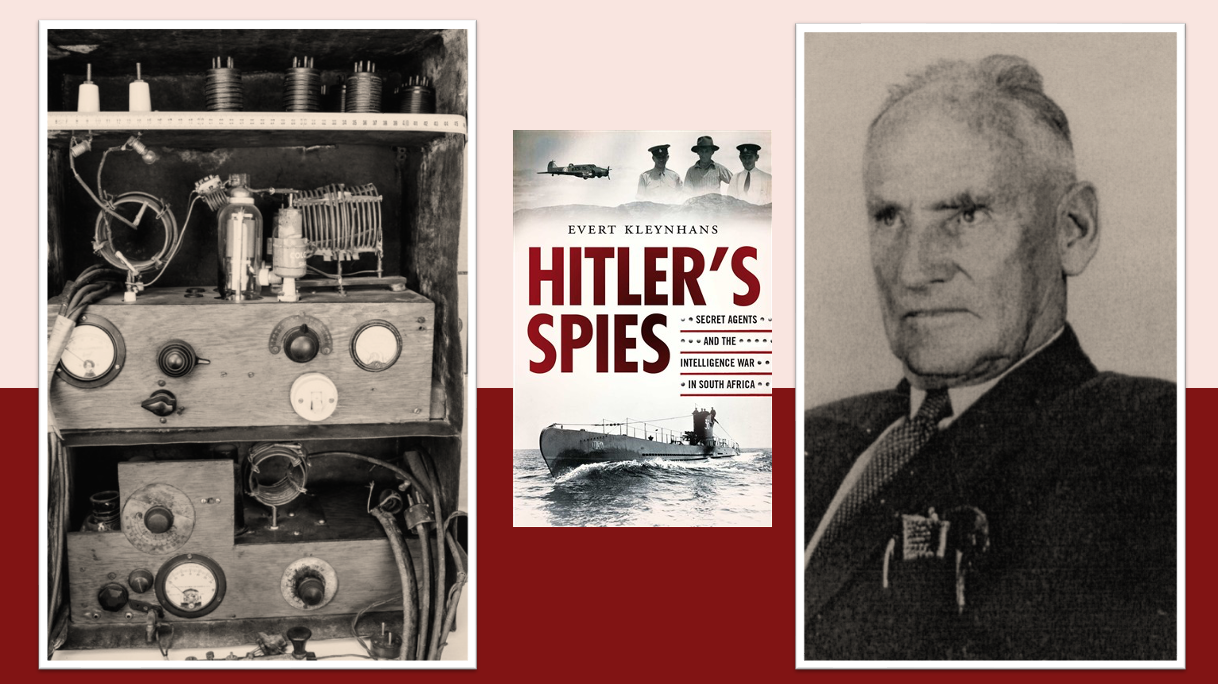
The Felix transmitter and Lothar Sittig – codename Felix – images courtesy Dr Brian Austin

The National Party in 1948 went another remarkable step further, they granted full amnesty to all Nazi German collaborators and spies, all imprisoned right wing Nazi sympathisers, murderers and saboteurs and all the treasonous South Africans who joined the German military or its propaganda and intelligence forces – all those been held in detention for interrogation or who had been given prison sentences for high treason and wartime crimes and serving time – simply walked free – with no obligation or pressure whatsoever to divulge their activities, the names of their collaborators or their sources and materials to anyone.  

The Afrikaner Nationalists were from here out just a bunch of anti-British Afrikaner republicans, pure Christians at heart and true patriots – no Nazism, no high treason, or traitors to seen here … moving on. Any young whippersnapper journalist or academic trying to pin Nazism on people like B.J. Vorster, H.F. Verwoerd, P.W. Botha, J. van Rensburg, Jaap Marais etc, or even trying to link Apartheid to Nazism would simply be met with a smug “prove it”.

Enter an archive bloodhound 

This is the reason for all my YES! And FINALLY! expletives. Dr. Evert Kleynhans, now an Associate Professor at the South African Military Academy spent years – literally years unlocking the parts of the Ossewabrandwag archive previously embargoed or denied to the all the other historians writing on the Ossewabrandwag. He added to this by digging around in the private collections and archives of all key players. Over and above this he tackled the British intelligence archives – MI5 and more. 

For most modern historians, the credibility of their work is seen in their mastery of the ‘secondary sources’ and you find it in the cross references – an example of this is a reference number to say X book by X author on X page e.g. “Visser, OB: Traitors or Patriots? P.183” However, if a historian gets into the ‘primary sources’ as their major reference source, that is where he or she gets into the archive and the original documents, photographs, signals, messages, letters, speeches, reports etc etc, then their work moves onto an entirely different level. It’s at this point the work moves away from being simply sound and good historical research and into a world where the work becomes a trailblazing and seminal one, one by which future historians will build on and reference.

You can see how Evert has tackled this, as in tackling the primary sources, his reference notations look entirely different, they read like this X Box, X File, X Date e.g. “Box 1621. File: Part 2 Secret Report on cases of high treason, 19 March 1946”. It is here, in the use of primary material that Evert Kleynhan’s “Hitler’s Spies” stands out as more than just a historical treatise it is a seminal work. Evert has fully ‘unlocked’ the Ossewabrandwag’s archive and he has meticulously and steadily pieced together all the missing testament such that the case he presents is water-tight, unquestionable and as close to a truism you can get with all the information at hand.

Image: An Ossewabrandwag ‘Kommandant’ in full para-military uniform with lapel badges, ‘crested eagle’ epaulettes and ‘lightning bolt’ cap badge insignia. In addition he is wearing a sam-browne belt and lanyard. His ‘green’ arm band signifies his rank – using the ‘crested eagle’ again and horizontal lines for scale of seniority.

Here’s a bit of a spoiler alert, but necessary for my argument on the Ossewabrandwag (OB), what Evert does in Hitler’s Spies using all this primary data is bash the ‘High Treason’ and ‘Nazi’ nails into the Ossewabrandwag’s coffin good and solid. The case of High Treason that “Hitler’s Spies: Secret Agents and the Intelligence War in South Africa” brings against the Ossewabrandwag’s high command, inner circle leaders and its Commander in Chief – Johannes (Hans) van Rensburg – is both water-tight by sheer weight of evidence and it is one of eternal damnation. Evert Kleynhans through empirical and extensive research is able to firmly prove that the Ossewabrandwag and its leaders and inner circle ticked all the boxes defining High Treason that would under the laws of the time may have had them all swinging from the end of a rope – alongside their Nazi brethren in Germany ‘Nuremberg Judgement’ style.

What Evert Kleynhans is able to do, and what the likes of B.J.Vorster and others tried very hard for many years to prevent, is that he has been able to “Prove it”.  The OB and its leaders stand as full Nazi collaborators and zealot devotees to Nazism as an ideology and its expansionist new order ambitions and racist constructs, directly assisting their war effort to the detriment of and living threat to every single South African – Afrikaner or otherwise, whether serving in the Union’s Defence force or even just existing as an ‘Untermensch’ in the South African Union and surrounding British territories. 

It’s evidence that is not even inferred by MI5 and SA Intelligence operators and their reporting, Evert even gets his hands on the only remaining copy of the Barrett Report – ironically buried deep in C.R. Swart’s personal archive – the man charged with destroying it, somehow and rather inexplicably decided to hold onto one copy (maybe he figured in the shady world of nationalist politics and political backstabbing he would one day need the leverage of political blackmail to prevent him from getting the chop). The evidence is even more water tight than the commission’s report, Evert even gets holds of confessions, all of them – spies, collaborators – the lot, the most remarkable is Johannes van Rensburg’s personal confession to all manner of High Treason charges called “Rex versus van Rensburg” which he penned in anticipation of his arrest when the war ended and the net was closing in on him (a document so incriminating he buried it and did not really refer to it in his autobiography).

A page turner

Now, one would think that with all this primary source and data that Dr Evert Kleynhans’ “Hitler’s Spies: Secret Agents and the Intelligence War in South Africa” is a dour romp through dusty archival records – but it is anything but, it reads like a Spy Thriller – stuffed full of espionage, spies, double agents, prison escapes, collaborators, honey traps and traitors. It would make it on the spy novel fiction shelf next to a John le Carré novel such is all the intrigue and danger, the frightening bit – John le Carré’s novels are fantastic and entertaining yarns – yet Evert’s work is a truth, it all actually happened, and in this context it will leave you utterly gobsmacked.

The book will take you through the full historiography of espionage in South Africa during World War 2, it covers in full the Ossewabrandwag’s association and collaboration with the Nazi Abwehr (intelligence) Roosebloom Operation and their Felix Operation in South Africa. In between it covers the Nazi Abwehr Operations in Mozambique and Operation Weissdorn and many other cases of espionage, propaganda warfare (Radio Zeesen), message couriering, prison breaks and spy smuggling.

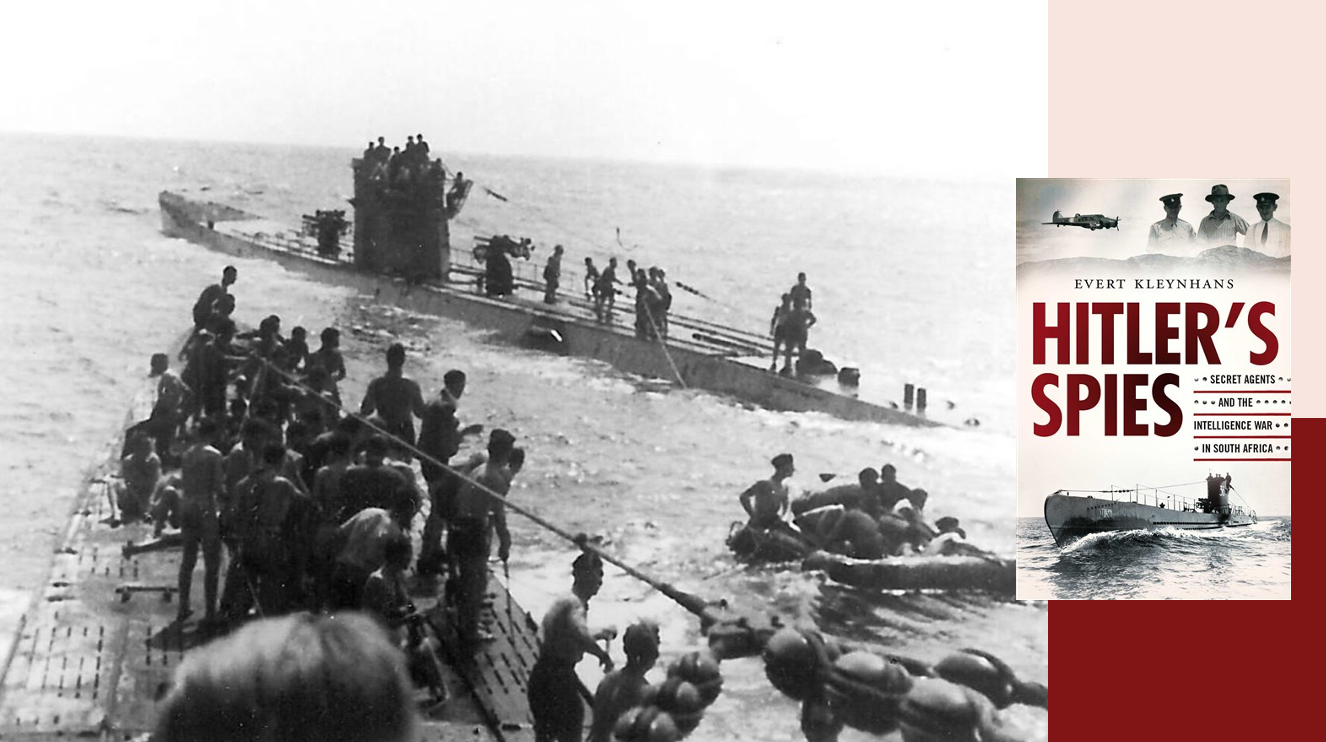
U-156 and U-507 assisting survivors sinking the Laconia in the Indian Ocean, 15 Sept 1942

Even for the ‘anorak’ history enthusiasts looking for all the technical stuff, Evert’s ‘Hitler’s Spies’ does not disappoint, what you also get a force majeure tour into the mechanics of transmitting, frequencies and signal vectoring, the methodologies and systems used in World War 2 of collecting intelligence and conducting counter-intelligence. For the real history buffs, you even get the intelligence, data, signals and tonnage sunk and reporting of the German submarine hunter packs operating off South Africa’s coastline – and all in addition to the submarine activities of the Italians and the Japanese.

I must commend Evert on one very critical point in making this book a page turner, and that’s his writing style. If you think you’re about to get a dull historical treatise sans paragraphs – academic style – think again. Evert, for an academic, uses very good journalistic and storytelling skills – his opening paragraph alone starts with a sinister quote from Carl Emmermann, the Commander of U-172, part of the Eisbär (Polar) submarine hunter group as he peers at Cape Town through his submarine’s telescope.  Evert even brings in skills like “send-up” to link the stories – a case in point here is the wager of a bottle of whiskey taken between two interrogators that they would not be able to break a Dutch national (held in detention after the war) who operated as a Nazi spy in South Africa. I’ll leave it to the reader to find out if the bottle of scotch was won or lost – but this is a human story telling element which has no real historical bearing and could easily have been left out – yet luckily, we find it in this history book – it makes it highly readable. 

The final word?

Is Evert’s book ‘Hitler’s Spies’ the final and definitive word on the Nazification of the Afrikaner Right? It’s solid enough that it can be, but to be honest it’s not – there is loads to this subject not covered in Hitler’s Spies and there is very good reason for this. As said this work is a seminal one, Evert could have broadened each subject he tackled exponentially taking the book which is focussed on submarine warfare and espionage into a massive historical tome instead – but he chooses not to and keeps the book and its story focussed and succinct, what he does instead is open the door to other historians and authors to pick up on any empirical thread Hitler’s Spies throws out and become bloodhounds in their own right.

A case in point here – during the war the OB’s leader – Johannes van Rensburg, is accused by the leader of the National Socialist Rebels – Robey Leibbrandt of being a double-agent – Leibbrandt is open in his accusation that van Rensburg is a “Smuts-man” in disguise. Whilst it is very clear in Evert’s book Hitler’s Spies that there is collaboration between the Smuts government and the OB, it would take another historian – Dr Garth Bennyworth from Sol Plaatjies University, to unearth in a MI5 file the proof positive that van Rensberg had indeed acted as a double agent to betray Liebbrandt. To note here, this skulduggery is not so much van Rensburg’s intentions as a patriot Afrikaner to protect Afrikaners – its more to his adherence to the Führer principle. Both Robey Leibbrandt and Johannes van Rensburg are megalomanic enough to assume they will be South Africa’s new absolute Führer should Germany win – you need to view Liebbrandt as a sort of Ernst Röhm brownshirt thug, and like Hitler eliminates Röhm, van Rensburg eliminates Liebbrandt. What this double agent conspiracy does – it also gives van Rensburg his “get out of jail free card” should Germany lose the war and he knew it, it would stop him from swinging by a rope for High Treason – the truth is he’s looking out for number 1. 

Image: Carnage from a OB bomb blast

Were does this leave the final word on all the Osswabrandwag’s leader element and inner circle – all the people complicit in Nazism and High treason? All the future National Party leaders, Presidents and Prime Minister’s – the likes of:

  • B.J. Vorster – Ossewabrandwag ‘General’, Broederbond and future National Party Prime Minister of South Africa and President of South Africa.
  • Oswald Pirow – Founder of the Neo Nazi ‘New Order’ and devout Nazi – National Party Cabinet Minister prior to the war and future National Party appointed State Prosecutor.
  • Hendrik van den Bergh – Ossewabrandwag future National Party appointed head of State Security.
  • Johannes von Moltke – leader of the Christian National Socialist Movement (SANP)’ in the Eastern Cape and future National Party Minister and the National Party leader in South West Africa/Namibia.
  • P.O. Sauer – Ossewabrandwag ‘General’ – future National Party Cabinet Minister.
  • Frans Erasmus – Ossewabrandwag ‘General’ – future National Party Cabinet Minister. 
  • C.R. Swart – Ossewabrandwag – future National Party Cabinet Minister and State President.
  • P.W. Botha – Ossewabrandwag and Broederbond – future National Party Cabinet Minister and State President of South Africa.
  • Eric Louw – Ossewabrandwag, devout anti-semite – future National Party Cabinet Minister (Foreign Minister). 
  • Jaap Marais – Ossewabrandwag – future National Party Cabinet Minister and future co-founder of the ultra-right Herstigte Nasionale Party.
  • Louis Weichardt – founder and leader of the Neo Nazi ‘South African Christian National Socialist Movement’ (SANP) and future National Party Minister.
  • The Rev. Koot Vorster – Ossewabrandwag General, Broederbond – brother of BJ Vorster and future NGK leader.
  • Dr Hendrik Verwoerd – editor of Die Transvaaler, found guilty of transforming it to a Nazi mouthpiece during WW2, Broederbond and future National Party Prime Minister of South Africa.
  • Henning Klopper – founder and Chairman of the Broederbond, National Party Minister and Speaker of the National Assembly.
  • Albert Hertzog – son of General J.B.M. Hertzog, Broederbond, future National Party Minister and co-founder of the ultra-right Herstigte Nasionale Party.
  • Dr Nico Diedericks – Chairman of the Broederbond during the war, a future National Party State President – prior to the war attended the Nazi Party’s Anti-Comintern training in Berlin. 
  • Piet Meyer – Chairman of the Broederbond and Ossewabrandwag General, future National Party appointed Head of the SABC. So admired Nazi Germany he befriended Hitler’s chief of staff, Rudolf Hess, who even taught him how to ski.
  • General Rudolph Hiemstra, UDF WW2 objector due to strong pro-Nazi convictions, re-instated by Frans Erasmus after the war in 1948 and eventually became the National Party’s appointed Commandant General of The South African Defence Force.
  • Dr Eben Dönges – Ossewabrandwag, Broederbond stalwart, future National Party Cabinet Minister, Acting Prime Minister and State President elect.

The truth is final word has been left wide open, these stalwart Afrikaner nationalists are now open to investigation and more digging, the secrets have now been unlocked, the archives are open, the documents found, the path mapped. The ‘veneer’ has finally fallen off. My honest recommendation to any military history enthusiast interested in South African history – buy this book – and buy it now. It’s still available on-line and in all major retailers.

Dr Evert Kleynhans – Associate Professor, South African Military Academy

Also, look out for a future Observation Post on the Felix Transmitter, an abridged version of The Story of the Nazi Spy in South Africa with the kind permission of Dr Brian Austin and Vincent Harrison.

As to last words, Dr Evert Kleynhans wrote in a personal message to me in the beginning of my copy of his book ‘Hitler’s Spies’ – it reads “Dear Peter. Happy Reading and look forward to working with you – Evert”, my last word on this review is this:

“It’s the other way round Evert – I look forward to working with you! – Peter” 


Written, researched and reviewed by Peter Dickens

References:

“Hitler’s Spies: Secret Agents and the Intelligence War in South Africa 1939-1945” by Dr. Evert Kleynhans – Jonathan Ball Publishers 2021

Felix Transmitter – The Story of the Nazi Spy in South Africa by Dr Brian Austin and Vincent Harrison.

Dr. Garth Benneyworth – Sol Plaatje University – Correspondence 16/2/2023

Pro-Nazi Subversion in South Africa, 1939-1941: By Patrick J. Furlong.

The Rise of the South African Reich: 1964: By Brian Bunting

The White Tribe of Africa: 1981: By David Harrison

National Socialism and Nazism in South Africa: The case of L.T. Weichardt and his Greyshirt movements, 1933-1946: By Werner Bouwer

The Final Prize: The Broederbond by Norman Levy: South African History On-line (SAHO) War and the formation of Afrikaner nationalism: By Anne Samson: Great War in Africa Association.

Volk and Fuhrer. By Hans Strydom. 

Ribbontrop’s proposals to South Africa, The Rise and Fall of the Third Reich. By William Shirer, 1974 edition.

Related Work

Kruger, the man the mystery and the movie Oom Kruger, the man, the movie, the myth!

Oswald Pirow South Africa’s Nazi ‘Neuordnung’ and Oswald Pirow

Greyshirts South Africa’s Nazi Party; The ‘Gryshemde’

Ossewabrandwag “Mein Kampf shows the way to greatness for South Africa” – The Ossewabrandwag

Broederbond and media Just whistling an innocent ‘toon’

Torch Commando – The Nazification of the Afrikaner Right