A little cheeky military humour

A little bit of “cheeky” military humour to see out the old year – please excuse the brashness but this is typical of military humour.

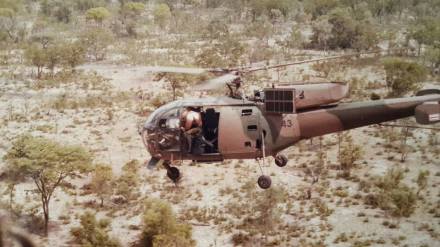
Here a South African Air Force Alouette III helicopter’s Flight Engineer/Gunner gives a typical response to fellow crew members flying alongside.

Not found in the Public Relations photographs in the SADF at the time. However in the light of combatants fighting  far away from home, and in need of some light banter to alleviate the seriousness of combat on the Angolan border, who can blame them  … “boys will be boys”.

Photo courtesy of the SAAF Alouette crew veterans fraternity.

SADF Propaganda and Psychological Warfare

No frills Propaganda

Propaganda was a means of Psychological Warfare was employed by all sides in the SWA/Angolan ‘Bush War’ Conflict – blunt and strait-forward in communication and tone so the message was clear.

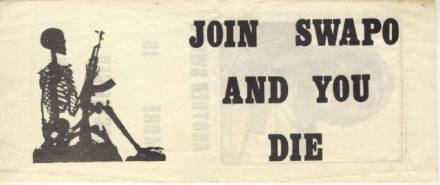
Usually symbols of death (or images of death) accompanied this type of printed propaganda and they served to underpin the threat and drive fear – this is an example of a SADF leaflet distributed to warn the local population in South West Africa/Namibia and neighbouring states not to join SWAPO (the South West African People’s Organisation) against whose armed wing – PLAN the SADF and SWATF forces were in combat with.

The message is crude and strait forward, the image used is easily assimilated and understood, it’s a “brutal” communication designed to get the point across to the lowest common denominator, no need for frills, pretty fonts and logos.

Propaganda is a “weapon”

Please note, this is of historic importance as to the propaganda used in the Bush War. It is not intended to glorify either the SADF or SWAPO – the intention is to capture and keep alive a little of South Africa’s military history so often forgotten.

Propaganda by its very nature preys on emotions – its intension and its goal is an emotive response – in military terms it’s classified as a weapon, as that response can influence the fight, either by spurring it on motivating the combatants or by stopping it and demotivating the combatants.  In many ways Propaganda can influence the outcome of a battle or war as much, if not more that the actual use of bullets.  Believe it or not – all this power – and it can simply be boiled down to a crude message like the one shown here.

When reviewing propaganda from a historical perspective (or even military perspective) it must be dealt with objectively without emotion. If it triggers an emotional response then it has simply done it job and wins, that’s how this particular weapon works…

Silver Flash – SAAF Mirage III’s in their original livery

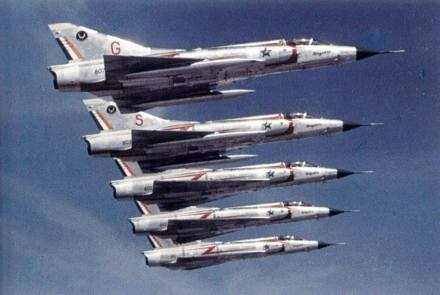
There is a saying in Afrikaans and it applies to this image ‘mooi bly mooi’ (beauty is eternal). Enjoy this stunning image of perfect formation flight by 2 squadron South African Air Force’ in their then ‘new’ Mirage III’s in 1968 – still in their colour scheme of silver metal and red lightning flash, before changing to their bush war camouflage scheme.

Photo copyright Edward Dickinson.

Border Ops to Soap Opera

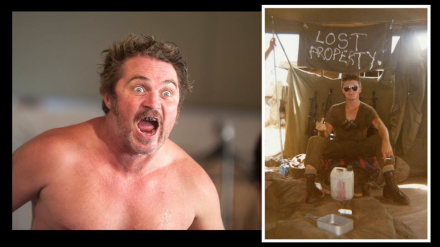
The Border War also saw some pretty famous future personalities and this is one for all the EastEnders fans (the famous on going British soap opera), this fun photo is Alex Ferns during his stint in the South African Army on the Angolan border – Alex is best known for his EastEnders role as Trevor Morgan, “Britain’s most-hated soap villain”.
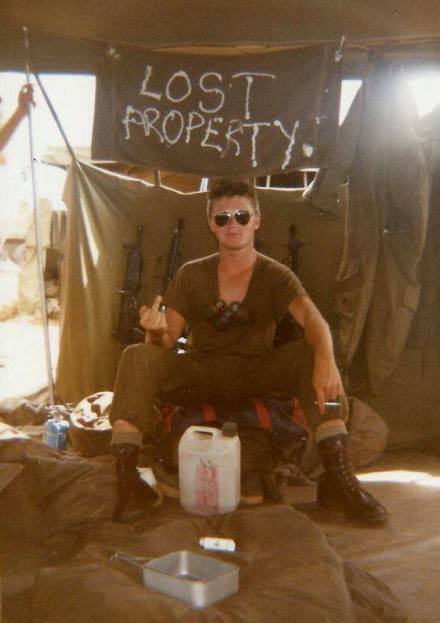
993468_242624705907269_2012413417_n

Alex was a 2 Special Service Battalion (SSB) Gunner in 1989 and affectionately regarded by his fellow brothers in arms as “hell raiser of epic proportions” he was their units “go to guy” during heavy physical training exercises and he used to sing his heart out and always lifted the spirits of the men around him. They had many an ‘oppie’ (a ‘beasting’ or Punishment PT’) together and many a dust up with other units. Because Scotland is his country of birth they regarded him as the ” mad Scotsman” often rousing his buddies to the call. Highly likeable, inspirational and great bloke to all who knew him.

We wish him the best of luck in his television career that has vaulted him to the dizzy heights of a true ‘soap star’ and British cultural icon.

Alex Ferns’ Bio

Alex Ferns also made an appearance in The Ghost and the Darkness (1996) before various television roles, including Trevor Morgan in the BBC soap opera EastEnders from 2000 to 2002. In 2005, Ferns played Lieutenant Gordon in the highly acclaimed trilingual film Joyeux Noël, which was nominated for Best Foreign Language Film at the Oscars, Golden Globe Awards and the BAFTAs.
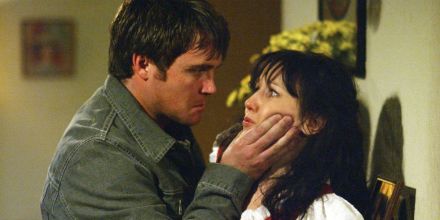
landscape-1501594800-trevor-and-mo-eastenders

Trevor and Mo, in the domestic abuse storyline for EastEnders, Alex Ferns as hard-man and abuser with Kacey Ainsworth

In 2003 Ferns appeared as Draco Malfoy in a Harry Potter sketch for Comic Relief.

In 2004 he played Commander Martin Brooke, the lead role, in the short-lived ITV series Making Waves. In the same year he appeared in Man Dancin’, a Festival Film & TV production, which won a number of awards on the festival circuit, including Outstanding Original Screenplay at the Sacramento Film Festival. He has also appeared on Coronation Street.

He has also appeared in the 2006 movie Shadow Man, as Schmitt, also starring Steven Seagal.

His theatrical work includes the role of the “tapeworm” (a hallucination) in I.D., a play about Dimitri Tsafendas and his assassination of South African Prime Minister Hendrik Verwoerd, the 2008 national tour of Agatha Christie’s murder mystery And Then There Were None, and Little Shop of Horrors as the Dentist. In 2011 he took the role of Scottish gangster Jimmy Boyle in the play about his life, The Hardman, during a Scottish tour to positive reviews.
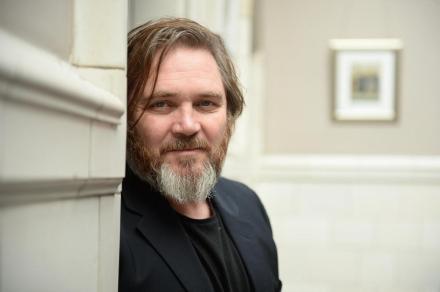
imgID141153557.jpg.gallery

Recent photograph of Alex Ferns with a possible comeback to EastEnders

He also made a brief appearance in the Smirnoff Vodka advert in 2009. Ferns took part in TV series Celebrity Coach Trip, partnered with friend Ricky Groves. He starred as Luther in the 2011 London revival and subsequent UK tour of South Pacific. In 2013, he starred as Lee in True West at Glasgow’s Citizen’s Theatre. In 2014, he starred in 24: Live Another Day.

Born in Lennoxtown, Scotland, Alex lived in South Africa for 17 years and studied drama at the University of Cape Town before returning to the United Kingdom in 1991.  Whilst in South Africa the military conscription regulations were changed to include ‘white’ foreign nationals with South African residencies, and Alex was conscripted into the South African Defence Force as a ‘National Serviceman’ or he would certainly have faced deportation and even imprisonment.

Alex Ferns has been married to South African-born actress Jennifer Woodburne since 1996. They currently live in London with their two sons, Cameron and Mackenzie.

To see Alex’s skill transforming from ‘nice guy’ to ‘hard-man’ in EastEnders, have a cuppa tea (as EastEnders fans do) and take a look at this famous clip from the series;


Related work and link

Sid James from ‘Carry On’ series; ‘Carry On’ the South African Army – the story of Sid James


Researched by Peter Dickens.

Photo courtesy of BJ Taylor and story on Alex in the SADF courtesy of Gary Smith. Video clip BBC EastEnders.  Feature image Alex Ferns in True West Rehearsals Photo: Tim Morozzo


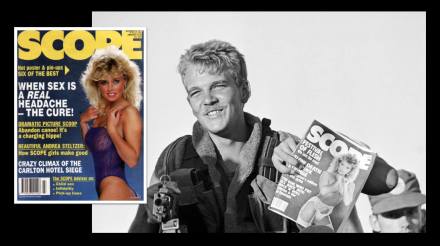
SCOPE Magazine – any troopie’s ‘must have’ reading material

SCOPE magazine – the ‘must have’ reading material for any troop serving in the SADF during the 70’s and the 80’s, many a SCOPE centre-fold model adorned signal/Ops rooms, tents and bungalow walls during the Border War.

By today’s standards SCOPE would be seen as a pretty tame mens lifestyle magazine, but then it pushed the barriers of soft porn and allowable content banned by the government of the day’s censorship board.

The magazine was launched in 1966 by Winston Charles Hyman and Jack Shepherd Smith became the long-time editor. Scope magazine would achieve iconic status in South African media as a publication that petitioned for freedom of the press with its censorship-defying content. The magazine was also known for placing strategically placed black stars concealing certain body parts of the nude female models per the censorship regulations.

The magazine had an on-going battle with the National Party’s Apartheid era policies of media censorship.  In 1972, the censor board of South Africa banned the weekly magazine, but this was overturned by the Supreme Court. This marked the seventh time in four years that the board had banned the magazine. The censor board had taken exception to a photograph published in May by the magazine, that showed a black man in New York embracing a white woman. They also took exception to a semi-nude shoot of a model in the forest and at the beach. In other attempts, the board had formerly attempted to ban the magazine because of a cover article on abortion and a story on test tube babies. In 1975, editor Shepherd Smith maintained that fair censorship was impossible in South Africa because of the cultural diversity of the nation “Whose particular way of life are the censors going to help to uphold?”. In May 1976, again the censor board issued a notice banning the magazine.

2408527183_43e82ca21d_b

However believe it or not, SCOPE also had excellent editorial content and investigative journalism receiving a number of industry awards.

The magazine also covered important crime stories. In 1984 the weekly published a telephone interview with South Africa’s most-wanted bank robber Allan Heyl of the Stander Gang who was in hiding in Britain at the time. The newspaper has also covered political stories and interviewed figures such as the spy Craig Williamson.

Stories also appeared during the South African Border War that celebrated the military training of SADF soldiers and contributed to a sense of heroism. The weekly also published a series on the experiences of Horace Morgan, an ex-psychiatric patient who spent 37 years in mental institutions. Scope conducted interviews with Morgan (who had been admitted in 1937 after losing his memory) and reported the hostility of the institutions and Morgan’s inability to escape the fate of a “wasted, tragic life in a cage”.

Several notable journalists have contributed to the magazine. In 1990, former Sunday Times writer, Jani Allan launched the self-titled Jani Allan column at Scope.  An article written by Allan on 5 October 1990, volume 25, number 20 in the magazine was presented to the South African parliament in 1991 in support of a legislation issue.

996516_183881248448282_1581793463_n

As the apartheid policies and governance crumbled in the 1990s, so too did the magazine.  Ironic considering it had played such an iconic role in countenance to Apartheid and it’s policies.  In a sense its success lay in the ability to challenge the status quo and to sensationalise it – it was taken up and enjoyed by thousands of young white South African men seeking an avenue to express their sense of independence and individualism. It was especially appealing to those serving in the armed forces where conformity and censorship was the order of the day.  With no status quo and censorship laws left to challenge, the magazine found itself without a mission.  It suffered from heavy circulation losses and the final issue was published in 1996.

For a great insight into the magazine in its heyday, order ‘The Journey Man” a biography by Chris Marais, Chis was a contributing journalist and his insights into the magazine are second to none – here’s a link The Journey Man by Chris Marais


Researched by Peter Dickens. Source wikipedia.  Photo copyright John Liebenberg