Glossary of South African Military Terms

This is for the benefit of those not always understanding the language of a South African military veteran.  This is a glossary of South African military terms compiled by Peter Dickens, David Kiley, Norman Sander and other veterans in The South African Legion, it is by no means definitive of all the terms used, quite a lot can be happily added and please feel free to notify me of any omissions.

Please note this list contains words that can be judged as offensive and objectionable – however as a historic document to capture the slang and terminology it needs to be as objective as possible.

SOUTH AFRICAN DEFENCE FORCE TERMINOLOGY AND SLANG

A)
Aapjas – A long, hooded coat usually with a fake fur lining ( post 1983 issue version ).
Aapkas (1) – metal platform / cage , sited on a radio mast in SWA / Angola ops bases; used as a lookout post / fire director station for base defence mortars.
Aap Kas (2) – also know as the jump simulation cable rig at 44 Para
Aangekla/kla-ed aan – Put on a charge.
AB – Navy.Able Seaman (Lance Corporal)
Adjudant – ( 1 ) commissioned officer appointed as executive officer to unit OC / 2IC .
Adjudant – ( 2 ) abridged Afrikaans form of address for rank of Warrant Officer ( SA Police).

Continue reading

Precision landing with Rudder and Elevators shot away = SAAF Hero!

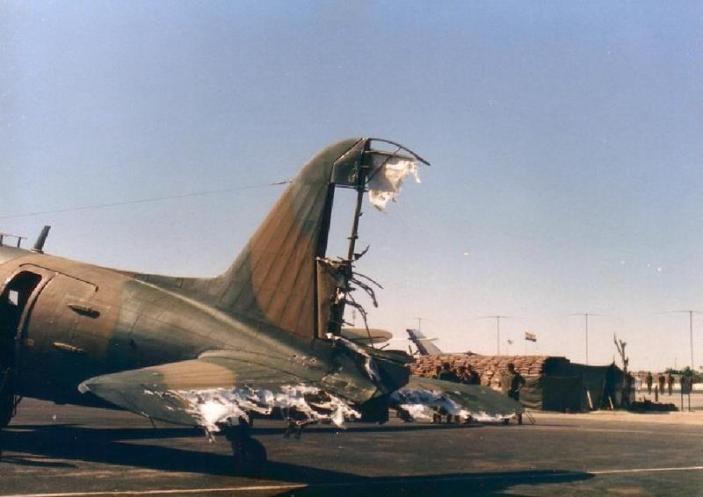
Now there are pilots with skills and then there are a cut above, this pilot is a cut above. On 1 May 1986, a South African Air Force Dakota while on a flight to Ondangwa at about 8000 ft was hit with a soviet SAM-7 shoulder fired surface to air missile. The explosion ripped off most of the Dakota’s tail. To add additional pressure to the crew, the Dakota was full of military VIP passengers including the Chief of the Army.

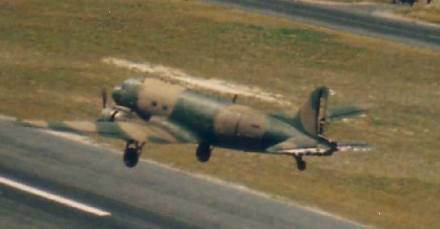
Captain Colin Green slowed the Dakota down to 100 knots in order to keep it under control and put in a mayday call. There was a SAAF helicopter in the area which formatted on him and relayed the damage to him. The helicopter crew also took this amazing picture showing the landing.

1383731_216630021840071_1160172803_n

To note from this picture is that the Dakota has lost all of it’s rudder and both sections of the elevator. This is an unrecoverable situation in most aircraft types and also a situation most pilots cannot recover the aircraft from in any event.

To compensate on the loss of stability Captain Green ordered the passengers around the aircraft to regulate the centre of gravity before going into land. Using flaps and throttle power to control the pitch (up and down) and thus control his decent rate and air speed, he landed it onto the tarmac, ‘greasing’ the centre line in a perfect landing.

Captain Colin Green was later awarded The Chief of the SADF Commendation for his exceptional flying skills.

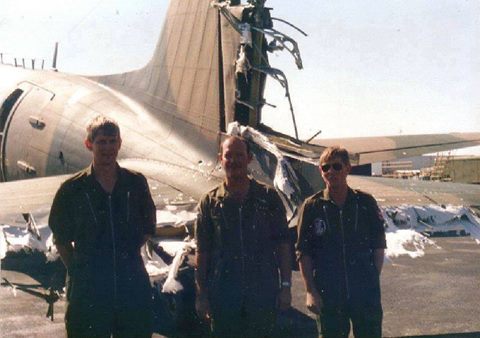
13124557_1766085276953796_1208176927466124088_n

From left to right:
National Serviceman Private Walsh (loadmaster)
Captain Colin Green (aircraft commander)
Lieutenant Mark Moses (co-pilot)

All Heroes.


Written and researched by Peter Dickens.  Images available on Internet, origin unknown .

Edward Backhouse as he comes home

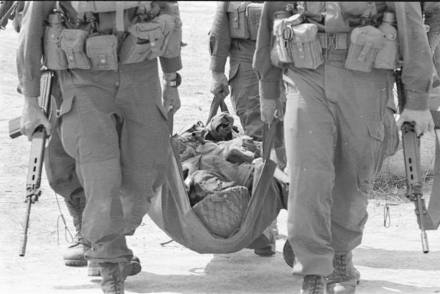
This week we especially remember the fallen from the Angolan/SWA Border War and the ‘Battle of Cassinga’ on the 4th May 1978 – in this very emotional picture we remember Rifleman Edward James Backhouse from 3 Parachute Battalion as he comes home.

There is an unwritten law to all servicemen – you don’t leave your buddies behind in a fire fight. Eddie was Killed in Action during the Battle of Cassinga. He was 22.

As a mark of respect, especially due to the highly controversial circumstances that surrounded this action, lets remember the immense sacrifice and loss experienced by all who participated in this battle and not get into any political platforming, it will only serve to disrespect the fallen.

Thank you to Graham Du Toit for the image and reference.

Recovering an irreplaceable aircraft – Capt. I.C. du Plessis HC

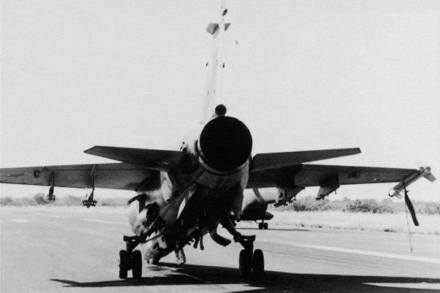
7 June 1980. The South African Air Force Mirage F1AZ 237 of Captain Isak C. du Plessis on the runway at Ruacana, after making an emergency landing when he sustained substantial battle damage.

His SAAF Mirage was part of a 16 ship F1AZ force attacking a SWAPO base near Lubango in Angola, it was damaged by two SA-3 ground to air missiles. Losing hydraulic pressure, the use of the nozzle flaps and the navigation computer he radioed for aid.

Whilst Capt. du Plessis struggled to keep the Mirage airborne, Captain “Budgie” Burgers flying a Impala as Telstar radio relay for the mission realised that the aircraft would not make it back to its base at AFB Ondangwa.  He used his considerable navigation experience in the operational area to redirect Capt. du Plessis, using bearings, to AFB Ruacana – a closer forward air base.

Capt. du Plessis managed to land the stricken aircraft at the Ruacana forward airstrip located in South West Africa (now Namibia) without the use of the nose-wheel whilst performing a flapless landing.

Capt. I.C. du Plessis awarded an Honoris Crux – 2nd type for bravery in the recovery of an irreplaceable stricken aircraft and airmanship.

Band of Brothers – 101 Romeo Mikes

This great photograph of Cpl Stephen Bothma captures the grit and camaraderie of a 101 Battalion ‘Romeo Mike’ unit in action somewhere on the Angolan/South West Africa (Namibia) border. The ‘Romeo Mikes’ meant Reaksie Mag (Reaction Force) and these units where designed as long range special forces of the South West African Territorial Force (SWATF) and their purpose was to relentlessly track and then surround insurgents.

By 1981 101 Battalion had been established as a light infantry battalion.  By 1983 at least 2700 men had been recruited and trained, many converted SWAPO insurgents. 101 Battalion translated Police tracking concepts to suit Army operations. These formed two Reaction Force companies: 901 and 903 Special Service Companies. These Companies concentrated on external operations and pursuit of infiltrators. By 1985 101 Battalion fought under its own command instead of being detached to external units.

The Romeo Mike and 101 engagements were intense to say the least.  This Battalion saw an extraordinary amount of combat and it can be put down to the Romeo Mike strategy and tactics to deal with insurgency (long range patrolling).  To give an idea of the intensity of combat 101 Battalions reaction force teams (Romeo Mikes) averaged about 200 “contacts” annually, a “contact” was usually refereed to an armed military skirmish between SWAPO PLAN insurgents and conventional forces.   It can be argued that the vast bulk of the fighting against insurgents on the South West African (Namibian)/Angolan Border was left to the SWATF formations (units including 101 Battalion), Police formations like Koevoet, 32 Battalion and search and destroy missions by SADF Recce (Reconnaissance) and Parabat (Parachute) formations.

Note the parallel two strips on Stephen’s shoulder in the feature picture – this shows his designated rank as a “full” corporal.  The SWATF rank structure insignia differed slightly from the South West African Defence Force (SADF) rank structure who used downward pointing “chevrons” for Non Commissioned Officer (NCO) insignia (i.e. Corporals and Sergeants), as is done in British rank structure.

These are South West African Territorial Force Rank insignia:

These are South Africa Defence Force Rank Insignia

This is because South West Africa was after all seen as a “separate” country to South Africa with its own defence force, therefore it had its own insignia.  However, in realty the equipment, clothing, weapons and even many of the officers and non commissioned officers were supplied by South Africa.

One thing that was clearly very different with all of the South West African formations, and especially 101 Battalion, was the very high degree of racial integration, the ethnic make-up of these Battalions was very reflective of the South West African (SWA) demographic. Division along the lines of race in the military structures did not really exist to the same degree that it did in the South African Defence Force.

Certainly on this level – fighting together as a 101 Romeo Mike unit, any sort of racial differentiation did not exist at all.  There was an old saying on the Border – there is “no Apartheid in a fox hole.”   Veterans in both the SADF and the SWATF will always attest that they do not care for colour as it matters not a jot in a firefight, and regardless of anything else, men in this situation (the hard trials of combat or serving in a combat area) will always bond as brothers.


All 101 images photo copyright Stephen Bothma.  Written by Peter Dickens

A picture is worth a thousand words

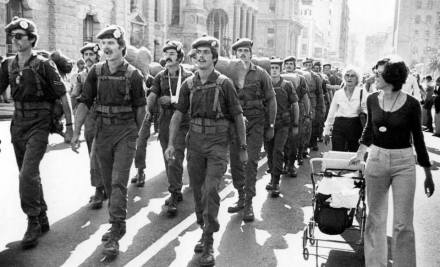
Sometimes, years later, the human story of a simple border war picture carries so much, especially as to the sacrifice families make when a father or brother gets “called up” to fight a war.  This from Lorraine Beer when this photo was published on the South African Legion’s social media.

“This photo is very special to my family, my brother Trevor Leo is on the right has his wife Lynette with his first born, as yet unseen son Craig in the pram and his mother Madeleine behind her.”

Here the Cape Town Highlanders stage a homecoming parade in Darling Street, Cape Town upon their return from the Angolan border operational area on the 17th of March 1976.

What a fantastic memory to have, and what a pure insight into the simple human truths that come along when men and women are called to serve their country  – thank you Lorraine.

Photo copyright, The Argus.

The need for South Africa to hold onto Namibia for as long as it did.

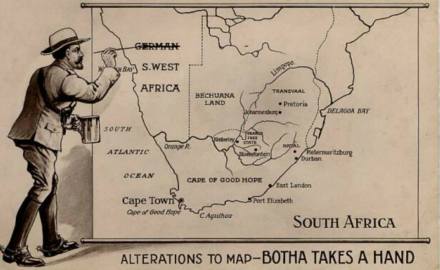
The capture of German South West Africa as part of the start of World War One, by South Africa, had a profound impact on the next 100 years of South Africa’s history. Whilst its invasion was important to the outcome of WW1, its period as a protectorate of South Africa’s after the war had a longer and more profound impact.

Politically speaking, the incorporation of the South West African white electorate into the South African electorate after the National Party came to power in 1948, set South Africa on a path which was to see it embroiled in a two and a half decade long war with South West Africa’s liberation movement and Angolan coalition forces (1966-1989).

The inclusion of this very pro German – anti British ‘whites only’ South West African voters into South African elections provided the National Party with a very large loyal voting block – it added to the campaign to reconcile constituencies to keep Smuts’ old United Party from getting back into power. Between 1950 and 1977, whites in the territory were represented in the South African Parliament by four Senators and six Ministers of Parliament.

Its also this loyal base of conservative white voters that the National Party found obligated to, so much so it was prepared for a protracted war to keep them.  The National Party in some senses saw South West Africa as a 5th province of South Africa and not an independent state.

It’s a fascinating period of South Africa’s history, and very ironic to think that it was this military campaign by Smuts and Botha that started it all.  Funny how history turns out.

South Africa’s World War 1 German South West Africa campaign is best and briefly summarised as follows:

An invasion of German South-West Africa from the south failed at the Battle of Sandfontein (25 September 1914), close to the border with the Cape Colony. German fusiliers inflicted a serious defeat on the British troops and the survivors returned to the Cape Colony.

The Germans began an invasion of South Africa to forestall another invasion attempt and the Battle of Kakamas took place on 4 February 1915, between South African and German forces, a skirmish for control of two river fords over the Orange River.

The South Africans prevented the Germans from gaining control of the fords and crossing the river. By February 1915, the South Africans were ready to occupy German territory.

General Botha put General Smuts in command of the southern forces while he commanded the northern forces.

Botha arrived at Swakopmund on 11 February and continued to build up his invasion force at Walfish Bay (or Walvis Bay), a South African enclave about halfway along the coast of German South West Africa. In March Botha began an advance from Swakopmund along the Swakop valley with its railway line and captured Otjimbingwe, Karibib, Friedrichsfelde, Wilhelmsthal and Okahandja and then entered Windhuk (Windhoek) on 5 May 1915.

The Germans offered surrender terms, which were rejected by Botha and the war continued.

On 12 May Botha declared martial law and divided his forces into four contingents, which cut off German forces in the interior from the coastal regions of Kunene and Kaokoveld and fanned out into the north-east.

The South African column under General Lukin went along the railway line from Swakopmund to Tsumeb. The other two South African columns rapidly advanced on the right flank, Myburgh to Otavi junction and Manie Botha to Tsumeb and the terminus of the railway.

German forces in the north-west fought the Battle of Otavi on 1 July but were defeated and surrendered at Khorab on 9 July 1915. In the south, Smuts landed at the South West African naval base at Luderitzbucht, then advanced inland and captured Keetmanshoop on 20 May. The South Africans linked with two columns which had advanced over the border from South Africa.

Smuts advanced north along the railway line to Berseba and on 26 May, after two day’s fighting captured Gibeon.

The Germans in the south were forced to retreat northwards towards Windhuk and Botha’s force. On 9 July the German forces in the south surrendered.

This German surrender was the first major tactical win of World War 1 for the Entente Alliance’s Allies.


Written and Researched by Peter Dickens.  Reference wikipedia

Border Ops to Soap Opera

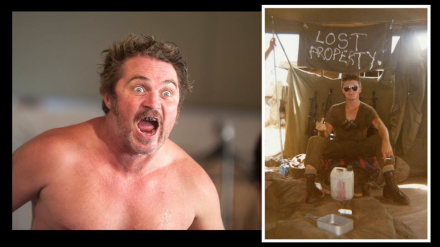
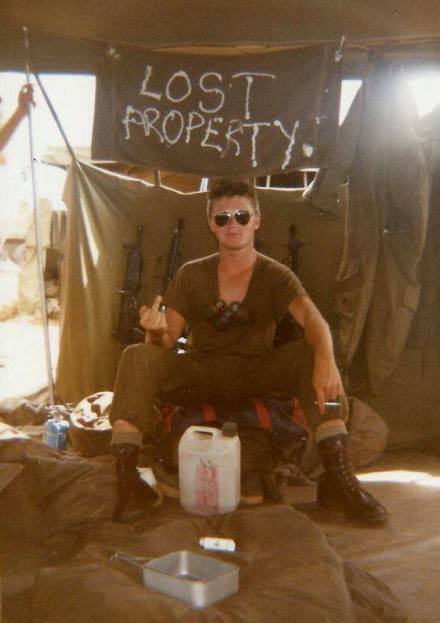
The Border War also saw some pretty famous future personalities and this is one for all the EastEnders fans (the famous on going British soap opera), this fun photo is Alex Ferns during his stint in the South African Army on the Angolan border – Alex is best known for his EastEnders role as Trevor Morgan, “Britain’s most-hated soap villain”.

993468_242624705907269_2012413417_n

Alex was a 2 Special Service Battalion (SSB) Gunner in 1989 and affectionately regarded by his fellow brothers in arms as “hell raiser of epic proportions” he was their units “go to guy” during heavy physical training exercises and he used to sing his heart out and always lifted the spirits of the men around him. They had many an ‘oppie’ (a ‘beasting’ or Punishment PT’) together and many a dust up with other units. Because Scotland is his country of birth they regarded him as the ” mad Scotsman” often rousing his buddies to the call. Highly likeable, inspirational and great bloke to all who knew him.

We wish him the best of luck in his television career that has vaulted him to the dizzy heights of a true ‘soap star’ and British cultural icon.

Alex Ferns’ Bio

Alex Ferns also made an appearance in The Ghost and the Darkness (1996) before various television roles, including Trevor Morgan in the BBC soap opera EastEnders from 2000 to 2002. In 2005, Ferns played Lieutenant Gordon in the highly acclaimed trilingual film Joyeux Noël, which was nominated for Best Foreign Language Film at the Oscars, Golden Globe Awards and the BAFTAs.

landscape-1501594800-trevor-and-mo-eastenders

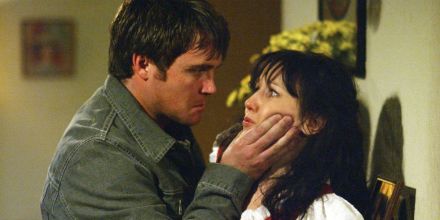
Trevor and Mo, in the domestic abuse storyline for EastEnders, Alex Ferns as hard-man and abuser with Kacey Ainsworth

In 2003 Ferns appeared as Draco Malfoy in a Harry Potter sketch for Comic Relief.

In 2004 he played Commander Martin Brooke, the lead role, in the short-lived ITV series Making Waves. In the same year he appeared in Man Dancin’, a Festival Film & TV production, which won a number of awards on the festival circuit, including Outstanding Original Screenplay at the Sacramento Film Festival. He has also appeared on Coronation Street.

He has also appeared in the 2006 movie Shadow Man, as Schmitt, also starring Steven Seagal.

His theatrical work includes the role of the “tapeworm” (a hallucination) in I.D., a play about Dimitri Tsafendas and his assassination of South African Prime Minister Hendrik Verwoerd, the 2008 national tour of Agatha Christie’s murder mystery And Then There Were None, and Little Shop of Horrors as the Dentist. In 2011 he took the role of Scottish gangster Jimmy Boyle in the play about his life, The Hardman, during a Scottish tour to positive reviews.

imgID141153557.jpg.gallery

Recent photograph of Alex Ferns with a possible comeback to EastEnders

He also made a brief appearance in the Smirnoff Vodka advert in 2009. Ferns took part in TV series Celebrity Coach Trip, partnered with friend Ricky Groves. He starred as Luther in the 2011 London revival and subsequent UK tour of South Pacific. In 2013, he starred as Lee in True West at Glasgow’s Citizen’s Theatre. In 2014, he starred in 24: Live Another Day.

Born in Lennoxtown, Scotland, Alex lived in South Africa for 17 years and studied drama at the University of Cape Town before returning to the United Kingdom in 1991.  Whilst in South Africa the military conscription regulations were changed to include ‘white’ foreign nationals with South African residencies, and Alex was conscripted into the South African Defence Force as a ‘National Serviceman’ or he would certainly have faced deportation and even imprisonment.

Alex Ferns has been married to South African-born actress Jennifer Woodburne since 1996. They currently live in London with their two sons, Cameron and Mackenzie.

To see Alex’s skill transforming from ‘nice guy’ to ‘hard-man’ in EastEnders, have a cuppa tea (as EastEnders fans do) and take a look at this famous clip from the series;


Related work and link

Sid James from ‘Carry On’ series; ‘Carry On’ the South African Army – the story of Sid James


Researched by Peter Dickens.

Photo courtesy of BJ Taylor and story on Alex in the SADF courtesy of Gary Smith. Video clip BBC EastEnders.  Feature image Alex Ferns in True West Rehearsals Photo: Tim Morozzo


Ineffective Bush War propaganda reinforces the “Communist Plot”

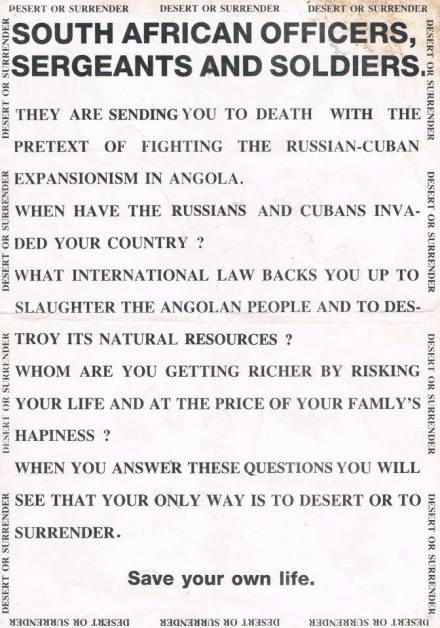
Bush War era propaganda leaflet distributed by FAPLA – The People’s Armed Forces for the Liberation of Angola (FAPLA or Forças Armadas Populares de Libertação de Angola) and its communist backers – Cuba and the USSR.

The purpose of this type of propaganda was to sow dissent in the South African Defence Force ranks and urge desertion – however there is no evidence of this actually working – notwithstanding the high discipline and motivation of SADF troops – but also for the most part SADF troops treated such propaganda with amusement. In fact it served to reinforce the held ideal that they were involved in a true “cold” war conflict against communism.

To put it in context – at the time there was no diplomatic interface between the capitalist ‘West’ and the Soviet Union and Cuba – not even a telephone call between the Western superpowers and the Kremlin. So the threat of communist ideals in Africa and the socialist nationalisation of private property was a very real one. The western world in the mid 1980’s stood against a real threat of “World war 3”, and the campaign was been played out in regional conflicts all over Africa, South America and the Middle East.

FAPLA was originally the armed wing of the People’s Movement for the Liberation of Angola (MPLA), a  party with communist leanings which was backed financially and militarily by the Soviet Union and Cuba.  There was no way the average SADF trooper would see it as anything other than yet another Communist “plot”.

Quiet lads, two heroes are walking by …

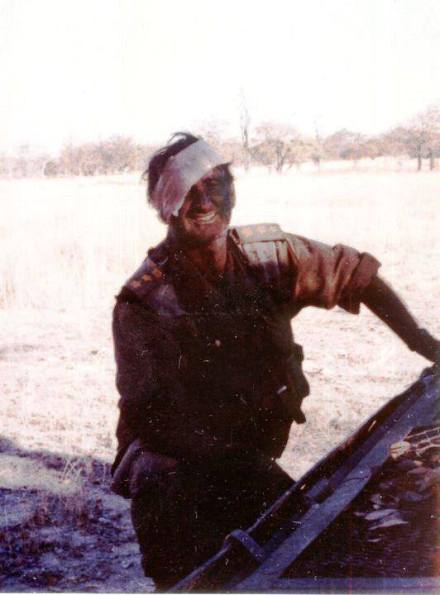
Two men who stands head and shoulders above other men. Col Jan Breytenbach seen here after been blown clear from his vehicle when it hit a anti tank land mine whilst on operations in southern Angola on the 29th August 1981. Col Breytenbach immediately returned to rescue Dave Barr, his gunner, who was pinned under the vehicle – a special forces ‘Sabre’ – and pulled him free from exploding ammunition and burning fuel.

Dave Barr, an American serving with the SADF unfortunately lost both legs in the incident, however testament to Dave – as a double amputee, ex Vietnam War and Bush War veteran, he then went on to circumnavigate parts of the planet by motorcycle raising funds for the disabled, setting world records and inspiring people.