The need for South Africa to hold onto Namibia for as long as it did.

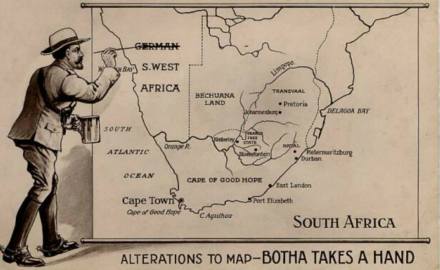
The capture of German South West Africa as part of the start of World War One, by South Africa, had a profound impact on the next 100 years of South Africa’s history. Whilst its invasion was important to the outcome of WW1, its period as a protectorate of South Africa’s after the war had a longer and more profound impact.

Politically speaking, the incorporation of the South West African white electorate into the South African electorate after the National Party came to power in 1948, set South Africa on a path which was to see it embroiled in a two and a half decade long war with South West Africa’s liberation movement and Angolan coalition forces (1966-1989).

The inclusion of this very pro German – anti British ‘whites only’ South West African voters into South African elections provided the National Party with a very large loyal voting block – it added to the campaign to reconcile constituencies to keep Smuts’ old United Party from getting back into power. Between 1950 and 1977, whites in the territory were represented in the South African Parliament by four Senators and six Ministers of Parliament.

Its also this loyal base of conservative white voters that the National Party found obligated to, so much so it was prepared for a protracted war to keep them.  The National Party in some senses saw South West Africa as a 5th province of South Africa and not an independent state.

It’s a fascinating period of South Africa’s history, and very ironic to think that it was this military campaign by Smuts and Botha that started it all.  Funny how history turns out.

South Africa’s World War 1 German South West Africa campaign is best and briefly summarised as follows:

An invasion of German South-West Africa from the south failed at the Battle of Sandfontein (25 September 1914), close to the border with the Cape Colony. German fusiliers inflicted a serious defeat on the British troops and the survivors returned to the Cape Colony.

The Germans began an invasion of South Africa to forestall another invasion attempt and the Battle of Kakamas took place on 4 February 1915, between South African and German forces, a skirmish for control of two river fords over the Orange River.

The South Africans prevented the Germans from gaining control of the fords and crossing the river. By February 1915, the South Africans were ready to occupy German territory.

General Botha put General Smuts in command of the southern forces while he commanded the northern forces.

Botha arrived at Swakopmund on 11 February and continued to build up his invasion force at Walfish Bay (or Walvis Bay), a South African enclave about halfway along the coast of German South West Africa. In March Botha began an advance from Swakopmund along the Swakop valley with its railway line and captured Otjimbingwe, Karibib, Friedrichsfelde, Wilhelmsthal and Okahandja and then entered Windhuk (Windhoek) on 5 May 1915.

The Germans offered surrender terms, which were rejected by Botha and the war continued.

On 12 May Botha declared martial law and divided his forces into four contingents, which cut off German forces in the interior from the coastal regions of Kunene and Kaokoveld and fanned out into the north-east.

The South African column under General Lukin went along the railway line from Swakopmund to Tsumeb. The other two South African columns rapidly advanced on the right flank, Myburgh to Otavi junction and Manie Botha to Tsumeb and the terminus of the railway.

German forces in the north-west fought the Battle of Otavi on 1 July but were defeated and surrendered at Khorab on 9 July 1915. In the south, Smuts landed at the South West African naval base at Luderitzbucht, then advanced inland and captured Keetmanshoop on 20 May. The South Africans linked with two columns which had advanced over the border from South Africa.

Smuts advanced north along the railway line to Berseba and on 26 May, after two day’s fighting captured Gibeon.

The Germans in the south were forced to retreat northwards towards Windhuk and Botha’s force. On 9 July the German forces in the south surrendered.

This German surrender was the first major tactical win of World War 1 for the Entente Alliance’s Allies.


Written and Researched by Peter Dickens.  Reference wikipedia
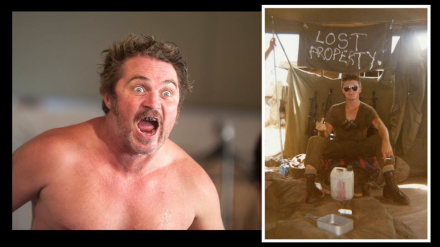
Border Ops to Soap Opera

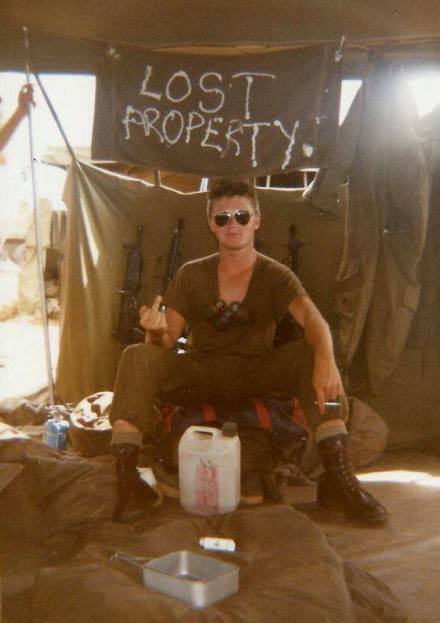
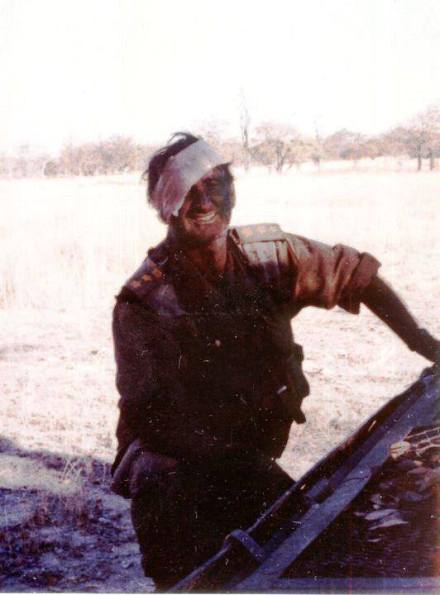
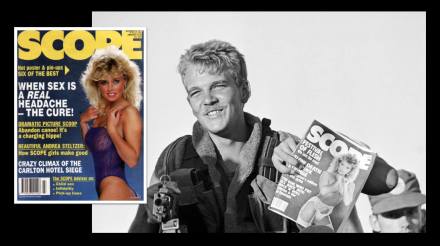
The Border War also saw some pretty famous future personalities and this is one for all the EastEnders fans (the famous on going British soap opera), this fun photo is Alex Ferns during his stint in the South African Army on the Angolan border – Alex is best known for his EastEnders role as Trevor Morgan, “Britain’s most-hated soap villain”.

993468_242624705907269_2012413417_n

Alex was a 2 Special Service Battalion (SSB) Gunner in 1989 and affectionately regarded by his fellow brothers in arms as “hell raiser of epic proportions” he was their units “go to guy” during heavy physical training exercises and he used to sing his heart out and always lifted the spirits of the men around him. They had many an ‘oppie’ (a ‘beasting’ or Punishment PT’) together and many a dust up with other units. Because Scotland is his country of birth they regarded him as the ” mad Scotsman” often rousing his buddies to the call. Highly likeable, inspirational and great bloke to all who knew him.

We wish him the best of luck in his television career that has vaulted him to the dizzy heights of a true ‘soap star’ and British cultural icon.

Alex Ferns’ Bio

Alex Ferns also made an appearance in The Ghost and the Darkness (1996) before various television roles, including Trevor Morgan in the BBC soap opera EastEnders from 2000 to 2002. In 2005, Ferns played Lieutenant Gordon in the highly acclaimed trilingual film Joyeux Noël, which was nominated for Best Foreign Language Film at the Oscars, Golden Globe Awards and the BAFTAs.

landscape-1501594800-trevor-and-mo-eastenders

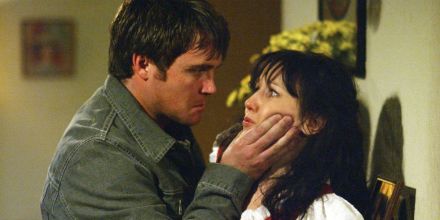
Trevor and Mo, in the domestic abuse storyline for EastEnders, Alex Ferns as hard-man and abuser with Kacey Ainsworth

In 2003 Ferns appeared as Draco Malfoy in a Harry Potter sketch for Comic Relief.

In 2004 he played Commander Martin Brooke, the lead role, in the short-lived ITV series Making Waves. In the same year he appeared in Man Dancin’, a Festival Film & TV production, which won a number of awards on the festival circuit, including Outstanding Original Screenplay at the Sacramento Film Festival. He has also appeared on Coronation Street.

He has also appeared in the 2006 movie Shadow Man, as Schmitt, also starring Steven Seagal.

His theatrical work includes the role of the “tapeworm” (a hallucination) in I.D., a play about Dimitri Tsafendas and his assassination of South African Prime Minister Hendrik Verwoerd, the 2008 national tour of Agatha Christie’s murder mystery And Then There Were None, and Little Shop of Horrors as the Dentist. In 2011 he took the role of Scottish gangster Jimmy Boyle in the play about his life, The Hardman, during a Scottish tour to positive reviews.

imgID141153557.jpg.gallery

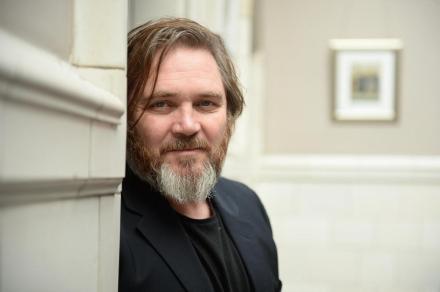
Recent photograph of Alex Ferns with a possible comeback to EastEnders

He also made a brief appearance in the Smirnoff Vodka advert in 2009. Ferns took part in TV series Celebrity Coach Trip, partnered with friend Ricky Groves. He starred as Luther in the 2011 London revival and subsequent UK tour of South Pacific. In 2013, he starred as Lee in True West at Glasgow’s Citizen’s Theatre. In 2014, he starred in 24: Live Another Day.

Born in Lennoxtown, Scotland, Alex lived in South Africa for 17 years and studied drama at the University of Cape Town before returning to the United Kingdom in 1991.  Whilst in South Africa the military conscription regulations were changed to include ‘white’ foreign nationals with South African residencies, and Alex was conscripted into the South African Defence Force as a ‘National Serviceman’ or he would certainly have faced deportation and even imprisonment.

Alex Ferns has been married to South African-born actress Jennifer Woodburne since 1996. They currently live in London with their two sons, Cameron and Mackenzie.

To see Alex’s skill transforming from ‘nice guy’ to ‘hard-man’ in EastEnders, have a cuppa tea (as EastEnders fans do) and take a look at this famous clip from the series;


Related work and link

Sid James from ‘Carry On’ series; ‘Carry On’ the South African Army – the story of Sid James


Researched by Peter Dickens.

Photo courtesy of BJ Taylor and story on Alex in the SADF courtesy of Gary Smith. Video clip BBC EastEnders.  Feature image Alex Ferns in True West Rehearsals Photo: Tim Morozzo


Ineffective Bush War propaganda reinforces the “Communist Plot”

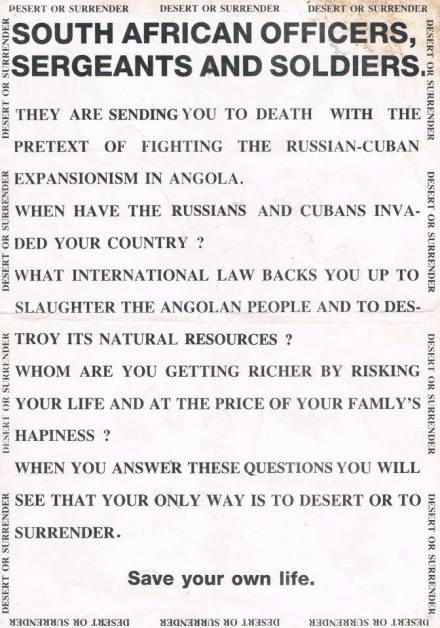
Bush War era propaganda leaflet distributed by FAPLA – The People’s Armed Forces for the Liberation of Angola (FAPLA or Forças Armadas Populares de Libertação de Angola) and its communist backers – Cuba and the USSR.

The purpose of this type of propaganda was to sow dissent in the South African Defence Force ranks and urge desertion – however there is no evidence of this actually working – notwithstanding the high discipline and motivation of SADF troops – but also for the most part SADF troops treated such propaganda with amusement. In fact it served to reinforce the held ideal that they were involved in a true “cold” war conflict against communism.

To put it in context – at the time there was no diplomatic interface between the capitalist ‘West’ and the Soviet Union and Cuba – not even a telephone call between the Western superpowers and the Kremlin. So the threat of communist ideals in Africa and the socialist nationalisation of private property was a very real one. The western world in the mid 1980’s stood against a real threat of “World war 3”, and the campaign was been played out in regional conflicts all over Africa, South America and the Middle East.

FAPLA was originally the armed wing of the People’s Movement for the Liberation of Angola (MPLA), a  party with communist leanings which was backed financially and militarily by the Soviet Union and Cuba.  There was no way the average SADF trooper would see it as anything other than yet another Communist “plot”.

Quiet lads, two heroes are walking by …

Two men who stands head and shoulders above other men. Col Jan Breytenbach seen here after been blown clear from his vehicle when it hit a anti tank land mine whilst on operations in southern Angola on the 29th August 1981. Col Breytenbach immediately returned to rescue Dave Barr, his gunner, who was pinned under the vehicle – a special forces ‘Sabre’ – and pulled him free from exploding ammunition and burning fuel.

Dave Barr, an American serving with the SADF unfortunately lost both legs in the incident, however testament to Dave – as a double amputee, ex Vietnam War and Bush War veteran, he then went on to circumnavigate parts of the planet by motorcycle raising funds for the disabled, setting world records and inspiring people.

The man with the MGL

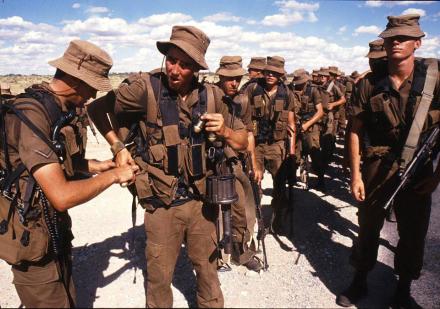
Infantry section seen here during South West Africa and Angola Border War. This is a SADF patrol final inspection (thought to be 5 SAI), this task was usually performed by the section leaders before the platoon moves out. His job was to check that every man’s kit is in full order. Here he checks the ammunition and kit of the man allocated the 40 mm multiple grenade launcher.

Infantry sections like this were made up of 10 men comprising a section leader – usually a corporal, two machine gun groups – LMG (Light machine gun) and one man on the multiple grenade launcher (MGL) in the rifle group.

Three Infantry sections made up a Platoon headed which report to a HQ group of 5 men, including a Platoon Commander (usually a Lt or 2Lt) and a Platoon Sergeant. Total platoon strength 35 men.

The MGL (Multiple Grenade Launcher) is a lightweight 40 mm six-shot revolver-type grenade launcher (variations also fire 37/38mm) developed and manufactured in South Africa by Milkor (Pty) Ltd. This MGL was the world’s first mass-produced multi-shot 40mm hand-held weapon.

The MGL was demonstrated as a concept to the South African Defence Force (SADF) in 1981. The operating principle was immediately accepted and subjected to a stringent qualification program. The MGL was then officially accepted into service with the SADF as the Y2. After its introduction in 1983, the MGL was gradually adopted by the armed forces and law enforcement organizations of over 50 countries. Total production since 1983 has been more than 50,000 units.

The MGL is a multiple-shot weapon, intended to significantly increase a small squad’s firepower when compared to traditional single-shot grenade launchers like the M203. The MGL is designed to be simple, rugged, and reliable. It uses the well-proven revolver principle to achieve a high rate of accurate fire which can be rapidly brought to bear on a target. A variety of rounds such as HE, HEAT, anti-riot baton, irritant, and pyrotechnic can be loaded and fired as fast as the trigger can be pulled; the cylinder can be loaded or unloaded rapidly to maintain a high rate of fire. Although intended primarily for offensive and defensive use with high-explosive rounds, with appropriate ammunition the launcher is suitable for anti-riot and other security operations. A newly patented modification allows the MGL to fire less lethal (very low pressure) rounds.

Photo copyright John Liebenberg, sources Wikipedia and Defence Network.

“Browns”

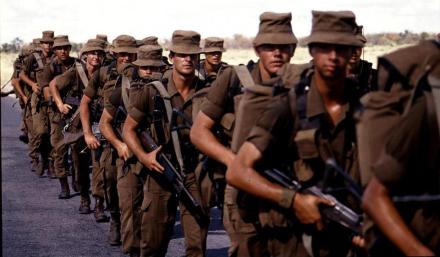
Great photo of South African infantry troops in the distinctive ‘brown’ nutria combat fatigues of the period. Here SADF troops return to their Ruacana base. March 26 1989. The nutria uniform was affectionally and officially known as ‘Browns’ and over time, sun and extensive washing and ironing exposure it became a ‘lighter’ brown with ‘houding’ (attitude) – browns with extensive exposure turned a milky brown eventually and this became the hallmark of a ‘ouman’ (old man) who had been serving for a while. The distinctive browns issue bush hats are also seen with a little ‘bush houding’ – a grenade ring pull and ‘toggle’ attaching it to the owner (and the stitch line was always worn at the back, never the front).

Camouflage fatigues – as part of the SADF’s “Soldier 2000” program began to replace “browns” in 1992/3

Photo copyright and courtesy: John Liebenberg

Lost MiG – pilot Lt Vinez never “defected” to South Africa

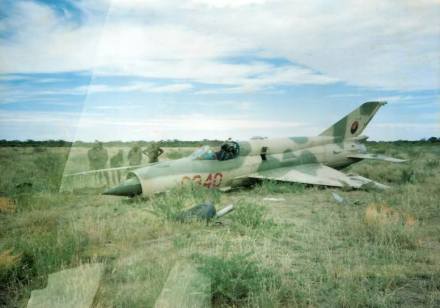
Much has been speculated and written regarding the circumstances under which this Angolan MiG-21bis (C340), piloted by Lt Vinez landed up on Schneider-Waterberg’s farm near Otjiwarongo, South West Africa (now Namibia).  However this is the true story.

On 14/12/1988 a MiG-21bis Fishbed of FAPA, took-off from the airfield at Lubango (FNBU position 14:56South 13:35East). Lt Vinez at the controls of the aircraft climbed to altitude on a general heading of 090 degree for a routine ferry flight from FNBU to the airfield at Menongue (FNME 14:39South 17:41East). The aircraft encountered clouds along the route, and Lt Vinez continued eastwards as planned. However on a number of occasions the aircraft entered clouds and upon regaining visual contact with the ground, he no longer could orientate himself as to where he was. After a while, he elected to divert to Cuito Cuanavale (FNCV), South East of FNME.

According to Lt Vinez, he had lost all his visual queues, he had been used to use when navigating between these airfields.

After setting a South Easterly heading, he continued believing that he would soon pick up the beacons of FNCV, this never happened (he was way to the west of the planned route) at this time. The only maps carried in FAPA aircraft were standard ‘Shell’ road maps, these maps are near to useless in the aviation environment, let-alone use it during an Instrument Flight Rules mission!

He continued, after approximately 20 minutes, he had crossed a major river (the Cubago), which he believed to be the Cuito River. The area to the East of the Cuito River was UNITA occupied territory. Continuing on his present course, the aircraft began giving the pilot a ‘Low Fuel’ warning. At that time he elected to attempt an emergency landing, after preparing the aircraft for the Forced Landing, he selected an open field, and executed a near prefect ‘normal’ landing. The aircraft only sustained minor damage.

Fuelled by National Party propaganda and state owned media in South Africa – this event was set up as “defection” to South Africa – in much the same way that Soviet and Cuban Communists defected to the “West” during the Cold War. The truth of the matter is Lt Vinez had no intent on defecting to the Republic of South Africa/South West Africa. During discussions at the accident site with him, his greatest concern was that he was indeed in UNITA occupied territory. It took some time to convince him otherwise.

Content courtesy of the SAAF forum

SCOPE Magazine – any troopie’s ‘must have’ reading material

SCOPE magazine – the ‘must have’ reading material for any troop serving in the SADF during the 70’s and the 80’s, many a SCOPE centre-fold model adorned signal/Ops rooms, tents and bungalow walls during the Border War.

By today’s standards SCOPE would be seen as a pretty tame mens lifestyle magazine, but then it pushed the barriers of soft porn and allowable content banned by the government of the day’s censorship board.

The magazine was launched in 1966 by Winston Charles Hyman and Jack Shepherd Smith became the long-time editor. Scope magazine would achieve iconic status in South African media as a publication that petitioned for freedom of the press with its censorship-defying content. The magazine was also known for placing strategically placed black stars concealing certain body parts of the nude female models per the censorship regulations.

The magazine had an on-going battle with the National Party’s Apartheid era policies of media censorship.  In 1972, the censor board of South Africa banned the weekly magazine, but this was overturned by the Supreme Court. This marked the seventh time in four years that the board had banned the magazine. The censor board had taken exception to a photograph published in May by the magazine, that showed a black man in New York embracing a white woman. They also took exception to a semi-nude shoot of a model in the forest and at the beach. In other attempts, the board had formerly attempted to ban the magazine because of a cover article on abortion and a story on test tube babies. In 1975, editor Shepherd Smith maintained that fair censorship was impossible in South Africa because of the cultural diversity of the nation “Whose particular way of life are the censors going to help to uphold?”. In May 1976, again the censor board issued a notice banning the magazine.

2408527183_43e82ca21d_b

However believe it or not, SCOPE also had excellent editorial content and investigative journalism receiving a number of industry awards.

The magazine also covered important crime stories. In 1984 the weekly published a telephone interview with South Africa’s most-wanted bank robber Allan Heyl of the Stander Gang who was in hiding in Britain at the time. The newspaper has also covered political stories and interviewed figures such as the spy Craig Williamson.

Stories also appeared during the South African Border War that celebrated the military training of SADF soldiers and contributed to a sense of heroism. The weekly also published a series on the experiences of Horace Morgan, an ex-psychiatric patient who spent 37 years in mental institutions. Scope conducted interviews with Morgan (who had been admitted in 1937 after losing his memory) and reported the hostility of the institutions and Morgan’s inability to escape the fate of a “wasted, tragic life in a cage”.

Several notable journalists have contributed to the magazine. In 1990, former Sunday Times writer, Jani Allan launched the self-titled Jani Allan column at Scope.  An article written by Allan on 5 October 1990, volume 25, number 20 in the magazine was presented to the South African parliament in 1991 in support of a legislation issue.

996516_183881248448282_1581793463_n

As the apartheid policies and governance crumbled in the 1990s, so too did the magazine.  Ironic considering it had played such an iconic role in countenance to Apartheid and it’s policies.  In a sense its success lay in the ability to challenge the status quo and to sensationalise it – it was taken up and enjoyed by thousands of young white South African men seeking an avenue to express their sense of independence and individualism. It was especially appealing to those serving in the armed forces where conformity and censorship was the order of the day.  With no status quo and censorship laws left to challenge, the magazine found itself without a mission.  It suffered from heavy circulation losses and the final issue was published in 1996.

For a great insight into the magazine in its heyday, order ‘The Journey Man” a biography by Chris Marais, Chis was a contributing journalist and his insights into the magazine are second to none – here’s a link The Journey Man by Chris Marais


Researched by Peter Dickens. Source wikipedia.  Photo copyright John Liebenberg

South Africa’s “Vietnam” – the tactical use of the helicopter during the Bush War

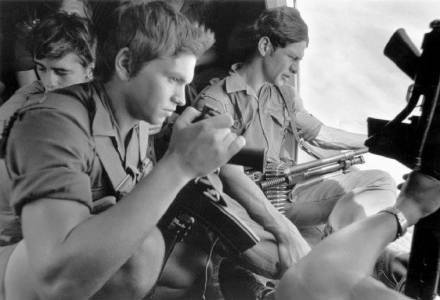
South Africa’s ‘Vietnam’ in a Bush War photo not too dissimilar to a Vietnam War image, an elite South African rapid response unit prepares to be debused from a South African Air Force Puma helicopter somewhere on the Angolan and South West African Border. What a great photo by Peter Marlow.

Not interested in keeping permanent “firebases” in Angola to stem insurgency,  similar to the American tactics used in Vietnam the South Africans extensively used the helicopter to shuttle reaction forces directly to an identified target and take them back once their “search and destroy” mission had been completed.

Image copyright – Peter Marlow

Border War Characters – Major Tickli Kessler

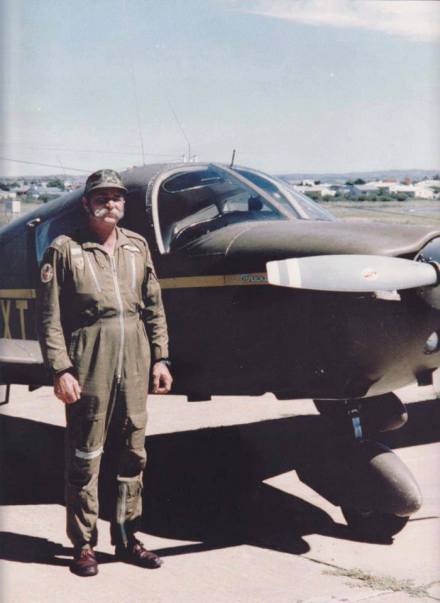
Famous characters of the Border War – Major Helmuth Adolf (Tikli) Kessler, who flew a PA28 Cherokee which he converted to have fire power and bombing capability in support of operations.

Major Kessler from the SWATF (South West Africa Territorial Force) – 1 SWA Squadron used the PA28 primarily as a spotter and also engaged combatants with his improvised weapons system. He was tragically killed whist supporting ground operations in 1982.

Major Kessler had a ” tube” which he used to drop grenades from between the seats and the two RPK’s (each with two 40 round RPK magazines welded together) under the wings.

He experienced an engine failure (attributed to a bent valve) whilst in support of ground operations and called in a forced landing. On landing the plane up-ended and the grenades in the tube fell out and exploded.

Major Kessler was regarded as a bush war a legend with a larger than life personality and he is sorely missed by all who knew him.