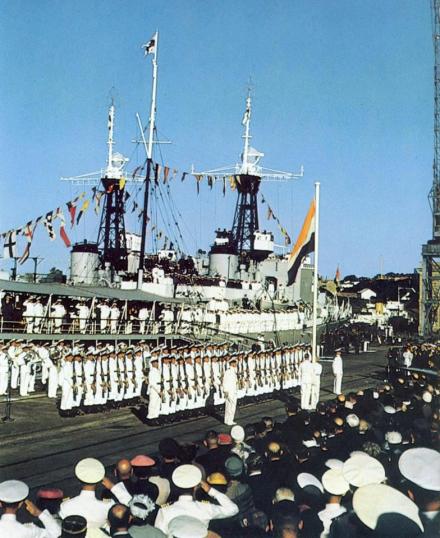
After the signing of The “Simonstown Agreement”, in this colourful ceremony, the Simon’s Town Naval base was handed over by the British to the Union of South Africa on the 2nd April 1957 – after being in British hands since 1813.
The Simonstown Agreement between the United Kingdom and South Africa had been signed less than two years before this ceremony on 30 June 1955. Under the agreement, the Royal Navy gave up its naval base at Simon’s Town, South Africa, and transferred command of the South African Navy to the government of South Africa.
In return, South Africa promised the use of the Simon’s Town base to Royal Navy ships. The agreement also permitted South Africa to buy six anti submarine frigates, ten coastal minesweepers and four seaward defence boats from the UK valued at £18 million over the next eight years. In effect, the agreement was a mutual defence arrangement aimed at protecting sea routes between the UK and the Middle East.
The agreement was controversial, especially with the United Nations, because of South Africa’s policy of Apartheid. The Agreement stood in stark contrast to United Nations resolutions against South Africa as the United Kingdom was still supporting the South African military by way of this quid pro quo agreement.
The United Kingdom terminated the agreement on 16 June 1975. However, ships of the Royal Navy still continued to call periodically at Simon’s Town and other South African ports, although the Royal Navy was not able to use any South African ports by the time the Falklands War started in 1982.
South Africa was a member of the Commonwealth at the time the agreement was signed (South Africa left the Commonwealth in 1961), so the United Kingdom and South Africa took the position that the agreement was not an international treaty requiring registration with the United Nations under Article 102 of the United Nations Charter and continued regardless of the United Nations’ protests.
A personal perspective
I often hear this old one from many people “we fought in the First and Second Wold Wars for Britain and in our hour of need they abandoned us” (referring to sanctions and fighting “terrorists”). Well, that’s not strictly true, the Simonstown Agreement saw to it that South Africa was using British produced Buccaneer Fighter Bombers and Naval vessels at the onset of the Border War and the internal armed insurgency and well into it. It’s obvious that after 1976 (the Soweto riots) that even this relationship would be strained let alone the implementation of Apartheid Legislation and the withdrawal by the National Party from the British Commonwealth of Nations – which would have made supporting South Africa exceptionally difficult for the United Kingdom in any event – and even then they continued military support well up to, and beyond the point where it became truely internationally impossible to continue to do so.
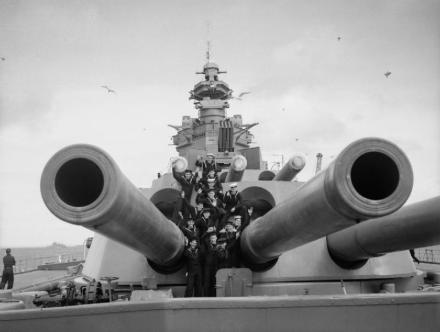
South Africans in the service of the Royal Navy in World War 2. Here is a great photograph of the members of the South African Division of the Royal Naval Volunteers Reserve on board HMS NELSON posing for the camera between two of the enormous 16 inch guns of A turret. July 1941.
During the war thousands of South African Naval Forces (SANF) members like these were seconded to serve on Royal Navy vessels, almost every large Royal Navy ship had its contingent of South Africans and this is the HMS Nelson’s allocation. This has a lot to do with the fact that Simonstown in South Africa was a British Naval port.
South African Naval Forces (SANF) in World War 2 where either allocated to Royal Navy ships (titled HMS – His Majesty’s Ship) or on South African Navy ships (tilted HMSAS – His Majesty’s South African Ship).
What is lost on South Africans, and even lost on the British today is that every-time a large British naval vessel was sunk or attacked, South African naval personal on it inevitably lost their lives or where wounded. These days, South Africans and also the British, very seldom count the sacrifice and commitment of South African men to the Royal Navy (due to this unique arrangement), especially when remembering the great deeds of the Royal Navy during the war.
Nugget of South African military history, the very first German General to formally surrender his forces to the Allies during the Second World War – surrendered to the South African forces in the North African theatre of operations.
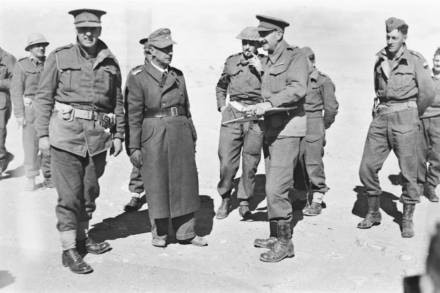
Generalleutenant Artur Schmidt was the first German General to formally surrender to a Allied General which was General De Villiers (Commissioner of the South African Police) and Commander of the South African 2nd Infantry Division.
As part of General Rommel’s skillful retreat in December 1941 to the El Aghelia – Marda strongpoint in Libya, key defensive actions where set up at Sollum, Halfaya Pass and Bardia. On 30 December 1941, South African troops supported by a heavy air, sea and land bombardment began their attack on Bardia. A counterattack on the city’s perimeter slowed the advance, but supported by tanks the South Africans launched their final assault on 02 January 1942 to take the city. Seen here on that day is General Schmidt formally surrendering himself and the Italian and German forces under his command to the South Africans.
Ironically the South African 2nd Infantry Division would themselves all become captured at the Fall of Tobruk by Rommel’s German Afrika Korps and other Axis forces on 21 June 1942.
Note the identification patch of the South African 2nd Infantry Division on the person standing on the far right of the image.
Not to be confused with the “capture” of Generalleutnant Johann von Ravenstein a couple of months earlier by New Zealand soldiers. There is a big difference between a formal surrender of forces to an opposing force, than simply been randomly ‘captured’ driving around in a staff car and taking a wrong turn as General von Ravenstein was. General von Ravenstein did not “surrender” himself nor did he surrender any German forces.
Ironically General von Ravesnstien served the first part of his POW life in South Africa before been shipped of to Canada.
Written and researched by Peter Dickens. Thank you to Sandy Evan Haynes for the background information and to Marc Norman for the image.
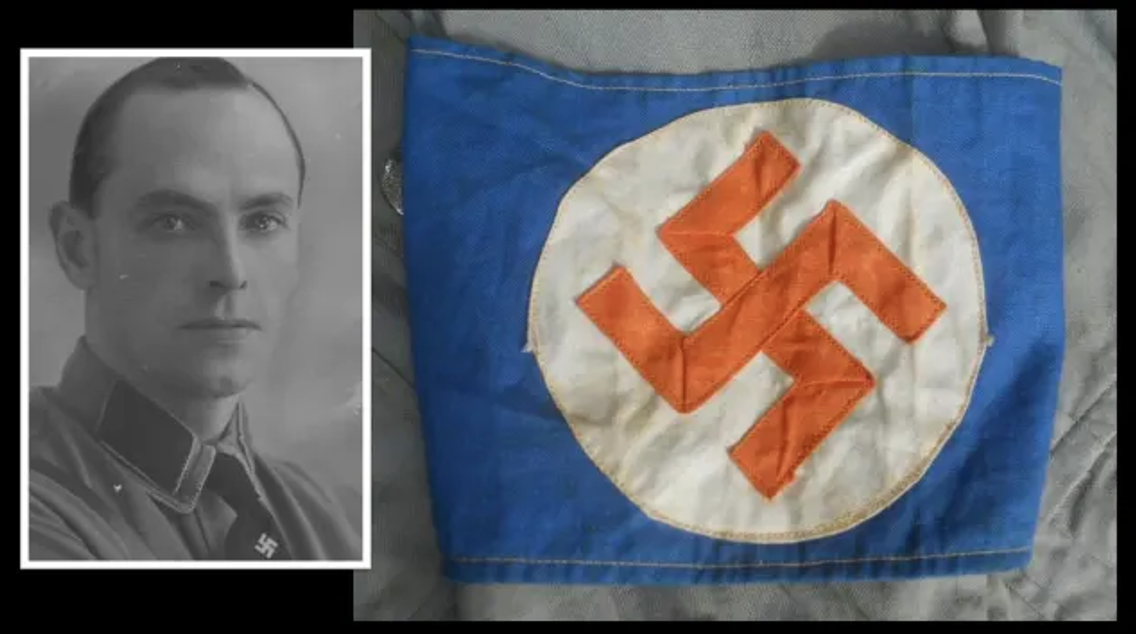
Here is a rare and very unique display of South Africa’s very own Nazi Party’s shirts, flags and bunting. Of interest, is the use of Orange, Blue and White in the Nazi swastika configuration – this was intentionally done to reflect the national colours of the South African flag at the time, the ‘Oranje-blanje-blou’ (Orange, White and Blue).
These items belong to South Africa’s ‘Greyshirts’, read on for an in-depth chapter in South Africa’s hidden history, here we focus on the SANP – The South African Christian National Socialist Movement (SANP) also referenced as the South African Gentile National Socialist Movement. More commonly they were also known at the time as the ‘Gryshemde’ in Afrikaans and ‘Grey-shirts’ in English.
SANP bunting, flags, armbands and shirts, image courtesy Ulrich Duebe, the current owner of the collection.
South African statute forces had fought a hard war against Italian Fascism and German Nazism, and the same war had been fought on the ‘home-front’ in South Africa itself, as with the USA and the United Kingdom, South Africa also had its own National Socialist (Nazism) parties prior to the war (it had actually been a quite popular doctrine across many “Western” European states prior to the war). During the war the Smuts’ government took severe action against pro-Nazi South African movements on the Afrikaner right-wing political fringe – the SANP (the Grey-shirts), the South African Democratic National Movement – the ‘Black-shirts’, the National Workers Bond – the ‘Brown-shits’, The ‘New Order’ and the Ossewabrandwag amongst others and jailed some of their leaders for the duration of the war.
Imagine the sheer frustration felt by the South African war veterans returning after winning ‘The War for Freedom’ (as Smuts had called WW2 at the time). This war had been fought with a massive cost in South African lives to rid the world of Nazism and Fascism in the “good fight” – only to come home in 1945 and within three short years in 1948 find South African ‘home grown’ pre-war Nazi and Neo Nazi politicians swept into government. The very men and their philosophy they had gone to war against in the first place. Many of these movement’s leaders and members were folded into National party after the war to one day become South Africa’s political elite (including a Ossawabrandwag General – BJ Vorster who became a future Prime Minister and State President of South Africa).
Louis Theodor Weichardt
One such South African politician was Louis Theodor Weichardt (21 May 1894 – 26 October 1985) and this is his relatively unknown story of South Africa’s very own Nazi Party, the largest and most significant of the Pro-Nazi South African ‘Shirt movements’ – the Grey-shirts .
Louis Theodor Weichardt
Louis Theodor Weichardt was born in Paarl of German extraction on the 23 May 1894, he attended German school in Pretoria and in New Hanover Natal. At the outbreak of World War 1, Weichardt found himself in Germany. His military service to the German state is shrouded in a little mystery, some accounts point towards three years service in the German Army, others point to non-combatant service in a Labour Corps. As a South African national there is an account that he was arrested after the war for High Treason, however the charges were never brought.
In Germany Louis Weichardt became a rabid antisemite, in travelling Europe he recalled that in the Ottoman Empire that the Turks were being “bled to death by Jewish extortioners and money lenders” and in Germany he said he:
“had the privilege of witnessing the first beginnings of the national German uprising against Jewish domination”. 1
Returning to South Africa in 1923, Louis Weichardt joined Hertzog’s National Party, however he became increasingly disillusioned in the National Party as he was unable to bring fellow members to his vision of National Socialism – he blamed been “checkmated” in his endeavours by external influences he called “powerful financial interests, predominantly Jewish”. When Hertzog merged the National Party with Smuts’ United Party, which was seen as by the ‘pure’ nationalists as underpinned by ‘Anglo-Jewish Capital’ (Oppenheimer) – Weichardt took the opportunity to break away from the National Party altogether and start his own party.
In Cape Town, on 26 October 1933, he founded South Africa’s Nazi party equivalent – The South African Christian National Socialist Movement with a paramilitary ‘security’ or ‘body-guard’ section (modelled on Nazi Germany’s brown-shirted Sturmabteilung) called the ‘Gryshemde’ (Afrikaans) or Grey-shirts (English). In May 1934, it was agreed to combine the ‘Grey-shirts’ with the South African Christian National Socialist Movement and form a new enterprise called ‘The South African National Party’ (SANP) – not to be confused with the National Party. The SANP would all keep with the ‘grey-shirts’ as their dress.
Johannes Von Moltke at this time was Louis Weichardt’s right hand man, the leader of the SANP’s stronghold in the Eastern Cape (his SANP office in Port Elizabeth proudly flying a swastika flag outside it every day). Johannes Von Moltke was of 1820 settler and German heritage, born in Senekal in the OFS he became a firm Republican and Afrikaner Nationalist, working for the Afrikaner Pers Group and the ‘Die Burger’, he met Weichardt in October 1933 and the two decided to collaborate.
Louis Weichardt was very proficient in English and he intended the SANP to appeal to both ‘English’ and ‘Afrikaner’ whites – citing that they were both of “Nordic” races. Some English joined the organisation, but the backbone found itself in rural and ‘poor white’ Afrikaner communities. It must be noted here that Nazism appealed to many Afrikaners as Hitler took an “anti-British” stance and the legacy of the South African War (1899-1902) was still strong within Afrikaner communities by the 1930’s, many within living memory of it. However Nazism was no means the exclusive pursuit of Afrikaners in South Africa, the handful of ‘English’ that supported the SANP were vicious in their anti-Semitic leanings – as were the British fascists at the time Oswald Mosley a case in point in England. This sentiment can be be seen in the University of Cape Town Law and SANP supporter – Professor Kerr Wylie, who said of Jews in a letter to University of Cape Town Principal Sir Carruthers Beattie:
“Everything point to the fact that the Jews’ game in South Africa is up, and, if they have any sense, they will realise the fact and try to effect compromise. But history shows that the greed for gold and lust for power is so engrained in the Jewish race that they will cling to their gold and power until it is too late”.2
As a movement the SANP also saw themselves as a ‘popular’ movement for National Socialism and initially did not contend by-elections and municipal elections as a political party – choosing instead to put forward their members as “independents” in elections. A future Grey-shirt breakaway called the ‘Black-shirts’ would however put party candidates forward which ironically caused issues for the ‘Pure’ National Party as the support or the Black-shirts split their vote.. Overall, Weichardt saw democracy as an outdated system and an invention of British imperialism and Jews.3
The SANP would eventually contest elections and Louis Weichardt would stand as a MP candidate in Port Elizabeth, he was not very successful and would later try another safer seat without success either – predictably he blamed his election losses on a Jewish conspiracy.
The SANP grew to about 4,000 members in South Africa (with their largest support base in the Eastern Cape – spurred by ‘poor white’ rural and urban issues in the area), central to their cause in the 1930’s where Jewish immigrants escaping Nazi Germany to South Africa, and their numbers were growing significantly over the decade – in response the SANP launched a campaign calling for an end to Jewish migration and even arranged mass protests in Cape Town. Their primary communication mouthpiece was a newspaper called ‘Die Waarheid/The truth’ which was nothing more than a vehicle to spread Nazi doctrine in South Africa – the Nazi emblem emblazoned on the masthead.
Louis Weichardt would spell out his ‘Nordic’ argument and vision in the ‘Die Waarheid/The truth’ and trace South Africa’s problems to one source – the Jews. He claimed Jewish ‘domination’ of the legal, medical, dental, commerce, trading, liquor trade etc. as between 60% to 100%, and he would write:
“We are determined to put the Jew in his place. We are not going to tolerate bootlicking, Gentile South Africans – English or Dutch speaking – are no longer prepared to play second fiddle to these aliens”.4
The main target of the SANP was Hertzog’s old National Party’s inspired Quota Act of 1930 which sought to curtail Jewish immigration. As far as the SANP was concerned the National Party had not gone far enough in their endeavours to clip Jewish immigration specifically. They proposed revoking South African citizenships granted to all Jews entering South Africa after 1918, the prevention of Jews gaining government jobs and the prevention of Jews from owning immovable property and dominating any particular industrial or trade sector. They would however support an immigration policy that brought in whites of ‘nordic’ (aryan) races that would assimilate with a white culture in South Africa sans the “insoluble” element of Jews.
The Protocols of the Elders of Zion
The nature of the movement was clearly seen in March 1934 when the SANP held a rally in Aberdeen in the Eastern Cape, Harry Victor Inch – one of the Greyshirt leaders – announced that he had in his possession a ‘stolen’ document from a Port Elizabeth synagogue – signed by its Rabbi – which outlined a secret plot by the Jews to destroy the Christian religion and civilisation.
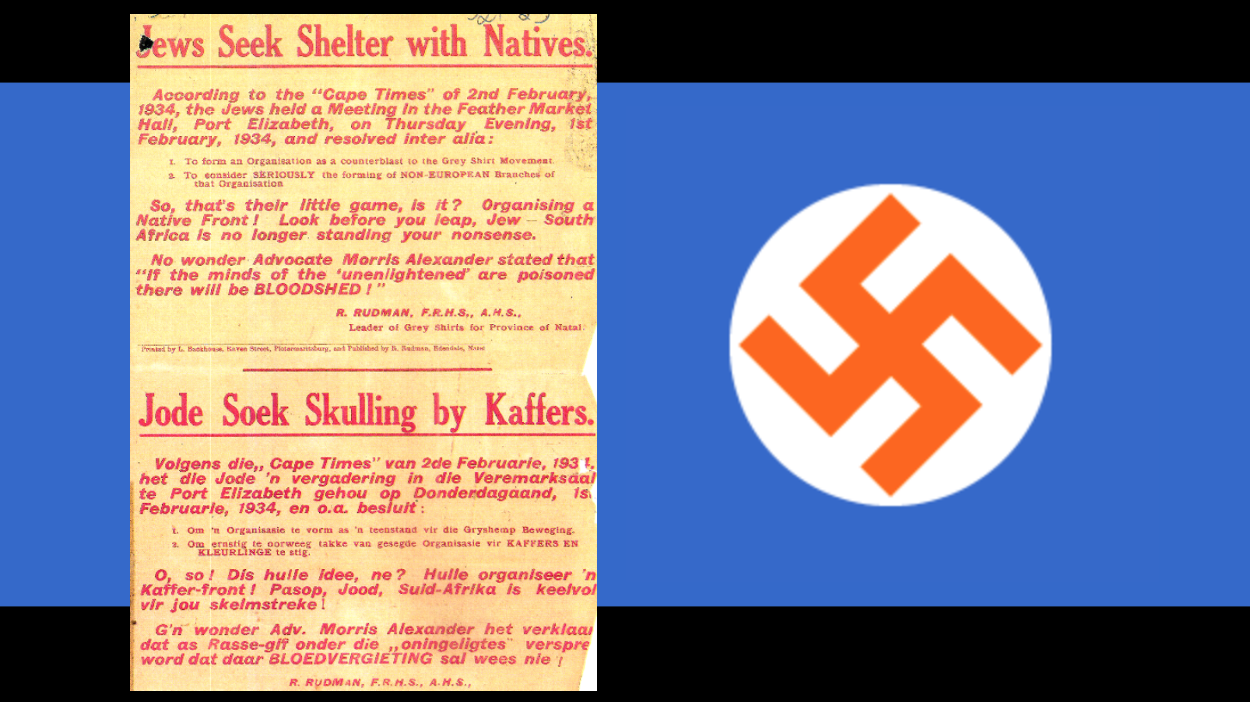
SANP propaganda leaflet accusing Jews of inciting Native (Black) violence against whites.
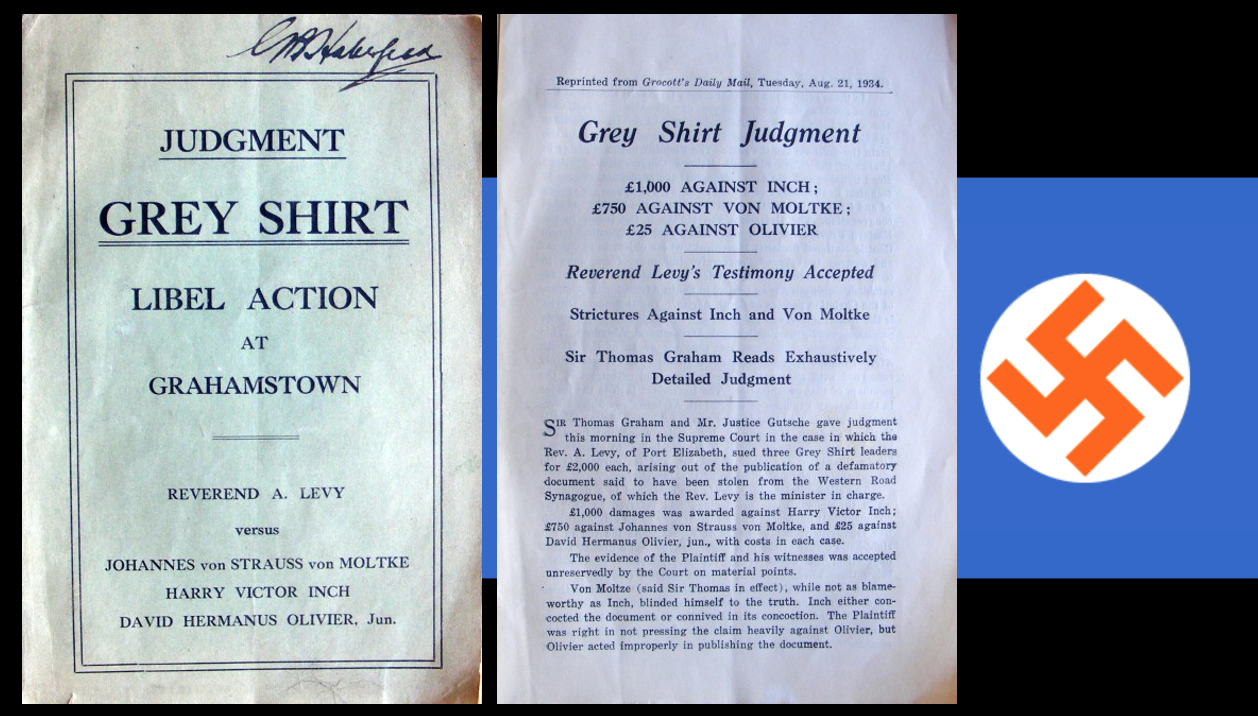
The Rabbi in question was not in fact a Rabbi, he was a Jewish Reverent, Reverent Abraham Levy, and he took the SANP Grey-shirt leadership in the Eastern Cape to court in Grahamstown in a landmark case. The SANP accused; Johannes von Strauss Moltke who was the Regional SANP leader, Harry Inch, who allegedly ‘stole’ the document and David Olivier, who had printed the document for circulation as the owner and publisher of “Rapport”, another media organ of the ‘shirt’ movements. All now have to account for themselves – the case billed as a mighty ‘Gentile vs. Jew’ showdown and a legal test of the ‘Great Jewish Conspiracy.’ `
The document in question followed the “Protocols of the Elders of Zion, a pamphlet of some 70 pages purporting to be the actual minutes of 24 speeches made by Jewish leaders during the First Zionist Congress in 1897. The pamphlet detailed a satanic plot by Jewish/Zionist conspirators to conquer the world. Alleging that Jews controlled much of the world’s finance, the media, the educational institutions, the court systems and many of the world’s governments, the Protocols claimed that the Jews indulged in all forms of trickery and deceit to tighten their hold. They deliberately spread diseases and immorality to weaken Gentiles, and did not hesitate to use murder and terrorism to destroy all religions except their own. Jews were striving to establish their own autocracy based on a false Messiah, the “Son of David”, and posed a fiendishly devious omnipresent peril to the rest of mankind.”5
‘Die Waarheid/The truth’ would pick up this ‘Protocols of the Elders of Zion’ and really twist it for a South African audience claiming:
“the disastrous Anglo-Boer War 1899-1902 was deliberately brought about by the Jewish mine magnets who circumvented Rhodes and Kruger alike”.6
In addition, Jews were accused of inciting blacks against whites and controlling the economy, exploiting ordinary Afrikaners as part of an international Jewish conspiracy. The ‘Die Waarheid/The truth’ statements were accompanied by a propaganda leaflet printed by the SANP and distributed in Port Elizabeth.
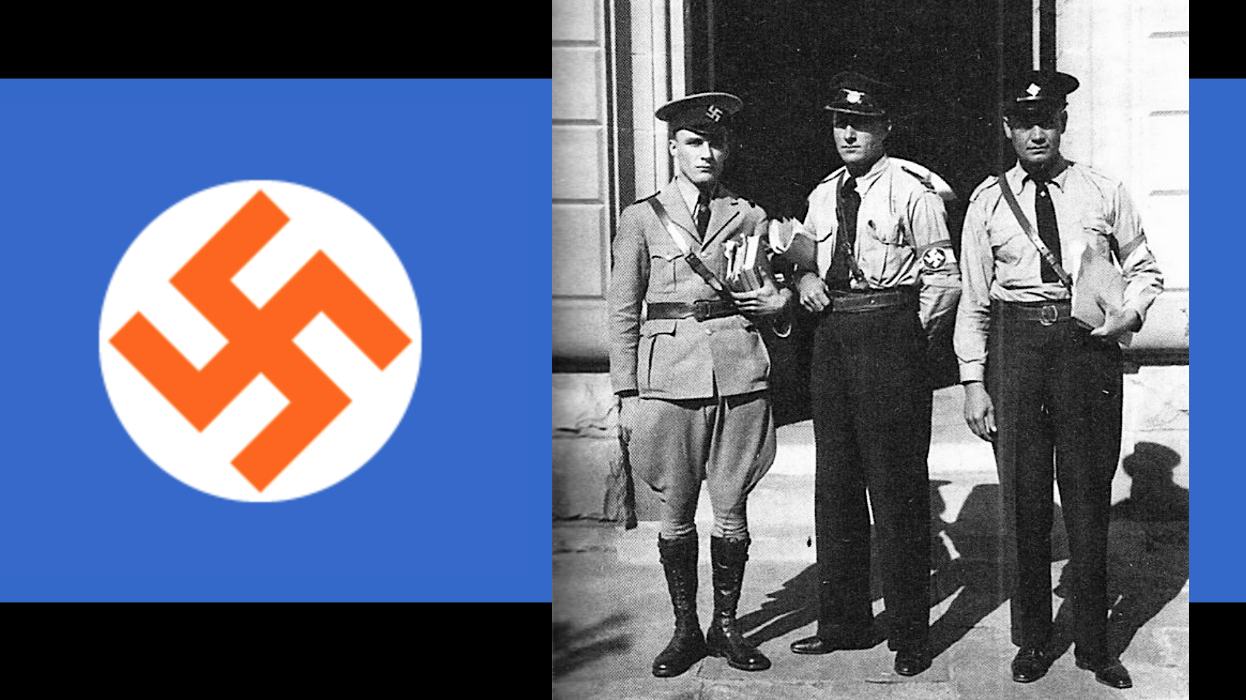
Left to Right – standing outside the courthouse in Grahamstown in full SANP dress is Johannes von Strauss Moltke, Harry Inch and David Olivier.
The ‘stolen’ document was scrutinised legally, it was found to be based on an entirely discredited antisemitic ‘international Jewish conspiracy’ document called ‘the Protocols of the Elders of Zion’ and given a South African twist by the SANP. The ‘Protocols of the Elders of Zion’ was a composition based on a 1860’s anti-Napoleon III pamphlet and a German antisemitic novel by Herman Gödshe ‘Biarritz’ – used by the Nazi Party in Germany.
In a carefully considered 30,000 word judgement, the court concluded inter alia;
“the protocols are an impudent forgery, obviously published for the purposes of anti-Jewish propaganda”.7
As a result three Greyshirt leaders all were fined, Harry Victor Inch was found guilty of perjury and forging documents defaming the Jewish race and swearing under oath that those documents were genuine – and fined £1,000 and later handed a short prison sentence. David Hermanus Olivier was fined £25 for acting improperly and printing the document and Johannes von Moltke was fined £750 for “playing a leading role in the plot”.
The result has been widely hailed here as a complete vindication of the Jewish people and of Rev. Abraham Levy who brought the lawsuit against the Grey-shirt leaders.
Splits in the Shirts
Later that year, the SANP Grey-shirts would hold their first National Congress in Observatory, Cape Town. Louis Weichardt in his keynote address would dismiss Johannes von Moltke as a “traitor” to the SANP and no longer a member having “misbehaved” in releasing Harry Inch’s anti-Jewish protocols. In fact Johannes von Moltke had broken away from the SANP along with most of his the Eastern Cape SANP supporters and leaders and formed a new organisation called ‘The South African Fascists’ who wore blue trousers and grey shirts.
Other Nazi splinter parties and ‘shirt’ organisations also began to form – ‘The South African National Democratic Movement’ (Nasionale Demokratiese Beweging) which became known as ‘the Black-shirts’ was formed in Johannesburg by Manie Wessels and operated in the Orange Free State and the Transvaal – the Black-shirts themselves would splinter into another Black-shirt movement as an off-shoot called the South African National People’s Movement (Suid Afrikaanse Nasionale Volksbeweging) – based in Johannesburg, started by Chris Havemann and advanced a closer idea of National Socialism – this Blackshirt splinter group by 1937 boasted 265 branches (mainly in the Transvaal), their official mouthpiece was called “The Swastika”8.
The black-shirts by July 1939 were formally incorporated into the Ossewabrandwag focussing on the recruiting of ‘Christian minded National Aryans’ into the Ossewabrandwag infusing it with a “volkisch” Nationalism and took it beyond just being a cultural organ of Afrikanerdom and the National Party. 9
Another ‘Volksbeveging’ (People’s movement) also known as ‘African Gentile Organisation’ was also formed in Cape Town by H.S. Terblanche. The National Workers Union (Bond van Nasionale Werkers) – known as the Brown-shirts was established by Dr. A.J. Bruwer in Pretoria in September 1934. Finally a group called the ‘Orange-shirts’ under Frans Erasmus, who at that stage was the Secretary to the Federal Council of the National Party and the Minister of Parliament for Moorreesburg, Erasmus would go onto become the National Party’s Minister of Defence after 1948.10
In addition, the SANP leader J.H.H. de Waal resigned from the SANP over leadership issues with Weichardt and formed the The ‘Gentile Protection League’ whose sole aim was to:
De Waal’s organisation would focus on the Western Cape, he would also advance a Jewish store boycott in the southern Orange Free State where antisemitism was rife, he was a popular lawyer of political stock and he would eventually claim his organisation as 5,000 members strong. De Waal would comment in his memoir “My Ontwaking” (my awakening) and blame Jan Smuts for promoting the Jewish agenda in South Africa and call him “The King of the Jews”.12
An ‘insoluble’ element
So, where does the ‘purified’ National Party under Dr. D.F. Malan sit on the ‘Jewish’ question in the mid 1930’s and what influence do these Nazi ‘shirt’ organisations have on it?
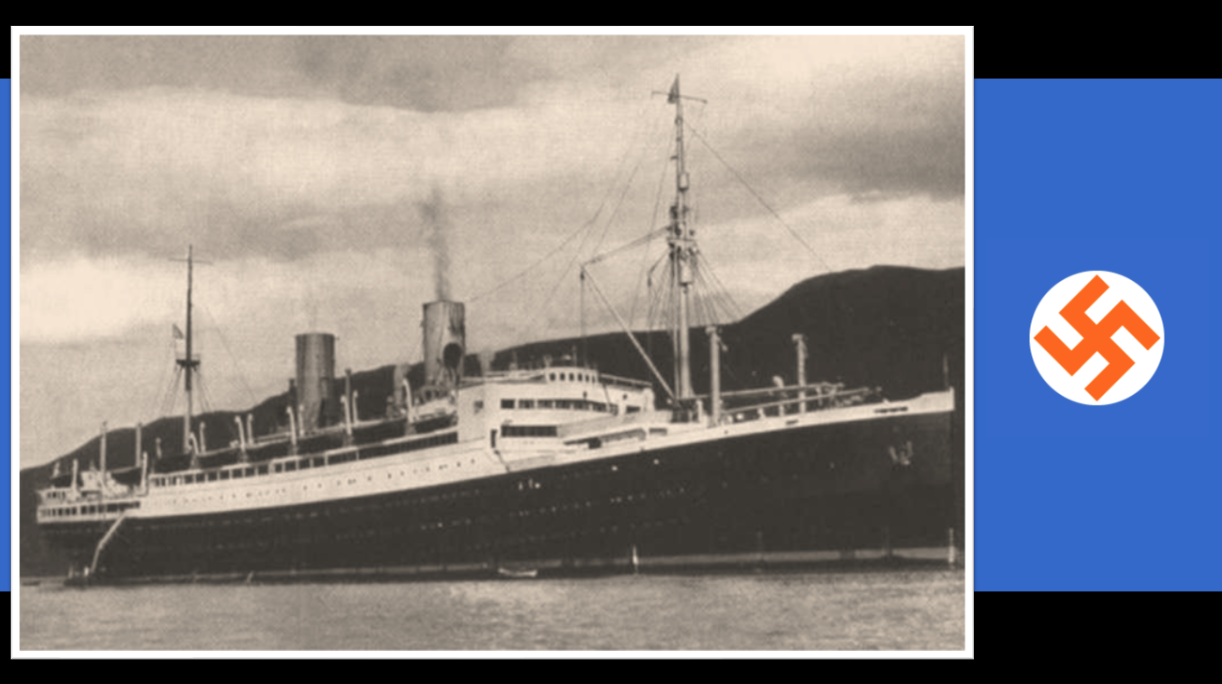
Prior to the war and sitting in the wings of the Broederbond was Dr. Hendrik Verwoerd (the Architect of Apartheid), he was a predominant Broederbond member, National Party leader and would become a future Prime Minister of South Africa. Dutch by birth, he honed his studies in sociology and psychology in Germany and there is no doubt he was exposed to German politics and the rise of Nazism at the time. Verwoerd showed his colours early on when, the ‘Black shirts’ held a large rally and protested the arrival of the S.S. Stuttgart in Cape Town on the 27th October 1936 with 600 Jewish refugees on board.
S.S. Stuttgart in Cape Town
The Nationalists joined hands with the Black-shirts in support of their protest and a few days later on 4 November, Dr Theophilus E. Dönges (future NP Acting Prime Minister) and admirer of Nazism would nail the Nationalists colours to the mast and said:
“The Jew is an insoluble element in every national life.”
The Black-shirts were joined by Dr Verwoerd and five fellow professors from Stellenbosch University who all went in deputation to the government to protest against the immigration of Jews from Nazi Germany. Frans Erasmus (the future National Party Minister of Defence) would go further on the matter and even officially thank the Black-shirts on behalf of The National Party for bringing the attention of the;
“Jewish problem to the Afrikaner ‘volk’.”
Dr Verwoerd would forward the National Party’s views on Jews in the Transvaaler where he wrote that there was a “botsing van belange” (clash of interests) between Jew and Afrikaner because the Jew had risen to wealth in key economic sectors whilst protecting themselves as a community, and as guests in the country they had purposefully excluded the Afrikaner (he referenced as the ‘majority’) from taking their rightful place in accessing the country’s wealth. He would outline the Jew as an enemy of Afrikanerdom, he would write:
“This population group (the Jews), which still keeps itself separate and apart within the population, and which is indifferent or even hostile to the national aspirations of Afrikanerdom, is thus regarded as the group which also stands in the way of the Afrikaner’s economic prosperity”.13
Dr. D.F. Malan, the National Party leader would go further and refer to the Jews as a:
“undigested and unabsorbed and unabsorbable minority … that leads to all sorts of difficulties”14
D.F. Malan would however try and sanitise the The National Party to the Jewish Community, but as they were a firmly “Christian” movement in terms of constitution his words carried little weight to the South African Jewish Council who saw the National Party for what it was. The National Party would openly lock-step with the “shirt” movements when it came to demonising Jews and Jewish Capital in the form of “Hoggenheimer” in their mouthpieces “The Transvaaler” (of which Verwoerd was the editor) and “Die Burger” (of which Dr. Malan was a founding editor).
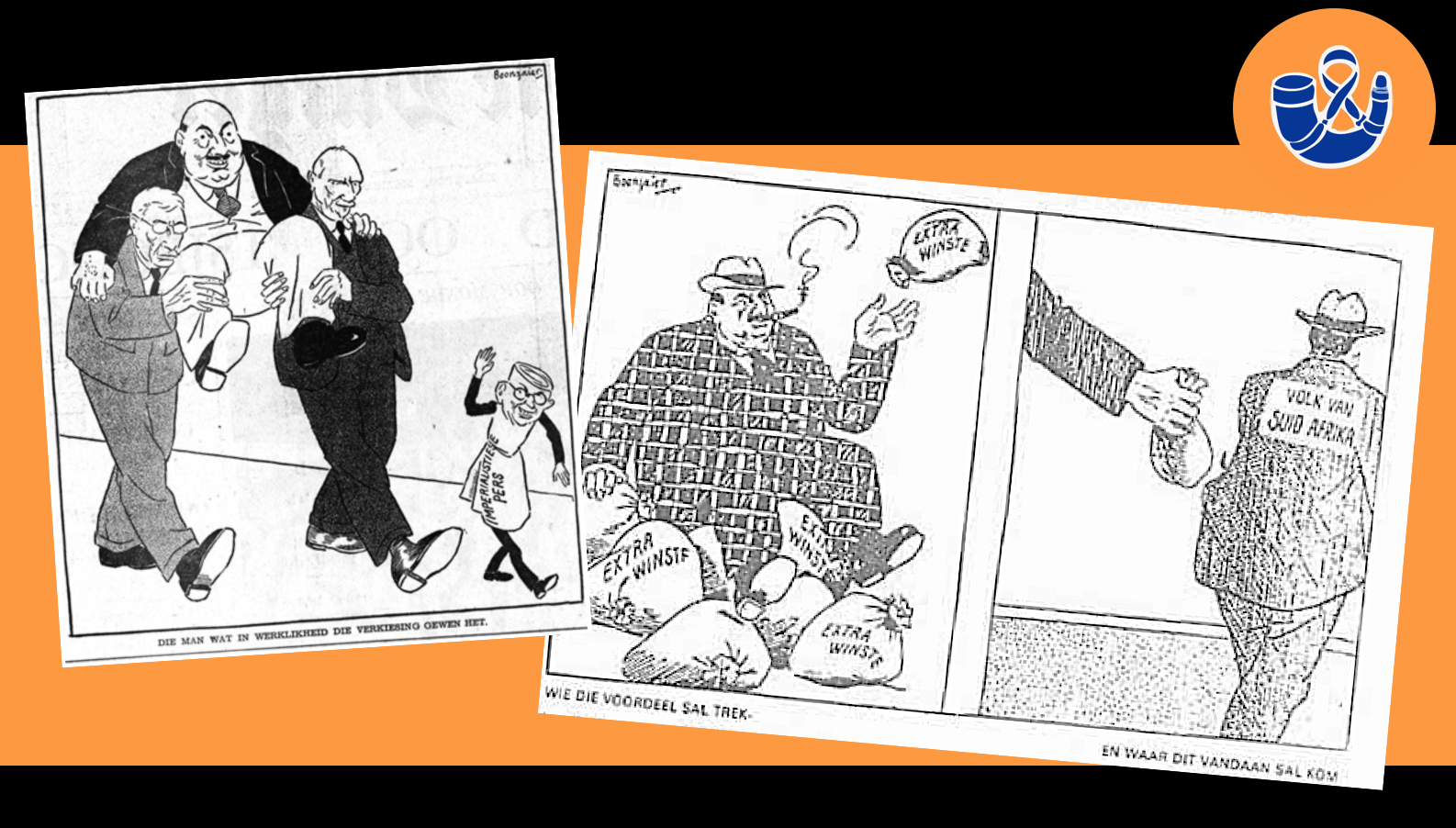
‘Hoggenheimer’ would become a cartoon in the same vein as “the banker” – a Nazi demonisation of Capitalist Jews and ‘the Jewish Conspiracy’ – depicted as fat, cigar smoking, balding and greedy – either pulling the strings or holding onto the money bag . The work of D.C. Boonzaier his caricature was developed specifically for Die Burger – a derogatory figure designed to depict a fat and bloated Jewish capitalist with a play on ‘hog” or pig, the character made a number of appearances and also served to lampoon Ernest Oppenheimer, the German Jewish Mining Industrialist who made South Africa his home. The Nationalists would even go as far as referring to Oppenheimer and Jewish Capital openly in Parliament and in speeches as “Hoggenheimer”.
Hoggenheimer by D.C. Boonzaier – Die Burger
It is undeniable that these “shirt” and antisemite fringe effectively “succeeded in shifting the ‘Jewish Question’ from the political margins of South African public life to its centre” … “Malan, under pressure from the ultra-right Greyshirts, focussed increasingly on the Jew as an explanation for the Afrikaners political misfortunes. It was Hendrik Verwoerd, however, who stood at the vanguard of anti-Jewish agitation”15
This sentiment would be taken up broadly across the Afrikaner Nationalist front – an example is the Nationalist MP for Bethlehem – Roelof van der Merwe, who on a call to boycott Nazi German goods, would warn the Jews:
“They (the Jews) are exploiting our people (the Afrikaners) and are nothing more than parasites.”16
World War 2 Nazi collaboration
During the Second World War, Louis Weichardt would even work in conjunction with the Ossewabrandwag to aid Nazi Germany’s war effort. He would take two Nazi spies under his wing, spies been smuggled by the Ossewabrandwag – the German spies Lothar Sitting and Nils Pashe would present themselves at a house in Stellenbosch and meet Weichardt – he would ensure they be driven and hidden by SANP men on a farm near Barrydale for two days after which one SANP man took them to Pretoria and back into the Ossewabrandwag’s network on 13 June 1940.17
Weichardt was arrested and imprisoned for the remainder of World War II at Koffiefontein detention barracks by the Smuts’ government as an ‘enemy of the state’ – along with all the other far right pro Nazi Germany, anti-British militants.
Merging of interests
With the end of the Nazi regime in Germany in 1945, Nazism became an anathema worldwide, Weichardt subsequently disbanded his SANP Nazi party in 1948. Moving on, Weichardt then gave his full attention and allegiance to D.F. Malan and the ‘Reunited’ National Party (NP) itself. He had a very successful political career with the National Party and went on to become the National Party’s senator from Natal Province from 1956 to 1970. Remaining elements of the Greyshirts distanced themselves from open Nazism and renamed themselves the White Workers Party in 1949. However, by this time most of the membership had been lost to the National Party and so the ‘Greyshirts’ and their reconstituted party faded .
By the early 1950’s the South African National Party government was littered with men, who, prior to the war where strongly sympathetic to the Nazi cause and had actually declared themselves full-blown National Socialists along Nazi political doctrine lines: Oswald Pirow, B.J. Vorster (a future President of South Africa), Hendrik van den Bergh, Piet Meyer, Johannes von Moltke and Louis Weichardt to name a few, and there is no doubt that their brand of far right politics, known collectively as Christian Nationalism (a form of Nazism) was influencing the National Party’s government policy.
By the early to mid 1950’s, this state of affairs led to open Anti-Apartheid protests from the South African military veterans community returning from WW2 – in their hundreds of thousands – in all The Torch Commando would rise to 250,000 members openly protesting the on-set of Nazism in the guise of the National Party, and it also ultimately led to the marginalisation of South African World War 2 veterans and their veteran associations by the ruling party when it was crushed under anti-communist legislation put forward in 1950 by the National Party.
The folding in of key National Socialist organisations, including Louis Weichardt and his SANP, Johannes von Moltke and his South African Fascists into the National Party’s political sphere would have a resounding impact on the future of not only the majority of ‘Black’ South Africans (who were viewed as ‘Inferior’ peoples by these hard liners), but also minority white ethnic groups like South Africa’s very large Jewish community.
The arrogance of this underpinning politics is seen with Louis Weichardt himself, who, on becoming an elected National Party Parliamentarian quickly covered up his dubious history as a full blown card carrying Nazi, and rather infamously declared that he had never been against the ‘Jewish race’ but only against the actions of certain ‘Jewish communists’. Not a single Jew, in his ‘opinion’ had suffered through his actions.18
Johannes Von Moltke the ex SANP and ex SA Fascist leader also later became a National Party Member of Parliament and exhibited the same arrogance, gaslighting and covering up of his antisemitic tracks as his old grey-shirt colleague. “The (UP)Jewish Minister of Parliament, Morris Kentridge, once recalled with some amusement that Von Moltke frequently buttonholed him in the lobby of the House of Assembly to explain that he had been misled by Inch (his fellow Grey-shirt collaborator) and was a great friend of the State of Israel!”19
Researched and written by Peter Dickens.
My thanks and acknowledgements to Ulrich Duebe, the current owner of the collection as illustrated.
References:
“Echoes of David Irving – The Greyshirt Trial of 1934” by Dr. David M. Scher – December 2004.
A Perfect Storm – Antisemitism in South Africa 1930-1940, Jonathan Ball Publishers, 2015 – By Milton Shain.
National Socialism and Nazism in South Africa: The case of L.T. Weichardt and his Greyshirt movements, 1933-1946: By Werner Bouwer.
Hendrik Verwoerd’s ‘possible solution’ to the Jewish Question in South Africa, 1937 – Die Transvaler, 1 October 1937.
“Hitler’s Spies: Secret Agents and the Intelligence War in South Africa 1939-1945” by Every Kleynhans – Jonathan Ball Publishers 2021
The Rise of the South African Reich by Brian Bunting.
Footnotes
A Perfect Storm – Antisemitism in South Africa 1930-1940 By Milton Shain page 55 ↩︎
The South African Jewish Board of Deputies – Jewish Matters – newsletter ↩︎
National Socialism and Nazism in South Africa: The case of L.T. Weichardt and his Greyshirt movements, 1933-1946: By Werner Bouwer – Page 18 ↩︎
A Perfect Storm – Antisemitism in South Africa 1930-1940 By Milton Shain page 58 ↩︎
Echoes of David Irving – The Greyshirt Trial of 1934 by David M. Scher – Dec 2004 ↩︎
A Perfect Storm – Antisemitism in South Africa 1930-1940 By Milton Shain page 58 ↩︎
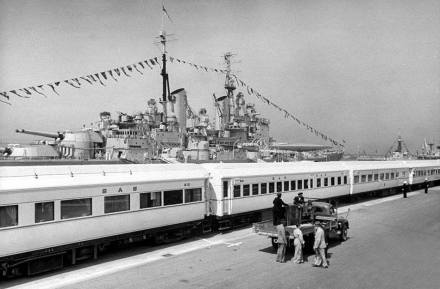
A different time in South Africa. Flagship, pomp and white carriages.
This is the first British Royal Tour of South Africa in 1947 by King George VI the then 21 year old Princess Elizabeth (the current Queen).
Here is HMS Vanguard that brought the Royals to Cape Town and it forms a majestic backdrop to the immaculate White train that was used for the tour through the Union of South Africa.
The Royal visit was intended to boost the relationship with South Africa after the Second World War, certainly in celebration of the British and South African successes supporting the crown in the fight against a Nazi Europe during WW2, which ended just two years earlier. It was also intended to consolidate the Union government of Jan Smuts ahead of the 1948 elections the following year and support his campaign.
Although the Royal tour was an unprecedented success, with large scale public displays of loyalty to the crown wherever they went it did not prevent the National Party narrowly beating Jan Smut’s United Party in the 1948 elections.
The National Party were no fans of British royalty (a legacy carried over by the Boer War) and South Africa’s relationship with the British Crown and the Commonwealth of Nations was to be severed in the future years, only to be re-established again in 1994.
Queen Elizabeth was not to visit South Africa again until 1995 after the country’s re-admittance to the Commonwealth of Nations.
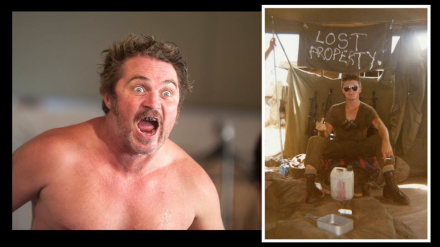
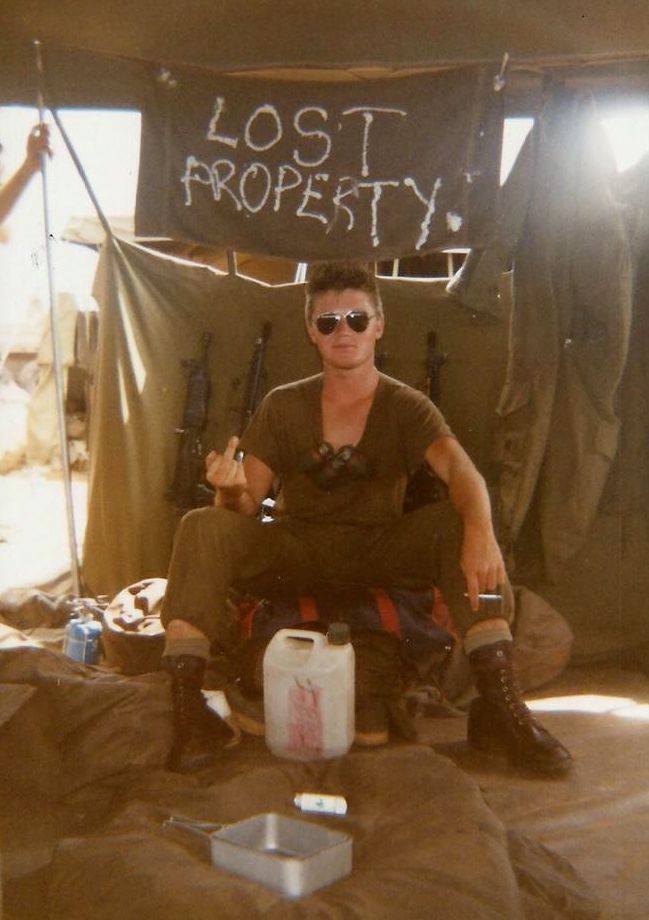
The Border War also saw some pretty famous future personalities and this is one for all the EastEnders fans (the famous on going British soap opera), this fun photo is Alex Ferns during his stint in the South African Army on the Angolan border – Alex is best known for his EastEnders role as Trevor Morgan, “Britain’s most-hated soap villain”.
Alex was a 2 Special Service Battalion (SSB) Gunner in 1989 and affectionately regarded by his fellow brothers in arms as “hell raiser of epic proportions” he was their units “go to guy” during heavy physical training exercises and he used to sing his heart out and always lifted the spirits of the men around him. They had many an ‘oppie’ (a ‘beasting’ or Punishment PT’) together and many a dust up with other units. Because Scotland is his country of birth they regarded him as the ” mad Scotsman” often rousing his buddies to the call. Highly likeable, inspirational and great bloke to all who knew him.
We wish him the best of luck in his television career that has vaulted him to the dizzy heights of a true ‘soap star’ and British cultural icon.
Alex Ferns’ Bio
Alex Ferns also made an appearance in The Ghost and the Darkness (1996) before various television roles, including Trevor Morgan in the BBC soap opera EastEnders from 2000 to 2002. In 2005, Ferns played Lieutenant Gordon in the highly acclaimed trilingual film Joyeux Noël, which was nominated for Best Foreign Language Film at the Oscars, Golden Globe Awards and the BAFTAs.
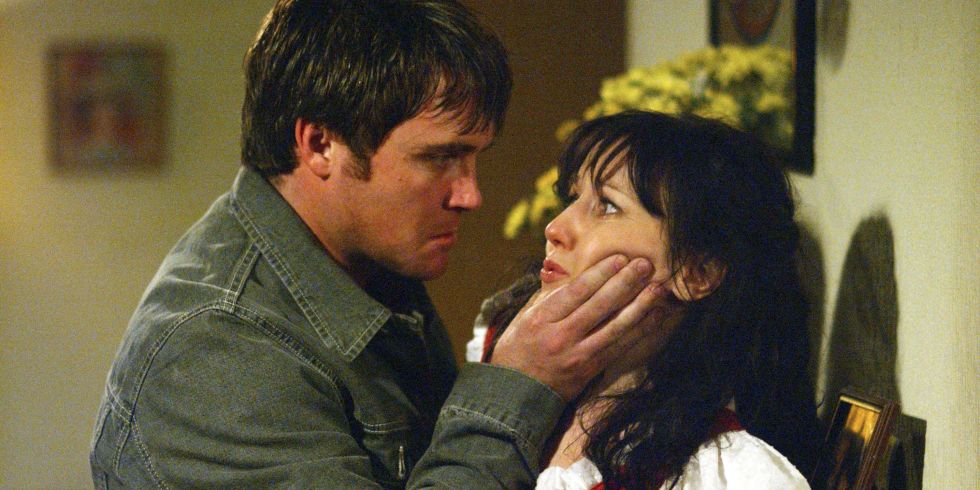
Trevor and Mo, in the domestic abuse storyline for EastEnders, Alex Ferns as hard-man and abuser with Kacey Ainsworth
In 2003 Ferns appeared as Draco Malfoy in a Harry Potter sketch for Comic Relief.
In 2004 he played Commander Martin Brooke, the lead role, in the short-lived ITV series Making Waves. In the same year he appeared in Man Dancin’, a Festival Film & TV production, which won a number of awards on the festival circuit, including Outstanding Original Screenplay at the Sacramento Film Festival. He has also appeared on Coronation Street.
He has also appeared in the 2006 movie Shadow Man, as Schmitt, also starring Steven Seagal.
His theatrical work includes the role of the “tapeworm” (a hallucination) in I.D., a play about Dimitri Tsafendas and his assassination of South African Prime Minister Hendrik Verwoerd, the 2008 national tour of Agatha Christie’s murder mystery And Then There Were None, and Little Shop of Horrors as the Dentist. In 2011 he took the role of Scottish gangster Jimmy Boyle in the play about his life, The Hardman, during a Scottish tour to positive reviews.
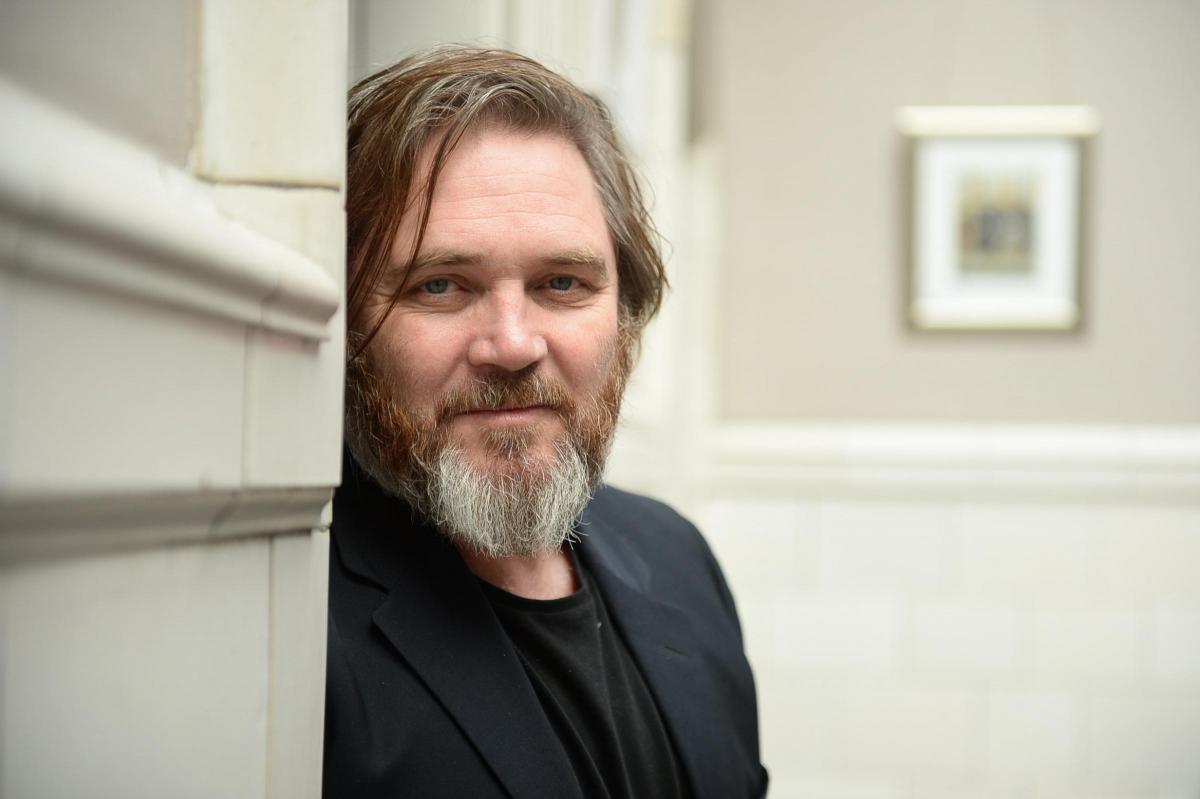
Recent photograph of Alex Ferns with a possible comeback to EastEnders
He also made a brief appearance in the Smirnoff Vodka advert in 2009. Ferns took part in TV series Celebrity Coach Trip, partnered with friend Ricky Groves. He starred as Luther in the 2011 London revival and subsequent UK tour of South Pacific. In 2013, he starred as Lee in True West at Glasgow’s Citizen’s Theatre. In 2014, he starred in 24: Live Another Day.
Born in Lennoxtown, Scotland, Alex lived in South Africa for 17 years and studied drama at the University of Cape Town before returning to the United Kingdom in 1991. Whilst in South Africa the military conscription regulations were changed to include ‘white’ foreign nationals with South African residencies, and Alex was conscripted into the South African Defence Force as a ‘National Serviceman’ or he would certainly have faced deportation and even imprisonment.
Alex Ferns has been married to South African-born actress Jennifer Woodburne since 1996. They currently live in London with their two sons, Cameron and Mackenzie.
To see Alex’s skill transforming from ‘nice guy’ to ‘hard-man’ in EastEnders, have a cuppa tea (as EastEnders fans do) and take a look at this famous clip from the series;
Photo courtesy of BJ Taylor and story on Alex in the SADF courtesy of Gary Smith. Video clip BBC EastEnders. Feature image Alex Ferns in True West Rehearsals Photo: Tim Morozzo
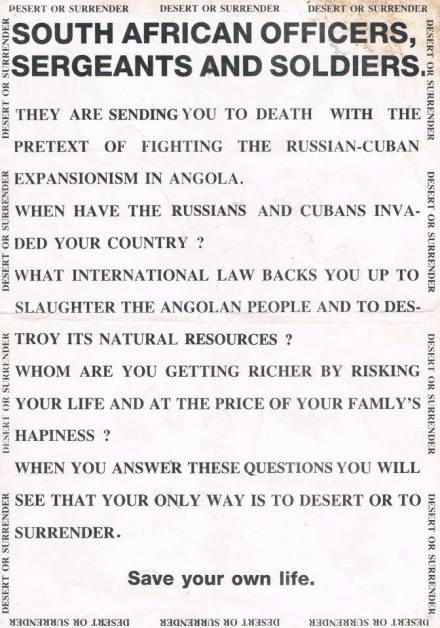
Bush War era propaganda leaflet distributed by FAPLA – The People’s Armed Forces for the Liberation of Angola (FAPLA or Forças Armadas Populares de Libertação de Angola) and its communist backers – Cuba and the USSR.
The purpose of this type of propaganda was to sow dissent in the South African Defence Force ranks and urge desertion – however there is no evidence of this actually working – notwithstanding the high discipline and motivation of SADF troops – but also for the most part SADF troops treated such propaganda with amusement. In fact it served to reinforce the held ideal that they were involved in a true “cold” war conflict against communism.
To put it in context – at the time there was no diplomatic interface between the capitalist ‘West’ and the Soviet Union and Cuba – not even a telephone call between the Western superpowers and the Kremlin. So the threat of communist ideals in Africa and the socialist nationalisation of private property was a very real one. The western world in the mid 1980’s stood against a real threat of “World war 3”, and the campaign was been played out in regional conflicts all over Africa, South America and the Middle East.
FAPLA was originally the armed wing of the People’s Movement for the Liberation of Angola (MPLA), a party with communist leanings which was backed financially and militarily by the Soviet Union and Cuba. There was no way the average SADF trooper would see it as anything other than yet another Communist “plot”.
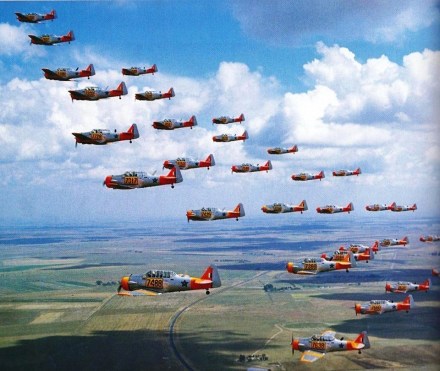
An image (and sound) some of us remember very well, the sky full of droning SAAF Harvards training our pilots.
The first Harvards arrived in South Africa in October 1942 for use by the Joint Air Training Scheme schools. By July 1944, 633 Harvard Mk IIA and III aircraft had been shipped to South Africa, with 555 surviving in October 1945 (379 MkIIAs and 176 Mk IIIs).
As the Harvards had been supplied on lend-lease by the US, 300 were shipped back to the UK from 1946, with the remainder being purchased by South Africa.
65 AT-6Ds (7634 to 7698) and 30 T-6Gs (7699 to 7728) were purchased from the USA during 1952-1956.
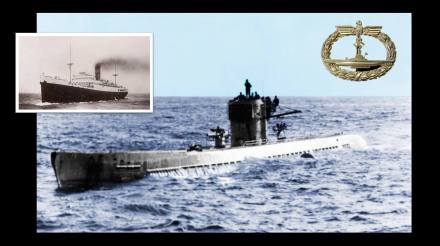
This rare colour image of U Boat 177 is at the heart of one of the worst maritime losses off South Africa’s coast during WW2 – this is the story of the sinking of the troopship SS Nova Scotia just off Durban by U177. An “own goal” really as the SS Nova Scotia was returning with fellow Axis Force “Prisoner of War” Italian servicemen.
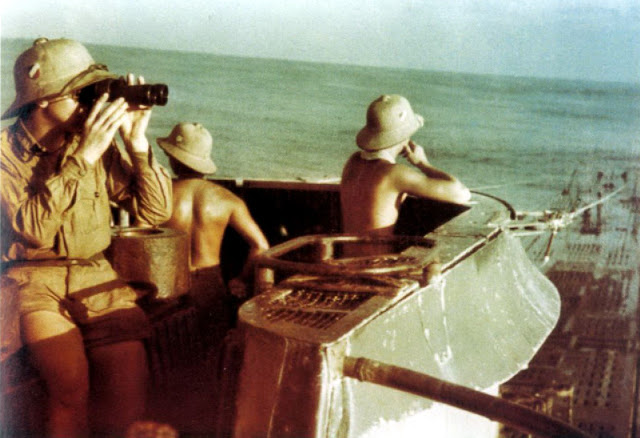
Rare original colour image of German submariners on the coning tower of U-177 conducting a watch.
During the Second World War, Durban was the embarkation and disembarkation port, first for the East African and Abyssinian campaigns and later for those in the Middle East and Italy. A large military hospital operated at Springfield and hospital ships plied between the port and the theatres of war in the north.
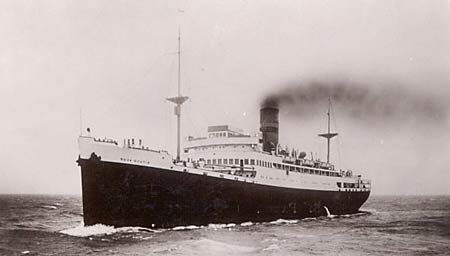
One such ship was the 6 796 ton SS Nova Scotia, belonging to the Furness Withy Group which had been converted into a troop carrier, operating mainly between Durban and ports along the African east Coast all the way up to the Suez. She carried troops from Durban to the “North” and on the return passage carrier Italian Prisoners of War (POW) to South Africa.
SS Nova Scotia
SS Nova Scotia sailed from Massawa, in Italian East Africa (modern day Eritrea), on 15 November 1942 carrying 765 Italian POW’s, 134 British and South African guards and 118 crew.
Just after 06:00 on 28 November 1942 the Commander of U-boat 177, Kapitanleutnant Gysae, apparently sighted smoke from the SS Nova Scotia off the Zululand coast of Natal. Just after 09:00 U177 fired three torpedoes which struck the SS Nova Scotia who sank within 7 minutes. It appears that only 1 lifeboat was successfully launched leaving the rest of the survivors clinging to bits of the wreck.
U177 surfaced to establish the identity of the ship that they sank, but was unable to do so due to the chaotic situation. Two survivors were taken aboard for intelligence. German U-boat Command did inform the Portuguese authorities of the sinking of the SS Nova Scotia. As a result of this, the Alfonso de Albuquerque out of Lourenco Marques reached the scene of the sinking on 29 November 1942 and managed to rescue 190 survivors. Another survivor was picked up by a Destroyer three days later while a fortunate Italian POW floated ashore at Mtunzini two weeks after the incident.
Many of the casualties were washed ashore on the Natal (Kwazulu-Natal) beaches. 118 of the Italian POW’s were buried in a common grave in the Hilary Cemetery, Durban. Three crosses initially marked the grave, but in 1982, using a donation from the survivors of the SS Nova Scotia still living in Mozambique a new memorial was erected. This comprised a circular tomb topped by a broken stele rising from the waves inscribed with the words “To the memory of the Sons of Italy who were overcome by the ocean in the sinking of the S/S ‘Nova Scotia’ XXVIII-XI-MCMXLII The survivors sheltered in Mozambique”.
Since then the 118 casualties from the “SS Nova Scotia” have been exhumed from the Hilary Cemetery and along with the remains of the 35 Italian POW’s who died in the Natal Province are now buried in the grounds of the “Master Divinae Gratiae” Church, Epworth Road, Mkondeni, Pietermaritzburg. The church was built by Italian POW’s in 1944 and is today a South African National Monument.
The only woman to survive the ordeal was Alda Ignisti (later Lady Taylor) who, along with her daughter Valcheria, was on her way to Durban having been stranded in in Italian East Africa (modern day Eritrea) following the death of her husband.
U-177 also met with a watery grave – on 6 February 1944, she was sunk in the Atlantic west of Ascension Island, in position 10°35′S 23°15′W Coordinates: 10°35′S 23°15′W, by depth charges dropped by a PB4Y aircraft from US Navy Squadron VB-107. 50 men were lost; 15 survived, they were picked up by USS Omaha.
Similar to the sinking of the SS NOVA SCOTIA, here is U 177 again – however this time the ship shown sinking in the photo is the American ship MS ALICE F. PALMER – sunk by U-177 south of Madagasgar off the east coast of Africa on the 10th of July 1943.
Information source – Charles Ross, additional research by Peter Dickens. The colour photo of U-177 is from the personal album of Burkhard Heusinger Von Waldegg who was the first watch officer of U-177 – Lt. Robert Gysae the commander of U-177 stands on the right hand side – note the Knights Cross.
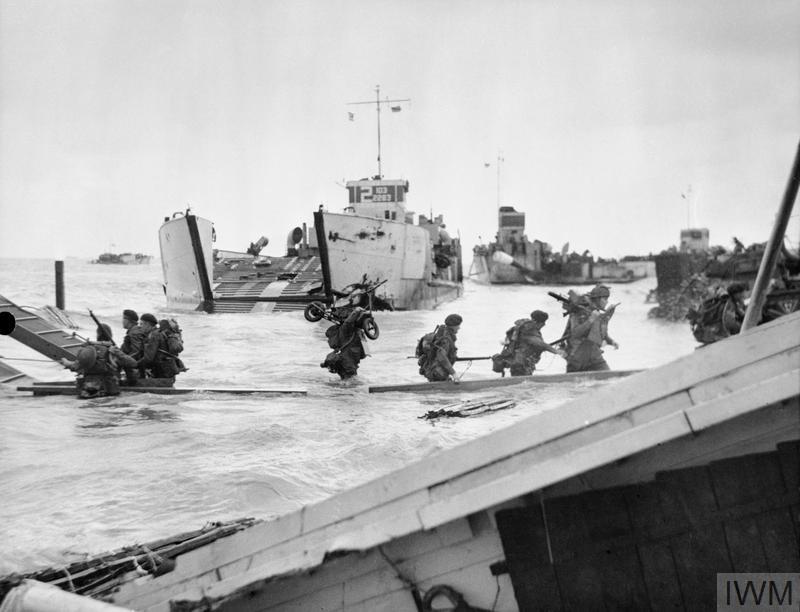
Two South Africans seconded to the Royal Marines were awarded the Military Cross for gallantry on D-Day. This is the citation for one of them Lieutenant Cecil Arthur Douglas Bircher, South African Forces (attached to the Royal Marines).
“Lieutenant Bircher was Officer Commanding Troops in a Landing Craft Tank known as a LCT(A) carrying part of his troop. The craft engines broke down and it was towed from a position off the Isle of Wight to the assault area by a LCT and a LCI. On 6th June 1944 when approaching the beach at Bernieres-sur-Mer these craft had to cast off the LCT(A) which was left drifting sideways in a strong tide about 150 yards from the beach.
Although there was a heavy sea running and the beach was still under close range fire, Lieutenant Bircher, without hesitation plunged into the water and swam about 100 yards to the shore with the beach lines. On arrival on the beach he secured the lines to some stakes, enabling his craft to beach, and disembarked his section of Centaur tanks.
He subsequently led his section from the Canadian Sector in which he had landed into the sector of the 50th (N) Division to which he was attached although enemy opposition still persisted between the two sectors . Throughout the operation Lieutenant Bircher showed personal courage of the highest order and unflinching determination in the most adverse conditions to get his guns into action at the right time and place.”
The chosen image shows Commandos of HQ 4th Special Service Brigade, coming ashore from landing craft on Nan Red beach, Juno area, at St Aubin-sur-Mer, 6 June 1944. An LCT (Landing Craft Tank) of the type that Lt Bircher was commanding troops in can be seen in the background.
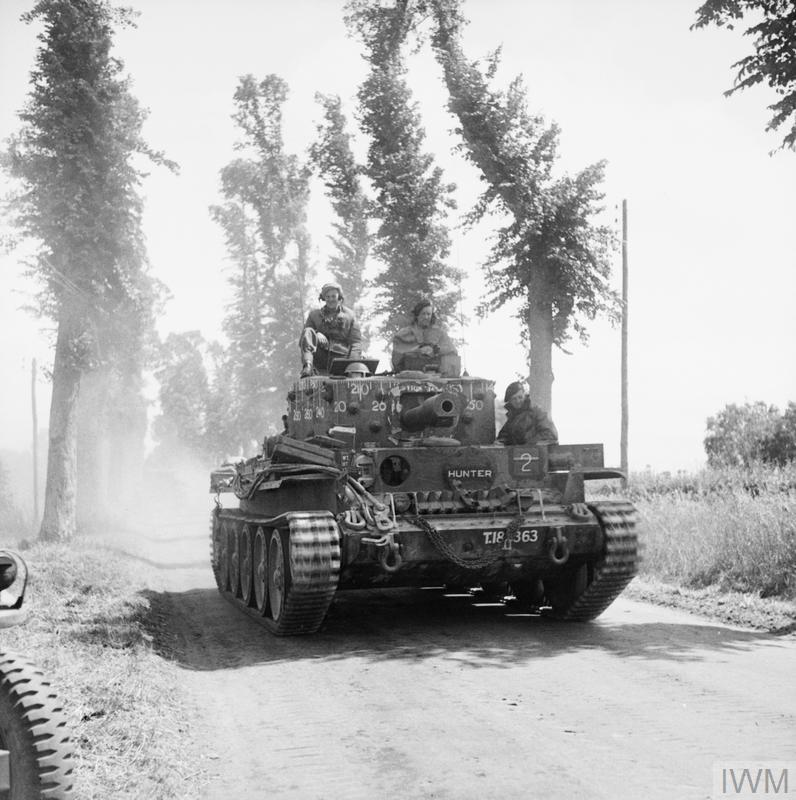
The type of tanks Lieutenant Bircher was off-loading from the LCT were Centaur IV tank of the Royal Marines Armoured Support Group, here is an image of one during Operation Overlord at Tilly-sur-Seulles, 13 June 1944.
Related Links and work on South Africans during D-Day
Posted by Peter Dickens. Image copyright – Imperial War Museum. Caption and citation reference ‘South Africa’s D Day Veterans’ by Cdr W.M. Bisset – SA Naval Museum.

 Note the identification patch of the South African 2nd Infantry Division on the person standing on the far right of the image.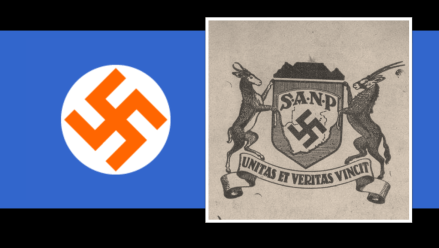




 The Observation Post