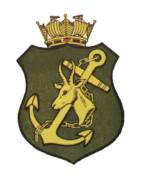
The feisty South African minesweeper that went down fighting – HMSAS Parktown

22308811_10155537271456480_3745202244434378650_nSouth Africa lost four ships during WW2, all of them minesweepers.  The second one to be lost was the HMSAS Parktown and it has a truly extraordinary fighting legacy.

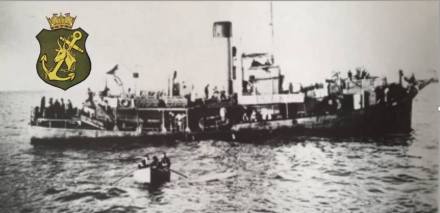
A small whaler converted to a minesweeper, the “tiny boat” HMSAS Parktown sailed into action in April 1942 in company of another “tiny boat” – the HMSAS Langlaagte, sailing  from Cape Town to the Mediterranean and joining the 167th Minesweeping Group working from Alexandria, Egypt.

Service in the Mediterranean

Parktown had arrived in the Mediterranean from South Africa during May and had sailed from Alexandria on 9 June as part of the escort for a convoy bound for Tobruk. During the passage the convoy is attacked and Parktown is involved in the gallant rescue of 28 survivors from a ship that had been sunk, many of whom are badly burnt. After their arrival in Tobruk on 12 June Parktown and her consort, a fellow South African ship the HMSAS Bever under the command of Lt P A North, are tasked to keep the approaches to Tobruk clear of mines.
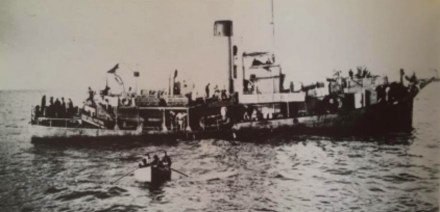
parktown

HMSAS Parktown

Fall of Tobruk 

At that time Tobruk was under siege and by 20 June it is clear that a crisis of some kind is imminent. Late that same afternoon Parktown and Bever are ordered to enter harbour to embark evacuation parties. At 20:00 that evening they watch the Axis forces entering the western end of town and then reach the harbour shortly afterwards.

These two South African minesweepers were to distinguish themselves during the Allied evacuation from Tobruk fighting their way out of the harbour.  The Bever and Parktown fought side by side as they were loading up with as many Allied and South African troops and equipment as they could take, all the time whilst Rommel’s German forces closed in around them. The rapidity of the attack caused great confusion, however, the ships still manage to embark most of the men allocated to them before they sail.

On 20 June 1942 General Rommel’s “Deutsch-Italienische Panzerarmee” (German and Italian Tank Army) attacked the Tobruk garrison from the south and south east. By 18:00, the German and Italian forces had overrun the main defence lines and were closing on the harbour and all Allied ships were ordered to embark personnel for evacuation.

The escape 

By 19:00 German tanks and armoured cars were within the town and started shelling the ships in the harbour. HMSAS Bever received a direct hit as she cast off.  Next is The Parktown and her escape is also quite remarkable.

Using her machine guns she checks the advance of the enemy land forces whilst embarking a further 60 men, even though hit by shell fire. As she is casting off, more men keep arriving and several try to swim to the ship. A few are hauled on board, some assisted by one of the ship’s company, Able Seaman P J Smithers, who swims to their assistance. However in the confusion of sailing A/B Smithers is left behind to be captured and placed in an Italian POW camp.

As the last Allied ship to leave Tobruk, Parktown attracts a tremendous concentration of fire as she steams out at full speed. Although she is hit several times, no hit causes fatal damage to the ship and only one man, an army NCO, is killed.
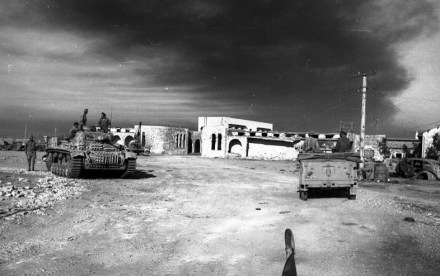
Tobruk, Rommel, Bayerlein, Panzer III

Rommel and his Panzers enter Tobruk

The Fall of Tobruk

Under cover of a smoke screen laid by a motor torpedo boat, but still receiving shell-fire from the town, the two ships left the harbour for the open sea. During the night off Tobruk port the Parktown and Bever became separated and the Parktown goes to the assistance of a disabled tug, also crowded with men.

The sinking of the HMSAS Parktown

After taking it in tow Parktown is only able to make five knots (9.3 Km/h) and thus gets left behind by the rest of the fleet. At daybreak on the 21 June they are still only 50 miles from Tobruk and can see the coast 14 miles away with a heavy fog bank to seaward.  At 06:45 Parktown’s crew sighted what they described as an Italian “MAS” torpedo boat (E-Boat), which had been directed to the slow moving vessel by a German reconnaissance aircraft.  The Parktown then turns north towards the fog bank, only to be confronted by four more E-boats at close range. Fire is immediately opened by both sides.

The E-boats using their higher speed and longer range guns open the range and attack from different directions. Even though Parktown, having only one 20mm Oerlikon, was heavily out matched, one or two of the E-boats appear to be hit by her fire and end up temporarily out of control.

However, within 30 minutes, completely outnumbered and outgunned the Parktown suffers sufficient damage to put her completely out of action.  The Captain, Lieutenant Leslie James Jagger and the coxswain are killed by a direct hit to the Bridge as well as a Royal Navy officer on passage.  Within 15 minutes Parktown was stationary with a hole in the boiler, half of the crew and evacuated soldiers as casualties, out of ammunition and with the upper deck on fire. The only surviving officer, Sub-Lieutenant E R Francis, although himself severely wounded, takes charge and orders the ship to be abandoned as a fire is spreading rapidly and no guns remain in action.

In the aftermath it is noticed that the E-boats appear to be firing at the men in the water, however a plane, which was thought to be German, appears and heads towards the E-boats where it then circles over them and opens fire on them, after which they make off at high speed.

The remaining crew and soldiers abandoned ship and clung to carley floats. At this time, an aircraft drove off the hostile ships. The tug which had been in tow had not been engaged by the E-boats and managed to rescue some of the survivors and some of the remaining survivors were rescued by an Allied Motor Torpedo Boat (MTB) which found them close to the burning minesweeper. The Allied MTB then sank the burning wreck of the Parktown with depth charges before returning to Mersa Matruh that evening.

Accounts on the final hour of the Parktown differ:

Orpen states that the Italian ships were driven off by a South African aircraft. He also records there being four Italian torpedo boats involved in the action.

Du Toit states that there were six Italian torpedo boats involved and that the aircraft was in fact a German aircraft which erroneously attacked the Italian ships.

Harris supports the fact that there were four torpedo boats and states that the German aircraft deliberately attacked the Italian vessels as they were firing on survivors in the water.
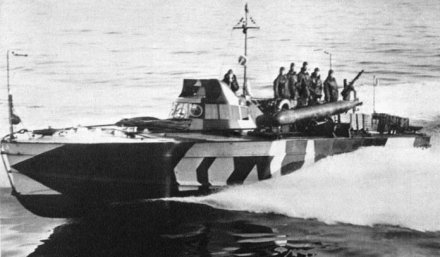
MAScamo

Camouflaged Italian World War II MAS that sunk the HMSAS Parktown (Motoscafo Armato Silurante – Italian: “Torpedo Armed Motorboat”)

Out of her complement of 21, Parktown suffered 13 casualties; five killed and eight seriously wounded.

Decorations and awards won

In this action alone the HMSAS Parktown’s crew would amass the following decorations and awards (we will leave the account of the HMSAS Bever to another post on her and her loss in November 1944 specifically):

Distinguished Service Order, D.S.O 
Sub-Lieutenant Ernest Rowland Frances (H.M.S.A.S. Parktown).
Comes from Krugersdorp. Age 34. Was in Training Ship General
Botha, 1923-23. Badly wounded during Tobruk withdrawal.

Distinguished Service Medal, D.S.M.
No 66921. Leading-Stoker John Charles Rohlandt (H.M.S.A.S. Parktown).
Home. address, 12, Hillyard-street. Woodstock.
No 71431. Leading-Stoker Leslie Ronald Mitchell (H.M.S.A.S. Parktown).
Home address. 16, Wesley-street. Observatory. Before war was
employed by Customs Department, Cape Town
No. 71048. Able-Seaman George Kirkwood (H.M.SA.S. Parktown).
Comes from Maraisburg. Transvaal. Was a miner in peace time.

Mentioned in Dispatches (Posthumous)
Lieutenant Leslie James Jagger (H.M.S.A.S. Parktown) Came from Johannesburg, was killed during this operation.

No. 71464. Stoker Andrew Henry Jooste (H.M.S.A.S. Parktown). Comes from Vrededorp Johannesburg. Age 21. A gold miner before joining Seaward Defence.

The honour roll  – HMSAS Parktown (SANF),

The following South African men were lost with the sinking of the Parktown (MPK means “missing presumed killed”)

BROCKLEHURST, Peter S, Able Seaman, 70457 (SANF), MPK
COOK, John A, Stoker 1c, 70256 (SANF), MPK
JAGGER, Leslie J, Lieutenant SANF, 70016 (SANF), MPK
MCEWAN, William A, Steward, 69686 (SANF), MPK
TREAMER, Arthur P, Petty Officer, 71109 (SANF), MPK

May these brave South Africans Rest in Peace, their duty done.
supporting-poppy-appeal

For more Observation Post stories on South African minesweepers lost in World War 2, please visit the following links:

HMSAS Southern Floe: The HMSAS Southern Floe was the SA Navy’s first ship loss & it carries with it a remarkable tale of survival.

The HMSAS Bever: “Under a hail of shells”; Recounting the bravery and loss of HMSAS Bever

The HMSAS Treern: The last South African Navy ship to be lost in action; HMSAS Treern


Researched by Peter Dickens. References: Article essence copied from Wikipedia, Military History Journal Vol 9 No 1 – June 1992. THE STORY OF A WARSHIP’S CREST by F V Demartinis and Day-to-Day in the SA Navy by Chris Bennett (social media). SOUTH AFRICAN NAVAL FORCE
Ship Histories, Convoy Escort Movements, Casualty Lists 1939-1947
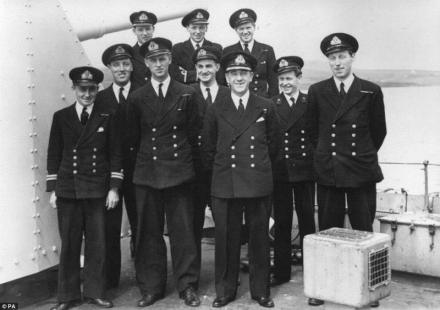
 

The connection between HRH Prince Philip & the SAS Simon van der Stel

Now, you’re wondering – what has Prince Philip (husband to Queen Elizabeth II) possibly have to do with the South African Navy’s SAS Simon van der Stel. Well here it is.

These are officers of the HMS Whelp – notice the tall and rather familiar HMS Whelp First Lieutenant – Prince Philip.

Philip joined the Navy as a cadet after leaving Gordonstoun School in 1939. In January 1941 he joined the battleship HMS Valiant in Alexandria and was in charge of its searchlight control during the night action off Cape Matapan, for which he was mentioned in dispatches. After serving aboard the HMS Wallace, he was appointed first lieutenant of HMS Whelp, which was present in Tokyo Bay when the Japanese signed the surrender.

In fact Prince Philip has quite a combat record, in a remarkable act of heroism Prince Philip saved scores of lives during the Second World War when he foiled a Luftwaffe bomber which looked certain to destroy their ship, the HMS Wallace during the Allied invasion of Sicily in July 1943.   During a night-time attack, Prince Philip conjured up a plan to throw overboard a wooden raft with smoke floats that would create the illusion of debris ablaze on the water, and as he hoped, the German plane was fooled into attacking the raft while the HMS Wallace sailed to safety under cover of darkness.

A young Prince Philip with Princess Elizabeth and HMS Welp in 1944 W Class Destroyer

The last wartime ship the Price served on was HMS Welp, and 1952 was sold to South Africa as the replacement for HMSAS Natal. HMS Whelp was renamed SAS Simon van der Stel, after the 17th century colonist reputed to be the founder of the South African wine industry. Much of SAS Simon van der Stel′s service was as a “grey ambassador”, on good-will visits to Europe and Europe’s African colonies, including a 147 day cruise to Europe in 1954. This role, however, declined as South Africa became increasingly isolated during the apartheid years.

SAS Simon van der Stel was placed in reserve from 1957, but was modernised as a Type 15 frigate (in common with other destroyers of her generation) in an anti-submarine role from 1962 to 1964, and re-commissioned in February 1964. She now had helicopter facilities, which were used by South Africa’s 22 Flight (later 22 Squadron).

10702201_358161731020232_3587078548727944204_n

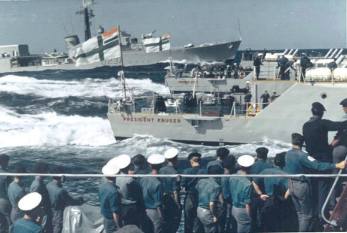
Photo of the South African Navy Frigates in their heyday. Here are the three President Class Frigates together, the SAS President Kruger, the SAS President Steyn and the SAS President Pretorius – neck to neck with the SAS Simon van der Stel in the background, now converted to a Type 15 Frigate (note additional helicopter hanger on the stern).

SAS Simon van der Stel was eventually scrapped in 1976 in Durban.

South African Navy at war against …. Imperial Japan!!

Many people don’t know it – but a small historic fact, the South African Navy was involved in direct engagements with Imperial Japan during the Second World War.

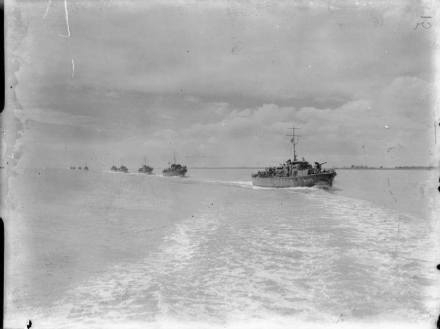
Here ML 475 leads motor launches of the Arakan Coastal Forces in line ahead up the Naaf River on their way to bombard Japanese shore defences and cut cross river communications.

These Coastal Forces were made up of the Royal Indian Navy, the Royal Navy, South African Naval Forces and Burma RNVR and they had covered nearly 30,000 miles in over 40 operations.

Harrassment of Japanese lines of communication and bombardment of shore defences were carried out between the Naaf River and Ramree Islands. Briefed in a Basha hut in their well hidden base, commanding officers return to their ships hidden in the up-river creeks for the nights operations.

Image and caption copyright: Imperial War Museum

Smuts inspects the South African Navy in Egypt

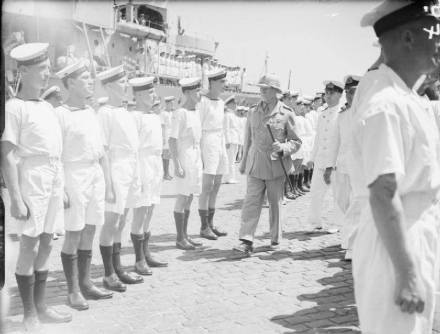
Field Marshal Smuts Visits South African Naval Forces in the Middle East, 16 May 1942
Field Marshal Smuts, in khaki army uniform, inspects massed ranks of South African sailors on the quay side in Alexandria, Egypt, 16 May 1942.

Imperial War Museum

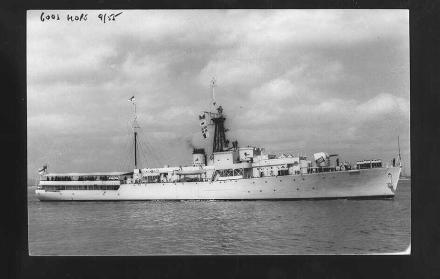
South Africa’s first Navy Frigate – HMSAS Good Hope

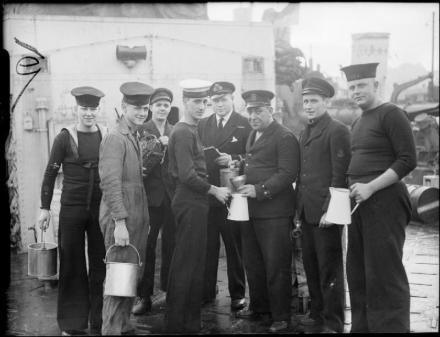
South Africa’s first Frigate, 6 January 1945, picture taken on the Clyde. Officers and men of the Frigate HMSAS Good Hope, the first of three presented to the South African government by the British government. The Coxswain, Chief Petty Officer A W Lincoln, from Robinson Deep, Johannesburg, serving out the rum.

Photo15frLochGoodHope1PS

Feature image and caption copyright: Imperial War Museum collection.

‘A sole survivor and a ship’s crest’; the South African Navy’s first loss – HMSAS Southern Floe

The month of February is also remembered as the “three ships” month in some small South African military veteran circles.  That’s because three of South Africa’s worst military disasters at sea – the SS Mendi (WW1), the SAS President Kruger, and this one the HMSAS Southern Floe (WW2) – all occurred in February.

Much effort by various associations in South Africa is put to remembering the Mendi and the President Kruger, however little regard is given to the SA Navy’s losses in World War 2.  Odd considering that during WW2  the most significant number of South Africans were lost at sea, yet scant regard is put to this epoch of the South African Naval sacrifice by way of remembrance and parades.

In all South Africa lost four ships in World War 2, all of them minesweepers, so lets look at the flotilla of South African Navy minesweepers (converted whalers) during World War 2, and the loss of the HMSAS Southern Floe, the first of these four minesweepers to be lost.

HMSASSouthernFloe_001_zps0bc9e903

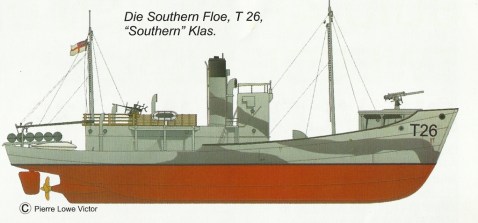
A number of whalers were converted to anti submarine roles and commissioned into the South African Navy for service, they were part of the South African Seaward Defence Force anti-submarine flotilla.

Some of them were sent to the Mediterranean and based at Alexandria, Egypt – the HMSAS Southern Floe, the HMSAS Southern Sea and their sister ship the HMSAS Southern Maid – which is seen in this rare featured photograph in Alexandria Harbour in Egypt (In the foreground is the South African Navy’s HMSAS Protea, a Flower-class corvette).10372567_405970339572704_7046310110446388801_n

In 1941 – the HMSAS Southern Floe (Lt J E Lewis) and HMSAS Southern Sea arrived at Tobruk on 31 January 1941 to take over patrol duties from two of their two sister ships.

Although submarines were not a threat in the first six months of the Western Desert campaign, numerous floating mines pointed to the existence of extensive moored mine fields. Except for the sweeping of the narrow coastal traffic route and harbour entrances at this stage there had not yet been time to locate these fields with any accuracy, much less to clear them. The main duty of the two Southerns was alternately to patrol the nearest section of the swept channel and to escort shipping along it. The port at that time was subject to air raids, littered with sunken wrecks and possibly active ground-mines. On patrol, the duties were complicated by sandstorms that strong off-shore winds extended for many miles out to sea, resulting in low visibility, heavy cross-seas, and much discomfort to personnel. To these conditions were added the menace of the mine fields on one side and an ill-defined and unlighted coast on the other.

17546669_10154957768326480_68053892438750609_o

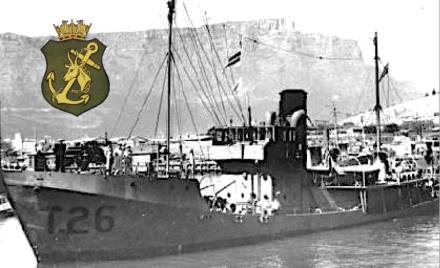
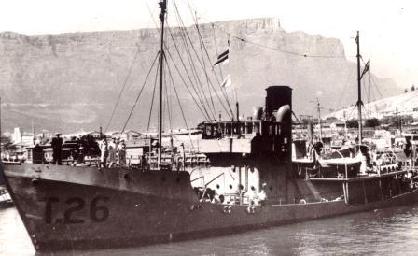
HMSAS Southern Floe T26

On the morning of 11 February Southern Sea arrived at the patrol rendezvous, two miles east of Tobruk, but found no sign of Southern Floe. This was reported but caused no concern at first; it had blown hard enough all night for the ship to find herself far from her station at dawn. However that evening, a passing destroyer picked up one man clinging to some wreckage – all that remained of Southern Floe and her company.

This sole survivor was Leading Stoker C J Jones, RNVR (SA), lent from HMS Gloucester to fill a vacancy just before Southern Floe sailed from Alexandria. The HMS Gloucester had a large contingent of South African Naval Force on it and was to be lost later in the war (see Observation Post A “grievous error”; Recounting South African Sacrifice on the HMS Gloucester).

Jones was almost insensible after 14 hours in the water, but afterwards stated that he had been in the stokehold when, at about 04:00 there had been a heavy explosion and the ship had filled rapidly. In the darkness, he had found his way into the flooded engine-room and struggled out through the skylight as the ship sank. He had seen a few other persons in the water at that time and later had done his best to support a wounded man. In the absence of other evidence there is little doubt that a mine, either floating or moored, was the cause.

The loss of the ship, although but a trivial incident in a world war, came as a sudden and grievous blow to the flotilla and to the SDF. The ships had spent a barely one month on the station and at home few were aware that they had arrived and had been in action. The casualties were the first naval losses suffered by the South African Seaward Defence Force and the sense of loss in the service was profound.

A relic of Southern Floe was brought to South Africa long after, in the form of a small brass ship’s badge, found amidst the other debris of battle 70 miles inland from Benghazi. Supposedly it had floated ashore, attached to a wooden fragment of the ship’s bridge, and been carried thence by an Italian souvenir-hunter.


After the war Stoker Jones, the sole survivor placed a memorial notice in the Cape Town newspapers. He continued to do this for many years until he also passed away.

22308811_10155537271456480_3745202244434378650_nWe salute these brave South Africans – here is the honour roll for the HMSAS Southern Floe (MPK means “Missing Presumed Killed”).
ANDERS, John, Steward, 69637 (SANF), MPK
BOWER, Robert, Stoker 1c, 69935 (SANF), MPK
BRAND, Leslie A, Able Seaman, 69828 (SANF), MPK
CAULFIELD, Patrick, Steward, 69802 (SANF), MPK
CHANDLER, Charles R D, Cook (S), 69613 (SANF), MPK
CHENOWETH, Richard, Stoker 1c, 67420 (SANF), MPK
FAIRLEY, Alexander E, Sub Lieutenant SANF, MPK
FRIEDLANDER, Cecil A, Able Seaman, 114703 (SANF), MPK
GARDINER, Elliott, Able Seaman, 67260 (SANF), MPK
GREENACRE, John H, Leading Seaman, 69677 (SANF), MPK
HEASMAN, Gratwicke E E, Engine Room Artificer 4c, 69784 (SANF), MPK
HOGG, Roy S, Sub Lieutenant, SANF, MPK
INNES, Ian Mck, Sub Lieutenant, SANF, MPK
LEWIS, John Edward Joseph, :Lieutenant, 70019 (SANF), MPK
MARSH, Reginald H Y, Able Seaman, 69911 (SANF), MPK
MITCHELL, William N, Able Seaman, 69787 (SANF), MPK
NEL, Eloff R, Able Seaman, 69635 (SANF), MPK
NICHOLSON, Douglas O, Able Seaman, 66833 (SANF), MPK
PUGH, John R, Able Seaman, 66877 (SANF), MPK
RYALL, David R, Able Seaman, 69999 (SANF), MPK
SHIMMIN, William, Leading Stoker, 69661 (SANF), MPK
SIENI, Joseph F, Able Seaman, 69788 (SANF), MPK
SNELL, Harold W, Leading Telegraphist, 69827 (SANF), MPK
STANLEY, Gordon J, Able Seaman, 66963 (SANF), MPK
WALTON, Dudley N, Sub Lieutenant, SANF, MPK

60eac9_b5b492be3f049f004e96e728a4a7b8cc.jpg_256

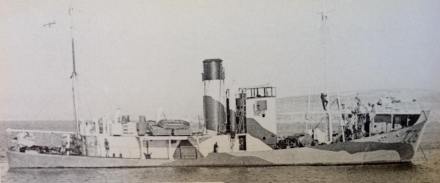
HMSAS Southern Floe in Cape Town

For more stories on other South African minesweepers lost during World War 2, please follow these Observation Post Links:

The feisty South African minesweeper that went down fighting – HMSAS Parktown

“Under a hail of shells”; Recounting the bravery and loss of HMSAS Bever

The last South African Navy ship to be lost in action; HMSAS Treern


Written and Researched by Peter Dickens. Many thanks to Glen Knox from the South African Naval Museum for the story content and his tireless work keeping this history alive. Casualty Lists of the Royal Navy and Dominion Navies, World War 2 by Don Kindell. Images of South African vessels courtesy Allan du Toit and reference from his book ‘South African Fighting Ships’.

The sinking of the ‘City of Johannesburg’

The submarine “U Boat” menace of the Second World War became commonly known as the “Battle of the Atlantic”, but it also extended to all oceans and the strategic point rounding the South African Cape became a focus point of the submarine war and German attention – and subsequently the attention of The South African Navy and her British Allies.

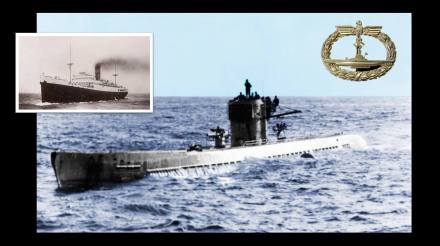
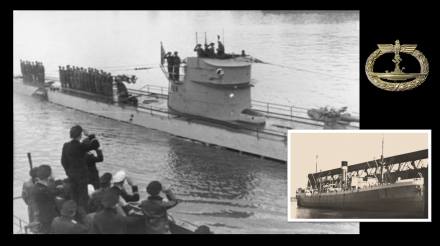
2000px-Pirate_FlagA typical example of the danger, survival and sacrifice in South African waters is the story of the sinking of the “City of Johannesburg” by German submarine U-504 (seen in the featured image above).  U-504 was a Type IXC U-boat of Nazi Germany’s Kriegsmarine during World War II, the SS City of Johannesburg was a merchant vessel carrying supplies off the coast of East London, South Africa.
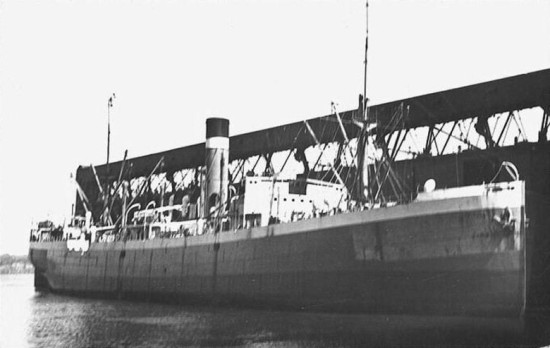
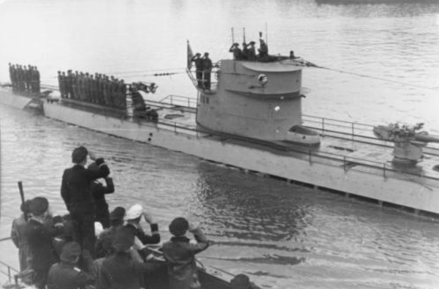
Of the merchantmen on board the SS City of Johannesburg, 90 in total, 4 perished and there where 86 survivors. Their survival in open water is remarkable considering the conditions in South African waters and typical to the dangers of operating at sea in WW2. This is one of many stories of the sinking of vessels and bravery of men off the coast of South Africa.

SS_City_of_Johannesburg

SS City of Johannesburg

At 23.12 hours on 23 Oct 1942 the unescorted City of Johannesburg (Master Walter Armour Owen) was hit by one of two torpedoes from U-504 while steaming on a zigzag course at 10.75 knots about 80 miles east-southeast of East London, South Africa. The torpedo struck between the deep tank and #4 hold on the port side, blowing the hatches off the deep tanks and opening a hole that flooded these compartments immediately. All electricity failed and the engines had to be stopped when the engine room was flooded a few minutes later, causing the ship to settle by the stern with a slight list to port. No distress signals could be sent as the main aerial was brought down and fouled the emergency aerial and it was later discovered that the portable wireless set had been damaged while lowering into a lifeboat and was useless.

Two lifeboats had been destroyed and the rafts aft were jammed in the rigging, so the 21 crew members, 60 Lascars (Indian sailors) and nine gunners (the ship was armed with one 4in, one 12pdr, two 20mm and four machine guns) abandoned ship in the four remaining lifeboats which were launched safely within five minutes despite rough sea and high swell.

Before leaving the gunners tried to train the 4in gun, but it was damaged and could no longer be turned. The master was the last to leave the ship after making sure that no one was left on board. At 23.40 hours, the U-boat surfaced after firing a coup de grâce at the ship which was hit at #2 hatch on the port side, but only settled further on an even keel.

The Germans then questioned the survivors in one of the lifeboats and left the area after the City of Johannesburg suddenly broke in two amidships and sank at 00.00 hours. Four Lascars were lost.

The boat in charge of the master had 11 persons on board and rescued two men swimming in the water. Quartermaster H. Birnie was picked up by a boat with 28 persons and later stated that he was alongside the U-boat after it had surfaced and even touched the plates when he was told to swim astern to the lifeboat. He was asked no questions and the engines of the U-boat remained stopped until the man was clear.

The other two boats held 19 respectively 25 persons, but owing to the rough sea the lifeboats could not approach each other to even up the survivors in them. The master told the other boats to remain in the vicinity while his boat set sail in order to get help and made 140 miles in 24 hours before he and twelve survivors were picked up by the Dutch steam merchant Zypenberg about 8 miles from the coast in 33°50S/26°50E on 25 October and landed at Durban two days later.

However, the boat with 19 occupants also set sail and only made half the distance before they were rescued by the British motor merchant King Edwin on 26 October and landed at Cape Town three days later. The 54 survivors in the two boats that waited near the sinking position were picked up by the British steam merchant Fort George after 12 hours in 33°24S/28°31E and landed at Port Elizabeth on 25 October.

U-504: South African Patrol

This submarine had caused a lot of damage off the coast of South Africa, here is a short history of her 4th Patrol in South African waters:

U-504

U-504

U-504 left Lorient on 19 August 1942 and sailed south to the waters off South Africa as part of Wolfpack Eisbär. There, on 17 October, about 450 nautical miles (830 km; 520 mi) south of Cape Town, she torpedoed and sank the unescorted British 5,970 ton Empire Chaucer. On the 23rd she sank the 5,669 ton SS City of Johannesburg, and on the 26th she attacked the unescorted American 7,176 ton Liberty ship Anne Hutchinson. The crew abandoned their vessel after she was hit by two torpedoes and fatally damaged. However the ship remained afloat, and on the 29th was taken in tow by the South African armed trawler HMSAS David Haigh (T13) and a harbour tug. Lacking sufficient power to tow the ship to port explosive charges were set, cutting the ship in two. The aft section sank, and the fore section was towed into Port Elizabeth. Part of the crew were picked up at sea, while the rest made it to land in their lifeboats.

U-504 sank two more British merchant ships on 31 October, about 200 nautical miles (370 km; 230 mi) east of Durban. First the unescorted 7,041 ton Empire Guidon, then the unescorted 5,113 ton Reynolds, which, hit amidships and in the stern, capsized and sank within seconds.

Finally on 3 November she sank the unescorted and unarmed Brazilian 5,187 ton cargo ship Porto Alegre en route from Rio de Janeiro to Durban, off Port Elizabeth. Hit by a single torpedo, the crew abandoned ship before the U-boat delivered the coup de grâce. Only one crew member was lost. The survivors were questioned by the Germans, and later made landfall about 50 nautical miles (93 km; 58 mi) from Port Elizabeth on 7 November.[22] U-504 arrived back at Lorient on 11 December 1942 after a patrol lasting 115 days.

The fate of U-504

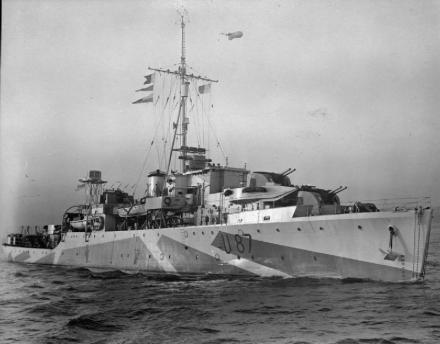
U-504 also met a grisly fate.  Whilst on her 7th Patrol U504 was depth charged and sunk with all hands on board (53 in total) on 30 July 1943 in the North Atlantic north-west of Cape Ortegal, Spain, in position 45.33N, 10.56W, by depth charges from the British ships HMS Kite, HMS Woodpecker, HMS Wren and HMS Wild Goose.

HMS_Kite_IWM_FL_22973

HMS Kite

HMS Kite’s Commanding Officer at the time of the sinking of U-504 was the famous U-boat hunter Captain “Johnnie” Walker, DSO and three bars.

The Commander from her one patrol off South Africa to when she was lost are two different men (and possibly even different crew as well).

12642880_10208446827553702_7537731843413712051_n

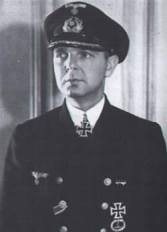
KrvKapt Hans-Georg Friedrich Poske

During the South African Patrol (4th patrol) the Commander was KrvKapt Hans-Georg Friedrich Poske (he command U-504 for the first four War Patrols). KrvKpt Wilhelm Luis did the next three patrols, his third being the fatal one.

This U Boat spent a total of 372 days a sea and sank 85,299 tons of shipping. All ships sunk were under her first commander KrvKapt Hans-Georg Friedrich Poske and on the second, third and fourth patrols.  U-504’s most successful patrol in terms of tonnage suck was on her South African patrol.

KrvKapt Hans-Georg Friedrich Poske survived the war, he also served post war as well and retired in 1963.  Note on the image provided  he was awarded a Knights Cross.


Researched by Peter Dickens

Reference and thanks to Sandy Evan Hanes for additional input.

Related Observation Post links:

The Leonardo da Vinci  The Leonardo da Vinci wreaks havoc off South Africa’s coastline

U-177 The worst maritime loss off Durban’s coast; The sinking of the SS Nova Scotia


The South African Naval Forces – WW2

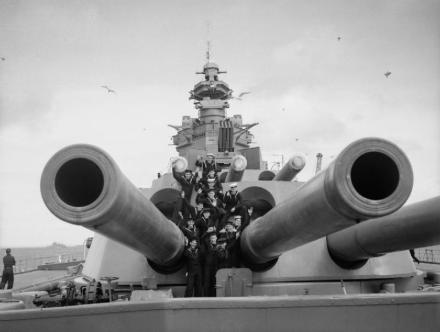
South Africans in the service of the Royal Navy in World War 2. Here is a great photograph of the members of the South African Division of the Royal Naval Volunteers Reserve on board HMS NELSON posing for the camera between two of the enormous 16 inch guns of A turret. July 1941.

During the war thousands of South African Naval Forces (SANF) members like these were seconded to serve on Royal Navy vessels, almost every large Royal Navy ship had its contingent of South Africans and this is the HMS Nelson’s allocation.  This has a lot to do with the fact that Simonstown in South Africa was a British Naval port.

South African Naval Forces (SANF) in World War 2 where either allocated to Royal Navy ships (titled HMS – His Majesty’s Ship) or on South African Navy ships (tilted HMSAS – His Majesty’s South African Ship).

What is lost on South Africans, and even lost on the British today is that every-time a large British naval vessel was sunk or attacked, South African naval personal on it inevitably lost their lives or where wounded.  These days, South Africans and also the British, very seldom count the sacrifice and commitment of South African men to the Royal Navy (due to this unique arrangement), especially when remembering the great deeds of the Royal Navy during the war.

Image – Imperial War Museum copyright.

The worst maritime loss off Durban’s coast; The sinking of the SS Nova Scotia

This rare colour image of U Boat 177 is at the heart of one of the worst maritime losses off South Africa’s coast during WW2 – this is the story of the sinking of the troopship SS Nova Scotia just off Durban by U177.  An “own goal” really as the SS Nova Scotia was returning with fellow Axis Force “Prisoner of War” Italian servicemen.

crew uboat watchout guard tropical binocular2

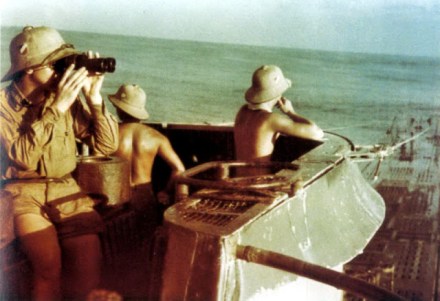
Rare original colour image of German submariners on the coning tower of U-177 conducting a watch.

During the Second World War, Durban was the embarkation and disembarkation port, first for the East African and Abyssinian campaigns and later for those in the Middle East and Italy. A large military hospital operated at Springfield and hospital ships plied between the port and the theatres of war in the north.

One such ship was the 6 796 ton SS Nova Scotia, belonging to the Furness Withy Group which had been converted into a troop carrier, operating mainly between Durban and ports along the African east Coast all the way up to the Suez. She carried troops from Durban to the “North” and on the return passage carrier Italian Prisoners of War (POW) to South Africa.

Nova-Scotia

SS Nova Scotia

SS Nova Scotia sailed from Massawa, in Italian East Africa (modern day Eritrea), on 15 November 1942 carrying 765 Italian POW’s, 134 British and South African guards and 118 crew.

Just after 06:00 on 28 November 1942 the Commander of U-boat 177, Kapitanleutnant Gysae, apparently sighted smoke from the SS Nova Scotia off the Zululand coast of Natal. Just after 09:00 U177 fired three torpedoes which struck the SS Nova Scotia who sank within 7 minutes. It appears that only 1 lifeboat was successfully launched leaving the rest of the survivors clinging to bits of the wreck.

U177 surfaced to establish the identity of the ship that they sank, but was unable to do so due to the chaotic situation. Two survivors were taken aboard for intelligence. German U-boat Command did inform the Portuguese authorities of the sinking of the SS Nova Scotia. As a result of this, the Alfonso de Albuquerque out of Lourenco Marques reached the scene of the sinking on 29 November 1942 and managed to rescue 190 survivors. Another survivor was picked up by a Destroyer three days later while a fortunate Italian POW floated ashore at Mtunzini two weeks after the incident.

Many of the casualties were washed ashore on the Natal (Kwazulu-Natal) beaches. 118 of the Italian POW’s were buried in a common grave in the Hilary Cemetery, Durban. Three crosses initially marked the grave, but in 1982, using a donation from the survivors of the SS Nova Scotia still living in Mozambique a new memorial was erected. This comprised a circular tomb topped by a broken stele rising from the waves inscribed with the words “To the memory of the Sons of Italy who were overcome by the ocean in the sinking of the S/S ‘Nova Scotia’ XXVIII-XI-MCMXLII The survivors sheltered in Mozambique”.

Since then the 118 casualties from the “SS Nova Scotia” have been exhumed from the Hilary Cemetery and along with the remains of the 35 Italian POW’s who died in the Natal Province are now buried in the grounds of the “Master Divinae Gratiae” Church, Epworth Road, Mkondeni, Pietermaritzburg. The church was built by Italian POW’s in 1944 and is today a South African National Monument.

The only woman to survive the ordeal was Alda Ignisti (later Lady Taylor) who, along with her daughter Valcheria, was on her way to Durban having been stranded in in Italian East Africa (modern day Eritrea) following the death of her husband.

U-177 also met with a watery grave – on 6 February 1944, she was sunk in the Atlantic west of Ascension Island, in position 10°35′S 23°15′W Coordinates: 10°35′S 23°15′W, by depth charges dropped by a PB4Y aircraft from US Navy Squadron VB-107. 50 men were lost; 15 survived, they were picked up by USS Omaha.

Similar to the sinking of the SS NOVA SCOTIA, here is U 177 again – however this time the ship shown sinking in the photo is the American ship MS ALICE F. PALMER – sunk by U-177 south of Madagasgar off the east coast of Africa on the 10th of July 1943.

supporting-poppy-appeal


Information source –  Charles Ross, additional research by Peter Dickens. The colour photo of U-177 is from the personal album of Burkhard Heusinger Von Waldegg who was the first watch officer of U-177 – Lt. Robert Gysae the commander of U-177 stands on the right hand side – note the Knights Cross.

SA Navy losses as HMS Barham explodes

Nothing drives home the peril of serving on a fighting ship harder than this British Pathe newsreel footage of the sinking of the HMS Barham, it is simply jaw dropping.

Made even more poignant for us as South Africans if you consider we are witnessing the loss of the following South African naval personnel in this tragedy.

BAKER, Dennis E W, Ordinary Seaman, 68617 (SANF)
GLENN, Paul V, Ordinary Seaman, 68906 (SANF)
HAYES, Richard T, Ordinary Seaman, 68499 (SANF)
MORRIS, Cyril D, Ordinary Seaman, 68932 (SANF)
UNSWORTH, Owen P (also known as R K Jevon), Ordinary Seaman, 69089 (SANF)
WHYMARK, Vivian G, Ordinary Seaman, 69024 (SANF)

During the Second World War, South African Navy personnel – known at the time as the “South African Naval Forces” (SANF) were seconded to serve on ships in the Royal Navy.

It is our duty as South African veterans never to let selective history and the mist of time obscure the brave contributions of our countrymen during this war, and it is our duty as South African military veterans to continually educate and keep this memory alive.

HMS Barham was a Queen Elizabeth-class battleship of the Royal Navy She was sunk during the Second World War on 25 November 1941 by the German submarine U-331north of and off the coast of Sidi Barrani, Egypt.

Prior to this HMS Barham visited Durban, South Africa, in June 1941 for extensive repairs at the Victoria Graving Dock. The repairs where due to damage sustained in the Crete bombing. She sailed from Durban on the 31st July 1941.

Video copyright British Pathe