The South African Air Force’s highest scoring Ace – Jack Frost

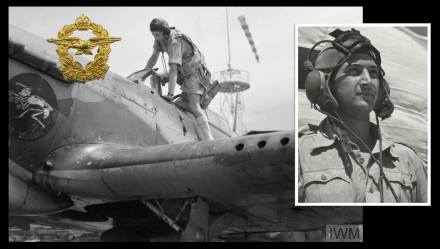
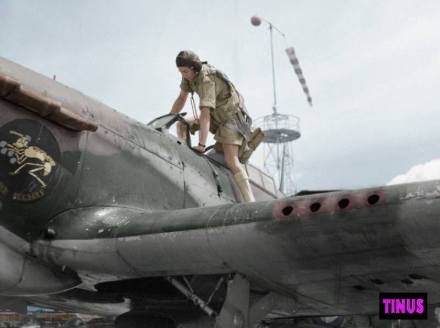
The Legendary South African Ace – Captain J E “Jack” Frost climbs into a Hawker Hurricane of No. 3 Squadron SAAF at Addis Ababa, after rejoining his unit as ‘A’ Flight commander following an attack of appendicitis.
1460210_258771500938983_1728074890_n

Born in Queenstown, South Africa on 16 July 1918. This son of Richard H. Frost and Ada M. Frost joined the South African Air Force (SAAF) in 1936, little did they know they had given birth to legendary fighter ace.  Awarded the Sword of Honour at the conclusion of his training at the Military College in 1938, Jack Frost was to prove this accolade correct the minute he got into combat.

East Africa Campaign

Jack Frost was the most successful fighter pilot in the SAAF. He joined the South African Permanent force in 1936 and after a spell as a flying instructor was posted to No. 1 Squadron SAAF in 1939. In 1940 he was posted to the Newly-formed 3 Squadron SAAF as a flight commander and saw considerable action in Somaliland and Ethiopia.

He was evacuated with acute appendicitis on 22 May 1941 but rejoined his unit in June and was given the command of No. 5 Squadron SAAF the following month. He led the unit through the heavy fighting in Egypt in May and June 1942, but was eventually shot down and killed while escorting bombers over the El Adem area on 16 June. He was the SAAF’s top scorer of the war with 16 confirmed victories and was regarded as an outstanding pilot and leader.
10648180_665754946874172_3586502582896698266_o

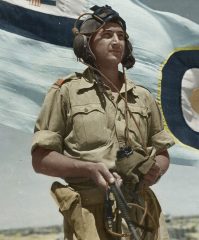
Maj Jack Frost, colourised image by Tinus Le Roux

His wartime record is considerable considering his short life, he entered the East African Campaign to fight against Italian Forces, on  22 February 1941, Frost destroyed four Fiat CR-42  fighters, an action for which he was awarded the Distinguished Flying Cross.

On 15 March 1941, Frost was shot down by anti-aircraft fire while strafing Diredawa  airfield. His wingman, Lieutenant Bob Kershaw landed his aircraft in a nearby field, while other 3 Sqn pilots fired on Italian infantry attempting to capture the pair. Kershaw escaped in his aircraft with Frost sitting on his lap, an action for which Kershaw was awarded the Distinguished Service Order.

The campaign ended effectively in November 1941 with the final defeat of Italian Forces in East Africa. The squadron returned to South Africa and was disbanded.

North African Campaign

Frost, promoted to Major was appointed commander of No. 5 Squadron flying P-40 Kittyhawks.  From March 1942 the squadron participated in the North African Campaign, with the Desert Air Force. No. 5 Squadron joined No. 2 and No. 4 Squadrons in No. 233 Wing; the main role of the SAAF fighters at the time was highly dangerous bomber-escort  missions, supporting No. 3 (Bomber) Wing SAAF.

The squadron was assigned to the Sollum-Mersa Matruh sector. On 11 May, Frost and his wingman Lt. Ken Whyte shared the destruction of a lone Heinkel He 111 bomber attacking a convoy bound for Malta.

Whyte described the action: “I remember our first combat together. While on a shipping patrol we were vectored on to a He 111. Jack made his favourite three-quarter attack which had brought him success in Abyssinia. I attacked from the rear. We each claimed half a share in its destruction.” On 16 May, Frost destroyed a Junkers Ju 88 for his ninth victory, but was hit by cannon fire damaging his port elevator.
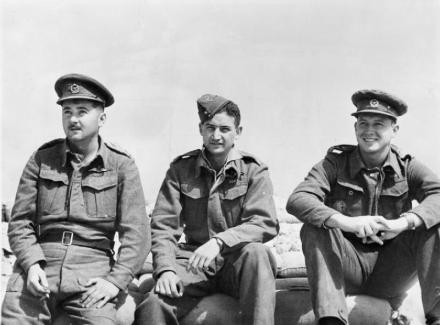
11981_152908078212266_1358625500_n

Three of South Africa’s most legendary fighter pilots in the North African theatre of operations during WW2, all of which were ultimately killed in action. Major J E “Jack” Frost, Commanding Officer of No. 5 Squadron SAAF sits between two of his most experienced pilots, Lieutenant Robin Pare (left) and Captain Andrew Duncan, at LG 121, Egypt.

To read up more on the above unique image of South African heroes, follow this Observation Post link 3 Legendary South African fighter pilots who never came home

On 28 May 1942, he was involved in a shared victory over a Messerschmitt Bf 109, his first. (The pilot, Feldwebel  Willi Langer was killed.) At this stage, Frost’s total tally stood at 15 Axis aircraft destroyed.

Frost was appointed commander of No. 233 Wing on 31 May, but his replacement at 5 Squadron, Andrew Duncan, was shot down and killed by Oberleutnant Otto Schulz.

On 16 June, whilst escorting Douglas Bostons, Frost and other P-40 pilots encountered Bf 109s from Jagdgeschwader 27 near Bir Hakeim, Egypt. Rod Hojem, one of the South African pilots involved in this combat commented: “There was one hell of a dogfight, and after it was over I can clearly remember Jack calling up the squadron on the R/T, he said “Form up chaps I am heading North”, and that was the last we heard of him.”

Frost’s aircraft and remains have never been found, and his fate remains unclear. Some sources suggest that Frost fell victim to one of the most prominent German aces, Hans-Joachim Marseille scored six of his 158 victories that same day.  To learn more on this remarkable German Ace and his unique South African connection follow this Observation Post Link German WW2 Fighter Ace befriends a Black South African POW and defies the Nazi status quo!

It has also been suggested that another German Experte, Gunter Steinhausen (who claimed four kills that day) may have shot down Frost.
12088598_506708752832195_3424448187684868824_n


Researched by Peter Dickens.  Extracts taken from Wikipedia.  Image colourising and copyright Tinus Le Roux with much and grateful thanks.  Image of Frost climbing into his cockpit Copyright IWM Collection.

See more on Tinus Le Roux great work on his website’s tribute pages by clicking this link WW2 SAAF Heritage Tribute Pages 

Also refer SA Military History
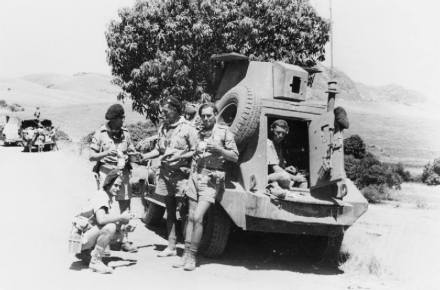
South Africa at war against … the French!

Many people don’t know it, but South Africans also fought against the French in World War 2.

A key part of the East African and Asian campaigns in WW2 was the Allied occupation of the former French colony of Madagascar and South African units took part in the operation.

The purpose was to prevent the strategically important island from being used by Axis Pact powers – Japan, Germany and Italy primarily .

Problem was, at the onset of the war many French colonies and troops did not join the ‘Free French’ and remained loyal to the French government who where now under occupation and in control of the Germans. This newly defined French Vichy government was sympathetic to the fascist cause and signed on with the Axis pact – in effect they changed sides and fought on the side of Germany.  Madagascar was just such a French colony.

The Allies had heard the rumours of Japanese plans for the Indian Ocean and on 27 November 1941, the British Chiefs of Staff discussed the possibility that the French Vichy government might cede the whole of Madagascar to Japan, or alternatively permit the Japanese navy to establish bases on the island. British naval advisors urged the occupation of the island as a precautionary measure.

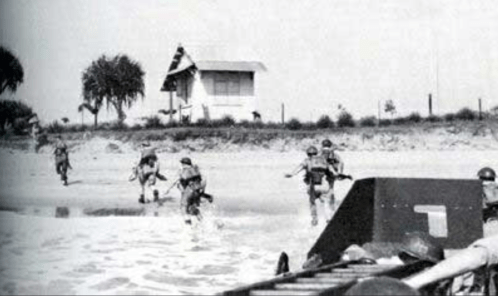
The Battle of Madagascar  began with Operation Ironclad, the seizure of the port of Diego Suarez from the French near the northern tip of the island, on 5 May 1942 by British and Commonwealth forces.  A subsequent campaign to secure the entire island, “Operation Streamline Jane”.  Ground operations where supported by the 7th South African Motorized Brigade which arrived on 24 June 1942 and the South African Air Force which had been involved at the onset in reconnaissance roles.

After capturing Majunga, Tamatave and other key towns and points, British and Commonwealth troops took the capital, Altananarivo and pursued French Vichy troops defending Madagascar deep into the heart of the island. Fighting ceased and an armistice was granted on 6 November 1942.

Feature picture shows: A South African armoured car crew snatching a quick meal during their rapid drive on Tananarive during the Battle of Madagascar – while radio contact is kept up all the time.  Note the armoured car is a South African manufactured Marmon-Herrington Armoured Car.

screen-shot-2016-09-23-at-11-07-35

Insert Image: British amphibious craft landings on Madagascar

mad

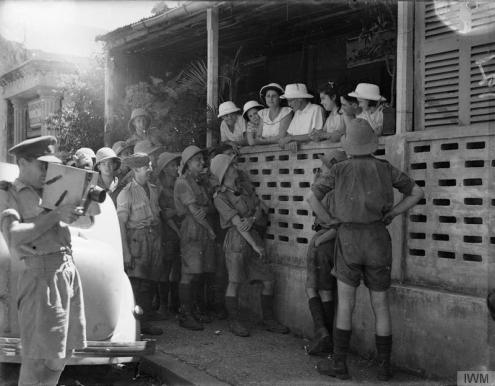
British troops talking to French inhabitants of Madagascar after the surrender.

Image copyright IWM Collection, source Wikipedia

Joint South African/Rhodesian Ops & the loss of SAAF Puma 164

It’s not widely known now, but In the late 1970’s the South African Defence Force (SADF) provided covert assistance to the Rhodesian Security Forces for raids conducted against ZANLA and ZANU bases in Angola and Mozambique (Operation Uric and Operation Vanity).

This is the story of the loss of a South African Air Force Puma – 164 during Operation Uric.

Operation Uric (or Operation Bootlace for the South Africans) was a cross-border raid carried out in Mozambique by operatives of the Rhodesian Security Forces during the Rhodesian Bush War, with combat assistance from the South African Air Force. During the operation, which took place from 1 to 7 September 1979, up to 400 Rhodesian military personnel and a small number of South African military personnel (flying Pumas, Canberras, Dakotas and Super Frelons) attacked bridges and a major staging point for Zimbabwe African National Liberation Army (ZANLA) insurgents in Gaza Province. The battle eventually drew in elements of the Mozambican army (FRELIMO) and police, who sustained heavy casualties. Along with Operation Miracle, this was one of the largest Rhodesian external operations of the Rhodesian Bush war.

21317440_1810898118921159_8994351697693582498_n

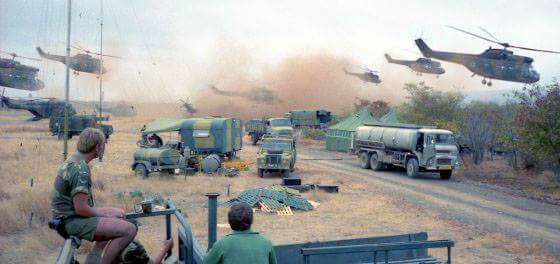
SAAF Pumas taking off during Ops Uric, Rhodesian troops and vehicles seen in the foreground

During the operation, on the 6th September 1979 one South African Air Force Puma helicopter – Puma 164 was hit by an RPG-7 rocket which entered through the open rear sliding door and exploded between the Pilot and Co-Pilot killing all 14 Rhodesian servicemen and the 3 South African Air Force personnel on board. The was the highest loss of life for the Rhodesian Security Forces in a single incident during the Rhodesian War. As the involvement of South Africans in this conflict was quite secretive and could politically backfire on South Africa, the crash site was later heavily bombed in an attempt to cover the South African markings on the Puma helicopter.

The battle resulted in over 300 dead ZANLA and FRELIMO soldiers and a number of damaged bridges, buildings and infrastructure. Politically the operation led to Samora Machel, the President of Mozambique at the time, putting pressure on Robert Mugabe to take part in the Lancaster House peace talks. He wanted to prevent Mozambique from being dragged further into the war with Rhodesia, which had already seriously damaged its economy.

The bodies from Puma 164 could not be recovered during the battle and were never repatriated. Their collective graves have been recently located in Mozambique and appropriate memorial stones have now been placed on all these graves.

The three 19 Squadron South African Air Force crewmen:

Captain Paul Velleman
Lieutenant Nigel Osborne
Sergeant Dick Retief

Five men from the Rhodesian Corps of Engineers:

Captain Charlie Small
2nd Lieutenant Bruce Burns
Sergeant Mick Jones
Corporal LeRoy Duberly
Lance Corporal Peter Fox

Nine men of the Rhodesian Light Infantry:

Captain Joe du Plooy
Corporal Gordon Fry
Trooper Kosie Briel
Trooper Aiden Colman
Trooper Jeremy Crow
Trooper Brian Enslin
Trooper Stephen King
Trooper Colin Neasham
Trooper Dave Prosser

Lest we forget.

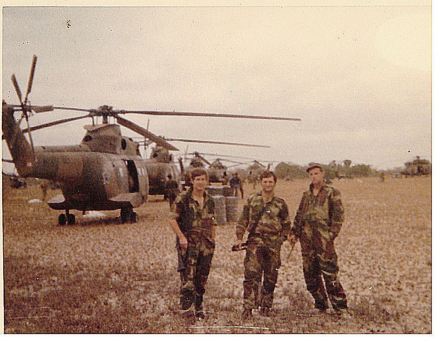
Photo courtesy of Frans Botha who is seen here with colleagues from the Rhodesian Security Forces during the Operation, the SAAF Pumas are clearly seen in the background.


Researched by Peter Dickens.  Reference, wikipedia and Colonel Graham du Toit’s daily SADF roll call.

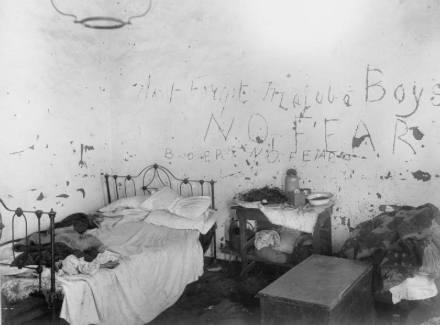
Boers; ‘Don’t forget Majuba, boys’. Brits; ‘No fear, Boere, no fear’.

A little bit of ‘Army’ banter between Boer and British Forces. Graffiti scrawled by both sides on a bedroom wall in a house originally taken by the Boers and recaptured by British forces. The Boer graffiti reads: ‘Don’t forget Majuba, Boys’. The British grafitti reads: ‘No fear, Boere, no fear’. Majuba was a disastrous British defeat in the lesser known First Boer War of 1881, and it was an “old score” to be settled in the Second Boer War 1899-1902 with devastating effect and further reaching punitive damage.

Many people in South Africa don’t know too much about the history of the 1st Boer War (also known as The Transvaal War) as they do about the 2nd Boer War i.e. the “Anglo Boer War” or “South African War” (as it is known in Britain).  As, by far, the second war had the most devastating and greatest impact to modern South African history, especially when the Concentration Camp policy and Scorched Earth policies are factored.  In fact it’s only as a consequence of the 2nd Anglo Boer War that South Africa as a “whole” country came into existence.

Many people in South Africa would also be surprised to learn that at one point, some 22 years before the 2nd Anglo Boer War, the Transvaal (known as the South African Republic) was “colonised” by way of a political annexe and effectively became British in 1877. A special “warrant” was issued by the British ostensibly to protect the Transvaal Boers against Zulu and local Pedi aggression.

It was the Transvaal War that changed this arrangement and re-established the South African Republic (Transvaal Republic) under the control of the Boers, setting the stage for the bigger conflict to come.

The Battle of Majuba Hill (near Volksrust, South Africa) on 27 February 1881 was the main and decisive battle of the First Anglo-Boer War (Transvaal War). It was a resounding victory for the Boers and the battle is considered to have been one of the most humiliating defeats of British arms in history.

Major-General Sir George Pomeroy Colley occupied the summit of the hill on the night of 26–27 February 1881. His motive for occupying the hill remains unclear. The Boers believed that he may have been attempting to outflank their positions at Laing’s Nek. The hill was not considered scale-able by the Boers for military purposes and thus it is often assumed that the purpose of occupying the summit may have been Colley’s attempt to emphasize British power and strike fear into the Boer camp.  Who knows, but the end result was that it was scaled and a resounding and very one sided Boer victory  ensued – the Boer suffering only 1 dead and 5 wounded, whereas the British suffered 92 dead, 134 wounded and 59 captured.

The impact of this battle was far reaching. It led to the signing of a peace treaty and later the Pretoria Convention, between the British and the reinstated South African Republic (Transvaal Republic), effectively ending the First Boer War and giving the Transvaal back to the Boers.

Coupled with the defeats at Laing’s Nek and Schuinshoogte, this third crushing defeat at the hands of the Boers ratified the strength of the Boers in the minds of the British, arguably to have consequences in the Second Anglo-Boer War, when “Remember Majuba” would become a rallying cry (as is seen in the feature image).

This defeat marked the beginning of the decline of the British Empire. Since the American Revolution, Great Britain had never signed a treaty on unfavourable terms with anyone and had never lost the final engagements of the war. In every preceding conflict, even if the British suffered a defeat initially, they would retaliate with a decisive victory. The Boers showed that the British were not the invincible foe the world feared.

However the British “Retaliation” for the Battle of Majuba Hill and the surrender of a British “protectorate” (the Transvaal) was yet to come and when it did, twenty two years later, the punitive measures of the British military, against combatants and non combatants alike, had devastating and tragic consequences for the Boer nation as a whole.

This underpinning “old score to settle” was very much a rally call of the 2nd Anglo Boer war, it’s often overlooked by some historians that claim they entire war was about British Imperial greed for Gold and Diamonds, and whilst only partly true – there remains a score of other reasons for the Anglo Boer War (2nd Boer War) – and this is no doubt, one of them.

Images above show a 2nd Boer War (Anglo Boer War) postcard to “avenge” Majuba and wipe the slate clean and British soldiers from the 2nd Anglo Boer posing at the Battle of Majuba Hill memorial on the summit of Majuba, making a profound statement of eventual victory.

Feature Image: Copyright Imperial War Museum Collection, reference wikipedia and the Imperial War Museum.

Teddy the Recce

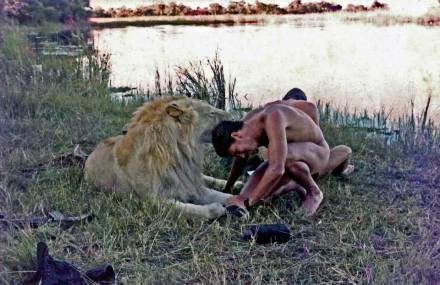
Some units roared like Lions and others literally where Lions and a lot can be said for members of South Africa’s Reconnaissance special forces (or commonly known as “Recce” units).  To celebrate the Recce veterans and their role in South Africa’s protection, here is this stunning image of “Teddy”, the Recce mascot at Fort Doppies.

Terrie was a Cuando lion who held a Recce Operators status and he is seen playing at Kwando River with Obie Oberholster, cira 1980.

To get a full story on Teddy – please visit the South African Special Forces website – here is the link:

Teddy the Lion on the official Recce website


Published by Peter Dickens.  Copyright and big thank you to Obie for the image.

The silent terror of the Angolan Border War

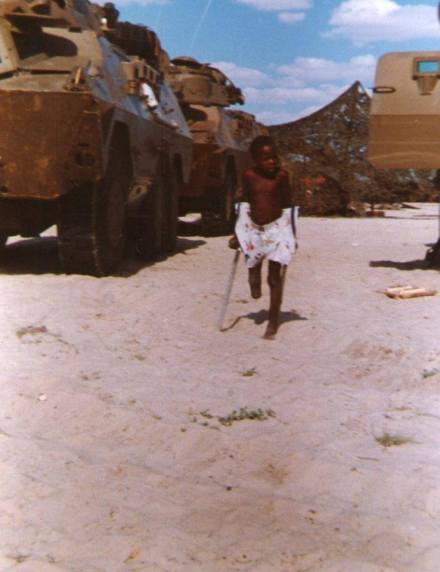
Forgotten to many as to why the Bush War was so closely felt to the South Africans conscripted to fight it, this image illustrates what many conscripts and volunteers felt they where there to do – protect innocent civilians from the ravages of the Angolan war and armed insurgency into South West Africa/Namibia.

A trademark of both the Angolan War and the Bush War was the silent terror of mines, the worst of which is the Anti Personnel Mine (APM). This type of mine is cheap to make can be easily concealed and extensively mined – it has a small charge designed to maim its victim, not kill, simply by blowing off a foot or leg – its design in essense is to demoralise and strike fear into every step.

This picture was taken by a medic whilst they where based temporarily next to the range at 101 Battalion’s Head Quarters in Oshakati during tte ‘9 Day War’ in April 89. This local Namibian child was moving amongst the Ratel Infantry Fighting Vehicles looking for food and entertainment. He remained under the wing of the medics for a couple of days.

Realistically summarised by BJ Taylor who took the photo in light of the frequent sight of such carnage of war on the civilian population as an ‘AP Mine victim, one of many … ‘

Image copyright and courtesy of BJ Taylor.

The Border War & the Lockerbie bombing connection!

You may be wondering, what the heck does the South African Border War on the SWA/Namibia and Angola border in the late 80’s have in common with Pan Am Flight 103 and the Lockerbie bombing?  Well, there is an interesting and uniquely South African connection.

Heralding the end of The Border War in 1988, as part of the pathway to peace, the United Nations pre-empted the process and appointed a Swedish UN Commissioner for Namibia, Bernt Carlsson. In the eventuality of South Africa’s relinquishing control of Namibia.

Commissioner Carlsson’s role would be to administer the country on behalf of the UN, formulate its framework constitution, and organise free and fair elections based upon a non-racial universal franchise.

On their way to sign the brokered peace accords to end the Bush War on the 22nd December 1988 in New York, the South African VIP contingent including Pik Botha (the then Foreign Minister) and the United Nations representative – Bert Carlsson all booked their passage to New York on Pan Am Flight 103.  Pan Am Flight 103 was a regularly scheduled Pan Am transatlantic flight from Frankfurt to Detroit via London and New York.

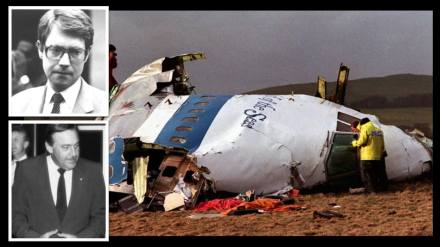
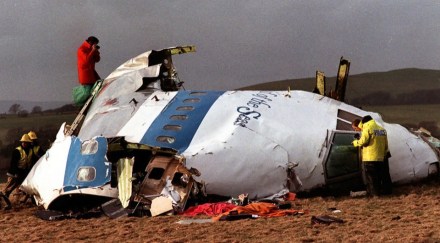
Sadly and very tragically, the UN Commissioner for Namibia, Bernt Carlsson, was not present at the signing ceremony. He was killed on Pan Am Flight 103 when it exploded and crashed on Lockerbie, Scotland on 21 December 1988 en route from London to New York City – killing all 243 passengers and 16 crew, in what became known as the Lockerbie bombing after large sections of the aircraft crashed onto residential areas of Lockerbie, United Kingdom, killing 11 more people on the ground.

bd4e1d5f0f5000d3

South African foreign minister Pik Botha, and the official South African delegation of 22 members had a very lucky escape. Their booking on Pan Am 103 was cancelled at the last minute and Botha, together with a smaller delegation, caught the earlier Pan Am 101 flight to New York.

Handed over by the Libyans and found guilty,  a Libyan terrorist, Abdelbaset al-Megrahi was jailed, the only person to be convicted for the attack. In 2003, Gaddafi, the Libyan despot, accepted responsibility for the Lockerbie bombing and paid compensation to the families of the victims.  However many questions still exist on the motive and responsibility of the bombing – with Abdelbaset al-Megrahi protesting his innocence all the way to his death bed.

With Gaddafi out of the picture now, I guess we will never know the full picture, and a tantalising titbit of a possible International terrorist conspiracy to derail the Namibian Peace Accords and/or deliver a killer blow to South Africa’s National Party elite and their policy of Apartheid will forever remain unanswered.

Pictured left is Bernt Carlsson and right is Pik Botha.


Written and researched by Peter Dickens

End of Soviet Communism signals the end of the Angolan Bush War

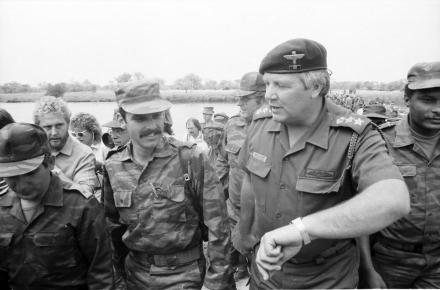
Colonel Archie Moore of The South African Defence Force (SADF) leads the joint military monitoring commission on an inspection of the SADF built pontoon bridge crossing the Kavango river .

With him are once enemies from Cuba, the Soviet Union (Russia) and FAPLA . On this day the political and socio-economic landscape in Southern Africa would change forever. The SADF would withdraw, so too would the Cuban, FAPLA (Peoples Armed Forces of Liberation of Angola), and PLAN forces (SWAPO’s Armed wing). South West Africa/Namibia would then implement resolution 435 and the war would come to an end.

The ramifications of the end of the Bush War would have a resounding effect and change the course of history of the sub continent and South Africa specifically.  The war had always been fought on a “Cold War” status – the fight of western styled capitalist democracy (as South Africa viewed itself albeit an Apartheid one) and the spread of Communism.

A number of factors came together to herald the change in South Africa’s disposition to the war, the primary one been the collapse of Soviet communism in 1988, the loss of the USSR satellite states, all cumulating in the collapse of the Berlin wall on November 9, 1989 and the eventual collapse of Russian communist domination in its wake.

This seismic change to global politics encouraged the National Party of South Africa (who were fiercely anti-communist) to review its position continuing the “Cold War” in southern Africa.   The Nationalists where beginning to feel comfortable enough that the stage could be set for a democratic election in Namibia, which would occur not on the back of a Communist backed militant overthrow, but on terms which would not see South Africa fighting a protracted Communist led war on its own border against Cuban and Soviet forces building up in the region.  This fear, not entirely unjustified, fundamentally underpinned most of South Africa’s rational for maintaining the Border War and its interests in Namibia.

The writing on the wall began in late 1987 and early 1988 as eastern Soviet block countries started demanding independence from Russia and the Soviet Union began unbundling, the process for South West Africa’s transition to independence from South Africa also began against this backdrop, and by May 1988, a US mediation team – headed by Chester A. Crocker, US Assistant Secretary of State for African Affairs – brought negotiators from the MPLA, Cuba, and South Africa, and observers from the Soviet Union, together in London.

Intense diplomatic manoeuvring  in the context of the military stalemate of the Battle of Cuito Cuanavale characterised the next 7 months. The parties worked out agreements to bring peace to the region and to enable the implementation of United Nations Security Council Resolution 435.

At the Moscow Summit of leaders of the United States and the Soviet Union in Moscow (29 May-1 June 1988), the withdrawal of Cuban troops from Angola was linked to Namibian independence. In this way, the Cubans could claim to have played a part in Namibian independence and the dismantling of Apartheid, while the South Africans could claim success in getting the Cubans to withdraw from Angola and the end of the Communist threat to South Africa.

The New York Accords – agreements to give effect to these decisions – were drawn up for signature at UN headquarters in New York in December 1988. Cuba, South Africa, and the People’s Republic of Angola agreed to a total Cuban troop withdrawal from Angola. This agreement – known as the Brazzaville Protocol – established a Joint Monitoring Commission (JMC), with the United States and the Soviet Union as observers, to oversee implementation of the accords.

A bilateral agreement between Cuba and Angola was signed at UN headquarters in New York City on 22 December 1988. On the same day, a tripartite agreement between the MPLA, Cuba and South Africa was signed whereby South Africa agreed to hand control of Namibia to the United Nations.

Funnily, today we look back and view these simple facts which heralded the end of The Border War in a different light, Nambian and South African current governments and many young people preferring to take up the romantic idea that “Apartheid” South Africa was somehow beaten back by the combined liberation forces of Nambia (SWAPO) and South Africa (ANC).  When the truth of matter is that history records facts and to those of us who actually lived through this era and saw this war – these are the facts.

The argument that the battles along the Lomba and at Cuito Cuanavale had somehow taken the fight out of South Africa are simply untrue.  The fact of the matter is that South Africa maintained a military force that constituted a regional super-power with nuclear capability, staunch discipline, highly motivated and highly resourced.  The Nationalist government was a highly conservative, intensely God fearing, belligerent, introspective and aggressive one, and one founded on a history of taking up arms against all odds  – fully prepared to put itself and the country’s military at odds with any adversary, armed with a simple belief founded in 1838 – that God was on their side.

In an unassailable position of power in 1989 with a growing majority white support, the only people who could change the course of the South Africa’s history, dissolve themselves from power and redress the injustice of their policies where the National Party themselves – and as an inconvenient truth goes, that’s exactly what happened.


Written and Researched by Peter Dickens. Featured image – Photo copyright – John Liebenberg

I’m not pro Boer, I’m British, this isn’t OUR way!

There are few times you see a balanced documentary on the The South African War (1899-1902) a.k.a. the Boer War when it comes to the issue of the British concentration camps and this landmark documentary “Scorched Earth” is another in a line up that gets it right and wrong all at the same time.

As South Africa addresses its history from a holistic perspective,  the complete story of the 2nd Anglo Boer War starts to emerge – the scale of the concentration camps as not strictly a “white” issue, but a “black” issue too is now becoming highly apparent.  That the war is now been viewed in both contexts and in the context of its historical time opens up new questions on the deep scars of hatred, still not fully addressed, affecting all of South Africa’s ethnic groups.

Apportioning ‘Blame’ 

That the concentration camps are a human tragedy on an epic level is not debatable. The key question to be addressed is the aspect of “blame”.

Can blame be put at one man’s feet – Lord  Kitchener under whose watch and policy this tragedy unfolded and a man with a disdain for the Boer nation, or does blame lie in cultural misunderstanding – actually going as far as blaming the women themselves for not following British heath regulations for tented camps, not trusting the nursing and hospital staff due to language and cultural barriers and using ancient remedies which accelerated the deadly social diseases instead?

Or, more to the point, does blame lie in the complete British maladministration of the camps, lack of medicine and lack of site and logistics planning by the British policy makers and proponents of the camp system?

7a7879c9b051127afdd349e3f9ffa2a2

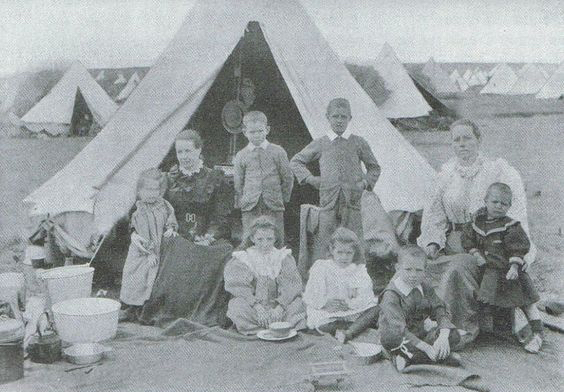
White Concentration Camp of the 2nd Anglo Boer War

Does blame lie with the Boer Commanders insistence on continuing a war after it had been “lost” through conventional war – fully in the knowledge that their kinfolk and entire nation’s survival was heading to complete annihilation?

Does blame lie in the sheer racism and lack of human respect to ‘Blacks’ by prevailing Victorian’s considering them ‘less civilised’ in need of white patronage and the even harsher racist attitudes and laws in the two Boer Republics to purposefully ignore an unfolding human tragedy in the ‘Black’ camps? Does blame even lie with men at war with one another and the propaganda to paint one another as somehow lesser human beings?

20448955_10155633958753980_1228035049095603465_o

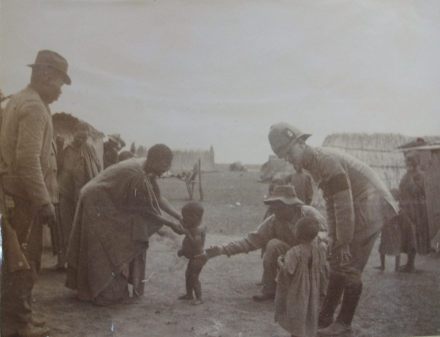
Black Concentration Camp of the 2nd Anglo Boer War

Does blame lie in the British initiating a medieval policy of putting to the crucible those women and children whose menfolk where still fighting and rewarding those whose men had stopped fighting with extra food by way of incentive?  And then the very thorny question – does blame lie in a system used by the British which had the potential to decimate a nation’s youth?

In essence, there is a strong case to argue that the concentration camps where a punitive measure to stop a phase of war which nobody really understood – the conventional war was lost when the Boer’s capital cities were taken, the decision by the Boer commanders and “government in the field” to take the war into a guerrilla one – supplied and fed by homesteads – simply brought the homesteads into the line of fire and war’s ravages – especially disease which proved the biggest killer.

To the Victorian men and women the unfolding tragedy in South Africa was shielded for much of the war and when exposed in the media by the likes of Emily Hobhouse it only really highlighted the plight of the ‘whites’. In this respect Emily Hobhouse’s words to Kitchener are sharply poignant “I’m not pro Boer, I’m British, and this isn’t our way”.

Or is the blame as simple as blaming a virus. The biggest killer in the Boer War was measles, a child’s disease which killed 30% of the white camp population, most of whom were children. It was also not this first or the last time a measles epidemic killed Boer children – epidemics existed in Voortrekker lagers log before the Boer War, with the same devastating consequences. The simple truth – the biggest killer of British soldiers in the Boer War was Typhoid, more died of disease than bullets – the same is true of the civilian populations – the British ones under Boer siege at the opening of the war, and the Boer ones under British camp oversight at the end of the war.

In Conclusion

There is a very long way to go – but the future in reconciling the true effect of this war and redressing it as a nation – is to understand that the Boer War was not only a “white” man’s war, nor the concentration camps strictly about Afrikaans women and children, a much bigger story exists and which needs to be reconciled with – and that is the suffering of South Africa’s black population and the extraordinary losses they experienced in concentration camps too – which only now are becoming fully understood.  For more on the ‘Black’ concentration camp history do visit this Observation Post link for a fuller story: To fully reconcile The Boer War is to fully understand the ‘BLACK’ Concentration Camps

The redress for white Afrikaners in South Africa as to any form of global awareness and world condemnation of this tragedy to their nation lies in the reconciliation of the history with the previously unwritten and misunderstood “black” history behind The 2nd Anglo Boer War.  Only if it is a national issue, a common cause and a national healing process implemented to dealt with it – will amends and long-awaited apologies from the British be found.


Written by Peter Dickens.  Image copyright, Imperial War Museum.  ‘Scorched Earth’ documentary, Director Herman Binge, produced for M-Net by Pearson Television, copyright 2001.

Operation Market Garden, a South African Captain remembered

Not many people know it, but a small number of South Africans participated in Operation Market Garden during World War 2.  Today we remember one of them.

Operation Market Garden was an unsuccessful Allied military operation pioneered by Field Marshall Montgomery to end the war by Christmas 1944, it was fought in the Netherlands and involved taking bridges ending with the prize bridge over the Rhein at Arnhem and then on into Germany. This key bridge was to be taken and held by British paratroopers from the 1st Airborne Division and they were due to be relived by XXX Corps an Allied ground force rushing up through the Netherlands taking key strategic points as it went.

But largely due to intelligence failures, delays crossing rivers, logistics issues and communication breakdowns the relief never arrived leaving the British paratroopers in a desperate and un-winnable fight. Operation Market Garden was the largest airborne operation up to that time and it was an unmitigated Allied failure with severe loss of life.

The air re-supply of the British airborne forces in the Arnhem area was particularly hazardous as they became isolated and surrounded.

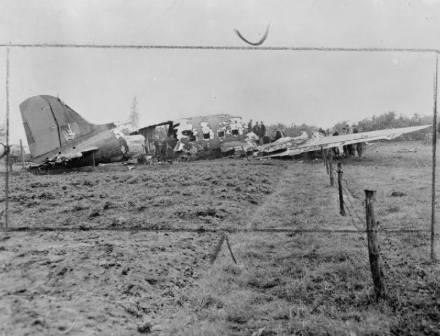
This image taken on 19 September 1944 shows a burned-out Douglas Dakota Mark III, KG401, of No. 48 Squadron RAF based at Down Ampney, Gloucestershire, which crash-landed in a field near Kessel, Holland, after parachuting supplies over Arnhem.

The aircraft had just dropped its supplies from 700 feet when it was met with intense anti-aircraft fire. Sixteen aircraft of 48 Squadron participated in MARKET III, flying through intense flak with no fighter escort.

Many aircraft were hit and two, (KG401 and KG428), failed to return. Over the following four days the Squadron lost another six Dakotas on re-supply missions to Arnhem.

One of these was piloted by Captain C.H Campbell, a South African Air Force (SAAF) officer seconded to 48 Squadron RAF and was lost in his RAF C47 Douglas Dakota on 21st September 1944.

Some additional information courtesy Sandy Evan Hanes

CAMPBELL, C.H, Colin Herbert, 25
Captain 12211V
SAAF, Pilot
48 RAF Sqn C-47 Dakota Mk.III, KG-346

21.09.1944
KIA Runnymede Memorial, Panel 264, United Kingdom

Son of John W. and Hilda M. Campbell, of Claremont, Cape Town, South Africa

May he rest in eternal peace, his sacrifice to the freedom of Europe as we know it today remembered with honour.

Image copyright – Imperial War MuseumSouth