‘An order in respect of Freemasons and Jews’

The Holocaust, the reason Freemasonry became a ‘secret’ order – World War 2 (1939-1945).

By Peter Albert Dickens

Incorrectly understood by many is the idea that Freemasonry is a “secret organisation” – however understood by only a few is why it is regarded as secretive in the first place. Upfront there’s noting secretive about it, Masonic temples and halls can be found the world over – hundreds of them, clear as a bell they stand openly in towns and suburbs all over the place, anyone is free to enquire. Of the organisation itself – many of its members are very public, and as an organisation with charity as its primary purpose they operate perfectly happily and openly in their communities and they do essential and good charity work. You can even jump onto ‘google’ and find everything you need to know from the freemasons themselves just using a simple search bar – or just buy a credible book or read a proper thesis on it – its all there, secrets included. So what’s with the big ‘Secret’ when clearly there is nothing really secretive about it?

Here’s the thing, anyone researching Freemason history will find a time before the Second World War (1939-1945) when Freemasons and masonic lodges were overtly in the public space. They participated in parades and fetes wearing all their regalia, took part in community events, photographs of all the lodge members and their names are easily found in countless local newspaper and magazine articles, the ‘worshipful masters’ quoted on many community affairs and even speaking publicly, keynote people in their society – just about everyone knew who belonged to their local lodge and they made no secret about it.

So what happened?

The answer lies in World War 2 (1939-1945), it lies in the relationship between the Holocaust and Freemasonry and how this impacted Freemasons in South Africa and in the rest of the world during and even after the war. The war is the primary reason Freemasonry “went dark” and “secret” – it is not because of any sinister illuminati’s plan to take over the world or a strange Hollywood inspired desire to protect Jesus’ bloodline by ‘rose’ hall.
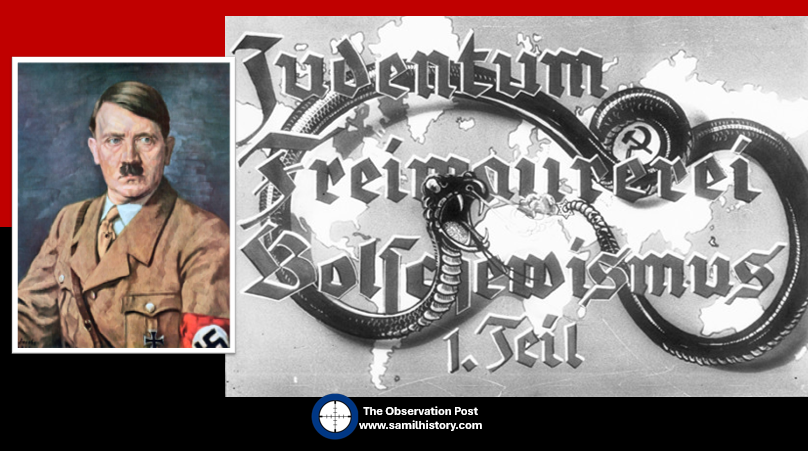
Adolf Hitler and Nazi anti-Judaism, anti-Freemasonry and anti-Bolshevik propaganda

The balance Freemasons enjoyed between themselves and the societies in which they function was fundamentally changed by Adolf Hitler and his cabal. Hitler began by associating a Freemason’s conspiracy with that of a Jewish conspiracy in his political testament Mein Kampf. He said:

“To strengthen (the Jew’s) political position, he tries to tear down the racial and civil barriers which for a time continue to restrain him at every step … in Freemasonry, which has succumbed to (the Jew) completely, he has an excellent instrument with which to fight for his aims and put them across. The governing circles and the higher strata of the political and economic bourgeoisie are brought into his nets by the strings of Freemasonry, and never need to suspect what is happening.”1

Hitler would even declare that the League of Nations, the source of Germany’s dishonour, was controlled by Freemasonry. He said in a speech to Nazi faithfull in Munich in 1928:

“All of Germany is being delivered to the Freemasons through the League of Nations.”2

As early as the 5 August 1934, in a speech delivered at Essen, Dr. Wilhelm Frick, the Reich Minister of the Interior, declared:

‘It is inappropriate that a secret society with obscure aims should continue to exist in the Third Reich. It is high time that the Freemasons’ Lodges should disappear in Germany just as they have disappeared in Italy. If this is not realised in Masonic circles, I will soon help them in this direction”.3

By 28 October 1934, Frick issued a decree defining the Masonic lodges as “hostile to the state” and hence subject to closure and having their assets confiscated.4
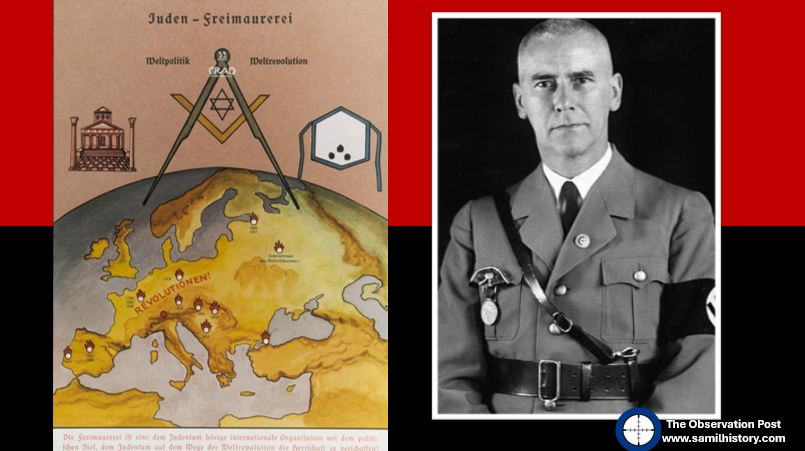
Anti Masonic propaganda poster no. 64 and portrait of Dr. Wilhelm Frick.

Nazi propaganda stated on political poster no. 64 in a series of issued posters entitled “Erblehre und Rassenkunde” (Theory of Inheritance and Racial Hygiene), published by the Verlag fuer nationale Literatur (Publisher for National Literature), Stuttgart in 1935:  

‘Freemasonry is an international organisation beholden to Jewry with the political goal of establishing Jewish domination through world-wide revolution.’5

Chief of Security Police and SD, Reinhard Heydrich regarded the Masons, along with the Jews as the

“most implacable enemies of the German race.”

In 1935 Heydrich argued for the need to eliminate and root out these “enemies” from the German world. Heydrich then created a special section of the SS Security Service (Sicherheitsdienst; SD), Section II/111, to deal specifically with Freemasonry.6
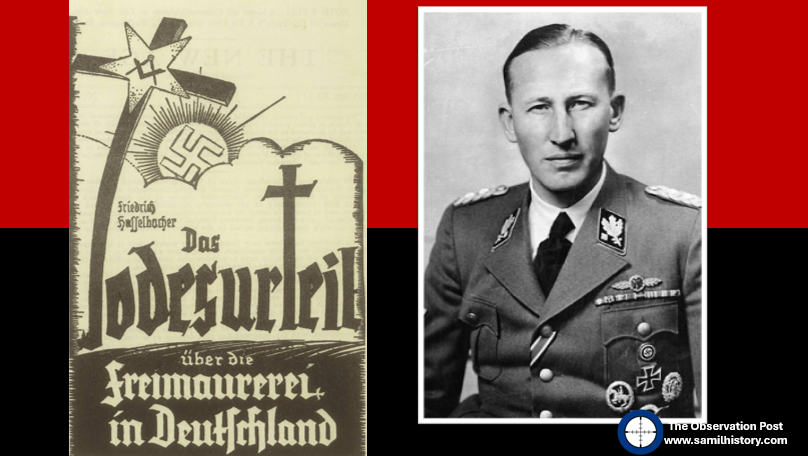
Nazi anti-Masonic propaganda and portrait of Reinhard Heydrich.

The SD argued that Freemasonry, through control of the media and exercising political influence was now in a position to provoke war, subversion, and revolution. In 1939, the SD amalgamated with another SS security department – Section VII B 1 of the Reich Security Main Office (Reichssicherheitshauptamt; RSHA), and it continued to devote itself to investigating Freemasonry.

The Exhibitions

From 1938 as Nazi Germany conquered Europe, the Germans forcibly dissolved Masonic organisations, ransacked lodges and confiscated their assets, monies and documents. Cultural artefacts and Masonic items were seized and sent to Berlin for a special rather sinister and ghoulish exhibition at the Berlin Museum. This in turn was sent to other capital cities in occupied Europe. Paris, France hosted an anti-Masonic exhibition in October 1940, as did Brussels in February 1941, so too did Nuremberg. Other anti-masonic exhibitions took place in Hannover, Düsseldorf and Erlangen all of which were aimed to ridicule and direct hatred towards Freemasons and to heighten fears of a Jewish-Masonic conspiracy.

In fact one complete lodges’ interior was removed from the Isle of Jersey for a “British” Freemasonry exhibition in Germany, this occurred after a night of heavy bombing on 29th June 1940, and the Island was invaded by Nazi Germany. Despite promises given by German commanders that Freemasons and Masonic property were not at risk, the Masonic Temple was completely ransacked and shipped off to Germany.7

The role of seizing all this wealth for the Reich was given to Heinrich Himmler, the Reichführer of the Schutzstaffel (the SS), Himmler had special dislike for Freemasons, and happily ransacked Masonic lodges out of both greed and his personal ideology.8
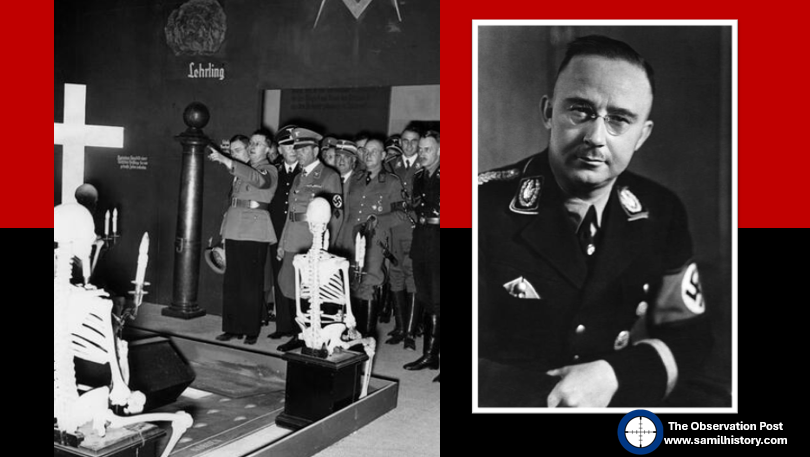
Nazi anti-Masonic exhibition and portrait of Heinrich Himmler

In all this Himmler and the SS established an interest in non-negotiable lodge property in order to further their study of Freemasonry. In 1935, guidelines were published as to the categorising of Lodge items, photos taken of them “in situation” and then removed for the anti-masonic (and anti-Jew) “exhibitions” and “museums”.

It is also worth noting that the ransacking of Masonic lodges did not just include the taking of items for exhibition, it also included the raiding of Lodge bank accounts, the taking of valuable jewels and artworks and the seizing of bank accounts of predominant Freemasons. Most lodge contents went to private homes, auction blocks or the smelter, documents and archive materials went to the Geheimenreichsarchiv (The Nazi Top Secret Government archive).9

Himmler acted as a broker for valuable acquisitions, but “he also had a special interest in lodge rituals. He was convinced high-degree Masonry involved a “blood ritual” in which:

‘the candidate cuts his thumbs and lets a little blood drop into a cup. Wine is then mixed in the bowl. Next a bottle containing the blood of the other brothers (from when they first performed this ritual) is added to the cup. The candidate then drinks the liquid, thus imbibing the blood of all Freemasons, including Jews. Thus the triumph of the Jews is complete.’10

Himmler pointed to this ritual as the means whereby Jews use Freemasonry to literally taint the blood of Aryans and to him this wildly unhinged idea of a Freemason ritual was proof positive of this. ‘The truth of the matter is that some do indeed have rituals that involve drinking wine, but references to blood are symbolic, much like the rituals performed in Christian churches.’11 This of course did not deter Himmler whose obscure view of Freemasonry was used to “study freemasonry” by ransacking lodges and looting their bank accounts for wealth.
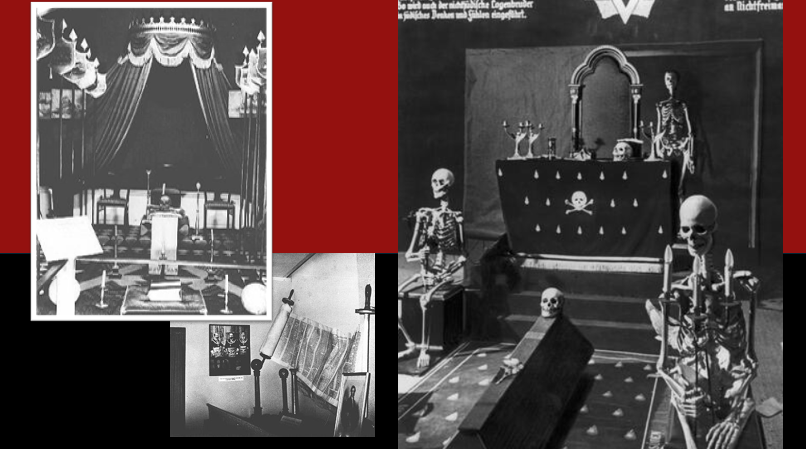
Anti-Masonic exhibitions, note the placement of skeletons in chairs and sculls and crossbones on alters to bring up the macabre and sinister – setting a scene for the occult. Note also the extensive combination of the Jewish Magen David and the Torah, Menorah etc. with Masonic items and symbology – the compasses and square etc.

One of the most infamous foreign exhibitions was the The Grand Anti-Masonic Exhibition, opened in Belgrade, in occupied Serbia on 22 October 1941. Financed by the Germans and opened with the support of collaborationist leader Milan Nedić it featured an estimated 200,000 brochures, 108,000 copies of nine different types of envelopes, 100,000 flyers, 60,000 copies of twenty different posters, and 176 different propaganda films that had previously been seen during ‘The Eternal Jew’ exhibitions in Munich and Vienna in 1937. Although being anti-Masonic in its title, the primary purpose was to promote antisemitic ideology using the Protocols of the Elders of Zion to rationalise and intensify hatred of Jews.
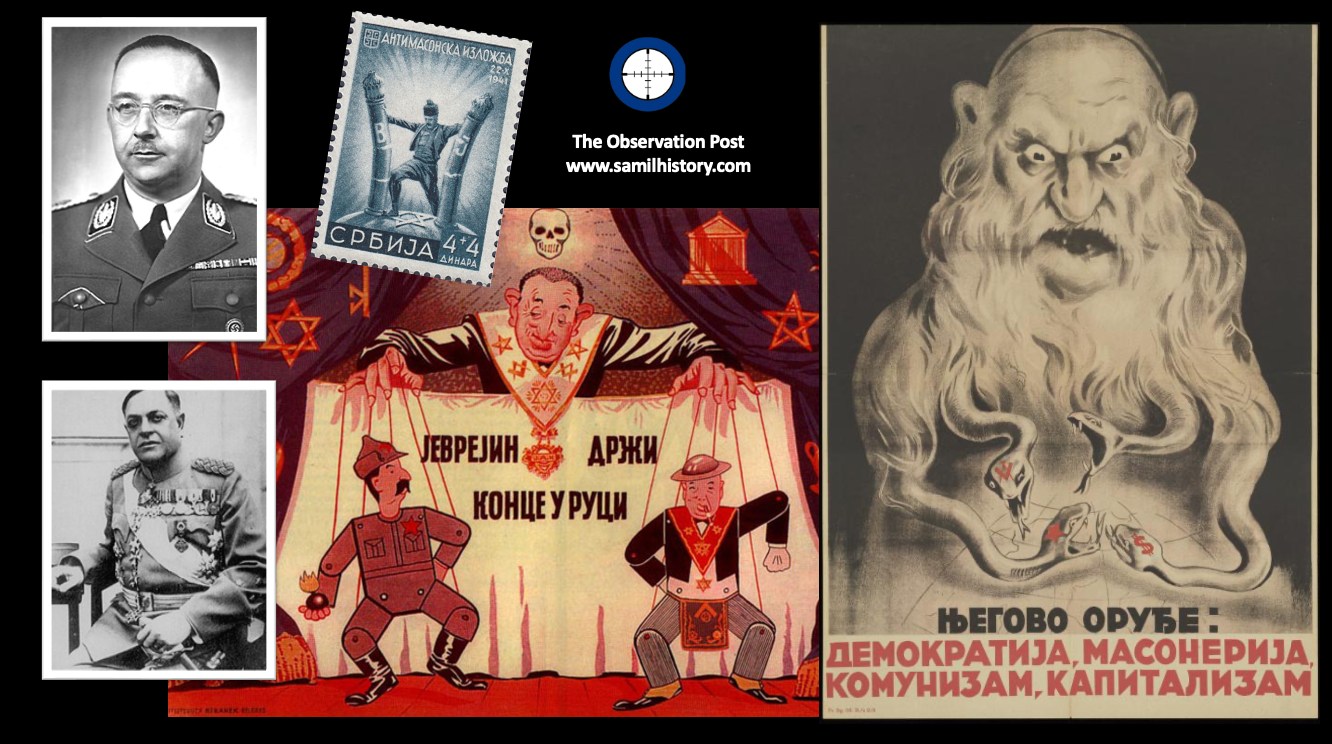
Artefacts from the Grand Anti-Masonic Exhibition. Insert pictures show Heinrich Himmler and Milan Nedić respectively.

Depicted in the image are three key artefacts from the Grand Anti-Masonic Exhibition, the Serbian anti-Semitic propaganda poster “His Weapons: Democracy, Masonry, Communism, Capitalism” issued for the Grand Anti-Masonic Exhibition opening. It has a caricature of an evil looking Jewish elderly man with a long beard that turns into snakes with symbols for Capitalism, Communism and Freemasonry.

The second poster shows the Jews and Masons controlling the Soviet Union and the United Kingdom, with marionettes of Stalin and Churchill, also depicted as a Freemason (it’s unrelated but in fact he was a mason for a short time). The caption reads: “The Jew is holding the strings. Whose strings and how? He’ll answer you. The anti-masonic exhibit”.

The final artefact is a stamp of a triumphal Serbian pushing over the two Pillars of King David’s temple, a symbol pertinent to Freemasonry and lodges, four stamps were issued by Serbian authorities and put into circulation to promote the ‘Grand Anti Masonic Exhibition’ – all depicting Judaism as being the source of all evil in the world and portraying a “strong and victorious Serbia triumphing over the plot of world domination.”

An estimated 80,000 people, including Milan Nedić and some of his ministers, visited the exhibition prior to its closure on January 19, 1942.
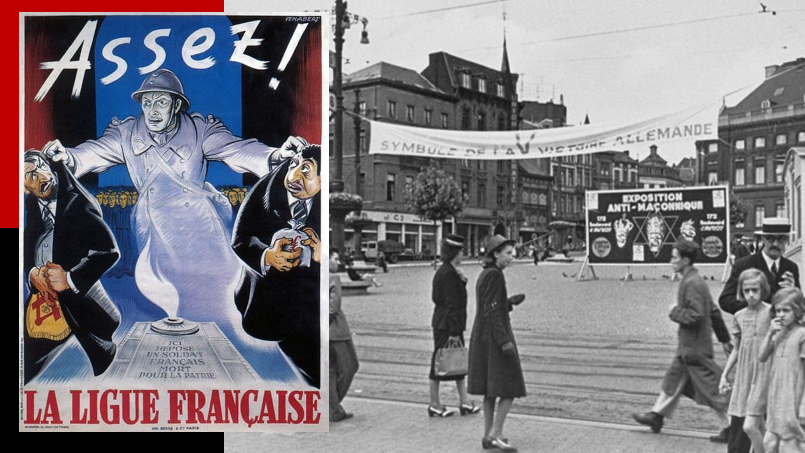
European anti-Masonic and anti-Jewish exhibition in Europe and related French League propaganda.

The central idea of all these museums and exhibitions was to promote an antisemitic work called ‘the protocols of Zion’ in which a Masonic and Jewish world order was exposed and these morbid displays brought it to life.

The Protocols of the Elders of Zion

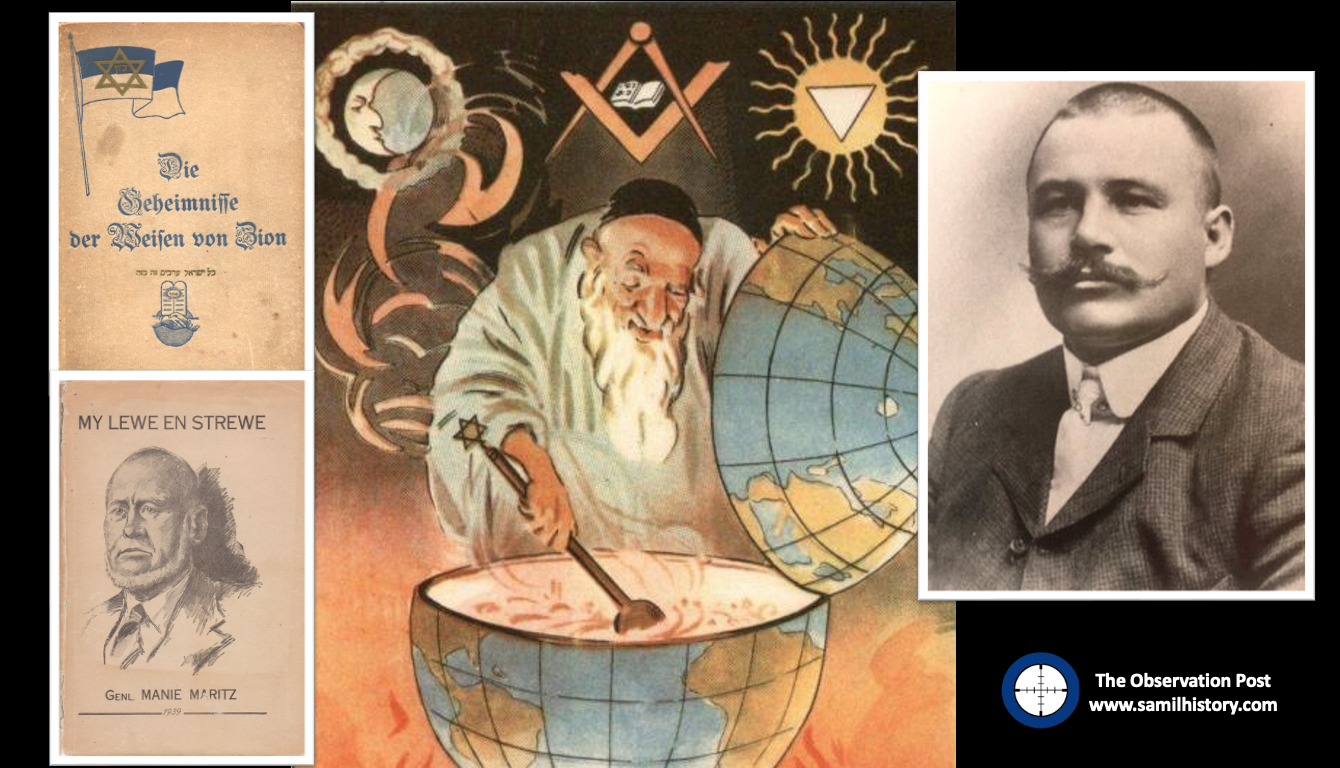
The Protocols of the Elders of Zion, also known as ‘The Protocols’ are a fictional work, it’s a combination of a number of documents targeting Jews primarily, but also Freemasonry. It purports to be the minutes of meetings of 24 speeches made by Jewish leaders during the First Zionist Congress in 1897. It actually had its roots as early as the 1860’s in a anti-Napoleon III pamphlet and became a forged rational for the Russian pogroms against Jews. By 1903 the Protocols appeared as an appendix in an anonymous Russian antisemitic pamphlet called The Great Within the Minuscule and Antichrist. The ‘Protocols’ eventually found their way into a German antisemitic book called The Secrets of the Wise Men of Zion – the first documented version of ‘The Protocols’ published outside of Russia and published in Charlottenburg, Germany in 1920 – which was subsequently read and used widely by Hitler and the Nazi Party in Germany.
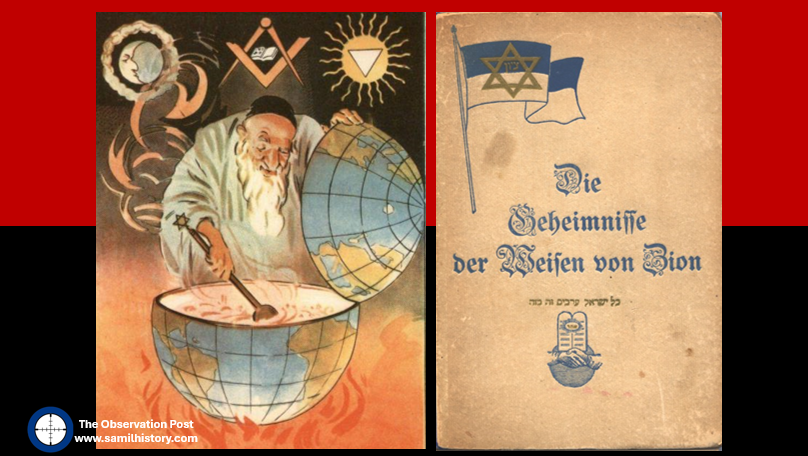
Protocols of the Elders of Zion German booklet and anti-Masonic and anti-Jewish conspiracy propaganda poster.

The Protocols of the Elders of Zion often found itself in a pamphlet format of some 70 pages. The pamphlet detailed a Satanic plot by Jewish/Zionist/Freemason conspirators to conquer the world. Alleging that Jews controlled much of the world’s finance, the media, the edu­cational institutions, the court systems and many of the world’s governments, the Pro­tocols claimed that the Jews indulged in all forms of trickery and deceit to tighten their hold. The Jews deliberately spread diseases and immorality to weaken Gentiles, and did not hesitate to use murder and terrorism to destroy all religions except their own. Jews were striving to establish their own autocracy based on a false Messiah, the “Son of David”, and posed a fiendishly devious omnipresent peril to the rest of mankind.12

Although exposed many times as a forgery, by the 1930’s it found its way into Nazi philosophy, and Adolf Hitler upfront supported its validity – now as a ‘truism’ in both Nazi Germany and occupied Europe – the ‘Protocols’ formed the groundwork to the Jewish ‘final solution’ and the holocaust.

The protocols also found their way into all sorts of propaganda, and not just Germany before and during the war, but it also found favour in antisemitic circles all over Europe and Russia – here are two French examples of it:
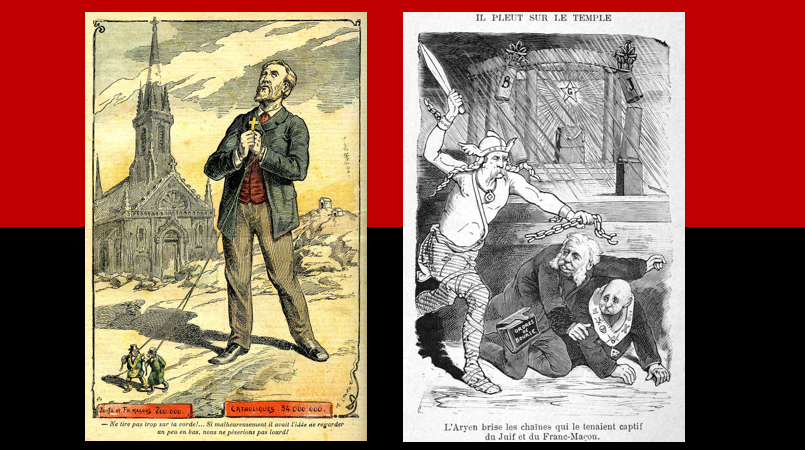
European anti-Masonic and anti-Jewish propaganda

On the left is a poster which shows an international Freemason and Jewish conspiracy (involving only 200,000 Jews and Masons) leading innocent and God fearing Catholics (the majority 34,000,000) to their nefarious ends. On the right is a French poster, very much in Nazi lore, which shows the pure ‘Aryan’ warrior striking the chain bonds of the Jew being held captive by the Freemason.

The Protocols of Zion in South Africa

In South Africa, the three main protagonists behind promoting the validity of the Protocols of the Elders of Zion are General Manie Maritz – the 1914-15 Afrikaner Revolt leader and leader of the Boerenasie Party, Louis Theodor Weichardt, a National Party stalwart who breaks away believing the party should focus all its attention on National Socialism and forms the ‘Greyshirts’ and finally the Afrikaner Nationalist ‘Broederbond’ under the Germanophile Dr. Nico Diederichs.

The Boerenasie Party

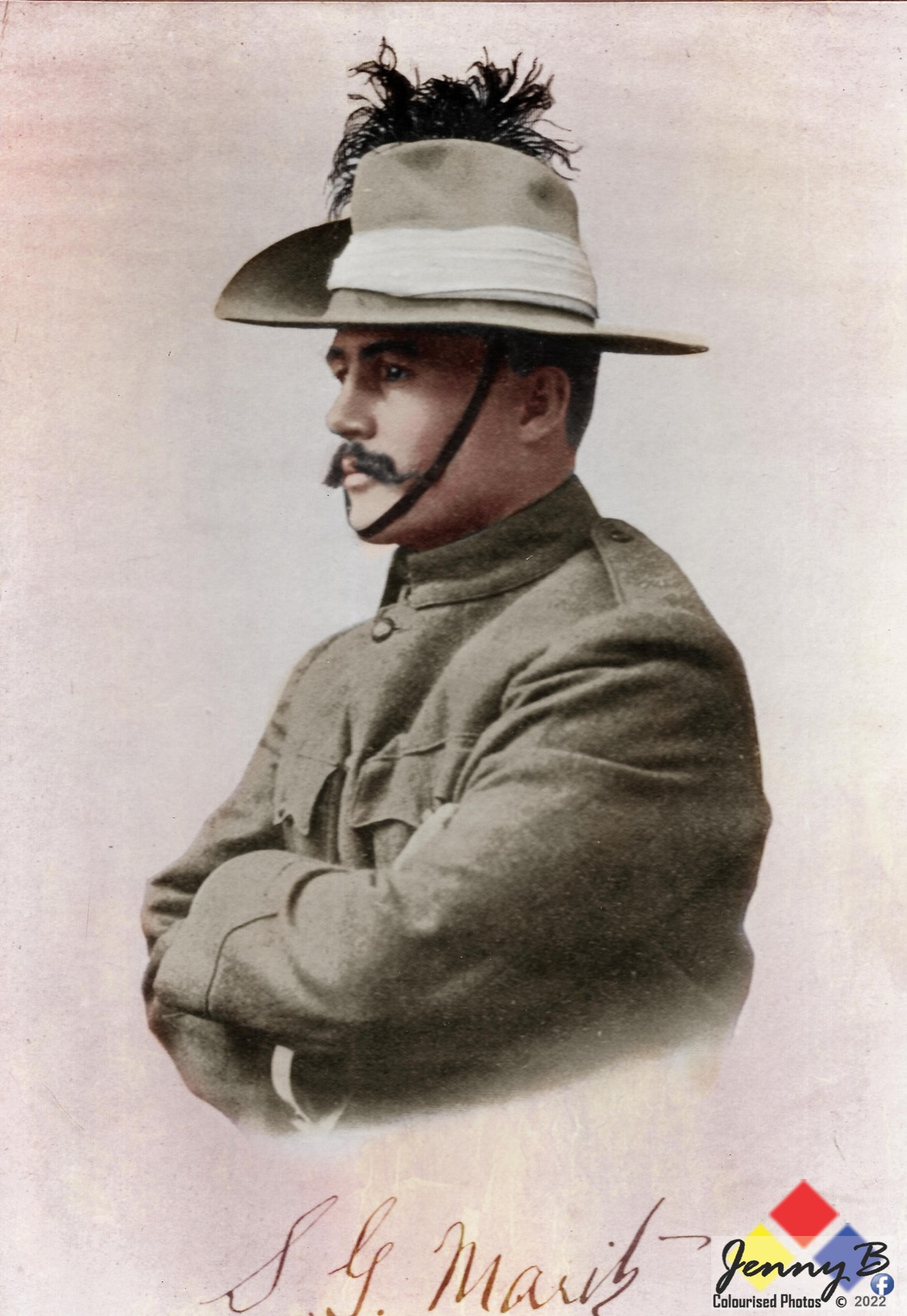
General Manie Maritz, a veteran of the South African War  and influential leader of the failed 1914-15 Afrikaner Rebellion, also admired German National Socialism. A converted antisemite, he even blamed the South African War (1899-1902), commonly called The Boer War on a Jewish conspiracy. Defeated after the Afrikaner Rebellion, Maritz would become a hardened admirer of National Socialism (Nazism) and Adolf Hitler – initially joining Theodor Weichardt and his SANP Grey-shirts, and after falling out with Weichardt over a Führerprinzip (leadership principle) conflict he joins a more hardline Nazi ‘Shirt’ movement called the ‘Black-shirts’ – the ‘South African National People’s Movement’ (Suid Afrikaanse Nasionale Volksbeweging), started by Chris Havemann in Johannesburg.

By July 1940 Maritz founded the anti-parliamentary, pro National Socialist, antisemitic ‘Volksparty’, in Pietersburg. 13This evolved and merged into ‘Die Boerenasie’ (The Boer Nation), a party with National Socialist leanings originally led by J.C.C. Lass (the first Commandant General of the Ossewabrandwag) but briefly taken over by Maritz until his accidental death in December 1940. Thereafter it was headed up by S.K. Rudman. 14 Maritz would also detail his Antisemitic and National Socialist views in his autobiography ‘My Lewe en Strewe’ (My life and Aspiration/Purpose) published in 1939 and modelled on Hitler’s own ‘Mein Kampf’.15

In 1924, Maritz would become a convert to the racist and anti-Semitic myth ‘the Protocols of the Elders of Zion’ and convinced of a Jewish and Freemason conspiracy to world domination, when he was shown the Protocols by the Kristelike-bond (Christian Bond) in Pretoria.16 He would make the ‘Protocols of Zion’ as his life’s meaning and make it his mission to educate the Afrikaner people (his ‘Volk’) to it – in it he would blame the ‘hidden hand’ of the Jews as the true conspiracists behind starting the Boer War. In ‘my Lewe en Strewe’ Maritz frames up the entire rational as to why the Jews are responsible for all the ills that have befallen the Afrikaner ‘Volk’ – and the ‘Protocols of the Elders of Zion’ are the way forward to understanding the Jewish, Freemasonry, and Communist conspiracy against Afrikaners. It starts with Maritz using a quote from President Kruger’s speech at the Johannesburg market square in February 1899, where he declared:

‘If it was possible to throw the Jewish monopolists out the country with everything they own (Sak en Pak), without getting into a war with England, then the problem of perpetual peace in South Africa be resolved’.17

Maritz then grounds his entire argument on the simple premise that even President Kruger foresaw the Jewish Problem and forewarned his people. His own warning then follows, and in the machinations of Maritz’ mind he declares:

‘Socialists, anarchists, communists, Bolsheviks, Marxists, Freemasons and super-capitalists are the key antagonists and they are none other than all Jews.’

Then Maritz concludes by way of a warning that by helping and entertaining the Jews and their requests Smuts and Botha and other Boer Generals are committing Christian fratricide :

‘… thus carry out the Jewish prescriptions and policies, perhaps unknowingly. They are the “Slavishly obedient politicians” of which the Jew speaks in his “Protocols”. One Christian must exterminate the other.’18

Part 1 of ‘My Lewe en Strewe’ covers Maritz’ autobiography – pages 1 to 96, but Part 2, the bulk of his book from pages 97 to 270 covers Maritz’ politics and ‘purpose’ and it begins with a chapter titled ‘The hidden hand of the Jew’ … and this particular theme does not stop, Part 2 covers the ‘Protocols of the Elders of Zion’ – literally translated and edited into Afrikaans with some South African references here and there to give them local flair. Abridged Protocols number 1 to number 23 and the alleged global Jewish/Freemasonry conspiracy are mapped out for simpleton consumption. Maritz also used large extracts lifted from ‘The Key to the Mystery’ 19 another discredited work on a Jewish, Communist, Freemason conspiracy and worldwide domination written by a leading Canadian antisemite – Adrian Archand.
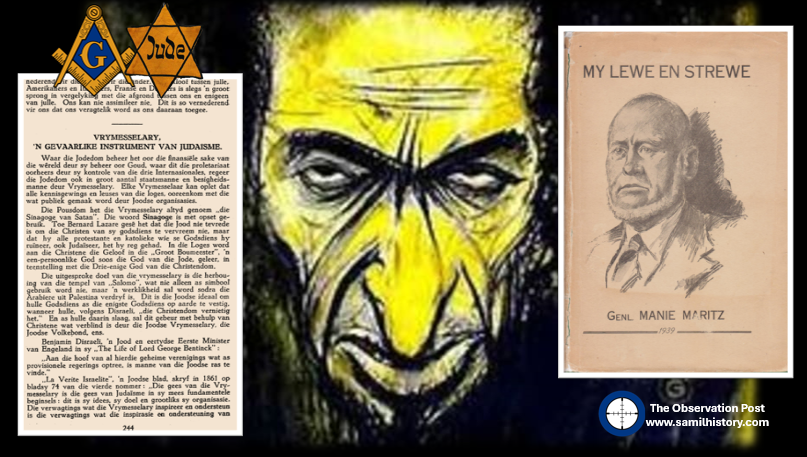
Manie Maritz and extract of his on the evils of Communism, Judaism and Freemasonry from his autobiography.

The South African Jewish Board of Deputies attempted unsuccessfully to have ‘My Lewe en Strewe’ banned for inciting race hate in South Africa. In South West Africa they were a little more successful, when taken to court Maritz was found guilty in August 1939 in Windhoek of ‘promoting a strong feeling of hostility against the Jewish race.’ and fined.20 Although Judge Hoexter described ‘My Lewe en Strewe’ as ‘filthy, contemptable and venomous racial propaganda’ according to Die Volksblad demand in South Africa for the book was off the charts, and its selling spree was only curtailed during World War 2 when it was finally banned under Smuts’ emergency regulations.21

The Grey-shirts

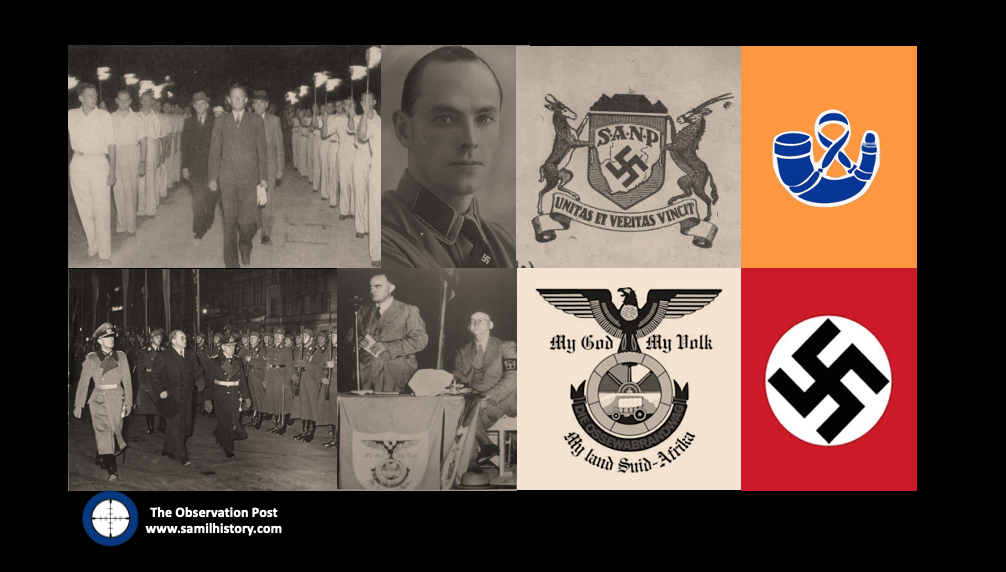
As a committed antisemite, Louis Theodor Weichardt founded the South African Christian National Socialist Movement when he broke with the National Party on the 26 October 1933. This included a paramilitary ‘security’ or ‘body-guard’ section (modelled on Nazi Germany’s brown-shirted Sturmabteilung) called the “Gryshemde” or “Grey-shirts”. In May 1934, the paramilitary Grey-shirts officially merged with the South African Christian National Socialist Movement and formed a new enterprise called ‘The South African National Party’ (SANP). The SANP would continue wearing Grey-shirts as their identifying dress and would also make use of other Nazi iconography, including extensive use of the swastika.22 Overall, Weichardt saw democracy as an outdated system and an invention of British imperialism and Jews.23
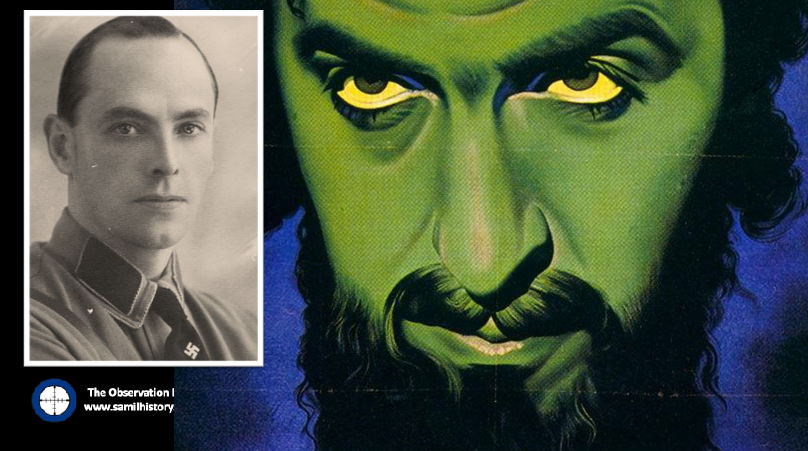
Louis Theodor Weichardt and the Nazi anti-Semitic propaganda movie poster ‘Jew Suss”

Weichardt also pitched the SANP as a fully bilingual organisation appealing to both English and Afrikaans speakers, he found favour in some English speaking corners with hardened antisemites, however for the most part his organisation and its ideology appealed to Afrikaners. Their primary communication  mouthpiece was a newspaper called ‘Die Waarheid/The truth’ which was nothing more than a vehicle to spread Nazi doctrine in South Africa – the Nazi emblem emblazoned on the masthead.

Louis Weichardt would spell out his National Socialist vision in the ‘Die Waarheid/The truth’ and trace South Africa’s problems to one source – the Jews. He claimed Jewish ‘domination’ of the legal, medical, dental, commerce, trading, liquor trade etc. as between 60% to 100%, and he would write:

“We are determined to put the Jew in his place. We are not going to tolerate bootlicking, Gentile South Africans – English or Dutch speaking – are no longer prepared to play second fiddle to these aliens”.24

As to the The Protocols of the Elders of Zion, in March 1934 when the SANP held a rally in Aberdeen in the Eastern Cape, Harry Victor Inch – one of the Greyshirt leaders – announced that he had in his possession a ‘stolen’ document from a Port Elizabeth synagogue – signed by its Rabbi – which outlined a secret plot by the Jews to destroy the Christian religion and civilisation.

The Rabbi in question was not in fact a Rabbi, he was a Jewish Reverent, Reverent Abraham Levy, and he took the SANP Grey-shirt leadership in the Eastern Cape to court in Grahamstown in a landmark case. The SANP accused; Johannes von Strauss Moltke who was the Regional SANP leader, Harry Inch, who allegedly ‘stole’ the document and David Olivier, who had printed the document for circulation as the owner and publisher of “Rapport”, another media organ of the ‘shirt’ movements. All now have to account for themselves – the case billed as a mighty ‘Gentile vs. Jew’ showdown and a legal test of the ‘Great Jewish Conspiracy.’ `

‘Die Waarheid/The truth’ would pick up this ‘Protocols of the Elders of Zion’ and really twist it for a South African audience claiming:

“the disastrous Anglo-Boer War 1899-1902 was deliberately brought about by the Jewish mine magnets who circumvented Rhodes and Kruger alike”.25

In addition, Jews were accused of inciting blacks against whites and controlling the economy, exploiting ordinary Afrikaners as part of an international Jewish conspiracy. The ‘Die Waarheid/The truth’ statements were accompanied by a propaganda leaflet printed by the SANP and distributed in Port Elizabeth.

The ‘stolen’ document was scrutinised legally, it was found to be based on the entirely discredited antisemitic ‘international Jewish conspiracy’ document – ‘the Protocols of the Elders of Zion’ and given a South African twist by the SANP. In a carefully considered 30,000 word judgement, the court concluded inter alia;

“the protocols are an impudent forgery, obviously published for the purposes of anti-Jewish propaganda”.26

As a result the three Grey-shirt leaders were all fined, Harry Victor Inch was found guilty of perjury and forging documents defaming the Jewish race and swearing under oath that those documents were genuine – and fined £1,000, later also receiving a short prison sentence. 27 David Hermanus Olivier was fined £25 for acting improperly and printing the document and Johannes von Moltke was fined £750 for “playing a leading role in the plot”.
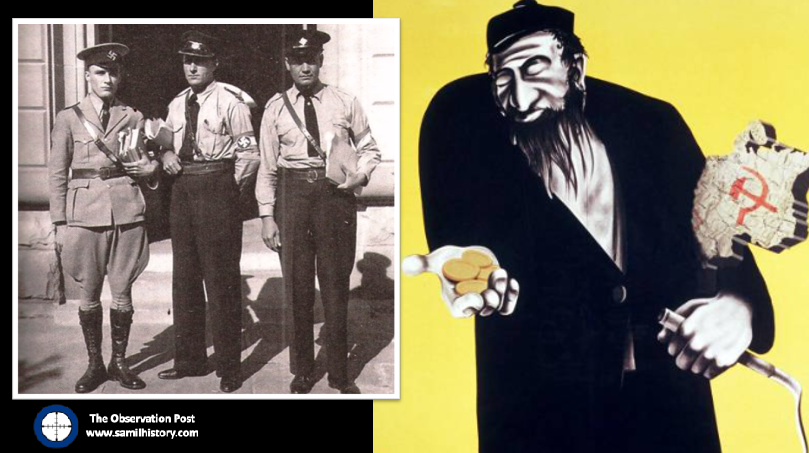
The SANP Grey-shirts on trial in Grahamstown and the Nazi anti-Semitic propaganda poster ‘the eternal Jew’.

The result was widely hailed in South Africa as a complete vindication of the Jewish people of a global plot and of Rev. Abraham Levy who brought the lawsuit against the Grey-shirt leaders.

The Afrikaner Broederbond

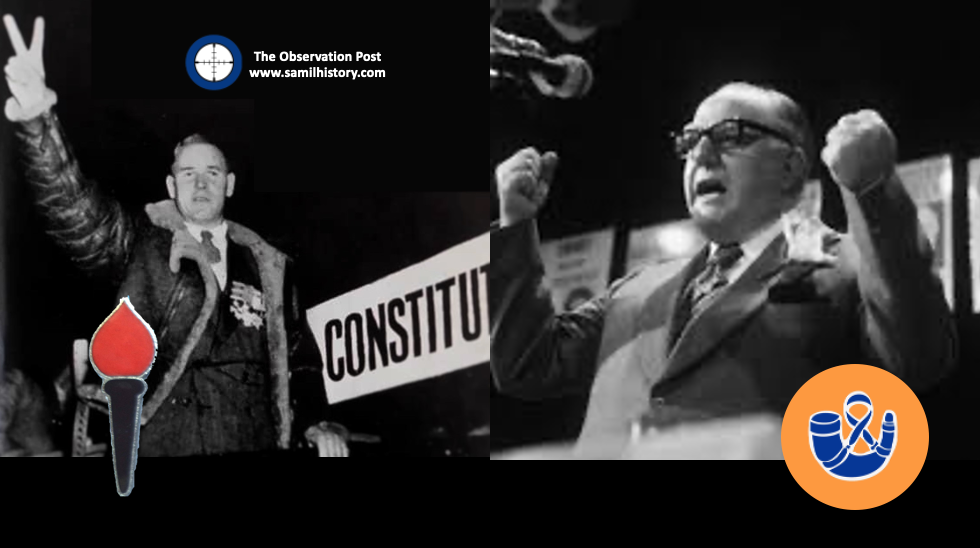
The Afrikaner Broederbond (AB) would also find itself immersed into this fabricated Jewish and Freemason worldwide conspiracy and it too would act. Dr. Nico Diederichs would become the Chairman of the Broederbond in 1938, in that same year he would visit Nazi Germany and became an admirer of Adolf Hitler and National Socialism. He would later meet the Nazi German ministerial delegate in South Africa – on 19 May 1939, Herr. H. Kirchner – in that meeting he confided that the Broederbond had been compromised in the past by Freemasons in the Broederbond (presumably by all the Dutch Constitution Freemasons in it, Jews were banned from the Broederbond upfront).

He declared the bond as having now been purged of its Freemasons, he had personally seen to it – and the Bond was ready to do its work on promoting anti-semitism and the National Socialist anti-democracy principle in the Afrikaner Nationalist sphere.

In fact he reassures the German delegate that the National Party had hung its hat completely on the anti-Semitic principle, and he even squashes concerns that Dr D.F. Malan was not strongly antisemite enough, confirming that he in fact is one. He goes on state that it is the Broederbond’s mission as a secret society is to both infiltrate and undermine the goals of the Smuts government and the state.28

Not to lose sight of Dr Nico Diederichs, he became a National Party MP stalwart, served as the first chancellor of the Rand Afrikaans University and became ceremonial State President of South Africa from 1975 to 1978.

The male fraternity war between the various fraternal societies in South Africa is interesting – especially the disposition of the Afrikaner Broederbond (AB) to the Freemasons – an uneasy relationship caused by the more “verlighte” (liberal) Afrikaners being members of the Dutch Freemason Constitution – and these included powerful and highly politically regarded figures over the course of the history of the OFS, ZAR and then Union, including Presidents and Prime Ministers – none of whom really favoured “Afrikaner Nationalism” as it was defined by the more “verkrampt” (conservative) Broederbonders.

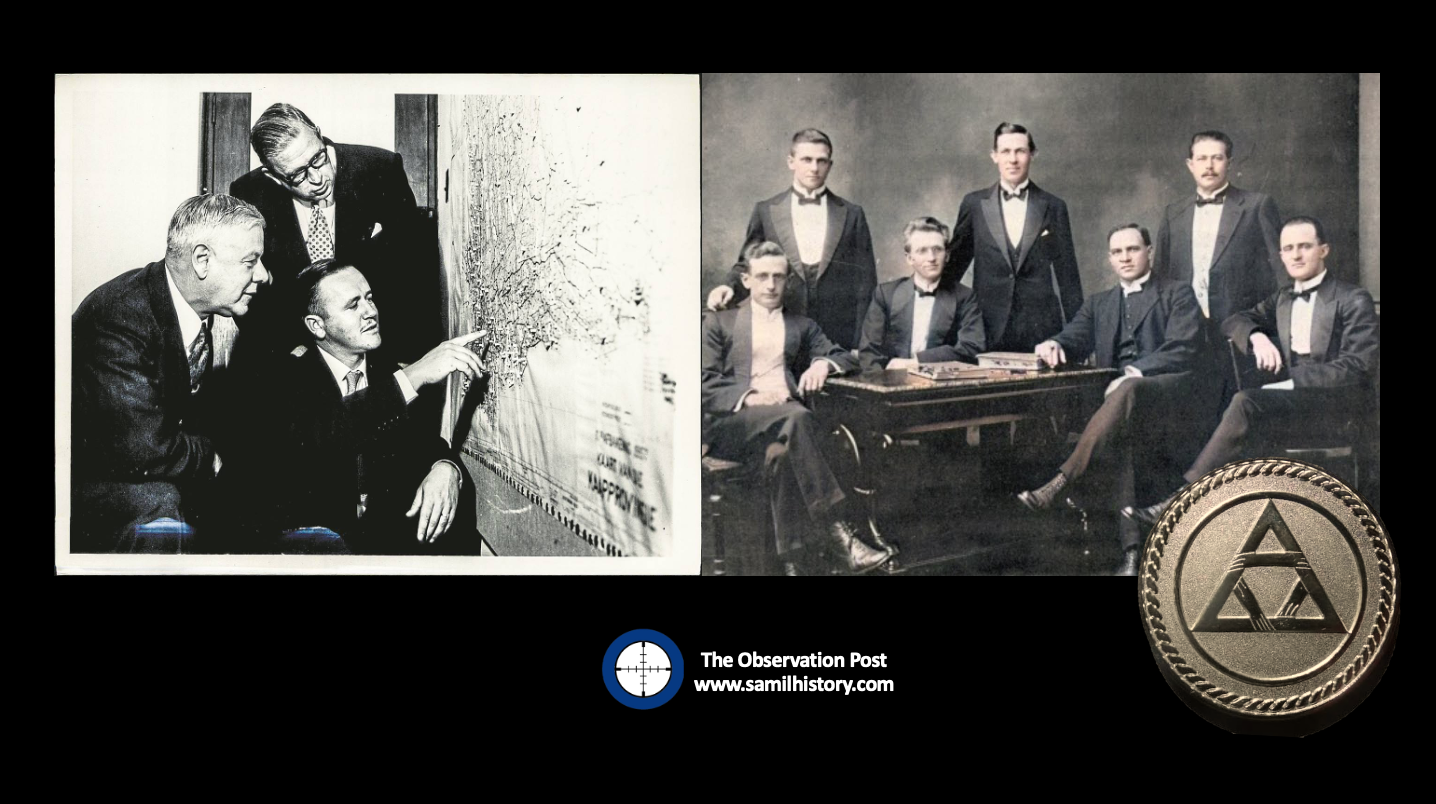
That all aside, the real opponent of the AB was not the Freemasons, the real ‘cultural’ opponent is a little understood and rarely discussed “English” fraternity called “The Sons of England” – the SOE. The full name – the Sons of England Patriotic and Benevolent Society – was a fraternal society for English Protestants residing in Commonwealth countries. It was originally founded in Toronto, Canada in 1874 but it especially took root in South Africa, starting in 1881 in Uitenhage and eventually establishing a Head Office in Durban and lodges in ever major metropole. Their goal was to bring Englishmen together for mutual support, networking, and to provide financial relief to them and their families if they fell on hard times. The society acted as a cultural organisation and was run along Masonic Lodge principles, regalia and rites – it aspired to preserve and celebrate the Anglo-Protestant cultural heritage of its members – which was diametrically opposite to the Broederbond who sought to do exactly the same thing, but for the promotion and preservation of Afrikaner-Protestant cultural heritage for its members. The key difference, the SOE was not ‘secret’, it was very openly public, whereas the AB was indeed ‘secret’.
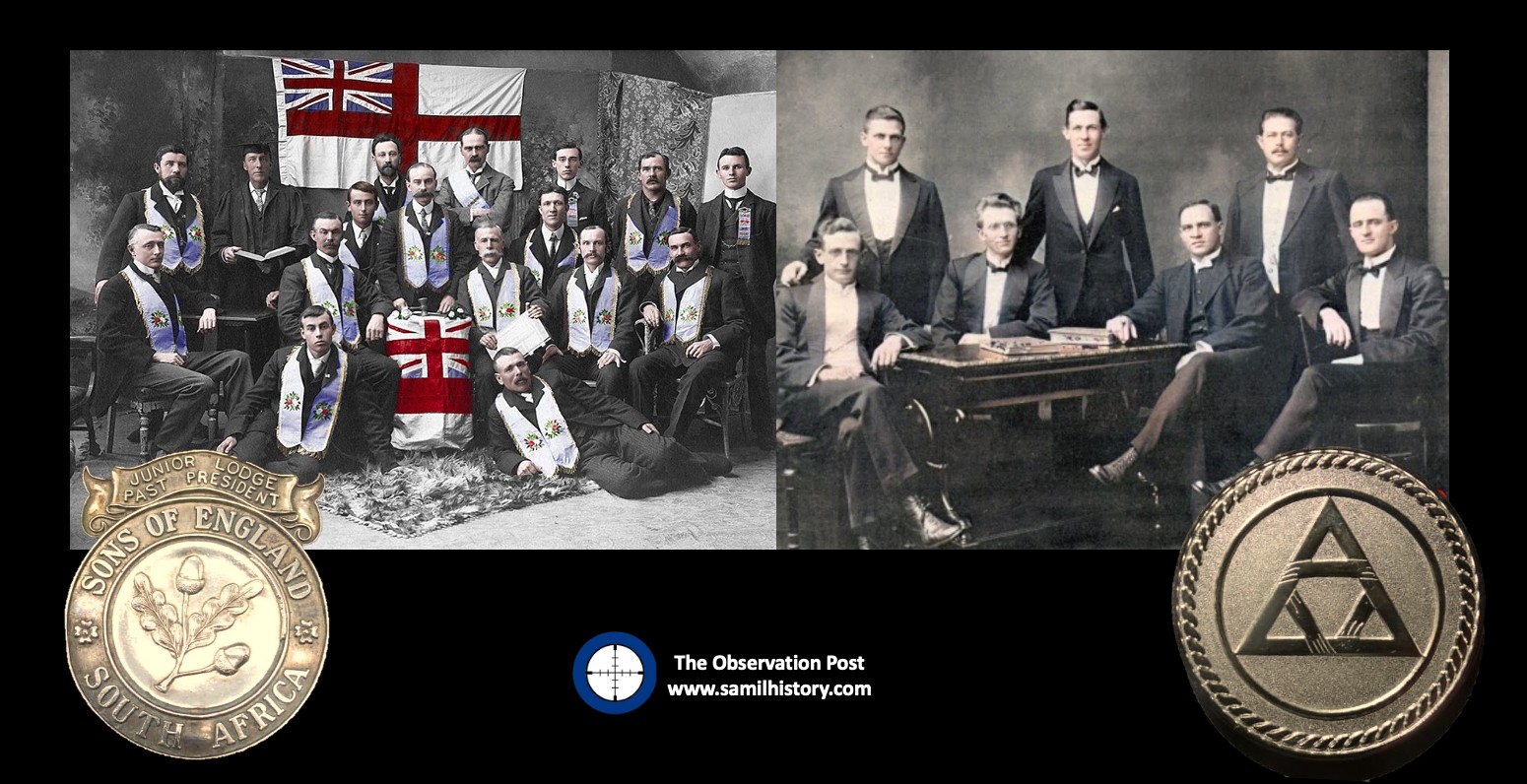
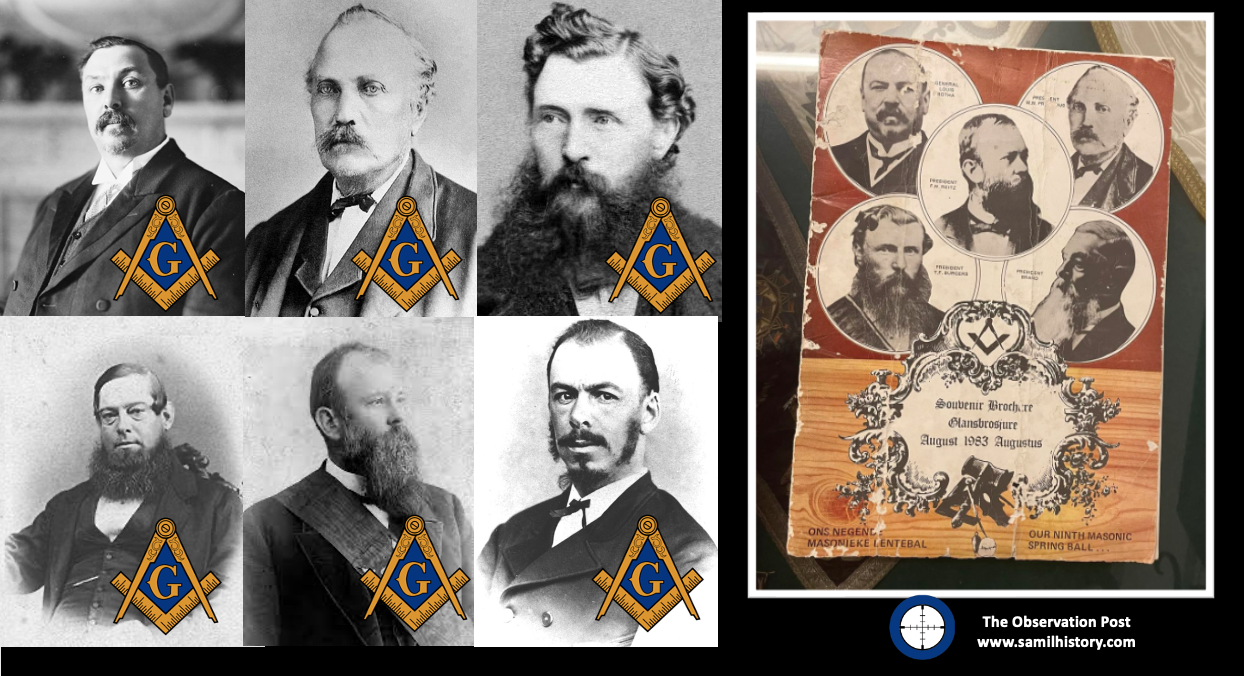
Insert picture – the original Broederbond Commitee members (right) and a SOE Lodge (left) – both marked with some of their respective symbols

Historically, the AB had three objects: to unite all Afrikaners who have the welfare of their people at heart; to foster national awareness; to implant a love of language, religion, tradition and fatherland; and to promote all of Afrikanerdom’s interests. Within the purely domestic Afrikaner arena, it acted as a secret coordinating council to weld Afrikaners into a single integrated insulated laager and as the guardian of the Nationalist spirit.29

The AB would however also lock itself in mortal combat with Freemasonry, which as a fraternity was open to men of any religion, race or creed including a great many Afrikaners in the English, Scottish, Irish and Dutch constitutions. Freemasons were specifically denied membership of the AB by the bond’s recruitment policy which was restricted to upstanding white Afrikaner adult males, protestants only, anti-Communist and specifically not a Freemason. The result of this, is that although many Afrikaner Freemasons enjoyed membership of the National Party, they did not really find themselves in key leadership roles of it – no National Party Prime Minister or President post 1948 was ever a Freemason, yet they were all Broederbonders to a man.
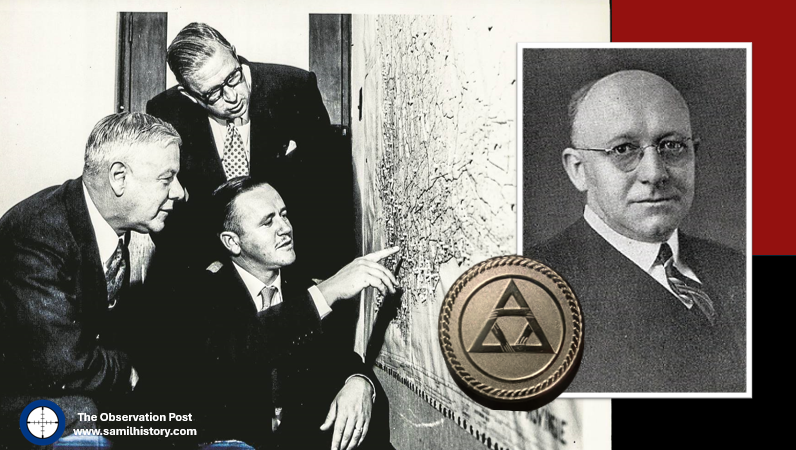
Dr. H.F. Verwoerd and fellow Broeders planning. Insert picture. Dr. Nico Diederichs and a symbol used by the Broederbond in later years as to its ‘secret’ iconography

The AB eventually even took to aggressively targeting Freemasons when it put out a circular warning its members of Freemason conspiracies and to take action via the Dutch Reformed Church, it reads:

‘Freemasons are pouncing on school committees and city councils and are not slow to seek control of cultural organisations. These fronts must be watched carefully therefore against Freemasons! Freemasonry, however innocent it might appear, is fundamentally anti-Christian and action must be taken with that in mind … action against Freemasonry must start at (Dutch Reformed) church level.’30

Inside the AB, a task force, headed by Professor F.J. van Zyl, was even set up ‘to combat communism, liberalism and other enemies such as Freemasonry.31

The campaign becomes murderous

By August 1940, the Vichy France regime also issued a decree declaring Masons to be enemies of the state. Later in Germany during 1942, Hitler authorised Alfred Rosenberg to wage an “intellectual war” against all Jews and Freemasons. This transitioned in a police response under the authority the German Armed Forces (Oberkommando der Wehrmacht – OKW) to fulfil the objectives of this war by way of a ‘final solution’.

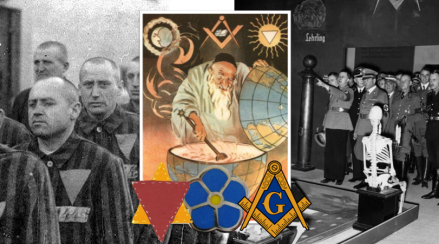
Thousands of Freemasons were arrested as ‘enemies of the state’ all over Germany and occupied Europe and sent to concentration camps. They were made to wear a red triangle on their prison uniforms to signify them as ‘political prisoners’. Jewish Freemasons were made to wear a red and yellow triangle in the shape of a Star of David – in all it is estimated that 150,000 Freemasons were murdered by the Nazi regime in their death camps by their death squads alongside 6,000,000 Jews.
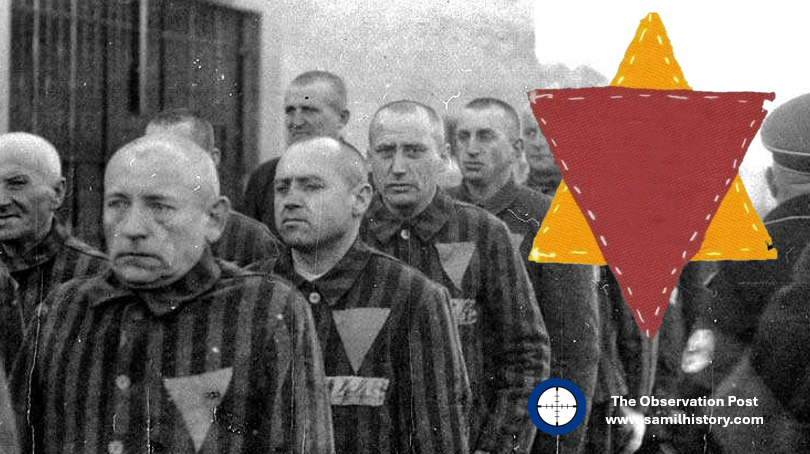
Political prisoners in a Nazi concentration ‘death’ camp wearing red ‘political’ triangles and the inverted triangles to show a Jewish Freemason with kind permission of Bro. Andrew Bergman.

After World War II, Soviet forces found much of the Masonic material that had been stolen by the Nazis. ‘They transported it to archives in Russia and Poland where the material remained unseen for more than 40 years. The Soviets, like the Nazis before them, wanted to learn about the Fraternity because, in a strange twist, they too, found Freemasonry threatening to their totalitarian government.’32

For this reason, European freemasonry including British Freemasonry, which anticipated an invasion of the British Isles by Nazi Germany decided to “go dark” in order to protect its members and its artefacts. To identify themselves Freemasons took to wearing small ‘forget-me-not’ flowers as lapel pins.

Forget me not

As Freemasonry across Europe (and in the UK and its Commonwealth) went “dark” and “secret” to protect itself from Nazi persecution – Freemasons in Europe (and in Commonwealth countries including South Africa) started to use the ‘Forget-me-Not’ flower as a lapel pin so they could recognise one another. Some lodges even became known as ‘Forget me Not’ Lodges (even in South Africa).

But why the ‘Forget-me-Not’ flower? The origins have a sinister and Nazi beginning. During the war, three Lodges were actually secretly formed inside German Nazi concentration/POW camps – to classify and identify inmates as Freemasons the Nazis used the inverted red triangle, which was reserved for ‘political prisoners’.
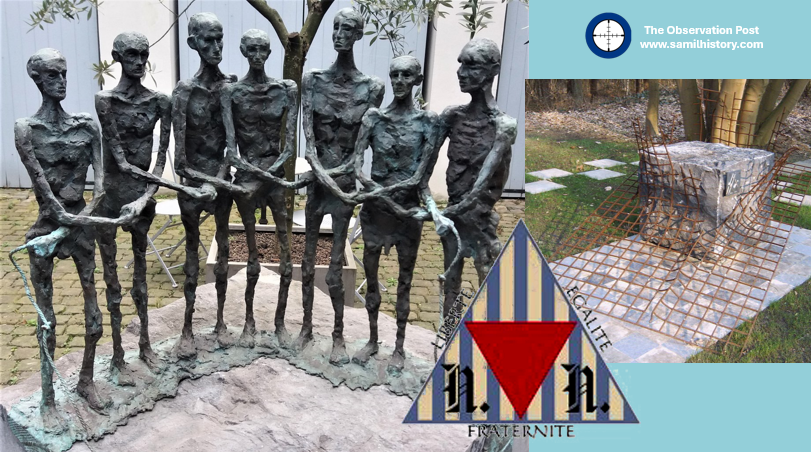
Masonic Holocaust remembrance at Esterwegen Cemetery.

The first and more famous lodge was the Liberté Chérie or Beloved/Cherished Liberty Lodge one of very few lodges founded inside a Nazi concentration camp. It was established inside Hut 6 at Esterwegen (a political prisoner concentration camp). Founded November 1943 by 7 Belgian Freemasons and resistance fighters. During its existence it ‘Entered’, ‘Passed’, and ‘Raised’ at least 2 additional members. A memorial and sculpture is now part of the memorial site of the Esterwegen Cemetery.33

The Obstinate Lodge, L’Obstinée was another Masonic Lodge founded inside the walls of a Nazi prisoner-of-war (POW) camp. Oflag X-D POW camp near Hamburg. Founded by members of the Grand Orient of Belgium. L’Obstinée was a the second Masonic Lodge and was founded in the Oflag XD camp by
members of the Grand Orient of Belgium which recognised the Lodge on14 July 1946.34

The third Lodge was “Les Frères captifs d’Allach” and who’s register is now located at the Grand Orient of France museum.35

The small forget me not flower had been used obscurely in masonic symbology in Germany from 1926. However, by a stroke of luck and irony the National Socialist (Nazi) German government decided to use a ‘Forget-me-Not’ flower as the symbol for its annual Winterhilfswerk (Winter Relief) campaign. A charitable, food, coal and clothing campaign with the slogan “None shall starve nor freeze”. Set for the harsh winter months (see insert pic of the forget-me-not used by the Winterhilfswerk charity from 1938).
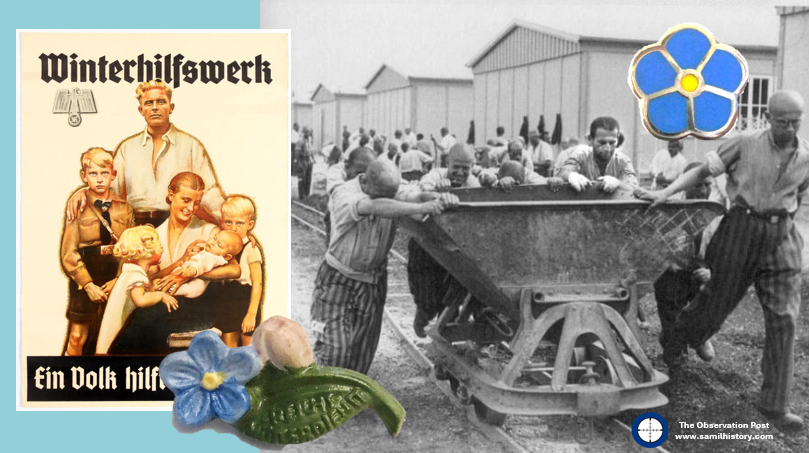
The forget-me-not worn for the Winterhilfswerk campaign and the one worn by Freemasons in remembrance of brothers in concentration camps.

As the flower pin was common to anyone supporting the winter relief campaign in Germany, this enabled some Freemasons to openly wear the Forget-me-Not as a secret sign of Freemasonry membership during the holocaust and avoid persecution or identification. The use of the Forget-me-Not lapel pin did not only occur in Germany, but Freemasons picked it as a symbol the world over during the war.36

The Forget-me-Not even appeared after the war at the first Annual Convention of the United Grand Lodges of Germany. It has continued to be worn by Freemasons world over to remember those that suffered in the name of Freemasonry.

In South Africa the Freemason fraternity would endure their remembrance duties and lament the situation in Europe, here is interesting piece of Masonic lore at Kensington Masonic Hall. It comes from Munster Lodge Irish Constitution and essentially it is a letter between a Brother and the Treasurer regarding the non-payment of his dues, it is written on the 21st April 1942 mid way though the war. It gives a grave picture of Masonry world-wide and in the occupied countries and urges the need to retain membership against difficult times. A second letter, also held at the Kensington Masonic Hall, is a set of minutes and funds raised for the family of a Freemason killed in action.37
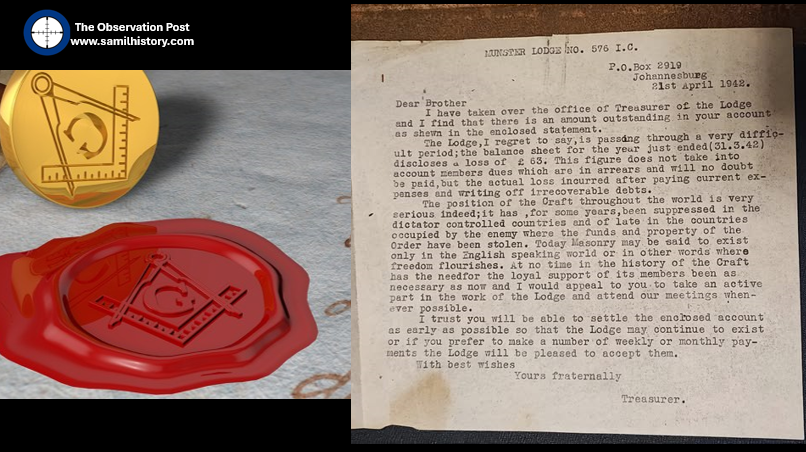
Kensington Masonic Hall artefact – with permission from Bro. Eric Cleaver

Numerous South African Freemasons served in the South African Union’s Defence Force during World War 2, and seconded to British Armed Forces, many attaining high accolade and Masons can also count many fallen amongst themselves. A notable World War 2 Freemason was the very popular Maj. General Dan Hermanus Pienaar, his role in the Battle of Al Alamein would contribute to the turning point of the war and the ultimate Allied victory. Dan Pienaar was a member of Lodge Rising Star (English Constitution) in Bloemfontein, initiated on 1 October 1935 and raised 14 April 1936. He was tragically killed during the war in an aircraft accident. 38

In Conclusion

It took some time after the war for the “all clear” to be given and for Freemasons to return to their normative position in society and open up their lodges and memberships, even as late as 2018 the United Grand Lodge of England was still calling officially for the end of discrimination of Freemasonry.

Freemasonry operates as a charity – not unlike a Lions Club or Rotary, it operates in public and as Freemasons put it – Freemasonry is organisation with secrets, but not a secret society. Freemason’s secrets are gestures, words and handshakes so they can recognise where each fellow mason is on their respective masonic journey and for the delight and surprise of the candidate passing his degrees. Freemasons have exposed their rituals, temples and gestures multiple times, and although not encouraged, the public can easily source them. 

It is important to note, as often Freemasonry is not factored in the lexicon on the Holocaust which usually focusses on the victims as being Jews, Homosexuals, Gypsies and Political Prisoners generally – it is important to stress that every single Führer Order in respect of the Holocaust started with the following words:

‘An Order in respect of Freemasons and Jews’.39


Written and researched by Peter Dickens

Footnotes

  1. Hitler, Adolf. Mein Kampf (Ralph Manheim Translation), Houghton Mifflin Company, New York, 1925 original publication, translation published 1999. ↩︎
  2. Hitler, Adolf. Speech at an NSDAP meeting in Munich, February 29, 1928. Hitler, Reden, Schriften, Anordnungen, Vol. II/2, 706. ↩︎
  3. Smith, Gary. Freemasonry and the Holocaust By W. Bro. Gary W. Smith, Pr.D.G.D.C. ↩︎
  4. Campbell, Thomas. Compass, Square and Swastika: Freemasonry in the Third Reich. Texas A&M University. 2011 – Page 119 ↩︎
  5. United States Holocaust Museum – on-line resource, fetched 1 December 2024 ↩︎
  6. Thomas, Christopher. Compass, Square and Swastika: Freemasonry in the Third Reich. PhD thesis. 2011 ↩︎
  7. Smith, Gary. Freemasonry and the Holocaust By W. Bro. Gary W. Smith, Pr.D.G.D.C. ↩︎
  8. Thomas, Compass, Square and Swastika: Freemasonry in the Third Reich, Page 126 ↩︎
  9. Thomas, Compass, Square and Swastika: Freemasonry in the Third Reich, Page 126 ↩︎
  10. Thomas, Compass, Square and Swastika: Freemasonry in the Third Reich, Page 126 – 127 ↩︎
  11. Thomas, Compass, Square and Swastika: Freemasonry in the Third Reich, Page 127 ↩︎
  12. Scher, David. Echoes of David Irving – The Greyshirt Trial of 1934. 2004 ↩︎
  13. Shain, A Perfect Storm, 230 ↩︎
  14. Bunting, The Rise of the South African Reich, 84 ↩︎
  15. Shain, A Perfect Storm, 231 ↩︎
  16. Shain, A Perfect Storm, 231 ↩︎
  17. Maritz, Manie ‘My Lewe en Strewe’ Pretoria 1939. Page 121. ↩︎
  18. Maritz, Manie ‘My Lewe en Strewe’ Pretoria 1939. Page 139 ↩︎
  19. Shain, A Perfect Storm, 230 ↩︎
  20. Shain, A Perfect Storm, 230 ↩︎
  21. Shain, A Perfect Storm, 231 ↩︎
  22. Shain, Milton. ‘A Perfect Storm’, Antisemitism in South Africa 1930-1948, (Johannesburg: Jonathan Ball Publishers, 2015) , 55–58. ↩︎
  23. Bouwer W, National Socialism and Nazism in South Africa: The case of L.T. Weichardt and his Greyshirt movements, 1933-1946. (MA Thesis, University of the Free State, Bloemfontein 2021), 18. ↩︎
  24. Shain, A Perfect Storm, 58 ↩︎
  25. Shain, A Perfect Storm, 58 ↩︎
  26. Shain, A Perfect Storm, 73 ↩︎
  27. Scher, David. Echoes of David Irving – The Greyshirt Trial of 1934. 2004 ↩︎
  28. Rein Commission. Unpublished ↩︎
  29. Bloomberg, Charles. Christian Nationalism and the Rise of the Afrikaner Broederbond in South Africa, 1918-48, Page 32 ↩︎
  30. Wilkins, Ivor. The Broederbond. Jonathan Ball Publishers, 1978. Page 150 ↩︎
  31. Wilkins, The Broederbond, 407 ↩︎
  32. Smith, Gary. Freemasonry and the Holocaust By W. Bro. Gary W. Smith, Pr.D.G.D.C. ↩︎
  33. Smith, Gary. Freemasonry and the Holocaust By W. Bro. Gary W. Smith, Pr.D.G.D.C. ↩︎
  34. Smith, Gary. Freemasonry and the Holocaust By W. Bro. Gary W. Smith, Pr.D.G.D.C. ↩︎
  35. Smith, Gary. Freemasonry and the Holocaust By W. Bro. Gary W. Smith, Pr.D.G.D.C. ↩︎
  36. The Forget-Me-Not and Anti-Freemasonry in Nazi Germany – The Square Magazine on-line. ↩︎
  37. With the kind permission of Bro. Eric Cleaver – Germiston Charity Lodge. ↩︎
  38. Rossouw, B (compiler). 250 Years of Freemasonry in South Africa, a Heritage Collection 1772 – 2022. Grand Lodge of South Africa. 2022. Page 1031 ↩︎
  39. Smith, Gary. Freemasonry and the Holocaust By W. Bro. Gary W. Smith, Pr.D.G.D.C. ↩︎

Bibliography and References

Bloomberg, Charles. Christian Nationalism and the Rise of the Afrikaner Broederbond in South Africa, 1918-48. Palgrave Macmillan. 1990.

Bouwer, Werner. National Socialism and Nazism in South Africa: The case of L.T. Weichardt and his Greyshirt movements, 1933-1946

Bunting, Brian. The Rise of the South African Reich. Penguin Books. 1964

Feng, Albert. Freemasonry: Survival and Compromise – Freemasonry in the Third Reich.

Hitler, Adolf. Mein Kampf (Ralph Manheim Translation), Houghton Mifflin Company, New York, 1925 original publication, translation published 1999.

Hitler, Adolf. Speech at an NSDAP meeting in Munich, February 29, 1928. Hitler, Reden, Schriften, Anordnungen, Vol. II/2, 706.

Maritz, Manie. ‘My Lewe en Strewe’ Pretoria 1939

Rossouw, B (compiler). 250 Years of Freemasonry in South Africa, a Heritage Collection 1772 – 2022. Grand Lodge of South Africa. 2022.

Scher, David, M. Echoes of David Irving – The Greyshirt Trial of 1934. December 2004.

Thomas, Christopher, Campbell. Compass, Square and Swastika: Freemasonry in the Third Reich. Doctorate of Philosophy thesis. Texas A&M University. 2011

Milton, Shain. A Perfect Storm – Antisemitism in South Africa 1930-1948. Jonathan Ball. 2015

Smith, Gary. Freemasonry and the Holocaust By W. Bro. Gary W. Smith, Pr.D.G.D.C

United States Holocaust Museum – on-line resource, 2024

The Square Magazine (on-line). The Forget-Me-Not and Anti-Freemasonry in Nazi Germany

Wilkins, Ivor. The Broederbond. Jonathan Ball Publishers, Johannesburg. 1978

Boer Bashing and other Bull

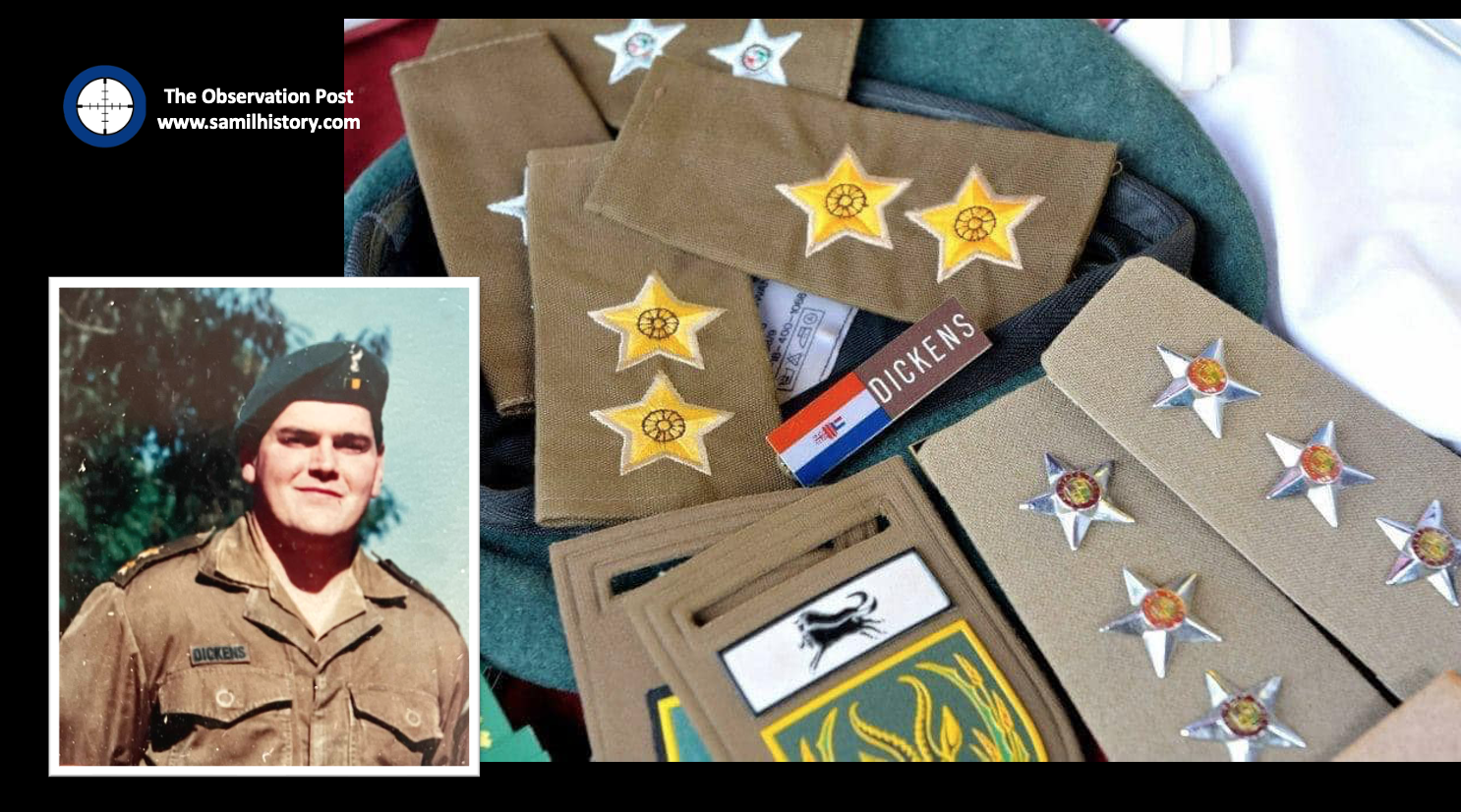
I was taken to task by a well known Afrikaner author, Albert Blake on Facebook pages and accused of ‘Boer Bashing’ on my website and social media and warned to keep my neck in. He even went as far to say he had included this in his new book on Jopie Fourie and to quote him he had investigated my:

‘deeper motives for (my) apparently predetermined “findings” (on Jopie Fourie) … and … the charges that were levelled against (me) in the past regarding severe “Boer/Afrikaner bashing”.’

All a bit rich, I don’t know Blake personally, I’ve never really interacted or debated anything with him, he’s never challenged or even opened a discussion with me in the past, and as to investigating anything, I’m in plain sight, we work in the same circle, he could have merely contacted me and asked the question, it would be the professional thing to do before willy-nilly publishing something that may or may not be libellous and slanderous. Bit odd considering he’s also a lawyer and nobody has “proven” any case of ‘Boer Bashing’ on anything I’ve ever written, nor has any alleged ‘bias’ been proven – ever! By being ‘Anti-Afrikaner’ or ‘Boer Bashing’ as he has alleged, he’s venturing into accusing me of ‘hate speech’ – and you better have some solid proof if you’re going to do that, let’s see, so far he’s provided nothing.

Not unusual that there is no evidence to back up Blake’s accusation and ‘investigation’. As to whenever this “Boer Bashing” accusation is levelled at me I’ve simply asked one question “prove it” and nobody has to date. I’ve also never belittled or insulted anyone on the basis of their ‘Afrikaner’ ethnicity, there is nothing in my media and it’s all ‘public’ – so feel to search my entire website and public social media pages … oh … and good luck.

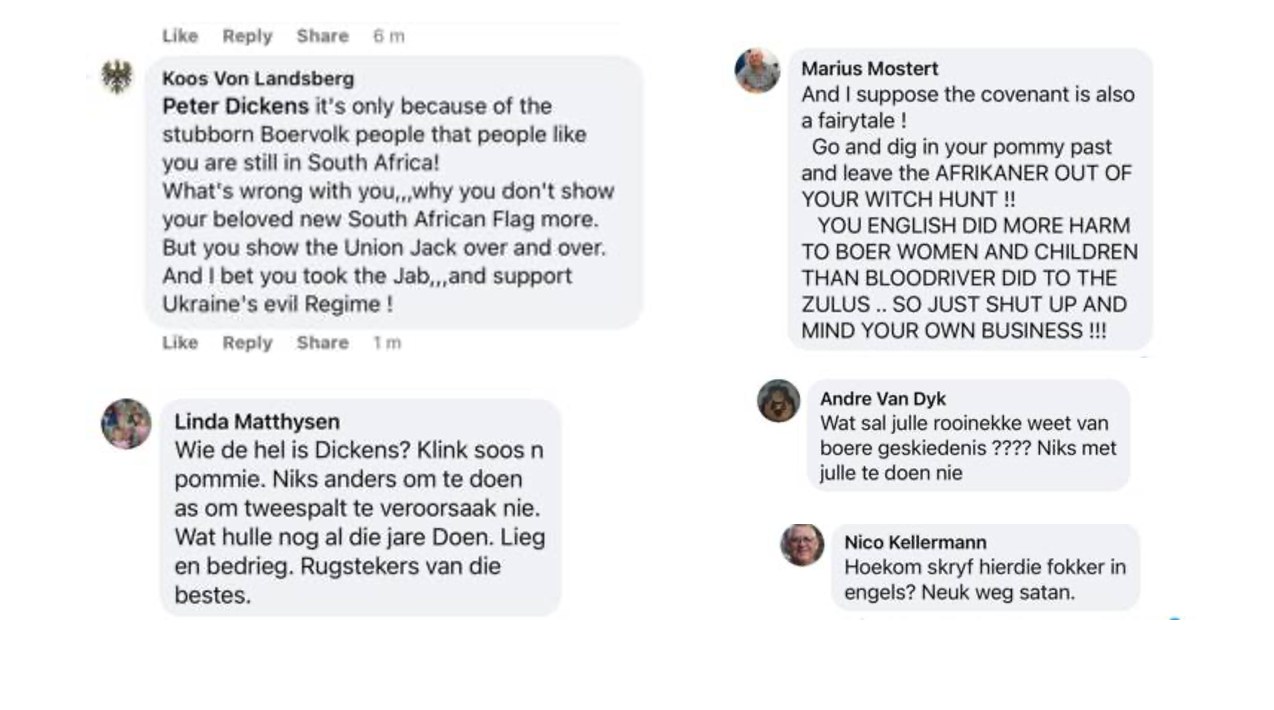
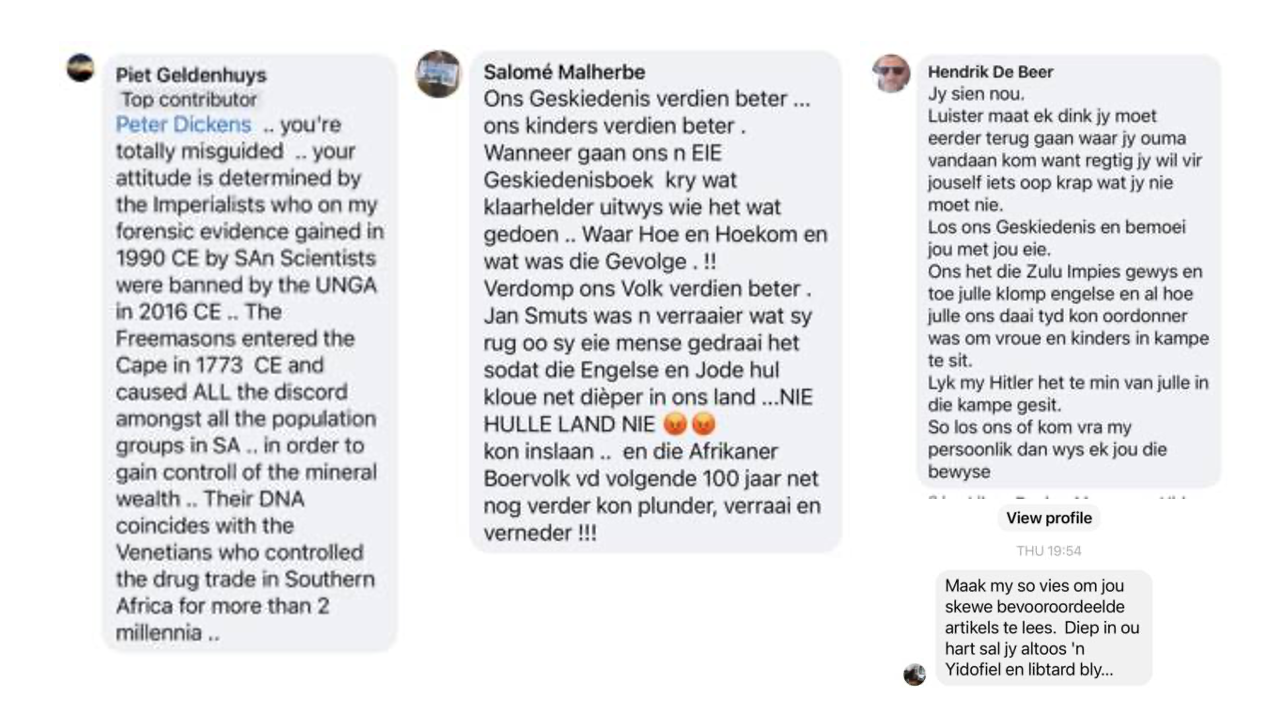
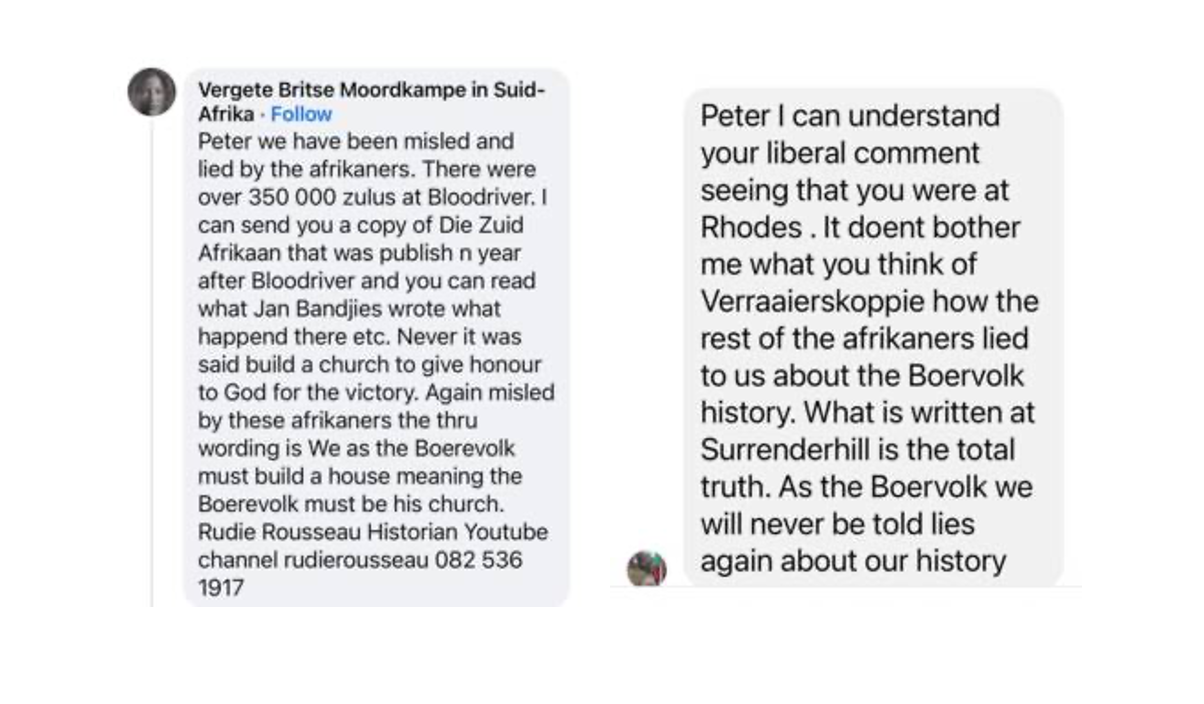
I’ve even been accused of having an “anti-afrikaner bias” by a handful of detractors and a couple of social media trolls, when challenged they feel it just “comes across” that way, a sort of “out there” sense they have – that this is not a basis for argument or logic is lost on them.

Blake’s sudden assertion is all a bit of a surprise to me to be honest, I’m sure my very Afrikaans family must find it amusing to learn how much I hate them, it’s all rather counterintuitive and illogical – so, I’ll explain my position and I’ll do everyone a favour to stop any speculation, slander and other libellous conjecture right here – they can have it “straight from the horse’s mouth” so to speak.

Specialism

Now, many of my articles and almost all of my research revolves around one period in South African history. It started when I took to researching Nazi movements in South Africa prior and during the Second World War (1939 – 1945). I started researching and blogging on this about 10 years ago, and the response was surprising – many people wrote in to me say “I never knew this” and urged more research. This took me into the politics of returning South African servicemen from WW2 and their reaction to the Nazi enamoured Afrikaner nationalists who found themselves in power from 1948. This cumulated in a large research body on The Torch Commando and early South African political, civil, para-military and military reactions to Apartheid. This took my specialised research period from 1935 to 1955 – about 20 years of specialism as historic ‘scope’ goes.

During this period – 1935 to 1955, the right wing fringe of the Afrikaner Nationalist movement became highly Nazified. Nazi dogma, laws, and ideology started to enter the thinking of Afrikaner Nationalist leaders and heavily influence them – especially from 1935 to 1944 – it manifested itself in Christian Nationalism as an ideology, which grounded itself on ‘Krugerism’ – especially from 1938, it in turn became infused with a cocktail of Nazi purity and race laws, national socialism and weimar eugenics to eventually become “Apartheid” as we knew it from 1948 to 1994.

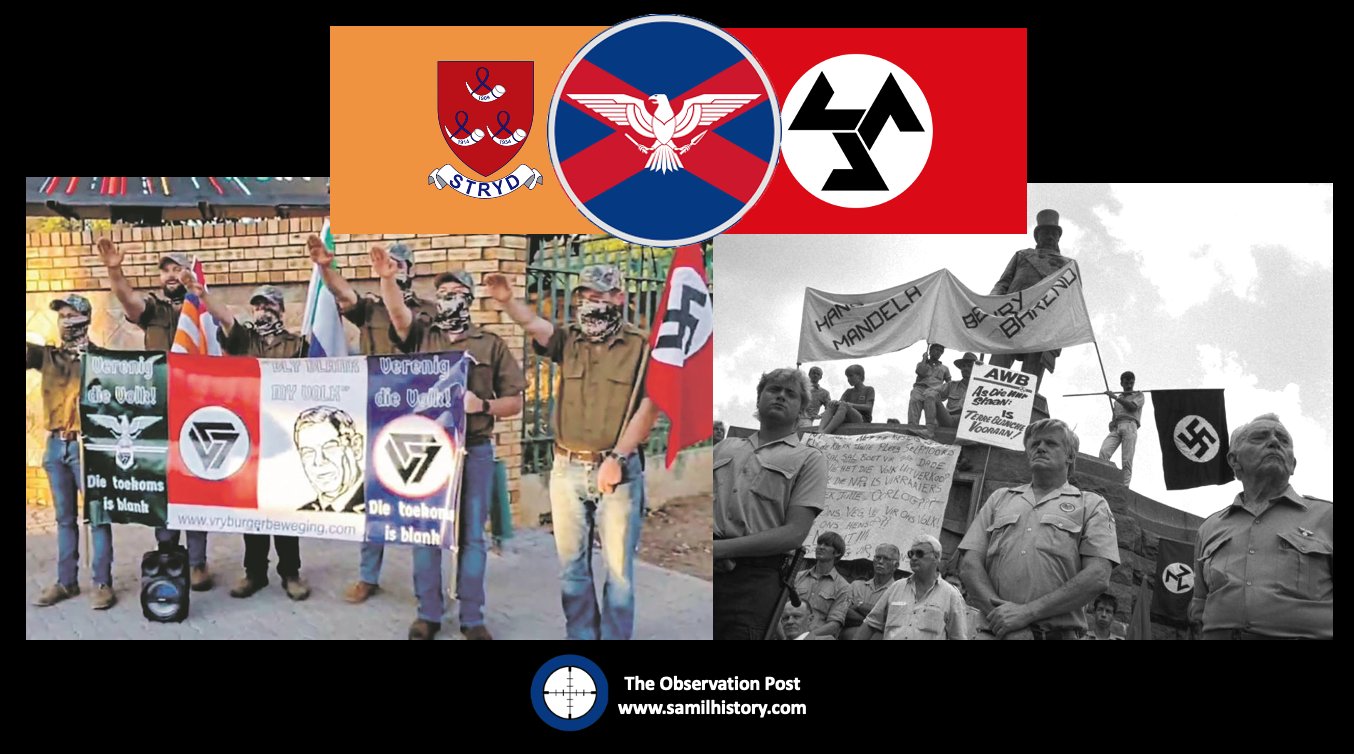
In terms of historic sweep, from the implementation of Apartheid in 1948, as a derivative of Nazism comes this idea of a police state to command and control a ‘whites only’ Afrikaner led hegemony over all South Africans – an oligarchy of minority rule with brutal state security apparatus, highly centralised government and a ‘command economy’ to maintain this status quo. This under-pinning Nazi philosophy eventually manifesting itself in various ‘Boerenasie’ and Afrikaner resistance movements (the AWB et al) starting in the mid 1980’s and its still lurking in South Africa to this day as a minority counter culture demanding a ‘Herrenvolk’ populated ‘Volkstaat‘ in places like Orania, and it can also still be found in various security services, political parties, cultural movements, historical reenactments and the internet. To illustrate the point, the Herstigte National Party still exists in South Africa, believe it or not, the extreme right wing party with its proto-Nazi origins everyone tries to forget. It has lost its ‘ticket’ but still exists and its stated mandate is the return of Verwoerdian Aparthied, and there are others like it.

AWB Protest circa 1993 and Vryburger movement protest 2022.

In researching this period (1935 to 1955) two distinctive groups of Afrikaners emerge. On the one side we find Afrikaners who embrace unity, seek reconciliation and are open to race relations to build a South Africa open to all. Many of these men are soldiers – military men, many having taken part in World War 2 fighting Nazism and all of them highly regarded, in terms of ‘history’, history treats them kindly for the most part. As a military veteran myself there is much in these men to like, actually for me it verges on complete admiration to be honest, but that’s a personal thing – they include the following Afrikaners:

Field Marshal Jan Smuts, Kommandant Dolf de la Rey, Group Captain Adolph “Sailor” Malan, General Daniel Pienaar, Group Captain Petrus “Dutch” Hugo, Mattheus Uys Krige, General Kenneth Reid van der Spuy, General George Brink, Major Jacob Pretorius, Lt (Dr) Jan Steytler, Pieter Beyleveld, Captain (Sir) Devilliers Graaff, Lt Harold Strachan, Major Pieter van der Byl, Colonel Danie Craven, Colonel Ernst Gideon Malherbe to name the leadership caucus of anti-Apartheid and ‘liberal’ or ‘libertarian’ Afrikaners during and post war.

On the other side in my research period, we find Afrikaners who embrace Nazism, either partly or in whole – they seek division and race hate as a political model, central to their philosophy is the ‘politics of pain’ – a ‘victimhood’ ethos and a deep seated Anglophobia alongside a heightened admiration of Nazi Germany and Adolf Hitler. They either sit out of World War 2 and tacitly support Nazi Germany or they become directly involved in treason and sedition supporting the Nazi state – they include the following Afrikaners:

B.J. Vorster, Oswald Pirow, Dr. Johannes Van Rensburg, Hendrik van den Bergh, Johannes von Moltke, P.O. Sauer, Frans Erasmus, Dr. Hendrik Verwoerd, C.R. Swart, P.W. Botha, Eric Louw, Dr Nico Diedericks, Jaap Marais, Dr Albert Hertzog, Louis Weichardt, Piet Meyer, ‘General’ Manie Maritz, ‘General’ Jan Kemp, Dr. Eben Dönges, J.G. Strydom, Koot Vorster – to name some of the far right Nationalist leadership caucus with overt Nazi leanings pre, during and/or post war.

Even the Nationalist leaders who took up a ‘neutral’ positioning as to the war, tacitly supported Nazi Germany and/or its dogma – both Dr. D.F. Malan and Prime Minister Barry Hertzog fall into the category, in fact Hertzog declared that National Socialism was the path for Afrikanerdom before he died, Malan also leaned heavily to anti-semitism and Völkisch nationalism.

Through their actions all these right wing Afrikaner Nationalists bring about the system of Apartheid, a system that is now regarded as a crime against humanity, and as such history does not treat them kindly. As historians, we try and contextualise and I’m pretty sure that out of Adolf Hitler, Heinrich Himmler, Albert Speer, Martin Bormann, Hermann Goering, Joseph Goebbels, Rudolf Hess and Reinhard Heydrich, some were stand-up guys – polite, popular and sociable to family and friends. But history does spend too much time on this and instead as we move nearer to the centurion celebration of WW2 they are viewed in the context of sociopaths, megalomaniacs, deviants, murderers and psychopaths. As sure as the sun rises, the Afrikaners who came up with Apartheid will all eventually be viewed the same way – they are the “bad guys”. In this respect it is almost impossible to paint any of the Apartheid leadership in a benign, loveable and sympathetic way, you can “contextualise” them to a degree, be as honest as you can with them, but as they say in marketing “you can’t polish a turd” – it’s a complete waste of effort and in fact its impossible to make them “look good” – certainly without been called out as an “Apartheid apologist” or “Nazi sympathiser” – so there is a very fine line.

Nazification of the Afrikaner right – Grey-shirts, Black-shirts, Orange-shirts, New Order, National Socialist Rebels, Boerenasie and Ossewabrandwag

My research into the Nazification of the Afrikaner right is always going to show this far right segment on the rump of Afrikanerdom in a highly critical way, certainly to most modern readers in 2024 who understand ‘Nazism’ in hindsight, these people will automatically be viewed in a repulsive and repugnant light, it’s almost unavoidable. Once identifying an association and/or sympathy to Nazism, in any way, there is just no way anyone is going to come out of it smelling of roses and held up as the true disciples of Afrikanerdom, people with a benevolent Christian veneer and a mere love of all things German. If anything they are easily viewed as the vanquished incubus of Afrikanerdom, the Judas to their denomination and creed.

These Apartheid protagonist Afrikaner Nationalists are no different to the Nazi heroes they worshipped and modern South Africans are no different in the way they view Aparthied as the majority of German’s treat Nazism now. That’s just a truism, these Afrikaners committed a crime against humanity, they came into power on a ‘minority’ ticket, dominated South African politics for nearly 50 years and represented the rump end of an ethic minority – barely 4% and they “committed a crime” which impacted the majority, the other 96% of South Africans. In the process they took nearly “all” white South Africans along with them – nothing we can do about it, it’s not salvageable, it happened. However, to say a historian researching the Nazification of the Afrikaner right is “anti-Afrikaner” is the same as to say a historian researching Nazism is somehow “anti-German” – it’s just plain counterintuitive and deflective – its red herring argument, prejudiced and plainly untrue.

This majority – the 96% of the country – now feel very differently about the “Architects of Apartheid” to the odd small Afrikaner cultural grouping trying to hold onto redeeming qualities in them. It’s a herculean task just to educate a fraction of modern South Africans to be more tolerant of ‘white’ history in South Africa and it’s also sad that of this ‘majority’, a massive swathe blame “all white Afrikanerdom” for Apartheid, some even go as far as to say “all whites” – and that has manifested in deadly hatred in some instances, certainly if farm killings of ‘Boere’ are anything to go by. This is where ‘historical balance’ is necessary – to prove that not all ‘whites’ and not all ‘Afrikaners’ bought into the whole idea of Apartheid, that they even resisted it. It becomes very important to prove that Apartheid was an ideological conflict and not a race conflict – all races were affected by it, including many whites – and not just a handful, but large swathes of 100’s of thousands of whites actively resisted Apartheid, a ‘critical mass’ argument – and here’s the fun part, we can easily prove it and dispense with the ‘revolutionist’ history that is the current political narrative.

Considering my research area and span (1935 to 1955) by historical confluence and not by design there emerges a “good guys” versus “bad guys” argument on the Afrikaner front. It also has the numbers, the critical mass to dispense with this idea that all “whites” and especially all “Afrikaners” upheld their privilege and exploited and repressed all “blacks” by keeping the Afrikaner Nationalist Party in power. Numbers alone tell a story, the 1948 election win by the National Party was not a majority win … and by 1953 a massive voting bloc of 250,000 white people (i.e. 25% of an electorate of 1,000,000 odd whites) had joined The Torch Commando – a war veterans based anti-Apartheid mass movement – paid up members in almost equal balance of ‘Afrikaans’ and ‘English’ and all protesting Apartheid in massive rallies countrywide – some well over 50,000 strong, a campaign which lasted about 5 years until the Nationalists (as was their fashion) started to crush it with legislation.

This research vindicates many white Afrikaners of Apartheid – fact. It is far more helpful to understand their story, study this history, find out how and why it was repressed and manipulated by a radical Afrikaner far right and not try and promote an unattainable and factually impossible redemption for the radical Afrikaner far right. In fact, the reaction I got to this work by Afrikaners was intensely positive, many Afrikaans people have written to personally, to say “thank you” and things like “finally” I can talk about my family heritage, my ‘Ouman’ or ‘Oupa’ (even Ouma) was one of these hundreds of thousands of ‘Smutsmen’ – our history has been flattened out by decades of National Party propaganda and rhetoric, in fact the term often used is “repressed”. Devoid of a voice by historical circumstance for over 50 years of ‘Apartheid censorship’ this work has given it back to them.

Sailor Malan (left) and his opposite nemesis BJ Vorster (right) – both identified themselves as Afrikaners. The Nationalists regarded Sailor Malan as a “Afrikaner of another kind” – a traitor to his people.

How uplifting ‘redeemable’ Afrikaners, the ones in history who resisted Apartheid and whose history was ‘forgotten’ and ‘censored’, the ones who sought reconciliation and understanding and now we are finally bringing their politics and their stories to life, giving them a long lost platform, how that possibly constitutes an “Anti-Afrikaner” standpoint is simply beyond me, it defies logic and even common sense.

But somehow it does, this position does not detract from the odd troglodyte emerging, like Ludwig Rode who on social media made an unhinged, libellous and unsupported comment to support Albert Blake by way of a justification of my alleged ‘Boer-bashing’ and said:

“Dickens hates Boers … (he is) trying to put the British and Joiners and anyone left of the Boers or against their freedom aspirations on the moral high ground. No balance at all”.

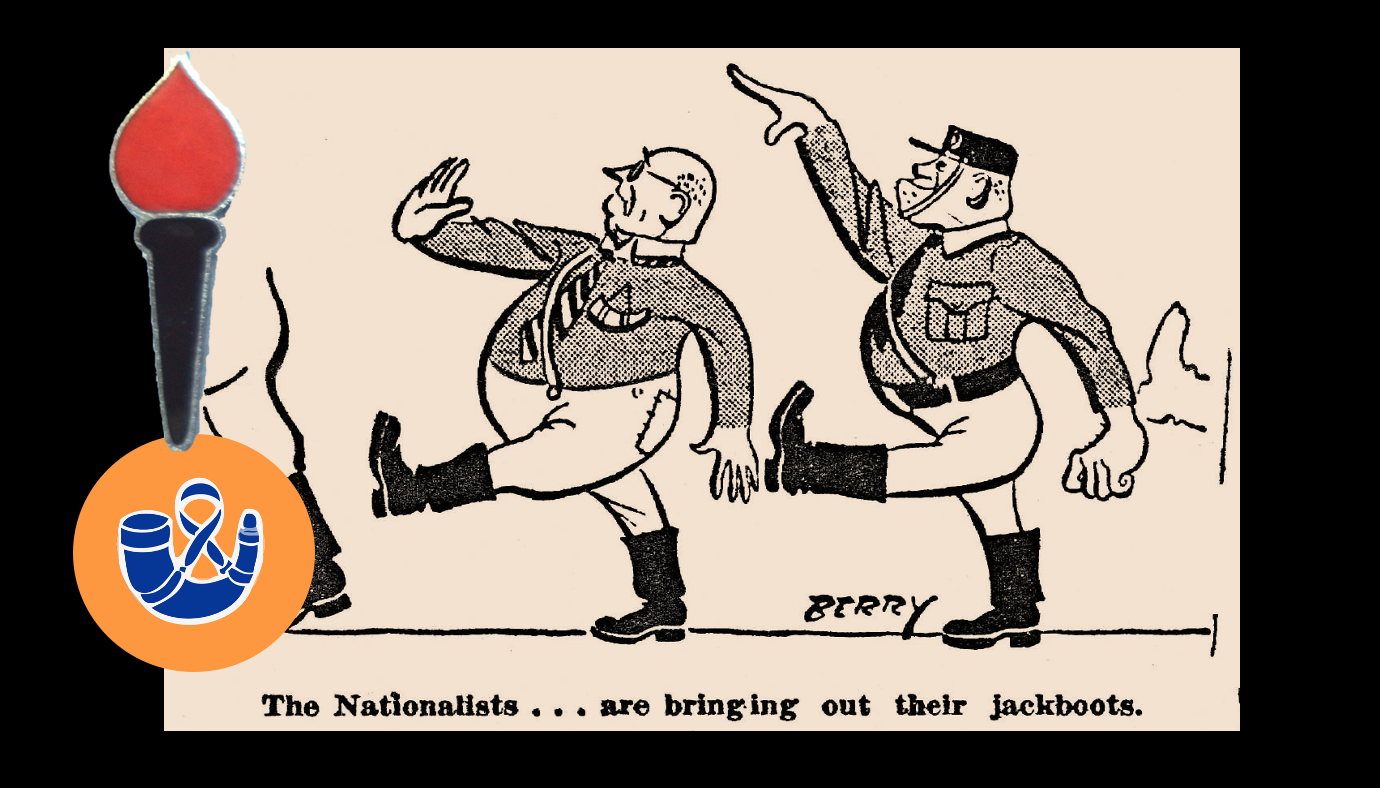
So, by Mr Rode’s logic highlighting those ‘leftist’ Afrikaners who resisted Apartheid and “joined” Smuts’ ‘khakis’ as opposed to the ‘rightist’ Afrikaners – i.e. those right wingers whose aspirations for “freedom” meant flirting with Nazism and trampling on the rights, freedoms and emancipation of everyone else – especially Blacks, Coloureds, Indians, English South Africans and Jews, and subjugating them to jackboot Nazism and violent oppression instead – this to Mr Rode is a bad thing. Now, I thought ‘separating’ them and opening them up so we can see the difference between these two vastly different factions of Afrikanerdom was a good thing – it provides a far more ‘balanced’ and insightful argument. Clearly Mr Rode does not see it this way, not sure how he sees ‘balance’ – maybe I should tar all Afrikaners with his idea of jackboot “Freedom” – in any event his sheer prejudices and adherence to Apartheid period historical doctrine are plain to see in the language he uses.

‘Talking Jackboots’ – Torch Commando cartoon highlighting the Nazification of the National Party

Also, as to historic sweep, sorry to say this to Mr Rode, but as to a ‘moral high ground’, these ‘lefty’ Afrikaners I highlight are already on it – I didn’t ‘put them there’, and as to the far right ‘Nazi’ Afrikaners I highlight – as South Africans they are all in our collective memory’s rubbish bin – and I didn’t put them there either, they did that bit all by themselves – sad but true, I can ‘contextualise’ them, put them into their ‘period’, understand ‘Nazism’ in the context of historical popularism – but that’s about it. To find out more about how they landed up with all our modern day collective contempt for them – read the thousands, I mean thousands of history papers, books, essays, memoirs, manuscripts, reports and confessions written on the ills of Apartheid brought about by these individuals … Some ‘freedom’ he refers!

Also, as a specialism I write a lot about the subject of the Nazification of the Afrikaner right, its full on, so anything coming out from me can seem a little infatuated with Afrikaners and Nazism as the published articles are numerous and frequent – there’s “a lot” of it, it can even be a little overwhelming and over saturating – to the point that one chap wrote to me to say it’s all a ‘bit much’ – let ‘bygones be bygones’ and I should find something ‘new’, something he likes and thinks would be more agreeable … now that’s just plain daft and it reinforces my thinking that I have not yet written enough on this subject – its like a modern Italian saying to a historian specialising in Fascism and Mussolini that they don’t like the work, its not “nice”, there’s “too much” and he should focus on the evolution of professional football in Italy instead – much better, less controversial and far more agreeable. I honestly had to go back to this detractor to say I’m pretty happy with my specialism and won’t be changing it anytime soon.

Banner for an upcoming blog on Manie Maritz, a ‘Volks-Held’ and the Boer Rebellion leader, and his conversion to Nazism.

Sometimes this extends to a second category of person, one who does not like the conclusions reached as it does not suit their identity, culture or socialisation – any form of preconceived narrative really … their ‘bias’ in effect. These people (and even Albert Blake made this mistake) usually come back with “you can do better” – in other words keep re-writing your article until you come up with a conclusion I can agree with.

As to giving a platform to historic Afrikaner characters who have made positive contributions to the broader society in which they live, believe it or not, there is a group of Afrikaners who still just simply don’t “get it” – like Mr Rode they are still conditioned in this old Afrikaner nationalist ‘Völkisch’ idea of Afrikanerdom. They hand to heart believe that ‘liberal’ Afrikaners are traitors to the Afrikaner cause, and they sincerely believe that ‘Verwoerdian Aparthied’ will make a ‘Volkstaat’ comeback – a place in the sun for the ‘Herrenvolk’. This bit I like to call “bringing back porch-monkey.”

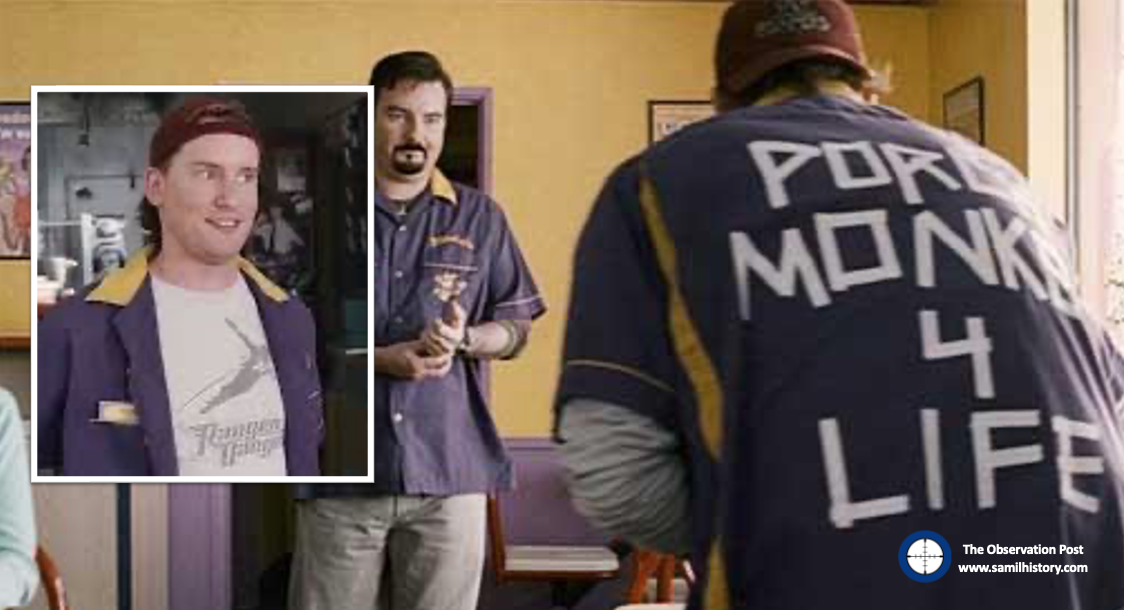
Porch Monkey 4 Life

‘I’m bringing back Porch-monkey” – this quote comes from a movie ‘Clerks 2’ and its a line from a complete idiot clerk with zero emotional IQ, he’s convinced that because the “old timers” like his Grandmother used terms like “Porch-monkey” (the American equivalent for a black ‘House-Boy’) it is perfectly acceptable language and not a racial slur – he makes it his life’s mission to “Bring Back Porch-monkey” and make it acceptable again – the scene is comic genius as he goes about insulting Black people with imbecilic oblivion. Obviously he’s on an offensive highway to nowhere, he’s an ingrained racist, he is moronically obtuse – and he still “doesn’t get it” even after he is challenged on racism by his best friend – he simply does not understand that he’s an utter idiot or even a racist – it makes for great comedy.

Clerks 2 scene – bringing back porch monkey.

I’ve met a couple of proponents of the idea of bringing back “Porch-monkey” – the one is an Afrikaner historian (actually he’s a choreographer of the Boer War) who went round the tree with me on social media for three days solid trying to convince the world that Dr. H.F. Verwoerd did not have any Nazi leanings or connections to Nazism whatsoever (despite a court case proving otherwise and his own actions and writings) and he was a virtuous and admirable man worthy of word-wide admiration for his ideas of ‘good neighbourliness’ and detente (how dare I even suggest otherwise) – that he is trying to bring back a true ‘porch-monkey’ is lost on him.

Another was a local councillor for the Freedom Front Plus, a man who has published two novels of fictional ‘Boer history’. He pulled me up after I highlighted an old ‘Citizen’ newspaper propaganda piece called ‘Call to Afrikaners by an Englishman’ written in 1990 by ‘anonymous’ – which he was plugging on his social media was well … erm … nothing more than a well known Nationalist government propaganda piece in a state sponsored rag and its ‘bringing back porch monkey’. So, before booting me off his social media he messaged me to say that I was ‘Boer Bashing’ as I only regarded Afrikaners “with British hearts” as acceptable, and that I should be grateful for the “thin white line” of protection that he provides against the riotous black hordes who live next door to me. His own ingrained sense of pomposity, misconstrued history, nationalist indoctrination and sheer prejudice lost completely on him.

Another chap was a fellow military veteran in a Veterans Association I chaired in the UK who figured that the Oranje, Blanje, Blou (the old “Aparthied” National Flag) had a bad rap and everyone in the old SADF should be proud of the “flag they fought under” so he planted it outside an African speciality shop in the middle of Peckham London (a suburb known for its ‘black’ multiculturalism – nearly half its population identifies as Black, Black British, Caribbean or African) … this sort of ‘bringing back porch monkey’ takes a special kind of determination and its no surprise to learn that after his SADF national service he joined Eugène Terre’Blanche’s special AWB bodyguard. That he planted a ‘porch monkey’ (whether we agree with it or not) was lost on him.

Now, I’m all for the correct demonstration of historic flags, from the “Vierkleur” to the OBB (same with statues and monuments), I’m also for ‘non-fiction’ and even ‘fiction’ based ‘Boer’ history if it’s grounded correctly and not grounded in identity politics and propaganda, and I’m all for chronologically recording Afrikaner history correctly – good and bad – warts and all. There is a careful balance to contextualising history and presenting it in an even-handed manner – and there’s also a point when you simply cannot bring back ‘porch monkey’.

Sweeping up the Boer Wars

Which brings me to the Voortrekkers and especially the “Boer Wars” as this is always a social media hot potato – all three of them, the Transvaal Revolt (1880 – 1881) the South African War (1899-1902) and the subsequent Afrikaner Rebellion (1914 – 1915). Hoo Boy!

Let me upfront say this, understanding the ‘Boer Wars’ is important to my preferred historic period on the Nazification of the Afrikaner right and the Torch Commando (1935 to 1955) because it provides for a back-drop, it’s in the “historical sweep” … without the Transvaal Revolt we don’t have “Krugerism” as an ideology … without “Krugerism” we don’t have The South African War and again the attempt to re-instate “Krugerism” is the object of the Afrikaner Rebellion. “Krugerism” – and the old ZAR constitution with its central 1860 racist tenet ‘The people are not prepared to allow any equality of the non-white with the white inhabitants, either in church or state’ is the adopted political philosophy by Hertzog’s breakaway National Party in 1914, and it is the epicentre on which the ideology of Aparthied is based. So, very important to the Nazification of the Afrikaner right and the anti-Aparthied Torch Commando.

Upfront I must also say this – the ‘Boer Wars’ are not my “specialism” but they are important for context and sweep, I generally leave the in’s and out’s of the Boer Wars to the historians who make these wars their “specialism”. However what the Boer Wars do provide is a lot of interest and “traffic” on my website. If there is conflict that is completely misunderstood in the historiography of the Afrikaner nation it’s the three Boer wars, and the reason for this is over five decades of Afrikaner nationalist propaganda and conditioning – “Half a Century” of propagandist history and Afrikaner identity politics, think about that, from the Centenary celebrations of the Great Trek in 1938 all the way to the democratic election of 1994.

The “Christian Nationalist” education agenda was spread through every avenue of social conditioning and socialisation, from Sunday School, to Primary School, to High School, to ‘Veld’ School, to University, to cultural clubs and youth movements, to National Service in the military, and to all state owned Television, Radio and Print media, even ‘SABC’ financed movies – Brug 14 (1976), Jopie Fourie (1979) and Gideon Scheepers (1982) etc. etc. It was on-going, relentless indoctrination and propaganda. The people pushing out all this ‘Christian Nationalism’ dogma were the Broederbond and everything they touched attempted to condition and convert every single ‘white’ person in South Africa, be they English or Afrikaans – even Jewish (strangely enough, they tried), to their particular brand of ‘nationalism’.

To do this top flight Broederbond members were placed everywhere – especially Education Boards and School Inspectors, government run ‘white’ Primary and High Schools in keynote positions like headmasters, ‘Afrikaans’ Universities – notably the University of Pretoria and RAU et al as Chancellors and academics, the South African Police (SAP), the South African Defence Force (SADF) especially after all the ‘Erasmus Reforms’, the South African Broadcasting Corporation (SABC), the Dutch Reformed Church, cultural organisations like FAK, and a number of other government SOE’s and security apparatus.

Broederbonders: HF Verwoerd would say “Brothers, the Broederbond must control all it lays its hands on, in every sphere of life in South Africa”

Also, this is not ‘conspiracy theory’ on my behalf, there are entire academic papers, thesis and books on this subject of Christian Nationalism and indoctrination thereof. So when Albert Blake and one of his acolytes Juan de Vries, called me out on overstating ‘Afrikaner Nationalist rhetoric’ just because the Afrikaner Rebellion (1914-1915) was never taught in a Christian National Education Curriculum ‘high school text-book during the Apartheid era’, really is a transparent attempt at gaslighting and a rather sloppy attempt at deflection given the scope of Broederbond’s activities and the stated factual history of it – that or Blake has not researched the subject enough, either way its a blatantly condescending and unscholarly remark.

As a net result of the Broederbond’s stated aims, the “Boer Wars” are arguably riddled with more “myths” than any South African wars before or after. So much so, that as to Boer War 2 (the main one), there is a vast gap between the histories and personal accounts written at the time (primary data or primary source) – Leo Amery, Jan Smuts, Deneys Reitz, Winston Churchill, Fredrick Maurice, Arthur Conan-Doyle, Clement Stott, Regimental histories etc. and those written almost 70 years after the fact by ‘Republican’ historians like Thomas Pakenham, Professor Hermann Gillomee, Professor Fransjohan Pretorius, Professor John Boje, Professor Burridge Spies etc, many of whom by their own admission were writing (and some still write) within the context of the “history of the Afrikaner” – and here I would even allocate Albert Blake as he only publishers in Afrikaans, writes on traditional ‘Afrikaans’ historical debates and he sells his work to a very specific and narrow Afrikaans audience. On a political scale for simplicity sake let’s call the first lot of historians the ‘Imperial School’ and the second lot the ‘Republican School’.

New School

There is however a third lot, another school on the Boer Wars, and it a relatively ‘new’ one – so let’s call it “New School” as it only really starts to come into its own after 1994, after South Africa’s universities are unhinged from towing an Afrikaner Nationalist ‘white’ history agenda, and ‘Black’, ‘Coloured’, Indian and even ‘English’ academics and their history’ is now pushed forward in order to ‘balance’ the history of the Boer Wars and incorporate the histories and ambitions of all South Africans – to make it universally relevant to everyone who took part in the Boer Wars. So much so they move to change the terminology and lexicon of the war at academic levels to the more universally accepted “The South African War (1899-1902)”.

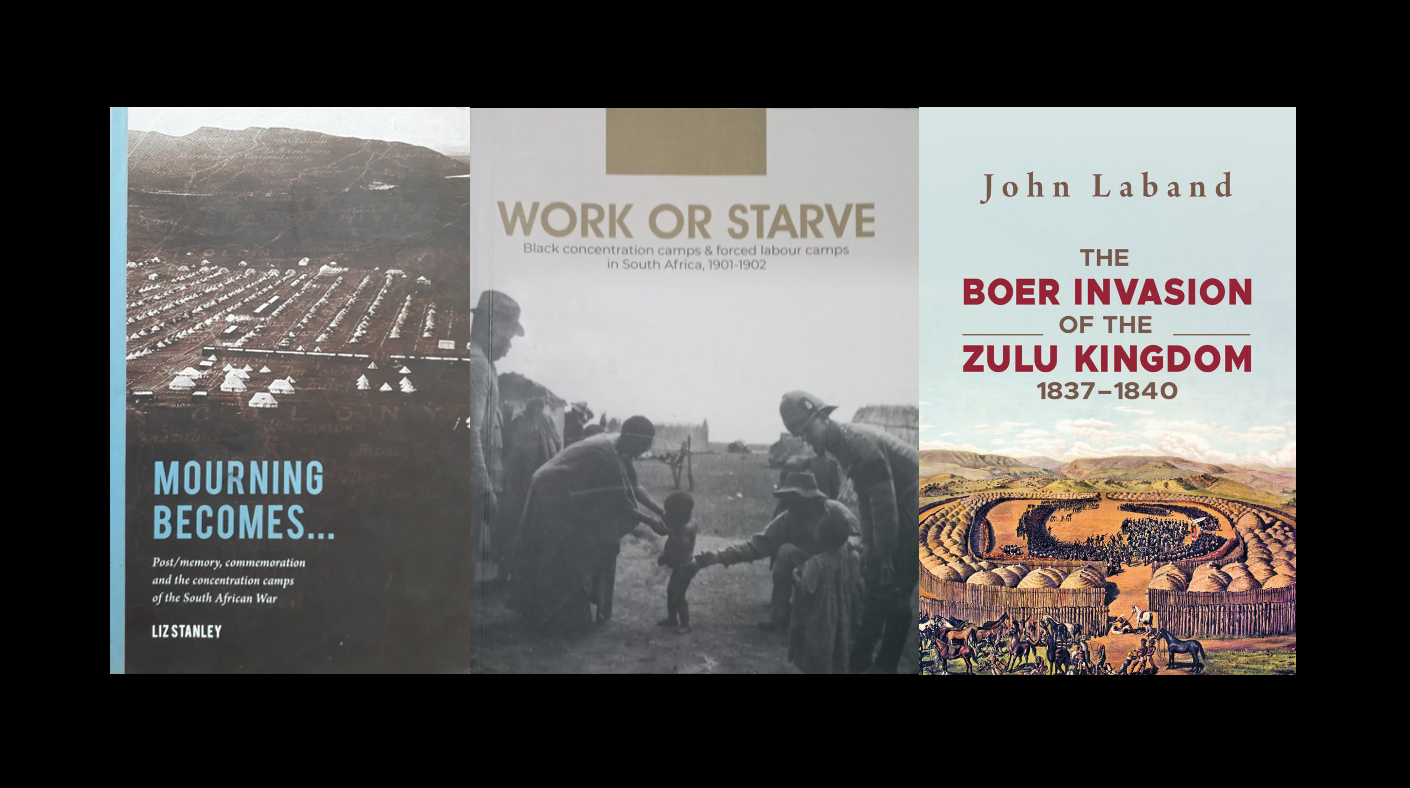
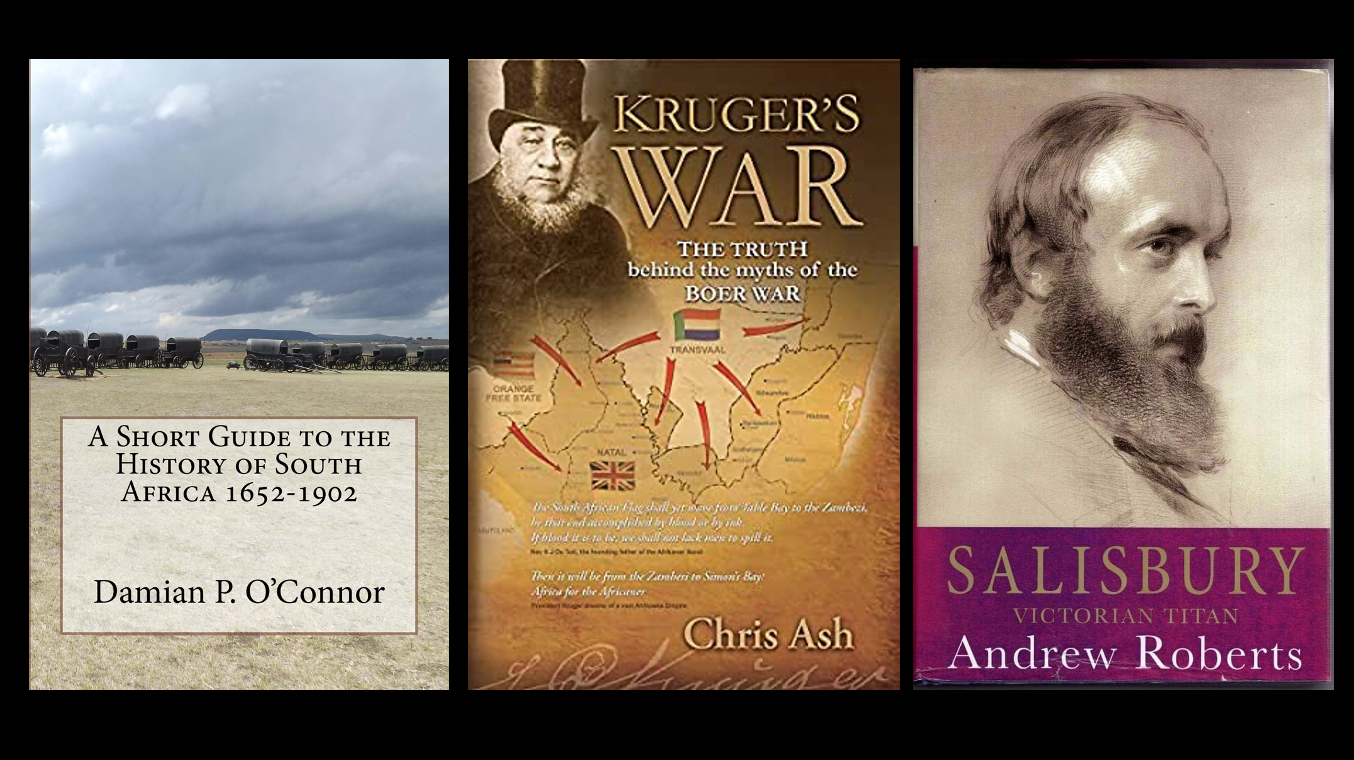
This ‘New School’ consists of historians who seriously challenge – not only the ‘Imperial School’ but also the ‘Republican School’ narratives of the war and they have punched massive holes into it, especially the ‘Republican School’ as its still a contemporary school and its been busy with a lot of ‘revisionism’ – these ‘New School’ historians include: Dr. Garth Bennyworth, Professor Bill Nasson, Dr. Peter Warwick, Dr Elizabeth van Heyningen, Professor Elizabeth Stanley, Professor John Laband etc. and even British accredited ‘Boer War’ historians like Dr. Donal Lowry, Dr. Damian O’ Connor, Andrew Roberts FRSL FRHistS and Chris Ash FRGS FRHistS … all working to unravel this politically inspired mythology, navigate this quagmire of Afrikaner Nationalism surrounding the Boer Wars and get to the truth.

Imagine the complete train-smash when social media really took off from about 2005, and all these historians came out their musky libraries and people started sharing website links, blogs, vlogs etc. of their stuff on-line. Suddenly the ‘Republican School’ historians found themselves at odds with the ‘New School’ historians in public space, and social media platforms experienced ‘melt downs’ as two separate camps of enthusiasts went hammer and tongs at one another (they still do). The ‘English’ enthusiasts accusing the ‘Afrikaner’ enthusiasts of peddling Apartheid period (Republican School) propaganda and the Afrikaners accusing the ‘English’ of peddling a new form of ‘revisionist’ history (New School) and ‘jingoistic’ (Imperial School) history. The poor ‘administrators’ – most of them local ‘Republican School’ amateur enthusiasts with ingrained cultural and identity bias – all spinning endlessly as they are not professional historians, and they don’t know much outside their ‘Christian Nationalist’ upbringings – they just figured its a good idea to open a Facebook appreciation ‘group’ – and they are especially untrained to deal with all this historical revisionism as its all ‘new’ to them.

Now, it’ll come as no surprise to anyone that I am a BIG fan of “New School” historians, I like the old “Imperial School” – Smuts, Amery, Reitz etc. because they are closer to source, some are even classified as ‘primary source’ themselves which is what any good historian should reference first – its critical to writing history. I also like the ‘New School’ precisely because they have unraveled large bodies of the Republican histories, disproven much of it as politically driven rhetoric, and simply got on with ‘correcting’ the narrative.

“New School” – Stanley, Benneyworth and Laband

It may however come as surprise to some, but absolutely nothing I have written about the Boer Wars cannot be supported by a ‘New School’ historian. Not one single article I’ve written does not have grounding, and there is nothing I’ve said that’s new, everything I’ve said has already been published by a very accredited historian. That I believe the white concentration camps are highly nuanced and not ‘genocide’ is largely due to the work of Elizabeth van Heyningen, that I believe much Afrikaner identity had a flawed underpinning is due to David Harrison, Liz Stanley and Andrew Roberts, that I believe the Boers targeted civilians during sieges is due to Garth Benneyworth and his work, that I believe the NG Church and not the British invented Apartheid is because of the work of Herman Giliomee and Damian O’Connor, that I believe that causes belli of the war was about the ZAR’s suzerainty and not ‘stealing gold’ is because of historians like Bill Nasson and even Leo Amery.

It’s not ‘conspiracy theory’ – Tinus le Roux, the chap who colourises Boer War photos, accused me of peddling ‘conspiracies’ without remotely offering a rational or proof behind his accusation, unfortunately Mr Le Roux, everything I’ve ever posted on the Boer Wars is already grounded in solid history by top flight historians – and it can all be verified and validated. I don’t make conclusions of my own on the Boer Wars as simply put – its not my specialism – it is however the specialism of these historians – so I use them extensively. The only difference is that of all these ‘New School’ historians, I am the only one that uses a website and blog with trailed social media – twitter (x), Facebook and Instragram accounts – so my ‘reach’ and ‘medium’ brings their message to a much broader audience in snap sized, fast consumption, historical interest pieces.

To take what is already concluded by many accredited historians and then turn around and say by using their findings I’m somehow suddenly “Boer Bashing” is indicative on just how uneducated, ignorant and biased these detractors are – they are simply not ‘read’ and what’s driving their view is an emotional state and not a learned state. As to Tinus le Roux, he ignored references I gave him (Benneyworth’s ‘Magersfontein’ and Stott’s ‘Boer invasion of Natal’) and refused to change his view – he should really stick to colourising pictures and get a proper historian to caption his work before he commercialises it and completely embarrasses himself.

Fools rush in

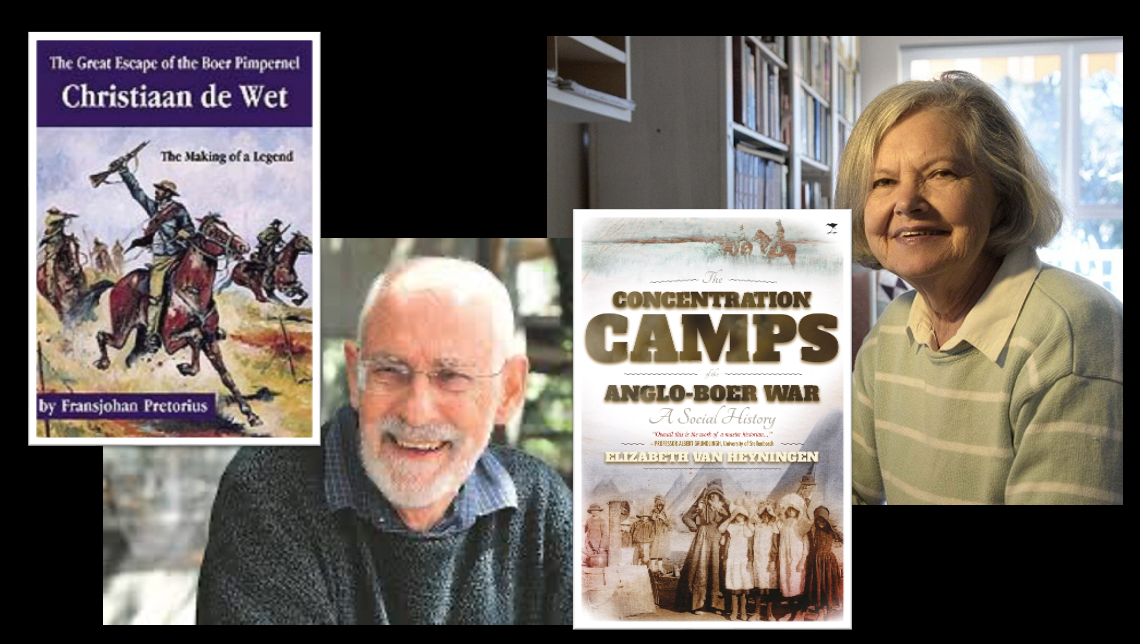
This bit is important, it’s not just the ‘Facebook’ amateur enthusiasts, even heavy weight South African historians of the old ‘Republican School’ and the ‘New School’ give each other ‘both barrels’. A case in point is Professor Fransjohan Pretorius, the ‘go-to’ Afrikaner Boer War historian from the University of Pretoria, semi-retired now but still firing. Prof Pretorius gave both barrels to Dr Elizabeth van Heyningen at the University of Cape Town and Prof Liz Stanley, now at the University of Edinburgh, for their papers and books on the white Boer concentration camps of Boer War 2. Pretorius penning scathing criticism of both van Heyningen and Stanley in a paper titled ‘The white concentration camps of the Anglo Boer War: a debate without end.’ on the basis that they ignored Afrikaner political and cultural nuances, and their research and findings were therefore academically sloppy. Stanley ignored him, but van Heyningen would have none of it and responded to Pretorius and said his remarks reinforce and ‘demonstrate the continued power of myth making among ordinary Afrikaners’ in a very erudite academic reply on white Boer Concentration Camps titled ‘Fools rush in: writing a history of the concentration camps of South Africa’.

Fransjohan Pretorius and Elizabeth van Heyningen

This ‘bun-fight’ is not just between local ‘New School’ historians and Professor Fransjohan Pretorius, it extends to the overseas ‘British’ new school historians and Fellows of the Royal Historical Society, some of Britain’s leading historians. Prof. Pretorius recently went out in the media and claimed ‘many English-speaking South Africans at present, let alone Englishmen from England’ fail ‘to understand the presence, goals and effect of British imperialism’. This of course pricked the interest of ‘English’ historians who rightly questioned as to why only Afrikaners, like Prof. Pretorius – who studied at institutions heavily financially subsidised by the National Party regime and controlled by the Broederbond, are the only ones who are wise enough to truly understand British Imperialism. Not only the derogatory and disparaging language used, but the supreme arrogance to assume that the specialists in Victorian and British Empire history and the ‘English’ themselves are not adequately equipped to understand their own Imperialist history. Naturally the strong rebuttal from qualified ‘English’ historians to these remarks by Pretorius were quickly deleted by the website owner – litnet, an Afrikaans website geared to Afrikaner academia .

‘New School’ British historians, O’Connor, Ash and Roberts – all with diametrically opposite views to that of Prof. Fransjohan Pretorius.

This supreme sense of arrogance and bias was even expressed by Albert Blake when he said of me in social media:

‘Dickens by his own words has a problem mastering Afrikaans. If you cannot read Afrikaans you will never be able to properly understand the Afrikaans way of thinking. Dickens lack thereof is apparent in his work.’

Really? Does he honestly think a historian has to be fluent in a language before he can write its history – he’s just dismissed just about every historian on the planet. I’m sure the English historian Sir Antony Beevor FRSL, whose written highly acclaimed WW2 history books on Stalingrad and the Russian conflict is not fluent in Russian – nor is he born into a German or Spanish hertitage, yet he’s written some highly acclaimed military history books on them. I’m also pretty sure the English historian Sir Ian Kershaw FRHistS FBA is not fully conversant in Yiddish and Hebrew or a born a Jew, yet he wrote some compelling works on the Jewish Holocaust. Closer to home I’d hate to know what Blake thinks of Dr. David Katz, a friend of mine and published SA Military historian, now David’s grasp of Afrikaans is the same as mine, does that make him and his work somehow unqualified?

That’s the other thing, I told Blake that I had a ‘colloquial’ grasp of Afrikaans – I can certainly speak, read and write it and at one stage in my life as a SADF officer I not only commanded in Afrikaans I thought in the language. I also have a Afrikaner heritage (two Great Grandparents), I have a Afrikaans wife (married for over 30 years) and I have a Afrikaans family, and the net result of all that is most my friendship circle is Afrikaans – so how I don’t understand the nuances of Afrikanerdom, Afrikaners and Afrikaans is anyone’s guess (methinks he’s grabbing at straws in his efforts to play to a peanut gallery) – Blake is also being hypocritical, you can reverse his logic and argue that because he is not ‘English’ himself, so he cannot comment on British history just because he cannot really understand the ‘English peoples’.

There is only really one key bias driving people like Prof. Pretorius and Albert Blake, and it has nothing to do with a home ‘language’ and everything to do with a home ‘identity’ – it’s an ingrained “victim mentality” and some older Afrikaners generally still tend to have it – brought on by decades of Broederbond indoctrination that says because of the white Concentration Camps of the Boer War, only the Afrikaner can comment on Britain’s history in South Africa, their victimhood makes their self righteousness and Anglophobia perfectly understandable. If you took this idiotic logic one step further you could conclude that ‘Black’ South Africans are the only ones who can comment on Afrikaner history because they were the victims of Apartheid – that’s how disjointed and self serving this thinking is.

But what’s with all this ‘identity’ overriding logic? Funnily its the ‘Broederbond’ at the centre of it again and for this bit – I like refer to the American satirist PJ O’Rourke’s book on holidaying in South Africa during Apartheid in a chapter he called ‘in whitest Africa’.

In Whitest Africa

So here’s the history of Afrikaner ‘identity’ not many people know about. In 1938, Henning Klopper, then the chairman of the Broederbond (and later a National Party speaker) initiated the Great Trek millennial re-enactment, his mission to bring the ‘Cape Afrikaner’ together with the ‘Boer Afrikaner’ – which he called the two separate hearts of Afrikanerdom forced apart by the Boer War and a separate history. The idea was that they would both merge with the ‘Voortrekker’ iconography, identity and historiography and jointly ‘map a path’ to a future Afrikaner hegemony, an oligarchy state with strong Christian theological belief in separate worship and all desirous of implementing a ‘whites only’ Republican paramountcy.

Long and short – it worked, Klopper would step back from his success and call it providence, divine intervention …. to quote him – a “sacred happening”. The Ossewabrandwag would carry this new Afrikaner unification under its singular identity like a ‘flame torch’, spread it like ‘wildfire’ (hence the name) from the centenary celebrations into every Afrikaner cultural organisation. The Broederbond sat with the Ossewabrandwag (OB) and the National Party (NP) and agreed the ‘Cradock Agreement’ – the spreading of this Afrikaner nationalist identity on the ‘Cultural Front’ of Afrikanerdom would be the ambit of the OB, whereas on the ‘Political Front’ of Afrikanerdom – the National Party (and the Volks Party, Afrikaner Party as well as other political organs like the ‘Boerenasie’ and ‘New Order’) would carry this identity through – and they would carry it well past the 1948 National Party election win, the 1961 ‘forward to a white Republic’ plebiscite win, all the way through ‘Apartheid’ and it’s still prevalent in modern Afrikanerdom to this day.

Two separate Afrikaner ‘paths’ to South Africa, Henning Klopper’s Centennial Oxwagon and OB ‘path’ poster to a whites only republic and Jan Smuts’ ‘path’ poster – a call to arms for Allied support and Union. One pro-British and one pro Nazi Germany.

That this is a completely artificial construct, an ideological make-believe, a Jungian archetype – that it has nothing to do with the actual historiography of large swathes of the Afrikaner community is immaterial – only some can claim this all-white ‘Voortrekker’ identity but many (in fact most) can’t. However, a great deal of modern Afrikaners have just bought into this identity – 60 years of steady indoctrination will do this.

This ‘identity’ history is also not conspiracy theory – monuments and artefacts to the 1938 Voortrekker centennial litter nearly every single town in South Africa, even in towns which never saw a Voortrekker, hundreds of thousands of people took part and it cumulated in the laying of the cornerstone of the Voortrekker monument, manually hauled up the hill by teams of the faithful. Whole thesis, academic papers and even books have been written about the phenomenon that was this event and the identity and political philosophy it created.

A ‘Kappie Kommando’ in white purity during the Trek Centenary and Nationalist media highlighting specific Afrikaner leaders the ‘volks heroes’ who ascribed to division and a whites only hegemony and leaving off those who ascribed union and an integrated society.

Here’s the thing, as to the development of Afrikaner Christian Nationalism and the keynote authors of it, Henning Klopper was a mere child with a smattering of a memory of the Boer War, however he concluded the concentration camps were – to quote him – ‘organised murder‘.  The mythology spun out from there by organisations like FAK (a Broederbond mouthpiece) amongst others – the British “stole” the gold and diamonds, the British “murdered” 28,000 Boer women and children, the British “raped” Boer women en-masse, the British committed systematic “genocide”, the British were the “warmongers” declaring the war and then the British invaded “sovereign” Boer Republics. The British “invented” the concentration camp and the “Nazis” followed their example. The British used Boer civilians – women and children as “hostage collateral” to win the war. The British were solely responsible for all the farm burnings and rural destruction. The British unfairly and illegally executed Boer commanders. The Boer War started the collapse of the British Empire. The Boers were “superior” fighters in every way but denied their victory by unscrupulous scorched earth tactics and overwhelming numbers – it goes on – it even ends with highly improbable claims – Boers inventing trench warfare, sniping, bush craft and camouflage.

Let alone all the ‘New School’ Boer War historians – just one ‘Imperial School’ book – Amery’s 7 volumes of official history of the Boer War as a starter will show that absolutely none of what I have written above is true – but this is immaterial, not one statement expressed above is historically proven, not even remotely correct, none of it factually supported – but no matter, let’s go with it – its political spin so it must be true.

Problem with writing modern South African military history is that very often you meet white Afrikaners who conflate this identity politics inspired by the Broederbond with the historiography of the Afrikaner nation. If you write any history which does not conform to the acquired belief structure or challenges it, there is a literal meltdown, they feel it is an assault on their world – their literal understanding of the way of things, their values, their personality, their language, their culture – there is a separation, cognitive dissonance takes hold and they get defensive, sometimes very irrationally so.

A case in point of conflagulated identity – Chris Pretorius, an administrator of large format Boer War Facebook group cannot compute analytical thought on any of his ‘Boer Heroes’. His stated claim is that he will not accept any criticism of General Christian de Wet for example, such heretic will be met with an immediate ban or a gag. To him, some of this ‘New School’ history is the result of “Ashism” – a concept he came up with to gag or ban anyone using ‘new school’ history and lumping them as a “disciple” of a “banned” Fellow of Royal Historical Society historian – Chris Ash – who consistently, and using sound factual support, sources and cross referencing, challenges Pretorius’ and his cabal’s very understanding of Boer War history (albeit abrasively so) – now Ash is his own historian, and I’ve seldom referenced him in the past, but no matter. These Boer War sites are truly like watching the Dunning Kruger effect in full fledge and its the reason I undertook to leave Pretorius’ media and others like it about nine months ago.

But that has not stopped some rather nasty individuals who really conflate identity with reality from cropping up, and almost all of them can be found in Facebook groups and pages run by the likes of Chris Pretorius, Tinus le Roux and John Elsegood. These individuals are so unhinged that they resort to criminal slander and even resort to sending me on-line threats, sometimes even directly – and it’s a lesson in open and brazen racism, prejudice and anti-Semitism. Everything the old ‘Afrikaner nationalists’ were about – alive and well and bubbling over in these Voortrekker and Boer War social media groups.

Amusing Fan Mail

Let’s get to the peanut gallery in these Boer War aligned social media platforms, these are some of the comments and social media mails sent to me – either directly or on my media platforms, they speak for themselves,I won’t go into all of it, but here’s some choice examples:

First out the blocks are people who because of my surname somehow think I’m British and only in South Africa at the behest of the Boere – just plain old prejudice and warped thinking. Earlier I said that as an officer in the SADF I became very astute as to Afrikaans and Afrikaners.

I recall when I entered the SADF at 5 SAI in Ladysmith as a conscript, there were a grouping of Afrikaner NCO’s with support of other Afrikaner troopies who took great delight in “bashing” (and at times literally bashing) the “English” guys accusing us of murdering their Great Grandmothers, stealing their country and their wealth  – we were called everything under the sun from “Jingo’s” to “murderers” to “rooi-nek” to “soutie”. Much delight was taken when guys were singled out with “English” surnames – “Mason” and the like, and mine – “Dickens” came in for a lot of attention and slander.

That my family were Pretoria Loyalists – my Great Grandfather born there in 1877 and he a descendent of an 1820 settler meant nothing, they had all married into Afrikaner families, I have not one but two actual Voortrekkers which are blood relatives on my paternal line (that’s more Voortrekker heritage than most Afrikaners can point to) – but this meant nothing, not a jot, as far as they were concerned I was an “Uitlander” a “Jingo”.  My “English” University (Rhodes) did not help either – because now I was also just lumped as a “fokkin Kommunis” in addition.

I can see these “clowns” coming a mile away – here’s some of them.

Then there are believers in ‘General’ Manie Maritz and his autobiography which promoted the anti-semitic and anti-masonic and highly discredited ‘Protocols of the Elders of Zion’ to the Boer nation – these clowns are so unhinged that pure racism, prejudice and anti-semitism is perfectly acceptable in an on-line space when writing to me.

Then there’s these gems from Rudi Rousseau, I took on one of his acolytes in a Boer War group and the next minute a PM appeared in my mailbox. I maintained that Rousseau, who is a self appointed historian for “Boere media”, defaced the monument at Surrender Hill in the Free State when he cemented a granite plaque to it which called the surrendering Boere “verraaiers” (traitors) and absolved Christian de Wet of abandoning his command – his action really no dissimilar to any defacing of a war memorial and as unhinged. The next one relates to a Blood River post, and Rousseau is so conflated with mythology and the idea of a “super-Boer” that he honestly believes a handful of Boers fought off 350,000 Zulu at the Battle of Blood River in 1838 – as stated earlier this kind of thing is not unusual in some circles.

It’s not only the nut-jobs, racists and anti-semites – I’ve even received a threat from a Dominee in the NG Church, a senior member of one of their Synods. He took the time out to write to me and say my “Boer hate” will be exposed in a future book. The background to this is a Jopie Fourie discussion where I attested that Jan Smuts was not present in his house when the Malan contingent arrived and the rightful person as Prime Minister to receive such a contingent was Louis Botha. His reference is to a conspiracy he believes in – that Smuts burned the Fourie case court records. I’ve blanked out his surname and picture as if this sort of crap continues he will lose his job for ‘bearing false witness’ against me and good ‘ol basic libel and slander – and he happens to be on Albert Blake’s Facebook friend profile. If there is a link, the gloves in this matter will come off and some very public naming and shaming will follow.

On Blake again, he also went into social media with this prize comment – and its pure “hearsay”, surprising here for a lawyer again, its up there with Jeremy Clarkson on Top Gear and the famous “some say”:

….. “some say” he sleeps upside down, all we know is he’s called the Stig!

Blake said of me:

‘Dickens has been called “Jingo Dickens” and labelled a “Boer /Afrikaner basher” by others. He should seek the true reasons thereof. He clearly thrives on the sensational.’

Now, I’ve just posted the choice individuals who have called me a “jingo” in the past and I know the reasons, as anyone can see most of it is nut job slander and has no credibility whatsoever. As to hearsay and the “some say” principle, this would be like me going out on a public forum and saying of him:

‘… “some say” Blake is a Plagiarist, I’ve heard from others he’s known as “Copycat Al” and he should find out why.’

The Dam’s Geese

I will conclude this in a language Albert Blake will understand, and it’s a courtesy to him, as this cess-pool from which he is trying to “investigate” my alleged “Boer hate” is now open for him to review, and I say this to him in pure honesty:

‘Luister nou mooi makker, hierdie is nie ons dam se ganse. Meng jou met die semelsdan vreet die varke jou.’


Written by Peter Dickens 

Romancing the Rebellion

Seems there is a lot of social media chatter surrounding Albert Blake’s new Afrikaans book on Jopie Fourie. One Afrikaner pundit after reading the book declaring anyone not familiar with the ‘truth’ about Jopie as a ‘Volksheld’ and the Rebellion is now a liar and this in his world includes any other qualified historians, other than Albert. Albert Blake himself even declaring his new work is the definitive one and the only medium to be referenced (problem is, only people who are fully literate in Afrikaans can read it).

There is undoubtably some truth in the old saying ‘history is written by the winners’, however very often the ‘plucky loser’ is a perennial favourite of propagandists, myth makers and entertainers (including Hollywood), they are often romanticised and idealised, given virtuous christian outlooks, a civilised veneer and great martial abilities – the little guy taking on the big bully. This is especially true of the 1914 Afrikaner Revolt and Jopie Fourie … and many of its local Afrikaner historians and laymen enthusiasts.

All this Boer romanticism and the portrayal of old Zuid-Afrikaansche Republiek (ZAR) as a benign place for a freedom loving people merely wanting it back – a foreign example of this is the Confederacy in the American Civil War (1861 to 1865), and here a Royal Historical Society historian, Chris Ash made a rather humorous comment and it rings especially true:

“Until very recently, they were certainly viewed by most as the more ‘glamorous’ of the two sides… gallant, good looking Southern gen’lemen who ‘frankly didn’t give a damn’, galloping off to fight against impossible odds against a massed industrialised hordes of a faceless enemy who wanted to end their bucolically halcyon way of life. Throw in a few gorgeous Georgia Peaches – called things like Emma-Lou and Daisy-Belle – all with heaving bosoms barely contained by beautiful ball gowns, and you’ve got all the makings of a heroic myth of doomed failure… well, as long as you ignore that the South started the war, and that they were fighting to retain slavery!”

There is an old proverb, and its especially true to historians “never meet your heroes” .. because in getting to the actual historical figures, you need to analyse who they are as people, how they view the society they live in at the time, and how that society views them. In their context of their time, you as as historian need to overcome your prejudices and start to look at things in a critical way.

This is especially true if you grow up with a ‘rebel’ as a person central to your entire identity, because as true as the sun rises that ‘rebel’ is going to be controversial and for good reason – and very much of this hero will depend on what they are fighting for … and “freedom” is the usual caveat … but then you start to really meet your hero when you ask the next question “freedom for whom?” Here it is where the hero worship of the 1914 Afrikaner rebellion leaders like Christiaan de Wet, Manie Maritz, Jan Kemp, Christiaan Beyers and Jopie Fourie starts to wobble somewhat .. sure they are fighting to free themselves from British oppression – they all said so, including Fourie the day before his colleagues shot him, but he like the others – Maritz, de Wet, Kemp and Beyers are also fighting for their stated aim of the Rebellion, and that’s a completely different kettle of fish.

Insert – Christiaan de Wet on winged horse with damsel holding onto him. Main image – the movie poster from Gone with the Wind.

Now, there is a small problem with the history of the Rebellion – and one of them is the complete lack of history books in English and even less written at the time of the revolt – the complete Afrikaner romanticism of the rebellion all comes much later with the advent and rise of Afrikaner nationalism and a plethora of Afrikaner academic papers, novels and books.

For simplicity sake, there is a ‘English’ side to the 1914 Afrikaner Rebellion story – the majority in the country if we consider all races and nationalities caught up in the Rebellion and there is a ‘Afrikaans’ side of the story, a minority – driven initially by Hertzog and his breakaway cabal of pro Republican Afrikaner Nationalists from the Botha/Smuts South African Party (SAP) in 1914 and then it is heavily driven by a far right grouping of ‘pure’ nationalists after their break with the Hertzog/Smuts Fusion before World War 2 (1939-1945) – and they went about using mass media, aligned academics in ‘Afrikaans’ universities and all manner of propaganda to ‘set the Rebel story strait’ – even Radio Zeesen from Nazi Germany with its renegade Nationalist broadcasters went full tilt at glorifying Fourie, the Rebellion and demonising Smuts during World War 2.

For any historian to take a grip on the 1914 Afrikaner Revolt in 2024, the bank of both primary and secondary source becomes invaluable and it sets up the validity of what you are going to say, ensure whatever it is holds up to academic scrutiny by your peers. In respect to using both primary and secondary sources, the closest you are to the historical figure in question the more accurate and valid the work – so here we find original accounts by people involved in the events as the key.

There has only ever been one comprehensive history book written in English on the Afrikaner Revolt and luckily for us its very close to the events of 1914, it is published a year later in 1915 and its written by a journalist very closely tied to the whole 1914 Revolt having interviewed the principle characters personally and been witness to the events himself. The book is called “The Capture of De Wet” and it’s written by PJ Sampson.

Now, unlike all the Afrikaner historians writing for a Afrikaner market on the 1914 Afrikaner Rebellion who come after PJ Sampson (many come decades after him), Sampson is just not interested in presenting a counter-case for High Treason for the Rebellion – the old Afrikaner Nationalist’s “volks-veraairer” versus “land-veraairer” (traitor to your ‘people’ as opposed to traitor to your ‘country’) argument which has been going round and round Afrikaner family kitchen tables for 110 years and still rages on – nope, Sampson records none of that, in fact he sees the ‘treason’ argument as clear cut one in 1914 and the execution of Fourie as inevitable.

Sampson is not alone, I published an article on my visit to Scapa Flow where unarmed German sailors responsible for sinking their surrendered Imperial fleet were executed for sedition on the spot as they came ashore – some by way of bayonet. 1914 and World War 1 (1914-1918) veterans looked at treason and the execution of traitors very differently to the way we look at it now. Fourie is lucky he got a trial and not a drumhead trial and on the spot execution, at that time if you committed treason or sedition, with war declared and domestic state of emergency regulations in place – you got dragged through an administrative formality which lasted barely a day, then taken out back in the morning and shot – that is what happened to Fourie and that was the way of things then.

Smuts during WW1 and a young Fourie in the insert.

I’m also not alone, one of the principle characters in the Jopie Fourie story is General Jan Smuts, Jan Smuts himself would regard Fourie as having “shed more blood than any other officer.” With the rebellion lost, Beyers drowned and General de Wet surrendered … Smuts would say:

“Only Fourie’s band remained contumacious. Twelve of our men were killed at Nooitgedacht. There was no justification for that. Some of them were shot at a range of twelve yards … A court martial was appointed, strictly according to military law. One of its members told me he felt compunction about serving, because he was a friend of Fourie’s. I replied that that was an additional reason why he should be on the tribunal. On Saturday Fourie was unanimously condemned to death…”1

Smuts would go on to say:

“Had I refused to confirm the sentence, I could not have faced the parents of the young men who met their deaths through Fourie’s fault. There is something to be said for many a rebel, but in this case I conferred a great benefit on the State by carrying out my most unpleasant duty..”2

Smuts remained convinced that a fair trial had taken place, the correct legal framework in place, as to all the rebels Fourie was an exception and Smuts was unrepentant in the outcome, in fact he saw Fourie’s execution as unavoidable and it was his duty to see it through – his attitude had hardened, his son – Jannie Smuts in his biography of his father would write very little on Fourie in the entire appraisal of Jan Smuts’ life and career, Fourie is barely a footnote, a wayward rebel, nothing more.

A lot is also written about by Neo-Nationalist historians and disgruntled Afrikaner commentators on Smuts’ so-called “refusal” to entertain last minute efforts to intervene and reprieve Fourie, Jannie Smuts Junior is however dismissive of this and confident his father “would not have interfered in the course of justice” in any event. So this entire episode in the story really is a non-starter.

The execution of Fourie, the South African Policemen who executed him removed his cell-door as a keepsake to commemorate the occasion (reference Nongqai).

In fact Sampson views Fourie as somewhat deluded and misled, he even sets aside an entire appendix to demonstrate the flaws in Fourie’s understanding of history, his thinking and the flawed nature of his defence testimony, which Sampson tears apart completely and simply dismisses as unreasonable and deluded – instead Sampson takes pity on Fourie as someone who cuts a tragic figure having been misled by less scrupulous men like Maritz, his execution a foregone and unpleasant conclusion.

The main thrust of Sampson’s book is however on the objectives, mission and stated aims of the Rebellion. Although the long-standing Anglophobia caused by the Boer War is considered, it is not Sampson’s focus, simply because he, like many English commentators of his time, they understand the tragedy of the concentration camps and the pain they caused at face value, they see the deaths in context of measles and typhoid epidemics which sweep the camps due to hardship and unsanitary conditions brought about by war – a tragedy and nothing more. The ideas of ‘genocide’ and ‘murder’ of the Afrikaner nation are completely foreign to Sampson and other British historians like Amery of the time and this thinking would qualify fantastical thought at best.

Manie Maritz in this South African Union Defence Force uniform and staff prior to the 1914 Afrikaner Revolt (Maritz Revolt). Lt. Col Maritz is seated front and centre with his ‘Agterryer’ (man-servant) at his heels. It’s the man-servant’s expression and position that is most interesting as in many ways it gives away the complete disregard Maritz felt for people of colour.

Sampson is more interested in the politics of the Afrikaner Revolt and the politics of the leaders taking part in it, the political circumstances in South Africa in effect (and less so the geo-political circumstances). Here Sampson argues that the ‘colour blind franchise’ and human rights for ‘natives’ are also key motivations for the rebellion – the rebels intent on maintaining a Afrikaner led hegemony, an oligarchy based on “Krugerism” as an ideology – which means no franchise, emancipation and limited human rights (if any) to anyone of colour. The declaration of war presents an opportunity for these Afrikaner leaders, with the assistance of Germany, to take over the whole of South Africa and implement this political construct of theirs, much like the post American Civil War traitors like John Wilks Booth and his rebels in 1865 trying to “raise the South” again and reclaim slavery. Sampson refers to the animosity between the ‘Free State’ Boers like Christiaan de Wet against the ‘Transvaal Boers’ of Smuts and Botha over the colour blind franchise, de Wet fearful that Smuts and Botha are ushering it in and it’s all very unacceptable to him.

Now, to anyone paying attention to the history, the colour blind qualified franchise across the entire country (not just in the old British Cape Colony) is one of the key demands by the British for a peaceful settlement of the South African War (1899-1902) ie. Boer War 2. It is the only clause that is dropped out the Peace of Vereeniging agreement as the Boers absolutely refuse to abide it and its a deal breaker. It is only dropped on the proviso that a future Union government, when it is granted self governance, will implement it – Smuts assures the British that he is the man to see it through and all the Boer signatories to the agreement promise they will address it when a Union and self determination is declared (this includes de Wet, Kemp and de la Rey et al)

The South African Union and self determination/responsible government is granted by the British to Botha’s ’South African Party’ (SAP) in 1910. However inside the SAP, Smuts and Botha are simply unable to move on the colour blind qualified franchise as the likes of de Wet and Hertzog will have none of it, 4 Years later it’s beginning to become a problem as an entire black population waits for its emancipation (and its rewards for taking part in the Boer War, the majority of them supporting the British).

Say what! It’s not all about the hatred of the British, Concentration Camps, forced to fight for the British against friendly brethren Germans …. Its about the … blacks!

What you smoking? Yup, I’m afraid there it is, commentators at the time like Sampson were pointing to issues of race – the internal politics at play, not just the geo-politics. To set up the ‘race’ argument Sampson goes in depth into each of the leaders of the revolt by way of outlining their character and disposition to race.

Beyers is described as a very religious man, however he was inordinately vain of his personal appearance (which looking at his pandering to his hair, a monumentally stylised moustache and his disposition to fine and dandy clothing sounds about correct), and regarded as megalomaniac by the man in the street, in fact they “used a more expressive term” to describe him – one not for polite publication. Beyers after the Boer War took to entertaining “veldt Boers” coming in for ‘indabas’ in Pretoria and he earned a reputation as a Anglophobe with a “with a particularly venomous tongue.”3

De Wet is described by Sampson as a different sort of person to Beyers. De Wet too is religious but religion does not dictate his actions – politics does. He is angry with Botha and Smuts for removing Hertzog from cabinet. As a Free Stater he is unhappy with these “Transvaal Boers” entertaining the British request of ‘colour blind qualification franchise’ (which is in fact a Boer War 2 peace treaty pre-requisite). It’s here that we see a common thread in many of the rebel leaders, sheer racism and a desire to maintain an white Afrikaner led oligarchy in South Africa with no rights whatsoever to anyone of colour.

Sampson places De Wet into what he calls a “Old School” Boer whose:

“Abiding fear always has been that British government in South Africa meant that the ascendancy of the whites over the blacks would cease, and one day the kaffirs would be permitted to be on an equality with the whites.”4

Sampson cites this fear of Black ascendancy over Whites as a primary rally call for the Boer Republican armies during the South Africa War (1899-1902). He goes on to outline De Wet deep hatred for Black people as his primary motivator for going into the 1914 Rebellion, he writes:

“De Wet always has treated kaffirs with severity, regarding them as little better than animals, whom he believed he ought to have the right to thrash as he would a dog, it only needed a fine for ill-treating a native to bring on a raging brainstorm that drove him headlong into the maelstrom of rebellion. To fine him, De Wet, was the greatest outrage conceivable, and clear proof that the time had come to strike a blow for freedom!”5

This sentiment and motive for De Wet going into Rebellion as outlined by Sampson is borne out by Jan Smuts, who later uses the fine De Wet gets for assaulting the said black man with a shambok – which was 5 shillings. In broad media, Smuts belittles both De Wet and his purposes behind the revolt by calling it the “5 Shilling Rebellion”.

Christiaan de Wet would go on to say of the Colour Blind Qualified Franchise policy and the fact its still upheld in the Cape Providence:

“The ungodly policy of Botha has gone on long enough, and the South African Dutch are going to stand as one man to crush this unholy scandal.”6

Manie Maritz is also described within his deep-seated racism – he is noted as a man of:

“Enormous strength, inordinate vanity, little education, and the one, perhaps, of all the rebels most open to the influence of German gold.”7

Jopie Fourie is described by Sampson as a religious mans and a very pleasant man – however his Anglophobia seemed to have grown on him like a disease starting with his resentment because of a permanent limp, caused by a bullet wound in the knee during The South African War (1899-1902), and this:

“intensified the bitterness to one who had been a fine footballer and athlete”.8

What follows in ‘The capture of De Wet’ is the ‘Black’ part of the 1914 Afrikaner Revolt, the declaration from Maritz stating that any blacks standing in the way of the rebels will simply be executed. His declaration Maritz states:

“Several cases are known where the enemy has armed natives and coloured people to fight against us, and as this tends to arouse contempt among the black nations for the white, an emphatic warning is issued that all coloured people and natives who are captured with arms, as well as their officers, will be made to pay the penalty with their lives.”9

The killing of Allan William King, the Native representative by Fourie’s Commando. The declaration by the said ‘Natives’ to avenge King and enter the war on their own terms and wipe Fourie’s Commando out by themselves – they are held back by King’s wife who pleads with them for restraint. Sampson notes of ‘rise’ of the ‘Natives’ to avenge King:

‘The natives of the district were almost crazy with rage at the loss of their ” Father,” as they deemed Allan King …. They sent a deputation of chiefs and headmen into Pretoria to see the wife of their dead “inkosi,” to assure her of their love for him … and said to her “Say the word, and we will kill every one of these bad men, and also their wives and children !”10

But Mrs. King shook her head and forbade them to raise a finger, for well she realized the horrors that might follow if once the natives commenced reprisals. The rebels have to thank the wife of the man they so unfairly shot that all their throats were not cut that night, their wives and children assegaied, and their homes given to the flames.’11

The position of Sol Plaatje as to the revolt and Native rights also becomes important. So too is the lambasting of Christiaan de Wet and his martial abilities – and even his influence, his reputation shattered.

Not only Sampson, General Jan Smuts was highly critical of Christiaan de Wet’s fighting abilities and strategic acumen. His son Captain Jannie Smuts would record his father’s disposition, it gives an interesting insight on de Wet and his disposition to making irresponsible strategic and operational decisions – driven instead by emotion and irrational ideals, here it is:

“It might here be noted that there was considerable divergence of opinion amongst the (1914) rebel leaders on their course of action. Beyers wanted a relatively passive though armed form of resistance – the type that came to be known as a “coup” in the Second World War. He was against civil war. De Wet, more fiery and impetuous, was for vigorous action and pushing through to connect up with Maritz. In his zeal he forgot that he was poorly armed, had no field guns, and was short of ammunition. He also failed to reckon with the mobility afforded the Government by the much-extended railway system, or the advent of the petrol driven motor-car”.12

In other words, as a pivot leader of the Boer Revolt of 1914, Christiaan de Wet was flying by the seat of his pants (a trait not uncommon with his approach to the South Africa War 1899-1902) – completely unprepared he was bent on full sedition and revolt to reinstate ZAR republicanism, an oligarchy run on a Boer paramountcy and its severe laws of racial exclusivity and repression throughout the South African Union – paying little regard to the strategic ramifications, operational requirements or even modern military advancements, completely underestimating his enemy, just blindly pursuing his “impetuous” pipe dream. 

Yup, its a WHOLE different view of the Afrikaner revolt and its not one you get from your Afrikaner Christian Nationalist education and its certainly not one you get from modern day Afrikaner historians. They have been telling you it’s all about ‘the British’ for decades … and meanwhile, the one and only ‘English’ historian to write on the matter at the time is simply dismissed, completely bypassed – his work simply discarded as ‘jingoism’ – so not relevant.

One thing is a truism, and its true of many Boer War or Boer Revolt books and academic papers directed to Afrikaner consumers in the past, is that the works tend to cater to a specific Afrikaner ‘Volksgeist’, one which has little resonance outside of white Afrikaans culture. These works tend to highlight the ‘whiteness’ of the conflict, and focus primarily on Afrikaner cultural dynamics. One hopes that any new book on the 1914 Afrikaner Rebellion brings something new to the table, one in which the ‘Black’ and the ‘English’ part of the 1914 Rebellion is fully appraised, researched and understood, an in-depth appraisal of race politics of the time, the role played by Black Africans, Coloureds, Indian and even English speaking white South Africans in the revolt i.e. the majority of South Africans – their political representations, reactions and aspirations – what they were “fighting for”, their “freedom” in effect.

Without this, the majority of South Africans will find themselves, once again, as by-standers to this history and they will pay no attention to it whatsoever. The ‘new’ work having no real resonance to modern South African society – just a re-packaged, re-marketed regurgitation of the old white Afrikaner Nationalist debates targeted at a fresh new Afrikaner audience for a little commercial gain.

As a very reputed historian – Dr. Damian P. O’Connor, also pointed out recently, the problem with removing or brushing over sources, especially written accounts such as this one from the period, on the basis of ‘jingoism’ or just ‘not conveniently fitting’ into a Afrikaner nationalist political narrative or even an Afrikaner author’s bias brought about by years of nationalist identity politics and socialisation … is that once we’ve dismissed a first hand written account we are left with nothing, just pure hearsay and verbal tradition .. empty space in effect, and into that ‘empty space’ anyone can write anything they like, we can just make it up. It becomes revisionist history – pure ‘gone with the wind’ romantic drivel.


Written and Researched by Peter Dickens

References:

  • The Capture of De Wet. The South African Rebellion 1914 – Sampson, Philip J. Published Edward Arnold, London. 1915
  • JC Smuts. Jan Christian Smuts by his son J.C. Smuts. Heinemann & Cassell Publisher, 1952.

Footnotes

  1. Smuts, Smuts by his son, 239 ↩︎
  2. Smuts, Smuts by his son, 240 ↩︎
  3. Sampson, Capture of De Wet, 5 ↩︎
  4. Sampson, Capture of De Wet, vii ↩︎
  5. Sampson, Capture of De Wet, vii ↩︎
  6. Sampson, Capture of De Wet, 148 ↩︎
  7. Sampson, Capture of De Wet, vii ↩︎
  8. Sampson, Capture of De Wet, vii ↩︎
  9. Sampson, Capture of De Wet, 252 ↩︎
  10. Sampson, Capture of De Wet, 191 – 193 ↩︎
  11. Sampson, Capture of De Wet, 193 ↩︎
  12. Smuts, Smuts by his son, 234 ↩︎

The Boer War’s Freemasons

To answer a question recently posted on Boer War appreciation media as to whether Freemasonry and the Boer War are in some way linked. The origin of this bizarre statement lies in Manie Maritz, the 1914 Afrikaner Revolt leader, who became convinced of a Masonic and Jewish conspiracy to start the second Boer War. More on insane machinations of Maritz later, however to answer the question – no – Freemasonry as a fraternity and the two Boer Wars – the Transvaal Revolt (1880-1881) and The South African War (1899-1902) – have nothing to do with one another, as much as some deluded conspiracy theory driven arm-chair historians would like to to make a connection. In fact, as in many wars over centuries in many countries, Freemasons have landed up on opposing sides shooting one another – the most significant example of this is The American Civil War (1861-1865).  For those ‘in the know’ Freemasonry plays no role whatsoever in starting (or preventing) wars, which is not surprising as Freemasonry is a charitable fraternity with principles relating to self actualisation and brotherhood.

It’s also not a ‘British’ thing. Freemasonry started in South Africa under the Dutch Grand Lodge, the Orient of the Netherlands in 1772 .. long before the British played any role in South Africa. The oldest Lodge is South Africa is a Dutch Constitution one – De Goede Hoop Loosie – its temple is located inside the Parliamentary buildings complex. It also does not mean the Dutch and English speaking South Africans are separated by English and Dutch constitutions, you’ll find English and Afrikaners in both. Case in point are the early Voortrekker leaders who were Freemasons – Andries Pretorius was a Freemason, he even opened up a Dutch constitution Lodge in Pretoria. Piet Retief was also a Freemason, but of the English Constitution whilst he was living in the Eastern Cape.

Here’s an interesting artefact, this one is located at the Pinelands Masonic complex’s historic display (my photo) – commemorating past South African state land Boer Republic leaders who were Freemasons. For interest, and it’s all in Public space – just ‘Google’it. As notable Boer Freemason Presidents and Prime Ministers go these include:

  • General Louis Botha – Boer War Bittereinder General. 1st South African Prime Minister of the Union of South Africa: 1 May 1910 – 27 August 1919, Prime Minister of the Transvaal: 4 March 1907 – 31 May 1910
  • President Johannes Brand – 4th President of the Orange Free State: 2 February 1864 – 14 July 1888. Awarded a British Knighthood.
  • President Marthinus Wessel Pretorius – 1st State President of the Zuid-Afrikaansche Republiek (Transvaal Republic): 22 October 1866 – 20 November 1871. Established the ZAR and its constitution.
  • President Thomas François Burgers – 4th State President of the Zuid-Afrikaansche Republiek (Transvaal Republic): 1 July 1872 – 12 April 1877. Introduced the ZAR’s currency.
  • President Francis William Rietz – 5th State President of the Orange Free State: 10 January 1889 – 11 December 1895 and State Secretary of the ZAR in the lead up to Boer War 2.
  • Acting President Pieter Blignaut – Acting State President of the Orange Free State: 14 July 1888 – 10 January 18891
Top Row left to right: Brothers Louis Botha, Marthinus Pretoruis and Thomas Burgers. Bottom Row left to right:: Brothers Johannes Brand, Francis Reitz and Pieter Blignaut

A very good barometer of the early development of the ZAR (Transvaal) and the very cosmopolitan nature of Pretoria with its Voortrekkers, NGK Churches, Jewish traders, British loyalists and Anglican Churches – before the discovery of significant gold deposits and the establishment of Johannesburg – is to look at Freemasonry in the ZAR. The first Freemasons Lodge was a Dutch constitution Lodge in 1862, the Aurora Lodge .

The corner stone of the new temple for this Lodge was laid by President Burgers, as noted, a freemason himself, on 27 May 1876. On the Freemason’s English constitution side, the ZAR voluntarily dissolved itself (led by President Burgers ironically) and it became The British Colony of the Transvaal in 1877 (the first version, there are two). The first English constitution lodge was established a year later on 15 January 1878, called the Transvaal Lodge – and its was established a mere 2 years after the Dutch’s Aurora temple was built. The Aurora temple was destroyed during a severe thunderstorm, disheartened and not keen to start all over again, the Dutch constitution freemasons joined the English constitution freemasons at the Transvaal Lodge (and here’s a rare photo of them).

The Masonic Hall in Pretoria and the Transvaal Lodge in 1884

Here’s another interesting wartime photo – Dutch and English/Scottish/Irish constituted freemasons getting together in the middle of the South African War (1899-1902) a.k.a. Boer War 2 near Bloemfontein. On 12 December 1900, in the middle of the fighting a meeting was held in Jagersfontein, attended by both British (English constitution) and Boer Freemasons (some of which were Dutch constitution) – both on separate sides, but happy to meet one another under a banner of brotherhood. Here’s a fascinating picture of the occasion.

Freemason meeting – Jagersfontein, December 1900

Other famous ‘Boer War’ Freemasons on the ‘Republican’ side include:

  • Commandant General Petrus ‘Piet’ Jacobus Joubert, Commandant General of the ZAR Forces, Vice President to Kruger and Boer War 1 and Boer War 2 veteran. The overall commander of Boer Forces at the start of the war. and political opposition to Kruger.
  • General Benjamin Johannes “Ben” Viljoen, Bittereinder Boer War 2 veteran and American Boer colony pioneer.
  • Commandant Danie Theron, renowned Boer War 2 scout, bittereinder, commander and national Boer hero.
  • Deneys Reitz – veteran Boer War officer and the author of ‘Commando’, although it his noted that he only became a Freemason after the Boer War, as noted his father President FW Reitz was also a Freemason.2

Of the famous ‘Boer War’ Freemasons on the ‘British’ side, these include:

  • Field Marshal Lord Roberts Frederick Sleigh Roberts, 1st Earl Roberts and a Lodge in South Africa is named after him.
  • Field Marshal Herbert Kitchener, 1st Earl Kitchener
  • Sir Winston Churchill but only became a Freemason after he left South Africa after his service in the Boer War and returned to the UK.
  • Sir Charles Warren was a notable Freemason
  • Cecil John Rhodes was a very committed lifelong Freemason.3
Significant Freemasons of the South African War (1899-1902) Boer and Brit.

Of the famous authors associated with the Boer War, Joseph Rudyard Kipling, the famous author of the Jungle Book was a Freemason, so too was Arthur Conan Doyle. Leo Amery, who penned the first official history of the Boer War for the Times was also a Freemason.  

As to co-operation, during the Boer War, many lodges closed. Some of the buildings used by the Freemasons were used for hospitals such as the Masonic Lodge in Mafeking and the Masonic Temple in Johannesburg. During the Boer invasions of northern Natal at start of the war in October 1899, the Masonic Lodge in Dundee was plundered by the Boer Republican Forces, however the Lodge’s artefacts were found and respectfully returned to the Lodge by Boer Freemasons.

Loot taken from the Masonic Lodge in Dundee by Boer Republican Forces. Image courtesy of the Talana Museum Archive.

Noted here, is there is NO General Jan Smuts – there is no evidence whatsoever that he was a Freemason. Many historians have tried to confirm the ‘conspiracy theories’ and there is no evidence, zilch, nothing – not here in South Africa nor in Britain. Smuts is not a Freemason, no matter how much many people wish he was (conspiracists and Freemasons alike).

Of the other ye olde Boer Republic Freemasons in leadership roles the only other significant ones who were NOT Freemasons were President Paul Kruger (his Dopper approach would not have allowed him) and Prime Minister Barry Hertzog. Of the British ‘hawks’ in starting the Boer War, there is absolutely no conclusive evidence that either Alfred Milner or Joseph Chamberlain were Freemasons – sorry for all those conspiracy theorists again. Maybe the decision to go to war should have been left to the Freemasons to negotiate and there would not have been war in the first place … and look there – I’ve created a conspiracy with no grounding whatsoever.

Image: President Paul Kruger and the British Colonial Secretary, Joseph Chamberlain, having a dust-up both were NOT Freemasons and no brotherly love lost.

Another point in the respect of famous people associated to the Boer War by way of historic sweep who are NOT freemasons .. all the ‘Pure’ National Party’s Presidents and Prime Ministers were members of the Broederbond – from D.F. Malan all the way to their last one, F.W. de Klerk and as a result of their rather perverse public animosity to Freemasonry, none of them were Freemasons. Also, none of them were ‘significant’ Afrikaners in the formation of ZAR, OFS or Union of South Africa, nor did any of them play any significant role in the Boer War – Dr D.F. Malan sat out of the war in safety – for that matter all of them sat out WW1 and during WW2 they either tacitly or overtly supported Nazism while sitting out of that war too. The best they could come up with was a ‘keep South Africa white’ South African Republic in 1961 and Freemasonry must surely thank its lucky stars that it is spared from any association with it for a change, conspiracy or otherwise.

As noted in the beginning, one origin of this bizarre link of Freemasonry to the Boer Wars is ‘General’ Manie Maritz, the Boer War Commander, 1914 Afrikaner Revolt leader and leader of the National Socialist Boerenasie movement. In the mid 1930’s Maritz would become a convert to the racist and anti-Semitic mythical and completely discredited ‘the Protocols of the Elders of Zion’ and convinced of a Jewish and Freemason conspiracy to world domination. He would make the ‘Protocols of Zion’ his life’s meaning and his mission to educate the Afrikaner people (his ‘Volk’) to it – and in it he would blame the ‘hidden hand’ of the Jews as the true conspiracists behind starting the Boer War. He would then go into mortal combat with General Jan Smuts calling him the King of the Jews and therefore a traitor to the Afrikaner people.4 Yet, believe it or not there are still some people out there who would gobble this sort of crap up.

If you want to see how this conspiracy theory nut job rubbish Maritz promulgated in action, consider this, the Broederbond opposed Freemasonry – as a net result the post 1948, the National party’s Minister of Justice C.R. “Blackie” Swart (a Broederbonder himself) famously accused the Freemasons and the ‘Sons of England’ (another South African lodge based fraternity) in the media of infiltrating Sailor Malan’s ‘Torch Commando’ political protest movement in 1952 and in so plotting to militarily overthrow his Apartheid government.5 Pure unfounded gobbledygook and you just can’t make this stuff up!

In my book none of these ‘Pure’ Afrikaner Nationalists really qualified ‘great’ Afrikaners in any event – the simple truth is that they were a fringe party of far right-wing nutters .. nothing more. Also, point to note, no – by bringing up famous Boer leaders who either were or were not part of the Freemason fraternity, I’m not “Boer Bashing” and discrediting Afrikanerdom – because that would be equally daft.


Written and Researched by Peter Dickens

References:

  • 250 Years of Freemasonry in South Africa – Commemorative Publication 2022, all Constitutions. Published by the Grand Lodge of South Africa
  • United Grand Lodge of England. On-line repository
  • Maritz, Manie ‘My Lewe en Strewe’ Pretoria 1939

Footnotes

  1. 250 Years of Freemasonry in South Africa ↩︎
  2. Ibid ↩︎
  3. Ibid ↩︎
  4. Maritz, My Lewe en Stewe‘, pages 97 – 270 ↩︎
  5. P Dickens, The Rise and Fall of the Torch Commando – Part 4, on-line record for The Observation Post ↩︎

Bechuanaland’s Aerial Pipeline

Intelligence and Counter Intelligence Operations against the South African Liberation Movements, 1960–1965.

By Garth Conan Benneyworth

Abstract

The road and rail pipelines operated by the liberation movements in Bechuanaland (Botswana) were known as the ‘road to freedom’. An aerial pipeline enabled high value South African political refugees and freedom fighters to move through the Protectorate as fast as possible. A mini-airline called Bechuanaland Air Safaris, it was financed by Bechuanaland’s government and a local millionaire businessman. Set up to support the needs of Britain’s Secret Intelligence Service (SIS), this air bridge enabled close surveillance of potential security issues within Bechuanaland by the SIS, whilst simultaneously assisting organisations that would one day gain political power. This made it a key intelligence target for South Africa’s security establishment, who penetrated this operation. Through surveillance and informants, notably Captain Herbert Bartaune, the company director and operator of Bechuanaland Air Safaris, they interdicted the activities of key personnel involved in liberation struggle operations. This paper examines this air bridge, some of its key personnel, surveillance operations by the South African Police, counter-intelligence actions by the British authorities connected to supporting this pipeline and its use by prominent leaders, including Joe Matthews, Nelson Mandela, Michael Dingake and Patrick Duncan.

Around the time of the start of the armed struggle in South Africa in 1961, an ‘aerial pipe-line’ was established in the then British Protectorate of Bechuanaland (Botswana). This pipe-line was used by important personalities of the liberation struggle from South Africa and Bechuanaland to access assistance outside those countries’ borders. The director and pilot of this aerial pipeline, Captain Herbert Bartaune, is fleetingly mentioned in the autobiographies of those who flew with him and in the literature on Botswana’s pipeline as a sympathiser of South Africa’s liberation struggle. Nelson Mandela and Michael Dingake mention only ‘a pilot’.1 Fish Keitseng, who played a key role in establishing various pipelines in Bechuanaland in the early 1960s, remembered Bartaune by name, describing him as a person who flew many people to safety.2 Ronald Watts knew the pilot and re-established contact in 1990, the pilot having stayed with Watts during September 1960.3 Neil Parsons refers to him by name and describes him as the resident director of the air charter company connected to Britain’s Secret Intelligence Service (SIS).4

However, this article demonstrates that embedded at the very core of this company were spies and informants who reported on the activities and whereabouts of the liberation struggle personnel, the very same people that this air bridge was meant to assist. It identifies Captain Bartaune, pilot and director of Bechuanaland Air Safaris, as a key operative. This paper uses resources such as Top Secret declassified British intelligence reports and a Department of Justice file in the South African National Archives.5 Both were unavailable at the time that many of the first struggle biographies and other works were produced in the early 1990s, and have not been consulted by other scholars who have written on the subject.

The file contents categorically prove this matter of spies in the aerial pipeline and has ramifications on our understanding of specific historic events – for example, those of the Pan Africanist Congress (PAC) in Basutoland, and the captures of Nelson Mandela and Michael Dingake, amongst others. These events and the broader geopolitical milieu in which they occurred consequently need to be reconsidered and refigured.

This paper will use the examples of three prominent persons who used the aerial pipeline, one of whom was seriously compromised as a result and two of whom were captured after exiting the pipeline. The first case is that of Patrick Duncan which demonstrates how Bartaune compromised Duncan and the PAC. The second is associated with Nelson Mandela’s flights as part of his tour of the continent in 1962 and his return to Bechuanaland later that year, when Britain tried to circumvent South Africa’s Security Branch. Within weeks of his return to South Africa, Mandela was captured. The third is that of Michael Dingake in 1965 and how South African agents linked to the pipeline enabled his kidnapping in Rhodesia and subsequent rendition by the SAP. The paper will also show that the shadowy figure of Bartaune is the common denominator for all three case studies. Before discussing these three cases, the article will outline the political context which led to the establishment of the pipeline, as well as provide previously unknown biographical information about Bartaune which is crucial to understanding his role in the pipeline.

The aerial pipeline6

With the banning of the African National Congress (ANC) and the PAC in 1960, numerous people from these organisations sought asylum and refuge in Britain’s High Commission Territories of Bechuanaland, Basutoland and Swaziland. After the start of the armed struggle in South Africa in 1961, Bechuanaland became the preferred option as it enabled direct transit into Northern Rhodesia and Tanganyika and beyond.

Fish Keitseng was a defendant in the 1956 Treason Trial and deported to Bechuanaland in 1959. He settled in Lobatse and was in charge of the ANC in Bechuanaland. In late 1960 Joe Modise linked up with Keitseng and recruited him into the ANC underground network.7

Fish Keitseng

Modise was one of MK’s founders and participated in its first operations. He helped establish MK infrastructure in various regions, in particular Natal and the Eastern and Western Cape, spending two years working underground. He played a key role in sending recruits out of South Africa for military training before going into exile in 1963. Together with Keitseng they played a key role with the pipeline.8

The aerial pipeline was no ordinary pipeline, such the road and rail networks where the rank and file were taken by Keitseng by train to Francistown from where they then drove to Livingstone in Northern Rhodesia.9 It was the niche operation that moved key South African leaders, political refugees and freedom fighters through Bechuanaland to Tanganyika and Northern Rhodesia (and vice versa). The aim was to transit them by air as fast as possible to protect them from being kidnapped by agents of the apartheid regime. This was a constant danger. For example during March and April 1960 Deputy President Oliver Tambo narrowly avoided being abducted by South Africa’s Security Branch.10

Fish Keitseng’s house in Botswana, now a memorial as the venue where he hosted South African struggle stalwarts

The air bridge ran from Lobatse via Kasane and, until Northern Rhodesia gained independence, then over-flew that territory to Mbeya, where refuelling took place before flying on to Dar es Salaam. The return trip followed the same route in reverse from Dar es Salaam. Called Bechuanaland Air Safaris, this mini-airline was established by Captain Herbert Bartaune as a charter company in 1961 and it linked Bechuanaland, Basutoland and Swaziland. Bartaune based himself as the company’s resident director in Lobatse, with his wife Elsie Bartaune as company secretary.11 Bartaune was the main pilot who flew refugees from Swaziland to Serowe, and in some cases from Serowe to Tanganyika.12 His financiers were the Bechuanaland Protectorate government and Lobatse-based meat millionaire, one Cyril Hurwitz.13 Parsons wrote that Britain’s Secret Intelligence Service (SIS) funded this enterprise and in essence the air bridge functioned as an SIS operation.14 The Resident Commissioner, Sir Peter Fawcus, who reported to the SIS, controlled the pipeline. Fawcus in turned used only his most trusted subordinates, that included the Lobatse based police Inspector John Sheppard, District Commissioner Brian Egner in Kasane and District Commissioner Philippus Steenkamp in Francistown. The designated point man for the aerial pipeline from MK’s side was Fish Keitseng.

Francistown airport – cira 1960

Overtly, the pipeline was a mini airline; yet, covertly, it informally linked agents of the SIS with elements of the ANC, including MK, and of the PAC. To circumvent the SAP, the SIS activated this aerial pipeline in 1961.15 Given the covert world of intelligence operations in Bechuanaland and the surrounding territories, it should be remembered that the security services of the Central African Federation and those of the Portuguese colonies also operated in the region.

For example, the Federal Intelligence and Security Bureau (FISB), the Central African Federation’s intelligence structure, was headed by Bob de Quehen, MI5’s former Central Africa Security Liaison Officer. In 1960 de Quehen described Colonel Prinsloo, the head of South Africa’s Security Branch, as ‘always a good friend of mine’. 16 This statement occurred in the context of an invitation to de Quehen in 1960 to visit Pretoria and assist in the interrogation of ‘hardcore Communists prominent in recent disturbances’.17 In August 1962 de Quehen learned that South Africa was going to establish a central intelligence and security organisation answerable directly to the Prime Minister. The FISB was promised access to long range South African intelligence and de Quehen arranged to hold monthly meetings with Brigadier Retief, who was responsible for creating this new organisation.18

Portuguese intelligence provided South Africa’s Security Branch with surveillance reports about the movements of prominent South African communists traversing Portuguese territories.19 In 1961 Portuguese Naval Intelligence advised the SIS that Ghana was recruiting South Africans for political, military and sabotage training and also supplying funds to South African anti-government groups.20 Consequently any person of interest to the FISB and Portuguese intelligence services would come in for attention and experience a hard time moving around undetected.

Given the profile of the pipeline passengers, who included the senior leadership of the ANC, the South African Communist Party (SACP), the PAC and possibly other liberation movements, this made it a key intelligence target for South Africa’s security establishment. If they could infiltrate or penetrate the pipeline and recruit its personnel, it would be possible to interdict the various organisations and the activities of their key political activists. This is confirmed in a Bechuanaland Central Intelligence Committee (CIC) report, dated September 1960, which reflects that a SAP officer from the Mafeking Security Branch questioned Captain Bartaune in Lobatse about his recent airlift of Patrick Duncan a member of the Liberal Party who joined the PAC in 1963) and Joe Matthews, a member of the ANC and SACP. 21 On 11 October 1961 a Security Branch officer from Mafeking visited Andrew Rybicki, one of Bartaune’s pilots. British records reflect that the consensus was that Rybicki was recruited as an informer. 22 Rybicki’s role was to forward information about refugee airlifts that he personally flew, some of which Joe Matthews organised.23

Joe Matthews

As for Joe Matthews, the SIS had him under close surveillance. In 1960 Matthews left South Africa for Basutoland with the view of qualifying for a British passport after residing there for a year. This would give him freedom of movement, making him the link between those outside of South Africa and those inside the country.24 As well as being a member of the ANC, Matthews had been active in the underground SACP since 1957 and was soon to become a member of its Central Committee in 1962.25. He was a direct person of interest to the various security services and his activities were being closely monitored by the SIS, the Bechuanaland CIC and the SAP, as it was believed that Matthews was in charge of the ANC’s pipeline.

The freedom of movement enabled by his British passport did not pass unnoticed. In 1962, British intelligence opened a file on Matthews. Classified Top Secret, its documents are marked UK Eyes Only, which means that Britain did not share this information with its strategic allies that made up the rest of the Five Eyes – the United States, Canada, Australia and New Zealand. Mandela’s 1962 file was classified Secret, a security grading one level lower than Matthews, suggesting that at this point in time British intelligence considered Matthews more of a threat than Mandela.26 None of Mandela’s file contents are marked UK Eyes Only, meaning information could have been shared with Britain’s strategic allies in the Five Eyes. In the case of Matthews, British intelligence tracked some of his overseas trips and attempted to identify his funding sources and payments made for air charter travel. In November 1960, they monitored him in Moscow, Prague, Tanganyika and the United Kingdom, amongst other destinations.27

Captain Herbert Bartaune, Director of Bechuanaland Air Safaris

Captain Herbert Bartaune runs as a central thread linking the life stories of Patrick Duncan, Nelson Mandela and Michael Dingake to the aerial pipeline. Bartaune was the Director of the air charter company from its inception in 1961 until it was acquired by Bechuanaland National Airways on 1 October 1965. Over a period of approximately four years he flew numerous key people in and out of Bechuanaland and played a pivotal role in the pipeline as its central operator. Yet who was he? A closer focus on the life of the Captain has direct bearing on the surveillance, repression and counterinsurgency operations undertaken by the SIS and South African Security Branch against the liberation movement and its key personnel. Herbert Bartaune was a German citizen who was born in German South West Africa in 1914 and died in Walvis Bay in 1993.28 His wife Elsie Bartaune died in Walvis Bay in 2002.29

Before the Second World War, Bartaune had been active in glider flying in South Africa and obtained his private and commercial pilot’s licence. His exact activities during the war are difficult to trace, yet before the war he was actively involved in aircraft and glider research and experiments in Germany. In 1937 he became a member of the German Research Institute for Soaring (gliders and sailplanes), where he did much research on aircraft air brakes. The institute was located in the Wasserkuppe, the highest peak in the Rhön Mountains in the German state of Hesse. Between the First and Second World Wars great advances in gliding and sailplane developments took place on this mountain.30 It is here that Bartaune specialised his flying skills which would later make him an aviator of choice for the pipeline.

A DFS SG 38 training glider, Wasserkuppe, Germany. Luftwaffe pilot training.

Students from the Darmastadt University of Technology started flying from the Wasserkuppe as early as 1911, yet gliding came into its own after 1918 when the Treaty of Versailles restricted the production or use of powered aircraft in Germany. From 1920 onwards annual gliding competitions were held and in the 1920s the world’s first glider pilot school was established at the Wasserkuppe. By 1930 the competition was an international event drawing pilots from all over Europe and the United States, and Bartaune from South West Africa.

Virtually every German aeronautical engineer and test pilot of note during the 1920s and 1930s spent time building, testing and flying aircraft at the Wasserkuppe, and this period saw advances in new technologies such as flying wings and rocket powered flights. During the Third Reich gliding activities were controlled by the state. As for the Hitler Youth pilots and their instructors, proficiency in gliding was used as the first step towards joining the Luftwaffe, something about which Bartaune later reminisced.31 During the war Bartaune served with the Luftwaffe as a pilot and reached the rank of hauptmann or captain.

Stuka dive bomber – benefiting from air brake technology

After the war Bartaune continued gliding, this time with the gliding club of the British Fourth Armoured Brigade in Germany.32 Here he was the Chief of Aviation before returning to South Africa in 1946, where he continued his career as an aviator. In 1953, Border Watch, an Australian newspaper, reported that he resided in South West Africa and owned two small aircraft. On 25 July 1953 the paper reported that he was flying in Australia, undertaking research into rain-making experiments for the Commonwealth Scientific and Industrial Research Organisation, an Australian federal government agency responsible for scientific research in Australia. His method was based on injecting silver iodide into the exhaust pipe of a light aircraft and then releasing this into cloud formations. According to the article, Bartaune met all of his expenses for this project.33

In September 1960 he resided in Bulawayo, worked for Air Carriers Bulawayo and regularly flew into Francistown and Maun. According to a telephonic interview by Watts with Bartaune in 1990, at the time aged 76 and retired in Walvis Bay, Bartaune said that in Bulawayo he ‘made enemies because people thought he was a liberal’.34 Bartaune flew all the Southern Rhodesian Prime Ministers including Lord Malvern, Garfield Todd and Ian Smith as well as Dag Hammarskjold, the Secretary General of the UnitedNations, before his fatal crash in September 1961. He considered himself a ‘taxi driver’ and said in 1990:

‘taxi drivers don’t ask the business of their clients.35

However, it was his activities and those of his wife during the Second World War that have a bearing on the pipeline. With the outbreak of the Second World War private pilots’ licences in South Africa were suspended and a registered letter was sent by the Office of the Director of Civil Aviation in Pretoria to Bartaune informing him of this. It was returned undelivered to Civil Aviation, which then referred the matter to the Commissioner of Police, prompting a police investigation into his whereabouts. According to a file in the South African National Archives, the SAP established that Herbert Bartaune left Walvis Bay on 22 July 1937 for Germany, before the outbreak of the war.36

Two documents in the file, dated 21 May 1946, refer to both Herbert Bartaune and his wife Elsie – then residing in Johannesburg – as being on the Official Card Index of Nazi Party members maintained by the German authorities and which was obtained by the Rein Commission during 1946. Other correspondence by the SAP in this file refers to them as ‘enemy aliens’.37

In other words, both the director (Herbert Bartaune) and the company secretary (Elsie Bartaune) of Bechuanaland Air Safaris were former Nazi Party members and the South African authorities knew this at the time the pipeline was being set up. Given that the British were part of the Rein Commission in post war Germany, they must have known this too. As former Nazi Party members, it is likely that the two central pipeline operators also harboured anti-communist sentiments with obvious bearings on the airlift passengers Herbert Bartaune transported.

Bartaune, Duncan and the PAC’s uprising plans

Declassified British Foreign Office documents provide another insight into Bartaune and his role in undermining the PAC’s plans for a general uprising in 1963 and again in 1964 staged from Basutoland. These documents also prove beyond doubt his role as a multiple intelligence services operative.

Following its banning in South Africa and the arrest of most of its leadership during the 1960 anti-pass campaign and the emergency, the PAC regrouped in Basutoland under the direction of a new Presidential Council. 38 They planned a national uprising in South Africa for 7–8 April 1963. This failed to materialise s a result of a series of raids on the PAC by the Basutoland police and the mass arrest of PAC activists by the SAP in South Africa.39

Bartaune was connected to these security operations and the failure of the 1963 uprising through his espionage activities. On 21 April 1963, Bartaune wrote a report in Lobatse for the Bechuanaland Protectorate Special Branch which was then classified Top Secret. This report was forwarded from the Resident Commissioner in Mafeking to the Deputy High Commissioner in Cape Town. Its Top Secret covering note (Savingram) reads: ‘I enclose report by Capt. H. Bartaune to [Bechuanaland’s] Special Branch. I have no reason to doubt the veracity of this statement. I have not informed the Central Intelligence Committee of its contents.’40 It was then forwarded together with a Top Secret dispatch on 3 May 1963 by the High Commission in Cape Town to the Colonial Office in London and also copied to the Foreign Office. Read together these documents provide clear evidence of just how penetrated the pipeline was and of Bartaune’s role in establishing it, running it and compromising its passengers and their political organisations.41

J.A. Steward of the High Commission wrote that:

The Special Branch of the South African Police are known to use Bartaune, but this does not necessarily mean that he is altogether to be disbelieved and we propose to act on the assumption that though the report may well be accurate, it may also have gone to the South Africans and perhaps to C.I.A. as well as to ourselves.42

The report details discussions that Bartaune had with Patrick Duncan, then a member of the PAC, during the evening of 12 April 1963 at Bartaune’s residence after Duncan was flown in from Maseru by one of Bartaune’s pilots. Duncan asked if Bartaune would transport arms and ammunition by air through Bechuanaland to Basutoland in return for attractive remuneration. Bartaune claimed that his first instinct was to decline, yet he decided to have the discussion as he may ‘get more information from him’.43 Duncan’s plan was for Bartaune’s aircraft to smuggle the weapons from lonely pans in the desert where Bartaune could arrange for aircraft refuelling depots. They would then at night overfly South Africa and either land or drop the cargo in Basutoland. Duncan suggested that should Bartaune not be prepared to do the flying, then he could at least aid foreign aircraft with secret refilling bases on these lonely pans. His thinking was to use the Dakota or similar aircraft for this purpose.

Patrick Duncan – Pan African Congress

Duncan also told Bartaune that he felt that Basutoland would be an ideal base for an uprising against the Republic. Its central positioning and rugged mountainous areas would provide ideal hiding places for armed activity. Such a centre would be safe as South Africa would not dare to invade any High Commission Territory as this would constitute an act of war against the United Kingdom. Bartaune was not the only person Duncan spoke to about his idea, for example he mentioned this to Peter Brown and other Liberal Party members who visited him in 1962.44

The weapons, Duncan told Bartaune, would come either from Egypt or Ghana, and not China or the Soviet Union. He was particularly seeking FN semi-automatic rifles. Funds would not come from behind the Iron Curtain and Duncan hinted to Bartaune that his backers might have been North American. This reference to the North America is interesting as two months later in June 1963 Duncan toured the USA with Nana Mahomo, a member of the national executive committee of the PAC and one of its chief representatives abroad after 1960. Duncan and Mahomo persuaded, on the basis of the PAC’s anti communist stance, the American Federation of Labour-Congress of Industrial Organizations to give money to the PAC.45

Duncan outlined the plan to start an uprising on South African soil from bases in Basutoland which would force the Republic to counter measures. He explained it thus:

Once the fighting starts and Africans were shot at a larger scale, it would create a tremendous outcry in the rest of the world against South Africa, and this would force the United Nations forces to step in for reasons of world security. The whole thing would then develop more or less in the line of a second Congo.

Duncan stated that the aim was to outflank the communist element in South Africa as it had happened in the Congo, where he viewed the events of 1961 as a victory for the West which prevented the communist bloc getting a hold in Africa.46 Shortly after this conversation, Bartaune reported the details of it to Mr Forrest, the Chief of Special Branch who, ‘begged me to cooperate with them and make Mr Duncan believe that I was agreeable to his suggestions. I was asked to do everything in my power to get information on further details’.47

On 14 April 1963 during a flight with Duncan from Kasane to Elizabethville, Bartaune suggested to Duncan how this gun-running operation could work. He said that the idea of night flying and secret refuelling should be abandoned. The weapons should be dismantled into the smallest possible parts and concealed in used suitcases and travelling bags of various sizes. The flights should leave from Mbeya via Bechuanaland to Basutoland in broad daylight and the baggage accompanied by one or two passengers to deceive the authorities. Even though Zambia was soon to become independent, the country was to be avoided as European airport personnel could not necessarily be trusted. Lobatse was to be used as a refuelling point before flying on to Maseru or an airfield close to the proposed hiding place in Basutoland. Duncan suggested as a first delivery approximately 40 rifles with ammunition probably as a sort of pilot scheme.

Air Charter companies operating in Francistown circa 1960. Bartaune operated three such Twin Engined Pipers.

Duncan offered 55 South African cents per mile against Bartaune’s normal quota of 35 cents plus a personal danger bonus of R2000 per flight, to be paid in advance in South African bank notes. Duncan advised that he was then on his way to Europe to collect sufficient funds to purchase and transport the arms and that he intended to return in about three or four months’ time. He would in all likelihood accompany Bartaune with the first consignment. The reason Bartaune suggested open flights was:

To gain the full confidence of Mr Duncan because he was expecting my advice and knowledge in these technical matters. Secondly, such flights carried out quite openly and in day time, create less suspicion to the authorities and to the general public of every Southern African country concerned. Thirdly, it gives an easy opportunity for the BP (Bechuanaland Protectorate) Police authorities to intercept such a shipment here in Bechuanaland or, better still, watch it safely going through Basutoland so that the Basutoland Police can take over there, and get more information on the hiding places and on the rest of the organisation.48

In his report for the Bechuanaland Protectorate Special Branch Bartaune claimed that he suggested to Duncan that:

The length of the supply line from Mbeya for instance, provides more opportunities to make certain whether the first shipment contains arms and ammunition. There is a possibility that on the first flight various kinds of hardware such as nails, bolts and stuff could be carried in order to test the reliability of this channel49.

Did Bartaune think up these ideas all on his own? Is there evidence as to why Duncan could trust Bartaune? On balance the hypothesis is that this method of gun-running was given to Bartaune during his initial discussions with Bechuanaland’s Special Branch so he could suggest it to Duncan. In effect Bartaune was working for the Special Branch and actively handling Duncan. As for Duncan trusting him, Bartaune reported the following:

In the past few years I have flown a number of political refugees and leaders of various factions. Although these flights were carried out completely legally with the international air navigation regulations, and with the full knowledge of, and consent of the appropriate authorities, these facts were hardly realised by those passengers, being hunted on one side of the border and assisted on the other side, which played a psychological part in their mental outlook. Over and above stands the fact that all passengers are treated and cared for to the best of my knowledge and ability, irrespective of race, social standing or political attitude, which instils confidence and trust. Mr. Duncan has flown with me since several years.50 Once, on a scheduled flight over Bechuanaland, I even possibly saved his life by swift action, when he by accident opened the door of the aircraft and was very nearly sucked out. My concern for him as for any other passenger must have given him the feeling of myself being a sympathiser with his political course.51

In other words, Bartaune not only had won the trust of the very same people who were being pursued by the South African authorities, he also broke it. From the documentary evidence it is clear that he was feeding information into at least three (Bechuanaland Special Branch, SIS and South African) and possibly four (CIA) intelligence systems about them. The possibility exists that he assisted the FISB as well.

The High Commissioner in Cape Town who forwarded Bartaune’s report to London stated that they had corroborated from other sources that his information was accurate.

In his last days in Maseru, Patrick Duncan was in a very overwrought state and the substance of this report seems to us likely to be genuine. You may have seen amongst the documents taken to London recently by Captain Willoughby a map of the mountainous area in the south of Basutoland and in the adjoining Eastern Cape. This map Patrick Duncan left behind in a drawer in a friend’s house in Southern Basutoland. Taken together with the location of Mr. Duncan’s trading stores; his theory of a ‘trigger’ war and of United Nations involvement (all of which was confirmed by Ntloedibe).52 These details tend to corroborate Bartaune’s report and are by no means out of keeping with Patrick Duncan’s present declared position and known political and psychological attitudes.53

This report by Britain’s High Commissioner in Cape Town is linked to the neutralisation of the PAC in Basutoland. The SIS were aware that PAC supporters were entering Basutoland to register as political refugees in order to receive military training before infiltrating South Africa. Duncan had purchased two trading stores in the Quthing district to be used as military training grounds for PAC recruits.54 These were the same stores referred to by the High Commissioner in Cape Town.55

On 12 May 1963 Duncan and his two sons met their pilot at Maseru airport and were flown to Bechuanaland by Bechuanaland Air Safaris. The pilot is described in Duncan’s biography as a white supremacist and former mercenary from the Congo. 56 On 4 June 1963, while Duncan was in the United Kingdom, the British authorities declared him a prohibited immigrant in the High Commission Territories.57 All Duncan’s plans hinged on him being based in Basutoland. The cause of this unexpected blow convinced Duncan that it resulted from pressure by the South African authorities who knew about his flight to Bechuanaland, yet allowed it on condition that he did not return.58 On balance they did know of this flight and Duncan’s discussions with Bartaune around weapons smuggling. Bartaune passed this information on to the South Africans, as suggested in his report to Bechuanaland Special Branch.59

On 21 August 1963, P.K. Leballo, the PAC’s Acting President and head of the Presidential Council, left Basutoland by chartered aircraft for Salisbury from where he then boarded a second aircraft to Accra. 60 The chartered flight was from Bartaune’s company. As British and South African intelligence driven operations closed down on the PAC network, its plans for a general uprising first in 1963 and then in 1964 were ultimately thwarted and its leadership forced out of Basutoland.

Nelson Mandela and the pipeline61

In 1962 Nelson Mandela travelled through Bechuanaland to Tanganyika as the first leg of his mission into Africa. Mandela linked up with Joe Matthews in Lobatse, before flying to Dar es Salaam. Bartaune’s aircraft was chartered, the payment monitored by the SIS in Dar es Salaam.62 On 11 January 1962, Mandela arrived in Lobatse to find that his flight was delayed. He stayed with Fish Keitseng in Peleng village.63 On 22 January 1963 Britain’s High Commissioner in Cape Town reported that on 19 January 1962, Bartaune air-lifted Mandela into the pipeline.64 The High Commissioner reported that while Mandela stayed in Lobatse South Africa’s Security Branch was unaware of Mandela’s presence in Peleng (the Lobatse location where Keitseng lived) yet an informant had advised them of Mandela’s flight details.65 This is worth noting, as this informant could have been Bartaune given the information regarded flight details.

Nelson Mandela in 1960 (Treason Trial)

Nelson Mandela’s return journey through Bechuanaland provides a glimpse into attempts by British intelligence to counter South African clandestine operations against Mandela once he was inside the protectorate. For part of Mandela’s return trip, starting from Dar es Salaam, then Prime Minister Julius Nyerere provided a private plane to Mbeya in southern Tanganyika66. Fish Keitseng then travelled to Mbeya and met with Mandela and Oliver Tambo, taking with him three other people who needed to travel onwards. Keitseng recalled:

I took them and rented a charter from Bartaune, who had earlier flown Mandela to Tanganyika. He was a big chap who used to fly a lot of our people to safety. Others were also dealing with him. Once, when I was at our headquarters in Lusaka I found him discussing payments with (Tennyson) Makiwane. On this trip another pilot who worked for Bartaune flew. So many people were flying that Bartaune had bought an extra plane.67

David Motsamayi travel document

Keitseng told Mandela and Tambo that aside from informants, South African Security Branch were all over Lobatse. He suggested that that it would be safer to land in Kanye rather than Lobatse. After spending the night in Mbeya, they flew to Kanye, where the District Commissioner of Gaborone and a Bechuanaland Special Branch officer intercepted Mandela. They brushed aside Mandela’s use of a false name and threatened his arrest if he incorrectly identified himself. The Special Branch officer stated that his instructions were to provide help and transportation.68 Mandela replied;

‘If you insist that I am Nelson Mandela and not David Motsamayi I will not challenge you’.69

The Special Branch officer accompanied by the District Commissioner then drove Mandela and Keitseng to Lobatse where they rendezvoused with Joe Modise and Jonas Matlou.70 Both were members of the MK team sent to collect Mandela.71 The Special Branch officer advised Mandela that the SAP were aware of his return and suggested that he leave the next day.72 Mandela decided otherwise and left that night for Liliesleaf farm in Rivonia, where he arrived the following day.

Mandela’s falsified David Motsamayi travel document

In just over a week after exiting the pipeline Mandela was captured. Were his movements reported by Bartaune and other informants embedded in the pipeline? Very likely given that they could recognise Mandela, having interacted with him before and having access to the passenger manifest and the timing and destination of his flight. The pilot whilst airborne would have radioed his route, position and timings to Bechuanaland air control. This signals traffic would have been monitored by the South African military and aviation authorities. Given that the SIS knew Bartaune was passing information to the SAP, this could explain the rerouting of his flight to Kanye. Within days the British were being challenged by the SAP about Mandela’s passage through Bechuanaland. It was decided that elements of the pipeline were in jeopardy so Inspector John Sheppard and District Commissioner Brian Egner, two key British intelligence operators involved with the pipeline, were quickly transferred out of the Protectorate to prevent their potential kidnapping by the SAP.73

Top Secret British colonial office documents tracking Nelson Mandela

Michael Dingake

Michael Dingake, a Bechuanaland national, joined the ANC in 1952 and served in various roles in the organisation’s structures. He took part in all the campaigns of this period from the Defiance Campaign to the anti-pass campaign and the burning of passes after the Sharpeville massacre in 1960. Dingake went into hiding after the Rivonia raid and captures to lead the ANC underground. In 1964 he left South Africa and became the external contact with the underground machinery in Johannesburg.74

Michael Dingake

His account of his 1965 capture in Rhodesia and subsequent rendition to South Africa in his new autobiography Better to Die on One’s Feet offers another insight into the pipeline. When his written account is combined with information he shared during an interview with the author about this in 2015, a picture emerges of the hidden hand of South African intelligence in his capture through access to informants embedded in the pipeline.75

Towards the close of 1965 Dingake visited the ANC office in Lusaka. For his return journey to Lobatse, the organisation chartered a plane to fly him and Duma Nokwe, the Secretary General of the ANC, who was scheduled to meet his wife who had just fled South Africa to Lobatse. For landing rights to be obtained, the Bechuanaland authorities required a passenger manifest together with all their passport details. It was presumed that there would be no difficulties given that Nokwe was not a prohibited person and Dingake’s passport was in order.76

However, a delay followed, which seemed unusual. The air charter company advised that they take off from Lusaka airport in anticipation of a positive response whilst they were airborne, as the company believed it would be impossible that a Bechuanaland citizen would be denied landing rights in their own country. Dingake recalled that;

‘it was a very small aircraft, could seat about four’ and that it was ‘the two of us (himself and Nokwe) and the pilot’.77

According to Dingake’s account, they took off and the pilot kept in radio contact with the company offices. Whilst airborne they kept checking with the pilot what the status was and he kept replying ‘no, not yet’.78 Later when they asked the pilot where they were he advised that, much to their consternation they were about to land in Salisbury, Rhodesia, for which the pilot had been cleared by the Rhodesian authorities. Dingake and Nokwe told him to return immediately to Livingstone as ‘Salisbury would not have been safe for either of us’.79 Dingake remembers that ‘He didn’t argue, he turned back to Livingstone’.80
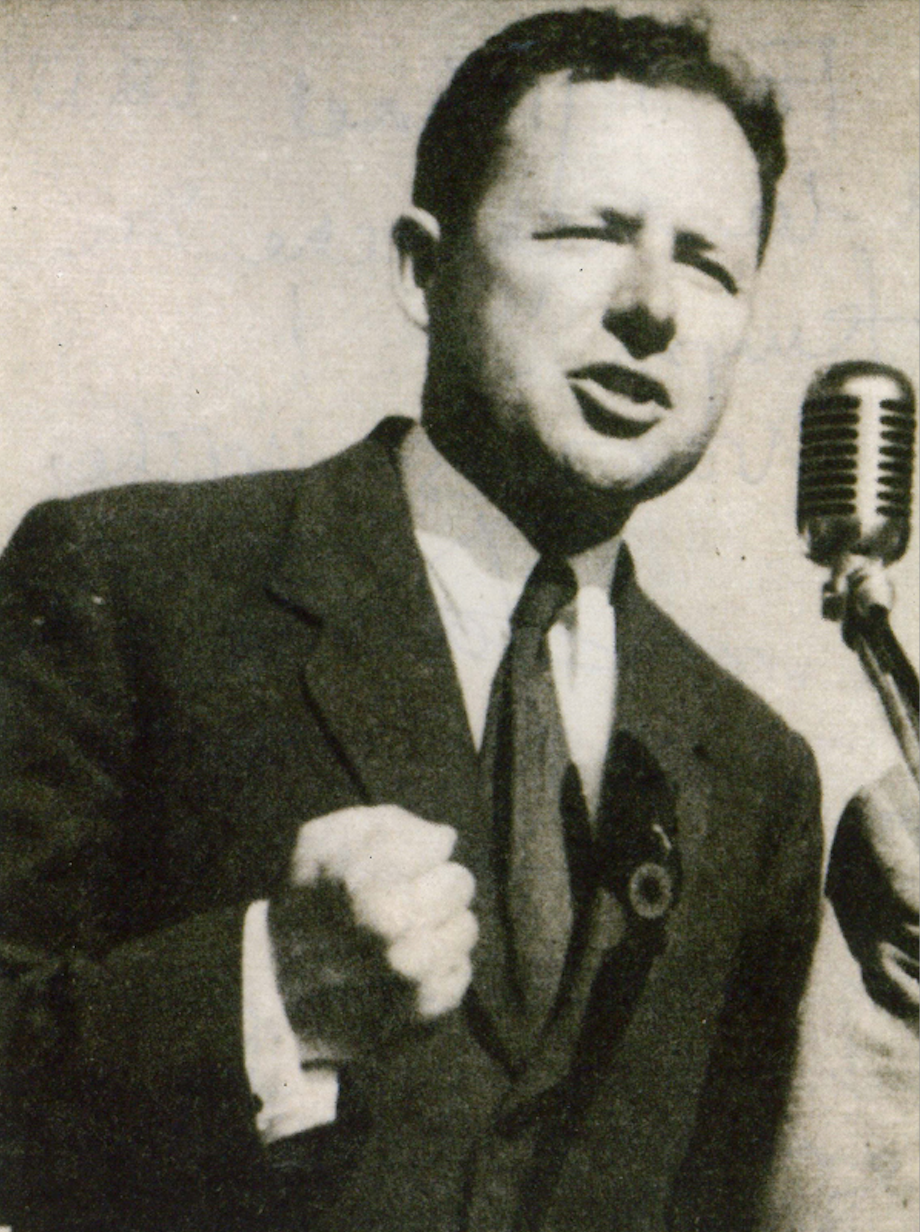
On landing in Livingstone the company advised that their landing rights had been refused and Dingake could proceed to Bechuanaland by other means of transport. He was assured that he could take a train through Rhodesia without hindrance. Dingake wrote to the High Commissioner of Bechuanaland berating the authorities for not allowing a bona fide citizen to return to his home country. To his surprise, he received a prompt and very polite reply claiming misinformation about his identity. The politeness disarmed Dingake, and he set off by train.81

On 8 December 1965, he was captured inside the train at Figtree, Rhodesia, while carrying his Bechuanaland passport. Dingake’s wife through her lawyer wrote to Seretse Khama to intervene, yet this letter was not handed to Khama in time by his personal secretary. As Dingake recalls, ‘it seemed all the dice were inauspiciously stacked against me’.82
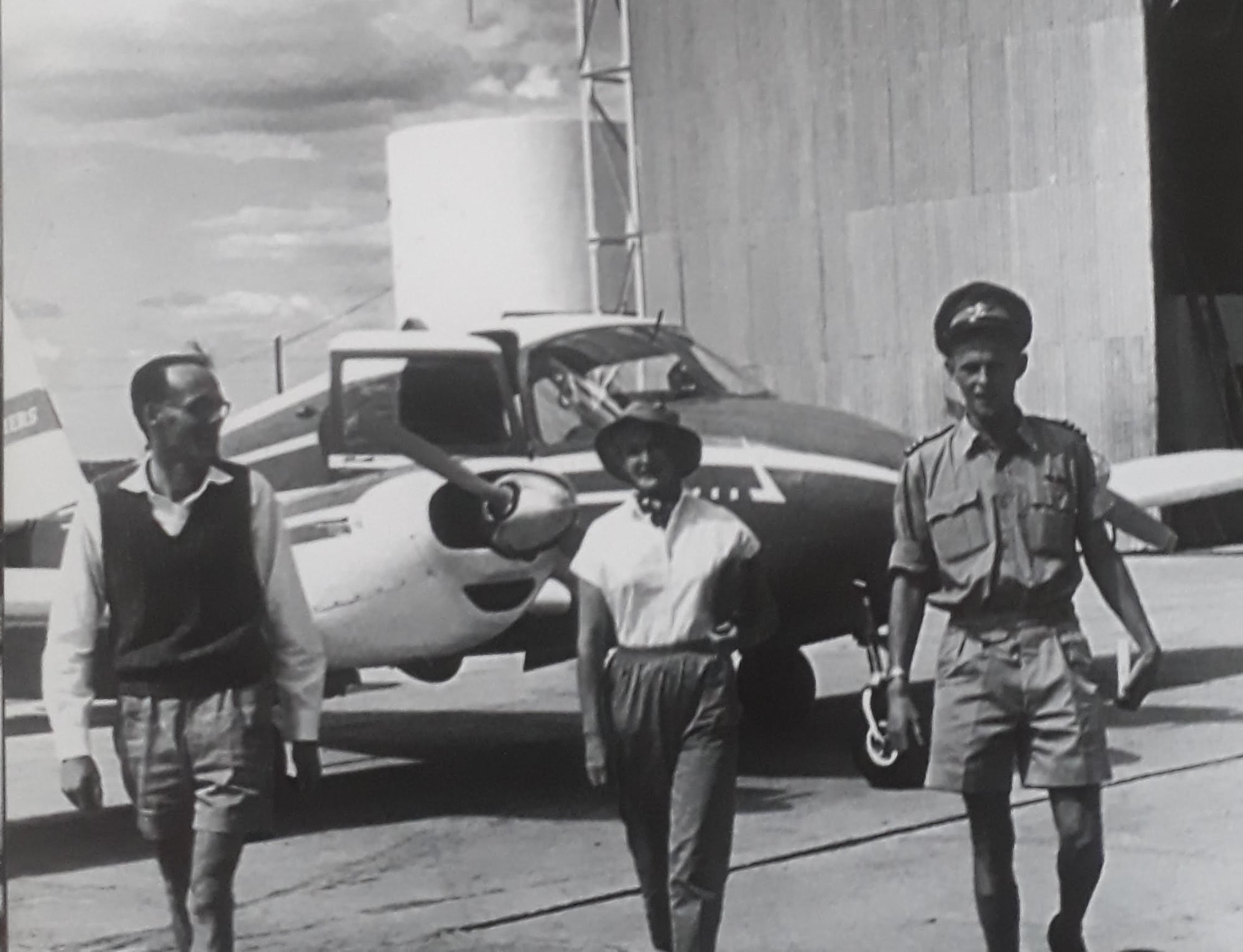
Lt. Dirker

Dingake was detained for just over a month before being driven to Beit Bridge where he was handed over to South African Special Branch. The Rhodesian BSAP officer went through the motions of returning Dingake’s passport. Lieutenant Dirker, a notorious Security Branch officer, snatched the passport from the Rhodesian officer’s hand. When they drove through the border post into South Africa Dingake was forced to lie down on the back seat of the car with a gun to his head. There were no witnesses to his entering South Africa.83 Detained and tortured, in 1966 Dingake was sentenced to 15 years imprisonment on Robben Island.

On 19 November 2015, during an interview with Michael Dingake in Gaborone, he was asked about the pilot who attempted to land him in Salisbury.

Author: May I ask you about the pilot? I know that this is a long time ago, can you recall what his nationality was?

Michael Dingake: I think he was British, I think he was British. Yet was he British? Anyway it was a funny sort of name. I’d better not commit myself to saying he was British.

Author: Was the surname Bartaune?

Michael Dingake: Ah! Yeah! That’s right. That’s right Yeah, that’s right. That’s the name. Yeah.84

Dingake was very clear about this point during this discussion. At the mention of Bartaune’s name he was decisive in his reply and in recognising the name. He literally clapped his hands together at the mention of the name. Bartaune was the pilot during this incident.

Conclusion

Bechuanaland Air Safaris was a key part of the various pipelines established in Bechuanaland to facilitate transport across that territory for the South African liberation movements. It connected Bechuanaland to Basutoland and Swaziland and was established by the SIS in partnership with Captain Herbert Bartaune. During its existence, many prominent leaders of the liberation movements flew with it and interacted with Bartaune. It appears that in certain instances, as that of Patrick Duncan, Bartaune won the trust of a number of people.

Yet his past suggests more about Bartaune. Aligning himself with the forces of Nazi-fascism, he served with the German armed forces in the Second World War and, along with his wife Elsie, he was a Nazi Party member. However, according to the British intelligence system he was, some time before the Rivonia raid, providing information to the SAP.

British documents state that they assumed that the information in his report to the Bechuanaland Special Branch was also passed on to the SAP and possibly the CIA. Whether this means Bartaune passed it on to the CIA directly, or that the SAP passed this onto the CIA through their channels remains unknown.

As for Patrick Duncan and PAC activities in Basutoland, Bartaune compromised them to the British, South African and possibly US intelligence systems. Duncan’s relationship with Bartaune reached back several years and, according to Bartaune, he had even saved Duncan’s life on one occasion. Duncan trusted Bartaune and shared his plans for smuggling weapons with the aviator. Yet, unbeknownst to Duncan, Bartaune had no hesitation in using this information against Duncan.

In the case of Nelson Mandela, Bartaune personally flew him from Lobatse to Tanganyika. Mandela’s return to Kanye in one of Bartaune’s aircraft resulted in diversions from the original route to Lobatse due to the risks involved as a result of increased South African surveillance around Lobatse. When landing at Kanye, Mandela was assisted by the District Commissioner of Gaborone and a British aligned security official to reach his rendezvous team for his journey back to South Africa. This in a way thwarted South African agents. However, very shortly thereafter Mandela was captured. It is known that the CIA assisted the South African Security Branch in his capture. If Bartaune at that stage was assisting the SAP, he may have played a role in the events leading up to his capture by reporting on his intended travels through Bechuanaland, prior to airlifting Mandela and Keitseng from Mbeya.

In the case of Michael Dingake, his capture in Rhodesia was part of an orchestrated plot between the South African and Rhodesian security services. According to Dingake, there was no apparent need to deny landing rights to a Botswana citizen with a valid passport, yet that is what happened. During this flight Bartaune attempted, for no apparent reason, to land his passengers in Salisbury, which would have resulted in Dingake’s and possibly even Duma Nokwe’s arrest. He would have literally delivered them to the Rhodesian security services. When they remonstrated, he returned to Zambia. Dingake was then forced to travel overland through Rhodesia, resulting in his capture by the BSAP, who then illegally handed him over to the SAP.

The penetration of the aerial pipeline by the apartheid regime has a bearing on our understanding of the events and personalities described in this paper. After Mandela’s capture, key persons connected to the pipeline were transferred out of Bechuanaland. However, the pipe-line continued functioning with Bartaune betraying Patrick Duncan and the PAC in 1963 and 1964 and up until Michael Dingake’s capture in 1965. As the company was taken over by Bechuanaland National Airways in October/November 1965, Bartaune’s role in Dingake’s capture may have been one of his final acts of betrayal at that time. Information supplied to the intelligence and security services of various countries by Bartaune (and other informants) impacted negatively on the liberation movements. This was part of the apartheid state’s surveillance, repression and counterinsurgency objectives, as the cases of Matthews, Duncan, Mandela and Dingake discussed in this article show.

Footnotes

  1. N. Mandela, Long Walk to Freedom (London: Abacus, 1995), 344; M. Dingake, Better to Die On One’s Feet(Cape Town: South African History Online, 2015), 102. ↩︎
  2. F. Keitseng, Comrade Fish: Memories of a Motswana in the ANC Underground (Gaborone: Pula Press, 1999), 55. ↩︎
  3. R. Watts, ‘Memoirs of the Refugee “Pipeline”: The Serowe Route, 1960–1961’, Botswana Notes and
    Records, 29 (1997), 115. ↩︎
  4. N. Parsons, ‘The Pipeline: Botswana’s Reception of Refugees, 1956–68’, Social Dynamics, 34, 1 (2008), 20–21. ↩︎
  5. National Archives of the United Kingdom (hereafter NAUK), FO 371/167528, South Africa: Export of
    Arms to South Africa: Smuggling and Gun-running Activities, 1963 (hereafter NAUK, FO 371/167528 South Africa: Export of Arms); National Archives of South Africa (hereafter NASA), JIC, Vol 62, Elsie Bartaune, 1939–1946. ↩︎
  6. This section on the setting up of the aerial pipeline and its monitoring by various intelligence agencies is partly drawn from G. Benneyworth, ‘Armed and Trained: Nelson Mandela’s 1962 Military Mission as Commander in Chief of Umkhonto we Sizwe and Provenance for His Buried Makarov Pistol’, South African Historical Journal, 63, 1 (2011), 81–84. ↩︎
  7. Keitseng, Comrade Fish, 49–51. ↩︎
  8. South African Democracy Education Trust (SADET), eds, The Road to Democracy: South Africans TellingTheir Stories, Volume 1, 1950–1970 (Houghton: Mutloatse Arts Heritage Trust; Hollywood, CA: Tsehai,2008), 20, fn 2. ↩︎
  9. Keitseng, Comrade Fish, 50. ↩︎
  10. J. Ramsay, ‘Roots of Botswana Nationalist Politics (Part 21): MK, MI6 and the Pipeline’, Weekend Post, 9 August 2015, http://www.weekendpost.co.bw/wp-column-details.php?col_id=183, accessed 9 November 2016. ↩︎
  11. NAUK, FO 371/167528, South Africa: Export of Arms. ↩︎
  12. Watts, ‘Memoirs’, 105–119. ↩︎
  13. Parsons, ‘The Pipeline’, 21. ↩︎
  14. Ibid., 20–21. ↩︎
  15. Ibid. ↩︎
  16. J. Sanders, Apartheids Friends: The Rise and Fall of South Africa’s Secret Service (London: John Murray, 2006), 14. ↩︎
  17. Ibid. ↩︎
  18. Ibid. ↩︎
  19. NASA, BLM/Box 22, Vol. 2, File 442. Subject file: Secret. Communism. Reports. 8/6/1960 – 18/5/1961. ↩︎
  20. NAUK, DO 195, 2, Ghana’s relations with the Union of SA, 29 July 1960–1962, marked ‘secret’. ↩︎
  21. NAUK, DO 157/9, Bechuanaland Central Intelligence Committee Reports, July 1960–October 1961. ↩︎
  22. Ibid. ↩︎
  23. Ibid. Sifiso Mxolisi Ndlovu describes a similar incident also in 1961 which Ndlovu cites from the Botswana archives. It records that ‘information from three different sources in Bechuanaland reported that between the 8 and 11 December 1961 two South African Police Special Branch agents were operating in the areas of Palapye and Serowe. When one of them was asked what the SAP special branch were doing in the protectorate, they replied that they “were going to arrest refugees”. They were traveling in a Johannesburg registered car’: Ndlovu, ‘Heritage Routes’, 502. ↩︎
  24. SADET, The Road to Democracy in South Africa Volume 1 (1960–1970) (Zebra Press, Cape Town, 2004, 22. . ↩︎
  25. NAUK, DO 119/1229, Vincent Joe Matthews (VJ), 4 July 1962–4 October 1962. ↩︎
  26. NAUK, DO 119/1478, Nelson Mandela, 1962 ↩︎
  27. NAUK, DO 119/1229, Vincent Joe Matthews (VJ), 4 July 1962–4 October 1962. ↩︎
  28. A picture of Bartaune’s gravestone is available at http://www.eggsa.org/library/main.php?g2_itemId=
    2537015, accessed 10 October 2016. ↩︎
  29. According to two Walvis Bay residents who remembered Bartaune, his final employment was with the fish oil depot in the harbour. According to one of them, Bartaune had at one point been Haile Selassie’s personal pilot. A member of the local shooting club, Bartaune was an ardent gunsmith and built a few handguns for himself. He refused to speak Afrikaans. Conversation with two Walvis Bay residents, 7 May 2016. Both individuals asked to remain anonymous ↩︎
  30. Deautsches Museum Flugwerft Schleissheim website. See, http://www.deutsches–museum.de/en/flugwerft/exhibitions/sailplanes/, accessed 8 March 2017. ↩︎
  31. Bartaune was a member of the Swakopmund gliding club, where in 1968 he spoke of the Hitler Youth and of how glider flying prepared them for conversion as pilots in the Luftwaffe. He related that the Hitler Youth launched their gliders by a catapult system: Conversation with R. Swart, Kimberley, 8 March 2017. Mr Swart was also a member of the Swakopmund gliding club and remembered Bartaune and the discussions he had with him. ↩︎
  32. P. Ariane, H. Kuckuk, K. Pophanken and K. Schalipp, Ein Jahrhundert Luft- und Raumfahrt in Bremen: Von den frühesten Flugversuchen zum Airbus und zur (Falkenberg, Rotenburg Edition, 2015), 343. ↩︎
  33. ‘More “Rain Makers” Here For Experiments’, Border Watch, 25 July 1953. ↩︎
  34. Watts, ‘Memoirs’, 105–119. ↩︎
  35. Ibid ↩︎
  36. NASA, JIC, Vol 62, Elsie Bartaune, 1939–1946. ↩︎
  37. Ibid ↩︎
  38. See A. Lissoni, ‘The PAC in Basutoland, c. 1962–1965’, South African Historical Journal, 62, 1 (2010), 60–61. ↩︎
  39. Ibid., 64. ↩︎
  40. NAUK, FO 371/167528, South Africa: Export of Arms. ↩︎
  41. Idid ↩︎
  42. Idid.The term ourselves refers here to the SIS. ↩︎
  43. Ibid ↩︎
  44. C.J. Driver, Patrick Duncan: South African and Pan-Africanist (Oxford: James Carrey, 2000), 224. ↩︎
  45. See Lissoni, ‘The PAC in Basutoland’, 67. ↩︎
  46. NAUK, FO 371/167528, South Africa: Export of Arms. ↩︎
  47. Idid ↩︎
  48. ibid ↩︎
  49. NAUK, FO 371/167528, South Africa: Export of Arms. ↩︎
  50. This distinction of several years is important in that this means that Bartaune flew Duncan before he established Bechuanaland Air Safari’s. This would presumably have been in the Central African Federation and Belgian Congo. ↩︎
  51. NAUK, FO 371/167528, South Africa: Export of Arms. ↩︎
  52. Elias Ntloedibe, a founding member of the PAC. ↩︎
  53. NAUK, FO 371/167528, South Africa: Export of Arms. ↩︎
  54. Ibid ↩︎
  55. NAUK, FO 371/167528, South Africa: Export of Arms. ↩︎
  56. Driver, Patrick Duncan, 226. ↩︎
  57. Ibid., 227. ↩︎
  58. Ibid ↩︎
  59. NAUK, FO 371/167528, South Africa: Export of Arms. ↩︎
  60. NAUK, CO 1048/521 Basutoland Intelligence Report, October 1963 and July 1964. ↩︎
  61. Mandela’s use of the pipeline and return to South Africa is also described in Benneyworth, ‘Armed and Trained’, 84, 94–95. ↩︎
  62. NAUK, DO 119/1478, Nelson Mandela, 1962. Secret Telegram from High Commissioner to the Secretary of State for Colonies and the Resident Commissioner Bechuanaland, 22 January 1962. ↩︎
  63. Ibid ↩︎
  64. Joe Matthews arrived the day before and flew out with Mandela. ↩︎
  65. NAUK, DO 119/1478, Nelson Mandela, 1962. Secret Telegram from High Commissioner to the Secretary of State for Colonies and the Resident Commissioner Bechuanaland, 22 January 1962. ↩︎
  66. Mandela, Long Walk, 364. ↩︎
  67. Keitseng, Comrade Fish, 55. ↩︎
  68. T. Simpson, Umkhonto We Sizwe the ANC’s Armed Struggle (Cape Town: Penguin Books, 2016), 54. ↩︎
  69. Mandela, Long Walk, 365. ↩︎
  70. Matlou had opened the ANC Office in Bechuanaland in 1961 before moving to Tanzania and then Algeria, where he helped to bring in South African youth for military training. ↩︎
  71. Mandela, Long Walk, 365. ↩︎
  72. Ibid ↩︎
  73. Ramsay, ‘Roots of Botswana Nationalist Politics’. ↩︎
  74. Dingake, Better to Die, 85. ↩︎
  75. Interview with M. Dingake by G. Benneyworth and O. Badsha, Gaborone, 19 November 2015. ↩︎
  76. Dingake, Better to Die, 102. ↩︎
  77. Interview with Dingake. ↩︎
  78. Dingake, Better to Die, 102. ↩︎
  79. Ibid ↩︎
  80. Interview with Dingake. ↩︎
  81. Dingake, Better to Die, 103 ↩︎
  82. Ibid ↩︎
  83. Ibid ↩︎
  84. Interview with Dingake. ↩︎

Trojan horses

Liliesleaf, Rivonia (August 1962 –11 July 1963)

By Garth Conan Benneyworth

Abstract

The police raid on Liliesleaf on 11 July 1963 is understood to be the result of informants within the liberation movements either breaking down in detention or “selling out” and providing information about the farm with its safe house and its people. This paper, while acknowledging that there were informants inside the liberation movements, maintains that this was only a fragment of a kaleidoscope of events culminating in the raid and subsequent Rivonia Trial. Rather it was a covert investigation undertaken since 1962 that resulted in the blow delivered by the combined security agencies, that shattered the underground networks opposing the apartheid state. It was an investigation which relied extensively on the principles of the mythological Greek Trojan horse; it used persons and technology that aimed to undermine and overthrow their opponent, to subvert and defeat it from within, while appearing non threatening. This paper identifies three Trojan horses. A human spy concealed behind the innocent look of a child who fronted for sinister forces. Electronic warfare deployed by the military and linked to an innocuous caravan park; and finally a laundry van to deliver the surgical knockout strike. Yet all this subterfuge has eluded the narrative for 53 years.

The build-up, 1963

By June 1963 the state crackdown was relentless. Political organisations, such as the African National Congress (ANC), the South African Communist Party (SACP) and Pan Africanist Congress (PAC), together with their activists were under banning orders, restricted from almost all social and political contact with others, rendered incommunicado, detained, driven into exile, or serving prison sentences. The PAC’s resistance had been neutralised, numerous political trials were underway and of the various methods exhibited by a growing security police state, one was increasing brutality.

It became increasingly difficult for the members of the underground to operate. Informants were rumoured to be everywhere and the pressure of living beneath the radar became unbearable. At some point a fatal mistake might be made or the sheer weight of the security apparatus might find a leak in the dyke, bursting through to flood into the underground networks.

Dennis Goldberg recalled that there were two sides to operating in the underground.

“It really was as exciting as I imagined it would be. I was a fulltime revolutionary. I felt invincible: on the brink of something great. There was a constant rush of adrenaline”.1

However this came with a price. Goldberg recalled living under this terrible strain:

“What happens when you are working underground is that you’re constantly working under the pressure of discovery; you’re constantly having to think about it. It becomes a terrible anxiety. The pressure of being underground, it was wearing and wearing … and you’re forced into making mistakes. This is what the pressure does, it forces you into mistakes. I am talking about the way the security forces
pressure you.2

And this is the lesson to be learnt from it, there is always too much to do, you’re always in a hurry, the revolution must happen today, if not tonight, and so you make mistakes. What it plays on is that eventually you become so lonely, you give yourself away … It’s like a boil. That is part of the psychology. That might not necessarily be the whole thing. But we don’t train our people for this, you only learn it when it’s too damn late.3

Lionel ‘Rusty’ Bernstein – mugshot

There was a nuance of change taking place; one that the movement was slow to detect. Some members had become complacent, lulled by a false sense of security, which appeared to be presented by the façade of the safe house. After all, once inside the perceived guerrilla zone, the hostile world lay beyond its boundaries. Rusty Bernstein saw it as “evident that the ‘safe house’ syndrome was at work. Liliesleaf farm seemed to be the easy option for every hard choice. It was after all safe.”4

Kathrada recalled his emotions when he arrived at Liliesleaf:

“I’m living in another world. The comrades here were completely divorced, Soweto was just a few miles from here, they were completely divorced from reality. And drawing up very fancy documents. They had even forgotten that when MK was formed, no one had the idea that MK was going to overthrow the government. At the very most MK was going to be a pressure group. The goal remained that MK would be one of the pressure groups together with the political struggle, together with the international pressures, to force the enemy to the negotiation table.”5

In 2006, according to Vivien Ezra who owned the front company, Navian Ltd, established by the SACP to purchase Liliesleaf, there were no internal security arrangements within the cells to resist infiltration. 6 Structures just did not exist whereby suspicions could be reported. In short, there was no structured counter intelligence mechanism in use by the underground. 7 Naïve is a persistent word that crept through all the interviews conducted by the author in the period from 2004 to 2006.

Nothing illustrates this better than the fact that although Mandela was captured in August 1962, Liliesleaf continued to be used by the allied organisations, including the SACP, the ANC, MK, members of the Congress Alliance, South African Congress of Trade Unions (SACTU) and members of the Indian political organisations, right up until the raid, eleven months later.

Liliesleaf farm – aerial photo taken after the raid, note the thatch roof room top left connected to rear farm quarters and buildings – this room was used by Nelson Mandela. Brenthurst Library.

One would have thought that once South Africa’s most wanted fugitive was captured, these organisations would have tried to put as much distance as possible between themselves and Liliesleaf, given that Mandela had used the farm as his base of operations. He had travelled throughout Africa and the United Kingdom, yet it would appear that no one considered the possibility that his movements might be tracked back to Liliesleaf, or that had he been under surveillance, which he was, thus compromising the farm around August 1962 when captured. Mandela claimed that he concealed a revolver and notebook within the upholstery of the front seat of Cecil Williams’s car before being arrested and taken into custody.8 The hypothesis is that the police found this notebook, which enabled them to investigate his activities in South Africa after his return from Ethiopia. The impending danger was that by using this information the security branch could hone in on Liliesleaf. In fact, it appears that that the underground activities and the use of Liliesleaf by the liberation movement actually increased after August 1962 and continued to do so until the 1963 raid. It is possible that more leaders of the underground and operatives sought shelter at Liliesleaf after August 1962, than at any other time in its history before this date. Walter Sisulu, Raymond Mhlaba, Wilton Mkwai, Andrew Mlangeni, Govan Mbeki and Ahmed Kathrada certainly did, to name but a few. Meetings of MK’s high command, the Secretariat and the SACP’s central committee were held there, and quite possibly also the ANC’s NEC and various MK committees such as those dealing with intelligence, logistics, transport and housing.

Police searching the living room at Liliesleaf farm – main house, police photograph.

It is widely understood that the meeting of the Secretariat on the day of the raid was the last meeting held at Liliesleaf and that thereafter other venues would be used. Some had serious reservations about returning there believing the farm to be compromised. Bernstein was vehemently opposed to returning to Liliesleaf. 9 Other senior leaders, such as Walter Sisulu, Govan Mbeki, Raymond Mhlaba and Wilton Mkwai no longer stayed there, having moved to Trevallyn, a smallholding near Krugersdorp, purchased shortly before by Denis Goldberg under a fictitious name. Meanwhile, Liliesleaf was to be used solely for accommodating the MK high command and those immediately involved in its functioning.10 However this was not the case for that one fateful meeting. The Logistics Committee was due to meet the night of 11 July 1963. So in fact two meetings were intended at Liliesleaf on the day of the raid. All of those captured during the raid concur that because an alternative venue couldn’t be found, it was agreed to meet at Liliesleaf one last time.

Yet other parallel activities were occurring, such as a scheduled Logistics Committee meeting, planned to take place inside the main house after the Secretariat concluded its business in the thatched cottage. One of its members, Denis Goldberg was already seated in the lounge reading a book when the veranda door swung open to initiate his capture. Another member, Arthur Goldreich, drove home into the raid with a copy of Operation Mayibuye concealed behind his vehicle’s hubcap. A third, Hilliard Festenstein, walked into the house punctually that night to attend the meeting which never happened – straight into the arms of the police. The chairman of the Logistics Committee, Wilton Mkwai, narrowly avoided capture when approaching the farm as scheduled and saw the raid already in progress. A fifth member, Ian David Kitson, escaped due to a bout of flu which had kept him in bed; while the reasons for Lionel Gay’s non-show remain unknown.

All those at Liliesleaf that day were arrested. The exceptions were six children, three black and three white. Together with other members of the liberation movement who were serving jail sentences or who were arrested elsewhere, those arrested stood trial in what became a watershed moment in South African history. Rivonia.

Leakage

Liliesleaf was leaking. A few weeks before the raid some MK members had visited the farm and were arrested. It was a matter of time before the security branch broke them. By July 1963, there were numerous security lapses so it was inevitable that if the police hadn’t already done so, they would soon find the farm. Apart from which, “we were total amateurs. You cannot cross both worlds, indefinitely”. 11

The concept of security had broken down. Too many people were using Liliesleaf. Its numerous visitors included people who were known to the security branch and foreign intelligence agencies, such as Joe Slovo, Ruth First, Jack Hodgson, Bram Fischer, Lionel Bernstein, Harold Wolpe and many others. Lionel (Rusty) Bernstein described this osmosis from the safe house:

“Later people who had been overseas for military training would arrive back in Bechuanaland without any proper planning. The first thing we would know was that they were in Bechuanaland and wanted come back. So we’d bring them back and they would stay for a few nights … Rivonia came into sudden use in a way that had not been foreseen.

So this place became a sort of centre, if you like because Sisulu and Mbeki were the two senior ANC people at large at that time. [Since] both of them were [also]participating on the high command, they began to use it for MK high command activities, both for keeping documents and holding meetings, and they were bringing people to their meetings who were not in the high command, not living underground and so on. So the place really changed from being a really closely kept secret to being something of a centre.”12

Even Thomas Mashifane, the foreman, could sense the inherent danger building up. “What are you folks doing? The way motor cars are coming in and out, the next thing the police are going to come.” 13 No one was prepared to listen. The question is, where others listening with a more sinister intent? Had those with a little more intellect than ascribed to them, applied themselves as opposed to the thuggery displayed by the police? Had the proverbial Mr Plod finally caught up?

Rear view aerial image of Liliesleaf farm – Police photograph post raid, Brenthurst Library.

The central thread that runs through the literature is that the security branch experienced a lucky break when they raided Liliesleaf farm. Starting in 1965, Strydom has it that an informant offered to tell what he knew about activities at the farm, yet had only a vague idea where it was. Accompanied by a detective and after driving about the area for some time, he eventually recognised the property.14 Frankel has it that Lt. Van Wyk who led the raid was advised by a colleague that he had an informant with information to sell. Apparently he knew where to find Walter Sisulu and half a dozen other important leaders of the Umkhonto high command. For a large payment he would take the lieutenant there.15 According to Frankel the informant took Van Wyk to Liliesleaf, enabling him to plan the raid which he sprung the following day. After the raid the informant received R6 000.16 More recent works, for example that by Smith, have the security branch depicted as a proverbial Mr Plod staffed with bumbling policemen who eventually caught up with the activists.17 If so, who was listening in besides the SAP and its security branch?

This paper will show that at least three parallel lines of investigation by three separate security agencies took place between 1962 and the day of the raid. There could have been other agencies but these remain unidentified. The three agencies were the SAP’s security branch, using its methods of informer recruitment and information collected; Republican Intelligence (RI), using informants and information trading with foreign intelligence organisations (later better known as the National Intelligence Service or NIS); and the South African Communications Security Agency which was linked to the South African Defence Force (SADF).

Investigating Liliesleaf, 1962-1963

There is no doubt that captured operatives gave the police information. Examples include Bruno Mtolo, Patrick Mthembu and Bartholomew Hlapane.18 However, this paper will identify one informer whose role the author uncovered in 2005 by locating this informant’s 1963 statement to the SAP. A copy was provided by the author to the Liliesleaf Trust in 2005 and is included in an unpublished research report to the Trust in 2007.19 All subsequent references to this informant are drawn from the author’s prior work. Within weeks of Nelson Mandela’s capture on 5 August 1962, the security branch had a ten-year-old informant who had access to the farm. His name is George Mellis. His parents owned the Rivonia Caravan Park directly across the road from Liliesleaf. He was the perfect Trojan horse. He could literally breach the sanctity of the safe house undetected, much like the mythical Trojan horse parked outside the gates of Troy. No one gave the boy so much as a second glance when he arrived to play with his friends Nicholas and Paul Goldreich, or wandered around near the outbuildings while covert meetings were underway.

On 5 August 1963, George Mellis made a sworn statement to Sergeant Fourie who commanded the Rivonia police station.

“About a year ago, one day when I was playing in the yard of the Goldreichs’ place, I saw a number of white and Bantu males together in the thatch-roof building next to the main house. These people were talking and I saw some shaking hands with each other. This seemed strange to me and I told my parents about it. On some occasions that I went there I saw a lot of cars parked in the yard and one occasion,
I took the registration numbers of all the cars parked in the Goldreich yard and handed the numbers I had written down, to the police at Rivonia.” 20

Sergeant Fourie forwarded Mellis’s number plate list and his information to the security branch. Mellis tried to elicit further information from his Goldreich playmates whom he joined inside the main house for lunch. On one occasion, he said, “I asked Nicholas about the persons on the premises but Nicholas said that he was not allowed to tell me anything”. 21

In his 1963 statement Mellis identified Walter Sisulu Raymond Mhlaba, Denis Goldberg and Ahmed Kathrada from police photographs. His Goldberg reference is pertinent in that Goldberg first visited Liliesleaf in May 1963. This means that Mellis was spying on Liliesleaf from the time of his first report (about a year before the raidand soon after Mandela’s capture), through to when Goldberg visited Liliesleaf between May and July 1963. Mellis spied right up until the raid.

Photo of Nicholas and Paul Goldreich who befriended George Mellis, this photograph was taken at Liliesleaf farm and is in the private collection of Arthur Goldreich and shared with the author.

Sergeant Fourie assisted the security branch too. In December 1962, Fourie received a summons for a parking offence from the Alberton magistrate’s court which he had to serve on Arthur Goldreich. Fourie held back.

“Aangesien ek bang was dat dit met die ondersoek mag inmeng het ek die lasbrief nie laat uitvoer nie maar het die agterwee gehou [Because I was afraid that it might interfere with the investigation, I did not serve the summons but held it back.]”.22

Fourie instructed his policemen that any action against anyone at Liliesleaf, for example serving a summons, should first be cleared with him. No policeman was to go onto Liliesleaf for any reason without prior authorisation, because an investigation was underway. The farm was sanitised from any official physical interruption.

On 14 January 1963, Colonel Hendrik van den Bergh was appointed head of the security branch of the South African Police. His orders were to reorganise the South African security establishment and it was he who created the first national intelligence service, originally known as Republican Intelligence (RI). The government needed an intelligence organisation that could function along the lines of America’s Central Intelligence Agency (CIA) and Britain’s Secret Intelligence Service (SIS). The RI, together with the security branch, were instructed to smash all organised resistance to the minority regime.

According to Gerhard Ludi the RI’s primary focus was the South African Communist Party (SACP). Ludi, one of RI’s first agents, has suggested that the RI identified the SACP as the primary problem confronting the apartheid regime. Ludi has said that the CIA assisted RI and provided intelligence about financial assistance that Russia provided to the liberation movements. The CIA also indicated who the KGB operatives in South Africa might be and pointed out some of the local communists to the RI.23 RI fed intelligence to both the CIA and the SIS on a weekly basis and these agencies reciprocated. This foreign intelligence feed also included information about Operation Mayibuye and Radio Freedom, both implicitly connected to Liliesleaf.24

Ludi related that RI took the approach that, “if one learned about the cores of the Communist Party, one would learn about the why and where and the role the Soviets were playing in this”. 25 Persons of interest who formed their intelligence target were Govan Mbeki, Raymond Mhlaba, Michael Harmel, Lionel Bernstein, Hilda Watts, Harold Wolpe and Ahmed Kathrada. Ludi said that Mhlaba, Bernstein and Harmel would be of particular focus for RI.

Liaison between the apartheid regime and other regimes in Southern Rhodesia and the Portuguese colonies was improved and intelligence sharing became the established modus operandi. Cooperation with the Portuguese extended into their Angola and Mozambique colonies and surveillance reports were provided to government about the movements of known South African communists such as Ruth First, Hillary Plegg, Ben Turok, V.W. Mkwai, Moses Mabida, Julius Baker and P. Beyleveldt who were travelling through Portuguese controlled territories.26 The Portuguese assisted the SIS in monitoring MK activities. In 1961 Portuguese Naval Intelligence transmitted an intelligence report to SIS that Ghana was recruiting South Africans for political, military and sabotage training and supplying funds to SouthAfrican anti-government groups.27

Documents photographed at Liliesleaf in one of the out buildings – Police photograph

Ludi claimed that RI was, “instrumental in pin pointing Rivonia through the radio”. 28 This was the radio transmitter linked to Walter Sisulu’s Freedom Day, Radio Freedom broadcast on 26 June 1963. It is important to note that this broadcast did not occur at Liliesleaf although the radio equipment was tested there. Ludi claims that one of his agents was an electrical engineer; he was connected to the SACP transport manager who knew someone who ran a dry cleaning operation and whose vans were used to transport underground operatives around the country. This link to a dry cleaning van is another Trojan horse. Someone connected to the underground structures used a vehicle like this one, and inside the van lurked an RI agent. This also shows that the routines at the farm were already under surveillance. They were understood, mapped and logged; a Trojan horse disguised as an innocuous laundry van was the modus operandi when the knockout blow was delivered.

The agent met the go between at a bus terminus where he was tied up and blindfolded inside the van. Driven to Liliesleaf he was shown the radio and commented, “This is the most antiquated piece of rubbish I’ve seen in my life.” He couldn’t do anything with it, but the information assisted RI who now knew that somewhere in that area:

“There was a place where things were happening and I believe that after we fed that information to the police that they then started driving … patterns in that area looking for something they thought must be happening there and that’s how they actually found Rivonia, plus of course somebody also gave them information.”29

Who gave the police information is a moot point – informants or another process? While the role of the security branch and RI is known, what is not known is the role of the SADF and its electronic warfare capabilities in locating Liliesleaf. Research and development into electronic warfare began in the early 1950s in response to SACP underground radio broadcasts. By the early 1960s their direction finding technology was on par with the British and Americans.

In about 1955/56, the Radio Section of the engineers’ section of the general post office (GPO) was tasked to assist the SAP to locate the source of Radio Freedom broadcasts that transmitted on short-wave wavelengths. The SACP transmitted on Sunday evenings at 20h00 for 15 minutes. The Radio Act No. 3 of 1952 stipulated that a conviction could only result if the police caught the perpetrators in the act of broadcasting. 30 As the SAP and the Union Defence Force (later the SADF) had no direction-finding capability to comply with this stipulation of the Act they turned to the GPO. The Derdepoort Radio Station based at Hartebeesfontein farm near Pretoria was given the task. Having no direction finding equipment they then developed their own.31

Transmissions were identified as coming from Natal. They then built a mobile direction finding facility and installed it in GPO vans and undertook the search. After nine months the operation halted without success. During early 1956 the transmissions resurfaced in the Johannesburg/Pretoria area. Each transmission came from a different location thus requiring greater mobility. Derdepoort’s technicians developed man-pack equipment which could be carried while walking. The SAP flying squad drove these operators (known then as chase teams). Three vehicle mounted direction finding units and five man-pack units were deployed. Included in the chase teams were technicians from Derdepoort station. The security branch supported the operation. 32 On Sunday 12 August 1956, they identified 363 Berea Street Muckleneuk, Pretoria and raided the house, seizing the transmitter and other equipment along with a pre-recorded taped broadcast. The four accused were convicted of violating the Radio Act No.3 of 1952, a relatively minor offence, and sentenced to a fine of ₤50 or six months in jail. 33

Following this the engineers’ section acquired more sophisticated equipment to facilitate their direction finding methods. In 1958, they imported the Adcock System from the USA, the most advanced of its kind at the time. Located at Derdepoort, this static system included an all-round direction finding capability. 34 Cooperation on direction finding operations between the GPO and SAP was not unusual for this era. Britain’s Security Service MI5, used British post office technology in its counter intelligence operations, both in the United Kingdom against Soviet agents and operations, and also during military operations against independence movements in its colonies, such as in Cyprus.35

The role of the SADF and South African Communications Security Agency

In 1960/1961 the SADF established an overarching telecommunication function, the South African Communications Security Agency (SACSA). SACSA fell under the directorate of telecommunications, and its director was accountable to the prime minister at the time, H.F. Verwoerd. SACSA’s duties were enabling secure and un-compromised communications between all government departments. This included all arms of the SADF, the Department of Foreign Affairs, military attaches abroad, and between the SAP and its agents. 36

During 1963, SACSA played a key role in locating and spying on Liliesleaf. On 1 April 1963, Captain Martiens Botha was transferred to defence headquarters Pretoria to work for the chief telecommunications officer. Included in this small team was Captain Mike Venter of the South African Air Force (SAAF) who was proficient in Morse code. One of his duties was monitoring radio transmissions that the authorities deemed as subversive. Venter detected suspicious Morse code messages inside the country and showed them to Botha. Venter’s information was reported to the security branch and
to RI. 37

SACSA borrowed a direction finding vehicle from the post office telecommunications section and pinpointed the location to within a few blocks of where the transmitter was located. This was enabled because, according to Captain Venter, the Morse code transmitter burst its signals more than once from Liliesleaf. SACSA then searched for visibly suspicious equipment such as antennas on properties in the area. Liliesleaf had two lightning conductors next to the main house. 38

SACSA observed and noted all these activities. Mary Russell and her husband lived in the Rivonia Caravan Park directly opposite the Rietfontein Road entrance into Liliesleaf. After the 1963 raid, Russell later shared her observations with her family, saying that, she “knew something was going on across the road”. 39 In 2005, Russell’s nephew, Gavin Olivier, shared this account with the author. According to Olivier, Russell was an avid birdwatcher and used binoculars to observe the birdlife from her veranda. Prior to the raid, she saw postal workers standing on ladders erected against telephone poles along Rietfontein Road, working on the telephone lines. For Russell, it was odd that they stood atop for long periods of time and used binoculars. Russell recalled what she described as “mysterious bread delivery vans” parked inside the caravan park several times a week for the entire day. Strange, she said, “we don’t have a shop that sells bread in the caravan park.” 40 Yet there they were opposite the driveway into Liliesleaf. Paul Goldreich also recollected men working on telephone cables outside the farm.41

The view of Liliesleaf farm in the valley to the left taken from the caravan park by Mary Russel (photographing a shrike) and the road and telephone lines on which the bakery van operated.

July 1963 was a cold winter, yet shortly before the raid, from at least May 1963, Denis Goldberg recalled there being a single caravan inside the park. Its presence made him feel uneasy.

“There was only one caravan there most of the time, and this area was so far out of Jo’burg, it was deep countryside … And there was this caravan park, which was bare red earth with what I remember as one caravan. A very sleepy police station around the corner. I believe they said they watched the place, this is what I am basing it on … it would have been the obvious thing.” 42

The Trojan horse was literally across the road, parked inside a caravan park owned by the Mellis family, who were actively assisting this investigation. There is other evidence of electronic surveillance activity, all intersecting towards July 1963. In 2005 the author interviewed an individual who wished to remain anonymous. This person claimed that in 1963 he had supplied the security branch with RM 401 hearing aid microphones together with long life batteries which lasted about a month. The microphones and their batteries fitted into a human ear, making them ideal for covert listening. These bugs could be disguised and planted anywhere and were small enough to be inserted into a pen and worn by an informant during a conversation; three or four such devices fitted into a matchbox. The microphone and transmitter worked at low frequencies, and the range was as much as 1⁄2 km to a listening station located within a line of sight.

The receiver for these devices was very powerful. The signal did not need to be very strong and the microphone did not require a large opening, a pin hole would suffice, as in a standard hearing aid. The listening station required a sizable aerial, about one metre in length. It could be erected in a tree; run along telephone wires; concealed inside a roof; or tucked out of sight inside a caravan. It could even masquerade as a car aerial if parked nearby.

If inserted inside a building then transmission distanced would be reduced and to compensate for this, some type of aerial would have to be attached to boost the transmission. An option was a shortwave radio, working at 10 MHz, providing there was a good receiver on the receiving end. If the transmitter was outdoors the range would increase and the only limitations would be caused by background noise. These transmitters picked up sound in an entire room, and the next room as well. The bug could be concealed in a light switch and fitted by an electrician or plumber. It could be hidden beneath a car or anywhere else and camouflaged to resemble any type of contextual object. Lightning or electrical activity did not affect its performance.

Police purchases began with a phone call to check for available stock; followed by a visit from two plainclothes policemen. Payment with was cash and no receipt was required. Prior to the raid, as many as 1 000 units may have been supplied. When news of the Liliesleaf raid broke, the salesperson thought, “So that’s where all our microphones were going! Damn sure in my own mind – bloody hell, so that’s where our microphones went!” 43

Surveyor General map of Rivonia

In 2004 the author uncovered additional tangible evidence of a surveillance operation. In 1961 the surveyor general updated the cadastral maps and the Rivonia area was aerially re-photographed to produce maps in 1962. Each photographic contact sheet covers a vast area and nothing distinguishes a particular property from the next unless the sheets are significantly enlarged. The next photographic series dates to 1964. The author scanned the sheets depicting Liliesleaf in the 1961 and 1964 mapping process in high resolution. One of these sheets revealed a trace of the SACSA direction finding andelectronic warfare operation. (None of the 1964 photographs reflect any tampering). Three microscopic red dots and a pencil cross (x) emerged when a high resolution electronic scanner was used. Two red dots are on a neighbouring property. One red dot marks the approximate centre of Liliesleaf farm and the pencil cross on the sheet marks the dirt driveway leading into Liliesleaf, directly across the road from the caravan park. 44

Tampering on the surveyor general cadastral map of the Rivonia area to show sophisticated electronic triangulation intelligence and X marks the spot on the Liliesleaf driveway.

Someone involved in this investigation examined this contact sheet and made the markings before returning the sheet assuming that the microscopic tampering would remain invisible. Not only was the SADF proficient in electronic warfare. The technical skills of the SAAF, the second oldest air force in the world, were on par with its international counterparts. In combat operations in Africa, Madagascar and Europe during the Second World War, the SAAF made extensive use of aerial photo reconnaissance. Nor were their skills of electronic warfare neglected in the post-war years.

In 1957, the SAAF acquired the Avro Shackleton MR Mk3 which it used for long range maritime patrolling and naval surveillance operations. 45 Between 1962 and 1964 the SAAF acquired 16 Mirage IIIC fighter aircraft from France, followed by four Mirage RZ fighter reconnaissance aircraft. 46 In late 1963, SAAF took delivery of the Canberra B (I) Mk 12 heavy bomber and photo reconnaissance aircraft from Britain. It was adding to and upgrading its technological capacity. Consequently, in 1962 to 1963 the only agency with the technical skills capable of identifying targets from aerial photographs of Liliesleaf was the SAAF.47

Thursday 11 July 1963

A meeting on Saturday 6 July 1963 to discuss Operation Mayibuye at Liliesleaf deadlocked. The plan was not approved and it created deep divisions within the Secretariat and amongst members of the SACP’s Central Committee. The plan had to be either approved by the political structures, which did not happen, or be sent back for further work. However, the next part of the problem was a practical one: where could the Secretariat meet and when? The matter had to be speedily resolved, yet the issue of a venue was becoming contentious and downright dangerous.

Denis Goldberg’s mugshot after his arrest and one his drawings on the working of a grenade recovered from Liliesleaf farm, evidence used in his trial.

There were a number of people who did not want to return to Liliesleaf. According to Goldberg:

“They had earlier taken the decision not to bring people who were not living underground to the place where others were living in hiding. Too many people had been to Liliesleaf farm. The security risks were great. We urgently needed a different place and the task of buying somewhere new was given to me because I could legally buy property.” 48

A number of the senior leaders, such as Sisulu, Govan Mbeki, Raymond Mhlaba and Wilton Mkwai no longer stayed at the farm, having moved to Trevallyn, a smallholding near Krugersdorp, recently purchased by Goldberg under a fictitious name and which was to be used solely for accommodating members of the MK high command and those immediately involved in its functioning. 49 Goldberg later wrote that “the last meeting of the High Command at Liliesleaf was one too many”. 50 Goldberg remembered:

“They didn’t have time to arrange a new venue, so we had to come back here, knowing that it was dangerous to come here. The decision had been taken, no more meetings at Rivonia. Yet we had one more, because of the pressure of Rusty’s house arrest.”51

Kathrada recalled:

Ahmed Kathrada after his arrest – JHB Fort.

“A number of us started feeling uneasy about the continued use of the Rivonia farm. We were well aware that the need-to-know principle had not applied to Liliesleaf for some time, and that far too many people – one of whom was Bruno Mtolo, a saboteur from Durban and leader of the Natal branch, had visited the farm. But there was no avoiding one final meeting in Rivonia. In the days leading up to this crucial gathering, I became more agitated and afraid. The only person who I could share my views with was Walter Sisulu, whose views coincided with my own.”52

As for Bernstein, he was not in favour of holding the meeting there. He had lost faith in
Liliesleaf as an uncompromised venue:

“I don’t even remember who convened the meeting. I know I didn’t want to go to it. I was afraid of the place. It was Hepple who persuaded me. [He said] “Okay, you don’t want to go to this place, just this one last time”. Famous last words.53

The next issue was the timing of the meeting. Which day might be appropriate? Thursdays were delivery days. Produce from the butcher and grocer were delivered; dry cleaning collected and dropped off; cars came and went – these goings-on were an established routine. Because these activities had doubled up as a screen for meetings before, Thursday it would be. However, these routines were known and identified, all watched and listened to inside the Trojan horse parked innocently in the caravan park.

Nothing untoward happened during the day except for Bob Hepple’s encounter with an unidentified individual which alludes to a covert investigation.

“On the morning of the 11th July, a man came to my chambers. He was an Indian. I had never met him before. And he said to me, “I have got a message for Cedric from Natalie.” Now I knew that I regularly received letters addressed to me at my chambers. Inside was an envelope sealed from Natalie for Cedric. And I knew these were for the leadership and I would deliver them personally to Liliesleaf Farm. And I wondered what was going on because Cedric was the codename for the centre and Natalie was the code name for the Natal district. And I knew these names on letters would come to my chambers addressed me. I would open them …and would take them over. Who was this guy? I had no knowledge of him. I fobbed him off. I said I don’t know what this is about but I’ll look into it and see. So I realised he was bringing some message. But I didn’t know if he was genuine, he could have been a police spy. And I was deeply suspicious. I feigned ignorance and said I have to go out now and sent him away and said come back to me tomorrow morning. My idea being to make enquiries if anyone knew what this was about. So the result, I was very worried and it was one of the things when I did go there that afternoon that I was worried about. So on my route there I was extremely nervous, I kept thinking maybe I am going to be followed.” 54

This encounter unnerved Hepple. According to him there were already suspicions that the CIA had had a hand in Mandela’s capture. For what reason and by whom was this visitor sent? 55 Hepple told Kathrada about his suspicious visitor and Kathrada confirmed that he too had received a garbled message from someone who mentioned Cedric. After ten minutes of exchanging pleasantries, the six took their seats inside the thatched cottage, Govan Mbeki, Raymond Mhlaba, Walter Sisulu, Lionel Bernstein, Bob Hepple and Ahmed Kathrada. Their agenda was to discuss the impact of the 90 days arrests and to continue the discussion on Operation Mayibuye.

Walter Sisulu after his arrest – JHB Fort

Bernstein held the Operation Mayibuye document on his lap so that he might refer to it and started his critique. No sooner had he commenced when they observed a dry cleaning van, bearing the logo Trade Steam Pressers through a rear window driving down the driveway. It drove up and parked next to the house. Bernstein looked out the window and exclaimed. “Oh my God, I saw that van opposite the police station this afternoon!” 56 The Trojan horse was in position. Perfectly timed and synchronised to the exact moment that the meeting started. Certainly no coincidence. Coordinated by another Trojan horse parked inside the caravan park and listening in. Suddenly the rear doors of the dry cleaning van opened, disgorging the security branch police with their attack dog. While the raiders encircled the main house, Govan Mbeki snatched the Mayibuye plan from Bernstein and tried to burn it but without matches it was useless. Mbeki then shoved the plan into the stovepipe chimney.

Mbeki, Sisulu and Kathrada leapt through a rear window but were immediately caught. The remaining three hoped to bluff their way out. Detective Kennedy opened the door and rushed inside. “Stay where you are. You’re all under arrest!” 57

Arthur Goldreich after his arrest – JHB Fort

The three were then escorted outside. Hepple recalled that by this stage the place was piling up with police and dogs. This suggests that the dry cleaner’s van was the initial probe – the Trojan horse. Once it had breached the gates and parked inside, its occupants would disgorge to secure the buildings while the main body, already in position on Rietfontein Road would then swoop in and overwhelm the farm, while securing the perimeter.

Earlier, in the lounge, Goldberg looked up to see Lt Van Wyk swing open the veranda door and step inside, only metres away from where he sat. Goldberg leapt from his chair, grabbed his coat which contained his notes about weapons manufacture and manufacturing quotations which he had received – and made a desperate dash to reach a toilet to flush them away. Intercepted by another policeman entering through the kitchen he was overpowered in the entrance hallway and arrested. “It was a disconcerting moment. Actually what I thought was, oh shit, we’ve been caught.” 58

Govan Mbeki after his arrest – JHB Fort

The suspects and farm labourers were handcuffed inside the dry cleaner’s van. At about 17h50 Arthur Goldreich drove down Rietfontein Road in his Citroen. 59 When he drew level with the entrance gate he noticed two men wearing the hallmark raincoats of plain clothes policemen, standing beneath a tree in the caravan park, talking to each other. It wasn’t raining and they weren’t relieving themselves.

“And my first thought was special branch, and my second thought was I am late. I can’t just drive by. Then the third thought of mine was how come the guy who’s supposed to be guarding the gate is not there … and I came down the driveway, there were trees on either side and from behind the trees came some police and some dogs. And they jumped on the motor car, and the guy with a pistol in his hand put the pistol to my head, and I heard someone shout, “moenie skiet nie!” So I switched off the engine and rolled down and came in towards the garage.” 60

Arthur’s car ground to a halt. He got out, hands raised above his head. 61 At around 18h00 after each captive had been shown the contents of the outbuildings, Bernstein and Hepple joined Mbeki inside the laundry van. Goldberg was then brought out of the house, four policemen climbed into the van and the Trojan horse drove them off. Having breached the gates of the safe house the Trojan horse left with its captives handcuffed inside, facing the horrors ahead, fearing the worst, potentially a death sentence. Passing the solitary caravan parked in the red dirt of the park. Into the dark. The Rivonia Trial followed.

Arthur Goldreich, looking very worried and Detective Warrant Officer Carel Dirker. By law Goldreich had to be made witness to the search.

Conclusion

Colonels Van den Bergh and Klindt arrived after sunset. Arthur Goldreich was taken into the main bedroom for a one-on-one monologue delivered by Van den Bergh. Among other things Van den Bergh said:

“The trouble with you, Goldreich, and the trouble with all of you, is you’re amateurs. You always have and you always will underestimate your enemy. And that’s why you’re in the shit.” 62

Colonel H.J. Van den Bergh

Liliesleaf and all that was linked to it was captured. The Rivonia Trial followed and after that more arrests and trials until the internal networks were neutralised. A blow most certainly, yet not one which was terminal to the forces of liberation. In the 53 years since the raid the focus on what led to the raid has always been on the security branch. These accounts claim that the SAP, assisted by informants from within the movement, were able to raid Liliesleaf and were lucky to have achieved the success that they did. Kathrada later wrote that the police had the farm under surveillance for some hours before the raid. However, according to him the no one had ever found out the truth:

“ … every version that has been bandied about over the years is based on nothing more that speculation.” 63

The author concurs with Kathrada’s statement. Starting with Strydom in 1965 and weaving through into the recent past with Frankel, popular notion has it that an informant or informants “gave up” the farm to the security branch and fed their information to Lt. Van Wyk who, on receiving it, literally sprung the raid the following day. In a massive twist of fate and coincidence, good luck for some and horrific luck for others, in a single swoop the raid netted prominent leaders connected with MK, the ANC and SACP, together with a haul of documentary and other evidence. This smashed the leaders of organised resistance to the apartheid regime in one massive lucky break, all a result of informants. The security branch pulled it off all on their own. So the story goes. This article demonstrates that to be a fallacy.

By means of an inter-agency investigation into Liliesleaf, this paper outlines some of the complex ways in which the combined security services used a range of techniques and tactics in an attempt to destroy armed opposition to apartheid. One agency was the security branch; its investigations commenced weeks after Nelson Mandela was captured, and later in 1963, the RI and the SADF joined the probe, which led eventually to an operation culminating in the raid. The hypothesis is that information in Nelson Mandela’s notebook and other sources enabled the security branch to identify Liliesleaf. Evidence of the investigation by the security branch soon after Mandela’s arrest is seen in the actions of the first Trojan horse, a young boy, George Mellis, who was able to observe events from within. He was the perfect spy; he passed on information to the Rivonia police station; no one gave him so much as a second glance. However, he would have been carefully handled both by his parents and the security branch, given that he was a minor. Additional evidence of a security branch investigation in 1962, assisted by the Rivonia police station, was the matter of holding back a summons to be served on Goldreich. By December 1962 a determined investigation was underway, so much so that the police sanitised the farm and there were instructions that no policemen were to enter the property.

Mellis’s parents owned the caravan park which offered an ideal position from which to conduct surveillance. A caravan was the second Trojan horse, innocuous on the outside yet filled with electronic equipment, it listened into conversations held at Liliesleaf via hearing devices and telephone line interceptions. Operated by SACSA the timing of the raid could be carefully calculated, which indeed it was. In position during the weeks leading up to the raid, they also detected the Radio Freedom transmitter being tested when it was switched on. The predictably of activities on a Thursday were all observed and calculated. This Trojan horse in turn linked to other SADF technologies of direction finding, electronic warfare and aerial reconnaissance. Evidence of this was provided by those who saw the “postal workers” equipped with binoculars working on the telephone lines. Postal vans and bread delivery vans were seen parked in the caravan park. They were being covertly used by the SACSA. The contact sheets in the surveyor general’s office bear evidence of aerial target identification and the only organisation with the requisite skills to undertake this task, was the SAAF.

The final deception was the third Trojan horse, a laundry and dry cleaning van. Prior to the raid at least one RI spy had accessed the premises in a similar van, so the tactic of using a laundry van to breach the safe house was the ideal choice. Like the mythological Trojan horse which breached the gates of Troy, it was driven inside the farm to disgorge the policemen and their dogs.

In conclusion this paper demonstrates that there was far more to the raid than what has been written about it since that fateful day. It was not merely a police strike. Key roles were played by the SAAF and electronic surveillance was carried out by the SACSA in the state’s offensive against MK. This challenges the commonly held view that the military was not involved in the counter-insurgency operations of 1962 1964. In conventional accounts of the period, the South African military only became involved in counter insurgency when P.W. Botha gained political ascendancy and together with General Magnus Malan, made the notion of Total Onslaught the apartheid government’s strategic doctrine. This paper shows just how heavily involved the military and the security agencies were against MK soon after its formation in 1961.


Written and Researched by Dr. Garth Conan Benneyworth

References

Bernstein, L., Memory against Forgetting (Penguin, London, 1999).Dingake, M., Better to Die on One’s Feet (South African History Online, Cape Town, 2015).
Ellis, S., External Mission: The ANC in Exile (Johnathan Ball, Johannesburg, 2012).
Frankel, G., Rivonia’s Children (Farrar, Straus & Giroux, New York, 1999).
Goldberg, D., The Mission: A Life for Freedom in South Africa (STE Publishers, Johannesburg, 2010),
Hepple, B., Young Man with the Red Tie: A Memoir of Mandela and the Failed Revolution: 1960-1963 Jacana Media, Johannesburg, 2013).
Kathrada, A., Memoirs (Zebra Press, Paarl, 2004).
Mandela, N.R., Long Walk to Freedom (Abacus, London, 1994).
SADET, The Road to Democracy in South Africa Volume 1 (1960-1970) (Zebra Press, Cape Town, 2004).
Smith, D.J., Young Mandela (Weidenfeld & Nicolson, London, 2010).
Strydom, L., Rivonia Unmasked (Voortrekkerpers, Johannesburg, 1965).
Volker, W., Army Signals in South Africa: The Story of the South African Corps of Signals and its Antecedents (Veritas Books, Pretoria, 2010).
Volker, W., Signal Units of the South African Corps of Signals and related Services (Veritas Books, Pretoria, 2010).
Wright, P., Spy Catcher: The Candid Autobiography of a Senior Intelligence Officer (Heinemann, Melbourne, 1987).

Footnotes

  1. D. Goldberg, The Mission: A Life for Freedom in South Africa (STE Publishers,
    Johannesburg, 2010), p 99. ↩︎
  2. Liliesleaf Archives, Rivonia (hereafter LL), INT 2, Interview with Denis Goldberg,
    conducted by G. Benneyworth, Liliesleaf, 2004. ↩︎
  3. LL, INT 2, Interview with Denis Goldberg, Liliesleaf, 2004. ↩︎
  4. L. Bernstein, Memory against Forgetting (Penguin, London, 1999), p 249. ↩︎
  5. LL, INT 4, Interview with Ahmed Kathrada, conducted by G. Benneyworth, Liliesleaf,
    2005. ↩︎
  6. Much of the literature (for example Ellis), has it that Arthur Goldreich was the owner
    of Liliesleaf farm. See S. Ellis, External Mission the ANC in Exile (Jonathan Ball,
    Johannesburg, 2012), p 33. Goldreich was the nominal tenant who rented the property
    from Navian Ltd. The lease was drawn up by R Sepel. See LL, G. Benneyworth of Site
    Solutions© “Research Report: Rivonia Uncovered – Rivonia Recovered” (All Rights
    Reserved, Site SolutionsTM), pp 40–41. ↩︎
  7. LL, INT 6, LOT 2 (a-k), Interview with Vivien Ezra, conducted by G. Benneyworth,
    Liliesleaf, 2006; LL, G. Benneyworth, “Research Report: Rivonia Uncovered”, p 137. ↩︎
  8. N.R. Mandela, Long Walk to Freedom (Abacus, London, 1994), pp 372–373 ↩︎
  9. Bernstein, Memory against Forgetting, p 254. ↩︎
  10. A. Kathrada, Memoirs (Zebra Press, Paarl, 2004), p 156 ↩︎
  11. LL, INT 3, LOT 4, Notes 1, Interview with Bob Hepple, conducted by G. Benneyworth,
    Cambridge, 2005. ↩︎
  12. SADET, The Road to Democracy in South Africa, Volume 1 (1960–1970) (Zebra Press,
    Cape Town, 2004), p 142. ↩︎
  13. LL, INT 2, Interview with Ahmed Kathrada, Liliesleaf, 2004. ↩︎
  14. L. Strydom, Rivonia Unmasked (Voortrekkerpers, Johannesburg, 1965), pp 17–19. ↩︎
  15. G. Frankel, Rivonia’s Children (Farrar, Straus & Giroux, New York, 1999), p 29. ↩︎
  16. Frankel, Rivonia’s Children, p 25. ↩︎
  17. D.J. Smith, Young Mandela (Weidenfeld & Nicolson, London, 2010), p 276. ↩︎
  18. M. Dingake, Better to Die on One’s Feet (South African History Online, Cape Town, 2015),
    pp 67–69. ↩︎
  19. LL, Benneyworth, “Research Report: Rivonia Uncovered”, pp 142–143. ↩︎
  20. National Archives of South Africa (hereafter NASA), NAN 52, Box 8, MS 385.23, George
    Mellis, Statement, 5 August 1963. ↩︎
  21. NASA, NAN 52, Box 8, Vol. MS. 385.23, George Mellis, Statement, 5 August 1963. ↩︎
  22. NASA, NAN 52, Box 8, MS 385.23, Sgt Christiaan Fourie, Station Commander Rivonia,
    Statement, 23 September 1963. ↩︎
  23. LL, Benneyworth, “Research Report: Rivonia Uncovered”, Appendix C, Interview with
    Gerhard Ludi. ↩︎
  24. LL, Benneyworth, “Research Report: Rivonia Uncovered”, Appendix C, Interview with
    Gerhard Ludi. ↩︎
  25. LL, Benneyworth, “Research Report: Rivonia Uncovered”, Appendix C, Interview with
    Gerhard Ludi. ↩︎
  26. NASA, BLM, Box 22, Vol. 2, File 442. ↩︎
  27. National Archives of the United Kingdom (hereafter NAUK), DO 195, 2, SECRET,
    “Ghana’s Relations with the Union of SA”, 29 July 1960–1962. ↩︎
  28. LL, Benneyworth, “Research Report: Rivonia Uncovered”, Appendix C, Interview with
    Gerhard Ludi. ↩︎
  29. LL, Benneyworth, “Research Report: Rivonia Uncovered”, Appendix C, Interview with
    Gerhard Ludi. ↩︎
  30. W. Volker, Army Signals in South Africa: The Story of the South African Corps of Signals
    and its Antecedents (Veritas Books, Pretoria, 2010), pp 226–227. ↩︎
  31. Volker, Army Signals in South Africa, p 227. ↩︎
  32. Volker, Army Signals in South Africa, p 227. ↩︎
  33. Volker, Army Signals in South Africa, p 228. ↩︎
  34. Volker, Army Signals in South Africa, p 229. ↩︎
  35. P. Wright, Spy Catcher: The Candid Autobiography of a Senior Intelligence Officer,
    (Heinemann, Melbourne, 1987), p 154. ↩︎
  36. W. Volker, Signal Units of the South African Corps of Signals and Related Services (Veritas
    Books, Pretoria, 2010), p 534. ↩︎
  37. Volker, Army Signals in South Africa, p 534. ↩︎
  38. Volker, Army Signals in South Africa, p 534. ↩︎
  39. Volker, Army Signals in South Africa, p 534. ↩︎
  40. Gavin Olivier, discussions with the author, 2005 and 2006; and LL, Benneyworth,
    “Research Report: Rivonia Uncovered”, pp 144–145. ↩︎
  41. Paul Goldreich, email to author, 11 March 2007. ↩︎
  42. LL, INT 2, Interview with Denis Goldberg, Liliesleaf, 2004. ↩︎
  43. Anonymous source. ↩︎
  44. Department of Land Affairs, Surveyor General, Mowbray, Cape Town South Africa, copy
    of original contact sheets, 1961–1964, as obtained in 2004. ↩︎
  45. This article is available on the website of the contemporary South African Air Force at
    http://www.saairforce.co.za/the-airforce/aircraft/60/shackleton-mr-3 Accessed 12
    December 2016. ↩︎
  46. This website article focuses on Dassault Mirage jet aircraft for Microsoft Flight
    Simulator and Combat Flight Simulator. At http://www.mirage4fs.com/slides15.html.
    Accessed 12 December 2016. ↩︎
  47. See http://www.saairforce.co.za/the-airforce/aircraft/28/canberra-bi12 Accessed 12
    December 2016. ↩︎
  48. Goldberg, The Mission, pp 109–110. ↩︎
  49. LL, INT 2, Interview with Denis Goldberg, Liliesleaf, 2004. ↩︎
  50. Goldberg, The Mission, p 109. ↩︎
  51. LL, INT 2, Interview with Denis Goldberg, Liliesleaf, 2004. ↩︎
  52. Kathrada, Memoirs, p 156. ↩︎
  53. SADET, The Road to Democracy in South Africa, Volume 1 (1960-1970), p 142. ↩︎
  54. LL, INT 3, LOT 4, Notes 1, Interview with Bob Hepple, Cambridge, 2005. ↩︎
  55. B, Hepple, Young Man with the Red Tie: A Memoir of Mandela and the Failed Revolution,
    1960–1963, at https://www.amazon.com/Young-Man-Red-Tie-Revolution-ebook/dp/
    B00EZM7PUW/ref=mt_kindle?_encoding=UTF8&me Accessed 24 March 2017. ↩︎
  56. LL, INT 3, LOT 4, Notes 1, Interview with Bob Hepple, Cambridge, 2005 ↩︎
  57. LL, INT 3, LOT 4, Notes 1, Interview with Bob Hepple, Cambridge, 2005. ↩︎
  58. LL, INT 2, Interview with Denis Goldberg, Liliesleaf, 2004. ↩︎
  59. NASA, NAN 52, Box 8, MS 385.23, Detective Warrant Officer C.J. Dirker, Statement, 12
    August 1963. ↩︎
  60. LL, INT 2, Interview with Arthur Goldreich, conducted by G. Benneyworth, Liliesleaf,
    2004. ↩︎
  61. LL, INT 2, Interview with Arthur Goldreich, Liliesleaf, 2004. ↩︎
  62. LL, INT 2, Interview with Arthur Goldreich, Liliesleaf, 2004. ↩︎
  63. Kathrada, Memoirs, p 161. ↩︎

What are the chances?

I was having a banter with an old SADF army pal of mine, and we recalled the great divisions between the “English” okes in the platoon and the “Afrikaans” okes in the platoon. There was always banter, and general unity and respect, we all faced the same hardship and threats, and we needed one another to survive so we were closer than blood brothers. That of course did not stop ‘the great divide’ caused by a Afrikaner nationalist identity, the ingrained idea that the “English” were the source of all Afrikaner trauma, the fierce need to be free of Britain’s tyranny and the mass exodus of Afrikaners from the British colonies in protest – the Great Trek, this would be followed by later by the indignation of the British invading their free republics and the fierce fight for independence again, a fight to the bitter end to protect an Afrikaner rebel hegemony and the right to the country.

Time and again, two key themes would re-appear – the idea that they all belonged to a ‘pioneer’ class of hard fighting frontiersmen – Voortrekkers and the idea they also all belonged to an equally hard fighting bunch of ‘bittereinders’ – all the time seeking independence from their traditional foe – the ‘English’ and all the time desirous of an Afrikaner Republic. It’s a repeat theme – you still see it even today then the Springbok XV meet the England XV. In the army, us ‘English’ okes were constantly singled out as the physical manifestation of this ‘foe’ – sometimes in jest but also sometimes taking a lot of abuse and you had to tread very lightly when accusations like “you put my Grandmother in a concentration camp” started kicking about – not that your forebears had anything to do with it whosoever.

Problem is – not all Afrikaners share a “pioneer” and “bittereinder” identity, they were artificially jelled into this identity in the late 1930’s by an all-white, all-Afrikaans and Broederbond driven Centenary celebration of the Great Trek. Pulled under a singular banner of Christian Nationalism. So much so that even if you look up ‘Afrikanerdom’ today you find it defined as:

Noun. (in South Africa) Afrikaner nationalism based on pride in the Afrikaans language and culture, conservative Calvinism, and a sense of heritage as pioneers (Voortrekkers).

But what are the chances? What are the chances that Afrikaners all share this unified ‘Pioneer’ and ‘Bittereinder’ identity – the coming together of which Henning Klopper, the Chairman on the Broederbond famously declared in 1938 as “a sacred happening” – God, according to Klopper, had ordained it. What are the chances indeed?

This is where economic history, hard stats, the maths, starts to punch massive holes into ‘political’ history and ‘identity’ politics. So, let’s begin at the very beginning.

The “Great” Trek

Let’s start with the “Great Trek”. There’s a lot of false and inflated numbers as to The Great Trek, but most accredited historians refer these Cape Colony figures.

From the commencement of British rule in 1806 – the Cape Colony had about 27,000 white burghers, 35,000 registered ‘ex-slaves’ and 17,000  Khoi Khoi descendants  – 79,000 total population. Of that total population only approximately 6,000 ‘Boers’ including an equal number of their ‘coloured’ servants and labourers on a 1:1 ratio (so 12,000 in total), left in the waves considered the Great Trek itself – and their jump points – Grahamstown, Uitenhage and Graaff-Reinet were hundreds of kilometres away from metropolitan Cape Town (in fact it was as far to travel to Bloemfontein from these jump points as it was to Cape Town). 

We need to think of them as the American white ‘pioneers’ settling the wild west in trailblazing wagon convoys – trying to negotiate land in “Indian” territory. The interior of South Africa above the Cape Colony and Natal Colony was not “empty” or “undiscovered” – like the “Wild West” it was already partly mapped by frontiersmen, nomadic farmers (trek-boers), hunters and missionaries. They would provide the network of ‘supply’ support to our plucky pioneers (Voortrekkers).

The “exploratory” first wave is not very successful. Louis Tregardt’s group is all but wiped out by disease – 52 people make it to Portuguese East Africa and return to Port Natal. Hans van Rensburg’s group (51 people) is wiped out by the Zulu – 2 children survive. Hendrik Potgieter and Sarel Cilliers have a party of 200. Gerrit Maritz has a party of about 700 (including servants). Piet Retief’s party starts with about 100 people, it links up with the other Voortrekkers and over 100 (including black servants/labour) are initially wiped out by the Zulu – the Zulu then wipe out more of Retief’s combined trek 282 Voortrekkers and 250 of their servants (there’s that 1:1 ratio) were killed along the Bloukrans during the Zulu attacks of the 16th and 17th February 1838. Piet Uys has a party of 100, and both he and his son are wiped out by the Zulu.

As we can see, there is already a major issue in trying to account the size of these treks – some account ‘white’ families only (and we have no knowledge of the number of servants – they are referenced but that’s about it), whilst others account both. Much work on the “Black History” of the Great Trek has yet to be done – the guardians of its ‘white’ history resisted it for decades.

Either way, whichever way you cut it, the chances of anyone been related by a direct blood line to the exploratory wave of the great trek are extremely slim if the published numbers are anything to go by – in fact it’s about 1% considering about half didn’t make it. Also, the ‘Zulu’ pose more of a threat to the Voortrekkers as a traditional ‘foe’ than the British ever did – it seems counter-intuitive to believe they would rather face certain death than face a British tax administrator and a colour blind Cape Franchise. There is clearly a lot more motivating this initial expedition and its highly nuanced.

That aside, let’s we stick to all the parties of Voortrekkers, the figure expressed in The Afrikaners : biography of a people by the famous Afrikaner historian, Hermann Giliomee – he notes 6,000 white Afrikaners over the period of the trek 1835 – 1840 (5 years) leaving the colony (so that’s 12,000 including Black Labour/servants on a 1:1 ratio – which tallies up with other references). So, given the size of the Cape Colony population and demographic there is only a 22% chance of any modern day white Afrikaner been related directly by bloodline to a white Voortrekker (Gillomee uses a different base and puts this figure at 10% – but let’s go with the higher figure and the benefit of the doubt). 78% of white Afrikaners are bloodline related to those who stay put in the Cape Colony and have nothing to do with the great trek whatsoever.

But, but .. but, there are loads of us “Boere” – you talking “kak” man comes a great retort from a great many. Well, not really would be my answer, let’s look at the economic history and the numbers.

There is, of course a natural economic migration of people, from the British Colonies and other places into the hinterland and into the small Voortrekker republics as they grow from strength to strength – from about 1840 (when the initial trek ends) all the way to the start of the South African War (1899-1902) a.k.a Boer War 2 – 60 odd years. It’s an incredibly slow migration, but speeds up substantially only from 1886 with the discovery of minerals in the ZAR (the OFS remains very sparsely populated). The economic migrants over this 60 year period consist of many white Afrikaners seeking bigger farms, mineral wealth or they settle as urbanised people seeking a “tabula rasa” opportunity with a trade, skill or service – shop owners, doctors, lawyers, miners, teachers – you name it. It’s not just white Afrikaners, they are joined by thousands of “English” 1820 settlers, other Europeans and even many Jews also seeking bigger farms, mining, commerce, service or trading opportunities.

Here’s the primary difference though, all these people are economic migrants seeking better business, wealth and lifestyle opportunities – they are not migrating because of any deep ‘hatred’ for the British or because the British took away their slaves. On the “numbers”, you would think from all the propaganda spewed out by Afrikaner Nationalists that a mass exodus of “true” Afrikaners had taken place and by the beginning of Boer War 2 most of them are “free-men” living in a Boer Republic, BUT – there’s a problem with this idea, its still NOT the case – not even after 60 years of migration and not even after the discovery of mineral wealth in the ZAR – the majority of Afrikaners, believe it or not, are STILL in the Cape Colony. Here are the numbers at the start of Boer War 2:

Boer War 2

The population of South Africa in 1899 was approximately 4.7 million persons with 3.5 million Africans making up 74% of the total. Whites, numbering 830,000 made up only 18% of the entire population. Asians and Coloureds total 400,000 or 8%. So whichever way you cut it, the ‘whites’ – Boer and British together, are a ‘minority’. 

But what of these two ‘white’ tribes? Where are they located after The Great Trek and economic migrations of the last 60 years. The white population are distributed among the two colonies and the two republics, In total 480,000 are Afrikaans-speaking, 58% of the total white population. Less than half of the Afrikaners lived in urban areas, most the ‘English-speaking’ population are urbanised and constitute 42% of the white population.

Also, most importantly, where are all these Afrikaners? Here’s the kicker, the majority of them are STILL in the Cape Colony – Great Trek aside. Afrikaners in the Cape Colony qualified as a bigger population of Afrikaners than the Orange Free State and Transvaal Afrikaners COMBINED. Data sources differ a little in the Transvaal I.e. ZAR, but it is generally understood that Afrikaners only really made up about half (50%) percent of the white population in the ZAR in any event, the other half are classified as ‘Uitlanders’ – mainly ‘British’ (it’s this imbalance that this is the principle Casus Belli advanced by the British as their reason for the 2nd Boer War). 

The Transvaal’s Afrikaners made up only 31% of the total number of Afrikaners in South Africa, with the Orange Free State having mere 15%. This total of 46% (approximately 219,000 people) shows that when Boer War 2 broke out, less than half of the total Afrikaners in South Africa were in the two republics that declared war on Britain. The Cape Colony and Natal, containing 54% of the Afrikaners, or 260,000 persons, never rose up and declared war against the British.

Although some 10,000 odd Cape Afrikaners did join the Republics forces as ‘Cape Rebels’ – this force when viewed against that of the general Cape Afrikaner populace is insignificant. Cape Afrikaners, and for that matter Natal Afrikaners too, simply did not rise up in any significant number to join the ZAR and OFS invasions of the two British colonies. Add to this that just about as many Cape and Natal Afrikaners joined the British forces which also counter-balances the argument somewhat.

The bottom line – the majority of Afrikaners simply decided not to rise up against their lawfully elected governments in the Cape and Natal, many decided to remain neutral and as a majority grouping of Afrikaners in general they simply did not participate in the war at all – that’s a fact. View it this way, the Cape franchise is such, that if the Afrikaner – the majority of voters – did not want someone like Cecil Rhodes in government. they could easily have voted him out.

The underpinning reality is that the Boer Generals planning the war and the Boer politicians claiming “Africa for the Afrikaner” failed to appreciate that many of the Cape Afrikaners were pretty happy under British administration for the near 100 years they are subjected to it, contented with the Cape franchise, many of them urbanised middle class and well to do and of the landed class many were very wealthy – as a demographic they are fundamentally different to their isolated frontier farming (Boer) Afrikaner brethren ‘up north’ facing an extremely hostile environment.

Poverty, famine and hardship was not an overarching issues in the British Colonies for many whites’ (Boer and Brit) in 1899 – nor does it seem that there was any fundamental discontent with their governance, representation and political disposition – and many simply did not view the ZAR’s “Krugerism” as a viable ideology or system of governance for Southern Africa – in fact Prime Minister William Schreiner, John X. Merriman and Jacobus Sauer had moved many in the Cape Colony’s branch of the Afrikaner Bond and Afrikaners in the Cape Colony in general closer to the British way of thinking. 

In a nutshell, half the available Afrikaners failed to take up arms against the British and the Boers fought the South African War 1899-1902 at half strength. So, in essence – they went off “half-cocked” against a world super-power to quote John L Scott’s conclusion on the numbers and the Boer Republics’ decision to invade British colonies.

So, here’s the statistical truth to a modern white Afrikaner – There is a 22% chance that their direct bloodline forebear was a Voortrekker, and a 54% chance that their direct bloodline forebear never took part in the Boer War, at all – the majority of Afrikaners simply did not take up arms, even when their northern brethren expected them to, even demanding they do it, still nothing happened.

The big question now, is of that minority – the 46% of Afrikaners who can claim a bloodline forebear who took part in the 2nd Boer War, how many of them joined the British and fought for them – the hated “joiners”, how many of them preferred neutrality “hensoppers” and how many qualify as the “true” patriotic Afrikaner irreconcilables – the “bittereinders”?

Bittereinders and Joiners

Let’s go with the most “conservative” Afrikaner chronology experts on this one, Pieter Cloete, and give some benefit of the doubt as numbers on the Boer War to the Boers as they vary considerably depending on whose recording them. Cloete in his chronology maintains there are 5,464 joiners (Republican Boers joining the British army to fight against their own countrymen) versus 20,779 recorded Bittereinders registered as still on Commando at the end of the war. So for every 5 Boers left in the field – 4 were fighting for the Republics and 1 was fighting for the British – a 4:1 ratio. Not a common or acknowledged bit of Boer War history – 26% of the Boers fighting at the end of the war were fighting FOR the British – a quarter of them, it’s a significant statistic.

This Figure becomes a little more skewered and complicated when you add the ‘Hensoppers’ and the ‘Prisoners of War’ – those that took the oath of neutrality and those that did not, those that went back on their oaths as well as the war dead and injured – but suffice to say that the stated majority of white Afrikaners are still not with the Boer Republic’s causes … at all. In fact many are even prepared to go to war with one another over it such is the extent of the disagreement.

This figure of white Afrikaner support for the Boer Republican ideal starts to really pale into insignificance after South Africa is made a Union in 1910. So let’s have a look at the Boer Revolt in 1914 as much Afrikaner legacy and Nationalist ‘volk’ heroes stem from it.

The Boer Revolt 1914

Upfront let’s look at the fighting numbers, in all during World War 1 (1914 to 1918) – no fewer than 146,000 South African whites volunteer to fight alongside Britain and France. A mere 7,100 South Africans volunteer to fight alongside Germany for the reinstatement of the Boer Republican paramountcy in South Africa – that’s only 5% of the entire white population volunteering to fight for one side or the other.

In the case of a proportion of these Boer Revolt fighters in relation to Afrikaners only – during WW1 every white in the census classifies themselves as ‘British’, and there are 1,400,000 of them. It’s hard to say who are English and who are Afrikaans, but if we apply the 40/60 ratio which exits most the way through our history – Afrikaners would account 840,000 – if we double the amount of Boer Rebels to include their wives in support – they would account 2% of the overall Afrikaner diaspora, even if we triple or quadruple the ‘Rebels’ number for sympathetic friends – they still remain a tiny minority – 3% to 4% odd.

And it’s not as if their leaders are in support of the Boer Republican cause and remaining neutral during the World War 1 either, this idea that the decision to go to war against Germany was rejected by the “majority” of Afrikaners is pure Hollywood – 92 members of the South African Parliament voted in favour of the war against Imperial Germany, and only 12 vote against. In the Afrikaner Party – the SAP, the vote is 82% in favour and only 18% against.

There is no doubt that Barry Hertzog’s break away from Botha and Smuts to form the National Party in 1914 re-kindled Afrikaner Nationalism in many white Afrikaners – primarily in the Orange Free State, a region hit by severe drought and an extensive share cropping farmer problem (bywoners) as a result of Boer War 2. Hertzog was a very popular Afrikaner Bittereinder General and held large sway. However, even this romanticising with nationalism the Afrikaner Nationalists are still a minority in the Afrikaner diaspora and even more so in the white diaspora at large. When the National Party first contend the General Elections in 1915 they win 29% of the votes (mainly in the OFS), whilst their brethren Afrikaners in the SAP get 37%. The ‘English’ parties alone match the National Party in size and have around 34% of the vote. This split down the middle in the Afrikaner diaspora is however beginning to rear its head again.

The 1938 Centenary Great Trek

What follows once the National Party get into power as a minority government, in a coalition with the Labour Party on the back of the Rand Rebellion in 1922 – is 15 years of unrelenting glorification of the 1914 Boer Revolt leaders, the execution of Jopie Fourie and the vilifying of General Smuts and General Botha. But even by 1938 the National Party still don’t have the stable majority they need, and there is still a massive split in the diaspora between the ‘Cape Afrikaner’ and the ‘Boere’ Afrikaner. That would all change with the 1938 Centenary of the Great Trek.

In 1938, the Broederbond under the directive of its Chairman, Henning Klopper sought to use the centenary of Great Trek to unite the ‘Cape Afrikaners’ and the ‘Boere Afrikaners’ under the symbology of the Great trek. In this endeavour artificially creating a shared heritage. He started a Great Trek re-enactment with two Ox-Wagons in Cape Town and addressed the large crowd of 20,000 spectators by saying;

“We ask the entire Afrikanerdom to take part in the festival celebration in this spirit. We long that nothing shall hinder the Afrikaner people as a whole from taking part. This movement is born from the People; may the People carry it in their hearts all the way to Pretoria and Blood River. Let us build up a monument for Afrikaner hearts. May this simple trek bind together in love those Afrikaner hearts which do not yet beat together. We dedicate these wagons to our People and to our God.”

By that he hoped to combine the ‘Cape white Afrikaners’ with the ‘Boer white Afrikaners’ in the symbology of the Great Trek under a fabricated Nationalist ideal of Christian Nationalism – and only meant ‘White’ Afrikaners in the Broederbond’s definition of what constituted ‘Afrikanerdom’ and not really the Afrikaans speaking peoples as a ‘whole’ – certainly not the Coloured and Black Afrikaners. The Trek celebration would be pitched as an assertion of Afrikaner white power in South Africa and the Trek as the true path to a overall South African nationhood and identity and ignore the histories of everyone else – black and white – in creating a future South African identity. 

Images: The 1938 Centennial Great Trek

In any event the trek re-enactment was very successful in re-aligning white Afrikaner identity under the Christian Nationalist ideal.  In the end eight wagons from all around the country threaded their way to Pretoria to lay the cornerstone of the Voortrekker monument – in front of a crowd of 200,000 people. Whilst at the same time, four ox-wagons went to the site of the battle at Blood River for a commemoration service on the 16th December. The wagons stopping in countless towns and villages all around the country along the way to re-name street after street after one or another Voortrekker hero, and laying imprints of the wagons wheels in freshly laid cement at many halts (there are still ‘imprints’ at my hometown in Hermanus – despite the fact that not one single Voortrekker came from this region).

The Centenary trek gave the Broederbond and the National Party symbology – the ox-wagon, gun-powder horns etc. on which to pin Afrikaner Nationalism that did not exist before. Gideon Roos would say of it:

“We (the Afrikaners) never had a symbol before; the ox-wagon became that symbol.”

The Broederbond had staggered onto the ideal way to ‘unify’ the Afrikaner – a round the country travelling carnival  – from the cities to the platteland, on to far flung corners and everything in between. Henning Klopper himself amazed at the reaction and the success of it all – so much so he turned to divine intervention and said:

“Although I organised it and had everything to do with it, I felt it was taken completely out of my hands. The whole feeling of the (centenary) trek was the working not of man, not of any living being. It was the will and the work of the Almighty God. It was a pilgrimage, a sacred happening.

A “sacred happening” – a miracle indeed.

It’s a Miracle!

What is a real miracle however, is that the ‘majority’ of Afrikaners would adopt this Voortrekker hegemony even when it is proven that most of them had nothing to do with the Great Trek, and that the two ‘separate’ hearts from Boer War 2 would only find commonality in the Bittereinders 40 years after the war. It’s a sheer miracle that the Broederbond managed to pull this off – and it’s no wonder that Smuts during World War 2 had to appoint a “Truth Legion” to counteract all the propaganda stemming from the Broederbond, re-setting identity and changing Afrikaner minds. So much so Smuts would call the Broederbond:

“a dangerous, cunning, political fascist organization”

He was not wrong, but the 1948 elections sealed it for the Broederbond, and Smuts was dead by 1950. The next 40 years are dominated by unrelenting Afrikaner Nationalism ideals and the banning, violent repression and gagging of any voices of dissent – including many Afrikaners.

A careful construct was put together which found Afrikaner heroes who were either Bittereinder Generals or 1914 Boer Rebels elevated to national worship. The irony is only those who were enamoured with racial segregation in their central politics were highlighted – and as leaders, either Boer War or 1914 Rebel, they had represented a minority of Afrikaners.

Whereas Afrikaners which sought unification and reconciliation – and were largely the most popular and effective leaders were airbrushed out – Jan Smuts and Louis Botha specifically, and so too all the Afrikaner military heroes who followed them, the military and political likes of Kommandant Dolf de la Rey, Group Captain Adolph “Sailor” Malan, General Daniel Pienaar, Group Captain Petrus “Dutch” Hugo, Mattheus Uys Krige, General Kenneth Reid van der Spuy, General George Brink, Major Jacob Pretorius, Lieutenant (Dr) Jan Steytler, Captain (Sir) De-villiers Graaff, Major Pieter van der Byl, Jan Hendrik Hofmeyr … the list goes on.

By the time I found myself in the Army most my Afrikaner brothers in arms were pretty convinced their heritage and identity lay with Voortrekkers and the Boer War concentration camps – and such is the power of identity many still believe in that – an entire nation baptised into a identity the majority had no connection to in the first place. Dr D.F. Malan would try to cement his sentiment when he said of Afrikanerdom:

To be a true patriot you have to embrace this Afrikaner Nationalism take on history – to do otherwise is not to be an Afrikaner.”

So – according to the National Party leader, as an Afrikaner, whether you are related to a Voortrekker, Bitteriender Republican or a 1914 Rebel or whether you are not, whether its your history or not (the irony, statistically speaking chances are you’re not). This is your heritage, history and identity, like it or not – or you’re not an Afrikaner – simple.

He went on to define this further, later Dr. Malan would say:

“An Afrikaner is one who, whether speaking the same language or attending the same church as myself or not, cherished the same Nationalist ideas. That is why I willingly fight against General Smuts. I do not consider him an Afrikaner.”

So, if your forebear joined Jan Smuts’ call to arms in World War 1, World War 2 or even voted for his “United Party” – and you’ve not adopted the Afrikaner Nationalist identity politics and their take on Afrikaner history – according to these Nationalists – you’re not considered an Afrikaner – you’ve somehow turned ‘English’. This attitude, believe it or not, still survives today. I took criticism from a local Freedom Front Plus councillor who authors Afrikaner history romanticism that my focus on was not on the true Afrikaners and I only praised selected Afrikaners who had sold out to the “crown” the ones with ‘English’ hearts – in that way he called me “anti-afrikaner” which is pretty odd considering the size of his bias and his total misconception of the Afrikaner diaspora.

Dr. Malan is not alone either, Adolf Hitler managed to do exactly the same to the German nation prior to Word War 2, using the same techniques, a similar ideology and the same brand of Nationalism. A miracle in every sense. It took a genocide and sheer destruction of their entire country and cultural construct to shake the German nation out of this malaise such is the power of it – its testament to what a determined minority government can do with the politics of pain and hatred if they really set their minds to it.

So, what are the chances – well the chances of the vast majority of Afrikaners been related to a Voortrekker is nil – maybe one in five are. The chances their bloodline forebear took part in the Boer War as a hard fighting Bittereinder Republican – maybe a one in three chance. Chances are that their forebear was a Boer Rebel is incredibly slim, there’s a far better probability that he fought against the rebels and joined up with Jan Smuts – chances of that happening are pretty good. Which makes it odd is that the Afrikaner leadership, when in the pound seats from 1948 to 1994, chose to force the traitorous 1914 Boer Rebels onto just about everyone as national heroes (Beyers, Fourie, de Wet, Kemp, Martiz etc.) in just about every medium, when in fact they are an anathema to the general public, black and white – including a great many Afrikaners.

The chances of anyone hitting the trifecta jackpot, a bloodline direct link between a Voortrekker, Bittereinder and a Rebel to make up a “Pure” Afrikaner at heart (as is the basis of the Afrikaner nationalist myth) – this is a very slim chance statistically speaking – its incredibly rare. However the Federasie van Afrikaanse Kidtuurverenigings (FAK) the old Broederbond front organ still co-ordinates events promoting this mythology and identity to the modern Afrikaner generation … and unless they too are exposed to the extent of the National Party’s nefarious ways and flawed ideologies chances of many of them putting any of this identity politics into proper perspective are equally slim.


Written and researched by Peter Dickens

References:

The Afrikaners : biography of a people (Reconsiderations in Southern African History) Published 2010 by Hermann Giliomee

British Concentration Camps of the second South African War (the Transvaal 1900 to 1902), Masters thesis – published 2007 by John L Scott

1899 Population data comes from state almanacs and is found in an essay by Andre Wessels ‘Afrikaners at War’, John Gooch (editor), The Boer War. Published 2000

The White Tribe of Africa – South Africa in Perspective: Published 1981 by David Harrison

The Union of South Africa censuses 1911-1960: an incomplete record: By A.J. Christopher

The Anglo-Boer war: A chronology. By Cloete, Pieter G

The Economic History of the Boer nation from 1880 to 1980. Rhodes University Economic History paper – 1988 by Peter Dickens

Related Work

Smuts’ Truth Legion A search for the … Truth … Legion!


Something is rotten in the state of Denmark!

Shakespeare provides us with a wonderful quote from Hamlet, it’s in the opening act, and it’s said by Marcellus on seeing the King’s ghost: “Something is rotten in the state of Denmark” – it’s a forewarning that there is sedition afoot in the state, real trouble is coming. It is appropriate when viewing the newly formed Union of South Africa, as within a year of its formation the old Boer War hero – General Louis Botha can already sense sedition in their camp. As Prime Minister, he tasks General Smuts as his Minister of Defence to set up the South African Union’s Defence Force and amalgamate the old Boer Republic’s Commandos with the old Cape and Natal Colonial Regiments.

Walking a political tight-rope of “reconciliation” post the South African War (1899-1902), Smuts appoints a staunch Boer “Bittereinder” General, Christiaan Beyers, as the head of the South African Union Defence Force’s Active Citizen Force (the largest contingent within the force made up by a majority of Afrikaners). His appointment largely a symbolic gesture to the “irreconcilables” in the Afrikaner diaspora.

On the 4th July 1911, Louis Botha in his capacity as Prime Minister wrote to General Jan Smuts to express his bewilderment that Smuts had appointed General Christiaan Beyers as the head of the Active Citizen Force. He does not hold back and what he says is very telling:

“Dear Jannie, You really are lazy to write so little. How is it possible that you have appointed Beyers? I do hope that you did not agree to it, because you certainly have no greater enemy there. He is not a persona grata (welcome person) with our people and still less so with the English. The Bar, no doubt, also does not approve of it and the Judges will be angry. I can swallow anything but this is impossible.”

Christiaan Beyers, would go on with his appointment, and only just 2 years after his appointment in the Union Defence Force, he would try and scuttle the Union’s decision to go war against German South West Africa. He unsuccessfully campaigns to get resignations from the UDF so as to render it toothless. Thereafter he unsuccessfully campaigns for De La Rey to join his treasonous plot. He joins hands with Manie Maritz, Christiaan de Wet and Jan Kemp in a treasonous soup and initiates the Boer Revolt of 1914 – inadequately planned and inadequately resourced the revolt is an outright failure – strategically, operationally and tactically. Lasting mere months and attaining none of its stated objectives. Beyers would drown in the Vaal river trying to escape his hunt on the 8th December 1914 (later supporters of Beyers would point out that he never fired his handgun when his body was recovered, as if to somehow say he didn’t really intend to kill fellow Afrikaners – but that’s merely an apologist’s stretch, Beyers had every intent given his Commando’s actions and his entire act was that of high treason whichever way you cut it).

The revolt does however pitch Afrikaner against Afrikaner, driving deep scars into the Afrikaner psyche. It would drive a political wedge into the Afrikaner diaspora, and in the strangest turns of fate, many Afrikaners by the 1980’s, after decades of Afrikaner Nationalist propaganda, would oddly juxtaposition the concept of “treason” – and start calling Smuts the “traitor” and Beyers the “hero” (even to this day he is cited in this community as a “volks” hero). Also, rather inexplicably Louis Botha somehow escapes this ‘traitor’ paint-brush as the Afrikaner Nationalist vitriol is almost exclusively targeted at Smuts. 

Botha in this letter to Smuts is being nothing more than prophetic – calling out Beyers as an ‘enemy’ and a ‘persona non grata’ (an unacceptable person) to the Afrikaner nation. There is obviously no love lost between these two men and Botha sees Beyers as a treasonous snake not with the program of a peaceful coexistence between English and Afrikaans South Africans and at odds with the vast majority of South Africans in general. Smuts, eternally seeking a careful balance of everyone’s opinions in the Afrikaner diaspora, has his efforts backfire on him considerably. 

To read more on the Boer Revolt, follow this link: Boer War 3 and beyond!


Written and Researched by Peter Dickens

Quoted Reference: Selected Smuts Papers – Volume III by W.K. Hancock 

William Shakespeare, Hamlet: Act 1 Scene 4

Thanks to Jenny B Colourising for the two great images of Botha and Beyers.

Classical Smuts

What I love about General Jan Smuts is his ‘classics’ education and intellect, it’s used to rapier effect and you need to be on your toes when reading his material.

Here’s an example, this is a letter – June 1902, from Jan Smuts’ to his wife Isie directly after the South African War (1899-1902), there are two parts which are noteworthy, the opening statement for its raw frankness and humility – it gives insight into how the guerrilla campaign is fought and the peace conditions it was fought for, and then the part where he informs Isie of President Steyn’s health. Here’s the first part:

“My darling Isie, The tragedy is over. The curtain falls over the Boers as British subjects, and the plucky little Republics are no more. Peace was signed last night at Pretoria. You can imagine my feelings on the subject; you will perhaps not be surprised to hear that I worked for peace. I did my best for our cause as long as there was any chance; but I had become convinced that the struggle had become hopeless. So we shall start afresh, working along the lines opened by the new conditions. I accept my fate – that is the only manly course left.”

The next bit on President Steyn’s health is where you need to pull out your copies of Shakespeare. Smuts informs Issie of the following news:

“I shall be very glad to hear how your health is progressing; write to me c/o General Sir John French and don’t forget I have reverted to plain J. C. Smuts. I am very sorry to tell you that President Steyn’s health is quite gone; sort of gradual paralysis; he cannot last long. He was the last of the Romans.”

Now, what does he mean by … ‘he was the last of the Romans’? It comes from Shakespeare’s Julias Caesar and it’s a quote from Brutus when he sees Cassius’ dead body, he says:

“The last of all the Romans, fare thee well! It is impossible that ever Rome should breed thy fellow. Friends, I owe more tears to this dead man than you shall see me pay. I shall find time, Cassius, I shall find time. Come, therefore, and to Thasos send his body.”

In other words Jan is saying to Isie that President Steyn was the last of a special breed of Afrikaner, the likes of which will not be seen again. He is under no illusions that Steyn will die shortly, and he is implying that he must get to work on immediate important issues (which is to secure amnesty for the Cape Rebels) and will mourn the death when he has the time.

Now, that’s deep. Luckily Isie was a well renowned intellectual herself and trained in ‘classics’ – so she would have understood exactly what Jan was trying to say to her.

Classics eh! You can’t beat it, Plato’s Philosopher King in action.


Written and Researched by Peter Dickens

Quoted Reference: Selected Smuts Papers – Volume II by W.K. Hancock

War is Cruelty

Not unusually, whenever there is a post of a Boer farm burning on a Boer War social media site there is an inevitable indignation and disgust targeted at the British and usually accompanied by a torrent of abuse from a community still fractured by this conflict.

Harsh reality of ‘total war’: a Boer families’ farm burning. Colourised by Tinus le Roux.

On my blog, The Observation Post, I even had a person write to me personally and state how dare I allude to Boer aggression as a Casus Belli of the war when “the British brought innocent Boer women and children into the war in the first place” – the indignation at the ‘destruction of innocents’ and rather misdirected raw hate at me highly apparent, a quoted figure of Boer women and children sacrificed almost immediately referenced (usually inflated) – and it’s a common theme and a common retort – I see it all the time on all sorts of forums. It’s the kind of retort that is the result of decades of indoctrination and propaganda – and it’s simply completely disconnected with any semblance of full truths or balance.

So, here’s a little balance and understanding of a ‘full-truth’. At the beginning of the South African War (1899-1902), it was the Boers who commenced with creating a civilian refugee crisis, not the British, and the Boers subsequently invaded, besieged and ransacked entire British towns and territories – not only Johannesburg, but on sovereign British territory in addition, the ransacking of Dundee a case in point – burning farms and looting – leaving civilians with no shelter or refugee camps and simply chasing them into the hinterland without food or assistance.

So, let’s account who started what, and let’s account the carnage and scale of civilian casualties and who the really affected parties are – and I think you’ll be a little surprised to learn something that is not part of the old nationalist narrative of this war. Let’s begin at the beginning.

The Johannesburg Exodus

Starting in September 1899 and into October 1899 is a civilian refugee crisis on a significant scale, the Zuid-Afrikaansche Republiek (ZAR) issue a directive which sees the largest city in the republic empty out of nearly all its inhabitants.

What follows are first hand account of the initial “stampede” of ‘foreign’ (Uitlander) residents fleeing Johannesburg – many to be disposed of their property at the beginning of the war. In the end some 50,000 ‘foreign’ residents of the Transvaal were shipped out in cattle trucks and coal carts creating a refugee crisis of note (6,000 left in cattle trucks over just two days alone). Many were afforded no food or water and there are documented cases of deaths and even births in these cattle trucks and open top coal carts – the dead were buried next to the railway lines. Many of these refugees arrived in places like Durban, Cape Town, East London or Port Elizabeth and those who could not find rented, friendly or temporary accommodation were found to be loitering in parks and on the streets with no place to go, sleeping in the open and subject to the elements. The Boers idea being to chase them out of their homes in the ZAR and empty Johannesburg of its “uitlander” problem … and the British should somehow deal with the crisis.

Uitlanders leaving Johannesburg on cattle trucks – October 1899, colourised by Jenny B

In addition to the 50,000 odd whites departing Johannesburg – it is estimated that some 78,000 Black mine labour and workers fled Johannesburg between September and October 1899, many on foot arriving home in their villages penniless (their money, the last month of their wages, was confiscated by the ZAR government), and they are destitute, malnourished and exhausted (see Black People and the South African War 1899-1902. By Peter Warwick).

Notwithstanding the scale of this forced displacement of civilians – these unarmed ‘foreigners’ and their labour made up the majority of residents in the republican state – the “minority” chasing them out at gun-point.

Here’s the account by a white “British” Bradford man, writing to his parents, from Port Elizabeth, and he gave a vivid picture of the flight (bear in mind this is just the opening of what became a mass exodus).

“When I wrote you a short note on September 29th, 1899, from Johannesburg, I did not expect to have to clear out so soon afterwards, but there was very little time given us to consider. The Boers were commandeering all the Outlanders’ property as a war tax; they claimed all the horses on the mines, and behaved most insultingly to any Englishman they could come across. The way the Boers were treating us was simply outrageous. They are worse than Kaffirs, so I cleared out as quickly as I could.

There were 1500 people left Johannesburg by the same train, and nearly as many left on the platform. I had an awful journey down. We saw all the women and children in the closed carriages, whilst we men had to go in open coal trucks. About two hours after we started there was thunder, lightning, and heavy rain, which continued until we reached Kronstadt next day. Of course, we were all drenched to the skin. There we had some “scoff,” for which we had to pay 3s. 6d. each. At ordinary times the charge is not more than 2s. per meal.

The Orange Free State officials provided us with cattle trucks, which, being covered, were a little better than open coal trucks, and shielded us from the rain. We travelled right through the Free State in this kind of conveyance, and after crossing the border into the colony at Newport we were put into civilised carriages for the rest of our journey. Altogether the journey took us three days and three nights. It was difficult to get quarters, for the place is crowded. Anyhow, we managed to get a room —I and another fellow—for which we had to pay a pound for one week.

There are about 5000 refugees from the Transvaal down here, and I hear that at Cape Town and Durban people are sleeping in churches, warehouses, and, in fact, anywhere they can get a covering for their heads. People who came down here two or three months ago are at their wits’ end, their money being finished, and they having to rely on charity for a bite to eat. Whole families are starving.

The British Government ought to help these subjects, as they are forced to leave their livelihood, and all because the English Government will not hurry up and settle things one way or the other. Johannesburg is very nearly empty. Nearly all the mines have been closed down. All the storekeepers have barricaded their places up and discharged their workpeople, and the principals have cleared out, leaving their goods and property to look after themselves. Thousands of people who a few months ago were doing a nice business are now ruined, and their labours for years past are all wasted. The Boers will not allow them to remove their stock, produce, or anything else.”

Of the exodus from Johannesburg a nurse named Miss Colina Macleay records the ordeal:

“I caught the first train, crowded beyond anything you can imagine, and had to go into a coal truck with fifty white and black people, all mixed, including coolies, samies, Kaffirs, Cornish miners, and other whites. On our way out of the Transvaal we were detained at lots of stations, and insulted everywhere. The heat was intense, with a broiling sun and nothing to protect us from it. And we also suffered from thirst. When we saw a water pump we would try to get out, but guns were pointed at us and we were threatened if we dared to move. All the time the fellows at the stations were drinking and laughing and wasting the water to tempt us all the more … one poor child died in our truck, and our train stopped for a few minutes to bury the body at the railway side on the veldt.  I think I shall never forget the cries of the poor children for meat and drink … At length we arrived at Delagoa Bay at one o’clock in the morning, only to find the place crowded, with people lying in the station, parks, and other available corners. A Committee of kind ladies and gentlemen and the Governor met all the refugee trains, and did the best they could for the poorer ones. As I was a nurse and in uniform I was taken to the Salvation Army Hall, and I had there to lie on the floor with hundreds of others (women and children) …”

To quote Steven’s ‘Complete History of the War’:

“The expulsion of aliens was the order of the (Republican) States, and protection was withdrawn from the mines, which of course came to a stand still. With the opening of October (1899) South Africa became astir with warlike preparations, Burghers and British troops hurrying to the- front, and with martial law (in the Boer Republics) came plunder. Bullion worth a million being conveyed from the Rand to Cape town was seized (by the Boers) and sent to Pretoria —with a ‘receipt’ for the same. It was minted into coin”.

The ransacking of Natal

The Boer Republics declared war on Great Britain on the 11th October 1899. This was achieved by two actions, both of which involved invading two sovereign British territories by way of declaration of hostilities. The first was the cutting of the railway line near Kimberley in the Cape Colony and the second was the invasion of the Natal Colony.

The invasion of Natal is marred by wholesale looting and the ransacking of British towns and farms in northern Natal. Despite Boer proclamations from their war council prohibiting both looting and even annexations. The Republican forces on the ground behave with impunity and ignore their directives, they re-name towns, declare sections of Natal as annexed to the ZAR, appoint Landrosts, hoist the Vierkleur over public buildings and embark on a looting and destructive spree of note (Newcastle is re-named Viljoensdorp and Dundee is re-named Meyersdorp).

Boer forces in front of the Dundee Town Offices – note the ZAR ‘Vierkleur’. Photo Credit – Talana Museum – colourised by Jenny B.

Both Newcastle and Dundee are looted extensively, Republican Burghers also pillage surrounding villages, towns and farms – loading wagons with stolen goods. British farmers and their families are disposed of their property and stock and many are pushed as refugees into the veldt to fend for themselves – no shelter or food given as aid.

The looting spree is so intense the Boers even sacrifice their military objectives of speed and manoeuvrability to cut the British forces off from linking up at Ladysmith and taking Port Natal – the slow-down to loot and pillage takes precedence and it allows the British to re-group and dig-in, this is a fundamental military blunder which ultimately costs the Boers the war. The extent of some of the damage and destruction can be found in this eye-witness account, when the British consolidate and counter-attack:

“General Hildyard at Estcourt lost no-time in following up the retreating Boers. On Sunday morning tents were struck and the order was given for a forward march to Frere. At 8 a.m. the long column streamed out, and after a tiring march arrived at Frere at two o’clock in the afternoon.

All along the line of march were evidences of wanton destruction by the Boer commando. At each railway station the safes had been blown to pieces with dynamite; the lamps and furniture had been smashed to atoms; the papers, tickets, and books had been torn to pieces and lay strewn over the floors. The farmhouses had also suffered in like manner, valued trinkets and ornaments lying smashed among the debris of furniture, etc. The doors and windows had been burst open and broken to pieces with crowbars. But it is impossible to adequately describe the heartrending scenes which were enacted. To understand fully the wanton devastation which had been made in many a happy country home, it would be necessary to witness the scene of desolation.

The disloyal Natal Dutch appear to have been among the principal perpetrators of these acts of despoliation, for in many of their houses were afterwards found articles of furniture which had been taken from the homes of neighbouring English farmers. In one house were found five pianos, which had belonged to English homes in the district. But the enemy had not restricted these wicked acts of destruction to ‘ the interiors of the farmhouses only, for- in some cases orchards of young fruit trees had been chopped down and utterly destroyed, and iron rain-water tanks had been pierced through the sides, rendering them useless. Many a heart was bowed down with grief on beholding the home, which had meant years of work, thus destroyed in a few moments by a ruthless foe.

Much of the live-stock, that had not been driven away, had also been destroyed. Dead poultry were lying about in heaps at one farmstead, among them being fifty young turkeys. Cattle and sheep lay rotting in the paddocks. On another farm three hundred head of cattle and sheep had been destroyed with arsenical poison.

Truly it was a terrible scene ; and yet this destruction had been wrought by the offspring of a civilised European nation. The Law of Environment had here proved itself true in the evolution of this people dwelling among the savage and barbarous tribes of South Africa.”

Stott p. 122. The Boer invasion of Natal.

Images: Looted furniture – Dundee Natal, Talana Museum.

So, in reality – the country “stealing the gold” from private businesses and minting it was the ZAR (not Britain) and the country bringing women and children into the conflict first was the ZAR followed by the OFS and not the British, the countries in initial neglect of duty of care when dealing with civilian refugees are the ZAR and the OFS, the initial illegal looting and stealing of private property is attributed to the Boers and the peoples responsible for the first civilian deaths were the Boer Republics.

The Siege crisis

There are always “two sides to the story” and each side has merit in their argument, but let’s do try and stick to some of these basic facts. The Boers initiated the Johannesburg civilian ‘refugee’ crisis in Sep 1899 and northern natal civilian refugee crisis in Oct 1899 and then they started another civilian refugee crisis when they put British cities like Ladysmith, Mafeking and Kimberley under siege during the first phase of the war from Oct 1899 to March 1900. The siege tactics – cutting water and food supplies, shelling townships, workers compounds and residence suburbs with artillery and the subsequent diseases, starvation and malnutrition killing thousands of civilians – black, white and coloured – over 3,000 in Kimberley alone (see The Battle of Magersfontein. By Dr. Garth Benneyworth).

Kimberley: “The Moir family at their siege shelter” – Colourised by Tinus le Roux

Figures of civilian casualties during the sieges are well documented in the case of white civilians – recorded deaths include women and children killed by shellfire and well-known townspeople, what’s not recorded adequately is the death of civilians by disease, and the death of Black, Coloured and Indian citizens also caught up in the sieges. An example is Kimberley – a pavement plaque marks the first civilian casualty and it simply reads that here the first civilian was killed by Boer shellfire – an unknown black women. In Ladysmith the civilian burials at the provisional hospital amount some 600 casualties, mainly disease – and these are just the whites, no record is made of the Black and Indian Ladysmith civilians.

The Empire Strikes Back!

This is all a pre-curser to the refugee crisis the British created by engaging scorched earth policies issued mid 1900 to deal with insurgency and guerrilla warfare – and the subsequent burning down and destruction of the bittereinder’s farms’ as part of this policy and strategy.

The British counter-attack to the Boer invasions in Oct 1899 is relentless and highly efficient. The British are able to consolidate from the setbacks of ‘Black-week’ in December 1899 whilst they are numerically disadvantaged and they manage to hold their major towns under siege. By the time their hastily assembled ‘Army Force’ begins to land from January 1900 and they are numerically matched – other than the set-back at Spionkop at the end of January 1900, they lose no other other major conventional battle and in a matter of just 6 months, relieve all the sieges of all their cities, dispatch the Republican forces from their colonies, take both the Boer capitals, take the economic hub that is Johannesburg, remove Boer Forces from all their invested defences, break the Boer’s fighting capability with the mass surrenders at Paadeberg and Brandwater Basin (9,000 Republican men in total) and cut the Boers from supply and foreign assistance from the sea. By July 1900, a mere 10 months in, the conflict is un-winnable for the Boers – the British attitude is the war is ‘done and dusted’ – the Boer capitals are in British hands and its back home before Christmas for tea and medals.

With extended and unprotected supply lines stretching all the way from Cape Town to Pretoria the British position in Pretoria is vulnerable. The Boers target these lines and start blowing up rail-line and shooting up trains as the main thrust of their newly devised guerrilla or insurgency campaign. Sick and tired of trains arriving in Pretoria full of holes or not at all, and highly annoyed with the chief protagonist of these tactical hit and runs – General Christiaan de Wet – Lord Roberts writes to Lord Kitchener on the 14th June 1900 and says:

“We must put a stop to these raids on our railway and telegraph lines, and the best way will be to let the inhabitants understand that they cannot be continued with impunity. Troops are now available and a commencement should be made tomorrow by burning De Wet’s farm… He like all Free Staters now fighting against us is a rebel and must be treated as such. Let it be known all over the country that in the event of any damage being done to the railway or telegraph the nearest farm will be burnt to the ground.”

Boer guerrillas derailing a train. British soldiers on the scene. Photo colourised by Tinus le Roux.

The Boer decision to embark on guerrilla warfare and force all the Burghers who have taken up the offer and oaths of neutrality – to take up arms again and rejoin their Commando’s on threat of their farmsteads being destroyed – marks the point where the British military attitudes in South Africa turn from ‘Relentless’ to ‘Ruthless’.

On 16 June 1900, Roberts issues the proclamation on ‘scorched earth’ stating that, for every attack on a railway line the closest homestead would be burnt down. When that does not work, some months later another proclamation is issued in September stating that all homesteads would be burnt in a radius of 16 km of any attack, and that all livestock would be killed or taken away and all crops destroyed.

“Government Laagers”

This is followed by two separate Boer civilian refugee problems – one refugee crisis created by the Boer Republican Forces, burning down and destroying Hensopper, British and Joiner farms after the mid 1900 armistice proclamations – leaving these families in the veldt to fend for themselves – the Boers spurring the British to initiate the first concentration camps on the 22nd September 1900 specifically to deal with these ‘Hensopper’ refugees and give them a bell tent shelter, food and water … Maj. General J.G. Maxwell signals: 

“… camps for burghers who voluntarily surrender are being formed at Pretoria and Bloemfontein.” 

A proclamation was even issued by Lord Kitchener by 20th December 1900 which states that all burghers surrendering voluntarily, will be allowed to live with their families in these “Government Laagers” (concentration camps) until the end of the war and their stock and property will be respected and paid for.

And there is a second refugee crisis, this one initiated by the British forces and their scorched earth policy. The ‘concentration camps’ termed ‘refugee camps’ by the British (or ‘Government Laagers) start to fill up with a mix of Boers who have voluntarily surrendered (Hensoppers) or joined British forces (Joiners) and whose farms have been burned down by the Boers, they are also joined by some British families whose farms suffered the same fate (all these families comprise, men, women and children). They are then joined by ‘Bittereiner’ families directed to the concentration camps by the British who are busy burning down or dynamiting their farmsteads under the Scorched Earth policy – these families comprise a handful of men, but mainly women and children (their husbands still on Commando). Over time and given the sheer scale of destruction of the rural sector, the Bittereinder families start to outnumber the Hensopper families.

By 21st December 1900 Lord Kitchener outlined the advantages of interning all women, children and men unfit for military services, also Blacks living on Boer farms, as this will be;

“the most effective method of limiting the endurance of the guerrillas … The women and children brought in should be divided in two categories, viz.: 1st. Refugees, and the families of Neutrals, non-combatants, and surrendered Burghers. 2nd. Those whose husbands, fathers and sons are on Commando. The preference in accommodation, etc. should of course be given to the first class. With regard to Natives, it is not intended to clear (Native) locations, but only such and their stock as are on Boer farms.”

What gets created now are two separate camp systems, one for ‘whites’ and one for ‘natives’ (Blacks) and they are both fundamentally different in the way they are managed. The ‘white’ camps are structured using bell tents along military camp lines, shelter is provided by way a tent and food and water is provided – the camps are somewhat porous, there are no fences or armed guards and people can come and go with ‘refugee passes’ – isolation and lack of places go for alternate shelter keep the Boers in the camps. Medical facilities are also at hand, some camps better equipped than others.

Winburg Concentration Camp – Photo Credit: Boer War Museum, Bloemfontein. Colourised by Jenny B.

However, and this is key, upfront these camps are very poorly managed, the military have other problems to deal with and are prioritised to do what they know best and fight – there are major problems with sanitation, some camps being better than others. The supply lines to these camps – medicine, food, tents etc. all situated along railway lines for this purpose, are also severely disrupted by the Boer insurgents blowing up railway line. Overcrowding, lack of tents, disrupted food, poor sanitation, poor water and limited medicines all become major issues.

Many people don’t fully understand the concentration camps systems or the phases of their administration, in a nutshell there are two distinctive phases:

Concentration Camps – diseases bell curve – Black and white camps and time-line.

Phase 1: Started in September 1900 – they are set up under British military administration. In the ‘white’ camps – from March 1901 the mortality rates in the starts to climb to unprecedented and alarming levels, and at their peak the mortality rate is driven primarily by a measles epidemic which sweeps the camps and accounts 30% the overall deaths – as a child’s disease, along with the high infancy mortality rate and child death ratio in the Victorian period, coupled with the difficulty of wartime conditions and camp sanitary standards, by the beginning of 1902 children account for nearly 2/3 of all deaths.

The period March 1901 to November 1901 is 9 months of abject misery and suffering in the white Boer camps. However, contrary to modern propaganda, although there are many in white Boer camps who are malnourished and conditions are extremely harsh, they are not purposefully starved to death – ‘Starvation and Scurvy’ accounts for only 2.9% of recorded deaths. There are also no recoded cases of premeditated murder or executions, all deaths are attributed to disease or medically related conditions.

The conditions and plight of the women and children in the camps, against the context of respiratory and waterborne disease, coupled with inadequate medical countermeasures and failures in administration is highlighted by the likes of Emily Hobhouse and later in 1901 by the Fawcett Commission. 

Phase 2: From November 1901 as a result of the Fawcett Commission’s and parliamentary recommendations, Lord Alfred Milner, the Cape Colony High Commissioner is tasked with taking over the white Boer camps from the military and bringing them under civilian authority instead. 

As a result of Milner’s direct intervention, from November 1901 the mortality rates in the ‘white’ camps start to drop off dramatically as his civilian administrators and medical staff start to get on top of the epidemics, food supply and sanitary issues. They also do away with the putative and preferential treatment of ‘hensopper’ versus ‘bittereinder’ families initiated by the military. 

Children fetching water, Bloemfontein concentration camp – colourised by Tinus le Roux – inserted chart is the full account of white Boer concentration camp deaths.

Milner’s actions and policies are extremely effective, in just 4 months the mortality rates in the white camps drop to acceptable mortality rates for the Victorian era, made even more remarkable considering that these mortality rates are declining and have plateaued-out when the Guerrilla Phase and Scorched Earth policy is at its height and at its most destructive. 

These “acceptable” i.e. normal mortality rates continue up to the end of the war on 31 May 1902 and then remain acceptable long after the end of the war as the camps are then used as ‘resettlement’ centres for displaced Boer families until the end of 1902.

As to Milner, it’s also an inconvenient truth, that a man so often vilified by modern white Afrikaners as the devil reincarnate, is the same man responsible for saving tens of thousands of Boer women and children’s lives. However in all, there are exactly 29,491 deaths recorded in the ‘white’ concentration camps, the result of which would deeply harm the white Afrikaner collective psyche and does so even to this day.

The ‘Black’ concentration camps are a different matter, on a point to note here, the ‘Black’ camps are very big, this population of displaced civilians throughout the war, be they from the farms or from the cities far outnumbers the whites. In the Black concentration camps, no food or shelter is afforded, Black internees are instructed to grow their own food, and provided seed for this purpose. The food is both for their own consumption and for the British war effort. Wages are paid for labour provided to the British war machine, and these wages are then used by the Africans in the camps to purchase shelters, provisions and food. Medical assistance is minimal. In terms of structure some of these camps start to reflect a modern day poor shack township – corrugated metal, mud, wood and canvass shacks. In a nut-shell these camps can best be described as ‘forced’ labour camps.

Boer War Black Concentration Camp near Bronkerspruit, c.1901 – Colourised by Jenny B.

These ‘Black’ camps are hit by the same cocktail of viruses and bacteria that hit the ‘White’ camps, mainly typhoid and to a large degree measles. Their disease bell curve follows a similar trajectory as the white camps, however it starts a little later in August 1901. That’s were the similarity ends, in the Black camps there are also cases of starvation as the black populations do not receive enough food from the government to maintain human survivability (unlike the white camps). The mortality rates are also not clearly understood as they were not meticulously recorded (unlike the white camps). Only as late as 2024 do we even have an inkling of an idea of the mortality in these camps. They are now been carefully analysed using archaeological record (primary data, excavating and forensics) and oral history – it is now estimated that over 30,000 Black Africans died in these forced labour camps (refer Dr. Garth Benneyworth ‘Work or Starve’ published 2024).

Seeing the bigger picture

In reality, we now need to start accepting that as many Blacks died in their concentration camps (30,000 plus) as Whites died in their concentration camps (29,461). The key difference given racial prejudices (Boer and Brit) of the time, and more so the racial prejudices of the Afrikaner Nationalist governments after 1910.

So, before “Boer War” Afrikaner enthusiasts start jumping up and using this as yet another stick to vilify and beat the British with, we must note that whilst hundreds of plinths, monuments, museums and thousands of grave markers have focused on the “Boer Women and Children” at every single camp and in every single affected town – erected over the course of nearly 10 decades at massive state expense … and not one grave marker, monument, museum or even a simple single plinth was erected to the Black concentration camps.

As to prejudice and misunderstanding of the Boer War – there remains to this very day no such acknowledgement and remembrance – still, and some still want to call it “The Anglo-Boer War” as if these are the only two groups in it and not by its official designated name “The South African War (1899-1902)” and they still exclude by way of simple acknowledgement the mass of other ethnicities who either took part in the war directly as belligerents – taking service directly in the British Army’s colonial regiments and units, over 30,000 as ‘Black African’ British combatants alone – and were not getting to the thousands of South African based ‘Coloureds’ and ‘Indians’ joining British forces.

Then there are the thousands of ‘armed’ black Agteryers’, labour and servants in the Boer Republican Armies – not to mention the Blacks affected by the war in their concentration camps as forced labour for the British by their tens of thousands.

Black African ‘British’ soldiers defending a rice patten blockhouse, British Army Museum – Colourised by Jenny B.

Remember also that both the Tswana in Botswana and the Swazi enter the war as belligerent nations in their own right – on the side of the British, and both defeat Boer Commandos. There are literally hundreds of thousands of refugees having lost their jobs and been displaced from places like Johannesburg and Kimberley by the Boers or displaced from the Boer farms by the British – so here’s the kicker – there are more “Blacks’ affected by the war than either the Anglos or Boers combined and their death toll is as significant! 

Heck, entire books and academic papers have been written by ‘British’ and then ‘Afrikaner’ historians – but this aspect of the war only started to appear with any degree of sincerity around 2015 – post 1994, and it’s still not fully researched.

War is Cruelty

The Boer’s Guerrilla campaign is not a romantic ‘scarlet pimpernel’ chase of Christian de Wet and his chums, all whilst they cleverly outsmart the British. It’s a brutal, harsh and very cruel campaign – aimed at public networks – trains and rail in addition to the military ones. It is marred by maundering – the destruction of public buildings, mission stations and farms in the British territories – and even the murder of British citizens. Here is just a flavour of it – mission stations and Black and Coloured British citizens and soldiers are especially targeted.

When the Reverend C. Schröder returned to his Gordonia congregation after the war, he was horrified to find that most of his flock had been killed by Boer raiders. A attack by an unhinged Manie Maritz on the Methodist mission station at Leliefontein in Namaqualand was especially savage. The mission station razed and plundered, the civilians hunted down in an act of revenge, in all 27 Leliefonteiners are killed (some accounts say a total of 43) and approximately 100 are injured. So brutal it even shocked Deneys Reitz who recorded it in his diary:

“We found the place sacked and gutted and among the rocks beyond the buried houses lay 20 or 30 dead Hottentots, still clutching their antiquated muzzleloaders. This was Maritz’s handiwork. He had ridden into the station with a few men to interview the European missionaries, when he was set upon by armed Hottentots, he and his escorts narrowly escaping with their lives. To avenge the insult, he returned the next morning with a stronger force and wiped out the settlement, which seemed to many of us a ruthless and unjustifiable act. General Smuts said nothing but I saw him walk past the boulders where the dead lay, and on his return he was moody and curt… we lived in an atmosphere of rotting corpses for some days.”

Deneys Reitz

Bill Nasson, the renowned Boer War historian would note:

“The wretched refugees of this massacre were pitilessly hunted down by parties of Boers. Those unfortunate enough to be captured were brought back to work as slave labourers. Indeed, they were even shackled in irons forged at the mission station’s smithy”.

Manie Maritz is so unhinged that later in the war, he ignores clear instructions from Smuts and attempts to dynamite the town of Okiep – its garrison and civilians included. Using the commandeered Namaqua United Copper Company locomotive ‘Pioneer’ to propel a mobile bomb in the form of a wagonload of dynamite into the besieged town. Luckily the attack failed when the train derailed.

Maritz is not the only unhinged Boer Kommandant in the Guerrilla phase – both Kmdt. Gideon Scheepers and Kmdt. Hans Lötter, amongst other charges – were charged on marauding, property destruction, murdering “native spies” and mistreatment of black civilians (in the case of Scheepers also murdering unarmed but uniformed black British POW) – both were executed by the British once caught.

Images: Kommandant’s Scheepers and Lötter after their capture and ‘Fighting General’ Manie Maritz.

General Christian De Wet even writes to Lord Kitchener requesting clemency for Boer Kommandant’s executing Black soldiers out of hand as he had given “general instructions to have all armed natives and native spies shot.” Kitchener rejected the appeal, replying to General De Wet that Boer officers were personally responsible for their actions, and he wrote:

“[I am] astonished at the barbarous instructions you have given as regards the murder of natives who have behaved in my opinion, in an exemplary manner during the war.”

Ironically, as the modern Nationalist narrative went, Gideon Scheepers, Hans Lötter, Manie Maritz and Christiaan de Wet are all heralded as “volks-heroes” for their deeds, and this involves the outright murdering of black civilians, whereas Lord Kitchener, who would move on to become the face for British recruitment in World War 1, would ultimately be painted as the murderer incarnate.

The cruelty does not stop in the Cape, even General De la Rey’s victory over Lord Methuen’s column at Tweebosch on the 7th of March 1902 in the Transvaal at the end of the war is marred by war crimes. Tweebosch is famous because of General De la Rey’s compassionate and kind treatment of the wounded Lord Methuen and saving his life. What is not recorded at the Battle of Tweebosch in the narrative is the killing spree De la Rey’s commando members go on, as they execute about 30 unarmed Black wagon drivers and servants in service of the British column as well as black and Indian soldiers having surrendered. The testimony of the executions by survivors recently found in WO 108-117 in the UK’s National Archives give a unique and harrowing insight:

Here are some quotes on the killings of that day:

“…the whole Indian and Kaffir establishment of the F.V.H. (Field Veterinary Hospital … One Farrier Sergeant of the Indian Native Cavalry and two Indian Veterinary Assistants (men carrying no arms) were ruthlessly shot dead after the surrender, and nine Hospital Kaffirs were either killed in action or murdered later.

(British Cavalry – Regimental History).

The Boers whom I met on the 8th instantly admitted that their men had deliberately shot down the transport Natives with a view, they asserted, of deterring others from enlisting in our services”.

Captain W.A. Tilney.

“I saw four Cape boys, unarmed and dismounted, come towards the Boers with their hands up. They were shot dead”.

Trooper C.J.J. Van Rensberg

“I saw a young Native boy riding a horse and leading another. He was unarmed. A Boer road up to him and told him to dismount. No sooner had he done so than the Boers shot him in the back of the head and killed him”.

Corporal H. Christopher

These testimony’s go on, there are loads – but its enough to get the point.

Even one of the most biased Republican Historians – Thomas Pakenham, has to acknowledge the slaughter of Blacks in the Transvaal by Republicans under the Command of Jan Smuts when he notes:

“When Jan Smuts’ commando fell on the native village at Modderfontein, for example, they butchered the 200 or so black inhabitants  and left their bodies strewn around, unburied.”

The American General, William Tecumseh Sherman said something very relevant to war generally and the Boer War specifically – he said:

“War is cruelty. There is no use trying to reform it. The crueller it is, the sooner it will be over”.

General Sherman

One can easily see where the origins of the “you reap what you sow” ethos which enters into latter British mindsets when dealing with the Boer Republican refugees and their properties – a “hardening of attitudes” as it is often termed in modern military speak. Not even 40 years later, a ‘Rhodesian’ Marshal of the Royal Air Force Sir Arthur “Bomber” Harris would really crystallise this type of military sentiment to justify his carpet bombing of German civilians in World War 2 when he quoted Horsea 8:7 and said:

“They sowed the wind and now they are going to reap the whirlwind.”

Also, to General Sherman’s point, the British fight the Boer’s guerrilla phase of the war with such intensity, the commitment of massive resources (8,000 blockhouses alone) and tens of thousands combatants – that the Guerrilla Phase of the Boer War is the shortest fought guerrilla war in the history of modern guerrilla warfare – it’s over in short time – less than 2 years (modern guerrilla warfare of this nature war lasts an average of 9 years), and here’s an uncomfortable fact, it’s over with the least trauma to the general population such warfare has traditionally invokes (then and now) – believe it or not.

The simple truth is the scale of destruction to property, lives and livelihoods is massive on both sides of the fence, so much so its almost impossible to separate the destruction initiated by the Boers and that initiated by the British given its scale – whole sections of the country in Boer territories destroyed and whole sections in British territories were also destroyed – thousands of Boer farms and entire British cities, farms, towns and mission stations … all destroyed.

To give an idea of the scale facing Milner at the end of the war, in trying to recover South Africa economically and deal with repatriations. There is the re-settlement of some 150,000 white civilians involved (mainly Boers) and about 50,000 impecunious white “foreigners” (mainly British) who had been employed on the Witwatersrand, and then there is approximately one million displaced and unemployed “Bantu” (read that again – 1,000,000 Black refugees).

Post war, Boers outside a compensation and repatriation tent. Colourised by Jenny B (insert Lord Milner).

Milner’s repatriation, economic reforms and compensations were naturally decried by latter day Afrikaner nationalists as insufficient – and that’s because they only focused on the Boers’ compensation and nobody else in the bigger picture. Milner, as a studious and rather bull-headed administrator, felt he did a decent enough job given the challenges he faced – and even some latter day economic historians would agree with him. But let’s face it – the community that come off worse, by a miracle mile, were the “Bantu”.

In Conclusion

This is not to say “tit for tat” – the Boers started it first bla … bla … bla! That would be disingenuous and disrespectful to their memory and that’s not the point of this missive – the point is to remind people who are hidebound by a rather poor Christian Nationalist education and blinkered by identity politics – that in war there are no saints, war is nasty, it’s cruel, there are never really any ‘winners’ in war, nothing happens in a vacuum – and in war the truth is always the first victim.

The idea that the white Boer civilians were the unwitting victims in this entire saga, that they are the only real community to really have suffered the ravages of this war at the hands of the British is completely unhinged, baseless and untrue. This sentiment rings more true to politicking and identity politics initiated by the Nationalists than it does to any historical fact.

In truth, both the Boers and the British are equally responsible for waging war, both can be held to account for the resultant civilian crisis that war inevitably produces and all the carnage that follows that, and very importantly they are both equally cruel … and citizens from all communities were traumatised, there is no clear ‘murderous villain’ … there never is in war.


Written and researched by Peter Dickens

References:

Complete history of the South African War: in 1899-1902 By F. T. Stevens. Published 1903.

The Boer Invasion of Natal : Clement Horner Stott. Published 1900.

Leopold Charles Maurice Stennett Amery “The Second Boer War – The Times History of the War in South Africa 1899-1902” – Volumes 1 to 7.

History of the war in South Africa 1899-1902. By Maj. General Sir Frederick Maurice and staff. Volumes 1 to 4, published 1906

The Boer War: By Thomas Pakenham – re-published version, 1st October 1991.

Black People and the South African War 1899-1902. By Peter Warwick. Published 1983.

The Battle of Magersfontein – Victory and Defeat on the South African Veld, 10-12 December 1899. Published 2023. By Dr. Garth Benneyworth.

Kruger’s War – the truth behind the myths of the Boer War: By Chris Ash, BSc FRGS FRHistS, published 2014.

A History of the British Cavalry, 1816-1919, Vol.4, p.270

Commando – By Deneys Reitz, published 1929

Work or Starve - Black concentration camps and forced labour camps in South Africa: 1901 – 1902, By Dr. Garth Benneyworth. Published 2024 by The War Museum of the Boer Republics.

Correspondence and fact checking with Dr. Garth Benneyworth, Boer War historian – Sol Plaatjies University, Kimberley – February 2024.

A tool for modernisation? The Boer concentration camps of the South African War, 1900-1902. By Dr Elizabeth van Heyningen – Department of Historical Studies, University of Cape Town, 2010 South African Journal of Science. 

Correspondence and fact checking with Chris Ash, BSc FRGS FRHistS, Boer War historian, Fellow of the Royal Historical Society and Fellow of the Royal Geographical Society for The Boer War Atlas – February 2024.

Correspondence to The Observation Post on Boer War Repatriation and Compensation – Jan 2024. By Gordon Mackinlay.

Correspondence and fact checking with Boer War historian – Robin Smith, Feb 2024.

With thanks to:

Colorised images on the mast-head thanks to Allan Wood (Kitchener) and Jenny B (de Wet)

Colourised images used with great thanks to both Jennifer Bosch and Tinus le Roux.