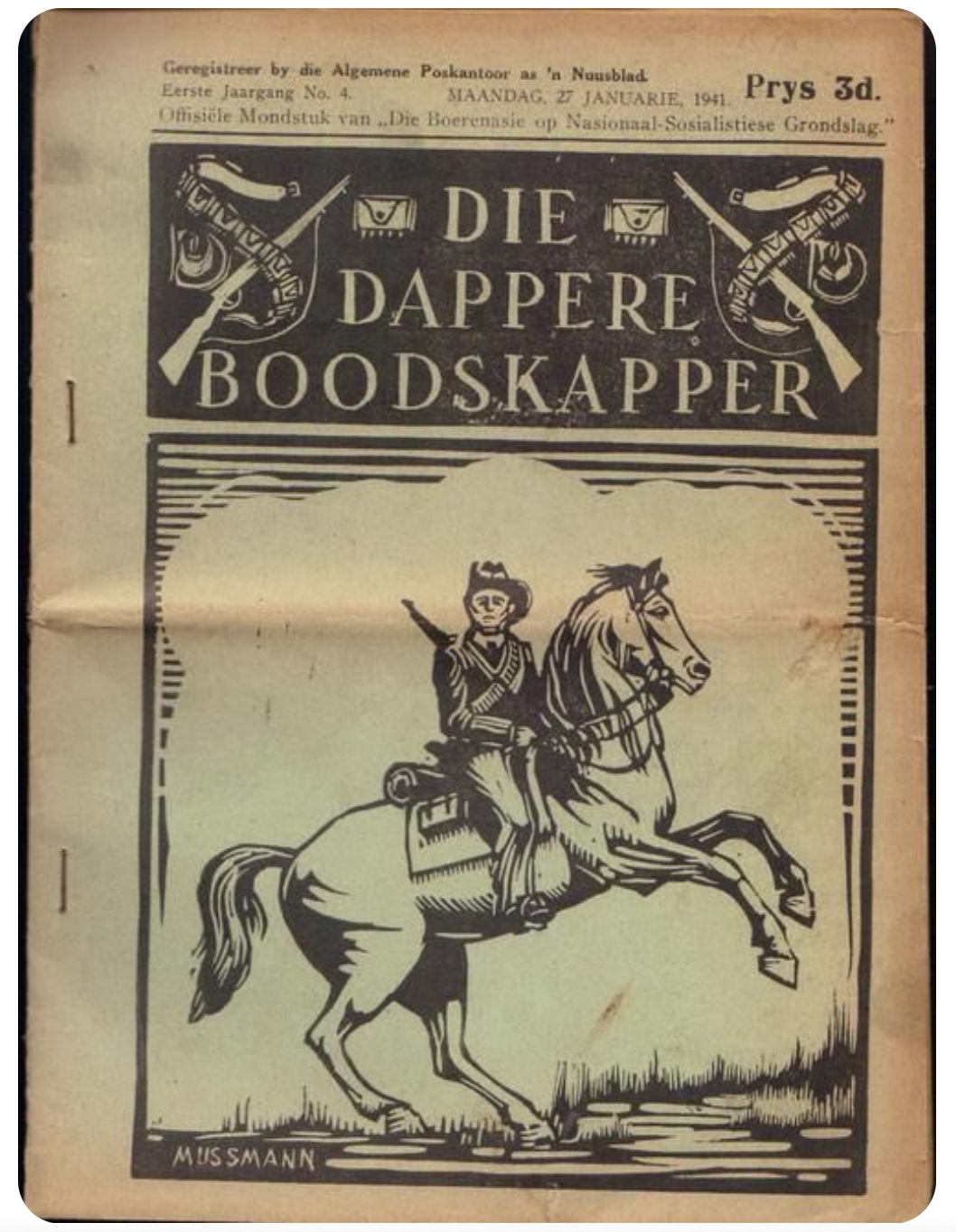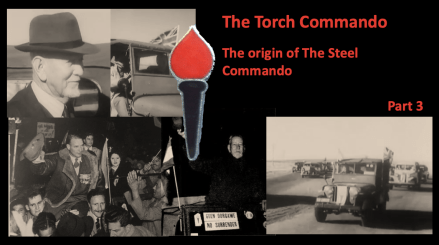
The Steel Commando

Torch Commando Series – Part 3

Forging a ‘Steel’ Commando

In researching The Torch Commando, quite often the word ‘Steel Commando’ comes in. Now, what exactly was The Steel Commando – some have incorrectly ventured that it was an equivalent to the ‘Greyshirts’ i.e. the strongmen enforcers within a political party – this is not the case, in fact the Steel Commando has an interesting origin, both in history and name. Central to the Steel Commando is the idea of winning hearts and minds – in the Steel Commando’s case it’s very much the Afrikaner ‘heart and mind’ they are after.

So, quick re-cap to my favourite area of research – The Torch Commando, a post-World War 2 mass-movement of ‘white’ ex-military servicemen, a political pressure group against the accent of the National Party into power in 1948 and their first submissions of Grand Apartheid legislation from 1950. It was not an insignificant movement, at its zenith The Torch Commando boasted 250,000 paid up members and as inconvenient truth goes, when it was formed it becomes the first mass anti-Apartheid protest movement, starting in April 1951, its origin pre-dates the African National Congress’ (ANC) ‘Defiance Campaign’ – which is their first mass mobilised protest against Apartheid and started in June 1952. The part that also does not sit with the current ‘struggle’ ANC rhetoric, the Torch Commando was almost exclusively ‘white’.

The dynamics behind the National Party’s ascent to power without a majority vote in 1948 have been vastly researched but suffice it to say that for returning War Veterans from WW2, fighting against Nazism, the advent of a political party with numerous leaders who had been directly and/or indirectly flirting with Nazism during the war as a net result of organisations like the Ox Wagon Sentinel (Ossewabrandwag) and other Neo Nazi factions merging with The National Party was an abhorrent idea and an insult to the sacrifice of their comrades in arms.

The outrage to this and the implementation of the first Acts and Bills that would become ‘Apartheid’ would result in a merger of war veteran members of the Springbok Legion veteran’s association and war veterans predominant in the United Party’s political structures in April 1951 – the ‘War Veteran’s Action Committee WVAC (the WVAC was to eventually evolve into The Torch Commando) under the leadership of the charismatic war-time fighter ace – Adolph Gysbert Malan, DSO & Bar, DFC & Bar, better known as Sailor Malan, a veteran with Afrikaans heritage. The WVAC is careful to balance its demography to reflect the views of both Afrikaners and English-speaking whites who had participated in all South Africa’s Wars and it is balanced 50/50 Afrikaans/English in its make-up. Now, the question is why did they have to do that – why the focus? 
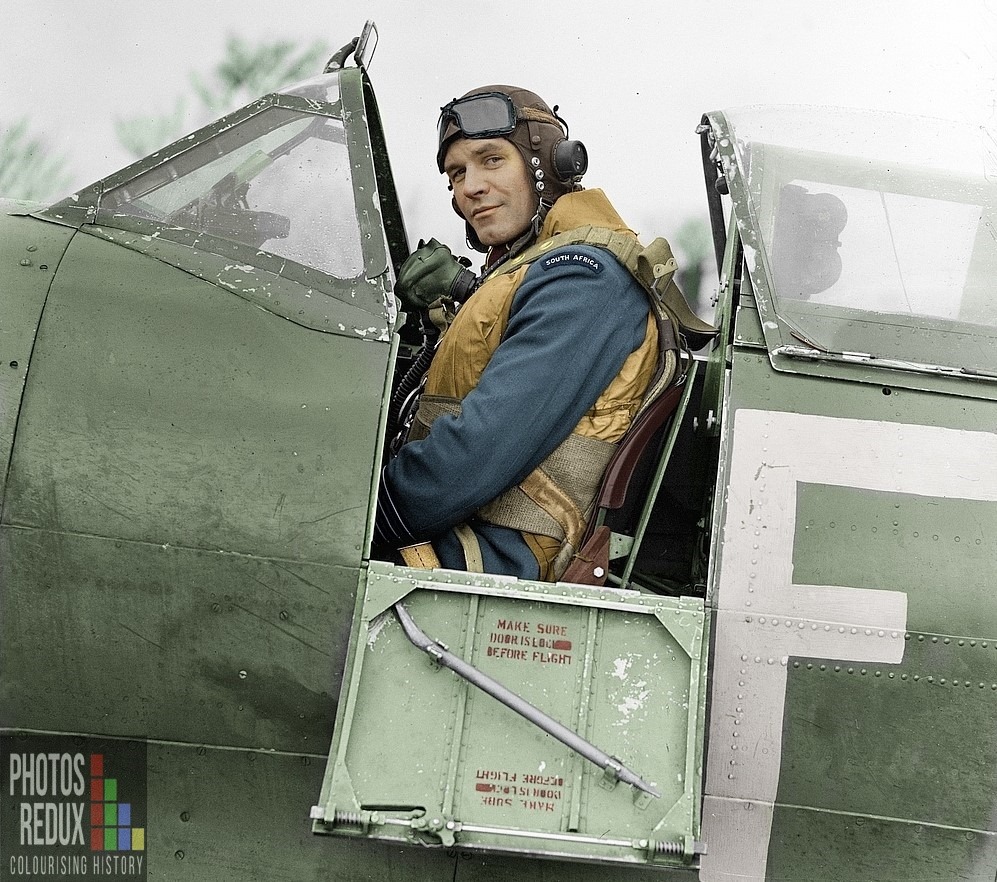
Sailor Malan during The Battle of Britain – note his ‘South Africa’ shoulder flash on his RAF uniform

The answer to this question has its origins in the way the South African Union Defence Force has been constructed and the way the South African public voting bloc – those eligible to vote is constructed and its dynamics. So, let’s look at the Defence Force.

The Union Defence Force

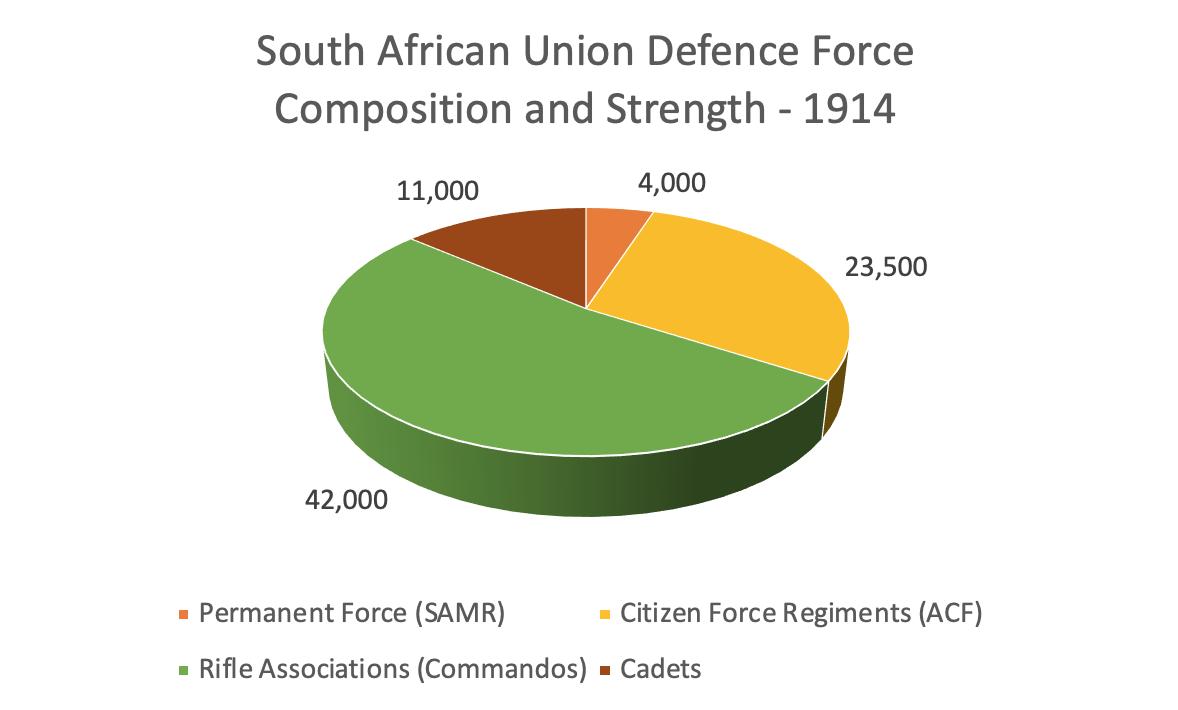
The South African Union Defence Force (UDF) from its origins in 1914 was carefully constructed by Jan Smuts to have an Afrikaner and English ratio of 60% Afrikaners and 40% English speaking whites, a proportional representation of the actual demographic of South Africa  – at first – for World War 1 starting in 1914, the Afrikaners primarily exist in the ‘Rifle Associations’ which are effectively the old Boer Republic’s Commandos and the English speaking South Africans exist in the ACF ‘Active Citizen Force’ Regiments – like the Royal Natal Carbineers, South African Light Horse and Durban Light Infantry, most of whom have origin in the old Natal and Cape Colony ‘Colonial Forces’ during the Boer War.

By the time the Second World War swings around in 1939 the UDF is a slightly different beast, but it still has its 60/40 ratio of Afrikaans to English, with Afrikaners in the majority, Jan Smuts calls out for volunteers, joining the Union Defence Force from the adult ‘white’ base of approximately 1,000,000 people in 1940 is 211,000 whites (with 120,000 Black, Coloured and Indian service personnel in addition).  

It’s an extraordinary response to a call-up to military service on voluntary lines, South Africa is one of the few participating countries in the Allied war effort not to implement conscription and as a population ratio – nearly a quarter of all white South African adults actively seeking service. 

Contrary to the myth asserted by the old National Party. The idea that 2nd World War was primarily fought by the ‘English’ white South Africans who had an affinity to Britain, Smuts had somehow turned ‘British’ and true ‘Afrikaners’ sat out the war as members of organisations like the Ossewabrandwag and the National Party either desiring neutrality due to a universal disgust with all things British (a hang-over from the Boer War) or in active support of Germany. However, this is a myth – it’s simply untrue.

The truth is that Smuts’ call had as much resonance with white Afrikaners as it did with white ‘English’ – of the white population volunteering for service, the pool reflects the national demographic split of the 60/40. So, approximately 127,000 Afrikaners and 84,000 ‘English’ – the Afrikaners are still the majority. Smuts’ call is simply broadly accepted by both white communities and extremely popular – fact, this is again where Economic History starts to tear gaping holes into ‘Political’ history narratives.

The voting bloc

Now let’s look at the white and coloured voting bloc and its dynamics. After the war ends in 1945, the National Party rather surprisingly wins the General Election in 1948, NOT by a majority, it’s a minority government winning on ‘constitutional’ grounds (number of seats) and NOT a popular one. 

Of the 1,000,000-adult voters in 1948 (the full actual vote count is 1,065,971 voters) – more or less as numbers go – 550,000 voted against Apartheid (for Jan Smuts’ United Party and their more liberal parties – The Labour Party etc.) as opposed to 450,000 who voted in favour of Apartheid (for the Afrikaner Nationalists – the re-united National Party and Afrikaner Party coalition). The ‘coloured’ vote – the Cape Franchise has within it approximately 50,000 voters and these have almost exclusively gone with the United Party and its partners (one of the National Party’s intended aims is to remove their franchise), so we can deduce that about 500,000 whites and 50,000 coloureds have voted against Apartheid.  
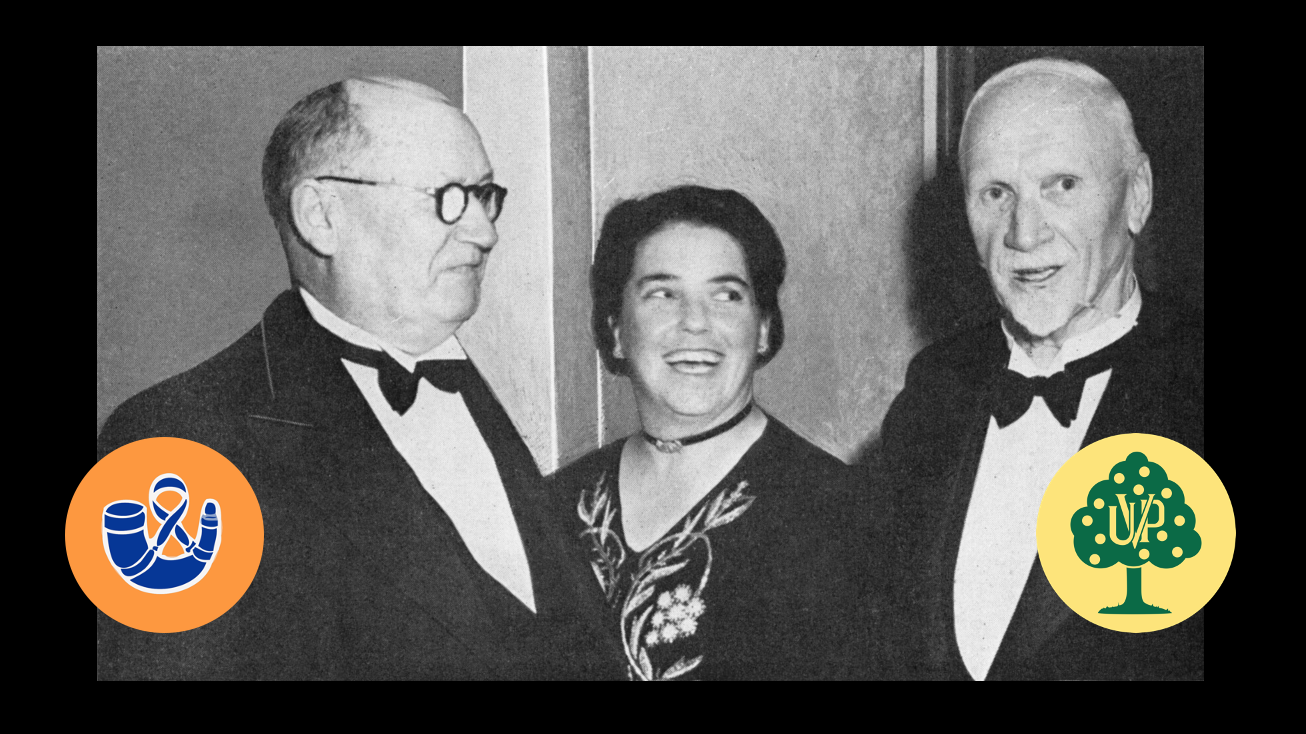
Dr D.F. Malan (left) leader of the National Party and General Jan Smuts (right) leader of the United Party

This alone qualifies an inconvenient truth. So much for the rather incorrect modern argument put forward by the ANC and other Black Nationalists that ‘white’ people in South Africa as a coherent whole voted to maintain their ‘privilege’ and are therefore responsible for Apartheid and the renumeration of black society hobbled by it. That agreement is simply not true – the majority of whites did not vote for Apartheid – the proof is in the statistics.

Albeit not a majority, clearly some Afrikaner ex-servicemen in the military veteran ‘service’ voting bloc have been moved to support Afrikaner Nationalism – prior to the election the National Party did a large degree of “swart gevaar” (Black Danger) fear mongering around Jan Smuts’ declaration that “segregation had fallen on evil days” and this has resonated with some Afrikaner servicemen, disillusioned in their discharge from the UDF, feeling vulnerable and seeking fundamental reforms within an Afrikaner hegemony.

What the War Veterans Action Committee (WVAC) aims to do is woo these white Afrikaans ex-servicemen voters back to either the United Party or the Labour Party. They also want to encourage ex-Afrikaner servicemen from Boer War 2 and World War 1 to join hands with the World War 2 veterans as a show of unified strength that many in Afrikaans community are simply not in favour of Apartheid – even some of the old highly regarded and much-loved Republican Boer War veterans who are still around.

The opening shots

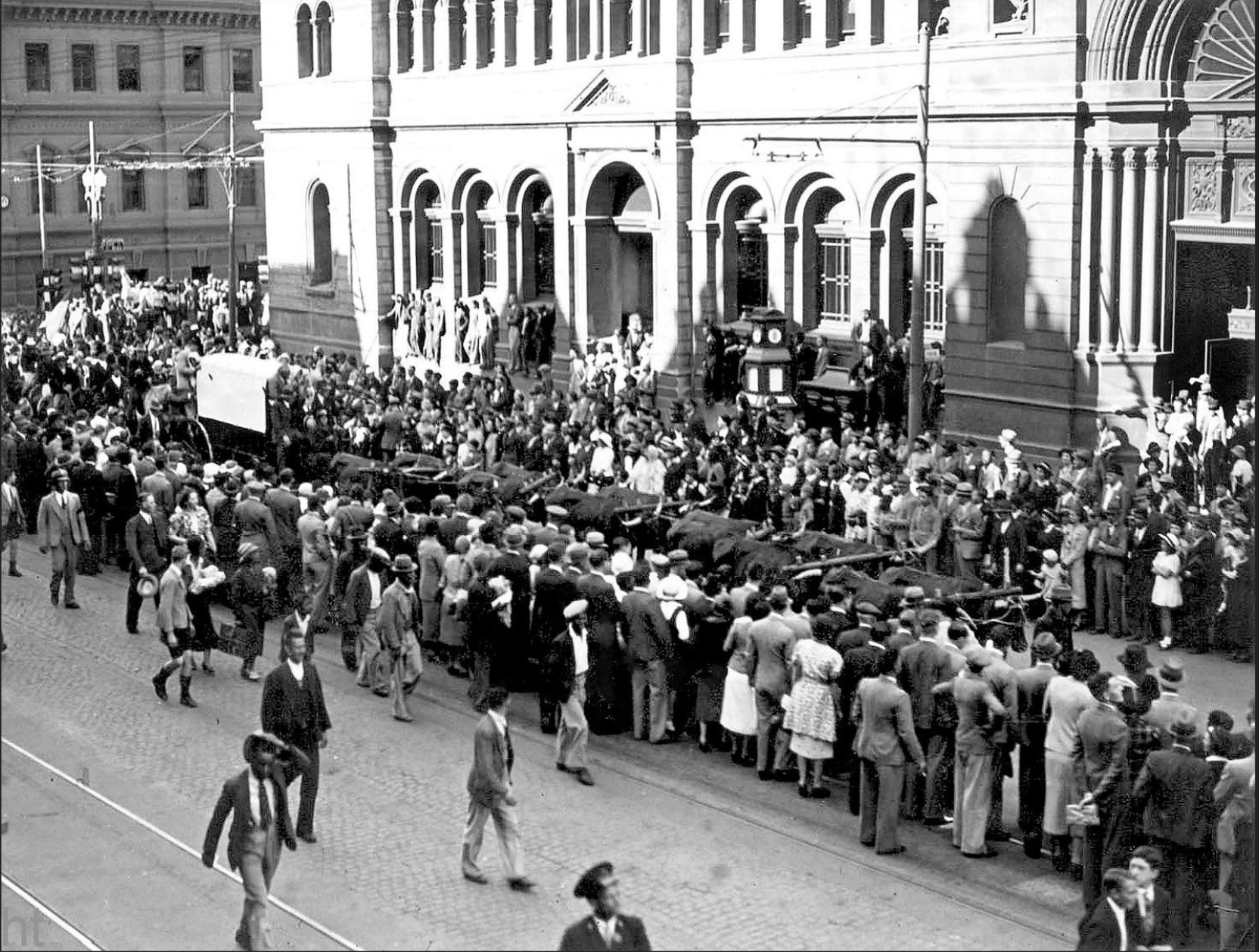
The War Veterans Action Committee (WVAC) kicked off their mission with a protest at the Johannesburg Cenotaph on 21st April 1951 during a commemoration service – laying a coffin draped in the national flag as a symbol to depict the death of the Constitution.
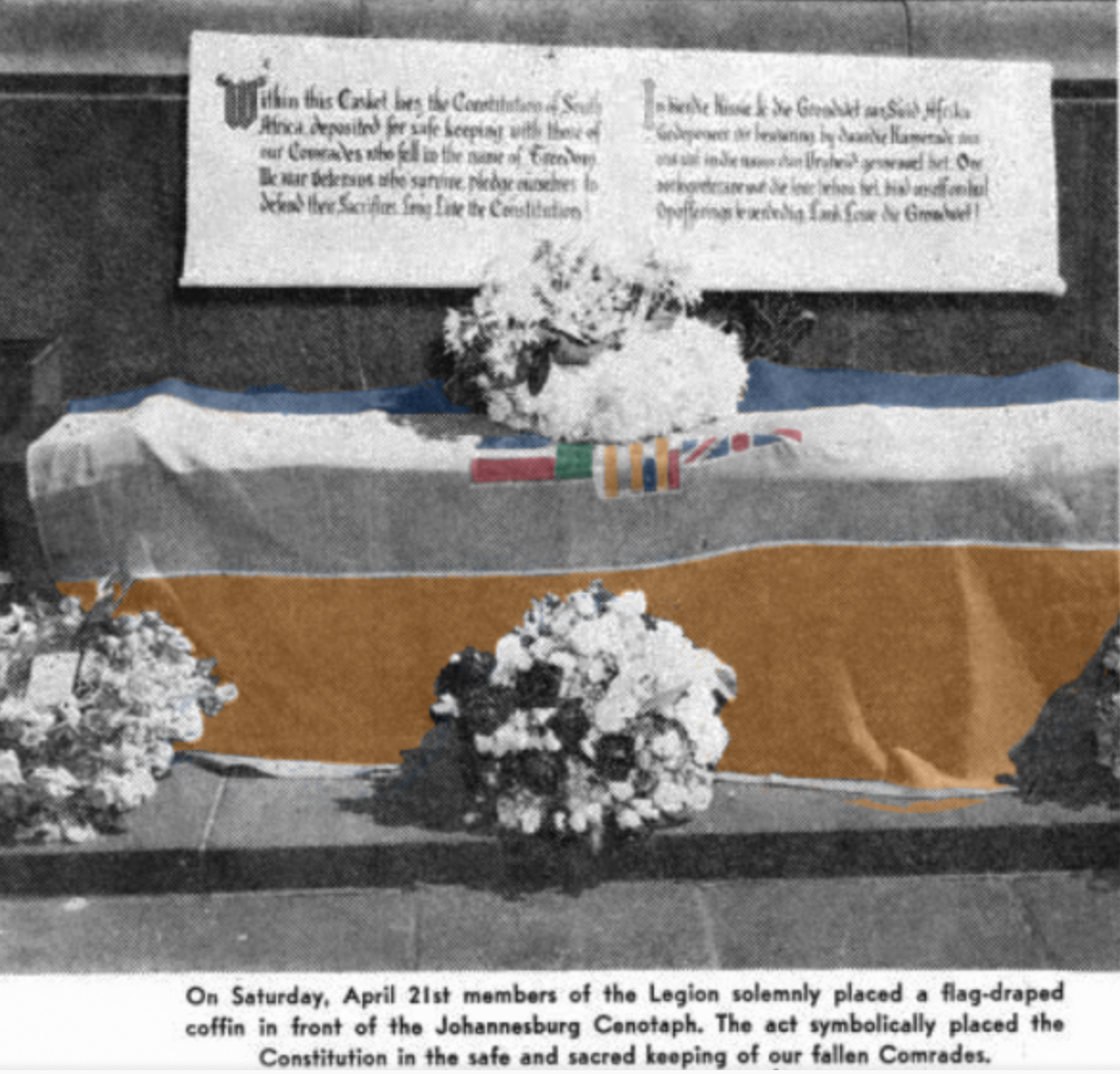
The first protest action of the WVAC

So, after the Cenotaph parade, the War Veterans Action Committee (WVAC) elected to ‘ramp-up’ their resistance and hold bigger protests using military precision and planning to activate the significant ‘ex-services’ vote and its supporters, so as to bring about regime change through the ballot box. 

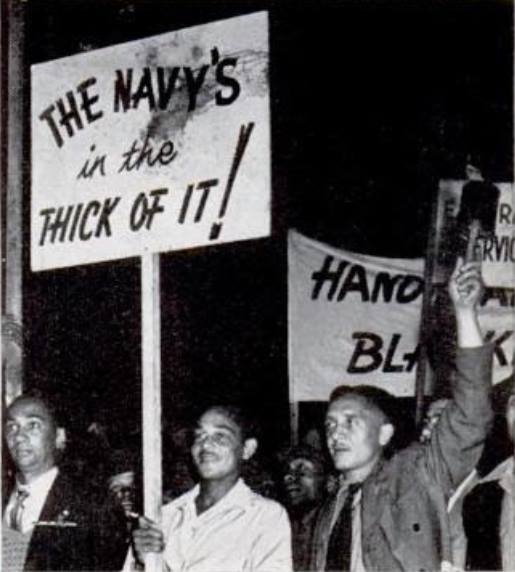
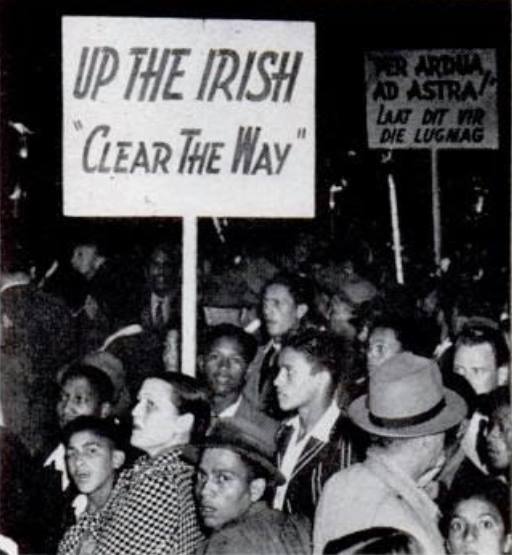
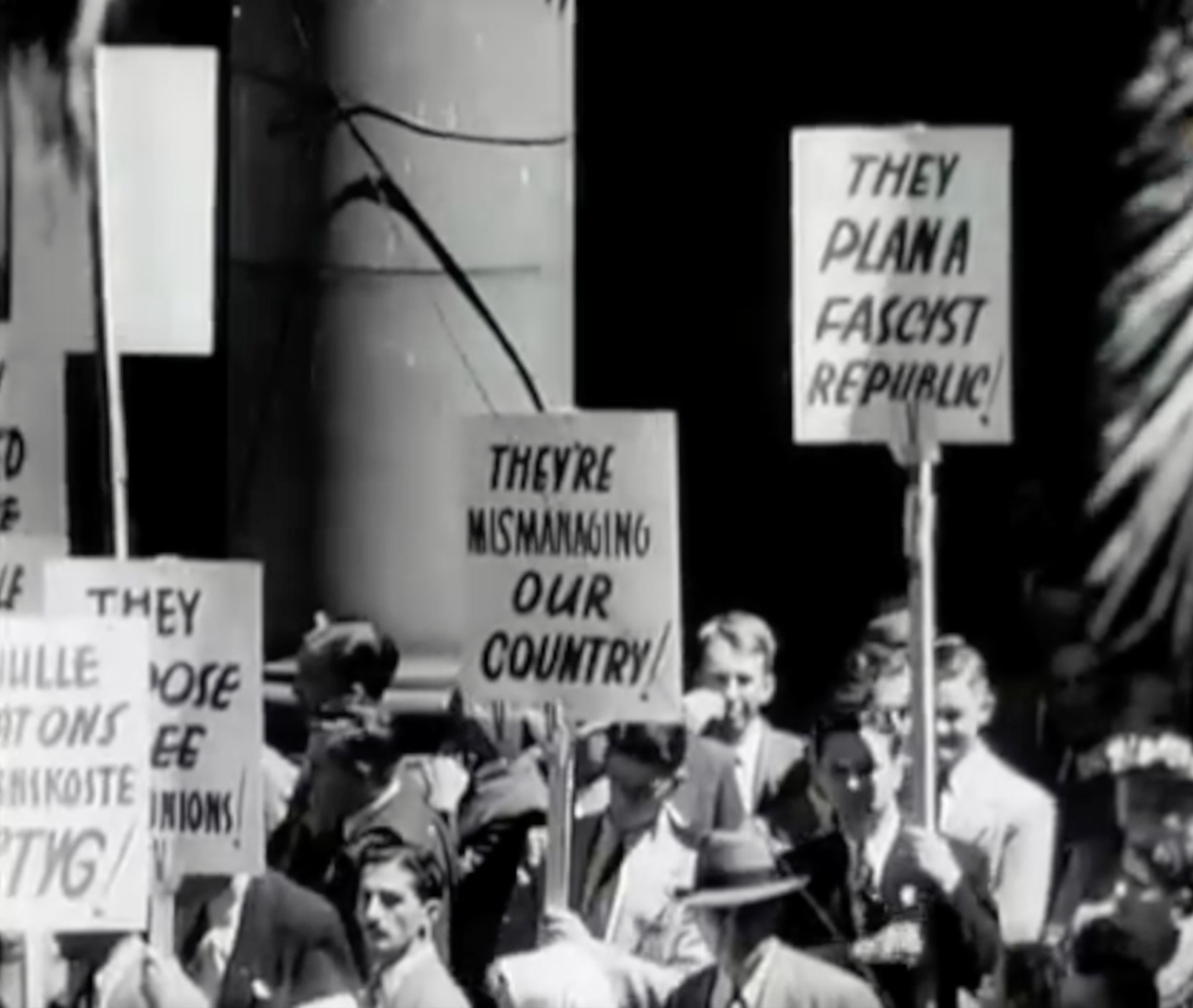
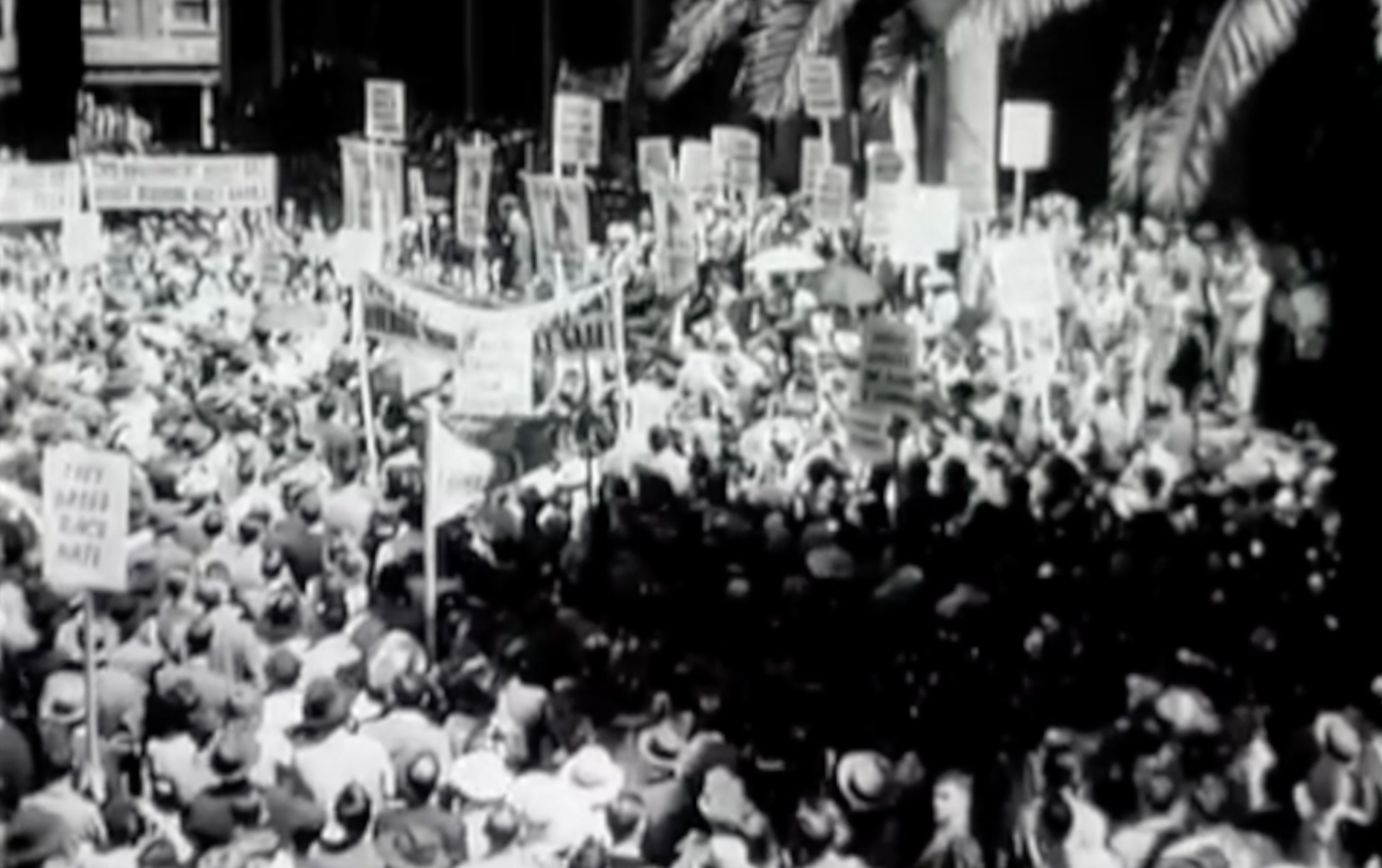
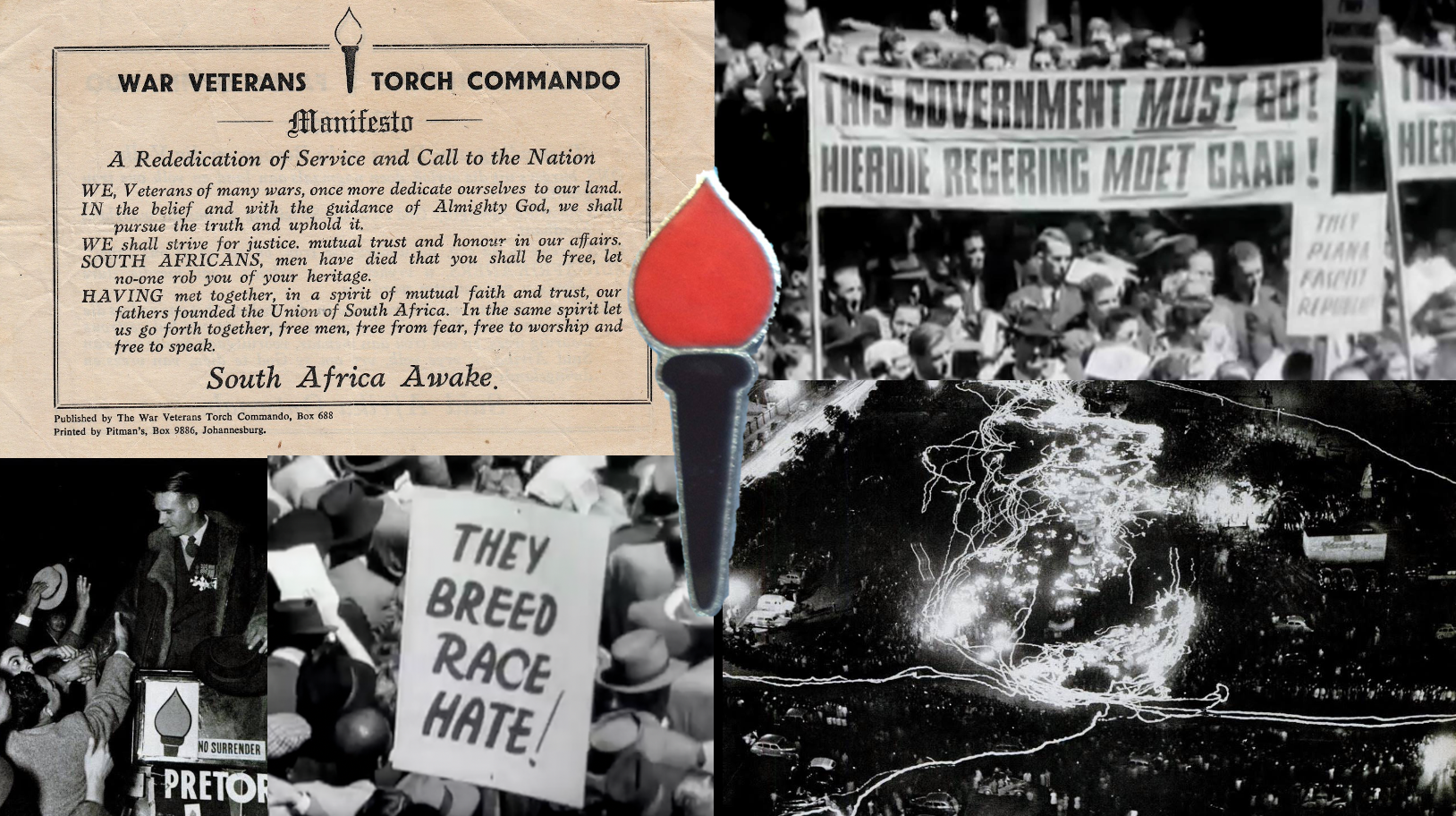
On the 4th May 1951, two political rallies were held, one Durban attracted 6,000 people and a second larger one 25,000 people strong, attended by Sailor Malan was held in Johannesburg. The protest marches were held at night and flaming torches were carried for effect – the Torches became symbols of ‘hope’, ‘freedom’ and ‘light’ – and would ultimately be the trademark of the movement with carriers known as “Torch-men”. The proposed idea to the audience was to initiate a ‘crusade’ against the Afrikaner Nationalists in the same spirit as their ‘crusade’ against Hitler and for the same reasons.

The Johannesburg rally saw more than 5,000 veterans ‘on-parade’ carrying Torches march from Noord Street near the railway station to the Johannesburg City Hall. They we joined by approximately 15,000 civilians as they gathered outside the City Hall. Sailor Malan was to outline this intention to crusade when he referred to the ideals for which the Second World War was fought:

“The strength of this gathering is evidence that the men and women who fought in the war for freedom still cherish what they fought for. We are determined not to be denied the fruits of that victory.”

Sailor Malan

At these meetings on 4th May the following resolutions were taken and unanimously agreed:

  1. We ex-servicemen and women and other citizens assembled here protest in the strongest possible terms against the action of the present government in proposing to violate the spirit of the Constitution.
  2. We solemnly pledge ourselves to take every constitutional step in the interests of our country to enforce an immediate General Election.
  3. We call on other ex-servicemen and women, ex-service organisations and democratic South Africans to pledge themselves to this cause.
  4.  We resolve that the foregoing resolutions be forwarded to the Prime Minister and the leaders of the other political parties.

A further meeting was held in Port Elizabeth, attended by 5,000 people, at this meeting the following resolution was outlined;

“This meeting condemns the present government for violating the liberties for which the wars of 1914 – 1918 and 1939 – 1945 were fought and for disregarding the moral undertakings enshrined in our Constitution. We pledge ourselves to continue the struggle to ensure we and our children live in true democracy.”

A manifesto would be released on the 13th May and the war veterans resolved to form a ‘Steel Commando’ to send these four resolutions of protest directly to Parliament in Cape Town. A jeep convoy was put together with precision from all major metropoles to convene in Cape Town on the 28th May 1951. But why the term “Steel Commando” – what resonance would that have and what were the objects of using this concept? Here again – this has a distinctive Afrikaner heritage and appeal. So, here’s some background.

The Steel Commando – an Afrikaner root

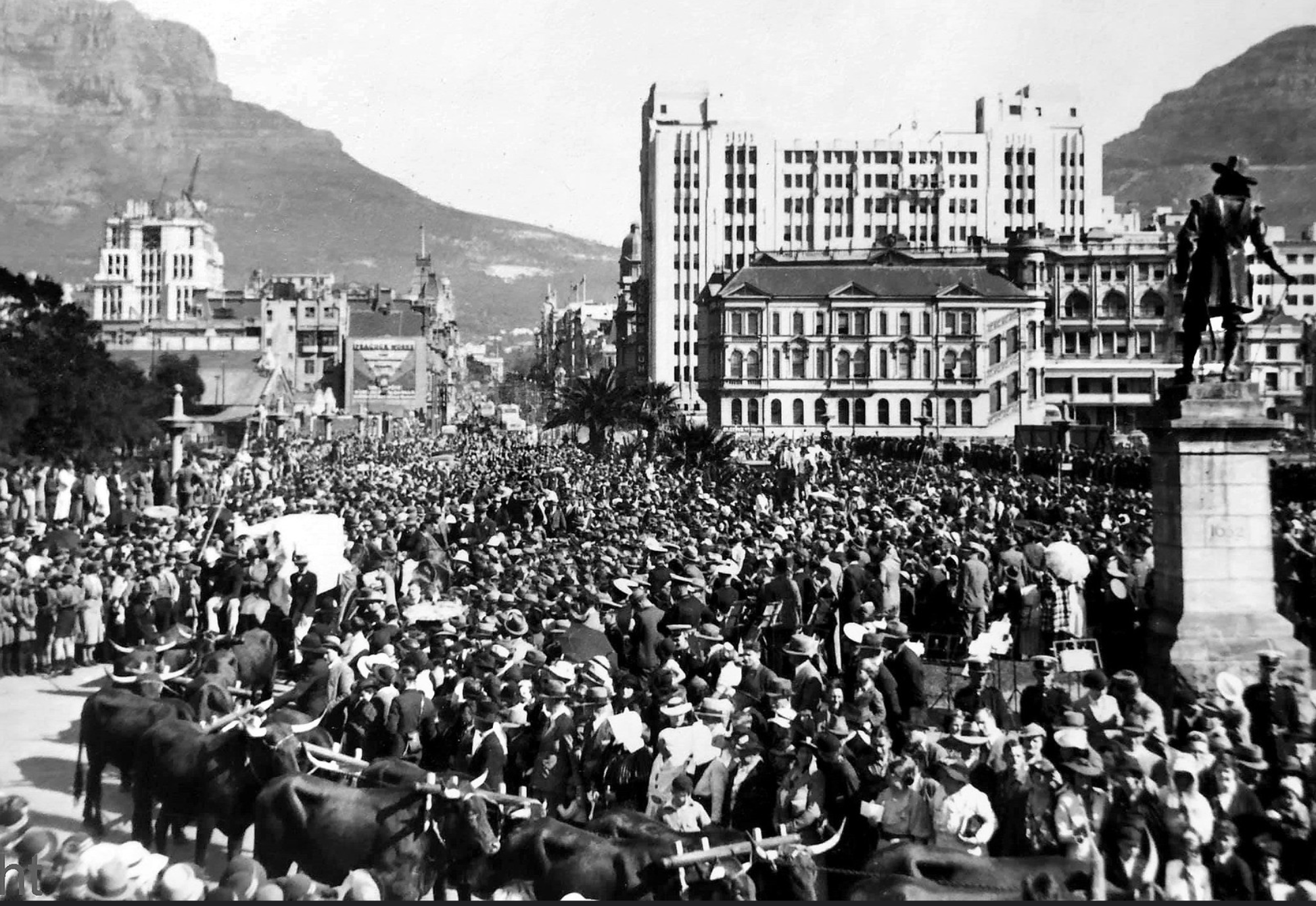
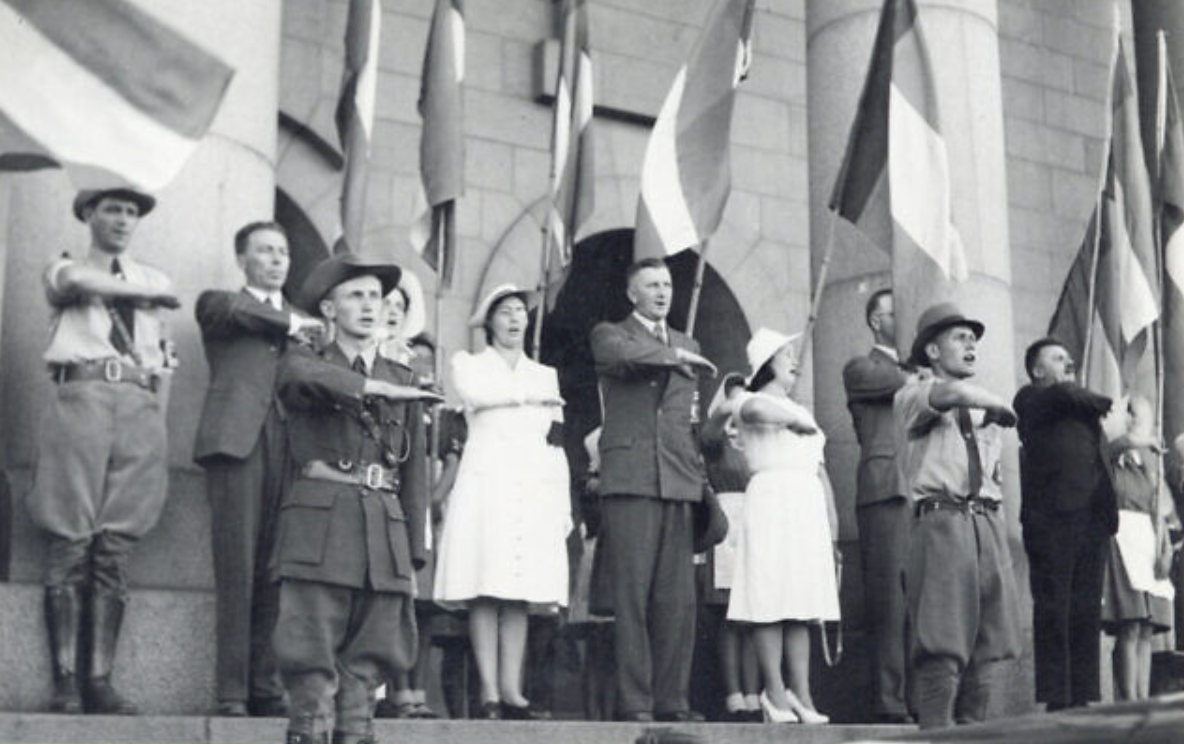
Just prior to World War 2, the Broederbond under the directive of its Chairman, Henning Klopper conceived a travelling carnival to celebrate the 100-year anniversary of the Great Trek – it was known as the 1938 Great Trek Centenary its purpose was the establishment of a unified Afrikaner identity under a white ‘Voortrekker’ hegemony – the underpinning of Afrikanerdom with a Christian Nationalism ideology. The long and short, this travelling caravan of Voortrekker wagons traversing to the most rural parts of South Africa on their way to the Blood River battle-ground and the future site of the Voortrekker monument outside Pretoria to lay its cornerstone … it was a massive success, resonating with Afrikaners country-wide and bringing together the impossible – the Boer Afrikaner and the Cape Afrikaner under a ‘white’ Voortrekker’s “path for South Africa” banner.
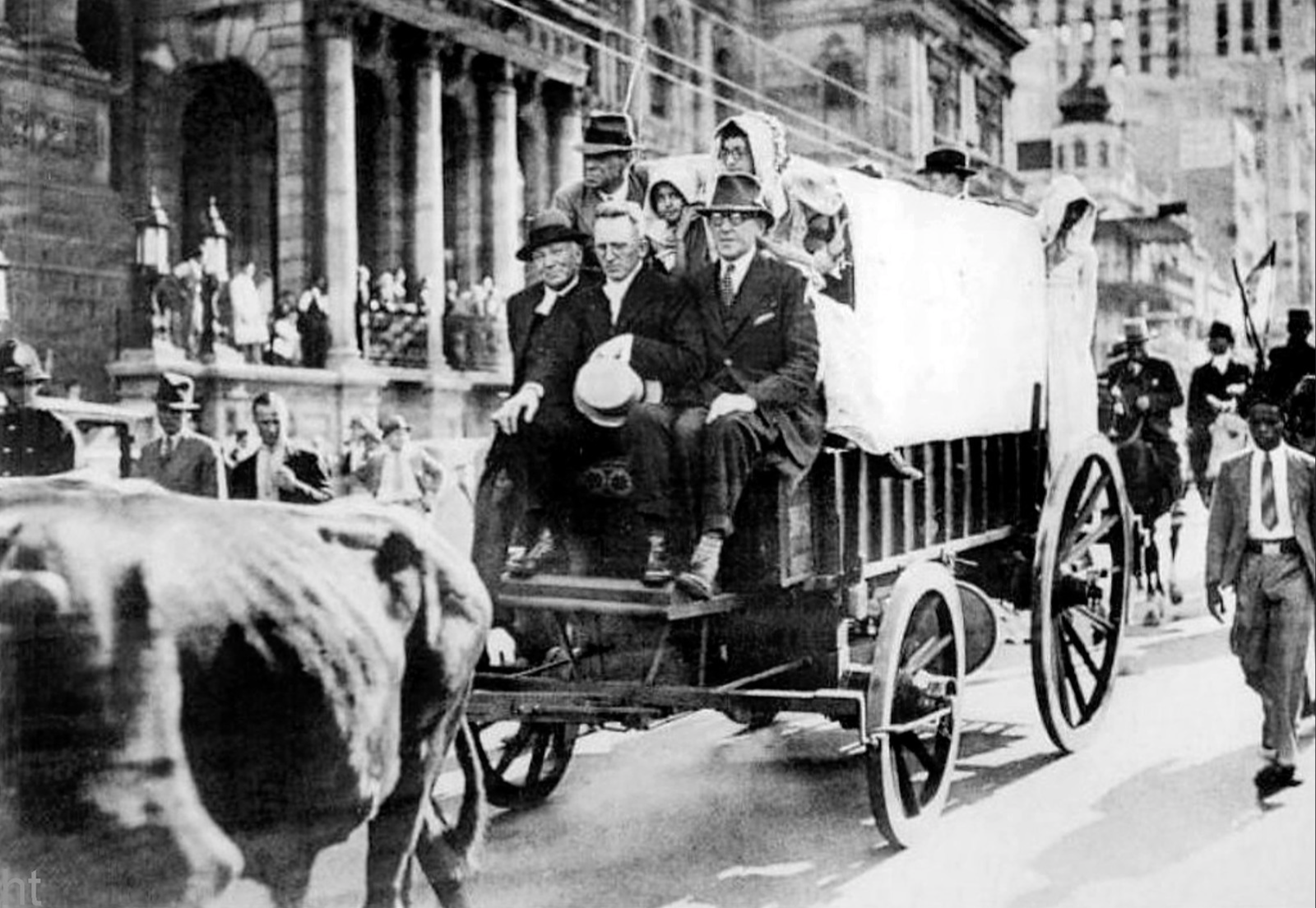
Henning Klopper’s Ox-Wagons named – The ‘Piet Retief’ and the ‘Andries Pretorius, leave Cape Town from the foot of Jan van Riebeeck’s statue to commence the 1938 Centenary of The Great Trek.

Two years later, during World War 2, the recruitment of white Afrikaners to volunteer for war service became paramount to Union’s Defence Force wartime objectives. Dr Ernie Malherbe and a group of academics, notably Alfred Hoernle and Leo Marquard, persuaded General Smuts to set up, under Malherbe, a corps of information officers to counter subversion in the armed forces generated by the likes of the Ossewabrandwag and the Broederbond and to stimulate the Afrikaner troops and potential white Afrikaner recruits to consider what they were actually fighting for.

Colonel Malherbe would take a leaf out of the Broederbond’s 1938 Centenary Trek used to ‘unify’ the Afrikaner – a round the country travelling carnival covering just about every town and village in the remotest areas. Only this time Colonel Malherbe intended that the travelling carnival ‘unify’ the Afrikaner behind Smuts’ call to arms to fight with Britain and France on the side of the Allies. He would use armoured cars instead of ox-wagons and his message was almost diametrically opposite to that of the Broederbonds’.

Colonel Malherbe would call his countrywide travelling carnival – The Steel Commando, added to this would be a propaganda and recruitment pamphlet dropping campaign from SAAF aircraft called the Air Commando.  The Steel Commando would consist of vehicle to carry a full military band, various armoured cars and a truck converted into a mobile recruitment station. 

Critical to the Steel Commando would be a contingent of old Republican Boer War veterans (South African War 1899-1902) to give it a sense of ‘Afrikanerdom’ and ‘duty’ to South Africa. The term ‘Commando’ would be given to the convoy – solely because it resonated with old Republics ‘Kommandos’ of the Boer war and as a result had Afrikaner appeal. 

This convoy would enter small rural and farming towns with the fanfare of the marching band ahead of it, flanked by the Boer War Republican veterans and the recruiting station behind. Was it effective in capturing the Afrikaner hearts and minds as the Centenary Trek had been?  The truthful answer is – yes. In all the South African standing forces in WW2, Malherbe was satisfied in the objects of The Steel Commando – the single majority ethnic group in the South African Union’s Defence Force during World War 2 were white Afrikaners (126,600 of them).
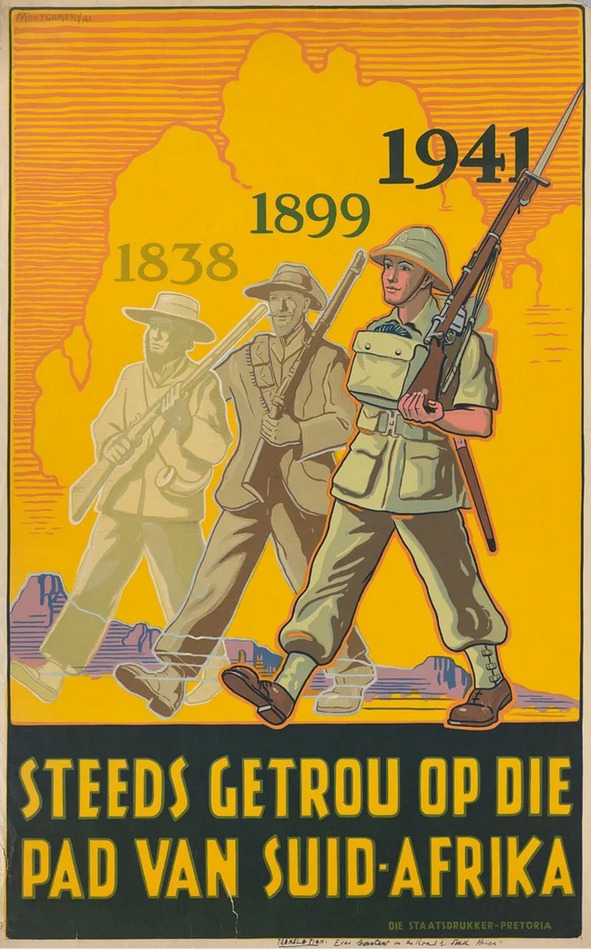
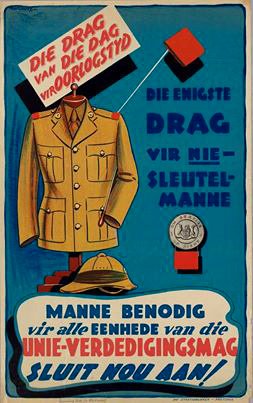
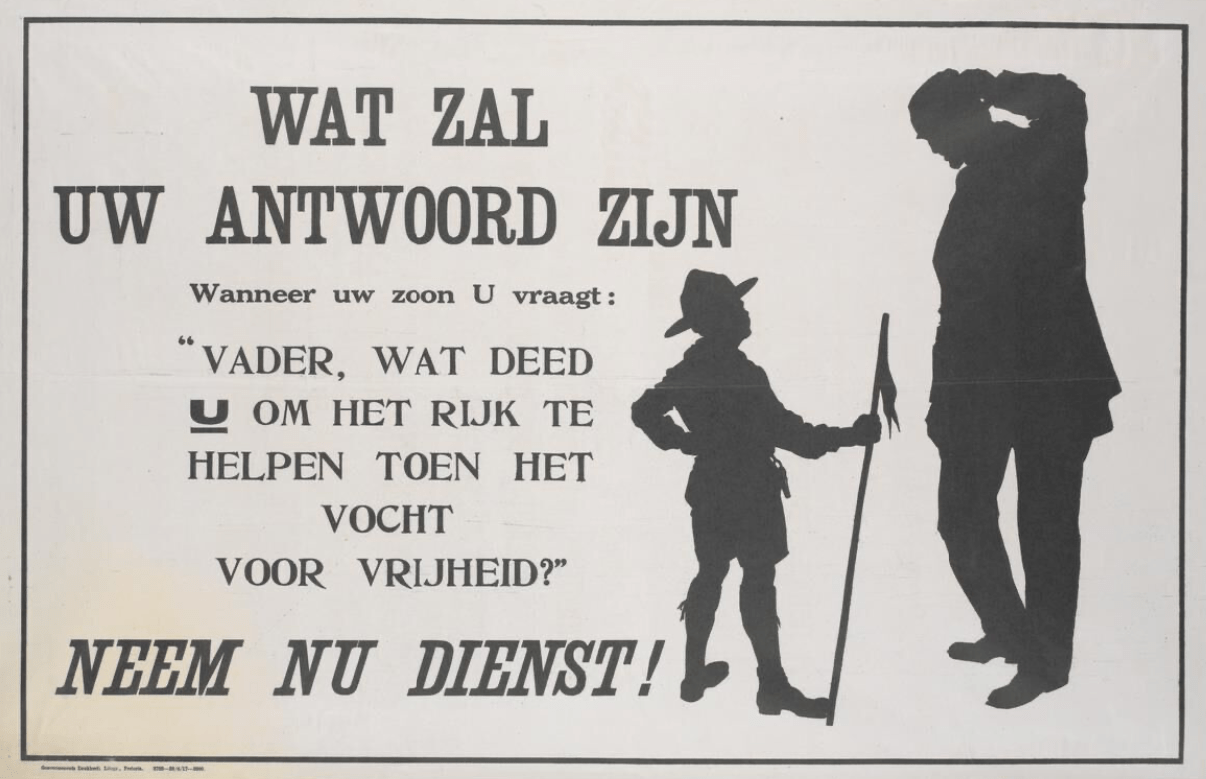
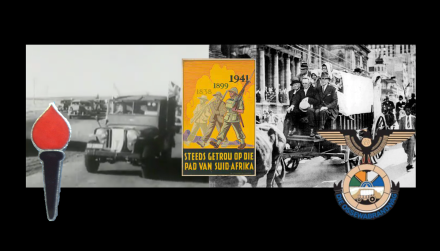
Images: World War 2 recruitment posters targeted at white Afrikaners – note the poster drawing on the ‘the road to South Africa’ commencing from The Battle of Blood River to the Boer War Commandos to the South African Union Army – the title “Still loyal to the path of South Africa” is a direct play on the 1938 Centennial Trek which the Broederbond pitched as “Die Pad van Suid-Afrika,” a symbolic ‘path’ to South Africa’s nationhood taken by the Voortrekkers. This poster attests that joining the Smuts appeal to war is the true path to nationhood.

To see the effect of a Steel Commando parade, this video outlines one addressed by Smuts as a demonstration of the achievements of recruitment is very telling – note the extensive use of Boer Commando veterans.

What the Steel Commando and Colonel Malherbe’s recruitment drive also did was literally split the Afrikaner ‘hearts and minds’ in two, one half supporting the National Party’s call to neutrality or the Ossewabrandwag’s call to directly support Nazi Germany – and the other half of white ‘Afrikanerdom’ – supporting the ideals of Union between English and Afrikaans, General Smuts’ policies and the Allied war against Nazi Germany. 

The Steel Commando … repurposed 

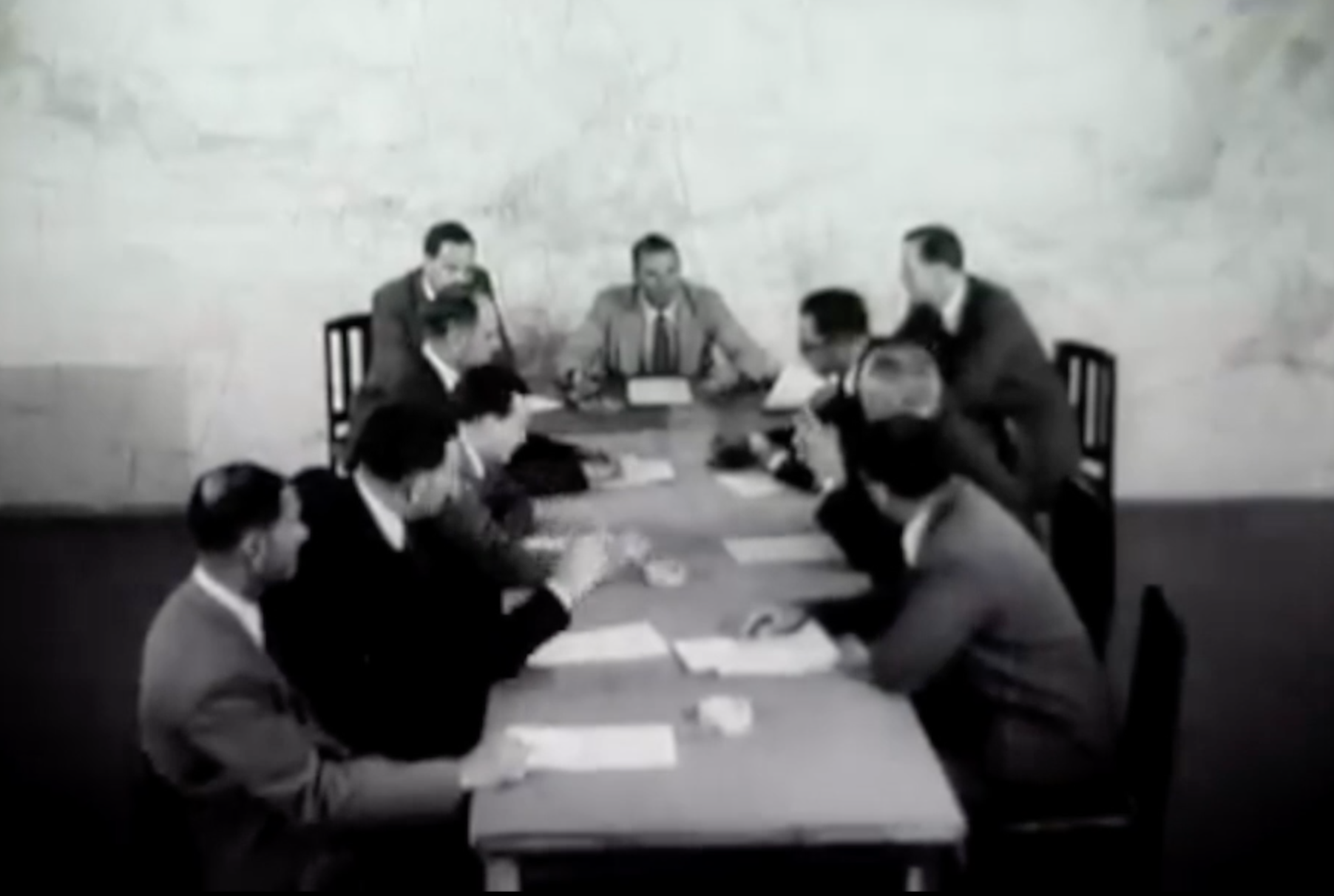
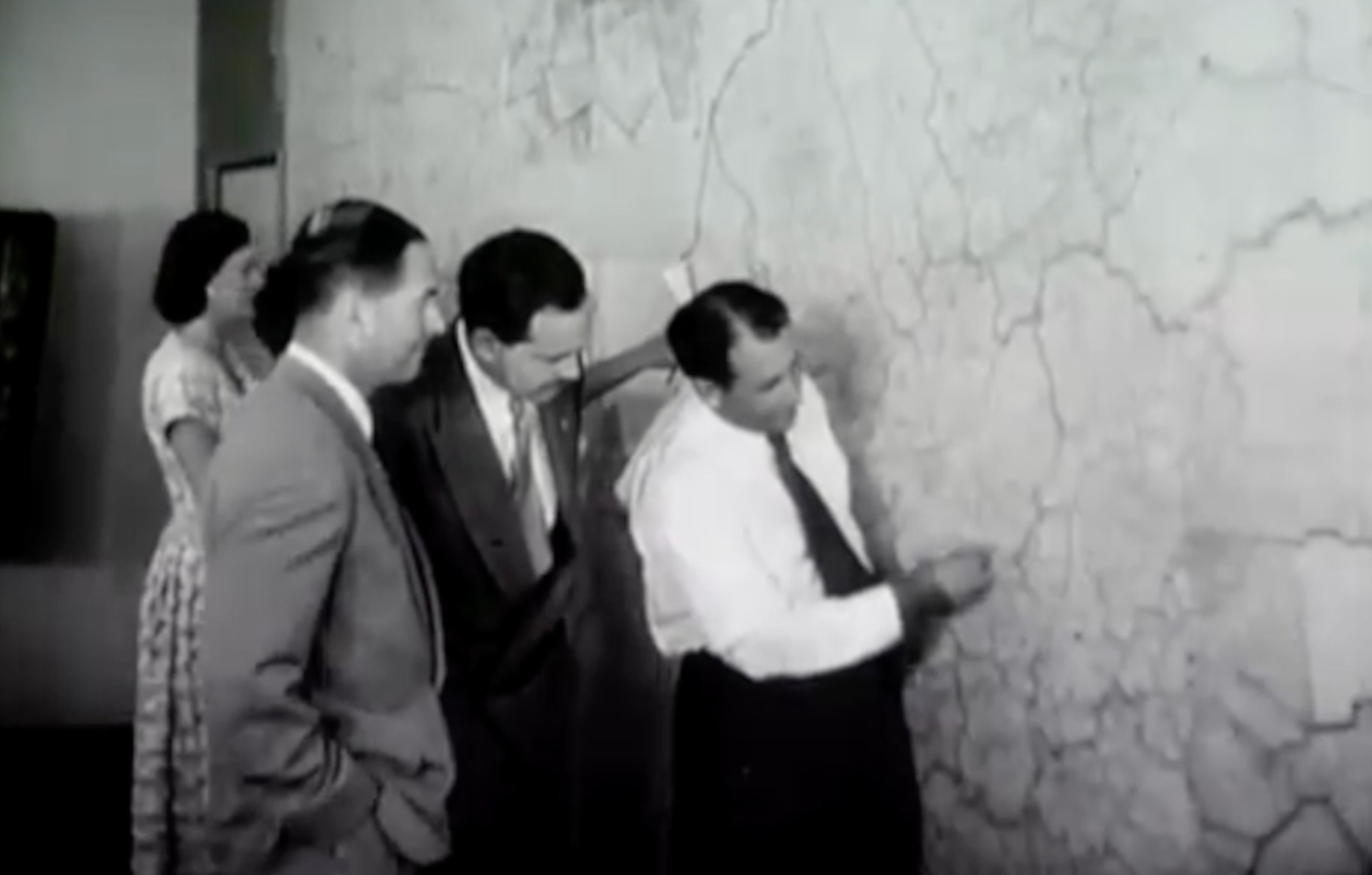
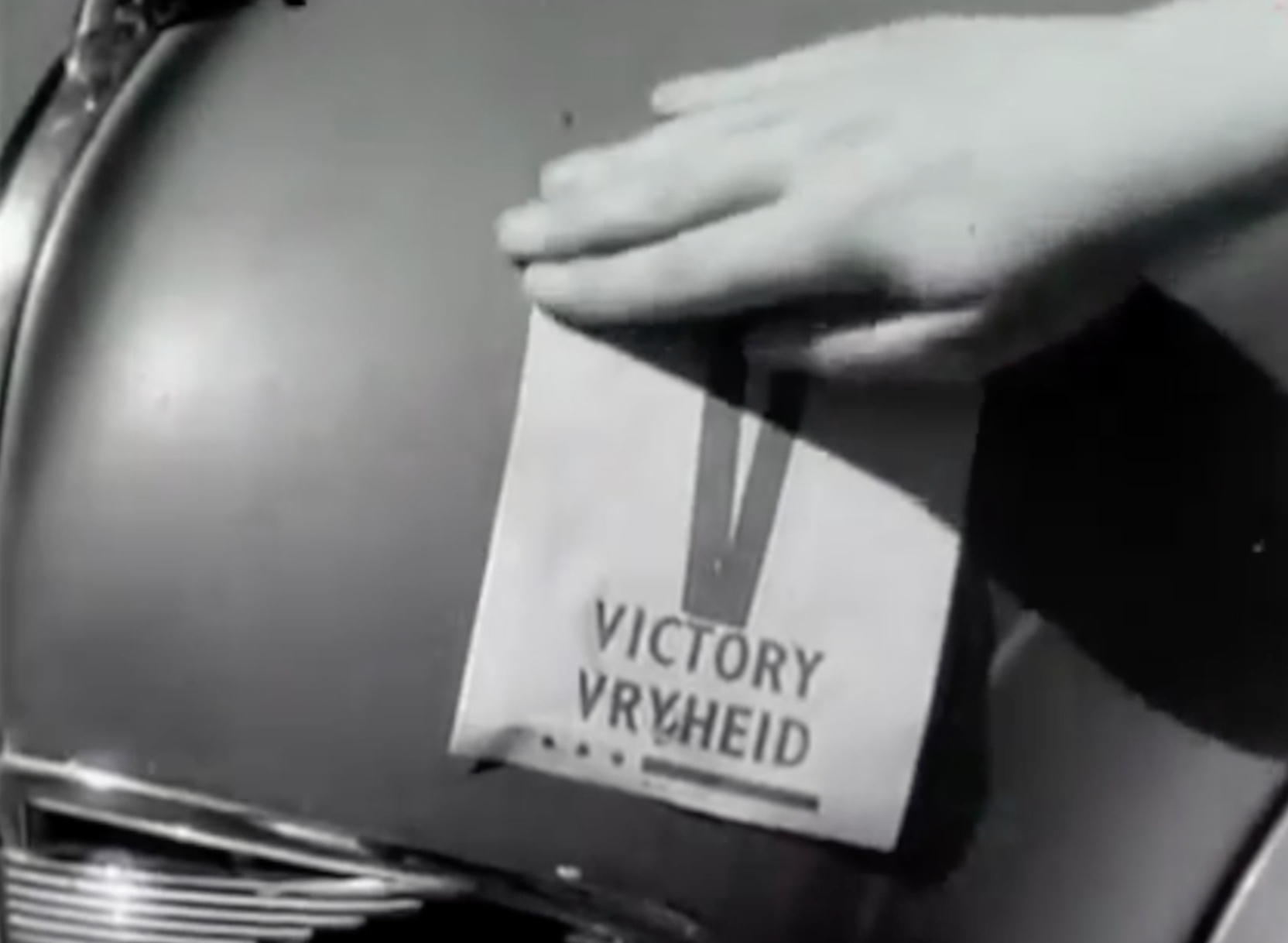
So, to whip up support for their Anti-Apartheid cause, and how to whip up the planned mega-torchlight rally in Cape Town to hand over the demands? The War Veterans Action Committee took a leaf out of Colonel Malherbe’s Union Defence Force ‘Steel Commando’ recruitment drive. They would not even change the name, the WVAC’s ‘Steel Commando’ would be run along the same lines with military precision. All around the country from far flung places vehicles would converge with the Steel Commando and the Commando itself would drive through multiple towns and villages whipping up publicity and support. 
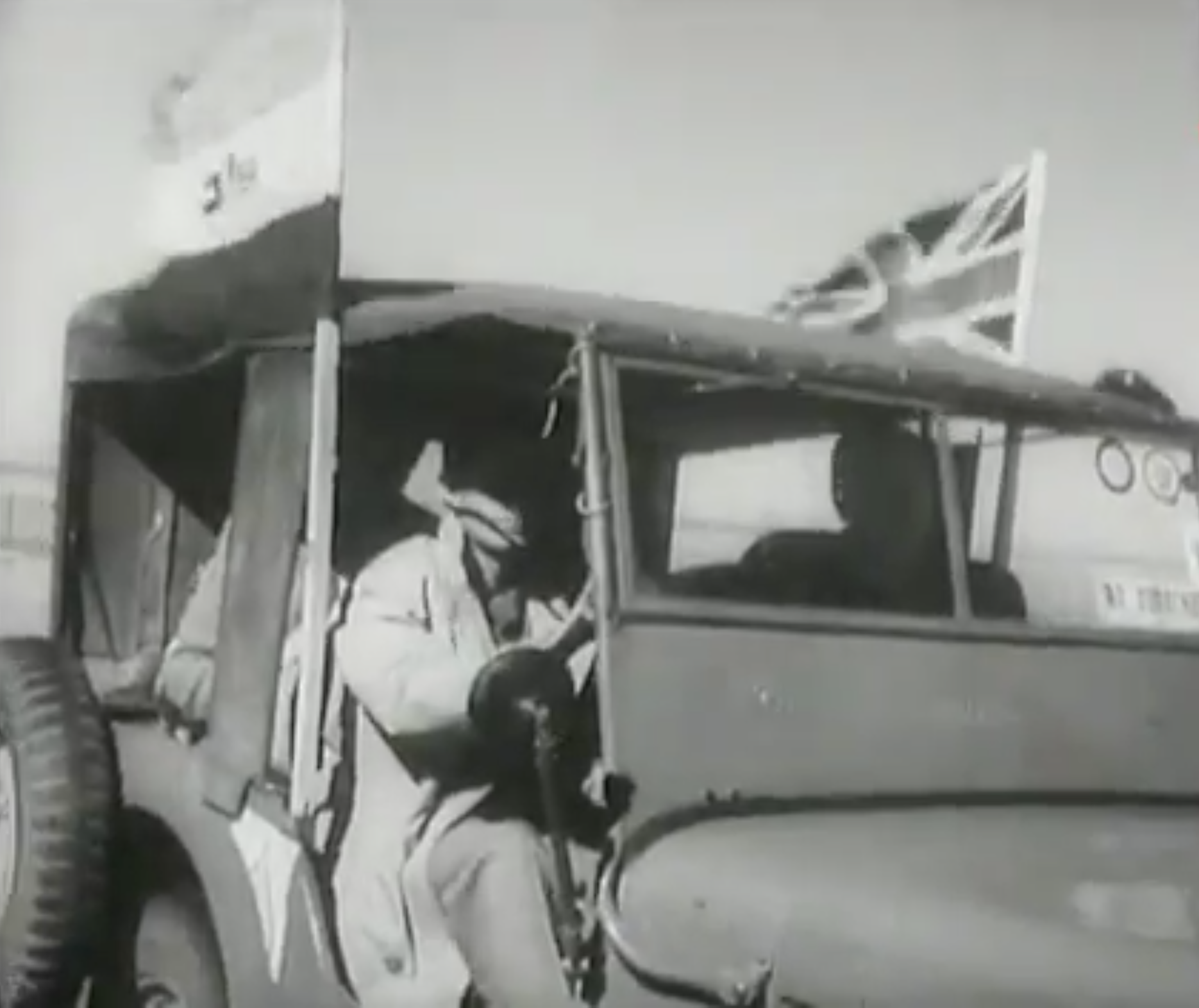
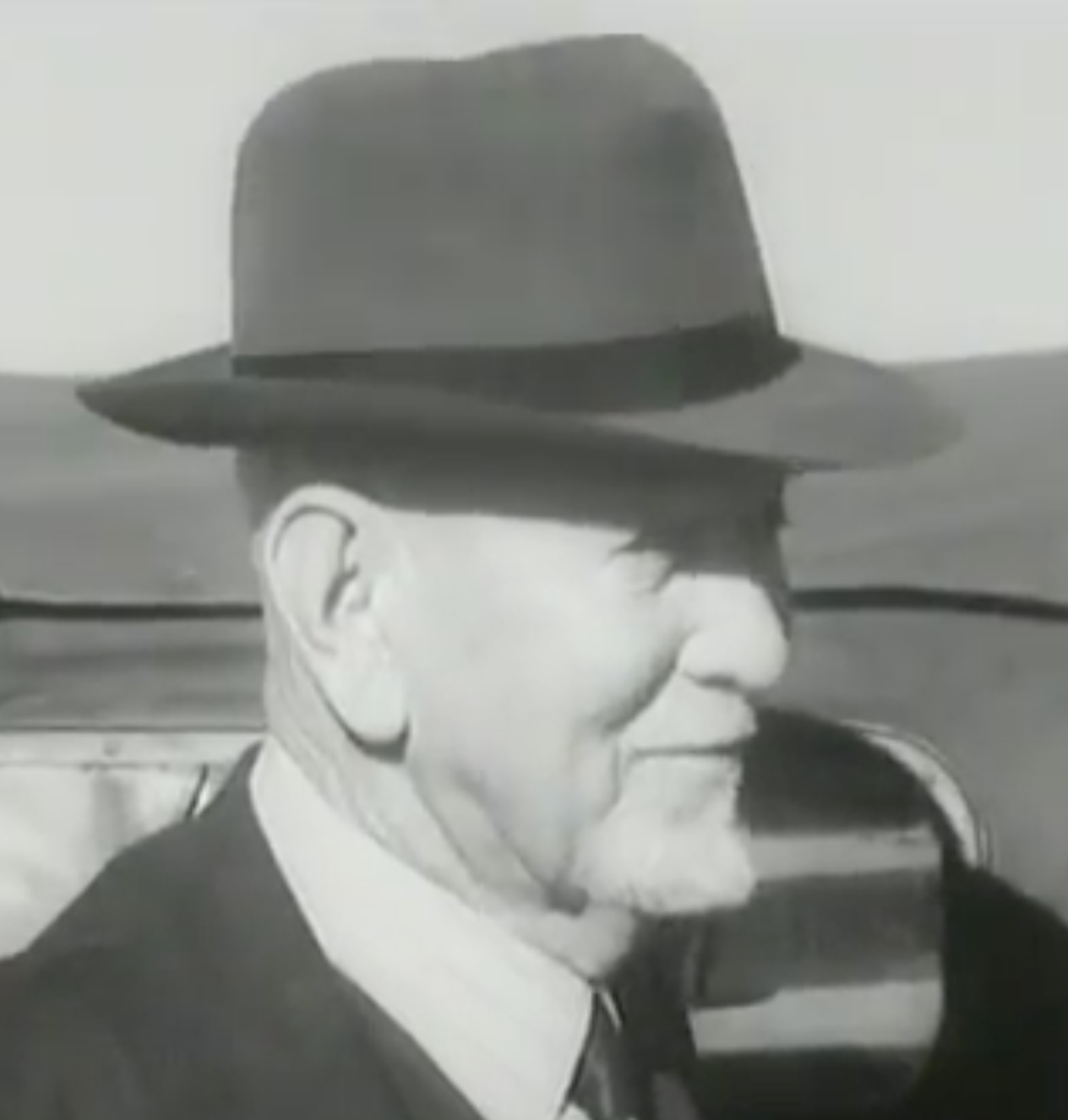
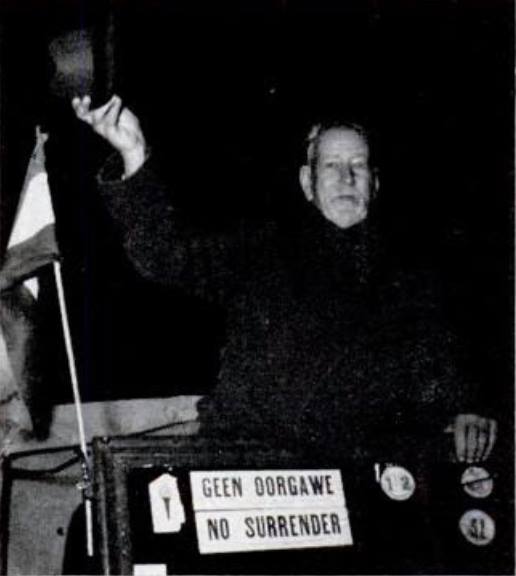
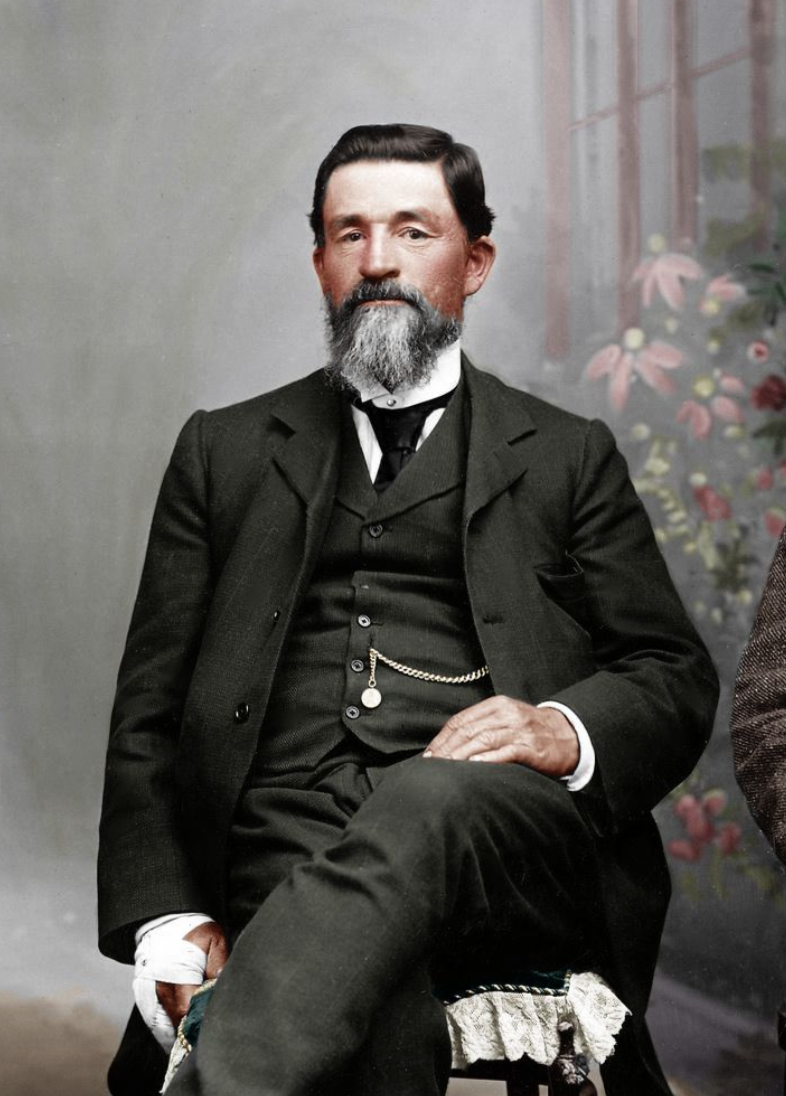
To balance the authority of the Steel Commando been both for ‘English’ and ‘Afrikaners’ alike and give it a high appeal, leading the ‘Steel Commando’ convoy to Cape Town a big hitting Afrikaner war hero – Kommandant Dolf de la Rey, a South African War (1899-1902) i.e. Boer War 2 veteran of high standing in the old Republican Forces of the Boer War. Part of Commandant Dolf de la Rey’s legacy was that he was reputed to have been involved in the actions around Ladysmith which resulted in the capture of Winston Churchill. Kommandant de la Rey was also affectionally given the term ‘Oom’ by the publicity machine to conjure up respect from the Afrikaner community.  

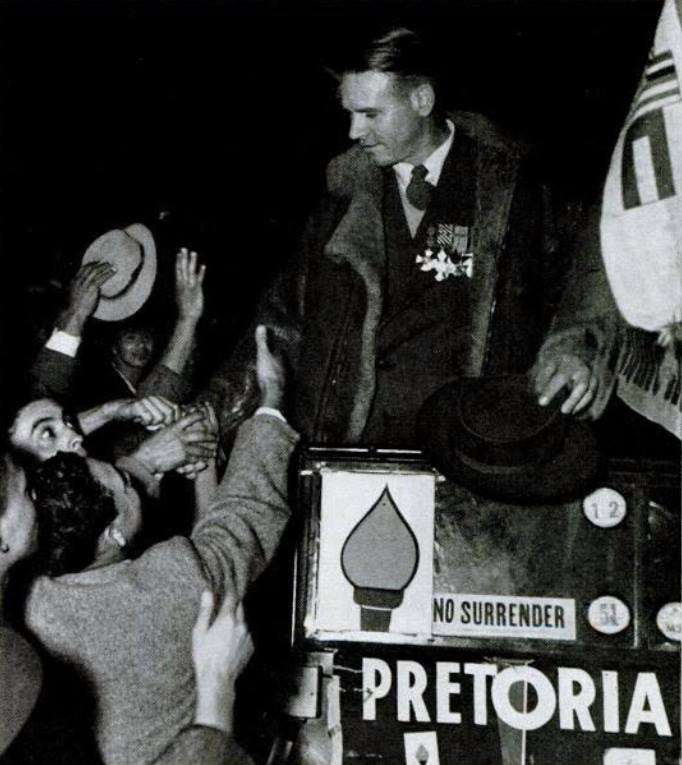
The ‘Steel Commando’ convoy gathered media attention and grew in size as it converged on Cape Town on the 28th May, a crowd of 4,000 greeted it as it converged in Somerset West before heading to Cape Town that evening.

This is a rare News reel of The Steel Commando drive – Note Kmdt Dolf de la Rey and the Republican Boer War veterans with him.

One newspaper correspondent wrote of it: 

“Cape Town staged a fantastic welcome for Kmdt de la Rey and Group Captain Malan, he related the enthusiasm of the crowd to the same that liberation armies received in Europe.”

The Johannesburg Star said: 

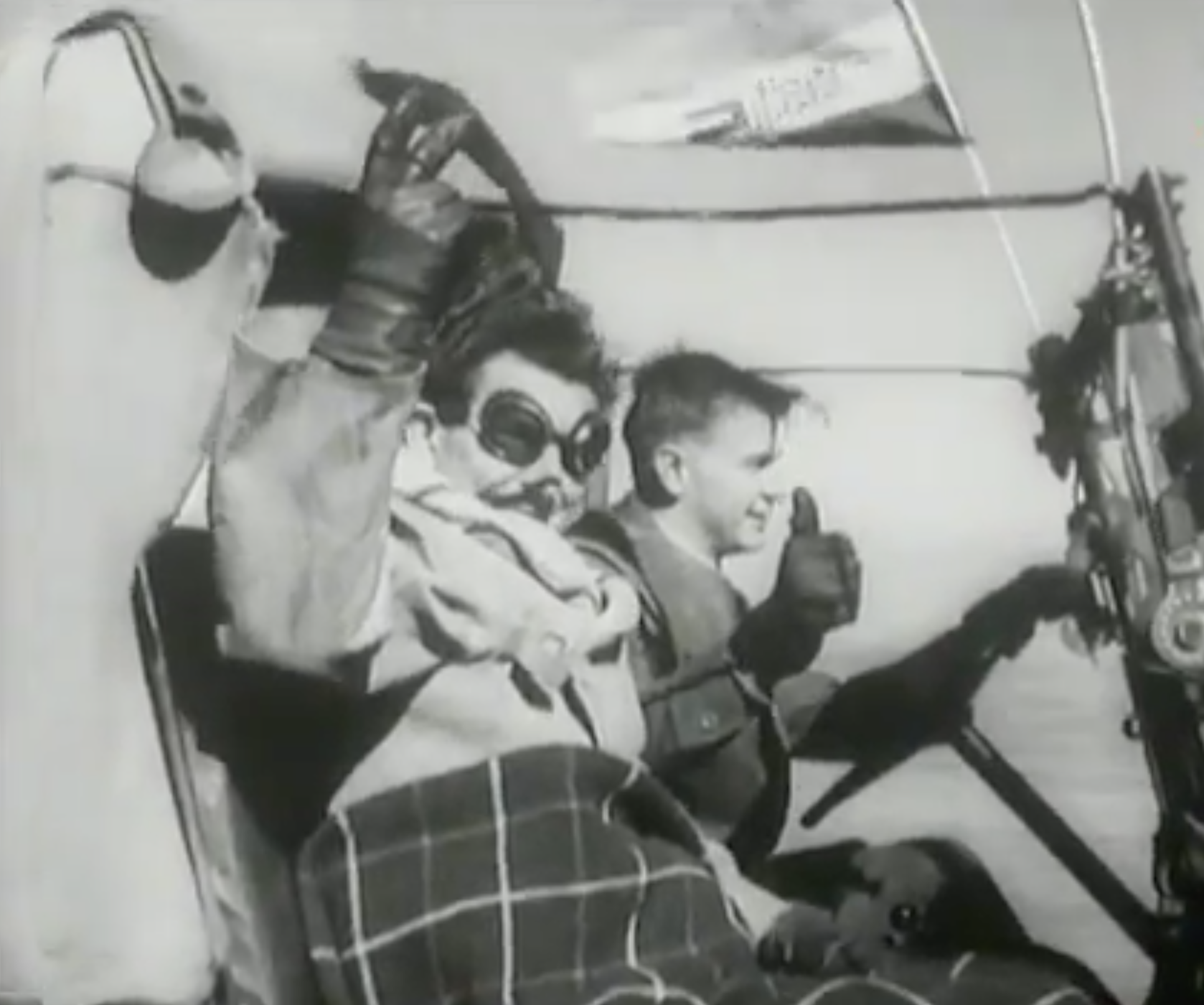
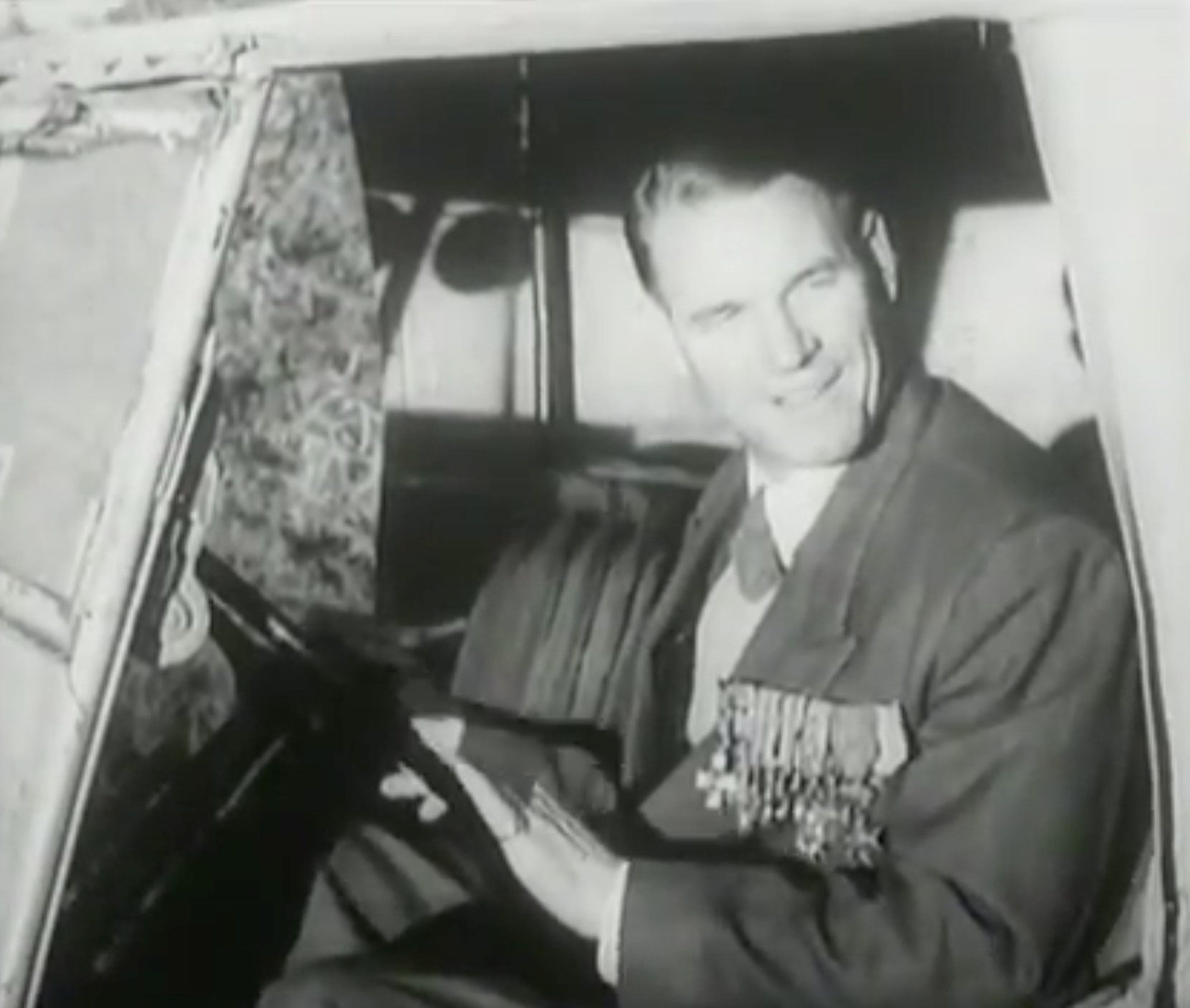
“The Commando formed the most democratic contingent ever to march together in the Union. Civil servants found themselves alongside the coloured men who swept the streets they were marching so proudly upon. In the front jeep rode Oom Dolf de la Rey, a white-haired old Boer of seventy-four, who looked so startlingly like the late General Jan Smuts that people looked twice at him and then cheered wildly. Oom (Uncle Dolf) was the man who, as a young burgher on commando fifty years before, had captured Winston Churchill, then a war correspondent with the Imperial forces in South Africa. In the second jeep stood a younger man with tousled brown hair, his hazel eyes cold and angry, the man who had been the most famed fighter pilot in all the RAF — Adolph Gysbert Malan, known all over the world as Sailor. He was the real hero of the hour. The people tried to mob him. Men and women, white as well as brown, crowded round his jeep and stretched out their hands to touch him”.

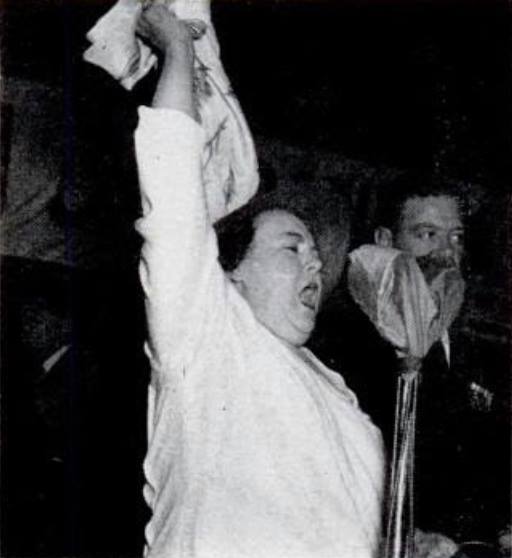
In Cape Town, the Steel Commando arrived to a packed crowd of protesters on The Grand Parade outside the City Hall of between 55,000 to 65,000 people – consisting of whites and coloureds, supporters and veterans alike (veterans were estimated at 10,000). Many holding burning torches as had now become the trademark of the movement. Spooked by it all the National Party were convinced that a military coup was on and as a precautionary measure placed manned machine gun positions around the rooftop of the nearby Houses of Parliament.

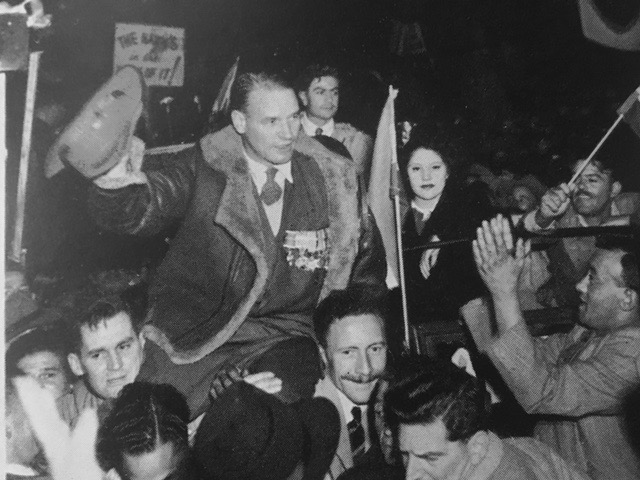
Sailor Malan was literally carried on shoulders by cheering crowds to give his speech. Joined by Dolf de la Rey and even future Afrikaner anti-apartheid activist and fellow war veteran Mattheus Uys Krige as well as the English speaking South African war-time soprano and heroine who led them in song – Perla Gibson. In Sailor Malan’s speech to the crowd famously accused the national party government at this rally of; 

“Depriving us of our freedom, with a fascist arrogance that we have not experienced since Hitler and Mussolini met their fate”.

Sailor Malan

During the rally in Cape Town, Dolf de la Rey took the microphone and laid into the National Party, as a respected Boer War vet he pulled no punches. Also, this is an inconvenient truth, Dolf de la Rey headed up an entire contingent of Boer War, Boer Republican Afrikaner veterans, on the Steel Commando – all of whom did not feel that Apartheid as outlined by the National Party was reflective of them as Afrikaners.

After the speeches formalities of the protest were closed, a group of mainly ‘coloured’ protestors and some ‘torch-men’ veterans rose-up in violent resistance and surged up the hill to the Houses of Parliament and clashed with the Police, the resultant violence left about 160 people injured and damaged the windows and railings of the ‘Groote Kerk.’

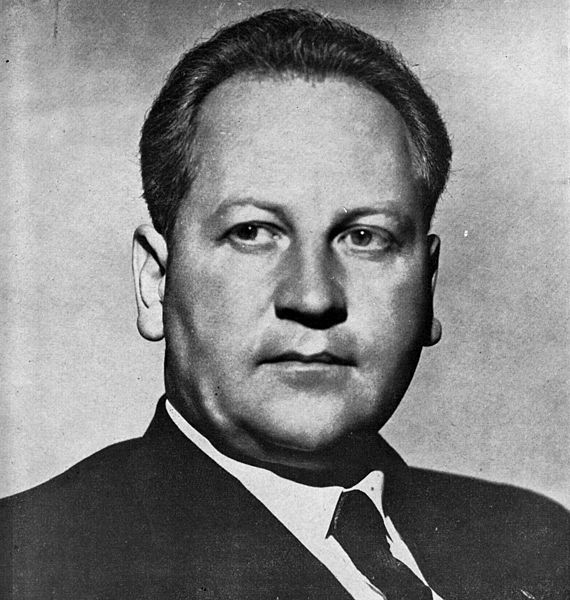
Now that there had been a clash with Police, the Afrikaner changed their tune and stance towards the War Veterans accusing them of starting violent riots and insurrection – threating a military coup. Johannes ‘Hans’ Strydom (National Party Minister and future NP Prime Minister) finally warned the war veterans that he would use the South African security forces against; 

“Those who are playing with fire and speaking of civil war and rebellion”.

Hans Strydom

Although the violence was dismissed by the War Veterans as not being of their making and unplanned, the Nationalists fear of violent military insurrection was not unfounded, both John Lang and Jock Isacowitz would later admit that the intention of many of the ‘torch-men’ on protest that day was always to surge on to Parliament and “throw out the Nationalists.”

The Nationalists continued to position the Torch as a national threat attempting a violent overthrow. This statement was equally quickly rebutted as nothing but shameful rhetoric by the National Party’s official opposition – the United Party. So, the Nationalists went further and targeted the personalities of Malan and de la Rey, bottom line is they did not want young Afrikaners influenced by these two national war heroes.

Sailor Malan was an easy target, he was the product of a Afrikaans father and English mother – he quickly became “the King’s poodle” and “an Afrikaner of a different kind” – not welcome in the Afrikaner laager. But, problem with ‘Oom Dolf’, here was a Afrikaner Boer War hero pure and applied, beyond the National Party’s criticism and reproach, so what did they do? They quietly dismissed him on his ‘Oom’ status, a senile old man, positioning him as somehow irrelevant, a patronising .. Ja Oom!

Formation of the Torch Commando

On the back of the successful widespread support of ‘The Steel Commando’ and determined to continue the fight to effect regime change, the ‘The Torch Commando’ took shape and it took to a more formalized structure of a central command with devolved authorities in the various regions of South Africa, using military discipline, military styled planning and lines of communication to activate.

Officially launching as the Torch Commando, Group Captain Sailor Malan was elected National President of the Torch, Major Louis Kane-Berman was elected National Chairman. To keep with the Afrikaner appeal and skew, the appointed Patron-in-Chief for the Torch Commando was Nicolaas Jacobus de Wet, the former Chief Justice of South Africa. Finally, the National Director was Major Ralph Parrott, a ‘hero’ of the Battle of Tobruk from the Transvaal Scottish who received the Military Cross for bravery. 

The Torch Commando is yet another demonstration of the rich tapestry of Afrikaner war veterans not in support of Apartheid – Afrikaners either joining or supporting the likes of Dolf de la Rey and Adolph ‘Sailor’ Malan in The Torch Commando would include many heavy-weight Afrikaner hitters, people like Mattheus Uys Krige – 2nd World War, correspondent and POW, poet and novelist, Torch Commando member and life-long anti-Apartheid campaigner. General Kenneth Reid van der Spuy – 1st World War and 2nd World War veteran and regional leader in the Torch Commando. General George Brink – 1st World War and 2nd World War veteran and a regional leader in the Torch Commando. Major Jacob Pretorius – 2nd World War and leader in the Torch Commando. Pvt Pieter Beyleveld –  2nd World War veteran, Labour Party and Springbok Legion, Torch Commando activist and life-long anti-apartheid campaigner.

Other Afrikaners would support the Torch, people like Lieutenant (Dr) Jan Steytler –  2nd World War veteran founder of the Progressive Party and Liberal politician. Captain (Sir) De-villiers Graaff – 2nd World War veteran, opposition United Party leader and New Republic Party founder, life-long anti-apartheid campaigner and supporter of the Torch Commando (in fact he hosted Sailor Malan on his ‘Steel Commando’ protest drive). Lt Harold Strachan – 2nd World War veteran, member of the Liberal Party, Congress of Democrats and Communist Party (he also became a founding member of MK). Major Pieter van der Byl – 1st World War veteran, South African Party, United Party and anti-Apartheid opposition stalwart and finally Colonel Ernst Gideon Malherbe – 2nd World War veteran, educator and famous South African academic.

The Commando would grow from strength to strength over the next couple of years, reaching a zenith of 250,000 members – nearly a quarter of the voting bloc and a significant threat to the National Party – do look out for the next Observation Post on The Torch Commando which will cover its rise.

In Conclusion

It is a very incorrect assumption to go with the old National Party rhetoric that they represented the interests of the majority of whites in South Africa, and to be a true Afrikaner you had to be an Afrikaner Nationalist. It is also very incorrect to connect Afrikaner identity to the white Voortrekker hegemony as devised by the Broederbond in their ‘Christian Nationalism’ construct in 1938, and most importantly – it is very incorrect to believe that Afrikaners are a homogeneous group with a homogeneous identity and as a group are all collectively responsible for Apartheid from 1948.  The Torch Commando and the nature of Afrikanerdom prior to the National Party coming into power in 1948 is proof positive, that the majority of whites and a significant part of the Afrikaner nation were simply not on board with the idea of Apartheid.

Editors Note:

As this research field includes the ‘racial constructs’ of Krugerism leading up and including Boer War 2 (1899-1902) and as an ideology and its role in establishing The National Party (and the onset of ‘Apartheid’) from 1914. In addition it also includes the ‘Nazification of the Afrikaner Right’ from 1936 and the political awakening of returning Afrikaner World War 2 veterans from 1950 because of it – the Observation Post often gets comments on both the blog and social media that it is somehow biased to the ‘British’ and ‘Afrikaner bashing’ or ‘Boer bashing’ – it is neither. 

What the Observation Post elects to highlight are the actual demographics, the economic history and not the political history peddled for political gain. It elects to highlight the progressive political deeds of Afrikaner military heroes like Dolf de la Rey and Sailor Malan, and all the Afrikaner military men in the Torch Commando whose legacies were buried by the Afrikaner Nationalists for decades and men whose truth must now ‘out’.

Given the current political assault on Afrikanerdom in modern South Africa this is key to understanding Afrikanerdom in its proper historical context – sans the National Party and now the African National Congress’ interpretation of it.

The Torch Commando – next instalment 

What follows next is called ‘The Rise and Fall of the Torch Commando’ – please click through to this Observation Post link which covers in this phase depth.

The Torch Commando – Part 4, The ‘Rise and Fall’ of the Torch Commando


Written and Researched by Peter Dickens

References:

The Torch Commando & The Politics of White Opposition. South Africa 1951-1953, a Seminar Paper submission to Wits University – 1976 by Michael Fridjhon.

The South African Parliamentary Opposition 1948 – 1953, a Doctorate submission to Natal University – 1989 by William Barry White. 

The influence of Second World War military service on prominent White South African veterans in opposition politics 1939 – 1961. A Masters submission to Stellenbosch University – 2021 by Graeme Wesley Plint 

The Rise and Fall of The Torch Commando – Politicsweb 2018 by John Kane-Berman

The White Armed Struggle against Apartheid – a Seminar Paper submission to The South African Military History Society – 10th Oct 2019 by Peter Dickens 

Sailor Malan fights his greatest Battle: Albert Flick 1952.

Sailor Malan – Oliver Walker 1953.

You-tube AP video footage of The Torch Commando.

Lazerson, Whites in the Struggle Against Apartheid.

Neil Roos. Ordinary Springboks: White Servicemen and Social Justice in South Africa, 1939-1961.

“Not for ourselves” – a history of the South African Legion by Arthur Blake.  

Pro-Nazi Subversion in South Africa, 1939-1941: By Patrick J. Furlong.

The Rise of the South African Reich: 1964: By Brian Bunting

The White Tribe of Africa: 1981: By David Harrison 

National Socialism and Nazism in South Africa: The case of L.T. Weichardt and his Greyshirt movements, 1933-1946: By Werner Bouwer

The Final Prize: The Broederbond by Norman Levy: South African History On-line (SAHO) War and the formation of Afrikaner nationalism: By Anne Samson: Great War in Africa Association 

Colourised photo of Sailor Malan – thanks to Photos Redux

Related Work

This work falls part of preparation work for a seminar on Sailor Malan called ‘I fear no man’ by Dr Yvonne Malan, scheduled for 16th September 2023 in Kimberley, here’s the link “I Fear No Man” – Sailor Malan Memorial Lecture

The Torch Commando Series

The Smoking Gun of the White Struggle against Apartheid!

The Observation Post published 5 articles on the The Torch Commando outlining the history of the movement, this was done ahead of the 60th anniversary of the death of Sailor Malan and Yvonne Malan’ commemorative lecture on him “I fear no man”. To easily access all the key links and the respective content here they are in sequence.

In part 1, we outlined the Nazification of the Afrikaner right prior to and during World War 2 and their ascent to power in a shock election win in 1948 as the Afrikaner National Party – creating the groundswell of indignation and protest from the returning war veterans, whose entire raison d’etre for going to war was to get rid of Nazism.

For the in-depth article follow this link: The Nazification of the Afrikaner Right

In part 2, in response to National Party’s plans to amend the constitution to make way for Apartheid legislation, we outlined the political nature of the military veterans’ associations and parties and the formation of the War Veterans Action Committee (WVAC) under the leadership of Battle of Britain hero – Group Captain Sailor Malan in opposition to it.  Essentially bringing together firebrand Springbok Legionnaires and the United Party’s military veteran leaders into a moderate and centre-line steering committee with broad popular appeal across the entire veteran voting bloc. 

For the in-depth article follow this link: The War Veterans’ Action Committee

In Part 3, we cover the opening salvo of WVAC in a protest in April 1951 at the War Cenotaph in Johannesburg followed by the ratification of four demands at two mass rallies in May 1951. They take these demands to Nationalists in Parliament in a ‘Steel Commando’ convoy converging on Cape Town. Led by Group Captain Sailor Malan and another Afrikaner – Commandant Dolf de la Rey, a South African War (1899-1902) veteran of high standing their purpose is to raise support from Afrikaner and English veterans alike and they converge with a ‘Torchlight’ rally of 60,000 protestors and hand their demands to parliament. 

For the in-depth article follow this link: The Steel Commando

In Part 4, in response to the success of The Steel Commando Cape Town protest, we then look at the rise of the Torch Commando as South Africa’s largest and most significant mass protest movement in the early 1950’s pre-dating the ANC’s defiance campaign. Political dynamics within the Torch see its loyalties stretched across the South African opposition politics landscape, the Torch eventually aiding the United Party’s (UP) grassroots campaigning whilst at the same time caught up in Federal breakaway parties and the Natal issue. The introduction of the ‘Swart Bills’ in addition to ‘coloured vote constitutional crisis’ going ahead despite ineffectual protests causes a crisis within the Torch. This and the UP’s losses in by-elections in the lead up to and the 1953 General Election itself spurs the eventual demise of The Torch Commando.

For the in-depth article follow this link: The ‘Rise and Fall’ of the Torch Commando

In Part 5, we conclude the Series on The Torch Commando with ‘The Smoking Gun’. The Smoking Gun traces what the Torch Commando members do after the movement collapses, significantly two political parties spin out the Torch Commando – the Liberal Party of South Africa and the Union Federal Party. The Torch also significantly impacts the United Party and the formation of the breakaway Progressive Party who embark on formal party political resistance to Apartheid and are the precursor of the modern day Democratic Alliance. The Torch’s Communists party members take a leading role in the ANC’s armed wing MK, and the Torch’s liberals spin off the NCL and ARM armed resistance movements from the Liberal Party. We conclude with CODESA.

For an in-depth article follow this link: The Smoking Gun


Boer War 3 and beyond!

The 1914 Boer Revolt in perspective.

Very often when I read website or social media military history commentary on the 1914 Boer Revolt – I often come across the phasing that Louis Botha (usually incorrectly referenced as Jan Smuts) went against the will of the ‘majority’ of Afrikaners and therefore the general will of the white voting population in South Africa, when he declared war against Imperial Germany in 1914 and invaded German South West Africa (GSWA) – now on the side of Britain and its main ally – France. The result is a general upsurgence of Republicanism and a desire to re-engage the Boer War (a sort of Boer War 3) in an outpouring of widespread support by the Boer nation for Germany and against Britain (a legacy hangover from the Boer War). South Africa was forced into an unwanted war to do the British Empire’s bidding and the Boere would have none of it!

The problem with the above assertion is that it is pure bunk, its unfounded, as once again Military History (doctrine, strategy and tactics) and Economic History (stats and demographics) tell a different tale entirely and once again the ‘cold facts’ rip the ‘Political’ interpretation of the history apart (this is why I just love both economic and military history). So, let’s examine these ‘cold facts’ – the hard statistics – the numbers and see how they hold up, let’s also examine military doctrine and see how that holds against the numbers. Let’s challenge the history and establish why this above assertion is purely politically inspired fantasy.

The Vote

Upfront is the vote to go to war. The arrival of World War 1 in 1914 is both a blessing and a curse for the Boer led government of the newly formed Union of South Africa. Both Botha as Prime Minister and Smuts as his ‘right hand man’ were walking a tight rope – as Boer commanders they represented a faction of the new “Union”, balancing the two small old Boer Republic’s politics and laws with those of all the British colonies and protectorates surrounding them (six large British territories and their interests in them in effect) – so they are obliged to support Britain as the major player in the region, and honour their word to them, the oath that brought about peace – that’s the ‘curse’. 

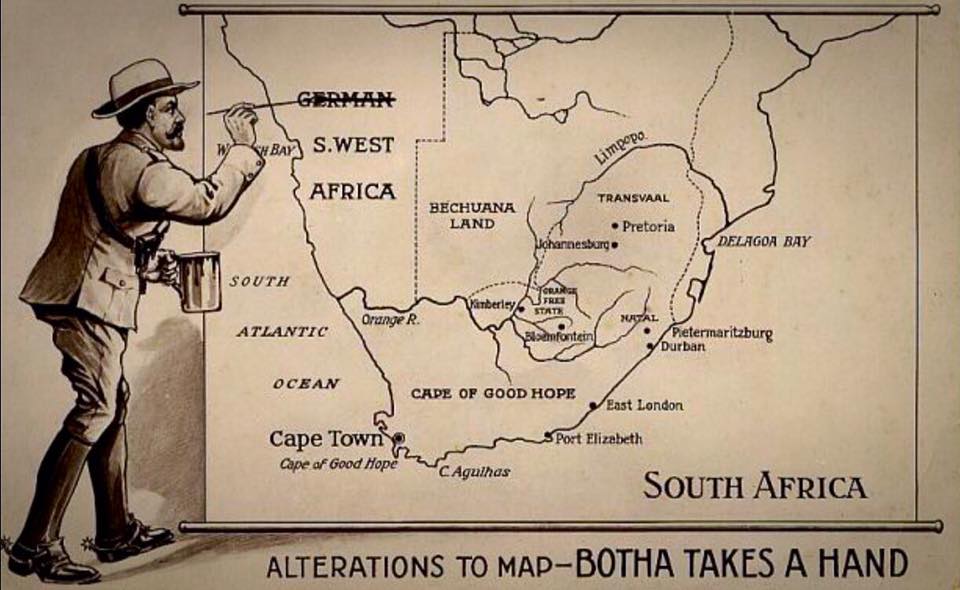
The ‘blessing’ to the Union government is that the war presents them with an ideal opportunity to realise the expansive border of ‘Greater South Africa’ as envisioned and concluded in the Union conference in 1909 – as this border also specifies the eventual inclusion of German South West Africa into South Africa in the first phase of the ‘Greater’ South Arica Union and eventually even bits of German East Africa would be included in the second phase of South Africa’s territorial advancement. 

So it’s really no surprise, that when the decision to go to war is put to the vote in the Boer led and very independent Union of South Africa Parliament (at Union, Britain takes a figurehead role, the South African Union’s Parliament and legal construct is not governed by Westminster, its fee to make its own laws) – and the result is not what your Apartheid era school history teacher plugged – it’s a staggering vote of confidence by nearly all the Boer MP’s favouring going to war alongside Britain (and France) against Germany, by a landslide – literally. Consider the result.

92 = For invasion of German South West Africa (GSWA) by the Union of South Africa

12 = Against

So, as to the ‘majority’ of Afrikaners NOT wanting war with Germany, that is simply untrue, the Afrikaner community’s representatives in Parliament were overwhelmingly in favour of war against Germany. This is also where some ‘Boer Romantic’ commentators on the 1914 Revolt make a fundamental mistake, the Union of South Africa’s decision to conquer German South West Africa (Namibia) was NOT just a service to the ‘British Empire’ – it was largely in service to the objects of The Union of South Africa and its own territorial expansion ambitions and the prescribed ‘sphere of influence’ over the Southern African region as a whole (as agreed by all Boer and British leaders involved in the Union conference in 1909).

Put another way, that’s 88% in favour of going to war alongside Britain and 12% against. In so far as the politics goes, the South African Party (SAP) headed up by Louis Botha, and comprising all the old Boer War Generals and the old Afrikaner Bond is by far the majority party, it’s the Afrikaner’s representative party in government (the National Party came later) … statistically speaking the breakdown of Parliament is as follows:

South African Party, Louis Botha leader – 66 seats

Unionist Party, Starr Jameson leader – 36 seats

Labour Party, Frederic Creswell leader – 3 seats

Simply put, to see who the “Afrikaner” representatives are and who are the “English” i.e. British affiliated parties, the SAP is the ‘Afrikaner’ party – the ‘British’ party is most certainly Starr Jameson’s Imperial Party (you may remember Starr Jameson as the leader of the infamous Jameson Raid). The Labour Party is a British (English) unionist construct, its voters are the miners on the Johannesburg gold reef mainly.

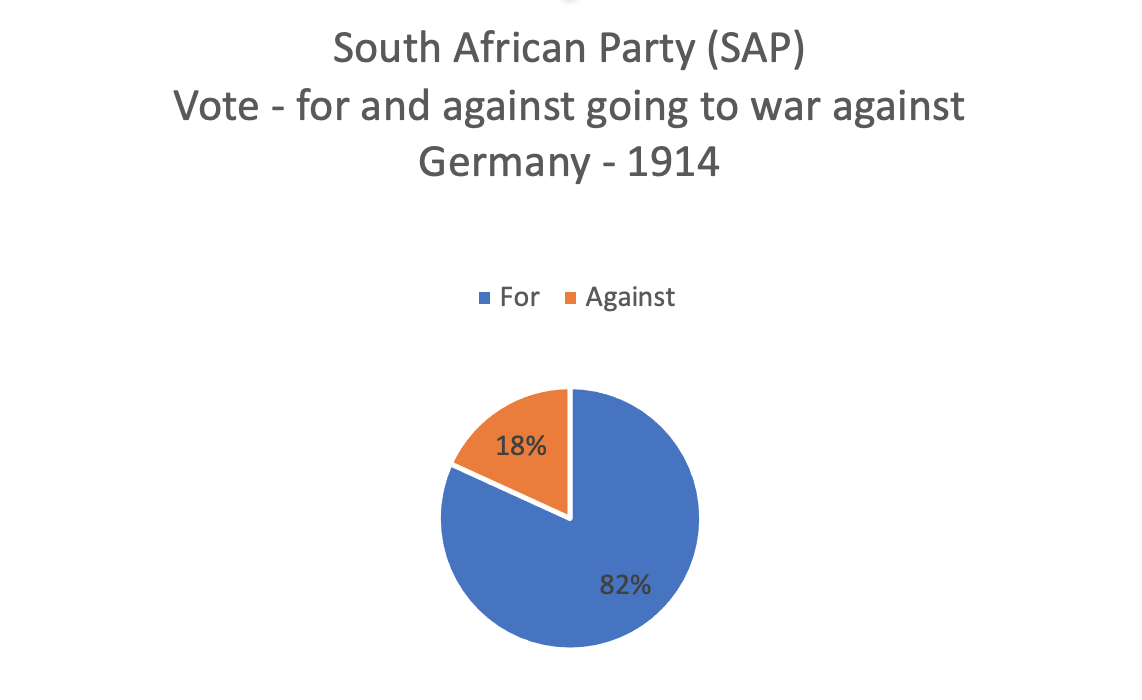
From that it can be deduced that he majority of the ‘Afrikaner’ SAP have voted FOR going to war alongside Britain against Germany – of the SAP – 54 votes, or 82% of the SAP’s ministers are pro-war alongside Britain and her allies. It is only on the very rump of this party that we find the AGAINST voters, and of these 12 individuals (or 18% of the SAP), only 3 of them are notable and become highly vocal anti-war campaigners – Barry Hertzog, Koos de la Rey and Christiaan de Wet. 

In this respect, between the three of them, although vocal they are really a small voice at odds with the legitimate elected government construct, the vast majority of South Africa’s representatives, and even most of their own peers. In truth, they are also not just “pro-German’ – at this stage they are intrinsically at odds with the idea of ‘Union’ and it’s agreed objects – seeking minority rule under a ‘Boer Republican’ hegemony instead.

Political cartoon of the day captures the Union’s territorial ambitions

The UDF Construct and its ’Afrikaner’ nature 

Jan Smuts, as the Minister of Defence at this time had also been busy amalgamating the armed forces of the republics with those of the colonial citizen force regiments to form the Union Defence Force i.e. the UDF (in much the same way as the SADF was amalgamated with other forces in 1994 to form the SANDF – with the same challenges). 

The UDF had taken shape to consist of a small contingent of Permanent Force, the Permanent Force basically comprises some 4,000 odd members and consists of a HQ, some admin and training staff and a mounted military constabulary of 5 regiments called the South African Mounted Rifles (SAMR) – these are a combination of members of the old British colonial mounted regiments like the Cape Mounted Rifles and old Boer Kommando members making the military their profession. They make up only 5% of the total UDF strength.

But the backbone would remain essentially voluntarily forces in a two-stream approach, the old ‘English’ colonial citizen force regiments – Transvaal Scottish, Royal Natal Carbineers, Royal Durban Light Infantry etc comprise what is collectively known as ‘Active Citizen Force’ (ACF) and to begin with they tend be ‘English’ speaking and led. There are 23,000 ACF members (29% of the total UDF mustering).

The greater part of the UDF backbone however is the ‘Afrikaans’ citizen force “skiet” Commandos known as the ‘Rifle Association Mounted Infantry’ working in parallel to the ACF. This is the old Transvaal and Orange Free State Boer Republic’s Boer Kommando system in effect. They are collectively called the “Rifle Associations” or RA and comprise 42,000 members (or 52% of the complete UDF strength) and they are the majority in the new UDF construct.

It was a careful construct to keep everyone happy, but the point is this, it was NOT “British” – Imperial British troops present in South Africa after the Boer War had all returned to the United Kingdom, any engagement the Union of South Africa was going to fight in World War 1 in Africa, whether foreign or domestic, was going to be made up of ‘South Africans’ and led by ‘South Africans’ – and in truth it was commanded by the old Republic’s ‘Bittereinder’ Boer Generals – primarily Botha (as Prime Minister was Commander in Chief) and Smuts (as Botha’s Minister of Defence) – and by way of construction the vast majority of the force is of ‘Afrikaans’ origin (not English) and part of a mounted infantry construct (RA and SAMR).

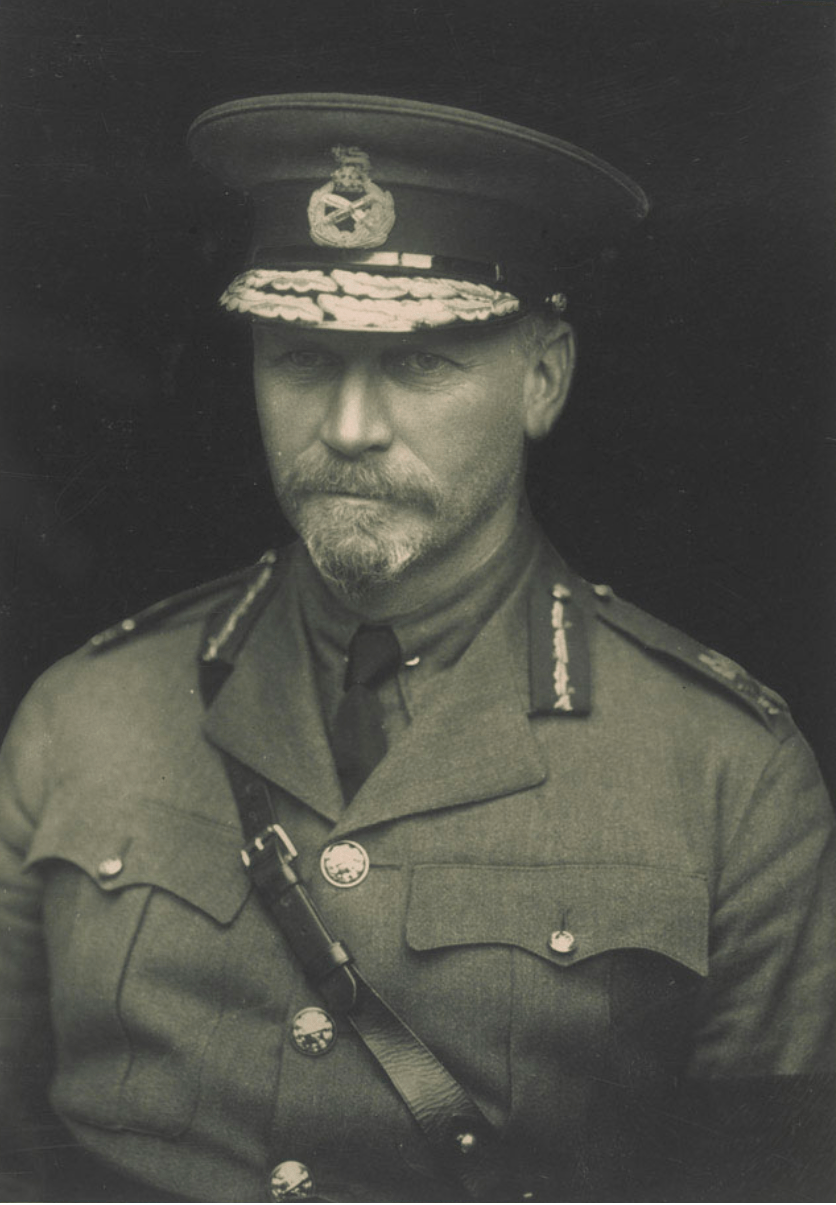
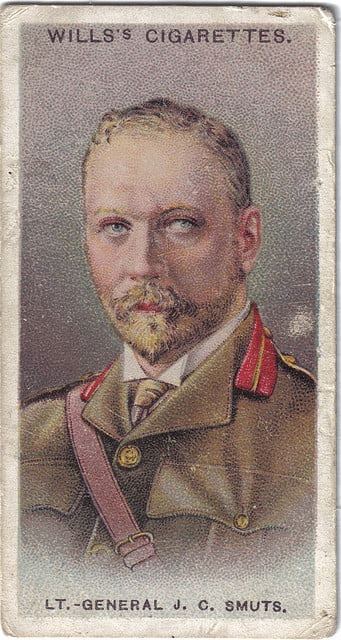
General Jan Smuts during WW1

Smuts is beginning to outline military doctrine for the UDF and he has a greater disposition to the Boer ‘way of fighting’ i.e. mobility which is heavily reliant on mounted infantry. The UDF is fortunate, at the end of the Boer War in 1902, the British (and Colonial forces) emerge as the singular worldwide authority on Counter Insurgency warfare (we know this today as COIN) and the old Boer Republican forces emerge as the worldwide authority on Insurgency warfare.  Thus the UDF is now being built along the lines of using effective combined arms with high degrees of mobility to deal with both conventional warfare (as is the requirement of any statutory force) in the event a Colonial Power in Africa (e.g. Portugal or Germany) invades the Union and any domestic insurgencies (initially ‘internal’ threats are defined as potential Black African uprisings and the UDF doctrine is been developed to counter-act it). 

Intrinsic in the UDF’s DNA at this point is the use of COIN in the rural warfare context (they have not been tested in the urban context, that would only really happen with the Miners’ strike in 1922). Also, a key learning for the UDF is that towards the end of Boer War 2, the British turn to highly mobile ‘Seek and Destroy’ columns known as “Commando Hunts” to put an end to the final ‘Bittereinder Kommandos’ – essentially matching mobility with mobility but with greater firepower and ‘combined arms’. This institutional knowledge will play a major role in the upcoming 1914 Boer Revolt.

Smuts is happy to cherry pick, basically he’s happy to bring all that’s great and good about the British culture of warfare – their discipline and drill (sorely lacking in the Boer army), their uniforms and rank structures (sorely lacking in the Boer army) and their very effective use of combined arms warfare and joint arms warfare (also sorely lacking in the Boer army) and combine it with the Boer culture of warfare – the use of mobility, and applying high rates of survivability thinking to tactics of assault and defence (both of which are sorely lacking in the British army). 

WW1 UDF Recruitment poster targeted at Afrikaners

 Smuts will build into the UDF the doctrine of highly mobile ‘combined arms’ – mainly the effective use of mounted infantry, armour and artillery (and other ‘arms’) all acting in unison and speed. It’s a doctrine of “manoeuvre” using the Clausewitzian concept – using superior and simultaneous advances along “exterior” lines (a concentration in space) on an enemy using “interior” lines (known as a concentration of time) of communication and supply. Under General Jan Smuts the UDF is shaping into a very effective fighting force, one that is far ahead of the old Boer Republics strategic and tactical constructs and doctrine which focused mainly on “interior lines”. This will have far reaching consequences for the Boer Revolt and the rebels.

The Afrikaner disposition to Germany

Smuts was also sensitive to the fact that many Afrikaners shared German heritage and they (falsely) believed that Germany extensively supported the Boer cause during Boer War 2 – ‘falsely’ because in fact, Germany was happy to ‘sell’ them arms (as did the British arms manufacturers) at a premium and send some medical assistance later on, however Germany withdrew their support officially – they provided no troops and no substantial funding to the Republican Boer War effort whatsoever. 

Kaiser Wilhelm II

Kaiser Wilhelm II, although sending a letter to Kruger congratulating him on the Jameson Raid victory (given the Boer nation their false sense of ‘support’), in fact refused point blank to receive any Boer representations and after the ‘Black Week’ Boer victories during Boer War 2 in late 1899, he and his Generals compiled a military strategy, not to help the Boers, but to help the British win the war (he was after all related to the British monarchy – part of the family so to speak) and shared it with them instead – Kaiser Wilhelm II even proudly proclaiming at the end of the Boer War that the British had followed his plan precisely as he had outlined it to them and it was the German plan that won the war for the British – not Field Marshal Frederick Robert’s plan and as inconvenient truths go the Kaiser’s plan involved scorched earth policies and concentration camps. (see: John C.G. Röhl: The Kaiser and England during the Boer War). 

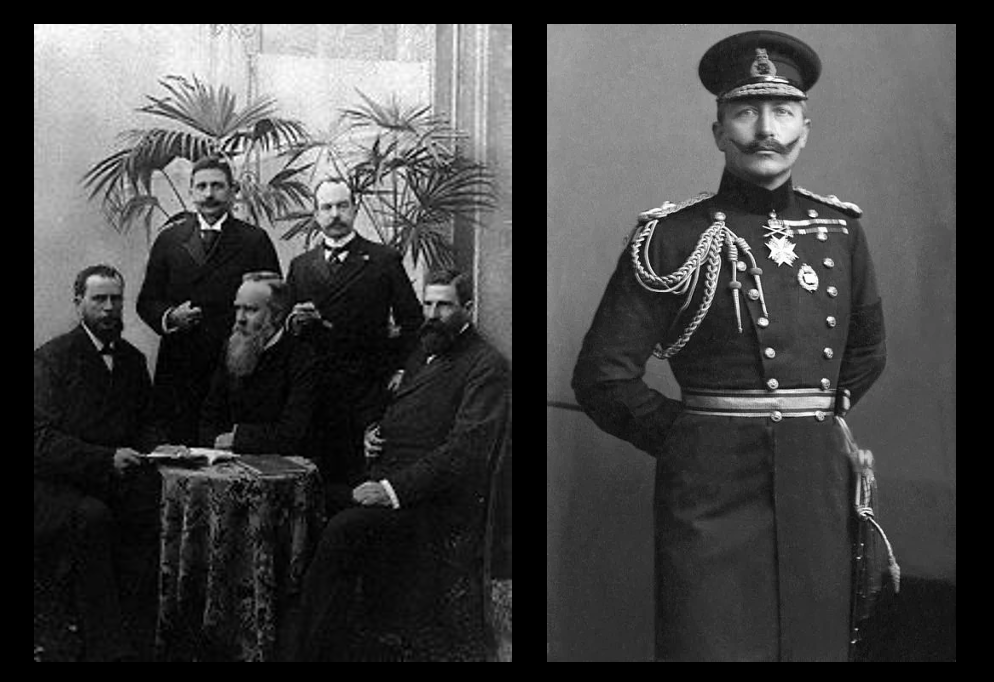
Ethnic Germans (local and foreign) volunteering to join Boer Commandos also qualified very few (550 odd) – far more Anglo-Irish, Dutch and Flemish joined the Boers (5,500 odd). A Boer leader delegation, including Botha and de Wet visited Germany after the war in 1902, and although they received a  grand welcome and ovations, they were never officially received, Kaiser Wilhelm II flatly refused to entertain any Boer delegation sent to Germany.

Boer delegations did raise a little money from private donators and a Boer help fund, but that’s it – there was never any official public contribution by the German government to the Boer cause – ever. Germany wanted to avoid conflict with Britain – who by convention and legal treatise at the time held suzerainty limitations over the two Boer Republics preventing them from engaging in foreign policies and entering into treaties. However, all this still did not resonate with many in the Boer community who almost illogically saw Germany as an Ally. Now, I bet none of this was in your Nationalistic inspired history teachings.

Left: Boer delegation to Europe and the USA in 1900 to try and solicit help for the Republics – with very limited success. Right: Kaiser Wilhelm II in a British Field Marshal uniform – he was made a Field Marshal in the British Army in 1909 by his relative – King Edward VII just after Queen Victoria’s death.

Smuts would argue the case for war, not on the basis of warring against Germany on the side of ‘Britain’, but for supporting the other old Boer Republic’s supporters – France, Belgium and the Netherlands in their war against a hostile and aggressive Germany busy de-stabilising western and eastern Europe, and Smuts was very aware of the vast majority of Boers had Dutch, Belgian and French roots, as opposed to the ones with German roots. He would use the same argument again for his declaration of war against Germany in World War 2.

Smuts however anticipated that the decision to go to war, although largely supported by the Afrikaner political elite and leadership, would have with it a handful of resignations from the Union’s Defence Force from those strongly in favour of Germany and whose sheer hatred of the British superseded everything, and the Union government received exactly that – a “handful” – nothing that would fundamentally compromise the UDF’s fighting ability or construct, the UDF remained at its 80,000 men strong capability and it remained with its primarily strong ‘Afrikaans’ demographic skew, contrary to the thinking of wishful Boer Romantic modern-day arm-chair Generals, there was no large gravitation of Afrikaners from the ‘Rifle Associations’ (Kommandos) and other arms of the UDF over to the German cause, nor was there a large wave of resignations from the UDF, in fact there was very little, verging on none – less than 1%. 

General Christiaan Frederik Beyers

Of the handful of resignations which were received, a rather long-winded one came from General Christiaan Beyers, the UDF’s Commandant General in charge of the Active Citizen Force (ACF) and his was the most important resignation. As previously noted, prior to the decision to go to war against Germany, Smuts and Botha’s old friend and highly respected comrade, General Koos de la Rey had been one of the handful of Parliamentary Ministers vocally against the decision to invade GSWA and advocated neutrality, and because of his popularity his opinion held massive sway over the old Boer Republic’s Afrikaner electorate  – nevertheless he was persuaded by Louis Botha and Jan Smuts not to take actions which may arouse the Boers, he then held a political rally for only 800 Boers who felt strongly over the matter and took a reconciliatory approach – contrary to what the attendees expected of him.

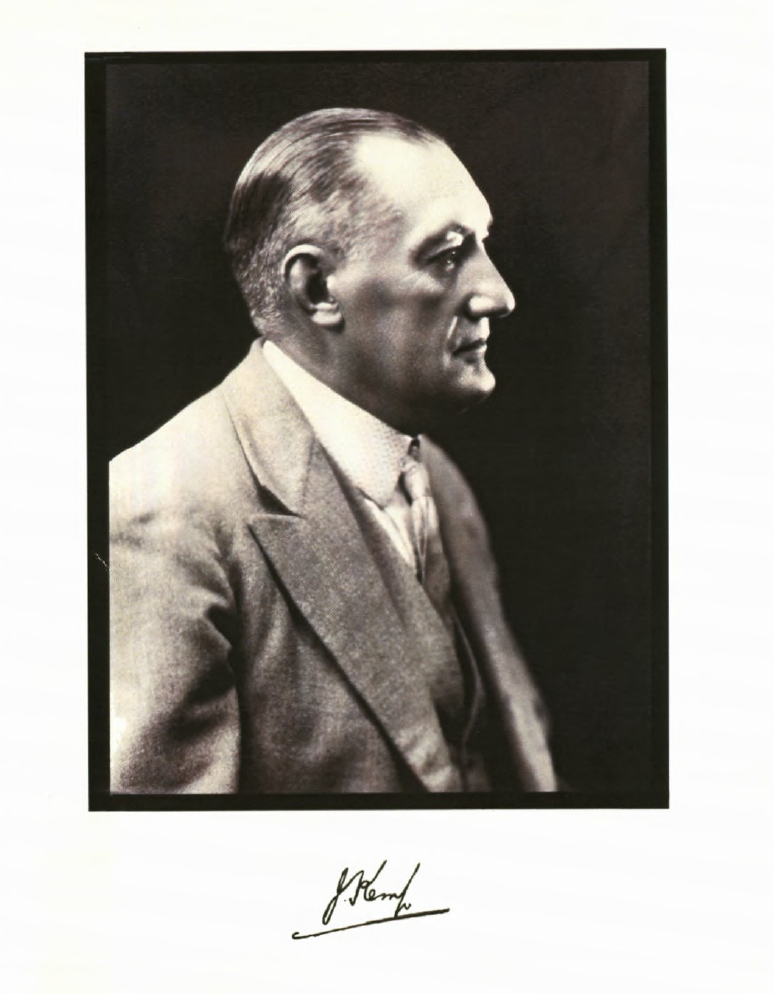
Major Jan Kemp in UDF uniform

General De la Rey seemed torn over his decision, and he was then targeted by General Beyers to join him for meeting with Major Jan Kemp, a mid-line UDF officer who had also resigned – the purpose of the meeting; Beyers and Kemp wanted to persuade de la Rey to take a stronger stand and initiate more Union Defence Force resignations to try and compromise its fighting capability. Joining the conspiracy was another heavyweight – the significant Boer General and Parliamentary Minister, Christiaan de Wet.

What follows next is well documented, however the generally accepted and investigated history concludes; General De la Rey and General Beyers were travelling in a soft top sedan car to their meeting with Major Kemp and did not stop at a Police blockade set up to capture a notorious gang of robbers and murderers called The Foster Gang. One of the Policeman fired a warning shot into the road to get them to stop, the bullet ricocheted and hit De la Rey, killing him. 

It was tragedy – plain and simple, and both Botha and Smuts were devasted at the loss of their friend, as a signal to the inevitable accusations of ‘political assassination’ both Botha and Smuts attended De la Rey’s funeral in front of thousands of mourning Boers, they appeared without any bodyguard at the mercy of the assembly – a token of no malice intended, and there were no protests or accusations from the mourners. 

Jacobus Hercules de la Rey

Regardless, despite sound and tested enquiries and court cases, and the Nationalists having full scope and the resources at hand for 40 years to uncover a ‘plot’ – no concrete proof has emerged of a plot by Smuts to kill De la Rey whatsoever – ‘conspiracy theory’ nevertheless grew out of the incident which would plague Smuts in future years, and it still does.

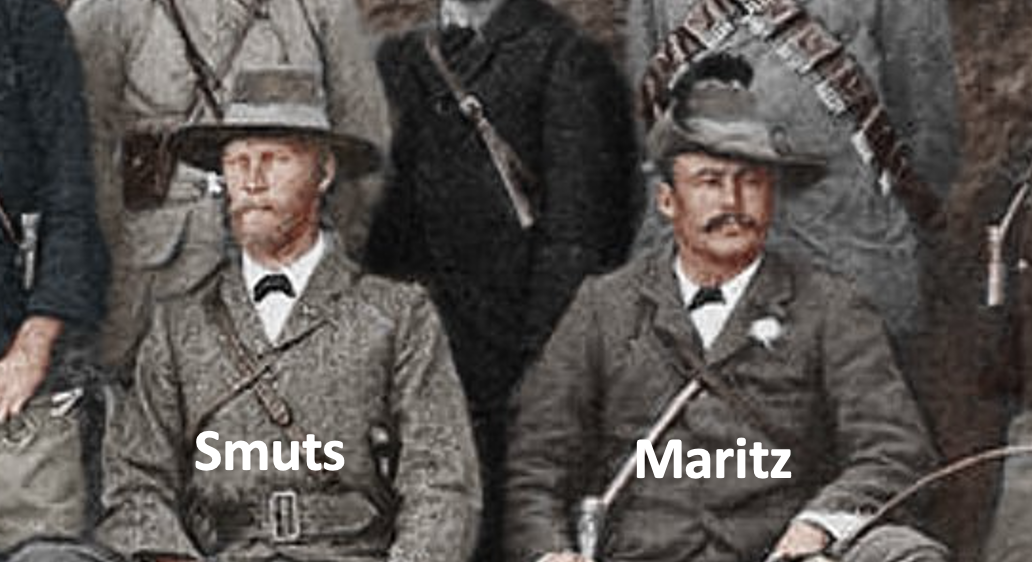
It is also generally understood that with the death of De La Rey, that would probably have been the extent of Boer resistance to the war, and it would have devolved into simple political protest and peaceful demonstrations, had it not been for one single man … Lt. Colonel Manie Maritz, who had an especially strong disposition towards Germany having served in German South West Africa and he commanded a small UDF force at Upington, on the border with German South West Africa (GSWA). 

A treacherous soup

The day after de la Rey’s funeral, Kemp, Beyers and de Wet addressed a large crowd at Lichtenberg, calling on protest meetings against the decision to invade GSWA. Manie Maritz however took a far more robust position than Kemp, Beyers and de Wet, he instead went into open sedition and started ignoring Smuts’ and his other Commander’s orders been sent to him. Intel told Smuts that Maritz had joined the Germans, however contradictory to Smuts’ usual manner of decisiveness, he vacillated instead hoping to persuade Maritz not to revolt and get him to see reason. 

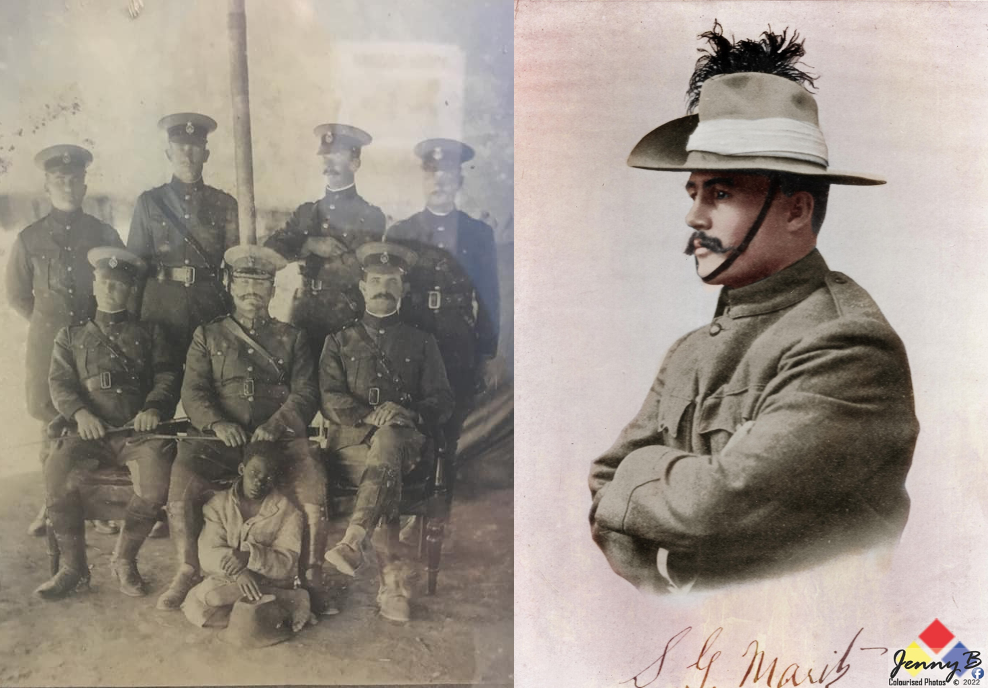
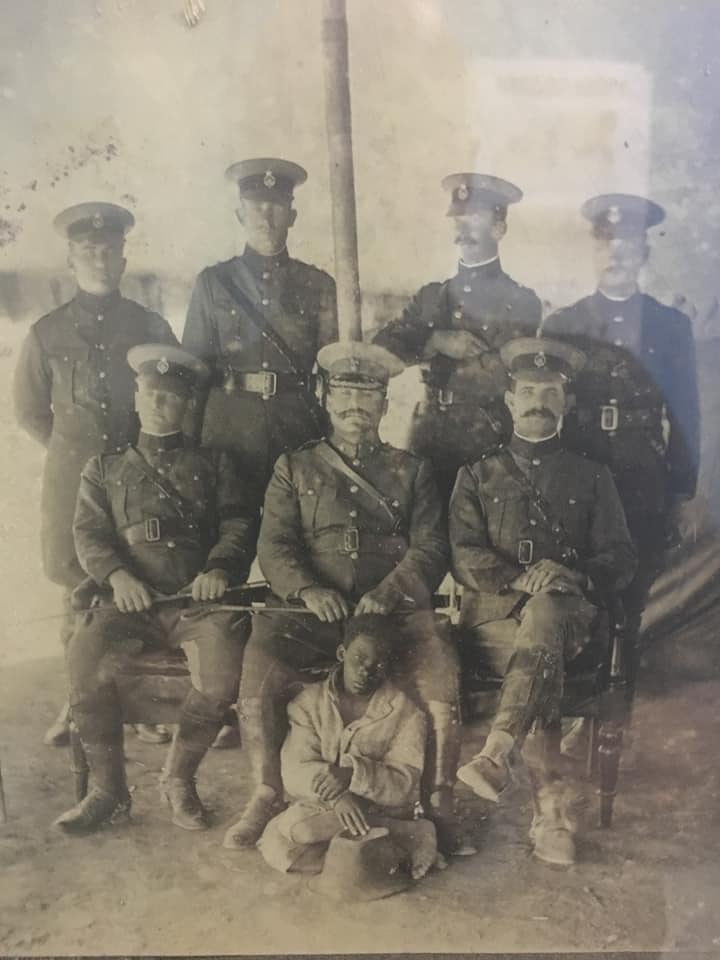
Lt Col Manie Maritz, front and centre in his South African Union uniform and his staff behind him – his  ‘Agter-ryer’ (man-servant) is at his heels (It’s the man-servant’s expression and position that is most interesting as in many ways it gives away Maritz who is a very outspoken racist and has no regard for people of colour).

Not dissuaded by Smuts and bent on a sedition, Maritz resigned his commission from the Union Defence Force and openly rebelled on 9 October, taking just 300 odd of his UDF soldiers with him when he went over to the Germans. Maritz arrested all the UDF officers and men under his command who were unwilling to join the Germans, and then sent them forward as prisoners into German South West Africa (GSWA).

Smuts sent Major Barend ‘Ben’ Bouwer over to deal with Maritz’ sedition and insubordination (both Bouwer and Maritz had served under Smuts in his Commando during Boer War 2 and he hoped Bouwer could reason with Maritz). Maritz however also promptly took Bouwer prisoner along with his fellow officers, he was subsequently released and sent back with the ultimatum from Maritz to the Union Government:

The ultimatum read that unless the Union Government guaranteed safe passage of his fellow plotting Generals (De Wet, Beyers, Kemp et al), to his position on the GSWA border by the 11th October he would immediately attack General Brits’ UDF forces preparing to invade GSWA and then he would invade the Union of South Africa.

Major Ben Bouwer reported that Maritz was in possession of some guns belonging to the Germans, and that he held the rank of General commanding the German troops. He also had a force of Germans under him in addition to his own rebel commando. 

To drive Maritz’ point home, Major Bouwer was shown an agreement between Maritz and the Governor of German South West Africa guaranteeing the independence of the Union as a Republic, ceding Walfish Bay and certain other portions of the Union to the Germans, and undertaking that the Germans would only invade the Union on the invitation of Maritz.

Major Bouwer was shown numerous telegrams and helio messages dating back to the beginning of September. Maritz boasted that he had ample guns, rifles, ammunition, and money from the Germans, and that he would overrun the whole of South Africa.

In response to Maritz’ action and ultimatum, on 12 October, the Union government imposed martial law across the whole of South Africa. On proclaiming martial law, Smuts, the eternal reconciler, immediately called again for “reason” and urged the rebels not to be swayed by “foreign agents influencing them”.

The ‘Boer Revolt’ or ‘Maritz Revolt’ or ‘Five Shilling Rebellion’ as it would also become known was underway, and with their sedition hand now played by Maritz in the Cape Colony, his fellow conspirators – Beyers, Kemp and de Wet had no choice, now ‘in for a penny and in for a pound’ they all broke their ties with the Union and went into open armed rebellion against their lawfully elected government – raising Commando’s primarily from the Transvaal and Orange Free State to come to Maritz’ aid.

The ‘Five Shillings Rebellion’ reference came about when de Wet, entered the town of Reitz on a recruitment drive, called together the inhabitants and said:

“I was charged before for beating a native boy. I only did it with a small shepherd’s whip, and for that I was fined 5/–”.

Hearing about the speech later, Jan Smuts referred to the rising as “the Five Shilling Rebellion” as a means of belittling the rebels, the baseless promises of wealth to the desperate and the aims of the revolt.

The stated objective: Maritz issued a proclamation by way of an objective:

 “The former South African Republic and Orange Free State as well as the Cape Province and Natal are proclaimed free from British control and independent, and every White inhabitant of the mentioned areas, of whatever nationality, are hereby called upon to take their weapons in their hands and realize the long-cherished ideal of a Free and Independent South Africa.”

In other words, to take by force, the former British Colonies and re-start the Boer War, resistance to the declaration by any “white” in the entire Union of South Africa would be treated by Maritz’ Provisional Government as treasonous. 

Sabre Waving

Generally in social media and web based articles on the Boer Revolt you get the impression that this was a significant military threat and social movement, but that’s not the case – in fact all these threats by Maritz as to invading South Africa, crushing the UDF’s intensions on invading GSWA, declaring a Afrikaner Republic under a white Boer hegemony with the aid of Germany are nothing more than ‘sabre waving’ – from a military doctrine perspective they are nothing more than unsubstantiated and baseless threats. 

So, let’s look at the military doctrine and establish what sort of threat from the rebels and Germany the South African Union defence force is facing, what’s the magnitude of the problem with regard the Boer Revolt that they have to deal with, what is the rebel forces calibre, construct and fighting capability? – Let’s look at the numbers.

To attain their objective, the Rebels raised 11,476 Boers. The South African Union Defence Force strength to ready itself for World War 1, all in, including all its reserves is 80,500 troops (without even considering the Rhodesian troops mustered for the GSWA campaign under South African command). That means the Boer Rebels are outnumbered on a ratio of 8 to 1. 

Military doctrine will always dictate that a force needs to be twice the size of the opposing force (2:1) if an effective ‘invasion’ is feasible and victory within grasp, more so (and more troops than a 2:1 advantage) if the intention is the occupation and annexation of a country. For the Boer Rebels to be successful in their object to defeat an 80,000 strong UDF they require a force of 160,000 men (that’s 3x more than the entire Boer Republican forces had in Boer War 2 which at their zenith numbered 40,000). 

Obviously, their hope and intention, albeit somewhat fanciful and arrogant, was that the UDF would capitulate with a mass walk out of all its Afrikaner demographic – estimated at some 50,000 odd people – but that simply did not happen. On an 8:1 ratio disadvantage the Boer Revolt stood absolutely no chance of success, even if this UDF number reduced sizeably there would still be at a disadvantage with almost no chance of success. 

But the intention was that Germany would combine with the Boere, the Germans in GSWA would join forces with the Boers right? We need to augment the numbers with German troops. Total German strength in GSWA is 3,000 odd well trained German Schutztruppe and 2,000 odd trained German militaria – about 5,000 in total. At best another 2,000 can be mustered from local Boere and German settlers in GSWA. If we add 7,000 German troops to the Boer Rebels’ 11,500 troops we get 18,500 troops MAX. Against the UDF’s 80,500 that still is nowhere near enough to affect a victorious outcome, they are still heavily outnumbered by 4 to 1. 

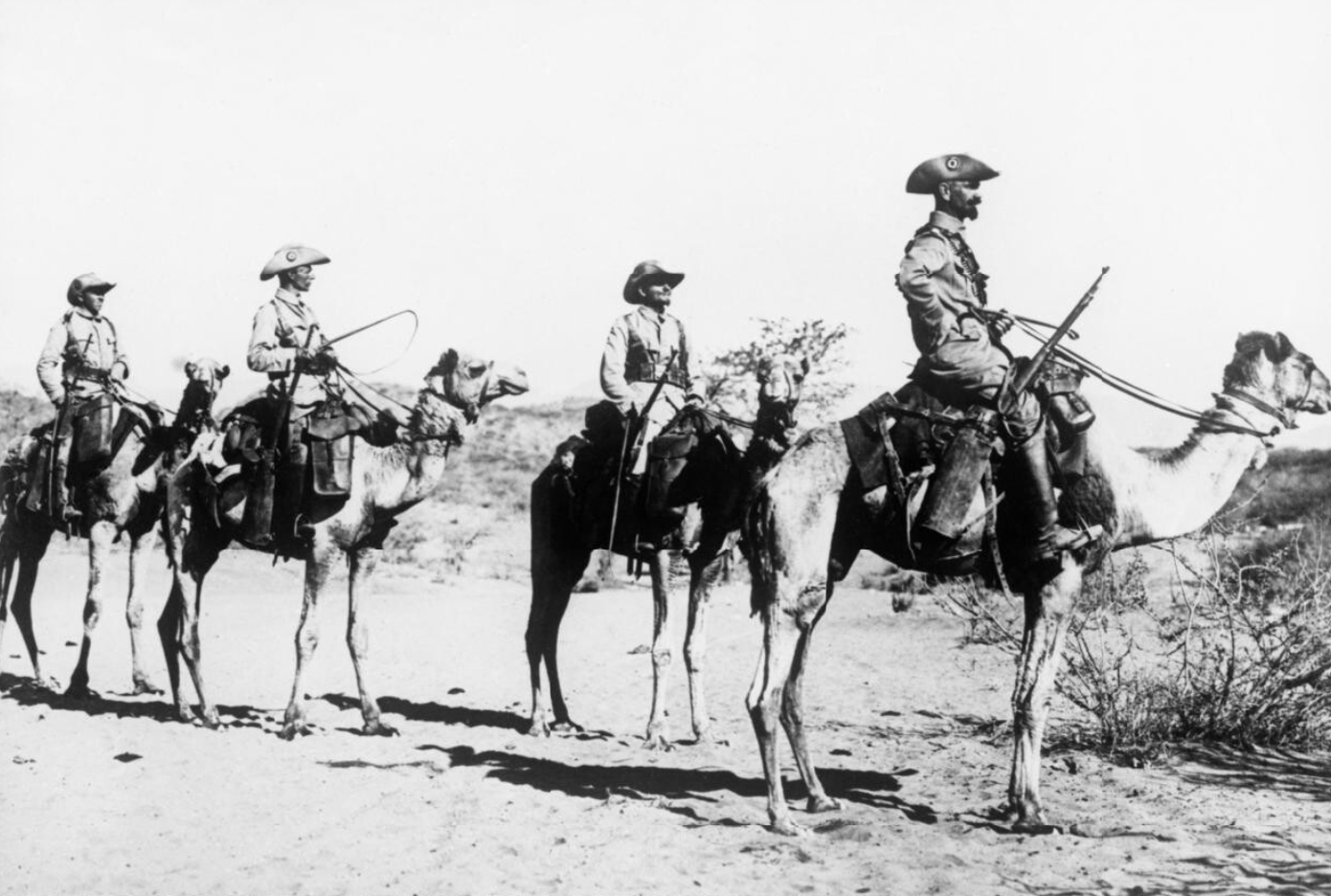
German ‘Camel Corps’ in German South West Africa

There is also no German expeditionary force from elsewhere making its way to GSWA, they are heavily committed to the European theatres of operations. Also, unlike in their East Africa colony, the German military in GSWA is unable to raise many local Askari black troops to augment their numbers, a hang-over from the Herero and Namaqua genocide which gives them no real traction with the black inhabitants of GSWA.

The idea that the Germans in GSWA could link up with a Boer Revolt (unless substantially supported) and invade South Africa is fanciful at best.

Now, let’s look at the Rebel Forces capability and make-up. It is important to note, the Rebel force was not made up entirely of first rate ex-UDF soldiers going against their counterparts, the rebel force was primarily made up of destitute Orange Free State Boers having come through a drought and agricultural reforms on the back of the devastation of their farms during Boer War 2. 

Many of these Free State Boers as has been pointed out by historians like Sandra Swart (Desperate Men: The 1914 Rebellion and the Polities of Poverty’ in South African Historical Journal, Vol 42) and John Bottomly (The Orange Free State and the Rebellion of 1914: the influence of industrialisation, poverty and poor whitism: pages 29-73), were simply desperate ‘Bywoners’ (landless farmers or share-croppers) promised a better life if the rebellion was successful.

Consider the statistics of the Boer rebels and from where they came, and you’ll see how the above statement holds true. 7,123 (62%) of the Boer Rebels came from the Orange Free State – the least populace, most rural and economically worse off province in the Union. As an aside, to gauge the extent of success of Maritz’ proclamation and its resonance across the broader Afrikaner community across the whole of South Africa, the rebel leaders were only able to motivate 1,215 (12%) of the Boer Rebels from the Cape province – the biggest province in the Union with the largest Afrikaans population. The balance coming from the Transvaal – which considering its very urbanised and significant population is negligible in the bigger scheme of the Transvaal’s demographic make-up, and no real support from Natal whatsoever.

The Potchefstroom Herald at the time best tried to explain why there was no traction behind the revolt from Cape Afrikaners and the black/brown African communities in this quote – and not surprisingly it boils down to the lack of suffrage and plain racism in the old Republics;

“When these high officers of the Defence Force in Transvaal and Orange “Free” State rebelled and joined the Germans with their commandos, the Dutchmen of the Cape (presumably because “they vote side by side with the Kafirs”) denounced the treachery in unmistakable terms. The South African party at the Cape beat up its followers to the support of the Government, and the voice of the Cape section of the Dutch Reformed Church rang from pulpit and platform in denunciation of disloyalty and treason. But in the Northern Provinces, where white men are pampered and guarded by the Government against the so-called humiliation of allowing native taxpayers to vote, there the rebellion, having been regarded with seeming approval, gained a marvellous impetus.

Plaatjie: The Boer Rebellion – snippet from the Potchefstroom Herald

As a unified, coherent, trained and fully armed force, the Rebel Boers were not. 

They were desperate and landless farmers in the main up against fully trained, motivated, even mechanised in some instances, and properly armed UDF soldiers who had an 8:1 numerical advantage. As noted earlier, in terms of doctrine the UDF under Jan Smuts’ design, command and control was focussed on effective deployment of combined arms in an enveloping role – all based on high manoeuvrability – up against this very modern military construct was a rebel force which only really consisted of ‘old school’ mounted infantry Commandos with ‘old school’ Boer command and control doctrine leading it – they had no light artillery support, no supply logistics to speak of, no armoured cars, no heavy guns, no machine guns and no motorised support – whereas the UDF had all of these. 

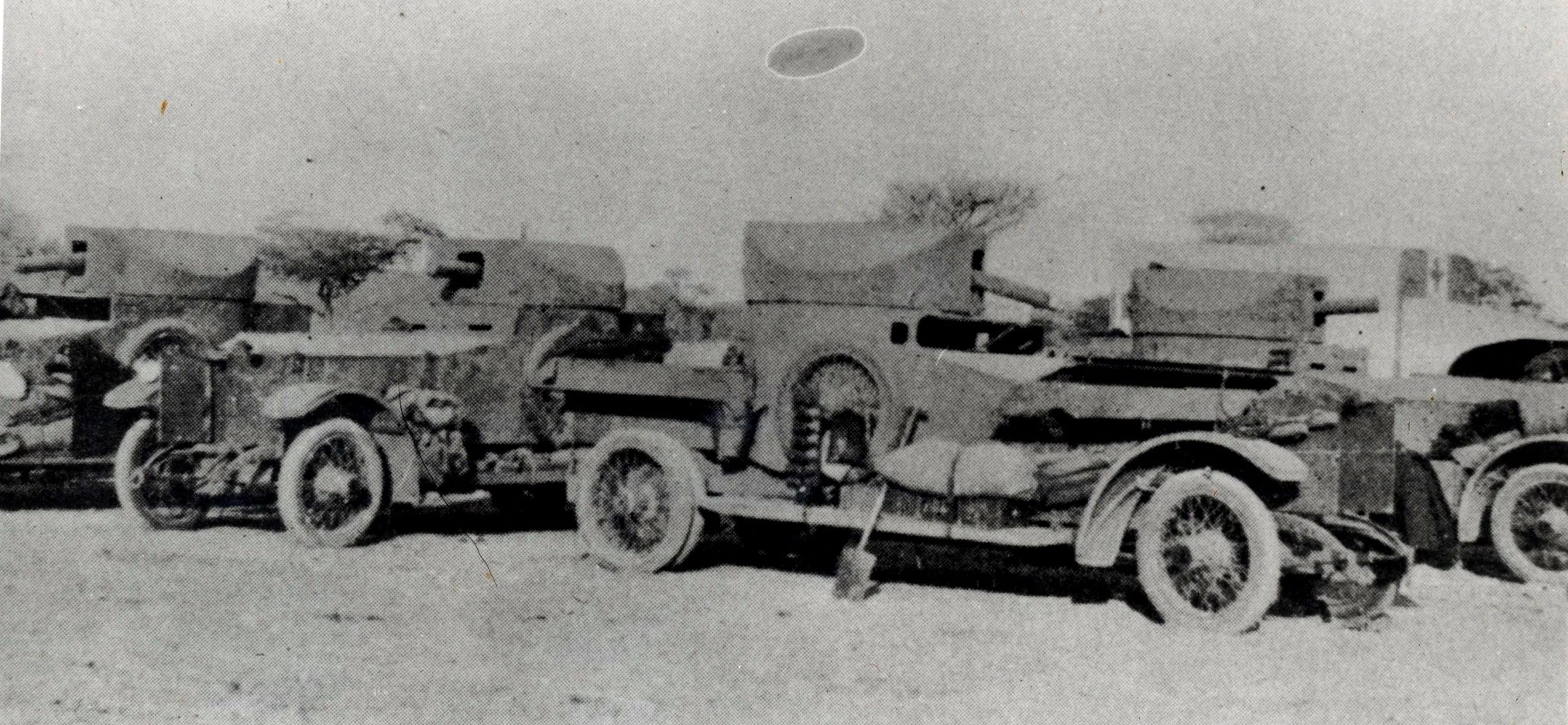
UDF armoured cars during GSWA campaign – 1914

In essence the Boer Rebels were using an outdated military doctrine originally intended to quell poorly armed Black African uprisings – a Commando, and it was simply complete folly to pitch such doctrine against a modern military using a doctrine of both combined arms and joint arms. The Rebels were simply no match and it quickly showed. 

Whilst still focussing much of the UDF’s resources on the invasion plans and logistics for the GSWA campaign, General Louis Botha would primarily use just the Rifle Associations to counteract the rebellion, insistent that the British ‘stay out of it’, this was going to be the Boer leaders sorting their differences out between themselves – so ‘Brother against Brother’ and in effect the UDF’s Afrikaners outnumbered the rebel Afrikaners 4 to 1. As also noted earlier, intrinsic in the UDF’s institutional memory and doctrine was the British idea of “hunting” Commandos using what was termed as a “flying column” of combined arms – a spill over of the British tactic from Boer War 2.

The long and short the rebellion was almost immediately repelled and then very quickly crushed as Botha’s UDF Rifle Associations with some Active Citizen Force elements in support used these ‘Flying Columns’ and effectively hunted the Rebel Commandos down as they tried to make their way to assist Maritz on the GSWA border. The revolt would last a couple of months only.

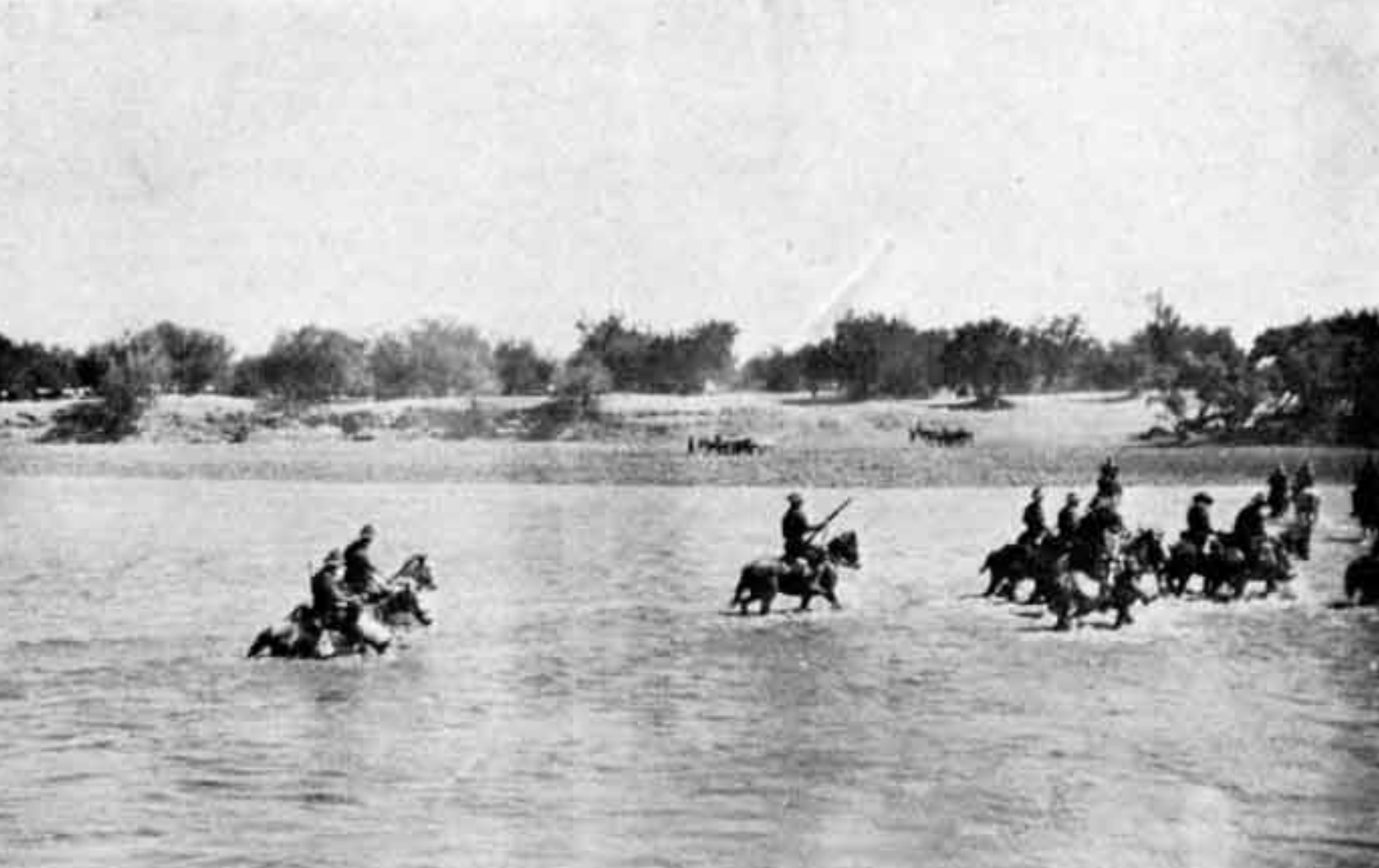
Image: The last pursuit of Major Kemp. A South African Union ‘Flying column’ crossing the Orange River after him.

Reconciliation

As Dr David Katz in his work ‘General Jan Smuts and his First World War in Africa 1914 -1917) points out. Jan Smuts, eternally the one Boer General keeping a level head and seeking reconciliation and understanding, and when it was clear the rebellion had failed, Smuts called for a ‘Blanket Amnesty’ across the board for the Boer Rebel leaders and their troops if they laid down their arms. General Louis Botha, the Commander in Chief, on the other hand took a much harder and less reconciliatory line than his colleague – he was livid at the sheer betrayal, the sheer waste of lives, resources and time it took and the complete stupidity of it all – an unsupported revolt against a lawfully elected government with absolutely no chance of success. It was reported that he once joking said to Jan Smuts “Let’s face it Jannie, you’re no General!” By that he meant Smuts was far too reconciliatory and soft-hearted – as far as Louis Botha was concerned, under the edicts of martial law, all rebels, officers and men alike should be tried, the most treasonous of which, the leaders, put up against a wall and shot – even if they were all his old friends.

Smuts however persevered – Botha eventually agreed to an Amnesty, but for the rank and file only, the Boer Rebel leaders would have to be prosecuted. The amnesty, excluding the Rebel leadership, was in put place from 12th to 21st November 1914, and with it the 1914 Boer Rebellion was effectively over, by the end of November General de Wet’s force alone was down to only 40 men. Rear actions and isolated and desperate battles continued to be fought for a couple of months by woefully under-strength hard liners refusing surrender and amnesty, but by the end of January 1915 the rebellion was over.  

Of the Rebel leadership now having surrendered, Botha and Smuts would again be especially magnanimous, considering the Union was in a state of war externally and in a state of martial law internally – and this was 1914 ‘World War 1’ – people were put in front of firing squads for ‘cowardice’ and being AWOL (absent without leave) – let alone ‘sedition’ and ‘treason’. Smuts would treat the Rebels in general very kindly, literally with kid gloves, all the time urging reason, understanding and reconciliation.

General Christiaan Rudolf de Wet

Of the main rebel leaders, General Christiaan Beyers tragically drowned in the Vaal River whilst attempting to desperately evade capture on 8th December 1914. General Christiaan de Wet was captured during the amnesty and sentenced to six years imprisonment, with a fine of £2000, he was released by Botha and Smuts after one year’s imprisonment, after giving a written promise to take no further part in politics. 

Major Jan Kemp was captured on the 2nd of February 1915 and sentenced to 7 years imprisonment, with a fine of £1000. However, a mere 10 months into his sentence Botha and Smuts agreed to release him – also on the condition that he may not participate in any politics – a promise Kemp almost immediately broke entering politics as a National Party MP under Hertzog in 1920. Ironically he accompanied Hertzog and joined with Jan Smuts in the Fusion government, however by 1940, in opposition to South Africa entering WW2 against Nazi Germany, he joined the Reunited National Party until his death in 1946.

Lt. Colonel Manie Maritz would evade capture and escape into German South West Africa, at the conclusion of the GSWA campaign and the Union Defence Force’s victory and annexation of the territory (the first real victory for the Allies against Imperial Germany in WW1), Maritz would again evade capture, going into self-imposed exile in Angola, Spain, Portugal and then Mozambique. He would re-enter South Africa in 1923 and spend a couple of months in jail for treason, thereafter he would enter into politics as the leader of an antisemitic, one-party state, National Socialist (Nazi) inspired ‘Boerenasie’ party prior to World War 2. 

Jopie Fourie

Of all the other leaders – junior and mid-level rebel officers who were also captured. All were sentenced to short imprisonments and fines, almost all of them walking free within a year … except for just one man … Captain Jopie Fourie was executed for ‘High Treason’ having not resigned his UDF officers commission, captured still wearing his UDF officer’s uniform and opening fire on his fellow UDF troops whilst under a ‘white flag’ of truce – in one skirmish Jopie Fourie’s men shot dead Captain William Allan-King, the much loved and popular Native Affairs administrator, whilst he was attending to a wounded man. 

Retribution for William Allan-King was coming, many in the English, Native and Coloured communities wanted Jopie Fourie dead, the South African Union Defence Force wanted him dead, many Afrikaners related to or who had affiliation to the Afrikaner UDF men he killed wanted him dead … and this was WW1 and Martial Law after all – there was no way anyone could get him out of this one with a no-nonsense leader like General Louis Botha as Prime Minister and in charge of stays of execution – not just one but on three distinctive charges of high treason, not in a month of Sundays was this possible – a story on Jopie needs a little more space – so follow this Observation Post link to Jopie’s story: What about Jopie?

To pay for all their fines the Bloemfontein newspaper ‘Het Volksblad’ established the ‘Halfkroonfonds’ (Half-a-Crown Fund). Shop owners and other people whose property had been damaged during the rebellion were able to claim compensation, leading to the establishment of the Helpmekaar Beweging (the Help-One-Another Movement). By the end of 1917, all the debts were paid.

Of the handling of the 1914 Boer Revolt, Louis Botha would summarise Smuts role and leadership, when he said of him;

“Nobody can appreciate sufficiently the great work General Smuts has done – greater than any man throughout this unhappy period. At his post day and night, his brilliant intellect, his calm judgement, his amazing energy and his undaunted courage have been assets of inestimable value to the Union in her hour of trial.”

As a rebellion with any chance of success consider just what a small minority they represented – no Cape Province or Natal Afrikaner would really come near it (and the majority of Afrikaners lived in the Cape), of the Afrikaners in the Transvaal and OFS they were unable to raise an effective fighting force, the vast majority of Afrikaners in the armed forces remained in the UDF, the vast majority of Afrikaner political leaders remained behind Botha and Smuts and they gained no traction whatsoever to raise anything from the Black and Coloured communities (the real ‘vast’ majority) – no “Askari” troops whatsoever, and they got no support whatsoever from the white South Africans of British decent – who by way of ‘white’ population were not insignificant in size (about 40% of the white population total), the ‘English’ whites commanding massive swathes of white population groups in the Transvaal (most of Johannesburg and the reef), Natal (most of Durban) and the Cape Colony (especially in Cape Town and the Eastern Cape). 

What if?

Now we can ask the question “what if the Rebellion took traction?” What next? Assuming the UDF internally imploded and a 10,000 strong Boer army with a 7,000 strong German army in support could annex the whole of South Africa, however implausible – consider the scale of white, coloured and black population groups that would resist it.

Also consider the British reaction to it, the probability that a couple of thousand mounted infantrymen, lightly armed, could take British held ports like Cape Town, Port Elizabeth and Durban or their Naval Base in Simonstown. As a modern military construct, the UDF at this stage ops out of developing a Navy of its own because the Royal Navy provides this service to the UDF on the back of operating their Simonstown Base as sovereign British territory. As a ‘joint arm’ to the UDF construct the Royal Navy is an incredibly powerful instrument.

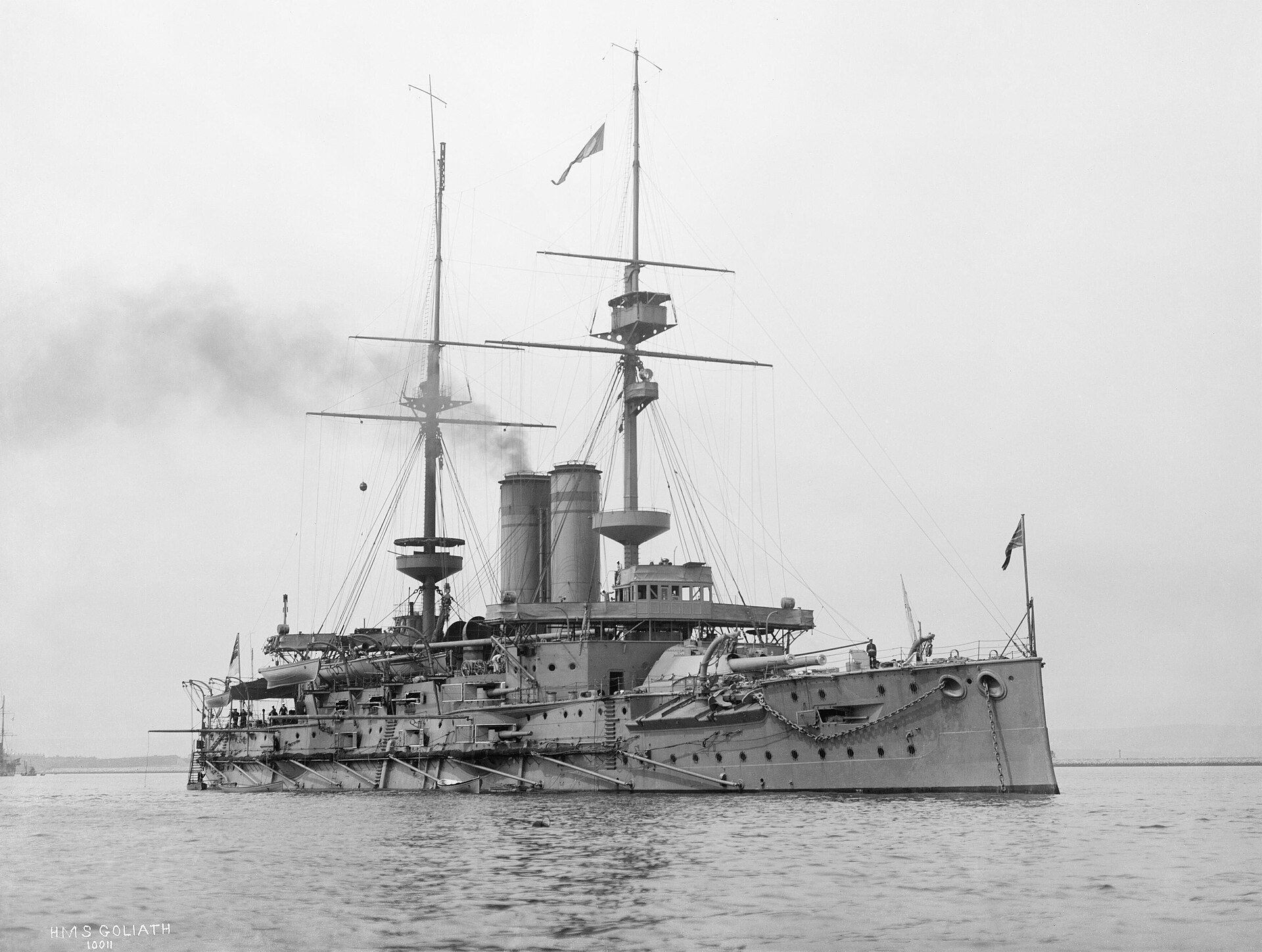
HMS Goliath – pre-dreadnaught class, extensive use during the East Africa Campaign.

The Royal Navy is Britain’s true military might, and it’s the world’s undisputed naval power – a very big hitter, in 1914 it’s bigger than the French and American navies combined. For the British in 1914 the ‘Army’ is very secondary to the control of its trading empire worldwide – the primary tool is the Navy. Defending (and even assaulting) ports is what the Royal Navy does, it’s their speciality and just one British battleship has more firepower on it than the entire Boer Rebel army combined – think about that.

Also, to consider with the hindsight of history, what would Britain do to re-establish its influence in Southern Africa with a rebel Boer Republic (with German backing) now declared – incorporating hundreds of thousands of people who consider themselves British subjects or under British protectorate, citizens and subjects who want nothing to do with the racist constructs of Boer Republicanism. Indeed, what would Britain do … it would, when the opportunity arose, return its Expeditionary Force to South Africa and simply take the country back – only this time it would have the benefit of all the technological advances of World War 1 – tanks, chemical warfare, fighter aircraft, bomber aircraft etc. 

Also, as Germany was defeated in WW1, an unsupported Boer Republican government would not hold out and Britain would have to intervene by 1918. The question then is how would the Boer nation hold out? As a population the Boer nation was devastated by the South African War (1899-1902) and they had no armaments industry, with a renewed British military intervention and all the new technology of warfare available to them, the Boer nation would simply not survive the onslaught. 

But – you may ask, the Boere did manage to get a ‘white’ Republic for themselves in 1948 without the support of Germany, and Britain didn’t invade – so it’s possible right? Again, this is after WW1 – not WW2, Britain is still an Imperial Empire and a colonial power, at the heart of which are its ‘Dominions’ – of which South Africa is one, and a key one at that (the other ‘Dominions’ are Ireland, Canada, Australia, and New Zealand). In any event, look at how Dr. H.F. Verwoerd’s ‘Keep South Africa White’ Republic worked out in the end. 

To Jan Smuts (and Louis Botha), the idea that a Boer Republic could be resurrected ended with the Boer War, South Africa was now intertwined as a British and Boer construct – Union had seen to that, and all the Boer war leaders had sworn an oath to uphold it, they had given their word (Smuts would remark that a nation who goes back on its word is not a nation at all). 

Smuts would also take an almost paternal approach to his much loved nation and try and gently try to steer the Boer nation away from inflicting more harm on itself, he would however consistently be thwarted by a minority of Afrikaners on the rump of Afrikanerdom, who against all odds are blindly bent on re-instating a Boer Republic with its intensive racially driven constructs (based on Krugerism) over the whole of South Africa and they are also wholeheartedly bent on supporting Germany – through both its Imperial and subsequent Nazi manifestations.

Conclusion 

In the end the Boer Revolt did little in terms of its military objectives, it managed to delay the invasion plans of GSWA for a couple of months only whilst the UDF dealt with it, however in the end the GSWA campaign was a decisive victory for the Union and the territory successfully annexed under ‘Greater South Africa’ in a trusteeship – as was the Union’s expressed casus belli for entering the war. 

As has been statistically proven – the Boer Revolt did NOT evoke a widespread desire from the Afrikaner community in the greater South Africa for a Boer Republic with Germany as its supporter. The Boer Revolt did NOT reflect the sentiment of the majority of the Afrikaans community nor that of the majority of its leaders. The Boer Revolt did NOT inspire the old Boer War Commando system and the majority of Afrikaner fighting men to join with it, in fact they did the opposite. The Boer Revolt also did NOT compromise the Union Defence Force in any way, shape or form whatsoever. 

From a military doctrine perspective, The Boer Revolt was poorly planned and poorly executed. The rebels were always going to be woefully outnumbered with completely insufficient firepower to do the task expected of them – in truth they had no chance of success – zero. The use of outdated mounted infantry doctrine against a modern military construct using combined and joint arms with a mobility ethos was also only ever going to end in a disaster for the rebels. In truth, not one single critical military objective of the Boer Revolt was met.

What the 1914 Boer Revolt did however do was plant the seeds for political division and is one of the key propaganda tools used by the Nationalists to create the deep split in Afrikaner outlooks. Louis Botha would look at the Rebellion as complete folly, a waste of time and an utter waste of life – a sort of Boer equivalent of the Charge of the Light Brigade, with the same disastrous consequence. Botha’s political opponents would look at it rather romantically instead – a sort of ‘Boer Last Stand’. It stands today in some Afrikaner communities, precisely because of its ‘Romanticism’ and ‘political currency’ and not because of its military prowess or even its unattainable objectives. 


Written and Researched by Peter Dickens

References: 

Statistics, data and references sourced from the following:

Eben Nel; ‘Kaapse rebelle van die Hantam-karoo’

Dr David Brock Katz; ‘General Jan Smuts and his First World War in Africa 1914 -1917’

Dr Evert Kleynhans and Dr David Brock Katz; ’20 Battles – searching for a South African Way of War 1913 – 2013’

Sandra Swart; ‘Desperate Men: The 1914 Rebellion and the Polities of Poverty’ 

John Bottomly; ‘The Orange Free State and the Rebellion of 1914: the influence of industrialisation, poverty and poor whitism’

André Wessels; Afrikaner (Boer) Rebellion (Union of South Africa) 2018.

Brian Bunting; ‘The Rise of the Afrikaner Reich’

John C.G. Röhl: ‘The Kaiser and England during the Boer War’

Plaatje: Chapter XXIII The Boer Rebellion

Related Work:

A Differing Outlook – Smuts and Maritz A differing outlook

Union to Banana Republic From Union to Banana Republic!

The Story of Jopie Fourie What about Jopie?

Colourised images with greatest thanks and appreciation to Jennifer Bosch – Jenny B Colourised online:

The Book! The ‘lost’ Springbok Rugby Trophy.

As we all experienced in the recent covid pandemic, during World War 2, all significant international sporting activities like the Olympics and Test matches came to a grinding halt for the duration of the war. Luckily, we’ve ‘rekindled’ our sporting trophies post Covid, however this wartime rugby trophy ‘The Book’ has been lost to future generations – and judging by all the new and evolving rules of rugby and the fierce contest that is any All Black and Springbok test match – if there is one trophy that needs a resurgence – it’s this one. 

The fun bit, this is a trophy which was only ever intended to be awarded in a ‘test’ rugby match between South African ‘Springboks’ and New Zealand ‘All Blacks’ and the loser … NOT the winner … the loser gets to “win” this particular trophy. 

A ‘winning’ trophy to the loser in a Springbok vs. All Black rugby humdinger – huh! So, what happened – how is it we’ve lost this, one of our most significant rugby trophies?

Let’s start at the beginning, to rugby mad nations like South Africa and New Zealand the on-set of World War 2 posed a problem for the sport and it was made worse by the fact that nearly all the young men playing in top division rugby leagues and top flight rugby clubs in all the ‘Allied’ countries like England, Ireland, Scotland, Wales, France, Australia, Canada, South Africa and New Zealand had joined their respective armed forces and were off to war as ‘brothers in arms’ – all these Allied countries also happened to constitute the lead nations in the rugby playing world (then and now).

So, our wartime generation “made a plan” and the default “National” rugby squads fell to the various expeditionary forces finding themselves in the same theatre of operations. Initially informal rugby matches started in the North Africa Theatre of Operations where South African units (mainly Army and Air Force) found themselves alongside British, Australian and New Zealand counterparts. Soldiers been soldiers started niggling and ragging one another over national pride. It all started whenever there was a lull in fighting or whenever on rest and recuperation leave touring the hot spots of Cairo. 

In particular, South African soldiers (also known as Springboks then) would seek out New Zealand soldiers (known as Kiwis) and before each contest would rib one another for not knowing the ‘rules’ of scrummaging and rugby as a whole (we still do). 

Heads and bodies clashed immediately to form a scrum, with all the ‘dark arts’, grunting, groaning and shoving. With the scrummaging done all would rise up from the resultant ruck smiling and laughing, shake hands and arm-in-arm then proceed to the bar or mess to drink a beer or three. 

It would not take long for the leader elements of the British, Australian, South African and New Zealand military formations to realise the benefits of all this camaraderie, teamwork, goodwill and national identity rugby offered and to settle this entire issue with more formalised rugby games. 

In the South African Union Defence Force ‘sports officers’ in North Africa and the Middle East, started to organise multiple matches with sports officers in other allied formations, playing on whatever surface they could find with whatever ‘rugby’ poles and whitewash markers they could find. In all the various rugby games, the great rivalry was the same as it was in peace time – and this was the great South Africa and New Zealand ‘test’ match.

The Legend of ‘The Book’ – Part 1

The legend that was to become ‘The book’ starts to take shape amidst all this informal scrummaging competitions and rugby games between the Springbok soldiers and their Kiwi rivals. 

As many may have guessed by now – The Book – is The Book of Rugby Union Rules. The South Africans claiming the Kiwis were hopeless and needed to learn the rules, and the Kiwis claiming they wrote the rules – so no need to learn them (or vice versa). The idea of each respective side “learning the rules” first became a general jibe and joke between Kiwi and Springbok service personnel.

The 6th Armoured Division “Springboks” – Egypt

By May 1943, South Africa’s 6th Armoured Division was formed as South Africa’s contribution to the invasion forces of Italy – and they took part in training exercises in Egypt before heading to Italian front. In identifying a need for stronger and more formal sports representation, and especially rugby – within the 6th Armoured Division there would also form South Africa’s default “Springbok” rugby side to take on the planned ‘internationals’ with ‘select’ sides from British, Australian and New Zealand military formations now in Italy – notably the 2nd New Zealand Division in Italy.

This 6th Armoured Division rugby team, playing in the Springbok ‘Green and Gold’ is no shrinking violet, it’s a rugby powerhouse on the level of an actual Springbok Rugby team – consider the players and the pedigree:

Initially the 6th Armoured Division team includes both current Springbok and future Springbok rugby players  – George Daneel, Bennie Osler, Jimmy White, Jack Gage, Frank Waring, Howard Watt, Louis Babrow, Ebbo Bastard, George van Reenen, John Apsey, Pat Lyster, Henry Martin, Dendy Lawton, Tony Harris, Richard Luyt, Bill Payn, Hermanus de Jongh, Bert Kipling, John Dold, Joe Nijkamp, Bert Reid and notably – Boy Louw, who had played for South Africa from 1928 to 1938.

Then there was the talent still on its way to Egypt to join the team, the likes of Felix du Plessis, Basil Kenyon and Stephen Fry, all three of whom would Captain the actual Springboks after the war. There were other future Springboks – Okey Geffin, Dennis Fry, Franz van der Ryst and Cecil Moss. Then there were also many highly talented provincial players joining the team, Billy Anderson and Hannes Morkel to name just two.

Even the coach was Springbok pedigree, now with the rank of Bombardier, Boy Louw, the Currie Cup 1939 referee would coach the 6th Armoured Division team, after the war Louw would go on to famously coach the 1960-61 Springboks Grand Slam tour to the UK and Ireland. 

Before heading to Italy, practice, trials and selections would take place in Egypt at the Gezira Sporting Club on an island in the Nile River and at Polygon Ground in Abbassia, a suburb of Cairo. 

Their first proper game in Egypt is significant, it’s played against the ‘old rivals’ the New Zealand Base, and it’s played at the El Alamein club on 7 November 1943. The second billed “Springbok” and “Kiwi” clash in Egypt with the New Zealand Base is a narrow and hard game, it takes place at the same club on New Years Day 1944. The South Africans win both games.

Action shot from the SA 6th Division vs New Zealand Base on 1st Jan 1944.

Games against other military formations in Egypt are also played at the El Alamein Club, and in all the results speak for themselves – they played 6 and won 6:

Egypt Matches

1. SA 6th Armoured Division vs New Zealand Base, 22-5 on 7 November 1943 at the Alamein Club

2. SA 6th Armoured Division vs 10th Armoured Division, 49-0 on 14 November 1943 at the Alamein Club

3. SA 6th Armoured Division vs Cairo United Services, 28-3 on Christmas Day 1943 at the Alamein Club

4. SA 6th Armoured Division vs New Zealand Base, 12-11 on New Year’s Day 1944 at the Alamein Club

5. SA 6th Armoured Division vs Rest of Egypt, 12-9 on 23 January 1944 at the Alamein Club. The Rest were a Barbarian side made up of New Zealanders, South Africans and British players.

6. SA 6th Armoured Division vs Rest of Egypt, 27-3 on 4 March 1944 at Alamein Club.

Then onto Italy. The 6th Armoured Division are deployed to Italy along with their ‘Springbok’ rugby team, they depart Alexandria, Egypt by ship from the 14th to the 16th April 1944, arriving in Taranto Italy on the 20th and 21st April 1944.

The 6th Armoured Division “Springboks” – Italy

Into the thick of it, the immediate priority for the South African 6th Armoured Division is winning the war and not playing sport, from May 1944 to May 1945 the South Africans found themselves in a series of brutal engagements, starting with the Battle of Monte Cassino which ended on the 18th May 1944 as South African 6th Division engineers cleared the access roads to close off the fighting.

In the race to liberate Italian cities from German troops, the fighting South African ‘Springboks’ found themselves in action over the ‘Albert Line’ and then commanding the Arno Valley, and once again they found themselves in rivalry with their counterpart New Zealand 2nd Division ‘Kiwi’ and ‘Māori’ troops.

This time their respective national pride and ‘rivalry’ was not rugby, it was on a very serious military level as they both raced “shoulder to shoulder” to take the honours of liberating the regional capital city of Florence on the 4th July 1944. The South Africans beating the New Zealanders just hours ahead of them as South African 6th Armoured Division units consisting of the South African Imperial Light Horse and the Kimberley Regiment managed to get across the landmark Ponte Vecchio – the only remaining bridge into central Florence not blown up by the retreating German forces – and raced into central square whilst the New Zealanders entered the city from other points. Funnily as rivalry’s go (if you can be funny about war) – to this day New Zealand still claims the honours of liberating Florence, whereas the historical record and ‘honour’ was given to South Africa, the satirist would say, as birds go they are being Magpies and not Kiwis.

South African 6th Division tank entering Florence’s central square (Left) on 4th July 1944 and New Zealand 2nd Division tank entering Florence (Right) on the same day – enthusiastic Italian crowds greeting both.

To read a little more on this historic liberation of Florence, follow this Observation Post link: Little known WW2 fact – the South Africans liberated Florence!

Crossing the Arno River, the South African 6th Armoured Division found itself fighting along the ‘Gothic line’, advancing into Bologna and in action around the peaks of Monte Sole and Caprara di Marzabotto. Advancing through the Po Valley, they end their war in near the northern city of Treviso, thereafter they are ordered west to garrison the city of Milan on 29th April 1945.

A year of heavy fighting later, the South Africans suddenly found themselves at rest, idol and a little bored in Milan. They managed to famously conclude their Victory Parade on the 14th May 1945 on Milan’s neighbouring world-famous Monza racing track, but very soon their attention also turned to sport on the orders of Major-General Frank Theron, and very specifically – rugby. 

Original colour image of the South African 6th Armoured Division Victory Parade on the famous Monza raceway – 14th May 1945.

The Legend of ‘The Book’ – Part 2

Whilst the 6th Armoured Division was in Milan in July 1945, a detachment of it, a South African Artillery Regiment – the 7-23 Medium Regiment found itself in liaison with the local Italian Amatori Rugby Club – which was playing a rugby game after an athletics meet at the local stadium, war had thinned their numbers somewhat and they only had 8 players, so they thought to ask some South African Gunners to make up their numbers. 

Rugby in Italy in 1945 was still at its infancy, and weary that they were playing in front of an Italian audience who did not really understand the rules of rugby, the South Africans produced a small pamphlet simplifying Rugby Union rules for easy understanding and had it translated into Italian. Copies of pamphlet was then distributed to all interested watching the game.

Among the spectators at the rugby game were a handful of Kiwis who received this Italian pamphlet. The ‘old rivalry’ kicked in, the New Zealanders were immediately amused and started to taunt the South Africans taking part in the game. At last, South Africans can learn how to play rugby they declared loudly, but what a pity they’ve got to learn it from the Italians!

That night in the pub at Corner House, the South African rest camp in Milan, usually referred to as “Kiwi Corner” – copies of the pamphlet were predominantly displayed. The banter continued with the flow of more beer and the pamphlet became one of the treasured souvenirs of the Italian campaign – no lucky Springbok or Kiwi who managed to get hold of a copy was ever persuaded to part with it. 

The banter, jesting and ribbing did not stop there, almost immediately afterwards cartoons were pinned up in the South African Springbok and New Zealand Kiwi messes respectively. 

The South African cartoon depicted a triumphant Springbok standing over three battered little Kiwis studying ‘The Book’, opened on the first page which read, “The Game of Rugby How it is Played.” 

The Kiwis cartoon comeback was equally good and taunting to the South Africans, it showed their Kiwi man as a schoolteacher of massive physique standing in front of 15 little Springboks with a rugby ball in his hand and asking sternly. “Come, come now, surely there is one among you who knows what this is?”

The idea of a ‘book of rugby union rules’ as a prize to the ‘losing’ team to “go away and learn the rules” started to take root, and there was only one way to solve this – a match to who might win this “least” converted and most undesirable “book” had to be played – New Zealand or South Africa.

The South African 6th Armoured Division Rugby Football Team was quickly re-established. Bombardier Boy Louw, the coach was re-engaged and he went about pulling a top-notch team together. He famously roped in real talent like Cpl Cecil Moss, then a Medical Corporal in the Special Service Battalion stationed at Monza, near Milan who arrived for ‘rugby’ duty in an ambulance (Dr. Cecil Moss was the Springboks’ vice-captain in the first post-war series against the touring All Blacks in 1949). 

Before squaring up against the New Zealand 2nd Division’s default “all blacks” and to teach them a rugby lesson and hand them a copy of the rule “book” so they can learn to play the game, the “springboks” held trials on 22 October 1945 in Rapallo and then arranged a practice game against a ‘barbarian’ squad of rugby players of all nations station in the “59 Area”. The Sixth Division Rugby squad thumped the ensemble ‘59 Area’ Rugby squad 45-3. With that under their belt they were ready for the big showdown with New Zealand and the decisive ‘winner’ of the Book.

The Showdown for ‘The Book’

The South African 6th Armoured Division Rugby XV and the 2nd Division New Zealand Expeditionary Force Rugby XV clash was scheduled to take place in the small town of Rapallo on the Italian Riviera on the 10th  November 1945. Billed as the ‘Grande Combattimento’ the game began to hype up to a spectacle of the old Springbok vs All Black rivalry.

Image: Advertisement hyping the game ‘Grand Combattimento’ and the contest for ‘The Book’

Although an “un-official” test match whose score would not count, in the minds of the men from both countries of the wartime generation this game was considered the most important or symbolic game they had ever watched. Both sides fielded XVs filled with current capped internationals or men who would go on to represent their countries at the highest level and receive caps in future.

Two South Africans, Lt. Keith Oxlee and Capt. J.G. Louden, are credited with the idea, of actually producing “The Book” before the game, with the intent of handing it out to those present and the losing side being given a copy so that they could go away and study the game! The idea was to make it like the Ashes, however unlike the Ashes, the losing team would be given the “trophy”. In the event a small, folded booklet consisting of only 8 pages with illustrations and rules was handed out at the game to the truckloads of troops, New Zealanders and South Africans who packed out the stadium.

The cartoon illustrations of the rules in ‘the book’ where drawn by cartoonist Richard “Ginger” Townley Johnson who drew draw sports caricatures for the Cape Town Times before and then after the war. It also contained the team lists (this booklet is now a highly collectable and sought after rugby piece of rugby lore and memorabilia).

Image: ‘The Book’ as outlined in pamphlet form produced by the South Africans

A “curtain raiser” was played before the main game, between the two respective “dirt-track” B team players – the Division Equipment Park versus the Artillery/ Armoured Group.

After the curtain raiser the two main contesting teams entered the stadium, the main attraction was on, history records the run-out sides as: 

For the South African 6th Armoured Division: Oscar Swanson, Ian Frylinck, Cecil Moss (future Springbok), Jimmy Hearne, Frank Kingwill, Peter Stewart, John Youngelson, Dick Holton, Dr. Piet Duvenhage (Capt), Apie Greeff, Hannes Morkel, John Clother-Morkel, Cas Botha, Stephen Fry (future Springbok) and Hendrik Swartz. 

Note: Aside from the two Springboks, all the other players would go on to play Provincial or 1st Division rugby.

For the 2nd New Zealand Division Expeditionary Force (NZEF) the names recorded on the pamphlet are: Greig, Evans, O’Byrne, Murphy, Marshall, Robinson, Finnerty (Capt), Figher, Hoffman, Honana, McNab, Haimona, Gibson, Cameron and Green. 

The referee was Captain Robin Prescott – Prescott was a front row forward for England prior to the war (capped from 1937 – 1939), later from 1962 – 1963 he served as Vice- President of the Rugby Football Union.

The two teams were lined up and introduced to the much loved and highly respected Commander of the South African 6th Armoured Division – Major General Evered Poole by the respective Team Captains.

Image: Major General Evered Poole greeting the South African 6th Division (left) and Brigadier Pleasants (New Zealand 2nd Division) alongside Maj General Poole exiting the playing field after introductions (right).

So, what happens? Who gets the book? 

Long and short the South Africans obliterate the New Zealand side, it’s a thumping, made worse considering the rugby old points scoring in 1945 (only 3 points for a try and 2 points for a conversion if successful called ‘a goal’– a penalty was worth 3 points and a drop goal 4 points), the South Africans score no less than 7 tries, the New Zealanders replied with only 1 try. The final score 30-5 with the South African 6th Armoured Division the clear victors.

Image: Line-out action during the SA 6th Div and NZ 2nd Div match at Rapallo on the 10th  November 1945.

Eastern Province’s Frank Kingwill scored “the try of the match” a 50-yard run that split the field and sealed the victory. The headline in La Stella d’Oro, an army newspaper loudly declared: “Springboks Smash Kiwis in Game of the Century!”

The introduction to the story says everything and read: 

“The SA Sixth Division ‘Springbok fifteen’ trounced the New Zealand Kiwi’ team 30 (three goals, four tries and a penalty) to 5 (one goal) to establish very definitely that the New Zealanders are the ones that need to study The Book.”

So, what next? Obviously, the New Zealanders want a re-match, so the South Africans give them one.

The re-match for ‘The Book’

The re-match is set for the19 November 1945, once again it’s the South African 6th Armoured Division versus the New Zealand 2nd Division Expeditionary Force, but this time its scheduled to be played at the Florence Stadium in the city Florence (the same city the South Africans and New Zealanders dispute over ‘liberating’).

The second game was played in a strong wind, and again its played to a packed stadium of South African and New Zealand supporters. Not to be outdone, this time it’s the New Zealanders turn to produce their official version of The Book for this match, and it is titled:”This is The Book” – it’s also a pamphlet form and consisting of 8 pages with the two teams listed and cartoon caricatures illustrating respective rugby union ‘rules’.  The kiwi artist illustrating the cartoons was Captain Peter McIntyre. McIntyre, OBE, New Zealand’s official war artist (again, this booklet is a highly sought after rugby artefact now).

Image: ‘The Book’ pamphlet produced by the New Zealanders

The South Africans are confident going into this game, Boy Louw makes no changes to the team which thumped the New Zealand 2nd Division just 9 days earlier in Rapallo. The Kiwi’s go in with a much-changed side, the South Africans record that the Kiwis backline’s defence was improved and that they boosted their forwards with a few tough Māori’s. The referee is again the English prop – Captain Robin Prescott.

The teams are listed as:

South African 6th Armoured Division XV – Swanson, Frylinck, Moss, Hearn, Kingwill, Stewart, Youngelson, Holton, Duvenage (capt), Greeff, Morkel J, Morkel J C, Botha, Fry S and Swartz. 

New Zealand 2nd Division XV: Hill, McKay, Birchfield, O’Byrne, Evans, Clay, Finnerty, Gardner, McNab, Murray, Haimona, Waaka, Honana, Mathews and Poki.

The game is noted as scrappy one in windy conditions with many infringements and rough play, given the conditions and the improved Kiwi backline, the South Africans keep the ball ‘tight’ in the forwards as a tactic and the two packs pounded each other into submission.

So, who won and who walks away with ‘The Book’ to learn the rules of rugby? Well, again it’s a thumping, a proper drubbing – the South Africans convincingly clock up 25 points, the Kiwis managed only 3 points to become he undisputed winner of ‘the book’ (again). 

In true comradeship, after the match a complimentary dinner is hosted by the Kiwis for the two teams at the New Zealand Forces Club at the Hotel Baglioni.

Touring

With the matter of who keeps ‘the book’ settled for once and for all. The balance of the South African 6th Armoured Division XV campaign in Italy is nothing more than one outstanding victory after victory. They emerge from Italy, as they did in Egypt with a complete winning streak having played 6 and won 6.

In all the Italian tour records:

1. SA 6th Division vs 59 Area, 45-3 on 27 October 1945 in Rapallo.

2. SA 6th Division vs 2nd New Zealand Expeditionary Force, 30-5 on 10 November 1945 in Rapallo.

3. SA 6th Division vs 2nd New Zealand Expeditionary Force, 23-3 on 19 November 1945 in Florence.

4. SA 6th Division vs 2 Military District, 19-3 on 27 November 1945 in Rapallo.

5. SA 6th Division vs British Army XV, 17-10 on 1 December 1945 in Milan.

Italy done, the issue of ‘the book’ settled – the 6th Division team then goes on to tour the United Kingdom, France, Germany and back to Egypt before been shipped back to South Africa, arriving to a hero’s welcome in February 1946. 

In all they Played 22 matches, won 19, drew 1, lost 2, and one match was cancelled. Now that is some track record, by any rugby teams standards.

Image: Team photo of the South African 6th Armoured Division touring squad 1945-1946

In Conclusion

Nobody knows where the ceremonial ‘book’ which acted as the trophy is. In 1949 Pat Swanepoel and others got together and recreated “The Book”, embellishing and expanding it and published it to celebrate the arrival of the 1949 All Blacks in South Africa on the first post-war tour. This version of ‘The Book’ was edited by Pat Swanepoel and illustrated by John Jackson. It is thought to have been whisked away by this losing All Black XV side when the Springbok XV made a clean sweep of them in the 1949 Test series. It has never been seen by the South African public since.

Would it not be nice to resurrect this fine tradition again and remember our wartime generation who secured liberty for Europe and the world over and who made such a significant sacrifice? 

I would imagine it’s about time. I’m glad the All Blacks have held onto ‘The Book’ of rules to learn them since 1949 and feel it necessary to hang onto it to overcome whatever inadequacy they may have; some would however say it’s also rightful that South Africa should have walked away with ‘The Book’ after some woeful Springbok tours to New Zealand since. Either way, it’ll be great to have this quirky tradition back – rather than tin cups and shields, this particular trophy has substance, quirkiness, history and pride just oozing from it.


Written and Researched by Peter Dickens

References:

War stories: Rugby games ‘Up North’. By Paul Dobson. Rugby 365 June 2020.

The Book – article in the Eastern Province Herald on October 27th, 1994, by Norman Canale

Khaki-clad Springboks: Rugby played by the 6th South African Armoured Division 1943-1946 by Gideon Nieman – Jstor public domain.

Related Work

Bill Payne – Springbok Rugby and Comrades Marathon: Comrades legend, Springbok and war veteran – the remarkable Bill Payn

Mannetjies Roux – Flying Springbok: A flying Springbok in more ways than one – ‘Mannetjies’ Roux

A differing outlook

An opposing view, a massacre, a revolt, and a Nazi.

There is an old joke in Afrikaner politics, put two Afrikaners in a room and they will come up with three political parties! 

It’s funny because throughout history it has always proven to be very true, As a nation from the get go, literally from the Great Trek serious schisms have occurred within the Afrikaner culture – from the Great Trek’s “Vlugkommando” where two trekking parties could NOT agree a overall Commando Commander for an assault on the Zulu on the 6th April 1838 and decided instead to have two equal Commanders in equal positions of authority – the result (if you’re a military vet – you guessed it) .. a Zulu victory and the death of 10 Voortrekkers including Piet and Dirkie Uys – the surviving “Vlug” Kommando (meaning “Flee” or ‘run-away’ commando) splitting ways after the battle, both accusing each other of been “Veraaiers” (traitors) and heading off on their respective treks.

So, as humorous as it is seriously tragic, nothing represents this dichotomy of views more so than this image of Jan Smut’s Commando during the South African War (1899-1902) a.k.a. The 2nd Boer War. In it are two leaders who have – right upfront – two massively differing opinions, two completely differing views of life and vastly differing outlooks on the objects of the war and the country as a whole going forward. So much so that it is a surprise that Smuts was even able to command this Commando, that his is arguably one of the most successful ‘Bittereinder’ Commanders of the war is even more surprising, and testament to Smuts’ abilities.

Image: General Jan Smuts’ Commando during the South African War 1899-1902. Smuts and Maritz are seated in the centre – photo colourised by Jennifer Bosch 

So, what’s with this leadership battle – what’s with these vastly differing views? The two people in this famous photograph are Manie Maritz and Jan Smuts, and the composition of the shot by the photographer ironically betrays their future feelings towards one another as an intense dislike of one another would emerge – and even here, almost by purpose, Smuts is seated opposite Maritz for a group portrait and both of them have their backs to one another looking the other way.

This differing view and outlook of these two men would forever taint Smuts’ commando with a mass murder of civilians – something your school history book would have conveniently glanced over – this differing outlook on Afrikanerdom would result in a serious schism in Afrikaner cultural fabric after World War 1, a schism that still exists to this day believe it or not and it would it would even add to the “Nazification” of the Afrikaner far right-wing prior to World War 2 and as a result create a diametrically opposing view of Afrikaner identity itself. 

What, Maritz, Smuts … mass murder and Nazism – you smoking your socks again right Mr. Dickens? Well, no – let me explain … and if you are a fan of the 1914 Boer Revolt and a Boer Romantic looking to this revolt as the bedrock of Boer stoicism and independence – now is the time to look away, as this next bit is going to sting a little. 

Let’s get this out upfront. General Manie Maritz, as the leader of the 1914 Boer revolt does not end up a very redeemable figure in history bathed in glory, instead he ends up as a murderer, an antisemite, a racist and a devout Nazi … the bit your Nationalist inspired school history book did not want you to know about him … the inconvenient truth.

An opposing view

Let’s start with Boer War 2, and upfront Maritz and Smuts are already at different points of view in Smuts’ Commando. It starts with Maritz’ rank, role and appointment in the Commando. Maritz would maintain Smuts gave him the rank of ‘General’ as a field commission – in the Republican Armies this was known as a “veggeneraal” or ‘fighting-general’. Deneys Reitz, Smuts’ long-time right-hand man, confidant, and friend, has a different view and claimed Maritz was only a “leader of various rebel bands” and never given a Generalship – as Reitz was also on Smuts’ staff, Reitz would have known if Martiz was made a ‘veggeneraal’or not.

The two leaders upfront also differ on leadership style, experience and philosophy. Smuts is a skilled lawyer and academic, he is a ‘Philosopher General’ and takes a very holistic view to the fighting seeking a consolidation of ‘white civilisation’ in Southern Africa between Boer and Brit as its final object. Smuts also has an outward look, seeking through the ‘consolidation of the white races’ good neighbourliness with all South Africa’s peoples, including South Africa’s ‘coloureds’ and ‘blacks’. Maritz on the other hand is a ‘Soldier’s General’, he starts his military career as a guard at the Johannesburg Fort after the Jameson Raid and subsequently becomes a ZARP Policeman. Maritz has a reputation as a “thug” he’s a devout Boer Republican, he wants nothing to do with reconciliation with the ‘hated’ British, he is inwardly focussed and views ‘coloureds’ and ‘blacks’ very suspiciously.

So, Smuts and Maritz are fundamentally different in their leadership styles, outlooks and personalities and it would come to a head towards the end of Boer War 2 in what was to become known as the ‘Leliefontein massacre’. For those who have an abiding admiration for Smuts, now is also the time to also look away, as some historians have tarnished Smuts with the title of “mass murderer” as it took place ‘under his watch’ so to speak, but the culprit is really Maritz – so what happened?

A Massacre 

Over two days, starting on the 31st January 1902, the ‘noble’ Boer bittereinder effort of the Boer War, and even Jan Smuts, would emerge forever tarnished by what is considered by some as the first massacre of innocents of the 20th Century. 

A rather dishonourable title and achievement not often emphasised by Boer War ‘Republican’ historians, journalists and commentators – rather conveniently ignored by them is the nature of this phase of the war really – the repeated targeting, pillaging and ransacking of mission stations, ‘hensopper’ farms (farms belonging to Boers who surrendered prematurely during the amnesty), ‘Joiner’ farms (farms belonging to Boers who joined the British) and even tribal villages by marauding Bittereinder groupings. This period also sees many Black and Coloureds executed by Bittereinder Boer firing squads and hangman nooses, mainly charged with “spying” for or “working” with the British. It is not such a ‘glorious’ end to a noble fight to the end, as romantic Boer war novelists would have you believe – its harsh war – bloody and revengeful, and nobody in the ‘Guerrilla’ phase of the Boer War comes out smelling of roses – not the British with their tactic of Scorched Earth and certainly not the Boers with their tactic of Marauding.

Manie Maritz

Many of these actions were of little real tangible military value in the war against the British and have more to do with retribution than anything else, and front and centre in this controversial phase is Manie Maritz, who whilst he is under Jan Smuts’ command, rides into the ‘Nama’ missionary town of Leliefontein in the far north west Cape – deep inside the British Cape Colony. Here Maritz immediately detains the Methodist missionary – Barnabas Links – who was acting in place of the absent Rev J.G. Locke. Maritz subsequently reads out a proclamation threatening death to both residents and the town’s missionaries alike if they are found guilty of aiding or abetting the British.

The Nama people (the local people made up of a mix of KhoiKhoi, Namibian and Tswana) and their missionaries are British subjects living in a British colony and fearing for their lives don’t take lightly to the proclamation threat and become steadily agitated. From here out there is a lot of conflicting account, in detaining Barnabas Links a rather strong verbal exchange over jurisdiction and authority takes place and some say Links strikes Maritz with his stick, others say Maritz strikes Links with his sjambok. Either way, a ‘fists and knives” scuffle breaks between a group of citizens and Maritz’ men, one Republican is injured, Links is also injured, and Maritz and his men manage to disentangle themselves from the melee, leaving 8 Leliefonteiners dead, and ride back to their rendezvous camp.

That night, Maritz and his men become indignant at their treatment at the hands of the Leliefonteiners and elect to exact revenge by wiping the missionary off the face of the earth. So, the next morning the Commando detachment numbering about 100 mounted Boers attacks the missionary in full force. The Nama and their missionaries are no match for a fully armed Boer commando, having some antiquated muskets they try and hold off the assault and most take refuge in the mission building. A further 27 Leliefonteiners are killed (some accounts say a total of 43) and approximately 100 are injured. 

Image: Modern day image of the Methodist Mission Church, Leliefontein (erected in 1855, it was the third church built at the mission station).

Maritz then directs all the surviving women and children, male survivors, and the wounded (including Links) be taken away in chains to the Boer positions surrounding Okiep, one account points to the local blacksmith been instructed to fashion iron shackles for this purpose. Some accounts also point to general violence been meted out by the Boers against surviving Leliefonteiners after the skirmish and ‘refugees’ been hunted down and killed.

Maritz instructs that the mission station be pillaged and then burned down – all the captured sheep and grain are to be forwarded to a Boer supply depot. The mission station is completely destroyed and the dead Leliefonteiners are left where they died – and here they remained unburied for months.

So, how does Smuts and his General Staff react to the news that a detachment of his Commando had ransacked a mission station and killed over 30 poorly armed or unarmed British civilians in a revenge attack? Deneys Reitz on arriving at the destroyed mission station described the scene as follows:

“We found the place sacked and gutted and among the rocks beyond the buried houses lay 20 or 30 dead Hottentots, still clutching their antiquated muzzleloaders. This was Maritz’s handiwork. He had ridden into the station with a few men to interview the European missionaries, when he was set upon by armed Hottentots, he and his escorts narrowly escaping with their lives. To avenge the insult, he returned the next morning with a stronger force and wiped out the settlement, which seemed to many of us a ruthless and unjustifiable act. General Smuts said nothing but I saw him walk past the boulders where the dead lay, and on his return he was moody and curt… we lived in an atmosphere of rotting corpses for some days.”

Deneys Reitz

Smuts, although clearly unimpressed with Maritz, actually comes through for Maritz in accounting the massacre in his letter to General de la Rey, he down-plays the instance as a “close shave” for Maritz and somewhat covers up the incident, citing that Maritz was attacked by a knobkerrie whilst acting as a peace envoy, it was taken as a sign of attack and only “8 hottentots” were killed due “to misunderstanding and ignorance” (Nel, Eben: Kaapse rebelle van die Hantam-karoo, p 461).

Some commentators point to this as collusion, as Maritz is completely exonerated and never held to account for the massacre – whereas similar instances of ‘murdering’ civilians in the cases of the Australian officer Lt. Harry ‘Breaker’ Morant and the Boer Commandant Gideon Scheepers landed them both in front of their respective firing squads.

To further demonstrate just how off the hinge Maritz was, the last real Boer action of the Boer War was when Jan Smuts’ Commando laid siege to the mining town of Okiep in the British Cape Colony in April, 1902. On hearing the news of the Peace Conference, Reitz writes “General Smuts set to work at once. Next morning a messenger was sent into O’Okiep, to advise the garrison that both sides were to refrain front active military operations while the Congress lasted”.

Jan Smuts then left the siege of O’okiep to take part in the final Peace talks at Vereeniging at the end of April 1902. With Smuts away Manie Maritz decided to attack Okiep with the idea of literally wiping the entire town off the map, using the commandeered Namaqua United Copper Company locomotive ‘Pioneer’ – which was used to propel a mobile bomb in the form of a wagonload of dynamite into the besieged town. The attack failed when the train derailed, snagged upon a barbed wire fence which wrapped around the points, spilling the dynamite upon the ground which burnt out harmlessly. 

The exercise could have resulted in killing large numbers of women and children (mainly coloured) who sheltered behind the defences, the failure of the operation was a blessing at a time when deliberations at the Vereeniging peace talks potentially heralded the end of the conflict. Smuts would again gloss over the incident and cover for Maritz when he stated that the railway was still intact after the incident anyway, and since there were women and children in Okiep town, all the commando was allowed to do was to give the good citizens of Okiep a “tremendous fright with a harmless explosion.”

Images: General Jan Smuts and General Christiaan Beyers at the Vereeniging Peace negotiations (left), and the locomotive ‘Pioneer’ used by Maritz to try and blow up the town of Okiep in Smuts’ absence (right).

Smuts’ disposition to treating treasonous, rebellious and insubordinate Boer commanders with ‘kid gloves’ in the hopes of placating and consolidating their views to see his way on things would be Smuts’ greatest ‘Achilles heel’ – as there would be no such quarter given in the way they would view or treat him in future. Which brings us to the next instance – The Boer revolt of 1914.

A Revolt

Much has been written on the Boer Revolt of 1914, but let’s understand the ‘differing’ view between Smuts and Maritz in the lead up and then the instigation of the revolt itself. Where Smuts was involved in negotiating the Peace at Vereeniging to end the Boer War in 1902, Maritz as part of his leader element would have none of it. When peace was made, the burghers of the erstwhile Republics were obliged to lay down their arms and sign an oath of allegiance to the British monarch – Maritz refused and instead he slipped over the border into German South West Africa (modern Namibia).

In German South West Africa (GSWA), Maritz would become embroiled in another massacre, this time the Hereto and Namaqua genocide – which as irony goes it is the first recorded case of Germans using the concentration camp system along with the resultant mass death (something ignored by both Hermann Göring and Adolf Hitler when they solely laid the blame on the British for “inventing” concentration camps and the “Genocide” of the Boers – in their book white deaths count, black deaths don’t seem to count – and these two criminals were are also happy to try and deflect Germany’s real crimes of genocide).

Returning to South Africa by sneaking back over the border, Maritz is briefly arrested in the British Colony of the Transvaal for not signing the oath of allegiance (and therefore still a combatant) – it’s a forewarning of a general dislike of his deep-seated dislike of the British. He is ultimately released and joins up again as a Transvaal Policeman.

Smuts on the other hand at this time in 1909 is concerning himself with Union, the Union conference on the back of the Peace of Vereeniging specifies an expanded Union border to incorporate Britain’s Southern Rhodesia colony as a 5th Province along with the incorporation of the British protectorates of Bechuanaland (Botswana), Lesotho and Swaziland. By doing this the Boer and the Brits agreed ‘Union’ negotiations are hoping to gain balance and reconciliation between Boer and Brit interests in the region, although now all under the “British family of nations” as specified in the Vereeniging Peace Treaty – Jan Smuts, Louis Botha and all the other significant Boer Generals – De la Rey, Hertzog etc are all consolidating to ensure this new ‘Union’ is managed by the Boers and not the Brits, which is in fact the subsequent outcome when The Union of South Africa is formed in 1910 – the South African Party, consisting of Botha, Smuts, De la Rey, Hertzog etc. win the majority seats.

Image: The borders of ‘Greater South Africa’ as outlined in the Union conference in 1909 – phase one – the Limpopo River marks the border of South Africa, phase two – Zambezi River marks the border and phase three – the Ruvuma River marks the border, this is Smuts’ map, note his personal notations ‘A’ and ‘B’.

The arrival of World War 1 in 1914 is both a blessing and a curse for the Boer led government of the newly formed Union of South Africa. Both Botha as Prime Minister and Smuts as his ‘right hand man’ were walking a tight rope – as Boer commanders they represented a faction of the new “Union”, balancing the two small old Boer Republic’s politics and laws with those of all the British colonies and protectorates surrounding them (six large British territories and their interests in them in effect) – so they are obliged to support Britain as the major player in the region, and honour their word to them, the oath that brought about peace – that’s the ‘curse’. 

The ‘blessing’ to the Union government is that the war presents them with an ideal opportunity to realise the expansive border of ‘Greater South Africa’ as envisioned and concluded in the Union conference in 1909 – as this border also specifies the eventual inclusion of German South West Africa into South Africa in the first phase of the ‘Greater’ South Arica Union and eventually even German East Africa would be included in the second phase of South Africa’s territorial advancement.

So it’s really no surprise, that when the decision to go to war is put to the vote in the Boer led and very independent Union of South Africa parliament (at Union, Britain takes a figurehead role, the South African Union’s Parliament and legal construct is not governed by Westminster, its fee to make its own laws) – and the result is not what your school history teacher plugged – it’s a staggering vote of confidence by nearly all the Boer MP’s favouring going to war alongside Britain (and France) against Germany, by a landslide – literally. Consider the result.

92 = For invasion of German South West Africa by the Union of South Africa

12 = Against

So, as to the ‘majority’ of Afrikaners NOT wanting war with Germany, that is simply untrue, the Afrikaner community’s representatives in Parliament were overwhelmingly in favour of war against Germany. This is also where some ‘Boer Romantic’ commentators on the 1914 Revolt make a fundamental mistake, the Union of South Africa’s decision to conquer German South West Africa (Namibia) was NOT just a service to the ‘British Empire’ – it was largely in service to the objects of The Union of South Africa and its own territorial expansion ambitions and the prescribed ‘sphere of influence’ over the Southern African region as a whole (as agreed by all Boer and British leaders involved in the Union conference in 1909).

Image: Political cartoon of the day captures the Union’s territorial ambitions

Smuts, as the Minister of Defence at this time had also been busy amalgamating the armed forces of the republics with those of the colonial citizen force regiments to form the Union Defence Force i.e. the UDF (in much the same way as the SADF was amalgamated with other forces in 1994 to form the SANDF – with the same challenges). 

The UDF had taken shape to consist of a small contingent of permanent force, but the backbone would remain voluntarily forces in a two-stream approach, the voluntary ‘English’ colonial citizen force regiments – Transvaal Scottish, Royal Natal Carbineers, Royal Durban Light Infantry etc and the voluntary ‘Afrikaans’ citizen force “skiet” Commandos known as the ‘Rifle Association Mounted Infantry’ in parallel to them (the old Republic’s commando system in effect). It was a careful construct to keep everyone happy, but the point is this, it was NOT “British” – Imperial British troops had returned to the United Kingdom, any engagement the Union of South Africa was going to fight in World War 1 in Africa, whether foreign or domestic, was going to be made up of ‘South Africans’ and led by ‘South Africans’ – and commanded by the old Republic’s ‘Bittereinder’ Boer Generals – primarily Botha (as Prime Minister was Commander in Chief) and Smuts (as Botha’s Minister of Defence). 

Smuts was sensitive to the fact that many Afrikaners shared German heritage and they (falsely) believed that Germany extensively supported the Boer cause during Boer War 2 – ‘falsely’ because in fact, Germany was happy to ‘sell’ them arms (as did the British arms manufacturers) at a premium and send some medical assistance later on, however Germany withdrew their support officially – they provided no troops and no substantial funding to the Republican Boer War effort whatsoever. 

Kaiser Wilhelm II

Kaiser Wilhelm II, although sending a letter to Kruger congratulating him on the Jameson Raid victory (given the Boer nation their false sense of ‘support’), in fact refused point blank to receive any Boer representations and after the ‘Black Week’ British defeats to the Boers in late 1899, he and his Generals compiled a military strategy, not to help the Boers, but to help the British win the war (he was after all related to the British monarchy – part of the family so to speak) and shared it with them instead – Kaiser Wilhelm II even proudly proclaiming at the end of the Boer War that the British had followed his plan precisely as he had outlined it to them and it was the German plan that won the war for the British – not Field Marshal Frederick Robert’s plan and as inconvenient truths go the Kaiser’s plan involved scorched earth policies and concentration camps. (see: John C.G. Röhl: The Kaiser and England during the Boer War). Now, I bet none of this was in your Nationalistic inspired history teachings.

Ethnic Germans (local and foreign) volunteering to join Boer Commandos also qualified very few (550 odd) – far more Anglo-Irish, Dutch and Flemish joined the Boers (5,500 odd). A Boer leader delegation, including Botha and de Wet visited Germany after the war in 1902, and although they received a royal welcome and ovations, they were not officially received – they did raise a little money from private donators and a Boer help fund, but that’s it. However, all this still did not resonate with many in the Boer community who almost illogically saw Germany as an Ally. 

Smuts would argue the case for war, not on the basis of warring against Germany on the side of ‘Britain’, but for supporting the other old Boer Republic’s supporters – France, Belgium and the Netherlands in their war against a hostile and aggressive Germany busy de-stabilising western and eastern Europe, and Smuts was very aware of the vast majority of Boers had Dutch, Belgian and French roots, as opposed to the ones with German roots. He would use the same argument again for his declaration of war against Germany in World War 2.

Smuts however anticipated that the decision to go to war, although largely supported by the Afrikaner political elite and leadership, would have with it a handful of resignations from the Union’s Defence Force from those strongly in favour of Germany and whose sheer hatred of the British superseded everything, and the Union government received exactly that – a “handful” – nothing that would fundamentally compromise the UDF’s fighting ability or construct. 

Of the handful of resignations which were received, a rather long-winded one came from General Christiaan Beyers, the UDF’s Commandant General in charge of the Active Citizen Force and his was the most important resignation. Prior to the decision to go to war, Smuts and Botha’s old friend and highly respected comrade, General Koos de la Rey had been one of the handful of Parliamentary Ministers vocally against the decision to invade GSWA and advocated neutrality, and because of his popularity his opinion held massive sway over the old Boer Republic’s Afrikaner electorate  – nevertheless he was persuaded by Louis Botha and Jan Smuts not to take actions which may arouse the Boers, he then held a political rally for 800 Boers and took a reconciliatory approach – contrary to what the attendees expected of him. 

Images: General Christiaan Frederik Beyers (left) and General Jacobus Herculaas de la Rey (right)

De la Rey seemed torn over his decision, and he was then targeted by General Beyers to join him for meeting with Major Jan Kemp, a mid-line UDF officer who had also resigned – the purpose of the meeting; Beyers and Kemp wanted to persuade de la Rey to take a stronger stand and initiate more Union Defence Force resignations to compromise its fighting capability. Joining the conspiracy was another heavyweight – the significant Boer General and Parliamentary Minister, Christiaan de Wet.

What follows next is well documented, however the generally accepted and investigated history concludes; General De la Rey and General Beyers were travelling in a soft top sedan car to their meeting with Major Kemp and did not stop at a Police blockade set up to capture a notorious gang of robbers and murderers called The Foster Gang. One of the Policeman fired a warning shot into the road to get them to stop, the bullet ricocheted and hit De la Rey, killing him. 

It was tragedy – plain and simple, and both Botha and Smuts were devasted at the loss of their friend, as a signal to the inevitable accusations of ‘political assassination’ both Botha and Smuts attended De la Rey’s funeral in front of thousands of mourning Boers, they appeared without any bodyguard at the mercy of the assembly – a token of no malice intended, and there were no protests or accusations from the mourners. 

Regardless, despite sound and tested enquiries and court cases, and the Nationalists having full scope and the resources at hand for 40 years to uncover a ‘plot’ – no concrete proof has emerged of a plot by Smuts to kill De la Rey whatsoever – ‘conspiracy theory’ nevertheless grew out of the incident which would plague Smuts in future years, and it still does.

It is also generally understood that with the death of De La Rey, that would probably have been the extent of Boer resistance to the war, and it would have devolved into simple political protest and peaceful demonstrations, had it not been for one man … the subject of the differing view – none other than Lt. Colonel Manie Maritz, who by now had joined the UDF and commanded a small UDF force at Upington, near the border with German South West Africa (GSWA).

The day after de la Rey’s funeral, Kemp, Beyers and de Wet addressed a large crowd at Lichtenberg, calling on protest meetings against the decision to invade GSWA. Manie Maritz however took a more robust position than Kemp, Beyers and de Wet, he instead went into open sedition and started ignoring Smuts’ and his other Commander’s orders been sent to him. Intel told Smuts that Maritz had joined the Germans, however contradictory to Smuts’ usual manner of decisiveness, he vacillated instead hoping to persuade Maritz not to revolt and get him to see reason. 

Images: General Christiaan Rudolf de Wet (left) and Major Jan Christoffel Greyling Kemp (right) in his UDF dress uniform.

Not dissuaded by Smuts and bent on a sedition, Maritz resigned his commission from the Union Defence Force and openly rebelled on 9 October, taking 300 odd of his UDF soldiers with him when he went over to the Germans.

Major Barend ‘Ben’ Bouwer was sent to deal with Maritz’ sedition and insubordination (Bouwer had also been a ‘Veggeneraal’ in Smuts’ commando during the Boer War and as irony goes was alongside Maritz when he sent the dynamite train into O’okiep). Maritz took Bouwer prisoner along with his fellow officers, he was subsequently released and sent back with the ultimatum from Maritz to the Union Government to the effect that:

That unless the Union Government guaranteed safe passage of his fellow plotting Generals (De Wet, Beyers, Kemp et al), to his position on the GSWA border by the 11th October he would immediately attack General Brits’s UDF forces preparing to invade GSWA and then he would invade the Union of South Africa.

Major Ben Bouwer reported that Maritz was in possession of some guns belonging to the Germans, and that he held the rank of General commanding the German troops. He also had a force of Germans under him in addition to his own rebel commando. Maritz arrested all the UDF officers and men under his command who were unwilling to join the Germans, and then sent them forward as prisoners into German South West Africa.

To drive Maritz’ point home, Major Bouwer was shown an agreement between Maritz and the Governor of German South West Africa guaranteeing the independence of the Union as a Republic, ceding Walfish Bay and certain other portions of the Union to the Germans, and undertaking that the Germans would only invade the Union on the invitation of Maritz.

Major Bouwer was shown numerous telegrams and helio messages dating back to the beginning of September. Maritz boasted that he had ample guns, rifles, ammunition, and money from the Germans, and that he would overrun the whole of South Africa.

Image: Rare image of Lt. Col Maritz, front and centre in his South African Union uniform and his staff behind him – his  ‘Agterryer’ (man-servant) is at his heels (It’s the man-servant’s expression and position that is most interesting as in many ways it gives away the complete disregard Maritz felt for people of colour).

In response to Maritz’ action and ultimatum, on 12 October, the Union government imposed martial law across the whole of South Africa. On proclaiming martial law, Smuts, the eternal reconciler, immediately called again for “reason” and urged the rebels not to be swayed by “foreign agents influencing them”.

The ‘Maritz Revolt’ as it would now become known was underway, and with their sedition hand now played by Maritz in the Cape Colony, his fellow conspirators – Beyers, Kemp and de Wet had no choice, now ‘in for a penny and in for a pound’ they all broke their ties with the Union Defence Force, resigned their commissions and went into open revolt against their lawfully elected government – raising Commando’s in the Transvaal and Orange Free State to come to Maritz’ aid

The revolt is well documented and carries with it a number of consequences for Jan Smuts, and we will cover these in future Observation Post articles called “Boer War 3 and Beyond” and “What about Jopie?” (look out for them). However, the long and short of it from a military historian’s perspective let’s look briefly look at the objective, the capability and strategy to achieve the objective and the outcome.

The stated objective: Maritz issued a proclamation by way of objective – “the former South African Republic and Orange Free State as well as the Cape Province and Natal are proclaimed free from British control and independent, and every White inhabitant of the mentioned areas, of whatever nationality, are hereby called upon to take their weapons in their hands and realize the long-cherished ideal of a Free and Independent South Africa.”

In other words, to take by force, the former British Colonies and re-start the Boer War, resistance to the declaration by any “white” in the entire Union of South Africa would be treated by Maritz’ Provisional Government as treasonous. 

Capability: To attain this objective, the Rebels raised 11,476 Boers. Union Defence Force strength was around 32,000 troops (so in essence the Rebels were outnumbered 3 to 1). Important to note here that of the 32,000 UDF troops, 20,000 were Afrikaners – mainly ex-Commando and most of them in the UDF’s mounted infantry ‘Rifle Associations’ (the old Commandos). General Louis Botha would primarily use the Rifle Associations to counteract the rebellion, insistent that the British ‘stay out of it’, this was going to be the Boer leaders sorting their differences out between themselves – so ‘Brother against Brother’ and in effect the UDF’s Afrikaners outnumbered the rebel Afrikaners 2 to 1.

Images: General Smuts (left) and General Botha (right) as depicted on cigarette cards during WW1.

Important also to note here as to capability, the Rebel force was not made up entirely of first rate ex-UDF soldiers going against their counterparts, the rebel force was made up primarily of destitute Orange Free State Boers having come through a drought and agricultural reforms on the back of the devastation of their farms during Boer War 2. 

Many of these Free State Boers as has been pointed out by historians like Sandra Swart (Desperate Men: The 1914 Rebellion and the Polities of Poverty’ in South African Historical Journal, Vol 42) and John Bottomly (The Orange Free State and the Rebellion of 1914: the influence of industrialisation, poverty and poor whitism: pages 29-73), were simply desperate ‘Bywoners’ (landless farmers or share-croppers) promised a better life if the rebellion was successful. 

Consider the statistics of the Boer rebels and from where they came, and you’ll see how the above statement holds true. 7,123 (62%) of the Boer Rebels came from the Orange Free State – the least populace, most rural and economically worse off province in the Union. As an aside, to gauge the extent of success of Maritz’ proclamation and its resonance across the broader Afrikaner community across the whole of South Africa, he was only able to motivate 1,215 (12%) of the Boer Rebels from the Cape province – the biggest province in the Union. The balance coming from the Transvaal, and no real support from Natal.

The Potchefstroom Herald at the time best tried to explain why there was no traction behind the revolt from Cape Afrikaners and the black/brown African communities in this quote – and not surprisingly it boils down to the lack of suffrage and plain racism in the old Republics;

“When these high officers of the Defence Force in Transvaal and Orange “Free” State rebelled and joined the Germans with their commandos, the Dutchmen of the Cape (presumably because “they vote side by side with the Kafirs”) denounced the treachery in unmistakable terms. The South African party at the Cape beat up its followers to the support of the Government, and the voice of the Cape section of the Dutch Reformed Church rang from pulpit and platform in denunciation of disloyalty and treason. But in the Northern Provinces, where white men are pampered and guarded by the Government against the so-called humiliation of allowing native taxpayers to vote, there the rebellion, having been regarded with seeming approval, gained a marvellous impetus.

Plaatjie: The Boer Rebellion – snippet from the Potchefstroom Herald

As a unified, coherent, trained and fully armed force, the Rebel Boers were not. Desperate and landless farmers in the main up against fully trained, motivated, even mechanised in some instances, and properly armed UDF soldiers on a 3:1 numerical advantage – the Rebels were no match and it quickly showed. The long and short the rebellion was almost immediately repelled and then very quickly crushed as Botha’s UDF Rifle Associations with some Regiment elements in support hunted the Rebel Commandos down as they tried to make their way to assist Maritz on the GSWA border.

Image: The last pursuit of Major Kemp. A South African Union ‘Flying column’ crossing the Orange River after him.

As Dr David Katz in his work ‘General Jan Smuts and his First World War in Africa 1914 -1917) points out. Jan Smuts, eternally the one Boer General keeping a level head and seeking reconciliation and understanding, and when it was clear the rebellion had failed, Smuts called for a ‘Blanket Amnesty’ across the board for the Boer Rebel leaders and their troops if they laid down their arms. General Louis Botha, the Commander in Chief, on the other hand took a much harder and less reconciliatory line than his colleague Smuts – Botha agreed to an Amnesty, but for the rank and file only, the Boer Rebel leaders would have to be prosecuted. The amnesty, excluding the Rebel leadership, was in put place from 12th to 21st November 1914, and with it the 1914 Boer Rebellion was effectively over, by the end of November General de Wet’s force alone was down to only 40 men. Rear actions and isolated and desperate battles continued to be fought for a couple of months by woefully under-strength hard liners refusing surrender and amnesty, but by the end of January 1915 the rebellion was over.  

Of the Rebel leadership now having surrendered, Botha and Smuts would again be especially magnanimous, considering the Union was in a state of war externally and in a state of martial law internally – and this was 1914 ‘World War 1’ – people were put in front of firing squads for ‘cowardice’ and being AWOL (absent without leave) – let alone ‘sedition’ and ‘treason’. Smuts would treat the Rebels in general very kindly, literally with kid gloves, all the time urging reason, understanding and reconciliation.

Of the main rebel leaders, General Christiaan Beyers tragically drowned in the Vaal River whilst attempting to desperately evade capture on 8th December 1914. 

General Christiaan de Wet was captured during the amnesty and sentenced to six years imprisonment, with a fine of £2000, he was released by Botha and Smuts after one year’s imprisonment, after giving a written promise to take no further part in politics. 

Major Jan Kemp was captured on the 2nd of February 1915 and sentenced to 7 years imprisonment, with a fine of £1000. However, a mere 10 months into his sentence Botha and Smuts agreed to release him – also on the condition that he may not participate in any politics (a promise Kemp almost immediately broke entering politics as a National Party MP under Hertzog in 1920 and again under Malan’s ‘Reformed’ National Party after 1948).

Lt. Colonel Manie Maritz would evade capture and escape into German South West Africa, at the conclusion of the GSWA campaign and the Union Defence Force’s victory and annexation of the territory (the first real victory for the Allies against Imperial Germany in WW1), Maritz would again evade capture, going into self-imposed exile in Angola, Spain, Portugal and then Mozambique.

Of all the other leaders – junior and mid-level rebel officers who were also captured. All were sentenced to short imprisonments and fines, almost all of them walking free within a year … except for just one man … Captain Jopie Fourie was executed for ‘High Treason’ having not resigned his UDF officers commission, captured still wearing his UDF officer’s uniform and opening fire on his fellow UDF troops whilst under a ‘white flag’ of truce (this was WW1 after all and there was no way anyone could get him out of this one with a no-nonsense leader like Botha as Prime Minister, not in a month of Sundays  – more on him in a later article “What about Jopie?”).

To pay for all their fines the Bloemfontein newspaper ‘Het Volksblad’ established the ‘Halfkroonfonds’ (Half-a-Crown Fund). Shop owners and other people whose property had been damaged during the rebellion were able to claim compensation, leading to the establishment of the Helpmekaar Beweging (the Help-One-Another Movement). By the end of 1917, all the debts were paid.

Of the handling of the 1914 Maritz Revolt, Louis Botha would summarise Smuts role and leadership, when he said of him;

“Nobody can appreciate sufficiently the great work General Smuts has done – greater than any man throughout this unhappy period. At his post day and night, his brilliant intellect, his calm judgement, his amazing energy and his undaunted courage have been assets of inestimable value to the Union in her hour of trial.”

Prime Minister Louis Botha

As a rebellion with any chance of success consider just what a small minority they represented – no Cape Province or Natal Afrikaner would really come near it, of the Afrikaners in the Transvaal and OFS they were unable to raise an effective fighting force, the vast majority of Afrikaners in the armed forces remained in the UDF, the vast majority of Afrikaner political leaders remained behind Botha and Smuts and they gained no traction whatsoever to raise anything from the Black and Coloured communities (the real ‘vast’ majority) – no “Askari” troops whatsoever, and they got no support whatsoever from the white South Africans of British decent – who by way of ‘white’ population were not insignificant in size, commanding massive swathes of white population groups in the Transvaal (most of Johannesburg and the reef), Natal (most of Durban) and the Cape Colony (especially in Cape Town and the Eastern Cape) . 

In the end the Maritz revolt did little in terms of its military objectives, it managed to delay the invasion plans of GSWA for a couple of months only whilst the UDF dealt with it, however in the end the GSWA campaign was a decisive victory for the Union and the territory successfully annexed under ‘Greater South Africa’ in a trusteeship – as was the Union’s expressed casus belli.

Image: General Botha (right) accepts the surrender of German South-West Africa from Lt Col Francke, (left) at Kilo, 9 July 1915.

What the Rebellion did however do was plant the seeds for political division and is one of the key propaganda tools used by the Nationalists to create the deep split in Afrikaner outlooks. Louis Botha would look at the Rebellion as complete folly, a waste of time and an utter waste of life, his opponents would look at it rather romantically instead – a sort of – ‘Boer Last Stand’. It stands today in some Afrikaner communities, precisely because of its ‘Romanticism’ and ‘political currency’ and not because of its military prowess or even its unattainable objectives.  

Now, back to Maritz and Smuts, the subjects of this vastly differing outlook on Afrikanerdom, because it would manifest itself again just prior to the Second World War.

A Nazi

Manie Maritz decided to end his self-imposed exile after the 1st World War ended and returned to the Union of South Africa in 1923. The Smuts government treating him very kindly by way of reconciliation, and all things considered for a crime as serious as treason he received a short imprisonment of three years. Luckily for Maritz, Hertzog’s National party won the 1924 election and Maritz was granted full amnesty and walked free having only served three months.

Maritz took to farming, but came under the influence of National Socialism (Nazism) in 1936 and founded a ‘anti-parliamentary’(dictatorship led) party called the Volksparty (People’s Party) in 1940. Maritz also took control of another ultra-right, national socialist, pro-Nazi movement initially set up by Colonel J.C. Laas (the first Commandant-General of the Ossewabrandwag) called “Die Boerenasie” (The Boer Nation), he then merged the Volksparty with Die Boerenasie and continued under the “Die Boerenasie” banner. He became known as a very outspoken proponent of The Third Reich and admirer of Adolf Hitler. During this time, he had also developed a theory about the alleged Jewish conspiracy and interference in South African and world politics and became a fanatical Antisemite. He would detail his Antisemitic and National Socialist views in his autobiography ‘My Lewe en Strewe’ (My life and Aspiration) which he published in 1939, a book regarded as lacking in objectivity, inciting racial hatred and like his hero Adolf Hitler’s book ‘Mein Kampf’ (My Struggle) Maritz’ book was full of emotional and racially driven rhetoric. He was even taken to court over all the anti-Semitic statements he made in his book, found guilty of fomenting racial hatred and he was fined £75.

Images: Maritz’ book ‘My Lewe an Sterwe’, later political portrait and the ‘Die Dappere Bloodskapper’ second world war mouthpiece for The Ossewabrandwag and Maritz’ Boerenasie.

Die Boerenasie rose to prominence under Manie Maritz, in September 1939 Jan Smuts declared war against Nazi Germany and once again you could not find a more vastly differing view than that of Smuts and Maritz. Smuts was extremely wary of the dangers of Nazism and Adolf Hitler, who he accused of being a “false messiah” and whose Nazi symbology of the Swastika Smuts called “the crooked cross” in reference to it being a corruption of true Christianity. Smuts was so anti-Nazism that he would take the Union of South Africa to war again to fight it, and once again at ‘war’ with Maritz. 

On antisemitism, here again Smuts held a polarising opposite view to Maritz. Smuts was a devout Zionist, he believed in the establishment of Israel as nation state, supported Jewish immigration and refugees (even controversially as Prime Minister he was involved in rescuing 200 Jewish orphans from the ‘Pogroms’ in the Ukraine in 1921, bringing them to safety in South Africa). Smuts supported the ‘Balfour Agreement’ which gave rise to Israel, he was also a personal friend of Chaim Weizmann, the President of the Zionist Organization. Weizmann went on to become the first President of Israel. Smuts is so loved and honoured in Israel that even today a kibbutz in Ramat Yohanan is named in his honour.

It is however difficult to say if Smuts would have interned Maritz again for his Nazi sympathies along with the other strong proponents of Nazism during the 2nd World War as Maritz’ life ended tragically and very early on in the war, he died in a car accident in Pretoria on the 20th December 1940. Probably, had he lived, Smuts and Maritz would have been at extreme loggerheads and Maritz back on the warpath with the Union – and very possibly back in jail.

A completely differing outlook

So, back to the image of Smuts and Maritz on Commando during the South African War (1899-1902) a.k.a. The 2nd Boer War on the masthead. It is hard to think how Smuts and Maritz could find anything in common, and to think they are fighting side by side in common cause against the British, living hard in the bush on horseback and up to their necks in the blood and gore of war – brothers in arms in effect.

Both saw South Africa – from the “Limpopo to the Cape” – even incorporating all the surrounding British protectorates and German South West Africa in addition. Both saw ‘white civilization’ as the steward to develop the region – this was the era of ‘Empire’ after all. Both put their ‘Afrikanerdom’ front and centre and both believe sincerely that only an Afrikaner hegemony in Southern Africa would successfully unlock the region’s potential, and both were prepared to fight for it.

That’s where the similarity ends. Smuts believed the ‘Afrikaner’ led hegemony would only work with an outward, embracing and reconciliatory disposition – and with all the British protectorates, British colonies and British subjects living in ‘Greater South Africa’ in partnership … so, he saw that the future lay only with the co-operation of the British super-power as a steward protecting the region as part of Britain’s family of nations. Progress for Smuts would only lie in establishing peace and co-operation with Britain.

Maritz on the other hand believed in a similar hegemony, only he believed that South Africa would fall under the stewardship of white Afrikaners with Germany as the super-power providing the glue to keep the region stable and prosperous. He believed that the only way the troublesome ‘British’ subjects in the colonies and protectorates would be brought into line was with jack-boot authority – and Germany would provide the Afrikaners with the protection, money, military backing and arms to do so. 

Maritz’s political disposition had its roots in “Krugerism” – a philosophy whereby White Afrikaners were ‘pure’ with an orthodox Calvinist ‘dopper’s’ approach to religion, through God and a theocracy styled republic they had an ordained right to rule over non-Afrikaners and Africans alike – they would have limited or no basic suffrage rights whatsoever in Kruger’s Republic. Maritz’ view so inwardly directed that he demonstrated a deep seated racist and violent response to anything “non-Aryan” (non pure). By 1939 Maritz’ Afrikaner cabal consisted of far-right wing Afrikaner nationalists with Nazi leanings – all of whom adopted or supported Nazism prior to, including and some even after the war – the likes of H.F Verwoerd, F.C Erasmus, Jaap Marais, B.J. Vorster, F.C. Erasmus, Oswald Pirow, Hendrik van den Bergh, Johannes von Moltke, P.O. Sauer, C.R. Swart, P.W. Botha, Eric Louw, Louis Weichardt, Rev. Koot Vorster, Henning Klopper, Albert Hertzog, Dr Nico Diedericks, Piet Meyer, Dr Eben Dönges, Dr Hans van Rensberg etc., etc. All of whom were infusing Afrikanerdom with a heady mix of Christian Nationalism, Oligarchy Republicanism and National Socialism (Nazism).

Smuts’ political disposition on the on the other hand had it roots in “Holism” – a philosophy whereby White Afrikaners lived in an interdependent state with all the cultures and societies surrounding it, he cherished the Cape Franchise, acknowledged Black South African medieval history and although a segregationist for much of his early life, his political philosophy would focus on consolidation, reconciliation and mutual recognition. By 1939 Smuts had abandoned segregationist thinking altogether famously stating that “segregation had fallen on evil days” in 1941 – his thinking had turned to universal suffrage and human rights and his Afrikaner cabal consisted of ‘left’-leaning Afrikaners with liberal suffrage and democratic leanings in the main – they were known as “Smuts-men” and they consisted of people like Deneys Reitz , Kmdt Dolf ‘Oom’ de la Rey, Group Captain ‘Sailor’ Malan, General Dan Pienaar, Group Captain ‘Dutch’ Hugo, Uys Krige, General Kenneth van der Spuy, General George Brink, Jacob Pretorius, Jan Steytler, Captain De Villiers-Graaff, Pieter van der Byl, Dr Ernst Malherbe, Jan Hendrik Hofmeyr etc., etc.

A more vastly different and polarising view of Afrikanerdom you could not find – one inward and one outward.

In conclusion 

So how does it all work out for these two vastly different views of Afrikanerdom? Well, unfortunately we all know the history, and after Smuts’ shock electoral defeat of the Nationalist Afrikaners in 1948, these Afrikaners had a free-reign with complete control of education channels and media channels coupled with ‘gagging’ powers over opposition voices – for 40 long years – in which they also took the opportunity to resurrect Manie Maritz and the ‘Boer Rebels of 1914’  as the true Afrikaner ‘heroes’ of Afrikanerdom and paint Smuts and his Smuts-men as the ‘traitors’. 

The net result, sad to say, is Maritz’ view won out, Maritz would be directly responsible in his rebellion in creating a schism that would break the Afrikaner camp into two distinctive groups and continue to drive a schism through it all the way to the on-set of World War 2 and then Apartheid and beyond.

Thanks largely to leaders like Maritz and advent of the Broederbond’s ‘Centenary Trek’ in 1938 the modern Afrikaner is still seen in South Africa by most other societies in the context of a whites-only ‘Voortrekker’ (pioneer), ‘Boer’ (farmer) hegemony, sometimes with conservative and ‘racist’ leanings – which, as it happened in Maritz’ beloved Nazi Germany put the Afrikaner on the same footing as Nazi Germans in many people’s eyes after the Afrikaner nationalists formally gazetted their eugenically driven ideology of Apartheid in 1948.

The small difference, modern Germany goes to great extent to re-dress, re-educate, reconcile and consolidate their military history and political ideologies from both the 1st World War and the 2nd World War … so as to overcome the tremendous impact of propaganda and conditioning initiated by the National Socialists and ‘open’ minds to the truth. Whereas in South Africa no real deep-seated action of reconciliation, re-education and understanding has taken place to counteract the old Christian Nationalism conditioning and propaganda initiated by the Nationalists, and in many circles the likes of General Christiaan de Wet, General Christian Beyers, Major Jan Kemp, Captain Jopie Fourie, Lt. Col Manie Maritz in active sedition with Germany and eventually the likes of the other Afrikaners flirting with Germany and its ideologies, D.F. Malan, H.F. Verwoerd, B.J. Vorster and P.W. Botha are still held up fervently and sometimes illogically by some as the ‘true’ heroes of Afrikanerdom – as certainly is the case with Maritz.

In all honesty, the challenge for ‘white’ South Africans especially in reviewing, redressing, and balancing their history – and this massively different outlook initiated by the likes of Maritz and Smuts – is to better resurrect the ‘redeemable’ Afrikaners – the iconoclasts, the ones who held the opposing view to Apartheid, the ones who went to war against Imperial Germany and then again against Nazi Germany – Smuts and his ‘Smuts-men’ – NOT the ones who joined hands with Germany and its ideologies. Hold up the true ‘heroes’ to account Afrikanerdom, the ones who demanded suffrage and fought against racist oppression – and believe it or not, there is a very big pool to choose from. Their histories and ‘differing’ views where savagely repressed by the Nationalists and literally scrubbed from our national consciousness – and they need to come to light in order to affect a more balanced outlook on Afrikanerdom – as in truth when we look at it with the hindsight of history, they are really the true ‘ysters’ (heroes) and not the ‘veraaiers’ (traitors). Krugerism, National Socialism, Christian Nationalism, Apartheid and a ‘keep South Africa white’ Verwoerd Republicanism are an abhorrent testament to Afrikaner nationalism as an ideology and an anathema to Afrikanerdom itself.


Written and researched by Peter Dickens 

References: 

Eben Nel; ‘Kaapse rebelle van die Hantam-karoo’

Dr David Katz; ‘General Jan Smuts and his First World War in Africa 1914 -1917’

Sandra Swart; ‘Desperate Men: The 1914 Rebellion and the Polities of Poverty’ 

John Bottomly; ‘The Orange Free State and the Rebellion of 1914: the influence of industrialisation, poverty and poor whitism’

André Wessels; Afrikaner (Boer) Rebellion (Union of South Africa) 2018.

Brian Bunting; ‘The Rise of the Afrikaner Reich’

John C.G. Röhl: ‘The Kaiser and England during the Boer War’

Plaatje: Chapter XXIII The Boer Rebellion

Colourised images with greatest thanks and appreciation to Jennifer Bosch – Jenny B Colourised on line:

Related Work:

Union to Republic: From Union to Banana Republic!

Boer War Myths: Debunking the myth that the British invented the ‘concentration camp’ and Stealing Republics, gold, diamonds and other myths!

Jan Smuts and Israeli: 200 Jewish orphans saved, the story of Jan Smuts and Issac Ochberg 

Jan Smuts and Balfour: A Kibbutz called Jan Smuts

Winning Afrikaner Hearts and Minds

Ox Wagons to Steel Commandos

So what does the 1938 Great Trek Centenary have in common with Sailor Malan’s returning war veterans anti-apartheid movement – The Torch Commando?

Well, it’s all in the name – ‘Steel Commando’ – so what is a Steel Commando and what the heck does it have to do with the famous 1938 Great Trek Centenary defining Afrikanerdom and Sailor Malan’s later ’Torch Commando’ in 1951.

So here’s the backdrop:

The 1938 Great Trek Centenary 

In 1938, the Broederbond under the directive of its Chairman, Henning Klopper sought to use the centenary of Great Trek to unite the ‘Cape Afrikaners’ and the ‘Boere Afrikaners’ under the symbology of the Great trek. In this endeavour artificially creating a shared heritage. He started a Great Trek re-enactment with two Ox-Wagons in Cape Town and addressed the large crowd of 20,000 spectators by saying;

“We ask the entire Afrikanerdom to take part in the festival celebration in this spirit. We long that nothing shall hinder the Afrikaner people as a whole from taking part. This movement is born from the People; may the People carry it in their hearts all the way to Pretoria and Blood River. Let us build up a monument for Afrikaner hearts. May this simple trek bind together in love those Afrikaner hearts which do not yet beat together. We dedicate these wagons to our People and to our God.”

By that he hoped to combine the ‘Cape white Afrikaners’ with the ‘Boer white Afrikaners’ in the symbology of the Great Trek under a fabricated Nationalist ideal of Christian Nationalism – and only meant ‘White’ Afrikaners in the Broederbond’s definition of what constituted ‘Afrikanerdom’ and not really the Afrikaans speaking peoples as a ‘whole’ – certainly not the Coloured and Black Afrikaners. The Trek celebration would be pitched as an assertion of Afrikaner white power in South Africa and the Trek as the true path to a overall South African nationhood and identity and ignore the histories of everyone else – black and white – in creating a future South African identity. 

In any event the trek re-enactment was very successful in re-aligning white Afrikaner identity under the Christian Nationalist ideal.  In the end eight wagons from all around the country threaded their way to Pretoria to lay the cornerstone of the Voortrekker monument – in front of a crowd of 200,000 people. Whilst at the same time, four ox-wagons went to the site of the battle at Blood River for a commemoration service on the 16th December. The wagons stopping in countless towns and villages all around the country along the way to re-name street after street after one or another Voortrekker hero, and laying imprints of the wagons wheels in freshly laid cement at many halts (there are still ‘imprints’ at my hometown in Hermanus).

Images: Henning Klopper’s Ox-Wagons named – The ‘Piet Retief’ and the ‘Andries Pretorius, leave Cape Town from the foot of Jan van Riebeeck’s statue to commence the 1938 Centenary of The Great Trek.

The Broederbond had staggered onto the ideal way to ‘unify’ the Afrikaner – a round the country travelling carnival  – from the cities to the platteland, on to far flung corners and everything in between. Henning Klopper himself amazed at the reaction and the success of it all – so much so he turned to divine intervention and called it a “sacred happening”

The Ossewabrandwag

A mere two short years after the Centenary Trek, South Africa was at war with Nazi Germany. Leading up to the war, the South African government was a ‘Fusion’ coalition party between the National Party under Prime Minister Barry Hertzog and General Jan Smuts’ South African Party as his deputy – in an entity called The United Party. The decision to go to war was won by Smuts and a majority vote. Hertzog, whose National Party was already splitting along more radical right lines with the advent of the ‘Pure’ National Party resigned and Smuts became the wartime Prime Minister.

Another one of the primary reasons for the National Party gravitating to radical right-wing lines was the Ox-wagon Great Trek Centennial of 1938.  One of the wagon group’s leaders during the trek was Dr Johannes Van Rensburg, a lawyer who had served previously as National Party ‘Secretary of Justice’ in 1933 and was a part-time Union Defence Force officer – he had been to Germany in his capacity as Secretary and met both Hitler and Göring as well as other Nazi officials, he was deeply impressed with both the leadership and discipline offered by Nazism and became an admirer.  

So, from the Centenary event in celebration of this coming together of Afrikaner identity under a white-only Afrikaner Nationalism came a cultural movement called the Ossewabrandwag (meaning Ox Wagon Sentinel or ‘Fire Watch’) – abbreviated OB – eventually led by Dr Johannes van Rensberg. Formed in 1938, the ‘Fire’ part of the OB name referred to the rapidly spreading “wildfire” of Christian Nationalism and ‘white’ Afrikanerdom set off by the 1938 Ox-Wagon Centenary Trek, eventually gaining about 250,000 – 300,000 members in total.

The Ossewabrandwag at the on-set was loosely associated to Dr D.F. Malan’s ‘Pure’ National Party. However so as not to tread on one another’s feet, the relationship between the Ossewabrandwag and National Party needed to be formalised. So Dr D.F. Malan met with OB leaders on the 29th October 1940 which resulted in declaration known as the ‘Cradock Protocol’. It specified the two operating spheres of the two respective organisations. They undertook not to meddle in each others affairs and the National Party endeavoured to work for white Afrikanerdom and Christian Nationalism in the “political” sphere while the OB would operate on the “cultural” front. 

Images: Ossewabrandwag members on parade and taking a Nazi styled salute

Resigning from the Union Defence Force, when war was declared, Dr Johannes Van Rensburg moved to promote the edicts of Nazism in the OB and even directly support the Nazi Germany war effort-ordinating espionage activities for German submarines, the OB under his leadership also evolved away from being a mere ‘cultural movement’ forwarding Nationalist Afrikaner identity, to an active domestic para-military movement with strong Nazi convictions.

Dr Van Rensburg, having resigned as an officer in the Union Defence Force at the start of the war, had always professed been a National Socialist, and as an open admirer of Nazi Germany and Adolph Hitler, the ideas and rituals of membership of the OB had a distinctive Nazi leaning as a result.

Officially, the National Party – when under Hertzog and then under Dr D.F. Malan took the position of ‘neutrality’ as to South Africa’s wartime involvement, but in reality hundreds of thousands of Afrikaner Nationalists were joining openly pro-Nazi Germany movements like the Ossewabrandwag (OB) and its ‘Stormjaers’ (Storm Troopers) military wing, the Nazi Party of South Africa – the South African Christian National Socialist Movement (SANP), the National Socialist Rebels under Robey Leibbrandt, a Nazi Germany insurgent and the Nazi world expansionist order in South Africa – The New Order (NO) under Oswald Pirow who had served as a National Party Defence Minister under Hertzog.

The Steel Commando

The recruitment of white Afrikaners to volunteer for war service became paramount to Union’s Defence Force wartime objectives. On the other side of the Afrikaner coin stood Afrikaners like General Jan Smuts and Dr Ernest Malherbe, who had also been swept up in the enthusiasm of 1938 Great Trek Centenary and the establishment of a unified Afrikaner identity, but not buying into its underpinning Christian Nationalism ideology. 

The Malherbe family, for example, being descendants of a French Huguenot and Afrikaners to their core had nothing in common with the Broederbond but had been caught up with all the Afrikanerdom of the 1938 Centenary Trek. At Blood River on 15 December, in the shade of one of the Centenary trek wagons, Dr Ernie Malherbe’s father-in-law, Dominee Paul Nel, baptised their daughter Betty-Jane with water from the Blood River. 

When South Africa declared war, Dr Ernie Malherbe and a group of academics, notably Alfred Hoernle and Leo Marquard, persuaded General Smuts to set up, under Malherbe, a corps of information officers to counter subversion in the armed forces generated by the likes of the Ossewabrandwag and the Broederbond and to stimulate the Afrikaner troops and potential white Afrikaner recruits to consider what they were fighting for. Smuts then made Malherbe Director of Military Intelligence with the rank of Colonel. Henceforward South African propaganda which had just been focused on countering Nazi propaganda became much more positive and more South African in its orientation.

Images; World War 2 recruitment posters targeted at white Afrikaners – note the poster drawing on the ‘the road to South Africa’ commencing from The Battle of Blood River to the Boer War Commandos to the South African Union Army – the title “Still loyal to the path of South Africa” is a direct play on the 1938 Centennial Trek which the Broederbond pitched as “Die Pad van Suid-Afrika,” a symbolic ‘path’ to South Africa’s nationhood taken by the Voortrekkers. This poster attests that joining the Smuts appeal to war is the true path to nationhood.

Critical to Smuts’ call for volunteers to serve in combat regiments was the white Afrikaner nation (as ‘whites’ and ‘coloureds’ were only deemed eligible to carry firearms in the military per segregationist policies and not ‘blacks’). The Union’s Defence Force at the beginning of the war was woefully under strength. Simply put, without the white Afrikaners volunteering for war-time service, South Africa’s wartime commitments for combatants would be ineffectual.

Colonel Malherbe would take a leaf out of the Broederbond’s 1938 Centenary Trek used to ‘unify’ the Afrikaner – a round the country travelling carnival covering just about every town and village in the remotest areas. Only this time Colonel Malherbe intended that the travelling carnival ‘unify’ the Afrikaner behind Smuts’ call to arms to fight with Britain and France on the side of the Allies. He would use armoured cars instead of ox-wagons and his message was almost diametrically opposite to that of the Broederbonds’.

Colonel Malherbe would call his countrywide travelling carnival – The Steel Commando, added to this would be a propaganda and recruitment pamphlet dropping campaign from SAAF aircraft called the Air Commando.  The Steel Commando would consist of vehicle to carry a full military band, various armoured cars and a truck converted into a mobile recruitment station. Critical to the Steel Commando would be a contingent of old Republican Boer War veterans (South African War 1899-1902) to give it a sense of ‘Afrikanerdom’ and ‘duty’ to South Africa. The term ‘Commando’ would be given to the convoy – solely because it resonated with old Republics ‘Kommandos’ of the Boer war and as a result had Afrikaner appeal. Isie Smuts (called ‘Ouma’), Jan Smuts’ wife and very popular amongst Afrikaners, young and old, was also positioned as a volksmoeder (people’s mother) a term originated in the Boer War and was initially drawn upon by Afrikaner nationalists to represent ‘the mother of the nation’ connected to the concentration camps – Isie Smuts would become a volksmoeder for the Union’s wartime cause comforting the Afrikaner men and women in uniform and the country’s ‘First Lady.’

This convoy would enter small rural and farming towns with the fanfare of the marching band ahead of it, flanked by the Boer War Republican veterans and the recruiting station behind.

Was it effective in capturing the Afrikaner hearts and minds as the Centenary Trek had been?  The truthful answer is – yes. In all the South African standing forces in WW2 comprised 334,000 full-time and voluntary service personnel, 211,000 were White, 77,000 were Blacks and 46,000 were Coloureds and Indians. Of the 211,000 whites, 60% were estimated by Malherbe as being white ‘Afrikaners’ – 126,600 – the majority ethnic group in the South African Union’s Defence Force during World War 2. 

To see the effect of a Steel Commando parade, this video outlines one addressed by Smuts as a demonstration of the achievements of recruitment is very telling – note the extensive use of Boer Commando veterans.

What the Steel Commando and Colonel Malherbe’s recruitment drive also did was literally spit the Afrikaner ‘hearts and minds’ in two, one half supporting the National Party’s call to neutrality or the Ossewabrandwag’s call to directly support Nazi Germany – and the other half of white ‘Afrikanerdom’ – supporting the ideals of Union between English and Afrikaans, General Smuts’ policies and the Allied war against Nazi Germany. 

Post 1948

The dynamics behind the National Party’s accent to power without a majority vote in 1948 have been vastly researched but suffice it to say that for returning War Veterans from WW2, fighting against Nazism, the advent of a political party with numerous leaders who had been directly and/or indirectly flirting with Nazism during the war as a net result of organisations like the Ox Wagon Sentinel (Ossewabrandwag) and other Neo Nazi factions merging with The National Party was an abhorrent idea and an insult to the sacrifice of their comrades in arms.

The War Veteran’s Action Committee

The outrage to this and the implementation of the first Acts and Bills that would become ‘Apartheid’ would result in a merger of war veteran members of the Springbok Legion veteran’s association and war veterans predominant in the United Party’s political structures in April 1951 – the ‘War Veteran’s Action Committee WVAC (the WVAC was to eventually evolve into The Torch Commando) under the leadership of the charismatic war-time fighter ace – Sailor Malan, a veteran with Afrikaans heritage. Pains were taken to ensure the make-up of the WVAC was 50/50 English/Afrikaans.  

The WVAC kicked off their mission with a protest at the Johannesburg Cenotaph on 21st April 1951 during a commemoration service – laying a coffin draped in the national flag as a symbol to depict the death of the Constitution. They ramped their protests up with three torchlight protests in Port Elizabeth, Johannesburg and Durban. At these protests, comprising over 30,000 people in total, a set of resolutions were ratified to take to Cape Town and present to Parliament. The resolutions basically were a warning to the government that the military veteran community would embark on a political struggle unless the National Party government resigns.

Steel Commando (version 2)

But how to whip up support for their cause, and how to whip up the planned mega-torchlight rally in Cape Town to hand over the demands? Here the WVAC took a leaf out of Colonel Malherbe’s Union Defence Force ‘Steel Commando’ recruitment drive. They would not even change the name, the WVAC’s ‘Steel Commando’ would be run along the same lines with military precision. All around the country from far flung places vehicles would converge with the Steel Commando and the Commando itself would drive through multiple towns and villages whipping up publicity and support. 
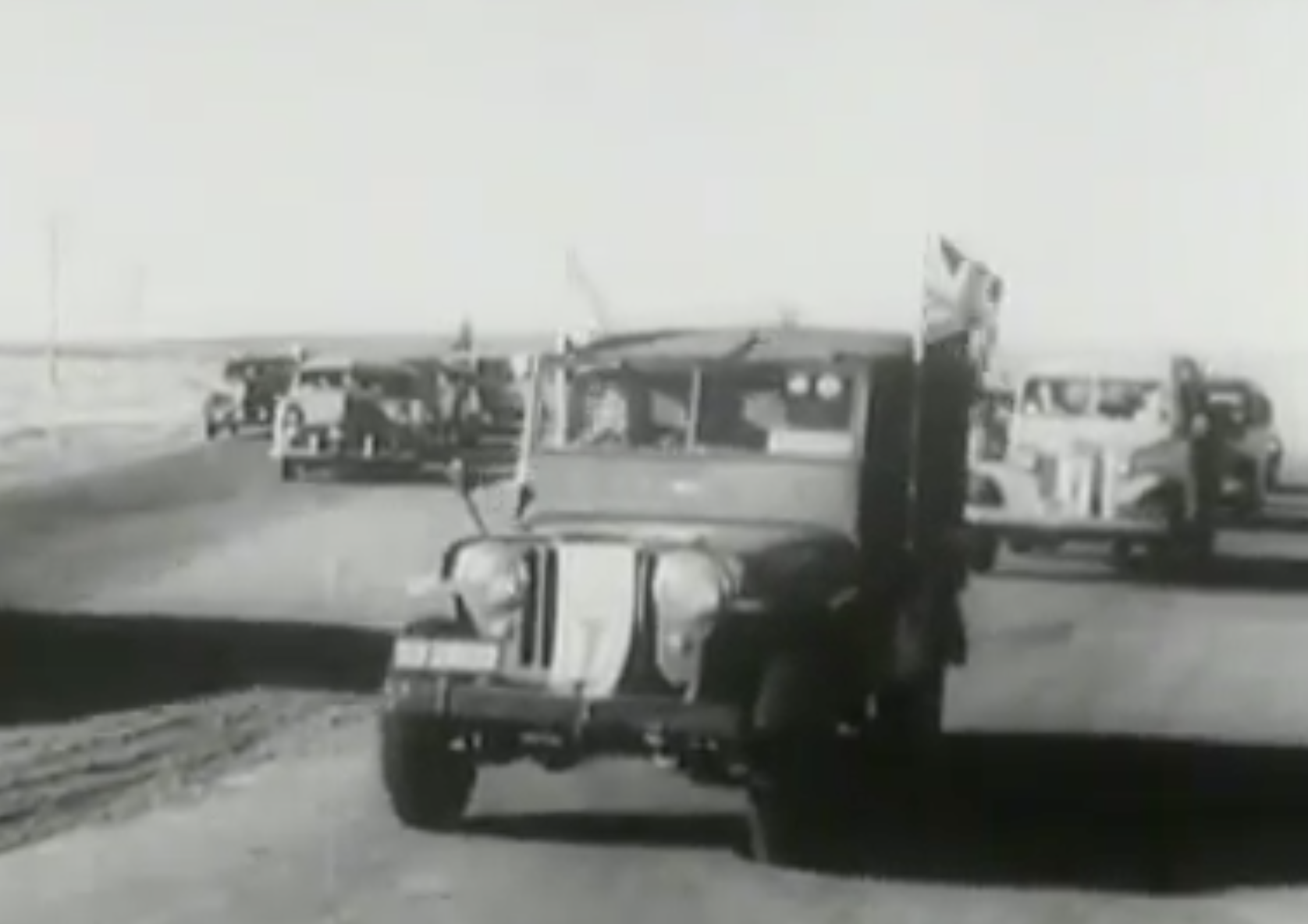
The Steel Commando of the WVAC (Torch Commando) would, as a primary objective also look to recruit, all the Afrikaans war veterans who in their minds may have erroneously voted for the National Party in 1948 and call them back to Smuts’ more moderate politics. To this end, as Colonel Malherbe had done using Republican Boer War veterans, the WVAC would do exactly the same with their version of the Steel Commando and use the old Boer War Veterans. Kommandant Dolf de la Rey, a Boer War veteran whose Commando had been involved in capturing Winston Churchill and national hero was appointed to lead The Steel Commando with Sailor Malan as his 2nd in Command – two Afrikaner war heroes leading the convoy. They would also keep the term Commando when the WVAC formed ‘The Torch Commando’ later as a nod to Afrikaner heritage. Kommandant de la Rey was also affectionally given the term ‘Oom’ by the publicity machine to conjure up respect from the Afrikaner community.  This sentiment can be seen in the newspaper reporting outlined as follows:

Of the Steel Commando trip to Cape Town, wrote one newspaper correspondent: “Cape Town staged a fantastic welcome” for Kmdt de la Rey and Group Captain Malan, he related the enthusiasm of the crowd to the same that liberation armies received in Europe. The Johannesburg Star said: “The Commando formed the most democratic contingent ever to march together in the Union. Civil servants found themselves alongside the colored men who swept the streets they were marching so proudly upon.”

“In the front jeep rode Oom Dolf de la Rey, a white-haired old Boer of seventy-four, who looked so startlingly like the late General Jan Smuts that people looked twice at him and then cheered wildly. Oom (Uncle Dolf) was the man who, as a young burgher on commando fifty years before, had captured Winston Churchill, then a war correspondent with the Imperial forces in South Africa.In the second jeep stood a younger man with tousled brown hair, his hazel eyes cold and angry, the man who had been the most famed fighter pilot in all the RAF — Adolph Gysbert Malan, known all over the world as Sailor. He was the real hero of the hour. The people tried to mob him. Men and women, white as well as brown, crowded round his jeep and stretched out their hands to touch him.”

Video: The Steel Commando on-route to Cape Town – note the use of Boer War Kommando veterans.

The ‘Steel Commando’ convoy gathered media attention and grew in size as it converged on Cape Town on the 28th May, a crowd of 4,000 greeted it as it converged in Somerset West before heading to Cape Town that evening. In Cape Town, the Steel Commando arrived to a packed crowd of protesters on The Grand Parade outside the City Hall of between 55,000 to 65,000 people – consisting of whites and coloureds, supporters and veterans alike (veterans were estimated at 10,000). Many holding burning torches as had now become the trademark of the movement. Spooked by it all the National Party were convinced that a military coup was on and as a precautionary measure placed manned machine gun positions around the rooftop of the nearby Houses of Parliament.
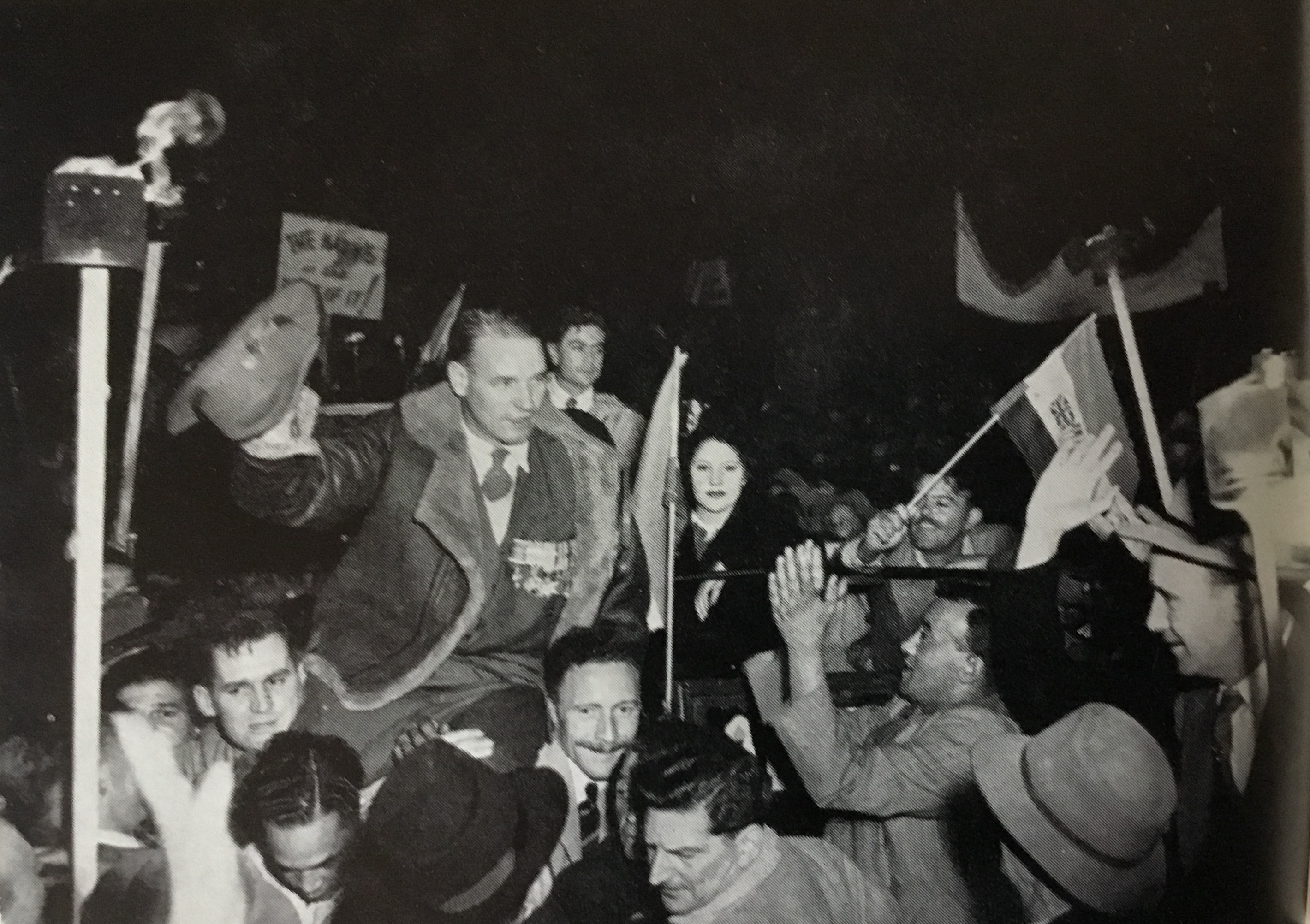
Sailor Malan was literally carried on shoulders by cheering crowds to give his speech. Joined by Dolf de la Rey and even future Afrikaner anti-apartheid activist and fellow war veteran Mattheus Uys Krige as well as the English speaking South African war-time soprano and heroine who led them in song – Perla Gibson. In Sailor Malan’s speech to the crowd famously accused the national party government at this rally of;

 “Depriving us of our freedom, with a fascist arrogance that we have not experienced since Hitler and Mussolini met their fate”.

Images: Kommandant Dolf de la Rey and Group Captain Sailor Malan addressing crowds at the Steel Commando in Cape Town

Buoyed by the success of The Steel Commando, The Torch Commando would officially form and would in the course of time rise to 250,000 plus members – so if one asks – was The Steel Commando as successful as its original concept – the pre-war 1938 Ox-Wagon centennial staged by the Broederbond, and whose idea was drawn on by Colonel Malherbe for the Defence Forces’ Steel Commando’ wartime recruitment drive, the answer is yes, and here’s why;

In Conclusion

The white population voting base in 1951 was estimated about 1,000,000 whites. 250,000 whites had polarised to Ossewabrandwag radically politically right on the back of the 1938 Great Trek ‘Ox Wagon’ Centennial .. and 250,000 whites had gravitated radically politically left on the back of The Torch Commando. Literally driving a dividing line between the white voting base (English and Afrikaans) – half in support of Apartheid and half against Apartheid.

It would also splinter the white Afrikaner voter base and the Broederbond’s attempt at a shared Afrikaner National identity, the majority would be swayed by Christian Nationalism as an ideology and keep the National Party in government on a slim margin, becoming more entrenched as the National Party engaged gerrymandering and jack-boot totalitarian politics going into the future – however a significant portion of white Afrikaners would remain ‘Smuts-men’ and resist Christian Nationalism for many years to come – they simply would not buy into the Broederbond’s initial tenants of bringing ‘Afrikanerdom’ under the singular banner of ‘white’ Afrikaner Nationalism and saw it for what it was – a corruption of Afrikaner history, exclusive, hateful and divisive.

The irony, all this fracturing would be caused by the same vehicle to ‘unify’ the white Afrikaner – a travelling carnival appealing directly to the hearts and minds of far flung rural white Afrikaners, initially conceived by the Broederbond to drive an Apartheid agenda starting in Cape Town and picked up in the end, a tad over a decade later, by the Torch Commando to drive an anti-Apartheid agenda – to the same far flung rural white Afrikaners and in a twist of fate ending up back where it all started – Cape Town.


Written and Researched by Peter Dickens

Bomber Harris’ bugle

Some hidden history – ‘Did you know?’- back of the Chappie gum wrapper facts. Did you know Sir Arthur ‘Bomber’ Harris – the famous Commander of RAF Bomber Command during WW2 was in fact a Rhodesian and he also had a very strong South African connection, here’s an interesting story and it involves a bugle, a bombing and a baronet.

7716973_l

At the commencement of World War 1, a unit called the 1st Rhodesia Regiment was formed in August 1914. In October it consisted of 500 volunteers. In November the Unit went to Bloemfontein and on to Cape Town by train. On Christmas Day 1914 the Regiment landed in Walvis Bay to join the 4th South African Brigade. After that there were marches and skirmishes against the German troops. One young man in this Regiment was the bugler.

After one skirmish, he got fed up and buried his bugle. They had marched and marched in blazing desert sun in German South West Africa (modern day Namibia), from January to June 1915, when the campaign finally ended. He swore he would never march another step into battle. The young man was Arthur Travers (Bomber) Harris and with this act he gave up foot soldiering into battle and took up flying into battle instead.
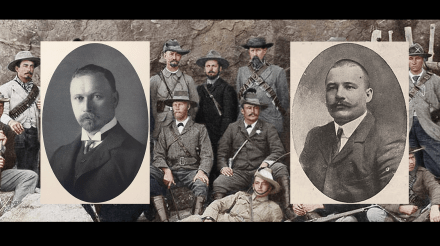
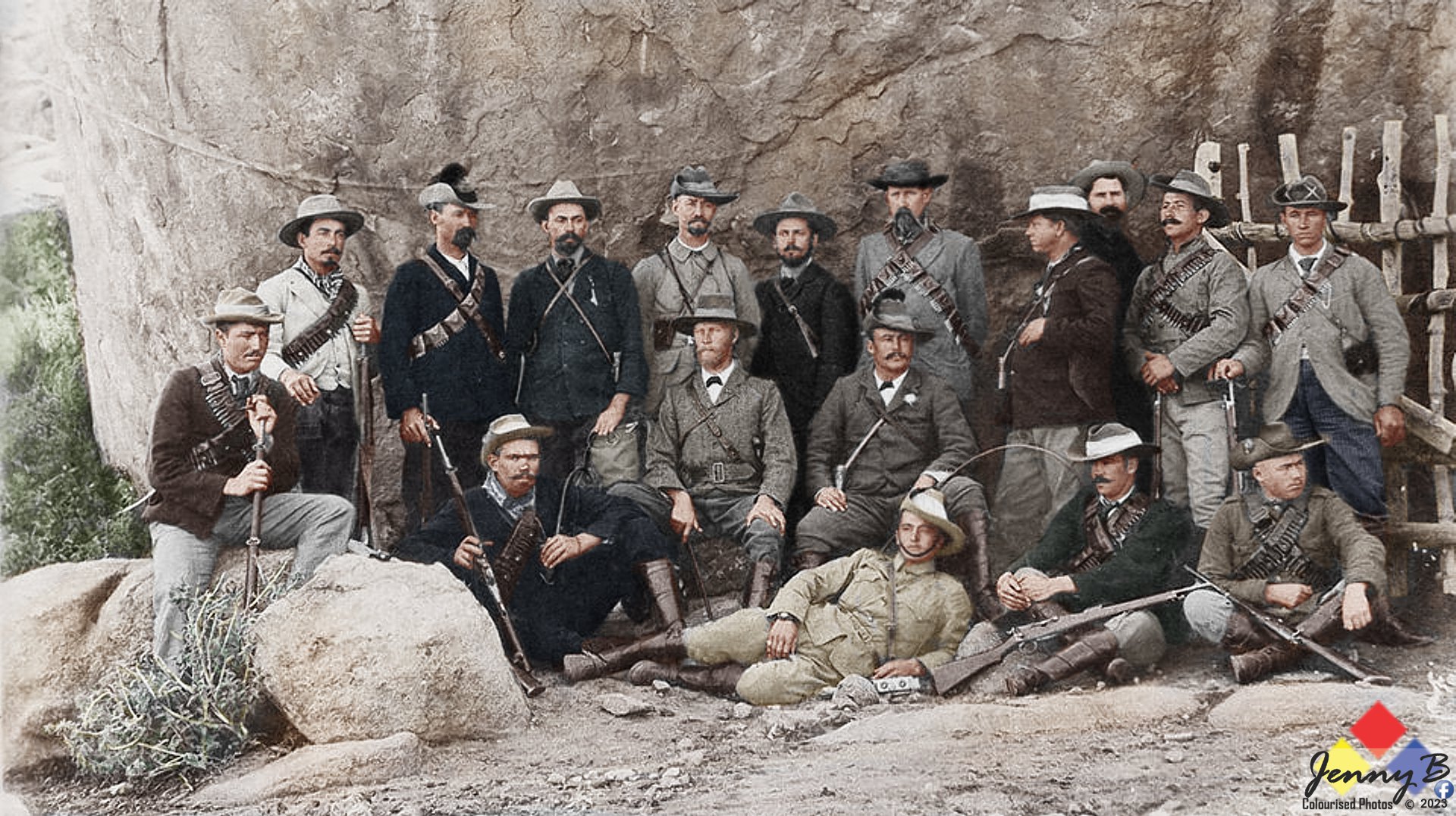
We have all heard about his exploits and management of RAF Bomber Command during World War 2, but few know of his lifelong connection with South Africa. In fact, he was even a founder member and General Manager of SAFMARINE.

First World War

Rhodesia_Regiment_in_Cape_Town_1914
1st Rhodesia Regiment in Cape Town on their way to German South West Africa (Namibia) December 1914

Born in the Gloucestershire, England, Harris emigrated to Southern Rhodesia (modern day Zimbabwe) in 1910 when he was 17. When the First World War broke out in August 1914, Harris did not learn of it for nearly a month, being out in the bush at the time. Despite his previous reluctance to follow the path his father had in mind for him in the army, and his desire to set up his own ranch in Rhodesia, Harris felt patriotically compelled to join the war effort.

He quickly attempted to join the 1st Rhodesia Regiment, which had been raised by the British South Africa Company administration to help put down the Maritz Rebellion in South Africa, but he found that only two places were available; that of a machine-gunner or that of a bugler. Having learnt to bugle at Allhallows School in Devon, he successfully applied for the bugler slot and was sworn in on the 20th October 1914.

The 1st Rhodesia Regiment briefly garrisoned Bloemfontein, then served alongside the South African forces in South-West Africa under South African command during the first half of 1915. The campaign made a strong impression on Harris, particularly the long desert marches—some three decades later, he wrote that “to this day I never walk a step if I can get any sort of vehicle to carry me”. South-West Africa also provided Harris with his first experience of aerial bombing: the sole German aircraft in South-West Africa attempted to drop artillery shells on his unit, but failed to do any damage. How prophetic that his next idea of a “vehicle” to carry him into battle would be an aeroplane.

When the South-West African Campaign ended in July 1915, the 1st Rhodesia Regiment was withdrawn to Cape Town, where it was disbanded; Harris was formally discharged on 31 July.

He felt initially that he had done his part for the Empire, and went back to Rhodesia to resume work at Lowdale, but he and many of his former comrades soon reconsidered when it became clear that the war in Europe was going to last much longer than they had expected. They were reluctant to join the 2nd Rhodesia Regiment, which was being raised to serve in East Africa, perceiving the “bush whacking” of the war’s African theatre as inferior to the “real war” in Europe. Harris sailed for England from Beira at the Company administration’s expense in August, a member of a 300-man party of white Southern Rhodesian war volunteers.

He arrived in October 1915, moved in with his parents in London and, after unsuccessfully attempting to find spaces in first the cavalry, then the Royal Artillery, he finally joined the Royal Flying Corps as a Second Lieutenant in November 1915.

He served with distinction on the home front and in France during 1917 as a Flight Commander and ultimately CO of No. 45 Squadron, before he returned to Britain to command No. 44 Squadron on Home Defence duties, Harris claimed five enemy aircraft destroyed and was awarded the Air Force Cross (AFC) on 2 November 1918.

He finished the 1st World War a Major and remained in the RAF as a career choice. Although born British, he identified himself as a Rhodesian Intending to return to Rhodesia one day, to this sentiment Harris wore a “Rhodesia” shoulder flash on his RAF uniform.

Second World War

Much is written about ‘Bomber’ Harris in the Second World War and a lot of it very controversial. At the outbreak of the Second World War in 1939, Harris took command of No. 5 Group RAF in England, and in February 1942 was appointed head of Bomber Command. He retained that position for the rest of the war.

In 1942, a seminal paper was put to the British Cabinet advocating the idea of area bombing of German cities in a strategic bombing campaign. It was accepted by Cabinet and Harris was directed to carry out the task. It became an important part of the ‘Total War’ strategy waged against Nazi Germany.

At the start of the bombing campaign, ‘Bomber’ Harris famously justified the idea of area bombing by quoting the Old Testament:

“The Nazis entered this war under the rather childish delusion that they were going to bomb everyone else, and nobody was going to bomb them. At Rotterdam, London, Warsaw and half a hundred other places, they put their rather naive theory into operation. They sowed the wind, and now they are going to reap the whirlwind.”

Images: Colourised images by DB Colour and RJM of Bomber Command Lancaster and crew.

Winston Churchill regarded the idea of area bombing strategy with distaste, official public statements maintained that Bomber Command was attacking only specific industrial targets, any civilian casualties were unavoidable and were unintentional. By 1943, Harris urged the government to be honest with the public regarding the purpose of area bombing and said:

“The aim of the Combined Bomber Offensive … should be unambiguously stated [as] the destruction of German cities, the killing of German workers, and the disruption of civilised life throughout Germany … the destruction of houses, public utilities, transport and lives, the creation of a refugee problem on an unprecedented scale, and the breakdown of morale both at home and at the battle fronts by fear of extended and intensified bombing, are accepted and intended aims of our bombing policy. They are not by-products of attempts to hit factories.”

Harris pressed for raids on a much larger scale and launched the first RAF “thousand bomber raid” against Cologne in May 1942, his successes using this method of aerial warfare saw him promoted to Air Marshal and even acting Air Chief Marshal by March 1943. 

The Butcher’s Bill

Leading up to and after D-Day, 6 June 1944, the bombing campaign continued to attract controversy, but the most controversial was the bombing of Dresden on the night of 13 February 1945. More than 1,200 heavy bombers dropped nearly 4,000 tons of high-explosive and incendiary bombs on the city in four successive raids. An estimated 25,000 people were killed in the bombings and the firestorm that raged afterward. More than 75,000 dwellings were destroyed, along with unique monuments of Baroque architecture in the historic city centre. The scale of the death and destruction, coming so late in the war, along with significant questions about the legitimacy of the targets destroyed have led to years of debate about whether the attack was justified.

Image: Colourised Royston Colour image of Dresden post bombing.

This issue on whether Dresden qualified a military target or not and in fact may have been an unnecessary bombing continues to this day, with evidence even pointing to targeting the ‘old city’ for a firestorm rather than the industrial sector as was the officially stated objective. In either event, what is known is that area bombing by nature was very inaccurate and indiscriminate and the death toll extreme, and the RAF and Bomber Command would admit that the entire area bombing campaign including Dresden was ‘somewhat overdone,’ but this sentiment was wrapped in secrecy for many years after the war.

To see this Butcher’s bill in total, consider these estimates. Civilian deaths in Germany from Allied bombing was more recently estimated at 380,000. Bomber Command dropped 53 per cent of all the ordnance sent to Germany. Firestorms caused by Bomber Command’s incendiaries killed over 34,000 civilians in Hamburg in July 1943, 5,600 in Kassel in October 1943, at least 7,500 in Darmstadt in September 1944, 25,000 in Dresden and 17,600 in Pforzheim in February 1945 and 4,000-5,000 in Würzburg in March 1945: nearly 100,000 dead for the half-dozen deadliest raids.

The attitudes to this style bombing of Nazi Germany populace at the time were becoming very ‘hard’, an attitude exhibited by nearly all the Allied combatants involved in it, as the war had rung out an alarming butchers bill on civilians in all the countries of Western and Eastern Europe. Notwithstanding the Nazi Blitz campaign of British cities at the start of the war and Nazi ‘wonder weapons’ indiscriminately bombing London’s civilians towards the end of the war. This hard attitude was best surmised by a British Bomber Command air-crewman when he said this during a World at War interview:

“If you couldn’t get the Kraut in his factory, it was just as easy to knock him off in his bed, and (if) Granny Schicklgruber in the seat next door got the chop that’s hard luck!” (The sarcastic reference to Schicklgruber was Maria Schicklgruber, Adolph Hitler’s paternal Grandmother).

Image: Avro Lancaster Bomber ‘B’ MkI ‘Victorious Virgin’ crew showing the attitude of the day, this 4000 pound ‘cookie’ bomb was dropped on an Oil Refinery in Hemmingstedt in March 1945, near Heide in Germany. Colourised by Tom Thounaojam.

The culmination of Bomber Command’s offensive occurred in March 1945 when the RAF dropped the highest monthly weight of ordnance in the entire war, mainly on Berlin to support the Russian offensive to take the city. In all Harris was asked if strategic area bombing would work in winning the war at the beginning of the campaign and his reaction was “we shall see”. In hindsight, the campaign went a very long to way to ultimately break resolve and bring Germany to its knees economically, but it happened at a tremendous cost in human lives, not only civilian, lets examine the butcher’s bill on Bomber Command:

Of every 100 airmen who joined Bomber Command, 45 were killed, 6 were seriously wounded, 8 became Prisoners of War, and only 41 escaped unscathed (at least physically). Of the 120,000 who served, 55,573 were killed. Of those who were flying at the beginning of the war, only ten percent survived. It is a loss rate comparable only to the worst slaughter of the First World War trenches. Only the Nazi U-Boat force suffered a higher casualty rate. On a single night, Bomber Command suffered more losses than did Fighter Command during the entire Battle of Britain.

One must also caution here, whilst the figures on both sides of the Butcher’s Bill are high for British and American combined Bomber Command Ops, Germany by no means comes through smelling of roses – their campaigns and targeting of civilians is staggering – in all about 90,500 British civilians were killed and that’s nothing compared to the estimated civilian deaths in Yugoslavia of 1.2 million, Poland 5.7 million and USSR 7.0 million. To say that attitudes had hardened when it came to the combatants would be an understatement.

In Conclusion

It would be unfair with a modern day sense of sensibility to look at Bomber Harris and the men of Bomber Command as a war criminals, one has to look them him in the context of their time and the great struggle surrounding them, especially the extreme choices taken to bring about an end to a war of this nature.

However, in his ‘Butcher’s Bill,’ one cannot help but note there is a ‘World War 1’ mind in Bomber Harris, but it’s not an uncommon one for a Commander in his time, Field Marshal Bernard Law Montgomery can also be accused of the same. It is one whereby ‘attrition’ is used to gradually overwhelm using overwhelming odds, it rings true to the WW1 Battle of Verdun, a meat grinding approach to who runs out of resources, especially human resources first. It eventually wins wars, no doubt, but at a tremendous cost in human lives.

After the war Harris moved to South Africa where he founded and managed SAFMARINE, short for the South African Marine Corporation. Safmarine, is a South African business success story involved in international container shipping and break-bulk shipping services worldwide. It is now owned by its parent company, the Maersk Line.

In 1953 he returned to the United Kingdom to accept a Baronetcy, which strangely, Winston Churchill insisted he receive, and here he lived out the rest of his long life in Goring-on-Thames passing away at 91 years old in 1984. He even managed to see the creation of his much loved Rhodesia into Zimbabwe as a nation state.

In all, it’s a fact that Southern Africa in its harshest form would fashion the man into what Arthur Harris was to become, it’s also clear that the German South West African Campaign in World War 1 would fashion a steel willed and uncompromising attitude of endurance and perseverance in a world of hardships, and one in which he would look to aviation instead of marching into battle to ultimately win wars. With all the modern day accusations of Harris been a ‘war criminal’ for his actions against civilians I wonder sometimes if someone may eventually dig up his buried bugle in Namibia and what that would come to symbolise.

Images: Sir Arthur Harris GCB, OBE, AFC and the Green Park Bomber Command Memorial

To the opening statement, I hear some colleagues say “everyone knows he was a Rhodesian”, well nope- the reason I say his South African and Rhodesian (Zimbabwean) heritage and history is relatively unknown, and for that matter this includes a great many other Rhodesians and South Africans (including two Victoria Cross recipients – Wing Commander John Nettleton VC and Captain Edwin Swales VC) who were sacrificed whilst taking part in Bomber Command operations, is that when the Bomber Command War Memorial was finally unveiled in Green Park in London in 2012, not one South African or Rhodesian military veteran association member and not one dignitary from South Africa or Zimbabwe took part in it. From the Commonwealth, Canadians, Australians, New Zealanders, even West Indians – all got a nod, I watched the entire unveiling ceremony on BBC and not even a mention of a South African, not even the Victoria Crosses and numerous other decorations for valour won by them whist in Bomber Command.

Some may even say, given all the controversy, better not to have been there anyway. But that would be to dishonour a generation that sacrificed so much, physically and mentally, for our modern freedoms. Especially our countrymen in Bomber Command who found themselves in this most extraordinary and very tragic period of our wartime history, these are men who had to face hard and very fateful decisions, the world at times has forgotten our WW2 contributions, lest we forget them too.


Researched by Peter Dickens.  

Large content and additional research with much thanks to Buskruit Burger.

Large extracts from wikipedia and Bomber Command Museum on line. Statistics referenced from Andrew Knapp: The Horror and the Glory: Bomber Command in British Memories since 1945 and the Encyclopaedia Brittanica.

Education Whiteout! The Broederbond

So often, when posting anything on Jan Smuts we get a tirade of slander, often masked as some sort of ‘truth’, certainly to the belligerent group who find themselves in a vortex of anger whenever Smuts is mentioned, or for that matter the same belligerence occurs whenever there is a move to strike at the old National Party and call them out for what they where .. Nazis.

So where does this all stem from? I’ve interviewed people who recall the onset of all this Afrikaner Nationalist inspired history in the past decades under Apartheid. The general opinion .. whose making this stuff up? .. what the heck! Ideas like an empty hinterland rich for the Boer nations taking a legitimate claim to it, migrating black tribes from the north meeting a white tribe migrating from the south in the middle having never met before, small clans of brave Voortrekkers beating back entire armies of treasonous blacks with a holy bible and powder shot, a British inspired Nazi styled extermination camp system in South Africa, an evil traitorous Jan Smuts arranging the British firing squad for Jopie Fourie – where did all this rubbish come from?

In case someone thinks I’m being insensitive at this stage, I’m not, I’m not saying the concentration camp system as was outlined in the South African War 1899 to 1902 did not exist, nor am I saying that it was not painful and tragic – it did exist and its a very painful past, what I am saying is that the education that lies behind it has been shrouded in a very false and flawed package of Nationalist thinking. Here’s why – here’s ‘the smoking gun’:

The Broederbond

The 1st executive council of the Afrikaner Broederbond in 1918.

The culprit for all of this is the Broederbond. There I said it, and I’m not trying to be some conspiracy theory nut job pointing towards a secret society for the world’s problems. No, this is a truth, based on a fact and a real life secret organisation with sinister goals. Here’s how the Broederbond ‘pulled the wool’ over everyones eyes in South Africa and manipulated the entire South African education system to their vicarious objectives, and in the long run successfully implemented ‘National Christian Education’ as the go-to framework for millions of South Africans, of all colours, then and to come in the future.

During Jan Smuts’ time as Prime Minister and the United Party in the pound seats, Smuts proposed the ‘dual medium’ education system – simple really in its idea, he wanted to bring Afrikaans speaking and English speaking coming together, sharing a common humanity and understanding each others cultures. The idea would be that certain subjects for English kids would be taught and written in Afrikaans and certain subjects for Afrikaans kids would be taught in English and examined in English. The classes and education would remain ‘separate’ but the playground would be a common area. The idea was that a natural cultural assimilation would eventually take root. The idea found favour in the thousands of Afrikaner and English service personnel during the war years with a 80% plus approval rating. At that stage in South Africa even in the old British ‘Regiments’ of the Union Defence Force it was becoming ‘good form’ for officers to be commanding and conversing in Afrikaans. Things were generally on the ‘up’.

Then, all of a sudden, the South African Military Intelligence Services started to pick up chatter, kids were returning home from school with concocted slander on Jan Smuts and the ruling party, false senses of national identity and incorrect historical interpretations, sheer hatred of all things British and extreme pro views on Nazism and the nobility of the German war effort, added to this were worrying views on Jewish capital and the Jewish exploitation in South Africa of ‘poor white Afrikaners’. It started up almost everywhere at once and it was ‘taught to them’.

Military intelligence swung into action in an attempt to find the root of all of this, this potentially posed a danger to South Africa’s war efforts. Early in the morning on the 13th December 1943 a small group of military intelligence officers infiltrated the Afrikaner Teachers Training College in Bloemfontein. They placed microphones and eavesdropped on an Afrikaner educationalists congress taking place in Bloemfontein – intelligence revealed it was a front for a Broederbond meeting intent on mapping South Africa’s future in the world of education. They traced vehicle registrations of many in attendance to known Broederbond members and highlighted Albert Hertzog, Nico Diederichs, Hendrick Verwoerd and Henning Klopper as the ringleaders (a line up of some significant heavy-weight National Party leaders).

Field Marshal Jan Smuts

What they took down whilst surveilling the meeting was nothing short of mind blowing, there was an intensive focus by the Broederbond on the country’s educators to dispel with Smuts’ policy and build both educators and the education system along Nationalist lines, to hit Smuts’ policy at the very basic and very weakest link – the children .. anti-Smuts and nationalist ideals would begin at a early developmental stage, such that the ‘education’ in National Christian dogma was ingrained by adulthood, an undeniable ‘fact’ would be fostered – people would simply know no better.

The investigation, led by the head of intelligence Colonel E.G. Malherbe, opened up more evidence over the years, a massive reservoir of intelligence, papers, transcripts, photographs began to grow – showing especially the Broederbond’s grip on the education systems and the reformed dutch churches. Netted in all this intelligence was also all the secret discussions, transcripts and alliances with Nazi Germany and the use of Nazi dogma in National Christian ideology.

Colonel Ernst G. Malherbe

They intercepted Broederbond correspondence calling for the infiltration on the Union Defence Force with aligned brothers from the Dutch Reformed Church to bolster the number of chaplains and start to undermine the war effort at the vulnerable point of dealing with soldiers religious frameworks

It was all presented to General Smuts by Colonel Malherbe with the recommendation to stamp out the Broederbond with immediate effect, cut it away before it really took root. Smuts , as was his nature, took a cautionary route when dealing with this Afrikaner faction. Malherbe asked Smuts to ‘name and shame’ publicly all the members of the Broederbond, warn the public on the influenced education their kids were receiving – issue a public notice in the press. Smuts decided instead to try and round up the ring-leaders and ring-fence them in Koffiefontein, he did not want all the reputable Dominees of the Afrikaans churches named and shamed as well as honourable men in the education and school board systems unduly battered in the media. He felt, much to Maherbe’s disillusionment with him, that a negotiated and moral influence on the matter would be best. He would however ‘ban’ any Brother working in a government job if he did not resign from the Broederbond – many did, and a handful stood firm. He had after all, what Malherbe would later say was “a soft spot for the church”.

The Broederbond in an unprecedented first came out in public and immediately started with the smoke and mirrors, the then Chair of the Bond Professor J.C. van Rooy declared in selected media that Smuts’ attack on the Broederbond as an unjust, unsubstantiated, unGodly attack on honest people in a simple ‘cultural society’ – nothing more. We now all know the aims of this ‘cultural society’ and it was State Capture .. on an epic level, it made the ANC’s attempt in recent years look like a child’s play .. why, the Nats got away with it, the ANC is yet to.

Broederbond Chairman – Prof J.C van Rooy

And if you think this program of Nationalist influence on our education small, think again. From the on-set of the historical discourse of the Afrikaner in Africa is a bias – at the very root of the Nationalist mythology, the simple fact that on the curriculum was the ‘discovery’ of a largely empty land and settlement of the Cape by the Dutch, a kind of ‘first rights’ to the country with Jan van Riebeeck nobly leading it. It begins with the famous painting of a benevolent bunch of Dutch settles carrying a Dutch Prinsenvlag (Prince Flag) coming in peace and trade – with a stoic religion and a civilising mind. Now, the fact is the British colonised the Cape BEFORE the Dutch, in fact 30 odd years before – huh! You Lie! Comes the chorus. So here’s some rather inconvenient truth.

The first flag to fly over the Cape was NOT the Prinsenvlag, the first flag was King James the 1st of England and Scotland – the Union Jack (known then as the British Flag without the Ireland inclusion). The flag was planted on Signal Hill in 1620 – long before the Dutch did it in 1652. That’s how insanely biased the National party narrative has become. If you think I’m telling ‘Porkies’, look it up for yourself, 27 March 1620 – The Unitie one of three British ships arrives in Table Bay from England, a small settlement had already existed there to furnish passing Spanish, British, Portuguese and Dutch traders. Two of the Commanders of these ships, Captain Humphrey Fitzherbert and Captain Andrew Shilling hoist the Union Jack on the slopes of Signal Hill calling it King James Mount and take possession of the entire countryside in the name of the British Monarch. Here they planned a plantation similar to that established by the Virginia Company at Jamestown. The settlement would have provided a revitalising stop on the way to the East but nothing came of the plan .. so what happens next? As historians we don’t really know, there is a conflicting account, we do however know it’s been ‘written out’ of the narrative – I can assure you there are now some serious historians ‘on the case’ now.

But the long and short is that the Cape was obviously left to the Dutch to also settle on the 6th April 1652, and even that is nothing but a footnote, it was neither the Dutch or the British that settled the Cape, it was the Khoi and San and as inconvenience goes there is proof of their farming and permanent settlements here which date back 2000 years … to the time of Christ – the Colonial period is but a ‘blip’ in the original peoples account of things. Bottom line, our understanding of our conjoint history of South Africa – white, black, Afrikaans, Coloured, Indian etc etc was off to a very bad start – the absolute beginning chapter 1 is so flawed you can drive a truck through it – the funny bit, this nationalist folklore made it onto our banknotes, into monuments, into textbooks and net net into our shared psyche as South Africans .. and its all not worth the paper its written on.

Left to their devises with their hatreds, bias and convoluted history, the Broerderbond carried on with influencing key institutions moving ‘brothers’ into key positions and pivots and pockets of power. Their activities given a massive boost in 1948 when the Nationalists unexpectedly won a General Election. Snapping up the opportunity to cover all their tracks, and distance the new government and many of its elected officials from their nazi ideologies and alignments during the war – they sprung into immediate action.

In July 1948, mere months after the National Party won the election, Colonel Malherbe’s successor Colonel Charles Powell (Colonel Malherbe was by the time the Vice Chancellor of the University of Natal), was sitting in the National Intelligence archive and in came none other than the National Party’s new head of Defence – F.C. Erasmus – who promptly dismissed Colonel Powell on the spot with a 24 hours notice. He then proceeded to remove “two lorries” worth of Broederbond documentation from the archive – never to be seen again. Formal complaints to the new Minister of Justice to reinstate the military intelligence archive were just ignored. Luckily and I mean luckily for us much of this was recorded in Malherbe’s book ‘Education in South Africa’.

Later, to the continued amazement of all, whenever there was a press conference and B.J Vorster taken to task on any of his Nazi or Broederbond past he would often smugly turn around to any young whippersnapper trying to set a record straight and simply say “prove it”.

Conclusion

Nothing like the art of deniability and the art of deception, the tragedy now is a ever growing and ever more deceived Afrikaner sub-culture, forever set to grind an imaginary sword against an imaginary injustice, and to forever come out and yell ‘veraaier’ and ‘Kings puppet’ at arguably the best of the Afrikaner nation – from Jan Smuts to Sailor Malan. Tragic, because its in these men, Smuts et al that the salvation of modern white Afrikaners lie, in the pro-democratic forward thinking Afrikaner ‘liberals’, the ones that fought Apartheid with every bone in their bodies – not their detractors, this little band of radical right wing nationalists and their ‘point of view’ on history needs to be left in the dust – or there is no moving on and all that white Afrikaners hold dear to their culture, language and heritage will ultimately be decimated in the march of time and the symbolism of Apartheid becomes intrinsically transfixed to Afrikaaners and Afrikanerdom as a whole.

Written and researched by Peter Dickens

—————————————–

References

Malherbe, Earnest G ‘Education in South Africa’ 1977 and ‘The Bilingual School’ 1945. The ‘White tribe of Africa’ David Harrison 1987. Day to Day history of the South African Navy – Chris Bennett.

South Africans destroy 101 Enemy Aircraft in East Africa

This is an interesting photograph of South African Airforce personnel celebrating a significant milestone.

The photo was taken during the East Africa campaign in 1941. Pilots and ground crew of No 3 Squadron, South African Air Force, chalk up their 101st enemy aircraft destroyed on the fuselage of a captured Italian CR 42 fighter.

p3

It must however be noted that this milestone was not 101 aircraft destroyed in air combat, and would be inclusive of aircraft destroyed whilst on the ground.  Nonetheless it provided for good propaganda and moral.  “Tiny” South Africa and a bunch of very brave airmen, in conjunction with The Royal Air Force and other Commonwealth Air Forces, decimated a European ‘superpower’s’ Air Force.

The East African Campaign – also known as the Abyssinian Campaign, started on 13 June 1940, with an Italian air raid on the base of 1 Squadron Southern Rhodesian Air Force (237 (Rhodesia) Squadron RAF) at Wajir in Kenya.

The campaign  continued until Italian forces had been pushed back from Kenya and Sudan, through Somaliland, Eritrea and Ethiopia in 1940 and early-1941.

The SAAF No.3 Squadron campaign began on 14 January 1941 the squadron was equipped with the Hawker Hurricane. It was used to support the invasion of Italian Somaliland, then after the fall of Mogadishu (25 February) took part in the advance into Ethiopa, moving to Jigigga on 24 March.In late October 1941.

6343f1123f89bedbd7e7d9c0a9936a3e

SAAF No.3 Squadron gained a second flight. This formation had originally been formed as No.41 Squadron Fighter Detachment, and was equipped with the Curtis Mohawk. This detachment was moved from Nairobi to the border town of Aiscia, where on 5 October 1941 it achieved the only Mohawk victory in Africa, shooting down a supply plane attempting to reach the isolated Italian garrison of Djibouti. Only after this did the detachment become ‘B’ Flight, No.3 Squadron.

216_1

At the end of 1941 the squadron returned to South Africa before been redeployed to North Africa.


Feature image copyright IWM Collection. Reference, Wikipedia and the historyofwar.org.

War in Eritrea heats up with the SAAF in the front!

The Allied invasion of Eritrea began on 17 January 1941. No.1 Squadron (SAAF) was used to escort RAF Wellesley bombers, and became one of the first Allied units to move into Eritrea, moving to Tessebei airfield during January.

No. 1 Squadron SAAF The squadron took part in the fighting around the key Italian fortress at Keren, which fell on 27 March, and then in the advance on Asmara, which surrendered on 1 April.

Within days of the surrender of Asmara the squadron moved from the “East African” theatre of conflict to the “North African” theatre in Egypt, arriving just in time to take part in Operation Brevity (15 May 1941), the first attempt to lift the siege of Tobruk.

Typical of the East African campaign during World War 2 was the unrelenting heat.  Clearly seen in the featured image is a South African Air Force pilot of No. 1 Squadron SAAF is doing a pre-flight check as he prepares for a sortie in his SAAF Hawker Hurricane Mark I. The picture was taken at a forward landing ground close to the front line in Eritrea, circa 1941.

Note the crew shelter in the foreground, taking some prime shade on offer under the stark thorn tree, it is situated there so the crew can stay out of the relenting heat and its complete with all the comforts and “mod cons” you would expect on a front line – furniture made from petrol cans and duckboards.

Image copyright: Imperial War Museum

Proper South African Gladiators

Wonderful colourised image by Tinus Le Roux of South African Air Force pilots during the East Africa campaign in WW2.

Here are No. 2 Squadron pilots in East Africa 1940-’41 (Gladiator aircraft in the background). From left to right: Lt. Pieter Fritz, Lt. Adrian “Coley” Colenbrander, Lt. Basil Guest. Only Lt. Guest will survive the war.

Lt. Colenbrander was a popular member of the squadron and was shot down and killed in 1942 just after the El Alamein break-through as 2 squadron’s Officer Commanding.

The Gloster Gladiator’s combat record  in East Africa

In Eastern Africa, it was determined that Italian forces based on Ethiopia posed a threat to the British Aden Protectorate, thus it was decided that an offensive would be necessary, under which the Gladiator would face off against the Italian biplane fighters: Fiat CR.32s and CR.42s. On 6 November 1940, in the first hour of the British offensive against Ethiopia, the Fiat CR.42 fighters of the 412a Squadriglia led by Capt. Antonio Raffi shot down five Gloster Gladiators of 1 SAAF Sqn; among the Italian pilots was the ace Mario Visintini. Tactically, the SAAF aircraft erred by engaging the CR.42’s in a piecemeal fashion and not en masse, and were anyway heavily outnumbered.

Early on in the action, Gladiators of No. 94 Squadron performed various offensive actions against the Italian forces; typical targets included airfields, supply depots, and aircraft. They were also assigned the mission of defending Aden airspace at day and night, as well as to protect Allied shipping operating in the vicinity. It was in the latter role that saw a single No. 94 Gladiator, piloted by Gordon Haywood, be responsible for the surrender and capture of the Italian Archimede-class submarine Galilei Galileo

On 6 June 1941, the Regia Aeronautica had only two serviceable aircraft remaining: a CR.32 and a CR.42, therefore air superiority was finally achieved by Gladiators and the Hurricanes. The Gladiator’s last air combat with an Italian fighter was on 24 October 1941, with the CR.42 of Tenente Malavolti (or, according to historian Håkan Gustavsson, sottotenente Malavolta). The Italian pilot took off to strafe British airfields at Dabat and Adi Arcai. According to the Italian historian Nico Sgarlato, the CR.42 was intercepted by three Gladiators and managed to shoot down two of them, but was then itself shot down and the pilot killed.  Other authors state that Malavolti managed to fire only on the two Gladiators before being shot down.

According to Gustavsson, SAAF pilot (no. 47484V) Lieutenant Lancelot Charles Henry “Paddy” Hope, at Dabat airfield, scrambled to intercept the CR.42 (MM7117). Diving on it, he opened fire at 300 yards. Although the CR.42 pilot took violent evasive action, Hope pursued, closing to 20 yards and firing as it tried to dive away. There was a brief flicker of flame and the last Italian aircraft to be shot down over East Africa spun into the ground and burst into flames near Ambazzo. The next day the wreckage was found, the dead pilot still in the cockpit. Hope dropped a message on Italian positions at Ambazzo:

“Tribute to the pilot of the Fiat. He was a brave man. South African Air Force.”

But operational record books of the Commonwealth units in the area state that they did not suffer any losses on this date. The dedication of the posthumous Medaglia d’oro al valor militare states that Malavolti shot down a Gladiator and forced another to crash land, but was himself shot down by a third Gladiator. This was the last air-to-air victory in the East African campaign.

Original black and white Photograph from the SAAF museum Colourised photo copyright and courtesy of Tinus Le Roux, and my thanks to Tinus for the caption reference.  Reference – wikipedia