“War is 99% boredom and 1% sheer terror”

There is an old saying: “War is 99% boredom and 1% sheer terror” and here we see exactly that – aircrews sitting around waiting for instructions, once up in the air, literally in an hour or two they will be in full combat with all the stressors involved in it for only a quarter of an hour or so.

Here aircrews of No. 16 Squadron South African Air Force  and No. 227 Squadron Royal Air Force sitting in a dispersal at Biferno, Italy, prior to taking off to attack a German headquarters building in Dubrovnik, Yugoslavia. A Bristol Beaufighter Mark X, armed with rocket projectiles stands behind them. 14 August 1944.

The Bristol Beaufighter (often referred to simply as the “Beau”) is a multi-role aircraft developed during the Second World War by Bristol Aeroplane Company in the UK. It was originally conceived as a heavy fighter variant of the Bristol Beaufort bomber. The Beaufighter was a versatile aircraft used in service initially as a night fighter, and later mainly in the maritime strike and ground attack roles; it also replaced the earlier Beaufort as a torpedo bomber.  This tough and versatile fighter bomber served in almost all the major Allied forces of the war: Britain, The United States, Canada, Australia, New Zealand and South Africa.

Image and caption copyright Imperial War Museum Collection, additional references Wikipedia.

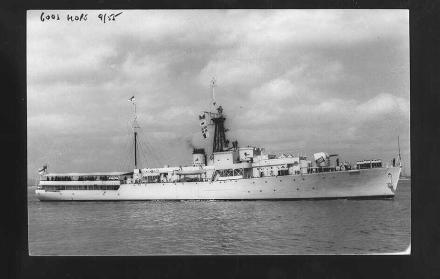
South Africa’s first Navy Frigate – HMSAS Good Hope

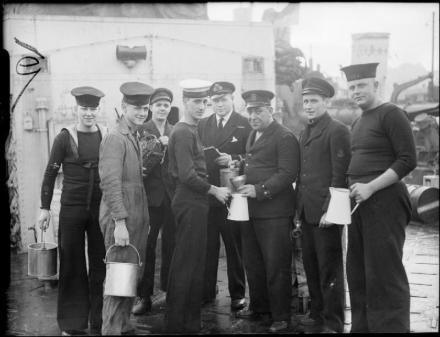
South Africa’s first Frigate, 6 January 1945, picture taken on the Clyde. Officers and men of the Frigate HMSAS Good Hope, the first of three presented to the South African government by the British government. The Coxswain, Chief Petty Officer A W Lincoln, from Robinson Deep, Johannesburg, serving out the rum.

Photo15frLochGoodHope1PS

Feature image and caption copyright: Imperial War Museum collection.

Smuts’ keen sense of smell detects Germans hiding nearby

An interesting snippet of history happened during this visit by Smuts and Churchill to Monty’s headquarters. While visiting the headquarters and as senior officers stood outside with the Prime Minister (Churchill), Field Marshal Smuts sniffed the air and said, “There are some Germans near us now…I can always tell!”

And low and behold, just two days later, “two fully armed German paratroopers emerged from a nearby Rhododendron bush, where they had been hiding all along (they had become isolated from their unit, seeing that they were unable to rejoin they chose to surrender). Had they used their guns and grenades on Churchill (and Monty as well as Smuts), everything would have changed.

There you have it, Smuts’ keen sense of smell and intuition is another attribute you can add to the very very long list of honours attributed to this great South African.

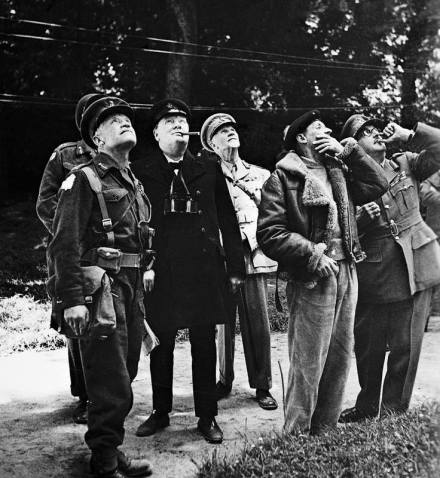
The feature image shows Winston Churchill and Field Marshal Jan Smuts accompanied one another just after the D Day landings to General Sir Bernard Montgomery’s headquarters, 12 June 1944.

Left to right: Lieutenant-General Sir Richard O’Connor, commanding VIII Corps; Churchill; Field Marshal Jan Smuts; Montgomery; Field Marshal Sir Alan Brooke, Chief of the Imperial General Staff. Here these Allied commanders are seen looking up at aircraft activity overhead.

Reference: Nicholas Rankin “Churchill’s Wizards”. Image copyright – The Imperial War Museum.

Able Seaman “Just Nuisance”

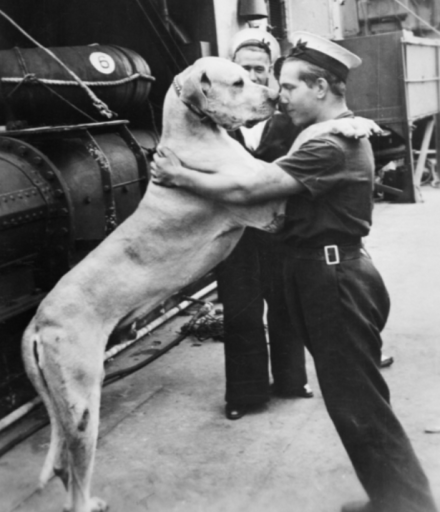
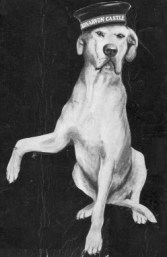
In 1939 the British Royal Navy did the unthinkable… Strange but true, they enlisted a South African dog who then went on to win the hearts and minds of sailors on two continents and become a legend.

Able Seaman ‘Just Nuisance’ is one very famous South African, and as he was an enlisted rating he received rank, pay, rations and duties – the same privileges as any other rating with the rank of ‘Able Seaman’ (AB).  This is how he got there.

He was a Great Dane who between 1939 and 1944 served at HMS Afrikander, a Royal Navy shore establishment in Simon’s Town, South Africa. He died in 1944 at the age of seven years and was buried with full military honours.

4378021_f248

Although the exact date of Just Nuisance’s birth is not known, it is usually stated that he was born on 1 April 1937 in Rondebosch, a suburb of Cape Town. He was sold to Benjamin Chaney, who later moved to Simon’s Town to run the United Services Institute (USI). Just Nuisance quickly became popular with the patrons of the institute and in particular the ratings, who would feed him snacks and take him for walks. He began to follow them back to the naval base and dockyards, where he would lie on the decks of ships that were moored at the wharf. His preferred resting place was the top of the gangplank. Since he was a large dog even for a Great Dane (he was almost 2 metres (6.6 ft) tall when standing on his hind legs), he presented a sizeable obstacle for those trying to board or disembark and he became affectionately known as Nuisance.

Nuisance was allowed to roam freely and, following the sailors, he began to take day trips by train as far afield as Cape Town, 22 miles (35 km) away. Despite the seamen’s attempts to conceal him, the conductors would put him off the trains as soon as he was discovered. This did not cause the dog any difficulty, as he would wait for the next train, or walk to another station, where he would board the next train that came along. Amused travellers would occasionally offer to pay his fare but officials of the State-owned railway company (South African Railways and Harbours) eventually warned Chaney that Nuisance would have to be put down unless he was prevented from boarding the trains or had his fares paid.

The news that Nuisance was in danger of being put down spurred many of the sailors and locals to write to the Navy, pleading for something to be done. Although somebody offered to buy him a season ticket, naval command instead decided to enlist him by the book. As a member of the armed forces, he would be entitled to free rail travel, so the fare-dodging would no longer be a problem. It proved to be an excellent idea. For the next few years he would be a morale booster for the troops serving in World War II.

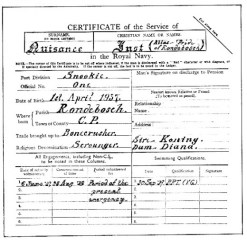
He was enlisted on 25 August 1939. His surname was entered as “Nuisance” and, rather than leaving the forename blank, he was given the moniker “Just”. His trade was listed as “Bonecrusher” and his religious affiliation as “Scrounger”, although this was later altered to the more charitable “Canine Divinity League (Anti-Vivisection)”. To allow him to receive rations and because of his longstanding unofficial service, he was promoted from Ordinary Seaman to Able Seaman.

Just Nuisance - Certificate of Service_02

He never went to sea but fulfilled a number of roles ashore. He continued to accompany sailors on train journeys and escorted them back to base when the pubs closed. While many of his functions were of his own choosing, he also appeared at many promotional events, including his own ‘wedding’ to another Great Dane, Adinda. Adinda produced five pups as a result, two of which, named Victor and Wilhelmina, were auctioned off in Cape Town to raise funds for the war effort.

Nuisance’s service record was not exemplary. Aside from the offences of travelling on the trains without his free pass, being absent without leave (AWOL), losing his collar and refusing to leave the pub at closing time, his record shows that he was sentenced to having all bones removed for seven days for sleeping in an improper place — in the bed of one of the Petty Officers. He also fought with the mascots of ships that put in at Simon’s Town, resulting in the in the deaths of at least two of them, one of them was the ship mascot of the HMS Shropshire, for which AB Nuisance was charged.

Nuisance was at some point involved in a car accident. This caused thrombosis, which gradually paralysed him, so on 1 January 1944 he was discharged from the Navy. His condition continued to deteriorate, on 1 April 1944 he was taken to Simon’s Town Naval Hospital where, on the advice of the naval veterinary surgeon, he was put to sleep. The next day he was taken to Klaver Camp, where his body was draped with a Royal Naval White Ensign and he was buried with full naval honours, including a gun salute and the playing of the Last Post. A simple granite headstone marks his grave, which is on the top of the hill at Klawer, at the former SA Navy Signal School. A statue was erected in Jubilee Square in Simon’s Town to commemorate his life.

The Simon’s Town Museum has an exhibition dedicated to his story and since 2000 there has been an annual parade of Great Danes from which a lookalike is selected.


Information – Wikipedia.

‘A sole survivor and a ship’s crest’; the South African Navy’s first loss – HMSAS Southern Floe

The month of February is also remembered as the “three ships” month in some small South African military veteran circles.  That’s because three of South Africa’s worst military disasters at sea – the SS Mendi (WW1), the SAS President Kruger, and this one the HMSAS Southern Floe (WW2) – all occurred in February.

Much effort by various associations in South Africa is put to remembering the Mendi and the President Kruger, however little regard is given to the SA Navy’s losses in World War 2.  Odd considering that during WW2  the most significant number of South Africans were lost at sea, yet scant regard is put to this epoch of the South African Naval sacrifice by way of remembrance and parades.

In all South Africa lost four ships in World War 2, all of them minesweepers, so lets look at the flotilla of South African Navy minesweepers (converted whalers) during World War 2, and the loss of the HMSAS Southern Floe, the first of these four minesweepers to be lost.
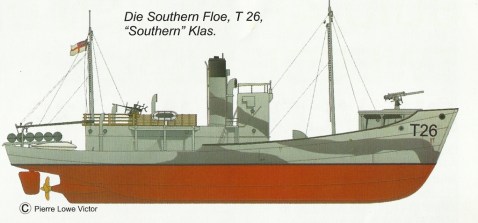
HMSASSouthernFloe_001_zps0bc9e903

A number of whalers were converted to anti submarine roles and commissioned into the South African Navy for service, they were part of the South African Seaward Defence Force anti-submarine flotilla.

Some of them were sent to the Mediterranean and based at Alexandria, Egypt – the HMSAS Southern Floe, the HMSAS Southern Sea and their sister ship the HMSAS Southern Maid – which is seen in this rare featured photograph in Alexandria Harbour in Egypt (In the foreground is the South African Navy’s HMSAS Protea, a Flower-class corvette).10372567_405970339572704_7046310110446388801_n

In 1941 – the HMSAS Southern Floe (Lt J E Lewis) and HMSAS Southern Sea arrived at Tobruk on 31 January 1941 to take over patrol duties from two of their two sister ships.

Although submarines were not a threat in the first six months of the Western Desert campaign, numerous floating mines pointed to the existence of extensive moored mine fields. Except for the sweeping of the narrow coastal traffic route and harbour entrances at this stage there had not yet been time to locate these fields with any accuracy, much less to clear them. The main duty of the two Southerns was alternately to patrol the nearest section of the swept channel and to escort shipping along it. The port at that time was subject to air raids, littered with sunken wrecks and possibly active ground-mines. On patrol, the duties were complicated by sandstorms that strong off-shore winds extended for many miles out to sea, resulting in low visibility, heavy cross-seas, and much discomfort to personnel. To these conditions were added the menace of the mine fields on one side and an ill-defined and unlighted coast on the other.
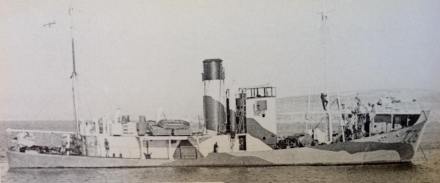
17546669_10154957768326480_68053892438750609_o

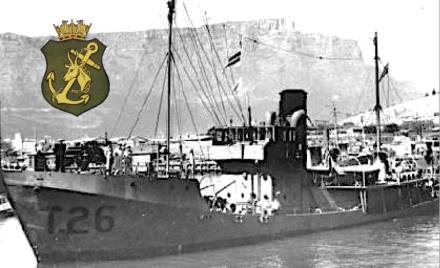
HMSAS Southern Floe T26

On the morning of 11 February Southern Sea arrived at the patrol rendezvous, two miles east of Tobruk, but found no sign of Southern Floe. This was reported but caused no concern at first; it had blown hard enough all night for the ship to find herself far from her station at dawn. However that evening, a passing destroyer picked up one man clinging to some wreckage – all that remained of Southern Floe and her company.

This sole survivor was Leading Stoker C J Jones, RNVR (SA), lent from HMS Gloucester to fill a vacancy just before Southern Floe sailed from Alexandria. The HMS Gloucester had a large contingent of South African Naval Force on it and was to be lost later in the war (see Observation Post A “grievous error”; Recounting South African Sacrifice on the HMS Gloucester).

Jones was almost insensible after 14 hours in the water, but afterwards stated that he had been in the stokehold when, at about 04:00 there had been a heavy explosion and the ship had filled rapidly. In the darkness, he had found his way into the flooded engine-room and struggled out through the skylight as the ship sank. He had seen a few other persons in the water at that time and later had done his best to support a wounded man. In the absence of other evidence there is little doubt that a mine, either floating or moored, was the cause.

The loss of the ship, although but a trivial incident in a world war, came as a sudden and grievous blow to the flotilla and to the SDF. The ships had spent a barely one month on the station and at home few were aware that they had arrived and had been in action. The casualties were the first naval losses suffered by the South African Seaward Defence Force and the sense of loss in the service was profound.

A relic of Southern Floe was brought to South Africa long after, in the form of a small brass ship’s badge, found amidst the other debris of battle 70 miles inland from Benghazi. Supposedly it had floated ashore, attached to a wooden fragment of the ship’s bridge, and been carried thence by an Italian souvenir-hunter.


After the war Stoker Jones, the sole survivor placed a memorial notice in the Cape Town newspapers. He continued to do this for many years until he also passed away.
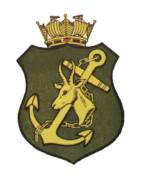
22308811_10155537271456480_3745202244434378650_nWe salute these brave South Africans – here is the honour roll for the HMSAS Southern Floe (MPK means “Missing Presumed Killed”).

ANDERS, John, Steward, 69637 (SANF), MPK
BOWER, Robert, Stoker 1c, 69935 (SANF), MPK
BRAND, Leslie A, Able Seaman, 69828 (SANF), MPK
CAULFIELD, Patrick, Steward, 69802 (SANF), MPK
CHANDLER, Charles R D, Cook (S), 69613 (SANF), MPK
CHENOWETH, Richard, Stoker 1c, 67420 (SANF), MPK
FAIRLEY, Alexander E, Sub Lieutenant SANF, MPK
FRIEDLANDER, Cecil A, Able Seaman, 114703 (SANF), MPK
GARDINER, Elliott, Able Seaman, 67260 (SANF), MPK
GREENACRE, John H, Leading Seaman, 69677 (SANF), MPK
HEASMAN, Gratwicke E E, Engine Room Artificer 4c, 69784 (SANF), MPK
HOGG, Roy S, Sub Lieutenant, SANF, MPK
INNES, Ian Mck, Sub Lieutenant, SANF, MPK
LEWIS, John Edward Joseph, :Lieutenant, 70019 (SANF), MPK
MARSH, Reginald H Y, Able Seaman, 69911 (SANF), MPK
MITCHELL, William N, Able Seaman, 69787 (SANF), MPK
NEL, Eloff R, Able Seaman, 69635 (SANF), MPK
NICHOLSON, Douglas O, Able Seaman, 66833 (SANF), MPK
PUGH, John R, Able Seaman, 66877 (SANF), MPK
RYALL, David R, Able Seaman, 69999 (SANF), MPK
SHIMMIN, William, Leading Stoker, 69661 (SANF), MPK
SIENI, Joseph F, Able Seaman, 69788 (SANF), MPK
SNELL, Harold W, Leading Telegraphist, 69827 (SANF), MPK
STANLEY, Gordon J, Able Seaman, 66963 (SANF), MPK
WALTON, Dudley N, Sub Lieutenant, SANF, MPK
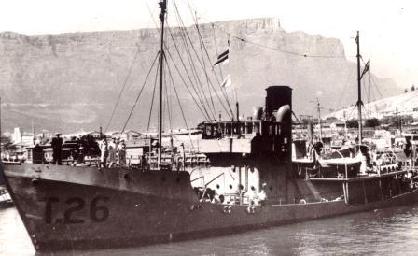
60eac9_b5b492be3f049f004e96e728a4a7b8cc.jpg_256

HMSAS Southern Floe in Cape Town

For more stories on other South African minesweepers lost during World War 2, please follow these Observation Post Links:

The feisty South African minesweeper that went down fighting – HMSAS Parktown

“Under a hail of shells”; Recounting the bravery and loss of HMSAS Bever

The last South African Navy ship to be lost in action; HMSAS Treern


Written and Researched by Peter Dickens. Many thanks to Glen Knox from the South African Naval Museum for the story content and his tireless work keeping this history alive. Casualty Lists of the Royal Navy and Dominion Navies, World War 2 by Don Kindell. Images of South African vessels courtesy Allan du Toit and reference from his book ‘South African Fighting Ships’.

42% of South Africans serving in WW1 were “non-white”

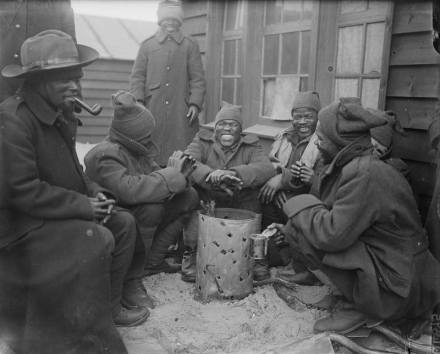
World War 1 and here we see this stunning and timeless photo of some very unsung heroes – South African Native Labour Corps men sitting around a brazier at their camp near the Western Front – Dannes, France – March 1917. Funnily it’s a scene which would not look too dissimilar to a construction camp in South Africa on a cold winters morning today.

The Black African contribution to World War 1 has been heavily downplayed in South Africa’s accounts of the war on the Western Front (and for that matter all “western” accounts of the war), however in all – 83 000 black South Africans and 3 000 Cape Coloureds answered the call – a total of 85 000 “non-white” men complemented the 146 000 white servicemen – serving in all sorts of roles, ranging from policing, carriage driving, stretcher bearing, cooking, engineering earth and wooden defences, felling trees for fuel, on-loading and off-loading cargo … the list goes on. 42% of the serving South Africans during WW1 were Black or “Coloured”, a fact that is has been very overlooked in the past, and remains relatively unknown to this day.

Funnily in any military outfit today non-combat support roles are viewed as an intrinsic part of the military – medics, engineers, “Loadies”,”drivers,”military” policemen etc. and they are not viewed any differently in terms of veteran status.  Yet the prejudice and politics of the time viewed these men differently, withholding medals and recognition due to them.

To say that World War 1 for South Africans was a “whites only” conflict is to fundamentally misunderstand the politics of the day.  The sanitation of South African Military History to support the “white” narrative remains one of the hardest things to redress as people (Black and White) just simply cannot see past decades of historical indoctrination.

The South African Native Corps cemetery at stands in stark testimony of the sacrifice of South African “Black” men to the cause of World War 1 on the Western Front.  Over 300 Black South African soldiers of the SANLC and Cape Coloured Corps lie buried at the cemetery outside Arques-la-Bataille in France alone, and that’s without considering the over 600 Black South African SANLC soldiers lost on the SS Mendi to a watery grave.  Here the dead really speak volumes.

1526731_240586416111098_748322243_n

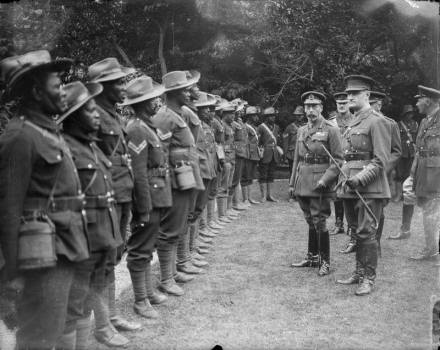
King George V who is seen inspecting N.C.O.’s of the South African Native Labour Corps at Abbeville, 10 July 1917.

Image copyright Imperial War Museum Collection

The sinking of the ‘City of Johannesburg’

The submarine “U Boat” menace of the Second World War became commonly known as the “Battle of the Atlantic”, but it also extended to all oceans and the strategic point rounding the South African Cape became a focus point of the submarine war and German attention – and subsequently the attention of The South African Navy and her British Allies.

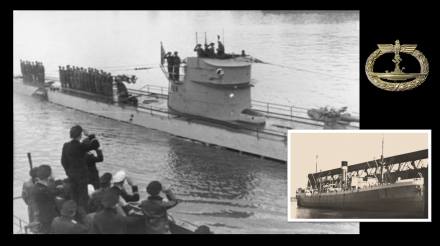
2000px-Pirate_FlagA typical example of the danger, survival and sacrifice in South African waters is the story of the sinking of the “City of Johannesburg” by German submarine U-504 (seen in the featured image above).  U-504 was a Type IXC U-boat of Nazi Germany’s Kriegsmarine during World War II, the SS City of Johannesburg was a merchant vessel carrying supplies off the coast of East London, South Africa.
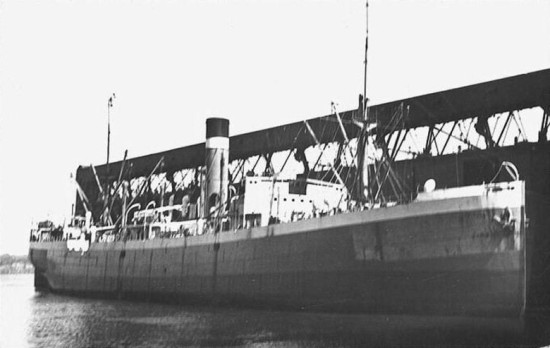
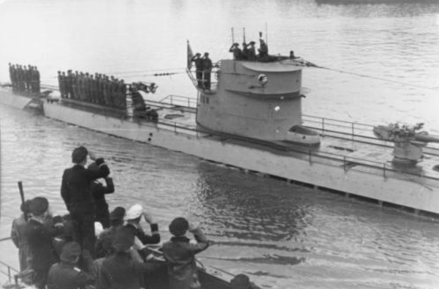
Of the merchantmen on board the SS City of Johannesburg, 90 in total, 4 perished and there where 86 survivors. Their survival in open water is remarkable considering the conditions in South African waters and typical to the dangers of operating at sea in WW2. This is one of many stories of the sinking of vessels and bravery of men off the coast of South Africa.

SS_City_of_Johannesburg

SS City of Johannesburg

At 23.12 hours on 23 Oct 1942 the unescorted City of Johannesburg (Master Walter Armour Owen) was hit by one of two torpedoes from U-504 while steaming on a zigzag course at 10.75 knots about 80 miles east-southeast of East London, South Africa. The torpedo struck between the deep tank and #4 hold on the port side, blowing the hatches off the deep tanks and opening a hole that flooded these compartments immediately. All electricity failed and the engines had to be stopped when the engine room was flooded a few minutes later, causing the ship to settle by the stern with a slight list to port. No distress signals could be sent as the main aerial was brought down and fouled the emergency aerial and it was later discovered that the portable wireless set had been damaged while lowering into a lifeboat and was useless.
Two lifeboats had been destroyed and the rafts aft were jammed in the rigging, so the 21 crew members, 60 Lascars (Indian sailors) and nine gunners (the ship was armed with one 4in, one 12pdr, two 20mm and four machine guns) abandoned ship in the four remaining lifeboats which were launched safely within five minutes despite rough sea and high swell.

Before leaving the gunners tried to train the 4in gun, but it was damaged and could no longer be turned. The master was the last to leave the ship after making sure that no one was left on board. At 23.40 hours, the U-boat surfaced after firing a coup de grâce at the ship which was hit at #2 hatch on the port side, but only settled further on an even keel.

The Germans then questioned the survivors in one of the lifeboats and left the area after the City of Johannesburg suddenly broke in two amidships and sank at 00.00 hours. Four Lascars were lost.

The boat in charge of the master had 11 persons on board and rescued two men swimming in the water. Quartermaster H. Birnie was picked up by a boat with 28 persons and later stated that he was alongside the U-boat after it had surfaced and even touched the plates when he was told to swim astern to the lifeboat. He was asked no questions and the engines of the U-boat remained stopped until the man was clear.

The other two boats held 19 respectively 25 persons, but owing to the rough sea the lifeboats could not approach each other to even up the survivors in them. The master told the other boats to remain in the vicinity while his boat set sail in order to get help and made 140 miles in 24 hours before he and twelve survivors were picked up by the Dutch steam merchant Zypenberg about 8 miles from the coast in 33°50S/26°50E on 25 October and landed at Durban two days later.

However, the boat with 19 occupants also set sail and only made half the distance before they were rescued by the British motor merchant King Edwin on 26 October and landed at Cape Town three days later. The 54 survivors in the two boats that waited near the sinking position were picked up by the British steam merchant Fort George after 12 hours in 33°24S/28°31E and landed at Port Elizabeth on 25 October.

U-504: South African Patrol

This submarine had caused a lot of damage off the coast of South Africa, here is a short history of her 4th Patrol in South African waters:

U-504

U-504

U-504 left Lorient on 19 August 1942 and sailed south to the waters off South Africa as part of Wolfpack Eisbär. There, on 17 October, about 450 nautical miles (830 km; 520 mi) south of Cape Town, she torpedoed and sank the unescorted British 5,970 ton Empire Chaucer. On the 23rd she sank the 5,669 ton SS City of Johannesburg, and on the 26th she attacked the unescorted American 7,176 ton Liberty ship Anne Hutchinson. The crew abandoned their vessel after she was hit by two torpedoes and fatally damaged. However the ship remained afloat, and on the 29th was taken in tow by the South African armed trawler HMSAS David Haigh (T13) and a harbour tug. Lacking sufficient power to tow the ship to port explosive charges were set, cutting the ship in two. The aft section sank, and the fore section was towed into Port Elizabeth. Part of the crew were picked up at sea, while the rest made it to land in their lifeboats.

U-504 sank two more British merchant ships on 31 October, about 200 nautical miles (370 km; 230 mi) east of Durban. First the unescorted 7,041 ton Empire Guidon, then the unescorted 5,113 ton Reynolds, which, hit amidships and in the stern, capsized and sank within seconds.

Finally on 3 November she sank the unescorted and unarmed Brazilian 5,187 ton cargo ship Porto Alegre en route from Rio de Janeiro to Durban, off Port Elizabeth. Hit by a single torpedo, the crew abandoned ship before the U-boat delivered the coup de grâce. Only one crew member was lost. The survivors were questioned by the Germans, and later made landfall about 50 nautical miles (93 km; 58 mi) from Port Elizabeth on 7 November.[22] U-504 arrived back at Lorient on 11 December 1942 after a patrol lasting 115 days.

The fate of U-504

U-504 also met a grisly fate.  Whilst on her 7th Patrol U504 was depth charged and sunk with all hands on board (53 in total) on 30 July 1943 in the North Atlantic north-west of Cape Ortegal, Spain, in position 45.33N, 10.56W, by depth charges from the British ships HMS Kite, HMS Woodpecker, HMS Wren and HMS Wild Goose.

HMS_Kite_IWM_FL_22973

HMS Kite

HMS Kite’s Commanding Officer at the time of the sinking of U-504 was the famous U-boat hunter Captain “Johnnie” Walker, DSO and three bars.

The Commander from her one patrol off South Africa to when she was lost are two different men (and possibly even different crew as well).

12642880_10208446827553702_7537731843413712051_n

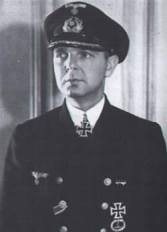
KrvKapt Hans-Georg Friedrich Poske

During the South African Patrol (4th patrol) the Commander was KrvKapt Hans-Georg Friedrich Poske (he command U-504 for the first four War Patrols). KrvKpt Wilhelm Luis did the next three patrols, his third being the fatal one.

This U Boat spent a total of 372 days a sea and sank 85,299 tons of shipping. All ships sunk were under her first commander KrvKapt Hans-Georg Friedrich Poske and on the second, third and fourth patrols.  U-504’s most successful patrol in terms of tonnage suck was on her South African patrol.

KrvKapt Hans-Georg Friedrich Poske survived the war, he also served post war as well and retired in 1963.  Note on the image provided  he was awarded a Knights Cross.


Researched by Peter Dickens

Reference and thanks to Sandy Evan Hanes for additional input.

Related Observation Post links:

The Leonardo da Vinci  The Leonardo da Vinci wreaks havoc off South Africa’s coastline

U-177 The worst maritime loss off Durban’s coast; The sinking of the SS Nova Scotia


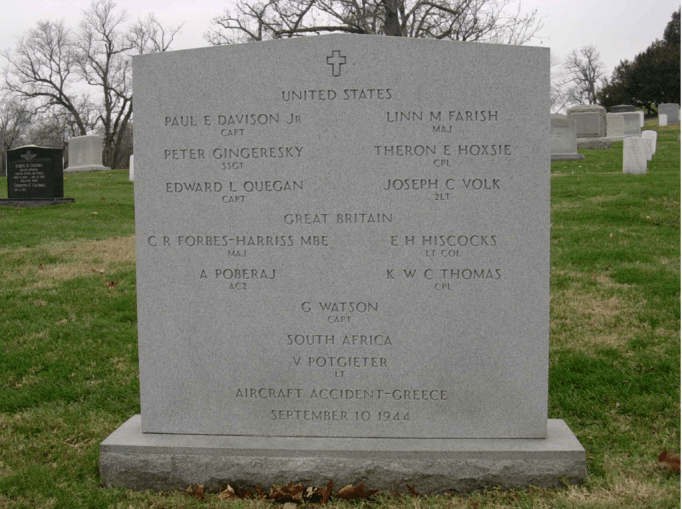
A part of Arlington will forever be South African

Arlington National Military Cemetery – Virginia, reserved for American servicemen of the United States of America, but there is a South African soldier buried in the cemetery. He was “discovered” in 1981.

For nearly 50 years World War II soldier Lieutenant Victor Potgieter lay unacknowledged in a common grave in the U.S, until his family learned of his whereabouts in 1981.

The fate of Lt. V. Potgieter, who grew up in Carolina, Eastern Transvaal (now Mpumalanga) and attended Wits University before volunteering for active service in 1940, what happened to him remained a mystery for half a century. He went missing in 1944 and his family in South Africa did not know his fate until 1981 when they read a newspaper article about an unknown soldier named Potgieter who lay unaccounted for in the United States; in their most revered military cemetery in Arlington, Virginia.

The lieutenant’s brother, Ben Potgieter of Arcadia, told the Pretoria News in 1993 that he believed his brother was involved in a clandestine operation when his plane was shot down and crashed in Greece.”Victor was home on leave from Egypt two months before his death,” Ben Potgieter was quoted as saying. “He told me he had volunteered for a mission and he would be photographing bridges there were to blow up.”When Victor Potgieter was first brought to the United States, all the authorities knew was his name. He was not registered as being on a mission in the area with any army. With no other leads, his headstone was marked as a British soldier.

Corrections have since been made to the headstone by the authorities at Arlington and Victor Potgieter is now correctly identified as a South African.

Screen Shot 2016-02-01 at 09.16.05

Rest in Peace Lt Potgieter, a part of Arlington will forever be South African.

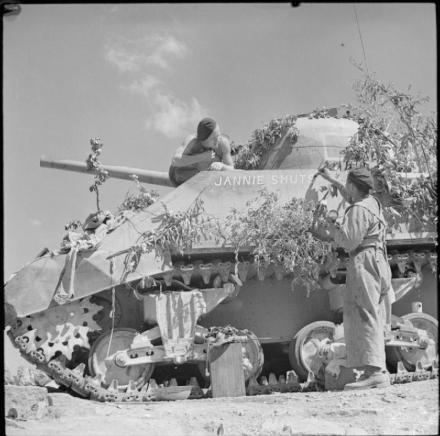
A tank called Jannie Smuts

Italy 1944, a crew of the Pretoria Tank Regiment, 6th South African Armoured Division, christen their Sherman tank with the names of Prime Minister, Field Marshal Jan Smuts, during their advance north of Rome.

Jan Smuts and his wife, Isie K. Smuts affectionally known as “Ouma” (Grandmother) by the troops proved incredibly popular to South African servicemen during the Second World War.  In part because of the compassion shown to the troops via the South African Gifts and Comforts Fund run by “Ouma” Smuts and the annual gift packs sent to all in service during the war.

The Pretoria Regiment featured here in Italy, went on claim great status as a fighting Armoured Regiment.  It was formed in Pretoria on 1 July 1913 as the 12th Infantry (Pretoria Regiment) – a unit of the Active Citizen Force – by the amalgamation of several units: the Pretoria Company of the Transvaal Scottish, the Central South African Railway Volunteers, the Northern Mounted Rifles and the Pretoria detachment of the Transvaal Cycle and Motor Corps. In 1928, it was renamed The Pretoria Regiment.

On 24 October 1930 it was once again renamed, to The Pretoria Regiment P.A.O. (Princess Alice’s Own). During World War II, the Regiment was converted to an armoured formation attached to the 11th South African Armoured Brigade, South African 6th Armoured Division.

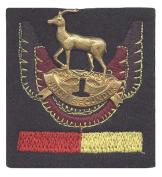
In Italy the Pretoria Regiment (PAO) was the armoured regiment for the British 24th Guards Brigade (Grenadiers, Coldstream and Scots Guards) in the 6th SA Armoured Division. At the end of six months together, in honour of fighting prowess of the Pretoria Regiment (POA), the Brigade Commander obtained King’s permission for award to the Pretoria Regiment (PAO) of a theatre honour in the form of stylised wings in Guards Brigade colours.  This is carried on the Pretoria Regiment’s insignia to this day.

553704_10151160234451480_887764237_n

After the Second World War the unit was demobilised, and in 1946 it was re-organised as a part-time force, consisting of two separate regiment-sized formations. These were re-integrated in 1954. After the establishment of the Republic of South Africa in 1961, the unit was again renamed The Pretoria Regiment by the South African Defence Force.

Since the end of compulsory national service in 1994.  As part of the SANDF Reserve the Pretoria Regiment now recruits volunteers from among former Reserve and Regular Force soldiers and focussing on University of Pretoria students, men and women.

Image Copyright Imperial War Museum Collection.  Image of insignia courtesy Dudley Wall. Reference – The Pretoria Regiment by Brig Gen (Ret) D Fourie and wikipedia

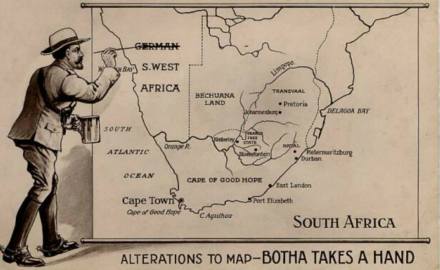
The need for South Africa to hold onto Namibia for as long as it did.

The capture of German South West Africa as part of the start of World War One, by South Africa, had a profound impact on the next 100 years of South Africa’s history. Whilst its invasion was important to the outcome of WW1, its period as a protectorate of South Africa’s after the war had a longer and more profound impact.

Politically speaking, the incorporation of the South West African white electorate into the South African electorate after the National Party came to power in 1948, set South Africa on a path which was to see it embroiled in a two and a half decade long war with South West Africa’s liberation movement and Angolan coalition forces (1966-1989).

The inclusion of this very pro German – anti British ‘whites only’ South West African voters into South African elections provided the National Party with a very large loyal voting block – it added to the campaign to reconcile constituencies to keep Smuts’ old United Party from getting back into power. Between 1950 and 1977, whites in the territory were represented in the South African Parliament by four Senators and six Ministers of Parliament.

Its also this loyal base of conservative white voters that the National Party found obligated to, so much so it was prepared for a protracted war to keep them.  The National Party in some senses saw South West Africa as a 5th province of South Africa and not an independent state.

It’s a fascinating period of South Africa’s history, and very ironic to think that it was this military campaign by Smuts and Botha that started it all.  Funny how history turns out.

South Africa’s World War 1 German South West Africa campaign is best and briefly summarised as follows:

An invasion of German South-West Africa from the south failed at the Battle of Sandfontein (25 September 1914), close to the border with the Cape Colony. German fusiliers inflicted a serious defeat on the British troops and the survivors returned to the Cape Colony.

The Germans began an invasion of South Africa to forestall another invasion attempt and the Battle of Kakamas took place on 4 February 1915, between South African and German forces, a skirmish for control of two river fords over the Orange River.

The South Africans prevented the Germans from gaining control of the fords and crossing the river. By February 1915, the South Africans were ready to occupy German territory.

General Botha put General Smuts in command of the southern forces while he commanded the northern forces.

Botha arrived at Swakopmund on 11 February and continued to build up his invasion force at Walfish Bay (or Walvis Bay), a South African enclave about halfway along the coast of German South West Africa. In March Botha began an advance from Swakopmund along the Swakop valley with its railway line and captured Otjimbingwe, Karibib, Friedrichsfelde, Wilhelmsthal and Okahandja and then entered Windhuk (Windhoek) on 5 May 1915.

The Germans offered surrender terms, which were rejected by Botha and the war continued.

On 12 May Botha declared martial law and divided his forces into four contingents, which cut off German forces in the interior from the coastal regions of Kunene and Kaokoveld and fanned out into the north-east.

The South African column under General Lukin went along the railway line from Swakopmund to Tsumeb. The other two South African columns rapidly advanced on the right flank, Myburgh to Otavi junction and Manie Botha to Tsumeb and the terminus of the railway.

German forces in the north-west fought the Battle of Otavi on 1 July but were defeated and surrendered at Khorab on 9 July 1915. In the south, Smuts landed at the South West African naval base at Luderitzbucht, then advanced inland and captured Keetmanshoop on 20 May. The South Africans linked with two columns which had advanced over the border from South Africa.

Smuts advanced north along the railway line to Berseba and on 26 May, after two day’s fighting captured Gibeon.

The Germans in the south were forced to retreat northwards towards Windhuk and Botha’s force. On 9 July the German forces in the south surrendered.

This German surrender was the first major tactical win of World War 1 for the Entente Alliance’s Allies.


Written and Researched by Peter Dickens.  Reference wikipedia