Field Marshal Smuts Visits South African Naval Forces in the Middle East, 16 May 1942
Field Marshal Smuts, in khaki army uniform, inspects massed ranks of South African sailors on the quay side in Alexandria, Egypt, 16 May 1942.
Imperial War Museum

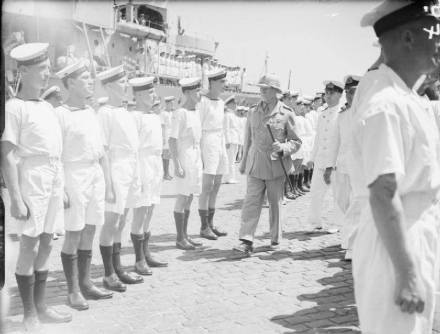
Field Marshal Smuts Visits South African Naval Forces in the Middle East, 16 May 1942
Field Marshal Smuts, in khaki army uniform, inspects massed ranks of South African sailors on the quay side in Alexandria, Egypt, 16 May 1942.
Imperial War Museum
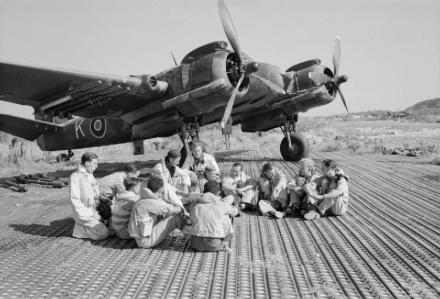
There is an old saying: “War is 99% boredom and 1% sheer terror” and here we see exactly that – aircrews sitting around waiting for instructions, once up in the air, literally in an hour or two they will be in full combat with all the stressors involved in it for only a quarter of an hour or so.
Here aircrews of No. 16 Squadron South African Air Force and No. 227 Squadron Royal Air Force sitting in a dispersal at Biferno, Italy, prior to taking off to attack a German headquarters building in Dubrovnik, Yugoslavia. A Bristol Beaufighter Mark X, armed with rocket projectiles stands behind them. 14 August 1944.
The Bristol Beaufighter (often referred to simply as the “Beau”) is a multi-role aircraft developed during the Second World War by Bristol Aeroplane Company in the UK. It was originally conceived as a heavy fighter variant of the Bristol Beaufort bomber. The Beaufighter was a versatile aircraft used in service initially as a night fighter, and later mainly in the maritime strike and ground attack roles; it also replaced the earlier Beaufort as a torpedo bomber. This tough and versatile fighter bomber served in almost all the major Allied forces of the war: Britain, The United States, Canada, Australia, New Zealand and South Africa.
Image and caption copyright Imperial War Museum Collection, additional references Wikipedia.
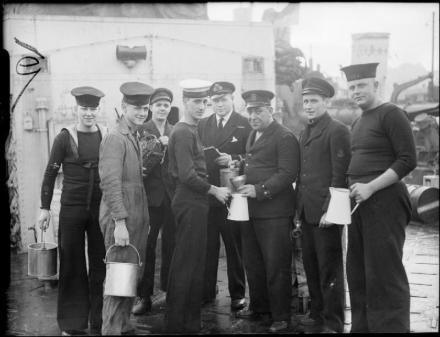
South Africa’s first Frigate, 6 January 1945, picture taken on the Clyde. Officers and men of the Frigate HMSAS Good Hope, the first of three presented to the South African government by the British government. The Coxswain, Chief Petty Officer A W Lincoln, from Robinson Deep, Johannesburg, serving out the rum.
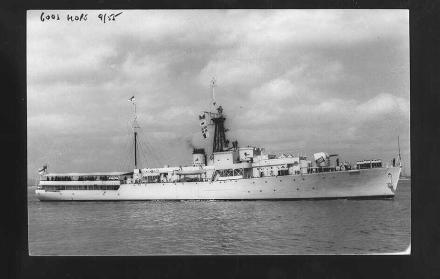
Feature image and caption copyright: Imperial War Museum collection.
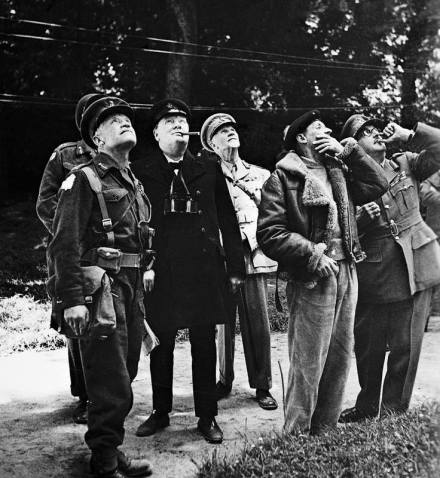
An interesting snippet of history happened during this visit by Smuts and Churchill to Monty’s headquarters. While visiting the headquarters and as senior officers stood outside with the Prime Minister (Churchill), Field Marshal Smuts sniffed the air and said, “There are some Germans near us now…I can always tell!”
And low and behold, just two days later, “two fully armed German paratroopers emerged from a nearby Rhododendron bush, where they had been hiding all along (they had become isolated from their unit, seeing that they were unable to rejoin they chose to surrender). Had they used their guns and grenades on Churchill (and Monty as well as Smuts), everything would have changed.
There you have it, Smuts’ keen sense of smell and intuition is another attribute you can add to the very very long list of honours attributed to this great South African.
The feature image shows Winston Churchill and Field Marshal Jan Smuts accompanied one another just after the D Day landings to General Sir Bernard Montgomery’s headquarters, 12 June 1944.
Left to right: Lieutenant-General Sir Richard O’Connor, commanding VIII Corps; Churchill; Field Marshal Jan Smuts; Montgomery; Field Marshal Sir Alan Brooke, Chief of the Imperial General Staff. Here these Allied commanders are seen looking up at aircraft activity overhead.
Reference: Nicholas Rankin “Churchill’s Wizards”. Image copyright – The Imperial War Museum.
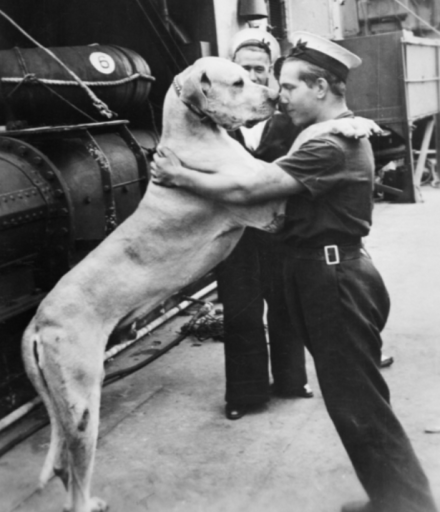
In 1939 the British Royal Navy did the unthinkable… Strange but true, they enlisted a South African dog who then went on to win the hearts and minds of sailors on two continents and become a legend.
Able Seaman ‘Just Nuisance’ is one very famous South African, and as he was an enlisted rating he received rank, pay, rations and duties – the same privileges as any other rating with the rank of ‘Able Seaman’ (AB). This is how he got there.
He was a Great Dane who between 1939 and 1944 served at HMS Afrikander, a Royal Navy shore establishment in Simon’s Town, South Africa. He died in 1944 at the age of seven years and was buried with full military honours.
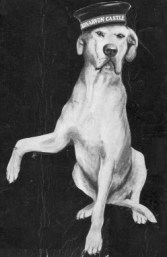
Although the exact date of Just Nuisance’s birth is not known, it is usually stated that he was born on 1 April 1937 in Rondebosch, a suburb of Cape Town. He was sold to Benjamin Chaney, who later moved to Simon’s Town to run the United Services Institute (USI). Just Nuisance quickly became popular with the patrons of the institute and in particular the ratings, who would feed him snacks and take him for walks. He began to follow them back to the naval base and dockyards, where he would lie on the decks of ships that were moored at the wharf. His preferred resting place was the top of the gangplank. Since he was a large dog even for a Great Dane (he was almost 2 metres (6.6 ft) tall when standing on his hind legs), he presented a sizeable obstacle for those trying to board or disembark and he became affectionately known as Nuisance.
Nuisance was allowed to roam freely and, following the sailors, he began to take day trips by train as far afield as Cape Town, 22 miles (35 km) away. Despite the seamen’s attempts to conceal him, the conductors would put him off the trains as soon as he was discovered. This did not cause the dog any difficulty, as he would wait for the next train, or walk to another station, where he would board the next train that came along. Amused travellers would occasionally offer to pay his fare but officials of the State-owned railway company (South African Railways and Harbours) eventually warned Chaney that Nuisance would have to be put down unless he was prevented from boarding the trains or had his fares paid.
The news that Nuisance was in danger of being put down spurred many of the sailors and locals to write to the Navy, pleading for something to be done. Although somebody offered to buy him a season ticket, naval command instead decided to enlist him by the book. As a member of the armed forces, he would be entitled to free rail travel, so the fare-dodging would no longer be a problem. It proved to be an excellent idea. For the next few years he would be a morale booster for the troops serving in World War II.
He was enlisted on 25 August 1939. His surname was entered as “Nuisance” and, rather than leaving the forename blank, he was given the moniker “Just”. His trade was listed as “Bonecrusher” and his religious affiliation as “Scrounger”, although this was later altered to the more charitable “Canine Divinity League (Anti-Vivisection)”. To allow him to receive rations and because of his longstanding unofficial service, he was promoted from Ordinary Seaman to Able Seaman.
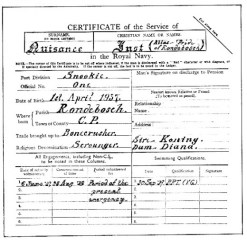
He never went to sea but fulfilled a number of roles ashore. He continued to accompany sailors on train journeys and escorted them back to base when the pubs closed. While many of his functions were of his own choosing, he also appeared at many promotional events, including his own ‘wedding’ to another Great Dane, Adinda. Adinda produced five pups as a result, two of which, named Victor and Wilhelmina, were auctioned off in Cape Town to raise funds for the war effort.
Nuisance’s service record was not exemplary. Aside from the offences of travelling on the trains without his free pass, being absent without leave (AWOL), losing his collar and refusing to leave the pub at closing time, his record shows that he was sentenced to having all bones removed for seven days for sleeping in an improper place — in the bed of one of the Petty Officers. He also fought with the mascots of ships that put in at Simon’s Town, resulting in the in the deaths of at least two of them, one of them was the ship mascot of the HMS Shropshire, for which AB Nuisance was charged.
Nuisance was at some point involved in a car accident. This caused thrombosis, which gradually paralysed him, so on 1 January 1944 he was discharged from the Navy. His condition continued to deteriorate, on 1 April 1944 he was taken to Simon’s Town Naval Hospital where, on the advice of the naval veterinary surgeon, he was put to sleep. The next day he was taken to Klaver Camp, where his body was draped with a Royal Naval White Ensign and he was buried with full naval honours, including a gun salute and the playing of the Last Post. A simple granite headstone marks his grave, which is on the top of the hill at Klawer, at the former SA Navy Signal School. A statue was erected in Jubilee Square in Simon’s Town to commemorate his life.


The Simon’s Town Museum has an exhibition dedicated to his story and since 2000 there has been an annual parade of Great Danes from which a lookalike is selected.


Information – Wikipedia.
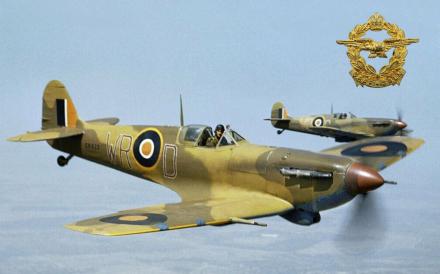
Original colour images of South African Air Force (SAAF) in Gabes in Tunisia April 1943. Here we see a SAAF Supermarine Spitfire pilot of ER622, No 40 Squadron, SAAF as he confers with his ‘No 2’ after landing at Gabes. This original colour image shows off a key identifier that only the South African Air Force squadrons used in the Allied theatre of combat …. ‘Orange’.
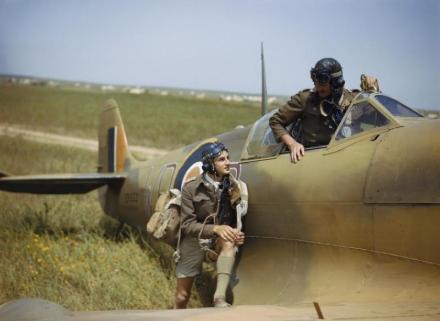
Note the distinctive ‘orange’ dot in the rondel identifier of the South African Spitfires, of all the commonwealth and British aircraft used in the north African campaign, the South Africans where the only ones to have the rondel in the colours of the ‘old’ national flag i.e. Orange, White and Blue on all their aircraft.
All others, British, Australian, New Zealand and Canadian air forces used a red centre in their roundel identifiers to signify the Union Jack (Flag) of Great Britain i.e Red, White and Blue, as seen in this original colour image below.
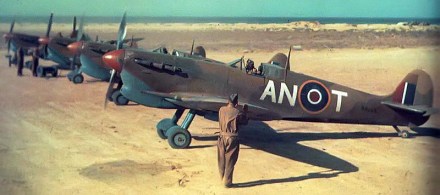
Allied Spitfires in Royal Air Force colour scheme, note the Red, White and Blue identifiers
Also note the officers in first photograph are wearing army rank insignia (not air force), another distinctive attribute specific to South Africa at the time. To compare the difference in aircraft identifiers, here is the SAAF scheme, as shown by these SAAF 40 Squadron Spitfires in desert scheme.
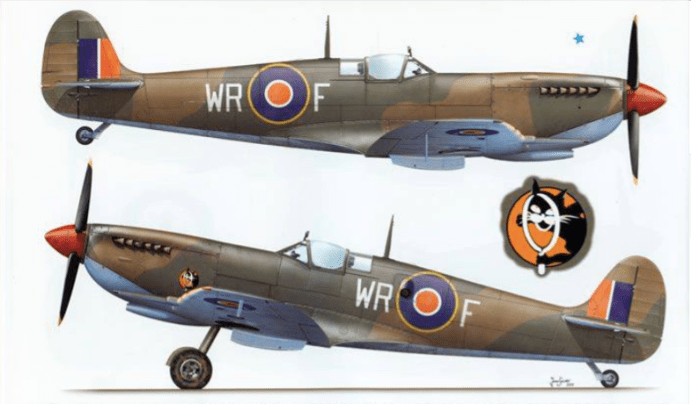
This distinctive difference in SAAF identifiers to RAF and other commonwealth county’s identifiers was given the SAAF because of Jan Smuts’ influence in forming both the Royal Air Force as the first independent air force and the South African Air Force as the second oldest independent air force. Also, the SAAF had identified a separate scheme as they were not a ‘Royal’ Air Force – as the RAAF (Royal Australian AF), RNZAF (Royal New Zealand AF) and RCAF (Royal Canadian AF) were.
Squadrons made up of pilots from Allied countries under occupation also flew in the British markings, the difference was a small national identifier usually found on their cowlings, the Dutch 322 Squadron for example used a small Orange triangle and the Poles used a small Red and White square.
A little history of the SAAF Spitfires featured
As the 8th Army advanced through Libya into Tunisia, SAAF No. 40 squadron flew Tactical Reconnaissance (Tac.R) and Photo Reconnaissance sorties in support of ground operations.
SAAF 40 Squadron converted to the Supermarine Spitfire Vb at the end of February 1943. This variant had clipped wingtips to enhance its low-altitude performance, most notably its roll-speed. Sorties now included vertical and oblique photography, battle area Tac.R, target marking for fighter bombers, searches for night bomber targets, and identification of landmarks for day bomber navigation.
In early 1943 the squadron received Artillery Reconnaissance training, however, unreliable radios meant that artillery shoots were not as successful as had been hoped. Nevertheless, the squadron continued to report the activities of enemy artillery.
Related work and links
Smuts and the Royal Air Force; The Royal Air Force’s 100th Birthday and its founder – Jan Smuts
Smuts and the Royal Air Force; Centenary of the ‘Smuts Report’, the instrument which gave birth to the Royal Air Force
Researched by Peter Dickens. Image copyright IWM Collection. Reference Wikipedia
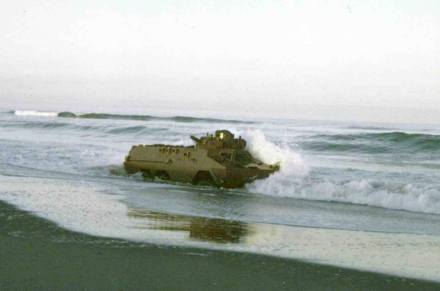
How this SADF Ratel IFV landed up in the ocean is told by Lt Mike Muller (Translated by WO1 Dennis Green from the original Afrikaans)
“Following the participation by D Squadron, 2 SA Infantry Battalion Group in Ops REINDEER, Maj P.W. de Jager, the squadron commander, thought it a good idea to give the members of the squadron a “day off” along the coast at Wortel about 15 km south of Walvis Bay. The aim was to provide the members with an enjoyable break following the intensive tension of the abovementioned operation.
This leisure day activity of 25 May 1978 was very successful and with the return on Friday 26 May at 07:00, the drama of the “Ratel in the Sea” began. As fate would have it, or rather as normal, four of the six Bedford’s would not start. After a lot of struggle, five of the Bedford’s were started and the NSM were taken back to Rooikop and the Squadron lines. Cpl Grassy Green returned to Wortel with Ratel R27029 to recover the remaining Bedford.
As a result of the loose sand and a sand dune over which the Ratel would have to tow the Bedford, Cpl Green decided to drive along the beach to a point where it would be more suitable to get onto the road to Walvis Bay. Because of certain problems, Grassy decided to stop and the Ratel immediately sunk into the sea sand, lying on its axles and gearbox. A further disastrous problem was that the waves were coming to a stop about 20 cm from the Ratel, and this was at the low point of the low tide. The Ratel was stuck and did not want to move; and the tide was turning. Little did Cpl Green realise this would be the hardest and longest recovery effort that D Squadron ever participated in.
Cpl Kanes returned to the base to get help and at 15:00, he informed Maj de Jager and Lt Muller of the events. Immediately the organising began and at 17:30, Lt Muller moved to Wortel with the other Ratels and enough recovery equipment.
A big shock awaited Lt Muller. The Ratel and the Bedford were standing about 20 metres in the sea, isolated and lonely, while the night, mist and cold approached.
The situation was further complicated in that the waves were almost breaking over the vehicles, the Bedford was almost rolled over a few times. Plans were made and preparations begun to recover the vehicles at the next low tide at 00:30 on Saturday 27 May 1978. Because of the loose desert sand, a hard surface had to be built for the Ratels to stand to recover the vehicles. In the cold, the big sweat began and fifteen members had to work against time to get this ‘road’ ready before the next low tide. During this low tide, these members had only 30 minutes to try to dig open the vehicles, but these efforts were not successful.
At this stage the Bedford was the biggest worry and it was first to be re-covered. This successful recovery encouraged the men. With enthusiasm and courage, the recovery effort of the Ratel began, but the tow cable (folded double) broke like cotton threads each time. At 03:00, the recov-ery effort was stopped and the exhausted members enjoyed bread and wine sent out by Sgt Snyman. Sgt Snyman acted as SSM.
Lt Muller decided that everybody must return to base to go and rest and the recovery effort would be started again at the next low tide. Fate de-cided that it would be misty and during the movement back to base, two more Ratels got stuck in the swampy lagoon south of Walvis Bay. They missed the road by 20 metres. It was decided to rest just there while at 06:00 Lt Muller went to report the situation to Maj de Jager. Calm and collected, Maj de Jager summarised the situation and arranged two re-covery vehicles from 55 Field Workshop.
On Saturday 27 May 78 at 11:00, Lt Muller, accompanied by the recovery vehicles drove out to the Ratel in the Sea. In the mean time, Sers Snyman with two corporals who had not slept yet, Cpls Kanes and Louw, recovered the two Ratels in the Lagoon swamp.
Just before low tide, the recovery personnel arrived at the Ratel in the sea. It was a lovely day, blue skies and the sea was calm and tranquil. It seemed that the water was pulling back further than the normal low tide level. The recovery vehicles and one Ratel were used for the recovery and there were many hands to dig away the sand in front of the stricken Ratel.
The engine of Ratel R27029 switched on as if no drop of water had fallen on it. After a few unsuccessful attempts, during which the towropes broke, the 18 tonner was lifted out of it’s almost water grave. A shout of triumph and victory went up from all the people involved. Satisfied but tired the 20 members of D Squadron returned to base as the leisure day could now be closed.
With this document, I would like to mention the names of those members who participated with good leadership and endurance:
• Sgt W.F. Snyman
• Cpl R. G. Kanes
• Cpl J .F. Louw
• Cpl D.A. Green
• Cpl J .H. de Bruin
• Cpl R. Mosich
NOTE: The consequences of the “Monster in the Sea” for the commander of D Squadron at the officer commanding 2 S A Infantry Battalion Group
are not discussed here, also not the big publicity which it caused in the colourless life of the civilian of Walvis Bay – Maj P.W. de Jager.
What happened on Monday 29 May 1978? Cpl Grassy Green was taken on orders in front of Maj PW de Jager and told to clean the Ratel of all sea sand and seawater.
Cpl Green, with help from the Squadron LWT, stripped the Ratel, serviced the engine, cleaned out all the sea sand and seawater and thoroughly washed the vehicle with fresh water. The only component that had to be replaced was the firing button on the turret hand wheel.
When Cpl Green left Walvis Bay in December 1979, Ratel R27029 was still in use by the Squadron.”
What happened to them?
Maj P.W. de Jager, later Commandant – businessman in Pretoria
Lt MJ Muller = later Col Mike Muller, OC 61 Mech Bn Gp, lovingly known as “Mad Max” – Cape Town
Sgt W.F. Snyman (Kat) = later WO 1 and RSM of 1 SSB and the School of Armour = working in Saudi Arabia
Cpl R.G. Kanes (Robbie) = later WO 2 at 1 SSB and SA Army Combat Training Centre, also awarded the Honoris Crux
Cpl JF Louw (Klagga) = working in Saudi Arabia
Cpl J.H. de Bruin (Johan) crew commander of R27029 = Wing Sergeant Major, Support Wing, School of Armour
Cpl D.A. Green (Dennis) driver of Ratel R27029 = Wing Sergeant Major, Simulator Centre, School of Armour
Cpl R. Mosich (Reinhard) = running a successful game farm in the Erongo Mountains near Omoruru, Namibia
Others involved:
S Sgt F.J.S. Scheepers = later WO 1 and SM of the SANDF
Cpl A.J. Crous (Abé) = later WO 1, RSM of WP Comd Workshop, 1 SSB and the School of Armour = Ceremonial WO, Army Support Base Bloemfontein
Cpl M. Winterbach (Marius) = Owner of a Dry Cleaning firm in Windhoek, Namibia
Cpl A. de Beer (Abrie) = Working in Afganistan
Story, photo and reference thanks to Richard Lambert, article thanks to Mike Muller.
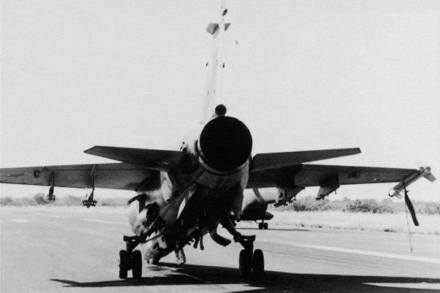
7 June 1980. The South African Air Force Mirage F1AZ 237 of Captain Isak C. du Plessis on the runway at Ruacana, after making an emergency landing when he sustained substantial battle damage.
His SAAF Mirage was part of a 16 ship F1AZ force attacking a SWAPO base near Lubango in Angola, it was damaged by two SA-3 ground to air missiles. Losing hydraulic pressure, the use of the nozzle flaps and the navigation computer he radioed for aid.
Whilst Capt. du Plessis struggled to keep the Mirage airborne, Captain “Budgie” Burgers flying a Impala as Telstar radio relay for the mission realised that the aircraft would not make it back to its base at AFB Ondangwa. He used his considerable navigation experience in the operational area to redirect Capt. du Plessis, using bearings, to AFB Ruacana – a closer forward air base.
Capt. du Plessis managed to land the stricken aircraft at the Ruacana forward airstrip located in South West Africa (now Namibia) without the use of the nose-wheel whilst performing a flapless landing.
Capt. I.C. du Plessis awarded an Honoris Crux – 2nd type for bravery in the recovery of an irreplaceable stricken aircraft and airmanship.


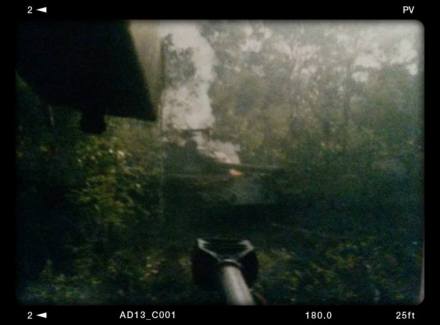
The “cold war” at its height in Angola gets very “hot” – 14 February 1988. Extraordinary and very rare combat photograph of South Africans in combat during the South West African/Angolan Border War. Here a South African Ratel 90 takes out a FAPLA Soviet made T-54/55 tank during Operation Hooper. The Ratel had fired three heat rounds into the tank before it stopped.
To the crew of the much lighter armoured Ratel (it is after all an Infantry Fighting Vehicle IFV not a Tank) this would have been highly nerve racking, especially given the proximity of combat and the thick bush in Southern Angola – which as can be seen in this picture – was very thick, and very close. All kudos to the skill and training of this Ratel’s crew for the steady nerves.
This remarkable photograph was taken by the Ratel’s commander Lt Duncan, call sign 31C.
To compare the differences, this is the T-54/55 Tank, the armour is substantial, 80 mm on the sides, 30 mm on the roof and 20 mm on the bottom. The hull front hull 100 mm at 60° angle, turret front 205 mm (rounded). The main gun is the D-10T 100 mm rifled tank gun. It has a four man crew. The T54/55 was the main battle tank of the post World War 2 Soviet era for the USSR and its Allies.
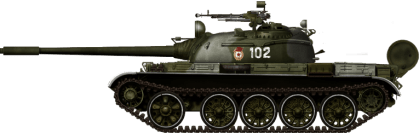
T54B
This is a Ratel 90 Infantry Fighting Vehicle, much more lightly armoured – only 20mm, the primary weapon is a 90 mm (3.54 in) GT-2 semi-automatic gun. It is used primarily in anti-armour, support, and reconnaissance elements within a battalion. The vehicle usually carries a crew of three men, with a seven-man infantry squad.
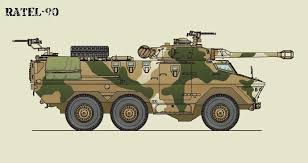
Ratel 90 IFV
Picture copyright, thanks and story content courtesy Sean Buckley.
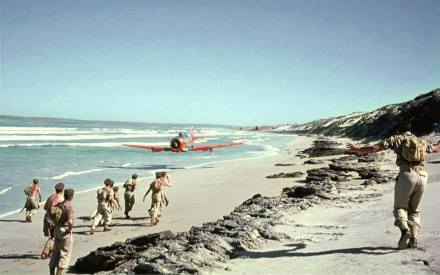
This extremely low flying South African Air Force Harvard was flown as a ‘dare’ to the pilot by the South African ‘pongo’ (army) personnel about to be buzzed. ‘Pongo’ is a derogatory term used by other arms of the forces, such as the Navy or the Air Force to describe the Army – comes from the British army tradition of saying .. “where the pong (smell) goes – the army goes”.
The pilot of the Harvard is Quentin Mouton, who is currently Chief Pilot of Mango Airlines in South Africa. He said the following about these pictures taken on 2nd October 1964 on a South African aviation forum:
“We were 590 hr pilots at the time and the whole thing was illegal, stupid and needless to say, dangerous. The low flying limit was 200ft (or above, not below).
I would have been court-martialled if the SAAF knew. Too late now.. These pictures were taken 2nd October 64. I was the pilot. The pictures are original and not ‘touched up’.
The ‘Pongos’ were on a route march from Langebaan by the sea to Saldanha.
The previous night in the pub one of them had said: “Julle dink julle kan laag vlieg maar julle sal my nooit laat lê nie” (“You think you can fly low, but you’ll never make me lie down”). Hullo!!!
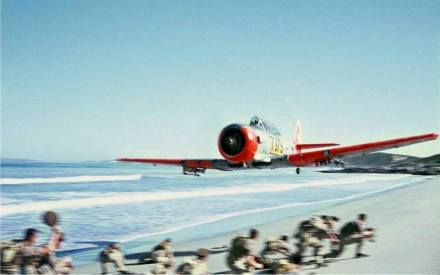
I went to look for them on the beach in the morning and was alone for the one picture. I was pulling up to avoid them. In the afternoon I had a formation with me and you can see the other aircraft behind me. (piloted by van Zyl, Kempen and Perold)
A friend by the name of Leon Schnetler (one of the pongos) took the pics.
The guy that said “Jy sal my nie laat lê nie” (“You won’t make me lie down”) said afterwards that he was saying to himself as I approached: “Ek sal nie lê nie, ek sal nie lê nie” (“I won’t lie down, I won’t lie down”) and when I had passed he found himself flat on the ground”
This subsequent photograph shows the “Pongos” hitting the deck and just how low that Harvard is. Certainly not something that would be approved of today, but it does demonstrate the exemplary flying ability and training of SAAF pilots.
Memories from the past.
Quentin Mouton – 23,000 hrs, everything up to B747-400, presently Chief pilot MANGO Airlines and still actively flying the B737-800.
 The Observation Post