SA Jewish ‘Struggle’ history … continued!

Lately, and especially in my little town of Hermanus is a complete storm in a teacup over a very likeable young man by the name of Benjamin Rattle – Ben to his mates. I’m in the beer brewing game, so too is the Rattle family so we interact with them often as part of the three main ‘local’ beer suppliers to Hermanus.

Now, Ben finished high school not long ago and was pretty much part of the young millennial crowd in Hermanus, well liked in the surfer circles, working briefly for his Dad’s brewing company, he – like many of his age set out to discover the world and being Jewish figured a good start would be to resolve his Israeli citizenship and do his national service in the Israeli Defence Force (IDF). An option open to Jews the world over and perfectly legal and perfectly legitimate in a recognised statutory defence force abiding by all the international conventions – which whether some believe it or not the IDF falls part. 

Whist performing his national service, he – like other dual national Jewish South Africans in a similar situation with commitments in the IDF, suddenly found his country under attack and he was deployed to Gaza for counter offensive operations. All good so far, he’s not some religious nut-job whose bolted to the Middle East to exterminate Arabs in some fanatical sense of wiping them off the planet … he’s a simple national serviceman performing his duties, and whilst in service his circumstances changed and have led him to war.

Like any national servicemen, and many of us in South Africa who have military experience as being National Servicemen will know – pride in service is central, so too family in support, and Ben’s Dad served in the South African Army as a conscript, and like all military vets he knows the importance of this – so like thousands of national servicemen before him, Ben took to a couple of photos of himself on duty and some with his folks whilst he’s in uniform (his parents obviously proud and concerned for their son at the same time) and put these images up on his social media accounts.1

Now, back in his ‘Old Country’ in South Africa a small muslim action group named the Palestine Solidarity Campaign (PSC) enamoured with the South African government’s open sympathy with Palestine and armed movements like Hamas whose stated intention is the annihilation of jews, took to pressing charges of genocide and illegally serving in a foreign army against Ben Rattle at a local Cape Town Police station … using his Instagram and social media pictures in the public space as ‘proof’ positive of his “crime”. 2

This in turn pricked journalists to get hold of Ben, who allegedly told them to hop it, as a Jew in defence of his country he’s doing nothing wrong and that the South African government should focus on its own problem of millions of its own destitute Africans living in shacks in similar if not worse conditions than Palestinians, and should stop meddling in affairs that don’t really concern them 3 Ben’s alleged position no different from that of the Israeli government – so nothing new here. 

All this, and a silly petition calling for South African soldiers in the IDF to be prosecuted with only 1,200 signatures –  spun our very partisan African National Congress government into action, and Nadeli Pandor, our Minister of International Relations and Cooperation for South Africa, who was in the USA urgently trying to convince them not to sanction South Africa for its “covert” but very overt sympathies and support of Russia and other rogue and terrorist states and organisations – and for the Americans this also includes Hamas and Iran.4

Pandor’s line with the Americans is that South Africa is just a leader in human rights and supports arbitration and negotiation for conflict resolution, our Mandela magic ethos and we are ‘neutral’ that’s all – and the Americans aren’t buying it, and she can’t figure out why. However a few weeks earlier in March, she declares all South Africans who are on dual national status serving in the Israeli Defence Force (and that includes Ben) will be arrested the minute they re-enter South Africa – on the basis that there is legislation outlawing South Africans from serving in “foreign” armies without “permission”. 5
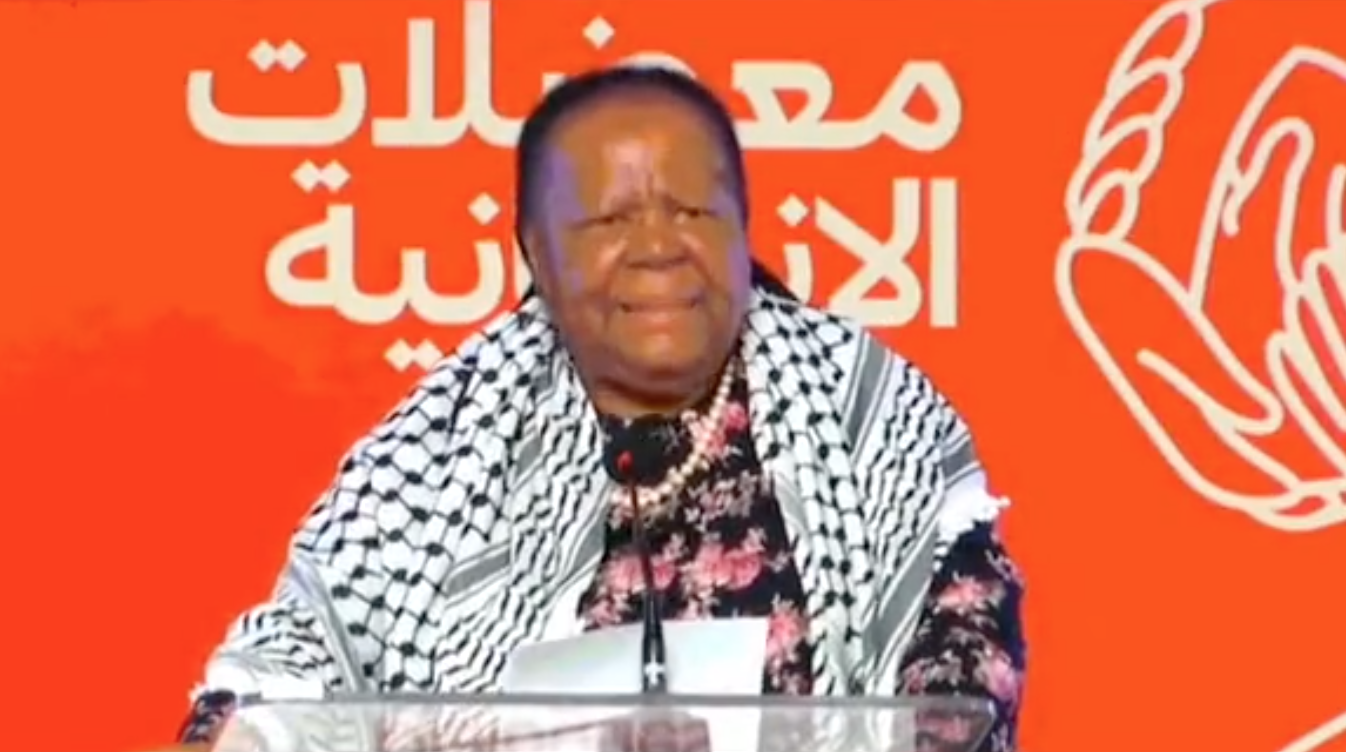
Nadeli Pandor, our Minister of International Relations and Cooperation for South Africa nailing her colours to the mast.

Somehow the ANC thinks that’s the morally good thing to do, leaving their senses again as they fail to recognise that by our shared history and perfectly legitimately, there are literally hundreds of thousands of South Africans who have held dual British and South African citizenships and have served in the British Armed Forces and many of her Allied forces from 1910 – through two world wars and continue to do so to this day. There are thousands of South Africans of Jewish decent who have served in the Israeli Defence Force from its inception, over 500 WW2 military veteran South Africans were recruited to fight in the Israel War of Independence in 1948 alone 6 and Jewish South Africans continued to serve in the IDF and still do so to this day. 

Not even by birthright mind, there are even thousands of South Africans who have obtained dual citizen status after serving in the British Armed Forces (BAF) under the Commonwealth agreement after 1994 and South Africa’s re-admittance to the Commonwealth, many recently serving in the Afghanistan and Iraq wars – and many still in service in His Majesty’s Armed Forces. Most of them serving in the BAF because it simply offered better career growth opportunities for someone seeking a military career than the South African National Defence Force (SANDF) could ever offer, and I can almost guarantee none of them got permission from the ANC government to serve in the BAF.

There are entire groupings of South African’s in the current British Armed Forces, they even have a honour roll of South Africans who died in action in British uniform in Iraq and Afghanistan and there are current South Africans who have received high accolades and British bravery decorations – their families very proud of them. 

As the President of the South African Legion of Military Veterans in the UK, I personally know of five close friends of mine who served in both the South African and British militaries, and not just Britain, I’ve a close friend who served in the South African Navy and is now an Admiral in the Royal Australian Navy and as to the diaspora of South Africans the world over  – one of my Australian nephews is currently in the Australian Navy serving as a Ensign with the very Aussie surname of “van der Merwe”.

Over and above that the French Foreign Legion which has seen South Africans join it over the years to obtain French and EU citizenship and even in the USA, there are many dual National South Africans currently serving in their armed forces.

So, somehow the ANC and the hapless Nadeli Pandor have just managed to put thousands of South Africans world over in statute and legitimate forces under threat of arrest  if they visit or emigrate back to South Africa based on some obscure and previously ignored legislation – and knowing military veterans and their families – to a man they will in all likelihood stand behind a fellow statutory force military brother like Ben Rattle and tell the ANC and Nadeli Pandor to ‘hop it’ (its a military thing – a value we all share).

What the ANC, and Nadeli Pandor did by bringing genocide accusations against a legitimate and mandated statute military is they “took a side” and stepped away from the ANC’s only real legitimacy as the worlds even handed “reconciler” and peacemaker – a reputation reached by Nelson Mandela in 1994 when he stood up and accused F.W. De Klerk and the National Party of been in an “illegitimate and internationally discredited government”, and this reputation of Mandela is now utterly in tatters in 2024, with an ANC heading up a corrupt kleptocracy and becoming more “discredited” in the international community by the day – certainly in all the “western” European democracies and NATO countries.

So what happened next, to demonstrate just what thin ice Nadeli Pandor is on, the United States of America’s government turned around to her and her cronies and warned South Africa that if they so much as arrested one South African serving in a legitimate foreign statute force and specifically in the Isreali Defence Force, South Africa would face sanctions and severe “consequences”. 7 This coming from one of South Africa’s largest trading partners, it’s as if the ANC just have no conception on how an economy works and besides electricity we can afford yet another significant assault on it – so much for addressing poverty, unemployment and wealth gap issues which beset the economy and are critical issues crippling the country.
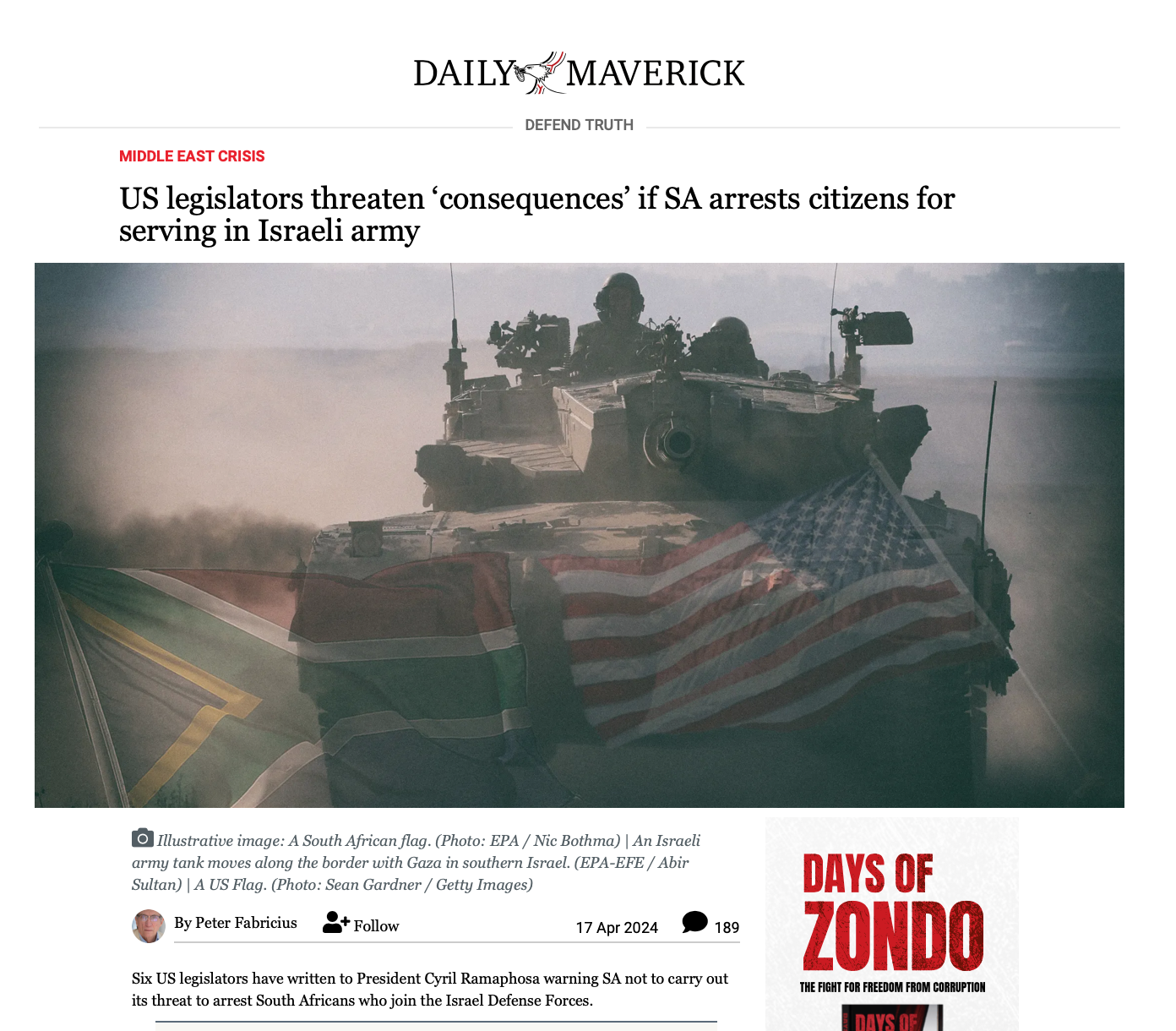
On a personal level, the ANC and their Muslim cabal are acting like a bullies, taking on simple soldier like Ben Rattle, a man who does not even hold a commission or non-comm warrant and plays no part whatsoever in the IDF’s military planning – strategic or operational, he’s merely doing his duty on a tactical level and what is commanded of him – and he has no moral quandary with that, it’s his ‘religion’, his ‘people’ and his ‘country’. In addition he plays no part in Isreali politics and yet finds himself thrust into the limelight. Unhinged individuals living in his hometown of Hermanus have even taken to targeting his Dad’s brewery business calling for boycotting it and its product.

Unhinged, because many years ago Germany’s elected government decided to blame Jews for the world’s woes, and the result was that their ‘mass’ population took to targeting Jews and Jewish business – because the government tacitly agreed with their actions and supported them – suitably empowered this eventually led to a proper genocide, millions of Jews murdered by ordinary Germans who had completely lost touch with their perfectly reasonable religious values and adopted state sponsored socialist ones instead. Our ANC government does not seem to understand the sweep of history very well – and as socialists themselves they are empowering our ‘masses’ to so the same – same as the Nazis did, no different – and its starts with accusing normal law abiding Jews of committing crimes against ‘society’ as they define it – which is exactly what has just happened.

As to the sweep of history – the ANC seems to have lost its senses completely, Jews in South Africa, as a persecuted peoples under Afrikaner Nationalism, played a key role in ridding the country of Apartheid – from within the ANC and external to the ANC, and their involvement is much bigger than you think.

As South African Jewish World War 2 military veterans –  Joe Slovo, Wolfie Kodesh and Rusty Bernstein even founded umkhonto we sizwe (MK) – Joe Slovo becoming MK’s Commander in Chief, other South African WW2 Jewish veterans became Zionists and actively resisted Apartheid, Leo Kowarsky (a founder of the Torch Commando and then the Progressive Party – the modern day Democratic Alliance), Cecil Margo (Margo  a WW2 SAAF bomber pilot goes on to become a founder of the Israeli Air Force and returns to South Africa eventually to become a Supreme Court Justice), Gerald Gordon, Leo Lovell, Jock Isacowitz – who becomes a founder of the Torch Commando and then the Liberal Party of South Africa along with fellow Jew, military veteran and liberal – Leslie Rubin.8   

Not just military veterans, as a result of the Police raid  on Liliesleaf farm in Rivonia in 1963, alongside Walter Sisulu, Govan Mbeki and Ahmed Kathrada – also arrested are two predominate Jewish MK members Dennis Goldberg (a “mensch” to his people) and Arthur Goldreich – Goldreich a devout Zionist in addition. They both land up in the dock and eventually in prison alongside Nelson Mandela charged with High Treason.9

Other Jews are also key anti-apartheid activists, Jews like Ronnie Kasrils, Hymie and Esther Barsel, Eli Weinberg, Yetta Barenblatt, Ray Alexander Simons, Hilda Bernstein, Ruth First, Ronald Segal, Norma Kitson, Baruch Hirson, Brian Bunting, Harry Schwarz, Sam Kahn, Isie Maisels, Arthur Chaskalson, Sidney Kentridge, Joel Joffe, Shulamith Muller, Denis Kuny, Jules Browde,  Ray Alexander, Benny Weinbren, Solly Sachs, Leon Levy, Harold Wolpe, Ben Turok, Paul Trewhela, David Bruce, Pauline Podbrey, Raymond Suttner and even the die hard life long anti-apartheid democrat and campaigner that was Helen Suzman.10

SAJBD President Gerald Leissner and Chairman Mervyn Smith (pictured here with ANC President Nelson Mandela, SAJBD National Congress, 1993) were instrumental in the Board’s taking a decisive stance against apartheid during the 1980’s. Reference SA Jews under Apartheid – A very old debate resisted by David Saks.

According to the South African Jewish Board of Deputies (SAJBD) – Jews made up just 2 percent of the white population of apartheid-era South Africa, but they constituted at least half of the country’s white anti-apartheid activists. Given this extraordinary history, the ANC have really not only lost a sense of their own history but also a sense of who has traditionally supported them and the South African history of the “struggle” completely. 

It is absolutely disgraceful that South African Jews and their children, who have a long and proud ‘struggle’ history in South Africa, now find themselves a marginalised and targeted group in South Africa again – even by our own ‘democratic’ government.

Regardless what we think of the current Palestinian and Isreali war and our individual politics – regardless whether we support Muslims or Jews in our personal lives, we must stand by our values as the world’s miracle nation – the reconcilers and peacemakers, and to do that we need to lead by example and we cannot “take a side”. With that in mind we as South Africans, and even as military veterans, can do a lot better than the current ANC, its cabal and especially its hapless, conceited, ignorant and frankly dangerous foreign minister.


Written by Peter Dickens

Footnotes

  1. Middle East Eye: South African activists file criminal complaint against citizen accused of fighting for Israel – PSC submitted 13 images from what they claim to be Benjamin Rattle’s Instagram accounts (MEE/Instagram)  ↩︎
  2. Ground-up: Criminal complaint lodged against Benjamin Rattle, a South African serving in the Israeli military -Rattle’s social media posts appear to show him standing in front of destroyed buildings and rubble in Gaza. 4 April 2024 | By Matthew Hirsch on-line reader: https://groundup.org.za/article/criminal-complaint-lodged-against-benjamin-rattle-south-african-serving-in-israeli-military/ ↩︎
  3. Ibid ↩︎
  4. Daily Maverick: Naledi Pandor is treading the Pit Botha path to diplomatic oblivion: 7 April 2024 on-line reader https://www.dailymaverick.co.za/article/2024-04-07-naledi-pandor-is-treading-the-pik-botha-path-to-sas-diplomatic-oblivion/ ↩︎
  5. Naledi Pandor: “South Africans fighting for Israel will be arrested” Africa News – on-line reader 14 March 2024 ↩︎
  6. The influence of Second World War military service on prominent White South African veterans in opposition politics 1939 – 1961. A Masters submission to Stellenbosch University – 2021 by Graeme Wesley Plint ↩︎
  7. Daily Maverick: US legislators threaten ‘consequences’ if SA arrests citizens for serving in Israeli army – By Peter Fabricius 17 April 2024 ↩︎
  8. The influence of Second World War military service on prominent White South African veterans in opposition politics 1939 – 1961. A Masters submission to Stellenbosch University – 2021 by Graeme Wesley Plint  ↩︎
  9. Dr. Garth Benneyworth “Trojan horses” Trojan horses ↩︎
  10. South African Jewish Board of Deputies – SA Jews under Apartheid – A very old debate resisted by David Saks – 02 January 2020 ↩︎
From a Persisting to a Raiding Strategy

A current overview of changing Israeli fighting doctrine in Gaza

20 April 2024

By: David Brock Katz

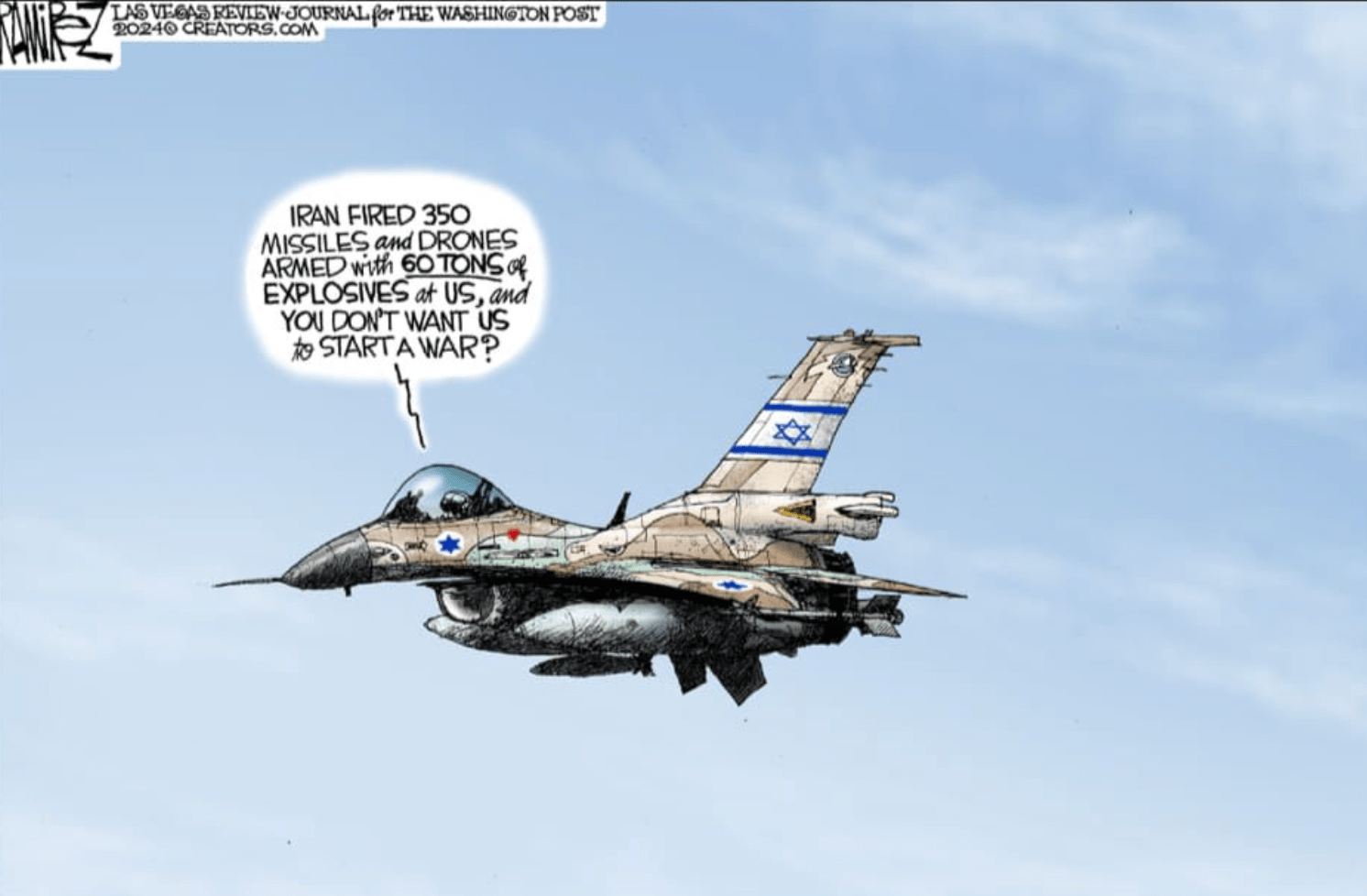
Overtaking the headlines on 8 April, which stated that Israel had pulled all its ground troops out of southern Gaza for “tactical reasons”, was the report of a massive Iranian strike of over 300 drones and missiles directed at Israel from Iranian territory. Iran’s “retaliatory” bombardment signified a significant strategic departure for the Islamic Republic of Iran. Instead of using its proxies, Hamas, Hezbollah or the Houthis, Iran attacked Israel directly for the first time in its history. In a similar fashion to the world’s initial reaction to 8 October, the attack garnered immediate condemnation from many quarters, thereby buying Israel a short respite from the constant media attacks surrounding the conduct of its war in Gaza. Despite Iran’s deadly intent, the missile attack leaves a massive credibility gap in the Iranian capability to inflict harm on Israel via the air. All but a few of the 300 missiles were either shot down or crashed on their own accord, inflicting minimal damage. Israel can claim a massive victory for its Iron Dome system and celebrate the fact that the Jordanians and Saudi Arabians accounted for several of the Iranian missile losses. However, it seems that the USA has again restricted any Israeli counterattack, which squanders a rare opportunity to neutralise some Iranian military assets. 

Quite simply, Biden and his administration have put the brakes on Israeli military actions. Israel has lost the ability to deploy its military at the operational and strategic level of war without the USA’s permission. Losing this independence of action poses a significant problem for Israel’s successful execution of the war in Gaza. The Israeli Defence Force (IDF) in Gaza deployed 18 brigades in December 2023 (about 90,000 troops) and then trimmed down to 5 brigades at the end of March. The IDF now fields a single brigade in Gaza, leaving Khan Younis and Gaza City unoccupied. Undoubtedly, the decision behind the IDF’s hasty withdrawal is not for any sound military reason. Instead, the IDF has succumbed to European and belated pressure from the USA to drastically change its tactics as world opinion has turned decidedly against the Israelis. The original IDF plan of occupying Gaza in its entirety and eliminating Hamas as a military and political force lies in tatters. 

Initially, Israel adopted a persisting strategy, placing a large number of boots on the ground, deliberately advancing at a slow, careful pace into the heart of Gaza. The IDF skilfully concentrated its forces using combined arms teams down to the lowest tactical level. They carefully accumulated overwhelming firepower at the focal points, sometimes only advancing mere meters in a given day. With great tactical skill and impeccable doctrine, the IDF produced innovative tactics to overcome most of the attacker’s disadvantages in dense urban areas. The Urban environment overwhelmingly favours Hamas. New IDF tactics are under tight wraps, but Israel’s allies are watching closely and will undoubtedly incorporate these combat innovations into their urban warfare doctrine. At least up to December, the Israelis made slow but significant progress in defeating Hamas in the field as well as destroying vast tracts of the tunnel system. The IDF badly mauled Hamas at a relatively low casualty cost, inflicting an estimated 30-50% loss on its fighting power before forcing them to withdraw to Rafah to conduct what would have been their last stand before destruction.  

Despite registering significant gains at the tactical and operational levels, Israel IS steadily losing the propaganda war. The world’s outrage at the atrocities committed by Hamas on 7 October began to recede almost immediately. If Israel ever had a chance to strike using a persisting strategy (occupy territory and boots on the ground), it would have had to execute with lightning speed. A cautious approach led to it being caught offside by the capricious support it had initially garnered on 7 October. Israel chose to minimise IDF and civilian casualties, and the sands of time have run out. The media’s constant barrage of civilian casualty figures, as reported by Hamas, has alienated many of Israel’s USA and European backers. The breathtaking hypocrisy of mainstream media has drowned out lone voices of reason, such as Douglas Murray. A discredited Norman Finkelstein, sidelined even by the Palestinians and now comparing Gaza to a concentration camp, has found new vigour and appreciative audiences. Rochdale in the United Kingdom has elected George Galloway, long consigned to the looney left fringes, as Member of Parliament on a pro-Hamas and virulently anti-Israel ticket. Friends, it would seem, are few.  

Israel has to contend with an increasingly frayed relationship with the USA. Support among younger Americans for Israel is rapidly fading. President Biden has insinuated that if the Israelis do not curtail operations in Gaza, then the supply of American arms will come under threat. There are lessons to be learned by those desirous of conducting an independent foreign policy free from American influence. A homegrown defence industry that supplies the lion’s share of one’s military needs is a fundamental prerequisite. Surely, Israel regrets abandoning the Israeli Airforce Industries Lavi Jet Fighter program in favour of the USA’s F-16? The USA no doubt had a significant role in eliminating the Lavi as a possible competitor in the lucrative arms trade industry. Israel cannot independently conduct its operations in Gaza without the USA’s implicit or explicit approval. That is the price of dependence on the USA for the supply of essential arms and munitions. Ukraine faces a similar dilemma of relying on the West to supply essential military equipment for survival. When the time comes, Ukraine will have little choice but to comply with the West’s version of a peace settlement. Israel has withdrawn from the south of Gaza and significantly reduced its troop numbers there, not of its own choice, but on instruction from the USA. 

So where to from here? The IDF has abandoned a highly successful persisting strategy, where it placed boots on the ground, occupied territory, and advanced methodically and innovatively by using combined arms warfare to eliminate Hamas’s fighting power in the north of Gaza. The military endgame was in sight. All that remained was to capture Rafah and remove Hamas in its entirety. Israel, succumbing to American pressure, now has no option but to resort to a raiding strategy. The IDF will attempt to remove Hamas targets through precision ground and air strikes surgically. The danger of this strategy can already be seen, with close to 2,000 Hamas fighters infiltrating their way back into Gaza City in the absence of Israeli ground forces. History has shown that wars cannot be won using a raiding strategy exclusively. Targeting Iranian, Hezbollah and Hamas operatives outside of Gaza to weaken the terrorist superstructure is also not a strategy which will eliminate Hamas. The hope of a more friendly future US government is uncertain and, at best, many months away. The release of hostages, if any are alive, seems remote. An emboldened Hamas continued to hold out for the best terms for a ceasefire. The Israeli retaliation for the Iranian attack was a very measured and even-handed response and an extensive counter-attack currently remains off the cards. Israel faces tough months ahead.


By Dr. David Katz  

What did you do in the Covid War Grandpa?

By Steve de Witt

Where’s our Victory over Covid party?

No dancing in the streets, kissing nurses, bonfires for masks, victory parades and presenting doctors with medals?

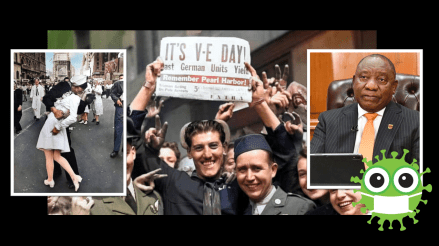
The war is won… but Cyril has ended it with a whimper not a bang. He should be gathering us for one final TV chat, stagger up the podium pissed wearing a party hat, pop champagne and have tinsel showers and fireworks go off behind him.

Instead we get someone called Joe Phaahla quietly posting in the gov gazette “No more musks” and, pfffffff, just like that, Covid fizzles out into history…

Why aren’t we having a party, Cyril?

What are we going to tell our grandchildren one day?

“Aye, it was quite something, lad. The world stopped for two years. No busses, trains, aeroplanes, nothing… They locked us up in our homes, withheld booze and smokes, patrolled the streets with guns and arrested the surfers.”

“You can’t be serious, Grandpa. How did you earn money to buy food?”

“We grew vegetables, me boy! It was the darkest of days, I tell you. People were dying left right and centre. Undertakers patrolled the streets everyday shouting, “Bring out your dead!” Me myself, I survived with a flesh wound, a rash on me testicles from the jabs they stabbed us with.”

“How did the war end, Grandpa?”

“Very quietly, son… the health minister stole all the money and got fired. Some guy called Joe replaced him and wrote in the newspaper that we’ve won… We’re still waiting to party.”

“We’re you a hero in the war, Grandpa?”

“We all were, son. Killed more germs with alcohol spray than you’ll ever know. Thank God for people like us…”

“Is it true that I’ve got 14 fingers because of the war?”

“Aye lad, it’s true… sorry ‘bout that. The jab wasn’t tested enough. But consider yerself lucky – you’ve got two penises!”

—————————

Editor’s comment

Steve de Witt, a friend and contributor to The Observation Post wrote on COVID, it resonated with me as a survivor, having been hospitalised with Covid for an extended period, it also plays right up to my ‘dark’ military sense of humour and put a smile on my dial, Cyril Ramaphosa where is our VE Day indeed. Thanks again Steve – Peter Dickens.

Thanks also to Frans Bedford-Visser for the VE Day colourised images

Another Major Accomplishment

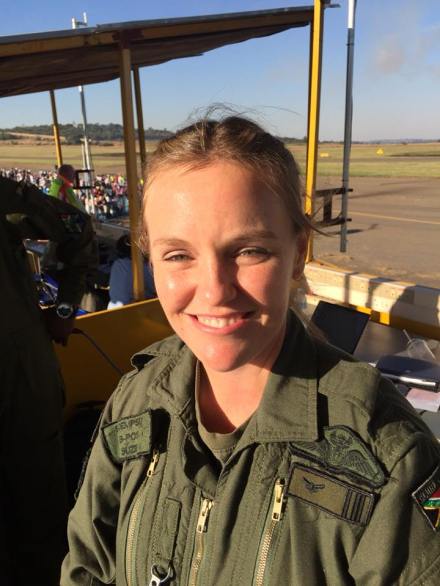
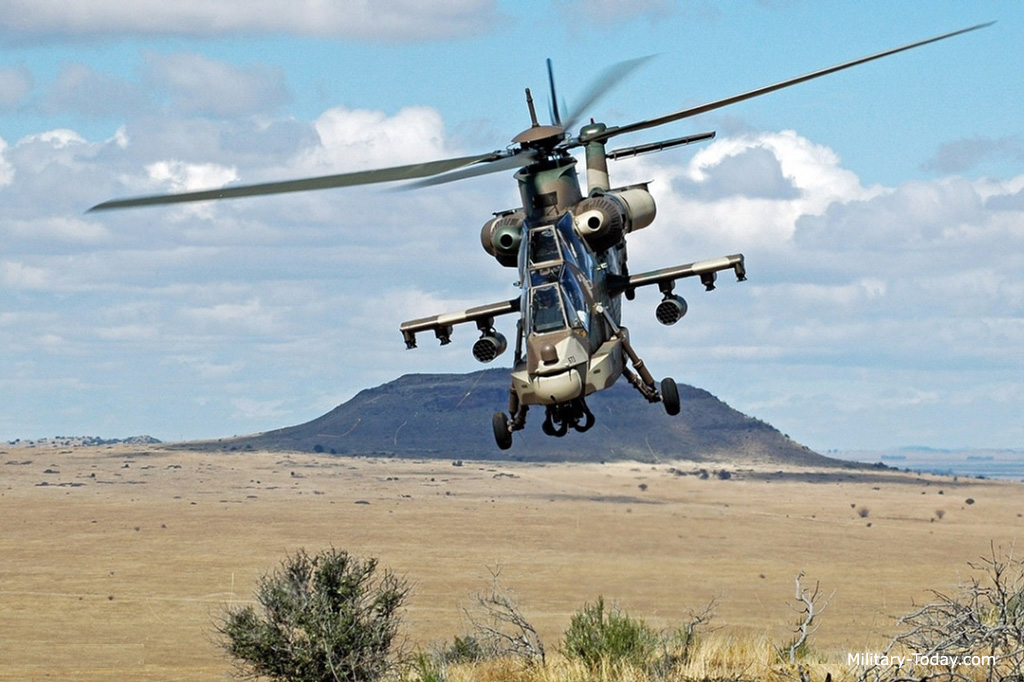
Congratulations to Major Suzanne Dempsey on becoming the first female in the world to fly the Rooivalk Combat Attack Helicopter. Major Dempsey went solo on Rooivalk and now flies with a weapons systems operator. Now the hard work starts as she will be trained to use this deadly to its utmost capability.

Denel AH-2 Rooivalk Attack Helicopter2

Denel AH-2 Rooivalk Attack Helicopter

As firsts go in the advancement of female aviators in the South African Air Force (SAAF) she now joins Major Nandi Zama, who became the first female to fly a SAAF C-130.  To see her accomplishment follow this link:

Nandi Zama; One Major accomplishment!

Bravo Zulu Major Dempsey on breaking new ground for female pilots the world over.  You exemplify the fine values and traditions of 16 Squadron and the South African Air Force.


Posted by Peter Dickens with reference to Capital Sounds, Rooivalk helicopter image courtesy militarytoday.com


Braaivleis, Rugby, Sunny Skies and Submarine!!

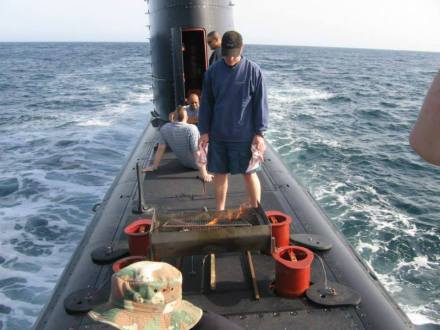
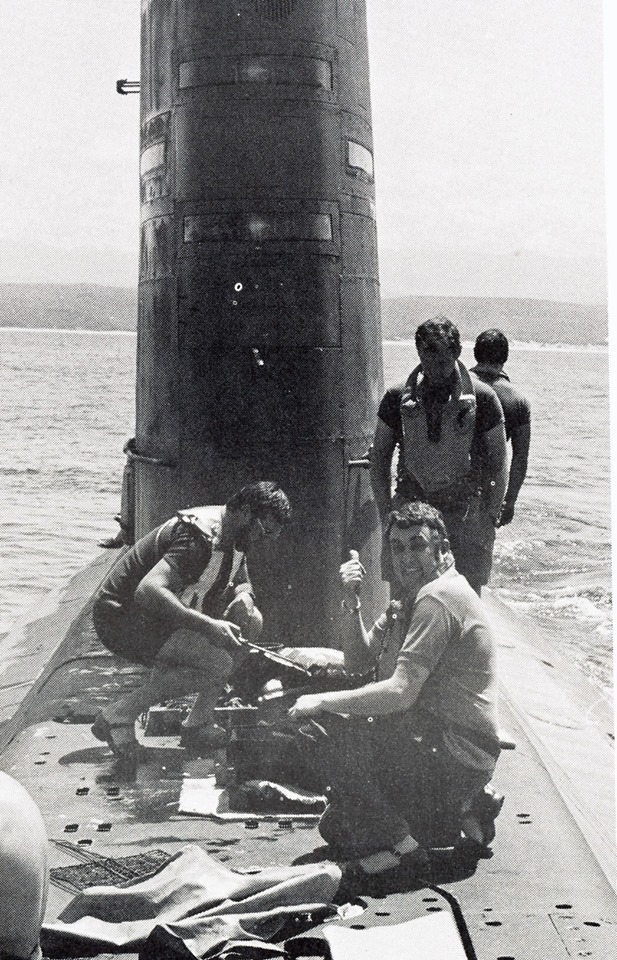
There is a South African Naval tradition in the ‘silent service’ of having a “braai” (South African BBQ using a wood and coal fire) on a 10659328_347729672063438_449914227600569864_nsubmarine when it has surfaced.  It is a true statement of South African heritage, and what better way to wish all South Africans a ‘Happy Braai Day’ (Heritage Day) than to show them how these South African naval servicemen over the years have enjoyed this particular heritage in their own rather unique way.
The featured image up top shows this bit of South African cultural epic-ness as it is today in the SANDF, here is the SA Navy crew braaing on the Casing of S-102 the SAS Charlotte Maxeke the middle of the ocean, with photo thanks to Colin Cloete.

The inserted image shows  the SAS Emily Hobhouse in 1983 off Beacon Isle after a lengthy trip up the east coast. Proof positive that Saffa’s will ‘make a plan’ and braai anywhere. Giving the big thumbs up in front of the braai is Mike Jensen, a popular man sorely missed by the South African submariners and the SA Naval community.

At times even large braai’s have made it onto Navy submarines stored securely and rattle free between the casing and the pressure hull.

Reminds us of another antic in the South African Navy which has “South Africaness” written all over it, this time the Strike Craft personnel – follow this link, Epic Navy Style Water Skiing.

Have a happy ‘Braai Day’


Written by Peter Dickens.  Thank you to Cameron Kirk Kinnear, Peter Marais, Colin Cloete and the South African Naval Fraternity for the information and images.

Navy teaches disadvantaged children to ‘Roll with the Punches’

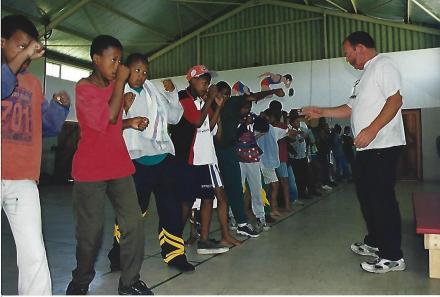
Did you know that the South African Navy in the 90’s spearheaded community outreach using the “sweet science”?  In 1998 the SANDF initiated the first boxing clinic on the West Coast to showcase local talent and generate role models for children who might otherwise gravitate to gangsterism.  Seen in the featured image are these children Shadow boxing with Jan Louwrens.

Boxing has always been a key sport in the South African military, with many of our great boxing heroes serving at one time or another in the armed forces, and nothing showcases this remarkable talent than a boxing outreach program to the community.

Equally, boxing has a long history of thriving in deprived areas. What better was to marry the two together by way of an outreach programme?

The first boxing outreach programme for children from previously disadvantaged backgrounds ever to be held on the West Coast took place at the Navy base SAS Saldanha in 9 December 1998, with the positive after effects continuing to this day…

Like all outreach programs the purpose of the clinic was to motivate children, making them aware of the benefits of sport as a conduit to physical and mental wellbeing, to make them healthy, confident and self-assured; providing role models and thereby turning them away from negative adult behaviour – alcoholism, drugs and warn them against the evils of gangsterism.

This community outreach programme was organised by the then Chairman of the Military Academy Boxing Club, S/Lieutenant Claudio Chistè a combat officer in the South African Navy, with the support from the University of Stellenbosch and the Military Academy, South African National Defence Force (SANDF). More than 70 children attended the training and instruction session which featured boxing stars such as the former world Boxing Champion, Gary Murray, former South African light-middleweight champion, Coenie Bekker, top SANDF trainer and referee, Jan Louwrens. The aim of the project was not only to teach children how to box, but to teach life skills and to facilitate the community building process.

South African military’s proud boxing legacy

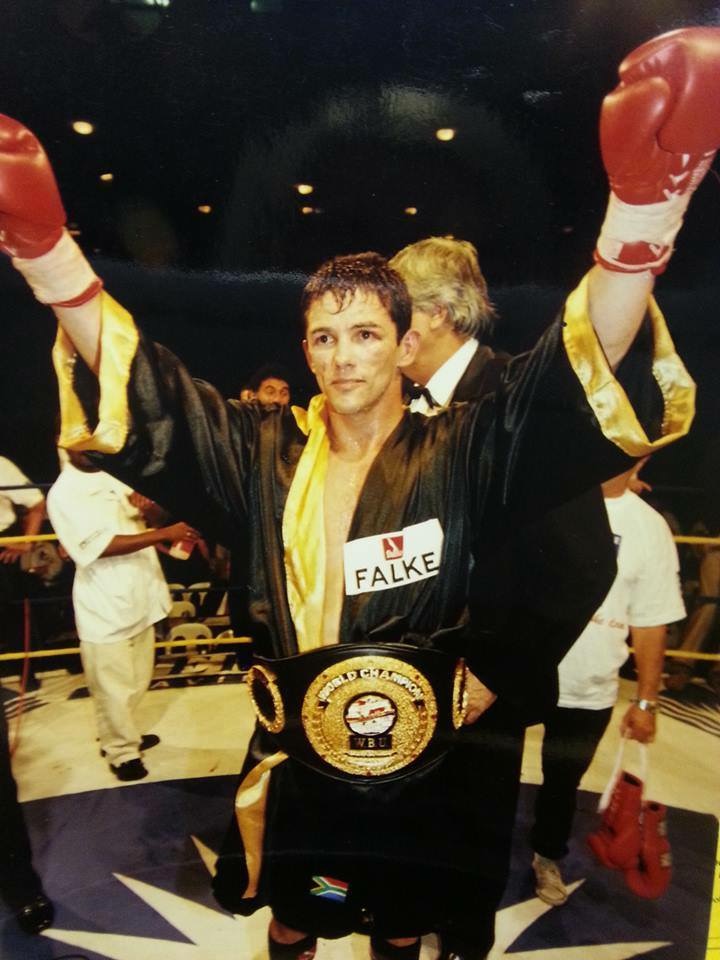
1_Gary Murray winning the word championship title

Gary Murray after winning the World Championship

The South African military has a very proud legacy of boxing.  Former World Welterweight Boxing Champion Gary “The Heat” Murray is a leading example of this.  Gary was just 12 years old when he started sparring, but after he knocked out the local champion, he was hooked.  Gary’s family moved from Scotland to South Africa and he boxed for both Scotland and South Africa as a youngster, winning the South African National Title in Cape Town.  He joined the South African military for two years of his national service and won the prestigious “Super Trooper” title for the fittest soldier in the defence force, as well as the crown of Best Boxer two years in a row. After Gary left the army, he turned pro sharing the ring with greats such as all time knock-out king, Buck Smith (120 knockouts to his name), Dingaan “Rose of Soweto” Thobela and tough as teak Rusty Derouen (the fight was billed “War on the Foreshore” and won the “Fight of the Year” award).

2_Coenie Bekker in his army days pre winning SA Light-middleweight title

Coenie Bekker before winning the SA Light Middleweight title

Former South African Light-Middleweight Champion Coenie Bekker had a similar story to Gary Murray.  His family moved to the rough suburbs of Cape Town and after getting into a street fight with a local gang member Coenie resolved to get formally trained as a boxer.  In a long and impressive amateur career Coenie had 87 bouts suffering only 6 defeats, he won many titles in this time which included the Western Province Title as a Junior and Senior and also the South African Coastal Title at Junior level and Senior. Coenie also boxed in the South African army during national service and won many fights while serving as well as representing the then OFS Province, (Orange Free State, prior to 1994). After completing his military service Coenie decided to turn professional, with career highlights being his famous duel with Charlie “the Silver Assassin” Weir (who also served in the SADF) and winning the national championship to be crowned South African champion.

Inspiration leading to first Community Outreach

One particular moment in the early part of Claudio’s life would prove to be rather poignant in demonstrating the power of the sweet science to bring a community together. Back in 1991 when he visited the then Ciskei with his grandmother, Selma, at the invitation of her close friend, the late Chief Lent Maqoma, Chief of the amaJingqi (for a period served as Acting Paramount Chief of the amaRharhabe Royal house after the death of Inkosi Enkhulu Mxolisi). During this visit,  they were invited by a local to a boxing match in nearby Mdantsane (where over 23 world champions and 50 national champions hail from, amongst them Nkosana “Happy Boy” Mgxagi, Vuyani “The Beast” Vungu, Welcome “The Hawk” Ncita, Nkosinathi “Mabhere” Joyi).  The atmosphere was electric, with the community in full spirit behind the two sportsmen in the ring. The power of the sweet science was clear. Claudio’s dad, Diego, being a former Italian welterweight title contender, reinforced the affinity with the sport.

Claudio joined the South African Navy immediately after school, taking up boxing as a sport, going  on to have 10 bouts ranging from development tournaments in townships to representing the SANDF at provincial level. Being trained by top defence force coaches John Jantjies (former SA Kickboxing Champion & SA boxing contender, who had taken over from Steve Kalakoda as coach of the SA Navy team)  and Jan Louwrens,  with SA Kickboxing Middleweight Champion, Chad Alexander, as his sparring partner. Subsequently Claudio went on to win the Western Cape & Western Province championship.

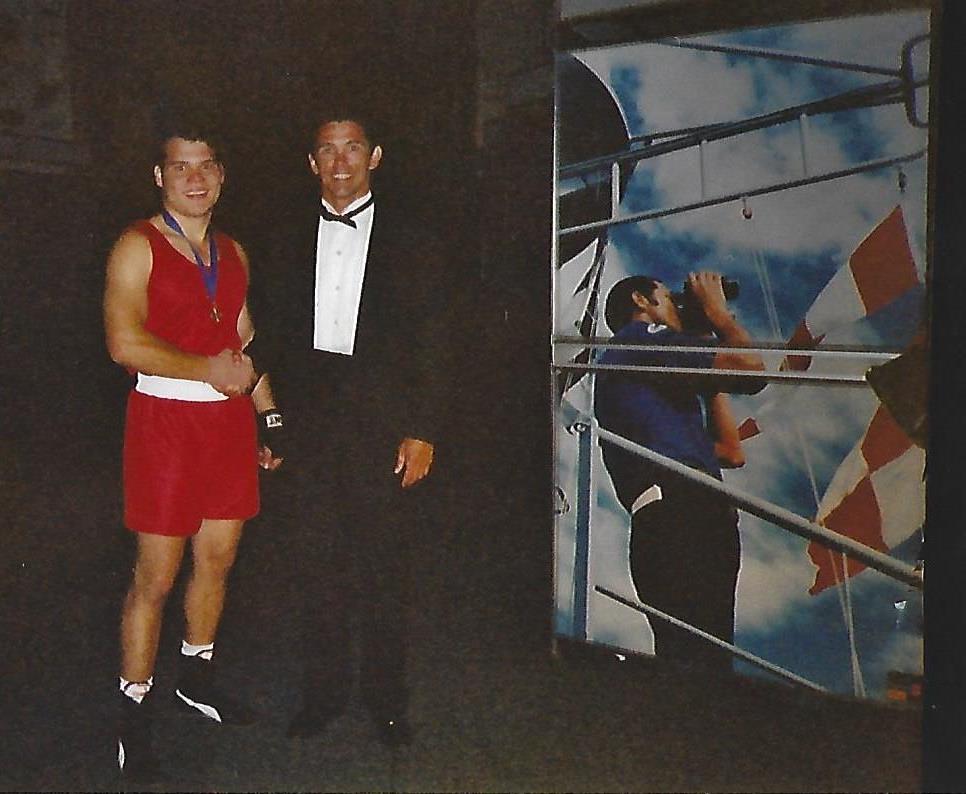
3_Claudio being congratulated by world champion Gary Murray after beating provincial champion Heindrich Pienaar

Claudio Chistè being congratulated by world champion Gary Murray after beating provincial champion Heindrich Pienaar.

Legacy of Community Outreach makes social impact

It was these experiences which led Claudio to hold training camps for military personnel assisting in training aspiring paratroopers in preparation for their gruelling parabat selection, and to organise this community outreach programme which has since gone on to be an inspirational training ground for aspiring Olympic boxers and South African national champions. This project received praise from the University of Stellenbosch and the Military Academy, SANDF for community service in social upliftment, consequently promoting the perception of the defence force amongst the local community.

At the time, organiser Chiste stated with what now seems a prescient understatement, “I think it was very successful. There were about fifteen kids who really showed talent and if we got them interested, we’ve achieved our goal”, adding: “The idea was to let them have fun while learning a skill to exercise their bodies and develop their minds”. This laid the seeds for follow on outreach programmes, which indeed provided a learning environment for the acquisition of these skills. A case in point being  Gregory “The Hitman” Gans, where at the age of only 13 he attended one of the follow-on outreach programmes, showing tremendous talent. With extremely hard work and dedication he obtained his National Colours (Protea) for Kickboxing within the first year of starting with the sport. He won the SA Kickboxing Championships and was selected for the National Team where after he represented South Africa in an international bilateral competition against Mauritius and won his fight with a spectacular knock-out. He went on to represent South Africa in numerous international events, including two World Kickboxing Championships in 2012 and 2014 whereby he brilliantly achieved second place during both World Championships (1).

The link in South Africa with the military and boxing are deep rooted.

Fist-fighting as a sport came to South Africa only during the first British occupation of the Cape in 1795 (preceding even soccer and rugby 1862), with boxing as a sport being one of the legacies of colonialism. Bouts were conducted under the London Prize Ring rules for close on a century but illegal bare-knuckle fights-to-a-finish were common in military camps in Cape Town and the Eastern Cape. In fact, one of the earliest references to boxing in South Africa is a report about the arrest of two characters, Japie and Mahmoud, after a fight in Cape Town in the early 1860s (2).

Perhaps the overall impact of this sport was best summed up by Professor Njabulo Ndebele who researched extensively the effect on the community when he said at a recent seminar, “What is also fascinating is to reflect on the contribution of boxing to one’s moral compass and character. The values espoused in the ring. The restraint of power. The demonstration of discipline and self-control. A code of conduct. These men have huge potential to injure but instead there is an instinct to protect – to win through technical skills, thought and the following of the rules”.


Sources:
Sunday Times, Die Weslander, Boxing World, Military Academy Yearbook, Department of Defence, Supersport.
(1) Source: http://www.dod.mil.za/defence_people/PteGans.htm
(2) Source: https://www.supersport.com/boxing/blogs/ronjackson/SA_boxings_Happy_Anniversary

Cpl. Ngobese joins a proud legacy of bravery in 7 Medical Battalion Group

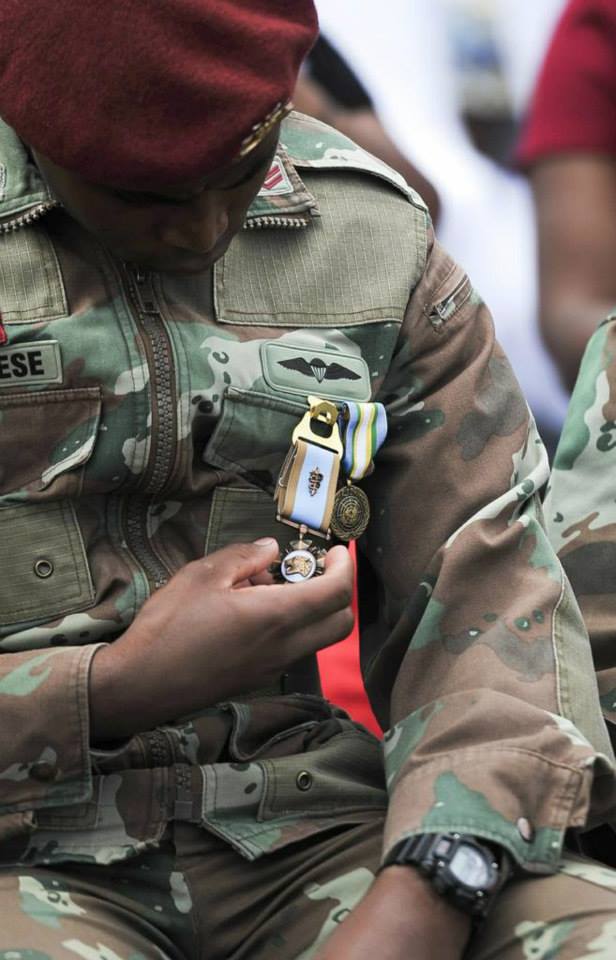
Celebrating South African heroes – here Corporal Mandla Maxwell Ngobese from 7 Medical Battalion Group – South African Military Heath Service looks down on his newly presented decoration for bravery – the Nkwe ya Boronse (Bronze Leopard) decoration for valour and joins a proud tradition of this special unit.

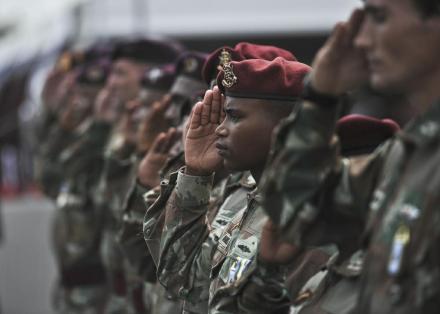
Elements of 7 Medical Battalion partook in the Battle of Bangui in the Central African Republic. The battle has been described by military analysts as one of the hardest-fought actions ever by the South African Army. During this battle which lasted from 22 March 2013 – 24 March 2013 a company of about 200 South African paratroops supplemented by a small number of Special Forces members was attacked, near their base in the outskirts of Bangui, by a reb10676374_353960348107037_5707337649502288620_nel force estimated to be up to 3000 strong. During this action 13 South African paratroopers were killed and a further 27 wounded. Rebel losses are estimated to have been well over 800. For their actions during this battle three members of 7 Medical battalion; Sergeant Mampa Serole Colman, Corporal Ngobese Mandla Maxwell and Corporal Nkoana Molatelo Alphina were awarded the Nkwe ya Boronse decoration for valour on 21 February 2014,
Also, together with 1 Parachute Battalion and 5 Special Forces Regiment, 7 Medical Battalion Group received battle honours for the first time.

7 Medical Battalion Group is the specialist Airborne Medical Battalion of the South African Military Health Service. The Battalion’s main task is to render medical support to the South African Special and Airborne Forces

These men join a proud tradition of recipients for valour from this Battalion, starting with Corporalfidler Bruce Andrew Fidler in 1985.  Bruce, also from 7 Medical Battalion Group was attached to 44 Parachute Regiment during Operations in Southern Angola.  A true hero who laid down his life for his friends. His unit was ambushed and in the ensuing firefight, he was captured by enemy forces on 15 September 1985 and subsequently Reported Missing.
Bruce was brutally tortured and interrogated by the enemy before being executed but he never once revealed the presence of his nearby unit thereby enabling the 7 Medical Battalion Group Surgical Team of between 5 and 10 doctors to successfully evade capture and reach South African lines. His remains were repatriated back to South Africa in June 1992. Corporal Bruce Fidler was posthumously awarded the Honoris Crux for his bravery and selfless devotion above and beyond the call of duty in the face of brutal torture. He was 21.

The Nkwe ya (Leopard) series – Bronze, Silver and Gold decoration series for the highest bravery in the military replaced the Honoris Crux – Bronze, Silver and Gold decoration series from 2003.

Thank you to Graham Du Toit for the reference on Bruce Fidler.

One Major accomplishment!

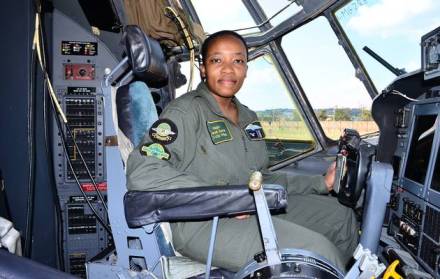
On Friday 23rd March 2017, this 31 year old Major not only touched down flying a C-130  military cargo plane at Waterkloof Air Force base‚ as part of her evaluation, she also went in the record books as the first black woman to qualify to fly this particular aircraft in the South African Air Force.

Her task was to fly the C-130 and be responsible for the safe arrival of both the aircraft and crew members on board from the Democratic Republic of Congo.

Congratulations Major Nandi Zama on breaking new ground for black female pilots and female pilots the world over.  You exemplify the fine values and traditions of your Squadron – 28 Squadron SAAF.

04

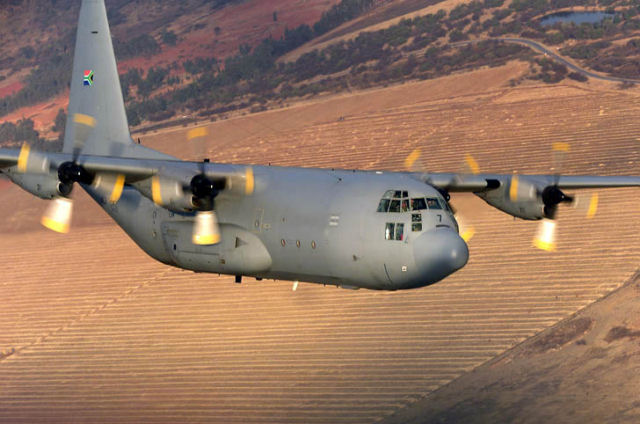
South African Air Force Lockheed Hercules C-130BZ from 28 Squadron with grey paint scheme

Related Link

Suzanne Dempsey; Another Major Accomplishment


Posted by Peter Dickens. Article and image reference Times Live

War in Darfur – Operation Cordite

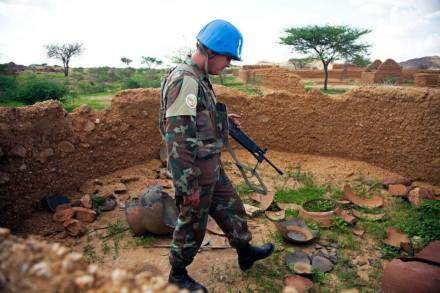
Looking into South Africa’s more recent involvement in Peacekeeping Missions in Africa.  Here, on  2 August 2010. South African National Defence Force (SANDF) Lieutenant Justin Heath, from Boksburg (greater Johannesburg), forms part of the UN peacekeeping mission to the Sudan for 7 months.

He is seen here patrolling in Tiksas, a village abandoned by the population some years ago due to the war in Darfur.

The War in Darfur is a major armed conflict in the Darfur region of Sudan, that began in February 2003 when the Sudan Liberation Movement (SLM) and Justice and Equality Movement (JEM) rebel groups began fighting the government of Sudan, which they accused of oppressing Darfur’s non-Arab population. The government responded to attacks by carrying out a campaign of ethnic cleansing against Darfur’s non-Arabs. This resulted in the deaths of hundreds of thousands of civilians and the indictment of Sudan’s president Omar al-Bashir for genocide, war crimes, and crimes against humanity by the International Criminal Court.

Estimates of the number of human casualties range up to several hundred thousand dead, from either combat or starvation and disease. Mass displacements and coercive migrations forced millions into refugee camps or across the border, creating a humanitarian crisis.

The Sudanese government and the JEM signed a ceasefire agreement in February 2010, with a tentative agreement to pursue peace. However, talks were disrupted by accusations that the Sudanese army launched raids and air strikes against a village, violating the Tolu agreement. The current situation is that the JEM, the largest rebel group in Darfur, vowed to boycott future negotiations.

Operation Cordite in Sudan began in July 2004 with the deployment of South African National Defence Force staff officers and observers to Darfur, Sudan, in support of the African Union Mission in Sudan (AMIS) It was an African Union (AU) peacekeeping force operating primarily in the country’s western region of Darfur with the aim of performing peacekeeping operations related to the conflict in Darfur.

The AU mission was terminated in December 2007 when it was integrated into the United Nations mission to form the UN African Mission in Darfur (UNAMID) in January 2008. it was the first African Union-United Nations hybrid mission. An Infantry Protection Company and an Explosive Ordinance Disposal Unit were added to the deployment, which was increased further in February 2005.

Operation Cordite made an immense contribution to the successful referendum on the future of Sudan, which resulted in the relatively peaceful division of the country into two: Sudan and South Sudan. Additional South African soldiers were sent to Juba, the capital of the new country, South Sudan, to assist with security for the independence celebrations in July 2011. In addition to this, South Africa also helped secure the air space for the duration of the celebrations. South Africa also trained police, prison officials and air traffic controllers: currently stationed at Juba International Airport

However typically, successful military operations are so often undermined by political antics of governments and Operation Cordite is no different.

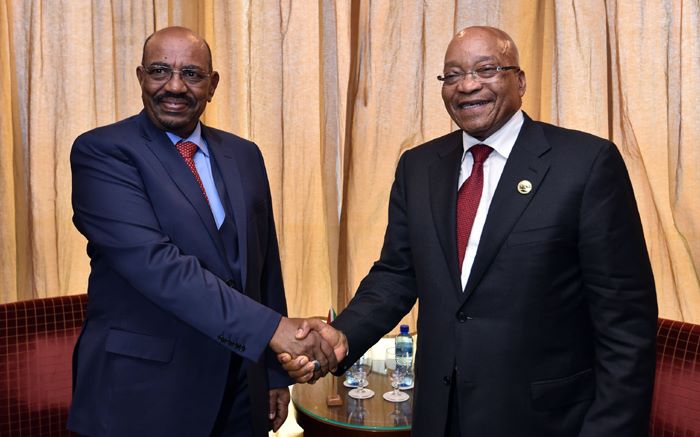
In April 2016, South Africa withdrew it UN forces from Sudan, ending Operation Cordite after a short and unspecific Presidential statement – coincidentally and unsurprisingly it was marred with controversy and against a backdrop of political scandal which started in June 2015 when President Omar Al Bashir – who was visiting South Africa to attend an African Union summit, was allowed to escape South Africa in a private jet.

His escape, allegedly with the connivance of President Jacob Zuma, came in defiance of an order by the South African High Court, pending a decision on whether to hand Al Bashir over to the International Criminal Court (ICC) in The Hague in accordance with international arrest warrants for genocide and crimes against humanity.

The decision remains highly controversial in South Africa today, so too South Africa’s strained relationship with the ICC (South Africa taking the standpoint that the ICC should not interfere in South Africa’s legitimate obligations to African Union AU).

150904ZumaBashir-jpg

The repercussions on how South Africa sees its compete military role in United Nations Peacekeeping remains to be seen, hopefully in future it will positively underpin the great work of the majority of good South African men and women who enter the armed services and have the privilege of wearing the United Nation’s “Blue Beret”.

Photo copyright Albert Gonzalez Farran / Unamid

The sad fate of Pelican 16

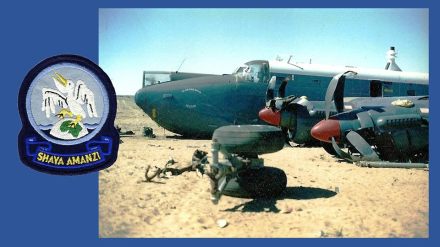
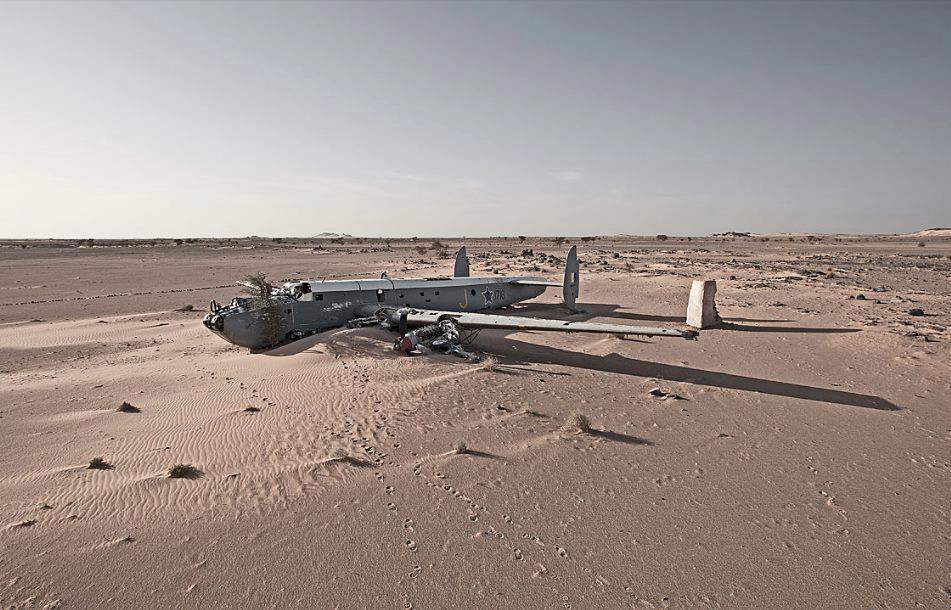
South African Air Force Shackleton 1716 – Pelican 16. This iconic image by photographer Dietmar Eckell for his photo book ‘Happy End’ – stories about miracles in aviation history, says it all.  The fate of Pelican 16 carries with it a tale of heroism and sadness.

946677_160793137423760_1438426949_n

Restored to flying condition by volunteers in 1994, Pelican 16 was offered to take part in the Fairford Military Air Tattoo in the United Kingdom and departed South Africa for England on July 12th, 1994.

The departure from Cape Town (CT) was scheduled for a midnight take-off, on Friday 08 July 1994.  The entire flight from CT to the UK, entailed four legs, with stops in between and the routes were planned for as follow:

a. CT to Libreville, Gabon
b. Libreville to Abidjan, Ivory Coast
c. Abidjan to Lisbon, Portugal
d. Lisbon to Duxford, England

(The return flight to SA, one month later, would have been just the reverse of the above route.)

Flown by a group of active SAAF pilots, Pelican 16 was operating over the Sahara desert  on the night of July 13th.  They were alerted to a warning on #4 engine, indicating signs of overheating, the engine was shutdown, as a precautionary measure and power was increased on the other three engines, in order to maintain the safety altitude.

The propellers on #4 feathered properly. The reason for the indication of overheating, can be contributed to a suspicion of a possible leak within the coolant system. However, within approximately 15 minutes after shutting down #4, sparks were seen emitting from #3, which ensued into flames around the contra-rotating propeller spinners.

The #3 engine was also shutdown, after the flames were successfully extinguished by the activation of the engine fire extinguishing system. However, after shutting down #3, the propellers would not feather completely and remained windmilling at +- 150 RPM.

The aircraft was now rapidly losing height and it was elected to restart #4 to gain height again. Within +- 10 minutes after restarting #4, the engine became so hot, that the exhaust stacks reflected a white magnesium glow. #4 was then shutdown for the second time, but this time round the propellers would not feather completely and they kept windmilling, much faster than those of #3, at +- 650 RPM.

With two sets of windmilling propellers, both on the same wing, a crash landing became inevitable, as asymmetric forces began to gain the upper hand.

The terrain where the crash landing was eventually executed, (approximately 14 km from the Eastern border of West Sahara with Mauritania), was indeed flat sands, but with multiple rocky outcrops in the area. In fact, the impact was, very fortunately, right on top of a slightly raised rocky outcrop and from there the aircraft skidded along the sandy surface, until she suddenly slewed by 90° to the left and thereafter skidded sideways to the right, before coming to a standstill.

The distance from point of impact and coming to a standstill, was paced off later that morning, after it became daylight, to be 243 metres – a very short landing for a Shackleton!

The failure of #3, was determined to be a probable Translation Unit (TU) failure. The TU is situated between the two contra-rotating propellers, inside the engine cowlings. It is attached to the front propeller by three rack bolts and it governs the rear propeller. After removing the front spinner from #3 engine later that morning, quite a few ball-bearings were found to be strewn inside the spinner. That confirmed the suspicion of a TU failure, which resulted on account of the rack bolts that pulled the TU apart. The latter can only be surmised that the cause was on account of the increased RPM on the three remaining engines, after #4 was initially shutdown. Why it happened, is still unknown.

Though none of the crew were seriously injured by the landing, all 19 men were miles from any assistance and in the middle of an active warzone. The crew of Pelican 16 were quickly located and returned safely to South Africa.

Time of the crash landing was at 01h40 GMT.

1800227_252938768209196_496921211_n

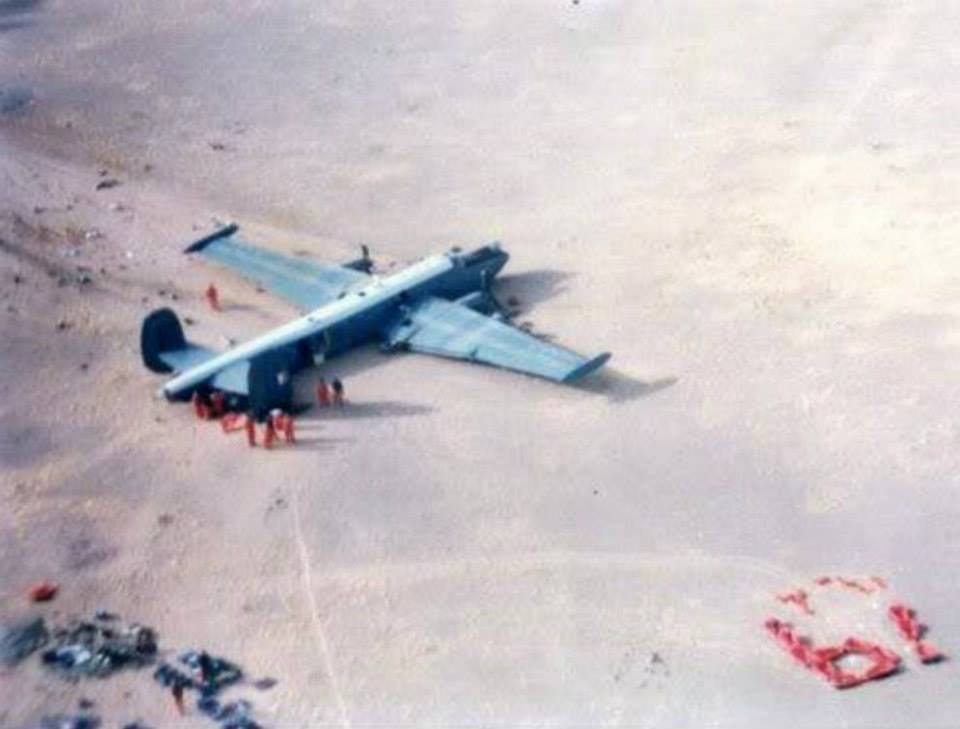
This is the photo taken from the French rescue aircraft “Pelican 16” taken after the belly landing in the Sahara desert – the ’19 OK’ written on the ground is to inform any rescue aircraft of the number of surviving souls from the crash.

The original sign on the ground was structured by the laying out of a combination of the spare orange flying suits and the single-man dinghies.

The word “OK” is no longer clearly visible when this photo was taken from the Atlantique ll Maritime aircraft, belonging to the French Navy’s 22 Squadron, that was on detached duty at Dakar, Senegal, from where it was scrambled at 04h00 GMT that morning, to conduct the search of the 19 souls of “Pelican 16”.

She is still where she landed – located about 2 hours drive from Zouérat in northern Mauritania in contested territory – lying open to the desert elements and subject to decay as there is no means of retrieving this beautiful aircraft.


Researched by Peter Dickens. Image Copyright Dietmar Eckell.  Information on the route and sequence of events written by Lionel Ashbury with his kind permission and assistance.