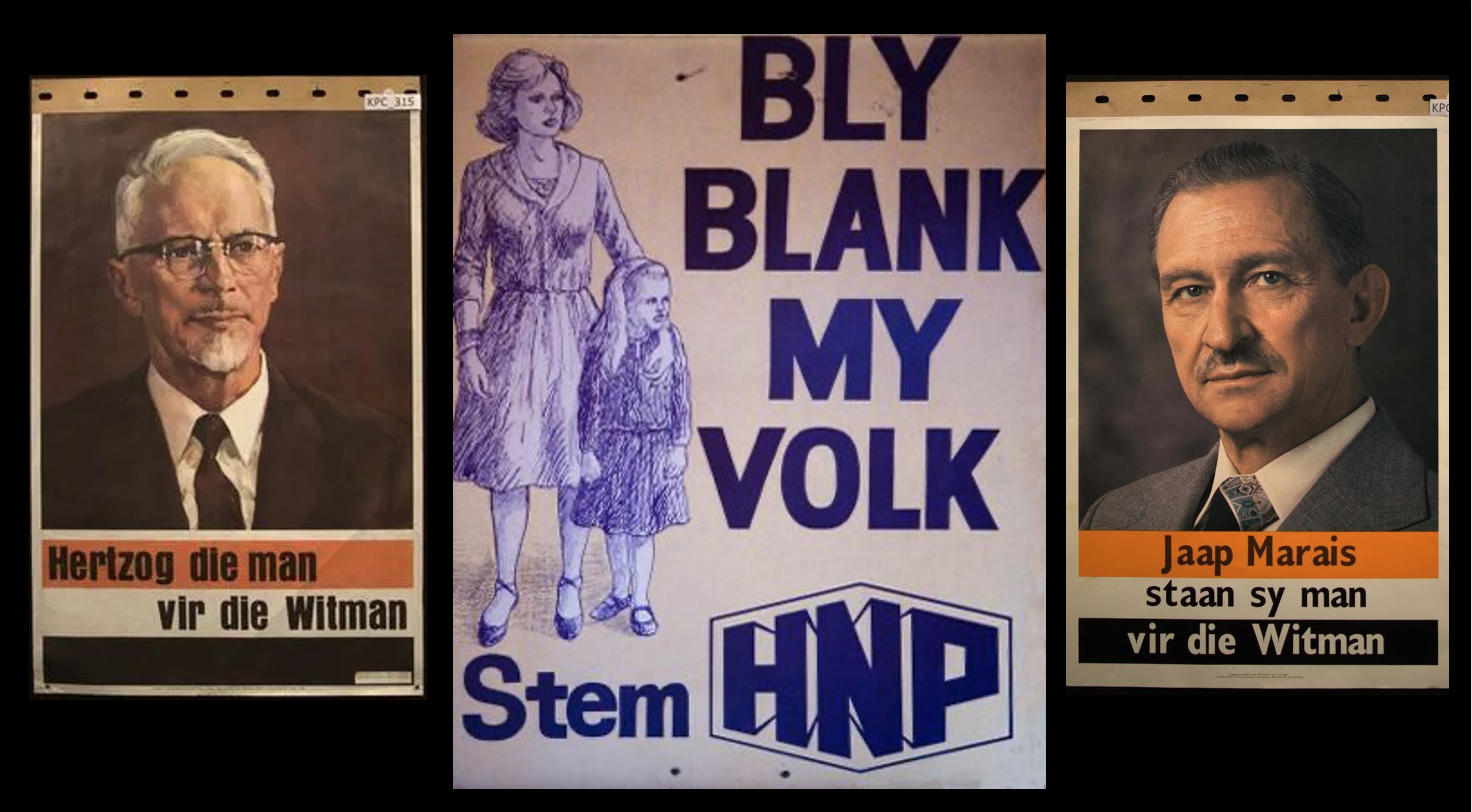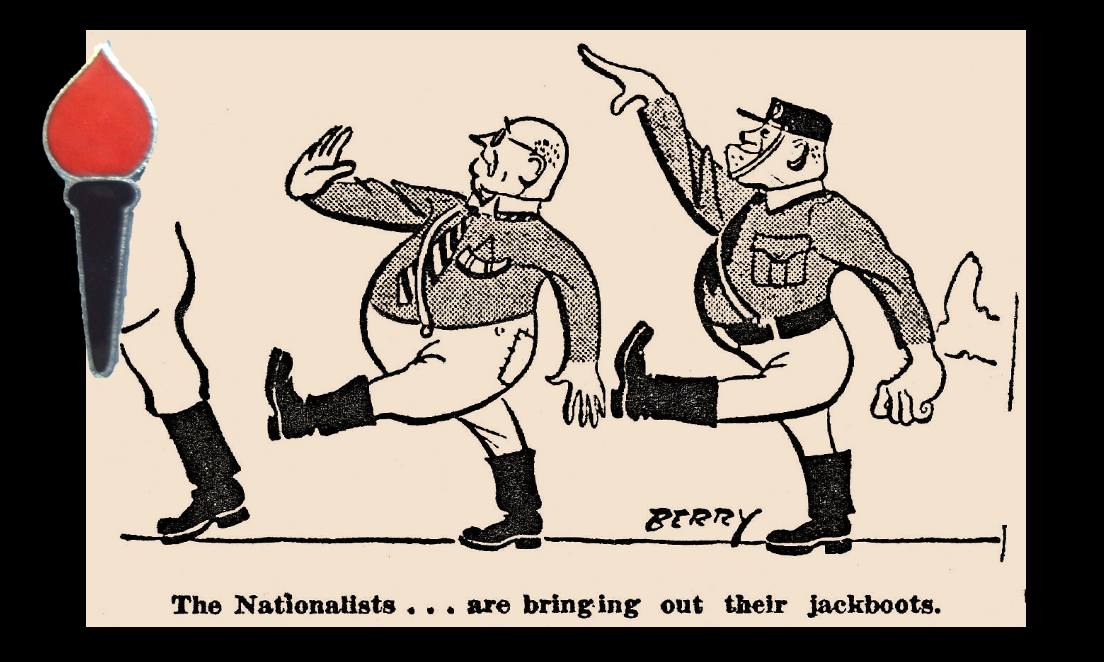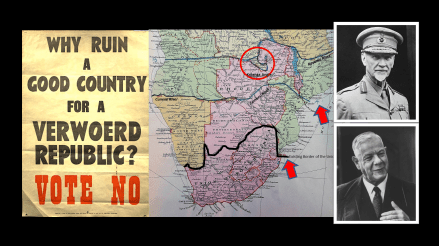
Inventing Apartheid – a Chronology

The Chronology of Apartheid: 1652 – 1952

In 2017 Hélène Opperman Lewis released a “psychology” book titled “Apartheid: Britain’s Bastard Child”, the name and cover image of a Boer child emancipated by disease in a concentration camp kicked off a latent voice of Afrikaner Apartheid apologists who held it up as proof positive – the British ‘invented’ Apartheid. She has been joined lately by Albert Blake, who in 2024 in his book on Jopie Fourie used a similar argument of a latent psychological trauma the British imparted on the Afrikaner nation as the raison d’exister for Apartheid.
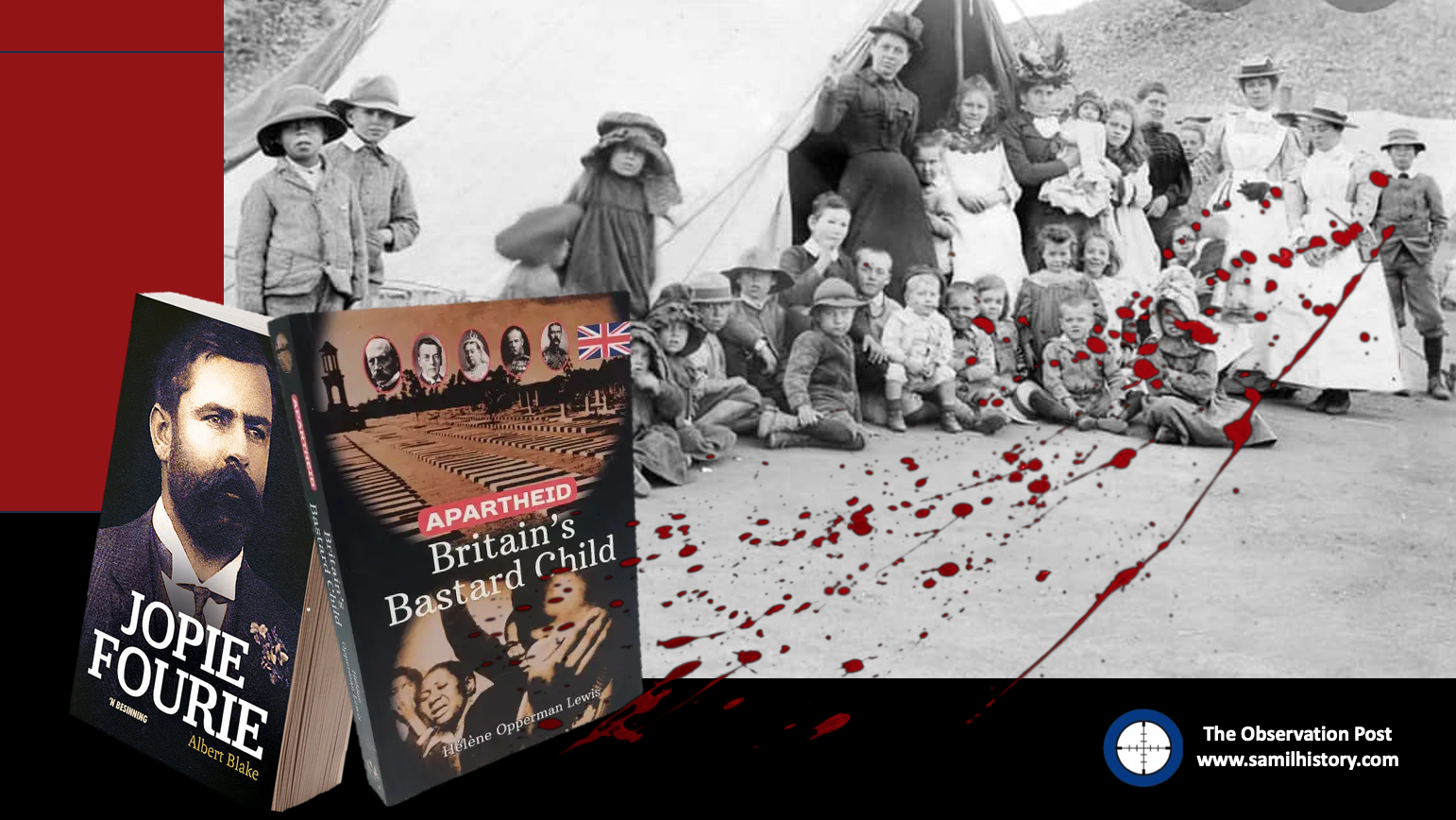
Despite Opperman Lewis facing serious criticism on trying to peddle a psychological book using the trauma and victim argument to claim ‘her people’ were unwittingly led to commit the crime of Apartheid – detractors noting that her argument was completely unhinged from nearly every history discipline – from historical sweep, the historical method, the chronological method, the archeological record all the way to simple economic history statistics. Despite this, these Neo Afrikaner Nationalists pointed to British Imperialism, Victorian paternal attitudes to “developing civilisations”, petty colonial segregation policies and trauma caused by British warmongering as the causes of Apartheid – not the fault of Afrikaners, the British did it – don’t you see!

Some even going as far as ignoring history completely and stating that Apartheid existed “unofficially” before 1948 anyway, and the only sin of Afrikaner Nationalists did in 1948 was simply to put down onto paper what was already there and define it as law – no foul, no harm, they just propagated what the “British started”.

So, let’s put Hélène Opperman Lewis and Albert Blake and their acolytes aside for a second, and do some proper historical sleuthing, come up with the “who done it”, who is really to blame for “Apartheid”. The chosen method is the basic historical method – the chronological method, and by using dates we will map the progression of Apartheid – from its origins to its final legal manifestations. Follow what the historians like to call “the golden thread” – the string that links the causal history together. At the end we hope to find who exactly is holding this particular “bastard child” as their own.

Nearly every historian, including all the predominant ‘Afrikaner’ historians, put the origins of Apartheid at the origins of slavery in the Cape – so, from a chronological method – let’s start there:

Apartheid – A chronology

1652 – Dutch arrive and form the Cape Colony in 1652 to service VOC shipping. Jan van Riebeeck lands his ships in Table Bay on 6 April 1652 with a small contingent of settlers.

1653 – First slave arrives at the VOC settlement from Jakarta the very next year in 1653.

1659 – First Khoikhoi–Dutch War, by 1672 – Second Khoikhoi–Dutch War, by 1677 the region and its peoples are subjugated by the Dutch. The slave trade continues to expand in the VOC settlement for the next 100 years.
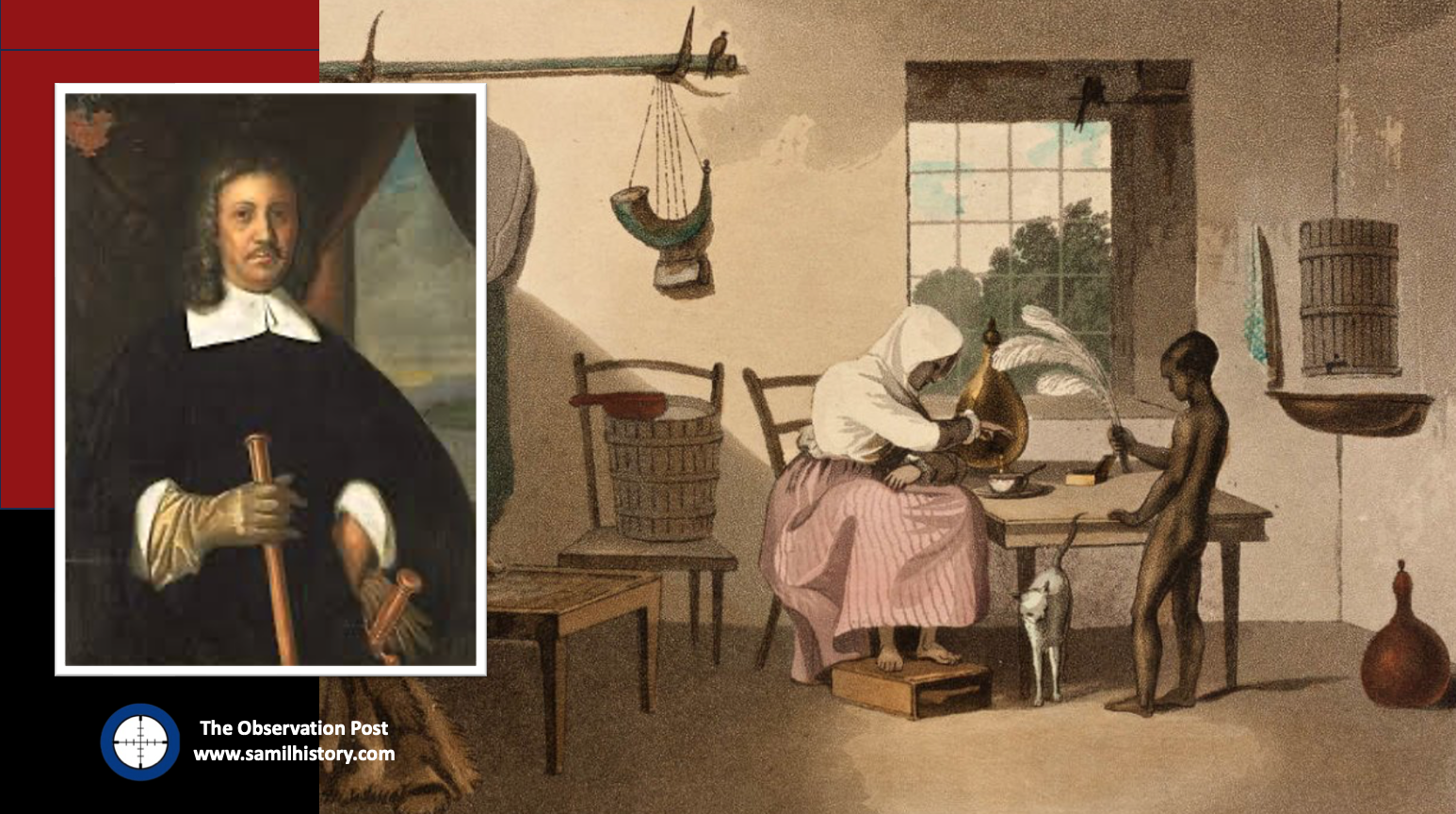
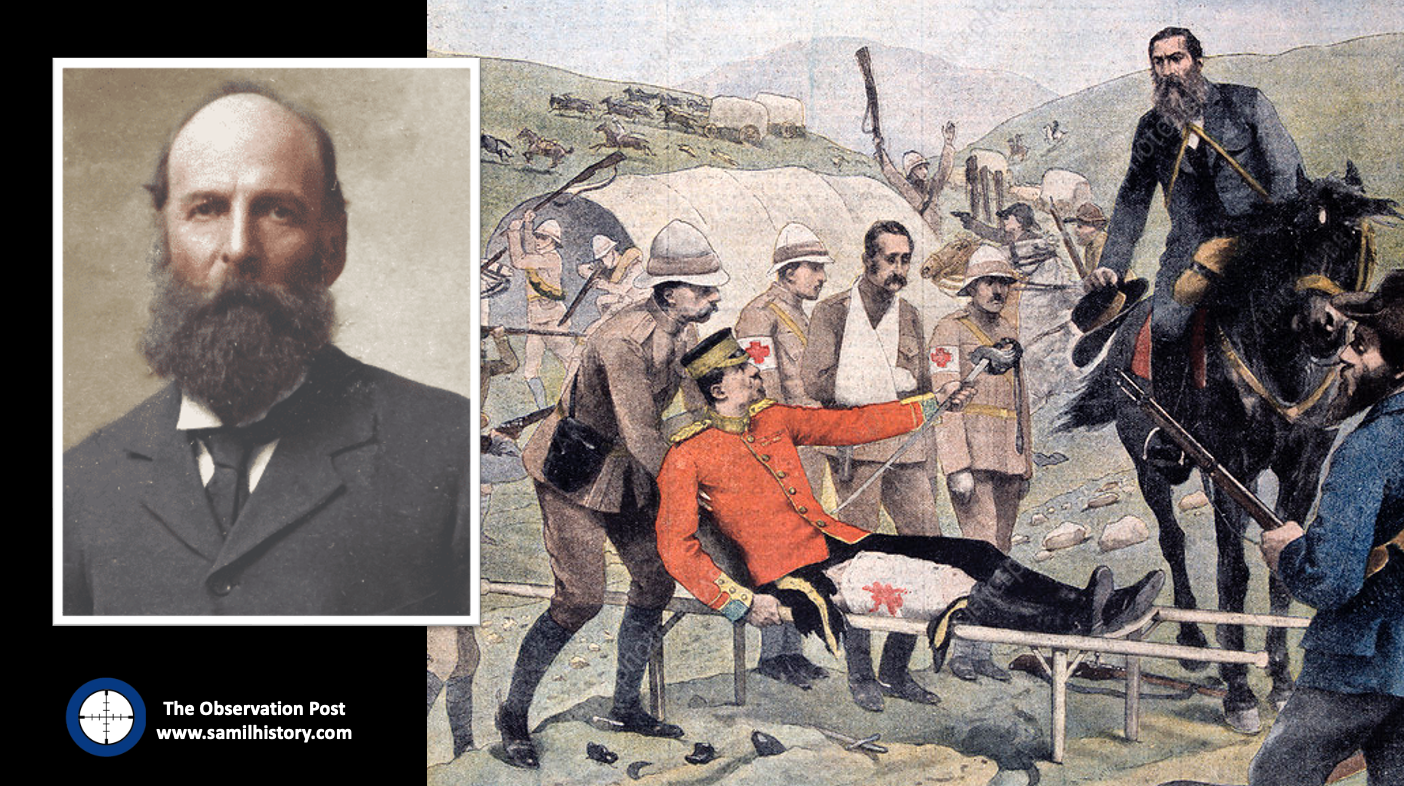
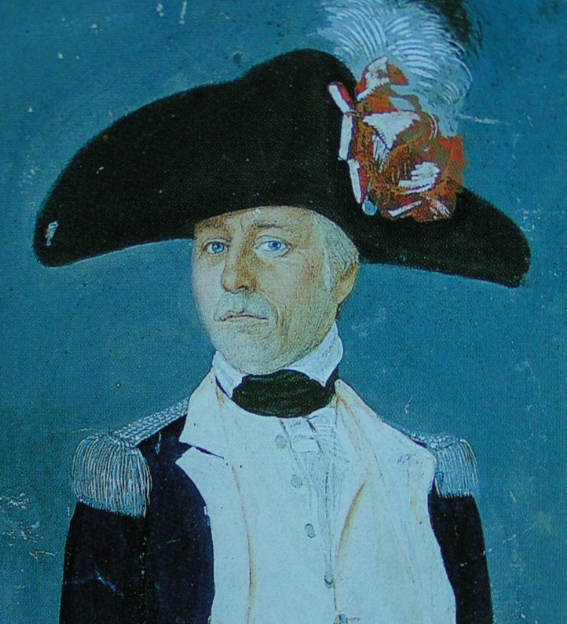
Slavery in the Cape Colony. Insert: Johan Anthoniszoon “Jan” van Riebeeck

From the mid 1700’s the Dutch VOC implements the Inboekstelsil’ system  on the outer borders of the Cape settlement – a policy of indentured slavery to initially capture Khoi and San children for an ‘apprenticeship’ period into adulthood – this done to fulfil demands for labour.

1795 – the French form the Batavian Republic and dispel with the Netherlands. The Cape Colony falls under Batavian rule. Slavery and Inboekstelsel systems in the colony continue.

The British occupy the Cape for the first time in response to activation of the Batavian Republic by the French – it’s short lived as the British settle a peace term with the Batavian vassal state and Napoleonic France – the Treaty of Amiens (1802) sees the British hand the colony back to Batavia.

1802 – Batavian rule again, slavery and indentured slavery practices in the Cape Colony continue.

1806 – The British attack the Batavian fort at their Cape Colony to forestall Napoleon’s troops strengthening the Cape Colony and the British re-occupy the colony as another Napoleonic War action (The Second Occupation of the Cape 1806).

1807 – British open their ban on slavery by banning slave trade between colonies in their empire. The Slave Trade Act 1807, officially an Act for the Abolition of the Slave Trade.

1814 – Dutch ‘Burghers’ dissatisfaction with the British occupation increases when the British specifically ban Dutch slave traders from entering any Cape port from 15th June 1814, squeezing labour supply.

1815 – Battle of Waterloo settles the matter of European control and occupied colonies, the Dutch sell their occupied Cape Colony to the British at the Congress of Vienna to aid in the re-establishment of their Dutch homeland in Europe for £6,000,000.1

1824 – The British negotiate territory from King Shaka to establish the Bay of Natal as a British trading post.

1829 – In the Cape Colony – the Dutch Reformed Church (DRC) or in Afrikaans the Nederduitse Gereformeerde Kerk (NGK) is now under British state authority. Puritan Burghers of Dutch/French and German decent formally request their DRC synod for separated black and white worship on he basis of a Puritan philosophy. It is denied by the DRC 1829 Synod who state:

‘Communion would be administered “simultaneously to all members without distinction of colour or origin.’

It is not a popular decision, Backhouse and Walker noted that in some parishes on the frontier:

‘the prejudices of the Dutch so strong, that some of them were much disturbed at the idea of the Hottentots coming into the “Kerk”; and they afterwards got up a protest against their being allowed to assemble there.’2

1834 – The British announced the full abolition of slavery, they also announced a universal qualified franchise vote putting a small number of ex-slaves and black male citizens who own property and have an education on the same footing as whites – some whites also find themselves on the same qualified footing as blacks. Due date – 1 Dec 1834. In the words of historian C.F.J. Muller:

‘The Afrikaans frontier farmer now got no satisfaction from Church and State.’3

1835 – Louis Tregardt is the very first Voortrekker to leave the Cape Colony in protest against the British legislation ending slavery, he is also wanted for cattle theft and gun running with the Xhosa – he also has no intention of releasing his slaves and takes them with him, one escapes and reports his position to the British authorities forcing him to ‘ditch’ the rest of his slaves and to carry on trekking north – his trek is a failure and disbands.4

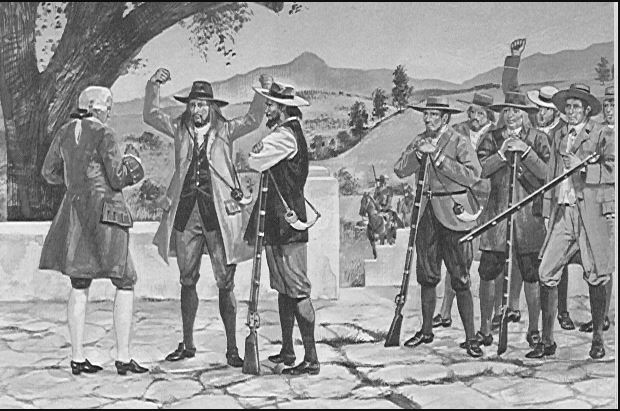
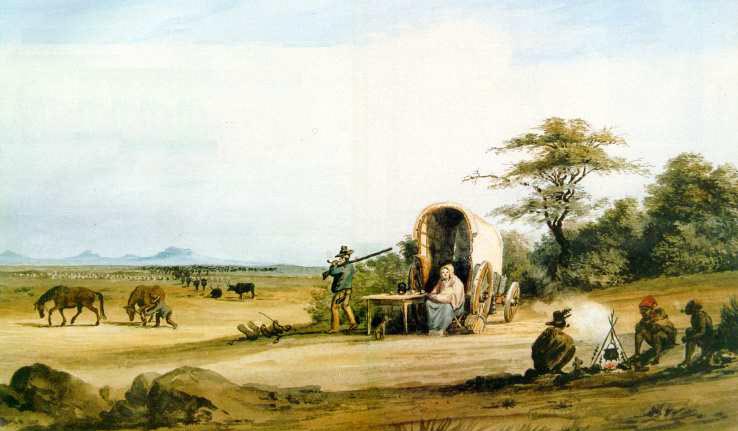
1837 – Piet Retief is the most famous of the Voortrekkers, in 1837 he leaves the Cape Colony – and his manifesto is published declaring discontent with the British for abolishing slavery, the terms of compensation thereof and for implementing a colour blind franchise. Included in their decision to “trek” from the colony is dissatisfaction with the colour blind worship and language status of their Dutch Reformed Church. 

These frontier farmers remain ‘Puritans’ within a strict Calvinist dogma regardless of their Church’s position on race – and this sentiment of outrage is captured by this famous quote by Retief’s sister, Anna Steenkamp who writes:

‘and yet it is not (‘the slaves’) freedom that drives us to such lengths, as their being placed on an equal footing with Christians, contrary to the laws of God and the natural distinction of race and religion, so that it was intolerable for any decent Christian to bow down beneath such a yoke; wherefore we rather withdrew in order to preserve our doctrines in purity.’5

This quote can be regarded as the epicentre of Apartheid as it becomes defined in future. 

The Dutch Reformed Church (DRC) i.e. the Nederduitse Gereformeerde Kerk (NGK) in the Cape Colony formally denounces the Voortrekkers – they leave anyway, The church’s next reaction is to refusal to permit of ‘any of its ministers to leave the colony with the Trekkers.’6
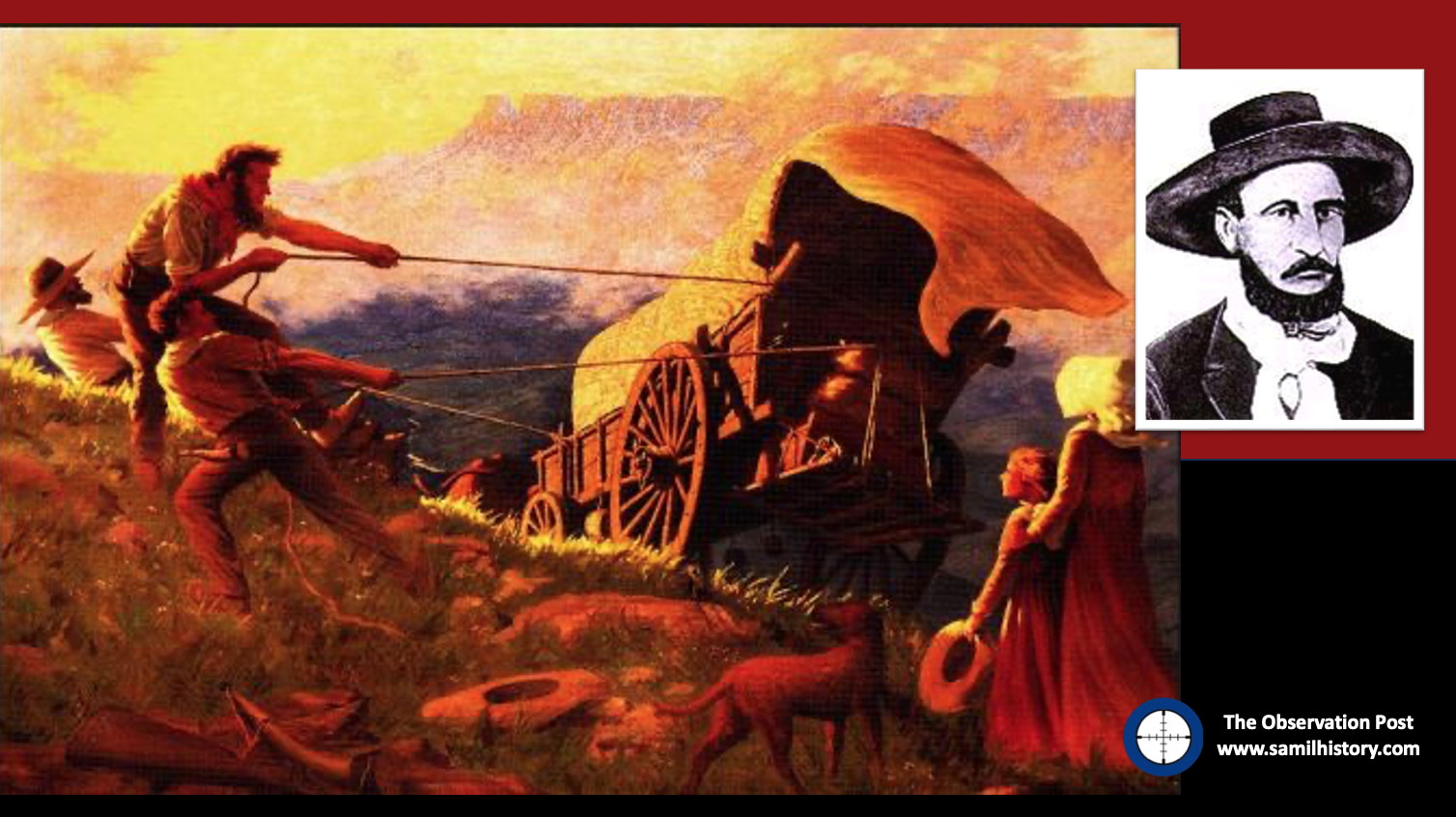
Voortrekkers – insert pic Piet Retief

The DRC – also known as the ‘gaatjieponders’ splits over the matter of the Great Trek and the Nederduitsch Hervormde Kerk (NHK) known as ‘Stoepsitters’ forms on 21 May 1837 as a ‘sister church’ of DRC to care for the puritan white Voortrekkers spiritual needs.

1838 – 6 February 1838 – Piet Retief’s party of 67 Boers and 30 of their black servants are murdered by Dingaan whilst negotiating land for a Voortrekker Republic. Later in the year – 16 December 1838, The Battle of Blood River takes place and is a resounding Boer victory.

1839 – The ‘unrecognised’ Republic of Natalia is established by Boers on 12 Oct 1839 with Pietermaritzburg as its capital. It’s ‘het publiek’ constitutional policy dissolves the Republic into administrative chaos. At war with nearly all neighbouring tribes, Zulu, Pondo and Xhosa and the British in addition, the Republic descends into further chaos.

1843 – In an ungovernable state, the Republic of Natalia’s Volksraad turn to the British for voluntary annexation when officially on 23 April 1843 it consented to Natalia becoming a British colony, on 8 August 1843 the Volksraad unanimously finalise the terms proposed by Lord Stanley, the new British ‘Natal’ colony would incorporate the Port Natal settlement and the Drakensberg is set as the northern limit.

There is a fundamental British condition in the formation of this new colonial expansion of Natal, it reads:

‘that there should not be in the eye of the law any distinction or disqualification whatever, founded on mere difference of colour, origin, language or creed.’7

Once again in countenance to Puritan Voortrekker values, unsatisfied with the political state of things, the loss of their republic and with a general dose of both Anglophobia and Afrophobia, a large group of Natalia Voortrekkers trek again over the Drankensberg into ‘Transorangia’ and into what would eventually become the Transvaal.

1848 – The British declare the area of ‘Transorangia’ i.e. the modern Free State, the area between the Orange and Vaal Rivers a ‘British Sovereignty’ (a colony) calling it the Orange River Sovereignty. They also bring with them the ‘Colour Blind’ qualification franchise as specified in the Cape and the abolition of slavery.

1852 – The Sand River Convention between the Boers and the British on 17 January 1852 establishes the Zuid-Afrikaansche Republiek (ZAR) – a combination of a number of small Voortrekker Republics in the region made up of migrating British colony citizens with varying constitutions now merged. The British delegation at the Sand River convention agree the formation of a fully independent ‘recognised’ ZAR Boer Republic on the proviso that they are not permitted to practice slavery. 

The initial ZAR constitution is ratified and it legally forbids anyone who is not a member of the Dutch Reformed Church (and related ‘sister’ Churches) from holding a voting franchise. Only ‘white’ adult males aligned to the DRC and its sister churches are allowed to vote – people of colour are specifically excluded – so too are white Jews and white Catholics. People of colour are given no political representation whatsoever, cannot vote and cannot own land, marriages are not legally recognised and they are even forbidden in the constitution from entering the ZAR’s ‘Raad’ (parliament).

The ZAR also implements the old Dutch Inboekstelsel system of indentured slavery targeted at indigenous peoples to supplement their need for real slaves and boost labour requirements for expansive farming – the average Voortrekker farm is 6,000 aches of land, in all they occupy a land mass bigger than Great Britain using a ‘grab and hold’ strategy when encroaching on native land.8 Trading of these indentured slaves on the ZAR frontiers even becomes known as ‘black gold’.  

A letter to Piet Joubert, who acquired many inboekstelsel slaves on his military campaigns as the ZAR Kommandant-General, summarises the brutality and manner of the inboekstelsel – sent to his wife it reads:

‘Please ask the General to let me have a little Malaboch kaffir, as of course there are some whose father and mother have been killed. I don’t mind if it’s a boy or a girl. I want one about seven years old, or any one that the General will give me’9

1854 – the Orange River Convention is held on 23 February 1854. Britain agrees to hand their “Orange River Sovereignty” over to Boer stewardship. The Boer Republic of the “Orange Free State” (OFS) was declared on the 23 February 1854, however a key condition for the establishment of the OFS is that it became a British Suzerainty (a British vessel or client state) – the conditions of the Suzerainty specify that the Boer Republic is ‘independent’ and responsible for its own ‘internal affairs’ in terms of self-governance whilst Britain has oversight for the ‘external affairs’ (foreign affairs) of the OFS. Issues of Black African emancipation, political representation and franchise are left to the OFS republicans to manage as an ‘internal affair’. Slavery is specified by the British as outlawed in the region and not permitted.

1856 – the ‘Colour Blind’ qualified Franchise as implemented in the Cape Colony by the British is now officially implemented by the British in the Natal Colony.10

1857 – The Dutch Reformed Church (DRC) holds a Synod in 1857 in the ZAR and makes allowances for separate worship – in a religious quandary it maintains conversion to Christianity as its goal for Black and Whites inclusively – however worship is separated on the basis of race – the “Groot Kerk” (Big Church for the Whites) and “Klein Kerk (Small Church for the Blacks). Sermons for both ‘Groot and Klein’ – Black and White services are run by the same white DRC Dominee. This decision was to have long-lasting ramifications. Unwittingly the church had provided:

‘An ecclesiological blueprint for the Nationalist policy of separate development of the races, or Apartheid’11

1858 – the ZAR State and DRC’s sister church, the Nederduitsch Hervormde Kerk (NHK) Church are synchronised as an Oligarchy on Theocracy lines.

1859 – the ‘Dopper’ Church – the Gereformeerde Kerke (GK) forms as an off-shoot of the Nederduitsch Hervormde Kerk (NHK) and a ‘sister’ church of both the Dutch Reformed Church and the NHK. Ultra Conservative – Paul Kruger is a Dopper.
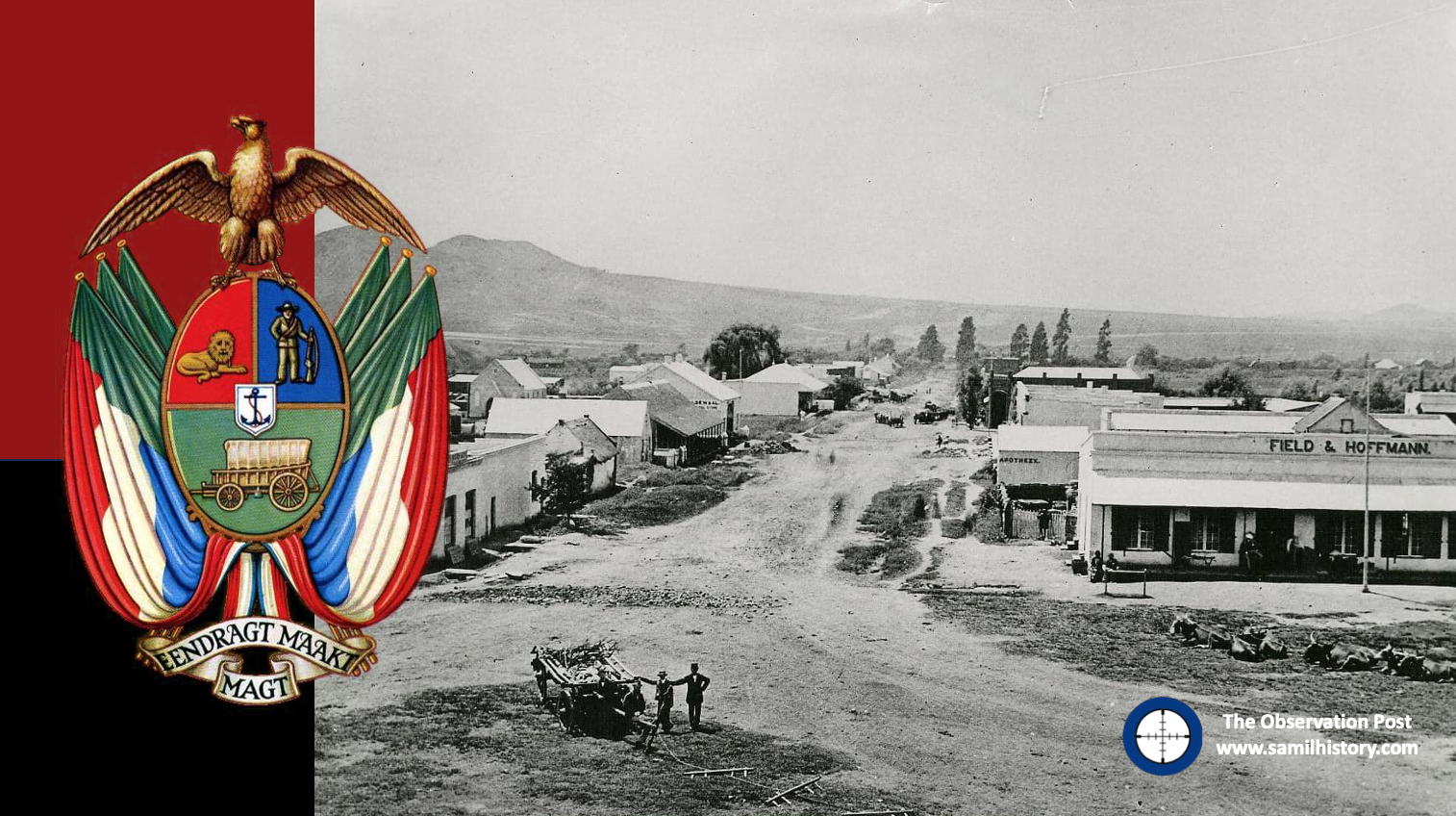
Early image of Pretoria, the capital of the ZAR – insert: the ZAR coat of arms

1860 – The ZAR constitution makes clear the legalities of Black emancipation in its territory when it declares:

‘The people are not prepared to allow any equality of the non-white with the white inhabitants, either in church or state.’

In the same year the British begin an indentured labour program of their own and 342 Indians arrive on board the Truro on 16 November 1860. The fundamental difference between the British “Indentured Labour” and the Voortrekker Inboekstelsel “Indentured Slaves” lies in the use of slave “apprenticeship” policies.

The Voortrekker ZAR Inboekstelsel system allowed for the aggressive capturing of black indigenous African children and holding them in a slave/master “apprenticeship” relationship. Slave Apprenticeships for African females lasted until they were 21 years old and for males it was 25 years old, thereafter the Indentured Slave had the option of been released (although this was not observed in remote frontier districts).12

The inboekstelsel labourer on release could also remain on the farm as a contract or paid worker, and as most were displaced anyway, many indentured slaves remained on the Boer farms as a sub working class in separate ‘kraals’ with no political or property rights whatsoever. Some 10% of the ZAR population qualified as inboekstelsil.

The British Natal Indian Indentured labour system was a 5 year work contract primarily on sugar cane farms or coal mining with minimal wage under very strict and unfair labour policies – which allowed for no labour or political representation for the work contract period – the conditions of work varied and in many instances qualified as an exploitative relationship and a miserable existence for the labourer. Thereafter the labourer could leave his indentured employer and become a ‘free man’, remain in Natal and open his own business or enter employment. If having served 2 indentured work terms (10 years) the passage back to India was free of charge.13

1865 – in terms of the Cape and Natal colonies – the British Westminster Parliament issues the “Colonial Laws Validity Act 1865” which allowed the colonies to pass legislation different from that in Britain provided that it was not repugnant to any law expressly passed by the Imperial Parliament to extend to that colony. This had the effect of granting British colonies more autonomy, to legislate free of Britain, within their own ‘internal’ borders.

1869 – The DRC Synod resolves to condemn the practice of the Inboekstelsel apprenticeship slavery system and within two years (1871) the DRC concludes the system no longer exists in the Zuid-Afrikaansche Republiek (although this is not strictly true).14

1876 – the ZAR heading into a financial crisis, facing bankruptcy due to a Voortrekker culture of non payment of taxes, and under threat from local African tribes. Led by Sekhukune I of the Pedi, a war in 1876 took place which is recorded as a Boer defeat. After losing the battle with the Pedi, the ZAR goes into confederation and protectorate negotiations with the British.

The ZAR President – Thomas Burgers and the British Representative – Sir Theophilus Shepstone, agree to the voluntary dissolving of the Republic and to the annexation of the territory by the British – the idea is a long standing British one of a Federation of loose states in Southern Africa under the British flag (paramountcy). In dissolving the ZAR ‘Raad’ Burgers points a finger at Paul Kruger and his cabal and cites the Inboekstelsil system and consistent conflict with indigenous tribes as the key causes for voluntary dissolution of the Boer republic and annexation and protection from Britain – he says:

‘It is you – you members of the Raad and the Boers – who have ruined the country, who have sold your independence for a drink. You have ill-treated the natives, you have shot them down, you have sold them into slavery, and now you have to pay the penalty.’15

1877 –  the British annex the ZAR, re-naming it “The British Colony of The Transvaal” – they open up immigration to white British settlers who become known as the “Pretoria Loyalists” and embark on a number of reforms. However, importantly, they do not immediately implement their Cape and Natal ‘colour blind’ qualified franchise in their new British Transvaal Colony.
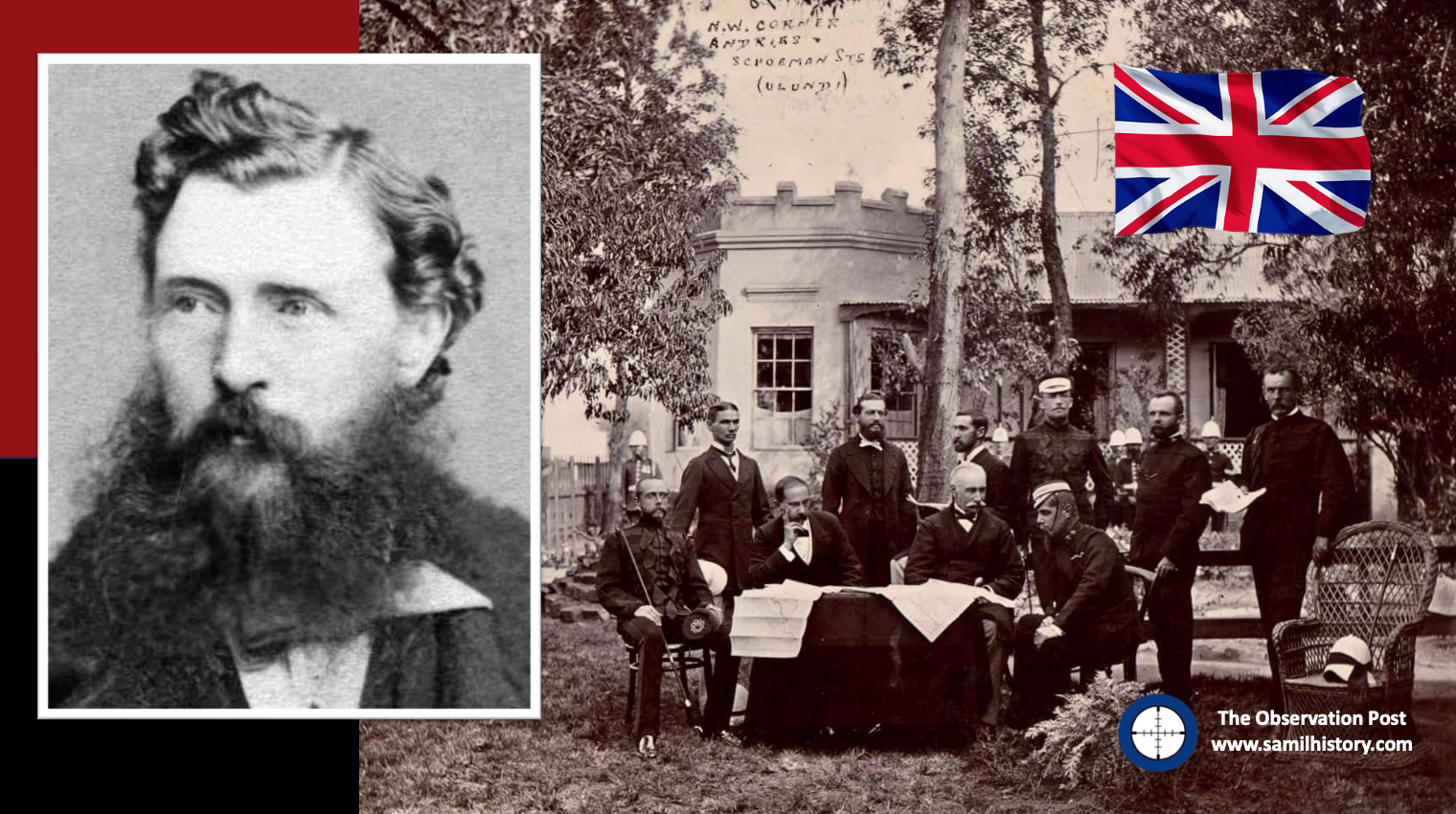
Annexation of the ZAR by Natal Mounted Police ceremonial guard – insert picture, the ZAR President Thomas François Burgers.

1879 – under ambitions for a British led Federation across the entire region, the British regional attentions switch to fighting the Anglo-Zulu war from 11 January – 4 July 1879, a British victory over the Zulu nation. The aftermath would see Zululand eventually annexed as part of Natal in 1897.

1880 – the Afrikaner Bond is established in 1880 to forward Afrikaner political ambitions. Within it lie the origins of Afrikaner Nationalism, which is a unification of Afrikaners across the all the states from the “Zambezi to the Cape” and calls for a Afrikaner led paramountcy16 in the region under the slogan:

‘Africa for the Africander’17

Later in the ZAR the “ox-wagon incident” takes place in November – an issue as to a Boer’s backdated tax, the incident brings up simmering Boer dissatisfaction with British rule. Led by Paul Kruger the Boers rise in a revolt on the 20 December 1880 and attack the British Garrison at Bronkhorstspruit. This marks the start of The Transvaal Rebellion (the first Boer War) in the British Colony of The Transvaal.

1881 – The Transvaal Rebellion ends with a resounding Boer victory over the British relief column at the Battle of Majuba on the 27 February 1881. With Pretoria’s garrisons still in the control of the British, the British sue for peace instead of a protracted rebellion.

A compromise is struck at the Pretoria convention, held on 3 August 1881, which re-established the Zuid-Afrikaansche Republiek (ZAR) re-named as The Transvaal Republic as a British Suzerainty state (a vassal or client state of Britain). The “Triumvirate’ Presidency” (shared Presidency) was officially recognised on 8 August 1881 by the British to oversee the running of the Transvaal Republic – it was made up of Paul Kruger, Piet Joubert and Marthinus Pretorius.

Under the conditions of the Suzerainty, the Transvaal Republic is permitted ‘independence’ to run all its own internal affairs as a Republic, however Britain remains in control of all the Transvaal Republic’s ‘external’ affairs (foreign affairs), its borders and enjoys a preferred status as to trade.

On the issue of Paramountcy and Federation, the Orange River Convention in 1854 specified upfront that the Orange Free State Republic was a British Suzerainty state, so British paramountcy was regionally assured with the Transvaal Republic becoming a Suzerainty state in addition.

On the issues of franchise and qualification, political rights are devolved to ‘internal affairs’ to be run by the Transvaal Republic.

1883 – Paul Kruger is elected as the President of the Transvaal Republic on 9 May 1883, ending the Triumvirate. He beats Joubert on election promises of increased Church involvement in State, an immigration policy in favour of the white Boer citizens, a cordial stance towards Britain and that the un-enfranchised majority of Black and Coloured citizens of the Transvaal Republic remain as:

‘obedient native races in their appointed districts.’18

From 1883 onwards, as President of the Transvaal Republic/ZAR, Paul Kruger comes to define a system of government and an ideology in the Transvaal known as “Krugerism”. Krugerism, extolled an anti-modernist social and economic order. Contemporary writers at the time almost unanimously conclude that Kruger himself headed this order:

‘as the Kommandant of a medieval oligarchy. Kruger was hemmed in by the “hurrying tide of civilisation”, leaving him and his following “rooted in the seventeenth century”.’19

Krugerism deepened the role of the Dutch Reformed Church and State as a Theocracy, whilst maintaining a white Protestant oligarchy in power. Franchise rights were still not afforded to Jews and Catholics and no political rights were afforded to ‘coloured’ or ‘native’ ZAR citizens whatsoever – even legally according to the constitution a ‘white’ man could not be tried in conjunction with a ‘black’ man in a ZAR court of law. Laws for each racial group were fundamentally separated as specified in the ZAR constitution. The language policy was ‘Dutch’ only in all facets of government and law.

Krugerism entailed compulsory “Commando” military commitments for all white Boer males per the constitution with “unusual” devolved powers to appointed “veldkornets” to marshal all white citizens – this, along with increased GDP focus on munitions, state intelligence services and state police (known as ZARPS) ensured the ZAR’s oligarchy was ensconced in power along the lines of a “Police State”.

Economically, Krugerism advocated ‘local’ (Boer) controlled monopolies to encourage manufacture called  ‘konsensies’ (concessions).20 Concessions extended to all facets of economic production, including eventually the infamous “dynamite” monopoly on mining.

1884 – desirous of returning the name of the region to the Zuid-Afrikaansche Republiek (ZAR) and desirous of full sovereignty as an independent republic and the removal of the British Suzerainty, a Boer delegation, including Kruger, is sent to London to re-negotiate the terms of the Pretoria Convention.

The London Convention is signed on 27 February 1884, the Republic is re-named the ZAR, however the issue of Suzerainty becomes key – the word “Suzerainty” is dropped from the pre-amble as a sap to Paul Kruger and his report back to his ‘Raad’, however all the legal constructs of the Suzerainty remain unchanged – the ZAR is permitted self governance for its “internal affairs” only, and the British still have full oversight of all the ZAR’s “external affairs” (foreign affairs), its borders and its preferred trade with the British status – the only exception that is made is ZAR’s foreign relations with the OFS. The ZAR remains a British ‘vassal state’ and is still not fully “sovereign”.
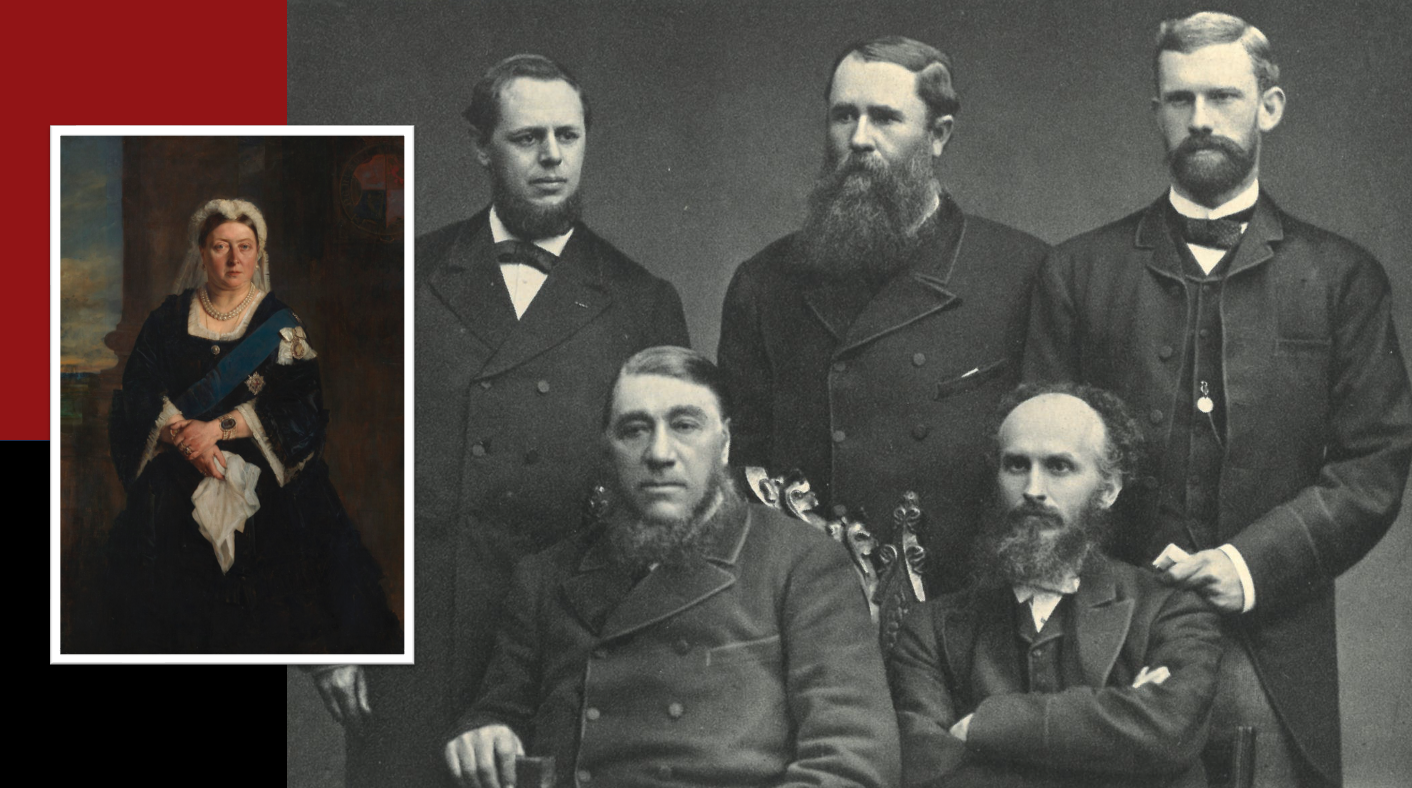
The Boer delegation to the London Convention 1884, insert picture Queen Victoria during this period.

On “internal affairs” the ZAR assures the British that white British citizens and white Boer citizens will enjoy the same equal rights status as they held in 1877 with no change – no such emancipation or political rights are specified for Black or Coloured citizens.

The London Convention was a poorly conceived compromise and the Suzerain unclear, the treaty would cause significant political abrasion and tension between Britain and the ZAR for the next 15 years.

1886 – Significant gold deposits are discovered along a reef known as the Witwatersrand in the ZAR, triggering a “gold rush” of large numbers of foreign miners – mainly British into the ZAR, but also significant numbers of migrant Black miners and labourers. Johannesburg is established and very quickly the demographic balance between white British settlers and white Boer settlers in the ZAR changes in favour of the British.

1895 – the Jameson Raid, 29 December 1895 to 2 January 1896 takes place – it’s a botched raid to enact regime change in the ZAR. The raid is made up of British privateers led by Starr Jameson with the support of ‘The Reform Committee’ led by mining Randlords on the ZAR’s gold reef. It is supported by the mining magnate and Cape Colony Premier – Cecil John Rhodes, and although the Raid takes place without the knowledge of the British foreign office and Westminster it leads to considerable souring of the British and Boer relationship. Kruger unsuccessfully attempts to have the 1884 London Convention and the Suzerain declared null and void because of what he sees as a breach of contract.

1897 – Alfred Milner is charged by the British with bringing matters to a head with Kruger and resolving the ZAR unrest situation, on the idea of implementing the colour blind ‘Cape Franchise’ in the ZAR, he writes to Herbert Asquith (a future Prime Minister) and says:

With your great two principles that (1) we seek to restore good relations between the Dutch (Boers) and the English and (2) we should secure for the natives … adequate and sufficient protection against oppression and wrong … the object No.2 is the principle obstacle to the attainment of object No.1 … I should feel quite confident of been able to get over the Dutch-English difficulty if it were not so horribly complicated by the native question.’21

In a letter to a friend, Milner would further lament on the complication of dealing with the ‘native question’ and the ZAR and says:

‘(If I did not have) some conscience about the treatment of blacks I personally could win over the Dutch in the Colony and indeed all the South African dominion without offending the English. You have only to sacrifice ‘the nigger’ and the game is easy. Any attempt to secure fair play for them makes the Dutch fractious and almost unmanageable’.22

Kruger flouts the 1884 London Convention restrictions on foreign affairs unilaterally approaching France and Germany for support and he challenges the suzerainty. On 6 March 1897 Joseph Chamberlain writes to Kruger to remind him that the ZAR is still a British suzerain, and he is also in violation of laws concerning emigration of foreigners – in contravention of Article 14 of the 1884 Convention.23

1898 – The British historian, Professor Andrew Roberts FRHistS FRSL would summarise Krugerism at this juncture. The ZAR, although a Republic in name was in no way a democracy. Jews and Catholics were forbidden to hold office, Johannesburg was not allowed a municipal council, English was banned in all official proceedings, the Judiciary was appointed by Kruger, Kruger controlled all the government monopolies, no open air public meetings were permitted, the freedom of the press was not guaranteed and …

‘Above all, full citizenship was almost impossible to gain for non-Boers. Pretoria ran a tight, tough, quasi-police state.’24

In terms of Church and State, although ZAR is a Oligarchy, Krugerism brings Dutch Reformed ‘Churches’ closer, so much so the ZAR at times resembles a Theocracy and the Raad busies itself with passing legislation that appeases God. An example was a debate in 1895 which forbid the firing of explosives into clouds to induce rain or firing a weapon into the sky as these actions were deemed as ‘being offensive to the Almighty’.25
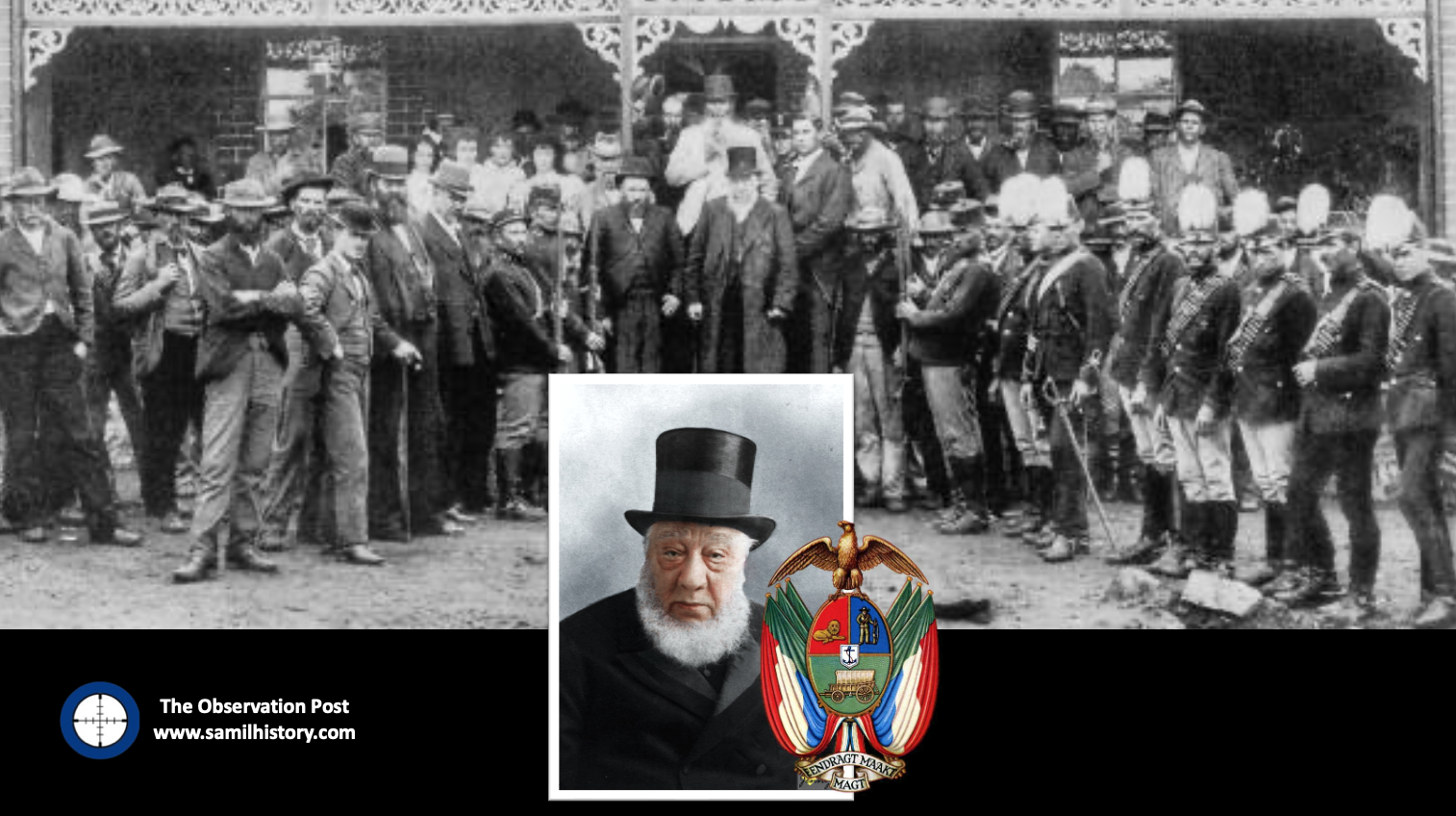
President Paul Kruger and his cabal.

1899 – With growing imbalance of voter demographics and tensions resulting in political instability in the ZAR, Paul Kruger would seek to consolidate power into Boer hands and unshackle the Suzerain preventing “full” Boer independence of Britain. He would do this through leveraging and denying of political rights and the franchise for white protestant British gold miners now making the ZAR their permanent domicile.

The issue of “political rights” for all the new ‘foreign’ settlers in the ZAR of all colours and creeds and “political freedom” from Britain for the Boers would play the pivot role in the Casus Belli of an upcoming war – the South African War (1899-1902).

With tensions rising over the franchise qualification period and the Milner and Kruger negotiations and breakdown thereof from 30 May to 6 June 1899, both sides start to prepare for war. Whilst in a numerical advantage, the two Boer Republics declare war on Britain on 11 October 1899 by way of an ultimatum followed by a military invasion of all neighbouring British colonies.

F.W. Reitz issues ‘A Century of Wrong’ (in conjunction with Jan Smuts) as an explanation for the Boer Casus Belli – he concludes it with the Afrikaner Bonds nationalist slogan calling for an Afrikaner led paramountcy in Southern Africa. It reads:

As in 1880, we now submit our cause with perfect confidence to the whole world. Whether the result be Victory or Death, Liberty will assuredly rise in South Africa like the sun from out the mists of the morning, just as Freedom dawned over the United States of America a little more than a century ago. Then from the Zambezi to Simon’s Bay it will be: “AFRICA FOR THE AFRICANDER.”26

1900 – from January 1900, the British ‘Army Force’ starts to land. Bloemfontein, the capital of the OFS falls to British forces on 13 March 1900. Pretoria, the capital of the ZAR falls on 5 June 1900. Thereafter the Boer Forces change strategy from conventional warfare to unconventional “hit and run” guerrilla warfare focusing primarily on extended British lines of supply and razing ‘hensopper’ (surrendering Boers taking oaths of loyalty) farmsteads, ‘Joiner’ (Boers joining British forces) farmsteads and British Loyalist farmsteads.

This in turn forces the British to focus on the localised Boer Commandos lines of supply – their ‘bittereinder’ (Boer Forces refusing surrender) farmsteads – and a controversial ‘scorched earth’ policy to raze these farmsteads is implemented – this is done along with a “refugee camp” (concentration camp) policy to deal with all the civilian displacement, comprising both loyalist civilians displaced by Boer actions and bittereinder civilians displaced by British actions.

1901 – Two vastly different types of British “refugee” camps emerge – ‘white’ Boer “concentration” camps taking in displaced white men, women and children of Bittereinders, Joiners, Hensoppers and loyalists (and the odd Black servant) – these camps are run along the lines of tented refugee camps and internees are provided rations (albeit limited), shelter and not forced to labour.

‘Black’ “concentration” camps taking in displaced native farm labour, again men, women and children, are however fundamentally different to the white Boer camps, they are more rudimentary, rations and shelters are highly limited and are purchased in exchange for work. Ultimately these camps are run along the lines of labour camps in support of British ‘Total War’ military objectives.
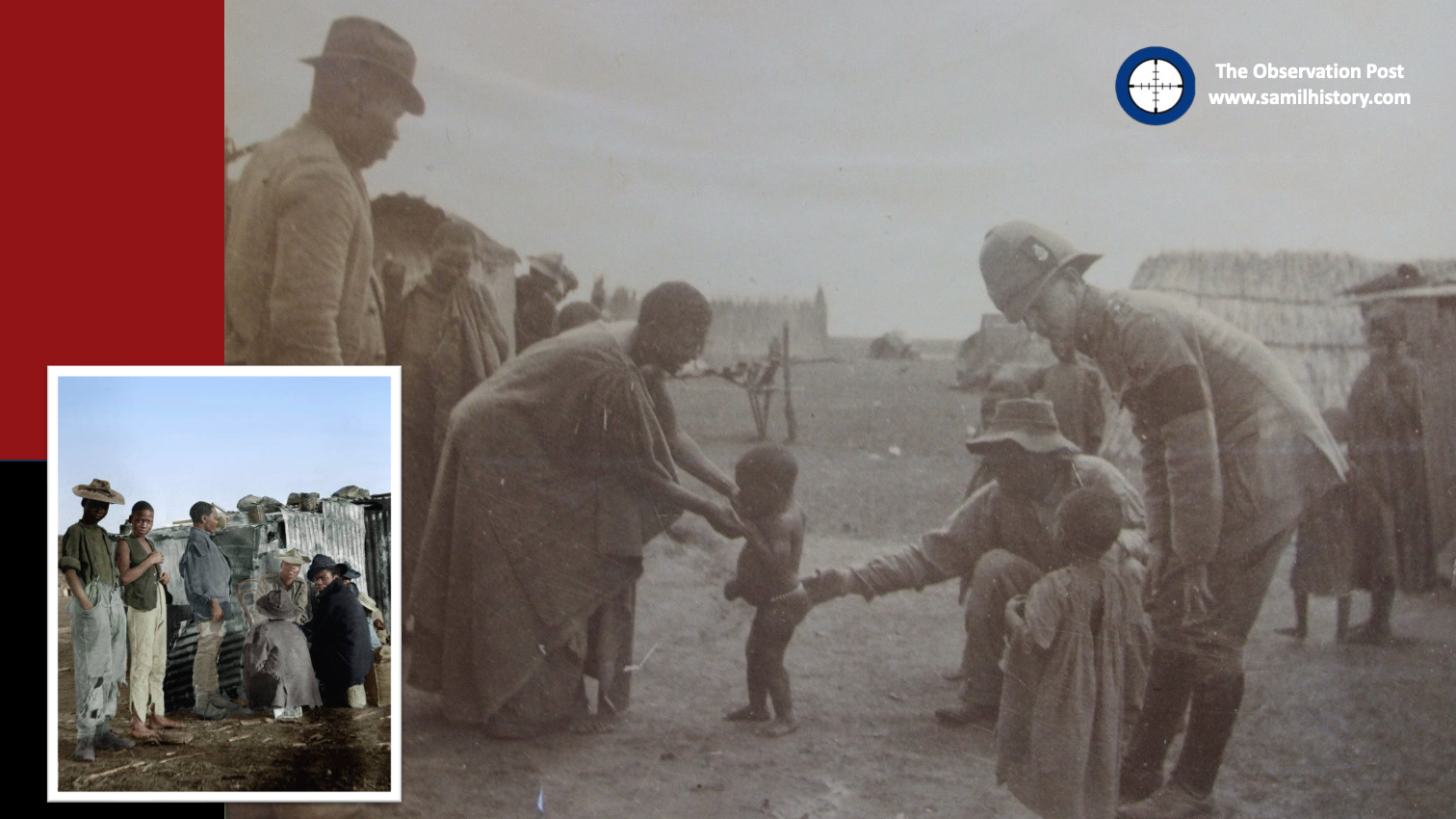
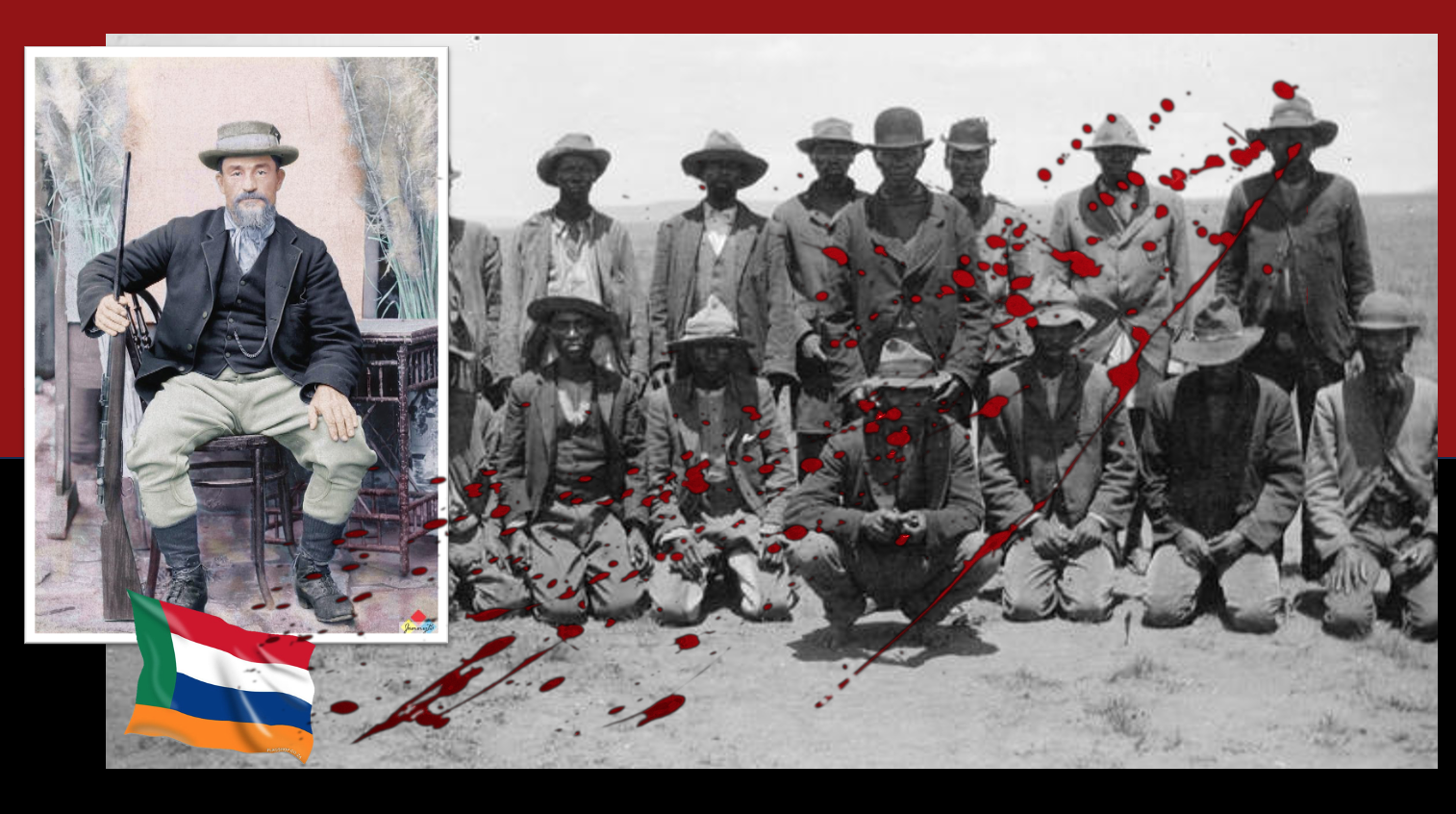
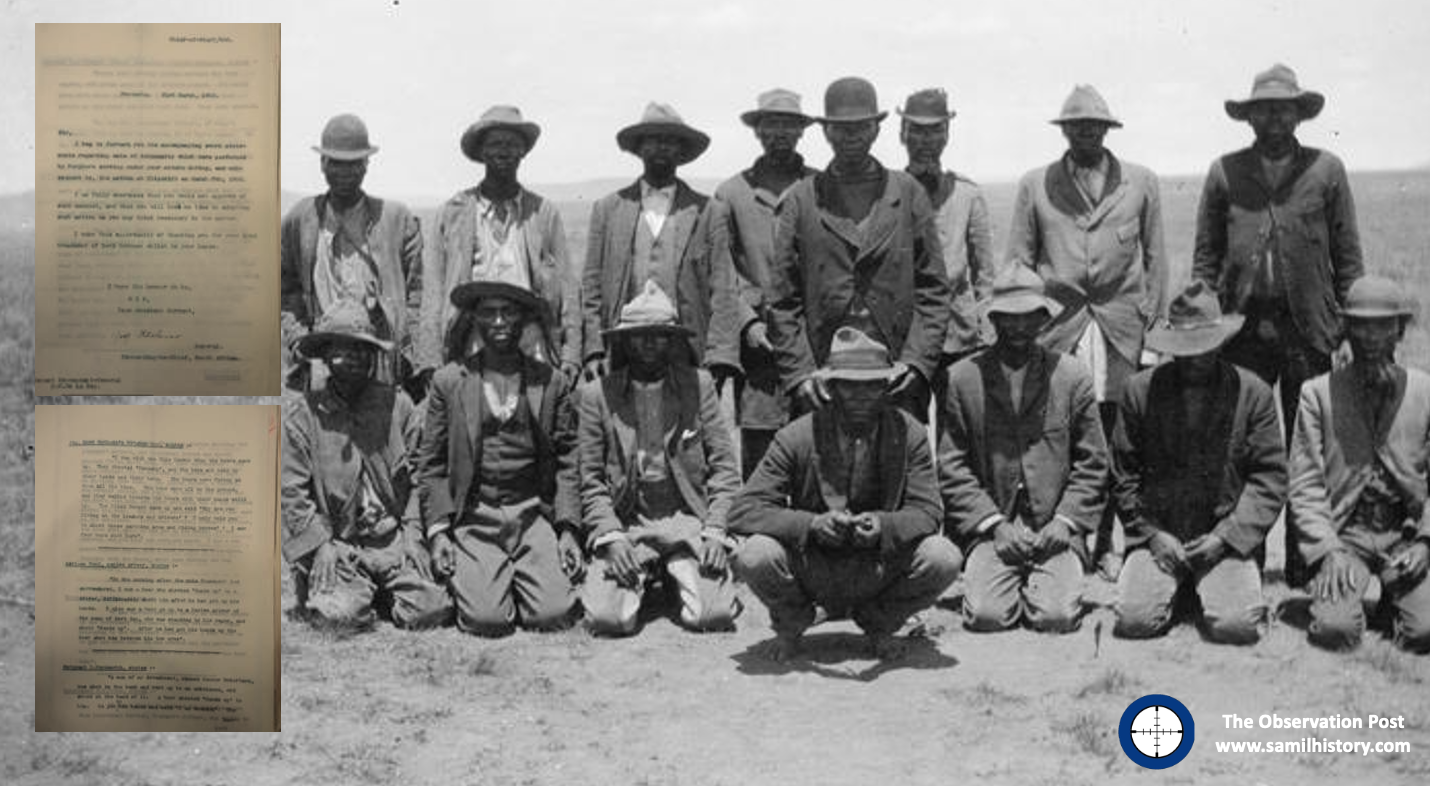
Black concentration camps of the Boer War – main image courtesy Dr. Garth Benneyworth, insert image colourised by Jenny B.

Both types of camps experience a high incidence of disease (contact and contamination) and civilian death rate. Over the duration of the war, 29,491 Boer Camp civilian deaths are recorded, of which 2/3 are children and infants, all attributed to disease – in the case of children this is attributed primarily to a measles epidemic which sweeps the camps 27.

Over 30,000 Black “concentration” camp civilian deaths are recorded – minimum, the complete Black death toll for the Boer War including both disease and starvation casualties in Black internment or labour camps and in key British towns like Kimberley besieged by Boer forces is projected to be as high as 50,000.28

Noteworthy here, is historian Dr. Garth Benneyworth’s research into the ‘Black’ internment camps of the Boer War, specifies that ‘Blacks’ are not merely “participants” in the war, and the Boer and Black “concentration” camps are not a “shared trauma” of “mutual suffering” at the hands of the British as:

‘The separation of internees along racial lines created fundamentally different internee experiences’29

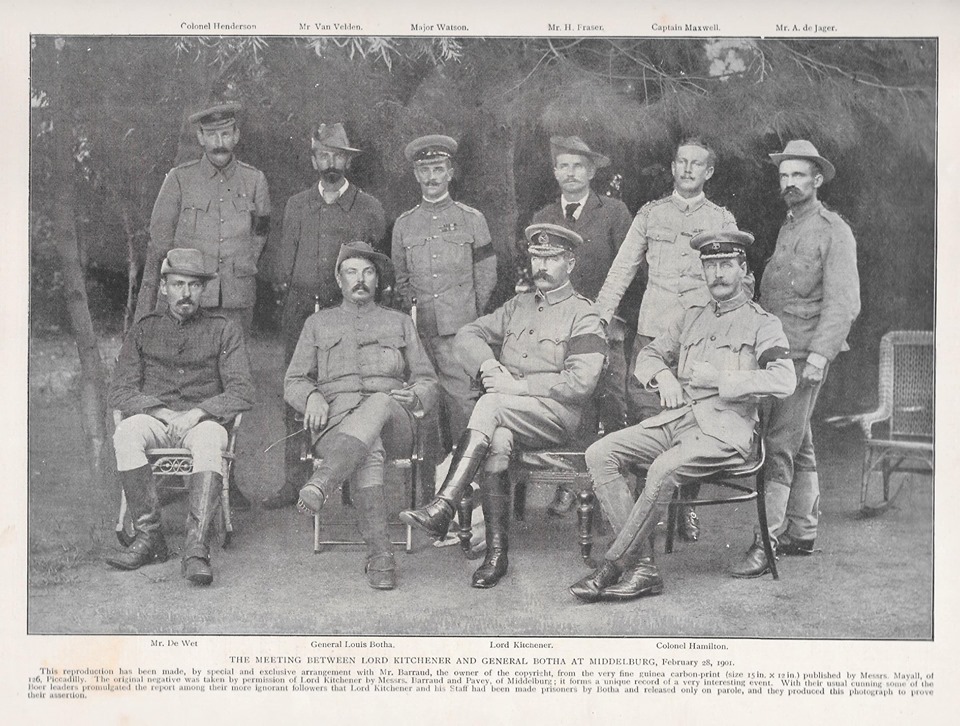
The first round of peace talks to end The South African War open at Middleburg from 28 February to March 16 1901 between Lord Kitchener and General Louis Botha. One of the conditions of peace specified by the British is the implementation colour blind franchise as it exists in the surrounding territories in the two Boer Republics. The accompanying statement in this respect reads:

‘… the legal position of Kaffirs will be similar to that which they hold in the Cape Colony’30

The peace proposals, on all counts including the question of a colour blind franchise, are universally rejected by the Boers and the war continues.

The latter half of the South African War is marred by the ‘guerilla warfare’ phase which produces two highly undesirable results. The concentration camps become overcrowded and steadily unmanageable and the Boers implement a policy of executing any Black or Coloured person in the service of the British military on the spot, General Christiaan de Wet would inform Lord Kitchener that he personally issued the order and writes:

‘the ungovernable barbarity of the natives realises itself in practice in such a manner that we felt ourselves obliged to give quarter to no native and for these reasons we gave general instructions to our Officers to have all armed natives and native spies shot.’31

Kitchener responds to de Wet:

‘….. (I am) astonished at the barbarous instructions you (General de Wet) have given as regards the murder of natives who have behaved in my opinion, in an exemplary manner during the war.32

Black contractors in the service of British forces, insert General Christiaan de Wet

The ruthless massacres of ‘Black’, ‘Indian’ and ‘Coloured’ citizens and contractors by Boer Generals and Commandants at Tweebosch, Leliefontein, Modderfontein, Uniondale, Calvinia and many other places come to define the closing phase of the South African War.

1902 – The second round of peace talks at Vereeniging end the South African War on 31 May 1902. Joseph Chamberlain insisted the issue of the Colour Blind qualified franchise for the two former Boer Republics is included, however this turns into a deal breaker for the Boers. The British attempt to strike a compromise and the initial draft of the Vereeniging Peace treaty includes the following phrase:

‘The Franchise will not be given to NATIVES until after the Introduction of Self-Government’.

This meant it would be given to them as part of the future self-government package. The Boer delegation even reject this concept, General Jan Smuts in his capacity as a lawyer convinces the British that the Boers will address the matter ‘in the future’ after self governance is granted (here Smuts is looking to the future South African ‘Union’) and the phase is changed again to read:

‘The question of granting the franchise to Natives will not be decided until after the introduction of self-government.’

This meant that the all white parliaments of the Transvaal and Orange Free State would independently decide the colour blind qualified franchise on their own, only after self-government is granted them, and even in that instance they may or may not decide to implement it.

Historian Peter Warwick would claim that as to the future emancipation of Blacks in South Africa this was the most significant clause of the surrender33 Black leaders would look to this as been ‘sold out’ by the British, especially given their considerable military resources and man-power used to help the British win the war.

1903 – With the Boer Republics under British control – The Transvaal Colony and Orange River Colony (both “officially” established in 1902). Lord Milner commissions a study into the “native question” i.e. the black emancipation issue, called the “South African Native Affairs Commission”. It would report back two years later.

1905 – the “South African Native Affairs Commission” reports. It’s Edwardian in its outlook on social Darwinism i.e. recognising where various races lie on a social “civilisation” track – but it does make key recommendations: That the “Cape Law” i.e the Colour Blind qualified franchise is applied across the entire country. In terms property rights it recognisers that land ownership laws applicable in the Cape be extended to the rest of South Africa and to acknowledge Black rights to own land – rural and urban. It also recognisers Black aspirations for an equal education.34

1906 – another “khaki” election takes place in the United Kingdom and the Tory Imperialists of the South African war period lose the election to the Liberal Party led by Henry Campbell-Bannerman – during the South African War, as opposition, the Liberal Party had taken an “Anti-War” ticket and took a “Pro-Boer” position. Campbell-Bannerman famously accused the Tories during the South African War of using “methods of barbarism” in dealing with the white Boer civilian population.

This “anti-Imperialist” and “Pro-Boer” position would lead to this majority “Liberal” government giving concessions to Boer ‘Afrikaner’ politician’s demands ahead of any other demands from South African population or ethnic groups.35

Lord Selborne, the Liberal Party’s new man on the ground, replaced Lord Milner as High Commissioner for South Africa and Governor of the Transvaal and Orange River Colonies. Although Selborne is in favour of extending the Cape Colour Blind Qualified Franchise and land ownership and other recommendations of the “South African Native Affairs Commission” to the old Boer Republics – he is unable to do so, as it would be in violation of the terms of the Vereeniging Peace Accord which Campbell-Bannerman intends to honour. According to Godfrey Lagdon, the Transvaal Commissioner for Native Affairs:

‘(the Boers) would “bitterly resent” it, and it would likely re-ignite the war’36

The Campbell-Bannerman government later grants ‘Responsible Government’ to the Transvaal Colony on 6 December 1906 which reinstates a Boer led Parliament for the region led by General Louis Botha.

1907 – the Campbell-Bannerman government grants ‘Responsible Government’ to the Orange River Colony on 27 November 1907 which reinstates a Boer led Parliament for the region led by Abraham Fischer.

Unlike the Cape Colony and Natal Colony’s ‘Colour Blind’ franchise, the Boer led Parliaments of the Orange River Colony and Transvaal Colony implement a whites only ‘Colour Bar’ franchise.

1908 – To complete the regions ambition to “self governance” as specified in the Vereeniging Peace Accord, the leaders of the old Boer Republics (now in leadership positions in the Orange River Colony and the Transvaal Colony) and the Colonial leadership of the Cape Colony and Natal Colony as well as Rhodesia commence the “The Closer Union Convention” or “National Convention” from 12 October 1908, with the intention of bringing a federation of states together under a unitary paramountcy for shared ‘white’ control (Boer and Brit) – from ‘the Zambezi to the Cape’ – all under the British “family of nations”. The convention is a “whites only” affair for all intents and purposes.

1909 – The Closer Union Convention concludes on 11 May 1909 and agrees to a “Greater Union for South Africa” in phases. Jan Smuts’ plan for union sees Phase 1: the initial South African ‘Union’ between the Cape, Natal, Orange Free State and Transvaal sans the British “High Commission Territories” consisting of Bechuanaland (Botswana), Lesotho and Swaziland. Phase 2: This later phase encompasses the territorial ambitions of the Union and would see the incorporation of the “High Commission Territories”, German South West Africa (Namibia), the southern half of Portuguese East Africa (Mozambique – Delagoa bay) and Southern Rhodesia (Zimbabwe) to all join the South African Union.37

The convention concludes that South Africa will be a unitary state with centralised authority. On the thorny issue of Franchise – the ‘English’ led Cape delegates are insistent the Cape ‘colour blind’ Franchise is applied across the entire country, the ‘Afrikaans’ led Free State and Transvaal delegates are immovable on a ‘colour bar’ whites only franchise for the entire country. A compromise is struck which ensures the Cape Franchise is ensconced in the new Union of South Africa constitution on a 2/3 majority for the Cape and Natal provinces, whilst the Transvaal and Orange Free State continue with the colour bar franchise until a future “independent” South African Union Parliament can resolve the matter.

Olive Schreiner, the South African author would make a startling prediction in her letter to the convention when she says:

‘The idea that a man born in this country, possibly endowed with many gifts and highly cultured, should in this, his native land, be refused any form of civic or political right on the ground that he is descended from a race with a civilisation, it may be, much older than our own, is one which must be abhorrent to every liberalised mind. I believe that an attempt to base our national life on distinctions of race and colour, as such, will, after the lapse of many years, prove fatal to us.’38

The “High Commission Territories” (Bechuanaland (Botswana), Lesotho and Swaziland) being ‘Black’ Kingdoms under British protection resolve to remain outside of the Union for the time being, fearful of the sharp racist construct of the Franchise laws in the old Boer Republics. They adopt a “wait and see” approach. As does Rhodesia which eventually opts for a plebiscite to decide of the matter of union with South Africa in 1923.

In Britain, the Pro-Boer governing Liberal Party, now under Herbert Henry Asquith agree to the Closer Union Convention’s recommendations on constitutional, legislative and economic design and they pass “The South Africa Act 1909” which establishes the South African Union as a “Responsible” Self-Governing State with ‘Parliamentary Sovereignty’ – which essentially separated the South African Parliament from Westminster and British Common Law, the South African Union now free to make laws of its own independent of Britain.

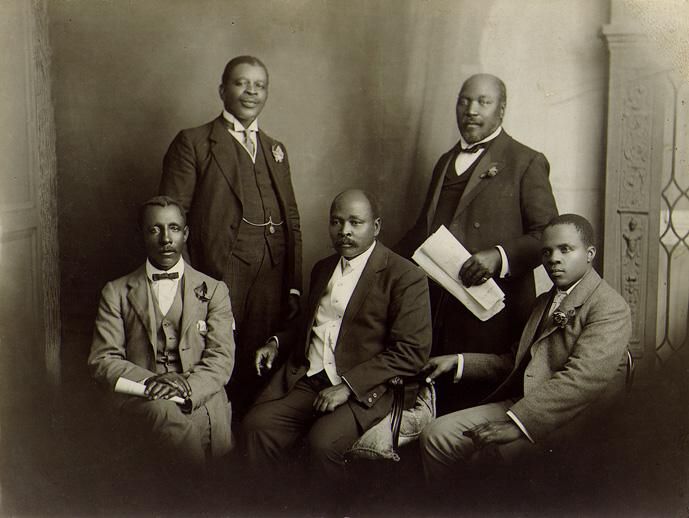
The South Africa Act goes ahead despite the “Schreiner Mission” to Britain made up of William Schreiner (the Premier of the Cape Colony), Dr. Abdurahman (the ‘Coloured’ deputation leader) and J.T. Jabavu (leader of the ‘African’ deputation and future ANC) – its mission to convince Westminster of the need to confer the right to vote upon all South Africans regardless of colour. They prophetically warn the British that the future South African Union Parliament with an independent Parliamentary Sovereignty bestowed on it would be empowered to remove the franchise from persons of colour at the Cape.

1910 – The Union of South Africa comes into official existence on 31 May 1910 with independent Parliamentary Sovereignty free of Westminster. The first Union elections are held 15 September 1910, the “Pro-Afrikaner” side of the house – The South African Party in conjunction with Orange Unie (OFS) and Het Volk (Transvaal) win the majority of the house with 66 seats.
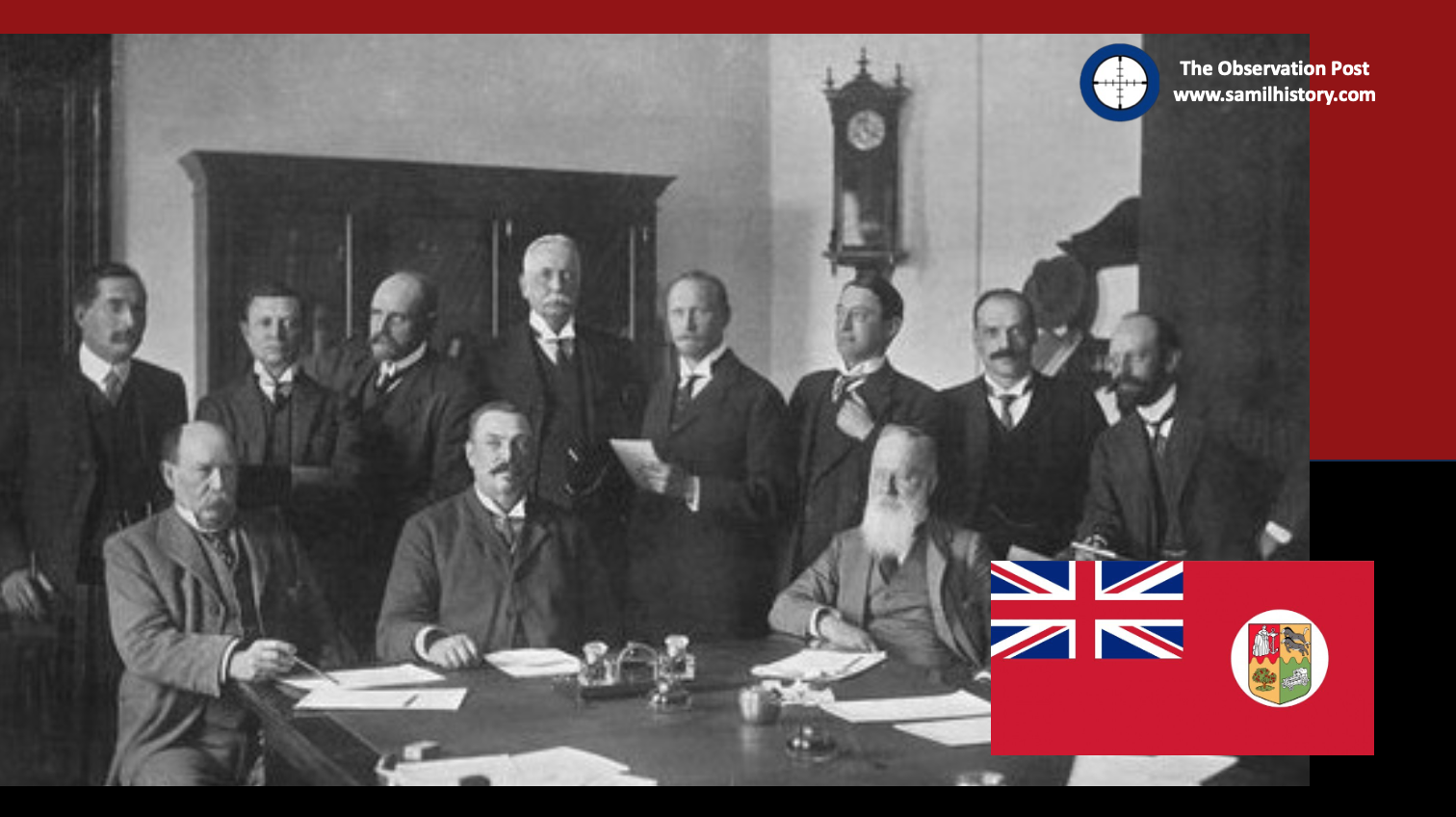
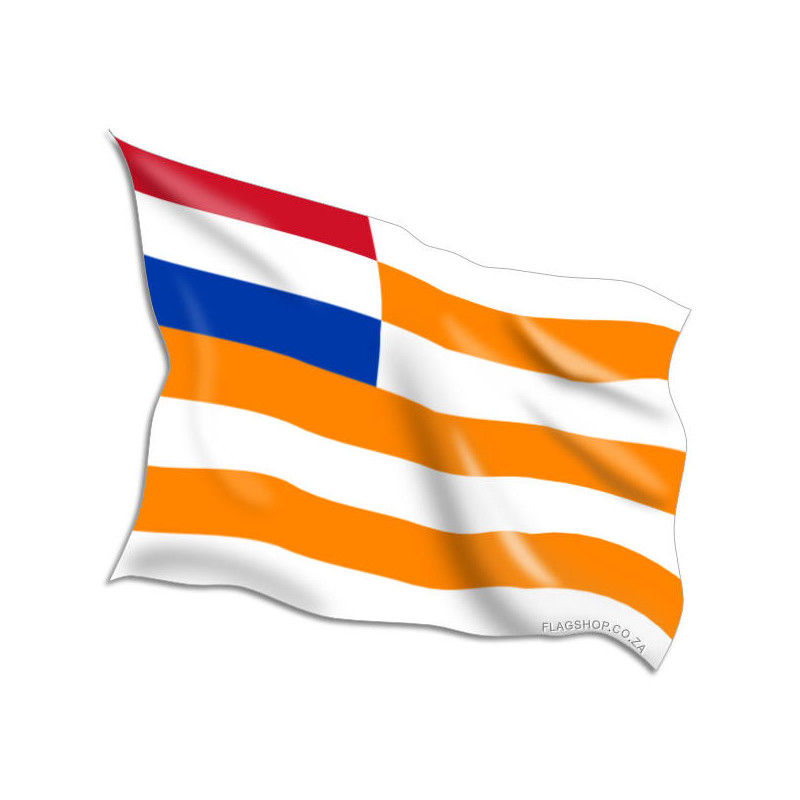
Botha’s first cabinet of South African Party members – insert flag is the first national flag of South Africa.

1912 – The South African Native National Congress (renamed the African National Congress in 1923) is formed in Bloemfontein on 8 January 1912 in reaction to the lack of adequate Black representation in the formation of the Union of South Africa and the Closer Union Convention.

1913 – The South African Union with Parliament under the Pro-Afrikaner ‘South African Party’ (SAP) majority government led by Prime Minister Louis Botha – comprising the old ZAR and OFS Boer ‘Bittereinder’ Generals – Louis Botha himself, Koos de la Rey, Jan Smuts, Barry Hertzog, Christiaan de Wet et al – table and then pass the ‘Native Land Act 1913’. To re-affirm the South African Union’s Parliament as “independent” of Britain, the legislation is “rushed” and passed without the input or approval of the British.

This act enforces ‘segregation’ and marginalises Black South Africans economically into a role of perpetual servitude and serfdom. Roughly 20% of “good land” was in the hands of Black Africans in 1913. The Native Land Act reduced Black African land to 7%. It demarcated “Black” farmland and “White” farmland as land solely for either Blacks or Whites. The black farmers and sharecroppers were disadvantaged to the larger degree, they cannot buy land and many are disposed of their land – with little choice many simply became labour on “white” farms.39

‘The Land Act was an anti-capitalist measure aimed at preserving a semi-feudal relationship between white land owners and black “serfs” (with no claim to land ownership)’40

The South African Native National Congress and Sol Plaatjie’s efforts to protest this legislation to the British, still under the governing party of the Pro-Boer Liberal Party, falls on deaf ears.

General James ‘Barry’ Munnik Hertzog is the Orange Free State champion in South African Party, and holds a Cabinet position. However he comes to loggerheads with Prime Minister Louis Botha over ‘language policy’ – Botha and Smuts believe in a “one stream” policy which will see ‘English’ and ‘Afrikaners’ eventually merge as a unitary entity. Hertzog believes in a ‘two-stream’ policy which would see Afrikaans and English speaking whites ‘separated’ in all socialisation aspects – education, culture, religion etc. so as to develop ‘apart’ from one another, and Afrikaner ‘nationalism’ is to carry its own momentum. Known as “Hertzogism”, it divided Botha’s party and resulted in Botha removing Hertzog from his cabinet.

“Hertzogism” is also a pre-curser of Apartheid thinking as the “two stream” policy is eventually extended to exclude Blacks to develop “separately” and “apart” from “whites” in addition.

1914 – Hertzog moves to resign from Botha’s South African Party (SAP), and spits the SAP with key SAP Orange Free State ministers moving with him to establish the National Party in January 1914, effectively ending Afrikaner unity41. The National Party moves to adopt “Hertzogism” and “Krugerism” as its central ideology.

The Nationalists take their initial inspiration from the United States of America (USA), drawing inspiration from Jim Crow, they also admired the USA for having won its war of independence against Britain. They were influenced by the Irish republican movement with a reverence for the notion of popular sovereignty and ethnic self-determination – principles which they did not want to apply to Blacks.42

World War 1 (1914-1918) commences on 28 July 1914. The Union of South Africa, primarily to fulfil its territorial ambitions for German South West Africa (GSWA)43, per the Closer Union Convention, votes in a parliamentary landslide to declare war on Imperial Germany and invade GSWA – 92 votes “for” and 12 votes “against”.

This triggers the ‘Afrikaner Rebellion 1914’, a handful of senior South African Union Defence Force officers and a few ministers of Botha’s South African Party, including the Boer War ‘Volk-hero’ General Christiaan de Wet go into open treason in support of Imperial Germany and he leads the rebellion alongside Lt. Col Manie Maritz, General Christiaan Beyers and Major Jan Kemp et al.

Although Anglophobia is a cited reason for the Rebellion, Philip Sampson a commentator (and historian) at the time argues that the ‘colour blind franchise’ and human rights for ‘natives’ are also key motivations for the rebellion – the Afrikaner rebels are intent on maintaining a Afrikaner led hegemony, an oligarchy based on “Krugerism” as an ideology – which means no franchise or emancipation to anyone of colour. The declaration of war to invade GSWA presents an opportunity for these Afrikaner leaders, with the assistance of Germany, to take over the whole of South Africa and implement this Republican ideal and political construct of theirs.

This sentiment is manifest in Christiaan de Wet, who would go on to say of the Cape Colour Blind Qualified Franchise’, still upheld in the Cape Providence:

‘The ungodly policy of Botha has gone on long enough, and the South African Dutch are going to stand as one man to crush this unholy scandal.’44

To prevent a ‘Black’ uprising in resistance to the Afrikaner Rebellion and maintain white authority, Maritz would make a draconian declaration and states:

‘… an emphatic warning is issued that all coloured people and natives who are captured with arms, as well as their officers, will be made to pay the penalty with their lives.’45

The Afrikaner Rebellion is poorly supported – only 11,476 Boers join the rebellion – primarily desperate ‘bywoner’ (landless or sharecropper farmers) from the Orange Free State, promised a better life if the rebellion was successful.46Strategically, Operationally and Tactically the Rebellion is poorly conceived and poorly led. General Louis Botha is able to crush the rebellion in a matter of months. The state deals with all the rebel leaders with Kidd gloves, with the exception of Jopie Fourie who is executed for treason – Fourie would go on to become a Afrikaner Nationalist martyr and carry with his legacy an on-going and intense National Party propaganda campaign to demonise General Jan Smuts.

On Indian politics, Smuts and Gandhi settle the Indian Relief Act of 1914 abolished the Indian tax which affected indentured labourers and Indian ‘free men’ domiciled in Natal, it facilitated widespread reforms to all Indians domicile in South Africa.47

1917 – The South African Party under Botha, in collaboration with the National Party under Hertzog table the ‘Native Affairs Administration Bill – 1917’, which institutionalises “segregation” between race groups – specifically Black and White. It is debated by not passed – it’s repeatedly amended over the years and only eventually passed as the ‘Native Administration Act’ in 1927 when the National Party has commanding oversight of it.

1918 – The Broederbond is established, a Calvinist, adult white male only Afrikaner secret organisation to forward Afrikaner Nationalist aims and objects on Christian principles.48

1919 – Prime Minister Louis Botha dies suddenly of heart failure after a bout of influenza, aged just 56. Jan Smuts takes over the party leadership of the SAP and the Premiership of South Africa.

1921 – the pillars of the General Mission Committee of the Dutch Reformed Church (DRC) Cape synod of 1921 were established in conjunction with delegates from the Transvaal and Orange Free State. At that meeting, it was concluded as follows:

‘The practice of the Church follows the doctrine of the State on the relation of the white and the black races to each other. That doctrine is that the white race is and must remain the ruling race. The coloured and the black sections of the population occupy a strictly subordinate position. This is not due to, as is very generally supposed, to the accident of their colour: it is due to their lower stage of cultural development.’49

1922 – the ‘Rand Rebellion 1922’ breaks out in March 1922. The Rebellion is triggered by white ‘communist’ led miners intent on maintaining a work ‘colour’ bar and preventing the Chamber of Mines from taking on cheaper unskilled and skilled Black labour from taking their jobs. Their intention is to spread worldwide Communism under a slogan:

Workers of the world, unite and fight for a white South Africa!50

Hertzog’s National Party in opposition comes out in support of these white communist mine workers, and issues a pamphlet stating:

‘The (National) party would never accept a “black industrial South Africa with a poor white South Africa”‘.51

The white miners call a general strike, however after ‘the strikers began to assault and massacre black people’ 52, the strike devolves into an armed rebellion and the rebels take up defensive positions, the rebellion in turn is brutally repressed by Prime Minister Jan Smuts, who sends the Union Defence Force into Johannesburg to quell it.

Four “English” Communist ring leaders are found guilty of treason and in two cases the murder of Black South Africans in addition, they go to the gallows singing their anthem, ‘The Red Flag’.

1923 – In sympathy with the miners rebellion, the securing of white proletariate class jobs, the idea of self-determination and in mutual opposition to ‘British Capital’ the National Party moves closer to the Labour Party, Hertzog would say of Communism and Labour:

‘We should not fear Bolshevism (Communism) …. The idea in and of itself is excellent.… If we say that we have the right to govern ourselves and we say that it is our duty to express that right, then we are in fact Bolshevists.’53

Dr. Daniël Francois (DF) Malan, the National Party’s Cape leader would also find an unusual bedfellow in Communism and the Labour movement. As Malan put it:

‘the two parties were tied together by their similar resistance against “capitalistic-monopolistic hegemony” (by which he meant the mine owners)’54

Historian and scholar, William Henry Vatcher, Jr. would say:

‘The alliance of Nationalists and Labour was a strange marriage of convenience. Essentially, it was a white man’s front against the Africans created for the purpose of raising white wages and ensuring jobs for the poor whites, the overwhelming majority of whom were Afrikaners.’55

1924 – Mutual resentment over Smuts’ handling of the Rand Rebellion meant that the National Party/Labour Party coalition was victorious at the polls and formed the ‘Pact Government’ in 1924. This would see the National Party take the reins of the country as a ruling party (in coalition with Labour) for the first time and Hertzog would oust the SAP and Smuts and become South Africa’s Prime Minister.

The Labour Party leader, Col. Frederic Creswell in going into the Pact Government ensures that Hertzog’s and the National Party’s ambitions for a white Afrikaner led South African hegemony and Republicanism are shelved,and that the country remains a British dominion with independent Parliamentary sovereignty.56

In coalition, the National Party were however able to pass three important acts which secured employment opportunities for whites and entrenched segregation in the labour market. The Industrial Conciliation Act of 1924, allows ‘whites’ to unionise, but specifically forbids ‘blacks’ from joining a union. The Wage Act 1925, sets up a wage board and specifically prevents black workers from undercutting “civilised” levels of wages. The Mines and Works Amendment Act of 1926, firmly established the colour bar and job reservation for whites in certain mining jobs.

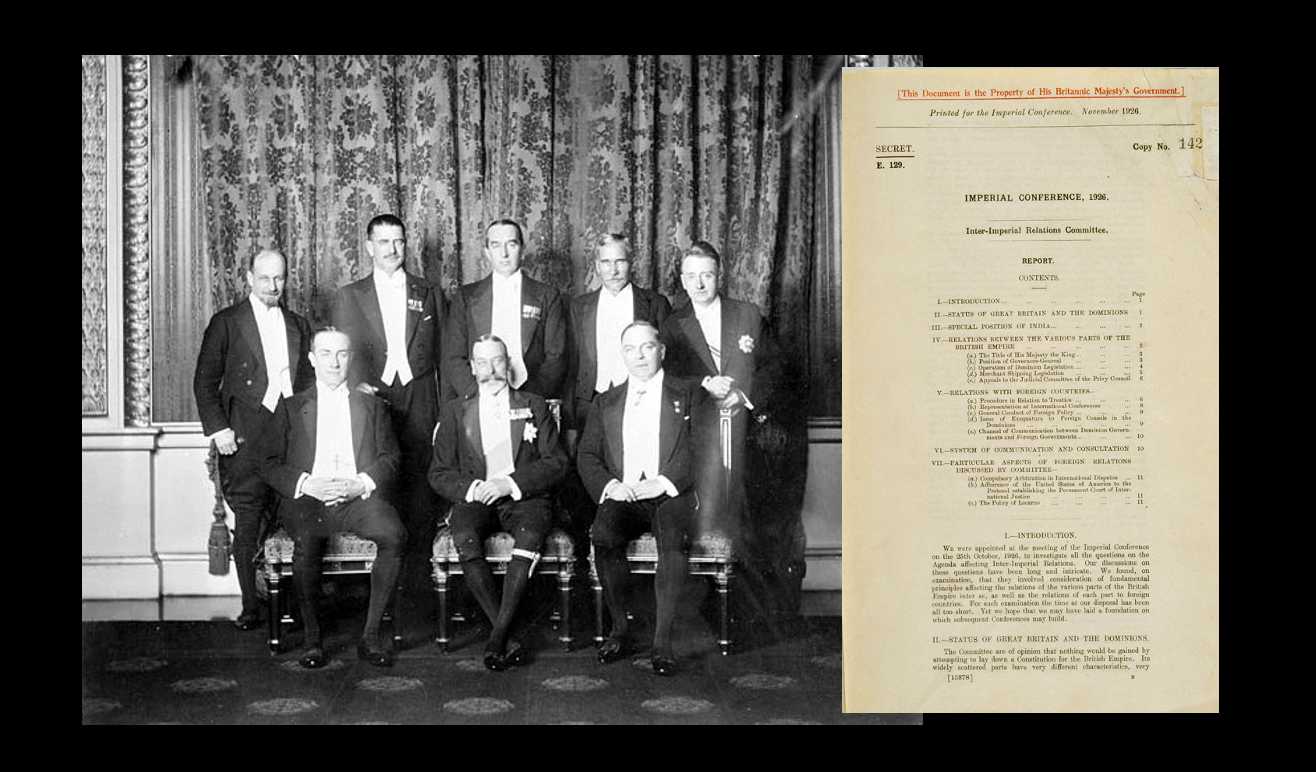
1926 – Barry Hertzog as Prime Minister is the South African delegate to the Balfour Declaration of 1926. The declaration gives more autonomous powers to all British Dominion’s including South Africa. To Hertzog, the Balfour Declaration of 1926 is sufficient so as to ensure South Africa’s complete legislative independence of Westminster and therefore no need to fulfil the National Party’s ambitions for a South African Republic.
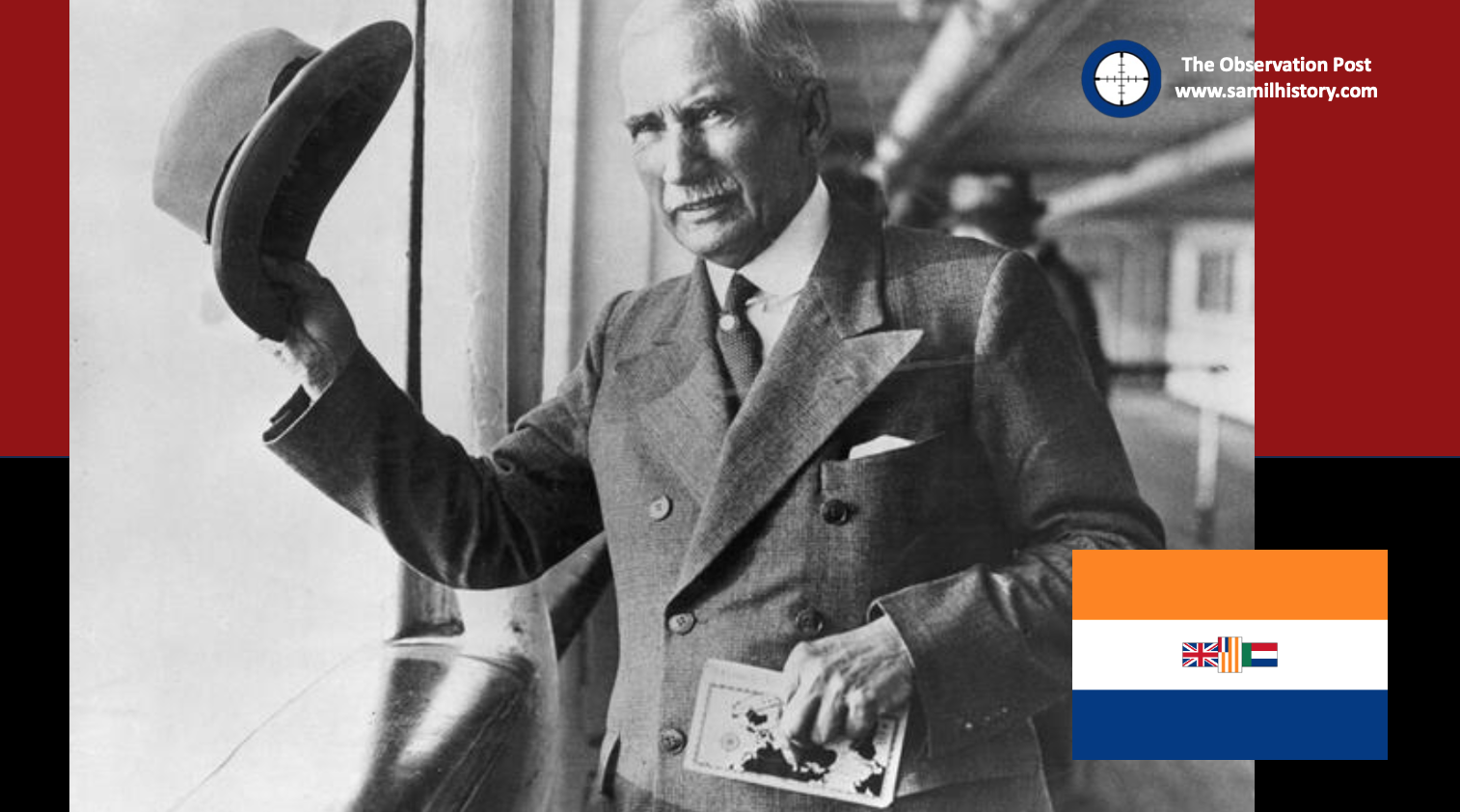
Prime Minister Hertzog, insert flag is the second South African national flag tabled by Hertzog’s National Party and adopted on 31 May 1928.

1929 – at the DRC conference in Kroonstad the Reverent J.C du Plessis makes the first recorded reference to the term “Aparthied” when he said:

‘In the fundamental idea of our missionary work and not in racial prejudice one must seek an explanation for the spirit of Apartheid that has always characterised our Church’s conduct.’57

The 1929 General Election is fought over the matter of women’s suffrage, Hertzog’s National Party win a majority Parliament, no longer requiring the Labour Party to retain a ruling party status.

1930 –  the Women’s Enfranchisement Act, No 18, of 1930 was enacted by the National Party which granted white women over the age of 21, the right to vote and stand for election. This doubles the size of the white voting bloc. Despite promises on universal female suffrage, the franchise is given to white women only – countrywide, female Black and Coloured voters under the Cape provinces’ “Colour Blind Qualification” Franchise are not given the vote.

1931 – The Free State Synod of the DRC in Kroonstad rejects gelykstelling (racial levelling) and social equality with Blacks, and with it, race degeneration and ‘bastardisation’, as ‘an abomination to every right-minded white and native’. The DRC declares Blacks should develop:

‘on their own terrain, separate and apart’.58

In Britain, the “Statute of Westminster 1931” ends the British empire and replaces it with the Commonwealth. South Africa’s self-governance and independence of Britain’s legislature is complete in all things except name.59

The National Party further entrenches and expands the ‘white vote’ when it passes the Franchise Laws Amendment Act, No. 41 of 1931, which removed all property and educational franchise qualifications applying to white men (and women) countrywide, whereas Coloured and Black men under the Cape Franchise are still subject to education and property qualifications to vote (Coloured and Black women are still not allowed to vote).

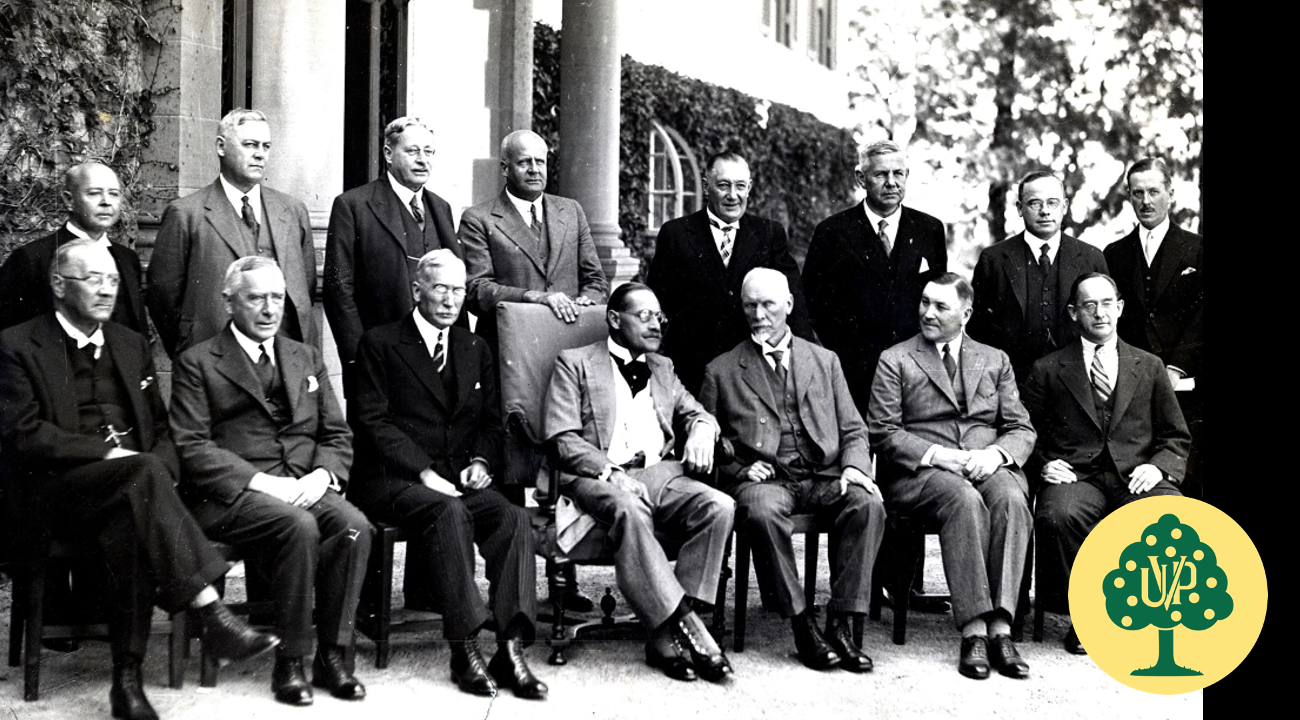
1933 – The 1933 General Election outcome forces the National Party to “fuse” with the South African Party to tackle the economic challenges of the Great Depression and a maintain an Afrikaner led hegemony in the interests of South Africa’s white population.60 Hertzog led this fusion undertaking as Prime Minister with Smuts as his deputy. Known as the United South African National Party or simply ‘United Party’ (UP), it contained within it a component of Afrikaner nationalists harbouring republican desires and a component within it of Afrikaners satisfied with Union and South Africa’s status as a British Dominion.61

Unhappy with the centre right politics of ‘Fusion’, Louis Theodor Weichardt breaks away from Hertzog’s old National Party and forms a far right Nazi Party equivalent in South Africa on 26 October 1933 called The South African Christian National Socialist Movement with a paramilitary section (modelled on Nazi Germany’s Sturmabteilung) called the ‘Gryshemde’ (Grey-shirts).
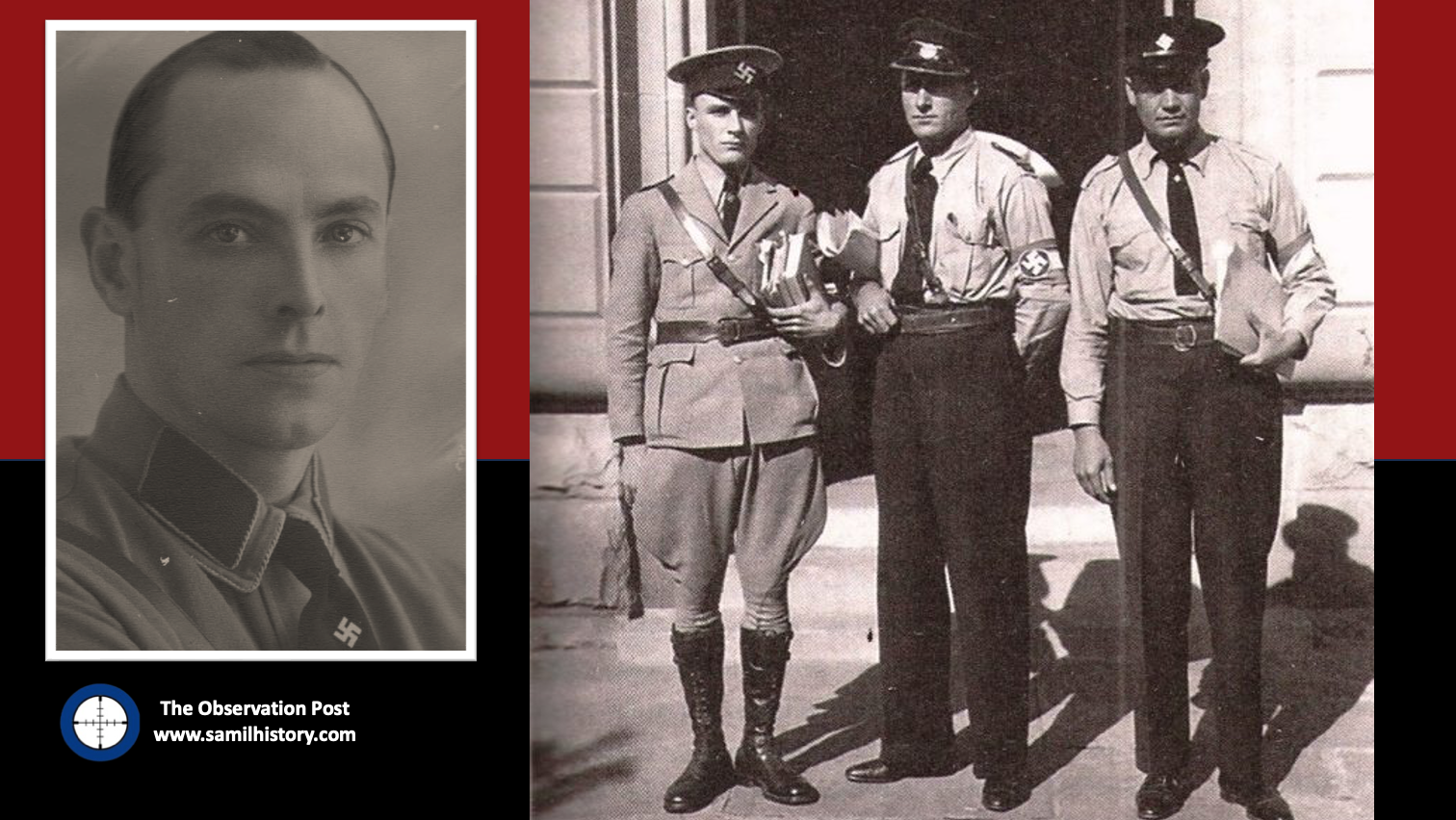
Grey-shirt leadership outside the courts in Grahamstown. Insert picture Louis Theodor Weichardt

By December 1933, the ‘Swarthemde’ (Blackshirts) are formed by Manie Wessels – also breaking away from the National Party, they are called the ‘South African National Democratic Movement’ (Nasionale Demokratiese Beweging). The ‘Black-shirts’ form in opposition to the ‘Grey-shirts’ anti-democracy position and look to a more “purified” whites only democracy free of Jewish and Capitalist influence.62 The Black-shirts themselves would splinter into another Black-shirt movement called the ‘South African National People’s Movement’ (Suid Afrikaanse Nasionale Volksbeweging), started by Chris Havemann and based in Johannesburg, these Black-shirts advanced a closer idea of National Socialism.63 

1934 – by May 1934, the ‘Grey-shirts’ combine with the South African Christian National Socialist Movement and form a new enterprise called ‘The South African National Party’ (SANP). The SANP would all keep the ‘grey-shirts’ as their dress and the caveat of ‘Grey-shirts’ – their political position is one of anti-semitism and pure national socialism (Nazism), the swastika is adopted as the party emblem. Overall, Weichardt saw democracy as an outdated system and an invention of British imperialism and Jews.64

1935 – The DRC Federal Conference declares that education for whites and blacks should remain separate within the barriers of national identity, and defines ‘Coloureds’ for the first time as a “separate nation” from both Black and White but all are equal as individuals before God.65

The mission policy at a DRC Synod held in 1931 in Kroonstad was officially promulgated in 1935 as the official DRC mission policy. It was at this conference that the DRC expressed itself unequivocally against any form of equality (gelykstelling) between blacks and whites.

The church affirmed that the natives had souls as white people have and that they possessed a soul of equal value in the eyes of God. However, in order to stick to this fundamental belief and at the same time to stick to their ‘treasured policy of inequality and separateness’.66

The 1935 DRC Federal Conference reaffirmed the 1931 Free State Synod ‘twist’ i.e. that blacks should develop ‘on their own terrain and apart’ from whites. Language, customs, culture and colour became determinants and the policy was securely aligned with that of the government of the day.67

On the political front, in 1935 the Afrikaner nationalists to the political far right are unhappy with the idea of Fusion between Hertzog and Smuts and their ex-National Party colleagues in the new United Party. The breakaway is led by the DRC theologian Dr. Daniël Francois (DF) Malan and they reconstitute themselves as the ‘Purified’ National Party (PNP).68

The ,central objective of the PNP was a complete break with Britain and the establishment of an independent oligarchy Republic under a white Afrikaner hegemony.69 Anglophobia was a critical ideology underpinning DF Malan’s PNP and Malan sought to exclude English speakers from the PNP completely.70

1936 – the arrival of the S.S. Stuttgart in Cape Town on the 27th October 1936 packed with 537 Jewish refugees on board71 sharply brought the National Party’s policies of immigration and race into focus – it defined what sort of ‘demographics’ the Pure National Party were prepared to focus on to augment the ‘white races’ in South Africa and which were the ‘undesirables’. The arrival of the SS Stuttgart was met with a mass protest of some 3,000 ‘Grey-shirts’.72
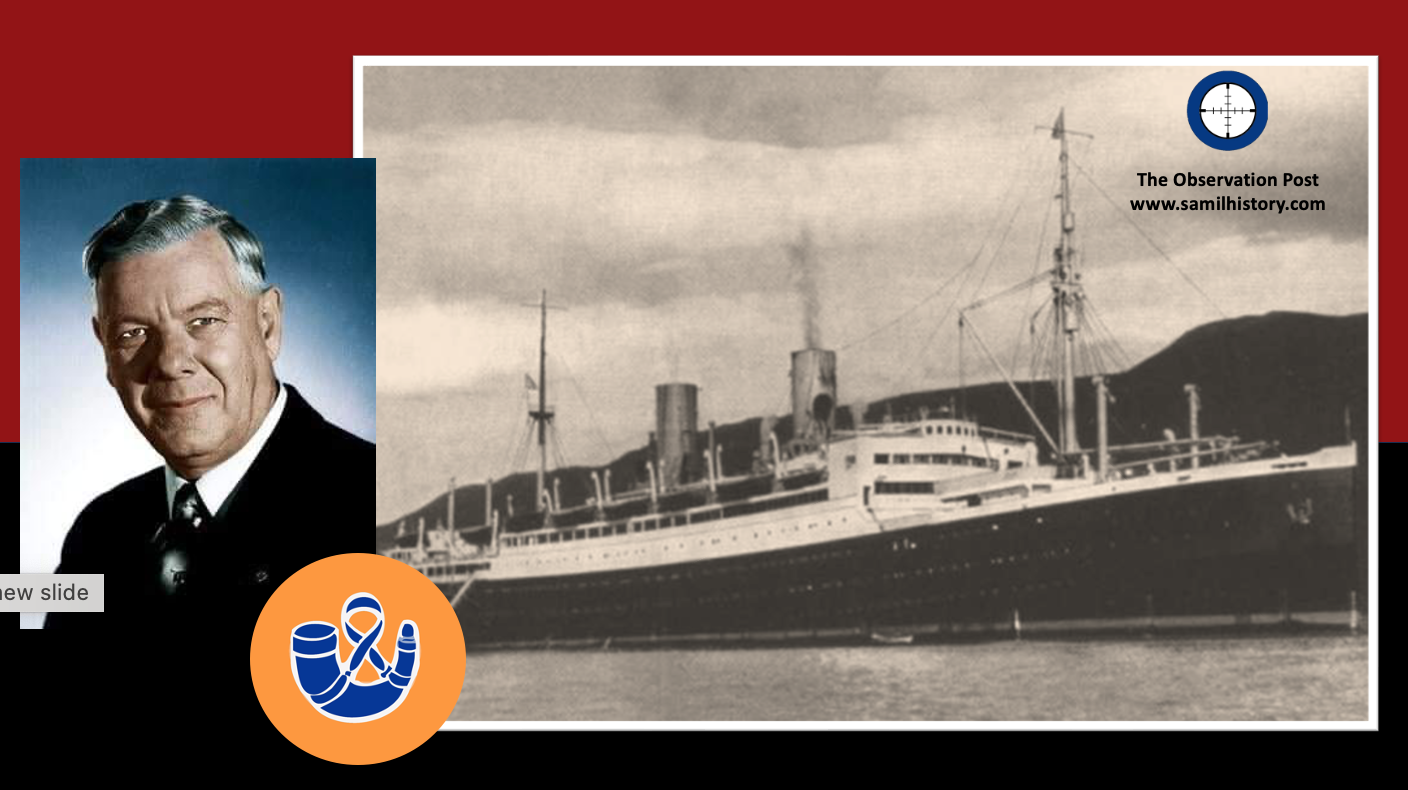
The arrival of the SS Stuttgart – insert picture Dr. H.F. Verwoerd

Dr. Hendrik Verwoerd showed his antisemitic colours when he and a deputation of four fellow minded Nationalist academics – Christiaan Schumann, Dr. Johannes Basson and Dr. Theophilus E. Dönges from Stellenbosch University and Frans Labuschagne of Potchefstroom University joined hands with the Grey-shirts and lodged protest with Hertzog’s’ government as to the immigration of Jews from Nazi Germany.73 

At this point these Afrikaner Nationalist academics were concerning themselves with the poor white problem and ‘völkisch‘ mobilisation warning that Jews were ‘unassailable‘ to the Afrikaner Volk , they met to protest the SS Stuttgart at the University of Stellenbosch on 27 October 1936 and resolved that Jews were ‘undesirable‘ on account of ‘religion’ and ‘blood mingling‘ and that ‘cultural cooperation‘ with them was impossible.74

On 4 November, Dr Theophilus E. Dönges (future NP Acting Prime Minister) would nail the Nationalists colours to the mast and said: 

“The Jew is an insoluble element in every national life.”

1937 – DS Valie Strydom of the DRC writes a paper on Apartheid titled “the policy of Apartheid here in our land and the United States of America” comparing it to American South state segregation policies on schooling, church and suburbs as a model for both Coloured and Black Africans in South Africa.75

On the political front, in the wake of the ‘Stuttgart incident’, Dr. DF Malan tables an Immigration and Naturalisation Bill which sought to exclude immigrants who were ‘unassailable‘ with Afrikaner culture and even economics of the Afrikaner Volk and deal with ‘the Jewish problem’ as he termed it. This in turn led to the ‘Aliens Bill of 1937′ 76 being passed by the Hertzog led United Party government which although a watered down version of Malan’s original proposal, still pandered to issue of cultural and economic ‘assimilation’ to prevailing ‘European’ white culture in South Africa – opening the way for the “right kind” of European immigrants (the Aryan kind) and not the wrong kind (the Jewish kind).

1938 – The ‘Baster Plakaat’ political illustration appears in the ‘Die Vaderland’, a National Party mouthpiece on 12 May 1938 and marks the trigger point where ‘Race Law’ starts to enter into National Party thinking from the political front using mass media. Building on a combination of the Nazi Nuremberg Race laws (which banned ‘mixed’ blood marriages of different races and Jews) and Jim Crow American segregation laws (the separation of blacks and whites on which the Nazi German lawyers based their Nuremberg Laws). 
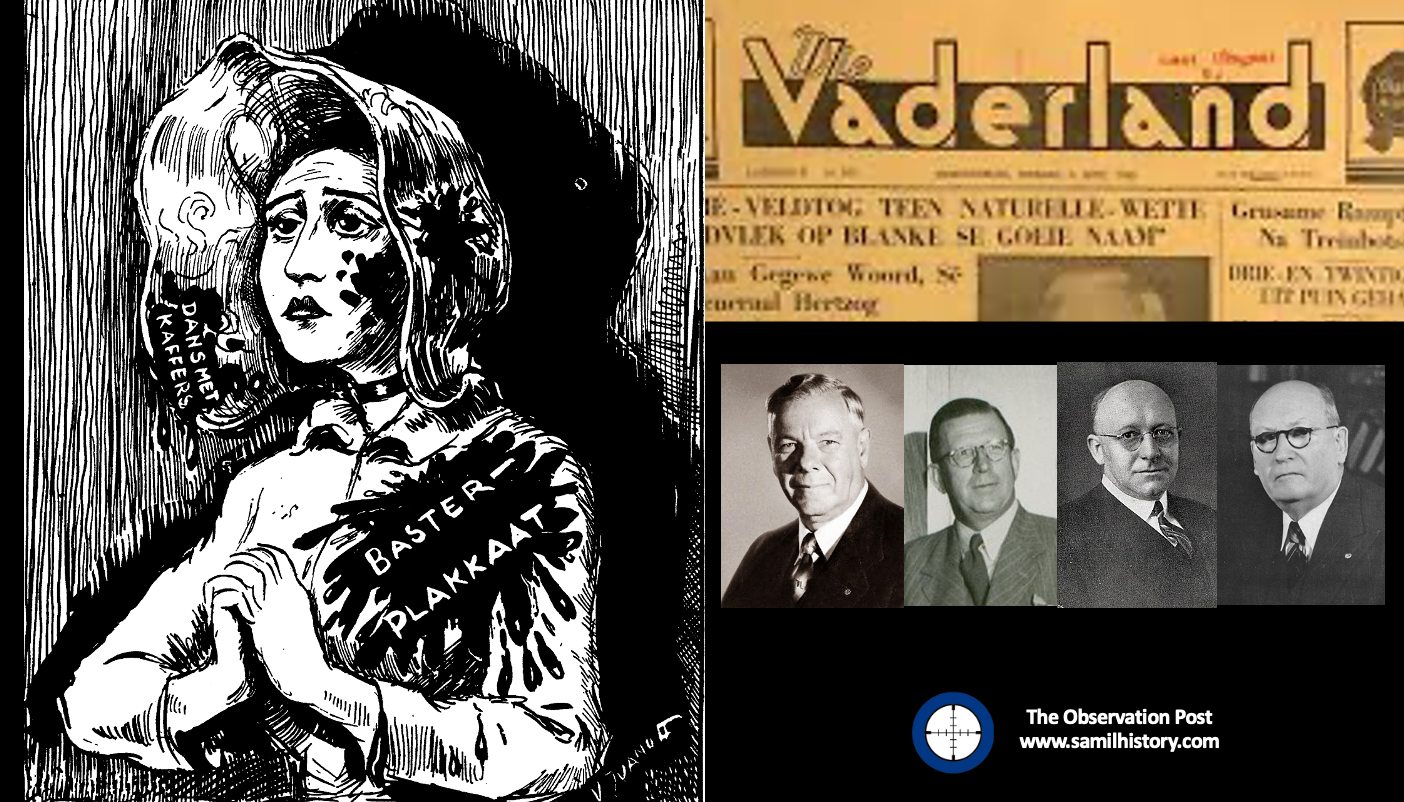
The Baster Plakaat as it appeared in National Party mouthpiece broad-sheet media and election posters.

The race laws find context and expression in a ‘Pure’ Voortrekker woman, in prayer to God and in ‘pure’ white traditional kappie and dress – now “tainted” with “Kaffir” blood, the words ‘dans met Kaffirs’ (dances, i.e to have sexual relations with the black native ‘Kaffirs’) writ in blood … a warning to keep races apart and prevent intercourse lest the purity of soul and the honour of white Afrikanerdom is compromised.77

On the theological front, the Rev. Koot Vorster (the future Prime Minister’s older brother) writes:

‘The Afrikaner’s freedom lies at the foundation of our aspiration and will to keep our blood pure and not to allow our people to miscegenation (bastardise).’78

DF Malan’s Purified National Party (PNP) become the official opposition to Hertzog’s United Party ‘fusion’ after the General Election held on 18 May 1938. Malan and the Purified Nationalists at their The Union Congress of the Nationalist Party in 1938 declared:

‘This Congress regards the dominant position of the White race in the spirit of guardianship as of vital importance to the future and welfare of South Africa. It declares therefore that it must be the earnest and determined struggle of that race to preserve its racial purity, to ensure the creation of a sound relationship between it and the non-White races, and also to avoid its economic destruction.’79

Dr. Malan then proclaimed the basic slogan of the Nationalists would be:

‘We want to make sure that South Africa remains a White man’s country.’

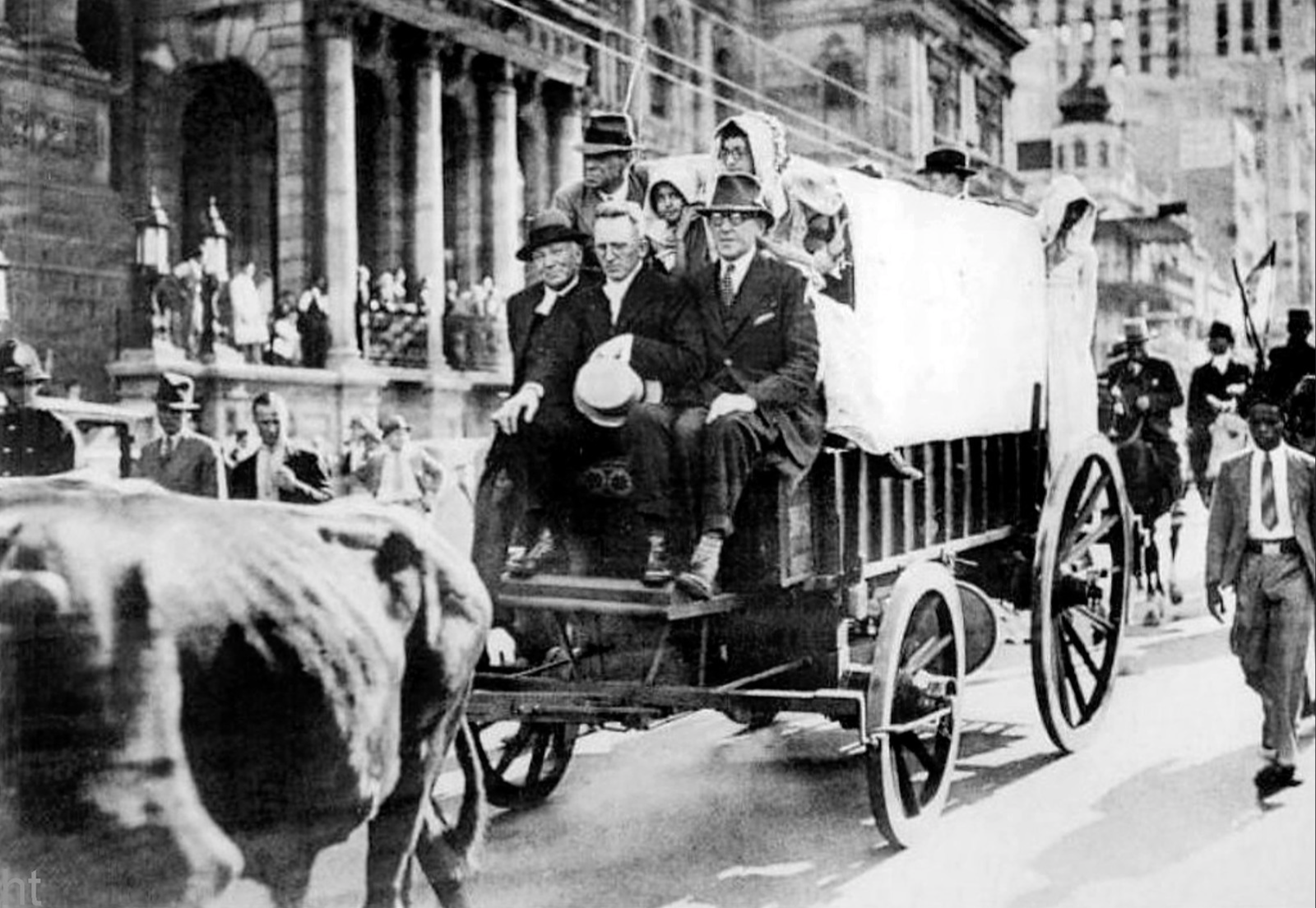
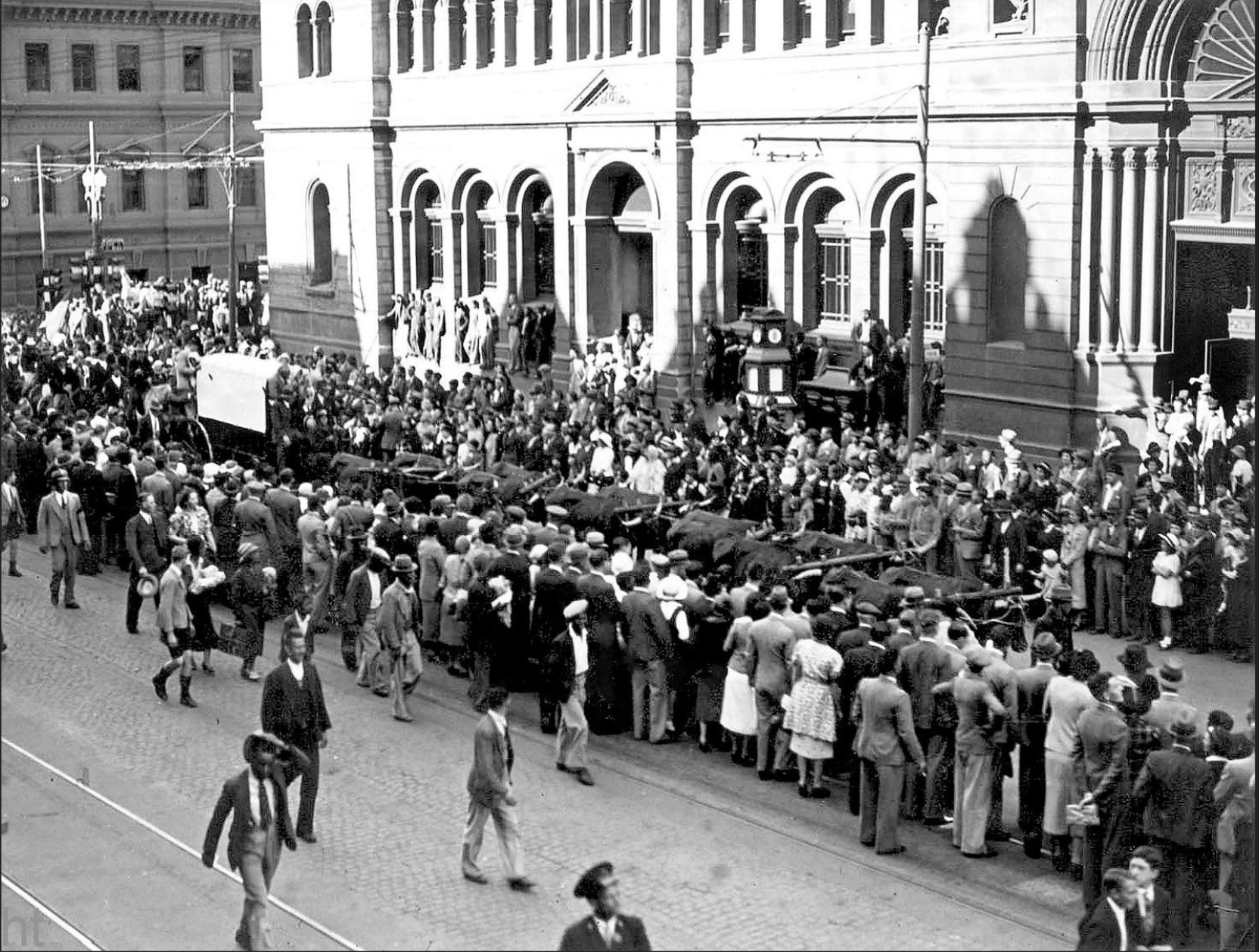
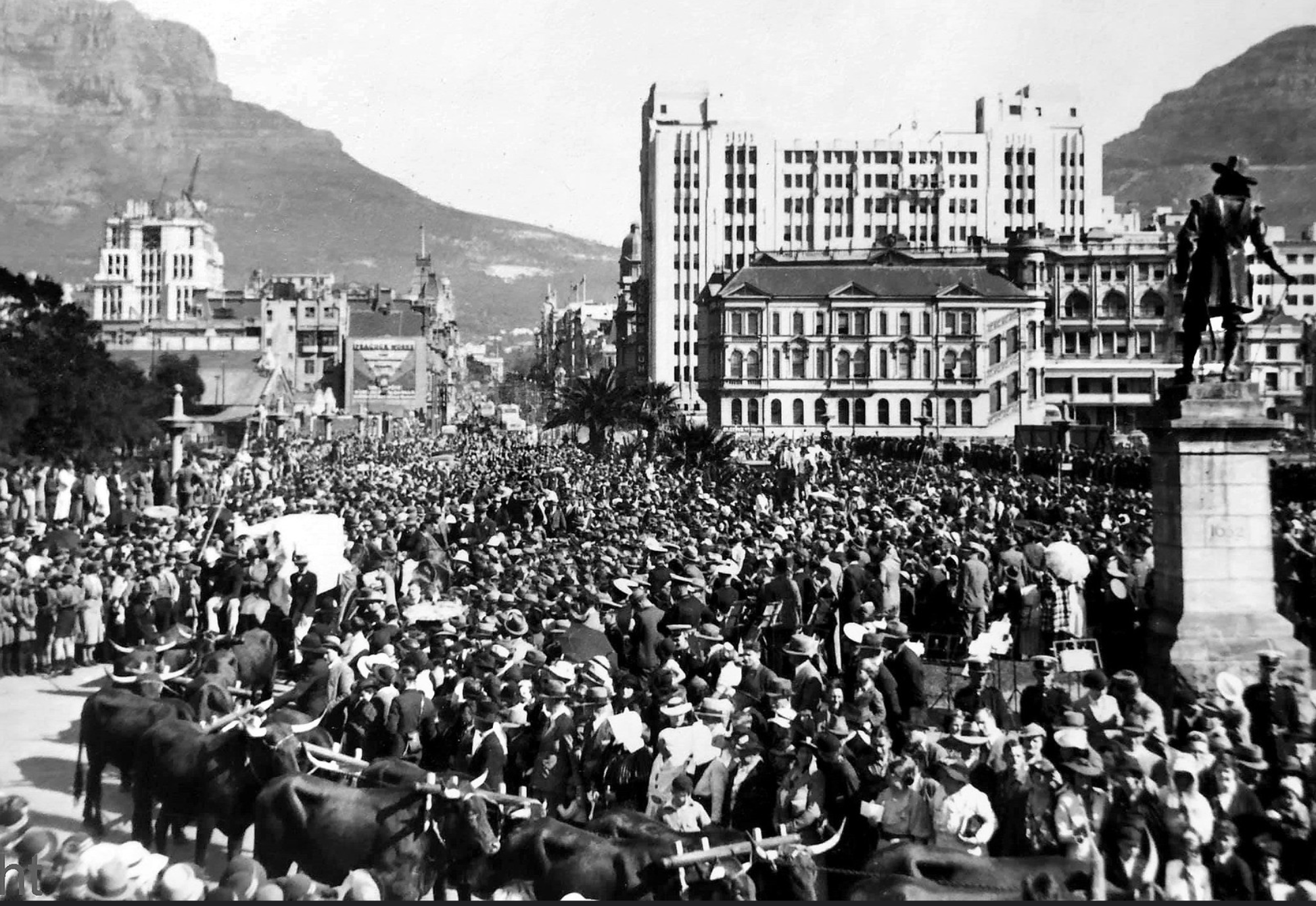
In 1938, the Broederbond under the directive of its Chairman, Henning Klopper sought to use the centenary of Great Trek to unite the ‘Cape Afrikaners’ and the ‘Boere Afrikaners’ under the symbology of the Great trek. In this endeavour artificially creating a shared Afrikaner heritage under the pioneering symbology of the Great Trek and to literally map a “path to a South African Republic” under a white Afrikaner hegemony. Klopper started a Great Trek re-enactment with two Ox-Wagons in Cape Town on 8 August 1938, and addressed the large crowd of 20,000 spectators by saying;

‘Let us build up a monument for Afrikaner hearts. May this simple trek bind together in love those Afrikaner hearts which do not yet beat together. We dedicate these wagons to our People and to our God.80

The trek re-enactment was very successful, and Klopper managed to realign white Afrikaner identity under the Broederbond’s Christian Nationalist ideology calling on providence and declaring it a:

‘sacred happening’81

1939 – The Ossewabrandwag was formed on 4 February 1939 (OB, the Ox-Wagon Sentinel) on the back of the 1938 Great Trek Centennial celebration and tasked with spreading the Broederbond’s (and the PNP’s) ideology of Christian Nationalism like “wildfire” across the country (hence the name Ox wagon “Sentinel”).
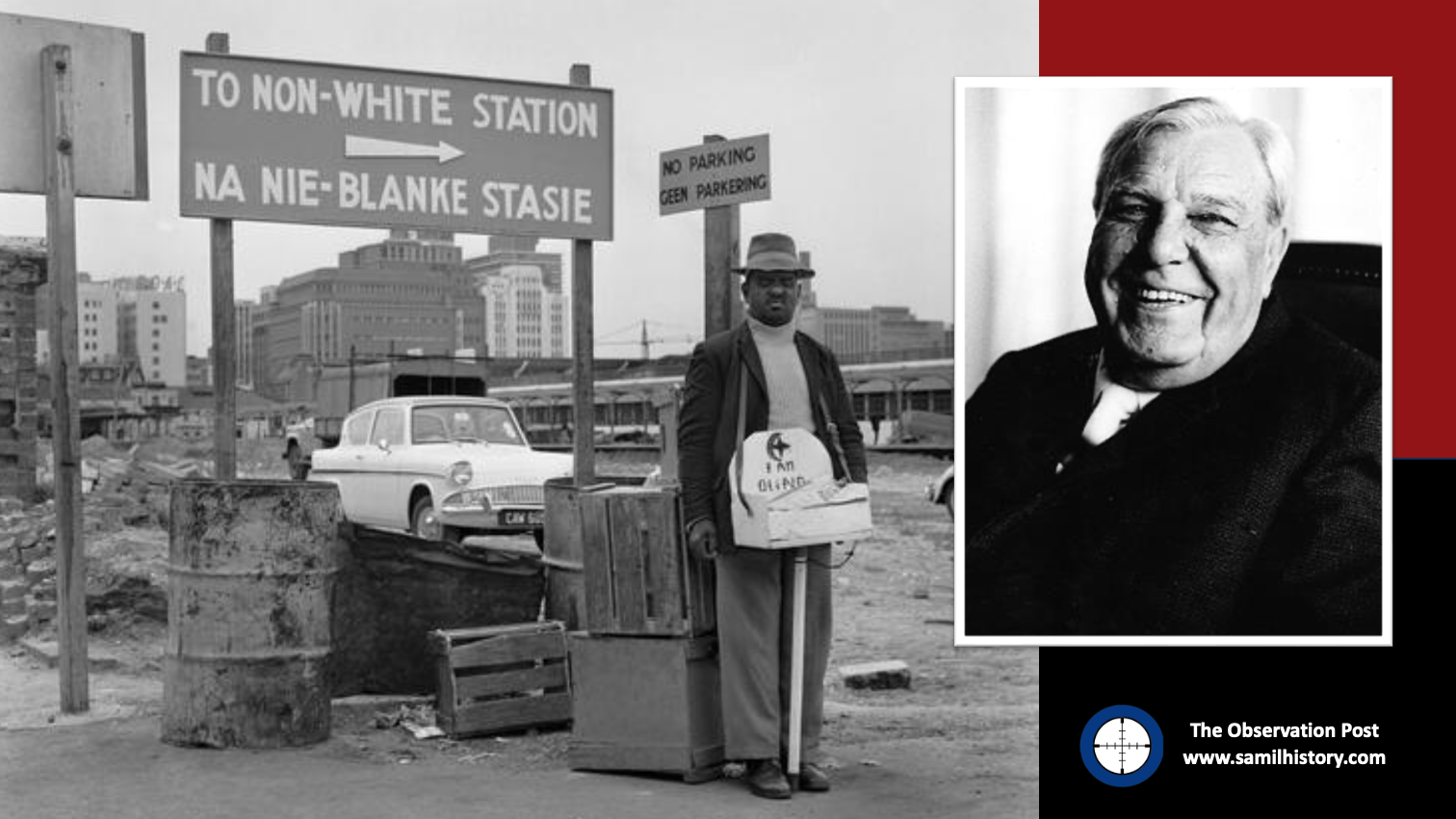
Application of Group Areas, insert picture the Rev. Koot Vorster

The Rev. Koot Vorster crosses over from his career as a theologian studying Church Law in the DRC to politician when he Chairs the ‘Separate Neighbourhoods Organisation’ which is a think tank for Group Areas Act and the Separate Representations Act, both keystone ‘pillars’ of National Party’s future Apartheid policy.82

‘In 1939 a ‘colour petition’ organised by the Pure Nationalists and signed by 230,619 Whites was presented to Parliament but not discussed. It demanded: (1) a ban on all mixed marriages; (2) all blood-mixing of White and non-White to be punishable (3) all deurmekaarwonery (living of the various races side by side) to be ended; and (4) economic and political segregation of White and non-White.’83

Manie Maritz, the Afrikaner Rebellion 1914 leader and Afrikaner “people’s hero”, also admired German National Socialism and split from his association with Hertzog’s old National Party to join the SANP Grey-shits, after a leadership purge he joined Chris Havemann’s Black-shirts. A converted antisemite and extreme racist, Maritz blamed the South African War on a Jewish conspiracy. He publishers an autobiography “My Lewe en Strewe” (my life and purpose) in 1939 and he outlines his political purpose to bring “the protocols of the elders of Zion” (a discredited racist propaganda document) and the dangers of Freemasonry, Judaism and Bolshevism contained therein to the Afrikaner people.84
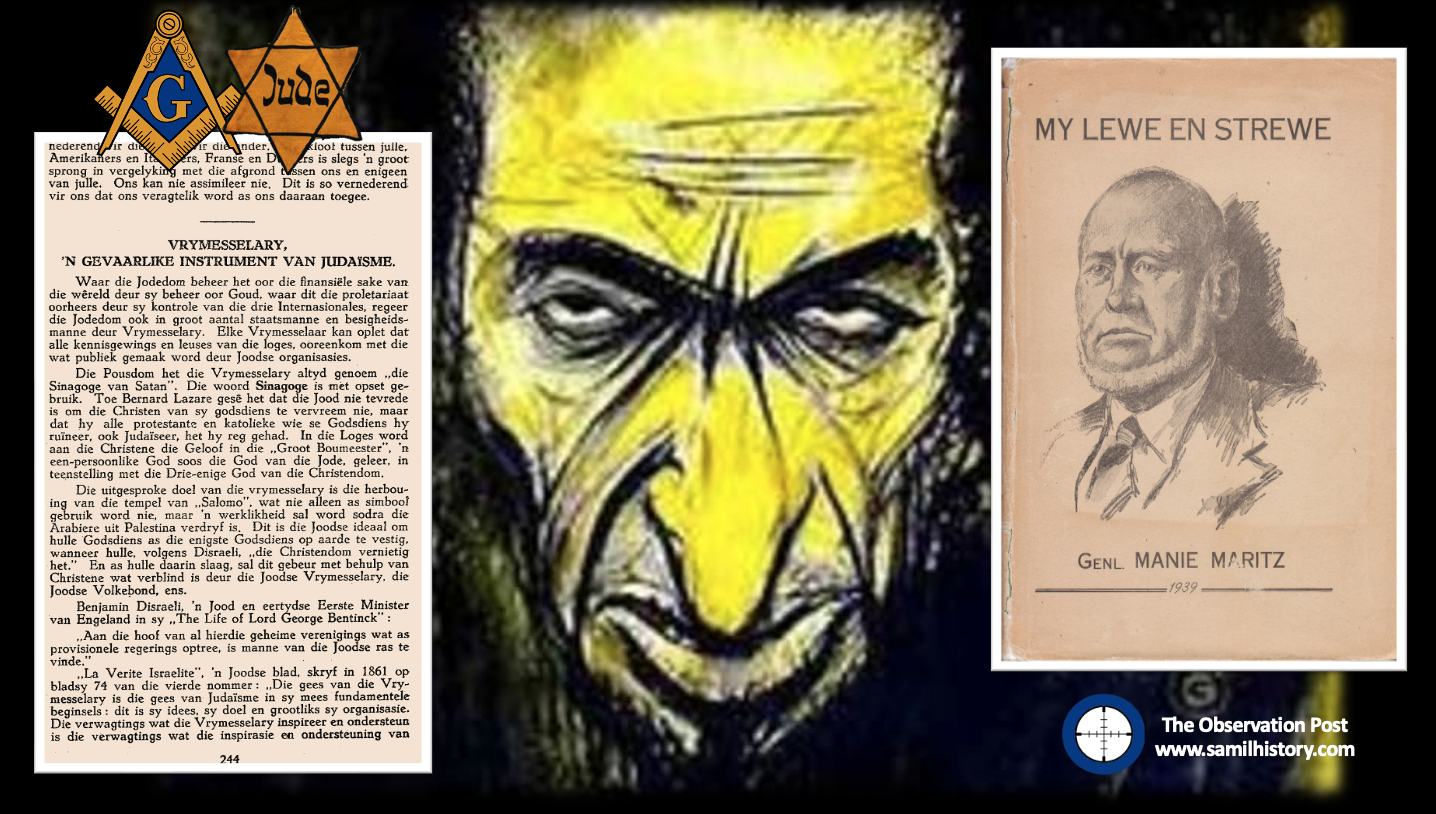
Manie Maritz and a section from My Lewe en Strewe

Dr. Nico Diederichs (future National Party ceremonial State President) on 9 May 1939, in his capacity of the Chairman of the Broederbond, would meet Herr. H. Kirchner, a Nazi foreign ministry representative in South Africa. Diederichs assures Kirchner that the divisions in Afrikanerdom had been overcome by the purging of Freemasons from Broederbond (which he had personally seen to) – he would go on to say that the Pure National Party (PNP) was a committed anti-semitic party and as policy had hung its hat on it, he assures Kirchner that Dr. DF Malan, Malan is also a committed anti-semitic. Diederichs however feels that more needs to be done to frame up National Party policies in line with National Socialism and confides in Kirchner that he does not think Dr. DF Malan is the man to do it, rather the implementation of the ‘anti-democratic’ and other national socialist principles should he left to Dr. Hans van Rensburg (future leader of the Ossewabrandwag) who he also feels would be ideal leader of the Purified National Party going forward.85

By July 1939, the Black-shirts were formally incorporated into the OB and focussed on the recruiting of ‘Christian minded National Aryans’ into the OB and starts to infuse it with National Socialist “volkisch” Nationalism.86

World War 2 breaks out when Britain and France declared war on Germany on 3 September 1939, the United Party found itself in a dilemma and a parliamentary three-way debate would take place. This debate, primarily between the two factions in the United Party (Hertzog’s cabal and Smut’s cabal) and the Purified Nationalists, was whether South Africa should go to war against Germany or remain neutral.

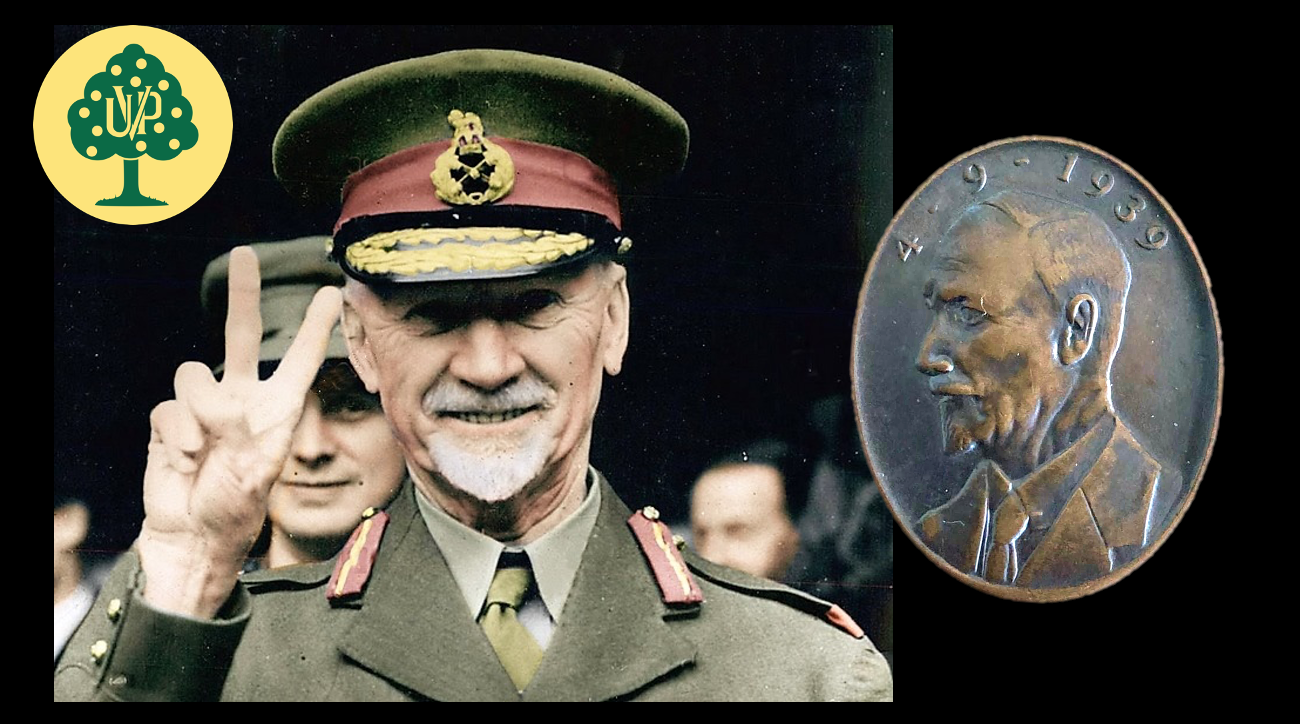
Prime Minister Hertzog was very confident he had the majority to carry a motion of neutrality. However Smuts’ argument that to stand aside from the conflict would be to expose the whole “civilised” world to danger wins the day.87  Smuts’ amendment to Hertzog’s Motion of Neutrality was carried by 80 votes to 67 votes on the 4 September 1939 and South Africa finds itself at war against Nazi Germany. Surprised at the outcome, Hertzog promptly resigned and along with 36 of his supporters left the United Party, thereby leaving the South African Premiership and the leadership of the United Party to Smuts.88

1940 – Hertzog moved to form a new party – the “Volksparty” and successfully reconciled with the “Malanites” in the PNP to then form the “Herenigde Nasionale Volksparty” (HNP) 89 or Reunited National Party in January 1940.90 However, on 5 November 1940 at the HNP’s Convention in Bloemfontein, Hertzog reaffirmed his position on English-speakers rights, and falling on deaf ears, he grabbed his hat and walked out of the National Party forever, leaving the leadership of the HNP to Malan.

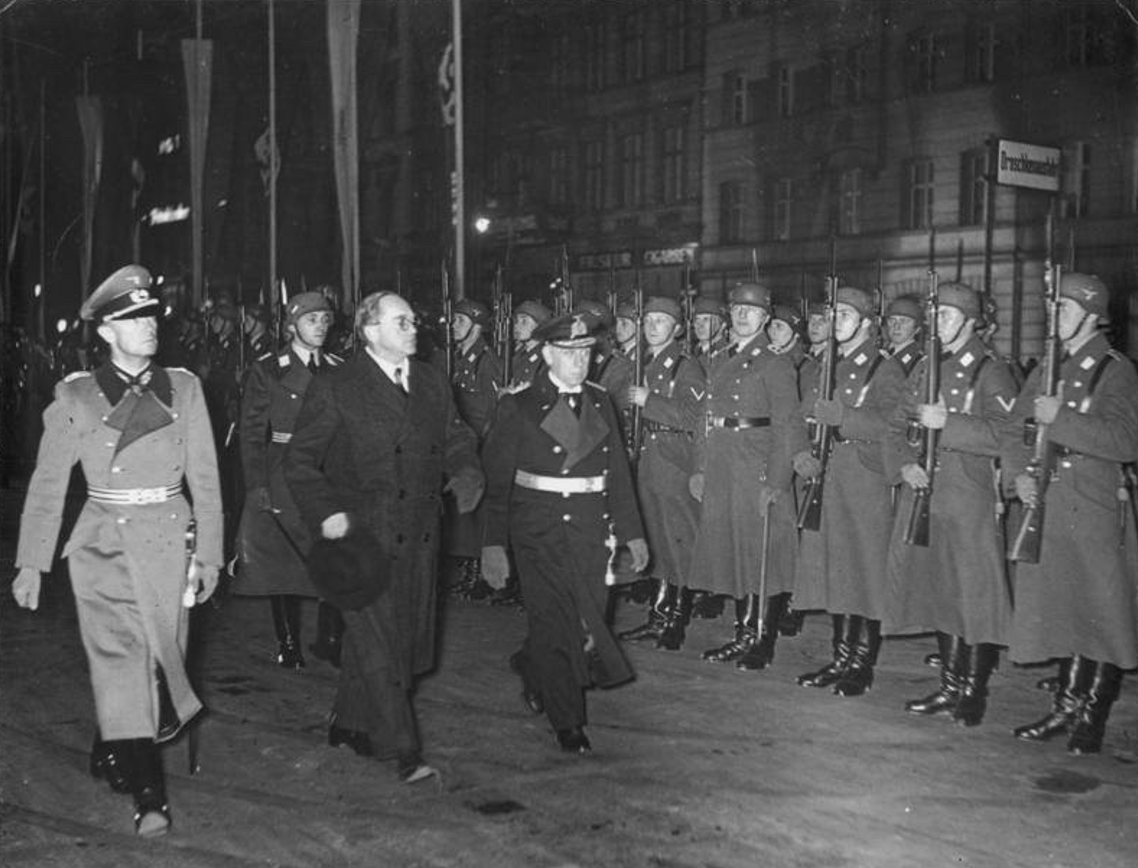
Oswald Pirow, whilst Hertzog’s old Minister of Defence met with Adolf Hitler, Hermann Göring, Benito Mussolini and Francisco Franco, and he becomes a convert to Nazism and Fascism. On 14 March 1940 Smuts forced Pirow out of his position as Minister of Defence for mismanaging his parliamentary portfolio, rendering the defence force unfit for wartime purposes and his failed “bush cart strategy”.91

Pirow gambled his career on a Nazi Germany victory and on 25 September 1940, he founded the national socialist ‘New Order’ (NO) for South Africa. He positioned it as a study group within the reformulated National Party (HNP), and based it on Hitler’s new order plans for Africa.92 During the Second World War, Pirow also positioned the NO as a defender of whites in Africa against the threat of Communism.93 In terms of the NO’s values, Pirow espoused Nazi ideals and advocated the “anti-democratic” principle an authoritarian state.94

The Rev. Koot Vorster in his guise as both a Church Leader and Ossewabrandwag ‘General’ conflates National Socialist “Führerprinzip” or Leader Principle and Afrikaner identity and the need for ‘separateness’ to succeed when on 15 September 1940 he states:

‘Hitler’s ‘Mein Kampf’ shows the way to greatness – the path of South Africa. Hitler gave the Germans a calling. He gave them a fanaticism which causes them to stand back for no one. We must follow this example because only by such holy fanaticism can the Afrikaner nation achieve its calling.’95

Hertzog, now in retirement and angered by his treatment at the hands of HNP and Malan, performs a remarkable volte-face and issued a press release in October 1941 in which he championed National Socialism.96 In the release Hertzog excoriated liberal capitalism and the democratic party system, praised Nazism as in keeping with the traditions of the Afrikaner, and argued that South Africa needed the oversight of a one-party state dictatorship.97

Manie Maritz, moving from the Black-shirts, then founded his own anti-parliamentary, pro National Socialist, antisemitic ‘Volksparty’, in Pietersburg in July 1940. 98 This evolved and merged into ‘Die Boerenasie’ (The Boer Nation), a party with National Socialist leanings originally led by J.C.C. Lass (the first Commandant General of the Ossewabrandwag) but briefly taken over by Maritz until his accidental death in December 1940.

On 30 October 1940, J.C.C. Laas resigns from the Ossewabrandwag as the Kommandant General, Malan also makes a declaration in a speech at Cradock which became known as the ‘Cradock Agreement’, defining the respective spheres of the Reunited National Party (HNP) and the Ossewabrandwag (OB). Each organization undertook not to meddle in the affairs of the other. The HNP was to do the work of Afrikanerdom in the party-political sphere, while the OB was to operate on the other (cultural) fronts of the Afrikaner “volk” (people).99

The Broederbond attempts to define Apartheid as a policy and commissions ‘think tanks’ within its structure to come up with it. However it falls short and L.J. du Plessis urges that Segregation is used rather than Apartheid as segregation was the ‘national policy’ in any event and had not reached its fullest potential as:

‘Afrikanerdom had not yet had the chance to carry it out.’.100

1941 – on 15 January 1941 the Ossewabrandwag (OB) came under the leadership of Dr. J.E.J. (Hans) van Rensburg,101 who had served as a National Party administrator of the Orange Free State. He was a strong admirer of Nazi Germany and campaigned for ‘a free Afrikaner republic based on nationalist-Socialist foundations.’ Explicitly rejecting parliamentary politics, the OB insisted that as the only mass movement it represented all Afrikaners. The OB pinned its hopes on a victory Nazi Germany and German help in establishing an Afrikaner republic. The OB had its own division of storm troopers, called the Stormjaers, who actively resisted the war by acts of sabotage and a handful of assassinations.102

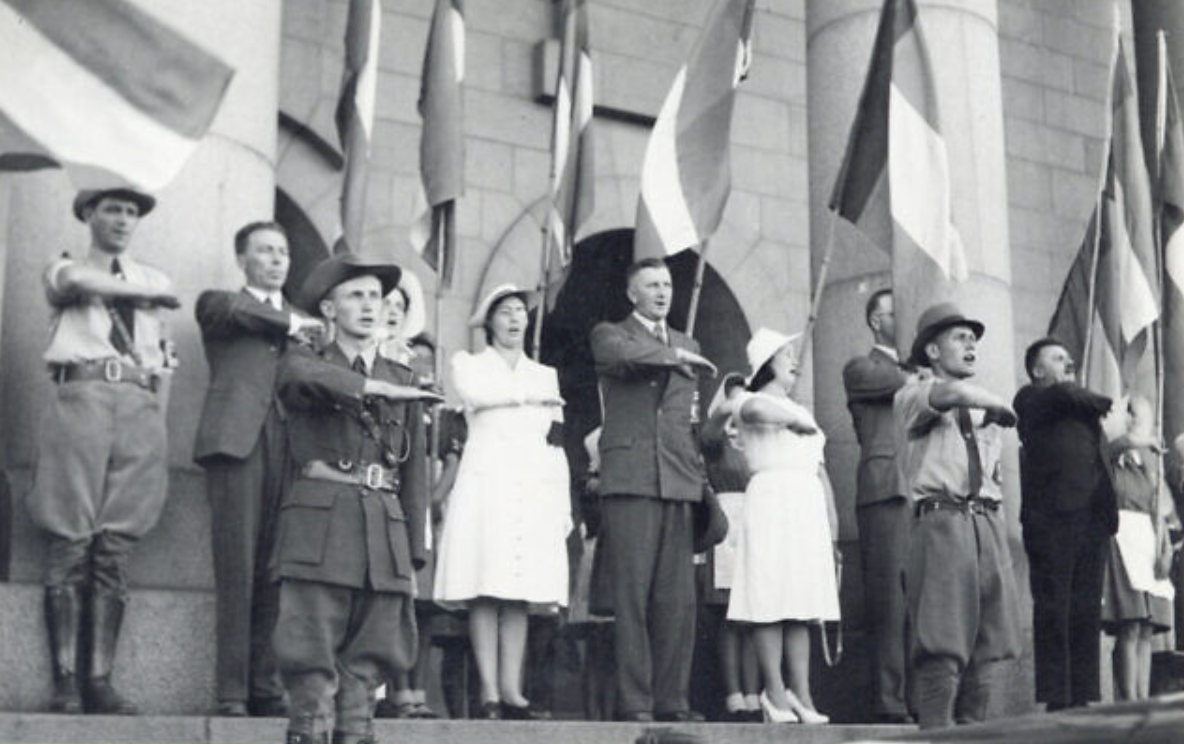
Van Rensburg infused the OB with National Socialist ideology, whereafter the organisation took on a distinctive fascist appearance, with Nazi ritual, insignia, structure, oaths and salutes. Ideologically speaking the OB adopted a number of Nazi characteristics: they opposed communism, and approved of antisemitism. The OB adopted the Nazi creed of “Blut und Boden” (Blood and Soil) in terms of both racial purity and an historical bond and rights to the land. They embraced the “Führerprinzip” (Führer Principle) and the “anti-democratic” totalitarian state (rejecting “British” parliamentary democracy). They also used a derivative of the Nazi creed of “Kinder, Küche, Kirche” (Children, Kitchen, Church) as to the role of women and the role of the church in relation to state. In terms of economic policy, the OB also adopted a derivative of the Nazi German economic policy calling for the expropriation of “Jewish monopoly capital” without compensation and added “British monopoly capital” to the mix.103
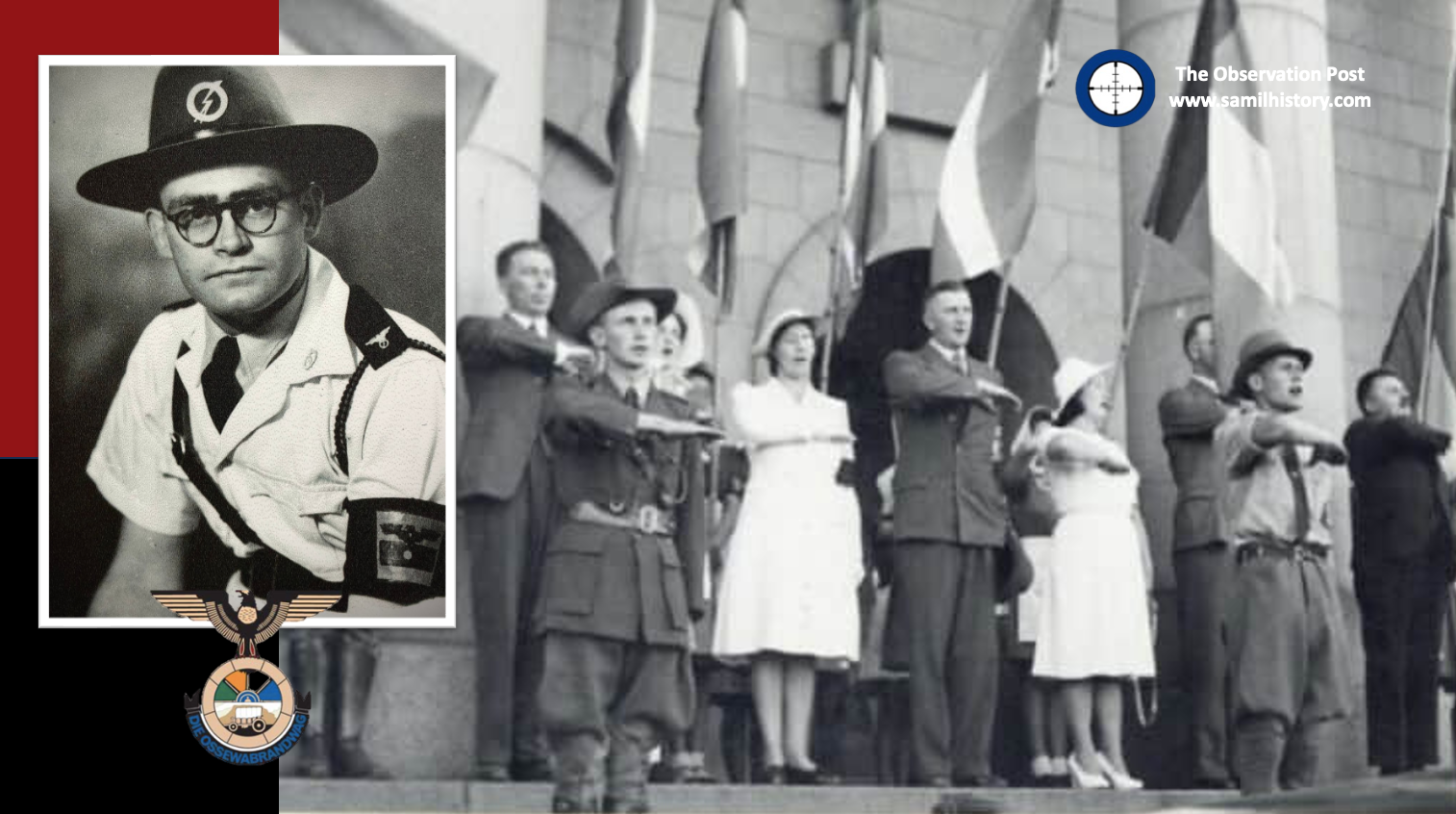
Ossewabrandwag dress and bearing

On 1 January 1914, the Afrikaner nationalist mouthpiece Die Vaderland called the OB ‘the greatest Afrikaans organisation outside of the Church’ and van Rensburg was not inclined to play second fiddle to Malan, whom he despised as a hide-bound constitutionalist.104

The Rev Koot Vorster, in February 1941 is sentenced to three years hard labour by the Smuts government when he is caught red handed in acts of sedition supporting the Nazi German war effort.105

In September 1941, fearing a leadership crisis over the OB’s encroachment from the cultural realm into the political realm and the promotion of the “Führerprinzip” over D.F. Malan’s more acceptable approach to working within “parliamentary democracy”, Malan in addition fears an ‘armed uprising’ of Afrikaners, so he moves to ‘ban’ OB members from joining the HNP. 106 B.J. “John” Vorster (the future National Party Prime Minister) refuses to resign from either, so the HNP make his mind up for him and expel him.

1942 – Smuts’ delivers a keynote address to the Institute of Race Relations on 21 January 1942, his usual position on ‘black’ and ‘white’ race and patronage changes, he opposes Nazism and attacks the Afrikaner nationalists who accepted Nazism, Smuts states, ‘.. that Nazi ideology of race produces the idea of a master people, the Herrenvolk. That is going back to an old discarded idea of slavery’ … and the policy of ‘segregation had resulted in very great disappointment at the results’ … and he proposes the need for a new policy, including a more equitable territorial (land) reconfiguration and the recognition of increasing Black urbanisation and their political aspirations.’107 Smuts then states:

‘Segregation has fallen on evil days’108

Smuts’ speech rallies the Afrikaner right wing who take up a position that Smuts’ “liberal” policies intend to give Black South Africans the franchise, and that an Afrikaner who did not believe in Afrikaner Nationalism was an “an Afrikaner of another kind”, a “traitor” with a “British heart”.
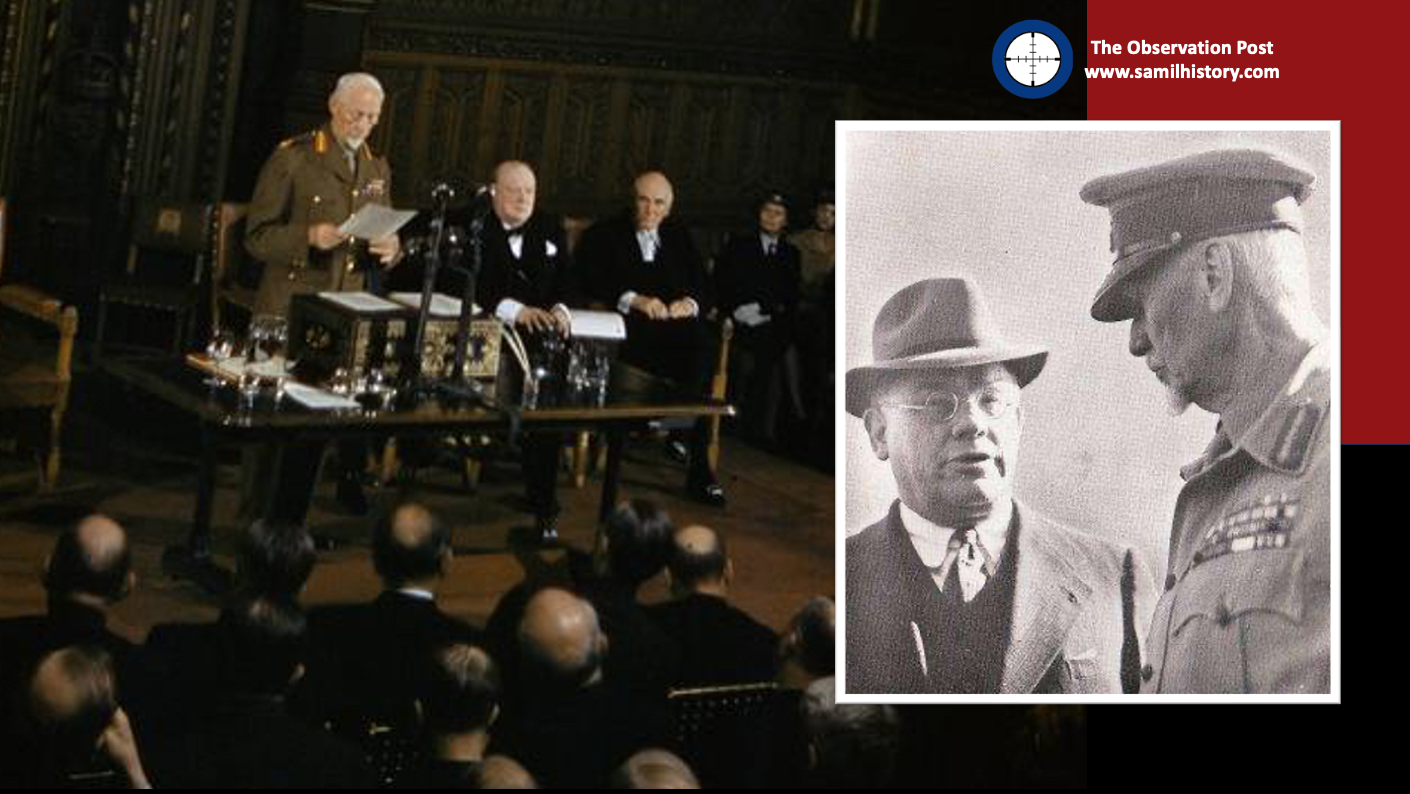
Smuts addressing both Houses of Parliament in the UK, insert picture shows Jan Hofmeyr, Smuts’ protégé

On the Afrikaner Nationalist right, the firebrand nature of the Ossewabrandwag (OB) also appealed to B.J. Vorster (future National Party Prime Minister and President of South Africa) more than the National Party during the war years. In 1942 he conflates the Broederbond’s ideology of Christian Nationalism with Nazism and Fascism and publicly states:

‘We stand for Christian Nationalism which is an ally of National Socialism. You can call this anti-democratic principle dictatorship if you wish. In Italy it is called Fascism, in Germany National Socialism (Nazism) and in South Africa, Christian Nationalism.’109

In response to growing support for Nazism in the Afrikaner community, a number of Afrikaner Nationalists find themselves interned by the Smuts government for acts of sedition and treason supporting the Nazi German war effort, these include the Broederbond’s legal stalwart Kowie Marais and B.J. Vorster.110

1943 – The DRC Federal Mission Council approaches Prime Minister Jan Smuts and requests a ban on mixed marriages. The DRC mission includes a biologists report from H.B. Fantham, who:

‘maintained that the colouring of black and white intermixture displayed negative social and mental characteristics.’111

Smuts rejects their proposal stating:

‘The line between white and coloured people in many instances could not be drawn.’112

Die Burger uses ‘Apartheid’ for the first time in mass media, when it referred to Apartheid as the:

‘accepted Afrikaner viewpoint’.113

In 1943, Dr. Verwoerd, as the editor of Die Transvaler, sued the English-language newspaper The Star for libel after it accused him of being a Nazi propagandist, the case back-fired as Justice Millin, in a 25,000-word judgement found Verwoerd had indeed being complicit in promoting Nazism and concluded:

‘Dr. Verwoerd caused this large body of German propaganda to be published and that it was along the same themes as the Afrikaans Zeesen reports which was “calculated to make the Germans look on Die Transvaler as a most useful adjunct to this propaganda service”‘.114

1944 – in May 1944, Dr. D.F. Malan and Paul Sauer, offered the first extended defence of Apartheid as a concept in parliament. Malan called for a republic based on the policy of:

‘apartheid and trusteeship, made safe for the white race and the development of the non-white race, according their own aptitude and abilities.’115

1945 – The Reunited National Party adopts Apartheid as its official policy.116

Surrounded by the Red Army, Adolf Hitler commits suicide and 30 April 1945. Nazi Germany unconditionally surrenders to Allied forces on 7 May 1945.

From 20 November 1945 to 1 October 1946, the Nuremberg Trial takes place and exposes the full criminality of the Nazi Party regime and its ideology. The Nazi dogma with its focus on the bogus “protocols of the elders of Zion” to justify the holocaust is exposed as wilful genocide and deemed a crime against humanity.

1946 – having served his sentence and released from jail, the Rev. Koot Vorster champions a DRC inter-church commission on Communism. This commission’s aim was to ‘combat the communist worldview in South Africa‘ and represents another cross over of Church and Afrikaner Nationalism politics in defining the “Rooi Gevaar” (red danger) policy.117  

In light of his ‘segregation has fallen on evils days’ statement, Smuts appoints The Native Laws Commission (also known as the Fagan Commission) to look at Black African urbanisation and investigate changes to the policies of segregation. In August 1946, in agreement with the Fagan Commission recommendation to end segregation, Smuts nails his colours to the mast in opposition to Apartheid and says of it:

‘The idea that the Natives must all be removed and confined in their own kraals is in my opinion the greatest nonsense I have ever heard.’118

1947 – Malan appoints P.O. Sauer to head a party commission to turn apartheid into a comprehensive racial policy.119 The Sauer Commission was in part intended to forestall Smuts’ Native Laws Commission (the Fagan Commission) and counteract its recommendations as to any changes to segregation policies.

The Sauer Commission proposes a policy aimed at ensuring blacks develop:

‘in their own territory and in their own towns.’120

Malan also declares that it is not the state that took the lead with inventing Apartheid, it was the DRC.121 He says:

‘It was not the State but the Church who took the lead with Apartheid The State followed the principle laid down by the Church in the field of education for the native, the coloured and the Asian. The result? Friction was eliminated. The Boer church surpasses the other churches in missionary activity. It is the result of Apartheid.”

1948 – the DRC Synod of the Transvaal accepts the 1935 DRC Mission for separate education for separate nations and refers the Tower of Babel as the justification for Apartheid.122

April 1948 sees Oswald Pirow re-engage his relationship with Oswald Mosley, the discredited leader of the defunct ‘British Union of Fascists’, in order to collaborate on a Neo Nazi ‘New Order’ model for Africa as a whole. The come up with the Mosley-Pirow Proposals, which were: ‘a natural development of General Hertzog’s Segregation Policy and was foreshadowed by (his) then cabinet colleagues 15 years earlier’.123 The proposals essentially divide Africa into a large southern ‘white’ state with its labour provided by separate ‘black’ vassal states on temporary work permits. The work foreshadows the Apartheid Bantustan program and influx control policies.
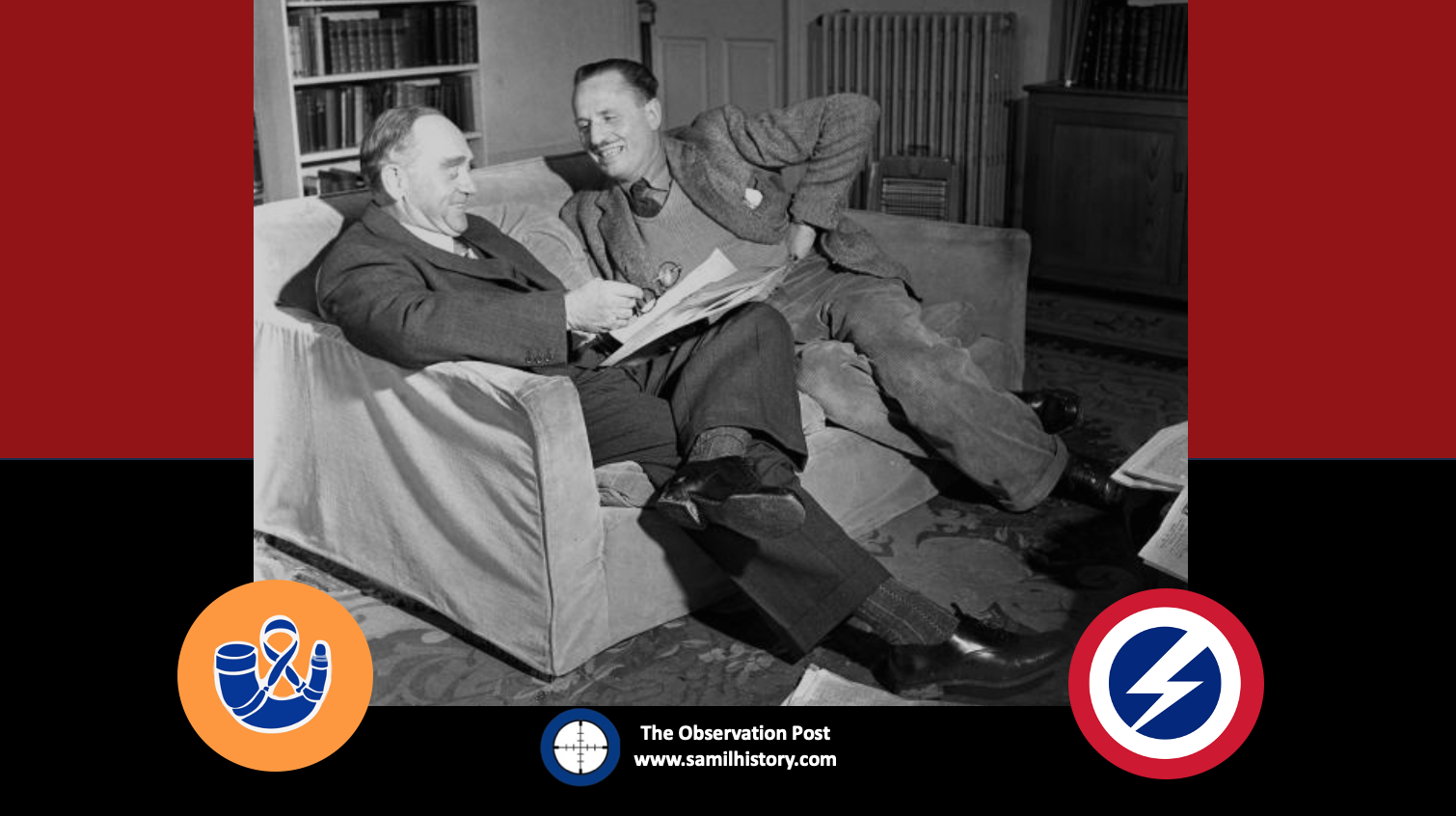
The ‘Oswalds’ – Pirow left and Mosely right – collaborating in London

With Nazism now a worldwide anathema, the Grey-shirts (SANP) disbands in 1948 with most its leadership joining Malan’s HNP or aligning with it under a new entity called ‘the white workers party’ in 1949.

Dr. Malan pledges that Aryan German immigrants were necessary to cultivate a ‘broad Nordic front to counter Communism, Blacks and Jews’.124 Schalk Botha and Dr. Vera Bührmann fly to war-torn Germany on behalf of the ‘German Children’s Fund (DKF) on 27 April 1948. They aim to implement a Weimar Eugenic program and locate 10,000 healthy White, German, Protestant (Aryan) orphans and bring them to South Africa for adoption by leading Afrikaner Nationalists in order to:

‘strengthen their own Afrikaner Volk with the blood of “prestigious” German-Aryan Herrenvolk’125

Unable to meet their target due to restrictions in Germany, they secure only 87 “orphans”, the first choice of which is given to Dr. Malan who adopts a little girl.

The 1948 General Elections on 26 May 1948 are a landmark occasion in South Africa, as Malan and his HNP in coalition with the Afrikaner Party win a constitutional majority by a single seat, although not elected on a ‘majority’ popular vote they take up the mantle of ruling party citing divine providence to bring their policy of Apartheid to all South Africans.

As the new ruling party the HNP tables and passes Acts that begin to form the ‘cornerstone’ of Apartheid, these include:

  • The South West Africa Amendment Act. propagated in 1948, provided for the representation for white South West Africans citizens in the South African Parliament, ignoring International Law and the status of the Namibian mandate.
  • Asiatic Laws Amendment Act of 1948 takes away franchise and land ownership rights of South African Indians and confines them to pre-determined ‘areas’.

1949 – the DRC Synod of the Cape declares the 1857 DRC Synod which made way for separate worship as the epicentre of Apartheid – and to the 1935 DRC Church policy on the segregation of schools and education and declares:

‘”Vertical Separation” between black and white so they can each achieve their own “independence “.’126

The fundamental difference in Afrikanerdom between Smuts and Malan is seen on 16 December 1949, at the inauguration of Voortrekker Monument as a symbol of ‘the Afrikaner’s proprietary right to South Africa’. General Jan Smuts warned:

‘Let us not be fanatical about our past and romanticise it.’ Smuts then called for greater co-operation between white and Black South Africans as the ‘most difficult and final test of our civilisation’.

Malan, now the Prime Minister of South Africa, took a different view to Smuts in his speech and warned:

‘Godless communism’ was threatening the achievements of the Afrikaners and ‘there was a danger of blood mixing and disintegration of the white race. The only way of avoiding the spectre of a descent into “semi-barbarism” was a return to the Voortrekker spirit and a return to the volk, church and God.’127

1950 – Acts which constitute the ‘Pillars of Apartheid’ are passed by the National Party as the governing party, these include:

  • The Immorality Amendment Act, 1950 (Act No. 21 of 1950) prohibits sexual intercourse between white people and people of colour. The act was an amendment to the 1927 Immorality Act originally introduced by Hertzog’s governing National Party and its eventually extended to include homosexuality.
  • The Group Areas Act, 1950 (Act No. 41 of 1950) separates urban areas into racially segregated zones where members of one specific race alone could live and work. Group areas were created for the exclusive ownership and occupation of a designated group and it became a criminal offence for a member of one racial group to reside on or own land in an area set aside by proclamation for another race. 
  • The Suppression of Communism Act, 1950 (Act No. 44 of 1950) gives the Minister of Justice broad powers to suppress not only Communism but any scheme aimed at achieving change, whether economic, social, political, or industrial, “by the promotion of disturbance or disorder” or any act encouraging “feelings of hostility between the European and the non-European races … calculated to further (disorder)”
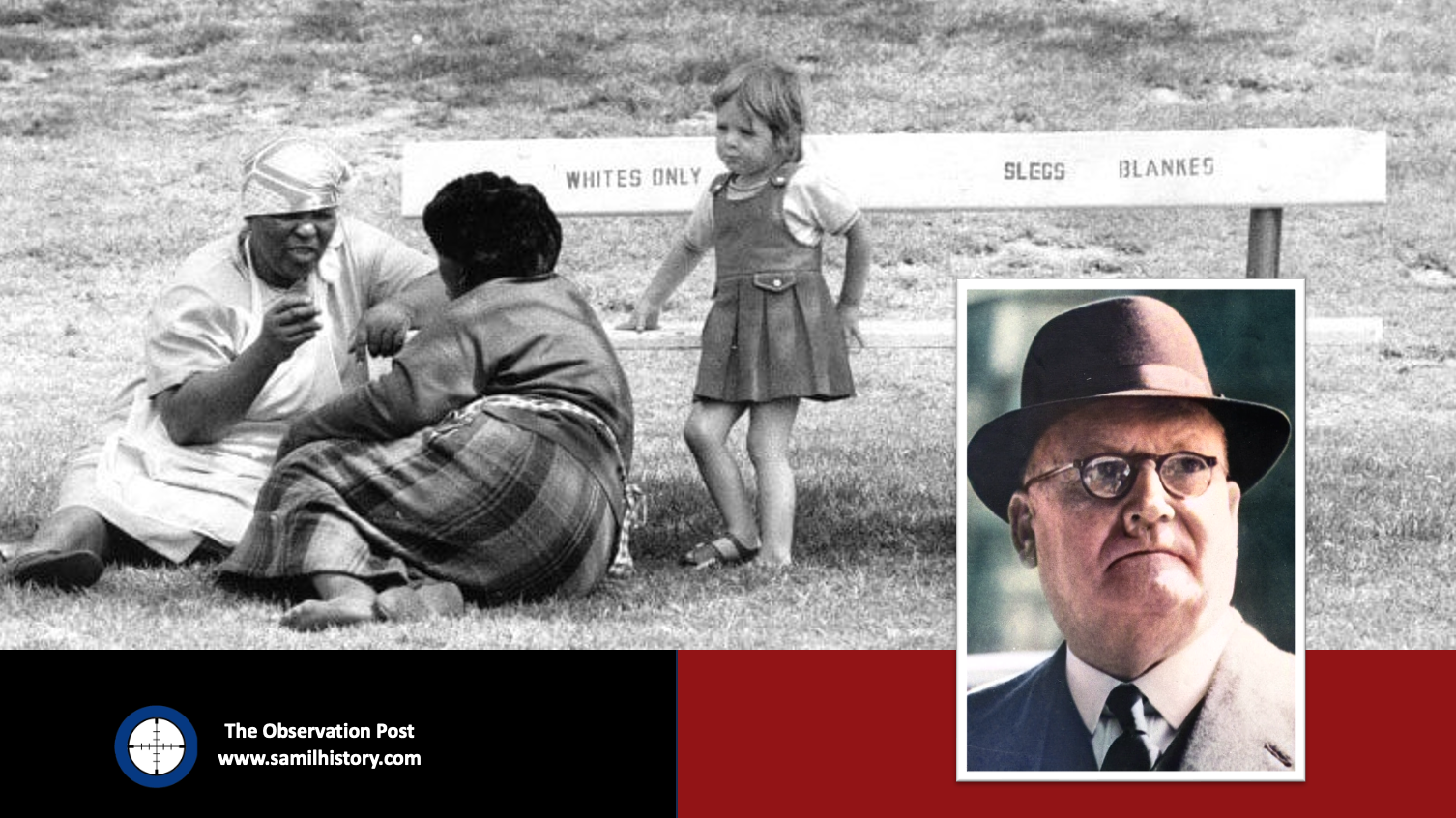
Insert – Dr. D.F. Malan

Jan Smuts passes away on the 11 September 1950 of a heart attack, aged 80.

1951 – The Reunited National Party formally Afrikaner Party are formally amalgamated to form ‘The National Party’ again, ending the long standing division caused by Hertzog and “Fusion” with Smuts back in 1933. The Afrikaner Nationalists who had splintered from the National Party into all the various shirt movements, the Ossewabrandwag and the New Order are welcomed back under a singular party.

These pro-Nazi and anti-war groupings within the National Party planted a fertile seed bed for the future authoritarianism of the Apartheid state. The constant depreciation of liberal democracy in this demographic of Afrikaners alongside an almost ‘hysterical exaltation’ for both ‘racist’ and a ‘Völkisch‘ group ethics were to have long term effects.128

Although Nazi ideology and dogma was no longer permissible in the political sphere, no solid measures were put in place by the Smuts government to prevent it from flourishing. Afrikaner Nationalists entertaining strong National Socialist ideologies and having committed treason and sedition during the war, who in European countries would have been hanged for war crimes, landed up back in mainstream party politics under the banner of the National Party and many even ended their days in Parliament.129

On the legislative front:

  • The Separate Representation of Voters Act 1941( Act No. 46 of 1951) is introduced as part of a deliberate process to remove all non-white people from the voters’ roll and revoke the Cape Qualified Franchise system, this triggers the Constitutional Crisis.

The Separate Representation Act and the Constitutional Crisis, triggers the formation of War Veterans Action Committee (WVAC), a returning ‘white’ war veterans lobby group led by Sailor Malan, which in turn becomes the first mass anti-apartheid protest movement, called The Torch Commando. In Sailor Malan’s words, The Torch Commando’s primary mission:

‘The Torch Commando was established to oppose the police state, abuse of state power, censorship, racism, the removal of the coloured vote and other oppressive manifestations of the creeping fascism of the National Party regime’.

1952 – the African National Congress (ANC) announces the start of the Defiance Campaign scheduled to begin with mass protests and defiance of Apartheid laws by the country’s black majority on 26 June 1952.

Whodunnit

As can be seen from the chronology and historiography of Apartheid, the body that ‘invents’ it is not the British and nor is it the entire white Afrikaner diaspora. It is in fact invented in the Dutch Reformed Church (DRC). The British are the “catalyst” to Apartheid in that without Britain’s abolition of slavery and Britain’s implementation of a colour blind franchise putting Dutch Reformed Church puritans on the same footing as some black slaves – the journey to ‘Apartheid’ would have taken a different path.

There has been a long standing debate in academic circles revolving around Apartheid’s origins and historiography. Two sides emerged from the debate, both agree that the origin of Apartheid is slavery in the Dutch Cape Colony, however after that the two arguments go separate ways.

One group points to the Voortrekker’s Puritan religious standpoint which brought the idea of “separate worship” for Blacks and Whites into Dutch Reformed Church policy. The epicentre is the Zuid-Afrikaansche Republiek (ZAR) NGK Synod in 1857 and subsequent Synods and Dominees come to define Apartheid along the lines of Jim Crow Laws, Darwinist Eugenics and Southern American State Segregation policies. This group, defines Apartheid as a derivative of American Segregation along ecclesiastical lines.

The other group points to the advent of National Socialism (Nazism) in the mid 1930’s as the key political driver of Apartheid’s origin, and they name the National Party’s ‘Think Tank’ Professors and academics who are all enamoured and besotted with Nazi Germany, anti-Semitism, Nuremberg Race Laws and Weimar Eugenics as the chief proponents of it. This group would define Apartheid as a derivative of National Socialism along party political and ideological lines.

Stepping into the fray to sort the argument out once and for all in 2003 was the heavy-weight Afrikaner historian – Professor Hermann Giliomee. He concluded in his work ‘the making of the Apartheid plan’ that the essence and origin of Apartheid lay along the DRC’s ecclesiastical lines and had nothing to with Nazism. He cites a famous speech by Dr. DF Malan in 1947, and taking it at face value he formats it as the crux of his argument, it’s a speech where Malan declares that it is not the state that took the lead with Apartheid, it was the Dutch Reformed Church who led it – and according to the Church, the DRC Synod in 1857 in the ZAR marks the start of it.130

What Professor Giliomee loses sight of by quoting DF Malan, is it is this very man who is front a centre in a very Weimar Eugenic based Aryan adoption program to boost the bloodline of white Afrikaners with Nazi German Herrenvolk blood and to advance an Völkisch ideology in South Africa. Malan not only opens the way for this ideology and thinking by the “Germanophiles” and wartime pro-Nazi leaders in his party, he even adopts one of the children. The German Children’s Fund (DKF) is not only inspired by National Socialist dogma, it is a vert practical and realistic application of it in South Africa.
The Malan family with their DKF adoptive child re-named Marieke Malan after Dr. Malan’s wife Maria.

Giliomee also loses sight of the fact that Malan makes this declaration in 1947, after the end of the war in 1945 and the exposure of Nazism and its ideological connection to the holocaust, and by deflecting to the Dutch Reformed Church (to which he is pre-disposed to do as a Dominee anyway) he is gaslighting for the plethora of “Germanophiles” who have been advocating National Socialism in all the various Afrikaner Nationalist cultural, media and political structures and who have all subsequently been warmly welcomed into the HNP’s fold and its leadership caucus. Especially after their 1948 election win and the merger with the Afrikaner Party to reconstitute the HNP as the “National Party” (NP). 

To be fair to Giliomee, what he does not have sight of in 2003 is all the recently uncovered archive files and materials found 20 years later. Documents on the Ossewabrandwag pointing to Nazi collusion – files, court records, letters, memos and confessions from South African Nazi renegades within Afrikaner nationalism captured and interrogated in the Rein Commission and published in the Barrett Commission findings after the war – files which were, until recently, regarded as either missing, “gate-kept” or embargoed. Even the recent findings and academic works on the Nazi German propaganda program in South Africa makes for an eye-opening historiography of Apartheid.

Previously “shielded” (gate-kept) or missing files – primary source material – have now finally put the nail into the ecclesiastical argument as the sole origin and development of Apartheid and we can now finally conclude that not only was Apartheid ‘invented’ by the Dutch Reformed Church, it was subsequently infused with National Socialism – and although not Nazism in its purest form it is indeed a derivative of Nazism.

Afrikaner Christian Nationalism vs. German National Socialism

So what’s the real difference between Apartheid and Nazism? The fundamental difference lies in the religious approach to establish a ‘Herrenvolk’ – a ‘pure’ white European race. How this is arrived at is fundamentally different to one another – the Nazis arrived at the idea of a Herrenvolk on a Nordic mythology and occultism platform, the Afrikaner Nationalists arrive at the idea of a Herrenvolk on a Calvinist puritan and ecclesiastical platform. Whichever way they arrive at it, they arrive at the same thing.
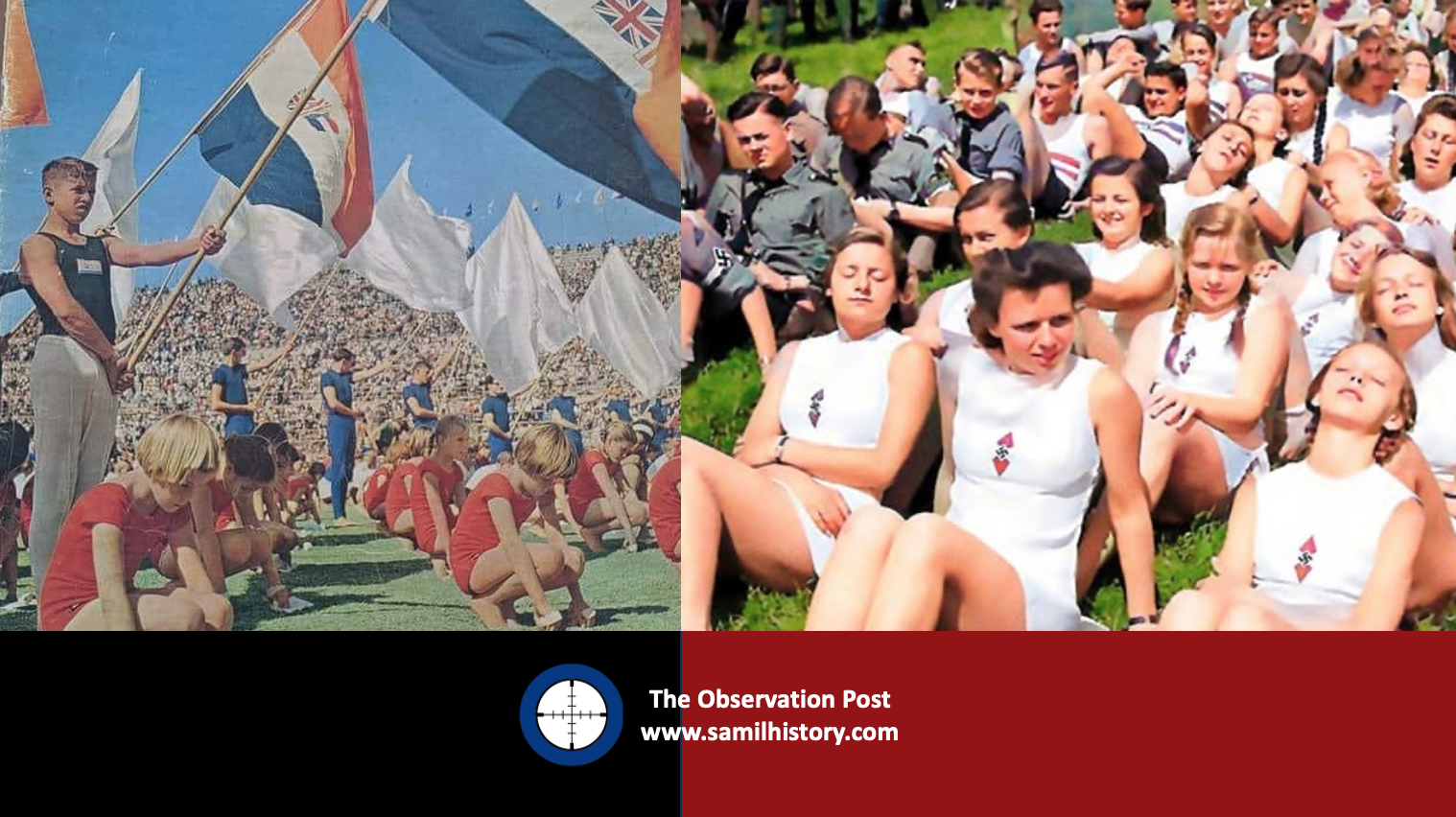
Afrikaner Nationalism and youth (left), Nazi German National Socialism and Hitler youth (right).

The ‘dominees’ base their Herrenvolk concept on a strict Calvinist Puritan dogma and an early idea of Darwinism and American eugenics based on Jim Crow and American Anti-miscegenation and segregation laws, the idea that the Afrikaner nation is ordained by God to be a morally superior nation over heathen (Kaffir) nations. The more germaphobe ‘politicians’ in the National Party build on the Herrenvolk concept with Nazi German Nuremberg Race Laws and German (Weimar) eugenics promoted by Hitler – the idea that the infusion of degenerate elements (Untermensch nations – including Blacks and Jews) into the bloodstream weaken the Herrenvolk nation so as to be morally inferior.

With the adoption of Krugerism as its core ideology and the conflating of Church and State, the National Party finds itself split in two camps over its historic sweep – on the one side are the Dutch Reformed ‘dominees’ like Dr. D.F. Malan and on the other side are the ‘politicians’ like Dr. H.F. Verwoerd.

Also, one group in the National Party sphere, like Malan and Sauer tend to favour ‘democracy’ as defined within the ‘white democratic constitution’ of South Africa to attain political objectives (as are the principles in the segregated states of the USA) – the Germaphobe inclined politicians in the National Party sphere like van Rensburg, Dönges, Vorster, Pirow, Diederichs etc. favour the ‘anti-democratic’ principle as defined by the Nazi “Führerprinzip”. This has bearing later as South Africa as they manipulate the constitution and laws to become a police state and with all opposition banned, imprisoned, deported or gagged – the Apartheid state mirrors a Nazi modus operandi and becomes a one party authoritarian state promoting a very thin veneer of wholesome ‘democracy’ to its faithful.

At the end of the day Apartheid – from a dogma standpoint, is a curious mix of Puritan Calvinism and Völkisch Nationalism. Legally it’s a curious mix of American Jim Crow segregation laws and Nürnberger Gesetze Nazi German race purity laws. Ideologically speaking Apartheid is a curious cocktail of Krugerism, Hertzogism, National Socialism and Fascism. None of which have anything to do with the British and their prevailing philosophy – which is a curious mix of monarchism and democratic liberalism.

Neo Nationalist Revisionism

As to Hélène Opperman Lewis book “Apartheid: Britain’s Bastard Child” released in 2017 blaming Apartheid as a psychological consequence of mutual trauma caused the British scorched earth and concentration camps policies of the South African War (1899-1902), and more recently reinforced by Albert Blake’s in his book “Jopie Fourie – ’n besinning” (a reflection) when he writes (my translation from Afrikaans):

Afrikaner Nationalism is increasingly seen as an attempt at self-protection – exclusively, partly to avoid repeating the unacceptable past (referring the South African War 1899-1902 and the Afrikaner Rebellion 1914-1915). This contributed to the emergence of hard-line Afrikaner nationalism which gave rise to an inflexible and, for others, an unacceptable racial policy. The Afrikaner wanted to avoid similar suffering as in the past at all costs, but by doing so overlooked the suffering of others. It became a vicious cycle from ‘abused children’ (under British rule) to ‘abusive parents’ (under apartheid) that is never broken, because there has been no healing for the unprocessed trauma.’131

Blake and Opperman Lewis are effectively extending an old National Party argument, the idea of ‘the politics of pain’ as the justification for nationalism and the identification of a ‘political’ and ‘economic’ enemy embodied therein, in the case of the Afrikaner Nationalists this led to extreme Anglophobia and the raison d’exister for Apartheid. This old Christian Nationalism dogma is largely disproven as rhetoric to drive a racially divided state. But in this case it has been given a new veneer, as in the social sciences Psychology has emerged as another method to understand history and in this case it has a tool called epigenetics.
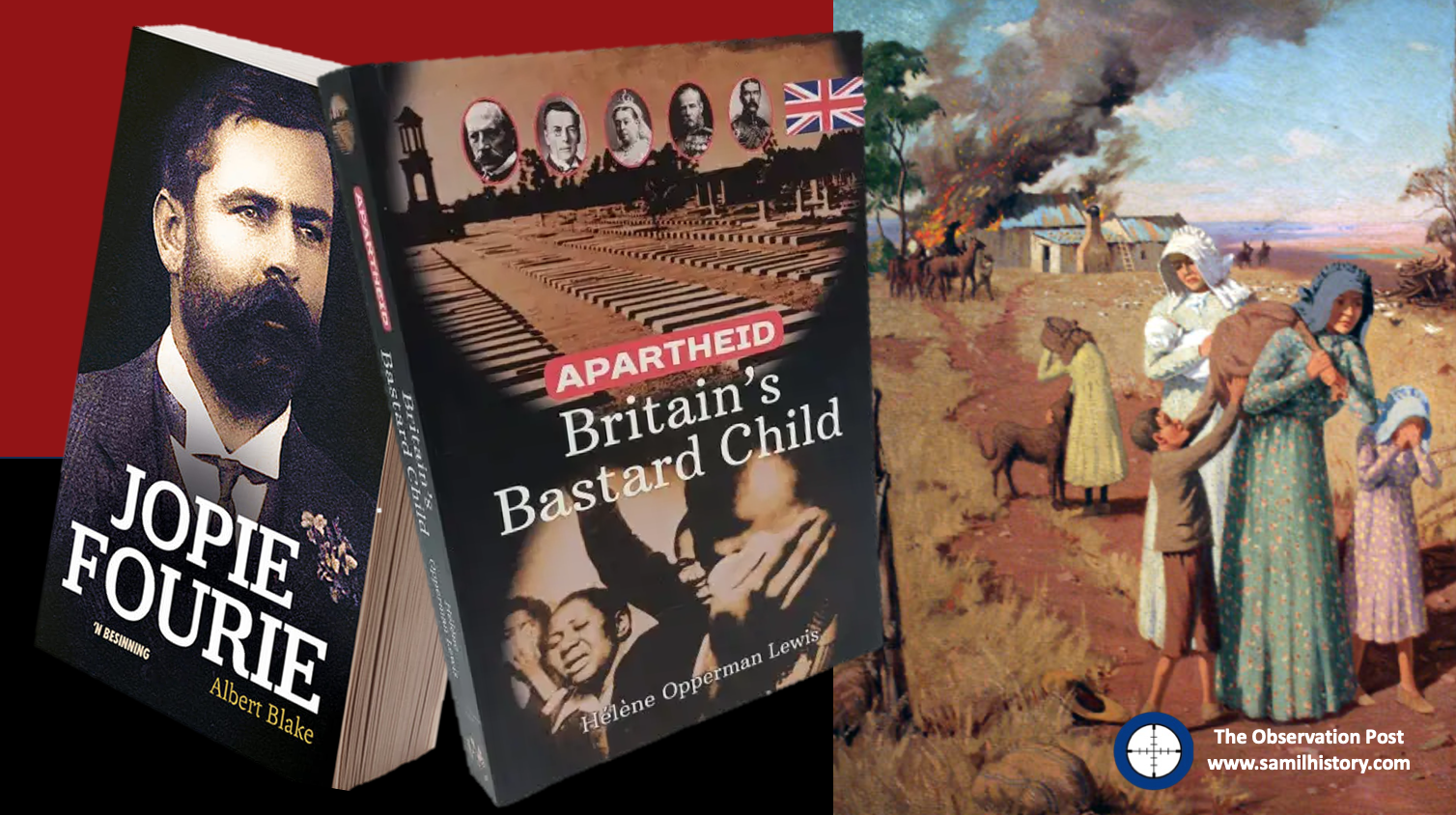
Epigenetics states that ‘trauma’ is carried from generation to generation in the DNA and called ‘Intergenerational trauma’. So according to Elsabé Brits in her review of Albert Blake’s book titled. Op dees aarde: Oorlogstrauma en die radikale Afrikaner-psige (On this earth: War trauma and the radical Afrikaner psyche) – it was the women’s and children’s suffering in both the white and black concentration camps that was passed on from one generation to the next and although they kept it to themselves it resurfaced generations later.132 The political landscape was impacted, Apartheid instituted as a protection mechanism and mutual suffering entered Afrikaner identity along with Anglophobia. Blake argues further that this Afrikaner Nationalism driven by trauma was accelerated by the 1914 Afrikaner Rebellion and Jopie Fourie’s execution.

There are a number of problems with this Neo Nationalist Revisionism. As can be be seen from the historiography of Apartheid, and the chronology of Apartheid, this revisionist approach really has unhinged itself from the historical method. For the following glaring reasons:

  1. It denies the historical fact that Apartheid’s origins lie in slavery and the abolishment thereof and rejects all contemporary historians who advocate this.
  2. It ignores the historic sweep of all the Boer conflict with Black tribes to establish Afrikaner led hegemony’s and skips out the establishment of the Afrikaner covenant (and Afrikaner Nationalism) on the back of the Boer invasion of the Zulu Kingdom (1837-1840) and warring with “Blacks” (and not the British) – Xhosa, Zulu, Pedi, Tswana etc. In the end ‘Apartheid’ is a system of primarily repressing ‘Black’ ambitions and not the ‘White’ ones (Boer or Brit).
  3. It denies the historical fact that the Dutch Reformed Church invented Apartheid in a fully independent ZAR in 1857 when it instituted separate worship, it even rejects the Afrikaner Nationalist’s and D.F. Malan’s claim that it was the Dutch Reformed Church who invented Apartheid – proof that it has nothing to do with the ‘British’ and it rejects all the contemporary historians who advocate this.
  4. It rejects the fact that the origins of Apartheid legislature lie in the Constitution of the ZAR in 1860, legislature that has no bearing on ‘the British’ or Westminster whatsoever.
  5. It does not recognise the advent of Krugerism in 1883 as the ideological bedrock of Christian Nationalism and Apartheid.
  6. Afrikaner Nationalism as a movement seeking regional paramountcy for the Afrikaner started in 1880 with the Afrikaner Bond – long before the South African War.
  7. The British Scorched Earth policy only impacts the ZAR and OFS boers, which before the Boer War account for less than half the white Afrikaner diaspora – the majority of Afrikaners are in the Cape and they do not take up arms against the British. The idea that they have a ‘shared’ experience with their northern brethren is an artificial one put forward by the Broederbond in 1938.
  8. Even within the concentration camps themselves, it does not acknowledge that the concentration camps contained Afrikaner families with British loyalist leanings because of Boer actions traumatising them (loyalists, hensoppers and joiners) and attempts to lump these groups with Bittereinder families as all been “traumatised by the British” as a “national whole”. Again leaning to the propaganda of the Broederbond in 1938 rather than to actual historic fact and simple statistics.
  9. It also attempts to lump the Black Concentration camp experience with the White Concentration camp experience as a mutually shared trauma, when leading historians on black concentration camps have proven this is not the case.
  10. Although acknowledging the idea of “the enemy of my enemy is my friend” with regards Nazi Germany, this Neo Nationalist Revisionism thinking does not adequately explain or even answer why Apartheid becomes so enamoured with National Socialist dogma, ideology, symbology and legislation – even after National Socialism is soundly defeated and exposed for what it is in 1945.

Epigenetics is a new scientific argument in the ‘nature versus nurture’ debate and a highly controversial one at that, what is currently known is that there is no real understanding as to ‘how’ the DNA signature comes about, in mice experiments it shows the phenomenon to be ‘very rare’ and trauma signatures are not transferable to the majority. It is also thought that it can be ‘un-learned’ through social conditioning and therefore the linear transference of trauma can be stopped.133

A case to consider here, is that through two World Wars and the London ‘Blitz’, more British civilians died at the hands of German Luftwaffe bombers from 1940-1941 in the London Blitz alone than the entire Boer population during the South African War 1899-1902, one would think that given “inter-generational’ trauma and ‘Post Traumatic Stress Disorder’ (PTSD) issues the modern Briton would simply “hate” the Germans and be in permanent lock-stop with all the psychological trauma caused by it all the time – and at the same time trying to conceive nationalist mechanisms to protect themselves from Germany in future. But the simple truth is, there is no such hatred for Germans in modern Britain, and that is very much a function of how modern Britons (and Germans for that matter) are socially and culturally “conditioned” – their socialisation process in effect.

The idea that Epigenetics, in the rare cases it can be found, can be ‘stopped’ through social conditioning brings up another point from a historic point of view. In the case of the Boer War, the simple fact that the vast majority of Black South Africans have no inter-generational shared trauma to the Boer War whatsoever, the legacy of the Black concentration camps is all but forgotten. In fact historians like Dr. Garth Benneyworth are having to revert to the forensic and archaeological record to account the history as it is so poorly captured in the written record and even more scarce in the verbal (spoken) record.

The reason that Black South Africans have not been conditioned as to their role in the Boer War is because it was pitched for decades by Afrikaner Nationalists as a “whites only” affair, the trauma of the Boer War almost exclusively on “white” women and children over a five decade long Broederbond ‘Christian Nationalist’ indoctrination and socialisation process – Blacks were merely “by-standers” and only “participated” here and there (and there are still some out there trying to push this narrative) – so simply put, generationally speaking, Black South Africans have “un-learned” it and have lost touch with any latent post traumatic stress (PTSD) it may or may not have caused.

What is however very existent in the Black community today is the trans-generational trauma caused by the Afrikaner Nationalists and their “Apartheid” ideology on the new generation of Black South Africans – and this is also very much a function of “conditioning” due to revolutionist and revisionist history rather than any DNA signature or for those Black South Africans “born free” any sort of latent PTSD.

To answer the question upfront, who does Apartheid’s “bastard child” belong to? Whose the parent? The uncomfortable truth is that many white Afrikaner writers and authors need to face facts – Apartheid has origin in their Church, it’s not birthed outside of it, it’s birthed inside it. The chronology and historiography of Apartheid is very clear and the responsible parent is not “the British” it’s in fact the “Dominee” and for many Afrikaners and their scribes that truism still cuts far too close to the bone to contemplate – its much easier to write to white Afrikaner popularism and appeal to a community desperately seeking absolution for Apartheid and blaming the British instead.


Written and Researched by Peter Dickens

Editors Notes

Please note, there will be many who will say … what about this battle, that protest or this strike that are not included? Where’s the Bambatha Revolt, the British war on the Pedi, the ZAR civil war with the OFS, the First Chimurenga, the Sharpeville Massacre, the Battle of Deville Wood, the Gun War, the Ngcayechibi’s War, the Malaboch War, the Griqua and the diamonds, Chinese indentured labour, the mfecane …. there’s LOADS missing!

That’s the problem, to do a chronology of Apartheid we come close to doing an entire chronology of South African history and it would exceed the limits of this blog. So, I’ve had to try and look at the thread of Apartheid – track where it has been part of constitutional changes as nation states have been formed, the legalise and the key players involved. Most important is the history of the ‘vote’ – the colour blind ‘franchise’ as that is critical to the development of Apartheid. Also critical is to look at the two different lines that shape Apartheid – the Dutch and the British and where and with whom the ‘invention’ of Apartheid lies – the “whodunnit”, and here we’ve had to include the history of the Dutch Reformed Church as it is critical – certainly when it comes to the “whodunnit”.

Time has also been spent on all three of The Boer Wars – The Transvaal Revolt (1880-1881), the South African War (1899-1902) and the Afrikaner Rebellion (1914-1915) as these three events are critical to modern psychological studies on the invention of Apartheid and the advent of Afrikaner Nationalist ‘politics of pain’ and ‘identity politics’ into the historiography of Apartheid.

I have also spent a little time to show that ‘segregation’ and the emancipation of people of colour between the British and the Dutch (and subsequently the Boer nations) follows an entirely different trajectory. Whilst British Imperialism is by no means perfect, and whilst over the course of historical sweep they have also instituted or have been privy to racist thinking and philosophy (the Victorian and Edwardian thinking on ‘civilisation’ and where nation states stood in relation to it), their trajectory in general follows a ‘progressive’ path to emancipation, the Liberal Democracy blueprint of Westminster and the Magna Carta guides it, whereas the Boer Nations and Afrikaner Nationalism with Krugerism at the centre of it has consistently followed a ‘regressive’ path to emancipation and served to deepen racial segregation and Apartheid – both before and after the South African War.

I’ve also included a little on Jan Smuts to show the track of ‘segregation’ as government policy sought by his party under Botha with the Land Act, and to show how Smuts evolves, firstly in his resistance to white miner colour bars and the Miners Revolt, then when he is finally back in the pound seats as Prime Minister from 1939 to 1948 his u-turn and rejection of segregation and Apartheid – this to show the development of Apartheid is not a linear phenomenon inherent to white Afrikaners and even within this diaspora there are a great many who are not in support of it.

Included, as it’s often purposefully ignored, and becoming increasing relevant as more information and material comes to light, is the ‘Nazification of the Afrikaner Right’ – the influence of Nazi Germany and National Socialism on the outcome of Apartheid as South Africans get caught up in a global conflict and Afrikaner Nationalist leaders and followers become enamoured and influenced by Nazi ideology.

I hope I’ve done it justice and the ‘essence’, the ‘golden thread’ is clear. I’ve stopped at the advent of the National Party and Apartheid as policy after 1948, as after that it’s less about who invented Apartheid and more about a chronology of “the struggle” from 1948 – 1994, something which has been drilled into every South African by now and a chronology all on its own.

Footnotes

  1. Creswicke, South Africa and the Transvaal War, Vol 1, 1 ↩︎
  2. Walker to George Richardson. 10 September 1839, Miscellaneous Letters, Box R4/5, Library of Friends; Backhouse,  Narrative, 81.  ↩︎
  3. Awake, South Africa’s Dutch Reformed Church – A House Divided, 16-19 ↩︎
  4. Binckes, The Great Trek Uncut, 192 ↩︎
  5. Harrison, The White Tribe of Africa, 14 ↩︎
  6. Awake, South Africa’s Dutch Reformed Church – A House Divided, 16-19 ↩︎
  7. Theal, History of South Africa since 1795, Vol. 2, 444 ↩︎
  8. Creswicke, South Africa and the Transvaal War, Vol 1, 13 ↩︎
  9. Gordon, The growth in Boer opposition to Kruger, 8 ↩︎
  10. Plaut, Promise and Despair – review by Milton Shain ↩︎
  11. Awake, South Africa’s Dutch Reformed Church – A House Divided, 16-19 ↩︎
  12. Feinstein, An economic history of South Africa, 53 ↩︎
  13. Goolam, Power and Resistance, 299-317 ↩︎
  14. Giliomee, The Afrikaners, 184–185. ↩︎
  15. Fitzpatrick, The Transvaal from Within, Chapter 1 e-book ↩︎
  16. Farrelly, The Settlement After the War in South Africa, 76 ↩︎
  17. Farrelly, The Settlement After the War in South Africa, 294 ↩︎
  18. Meintjes, President Paul Kruger: A Biography, 130-131 ↩︎
  19. Trapido, Imperialism, Settler Identities and Colonial Capitalism, 61 ↩︎
  20. Trapido, Imperialism, Settler Identities and Colonial Capitalism, 60 ↩︎
  21. Headlam, The Milner Papers, 178 ↩︎
  22. Ash, Kruger’s War, 127 ↩︎
  23. Guyot, Boer Politics, 103 ↩︎
  24. Roberts, Salisbury: Victorian Titan, 717 ↩︎
  25. Fitzpatrick, The Transvaal from Within, Appendix D, Volksraad debates. ↩︎
  26. Reitz, A Century of Wrong, 56 ↩︎
  27. van Heyningen, et al. Measles Epidemics of Variable Lethality in the Early 20th Century, 416 ↩︎
  28. Benneyworth, Work or Starve and correspondence between Peter Dickens and Dr Benneyworth – 8 November 2024 ↩︎
  29. Benneyworth, Work or Starve, 47 ↩︎
  30. Pakenham, Boer War, 491 ↩︎
  31. Judd & Surridge, The Boer War, 235 ↩︎
  32. Judd & Surridge, The Boer War, 235 ↩︎
  33. Warwick, Black People and the South African War, 164 ↩︎
  34. O’Connor, A short history of South Africa 1902 – 1989. ↩︎
  35. O’Connor, A short history of South Africa 1902 – 1989. ↩︎
  36. O’Connor, A short history of South Africa 1902 – 1989. ↩︎
  37. Katz, General Smuts and his First World War in Africa 1914 – 1917, 33-36 ↩︎
  38. Schreiner, A Letter on the South African Union and the Principles of Government. ↩︎
  39. O’Connor, A short history of South Africa 1902 – 1989. ↩︎
  40. O’Connor, A short history of South Africa 1902 – 1989. ↩︎
  41. Katz, General Smuts and his First World War in Africa 1914 – 1917, 48 ↩︎
  42. Marks, The Rand Revolt, the Red Scare, and the Roots of Apartheid, 203-204 ↩︎
  43. Katz, General Smuts and his First World War in Africa 1914 – 1917, 59 ↩︎
  44. Sampson, Capture of De Wet, 148 ↩︎
  45. Sampson, Capture of De Wet, 252 ↩︎
  46. Swart, Desperate Men and Bottomly, The Orange Free State and the Rebellion of 1914, 29-73 ↩︎
  47. Meer, Portrait of Indian South Africans, 44. ↩︎
  48. Shain , A Perfect Storm, 46 ↩︎
  49. Van Donk, Land and the church, 32 ↩︎
  50. Marks, The Rand Revolt, the Red Scare, and the Roots of Apartheid, 199-200 ↩︎
  51. Marks, The Rand Revolt, the Red Scare, and the Roots of Apartheid, 203 ↩︎
  52. Marks, The Rand Revolt, the Red Scare, and the Roots of Apartheid, 200 ↩︎
  53. Marks, The Rand Revolt, the Red Scare, and the Roots of Apartheid, 205 ↩︎
  54. Marks, The Rand Revolt, the Red Scare, and the Roots of Apartheid, 206 ↩︎
  55. Marks, The Rand Revolt, the Red Scare, and the Roots of Apartheid, 206 ↩︎
  56. Marks, The Rand Revolt, the Red Scare, and the Roots of Apartheid, 206 ↩︎
  57. Giliomee, The Making of the Apartheid Plan, 374 ↩︎
  58. Giliomee, The Making of the Apartheid Plan, 382 ↩︎
  59. O’Connor, A short history of South Africa 1902 – 1989. ↩︎
  60. D Harrison, The White Tribe of Africa, 99. ↩︎
  61. D Harrison, The White Tribe of Africa, 99 ↩︎
  62. Shain , A Perfect Storm, 41 ↩︎
  63. Shain, A Perfect Storm, 84 ↩︎
  64. Bouwer, National Socialism and Nazism in South Africa, 18. ↩︎
  65. Giliomee, The Making of the Apartheid Plan, 382 ↩︎
  66. Kgatla, Magwira. The defining moments for the Dutch Reformed Church mission policy ↩︎
  67. Kgatla, Magwira. The defining moments for the Dutch Reformed Church mission policy ↩︎
  68. Davenport, South Africa, A Modern History. ↩︎
  69. Bunting, The Rise of the South African Reich, 41 ↩︎
  70. Harrison, The White Tribe of Africa, 112 ↩︎
  71. Shain, A Perfect Storm,131 ↩︎
  72. Shain, A Perfect Storm,134 ↩︎
  73. Shain, A Perfect Storm, 132-133 ↩︎
  74. Shain, A Perfect Storm,133 ↩︎
  75. Giliomee, The Making of the Apartheid Plan, 382 ↩︎
  76. Shain, A Perfect Storm, 143-149 ↩︎
  77. Hyslop, White Working Class Women and the Invention of Apartheid, 76 ↩︎
  78. Louw, Die Vormingsjare van die kerkleier J.D. (Koot) Vorster, 337 ↩︎
  79. Bunting, The Rise of the South African Reich, 80 ↩︎
  80. Harrison, The White Tribe of Africa, 103 – 106 ↩︎
  81. Harrison, The White Tribe of Africa, 103 – 106. ↩︎
  82. Louw, Die Vormingsjare van die kerkleier J.D. (Koot) Vorster, 338 ↩︎
  83. Bunting, The Rise of the South African Reich, 80 ↩︎
  84. Maritz, My Lewe en Stewe‘, 97-270 ↩︎
  85. Rein Commission – unpublished ↩︎
  86. Shain, A Perfect Storm, 238 ↩︎
  87. Bunting, The Rise of the South African Reich, 85 ↩︎
  88. Shain, A Perfect Storm, 233 ↩︎
  89. Shain , A Perfect Storm, 237 ↩︎
  90. Giliomee, The Afrikaners, 441 ↩︎
  91. Mouton, Beyond the Pale, 18 ↩︎
  92. Bunting, The Rise of the South African Reich, 57 ↩︎
  93. Mouton, Beyond the Pale, 20 ↩︎
  94. Monama, Wartime Propaganda in the Union of South Africa, 1939 – 1945, 62 ↩︎
  95. Harrison, The White Tribe of Africa, 133 ↩︎
  96. van den Heever , General J.B.M Hertzog, Official Biography. ↩︎
  97. Furlong, Pro-Nazi Subversion in South Africa,16. ↩︎
  98. Shain, A Perfect Storm, 230 ↩︎
  99. Bunting, The Rise of the South African Reich, 104 ↩︎
  100. Giliomee, The Making of the Apartheid Plan, 379 ↩︎
  101. O’Mally Collection on-line: The leader of the Ossewabrandwag Johannes Frederik Janse Van Rensburg ↩︎
  102. Giliomee, The Afrikaners, 442 ↩︎
  103. Bunting, The Rise of the South African Reich, 92 – 93 ↩︎
  104. Bunting, The Rise of the South African Reich, 110 ↩︎
  105. Louw, Die Vormingsjare van die kerkleier J.D. (Koot) Vorster, 370 ↩︎
  106. Shain, A Perfect Storm, 248 ↩︎
  107. Hyslop, Segregation has fallen on evil days, 451 ↩︎
  108. Hyslop, Segregation has fallen on evil days, 438-460 ↩︎
  109. Bunting, The Rise of the Afrikaner Reich, 88 ↩︎
  110. Harrison, The White Tribe of Africa, 132 ↩︎
  111. Giliomee, The Making of the Apartheid Plan, 383 ↩︎
  112. Giliomee, The Making of the Apartheid Plan, 383 ↩︎
  113. Giliomee, The Making of the Apartheid Plan, 374 ↩︎
  114. du Toit, The Jewish Question and Verwoerd, 83
 ↩︎
  115. Giliomee, The Making of the Apartheid Plan, 388 ↩︎
  116. Giliomee, The Afrikaners, 476 ↩︎
  117. Louw, Die Vormingsjare van die kerkleier J.D. (Koot) Vorster, 306 ↩︎
  118. Barber, South Africa in the Twentieth Century, 134 ↩︎
  119. Giliomee, The Afrikaners, 476 ↩︎
  120. Giliomee, The Making of the Apartheid Plan, 383 ↩︎
  121. Giliomee, The Making of the Apartheid Plan, 383 ↩︎
  122. Giliomee, The Making of the Apartheid Plan, 382 ↩︎
  123. British National Archives – Kew reference 2/908, 12 April 1948 – Oswald Pirow Statement. ↩︎
  124. van der Merwe. Herrenvolk Bloed vir die Afrikaner, 81  ↩︎
  125. van der Merwe. Herrenvolk Bloed vir die Afrikaner, 85  ↩︎
  126. Giliomee, The Making of the Apartheid Plan, 384 ↩︎
  127. Giliomee, The Afrikaners, 488 ↩︎
  128. Furlong. Pro-Nazi Subversion in South Africa, 1939-1941. ↩︎
  129. Furlong. Pro-Nazi Subversion in South Africa, 1939-1941 ↩︎
  130. Giliomee. The Making of the Apartheid Plan, 383 ↩︎
  131. Brits, Oorlogstrauma en die radikale Afrikaner-psige, Litnet on-line ↩︎
  132. Brits, Oorlogstrauma en die radikale Afrikaner-psige, Litnet on-line ↩︎
  133. Henriques, Can the legacy of trauma be passed down the generations? BBC on-line ↩︎

Bibliography and References:

Ash, Chris. Kruger’s War – the truth behind the myths of the Boer War. Durban: 30 degrees South Publishers, 2017.

Awake. South Africa’s Dutch Reformed Church—A House Divided 1983 (pages 16-19)

Barber, James. South Africa in the Twentieth Century: A Political History – In Search of a Nation State (History of the Contemporary World). Wiley-Blackwell. 1999.

Benneyworth, Garth. Work or Starve - Black concentration camps and forced labour camps in South Africa: 1901 – 1902. Publisher – The War Museum of the Boer Republics. 2024.

Binckes, Robin. The Great Trek Uncut: escape from British rule, the Boer exodus from Cape Colony, 1836. Helion Limited, 2013.

Bouwer, W. National Socialism and Nazism in South Africa: The case of L.T. Weichardt and his Greyshirt movements, 1933-1946. (MA Thesis, University of the Free State, Bloemfontein 2021)

Bottomly, John. The Orange Free State and the Rebellion of 1914: the influence of industrialisation, poverty and poor whitism.

British National Archives – Kew reference 2/908, 12 April 1948 – Oswald Pirow Statement.

Brits, Elsabé. Op dees aarde: Oorlogstrauma en die radikale Afrikaner-psige (War trauma and the radical Afrikaner psyche) Rebrieke. Litnet on-line review of Albert Blake’s book: Jopie Fourie Jopie Fourie – ’n besinning 2024-10-18

Bunting, Brian. The Rise of the Afrikaner Reich. Penguin Books, 1964.

Creswicke, Louis. South Africa and the Transvaal War. Vols. 1-7. First Published by T. C. & E. C. Jacket, 1900-1901.

Davenport, TRP. South Africa, A Modern History. Cambridge Commonwealth Series. London: Macmillan Publishers, 1977.

du Toit, Karen S. The Jewish Question and Verwoerd: Editorship of Die Transvaler 1937-1948. Masters Thesis, University of the Witwatersrand, Johannesburg, 2019.

Farrelly, Michael. The settlement after the war in South Africa. London : Macmillan & co., ltd. 1900.

Feinstein CH. An economic history of South Africa: Conquest, Discrimination and Development. Cambridge University Press. 2005.

Fitzpatrick, J.P. The Transvaal from Within. London: William Heinemann. 1899

Furlong, Patrick J. National Socialism, the National Party and the radical right in South Africa, 1933-1948 (D.Phil. Thesis, University of California), 1990

Furlong, Patrick J. Pro-Nazi Subversion in South Africa, 1939-1941. 1988. Ufahamu: A Journal of African Studies, 16(1).

Giliomee, Hermann. The Making of the Apartheid Plan, 1929-1948. Journal of Southern African Studies, Vol. 29, No. 2, Taylor & Francis, Ltd. 2003, pp. 373-392

Giliomee, Hermann. The Afrikaners: Biography of a People. C. Hurst & Co. Publishers. 2003.

Gordon, C.T. The Growth of Boer Opposition to Kruger, 1890-1895. Oxford University Press. 1970 

Hopkins, J. Castell. Halstead, Murat. South Africa and the Boer-British War, Volume I – Comprising a History of South Africa and its people, including the war of 1899 and 1900 – e-book release 2012.

Harrison, David. The White Tribe of Africa: South Africa in Perspective. Macmillian Publishers. 1981

Headlam, Cecil (ed). The Milner Papers (2 vols: South Africa 1897-1899 and South Africa 1899-1905). Cassell, London. 1931 and 1933.

Henriques, Martha. Can the legacy of trauma be passed down the generations? BBC On-line 26 March 2019.

Hyslop, J. ‘Segregation has fallen on evil days’: Smuts’ South Africa, global war, and transnational politics, 1939–46. Journal of Global History (2012), 7, 438–460.

Hyslop, J. White Working Class Women and the Invention of Apartheid: ‘Purified’ Afrikaner Agitation for Legislation against Mixed Marriages 1934-1939.

Judd, D & Surridge, K. The Boer War. London: John Murray Publishers, 2002.

Katz, David Brock. General Smuts and his First World War in Africa 1914 – 1917. Jonathan Ball Publishers, Johannesburg, 2022.

Louw, Reinier Willem. Die Vormingsjare van die kerkleier J.D. (Koot) Vorster 1909 – 1956. Masters Thesis, UNISA, 1994.

Maritz, Manie ‘My Lewe en Strewe’ Pretoria 1939

Marks, Steven. “Workers of the World Fight and Unite for a White South Africa”: The Rand Revolt, the Red Scare, and the Roots of Apartheid. Clemson University. 2020.

Meer, F. Portrait of Indian South Africans. Durban: Avon House. 1969

Meintjes, Johannes. President Paul Kruger: A Biography. London. 1974.

Monama, FL. Wartime Propaganda in the Union of South Africa, 1939 – 1945 (Dissertation for the degree of history, University of Stellenbosch. Stellenbosch, 2014)

Mouton FA, ‘Beyond the Pale’ Oswald Pirow, Sir Oswald Mosley, the ‘enemies of the Soviet Union’ and Apartheid 1948 – 1959, Journal for Contemporary History, 43, 2 (2018).

Mouton, F.A. The Opportunist: The Political Life of Oswald Pirow, 1915-1959. Pretoria: Protea Boekhuis. 2022

Milton, Shain. A Perfect Storm – Antisemitism in South Africa 1930-1948. Jonathan Ball. 2015

O’Connor, Damian. A short history of South Africa 1902 – 1989. Independent Publisher. 2019

O’Mally Collection on-line: The leader of the Ossewabrandwag Johannes Frederik Janse Van Rensburg

Pakenham, Thomas. The Boer War. Random House Publishing Group. 1979

Plaut, Martin. Promise and Despair. The First Struggle for a Non-Racial South Africa – a review by Professor Milton Shain. The Journal of the Helen Suzman Foundation. Issue 80. 2017.

Pugh, M. ‘Hurrah for the Blackshirts!’ – Fascists and Fascism in Britain Between the Wars. Pimlico. 2006.

Reitz, Francis William. A Century of Wrong. London, “Review of reviews” office, 1899.

Roberts, Andrew. Salisbury: Victorian Titan. Phoenix Press. 2000.

Sampson, Philip J. The Capture of De Wet. The South African Rebellion 1914 – Published Edward Arnold, London, 1915.

Schreiner, Olive. Closer Union – A Letter on the South African Union and the Principles of Government. William Brendon and Son Publishers, London. 1909.

Swart, Sandra. Desperate Men: The 1914 Rebellion and the Polities of Poverty’ in South African Historical Journal, Vol 42.

Theal GM. History of South Africa since 1795. London Allen & Unwin, 1915.

Thias Kgatla & Anderson Magwira. The defining moments for the Dutch Reformed Church mission policy of 1935 and 1947. Missionalia (Online) vol.43 n.3 Pretoria  2015.

Trapido, Stanley. Imperialism, Settler Identities and Colonial Capitalism: The Hundred Year Origins of the 1899 South African War.  Cambridge University Press. 2011

Goolam, Vahed. Power and Resistance: Indentured Labour in Colonial Natal, 1860 – 1911. Man In India, 92 (2).

Guyot, Yves. Boer Politics. London. 1900

van Donk, M.  Land and the church: The case of the Dutch Reformed Churches. Cape Town: Western Province Council of Churches. 1994.

van Heyningen, Elizabeth et al. Measles Epidemics of Variable Lethality in the Early 20th Century, November 2013 American Journal of Epidemiology, 179(4).

van den Heever, C.M. General J.B.M Hertzog: Official biography. Johannesburg: A.P. Boekhandel, 1943.

van der Merwe, Werner. Herrenvolk Bloed vir die Afrikaner: Veertig Jaar Duitse wees kinders (1948-1988) UNISA on line journal

Watson, R.I. ‘I Will Gather All Nations and Tongues’: Christian Missions and Racial Integration in the Cape Colony in the Aftermath of Abolition. Kronos vol. 31 n.1. Cape Town. 2005
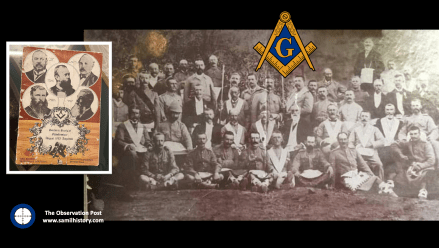
The Boer War’s Freemasons

To answer a question recently posted on Boer War appreciation media as to whether Freemasonry and the Boer War are in some way linked. The origin of this bizarre statement lies in Manie Maritz, the 1914 Afrikaner Revolt leader, who became convinced of a Masonic and Jewish conspiracy to start the second Boer War. More on insane machinations of Maritz later, however to answer the question – no – Freemasonry as a fraternity and the two Boer Wars – the Transvaal Revolt (1880-1881) and The South African War (1899-1902) – have nothing to do with one another, as much as some deluded conspiracy theory driven arm-chair historians would like to to make a connection. In fact, as in many wars over centuries in many countries, Freemasons have landed up on opposing sides shooting one another – the most significant example of this is The American Civil War (1861-1865).  For those ‘in the know’ Freemasonry plays no role whatsoever in starting (or preventing) wars, which is not surprising as Freemasonry is a charitable fraternity with principles relating to self actualisation and brotherhood.

It’s also not a ‘British’ thing. Freemasonry started in South Africa under the Dutch Grand Lodge, the Orient of the Netherlands in 1772 .. long before the British played any role in South Africa. The oldest Lodge is South Africa is a Dutch Constitution one – De Goede Hoop Loosie – its temple is located inside the Parliamentary buildings complex. It also does not mean the Dutch and English speaking South Africans are separated by English and Dutch constitutions, you’ll find English and Afrikaners in both. Case in point are the early Voortrekker leaders who were Freemasons – Andries Pretorius was a Freemason, he even opened up a Dutch constitution Lodge in Pretoria. Piet Retief was also a Freemason, but of the English Constitution whilst he was living in the Eastern Cape.

Here’s an interesting artefact, this one is located at the Pinelands Masonic complex’s historic display (my photo) – commemorating past South African state land Boer Republic leaders who were Freemasons. For interest, and it’s all in Public space – just ‘Google’it. As notable Boer Freemason Presidents and Prime Ministers go these include:

  • General Louis Botha – Boer War Bittereinder General. 1st South African Prime Minister of the Union of South Africa: 1 May 1910 – 27 August 1919, Prime Minister of the Transvaal: 4 March 1907 – 31 May 1910
  • President Johannes Brand – 4th President of the Orange Free State: 2 February 1864 – 14 July 1888. Awarded a British Knighthood.
  • President Marthinus Wessel Pretorius – 1st State President of the Zuid-Afrikaansche Republiek (Transvaal Republic): 22 October 1866 – 20 November 1871. Established the ZAR and its constitution.
  • President Thomas François Burgers – 4th State President of the Zuid-Afrikaansche Republiek (Transvaal Republic): 1 July 1872 – 12 April 1877. Introduced the ZAR’s currency.
  • President Francis William Rietz – 5th State President of the Orange Free State: 10 January 1889 – 11 December 1895 and State Secretary of the ZAR in the lead up to Boer War 2.
  • Acting President Pieter Blignaut – Acting State President of the Orange Free State: 14 July 1888 – 10 January 18891
Top Row left to right: Brothers Louis Botha, Marthinus Pretoruis and Thomas Burgers. Bottom Row left to right:: Brothers Johannes Brand, Francis Reitz and Pieter Blignaut

A very good barometer of the early development of the ZAR (Transvaal) and the very cosmopolitan nature of Pretoria with its Voortrekkers, NGK Churches, Jewish traders, British loyalists and Anglican Churches – before the discovery of significant gold deposits and the establishment of Johannesburg – is to look at Freemasonry in the ZAR. The first Freemasons Lodge was a Dutch constitution Lodge in 1862, the Aurora Lodge .

The corner stone of the new temple for this Lodge was laid by President Burgers, as noted, a freemason himself, on 27 May 1876. On the Freemason’s English constitution side, the ZAR voluntarily dissolved itself (led by President Burgers ironically) and it became The British Colony of the Transvaal in 1877 (the first version, there are two). The first English constitution lodge was established a year later on 15 January 1878, called the Transvaal Lodge – and its was established a mere 2 years after the Dutch’s Aurora temple was built. The Aurora temple was destroyed during a severe thunderstorm, disheartened and not keen to start all over again, the Dutch constitution freemasons joined the English constitution freemasons at the Transvaal Lodge (and here’s a rare photo of them).

The Masonic Hall in Pretoria and the Transvaal Lodge in 1884

Here’s another interesting wartime photo – Dutch and English/Scottish/Irish constituted freemasons getting together in the middle of the South African War (1899-1902) a.k.a. Boer War 2 near Bloemfontein. On 12 December 1900, in the middle of the fighting a meeting was held in Jagersfontein, attended by both British (English constitution) and Boer Freemasons (some of which were Dutch constitution) – both on separate sides, but happy to meet one another under a banner of brotherhood. Here’s a fascinating picture of the occasion.

Freemason meeting – Jagersfontein, December 1900

Other famous ‘Boer War’ Freemasons on the ‘Republican’ side include:

  • Commandant General Petrus ‘Piet’ Jacobus Joubert, Commandant General of the ZAR Forces, Vice President to Kruger and Boer War 1 and Boer War 2 veteran. The overall commander of Boer Forces at the start of the war. and political opposition to Kruger.
  • General Benjamin Johannes “Ben” Viljoen, Bittereinder Boer War 2 veteran and American Boer colony pioneer.
  • Commandant Danie Theron, renowned Boer War 2 scout, bittereinder, commander and national Boer hero.
  • Deneys Reitz – veteran Boer War officer and the author of ‘Commando’, although it his noted that he only became a Freemason after the Boer War, as noted his father President FW Reitz was also a Freemason.2

Of the famous ‘Boer War’ Freemasons on the ‘British’ side, these include:

  • Field Marshal Lord Roberts Frederick Sleigh Roberts, 1st Earl Roberts and a Lodge in South Africa is named after him.
  • Field Marshal Herbert Kitchener, 1st Earl Kitchener
  • Sir Winston Churchill but only became a Freemason after he left South Africa after his service in the Boer War and returned to the UK.
  • Sir Charles Warren was a notable Freemason
  • Cecil John Rhodes was a very committed lifelong Freemason.3
Significant Freemasons of the South African War (1899-1902) Boer and Brit.

Of the famous authors associated with the Boer War, Joseph Rudyard Kipling, the famous author of the Jungle Book was a Freemason, so too was Arthur Conan Doyle. Leo Amery, who penned the first official history of the Boer War for the Times was also a Freemason.  

As to co-operation, during the Boer War, many lodges closed. Some of the buildings used by the Freemasons were used for hospitals such as the Masonic Lodge in Mafeking and the Masonic Temple in Johannesburg. During the Boer invasions of northern Natal at start of the war in October 1899, the Masonic Lodge in Dundee was plundered by the Boer Republican Forces, however the Lodge’s artefacts were found and respectfully returned to the Lodge by Boer Freemasons.

Loot taken from the Masonic Lodge in Dundee by Boer Republican Forces. Image courtesy of the Talana Museum Archive.

Noted here, is there is NO General Jan Smuts – there is no evidence whatsoever that he was a Freemason. Many historians have tried to confirm the ‘conspiracy theories’ and there is no evidence, zilch, nothing – not here in South Africa nor in Britain. Smuts is not a Freemason, no matter how much many people wish he was (conspiracists and Freemasons alike).

Of the other ye olde Boer Republic Freemasons in leadership roles the only other significant ones who were NOT Freemasons were President Paul Kruger (his Dopper approach would not have allowed him) and Prime Minister Barry Hertzog. Of the British ‘hawks’ in starting the Boer War, there is absolutely no conclusive evidence that either Alfred Milner or Joseph Chamberlain were Freemasons – sorry for all those conspiracy theorists again. Maybe the decision to go to war should have been left to the Freemasons to negotiate and there would not have been war in the first place … and look there – I’ve created a conspiracy with no grounding whatsoever.

Image: President Paul Kruger and the British Colonial Secretary, Joseph Chamberlain, having a dust-up both were NOT Freemasons and no brotherly love lost.

Another point in the respect of famous people associated to the Boer War by way of historic sweep who are NOT freemasons .. all the ‘Pure’ National Party’s Presidents and Prime Ministers were members of the Broederbond – from D.F. Malan all the way to their last one, F.W. de Klerk and as a result of their rather perverse public animosity to Freemasonry, none of them were Freemasons. Also, none of them were ‘significant’ Afrikaners in the formation of ZAR, OFS or Union of South Africa, nor did any of them play any significant role in the Boer War – Dr D.F. Malan sat out of the war in safety – for that matter all of them sat out WW1 and during WW2 they either tacitly or overtly supported Nazism while sitting out of that war too. The best they could come up with was a ‘keep South Africa white’ South African Republic in 1961 and Freemasonry must surely thank its lucky stars that it is spared from any association with it for a change, conspiracy or otherwise.

As noted in the beginning, one origin of this bizarre link of Freemasonry to the Boer Wars is ‘General’ Manie Maritz, the Boer War Commander, 1914 Afrikaner Revolt leader and leader of the National Socialist Boerenasie movement. In the mid 1930’s Maritz would become a convert to the racist and anti-Semitic mythical and completely discredited ‘the Protocols of the Elders of Zion’ and convinced of a Jewish and Freemason conspiracy to world domination. He would make the ‘Protocols of Zion’ his life’s meaning and his mission to educate the Afrikaner people (his ‘Volk’) to it – and in it he would blame the ‘hidden hand’ of the Jews as the true conspiracists behind starting the Boer War. He would then go into mortal combat with General Jan Smuts calling him the King of the Jews and therefore a traitor to the Afrikaner people.4 Yet, believe it or not there are still some people out there who would gobble this sort of crap up.

If you want to see how this conspiracy theory nut job rubbish Maritz promulgated in action, consider this, the Broederbond opposed Freemasonry – as a net result the post 1948, the National party’s Minister of Justice C.R. “Blackie” Swart (a Broederbonder himself) famously accused the Freemasons and the ‘Sons of England’ (another South African lodge based fraternity) in the media of infiltrating Sailor Malan’s ‘Torch Commando’ political protest movement in 1952 and in so plotting to militarily overthrow his Apartheid government.5 Pure unfounded gobbledygook and you just can’t make this stuff up!

In my book none of these ‘Pure’ Afrikaner Nationalists really qualified ‘great’ Afrikaners in any event – the simple truth is that they were a fringe party of far right-wing nutters .. nothing more. Also, point to note, no – by bringing up famous Boer leaders who either were or were not part of the Freemason fraternity, I’m not “Boer Bashing” and discrediting Afrikanerdom – because that would be equally daft.


Written and Researched by Peter Dickens

References:

  • 250 Years of Freemasonry in South Africa – Commemorative Publication 2022, all Constitutions. Published by the Grand Lodge of South Africa
  • United Grand Lodge of England. On-line repository
  • Maritz, Manie ‘My Lewe en Strewe’ Pretoria 1939

Footnotes

  1. 250 Years of Freemasonry in South Africa ↩︎
  2. Ibid ↩︎
  3. Ibid ↩︎
  4. Maritz, My Lewe en Stewe‘, pages 97 – 270 ↩︎
  5. P Dickens, The Rise and Fall of the Torch Commando – Part 4, on-line record for The Observation Post ↩︎

The Tweebosch Massacre

One of the most stand out things in the way the Boer War is recorded by modern historians is the vast difference between the ‘Old School’ Afrikaner historians still peddling a romantic narrative of Bittereinder Boer Pimpernels tying the British up in knots – and then there are the modern ‘British’ and ‘Black’ historians, who post Apartheid have been gradually uncovering a narrative of war crime, atrocity, genocide and massacre – but not of ‘white’ Boer women and children – but of ‘Blacks’ – on nearly all levels of age and sex and all definitions. Upfront let’s be clear on this – it’s an atrocity committed by both sides – so nobody comes out smelling of roses – not the Boers and not the Brits.

So much so, as Dr Garth Benneyworth, a leading South African War historian pointed out recently on The Observation Post that a significant research gap on the historiography of the South African War (1899-1902) needs to be investigated.

A Genocidal Order

This specific literacy gap evolves around a policy decision taken by Bittereinder Boer Commanders in the ‘Guerrilla Phase’ of the South African War (1899-1902) to shoot out of hand any Black, Coloured or Indian civilian, contractor or soldier deemed as being in support of the British military. The order is tantamount to genocide as ‘Natives’ can be simply be killed on the basis of the colour of their skin and a simple “suspicion” of spying or working for the British – which becomes highly problematic in the British Colonies, especially the Cape Colony as many hold a colour blind franchise and are equal to whites, they hold British citizenships and most ‘work’ for the British in one way or another. No recourse to the law or a trial of any kind is afforded them – they could just be shot on the spot by any Boer invader.

An example of the ruthlessness of this order in practice is the murder of a coloured blacksmith named Abraham Esau in Calvinia, Namaqualand, British Colony. As the guerrilla war continued, there were ongoing Boer Commando raids in the area, and demands for tribute, whippings, looting, and even exemplary executions were common.1 Esau organised a militia to resist these incursions, however his British patriotism and bravery made him a marked man, so when a Orange Free State Commando (600 strong) fell on Calvinia on 7 January 19012, Esau was one of those sought out amidst the plunder of the town. Esau was beaten, bludgeoned and then lashed – he survived this torture until 5 February when he was eventually shackled in irons, dragged for five miles behind a pair of horses, and, after a final beating, shot dead.3

So, where is this order sourced? In fact it’s a ‘General Order’ and can therefore be regarded as ‘Policy’. General Christiaan de Wet would inform Lord Kitchener that he personally issued the order …

‘the ungovernable barbarity of the natives realises itself in practice in such a manner that we felt ourselves obliged to give quarter to no native and for these reasons we gave general instructions to our Officers to have all armed natives and native spies shot.’4

Not one senior Boer Commander in the field is not guilty of implementing this policy, even captured junior officers like Gideon Scheepers and Hans Lötter both face charges of “murdering” black and coloured civilians and captured ‘coloured’ British soldiers in the British Cape Colony – and they both faced firing squads for this – Kitchener responds to de Wet:

‘….. (I am) astonished at the barbarous instructions you (General de Wet) have given as regards the murder of natives who have behaved in my opinion, in an exemplary manner during the war.5

Kitchener then notifies de Wet that Boer Commanders guilty of this crime will face charges of murder and Scheepers had already been found guilty and executed.

However, this policy is widespread, it spreads from the Bittereinder raids into the British Colonies to the two Republics themselves, and these executions happen under of the watch of great Boer Commanders – even the great General Koos de la Rey can’t escape it, de la Rey is almost unapproachable in Afrikaner lore – no Afrikaner historian would dare accuse him of a war crime like this. But the sad fact is it did happen under his watch and it happened at one of his greatest victories.

Massacre at The battle of Tweebosch

The battle of Tweebosch on 7 March 1902 is famous because of General De la Rey’s compassionate and kind treatment of the wounded Lord Methuen and saving his life. It’s also an astounding Boer victory, it occurs towards the end of the war and reassures the Boers of the marshal ability of this, one of their greatest Commanders.

General Methuen surrendering to General de la Rey (insert picture), image from Le Petit Journal 1902.

What is not often recorded at the Battle of Tweebosch in the narrative is the killing spree De la Rey’s commando members go on, its a war crime and atrocity, as they execute about 30 unarmed Black wagon drivers and servants in service of the British column as well as black and Indian soldiers having surrendered.

This spurred Lord Kitchener to write to General de La Rey and forward all the witness reports of the executions. The intention was to get de la Rey to take action against the perpetrators and cease and desist – de la Rey does none of these.6

Kitchener’s missive is sent on the 31st of March, 1902 and reads:

Sir,

I beg to forward you the accompanying sworn statements regarding acts of inhumanity which were performed by Burghers serving under your orders during, and subsequent to, the action at Klipdrift (Tweebosch) on March 7th, 1902.

I am fully convinced that you would not approve of such conduct, and that you will lose no time in adopting such action as you may think necessary in the matter.
I take this opportunity of thanking you for your kind treatment of Lord Methuen whilst in your hands.

The following testimonies are then attached:

Captain W.A. Tilney, Deputy Assistance Adjutant-General, states:-

“Boers were already riding amongst the rear wagons, off which some of the drivers jumped. Two knelt down with their hands above their heads, when a Boer pulled up his horse, and shot both dead. They were unarmed.

On the 8th, Commandant Joubert, of Kemp’s Commando, took me over to General De la Rey’s laager. On the way, we passed over the field of action at Klipdrift. Parties of men, women and children were engaged in stripping the dead. There were periodical shots which were not at horses, as there were no wounded animals about that part of the field. All the men we buried that day were stripped naked, including Lieutenants Venning and Nesham, Royal Artillery.

On the 9th instant, the convoy of wounded on its way from Klipdrift to Taaiboschpan trekked along the line of retirement of the mounted troops. We passed many dead, stripped naked, most of whom had three or four bullets through the head and chest. There were so scorched and blistered by the sun as to be beyond all recognition. The Boers whom I met on the 8th instant admitted that their men had deliberately shot down the transport Natives with a view, they asserted, of deterring others from enlisting in our services”.

Lieutenant S.H. McCallum, states:-

“I saw a dismounted white man, unarmed, and with only shirt and breeches on, standing about 40 yards from me with his hands up. I saw a mounted Boer deliberately shoot him about two yards off him.

A few minutes later I saw a Native, who appeared to be a Driver, with his hands up. He was unarmed in front of a Mounted Boer, who deliberately shot him”.

Trooper Hermann S. Van Eeden (nice old English name), states:-

“I saw a native boy coming from our front, saying ‘if you please, Baas…’, and holding up his hands. He was unarmed. A Boer shot him from about 10 yards off. The boy appeared to be a Driver. He was killed.

A few minutes afterwards, I heard a shot from my rear. I looked round and saw a man get up. He said:- ‘You Dutch bastard; you shot me in cold blood’. He was shot in the chest. When I saw him he was unarmed. I spoke to him and he said he had ‘hands up’ when he was shot”.

Trooper F. Jackson, states:-

“I was riding alongside a men who I think was B.S.A.Police. We were in amongst the Boers before we knew it. A Boer told him to ‘hands up’. He was handing up his rifle when another Boer came up and shot him. We had halted. He was killed”.

Trooper C.J.J. Van Rensberg (another fine ‘Jingo’ name), states:-

“I saw four Cape boys, unarmed and dismounted, come towards the Boers with their hands up. They were shot dead”.

Corporal H. Christopher, states:-

“I saw a young Native boy riding a horse and leading another. He was unarmed. A Boer road up to him and told him to dismount. No sooner had he done so than the Boers shot him in the back of the head and killed him”.

Sergeant T. Barrow, states:-

“After surrendering, I saw Captain Tuckey’s native boy, called ‘Clean Boy’, in the act of surrendering with his hands up over his head. I saw a Boer shoot him. He was unarmed.

I also saw two other native boys shot. They were Transport boys and unarmed.
I heard a Boer say plainly in English:- ‘What shall we do? Shall we shoot the blacks and spare the whites, or what?’”.

Tom, Native Driver, states:-

“I saw six boys taken away from the mule convoy, and made to dig a hole. They were then lined up to the side of the hole and shot. I saw them shot. I also saw 13 boys taken away from the mule Transport into a bush on the right. I heard shots, A Boer told me that they had shot the boys”.

Trooper C. Davies, states:-

“I saw a Boer go up to a native boy who was driving a mule wagon and shout ‘hands up’. The boy threw his whip down on the side of the wagon the Boer was, and the Boer fired point-blank at the boy, who fell off the wagon. He was unarmed. Then the Boer turned round to a Scotch Cart and shot the native boy who was driving. Afterwards I saw the Boers shoot four small native boys, who were camp followers. They were running after the Mounted troops on foot, and were unarmed”.

Trooper T. Bradley, states:-

“I was in a sluit with about 30 others, and there were two wounded men laying in the spruit. Some Boers came galloping on to the sluit and fired at the wounded men, and hit one in the neck. They were quite close to them when they fired”.

Jim, Lord Methuen’s Kitchen Boy, states:-

I was with the Mule Convoy when the Boers came up. They shouted ‘hands up’, and the boys all held up their hands and their hats. The Boers were firing at them all the time. The boys were all on the ground, and they walked towards the Boers with their hands still up. The Field Cornet came up and said, ‘Why are you firing at the leaders and drivers? I only told you to shoot those carrying arms and riding horses!’ I saw four boys shot here”.

Adriaan Pohl, native driver, states:-

In the morning after the mule Transport had surrendered, I saw a Boer who shouted ‘hands up’ to a driver, deliberately shoot him after he had put up his hands. I also saw a Boer go up to a Native driver of the name of Gert Gey, who was standing by his wagon, and shout ‘hands up’. He had put his hands up the Boer shot him between his two eyes”.

These testimony’s go on, there are loads – but its enough to get the point. This entire document is found in the files WO 108-117 in the United Kingdom’s National Archives, yet it is seldom referenced by one sector of South African Boer War historians. Why? Because it flies in the face of painting a romantic picture of the Boer Bittereinder Generals and the victimhood narrative – the eternal anvil on which ‘British’ tyranny on the Boer citizenry is forever hammered by these authors.

It does not stop at all the Black Wagon Captains, Handlers etc. Even the Regimental History also records the unlawful killing of Indian veterinarians at the Battle of Tweebosch, a direct violation of the rules of war at the time:

“…the whole Indian and Kaffir establishment of the F.V.H. (Field Veterinary Hospital) … One Farrier Sergeant of the Indian Native Cavalry and two Indian Veterinary Assistants (men carrying no arms) were ruthlessly shot dead after the surrender, and nine Hospital Kaffirs were either killed in action or murdered later.”7

(British Cavalry – Regimental History).

‘Native’ wagon handlers and staff in a British Column during the South African War (1899-1902) – Imperial War Museum. Insert shows examples of Kitchener’s letter and testimonies to de la Rey (courtesy Chris Ash).

Conclusion

This is part of the problem with writing any history on the Boer War, if you bring up thorny issues like this – and especially start to criticise holy cows like de la Rey, de Wet and even Smuts the immediate reaction is a tirade of abuse, accusations of bias – and the “Boertjies” in social media groups laager around their ‘heroes’, some administrators of large format Boer War groups will even ‘ban’ you – de Wets’ and de la Rey’s reputations are guarded regardless of the history and it smacks of an old School Aparthied ‘banning’ technique. Nobody remains the wiser, and the very important ‘Black’ history of the Boer War is either ignored or used an another stick to beat the British with by these Anglophobes.

At the end of the day these ‘gatekeepers’ keep the actual history away or continue to reinforce the old National Christian and Apartheid mythology and bias surrounding this war. In the end no-body on their forums learns anything. It also says something about these gatekeepers, by holding back on full historiography of The South African War (1899-1902) and peddling a learned Christian Nationalism bias they are preventing the ownership of this conflict by ‘all’ South Africans and maintaining it for the benefit of “white Afrikaners only” as a “white man’s war” – and then they wonder why ‘Black’ South Africans pay no respect to them or their history.

However, that’s not the case in the modern age of information, there is just no way anyone can stop the dissemination of history as it has already been written, the ‘Black’ contribution to the Boer War is an under researched truism, the extreme white racist hegemony that was the Zuid-Afrikaansche Republiek (ZAR) and its claim to absolute authority for white protestant Afrikaners only and policies such as this one to deliver on it is a truism, the ruthless massacres of ‘Black’, ‘Indian’ and ‘Coloured’ citizens and contractors by Boer Generals and Commandants at Tweebosch, Leliefontein, Modderfontein, Uniondale, Calvinia and many other places are all truisms … there is no shaking it, it happened, it’s history. That the ZAR’s extreme policies of race and lack of human rights for people of colour is taken forward to the Afrikaner Revolt of 1914 and then to Aparthied in 1948 by the next generation of these exact men is also an intrinsic part of the historic ‘sweep’ – its a truism.

Next look out for an article which controversiality shows Jan Smuts to be guilty of the same atrocity at Modderfontein – and here I am “sacrificing” a personal hero of mine – but that’s the nature of history and the promotion of the sound and balanced understanding of great men – ‘war is cruelty’ the British were guilty of it, so too the Boers and all great Commanders are flawed – Buller, Kitchener, Roberts, de la Rey, Smuts, de Wet, Botha – all of them, the lot, there’s no escaping it.


Written and Researched by Peter Dickens

References:

B Nasson. Abraham Esau’s War: A Black South African War in the Cape, 1899–1902. African Study Series 68, Cambridge University Press, 2003

D Judd & K Surridge. The Boer War. London: John Murray Publishers, 2002.

Files WO 108-117 United Kingdom National Archives.

Correspondence with Dr Garth Benneyworth, South African War historian on the Observation Post Scuttlebutt – 25 August 2024

C Ash. Kruger’s War – the truth behind the myths of the Boer War. Durban: 30 degrees South Publishers, 2017.

Footnotes

  1. Nasson, Abraham Esau’s War, p 122 ↩︎
  2. Ibid. 128 ↩︎
  3. Ibid. 131 ↩︎
  4. Judd & Surridge, The Boer War. p 235 ↩︎
  5. Idid. 235  ↩︎
  6. Files WO 108-117 United Kingdom National Archives ↩︎
  7. Ash, Kruger’s War, p 324 ↩︎

Something is rotten in the state of Denmark!

Shakespeare provides us with a wonderful quote from Hamlet, it’s in the opening act, and it’s said by Marcellus on seeing the King’s ghost: “Something is rotten in the state of Denmark” – it’s a forewarning that there is sedition afoot in the state, real trouble is coming. It is appropriate when viewing the newly formed Union of South Africa, as within a year of its formation the old Boer War hero – General Louis Botha can already sense sedition in their camp. As Prime Minister, he tasks General Smuts as his Minister of Defence to set up the South African Union’s Defence Force and amalgamate the old Boer Republic’s Commandos with the old Cape and Natal Colonial Regiments.

Walking a political tight-rope of “reconciliation” post the South African War (1899-1902), Smuts appoints a staunch Boer “Bittereinder” General, Christiaan Beyers, as the head of the South African Union Defence Force’s Active Citizen Force (the largest contingent within the force made up by a majority of Afrikaners). His appointment largely a symbolic gesture to the “irreconcilables” in the Afrikaner diaspora.

On the 4th July 1911, Louis Botha in his capacity as Prime Minister wrote to General Jan Smuts to express his bewilderment that Smuts had appointed General Christiaan Beyers as the head of the Active Citizen Force. He does not hold back and what he says is very telling:

“Dear Jannie, You really are lazy to write so little. How is it possible that you have appointed Beyers? I do hope that you did not agree to it, because you certainly have no greater enemy there. He is not a persona grata (welcome person) with our people and still less so with the English. The Bar, no doubt, also does not approve of it and the Judges will be angry. I can swallow anything but this is impossible.”

Christiaan Beyers, would go on with his appointment, and only just 2 years after his appointment in the Union Defence Force, he would try and scuttle the Union’s decision to go war against German South West Africa. He unsuccessfully campaigns to get resignations from the UDF so as to render it toothless. Thereafter he unsuccessfully campaigns for De La Rey to join his treasonous plot. He joins hands with Manie Maritz, Christiaan de Wet and Jan Kemp in a treasonous soup and initiates the Boer Revolt of 1914 – inadequately planned and inadequately resourced the revolt is an outright failure – strategically, operationally and tactically. Lasting mere months and attaining none of its stated objectives. Beyers would drown in the Vaal river trying to escape his hunt on the 8th December 1914 (later supporters of Beyers would point out that he never fired his handgun when his body was recovered, as if to somehow say he didn’t really intend to kill fellow Afrikaners – but that’s merely an apologist’s stretch, Beyers had every intent given his Commando’s actions and his entire act was that of high treason whichever way you cut it).

The revolt does however pitch Afrikaner against Afrikaner, driving deep scars into the Afrikaner psyche. It would drive a political wedge into the Afrikaner diaspora, and in the strangest turns of fate, many Afrikaners by the 1980’s, after decades of Afrikaner Nationalist propaganda, would oddly juxtaposition the concept of “treason” – and start calling Smuts the “traitor” and Beyers the “hero” (even to this day he is cited in this community as a “volks” hero). Also, rather inexplicably Louis Botha somehow escapes this ‘traitor’ paint-brush as the Afrikaner Nationalist vitriol is almost exclusively targeted at Smuts. 

Botha in this letter to Smuts is being nothing more than prophetic – calling out Beyers as an ‘enemy’ and a ‘persona non grata’ (an unacceptable person) to the Afrikaner nation. There is obviously no love lost between these two men and Botha sees Beyers as a treasonous snake not with the program of a peaceful coexistence between English and Afrikaans South Africans and at odds with the vast majority of South Africans in general. Smuts, eternally seeking a careful balance of everyone’s opinions in the Afrikaner diaspora, has his efforts backfire on him considerably. 

To read more on the Boer Revolt, follow this link: Boer War 3 and beyond!


Written and Researched by Peter Dickens

Quoted Reference: Selected Smuts Papers – Volume III by W.K. Hancock 

William Shakespeare, Hamlet: Act 1 Scene 4

Thanks to Jenny B Colourising for the two great images of Botha and Beyers.

Lost and Found – The South African Way of War

I have taken a little time to review this book – 20 Battles – Searching for a South African Way of War 1913 to 2013 by Dr. Evert Kleynhans and Dr. David Brock Katz since its launch a couple of months back, time taken because I have savoured just about every battle in the 20 battles outlined in this book. As a military history lover and commentator each battle in the book has given me tremendous insight, even to battles I’ve written on in the past and thought I had a good grip on – only to find out I’m nowhere close.  

To find I have knowledge gaps was both refreshing and reinvigorating, and I now have to revisit my Observation Post articles on Delville Wood, the 1922 Rand Revolt, Sidi Rezegh, Tobruk and Cassinga completely – adding to them new insight and understanding – thanks in large part to the work outlined in 20 Battles on these battles specifically.  I also must throw my entire draft on Cuito out the window, a good thing too as I really needed better insight and a stronger grip on this very controversial battle.

20 Battles in a nutshell seeks to find and define the “South African way of war” – our preferred methodology for waging war and it tracks the development of this methodology using a historical ‘golden thread’ starting from the inception of the South African Union Defence force (UDF) in 1910 to its current manifestation as the South African National Defence Force (SANDF) conceived in 1994. The book skilfully selects battles South Africans have been involved in, which by design have helped to forge our preferred method of waging war, and it also outlines battles which have been an anathema to our military ‘DNA’ and why that is so. 

This can be extremely insightful when you learn for instance, that even our greatest sacrifice and honour, the very crucible on which our budding National Pride as a unified Defence Force was forged – The Battle of Delville Wood – is a complete and utter anathema to the South African way of fighting … even for 1916.

Professor Abel Esterhuyse (left) in discussion with the authors Dr. David Katz (middle) and Dr. Evert Kleynhans (right) at the Military Academy.

For me it is no surprise that 20 Battles finds the ‘Father’ of our military in the form of General Jan Smuts, he was tasked to form the Union Defence Force as the Minister of Defence. What is highly illuminating is just what a force majeure Smuts is in defining our military doctrine and way of war, not only in 1910, but throughout World War 1 and World War 2, Smuts’ fingerprints are still seen in 1981 during Operation Protea in Angola and you can even still find them writ large on the SANDF’s doctrine … even today. I have always thought of Smuts as an under-rated military genius, certainly in his own country and this book goes a long way to validate this view. 

It is Smuts’ learnings from The South African War (1899-1902) a.k.a. Boer War 2 that play such a defining a role, at the end of this war in 1902, the Republican Forces emerge as masters of waging effective Insurgency Warfare and the British and Cape/Natal Colonial Forces emerge as masters of effective Counter-Insurgency Warfare (COIN). 

Smuts also emerges from the Boer War as the only real ‘Bittereinder’ Boer General still occupying enemy territory and still waging an effective offensive campaign, and he carries his learnings over to the formation of the UDF – combining the very best of ‘Boer‘ doctrine with the very best of ‘British‘ doctrine and blends a defence force that has mobility and enveloping manoeuvre as its central premise – with both combined arms (the use of different disciplines – artillery, mounted infantry, armour etc.) and joint arms (the use of all services – Army, Navy and Air Force) all in unison and all in support. 

Smuts built the UDF along the lines of using effective combined arms with high degrees of mobility to deal with both conventional warfare (as is the requirement of any statutory force) and any domestic insurgencies defined as potential ‘Black’ African rural uprisings of the time and even ‘white’ urban uprisings of the time – the Miners’ Strike in 1922 a case in point – and the UDF doctrine is evolved to counter-act these internal insurrections – urban and rural.

Smuts is happy to cherry pick, basically he’s happy to bring all that’s great and good about the British culture of warfare – their discipline and drill (sorely lacking in the Boer army), their uniforms and rank structures (sorely lacking in the Boer army) and their very effective use of combined arms warfare and joint arms warfare (also sorely lacking in the Boer army) and combine it with the Boer culture of warfare – the use of mobility, and applying high rates of survivability thinking to tactics of assault and defence (both of which are sorely lacking in the British army). 

Smuts will build into the UDF the doctrine of highly mobile ‘combined arms’ – mainly the effective use of mounted infantry, armour and artillery (and other ‘arms’) all acting in unison and speed – preferably in an enveloping role. It’s a doctrine of “manoeuvre” using the Clausewitzian concept – using superior and simultaneous advances along “exterior” lines (a concentration in space) on an enemy using “interior” lines (known as a concentration of time) of communication and supply. 

Under General Jan Smuts the UDF took shape into a very effective fighting force, one that is far ahead of his old Boer Republics strategic and tactical constructs and doctrine which focused mainly on “interior lines”. This will have far reaching consequences for the South African military and its future successes and even failures over the next century.

What David Katz and Evert Kleynhans do from here out is take you through this century of South Africa at war – over a journey of 20 battles which show you how Smuts’ doctrine is applied – “mobility” at first defined by ‘mounted infantry’, then by ‘motorised infantry’ in WW2 and then even further evolved after Smuts’ death in 1950, as after WW2 all the Allied planners look to their old enemy – for the “German way of war” and their very effective use of “Blitzkrieg” (lightning war) and the “schwerpunkt” (heavy, focus – or centre point) of armoured and manoeuvre warfare doctrine – especially at the tactical level, and the South African military planners are no different.

In more recent history commencing with the Border War in 1966, David Katz and Evert Kleynhans show how this manoeuvre doctrine evolves further when the Rhodesian ‘Fireforce’ concepts are added into aspects of ‘vertical envelopment’ (use of paratroopers and helicopters), something which the South African Defence Force (SADF) applies for the first time in earnest during The Battle of Cassinga. 

This doctrine of manoeuvrability – horizontal and vertical, inside and outside lines of communication – a co-ordinated infantry and armour affair – adding force-multipliers such as Ratel Infantry Fighting Vehicles (IFV) and vehicles such as Casspir Armoured Personnel Carriers (APC) and others into the mix, starts to deliver the outstanding successes we see in Operation Protea and along the Lomba River in Angola during Operation Modular.

Of specific interest to anyone with an interest in military history, and anyone who is currently or has served in the military is the extensive evaluation and insight that David Katz and Evert Kleynhans take to when analysing each battle across the three core tenants of waging a battle – the Tactical level, the Operational level and the Strategic level. 

In a nutshell the Tactical level is the part where bits of metal start whizzing around, the Operational level is basically the plan and objectives going into battle and the evolved plan once bits of metal start really whizzing around in earnest and the Strategic level is the military and political intentions of going into battle in the first place – and the outcome of these intentions when the bits of metal stop whizzing around.

Analysing each battle on these three principles of military strategy makes for very enlightening reading, and for all the ‘Border Boys’ out there (Border War veterans) – wait till you get to their appraisal of The Battle of Cuito Cuanavale as its an honest, objective and highly critical ‘military’ appraisal, a true score-card on the SADF’s performance – and you’re in for some surprises I assure you – especially in light of the fact that this pivotal battle is one of the most controversial and misunderstood battles in our time. 

I can almost hear the next universal cry from all the military enthusiasts out there …

“It all doesn’t matter now anyway, the SANDF is on its knees, eaten away from the inside by political malfeasance and now it’s a shadow of its former self!” 

But here 20 Battles shows us, that over the course of history this is not the first time South Africa’s statute forces have been whittled down by political malfeasance to the point of unfit for purpose – from 1924 Hertzog’s Defence Minister Oswald Pirow rendered the UDF completely unfit and a mere shadow of itself after WW1, the learnings from WW1 and ‘the South African way of war’ had to re-learned completely to get the UDF ready for WW2. The Afrikaner Nationalists did it again after WW2, the Defence Minister appointed in 1948 was Frans Erasmus and his Erasmus Reforms completely crippled the SADF and left it utterly unfit for purpose when the Border War started in 1966 – and again the learnings from WW2 and ‘the South African way of war’ had to be completely re-learned again.

It’s here that 20 Battles shows its true colours as to what a valuable volume of work it is, as it serves to maintain the SANDF’s institutional memory, it outlines how the South African military ethos and doctrine is derived and come what may future military strategists will always be able to tap into these vital and hard fought learnings as a building block. In this respect the Military Academy at Saldanha military base is very fortunate to have good men like David Katz and Every Kleynhans working with them to maintain institutional memory.

I can almost hear the universal cry from the new generation …

“Forget about it all – we want our own ‘Black’ military history reflected in our military ethos, and not the history of Europeans and the Colonialists”

But even here 20 Battles serves to show that the art of war expressed by the SANDF is very “African” in its heritage and our philosophy of manoeuvre and envelopment can even be traced to the great Zulu General – King Shaka kaSenzangakhona.

David Katz and Peter Dickens at the Military Academy in Saldanha, Western Cape.

But .. but … but, South Africa does not need all this “military doctrine” we are at peace and have been since 1994! We don’t really need a large operationally ready military force anymore comes the political inspired call of people seeking to channel all the money to pressing welfare issues instead. Not true, as to our learnings on how to handle “internal insurrection” and the potential threats – look no further than the Covid Riots in Durban in 2022. As to foreign destabilisation and threats, look no further than the Islamic Jihadist activities on our border with Mozambique. Thomas Jefferson said something that is very true even to this day:

“Peace is that brief glorious moment in history when everybody stands around reloading.”

Maintaining the SANDF’s operational capability and doctrine is vital.

The only criticism I have of 20 Battles is that it is very Army specific, the Navy and Air Force enter the equation when looking at the Joint Arms co-ordination in many of the battles outlined, however a “Sea Battle” or a “Air Battle” is not singled out to demonstrate how the ‘South African way of war’ is applied to these arms of service when acting unilaterally of one another. However, having read the book anyone with half an interest South Africa’s military history can easily see how the South ethos of manoeuvre and survivability ahead of attrition has been applied in both Navy and Air Force engagements in the past – from the anti-Submarine Warfare around the coast during WW2 to the SAAF and 2 Squadron’s approach to the Korean War.

I will say this as an ex-army officer, and I mean it – where was this sort of work when I did my National Service and Citizen Force training? As a young Candidate Officer, I would have been a zillion times wiser and rounded as an officer had the SADF taken the time to simply demonstrate how we arrived at our doctrine and ethos and how we intended to apply it going forward – instead a lot of the time was spent drilling in the Operation Procedures as they stood and learning Command and Control. In this respect I can only congratulate David Katz and Evert Kleynhans for finally pulling it all together and pushing it into the Military Academy’s arsenal for our military leaders and our current junior officers, NCO’s and warrant officers to tap into – there is no doubt that it will become a valuable asset in future.

My heartfelt recommendation – buy this book now! The book is published by Jonathan Ball Publishers and available at most major book retailers and on-line.


Written by Peter Dickens

General Hertzog’s volte-face towards Nazism

I’m currently researching the Torch Commando for an academic seminar I’m involved in on Sailor Malan to be held in Kimberley in September 2023, part of this is researching the ‘Nazification of the Afrikaner Right’ which triggered the returning South African WW2 veterans into mass protest when the National Party came to power in 1948. In doing this we uncover more “inconvenient history” and nothing more inconvenient to our general understanding is the sudden conversion of the much loved (in white South African circles at least) Prime Minister, General J.B.M. Hertzog … to Nazism. 

What! No way, we’ve heard about all the ‘Pure’ Afrikaner Nationalists flirting with Nazim, how now General James Barry Munnik Hertzog? He was all about the South African ‘Union’ with Jan Smuts! This was no ‘Nazi ‘surely!

But I’m afraid here’s some more history that your Apartheid period schoolteacher either glossed over or had no clue about. But let’s cover a little of Hertzog’s background to this infamous U-turn first.

Hertzog’s political career in a nutshell

Much is written about General Barry Hertzog. A complex character, his popularity amongst Afrikaners was cemented when as a ‘Bittereinder’ Boer War General, he played a pivot role alongside Generals Louis Botha, Koos de la Rey and Jan Smuts in the Peace agreement that ended the Boer War. He joined Botha, and Smuts to form the South African Party (SAP) and was key to the establishment of ‘Union’ which saw a South African Union formed out of the two old Boer Republics and two primary British Colonies under the British family of nations, established in 1910, with Louis Botha as the country’s first Prime Minister.  

Issues within the SAP would however start to come to head between Hertzog and Botha when Hertzog chose neutrality when the First World War broke out with Imperial Germany in 1914, Hertzog then joined a small minority of Ministers who voted against invading German South West Africa (the vote was 92: In Favour and 12: Against – going to war against Imperial Germany).

He would ultimately break away from the SAP later in 1914, found and head up the National Party after a disagreement with Prime Minister Botha, who favoured a ‘one-stream’ policy (English and Afrikaners together policy) as opposed to Hertzog’s ‘Two-Stream’ which sought a separate development of English and Afrikaans to protect Afrikaans culture (an early form of Apartheid). He would state of British Imperialism at this time, that he would remain committed to it, on the proviso that it benefited the white Afrikaner, the minute it did not, he would happily break with it.

After the Miner’s Strike (Rebellion) in 1922, Jan Smuts’ Prime Ministership and the reign of the SAP was lost, and Hertzog was able to come into power under the National Party banner by climbing into bed with the Labour Party (‘English’ white ‘Bolsheviks’ in effect) in a very uneasy coalition. Although clipped somewhat by the Labour Party as to the maintenance of Union under the British flag (Hertzog leaned to Republicanism) the ‘majority’ National Party was now able to pass extensive ‘segregation’ based legislation, and even change the national flag from the ‘Red Duster’ to the OBB (Orange, White and Blue) incorporating the old Boer Republic flags.

With respect to the South African Union, despite at times harbouring deep wishes for the re-establishment of Boer Republicanism and the possible unbundling of the Union. After the Belfour Declaration of 1926, of which Hertzog was the South African representative and signatory, he remained committed to Union, and to South Africa’s status as a British Dominion. Having played a key role in the agreement he believed that the Balfour Declaration of 1926 had granted sufficient autonomy to British dominions and negated any idea of any overt British Imperialism or influence playing any sort of significant role in South Africa’s future. South Africa (like Canada and Australia) had ‘figurehead’ British monarchist representation, but could crack on with its own laws and independence, completely free of Westminster.

The Balfour Declaration 1924: King George V (front, centre) with his prime ministers at the 1926 Imperial Conference – Monroe (Newfoundland), Coates (New Zealand), Bruce (Australia), Hertzog (South Africa), Cosgrave (Irish Free State), Mackenzie King (Canada) and Baldwin (United Kingdom).

The Balfour Declaration of 1926 would be Hertzog’s crowning achievement and personal pride. However dynamics within the electorate in by 1934, would see the Hertzog’s National Party out of its coalition with Labour and into “Fusion” with Jan Smuts’ opposition South African Party to maintain its authority and Hertzog’s Premiership over South Africa. The decision in this “Fusion” would see Hertzog and Smuts shelve their respective parties and form a new entity called The United Party (UP) – essentially to consolidate a white hegemony in South Africa with a better balance between white English and Afrikaans speakers.

By this stage Hertzog would become the longest serving South Africa Premier in history, presiding over no less than 4 governments. Hertzog’s mantra as Prime Minister revolved around the reconciliation of white Afrikaans and English speakers as the only viable path for South Africa, in this respect he became an intense supporter of “English Rights” and he continued his commitment to South Africa remaining a British Dominion. Hertzog and his Nationalist cabal within the UP are however still able to continue to with segregationist and race-based policies, albeit these were ‘softened’ significantly by the more liberal Smuts and his cabal. 

Hertzog’s United Party cabinet, a curious mix of hard conservatives like Jan Kemp and democratic progressives like Jan Smuts and Patrick Duncan.

A small group of disgruntled nationalists ‘on the rump’ of the party would however break away from Hertzog’s nationalists and form the ‘Pure’ National Party or Herenigde Nasionale Party (Reunited National Party) – under the leadership of Dr. D.F. Malan. They would turn their vitriol against Hertzog, who they now regarded as traitorous as Smuts and a British puppet.

On the other hand, within The United Party, by the late 1930’s things had started to come to a head between Hertzog and Smuts. One issue was South West Africa (Namibia), now under South African Union mandate, and part of Smuts’ and the Union’s vision for ‘Greater South Africa’.

Hertzog’s right hand-man, Oswald Pirow – the National Party’s Minister of Defence and a devout Nazi supporter and admirer of Adolf Hitler had been sent by Hertzog to the Nazi German state on a number of ‘unofficial’ state visits – in doing so Pirow would meet Hitler and assure him of Afrikaner support of the Reich and that should there be war against the British – South Africa would remain neutral and should Germany win they could re-claim their old colony of South West Africa as German (something Hitler re-iterated to Pirow as a fait accompli).

Oswald Pirow in Nazi Germany, November 1938  in Berlin inspecting a honour guard from the German Luftwaffe (Air Force), to his left is Wilhelm Canaris, to his right Ernst Seifert.

Things would really come to a full head when Britain and France declared war against Nazi Germany in 1939. A Parliamentary three-way debate would take place at the beginning of September 1939 primarily between the two factions in the United Party and the Pure Nationalists now in opposition, as to whether South Africa should go to war against Germany or remain neutral. As the United Party was loaded with Hertzog’s Nationalists and there was also Malan’s Nationalists in opposition, Hertzog was very confident he had the majority to carry his motion of neutrality.

Prime Minister Hertzog would argue in his speech that Hitler’s invasion of Poland and annexations of Austria and Czechoslovakia was not an indication that Hitler aspired to world conquest, and Afrikaners well understood the Germans right to struggle for their own self-determination against the hostility of the outside world. Germany’s actions constituted no threat to South African security whatsoever and a policy of neutrality under these circumstances was the only logical policy to adopt.

General Smuts would reply in his speech that since the fate of South West Africa would depend on the outcome of the war, South Africa’s interests were virtually involved. Furthermore, South Africa was part of the Commonwealth whose fate now hung in the balance, to stand aside from the conflict would be to expose the whole civilised world to danger.

Smuts’ amendment to Hertzog’s Motion of Neutrality was carried by 80 votes to 67 votes on the 4th September 1939 and South Africa found itself at war against Nazi Germany. Surprised at the outcome, Hertzog promptly resigned, leaving the South African Premiership and the leadership of the United Party to General Jan Smuts and both he and some of his supporters left the United Party.

Field Marshal Smuts with a ‘V’ for Victory and the pin commemorating his win over Hertzog’s motion of neutrality on the 4-9-1939

On the 23rd November 1939 the National Party’s “Malanites” and “Hertzognites” met and tried to reconcile their differences, they could not, the stumbling block was Republicanism – the ‘Pure’ Malanite Nationalists wanted a Republic regardless, Hertzog felt that a break from Union and the declaration of Republic could only take place if both Afrikaner and English whites were in agreement with the idea. 

To the ‘Malanite’ Nationalists, the UP’s decision to go to war had vindicated their intensive segregationist policies which they had been following since 1934, and that Hertzog’s flirtation with English speakers ‘rights’ was delusional (the Malanites classified English speakers as secondary citizens, albeit they made up around 40% of the white population). Unable to reconcile, Dr. D.F. Malan seized the opportunity to take over leadership of all ‘Afrikanerdom’ and cast Hertzog out into the political wilderness. Hertzog tried again on 5th November 1940 at the National Party’s Convention to reaffirm his position on English-speakers rights, falling on deaf ears, he grabbed his hat and walked out of the National Party – forever.

In his retirement from politics, and in his private life, no longer walking ‘coalition’ and ‘fusion’ political tightropes and toeing UP party-political lines, Hertzog felt confident to reveal his true colours. He performed an especially remarkable volte-face (U-Turn) when, just after leaving the National Party over his defence of English-speakers’ rights, he suddenly became a champion of full-blown National Socialism (Nazism).

Angered by his treatment by Dr D.F. Malan and the endless machinations of National party politicians, General Hertzog issued a press statement in October 1941 in which he excoriated “liberal capitalism” and the democratic party system, while praising National Socialism, as in keeping with the traditions of the Afrikaner, and as a system National Socialism simply had to be adapted to South African needs under the oversight of a one-party state dictatorship.

General Hertzog’s press release led to frenzied activity as the various Afrikaner pro-Nazi and anti-war factions tried to reunite. In the months following Hertzog’s pro-Nazi declaration Germany was joined by Japan, and the Axis forces won victory after victory. This was the point where Smuts was at his most perilous and the Smuts Government really feared that all could easily be lost. The National Party at this point even gave Dr. D.F. Malan dictatorial powers over his party to meet the Hertzog induced “crisis.”

The United Party’s Secretary Louis Esselen even wrote to Sidney Waterson, the wartime Minister of Transport that General Hertzog was ready to be proclaimed saviour of the Afrikaner volk once the war was lost.

According to Hertzog’s officially appointed biographer C.M. van den Heever, in his ‘General J.B.M Hertzog’ published in 1944; the following on Hertzog’s volte-face towards Nazism over this period is noted:

“Hertzog became “bitterly disappointed in the democratic system, with its capitalist foundations and press influence, for he had cause to know that the voice of the majority is not only the voice of wisdom … he was convinced that a new world order was on its way … after his retirement … he became more inclined towards National Socialism, by which he meant the adaption of the old Free State model republic to modern conditions, using the best from recent European experiments. … He regarded National Socialism as suited to the moral and religious outlook of the Afrikaner; indeed, he considered that the constitution of the old Free State Republic was based on it.”

As it happened the Malan’s Nationalists were not able to reconcile with all the pro-Nazi Afrikaner factions – the Ossewabrandwag, the Greyshirts (and the other ‘shirt’ movements), the New Order and the Boerenasie. The ‘Greyshirts’ – The South African Christian National Socialist Movement (SANP) themselves were unable to convince anyone to accept their rather opportunistic leader Louis Weichardt to be appointed as Führer under Hertzog’s ceremonial patronage. Dr. D.F. Malan was certainly unwilling to be usurped by anybody as the leader of “Afrikanerdom” – he had fought very hard to get to this position and rid the party of Hertzog, and even the Ossewabrandwag leader Dr Hans van Rensberg, a man who also converted the idea of Führer for himself, would ultimately find himself on the wrong side of Malan.

Also, according to C.M. van den Heever, Hertzog became increasingly private and isolated. Also noted is that Hertzog started to become seriously ill a year later in 1942 passing away on the 21st November 1942 aged 74. Some apologists to Hertzog’s volte-face and sojourn with Nazism point to his illness and him becoming ‘senile’ – however he was also considered by many to have been well within his faculties a year before in 1941 when he published his pro-National Socialist press release.

That said, his turn to Nazism, given his entire political career and his strong position on ‘Fusion’ and equality between English and Afrikaans speakers along with ‘Union’ – his turn to Nazism seems a little out of character – his illness and realisation that he was closing in on his twilight years may have played a role in that he may have wanted ‘to get it off his chest’, or he may have genuinely become completely mentally discombobulated. 

Like father like son?

Barry and Albert Hertzog

However, it’s in his private life and not in his public life that we find a more compelling clue, and in retirement especially he was very much focussed on his family. They say ‘the apple does not fall far from the tree’ and here we find General Hertzog’s son, Dr. Albert Hertzog who followed his fathers’ footsteps into politics.

Dr. Albert Hertzog was a key figure in the Afrikaner Broederbond, in 1948 he stood as a National Party candidate, becoming a Minister of Parliament. Dr. Albert Hertzog’s views were extreme, he wanted to nationalise the gold mines and as devout National Socialist he looked to reforming Afrikaner and white labour unions – especially the Afrikaner Bond of Mineworkers. He even advocated state control of the entire economy. 

So extremely right wing in his views, Dr. Albert Hertzog eventually found the National Party too ‘liberal’ for his liking and came to loggerheads with them – he was removed from the party, and he moved to establish the Herstigte Nasionale Party (Reconstituted National Party) or HNP in 1969 and head it up as a breakaway to the extreme right of the NP. Joining him as his deputy was Jaap Marais, an ex-Ossewabrandwag stalwart and National Party Minister, who along with Dr Albert Hertzog harboured such extreme National Socialist views that he too was removed from the NP.

The HNP bordered on a Neo-Nazi party in its mandate, advocating complete racial segregation with ‘Pure’ white Afrikaners in full control, dictatorial government, ‘Blood and Land’ ideals and the only official language in South Africa was to be Afrikaans. The party would see the likes of Eugène Terre’Blanche emerge from it (forming the neo-Nazi – afrikaner weerstandsbeweging – AWB) and believe it or not the HNP still exists in modern South Africa today with a mandate to revert to Verwoerdian Apartheid – such is our free democracy, but how they realistically intend to do this is anyone’s guess.  

Legacy

General Hertzog was a much-loved leader, and that’s attested by his oversight over 4 governments, he carefully balanced Smuts’ ‘liberals’ against the more conservative Nationalists and as a result had a tenure over South Africa that even exceeded Smuts’ – and this has not been matched by a South African premier since – even in the modern democratic era. His disposition to ‘reconciliation’ of Afrikaners and English with Smuts alongside him was his downfall in the face of the extreme Afrikaner Nationalists advocating a return to ‘Krugerism’, and an all-encompassing Afrikaner ‘white’ Republic, with the emerging Broederbond advocating a Weimar Eugenics and National Socialist infused definition of Afrikaner ‘Christian Nationalism’ in addition. 

Had it remained there, history would have been kinder to General Barry Hertzog.  Unfortunately, his volte-face to accept National Socialism (Nazism) at the very end of his career will forever tarnish his legacy, as there is literally no way it can be shaken off.  In this respect he joins the likes of all the other National Party members who embraced National Socialism as an ideology prior to and during the war (some even after the war) – B.J. Vorster, Oswald Pirow, Hendrik van den Bergh, Johannes von Moltke, P.O. Sauer, Frans Erasmus, C.R. Swart, P.W. Botha, Eric Louw, General Manie Maritz, Jaap Marais, Louis Weichardt, The Rev. Koot Vorster, Dr. Hendrik Verwoerd, Henning Klopper, Dr. Nico Diedericks, Piet Meyer, General Rudolph Hiemstra, Dr. Eben Dönges, Dr. Hans van Rensberg and even his own son …  Dr. Albert Hertzog.

The Springbok Legion and the Torch Commando, consisting of returning World War 2 veterans repeatedly warned that the under the thin veneer of Afrikaner Nationalism dwelt full blown National Socialism (Nazism), and they pointed repeatedly at the likes of Pirow, Vorster, Erasmus, Verwoerd and Swart. At the helm of the National Party during the 1950’s was Dr. D.F. Malan, and he was just about the only Afrikaner Nationalist in the NP’s leader element who had not either partly or fully embraced Nazism as a political ideology prior to and during World War 2. 

The ‘Malanazi’ as published in ‘Blikfakkel’ the Torch Commando’s mouthpiece in June 1952 – political cartoon by Berry – served to ridicule Dr. D.F. Malan, the Prime Minister and leader of The National Party, humorously depicted as a poor cousin of Nazism.

The National Party spent years covering up its National Socialist affiliations, declaring they were just “anti-British” during WW2 and promoted “neutrality” and not war with Nazi Germany – a “no, Nazi to be seen here .. move on!” approach. But this argument starts to really fall about when you look at General Hertzog’s conversion to Nazism in addition to the rest, the National Party’s founder, its most successful premier and cornerstone for the party for over three decades. 


Written and Researched by Peter Dickens

References:

Pro-Nazi Subversion in South Africa, 1939-1941: By Patrick J. Furlong.

General J.B.M Hertzog: Official biography published 1944: By C.M. van den Heever.

The Rise of the South African Reich: 1964: By Brian Bunting

The White Tribe of Africa: 1981: By David Harrison 

National Socialism and Nazism in South Africa: The case of L.T. Weichardt and his Greyshirt movements, 1933-1946: By Werner Bouwer

The Final Prize: The Broederbond by Norman Levy: South African History On-line (SAHO) War and the formation of Afrikaner nationalism: By Anne Samson: Great War in Africa Association 

Colourised photo of Smuts contract Photos Redux

Related work:

Robey Leibbrand’s National Socialist Rebels Blood Oaths on the Führer principle

Oswald Pirow’s New Order: South Africa’s Nazi ‘Neuordnung’ and Oswald Pirow

Ossewabrandwag: “Mein Kampf shows the way to greatness for South Africa” – The Ossewabrandwag

Greyshirts: South Africa’s Nazi Party; The ‘Gryshemde’

Manie Martiz Boerenasie : A differing outlook

From Union to Banana Republic!

Sitting here in 2023 listening to yet another Nationalist, this time an African Nationalist President urging a Constitutional workshop to forward Nationalistic aims of land appropriation and ‘economic transformation’ in the guise of building a national ‘rainbow’ identity to redress the past, to pass off his own parties political inadequacies and flaws as been a ‘constitutional’ right to fight the wrongs committed “on the many” by what he termed “the state that came before us”

Typical, comes the universal cry, the ANC playing the ‘Apartheid’ card yet again, corrupt as ever now even trying to manipulate the constitution for their own duplicitous aims. Our beloved and hard fought South African Republic becoming like the Republic of Zimbabwe, another ‘Banana Republic’. 

The ‘politics of pain’ rearing its political head, the ‘race card’ played again and again – however playing the race card is nothing new to Nationalists, it has been played for many decades by any ‘nation’ seeking freedom and ‘identity’– and herein lies a deep irony when it comes to creating Republics out of the ideology of  singular ‘nationhood’ – there is always another ‘race’ to blame for it – a license to target another national group as the origins of all their economic, social and political woes.

Even President Ramaposha did not shy away from it one bit – the ‘state before’ his (i.e., the Old National Party ‘Apartheid’ Republic) excelled in it, the idea that a ‘wounded’ nation, dealt a terrible misdeed, must for the survival of its identity and ‘nationhood’ oppress other nationalities/cultures/languages and even entire nation states. 

Republic to Union and back again!

As military veterans we stand by our hard-fought freedoms, from those who fought the ‘cold’ war of communism versus capitalism, and those of us who served to see the country through transition to an all embracing democracy. We all covet the ideals of freedoms so protected in our Republic’s constitution – it came with a lot of blood and toil. 

To see clearly how these ideals of a ‘Democratically Free Republic’ are transitioning to a ‘Banana Republic’ as all the government owned and run utilities and the SANDF, slowly collapses around us is distressing. The fear of another ‘Zimbabwe’ looming large as Eskom turns the country’s economy on and off. 

So, how did South Africa go from its lofty ideals of a Union, a ‘federation of states and nations’ in 1910, to a Banana Republic? Intriguing question and it has to do with the old argument between British Imperialists and Boer Imperialists as to under whose ‘influence’ Southern Africa should be managed (only if it was ‘European’ civilisation leading it mind) – an argument with started long before The South African War (1899-1902) and one that leads directly to the Union of South Africa and it is one which eventually leads to the formation of the Republic of South Africa – as the likes of two Afrikaners, Jan Smuts and D.F. Malan would go hammer and tongs at each other over the issue for decades. 

The white Afrikaner Nationalist right wing and their continued obsession with creating a Afrikaner led Republic from the “Limpopo to the Cape”, and the white English and many moderate white Afrikaners happy with a ‘Union’ along Federal lines of all states in Southern Africa (Colonial, Protectorate and Republic) with British Dominion oversight – like Australia and Canada. The net outcome of it all today – the fully democratic Republic of South Africa – or ‘Banana Republic’ as it is sarcastically referred to, ironically by these same white Republicans and Unionists, who either inadvertently or even directly created it for themselves.

Written as far back as 1900 by Leo Amery, in the middle of the South African War (1899-1902) in his History of the Boer War, was this completely differing outlook, those of the Unionists and those of the Republicans and it is clearly mapped out. It’s very insightful for the time. Here it is:

“Those who believe in progress, in honest government, in political liberty and equality, must upon true statement of the facts, be on the side of England. Those to whom nationalism is all in all, who hold the creation of a nation state, with racial and linguistic characteristics of its own, is the one supreme object of political development – an object justifying every means for its attainment – will naturally be on the side of the Afrikaner Republics.”

Please note: By 1900, Britain regarded itself as a Constitutional Monarchy (where Parliament and Royalty for all intents and purposes of actual governance – are separate) and Parliament considered a ‘Liberal Democracy’ – a tussle between ‘Whigs’ (Liberals) and ‘Tories’ (Conservatives) with a ‘human rights’ agenda (equality and suffrage), secular in nature and with an acculturation focus i.e., getting various cultural groupings to adopt British values and governing principles as their own, whilst at the same time keeping their cultural identity and individual liberties – even in the context of Empire, that was (and remains) the basis of Britain’s Parliamentary system and it needs to read into the context of its time in history and the franchise – which believe it or not was ‘multi-cultural’ and ‘qualified’ – even for 1900. Funnily, the same philosophy even exists to this day, in essence it has not changed. 

Also please note: The Boer Republics at the time were regarded Nationalist Republics run entirely opposite to the British, they were seen as ‘oligarchies’ or even as devolved ‘theocracies’ (not secular at all – State and Church are linked) whose focus was on cultural prejudice (not acculturation in any real respect) i.e., ‘them and us’ and a complete separation of Boer values from all others, almost a cultural assimilation of imposition – and in so combining their ‘Nationalism’ and ‘identity’ into a unilateral ‘nation state’. This manifested itself in the Boer Republic’s Parliamentary systems and needs to be read into the context of its time in history and the franchise as well (which at the time was exclusively ‘Boer’ and ‘white’). Funnily, the same philosophy resurfaced in 1961 when the whole of the Union of South Africa declared itself a Republic.

Obsessing over Republics

So, what’s with the ‘Boer’ obsession with the ideals of Republics and the idea of Boers tacking their identity to them – sheer nationalism?

As far back as South Africa’s initial colonisation goes, Republican ideology has accompanied it. It starts with the Dutch East India Company (VOC) in the Cape Colony with the establishment of ‘Free Burghers’ – these ‘Free Burgers’ held their freedom as paramount, many of them escaping religious and nationality persecution in Europe. The Cape Colony fell under a Dutch Republic government with the VOC as an administrator and the ‘Free Burgher’ colonies fell under it, this Dutch Republic was later replaced by a French Republic vassal state called the Batavian Republic.

Contrary to a mainstream belief, these ‘Free Burghers’ and their fierce need for independence from a meddling state would not start with the British, it would start with the Dutch! .. Huh, how so? Well, here’s some little known history not usually found in a school history book ..

By 1795, dissatisfaction with the Dutch East India Company caused the Free Burghers of Swellendam to declare their own Republic, and Hermanus Steyn its President of the ‘Republic of Swellendam’. It lasted until the 1st British occupation of the Cape. Not just The Republic of Swellendam, the Free Burghers of Graaf-Reinet, also in 1795, had issues with the Dutch East India Company on policies regarding the frontier and tax, and they too declared the Republic of Graaf-Reinet, it also lasted until the 1st British occupation of the Cape in its war against the French. 

Images: The declaration of the Republic of Swellendam, and Southern Africa’s first real President, President Hermanus Steyn of the Republic of Swellendam 1795.

The 2nd British occupation of the Cape after the defeat of the Batavian Republic and the French Republic brought with it policies some of the Dutch speaking Burghers could not abide by. The British had been protecting the Dutch aristocracy during their Napoleonic and Batavian exile – after the Battle of Waterloo in 1815 finally settled the matter, the Dutch sold their Cape Colony to the British to aid in the re-establishment of their country (£6,000,000 then, now worth £150,000,000 or ZAR 3,380,000,000 – more or less). So here’s another inconvenient truth, the British did not ‘steal’ the Cape Colony from the Dutch, the Dutch sold it fair and square to the British to help them re-build the Netherlands after the Napoleonic wars.

The British outlook on suffrage as opposed to the Dutch one would clash in their new colony from the get go. Dissatisfaction started when the British banned Dutch slave traders from entering any Cape port from 15th June 1814, squeezing labour supply, then the British announced the abolition of slavery completely in 1834, they also announced a universal qualified franchise vote putting some ex-slaves and black citizens on the same footing as some white ones. 

To top this indignity to the Burghers, the British announced English as the only official language in the Cape Colony and issued terms for the compensation of slaves which were viewed as unacceptable. Burghers had to go to Britain to get their compensation, an impossibility for many slave owners on the frontiers especially – and the amount been compensated was deemed as way under-valued in any event. With this indignity, and with their fierce need for independence – language, identity and religion, some Cape Burghers on the far-flung Colony’s frontiers (estimated at only 7.8% of the total population) upped sticks a year later in 1835 in a “Great” Trek to form a whole bunch of new Republics north of the Cape Colony’s border. 

Consider why a Republic, Republics by now are based on their lofty French Republic ideals of Liberty, Equality and Fraternity are highly appealing to anyone seeking ‘Freedom’, they also should be free of domination and oversight (theoretically) by other states, and for a people seeking a separate national identity and nation state this is very appealing. But and it’s a BIG BUT, the types of Republics these Burghers were seeking to establish would manifest a version of racial servitude taken with them, strict in Calvinism and steeped in the Old Testament  these ‘Burghers’ saw themselves as God’s ‘Chosen People’ in Africa – a superior race, certainly to their slaves and local African inhabitants, which they simply dismissed as “Kafir” (an Arabic term adopted from Muslim slaves and banished exiles from the Dutch East Indies) meaning “heathens” and therefore unworthy under God – the idea the hated British came up with – that slaves and heathens could hold the same rights as them in future – was an abhorrent one – and herein would lie a future problem (and future derogatory term).

A heady concoction of the ideals Liberty, Equality and Fraternity – but only for the white ‘Free-Burgher’ Nation – within their strong confines of identity, and one in which the ‘servitude’ of other racial groups played a key role – they would have to either barter or shoot their way in to gain land to establish Republics, and they did both. They would also need a disenfranchised labour class to work the vast tracks of arid farmland or in household servitude, they would source this labour either locally when they got there, primarily through a old Dutch/VOC indentured slavery system called the “inboekstelsel” system or take labour and servants with them – and they did both.

It is estimated in some historical sources that the ratio of Voortrekker/Trek Boer to Servant/Labour taken with them from the Cape Colony commencing in 1835 was as much as 1:1. This ratio is easily seen in this sad statistic, of the recorded 282 white Voortrekkers killed along the Bloukrans during the Zulu attacks of the 16th and 17th February 1838, there are 250 ‘black’ servants also recorded as killed by the Zulu’s in addition to their white benefactors. A homogeneous trek of white trekkers the Great Trek was not.

The inboekselings system was widely used by the Boers in the region that would ultimately comprise the Transvaal, the system had its origins in driving Khoi-Khoi to labour in the Cape by the Dutch/VOC, and was still in use by the Batavian Republic (French) when they controlled the Cape. It was a system of ‘indentured slavery’ (indentured or contracted labour with limited or no rights) – primarily of Black women and children captured by force and indentured to their Boer masters till 25 years of age for the men and 21 years of age for women, it also formed a lucrative trade for struggling farmers on the frontiers of the Transvaal known as ‘Black Gold’. It is also not a ‘tiny’ or isolated affair, as numbers go, Keith Breckenridge in ‘his work ‘power without knowledge’ estimates the ratio between inboekstelsel labour and white Voortrekker by 1866 as 1:10 (10% of the population).

Trekboers crossing the Karoo by Charles Davidson Bell, unusual, but do note the Black servants and labour in foreground – an omission from many (if not most) contemporary Nationalist inspired Voortrekker and Trekboer paintings, sculptures and illustrations of the trekkers.

In either event – and another inconvenient truth, between the labour taken with them by the Boer trekkers and the labour acquired when they got to their destinations, within all the future Republics declared by the trekking Boers, there would exist from the very beginning a very large class of displaced black servants and indentured black labourers who were given no rights whatsoever – no right to own land, no right to political representation and no suffrage whatsoever. Most inboekselings remained with the farmers after their indenture period terminated as employed farm labour and servants and in this way the Boer Republican governments also sought to create a ‘black’ buffer class between themselves and the tribal Africans. They would exist on Boer farms in separated conditions in their ‘kraal’ – a very large separated sub-class and disenfranchised social construct which would remain with the Afrikaner communities for nearly two centuries and one that can still be seen in rural areas to this day.

The British, as a world Super-power at this time also found itself playing ‘Global Policeman’ with the abolition of slavery, world over and engaging its Navy to stop the trade, especially along the west and east coasts of Africa. But it did not stop at just its Navy, it uses every means at its disposal, military and legal. On indentured labour/slavery, British policy would remain a little hazy as they practiced the system in Natal bringing indentured labour to work primarily on the sugar cane farms – both servitude and highly exploitative in nature Indian indentured labourers started arriving in Natal from 16 November 1860, albeit a less forceful version that the old Dutch inboekstelsel system, the ‘Coolie’ system (now a derogatory term) focussed on adult labourers free willing to enter into a contract for five years in ‘bonded’ labour with no rights and thereafter as ‘free-men’ they were able to buy or rent land, houses and open businesses – and even form political groups – albeit these concessions (clipped by harsh ‘immigration laws’) were highly limited in terms of both opportunities and human rights (all of which however was certainly not the case in the inboekstelsel system where there were literally no real concessions at all).

The Orange Free State Republic

The Orange Free State Republic was established by a combination of ‘trek Boers’ and ‘Voortrekkers’ having settled there (there is a slight difference between these Boers depending on when these Boers left the Cape, one set are natural migrants, the other set protested the British. But here’s the confusing part and the rather inconvenient truth when it comes to the general narrative, it was a British territory BEFORE it became a Boer Republic. 

So, when these ‘Voortrekkers’ and ‘Trek Boers’ entered the Transorangia territory, re-named the British Orange River Sovereignty in 1848, they were subject to anti-slavery laws – these laws remained in place when it was later mutually agreed at the Orange River Convention in 1854 that Britain’s Sovereignty be administrated by Boers and they could declare a Republic of their own, but only as a proviso that the Orange Free State Republic established 23 February 1854, remain a British Suzerainty state (vassal state) under British oversight – so no slavery allowed in the Republic of Orange Free State from the get go. Also, the Orange Free State would never attain full independence since its inception to its end, it would at all times be a British Suzerainty, even up to and including the South African War (1899-1902) i.e. The Boer War.

The Orange Free State, chose to ally itself with its sister state, the Zuid-Afrikaanse Republiek (ZAR), in their dispute with the British leading to the South African War (1899 – 1902) and joined with the ZAR to invade the surrounding British Colonies and Protectorates in Oct 1899. The result to their declaration of war against Britain is a counter-attack which would see the Orange Free State Republic annexed by the British in March 1900 when they took their capital Bloemfontein, a mere 6 months after the Orange Free State declared war against Britain and it was officially renamed and ratified as the ‘Orange River Colony’ by the British a the end of hostilities in 1902.

A conglomeration of Boer Republics

The British at the Sand River Convention in January 1852 would allow the establishment and amalgamation of Boer Republics north of the Vaal River as fully autonomous, only on the proviso that they were not to practice slavery (indentured slavery was a different matter). Unable to practice slavery proper, they enjoyed their autonomy and they would come up with legal and social compacts which defined class structures and franchise along racial and ‘national’ lines, as at 1852 most would become part of the ZAR, however due to the very isolated nature of these Boer groupings the ZAR did not really start to take shape until 1860. So let’s look at all these Republics and consider the number of Republics formed by trekking Boers (Voortrekkers and Trek Boers) and what happened to them; 

The Republic of Zoutpansberg (1835-1864), incorporated into the Zuid-Afrikaanse Republiek (ZAR) as a result of the 1st Boer War against the British (Transvaal War).

The Republic of Winburg (1836 -1844) and The Republic of Potchefstroom (1837-1844) amalgamated after 1844 to form the Winburg-Potchefstroom Republic till 1848. Eventually incorporated into the Zuid-Afrikaanse Republiek (ZAR).

Natalia Republic (1839 -1843), established after the Voortrekker victory over the Zulu nation at the Battle of Blood River, named Natália after the Portuguese term for Christmas (the day they discovered Natal). The Republic came to an end in 1843 when British forces annexed it to form the Natal Colony, most of the local Voortrekkers then trekked northwest into the the Zuid-Afrikaanse Republiek (ZAR) – which held massive swathes of Northern Natal.

The Republic of Klip River (1847-1848), established by Voortrekkers and is now modern-day Ladysmith, the British annexed it as part of the Natal Colony, naming the township ‘Windsor’ and then later re-naming it ‘Lady Smith’ after Sir Harry Smith’s Spanish wife.

Lydenberg Republic (1849 – 1860), established by Voortrekkers, it merged with a second Voortrekker Republic, the Utrecht Republic (1852-1858) and then both merged with the Zuid-Afrikaanse Republiek (ZAR).

Klien Vrystaat Republic (1876 – 1891), established by Voortrekkers on land bought from the Swazi King Mbandzini around a township they established called Piet Retief, now controversially renamed eMkhondo. The Republic was incorporated into the Zuid-Afrikaanse Republiek (ZAR).

The Republic of Stellaland (1882 – 1883) and the State of Goshen (1882 – 1883), both Republics established by Boer mercenaries awarded the land by the Twana Chief Moshoette for their assistance in his battles against the Mankurwane and Montshiwa Tswana factions. The two Republics merged to become the United States of Stellaland until 1885. In a land grab the Zuid-Afrikaanse Republiek (ZAR) annexed it, in response to the Tswana chiefs requesting protection from Boer expansion and aggression, in 1885 the British annexed Bechuanaland in two parts, the Bechuanaland Protectorate (modern Botswana) and British Bechuanaland (later part of the Cape Colony), the United States of Stellaland was annexed as part of British Bechuanaland. 

New Republic (1884 – 1888), also established by Boer mercenaries brought in by the Zulu King Dinuzulu to defeat his Zulu rivals, their compensation was land along the Mfolozi River. The Boers declared it a Republic and ‘Vryheid’ its capital. Long and short after a lot of conformation between the British and the Boers and the British and the Zulu, it was incorporated into Zuid-Afrikaanse Republiek (ZAR) and after the South African War (1899-1902) it was incorporated into the Natal Colony by the British.

Republic of Upingtonia/Lijdensrust (1885 – 1887). Declared on 20 October 1885 as a Boer Republic, it was originally named Upingtonia, but changed its name soon after. In 1887, it was merged into German South West Africa (Namibia).

The British did it too!

So, here’s an inconvenient truth – one your school text book would have gleaned over, its not just a Boer disposition to declaring mini Republics everywhere in South Africa, British settlers in South Africa did it too. When diamonds were discovered in South Africa in 1866 a flood of treasure hunters, especially from England, streamed to the diamond Fields around Kimberley.

Ownership of the diamond fields was contested by the Boer Republics of the Orange Free State and the ZAR, as well as various other groups, including the Cape Colony, the Griquas under the leadership of Andries Waterboer, and the Batlhaping, who were ruled by Chief Mankuroane. Before the issue could be arbitrated, the ZAR President Andries Pretorius decided to act unilaterally and declare the Diamond Fields as theirs in 1870. The Immigrant miners were so enraged, a former British sailor called Stafford Parker organised his fellow countrymen and drove all the ZAR officials out of the area and on the 30th July 1870, the Klipdrift Republic was declared and by December of the same year about 10,000 British settlers had made their home in the new republic.

Parker was elected as the President of the new republic, which was also called the Digger’s Republic and the Republic of Griqualand West. The Republic existed for an extremely short time, on 27 October, 1871 the British took possession of it after the matter of the diamond fields was arbitrated, and declared as belonging to the Griquas and it subsequently became a British protectorate (the Griquas fearing future Boer aggression, and unable to effectively administrate diamond claims and foreign miners – called in the British).

Zuid-Afrikaanse Republiek (1852-1877, 1881-1902)

The Zuid-Afrikaanse Republiek – sometimes outlined as the Zuid-Afrikaansche Republiek (South African Republic) or Transvaal Republic or ZAR has two lives, the ZAR (1852-1877) was initially established by Voortrekkers, whereupon its Parliament (Raad) voluntarily dissolved its status as a Republic and requested the British to convert it to a British Colony called the British Colony of the Transvaal (1877-1881) instead. Dispute, mainly over taxes, land concessions to African tribes made by the British and issues surrounding Boer sovereignty, eventually kicked off  the ‘Transvaal War 1880-1881’ (or 1st Anglo Boer War) and the Republic was re-established as a Boer Republic after their victory over the British at the Battle of Majuba in 1881 – but only on PROVISO it too became a British Suzerainty state (vassal state) under British oversight – much the same status as the Orange Free State Republic.

The re-established ZAR (1881-1902) was again the main protagonist in the dispute with the British (over many reasons to be discussed another day) leading to the ‘South African War’ (1899-1902) hence the official name of the name of the war (not the “Boer War”). The ZAR’s invasion of British Colonies and Protectorates in Oct 1899 (not just the Cape and Natal Colonies, the ZAR and OFS Republican forces also invaded the Bechuanaland protectorate i.e. Botswana and Southern Rhodesia) and it would signal the official declaration of war, the British counter-attack would see the ZAR conventionally capitulate its capital 9 months later. The ZAR would cease to be a Republic and became a British colony again when it was re-proclaimed as the ‘British Colony of the Transvaal’ again on 1st September 1900 (after Pretoria fell to the British in the June of that year) and ratified it as a British colony at the end of hostilities in 1902. It remained The British Colony of the Transvaal (1902-1910) again until Union.

As a ‘fully independent’ Boer Republic, free of another Nation states’ oversight (Britain), the ZAR only really existed for a mere 15 years – but this did not deter the desire for ‘freedom’ from Britain by many of its white Boer population, and this was reinforced by the devastation to their society and economy caused by the South African War (1899-1902) or 2nd Anglo Boer War.

The idea of a ‘Union’

The ‘British’ i.e., the United Kingdom is essentially a union of four separate nation states with varying degrees of devolved authority. It is not a leap in logic to see how the idea of a union has resonance with them. As early as 1875 The Earl of Carnarvon, Henry Herbert – the British Colonial Secretary, approached the Orange Free State and the Transvaal Republics and tried to organise a federation of the British and Boer territories modelled on the 1867 federation of the French and English provinces of Canada. 

The liberal Cape government also objected to the plan for ideological concerns; Its formal response, conveyed to London via Sir Henry Barkly had been that any federation with what were regarded as “illiberal” Boer republics would compromise the rights and franchise of the Cape’s Black citizens, and was therefore unacceptable.

The 4th Earl of Carnarvon, Henry Herbert

Although this initial attempt of Federation by Henry Herbert failed, the concept remained. By 1902 the landscape of Southern Africa had changed with many more British territories bordering the old Boer ones, not just the Cape Colony and the Natal Colony, it included Rhodesia South (now Zimbabwe) and North (now Zambia) and the British Protectorates of Bechuanaland (now Botswana), Lesotho and Swaziland in addition. Some sort of peace and balance between these two antagonists was needed to allow for a stable governance of the region, the Boer Republics lay in tatters after the war, but the desire and fight to re-establish them remained. 

The British were only able to secure a Peace treaty with the Boers at the end of the South African War (1899-1902) – on the CONDITION that Boer self-governance would be re-examined again in the near future. The British had also insisted that The Cape Franchise (a vote for Blacks based on a qualified franchise) be extended to include the old Boer Republics as a Peace Term to end the Boer War, bringing the issue of political emancipation for the region’s Black population sharply into focus. 

General Jan Smuts attending the Peace negotiations with the British, was not only a skilful ‘Bitter-einder’ Boer General but also a skilful lawyer. Smuts was able to convince the British to put this issue of ‘black franchise’ on a back burner to be dealt with by a ‘future’ and ‘independent’ government in South Africa making its laws suitable to the region and not Britain insisting on applying its Westminster laws on the unwilling Boers. This would allow the old conservative Boer Republic’s laws on race division and exclusion to be upheld in their regions and the more liberal Cape Colony and British Protectorate laws on race inclusion to exist in their regions, at least for a little longer until the well-meaning British Colonial and Boer Republic ‘white’ politicians living in South Africa could resolve it.  

The British would leave the amalgamation of their interests in Southern Africa with those of the Boer Republics interests to a future government in which the Boer Generals would have a significant say. So, long and short, something had to be done.

So, here’s some inconvenient truths, very often on Boer War forums, a grouping of Boer Romantics still hung up on Pakenham’s idea that the war was all about gold and diamonds, flat ignore the British historians who repeatedly point out it was about suffrage and human rights (both ‘miners’ in the ZAR and the black population groups inside or adjacent to the two Boer Republics). The Boer Romantics dismiss this as Britain paying “lip service” to African rights and not really that serious about it. However, look at this way – to end the Boer War, the first proper round of peace negotiations where held at Middleburg in February 1901, and the British demanded a “colour blind” qualified franchise, as existed in the Cape and other British territories be extended to the Boer Republics in addition as a peace term. The British also insisted on ‘representative’ governance of the Boer Republics after the war (mainly dealing with the quick inclusion for disenfranchised ‘foreign’ white miners in the ZAR in their political process and the establishment of their political ambitions).

The First attempt at Peace during the 2nd Boer War – Middleburg 28th Feb 1901

So important to the Boers that their racial laws and franchise constructs remain in place, that they rejected these terms outright and walked away from the peace table. The uneasy truth is they were prepared to continue the ‘Guerrilla Phase’ i.e. Bittereinder campaign and endure the scorched earth farm burning policies and the displacement and death of their women and children in concentration camps for 13 more months of really savage war, rather than concede to a more representational system of government – and the British on the other hand were well prepared to continue such was their resolve.

The issue of a ‘black’ franchise would remain on the cards and even laid down again in May 1902 at the Treaty of Vereeniging (literally there were little real changes from the Middleburg Feb 1901 conference’s terms of surrender other than some British concessions on the Cape Rebels and an increase in war compensation funds to fix damaged farms), and here the issue of black enfranchisement was kicked into the long grass with the assurances and promises from ALL the Boer Generals (not just Botha and Smuts) that it would be dealt with in a future self-governance construct (the future ‘Union’). This is NOT just “lip service” as to human rights on behalf of the British, or for that matter the Boers – the issue was costing lives and of course this was not the only issue the Boers walked away from the negotiation table over in 1901, but it certainly is a major and on-going ideological dispute between Boer and Brit.

A well-meaning congress of ‘Closer Union’ 

So, all the protagonists put aside their vast differences aside after the end of the South African (Boer) war in 1902 and got together to nut out a solution in 1908 and 1909, known as ‘The Closer Union Convention’ it was the CODESA of its day, a ‘whose who’ of modern Southern African history .., the old ‘Boer’ Generals – de la Rey, Hertzog, Smuts, Botha, de Wet and Burger even sucked it up long enough to sit opposite the likes of Starr Jameson and be nice. Notably, it also includes Southern Rhodesia (more on this later). Have a look at this photo of it, it’s a stella cast of the heads and ministers of every British colony and ex-Republic (now a British colony) in Southern Africa.  

Front row (left to right): Hon. J.W. Saner, (Commissioner for Public Works); Hon. J.X. Merriman, (Prime Minister, Cape Colony): Hon. M.T. Steyn (Vice-President of Convention); Hon. A. Fischer, (Prime Minister, Orange River Colony), Lord J.H. de Villiers (President of the Convention), Right Hon. General Louis Botha, (Prime Minister, Transvaal); Right Hon. F.R. Moor, (Prime Minister, Natal), Sir W.H. Milton (Administrator of Southern Rhodesia), Sir J.P. Fitzpatrick. 

Second row: Hon. E.H. Walton; Hon. Colonel E.M. Greene (Minister of Railways and Harbours); Mr H.C. van de Heerden; Dr J.H.M. Beck, Mr G.H. Maasdorp, Mr H.L. Lindsay; Hon. F.S. Malan (Secretary for Agriculture); General S.W. Burger; Hon. Dr T.W. Smartt; Hon. General C.R. de Wet (Minister of Agriculture); Right Hon Dr L.S. Jameson; Hon. H.C. Hall (Treasurer); Hon. General J.B.M. Hertzog (Attorney General); Mr C.F. Kilpin (Clerk of House of Assembly and Chief Secretary of Convention). 

Third row: General J. H. de la Rey; Mr W.R. Morcom; Hon A. Brown; Mr T. Hyslop; Mr J.W. Jagger; Hon. C.J. Smythe; Sir G.H. Farrar; Hon. General J.C. Smuts (Colonial Secretary); Mr A.M.N. de Villiers (Clerk to House of Assembly, ORC and Secretary of Convention). 

Fourth row: Mr G.T. Plowman (Secretary to the Prime Minister of Natal and Secretary to Convention); Mr W.E. Bok (Private Secretary to Prime Minister of Transvaal); Mr G.F. Hofmeyr (Clerk of House of Assembly Transvaal and Secretary to Convention); Colonel W.E.M. Stanford; Hon. C.P.J Coghlan.

Mahatma Gandhi would even speak at the Conversion and bring up the issues surrounding Indian indentured labour immigration, Indian ‘free passengers’ and all of their rights. The solution they all came up with, a ‘Union’ was needed, a grouping of federated states, much the same as had been proposed in 1875 by Henry Herbert along his ‘Canadian model’. It would publish ‘The Framework of Union’ explaining the ‘Union’s’ constitutional frameworks as following the likes of the United States of America and Canada. It would then go on to lay down the constitutional framework for the future South African Union.

However, key to this ‘balance’ of British and Boer interests and unity would be the eventual inclusion of Rhodesia in the South African Union, also key would be the eventual inclusion in the South African Union of the British Protectorates of Bechuanaland (Botswana), Lesotho and Swaziland.

What’s missing from this well-meaning congress? Clearly it was the Black African political representatives, this idea of Union was to be progressed without their input. Clearly, they needed a political voice as a homogenous group of ‘Africans’, and it’s a large reason why The African National Congress was formed just 4 years later in 1912, originally as the South African Native National Congress (SANNC) and made up of a ‘conservative’ African intellectual class – ‘Christian’ in its central ideology.

Also, from the outset, the degree of ‘devolved authority’ to the ‘federated states’ was an issue. The Union of South Africa would carry a highly ‘centralised’ government and the likes of Olive Schreiner who was vehemently opposed to a centralised system of government for the new Union and advocated a highly devolved confederation instead, and berated the negotiators as being “men selling their souls and the future.” She, was not wrong, and as we will see in the future, the ‘centralisation’ of government would undermine the future ideals of ‘greater union’ after 1910 and also find a happy matrimonial bed for the South African ‘Banana’ Republic to thrive after 1994.

The South African Union … and it’s not what you think!

This is an expansive subject, bear with me, I’ll make it as brisk as possible. Let’s look at the ‘Union’ argument for South Africa, and upfront this is going to shock many – The South African Union as we know it, is not the South African Union that Smuts and his cronies envisioned, not by a long shot.

The central mechanism to attain ‘Union’ from the Boer perspective starts is a little known political party called ‘Het Volk’ – a party essentially led by a Louis Botha and Jan Smuts in partnership, and a party that would eventually pull together all the old Boer war Generals (including Hertzog) and the leading British Colonial parties into a unified entity – ‘The South African Party’ (the SAP or ‘Sappe’). Its mantra was ‘Union’, its chief philosophy was ‘reconcilliation’ and its chief visionary – Smuts.

For all the ballyhoo of Nelson Mandela being the ‘father of South Africa’ that’s not true, the ‘father of South Africa’ was Jan Smuts – period, and Smuts did not envisage South Africa on its current borders – it was much much bigger. Even before The South African War (Boer War) 1899-1906, the Afrikaner Bond, established in 1881 had as its stated aim a unitary Afrikaner Republic from “the Cape to the Zambezi”, even Smuts had already started articulating his views a greater ZAR incorporating the British colonies from 1895, Kruger and his cabal had always been expansionists – bear in mind ‘Swaziland’ was not a British protectorate at the start of the Boer War, it was annexed by the  Zuid-Afrikaanse Republic (ZAR) in an expansionist grab, along with more bits of Zululand in a bid to extend the borders to include a eastern sea port, plans and threats were even afoot for a Boer invasion of southern Rhodesia – the Adendorff trek. In fact ‘Botswana’ as we know it now was established to protect the Tswana from Kruger’s ever westward expansionism – now, not many people know that!

Cecil Rhodes thought the same way with his British South Africa Company, only his idea specified ‘British influence’ – hence the clash of under ‘whose influence’ and whose ‘laws’ all this expansionism and regional control would take place (British Unionist or Boer Republican) – its an ideological clash between Boer and Brit.

To conclude the Boer War, the Peace Treaty at Vereeniging settled the issue under whose influence all this imperialism, expansionism and unionism would take place – either Boer or Brit. The British demanding a settlement as long as South Africa remained part of the British family of nations, and with the goal of ‘self government’ for the entire region – to be shared by both ex-Boer Republic and ex-British Colony leadership.

By the conclusion of the Union Congress in 1909, the declaration of Union in 1910, and the conclusion of World War 1 in 1918, Smuts’ vision for a Greater South African Union bordered on a ‘United States of Africa’ on a federalism ideology. A proper Union, a system of inter-dependent states pivoted around Smuts’ central philosophy of ‘union is strength’ a philosophy which would all eventually evolve into his philosophy of ‘holism’.

Smuts’ expansionist thinking took South Africa’s borders over the Zambezi River – literally all the way to the equator. Here’s Smuts’ map of it, and note his personal marks of A and B, the map is in three phases:

Image: Jan Smuts’ map marking the phases of Union

Phase 1, the initial South African ‘Union’, which would incorporate Lesotho and Swaziland.

Phase 2, this would be followed by the incorporation of Bechuanaland (Botswana), German South West Africa (Namibia), the southern half of Portuguese East Africa (Mozambique – Delagoa bay) and Southern Rhodesia (Zimbabwe). 

Phase 3,’Greater South Africa’ does not stop at Phase 2, the next phase would see half of modern Angola, the rest of modern Mozambique (the north part of Portuguese East Africa), the whole of modern Zambia (Northern Rhodesia) and the whole of modern Malawi joining the South African ‘Union’.

So, what went wrong with a Federation?

Field Marshal Jan Smuts

So, we nearly had a ‘United States of Africa’ a Federation of individual states like Australia, the USA, United Kingdom and Canada – bet you didn’t learn that in your history books. Life may have seen substantially different – Apartheid would probably not have happened, Rhodesian UDI would probably not have happened, even the Angolan Border War would probably not have happened (Southern Angola and SWA would have been part of the Union). So, what was right with the thinking and what was wrong?

On the right side was Smuts’ ideals of globalism and holism – the inter-dependency of peoples, nations and cultures on one another (politically and economically) – this thinking would see Smuts steer in the ideals of the Commonwealth of Nations (instead of ‘Empire’), the United Nations (instead of the League of Nations), and the same philosophy has been implemented after Smuts’ death in 1950 – we’ve seen European Economic Union and closer to home ‘BRIX’ and the Southern African Development Community (SADC) zone.

On the down-side was this persistent problem of Afrikaner Nationalists demanding Republicanism in their likeness, and the on-going issues of segregation and ‘white’ Imperialism in the territories concerned. Even Smuts saw this ‘United States of Africa’ under some sort of white patronage with a qualification franchise to gradually bring Black indigenous tribes into the edicts of western democracy – a gradual transformation to full political emancipation within institutions of western governance – and who can blame Smuts here, even as liberal globalist and a man ‘ahead’ of his time, he was also a pragmatist and a man ‘of’ his time. Smuts understood and often said “a politician cannot move faster than his electorate” (or lose his ticket) – and in his case his electorate was mainly ‘white’ and intensively racially divided and very fearful of a ‘Black’ future.

However, the two big de-railers of this ‘United States of Africa’ were the white voters, suitably enfranchised in South Africa and Rhodesia – oddly, both diametrically apposed and in fear of one another.

At Union in 1910, it was hoped that British Protectorates of Bechuanaland (Botswana), Lesotho and Swaziland would be incorporated. The difficulty in Smuts’ dream was the word British ‘Protectorate’ – they were not British ‘Colonies’. They could not be legally forced into Federation; they were tribal Kingdoms (and still are) and had all requested British protection in response to Boer expansionism and to avoid being swallowed up by the Boer republics.

These Protectorates opted on a ‘wait and see’ strategy – wait to see what ‘Rhodesia’ would do, as this would ‘balance’ Afrikaner nationalism and its race laws which were still apparent in the old Transvaal and Orange Free State legal constructs, Botha and Smuts had still not been able to institute the black qualification franchise vote as required by the British at the end of Boer War in 1902.

Thomas Pakenham (a travel writer and Irish Republican) would make one very good conclusion in his first authoritative work considered history ‘The Boer War’ – and its one which we can agree on, he said the Boer nation would never concede a vote franchise to the Blacks, regardless of promises given and would conclude that the nation which truly came off the worse in Boer War 2 was not the Afrikaner one – despite the white concentration camps and scorched earth policies, but it was the Tribal Blacks and their nationhood who would be the greatest losers. Try as they might Botha and Smuts would never be able to shift this needle. If anyone is wondering why South Africa has great big holes in the middle of it comprising the Kingdoms of Lesotho and Swaziland – this is why.  Botha and Smuts however went ahead with Union in the hope that this burning question of black franchise qualification would be settled by Southern Rhodesia (Zimbabwe). 

With Southern Rhodesia on board, as was planned at the ‘The Closer Union Convention’ a year before in 1909, and even with the South African Act passed in 1909 which outlined ‘Union’ as it made way for the inclusion of Rhodesia as the 5th province in the Union. It would now be up to Rhodesia who would provide the balance between the main British territories of Rhodesia, Natal and Cape Colony – with their more liberated approaches to enfranchisement than those of the two old Boer Republics – and in the end the ‘majority’ of progressively minded whites in the region would win out and the small but burgeoning desire for ‘white’ Afrikaner Republics would be kept at bay by sheer democracy and a willingness for greater Union.

So, up to the Rhodesians to decide the future South African Union and political balance then. Winston Churchill once said, “The best argument against democracy is a five-minute conversation with the average voter” (incidentally Churchill was also then the Colonial Secretary to Southern Africa) and in the case of Union this became a truism as the Rhodesians took the matter to a referendum, they called a vote on the matter on the 27th October 1922.  Option 1: ‘Responsible Government’ (own independence) or Option 2: ‘Union with South Africa’.

In Rhodesia, the prevailing government opinion was that Union with South Africa was inevitable, it was supported by the United Kingdom’s government, the South African government, and the British South Africa Company – all of whom favoured the Union option. But (like BREXIT recently), the government was out of touch. The Rhodesian enfranchised voters (mainly white, some black) were afraid of ‘Boer’ policy interfering in Rhodesian politics and fearing the extreme segregationist and race law issues latent in South Africa’s old Boer Republic provinces opted out of Union voting 59% in favour of ‘Responsible Government’ instead. 

Thus ‘nearly’ ended any dreams Smuts had of a ‘Greater South Africa’ or ‘United States of Africa’. It was only 1922, and there was still time and the whole of German South West Africa to consider, which after it was annexed by the Union of South Africa during World War 1 was a South African ‘mandate’ with League of Nations oversight. Jan Smuts have even proposed it be re-named after his friend, fellow Boer General and now the Union’s first Prime Minister – Louis Botha as “Bothaland” (bet you did not see that in your school books either). Bothaland did not go ahead, but Smuts, determined that Union through ‘annexation’ go ahead and ignoring the League of Nations mandates he even tried (again) to name South West Africa as a 5th Province of the Union of South Africa as late as the 17th October 1946. The new United Nation’s defeating Smuts claims in 1946, reducing the Union’s powers over the territory and placing it under ‘Trusteeship’ instead (primarily concerned over black rights) – that was really the end of Smuts’ expansionist Greater South African Union as South Africa never really had ‘full’ legal authority over South West Africa in the past and now going into future, as hard Smuts tried, it never would have full authority and its mandate over the territory was later set by the United Nations to expire in 1966.

Many ex-Rhodesians today lament their decision, as without the power of a large Southern African Federation behind them, they would be left alone to deal with mounting political pressure, especially over the issues of franchise and political emancipation. It laid the bed-rock conflict and for ‘right wing’ Rhodesians trying to hold onto segregation and the qualified franchise system within a white parliamentary construct as long as possible to come to power and declare a “Unilateral Declaration of Independence” in 1965, led by a very conservative Ian Smith and form … you guessed it, a Republic! The Republic of Rhodesia 1970-79.

So, let’s look again to the other problematic part of the Union’s mandate – South West Africa (Namibia) for which act of full Union was (and remained) elusive, the voting population by way of white settlers was small, an all-white affair made up of conservative German settlers who were almost equalled in numbers by Afrikaner settlers venturing into the territory. They would eventually deliver the final blow and bring about the ultimate collapse of the ‘Union of South Africa’ and the forwarding of a ‘expansionist’ white Afrikaner Republic instead.

What! South West Africa (SWA) ended the South African Union – no way! Well, it did, and its also the reason the Nats hung onto it as tightly and as long as they did, even occupying it with sheer military and police force when the South African mandate over the territory expired in 1966 – kicking off the Border War 1966-1989, so here’s why SWA was so important to the National Party and how they did it:

The Nats and their South African Republic.

The return of the idea of a Republic starts with the formation of the National Party in 1914 by Afrikaner Nationalists soon after the establishment of the Union of South Africa. Its founding was rooted in disagreements of ‘Union’ among South African Party politicians (remember ‘Het Volk’ and the formation of the SAP), particularly Prime Minister Louis Botha who sought a ‘unitary’ Unionist state with singular purpose called ‘one-stream’ and his first Minister of Justice, General J.B.M. Hertzog who sought a ‘two-stream’ state which separated English and Afrikaners. 

Incorporated into the ‘Two-Stream’ ideology was the fierce adherence to ‘Krugerism’ – the racial separation and ideological purpose of the old Zuid-Afrikaanse Republic (ZAR) separating not just Afrikaner and English but also all the ‘Bantu’ in addition. With a oligarchy philosophy underpinning it, and the sense of ‘Boer’ Nationalism ahead of all other races in servitude to the Boer cause, the religious reincorporation of the ‘Chosen Race’ – white supremacy in effect. The ‘Politics of Pain’ also factored into the Nationalist ideology – i.e. the need to preserve Afrikaner identity by what was defined as a century long British tyranny, which ultimately manifested itself in the destruction of Boer farms and families during the 2nd Boer War. In essence it generated a victim mentality, and this preservation of Boer Nationalism and identity was paramount to the survival of the ‘Boer’ race – and if that required the subjugation by force of the ‘British’ and all other races and cultures threatening its ‘survival’ for that matter, then so be it.

The formation of the National Party was directly at odds with the aims and objectives of the Closer Union Convention of 1909 – the convention designed to end the Boer and British antagonism for once and for all.

Apartheid as an ideology had not really fully and clearly taken shape at this stage, the Nationalists were pretty loose in defining exactly how they intended to implement ‘Krugerism’, they sat in the pound seats running South Africa in coalition with the Labour Party (the ‘Communists’ in effect) after the Miners’ Strike in 1922  and in ‘Fusion’ with Smuts’ United Party in 1934 generally supporting British Dominion and ‘Union’ – this caused a breakaway called the ‘Purified National Party’ on the 5th July 1935 which stood to the far right politically, under the leadership of Dr D.F. Malan – and it stood in abject rejection of Union and demanding the return to Afrikaner Republicanism along with clearer ideology on racial segregation called Apartheid – this was all ultimately resolved by two events really – the Great Trek Centenary Trek in 1938 and the Second World War (1939-1945).

Henning Klopper, the Chairman of a young and up and coming ‘Broederbond’ initiated the 1938 Great Trek Centenary Trek to artificially bind and brand ‘all’ Afrikaners as decedents of the pioneers (Voortrekkers), symbolic of a ‘white’ Afrikaner hegemony paving the path of future unitary South Africa under white Afrikaner patronage. Long and short, although very fantastical and completely historically incorrect – it worked. 

Afrikaner Christian Nationalism as an ideology outlined by the Broederbond as their official ideology, using the ‘Voortrekkers’ as a binding source of National pride and identity, would ultimately come to define ‘Afrikanerdom’. Even today, if you search ‘Afrikanerdom’ on-line you get a ‘whites-only’ Nationalistic hegemony of what qualifies an Afrikaner.


Smuts (right) and D.F. Malan (left)

Dr D.F. Malan would define the National Party’s ideology of Afrikanerdom when he said in November 1939. “An Afrikaner is one who, whether speaking the same language or attending the same church as myself or not, cherished the same Nationalist ideas. That is why I willingly fight against General Smuts. I do not consider him an Afrikaner.” An Afrikaner, in other words, was one who was prepared to accept the hegemony of the National Party and not those Afrikaners inclined to Unionism, Libertarianism or Liberal Democracy in the United Party and certainly not those like Bram Fischer in the Communist Party. This idea of ‘Afrikanerdom’ also did not extend to Black and Coloured Afrikaners or even Jewish Afrikaners who identified themselves as such.

Christian Nationalism would also be adopted by the Ossewabrandwag – the Ox-Wagon Fire Watch or OB which originated because of 1938 Centenary Great Trek (named because the Centenary trek spread Christian Nationalism and Afrikaner Nationalism like ‘wildfire’), an organisation which drew over 250,000 plus Afrikaner members under the auspices of a ‘cultural society’ on a ‘anti-British’ ticket – and was ultimately infiltrated and coupled to the ideologies of National Socialism (Nazism) through its leadership and their love affair with Nazi Germany and Adolf Hitler. 

The Ossewabrandwag along with other Pro-Nazi Germany organisations like the ‘South African Gentile National Socialist Movement’ or Greyshirts, the ‘National Socialist Rebels’, the ‘Blackshirts’ and Oswald Pirows’ ‘New Order’ ensured that the ideology of National Socialism and Christian Nationalism was fused when all these movements were folded into the ‘Purified National Party’ – now re-named just the ‘Herenigde’ (Re-united) National Party’ after Hertzog resigned over Smuts’ decision to go to war against Nazi Germany. Only this time the Re-United National Party and its Afrikaner nationalists are now powered by a white supremacist nationalist cocktail of Nazism, Christian Nationalism and Apartheid – focussed solely on doing away with Union and implementing a ‘White’ Afrikaner Republic instead, they would undo all the work done by progressive Afrikaners like Smuts and Botha and well-meaning English South Africans of British origin  – D.F. Malan and his cabal went on the political path with this sole objective in mind and time and again declared their aim for a Afrikaner Republic – where ‘English’ citizenship would take a de-facto secondary status along with all other ‘Non-Afrikaners’ like Jews, Indians, Coloureds and Blacks.

We all know about Jan Smuts’ shock defeat in 1948, where an Afrikaner Party coalition comprising The Re-United National Party and the Afrikaner Party squeezed out the United Party on the back of substantive gerrymandering and a fear campaign driving discontent over future black enfranchisement, after winning the two Afrikaner Parties merged to re-establish their original name – the National Party – however, a significant problem existed for the National Party’s dreams and promises of a Republic – their win was not a popular (majority) vote win at all – the majority of whites (English and great many Afrikaners) and the Cape Coloureds did not vote for Apartheid (in 1948 more or less as numbers go – 550,000 voted against Apartheid as opposed to 450,000 who voted in favour), and therefore the National Party still did not have the majority necessary in Parliament to change the South African constitution from a Union to a Republic (another inconvenient truth to the current ANC narratives – the majority of whites, regardless of privilege – did not vote for ‘Apartheid’).

So, what did the National Party do to get their Republican dream, well they cheated really, to gain their majority of 2/3 for a constitutional change they needed to pack the senate with more National Party friendly seats, and they needed to get rid of the Coloured Franchise (remember – in the Western Cape ‘Coloureds’ and Whites were on the same voters roll since the abolishment of slavery and ‘apprenticeships’ from 1853).

The National Party proposed legislation called ‘the Separate Representation Act’ in 1951 to remove ‘Coloureds’ from the Common Voters Roll. Amongst other measures to negate and by-pass the judiciary, they turned to ‘South West Africa’ to push their majority.

Images : The Torch Commando, 250,000 white people alone in open protest countrywide against the removal of Coloureds from the common voters roll and the advent of a ‘Facist Republic’ (see rally placard) – a quarter of the white vote bloc on the streets protesting and demanding the resignation of the National Party government.

As discussed earlier, convenient for the National Party was Smuts’ old Unionist expansion plan, where Smuts had looked to Rhodesia to ‘balance’ Republican politics in South Africa, now with Rhodesia out of the equation, the nationalists looked to South West Africa to reinforce their Republican politics (and if you are an old SADF vet who still thinks you were only in SWA to fight communists – this next bit is going to sting a little manne).

Dr H.F. Verwoerd

One of the first acts passed when the National Party came to power in 1948, was the South West Africa Affairs Act of 1949 Amendment, which went against the wishes of South West Africa’s Trusteeship in the United Nations – it ‘illegally’ gave representation in the South African Parliament to whites only in South West Africa, it gave them 6 seats in the South African House of Assembly and 4 seats in the Senate and it also illegally gave all whites in South West Africa a vote in South African affairs and elections.

This was to the advantage of the National Party who enjoyed strong support by the ethnic Germans as the National Party had through many of its organs expressed support for Imperial Germany and subsequently Nazi Germany during the two war world wars. Such was the support that from 1950 to 1977 all of South West Africa’s parliamentary seats in South Africa’s Parliament were held by the National Party.

On the Cape Coloured Franchise, The Separate Representation Act as put forward by the National Party in 1951 went ahead after the National Party overcame the powers of the judiciary through packing it to by-pass the constitution. The ultimate removal of the Cape Coloureds (some 50,000 voters) from the Common Voters roll in 1956 would pave the way for future and more sinister racially based Apartheid legislation, the complete marginalisation of ‘black’ political representation and it would open the way to the National Party’s dream of a Referendum to take South Africa out of its British Dominion and ‘Union’ status completely to become a White Afrikaner Republic.

By 1960 the National Party was ready, Dr H.F. Verwoerd was now at the helm and a referendum on the matter of Union vs. Republic was held. Single question “In Favour of a Union or Republic” – yes or no. The heavy media campaign to propose the Republic was a “Unite and Keep South Africa White” proposition and the promise of white’s only enclave in South Africa (and SWA). The entire campaign and proposal rejected outright by the majority of South Africans. It went ahead on 5th Oct 1960 and the National Party won it, but by a sliver – 1%, only 70,000 votes – and here’s how the maths worked to do it. 

Image: National Party Campaigner 1960

The illegal ‘white only’ sympathetic South West African (Namibian) voters gave Verwoerd 20,000 Pro-Republic votes and by unconstitutionally removing the Cape Coloureds from the Common Voters Roll he was able to minus 50,000 Anti-Republic votes. Then by ‘banning’ or ‘gagging’ almost all strong opposing ‘white’ voices in the Liberal Party, Congress of Democrats, United Party and Labour Party using the Anti-Communist Act and the ‘Treason Trial’ (which lasted from 1956 to 1961) – basically, silencing many white Unionist opposition almost completely. The Net result was the sliver of 1% – the 70,000 votes he needed for a ‘Republic’. 

The result was a White’s Only Apartheid Republic, declared on the 31st May 1961 in which a foreign country’s white voters played a significant role in establishing the Republic, a Republic rejected by the British Commonwealth of Nations (from which South Africa almost immediately resigned – also read ‘kicked out’) and the near majority of voters in South Africa itself (whites), the Coloured community now disenfranchised and the Black Community when the ANC and Nelson Mandela personally formally rejected the referendum, his letter on the matter of Unions and Republics is most insightful when he said, rather prophetically:

“The adoption of this part of the resolution did not mean that (the ANC) conference preferred a monarchy to a republican form of government. Such considerations were unimportant and irrelevant. The point at issue, and which was emphasised over and over again by (ANC) delegates, was that a minority Government had decided to proclaim a White Republic under which the living conditions of the African people would continue to deteriorate.”

Images: 1960 Union vs Republic campaign.

On track to a Banana Republic

We all know the history of Apartheid, 1960 was the turning point, the massacre at Sharpeville took place on the 21 March 1960 and a white Liberal Party activist attempted to assassinate Verwoerd on the 9th April 1960 at the Rand Show by shooting him in the head. The immediate jackbooted swoop down on the progressive whites (English and Afrikaans) in the United Party, the Liberal Party, the Labour Party and all ‘Black’, ‘Coloured’ and ‘Indian’ political movements and parties by the South African police in 1960/61 was unprecedented, as they literally imprisoned, banned, gagged and deported many of the country’s leadership deemed ‘unpatriotic’ to the Afrikaner Nationalist cause. That action was to change the course of South Africa as it was to change the course of the African National Congress.

So what does the Apartheid Republic of H.F. Verwoerd possibly have to do with the mess we are in now, the ANC are responsible for the mess were in – not the Nats right? It’s an ANC Republic now. Well, wrong – the Afrikaner Nationalists and their desire for a Republic are as much responsible for African Nationalists and their desire for a Republic and the main reason … the “Politics of Pain”. Let me explain.

Remember the ‘Closer Union Convention’ of 1909 to remedy the antagonisms which under-pinned the South African War (1899-1902). The National Party came about in 1914 as they simply could not “bury the hatchet” and focus on Unionism – as a small fringe party at that stage (and they have always been ‘fringe’ in the greater sense of the population of South Africa), they were still determined in their focus of reinstating ‘Krugerism’ and the ultimate dream of a White Afrikaner Republic spanning from Cape Point to the Zambezi, sans British interference. The British had caused them substantial harm, starting with the indignation kicking off the Great Trek and ending with Boer War 2 as the British used scorched earth and concentration camp policies to ultimately win the Guerrilla Phase of the war – which had a massive impact on ‘Boer’ society and psyche.

Added to this in 1914 was the decision to go to war against German Imperial Axis forces in World War 1, by an independent Union of South Africa. By a vast majority vote in the South African Union Parliament comprising a majority Boer (SAP) government – a staggering 92 MP’s voted in favour of invading South West Africa and siding with Great Britain and only 4, yup – only 4 MP’s voted against (an inconvenient truth that’s often conveniently ignored by contemporary Boer Romantics today who repeatedly state the ‘majority’ were against “Smuts’ war”), this kicked off the Maritz Revolt in the same year 1914 – which again sought in its stated objectives to create a Afrikaner Republic, from the Cape to the Zambezi – and with the aid of the Imperial Germany via South West Africa they hoped see the British out (of South Africa and all its surrounding British protectorates) – aid which was never really forthcoming and a revolt doomed from the get go because of lack of any significant support and resolve, from either the Afrikaans or English communities. 

At the same time, and forming in parallel to the National Party in 1914 is the South African Native National Congress (the original ANC), formed in 1914 also in response to Closer Union Convention’ of 1909 and the announcement of The South African Union in 1910, only this time they are on a mission of ‘inclusion’ – as they had been ‘excluded’ from the convention and their political aspirations and desires had not been properly accounted – sending their delegation to the United Kingdom in 1914 and again in 1919.  Small beginnings, like their Afrikaner Nationalist counterparts they are also just burgeoning. 

The 1914 South African Native National Congress delegation to Britain (Left to Right: Walter Rubusana, Thomas Mapikela, Saul Msane, John Dube and Sol Plaatjie.

The ANC sought inclusion, representation and political emancipation throughout South Africa’s tenure as a ‘Union’ and calling on the United Kingdom to assist in this quest became their mission. At this stage the ANC is no means ‘radicalised’ – its central tenants are for the recognition of an African national identity. In fact, like the Afrikaner Nationalists, they were ‘Conservatives’ on the political spectrum – focused on protecting a moral and social order they correctly perceived to be under attack. They are also nationalists in the pure sense of it, aspiring to a unified National identity for all Black South Africans (regardless of tribe).

At this stage the ANC is also relatively happy with the idea of Union’s independence with British dominion oversight and protection as it is far more disposed to working with them to gain political emancipation than any Afrikaner Republic would. The ‘Politics of Pain’ although beginning to germinate had not yet fully entered their ideology and rhetoric as a full blown foundation stone, the advent of Apartheid in 1948 would see to that.

The Politics of Pain

This ‘Republicanism’ and ‘anti-British’ desire the Afrikaner Nationalists had was underpinned by the belief that the British had done the Boer nation an injustice, not just in 1899, this started with the abolition of their slaves in 1834 when small groups decided to leave the Cape Colony and start forming their own Boer Republics along racist lines, with their basis solidly rooted in Afrikaner “Nationalism”.  This ‘injustice’ to their ‘freedoms’ begins the ‘politics of pain’ central to the concept of Nationalism – an injustice caused by the tyranny of another ‘nation’ on it, such that the survival of the repressed nation depends on it usurping its power over anything that would threaten it again and controlling its own destiny.

This led directly to the desire, and the eventual realisation of the Apartheid Republic. But in realising this Apartheid state in 1961, the ANC and all other opposition to it (including white) would need to be banned, murdered, imprisoned, gagged or exiled.

By 1960/1961 the ANC, a previous ‘conservative’ congress, was also forced into armed resistance and into coalition with the Pan African Congress (far left radicalised African Nationalists) and a tripartite alliance with ‘Labour’ – The Congress of South African Trade Unions (COSATU) and the Communist Party of South Africa (CPSA). With that came the journey of ANC from a ‘Conservative and Christian’ African Nationalist platform to ‘Sankarism’ and ‘African Socialism’ a heady concoction that at times even borders on National Socialism (similar to the old edicts of Afrikaner Christian Nationalism). This African Nationalist love affair with out-dated Communist and Socialist ideologies is something the ANC carries proudly on its sleeve and even through the world has moved on they continue to try and resurrect this socio-economic system – that it has been historically proven unworkable time and time gain and even seen by many ex-Communist countries as a crime against humanity is simply ignored. Yet on we go.

The politics of pain again, and it rears itself throughout the ‘Struggle’ years – injustice, pain and trauma caused to the Black population by the Apartheid state – and by the ‘white settlers’ not part of nation’s soil – foreigners, seeking to exploit their minerals and labour. To overcome this was the need to for a unified black consciousness who when it comes to power will seek to usurp its power over anything that would threaten the ‘Mzanzi’ Nation – a term now firmly entrenched in the South African national identity and lexicon. The penalty for ‘Apartheid’ – land and capital appropriation without compensation from the ‘white’ owners of it (in much the same way Nazi Germans appropriated through the same legislation – land and capital belonging to Jews). 

Nationalism in a nutshell

Let’s examine ‘Nationalism’ for a minute – and this is Nationalism in the context of Hegemonic Nationalism, as said – to be this sort of Nationalist you need an extreme sense of ‘identity’ formed by a ‘trauma’ and a political and economic ‘enemy’.  In the case of the Weimar Republic or German Reich (realm) 1871-1945 … before World War 2, the Nationalist Socialists (Nazi party) believing in a ‘Aryan’ (white) supremacy as to be a ‘proper German’ or sense of national identity, forms on the back of great injustice dealt to it by the ‘Allies’ (mainly France) during World War 1 – the war, its death and destruction and the indignation of the Treaty of Versailles leaves an enduring scar on the psyche on the German nation. So that’s the ‘Political’ enemy sorted, now for the economic -‘Jewish Monopoly Capital’ – the Jews profiteering from the misery of World War 1 and exploiting ordinary white Germans. The result – a German Reich run on extreme Nationalist lines with a very high incidence of state involvement and an Aryan nation’s survival guaranteed by drawing compensation from the state and its captured Jewish Capital, a race of peoples they were very happy to wipe off the face of the planet for their own ‘Aryan’ survival.

Afrikaner Nationalism – similar belief to National Socialism in Christian Nationalism i.e., a belief in an all-White Afrikaner hegemony to be a ‘proper Afrikaner’. Dealt a great injustice by the ‘British’ during Boer War 2 – the war, its death and destruction and indignation of the peace treaty leaves an enduring scar on the psyche on the Afrikaner nation. So that’s the ‘Political’ enemy sorted, now for the economic -‘British (and Jewish) Monopoly Capital’ the British profiteering from the misery of war stealing the Boer’s rightful claim to gold and diamonds and exploiting ordinary white Afrikaners. The result – a Afrikaner Republic run on extreme Nationalist lines with a very high incidence of state involvement to ensure the survival of the Afrikaner nation whilst drawing compensation from the state – and they went about it with all manner of cronyism setting up mineral and farm produce price fixing boards and creating monopolies and duopolies and state owned companies – even legislating ‘job reservation barriers’ and ‘colour bars’ ostensibly for White Afrikaner economic advancement only (the ‘poor white’ problem argued as a result of, you guessed it – the British and their Boer War 2 scorched earth policy).

African Nationalism, and here we look at African Nationalism as practiced under the principles of Sankarism and Pan-Africanism, which is central to the philosophy put forward by the African National Congress, its ‘RET’ Radical Economic Transformation faction and their related cousins – the Economic Freedom Fighters (the EFF). Again, a ‘Black’ Pan-African hegemony or identification with it. Dealt a great injustice by ‘Apartheid and Colonisation’ (the Europeans – read ‘whites’) and ‘the struggle’ – i.e. the war, its death and socio-economic destruction and indignation leaves an enduring scar on the psyche on the Black African nation. So that’s the ‘Political’ enemy, now for the economic -‘White Monopoly Capital’ the ‘whites’ profiteering from the capital and minerals rightfully belonging to the Africans and exploiting ‘Black’ labour to do it. The result – a ‘Banana’ Republic run on extreme Nationalist lines to ensure the liberty of the ‘Black’ nation with a very high incidence toward state involvement and control (nationalisation) whilst also drawing compensation from both the state and private concerns for the past economic “hobbling” of a enslaved and exploited black nation (pitched as ‘the previously disenfranchised’).

Jerm just nails this historic twist in his political cartoon.

In Conclusion

Nationalism, whether practiced by African Nationalists or Afrikaner Nationalists are two different peas in the same pod. The current ‘Banana’ Republic is a direct consequence of the Apartheid Republic which came before it. The Apartheid Republic was a consequence of Union, the Union was a consequence of the conflict between Boer Republicanism and British Imperialism.

The ‘Keep South Africa White” Republic pipe-dream of Dr. H.F. Verwoerd and his cabal in 1960 was an abhorrent and short lived testament to Boer independence with disastrous consequences for just about everyone – and Boer Generals like Smuts and Botha recognised the danger of hanging onto this idea from the get-go, General Jan Smuts even going so far as to say of National Party’s concept of Apartheid –

“The idea that the natives must all be removed and confined in their own kraals is in my opinion the greatest nonsense I have ever heard.”

This love affair with Nationalism is ultimately reflected in one of the greatest ironies, but not surprising if we understand Nationalism, when the Afrikaner National Party (NP – repositioned as the ‘New’ NP after 1997) folded up shop on the 5th August 2005 and all their members “walked the floor” to join their African nationalist cousins in the African National Congress (ANC) in coalition and membership. Proof positive of the ideological conjugal bed.
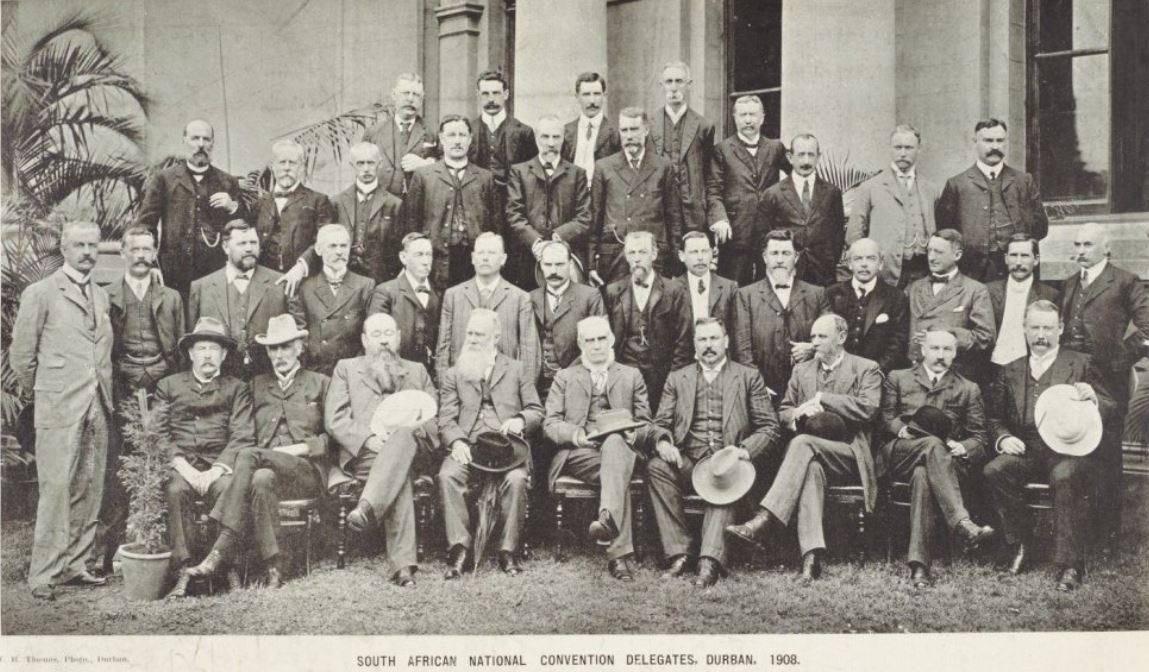
The cyclical nature of history has always shown that minorities cannot hold control over majorities indefinitely – and the two always roll over on one another, and where consensus elects a fiercely Nationalistic government, there is a tendency for that government to gravitate to Kleptocracy – and the Afrikaner Nationalists did it, so too now the African Nationalists – a rule by a elitist grouping (a real minority), consolidating absolute power (which corrupts absolutely) and helping itself to the state’s wealth. History fortunately shows us the majority will eventually see them out again (and the sooner the better for the ‘democratic’ South African Republic really).

On the left is a political cartoon from the 1950’s by Bob Connolly – it’s part of a series called “Fat Nat” and targets the National Party’s appetite for Kleptocracy – as does the political cartoon on the right lampooning President Ramaphosa and the ANC.

This also an historic truism, in the great fight of ‘right’ against ‘wrong’ world over – history has always sided with those who fight for human suffrage and emancipation as been on the side of the morally ‘good’ fight. The defenders of regimes which oppress and deny human suffrage and emancipation are always deemed as been on the side of the morally ‘bad’ fight. The net result has seen regimes like Verwoerd’s Afrikaner Republic come and go, often discarded to the scrapheap of history and irreconcilable within decades, whereas Unions which have individual liberties enshrined in their constitutions tend to last (as bumpy as the road gets at times) – the USA’s Bill of Rights, the Swiss Federal Charter and Bills of Rights and the British Magna Carta and all its subsequent Charters and legal interpretations have generally ensured the survival of these Unions over centuries.

Now, what about ‘Unionism’ were Smuts, Botha, Merriman and their ilk on the right track? Well, consider this, the Southern African Development Community (SADC) comprises all of Smuts’ 3rd Phase ‘Greater South Africa’ countries: Angola, Botswana, Eswatini, Lesotho, Malawi, Mozambique, Namibia, South Africa, Zambia and Zimbabwe. And it’s even bigger now as this political, security and economic alliance now also includes the Comoros, Democratic Republic of Congo, Madagascar, Mauritius, Seychelles and Tanzania. Also, strangely enough the ideals of Pan-Africanism as aspired to by the ANC and EFF (and obviously the Pan Africanist Congress) speaks very strongly to a unified African construct.

The mission of SADC is similar to that of the Greater South African Union, that is to promote sustainable and co-dependent and equitable economic growth and socio-economic development throughout the region. The obvious difference, Smuts saw ‘Pretoria’ as the capital and the regional economic driver as Johannesburg, with Federated control from Pretoria (like Washington D.C. controls the USA’s ‘Union’ and New York its business hub) … and, here’s the problem child – only with ‘white civilisation’ guiding progress.

This ‘white stewardship’ of the Victorian period clearly would not work out after World War 2 and with historic hindsight would never have been sustainable going forward, however Jan Smuts played ‘the long game’ – by January 1942, even Jan Smuts had seen the end of ‘white Imperialism’ when he admitted at an Institution of Race Relations conference that “segregation has fallen on evil days” and by the time Smuts drafted and ratified the preamble of another “Union” the United Nations (UN) in October 1945 he was all about human rights and suffrage, subscribing to reaffirming “faith in fundamental human rights, in the dignity and worth of the human person, in the equal rights of men and women and of nations large and small.” (preamble to the UN as drafted by Smuts).
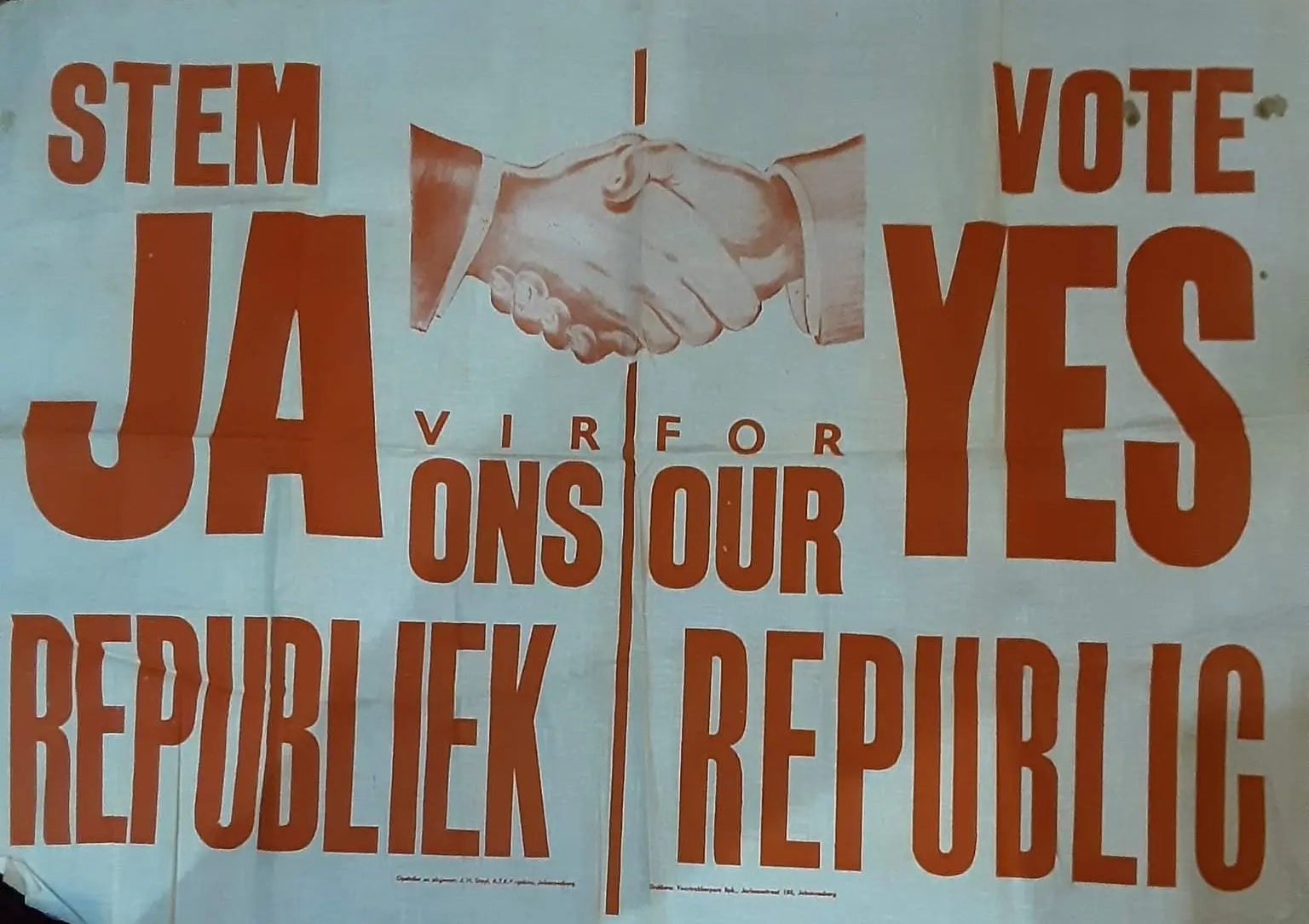
One has to wonder, had Jan Smuts and the Greater South African Union been given time and space, and had the Afrikaner nationalist ideals of a White’s Only Republic not resurfaced as a reality, Apartheid not implemented with such Nationalist vigour, and a less radicalised view of Pan-Africanism in Southern Africa not come around because of Apartheid and Colonial whites clutching onto power once their mandates were well past their ‘sell-by’ dates – whether we would have been on a substantively different trajectory than what we have today … I wonder.


Written and Researched by Peter Dickens

Winning Afrikaner Hearts and Minds

Ox Wagons to Steel Commandos

So what does the 1938 Great Trek Centenary have in common with Sailor Malan’s returning war veterans anti-apartheid movement – The Torch Commando?

Well, it’s all in the name – ‘Steel Commando’ – so what is a Steel Commando and what the heck does it have to do with the famous 1938 Great Trek Centenary defining Afrikanerdom and Sailor Malan’s later ’Torch Commando’ in 1951.

So here’s the backdrop:

The 1938 Great Trek Centenary 

In 1938, the Broederbond under the directive of its Chairman, Henning Klopper sought to use the centenary of Great Trek to unite the ‘Cape Afrikaners’ and the ‘Boere Afrikaners’ under the symbology of the Great trek. In this endeavour artificially creating a shared heritage. He started a Great Trek re-enactment with two Ox-Wagons in Cape Town and addressed the large crowd of 20,000 spectators by saying;

“We ask the entire Afrikanerdom to take part in the festival celebration in this spirit. We long that nothing shall hinder the Afrikaner people as a whole from taking part. This movement is born from the People; may the People carry it in their hearts all the way to Pretoria and Blood River. Let us build up a monument for Afrikaner hearts. May this simple trek bind together in love those Afrikaner hearts which do not yet beat together. We dedicate these wagons to our People and to our God.”

By that he hoped to combine the ‘Cape white Afrikaners’ with the ‘Boer white Afrikaners’ in the symbology of the Great Trek under a fabricated Nationalist ideal of Christian Nationalism – and only meant ‘White’ Afrikaners in the Broederbond’s definition of what constituted ‘Afrikanerdom’ and not really the Afrikaans speaking peoples as a ‘whole’ – certainly not the Coloured and Black Afrikaners. The Trek celebration would be pitched as an assertion of Afrikaner white power in South Africa and the Trek as the true path to a overall South African nationhood and identity and ignore the histories of everyone else – black and white – in creating a future South African identity. 

In any event the trek re-enactment was very successful in re-aligning white Afrikaner identity under the Christian Nationalist ideal.  In the end eight wagons from all around the country threaded their way to Pretoria to lay the cornerstone of the Voortrekker monument – in front of a crowd of 200,000 people. Whilst at the same time, four ox-wagons went to the site of the battle at Blood River for a commemoration service on the 16th December. The wagons stopping in countless towns and villages all around the country along the way to re-name street after street after one or another Voortrekker hero, and laying imprints of the wagons wheels in freshly laid cement at many halts (there are still ‘imprints’ at my hometown in Hermanus).

Images: Henning Klopper’s Ox-Wagons named – The ‘Piet Retief’ and the ‘Andries Pretorius, leave Cape Town from the foot of Jan van Riebeeck’s statue to commence the 1938 Centenary of The Great Trek.

The Broederbond had staggered onto the ideal way to ‘unify’ the Afrikaner – a round the country travelling carnival  – from the cities to the platteland, on to far flung corners and everything in between. Henning Klopper himself amazed at the reaction and the success of it all – so much so he turned to divine intervention and called it a “sacred happening”

The Ossewabrandwag

A mere two short years after the Centenary Trek, South Africa was at war with Nazi Germany. Leading up to the war, the South African government was a ‘Fusion’ coalition party between the National Party under Prime Minister Barry Hertzog and General Jan Smuts’ South African Party as his deputy – in an entity called The United Party. The decision to go to war was won by Smuts and a majority vote. Hertzog, whose National Party was already splitting along more radical right lines with the advent of the ‘Pure’ National Party resigned and Smuts became the wartime Prime Minister.

Another one of the primary reasons for the National Party gravitating to radical right-wing lines was the Ox-wagon Great Trek Centennial of 1938.  One of the wagon group’s leaders during the trek was Dr Johannes Van Rensburg, a lawyer who had served previously as National Party ‘Secretary of Justice’ in 1933 and was a part-time Union Defence Force officer – he had been to Germany in his capacity as Secretary and met both Hitler and Göring as well as other Nazi officials, he was deeply impressed with both the leadership and discipline offered by Nazism and became an admirer.  

So, from the Centenary event in celebration of this coming together of Afrikaner identity under a white-only Afrikaner Nationalism came a cultural movement called the Ossewabrandwag (meaning Ox Wagon Sentinel or ‘Fire Watch’) – abbreviated OB – eventually led by Dr Johannes van Rensberg. Formed in 1938, the ‘Fire’ part of the OB name referred to the rapidly spreading “wildfire” of Christian Nationalism and ‘white’ Afrikanerdom set off by the 1938 Ox-Wagon Centenary Trek, eventually gaining about 250,000 – 300,000 members in total.

The Ossewabrandwag at the on-set was loosely associated to Dr D.F. Malan’s ‘Pure’ National Party. However so as not to tread on one another’s feet, the relationship between the Ossewabrandwag and National Party needed to be formalised. So Dr D.F. Malan met with OB leaders on the 29th October 1940 which resulted in declaration known as the ‘Cradock Protocol’. It specified the two operating spheres of the two respective organisations. They undertook not to meddle in each others affairs and the National Party endeavoured to work for white Afrikanerdom and Christian Nationalism in the “political” sphere while the OB would operate on the “cultural” front. 

Images: Ossewabrandwag members on parade and taking a Nazi styled salute

Resigning from the Union Defence Force, when war was declared, Dr Johannes Van Rensburg moved to promote the edicts of Nazism in the OB and even directly support the Nazi Germany war effort-ordinating espionage activities for German submarines, the OB under his leadership also evolved away from being a mere ‘cultural movement’ forwarding Nationalist Afrikaner identity, to an active domestic para-military movement with strong Nazi convictions.

Dr Van Rensburg, having resigned as an officer in the Union Defence Force at the start of the war, had always professed been a National Socialist, and as an open admirer of Nazi Germany and Adolph Hitler, the ideas and rituals of membership of the OB had a distinctive Nazi leaning as a result.

Officially, the National Party – when under Hertzog and then under Dr D.F. Malan took the position of ‘neutrality’ as to South Africa’s wartime involvement, but in reality hundreds of thousands of Afrikaner Nationalists were joining openly pro-Nazi Germany movements like the Ossewabrandwag (OB) and its ‘Stormjaers’ (Storm Troopers) military wing, the Nazi Party of South Africa – the South African Christian National Socialist Movement (SANP), the National Socialist Rebels under Robey Leibbrandt, a Nazi Germany insurgent and the Nazi world expansionist order in South Africa – The New Order (NO) under Oswald Pirow who had served as a National Party Defence Minister under Hertzog.

The Steel Commando

The recruitment of white Afrikaners to volunteer for war service became paramount to Union’s Defence Force wartime objectives. On the other side of the Afrikaner coin stood Afrikaners like General Jan Smuts and Dr Ernest Malherbe, who had also been swept up in the enthusiasm of 1938 Great Trek Centenary and the establishment of a unified Afrikaner identity, but not buying into its underpinning Christian Nationalism ideology. 

The Malherbe family, for example, being descendants of a French Huguenot and Afrikaners to their core had nothing in common with the Broederbond but had been caught up with all the Afrikanerdom of the 1938 Centenary Trek. At Blood River on 15 December, in the shade of one of the Centenary trek wagons, Dr Ernie Malherbe’s father-in-law, Dominee Paul Nel, baptised their daughter Betty-Jane with water from the Blood River. 

When South Africa declared war, Dr Ernie Malherbe and a group of academics, notably Alfred Hoernle and Leo Marquard, persuaded General Smuts to set up, under Malherbe, a corps of information officers to counter subversion in the armed forces generated by the likes of the Ossewabrandwag and the Broederbond and to stimulate the Afrikaner troops and potential white Afrikaner recruits to consider what they were fighting for. Smuts then made Malherbe Director of Military Intelligence with the rank of Colonel. Henceforward South African propaganda which had just been focused on countering Nazi propaganda became much more positive and more South African in its orientation.

Images; World War 2 recruitment posters targeted at white Afrikaners – note the poster drawing on the ‘the road to South Africa’ commencing from The Battle of Blood River to the Boer War Commandos to the South African Union Army – the title “Still loyal to the path of South Africa” is a direct play on the 1938 Centennial Trek which the Broederbond pitched as “Die Pad van Suid-Afrika,” a symbolic ‘path’ to South Africa’s nationhood taken by the Voortrekkers. This poster attests that joining the Smuts appeal to war is the true path to nationhood.

Critical to Smuts’ call for volunteers to serve in combat regiments was the white Afrikaner nation (as ‘whites’ and ‘coloureds’ were only deemed eligible to carry firearms in the military per segregationist policies and not ‘blacks’). The Union’s Defence Force at the beginning of the war was woefully under strength. Simply put, without the white Afrikaners volunteering for war-time service, South Africa’s wartime commitments for combatants would be ineffectual.

Colonel Malherbe would take a leaf out of the Broederbond’s 1938 Centenary Trek used to ‘unify’ the Afrikaner – a round the country travelling carnival covering just about every town and village in the remotest areas. Only this time Colonel Malherbe intended that the travelling carnival ‘unify’ the Afrikaner behind Smuts’ call to arms to fight with Britain and France on the side of the Allies. He would use armoured cars instead of ox-wagons and his message was almost diametrically opposite to that of the Broederbonds’.

Colonel Malherbe would call his countrywide travelling carnival – The Steel Commando, added to this would be a propaganda and recruitment pamphlet dropping campaign from SAAF aircraft called the Air Commando.  The Steel Commando would consist of vehicle to carry a full military band, various armoured cars and a truck converted into a mobile recruitment station. Critical to the Steel Commando would be a contingent of old Republican Boer War veterans (South African War 1899-1902) to give it a sense of ‘Afrikanerdom’ and ‘duty’ to South Africa. The term ‘Commando’ would be given to the convoy – solely because it resonated with old Republics ‘Kommandos’ of the Boer war and as a result had Afrikaner appeal. Isie Smuts (called ‘Ouma’), Jan Smuts’ wife and very popular amongst Afrikaners, young and old, was also positioned as a volksmoeder (people’s mother) a term originated in the Boer War and was initially drawn upon by Afrikaner nationalists to represent ‘the mother of the nation’ connected to the concentration camps – Isie Smuts would become a volksmoeder for the Union’s wartime cause comforting the Afrikaner men and women in uniform and the country’s ‘First Lady.’

This convoy would enter small rural and farming towns with the fanfare of the marching band ahead of it, flanked by the Boer War Republican veterans and the recruiting station behind.

Was it effective in capturing the Afrikaner hearts and minds as the Centenary Trek had been?  The truthful answer is – yes. In all the South African standing forces in WW2 comprised 334,000 full-time and voluntary service personnel, 211,000 were White, 77,000 were Blacks and 46,000 were Coloureds and Indians. Of the 211,000 whites, 60% were estimated by Malherbe as being white ‘Afrikaners’ – 126,600 – the majority ethnic group in the South African Union’s Defence Force during World War 2. 

To see the effect of a Steel Commando parade, this video outlines one addressed by Smuts as a demonstration of the achievements of recruitment is very telling – note the extensive use of Boer Commando veterans.

What the Steel Commando and Colonel Malherbe’s recruitment drive also did was literally spit the Afrikaner ‘hearts and minds’ in two, one half supporting the National Party’s call to neutrality or the Ossewabrandwag’s call to directly support Nazi Germany – and the other half of white ‘Afrikanerdom’ – supporting the ideals of Union between English and Afrikaans, General Smuts’ policies and the Allied war against Nazi Germany. 

Post 1948

The dynamics behind the National Party’s accent to power without a majority vote in 1948 have been vastly researched but suffice it to say that for returning War Veterans from WW2, fighting against Nazism, the advent of a political party with numerous leaders who had been directly and/or indirectly flirting with Nazism during the war as a net result of organisations like the Ox Wagon Sentinel (Ossewabrandwag) and other Neo Nazi factions merging with The National Party was an abhorrent idea and an insult to the sacrifice of their comrades in arms.

The War Veteran’s Action Committee

The outrage to this and the implementation of the first Acts and Bills that would become ‘Apartheid’ would result in a merger of war veteran members of the Springbok Legion veteran’s association and war veterans predominant in the United Party’s political structures in April 1951 – the ‘War Veteran’s Action Committee WVAC (the WVAC was to eventually evolve into The Torch Commando) under the leadership of the charismatic war-time fighter ace – Sailor Malan, a veteran with Afrikaans heritage. Pains were taken to ensure the make-up of the WVAC was 50/50 English/Afrikaans.  

The WVAC kicked off their mission with a protest at the Johannesburg Cenotaph on 21st April 1951 during a commemoration service – laying a coffin draped in the national flag as a symbol to depict the death of the Constitution. They ramped their protests up with three torchlight protests in Port Elizabeth, Johannesburg and Durban. At these protests, comprising over 30,000 people in total, a set of resolutions were ratified to take to Cape Town and present to Parliament. The resolutions basically were a warning to the government that the military veteran community would embark on a political struggle unless the National Party government resigns.

Steel Commando (version 2)

But how to whip up support for their cause, and how to whip up the planned mega-torchlight rally in Cape Town to hand over the demands? Here the WVAC took a leaf out of Colonel Malherbe’s Union Defence Force ‘Steel Commando’ recruitment drive. They would not even change the name, the WVAC’s ‘Steel Commando’ would be run along the same lines with military precision. All around the country from far flung places vehicles would converge with the Steel Commando and the Commando itself would drive through multiple towns and villages whipping up publicity and support. 

The Steel Commando of the WVAC (Torch Commando) would, as a primary objective also look to recruit, all the Afrikaans war veterans who in their minds may have erroneously voted for the National Party in 1948 and call them back to Smuts’ more moderate politics. To this end, as Colonel Malherbe had done using Republican Boer War veterans, the WVAC would do exactly the same with their version of the Steel Commando and use the old Boer War Veterans. Kommandant Dolf de la Rey, a Boer War veteran whose Commando had been involved in capturing Winston Churchill and national hero was appointed to lead The Steel Commando with Sailor Malan as his 2nd in Command – two Afrikaner war heroes leading the convoy. They would also keep the term Commando when the WVAC formed ‘The Torch Commando’ later as a nod to Afrikaner heritage. Kommandant de la Rey was also affectionally given the term ‘Oom’ by the publicity machine to conjure up respect from the Afrikaner community.  This sentiment can be seen in the newspaper reporting outlined as follows:

Of the Steel Commando trip to Cape Town, wrote one newspaper correspondent: “Cape Town staged a fantastic welcome” for Kmdt de la Rey and Group Captain Malan, he related the enthusiasm of the crowd to the same that liberation armies received in Europe. The Johannesburg Star said: “The Commando formed the most democratic contingent ever to march together in the Union. Civil servants found themselves alongside the colored men who swept the streets they were marching so proudly upon.”

“In the front jeep rode Oom Dolf de la Rey, a white-haired old Boer of seventy-four, who looked so startlingly like the late General Jan Smuts that people looked twice at him and then cheered wildly. Oom (Uncle Dolf) was the man who, as a young burgher on commando fifty years before, had captured Winston Churchill, then a war correspondent with the Imperial forces in South Africa.In the second jeep stood a younger man with tousled brown hair, his hazel eyes cold and angry, the man who had been the most famed fighter pilot in all the RAF — Adolph Gysbert Malan, known all over the world as Sailor. He was the real hero of the hour. The people tried to mob him. Men and women, white as well as brown, crowded round his jeep and stretched out their hands to touch him.”

Video: The Steel Commando on-route to Cape Town – note the use of Boer War Kommando veterans.

The ‘Steel Commando’ convoy gathered media attention and grew in size as it converged on Cape Town on the 28th May, a crowd of 4,000 greeted it as it converged in Somerset West before heading to Cape Town that evening. In Cape Town, the Steel Commando arrived to a packed crowd of protesters on The Grand Parade outside the City Hall of between 55,000 to 65,000 people – consisting of whites and coloureds, supporters and veterans alike (veterans were estimated at 10,000). Many holding burning torches as had now become the trademark of the movement. Spooked by it all the National Party were convinced that a military coup was on and as a precautionary measure placed manned machine gun positions around the rooftop of the nearby Houses of Parliament.

Sailor Malan was literally carried on shoulders by cheering crowds to give his speech. Joined by Dolf de la Rey and even future Afrikaner anti-apartheid activist and fellow war veteran Mattheus Uys Krige as well as the English speaking South African war-time soprano and heroine who led them in song – Perla Gibson. In Sailor Malan’s speech to the crowd famously accused the national party government at this rally of;

 “Depriving us of our freedom, with a fascist arrogance that we have not experienced since Hitler and Mussolini met their fate”.

Images: Kommandant Dolf de la Rey and Group Captain Sailor Malan addressing crowds at the Steel Commando in Cape Town

Buoyed by the success of The Steel Commando, The Torch Commando would officially form and would in the course of time rise to 250,000 plus members – so if one asks – was The Steel Commando as successful as its original concept – the pre-war 1938 Ox-Wagon centennial staged by the Broederbond, and whose idea was drawn on by Colonel Malherbe for the Defence Forces’ Steel Commando’ wartime recruitment drive, the answer is yes, and here’s why;

In Conclusion

The white population voting base in 1951 was estimated about 1,000,000 whites. 250,000 whites had polarised to Ossewabrandwag radically politically right on the back of the 1938 Great Trek ‘Ox Wagon’ Centennial .. and 250,000 whites had gravitated radically politically left on the back of The Torch Commando. Literally driving a dividing line between the white voting base (English and Afrikaans) – half in support of Apartheid and half against Apartheid.

It would also splinter the white Afrikaner voter base and the Broederbond’s attempt at a shared Afrikaner National identity, the majority would be swayed by Christian Nationalism as an ideology and keep the National Party in government on a slim margin, becoming more entrenched as the National Party engaged gerrymandering and jack-boot totalitarian politics going into the future – however a significant portion of white Afrikaners would remain ‘Smuts-men’ and resist Christian Nationalism for many years to come – they simply would not buy into the Broederbond’s initial tenants of bringing ‘Afrikanerdom’ under the singular banner of ‘white’ Afrikaner Nationalism and saw it for what it was – a corruption of Afrikaner history, exclusive, hateful and divisive.

The irony, all this fracturing would be caused by the same vehicle to ‘unify’ the white Afrikaner – a travelling carnival appealing directly to the hearts and minds of far flung rural white Afrikaners, initially conceived by the Broederbond to drive an Apartheid agenda starting in Cape Town and picked up in the end, a tad over a decade later, by the Torch Commando to drive an anti-Apartheid agenda – to the same far flung rural white Afrikaners and in a twist of fate ending up back where it all started – Cape Town.


Written and Researched by Peter Dickens

The Red Oath

Pride in “Rooi Lussies”(red tabs), worn by most, branded “Rooi Luisies” (Red Lice) by some.

At the start of World War 2, the South African armed forces were woefully understrength having only 3,500 permanent force members and 14,000 volunteers in citizen force regiments and rifle associations (Active Citizen Force). General Jan Smuts needed to increase these numbers dramatically, and he did not want to institute conscription to do so, the call to fight would be based on volunteerism. The idea was to initiate a Oath declaring the free willing and voluntary nature South Africans felt in going to war against Nazi Germany, Fascist Italy and eventually Imperial Japan. The success of this call for volunteerism is staggering – in the end a total of 342,792 South Africans volunteered to participate in World War 2.

Also of that statistic nearly one quarter of the total ‘white’ adult population at the time volunteered for service, consider what Smuts had achieved, the Nationalists were unable to raise anywhere near these numbers in 1966 to their cause and had to implement forced conscription for the SADF.

The ‘Red Oath’ or ‘Service Oath’ was taken by all these volunteers when joining the South African Union Defence Force (UDF) from 1939, it was a Service Oath to legally enable the Union to send soldiers outside the borders of South Africa (soldiers in the UDF were only legally obliged to protect South Africa itself if it were invaded). The oath read:

“That I will be faithful and bear true allegiance to His Majesty King George VI and his heirs and successors according to law … That I will perform to the best of my ability the duties assigned to me as a volunteer member of the Union Defence Forces … That I will serve anywhere for the duration of the present war and for a period of six months thereafter unless otherwise legally discharged.”

This manifested itself in ‘red epaulettes’ issued to all service-personal who ‘volunteered’ to serve in the armed forces during the war and took the ‘Red Oath’. Sensitive to sympathetic political feelings many Afrikaners had towards Germany, by implementing the oath the Smuts government gave the opportunity for permanent force members sympathetic to Germany to remain in the Union’s forces, and not go to war against them – they just didn’t get to wear the red tabs.

The original ‘red’ oath specified service anywhere in “Africa” and was called the ‘Africa Service Oath’ (ASO), it was changed to the ‘General Service Oath’ (GSO) once the Axis Forces in North Africa were defeated so that volunteers could be used in the European theatre and the word “Africa” was changed to “anywhere”. Those who did not want to fight in Europe and who had taken the ‘Africa’ oath only were returned to the Union.

A handful of permanent force UDF members did not take either red oath, some felt inevitably ‘singled out’ by not wearing the tabs (and in some cases resigned), whilst others took pride in their political convictions and wore their ‘clean’ epaulettes, sans the red strip with pride.

Images: Pride in the Red tabs and Let’s Go South Africa, showing proudly the tabs propaganda posters.

This WW2 South African propaganda poster, promoting the ‘Red Oath’ and the special volunteer epaulette flash worn by all who took the oath and volunteered for service during World War 2 was designed to swing opinion in the Afrikaans community where the wearing of the red flash was seen as an oath to the British and viewed by some as betrayal. In these sections of the Afrikaans community they where called ‘Rooi Luisies’ (Red Lice) instead of ‘Rooi Lussies” (Red Tabs), as a means of degrading those who volunteered.

Image: British (left) and South African (right) uniforms from the Italy Campaign during WW2, note the red tabs on the epaulettes.

Of interest is the ‘Africa Service Medal’ awarded to all who served in South African Forces during the Second World War, the ‘red tab’ in this medal’s ribbon is symbolic of the The Red Oath taken and the tabs worn.

The ‘Erasmus Reforms’ to the defence force was implemented by FC Erasmus after the Afrikaner Nationalists came to power in 1948. Deemed more necessary when the Nationalists converted the South African Union’s Defence Force to that of the Republic’s Defence Force in 1961 and these reforms would see the idea of the ‘red’ oaths to the British royal family as the symbolic head of South Africa and red tabs removed. Some citizen force regiments however carried on with the tradition as a historical nod to their participation in the Second World War on their step out uniforms, the Cape Town Highlanders a case in point.


Written and Researched by Peter Dickens

References:

The Smuts Government Justification of Emergency Regulations and the impact thereof on The Ossewabrandwag (1939-1945) by Anna La Grange

The Springbok Record – published by the South African Legion