The Smoking Gun

Torch Commando Series – Part 5

The Smoking Gun

The military ‘struggle’ of White South Africans against Apartheid is a complex one seldom acknowledged. It’s politically ‘inconvenient’ history and hidden from the mainstream. It is often presented in a fragmented manner, somehow dipping in and out of the struggle narrative as a ‘few’ whites with a conscience prepared to forsake their Apartheid white privilege. The advent of this narrative now deepened by revolutionist rhetoric which by its very nature is very unbalanced.

The simple truth is that the ‘white’ struggle against Apartheid is far from a mere side note in the annals of South Africa’s liberation struggle. A full understanding the ‘white’ struggle exposes one overarching truth, the history of the struggle against Apartheid has less to do with race and more to do with ideology. Race was the raison d’être for Apartheid as an ideology, so it’s hard for many to step away from the logic that says race must therefore be the raison d’être for the liberation ‘struggle’ – but step away we must, the ‘struggle’ was an ideological one.

This misdirected populist perspective of a struggle between ‘black’ and ‘white’, makes it necessary to pack out the ‘white’ struggle along a racial line to show the flaw in the current narrative.  So, to fully understand the ‘white’ struggle against Apartheid, we need to first find and follow its ‘Golden thread’ – the key task of historians to find the ‘smoking gun’ and tell the story in a sequential way.  With a little historical sleuthing we need to see the ‘golden thread’ – and connect the dots in order for the history of the ‘struggle’ to be holistically understood. 

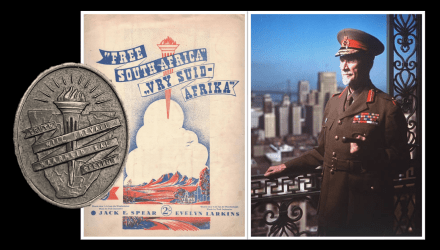
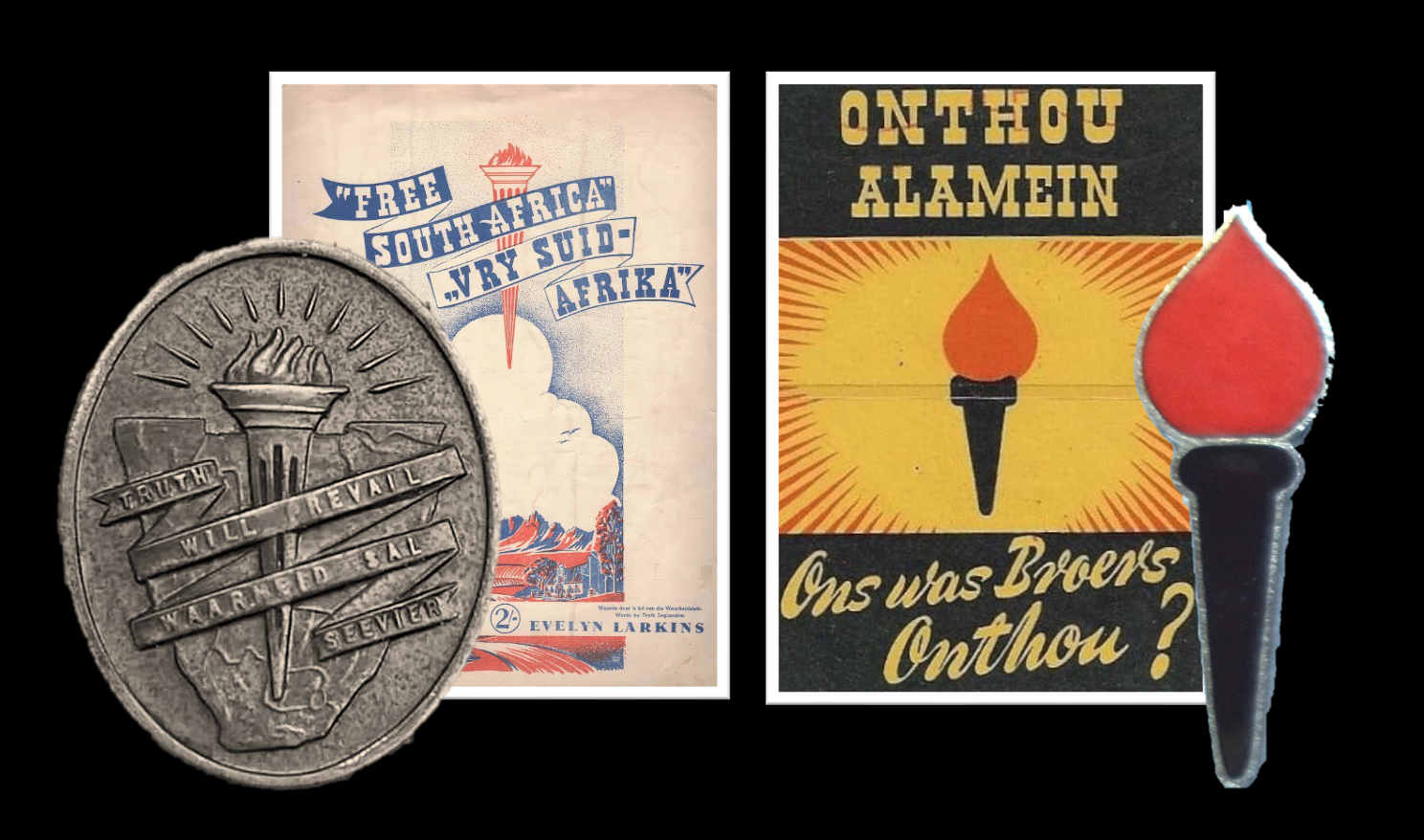
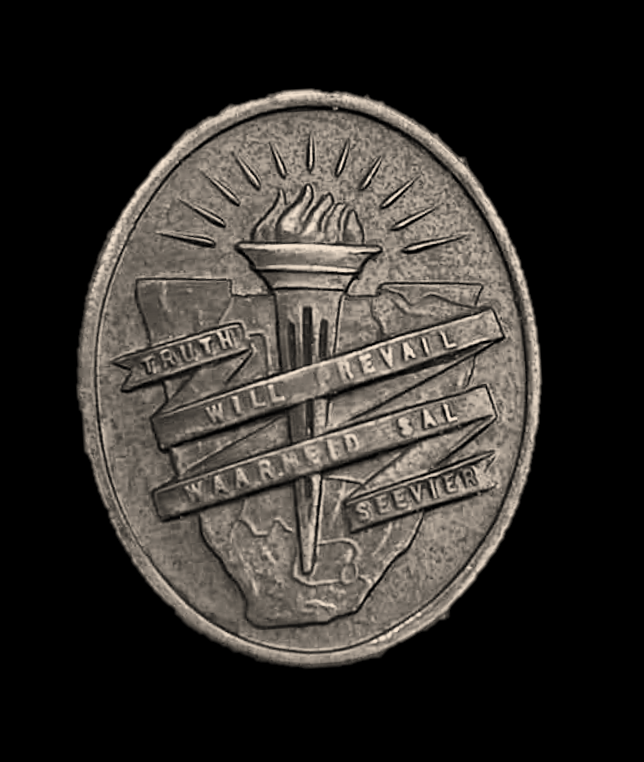
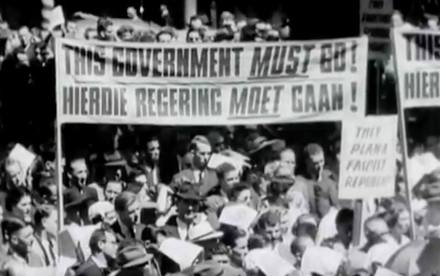
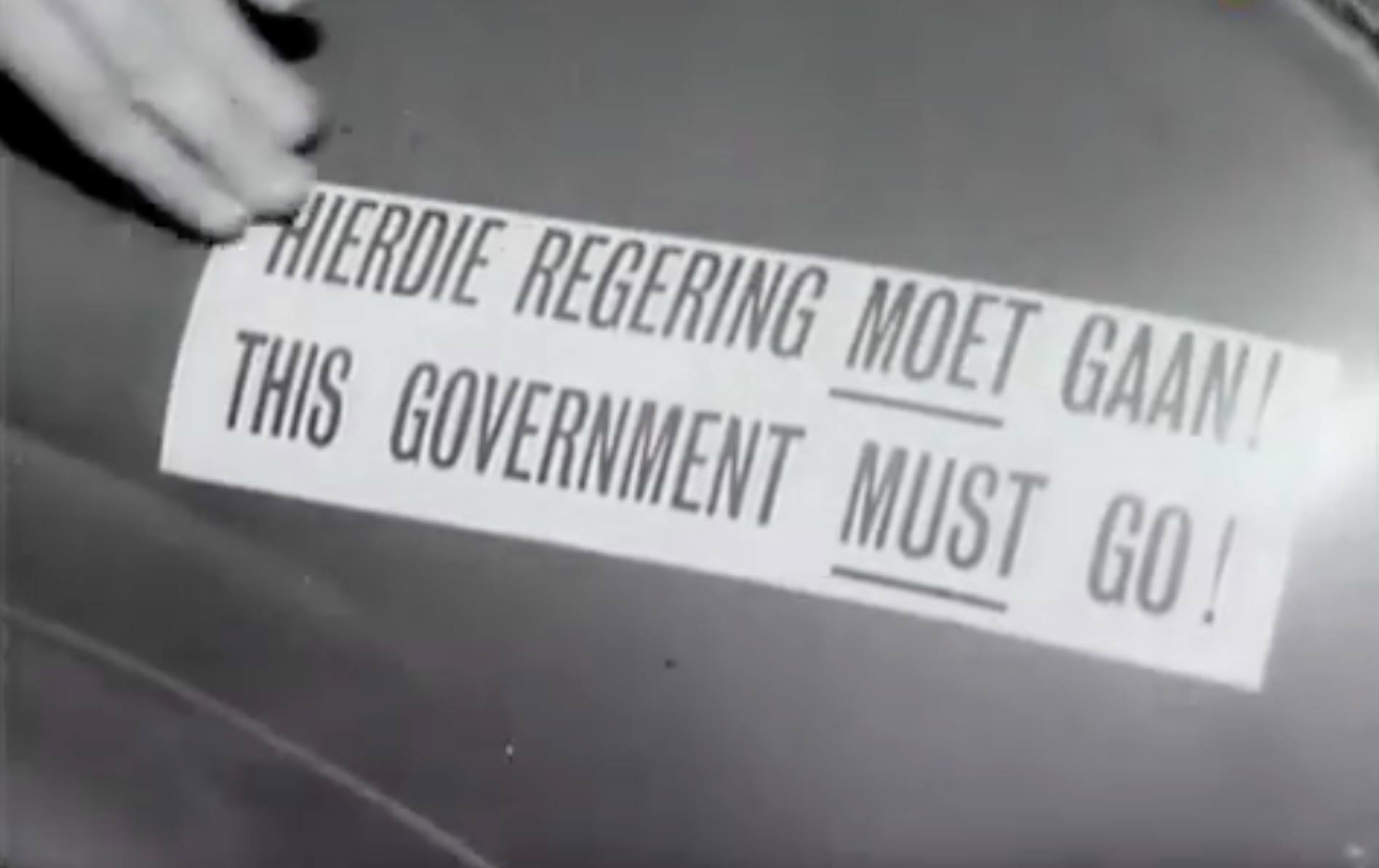
The ‘smoking gun’ for the ‘white struggle against Apartheid’ begins in earnest with a military theme and a post-World War 2 military veteran’s formation. The Torch Commando, a mass movement of mainly white ex-servicemen and supporters who mobilised against Apartheid; 250,000 in total.  Not a common feature on South African history of the ‘Struggle’ – simply put it does not suit the current political rhetoric and broad popular understanding of the ‘struggle’ – so how did this come about?

In a nutshell, The Torch Commando mission came on the back of a ‘Constitutional’ (not majority win) of the National Party in 1948 to push for another more representative election and The Constitutional Crisis’ that follows the Afrikaner Nationalist government’s first attempts at Apartheid legislation. The Torch views its fight as an extended anti-fascism one against ‘the rise of the Afrikaner Reich’ and sees a quarter of the 1948 ‘White’ voting base (of an est. 1,000,000), known as the ‘service vote’ – actively mark their protest against the National Party’s accent to power in a mass ‘pro-democracy’ and ‘anti-Apartheid’ movement.  

The Torch’s activation pre-dates the African National Congress’(ANC) activation of their ‘Defiance Campaign’ (which activated on 26 June 1952) and as such ‘The Torch’ as it became to known is the first significant mass protest movement against the intuition of Apartheid legislation, and at the time it posed more significant threat to the National Party than the ANC – militarily, numerically and politically speaking.  

The ‘numeric’ threat alone made the National Party uneasy as it highlighted just how tenuous their new grip on South Africa was, statistically the majority of whites wanted nothing to do with their election promise of ‘Apartheid’ and had voted against them in 1948 (they won by ‘seats’ and not by a majority) and now literally half of the white people who voted against them had gone one step further and joined a mass movement in active protest, a mass movement led by a group of men who were militarily commanders and well experienced in waging war and comprising tens of thousands of very experienced war veterans.

Heady and dangerous stuff for the fledgling Architects of Apartheid – so let’s have a look at this movement a little closer and figure out what happened and why the ‘Torch’ is the epicentre of the ‘white’ militant struggle against Apartheid.

What happens next?  

What arises from the ashes of The Torch’s mass political uprising against the Nationalists and Apartheid post the April 1953 General Election National Party victory? The answer lies in the Torch’s broach church and mixed bag of ex-military servicemen and women. These leading members of The Torch Commando, with their differing ideologies, will move on to re-shape the political landscape and resistance to Apartheid in the coming years.

Broadly the leader element of The Torch Commando comprises groupings of individual members who follow entirely separate ideologies – one faction can be described as ‘Liberals’ the second faction are ‘Communists’, the third faction can be described as ‘Democrats’ and finally there are Torchmen who are ‘Federalists’. Let’s examine each separately. 

At the same time the Torch folds in mid 1953, the ‘Liberal’ Torch members become the founders of The Liberal Party – formed in May 1953. Louis Kane-Berman (The Torch’s Chairman) would recall that the Liberal Party which literally take shape at his house, although Louis Kane-Berman himself became a federalist, favouring the Union Federal Party. Central to the Liberal Party’s formation is the failing of the UP to adequately address the black franchise question. 

The ‘communist’ members of the Torch, limited by the Suppression of Communism Act 1950 and using the Torch Commando for political voice as The Springbok Legion would maintain their Communist Party of South Africa (CPSA) identity and fall into lock step with the African National Congress. In late 1951, the Torch Commando moves onto a ‘anti-Communist’ footing and into lock step with the United Party so as to maintain its broad appeal amongst white voters as an anti-fascist protest movement. The Torch had “donned the straightjacket of anti-Communist orthodoxy” according to the very liberal leaning Guardian newspaper on 6 September 1951. 

The Torch’s key Springbok Legion and ‘Communist’ leaders are eventually swept up or fingered in 1956 when the Treason Trial begins, the trial forces most of them underground. After the Sharpsville massacre in 1961 all of them find themselves in jail or in exile.

The ‘democratic’ members of the Torch, who are also disillusioned members of the UP, especially on the UP’s appeasement politics on race relations, would break away from the UP and play key roles in forming the Progressive Party in 1956. This would be the pre-curser to what is now the Democratic Alliance (DA) today. In many respects it is the Torch Commando’s fire-brand politicians demanding the United Party radically change its position on Black political empowerment and open up the franchise who would ultimately end the United Party. 

The ‘Federalists’ in the Torch would also split out of the United Party and peruse an agenda for a qualified franchise and push another constitutional crisis over the Natal breakaway proposal. After the Torch collapses many of these ‘UP’ torchmen would form the Union Federal Party (UFP). 

Depending on their moral convictions, out of these respective breakaways and political parties and movements would emerge a two stream ‘white’ resistance campaign to Apartheid. One stream which focused its military experience on armed resistance and one stream, traumatised and tired of armed conflict, choose civil resistance instead. Both streams would continue with a struggle or a continued fight against ‘Nazim’ and the on-set of the ideology in South Africa under the guise of Afrikaner Christian Nationalism.

So, who are these leaders who are embroiled in the Torch Commando and why are they so important to South Africa’s future democracy?  First, let’s start with the Communists.

The Torch’s Communists 

The communist element of the Springbok Legion and subsequently the Torch Commando are made up of the following key persons:

Cecil Williams

Cecil Willams’ wartime experience was with the Royal Navy (RN) as a RN War Correspondent in the Mediterranean theatre. He joins The Springbok Legion as its Secretary and later becomes its Chairman.  A paid-up Communist Party of South Africa (CPSA) member, he becomes the administrative officer of the Torch Commando’s “Steel Commando”.

Cecil Williams

Cecil Williams sought a broad-based white front against the Nationalists and called on the Torch Commando to declare a national strike. He foresaw that the Nationalists would not be ousted in the 1953 General Election, a new delimitation would favour the Nationalists; opponents could be banned or proscribed, and hooligans could stop people voting. He called for a National Strike to make it impossible for the government to continue governing stating it “would unite all anti-Nationalist sections of the population; would prove the government did not reflect the will of the majority; and would show people that power lay in their hands” (Clarion, 17 July 1952). 

Cecil Williams later joins the African National Congress (ANC) and is famously arrested on the 5th August 1962 whilst being ‘chauffeured’ by Nelson Mandela. Driving an Austin Westminster, Mandela was able to travel around the country secretly to meetings post the Sharpeville massacre by disguising himself as a chauffeur for an elegant, impeccably dressed white man (Cecil Williams). Nelson Mandela would famously recall of the day “I knew in that instant my life on the run was over”.

Williams is detained, banned and ultimately goes into exile in the United Kingdom (UK). He pioneers gay rights in the UK in addition to anti-Apartheid activism and he died in London in 1979. A movie about his life “The Man who Drove with Mandela” was released in 1998, and given his influence over Mandela and other ANC stalwarts at this time in history, many would later conclude Cecil Williams had planted the seeds that saw South Africa become the first country in the world to embody equal LGBT rights in its post-apartheid constitution.

Wolfie Kodesh

Wolfie Kodesh sees his military experience in the South African Army fighting in East and then North Africa during World War 2.  Also, a card-carrying member of the Communist Party, The Springbok Legion and The Torch Commando. After the collapse of the Torch Commando and banning of Communism, he puts his logistics and military planning skills to use, secretly moving Nelson Mandela around to avoid arrest. Acting as an uMkhonto we Sizwe (MK) Counter-Intelligence and logistics officer he also trains ANC cadres on weapons and co-ordinates communications.

Wolfie Kodesh

Wolfie Kodesh is also credited with introducing Nelson Mandela to Communist military doctrine and tactics and becomes a founding member of uMkhonto we Sizwe (MK). Wolfie Kodesh was a director of The New Age Newspaper, vocally in opposition to Apartheid. In 1963 he was arrested and detained without trial in solitary confinement for 90 days, thereafter he was deported to the United Kingdom (UK). While he was abroad, he worked for the ANC until he was deployed to work in MK camps. He later took charge of logistics for MK in Lusaka, Zambia. He returned to South Africa after the end of Apartheid and died in Cape Town in 2002.

Percy John ‘Jack’ Hodgson

Jack Hodgson’s service during the second world war is in the South African Army where he is deployed in the Western Desert. He is severally wounded under fire and after a long spell in military hospital, he was invalided out in 1943. He marries Rica Hodgson after the war in 1945. Rica and Jack both become a highly active anti-Apartheid team.
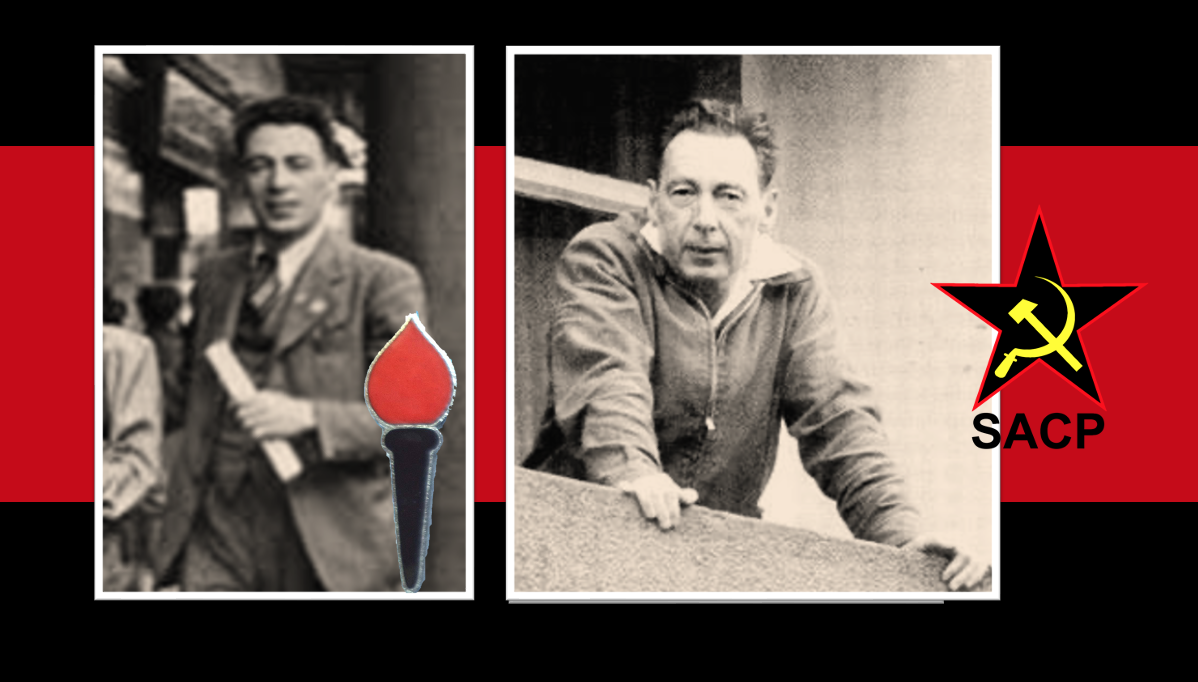
Jack Hodgson

A very experienced combat soldier and hard-line Communist Party member, he becomes the National Secretary of the Springbok Legion leading the Legion’s campaign against the National Party in the 1948 election.  In opposition to the National Party’s 1948 win he then plays a key role in setting up The Torch Commando and continued in a highly active role in the Torch’s activities and protests.  When the Torch Commando collapsed in 1953, he went on to become a founding member of the Congress of Democrats aligning with The African National Congress (ANC).

Under the Suppression of Communism Act, he is served banning orders in November 1953 and goes underground.  He is arrested, charged and acquitted in the Treason Trial in 1956, and along with fellow Springbok Legion and Torch Commando stalwart Wolfie Kodesh at his side, he becomes part of Mandela’s security detail during the trial. Rica Hodgson also takes an active role as the secretary of the Treason Trial Defence Fund.

After the trial Jack Hodgson gets involved in the formation of uMkhonto we Sizwe (MK) and becomes part of MK’s Johannesburg High Command.  He is the person who introduces Nelson Mandela to art of bomb-making and “brings the bomb” to the ANC’s first test bombing at a brickyard outside Johannesburg. He involves himself in all aspects military for MK and spends much of his time training MK cadres in bombmaking.

He is detained and eventually deported to the UK along with Rica. In the UK Jack sets up a workshop producing false passports, letter bombs and fake suitcase bottoms to smuggle covert material into South Africa on behalf of MK. Jack Hogson died in London in 1977, Rica Hodgson returned to South Africa as Walter Sisulu’s secretary after the Communist Party and ANC was unbanned in 1991 and she passed away in 2018.

Lionel ‘Rusty’ Bernstein

Rusty Bernstein at the onset of WW2 he joins the South African Army, serving as an artillery man in all major theatres of South African operations during the war; East and North Africa and finally in Italy. Another highly politicised member of the Communist Party, Springbok Legion and then The Torch Commando – he is eventually charged during the Treason Trial and acquitted, only to be charged again and detained for the Rivonia Trial. He is the only man to be acquitted during the Rivonia Trial.
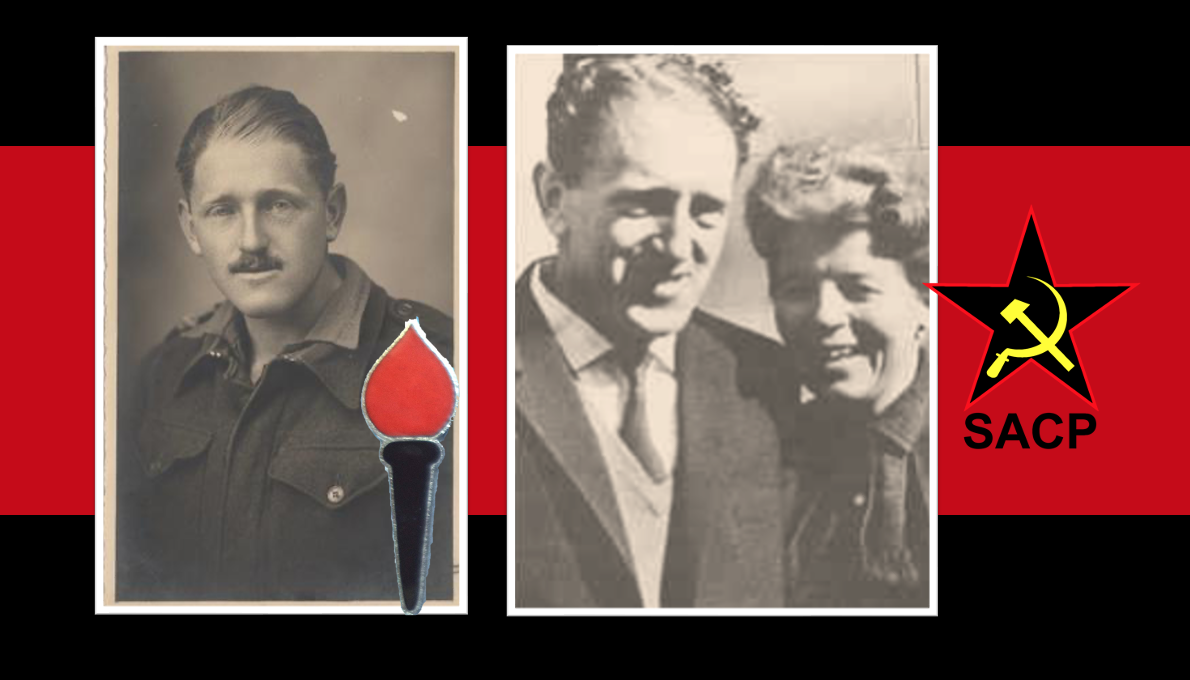
Rusty Bernstein

Rusty Bernstein is accredited as the person who crafts the Freedom Charter, he was detained without charge for almost five months during the  post Sharpeville state of emergency, thereafter banned he goes into exile. In exile he joins uMkhonto we Sizwe (MK) and plays a key role in educating MK cadres and others in African struggle politics whilst in the Soviet Union at the Lenin School in Moscow and at the Solomon Mahlangu College in Tanzania.

In 1994 he returned to South Africa for Nelson Mandela inauguration as President and then returned to Britain until his death in 1999.

Joe Slovo

Joe Slovo, politicised early Joe joins the Communist Party at the onset of World War 2, to get in on the fight on the side of the Allies, he joins the South African Army as a signaller and serves in both the North African and Italy campaigns. He plays a pivot role in the Springbok Legion and the Torch Commando. Like his other Communist comrades in The Torch and Springbok Legion he finds himself gagged by suppression of communism act and voiceless when the Torch and Springbok Legion collapse. He is associated with the Treason Trial and acquitted and like Rusty Bernstein takes a role in contributing to The Freedom Charter.  
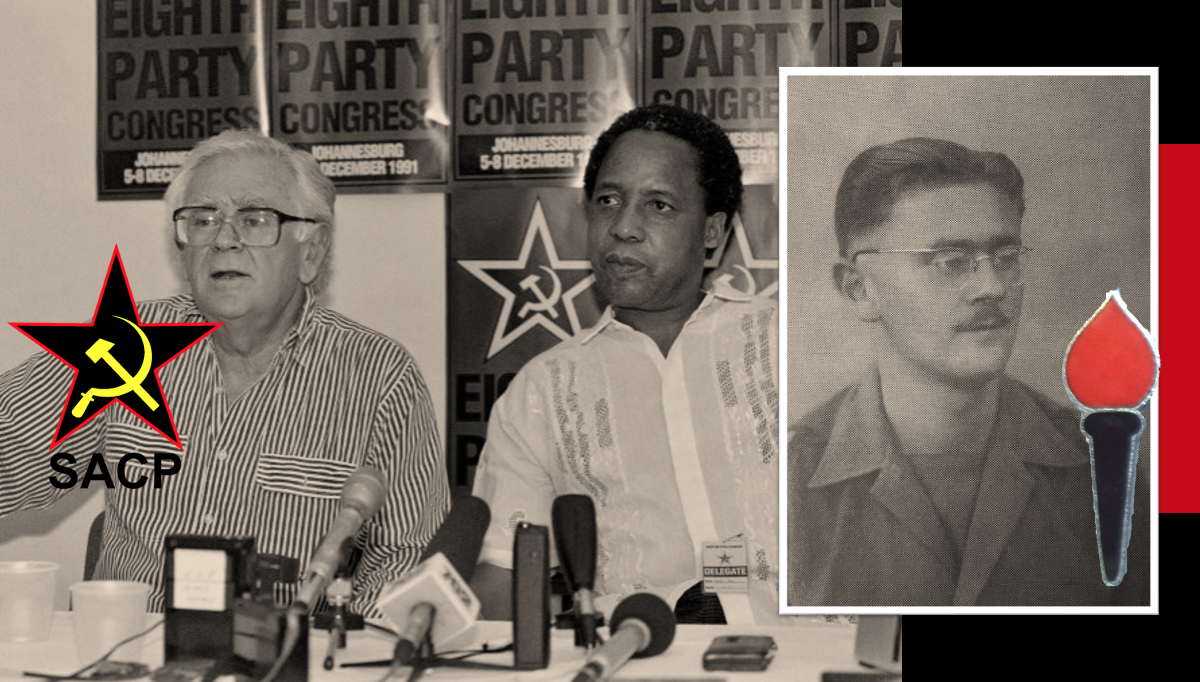
Joe Slovo

Joe Slovo becomes a Founding member of uMkhonto we Sizwe (MK) and forms part of its High Command later establishing an operational centre for MK in Mozambique and becoming MK’s Chief of Staff.  During this period, he would be the military strategist and chiefly accountable for nearly all MK’s military operations in South Africa. Like the Hodgson’s, he formed a strong anti-apartheid coalition with his wife, Ruth First who was also a committed Communist. Ruth was killed in 1982 in Mozambique when the South African security police sent her a letter bomb.

Joe Slovo ultimately becomes the General Secretary of The South African Communist Party and plays a key-pin role in South Africa’s future democracy when he brokers the ‘Sunset Clause’ for The National Party government which paves the way to a negotiated and democratic settlement for South Africa.

In 1991, Slovo returned to South Africa and joined the African National Congress’ (ANC) National Executive Committee and served as an SACP representative on the National Peace Committee dealing with constitutional principles and a constitution-making body and process.

After the 1994 elections Slovo was elected to the South African cabinet where he served as Minister of Housing (implementing the RDP housing program) until his death in 1995.

Fred Carneson

Fred Carneson, volunteers at the on-set of World War 2, joining the South African Army as a as radio officer initially in the East Africa campaign, by the time North Africa campaign comes around he is a hardened desert combatant and is badly injured at the Battle of El Alamein. He joins the Springbok Legion after the war and plays a pivot role in The Torch Commando when it is formed. 
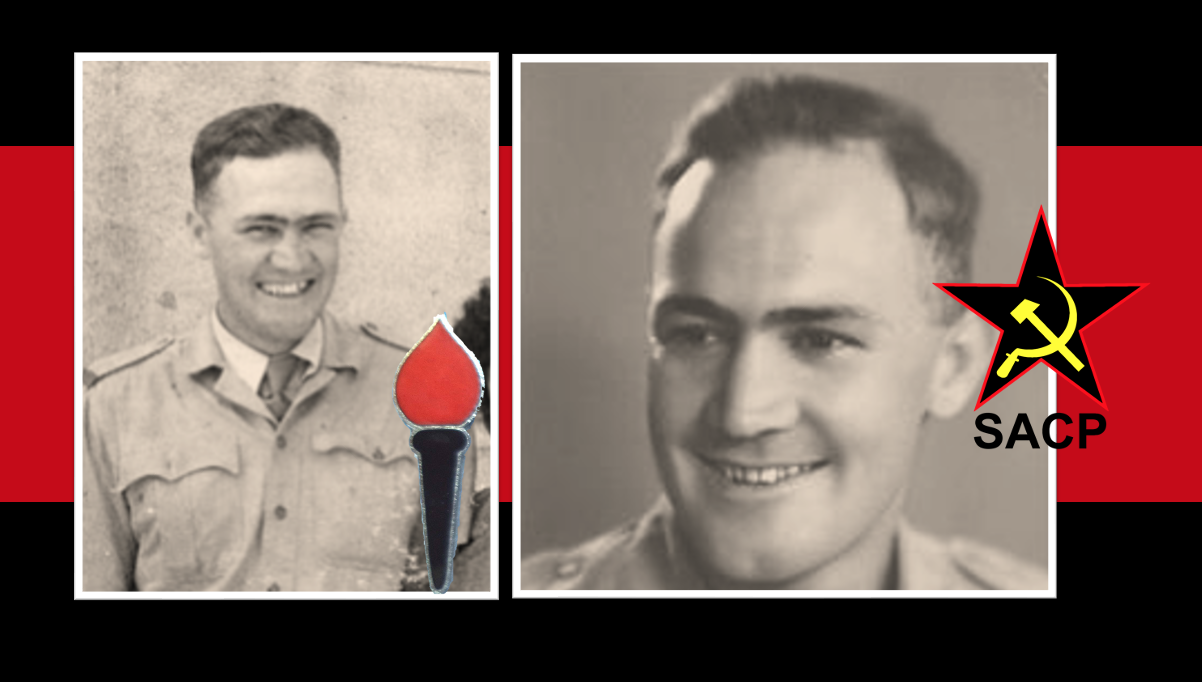
Fred Carneson

Fred Carneson is associated with the Treason Trial and acquitted, his Communist leanings then lead him to join uMkhonto we Sizwe (MK) as a Political Commissar. Like, the Hodgson’s and the Slovo’s he and his wife Sarah form an anti-apartheid team.

He is arrested by the state police for breaking his banning orders whilst working as an editor on the New Age newspaper. He is tortured and kept in solitary confinement for 13 months, after which he is imprisoned at Pretoria Central Prison for nearly 7 years. Released in 1972 he goes into exile in the United Kingdom (UK).  

In the UK he again became active in the South African Communist Party (SACP) raising funds for the SACP and ANC, eventually becoming the Chairman of the Anti-Apartheid Trade Union Committee. He passed away in South Africa in 2000.

The Liberals 

Within the Torch Commando we find members who form the Liberal Party of South Africa (LPSA). The epicentre for the establishment of the Liberal Party is literally traced to the “Coloured Vote” Constitutional Crisis and the resultant divisions within the Torch Commando.

Some of these Liberals, like their Communist colleagues, would ultimately strive for an armed resistance campaign against Apartheid whilst others who, like their Democrat and Federalist colleagues, would strive for a socio-political resistance campaign against Apartheid. 

Unlike the mainstream Democrats, some of these ‘Liberal’ members are subject to same detention, banning and exile actions that the Communists are subjected to. The only difference between the two, they hold Liberal values and not Communist ones. Values that differ vastly from one another and clear to any Liberal or Communist, but not so clear to the National Party who merely lumped them in the same boat under their definitions in the anti-Communist Act. So, who are they?  

Jock Isacowitz

Jock Isacowitz joins the South African Army during the war and rises to the rank of Warrant Officer. Highly politicised he becomes the National Chairman of the Springbok Legion after the war and is one of the guiding forces behind the establishment of The Torch Commando. Initially a member of the Communist Party of South Africa, when the Torch collapses, he becomes a Founding Member of the Liberal Party of South Africa (LPSA).
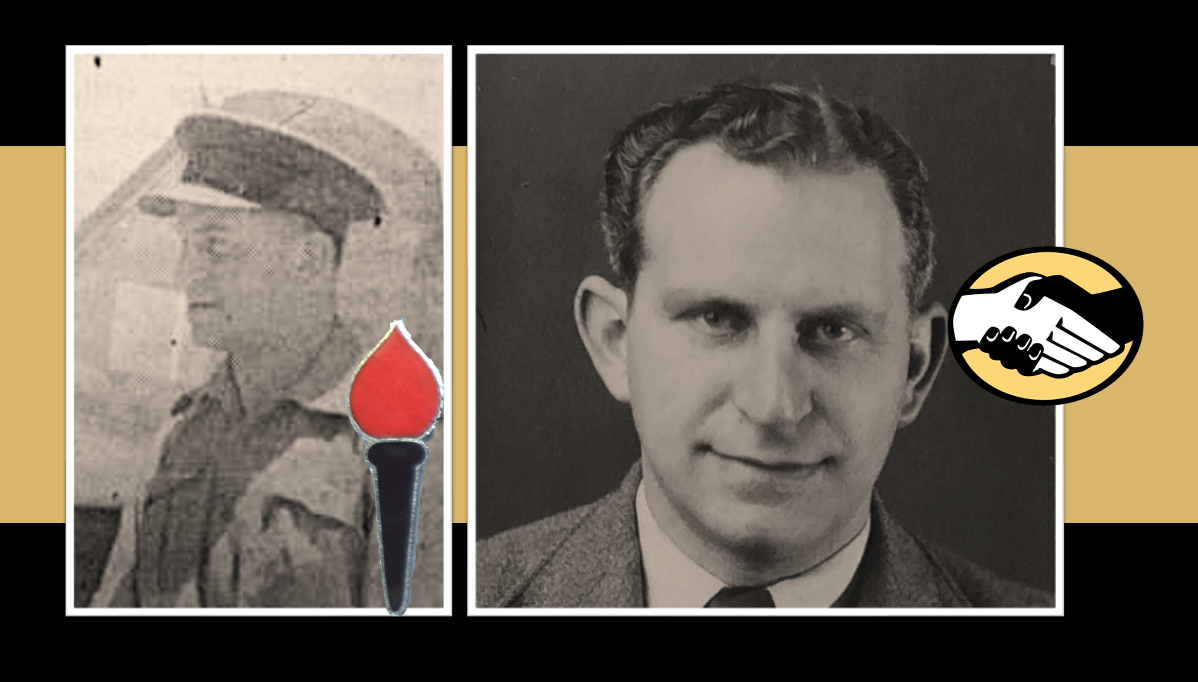
Jock Isacowitz

He would become the Transvaal Chairman of the Liberal Party and eventually the Party’s National Vice-Chairman. Recognised as a threat to the Apartheid government, he was banned for two years and during the Sharpeville police sweep in 1960 he was detained for three months. He passed away shortly afterwards in 1962.

Alan Paton

Alan Paton, the famous author of ‘Cry the Beloved Country’ and leading anti-apartheid Liberal. Prior to World War 2 in 1938 Paton was the principal of an African boys’ reformatory at Diepkloof – and being completely bi-lingual – fluent in Afrikaans and considering himself a son of Africa. He gets swept up in Afrikaner Nationalism, grows a Voortrekker beard and joins the 1938 Centenary of the Great Trek on one of the wagons dressed as Voortrekker. As discussed in Part 1 The Nazification of the Afrikaner Right this Voortrekker centennial is pivotal to the advent of Nazism on a large scale in South Africa and the resultant domestic armed resistance to South Africa’s war efforts. At the closing celebrations of the 1938 Centenary Great Trek outside Pretoria, what awaited Alan Paton would change his perspective on Afrikaner Nationalism forever, of his epiphany he said:

“We arrived on a hot day, and I went straight to the showers. Here I was greeted by a naked and bearded Afrikaner who said to me, ‘Have you seen the great crowds?’ I said,’Yes’, He said to me with the greatest affinity: ‘Nou gaan ons die Engelse opdonder,’ (Now we’re going to knock hell out of the English). 

The great day was full of speeches, and the theme of every meeting was Afrikanerdom its glories, its struggles, its grief, its achievements. The speaker had only to shout Vryheid (freedom) to set the vast crowd roaring, just as today a black speaker who shouts Amandla (power) can set a black crowd roaring. A descendant of the British 1820 settlers who gave Jacobus Uys a Bible when he set out on the Great Trek was shouted down because he gave his greetings in English as his forebear had done. 

It was a lonely and terrible occasion for any English-speaking South African who had gone there to rejoice in this Afrikaner festival After the laying of the stone I left the celebrations and went home. I said to my wife: ‘I’m taking off this beard and I’ll never wear another. ‘ That was the end of my love affair with Nationalism. I saw it for what it was, self-centred, intolerant, exclusive.”

Although he was medically exempted from joining up when World War 2 broke out, Alan Paton would find himself a non-military member of the war Veterans’ Torch Commando in protest these very nationalists who staged this Centenary Trek and their accent to power in 1948. 
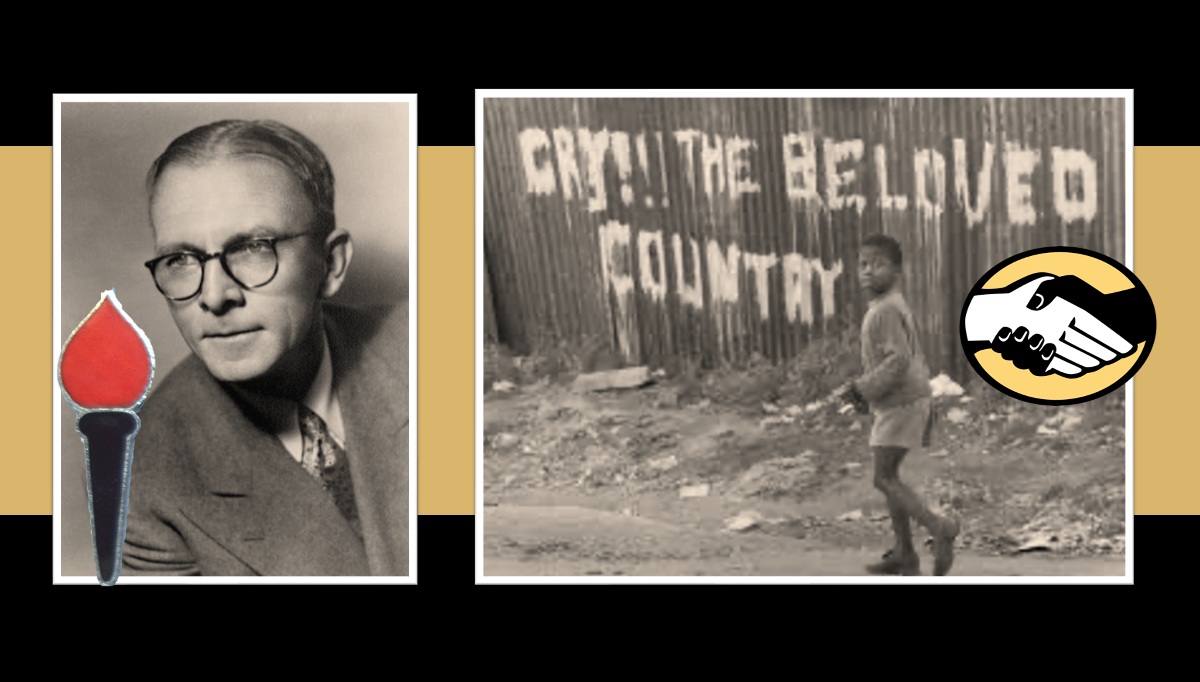
Alan Paton

An absolute adherent to Liberal values Alan Paton becomes the founder and leader of the Liberal Party, he remained the National President until the LPSA was dissolved in 1968 due to Apartheid legislation banning multi-racial parties.

In 1960 after returning from an award ceremony for the American Freedom Award, his passport was confiscated by the Apartheid government. It was returned only a decade later. Alan Paton would say of the Torch Commando and his time in it, that it was the Torch Commando movement the National Party only ever really feared. 

Alan Paton died in Durban in 1988. The Alan Paton Centre and Struggle Archives at the University of KwaZulu-Natal now houses his papers as well as a major collection of apartheid-related manuscripts.

Leslie Rubin

Leslie Ruben at the onset of WW2 answers Smuts’ call and volunteers to join the South African Army in 1940, he is commissioned as a Lieutenant in the intelligence corps in north Africa, and later attached to the Royal Air Force in Italy.
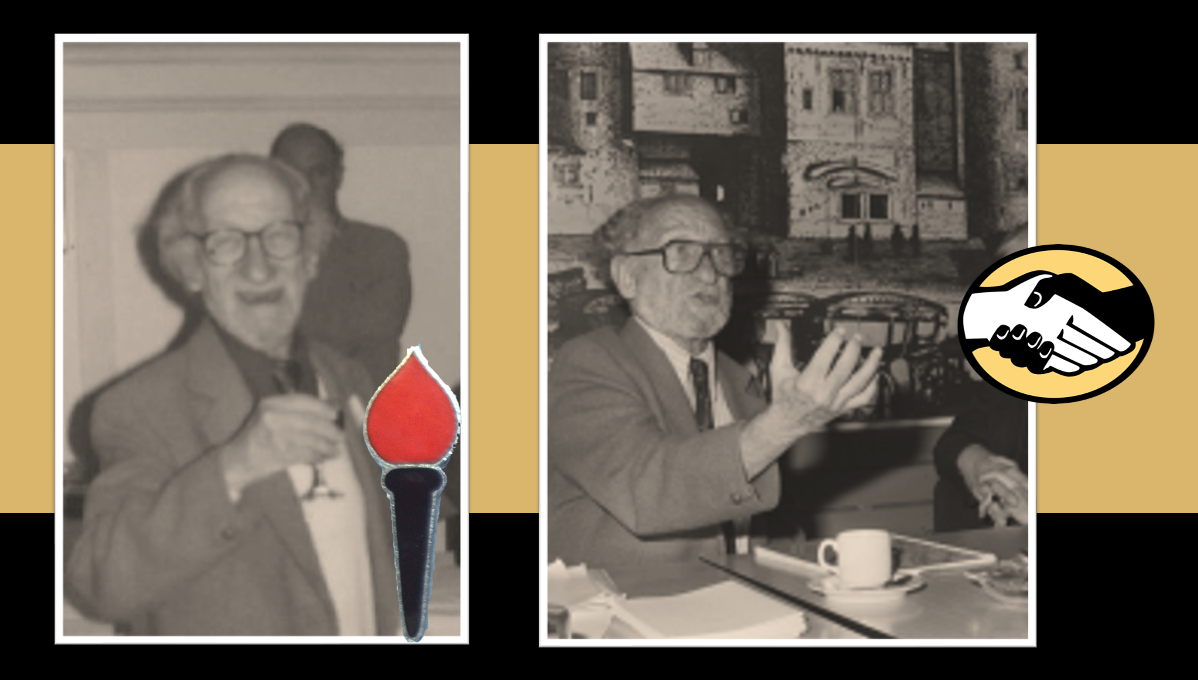
Leslie Ruben

After the war, he joins The Springbok Legion. He subsequently joined the Torch Commando, becoming a leading member within in the Torch’s Natal branch.

Along with Alan Paton, Leslie Rubin tried, unsuccessfully, to persuade Jan H. Hofmeyr, a leading United Party parliamentarian, to form a liberal party. After Jan Hofmeyr passed away in 1948, they went ahead anyway and created the Liberal party of South Africa (LPSA) in 1953.

Rubin became chairman of the Liberal Party in the Cape, and, in 1954, was elected to the Senate. As a Senator he fought every single Apartheid Legislation to the point that Dr Hendrik Verwoerd or on one occasion – the entire National Party caucus – walked out. Rubin resigned from the Senate in 1960 and went into exile.

In exile he became the chairman of the United States committee of the Defence and Aid Fund, getting funds to South Africa to support political prisoners and their families. He passed away in 2002.

Sailor Malan

Sailor Malan, the President of the Torch Commando, also held liberal values, so much so it did not stop Alan Paton, Margaret Ballinger and Donald Molteno, from persisting that Sailor Malan (as a powerful potential political ally) join the Liberal Party of South Africa. In June 1953, Leslie Rubin would be tasked by the party to put pressure on Malan to join the Liberal Party.

However, with demise of The Torch Commando, Sailor became increasingly focused on his private life seeking serenity sheep farming near Kimberley. For Sailor, the stress of combat and political struggle had led him to say “my nerves are shot” – little did he know, now in his early 50’s, that he had rapid on-set Parkinson’s disease, a neurological disorder some believe triggered as the result of combat stress and the resultant PTSD.
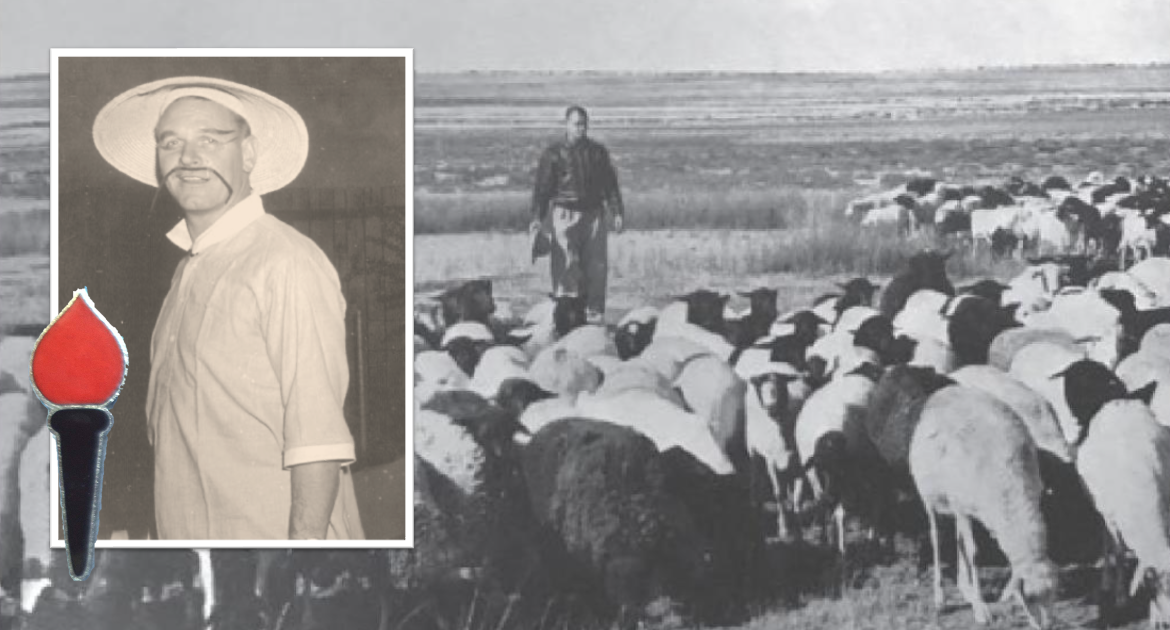
Sailor Malan sheep farming near Kimberley, insert Sailor in fancy dress at a party in Kimberley.

He kept his distance using farming as an excuse not to join the Liberal Party, when pressed for a commitment by the LPSA “to forget your sheep for a little while”. According to the historian Bill Nasson Sailor Malan’ revealed that his reluctance was due to his gradualist conviction that the Liberals were going about things in the wrong way in making a fuss about franchise rights. As Nasson records

“The difficulty of selling it to white South Africans was by no means the least of his reservations. What the country needed was planned evolution. In his view, as he told Rubin, “more emphasis should be placed on economics and less on political rights. It is true that you are today dealing with the more educated Non-Europeans but your concern should be with the masses, to whom a full stomach and a secure life are more acceptable.”

Sailor Malan was very prepared to accept the inevitability of Black African majority rule, he felt the Liberal Party was too focused on black elites and lofty liberal values and not on the needs of the masses. Sailor Malan emphasised addressing “poverty and starvation”, with the primary emphasis falling on “material advancement”, the centre of which should be “very largely the economic advancement and housing of the African”.

In an odd sense Sailor Malan 1953 held the same view that modern Black African politicians hold now, that economic emancipation should precede political emancipation and without empowerment the ‘vote’ becomes meaningless.

Sailor Malan would not join the Liberal Party, nor any Party for that matter – a United Party seat was always open to him anytime he wanted it. Instead he chose to step back from politics after the Torch Commando collapsed and focussed on his private, family life, and having a little fun. Given Sailor’s history people always view him as serious, driven and focussed, but he loved a party and would often lighten them up, his socialising time spent in his Memorable Order of Tin Hats (MOTH) Shellhole in Kimberley and the Kimberley Club (who have a plaque to him at the entrance).

Unfortunately his Parkinson’s disease was misdiagnosed at one point and he was told he would recover, and he rather enthusiastically reflected that finally he could start living, but it was a false sense of hope, Sailor Malan would pass away on the 17th September 1963, aged just 52. In what is arguably the lowest point a government can stoop to for a war hero of Sailor’s magnitude, the National Party declined requests for a formal military funeral, forbade any South African Defence Force members from wearing their uniforms to the funeral and from laying wreaths as military representatives, they specifically forbade the South African Air Force from laying a wreath. The government issued obituary for Sailor Malan circulated nationally contained no reference to his political career whatsoever, simply put the government wanted his memory wiped and nobody making a hero out of him.

In defiance to the National Party and to send a clear message to them, the governments of the United Kingdom, the United States of America and Rhodesia sent uniformed personnel and wreaths to Sailor’s funeral.
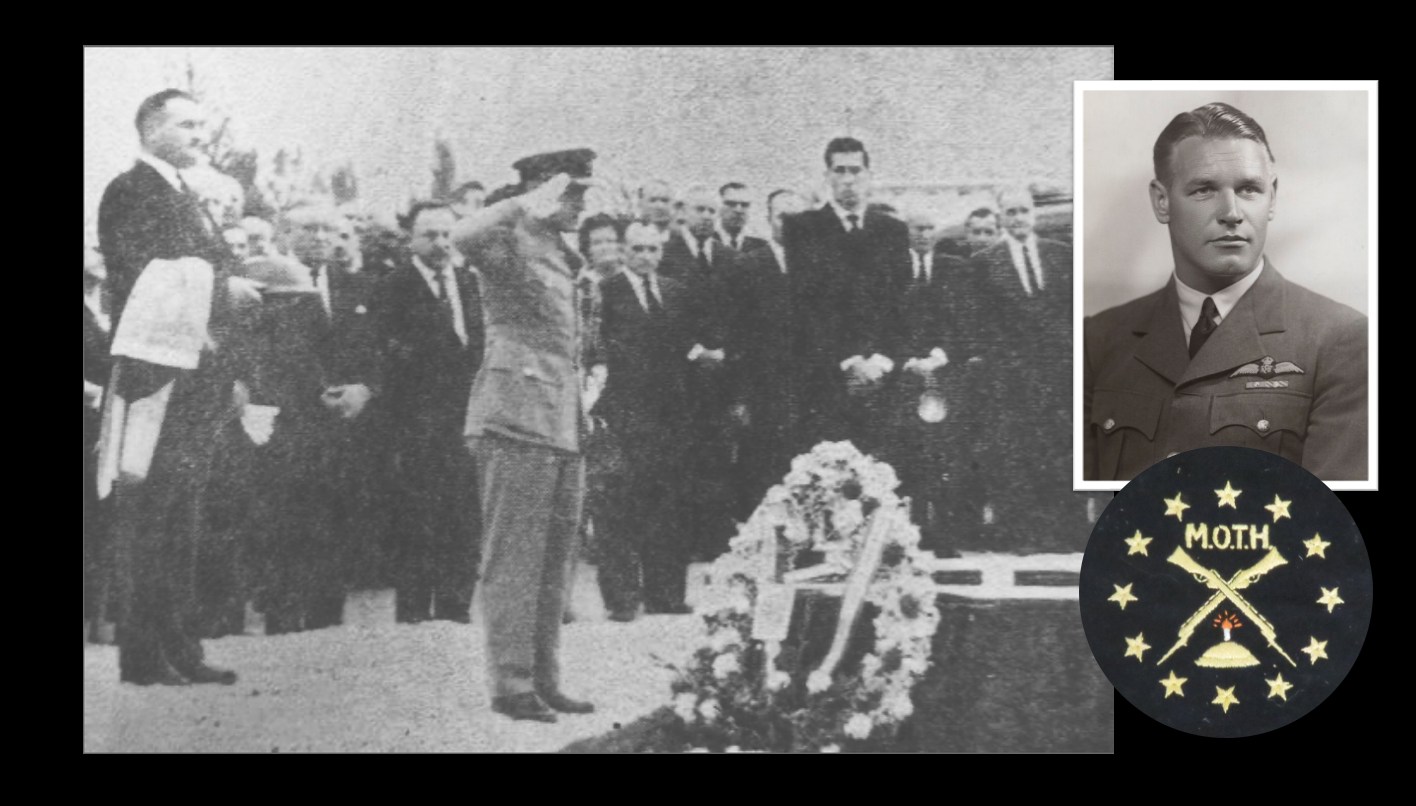
Image: Here Wing Commander J Moss of the Royal Rhodesian Air Force pays his tribute to Sailor Malan. It also did not stop the Memorable Order of Tin Hats (MOTH), of which Sailor was a member from giving him the rites afforded a MOTH member. Behind Wing Commander Moss stands MOTH Francis John Dressler, a fellow WW2 vet, with the MOTH flag over his arm and a Brodie helmet (Tin Hat) in hand – the MOTH flag was subsequently draped over the coffin. As per MOTH ritual a candle would have been placed on the helmet and lit as a flame of remembrance. 

At the very least his comrades in arms could afford him a privilege his own country refused to do. This injustice was finally corrected in 2023 on the 60th anniversary of Sailor Malan’s death, when in Kimberley the South African Air Force Association laid a wreath to him.

Peter Brown

Peter Brown joined the 6th South African Armoured Division during WW2.  He would go on to become Alan Paton’s right-hand man and a kingpin of Liberal politics in South Africa. He is worth mentioning as he does attend a Torch Commando meeting and chooses not to join the Torch as he finds the organisation too ‘white’ and too ‘hierarchal’ for him.
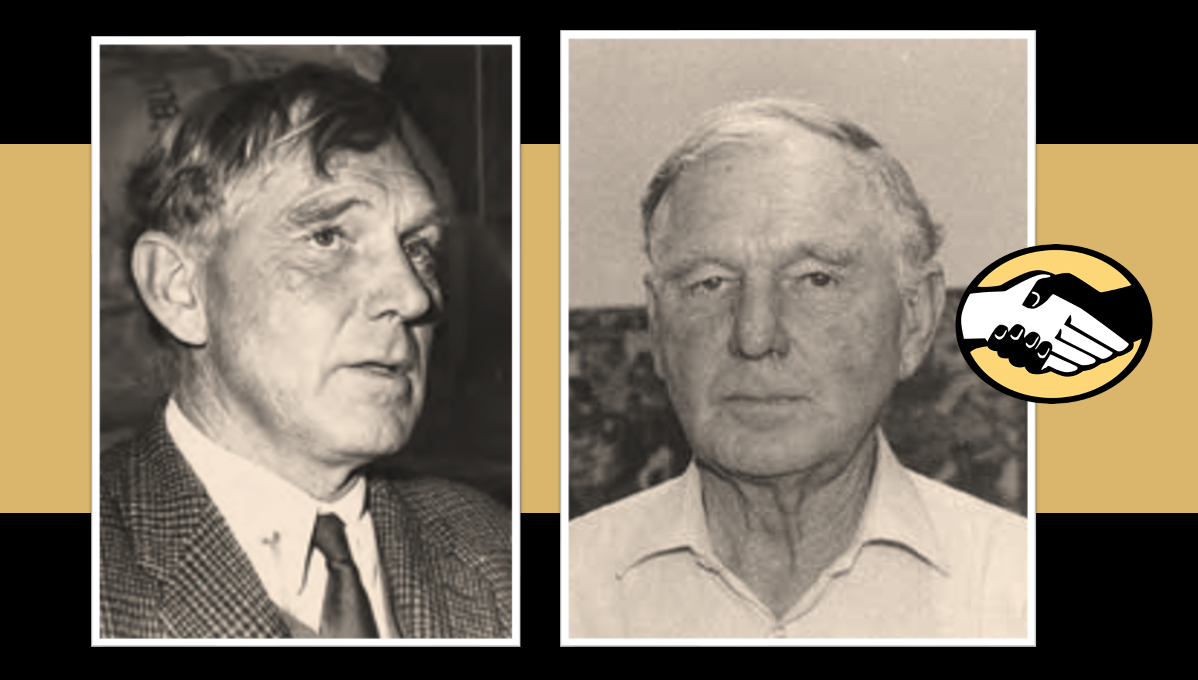
Peter Brown

In establishing the Liberal Party with the likes of ex-Torch members Rubin, Paton and Isacowitz in 1953, they target the Torch Commando and its now unbundling membership for a more robust LPSA membership. Ronald Morris, the Chairman of The Torch Commando’s Point Branch in Natal is a significant case in point – he would contest the Natal Provincial elections as a Liberal Party candidate.

Peter Brown would become embroiled in a Liberal Party spin off armed resistance movement called ARM (more about ARM later) and he would like so many LPSA members also go into exile.

David Pratt

One of the defining moments in the struggle against apartheid in South Africa was the Sharpeville Massacre on 21 March 1960 and its aftermath.

On the Liberal Party front political resistance was about to take a nasty turn, when in April 1960 – 19 days after the Sharpeville Massacre, Prime Minister H.F. Verwoerd, the architect of Apartheid was giving his ‘good neighbourliness” speech at the Rand Show in Johannesburg.
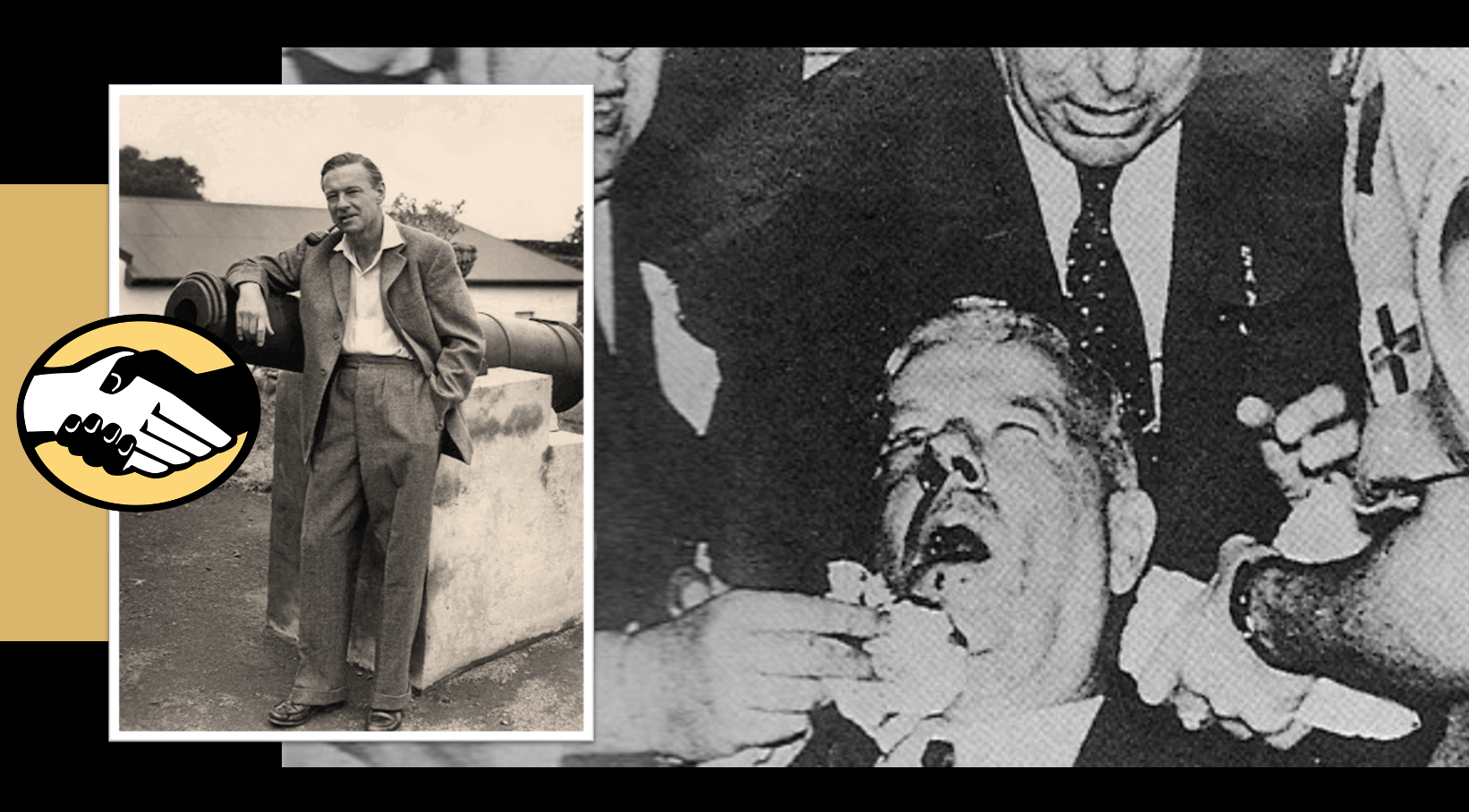
David Pratt (insert) and his attempted assassination of Verwoerd

After Verwoerd gave his opening speech, he returned to his seat in the grandstand where he was shot at point-blank range by David Pratt, who was an outspoken Liberal Party of South Africa (LPSA) member and a wealthy English farmer from the Magaliesberg region outside of Pretoria. He joined the Liberal Party in 1953 and believed that a coalition between liberals and ‘verligte’ (enlightened) Afrikaners was the only solution to defeating the National Party at the polls. Verwoerd survived Pratt’s attempted assassination of him, only to be finally assassinated by Dimitri Tsafendas, a white man with Communist leanings, on the 6th September 1966.

Pratt was also an epileptic with a long medical history of heavy epileptic fits – so he was excused military service and did not join The Torch Commando. So to dismiss Pratt as a ‘lunatic’ – as to the Nationalists no white person in their right mind would shoot a white Prime Minister – so he was judged as ‘insane’. Pratt was sent to an institution for the mentally ill and by October 1961 he was found – rather too conveniently for the Nationalist government – hanging from a rolled-up bed-sheet.

John Lang

John Lang joined the Navy for World War 2 but did not aspire to any senior rank, he is a qualified lawyer post war and his political and resistance career starts as when he takes up a ‘strong-man’ security role for The Steel Commando protest (the show of strength in Cape Town to oust the National Party and force them to resign).  He also joins the Torch Commando’s national executive.

When the Torch Commando collapses, John Lang tries to revive The Torch Commando in 1955 and through the Torch becomes a key member in The Liberal Party. He is a key force when the Liberal Party branch is established in Johannesburg in co-ordination with the Natal committee. He also raises significant funds for The Liberal Party at its onset. As an attorney Lang becomes embroiled in a trust fund scandal, he however remains a key figure within the Liberal Party as a fund raiser. 
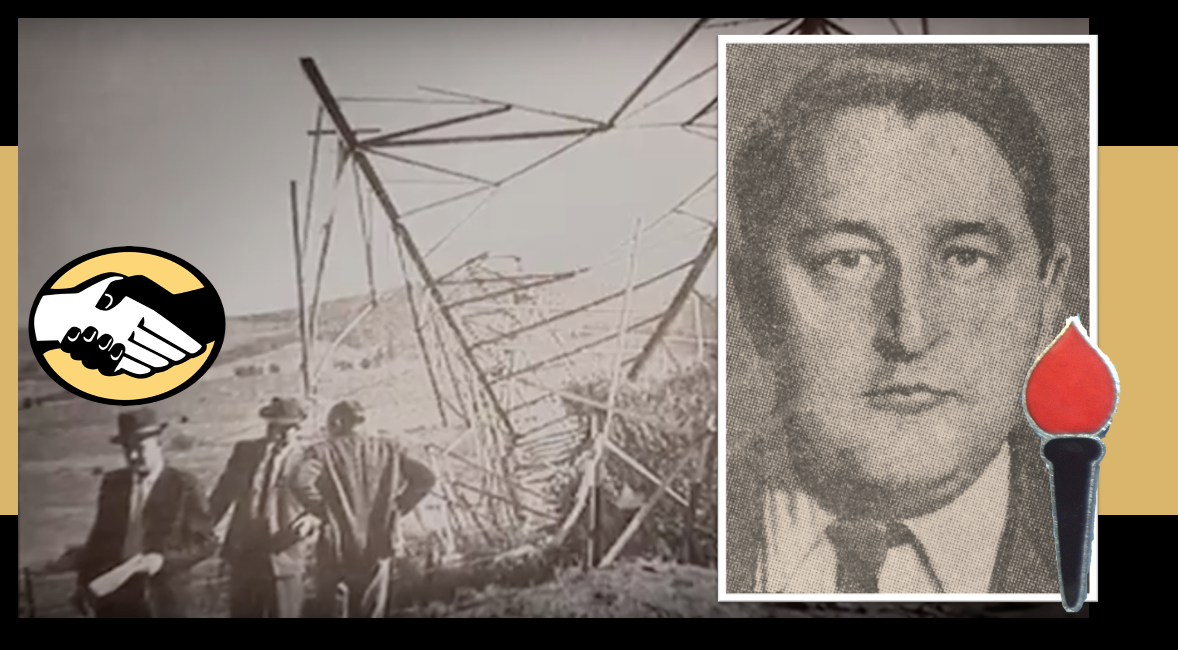
John Lang and a ARM attack.

John Lang is a significant character in our tracing of the Golden Thread of ‘white’ political and armed resistance it’s smoking gun, the Torch Commando, and like all things in the South African armed ‘struggle’ his story really kicks off with Sharpeville Massacre.

The Sharpeville Massacre occurred on 21 March 1960, after which a state of emergency was declared, the African National Congress (ANC) and Pan Africanist Congress of Azania (PAC) were banned and forced underground.  Liberation movements were forced to re-evaluate their approach to the liberation struggle and consider non-violence in favour of military sabotage.

Despite the Liberal Party’s initial non-violent stance, the party was not spared the suppression of its political activity by the Apartheid State. The legislative tool used to crush the Communist Party, Springbok Legion, Torch Commando and the Liberal Party was the Suppression of Communism Act 44 July 1950.  The Act’s name was misleading as it was a sweeping act and not really targeted to Communists per se, it was intended for anyone in opposition to Apartheid regardless of political affiliation. The Act defined “any scheme aimed at achieving change whether economic, social, political, or industrial – by the promotion of disturbance or disorder or any act encouraging feelings of hostility between the European and the non-European races…calculated to further (disorder)”.

With the powers of the State of Emergency and the Suppression of Communism Act, the Apartheid State also launched a vicious attack on the Liberal Party, arresting 35 of its leading members in 1961, including John Lang and detaining them at the Fort in Johannesburg.

Whilst imprisoned in the Johannesburg Fort prison John Lang makes contact with fellow Liberal Party members Monty Berman (also a South African WW2 military veteran of the Italy campaign where he is exposed to Partisan warfare) and Ernest Wentzel who are also swept up in the Sharpeville clampdown and between them they establish the National Committee for Liberation (NCL) and embark on an armed struggle of their own.  

The NCL declares itself as an armed struggle movement of ‘Liberals’. The NCL challenges the idea of peaceful protest when the government was evidently intent on using violence. The NCL is formed under a liberal ideological framework, declaring an armed struggle on the proviso that no human life is harmed. Ironically the formation of the NCL pre-dates the formation of MK but the official announcement of its existence occurs on the 22nd December 1961 a couple of days after MK announces its existence on 16th December.

This white ‘Liberal’ armed resistance, like MK, was going to need money to buy arms and explosives – and as a fund raiser John Lang was up to the task. After his release from prison, Lang immediately forms a secretive NCL cell which eventually becomes known to the South African Police Intelligence Services as ‘The Group’. The objective of The Group a.k.a. John Lang, is to obtain financial support for the NCL.  

John Lane’s first mission is to make contact his old Torch Commando comrade and Liberal Party founder stalwart – Leslie Rubin (by now in exile) to source funds from the Ghanaian government – which were given in two financial payments in 1961 (NCL was the first armed resistance group to get finance from Ghana).  With money to buy weaponry and explosives the NCL were now ready to go.

The NCL’s armed Resistance campaign

The NCL was non-racial although its membership was predominantly White. The organisation hoped to attract an African following by acts of sabotage against government installations and institutions.

The NCL attracted three groups of ‘Liberals’ to its ranks: members of the Liberal Party (the largest grouping), the African Freedom Movement (AFM) – made up of disillusioned ANC members not joining MK, and the Socialist League of South Africa (SLA) – made up of disillusioned South Africa Communist Party (SACP) members – ‘Trotskyites’ who also did not want to join MK and its SACP alliance.

Regional Committees of the NCL were to operate autonomously. Between 1962 and 1963 the NCL focused on recruiting – Adrian Leftwich of the National Union of South African Students (NUSAS) joined the organisation, so too Randolf Vigne, the vice chairman of the Liberal Party, joining after he was recruited by John Lang.
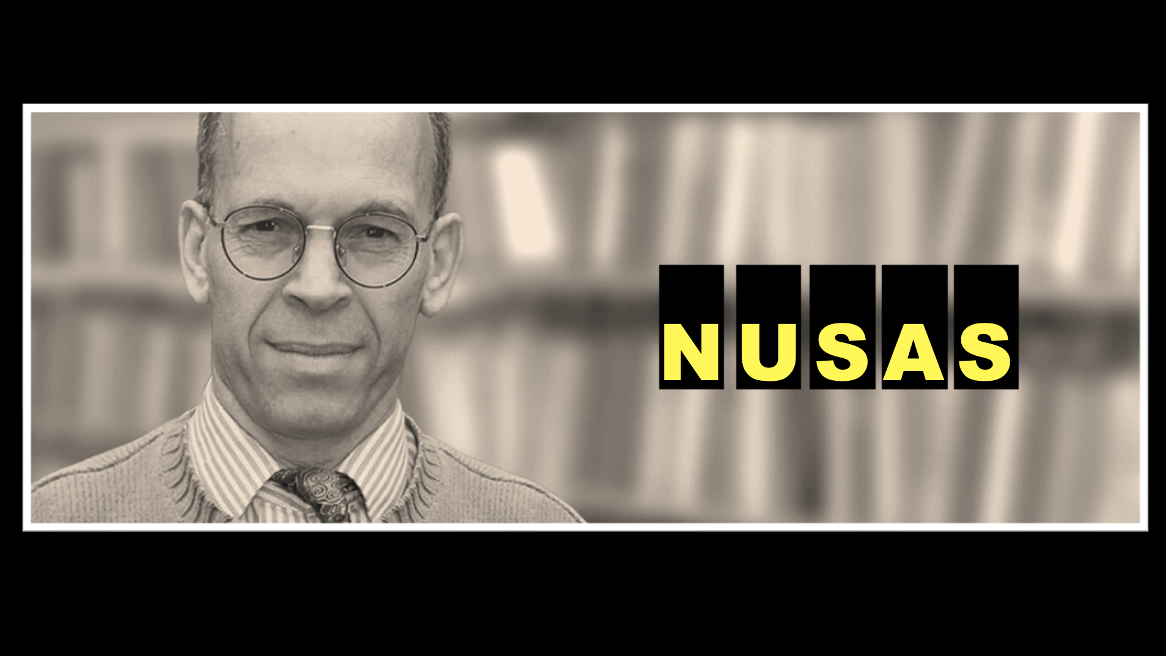
Adrian Leftwitch – NUSAS

Other members included Neville Rubin, Baruch Hirson, Stephanie Kemp, Lynette van der Riet, Hugh Lewin, Ronald Mutch, Rosemary Wentzel, Dennis Higgs and Alan Brookes. Most of them from the Liberal Party. The NCL established two regional committees – Cape Town and Johannesburg but also had a cell in Natal, notably David Evans and John Laredo.

The NCL initially involved itself with smuggling people out of South Africa into exile, this included helping the ANC smuggle Robert Resha into Botswana. The ANC reciprocated by helping Milton Setlhapelo of the NCL move from Tanzania to London.

With a sense of combined purpose the NCL leaders endeavour to join hands with MK, the NCL approached MK through Rusty Bernstein (remember our old Torch Commando stalwart who becomes a founding member of MK – see the Torch’s Communists) to organise joint operations. After one failed operation the two organisations ceased to cooperate again.

NCL Military Operations

Late 1961 the NCL sabotage campaign commenced with the targeting of three power pylons and the burning of a Bantu Affairs office.

By 1962, dynamite was stolen from mines.  Dennis Higgs and Robert Watson, a former British Army officer, provided explosives training to members of the NCL in Cape Town and Johannesburg. In August and November 1962, the NCL carried out sabotage attacks on pylons in Johannesburg, bringing one down.

In Durban, the members of the NCL failed to bring down a electricity pylon as a result of faulty timers. Later, in August 1963, the NCL made two attempts to sabotage the FM tower in Constantia, Cape Town. On the first attempt, the operation was cancelled after Eddie Daniels lost his revolver, which was found a few days later. In the subsequent operation at the same installation, the bomb failed to explode. 

Later, in September, explosives damaged four signal cables at Cape Town railway station, and in November an electricity pylon was brought down.

ARM

Given their declared intentions of armed resistance the NCL became wanted by the Apartheid State, Myrtle and Monty Berman were banned and in 1961 the police searched John Lang’s residence where letters requesting financial assistance were seized. 

On 26 June 1961, John Lang fled South Africa and went into exile to London, where he continued with anti-apartheid activities on behalf of the NCL. That same year, Monty Berman violated his banning order and was given a three-year suspended sentence. As a consequence, he was forced to leave the country in January 1962. His departure threw the NCL into disarray, and morale among the remaining members declined.

The NCL’s efforts to revitalise itself without its leaders on the ground in South Africa failed and to reinvent itself, the organisation changed its name from the NCL to the African Resistance Movement (ARM). ARM launched its first military operation in September 1963.

From September 1963 until July 1964, the ARM bombed power lines, railroad tracks and rolling stock, roads, bridges and other vulnerable infrastructure, without any civilian casualties. ARM aimed to turn the white population against the government by creating capital flight and collapse of confidence of the economy.

In Johannesburg, a cell of the ARM also carried out more attacks in September and November 1963. NCL members used hacksaws to cut through the legs of a pylon in Edenvale, which led to a blackout in Johannesburg’s eastern suburbs. More attacks on pylons were carried out in January and February 1964. The climax of the ARM campaign came in June 1964 when five pylons were destroyed; three around Cape Town and two in Johannesburg.  In fact some sources say that  ARM was more active in this period than MK.

On 12 June 1964 ARM issued a flyer by way of a statement announcing its existence and committed itself to fighting apartheid and it read in part:

“The African Resistance movement (ARM) announces its formation in the cause of South African freedom. ARM states its dedication and commitment to achieve the overthrow of whole system of apartheid and exploitation in South Africa. ARM aims to assist in establishing a democratic society in terms of the basic principles of socialism. We salute other Revolutionary Freedom Movements in South Africa. In our activities this week we particularly salute the men of Rivonia and state our deepest respect for their courage and efforts. While ARM may differ from them and other groups in the freedom struggle, we believe in the unification of all forces fighting for the new order in our country. We have enough in common.”

John Harris 

The end of ARM begins with Frederick John Harris –a member of the executive committee of the Liberal Party in the Transvaal and the Chairman of the South African Non-Racial Olympic Committee. He lobbies and is partly accredited for South Africa’s ban from the Olympics in 1964.  His ‘liberal’ actions earned him a banning order and by February 1964 he was recruited and joined ARM. He decided that a dramatic gesture was needed to “bring whites to their senses and make them realise that apartheid could not be sustained”.

On July 24, 1964, John Harris walked into the Johannesburg railway station and placed an explosive charge and several containers of petrol in a suitcase on the main ‘whites only’ concourse. On the case he left a note: “Back in 10 minutes”

Despite a pre-planned detailed telephone warning to the Railways Police and targeted newspapers to evacuate the station, no action was taken. The bomb exploded, injuring several people seriously, in particular Glynnis Burleigh, 12, and her grandmother, Ethel Rhys, 77. Mrs Rhys who died three weeks later. Glynnis, who had 70%- and third-degree burns, was left with life-changing injuries.
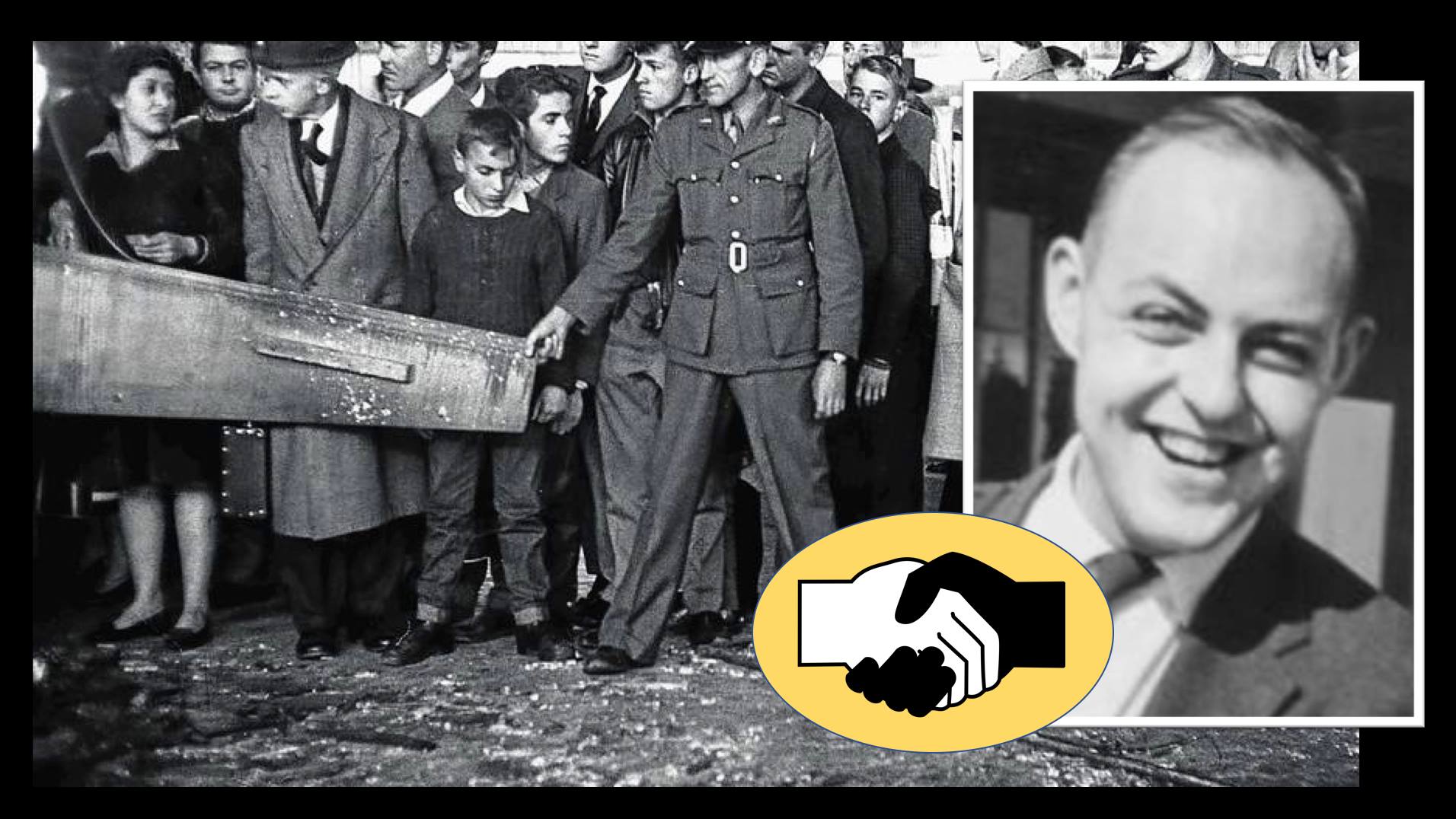
Damage caused by Harris’ bomb – insert John Harris

The ARM action produced a horrified reaction amongst the white population – ARM had finally killed an innocent civilian despite their Liberal values. The incident was incorrectly touted by the National Party as part of a terror plot by “Communists” (not liberals). Harris was arrested, tortured and beaten. His jaw was broken in three places.

Harris was tried for murder of a civilian and by the tenets of South African law for murder received an automatic death sentence (despite attempts at an insanity plea and a ‘manslaughter’ plea).  His friends and family believe to this day that the Sate was never going to allow John to beat the rope.

On April 1, 1965 went to the gallows, reportedly singing “we shall overcome”. His remains were never handed to the family – they disappeared. A heart-breaking private investigation after 1994 found them in a prison cemetery – simply marked ‘John Harris’ – the words ‘A Patriot’ were added later to his headstone by his family. His legacy as the only ‘white’ man to be hanged for ‘crimes against Apartheid’ as lost to the history of the struggle as his headstone was.

The end of ARM

After the bombing in July 1964 the police raided the flat of Adrian Leftwich and subsequently raided the flat of Van der Riet, finding documents containing instructions on sabotage and the storage of explosives. Under torture and interrogation, the two implicated their comrades.

Leftwich’s statements were devastating for ARM. He testified against his comrades in at least two of the trials, and as someone who had played a key role in NCL/ARM operations, his evidence was difficult to refute. Subsequently, the police raided and arrested 29 members of ARM, among them Stephanie Kemp, Alan Brooks, Antony Trew, Eddie Daniels and David de Keller – all in Cape Town. Others like Randolf Vigne, Rosemary Wentzel, Scheider, Hillary Mutch and Ronnie Mutch escaped. 

The security police kidnapped Wentzel from Swaziland and brought her back to stand trial in South Africa. She sought relief for her illegal abduction through the courts. Dennis Higgs was also kidnapped by apartheid government forces and challenged the legality of his kidnapping through the courts.

In the subsequent trials, Eddie Daniels was sentenced to 15 years in prison, which he served on Robben Island. Baruch Hirson was sentenced to nine years in prison, Lewin to seven years, while Evans and Laredo were sentenced to five years in prison. David De Keller received a sentence of 10 years, Einstein seven years, Alan Brooks four years, Stephanie Kemp five years, and Anthony Trew four years.

The arrest of ARM members and the flight of others into exile led to the disintegration of the organisation. 

However, some of its members, particularly those in exile, continued fighting against apartheid by working for anti-apartheid organisations. Hugh Lewin was appointed head of the International Defence and Aid Fund’s (IDAF) information department. Rundolf Vigne also worked closely with IDAF in Britain and travelled to the United Nations (UN), campaigning against the apartheid government.  Finally, Alan Brookes, a former member of ARM played a key role in organising demonstrations against the 1969 Springbok Tour to the UK.

A little raw  still

Myrtle Berman and the others never really come to terms with the bombing and killing of a human being and the trauma of the hanging, it counter acts their Liberal values and the stated objective of ARM.

The late Adrian Leftwich describes his behaviour as “shameful, harmful and wrong” and although repentant and his actions the result of unimaginable torture in jail, his status as a ‘sell-out’ still sticks.

Modern attempts to revitalise the Liberal Party do not even account this ‘armed struggle cred’ as part of their history – it’s that disconnected to the modern narrative of Liberalism in South Africa.

The End of the Liberal Party

Sharpeville signals the of the Liberal Party of South Africa (LPSA), but its demise starts earlier with a sustained persecution of Liberal Party members by the Nationalists.

In 1962, BJ Vorster opened the shots at the LPSA when he accused the party of being nothing more than a “communist tool”. This opened the way, as between March 1961 and April 1966, 41 leading members of the LPSA were banned under the Suppression of Communism Act.

By 1965, leaflets were secretly scattered by government agents warning African members of the Liberal Party that they would be banned unless they desisted.

The state would continue to harass and intimidate Liberal Party members. Security branch officers would attend party branch meetings.  The police would intimidate families of party members, even Alan Paton had his telephone lines tapped and house was searched.

In 1966, the government tabled the Prohibition of Improper Interference Bill, which proposed the prevention of interracial political participation. In 1968, the Bill was passed in parliament as the Prevention of Political Interference Act. Two political parties, the Progressive Party (PP) and Liberal Party had members across racial line were severely affected.

The PP chose not to disband but become a white’s only party to fight Apartheid via the legal parameters available to it and be a representative voice of the disenfranchised in a now dominated Nationalist Parliament.

The Liberal Party chose to disband rather than comply with legislation that went against its defining principle of non-racialism. Between April and May 1968, meetings were held in various parts of the country, bringing an end to the Liberal Party’s 15 years of anti-apartheid struggle.

The Democrats 

The Democrats form the backbone of socio-political resistance to Apartheid without engaging an armed resistance campaign – attempting to work within the confines of ever-increasing National Party’s political gerrymandering and jack-boot legislative repression. 

As we have established, The Torch Commando is not all about these fire-brand Communist war veterans joining MK in ‘armed resistance’ to Apartheid.  It’s a mixed bag of Liberals, Federals and Democrats in addition, so who are they and what do they do when the Torch collapses?  Let’s have a look at the Democrats – the ‘Progressives’ and their ‘political’ resistance to Apartheid; 

Harry Schwarz 

Harry Schwarz joins the South African Air Force during the war as a Observer (navigator and bomb aimer) – part of 15 Squadron “Aegean Pirates” fighting in North Africa and Italy. Harry Schwarz is a co-founding member of The Torch Commando after the war and takes a key role in Torch Commando’s anti-apartheid stance. He joins the United Party however; he becomes disillusioned with United Party the party’s appeasement politics to woo back white UP voters now supporting the National Party. 
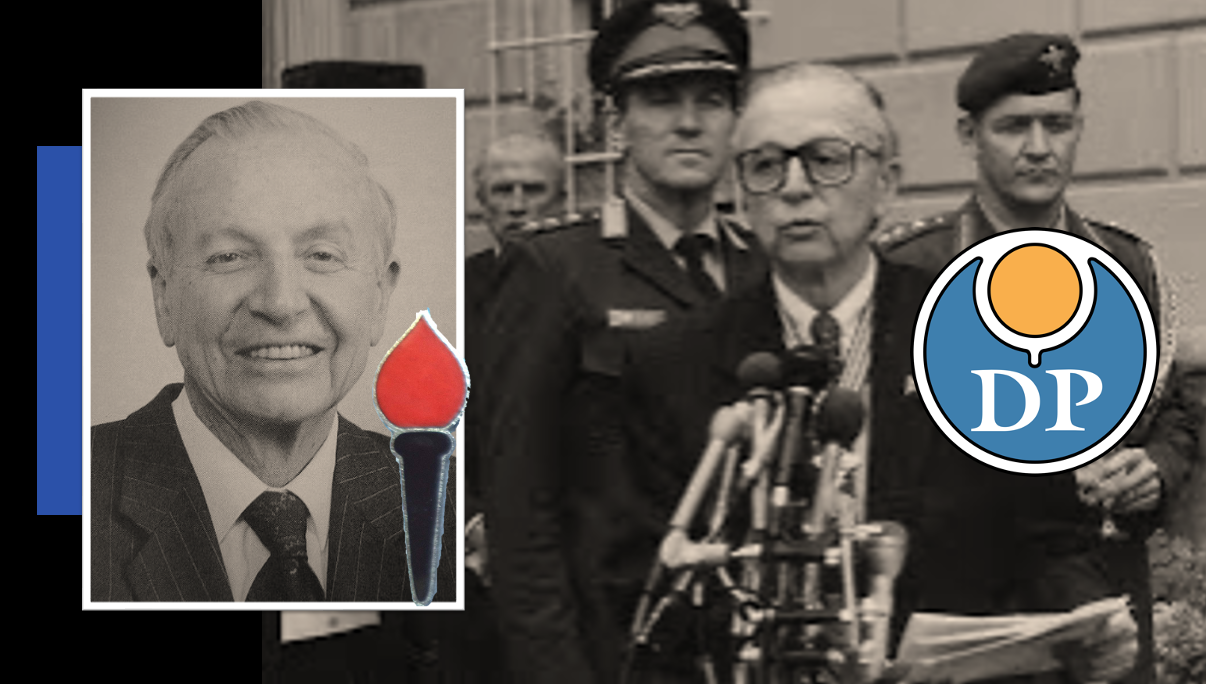
 

Harry Schwarz’s speech in the USA for the raising of the new South African flag in 1994

He is expelled from the United Party with the ‘Young Turks’ rebellion. Following this he plays a pivotal role in the formation of the Reform Party (RP) and is elected as its leader. The party’s charter calls for full franchise and equal rights for all. In 1975 the Reform Party is fused with the Progressive Party, led by fellow ‘UP Young Turk’, WW2 veteran and Torch Commando member, Colin Eglin (remember, there is a ‘golden thread’ weaving its way through this history).  

The merger forms the Progressive Reform Party (PRP) with Colin Eglin at the helm. As Smuts’ old United Party continues to disintegrate, the PRP takes on more of the progressive old UP members and the PRP evolves into the Progressive Federal Party. Harry Swartz continues in a long-time opposition to Apartheid aas a leading figure in the Progressive Federal Party and continues in opposition to Apartheid when the PFP finally as it morphs into the Democratic Party (DP) – the precursor to the modern-day Democratic Alliance (DA).

After the ANC is unbanned, in 1991 Harry Schwarz becomes the first opposition member to the National Party to be appointed Ambassador to the USA – a controversial appointment Harry Swartz seeks permission before he takes it – it comes in his old Torch Commando friend, Joe Slovo (there is that ‘golden thread’ again) and Nelson Mandela in addition to give him the nod – and he takes the appointment.

During his appointment as Ambassador to the USA, he negotiated the lifting of US sanctions against South Africa, secured a $600 million aid package from President Clinton and signed the Nuclear Non-Proliferation Treaty in 1991 officially ending South Africa’s armed nuclear program developed during the Apartheid era. He died in South Africa in 2010.

Colin Eglin

Colin Eglin joins the 6th South African Armoured Division in Italy during WW2. He takes an intelligence role as a Corporal whilst serving in combat operations in the Italian mountains. After the war the “Egg” as he is nicknamed cuts his political teeth when he joins The Torch Commando. 

He also joins the United Party (UP) and formulates a relationship with Zach de Beer. In 1959 he joins the ‘Young Turk” rebellion in the United Party, like Schwarz he is dissatisfied with their appeasement politics to the conservative white voting base.  
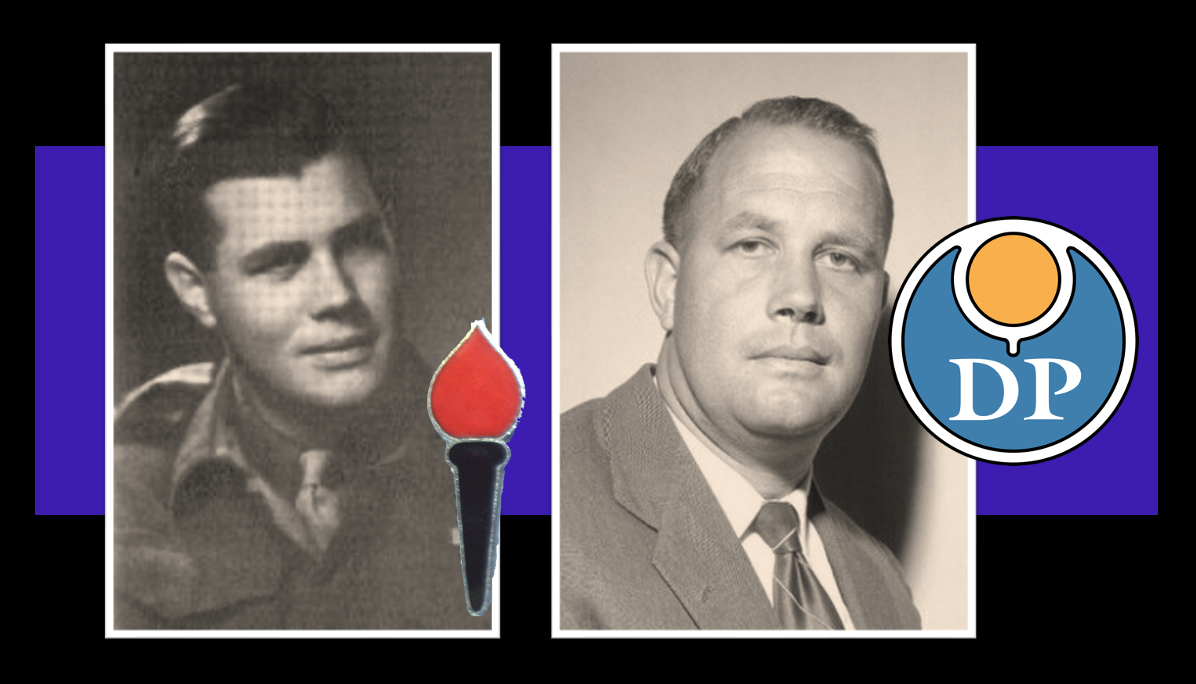
Colin Eglin

He was one of the 11 UP members of parliament who formed the nucleus of the newly established Progressive Party (PP).  By 1966 he is the Progressive Party’s Chairman and by 1971 the Party Leader.  He negotiates the merger with the RP with his old Torch Commando chum, Harry Schwarz in 1975.  Following the dissolution of the UP, some members were co-opted by his party, and the PRP became the Progressive Federal Party (PFP). In 1986 he was re-appointed chairman following the resignation of Van Zyl Slabbert, he was the PFP’s Party Leader until 1988 when his old friend Zac de Beer took over the leadership.

Eglin is instrumental in the merger of the Independent Party and National Democratic Movement with the PFP to bring about the Democratic Party in 1989 and was elected chairperson of the DP’s parliamentary caucus.  He would also play a key role in founding The Red Cross Children’s Memorial Hospital (financed by World War 2 veterans as a ‘living’ memorial).

The ‘egg’ is a life-long anti-Apartheid campaigner – he remains with the DP when it morphs into the modern-day Democratic Alliance (DA) and he finally retires from Parliamentary politics in 2002. He passed away in 2013. For more on the ‘Egg’ and his military service follow this link: A road to democracy called ‘the egg’!

Dr Jan Steytler

Dr Jan Steytler was decorated for gallantry while serving with the UDF Medical Corps in the Western Desert and held the rank of Captain, disillusioned with the United Party he would also lead the breakaway and form the Progressive Party. He would be named as the first leader of the Progressive Party when it was founded on 13 November 1959. 
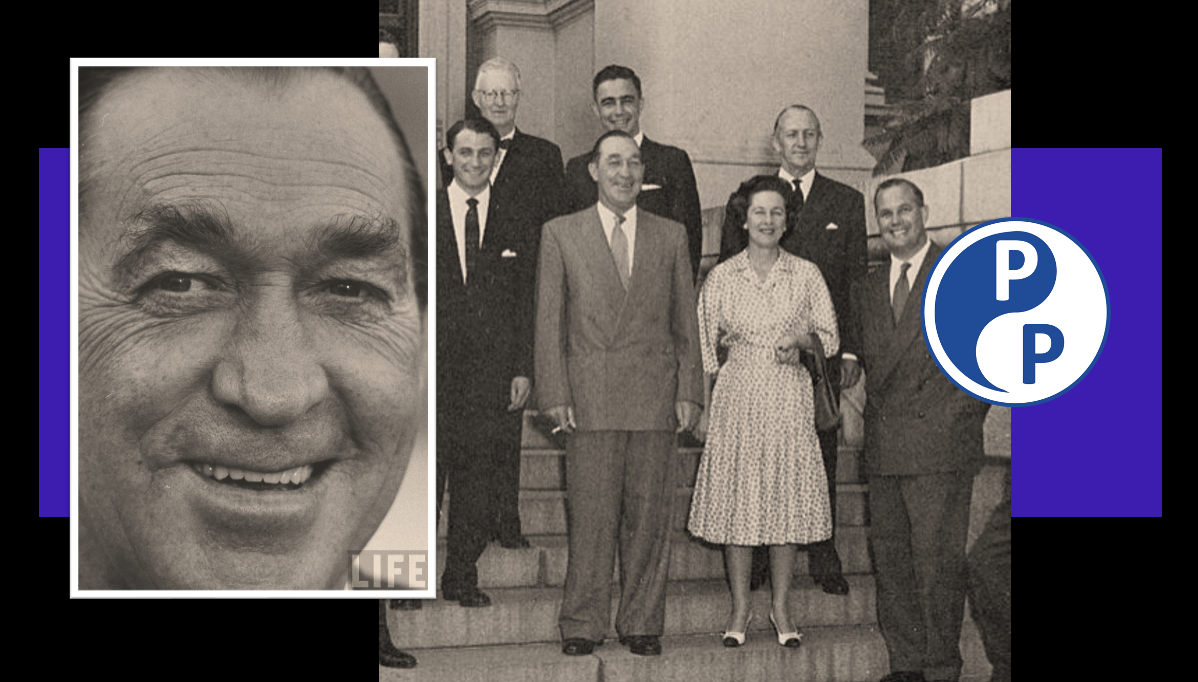
Jan Steytler next to Helen Suzman, the PP and anti-apartheid stalwart

Jan Steytler is regarded as one of Apartheid’s most vocal critics. Gradual restrictive Apartheid legislation, silencing and gagging orders, gerrymandering and media bans of the Progressives in Parliament as official opposition, would ultimately lead to them all losing their seats, with the exception of Helen Suzman being the only one – standing as a lone voice of opposition to Apartheid in Parliament for 13 long years. 

Although Jan Steytler did not join the Torch Commando, he had a close connection to The Torch, his brother William Steytler who also broke away from the UP and joined the PP, had served as a lieutenant in the Army and he was the Chairman of the Torch Commando – Burgersdorp branch.

The United Federal Party

The United Party’s loss of the 1953 General Elections and the collapse of the Torch Commando in its wake leaves a vacuum from which both the Liberal Party and the Union Federal Party are formed, as ex-servicemen in the Torch Commando pursue their respective political faults in opposition. It is an absolute truism in every respect to say that both these parties are literally formed within the Torch Commando.

So, what is the difference between these two ‘liberal’ parties – where is the political fault line? 

Sir De Villiers Graaf of the United Party in particular and the party in general was trying to toe a moderate ‘centreline’ politics bridging Apartheid right-wing leaning politics and Liberal left-wing politics into balance – and in fact had taken a more robust and antagonistic approach to the liberal wing of the party. The 1953 elections left the ‘Liberal’ end of the party in need of its own vehicle of political resistance.

A liberal alliance, the South African Liberal Alliance (SALA) was formed In January 1953 to map a route forward, three Torch Commando members see the SALA go in three different directions. Leslie Rubin would guide the formation of the Liberal Party of South Africa (LPSA), Colin Eglin would eventually lead the ex-servicemen break from the United Party and form the Progressive Party, and finally, Geoffrey Durrant would paves the way to another party – The Union Federal Party (UFP).

So, what’s the difference between the UFP and LPSA? For starters the UFP is a little more moderate and its origins lie in ‘the Natal stand’, at the centre of its mandate is South Africa’s dominion relationship with Great Britain and the Commonwealth of Nations (appealing to many ex-servicemen having just fought to maintain these concepts), on race it stands for full enfranchisement of ‘Coloureds’ and ‘Indians’ and a gradual phased qualified enfranchisement for ‘Black’ natives. 

The ‘black native’ position is not a usual one for 1953 given segregation was still been practiced world over. The ‘Native’ ethnic groups were generally left to their respective ‘kingdoms’ (the ex-protectorates in reality) to govern themselves along their traditional systems of monarchy governance, the real problem is an ever growing ‘Black’ urban proletariat class and the idea of even enfranchising it in 1953 is a very ‘liberal’ one. 

After the 1953 election, most senior Torch Commando leaders in Natal are disillusioned with the United Party not taking a stronger stance on the constitutional issue of whether Natal should remain in the Union or break from it if forced into a Nationalist Apartheid hegemony bent on manipulating the constitution illegally (and eventually breaking with ‘Union’ and creating a Republic). These Natal Torch-men include Edward (Gillie) Ford, a SAAF officer taken POW during the war and his fellow torch-men, James Chutter, Roger Brickhill, Robert Hughes-Mason, Arthur Selby, James Durrant and William Hamilton from the Natal Torch’s Executive Committee – who all forged ahead into the Union Federal Party (UFP) which comes into being on 10 May 1953.

Given its Torch roots, it’s no surprise that the UFP, emulates the Torch’s position regarding the South African constitution and race relations. The South African Institute of Race Relations (SAIRR) traces the UFP’s position on race relations back to the Torch’s position on race relations i.e. the preservation of the constitution and the entrenched clause dealing with equal language rights for English and Afrikaans – this led the UFP to consider the other entrenched clause dealing with non-European voting rights, and to formulate a policy to promote racial harmony.

Although a full-time lawyer, and not really a politician, Louis Kane-Berman, the Torch Commando’s Chairman decides to throw in his support for the Federalist cause as opposed to the Liberal Party cause and becomes a member of the Union Federal Party. As to Kane-Berman’s legacy, John Kane-Berman, his son, would become a lifeline guiding light in Institute of Race Relations and Liberal Politics in South Africa.

Louis Kane-Berman

The elected leader of the UFP was an ex-UP Senator George Heaton Nicholls, a well-respected and seasoned Natal politician, and also a military veteran, not of WW2 but of The South African War (1899-1902) a.k.a., Boer War 2.

Unfortunately, the UFP broad public appeal was very limited and as a party it did not exist for every long, its outwardly ‘British’ stand appealed to the white English electorate but alienated the white Afrikaner electorate who perceived it as jingoism. Up against the UP and the Labour Party (and even the Liberal Party) for the opposition vote, it simply did not have the groundswell and critical mass to win seats. It led a ‘NO’ Campaign in the 1960 National Referendum on whether South Africa should become a Republic. After that defeat, the Union Federal Party was dissolved as its ‘raison d’etre’ simply ceased to be after South Africa became a Republic.

Apartheid conditioning of white youth

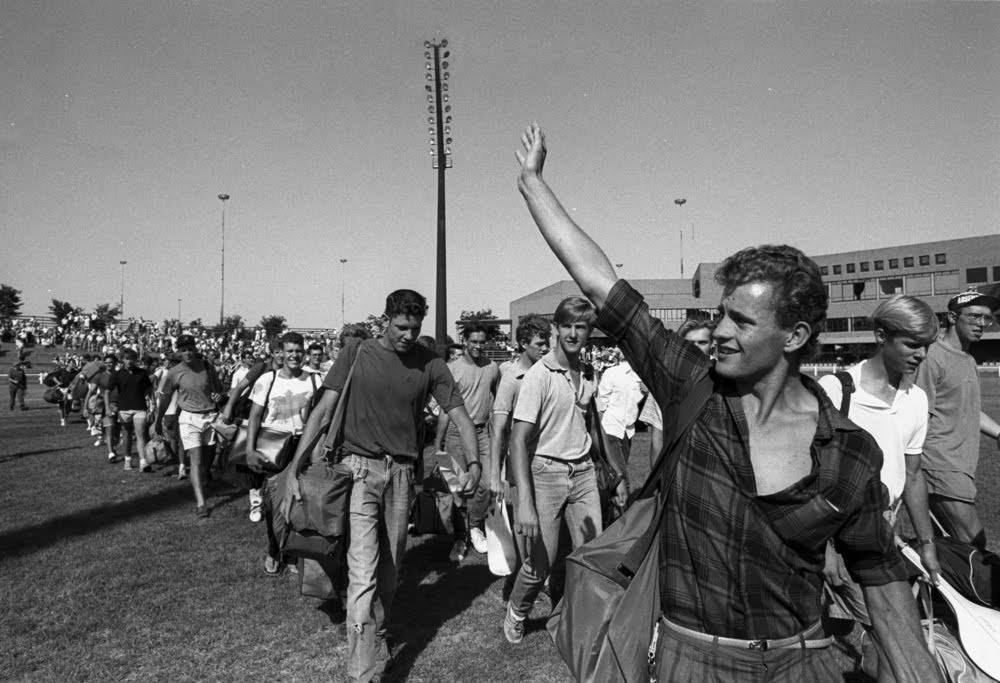
Conscription of all white men into the South African Defence Force began in 1966 as the National Party feared a United Nations military action against South Africa over the 1966 Resolution deadline for an Independent SWA/Namibia which South Africa ignored (to the National Party the sympathetic ‘white voter’ block in SWA was still critical to their hold on power). 

The National Party was in two minds about initiating conscription, one part felt that conscription was necessary to condition the future white youth to the ideals by which the Nationalists stood – Republicanism, Apartheid and Anti-Communism – and packaged this as the ‘Swart’ and ‘Rooi’ Gevaar (Black and Red Danger) respectively. 

Some in the National Party were against conscription, the South Africa Defence Force after all the ‘Frans Erasmus Reforms’ had worked – the removal key of ‘English speaking’ and ‘Smuts’ officers had been completed, the rank structures and symbology changed to identify with the ‘Volk’, the old Boer ‘Commando Structure’ reinforced – so much so Defence Force was now considered a key ally of the National Party’s power base and vote. Bringing the ‘English’ speaking whites back into it on an equal footing again may destabilise it.

The external threats of the Communist ‘domino effect’ in Africa edging ever closer – in Angola, Mozambique and Rhodesia specifically – and the UN threat as to South West Africa (Namibia), along with escalating internal violence – the army needed a substantial human resource boost to maintain the status quo and the Nationalists also saw it as an opportunity to condition ‘all’ white youth to their cause, including the English speaking whites (and forcefully bring them onto their side so to speak).

Added to this was the implementation of the National Christian Education Curricula at all levels of primary and secondary schooling funded by the state. This would see a Nationalist re-interpretation of all South African history along Afrikaner Nationalist lines. The State would also play a direct role in guiding all formal histories of The Second World War – a sanitised ‘white’ version of it would be taught, the role of the Native Military Corps (NMC), Cape Corps (CC – ‘Coloureds) and Indian and Malay Corps (IMC)largely written out of it.

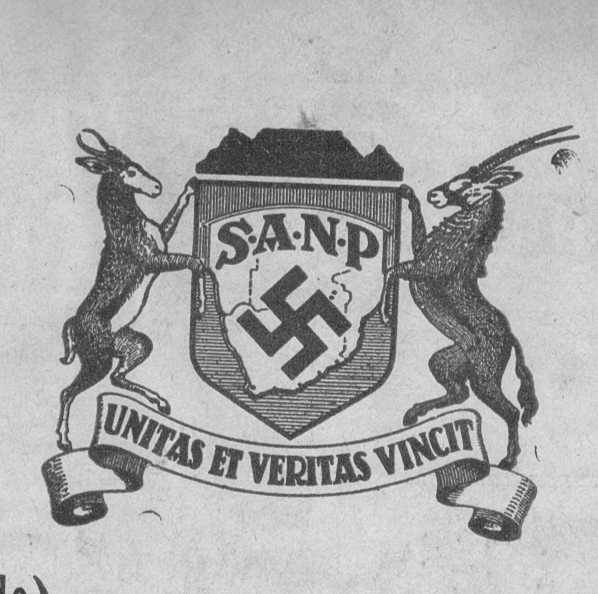
The Nazi sympathies and terrorist actions during the war of leaders of the National Party would be removed – and the direct Nazi German collaborations by Ossewabrandwag (OB), SANP and New Order during the war would be wiped clean – the OB would be positioned as ‘anti-British’ because of the Boer War and nothing more. The OB intelligence and historical archive was slammed shut in 1948 by Frans Erasmus and although partially re-opened by ‘gate-keepers’ it was only fully re-opened as late as 2015 for all the proof on its full blown collaboration with Nazi Germany itself. The political reaction of the returning servicemen and The Torch Commando would also be wiped clean completely.

After years of military and education conditioning, sanitising of media, years of banning and/or gagging of white political opposition – to the majority of ‘white’ male youth and young white adults – both English and Afrikaans – by the 70’s and 80’s the National Party presented itself as the only way forward for ‘white’ survival in Africa in light of a “Total War” against the “Total Onslaught”.

Pesky Students

By the 1970’s almost every Political party and White political figures not in step with the National Party’s ideas of separate representation were imprisoned, in exile, banned or gagged.  End of the ‘troublesome’ whites – not so!

From a military history perspective, one of the many threads of resistance comes where the NCL/ARM found Adrian Leftwich – the student movements, in the case of Whites – The National Union of South African Students (NUSAS). 

The late 70’s and 80’s saw tens of thousands of White students from the ‘Liberal’ white dominated universities on active protest – Natal, Wits, Rhodes, UCT. Entering the fray are many academics and even a student culture music movement – the Voëlvry Movement (James Phillips, Koos Kombuis and Johannes Kerkorrel).

In NUSAS dominated Universities the End Conscription Campaign (ECC) found its bedrock. In fact the ECC took shape initially within NUSAS.
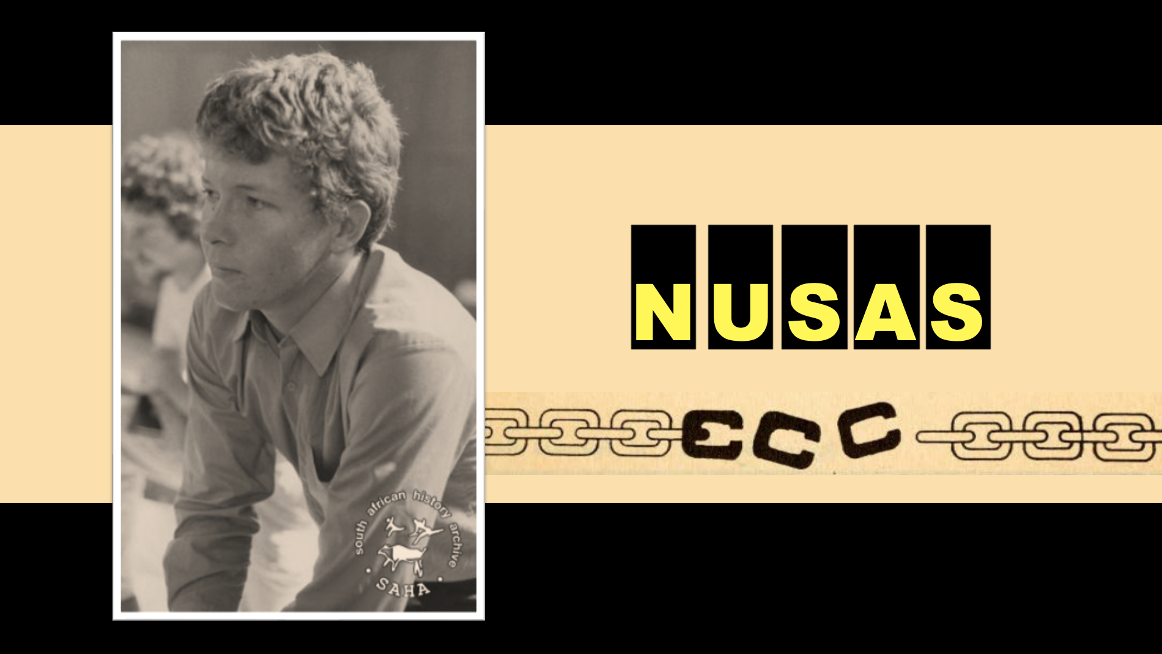
Brett Myrdal – End Conscription Campaign

No shrinking violet, a case in point –  in 1983, the ECC co-founder Brett Myrdal, publicly refused his call-up and elected to stand trial an spend his ‘2 years’ behind bars, in September 1983, three days before Myrdal’s trial the state increased prison sentences for objectors from 2 years to 6 years. Mydral goes into exile and joins MK instead.

Twists and Turns

By 1990 the ANC is unbanned and the ’struggle’ landscape changes – especially for white South Africans. The Yes/No Referendum in 1992 gives voice to the silent majority of pro-democracy whites not heard from since 1948. It ensures that the final defeat of Apartheid becomes a moral one and not a military one.

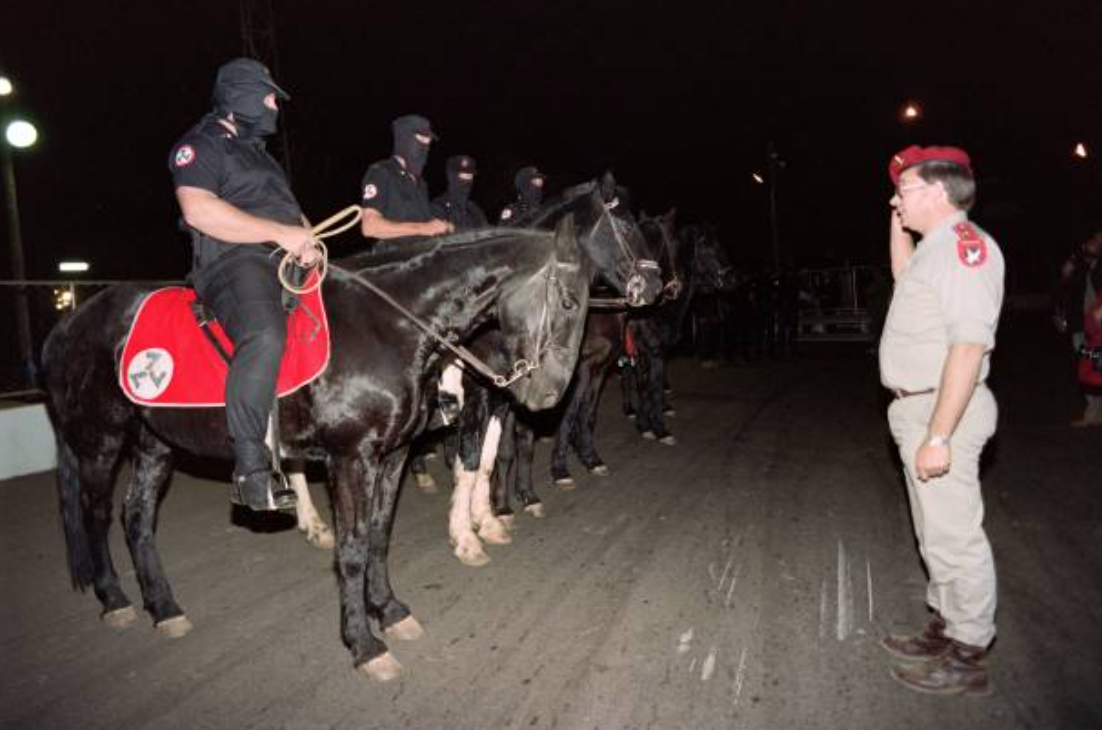
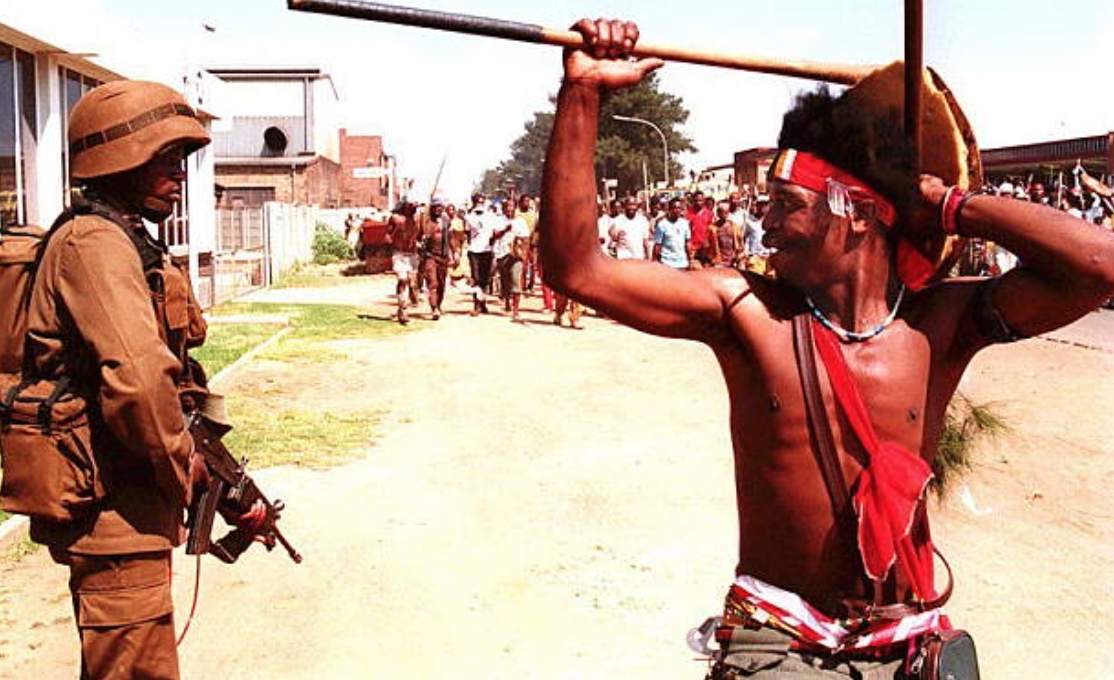
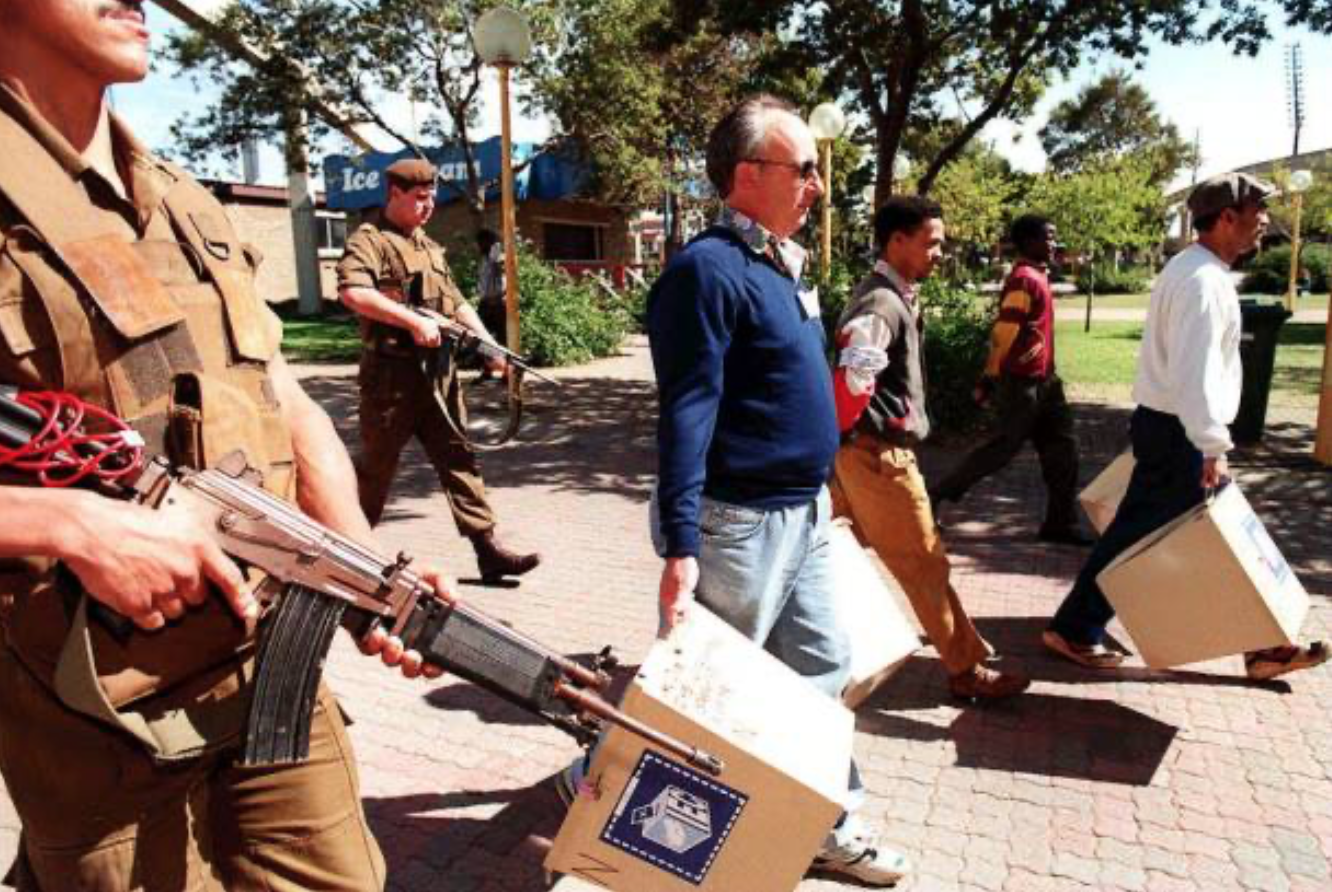
The composite National Peacekeeping Force NPKF fails and CODESA calls to replace the force with statutory force SADF personnel. The battleground moves to the politically violent void between the African National Congree (ANC)/Inkata Freedom Party (IFP) and in the lead-up to democracy – in a deep irony the Afrikaner Weerstandsbeweging (AWB), a white supremacy movement also embarks on a armed resistance campaign against the National Party Government and its CODESA collaboration –  and in an ironic twist, thousands of white conscripts – those from the 80’s generation and post 1990 call-up take up the role of Peacekeeping in the SADF and transition the country to full democracy. This call up of the country’s reserves of white conscripts to their regiments in 1994 to secure the election is paradoxically supported by the ECC as a ‘different kind of call-up’. 

In the end, the instrument of the new democracy – the vote itself – is secured by white military conscripts, not by any non-statute forces – an inconvenient fact in the contemporary narrative of ‘The Struggle’. The old National Party objective of conditioning many of these white conscripts to Afrikaner Nationalism proved null and void and in fact entirely baseless in the end.

To read more on these events leading to the elections follow this observation post link: The Inconvenient ‘Struggle Heroes’ of Freedom Day

The ‘fatal’ 1992 Referendum

In the strange world of the National Party, where “Communism” equated with ‘Liberalism” – the Nationalists made a fatal error.  Feeling confident that their hated nemesis ‘Communism’ no longer really posed a threat to their idea of the ‘Western World’ democracy when the Berlin Wall collapsed in 1989 with the resultant beak up of the Soviet Union. Feeling more confident that with the loss of its ‘communist’ backers the ANC plans as to a socialist communist take-over of South Africa would now not be possible and they would be in a position to ‘talk’.  The National Party was on the ascendancy in terms of ‘seats’ in Parliament in 1989 using more gerrymandering and with the SADF enjoying 5% GDP spend (the average spend of a NATO country on the military is 2% GDP) they were now more powerful than ever – they now even felt confident that with a negotiated settlement with the ANC they had a shot at a sustained political future for themselves. They had started Apartheid, but now they would rather magnanimously end it and all would be forgiven.

So when they hit internal political hiccups and resistance from within their party, coupled with resistance from the ‘all white’ Conservative Party and Afrikaner extreme right (AWB) – and with the ANC not really rolling over in the negotiations. They made the fatal error of thinking they needed ‘populist’ support and put forward what was to become the last ‘whites only’ vote on the issue of Apartheid. But instead of a party political vote where they had a constitutional seat advantage which would see them over the line, FW de Klerk instead opted for a ‘one to one’ count, a ‘one man one vote’ all white referendum.  For the first time since 1948 it would become clear again who in the white community supported Apartheid and who didn’t, and this time constitutional boundaries were moot.

The Nationalists for the first time sided with the ‘liberal white ‘left, it backed the support to end Apartheid and joined forces with the ‘Democratic Party’ (the last remaining “Liberal” party – the direct result of the Progressive Party and the merging of the now collapsed Union Party, Labour Party, Liberal Party and Union Federal Party, Reform Party and all their Torch Commando forebears) – it would spell out just how many liberty loving white South Africans there were to vote ‘Yes’ to end Apartheid – the nearly 3 million strong white voter base brought back an astonishing result.  69% of whites wanted the end of Apartheid – nearly 2,000,000 whites (read that again – 2 million whites willingly and very peacefully voted to end what is now incorrectly touted as their ‘Apartheid privileges’).

In terms of demographics this was not really too dissimilar to the split faced by Jan Smuts in 1948 – the populist white vote was still very much an anti-apartheid vote, even 40 years on. The only difference between 1948 and 1992 was the fact the white electorate base had grown to three times that of 1948 and an armed and civil struggle had kicked off in the interim. The very percentage of the white voter block that the Torch Commando had worked so hard to reinvigorate in its protests from 1951-1953 were still largely intact and had just grown exponentially over the years.

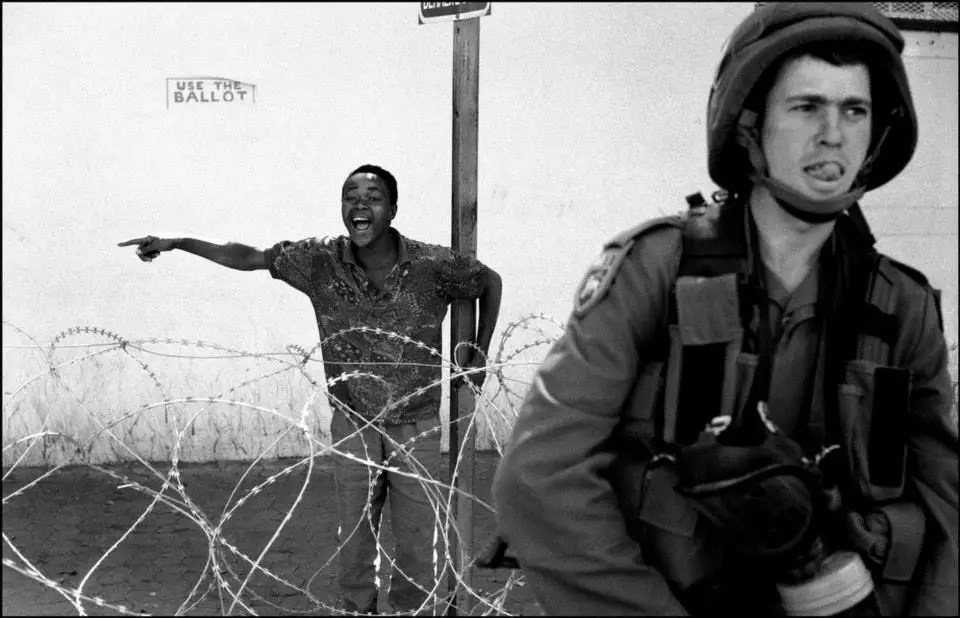
The truth of the matter is that an armed struggle did not really end Apartheid, the ballot did. The initial objects of The Torch Commando as outlined by Sailor Malan and Louis Kane-Berman, that the ‘ballot’ was the only viable way to oust Apartheid, held as true in 1992 as it did in 1951. There was no MK led ‘military victory parade’ over defeated SADF/SAP forces – and that’s because there was no military victory. Victory in the end was a moral one, and it was one in which democracy loving white South African’s played a key role – the first-time white people were given proper representation and voice by weight of sheer numbers – and they voted Apartheid out – that is a fact.

The ‘Yes’ vote spelled the end of the National Party, it had fundamentally misinterpreted its support. Its voting base was fractured further after the 1994 Democratic elections and it continued to diminish until one day it did an unbelievable thing – after flirting with old ‘white’ enemy, the Liberals and Democrats now in a Democratic alliance (DA), the National Party then closed shop, left the Democrats and walk the floor in April 2005 and joined the ranks of none other than the African National Congress (ANC) – their much hated ‘Communists’.  So much for Afrikaner Nationalism and the visions of Malan and Verwoerd – because the inconvenient truth is that this is what they are left with as a legacy.

In Conclusion

In the light of ‘Revolutionary History’ which has now become so predominant in the current ANC government and in formal education, incorrectly shaping the Struggle as a ‘race’ war and not an ideological and ‘moral’ one – our task to the ‘truth’ becomes more important than ever.

From a military history perspective, the white armed struggle has not been given its full scope, the dots have not been fully connected and the ‘golden threads’ not completely woven. Much of ‘the white struggle against apartheid’ it is either ‘lost’ or inadequately woven into the modern narrative of the struggle for the sake of political rhetoric favouring revolutionary Black consciousness and reform.

The ‘Truth’ – if we seeking it, is that here is a rich and very deep history of both ‘white’ military and ‘white’ political struggle against Apartheid, the epicentre of which is a little known and little regarded movement called The Torch Commando – and why is that so important?

Because future stalwarts of ‘The Struggle’ cut their political teeth in the Torch Commando – its members provide the military experience, structure and training for all the ‘Liberation’ non-statute forces – from the African National Congress’ MK to the Liberal Party’s ARM. Where they do not provide a direct military link to the armed struggle, Torch-men also become guiding lights in the political struggle – from Smuts’ old United Party and the Labour Party to the evolved Progressive Party, Union Federal Party and Liberal Party (the origins of today’s Democratic Alliance) which all spin out of The Torch Commando.

In fact, its Torch Commando members who are at the epicentre of the paradigm shift in opposition white politics after 1948 and again in 1961 and finally again in 1994. It all comes full circle, when three key old surviving Torch Commando stalwarts are at the very core of South Africa’s transition to full democracy – one lawyer, one Communist and one Democrat.

Michael Corbett joined the Army in 1942 to fight in World War 2, leaving as a Lieutenant, after the war he was an aspiring lawyer and he joins The Torch Commando in protest against Apartheid becoming part of the Torch’s legal team. Years later and a long distinguished career, by 1989 he is appointed South Africa’s Chief Justice. As Chief Justice he delivers the opening speech at the inaugural session of CODESA in December 1991 – marking the beginning of the negotiations for a new constitutional order for all South Africans.

During the CODESA negotiations, the critical team was ‘Working Group 2’ dealing with Constitutional Principles, in it are the respective party’s ‘Big Gun’ negotiators … Gerrit Viljoen, Cyril Ramaphosa, Colin Eglin, Joe Slovo and Ben Ngubane.

Yup, two old Torch Commando stalwarts are sitting opposite one another bashing out South Africa’s Constitution paving the way to the vote – Eglin and Slovo. This group is also notorious during the negotiations for hitting impasses and creating crisis after crisis as negotiations falter and hang on the edge of the proverbial cliff. 

Peter Soal, the late PFP leader would say of these impasses that it was;

“Colin Eglin’s negotiating prowess that was recognised by Joe Slovo in particular and, when an impasse was reached, the two would get together and generally find a compromise and way forward that enabled talks to continue and, eventually, a worthy constitution to emerge.”

Colin Eglin would say of Joe Slovo;

“Particularly close to my political and private soul was Joe Slovo, most remarkable of them all. Charming and intelligent, he was a creative lateral thinker with a deep human understanding”.

Eglin and Slovo shared a deep common bond, not only were they both veterans of the second World War and ‘brothers in arms’ with a mutual respect that only soldiers find in one other, they are also political veterans of The Torch Commando and they both chartered a course of political struggle with the same aim in mind – albeit on different trajectories.

As a critical part of the Multi-Party Negotiating Forum (MPNF), Eglin and Slovo hammer out the Interim South African Constitution – the basis of the South African Constitution as we know it today, by no means perfect but one of the most liberal and enlightened constitutions in the world. In a way, it’s the Second World War that forges these ideals of liberty in the South Africans taking part it, it’s a constitutional crisis after the war which triggers them into mass anti-apartheid protests as The Torch Commando in 1951 and in the end after an armed and political struggle, they emerge to change the constitution of South Africa completely and build it into the ‘Torch’ of liberty we see today.

To top it all, entering the stage again, is Justice Michael Corbett, our third Torch-man who wraps it all up for The Torch when he inaugurates Nelson Mandela as the new State President of a fully democratic South Africa on the 10th May 1994.

That’s why understanding The Torch Commando and bringing its history forward and preserving it properly is critical to our shared understanding of struggle against Apartheid.
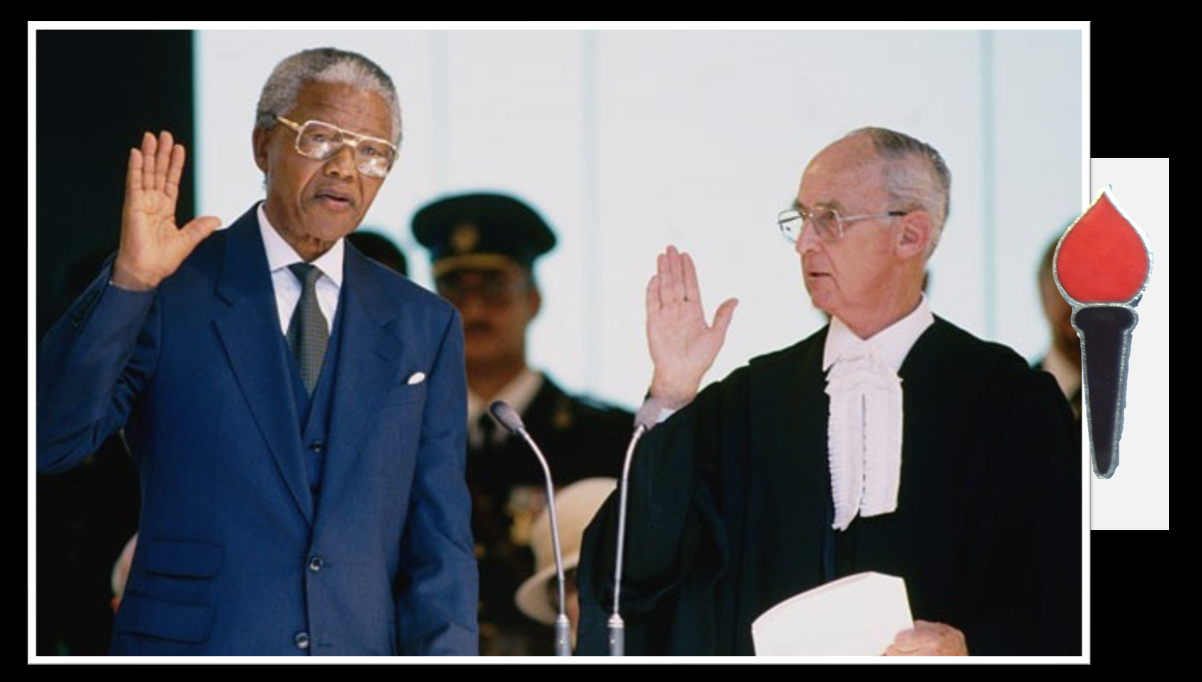
President Nelson Mandela and Justice Micheal Corbett

Editors Note:

Small teaser for those who wish to really know more on the Torch. There is a definitive book on the Torch Commando which is been planned and penned by Peter Dickens in collaboration with leading academics like Graeme Plint and in support of the legacy of Louis Kane-Berman and Sailor Malan and their families, do look out for it when it hopefully makes it to a publisher.


Written and Researched by Peter Dickens

References

Liberal Opinion – March 1962 ‘Jock Isacowitz’ by Peter Brown

A flying Springbok of wartime British skies: A.G. ‘Sailor’ Malan. By Bill Nasson – University of Stellenbosch

South African History On-Line (website)

Liberals against Apartheid – A History of the Liberal Party of South Africa, 1953–68 by Randolph Vigne

The United Party and the 1953 General Election, University of Durban-Westville by W.B. White 

‘Contact’ the Liberal Party’s Newsletter 1954

The Alan Paton Centre and Struggle Archives at the University of KwaZulu-Natal on-line – Interviews with Peter Brown and the History of the Liberal Party South Africa

Business Day press-reader, Nov 2018

Values, Duty, Sacrifice in Apartheid South Africa. By Peter Hain

Crossing the boundaries of power: the memoirs of Colin Eglin.

The Rise of the South African Reich by Brian Bunting 1964

Not for Ourselves – the history of The South African Legion – South African Legion of Military Veterans

The Springbok and the Skunk: War Veterans and the Politics of Whiteness in South Africa During the 1940s and 1950s by Neil Roos – University of Pretoria

A tribute to Colin Eglin – By Peter Soal – 02 December 2013.

The Torch Commando & The Politics of White Opposition. South Africa 1951-1953, a Seminar Paper submission to Wits University – 1976 by Michael Fridjhon.

The South African Parliamentary Opposition 1948 – 1953, a Doctorate submission to Natal University – 1989 by William Barry White. 

The influence of Second World War military service on prominent White South African veterans in opposition politics 1939 – 1961. A Masters submission to Stellenbosch University – 2021 by Graeme Wesley Plint 

The Rise and Fall of The Torch Commando – Politicsweb 2018 by John Kane-Berman. Large extracts taken from the late John Kane-Berman memoirs of his father Louis Kane-Berman with the kind permission of the Kane-Berman family.

Raising Kane – The Story of the Kane-Bermans by John Kane-Berman, Private Circulation, May 2018

The White Armed Struggle against Apartheid – a Seminar Paper submission to The South African Military History Society – 10th Oct 2019 by Peter Dickens 

Sailor Malan – By Oliver Walker 1953. 

Lazerson, Whites in the Struggle Against Apartheid.  

The White Tribe of Africa: 1981: By David Harrison

Ordinary Springboks: White Servicemen and Social Justice in South Africa, 1939-1961. By Neil Roos.

Related Work

The White Struggle Against Apartheid: The ‘White’ armed struggle against Apartheid

The Torch Commando Series

The Smoking Gun of the White Struggle against Apartheid!

The Observation Post published 5 articles on the The Torch Commando outlining the history of the movement, this was done ahead of the 60th anniversary of the death of Sailor Malan and Yvonne Malan’ commemorative lecture on him “I fear no man”. To easily access all the key links and the respective content here they are in sequence.

In part 1, we outlined the Nazification of the Afrikaner right prior to and during World War 2 and their ascent to power in a shock election win in 1948 as the Afrikaner National Party – creating the groundswell of indignation and protest from the returning war veterans, whose entire raison d’etre for going to war was to get rid of Nazism.

For the in-depth article follow this link: The Nazification of the Afrikaner Right

In part 2, in response to National Party’s plans to amend the constitution to make way for Apartheid legislation, we outlined the political nature of the military veterans’ associations and parties and the formation of the War Veterans Action Committee (WVAC) under the leadership of Battle of Britain hero – Group Captain Sailor Malan in opposition to it.  Essentially bringing together firebrand Springbok Legionnaires and the United Party’s military veteran leaders into a moderate and centre-line steering committee with broad popular appeal across the entire veteran voting bloc. 

For the in-depth article follow this link: The War Veterans’ Action Committee

In Part 3, we cover the opening salvo of WVAC in a protest in April 1951 at the War Cenotaph in Johannesburg followed by the ratification of four demands at two mass rallies in May 1951. They take these demands to Nationalists in Parliament in a ‘Steel Commando’ convoy converging on Cape Town. Led by Group Captain Sailor Malan and another Afrikaner – Commandant Dolf de la Rey, a South African War (1899-1902) veteran of high standing their purpose is to raise support from Afrikaner and English veterans alike and they converge with a ‘Torchlight’ rally of 60,000 protestors and hand their demands to parliament. 

For the in-depth article follow this link: The Steel Commando

In Part 4, in response to the success of The Steel Commando Cape Town protest, we then look at the rise of the Torch Commando as South Africa’s largest and most significant mass protest movement in the early 1950’s pre-dating the ANC’s defiance campaign. Political dynamics within the Torch see its loyalties stretched across the South African opposition politics landscape, the Torch eventually aiding the United Party’s (UP) grassroots campaigning whilst at the same time caught up in Federal breakaway parties and the Natal issue. The introduction of the ‘Swart Bills’ in addition to ‘coloured vote constitutional crisis’ going ahead despite ineffectual protests causes a crisis within the Torch. This and the UP’s losses in by-elections in the lead up to and the 1953 General Election itself spurs the eventual demise of The Torch Commando.

For the in-depth article follow this link: The ‘Rise and Fall’ of the Torch Commando

In Part 5, we conclude the Series on The Torch Commando with ‘The Smoking Gun’. The Smoking Gun traces what the Torch Commando members do after the movement collapses, significantly two political parties spin out the Torch Commando – the Liberal Party of South Africa and the Union Federal Party. The Torch also significantly impacts the United Party and the formation of the breakaway Progressive Party who embark on formal party political resistance to Apartheid and are the precursor of the modern day Democratic Alliance. The Torch’s Communists party members take a leading role in the ANC’s armed wing MK, and the Torch’s liberals spin off the NCL and ARM armed resistance movements from the Liberal Party. We conclude with CODESA.

For an in-depth article follow this link: The Smoking Gun
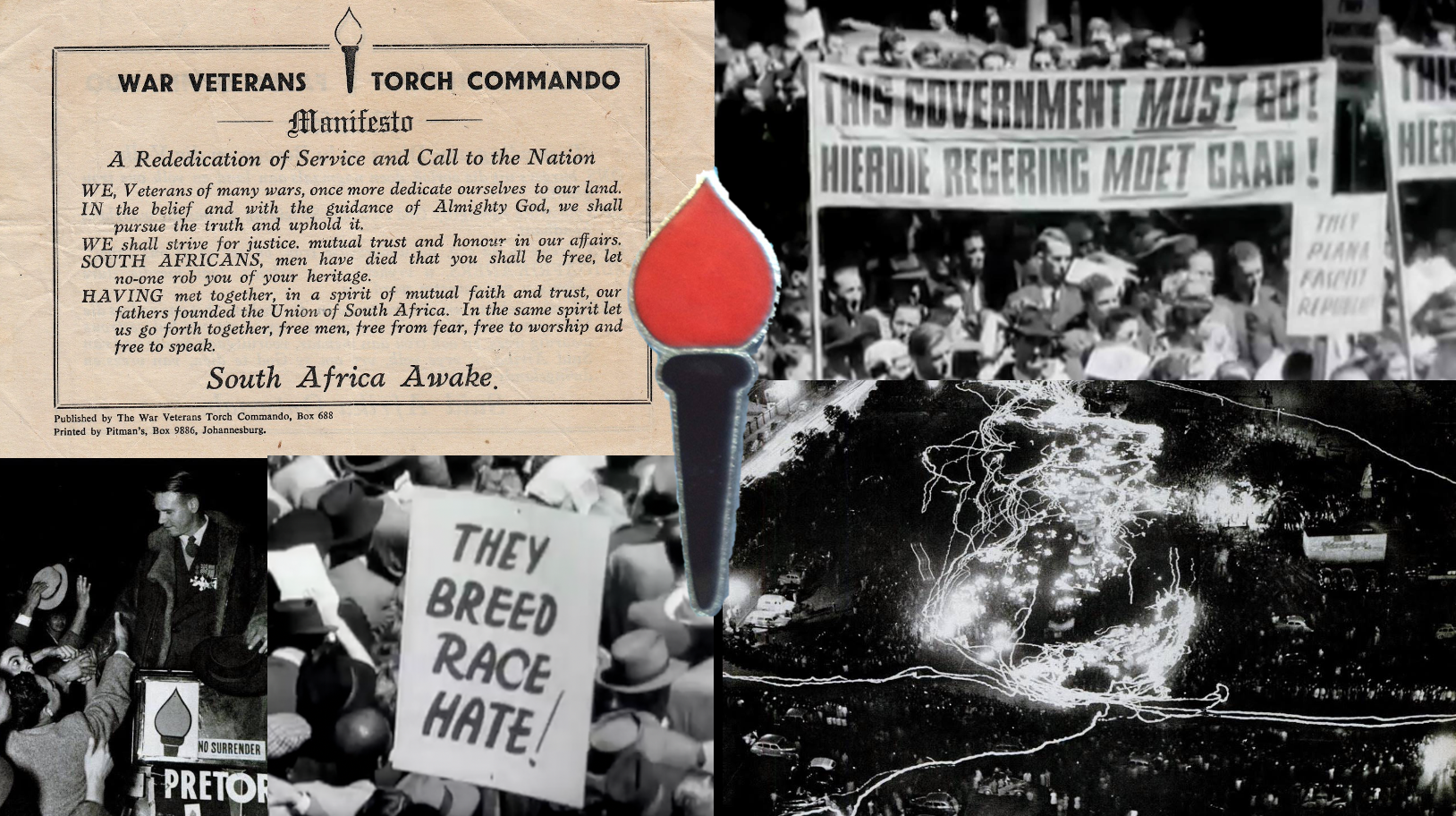

A search for the … Truth … Legion!

So, I saw a lapel pin with a Torch on it been promoted as a “Torch Commando” pin on a collectors site, I have one like it in my collection, and I sincerely thought that although not Torch Commando it was a related civic association concerned with the Constitutional Crisis of the 1950’s. Turns out I was wrong! At times I’m very happy to be proved wrong, and the investigation into this simple “torch” pin led me down a rabbit hole to uncover some history that really is “lost” to most South Africans (certainly to the collectors of war-time memorabilia). For in this search for the truth .. we find .. “The Truth Legion”.

Image: Truth Legion pin and propaganda (left) and Torch Commando pin and propaganda (right).

The Truth Legion … what the heck was that all about? Well, it’s origins all point to Nazi Germany.

Nazification of the Afrikaner Right

It turns out that at the beginning of World War 2, Jan Smuts and his government needed a vehicle to promote the “truth” about why South Africa went to war and to counter-act far right Nationalist and Nazi propaganda streaming into South Africa via radio stations like Radio Zeesen (a Nazi German propaganda service radio station broadcasting in short wave in eighteen different foreign languages including Afrikaans) and via the German intelligence service of the Ober Kommando Wehrmacht (German High Command) called the “Abwehr”, which had been engaged in coordinating direct operational intelligence and the spread of propaganda in the Union of South Africa and South West Africa (Namibia). 

If foreign influence was not enough, domestically political organs like the South African Nazi ‘shirt’ movements – Louis Weichardt’s South African Christian Nationalist Socialist Party or “Greyshirts” and Manie Wessels’ and Chris Havemann’s ‘Democratic Movement’ or “Blackshirts”. Other Nazi ‘shirt’ organisations included the Volksbeweging (People’s Movement) or ‘African Gentile Organisation’ which was established by H.S. Terblanche. Johannes Bruwer also founded ‘The Bond van Nasionale Werkers’ (National Workers Union) which became known as the “Brownshirts”.

The Greyshirts’ organ of communication, a newspaper called oddly enough “Die Waarheid” (the ‘truth’), “Ons Reg” (Our Right) was published by the “Blackshirts” and the “Terre Blanche” (White Land) published by the People’s Movement. They nailed their colours literally to the mast – Die Waarheid and Terre blanche both used a swastika on their mastheads indicating their pro-Nazi and National Socialistic sympathy. 

Image: Die Waarheid – note masthead

Added to this was the Ossewabrandwag led by a Nazi devotee – Dr J.F.J. van Rensburg who transformed the Ossewabrandwag from a predominately Afrikaner cultural movement surrounding the 1938 Great Trek Centenary into a militarised, totalitarian, anti-Semitic and pro-Nazi movement operating under the guise of an Afrikaner cultural movement. Dr Johannes van Rensburg would even go as far using the Ossewabrandwag and its structures to directly assist Nazi Germany in espionage and intelligence operations in South Africa. During the war a secret wireless transmitter was installed in on Dr van Rensburg’s farm near Vryburg. The wireless service was run by Nazi spy, Lothar Sittig (codename Felix), a South African with German roots, and assisted by Dutch journalist, Henri Jacques (Hans) Rooseboom, who was inserted into the Union by the Nazis in October 1939.
In addition, the National Party’s Defence Minister, another Nazi devotee, Oswald Pirow inspired his organisation – the Nazi ‘New Order’ and its leaflets and even the National Party itself, with its communication organs – the ‘Transvaaler ‘and the ‘Burger’ towing Nazi German sympathises and ideologies – all this added to the heady mix of Nazi propaganda and Nazi German sympathies streaming into South Africa. All targeting white Afrikaners primarily with the purpose of de-stabilising South Africa’s war effort and even trying to effect regime change to a Nazi German friendly South African ally. 

So, to counter act all of this, Jan Smuts, now very concerned about the unchecked growth of Nazism in South Africa and South West Africa, and particularly the spread of “propaganda, falsehood, delusion and fomenting of strive carried on by foreign agents” – in response Smuts promoted Dr Ernst Gideon Malherbe, one of South Africa’s foremost academic minds, to the head of Intelligence and gave him the rank of Colonel. He then went about structuring the intelligence and counter-intelligence services to meet war-time objectives. In the main, three propaganda agencies were conceived, the Bureau of Information (BOI), the Directorate of Military Intelligence (DMI) and the Union Unity Truth Service (UUTS). 

Now, that badge and symbology sending us down the rabbit hole is the “Union Unity Truth Service (UUTS)” or “Truth Legion” – so who and what then are the UUTS? 

Union Unity Truth Service (UUTS)

The Union Unity Truth Service was a “Non-state” propaganda service, in other words it operated “outside” state institutions like the Intelligence Services and Union Defence Force. The purpose was to develop an institution in which ‘loyal’ civilians, concerned with the rise of Nazi propaganda and extremism in South Africa would establish a “Truth” Service to counter-act it.

The Union Unity Truth Service (UUTS) was established in September 1939, literally in the same month that Smuts rose to Prime Ministership and declared war against Nazi Germany. It was inspired by Sir James Rose Innes, Brigadier General HNW Botha, Colonel Sir W Dalrymple and Sir Charles Smith. 

They appealed to the public for a “publicity fund to finance a nation-wide campaign to support Smuts’ Government … to deal with propaganda from abroad and misrepresentations at home … to promote mutual understanding between all sections of people”. The fund, known as the Union Unity Fund underpinned the objectives of the UUTS movement, which were defined as “providing intellectual, moral and political support for Smuts and the national government in the prosecution of the war”.  

The South African public was called upon to both support and contribute financially to the Unity Fund and the UUTS. It’s Head Quarters were based in Johannesburg, Thomas Robertson – a Rand Daily Mail journalist was appointed as the Director of the UUTS and he positioned it as “The New Crusade” with General Jan Smuts as its Commander in Chief. In line with Union policy (and objectives) all UUTS communications, emblems, merchandising, books, leaflets etc would be bi-lingual in English and Afrikaans. An advisory Committee sat behind the Director, and it was headed up by a United Party Senator – Mr G. Hartog.

As it operated “outside the state” fundraising would take place via a ‘Field Unit’ called “The Truth Legion” which consisted of a literal ‘army’ of Smuts loyalists who called themselves “Truth Legionnaires” – they would go about canvassing and raising funds through the sale of Jan Smuts’ books, badges and speeches. Here are two examples of books sold by the “Truth Legion” – “Why the Union is at war with Nazi Germany” – speech by General Smuts, Nov 1939 and “Greater South Africa – Plans for a better world” – the speeches by General Smuts , Nov 1940. Note the ‘Publisher’ details in both books comprises the Truth Legion’s torch emblem and their details.

Other Truth Legion activities consisted of the production of Afrikaans-language film “Noordwaarts” (Northwards), the publication of an illustrated magazine called “Libertas”, they also got behind the ‘Peace through victory’ campaign (essentially to counter campaigns advocating peace with Nazi Germany).  

The Truth Legion also operated an underground radio station called “Mystery Radio Freedom” to counter-act the Afrikaans broadcasts of Nazi German’s “Radio Zeesen”. In addition, they also compiled an released a patriotic song, selling the records to raise funds, and here’s an example of the record and song-sheet, note again the “Truth Legion” Torch emblem.

Images: Free South Africa recording and song sheet

By 1940 the UUTS/Truth Legion established a School of Propaganda and Political Education at the Kero Hotel in Johannesburg. It marketed a ten day course on propaganda and politics – primarily aimed at university students – the lecturers of the course were all powerhouse academics and government officials – Advocate G Saron lectured on ‘Nazism and the Fifth Column’, Professor Leo Fouché lectured on ‘propaganda history’, Dr Malherbe – the head of the Intelligence Service lectured on ‘film propaganda’ – they were accompanied by the likes of Professor Hoernlé, Professor T Haarhoff, Professor ID MacCrone and Dr S Biesheuvel – all of who formed part of the military’s education programme, the AES.

In addition to all of this, according to Fankie L Monama’s publication ‘South African Propaganda Agencies and the Battle for Public Opinion during the Second World War, 1939–1945’. “The UUTS also brought in the head of the Bantu Press, BFG Paver, whose company was tasked to produce propaganda newspapers for blacks. In some instances, the UUTS liaised with OWI (United States) and MOI (Britain) for supplying propaganda material from those countries for distribution in South Africa. The activities of the Truth Legion were also extended to other parts of Africa to generate “sympathisers” to the Allied cause, particularly in Portuguese East Africa”.

In Conclusion

It’s amazing what a simple ‘lapel’ pin find can unravel, because this is all a very “hidden” history and there is preciously little for the ‘armchair’ amateur historians, commentators, journalists and collectors to find –   and its hoped that any future confusion between ‘The Torch Commando’s’ Torch emblem and the Truth Legion’s Torch emblem, which is a war-time emblem and pre-dates the Torch Commando and its post war Anti-Apartheid protests by 12 years is now cleared up. The war-time contribution of South Africa remains a highly unknown area, as these structures and even intelligence files were all but collapsed and even destroyed by the incoming Afrikaner Nationalist government in 1948. 

Consider this, in July 1948, mere months after the National Party won the election, Colonel Malherbe’s successor Colonel Charles Powell (Colonel Malherbe was by the time the Vice Chancellor of the University of Natal), was sitting in the National Intelligence archive and in came none other than the National Party’s new head of Defence – Frans C. Erasmus – who promptly dismissed Colonel Powell on the spot with a 24 hours notice. He then proceeded to remove “two lorries” worth of documentation outlining the National Party’s affiliations with Nazi Germany and flirtation with Nazism from the Intelligence archive – not to be seen in ‘public’ again – well – not for a very long time.

Fortunately in recent years, historians now unshackled by old Apartheid restrictions have started challenging these old archives and intelligence files (in South Africa, Germany and the United Kingdom), and it’s a treasure trove of information, so organisations like “The Truth Legion” have started to re-surface, and we are all now richer for it.


Written and Researched by Peter Dickens

Main consultation sources include:

Wartime Propaganda in the Union of South Africa, 1939 – 1945 by Fankie Lucas Monama 2014

South African Propaganda Agencies and the Battle for Public Opinion during the Second World War, 1939–1945 – Fankie L Monama 

National Socialism and Nazism in South Africa: The case of L.T. Weichardt and his Greyshirt movements, 1933-1946 By Werner Bouwer 

Related Work

The South African Greyshirts – follow link: South Africa’s Nazi Party; The ‘Gryshemde

Oswald Pirow’s New Order – follow link: South Africa’s Nazi ‘Neuordnung’ and Oswald Pirow

Ossewabrandwag – follow link: “Mein Kampf shows the way to greatness for South Africa” – The Ossewabrandwag

South African National Socialists – follow link: Blood Oaths on the Führer principle

Swart Gevaar …  Wit Gevaar 

This article has been a long time in coming because it’s really a simple soldier’s story … it’s mine … and I’m a real son-of-a-bitch to consolidate myself with and as such this has been very hard to put together. However, I hope it gives some insight into what it was like to serve in the South African Defence Force (SADF) from the unbanning of the ANC and release of Nelson Mandela on 11 February 1990 to the landmark year for the transformation of South Africa’s democracy in April 1994. 

It’s also a testament and a cathartic exercise, as … ta da! No surprise to anyone who knows me personally and what I went through with Covid 19, but I was diagnosed with Post Traumatic Stress Disorder (PTSD). So, no surprise on the Covid front, but it’s the root of the PTSD that’s the real problem, and it boils down to my time in the SADF from 1990 to 1994, it settled on ‘Trust’ or lack thereof really.

“Ag Fok man! No more PTSD G3/K3 Fucked Up Kak” some of my fellow veteran buddies may jump to, heck at one stage I felt the same. But bear with me ‘manne’, this is not a ‘outreach’ or a ‘call for help’ .. I’m solid, in good spirits and very stable (more on this later). What my therapy disclosed is in fact a very interesting bit of history not often held up in the narrative of 1994 and it possesses a load of inconvenient truths, that’s what this story is really all about. So, here goes;

Wit en Swart Gevaar (White and Black Danger)

In 1990 Whilst the now ‘unbanned’ African National Congress (ANC) was finding its political feet and locating itself to ‘Shell House’ near Bree Street in Johannesburg, I was located at Witwatersrand Command’s new HQ Building – also in Bree Street a block away – the nearby old HQ at the bottom of Twist Street called the ‘Drill Hall’ had been all but abandoned after it was bombed by a ‘lone’ ANC cadre – who oddly was a ‘white Afrikaner’ from a top Upper Middle Class Afrikaans school, Linden High School, and who had some serious ‘Daddy issues’ with his Conservative father and upbringing. With the building now declared ‘unsafe’ the HQ had moved next door. Here begins my problem in trying to define the enemy – as we had been conditioned by the old Afrikaner Nationalists and in the SADF that the ‘enemy’ was a ‘Swart Gevaar’ (Black Danger) and a ‘Rooi Gevaar’ (Communist Red Danger) – not a ‘Wit Gevaar’ (White Danger) with a Upper Middle-Class sense of Liberalism as the bomber in question, Hein Grosskopf, was.

So, here I am, a freshy minted National Serviceman ‘one-pip’ Loot ( 2nd Lieutenant or Subaltern) seconded to Wit (Witwatersrand) Command Operations (Ops) from my initial placement at D-Ops (Directive Operations) located in a underground circular shafted ‘nuclear proof’ building in Pretoria called Blenny, the building whose Top Secret Ops room looked like a scene out of Dr Strangelove had its entry bunker located near the Pretoria Prison. This underground building is now falling derelict as a SAAF HQ, in my time the personnel stationed there were known as the ‘Blenny rats’ for obvious reasons, and funnily I can count myself as one.  

My job at Wit Command (not ‘Wits’ Command mind – that designation was for the nearby University) was to provide Operation Support and send Top Secret daily SITREP (situation reports) from Wit Command to D Ops at Blenny, or just been a ‘Bicycle’ as my fellow senior officers called ‘one pip’ 2nd Lieutenants (you can ‘trap’ i.e. peddle/stamp on a bicycle), the lowest rung on the officer rank profile. 

Whilst parking in my cushy post in the Ops room in September 1990 processing a whack of casualties reported on Johannesburg’s railway lines as the ANC dealt with ‘sellouts’ by throwing them off the commuter trains, the Railways Police and Army Group 18 collecting the corpses and sending reports to me for the daily SITREP and suddenly ‘bang’ another bomb blast (more like a muffled ‘thump’ actually), this one a couple of city blocks away in nearby Doornfontein and the target is the old Beeld Newspaper Offices, the bomb later turned out to be placed by the Orde Boerevolk – one of the spin-off militant White Supremacist Groups. Swart Gevaar suddenly turned Wit Gevaar again. Luckily nobody killed.

This ‘White’ Danger did not end there for me that month. Being a ‘bicycle’, 2nd Lieutenant I was given the shift nobody wanted, the weekend shift in the Ops room, the ‘Commandants’ (Lt. Colonels – and there were loads of them in Army Ops), were all at home enjoying their braai’s and brander’s. It was a 24 hour on – 48 hour off gig with no brass around so I enjoyed it. Late on a Saturday night, its all quite and I’m stretched out on a cot behind the signaller’s station watching TV and enjoying my lekker time in the ‘Mag’ when a white Ford Cortina pulled up in Bree Street, four white men in the car, out step two, one of them wearing a AWB arm band hangs back standing watch and the other walks up to the entrance of Wit Command and calmy shoots a 21 Battalion sentry on duty in the reception in the head.  

21 (Two-One) Battalion was a ethnic Black Battalion – the SADF was ethnically funny that way, so this was basically a white extremist shooting a black SADF troop as a terror attack. I hear the gunshot, then get a frantic call from the guard room. There is no medic support and only one other officer on the base, so I grab a hand-held radio and the emergency medic bag and give instructions to the signaller to stay on the radio and relay messages. The troopie is fortunately alive, the bullet having passed through his jaw as he flinched away from his attacker’s gun. I patch him up with bandages from the medical kit bag and radio the signaller to call an emergency medical evacuation. I then issue an order to the 21 Battalion Guard Commander to double the guard, take note from witnesses as to what happened and then back to my post to disturb my senior officer’s weekend. ‘Wit Gevaar’ had struck Wit Command again.

Image : AWB Clandestine paramilitary

Given the general carnage in the country created by the AWB, the Inkata Freedom Party (IFP) and African National Congress (ANC) at this time it did not take long for the ANC version of ‘Swart Gevaar’ and it would hit me directly again about two weeks later in October 1990 when I received a desperate call over the Ops room phone from an ANC informant, his cover blown and an angry ANC mob had turned up outside his house in Soweto. I was unable to get an extraction to him in the time that it took for the mob to break down the door and the line go dead after I had to listen to his desperate pleading to me for help, the Police picked up his body later.  The dismissive and rather racist attitude of one of the other officers present to the whole incident  .. “just another kaffir.”

Shortly after that in October ANC ‘danger’ turned to IFP ‘danger,’ same scenario I’m sat on the weekend in the Ops room enjoying my cushy 24 hours on 48 hours off. This incident strangely happened on a Sunday afternoon, so again the Command is relatively silent manned only by a skeleton staff. Odd for a Sunday, but a small group of IFP supporters banishing traditional weapons (deadly spears and pangas in reality) had made its way down Twist Street from Hillbrow and was making its way past the old Drill Hall to Bree Street, which, as it was still a SADF installation had a group of 21 Battalion guards staying in it.  One troop was casually standing outside having a smoke, and I don’t know if it was a ethnic retaliation of Zulu sentiment for a Black SADF troop, but in any event, he got attacked – hit by a panga as he lifted his arms to prevent a killing blow.  

Same drill as previous – no medics around and only 2 officers on the base, grab radio to relay instructions, grab bomb bandages, immediately double the guard, relay instructions to my signaller. I get to the troop and start bandaging him up, however as the panga had severed veins and done other general carnage in both his arms it took some bomb bandages and applied pressure to get it the bleeding under control before an ambulance arrived. 

Image: Inkata Freedom Party member taunts a black SADF soldier

He lived, but the strange bit for me, next morning – Monday early, I had been up all night and my uniform was covered in blood. The Commandant, whose lekker branders and braai weekend I had once again disturbed, came in earlier than expected at 06:30am, called me in ‘on orders’, and whilst ‘kakking me out’ from high told me I was derelict in my duty for not wearing barrier gloves when treating a casualty, who, as he was a black man (and to his racially ‘verkrampt’ mind) he would likely have AIDS, thus I was endangering myself as government property. That there were no barrier gloves around was not an excuse – and as some sort of punitive measure, he then instructed me to attend the morning parade on the open ground on the Command’s car park (as Ops Officers we had usually been excluded from it). I objected on the basis that I could not change my uniform in time, but he would have none of it.  

So, there I stood, an officer on parade covered in blood from saving yet another lowly regarded ‘black’ troopie, watching the sun come up over a Johannesburg skyline on a crisp clear day (if you’ve lived in Johannesburg, you’ll know what this is like, it’s the town’s only redeeming factor – it’s stunning) all the time thinking to my myself “this is one fucked up institution.”  
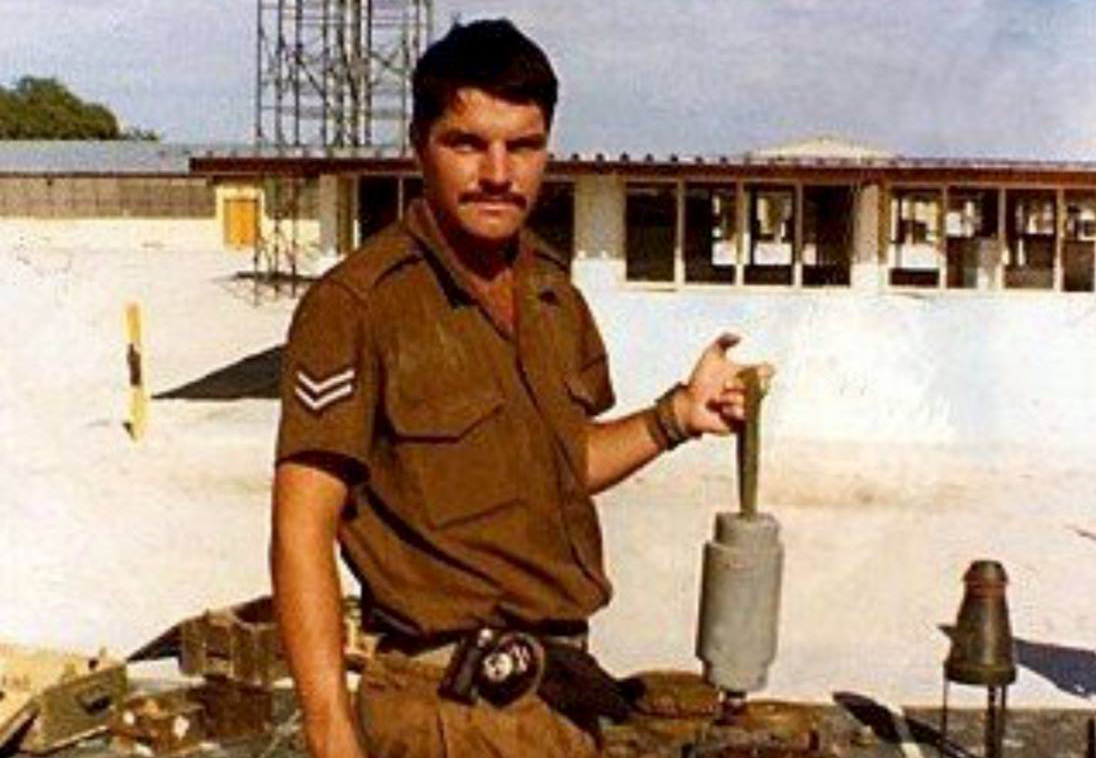
There were more instances of the random nature of violence at the time, I was called to and attended to the stabbing of a woman (later criticised by a Commandant for calling a emergency ambulance for a mere ‘civilian’) – she had a very deep stab wound about two inches above her mons pubis into her lower intestines which looked pretty bad to me, so I called it and I have no regrets. I was also called to help with a off duty white troop who staggered into the Command late Saturday night with a blunt trauma to the back of the skull and subsequently pissed himself and went into shock.

Oh, and if the general populace wasn’t bad enough, then there were the ‘own team’ military ‘idiots’ which posed a danger all of their own, my first ‘Padre’ call out as an Ops officer was for a troop shot dead by his buddy playing around with his 9mm side-arm, and some months later on after a morning parade walking back to the Bree Street building I had to deal with an accidental discharge gunshot in the guardroom of the old Drill Hall which saw two troops with severe gunshot wounds (a conscript Corporal in counter-intelligence decided to check R4 assault rifles standing on their bi-pods on the ground, one discharged taking off a big chunk of his calf muscle which was in front of the muzzle, the bullet then entering both legs of a 21 Battalion guard standing opposite him).

One thing was very certain to me … everyone, black and white .. from white right wing Afrikaners to left wing English and Afrikaner whites .. to militant and angry Zulus, Tswanas and Xhosas and just about everyone in between was a threat to my life whilst in uniform. These instances whilst serving as an Ops officer would later serve as the basis of stressor trigger during my Covid experience. To me in 1990 there was no such thing as a ‘friendly’, extreme racism, danger and hate coursed in all directions and the old Nationalist idea of the ‘Gevaar’ was a crock of shit.

Wit Command Citizen Force

On finishing my National Service (NS) stint, I immediately landed up in my designated Citizen Force Unit, 15 Reception Depot (15 OVD/RCD) which was part of Wit Command and basically handled the bi-annual National Service intakes and call-ups (reserve forces included). It also provided surplus personnel to assist in Wit Command’s administration, and that included Operations and Intelligence work. By 1991, I was back doing ‘camps’ and had impressed my new Commanding Officer (CO) enough to earn my second ‘pip’ and now I was a substantiated Full Lieutenant, an officer good and proper. I had previously keenly jumped at a role as a Convoy Commander escorting raw SADF recruits to their allocated training bases. 

Images of Nasrec NSM intakes circa 1990-1993. Photo of Lt. Col Mannie Alho (then a Captain) and Miss South Africa, Michelle Bruce at an intake courtesy Mannie Alho.

These were ‘fully armed’ operations as NSM intakes were regarded as a ‘soft’ and very ‘public’ target, of much value for an act of terrorism. As such each convoy needed an armed escort with a lot of Intelligence and logistics support. If you need to know how dangerous – consider how many times a recruitment station has been bombed in the Iraq and/or Afghanistan conflicts. I volunteered for the furthest and most difficult escort as the Convoy Commander – the bi-annual call up to 8 South African Infantry Battalion in Upington (8 SAI). My ‘escort’ troops were made up of Wit Command reservists, some from Personal Services but most of them with Infantry Battalion backgrounds, Border War veterans in the main and highly experienced. 

1994

By 1994 I had really earned my spurs doing ‘long distance’ Convoy Command. In early 1993 my CO – Lt. Col Mannie Alho had seen enough potential in me to kick me off to do a ‘Captain’s Course’ at Personal Services School at Voortrekkerhoogte in Pretoria. At the beginning of 1994 Colonel Alho called me in, handed me a promotion to Captain and gave me his old Captain’s ‘bush pips’ epaulettes he had in his drawer – a gesture and epaulettes I treasure to this day.

Images: … erm, me – in case anyone is wondering why the ‘Bokkop’ (Infantry beret), I started off at 5 SAI, then PSC, then back in an infantry role in Ops.

At this time around Wit Command, a number of significant things happened involving all of us in 15 RCD to some degree or other – some less so, others more so. It was a BIG year. In all, these instances would really question who the enemy was in any soldier’s mind serving in the ‘old’ SADF at that time. 

The Reserve Call-Up – 1994

Firstly, the call up of the SADF Reserve in the Witwatersrand area to secure the country for its democratic transformation. Generally, in 1994 the SADF was running out of National Servicemen – the ‘backbone’ of the SADF, the annual January and July intake of ‘white’ conscripts had dwindled alarmingly. Generally, the white public saw the writing on the wall as to the end of Apartheid and the end of whites-only conscription program and simply refused to abide their national service call-ups. 

As to the ‘Permanent Force’ (PF), the professional career element of the SADF, many senior officers (and a great many Commandants) along with warrant officers and some senior NCO’s took an early retirement package. They had seen the writing on the wall as to their role in the Apartheid security machine and felt they had been ‘sold out’ by the very apparatus they had sworn their allegiance to. Some would head into politics in the Conservative Party, others would join the AWB structure and other ‘Boerevolk’ resistance movements and some took their Truth and Reconciliation Commission (TRC) amnesty’s and quietly retired. Others would just bow out honourably, their time done. Nearly all of them totally fed up with FW De Klerk and his cabal and feeling utterly betrayed by them – even to this day, and I meet many in military veteran circles. 

As to the other part of the SADF ‘backbone’ of which I was one – the Citizen Force, then made up almost exclusively of ‘white’ ex-National Service members now undertaking their ten odd years of ‘camp’ commitments. In 1994, it was on the cards that a future ‘whites only’ conscription would be stopped, but the problem was a great many soldiers would be needed to stop the country falling into a violent abyss and continuing its journey to a free fully democratic election. To keep up with resourcing requirements, the government contested that ‘whites only’ conscripts who had completed their National Service and were now serving in citizen force Regiments and Commandos must continue to do so and attend their call ups (or risk being fined). 

Many were simply sick and tired of the situation; they had done their ‘Border Duty’ and ‘Townships’ and had seen the writing on the wall. They knew the Citizen Force structures would be toothless trying to enforce the camp call-ups and ‘fines’. Many just didn’t bother with a camp call up and just wanted to get on with their professional and family lives. A small few however split their loyalty on political grounds and made their way into the AWB and other Boerevolk Armed Resistance movements instead.

Images: AWB Training – note the use of parts of SADF ‘Browns’ uniform

However, and this is a truism, a great many of these active reservists (the vast majority) stayed on out of sheer loyalty to serve their country no matter what, and to serve their comrades (a powerful bond of brotherhood develops when you serve) and to execute their mandates as well trained and professional military personnel. It was to this element of the Citizen Force that the government would ultimately turn to for help and implore them to volunteer to steer the country to democracy. Even the old ‘End Conscription Campaign’ anti-apartheid movement moved to support the ‘camper call up’ for the 1994 general elections.

Personally, I found the SADF military personnel moving to join the AWB and other White Supremist groupings very disappointing as I honestly believe they were hoodwinked and misled. Whilst serving in the SADF, the AWB presented itself as a very distinct enemy and they had no problems targeting the SADF – of that I had first-hand experience, so very little doubt. I find myself often in military veteran circles in contact with some of these veterans and must say I still find it difficult to reconcile with them.  

The country’s military also can’t just ‘sommer’ fall apart when a new political party is elected, the loyalty and oath on my officer’s commission is not party political it’s to the State. As a soldier, acting against the State is an act of sedition and all it did was show up these SADF soldiers as loyal to political causes, in this case the National Party’s Apartheid policy and not to the country per se, the military, or their fellow comrades-in-arms still in the military. Having any of them on the ‘inside’ at this time simply qualified them in my eyes as yet another form of ‘Wit Gevaar’.

To secure the transition of the country to its new democratic epoch, CODESA (the Committee overseeing the establishment of a new constitution and transition of power) proposed the National Peacekeeping Force (NPK), a hastily assembled force consisting of SADF soldiers, some ‘Bantustan’ Defence Force soldiers and ANC MK cadres, to conduct peace-keeping security operations and secure the 1994 election. The NPK was a disaster, SADF officers complained of the very poor battle form and discipline, especially of the ANC ‘cadres’ and pointed to basic cowardice. All this materialised in the accidental shooting and killing of the world renown press photographer, Ken Oosterbroek by a NPK member nervously taking cover behind journalists advancing on a IFP stronghold. The NPK was finally confined to barracks in disgrace and quietly forgotten about (even to this day).

Images: National Peacekeeping Force in Johannesburg and surrounds

So, it was the old SADF that would have to do the job of taking the country into democracy. I was at the Command when this news came in on the NPK, and I must say I was very relieved, I felt we had been held back ‘chomping at the bit’ literally, and this was our opportunity to shine. It was the opportunity for all involved in the SADF at the time to redeem its image so badly battered by its association to Apartheid and the controversial decision in the mid 80’s to deploy the SADF in the Townships against an ‘internal enemy’ (protesting South African citizens in reality) as opposed to the ‘Rooi Gevaar’ enemy on the Namibia/Angola border (MPLA, SWAPO and Cuban Troops). Added to this were the emerging confessions of political assassinations by Civil Co-Operation Bureau (CCB) members, a SADF clandestine ‘black-ops’ group off the hinge and operating outside the law. 

The decreasing pools of experienced SADF soldiers, the increasing violence between ANC and IFP supporters, the substantial increase in attacks and bombings by armed ‘Boerevolk’ white supremacist movements like the AWB and others, and the disaster that was the ‘National Peacekeeping Force’ and its disbandment; all forced CODESA and the FW de Klerk government to call-up the SADF’s National Reservists. This was done to boost troop numbers and inject experience into the ranks, take over where the NPK left off, and secure the country’s democratic transition and elections.

A Reception Depots primary role is ‘mustering’ and this does not matter if it’s a citizen recruit for Military Service – conscript or volunteer or the mustering of the country’s National Citizen Force Reserve. The mustering of the SADF Reserve in Johannesburg took place at Group 18 (Doornkop) Army Base near Soweto and as 15 Reception Depot I was there with our officer group to process the call-ups, see to their uniform and kit needs and forward these Reservists to their designated units to make them ‘Operational’. 

Operational Citizen Force members in Johannesburg and surrounds during 1994

Swaggering around the hanger rammed full of reservists, as a newly minted Captain and trying to look important, I was tasked with dealing with a handful of reservists who had abided the call-up but turned up wearing civilian clothes and no ‘balsak’ kitbag and uniforms in sight. The Army regulations at time allowed National Servicemen to demobilise but they had to keep their uniforms in case they are called back. I was to send them to the Quarter Master Hanger to get them kitted out again but had to ask what they did with their uniforms. Expecting a “I got fat and grew out of it” or “the gardener needed it more” I got a response I did not expect. They all destroyed or disposed of their SADF uniforms – three said they had even ceremonially burned their uniforms when they left the SADF they hated serving in it so much. All of them said; despite this, for this occasion, the securing of a new dawn democracy, for this they would gladly return and serve again, they just needed new browns. It got me thinking, and I felt we were really standing on the precipice of history and as ‘men of the hour’ we were going a great thing.  We were the men who, at an hour of great need, had heeded the call to serve the country, and we were to advance human kind and deliver full political emancipation to all South Africans, regardless of race, sex or culture…. heady stuff indeed! 

Images: SADF Citizen Force members guarding polling stations and securing ballots during the 1994 election.

A very ‘Noble Call’ and I felt very privileged and excited at the time that I was involved in such an undertaking, I felt like my old ‘Pops’ (Grandfather) did when the country called for volunteers to fight Nazism in World War 2. We were most certainly on a great precipice.

I don’t want to get into the “look at it now” as I type this in 2022 during Stage 5 loadshedding. That was not the issue in 1994, the ANC miss-management and plundering of the country of its finances decades later was not on the cards then, what was on the cards was the disbandment of an oppressive political regime looking after a tiny sect of Afrikaner Nationalists and in the interests of a minority of white people only, and one which was trampling on the rights of just about everyone else. The idea of a country, a ‘rainbow nation’ with one of the most liberated constitutions in the world was paramount at the time, and I’m very proud of my role in this (albeit small), my UNITAS medal for my role in all this still sits proudly on my medal rack.

Newspaper at the time capturing the mutual confidence in the future of a ‘new South Africa’ and avoiding ‘the abyss.’

These ‘white’ ex-conscript reservists guarded election booths, gave armed escort to ballot boxes, patrolled the ‘townships’ keeping APLA, ANC, IFP and AWB insurgents away from killing people – black and white in the hopes of disrupting the election. If you think this was a rather ‘safe’ walk in the park gig, the ‘war’ or ‘struggle’ was over, think again. I accompanied Group 42 soldiers later in an armoured convoy into Soweto and it was hair raising to say the least. Which brings me to the next incident in 1994.

The Shell House Massacre – 1994

As noted, earlier Shell House was located a block away from Wit Command and was the ANC’s Head Office in the early 90’s (Letuli House came later). On the 28 March 1994, IFP supporters 20,000 in number marched on the ANC Head Office in protest against the 1994 elections scheduled for the next month. A dozen ANC members opened fire on the IFP crowd killing 19 people, ostensibly on the orders of Nelson Mandela.  SADF soldiers from Wit Command mainly reservists and national servicemen were called to the scene, on arrival, to save lives they put themselves between the ANC shooters and the IFP supporters and along with the South African Police brought about calm and an end to the massacre. 

I was not there that day, but some of my colleagues at Wit Command were and all of them would experience ‘elevated’ stress and take a hard line, fully armed response when it came to dealing with protests, especially on how quickly they could go pear shaped. This would permeate to all of us in our dealings with this kind of protesting (more on this later). If you think this incident was yet another in many at this time, note the photo of the dead IFP Zulu man, shot by an ANC gunman, his shoes taken off for his journey to the after-life, and then note the three very nervous but determined SADF servicemen from Wit Command putting themselves in harm’s way to prevent more death.

Images: Shell House Massacre

The Bree Street bombing and 1994 Johannesburg terrorist spree

Not even a few weeks after the Shell House Massacre, the ANC HQ on the same little patch on Bree Street as Wit Command was to be hit again, and this time it was as destruction outside Shell House was on an epic level. 

The bomb went off on 24th April 1994 near Shell-house on Bree Street and was (and still is) regarded as the largest act of bombing terrorism in Johannesburg’s history’. It was part of a bombing spree focussed mainly around Johannesburg which left 21 people dead and over 100 people with injuries between April 24 and April 27, 1994. The worst and most deadly campaign of terrorist bombings in the history of the city. 

And … it was not the ANC, nope, my old enemy in 1990 had reappeared with vengeance, it was ‘Wit Gevaar,’ it was the Afrikaner Weerstandsbeweging (AWB) again. Luckily, I was not at our HQ at Wit Command when the bomb went off, however I was there afterward to see the carnage – the whole city block was sheer destruction – everywhere.

The thunderous blast of a 150 pounds of explosives set off at 09:50 am left a waist-deep crater in the street about midway between the national and regional headquarters of the African National Congress, shattered glass and building structures for blocks and lacerated scores of passers-by on the quiet Sunday streets and residents in the surrounding high-rise buildings. It was the deadliest blast of its kind in South Africa since 1983.

Images: AWB Bree Street Bombing

A total of 7 people were dead in Bree Street, mostly by-standers and civilians from all racial and ethnic groups and 92 people in total were injured.  The only reason behind the low death toll is that the bomb went off (and was planned) for a Sunday when the streets were relatively empty. Even though it was a Sunday, members of the Army from Wit Command, SAP and especially SADF Medics quickly moved in to secure the bomb blast area and treat the wounded.

The AWB bombing campaign did not stop there, it continued at pace, the very next day on April 25 a bomb was placed in a trailer allegedly belonging to the AWB leader, Eugene Terre’Blanche (the AWB later claimed it had lost the trailer during its disastrous Bophuthatswana campaign). The Trailer was towed to Germiston where it was left and then detonated in Odendaal Street near the taxi rank at about 8.45am. Again, civilian by-standers took the toll, 10 people were killed and over 100 injured.

Later in the day on April 25 at 11.45am, a pipe bomb detonated at a taxi rank on the Westonaria-Carletonville road, injuring 5 people. Earlier, at about 7.45am, a pipe bomb went off at a taxi rank on the corner of Third and Park streets in Randfontein, injuring 6 people. At 8.30pm on the same day, a pipe bomb attack at a restaurant on the corner of Bloed Street and 7th Avenue in Pretoria killed 3 and injured 4. 

To prevent more bomb-blasts in Johannesburg’s city centre on the election day and the lead up to it, Johannesburg’s city centre was locked down by the SADF using reams of razor wire and armed guards.  The election booths themselves in the high-density parts of the city became small fortresses with a heavy armed SADF presence, all done so people in the city centre could vote in the full knowledge they were safe to do so.

Then, just two short days later, on the Election Day itself, 27th April 1994 the final AWB election bombing campaign attack came in the form of a car bomb at the then Jan Smuts International Airport (now OR Tambo International). The bomb was placed at this high-profile target so as to create fear on the Election Day itself. The blast left the concourse outside the airport’s International Departures terminal damaged along with a number of parked vehicles on the concourse. Ten people were injured in this blast.  If the AWB was going to make an international statement on their objection to the 1994 Election Day itself, this was it.

Images: AWB Jan Smuts Airport Bombing

To try and understand my context, this was violence in the ‘white danger’ context of the ‘Struggle’ it was on top of such a general surge of violence at the time I was serving that was the ‘black danger’, the townships of Johannesburg burned as the IFP and ANC went at one another hammer and tongs leaving thousands dead and wounded. The Human Rights Committee (HRC) estimated that between July 1990 and June 1993, some 4 756 people were killed in politically in mainly IFP and ANC related violence in Gauteng alone. In the period immediately following the announcement of an election date, the death toll in Gauteng rose to four times its previous levels.

Armed ANC, APLA and IFP driven unrest in Johannesburg Townships 1994

I often look at the SADF conscripts from this period – the post 1989 intakes, as having more violent exposure than the majority of SADF veterans called up for the Border War which ended in 1989. Our experience ‘the post 1989 intakes’ was fundamentally different to that experienced by the Border War veterans who stopped doing camps after 1989, and I stand by that. I see this difference in old SADF social media groups especially, if a Border War vet posts a picture showing the war against the MPLA and PLAN prior to 1989 that’s fine, post a picture of the elections showing the AWB mobilising or the MK amalgamation in 1994 and its too ‘political’ for them – our war doesn’t count, it’s all a little too ‘blurred’ for them – no clear cut Rooi-Gevaar and Swart-Gevaar see – no clear cut ‘enemy’, it just doesn’t make sense to them.

The elections, as we all know went ahead, history marched on, but I must smile at the inconvenient truth of it all, it was the SADF, and more specifically the white conscripts serving their camp commitments, who brought the final vehicle of full democracy to South Africa – the vote itself.  There was not an ANC MK cadre in sight at the election doing any sort of security, they played no role whatsoever, in fact at the time they were part of the problem and not part of the solution, and their efforts in the NPK deemed too inexperienced, so they were sidelined. The ANC and PAC military wings fell at the last hurdle, they didn’t make it over the finish line of Apartheid bathed in glory, in fact they came over the line a bloody disgrace. To watch them in their misguided sense of heroism today just brings up a wry smile from me.

Integrated Military Intakes

Later in 1994, as a Mustering Depot, we naturally became involved in implementing the newly developed ‘Voluntary Military Service’ program. This was the first multi-racial intake of male and female SANDF recruits. The Voluntary Military System (VMS) was originally established as a substitute for the defunct ‘whites only’ involuntary national service system (NS) and the ‘Indian’ and ‘coloured’ voluntary national service. Also, out the window where the ethnic intakes into ‘Black’ battalions.

In terms of the VMS, volunteers had to undergo ten months basic military training, followed by a further obligation of eight annual commitments of 30 days in the Regiments and Commandos (the Reservist Conventional Forces). The objective was to create a feeder system for the Reservist Conventional forces and eventually balance the ethnic make-up of Reservist Regiments (up to this point they were a near ‘all-white’ affair with black troops and officers gradually joining them). 

Our first VMS intake at Nasrec in early January 1995 was historic and very telling.  In 15 RCD, some of our battle hardened and experienced escorts had to re-programmed a little. We introduced a policy of minimal force, we were no longer at war and we had to change mindset. We replaced our pre-intake shooting range manoeuvres with ‘hand to hand’ self-defence training instead. The photo on this article shows our escorts getting this training – it was very necessary and vital, times had changed.

Image: 15 RCD Hand to Hand Training NASREC – My photo.

Our intelligence had picked up chatter that the local ANC structures planned to disrupt the intake by spreading the word that the army was now employing – ‘Jobs’, ‘Jobs’, Jobs’ after all was an ANC election promise in 1994 and this a first opportunity for delivery on their promise, you merely had to turn up at Nasrec and a ‘job in the defence’ was yours. Anyone with a brain knows a political party cannot promise jobs, an economy creates jobs – but this did not (and still does not) deter the ANC on trying to fulfil their own propaganda.

And so it happened, two sets of people turned up, one set with ‘call-up’ papers, vetted by the military before mustering and one set, just turning up. The job seekers naturally started to get very upset, angry and uneasy with being turned away and a potentially violent situation began to brew with a large and growingly angry crowd. A couple of other officers and I were called to the situation, and it suddenly occurred to me, as comic as it is serious, that the 9mm Star pistol issued to me was a piece of shit and one of the two issued magazines had a faulty spring – so pretty useless if things go south – and angry crowds for whatever reason in South Africa, even lack of electricity or a delayed train, can get very violent. So much for Denel’s (Armscor) best, but the SADF was like that when it came to issuing weapons and ammo – uber self-confident, during my basic training at 5 SAI and Junior Leaders (JL’s) training at Voortrekkerhoogte, the standard operation procedure (SOP) was only 5 rounds (bullets) per guard – I often wonder how MK would have reacted if their Intel knew just how underprepared and over-confident the SADF was sometimes.

Images: NASREC response, 1995 VMS Intake: My photos

We got to the ‘flashpoint’, and to this day I can kiss Staff Sergeant Diesel, who jumped up onto a Mamba Armoured Personnel Carrier (APC), two of which had been brought up, grabbed a loud hailer an told them calmly to go to Wit Command and then he quickly handed out a stack of application forms. His mannerism as a larger-than-life guy and likeability as a person immediately diffusing the situation as they all set off – either home or to Wit Command armed with the correct information.

The intake went on without any further incidence and I have the privilege of having the only photographs of this historic day. I asked VMS recruits what their expectations where, for many ‘white’ VMS recruits their parents (and fathers specifically) wanted them to have the military discipline and camaraderie they had experienced in the old SADF as a life purpose, the ‘black’ VMS recruits were different, they immediately wanted to sign up as permanent force members and make the military a full-time career – they saw the VMS system as a ‘In’.

The First Multiracial Intake: My Photos – Peter Dickens copyright

The VMS system of mustering also went ahead for the first multi-racial female intake, so as to address the balance of female personnel and officers, black and white in the Reserve forces, again I was proud to be involved in that ‘call up’ and again hold the only historic pictures of it.  However, again, the general sense that I picked up was these women were holding out for full time military careers, but nevertheless it was critical that militarily trained females were sorely in need to modernise the South African military.

First Integrated Female Intake circa 1998: My Photos – Peter Dickens copyright

For the latter reason, the objective of the VMS was not initially met, many VMS service personnel, after doing their basic training, were in fact able to secure these permanent force contracts as the force experienced a contraction of trained personnel after 1994 and the VMS personnel proved an easy and trained recruiting pool. By 2006 the VMS system had all but served its role and was disbanded, the Reserve Force Regiments would recruit directly under a newly constructed training programme, and with that came the bigger changes that integration required.

Also, I don’t really want to hear the ‘it was the beginning of the end’ bit so many vets now feel, the SADF had to change, ‘whites only’ conscription had to change and Apartheid as an ideology was simply unsustainable and had to go. The SADF had to change – dividing units on colour and ethnicity was not practical, segregation had fallen on evil days to quote Field Marshal Jan Smuts. The Defence Force had to become reflective of the country at large – the extreme lack of Black African commissioned officers in 1994, in an African Defence Force nogal, was alone reflective of a system of extreme racial bias.

SANDF VMS Intake circa 1997, my photos

Remember, in 1994 nobody could predict the future, many held a belief that structured and balanced politics would happen, the Mandela Magic was everywhere, from 1990 to 1994 the violence was extreme and as a nation we had narrowly skirted ‘the abyss’ with a miracle settlement. In 1994, nobody foresaw Jacob Zuma and the ANC’s pilfering of the state from 2009, nor did they see the ANC’s extreme restructuring of the SANDF in their likeness, the ‘rot’ starting as early as 1999 when General Georg Meiring, a SADF stalwart and now the Chief of the SANDF, was dismissed on trumpeted up allegations of presenting a false coupe, making way for General Siphiwe Nyanda, a ANC MK cadre whose subsequent career as Jacob Zuma’s Communications Minister is a corruption riddled disgrace.

The MK Intake – 1994 to 1996

Finally on the 1994 line-up, the amalgamation of the Defence Structures with non-statute forces, the ‘Swart Gevaar’ terrorists. From 1994, 15 Reception Depot became involved to a degree with the mustering of ANC and PAC political armies into the newly SANDF. At this stage I was a SSO3 (Senior Staff Officer 3IC) at 15 Reception Depot and had the privilege to work closely with Sergeant Major Cyril Lane Blake, the unit’s Regimental Sergeant Major (RSM) who had been involved with the non-statutory force intake from an Intelligence standpoint. Mustering of MK and APLA took place at Personnel Services School, a military base in Voortrekkerhoogte and at Wallmannstal military base, many of these MK members were then destined to go to De Brug army base for training and integration.

Of interest was the intake itself, of the ANC Umkhonto weSizwe (MK) veterans, only half of them really qualified as trained soldiers, these were the MK members trained overseas – mainly in Angola, they were made up mainly of the old cadres (old guard) of Mandela’s period, trained by the ex-WW2 veterans like Joe Slovo, and they were recruited to MK after the Sharpeville Massacre (a very small contingent) and then the Seventy Sixes (the big contingent), those who were recruited after the 1976 Riots, added to this was a trickle from the 1980’s riots who made it to their Angolan training camps.  Out of 32,000 odd MK veterans, there were only about 12,000 MK veterans who were accepted as proper military veterans (about half of them), the rest were ‘stone throwers’ (as some sarcastically called them) recruited rapidly into the ANC MK ranks in 1990 the very minute they were ‘unbanned’ and they just constituted political dissidents with little military experience if any and no formalised military training whatsoever.  

Images: MK Intake into the SANDF issued with old SADF ‘Browns’ – Copyright Reuters, RSM Cyril Lane-Blake, my photo and finally ANC supporters appearing in ‘uniform’ as MK at Mandela’s inauguration in 1994.

Of the ‘Untrained’ MK veterans, many of these were the ‘MK’ cadres from the so called ‘self-defence units’ in the townships who had regularly gone about holding ‘peoples courts’ and sentencing people to death with ‘necklaces’ (placing a car tyre around the persons neck, dousing it in petrol and setting it alight).  

Also, but not unsurprisingly there were MK ‘chances’ – people joining the intake pretending to be MK so they could get a ‘job in the defence’, BMATT (British Military Advisory Training Team), the British Military task force assigned to the integration, and even the ‘proper’ MK cadres themselves, had a heck of a job trying to identify these chance takers, and a great many ‘slipped’ through with falsified CV’s. 

This would later result in what BMATT politely called a ‘hardening of attitudes’ in their report to Parliament, when it come to the way statutory force members viewed these ‘non-statutory’ force members and MK generally, an attitude which in my opinion is getting ‘even harder’ as the years go on as some of these MK vets really show their colours to all of South Africa – involved in corrupt and outright criminal behaviour, degenerating and demeaning themselves, their organisation and their ‘victory’ now well tarnished.

What amazed me was just how structured the MK was when it came to the their proper military veterans, I had been conditioned by the SADF that they were a rag-tag outfit and incompetent at best, but that wasn’t completely true, they had a highly structured command and very defined specialised units ranging from a Chief of Staff, Operations, Ordnance, Intelligence, Engineering, Anti-Aircraft, Artillery to Counter Intelligence/Communications (propaganda), and attached to nearly to all of it was a very detailed Soviet styled military Political Commissar structure. They even had unit designations, and many out of the half of them that had been trained, had decent military training.

I don’t want to get to the Pan African Congress’ APLA veterans, I was told they generally treated their SADF escorts with utter disdain. 

Their problem (MK and APLA) is that they were asked to identify and verify all their members for their military credentials, and they quickly pointed out who was and who was not a trained military veteran, and this caused the huge division in the MK veteran structures we see today.  The split of the Umkhonto weSizwe Military Veterans Association (MKMVA) and the MK Council recently is a case in point – the MK Council are the ones with the military ‘struggle’ credentials and the MKMVA have all the members who do not have any meaningful military ‘struggle’ credentials at all, they’ve all joined Jacob Zuma’s RET hence the reason the current ANC no longer wants to recognise them. 

This makes me laugh uncontrollably when the MKMVA used to wheel out Carl Niehaus in his purchased PEP store MK camouflage fatigues pretending to be a military veteran, when in truth he is anything but one, and it makes me cry when the Department of Military Veterans squander all their time and money on the 12,000 odd MK ‘non-veterans’ trying to give them and their families un-earned veteran benefits and bring harmony to the ANC and they almost completely ignore their primary mandate – the 500,000 odd statutory force veterans, proper military veterans – solely because many of them (the majority mind) served in the old SADF and of that a great majority where conscripts.

In 1999, I was assigned to escort Joe Modise, the ex MK Commander in Chief, and Paratus (the SADF/SANDF) mouthpiece published it, yes, I admit it – I even shook his hand (we’ll there is a published photo to prove it – so no point hiding the fact), but again, at this stage in the SANDF we were still confident in the country, little did I know he would be dead two years later and embroiled in yet another ANC corruption and arms buying controversy. I did some more VMS work after that, but that signalled the beginning of the end of my service, reception depots had outgrown their use after 2002 and mothballed – in fact they are still mothballed, waiting for the day to muster the general populace in the event the country goes to war again.

Image: Joe Modise and myself – Peter Dickens copyright

Oh, and if this sounds a bit personal, it is, here’s a big “Fuck You” middle finger to the politically motivated pressure groups in ANC led government departments currently trying to delist the old SADF ‘conscripts’ as military veterans on the basis that they ‘served Apartheid’ and not recognising their role in bringing democracy to South Africa, whereas their ‘heroes’ in MK did. The historic record stands, there’s no changing it and as things go even this missive is now primary documentation for future generations of South Africans to read and assimilate – from someone ‘who was there’ and is a genuine ‘military veteran’ – true reconciliation comes with facing the truth comrades, just saying.

Back to PTSD

So, enough to do with the ANC and their Parliament of Clowns, the old ‘Swart Gevaar’ fast becoming a newly reinvigorated ‘Swart Gevaar’ of their own making and back to the serious stuff and all the ‘Wit Gevaar and Swart Gevaar’ from 1990 to 1994 forming my general mental mistrust of just about everything. 

Whilst in hospital with Covid I had a psychological mistrust of efforts been made by Doctors, Nurses and medical assistants (Black and White), I was convinced they were out to kill me and efforts to pump lifesaving high pressure oxygen into me were met with an unnatural resistance and a self-induced gag reflex. To give you an idea of how bad this ‘mistrust’ was, if personnel so much as tried to ‘turn’ me to change bedding or wash me I would go into a panic attack, which resulted in rapid rapid thoracic breathing upsetting my body’s oxygen levels to the point of oxygen starvation and renal nerve release (I’d literally piss myself) – a simple ‘turn’ would become a life and death matter – and nobody could make sense of it, me included. So, in desperation .. enter stage right … the hospital Psychologist … and stage left my lifelong confidant, a solid Free State ‘Bittereinder Boertjie’ with the mental tenacity of a Ratel (an African Honey Badger) … my wife.  

To define and understand PTSD, as it’s a much-brandished word nowadays with anyone having experienced a high stress incident claiming it, many using it as an excuse. PTSD is best explained a stressor bucket in your head, you’re born with it and its empty. In life stressful events are sometimes internalised and start to fill your bucket, your bucket usually makes it underfilled to the end of your life and you don’t have a mental meltdown and things make sense and you’re stable, the bucket is very resilient. What happens to military personnel especially is that the stressors they experience are often far beyond normal and it fills the bucket up at an early stage, right up to the ‘nearly full’ mark in some extreme cases, after some significant stressors are added to it later in life, anything really but usually the D’s – Disease, Debt, Divorce and Death. For Military veterans these ‘D’s’ can then ‘tip’ the bucket over and you start to psychologically have a meltdown. This is the reason why PTSD is gradually becoming more and more apparent in ex-SADF conscripts and PF members as they get older.

In extreme cases in the military, you can have that meltdown whilst serving, the old battle fatigue syndrome, repeated life and death experiences unrelentingly occurring end on end filling up the stressor bucket and finally your last one tips the bucket, produces meltdown and you’re withdrawn from the line. Refer to Spike Milligan’s autobiography ‘Mussolini, his part in my downfall’ of his time as a gunner in WW2 and you’ll see how this plays out in a serving combatant.

In therapy trying to get to the bottom on what initially filled my bucket up, and on this the Psychologist and my wife and I settled on ‘mistrust’ initially rooted deep in in my psyche whilst I was in the Army. Mistrust as I could not distinguish foe from friend, ‘swart gevaar from wit gevaar,’ and to me everyone was a ‘enemy’ – that enemy or ‘gevaar’ now included most hospital staff – black and white, and I was the only one who could fight my way out – no help required thanks.  

To say my Covid condition was bad and a PTSD issue on its own would be an understatement, I had even died to be brought back with CPR on one occasion and knocked on the Pearly Gates a great deal more with more near death experiences than I can shake a stick at. I was intubated on a ventilator and placed in an induced coma for a full month. This was followed up with two collapsed lungs and a battery of deadly infections, two serious bouts of bronchitis and then bronchial pneumonia. To my knowledge, I walked into history as one of a mere handful of Covid patients to survive the disease with the number of infections and complications I had – 4 months in ICU, 2 months in High Care and another 2 months of Step Down therapy as I even had to learn to simply take a shit in a toilet and even walk again – a total of 8 months spent in hospital and a further 4 months as a oxygen supplement dependent outpatient, before been given an ‘all clear’ a full year later and taken off all drugs and supplemental oxygen. 

This is pretty big story for another day, and a lot of people are very intrigued by it, so I am writing a book on it called ‘I’m not dead yet’ – my dark military sense of humour aside, do look out for it. 

Images: Me recovering from a coma, giving my best army ‘salute’ just before both lungs collapsed and me sitting up for the first time once lungs drains were removed – copyright Peter Dickens

It took all that to ‘tip my stressor bucket’ – and no doubt I had a massive life and death fight on my hands, but I would have to say this in all honesty, I was substantially compromised by a latent mistrust I picked up as a young man in the Army, especially in 1990. Unlocking that, helped unlock the gag reflexes, which unlocked the fear and ultimately set me on a journey to a healthy recovery – physically and mentally.

Dragon Slaying

Many years after my service, a fellow military veteran, Norman Sander (and ex Sergeant Major in the Natal Carbineers) and I had lunch in London with an ex-BMATT officer, Colonel Paul Davis who had been involved in the South African Forces integration and at one stage headed up the BMATT delegation. He said something interesting, according to the Colonel, the South African Defence Force training modules where draconian at best and styled on the old Nazi Waffen SS model, which demanded absolute iron cast discipline, absolute obedience and absolute goal driven determination to function across multiple voluntary and conscripted outfits often ethnically separated. Notwithstanding his view, I’ve attested to this before, had I not undergone this “draconian” training as an SADF officer I would not have survived my Covid experience, no matter how bad it got I knew I had more in the tank, I’d pushed these limits whilst ‘pissing blood for my pips’ in the SADF as a young man and understood my breaking point from a early age, without this intrinsic knowledge and iron cast focus I would be dead, of that there is absolutely no doubt.

My Commission signed by President F.W. de Klerk, one of his last acts of office

In Conclusion

Now, I’m no ‘Grensvegter’ (Border Warrior), I’m a simple pen pusher, my service pales into insignificance compared to a great many veterans, many I’ve had the privilege to serve with, true soldiers fighting a brutal war in a brutal manner. Nope, I’m not one of those, and nor can I ever be, and nor do I pretend to be, to them the kudos of valour and I mean it.  

Here’s a simple thought on my time as a Military Conscript and then a Volunteer, this quote from Czech author Milan Kundera and it resonates with me the most; 

“The struggle of man against power is the struggle of memory against forgetting.” 

What this means to us SADF conscripts turned volunteers in 1994, we were on a journey, a ‘struggle’ if you will, to take our fellow citizens out of political oppression into political emancipation and liberty. If we forget our stories in this great struggle, discard them as irrelevant because we are no longer politically convenient, vanquished as ‘SADF’ baby killing monsters, and passed over as fighting for some sort of WOKE idea of ‘white privilege’ – if we don’t resist this and choose ‘forgetting’ instead, then we ultimately betray ourselves, we’ve lost.

On PTSD, it’s manageable for most, but you must get to those internalised ‘stressors’ and truly understand what they are and what caused them. Un-internalising the stressors is a first big step to ridding yourself of PTSD, and that’s why I can say in all honesty I’m happy and stable.

So, I thank all you who have made it to this last part of my ‘story,’ it really is a simple soldier’s small tale with a great deal of political ‘struggle’, and I really hope you’ve picked up some interesting historical snippets on the way, especially the ones which are not really in the broad ANC narrative today of ‘the struggle’ leading to 1994. The ‘truth’ will eventually ‘out’ and I sincerely believe that, and I believe its cathartic and from a cognitive therapy perspective a very necessary ‘out’.

A memoir: By Capt. Peter Albert Dickens (Happily Retired)


The incidental ‘terrorist’

Not too many people are fully aware of the story behind the bombing of the Koeberg nuclear plant in 1982, it made the news alright, big news, but who really knows the real story behind it? Now, if you’re not familiar, you are going to need a stiff drink and sit down, this story is guaranteed to make you laugh and cry all at the same time.

It’s actually a very comical and random sequence of events which led to the Umkhonto we Sizwe (MK) getting this one right, and it’s one that will leave you simply astounded.  It’s also an inconvenient story to the general narrative, as the bomber is in the same category as Hein Grosskopf, who bombed Witwatersrand Command – he was also ‘white’.

It gets better, not only was he ‘white’ he was also a serving Citizen Force Non-Commissioned Officer (NCO) in the South African Defence Force (now that’s very inconvenient news to many SADF veterans). However, it gets even better than that, unlike Grosskopf he was a ‘English South African’ in origin, a South African national sporting champion and a free-thinking liberal soul, a little like the archetypal ‘hippy’.

He’s was not your typical MK cadre at all, in fact nowhere close. MK didn’t even need to train him (the SADF did) and he randomly arrived on their doorstep in Zimbabwe with Koeberg blue-prints under his arm, his proposition was so ‘out there’ MK thought he was a spy and initially laughed him off.

7E36C502-4325-40CD-A92B-ABB3D84938A7-777x437

Koeberg Nuclear Plant

The bombing of Koeberg is now posted by MK as one of their ‘Top Achievements’ on their website, but the inconvenient truth is that it was not really theirs to start off with, it was more about the bombers own politics in resistance to Apartheid than the African National Congress’ (ANC) politics and the ‘operator’ was pretty much in his own ‘cell’ with his equally free-spirited girlfriend who in reality was a speech therapist. MK just provided some very ‘unstable’ limpet mines and helped pin-point the placement targets.

So audacious was the attack that the South African security forces at the time suspected the operation was the work of a ‘group’ of highly trained saboteurs. But in fact, and here’s a military truism, never under-estimate the ability  of a ‘single’ corporal in the South African Defence Force (SADF) to wreak havoc.

The bombing of Koeberg Nuclear Plant reads like the ‘Incidental Tourist’, stuff just randomly falls in place with loads of luck and even though it is a very serious matter it even comes across as comical at times, you just could not make it up  – so let’s have a look at a pair of ‘hippies’ Rodney Wilkinson, South Africa’s fencing sword fighting national champion and his side-kick, his girlfriend, Heather Gray, the speech therapist.

‘Planning’ the Koeberg bombing

SAsidebar

Rodney Wilkinson taken in 1995

The Koeberg operation was born of sheer chance in 1978. Rodney Wilkinson was living in  a ‘hippy’ commune near Koeberg. The commune ran out of money and Rodney, a student of  building science and UCT drop-out, rather reluctantly mind, had to take a job at the nearby nuclear plant which was under construction.

Whist working at the plant for nearly two years he was privy to the building plans and blue-prints. With a strong anti-Apartheid sentiment and liberal conviction he was encouraged by his girlfriend Heather to steal a set of them. But what to do with them?

They came up with an idea, give them to the African National Congress (ANC) so they might find them handy and conduct an attack on the nuclear station.  Buoyed up with this idea they both trekked off to the newly independent Zimbabwe to hand over the plans to the ANC in exile there, job done.

Not really.  Rodney pitched up randomly on the doorstep of the ANC office and told them he was in possession of plans to one of the most secure and secret facilities in South Africa.  The ANC took one look at the hapless hippy in front of them and dismissed him out of hand as a government spy.

The ANC were very circumspect of him, but Rodney was persistent so they agreed to take the plans from him and have them authenticated first.  After many delays with Rodney hanging about, during which time the stolen plans were shown to Soviet nuclear scientists and an investigation into Rodney Wilkinson himself was done. Eventually the ANC reverted. Great news – all vetted, job done, they’ll take the plans, Rodney and Heather figured they now could head off home.

Not so fast snowflakes!  The ANC then threw a curveball at Rodney and told him that the only way the job could really be done is if he carried out the attack himself.  By his own admission he was initially taken aback by all this, as becoming a MK operative really wasn’t in his plans, however he pondered their proposal and eventually agreed.  The operation was code-named Operation Mac (named after Mac Maharaj).

435109_140610223636_010

SADF Koeberg Commando flash

No military training required, luckily the South African Defence Force (SADF) had already provided all that when he was called up as National Servicemen conscript, completed his two years of training and deployment and he was now serving out his Citizen Force commitments with the rank of Corporal.

In fact he had even served duty on the Angolan border and at one stage wrecked a truck going AWOL and landed up in hospital, he was not prosecuted by the SADF and not demoted.

Therein lies the hazard of conscription, not everyone agreed with the government of the day and moreover many didn’t buy into the ‘whites only’ Afrikaner Nationalist government’s program of conscription at all, especially many of the ‘English’ conscripts and certainly not Rodney, but it did produce very proficient soldiers in any event.

‘Dirty weekends’ in Swaziland 

To Rodney’s own surprise, more luck, Koeberg Nuclear station wanted him back at work on mapping emergency pipes and valves at the plant.

The ANC appointed a ‘Dolphin’ MK commander in Swaziland as Wilkinson’s ‘handler’, he was Aboobaker Ismail. So once a month Rodney and his girlfriend trekked off to Swaziland, the small independent kingdom which allowed gambling (banned under Apartheid South Africa), before Sun City was built, this was the premier destination for thousands of white South Africans to go gambling on weekend getaways and not unusual ‘movement’ of white people over a border at all.

Whilst in Swaziland, Rodney and his handler thrashed out the strategy, it was designed to maximise embarrassment to the South African government while minimising the risk to human life – this after all was a nuclear facility and required ‘careful’ thinking.

Aboobaker and Rodney then drilled down the targets onto which limpid mines would be placed. It was suspected at the time that Koeberg Nuclear plant would be used to produce plutonium for the construction of atomic bombs, so to avoid a radioactive fall-out, the attack had to happen before the plant went on-line.

500px-SPM_Limpet_mine

Soviet era SPM Limpet mine commonly used by MK

Limpet mines were to be placed on the two reactor heads, yup – read that again, the reactor heads – they figured as these were made of 110 tones of steel the limpet mines were not really going to really harm them, also they figured there would be fantastic PR and media value in it for the ANC.  Other mines were planned for the control room and a containment building, designed to do as much damage as possible.

The date for the attack was deliberate and designed to humiliate the government – it was set for 16th December, the National Party’s ‘Day of the Covenant’ – ‘Dingaan Day’ to others and ‘MK Day’ to members of the ANC.  That the attack happened on the 17th December is another event of haplessness and chance.

The arms ‘cache’

To anyone with a military background, the arms ‘cache’  is where the story gets comically scary, as if blowing up a plutonium nuclear plant is not scary enough.  Rodney and Heather were directed to the arms cache, and it was not where you would expect, nope this cache consisted of four very old and unstable limpet mines left next to a road side in the middle of the remote Karoo.  Makes you think what else is still ‘out there’ in this quirky part of South Africa.

31698794_2131521230410197_319511421832396800_o

SADF Corporal holding a Soviet era SPM limpet mine

So, how to smuggle them unnoticed?, No problem to Rodney and Heather, they dug them up and simply hid them in decanted wine boxes – the good old box wine ‘doos’ now makes another unusual entry into South African history folklore.  They jump into their little Renault 5 and head to their home in the tranquil up-market, very ‘white’ suburb of Claremont in Cape Town.  If you have not yet reached for your stiff drink now is a good time.

Now enter the worst co-conspirator ever!  Their puppy dog, Gaby.  Gaby had been pretty efficient digging holes all over their garden, so thanks to her labours they buried these old and unstable limpet mines in the holes.

From there Rodney smuggled the mines one by one in a hidden compartment of the Renault through the perimeter security fence at the nuclear installation. But were to hide them in order that nobody would dare to look?  No problem Rodney simply put them in his desk drawer in his prefabricated office.  Now, to get them into the main building and past all the heavy security, no problem again he simply walked in carrying one at a time hidden in his overalls – so much for the ‘heavy’ impenetrable security on South Africa’s most vital, most prized and most secretive Nuclear Plant.

A series of mishaps 

s-l300So on to the attack itself and it’s marred by a series of mishaps. It started with an unrelated accidental short-circuit which started a cable fire. The incident was reported in the local press.  Now enter the ANC’s President-in-exile, Oliver Tambo, who had been made aware of the operation but not really the details of it, like timing.  So he released a statement immediately claiming the fire as an ANC victory.  All this did was prompt a security scare and clamp down at the plant and gave the National Party some ammo to ridicule the ANC for unsubstantiated claims.
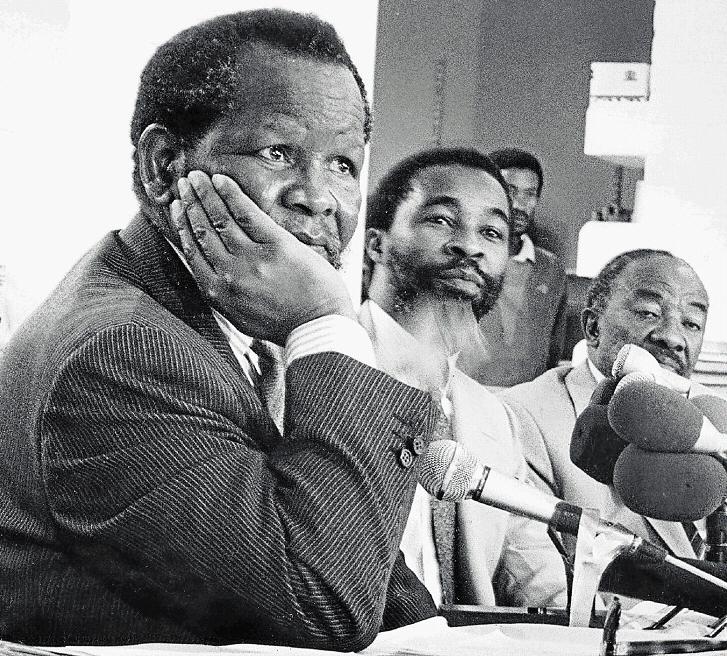
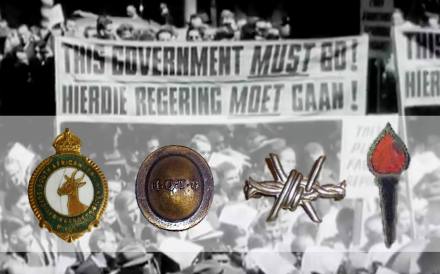
Then, in November the firm hiring Rodney informed him that they were laying him off at the end of the month, so much for timing.  Luckily for Rodney they changed their minds and asked him to stay on for another month.  As fortune would also have it, he turned the security scare to his advantage and told them he would stay on, but only till the 17th December, thereby obtaining an official alibi and cover for his planned disappearance.

Here is where he missed the deadline of the 16th December, as previously stated the limpet mines were old and unstable.  Rodney placed the mines in the pre-determined targets setting 24 hour fuses on the 15th December (a Friday) so they would blow on the public holiday (a Saturday), thereby assuring minimal casualties to his fellow contractors as nobody would be there.

Here’s the kicker, as his contract was ending, his fellow contractors and engineers liked this young man and decided to throw Rodney a farewell party at the plant on the Friday evening just after he had been busy planting the bombs.  Rodney had to sit through his impromptu ‘going-away’ party stressing endlessly that the bombs would not go off prematurely.

He had no real need to worry, as said these limpet mines were old and they would not go off on the Saturday either in fact they eventually went off a day after the target date on the Sunday. The springs on the firing mechanism proved to have been brittle and the devices also exploded over a period of several hours instead of simultaneously.

Rodney’s ‘Great Escape’

Reach for that stiff drink again, you’ll need it for this next part of the story.  Instead of bolting it out the country with a keen sense of urgency, as the other ‘white’ lone wolf MK cadre did – Hein Grosskopf who high-tailed it directly into Botswana after bombing of Wit Command on his motorbike, not even looking back for a nano-second.  No, not our ‘hippy’ would casually, get this, ‘cycle’ out of South Africa on a bicycle, yup you heard right … a bicycle.

He took a domestic flight to Johannesburg and was driven with a borrowed bicycle to a point near the Swaziland border where he jumped on the bicycle and then casually cycled through the border post into exile.

Aftermath 

OR-Tambo-Thabo-Alfred-Nzo-Pic

Oliver Tambo at a news conference in exile (left) Gallo Image

A few days beforehand South African special forces had attacked ANC targets in the kingdom of Lesotho, Oliver Tambo claimed the Koeberg attack was an act of retaliation carried out by a MK ‘unit’ (one chap in reality and as propaganda goes his efforts had nothing to do with the Lesotho raid at all).

How close to nuclear fall-out did we come? Take a big sip that stiff drink again.  Not part of Rodney’s plan but unbeknown to him enriched uranium fuel had been moved into to the plant when the attack took place and was due to come on-line in the reactors.  Luckily for all of us (and here we include the entire planet) it was in dormant storage.

The attack delayed the commissioning of the plant by about 18 months and cost the Apartheid government millions of rand.  This is why this attack sits as No. 2 on their all time greatest achievements (No. 1 is the Sasol bombing and No.3 is the rather controversial and bloody Church Street Bombing).  Although there were no deaths attributed to the bombing, that it nearly cost thousands of lives in the entire city of Cape Town is lost on this particular MK ‘highlight’.

Rodney flew on to Maputo where he met Oliver Tambo, the two exchanged a warm and tearful embrace.  Rodney’s girlfriend Heather was already in Maputo having flown out a week beforehand.  The two jumped on a flight to the United Kingdom and further into exile.

They married one another in Woodbridge, Suffolk, before returning home to South Africa following the general amnesty and unbanning of all ‘liberation’ movements. The TRC rewarded the Wilkinsons and Aboobaker Ismail full amnesty in April 1999. Given the nature of this MK ‘cell’ it seemed a little unlikely that the ANC and its brand of politics is quite Rodney and Heathers bag, anti-apartheid, yes but unlike Carl Niehaus we don’t find him regularly wheeled out in a PEP store set of camos with the other ‘struggle heroes’ and he lives a life in relative obscurity.

A happy ending to our ‘Incidental terrorist’ and an equally and far more happy ending to just about every Cape Town and Western Cape resident, South Africa as a whole, the entire South African tourist trade, the local bio-sphere and the green planet in general. We can now all universally breathe a sigh of relief that the entire Cape Peninsula is not a radioactive ‘Chernobyl’ no-go zone thanks to the African National Congress.

If you chose not to have a stiff drink reading this article, nows a good time to really start.

31674077_2131533363742317_64406157044744192_o

Related Work and Links

Wit Command Bombing; The truth behind the bombing of Witwatersrand Command

Struggle ‘Heroes’; Tainted “Military Heroes” vs. Real Military Heroes

Rocketing of Voortrekkerhoogte; The not so ‘spectacular’ MK attack on Voortrekkerhoogte


Written and Researched by Peter Dickens.  Primary source, an interview with Rodney Wilkinson by a daily mail staff reporter in December 1995 and photograph.  Published news snippets, MK official web-page. TRC references. Image references – general net search. Nuclear terrorism in Africa: The ANC’s Operation Mac and the attack on the Koeberg Nuclear Power Station in South Africa. Jo-Ansie van Wyk


The Torch’s impact on the South African military veteran diaspora!

To really understand who and what ‘The Torch Commando’ military veterans movement was and its anti-apartheid stance, we need to profile the military veteran organisations in South Africa as they stood in 1950, and how they contributed to The Torch Commando and what the ramifications were for each them in the future.

In the South African Legion’s official history ‘not for ourselves’, there is a period described as the “fateful 50’s”, that is because it is in this period South Africa’s World War 1 and World War 2 veterans and their respective veteran associations were drawn into a headlong confrontation with the then newly elected National Party government and it’s policies of Apartheid.

This period, the early 1950’s saw the first mass protests and the first open resistance against Apartheid – and ironically, it did not come from Black, Indian and Cape Coloured communities – it came from the mainly “White” military veterans community.

In a sense it was the South African veterans who spearheaded the protesting to come, and it made the government sit up and take notice as it came from a sector that the government really feared and wanted reformed – the military and its associated veteran associations.

This part of South Africa’s community in 1950 was strong with tens of thousands of freshly demobilised trained combatants. Men and women, who in the main, where ardent supporters of General Jan Smuts and who had just been victorious in the “war for freedom” (as World War 2 was known) – fighting against the very policies and ideologies the new Nationalist government was now proposing for South Africa.

Their actions in the 1950’s against the National Party win of 1948 still shapes the politics of the veterans associations in South Africa even to this day, as the net result was not only the first radical changes in the make-up of the military, it also resulted in the marginalisation of South Africa’s Veteran Associations and community to a large degree and a strained relationship with the Nationalist government down the years.

The Veterans Community in South Africa post WW2

Central to this story were the three primary War Veterans associations in South Africa at the end of World War 2 – The Memorable Order of Tin Hats (MOTH), The South African Legion of the British Empire Services League BESL (The South African Legion as we know it today) and The Springbok Legion.

Politically speaking the MOTH and South African Legion were “apolitical”, the MOTH taking the position of a “order” (along masonic styled rituals) outlining a ‘brotherhood’ for veterans who had seen combat only.   The South African Legion was the “primo” (first) veterans association of South Africa which worked very closely with government as a charity – The South African Legion was open to all veterans whether they had seen combat or not and was by far the largest veterans association in South Africa with 52000 veterans and 224 branches.

The South African Legion, Springbok Legion and General van der Spuy

The South African Legion (BESL), founded by Jan Smuts in 1921 as part of the Royal Commonwealth Ex-Services League (RCEL) was the ‘official’ national body for all South African veterans, and it took a formal approach when dealing with the now ‘new’ Nationalist government and its policies as they impacted Black, Indian and Cape Coloured veterans – choosing to try and negotiate with the government via the formal and non-confrontational channels made available to it as the national body for veterans.

vo056dtg

Gen. van der Spuy

However it was the smallest veterans association of the three – The “Springbok Legion” which took a direct “political” role against the Nationalists – this body was founded in part by a very senior South African Legion national executive member – General van der Spuy (a pioneer of the SAAF), and he used The Springbok Legion to go where the South African Legion could not – into direct confrontational politics.

General van der Spuy, a South African Legion national executive member, became increasingly frustrated with The South African Legion position of ‘quietly’ supporting the anti-apartheid causes in the veterans community simply by opening their branches up to them, and of trying to ‘negotiate’ with the Nationalists as to South Africa’s Black, Indian and Cape Coloured veterans rights via formal channels.  

So, in addition to his position in The South African Legion he also took over The Springbok Legion.  He then took the Springbok Legion from what he referred to as the South African Legion’s “painfully correct whisper of polite protestto become a “shout” of protest instead.

The Springbok Legion

23472831_2045180902377564_421488839758622360_nThe history of the Springbok Legion as a political entity is fascinating – initially formed in 1941 by members of the 9th Recce Battalion of the South African Tank Corps, along with the Soldiers Interests Committee formed by members of the First South African Brigade in Addis Ababa, and the Union of Soldiers formed by the same brigade in Egypt.

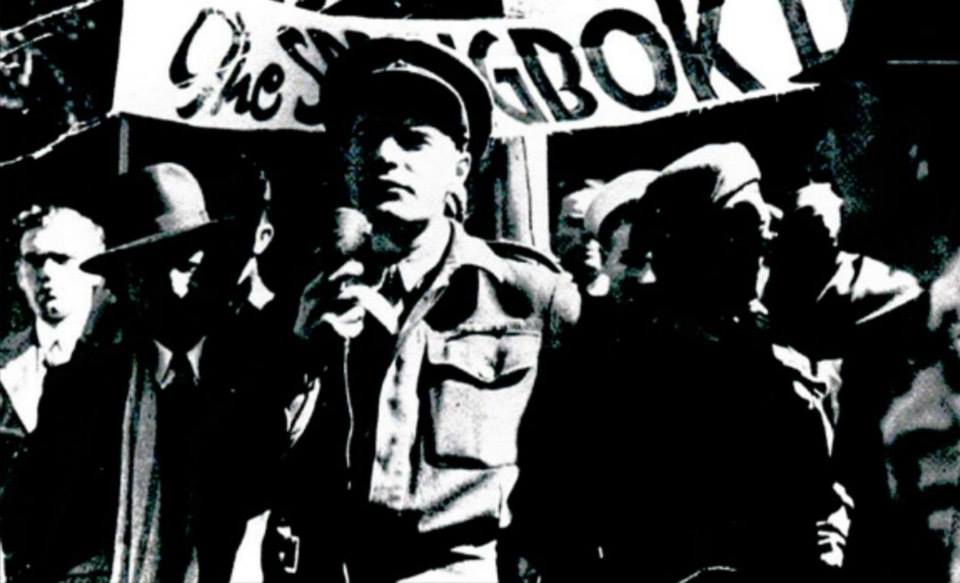
The aims and objectives of the Springbok Legion were enunciated in its ‘Soldiers Manifesto’. The Springbok Legion was open to all servicemen regardless of race or gender and was avowedly anti-fascist and anti-racist.

The Springbok Legion was mainly led by a group of both white and black war veterans, many of whom embraced Communism and it was already very actively campaigning against Apartheid legislation and highly politically motivated.

The Springbok Legion decided to very vocally take the fight against Apartheid legislation into the mainstream media and then into the streets in mass protests, and it became the main driving force behind a new and more strident organisation called “The Torch Commando”, headed up by the famous war hero “Sailor” Malan.

11035448_454230531413351_8517476393970821075_n

Sailor Malan addressing a Springbok Legion Rally

The Torch Commando

23244351_2045180895710898_7895375157337321647_nIn reality, the Torch Commando constituted the first real mass “anti-Apartheid” protests and Adolph ‘Sailor’ Malan can be counted as one of the very first anti-apartheid ‘struggle’ heroes.  Sailor Malan, a Battle of Britain hero and flying ace (one of the best pilots the Royal Air Force had during the war)  returned to his homeland – South Africa in 1946.
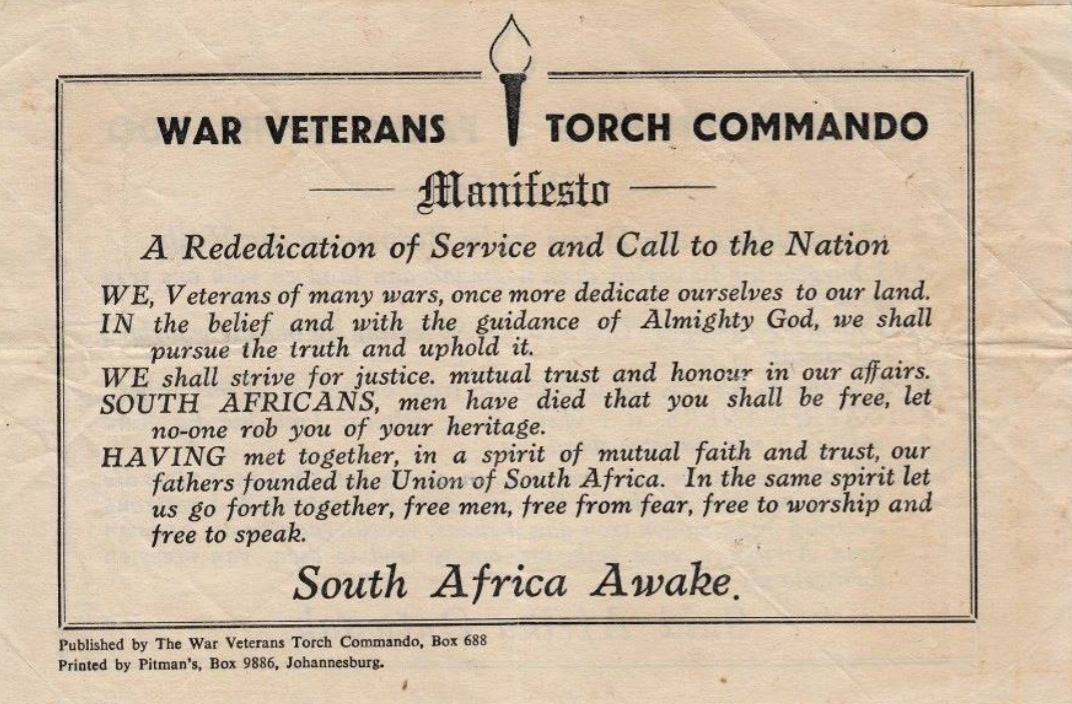
Sailor Malan was surprised by the unexpected win of the National Party over Smuts’ United Party in the General Election of 1948 on their proposal of ‘Apartheid’ as this was in direct opposition to the freedom values he and nearly all the South African veterans in World War 2 had been fighting for.  This new political disposition in South Africa was also rammed full of Afrikaner Nationalists who had declared themselves as either in support of Nazi Germany during the war or even having joined robust pro-Nazi organisations during the war years and declaring themselves as full-blown Nazi styled National Socialists.   This was simply unacceptable to just about every returning war veteran.

To get a full sense of Sailor Malan and his motivations behind the Torch please follow this link to a previous Observation. Post Article Sailor Malan; Fighter Ace & Freedom Fighter!

To get a full appraisal of how the National Party looked just post World War 2 and what it had been up to during the war, do follow this link to a previous Observation Post article “Mein Kampf shows the way to greatness for South Africa” – The Ossewabrandwag

14715460_689736611196074_2236990259246984822_o

The Torch Commando can best be described as a ‘pro-democracy’ movement and in its manifesto it called for Liberty, Freedom of Speech, Liberty from Tyranny and Freedom of Religion. Sailor Malan’s personal politics (which he brought into the Torch) revolved around universal franchise and addressing poverty in the black community and economic empowerment as a priority to political reform. Ironically, Sailor Malan was years ahead of time in this regard, as it is only now that politics in South Africa is focusing on economic emancipation ahead of political emancipation.

The Torch Commando strategy was to bring the considerable mass of “moderate’ South African war veterans from apolitical organisations such as the Memorable Order of Tin Hats (MOTH) and South African Legion (BESL) into allegiance with the more ‘leftist’ politicised veterans of  The Springbok Legion.

The Torch Commando held out that it was NOT a radical leftist organisation but rather a centre line ‘Pro Democracy” movement.  This moderate ‘democratic’ centre had high appeal across the entire veteran’s community, as a result the members of the MOTH, The South African Legion (BESL) and the Springbok Legion joined them in their tens of thousands.

Nearly one in four South African white males took up Smuts’ call to volunteer to fight for Britain and her Commonwealth in World War 2 against Nazi German ideology and aggression.  As a result after the war this veterans community made up 200,000 votes of the white voting community in a voting base of about 1,000,000 white voters.

This portion of voters could significantly impact the next General Elections if spurred into stronger political representation, and the Torch Commando targeted it with a pledge to remove the nationalists by demanding an early election due to unconstitutional and illegal breaches by the National Party of South Africa’s constitution.

To further position itself as ‘pro-democracy’ movement and appeal to the ‘ex-service’ vote  The Torch Commando aligned itself with the United Party (Smuts’ party which was now in opposition) which in 1948 had still commanded a majority support (the Nationalist win had been a constitutional one and not a popular one) and after Smuts’ death the United Party was headed up by Koos Strauss (who was eventually replaced by the more popular war veteran – Sir David Pieter de Villiers Graaf).  The United Party was hoping that the Torch would be the catalyst for them to take back the narrow margins that brought the National Party into power earlier in 1948.

15590218_1878221252406864_7714979752789981284_n

Kmdt. de la Rey at the Cape Town Torch

The Torch Commando, armed with broader appeal to the majority of moderate veterans and under the leadership of very dynamic duo consisting of both Sailor Malan and Kmdt. Dolf de la Rey, now reached out to the wider veteran diaspora.

Kmdt. de la Rey is also interesting – he was himself an Anglo-Boer War Burger Commando veteran and he famously captured Winston Churchill during the Boer War – another one of the rich tapestry of Afrikaner war heroes in conflict with National Party politics and philosophy.

The Torch Commando almost immediately drew massive support – and it saw anti-Apartheid and anti-government protests on a scale previously unseen in South Africa (with all due respect to the African Miners Strike in 1946) .  It all began with torchlight protest marches at night. In all The Torch Commando boasted 250,000 members.  Its torch-light rallies and protests in Durban and Cape Town attracted tens of thousands of veterans – mainly white, and mainly from the middle class and professional strata of white South African society.

In a speech at a massive Torch Commando rally outside City Hall in Johannesburg – to  75,000 people on protest, “Sailor” Malan made reference to the ideals for which the Second World War was fought:

“The strength of this gathering is evidence that the men and women who fought in the war for freedom still cherish what they fought for. We are determined not to be denied the fruits of that victory.”

During the Cape Town “Torch” 50,000 civilians joined the 10,000 veterans when the protest moved to hand over a petition at the Parliament buildings in Cape Town. The police barred the way and a scuffle broke out. 160 Protesters where injured along with 15 Policemen. At this Torch demonstration Sailor Malan famously accused the national party government of:

depriving us of our freedom, with a fascist arrogance that we have not experienced since Hitler and Mussolini met their fate”.

As tensions grew over the protest the National Party MP Johannes Streydom finally warned The Torch Commando that he would use the South African security forces against “those who are playing with fire and speaking of civil war and rebellion”.

The Decline of The Torch Commando

DF Malan’s government was so alarmed by the number of judges, public servants and military officers joining The Torch Commando that those within the public service or military were prohibited from enlisting, lest they lose their jobs – this pressure quickly led to the erosion of the organisation’s “moderate” members, many of whom still had association to the armed forces, with reputations and livelihoods to keep.

The newly governing National Party at that time also could not afford to have the white voter base split over its narrow hold on power and the idea that the country’s armed forces community was standing in direct opposition to their policies of Apartheid posed a real and significant problem – not only as a significant ‘block’ of ‘white’ voters, but also because many of these anti-government veterans were battle hardened with extensive military training, and as such posed a real threat should they decide to overthrow the government by force of arms.

Also the National Party government was extremely concerned about the influence this movement might generate over Afrikaner youth, especially under the leadership of the war heroes, and they acted ‘decisively’ (as was its usual modus operandi) and went about discrediting the Torch Commando and its leaders through means of constant negative propaganda.

For the rest of his life, Sailor Malan would be completely ridiculed by the Nationalist government. The National Party press caricatured him  ‘a flying poodle’, dressed in his leathers and flying goggles, in the service of Jan Smuts and the Jewish mine-bosses, who were referred to as the “Hochenheimers”.  The National Party openly branded him as an Afrikaner of a ‘different’ and ‘unpatriotic’ kind, a traitor to his country and ‘Volk’ (people).

In addition to the National Party’s efforts, the Torch Commando also ultimately failed because it could not distance itself as a political arm of the United Party and establish itself as independent mass action movement. It found itself severely curtailed by mainstream party politics of the United Party (especially on issues such as Natal’s possible cessation from the Union, manifesto freedoms, positions on franchise and addressing Black poverty, actions of the ‘steel commando’ (which was a more militant sect within the Torch Commando) etc. One political cartoon of the time lampoons The Torch Commando as a hindrance to the United Party.

There was also the issue of the Torch Commando’s “Achilles Heel” – The Springbok Legion and its firebrand, highly political and militant anti-apartheid veterans.  The National government took to destroying this veterans association completely and here’s how that happened.

The Springbok Legion’s Rise and Decline

The Springbok Legion, buoyed by the political actions of The Torch Commando gradually became a fully blown political entity in its own right, and the inevitable happened, as with any political party, The Springbok Legion gradually became politically radicalised. This was spearheaded by veterans who were also members of the Communist Party of South Africa (CPSA) and who joined The Springbok Legion and served in its upper and lower structures.

1195451_141209214421_P1170697

The targeting of the Springbok Legion by the Communist Party was the result of the South African Communist Party believing that it could use the veterans to re-order “white” political thinking in South Africa along communist lines.

Emblem_of_the_South_African_Communist_PartyThis eventually resulted in the fracturing of the Springbok Legion as a whole as moderate “white” members, who made up the majority of its supporters became disenchanted with its increasingly militant leftist rhetoric.
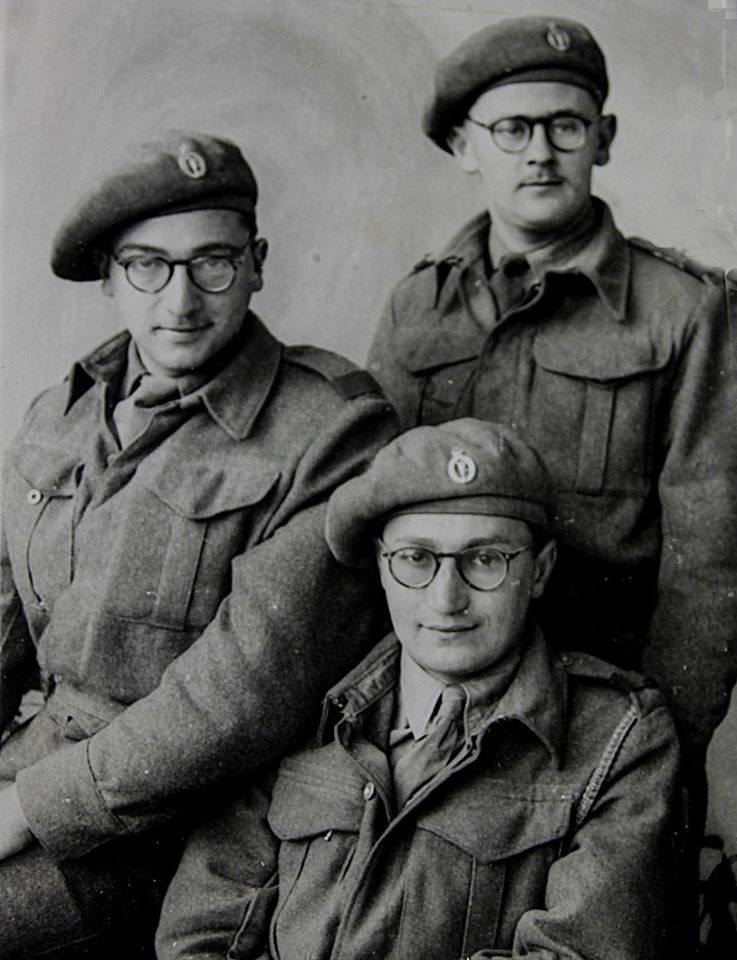
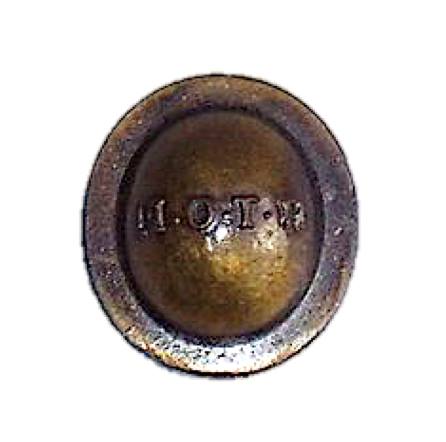
Notable South African Communist Party (SACP) veterans to join the Springbok Legion in a leading capacity where none other than ex-servicemen such as Joe Slovo, Lionel Bernstein, Wolfie Kodesh, Jock Isacowitz, Jack Hodgson and Fred Carneso.

12924483_564897823679954_6021742891576540881_n

Joe Slovo (right of picture) in WW2

Aside from the Communists, Key members included future political and anti-apartheid leaders, such as Peter Kaya Selepe, an organiser of the African National Congress (ANC) in Orlando (he also served in WW2). Harry Heinz Schwarz, also a WW2 veteran eventually became a statesman and long-time political opposition leader against apartheid in South Africa and served as the South African ambassador to the United States during South Africa’s “transition” in the 90’s.

The National Party – which even as part of it’s pre-war make up had a fierce anti-communist stance was becoming increasingly alarmed by the rise of veterans against their policies and began seeking was of suppressing it. One of the mechanisms was to pass the Suppression of Communism Act.

The combined effect of the ‘Suppression of Communism Act’, and the broadening and deepening of the Communist rhetoric and politics was alienating the majority of Springbok Legion members rang a death knell for the Springbok Legion and the inevitable happened, the organisation folded as thousands of its “moderate” members left, returning to the either the apolitical MOTH movement or the South African Legion (or both).

23334224_2045633818998939_6946976336053428991_o

Rica and Jack Hodgson wearing Springbok Legion badges in the 1940s

The Communist Party members of The Springbok Legion who had played a pivot in its rise and its demise i.e. Joe Slovo, Lionel Bernstein, Wolfie Kodesh, Jack Hodgson and Fred Carneso all then joined the African National Congress and, given their experience as combat veterans, they also all joined its military wing Umkhonto we Sizwe under the command of Nelson Mandela.

Once clear that Springbok Legion was at an end as an organisation – part of its branch infrastructure and a great many of their “moderate” members where then absorbed into the South African Legion (BESL).

It was however very clear that the veterans community had shown their colours – and the relationship between the Nationalist government and the ‘apolitical’ national body i.e. South African Legion was to remain strained for some time come.

Sailor Malan returns to his ‘shell-hole’

23316645_2045180912377563_1947893965526734465_nSailor Malan’s political career was effectively ended and the “Torch” effectively suppressed by the National Party, so he returned to his hometown of Kimberley.  Sailor then joined his local Memorable Order of Tin Hats (MOTH) shell-hole (branch) in Kimberley and withdrew from politics, choosing instead the social and camaraderie of his like-minded colleagues in his ‘shell-hole’ and the ‘good life’ (he had a reputation as the ‘life of a party’).

Sadly, Sailor Malan succumbed on 17 September 1963 aged 53 to Parkinson’s Disease about which little was known at the time. Some research now supports the notion that Post Traumatic Stress Disorder (PTSD) can bring on an early onset of Parkinson’s Disease, and it is now thought that Sailor Malan’s high exposure to combat stress may have played a part in his death at such a relatively young age.

It is to the embarrassment now as to his treatment as a South African WW2 military hero that all enlisted South African military personnel who attended his funeral where instructed not to wear their uniforms by the newly formatted SADF. The government did not want a Afrikaner, as Malan was, idealised as a military hero in death in the fear that he would become a role model to future Afrikaner youth.

The “official” obituary issued for Sailor Malan published in all national newspapers made no mention of his role as National President of The Torch Commando or referenced his political career. The idea was that The Torch Commando would die with Sailor Malan.

All requests to give him a full military funeral were turned down and even the South African Air Force were instructed not to give him any tribute. Ironically this action now stands as testimony to just how fearful the government had become of him as a political fighter.

moth-logo1The campaign to purge the national consciousness of The Torch Commando, The Springbok Legion and Sailor Malan was highly effective as by the 1970’s and 1980’s the emergent generation of South Africans have little to no knowledge of The Torch or The Springbok Legion, it is highly unlikely that anyone today remembers Sailor Malan’s speech to 75,000 Torch Commando protesters in the centre of Johannesburg.  The veterans community today, albeit very small, have kept his memory alive, Sailor’s MOTH shell-hole in Kimberley still remember this outstanding war hero very fondly to this day,
The marginalising of The South African Legion

23316506_2045181059044215_5913293740943393863_nMany older people will remember a time in the 50’s, 60’s and early 70’s, when on “Poppy Day” thousands of South African Legion members with their supporters would ‘sell’ paper red poppies raising funds for veterans in need in just about every major shopping centre all over South Africa.  Some may even remember the South African Legion visiting their schools and explaining the meaning of the Poppy.
However, by the 1980’s the South African Legion and its Poppy legacy was all but gone from the national consciousness – so what happened?

SALegion_FinalLogoLayout_GreenPrintTextSimply put, even though the South African Legion (BESL) had taken an apolitical stance and chosen a cordial approach in dealing with the Nationalists, it still found itself coming into headlong confrontation with the National Party government, both in terms of its individual members’ politics but also in terms of the mandate given to it as the national body to look after Cape Coloured, Indian and Black South African veterans in need.
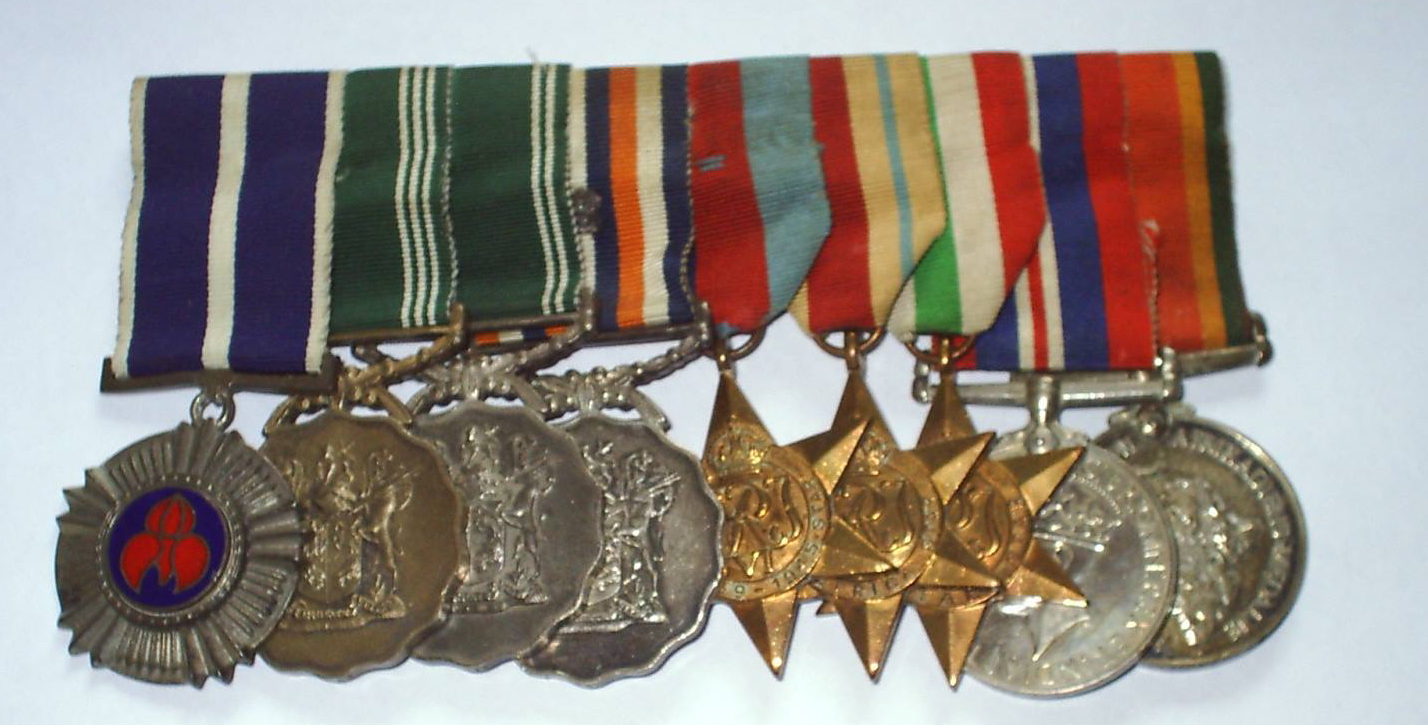
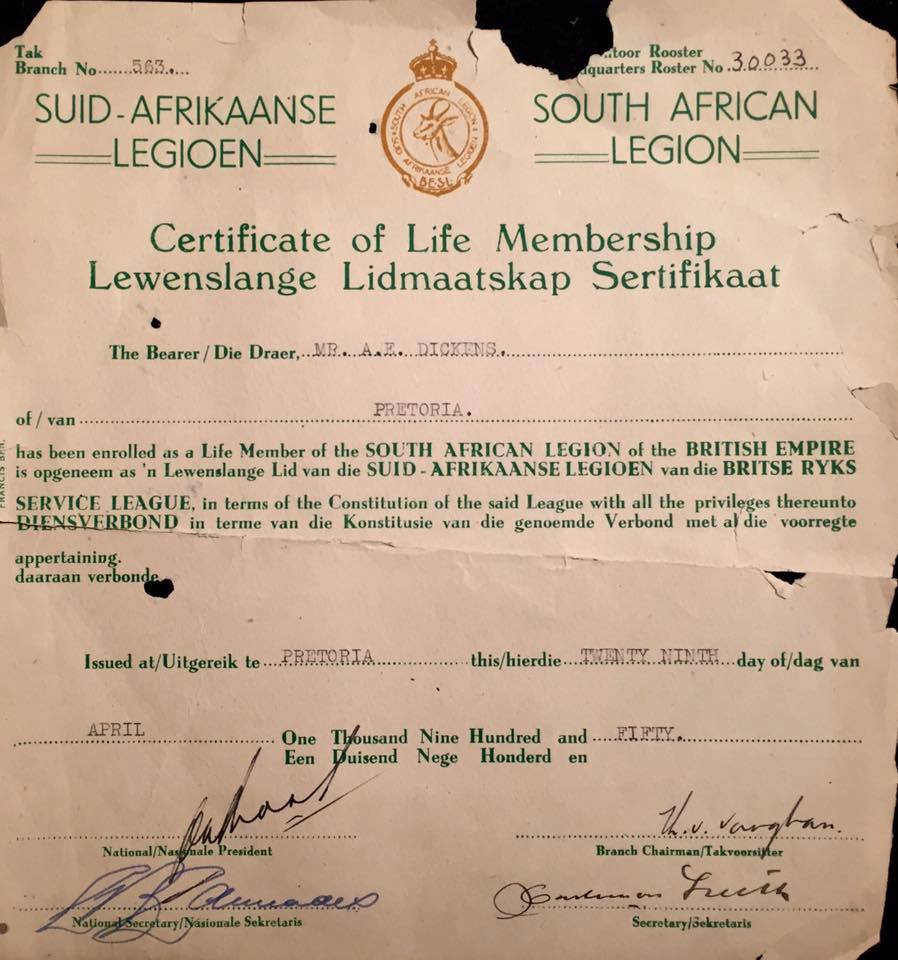
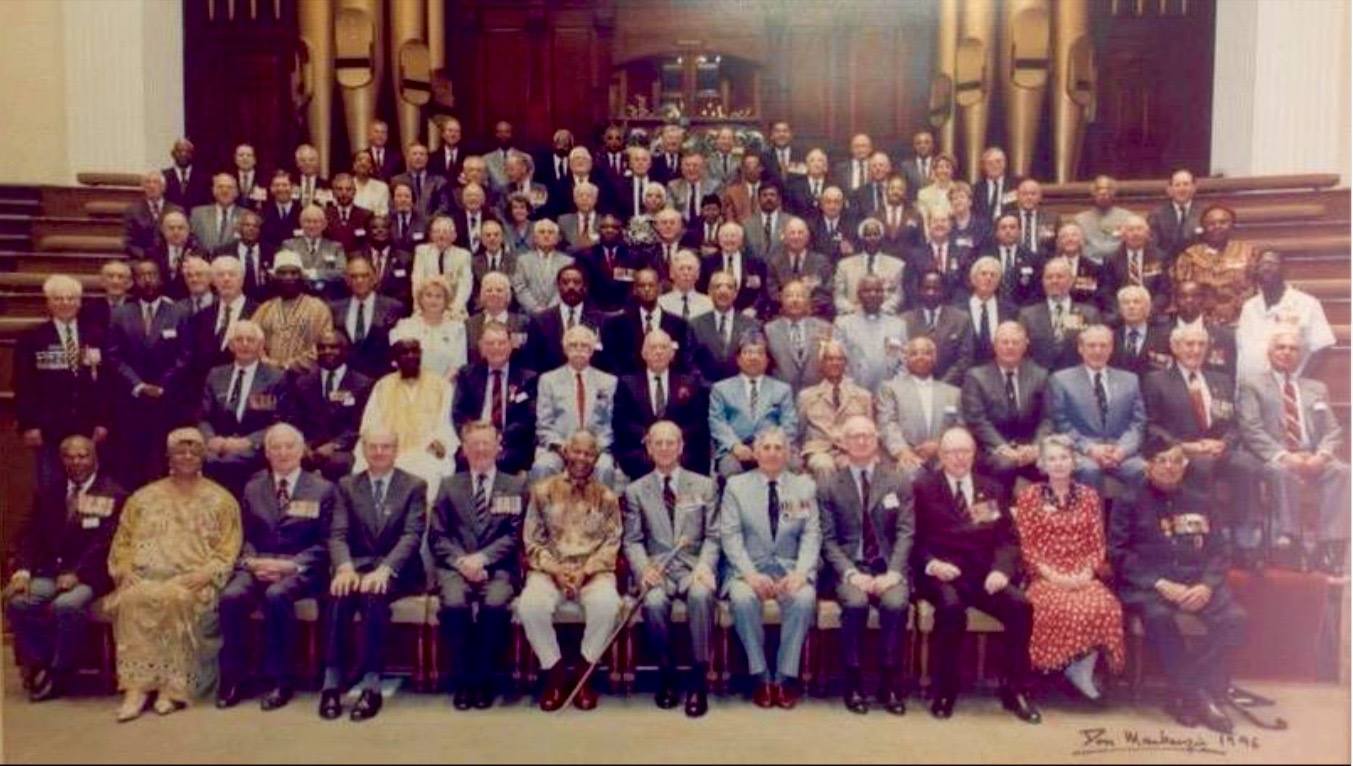
To a degree the MOTH were spared this confrontation as their joining criteria in the 1950’s and 1960’s specified the MOTH order for “combat veterans only” – and as ‘combat’ veterans were defined by race politics in South Africa as ‘whites and cape coloureds only’ during World War 2 the MOTH by default did not attract many Black members of The Native Military Corps who were deemed ‘non-combative’ by the definitions of the time.  The South African Legion on the other hand was a viable veterans association for Black veterans during these years – and to this very day The South African Legion still has many of these old veterans on its books.

From the beginning of 1948 the South African Legion’s relations with the Nationalists were starting to strain via the actions of The Torch Commando and South African Legion (BESL) members joining it, but a major clash was to come when the South African Legion reacted strongly in 1956 to the Government’s move to ban Black and Coloured veterans from Remembrance Day Services.

Another confrontation occurred when the South African Legion requested the Nationalist government to waive pass laws for Black military veterans who had served South Africa (not some ‘Bantustan’) and therefore should be treated differently, however this request unfortunately worked for a limited time and the juggernaut of Apartheid law and policy implementation eventually simply over-ran it.

The South African Legion was again at loggerheads with the National Party government over the lack of parity with regard to pensions paid out to Black and Coloured veterans.  The fight to obtain parity of pensions for all – white, coloured and black veterans was finally won in 1986/87. It had been a very long battle for the South African Legion.

The old World War 2 veterans sitting in their MOTH Shell-Holes and South African Legion branches (and even those still serving) were again at serious loggerheads with the newly formatted SADF and the Nationalists – when in a very sinister move the government decreed that all their highest bravery decorations (military cross, DSO etc) along with campaign medals and Stars – all won in the Second World War were for a ‘foreign’ country in their estimation (Britain – and not South Africa) and therefore these decorations and medals had to take the junior position after even the most lowly SADF service medal on their medal racks.

1614474_10201367107008779_510395781_o

WW2 South African veterans rack – note the very senior WW2 campaign stars and campaign medals in secondary position (left to right) to more junior SADF Service medals

To add insult to injury, amongst many other changes to remove ‘British’ and ‘English’ heritage,  they also went about introducing German styled NCO rank insignia and reformatting many of their infantry and regiment formations which resulted in new insignia and hard-earned Battle honours laid up and new colours initiated instead.

The net result of all of this was a ‘them and us’ mentality, where the old veterans in the South African Legion branches and MOTH shell-holes looked at the SADF in disdain – some refusing to alter their medal orders and The Nationalists (and many Afrikaners in the SADF officer class) also began to brand The South African Legion (BESL) and The Memorable Order of Tin Hats (MOTH), as ‘British’ and ‘unpatriotic ‘ whilst they maintained their ‘British’ links, insignia and heritage.

The government also started to gradually turn off the taps of the supply of veterans to the South African Legion and the MOTH from the newly formatted ‘South African Defence Force’ (SADF), when SADF personnel completed their service.  Whereas under the old South African Union’ Defence Force (UDF) such a transition when demobilising was the norm.

15698128_1885140061714983_691947815593202916_n

Certificate granting Life Membership of the SA Legion given to Union Defence Force members demobilising after WW2

By the mid 1980’s the SADF simply would not actively promote the South African Legion (or the MOTH) to the thousands of SADF permanent force members and conscripts as a veterans association option and ‘home’ available to them post service.

The National Party also took South Africa out of the British Commonwealth of Nations in 1961, and along with sanctions and International isolation, the South African Legion – as a Commonwealth inspired and linked association, found itself floundering in a country whose government had no time for the British and the Commonwealth and its affiliations at all.

Faced with an ageing membership, a divergent view to that of the Apartheid government of the day, and no ‘new blood’ from the Alma Mater – the South African Defence Force (SADF) – for nearly four decades on end, the South African Legion (and the MOTH) gradually started to slip into long-term decline.

A major casualty of all of this was the gradual removal of the ‘Poppy’ as an icon of Remembrance from the general population’s mass consciousness.  Embroiled in race politics where black servicemen were marginalised and events as to Apartheid took greater national precedence, the Poppy took a back seat to the seismic events of the day – and where the movement flourished in other countries, it declined in South Africa.

1994 

1994 was a significant year in many respects, South Africa re-joined the Commonwealth of Nations and was invited back into the International world.  Almost instantly Queen Elizabeth II visited South Africa to re-kindle the links and in a landmark move, The Royal Commonwealth Ex-Service League (RCEL) decreed that its 75th international convention would again take place in Cape Town (the city where it was founded). Nelson Mandela even opened the RCEL’s Cape Town convention on the 26th February 1996 with an upbeat message to re-kindle the purpose of South Africa’s primo veterans association – The South African Legion (a founding member of the RCEL) and re-establish South Africa’s place in the international veterans community (for more of this history see Observation Post Legions and Poppies … and their South African root).

12496402_10153772579221480_7174090535779586670_o

Nelson Mandela opening the 75th Convention of The Royal Commonwealth Ex-Services League in Cape Town – 1996

Not so fast!

So, in the mid 90’s – the surviving veteran’s bodies reconciling and extending olive branches, the SADF now reformatted into the SANDF and the legacy of the Torch Commando and its political influence to split the surviving veterans associations (The South African Legion and MOTH) away from their ‘Alma Mater‘ –  the South African Defence Force, long-buried and a thing of past … right?

Wrong!  Typical to a South Africa personality – put two of us in the same the room and we’ll come up with three political parties.

Where are we now?

The fracturing nature of South African politics which played such a significant role in forming The Torch Commando in the first place, still plays out in South Africa.  Still not unified in a singular mission the veterans community remains as fractious as ever.  Race politics, party politics and political one-upmanship has dictated that the ‘non statutory forces’ veterans associations (APLA, MK etc) have a separate umbrella association to the ‘statutory forces’ veterans associations.

1185958_516504791764854_16020334_nThe ‘statutory’ associations i.e. the Infantry Association, Armour Association, Naval Officers Association, Gunners Association, Caledonian Regiments Association etc. etc. are combined and lumped with more newly sprung ‘broader’ veterans associations – the SADF Veterans Association, the South African Military Veterans Organisation ‘International’ (a spin-off from a Australia based SA veterans association) and more, each targeting the same veteran – all of whom exist under their own umbrella organisation – The Council of Military Veterans Organisations (CMVO).
If you’re confused now – there’s more!  They all fall under another reformatted umbrella body – The South African National Military Veterans Association (SANMVA), which is designed to bring about reconciliation and common value.

23472242_2045680692327585_4594319913114114412_nThis all in turn falls under the ‘Department of Military Veterans’ (DMV) a government department under the Minister of Defence which toes a very African National Congress (ANC) party political line in its media either shaming or ignoring the statutory veterans (especially the old ‘SADF’ members who make up the majority of the Department’s mandate and membership) and highlighting the deeds of the non statutory political party veterans, primarily ANC Umkhonto we Sizwe (MK) veterans as noble ones instead (and these veterans are contentious at best).
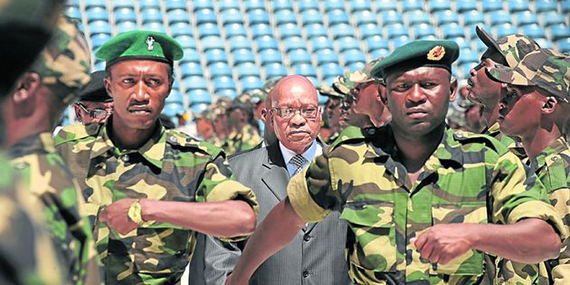
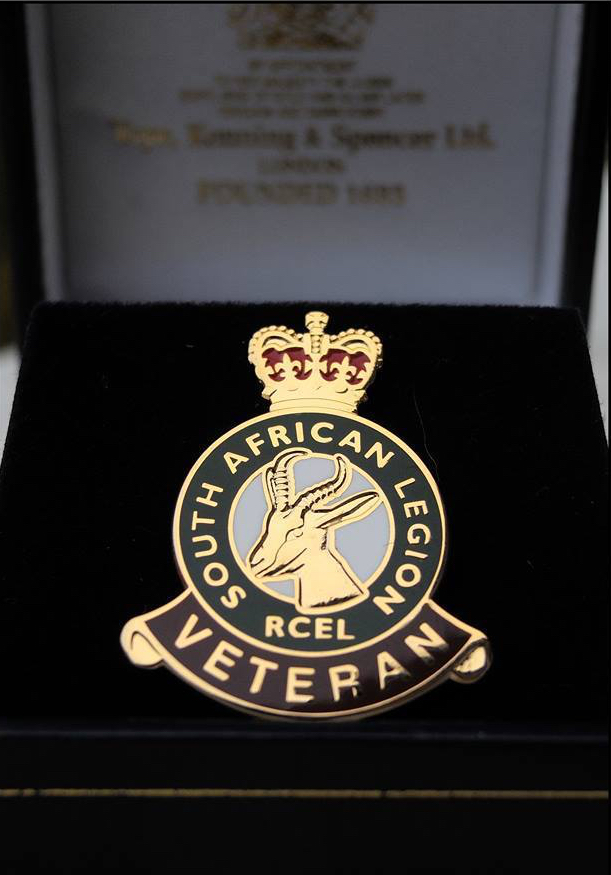
So, there are no surprises here then – the government of the day, behaving exactly like the old Apartheid nationalists, now dictate who they regard as military heroes whilst ignoring or vanquishing others for political expediency – same, same approach, new epoch – the nobility of Nelson Mandela’s reconciliations, honour, respect, remembrance and understanding of all of South Africa’s veterans from all the ethnic groupings of South Africa … now a long lost and conveniently ignored memory.

Internship-Internship-programme-Department-of-Military-Veterans

Add to this the advent of social media which has seen a raft of pseudo South African veteran organisations, clubs, orders, charities etc spring up on various on-line social media platforms (Facebook, Whats-app etc.) over the past ten years. All purposefully not aligned to any official veterans body or department (citing the political climate and separation from having to deal with ‘ex-terrorists’).

These digital groupings and their spin-offs are not recognised by the law of the land or their peers in the properly constituted veterans associations – but they are promising the world to some disillusioned South African military veterans, and in many instances these veterans are preyed upon by opportunists trying to make a fast buck and false Messiah’s promising things that can never be delivered on, as they are simply not ‘recognised’ as legitimate associations.  They cannot draw benefits for their members and have no formal representation of their members needs or ‘voice’ when dealing with government, non-government organisations, the public at large and international veterans federations – like the Royal Commonwealth Ex-Services League (RCEL) and UN’s World Veterans Federation (WVF).

What this shows up is the continued divisiveness of South African race politics and instead of consolidating as veterans many of these digital gatherings have headed off to ‘do their own thing’ (usually by way of their political convictions) and create more division (more often than not).  Generally they are ignored by the DMV and the CMVO and without official recognition they really are on a highway to nowhere.  What they do manage to do however is divert much-needed Human Resources from South Africa’s long-standing veterans bodies like The South African Legion and MOTH, and that’s not helpful to anyone.

So where do surviving organisations like The Memorable Order of Tin Hats (MOTH) and especially – The South African Legion – as the country’s primo veterans organisation sit now?

Safe to say they are just cracking on and hoping everyone will come round to their senses, stop re-imaging themselves after this or that dying political epoch, stop politicising what is essentially a charitable cause and join their infrastructures – which for decades have been in place to serve South African veterans only (In the case of the South African Legion – for nearly 100 years), not only in terms of physical buildings but also in terms of Camaraderie and Remembrance – and infrastructures which are now badly in need of new blood (and money) to see them into the future.

12509616_1079472838770400_3237676186530456056_n
In some respects they wait until the usual political course becomes its calamitous self and the inevitable implosions start to happen (as they have been doing in South Africa for decades now, starting with veterans groups like the Springbok Legion and the Torch Commando politicising themselves) – and they just bide their time and focus on the real life issues at hand and championing the one relevant person in all of this – the person who signed up to serve his or her country in uniform – the veteran!


Written and Researched by Peter Dickens. 

References Lazerson, Whites in the Struggle Against Apartheid. Neil Roos. Ordinary Springboks: White Servicemen and Social Justice in South Africa, 1939-1961. Wikipedia and “Not for ourselves” – a history of the South African Legion by Arthur Blake.  South African History On-Line – a History of the Springbok Legion.  Image copyrights – Imperial War Museum and Associated Press.

‘New’ rare footage of The Torch Commando in action, the first mass protests against Apartheid by WW2 veterans.


Sometimes you come across gems, and occasionally more information on The Torch Commando surfaces.  This is more very rare footage showing South Africa’s first mass protests against Apartheid, led by Sailor Malan, a World War 2 fighter Ace and Battle of Britain hero.

The inconvenient truth to the modern African National Congress driven narrative of what and who qualify ‘struggle heroes’ is that this movement was the first really significant ‘mass’ protest movement against Apartheid, and it was made up of mainly of white war veterans, led by a white Afrikaner – that’s a fact.  By no means was The Torch Commando small either, at its peak it boasted 250 000 members and their protests attracted between 30 000 to 75 000 people.

Since publishing the first video and articles on The Torch Commando, a number of people have fed back to The Observation Post to dispute this above basic fact.  To see a fuller article on The Torch Commando and other footage, follow this link:

The Torch Commando led South Africa’s first mass anti-apartheid protests, NOT the ANC!

They highlight the following:

The Torch Commando concerned itself only with the Coloured Franchise – This is incorrect.

The Torch Commando Manifesto called for Liberty, Freedom of Speech, Liberty from Tyranny and Freedom of Religion. Sailor Malan’s personal politics which he brought into the Torch revolved around addressing poverty in the black community and economic empowerment. Franchise and political reform is actually something Sailor Malan saw as secondary.  Funnily, Sailor Malan was years ahead of time in this regard, as it is only now that politics in South Africa is focusing on freedom from economic emancipation ahead of political emancipation.

14715460_689736611196074_2236990259246984822_o

Torch Commando Manifesto

The Torch Commando focussed on protesting against DF Malan’s National Party’s 1948 election win with its proposals of Apartheid.  It saw itself as a ‘pro-democracy’ movement and regarded the National Party’s policies as ‘anti-democratic’.  The Cape Coloured franchise removal was the first action of the National Party to implement the edicts of Apartheid, so it stood to reason that this was the first issue to protest against.

The Torch Commando in Natal was particularly focussed on the cessation of Natal from the Union of South Africa in 1950, now that Afrikaner nationalists were in absolute power in controlling the Union.  Natal had a predominately English speaking voting public who were very loyal to their British origins.  This issue of cessation in Natal brought The Torch Commando into direct conflict with the United Party (Smuts’ old party and by then it was now the official party in opposition) and The National Party in that province.

A key objective underpinning the Torch was to remove the National Party from power by calling for an early election, the 1948 ‘win’ by The National Party was not a ‘majority’ win, but a constitutional one, and the Torch wanted a groundswell to swing the ‘service’ vote (200 000 in a voting population of a 1 000 000).  The Torch at its core was absolutely against The National Party’s Apartheid ideology and viewed their government as  ‘unconstitutional’ when they started implementing policy.  This is why the Torch Commando found itself in bed with Smuts’ old United Party in opposition in the first place.

Other issues also sat at the core of the Torch, one issue was the Nationalist’s headstrong policy to make South Africa a Republic, whereas the ‘servicemen’ had fought alongside the British commonwealth – and they wanted South Africa to retain its Dominion status, remain a ‘Union’ and remain part of the Commonwealth of Nations.

21743765_2021324431429878_9049818004730303472_o

It is also incorrect to assume that The Torch Commando did not feel the sting of repressive and violent government counter actions.  There is a recorded case of a clash of Torch Commando protestors in Cape Town and the Police, who were sent to break up a secondary march onto Parliament, it was also met with further threats of violent repression by the Nationalist government after that incident.

The 1780 Xhosa Rebellions and other tribal uprisings precede The Torch Commando as the first mass uprisings against Apartheid – This is incorrect.

With regard the Xhosa wars, South Africa was not a country in 1780.  The South African Union was established in 1910.  Preceding that the various British Colonies and Boer Republics that would ultimately become a Union had different policies on race relations and the conflicts against these policies need to be viewed in relation to the Colony or Republic concerned, as they all differ very much from one another in both policy and historical context (even between the two British colonies of the Cape and Natal).

Movements like the 1913 Women’s Anti-Pass movement, the founding of the ANC in 1912, the 1946 African Miners Strike, Mahatma Ghandi’s civil dissonance campaign – all precede the Torch Commando as the first Anti Apartheid mass movements.  This is incorrect.

13450028_10154250644792329_4746410985414422490_nThe is a very big separation between race politics in the Smuts epoch and the Apartheid epoch. Race politics existed in South Africa during the Smuts era, of that there is no doubt.  However Smuts was addressing it and political resistance on a really ‘mass’ basis from from these communities did not really exist at the time.  Smuts and his politics are complex, he initiated violent counter action to any dissonance by striking miners or Afrikaner rebellions (whether Black or White, it mattered not a jot to him) but more often than not used dialogue, and a lot can be said to the fact that the ANC in fact supported Smuts’ decision to take the country to war in 1939/40.
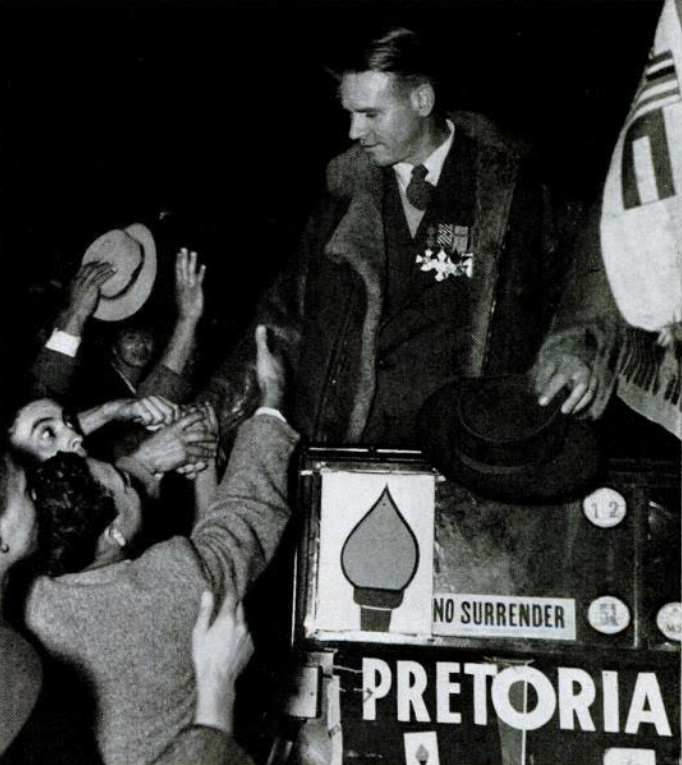
The fact is that prior to 1948 ‘resistance’ on a mass level to Smuts’ policies came from the white sector, and it came from fierce Afrikaner nationalists who had joined organisations like the Ossewabrandwag and Nazi grey shirts, whose objective was to topple the Smuts’ government by force of arms.  The Ossewabrandwag had about 200 000 supporters, these were the true resistance and mass movements facing the Smuts epoch.  They were the biggest threat to the Union of South Africa and Smuts’ biggest political headache.

The 1946 miners strike, was a one week mass strike action which ended in violence with government forces, the underpinning problem was a wage dispute, it was settled with a 10 shilling per day minimum wage (an increase from 2 shillings), and improved working conditions as the basis of the strikers demands.  This action needs to be viewed as dispute on wages and conditions of miners with the mine companies primarily.  It was not really a political protest against an entire system of government.

The 1912 Anti Pass Women’s movement needs to be viewed in context with the British Suffrage Movement which they chose to follow, and revolved around a worldwide problem of female political representation (in Europe as in Africa). Gandhi’s Satyagraha campaign against pass laws eventually succeeded in 1914.  Smuts’ and Gandhi actually became friends over the process and admired each other greatly till the day they died.

Post World War 2, Smut’s approached the 1948 elections with the idea of giving franchise to South Africa’s Black population on a phased and qualification basis.  He had promised Black Community leaders to give more political representation to the Black community if they supported the war effort – which they did.  It was these proposals and policies which went up against the National Party’s Apartheid policies in the 1948 elections.  It was Smuts’ willingness to address the African franchise issue that led to his failure in the elections, with the Nationalists playing into ‘white fears’ of Black African political empowerment which swung the vote to them.

Apartheid as an institutionalised policy started in 1948.  The first mass protests against this institution started in 1951.  The people who led this mass protest action were The Torch Commando, and not the ANC, their ‘Defiance Campaign’ came later.  Prior to this the proper ‘mass action’ against the Smuts’ government came primarily from disaffected and militant Afrikaner nationalists in their hundreds of thousands wanting an Apartheid state. That’s a fact.

The Observation Post is re-writing history.  This is incorrect

The intention of highlighting The Torch Commando is that it was ‘written out of history’ by The National Party and remains ‘written out’ for political expedience by the current government.  It is a ‘inconvenient truth’ as it highlights a mass movement of pro-democratic white people not in alignment with Apartheid.  It challenges the prevailing malaise of thinking in South Africa – that everything prior to 1994 was ‘evil’ and white South Africans must therefore share a collective ‘guilt’.  The purpose is to highlight great men like Sailor Malan and movements like the Torch Commando, uncover their hidden history and enter their contributions into the annuals of progressive South Africans who sought change and universal franchise and honour them as such.

15541961_689668087869593_6848483991317263370_n

Sailor Malan at a Torch Commando Rally in Cape Town


Written by Peter Dickens.  Video footage Associated Press copyright.