So, here’s an interesting “first” for South Africa, we are the first nation who can hold up the very first aircraft hijacker as our own. Now, it’s not what you think, he’s not your deranged Islamic extremist or strait forward nut-job hijacking some or other commercial airliner … he’s a South African Air Force pilot and the aircraft he hijacked was a military aircraft belonging to the Axis forces during World War 2. His name was Lt. Colonel Edward Theodore Strever, South African Air Force (SAAF) No. 217 Squadron, or just plain “Ted” and both he, and his deeds are the stuff of legend, here’s his hijack story:
The Attack
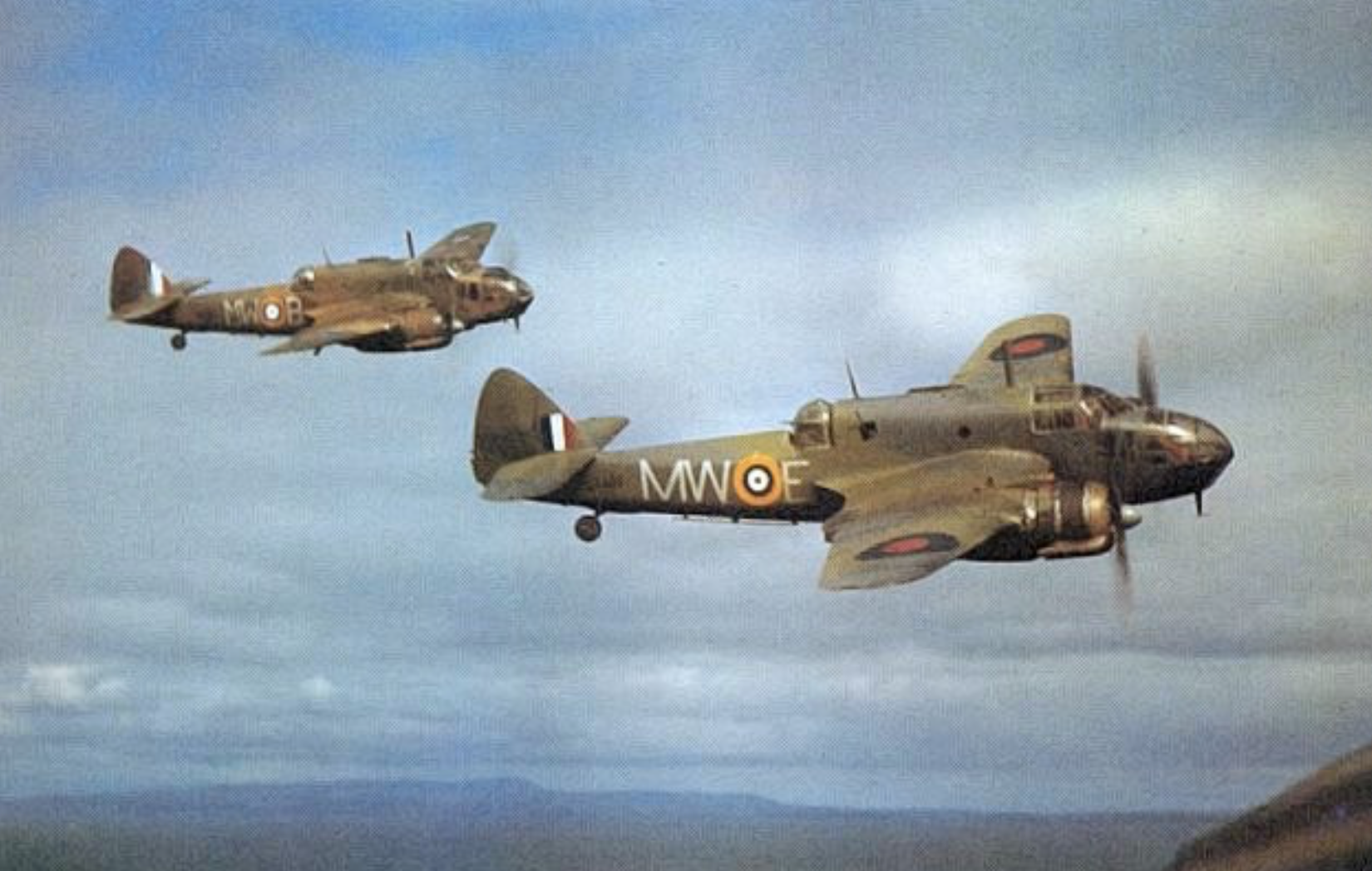
During the war, Ted Strever, then a SAAF Lieutenant, found himself seconded to the Royal Air Force (RAF) flying a RAF 217 Squadron Bristol Beaufort twin-engined torpedo bomber L9820 and based at Luqa airfield in the isle of Malta. On 28th July 1942, 217 Squadron was engaged in attacking Italian Merchant shipping off Southern Greece. On that day Lt. Edward “Ted” Strever (SAAF) is captaining his Bristol Beaufort with a motley crew, his navigator is Pilot Officer William Dunsmore, Royal Air Force (RAF), from Liverpool. Sergeant John Wilkinson is his wireless operator, Royal New Zealand Air Force (RNZAF) from Auckland and Sergeant Alexander Brown is his Air gunner, also Royal New Zealand Air Force (RNZAF) from Timaru.
RAF 217 Squadron Bristol Beauforts
They spot a 12,000 ton Italian cargo ship escorted by two destroyers, targeting the cargo ship they go into a torpedo run, intense enemy defensive fire sees Ted Strever’s wingman go down, but Strever is able to get his torpedo away. His torpedo slams into the side of the target in a direct hit, eventually sinking the vessel. However in passing over the target Ted’s Bristol Beaufort is shot up, taking damage to both engines. The stricken bomber is forced into a water crash-landing, the crew all survive and in the 90 seconds it takes the Bristol Beaufort takes to sink, they all manage to scramble into an inflatable dingy.
Taken Prisoner
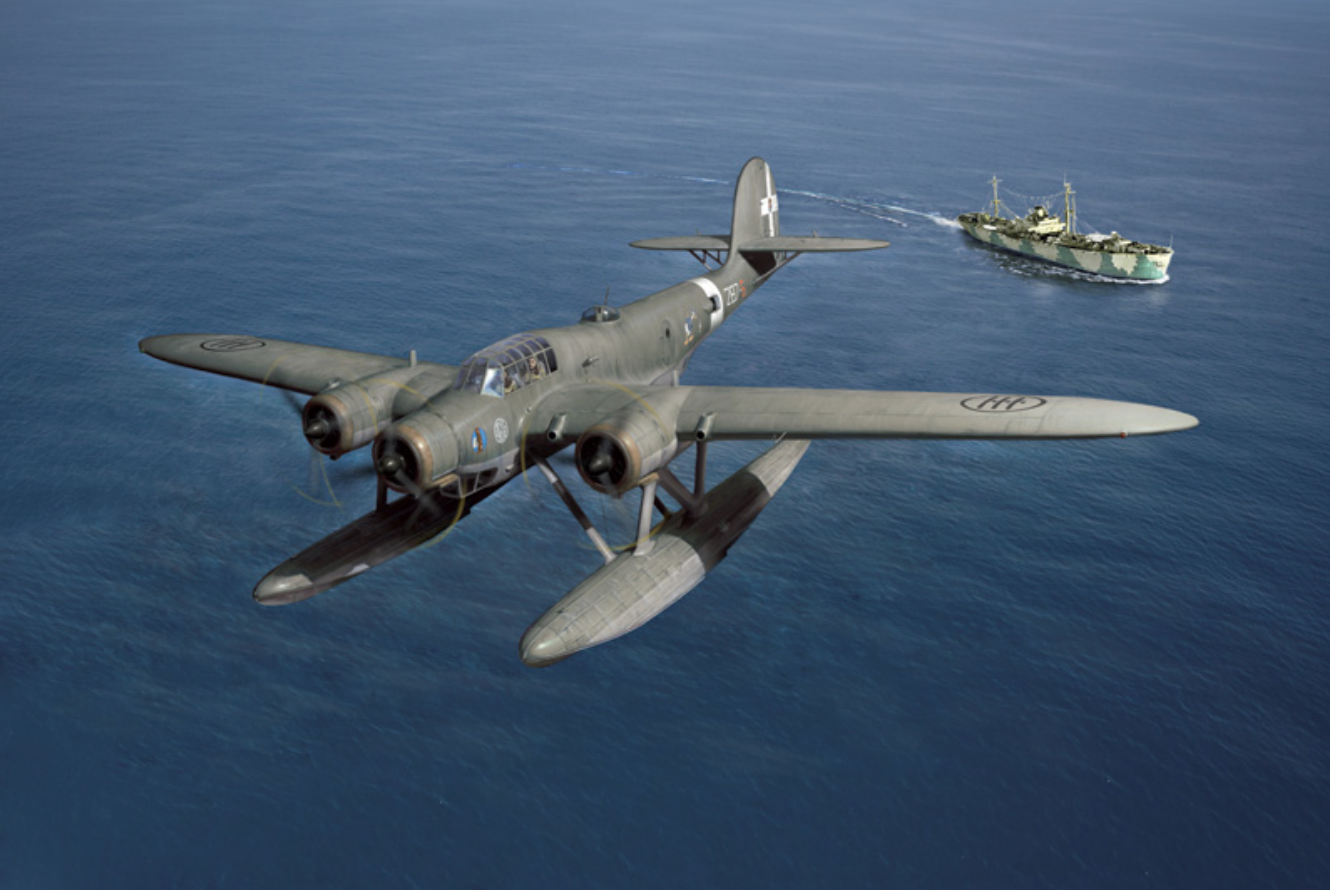
Not long after scrambling into their dingy after the crash Ted and his crew were picked up by an Axis sea plane – an Italian CANT Z506B ‘Airone’ (Heron), a maritime reconnaissance plane and bomber, it has 3 engines, a crew of 4 and floats – it puts down near the dingy and Ted and his crew are hauled aboard. The Italian crew make the Allied crew Prisoners of War – and kindly give them some brandy and cigarettes to smooth their ordeal of the attack and crash. They are then flown to a small harbour on the island of Corfu. Taken to a nearly camp, the Italians continue to treat them well and they are fed a meal of steak, tomatoes and wine – more cigarettes and given comfortable beds.
The next day after having eggs for breakfast the Italian’s informed the captured Allied crewmen they will be taken to Taranto in Italy, here they would spend the rest of the war as prisoners – they immediately begin to conspire as to escaping. A few hours later they are back at the small harbour, and back in the same aircraft that had rescued them the day before – the CANT Z506B ‘Airone’ – with the same 4 Italian aircrew, only this time there is an extra armed guard – a corporal.
CANT Z506B ‘Airone’
The seaplane took off and set a westwards course, after a short time, the Allied crew talking softly amongst themselves, hatched a hasty escape plan. They are about to make history with the very first “skyjacking”.
The Escape
Sergeant Wilkinson (RNZAF) leans forward and punches the Arione’s wireless operator hard in the face, he leaps over the failing body and over-powers the armed guard, taking his pistol and passing it to Lt. Ted Strever (SAAF). Pilot Officer Dunsmore (RAF) and Sergeant Brown (RNAF), tackle the aircraft’s engineer. The commotion alerts the two pilots, one draws his pistol and the other fumbles with a sub machine gun, however in trying to recover control of the aircraft the pistol is knocked from the pilot’s hand by his colleague. Ted Strever advances on the pilots using the corporal as a human shield and then disarms the pilots – the Italians are then tied up using their own belts. The aircraft is now in the hands of Ted and his crew and Ted takes over the controls – it’s all a little too much for the Italian corporal, not used to flying and in all the excitement he becomes violently air-sick.
More problems rear their heads, Ted Strever is unfamiliar with this aircraft type, cannot understand the fuel situation and had no maps. So, they untie the Italian co-pilot, put him in the pilot’s seat and at gun-point instruct him to fly the aircraft to Malta.
Next was the problem of flying an enemy Italian aircraft into Allied controlled airspace around Malta. On approaching Malta they are intercepted by 3 RAF Spitfires from No. 603 Squadron, the Spitfires immediately pounce on the Arione and start shooting it up. P/O Dunsmore frantically tries to wave the deadly attack off by leaning out and waving his white vest out a window – but to no avail. The Arione, now full of holes and badly shot up, makes an immediate sea landing. The Allied crew climb on top of the wings and start frantically waving the Spitfires off – the target neutralised the Spitfires break the attack. The British then dispatch a RAF ‘crash-boat’, a high speed Air Sea Rescue Launch HSL 107, from Kalafrana to pick the aircrew and tow the sea-plane in.
Astonished to see four Allied aircrew in the enemy plane a member of the RAF crash boat team tasked with towing them to St Paul’s Bay is reported to have said
“We thought it was old Mussolini coming to give himself up!”
RAF ‘Crash Boat’
Feeling a little guilty that the Italian’s had treated them so nicely when they were their POW’s, the Allied crew offered their apologies for not having any wine or brandy on them – but they promised them they would re-pay the compliment. One of the Italian crew, in rather good spirits realising that the war was finally over for him then produced a bottle of wine from his suitcase, which was promptly and very happily shared amongst both the air-crews.
Recognition
William Dunsmore was awarded the Distinguished Flying Cross (DFC), John Wilkinson and Alexander Brown as NCO’s eared the Distinguished Flying Medal (DFM). All survived the war.
Ted Strever also received a Distinguished Flying Cross (DFC) for this action. He died in Haenertsburg, South Africa in 1997 at the age of 77. This was only one instant in what was a very highly colourful and brave career in the Air Force. His daughter Gail Strever-Morkel published a book on his life, called ‘On Laughter-Silvered Wings: The Story of Lt. Col. E.T (Ted) Strever D.F.C’ and it well worth a read should anyone get their hands on a copy or order an electronic copy.
A short documentary was recently made by Mark Felton Productions and is on YouTube, here’s the link:
One thing is certain, they sure don’t make airmen like this anymore. A unique, brave and distinctively South African legacy.
Written and Researched by Peter Dickens
References
On Laughter-Silvered Wings: The Story of Lt. Col. E.T (Ted) Strever D.F.C By Gail Strever-Morkel. Published 2013.
PB Lucas (editor): Wings of War – Published 1983
The Reader’s Digest Illustrated Story of World War 2, vol.I.
The London Gazette dated Friday 4th September, 1942, regarding the award of the DFC.
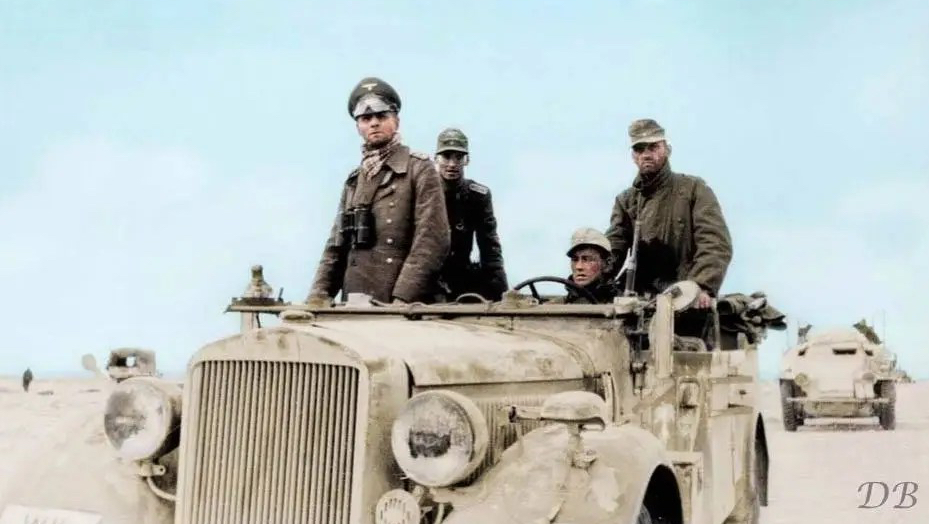
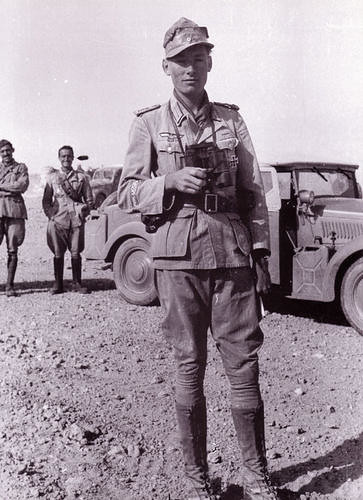
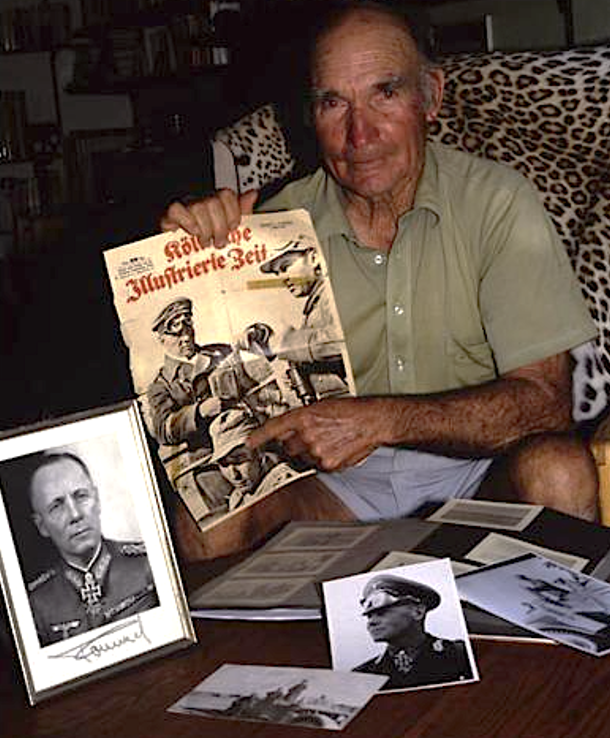
Now this chap poses an interesting figure in South African Military history – his name is Lt. Hellmut von Liepzig (18 July 1921 — 24 October 2016). He was Brandenburger officer (German special forces). He joined the DAK (German Africa Corps) in 1941. Leutnant (Lt) von Liepzig was Field Marshal’s Erwin Rommel’s driver and part of his staff during the DAK’s North Africa campaign.
But here is the interesting bit to South African military history, as Rommel’s forces and South Africa’s forces were very much at odds with one another during this campaign. Lt. Hellmut von Liepzig is the second ’South African’ on Field Marshal’s Erwin Rommel staff, the other is Lt. Heinz Werner Schmidt, Rommel’s aide-de-camp (you can read more on Heinz Werner Schmidt here: Rommel’s aide-de-camp was a South African).
General der Panzertruppe Erwin Rommel rides in his Horch 1937 type 901 staff car with the 15th Panzer Division between Tobruk and Sidi Omar, Libya. Lt. Hellmut von Liepzig at the wheel.
To be fair to Hellmut von Liepzig, he is a South West African and was born in Keetmanshoop to German parents. However, he was born in South West Africa in 1921, after it becomes a South African mandated territory in 1919 – so he’ falls under South Africa’s nationalisation regulations.
A Knights Cross
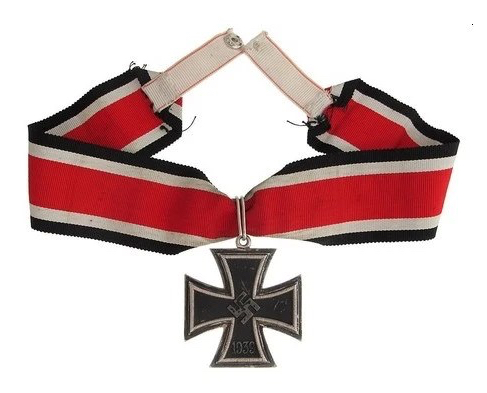
Lt. Hellmut von Liepzig is not just a mere driver, he’s a fully competent Wehrmacht officer and lands up commanding his own units, in fact he is a very brave and skilful fighter, he earned a Iron Cross 2nd Class and then 1st Class – and ended up even earning a Knights Cross on the Russian front, his citation for this decoration below says everything about him:
“In April 1945 the Panzergrenadier-Division “Brandenburg” was in action around Bautzen. On the 24.04.1945 Leutnant Leipzig and his Zug were in reserve north of Milkel when they received the alarm. The Soviets had succeeded in breaking into the German frontline around the Milkel castle with strong forces. Recognizing the situation, Leutnant Leipzig led his men into battle around 12:00 on that day and was able to seal off the enemy penetration.
During this counterthrust Leipzig took note of further enemy forces that were approaching the German positions from a streambed to the north. He decided to launch a flank attack into this group. The surprised enemy were defeated in close combat and forced back to their jump off positions with heavy losses. This was in spite of the fact that Leipzig and his men were almost out of ammunition and had to fight mostly with melee weapons. Leipzig himself used his last MPi magazine to eliminate the crew of a knocked out enemy tank.
The result of this battle in the streambed was between 20-30 Soviet dead, for the cost of three wounded from Leipzig’s Zug. More importantly however the crisis in the German frontline in this area had been resolved by the bold counterattack of Leutnant Leipzig and his men. For this act he would be decorated with the Knight’s Cross.”
In 1945 he became a Prisoner of War (POW) under the Soviets – for 10 years. After his release in the 50’s he retired back to his homeland South West Africa to re-start his life.
He resided in Namibia for most his life, where he founded the German Cultural Council, the largest organisation of the German-speaking community in Namibia. He chaired the organisation from 1986 to 1997. He also sat on the board of The Association of German School Societies in Namibia (AGDS). He died in Windhoek in 2016 after a long and fulfilling life.
Treason
On the question of treason, having taken up arms against his fellow country-men and their Allies. After the war, a commission called the Barrett Commission was assembled to look into all South Africans and South West African’s who had joined Nazi German forces during the war. The purpose was to find them, test their citizenship and nationality status and hold them to account on charges of treason if in breach. The commission’s findings and lists were completed in late 1947, and withheld pending outcome of the 1948 elections.
When the National Party won the elections in 1948, two Nationalist MP’s – Frans Erasmus and Blackie Swart removed all copies of the Barrett report and all the intelligence files on German collaboration and embargoed them (some of these files have only recently been re-opened). The National Party then issued a general amnesty for all South Africans and South West Africans tried for treason or awaiting sentence and/or interrogation … and in 1948 they all walked free.
It was into this environment that Hellmut von Liepzig was able to re-settle back in South West Africa and not be held account nor have his nationality status tested. Others like Heinz Werner Schmidt enjoyed the same status, Schmidt would go on and become a well known and highly successful Natal businessman and would publish a book on his time under Rommel as a staff member of his. Hellmut von Liepzig would even be re-united with Rommel’s famous staff vehicle which he drove during the desert campaign in a documentary called “I drove Rommel” screened in 2009:
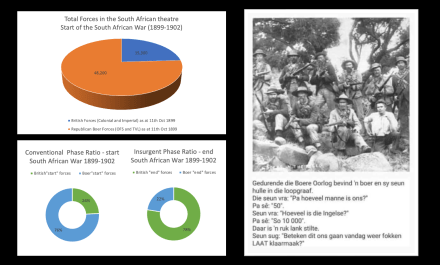
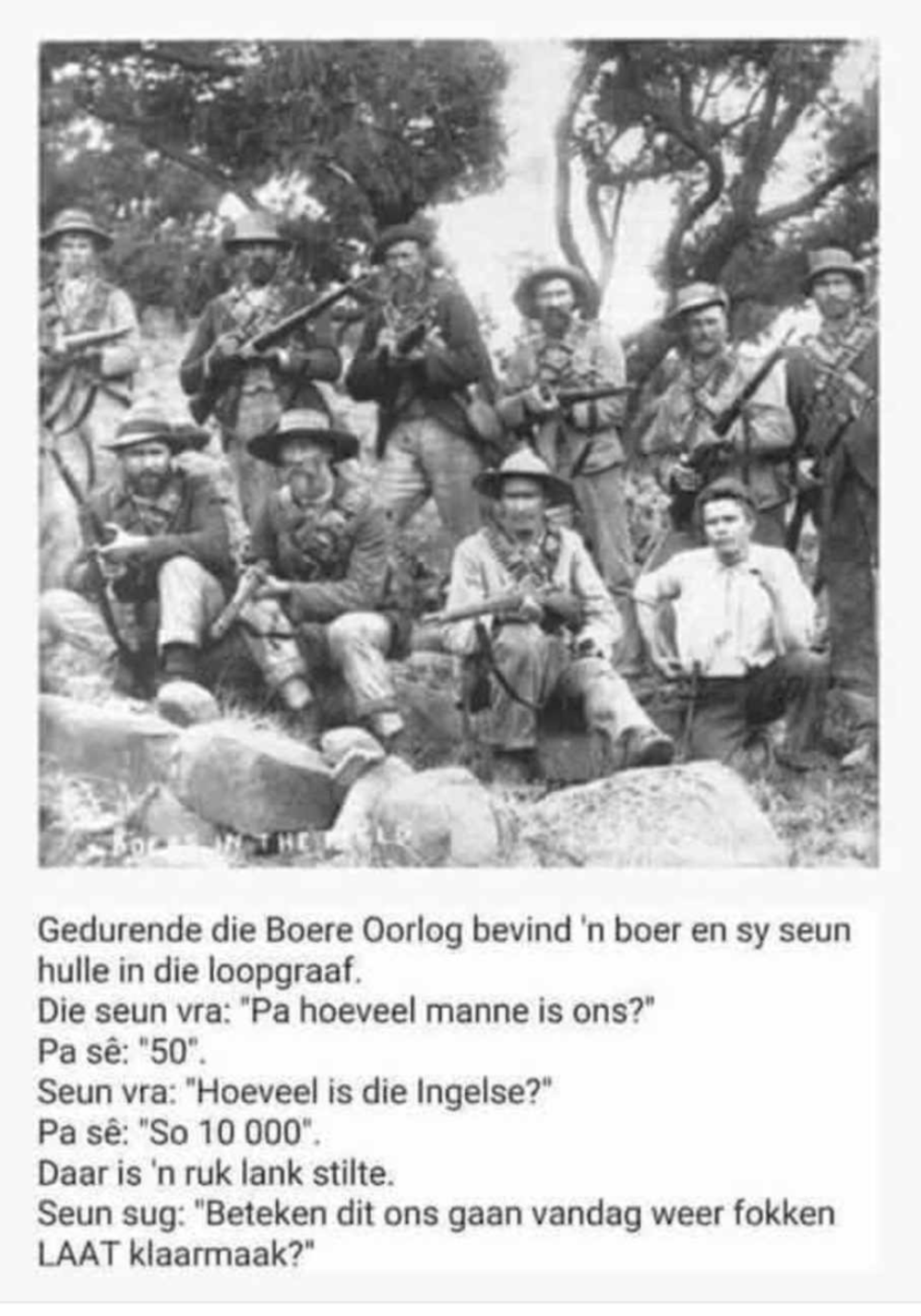
Often on Boer war social media appreciation sites, and even on simple things like wikipedia we see this statement “it took 500,000 British to defeat 20,000 Boers” – the much-touted ratio in this type of media is that the Boers were outnumbered 25 to 1, at a staggering disadvantage during The South African War 1899-1902 a.k.a Boer War 2.
The story goes that these plucky Boers held the mighty British empire at bay. Now that’s a figure designed to paint the Boer fighter as some sort of super-man and the British military as bumbling, monolithic and ineffective. But the truth is far from this and this figure is completely erroneous designed to drive Afrikaner nationalist political rhetoric – it has nothing to do with actual numbers on the ground.
This is why I love economic history and not political history – economic history speaks the raw numbers, the statistics – the unassailable mathematical facts, and it tends to drive great holes into the ‘political’ history and its inherit political rhetoric – its the point when the facts talk and the bull walks.
Let the numbers speak!
Now, here’s the truth – at no point in Boer war 2 were there ever 500,000 British troops in South Africa as boots on the ground at any one point in time – in total, over the course of the war the British called up 550,000 men – that bit is true, yes. HOWEVER the British rotated their Regiments in and out of South Africa on ‘tours of duty’ – never really sending a full regiment into the operational theatre at once, retaining many at home and in their other colonies around the world. The “high water mark” i.e., the maximum number of British Troops in South Africa at any one point in time is 230,000 men. Even pro-Boer chronologies like that of Pieter Cloete’s Boer War facts and figures reluctantly has to admit this fact.
This high-water mark of 230,000 (including African Auxiliaries) is only peaked briefly during the late Guerrilla Phase of the war – and at least 50,000 of these troops are being used to man the rather extensive blockhouse defence system stretching from the top to bottom and side to side across the whole of South Africa (as referenced by Simon C. Green in his Blockhouses of the Boer War) – over thousands of kilometres both ways. On average during the Guerrilla Phase of the war – September 1900 to April 1902, the British enjoy 190,000 troops on the ground.
But let’s stick to the high-water marks for a proper account – the high water for the Boer forces, total Republican forces strength is 87,365 men – including 21,043 burghers who add onto the original ZAR and OFS Commando call-up later (initial call-up is 48,216), the statutory Boer forces (2,686), foreign volunteers (2,120) and Cape Rebels (13,300).
The Boer figure is possibly higher if we add African auxiliaries and rear echelon support – the “tooth to tail” non-combatant ratio – which is accounted in the British numbers in terms of administrators, doctors, pharmacists and medics, batmen, chefs, farriers, holsters, labourers, wagon drivers etc. but NOT in the Boer numbers as this would start to add women, agteryers, servants and farm hands as people acting in Boer combat supporting roles in a non-combatant capacity.
That means a conservative ratio between Brit and Boer at the high-water marks = 230,000 Brits and 87,300 Boers – a ratio of 3:1 – total Imperial forces versus total republican forces (sans the tooth to tail ratio in the Boer number). It’s a far cry from the emotionally charged and erroneously touted figure of 25:1.
Consider the size of the Republican Forces at the beginning of Boer War 2, versus that of the British. At the Boer declaration of war on the 11th October 1899 when the Boers invade sovereign British territories: The total British Forces in the field = 15,300 men. Total Boer forces assembled to attack = 48,216 men. The ratio is heavily in favour of the Boers – Boer Forces outnumber the British 3 to 1.
“On the high seas” as at the 11th October 1899 are an additional 7,418 British Troops on their way to South Africa from India and Australia – called up to bolster an inadequate British force strength in the event of war. Even with their arrival at the end of October 1899 (after the war has been declared and the Boer invasions commence) bringing the British number up to 22,708 – British Forces are still woefully inadequate, and the invading Boer Forces still outnumber them 2 to 1.
If we want to account Boer War 2 properly and view it with balance, it would be correct and very true to say at the beginning of the war the Boers outnumber the Brits 3:1 – as the war progresses there is a juxtaposing of numbers (they start to match capability in numbers from February 1900) … and by the end of war the Brits account 190,000 troops in country, Boers account 24,300 left in the field and 47,300 POW in the bag (factoring out the ‘Hensoppers’ and ‘joiners’ and factoring in the Cape Rebel POW) = 71,600 or a 3:1 ratio – Brits outnumber Boers, a reversal of the advantageous 3:1 ratio the Boers enjoyed at the start of the war.
Let the doctrine speak!
In terms of military doctrine, the above estimation on a 3:1 ratio is about right given Boer War 2 is fought in two distinctive phases, the Conventional warfare Phase (Oct 1899 to August 1900) and the Guerrilla warfare phase (September 1900 to May 1902) – to invade the British territory in Oct 1899 the Boers need a 3 to 1 advantage to be successful … and to counter attack and hold the Boer territory the British need to be at a 3 to 1 advantage – and even by Guerrilla Warfare standards and the doctrine used to fight one, this number is very low. Consider the following:
American Brigadier-General Nelson Miles was put in charge of hunting down Geronimo and his followers in April 1886. Miles commanded 5,600 troops deemed necessary to find and destroy Geronimo and his 24 warriors. In Malaya in 1950 it took 200,000 British, Australian and allied troops to defeat 5,000 Communist guerrillas. In Ireland over the 30-year course of ‘the troubles’ a total of 300,000 British troops were used to contain 10,000 IRA guerrillas. Closer to home, so the arm chair Boer war generals get this – over the course of the Angolan Border War (1966-1988) and the ‘Struggle’ (1960-1994) the SADF would call up 650,000 conscripts and then hold them in reserve – MK and other non-statutory force ‘guerrillas’ at their high water mark in 1990 only have 40,000.
The modern-day theoretical ratio of counter-insurgency forces to guerrillas needed to defeat an insurgent/guerrilla campaign is 10:1. In 2007, the US Department of Defence produced a document entitled Handbook on Counter Insurgency which quotes this as the rule-of-thumb ratio for all such operations – and that is even with the advent of modern technology in warfare fighting mere insurgents or guerrillas. Little wonder that General David Petraeus needed 180,000 coalition force troops (the same size as the full invasion force) on the ground in 2007 just to deal with the Iraqi guerrilla “surge” spearheaded by an insignificant but determined bunch of suicide bombers.
Just kidding!
The idea that it took half a million British troops to subdue a couple of thousand boers is very erroneous .. the old ‘super’ Afrikaner joke – on witnessing an advancing British ‘rooineck’ column a Boer kid asks his Dad “how many Boers are we Dad? – Answer “50 son”, and “how many British Dad?” – Answer “10,000 son”. Punchline … “Dad, does this mean we’re going to finish late again?” A joke that re-appears in different formats in countless forums, and it’s as funny as it’s statistically false and fantastical.
Written and Researched by Peter Dickens
References – all quoted statistics
Leopold Charles Maurice Stennett Amery “The Second Boer War – The Times History of the War in South Africa 1899-1902” – Volumes 1 to 7.
History of the war in South Africa 1899-1902. By Maj. General Sir Frederick Maurice and staff. Volumes 1 to 4, published 1906
The Anglo-Boer war: A chronology. By Cloete, Pieter G
Anglo-Boer War Blockhouses – a Field Guide by Simon C. Green, fact checking and correspondence – 2023.
The Boer War: By Thomas Pakenham – re-published version, 1st October 1991.
Correspondence and interviews with Dr. Garth Bennyworth, Boer War historian – Sol Plaatjies University, Kimberley – 2023.
Correspondence on fact checking British doctrine with Chris Ash, BSc FRGS FRHistS, 2023 – Boer War historian, Fellow of the Royal Historical Society and Fellow of the Royal Geographical Society.
Kruger’s War – the truth behind the myths of the Boer War: By Chris Ash, published 2014.
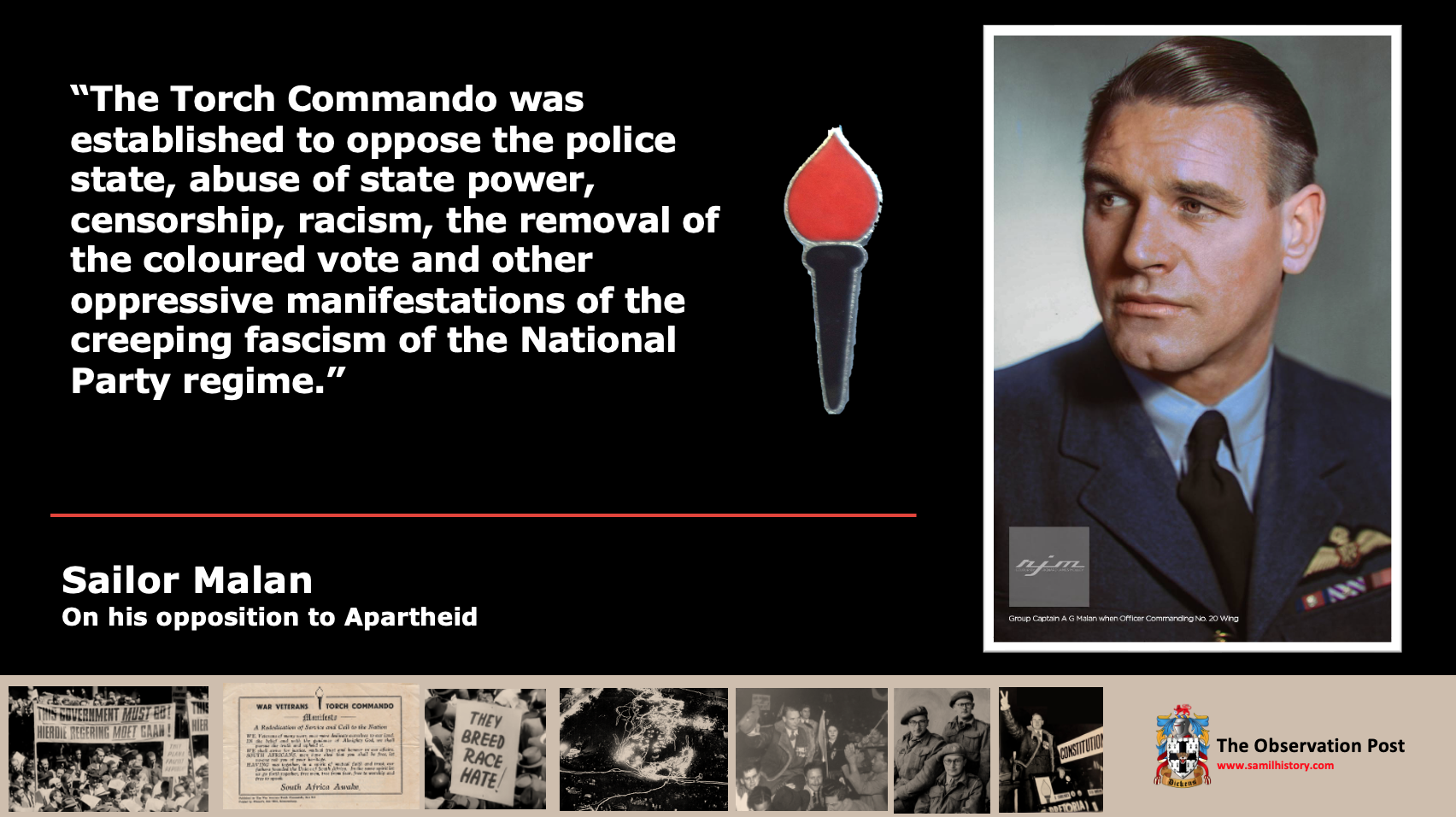
The Observation Post will be ON at Swellendam on Thursday 18th January 2024 in conjunction with the Swellendam Heritage Association, Peter Dickens (B Soc.Sc. Rhodes PG Dip UNISA) will be presenting a lecture and discussion on The Torch Commando and Sailor Malan, the South African war-time Battle of Britain ace. Titled ‘An inconvenient truth’ it is an in-depth look at The Torch Commando, South Africa’s first mass Anti-Apartheid protest movement and the politics of returning South African WW2 veterans.
Topics to be covered include:
The Nazification of the Afrikaner Right
TheReturning War Veterans Action Committee
SailorMalan
The Steel Commando
The rise and fall of The Torch Commando
The smoking gun to the ‘white’ struggle against Apartheid
Places are filling up fast so please R.S.V.P. – details as follows:
Date: Thursday 18th January 2024
Venue: Swellendam Heritage Association, The Drostdy Schuur, Swellendam.
Time: 18:00
RSVP: p.bromley05@gmail.com by Monday 15 Jan 2024.
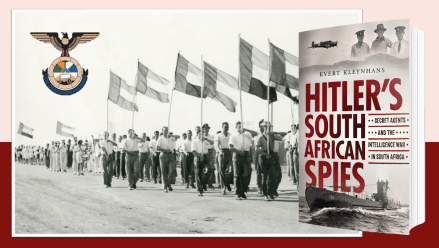
You can tell it’s the holidays as I am getting to some book reviews I’ve been promising – and this book by Dr Evert Kleynhans “Hitler’s Spies: Secret Agents and the Intelligence War in South Africa: 1939 – 1945” had me reacting like the ‘Strictly Come Dancing’ Judge Anton Du Beke when a celebrity performer receives a 10/10. Du Beke usually becomes highly animated, jumps up, fist pumps and joyously shouts out … YES! BRILLIANT! NAILED IT! FINALLY! I KNEW IT ALL ALONG!!!!! … my wife found me putting down Evert’s book after I finishing it and very amusingly behaving like a rather euphoric and unhinged Du Beke.
So why so happy? There’s a bit of a backstory to this delirious happiness, so bear with me. Over six years ago in 2017 – I published an Observation Post called “Mein Kampf shows the way to greatness for South Africa” – The Ossewabrandwag. I had sought to find and publish the proof of conversion to Nazism by this “cultural front” to Afrikaner Nationalism.
I had managed to build this Nazi link easily with movements like the ‘Grey-shirts’ – The South African Christian National Socialist Party (SANP) – led by Louis Weichardt and the ‘Black-shirts’ – the Volksbeweging (People’s Movement) or ‘African Gentile Organisation’ led by H.S. Terblanche – these shirt movements with their “Blue, White and Orange” arm-band swastikas were clearly Nazi to the core . The National Socialist Rebels – led by Robey Leibbrandt were also easy and really obvious given he was a covert Nazi appointed operator. The National Socialist Boerenasie (Boer Nation) movement – led by the Boer Revolt hero and rabid anti-sematic Manie Maritz was equally clear – all these movements had fully adopted National Socialism in their missions and even swastika iconography into their images, mastheads and positioning – so proving them as out and out Nazi was easy.
Not so the Ossewabrandwag (OB) – proving their Nazi affiliations is somewhat more difficult. It’s the veneer of the Ossewabrandwag (OB) that’s the issue – their clear “anti-British” stance due to Boer War 2, and their clear positioning as the “cultural front” of Afrikaner Nationalism, with the National Party operating as the “Political front” – this makes it so difficult to pin a case of Nazism on them. The Ossewabrandwag’s Voortrekker origins and mission as “mapping a path” to a ‘white’ South African Republic with a white Afrikaner hegemony using these voortrekkers (pioneers) as the vehicle – all working very succinctly with the National Party which adopted the same voortrekker iconography and mission in its image and political its resolve for a future Republic.
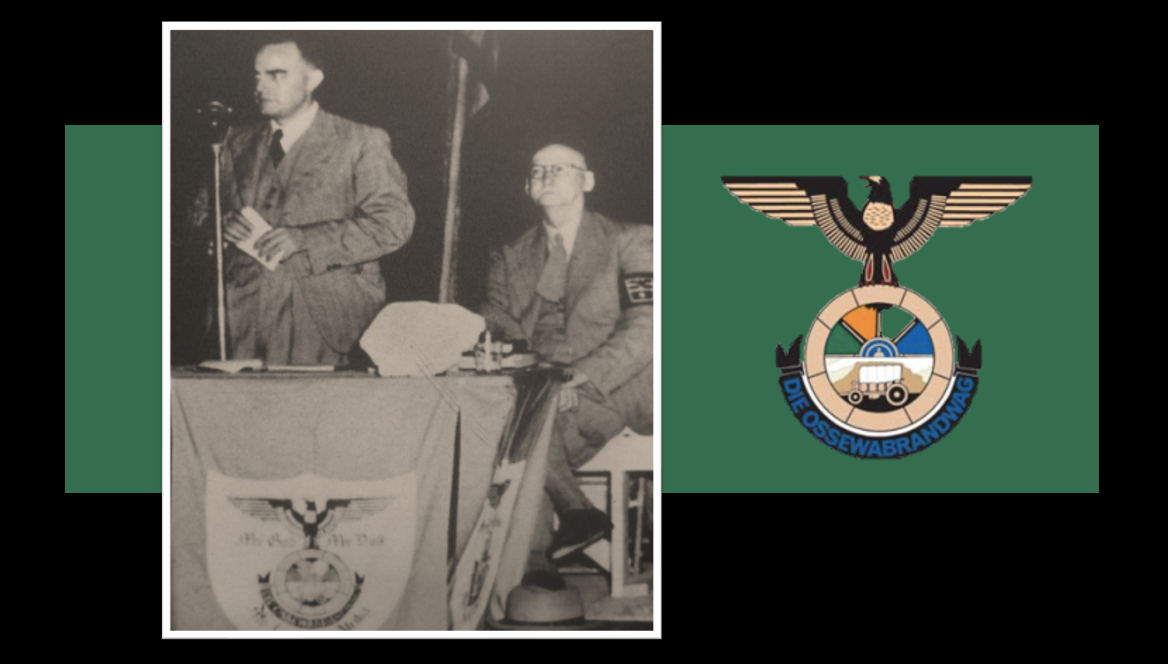
Image: OB ‘General’ B.J. ‘John’ Vorster at a OB rally
To smear an organisation like the OB which boasted about 300,000 active middle of the road Afrikaners (to whom nearly a million modern Afrikaners are now related) with a “Nazi Brush” is not an easy task – it is as Afrikaans as a Hertzoggie cookie.
You can argue that the introduction of the Stormjaers within the OB with their military ranks, insignia, salutes and blood oaths are distinctively Nazi, so too their armed ‘sabotage’ campaign can be seen as ‘assisting’ Nazi Germany in their war effort and by their very actions treasonous. You can argue that the OB’s ‘Commandant-General’ Johannes (Hans) van Rensburg was a disciple of Nazim and admirer of Adolf Hitler and built into the OB the distinctive Nazi ideologies of “blut und Boden” (Blood and Soil), their “Give us a master” call for the implementation of the “Führer principle”, their call for the removal and expropriation of “British-Jewish” controlled capital. Their racial constructs and policies which relegated “English speaking” South Africans to secondary citizenship and lumped Jews and Blacks as “Untermensch” – racially inferior and “insoluble” in white Afrikaner every-day life. All of that is distinctively Nazi right?
Dr Hans van Rensburg being sworn in – OB swearing in ceremony
You can even pick out choice statements by key OB leaders as to the OB’s distinctive Nazi roots – ‘from the horse’s mouth’ so to speak. The firebrand nature of the Ossewabrandwag appealed to B.J. Vorster (a future nationalist Prime Minister and President of South Africa) more than the National Party. On Nazism and the OB and said in 1942:
“We stand for Christian Nationalism which is an ally of National Socialism. You can call this anti-democratic principle dictatorship if you wish. In Italy it is called Fascism, in Germany National Socialism (Nazism) and in South Africa, Christian Nationalism.”
The Rev. Koot Vorster (B.J. Vorster’s brother), a Dutch Reformed Church minister, and like his brother was also a predominant Ossewabrandwag leader, crystalised this idea of Afrikaner totalitarianism when he summed up the pro-Hitler and Pro-Nazi standpoint of the OB during an address to a student group on September 15, 1940 and said:
“Hitler’s ‘Mein Kampf’ shows the way to greatness – the path of South Africa. Hitler gave the Germans a calling. He gave them a fanaticism which causes them to stand back for no one. We must follow this example because only by such holy fanaticism can the Afrikaner nation achieve its calling.”
Kowie Marais, an OB member and key member of the Broederbond, years later recalled in an interview the admiration he and his friends held for Hitler:
“We thought (Hitler) might rejuvenate western civilization … against the communist-socialist trends that were creeping in from the east. We thought it was the dawn of a new era.”
All these links to Nazism matter not a jot to many Afrikaners still convinced that the OB was merely a “cultural organisation” to spread the edicts of Christian Nationalism as outlined by Henning Klopper, then the Chairman of Broederbond, in his famous 1938 centenary of the Great Trek. To literally spread this new ideology of Afrikaner nationalism like ‘wildfire’ throughout the country and unite the white ‘Cape’ Afrikaners with the ‘Boer’ Afrikaners up north (hence the name Ox Wagon Sentinel or ‘Fire Watch’), a job it did very successfully, so much so Klopper praised it as a divine event and called it a “sacred happening” – God had ordained it (according to the Broederbond at least) – and to a audience of Calvinists and Puritan Christian Protestants this had meaning .
Nothing to see here!
But how come this general malaise? How is it that all this Nazism is ignored? It boils down to the simple fact that by the end of World War 2, just about every National Party minister had been in the OB or in organisations affiliated to it, only a handful of ministers – men like D.F. Malan had not flirted directly with Nazism. The Nationalists had to be squeaky clean and re-invent themselves completely if they stood any chance to win the 1948 elections and then hold onto power. The reason they “sat out” the war with Nazi Germany was not because of any great affinity to Adolf Hitler and his cabal, it was because they were purely anti-British. They were simply against Jan Smuts’ ideals of Union and sought national independence and self-determination by way an Afrikaner Republic – they were just avowed Republicans whose identity was forged by Britain’s treatment of their women and children in the Boer War concentration camps.
Image: The “Path to Nationhood” OB Poster
B.J. Vorster would cry complete innocence, often declaring in interview after interview that Smuts had unjustly imprisoned him during the war and the only reason given to him for his incarceration was because he was merely “anti-British”. The true reason for his imprisonment which was that he harboured previously interned fugitives on the run during the war was conveniently buried, in fact by the mid 70’s it was all under embargo and ‘lost’.
Even the OB leader – Johannes (Hans) van Rensburg – did a compete about face once Nazi Germany lost the war in 1945, he turned around and rather regretfully said:
“It was the greatest disaster in my spiritual life to realise suddenly that the people I had thought to be the heroes of a new era in western civilisation should in fact turn out to be just a band of murderers and nothing else.”
He went further in his autobiography to state his fight was always one of Afrikaner patriotism and a simple fight against Smuts and his policies – he reiterated that as the leader of the OB he had instructed his Stormjaers to sabotage the Union’s war effort so as to keep the soldiers in South Africa and prevent ‘sons of the soil’ – Afrikaners – been sent overseas to die for Great Britain. He was clear in his instructions that no Union soldier would die by the hand of an OB Stormjaer. So – nothing to do with high treason and nothing to do with actively supporting Nazi Germany by way of killing any UDF members, and everything to do with Afrikaner patriotism instead.
He would remark on the OB’s achievements in his autobiography:
“I fought (Smuts’) war effort and I fought it bitterly with all the means at my disposal – which were considerable…. There is no doubt that they (the Ossewabrandwag) seriously hampered the government’s war effort. Hampered it because the government was forced to draw off considerable manpower to guard many strategic points and essential services. A not inconsiderable military element also had to be retained in South Africa as a strategic reserve for possible emergency.”
That in reality the OB played no significant tactical, operational or strategic role in curtailing South Africa’s war effort whatsoever mattered not a jot to van Rensburg, in his mind he did a great service and was pure of Afrikaner heart.
The cover up
During the war, the South African intelligence services under Colonel Ernie Malherbe and the British intelligence services had collected a wealth of information directly linking the OB and the Broederbond to the Nazi German war effort. After the war ended, the Smuts’ government found itself having to implement commissions to investigate all the cases of High Treason, committed by organisations like the Ossewabrandwag, the Grey Shirts, the Broederbond, the New Order etc – additionally treasonous acts by South African nationals joining the German military directly, or joining German propaganda and intelligence services directly and also German and foreign nationals operating in South Africa as spies were to be investigated. Called the Barrett Commission it published its findings to limited ‘eyes-only’ circulation at the end of 1947, but these findings were deemed as political fireworks and embargoed pending the outcome of the 1948 elections scheduled early in the new year.
The fateful 1948 election and unexpected National Party win would change all of that, the newly appointed National Party Minister of Defence (and ex-OB member) Frans Erasmus would walk into the South African Intelligence Services archive, he fired the Officer Commanding on the spot and removed “two lorries” worth of incriminating evidence – never to seen again! The newly appointed National Party Minister of Justice (and ex-OB member) C.R. “Blackie” Swart would obtain the original Barrett Report and recall all the circulated copies of the Barrett report and all its appendixes and supporting documents – never to seen again!
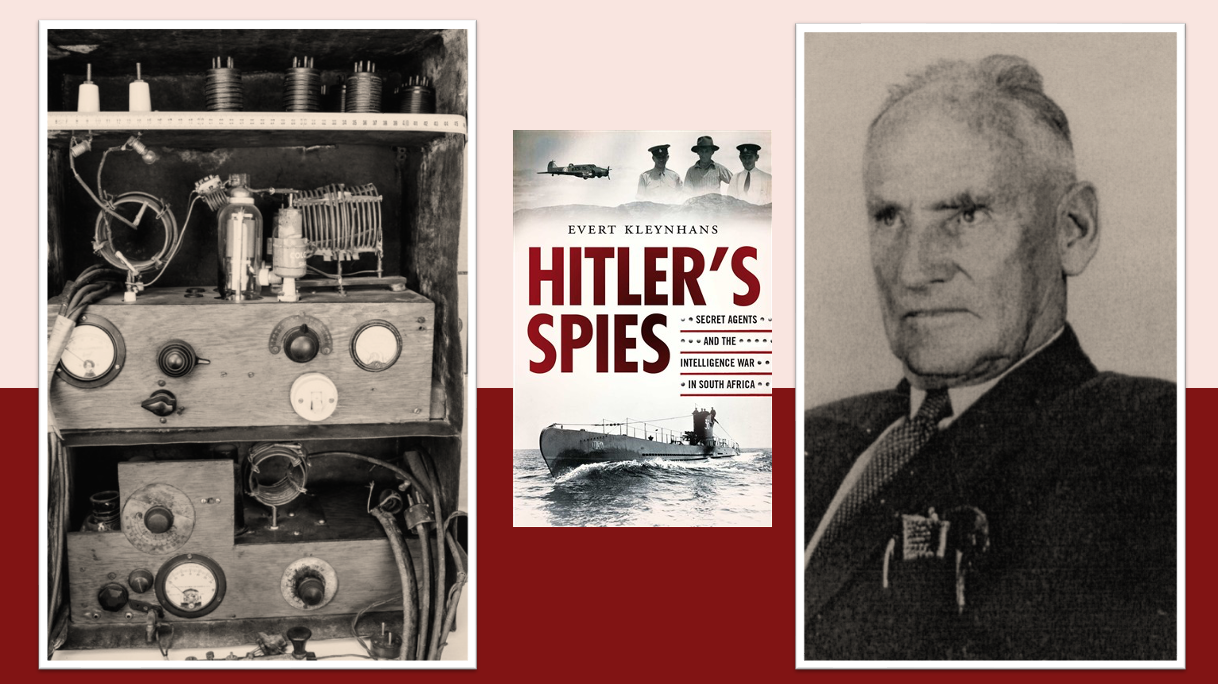
The Felix transmitter and Lothar Sittig – codename Felix – images courtesy Dr Brian Austin
The National Party in 1948 went another remarkable step further, they granted full amnesty to all Nazi German collaborators and spies, all imprisoned right wing Nazi sympathisers, murderers and saboteurs and all the treasonous South Africans who joined the German military or its propaganda and intelligence forces – all those been held in detention for interrogation or who had been given prison sentences for high treason and wartime crimes and serving time – simply walked free – with no obligation or pressure whatsoever to divulge their activities, the names of their collaborators or their sources and materials to anyone.
The Afrikaner Nationalists were from here out just a bunch of anti-British Afrikaner republicans, pure Christians at heart and true patriots – no Nazism, no high treason, or traitors to seen here … moving on. Any young whippersnapper journalist or academic trying to pin Nazism on people like B.J. Vorster, H.F. Verwoerd, P.W. Botha, J. van Rensburg, Jaap Marais etc, or even trying to link Apartheid to Nazism would simply be met with a smug “prove it”.
Enter an archive bloodhound
This is the reason for all my YES! And FINALLY! expletives. Dr. Evert Kleynhans, now an Associate Professor at the South African Military Academy spent years – literally years unlocking the parts of the Ossewabrandwag archive previously embargoed or denied to the all the other historians writing on the Ossewabrandwag. He added to this by digging around in the private collections and archives of all key players. Over and above this he tackled the British intelligence archives – MI5 and more.
For most modern historians, the credibility of their work is seen in their mastery of the ‘secondary sources’ and you find it in the cross references – an example of this is a reference number to say X book by X author on X page e.g. “Visser, OB: Traitors or Patriots? P.183” However, if a historian gets into the ‘primary sources’ as their major reference source, that is where he or she gets into the archive and the original documents, photographs, signals, messages, letters, speeches, reports etc etc, then their work moves onto an entirely different level. It’s at this point the work moves away from being simply sound and good historical research and into a world where the work becomes a trailblazing and seminal one, one by which future historians will build on and reference.
You can see how Evert has tackled this, as in tackling the primary sources, his reference notations look entirely different, they read like this X Box, X File, X Date e.g. “Box 1621. File: Part 2 Secret Report on cases of high treason, 19 March 1946”. It is here, in the use of primary material that Evert Kleynhan’s “Hitler’s Spies” stands out as more than just a historical treatise it is a seminal work. Evert has fully ‘unlocked’ the Ossewabrandwag’s archive and he has meticulously and steadily pieced together all the missing testament such that the case he presents is water-tight, unquestionable and as close to a truism you can get with all the information at hand.
Image: An Ossewabrandwag ‘Kommandant’ in full para-military uniform with lapel badges, ‘crested eagle’ epaulettes and ‘lightning bolt’ cap badge insignia. In addition he is wearing a sam-browne belt and lanyard. His ‘green’ arm band signifies his rank – using the ‘crested eagle’ again and horizontal lines for scale of seniority.
Here’s a bit of a spoiler alert, but necessary for my argument on the Ossewabrandwag (OB), what Evert does in Hitler’s Spies using all this primary data is bash the ‘High Treason’ and ‘Nazi’ nails into the Ossewabrandwag’s coffin good and solid. The case of High Treason that “Hitler’s Spies: Secret Agents and the Intelligence War in South Africa” brings against the Ossewabrandwag’s high command, inner circle leaders and its Commander in Chief – Johannes (Hans) van Rensburg – is both water-tight by sheer weight of evidence and it is one of eternal damnation. Evert Kleynhans through empirical and extensive research is able to firmly prove that the Ossewabrandwag and its leaders and inner circle ticked all the boxes defining High Treason that would under the laws of the time may have had them all swinging from the end of a rope – alongside their Nazi brethren in Germany ‘Nuremberg Judgement’ style.
What Evert Kleynhans is able to do, and what the likes of B.J.Vorster and others tried very hard for many years to prevent, is that he has been able to “Prove it”. The OB and its leaders stand as full Nazi collaborators and zealot devotees to Nazism as an ideology and its expansionist new order ambitions and racist constructs, directly assisting their war effort to the detriment of and living threat to every single South African – Afrikaner or otherwise, whether serving in the Union’s Defence force or even just existing as an ‘Untermensch’ in the South African Union and surrounding British territories.
It’s evidence that is not even inferred by MI5 and SA Intelligence operators and their reporting, Evert even gets his hands on the only remaining copy of the Barrett Report – ironically buried deep in C.R. Swart’s personal archive – the man charged with destroying it, somehow and rather inexplicably decided to hold onto one copy (maybe he figured in the shady world of nationalist politics and political backstabbing he would one day need the leverage of political blackmail to prevent him from getting the chop). The evidence is even more water tight than the commission’s report, Evert even gets holds of confessions, all of them – spies, collaborators – the lot, the most remarkable is Johannes van Rensburg’s personal confession to all manner of High Treason charges called “Rex versus van Rensburg” which he penned in anticipation of his arrest when the war ended and the net was closing in on him (a document so incriminating he buried it and did not really refer to it in his autobiography).
A page turner
Now, one would think that with all this primary source and data that Dr Evert Kleynhans’ “Hitler’s Spies: Secret Agents and the Intelligence War in South Africa” is a dour romp through dusty archival records – but it is anything but, it reads like a Spy Thriller – stuffed full of espionage, spies, double agents, prison escapes, collaborators, honey traps and traitors. It would make it on the spy novel fiction shelf next to a John le Carré novel such is all the intrigue and danger, the frightening bit – John le Carré’s novels are fantastic and entertaining yarns – yet Evert’s work is a truth, it all actually happened, and in this context it will leave you utterly gobsmacked.
The book will take you through the full historiography of espionage in South Africa during World War 2, it covers in full the Ossewabrandwag’s association and collaboration with the Nazi Abwehr (intelligence) Roosebloom Operation and their Felix Operation in South Africa. In between it covers the Nazi Abwehr Operations in Mozambique and Operation Weissdorn and many other cases of espionage, propaganda warfare (Radio Zeesen), message couriering, prison breaks and spy smuggling.
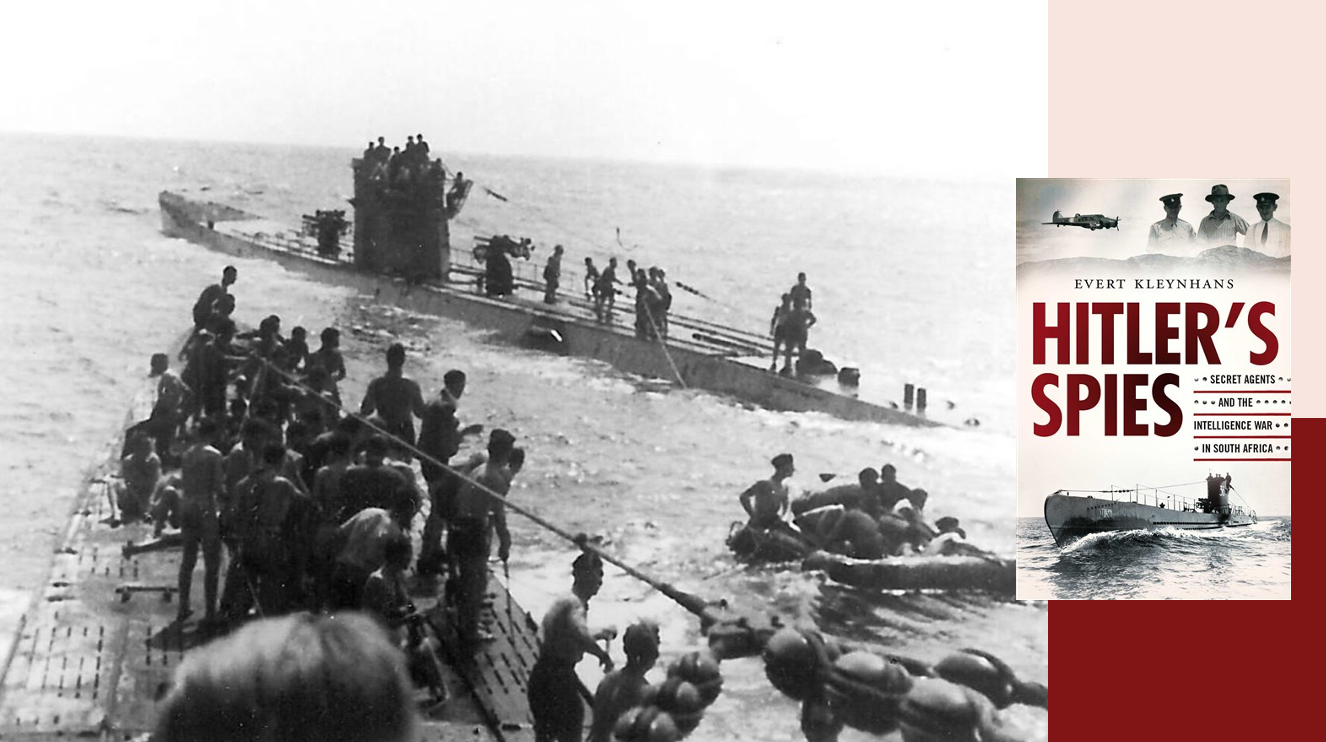
U-156 and U-507 assisting survivors sinking the Laconia in the Indian Ocean, 15 Sept 1942
Even for the ‘anorak’ history enthusiasts looking for all the technical stuff, Evert’s ‘Hitler’s Spies’ does not disappoint, what you also get a force majeure tour into the mechanics of transmitting, frequencies and signal vectoring, the methodologies and systems used in World War 2 of collecting intelligence and conducting counter-intelligence. For the real history buffs, you even get the intelligence, data, signals and tonnage sunk and reporting of the German submarine hunter packs operating off South Africa’s coastline – and all in addition to the submarine activities of the Italians and the Japanese.
I must commend Evert on one very critical point in making this book a page turner, and that’s his writing style. If you think you’re about to get a dull historical treatise sans paragraphs – academic style – think again. Evert, for an academic, uses very good journalistic and storytelling skills – his opening paragraph alone starts with a sinister quote from Carl Emmermann, the Commander of U-172, part of the Eisbär (Polar) submarine hunter group as he peers at Cape Town through his submarine’s telescope. Evert even brings in skills like “send-up” to link the stories – a case in point here is the wager of a bottle of whiskey taken between two interrogators that they would not be able to break a Dutch national (held in detention after the war) who operated as a Nazi spy in South Africa. I’ll leave it to the reader to find out if the bottle of scotch was won or lost – but this is a human story telling element which has no real historical bearing and could easily have been left out – yet luckily, we find it in this history book – it makes it highly readable.
The final word?
Is Evert’s book ‘Hitler’s Spies’ the final and definitive word on the Nazification of the Afrikaner Right? It’s solid enough that it can be, but to be honest it’s not – there is loads to this subject not covered in Hitler’s Spies and there is very good reason for this. As said this work is a seminal one, Evert could have broadened each subject he tackled exponentially taking the book which is focussed on submarine warfare and espionage into a massive historical tome instead – but he chooses not to and keeps the book and its story focussed and succinct, what he does instead is open the door to other historians and authors to pick up on any empirical thread Hitler’s Spies throws out and become bloodhounds in their own right.
A case in point here – during the war the OB’s leader – Johannes van Rensburg, is accused by the leader of the National Socialist Rebels – Robey Leibbrandt of being a double-agent – Leibbrandt is open in his accusation that van Rensburg is a “Smuts-man” in disguise. Whilst it is very clear in Evert’s book Hitler’s Spies that there is collaboration between the Smuts government and the OB, it would take another historian – Dr Garth Bennyworth from Sol Plaatjies University, to unearth in a MI5 file the proof positive that van Rensberg had indeed acted as a double agent to betray Liebbrandt. To note here, this skulduggery is not so much van Rensburg’s intentions as a patriot Afrikaner to protect Afrikaners – its more to his adherence to the Führer principle. Both Robey Leibbrandt and Johannes van Rensburg are megalomanic enough to assume they will be South Africa’s new absolute Führer should Germany win – you need to view Liebbrandt as a sort of Ernst Röhm brownshirt thug, and like Hitler eliminates Röhm, van Rensburg eliminates Liebbrandt. What this double agent conspiracy does – it also gives van Rensburg his “get out of jail free card” should Germany lose the war and he knew it, it would stop him from swinging by a rope for High Treason – the truth is he’s looking out for number 1.
Image: Carnage from a OB bomb blast
Were does this leave the final word on all the Osswabrandwag’s leader element and inner circle – all the people complicit in Nazism and High treason? All the future National Party leaders, Presidents and Prime Minister’s – the likes of:
B.J. Vorster – Ossewabrandwag ‘General’, Broederbond and future National Party Prime Minister of South Africa and President of South Africa.
Oswald Pirow – Founder of the Neo Nazi ‘New Order’ and devout Nazi – National Party Cabinet Minister prior to the war and future National Party appointed State Prosecutor.
Hendrik van den Bergh – Ossewabrandwag future National Party appointed head of State Security.
Johannes von Moltke – leader of the Christian National Socialist Movement (SANP)’ in the Eastern Cape and future National Party Minister and the National Party leader in South West Africa/Namibia.
P.O. Sauer – Ossewabrandwag ‘General’ – future National Party Cabinet Minister.
Frans Erasmus – Ossewabrandwag ‘General’ – future National Party Cabinet Minister.
C.R. Swart – Ossewabrandwag – future National Party Cabinet Minister and State President.
P.W. Botha – Ossewabrandwag and Broederbond – future National Party Cabinet Minister and State President of South Africa.
Eric Louw – Ossewabrandwag, devout anti-semite – future National Party Cabinet Minister (Foreign Minister).
Jaap Marais – Ossewabrandwag – future National Party Cabinet Minister and future co-founder of the ultra-right Herstigte Nasionale Party.
Louis Weichardt – founder and leader of the Neo Nazi ‘South African Christian National Socialist Movement’ (SANP) and future National Party Minister.
The Rev. Koot Vorster – Ossewabrandwag General, Broederbond – brother of BJ Vorster and future NGK leader.
Dr Hendrik Verwoerd – editor of Die Transvaaler, found guilty of transforming it to a Nazi mouthpiece during WW2, Broederbond and future National Party Prime Minister of South Africa.
Henning Klopper – founder and Chairman of the Broederbond, National Party Minister and Speaker of the National Assembly.
Albert Hertzog – son of General J.B.M. Hertzog, Broederbond, future National Party Minister and co-founder of the ultra-right Herstigte Nasionale Party.
Dr Nico Diedericks – Chairman of the Broederbond during the war, a future National Party State President – prior to the war attended the Nazi Party’s Anti-Comintern training in Berlin.
Piet Meyer – Chairman of the Broederbond and Ossewabrandwag General, future National Party appointed Head of the SABC. So admired Nazi Germany he befriended Hitler’s chief of staff, Rudolf Hess, who even taught him how to ski.
General Rudolph Hiemstra, UDF WW2 objector due to strong pro-Nazi convictions, re-instated by Frans Erasmus after the war in 1948 and eventually became the National Party’s appointed Commandant General of The South African Defence Force.
Dr Eben Dönges – Ossewabrandwag, Broederbond stalwart, future National Party Cabinet Minister, Acting Prime Minister and State President elect.
The truth is final word has been left wide open, these stalwart Afrikaner nationalists are now open to investigation and more digging, the secrets have now been unlocked, the archives are open, the documents found, the path mapped. The ‘veneer’ has finally fallen off. My honest recommendation to any military history enthusiast interested in South African history – buy this book – and buy it now. It’s still available on-line and in all major retailers.
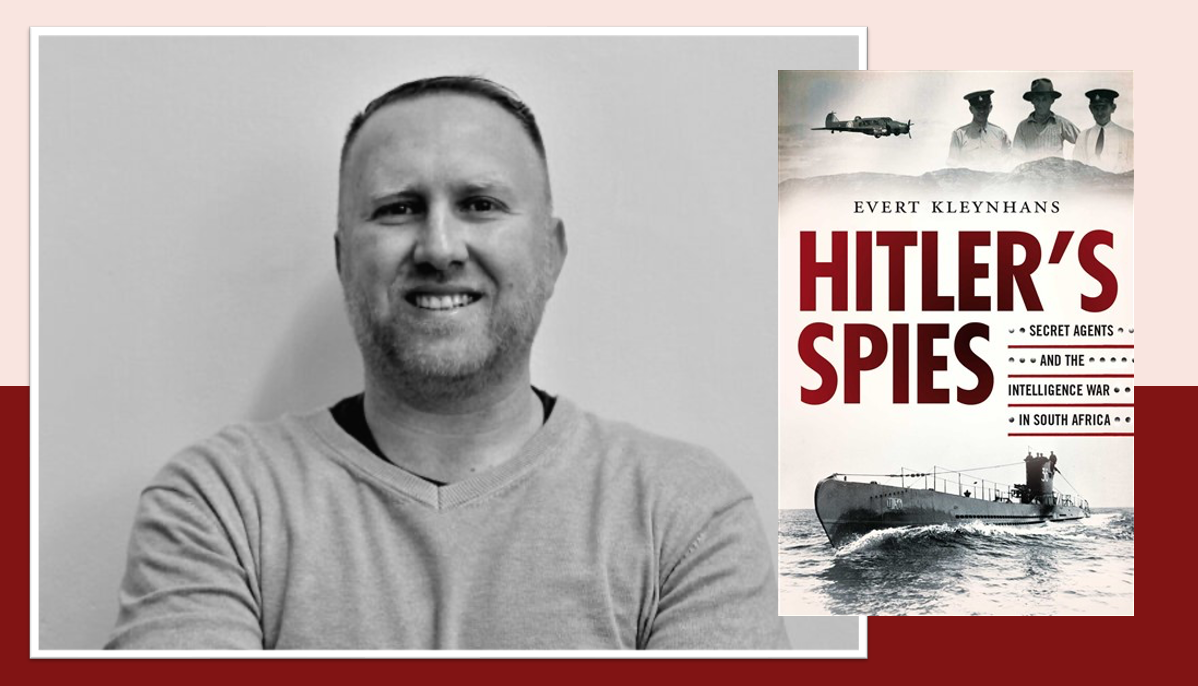
Dr Evert Kleynhans – Associate Professor, South African Military Academy
Also, look out for a future Observation Post on the Felix Transmitter, an abridged version of The Story of the Nazi Spy in South Africa with the kind permission of Dr Brian Austin and Vincent Harrison.
As to last words, Dr Evert Kleynhans wrote in a personal message to me in the beginning of my copy of his book ‘Hitler’s Spies’ – it reads “Dear Peter. Happy Reading and look forward to working with you – Evert”, my last word on this review is this:
“It’s the other way round Evert – I look forward to working with you! – Peter”
Written, researched and reviewed by Peter Dickens
References:
“Hitler’s Spies: Secret Agents and the Intelligence War in South Africa 1939-1945” by Dr. Evert Kleynhans – Jonathan Ball Publishers 2021
Felix Transmitter – The Story of the Nazi Spy in South Africa by Dr Brian Austin and Vincent Harrison.
Dr. Garth Benneyworth – Sol Plaatje University – Correspondence 16/2/2023
Pro-Nazi Subversion in South Africa, 1939-1941: By Patrick J. Furlong.
The Rise of the South African Reich: 1964: By Brian Bunting
The White Tribe of Africa: 1981: By David Harrison
National Socialism and Nazism in South Africa: The case of L.T. Weichardt and his Greyshirt movements, 1933-1946: By Werner Bouwer
The Final Prize: The Broederbond by Norman Levy: South African History On-line (SAHO) War and the formation of Afrikaner nationalism: By Anne Samson: Great War in Africa Association.
Volk and Fuhrer. By Hans Strydom.
Ribbontrop’s proposals to South Africa, The Rise and Fall of the Third Reich. By William Shirer, 1974 edition.









 The Observation Post