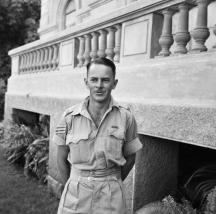
The SAAF’s Mustangs baptism of fire and the urgent need for jet powered fighters

Korean War and the urgent need for the South African Air Force participating in the war  to change from piston driven Mustangs to jet power.

Prior to the SAAF 2 Squadrons deployment to Korea the pilots of the ‘Flying Cheetahs’ underwent concentrated training on Spitfire Mk IXs. Before they were placed at the disposal of the United Nations. They converted to the F-51D Mustang at Johnson Air Force Base, Tokyo, and were attached to the USAF 18th fighter bomber wing at K-9, Pusan and K-24 Pyongyang.

The squadron flew into action to stem the Communist invasion swarming in from the North, the head-long advance forcing it to fall back to K-10 near Chinhae, which remained its permanent base for the next two years.

In this war the SAAF received its baptism of fire from Russian made MiG jets and intensive ground fire – this was party due to the nature of the SAAF sorties at the beginning of the war – close air support to ground troops – coming in low and relatively slow in a highly vulnerable position to ground anti aircraft fire to hit ground targets. Sarcastically these USAF and SAAF pilots were called “mud movers” by pilots and ground troops alike, as at times this is all they seemed to do when dropping bombs or rocketing well defended lines.

In operations using the Mustangs, the SAAF carried out 10 373 sorties, and lost 74 of its 95 aircraft. The high rate of loss is testament to the bravery and commitment of the pilots, but also testament that the SAAF had to convert to jet power to have a fighting chance.

It was this baptism of fire which required a change in tactics and it moved the SAAF from a piston-engined air force into the jet age – and from flying F-51D Mustangs to F-86 Sabre fighter jets.

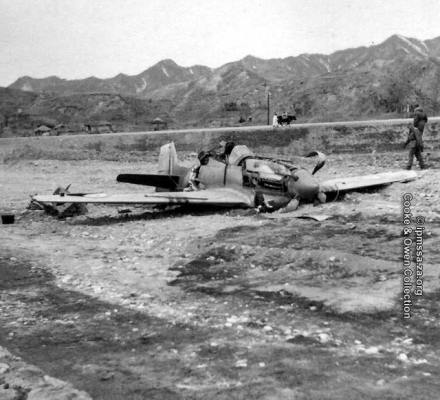
Image of a crashed SAAF F51D Mustang in Korea – copyright ipmssa.za.org Cooke & Owen Collection

Tragedy on Devils Peak and the end of the SAAF H.S. 125 Mercurius fleet

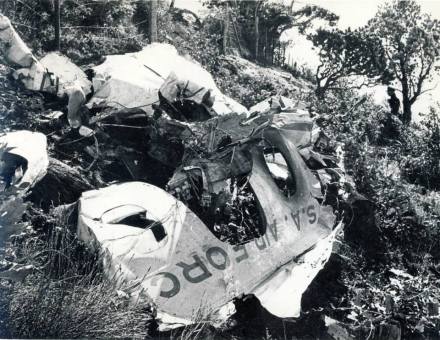
Tragedy on Devils Peak, 26 May 1971. Three South African Air Force Hawker Siddeley 125 Mercurius jets, on a practice formation flying above the Cape Town peninsula, in preparation for a massive 220 aircraft flypast for a Republic day display,  slam into the mountain just above Rhodes Memorial with the loss of eleven lives.

The mountain was shrouded in mist and it is believed the lead aircraft most probably miscalculated the arch of its turning circle coming from the direction of the Athlone cooling towers.  The lead aircraft’s error in judgement meant the other two tragically followed it into the mountain with the loss of all three.

The accident decimated this fleet, as the SAAF where left with only one H.S. 125 Mercurius jet which was not included in this formation flight.  This was a tragedy which took a long time to overcome and in many senses is still quite raw in SAAF circles and memories even to this day – lest we forget

Photo Copyright; Cape Argus

SAAF Pilot single handedly captures his captors – Lt. Peter During’s amazing story

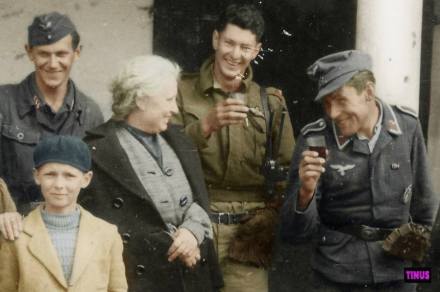
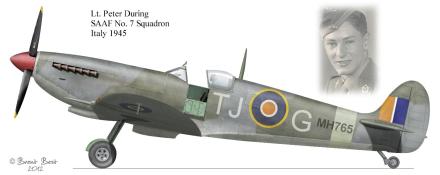
This colorised image captures a must read story about a South African Air Force pilot who escaped from becoming a Prisoner of War (POW) by capturing his own German captors during WW2.  The image shows South African Air Force (SAAF) Fighter pilot Lt. Peter During (SAAF 7 squadron) with German prisoners in Italy April 1945, and this is the story of how he came capture them.

peter during a.jpg.opt1459x581o0,0s1459x581

Lt. Peter During was shot down behind enemy lines in Italy right at the close of the war,  he survived a crash landing and was promptly taken prisoner by the Germans.  Whilst been escorted to a German Lufwaffe Prisoner of War (POW) camp (he was a pilot and thus his interrogation and imprisonment was the responsibility of the German airforce), he opened a conversation with his captors.

He was quickly able to establish that they could already see the writing on the wall, that the war was at an end and Germany would loose it.  The Germans agreed with him that the best way for them to survive the war was to make it over to the Allied lines and surrender.  He then convinced his four German escorts that he was their ticket to survival and to become his prisoners.  They agreed and then changed direction and headed for the Allied lines instead.

It was a simple agreement really – if challenged by any German or other Axis Forces along the way the German’s agreed to say they were transferring an Allied pilot and continue on their way, and if challenged by Allied troops or the Italian Resistance fighters, Lt. Peter During would be given their MP-40 machine pistol and state he was transferring German prisoners.

On their way they stopped at several Italian houses for food and wine. One of the Germans had a camera and hence the photograph. In the feature picture you can see Peter has the MP-40 machine pistol while they enjoy a glass of wine with a rural Italian family hosting this odd group of men, whilst in other pictures the MP-40 has changed hands. Proof positive that there is some humanity in the craziness of war.

They made it over to the Allied lines, Peter During wrote them a note as to their good conduct which he gave to them as they went into captivity.  The camera was given to Peter for safekeeping as its owner knew it would fall into the wrong hands and be lost once going into captivity.

Despite trying on numerous occasions to track down these men Peter had “saved” after the war ended, he was unable to find them, thank them and reunite the camera with its original owner.  He printed the role of film to discover this priceless snippet of history.

If you want to hear this remarkable story from Peter himself, take the time to watch this video interview he did with Tinus Le Roux, it’s an absolute gem of South African military history.


Written by Peter Dickens. The photograph is from Peter During’s collection and it was given to Tinus le Roux, who has also done this fantastic job colourising it. Photo copyright Peter During and colouring credit to Tinus le Roux.  Video copyright and my deepest thanks once again to Tinus.

Britain never really “stood alone” at the beginning of WW2

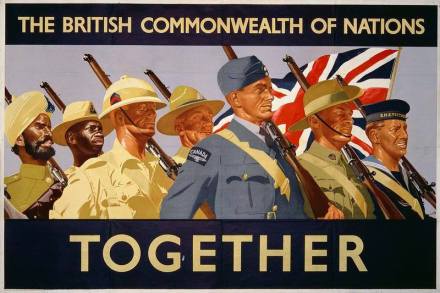
Iconic propaganda poster from World War 2 calling for the unification of the British Commonwealth in what was termed at the time in South Africa by Jan Smuts as the “fight for the freedom of the human spirit” – essentially against Fascist and Nazi ideologies of the time.

It’s widely reported now that Britain “stood alone” at the beginning World War 2, but that is not strictly true (for a short while after the fall of Dunkirk, it may have felt like it, but it was not the case) very quickly coming to aid Britain “in her hour of need” and reinforce her troops, airman and seamen where the armed forces of the British Commonwealth – and not only the armed forces but also the raw materials and industry of the likes of Australia, India, South Africa and Canada – an all in effort to aid the United Kingdom, push back the advances of Fascist thinking and change the course of European history.

It’s generally misunderstood – but within a day of the United Kingdom and France declaring war on Germany on 3 September 1939, New Zealand and Australia had declared war on Germany as well.  It was just 3 short days later that an independent parliament in South Africa declared war on Germany on the 6th September 1939 (very early on if you think about it – the fifth country to declare war on Nazism).  Quickly followed by Canada who just four days after South Africa’s declaration also declared war on Germany – 10th September 1939.

In context – the United States of America came to the table much later on declaring war on Germany on the 11th December 1941.  In this respect it can be better argued that Britain AND her Commonwealth of Nations stood alone against Nazism and other forms of Fascism for about two years.

Seen in this poster are the United Kingdom’s key ‘dominions’ – South Africa, Australia and Canada feature in the most pronounced positions in this poster as the leading nations of the Commonwealth.

Representatives of Commonwealth Armed Forces marching toward the right, with a Union flag behind the front figures. Left to right they are soldiers from India, East Africa, a South Africa soldier (in his distinctive “Pith helmet”),  New Zealand, a Canadian airman, an Australian soldier (in his distinctive “slouch hat”) and a Royal Navy sailor (in senior position as the Navy is the senior service).

Poster Copyright: Imperial War Museum

The Soviet domino in Angola

It is widely understood that the Angolan Border War or ‘Bush War’ was part of the ‘Cold War’. The Soviet ‘domino effect’ in Africa (the progressive movement south of Communism down Africa) was a real concern to many South Africans in the 1980’s and one of the primary reasons underlying South Africa’s involvement in Angola.  South Africans only had to look north to Zimbabwe see the wealth grabs of capital and farms and witness the economic and social dangers of communist philosophies in an African context.

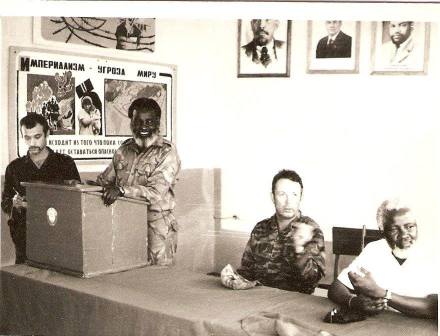
To give context to this, and the influence of Soviet Communism in sub saharan Africa, here is the 1987 Soviet Mission to Angola, this picture was taken at Lubango — starting from left to right – Lt. Igor Ignatovich, the interpreter, Dr. Sam Nujoma, Colonel Vladimir Shayda Commander of the Soviet Mission (SWAPO 1985-1988) and Peter Mweshihange.

To understand the “Cold War” in the 1980’s, at the time that this photograph was taken there was virtually no “Western” diplomatic contact with the Soviet Union at all.  It was truly a firm stand-off between two super power blocks with the threat of nuclear attack a constant and present danger.  The Soviet Union and NATO states (USA, UK and Western Europe) were literally in an eye-ball to eye-ball stand-off, each side of a “iron curtain” that split central Europe down the middle.

South Africa, even as an Apartheid State, saw itself as a “Western democracy” allied to the “West” and as a consequence in direct opposition to the spread of Communism. The National party often positioned South Africa as leading the “Cold War” fight against Communism in Africa.  The National Party – from the very beginning of their accent to power in 1948 were fiercely anti-communist in their philosophy and by 1987 the “Rooi Gevaar” (Red Danger) warning was very central to their political rhetoric.

That “Soviet Communism” was going to come to a spectacular end with the fall of the Berlin Wall in 1989 was still a couple of years off, and it was this event and the collapse of Soviet communism that was to be the major catalyst for the withdraw of South African forces from the Angolan/Namibian border.

Photo courtesy Outapi War Museum and Igor Ignatovich,

South Africa’s “Vietnam” – the tactical use of the helicopter during the Bush War

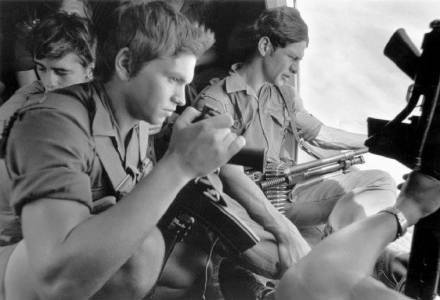
South Africa’s ‘Vietnam’ in a Bush War photo not too dissimilar to a Vietnam War image, an elite South African rapid response unit prepares to be debused from a South African Air Force Puma helicopter somewhere on the Angolan and South West African Border. What a great photo by Peter Marlow.

Not interested in keeping permanent “firebases” in Angola to stem insurgency,  similar to the American tactics used in Vietnam the South Africans extensively used the helicopter to shuttle reaction forces directly to an identified target and take them back once their “search and destroy” mission had been completed.

Image copyright – Peter Marlow

‘Severely wounded, he single-handedly attacked a machine gun nest and an anti-tank gun’; Quentin Smythe VC

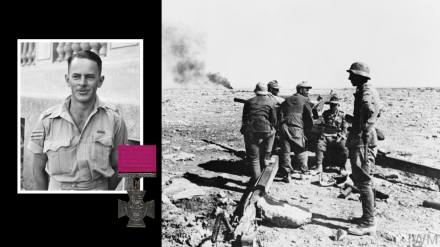
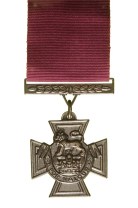
487590_145585105611230_766406177_nNow this is a very notable South African, and a true hero – Sgt Quentin George Murray Smythe VC,  who won the Victoria Cross in the Western Desert on 5 June 1942.  The Victoria Cross (VC) is the highest military decoration awarded for valour “in the face of the enemy” to members of the British armed forces and various Commonwealth countries (of which South Africa is one).

Quentin George Murray Smythe, was born in Nottingham Road, Natal, South Africa on 6 August 1916 as son of Edric Smythe. He was the grandson of the First Administrator of Natal, Charles Smyhte. Quentin Smythe attended the Estcourt High School in Estcourt. After his education he started farming in Richmond.

During the Second World War,  Quentin Smythe served with the 1st Battalion Royal Natal Carabineers, 1st SA Infantry Division, South African Forces in the East Africa Campaign against the Italians before moving to the Western Desert against the German and Italian Axis Forces.

On May 26, 1942, Rommel’s Afrika Korps attacked the British Army ( which had just been weakened by losing two divisions, an Armoured Brigade and some squadrons of the Desert Air Force to the Far East ) in order to pre-empt a new British offensive. The Germans hoped to capture Tobruk and, ultimately, to drive the British back to Alexandria, although this attempt was finally checked at El Alamein by Auchinleck the next month.

Gazala

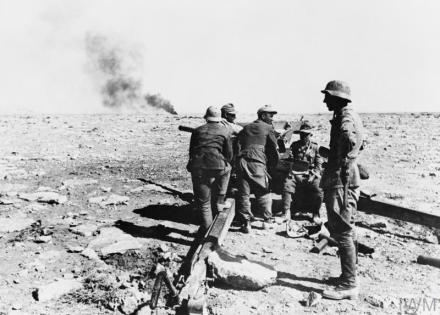
A German gun crew manning a 3.7 cm Pak 36 anti-tank gun in the Western Desert, during the Gazala offensive, June 1942.

The initial attack caught the British off-balance, but they recovered and fought back, forcing the Germans to take up a defensive position, which became known as ‘The Cauldron’. Unfortunately, the British were at this stage equipped with tanks and guns which were inferior to the Germans’, and after a number of desperate battles they had to fall back.

For related articles on this retreat – know as the ‘Gazala Gallop’ see “General Pienaar, tell your South African Division they have done well”; The Battle of El Alamein and the Fall of Tobruk “Defeat is one thing; Disgrace is another!” South Africa’s biggest capitulation of arms – Tobruk

On June 5 the South African forces were holding a position in the north of the line (which consisted of defensive “boxes” separated by minefields), and when Rommel launched a heavy attack in the northern sector he encountered strong and determined resistance. The cost in casualties on both sides was high. Smythe, who was then a sergeant, realised that there was no officer to command his platoon and took charge himself, leading his men in an attack on the enemy’s strong point at Alem Hamza, 20 miles south of Gazala

His citation in attacking Axis Forces says just about everything as to how this hero earned his VC and reads as follows:

medalNo. 4458 Sergeant Quentin George Murray Smythe, South African Forces.

For conspicuous gallantry in action in the Alem Hamza area on the 5th June,

“1942. During the attack on an enemy strong point in which his officer was severely wounded; Sergeant Smythe took command of the platoon although suffering from a shrapnel wound in the forehead. The strong point having been overrun, our troops came under enfilade fire from an enemy machine-gun nest. Realising the threat to his position, Sergeant Smythe himself stalked and destroyed the nest with hand grenades, capturing, the crew. Though weak from loss of blood, he continued to lead the advance, and on encountering an anti-tank gun position again attacked it single-handed and captured the crew. He was directly responsible for killing several of the enemy, shooting some and bayonetting another as they withdrew.

After consolidation he received orders for a withdrawal, which he successfully executed, defeating skilfully an enemy attempt at encirclement.

Throughout the engagement Sergeant Smythe displayed remarkable disregard for danger, and his leadership and courage were an inspiration to his men.”

Citation was gazetted on 11 September 1942, see this rare Associated Press video of the actual award ceremony where Sgt. Smythe received his Victoria Cross from Maj. General Dan Pienaar.

When Sgt. Smythe VC returned to South Africa, he returned a national hero, he had won the country’s first Victoria Cross in the Second World War. In all five South African’s won the Victoria Cross during World War 2, of which there are only two very well known recipients, these been our hero today, Quentin Smythe VC and Edwin Swales VC (see Edwin Swales VC DFC, a South African Hero whose legacy has been eroded!)

The remaining three are George Gristock VC, Gerard Norton VC and John Nettleton VC (you can read more on John Nettleton – see John Nettleton VC – an unknown South African Victoria Cross recipient)

Sgt Smythe is well known because he enjoyed great media attention and was presented to the Premier Jan Smuts and this PAHÉ footage captures the occasion.

On leaving the Department of Defence he returned to farming in the Richmond area of Natal. He was an outstanding marksman, a passionate conservationist and animal lover. He died from cancer in Durban, aged 81 in October 1997 and was buried with military honours by his Regiment – The Natal Carabineers.  He left three sons, a daughter and 11 grandchildren.

His Victoria Cross is now part of Lord Ashcroft’s collection and is kept in the Imperial War Museum in London.


Researched by Peter Dickens. Image Copyrights – Imperial War Museum.  Video copyrights Associated Press and British PATHÉ respectively.

South African troops liberate Castiglione dei Pepoli and put an end to massacres in the area

Some little known South African military history that we can all be very proud of, take the time to read how South Africans are still appreciated to this day in Italy for saving a small town’s civilian population from been totally massacred by the Nazi SS.  This from 2008 issue of The Roman Forum magazine:

Marzabotto – An Italian town’s appreciation to South African troops for rescuing them from total annihilation after the massacre nearby townspeople by Nazi SS during World War 2.

Today, deep in the heart of Italy’s Apennine mountains between Bologna and the Po valley, in the communities of Castiglione dei Pepoli, Monte Stanco, Grizzana Morandi and the surrounding area local people gather annually not only to celebrate their towns’ emancipation from Nazi forces in the autumn of 1944 by the 6th Armoured Division from South Africa, but even to raise the South African flag in ceremony.

Their gratitude is so great, because this area was the site of the biggest, yet least-known, massacre of innocent civilians in Italy during WWII: the Marzabotto Massacre.

It was an exceptionally bleak atrocity for Italy, as it involved the extinction of an entire ‘race’- on 3 October 1944, German and Austrian SS troops were ordered to purge the entire area of Monte Sole and Monte Ruminci, because the townspeople of Marzabotto, Grizzana Morandi, and Monzuno were suspected of helping and supplying Italian partisans along the Gothic Line, which Hitler himself had ordered to be kept at all costs to sever south Italy and Allied forces from the industrialised and developed north.

Here Allied and German SS forces saw out the last winter of WWII, tired, cold, depleted, neither able to advance or retreat. Here is where the Allies eventually broke through the following Spring, spelling the end of the war in Italy. Before that, Nazi troops literally marched into every town and exterminated every living thing in sight. Women, children, young babies and the elderly alike were killed by gunfire and with grenades.

By sunset 3 October, Marzabotto’s and Monzuno’s unique population of mountain people, nearly two thousand people, were entirely exterminated.
marzabotto-2

The SS then started moving into Grizzana Morandi and Monte Stanco herding the townspeople into two groups in no particular order. The first group (half the population) were slaughtered that night, the remaining group was to be executed the next morning.

On 4 October 1944, the executions had already started, when out of nowhere a group of Allied soldiers who had been sent to patrol and scout the area, unaware of the purge, appeared and engaged the SS in combat. After a long battle they managed to drive the Nazis off well behind the Gothic Line, saving the few remaining people of Monte Sole. This group of soldiers was the 6th Armoured Division of South Africa.

The South Africans had been the first Allied troops to arrive in the area; British, American, New Zealand, Rhodesian, Australian, and Indian troops arrived some three days later from the nearby American base in Livergnago (dubbed ‘Liver & Onions’ by soldiers) with food and supplies for the towns’ afflicted victims and set up Allied camps along what is today one of Italy’s most famous war commemoration sites – the Gothic Line.

Hence, the people of Monte Sole celebrate South Africa every year, because the few survivors (some even today), owed their lives to the 6th Armoured Division.

A new street connecting Castiglionei dei Pepoli and the entire area with the Bologna-Modena highway was unveiled in November 2007 was named in honour of the South African 6th Armoured Division.

(May 2008 issue of The Roman Forum magazine)
22538880_2036375319924789_2530925105059241320_o

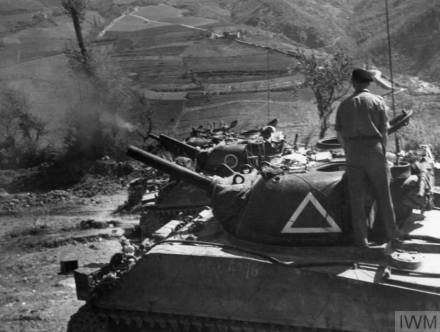
Tanks of the South African 6th Armoured Division firing on German positions at Monte Sole and Montebello at the start of the attack which ended in the breakthrough to Bologna. April 1945.

Aftermath

The Marzabotto massacre was a mass murder of at least 770 civilians by Nazi Germans.  It is the worst massacre of civilians committed by the Waffen SS in Western Europe during the war.   The massacre was in reprisal for the local support given to the Italian Partisans and Resistance by the townspeople between 29 September and 5 October 1944,  SS-Surmbannfuher Walter Reder led members of the 16th SS Panzergrenadier Division Reichesfuhrer-SS to systematically kill hundreds of people in Marzabotto. They also killed numerous residents of the adjacent villages of Grizzana Morandi and Monzuno.
Reder123

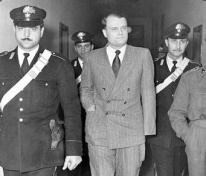
Walter Reder’s Trial

The Allies tried two Nazi Germans for the massacre, Max Simon and Walter Reder.  Simon received the death sentence which was changed later to life in prison, he was released in 1954 and died in 1961.  Reder was handed over to the Italians sentenced to life in prison, and released in 1985, he died in 1991

Remembrance

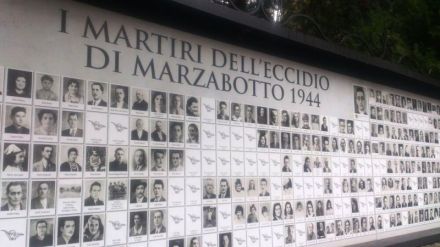
Claudio Chiste’, the Chairman of the South African Legion of Military Veterans – England branch visited the area to pay homage to this incident in October 2017 – here is the mausoleum and plaque dedicated to the 6th South African Armoured Division by a grateful local population for their rescue from systematic German massacre (note the triangular symbol which was the 6th South African Armoured Division’s insignia).


Researched by Peter Dickens.  Primary extract May 2008 issue of The Roman Forum magazine), additional source – wikipedia. Photo copyright and much thanks to Claudio Chiste’ for his dedication.  Additional image copyright, Imperial War Museum.

The thousand yard stare

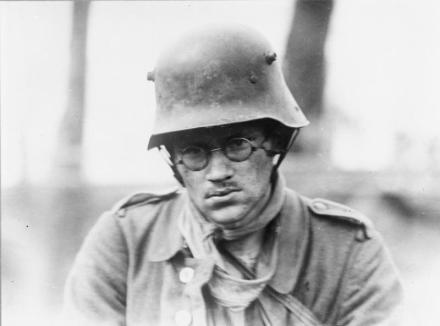
South Africans in WW1. This is face of defeat, fatigue and war – this time from the Battle of the Menin Road Ridge. This German prisoner of war was captured in the attack on Vampire Farm by Scottish and South African troops near Potijze on the 20th September 1917.  This photograph of his expression shows his emotional and physical state of mind, it’s a phenomenon known to soldiers as “the thousand yard stare,” and it is a condition brought about by the extreme stressors of combat.

Image copyright Imperial War Museum

The legendary South African made Marmon-Herrington armoured car

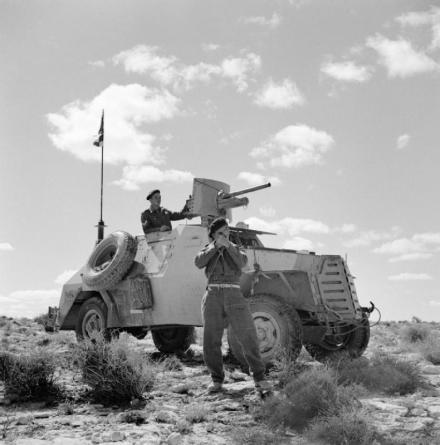
Great image of a South African made Marmon-Herrington armoured car in World War 2, as the crew stops to take a compass bearing during a patrol. These South African armoured car units were successfully used in North Africa for reconnaissance duties and as part of mobile columns despatched to harrass the enemy.  Some captured Marmon-Herringtons even landed up been used by The German DAK (Afrika Korps).

The use of captured goods was not uncommon – have a look at the side of this armoured car and you will see a “Jerry Can” for water which is a piece of German kit adopted by the Allied soldiers who found it infinity better in design than their own cans (which were prone to splitting).  Hence the word “Jerry” (derogatory term used by Allies for Germans) for the name of the can, a name which survives to this day for this style of container.

Image Copyright Imperial War Museum Collection