Nugget of South African military history, the very first German General to formally surrender his forces to the Allies during the Second World War – surrendered to the South African forces in the North African theatre of operations.
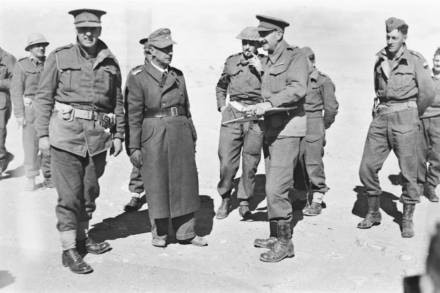
Generalleutenant Artur Schmidt was the first German General to formally surrender to a Allied General which was General De Villiers (Commissioner of the South African Police) and Commander of the South African 2nd Infantry Division.
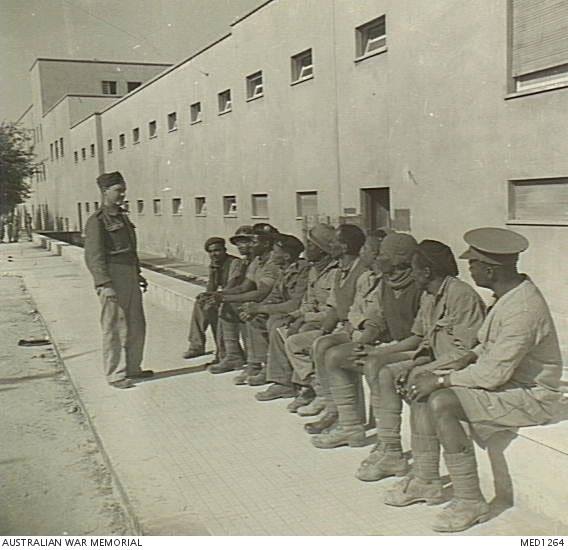
As part of General Rommel’s skillful retreat in December 1941 to the El Aghelia – Marda strongpoint in Libya, key defensive actions where set up at Sollum, Halfaya Pass and Bardia. On 30 December 1941, South African troops supported by a heavy air, sea and land bombardment began their attack on Bardia. A counterattack on the city’s perimeter slowed the advance, but supported by tanks the South Africans launched their final assault on 02 January 1942 to take the city. Seen here on that day is General Schmidt formally surrendering himself and the Italian and German forces under his command to the South Africans.
Ironically the South African 2nd Infantry Division would themselves all become captured at the Fall of Tobruk by Rommel’s German Afrika Korps and other Axis forces on 21 June 1942.
Note the identification patch of the South African 2nd Infantry Division on the person standing on the far right of the image.
Not to be confused with the “capture” of Generalleutnant Johann von Ravenstein a couple of months earlier by New Zealand soldiers. There is a big difference between a formal surrender of forces to an opposing force, than simply been randomly ‘captured’ driving around in a staff car and taking a wrong turn as General von Ravenstein was. General von Ravenstein did not “surrender” himself nor did he surrender any German forces.
Ironically General von Ravesnstien served the first part of his POW life in South Africa before been shipped of to Canada.
Written and researched by Peter Dickens. Thank you to Sandy Evan Haynes for the background information and to Marc Norman for the image.
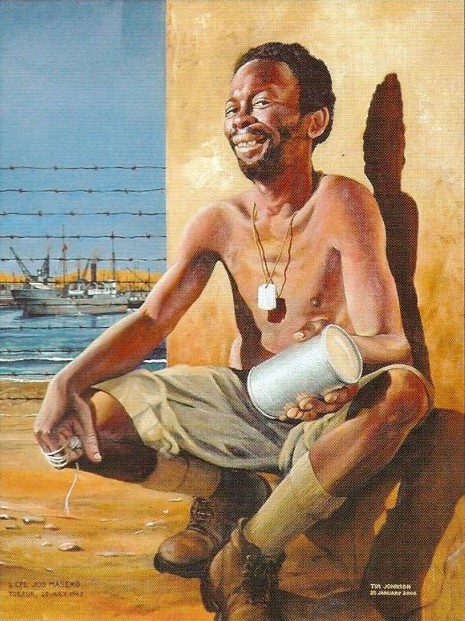
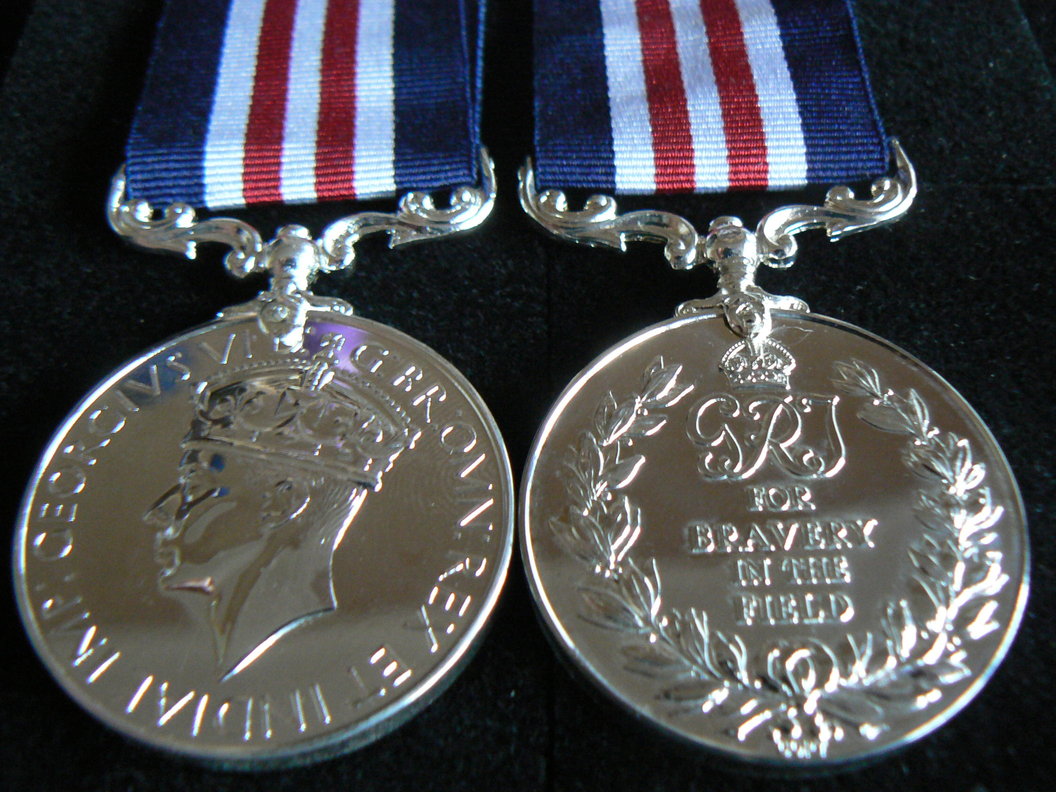
Job Maseko is a very notable South African hero of the Second World War. He was a member of the South African Native Military Corps (NMC) and was decorated with the Military Medal for gallantry. So how is it that a NMC member, a corps not allowed to officially carry firearms, gets to into the fight and wins this decoration. Simply put he single-handedly blew up an enemy ship. Read on for the story of a very remarkable man.
Job Maseko was employed as a delivery man in Springs before he volunteered for service in the Second World War and joined the South African Native Military Corps (NMC). After completion of basic training, he was sent to North Africa, attached to the 2nd South African Infantry Division. Members of the NMC took up any support role in the Division which did not require the handling of a firearm. They were given a vast range of different roles – anything from drivers, military cooks, engineers, stretcher bearers to bomb loaders. South African race laws at the time provided that serving ‘black’ men could not carry firearms, they were however issued spears as a ‘traditional weapon’ for guard and ceremonial duty, but that was about it (see related Observation Post Dress and Bearing of the South African Native Military Corps).
128 000 ‘Black’ South African soldiers volunteered to take part in World War 2 (nearly 40% of the standing army) and members of the NMC often found themselves in perilous circumstances and were exposed to the rigours and dangers of war as much as any another soldier. Some of these restrictions on the use of weapons quickly went out the window when in a combat zone, and somewhere along the line Job Maseko also learned a bomb making skill (see related Observation Post ‘Armed’ SA Native Military Corps in WW2 – this Corps screams out for a definitive work!).
The fall of Tobruk
General Klopper
In 1941 the Australians had held Tobruk for 9 months, until Rommel’s withdrawal of his Axis forces to the west. Tobruk secured, by 1942 the Allied Middle East Command decided to leave a smaller ‘temporary’ force to hold Tobruk while a new strike force was built up near the frontier. The task of defending Tobruk was left to the South Africans. The new garrison was to be formed by the 2nd South African Infantry Division with General Klopper, a farmer from the Orange Free State before the war, and a major general of only one month’s standing, given command of Tobruk. In addition, units of British and Indian detachments fell under South African command defending Tobruk. Into this deployment also fell our hero – Job Maseko.
It is generally understood that by this stage Tobruk’s defences were in a poor shape with much of the armour and artillery taken away to the new frontier, the Western and Southern sides of the port were well defended by the South Africans, but the East side was weak, and it proved to be fatal.
As usual, Rommel had devised a ruse for capturing Tobruk. Only his infantry approached the western perimeter, while his mobile forces swept on past, to give the impression that the German and Italian armour was heading straight for the Egyptian border (sending radio messages to that effect to complete the ruse). He then swung his mobile armoured forces around and attacked Tobruk from its weak point – the eastern perimeter.
Rommel’s zero hour was 05h20 on 20 June 1942. As dawn broke long black lines of tanks, trucks and infantry slowly started to move forward. As it grew louder and closer to Tobruk waves of German Stukas and Ju 88’s aircraft appeared overhead (Rommel pressed every single Axis airplane in service in North Africa into taking Tobruk).
As the heavy artillery began to fire, the planes released their bombs and quickly got out of the way for the next wave, operating a shuttle service between the defence perimeter and El Adem airfield, 10 miles away. They pounded a gap open 600 yards wide. Behind them, under cover of artillery barrage and half-hidden by smoke and dust, German and Italian sappers raced forward to lift mines and bridge the tank traps with tanks and infantry racing through the gaps. As they move forward, they lit green, red and purple flares and the Stukas dropped their bombs just ahead of the advancing, multi-coloured smoke screen while the other planes and artillery blasted the South African rear (the seaward side of the port) with shells and bombs.
Rommel and German armour entering Tobruk
Into this desperate fight for survival went everyone, including members of The Native Military Corps. Job Maseko worked as a stretcher bearer, doing profoundly dangerous work, rescuing wounded men, as the defence of Tobruk became more desperate, Job and other black colleagues were given rifles and expected to fight on the front line with everyone else.
Inside Tobruk the situation was chaotic. General Klopper – his HQ’s bombed out, his radio and telephone wrecked and his code booked destroyed, lost the last vestige of control. Tobruk fell by the evening. Job Maseko became a prisoner of war (POW) on 21 June 1942 when Major-General KIopper, surrendered to Rommel at Tobruk with 32000 men, including 10,722 South Africans of the 2nd Infantry Division, of whom 1,200 were members of the Native Military Corps. It was the single biggest capitulation of South African forces in the country’s history – before or since.
Erwin Rommel inspecting South African POW after Tobruk falls
Job and many others were forced to march across the desert to an Italian POW camp. The Italian treatment of South African prisoners of war was nothing short of diabolical, however an even worse treatment was reserved for Black members of the South African Native Military Corps in captivity. German and Italian forces displayed a complete disregard for the rights of coloured or black POWs as they did not view them as regular troops.
One account recalls how black soldiers were shot by drunk German guards while been marched to the POW camp, and the account goes further to say that in Tobruk camp, black South African POWs were forced “under threat of death” to do war work, which was contrary to the Geneva Convention.
Another report claims Indian and Black prisoners at Tobruk were not allowed to take cover whenever the Allied bombers later bombed the port, furthermore their food was totally inadequate – they were only given one packet of biscuits per day and water rations were kept to a minimum.
Allied POW at Tobruk
There were also examples of Black South African POW escaping from the camp perimeter with their white counterparts to scrounge for food in the town, and Job Maseko was one. The Black POWs, as they were put to war work in the harbour (something most their white counterparts were excluded from) – mainly offloading ships. Desperate for food they would sometimes return to the camp with ‘acquired’ sacks of corn meal (mieliemeal), one account from De Lisle recalls that the unfortunate consequence was that hungry English and South Africans white POW would lay siege to their tents (the Black POW) at night to beg for their food.
The diabolical treatment of Black POW forced Job Maseko to taken action against his captors, to quote him “because of our ill-treatment by the enemy, especially the Italians, and because I felt it a duty in this way to assist my own people”.
As with his Biblical namesake, Job was made of tough stuff and with the help of some comrades whilst on mundane prisoner duties to go down to the docks, Job created a bomb using a condensed milk tin, cordite taken from bullets and an extremely long fuse.
Job placed his home-made bomb deep inside the bowels of a German freight ship (and “F” Boat) that was docked in the harbour at Tobruk. He skilfully placed it next to fuel barrels for maximum effect, lit the fuse and made good his escape. Had he been caught, as a Black POW, he would have certainly been put to death if not tortured first.
Job waited and later the ship shuddered from a huge internal explosion and sank almost immediately into the harbour. After the war Job Maseko was able to point out the exact place where the ship was berthed and sure enough divers found it on the sea bed.
He later escaped from Tobruk and walked, for three long weeks though the desert and through enemy lines, all the way to El Alamein, he intended joining the battle there as he had fixed an old German radio he had found which informed him about General Montgomery’s epic and tide turning battle at El Alamein. We still await the full historical account of this remarkable man as very little is known to this day, rest assured historians are now writing it.
For his actions, Job Maseko was later presented with the Military Medal (MM) by Major-General F H Theron. The following extract enshrines his heroism, bear in mind when reading this, it is made even more remarkable in that Job Maseko as a ‘black’ African could only be deployed in a non combat role:
The King has been graciously pleased to approve the following award in recognition of gallant and distinguished service in the Middle East:-
Military Medal No N 4448 L/Cpl Job Masego [sic) – Native Military Corps
Citation For meritorious and courageous action in that on or about the 21st July, while a Prisoner of War, he, Job Masego, sank a fully laden enemy steamer – probably an “F” boat – while moored in Tobruk Harbour.
This he did by placing a small tin filled with gunpowder in among drums of petrol in the hold, leading a fuse therefrom to the hatch and lighting the fuse upon closing the hatch.
In carrying out this deliberately planned action, Job Masego displayed ingenuity, determination and complete disregard of personal safety from punishment by the enemy or from the ensuing explosion which set the vessel alight.’
The Victoria Cross Controversy
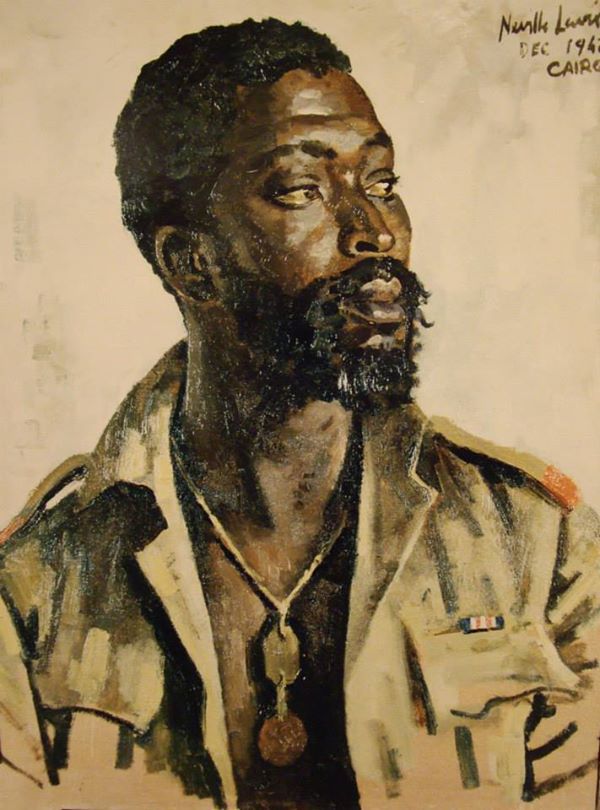
For his actions Job Maseko was initially recommended for a Victoria Cross but according to Neville Lewis, the first official war artist for South Africa during the Second World War, Job Maseko was awarded the Military Medal instead as he was ‘only an African’. It is hoped that actions currently been taken by the SANDF Military Attache in the United Kingdom to redress this issue with British government and re-open his case so it will be met with a correct interpretation of Job Maseko’s actions without the ‘race’ factor as part of the deliberation, and his actions considered as one worthy of the Victoria Cross or not (as may be the case).
Later in Life
Black ex-South African POW in Tripoli awaiting repatriation after the war
After been released Lance Corporal Job Maseko returned to South Africa. “Apartheid” was to be implemented a few short years after the war ended in 1948 when the Nationalists came to power beating Smuts. Job Maseko’s legacy slipped away from the general consciousness – along with many deeds of South African servicemen in World War 2, black and white. He became a poor man and died in 1952 when he was accidentally hit by a train. He was so broke at the time he was buried with borrowed money in the Payneville Township Cemetery in Springs. A very sad way to see the end of a national hero.
Today, to honour this unassuming hero, the community of KwaThema near Springs has a primary school in the township named after him. The main road linking the town of Springs to KwaThema Township has also been named after him. He is honoured at both the Delville Wood museum in France and the South African Museum of Military History in Johannesburg, A South African fighting ship the SAS Kobie Coetzee has also now been renamed the SAS Job Maseko in recognition of this very brave South African.
He can truly take the mantle of a proper South African warrior and stands shoulder to shoulder with all the other great South Africans who have earned the highest accolades of gallantry.
Written and Researched by Peter Dickens, References wikipedia, The incredible true tale of Job Maseko – the man who sunk a ship whilst a prisoner by Stephen Liddell. Narratives from North Africa: South African Prisoner of War experience following the fall of Tobruk, June 1942 by Karen Horn. Artwork credits: . Job Maskeko official portrait by Neville Lewis. Job Maseko holding explosive by Tim Johnson, copyright Tim Johnson website: http://www.timjohn.co.za
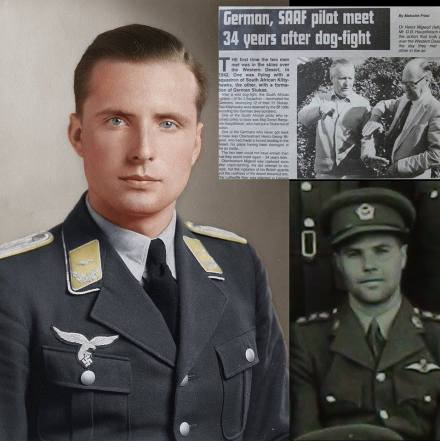
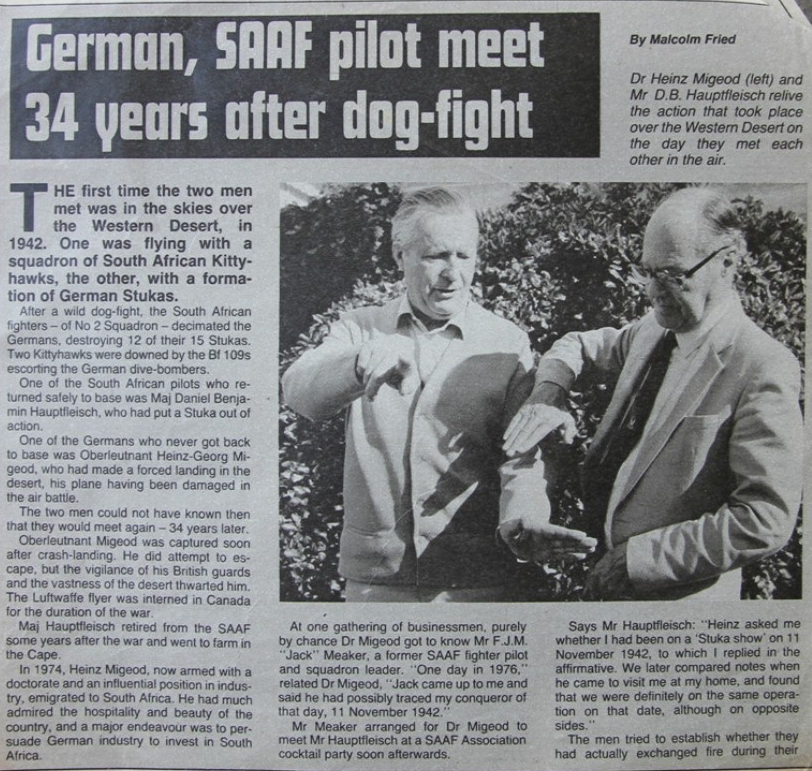
Another amazing and very human story about one of our World War 2 South African heroes. This one where two former enemies became close friends long after they met in the skies of North Africa during Word War 2. A German and a South African pilot fought to the death, the South African shooting down the German, later only to become friends.
The colorised image is Stuka pilot Lt. Heinz-Georg Migeod, shot down in Libya, 11/11/1942 by SAAF fighter pilot DB “Hoefie” Hauptfleisch (in the black and white portrait insert).
After the war Heinz relocated to South Africa where he met Hoefie and they became good friends. Hoefie passed away in 2009 and Heinz in 2010.
Tinus Le Roux was fortunate to have met Heinz. He once said to Tinus that the incident on 11 Nov 1942 was very funny: “a German of French descent was shot down by a South African from German descent in an African country occupied by Italy”
Now that is sheer irony.
Watch Tinus’ interview of the German Stuka pilot Heinz-Georg Migeod on the day he was shot down by Hoefie Haupfeish, its historic gold and gives an excellent insight into the manner the war was fought in North Africa.
Researched by Peter Dickens. With thanks to Tinus Le Roux for the colorised image and story as well as the families of Heinz Migeod and Hoefie Hauptfleisch for their stories, pictures and memories. Image and video copyright – Tinus Le Roux
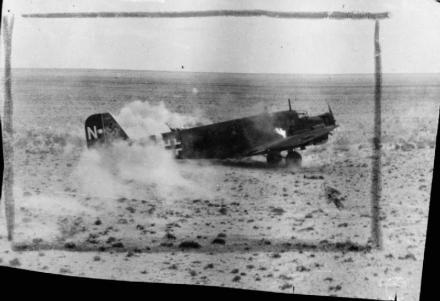
Not often seen is a close up of like this of the South African Air Force in action during the North African campaign – WW2. Here cannon shells can be seen as they explode around the tail of a German Junkers Ju 52 forced down in the Western Desert by three Bristol Bisleys of No. 15 Squadron South African Air Force, 12 October 1942.
The starboard (right) engine is already on fire, and a member of the JU 52 crew can be seen trying to take cover lying face down on the ground beneath it. The Bisleys, escorted by four Bristol Beaufighters of No. 252 Squadron Royal Air Force, intercepted the German transport aircraft while returning from a strike on an enemy train.
The Beaufighters shot down a Ju 52 and damaged one of the escorting Messerschmitt Bf 110s, while the Bisleys forced down a second Ju 52 and subsequently destroyed it with their bombs. One of the Bisleys was shot down by return fire.
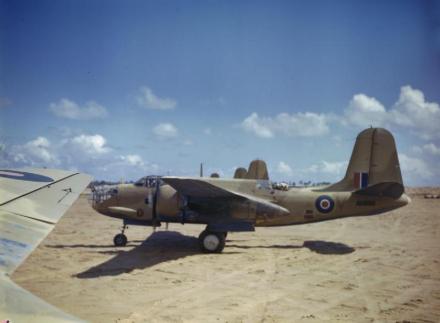
Sometimes some well preserved original colour photography can take you right back to South Africans taking part in World War 2 as if it was yesterday. Here, in Libya March 1943, are Douglas Boston light bomber aircraft of No 24 Squadron, South African Air Force lined up at Zuara, Tripolitania. The nearest Boston is AL683/`V’.
On 5 March 1941 24 Squadron SAAF was formed when No.14 Squadron SAAF and its Maryland bombers were moved from Kenya to Egypt, and renumbered as No.24 Squadron. The squadron then operated alongside No. 39 Squadron RAF as a daytime tactical bomber unit carrying out bombing sorties against targets in the Mediterranean theatre. 24 Squadron was later in the year re-equipped with Bostons.
In December 1943, the squadron was relocated to Algeria and re-equipped with the B-26 Marauders and in 1944 flew to a new base at Pescara, Italy, before later advancing to Jesi, Italy. At the end of the war the squadron used its Marauders as transport aircraft, before moving to Egypt in October 1945 and disbanding on 6 November 1945.
The squadron was reactivated when the Buccaneer entered SAAF service in 1965. 24 Squadron SAAF Buccaneers saw active service during the Border War in South-West Africa,. They flew over Angola and Namibia in the 1970s and 1980s, and attacked SWAPO guerrilla camps with rockets and bombs.
The squadron was disbanded in March 1991 at AFB Waterkloof, Pretoria.
Photo copyright – Imperial War Museum, source IWM and wikipedia
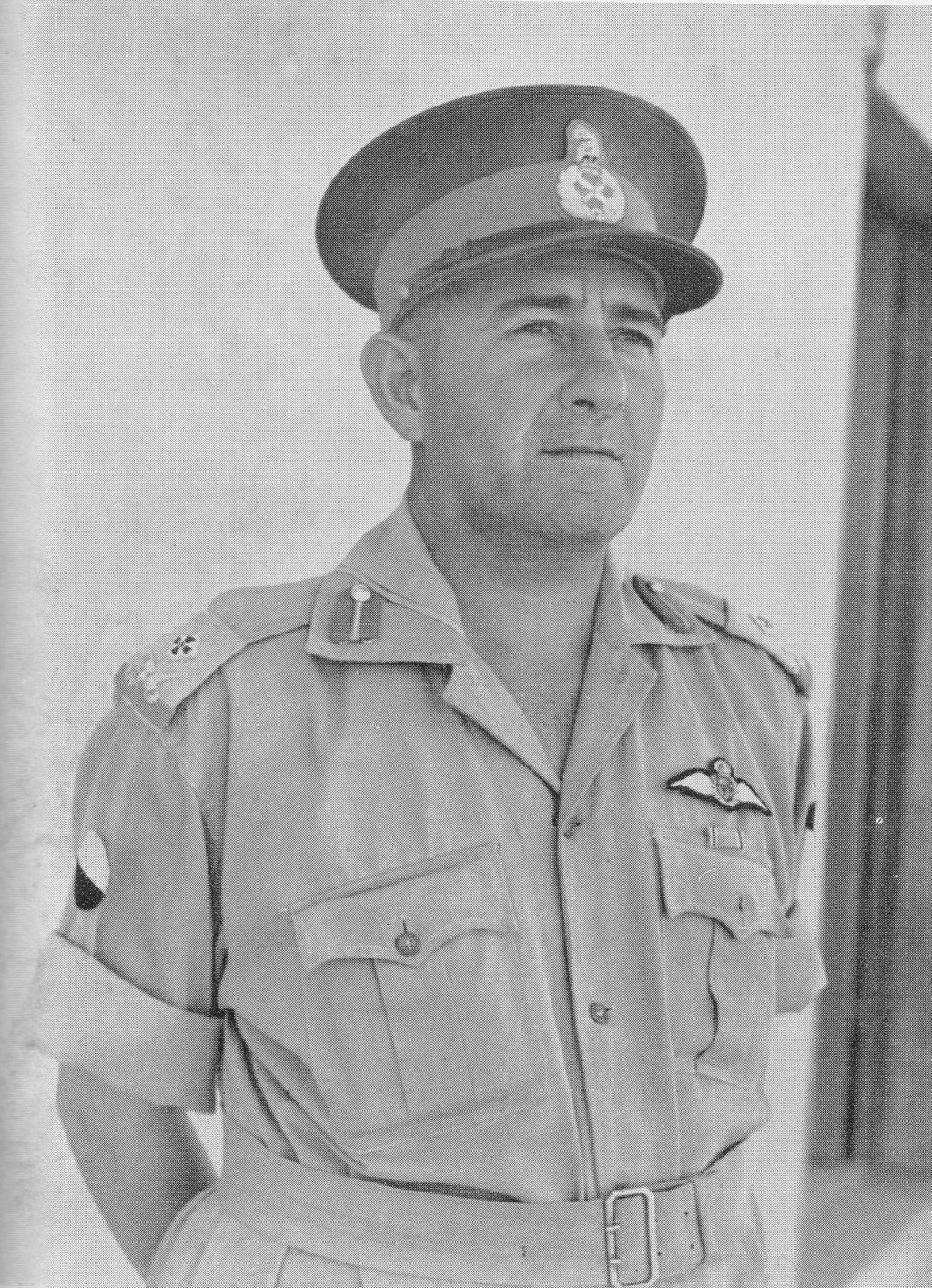
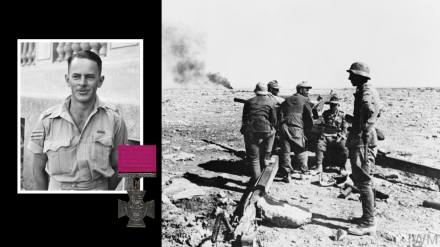
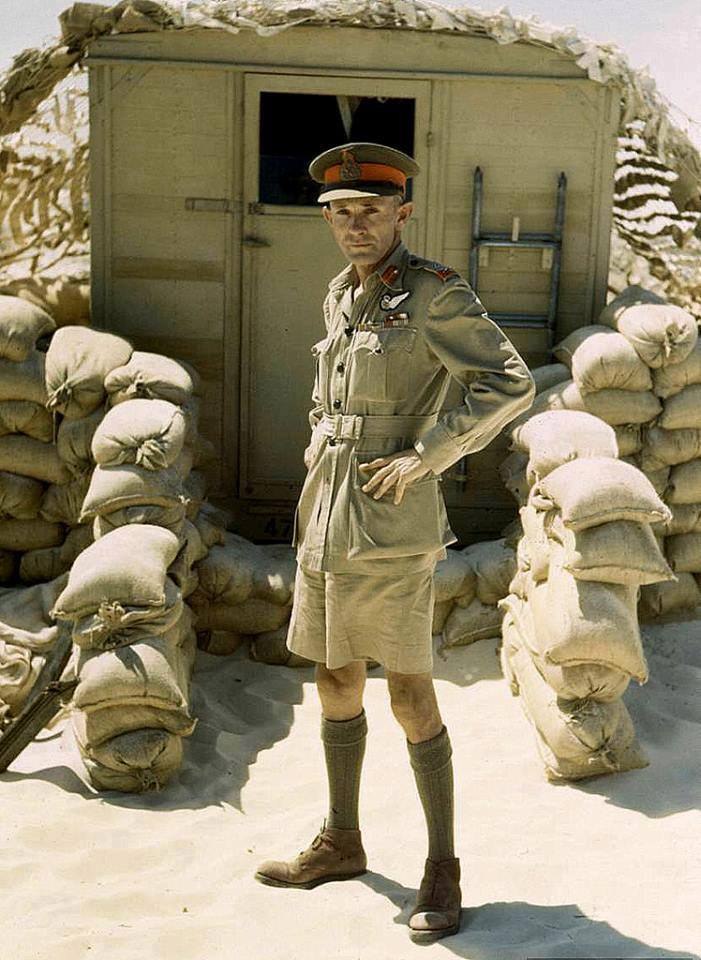
Now this is a very notable South African, and a true hero – Sgt Quentin George Murray Smythe VC, who won the Victoria Cross in the Western Desert on 5 June 1942. The Victoria Cross (VC) is the highest military decoration awarded for valour “in the face of the enemy” to members of the British armed forces and various Commonwealth countries (of which South Africa is one).
Quentin George Murray Smythe, was born in Nottingham Road, Natal, South Africa on 6 August 1916 as son of Edric Smythe. He was the grandson of the First Administrator of Natal, Charles Smyhte. Quentin Smythe attended the Estcourt High School in Estcourt. After his education he started farming in Richmond.
During the Second World War, Quentin Smythe served with the 1st Battalion Royal Natal Carabineers, 1st SA Infantry Division, South African Forces in the East Africa Campaign against the Italians before moving to the Western Desert against the German and Italian Axis Forces.
On May 26, 1942, Rommel’s Afrika Korps attacked the British Army ( which had just been weakened by losing two divisions, an Armoured Brigade and some squadrons of the Desert Air Force to the Far East ) in order to pre-empt a new British offensive. The Germans hoped to capture Tobruk and, ultimately, to drive the British back to Alexandria, although this attempt was finally checked at El Alamein by Auchinleck the next month.
A German gun crew manning a 3.7 cm Pak 36 anti-tank gun in the Western Desert, during the Gazala offensive, June 1942.
The initial attack caught the British off-balance, but they recovered and fought back, forcing the Germans to take up a defensive position, which became known as ‘The Cauldron’. Unfortunately, the British were at this stage equipped with tanks and guns which were inferior to the Germans’, and after a number of desperate battles they had to fall back.
On June 5 the South African forces were holding a position in the north of the line (which consisted of defensive “boxes” separated by minefields), and when Rommel launched a heavy attack in the northern sector he encountered strong and determined resistance. The cost in casualties on both sides was high. Smythe, who was then a sergeant, realised that there was no officer to command his platoon and took charge himself, leading his men in an attack on the enemy’s strong point at Alem Hamza, 20 miles south of Gazala
His citation in attacking Axis Forces says just about everything as to how this hero earned his VC and reads as follows:
No. 4458 Sergeant Quentin George Murray Smythe, South African Forces.
For conspicuous gallantry in action in the Alem Hamza area on the 5th June,
“1942. During the attack on an enemy strong point in which his officer was severely wounded; Sergeant Smythe took command of the platoon although suffering from a shrapnel wound in the forehead. The strong point having been overrun, our troops came under enfilade fire from an enemy machine-gun nest. Realising the threat to his position, Sergeant Smythe himself stalked and destroyed the nest with hand grenades, capturing, the crew. Though weak from loss of blood, he continued to lead the advance, and on encountering an anti-tank gun position again attacked it single-handed and captured the crew. He was directly responsible for killing several of the enemy, shooting some and bayonetting another as they withdrew.
After consolidation he received orders for a withdrawal, which he successfully executed, defeating skilfully an enemy attempt at encirclement.
Throughout the engagement Sergeant Smythe displayed remarkable disregard for danger, and his leadership and courage were an inspiration to his men.”
Citation was gazetted on 11 September 1942, see this rare Associated Press video of the actual award ceremony where Sgt. Smythe received his Victoria Cross from Maj. General Dan Pienaar.
When Sgt. Smythe VC returned to South Africa, he returned a national hero, he had won the country’s first Victoria Cross in the Second World War. In all five South African’s won the Victoria Cross during World War 2, of which there are only two very well known recipients, these been our hero today, Quentin Smythe VC and Edwin Swales VC (see Edwin Swales VC DFC, a South African Hero whose legacy has been eroded!)
Sgt Smythe is well known because he enjoyed great media attention and was presented to the Premier Jan Smuts and this PAHÉ footage captures the occasion.
On leaving the Department of Defence he returned to farming in the Richmond area of Natal. He was an outstanding marksman, a passionate conservationist and animal lover. He died from cancer in Durban, aged 81 in October 1997 and was buried with military honours by his Regiment – The Natal Carabineers. He left three sons, a daughter and 11 grandchildren.
His Victoria Cross is now part of Lord Ashcroft’s collection and is kept in the Imperial War Museum in London.
Researched by Peter Dickens. Image Copyrights – Imperial War Museum. Video copyrights Associated Press and British PATHÉ respectively.
Great image of a South African made Marmon-Herrington armoured car in World War 2, as the crew stops to take a compass bearing during a patrol. These South African armoured car units were successfully used in North Africa for reconnaissance duties and as part of mobile columns despatched to harrass the enemy. Some captured Marmon-Herringtons even landed up been used by The German DAK (Afrika Korps).
The use of captured goods was not uncommon – have a look at the side of this armoured car and you will see a “Jerry Can” for water which is a piece of German kit adopted by the Allied soldiers who found it infinity better in design than their own cans (which were prone to splitting). Hence the word “Jerry” (derogatory term used by Allies for Germans) for the name of the can, a name which survives to this day for this style of container.
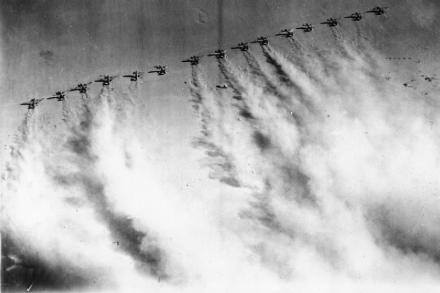
South African Air Force (SAAF) Operations in North Africa during World War 2.. Here SAAF pilots perform the “Boston Shuttle Service” a squadron of Douglas Boston Mark IIIs of No. 3 Wing SAAF positioned for their famous simultaneous take-off manoeuvre on a landing ground in the Western Desert. This commenced with all aircraft turning into wind in line abreast. The leading aircraft, on the right-hand side, then commenced its take-off run with the remainder following in echelon port so that each aircraft avoided the dust of the one ahead.
The term “Boston Shuttle Service”, was given to the SAAF’s single most memorable feat in North Africa in which eighteen aircraft of 12 and 24 Squadrons showered hundreds of tons of bombs, primarily using Boston Medium bombers, on the Afrika Korps as it relentlessly pushed the Eighth Army back towards Egypt during the “Gazala Gallop” in the first half of 1942.
No. 3 (S.A.) Wing was a South African Air Force commanded formation during World War II that served in North Africa, Sicily and Italy. It was formed on 28 August 1941 and initially consisted of Royal Air Force and South African Air Force squadrons under South African command, known as No. 261 Medium Bomber Wing but became a fully fledged South African formation on 23 September 1942 when the RAF Squadrons were transferred from it leaving 12, 21 and 24 Squadrons SAAF as its assigned units.
Reference Imperial War Museum, SAAF History – SAAF website and Wikipedia. Image copyright Imperial War Museum.
A very notable South African hero. The highest decoration awarded to a Black South African soldier during the Second World War was the DCM (Distinguished Conduct Medal) awarded to Lucas Majozi (1916-1969). Read on for the story of one of South Africa’s bravest.
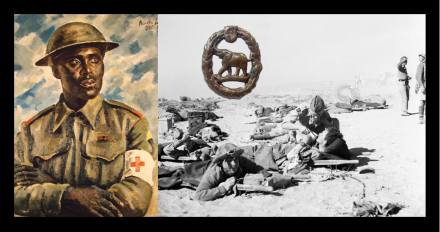
Lucas Majozi volunteered to fight in the 2nd World War, however as he was a black man, race politics in South Africa dictated that he could only join the Native Military Corps (NMC) in a non-combat role, which meant he and all other South African ‘Bantu’ fighting in World War 2 could not carry a firearm – unlike the Cape Coloured Corps, which could carry firearms and take a combat role. This did not however keep the Native Military Corps away from the perils of fighting and NMC were often fight right in the middle of the fighting. To read up a little more of this, see Observation Post ‘Armed’ SA Native Military Corps in WW2 – this Corps screams out for a definitive work! .
So how does an unarmed NMC soldier get to win one of the highest accolades for bravery in World War 2?
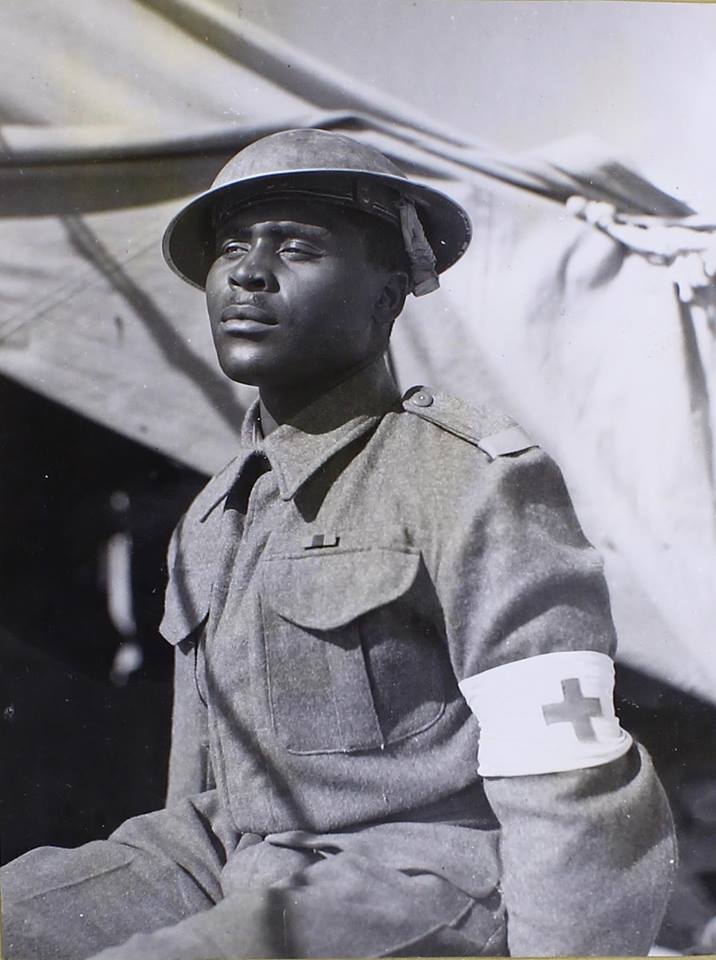
The answer lies in Lucas Majozi’s personality and character, he was a proper South African warrior and although he would be unarmed he volunteered to become a medic working as a stretcher bearer in the thick of fighting to bring wounded men back from harm to aid stations, an extremely dangerous job. Like another Native Military Corps hero – Job Maseko, Lucas Majozi by his actions was also to become one of South Africa’s fighting legends. To read more on Job Maseko and his remarkable bravery read this Observation. Post: Job Maseko; one very remarkable South African war hero
So lets have a look at Lucas Majozi, his account is a truly inspirational one, a very remarkable act of bravery and courage.
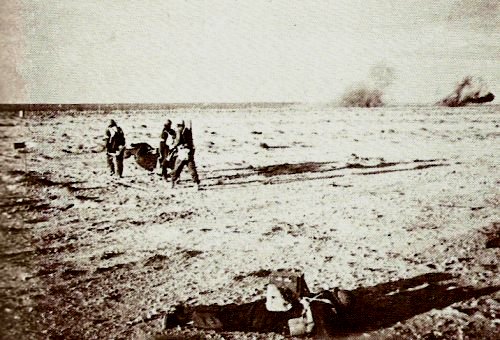
Bardia, taken earlier 31st December 1941, black stretcher-bearers in action under fire (photo : R.Masters from The Kaffrarian Rifles of FL Coleman).
The end of the beginning
The DCM was the second highest British award for gallantry after the Victoria Cross. It was awarded to Lucas Majozi for the great bravery that he displayed during the game-changing 2nd battle of El Alamein which commenced on 23 October 1942 when the British 8th Army under command of General Bernard Montgomery attacked the German/Italian forces under command of Field Marshal Erwin Rommel.
The Battle of El Alamein plays such a significant in the outcome of World War 2, Winston Churchill once remarked; “before Alamein, we never had a victory – after Alamein we never had a defeat” and more famously that Alamein marked the ‘end of the beginning‘ of World War 2.
Operation Lightfoot
The 1st South African Division played a spearhead role. It had to breach the German minefield which had been sown with more than half a million mines – with a dab of military humour this part of the 2nd Battle of El Alamein was called ‘Operation Lightfoot’. South African sappers were to play a significant role opening up the minefield to allow the Allied and South African forces to push through.
General Montgomery’s basic idea was that the Australians and Highlanders were to force a northern corridor through the Axis (German/Italian) minefields while the New Zealanders and South Africans were to do the same in the southern sector.
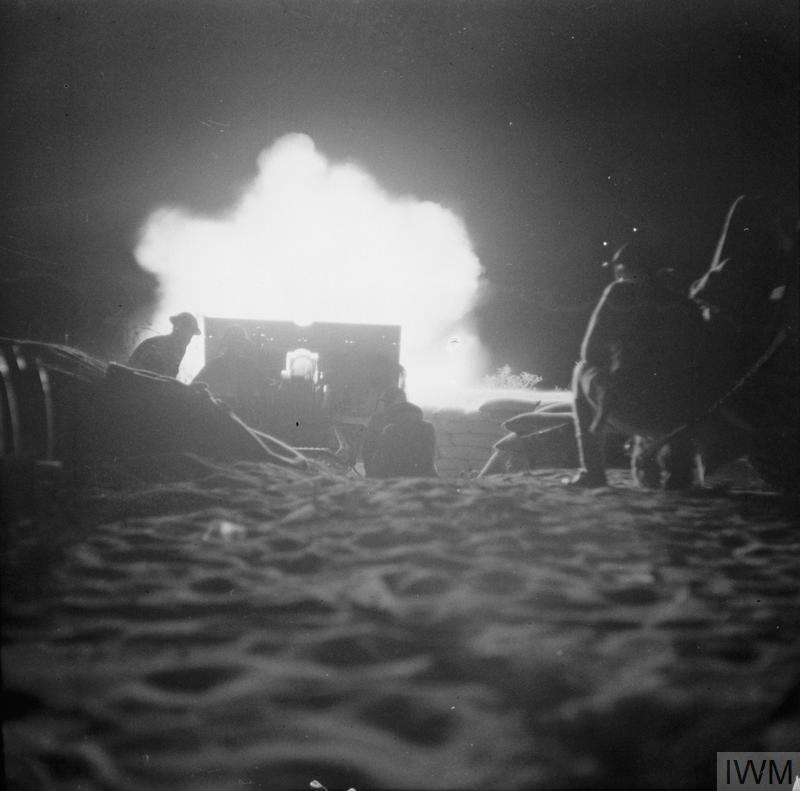
A 25-pdr gun firing during the British night artillery barrage which opened Second Battle of El Alamein, 23 October 1942. Imperial War Museum Copyright
The 1st Infantry Division (South Africa), under the overall command of General Dan Pienaar was tasked attack on a two-brigade front to secure the southern end of Mieiriya Ridge. The Indian 4th and Northumbrian 50th Divisions were deployed to their south and to the north was the 2nd New Zealand Division.
The South Africans were to attack towards the south-west with 2nd SA Infantry Brigade (under the command of Brig. W.H.E. Poole) on the right and the 3rd SA Infantry Brigade (under the Command of Brig. R. Palmer) on the left. The 1st SA Infantry Brigade was deployed further south and was responsible for creating an anti-tank screen to protect the left flank of the South African attack.
Our hero – Lucas Majozi was deployed with Brig. Poole in the 2nd SA Infantry Brigade to attack the South West, and he was in support of the 1st and 2nd Field Force Battalions (FFB) which were basically South African Infantry Corps battalions.
Crumbling Actions
Operation Lightfoot started at 2140 on 23 October with a five-hour fire plan, the start of which signified H-Hour for the infantry assault. General Pienaar had deployed each of the lead brigades, with on battalion leading for the first phase to the “red line” – after a pause of an hour and a quarter, the two trailing battalions would pass though to the final objective on Miteiriya Ridge. By 08:00, the following morning on 24th October the South African objective, Miteiriya Ridge was finally secured, after a very long night of fighting and a very high rate of attrition by way of casualties (the rate of attrition was on a World War 1 scale dubbed ‘crumbling actions’ by General Montgomery who chose this tactic). By the evening of 26 October (as from the H-Hour on the 23rd), the South Africans had suffered 600 casualties (the British had 2000 casualties as well as 1,000 Australians 1000 New Zealanders).
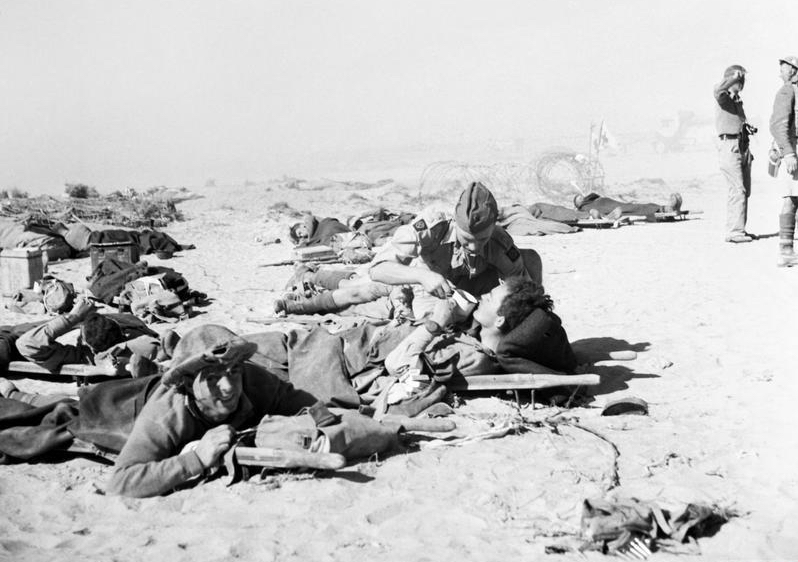
El Alamein 1942: Wounded British soldiers wait on stretchers for attention at an Advanced Dressing Station. A Royal Army Medical Corps officer gives a drink to one of the wounded (Imperial War Museum Copyright)
Into all these ‘crumbling actions,’ of high rates of attrition and loads of casualties comes Lucas Majozi and his remarkable tale of individual bravery.
Pinned down in the Axis minefield
The South African 1st and 2nd Field Force Brigades (FFB), as soon after the battle began, became pinned down in the German Axis forces minefield by intense German machine gun and artillery fire. The South African infantrymen suffered very severe casualties.
Throughout the night of 23 October, the stretcher-bearers worked under heavy enemy fire, tending to the wounded and evacuating them from the battlefield. Amongst these Black NMC non-combatant medics rescuing their White combatant counterparts was Lucas Majozi (see related article Skin colour is irrelevant in a foxhole!). His citation says everything about his actions:
The DCM for Lucas Majozi
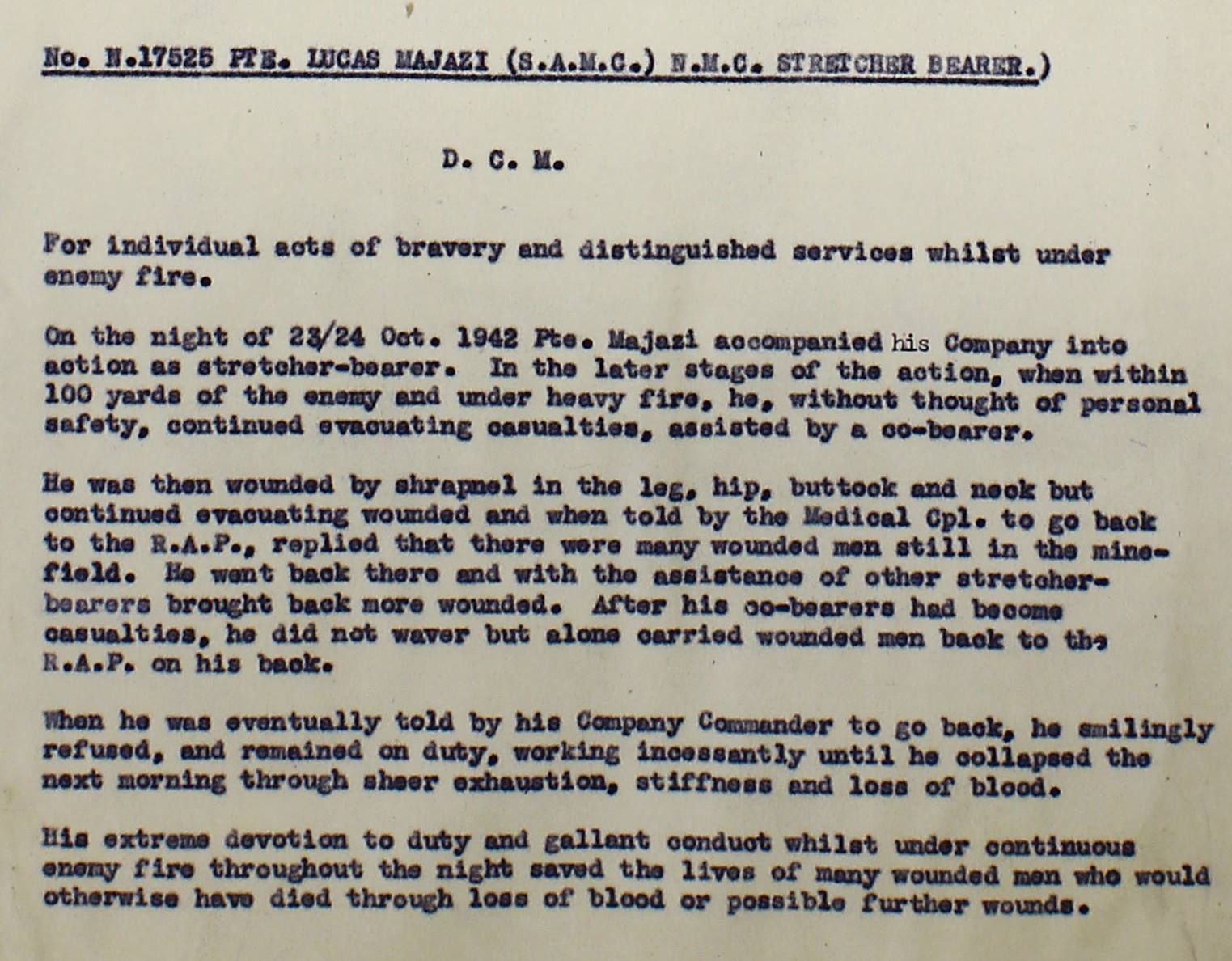
Citation given to Lucas Majozi, NMC, for the Distinguished Conduct Medal is given below: No N 17525 Cpl Lucas Majozi, NMC, a Zulu from Zastron, Orange Free State att. FFB – Distinguished Conduct Medal.
Lucas Majozi
‘On the night of October 23-24, Majozi accompanied his company into action as a stretcher-bearer. In the later stages of the action when he was within 100 yards of the enemy and under heavy fire, he thought nothing of his personal safety and continued to evacuate casualties assisted by co-bearers.
He was then wounded by shrapnel, but he continued evacuating the wounded. Told by a medical corporal to go back to the regimental aid post, he replied that there were many wounded men still in the minefield.
He went back, and with the assistance of other stretcher-bearers, he brought back more wounded. After his co-bearer had become a casualty, he did not waver, but carried wounded men back alone on his back to the aid post.
When he was eventually told by the Company Commander to go back, he smilingly refused and remained on duty, working incessantly till he collapsed next morning through sheer exhaustion, stiffness, and loss of blood. His extreme devotion to duty and gallant conduct under continuous enemy fire throughout the night saved the lives of many wounded men who would otherwise have died through loss of blood or possible further wounds.’
Here is a copy of the original signal:
Aftermath
The British and Commonwealth forces, including the South Africans were able to break out of their initial objectives by the 2nd of November 1942 and the Axis forces were turned in retreat, a retreat from which they never recovered.
At a parade in Egypt after the battle of El Alamein, the commander of the 1st South African Division, Major-General Daniel Hermanus Pienaar (popularly known as Dan Pienaar) said of Lucas Majozi:
‘This soldier did most magnificent and brave things. With a number of bullets in his body he returned time after time into a veritable hell of machine gun fire to pull out wounded men. He is a man of whom South Africa can well be proud. He is a credit to his country.’
Post War
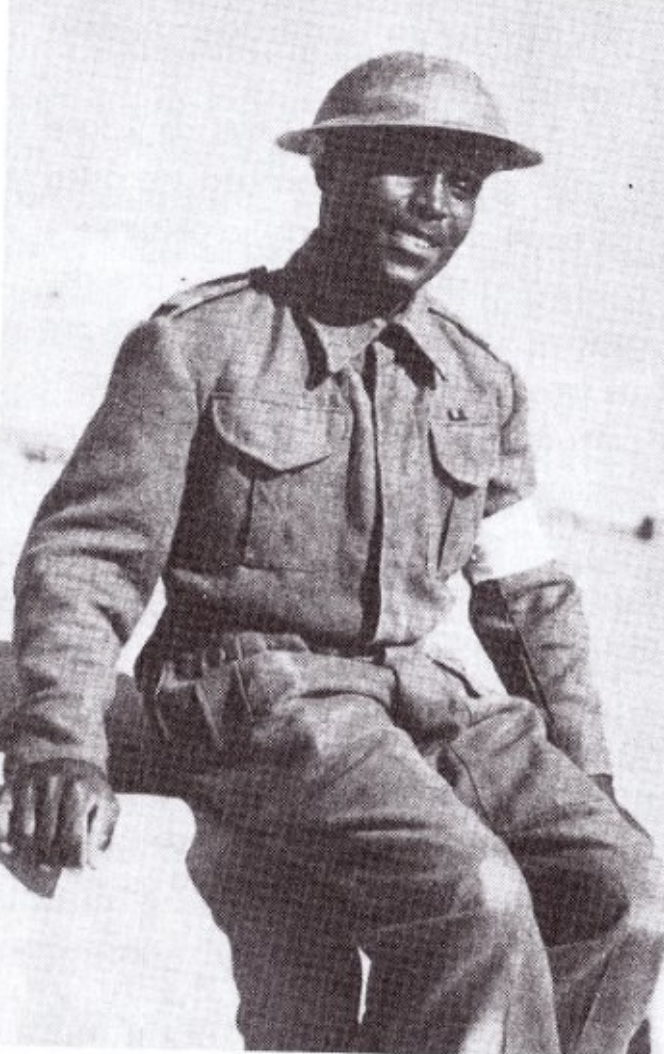
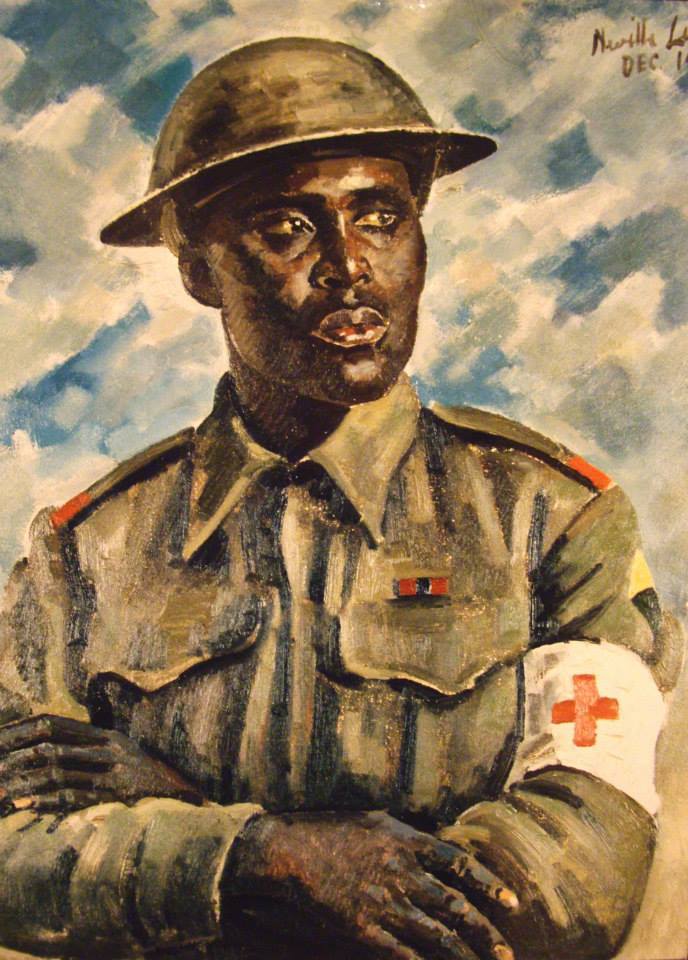
Lucas Majozi DCM ‘Official Portrait’
After the war, Majozi returned to the town of his birth, Zastron. In 1948 he joined the South African Police (SAP), attaining the rank of sergeant. Like all returning South Africa World War 2 heroes (white and black) his legacy and great deed was to be sidelined by the incoming Nationalist government in 1948 and his story lost to many future generations – even today.
In particular the two Black NMC men – Majozi and Maseko who received bravery decorations were somewhat downplayed over the Apartheid years by the Nationalist government and not honoured as national heroes.
Lucas Majozi died in 1969. The South African National Museum of Military History is in possession of both this portrait by the famous artist, Neville Lewis and his medal group. His legacy today is marked by a display at the Delville Wood Museum in France, the SA National History Museum in Saxonwald, a street in Zastron is also named after him. The MOTH (Memorable Order of Tin Hats) Shellhole (clubhouse) for military veterans in Riebeek Kasteel (Western Cape) is also called the Majozi Shellhole in his honour.
Many say he should have received the Victoria Cross (the highest award for gallantry) but did not because he was a black man and due to race politics was not recommended for one – in either event his case should be reviewed by the British issuing authority with the perseverance of the South African National Defence Force attache in London.
He remains a true South African warrior and hero deserving of more of our praise and recognition.
Written and Researched by Peter Dickens. Photographic references Imperial War Museum and Wikipedia. Lucas Majozi DCM official portrait by Neville Lewis – accredited state artist.
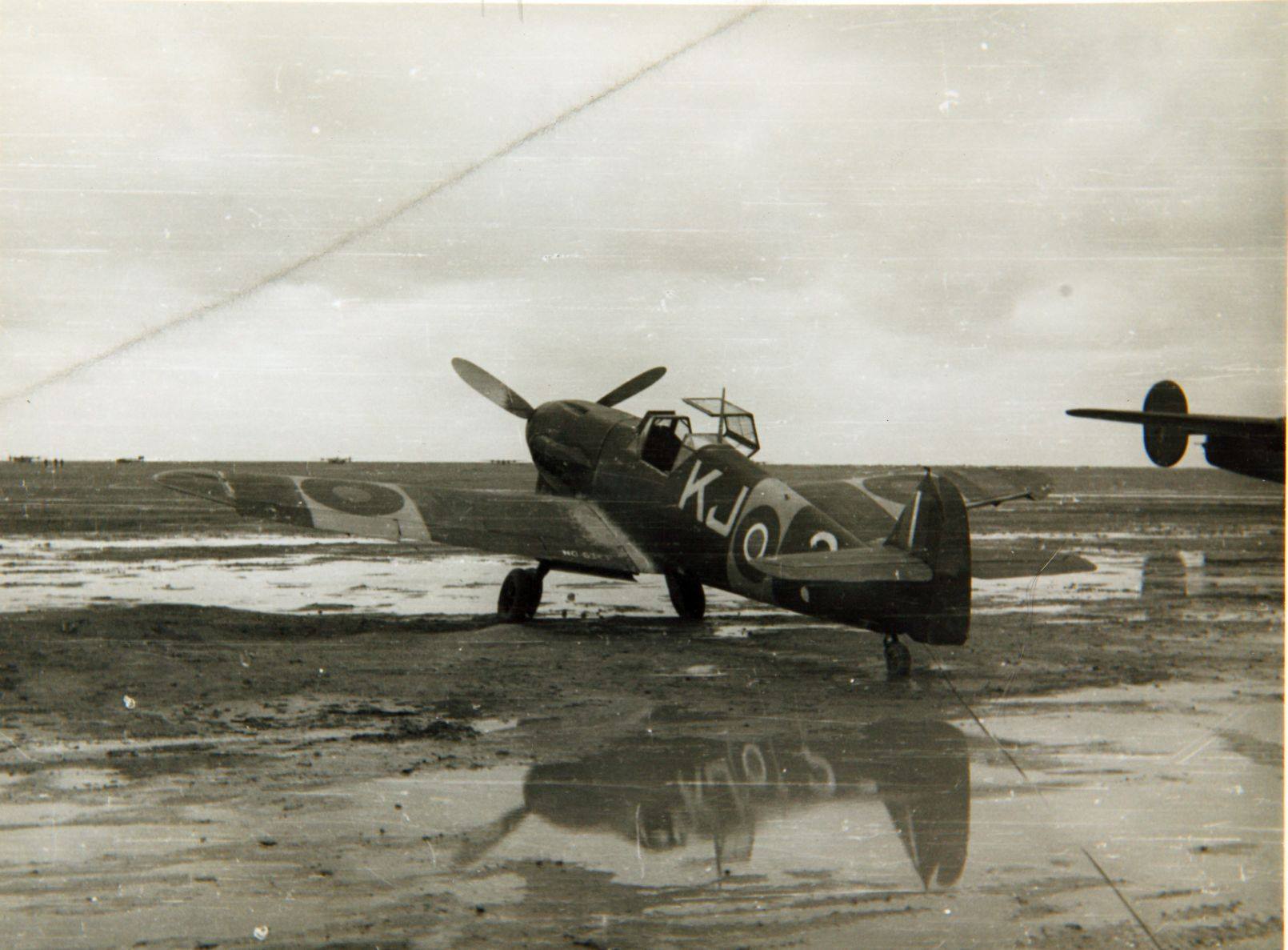
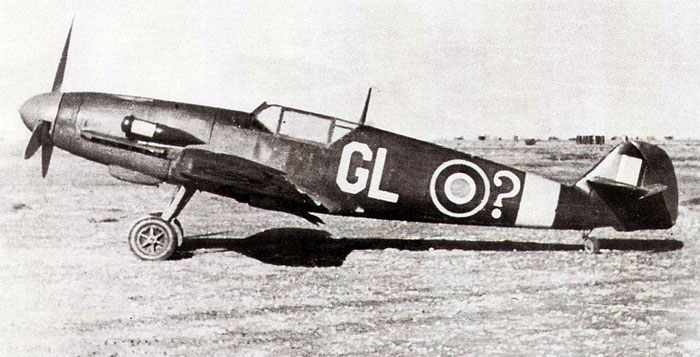
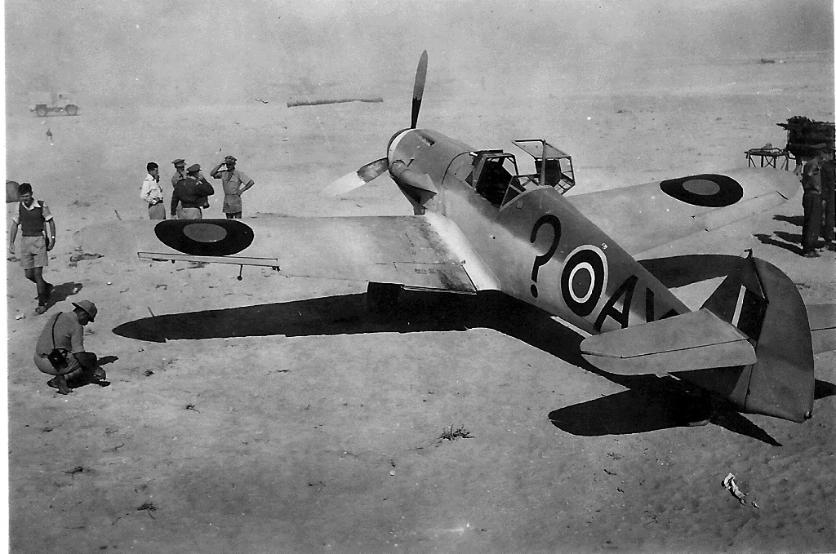
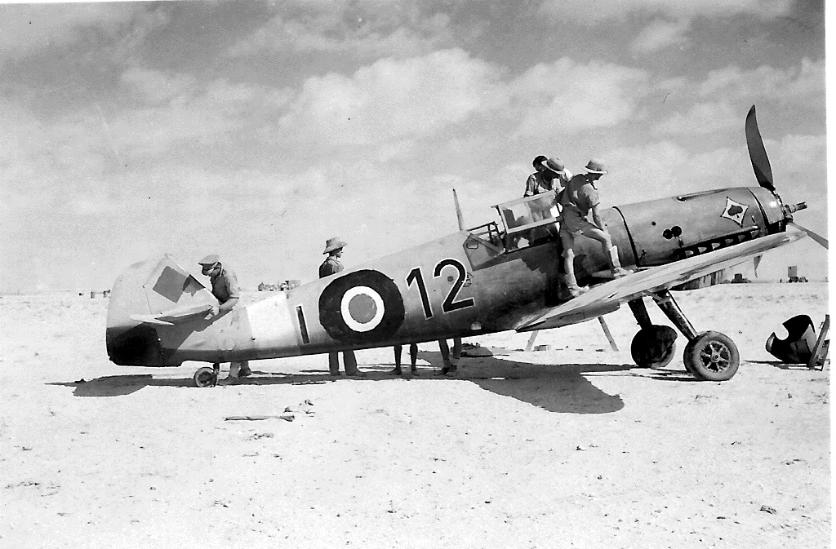
During World War 2, captured aircraft in working condition were quickly pressed into service and it was not unusual to find captured Spitfires and Hurricanes in German marketings, and no different on the Allied side as well. The South Africans also used captured aircraft and here’s some visual proof.
This is a captured German Messerschmitt Bf 109F, given South African Air Force markings and serial ‘KJ-?’, parked on the airfield at Martuba No.4 Landing Ground in North Africa, January 1943. It was “operated” by No. 4 Squadron, South African Air Force. Note tail of B-24 Liberator on right.
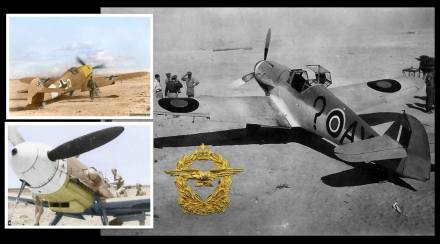
A captured Messerschmitt Bf 109F with tropical filter on its engine cowl was also used by No. 5 Squadron of the South African Air Force as a squadron hack. This is it:
SAAF 1 Squadron’s also used a captured Bf-109 F
Another Squadron’s captured Bf-109 F, the blades tipped the ground hence they are bent forward.
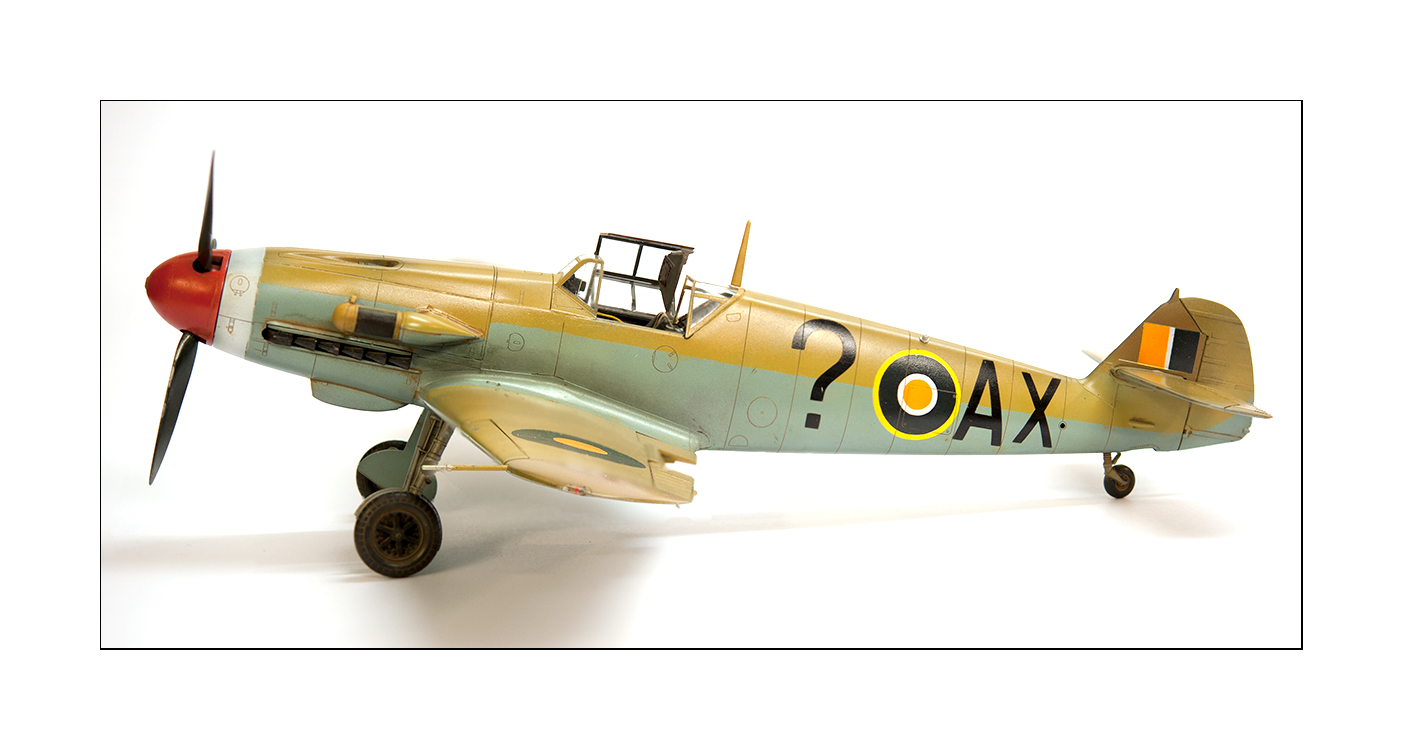
Visually in colour, these markings would have looked as follows (model):

 Note the identification patch of the South African 2nd Infantry Division on the person standing on the far right of the image.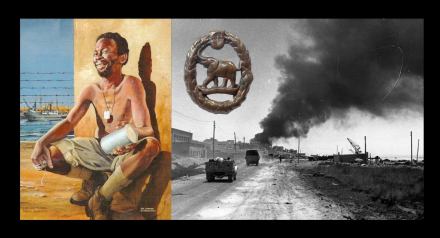



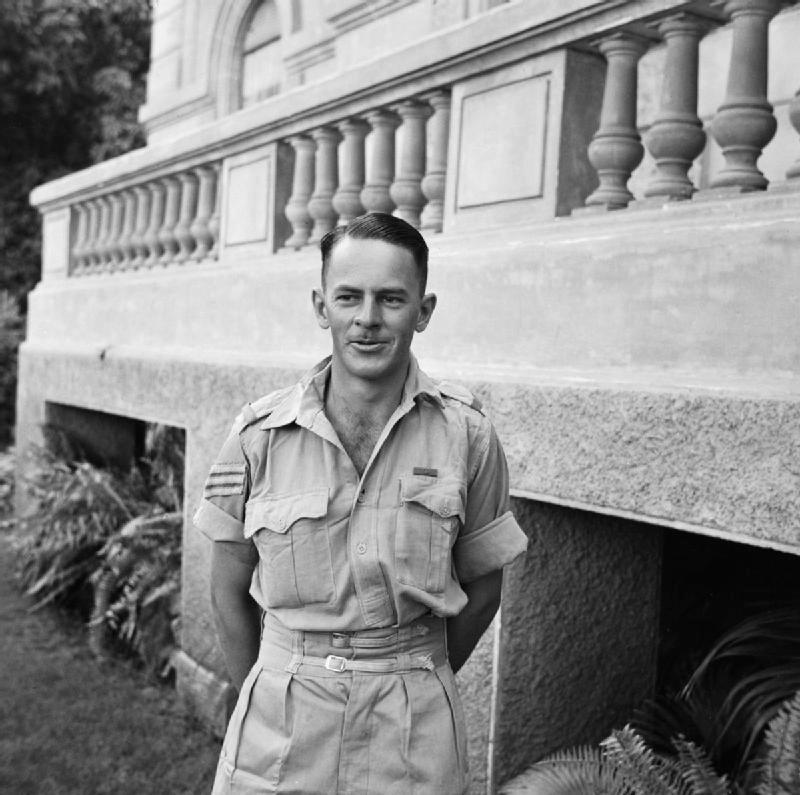 Now this is a very notable South African, and a true hero – Sgt Quentin George Murray Smythe VC, who won the Victoria Cross in the Western Desert on 5 June 1942. The Victoria Cross (VC) is the highest military decoration awarded for valour “in the face of the enemy” to members of the British armed forces and various Commonwealth countries (of which South Africa is one).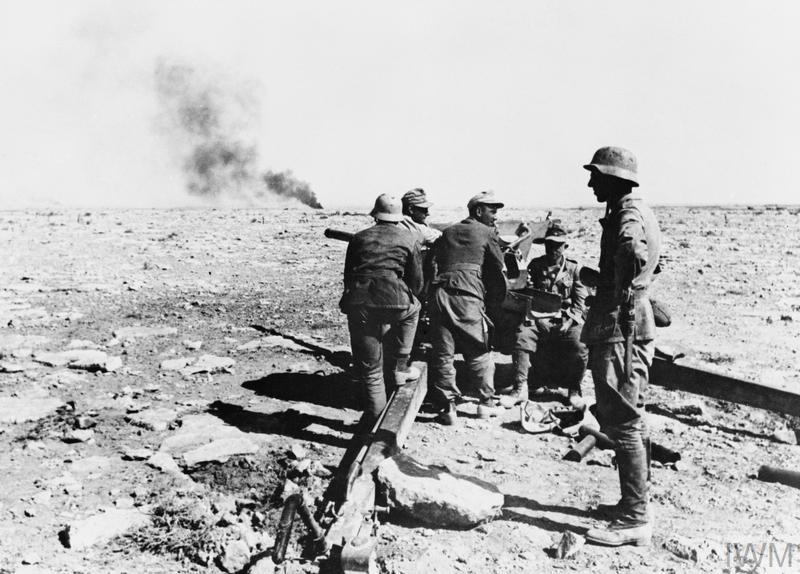
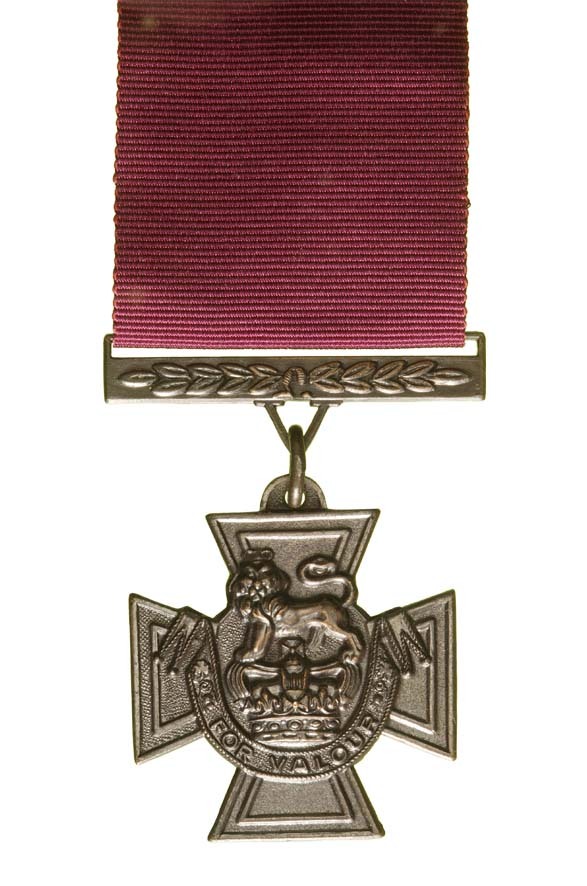 No. 4458 Sergeant Quentin George Murray Smythe, South African Forces.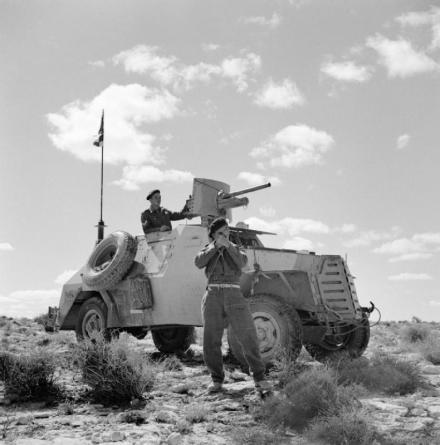




 The Observation Post