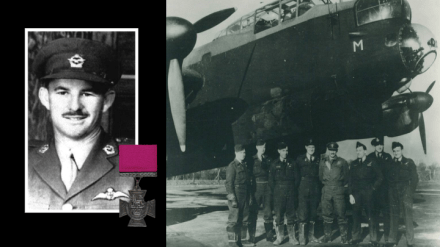
Edwin Swales VC DFC, a South African Hero whose legacy has been eroded!

Edwin (Ted) Swales VC DFC is one of South Africa’s greatest sons,  yet the South African politicians  of today,  have removed his name from the well known “Edwin Swales Drive” named in honour of him in Durban and re-named it after a contemporary “struggle” cadre.  The legacy of Maj. Swales VC DFC is under threat, and there is very good and noble reason not to forget him, this is his story, kindly contributed to by David Bennett.

A very short biography :    Major Edwin Swales, VC, DFC, SAAF (1915 – 1945)  by David Bennett

Edwin Essery Swales : Born in Inanda, Natal, 3 July 1915. Attended Durban High School, Jan. 1930 to Dec.1934. Worked for Barclay’s Bank, DC&O, in Durban 1935 to 1939. He joined the Natal Mounted Rifles, 1935 and left 31 May 1939 as a W.O.II. Rejoined N.M.R. on 4 September 1939.

He served in Kenya; Abyssinia; Italian Somalia; British Somalia and Eritrea. Then (1941) in North Africa. In 1942, he left the army to join the S.A. Air Force. Swales received his wings at Kimberley in 1943. Then seconded to the Royal Air Force in 1943, he attended Flying Training School at  R.A.F. Little Rissington, 1944. Later sent to the elite R.A.F. Pathfinder Force, 582 Squadron, Royal Air Force, at Little Staughton in July 1944.

Swales was awarded an immediate D.F.C. on 23 December 1944 following a bombing raid on Cologne. After a raid on Pforzheim on 23 February 1945, Swales was killed in action, crashing near Valenciennes, France and he was awarded a posthumous Victoria Cross.

Swales is now buried in the War Cemetery at Leopoldsburg, near Limburg, Belgium, Plot No.8, Row C, Grave No.5. (Although he had originally been buried at Fosse’s USA Cemetery). The headstone of Swales’ grave shows the Springbok head, common to the graves of all South Africans, as well as the Victoria Cross engraved on it. The legend on the headstone states:

Edwin Swales was awarded the Distinguished Flying Cross, on 23 December, 1944.  The citation reads:

The KING has been graciously pleased to approve the following award in recognition of gallantry and devotion to duty in the execution of air operations:-

Captain Edwin Swales, (6101V) S.A.A.F. 582 Sqn. :-

The Distinguished Flying Cross:

“This Officer was pilot and Captain of an aircraft detailed to attack Cologne in December, 1944. When approaching the target, intense anti-aircraft fire was encountered. Despite this, a good bombing attack was executed. Soon afterwards the aircraft was attacked by five enemy aircraft. In the ensuing fights, Capt. Swales manoeuvred with great skill. As a result his gunners were able to bring effective fire to bear upon the attackers, one of which is believed to have been shot down. Throughout this spirited action Captain Swales displayed exceptional coolness and captaincy, setting a very fine example. This Officer has completed very many sorties during which he has attacked a variety of enemy targets.”           (Official D.F.C. Citation)    

Edwin Swales was killed on 23 February, 1945, and he was posthumously awarded the Victoria Cross – the 3rd and last Pathfinder pilot to be so honoured (all alas, posthumous). It had been Swales’ 43rd operational flight for 582 Squadron, R.A.F. Here is the citation:

The KING has been graciously pleased to confer the VICTORIA CROSS on

the under-mentioned officer in recognition of the most conspicuous bravery:-

Captain Edwin Swales, DFC (6101V) S.A.A.F. 582 Sqn. (deceased):

 “Captain Swales was ‘Master Bomber’ of a force of aircraft which attacked Pforzheim on the night of February 23, 1945. As Master Bomber he had the task of locating the target area with precision and of giving aiming instructions to the main force of bombers in his wake.

Soon after he reached the target area he was engaged by an enemy aircraft and one of his engines was put out of action. His rear guns failed. His crippled aircraft was an easy prey for further attacks. Unperturbed, he carried on with his allotted task; clearly and precisely he issued aiming instructions to the main force. Meanwhile the enemy fighter closed the range and fired again. A second engine of Captain Swales’ aircraft was put out of action. Almost defenceless, he stayed over the target area issuing his aiming instructions until he was satisfied that the attack had achieved its purpose. It is now known that the attack was one of the most concentrated and successful of the war.

Captain Swales did not, however, regard his mission as completed. His aircraft was damaged. Its speed had been so much reduced that it could only with difficulty be kept in the air. The blind-flying instruments were no longer working. Determined at all costs to prevent his aircraft and crew from falling into enemy hands, he set course for home. After an hour he flew into thin-layered cloud. He kept his course by skilful flying between the layers, but later heavy cloud and turbulent air conditions were met. The aircraft, by now over friendly territory, became more and more difficult to control; it was losing height steadily. Realising that the situation was desperate Captain Swales ordered his crew to bale out. Time was very short and it required all his exertions to keep the aircraft steady while each of his crew moved in turn to the escape hatch and parachuted to safety. Hardly had the last crew-member jumped when the aircraft plunged to earth. Captain Swales was found dead at the controls.

Intrepid in the attack, courageous in the face of danger, he did his duty to the last, giving his life that his comrades might live”

(Official V.C. Citation)

Air Chief Marshal Sir Arthur ‘Bomber’ Harris, KCB, OBE, AFC, Chief of Bomber Command, Royal Air Force, following the loss of Edwin Swales, wrote a letter to Swales’ mother, Mrs. Olive Essery Swales, saying, inter-alia:

…… On every occasion your son proved himself to be a determined fighter and resolute captain of his crew. His devotion to duty and complete disregard for his own safety will remain an example and inspiration to us all …..

Memorial to Edwin Swales at the secondary school he attended as a student, Durban High School (DHS)

In conclusion 

It is our humble opinion, that whilst it is important to segments of South Africa’s population to remember their heroes it should not come at the expense of other national heroes.

Solomon Kalushi Mahlangu, after whom Edwin Swales VC Drive is now named,  was a operative of the African National Congress militant wing, Umkhonto we Sizwe, and whilst it is important to the current ANC ruling party to highlight the sacrifice of its heroes, it should not come at the sacrifice of Maj. Swales’ legacy – one of a handful of South African World War 2 Victoria Cross winners, and one whose extremely brave deeds were awarded in a war which was to liberate the entire western world of tyrannical and rather deadly racial political philosophy as well as dictatorial megalomaniacs supporting such ideology.

In fact to rectify the situation, the Durban City Council should actually consider a monument or statue in the centre of Durban to Edwin Swales and allow him to take his rightful place as a true son of South Africa and one of our all time greatest military heroes, as is the case for many Victoria Cross winners the world over.  That his actions and deeds are taught to South African youth, pride in our WW2 history established and his sacrifice not forgotten.  Lets hope they see their way clear to do this.

Note:    The papers from the South African Air Force, promoting Edwin Swales from Captain to Major, only reached the British authorities after his death, and after the award of the Victoria Cross was gazetted, hence the rank of “Captain” being used in the VC citation. However, he is referred to as a Major.

Thank you to David Bennett for both photograph and content contribution.
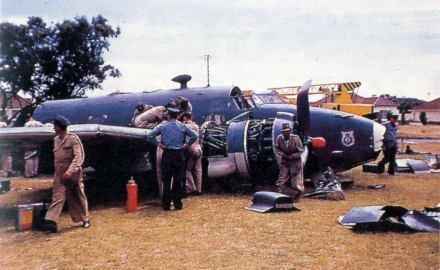
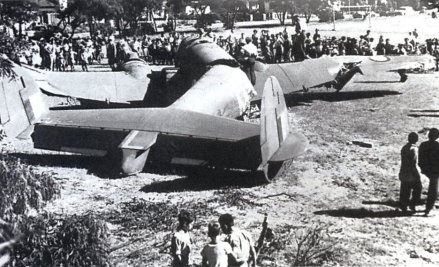
SAAF Ventura down

A little bit of Cape Town’s rich history.  Here is a South African Air Force Ventura 6515 from 17 squadron went down in an open field following a engine failure shortly after take-off from Ysterplaat on 26 November 1956.

The crew members – 2Lt R.C. Pelk and 2Lt J.H. Nel survived the crash landing.  Naturally it became a bit of a public spectacle as this image shows.

3936484617_658e907d8b_o

The Ventura PV-1 was an American aircraft made by lockheed and they were extensively used during World War 2 by the Americans, British and Commonwealth forces. The SAAF also operated the aircraft during the war and continued to do so after the war in a coastal patrol role for many years.

Lt. Blake, one remarkable SAAF pilot … more than just a photo

The official Imperial War Museum caption of this photo is “crew of Douglas Boston Mark III, W8376 ‘C’, of No 24 Squadron, South African Air Force, walking away from their aircraft on an airfield in Libya after a sortie.” But there is so much more to this.

It’s assumed this photo was taken whilst 24 Squadron who were at Zuara airfield in Libya. (The “colourised” image of Boston seen here is incorrectly branded in RAF colours and not SAAF – the flash on the tail should be orange not red).

In August ’42 No.12 Squadron, SAAF, arrived from Kenya, and the two squadrons were formed in No.261 Wing. They were soon joined by No.14 Squadron, SAAF and in October the wing was renumbered as No.3 (S.A.A.F.) Wing. At about the same time No.24 Squadron withdrew to convert to the Douglas Boston.

But the story of this photograph does not end there, seen here are:

Air Sgt. Stakemore (Air Gnr) – SAAF
Lt. G.A. Marshall (Observer) – SAAF
Lt. C.W. Blake (pilot) – SAAF
Sgt. Atkinson (Air Gnr) – Royal Air Force

They were shot down in the aircraft behind them Boston Mk.III “C” W8376 on 23.11.1941 by Obfw Espenlaub of 1/JG.27 – a Luftwaffe Ace.

All were made Prisoners of War. Lt. Blake pulled two crew members out of the wreckage the fourth had baled out successfully.

After escaping the PoW camp, Lt. Blake went on to be awarded the Military Cross later for ground action with Partisans in Italy, he was the only SAAF pilot to be so awarded for WWII.

This was after his fifth escape attempt, he was recaptured in the first four.

Photo courtesy Imperial War Museum, colourised by “WW2 Colourised Photos”and additional information provided by Sandy Evan Hanes with great thanks.

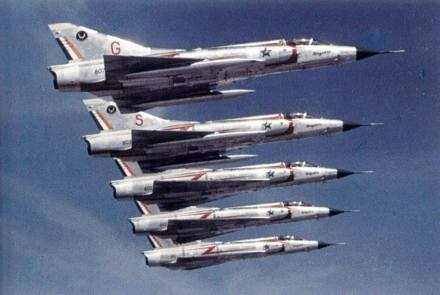
Silver Flash – SAAF Mirage III’s in their original livery

There is a saying in Afrikaans and it applies to this image ‘mooi bly mooi’ (beauty is eternal). Enjoy this stunning image of perfect formation flight by 2 squadron South African Air Force’ in their then ‘new’ Mirage III’s in 1968 – still in their colour scheme of silver metal and red lightning flash, before changing to their bush war camouflage scheme.

Photo copyright Edward Dickinson.

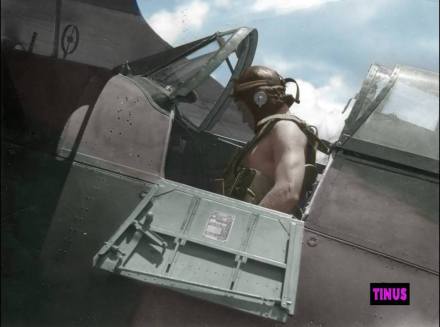
The naked Gladiator pilot

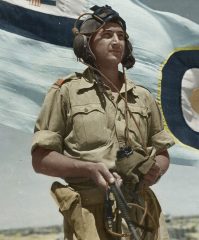
This is a colourised version of a famous original black and white Bureau of Information photograph called “The naked Gladiator pilot” with a caption which reads;

“South African Contingent in East Africa. a SAAF fighter pilot in Kenya preparing to take off to meet enemy raiders. He has removed his shirt because of heat.”

The Gloster Gladiator (or Gloster SS.37) was a British-built biplane fighter. It was used by the Royal Air Force (RAF) , the Royal Navy’s Fleet Air Arm (FAA) (known as the Sea Gladiator variant) and the South African Air Force (SAAF).

It was the RAF’s last biplane fighter aircraft and was rendered obsolete by newer monoplane designs even as it was being introduced. Though often pitted against more formidable foes during the early days of the Second World War, it acquitted itself reasonably well in combat due to high degrees of manoeuvrability.

Photograph obtained from the SAAF museum. The colourised photo copyright belongs to Tinus Le Roux, and my deep thanks to him for sharing it.

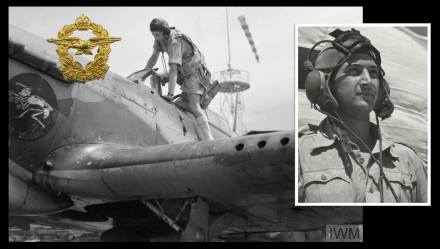
The South African Air Force’s highest scoring Ace – Jack Frost

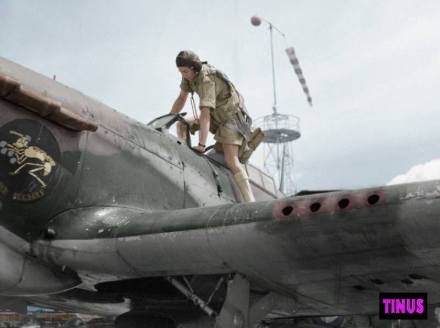
The Legendary South African Ace – Captain J E “Jack” Frost climbs into a Hawker Hurricane of No. 3 Squadron SAAF at Addis Ababa, after rejoining his unit as ‘A’ Flight commander following an attack of appendicitis.

1460210_258771500938983_1728074890_n

Born in Queenstown, South Africa on 16 July 1918. This son of Richard H. Frost and Ada M. Frost joined the South African Air Force (SAAF) in 1936, little did they know they had given birth to legendary fighter ace.  Awarded the Sword of Honour at the conclusion of his training at the Military College in 1938, Jack Frost was to prove this accolade correct the minute he got into combat.

East Africa Campaign

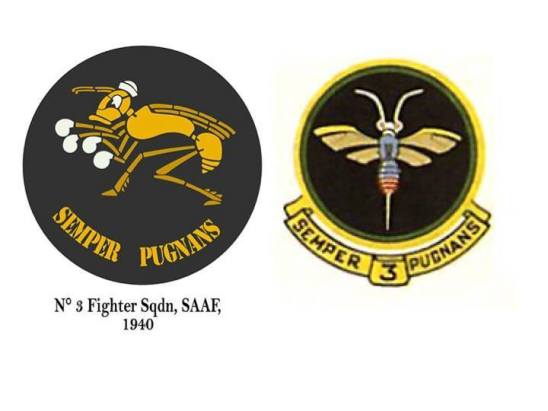
Jack Frost was the most successful fighter pilot in the SAAF. He joined the South African Permanent force in 1936 and after a spell as a flying instructor was posted to No. 1 Squadron SAAF in 1939. In 1940 he was posted to the Newly-formed 3 Squadron SAAF as a flight commander and saw considerable action in Somaliland and Ethiopia.

He was evacuated with acute appendicitis on 22 May 1941 but rejoined his unit in June and was given the command of No. 5 Squadron SAAF the following month. He led the unit through the heavy fighting in Egypt in May and June 1942, but was eventually shot down and killed while escorting bombers over the El Adem area on 16 June. He was the SAAF’s top scorer of the war with 16 confirmed victories and was regarded as an outstanding pilot and leader.

10648180_665754946874172_3586502582896698266_o

Maj Jack Frost, colourised image by Tinus Le Roux

His wartime record is considerable considering his short life, he entered the East African Campaign to fight against Italian Forces, on  22 February 1941, Frost destroyed four Fiat CR-42  fighters, an action for which he was awarded the Distinguished Flying Cross.

On 15 March 1941, Frost was shot down by anti-aircraft fire while strafing Diredawa  airfield. His wingman, Lieutenant Bob Kershaw landed his aircraft in a nearby field, while other 3 Sqn pilots fired on Italian infantry attempting to capture the pair. Kershaw escaped in his aircraft with Frost sitting on his lap, an action for which Kershaw was awarded the Distinguished Service Order.

The campaign ended effectively in November 1941 with the final defeat of Italian Forces in East Africa. The squadron returned to South Africa and was disbanded.

North African Campaign

Frost, promoted to Major was appointed commander of No. 5 Squadron flying P-40 Kittyhawks.  From March 1942 the squadron participated in the North African Campaign, with the Desert Air Force. No. 5 Squadron joined No. 2 and No. 4 Squadrons in No. 233 Wing; the main role of the SAAF fighters at the time was highly dangerous bomber-escort  missions, supporting No. 3 (Bomber) Wing SAAF.

The squadron was assigned to the Sollum-Mersa Matruh sector. On 11 May, Frost and his wingman Lt. Ken Whyte shared the destruction of a lone Heinkel He 111 bomber attacking a convoy bound for Malta.

Whyte described the action: “I remember our first combat together. While on a shipping patrol we were vectored on to a He 111. Jack made his favourite three-quarter attack which had brought him success in Abyssinia. I attacked from the rear. We each claimed half a share in its destruction.” On 16 May, Frost destroyed a Junkers Ju 88 for his ninth victory, but was hit by cannon fire damaging his port elevator.

11981_152908078212266_1358625500_n

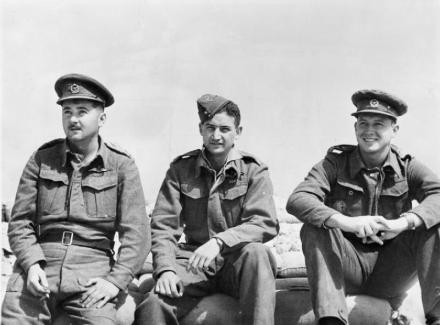
Three of South Africa’s most legendary fighter pilots in the North African theatre of operations during WW2, all of which were ultimately killed in action. Major J E “Jack” Frost, Commanding Officer of No. 5 Squadron SAAF sits between two of his most experienced pilots, Lieutenant Robin Pare (left) and Captain Andrew Duncan, at LG 121, Egypt.

To read up more on the above unique image of South African heroes, follow this Observation Post link 3 Legendary South African fighter pilots who never came home

On 28 May 1942, he was involved in a shared victory over a Messerschmitt Bf 109, his first. (The pilot, Feldwebel  Willi Langer was killed.) At this stage, Frost’s total tally stood at 15 Axis aircraft destroyed.

Frost was appointed commander of No. 233 Wing on 31 May, but his replacement at 5 Squadron, Andrew Duncan, was shot down and killed by Oberleutnant Otto Schulz.

On 16 June, whilst escorting Douglas Bostons, Frost and other P-40 pilots encountered Bf 109s from Jagdgeschwader 27 near Bir Hakeim, Egypt. Rod Hojem, one of the South African pilots involved in this combat commented: “There was one hell of a dogfight, and after it was over I can clearly remember Jack calling up the squadron on the R/T, he said “Form up chaps I am heading North”, and that was the last we heard of him.”

Frost’s aircraft and remains have never been found, and his fate remains unclear. Some sources suggest that Frost fell victim to one of the most prominent German aces, Hans-Joachim Marseille scored six of his 158 victories that same day.  To learn more on this remarkable German Ace and his unique South African connection follow this Observation Post Link German WW2 Fighter Ace befriends a Black South African POW and defies the Nazi status quo!

It has also been suggested that another German Experte, Gunter Steinhausen (who claimed four kills that day) may have shot down Frost.

12088598_506708752832195_3424448187684868824_n


Researched by Peter Dickens.  Extracts taken from Wikipedia.  Image colourising and copyright Tinus Le Roux with much and grateful thanks.  Image of Frost climbing into his cockpit Copyright IWM Collection.

See more on Tinus Le Roux great work on his website’s tribute pages by clicking this link WW2 SAAF Heritage Tribute Pages 

Also refer SA Military History

South Africa at war against … the French!

Many people don’t know it, but South Africans also fought against the French in World War 2.

A key part of the East African and Asian campaigns in WW2 was the Allied occupation of the former French colony of Madagascar and South African units took part in the operation.

The purpose was to prevent the strategically important island from being used by Axis Pact powers – Japan, Germany and Italy primarily .

Problem was, at the onset of the war many French colonies and troops did not join the ‘Free French’ and remained loyal to the French government who where now under occupation and in control of the Germans. This newly defined French Vichy government was sympathetic to the fascist cause and signed on with the Axis pact – in effect they changed sides and fought on the side of Germany.  Madagascar was just such a French colony.

The Allies had heard the rumours of Japanese plans for the Indian Ocean and on 27 November 1941, the British Chiefs of Staff discussed the possibility that the French Vichy government might cede the whole of Madagascar to Japan, or alternatively permit the Japanese navy to establish bases on the island. British naval advisors urged the occupation of the island as a precautionary measure.

The Battle of Madagascar  began with Operation Ironclad, the seizure of the port of Diego Suarez from the French near the northern tip of the island, on 5 May 1942 by British and Commonwealth forces.  A subsequent campaign to secure the entire island, “Operation Streamline Jane”.  Ground operations where supported by the 7th South African Motorized Brigade which arrived on 24 June 1942 and the South African Air Force which had been involved at the onset in reconnaissance roles.

After capturing Majunga, Tamatave and other key towns and points, British and Commonwealth troops took the capital, Altananarivo and pursued French Vichy troops defending Madagascar deep into the heart of the island. Fighting ceased and an armistice was granted on 6 November 1942.

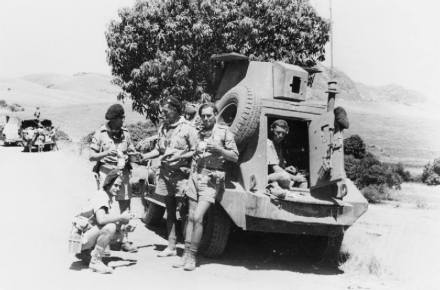
Feature picture shows: A South African armoured car crew snatching a quick meal during their rapid drive on Tananarive during the Battle of Madagascar – while radio contact is kept up all the time.  Note the armoured car is a South African manufactured Marmon-Herrington Armoured Car.

screen-shot-2016-09-23-at-11-07-35

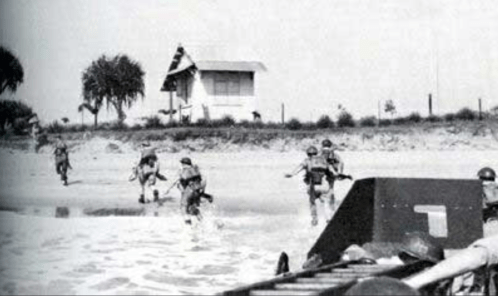
Insert Image: British amphibious craft landings on Madagascar

mad

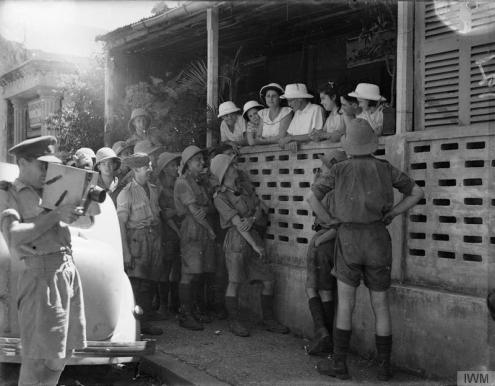
British troops talking to French inhabitants of Madagascar after the surrender.

Image copyright IWM Collection, source Wikipedia

Operation Market Garden, a South African Captain remembered

Not many people know it, but a small number of South Africans participated in Operation Market Garden during World War 2.  Today we remember one of them.

Operation Market Garden was an unsuccessful Allied military operation pioneered by Field Marshall Montgomery to end the war by Christmas 1944, it was fought in the Netherlands and involved taking bridges ending with the prize bridge over the Rhein at Arnhem and then on into Germany. This key bridge was to be taken and held by British paratroopers from the 1st Airborne Division and they were due to be relived by XXX Corps an Allied ground force rushing up through the Netherlands taking key strategic points as it went.

But largely due to intelligence failures, delays crossing rivers, logistics issues and communication breakdowns the relief never arrived leaving the British paratroopers in a desperate and un-winnable fight. Operation Market Garden was the largest airborne operation up to that time and it was an unmitigated Allied failure with severe loss of life.

The air re-supply of the British airborne forces in the Arnhem area was particularly hazardous as they became isolated and surrounded.

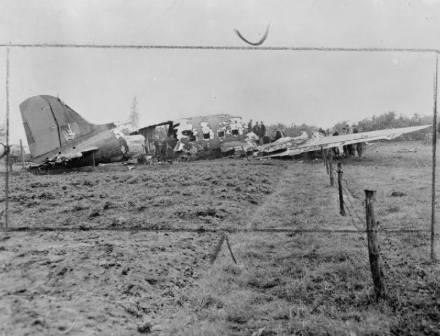
This image taken on 19 September 1944 shows a burned-out Douglas Dakota Mark III, KG401, of No. 48 Squadron RAF based at Down Ampney, Gloucestershire, which crash-landed in a field near Kessel, Holland, after parachuting supplies over Arnhem.

The aircraft had just dropped its supplies from 700 feet when it was met with intense anti-aircraft fire. Sixteen aircraft of 48 Squadron participated in MARKET III, flying through intense flak with no fighter escort.

Many aircraft were hit and two, (KG401 and KG428), failed to return. Over the following four days the Squadron lost another six Dakotas on re-supply missions to Arnhem.

One of these was piloted by Captain C.H Campbell, a South African Air Force (SAAF) officer seconded to 48 Squadron RAF and was lost in his RAF C47 Douglas Dakota on 21st September 1944.

Some additional information courtesy Sandy Evan Hanes

CAMPBELL, C.H, Colin Herbert, 25
Captain 12211V
SAAF, Pilot
48 RAF Sqn C-47 Dakota Mk.III, KG-346

21.09.1944
KIA Runnymede Memorial, Panel 264, United Kingdom

Son of John W. and Hilda M. Campbell, of Claremont, Cape Town, South Africa

May he rest in eternal peace, his sacrifice to the freedom of Europe as we know it today remembered with honour.

Image copyright – Imperial War MuseumSouth

When the SAAF went to Warsaw, we Remember – 1st August 1944

Take a few minutes out of your day today to remember the 1st August 1944 and watch “The Men Who Went to Warsaw”: The Warsaw Uprising Airlift 1944 – a short dramatisation and interviews of the brave South African men who actually went on this mission.

Produced by Tinus le Roux as a non commercial historical archive, this film and others he has produced, all aim to capture the stories of South African Airmen in WW2 before they are lost.

70 Years ago, 13 August 1944; the first South African Air Force Liberators took off on a suicidal mission to Warsaw. This was the start of arguably one of the most daring and tragic series of missions ever flown by heavy bombers as they had to fly at night only 450 feet high at landing speed over the enemy infested city.

Watch and learn their story.

‘Orange’ is the new ‘Red’

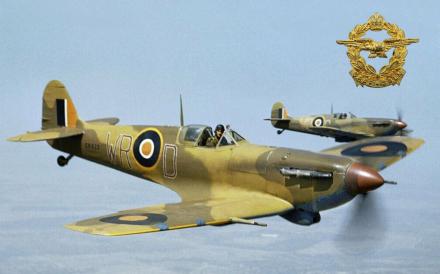
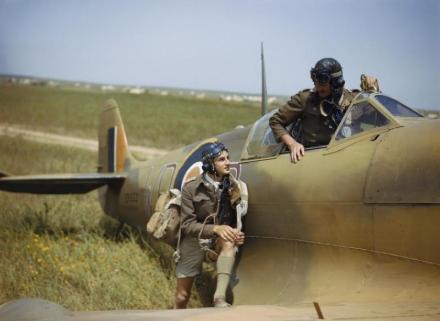
Original colour images of South African Air Force (SAAF) in Gabes in Tunisia April 1943.  Here we see a SAAF Supermarine Spitfire pilot of ER622, No 40 Squadron, SAAF as he confers with his ‘No 2’ after landing at Gabes.  This original colour image  shows off a key identifier that only the South African Air Force squadrons used in the Allied theatre of combat …. ‘Orange’.

208982_144336619069412_266276853_n

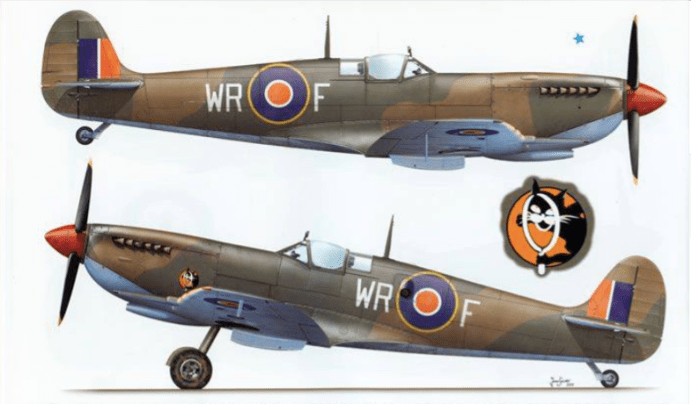
Note the distinctive ‘orange’ dot in the rondel identifier of the South African Spitfires, of all the commonwealth and British aircraft used in the north African campaign, the South Africans where the only ones to have the rondel in the colours of the ‘old’ national flag i.e. Orange, White and Blue on all their aircraft.

All others, British, Australian, New Zealand and Canadian air forces used a red centre in their roundel identifiers to signify the Union Jack (Flag) of Great Britain i.e Red, White and Blue, as seen in this original colour image below.

Spitfires

Allied Spitfires in Royal Air Force colour scheme, note the Red, White and Blue identifiers

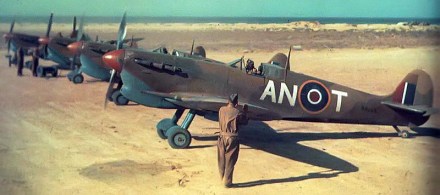
Also note the officers in first photograph are wearing army rank insignia (not air force), another distinctive attribute specific to South Africa at the time.  To compare the difference in aircraft identifiers, here is the SAAF scheme, as shown by these SAAF 40 Squadron Spitfires in desert scheme.

Screen Shot 2016-03-10 at 11.38.51

This distinctive difference in SAAF identifiers to RAF and other commonwealth county’s identifiers was given the SAAF because of Jan Smuts’ influence in forming both the Royal Air Force as the first independent air force and the South African Air Force as the second oldest independent air force.  Also, the SAAF had identified a separate scheme as they were not a ‘Royal’ Air Force – as the RAAF (Royal Australian AF), RNZAF (Royal New Zealand AF) and RCAF (Royal Canadian AF) were.

Squadrons made up of pilots from Allied countries under occupation also flew in the British markings, the difference was a small national identifier usually found on their cowlings, the Dutch 322 Squadron for example used a small Orange triangle and the Poles used a small Red and White square.

A little history of the SAAF Spitfires featured 

As the 8th Army advanced through Libya into Tunisia, SAAF No. 40 squadron flew Tactical Reconnaissance (Tac.R) and Photo Reconnaissance sorties in support of ground operations.

SAAF 40 Squadron converted to the Supermarine Spitfire Vb at the end of February 1943. This variant had clipped wingtips to enhance its low-altitude performance, most notably its roll-speed. Sorties now included vertical and oblique photography, battle area Tac.R, target marking for fighter bombers, searches for night bomber targets, and identification of landmarks for day bomber navigation.

In early 1943 the squadron received Artillery Reconnaissance  training, however, unreliable radios meant that artillery shoots were not as successful as had been hoped. Nevertheless, the squadron continued to report the activities of enemy artillery.

Related work and links

Smuts and the Royal Air Force; The Royal Air Force’s 100th Birthday and its founder – Jan Smuts

Smuts and the Royal Air Force; Centenary of the ‘Smuts Report’, the instrument which gave birth to the Royal Air Force


Researched by Peter Dickens. Image copyright IWM Collection.  Reference Wikipedia