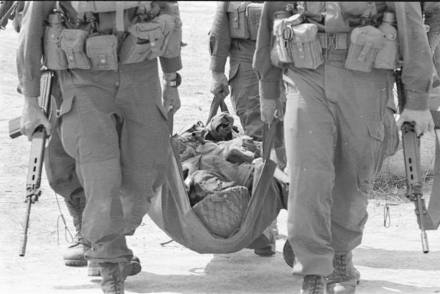
Edward Backhouse as he comes home

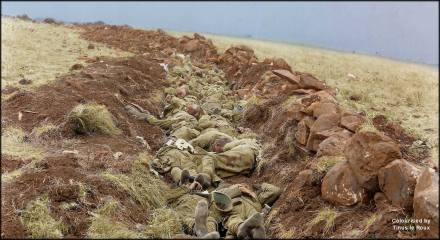
This week we especially remember the fallen from the Angolan/SWA Border War and the ‘Battle of Cassinga’ on the 4th May 1978 – in this very emotional picture we remember Rifleman Edward James Backhouse from 3 Parachute Battalion as he comes home.

There is an unwritten law to all servicemen – you don’t leave your buddies behind in a fire fight. Eddie was Killed in Action during the Battle of Cassinga. He was 22.

As a mark of respect, especially due to the highly controversial circumstances that surrounded this action, lets remember the immense sacrifice and loss experienced by all who participated in this battle and not get into any political platforming, it will only serve to disrespect the fallen.

Thank you to Graham Du Toit for the image and reference.

The forgotten war … South African “mud movers” in Korea

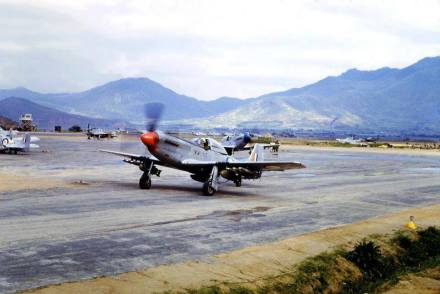
To many South African participation in the Korean War is unknown, but as part of United Nation contributions to the war effort South Africa sent a squadron to South Korea to fight in the Korean War. Here are South African Air Force F51D Mustangs in Korea circa 1951.

The focus of the photograph shows a SAAF 2 Squadron machine which is seen here on its way to the main runway at K10, Chinhae Airbase in South Korea during the war.  Fully armed this SAAF F51D Mustang is setting off on what is properly a ground support role in close support of American troops.  Bombing enemy defensive positions in close support of ground troops is often sarcastically referred to as “mud moving” and highly dangerous as the aircraft has to get right into the battle at very low altitude and speed (the high attrition of South African pilots lost in this role during the war is testimony to that).

Its rare to see such a quality original colour photograph of South Africa’s involvement in the Korean War and much thanks to Ian Pretorius whose shared this magnificent image from his father’s personal collection, then Lt M S (Mike) Pretorius.

Much can be said of South Africa’s involvement in the Korean War and more is to follow on this blog.  For the time being enjoy this great photograph.

Photo copyright Ian Pretorius

South Africa’s Nazi ‘Neuordnung’ and Oswald Pirow

Oswald_Pirow

Oswald Pirow

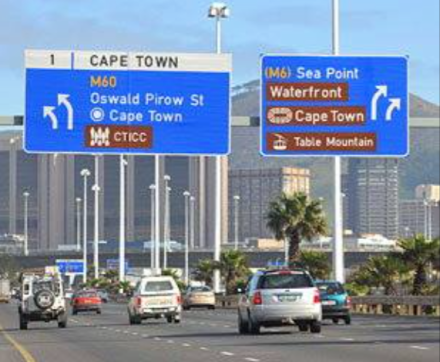
So when is it right to re-name a national landmark road?  We’re all up in arms that Edwin Swales VC Drive, named after our famous Victoria Cross winner for gallantry in World War 2 was re-named as Solomon Kalushi Mahlangu Drive after a controversial Umkhonto we Sizwe operative.  But what of Oswald Pirow Street in Cape Town, is there a case to justify this street name change?

Read on for a little more on who Oswald Pirow really was, learn some more on South African “hidden” military history; the Pro Nazi paramilitary organisations who sought to destabilise South Africa and the Union during the Second World War and bring South Africa into a one party ‘Fuhrer’ state run along ‘national socialism’ lines.

In all there were three movements which supported Nazi Germany and embraced its ideology in South Africa, the Ossewabrandwag, the shirts including the ‘Blackshirts’ and the SANP Greyshirts (see Pro Nazi movements in wartime South Africa – the SANP “Greyshirts”) and the ‘global’ Nazi movement – The ‘New Order’ – led by our subject for the day, the well-known South African Nationalist Politician and Public Prosecutor – Oswald Pirow.

10460708_459305080905896_5196244094119877880_n

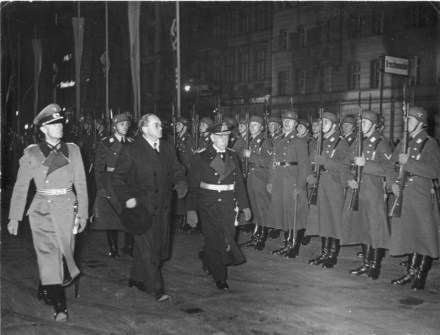
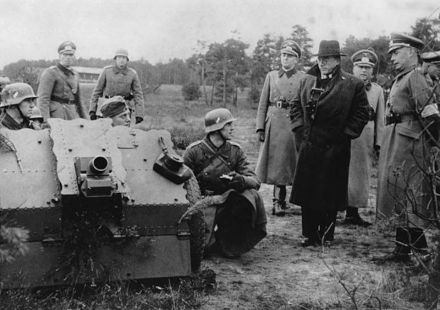
Oswald Pirow in Nazi Germany, November 1938  in Berlin inspecting a honour guard from the German Luftwaffe (Air Force), to his left is Wilhelm Canaris, to his right Ernst Seifert.

In a relatively little known part of South African history, Oswald Pirow was sent on ‘quasi-official’ visits on behalf of the Hertzog government to Nazi Germany and Fascist Italy.  His mission was one of appeasement, to meet with Hitler, Ribbentrop and Goering and try to establish Anglo-German rapprochement as well as assure them of South Africa’s neutrality under the Hertzog government.

Pirow’s solution to easing British and German tension prior to the war, which he proposed to Hitler, was for the British to agree with the Nazi policy of “Drang nach Osten” (meaning yearning or ‘thrust’ towards the East for ‘living space’ as Hitler put it in his book ‘Mein Kamph’) and in return Hitler should allow all the Jewish people living in Germany to leave.  In reality this offer would never have happened as it would have required Britain, by way of a parliamentary agreement, to renege on its commitment to Poland as an ally.  However, Pirow also had another mission, that of building a South African partnership for a post war Nazi world.

So how is it that these lessor known South African missions and special envoy on ‘quasi official’ visits come about, what was he doing and what made Oswald Pirow tick?

Background

Oswald Pirow was born in Aberdeen (Cape Province, South Africa) on 14th August 1890, and was the grandson of a German missionary and son of a Doctor. Pirow studied law in Potchefstroom, Germany and London, and then practised as an advocate in Pretoria.  Oswald spoke perfect German and was insistent that only German was spoken by his family at home in South Africa (it was said by those who knew them that the Pirow family was more German in identity than South African).

He came to fame as a lawyer defending the Communist ring-leaders and instigators of The Rand Revolt in 1922 (see South Africa’s very own Communist Revolution – The Rand Revolt of 1922), an odd start for him as he became an ardent hater of anything Communist and would later come up with plans to ‘eradicate’ communism from the planet in its entirety (not just South Africa).

He made several unsuccessful attempts to enter parliament and finally in 1924 he was elected for Zoutpansberg. Smuts defeated him in 1929 in Standerton but he returned to Parliament and in the same year and he was appointed Minister of Justice in General Hertzog’s cabinet. The Hertzog government was in coalition, so it could not fully unleash Nationalist proposals for a Republic (of which Pirow was a keen supporter).

As Justice Minister, typical to form as a fierce anti-communist he passed the first anti-communist legislation in South Africa. In 1933 he was appointed Minister of Railways and Harbours, and from 1933 to 1939 he was Minister of Defence.

25074984_2060834677478853_5650117780720895916_o

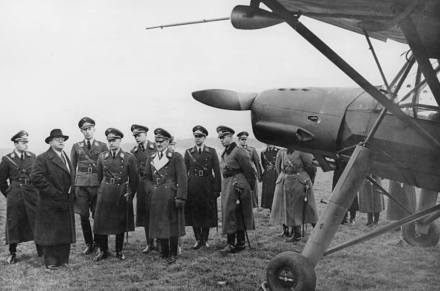
Oswald Pirow (in civilian dress) on tour inspecting German military capability in 1938

Unofficial Envoy 

In 1936 Pirow attended the Olympic Games in National Socialist (Nazi) Germany and in 1938 again visited Europe, including Spain, Portugal and Germany. These visits confirmed his admiration for this new style of government in Europe and, in particular, for National Socialism (Nazism). A vehement anti-communist – Pirow vowed to legislate communism out of existence, he also became an admirer of Adolf Hitler – especially after meeting him in 1933.

11425451_459347364235001_7335473098897133162_n

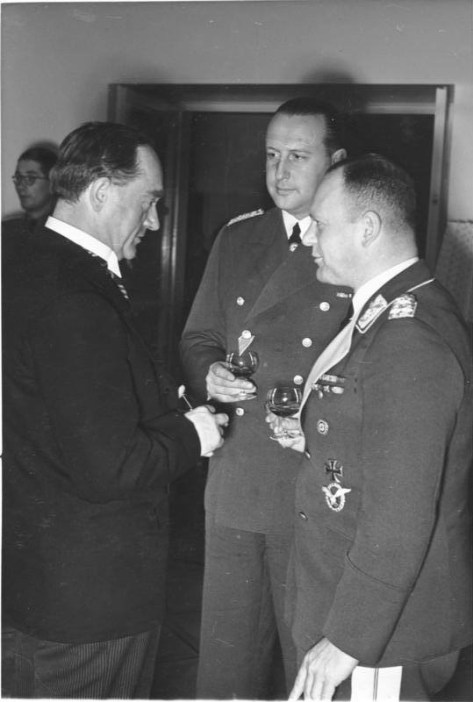
Oswald Pirow ( left) at a reception of the Nazi Foreign Minister Joachim von Ribbentrop in conversation with Erhard Milch (right) and Walter Hevel on November 19, 1938

During this tours he also met Benito Mussolini, António de Oliveira Salazar and Francisco Franco and became convinced that a European war was imminent, with a resounding Nazi victory assured.  The future Pirow predicted was one of global nazism and it was a future he liked.

The Nationalists were strongly in favour of Nazi Germany, primarily as the antagonists for war in their eyes were the British, and they simply hated the British.  This hatred stemmed from the punitive deportation and containment measures used by The British against Boer families along with the destruction of their farmsteads during The 2nd Anglo-Boer War.

Publicly the Nationalists declared neutrality as to Nazi Germany and to the impending war with Germany, whilst covertly their members (and even leaders) in the tens of thousands joined pro Nazi organisations like the Ossawabrandwag and the SANP Grey Shirts, which very publicly nailed their colours to mast strongly in support of Nazi Germany.

When General Jan Smuts committed South Africa to war against Nazi Germany, Pirow found his position in government as a Minister of Parliament and especially as Minister of Defence untenable. He had given his support in 1939 to Hertzog’s neutrality policy and had been on appeasement missions to Nazi Germany in support of them.  He then resigned along with Hertzog and took no part in Smuts’ reformatted war-time government.

South Africa’s ‘New Order’ 

By September 1940, with Nazi Germany on the ascendancy having invaded most of Western Europe, Pirow launched the South African version of the “New Order” within the breakaway National Party – the Herenigde Nasionale Party (HNP), backing a Nazi style dictatorship.

His new political grouping took its name from his 1940 ‘New Order in South Africa’ pamphlet in which Pirow embraced the ideology of Nazi globalisation.

To understand what the concept of the “New Order” was – the New Order (German: Neuordnung) was the political order which Nazi Germany wanted to impose on the conquered areas under its dominion.

The establishment of the New Order was publicly proclaimed by Adolf Hitler and entailed the creation of a pan-German racial state structured according to Nazi ideology to ensure the supremacy of an Aryan-Nordic master race, massive territorial expansion into Eastern Europe through its colonization with German settlers, the physical annihilation of the Jews and others considered to be “unworthy of life”, and the extermination, expulsion, or enslavement of most of the Slavic peoples and others regarded as “racially inferior”.

third-reich-2

Hitler’s New Order for Africa

Hitler’s ‘New Order’ plan involved global expansion, it focussed primarily on Eastern Europe (‘living space’) however it also extend to Asia, India, South America and North America in ‘post war’ fascist dominated world. Like any plan for globalisation, Africa also played a role in the New Order.

Hitler’s overall intentions for the future organisation of Africa was based on a plan which divided the continent into three big parts. The northern third of Africa was to be assigned to Germany’s Axis partner – Italy. The central part of Africa would fall under German rule. The remaining southern sector would be controlled by a pro-Nazi Afrikaner state built along racial grounds.

Foreign Minister Ribbentrop had communicated this plan with South African leaders sympathetic to Nazism, and a key channel for this communication were his meetings with Oswald Pirow whilst he was on his ‘quasi official’ South African State visits to Nazi Germany on behalf of the Hertzog government.

25188738_2060834724145515_6204150310272340344_o

Oswald Pirow as a special South African envoy inspecting German Infantry and military capability in 1938

Ribbentrop informed the Afrikaner Nationalist leaders that once Germany had won the war, Germany was to reclaim its former colony of German South-West Africa (now Namibia), then a mandate would be given to an Afrikaner Nationalist led South Africa as a sort of ‘war compensation’ which would include the territorial acquisitions of the British protectorates of  Swaziland, Basutoland (Lesotho), Bechuanaland (Botswana) and the colony of Southern Rhodesia (Zimbabwe).

On the division of French African colonies between the Spanish and Italian governments Hitler refused to provide any official promises during the war, fearful of losing the support of Vichy France

Decline of Pirow’s New Order 

240px-DFMalanPortret

Dr. DF Malan

Dr D.F. Malan, leader of the National Party initially tolerated the actions of Oswald Pirow’s South African adaption of the 3rd Reich’s ‘New Order’ however very soon Malan came to realise what the extreme ideology of  The New Order was about and he immediately saw it as a divisive influence on the Afrikaner nationalist movement.

Fearful of a split in Afrikaner nationalism over support for extreme Nazism and for Hitler’s plans for the African ‘new order’, at the Nationalists Transvaal party congress of August 1941, Malan forced through a motion ending the New Order’s propaganda activities, particularly their insistence on a one-party state on a ‘Führer’ principle.

To understand more about the National Party and its associations to pro Nazi movements do follow this link “Mein Kampf shows the way to greatness for South Africa” – The Ossewabrandwag

Although restricted by DF Malan, the New Order continued to exist and Pirow and 17 of his New Order supporters continued to be associated with the HNP and continued to attend their caucus meetings.

The New Order  finally broke from the HNP altogether in 1942 after both D.F. Malan and J.G. Strijdom publicly rejected the Nazis.

Partnership with Sir Oswald Mosley 

537202579

Oswald Mosley

With the outcome of the war firmly against Nazi Germany, Oswald Pirow’s political career within the Afrikaner Nationalists was effectively over, he returned to legal practice, and during this time became a friend of Sir Oswald Mosley.

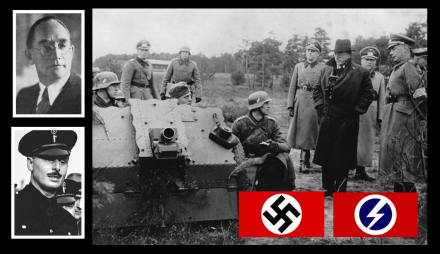
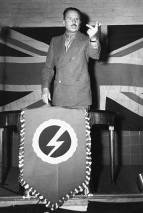
Mosley was ex-British MP and an infamous British Nazi, he led the British Union of Fascists (BUF), a Neo-nazi British organisation following the edicts of the ‘New Order’ in the United Kingdom.

Mosley was imprisoned at the outbreak of World War 2 in 1940 for his extreme views in support of the enemy (Nazi Germany) and the BUF was outlawed. He was released in 1943.

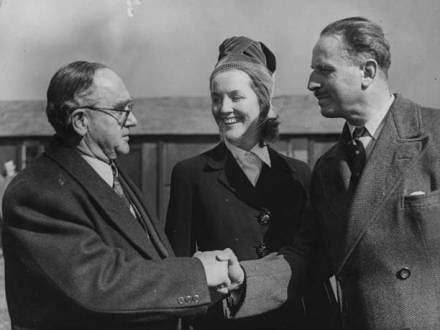
Oswald Pirow and Mosley, having similar political views decided to collaborate together and they developed an idea for the division of Africa into exclusively black and white areas.

505808586

Oswald Pirow and Oswald Mosley

The two met after Pirow read a copy of Mosley’s book ‘The Alternative’ and by 1947 they were in discussion over founding an anti-communist group to be known as the “enemies of the Soviet Union” (although this plan never reached fruition).

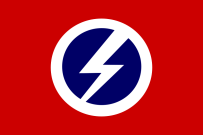
buf_flag

Mosley’s British Union of Fascists (BUF) Flag

The two Oswalds co-operation started in earnest when Pirow visited Mosley in London in April 1948 and spent the weekend at his house.  In collaboration with Mosley, Oswald Pirow started writing articles for the Union Movement journals and The European, some of which were reprinted in German magazine Nation Europa.

In addition to writing for far right wing publications, the two Oswalds came up with what were known as the Mosley-Pirow Proposals, which advocated the extension of the South African National Party’s Apartheid ideology and concept to include the entire continent of Africa.  The idea they came up with was that two-thirds of sub saharan Africa would be advocated for ‘Black States’ and one-third would be for ‘White states’.  Where the two of them differed on their concept of ‘Eurafrica’ (which they coined) is that Pirow felt that ‘sweated labour’ would need to be forced whereas Mosley felt that unskilled Labour, needed in the ‘white states,’ was to be traded for from the ‘black states’ in return for technical assistance at some ‘later stage’.

The relationship with Pirow and Mosley started to break down after their ‘Eurafrica proposals’ were launched. Pirow came to realise that virtually nobody took Mosley seriously, people generally dismissed both him and his economic and political treatise out of hand as an extreme oddity.

The Treason Trial

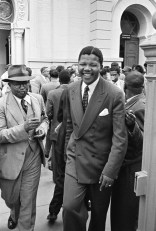
Nelson Mandela, treason trial, Pretoria, 1958

Nelson Mandela at The Treason Trial 1956

Very famously Pirow, now back in South Africa and back in his legal guise, acted as the public prosecutor on behalf of the Nationalist State during the Treason Trial of 1956. The Treason Trial was a trial in which 156 people, including Nelson Mandela, were arrested in a raid and accused of treason in South Africa in 1956. The main trial lasted until 1961, when all of the defendants were found not guilty. During the trials, Oliver Tambo left the country and was exiled. Some of the defendants, including Nelson Mandela were later convicted in the Rivonia Trial in 1964.

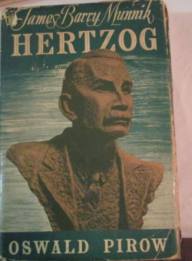
Following the Treason Trial Pirow largely lived in retirement, publishing several books, especially on JB Hertzog of who he was an admirer, he also wrote books on wildlife and adventure books for boys. He died of heart failure. He was cremated and his ashes are kept at his Valhalla Farm residence near Pilgrim’s Rest.

11401548_459339007569170_7553625890068332822_n

Influence on Apartheid 

Oswald Pirow’s influence in South African politics and Apartheid is far-reaching. The Tomlinson Commission – which investigated the validity of the idea Apartheid was not a new creation, and its findings were based in part on findings made by the Native Economic Commission in 1932 and on preparatory work done by Oswald Pirow.

Very little is known in South Africa today of the frustration and disillusionment returning South African combatants from World War 2 felt and the motivation behind their eventual mass protests against Apartheid policies in the 1950’s (known as the ‘Torch’ Commando rallies – attracting  tens of thousands of war veterans – see The Torch Commando led South Africa’s first mass anti-apartheid protests, NOT the ANC!).

Effectively the returning South African statute force veterans had gone to war to rid the world of Nazism, only to come home and in a few short years find significant “home grown” Nazi’s in government or playing a key role in public prosecution (as was the case with Pirow) when the National Party narrowly beat Smuts’ United Party into power in 1948.

The likes of famous World War 2 heroes like Adolph “Sailor” Malan would have none of it and they took to the streets in the first mass protests against Apartheid and the Nationalist government who had only come into power a couple of years before hand and where already removing the cape coloured vote from the register – see Sailor Malan; Fighter Ace & Freedom Fighter!.

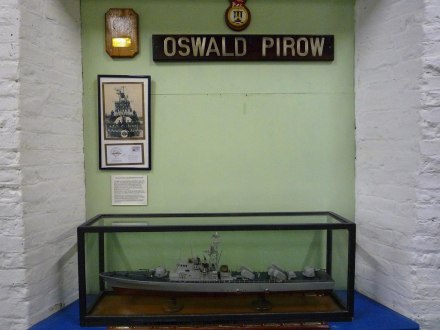
The Torch Commando and veteran protests where ultimately suppressed by The National Party (including Sailor Malan) and the Nationalists where free to promote their heroes – Oswald Pirow had the foreshore road in Cape Town named after him  as well as a South African navy strike craft – the SAS Oswald Pirow – much to the disillusionment of many of South Africa’s war veterans, the disenfranchised voters and the South African Jewish community.

Re-naming 

Since 1994, proposals were to put forward to re-name the strike craft and Cape Town’s foreshore road.

The SAS Oswald Pirow was re-named the SAS Rene Sethren after a famous Navy stocker Rene Sethren who was on board a South African minesweeper in World War 2. In June 1941 his ship was escorting a convoy to Tobruk when they came under heavy attack from enemy planes. He took over an anti-aircraft gun and did not stop firing until the attack was over. He was wounded 27 times during the attack and fortunately survived, he received his gallantry decoration from King George V.

It was also discovered that although Dr Christiaan Barnard had performed the world’s first heart transplant nothing in the way of Cape Town’s streets honoured this, since 2011 most Captonians now know this landmark road which was ‘Oswald Pirow Street’ as ‘Christiaan Barnard Street’.

Oswald Pirow

There is an argument that says we should not be re-naming things in the interests of preserving history, with all its spots, however world over institutions named after Nazis have been re-named and/or scrubbed of anything glorifying this history.  Munich – the birthplace of Nazism is virtually clean of any old references, such is its blight to the entire human race caused by this ideology, and in this respect South Africa has acted no differently.

What is surprising is that even during the 70’s and the 80’s, the National Party were unapologetic in the glorification of individuals so closely associated to National Socialist ideology and Nazism, no matter how hurtful to the vast majority of South Africans, well after the horrors of this ideology had been exposed and universally condemned (even in South Africa).

Pirow was allowed to continue as the State Prosecutor and advise Apartheid policy, his controversial plans for the Nazification of Southern Africa were just glazed over and conveniently swept under the rug – the modern South African generation would grow up fairly oblivious of Oswald Pirow’s really dark past.

11406645_459696484200089_3957396089513991556_o

Display of the SAS Oswald Pirow at the SA Naval Museum, it was renamed the renamed SAS Rene Sethren on April 1, 1997


Written and Researched by Peter Dickens.

Feature photo copyright the German Federal Archives copyright. ‘Very Deeply Dyed in Black’ Sir Oswald Mosley  and the Resurrection of British Fascism After 1945 by Graham Macklin. NSDAP Office of Colonial Policy  Brian Bunting’s 1964 book, The Rise of the South African Reich.  Ribbontrop’s proposals to South Africa, The Rise and Fall of the Third Reich,  by William Shirer, 1974 edition.

Published by New York: Crest, 1962, New York (1962

The origin of SAAF 1 Squadron’s nickname – “Billy Boys”

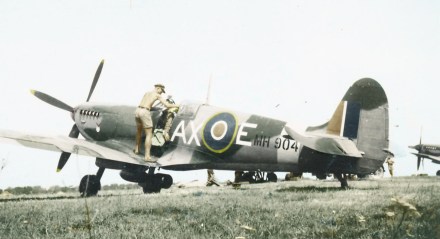
Spitfire Mk IX of South African Air Force’s 1 Squadron preparing for take-off from a Sicilian airfield, perhaps Pachino on 1943, these are the famous “Billy Boys”.  How they got their nickname is actually quite interesting and distinctively South African.

This squadron had an incredible success rate and whenever one of it’s pilots had an aerial victory shooting down an enemy aircraft his fellow South African pilots would all shout “Jou BIELIE” down their radios.

The term “bielie” is an Afrikaans term for a prime example e.g. ‘n bielie van ‘n bul, meaning a prime example of a bull. Calling someone “‘n bielie” is a term of recognition of something special. Calling a pilot that after a successful aerial shoot down would have been equal to saying that he is a prime example of a fighter pilot. “Jou bielie van ‘n skut” meaning “you cracking shot”.

The British Royal Air Force pilots who where on the same frequency as the South Africans where slightly perplexed by the term thinking they where calling out “Billy” instead of “Bielie”, so they quickly started to refer to the SAAF 1 Squadron pilots as “Billy Boys”. The nickname stuck.

To give an idea of the success rate 1 SAAF Squadron total for the war was 165.5 kills, the highest scoring SAAF squadron.

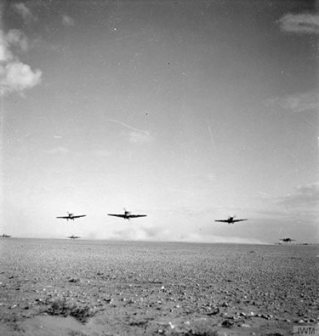
Here are South African Air Force 1 Squadron Hurricanes taking off from Msus, Libya. Image copyright Imperial War Museum.

10649706_376892759147129_7713225561556526636_n

Feature image of SAAF 1 Squadron Spitfire Mk IX colourised and copyright to Tinus Le Roux

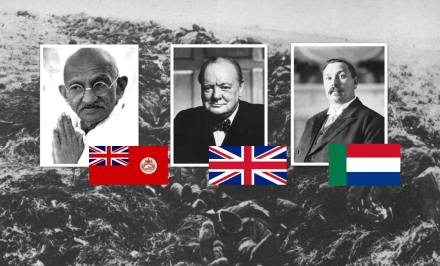
The Battle of Spionkop shaped 3 future leaders – Churchill, Botha & …. Gandhi

A little more unknown military history on just how one small battle in South Africa has shaped some of the greatest men of our time, including, believe it or not, Mahatma Gandhi, the famous Indian political reformer and spiritual leader.

Gandhi’s formative years were in South Africa and many don’t know this, but he even took part in the 2nd Anglo Boer War. He was also present at the battle of Spionkop, fighting for the British Army as a stretcher bearer and medic.

Spionkop is such a significant battle that three future heads of government were present, Winston Churchill, Mahatma Gandhi and Louis Botha. As a result, South Africa, and that battle in particular, played a significant role in moulding the contemporary history of the world in the years to come, simply because of the way the battle influenced these three men.

Background to the Battle of Spion Kop

After much sabre rattling over British immigrant workers rights on the mines in the Zuid-Afrikaansche Republiek (Transvaal Republic) and Rhodes’ Imperial expansionist visions, The 2nd Anglo Boer War was officially declared by the Boers on 11 October 1899 when they invaded the British Colonies of Natal and the Cape.

The move by two relatively small Boer Republics – the South African Republic (Transvaal) and Orange Free State Republic – to declare war on what was then the world’s only real superpower – The United Kingdom (Great Britain) – came with some astonishment to Queen Victoria and the British Government. The British expansionist Imperialists in Southern Africa, along with the Gold and Diamond mining magnates, on the other hand, could hardly believe their luck.

From the Boer’s perspective, the pressures Milner had put on Paul Kruger’s government to grant citizenship rights to mainly British mine workers on the Rand had simply become too much to bear.  Numerically speaking there were to be more miners than Boers in the Transvaal and the granting of such rights would have ended Boer governance of the province eventually – simply by the ballot alone.

As with the 1st Anglo Boer War (or Transvaal War as it was known) fought 20 years earlier from 16th December 1880 until 23rd March 1881, the Boers banked on a quick and decisive victory over the British Colonial forces in Natal and the Cape (which were somewhat weaker than Boer forces at the start of the 2nd Anglo Boer war), and bring to an end the United Kingdom’s demands on them and give them an upper hand in re-establishing their peaceful relations with their British neighbours – exactly as they had done after their victory over the British at The battle of Majuba in the 1st Anglo Boer War.

The Boer advance was however stopped by three small garrison armies at the British border towns of Mafeking, Kimberley and Ladysmith.  The Boers promptly put all three of these towns to siege and brought up heavy artillery and cannons to bombard them, both the garrisons and the civilians alike came under repeated and constant fire, the British citizens in these towns – especially women and children, were forced to near starvation and were now living rough in bunkers, mine shafts and caves.  This prompted an outrage back in Britain and fuelled by public opinion of the arrogance of it all Queen Victoria was able to draft the biggest British expeditionary force ever seen to go to Southern Africa and get their towns back. Central to all of this was the plight of the citizens in Ladysmith – Ladysmith was to become the pride of the British empire in Southern Africa and the rally call.

General Sir Redvers Henry Buller VC landed in Cape Town on the 31st October 1899 to appraise the situation, the main body of the first wave of expeditionary forces due to arrive shortly afterward by 10 November 1899.  By the beginning of December 1899 Buller had assembled all his forces in Durban to begin the relief of Ladysmith – what the British did not expect was to get was a resounding beating, ‘Black Week’ awaited them.

Buller’s woes in Natal started  with the Battle of Colenso – which was the third and final battle fought during the ‘Black Week’ – 10th to 17th December 1899 (the other two been resounding Boer victories at Magtersfontein and Stormberg in the Cape Colony),

At the Battle of Colenso, fought on the 15th December 1899, Buller’s forces came up against well entrenched Boer forces under the command of General Louis Botha (the first of the men profiled here).  Despite a brave attempt to ‘save the guns’ at Colenso, inadequate preparation and reconnaissance and uninspired leadership led to a heavy, and in some respects humiliating, British defeat. Buller’s army lost 143 killed, 756 wounded and 220 captured. Boer casualties were only eight killed and 30 wounded.  Buller retreated to reinforce, he requested even more British expeditionary battalions from the War Office by January 1900 and next up for Buller in a second attempt to relieve Ladysmith was The Battle of Spion Kop.

In a nutshell, the Battle of Spion Kop (Dutch: Spionkop; Afrikaans: Slag van Spioenkop) was fought about 38 km (24 mi) west-south-west of Ladysmith on the hilltop of Spion Kop along the Tugela River, Natal in South Africa from 23–24 January 1900.  It was fought between the South African Republic (Transvaal Republic) and the Orange Free State forces under the command of General Louis Botha on the one hand and British forces under command of General Sir Redvers Henry Buller VC in their second push to relieve Ladysmith on the other hand.  Spion Kop occupied the centre of the Boer line, and was therefore of strategic and tactical importance.
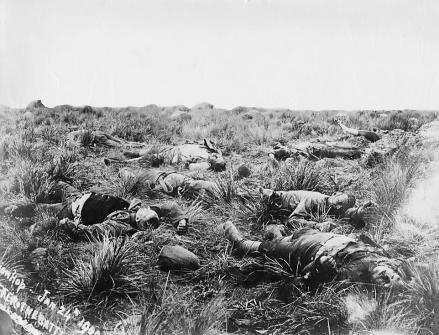
1403133_10203084409771670_1091144163_o

Iconic photograph of British dead in situation after the Battle of Spionkop

So what were these three future statesmen and reformers doing at Spion Kop? During the battle, Gandhi performed the role of a medic, Churchill acted as a courier and Botha led the Boers during the battle.  So let’s have a look at these three and their involvement a little more in depth, and chart how this singular battle affected their future views and helped shape their careers.

Louis Botha
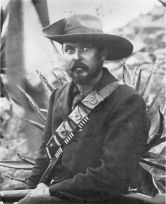
vo017cbaAt the onset of the war in 1899, Louis Botha initially joined the Krugerdorp Commando, he fought under Lucas Meyer in Northern Natal, and later as a General commanding and leading Boer forces rather impressively at the Battle of Colenso and then at the Battle of Spion kop.

General Louis Botha’s forces came up against General Sir Redvers Buller VC forces as he was trying to relieve Ladysmith.  Botha’s forces held the Tugela River and although Botha’s men were outnumbered, they were mostly equipped with modern Mauser rifles and up-to-date field guns, and had carefully entrenched their positions. In December, 1899, Buller made a frontal assault on the Boer positions at the Battle of Colenso The result was a heavy British defeat.

Over the next few weeks, Buller received further reinforcements, and he moved to cross the Tugela river and capture the hill of Spion Kop in a second attempt to advance on Ladysmith – Spion Kop lay at the centre of the Boer line, so of great strategic and tactical advantage if taken.  So on the night of 23 January 1900, General Sir Charles Warren, tasked with the advance on Ladysmith, sent the larger part of his force to secure the top of Spion Kop.
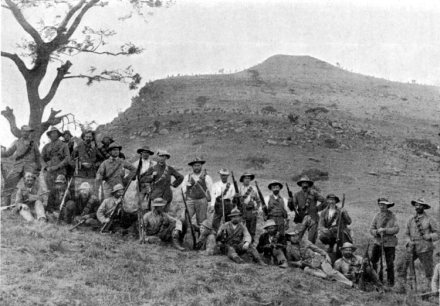
4-Boers_at_Spion_Kop_1900_-_Project_Gutenberg_eText_16462

Boer Forces on Spion Kop, January 1990

The British climbed up the hill at night and in dense mist. They surprised the small Boer piquet  and drove them off the kop at bayonet point. The Boer piquet retreated down the hill to their camp waking up their fellow Boers by screaming “Die Engelse is op die kop.” (The English are on the hill.). At that time a half-company of British sappers began to entrench their position on the hill with a mere 20 picks and 20 shovels (oddly – while almost 1,000 soldiers stood around idle).

As dawn broke, the British discovered that they held only the smaller and lower part of the hilltop of Spion Kop, while the Boers occupied higher ground on three sides of the British position. The British had no direct knowledge of the topography of the summit and the darkness and fog had compounded the problem. Furthermore, the British trenches were inadequate for all defensive purposes. Because the summit of the kop was mostly hard rock, the trenches were at most 40 centimetres (16 in) deep and provided an exceptionally poor defensive position – the British infantry in the trenches could not see over the crest of the plateau and the Boers were able to fire down the length of the crescent-shaped trench from the adjacent peaks.
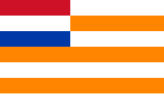
2000px-Flag_of_the_Orange_Free_State

Orange Free State Republic flag

In the resultant murderous and accurate Boer rifle and artillery fire as well as Boer assaults – the British ran up an unacceptable level of casualties and deaths – in what was to become known later as the ‘murderous acre’.  Although they eventually broke the Boer line after a herculean effort they withdrew from the hilltop as an exhausted and broken force, allowing the Boer’s to re-occupy it and win the day.

The British took 20,000 men and 36 Field Guns into the battle and by the end of the battle, the British suffered 243 fatalities; many were buried in the trenches where they fell and 1,250 wounded.  Whilst the smaller Boer force of 8000 men, 4 Field Guns and 2 cannon only sustained 68 killed 267 wounded.  It was a resounding Boer victory against the numerically superior British.
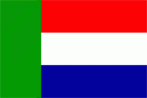
za-trans

South African Republic (Transvaal) flag

The Boers, including Botha, thought that their victory at the Battle of Spion Kop would be the end of all the hostilities, and like the end of the 1st Boer War which saw a similar British defeat on the hill of Majuba – the Boers thought the British would now sue for peace and so many of them even went home.  (see Observation Post Boers ‘Don’t forget Majuba, boys’. Brits ‘No fear, Boere, no fear’. for more on this battle).

Little did they foresee the ‘total war’ that was to become the 2nd Anglo Boer War and British resolve to not only take back their captured cities but also to eventually conquer the two Boer Republics with a degree of ruthlessness never before seen in South Africa, and never seen again.
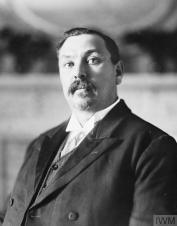
Botha

Louis Botha as the first Prime Minister of South Africa

The successes at Colenso and Spion Kop eventually saw General Louis Botha take control of all Boer Forces.  However, once the British won the conventional phase of the war and captured the capital city of Pretoria, the Boer commanders decided to move their government ‘into the field’ and embark on a new Guerrilla warfare phase.  This resulted in the British using heavily handed scorched earth and concentration camps systems to squeeze off supply to the guerrillas in the field.  The net result of these policies is that by the end of the 2nd Anglo Boer War, the Boer Republics’ farming sector was economically broken and Boer armies and Boer people’s completely decimated.

To build their country up again General Louis Botha teamed up with General Jan Smuts to propose ‘Union’ between the two British colonies and the two Boer states, take control back in the form of an independent South African parliament from Westminster (so it would be able to make its own laws) and create a new country – South Africa.  The Union of South Africa was born in 1910 with these two ex-Boer commanders leading it (without a shot been fired) and as one of these two reformers Botha took the mantle of South Africa’s very first Prime Minister.

Botha is literally the co-founder of South Africa and Smuts was very prepared to let him take the Prime Minister position as he was a far more popular man than the deep thinking broody Smuts,  here Smuts felt their relationship was perfectly balanced for the work of creating a new country and all the challenges that would bring.  Botha’s popularity, especially amongst the Afrikaner lay in his great deeds during the 2nd Anglo Boer War and his popular and likeable manner in command, this popularity was forged by his successes at Colenso and Spion Kop.

Botha would die in office on the 22 August 1919, and in a further ironic twist, it would be Field Marshal Smuts, Botha’s partner in Union who would go on to be come a key advisor and close friend to Winston Churchill during the invasion of France in World War 2 and the formation of the post war world.  To read more on Smuts and Churchill read Observation Post “The force of his intellect has enriched the wisdom of the whole human race”- the death of Jan Smuts.

Winston Churchill
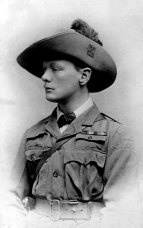
Winston ChurchillWinston Churchill took initially part in the 2nd Anglo Boer War as a ‘war correspondent’ for The Morning Post.  War Correspondents like Churchill tended to be commissioned officers serving in uniform attached to Regiments or formations, their reporting was intended to toe the military line.  South Africa literally made Churchill into a national hero and it is the epicentre of his rise to political greatness.

Churchill’s activities in South Africa read like a ‘Boys Own’ Adventure Novel.  His impertinent nature saw him arrive in Cape Town with General Sir Redvers Henry Buller’s expeditionary force, and he immediately teamed up with journalistic colleague John B. Atkins of the Manchester Guardian to go to the front at Ladysmith before any other journalists could do so. They took a 700-mile undefended train ride, boarded  a small steamer bound for Durban and promptly sailed into the teeth of an Indian Ocean storm. After several harrowing days, the pair arrived at Durban.

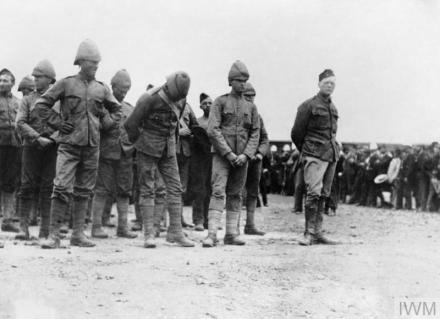
Still determined to get to see the Boer forces’ siege of Ladysmith ahead of Buller’s advancing forces, Churchill and Atkins made another dangerous train ride of 60 miles to within hearing range the artillery fire of the Boer guns on Ladysmith. Churchill, still keen on getting closer to the action accompanied a scouting expedition on an armored train. The train was ambushed by the Boers and on 15 November 1899, Churchill and after a firefight in which Winston played a direct combatant role, he was captured by none other than Louis Botha (the other future statesmen profiled here).
large_000000

Churchill – standing off-set to the right as a POW

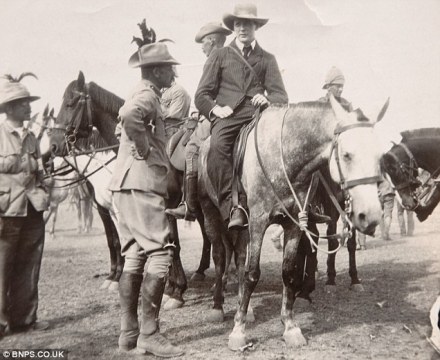
Churchill was imprisoned in a Prisoner of War (POW) camp. He managed to escape, and with a ransom price on his head and the assistance of an English mine manager, he eventually made his way to Delagoa Bay (Mozambique) after forging rivers, hiding in mine shafts and stowing away on a train . Hailed as a hero back in England, Churchill returned to Durban.

Here Churchill joined Buller’s advance on Ladysmith and was commissioned as a lieutenant in the South African Light Horse by General Buller whilst he was basking in the glory of his well-publicised escape from Boer captivity.  By January 1900, at the Battle of Spionkop just outside Ladysmith Churchill acted as a courier to and from the summit at Spion Kop and Buller’s headquarters and made a statement about the scene: “Corpses lay here and there. Many of the wounds were of a horrible nature. The splinters and fragments of the shells had torn and mutilated them. The shallow trenches were choked with dead and wounded.”
article-2094822-118BA99F000005DC-359_636x521

Churchill on horseback during the 2nd Anglo Boer war, this photograph was taken just after his escape from Boer captivity.

1280px-Flag_of_the_United_Kingdom

British Union Flag

Later, after the war Churchill used his new-found status as a national hero and turned his attention to politics, winning a seat in Parliament in the 1906 general election.

Ironically, it was Winston Churchill who revealed that General Botha was the man who captured him at the ambush of the British armoured train he was travelling in on 15 November 1899. Churchill was not aware of the man’s identity until 1902, when Botha travelled to London seeking loans to assist his country’s reconstruction, and the two met at a private luncheon.

Churchill became the Chancellor of Exchequer (Cabinet Minister) in 1924 upon rejoining the Conservative Party. Churchill was outspoken on a number of issues, such as the danger of Germans re-armament after World War One. His warnings against Hitler were largely ignored, but at the outbreak of the Second World War, his foresight was acknowledged and he became the war-time Prime Minister. His speeches and military strategy were a great encouragement to the British, and he is regarded today as one of the greatest Britons of his time.  It is largely due to Churchill’s leadership during the war that Britain was not invaded by Hitler’s nazi forces at the on-set of The Battle of Britain, that Britain (and Western Europe for that matter) is the modern democracy with the freedoms it enjoys today is largely thanks to Churchill (whether his detractors, of which there are many, like it or not, it remains a fact).

Mahatma Gandhi

Historians have forever struggled to explain why this apostle of peace and non-violence rendered support to the British Empire in the Boer War, the 1906 Natal Rebellion and the First World War.  However what is clear by Gandhi’s own writings was that his intentions in supporting the British Army in Southern Africa was to buy the Indian population in Southern Africa more political concession and representation based on endorsement and participation in British war efforts.
Natal Colony

Natal Colony Flag

When the Boer War came about Mahatma Gandhi actually played a pivotal role in the forming Natal Indian Ambulance Corps which fell under the British Military command.  He even raised the money to form the Corps from the local Indian Community.   It consisted of 300 “free” Indians and 800 indentured labourers (Indians were encouraged to emigrate to South Africa as labourers under contract, once the specified dates of the contract finished they were “free” to own land and make their own way as citizens).

In an urgent response the siege of Ladysmith the British authorities recruited the Natal Volunteer Ambulance Corps of about 1100 local White men, at the same time Gandhi pressed for his Indian stretcher-bearers to be allowed to serve, which was duly granted.
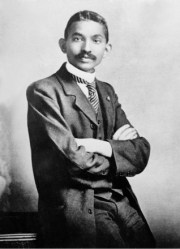
Gandhi lawyerMahatma Ghandi first saw action with Buller’s forces at the Battle of Colenso on 15 December 1899,  when the Natal Volunteer Ambulance Corps we ordered to remove the wounded from the front line and then transport them to the railhead.

During the Battle of Spion Kop, the Natal Volunteer Ambulance Corps (including Gandhi) moved into the frontline to collect the wounded. There is even an account of Ghandi’s bearing during the Battle of Spion-Kop. Vera Stent described the work of the Indians in the Illustrated Star of Johannesburg, July 1911, as follows:

“My first meeting with Mr. M. Gandhi was under strange circumstances. It was on the road from Spion Kop, after the fateful retirement of the British troops in January 1900.

The previous afternoon I saw the Indian mule-train moved up the slopes of the Kop carrying water to the distressed soldiers who had lain powerless on the plateau. The mules carried the water in immense bags, one on each side, led by Indians at their heads. The galling rifle-fire, which heralded their arrival on the top, did not deter the strangely-looking cavalcade which moved slowly forward, and as an Indian fell, another quietly stepped forward to fill the vacant place. Afterwards the grim duty of bearer corps, which Mr. Gandhi organised in Natal, began.
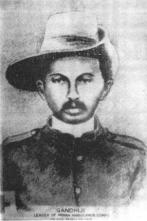
ghandi7It was on such occasions the Indians proved their fortitude, and the one with the greatest fortitude was the subject of this sketch [Mr. Gandhi]. After a night’s work, which had shattered men with much bigger frames I came across Gandhi in the early morning sitting by the roadside – eating a regulation Army biscuit. Everyman in Buller’s force was dull and depressed, and damnation was heartily invoked on everything. But Gandhi was stoical in his bearing, cheerful, and confident in his conversation, and had a kindly eye. He did one good… I saw the man and his small undisciplined corps on many a field during the Natal campaign. When succour was to be rendered they were there.”

34 Indian leaders were awarded the Queen’s South Africa Medal for actions in the Boer War. Gandhi’s is held by the Nehru Memorial Museum in New Delhi.

Mahatma Ghandi remained in the military as a reservist, and was eventually promoted to the rank of Sergeant Major, he also took part in the 1906 Natal Rebellion for which he again received 1906 Rebellion Medal.  For more in Gandhi’s military service see The Observation Post Gandhi was a man of peace, but he was also a man of war! .

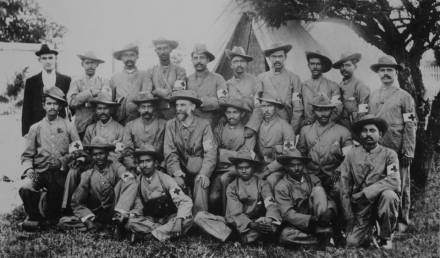
In the below image is Gandhi as a medic on the side of the British this time, seen in this photo with the stretcher-bearers of the Indian Ambulance Corps during the Boer War, South-Africa cira 1900.
1465327_235941723242234_756707980_n

Standing: H. Kitchen, L. Panday, R. Panday, J. Royeppen, R.K. Khan, L. Gabriel, M.K. Kotharee, E. Peters, D. Vinden, V. Madanjit. Middle Row: W. Jonathan, V. Lawrence, M.H. Nazar, Dr. L.P. Booth, M.K. Gandhi (Mahatma Gandhi), P.K. Naidoo, M. Royeppen. Front Row: S. Shadrach, “Professor” Dhundee, S.D. Moddley, A. David, A.A. Gandhi.

After the wars (Boer War and Natal Rebellion), Mahatma Gandhi’s politics began to shape up as one of non violence, and no doubt his exposure to the violence on war guided Gandhi to his philosophy of peaceful resistance.

In another irony as his political career travelled in synch with that of Louis Botha, in 1910, the same year the South African Union was established, Gandhi established an idealistic community called ‘Tolstoy Farm’ near Johannesburg. It was here, based on his wartime experience and his unsuccessful experiences of trying collaborative politics with the British, that he nurtured his policy of peaceful resistance.

Mahatma Gandhi’s political path was to cross with Louis Botha and Jan Smuts on a number of occasions over the issues of Indian rights and franchise in South Africa, and although Gandhi was arrested on a number of occasions for civil dissonance, he and Smuts developed a strong mutual respect, see Observation Post “… I am not worthy to stand in the shoes of so great a man”  for more on this unique relationship.

In all Mahatma Gandhi spent 22 years of his life in South Africa, a significant period of time, and there is no doubt the region’s politics and violence forged the man he had become by the time he returned to India in 1915.  On arrival in India he brought with him an international reputation as a leading Indian nationalist, theorist and organiser.

He joined the Indian National Congress and was introduced to Indian issues by Gopal Krishna Gokhale, his mentor. Gandhi by the time he arrived in India was utterly devout to the ideals of non-violence and universal love. He was against “untouchability” of India’s most destitute and all sorts of injustice in society. He lived a frugal life and imposed self suffering and hunger strikes to see his ideals triumph. In essence he dreamed of a “Ram Rajya” where everybody would live in peace.

In Gandhi’s in book Hind Swaraj Gandhi outlined his ideals of change via principles of non co-operation, and he declared that British rule was established in India with the co-operation of Indians and had survived only because of this co-operation. If Indians refused to co-operate, British rule would collapse and “swaraj” (self rule) would come.
Ghandi3

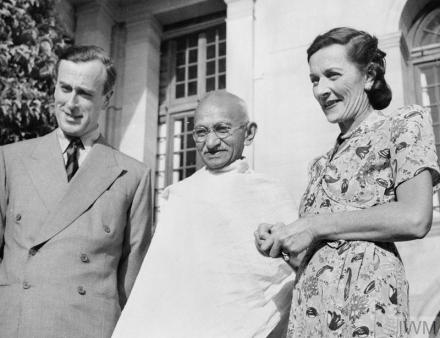
Negotiation of independence for India, Gandhi with Lord and Lady Mountbatten in 1947

Whist using this idea of non co-operation to fight British rule in India, he maintained his principles of truthfulness, peace and non-violence. In 1942, he launched the “Quit India Movement” to drive the British out of the country and gave the famous slogan of ‘do or die’ to his countrymen. The movement brought tremendous pressure on the British who eventually granted full independence to India in 1947.

1200px-Flag_of_India

National flag of India

He even famously crossed political paths with Winston Churchill when Churchill famously commented  “It is alarming and also nauseating to see Mr. Gandhi, a seditious Middle [Inner] Temple lawyer, now posing as a fakir of a type well known in the East, striding half-naked up the steps of the Viceregal palace, while he is still organizing and conducting a defiant campaign of civil disobedience, to parley on equal terms with the representative of the King-Emperor.”

Gandhi famously disarmed this typical Churchill rhetoric and insult when Gandhi wrote to Churchill in a letter saying, “Dear Prime Minister, You are reported to have a desire to crush the simple ‘naked fakir’ as you are said to have described me. I have been long trying to be a fakir and that [too] naked – a more difficult task. I, therefore, regard the expression as a compliment though unintended. I approach you then as such and ask you to trust and use me for the sake of your people and mine and through them those of the world.”


Written and researched by Peter Dickens.  References – wikipedia, Imperial War Museum, SAHO – South African History on-line, the escape of Winston Churchill.  Image copyright Imperial War Museum.  Colourised Spionkop image copyright Tinus Le Roux

The Red Oath

Pride in “Rooi Lussies”(red tabs), worn by most, branded “Rooi Luisies” (Red Lice) by some.

At the start of World War 2, the South African armed forces were woefully understrength having only 3,500 permanent force members and 14,000 volunteers in citizen force regiments and rifle associations (Active Citizen Force). General Jan Smuts needed to increase these numbers dramatically, and he did not want to institute conscription to do so, the call to fight would be based on volunteerism. The idea was to initiate a Oath declaring the free willing and voluntary nature South Africans felt in going to war against Nazi Germany, Fascist Italy and eventually Imperial Japan. The success of this call for volunteerism is staggering – in the end a total of 342,792 South Africans volunteered to participate in World War 2.

Also of that statistic nearly one quarter of the total ‘white’ adult population at the time volunteered for service, consider what Smuts had achieved, the Nationalists were unable to raise anywhere near these numbers in 1966 to their cause and had to implement forced conscription for the SADF.

The ‘Red Oath’ or ‘Service Oath’ was taken by all these volunteers when joining the South African Union Defence Force (UDF) from 1939, it was a Service Oath to legally enable the Union to send soldiers outside the borders of South Africa (soldiers in the UDF were only legally obliged to protect South Africa itself if it were invaded). The oath read:

“That I will be faithful and bear true allegiance to His Majesty King George VI and his heirs and successors according to law … That I will perform to the best of my ability the duties assigned to me as a volunteer member of the Union Defence Forces … That I will serve anywhere for the duration of the present war and for a period of six months thereafter unless otherwise legally discharged.”

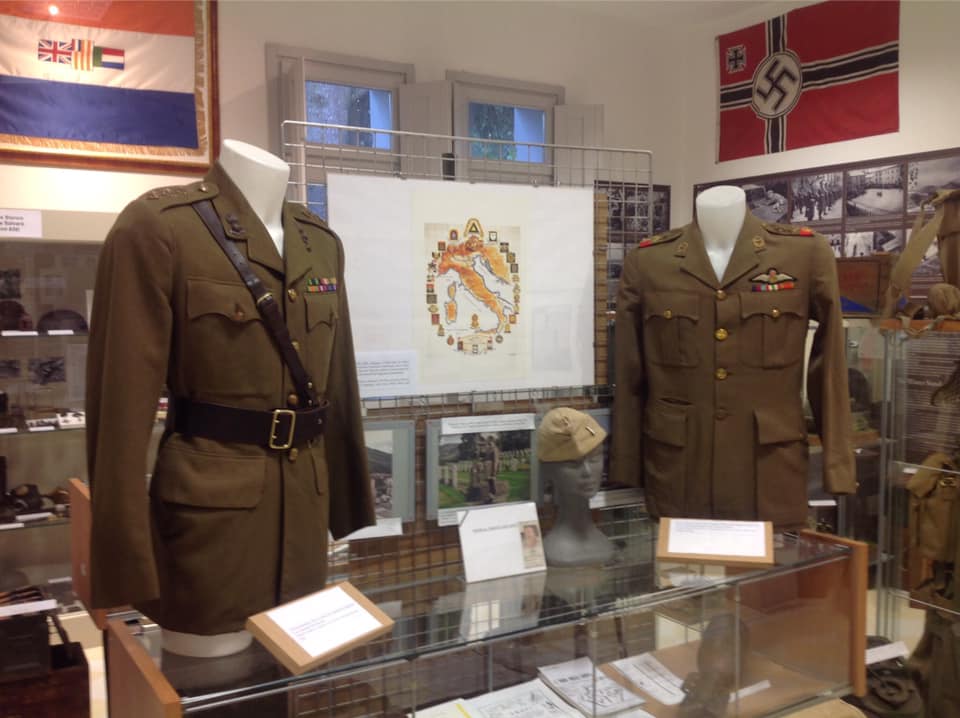
This manifested itself in ‘red epaulettes’ issued to all service-personal who ‘volunteered’ to serve in the armed forces during the war and took the ‘Red Oath’. Sensitive to sympathetic political feelings many Afrikaners had towards Germany, by implementing the oath the Smuts government gave the opportunity for permanent force members sympathetic to Germany to remain in the Union’s forces, and not go to war against them – they just didn’t get to wear the red tabs.

The original ‘red’ oath specified service anywhere in “Africa” and was called the ‘Africa Service Oath’ (ASO), it was changed to the ‘General Service Oath’ (GSO) once the Axis Forces in North Africa were defeated so that volunteers could be used in the European theatre and the word “Africa” was changed to “anywhere”. Those who did not want to fight in Europe and who had taken the ‘Africa’ oath only were returned to the Union.

A handful of permanent force UDF members did not take either red oath, some felt inevitably ‘singled out’ by not wearing the tabs (and in some cases resigned), whilst others took pride in their political convictions and wore their ‘clean’ epaulettes, sans the red strip with pride.

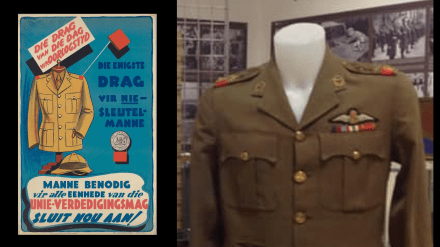
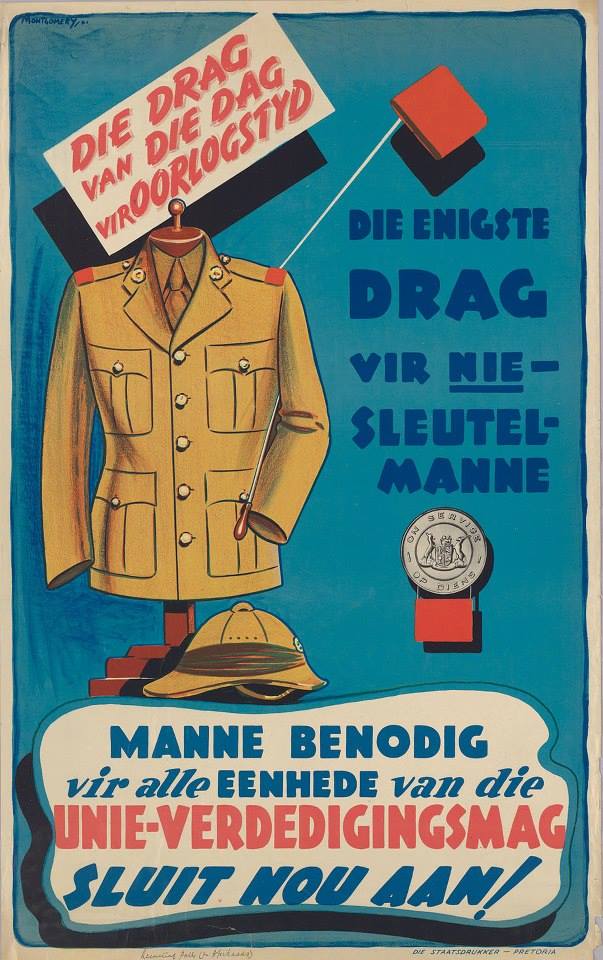
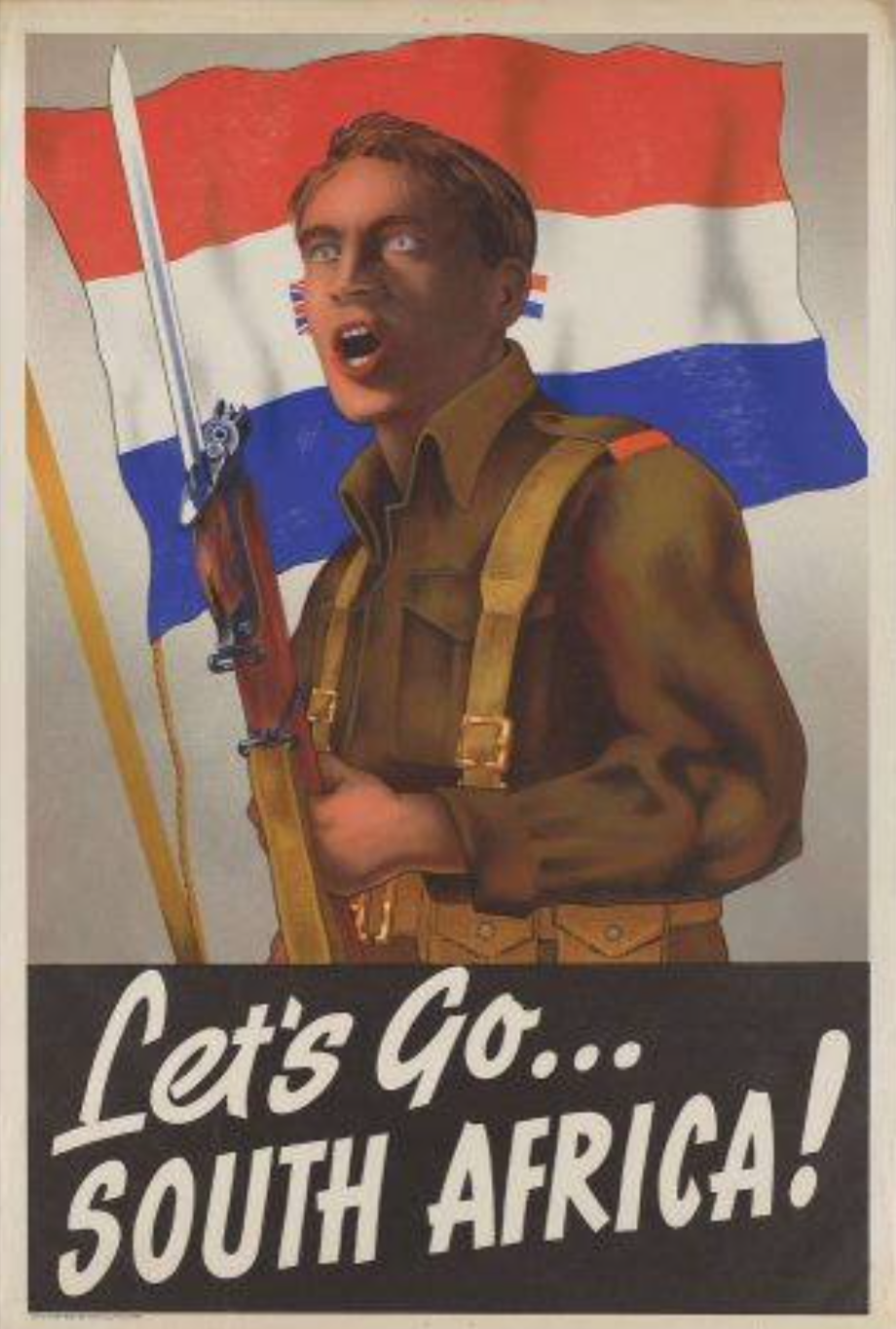
Images: Pride in the Red tabs and Let’s Go South Africa, showing proudly the tabs propaganda posters.

This WW2 South African propaganda poster, promoting the ‘Red Oath’ and the special volunteer epaulette flash worn by all who took the oath and volunteered for service during World War 2 was designed to swing opinion in the Afrikaans community where the wearing of the red flash was seen as an oath to the British and viewed by some as betrayal. In these sections of the Afrikaans community they where called ‘Rooi Luisies’ (Red Lice) instead of ‘Rooi Lussies” (Red Tabs), as a means of degrading those who volunteered.

Image: British (left) and South African (right) uniforms from the Italy Campaign during WW2, note the red tabs on the epaulettes.

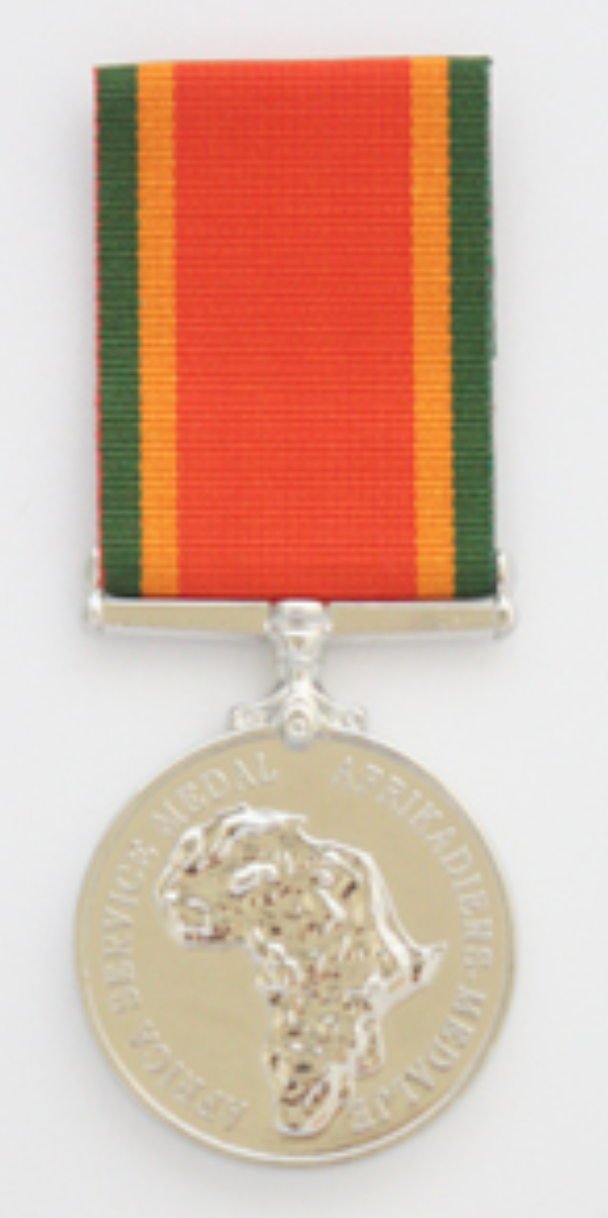
Of interest is the ‘Africa Service Medal’ awarded to all who served in South African Forces during the Second World War, the ‘red tab’ in this medal’s ribbon is symbolic of the The Red Oath taken and the tabs worn.

The ‘Erasmus Reforms’ to the defence force was implemented by FC Erasmus after the Afrikaner Nationalists came to power in 1948. Deemed more necessary when the Nationalists converted the South African Union’s Defence Force to that of the Republic’s Defence Force in 1961 and these reforms would see the idea of the ‘red’ oaths to the British royal family as the symbolic head of South Africa and red tabs removed. Some citizen force regiments however carried on with the tradition as a historical nod to their participation in the Second World War on their step out uniforms, the Cape Town Highlanders a case in point.


Written and Researched by Peter Dickens

References:

The Smuts Government Justification of Emergency Regulations and the impact thereof on The Ossewabrandwag (1939-1945) by Anna La Grange

The Springbok Record – published by the South African Legion

South African D-Day hero: Anthony Large BEM

6th June 1944. D Day, a very significant day in the history of mankind, and albeit on a smaller scale quite a number of South Africans did actually participate in it. The South African Naval Force (assisting the Royal Navy) is one such entity that did and this is one of these South African heroes to come from the D-day landings.

A Large

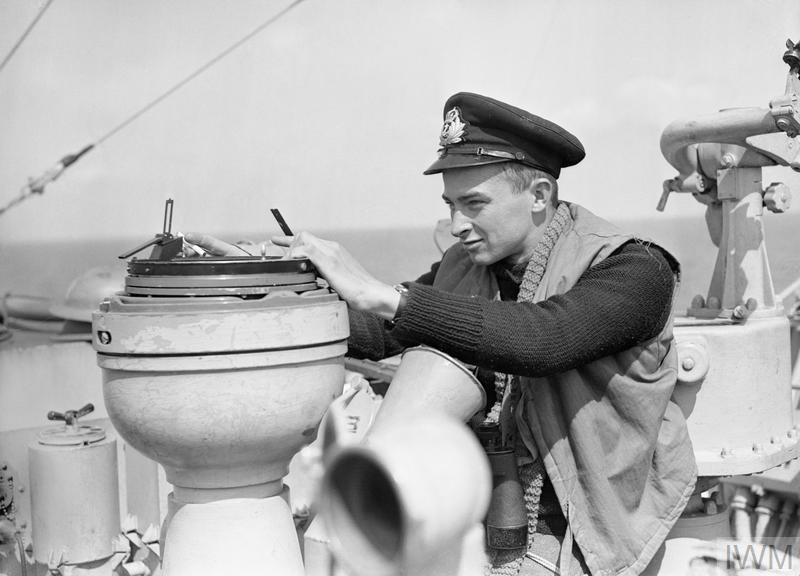
Here Sub Lieutenant Anthony Large BEM, South African Naval Force (Volunteers), of Durban, South Africa, is seen taking a bearing on the ship’s compass on board HMS HOLMES whilst she was helping to guard the Allied supply lines to and from the Normandy beachhead. He won his British Empire Medal BEM whilst he was a rating.

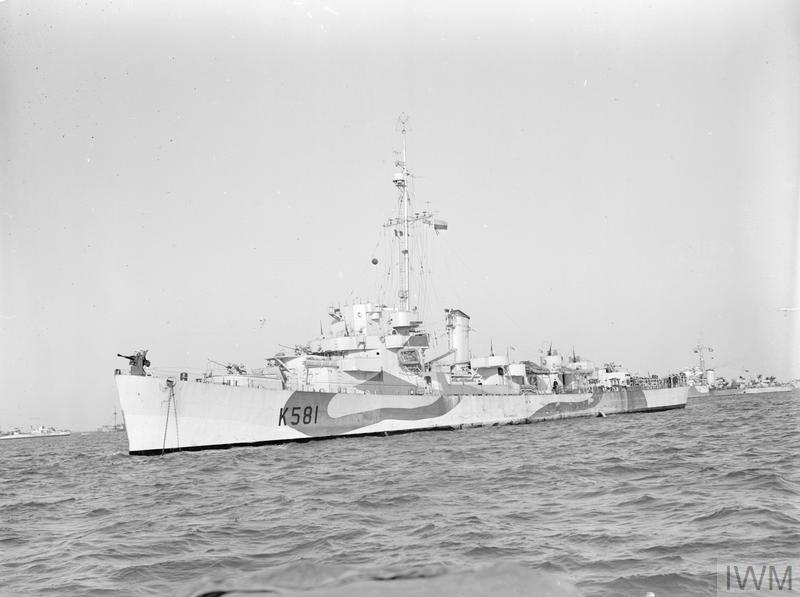
The HMS Holmes (K581) was a Captain Class frigate, originally intended for the United States Navy she was transferred to the Royal Navy before she was finished.  The HMS Holmes found itself in the thick of battle during D-Day on the 6th June 1944 as an escort.  She was alongside escorting large battleships like the HMS Rodney as they fired at shore targets in Normandy. Operating off the Caen beachhead and Le Havre, this Royal Navy flotilla known as Bombarding Force D, including the HMS Holmes, opened the channel for invading forces.

In this dramatic photograph the crew on the bridge of the frigate HMS Homes keep watch as gliders carrying 6th Airborne Division reinforcements to Normandy pass overhead on the evening of 6 June 1944.

Holmes 2

Naval operations for the invasion were described by historian Correlli Barnett  as a “never surpassed masterpiece of planning”. In overall command was British Admiral Sir Bertram Ramsay who had served as the Flag Officer at Dover during the Dunkirk evacuation four years earlier.

Operation Neptune, as the ‘D-Day’ operation was codenamed was quite something.  Consider these staggering statistics. The invasion fleet was drawn from eight different navies, comprising 6,939 vessels: 1,213 warships, 4,126 landing craft of various types, 736 ancillary craft, and 864 merchant vessels. The majority of the fleet was supplied by the UK, which provided 892 warships and 3,261 landing craft. There were 195,700 naval personnel involved.

HMS Holmes

HMS Holmes (K581) during Operation Overlord

Available to the British and Canadian sectors were five battleships, 20 cruisers, 65 destroyers, and two monitors. German ships in the area on D-Day included three torpedo boats, 29 fast attack craft, 36 ‘R’ Boats and  36 minesweepers and patrol boats. The Germans also had several U-Boats available, and all the approaches had been heavily mined.

At 05:10, four German torpedo boats reached the Bombarding Force D Task Force and launched fifteen torpedoes, sinking the Norwegian destroyer HNoMS Svenner off Sword beach but missing the battleships HMS Warspite and HMS Ramillies.  Not far from this action was our South African hero and the HMS Holmes.

Here the battleship HMS Ramillies shelling German gun batteries in support of the landings on Sword area, 6 June 1944. The photo was taken from the frigate HMS Holmes.

Ram

HMS Ramillies Sword area, 6 June 1944.

The British Empire Medal (BEM) awarded to Anthony Large is a significant British decoration, the medal is issued both for gallantry or meticulous service medal, however during the war it was generally awarded for gallantry to uniformed personnel, usually non-commissioned ranks below Warrant Officer.

BEM_400

British Empire Medal (BEM)

Related Links and work on South Africans during D-Day

Albie Gotze “This bastard is going to kill me”; Albie Götze’s Legion d’Honneur

Tommy Thomas South African D Day Hero: Lt. D.C. “Tommy” Thomas MC

Lyle Mckay South African bravery on D Day, Capt. Lyle McKay.

Cecil Bircher South African D Day Hero: Lt. Cecil Bircher MC

Royston Turnball Supreme South African heroism on Omaha Beach, Lt. Royston Turnbull DSC


Written and Researched by Peter Dickens Photograph copyrights and caption references – Imperial War Museum

South African Navy at war against …. Imperial Japan!!

Many people don’t know it – but a small historic fact, the South African Navy was involved in direct engagements with Imperial Japan during the Second World War.

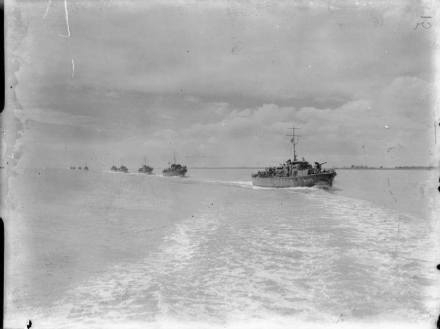
Here ML 475 leads motor launches of the Arakan Coastal Forces in line ahead up the Naaf River on their way to bombard Japanese shore defences and cut cross river communications.

These Coastal Forces were made up of the Royal Indian Navy, the Royal Navy, South African Naval Forces and Burma RNVR and they had covered nearly 30,000 miles in over 40 operations.

Harrassment of Japanese lines of communication and bombardment of shore defences were carried out between the Naaf River and Ramree Islands. Briefed in a Basha hut in their well hidden base, commanding officers return to their ships hidden in the up-river creeks for the nights operations.

Image and caption copyright: Imperial War Museum

One of the greatest Allied fighter pilots of WW2 was a little known South African! Meet Pat Pattle.

1972284_264945320341874_456274533_nMeet the all time highest scoring British and Commonwealth forces WW2 fighter ACE, a South African named  – Marmaduke ‘Pat’ Pattle DFC & Bar.

There are great South Africans, and then there are ones who stand on the shoulders of great men, and this man is one of them. Arguably the best Western Allied Forces fighter ace of WW2, this South African stands heads and shoulders above other British, British Commonwealth and American fighter aces of the war, however he remains a rather unsung hero. Precious little is known of him by many of his countrymen today, no significant war memorials exist in South Africa that even bear his name – but he is indeed one of South Africa’s greatest sons and one of the greatest heroes of WW2.

Squadron Leader Marmaduke Thomas St. John “Pat” Pattle DFC & Bar (3 July 1914—20 April 1941) was a South African-born Second World War fighter pilot and flying ace— believed to be the most successful Western Allied fighter pilot of the war.

Pat Pattle was born in Butterworth, Cape Province, South Africa, on 3 July 1914, the son of South African-born parents of English descent, Sergeant-Major Cecil William John “Jack” Pattle (b. 5 September 1884) and Edith Brailsford (1881–1962). Marmaduke was named after his maternal grandfather, Captain Thomas Marmaduke Pattle, who resigned his commission in the Royal Horse Artillery and emigrated to South Africa from England in 1875.

Pattle was academically intelligent. He considered a degree and career in Mining engineering before developing an interest in aviation. He travelled to the United Kingdom and joined the RAF in 1936 on a Short Service Commission (SSC). Pattle negotiated the training programs with ease and qualified as a pilot in the spring, 1937.

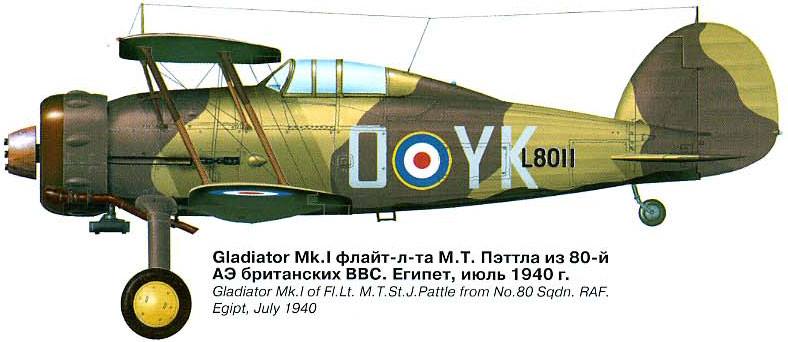
Assigned to No. 80 Squadron RAF, he was sent to Egypt before the war in 1938. He remained there upon the outbreak of war in September 1939. In June 1940 Italy entered the war on the side of the Axis Powers and he began combat operations against the Regia Aeronautica (Italian Air Force) gaining his first successes during the Italian invasion of Egypt. By November 1940 had gained 4 aerial victories but had been shot down once himself.

20140101_1531808780223191_901846197557193677_n

In November 1940 his Squadron was redeployed to Greece after the Italian invasion. Pattle achieved most of his success in the campaign. In subsequent operations he claimed around 20 Italian aircraft shot down. In April 1941 he faced German opposition after their intervention.

1504018_235682969934776_1104628272_n

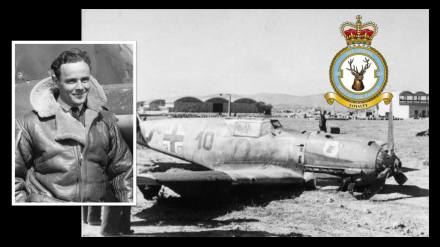
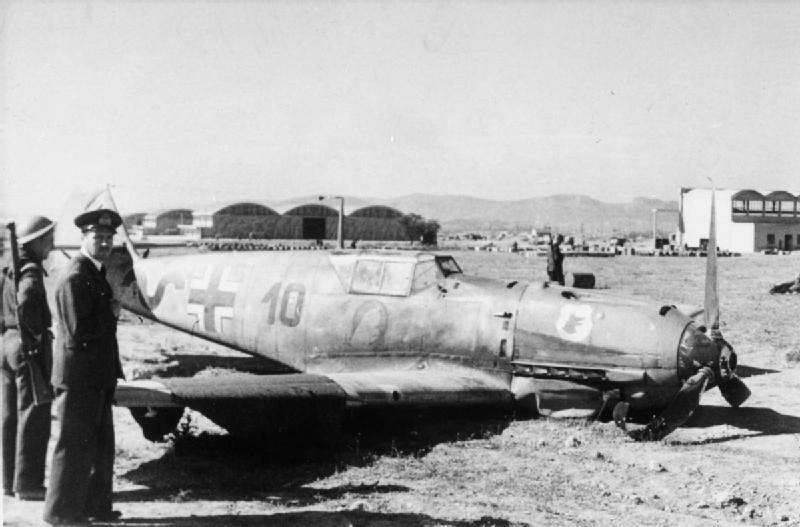
Here is a Messerschmitt Bf 109E of III/JG 77 which crash-landed on the airfield at Larrissa, Greece, possibly one of two claimed shot down by the South African Squadron Leader “Pat” Pattle, the Officer Commanding No. 33 Squadron RAF on 20 April 1941.

During the 14 days of operations against the Luftwaffe (German Air Force) Pattle claimed his 24—50th aerial victories; all but 3 were German. Pattle claimed 5 or more aircraft destroyed in one day on three occasions, which qualified him for “Ace in a day” status. Pattle achieved his greatest success on 19 April 1941, claiming six air victories.

Squadron_Leader_Pattle_of_33_Squadron_RAF_Greece_IWM_ME(RAF)_1260

Squadron Leader Marmaduke Thomas St John “Pat” Pattle, Officer Commanding No. 33 Squadron RAF (left) , and the Squadron Adjutant, Flight Lieutenant George Rumsey (right), standing by a Hawker Hurricane at Larissa, Thessaly, Greece.

The very next day, having claimed more aerial victories than any other Western Allied pilot, he took off against orders, and suffering from a high temperature to engage German aircraft near the Greek capital Athens. He was last seen battling Messerschmitt Bf 110 heavy fighters. His fighter crashed into the sea during this dogfight, killing Pattle.

Pattle’s death was equally heroic as he had dived down to rescue a fellow pilot who had a Bf-110 on his tail, Pattle managed to save him but at the loss of his own life, as he was also been attacked by Bf-110’s during the rescue – and he chose to ignore them to save his buddy.

Pattle was a fighter ace with a very high score, and is noted as being the highest-scoring British and Commonwealth pilot of the war. If all claims made for him were in fact correct, his total could be in excess of 51. It can be stated with confidence that his final total was at least 40 and could exceed this value. Log-books and semi-official records suggest this figure while personnel attached to his Squadron suspect the figure to be closer to 60. A total of 26 of Pattle’s victims were Italian; 15 were downed with Gloster Gladiators, the rest with Hawker Hurricanes. He is considered to be the highest-scoring ace on both Gladiator (15 victories) and Hurricane (35 victories) fighters.

20106521_1531758346894901_5386158313531060856_n

Pattle is however regarded as the ‘unofficial’ Highest scoring Western Allied Fighter pilot for WWII. Unfortunately the squadron war dairy and his log books were lost in the retreat from Greece.

Pattle’s medals are on display at the Ditsong National Museum of Military History in Johannesburg.  However little other recognition is given to him in South Africa.  Pat Pattle, like so many other great South Africans of WW2 serving in the Royal Air Force – Roger Bushell, Sailor Malan, Zulu Lewis, JJ Le Roux, Stapme Stapleton, Geoffrey Haysom, Dutch Hugo, John Nettleton VC and many more, suffered from the incoming race politics of the Nationalists in 1948, their memory ridiculed and branded as ‘traitors’ for siding with the British, their legacy subject to systematic erosion during the years of Apartheid. To the extent that today, in the changed politics of South Africa, we find them almost completely forgotten.

To think that we have in our midst in South Africa, some of the greatest men of the war to liberate the world of Fascism and Nazism, we have so much to be proud about as a nation, we even hold the honour of having the greatest Western Allied fighter pilot of the war … and nobody knows.

pat
Pilots of No. 33 Squadron RAF, at Larissa, Greece, with Hawker Hurricane Mark I, V7419, in background. from left to right, Pat Pattle stands at the centre.


Thank you to Tinus Le Roux for the use of this rather rare feature photo of Pat Pattle, copyright and use to Tinus Le Roux. Content thanks to Wikipedia and Sandy Evan Hanes.  Insert photographs – copyright Imperial War Museum

‘Carry On’ the South African Army – the story of Sid James

30420838_2128269237402063_5030635904492981272_o

Sid James in the South African Army

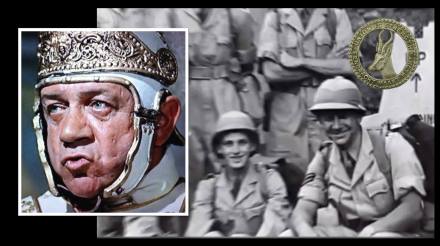
Sid James – was the famous ‘cockney’ Jack the Lad star of the “Carry On” movie series with his legendary trademark ‘naughty’ laugh. He epitomised a London ‘wide-boy’ and exists in British comedy as Super-Star.

But did you know Sid James was in fact a South African and served in the South African Armed Forces during World War Two?

Not many know this as off-screen Sid was a very private man, and when not in his ‘cockney wide-boy’ character, his South African accent would find its voice.

Sid James was born Solomon Joel Cohen, on 8 May 1913, to Jewish parents, in South Africa, later changing his name to Sidney Joel Cohen, and then Sidney James.

His family lived on Hancock Street in Hillbrow, Johannesburg. Upon moving to Britain later in life, he claimed various previous occupations, including diamond cutter, dance tutor and boxer; in reality he had trained and worked as a hairdresser.

It was at a hairdressing salon in Kroonstad, Orange Free State that he met his first wife. He married Berthe Sadie Delmont, known as Toots, on 12 August 1936 and they had a daughter, Elizabeth, born in 1937. His father-in-law, Joseph Delmont, a Johannesburg businessman, bought a hairdressing salon for James, but within a year he announced that he wanted to become an actor and joined the Johannesburg Repertory Players. Through this group he gained work with the South African Broadcasting Corporation.

Sid’s abandonment of his hairdressing career and then his young bride and child was the last straw for her wealthy father (who apparently ‘put a price’ on our man’s head), so Sid decided to cut his losses and join the army. Sid was never to look back, as when he volunteered to join the South African Army World War 2 had just broken out, and funnily the war aided that aided his emerging career in the performing arts.

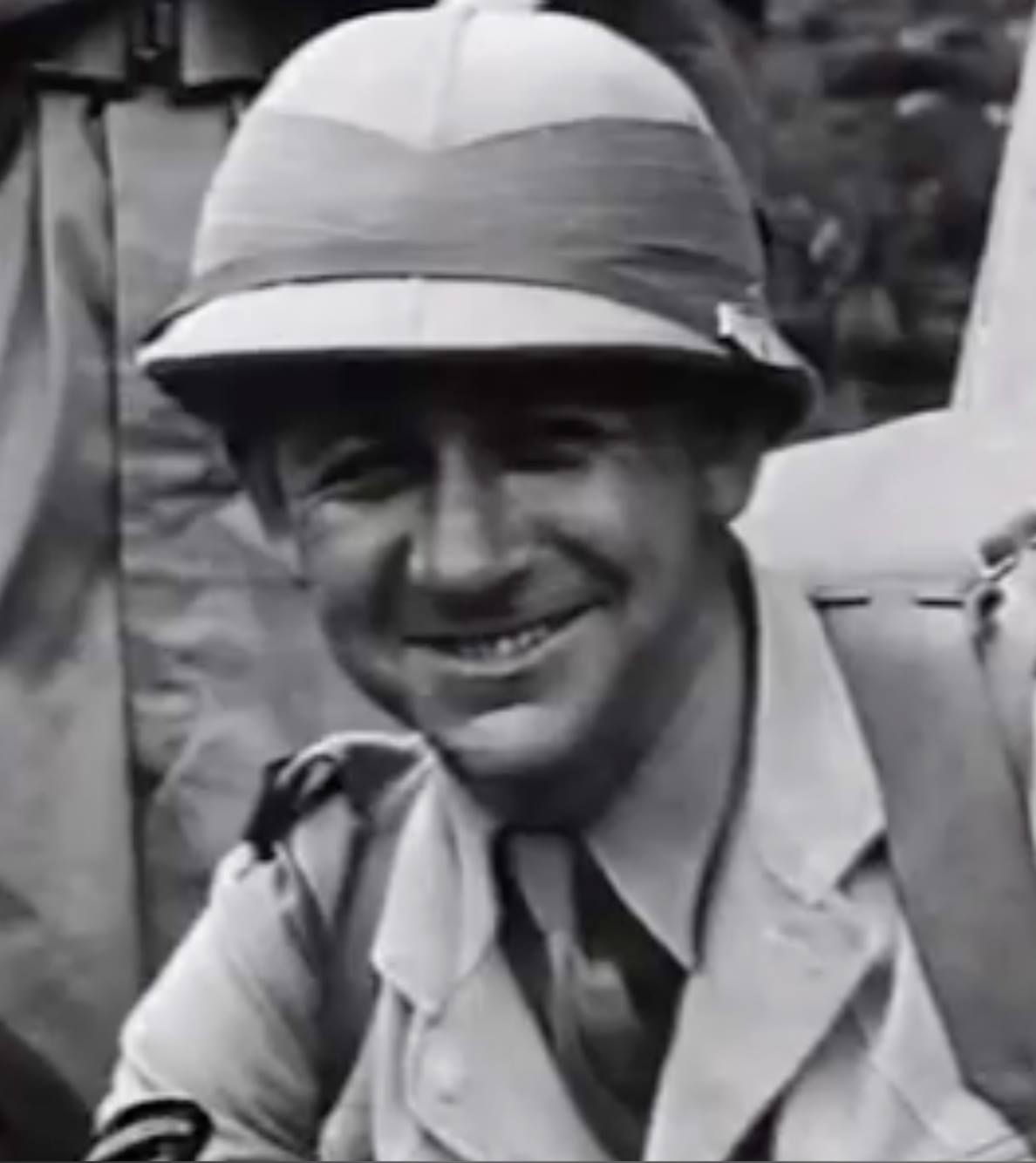
After a stationing with the South African Tank Corps in Abysinnia, Sid felt his talents were better used in troop morale, so he joined the Entertainment Unit of The South African Army, he was initially made a corporal and proceeded to put on shows for his fellow troops.

During this time, he was also caught under heavy fire at the notorious ‘Fall of Tobruk’, South Africa’s largest capitulation of arms, he managed to escape Tobruk ahead of Rommel’s forces and was eventually promoted to the rank of Staff Sergeant. Sid was eventually given a commission as a lieutenant in the entertainment unit, and subsequently took up acting as a career.

Around this time he acquired for himself a second wife, another South African – dancer Meg Sergei, and come the war’s end and his demobilisation, the couple’s showbiz ambitions saw them leave their homeland for the glamour of London.

Sid and Meg arrived in the UK on Christmas Day 1946 and, amazingly enough, within days he’d landed himself not just an agent but a small role, the rest is movie and show-biz history.

Ironically Sid died in complete character with his trademark ‘dirty laugh’ at the Empire Theatre on Monday, April 26, 1976. He was appearing in a suitably smutty comedy called ‘The Mating Game’. Sitting next to Sid on the stage was actress Olga Lowe, an old friend from his early days in his native South Africa, and he died of a heart attack staring at her breasts … a “Jack the Lad” to the end.

30168079_2128206510741669_8372904432765348110_o

Related Work and Links:

Fall of Tobruk: “Defeat is one thing; Disgrace is another!” South Africa’s biggest capitulation of arms – Tobruk

El Alamein; “General Pienaar, tell your South African Division they have done well”; The Battle of El Alamein


Written and Researched by Peter Dickens. Reference Wikipedia and The ghost of comic legend Sid James by Ian Robson.  Video Clip – YouTube, master image of South African troops in North Africa during World War 2, Imperial War Museum copyright.