Drunk Ratel ….

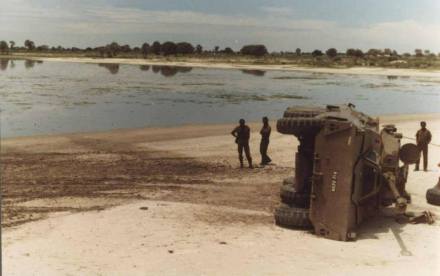
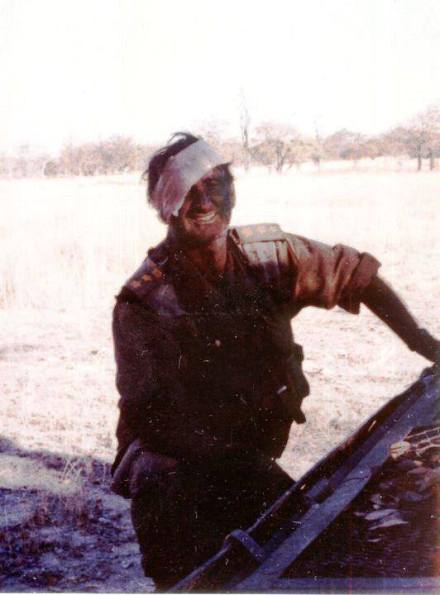
South West Africa/Namibia border 1987, 61 Mechanised Infantry Battalion Group and Charlie Squadron is joyriding in a SADF “Ratel” (honey badger) Infantry Fighting Vehicle  (IFV) .. the picture says a thousand words.

Some say, the driver is still getting an oppie .. all we know is he’s called the Stig!

This example stands testament to many instances of highly valued military equipment wrecked by 19 year old odd National Servicemen taking full advantage of having a little fun.


The Great Escape … was led by a South African!

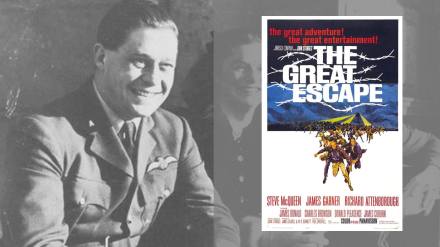
Those watching ‘The Great Escape’ re-run on British television this long Christmas weekend – thinking it was an all American and British affair, here’s some more back of the Chappie gum wrapper trivia – the mastermind behind it was a South African, and the escape had very little to do with Americans.

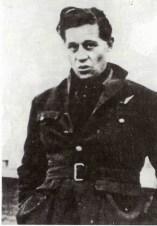
ffdf05478514b3273afec71b503fc0f8Here is another great South African (seen here at Stalag Luft III). Squadron Leader Roger Joyce Bushell RAF – AAF (30 August 1910 – 29 March 1944) was an Auxiliary Air Force pilot who organised and led the famous escape from the German prisoner of war camp, and also victim of the Stalag Luft III murders when participants in the famous escape were executed by the German Gestapo.

The escape was used as the basis for the film The Great Escape. The character played by Richard Attenborough, Roger Bartlett, is modelled on Roger Bushell. The story about the “Great Escape” was one of the most famous escape stories during WW2.  The Great Escape movie is now an institution in The United Kingdom and the United States.  Made famous by the swagger of Steve McQueen and his fictional attempted escape attempts culminating in a cross-country motorbike chase (McQueen’s preferred sport) with Nazi Germans in pursuit.

The backdrop of the movie is however a true story and it involves a South African as its leader and not a plucky Briton.

The Real Story of The Great Escape

In the spring of 1943, Roger Bushell masterminded a plot for a major escape of Prisoners of War from Stalag Luft III. Being held in the north compound where British airmen were housed, Bushell as commander of the escape committee channelled the escape effort into probing for weaknesses and looking for opportunities. Falling back on his legal background to represent his scheme, Bushell called a meeting of the escape committee in the camp and not only shocked those present with its scope, but injected into every man a passionate determination to put every energy into the escape. He declared,

“Everyone here in this room is living on borrowed time. By rights we should all be dead! The only reason that God allowed us this extra ration of life is so we can make life hell for the Hun… In North Compound we are concentrating our efforts on completing and escaping through one master tunnel. No private-enterprise tunnels allowed. Three bloody deep, bloody long tunnels will be dug – Tom, Dick and Harry. One will succeed!”

The simultaneous digging of these tunnels would become an advantage if any one of them were discovered by the Germans, because the guards would scarcely imagine that another two could be well under way. The most radical aspect of the plan was not merely the scale of the construction, but also the sheer number of men that Bushell intended to pass through these tunnels. Previous attempts had involved the escape of anything up to a dozen or twenty men, but Bushell was proposing to get over 200 out, all of whom would be wearing civilian clothes and possessing a complete range of forged papers and escape equipment. It was an unprecedented undertaking and would require unparalleled organisation. As the mastermind of the Great Escape, Bushell inherited the codename of “Big X”. The tunnel “Tom” began in a darkened corner of a hall in one of the buildings. “Harry”‘s entrance was carefully hidden under a Stove. The entrance to “Dick” had a very well concealed entrance in a drainage sump. More than 600 prisoners were involved in their construction.

Bushell also organised another mass break out, which occurred on 12 June 1943. This became known as the Delousing Break, when 26 officers escaped by leaving the camp under escort with two fake guards (POWs disguised as guards) supposedly to go to the showers for delousing in the neighbouring compound. All but two were later recaptured and returned to the camp, with the remaining two officers being sent to Oflag IV-C at Colditz for attempting to steal an aircraft.

After the discovery of Tom, construction on Harry was halted. but it resumed in January 1944. On the evening of 24 March, after months of preparation, 200 officers prepared to escape. But things did not go as planned, with only 76 officers managed to get clear of the camp. Among those left behind was 21-year-old RAF Flight Lieutenant Alan Bryett, who refers to Bushell as “the bravest man I ever knew”.

Roger and his partner Bernard Scheidhauer, among the first few to leave the tunnel, successfully boarded a train at Sagan railway station. They were caught the next day at Saarbrücken railway station, waiting for a train to Alsace, which had been annexed from France by Germany.

Bushell and Scheidhauer were murdered three days later by members of the Gestapo.  This was a breach of the Geneva Convention and so constituted a war crime. The perpetrators were later tried and executed by the Allies. Fifty of the 76 escapees were killed in the Stalag Luft III murders on Hitler’s direct orders.

In an ironic twist Bushell’s executioner was himself executed at the end of the war for his crime (see this story on the Observation Post As they like to say in the military “Karma is a Bitch!”).

It unfortunately was not just Roger Bushell as a South African to suffer this fate, three more South Africans participated and escaped with Roger Bushell in The Great Escape. Lieutenants Gouws, Stevens and McGarr (all South African Air Force) were also recaptured and executed illegally by the Gestapo.

Bushell was posthumously mentioned in Despatches on 8 June 1944 for his services as a POW.  This award was recorded in the London Gazette dated 13 June 1946. His name also appears on the war memorial in Hermanus, South Africa, where his parents spent their last years and where they were buried.

Roger Bushell was born in Springs South Africa on the 30th November 1910.  He was first schooled in Johannesburg at Park Town School but later moved to England, and in 1929 he spent his first year at Cambridge University where he studied law. His talents however extended far beyond a career in law, as an athlete he had the honour of representing the University, both as a skier and rugby player. He excelled at skiing and during the early 1930’s he was declared the fastest Briton in the downhill category.

In South Africa the memory of Roger Bushell lives on in Hermanus. His name is among those on the War Memorial above the Old Harbour, Roger’s parents were living in Hermanus at the time of his death and his parents also made a presentation to the Hermanus High School, in remembrance of their son who (incidentally) could speak nine languages. The two coveted Roger Bushell prizes for character are still awarded annually at the prize-giving of the school. One prize is awarded annually to the student who has shown the most exemplary signs of character during the year and second one is for the school boy chosen by his fellow students as the best leader.

Roger Bushell’s memorial plaque on the War Memorial in Hermanus, South Africa.


Researched by Peter Dickens, with reference and help from Buskruit Burger and Sandy Evan Hanes.

Christmas Pants

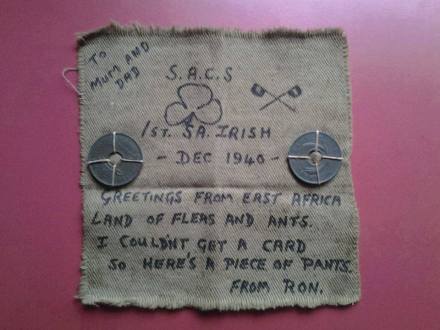
Loving this ‘Christmas card’ – it just oozes South African inventiveness, innovation and that unique brand of dark military humour soldiers the world over share and understand.

The soldier who sent this ‘Christmas Card’ home was Ronald Bidgood, 1st South African Irish, whilst fighting in East Africa during World War 2. Not having much in the way to make a Christmas card in a combat zone, he used a little imagination – his folks must have been quite amused when they received this.

So here is today’s Christmas card historical artefact – enjoy.

Thanks to Stefaans Conradie for the image.

Sailor Malan; in his own words!

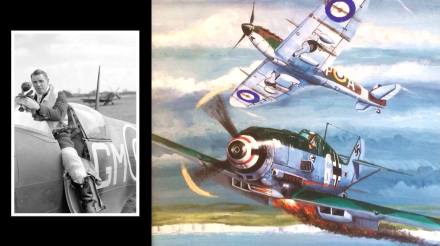
Sailor Malan – a true South African WW2 flying ace and national hero “in his own words” – and here is a very rare recorded interview with him.

This is a fantastic historical record of a personal interview with the great WW2 South African fighter ace Adolph “Sailor” Malan, DSO & Bar, DFC & Bar.

Note in this recording, clearly taken as a public relations exercise to install confidence in the British public in the Royal Air Force and it’s pilots by the public broadcaster (there were a series of these interviews involving other pilots).  Because of this, Sailor Malan comes across as a little over-confident and quite flippant.  Its intentional and designed to make killing Germans sterile and combat adventurous.

He also adopts a very plummy British ‘officers’ accent so common to the tone and manner of speaking of this particular officer class during the war, both in Britain and in the Commonwealth.  His ‘flat vowel’ South African accent sneaks in here and there, but in all Malan was a very well-educated and travelled man and his command of the English language was exemplary (as was his command of Afrikaans).

Also noteworthy is Sailor Malan’s WW2 era cultural expressions, delivery and sayings which were so typical to Allied Air Force officers at the time – terms like:

“Hun” – meaning Germans – a derogatory term insinuating barbarism dating to the First World War.
“Squirt” – meaning a short burst of gun or cannon fire.
“Jerry” – meaning Germans – a derogatory term pertinent to the Second World War.
“Pumping Lead” – meaning a high rate of machine gun or cannon fire ‘pumped’ into the enemy to kill him
“Tally Ho” – a British fox-hunting term meaning to spot a target and call to action.
“Cut yourself a slice of cake” – a favourite term used by Sailor Malan (and other pilots) meaning to get into the fight and have a piece of the action.

Related work on Sailor Malan:

Sailor Malan’s role in the Battle of Britain and the Torch Commando: Sailor Malan; Fighter Ace & Freedom Fighter!

Sailor Malan’s Ten Rules of Air Combat: ‘Ten of my rules for air fighting’ – Sailor Malan

The Torch Commando – footage and history: The Torch Commando led South Africa’s first mass anti-apartheid protests, NOT the ANC!


Researched and written by Peter Dickens

Reference: YouTube.  Painting by Derrick Dickens, copyright Peter Dickens.  Photograph copyright – Imperial War Museum

Epic Navy Style Water Skiing

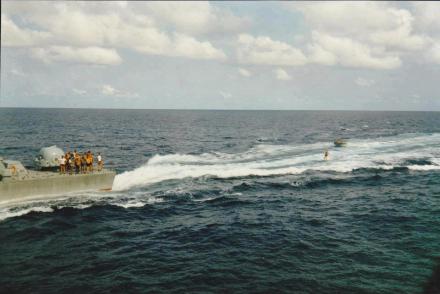
South African Navy task Force returning from a flag showing cruise to Taiwan in mid 1990. This fun photo showing typical South African spirit was taken of a South African Navy Strike Craft – SAS Jan Smuts towing Richard Snook who is seen water skiing behind it.

The photo was taken from the deck of the SAS Drakensberg travelling at about 20 – 25 knots (40-45 km/h). Another strike craft – the SAS Hendrick Mentz was also in attendance when this fun stunt was performed.

According to Richard Snook, the skier, “the water was a bit choppy, but I managed to stay up until we had given Admiral Woodburne the salute”.

Salute to you Richard for demonstrating a typically South African can do attitude and sense of humour.

Photo courtesy Geoff Johnstone.

The SADF’s finest hour

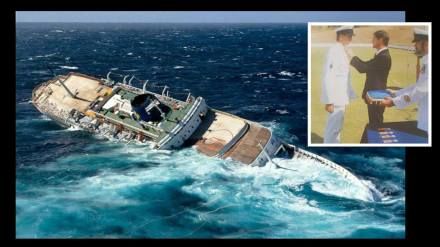
The tragedy of the MS Oceanos can be regarded as the finest hour for the SADF and more specifically one where both the South African Navy and South African Air Force proved their mantra as the best in Africa and more.  It is also regarded as one of the greatest and most successful maritime rescues ever undertaken – anywhere in the world.

ss-100520-oceanos-tease.1024;768;7;70;3

Not only was every soul saved, the SAN and SAAF personnel conducted themselves in great regard with a number of medals awarded for bravery, and even a Honoris Crux Gold awarded to Able Seaman Paul Burger Whiley (one of only six ever awarded).

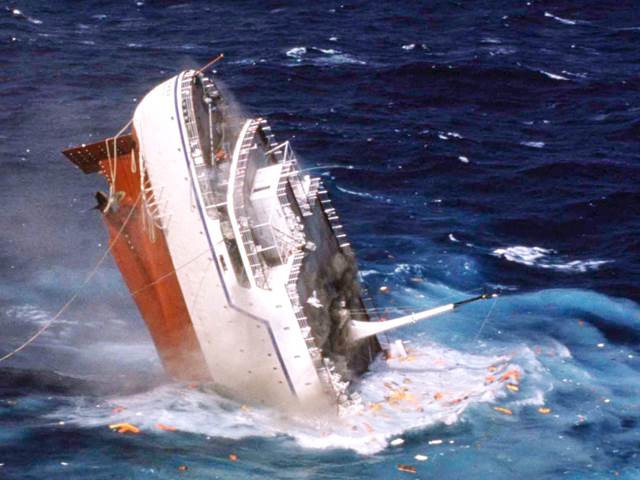
On 3 August 1991, the Oceanos set out from East London heading to Durban. Unwittingly she headed into highly dangerous sea conditions with 40-knot winds and 9 m swells.

At approximately 21:30 while off the Wild Coast, a muffled explosion was heard and the Oceanos lost her power following a leak in the engine room’s sea chest , the ship was left adrift and then started to sink. The crew at this stage did not conduct themselves with great decorum and reports indicated that they were quite prepared to save themselves and abandon the passengers.

Nearby vessels responded to the ship’s SOS and were the first to provide assistance. The South African Navy along with the South African Air Force launched a seven-hour mission in which 16 helicopters were used to airlift the passengers and crew to a site south of Coffee Bay. Of the 16 rescue helicopters, 13 were South African Air Force Pumas, nine of which hoisted 225 passengers off the deck of the sinking ship. All 571 people on board were saved.

To see just how dramatic this sinking was, here’s the original footage – think, if the South African Navy and Air Force hadn’t acted as they did what the cost in lives would have been:

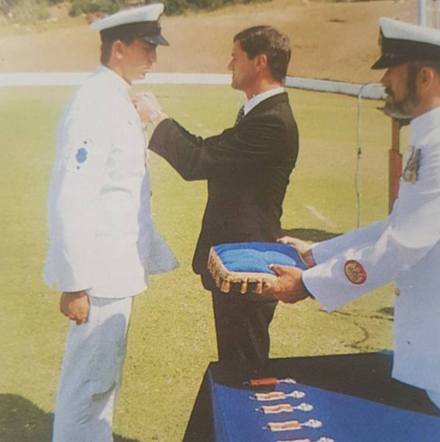
Of the many awards and citations of bravery, one stands out. Able Seaman (AB) Paul Wiley from the SAS Scorpion was presented with the Honoris Crux Gold Decoration by the then Minister of Defence, Mr R.P. Meyer on the 6 March 1992.

He was cited as the first diver to be lowered aboard the MV Oceanos, and although he was severely beaten against the ship’s superstructure, he reached the deck.
Under extremely trying conditions he then succeeded in creating order and stability among the passengers. He then started hoisting passengers, on the first lift he accompanied a survivor up to the helicopter, after which it took a further 10 minutes of nerve-racking hovering to get him back on the deck.

During this maneuver, after being severely battered against the railing of the ship he was flung out of the hoisting strap and fell to a deck lower than intended. Thereupon a male survivor also fell out of a hoisting strap and fell 40 meters into the mountainous swells. AB Whiley, disregarding his own life, dived into the treacherous seas and on reaching the semi-conscious passenger, revived him and assisted him into a rescue craft.

Not quite finished Paul Whiley then swam back to the sinking ship and was confronted with the further difficulty of climbing back on board. Whilst scaling a ladder draped over the ship’s side, he was repeatedly beaten against the ship’s hull. However, his perseverance paid off and he managed to return to the deck to continue his vital task. After six hours aboard the Oceanos Able Seaman Whiley was one of the last persons to be hoisted from the stricken vessel.

27907820_2089229767972677_3950317368211174028_o

Roelf Meyer, the Minister of Defence, presenting the Honours Crux (Gold) to AB Paul Whiley at Silvermine on the 6 March 1992

This rescue proves beyond any shadow of doubt the exemplary level South Africa’s statutory forces had become by the early 1990’s.  This rescue cannot be politicised –  there are no “struggle heroes” in it, it has nothing to do with any political mantra or policy –  it stands as a pure example of the heroism, skill and professionalism of the statute forces of the time.  It truly is the SADF’s finest hour.

Honours

Consider this, the Honoris Crux is the highest SADF award for bravery and three levels of this award were issued, for accounts of bravery in the extreme, just on the MS Oceanos alone on the 4 August 1991, were the following:

Honoris Crux (Gold): AB. Paul Burger Whiley (as per the account above)

Honoris Crux (Silver): AB. Gary Ian Scoular.


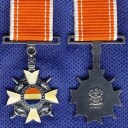
Honoris_Crux_(1975)Honoris Crux: Lt.-Cmdr. André Geldenhuys; PO. Frans Hugo Mostert; LS. Darren Malcolm Brown; LS. Luke James Dicks.  All from the South African Navy, all from the Divers School.

In addition to Honoris Crux, consider the following decorations for bravery and actions above the call of duty which were also won on that day by South African Air Force personnel:

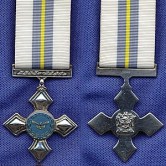
Air_Force_Cross_(CA)The Air Force Cross decoration recipients: Kmdt. Eric Brennan Elphick; Kmdt. Anthony Charles Hunter; Maj. Phillip Fenwick; Maj. Anthony Wright Johnson; Maj. Martin Johannes Hugo Louw; Maj. Hermanus Frederik Steyn; Maj. André Stroebel; Capt Anton Botha, Capt. René Martin Coulon; Capt. Peter Evans Hanes; Capt. Charles Glen Goatly; Capt. Hendrik; Capt Jacques Hugo; Capt. Tarri Jooste; Capt. Johannes Meintjies; Capt.. Slade Christoper Thomas; Capt. Francois Johann Weyers; Lt. Mark Graig Fairley; WO2 William James Riley; F/Sgt  Norman Herbert Askew-Hull; Capt. Len Pienaar; F/Sgt Frans Campher; F/Sgt Daniël Francois Bezuidenhout; F/Sgt. Daniël Roedolf Jacobs; F/Sgt Christoffel Jacobus Pedlar;  F/Sgt. Philip Davey Joseph Scott; F/Sgt. Frans Schutte; F/Sgt. Willem Hendrik Steyn.

Mentioned in Dispatches.

South African Air Force: Brig. T.J.M. de Munnink, SD; Brig. R.S. Lord, SD; Col. G.A. Hallowes; Col. B.J. Kriegler; Col. L.E. Weyer; kmdt. D.B. Janse van Rensburg; Maj. W.H.W. van Wyk.  South African navy: Capt. (Naval). P.C. Potgieter; Capt. (Naval). R.D. Stephen; Cdr. A.G. Absolom; WO1 P. Hutchinson.

In conclusion

Quickly forgotten now as these fine men and woman are now painted as “Apartheid Forces” and great deeds such as this rescue are confined to a history nobody references or even considers anymore.

However this rescue is still regarded as the greatest and most successful sea rescue of its kind – to have ever been undertaken in modern maritime history. Under current cut-backs and capability restraints it is unlikely that the South African National Defence Force can ever replicate such a rescue if presented with it again.

It stands directly in the way of the current ANC’s political narrative and therefore it is another ‘inconvenient truth’ to be ‘passed over’ when referring the Permanent Force and National Service Conscript heroes of South Africa.


Written and researched by Peter Dickens

A Beaufighter, a Bible and a Badge

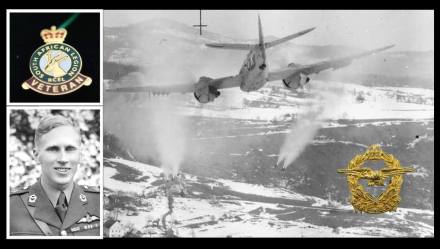
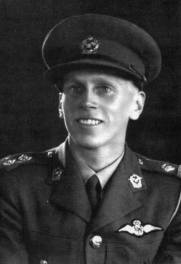
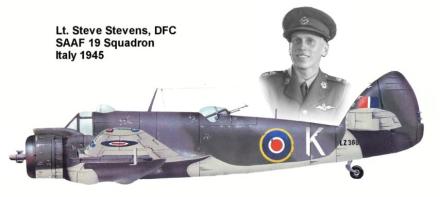
55908_146382762236864_626950629_oHaving known Lt. Steve Stevens DFC, I remain in total awe of his generation.  I met him in Wothing in England and Steve was 96 years young bed-ridden, in pain and weak – but he was no less the man, and this famous featured image of him firing rockets from his South African Air Force (SAAF) Beaufighter during WW2 says everything about him as a fighter pilot, but he was also a devout Christian who pioneered missionary aviation, leading a rich and interesting life.  This is a little of his very remarkable story.

Steve Stevens was born on 27th August 1919 in Amesbury, Dorset. His father George was gassed in Salonica during WW1 and was sent to a special medical facility in Aberdeen for mustard gas victims, and he met and married Dora, one of the VAD’s.

Steve’s father was not expected to live past 40. However, in typical Stevens fashion George Alexander Stevens took no notice of this pronouncement and his health improved enough for him to take up a new assignment in the British Army of Occupation in Germany. The family was billeted in a huge house complete with stables, and young Steve was delighted to be placed in the care of a beautiful young fraulien. Steve adored her, and from her learned to speak German better than he could speak English.

However, George’s health deteriorated and after the family was moved around from Switzerland (where Steve became proficient in skiing, jumping and skating), Italy and Ireland on various Army assignments, on medical advice it was agreed that George Stevens’ lungs would not survive the wet European climate, it was recommended that he was to be invalided out of the army and moved to somewhere nice and warm and dry.

So it was that the family left for a life on a farm in South Africa in November 1929. George’s health improved, but Steve’s mother Dora suddenly fell ill and died of a brain tumour when Steve was only 14.

When World War 2 broke out Steve was at the Bible Institute of South Africa. With the decision to close the college for the duration, some of the students joined the Ministry, and Steve joined the South African Air Force (SAAF). Steve was convinced that the prayers offered three times a day by his father and stepmother would keep him safe during the war. Steve joined the SAAF as a trainee air photographer, but soon re-mustered as aircrew.

Steve Stevens cr.jpg.opt854x383o0,0s854x383

A Beaufighter

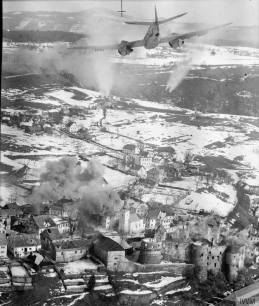
During the War Steve flew air strikes over Yugoslavia with SAAF 19 Squadron, based at Biferno in Italy. These strikes included the daring raid on the occupied walled town of Zuzenberk. The image of Steve firing his rockets is one of the two iconic Beaufighter images of the war. It is astonishing to realise that Steve could accurately hit a target as small as a 44 gallon fuel barrel with his rockets.  In Steve’s words;

“This photograph is widely recognised as one of the most famous Beaufighter air- strike photo of WWII. It shows my plane attacking the Nazi-held medieval walled town of Zuzenberk, Yugoslavia.  The attack by the South African Air Force resulted in the Yugoslav Partisans recapturing their town that very day.”   

10419987_398890630280675_310774668078404600_nAnd this is the photograph, the SAAF Bristol Beaufighter TF Mark X of No. 16 Squadron South African Air Force seen in the image is been flown by Lt Steve Stevens as he releases its rocket projectiles at an enemy target in the town of Zuzemberk.

The photograph was taken by Lt. Schonveld flying just behind Lt. Stevens (SAAF 19 squadron) who’s Beaufighter is in view while attacking a target in Zuzemberk Feb 1945. Schonveld was a keen photographer and positioned his aircraft in a perfect position behind Stevens to capture this epic shot with the nose camera, but he flew a bit too close and ended with dents in his wings from spent 20mm shell cases from Steve’s aircraft.

Take the time to watch this short video interview of Steve Stevens by Tinus Le Roux, as to how this photograph was taken. It is as insightful as it is fascinating.

Copyright Tinus Le Roux

This photograph is historically well-known and has been published in many writings. It shows the aircraft, fired rockets and target simultaneously in a perfect balanced setting, indeed very rare.

Luckily for all of us, we get to preserve unique insight as both SAAF 16 and 19 Squadrons had unofficially mounted F.24 camera’s in the nose of their Beaufighters which took photographs during their attacks so that reconnaissance  aircraft did not have to over fly later to asses the battle damage.

ss7

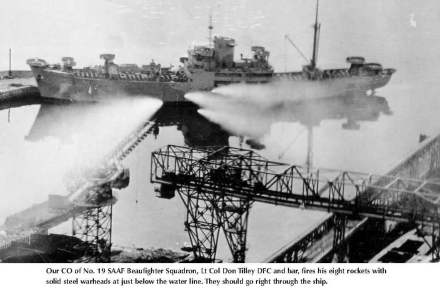
In another raid Steve also photographed Major Tilley attacking the armed German warship SS Kuckuck as Tilley’s number two. It was a desperate sortie which Steve and his fellow pilots fully expected to be a suicide mission. The rockets holed the target under the waterline. The pilots had been briefed by the Partisans that they would face the fire from 140 anti-aircraft guns. Remarkably all four planes returned safely.

Tinus Le Roux interviewed Steve Stevens to capture this attack on the SS Kuckuck, his short video is fascinating, a capture of a man and a time that is truly remarkable, take the time to watch it (many thanks to Tinus for bringing this experience to us)

Copyright: Tinus Le Roux

A Bible

Lt Steve Stevens DFC had a very remarkable life, deeply God-fearing, religion was a very central pillar in all of it.

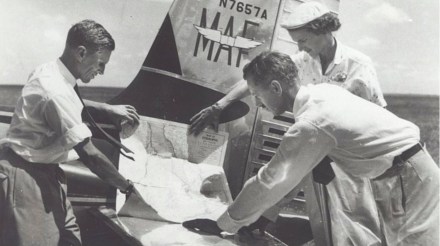
After the war ended, in 1946, as liaison officer between the South African Air Force and the Royal Air Force in Khartoum, Sudan Steve saw how badly the Christian missionaries needed a plane, not only just to spread the word of Christ, but also to get aid (medicines, foodstuffs and equipment) to remote communities.  He joined the MAF, the ‘Mission Aviation Fellowship’ – a group of pilots dedicated to Christian missionary becoming MAF’s first operational pilot to be based in Sudan in 1950.

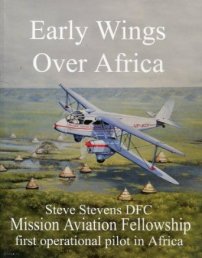
Early-WingsIn Sudan, Steve flew a de Havilland Rapide – an eight-seater twin-engine wood and fabric covered biplane – not best suited for flying in Africa, but the best MAF could find and afford at that juncture. Over time, more and more airstrips were hacked out of jungle, bush, desert and grasslands, and Steve began to fly to other places where no planes had ever been before.

At the end of 1951, Steve experienced some problems with his vision, diagnosed as a detached retina and he lost the sight in one eye.  He was grounded , however Steve still felt that his call was still to aviation missionary work so he and his family moved to the UK. He re-established MAF’s UK HQ and worked tirelessly to raise financial, staff and prayer support for the ministry.

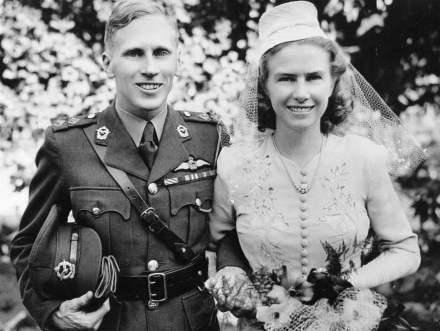
29351857_2114964225399231_7455946665119351885_oIn 1970, after more than twenty years of service to the MAF cause, Steve and his wife Kay moved on to become early members of the National Festival of Light, forerunner of today’s CARE organisation. Steve later became Executive Director of Australian Festival of Light.

A Badge 

Steve Stevens remained a great advocate and supporter of  veterans associations, the MAF and his Christian charities and institutions, throughout his life and was active in his backing all of them until age and frailty forced him to slow down a little, but not entirely, Steve even continued to use the internet and podcasting Christian messaging from his frail care bed.  He also actively ran his own website to sell his work and outreach his messages, he became an avid author of all his adventures,  his book on his time in the war called “Beaufighter over the Balkans” is a welcome addition to anyones library.

12274761_1701525626743095_268284195502034384_nI met Steve Stevens, when the South African Legion of Military Veterans initiated an outreach to him to see if there was anything we could do to help him as a frail care WW2 veteran in his 90’s, I was astounded when he replied that he was at peace with himself and how could he help the Legion instead.  Steve then kindly donated signed copies of his books to the Legion so that we could fundraise for other initiatives.  Cameron Kinnear and I visited him at his home in England and awarded him a lifetime honoury membership of the South African Legion, and we pinned his SA Legion ‘veterans badge’ on his lapel.

Steve passed away in June 2016 and is survived by his children – Merle, Pam, Coleen and Tim – in addition to his grandchildren.  His veterans badge was given back to the SA Legion by his family and, as means of keeping people like Steve in living memory his badge was loaned to me to wear.

ss4

This was an extraordinary man you can easily attribute words and values which would describe him as ‘noble’, ‘selfless’, ‘adventurous’, ‘brave’, ‘humble’ and most importantly a man with a solid backbone, unwavering in his belief and demonstrating that rare value of spiritual self actualisation ‘completely at peace with himself and the world’.

This man was cut from a very different cloth to the rest of us mortals, and it is with the greatest pride that I wear his veterans badge and an even bigger privilege that I am allowed to carry his memory.

Capt. Peter Dickens (Retired)


Written by Peter Dickens. Image Copyright: Imperial War Museum. Information Tinus Le Roux and Sandy Evan Haynes.  Thanks to Cameron Kinnear for the extraction from his visit with Steve Stevens. Video (SA Legion UK stories: South African Legion UK and EU), “SAAF Beaufighters attack a German Ship – WW2 Pilot Steve Stevens DFC” Produced and Directed by Tinus Le Roux, copyright Tinus Le Roux. “How one of WW2’s greatest rocket air strike photographs was taken: Steve Stevens DFC” Produced and Directed by Tinus Le Roux, copyright Tinus Le Roux.

Quiet lads, two heroes are walking by …

Two men who stands head and shoulders above other men. Col Jan Breytenbach seen here after been blown clear from his vehicle when it hit a anti tank land mine whilst on operations in southern Angola on the 29th August 1981. Col Breytenbach immediately returned to rescue Dave Barr, his gunner, who was pinned under the vehicle – a special forces ‘Sabre’ – and pulled him free from exploding ammunition and burning fuel.

Dave Barr, an American serving with the SADF unfortunately lost both legs in the incident, however testament to Dave – as a double amputee, ex Vietnam War and Bush War veteran, he then went on to circumnavigate parts of the planet by motorcycle raising funds for the disabled, setting world records and inspiring people.

When “nuggets” of history make a BIG difference

Sometimes you get a surprise that leaves you speechless. This is when you realise that your dedication to military veterans actually makes a difference.  This is a mail I received and I’ve added the original post below.

Letter from Chris Crossley

Hi Peter,
Just another story for you! This post you put up on the Legions page has some amazing history which you wouldn’t know about but I am happy to share with you to show my gratitude for these “nuggets” of info you share with us.

My wife, Tracy, was an adopted child who after 35 years found her birth parents. Wonderful people they turned out to be and we are building a relationship with them that is priceless. As things go, curiosity led us to find out about family history and Tracy’s birth Dad told us about an uncle of his that was lost during the war. He was in the SAN and went down with “some” ship somewhere. He was married at the time and his wife, on hearing the news that her husband was lost at sea (MIA) never gave up on the hope of his return to Durban because he was never seen and not confirmed deceased. Because of this, she never remarried and passed away many years later, remaining faithful to her husband. Her husband was Roland Redman who served with the SA Navy volunteers on the HMS Dorchester that your story includes. His name is included in the Role of Honour for the Dorchester.

None of the wider family have ever known what happened to him and the facts and details of his service were not known by the surviving family members either. This last Saturday evening, I was talking to my wife’s birth Dad when he recounted the scant details he had of his uncle. I went on line and found your article and shared it with him on fb. Well he was overcome by this information as well as other members of his family and now for the first time in seventy odd years the facts of Uncle Roland, his service and his sacrifice are now known and cherished by his family left behind.

As an historian, I am sure this story will be something that you can cherish as your post has made a huge difference to some wonderful people! Thank you.

Chris Crossley

This is the original post Chris is referring to which I placed on The South African Legion’s Facebook page:

The Article – The sinking of the HMS Cornwall and HMS Dorsetshire.

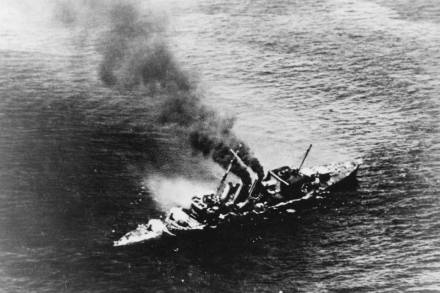
This is a image of the HMS Cornwall under attack just prior to her sinking, it was taken by the Japanese attack aircraft. A number of South African Navy personnel were lost with this ship whilst seconded to the Royal Navy during World War 2, as well as on the HMS Dorsetshire in the same attack.

As Simon’s Town was a Royal Navy base, men volunteering for the “South African Naval Forces” (SANF) to fight in World War 2 where either allocated to Royal Navy ships (titled HMS – His Majesty’s Ship) or on South African Navy ships (tilted HMSAS – His Majesty’s South African Ship), therefore whenever a large Royal Navy ship was lost during the war it is almost guaranteed that a number of South African Naval Personnel (SANF) were lost with it.

On 4 April, the Japanese carrier fleet was spotted and the two cruisers HMS Cornwall and HMS Dorsetshire set out for Addu Atoll in pursuit of the Japanese. On 5 April 1942, the two cruisers were sighted by a spotter plane from the Japanese cruiser Tone about 200 miles (370 km) southwest of Ceylon (now Sri Lanka).

As part of the engagement known as the Easter Sunday Raid, a wave of dive bombers led by Lieutenant Commander Egusa took off from Japanese carriers to attack Cornwall and Dorsetshire, 320 km (170 nmi; 200 mi) southwest of Ceylon, and sank the two ships.

British and Allied losses were 424 men killed; 1,122 survivors spent thirty hours in the water before being rescued by HMS Enterprise and two destroyers.

Total South African (SANF) losses on the HMS Cornwall and HMS Dorsetshire were as follows (MPK means “missing presumed killed”):

HMS Cornwall

BATES, John S, Stoker 2c, 68924 (SANF), MPK
BESWETHERICK, Hedley C, Ordinary Seaman RNVR, 86671 (SANF), MPK
BOTES, John S, Stoker 2c RNVR, 68924 (SANF), MPK
COMMERFORD, Noel P, Able Seaman RNVR, 66493 (SANF), MPK
CRAWFORD, Cecil E, Act/Engine Room Artificer 4c RNVR, 67922 (SANF), MPK
DU PREEZ, Charles P H, Able Seaman, 68175 (SANF), MPK
DUTTON, Charles C, Stoker 2c RNVR, 68949 (SANF), MPK
HANSLO, Raymond F, Able Seaman RNVR, 68295 (SANF), MPK
KEITH, Kenneth I B, Able Seaman RNVR, 66742 (SANF), MPK
KENYON, Graeme A B, Able Seaman RNVR, 68002 (SANF), MPK
KIRSTEN, Monty G W, Able Seaman RNVR, 68917 (SANF), MPK
LAW, Edward, Act/Engine Room Artificer 4c RNVR, 66760 (SANF), MPK
MCDAVID, William K, Stoker 2c RNVR, 69138 (SANF), MPK
MITCHELL, William A, Stoker 1c RNVR, 68796 (SANF), MPK
SPENCE, Noel W, Ordinary Seaman RNVR, 68732 (SANF), MPK
SQUIRES, John E, Ordinary Seaman RNVR, 68728 (SANF), MPK
STEPHEN, Eric B, Ordinary Seaman RNVR, 68861 (SANF), MPK
SWANN, Lawrence T, Stoker 1c RNVR, 68710 (SANF), MPK
THORPE, Maurice, Stoker 2c RNVR, 69140 (SANF), MPK
VERSFELD, Peter H S, Able Seaman RNVR, 68859 (SANF), MPK
VINK, Benjamin F, Ordinary Seaman RNVR, 68860 (SANF), MPK
WILLSON, Gerald F, Stoker 2c RNVR, 69006 (SANF), MPK
WRIGHT, Thomas H, Able Seaman RNVR, 68039 (SANF), MPK

HMS Dorsetshire

BELL, Douglas S, Ty/Act/Leading Stoker, 67243 (SANF), MPK
BRUCE, Alexander M, Stoker 2c, 67907 (SANF), MPK
EVENPOEL, Albert, Stoker 2c, 67909 (SANF), MPK
GEFFEN, Sender, Stoker 1c, 68035 (SANF), MPK
HOWE, Horace G, Ordinary Seaman RNVR, 68680 (SANF), MPK
KENDRICK, George, Stoker 2c, 67910 (SANF), MPK
MCINTYRE, Norman G, Able Seaman, 67446 (SANF), MPK
MCLELLAN, Robert, Ordinary Telegraphist, 67897 (SANF), MPK
MORROW, Douglas E, Able Seaman, 67989 (SANF), MPK
ORTON, Charles P, Able Seaman, 68009 (SANF), MPK
REDMAN, Roland A, Leading Stoker, 67406 (SANF), MPK
SCOTT, William J, Able Seaman, 68007 (SANF), MPK
SEVEL, Harry, Stoker 1c, 68100 (SANF), MPK
WILLETT, Amos A S, Stoker 1c, 67240 (SANF), MPK
WILLIAMSON, Walter N, Able Seaman, 67803 (SANF), MPK

Lest we forget the trememdous sacrifice of our countrymen in this world war for liberation.

Article by Peter Dickens

The man with the MGL

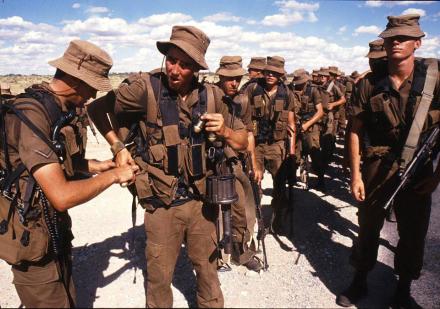
Infantry section seen here during South West Africa and Angola Border War. This is a SADF patrol final inspection (thought to be 5 SAI), this task was usually performed by the section leaders before the platoon moves out. His job was to check that every man’s kit is in full order. Here he checks the ammunition and kit of the man allocated the 40 mm multiple grenade launcher.

Infantry sections like this were made up of 10 men comprising a section leader – usually a corporal, two machine gun groups – LMG (Light machine gun) and one man on the multiple grenade launcher (MGL) in the rifle group.

Three Infantry sections made up a Platoon headed which report to a HQ group of 5 men, including a Platoon Commander (usually a Lt or 2Lt) and a Platoon Sergeant. Total platoon strength 35 men.

The MGL (Multiple Grenade Launcher) is a lightweight 40 mm six-shot revolver-type grenade launcher (variations also fire 37/38mm) developed and manufactured in South Africa by Milkor (Pty) Ltd. This MGL was the world’s first mass-produced multi-shot 40mm hand-held weapon.

The MGL was demonstrated as a concept to the South African Defence Force (SADF) in 1981. The operating principle was immediately accepted and subjected to a stringent qualification program. The MGL was then officially accepted into service with the SADF as the Y2. After its introduction in 1983, the MGL was gradually adopted by the armed forces and law enforcement organizations of over 50 countries. Total production since 1983 has been more than 50,000 units.

The MGL is a multiple-shot weapon, intended to significantly increase a small squad’s firepower when compared to traditional single-shot grenade launchers like the M203. The MGL is designed to be simple, rugged, and reliable. It uses the well-proven revolver principle to achieve a high rate of accurate fire which can be rapidly brought to bear on a target. A variety of rounds such as HE, HEAT, anti-riot baton, irritant, and pyrotechnic can be loaded and fired as fast as the trigger can be pulled; the cylinder can be loaded or unloaded rapidly to maintain a high rate of fire. Although intended primarily for offensive and defensive use with high-explosive rounds, with appropriate ammunition the launcher is suitable for anti-riot and other security operations. A newly patented modification allows the MGL to fire less lethal (very low pressure) rounds.

Photo copyright John Liebenberg, sources Wikipedia and Defence Network.