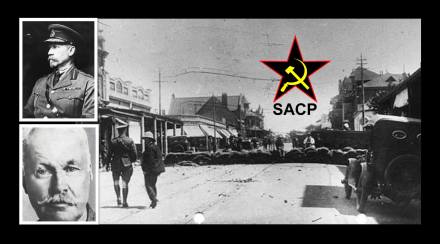
South Africa’s very own Communist Revolution – The Rand Revolt of 1922

The narrative that many South Africans understand of The Rand Revolt today is one linked to Jan Smuts, sending tanks and aeroplanes to brutally repress a miners strike murdering his own kind – white South Africans, and it is a narrative his opposition, the National Party, used repeatedly to criticise Smuts for political expediency for decades.

The Nationalists went further, as during the Apartheid period Smuts was painted as traitor to his own ‘Volk’ (people) partly because of the actions he took to quell this ‘miners strike’ and adding to this was the example of Jopie Fourie and the ‘1914 Afrikaner Revolt,’ both of which proved beyond doubt Smuts’ betrayal and brutality to his own kind, certainly according to the Nationalists.

However, like any history derived for political expediency, much of this above narrative is very incorrect.  The truth is the Rand Revolt was much more than a simple miners strike and a deep irony sits behind the old Nationalists claims of Smuts’ betrayal – as the nationalists had found sympathy using their traditional enemies – the Communists – in order to gain political points. It is the strangest of bedfellows on which to press a criticism.  The truth is The Rand Revolt was South Africa’s first ‘Communist Revolution’ and the rebels (not just strikers) were not Afrikaner Boere ‘Volk’, they were, for the most part, led by a bunch of very militant English Communists with origins in Great Britain.
cf3a58deee1c56e29aca7e29793bef26

These Communist miners were joined by the ‘Syndicalists’ in their upcoming fight to overthrow the South African Union government, the Syndicalists were a similar organisation to the Communists as they held the same view – that an economic system should exist where the worker ‘syndicate’ owns the mine, not the capitalist.

These miners were in fact the same miners who provided the British with the trigger to start the Boer War, the same ‘British’ miners who repeatedly protested for their workers rights to the old Transvaal Government, and even then Paul Kruger sent in his infamous ‘ZAR’ Policemen to baton and break up these miners’ strikes and protests on the Rand.

They were also the rational behind the Jameson Raid. Leander Starr Jameson and his colleagues on the mines in Johannesburg planned the raid ostensibly to liberate these miners from Transvaal government oppression (coupled of course with Rhodes’ ideals of imperial expansionism). This time the Jameson ‘revolt’ and miners uprising was universally crushed by the Transvaal government (The old South African Republic) who sent in their military Commandos to put an end to it.

The white miners on the Rand and their issues, which almost universally revolved  around citizen and worker rights, were a constant thorn in both Boer Republics, they were the reason behind the destruction of the Boer nation by Britain in the 2nd Anglo Boer war, friends of the Afrikaner ‘Boer’ population they were not.

So now that we have dispelled the first miss-truth, let’s have a look at what this revolt was really all about and ask ourselves if Smuts had any alternative to the course he took. Also lets hypothetically challenge whether the Rand Revolt of 1922 would have been handled any differently by the old Transvaal government (should the Boer War not have happened) and the Nationalist government (should they have been in power at the time of the revolt instead of Smuts).

Origins of a Communist Rebellion in South Africa
Emblem_of_the_South_African_Communist_PartyThe Rand Rebellion (also known as the Rand Revolt or Second Rand Revolt – the Jameson Raid was the first) was an armed uprising of white miners on the Witwatersrand mining belt in March 1922.

The trigger was a drop in the world price of gold from 130 shillings (£6 10s) a fine troy ounce in 1919 to 95s/oz (£4 15s) in December 1921, the companies tried to cut their operating costs by decreasing wages, and by weakening the colour bar to enable the promotion of cheaper black miners to skilled and supervisory positions.

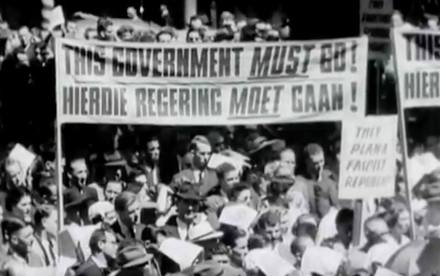
This in turn triggered a strike action led by the South African Communist Party which very quickly turned into an open armed rebellion against the state.  The Communist Party in South Africa in fact took a very proactive role in transcending a simple strike to an open armed revolt, they based their argument on the ‘class struggle’ premise and sought to follow the lead of the Russian Communist workers revolution in 1917 which saw the overthrow of the Tzar by the Bolsheviks and the establishment of Soviet Russia.

Consider that by 1922 this revolution in Russia had only occurred 5 years perviously.  Buoyed by the success of the Russian communists, the South African Communists hoped that their action in Africa would force regime change in the Transvaal and furthermore inspire more Communist overthrows of state by other worker colonies in far-flung countries like Australia and India.

Consider the summary of the Revolt given by David Ivon Jones – a mine-union communist and you’ll see the point:

The Rand Revolt was ‘the deed of indictment against capitalism [which was] filling up from every land and every clime; and the roll of honour of proletarian heroism [was] growing from Africa, Australia and India . . . ‘

The South African Communist Party’s racist beginnings

However, contrary to current views of The South African Communist Party (SACP), the SACP has as its origin an ‘Apartheid’ beginning, it was initially not the party for Black Africans, in fact by the time of the Rand Revolt it had a pretty strong ‘whites only’ philosophy underpinning it.
Bill_Andrews_1930_c

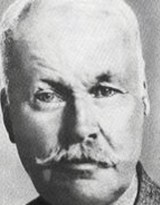
‘Comrade Bill’ Andrews

It was founded by William (Bill) Henry Andrews who became the first Chairman of the SACP.  Bill Andrews was born in England and by 1890 he had travelled to South Africa to work on the mines, here he became a predominant trade union organiser.

A fighter for the rights of ″white″ labour, Bill Andrews was always quick to complain when he perceived that an African (whom he openly called ″Kaffirs″) might take away a job from a white man.

By 1922 Bill Andrews was the first General Secretary of the South African Communist Party, and as a result the SACP approached the Rand Rebellion as a fight for white worker rights and white worker job reservation.  In fact they used the slogan”Workers of the world, unite and fight for a white South Africa!” as a rally call to their Communist brethren all over the world to join them.

To anyone who is wondering at this stage why the modern African National Congress (ANC) politicians when in conflict with the modern South African Communist Party (SACP) politicians feely call them ‘racists’, now you know the reason why.

The Rand Revolt background

In the early days of mining no Africans possessed the skills necessary for deep level mining, therefore the division of the work force had been between white miners and white management. The custom that skilled work was done by white men had been reinforced by legislation when Chinese labourers were introduced.  During World War I the overall ratio of white to black workers had been maintained. As time passed, however, black miners began to acquire these skills, although their wages remained at very low rates. In September 1918, white mine workers had succeeded in persuading the Chamber of Mines to agree that no position filled by a white worker should be given to an African or Coloured worker.

When the Chamber of Mines gave notice that it would be abandoning the agreement and would be replacing 2,000 semi-skilled white men with cheap black labour, the white miners reacted strongly. Their jobs and pay packets were threatened by the removal of the colour bar, and they feared the social encroachment on their lives that differences in colour, standards of living, and the cultural background of the coloured races might make. Sporadic strikes were launched in 1921, but these did not become widespread until the end of the year.

The trade unions

Because of the large number of mines and workingmen living in and around Fordsburg, Johannesburg, trade unions had become active in this area. This set the scene for the revolt in Fordsburg. At this time some trade union members were attracted to the spirit of socialism and others became communists, who referred to themselves as ‘Reds’. The leader of the Communist Party, Bill Andrews, known to his chums as ‘Comrade Bill’, urged a general strike. In the meanwhile, a group of revolutionaries organized commandos under the leadership of people who called themselves the ‘Federation of Labour.’

Strikes

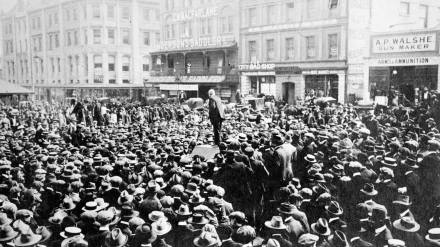
The New Year marked a strike on the collieries of the Transvaal. Strikes soon spread to the gold mines of the Reef, especially those in the East Rand, when electrical power workers and those in engineering and foundry occupations followed suit. By January 10, stoppage of work in mining and allied trades was complete. Bob Waterston, Labour Party MP, sponsored a resolution urging that a provisional government declare a South Africa republic. Tielman Roos, leader of the National Party in the Transvaal, submitted this proposal to a conference of MPs convened in Pretoria, but they rejected it outright. Roos himself was emphatic that the National Party would have nothing to do with a revolt.
15235526_10154121323392444_8688316480568324123_o

The revolt itself

In February 1922, the protracted negotiations with the South African Industrial Federation broke down when the Action Group seized control, armed some white miners, and set up barricades. Mob violence spread alarmingly with bands of white men shooting and bludgeoning unoffending Africans and coloured men ‘as though they were on a rat hunt’. A general strike was proclaimed on Monday, 6 March and on Wednesday, the strike turned into open revolution in a bid to capture the city.

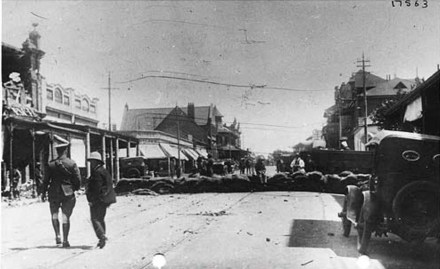
On 8 March, white workers attempted to take over the Johannesburg post office and the power station, but they met with stout resistance from the police, and the day ended in fights between white strikers and black miners. The Red commandos made the most of this chaos by encouraging their rebel followers to obtain firearms and other weapons from white miners and their sympathizers under the pretext of trying to protect women and children from attacking blacks. By spreading the alarm, they discovered who had firearms and immediately confiscated them. The following day six units of the Active Citizen Force were called out to prevent further disorder.
22539033_2034488626780125_2758876348532888164_o

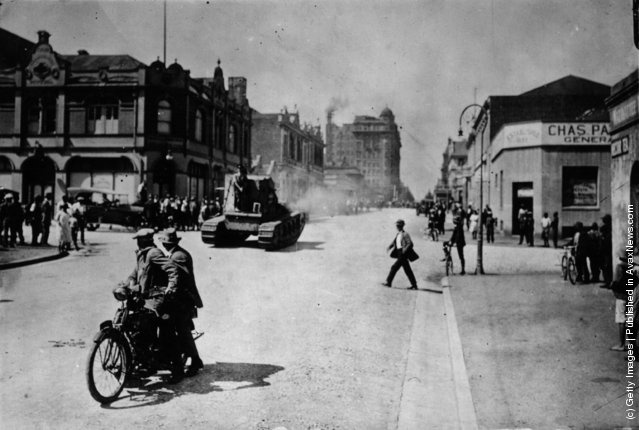
On Friday, 10 March, a series of explosions signalled the advance of the Red commandos and an orgy of violence began. To quell this the Union Defence Force was called out, as well as the aircraft of the fledgling SAAF and the artillery. By this time, Brakpan was already in the hands of the rebels, and pitched battles were raging between the strikers and the police for control of Benoni and Springs. Aeroplanes strafed rebels and bombed the Workers’ Hall at Benoni. Rebels besieged the Brakpan and Benoni police garrisons. At Brixton 1,500 rebels surrounded 183 policemen and besieged them for 48 hours. From the air, pilots observed the plight of the beleaguered Brixton policemen. Swooping over them, they dropped supplies, and then returned to bomb the rebels. During one of these sorties Colonel Sir Pierre van Ryneveld’s observer, Captain Carey Thomas, was shot through the heart.

Martial law was proclaimed and burgher commandos were called up from the surrounding districts. On Saturday, 11 March, the Reds attacked a small detachment of the Imperial Light Horse at Ellis Park in Doornfontein, which sustained serious losses, and, on their way to the East Rand, the Transvaal Scottish marched into an ambush at Dunswart, sustaining heavy losses. The rebels searched citizens passing through Jeppestown and Fordsburg and sniped at those they thought were supporters of the mine management, as well as many policemen on duty in the streets. Prime Minister General Jan Smuts was widely blamed for letting the situation get out of hand. He arrived on the Rand at midnight to take charge of the situation.

The rebellion is crushed

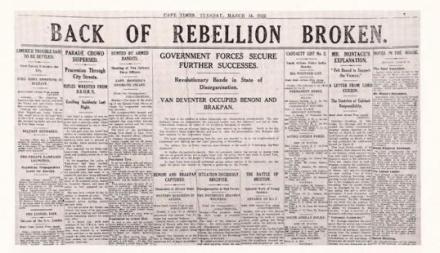
On Sunday, 12 March, military forces and citizens attacked the rebels holding out on the Brixton ridge and took 2,200 prisoners. The next day government troops led by General van Deventer relieved the besieged police garrisons in Brakpan and Benoni. On 15 March, the artillery bombarded the strikers’ stronghold at Fordsburg Square and in the afternoon, it fell to the government. Before committing suicide in this building, the two communist leaders, Fisher and Spendiff, left a joint note: ‘We died for what we believed in – the Cause’. Samuel Alfred (Taffy) Long, heralded by subsequent labour histories as one of South Africa’s greatest working-class martyrs, was arrested after the defeat of Fordsburg. He was charged with murder and later also with high treason and the possession of loot.
540x293_20131103_59701098b54a83a1476f50413e6068fa_jpg
From 15 to 19 March 1922, government troops cleared areas of snipers and did house-to-house searches of premises belonging to the Reds, making many arrests. On March 16, the Union Defence Headquarters issued a press statement that the revolt had been a social revolution organized by Bolshevists, international socialists and communists. The revolt was declared over from midnight on 18 March.

Aftermath and resultant changes in goverment and law

In all the Rand Revolt was a calamity. It cost many lives and millions of pounds. About 200 people were killed – including many policemen, and more than 1,000 people were injured. Fifteen thousand men were put out of work and gold production slumped. In the aftermath, some of the rebels were deported and a few were executed for deeds that amounted to murder. John Garsworthy, leader of the Brakpan commando, was sentenced to death, but he was later reprieved. Four of the leaders were condemned to death and went to the gallows singing their anthem, ‘The Red Flag’.

The Red Flag anthem was the rally anthem for British Communists – and as an aside it is still the official song for the British Labour Party and sung at their annual party rally.

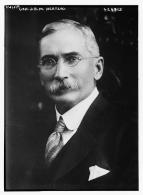
Smuts was widely criticised for his severe handling of the revolt. He lost support and was defeated in the 1924 general election. This gave Hertzog’s Nationalist Party and the Labour Party, supported by white urban workers, the opportunity to form a pact (the old adage ‘enemy of my enemy is my friend’ applied – a strange and uneasy pact indeed).
JBM_Hertzog_-_SA

JBM Hertzog

Whilst Smuts stood in opposition, three important Acts were passed by Hertzog’s Nationalists whilst in pact with Labour.  They gave increasing employment opportunities to whites and introduced programme of African segregation. The first was the Industrial Conciliation Act of 1924, which set up machinery for consultation between employers’ organisations and trade unions. The second was the Wage Act, which set up a board to recommend minimum wages and conditions of employment. The third was the Mines and Works Amendment Act of 1926, which firmly established the principle of the colour bar in certain mining jobs.

 South African Communists U-turn

Two things happened after the 1922 Revolt that would have long reacting ramifications. Firstly Jan Smuts lost the next election and had to sit in the opposition bench and endure coalition Nationalist law making in the Union along race barrier lines for 15 years until 1939, when he finally became Prime Minister of South Africa for a second time.

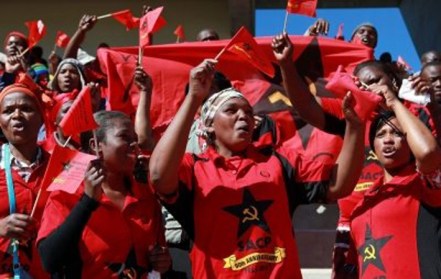
Secondly the South African Communist Party evolved into the political juggernaut it is now, and in a strange twist, the Rand Revolt in 1922 forced the hard-line Communists to re-appraise their views on ‘white’ worker rights.  The Rand Revolt showed this to be a weakness and broader population support was needed if there was to be any significant Communist revolt in South Africa to create an independent Republic under communist rule.

So, even though their jobs were now protected by ‘colour bar’ laws, they turned against these hard fought for rights.  ‘Comrade Bill’ Andrews was expelled from the South African Communist Party in a series of purges over the their new “black Republic” policy (he was only permitted to rejoin the SACP many years later in 1938 aged 68).

Just six years after the Rand Revolt, by 1928 the SACP agreed with their controlling body ‘Communist International’ to adopt the “Native Republic” thesis which stipulated that South Africa was a country belonging to the Natives i.e. the Blacks. The resolution was influenced by a delegation from South Africa. James la Guma, the new Communist Party Chairperson from Cape Town, he had already met with the leadership of ‘Communist International’ to agree the new way forward.

By 1928, 1,600 of the SACP’s 1,750 members were Black. During this period, the party was accused of dismissing attempts by other multiracial revolutionary organisations (the ANC and  Syndicalists) and using revisionist history to claim that the Communist party and its Native Republic policy was the only viable route to African liberation.

By 1929: the party adopted a “strategic line” which held that, “The most direct line of advance to socialism runs through the mass struggle for majority rule”.
7659953606_7f0d9f9f50_b

The SACP today

Did Smuts have a choice?

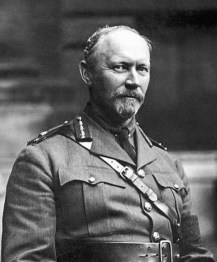
Smuts sent in 20 000 troops to crush the Revolt.  The fact is, it was a Communist Revolt to establish the Transvaal as a Communist Republic, and not just a simple strike.  The Communists wanted the fight, tooled up for the fight and even annexed cities to forward their goal.  So the answer in truth is that Smuts did not really have a choice.

Would anyone else have reacted any differently to Smuts?
22498946_2034494743446180_9027430172028438091_o

Jan Smuts

Upfront we established that the old Boere Transvaal Republic had no appetite for these militant miners and their strikes and revolts.  Their reaction in quelling them was brutal and swift.

Politically expedient packs between the Communists and the Nationalists after the 1922 Revolt aside, the Nationalists had real no appetite for the Communists – and by 1928 the Communists certainly had no appetite for the Nationalists.

The Nationalists, who by 1948 were in full control of South Africa, had a deep-seated hatred for Communism, they regarded them as the ‘Rooi gevaar’ (Red Danger) and used this as a call to action when embarking South Africa on a war against Communism.  This manifested itself in not only the implementation of ‘anti-communist’ legislation and the ‘banning’ of the organisation in 1950, but also in a proxy Cold War against ‘Communism’ fought in Angola and Namibia from 1966 to 1989.  Over the two decades of The Border War, the Nationalists killed thousands more ‘communists’ using the country’s defence force.  It was certainly a far stronger reaction against Communism than Smuts’ use of the defence force against the Communists in the Rand Revolt.

So to answer the hypothetical question whether the Nationalists would have reacted differently to the Rand Revolt had they been in power instead of Smuts, the answer would in all likelihood be ‘no’, in fact it would be very probable that their reaction would have been even more brutal.

In Conclusion

The irony does not end there as to strange bedfellows and the war against Communism for the Nationalists, in waging their war against Communism the Nationalists found themselves in bed with Jonus Savimbi and his ‘anti-colonial’ movement UNITA fighting the proxy Cold War in Angola.  By 1988, the Battle of Cuito Cuanavale found the National Party in a deep political hole and they had to use the South African Defence Force to very bravely (and successfully) fight their way out of it.  To negotiate a peace, PW Botha and the National Party hung UNITA out to dry, agreed with Cuba and the MPLA’s Soviet alliance as to the withdrawal of their Communist forces from Angola so the Nationalists could go home and declare a ‘victory’ over Communism (the Cubans in turn could go home and declare they liberated Namibia see ‘The enemy of my enemy is my friend’).
dbKkeMN

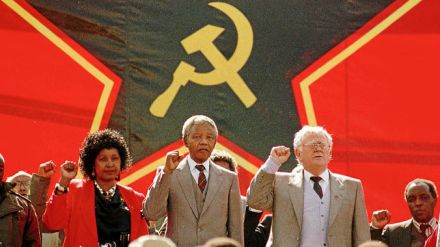
Thereafter, just five very short years later, by 1994, the Nationalists of FW de Klerk had handed South Africa to the ANC/COSATU/Communist Party Tripartite Alliance with the Nationalists in coalition government again.  The twists and turns of history now really show up the ‘full circle’ nature of history and why it repeats itself – because by April 2005 the ‘sunset clause’ was over and the National Party folded shop completely – and for political expediency again – their MP’s walked the floor to amalgamate with the ANC and their Communist labour alliance in a full merger.  You could cut the irony with a knife at this stage.

How predictable is history in that it ‘repeats’ itself, and in light of all this ‘political expediency’, ‘irony’, ‘strange bedfellows’ and twisting by the party of Afrikaner nationalism, we have to genuinely ask ourselves how much of their constant criticism of Smuts over the 1922 Revolt was genuine and how much was just a case of political sandbagging?


Researched by Peter Dickens.  Chief extract of the time-line of the Revolt taken from South African History Online (SAHO) 1922 Rand Rebellion.  Other references include Wikipedia.
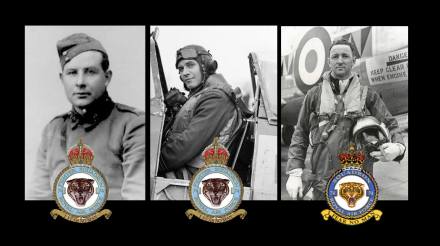
Forget Tigers, The Royal Air Force’s 74 Squadron has a legacy of South African Lions!

One of the most prestigious fighter Squadrons in the history of the Royal Air Force was 74 Squadron, known as the ‘Tigers’.  However, three South Africans played a key role in forging the great fighting legacy of the Tigers, two of them commanded the squadron, one during World War 2 and one took the squadron into the jet age.

So let’s look at these three remarkable South Africans and how they have come to influence not only 74 Squadron, but The Royal Air Force itself.

World War 1

19424342_1982409011988087_4980834163001230819_n74 Squadron was formed during World War 1,Its first operational fighters were S.E. 5as in March 1918, and served in France until February 1919, during this time it gained a fearsome reputation and was credited with 140 enemy planes destroyed and 85 driven down out of control, for 225 victories. No fewer than Seventeen aces had served in the squadron, including one Victoria Cross Winner Major Edward Mannock.  In this line up of aces was one notable South African, and this man came from Kimberley, Capt. Andrew Cameron Kiddie DFC, and he came from unassuming beginnings – he was one of Kimberley’s local bakers.
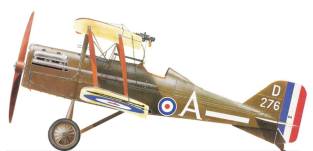
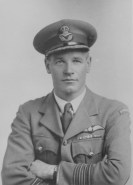
Captain Kiddie became a flight commander of 74 Squadron in the summer of 1918 and scored fifteen aircraft shot down victories by the end of the war. For this he was awarded the Distinguished Flying Cross and  the Belgian Croix de Guerre.

19442146_1982409701988018_1273489368050288074_o
To read more in-depth about his remarkable South African follow this link to a previous Observation Post story Kimberley baker was a South African WW1 Flying Ace.

World War 2

malan1World War 2 would shape 74 Squadron as one of the best in The Royal Air Force.  It became the front-line squadron which took the brunt of the attacks during The Battle of Britain, and this time the squadron was commanded by a formidable South African, Group Captain A G ‘Sailor’ Malan DSO & Bar DFC & Bar.
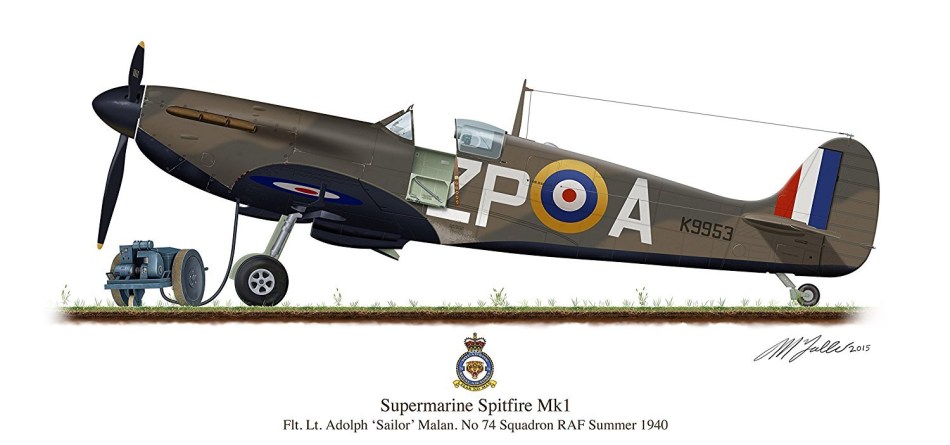
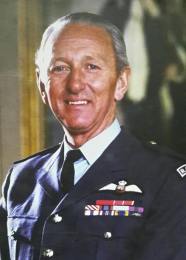
Arguably one of the best South African pilots of the Second World War and certainly one of the best Royal Air Force pilots during the Battle of Britain – now one of the much idolised ‘few’ who, along with his command of 74 Squadron, turned the tide of the war, and he did it based on a set of rules he drew up, now famously known as “Ten of my rules for air fighting”.

Sailor Malan’s rules of air combat were readily adopted by pilots in the Royal Air Force during the Battle of Britain, these rules saved many a pilot and brought down many enemy aircraft, they are directly attributed to the success of the Battle of Britain and in so keeping Britain in the war.

Sailor Malan was given command of 74 Squadron, which by this stage was flying the iconic Spitfire, Sailor, now with the rank of Acting Squadron Leader took command at the height of the Battle of Britain on 8th August 1940. Three days later on August the 11th, the Squadron was in battle, and it was a battle that help turn the tide of the Battle of Britain.  When Sailor finished the day’s combat The Royal Air Force had downed an astounding 38 enemy aircraft.  This day is forever marked now in the history of the Battle of Britain and the squadron history as “Sailor’s August the Eleventh”.

In all, by the end of the war Sailor Malan scored 27 enemy aircraft kills, seven shared destroyed, three probably destroyed and 16 damaged. He was to receive the Distinguished Service Order decoration – not once, but twice and well as the Distinguished Flying Cross decoration, again not once – but twice.

81dm3lsq8il-_sl1500_.jpg

Much has been written on Sailor Malan on this website, so for an in-depth profile on this most exceptional South African please follow this link: Sailor Malan; Fighter Ace & Freedom Fighter!

The Cold War

But that is not the end of 74 Squadrons remarkable commanding officers, one South African was to take the squadron into the jet age and himself achieve the dizzy heights of Air Vice-Marshal in the Royal Air Force.

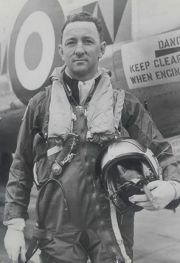
21414618_10214639016195019_6362419216829534532_oAir Vice-Marshal John Howe was one of the RAF’s most experienced and capable Cold War fighter pilots, whose flying career spanned Korean war piston-engined aircraft to the supersonic Lightning and Phantom.
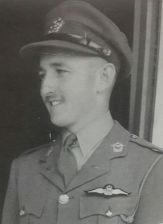
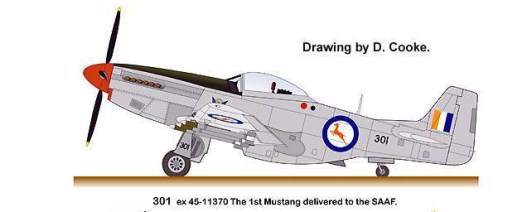
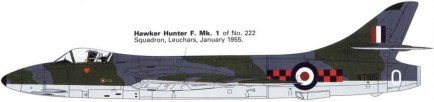
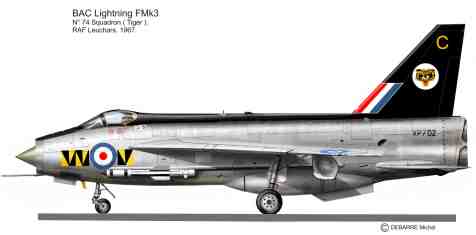
Howe was appointed to command the RAF’s No 74 Tiger Squadron in early 1960, the squadron had just been issued one of the fastest fighter aircraft ever built, the EE Lightning and Howe was going to put it through its paces. Once again, we find a South African Lion leading a squadron of Tigers. So how did a South African land up in such a position of Command in the Cold War?

22008399_10214639197439550_2877245947152207306_n

John Howe in the SAAF

John Frederick George Howe was born in East London, South Africa, on March 26 1930 and educated at St Andrew’s College, Grahamstown. As soon as he left school, he joined the South African Air Force (SAAF) and trained as a pilot. In early 1951 he joined SAAF No 2 Squadron, known as the Flying Cheetahs. John along with 2 Squadron became part of the South African commitment to United Nations to take part in the Korean War.  Here his prowess as fighter pilot took root.

During his first tour of duty in Korea for the South African Air Force he flew the American made  Mustang F-51D fighter-bombers in front-line action.  One notable action took place on June 24, when Howe took off with three others. They responded to an emergency call for air support by a surrounded ground force. In the face of intense anti-aircraft fire, the four Mustangs attacked gun emplacements a number of times. Howe did not expect to survive, but the four aircraft returned to base. All four South African pilots received US gallantry awards. A month later, Howe was forced to crash-land and was rescued by a helicopter.

16864859_1347058448698226_4569233145128520065_n
In September, as a 21-year-old second lieutenant, he was the leader of four aircraft instructed to attack enemy troops that were threatening friendly forces. Fierce enemy fire damaged Howe’s aircraft but he continued to lead his formation against the target. The US authorities awarded him an immediate DFC, the citation recording:

“He displayed a standard of leadership above and beyond that normally expected.”

After completing his flying tour, Howe remained in Korea on a second tour as a ground based Forward Air Controller for the SAAF, serving with US Infantry and operating in the thick of the fighting. He was awarded the Distinguished Flying Cross and the Air Medal from the United States for his service during these actions.

Returning to South Africa after the war, Howe found himself in a changed political landscape.  The National Party had come to power in 1948 with its policies of Apartheid and entrenched hatred of anything British (a legacy given them from the Boer War), by 1954 the political situation in South Africa became more difficult and extreme, especially for senior officers of English origin in the South African defence forces, who were by-passed for Afrikaans officers instead. As was also the case with Dick Lord, John Howe would now find his future in The Royal Air Force (RAF) instead, so in 1954 he decided to resign from the SAAF and moved to England where he transferred to the RAF with the rank of Flying Officer (Service No. 503984) to fly early types of jet fighters.

In April 1956 he joined Royal Air Force No 222 (Natal) Squadron flying the Hunter. When a volunteer was required for forward air controller duties with No 3 Commando Brigade in late 1956, Howe’s experience in Korea helped to land him the job. He sailed with the Brigade for the ill-fated Suez campaign and, at dawn on November 6, landed on the beaches at Port Said with No 40 Commando, to direct aircraft on to targets in the area. In the event, the campaign was short-lived.

9_76
Howe returned to his squadron before joining No 43 Squadron as a flight commander, still flying the Hunter. He was awarded a Queen’s Commendation for Valuable Service in the Air, receiving a second two years later. In June 1959 he started training to take command of his Lightning squadron – No. 74.

Based in Norfolk. The aircraft represented a great advance in technology and performance, with a remarkable rate of climb to heights in excess of 60,000 ft and capable of flying at twice the speed of sound.

With no simulator or two-seat training version of the aircraft, Howe made his, and the squadron’s, first flight on June 14 1960. A few weeks later he was instructed to provide a four-aircraft formation for the annual Farnborough Air Show.

lightning-f3-74
Despite the inevitable early teething troubles with the complex aircraft, Howe and his pilots flew on all but one day of the show. The squadron was made the RAF’s official aerobatics team for 1961 and was in demand for appearances at British and European shows. For the Farnborough event that year, Howe trained and led a “diamond nine” formation.

Howe realised that air shows were good for publicity and potential international sales of aircraft, but the time devoted to them hindered the development of full operational capability. He drove himself, and others, hard, but he was a highly respected leader. The squadron’s high morale helped it to reach operational status within the first 10 months despite the many problems that had to be overcome. At the end of his tour, Howe was awarded the AFC.

He said of the Lightning: “It was one of the most exhilarating aeroplanes, even by today’s standards.”

22104347_2028319454063709_4665878180584906328_o

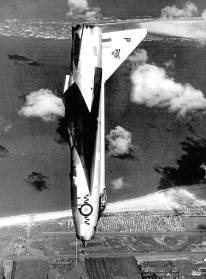
John Howe in a vertical dive flying a RAF EE Lightning

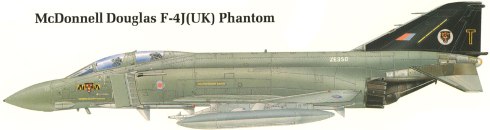
Howe remained in the fighter business, including a tour of duty with the USAF which gave him an opportunity to fly the latest American fighters, including the Phantom. In 1968 he was appointed to command the RAF’s operational conversion unit that saw the introduction of the Phantom into RAF service, his unit being responsible for the conversion of the first squadron crews.

After a staff tour he became the station commander of RAF Gutersloh, the home of two Lightning squadrons and a support helicopter squadron. His fighter squadrons, based a few minutes’ flying time from the border with Warsaw Pact forces, mounted a continuous quick-reaction capability. He rarely missed an opportunity to maintain his fighter pilot proficiency.

After attending the Royal College of Defence Studies he served at HQ 11 (Fighter) Group, and on promotion to air commodore was appointed the commandant of the Royal Observer Corps (ROC). The organisation had a fine record, but Howe justifiably believed that it was in need of modernisation and a more robust attitude. He set about applying the same exacting standards to the ROC that he did to his flying. By the time he left in 1980, the efficiency of the Corps had risen sharply.

9_72
In May 1980 he was appointed the air officer commanding the Southern Maritime Region, a departure from his previous fighter experience and where his usual forceful approach was much in evidence.

His final appointment in the RAF was the dual role of Commandant General RAF Regiment and Provost Marshal of the RAF. He retired in November 1985. He was appointed CB (1985) and CBE (1978).

In his younger days, Howe was a high-spirited officer who knew how to enjoy life – his South African roots never left him and his “Zulu war dance” at social functions was a speciality. But on duty he was utterly professional and he set himself and those around him difficult goals.

22046893_10214639202959688_8200957218336099859_nIn retirement he was a sheep farmer in Norfolk, where he was known as the “supersonic shepherd”; he retired in 2004. He was a capable skier and a devoted chairman of the Combined Services Skiing Association. A biography of him, Upward and Onward, by Bob Cossey, was published in 2008. John Howe married Annabelle Gowing in March 1961; she and their three daughters survive him.
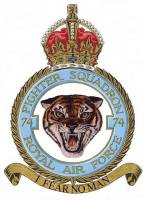

Air Vice-Marshal John Howe, was born March 26th 1930, he died 27th January 2016 aged 85. He remains another one of South Africa’s finest military exports, another South African who truly carries the 74 Squadron motto:

I fear no man

19437652_1982409038654751_1420497074088337846_n

For some video footage of Air Vice-Marshal John Howe in action and the equipping of 74 Squadron with Lightnings, have a look at this rare footage:


Researched by Peter Dickens.  Primary reference and extract on Air Vice-Marshal John Rowe taken from his Obituary in The Telegraph and Wikipedia.  Images of Air Vice Marshal Howe thanks to Alan Mark Taylor

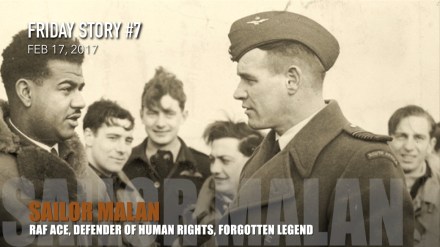
FRIDAY STORY #7: Sailor Malan: Fighter Pilot. Defender of human rights. Legend.

We’re glad to see this highly unsung South African hero finally profiled by other historians. Sailor Malan’s legacy is coming to life through video and other mediums like this and in so back into the general consciousness, and it can only be a good thing. Once watching this you’ll want to hit that share button, and please feel free to do so.

14322420_1091043234297657_3731584281145428934_nThis time Sailor’s legacy has been carried forward by “Inherit South Africa” in this excellent short biography narrated and produced by Michael Charton as one of his Friday Stories – this one titled FRIDAY STORY #7: Sailor Malan: Fighter Pilot. Defender of human rights. Legend.
Many people may know of the South African “Battle of Britain” Ace – Adolph “Sailor” Malan DSO & Bar, DFC & Bar – he is one of the most highly regarded fighter pilots of the Second World War, one of the best fighter pilots South Africa has ever produced and he stands as one of the “few” which turned back Nazi Germany from complete European dominance in the Battle of Britain – his rules of air combat helped keep Britain in the war, and as a result he, and a handful of others, changed the course of history. But not many people are aware of Sailor Malan as a political fighter, anti-apartheid campaigner and champion for racial equality.

Sailor Malan remains an inconvenient truth to the current political narrative of the “struggle” in South Africa, as the first mass anti-Apartheid and pro-Democracy protests were led by this highly decorated Afrikaner war hero and the mass protesters were not the ANC and its supporters, this very first mass mobilisation was made up of returning war veterans from the 2nd World War, in their hundreds of thousands – and this video footage and story captures some more fascinating “hidden” South African history.

The purposeful “scrubbing” by the National Party of South Africa’s “Torch Commando” and its President – Sailor Malan is in itself a travesty, and its made more tragic by the current government conveniently glancing over this glaring mass anti-apartheid and pro democracy movement starting in 1951 involving over 250 000 mainly “white” South Africans. Years before the ANC Defiance Campaign started in earnest and the mass “black” mobilisation against Apartheid stemming from the Sharpeville massacre in 1960. Inconvenient as it does not fit the current political narrative of South African history and thus still remains relatively unknown to the majority of South Africans.

Inherit South Africa is the brainchild of Michael Charton and his short videos are platformed on youtube, packaged as great South African Stories, usually released on a Friday.  Feel free to visit his websites and social media platforms via the following links:

Inherit South Africa website

Inherit South Africa YouTube

Inherit South Africa Facebook

For more information on Sailor Malan, feel free to follow this link to The Observation Post’s story on him:

Sailor Malan; Fighter Ace & Freedom Fighter!


Written by Peter Dickens. Many thanks to Micheal for permission to post this video of his, Inherit South Africa copyright.

200 Jewish orphans saved, the story of Jan Smuts and Issac Ochberg

You might remember heroic figures like Oskar Schindler (the famous “Schindler’s List”) who rescued groups of Jews from certain annihilation during World War 2. But did you know Jan Smuts also played a significant role in rescuing 200 Jewish orphans from the “Pogroms” in the Ukraine in 1921? Here’s a little bit of little known history involving an unlikely South African hero, Isaac Ochberg, and it’s one we can all stand proud of.

21753347_2024418131120508_3529886432406051483_o

In the early 1920s, reports trickled through to South Africa of tragic forces occurring in the Ukraine. Following the collapse of the old Czarist Empire in 1917, rival Red and White armies were fighting for control. Although the battles did not start out as particularly anti-Semitic, the Jews’ condition deteriorated.

Famine was followed by typhoid epidemics for the entire population, but it was made worse for the Jews by pogroms. Ukrainian and Polish peasants joined forces with reactionary military forces to massacre Jews wherever they found them inside the Pale of Settlement.

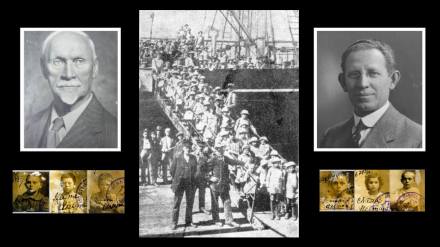
In despairing letters smuggled through enemy lines, Jews begged their cousins in South Africa for help. These pleas immediately stirred South Africa’s Jewish communities. People asked at meetings across the country if at least the children could be rescued from the Ukraine. Before any organisation could step in, generous offers of financial and other assistance were made by Russian-born Cape Town businessman Isaac Ochberg.

Two questions became critical to Issac Ochberg: How could the orphans be rescued from a war-torn region, and would the South African government create any difficulties in admitting them?

smuts ww1

Jan Smuts

Ochberg immediately contacted the Prime Minister, General Jan Smuts, and Mr. Patrick Duncan, the Minister of the Interior.  Smuts granted permission to land, without restriction, as many youngsters as could be saved.

A South African Relief Fund for Jewish War Victims had already come into operation, when, at a special meeting called in his office on August 19, 1920, Ochberg proposed that the Cape Jewish Orphanage “take all the responsibilities of bringing the children out, and taking care of them.” In addition it should act as a clearing-house, whence they could be distributed among charitable people for adoption.

By January 1921, the South African Relief Fund for Jewish War Victims had persuaded Smuts and his government to give on a pound for pound principle to the Pogrom Orphan Fund, and it was felt that not 200 but 250 children could be brought to South Africa.

As reports of the Jews’ plight continued to arrive in South Africa, the size of the tragedy became clearer. 100,000-150,000 Jewish men, women and children were slaughtered by Ukrainian nationalists and another 400,000 Jewish orphans were starving.

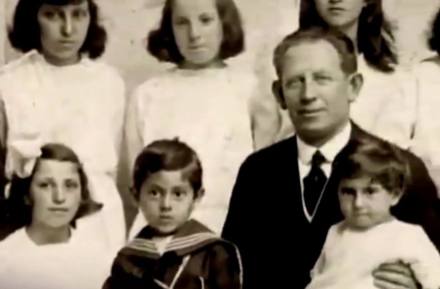
The next step was for someone to travel to Eastern Europe and make arrangements on the spot. Ochberg agreed to go. For two months Ochberg travelled by train, wagon and on horseback around the Pale, looking for orphaned children. The Ukrainian children knew only that “The Man From Africa” was coming and he was going to take some of them away to a new home, on the other side of the world.

Ochberg’s worst problem was how to select which children to take and which he had to leave in Eastern Europe. So he decided to choose eight children from each institution, until he reached a total of exactly 200. Since the South African government required that the children had to be in good physical and mental health, careful selection was essential. In addition, only those who had lost BOTH parents were accepted.

map_orig

In Pinsk alone, so many children had been orphaned that 3 new orphanages had to be opened. At first, Pinsk was so isolated by the fighting that the children were dependent solely on their own resources. There were no blankets, beds or clothes. Typhus broke out in one of the orphanages and the pogroms raged for a week at a time. As order was restored, food supplies began to trickle in, first from Berlin and then from the Joint Distribution Committee.

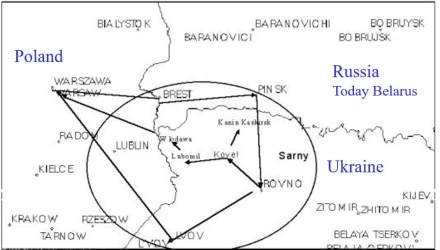
Ochberg moved from town to town, visiting Minsk, Pinsk, Stanislav, Lodz, Lemberg and Wlodowa, collecting orphans. How did he get the children out – on wagons.

Three months later, with the 200 children in London, he wrote to Jan Smuts’ government in South Africa

“I have been through almost every village in the Polish Ukraine and Galicia and am now well acquainted with the places where there is at present extreme suffering. I have succeeded in collecting the necessary number of children, and I can safely say that the generosity displayed by South African Jewry in making this mission possible means nothing less than saving their lives. They would surely have died of starvation, disease, or been lost to our nation for other reasons. I am now in London with the object of arranging transport and I hope to be able to advise soon of my departure for South Africa with the children.”.

The story of getting to South Africa and horror is remembered by one of the orphans in an interview years later, Fanny Shie (Lockitch).  She became orphaned after her father, who was in the Russian Army, had died in a gas attack and her mother passed away during the 1918 Influenza.

In a Orphanage in Brest-Litovsk, she recalled “Although the war was over, we were suffering from lack of coal, from lack of clothes, from lack of food and from lack of care. To give an idea of conditions, I can remember how we had the Russians in the city at one moment, and a few days later the Poles. Looking out of the Orphanage windows, one could see some of the hand-to-hand battles with bayonets, and the corpses lying in the street that led up to the fortress.”

“One day we heard that a ‘Man from Africa’ was coming. He was going to take some of us away with him and give us a new home on the other side of the world. Nearly all the orphans had lost both parents, many of them in pogroms, on the Ukrainian border, at Minsk, Pinsk and other places. One poor little boy, who afterwards came to South Africa and is now a successful man in Johannesburg, had his hand hacked off by some ruffian.”

“Among us children the news aroused mixed feelings. We all liked the idea of going to a beautiful new country, but we also heard stories of robbers and wild animals, and that we might be eaten by lions. However, when Mr. Ochberg appeared, with his reddish hair and cheery smile, we all took a great liking to him and soon called him ‘Daddy’.”

passports-1a

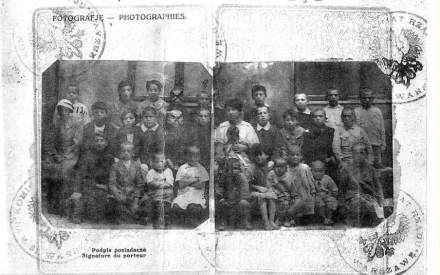
The Children were issued very unique passports, they were “In quantity”, a multiple named passport with a group photograph with as many as 30 children sitting in rows.

“We set off for Africa,” recalled Mrs. Fanny Lockitch, “each with a tiny package of the clothing that had already been sent to us from overseas, and a few pitiful trifles like photographs or dolls”

Travelling from Warsaw to London, the Orphans and carers then boarded the Edinburgh Castle to Cape Town.

“Never until my dying day,” said Mrs. Fanny Lockitch, “shall I forget our first sight of the lights of Cape Town”.

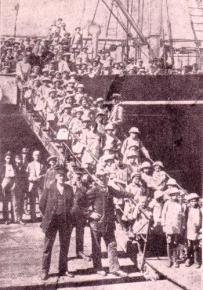
OchbergOrphansArriveCapetownA tremendous reception awaited the orphans when they came ashore in Cape Town. So large was the group of children that the Cape Jewish Orphanage was unable to house them all, so 78 went on to Johannesburg.
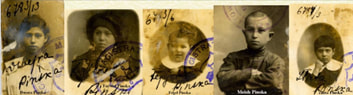
Special English speaking classes were organised for the children, and the warmth, friendship and the hospitality of South Africa showed itself when number­less orphans found new homes.

Ochberg died in 1937 while on an ocean voyage, 59 years old. He was buried in Cape Town at one of the largest funerals ever seen there. Ochberg left what was then the largest single bequest to the Jewish National Fund. The JNF used it to redeem a piece of land in Israel called Nahalat Yitzhak Ochberg – which included the kibbutzim of Dalia and Ein Hashofet.

An Ochberg dedication ceremony took place at Kibbutz Dalia on 19th of July 2011. For the thousands of descendants of his orphans, he is the reason they are alive.

Over the years various projects and films have been compiled, many of the original orphans’ children and grandchildren have been traced and have honoured Ochberg’s memory, South Africa’s very own “Oskar Schindler”.

2017-08-08-12-16-45


Content and article sourced from The Jerusalem Post from an article by Lionel Slier 07/18/201 and The Issac Ochberg Story on-line website. Researched by Peter Dickens.

“The force of his intellect has enriched the wisdom of the whole human race”- the death of Jan Smuts.

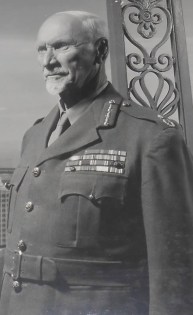
smutsThere are still a handful of conservative ‘Afrikaner nationalist’ white people in South Africa who would still toe the old Nationalist line on Smuts, that he was a ‘verraaier’ – a traitor to his people, his death welcomed.  However, little do they know that many of the old Nationalist architects of Apartheid held Smuts in very high regard.
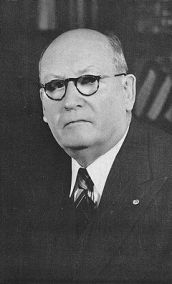
DF Malan, on the day of Smuts’ death, 11th September 1950, was the Prime Minister of South Africa, his Nationalist party had defeated Smuts’ United party two years earlier in 1948 whilst pushing the Nationalist proposals to further entrench racial segregation with a concept they called Apartheid.  Smuts on the other hand, foresaw the need to extend the ideas of ‘Union’ which had brought Afrikaner and Briton together to include Black South Africans. On voting rights, he had made his views clear to Hertzog as early as 1920 when in a private meeting he proposed a Qualification Franchise (not a Universal one though) for black South Africans (Hertzog was an ardent Nationalist and rejected the idea outright).

Smuts was born into a system of ‘Empire’ and that was the socio-political sphere everyone understood, including Smuts.  Over time Smuts’ views on racial segregation gradually evolved from the generally understood divided evolution edicts of his day (based on where nations stood on the ‘civilisation’ continuum).  On the international stage by the mid 1940’s, when Smuts was outside of the pressures of South Africa’s race politics (even from inside of his own political party) and not toeing his party’s line, here his views started to really shape up.

By the middle of World War 2 he had taken on a deep sense of individual liberty for all mankind, emancipation and freedom from any sort of oppression (including State).  These views, based on what he termed man’s universal “spirit” for freedom forged by two world wars, they were consolidated in his work on the United Nations and exposed on an international stage in a number of speeches.

Back in South Africa after the war, as a precursor to these views on universal liberty, Smuts had already changed from his old positions on segregation and proposed ‘integration’ instead of ‘separation’ and he had also already promised black community leaders greater political representation if they supported his war effort, voting rights under Smuts were already secure for South Africans of Indian origin and the Cape Coloured community.  On the Nationalists proposals of Apartheid he once said:

“The idea that the Natives must all be removed and confined in their own Kraals is in my opinion the greatest nonsense I have ever heard”.

The nationalists touted a fear of ‘black danger’ under this more democratically minded Smuts if he won, and it struck a cautionary chord with many white voters and the Nationalists won the day, surprisingly and against the odds, and not by a majority mind – but on a constitutional seat basis.

On losing the election Smuts made one of his greatest speeches in 1949 at the inauguration of the Voortrekker Monument to a largely Afrikaner crowd, it says everything of where he stood on integration and the future of South Africa, he said:

“Only on the basis of taking from the past what was beautiful could ‘fruitful co-operation and brotherhood’ between the two white communities be built. And only on this basis could a solution be found for the greatest problem which we have inherited from our ancestors, the problem of our native relations”. He went on to say, that this was “the most difficult and the final test of our civilization.’

Simply put, the country’s white community at Smuts’ death was very split down the middle on the issue of ‘Apartheid’ and what it would bring, the majority of South Africans did not favour it and they had heeded Smuts’ warnings of what entrenched race politics would bring to South Africa’s future.

The death of Jan Smuts

240px-DFMalanPortret

DF Malan

DF Malan was attending a National Party political rally to the party faithful and whipping up support for the edicts of Apartheid when Smuts’ died.   An aide walked up to him and handed him a note with the news of Smuts’ death, what he does next would surprise even the hardest right-wing Afrikaner Nationalist.

Instead of gleeful celebration of the demise of this most hated enemy of the Apartheid cause, the man repeatedly called a ‘traitor’ by the Nationalists, a man who had the ‘blood’ of Jopie Fourie on his hands, the ‘hansopper’ and ‘joiner’ turncoat who favoured the union of the Afrikaner with the hated British to heal South Africa over and above separationist Afrikaner rule, the King’s ‘hanskakie’ puppet, old ‘slim Jannie’ who put global interests and governance ahead of his ‘volk’ (white Afrikaner peoples) – no Dr. Malan’s reaction to the news was somewhat different to what most people now would even think.

DF Malan immediately turned pale, he slowly sat down, slumped over and cupped his hands to his face. He had lost a lifelong and very close friend.  Their political positions aside, Malan had a deep sense of admiration for his old friend.

He had to be helped up to stand at the microphone, where he announced that “a great figure of our time” has just died, he called the Nationalists to silence and then cancelled the rally.  His colleagues reporting that they had never seen Malan so distressed.

DF Malan’s reaction says a lot about Smuts, the importance he had in the formation of South Africa, he was the original ‘reconciler’ of the warring nations in South Africa, his idea of union based his philosophy of holism – all parts of the sphere make the whole, made the state of South Africa as we know it, he was quite literally the ‘father’ of the South African nation, and now he was lost.


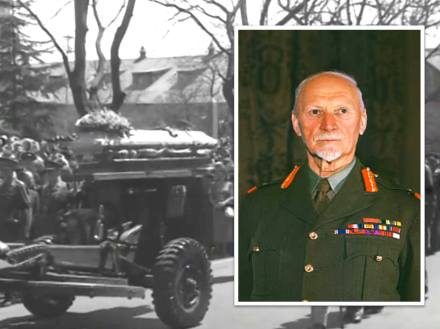
The universal appreciation of Smuts at the time, both by his supporters and his detractors, would see a nationwide and even worldwide outpouring of grief, Smuts’ funeral was something else, a funeral not seen since in South Africa and only seen again when Nelson Mandela died.

To even begin to contemplate Smuts’ importance to not only South Africa, but to the free world consider what Winston Churchill wrote to Isie (Ouma Smuts), his wife, expressing his condolences, and what he wrote sums up the loss perfectly.

“There must be comfort in the proofs of admiration and gratitude that have been evoked all over the world for a warrior-statesman and philosopher who was probably more fitted to guide struggling and blundering humanity through its suffering and perils than anyone who ever lived in any country during his epoch.”

In his lifetime, Smuts had advanced to a level of greatness that is more substantive and more far-reaching to the modern human race than any South African before and even after him (with all respect to Nelson Mandela and his legacy).

Add to this what King George VI wrote Ouma Smuts and you start to see a pattern.  He wrote:

“the force of his intellect has enriched the wisdom of the whole human race”.

To understand his impact to humankind by way of an obituary to his milestone accolades, consider the following:

The birth of South Africa

The establishment of the state of South Africa in 1910. His proposal of ‘Union’ with the British colonies of the Cape and Natal brought South Africa out of the devastation of the Boer War and the resultant decimation of the Boer nation. Despite winning the war, in just four years of Colonising everything, Britain had handed all control of her colonies in South Africa to an independent parliament to Westminster, able to make its own laws to forge its own destiny, headed up by two Boer Generals of which Smuts was one.

The Boers had lost their two small Republics to war and now, thanks to Smuts’ skill and British confidence in his vision and him, the Boer commanders were very quickly back in governance of both their ‘old’ Republics and in addition, both the British Colonies as well – without a shot been fired.  To quote Smuts ‘they gave our country back’.  He reflected that at no time in Britain’s long history had such a ‘miracle of trust and magnanimity’ ever happened.

British ‘meddling’ and ‘warmongering’ in South Africa would never happen on the same scale again, and in fact they were making reparations for the damage they had caused by way of economic support.

The League of Nations and United Nations

He played a key role in the establishment of the League of Nations, the exact design and implementation of which relied upon Smuts, he even drafted the outlines for the The Treaty of Versailles. His outline was not fully followed and he warned the League of a future calamity with Germany – how prophetic he was.

With the demise of the League of Nations (the USA left it), Smuts still held the view that a more robust world peace body was required involving all nations holding each other to account.  He later urged the formation of a new international organisation for peace: The United Nations (UN).

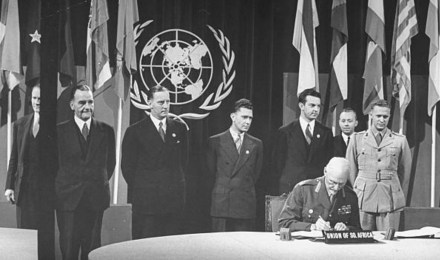
Smuts wrote the first draft of the preamble to the United Nations Charter, and was the only person in history to sign the charters of both the League of Nations and the United Nations (see earlier Observation Post link Jan Smuts drafted the Preamble to the United Nations Charter).

21731730_2020994458129542_6028296406653483655_o

Smuts signing the United Nations Charter

The British Commonwealth of Nations

He sought to redefine the relationship between the United Kingdom and her colonies, he helped establish the concept of a ‘British Commonwealth of Nations’ based on devolved British authority instead of a ‘British Empire’ and by doing so he served to end Britain’s ‘Empire. He in fact came up with the term ‘Commonwealth’ and it was to his recommendations that the King listened.

The birth of Israel

In 1932, the kibbutz Ramat Yohanan in Israel was named after him. Smuts was a vocal proponent of the creation of a Jewish state, and spoke out against the rising anti-Semitism of the 1930s.  His relationship with the Jews and Israel did not stop there, he was one of the driving forces behind the Balfour Declaration which established the state of Israel (see earlier Observation Post A Kibbutz called Jan Smuts.)

World Wars and Military Milestones

He became South Africa’s only Field Marshal, having taken South Africa to both World Wars on the side of democracy and freedom.  The Second World War alone launched the manufacturing might of South Africa largely due to the support of the war effort.  By the end of WW2, South Africa, a muddle of small colonies and republics just 40 years earlier, now stood as a key contributing world player.

He was the only person with in-depth military experience to join The British War Cabinet, at the insistence of the King, during World War 1 (the rest were Politicians) and in so played a key role in guiding the outcome of World War 1.

He gave birth to the idea of an independent Air Force free from Navy or Army control in 1917, that saw the formation of the Royal Air Force (RAF), the oldest independent air arm in the world and in addition carried this over to form The South African Air Force, the second oldest. Modern military construct now still follows The Smuts Report on the use of air power (see earlier Observation Post links Centenary of the ‘Smuts Report’, the instrument which gave birth to the Royal Air Force,).

Smuts had a long string of successful military command, notwithstanding his Command of a Boer Commando during the Anglo-Boer war, evading defeat for the entire duration of the war.  He founded the South African Defence Force after Union, commanded UDF forces alongside Botha in taking German South West Africa during WW1, the first ‘Allied’ victory of the war.  He went on to command all the British and Commonwealth Forces in the East African campaign during WW1, chasing General Paul Von Lettow-Vorbeck’s forces all over East Africa, and in so doing he captured Dar-es-Salaam, the German East Africa capital. However, to really put Smuts in perspective, when he heard that his old enemy, General Paul von Lettow-Vorbeck had fallen into destitution after WW2, it was Smuts who personally extended aid and food to him (to Smuts war was not a personal thing amongst soldiers).

During the Second World War he was appointed to the British King’s Privy Council.   The King was even warm to an idea proposed by Jock Colville (Churchill’s Private Secretary) that should Prime Minister Winston Churchill die during the war, Smuts would replace him, however this idea was never tested as Smuts would have need to have been made a peer and constitutional issues would have prevented it.  Whether possible or not it does give an idea of just how close Smuts was to Churchill and how indispensable he had become (see related Observation Post: Churchill’s idols; Napoleon, Nelson &…Smuts!).

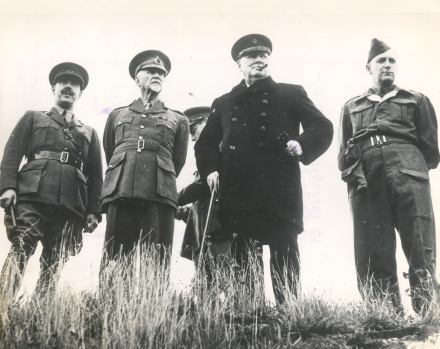
Again, as a member of the British War Council, he played a key role in the outcome of World War 2 and the Allied Victory.  He even accompanied Winston Churchill shoulder to shoulder to oversee Operation Overlord (D Day) and the liberation of France and subsequently Western Europe.

smuts2

Smuts and Churchill in France overseeing Operation Overlord (D Day)


Many historians would now even point to the notion that Churchill regarded Smuts’ advice above anyone else’s advice on his war effort and strategy (see related Observation Posts Jan Smuts, Winston Churchill and D-Day and Smuts’ keen sense of smell detects Germans hiding nearby).

Domestic acclaim

hobhouse

Emily Hobhouse

The deep-seated pain of the Boer War concentration camps and how it affected Afrikaner identity was also something that Smuts actively addressed (Ouma Smuts was herself interned in a concentration camp, and Smuts had also tragically lost family to the system).  He became a friend and confidant of Emily Hobhouse in addressing the issue with the British over many years. The Magnolia seeds she gave him in friendship now stand as a full botanical statement to this outside his house in Irene.

He brought the government to take measures to bring the treatment of Indians in South Africa into line with the provisions of the United Nations, putting them to the same equality and status of the ‘Cape Colourds’ who already enjoyed an equal universal franchise in South Africa at the time.  In doing so he became a life-long admirer of Mahatma Ghandi, who in turn also regarded Smuts as one of the greatest statesmen of his time.

To illustrate this admiration, Before Gandhi returned to India in 1914, he presented General Smuts with a pair of sandals made by Gandhi himself. In 1939, on Gandhi’s 70th birthday, Smuts returned the sandals with the following message:

“I have worn these sandals for many a summer, even though I may feel that I am not worthy to stand in the shoes of so great a man.”

(see earlier Observation Post story “… I am not worthy to stand in the shoes of so great a man”).

In domestic policy, Smuts instituted a number of social security reforms. Old-age pensions and disability grants were extended to ‘Indians’ and ‘Africans’ respectively (although there were still differences in the level of grants paid out). He also instituted the Workmen’s Compensation Act of 1941 and the Unemployment Insurance Act of 1946.

International acclaim

55bfc5b0ef884389cd7a9bddf3645bd8Smuts was honoured by many countries and on many occasions, as a standout Smuts was the first Prime Minister of a Commonwealth country (any country for that matter) to address both sitting Houses of the British Parliament – the Commons and the Lords during World War 2.  To which he received a standing ovation from both houses.
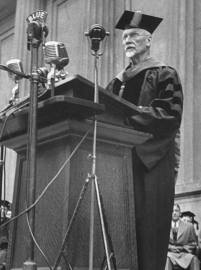
Such was the admiration of Smuts that his statue stands outside Westminster on Parliament Square in London for his contribution to world politics and as a great reformer.

Now he stands alongside the likes of Ghandi, Mandela and Abraham Lincoln as the only other ‘foreign’ statesmen honoured in the square.  Whilst, ironically, in South Africa his legacy has taken an absolute battering and his statues removed.

Take the time to listen to Smuts’ speech to both houses of Parliament, note his views on all mankind’s basic freedoms and what he envisions as the future by way of fundamental reforms.  Also note the short praise by Winston Churchill when Smuts concludes his speech and the reaction of the British Parliament, a reaction that has not been seen in British politics since, it is very unique.


Charity

In 1921 Smuts, along with Field Marshal Haig, established The Royal Commonwealth Ex-Services League (RCEL) in Cape Town.  The RCEL sought to consolidate war veteran’s charities all over the world to care for the returning military service personnel in the Commonwealth.  It saw the establishment or re-purposed institutions which now play a significant role in care for servicemen worldwide, The Royal British Legion, The Royal Canadian Legion, The Returned Services League Australia and The South African Legion to name a few.

He also made South Africa available to Jewish orphans escaping the Pogroms of Eastern Europe (despite resistance from South African nationalists).  For a full story on this remarkable chapter, see an earlier Observation Post 200 Jewish orphans saved, the story of Jan Smuts and Issac Ochberg

He again made South Africa available to Polish orphan children escaping the Nazi German and Soviet invasion of Poland in 1939, establishing a grateful and thriving small Polish community in South Africa (see earlier Observation Post South Africa provides sanctuary for Polish refugee children during WW2 ).

Academia

Smuts was also an accredited philosopher, his work on Holism brought him high acclaim from his Philosopher peers.  Holism can be defined as “the fundamental factor operative towards the creation of wholes in the universe” and was published in 1926.  For Smuts it formed the grounding behind his concepts of the League of Nations and United Nations.

Smuts was also an accredited Botanist, his books and illustrations on South African grasses (veld) are still regarded as the definitive work.

21731360_2020995841462737_816238144166127637_nWhilst studying law at Christ’s College at Cambridge University, he was rated as one of the top three students they have ever had (Christ’s College is nearly 600-year-old).  The other two were John Milton and Charles Darwin.

His intellect was unsurpassed, to pass an exam at Cambridge he learnt Greek (fluently) in just 6 days. His wife was no intellectual slouch either, later in life Jan Smuts and Ouma Smuts used to tease one another when one would recite a Bible verse and the other would be expected to recite the following one, from memory, in Greek!

In 1948, Smuts was elected Chancellor of the University of Cambridge, the first real non-Briton outside of British Royalty to be elected to the position in the 800 year-old history of Cambridge University.

Vision

Smuts’ idea of ‘Union’ and vision for South Africa was that of a ‘United States of South Africa’ including countries like Namibia, Botswana and Zimbabwe in the Union.  It was to be a significant player on the world stage drawing on Africa’s vast resources to see it as a leading political and economic power block (much like the USA is now).  Can you imagine if Botswana and Rhodesia voted to join the Union (they chose not to at the time), what a different history we would have seen in Southern Africa – ‘Apartheid’ may never have happened just for starters.

A humble man

Personally, Smuts was a God-fearing, frugal and humble man. He chose as his house an old rickety, uninsulated, fully corrugated iron, transportable military head office.  He preferred to sleep outside on the ‘stoup’ (veranda) on a small single hard wood bed, his garden was the natural veld. There were no stately mansions or ‘Nkandla’ with ‘fire pools’ for Smuts and he would not have had it anyway.

Legacy

The National Party in a sinister move, gradually and over the long period of Apartheid insidiously smeared Smuts and his legacy, erasing from the general consciousness of just what a great South African Smuts had become. Modern South Africans grew up with almost no regard for Smuts, and if you had to ask a young Black South African today who Smuts was he’ll probably say he was one of the white Apartheid monsters, the white English children will have no idea and the White Afrikaans ones may remember something about him been traitor to Afrikaners.  A student in Canada studying world politics would have a better grip on Smuts than a South African student.

Luckily this is beginning to change, and landmark Biographies are being written now which start to fully explore who and what Jan Smuts was, and it is both fascinating and eye-opening.  It is very hard to sum up all the greatness Smuts was to attain, and certainly for his time his deeds set him well apart from any of the other Statesmen South Africa has produced, certainly if you consider all the subsequent South African Premiers other than Mandela. We have a wonderful story in Smuts, and what we have a character of force – a polyglot, philosopher, botanist, intellectual, lawyer, politician, statesmen, reformer and warrior –  a story and a man who is best summed up by Alan Paton who said:

“Even the great thought he was great.”


Written and Researched by Peter Dickens.  References: Jan Smuts reconsidered Hermann Giliomee 26 January 2016, Richard Steyn’s Smuts: Unafraid of Greatness 2015.  Video footage copyright Associated Press.  My deep thanks to Philip Weyers for the Smuts family insight and access.

This article serves to highlights Smuts’ achievements by way of an Obituary.  There are other issues any national leader faces that highlight decisive but ‘unpopular’ action depending on the affected party’s point of view.  For more related articles in The Observation Post on  Jan Smuts please have a look at this link:

South Africa’s very own Communist Revolution – The Rand Revolt of 1922


Four Israeli pilots stopped the Egyptian invasion of Tel Aviv. One was a South African.

When Israel became an independent nation on May 14, 1948, the armies of four Arab neighbours — Egypt, Syria, Lebanon and Iraq — immediately invaded the new country to prevent its creation. Desperate to defend themselves the Israelis lacked many modern weapons and aircraft.

The Israelis did however have a small fleet of Avia S-199 fighters, made in Czechoslovakia with parts left over from the WW2 German Lufwaffe. The aircraft was poorly constructed and it was extremely unpopular with pilots who called it a Mezek (mule), another name for it was the ‘Messer’ (meaning ‘Knife’ and because the frame was that of the WW2 German Bf109G Messer-schmitt) the engine came from a Luftwaffe Heinkel He-111H bomber, and the Israeli pilots sarcastically also called it a ‘Messer-shit’.

messer01.jpg
Avia S-199

Within this tiny newly formatted Israeli Air Force were a number of very brave Jewish pilots, from the world over, some with WW2 combat experience.  One such pilot was a South African, Eddie Cohen.  This is his story.

Edward (Eddie) (Shlomo) Cohen came from South Africa.  He was the only child of Victor, Edward Cohen was born in Johannesburg on 2nd July 1922 into a well-to-do family. He grew up in an assimilated background, completed high school and began his studies at the University of the Witwatersrand.

21167942_10155437209216480_169900570387994980_o
Eddie Cohen

World War II changed his plans, and he joined the South African Air Force (SAAF), qualifying as a fighter pilot with the rank of Lieutenant.  He flew with 2 Squadron, SAAF and subsequently 4 Squadron SAAF in Italy during the war.

Upon his discharge from the SAAF at the end of the war, he did not return to his university studies, and took an office job in his father’s business in Johannesburg. He loved playing sports with his friends: rugby, tennis and golf. He was also very fond of music and excelled at that, too.

His meetings with Zionist friends aroused his interest in his religious roots, and their beliefs awoke something in him which led him to follow in their footsteps to Palestine.

He arrived in Palestine in 1947 and joined his friends at Kibbutz Ma’ayan Baruch. On a trip to Tel Aviv, he bought a number of books on archaeology and the history of Palestine, and in these scholarly works he found a new life, and began to take an interest in Judaism and his historical homeland.  He wrote to his mother:

“Today, Shabbat, I spent the whole day studying the history of the Jews and surrounding nations, using the Bible and other books. It is the most interesting study I have ever undertaken, as the area around this part of the world was the cradle of western civilization. My greatest regret is that I did not think of studying this branch of history earlier in my life, as so much can be learnt from it…”

Later, in 1947, the survival of the Zionist settlers called Eddie back into military service, he joined ‘Sherut Avir’, the forerunner of the Israeli Air Force, which formed on the 27th of December 1947.  Eddie Cohen, Boris Senior, Ezer Weizman, Modi Alon, and six others made up the new Tel Aviv Squadron.

On January. 15, 1948, Eddie Cohen took part in the Sherut Avir’s first co-ordinated multiple-plane mission: a pre-dawn aerial resupply of the besieged Gush Etzion settlements, using outdated Tiger Moths and Cargo planes.

Eddie Cohen was then trained at Ceske Budejovice in Czechoslovakia as one of ten pilots earmarked for the initial S-199 training course. He flew back to Israel on May 20 with the other graduates and the first batch of Avia S-199 fighters.

On 29 May 1948, Cohen flew in the first S-199 mission, regarded as the first mission of the newly formatted Israeli Air Force (IAF). The Egyptian advance on Tel Aviv had been stalled by a blown bridge 32 km south Tel Aviv by the lightly armed remnants of the Israeli Givati Brigade.

The Israeli Defence Force issued Operation Order No. 26 to the IAF Command that very same day and ordered an attack (even though the first Avia S-199 fighters were theoretically air-worthy they were not yet properly tested).  Four pilots, Eddie Cohen (South African), Modi Alon (Israeli), Ezer Weizman (Israeli) and Lou Lenart (American) took off from Ekron at 19:45 in their Avia’s bombed up with two 70-kg bombs each, and armed with ‘untested’ cannons and machines guns, they set off bound for the Egyptian army column near Ashdod.

Lou Lenart Israeli Air Force
Lou Lenart

Of the mission, Lou Lenart said, “There is no making light of this moment. Behind us is Israel, the Jewish people hanging on by a thread. Ahead of us is the enemy, advancing to destroy everything we love.”

The four pilots alone faced 6,000 Egyptian troops — consisting of seven infantry battalions, six hundred vehicles (including tanks), and formidable anti-aircraft weapons.

Lenart and Modi Alon shared unofficial command of the new fighter squadron and Lenart led the first mission. The wingman pair of Lenart and Alon took off first, followed by Weizman and Cohen. Lenart, however, was unfamiliar with the country and once in the air realized he didn’t know the way to Ashdod. The first two S-199s had no radios so he used hand signals to indicate direction requirements to Alon, who in turn pointed in the proper direction.  In order to avoid any enemy fighters the formation flew over the sea (west of the column) and turned east when it reached Ashdod.


Israeli Air Force Ezer Weizman
Ezer Weizman with his S-199

They spotted the Egyptian column between Ashdod and Gas’ser Ishdod, which had just stopped on the southern side of the destroyed bridge.  At this point all four pilots using machine guns and cannons strafed the concentrations of Egyptian armed forces and bombed them.

Once ammunition and bombs had been exhausted they all headed back to Ekron, Eddie Cohen had a radio and was in radio contact with base. On his way back he reported that all was OK, that he saw the base and that he was about to land. From Ekron, he was not observed and he did not land there. At another nearby air base at Chatzor an aircraft was observed engulfed in flames trying to crash-land about two and a half kilometers away from Chatzor.

The Israeli army at Chatzor dispatched two infantry platoons immediately to rescue the pilot but the Egyptian forces were the first to reach the location. Eddie Cohen had mistaken Chatzor for Ekron and tried to land there with his damaged airplane.

Tragically Eddie Cohen was killed in the crash. Eddie’s S-199 had taken an anti-aircraft gun hit which started a fire that he apparently hadn’t initially noticed.

The bold strike left the Egyptian forces dumbfounded and vulnerable. That night, Jewish ground troops took advantage of the situation by attacking the Egyptians’ flank. The Egyptians were thrown into disorder. Israeli intelligence intercepted this dispatch from their brigade commander to Cairo: “We were heavily attacked by enemy aircraft and we are scattering.”

Despite the loss of Eddie and one aircraft, the mission was a success, it seems that the attack had a profound psychological effect on the Egyptian forces, and they halted their advance completely. The bridge where they stopped was later named ”Ad Halom” bridge, meaning ”no further”.

The Egyptian Army later deflected to the east, in order to link with other Arab forces besieging Jerusalem. Tel Aviv was saved, and so was too was the new nation of Israel.

Israeli Air Force, David Ben-Gurion, Modi Alon
Modi Alon (centre with sunglasses) and David Ben-Gurion (right)

After the Israeli War of Independence finished, in prisoner exchanges with the Egyptians for the remains of the Fallen, Eddie’s body was identified by the then Chief Army Chaplain, Rabbi Shlomo Goren, and in 1949 Israel recovered Eddie Cohen’s remains near the small airfield, at the time of his death in Egyptian hands. Edward Cohen’s mother came from Johannesburg for the re-interment at the Mount Herzl military cemetery on the 8th of November 1951.

Eddie Cohen Is regarded as the first combat casualty of the first fighter squadron (101 Squadron) of the new Jewish State of Israel, and is a national hero in Israel (in South Africa he is hardly remembered at all).  On 29th September 1949, on the orders of the Israeli Chief of Staff, Edward Cohen was posthumously promoted to the rank of Flight Commander in the IAF.


Researched by Peter Dickens. Source: The Jerusalem Post, the history of 101 squadron and wikipedia

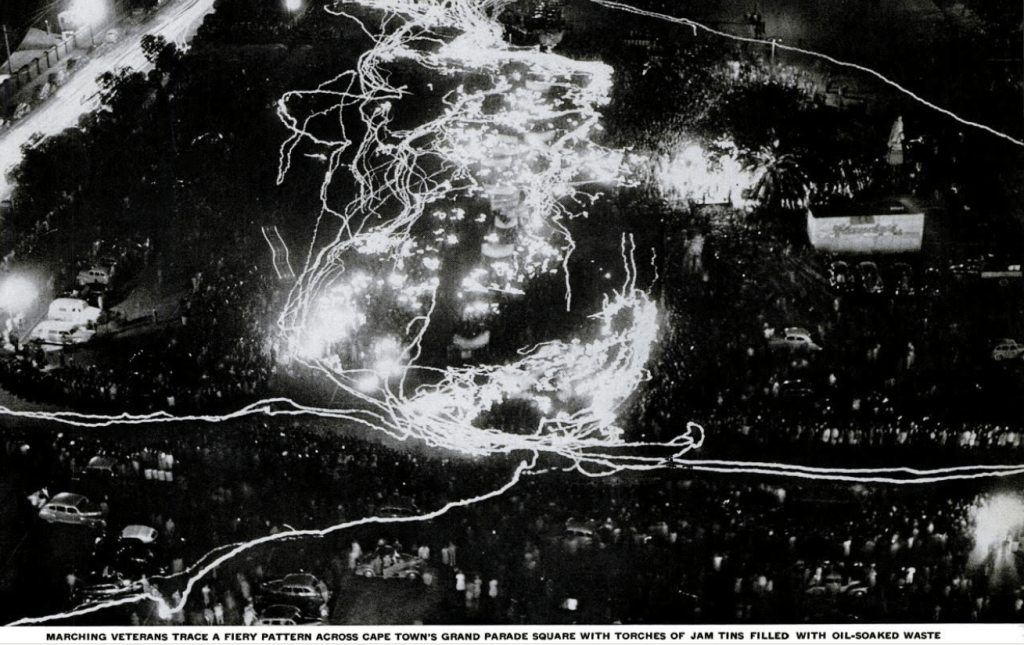
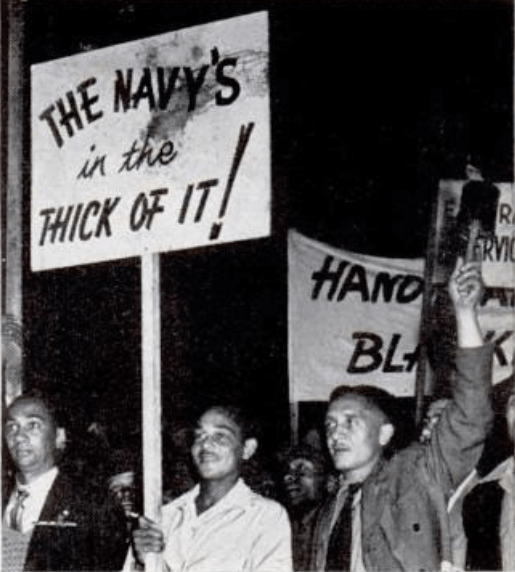
‘New’ rare footage of The Torch Commando in action, the first mass protests against Apartheid by WW2 veterans.


Sometimes you come across gems, and occasionally more information on The Torch Commando surfaces.  This is more very rare footage showing South Africa’s first mass protests against Apartheid, led by Sailor Malan, a World War 2 fighter Ace and Battle of Britain hero.

The inconvenient truth to the modern African National Congress driven narrative of what and who qualify ‘struggle heroes’ is that this movement was the first really significant ‘mass’ protest movement against Apartheid, and it was made up of mainly of white war veterans, led by a white Afrikaner – that’s a fact.  By no means was The Torch Commando small either, at its peak it boasted 250 000 members and their protests attracted between 30 000 to 75 000 people.

Since publishing the first video and articles on The Torch Commando, a number of people have fed back to The Observation Post to dispute this above basic fact.  To see a fuller article on The Torch Commando and other footage, follow this link:

The Torch Commando led South Africa’s first mass anti-apartheid protests, NOT the ANC!

They highlight the following:

The Torch Commando concerned itself only with the Coloured Franchise – This is incorrect.

The Torch Commando Manifesto called for Liberty, Freedom of Speech, Liberty from Tyranny and Freedom of Religion. Sailor Malan’s personal politics which he brought into the Torch revolved around addressing poverty in the black community and economic empowerment. Franchise and political reform is actually something Sailor Malan saw as secondary.  Funnily, Sailor Malan was years ahead of time in this regard, as it is only now that politics in South Africa is focusing on freedom from economic emancipation ahead of political emancipation.

14715460_689736611196074_2236990259246984822_o

Torch Commando Manifesto

The Torch Commando focussed on protesting against DF Malan’s National Party’s 1948 election win with its proposals of Apartheid.  It saw itself as a ‘pro-democracy’ movement and regarded the National Party’s policies as ‘anti-democratic’.  The Cape Coloured franchise removal was the first action of the National Party to implement the edicts of Apartheid, so it stood to reason that this was the first issue to protest against.

The Torch Commando in Natal was particularly focussed on the cessation of Natal from the Union of South Africa in 1950, now that Afrikaner nationalists were in absolute power in controlling the Union.  Natal had a predominately English speaking voting public who were very loyal to their British origins.  This issue of cessation in Natal brought The Torch Commando into direct conflict with the United Party (Smuts’ old party and by then it was now the official party in opposition) and The National Party in that province.

A key objective underpinning the Torch was to remove the National Party from power by calling for an early election, the 1948 ‘win’ by The National Party was not a ‘majority’ win, but a constitutional one, and the Torch wanted a groundswell to swing the ‘service’ vote (200 000 in a voting population of a 1 000 000).  The Torch at its core was absolutely against The National Party’s Apartheid ideology and viewed their government as  ‘unconstitutional’ when they started implementing policy.  This is why the Torch Commando found itself in bed with Smuts’ old United Party in opposition in the first place.

Other issues also sat at the core of the Torch, one issue was the Nationalist’s headstrong policy to make South Africa a Republic, whereas the ‘servicemen’ had fought alongside the British commonwealth – and they wanted South Africa to retain its Dominion status, remain a ‘Union’ and remain part of the Commonwealth of Nations.

21743765_2021324431429878_9049818004730303472_o

It is also incorrect to assume that The Torch Commando did not feel the sting of repressive and violent government counter actions.  There is a recorded case of a clash of Torch Commando protestors in Cape Town and the Police, who were sent to break up a secondary march onto Parliament, it was also met with further threats of violent repression by the Nationalist government after that incident.

The 1780 Xhosa Rebellions and other tribal uprisings precede The Torch Commando as the first mass uprisings against Apartheid – This is incorrect.

With regard the Xhosa wars, South Africa was not a country in 1780.  The South African Union was established in 1910.  Preceding that the various British Colonies and Boer Republics that would ultimately become a Union had different policies on race relations and the conflicts against these policies need to be viewed in relation to the Colony or Republic concerned, as they all differ very much from one another in both policy and historical context (even between the two British colonies of the Cape and Natal).

Movements like the 1913 Women’s Anti-Pass movement, the founding of the ANC in 1912, the 1946 African Miners Strike, Mahatma Ghandi’s civil dissonance campaign – all precede the Torch Commando as the first Anti Apartheid mass movements.  This is incorrect.

13450028_10154250644792329_4746410985414422490_nThe is a very big separation between race politics in the Smuts epoch and the Apartheid epoch. Race politics existed in South Africa during the Smuts era, of that there is no doubt.  However Smuts was addressing it and political resistance on a really ‘mass’ basis from from these communities did not really exist at the time.  Smuts and his politics are complex, he initiated violent counter action to any dissonance by striking miners or Afrikaner rebellions (whether Black or White, it mattered not a jot to him) but more often than not used dialogue, and a lot can be said to the fact that the ANC in fact supported Smuts’ decision to take the country to war in 1939/40.
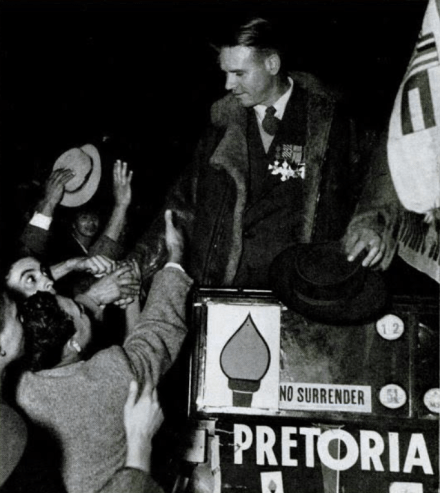
The fact is that prior to 1948 ‘resistance’ on a mass level to Smuts’ policies came from the white sector, and it came from fierce Afrikaner nationalists who had joined organisations like the Ossewabrandwag and Nazi grey shirts, whose objective was to topple the Smuts’ government by force of arms.  The Ossewabrandwag had about 200 000 supporters, these were the true resistance and mass movements facing the Smuts epoch.  They were the biggest threat to the Union of South Africa and Smuts’ biggest political headache.

The 1946 miners strike, was a one week mass strike action which ended in violence with government forces, the underpinning problem was a wage dispute, it was settled with a 10 shilling per day minimum wage (an increase from 2 shillings), and improved working conditions as the basis of the strikers demands.  This action needs to be viewed as dispute on wages and conditions of miners with the mine companies primarily.  It was not really a political protest against an entire system of government.

The 1912 Anti Pass Women’s movement needs to be viewed in context with the British Suffrage Movement which they chose to follow, and revolved around a worldwide problem of female political representation (in Europe as in Africa). Gandhi’s Satyagraha campaign against pass laws eventually succeeded in 1914.  Smuts’ and Gandhi actually became friends over the process and admired each other greatly till the day they died.

Post World War 2, Smut’s approached the 1948 elections with the idea of giving franchise to South Africa’s Black population on a phased and qualification basis.  He had promised Black Community leaders to give more political representation to the Black community if they supported the war effort – which they did.  It was these proposals and policies which went up against the National Party’s Apartheid policies in the 1948 elections.  It was Smuts’ willingness to address the African franchise issue that led to his failure in the elections, with the Nationalists playing into ‘white fears’ of Black African political empowerment which swung the vote to them.

Apartheid as an institutionalised policy started in 1948.  The first mass protests against this institution started in 1951.  The people who led this mass protest action were The Torch Commando, and not the ANC, their ‘Defiance Campaign’ came later.  Prior to this the proper ‘mass action’ against the Smuts’ government came primarily from disaffected and militant Afrikaner nationalists in their hundreds of thousands wanting an Apartheid state. That’s a fact.

The Observation Post is re-writing history.  This is incorrect

The intention of highlighting The Torch Commando is that it was ‘written out of history’ by The National Party and remains ‘written out’ for political expedience by the current government.  It is a ‘inconvenient truth’ as it highlights a mass movement of pro-democratic white people not in alignment with Apartheid.  It challenges the prevailing malaise of thinking in South Africa – that everything prior to 1994 was ‘evil’ and white South Africans must therefore share a collective ‘guilt’.  The purpose is to highlight great men like Sailor Malan and movements like the Torch Commando, uncover their hidden history and enter their contributions into the annuals of progressive South Africans who sought change and universal franchise and honour them as such.

15541961_689668087869593_6848483991317263370_n

Sailor Malan at a Torch Commando Rally in Cape Town


Written by Peter Dickens.  Video footage Associated Press copyright.

The Torch Commando led South Africa’s first mass anti-apartheid protests, NOT the ANC!

The ‘Torch’, an inconvenient truth!

Now, this rare short movie clip exposes an inconvenient truth to the current political narrative of the “struggle”, the first mass anti-Apartheid protests were led by this highly decorated Afrikaner war hero – Adolph “Sailor” Malan – and the mass protesters were not led by the ANC and its supporters, this very first mass mobilisation was made up of returning WW2 veterans – this rare video footage captures some of this fascinating and largely ‘hidden’ South African history.

Many people may know of the South African “Battle of Britain” Ace – Adolph ‘Sailor’ Malan DSO & Bar, DFC & Bar – he is one of the most highly regarded fighter pilots of the war, one of the best fighter pilots South Africa has ever produced and he stands as one of the “few” which turned back Nazi Germany from complete European dominance in the Battle of Britain – his rules of aerial combat helped keep Britain in the war, and as a result he, and a handful of others, changed the course of history. But not many people are aware of Sailor Malan as a political fighter, anti-apartheid campaigner and champion for racial equality.

‘Sailor’ Malan can be counted as one of the very first anti-apartheid ‘struggle’ heroes. The organisation he formed “The Torch Commando” was the first real anti-apartheid mass protest movement – and it was made up of South African ex-servicemen, not disenfranchised civilians. Yet today that is conveniently forgotten in South Africa as it does not fit the current political rhetoric or agenda.

After the Second World War, Sailor Malan left the Royal Air Force and returned to South Africa in 1946. He was surprised by the unexpected win of the National Party over the United Party in the General Election of 1948 on their proposal of ‘Apartheid’ as this was in direct opposition to the freedom values he and all the South African veterans in World War 2 had been fighting for.

What he and other returning World War 2 servicemen saw instead was far right pro Nazi Germany South African reactionaries elected into office. By the early 1950’s the South African National Party government was littered with men, who, prior to the war where strongly sympathetic to the Nazi cause and had actually declared themselves as full-blown National Socialists during the war as members of organisations like the Ossewabrandwag, the SANP Greyshirts and the Nazi expansionist “New Order”: Oswald Pirow, B.J. Vorster, Hendrik van den Bergh, Johannes von Moltke, P.O. Sauer, F. Erasmus , C.R. Swart, P.W. Botha and Louis Weichardt to name a few, and there is no doubt that their brand of politics was influencing government policy.

This was the very philosophy the returning South African servicemen and women had been fighting against, the “war for freedom” against the anti-Judea/Christian “crooked cross” (swastika) philosophy and its false messiah as Smuts had called Germany’s National Socialism doctrine and Adolph Hitler.

In the 1951 in reaction to this paradigm shift in South African politics to the very men and political philosophy the servicemen went to war against, a mass mobilisation protest movement was formed by  group of ex-servicemen.  They called it the “ Torch Commando” (The Torch), as their protests were held at night with each member carrying a ‘fire’ torch – a symbol of light, freedom and hope. In effect it became an anti-apartheid mass movement and Sailor Malan took the position of National President.

The Torch’s first activity was to fight the National Party’s plans to remove ‘Cape Coloured’ voters from the common roll which were been rolled out by the National Party two years into office in 1950.

The ‘Cape Coloured’ franchise was protected in the Union Act of 1910 by an entrenched clause stating there could be no change without a two-thirds majority of both houses of Parliament sitting together. The Nationalist government, with unparalleled cynicism, passed the High Court of Parliament Act, effectively removing the autonomy of the judiciary, packing the Senate with National Party sympathisers and thus disenfranchising the ‘coloured’ voters. This was the first move by the National Party to secure a “whites only” voting franchise for South Africa (reinforcing and in fact embedding them in power for years to come).

The plight of the Cape Coloured community was close to most White ex-servicemen as during WW1 and WW2, the Cape Coloureds had fought alongside their White counterparts as fully armed combatants. In effect forging that strong bond of brothers in arms which so often transcends racial barriers.

The Torch Commando strategy was to bring the considerable mass of “moderate’ South African war veterans from apolitical organisations such as the Memorable Order of Tin Hats (MOTH) and South African Legion (BESL) into allegiance with more ‘leftist’ veterans from an organisation called the Springbok Legion – of which Joe Slovo, who himself was also a South African Army World War 2 veteran and was a key leader, his organisation – The Springbok Legion, led by a group of white war veterans who embraced Communism was already very actively campaigning against Apartheid legislation and highly politically motivated.

The commando’s main activities were the torchlight marches. The largest march attracted 75 000 protesters. This ground swell of mass support attracted the United Party to form a loose allegiance with The Torch Commando in the hope of attracting voters to its campaign to oust the National Party in the 1953 General Election (The United Party was now run by J.G.N. Strauss after Jan Smut’s death and was seeking to take back the narrow margins that brought the National Party into power in 1948).

In a speech at a massive Torch Commando rally outside City Hall in Johannesburg – 75000 people on protest, “Sailor” Malan made reference to the ideals for which the Second World War was fought:

“The strength of this gathering is evidence that the men and women who fought in the war for freedom still cherish what they fought for. We are determined not to be denied the fruits of that victory.”

During the Torch Commando anti-apartheid rally in Cape Town (The movie clip shows the leader of the Torch heading to this exact rally) – 10 000 South African WW2 veterans went on protest. Sailor Malan famously accused the national party government at this rally of;

“Depriving us of our freedom, with a fascist arrogance that we have not experienced since Hitler and Mussolini met their fate”.

Wartime singing icon Perla Gibson also attended the Torch Commando anti apartheid rally in Cape Town and sang to the protesters in support. Perla was known as the ‘Lady in white” and sang to incoming and outgoing troops in Durban harbour during WW2 to beef up morale.

Also of extreme interest was co-leader of the Torch Commando rally in Cape Town – Kmdt. Dolf de la Rey (seen here in the video) – he famously captured Winston Churchill during the Boer War fighting for the Boers and became a Torch Commando activist, another one of the rich tapestry of Afrikaner war heroes in conflict with National Party politics and philosophy.

During the Cape Town “Torch” 50 000 civilians joined the 10 000 veterans when the protest moved to hand over a petition at the Parliament buildings in Cape Town. The police barred the way and a scuffle broke out. 160 Protesters where injured along with 15 Policemen. As tensions grew over the protest the National Party MP Johannes Streydom finally warned them that he would use the South African security forces against “those who are playing with fire and speaking of civil war and rebellion”.

DF Malan’s government was so alarmed by the number of judges, public servants and military officers joining The Torch that those within the public service or military were prohibited from enlisting, lest they lose their jobs – this pressure quickly led to the erosion of the organisation’s “moderate” members, many of whom still had association to the armed forces, with reputations and livelihoods to keep.

The “leftist” members of The Torch where eroded by anti-communist legislation implemented by the National Party, which effectively ended the Springbok Legion forcing its members underground (many of it’s firebrand communist leaders, including Joe Slovo, went on to join the ANC’s MK armed wing and lend it their military expertise instead).

In essence, the newly governing National Party at that time could not afford to have the white voter base split over its narrow hold on power and the idea that the country’s armed forces community was standing in direct opposition to their policies of Apartheid posed a real and significant threat – bearing in mind one in four white males in South Africa (English and Afrikaans) had volunteered to go to war and support Smuts – this made up a very significant portion of the voting public, notwithstanding the fact that there all now very battle hardened with extensive military training, should they decide to overthrow the government by force of arms.

Also the National Party government, being extremely concerned about the influence this movement might have, especially under the leadership of the war hero, acted ‘decisively’ (as was its usual modus operandi) and went about discrediting the Torch Commando and its leaders through means of negative propaganda.

For the rest of his life, Sailor would be completely ridiculed by the Nationalist government. The National Party press caricatured him  ‘a flying poodle’, dressed in his leathers and flying goggles, in the service of Jan Smuts and the Jewish mine-bosses, who were referred to as the “Hochenheimers”.  The National Party openly branded him as an Afrikaner of a ‘different’ and ‘unpatriotic’ kind, a traitor to his country and ‘Volk’ (people).

In addition to the National Party’s efforts, the Torch Commando also ultimately failed because it could not un-couple itself as a political arm of the United Party and establish itself as independent mass action movement, it found itself curtailed by moderate party politics. One political cartoon of the time lampoons The Torch Commando as a hindrance to the United Party.

Sailor Malan’s political career was effectively ended and the “Torch” effectively suppressed by the National Party, so he returned to his hometown of Kimberly. Sadly, Sailor Malan succumbed on 17th September 1963 aged 53 to Parkinson’s Disease about which little was known at the time. Some research now supports the notion that Post Traumatic Stress Disorder (PTSD) can bring on an early onset of Parkinson’s Disease, and it is now thought that Sailor Malan’s high exposure to combat stress may have played a part in his death at such a relatively young age.

Although he fought in the blue sky over England in the most epic aerial battle to change the course of history, one of the “few” to which Churchill recorded that the free world owes a massive debt of gratitude to, he lies today under an African sun in Kimberley – a true hero and son of South Africa.

It is to the embarrassment now as to his treatment as a South African WW2 military hero that all enlisted South African military personnel who attended his funeral where instructed not to wear their uniforms by the newly formatted SADF. The government did not want a Afrikaner, as Malan was, idealised as a military hero in death in the fear that he would become a role model to future Afrikaner youth.

The “official” obituary issued for Sailor Malan published in all national newspapers made no mention of his role as National President of The Torch Commando or referenced his political career. The idea was that The Torch Commando would die with Sailor Malan.

All requests to give him a full military funeral were turned down and even the South African Air Force were instructed not to give him any tribute. Ironically this action now stands as testimony to just how fearful the government had become of him as a political fighter.

A lot can be said of Sailor Malan as a brilliant fighter pilot, even more can be said of political affiliation to what was right and what was wrong. He had no problem taking on the German Luftwaffe in the greatest air battle in history, and he certainly had no problem taking on the entire Nationalist regime of Apartheid South Africa – he was a man who, more than any other, could quote the motto of the Royal Air Force’s 74 Squadron which he eventually commanded, and say in all truth:

“I fear no man”

The campaign to purge the national consciousness of The Torch Commando, The Springbok Legion and Sailor Malan was highly effective as by the 1970’s and 1980’s the emergent generation of South Africans have little to no knowledge of The Torch, it is highly unlikely that anyone today remembers Sailor Malan’s speech to 75000 Torch Commando protesters in the centre of Johannesburg.

This “scrubbing” of history by the National Party in aid of their political narrative strangely also aids the ANC’s current political narrative that it is the organisation which started mass protests against Apartheid with the onset of the “Defiance Campaign” on the 6th of April 1952, led mainly by ‘black’ South Africans.  The truth of that matter is that the first formalised mass protests in their tens of thousands against Apartheid where in fact mainly led by ‘white’ South African military veterans, starting a year earlier in 1951.

Another inconvenient truth – luckily history has a way of re-emerging with some facts, and the historical record (like this rare footage) shows in plain day an overlooked mass movement against Apartheid, a movement no longer referenced or even properly documented in South Africa today.

Indeed, Sailor Malan is also not publicly accredited as a significant ‘struggle hero’ in countless current-day dedications, let alone his value as a Battle of Britain hero, and here he is widely praised in Britain, but not in his homeland.  It is also currently unlikely that any streets, institutions or buildings will be named after him or any of the other leaders of The Torch Commando for that matter (other than Joe Slovo).  The ‘race politics’ that Sailor Malan fought against, which sadly still exist in South Africa today, dictate that – so he and his organisation remain anonymous but to a few.

Written and researched by Peter Dickens

Editors Note: Since publishing this, more footage of the Torch Commando has been released by AP and it’s a new wealth of insight, please refer to this new Observation Post for this amazing footage and answers to some of the received comments and criticisms stemming this article. ‘New’ rare footage of The Torch Commando in action, the first mass protests against Apartheid by WW2 veterans.


References: South African History On-Line (SAHO), South African History Association, Wikipedia ,Neil Roos: Ordinary Springboks: White Servicemen and Social Justice in South Africa, 1939-1961. Life Magazine, 25 June 1951.  Video footage, Associated Press – source Youtube.

“Mein Kampf shows the way to greatness for South Africa” – The Ossewabrandwag

History is always a three-way prism. As with South African statute forces fighting communism on two fronts – the Angolan Border ‘Bush’ War and the internal ‘struggle’ movements in the 70’s and 80’s – so it was during the Second World War as well, this time the ‘struggle’ movement was a little different and South African statute forces were fighting Fascism and Nazism (National Socialism) on two fronts, both on the international stage and on the domestic front at home.

Little is known of the domestic conflict during World War 2 as it was effectively shielded and even erased from the state’s educational history curriculum – to the point that little is known about it by subsequent generations of South Africans even to this day. By far the biggest of all the domestic pro Nazi organizations in South Africa at this time was a movement called the “Ossewabrandwag” (abbreviated to OB).

The feature image shows a Ossewabrandwag rally and its leadership along with an inserted emblem of the organization. Read on for a fascinating and relatively unknown part of South African military history.

Background and formation

screen-shot-2016-03-05-at-16-38-42

The Ossewabrandwag (OB), meaning in English Ox-wagon Sentinel was an anti-British and pro-Nazi German organization in South Africa during World War II. It was officially formed in Bloemfontein on 4 February 1939.

As a background to it, in the South African War (1899–1902), Britain conquered the Boer Republics. Germany supported the Boer cause. After the war, there was a general reconciliation between Afrikaners and Britain, culminating in the formation of the Union of South Africa in 1910, under the leadership of former Boer fighters, Louis Botha and Jan Smuts. South African troops, including tens of thousands of Afrikaners, served in the British and South African Union forces during World War 1 and again in World War 2.

Nonetheless, many Boers from the ex Transvaal and Orange Free State Republics remembered the extremely brutal tactics used by Britain in the Boer War and remained resentful of British rule. They were especially resentful of the concentration camp and scorched earth policies engaged by the British to bring to bring an end to the guerilla tactics used by ‘Bitter einders’ at the close of the war.

In the 1930’s the chief vehicle of Afrikaner nationalism was the ‘Purified National Party’ of D. F. Malan, which later became the ‘National Party’. As in 1914, the Second World War appeared to a relatively small group of far right-wing Afrikaner nationalists as a golden opportunity to establish Afrikaner nationalist rule and move to make South Africa a republic independent of Britain.

‘We are now ceaselessly on the road to our goal: the Republic of South Africa – the only status under which we can truly exercise the right to self-determination as a country,’ said D.F. Malan on 6 September 1939 at the on-set of the Second World War.

Prior to this, 1938 was also the centennial anniversary of the Great Trek (the migration of Boers to the interior). The Ossewabrandwag was established in commemoration of this Great Trek. Most of the migrants traveled in ox-drawn wagons, hence the group’s name. The group’s leader was Dr Johannes Van Rensburg, a lawyer who had served previously as Secretary of Justice, in 1933 he had been to Germany in his capacity as Secretary and met both Hitler and Goering as well as other Nazi officials, he was deeply impressed with both the leadership and discipline offered by Nazism and became an admirer.  The OB at the on-set of the centennial was loosely associated to Malan’s National Party.

The relationship with the National Party 

There were however sharp differences between Dr van Rensburg and Dr D.F. Malan over the right course of action to be followed when South Africa declared war on Germany in 1939. Both believed that everything depended on the outcome of the war, both believed that Germany would win it, however Malan relied on negotiation with Germany to achieve his objectives, van Rensburg on the other hand believed that at some stage freedom would have to be fought for and began to formulate a militant opposition to the South African government to undermine South Africa’s war effort.

At first, relations between the National Party and the Ossewabrandwag were cordial, with most members of the Ossewabrandwag belonging to the party as well. At the higher levels, National Party leaders like P.O. Sauer and F. Erasmus (later to be made Cabinet Ministers when Malan came to power) were members of the OB.

Three future National Party South African Prime Ministers/State Presidents held key leadership positions in the Ossewabrandwag. ‘Generals’ like C.R. Swart (later South Africa’s first State President) was a member of the Groot Raad (Chief Council) of the Ossewabrandwag, B.J. Vorster (later to become Prime Minister of South Africa) was a keynote OB leader and formed the OB’s Cape Branch and even PW Botha (future South African State President) joined the Ossewabrandwag and worked with Vorster to establish the OB’s Cape branch.

Other National Party stalwarts where also prominent in the Ossewabrandwag organisation, Eric Louw, for example – who later to become the National Party’s Foreign Minister.  That to say the National Party and the Ossewabrandwag were, to coin a phrase, “two peas in the same pod” is an absolute truism.

Combining the impact of the war and the very dynamic personality of Dr van Rensburg, the Ossewabrandwag soon grew into a significant force, a mass movement whose membership at its peak was estimated to be between 200,000 and 400,000 members.

The relationship between the Ossewabrandwag and National Party at first was very well-defined and D.F. Malan even met with OB leaders in Bloemfontein which resulted in declaration known as the ‘Cradock Agreement’. It specified the two operating spheres of the two respective organizations. They undertook not to meddle in each others affairs and the National Party endeavoured to focus on Afrikanerdom in the party political sphere, while the Ossewabrandwag was to operate on the other fronts of the ‘volk’ (white Afrikaans people’s).

‘Nazification’ of the far right 

In 1940 the Ossewabrandwag created within in structures an elite organization known as the Stormjaers – the storm troopers of Afrikanerdom. The formation of the Stormjaers (English meaning: Assault troops) was in essence a paramilitary wing of the OB. The nature of the Stormjaers was drawn upon the lines of Nazi Germany’s army ‘Storm troopers’, as were the Nazi and fascist rituals and salutes, this is evidenced by the oath sworn in a by new recruits (in some instances a firearm was levelled at them whilst they read the oath): “If I retreat, kill me. If I die, avenge me. If I advance, follow me” (Afrikaans: As ek omdraai, skiet my. As ek val, wreek my. As ek storm, volg my).

screen-shot-2016-12-11-at-11-17-41
Johannes van Rensburg been sworn into the Ossewabrandwag

The Stormjaers were deployed in variety of military operations ranging from the defence of Nationalist political platforms to pure sabotage, they dynamited post offices and railway lines and cut telephone wires. Van Rensburg even wrote “The Ossewabrandwag regards itself as the soldiery of the (South African) Republic . . . the Ossewabrandwag is the political action front of Afrikanerdom.”

The ideologies of the Nazis were penetrating deep into right-wing Afrikaner political identity. In 1940, directly after Nazi German decisive victories in Europe, Otto du Plessis (later to become Administrator of the Cape under the National Party) published a pamphlet – The Revolution of the Twentieth Century – in which he openly espoused the Ossewabrandwag’s policy of totalitarianism.

B.J. Vorster’s brother, Rev. Koot Vorster, who was a Dutch Reformed Church minister, was also a predominant Ossewabrandwag leader. He summed up the pro-Hitler and Pro-Nazi standpoint of the OB during an address to a student group on September 15, 1940:

book_mein_kampf_verlag

“Hitler’s ‘Mein Kampf’ shows the way to greatness – the path of South Africa. Hitler gave the Germans a calling. He gave them a fanaticism which causes them to stand back for no one. We must follow this example because only by such holy fanaticism can the Afrikaner nation achieve its calling.”

Kowie Marais, an OB member, years later recalled in an interview the admiration he and his friends held for Hitler: “We thought he (Hitler) might rejuvenate western civilization…against the communist-socialist trends that were creeping in from the east. We thought it was the dawn of a new era.”

Oswald Pirow also publicly identified himself with National-Socialist doctrines and Nazi Germany and established the Nazi expansionist ‘New Order’ movement inside the ranks of the former Hertzogites.

There even existed South Africa’s own Nazi party called the SANP and it’s militant wing the ‘Greyshirts’ led by Louis Theodor Weichardt (who later became the National Party Senator for Natal). This pure Nazi movement had 5000 odd loyal followers.

Dr Van Rensburg from the OB had always professed been a National Socialist, as an open admirer of Nazi Germany and Adolph Hitler, and the ideas and rituals of membership put forward by his organization had a distinctive Nazi leaning as a result.

According to OB political thinking, Afrikaans would be the only official language in a free, independent, Christian-National Republic. The English-speaking South Africans, regarded as an “un-national” element, would be condemned to an inferior status. Anti-Communism was an important backbone of OB policy in line with Nazi hatred of communism.

The emphasis of the OB was also on race and racial purity. Members were exhorted to ‘think with your blood’, and the Nazi creed of ‘Blut und Boden’ (Blood and Soil) was promoted as an OB value. ‘Family, blood, and native soil – that is, next to our religion and our love of freedom, our greatest and our most sacred national heritage’ (Die O.B. 28 October 1942).

The OB always displayed an exaggerated interest in physical culture and the need for dictatorial discipline. “Give us a master ! Give us bonds which tie us to a stable way of life” wrote van Rensburg.

On issues of family value, the leaders of the OB proclaimed that the duty of the man was to work and fight and the duty of the woman to create and tend the home and family.

In essence the Ossewabrandwag was based on the Führer principle, fighting against the British Empire, anti-capitalist in nature – they called for the removal and expropriation of “British-Jewish” controlled capital, the communists, the Jews and the system of parliamentarism. All based on the principles national socialism.

An irony is not lost here, in modern South Africa the African National Congress (ANC) now call this ‘British-Jewish controlled capital’ a new name – ‘white monopoly capital’ and call for the same capture of this elusive capital as a justification for their cause too.

Screen Shot 2016-03-05 at 16.38.22
Johannes van Rensburg at a Ossewabrandwag torch rally

Insurrection 

From the outset of the war a series of violent incidents took place between statutory force South African soldiers and the Ossewabrandwag. This was to cumulate on Friday 31 January 1941, when van Rensburg was due to hold a meeting at the Johannesburg City Hall when a riot broke out between OB Stormjaers and South African Union Defence Force soldiers who were determined not to allow van Rensburg to have a platform for his support of Nazi Germany – with whom they were now at war with.

The Stormjaers were armed with sticks,pipes, batons, knives, sjamboks and even bicycle chains, while the soldiers were for the most part unarmed and the battle raged in downtown Johannesburg for two days. Armoured cars were brought in while enraged UDF soldiers set fire to Nationalist newspaper offices and set police vans alight. Tear-gas canisters were hurled in every direction between the two antagonists and the Police.

Before a commission of inquiry on the Johannesburg riot, Dr van Rensburg declared that it was only OB discipline and restraint which had prevented reinforcements in outlying areas from being brought into town and broadening the scope of the battle.

In support of OB activities the National Party even came out in direct support of the OB against Smuts’ government resolution to detain and ban members of the OB. Dr D.F. Malan defended the OB in a speech on 5 March 1941, saying:

“The Ossewabrandwag has been accused of lending itself to subversive activities and also of encouraging them. Now I say: Carry out your threat. Ban it. Prevent it and prevent its meetings. If the Ossewabrandwag decides to be passively disobedient and refuses to be dissolved . . . I shall share the consequences with the Ossewabrandwag. At this stage I am prepared to say to you that if the government decides upon that act and the Ossewabrandwag decides not to submit, I shall keep my pledge”.

It was a clear sign to Smuts’ government that unity in the ranks of the Afrikanerdom movements was as unified as ever since the outbreak of the Second World War.

To give an idea of sabotage and violent attacks, at the height of the Second World War – 1942, Ossewabrandwag Stormjaer activities included:

Explosions over a large area of mines at Klerksdorp, Vereeniging, Delmas and in Potchefstroom the OB blew up power lines – 29 January 1942. All telegraph and telephone communication between Bloemfontein and the rest of South Africa were dislocated in one attack in February 1942.

Railway, telegraph and telephone lines in various parts of the Free State were destroyed in February 1942. Fifty-eight Stormjaers were eventually charged with high treason, and a quantity of hand grenades were found. Stormjaers also blew up two telephone poles behind the Pretoria Central Jail, but were never captured.

10402583_560135767489493_4510500168473141319_n

Two other Stormjaers, Visser and van Blerk were convicted of a bombing at the Benoni Post Office, as a result of which an innocent bystander was killed, they were both sentenced to death. The sentence was commuted to life imprisonment.

A few members of the OB were shot while trying to escape from internment camps or jails, the most known was the dramatic pursuit OB General, Johannes van der Walt, who was shot while on the run near Krugersdorp.

A number of arms cache’ and hiding places for the Stormjaers can still be found, the inserted picture shows Ossewabrandwag graffiti in a cave in the Excelsior area.

B.J. Vorster

One very predominant leader of the Ossewabrandwag was Balthazar Johannes (B.J.) Vorster, South Africa’s future Prime Minister. Along with like-minded OB colleagues he regarded the war as an opportunity to get rid of the hated domination of the United Kingdom of South Africa and welcomed the Nazis as allies in their fight.

The firebrand nature of the Ossewabrandwag appealed to Vorster more than the National Party, so while South African troops were helping to make the world safe from Hitler’s National Socialism, Vorster was appointed as a ‘General’ in the Ossewabrandwag for the Port Elizabeth district to promote the National Socialism doctrine back home. On his politics he famously announced the Ossewabrandwag’s position on Nazism and said in 1942:

‘We stand for Christian Nationalism which is an ally of National Socialism. You can call this anti-democratic principle dictatorship if you wish. In Italy it is called Fascism, in Germany National Socialism and in South Africa, Christian Nationalism”.

vorster
BJ Vorster addressing a OB meeting

Vorster was eventually arrested under the emergency regulations in September 1942, he immediately went on hunger strike and after two months was transferred to Koffiefontein internment camp as prisoner No. 2229/42 in Hut 48, Camp 1. B.J. Vorster was eventually released on parole in January 1944 and placed under house arrest.

Interned alongside BJ Vorster was another Ossewabrandwag member Hendrik Johan van den Bergh who eventually went on to found the Bureau of State Security (B.O.S.S.), an intelligence agency created under the National Party on 16 May 1969 to coordinate military and domestic intelligence. Van den Bergh was to become known as the “tall assassin” given his physical height.

Direct German intervention

The German Nazis themselves saw the activities of the Ossewabrandwag as very positive to their fight. Van Rensburg was even played up over Zeesen radio as the real leader of the Afrikaner people.

In June 1941 Robey Leibbrandt was landed from a German yacht on the Namaqualand coast with 10,000 dollars, a radio transmitter, and instructions to make contact with van Rensburg and investigate the possibilities of joint action with the Ossewabrandwag. His mission, overseen by German Admiral Wilhelm Canaris was Operation Weissdorn, a plan for a coup d’état to overthrow the government of General Jan Smuts.

Leibbrandt was a South African Olympic boxer who later came a fervent Nazi follower. He joined the German Army, where he became the first South African to be trained as a Fallschirmjäger (paratrooper) and glider pilot. Leibbrandt was trained with comrades of the Brandenburgers at a sabotage training course of Abwehr II (Abwehrschool “Quenzgut”) near Brandenburg an der Havel, west of Berlin.

Once in South Africa he soon made contact with the Stormjaers and was brought to Pretoria to see van Rensburg.

Nothing, however, came of the negotiations. Leibbrandt’s megalomania was enough to deter anyone from cooperating with him, and van Rensburg refused to be drawn. At the same time Leibbrandt’s fanaticism attracted a number of members of the Ossewabrandwag over to his side, and within a short while Leibbrandt was leading his own group, calling themselves ‘The National Socialist Rebels’ whose members were bound to one another by a blood oath which partly read:

“All my fight and striving is for the freedom and independence of the Afrikaner people of South Africa and for the building up of a National Socialist State in accordance with the ideas of Adolf Hitler.”

The quite truce between Leibbrandt and van Rensburg quickly developed into open hostility. Leibbrandt, disappointed that the OB did not officially support his mission and its resultant failure began to openly attack van Rensburg as an ‘agent’ of Smuts. This sealed his fate. After a few months in South Africa he was ‘sold out’ by OB insiders, his location now known to the Smuts government, he was arrested, together with a number of leading Stormjaers.

Placed on trial Leibbrandt was sentenced to death for treason, but the sentence was commuted to life imprisonment after much lobbying from Afrikaner Nationalist organisations.  Mindful of the deep-seated split in his own Afrikaans community, to quote Jan Smuts at the time his sentence was commuted to life “I did not want the blood of another Jopie Fourie on my hands”.

The Stormjaers sabotage activities were getting too violent for DF Malan’s National Party policy of negotiated settlement with Germany when (and if) they won the war. Many of these acts of violence were going too far for the majority of moderate Afrikaners, and Malan ordered the National Party to break all ties with the OB later in 1942.

The South African Union government then cracked down heavily on the OB and the Stormjaers, placing thousands of them in internment camps for the duration of the war.

Summing up the achievements of the Ossewabrandwag’s campaign of sabotage, van Rensburg wrote this in his autobiography which was published after the war:

“I fought (Smuts’) war effort and I fought it bitterly with all the means at my disposal – which were considerable…. There is no doubt that they (the Ossewabrandwag) seriously hampered the government’s war effort. Hampered it because the government was forced to draw off considerable manpower to guard many strategic points and essential services. A not inconsiderable military element also had to be retained in South Africa as a strategic reserve for possible emergency.”

At the end of the war, the Ossewabrandwag was absorbed back into the National Party and ceased to exist as a separate body, many of its members achieving political notoriety as members of the National Party government on their accent to power with the National Party electoral win over Smut’s United Party in 1948.

Returning war veterans react

Imagine the sheer frustration felt by the veterans after “The War for Freedom” (as WW2 was known) had been fought with the massive cost in South African lives (literally tens of thousands), to rid the world of Nazism and Fascism in the ‘good fight’ – only to come home in 1945 and within three short years find the ‘home grown’ pro Nazi Germany and pro Nazi philosophy politicians swept into government. The very men and their philosophy they had gone to war against in the first place.

By the early 1950’s the South African nationalist government was littered with men, who, prior to the war where strongly sympathetic to the Nazi cause and had actually declared themselves as full-blown National Socialists: Oswald Pirow, B.J. Vorster, Hendrik van den Bergh, Johannes von Moltke, P.O. Sauer, F. Erasmus , C.R. Swart and Louis Weichardt to name a few, and there is no doubt that their brand of politics was influencing government policy.

Louis Weichardt was the South African Nazi ‘grey-shirts’ founder (he later became a National Party MP) in the left image and Oswald Pirow (Nazi ‘New Order’ founder in South Africa) inspecting German Luftwaffe troops on a ‘unofficial’ visit to Nazi Germany on behalf of the ‘old’ National Party – later he became a key Public Prosecutor under the ‘new’ National Party.

Also by the early 1950’s, this state of affairs in the make up and philosophy underpinning South Africa’s ‘new’ ruling party, led to open Anti-Apartheid protests from the South African military veterans community – in their tens of thousands, led by Adolph ‘Sailor’ Malan and other returning war heroes in Torch Commando rallies (The Torch) and it ultimately led to the marginalization of South African war veterans, their veteran associations and the ultimate suppression of anti-Apartheid movements like the Torch by the National Party.

Images of Sailor Malan at an anti-apartheid Torch Commando rally in Cape Town attended by over 10 000 returning South African World War 2 veterans.

Sailor Malan famously accused the national party government at this rally of “depriving us of our freedom, with a fascist arrogance that we have not experienced since Hitler and Mussolini met their fate”.

Covering Tracks

In the interests of consolidating themselves in power and in the interests of securing the ‘white’ vote from both English and Afrikaans voters (especially English-speaking white South Africans of British extraction) much of this legacy was a political hot potato for the National Party.  Nazism, Fascism and National Socialism was purged from Europe with the loss of millions of lives, and exposed for what it is – a crime against humanity.

Political careers – especially those of future National Party State Presidents and Prime Ministers would not be helped if their associations to Nazi Germany, Nazi political philosophy and even anti-British ideals where openly promoted. Especially when National Service was instituted and the National Party called on Jewish and English-speaking white South Africans of British heritage and even moderate or leftist Afrikaners to rally behind their cause to ‘fight communism’ and serve in the statutory armed forces as conscripts.

the-real-face-of-apartheid-vorster-and-hitler-1970s

So it was shielded – in formal secondary education it was not formally taught at all and it was never really widely reported on by the state media apparatus when referring the political legacies of the likes of B.J. Vorster or P.W. Botha. In 1948, two months after taking office the National Party even went so far as removing two truck loads of intelligence on the Broederbond and Ossewabrandwag accrued by the Smuts government from their archive, and it especially included Broederbond plans on how South Africans would be educated along Christian Nationalism lines, this intelligence was never to be seen again. This would give B.J. Vorster his favourite fall-back line of “prove it” whenever someone challenged him on his Nazi sympathising past. Except ‘banned’ overseas anti-apartheid movements, they went to town on the link of Apartheid to Nazism and broadly promoted it to anyone who would listen. This was of course gagged in South Africa under emergency regulations and banned organisation listings. The result is that little is left of it in the modern historical narrative on South Africa in the country itself.

At best, in South Africa, it was re-branded as a ‘fight against the British’ because of the atrocities committed by the British during the Boer War, a sort of retribution, cleverly phasing moral correctiveness to justify it.  What this narrative also aimed to do was unbundle all the underlying Nazi ideology, philosophy, ritual and politics which had been coupled so openly during the war to the Ossewabrandwag’s ideals of Christian Nationalism by future National Party leaders.  Covering it up with ‘moral outrage’ instead.  Whilst retribution for the Boer War was a primary driver of the Ossewabrandwag, and there is good reason behind this objective, it was not the only driver, and ignoring the entire underpinning ideology of the group is only to look at half of the whole.

Many historians have asked if Nazism played a role in the creation of Apartheid as philosophy, and frankly the answer is yes it did, both directly and indirectly by the architects of Apartheid who so readily adopted Nazi ideals, rituals and philosophy during the war, in open and on the public record.  It is this for this reason that National Party did not want any open or constant linkages made to this, their darker past, because when in power the ideals behind Nazism were so abhorrent to the majority of white South Africans that it would have certainly lost them their authority.

In Conclusion

In the end it all disappeared into a politically generated one-sided nationalist narrative of South Africa’s history, and was lost or ‘re-presented’ as retribution for the Boer War to future generations. It even remains a very dark and relatively unknown topic even to this day, however, so strong is this legacy that it has continued to lurk in the Afrikaner far right for many years and resurfaced openly again in the ‘Afrikaner Weerstandsbeweging’ – Afrikaner Resistance Movement (abbreviated to ‘AWB’) in the early 1990’s. When German Nazi swastika flags made a regular appearance next to the AWB flags – which were also styled after the swastika. In addition to German National Socialism finding itself back into the AWB ideology itself, it also wound its way into AWB identity – including insignia and uniform.

1978902_10152242649431480_1182899123_n
AWB Rally in Pretoria

This legacy is far-reaching, and it also remains an irony that the Ossewabrandwag (and later the AWB) embarked on acts of armed insurrection which by any modern definition would be considered a ‘terrorist’ act, and the same people involved in them would readily brand the ANC for ‘terrorism’ with no hindsight to their own time spent as a ‘terrorist’, fighting to destabilise the government of the day with bullets and bombs in very much the same way.

Ironic that the future ‘struggle’ of South Africa’s Black people (and many White people too) against the political philosophy of these men would emulate the same ‘struggle’ these men initiated against ‘British rule’ – and in both instances it carried with it armed insurrection, detention of ‘heroes’, imprisonment of a future President and the promotion of a political “ism”, albeit that ‘Communism’ and ‘African Socialism’ were diametrically opposite to ‘Fascism’, ‘Nazism’ and ‘Christian Nationalism’ – far left and far right of the political sphere respectively.

The net result, the importance and legacy that the Ossewabrandwag has left us with, is that ‘race politics’ continues to haunt us and ‘centre’ balanced moderate politics in South Africa has been completely elusive since 1948.

20157330_10155293323996480_5447290221746340136_o
Evolution of Symbology (L-R) Nazism, Ossewabrandwag, Afrikaner Weerstandsbeweging

Written and Researched by Peter Dickens.

Related works and Links

Louis Weichardt was the South African Nazi ‘grey-shirts’ South Africa’s Nazi Party; The ‘Gryshemde’

Oswald Pirow and the South African Nazi ‘New Order’ South Africa’s ‘Neuordnung’ and Oswald Pirow

Sailor Malan and Torch Commando see Sailor Malan; Fighter Ace & Freedom Fighter! and The Torch Commando led South Africa’s first mass anti-apartheid protests, NOT the ANC!)

The AWB bombing campaign The largest act of terrorism in Johannesburg’s history – a lesson learned?

References from South African History On-Line, Wikipedia and “The Rise of the South African Reich” 1964 written by Brian Bunting, “Echoes of David Irving – The Greyshirt Trial of 1934” by David M. Scher. “Not for ourselves” – a history of the SA Legion” by Arthur Blake. Lazerson, “Whites in the Struggle Against Apartheid”. Neil Roos. “Ordinary Springboks: White Servicemen and Social Justice in South Africa, 1939-1961″. David Harrison “The White Tribe of Africa, South Africa in Perspective” 1981.

The Nat’s Nazi German orphan adoption program .. some good results, some very bad!

Please note, this article has been re-pressed and updated, please follow the link below for its revision:

‘Herrenvolk blood for a Afrikaner Volk’ Herrenvolk blood for an Afrikaner volk