Why the Comrades Marathon is called the ‘Comrades’

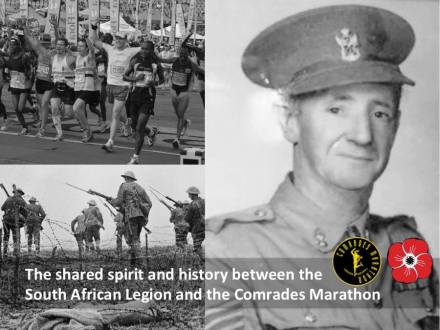
Did you know that “The Comrades Marathon” has a shared spirit and a shared history with The South African Legion of Military Veterans?

As the oldest military veterans organisation in South Africa, the South African Legion was formed at the 1921 Empire Conference (28 February to March 4) in Cape Town as the British Empire Services League (BESL, South Africa) by joining two organisations together – the “Returned Soldiers and Sailors Association” and the “Comrades of the Great War”, which co-incidentally is the organisation after which the term “Comrades” in Comrades Marathon is given.  In the course of history the “BESL South Africa” came to be called “The South African Legion of Military Veterans”.

bokclear3

In the same year – 1921 – Vic Clapham, a World War 1 veteran himself approached the “Comrades of the Great War” with a vision that would result in the worlds greatest ultra marathon nearly one hundred years later.

His idea was that if infantrymen, drafted into the armed forces from sedentary jobs, could endure forced marches over great distances, trained athletes could cover the distance between the two cities of Pietermaritzburg and Durban without great difficulty. Clapham, like the Legion, also wanted to remember those who had fallen in the war, and he felt the best way to honour this was by the ultimate testing of body and mind, and triumphing.

The Natal athletics body was not interested in the idea of a ultra marathon, and thought Clapham was quite mad, so undaunted by the set-back Clapham approached the British Empire Services League of South Africa (now known as the South African Legion), and asked permission to stage the race under their auspices. They ultimately agreed and financially underwrote the first race.

The first 1921 Comrades Marathon was run by Vic Clapham and included a field of 34  runners, of them Sixteen runners completed the 87, 9km (55 mile) downhill race from Pietermaritzburg to Durban. The race was won by Bill Rowan who finished in a time of 8:59:00 and his name is now given to the sub 9 hour medal in today’s race.

comradesmedals

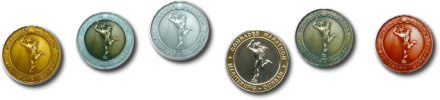
Left to Right “Modern” Comrades medals

A gold medal for the top 10 finishers
A Wally Hayward for a sub-6 hour time
A Silver for a sub-7:30 time
A Bill Rowan for sub-9
A Bronze for sub-11 and finally
A Vic Clapham for sub-12

SALegion_FinalLogoLayout_GreenPrintTextAlthough The Comrades Marathon is an independent commercial concern now, The South African Legion has continued its association to the Comrades Marathon over the  years and encourages all participants to wear a Remembrance Poppy in recognition of this history and the sacrifice of the fallen.  In this respect the Comrades Marathon is still in fact a “living memorial” to the Great War (World War 1).

Related Work and Links

Living War Memorial: Comrades Marathon A ‘Living’ War Memorial, The Comrades Marathon

Living War Memorial: Red Cross Children’s Hospital A war memorial in Cape Town which saves children’s lives

Comrades Marathon; Bill Payn Comrades legend, Springbok and war veteran – the remarkable Bill Payn


Written and Researched by Peter Dickens

The Inconvenient ‘Struggle Heroes’ of Freedom Day

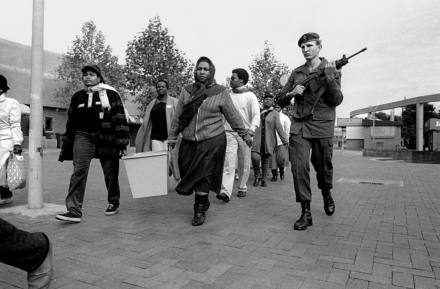
Here is an unusual ‘hero of the struggle for democracy in South Africa’.  This is a South African Defence Force (SADF) former ‘whites only’ National Service conscript turned ‘volunteer’ holding a R4 assault rifle as he safely escorts the ballot boxes to a counting station during South Africa’s landmark 1994 election.

He, like thousands of other old SADF white National Servicemen literally volunteered over the transition between 1990 and 1994 to bring democracy to all South Africans and make the elections a reality.  For good reason to, even on the election day itself bomb attacks where still going on and lives were still under threat. Yet now these military ‘heroes’ are conveniently forgotten or vanquished and rather inappropriately branded as “racists” by a brainwashed South African public that has lost perspective.

14196083_10154301049386480_5318023740986514293_o

This is their story and it needs to be told. 1990 was a significant year – Apartheid in all its legal forms was removed from the law books, the system that had generated ‘the struggle’ was dead. The African National Congress (ANC) was also officially unbanned in February 1990, unhindered to practice its politics. All that remained was a period of peaceful negotiation and reconciliation … the future looked bright.  But did that happen?

Unfortunately not, all hell broke out and the organisations that ultimately kept the peace were the statute armed forces of South Africa (SADF and SAP), who by default steered the country safely on the path to democracy in its final course up to and through the 1994 elections, and not the ‘struggle heroes’ of the ANC, who it can really be said to have stumbled at the last hurdle.

It’s a pity as without this stumble the ANC could truly claim the mantle of  the “liberators” who brought democracy to all South Africans but now, rather inconveniently for them, they have to share it with the SADF – and in addition to SADF professional soldiers a huge debt gratitude is owed by the country to the old white SADF National Servicemen – the ‘conscripts’.

The violence of the ‘Peace’ Negotiations 

In 1990, once unbanned the ANC immediately went into armed conflict with all the other South Africans who did not favourably agree with them – especially the Zulu ’s political representation at the time – the Inkata Freedom Party (IFP), but also other ‘Black’ liberation movements such as AZAPO (Azanian Peoples Organisation) and the old ‘homeland’ governments and their supporters.  Instead of taking up a role of actively peacekeeping to keep the country on the peace negotiation track, they nearly drew South Africa into full-blown war.

From 1990 to 1994 South Africa saw more violence than the entire preceding period of actual “Apartheid”. There was extensive violence and thousands of deaths in the run-up to the first non-racial elections in South Africa in April 1994 – and to be fair it was not just the ANC , the violence was driven by a number of political parties left and right of the political spectrum as they jostled for political power in the power vacuum created by CODESA negotiations.

To deal with this escalation of all out political violence, the SADF called out for an urgent boost in resources, however conscription was unravelling and numbers dropping off rapidly from the national service pool.  Luckily however, tens of thousands of ‘white’ ex National servicemen were now serving out ‘camp’ commitments in various Citizen Force units, SADF Regiments and in the Regional Commando structures who heeded the call and volunteered to stay on – fully dedicated to serving the country above all else, and fully committed to keep the country on the peace process track and stop the country sliding into civil war.

In an odd sense, if you really think about it, these white conscripts are the real ‘heroes’ that paved the way for peace. For four full years of political vacuum they literally risked their lives by getting into harms way between the various warring protagonists, left/right white/black – ANC, IFP, PAC and even the AWB – and it cannot be underestimated the degree to which they prevented an all out war from 1991 to 1994 whilst keeping the peace negotiations on track to a fully democratic settlement.

That South Africa enjoys the fruits of the CODESA democratic process, without plunging itself into civil war whilst democracy was negotiated is very much directly attributed to the men and women in the SADF.

The white supremacist uprising

In 1991, the armed insurrection in South Africa became more complex when far right-wing ‘white supremacist’ break-away groups such as the Afrikaner Weerstandsbeweging (AWB) began to increasing turn to armed violence to further their cause. South Africa’s Defence Force and Police structures and personnel now also had to deal with this added, rather violent, dynamic to an already feuding and violent ethnic and political landscape.

‘White’ loyalties where quickly cleared up between white right wingers and white members of the statute forces when the issue came to a head at ‘The battle of Ventersdorp’ on 9 August 1991.  The statute force maintained the upper hand and in all, 3 AWB members and 1 passer-by were killed. 6 policemen, 13 AWB members and 29 civilians were injured in the clash.

In addition to Pretoria and surrounds, this right wing ‘revolution’ also focused  on Bophuthatswana in 1994,  The AWB attempted an armed Coup d’état (takeover by force of arms) after Bophuthatswana homeland’s President Mangope was overthrown by a popular revolt.  In addition to the SADF, this uprising was also foiled by what remained of the statute forces of Bophuthatswana, and was to cumulate in the infamous shooting of 3 surrendered AWB members in front of the world’s media by a policeman.

Luckily not part of this particular controversy, the SADF ‘national service’ soldiers were deployed into the region to quell the uprising and arrested looters in the chaos of the revolt stabilising the situation – as the below famous image taken in Mmabatho by Greg Marinovich shows.

The net result of all this is recorded as a “SADF victory, removal and abolition of Lucas Mangope’s regime, disestablishment of Bantustan”.  In all, Volksfront: 1 killed, AWB: 4 killed, 3 wounded and Bophuthatswana’s mutineers suffered 50 dead, 285 wounded.

The war between the ANC and IFP

To get an idea of this low-level war between the ANC and IFP for political control in Kwa-Zulu Natal alone, The Human Rights Committee (HRC) estimated that, between July 1990 and June 1993, an average of 101 people died per month in politically related incidents – a total of 3 653 deaths. In the period July 1993 to April 1994, conflict steadily intensified, so that by election month it was 2.5 times its previous levels.

Here SADF soldiers conduct a search through bush veld in KwaZulu Natal 1994 and keep a close eye on protesters with ‘traditional weapons’  – Section A KwaMashu Hostel, an Inkatha stronghold.

Moreover, political violence in this period extended to the PWV (Pretoria– Witwatersrand-Vereeniging) region in the Transvaal. The HRC estimated that between July 1990 and June 1993, some 4 756 people were killed in politically related violence in the PWV area. In the period immediately following the announcement of an election date, the death toll in the PWV region rose to four times its previous levels.

Here are SADF National Service soldiers on patrol in Soweto, South Africa, 1991/2 and keeping the peace in Bekkersdal in 1994.

Much of this climaxed into famous incident when the IFP chose to march in Johannesburg brandishing ‘traditional weapons’ in 1994.  Outside the African National Congress (ANC) headquarters at ‘Shell House’  a shootout in downtown Johannesburg between the ANC and IFP supporters erupted.

Here in a famous photo taken by Greg Marinovich is a member of the Inkatha Freedom Party (IFP) who lies dead, his shoes are taken off for the journey to the next life. These three SADF soldiers have come forward into the line of fire – strait between the two warring factions and are keeping the ANC gunmen at Shell House at bay preventing further loss of life, the another image shows a SADF medic coming to the assistance of a wounded IFP member at Shell House – the degree of the life changing injury of a bullet shattering his leg quite graphically evident.

Another good example is also seen here at Bekkersdal township, Transvaal, South Africa 1994. AZAPO supporters fire at ANC supporters in armed clashes between these two groups of the ‘liberation struggle’.  The SADF again suppressed the clash, the next image shows heavy armed SADF National Servicemen in support by driving into the middle of the fray and keeping the belligerents apart – in effect saving lives.

Bigger clashes took place in KaZulu Natal – an example is seen here at KwaMashu in 1994. ANC militants with a home-made gun or ‘kwash’ do battle with Inkatha Freedom party supporters across the valley at Richmond Farm.  Again SADF personnel were moved in to separate the protagonists, here 61 Mech National Servicemen in a SADF “Ratel” IFV patrol Section A, KwaMashu Hostel, an Inkatha stronghold.

In an even stranger twist, a blame game ensured with the ANC not blaming itself and instead accusing a ‘third force’ of guiding the violence and laid the blame on FW de Klerk.  Funnily no evidence of a ‘third force’ has ever been found and the TRC hearings rejected the idea after a long investigation.

The 1994 Election ‘Call-Up’

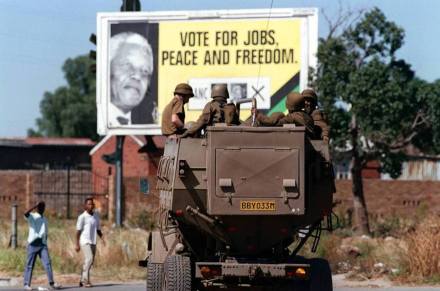
In the lead-up to the elections in April 1994, on 24 August 1993 Minister of Defence Kobie Coetsee announced the end of ‘whites only’ conscription. In 1994 there would be no more call-ups for the one-year initial training. Although conscription was suspended it was not entirely abandoned, as the SADF Citizen Force and SADF Commando ‘camps’ system for fully trained conscripts remained place. Due to priorities facing the country, especially in stabilising the country ahead of the 1994 General Elections and the Peace Progress negotiations, the SADF still needed more strength to guard election booths and secure key installations.

10333503_10152318503441480_4004036503611530562_o

So in 1994, the SADF called-up even more ‘white’ SADF Civilian force members, SADF Commando and SADF National Reservists to serve again, and despite the unravelling of conscription laws the response was highly positive with thousands of more national servicemen ‘voluntarily’ returning to service in order to safeguard the country into it’s new epoch.

National Reserve members were mustered at Group 18 outside Soweto in January 1994, some even arriving without uniform.  As part of this mustering I even have the personal experience of asking one of them what happened to his equipment and uniform to which the reply was “burnt it after my camps, but for this I am prepared to serve my country again.”  This comment says a lot as to devotion and commitment of someone making a difference at a turning point of history.

‘Camp’ call-ups and the call-up of ex-conscript SADF members on the National Reserve reached record proportions over the period of the April 1994 elections, and for the first time in history, in a strange twist of fate, the End Conscription Campaign( ECC) called these conscripts to consider these “election call-ups” to be different from previous call-ups and attend to their military duties.

It is highly ironic that even the ECC could see the necessity of security to deliver South Africa to democracy in this period – it was not going to come from the ‘liberation’ movements or any ‘cadres’ as they were part of the problem perpetuating the violent cycle in the power vacuum – it had to come from these SADF conscripts and statutory force members committed to their primary role of serving the country (and not a political ideology or party).

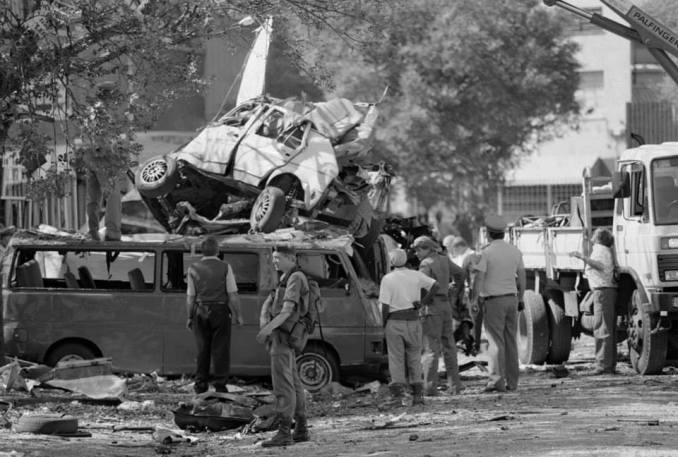
The threats on election day where very real – here South African Defence Force personnel cordon off a bomb blast area and South African police personnel inspect the bombing near the air terminals at Jan Smuts International Airport (now OR Tambo International).  This was the final Afrikaner Weerstandsbeweging (AWB) cell attack on April 27, 1994 in response to the landmark election day held the same day.

1012019_188775031292237_1060298211_n

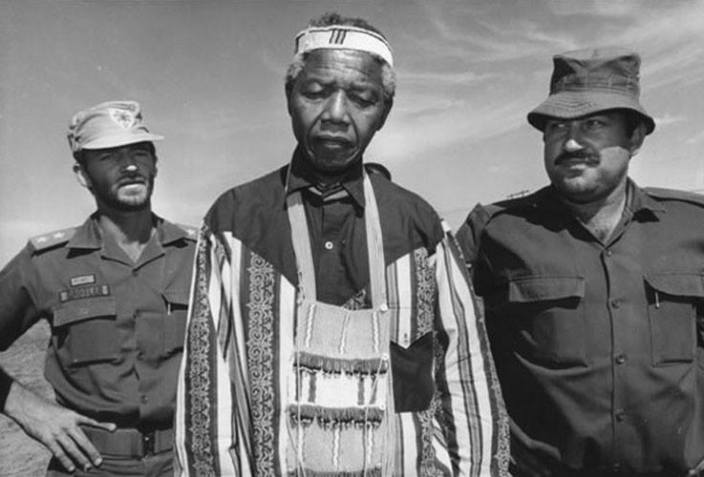
While campaigning for the Presidency, even Nelson Mandela, seen here in traditional dress, made sure to stop and thank citizen force members of the SADF for their support and duty during South Africa’s first fully democratic election in 1994.

These ordinary South African servicemen showed what they are really made of by putting themselves in harm’s way to bring about the democracy that South Africans share today – they where literally the unsung heroes, and all respect to Nelson Mandela, he knew that and took  time in his campaigning to recognise it – these men did not ask for much in return and this small recognition would have been enough.

1424299_233794253456981_124886967_n

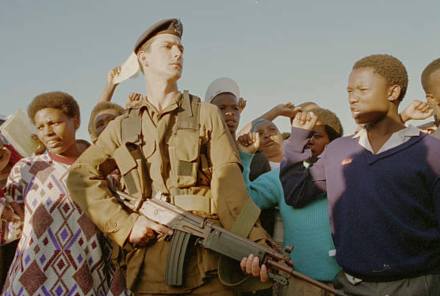
Here a SADF member keeps a guarding and secure eye whilst fellow South Africans are queuing to vote in the historic first democratic election on April 27, 1994. This election poll was in Lindelani, Kwa Zulu Natal. Nelson Mandela voted here at 6am and his car passed by as these youngsters sang to honour him.

31047127_2129630577265929_8718812037483055217_o

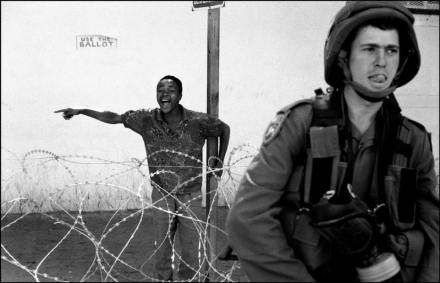
Another image shows a SADF National Serviceman guarding the election booths in Johannesburg, whilst a newly enfranchised South African eagerly points the way to the voting polls.

1002208_205501559619584_386269910_n

It was not just National Servicemen, all the uniformed men and women of the SADF and the SAP, of all ethnic groups in South Africa, paved the way for real peace when the country really stood at the edge and about to fall into the abyss of violence and destruction from 1990 to 1994.

This is an inconvenient truth – something kept away from the contemporary narrative of South Africa’s ‘Liberation’ and ‘Struggle’ – as it does not play to the current ANC political narrative. These men and women are now openly branded by lessor Politicians in sweeping statements as “Apartheid Forces” – demonised and vanquished – whereas, in reality nothing can be further from the truth. South Africans today – whether they realise it or not, owe these SADF Professionals and especially the former ‘whites only’ national service conscripts a deep debt of gratitude for their current democracy, civil rights and freedom.

In conclusion

If you had to summarise the military involvement in the transition period, it was the SADF – not the ‘Liberation’ armies of the ANC and PAC, who brought down civil revolts in all the ex-‘Bantustans’, it was the SADF that suppressed an armed right-wing revolutionary takeover in South Africa , it was the SADF that put itself into harms way between all the warring political parties in the townships all over the country and literally saved thousands of lives for 4 long years and it was the SADF who stood guard and secured the 1994 election itself – in this sense it was the SADF (and especially the ‘ex’ white conscripts) who practically delivered the instrument of full democracy and freedom safely to all the citizens of South Africans so they could in fact vote in the first place (without fear of being blown up or shot to pieces in the voting booths) – and that’s a fact and there’s no changing it.

The SADF veterans by far make up the majority of South Africa’s military veteran community, they also fought for liberation and peace, and as they say whenever current South African politicians idealise the MK veterans and demonise the old pre 94 SADF veterans all I can say is – “please don’t let the facts get in the way of a good story” and the inconvenient fact is the ‘old’ SADF delivered the ‘Instrument’ of democracy, not MK.

Related Work and Links

Real Heroes; Tainted “Military Heroes” vs. Real Military Heroes

Conscription; Conscription in the SADF and the ‘End Conscription Campaign’


Article researched and written by Peter Dickens.

Photo copyrights to Greg Marinovich and Ian Berry.  Feature image photograph copyright Paul Weinberg

A little cheeky military humour

A little bit of “cheeky” military humour to see out the old year – please excuse the brashness but this is typical of military humour.

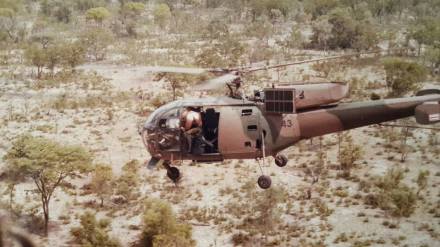
Here a South African Air Force Alouette III helicopter’s Flight Engineer/Gunner gives a typical response to fellow crew members flying alongside.

Not found in the Public Relations photographs in the SADF at the time. However in the light of combatants fighting  far away from home, and in need of some light banter to alleviate the seriousness of combat on the Angolan border, who can blame them  … “boys will be boys”.

Photo courtesy of the SAAF Alouette crew veterans fraternity.

German Fighter Ace befriends a Black South African POW & defies the Nazi status quo!

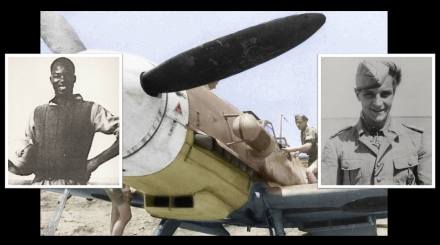
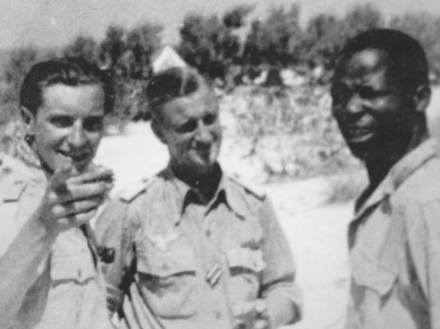
This is an extraordinary featured photograph for a variety of reasons. This is Hauptmann (Captain) Hans-Joachim Marseille, the German WW2 Fighter Ace known to the Axis Forces as “The Star of Africa” on the extreme left and Corporal Mathew ‘Mathias’ Letulu, a South African Prisoner of War who was pressed into becoming his ‘batman’ (personal assistant to an officer) in 1942 but eventually became his close and personal friend, is seen on the extreme right of the photograph.
31944142_10156143712001480_6772314735959343104_n

It’s quite intriguing that Hans-Joachim Marseille had a South African assistant on the one hand when on the other hand he was the most feared of the German Pilots in the North African campaign, arguably one of the best combat pilots the world has ever seen,  he clocked up quite a number of South African Air Force “kills” in his enormous tally of destroying well over 100 Allied aircraft – consisting mainly of aircraft from the Royal Air Force (RAF), the Royal Australian Air Force (RAAF) and the South African Air Force (SAAF).

It’s equally a measure of Hans-Joachim Marseille as a man in that he directly baulked against the Nazi policies of racial segregation and openly befriended a Black man, especially amazing considering his role as a senior commissioned officer in the German Air Force (Luftwaffe) and hero of the Reich.

Over time, Marseille and “Mathias” Letulu became inseparable. Marseille was concerned how Letulu would be treated by other units of the Wehrmacht and once remarked

“Where I go, Mathias goes.”

Marseille secured promises from his senior commander, Neumann, that if anything should happen to him (Marseille) Cpl “Mathias” Letulu  was to be kept with the unit. Unusual behaviour for a German officer in the Third Reich, but Marsaille was no card carrying member of the Nazi party, in fact he despised them.

No ardent Nazi

In terms of personality Hans-Joachim Marseille was the opposite of highly disciplined German officer, he was “the funny guy” and almost kicked out of Luftwaffe several times for his antics. The only reason he wasn’t was because his father was a high ranking WW I veteran and an army officer and Hans-Joachim Marseille tested how far this protection would go.

If you look “misbehaving scoundrel” in dictionary there should be an image of Hans’ smirking face next to it. On one occasion he actually strafed the ground in front of his superior officer’s tent. He could have been court marshalled for that alone, but by  then he was starting to demonstrate his superior pilot skills as an upcoming Fighter Ace.

He hated Nazis and he despised authority in general and always had strained relations with his authoritarian father who was the model of a strict Prussian officer. Hans was truly the opposite of his father.

His American biographers Colin Heaton and Anne-Marie Lewis recall in ‘The Star of Africa’ that he once landed on the autobahn simply to relieve himself. Tired of his undisciplined behaviour, a superior officer had him transferred to North Africa in 1941. Here he thrived, his dazzling record earned him the Knight’s Cross with Oak Leaves, Swords, and Diamonds, and acclaim at home. But the record suggests he was no ardent Nazi.

He listened to banned Jazz music openly, drank a lot and sometimes showed up to service smelling of booze and in hangover, he was a known womanizer, going against Nazi ideology in every possible manner – and getting away with it.

An incident happened which really shows the metal and attitude of the man. It occurred when Hans-Joachim Marseille was summoned to Berlin as Hitler wanted to present him with decorations.  As a gifted pianist Marseille was invited to play a piece at the home of Willy Messerschmitt, an industrialist and the designer of the Messerschmitt Bf 109 fighter Marseille had achieved so much success in.

Guests at the party included Adolf Hitler, party chairman Martin Borman, Hitler’s deputy and Commander-in-Chief of the Luftwaffe, Hermann Göring, head of the SS, Heinrich Himmler and Reich Minister of Propaganda Joseph Goebbels. After impressing them with a display of piano play for over an hour, including Ludwig van Beethoven’s Für Elise, Marseille proceeded to play American Jazz, which was considered degenerate in Nazi ideology. Hitler stood, raised his hand, and said “I think we’ve heard enough” and left the room.

Magda Goebbels found the prank amusing and Artur Axmann recalled how his “blood froze” when he heard this “Ragtime” music being played in front of the Führer.

But a more telling incident of his attitude to Nazism was to come. On one occasion when he was summoned to Germany, he noted that Jewish people had been removed from his neighbourhood (including his Jewish family Doctor who delivered him) and grilled his fellow officers as to what happened to them – what he then heard were the plans for the Final Solution – the extermination of the Jews of Europe. This shocked him to the core and he actually went AWOL (Absent without Leave), he became a de facto deserter and went to Italy were he went into hiding ‘underground’.

The Nazi German Gestapo (Secret Police) however managed to track him down and forced him to return to his unit where other pilots noticed that he appeared severely depressed, concerned and wasn’t anything like his normal happy self that they were used to.

Friendship with Corporal Mathew Letulu

Marseille’s friendship with his ‘batman’ (personal helper) is also used to show his anti-Nazi character. In 1942 Marseille befriended a South African Army prisoner of war, Corporal Mathew Letulu. Marseille took him as a personal helper rather than allow him to be sent to a prisoner of war camp in Europe.

“Mathias” was the nickname given Corporal Mathew Letulu by his captors. Cpl Letulu was part of the South African Native Military Corps and was taken as a Prisoner of War (POW) by the Germans on the morning of 21 June 1942 when Tobruk and the defending South Africans under General Klopper were overrun by Field Marshal Erwin Rommel.

‘Black’ POW where treated differently to White ‘POW’ by Nazi Germany, instead of mere confinement under the conventions, Black POW were but to unpaid ‘labour’ assisting the Nazi cause, resistance to which was a grim outcome.  Letulu was put to work by the Germans – initially as a driver. The vehicle belonged to 3 Squadron of Jagdgeschwader – or Fighter Wing – 27 (JG 27) based at Gazala, 80km west of Tobruk. Here, Letulu came to the attention of the reckless and romantic Hans-Joachim Marseille.

By this time Letulu had advanced a little in his lot to a helper in 3 Squadrons club casino, where he took a particular liking to Marseille.  In need of personal assistants for officers (known in the military as a “batman”) some POW’s where snapped up by German Officers, Hans-Joachim Marseille was no different and Cpl Letulu was taken on initially as his batman, but very quickly became a close friend.

Marseille knew that as his kill score grew, the chance of him being pulled from the front lines increased every day, and if he was to be taken away, Cpl “Mathias” Letulu, who because he was a black man, might be in danger given the Nazi racial philosophy. With utmost seriousness, he had his fellow pilot Ludwig Franzisket promise to become Mathias’ protector should Marseille lose the capability to be in that role.

Corporal Letulu also knew that by sticking with Marseille he stood a better chance of surviving the war and eventually escaping, and because they viewed each other in an extremely positive light, Letulu made Marseille’s life in the combat zone as comfortable as possible.

The following on their unique bond comes from “German Fighter Ace – Hans-Joachim Marseille, The life story of the Star of Africa” by Franz Kurowksi.

“Through few odd twists of fate Hans had Mathew assigned to his personal assistant but he treated him in every way like a friend, having long talks with him and possibly even sharing alcohol and listening to music together, just hanging out like a couple of friends who happened to be in a war and on different sides.

Besides Mathew, Hans would often see other captured Allied pilots and talk to them in English and socialise. Hans would also violate a direct order not to notify the enemy of the fate of their pilots – he would take off solo with a parachute note explaining the names of the captured pilots and that they were alive and well.  As he flew over enemy airfields to drop these notes he would be attacked by AA fire, so he was risking his life to let the families of his enemy pilots know that the pilots were alive and well – or dead, removing their MIA (Missing in Action) status.  According to various sources he was like that. Person who believed in chivalry who’s country was taken over by Nazis.

Eventually Hans would become even protective of Mathew especially against the Nazis”

The “Star of Africa”

Hans-Joachim Marseille’s record of 151 kills in North Africa where nothing short of staggering – he destroyed Allied (RAF, SAAF and RAAF) squadrons shooting down One Hundred and One (101) Curtiss P-40 Tomahawk/Kittyhawk fighters, 30 Hawker Hurricane fighters, 16 Supermarine Spitfire fighters, Two Martin A-30 Baltimore bombers, One Bristol Blenheim bomber; and One Martin Maryland bomber.
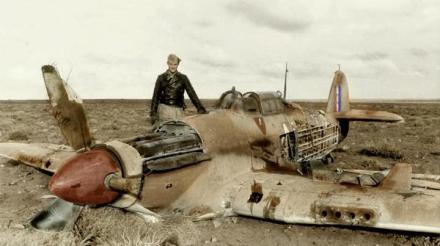
color Hans-Joachim Marseille with Hawker Hurricane MkIIB of 274. Squadron RAF, North Afrika - 30.3.42 (coloured)

Hans-Joachim Marseille with Hawker Hurricane MkIIB of 274. Squadron RAF, North Afrika – 30 March 1942 (coloured)

As a fighter pilot Marseille always strove to improve his abilities. He worked to strengthen his legs and abdominal muscles, to help him tolerate the extreme ‘G forces’ of air combat. Marseille also drank an abnormal amount of milk and shunned sunglasses, to improve his eyesight.

To counter German fighter attacks, the Allied pilots flew “Lufbery circles” (in which each aircraft’s tail was covered by the friendly aircraft behind). The tactic was effective and dangerous as a pilot attacking this formation could find himself constantly in the sights of the opposing pilots. Marseille often dived at high-speed into the middle of these defensive formations from either above or below, executing a tight turn and firing a two-second deflection shot to destroy an enemy aircraft.

Marseille attacked under conditions many considered unfavourable, but his marksmanship allowed him to make an approach fast enough to escape the return fire of the two aircraft flying on either flank of the target. Marseille’s excellent eyesight made it possible for him to spot the opponent before he was spotted, allowing him to take the appropriate action and manoeuvre into position for an attack.

In combat, Marseille’s unorthodox methods led him to operate in a small leader/wingman unit, which he believed to be the safest and most effective way of fighting in the high-visibility conditions of the North African skies. Marseille “worked” alone in combat keeping his wingman at a safe distance so he would not collide or fire on him in error.

In a dogfight, particularly when attacking Allied aircraft in a Lufbery circle, Marseille would often favour dramatically reducing the throttle and even lowering the flaps to reduce speed and shorten his turn radius, rather than the standard procedure of using full throttle throughout. Emil Clade said that none of the other pilots could do this effectively, preferring instead to dive on single opponents at speed so as to escape if anything went wrong.

Marseille’s  South African associations went beyond his bond with Cpl “Mathias” Letulu and was far more lethal in respect to South African pilots.  In the weeks before the two met, Marseille is credited with shooting down three SA Air Force pilots west of Bir-el Harmat on May 31, including Bishops’ old boy Major Andrew Duncan (who was killed), and three days later, another six South African Air Force “kills” in just 11 minutes, three of whom were high-scoring aces. One of them, Robin Pare, was killed in the combat.

Death of Hauptmann Hans-Joachim Marseille

On 30 Sep 1942, Marseille’s brilliant total record of 158 career-kills came to an end (151 of them with JG 27 in North Africa).

After the engine of his Bf 109G fighter developed serious trouble, he bailed out of the aircraft close to friendly territory under the watchful eyes of his squadron mates. To their horror, Marseille’s fighter unexpectedly fell at a steep angle as he bailed out, the vertical stabilizer striking him across the chest and hip. He was either killed instantly or was knocked unconscious; in either case, his parachute did not deploy, and he struck the ground about 7 kilometers south of Sidi Abdel Rahman, Egypt.
3a6ef2df55c9625ceb0ce191332402c5

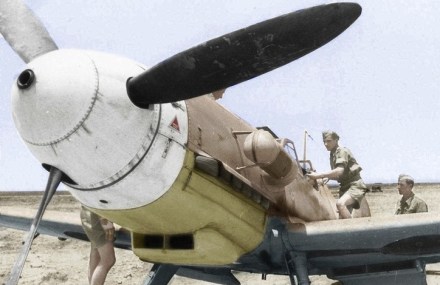
Messerschmitt Bf 109F-4 , Hans Joachim Marseille, colorised picture.

His friend and fellow JG 27 pilot and Knights Cross recipient Hauptmann Ludwig Franzisket along with the squadron surgeon Dr. Winkelmann, were the first two to arrive on the scene, bringing Marseille’s remains back to the base.

Mathias was the first to greet them, and the following is accounted from a memoir by Wilhelm Ratuszynski.

Although the heat didn’t encourage any activity, something told Mathias to wash Hans’ clothes. Hans liked to change into a fresh uniform after the flight. He always liked to look presentable. Mathias opted to use gasoline this time. They wash would dry in just few minutes.

Usually, this was done by scrubbing uniforms with sand to rid it of salt, oil and grime. Everything was in short supply. Being a personal batman for Hans-Joachim Marseille, the most famous Luftwaffe pilot, had its advantages. For instance he was given a little of aircraft fuel for washing. Mathias liked being Jochens servant and he liked Jochen himself.

They were friends. Mathias had barely started his chore, when the sound of approaching aircraft signaled to ground personnel to change torpidness for activness. Mathias put the lid on the soaking uniforms and started to walk towards the landing aircraft. He was looking for familiar plane which supposed to have number 14 painted in visible yellow on fuselage. It was supposed to land last. He noticed that three planes were missing, and last one to touch down had different number on it.

Unalarmed, he turned toward Rudi who had already jumped on the ground from wing of his 109. He saw Mathias coming and cut short his conversation with his mechanic. His face was somber when he looked at Mathias and slowly shook his head. And Mathias understood immediately. He kept looking straight into Rudi’s face for few more seconds, slowly turned and walked away. He noticed a strange sensation. No anger, sorrow, grief, nor resignation. He was calm yet something gripped his throat. Muscles on his neck tightened and he found it hard to swallow. He walked for few minutes without noticing others who were staring at him. He came to Jochen’s colorful Volks (volkswagen car) called “Otto” and sat behind steering wheel. For a moment he looked like he wanted to go somewhere, but climbed out and approached the soaking uniforms.

He looked at the canvas bag with initial H-J.M laying right beside it. He reached into his breast pocket for matches. Slowly but without any hesitation he struck a match and threw it on the laundry. Flames that burst out added to the already scourging heat. At that moment last rotte was flying in. Mathias intuitively lifted his head, following them. The lump in his throat got bigger.

While the entire squadron was devastated at the loss of such a great fighter ace, Mathias, despite having known Marseille only for a short time, was deeply depressed at the loss of a dear friend.

Marseille was initially buried in a German military cemetery in Derna, Libya during a ceremony which was attended by leaders such as Albert Kesselring and Eduard Neumann. He was later re-interned at Tobruk, Libya.

 Ludwig Franzisket

After Marseille’s death,  as promised to his friend, Hauptmann Ludwig Franzisket took Cpl Letulu in, and in turn he became his personal servant. Cpl Letulu remained with the Squadron even after Franzisket was forced to bail out whereby he too struck the vertical stabilizer, shattering a leg in the process. After been nursed to health, Franzisket returned to his Squadron and Cpl Letulu continued serving him in Tunisia, Sicily, and finally Greece.

By the summer of 1944 the situation there had grown critical with a British invasion of the Greek continent imminent. The chance had come to “smuggle” Cpl. “Mathias” Letulu into one of the hastily established POW camps, where he could then be “liberated” by the British. Franzisket planned this coup together with Hauptmann Buchholz. “Mathias “became “Mathew” again and was a corporal in the South African Division. Everything went off without a hitch. He was set free by British troops in September of 1944 and allowed to return home at the end of hostilities.

Reunion 

By coincidence, after the war, former members of JG 27 learned that Cpl “Mathias” Letulu was still alive. They immediately sent him an invitation, paid for the journey and other expenses, and finally, at the tenth reunion of the Deutsches Afrikakorps in the fall of 1984, they were once again reunited with their old South African friend.

The former pilots were elated to see him and invitations rained from all around. The following words, spoken in German as a tribute to Hans-Joachim Marseille by “Mathias” Letulu at the happy conclusion of his odyssey, and it gives some insight into the bond which had united Letulu with his German friend:

“Hauptmann Marseille was a great man and a person always willing to lend a helping hand. He was always full of humor and friendly. And he was very good to me.

In 1989, a new grave marker and a new plaque was placed at his grave site; Marseille’s surviving Luftwaffe comrades attended the event, including his Allied friend – Mathew “Mathias” Letulu who flew out specifically from South Africa to attend the ceremony.

Related work and links:

Rommel’s aide-de-camp;  Rommel’s aide-de-camp was a South African

Jack Frost, The South African Air Force’s highest scoring Ace – Jack Frost


Researched by Peter Dickens

Skin colour is irrelevant in a foxhole!

The culture of owing a debt of gratitude to South Africa’s military veterans is sorely lacking – for all of them, then and now.  But especially to these very forgotten South African “Black, Indian and Coloured” WW1 and WW2 heroes of which the current generation really does have little or no understanding.  It’s truly a tale of the suppression of history and the fight for recognition.

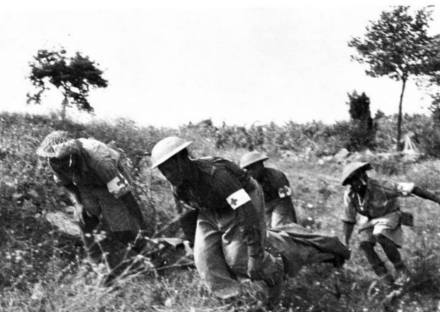
The featured image is a very rare photograph of South African medics in combat in WW2 during the Italian Campaign, dramatically caught running stooped under intense fire to stretcher bear a wounded man out of the combat zone. What is even more interesting is the make-up of these South African 6th Armoured Division medics. Here we have men from the South African Cape Corps, the South African Native Military Corps and the South African Indian Service Corps all involved in this casualty evacuation.

The politics of the day had an odd philosophy underpinning it. During the Second War the South African Union Defence Force still differentiated and segregated Corps according to race. However such was the odd politics of the time that men drawn from the Cape Coloured and Indian communities into their respective corps could function in combatant roles and carry firearms – as well as non combatant roles – such as a medic. However Black men drawn into the Native Military Corps (NMC) could not function in a combatant role and where not allowed to carry firearms – although they could carry a spear when on guard duty. They could however step into harms way in combat and put their lives on the line, as is seen here doing stretcher bearing as a medic.

All this politically driven segregation mattered not a jot when the bullets started flying around. This picture stands in stark testimony to this.

The separation of these men became quite irrelevant when serving in combat areas and in many instances combat units quite quickly also “unofficially” issued firearms to their NMC members

As is often the case in combat, and many veterans will attest to this, the man who joins you in the fight is your brother – irrespective of the colour of his skin – there is no such thing as racial segregation in a foxhole.

There is certainly no such thing as segregation when it comes to your fellow countrymen from across the racial spectrum risking their lives to save one of their own countrymen in a full blown firefight – as is so demonstrably shown here. These are all South African heroes – it’s that simple.

During the Second World War Black, Coloured and Indian South African community and political leaders, agreed to support the South African Union government’s declaration of war against Nazi Germany and send members of their community into the fight. The hope was that it would buy them more political currency and leverage at the negotiation table after the war for extended rights and political representation. Initially it looked like this would pay off as Jan Smuts and his United Party proposed giving qualified franchise votes to Black citizens whose service in the military was also deemed as such a qualification.

Unfortunately this very progressive way of thinking did not sit well with the National Party and their supporters and they used it as a Political “race” card in their campaigning in the 1948 elections. So much s that they rather unexpectedly and very narrowly won the elections and ousted Jan Smuts and the United Party.

The true tragedy was yet to come.  Not only was all this sacrifice and valour in vain – the National Party went to great lengths to further marginalise these soldiers – denying them medical aid, reduced pensions and excluding them as veterans from Remembrance and Military Parades, as well as denying them access to veterans facilities and organisations.

It was not unusual to find a small grouping of Native Military Corps veterans sitting under a tree away from the national parade with their medals proudly flickering in the sunlight, telling their war stories to anyone prepared to take the time to listen to them.  Excluded, forgotten and vanquished as traitors for serving “Britain” by the reigning Nationalists.

The political philosophy of the time substantially down-played the contribution of “non white” servicemen lest heroes be made of them. History in South Africa would record both the First and Second World War’s as a white man’s one – when nothing can be further from the truth.

It’s an often ignored fact and statistic – one which most certainly the National government after 1948 did not want widely published – which was that 40% of the standing South African servicemen in WW2 where persons of “colour”. In all more than 146,000 whites, 83,000 blacks, and 2,500 people of mixed race served in the standing forces of the Union of South Africa at this time.

This forgotten and “lost” valour is something South Africa’s oldest and most prestigious veterans organisation – The South African Legion of Military Veterans, has been fighting for from day one; at times the Legion went to serious loggerheads with the government of the day over pensions and representation for these men. The South African Legion eventually won the fight on pensions by the late 1980’s, when equal pensions where finally awarded these men.

We as South Africans need to work to address the historic void created by political posturing at the detriment of the country’s forgotten WW1 and WW2 heroes. This is why the recognition of the sinking of the Mendi and other commemorations becomes so important – it’s our duty as South African veterans to uphold honour where honour is well due. Not only to these men, but to anyone who has served in South Africa’s defence forces.

Image – SANDF Archive, Researched by Peter Dickens

SADF Propaganda and Psychological Warfare

No frills Propaganda

Propaganda was a means of Psychological Warfare was employed by all sides in the SWA/Angolan ‘Bush War’ Conflict – blunt and strait-forward in communication and tone so the message was clear.

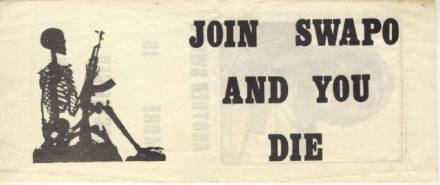
Usually symbols of death (or images of death) accompanied this type of printed propaganda and they served to underpin the threat and drive fear – this is an example of a SADF leaflet distributed to warn the local population in South West Africa/Namibia and neighbouring states not to join SWAPO (the South West African People’s Organisation) against whose armed wing – PLAN the SADF and SWATF forces were in combat with.

The message is crude and strait forward, the image used is easily assimilated and understood, it’s a “brutal” communication designed to get the point across to the lowest common denominator, no need for frills, pretty fonts and logos.

Propaganda is a “weapon”

Please note, this is of historic importance as to the propaganda used in the Bush War. It is not intended to glorify either the SADF or SWAPO – the intention is to capture and keep alive a little of South Africa’s military history so often forgotten.

Propaganda by its very nature preys on emotions – its intension and its goal is an emotive response – in military terms it’s classified as a weapon, as that response can influence the fight, either by spurring it on motivating the combatants or by stopping it and demotivating the combatants.  In many ways Propaganda can influence the outcome of a battle or war as much, if not more that the actual use of bullets.  Believe it or not – all this power – and it can simply be boiled down to a crude message like the one shown here.

When reviewing propaganda from a historical perspective (or even military perspective) it must be dealt with objectively without emotion. If it triggers an emotional response then it has simply done it job and wins, that’s how this particular weapon works…

South Africa at war against … the French!

Many people don’t know it, but South Africans also fought against the French in World War 2.

A key part of the East African and Asian campaigns in WW2 was the Allied occupation of the former French colony of Madagascar and South African units took part in the operation.

The purpose was to prevent the strategically important island from being used by Axis Pact powers – Japan, Germany and Italy primarily .

Problem was, at the onset of the war many French colonies and troops did not join the ‘Free French’ and remained loyal to the French government who where now under occupation and in control of the Germans. This newly defined French Vichy government was sympathetic to the fascist cause and signed on with the Axis pact – in effect they changed sides and fought on the side of Germany.  Madagascar was just such a French colony.

The Allies had heard the rumours of Japanese plans for the Indian Ocean and on 27 November 1941, the British Chiefs of Staff discussed the possibility that the French Vichy government might cede the whole of Madagascar to Japan, or alternatively permit the Japanese navy to establish bases on the island. British naval advisors urged the occupation of the island as a precautionary measure.

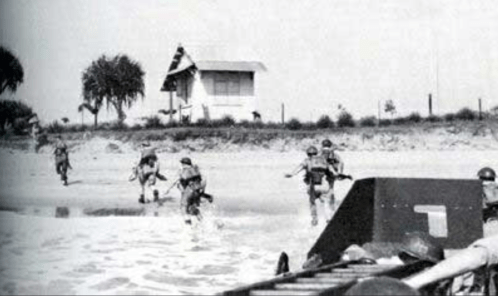
The Battle of Madagascar  began with Operation Ironclad, the seizure of the port of Diego Suarez from the French near the northern tip of the island, on 5 May 1942 by British and Commonwealth forces.  A subsequent campaign to secure the entire island, “Operation Streamline Jane”.  Ground operations where supported by the 7th South African Motorized Brigade which arrived on 24 June 1942 and the South African Air Force which had been involved at the onset in reconnaissance roles.

After capturing Majunga, Tamatave and other key towns and points, British and Commonwealth troops took the capital, Altananarivo and pursued French Vichy troops defending Madagascar deep into the heart of the island. Fighting ceased and an armistice was granted on 6 November 1942.

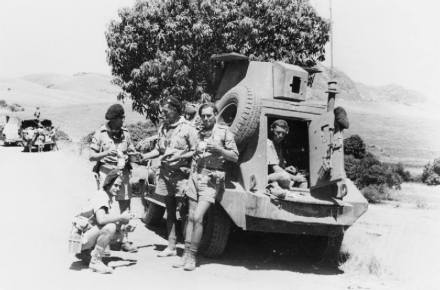
Feature picture shows: A South African armoured car crew snatching a quick meal during their rapid drive on Tananarive during the Battle of Madagascar – while radio contact is kept up all the time.  Note the armoured car is a South African manufactured Marmon-Herrington Armoured Car.

screen-shot-2016-09-23-at-11-07-35

Insert Image: British amphibious craft landings on Madagascar

mad

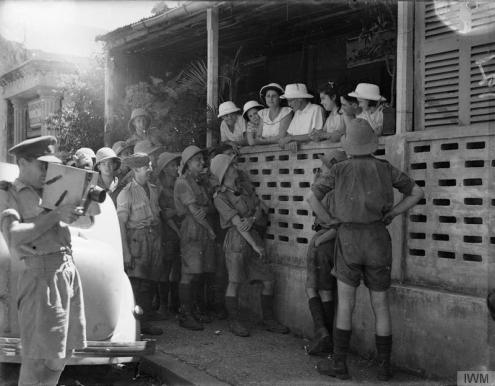
British troops talking to French inhabitants of Madagascar after the surrender.

Image copyright IWM Collection, source Wikipedia

The silent terror of the Angolan Border War

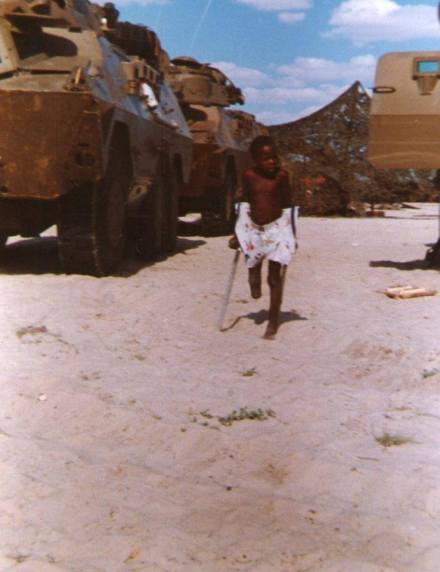
Forgotten to many as to why the Bush War was so closely felt to the South Africans conscripted to fight it, this image illustrates what many conscripts and volunteers felt they where there to do – protect innocent civilians from the ravages of the Angolan war and armed insurgency into South West Africa/Namibia.

A trademark of both the Angolan War and the Bush War was the silent terror of mines, the worst of which is the Anti Personnel Mine (APM). This type of mine is cheap to make can be easily concealed and extensively mined – it has a small charge designed to maim its victim, not kill, simply by blowing off a foot or leg – its design in essense is to demoralise and strike fear into every step.

This picture was taken by a medic whilst they where based temporarily next to the range at 101 Battalion’s Head Quarters in Oshakati during tte ‘9 Day War’ in April 89. This local Namibian child was moving amongst the Ratel Infantry Fighting Vehicles looking for food and entertainment. He remained under the wing of the medics for a couple of days.

Realistically summarised by BJ Taylor who took the photo in light of the frequent sight of such carnage of war on the civilian population as an ‘AP Mine victim, one of many … ‘

Image copyright and courtesy of BJ Taylor.

End of Soviet Communism signals the end of the Angolan Bush War

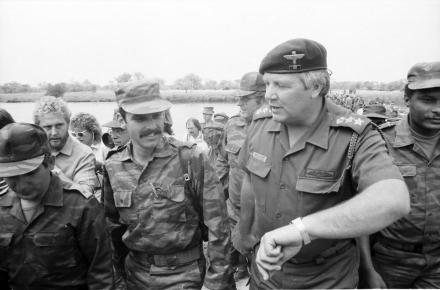
Colonel Archie Moore of The South African Defence Force (SADF) leads the joint military monitoring commission on an inspection of the SADF built pontoon bridge crossing the Kavango river .

With him are once enemies from Cuba, the Soviet Union (Russia) and FAPLA . On this day the political and socio-economic landscape in Southern Africa would change forever. The SADF would withdraw, so too would the Cuban, FAPLA (Peoples Armed Forces of Liberation of Angola), and PLAN forces (SWAPO’s Armed wing). South West Africa/Namibia would then implement resolution 435 and the war would come to an end.

The ramifications of the end of the Bush War would have a resounding effect and change the course of history of the sub continent and South Africa specifically.  The war had always been fought on a “Cold War” status – the fight of western styled capitalist democracy (as South Africa viewed itself albeit an Apartheid one) and the spread of Communism.

A number of factors came together to herald the change in South Africa’s disposition to the war, the primary one been the collapse of Soviet communism in 1988, the loss of the USSR satellite states, all cumulating in the collapse of the Berlin wall on November 9, 1989 and the eventual collapse of Russian communist domination in its wake.

This seismic change to global politics encouraged the National Party of South Africa (who were fiercely anti-communist) to review its position continuing the “Cold War” in southern Africa.   The Nationalists where beginning to feel comfortable enough that the stage could be set for a democratic election in Namibia, which would occur not on the back of a Communist backed militant overthrow, but on terms which would not see South Africa fighting a protracted Communist led war on its own border against Cuban and Soviet forces building up in the region.  This fear, not entirely unjustified, fundamentally underpinned most of South Africa’s rational for maintaining the Border War and its interests in Namibia.

The writing on the wall began in late 1987 and early 1988 as eastern Soviet block countries started demanding independence from Russia and the Soviet Union began unbundling, the process for South West Africa’s transition to independence from South Africa also began against this backdrop, and by May 1988, a US mediation team – headed by Chester A. Crocker, US Assistant Secretary of State for African Affairs – brought negotiators from the MPLA, Cuba, and South Africa, and observers from the Soviet Union, together in London.

Intense diplomatic manoeuvring  in the context of the military stalemate of the Battle of Cuito Cuanavale characterised the next 7 months. The parties worked out agreements to bring peace to the region and to enable the implementation of United Nations Security Council Resolution 435.

At the Moscow Summit of leaders of the United States and the Soviet Union in Moscow (29 May-1 June 1988), the withdrawal of Cuban troops from Angola was linked to Namibian independence. In this way, the Cubans could claim to have played a part in Namibian independence and the dismantling of Apartheid, while the South Africans could claim success in getting the Cubans to withdraw from Angola and the end of the Communist threat to South Africa.

The New York Accords – agreements to give effect to these decisions – were drawn up for signature at UN headquarters in New York in December 1988. Cuba, South Africa, and the People’s Republic of Angola agreed to a total Cuban troop withdrawal from Angola. This agreement – known as the Brazzaville Protocol – established a Joint Monitoring Commission (JMC), with the United States and the Soviet Union as observers, to oversee implementation of the accords.

A bilateral agreement between Cuba and Angola was signed at UN headquarters in New York City on 22 December 1988. On the same day, a tripartite agreement between the MPLA, Cuba and South Africa was signed whereby South Africa agreed to hand control of Namibia to the United Nations.

Funnily, today we look back and view these simple facts which heralded the end of The Border War in a different light, Nambian and South African current governments and many young people preferring to take up the romantic idea that “Apartheid” South Africa was somehow beaten back by the combined liberation forces of Nambia (SWAPO) and South Africa (ANC).  When the truth of matter is that history records facts and to those of us who actually lived through this era and saw this war – these are the facts.

The argument that the battles along the Lomba and at Cuito Cuanavale had somehow taken the fight out of South Africa are simply untrue.  The fact of the matter is that South Africa maintained a military force that constituted a regional super-power with nuclear capability, staunch discipline, highly motivated and highly resourced.  The Nationalist government was a highly conservative, intensely God fearing, belligerent, introspective and aggressive one, and one founded on a history of taking up arms against all odds  – fully prepared to put itself and the country’s military at odds with any adversary, armed with a simple belief founded in 1838 – that God was on their side.

In an unassailable position of power in 1989 with a growing majority white support, the only people who could change the course of the South Africa’s history, dissolve themselves from power and redress the injustice of their policies where the National Party themselves – and as an inconvenient truth goes, that’s exactly what happened.


Written and Researched by Peter Dickens. Featured image – Photo copyright – John Liebenberg

South African Sappers at Monte Cassino … one of the fiercest battles of WW2

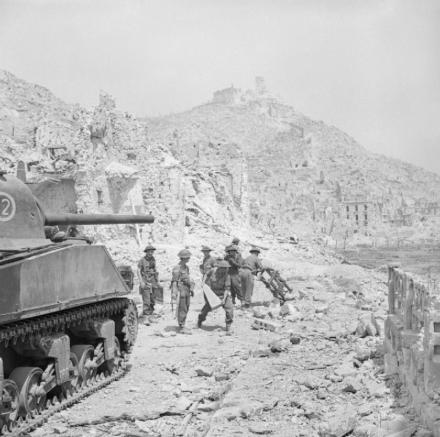
South Africans are seen in this historic image taking part in one of the most bitter battles of World War 2 – Monte Cassino.  Overlooked by the ruins of the historic hill-top monastery, South African engineers of 11th Field Company, South African Engineer Corps, clear rubble from ‘Route 6’, the main road through Cassino. The final German resistance had ceased only hours before.

The Battle of Monte Cassino (also known as the Battle for Rome and the Battle for Cassino) was fierce – it was a costly series of four assaults by the American, Polish, Free French, British and Commonwealth Allies against the Winter Line in Italy held by Nazi German and other Axis forces during the Italian Campaign of World War II. The intention was a breakthrough to Rome.

The above images show German soldiers holding their positions in Cassino and a British soldier with a Bren gun assaulting an Axis position amongst the shattered rubble of the  Monastery.

Between 17 January and 18 May 1944 the Monte Cassino and the Gustav defences were assaulted by Allied troops, the last Allied assault involving twenty divisions attacking along a twenty-mile front. The German defenders (including crack German airborne troops) were finally driven from their positions, but at a high cost. The capture of Monte Cassino tolled some 55,000 Allied casualties, with German losses being far fewer, estimated at around 20,000 killed and wounded.

Polish troops entered the shattered hill-top monastery, a symbol of German resistance at Cassino, the morning of the 18th May 1944.

The images show the British and Polish flags on top of the Monastery at Cassino on the final day of the assault and surrendering German soldiers.

This is the monastery before and after it was destroyed. Repeated pinpoint artillery attacks on Allied assault troops caused Allied leaders to conclude the monastery at Cassino, which had existed as a benedictine monastery  from 529 AD was being used by the Germans as an observation post.

Fears escalated along with casualties, and in spite of a lack of clear evidence, the monastery was marked for destruction. On 15 February American bombers dropped 1,400 tons of high explosives, creating widespread damage. The raid failed to achieve its objective, as German paratroopers occupied the rubble and established excellent defensive positions amid the ruins.

The monetary has since been rebuilt and is a national heritage site.

Image copyrights – Imperial War Museum, reference wikipedia