A war memorial in Cape Town which saves children’s lives

Today we look at a small miracle in South Africa which even has the attention of the Princes William and Harry, and it’s a miracle that really captures the imagination.  This miracle is a very special type of war memorial.

Over the years there has been many debates on how to commemorate those who have paid the supreme sacrifice for the country in war. Should a concrete or granite memorial be erected, a wall of remembrance be constructed, maybe a sport pavilion or a ‘living memorial’ that will continue to serve a community.

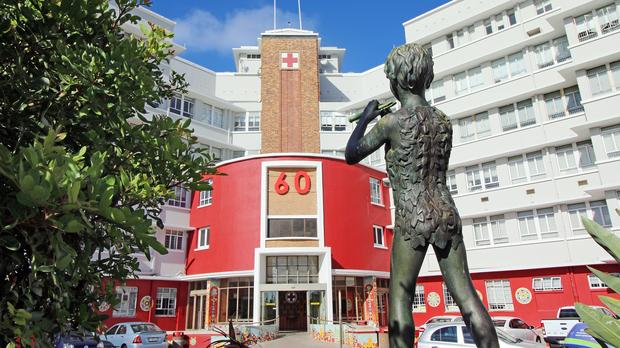
image3-300x294In South Africa we have two ‘living memorials’, one for the First World War, the annual running of the Comrades Marathon between Durban and Pietermaritzburg, and another for the Second World War, the Red Cross War Memorial Children’s Hospital in Cape Town. Sadly commonly referred to as the Red Cross Children’s Hospital, so not many people know of its wartime origin and its true intention.

The story of this iconic Cape Town landmark originates from the final days of World War 2, when South African ex-servicemen were waiting to return home from Italy. They had been so moved by the plight of war-torn children, that they contemplated what could best serve as a living memorial to their fallen compatriots.

The idea of a children’s hospital – a place of healing – captured people’s imaginations and gained popularity. Many of the servicemen donated two days of their pay towards this ideal and these funds were held in trust by the South African Red Cross Society who began to champion its establishment.

620x349
Since the Hospital first opened its doors, thousands of desperately sick children have been given back their childhood. Just as the returning World War 2 heroes fought for a better world, brave children at this incredible Hospital fight their own battles every day, to return home to their families and live the lives they were destined for.

The hospital is a beacon of hope and excellence in Cape Town, it is the largest, stand-alone tertiary hospital in sub-Saharan Africa dedicated entirely to the care of sick children. Children are referred from all over the African continent for medical intervention from the dedicated specialists who work tirelessly to heal and cure.

10620663_397984187037986_8452756597325360824_n

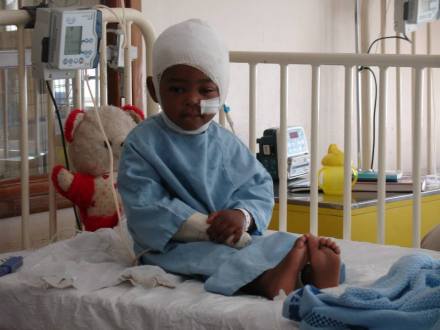
Diana – a three-year old toddler, who pulled over boiling hot water on herself in 2010 and was hospitalised at the Red Cross Children’s Hospital in Cape Town.

So how exactly did this miracle unfold?

The South African Red Cross Society started planning the building at a cost of £700 000. The building committee’s chairman, Vyvyan Watson, was the driving force behind its construction and fundraising. The first public appeal outside the war veterans contributions was launched and a generous response from the Cape Town public resulted in a contribution of £207,000. The rest of the funding was provided by the Cape Provincial Administration.

Building began late in 1953 and the Hospital officially opened its doors in June 1956 with a 90-bed capacity. By 1957 rapidly increasing patient loads necessitated the opening of all the remaining beds, bringing the total to 176 beds, with inpatient admissions at just over 1000 and 36 000 outpatients treated.  This expansion continued with the kind support of private initiative well through the 1980’s and 1990’s to the fine institution and beacon it has become today.

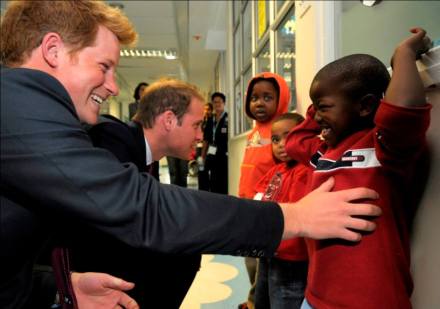
The hospital even has the attention of the Royal family in the United Kingdom, and hosted a visit by both Princes William and Harry on a visit to the hospital in June 2010.

10382873_399919683511103_7226112796668776843_n

The hospital’s purpose is best summed up in a memorial plaque at the entrance, it states;

The Red Cross War Memorial Children’s Hospital has been established by the Cape Region of the South African people in World War II 1939-1945. It is hoped that future generations, in their thankfulness for the benefits of this hospital, may be mindful of those in whose memory it has been erected.

In the forecourt of the Red Cross War Memorial Children’s Hospital stands a bronze statue of Peter Pan, and it is the location where war veterans annually lay wreaths in memory and appreciation.  The Peter Pan statue was commissioned by the parents of Peter Watson, a four year old who died of diphtheria at a time when there was no specialist children’s hospital in Cape Town.

Related Work and links

Comrades Marathon; A ‘Living’ War Memorial, The Comrades Marathon

Comrades Marathon; Why the Comrades Marathon is called the ‘Comrades’


Researched by Peter Dickens with much thanks to Charles Ross, images of wreath laying thanks to Liz Linsell.

Another Major Accomplishment

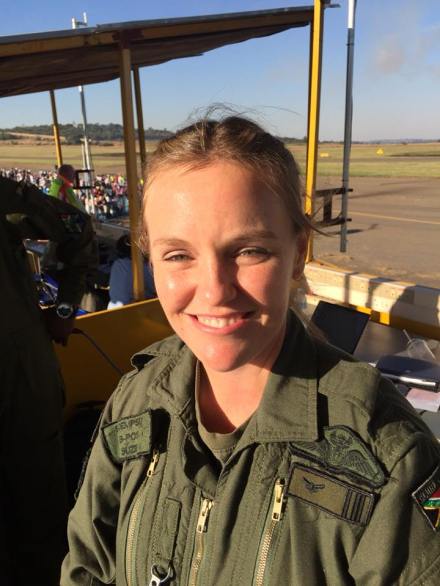
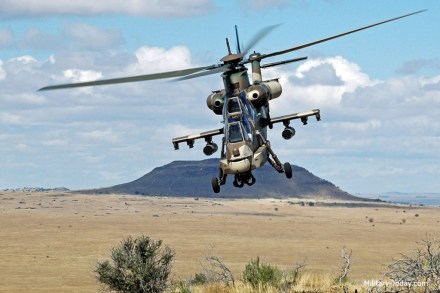
Congratulations to Major Suzanne Dempsey on becoming the first female in the world to fly the Rooivalk Combat Attack Helicopter. Major Dempsey went solo on Rooivalk and now flies with a weapons systems operator. Now the hard work starts as she will be trained to use this deadly to its utmost capability.

Denel AH-2 Rooivalk Attack Helicopter2

Denel AH-2 Rooivalk Attack Helicopter

As firsts go in the advancement of female aviators in the South African Air Force (SAAF) she now joins Major Nandi Zama, who became the first female to fly a SAAF C-130.  To see her accomplishment follow this link:

Nandi Zama; One Major accomplishment!

Bravo Zulu Major Dempsey on breaking new ground for female pilots the world over.  You exemplify the fine values and traditions of 16 Squadron and the South African Air Force.


Posted by Peter Dickens with reference to Capital Sounds, Rooivalk helicopter image courtesy militarytoday.com


VE – Day’s flags of honour

8th May 1945 – Victory In Europe Day, also known as VE – Day – the war in Europe is declared over. VE Day is a day to mark the formal acceptance by the Allies of World War II of Nazi Germany’s unconditional surrender of its armed forces.

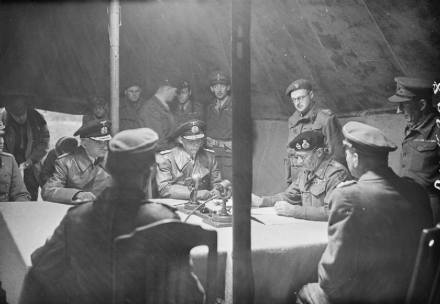
Just a few days before the designated ‘VE-Day’ on 4 May 1945 just east of Hamburg, Field Marshal Sir Bernard Law Montgomery, Commander of the 21st Army Group accepted the unconditional surrender of key German forces in Western Europe.

31959929_1725767320838326_7902641877910814720_n

The surrender preceded the end of World War 2 in Europe, which was later signed in a tent at Montgomery’s HQ on the Timeloberg hill at Wendisch Evern. A second German Instrument of Surrender ahead of the official ending World War 2 in Europe was signed on 7 May at Reims in France and signed again on 8 May with the Supreme High Command of the Red Army (Soviet Union), French and United States representatives in Berlin.

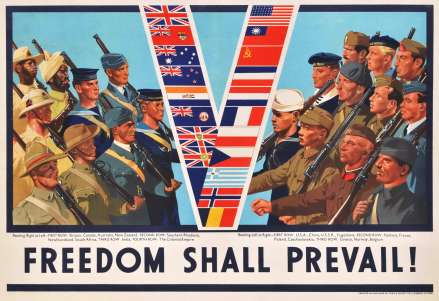
The 8th of May was declared as VE – Day, and an intensely proud day celebrated by the Allies the world over followed, including South Africa (Russia celebrates it the day after on the 9th).  The ‘V for Victory’ sign used to drive support for the Allied cause throughout the war made a full appearance everywhere, and so did the great nation’s flags who had fought so hard, and with such sacrifice to get to this day.

10259794_10153711964401480_1609297100934913427_n

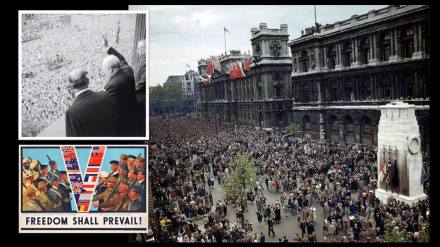
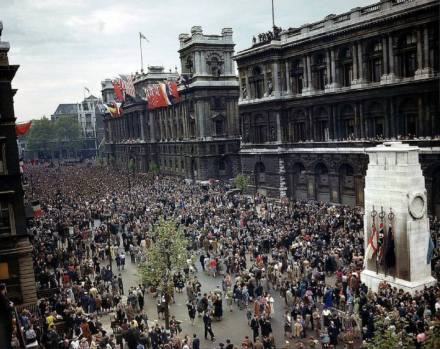
If you examine the picture of Whitehall closely, all the key nations in support and Allied with Great Britain, massive flags proudly flown from Whitehall next to one another – they included the flag of the United States of America and the flag of the Soviet Union.

In sequence the flags of the key commonwealth countries who had committed so much in resources, people and lives are also seen, these included Canada, Australia, India, New Zealand and South Africa, and you can see it here, the ‘Orange, White and Blue’ flag of the Union.

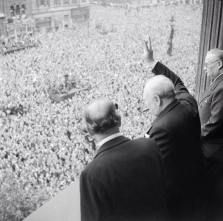
Winston Churchill appeared in Whitehall on he Ministry of Heath balcony to address the masses of people assembling there, in part be said;

11050253_445187798984291_7988015998947365041_n“I say that in the long years to come not only will the people of this island but of the world, wherever the bird of freedom chirps in human hearts, look back to what we’ve done and they will say “do not despair, do not yield to violence and tyranny, march straightforward and die if need be-unconquered.” Now we have emerged from one deadly struggle-a terrible foe has been cast on the ground and awaits our judgment and our mercy.”

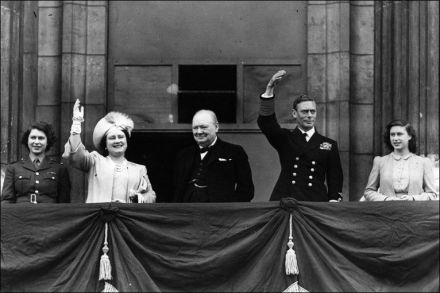
His views were echoed by King George VI when Winston Churchill appeared alongside him,  the Queen mother and a young Princess Elizabeth (soon to be Queen Elizabeth II) in her uniform.  She had joined the war effort as a subaltern in the women’s Women’s Auxiliary Territorial ServiceKing George said;

“I thank with a full heart those who bore arms so valiantly on land and sea, or in the air; and all civilians who, shouldering their many burdens, have carried them unflinchingly without complaint.”

31956176_1725765230838535_1877600895395430400_n

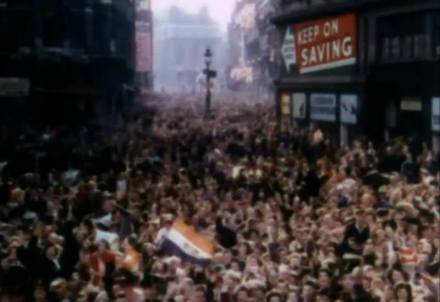
What followed was two solid days of partying in central London and the world over.  It had been South Africa’s war too, and South Africans were right at the centre of this massive party in London  – and rightly so. This still from colour film footage shows the street party and general revelling at Piccadilly Circus in London – and it’s marked by some South Africans in the centre proudly waving the South African Union national flag and rejoicing the end of the war in Europe.

11210502_445788838924187_3293832895299064234_n

Some people (in fact many) in South Africa would say, oh no not THAT flag (referring the Orange, White and Blue or ‘OBB’)!  But that is to completely misunderstand what this flag meant to the world in 1945 and not 1994.

The South African Union flag was the flag of Smuts’ Union and not really the preferred flag of Malan’s Republic, in fact between Verwoed and Vorster both had proposed re-designing the South African Union flag in line with their ideologies and those of the ‘Republic’ state they created and not Smuts’ despised ‘Union’ (many in Nationalist caucus literally hated the British Union “Jack’ on the flag, they called it the ‘blood-vlek’ as it reminded them of the sufferings of the Boer nation under the British in the 2nd Anglo-Boer War and wanted it removed); for more on this rather ‘inconvenient’ history of South Africa’s national flags see the link at the end of this article.

In fact it’s a great pity the Apartheid government didn’t follow through with their endeavours to change the flag in 1961 and 1971 respectively, when they drove at issue of the Republic they created.  In 1945, South Africa was a Union and a Dominion in the British Commonwealth and this flag, along with Smuts as Head of State was honoured and highly respected the world over, especially at the end of World War 2.

At the time the South African Union flag stood for the almighty sacrifice of South Africans and Jan Smuts’ call to fall behind the Allied nations to rid the world of Nazi and Fascist tyranny. A war against what Smuts referred to as Hitler’s ‘Crooked Cross’ (swastika) an unchristian ideology and heinous symbology.

CL182-68

The South African Union Flag in 1945 also stood for freedom and victory over ‘violence and tyranny’ as Churchill had aptly referred to in his speech on VE Day, at the time it stood firmly behind this ideal and was flown proudly. That the flag was to be carried over and soiled by the Nationalists and their Apartheid ideology after the war from 1948 and now stands as a symbol of ‘hate’ is unfortunate history.

Old flags have their place, and the South African Union flag should have ended with the Union in 1961 as it symbolised that time, with all its own ups and downs and its own forms of ‘race’ politics, but also its greatest achievement which won it high acclaim – and that was ‘VE-Day’, the Union epoch was in fact very different to the Apartheid epoch in just about every respect.  Also lets face it the Nationalists didn’t bathe themselves in glory with a pinnacle of achievement anywhere close to ‘VE – Day’.

Also,  South Africa is also not alone in this line-up at Whitehall in VE Day of having its flag changed – the flags of the Soviet Union, India and Canada all changed in the wake of new politics and social orders after World War 2.

In any event, we stand on the 8th May and remember Smuts’ South African Union and the lofty role it performed in bringing peace and freedom to the world in 1945, a ‘little country’ by comparison standing shoulder to shoulder with some of the greatest men and super-powers in the world, on an occasion that changed the destiny of almost every country around the world.  A day many South Africans stood with their heads held high and applauded the world over.

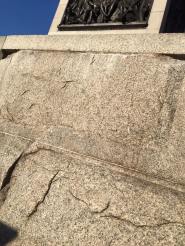
12549123_10153755844686480_5840912786017399781_nA beacon of fire symbolising this freedom was lit in Trafalgar Square on VE – Day, by a bunch of very happy and inebriated Canadian servicemen burning war bond advertising boards, it burned so bright, so strong and was so hot it cracked a part of the granite base of Nelson’s Column, a subtle reminder to this day, if you look carefully, to the sheer magnitude of the occasion and what it meant to a relieved and ecstatic British public, Commonwealth and Allied nations and the world at large.

Video

In conclusion, this short Associated Press news reel captures VE-Day perfectly:

Related Work

The South African National Flag; The inconvenient and unknown history of South Africa’s national flags

Churchill’s Heroes; Churchill’s Desk


Written by Peter Dickens.  Reference and thanks to the ‘British and Commonwealth Forces’ Facebook page.  Image of Churchill at Whitehall from the Imperial War Museum. Video commercial copyright Associated Press.

Churchill’s idols; Napoleon, Nelson &…Smuts!

Walk into the average teenager’s room and it would be adorned with posters of people they are fans of.  People, usually music stars, that they look up and admire, and more importantly people to which they role model.  These people are powerful icons which shape them psychologically.

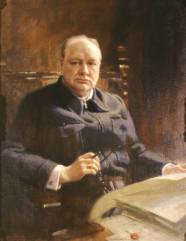
ChurchillTo an adult, after a more experienced life, the icons who have moulded them – their role models, the people they admire most usually end up in picture frames or as small statues on mantels, desks and tables, very often family but very often also great thinkers, leaders who have step-changed their world and great sportsmen and women (even the odd music star from their teens might even make an appearance).

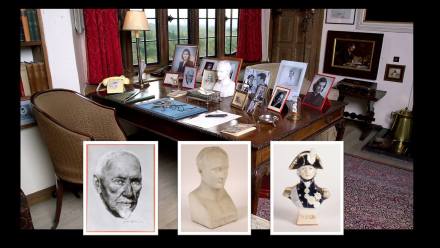
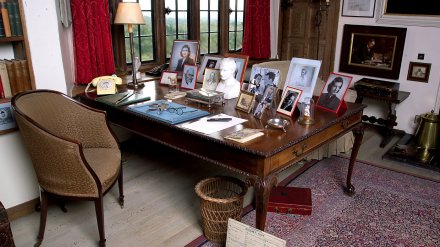
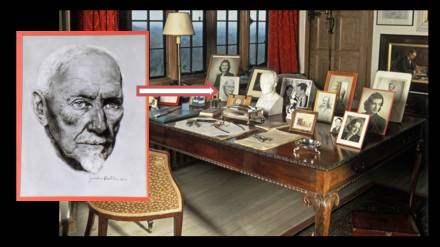
It’s no different with Winston Churchill, his desk at Chartwell is the most telling of who shaped him as a person, who he admired the most, who he loved and who he looked to for inspiration when writing his accounts of history, his epoch changing speeches and his great works on shaping the future of Great Britain.

Churchill suffered from great bouts of depression, which he called his ‘black dog’ and it is  in these people represented on his desk that he would also find light and drive, these are very important individuals to him.

chartwell study website size

In and amongst his family portraits on his desk, he positioned three non-family members in the middle of his desk – his ‘heroes’ looking strait back at him for inspiration – Napoleon, Nelson and, believe it or not, Jan Smuts.

One Englishman, one Frenchman and one Afrikaner … now that’s a strange combination for someone who epitomised everything British and her Imperial Empire.  Horatio Nelson you can understand, but two great former enemies of Britain, that’s odd.

So let’s understand why Churchill was such a big fan of Nelson, Napoleon and Smuts and examine why these specific people shaped him as a leader, a man who was to be voted by the British in 2002  as the greatest Briton in their history ahead of a nomination of 100 others in a BBC survey.  A man, whether some like it or not, who is one of the most influential men to have shaped our 21st Century’s social, political and economic landscapes.

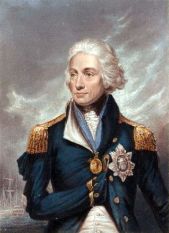
Horatio Nelson

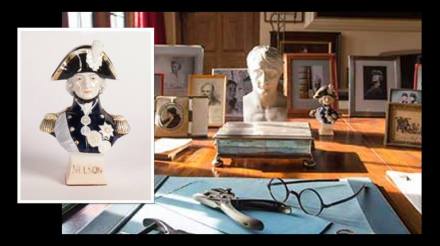
horatio-nelson-george-baxterPerhaps owing to Churchill’s role as First Lord of the Admiralty (a position which he held twice) Churchill developed a serious love of Nelson. A bust of Nelson sat on his desk at Chartwell and Churchill had a grey cat which accompanied him on trips to Chequers during the war which he named for the great Napoleonic Wars admiral.

One of Churchill’s favourite movies was Lady Hamilton, a film about Nelson’s mistress. Churchill also wrote about Nelson in History of the English Speaking Peoples.  Lets face it he was a fan.

But not just Churchill, in the BBC vote for the greatest Briton, Horacio Nelson also made the short-list.  The British we such fans of Nelson they went further than a small busts of him, they erected a column (which extends the full length of the HMS Victory’s mast) in the middle of their most famous square in the centre of London and put him on the top.  Nelson still towers over London on his ‘column’ to this day.

31755351_2132092927019694_4424184196008771584_n

What Nelson did to get all this admiration is he ‘saved Britain’ whilst at the ‘helm’ of the Royal Navy by destroying the French Navy at the Battle of Trafalgar in 1805 and this is really why Churchill found inspiration in him.  Churchill was to emulate his hero exactly when he too ‘saved Britain’ at the ‘helm’ of the Royal Air Force by destroying the German Luftwaffe during the Battle of Britain in 1940.

That is why Nelson sits on Churchill’s desk.

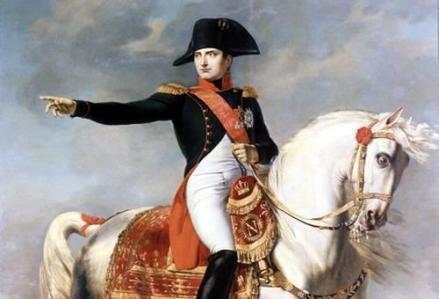
Napoleon Bonaparte

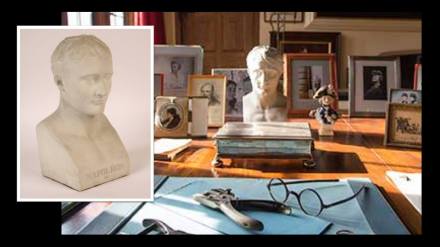
Churchill had a fascination and an immense respect for Napoleon. His bust also sat on Churchill’s desk at Chartwell, but was slightly larger and more prominently placed than Nelson’s – in fact it sits dead centre and dominates his desk.

Churchill enjoyed reflecting on Napoleon’s military genius, perhaps wanting to emulate the French emperor. After all, like Churchill after the Dardanelles, Napoleon made a significant comeback. Churchill even hoped to write a biography of Napoleon but never found the time.

More than that, he hated it when people would compare Hitler to Napoleon. “It seems an insult to the great Emperor and warrior,” he said, “to connect him in any way with a squalid caucus boss and butcher”.

31703886_2132093103686343_4492955349791277056_o

But most of all, during the 2nd Anglo-Boer War (1899 to 1902) it was Napoleon’s quote that came to his mind when he surrendered to Boer forces once he found him isolated from an armoured train which the Boer’s attacked.  Of the incident when a Boer horseman pointed a rifle at his head and waved it to signal he should come out, Churchill considered his idol – Napoleon who said, “When one is alone and unarmed, a surrender may be pardoned.”  So he obeyed the Boer’s signal to surrender or die and walked out. Napoleon had literally saved his life.

However, Churchill’s admiration of Napoleon is a lot deeper, what Churchill saw in Napoleon was a reformer. Napoleons influence on the modern world brought liberal reforms to the numerous territories that he conquered and controlled. His Napoleonic Code has influenced the legal systems of more than 70 nations around the world. British historian Andrew Roberts summed up Napoleon very well;

“The ideas that underpin our modern world—meritocracy, equality before the law, property rights, religious toleration, modern secular education, sound finances, and so on—were championed, consolidated, codified and geographically extended by Napoleon. To them he added a rational and efficient local administration, an end to rural banditry, the encouragement of science and the arts, the abolition of feudalism and the greatest codification of laws since the fall of the Roman Empire”

napoleon-bonaparte-high-quality-genuine-pure

With France capitulating to Nazi Germany early in World War 2, Europe’s great bastion of liberty forged by Napoleon was no longer in contention, and Churchill saw Britain as the last hope to carry this flame and become the next great reformer of Europe, and it has manifested itself in the creation of the European Union, the roots of its creation and thinking can be traced to none other than Churchill when after the 2nd World War he called for the creation of a ‘United States of Europe’.

That is why Napoleon sits on Churchill’s desk.

Jan Smuts

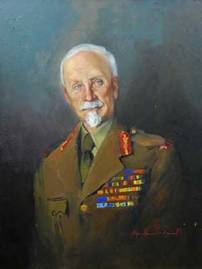
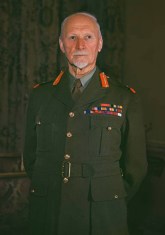
Jan Smuts’ portrait sits to the left of Napoleon’s bust on Churchill’s desk at Chartwell, sitting alongside what is arguably the two greatest military strategists known – Nelson and Napoleon. Here Churchill viewed Smuts as an equal to two of the biggest hitters in European history. But why this lessor known Afrikaner General, why Smuts?

31772977_2132093840352936_3593175403679711232_o

Some would say it was Churchill’s close personal relationship with Smuts as his advisor during World War 2, that he was simply Churchill’s ‘friend’ with loads in common.  But that too would be incorrect, Smuts was the extreme opposite of Churchill, Smuts was a near teetotaler whereas Churchill was seldom sober, Smuts was an early to bed early riser, Churchill was a night-owl, Smuts maintained a stringent diet whereas Churchill was a glutton, Smuts enjoyed exercise and long walking and climbing treks and Churchill hated the very idea of it.

So, nothing in common as friends go then.

Less informed people in South Africa would venture it’s because Smuts turned ‘traitor’ on his people and turned ‘British’.  But that’s both grossly ignorant and entirely wrong as the rather inconvenient truth to these detractors is that Winston Churchill admired Jan Smuts precisely because he was a ‘Boer’.

Churchill emulated and admired Smuts, because Smuts had been his great adversary during the South African War (1899-1902).  He was a fan of Smuts’ strategic and tactical military capability and leadership in the field.  Churchill, like many of his peers and the general population in England, admired Smuts preciously because he epitomised the legacy of a great Boer fighter.

Smuts02

There is credit in the arguments which expose certain officers and South African based British politicians for ‘Boer hatred’ during The South African War (1899 to 1902), it’s true in some cases and there is no denying that – but it is not generally true of the whole, in fact it’s entirely the opposite.  Across the English-speaking world, in Britain and America particularly the Boer fighter would take an on almost legendary and mythical status.

Consider this famous influential Briton’s admiration of the Boer nation.  Sir Arthur Conan Doyle, the creator of Sherlock Holmes, said of the Boers after the South African war;

“Take a community of Dutchmen of the type of those who defended themselves for fifty years against all the power of Spain at a time when Spain was the greatest power in the world. Intermix with them a strain of those inflexible French Huguenots, who gave up their name and left their country forever at the time of the revocation of the Edict of Nantes . The product must obviously be one of the most rugged, virile, unconquerable races ever seen upon the face of the earth. Take these formidable people and train them for seven generations in constant warfare against savage men and ferocious beasts, in circumstances in which no weakling could survive; place them so that they acquire skill with weapons and in horsemanship, give them a country which is eminently suited to the tactics of the huntsman, the marksman and the rider. Then, finally, put a fine temper upon their military qualities by a dour fatalistic Old Testament religion and an ardent and consuming patriotism. Combine all these qualities and all these impulses in one individual and you have the modern White Boer.”

IMG_104Smuts found thousands admirers for his speeches, in the general public, political circles and even in the British Parliament who received him with a resounding ovation, all of them within living knowledge of the South African War and the extremely hard time tenacious Boers, including Smuts, had given the British during the war.

The value of the ‘little guy’ standing up to the giant and giving it a bloody nose resounds very well in the English-speaking world.  So too the very British value of ‘pluckiness’ which the British saw in a tiny Republic taking on a Superpower, you just had to admire it.  Again, the Boer cause strikes the British value of ‘fortitude’, the ‘stiff upper lip’ required for supreme perseverance against intense adversary – and the Boer fighter amplified this value in buckets.

The 2nd Anglo-Boer war (1899-1902) was the single biggest event to ‘shape’ the young Churchill as a character, it forged him into who he became and his exploits in South Africa directly contributed to his success as leader.  He was time and again to encounter the Boer fighting spirit and strategic and tactical capability, the Boers made a POW of him, shot his horse out from under him and so narrowly killed him on so many occasions that Churchill would describe the sonic wakes of Boer bullets so close to blowing his head off they ‘kissed his cheeks’, his survival of Boer military assaults and marksmanship he puts down to his own sheer luck and nothing else.

Smuts Boer

General Jan Smuts in the 2nd Anglo-Boer War

What’s not to admire about these ‘pesky’ Boers made up of small groups of simple farming folk in their thousands using skilful military manoeuvrability and marksmanship to keep an entire professional army expeditionary force in their hundreds of thousands at bay with their heads down.

But not in his home country, Smuts would not find hordes of adoring fans, instead the nationalists spin-doctored this fame and admiration to further reinforce their argument that Smuts had turned ‘British’ and split him from his voter base and people. Not that this mattered a jot for Churchill in his worship of Smuts and the Boers, to him the ‘National Party’ was nothing more than a relatively small bunch of misled Nazi sympathising politicians, their brand of politics in countenance to just about every fibre in this body and they had nothing at all to do with the values he so admired in the Boers and Afrikaners in general.

It’s precisely because Churchill considered Smuts an ‘enemy’ and not a ‘friend’, that he was ‘Boer’ and not a ‘Brit’ that he found so much admiration in Smuts, that he thought himself an equal military strategist to wrestle his ideas with his old foe, to grapple with this formidable ‘Boer’ General for strategic perspective and in so not make the kind of mistake he made with the Dardanelles operation and the resultant, rather disastrous, Gallipoli campaign in World War 1.  Smuts tempered Churchill throughout World War 2 advising against his intrinsic disposition for impulsiveness with sheer reason.  Smuts ‘balanced’ Churchill perfectly.

It was the sheer fortitude of the Boer fighter that Churchill admired so much, the little guy giving the big guy the old two-fingered ‘Agincourt’ up-yours ‘mate’ salute the English archers gave the superior French forces in 1514 in defiance of them, a salute which Churchill (and even Smuts) would later turn around in a double-entendre of the gesture to indicate ‘Victory’ without losing its actual meaning.

Simply put – he admired all the ‘Boer’ traits of fortitude, versatility and mental toughness in Smuts, and it manifests itself in Churchill in just about every speech he made and work he did.

Richard Steyn in ‘Unafraid of Greatness’ sums this up very well;

“Yet the great paradox of (Smuts’) life was that – as Leif Egeland pointed out – it is precisely because Smuts was a Afrikaner and a Boer soldier that he built up such a formidable reputation world-wide.  On his many visits abroad and in his personal life, he kept the image of the Boer general, ‘one of the most romantic and bravest figures in history’. Whilst many of his countrymen described him for being an Englishman at heart, in Britain and around the world ‘General Smuts’ was respected and revered for being a true and patriotic Afrikaner – the finest example of his tribe”.

That’s why Smuts sits on Churchill’s desk.

Related work and Links

Churchill and The South African War; Churchill’s epic ‘Boy’s Own’ Adventure in South Africa

Smuts; “The force of his intellect has enriched the wisdom of the whole human race”- the death of Jan Smuts.

Smuts’ speech to the Houses of Parliament; A true statesman, Jan Smuts addressing the British Parliament – 1942


Written and Researched by Peter Dickens.

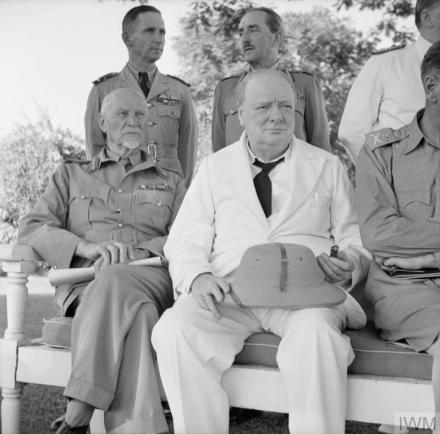
References include ‘The National Trust Collections’ Chartwell, Jan Smuts reconsidered by Hermann Giliomee 26 January 2016, Richard Steyn’s Smuts: Unafraid of Greatness 2015.  ‘Who were Churchill’s heroes’ by Warren Dockter, historian 2015.  Horatio Nelson portait by George Baxter,  Image of Smuts and Churchill – Imperial War Museum


The incidental ‘terrorist’

Not too many people are fully aware of the story behind the bombing of the Koeberg nuclear plant in 1982, it made the news alright, big news, but who really knows the real story behind it? Now, if you’re not familiar, you are going to need a stiff drink and sit down, this story is guaranteed to make you laugh and cry all at the same time.

It’s actually a very comical and random sequence of events which led to the Umkhonto we Sizwe (MK) getting this one right, and it’s one that will leave you simply astounded.  It’s also an inconvenient story to the general narrative, as the bomber is in the same category as Hein Grosskopf, who bombed Witwatersrand Command – he was also ‘white’.

It gets better, not only was he ‘white’ he was also a serving Citizen Force Non-Commissioned Officer (NCO) in the South African Defence Force (now that’s very inconvenient news to many SADF veterans). However, it gets even better than that, unlike Grosskopf he was a ‘English South African’ in origin, a South African national sporting champion and a free-thinking liberal soul, a little like the archetypal ‘hippy’.

He’s was not your typical MK cadre at all, in fact nowhere close. MK didn’t even need to train him (the SADF did) and he randomly arrived on their doorstep in Zimbabwe with Koeberg blue-prints under his arm, his proposition was so ‘out there’ MK thought he was a spy and initially laughed him off.

7E36C502-4325-40CD-A92B-ABB3D84938A7-777x437

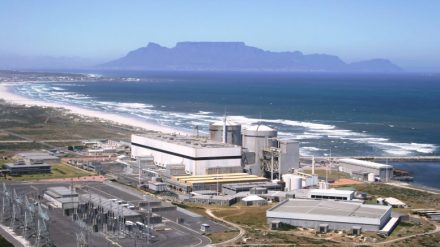
Koeberg Nuclear Plant

The bombing of Koeberg is now posted by MK as one of their ‘Top Achievements’ on their website, but the inconvenient truth is that it was not really theirs to start off with, it was more about the bombers own politics in resistance to Apartheid than the African National Congress’ (ANC) politics and the ‘operator’ was pretty much in his own ‘cell’ with his equally free-spirited girlfriend who in reality was a speech therapist. MK just provided some very ‘unstable’ limpet mines and helped pin-point the placement targets.

So audacious was the attack that the South African security forces at the time suspected the operation was the work of a ‘group’ of highly trained saboteurs. But in fact, and here’s a military truism, never under-estimate the ability  of a ‘single’ corporal in the South African Defence Force (SADF) to wreak havoc.

The bombing of Koeberg Nuclear Plant reads like the ‘Incidental Tourist’, stuff just randomly falls in place with loads of luck and even though it is a very serious matter it even comes across as comical at times, you just could not make it up  – so let’s have a look at a pair of ‘hippies’ Rodney Wilkinson, South Africa’s fencing sword fighting national champion and his side-kick, his girlfriend, Heather Gray, the speech therapist.

‘Planning’ the Koeberg bombing

SAsidebar

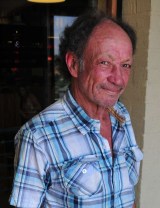
Rodney Wilkinson taken in 1995

The Koeberg operation was born of sheer chance in 1978. Rodney Wilkinson was living in  a ‘hippy’ commune near Koeberg. The commune ran out of money and Rodney, a student of  building science and UCT drop-out, rather reluctantly mind, had to take a job at the nearby nuclear plant which was under construction.

Whist working at the plant for nearly two years he was privy to the building plans and blue-prints. With a strong anti-Apartheid sentiment and liberal conviction he was encouraged by his girlfriend Heather to steal a set of them. But what to do with them?

They came up with an idea, give them to the African National Congress (ANC) so they might find them handy and conduct an attack on the nuclear station.  Buoyed up with this idea they both trekked off to the newly independent Zimbabwe to hand over the plans to the ANC in exile there, job done.

Not really.  Rodney pitched up randomly on the doorstep of the ANC office and told them he was in possession of plans to one of the most secure and secret facilities in South Africa.  The ANC took one look at the hapless hippy in front of them and dismissed him out of hand as a government spy.

The ANC were very circumspect of him, but Rodney was persistent so they agreed to take the plans from him and have them authenticated first.  After many delays with Rodney hanging about, during which time the stolen plans were shown to Soviet nuclear scientists and an investigation into Rodney Wilkinson himself was done. Eventually the ANC reverted. Great news – all vetted, job done, they’ll take the plans, Rodney and Heather figured they now could head off home.

Not so fast snowflakes!  The ANC then threw a curveball at Rodney and told him that the only way the job could really be done is if he carried out the attack himself.  By his own admission he was initially taken aback by all this, as becoming a MK operative really wasn’t in his plans, however he pondered their proposal and eventually agreed.  The operation was code-named Operation Mac (named after Mac Maharaj).

435109_140610223636_010

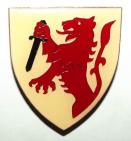
SADF Koeberg Commando flash

No military training required, luckily the South African Defence Force (SADF) had already provided all that when he was called up as National Servicemen conscript, completed his two years of training and deployment and he was now serving out his Citizen Force commitments with the rank of Corporal.

In fact he had even served duty on the Angolan border and at one stage wrecked a truck going AWOL and landed up in hospital, he was not prosecuted by the SADF and not demoted.

Therein lies the hazard of conscription, not everyone agreed with the government of the day and moreover many didn’t buy into the ‘whites only’ Afrikaner Nationalist government’s program of conscription at all, especially many of the ‘English’ conscripts and certainly not Rodney, but it did produce very proficient soldiers in any event.

‘Dirty weekends’ in Swaziland 

To Rodney’s own surprise, more luck, Koeberg Nuclear station wanted him back at work on mapping emergency pipes and valves at the plant.

The ANC appointed a ‘Dolphin’ MK commander in Swaziland as Wilkinson’s ‘handler’, he was Aboobaker Ismail. So once a month Rodney and his girlfriend trekked off to Swaziland, the small independent kingdom which allowed gambling (banned under Apartheid South Africa), before Sun City was built, this was the premier destination for thousands of white South Africans to go gambling on weekend getaways and not unusual ‘movement’ of white people over a border at all.

Whilst in Swaziland, Rodney and his handler thrashed out the strategy, it was designed to maximise embarrassment to the South African government while minimising the risk to human life – this after all was a nuclear facility and required ‘careful’ thinking.

Aboobaker and Rodney then drilled down the targets onto which limpid mines would be placed. It was suspected at the time that Koeberg Nuclear plant would be used to produce plutonium for the construction of atomic bombs, so to avoid a radioactive fall-out, the attack had to happen before the plant went on-line.

500px-SPM_Limpet_mine

Soviet era SPM Limpet mine commonly used by MK

Limpet mines were to be placed on the two reactor heads, yup – read that again, the reactor heads – they figured as these were made of 110 tones of steel the limpet mines were not really going to really harm them, also they figured there would be fantastic PR and media value in it for the ANC.  Other mines were planned for the control room and a containment building, designed to do as much damage as possible.

The date for the attack was deliberate and designed to humiliate the government – it was set for 16th December, the National Party’s ‘Day of the Covenant’ – ‘Dingaan Day’ to others and ‘MK Day’ to members of the ANC.  That the attack happened on the 17th December is another event of haplessness and chance.

The arms ‘cache’

To anyone with a military background, the arms ‘cache’  is where the story gets comically scary, as if blowing up a plutonium nuclear plant is not scary enough.  Rodney and Heather were directed to the arms cache, and it was not where you would expect, nope this cache consisted of four very old and unstable limpet mines left next to a road side in the middle of the remote Karoo.  Makes you think what else is still ‘out there’ in this quirky part of South Africa.

31698794_2131521230410197_319511421832396800_o

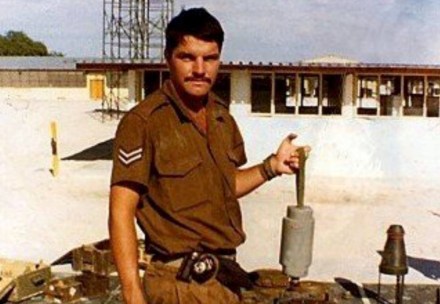
SADF Corporal holding a Soviet era SPM limpet mine

So, how to smuggle them unnoticed?, No problem to Rodney and Heather, they dug them up and simply hid them in decanted wine boxes – the good old box wine ‘doos’ now makes another unusual entry into South African history folklore.  They jump into their little Renault 5 and head to their home in the tranquil up-market, very ‘white’ suburb of Claremont in Cape Town.  If you have not yet reached for your stiff drink now is a good time.

Now enter the worst co-conspirator ever!  Their puppy dog, Gaby.  Gaby had been pretty efficient digging holes all over their garden, so thanks to her labours they buried these old and unstable limpet mines in the holes.

From there Rodney smuggled the mines one by one in a hidden compartment of the Renault through the perimeter security fence at the nuclear installation. But were to hide them in order that nobody would dare to look?  No problem Rodney simply put them in his desk drawer in his prefabricated office.  Now, to get them into the main building and past all the heavy security, no problem again he simply walked in carrying one at a time hidden in his overalls – so much for the ‘heavy’ impenetrable security on South Africa’s most vital, most prized and most secretive Nuclear Plant.

A series of mishaps 

s-l300So on to the attack itself and it’s marred by a series of mishaps. It started with an unrelated accidental short-circuit which started a cable fire. The incident was reported in the local press.  Now enter the ANC’s President-in-exile, Oliver Tambo, who had been made aware of the operation but not really the details of it, like timing.  So he released a statement immediately claiming the fire as an ANC victory.  All this did was prompt a security scare and clamp down at the plant and gave the National Party some ammo to ridicule the ANC for unsubstantiated claims.

Then, in November the firm hiring Rodney informed him that they were laying him off at the end of the month, so much for timing.  Luckily for Rodney they changed their minds and asked him to stay on for another month.  As fortune would also have it, he turned the security scare to his advantage and told them he would stay on, but only till the 17th December, thereby obtaining an official alibi and cover for his planned disappearance.

Here is where he missed the deadline of the 16th December, as previously stated the limpet mines were old and unstable.  Rodney placed the mines in the pre-determined targets setting 24 hour fuses on the 15th December (a Friday) so they would blow on the public holiday (a Saturday), thereby assuring minimal casualties to his fellow contractors as nobody would be there.

Here’s the kicker, as his contract was ending, his fellow contractors and engineers liked this young man and decided to throw Rodney a farewell party at the plant on the Friday evening just after he had been busy planting the bombs.  Rodney had to sit through his impromptu ‘going-away’ party stressing endlessly that the bombs would not go off prematurely.

He had no real need to worry, as said these limpet mines were old and they would not go off on the Saturday either in fact they eventually went off a day after the target date on the Sunday. The springs on the firing mechanism proved to have been brittle and the devices also exploded over a period of several hours instead of simultaneously.

Rodney’s ‘Great Escape’

Reach for that stiff drink again, you’ll need it for this next part of the story.  Instead of bolting it out the country with a keen sense of urgency, as the other ‘white’ lone wolf MK cadre did – Hein Grosskopf who high-tailed it directly into Botswana after bombing of Wit Command on his motorbike, not even looking back for a nano-second.  No, not our ‘hippy’ would casually, get this, ‘cycle’ out of South Africa on a bicycle, yup you heard right … a bicycle.

He took a domestic flight to Johannesburg and was driven with a borrowed bicycle to a point near the Swaziland border where he jumped on the bicycle and then casually cycled through the border post into exile.

Aftermath 

OR-Tambo-Thabo-Alfred-Nzo-Pic

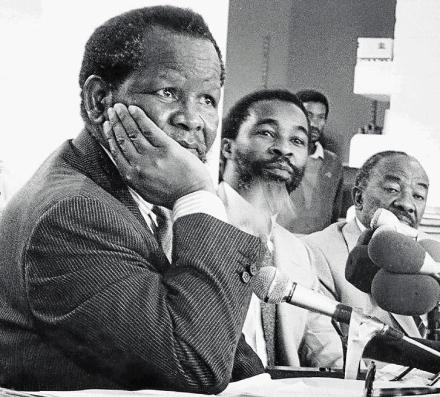
Oliver Tambo at a news conference in exile (left) Gallo Image

A few days beforehand South African special forces had attacked ANC targets in the kingdom of Lesotho, Oliver Tambo claimed the Koeberg attack was an act of retaliation carried out by a MK ‘unit’ (one chap in reality and as propaganda goes his efforts had nothing to do with the Lesotho raid at all).

How close to nuclear fall-out did we come? Take a big sip that stiff drink again.  Not part of Rodney’s plan but unbeknown to him enriched uranium fuel had been moved into to the plant when the attack took place and was due to come on-line in the reactors.  Luckily for all of us (and here we include the entire planet) it was in dormant storage.

The attack delayed the commissioning of the plant by about 18 months and cost the Apartheid government millions of rand.  This is why this attack sits as No. 2 on their all time greatest achievements (No. 1 is the Sasol bombing and No.3 is the rather controversial and bloody Church Street Bombing).  Although there were no deaths attributed to the bombing, that it nearly cost thousands of lives in the entire city of Cape Town is lost on this particular MK ‘highlight’.

Rodney flew on to Maputo where he met Oliver Tambo, the two exchanged a warm and tearful embrace.  Rodney’s girlfriend Heather was already in Maputo having flown out a week beforehand.  The two jumped on a flight to the United Kingdom and further into exile.

They married one another in Woodbridge, Suffolk, before returning home to South Africa following the general amnesty and unbanning of all ‘liberation’ movements. The TRC rewarded the Wilkinsons and Aboobaker Ismail full amnesty in April 1999. Given the nature of this MK ‘cell’ it seemed a little unlikely that the ANC and its brand of politics is quite Rodney and Heathers bag, anti-apartheid, yes but unlike Carl Niehaus we don’t find him regularly wheeled out in a PEP store set of camos with the other ‘struggle heroes’ and he lives a life in relative obscurity.

A happy ending to our ‘Incidental terrorist’ and an equally and far more happy ending to just about every Cape Town and Western Cape resident, South Africa as a whole, the entire South African tourist trade, the local bio-sphere and the green planet in general. We can now all universally breathe a sigh of relief that the entire Cape Peninsula is not a radioactive ‘Chernobyl’ no-go zone thanks to the African National Congress.

If you chose not to have a stiff drink reading this article, nows a good time to really start.

31674077_2131533363742317_64406157044744192_o

Related Work and Links

Wit Command Bombing; The truth behind the bombing of Witwatersrand Command

Struggle ‘Heroes’; Tainted “Military Heroes” vs. Real Military Heroes

Rocketing of Voortrekkerhoogte; The not so ‘spectacular’ MK attack on Voortrekkerhoogte


Written and Researched by Peter Dickens.  Primary source, an interview with Rodney Wilkinson by a daily mail staff reporter in December 1995 and photograph.  Published news snippets, MK official web-page. TRC references. Image references – general net search. Nuclear terrorism in Africa: The ANC’s Operation Mac and the attack on the Koeberg Nuclear Power Station in South Africa. Jo-Ansie van Wyk


Whose land is it anyway?

It’s a thorny issue in South Africa, the taking of farm land without compensation.  However the Anglo-Boer Wars (both of them) and even the Voortrekker Zulu War carry with them some interesting history and it asks the question ‘whose land is it anyway’ One significant and conveniently overlooked answer lies in the grounding history and cause of the South African War 1899-1902 (also known as the 2nd Anglo-Boer War).

This answer makes the case for the giving of annexed land by the Transvaal and Orange Free State Republics (The Boers) back to the black indigenous peoples of South Africa who existed in those two republics prior to The South African War, and it ALSO makes a case which reinforces the ‘white’ Boer ownership of vast tracks of land in the two old Boer Republics annexed by the British during The South African War.

To many South Africans the chief cause of the Second Anglo-Boer War is completely misunderstood, it is shrouded by a National Party narrative and bias caused by the fierce sense of Afrikaner Nationalism created by this party’s ideology.   Dismiss for a minute the whole Nationalist idea that all the land was ’empty’ or bartered and traded for fairly during the Great Trek. Also, dismiss for a minute also the whole idea that the 2nd Anglo-Anglo Boer war was all only about ‘gold’ and ‘diamonds’ and British greed for it. Finally, dismiss the idea that the Boer concentration camps of The South African War were systematic ‘extermination’ camps designed to rid the British world of the Boer nation in its entirety (Nazi style).  All of these Nationalist fuelled ideas are either falsehoods or at best only half-truths.  When putting these into correct context and in the ‘inconvenient’ truth that the case for ‘who owns the land’ is found.

Let’s start with the real underpinning reason for the 2nd Anglo-Boer war (The South African War), which is the 1st Anglo-Boer War (The Transvaal War).  Like World War 2 is World War 1, Part 2, so too a key underpinning cause of  the 2nd Anglo-Boer War was the 1st Anglo-Boer War.   In effect ‘Boer War’ 2 is ‘Boer War 1’; Part 2.

1st Anglo-Boer War

The 1st Anglo-Boer War (Transvaal War) is an enigma to most South Africans, barely understood even today, the events and outrages of the 2nd Anglo-Boer War completely cloud it out, and it’s an inconvenient war to look at as it throws up these thorny truths which don’t suit the political narrative:

  • The Transvaal Republic was at one stage a British Colony BEFORE the 2nd Anglo- Boer War
  • The Transvaal Republic ‘raad’ handed their Republic, with all its wealth and their state coffers (tax), their flag and their independence to the British in April 1877 – willingly and WITHOUT one single protest or shot fired.
  • ‘Native Land’ and ‘Protection’ were also a central reason why the Transvaal Boer Republic INVITED the British to colonise their Republic.

In 1876 the tiny Boer population of the ‘Transvaal’  people was under threat from a much bigger population of warring African tribes in the Transvaal Republic and on the Republic’s borders (remember this was before the discovery of gold in 1886 and before the future ZAR Republic was rich in arms and munitions).

The reason why the Transvaal Boers were under threat is that they were annexing tribal land by force and demanding tax from various tribal groups for the land (and forcing labour) on land they were allowed to occupy. This had stirred up the Pedi, led by Sekhukune I and resulted in a war in 1876 which is recorded as a Boer defeat.  To the East the very powerful Zulu kingdom was also making claims on ‘Transvaal’ territory.

This ‘Black African’ uprising was one the Boers could not cope with alone.  So the Boers INVITED the British to Colonise their Republic and protect them.

The Black Africans in the Transvaal Republic felt they had a case too, and they too called on the British to help them from what they saw as Transvaal Republic aggression, land grabbing and subjection.  They also INVITED the British to protect them.

All good then, invited by EVERYONE in the Transvaal Republic the British moved into the Transvaal on the 12th April 1877 to settle the peace, annexed it as British Colony,  with no resistance they took down the ZAR ‘Vier-Kleur’ and hoisted the Union Flag (Jack) over Pretoria and erected a British government.  In doing so the ex-Boer Republic also handed   over the money, tax would now be collected by the British – all tax, the taxes on mining and the taxes on land.

In addition, to protect the ex-Boer capital they built forts around Pretoria (Johannesburg did not really exist as a complete mining city and some of these forts in Pretoria are still there as an inconvenient reminder of this history). For their efforts, the British got to expand their territory in Africa (more land for them) suiting their expansionist Imperialism agenda right down to the ground, everyone happy right?

But not for long, the British had crushed the Zulu threat in 1879 (Anglo-Zulu War), with the threat gone, it did not take long before the British policies on Black African land rights and their policies of taxation of Boer land became an issue with the resident Boer population.  It all came to a head with the Boers when the British confiscated one Boer’s wagon in lieu of his backdated tax, which he refused to pay.  This brought them into direct conflict with a Boer Commando drafted to help the farmer and simply put the Boers now wanted their old Republic back and the British OUT.  This then kicked off the 1st Anglo-Boer War, the ‘Transvaal War’ in November 1880.

image

The Siege of Rustenburg, 1st Anglo-Boer War

So what was the issue really – it can’t just be one wagon?  We have to ask ‘whose land is it anyway’ and ‘who really needed it protected from who’?  The Boer case lies in two events in history which occurred more or less at the same time, the ‘Great Trek’ and the ‘Mfecane’.

The turbulent early 1800’s

Its complicated history, but in a nutshell in the early 1800’s are the key, specifically the period 1819 to 1838 – this was the epicentre of events in South Africa which were to shape the problem we have in South Africa today, especially as to ‘freedoms and land’.

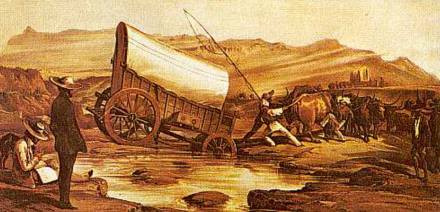
It all started in one part of the country on the 1st December 1834 when the British took the bold decision to ban slavery in the Cape Colony and in addition gave franchise (the ‘vote’) and property ownership rights to all its inhabitants – Black and White (Setter, Coloured and Indigenous) on an equal footing.  This did not sit well with the  mainly Dutch (with a blend of French and German) farmers many of which found themselves in an intolerable situation as ex-slave owners and they chose, just a short 6 months later, in June 1834, to up-sticks and leave the British colony and their endless meddling in their social structures, beliefs and social spheres.  At the same time taking with them into South Africa’s hinterland their ideologies of racial servitude, ideologies which would underpin the future Boer Republics which they formed.  They would also form a new nation an ‘Afrikaner’ one, with an Afrikaans language both named after their ‘land’ in ‘Africa’ – essentially a ‘White African Tribe’.

31487269_2130655337163453_5957646760985928386_n

The Great Trek – artists impression

Around the same time, in another part of the country Shaka Zulu and the Zulu nation  was born.  In 1819 Shaka Zulu managed to unite, through force and war, a number of small tribes into a newly established ‘Zulu nation’.   Like the Boer ‘Afrikaners’ their nation did not exist as a ‘Zulu’ one prior to the early 1800’s.

The 1st ‘depopulation’ of land

So when and how did these northern ‘Black African Tribes’ establish themselves in South Africa? The answer lies in the Mfecane (meaning ‘the crushing’), also known by the Sesotho name Difaqane (scattering, forced dispersal or forced migration).  This great  displacement of Black tribal people took place between 1815 and about 1840.

30806362_2130615857167401_5549917167853742007_o

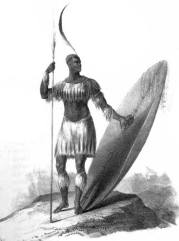
King Shaka – artists impression

As King Shaka created a very militaristic Zulu Kingdom (situated in the territory between the Tugela River and Pongola River) his forces expanded outwards in a wave, subjecting or simply annihilating all other peoples.  This expansionism also became the prelude to  the Mfecane, which spread from this Zulu epicentre. The forced movement of peoples caused many displaced tribes to wage war on those in other territories, leading to widespread warfare and death as well as the consolidation of various tribes.  Notably, it brought up the Matabele actions who dominated in what was the ‘Transvaal’ when Mzilikazi, a king of the Matabele, who between 1826 to 1836 ordered widespread killings and reorganised his territory to establish the new Ndebele order. The death toll is estimated between 1 to 2 million people (it cannot be satisfactory determined), however the result can, as simply put was massive swaths of land in the region became depopulated, either entirely or partially.

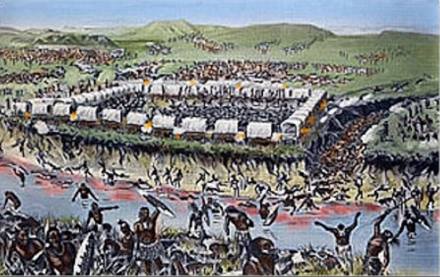
Now, enter the trekking ‘white tribe’ Afrikaner Boers, who in 1836 whilst all this is taking place arrive in the same place as the Mfecane, and to survive as nation and not be ethnically cleansed  themselves in addition to the other tribes, the Boers take on by force this warring Matabele nation and then they take on the warring Zulu nation by force of arms, the cumulation was the Battle of Blood River on the 16th December 1838.

30171590_2130613020501018_7878437854953059926_o

Artists impression of the Battle of Blood River – artist unknown

The Battle of Blood River is significant, not just for the Boers, but for all future Black South Africans who are not of Zulu or Matabele ethnic origin.  In effect the Boers, by decimating the Matabele army and then the Zulu army put a temporary end to their respective fighting capabilities and therefore put an end to the Mfecane, they ended what is South Africa’s first and only mass genocide and ethnic cleansing.  It’s an ironic twist but the very existence of any of these ‘Black’ South Africans in South Africa today (other than the aforementioned Matabele and Zulu), and the very fact they are even identified as tribes and exist as nations, is largely thanks to the Afrikaner Voortrekkers – the ‘white tribe’ Boer nation.  They literally owe them their lives and nationhood.

Now, as to the old ‘half truth’ the land was ’empty’ or ‘traded fairly’ so the Boers could occupy it.  In part there is truth, some of the land had been depopulated by the Mfecane also many tribes welcomed the Voortrekkers giving them parcels of land in trade and in grateful thanks for their ‘protection’ against been slaughtered by Matabele or Zulu armies. All good right – fair is fair?  Not so, it’s only partly true.  There’s a more sinister side to the formation of the two Boer Republics, not all the land was fairly settled, the two Boer Republics also embarked on expansionism to establish borders and forced various tribal Africans from some of their land at the same time as annexing land belonging to various chiefdoms and putting it under Boer ownership.

1820 Settlers 

To be fair the Boers, the British in the early 1800’s were also securing and expanding their own borders and territory (land) and endeavoured to repel the southward migration of the Xhoza tribe, driven very much by the Mfecane up north.  This issue came to a head around Grahamstown, on what was known as the ‘Border’.

fig-8-4

British 1820 Settlers arriving in South Africa

In the UK, the end of  the napoleonic wars at the Battle of Waterloo 18 June 1815 posed a problem, they had massive unemployment, especially soldiers who were no longer needed and rising debt from fighting the wars.   They solved this by offering citizens, who were to become the ‘1820 Settlers’, their own land, and it was land which they needed reconciled on the ‘Border’ of the Cape Colony.  After a number of small wars were fought with indigenous tribes settling the ‘border’ issue – the British then went about reconciling the land under deed, some farm land was even given under deed to Black African farmers, but others remained controversial and it still is.

The even more turbulent late 1800’s

Now, fast forward to the Anglo-Zulu War of 1879 and a year later to the 1st Anglo-Boer War of 1880.  The African chiefdoms in the North and West Transvaal have recovered from the Mfecane, and have been armed in part by missionaries and traders trading rifles.  Whilst at the same time the Zulu Chiefdom bordering the ‘Natal Colony’ settled by the British and the newly minted British ‘Transvaal Colony’ also now settled by the British, is again back up to fighting strength.  ‘Land’ becomes the central problem again (the Zulu’s were really not that interested in gold).

31543425_2130621920500128_6212394080895866691_n

President Thomas Burgers

Consider for the underpinning tensions leading up to the 1st Anglo-Boer War  (The Transvaal War) in 1880.  The British annexed the Transvaal in 1877 at the invitation of the out-going ‘Boer’ Transvaal President, Thomas Burgers.  President Burgers laid squarely the blame for bringing the British to the Transvaal at the future President, Paul Kruger and his cabal.  His  blame and anger is expressed with this most extraordinary outburst and it is most illuminating:

“I would rather be a policeman under a strong government than a President of such a State. It is you—you members of the Raad and the Boers—who have ruined the country, who have sold your independence for a drink. You have ill-treated the natives, you have shot them down, you have sold them into slavery, and now you have to pay the penalty.”

The missionary, Rev John Mackenzie, gives us another example. Here is how Mackenzie described the motives behind the First Boer War: 

“The Transvaal rising (1st Anglo Boer War) was not dictated, as was believed in England, by a (Boer) love of freedom and preference for a (Boer) republic rather than a limited monarchy (Great Britain). It was inspired by men who were planning a policy which would banish the English language and English influence from South Africa. Their action was a blow directly dealt against freedom, progress, and union of Europeans in South Africa.”

30822238_2130622417166745_8255877245435884884_o

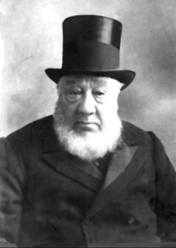
Paul Kruger

After Kruger et al regained control of the Transvaal, another missionary, the Rev John Moffat, was tasked with giving the news to some of the black tribal leaders who would again be abandoned to their tender mercies: 

“for the most part there was the silence of despair. One gentle old man, Mokhatle, a man of great influence, used the language of resignation, ‘When I was a child, the Matabele came, they swept over us like the wind and we bowed before them like the long white grass on the plains. They left us and we stood upright again. The Boers came and we bowed ourselves under them in like manner. The British came and we rose upright, our hearts lived within us and we said: Now we are the children of the Great Lady. And now that is past and we must lie flat again under the wind—who knows what are the ways of God?’”

The thoughts of a few more African leaders are equally illuminating:

In response to the endless violent expansion of the pre-annexation Transvaal into their territory, Montsioa Toane, Chief of the Barolong, requested that Great Britain take his people under imperial protection. In a letter addressed to ‘His Excellency Her Britannic Majesty’s High Commissioner, Sir P. Wodehouse, KCB’, the chief requested “refuge under your protecting wings from the injustice of the Transvaal Republic, whose government have lately, by proclamation, included our country within the possessions of the said Republic”.
He went on to explain: “…without the least provocation on our side, though the Boers have from time to time murdered some of my people and enslaved several Balala villages, the Transvaal Republic deprives us, by said proclamation, of our land and our liberty, against which we would protest in the strongest terms, and entreat your Excellency, as Her Britannic Majesty’s High Commissioner, to protect us.”

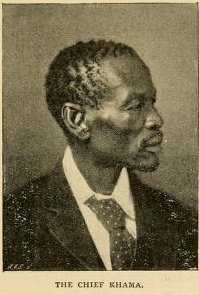
Chief-khama-IIIIn 1876, King Khama, Chief of the Bamangwato people from northern Bechuanaland, joined the appeal: 

“I write to you, Sir Henry, in order that your queen may preserve for me my country, it being in her hands. The Boers are coming into it, and I do not like them. Their actions are cruel among us black people. We are like money, they sell us and our children. I ask Her Majesty to defend me, as she defends all her people. There are three things which distress me very much: war, selling people, and drink. All these things I shall find in the Boers, and it is these things which destroy people to make an end of them in the country. The custom of the Boers has always been to cause people to be sold, and to-day they are still selling people.”

8e21cb58c3a6c0e4296505afee709889

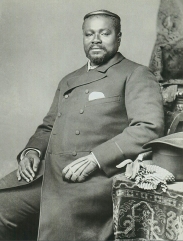
King Cetshwayo

Even King Cetawayo of the Zulu laid the blame for the tensions which led to the Anglo-Zulu War of 1879 against the British squarely at the feet of the Transvaal Boers, now this is ironic from the leaders of Zulu themselves, he said: 

“This war (the Zulu War) was forced on me and the Zulus. We never desired to fight the English. The Boers were the real cause of that war. They were continually worrying the Zulus about their land and threatening to invade the country if we did not give them land, and this forced us to get our forces ready to resist, and consequently the land became disturbed, and the Natal people mistakenly believed we were preparing against them.”

250px-John_X_Merriman_-_Cape_Prime_Minister

John X Merriman

Just prior to the 1st Anglo-Boer and the British annexation of the ‘Transvaal Colony’, in 1885, the liberal Cape politician, John X. Merriman described Kruger’s newly independent, and ever-expanding, republic as follows: “The policy of the Transvaal was to push out bands of freebooters, and to get them in quarrels with the natives. They wished to push their border over the land westwards, and realize the dream of President Pretorius, which was that the Transvaal should stretch from the Indian Ocean to the Atlantic. The result was robbery, rapine and murder.”

30419962_2130626770499643_2719702072784891833_o

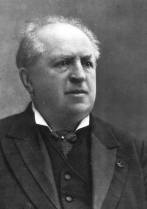
Dr Abraham Kuyper

The ZAR ‘Transvaal’ Republic’s main-cheerleader in Europe, Dr Kuyper, commented enthusiastically on the racial policies of the Republic: “The English prided themselves on protecting the imaginary rights of the natives… The Boers are not sentimentalists, but are eminently practical. They recognized that these Hottentots and Basutos were an inferior race.”

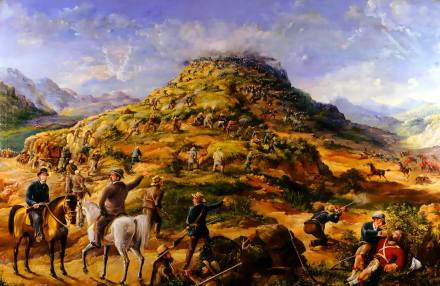
Majuba

Things came to a head in the 1st Anglo-Boer War at The Battle of Majuba Hill (near Volksrust, South Africa) on 27 February 1881.  This was the main and decisive battle of the 1st Anglo-Boer War (Transvaal War). It was a resounding victory for the Boers and the battle is considered to have been one of the most humiliating defeats of British arms in history.

30821223_2130612847167702_4007037161243377805_o

It sent the British back over their border to Natal, but it also resulted in a very uneasy ‘peace’ as to the British ‘Transvaal Colony’.  In the aftermath of the war the South African Republic (Transvaal) regained its independence. The Pretoria Convention (1881)  and the London Convention (1884) laid down the terms of the peace agreement.  In terms of land the Pretoria agreement settled the Transvaal’s borders and re-established an independent Boer Republic again, but it still had to have its foreign relations and policies regarding black people approved by the British government.  The new version of the Boer Transvaal Republic was also not allowed by the British to expand towards the West (and link with the Atlantic Ocean).

These policies meant that the Transvaal was still under British suzerainty or influence. In 1884 the London Convention was signed. The Transvaal was given a new Western border and adopted the name of the South African Republic (ZAR). Even then, the ZAR still had to get permission from the British government for any treaty entered into with any other country other than the Orange Free State.

An ‘uneasy’ peace

The Boers saw this as a way for the British government to interfere in Transvaal affairs and this led to tension between Britain and ZAR. This increased steadily until the outbreak of the 2nd Anglo-Boer War in 1899, especially with the on-set of gold mining. which saw tens of thousands of British miners settle in the Transvaal.  Gold mining was done under concession from Kruger’s government.  Kruger took the position that his people, the Boers, were farmers and not miners, so he gave British mining concerns a mandate to mine and pay the ZAR government a hefty tax for the privilege. Initially mining in the Transvaal was an all British affair – from the mining concerns, to the infrastructure (rail and buildings) and even right down to the labour.  Again ‘land’ had been conceded by the Boer Republic to British miners and companies.  As inconvenient truths go, they already ‘owned’ the gold at the onset of the 2nd Boer War and had no reason to ‘steal’ it.

The unsettling problem for the British and the Boers was a demographic and representation one, there were more Britons on the reef than Boers.  These British citizens were denied political representation and citizenship qualification periods became an issue (Kruger realised if he allowed citizenships after 5 years residency he would lose his state).

Also the Boer State was crushing political protest on the reef in a jack-booted and heavy-handed manner using their Police, known as ZARP. Things came to a head with a privateer raid (supported privately by Rhodes) called the Jameson Raid in 1895 which was planned in the billiards room of the Rand Club in Johannesburg (and not by British Parliament in Whitehall as is incorrectly assumed – in fact to British politicians the whole affair came as uncomfortable surprise).  The Raid, financed by the mine owners and not the British government, was intended to trigger a simmering civil revolt on the reef. The revolt was crushed by the Boers.

A1S7_1_20170618730957404

Jamesons Last Stand The Battle Of Doornkop 1896.

This unrest and uneasy peace established after the 1st Anglo Boer War all came to a another head when negotiations on citizenship and political representation of the Transvaal Britons broke down.  To settle the dispute the Boers declared war on Britain and invaded the British colonies late 1899 – in effect they wanted a swift victory whilst British forces were weak and unsupported by any substantial expeditionary force – as they did at Majuba and weaken the British negotiation hand, re-set the table so to speak.

It backfired. The mandate given to the Boers to re-establish their ‘British Transvaal Colony’ as an independent Boer Republic lasted barely 15 years after the London Convention peace agreement which properly ended the 1st Anglo-Boer War and finally established the ZAR territorial borders.

To the British, there was an ‘old’ score to settle with the Transvaal Boers, and it had nothing to do with ‘gold’ and everything to do with territory – ‘land’.  It is best summed up by Churchill who reflected on the 1st Anglo-Boer War as “a disgraceful, cowardly peace” – and now they wanted their Colony back.

Mjuba

Graffiti scrawled by both sides in a house recaptured by the British in the 2nd Anglo Boer War. The Boer graffiti reads: ‘Don’t forget Majuba, Boys’. British graffiti reads: ‘No fear, Boere, no fear’.

1st Anglo-Boer War – Part 2, the 2nd Anglo-Boer War

Now, as ‘Boer War’ 2 is the logical expansion of ‘Boer War’ 1, consider that these tensions over land and the whole of the Transvaal had by the late 1800’s escalated somewhat.  In the intervening period between ‘Anglo-Boer War’ 1 and ‘Anglo-Boer War’ 2,  gold was discovered in the Transvaal, and in addition to this the local Black tribes flourished, with no more large wars to fight and no Mfecane and aided by the introduction of medicine by missionaries, this mounting black population of the Transvaal added to the hundreds of thousands of mainly British immigrant mine workers now settled in the Transvaal.

Now, with a ‘old score’ to settle over the Transvaal territory, along with a simmering revolt of miners over their rights to the land, the Boer declaration of war against the British, provided a ‘Casus Belli’ to the British to again wage war them again, and so began the 2nd Anglo-Boer War (1899 to 1902). To give perspective of how long the ZAR lasted, from the time the British Union ‘Jack’ was taken down over Pretoria to the time it was put up again took a mere 16 years.

The 2nd ‘depopulation’ of land

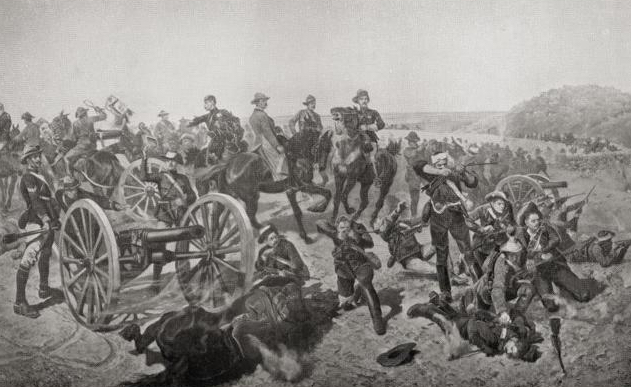
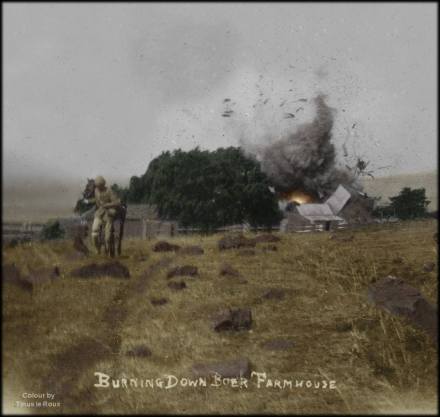
Back to the issue of land.  During the 2nd Anglo-Boer war the British, after winning the ‘conventional’ war phase were forced into a second and more bitter phase,  guerrilla war with disposed Boer governments now ‘in the field’ and running their Republics from the veldt, a moving and endlessly fraught war where Boer forces relied on their communities and families for supply to keep the fighting.

Lord Kitchener in an attempt to bring the war to rest adopted a policy depriving the Boer forces of supply, and so began a policy of ‘concentration camps’.  This can be better described as ‘forced removal’ from land and the placing of citizens in ‘deportation camps’, it involved rounding up of both White and Black civilians in demarcated conflict zones and effectively ‘depopulating’ the land and moving all the people to isolated camps.  The policy which resulted in the deaths of tens of thousands and people deprived of their land leaves a deep scar on many South Africans, and not just the white Afrikaners, the black South Africans caught up are equally traumatised.

28699287_1608270105876259_4601684936069398143_o

So, now we have an interesting dilemma for the current citizens of South Africa who own vast tracks of land in the Republic, the inconvenient truth is that not only was it ‘depopulated’ by the Zulu Kingdom in the early 1800’s, it was depopulated again by the United Kingdom – eighty or so years later.

The international case

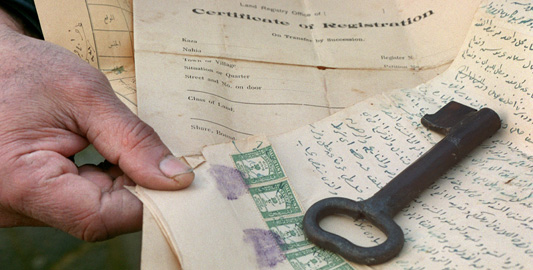
Now here is where the issue of land ownership gets interesting, and funnily it is in line with the issues now surrounding the Palestinian question and Israel (and best illustrated by this case as it surrounds ‘land’ ownership and war).  Many people are not familiar with the underlying problem of land under occupation in Israel.  In international law an occupying force can do anything within limitations on the land it occupies as long as a state of war exists.  This has become a thorny issue with the Palestinians who, like the Boers, were deposed of their land by war – land which the British sold to Palestinians under title-deed whist Palestine was a British protectorate (those pesky British again), and this land is now under private title deed is owned by Palestinians and occupied by Israelis – and it makes up massive portions of modern Israel.

1_244173_1_9

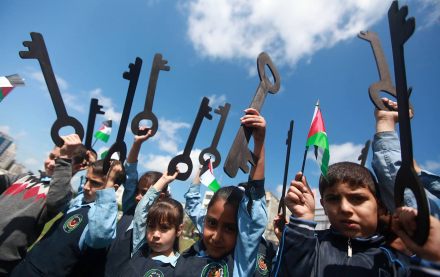
If given back to the legal owners it will most certainly unseat Israel as a state and put millions of dollars invested in land at risk.  The only way Israel can hold onto the land legally is to be in a constant state of war with the Palestinians (not really the other way round – see annual Palestinian protests when the bring the house keys and title deeds to their land to the fore – which over the border are now occupied by Israeli families or developed into multi-million dollar property estates and shopping malls).

How does this odd bit of International law apply to South Africa’s farmers. Simply put they were deposed of their land during the 2nd Anglo-Boer war, it came under British control under the edicts of war.  Unlike the Palestinians the Boers were allowed to return to the land, land on which families were decimated and could not be re-settled was re-allocated by the British and the Union governments after the war, the last ‘legal’ owner of this land expropriated during the war were in fact the British.    In the subsequent years after The South African War, as a colony of Britain and then under British administration and dominion as a Union, the country went about formalising land title and ownership from the old Boer Republics and concluding war repatriation and re-settlement.

Palestine-kids-key-ap-img

Palestine ‘Keys’ and ‘Deeds’ protest symbolised by their old keys to their houses in Israel

So, in our modern day, if this land is now taken away without compensation, the Israeli/Palestinian dilemma and the annual ‘keys’ protest rears it head, where the ‘British’ issue is now again at the forefront of title deeds and like the Palestinians, the dispossessed modern Boer family will want to turn to Britain for an answer, adding to the many dispossessed Zimbabwean white farmers with a similar case.  That would be a nasty surprise for the modern British Foreign Secretary.

Here’s another interesting question over South African land located in the Centre and Northern  provinces and the two seismic events that depopulated much of it, not to mention the British sale of land in the Cape, especially in contested ‘Border’ region which they purposely ‘settled’.

Would a claim now for restitution or compensation for land ‘re-appropriated without compensation’ be laid at the feet of the Zulu King or at the feet of the British Queen?

In Conclusion

All very complicated this land reformation business, now an almost impossible job to simply unbundle through declarations of ‘mine – you stole it’ and simply grabbing it.  A case example here is the land grabbing which recently took place in Midrand and Hermanus, this land has nothing to do with the disputed historical African territories unseated by the expansion and creation of the old Transvaal, Orange Free State, Natal and Cape Colony borders, and the people occupying it are not all the proper ancestors anyway.  This is a political grab using a very bent interpretation of history.

There is value in identity of having a ‘homeland’, but whose people are we referring to when we say ‘our people’, the ‘homeland of the Afrikaner nation is also Africa. By all means look at the land taken by force of arms from various Chiefdoms as their tribal land borders and were they stood after the Mfecane, and the resultant occupation by Zulu, Matabele, Brit and Boer alike and not the land ‘sold’ to the Boers or the British for that matter for trade or protection.   Present the historical evidence showing which families and grouping were unseated by force of occupation and how this ‘stolen’ land was then put under plough by the occupiers.  There’s not much to go by in the way of arable and profitable ‘land’ here, but lets challenge it properly.

Generally the historically contested farm land is nowhere near the bulk of multi-million rand privately owned title-deed farms – so really of no political value.  Unless you provide the argument that all land was occupied by whites, and this is not historically true at all.  In which case everybody who has a white skin can have his property simply taken away – now we are into a ludicrous argument, and one used to incite racial disharmony and hatred.

Urban land, depopulated by Apartheid policy only really accounts to small areas located near Johannesburg and Cape Town city centrals,  Land, which now, because it worth literally millions of Rand, is under contention, the reason for the slow progress is that multiple families are making claims to the land, families which actually own it and families which rented it.  District 6 is a prime example, it really is a political quagmire as its now vastly profit driven and less about the ‘home’ it once offered.  Also in reality it cannot be settled by huge numbers of the ‘people’ offered by the EFF – they want the nice well run profitable farm land which is under title-deed and owned for decades by private individuals (who are not Black) – whether it’s under real historic contention or not, so it’s entirely wrong of Cyril Ramaposa to cite District 6 in his SONA address as a key underpinning social cause of the ANC’s entire land without compensation drive.

The biggest dilemma facing the proposed amendment to the Constitution is that in reality the land everyone in the ANC and EFF wants and is highly productive – and its land which has not only been depopulated once, its been depopulated twice and resettled twice over after the end of the Mfcane and 2nd Anglo-Boer War respectively.

The lands negotiated with and allocated to the Zulu kingdom are even a more thornier question and we might want to ask is the Zulu kingdom is going to pay for land depopulated by their expansionism and militarism, so too can the same question be asked of the Matabele.  There another human trait here, one that will not go away once this particular monkey is out the cage, it’s called greed, and it’s an intrinsic human condition the ANC has been indulging itself in, time and again.  Here is where the Zulu have drawn the line when Mangosuthu Buthelezi rightly accused the ANC and EFF of ‘playing with fire’.

The simple truth is this.  ‘Land’ ownership in South Africa has been defined by war and armed ‘struggle’, and not just war between ‘Blacks and Whites’, war between ‘Blacks and Blacks’ and even war between ‘Whites and Whites’.  The burning question is, will it be defined again by another ‘war’  – another armed ‘struggle’?

Related articles and Links

Concentration Camps; To fully reconcile The Boer War is to fully understand the ‘BLACK’ Concentration Camps

Concentration Camps; I’m not pro Boer, I’m British, this isn’t OUR way!

Majuba; Boers; ‘Don’t forget Majuba, boys’. Brits; ‘No fear, Boere, no fear’.

Winston Churchill; Churchill’s epic ‘Boy’s Own’ Adventure in South Africa

Kruger and Victoria; Kruger “blunders” and declares war on the world’s Superpower!


Written and researched by Peter Dickens.  References from Wikipedia, the South African History Association on-line, quotes gleaned from ‘getting to the source’ by Chris Ash. Colourised 2nd-Anglo Boer War photograph copyright Tinus Le Roux.

The first man to land on an aircraft carrier at sea was a South African

A South African holds a very prestigious place in the world of aviation firsts.  Edwin Dunning was the first man to land an aircraft on a moving ship adapted to carry aircraft, a feat that at the time was near impossible, and the practice of landing aircraft even today on an aircraft carrier takes supreme skill and is reserved for the ‘best of the best’ pilots, such is the hazard.  Unfortunately for his pioneering endeavour his efforts were to end in tragedy.

Dunning_First_Moving_Carrier_Landing_IWM_Q_110613

Squadron Commander E H Dunning climbs out of his aircraft on the flying-off deck of HMS FURIOUS after the first successful landing on an aircraft carrier underway.

Edwin Harris Dunning was born in South Africa on the 17th July 1892, the second child of Sir Edwin Harris Dunning and was later educated at Royal Navy Colleagues in the United Kingdom.

A very skilled aviator, he took to pioneering naval aviation.  He rose to a high rank within the Royal Navy’s newly born Air Service or RNAS (which was to evolve into their ‘Fleet Air Arm’).  During World War 1 the Army and the Navy ran separate Air Services under their own Command. During the war the Royal Navy began to look at how aircraft can be operated from fighting ships.

tmp546217157592088578

Squadron Commander E H Dunning

Previously the Royal Navy had used catapults to launch the aircraft from ship decks but landing them was a different matter – early naval aircraft types were fitted with pontoons (sea-plane or ‘float’ plane) and ‘landed in the ocean next to the vessel to be hoisted back on.  This posted a number of difficulties, sea conditions and time and manoeuvring of the aircraft and ship for hoisting for starters.  Also, they could only operate one aircraft from a ship and it was usually used for one thing – ‘spotting’ i.e. reconnaissance work.

The solution lay in an adapted fighting ship with a runway from which a number of aircraft could take-off or be catapulted from and could land directly on the ship again, this could then bring the formidable nature of air-power – striking targets anywhere in the world within range completely at will into the realm of sea-power.  The concept of the aircraft carrier was born (a concept that to this day divides a super-power from an ordinary country).

However, you needed people with considerable skill and courage to try this idea out, that it was dangerous to land on a ship in high winds and rolling seas is an understatement – think of runway that is always moving around.  They found such a man in our hero, one very brave South African aviator.

FuriousSP_89

HMS Furious with the original flight deck conversion in the front

The Royal Navy decided to convert a Courageous-class Battlecruiser, the from a fighting ship into a fighting aircraft carrier by removing her forward gun and a flight deck was added to the bow in its place.  A difficult proposition to land on as the approaching aircraft had to manoeuvre around the superstructure to land (much later on they removed the rear gun and extend the flight deck to compensate for this, but it look a tragic learning).

Squadron Leader Edwin Dunning, aged just 25, flying a Sopwith Pup bi-plane marched into the history books at Scapa Flow, Orkney Islands, Scotland during test exercises in the Flow.  He became the first person to land on a moving aircraft carrier at sea.  He completed this landmark aviation feat on 2 August 1917.

30171874_2129303910631929_145288007698899824_o

A colourised image captures Dunning’s milestone.  Note naval personnel ‘catching’ his aircraft

The landing was extremely perilous – whereas now arrest wires would bring a plane to a halt, Dunning was relying on the deck crew of the Furious to grab the wings of his Sopwith Pup to bring it to a halt.

Five short days later, after completing his milestone, Dunning endeavoured to do it again.  However tragedy struck during his third landing of the day. On approach, his aircraft stalled and he came down on the deck of the Furious at too steep an angle. Dunning was knocked unconscious, his port wing lifted as the plane went over the side of the ship and he drowned in the cockpit.


Recognition

Edwin Dunning is buried at St Lawrence’s Church, Bradfield in England. A plaque in the church says just about everything in recognition of his contribution to naval aviation.

It reads:

“The Admiralty wish you to know what great service he performed for the Navy. It was in fact a demonstration of landing an Aeroplane on the deck of a Man-of-War whilst the latter was under way. This had never been done before; and the data obtained was of the utmost value. It will make Aeroplanes indispensable to a fleet; & possibly, revolutionise Naval Warfare. The risk taken by Squadron Commander Dunning needed much courage. He had already made two successful landings; but expressed a wish to land again himself, before other Pilots did so; and in this last run he was killed. My Lords desire to place on record their sense of the loss to the Naval Service of this gallant Officer”.

In memory of Edwin Dunning, the Dunning Cup is given annually to the officer who is considered to have done most to further aviation in connection with the Fleet for the year in question. In the 1950s and 1960s it was awarded to Royal Air Force squadrons which achieve the highest standard on courses at the Joint Anti-Submarine School.

A memorial stone was also unveiled at Swanbister Bay in Orkney in 1992 in recognition of Dunning’s feat.

_97156661_mediaitem97156660

On the occasion of the centenary of Dunning’s feat the British marked the occasion in Orkney with a Hawk flypast and a new plaque was unveiled.  Lt Cdr Barry Issitt, Commanding Officer of 736 Naval Air Squadron, paid tribute in August 2017 to mark the centenary, he said;

Plaque020817_019

The new plaque has been produced by local craftsman Stuart Wylie, of Orkney Crystal – 2017.

“The event itself is of particular significance to the Royal Navy and Fleet Air Arm as it marks the first successful landing of a fixed-wing aircraft on a ship under way at sea; a moment that would be the genesis for the establishment of the pre-eminence of aircraft carriers.

“It is all the more poignant considering the current regeneration of the UK’s carrier capability, with HMS Queen Elizabeth currently conducting sea trials not far from the location of Dunning’s landing, with Merlin helicopters from 820 Naval Air Squadron operating from her flight deck.”

In Conclusion

As is typical to South Africa’s lack of recognition to countrymen who attained greatness serving in the ‘hated’ British forces (as was the case with the old National Party) or in the case of the ‘colonial’ forces (as is the current case with the ANC), even if the feat was an international aviation milestone.  So it passed unnoticed and no such flybys, plaque unveilings, awards, centenary mark or national salutes were given to our pioneering hero in South Africa – and that’s more tragic than the tragedy itself.

30420527_2129303850631935_3369238736591045798_o

Cdr Chestnutt is presented The Edwin Dunning Trophy on the pride of the Royal Navy, the new aircraft carrier HMS Queen Elizabeth

Related Work and Links 

Fleet Air Arm – South African sacrifice ; South African sacrifice in the Royal Navy’s Fleet Air Arm

Fleet Air Arm – Dick Lord; Dick Lord – the combat legend who took learnings from the Royal Navy’s Fleet Air Arm to the SAAF

South African Navy sacrifice in the Royal Navy; The South African Navy’s ‘darkest hour’ is not recognised and not commemorated


Researched by Peter Dickens.  Source and Extracts – Wikipedia and BBC News

Vive la rue du Transvaal, vive la France!

My wife and I headed into a quaint neighbourhood of Paris to enjoy some traditional French Chanson music. When in Paris eh!. Our venue sported just about everything ‘French’, right down to the menu, wine list and sing along to Jacques Brel and Édith Piaf favourites.

30073135_2127175497511437_787967327737655482_oI glanced up at an art mural of the quarter depicting its early 20th Century heyday, and noticed its old landmark hotel was called the ‘Transvaal Hotel’, nipping outside I realised I was in the famous old ‘working class quarter’ of Paris, the epicentre of French equality and multiculturalism … Belleville … the birthplace and childhood home of Édith Piaf, with its panoramic view of the Paris at the Parc de Belleville, and I was standing in one its most well-known streets, leading to the Parc de Belleville, the ‘Rue du Transvaal’.

So what’s with all the references to the old Transvaal in middle of ‘working class’ Paris?  Put simply, the French during The South African War (1899 to 1902) had been fully in support of the Zuid-Afrikaansche Republiek (the Transvaal), in fact there are a number of ‘Rue du Transvaal’ in France and Belgium named after the old South African Republic.

In Belgium a Transvaal Streets are found at Anderlecht, Binche and Quiévrain and in France, Transvaal Streets are found at Berck, Boulogne-Billancourt, Bourgoin-Jallieu, Cateau-Cambrésis, Chalon-sur-Saône, Chambéry, Colombes, Dijon, Divion, La Garenne-Colombes, Guilvinec, Le Creusot, Limoges, Lyon, Marseilles, Nantes, Pessac, Rousies, Saint-Amand-les-Eaux, Saint-Avold and Thiers Wasquehal.

There is even a Rue du Botha which joins up with Rue du Transvaal in Belleville, named in honour of Louis Botha, the famous Boer General and then Commander-in-Chief of the Transvaal Forces, who went on to become the first Prime Minister of the Union of South Africa.

30073260_2127175847511402_1828333056881797150_o

But why such a strong support?  Simply put there is an aged old ‘hatred’ between the French and the English, and it’s because they are diametrically opposed to one another on one key thing, Republicanism versus Monarchism (not to mention a very long history of going to war against one another).

Deep in the French psyche and value system and inbred in every French citizen are their ‘Republican’ values Liberté, égalité, fraternité ou La Mort. The literal translation of this means ‘freedom’, ‘equality’, ‘brotherhood’ or we die. Values which are in sharp contrast to the English who idolise their monarchy and class based heritage even to this day (the French guillotined their monarchy and upper-class in favour of Republicanism and this motto).

31172198_2127175647511422_3871489692275261358_nIn their Republicanism and concepts of Liberty, Equality and Brotherhood they found kindred “Brothers’ in the form of the Boers of The Transvaal Republic and the Orange Free State Republic, a hard ‘working class’ and determined people (like themselves) seeking ‘freedom’ and ‘equality’ from the oppressive yoke of British Class Elitism and Monarchism. The French fully supported the Boer cause for Republic autonomy and found Britain to be unduly pressuring them, and lets not forget – the Boers were up against their old enemy; “les rosbifs” (the roast beefs) – the English.

Unlike South Africa where the legacy of the South African War (1899 to 1902) and the two Boer Republics is gradually been erased from street names, place names and places of interest for the sake of this or that changing political convenience, the French will have none it.  In France they understand the need to preserve history, no matter how inconvenient, it is what has forged their identity, especially the nasty part of their past pre-revolution, and the equally nasty past of recent German occupation – all preserved.

In fact they surrendered their country in just six weeks of fighting when Nazi Germany invaded in 1940, simply because they understood the value of Paris, this landmark of European and historical heritage and did not want it bombed flat, as was the fate of so many other European capitals.  It is why Paris remains such a unique and beautiful bastion to historical heritage to this very day.

So, when next the ‘Springbok’ rugby team are in France about to give  ‘Les Bleus’ (The Blues) French national squad a pounding, take the time to extend a hand and say thank you to the French for preserving a very valuable South African historical legacy so quickly forgotten about in South Africa today and say in all honesty;

“Vive la rue du Transvaal, vive Paris, vive la France”.

Related articles and links

The 2nd Anglo Boer War – Churchill; Churchill’s epic ‘Boy’s Own’ Adventure in South Africa

The 2nd Anglo-Boer War – Concentration Camps; To fully reconcile The Boer War is to fully understand the ‘BLACK’ Concentration Camps

The 2nd Anglo-Boer War – Emily Hobhouse; I’m not pro Boer, I’m British, this isn’t OUR way!

The 2nd Anglo-Boer War – Kruger; Kruger “blunders” and declares war on the world’s Superpower!


Written by Peter Dickens

How South Africa forged Winston Churchill

Winston Churchill’s ‘Great Escape’ from Boer captivity during the ‘South African War’ (1899 to 1902) – is the stuff of a ‘Boy’s Own’ adventure book. Boy’s Own was a Victorian period magazine featuring great fictional adventures and deeds of Empire.
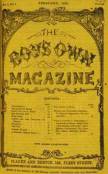
Boys_Own_Magazine_Feb_1855Because Churchill’s exploits in the South African War were marketed as a grand adventure, it vaulted this failing politician into the annuals of British heroism and resuscitated his career in a manner that can only be described as ‘stellar’.

It was this escape from a POW holding pen in Pretoria during the South African War that set up and ultimately forged Churchill into the juggernaut politician and statesman he was to become, without it Great Britain may never have had its great wartime leader and ‘saviour’ during World War 2 and by the same token the disaster at Gallipoli during World War 1 may even have never taken place.

So, let’s have a look at why South Africa is the epicentre of Churchill’s revived career and why by association this country gave the world a man who in 2002 was voted as the ‘Greatest Briton of all time’ placing him at the top of the most influential people in British history.

Let’s also examine why a lot of people would frankly have been very happy if the Boers had shot and killed him on the fateful day he was caught in Natal (an outcome which very nearly happened).  On the way we’ll also unravel some truths and myths.

Churchill’s South African ‘Adventure’
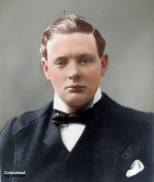
Young Churchill

Known as ‘Copperknob’ a colourised young Churchill at Harrow

To say Winston Churchill was an ambitious young man would be a classic example of English understatement. By the age of 25, the freckled-faced redhead had already written three books, run unsuccessfully for Parliament and participated in four wars on three continents. He was even nicknamed “Pushful, the Younger” because of his ambition, Churchill hungered for fame and glory unwavering in his belief that he would one day become Prime Minister. “I have faith in my star that I am intended to do something in the world,” he wrote to his mother.  Unknown to him at this stage his ‘star’ was to align and bring him fame in South Africa.

Winston Churchill initially took part in the South African War as a ‘war correspondent’ for The Morning Post.  Some war correspondents (like Churchill) tended to be retired commissioned officers with military experience attached to British Regiments or Formations, their reporting was intended to toe the military line.

Churchill as a war correspondent was generally disliked by the British upper officer class, they found him highly critical of their strategy, tactics and actions, they also found him impertinent, arrogant and nothing more than a meddling glory monger.  His ‘upper class elite’ and ‘political class’ heritage presented him as a double-edged sword to any Regiment or Division’s officer elite and they had no choice, simply put they had to just put up with him.

True to form, Churchill’s activities in South Africa literally read like a ‘Boys Own’ Adventure Novel. Within two days of the Boer Republics declaring war on Great Britain on 11th October 1899, Britain started to mobilise their forces at home, in the Cape Colony and Natal their forces were relatively small frontier garrison forces supplemented by citizen force members (which they began to muster anticipating the coming hostilities), and they were hopelessly under-strength.
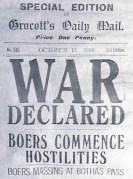
18056649_10155221467369476_6950152090307411838_nIt a ‘myth’ that Britain had built up large forces to invade the Boer Republics before the start of the war.  The ‘truth’ is they were relatively unprepared and much weaker than the well equipped Boer forces – ‘Black November’ illustrates this perfectly.  The Boers had banked on a swift victory whilst Britain was weak, hence their ultimatum was followed immediately with a surprise Boer invasion of the British colonies – Natal and the Cape Colony.

The British decided to initially send General Sir Redvers Henry Buller and a small contingent of officers, a detachment of troops and a gaggle of journalists off to South Africa on a fact-finding mission to gauge troop strength ahead of sending any major expeditionary force requirements, they left on the Dunottar Castle on 14th October 1899.

Churchill had planned to publish his magnum opus in October 1899, “but when the middle of October came, we all had other things to think about”. He said, “the Boer ultimatum had not ticked out on the tape machines for an hour” and he was on his way to the Cape Colony, appointed as the principal War Correspondent of the Morning Post. He was to be paid £250 per month for four months (£ 1000 was a small fortune at the time), all expenses paid and he retained the copyright on his articles.

Churchill was first in with Buller’s fact-finding mission anticipating his big ‘scoop’.  Sailing with great haste and at high-speed, Churchill called the voyage with Buller as “a nasty, rough passage” and wrote his mother that he had been “grievously sick.” The passage aside, in typical form Churchill even took his valet with him and a vast liquor cabinet that included 18 bottles of Scotch Whiskey also went in tow.
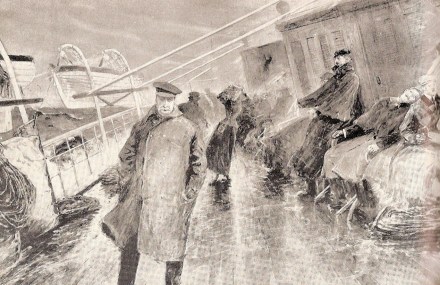
churchill to the cape

Illustration of General Sir Redvers Buller on the Dunottar Castle, steaming at haste to Cape Town departing Britain on 14 Oct 1899

In those days before radio, they were completely cut off from the world while at sea. Approaching the Cape, a passing ship held up a blackboard on which was written: BOERS DEFEATED, THREE BATTLES, PENN SYMONS KILLED. A staff officer ventured to address Buller. “It looks as if it will all be over, sir.” Buller only said,“I dare say there will be enough left to give us a fight outside Pretoria.”

Churchill arrived with Buller in Cape Town on 31 Oct 1899, by this stage the siege of the British frontier town of Ladysmith was well underway, and the initial message of Boer ‘defeat’ was very incorrect.  Churchill could not believe his good fortune and endeavoured to be become the first British journalist to get to Ladysmith – against all odds – ahead of Buller’s fact-finding mission and way ahead of any sizeable expeditionary force (which only was to start landing in Cape Town from 10 November 1899).  In effect he was going to be the first to ‘ascertain’ the situation for the very apprehensive Britons back home, not Buller.

Churchill immediately teamed up with journalistic colleague John B. Atkins of the Manchester Guardian to go to the front at Ladysmith before any other journalists could do so.

They took a 700-mile undefended train ride up north to the Cape Colony’s frontier near Port Elizabeth, then they boarded a small steamer bound for Durban and promptly sailed into the teeth of a violent Indian Ocean storm. After several harrowing days in very high seas, the pair arrived at Durban.  This ‘adventure’ had started to play out in an extraordinary way.

Capture 

Still determined to get to see the Boer forces’ siege of Ladysmith ahead of any advancing forces, Churchill and Atkins made another dangerous train ride of 60 miles to within hearing range of the artillery fire from the Boer guns on Ladysmith. Churchill, still keen on getting closer to the action accompanied a scouting expedition on an armoured train.

The train was ambushed by the Boers and on 15 November 1899 using field artillery and heavy rifle fire, whilst trying to manoeuvre out of fire, the front truck hit an obstruction which was placed by the Boers on the track and it was tossed from the tracks. The Boers then opened up on the stalled train with field guns and rifle fire from a vantage position. With the front truck overturned, the engine and rear trucks remained on the tracks, still coupled to them.
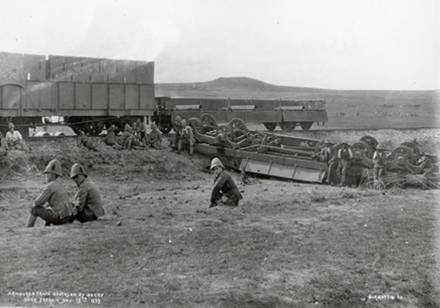
Churchills train

The wrecked part of the armoured train Churchill was travelling in

As shells roared around him and bullets pinged the sides of the armoured train, Churchill’s instincts as a trained military officer took over from his ‘journalist’ side, possibly even more in self-preservation. Acting like a decorated commander, Churchill braved the line of fire for more than an hour as he directed the soldiers to free the train. He also instructed the train driver, a civilian, who was injured and hiding to return to his post (he lied and convinced him that odds are it was not possible to get wounded twice in one day).  He became involved in un-coupling the section of the train which was not completely de-railed, the idea was to use this part of the train still on the tracks as a shield for the soldiers as they retreated to safety.
Churchill

Colourised image of Churchill next to the ambushed train – taken later in the war. Colourised by Tinus Le Roux

After some 70 minutes of action the Boers swept down the hillside, Churchill by this time had become separated from the part of the train on the tracks as it retreated. A number of men were taken prisoner, but a large section of the train, now loaded with men, had escaped.

Churchill made for cover to try to escape and found himself alone in a gully near the track. A Boer rode up and seated on his horse raised his rifle to bear at a range of 40 yards. Churchill went for a Mauser pistol he was carrying in his belt but it wasn’t there, whilst clearing the train he had taken it off and left it on the train, it was now safely making its way back without him and Churchill was unarmed.  So, as myths go Churchill was not simply an ‘unarmed’ journalist and as other myths go he also did not fire the pistol during the attack, but he certainly had every intension of shooting the Boer horseman (at his own admission).

In a flat dilemma, Churchill considered his idol – Napoleon who said, “When one is alone and unarmed, a surrender may be pardoned.”  So he obeyed the Boer to surrender and walked out.  Whilst walking into captivity next to the Boer horseman Churchill suddenly realised he had two magazine clips on his person for the Mauser Pistol, which were loaded with ‘soft-nosed’ ammunition. Figuring this may get him into a lot of trouble (soft-nose ammunition makes a bigger striking wound than hard-nosed ammunition and was generally not thought of Kindly by soldiers – it still isn’t), he realised he had to get rid of them fast.

Churchill silently got rid of one magazine, whilst trying to dispose of the second the Boer caught him in the act and said in English, ‘What have you got there?’.  Quick thinking, Churchill gave a whopping lie and replied, “What is it?’ I picked it up”.  The Boer took the pistol magazine and threw it away.

With that Churchill went into captivity, protesting that he was just a civilian war correspondent and therefore not subject to a Prisoner of War status and should be released immediately.  The Boers would have none of it, they had captured a ‘great prize’ who had not behaved under fire in characteristically ‘civilian’ manner.

Passing Majuba 

Whilst his POW train passed Majuba hill on its way to Pretoria Churchill had time to think.  Majuba was the site of the British defeat in the 1st Anglo-Boer War (1880 to 1881) twenty years earlier, to understand the deep causes of The South African War (2nd Anglo-Boer War), we need to understand the 1st Anglo-Boer War (like the 2nd World War is World War 1 Part 2, so too the case with the two Anglo-Boer Wars).

As inconvenient truths go the Transvaal was annexed by the British in 1881 at the invitation of the Boers to save them from an African revolt, the Boers did not take to British administration, especially as to how they dealt with the Black African’s claims and taxes and so kicked them out, this cumulated in the Battle at Majuba – and all this happened long before Gold was discovered in the Transvaal – think about that.
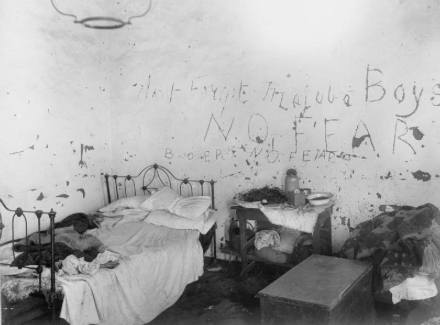
Mjuba

Graffiti scrawled by both sides in a house recaptured by the British in the 2nd Anglo Boer War. The Boer graffiti reads: ‘Don’t forget Majuba, Boys’. British graffiti reads: ‘No fear, Boere, no fear’. Imperial War Museum image

This act of defeat and subsequent ceasefire agreement from the battle at Majuba was described by Churchill as “a disgraceful, cowardly peace” as he pondered it whilst passing Majuba hill in his POW train going into captivity.  The general sentiment at the time amongst the British was that the South African War i.e. 2nd Anglo-Boer War (1899 to 1902) was going to settle the disgrace and tentative ‘ceasefire’ of the 1st Anglo-Boer War (1880 to 1881) once and for all.

How history twists 

In one of the most ironic twists in history, after The South African War (1899 to 1902), when Boer Generals visited England to ask for some loan or assistance on behalf of their devastated country, Churchill was introduced at a private luncheon to their leader, General Louis Botha.  Churchill began with his story of his capture, Botha replied ‘Don’t you recognise me? I was that man. It was I who took you prisoner. I, myself,’

Churchill highly respected and valued Louis Botha after the war, he found the Union of South Africa’s first Prime Minister as “an acquaintance formed in strange circumstances and upon an almost unbelievable introduction ripened into a friendship which I greatly valued. I saw in this grand, rugged figure, the Father of his country, the wise and profound statesman, the farmer-warrior, the crafty hunter of the wilderness, the deep, sure man of solitude”.

In another strange twist of history, Kmdt Dolf De la Rey was in command of forces attacking the train is also credited with capturing Churchill (amongst others), much later on De la Rey in 1950’s, as an ageing Boer veteran of The South African War, joined Sailor Malan in his Torch protests against the National Party, such is the rich tapestry of Afrikaners against Apartheid.

Prisoner of War

Although the Boers allowed prisoners-of-war to purchase newspapers, cigarettes and beer, the future British Prime Minister despised his imprisonment “more than I have ever hated any other period in my whole life”. What frustrated Churchill even more than the loss of control was the possibility that he was missing out on further opportunities for glory. “I had only cut myself out of the whole of this exciting war with all its boundless possibilities of adventure and advancement,” he lamented.
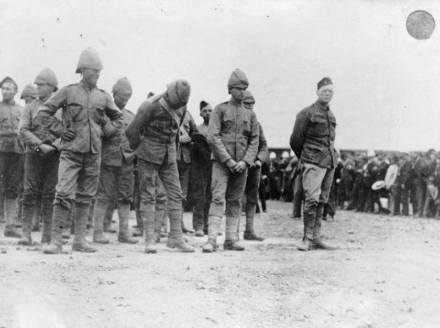
Winston Churchill POW

Group of British Prisoners of War, with Churchill on the right. Imperial War Museum image

So, he decided to do something about it and escape, and the ramification of doing so would have massive historical consequence.  Here Winston Churchill himself sums up the randomness and sheer ‘luck’ this would all bring him.

“I was to escape, and by escaping was to gain a public reputation or notoriety which made me well-known henceforward among my countrymen, and made me acceptable as a candidate in a great many constituencies. I was also put in the position to earn the money which for many years assured my independence and the means of entering Parliament. Whereas if I had gone back on the engine, though I should perhaps have been praised and petted, I might well have been knocked on the head at Colenso a month later, as were several of my associates on Sir Redvers Buller’s Staff”.

Churchill’s ‘Great Escape’

In December 1899 Churchill’s plan to escape took shape.  He was held in a prison dedicated to British officers, it was a State Model school in central Pretoria converted to hold Prisoners of War.

He wrote.“The State Model Schools stood in the midst  of a quadrangle, surrounded on two sides by an iron grille and on two by a corrugated-iron fence about ten feet high, these boundaries offered little obstacle to anyone who possessed the activity of youth, but the fact that they were guarded on the inside by sentries, fifty yards apart, armed with rifle and revolver, made them a well-nigh insuperable barrier” he then adds “No walls are so hard to pierce as living walls”.

In cohorts with two officers, Captain Haldane and Lieutenant Brockie (who was in fact a Sergeant Major who passed himself off as a Lieutenant in order to get better quarters).  They had noticed a ‘blank spot’ in the movements of Boer guards behind the latrines.  After a first attempt at escape was aborted, they had another go the next day.  Churchill was to go first followed by the other two.
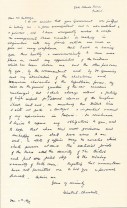
churchill

Churchill’s departing note

On the night of his escape, December 12, 1899 Churchill even had the gumption and cheek to leave a ‘Dear John’ departing note on his pillow thanking the Boer Republic for its hospitality, it read in part:

 “… I wish in leaving you thus hastily and unceremoniously to once more place on record my appreciation of the kindness which has been shown me and the other prisoners by you, the Commandant and Dr Gunning and my admiration of the chivalrous and humane character of the Republican forces.”

‘Churchill entered the small circular lavatory, waited some time monitoring the guards from the lavatory, he waited until the guards had turned their backs and this was his moment, he hesitated twice and then went for it, he scaled the wall and jumped, initially snagging himself on the ornamental metal spikes on top of the wall.

Once free he hid himself in a nearby shrub in the adjacent garden and waited for his partners, who did not arrive, he lay here for an hour with great impatience.  He overheard them speaking in Latin gibberish and mentioning his name, he risked a cough and they told him the game was up on the guard movements and they were not able to join him.

So, there he was, he considered going back and instead undertook to press on with his escape.  The escape was very poorly planned, he had only figured out how to get out of the prison, no real further thought had been given other than to head east. Churchill the ‘fugitive’ had no map, no compass, no intimate local knowledge, no ability to speak the local languages and just “four slabs of melting chocolate and a crumbling biscuit” in his pocket for food.  The compass and food had been with his colleagues, but he still possessed a seemingly superhuman level of self-belief that he could safely navigate the 300-mile journey through enemy territory.

On the ‘run’

Contrary to many myths, Churchill did not scarper out of Pretoria as a running fugitive only to ‘forge the mighty Apies’ river to freedom (that was all media hype).  In fact, he casually walked out of Pretoria.  He figured so as not to draw attention to himself he would just amble along in the middle of the road, in full view, humming a tune, pretending to be just a regular ‘Burgher’ on his way home.  He would later joke with Jan Smuts that there was a good chance he just walked straight past him.

Without ‘forging’ any river, he eventually found himself strolling along looking for a railway line, he figured he would follow the easterly tracks, the idea was to get to neutral Portuguese East Africa (now Mozambique).  When he reached the eastern suburbs of Pretoria he sat down on a small bridge and for a little while contemplated as to how his ‘adventure’ was now panning out.

He resolved to turn South and eventually he struck a railway heading in an easterly direction, following it, all the while reasoning with himself that he would jump aboard a train and hide.  A coal train passed and he jumped aboard hiding amongst the sacks, and promptly went to sleep.  He awoke hungry and thirsty and needed sustenance, and to get a bearing (he was not sure the coal train had in fact run east) so he disembarked by jumping off.

His next effort to find another train proved entire futile, hungry, tired and thirsty he marched on with increasing hopelessness. By now he was desperate, that night he spotted a fire, thought it a Black African hamlet and hoped to fall on their tender mercy.  On approaching the fire, it turned out to be a railway siding and he overheard Dutch-Afrikaans been spoken.  But desperate and miserable he then resolved to ‘give up the game’ and approach a nearby house.  Chuck it all in, whatever comes, he hoped against hope there would be a sympathetic owner to his plight.
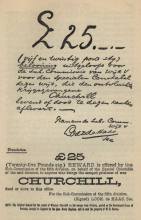
Winstons Wanted Poster

Churchill’s ‘Wanted’ Poster

Meanwhile back in Pretoria and in the United Kingdom, news of his escape broke.  The British public and media shifted into a mode that can only be described as ecstatic, news stories broke on the ‘bravery’ of Winston Churchill giving the Boers the old ‘Agincourt salute’!

Good old stiff upper lip resistance stuff – in a sea of negative news on the heavy British battle losses over November and December this made for the only media ‘great news’ and positive propaganda for a public desperately keen on anything good coming from the war to date – and all thanks to only one man – Winston Churchill. The Zuid-Afrikaansche Republiek (The South African Republic) , also known as the ‘Transvaal’ Republic (abbreviated ‘ZAR’), went on the man-hunt and immediately put a bounty on Churchill’s head – £25 for the return of Churchill ‘Dead or Alive’.

The Transvaal Police (ZARP) circulated a telegram after Churchill escaped from prison and it gives a very accurate description of Churchill demeanour, it is also very telling of the saga unfolding for Churchill.  It read:

“Englishman 25 years old about 5 foot 8 inches tall medium build walks with a slight stoop. Pale features. Reddish-brown hair almost invisible small moustache. Speaks through his nose and cannot pronounce the letter S. Had last a brown suit on and cannot speak one word of Dutch.”

Throwing the dice 

Churchill, now in sheer desperation, cautiously approached the house and knocked on the door.  His odds were really 50/50 and he knew it, to dispel another myth, The South African War was not a clean-cut affair between the British and Afrikaners facing each other.

The South African Republic (ZAR) was rammed full of tens of thousands of mainly British mine workers and managers, who also worked the mining support infrastructure – like rail (they were the cause Britain cited as the Casus Belli for war in the first place), there were more Britons living along the Transvaal gold reef’s towns in the Republic than Boers.  Equally there were more Afrikaners with British Cape Colony citizenship in the Cape Colony than Britons.

At the beginning of the war, English and Afrikaners with citizenships on either side of the fence, if caught siding with one or other cause were generally executed for treason by either the British or Boers – this kept most of them at bay and non-hostile one way or the other. Also, there were many Afrikaners living in the two Boer Republics and most in the Cape Colony who were in fact sympathetic to the British cause, as there were also many English ZAR citizens sympathetic with the Boer cause.  The next phase of Churchill’s ‘adventure’ illustrates this perfectly.

On knocking on the door, a light came on and a man asked in Dutch-Afrikaans “Wie is daar (Whose there)”. Winston went into shock, the game was up, so he immediately lied and said; “I want help; I have had an accident”. The door opened, and the man said in English this time “What do you want?” Not sure of the status of things Winston carried on lying and said; “I am a burgher, I have had an accident. I was going to join my commando at Komati Poort. I have fallen off the train. We were skylarking. I have been unconscious for hours. I think I have dislocated my shoulder”.  He had in all honestly no clue what to say next.

The stranger regarded Winston intently and ushered him in pointing to a room with one hand whilst holding a revolver in the other.  Winston Churchill half expected to be shot in the back of the head there and then.  He chose to come clean and said; “I am Winston Churchill, War Correspondent of the Morning Post. I escaped last night from Pretoria. I am making my way to the frontier. I have plenty of money. Will you help me?”

Now here’s where Winston just got lucky, his host responded; ‘Thank God you have come here! It is the only house for twenty miles where you would not have been handed over. But we are all British here, and we will see you through.”

Brave words from the host, and here’s why, it turns out that Churchill’s new host was John Howard, an Englishman managing Transvaal Collieries. He had become a naturalised citizen of the Zuid-Afrikaansche Republiek and he had bribed the local Boer Field Cornet, so he would not be called up to his Commando and fight the British.  His team was all of British heritage and had been allowed to stay if they remained ‘neutral’.

‘Verraaiers’ (traitors) everywhere!

John Howard and some of his compatriots resolved to hide Churchill under-ground in a nearby coal mine whilst they figured out the next move.  They ran a tremendous risk, had they been caught they would have been shot as traitors and collaborators, especially John Howard who would have been shot outright.

Churchill sat it out in a mine shaft with food provisions given to him, his only company the many rats.  On the fifth day of his escape, John Howard hatched an escape plan for Churchill.  In the neighbourhood of the mine there lived an Afrikaner named Burgener, who was sending a consignment of wool by rail to Delagoa Bay on the 19th December.  Burgener was an Afrikaner ZAR citizen sympathetic to the British cause.

Howard had secretly met with Burgener, told him of Churchill and they agreed to smuggle Churchill into a specially adapted wool bale on the train and take him to safety.  Phew, supreme treason this, had this Boer ‘turncoat’ been caught he would surly have faced a ZAR firing squad or noose.  Burgener was also to accompany Churchill all the way to Portuguese East Arica and safely see him through – now not many people know this part of the narrative, it’s inconvenient to highlight a ‘Afrikaner’ collaborator in all of this.

What all this skullduggery means, the idea of broad partisan loyalty to the Zuid-Afrikaansche Republiek’s cause is simply a myth – thousands of ZAR citizens, English and even some Afrikaans were not behind Kruger’s politics or his cabal.

Do you know who I am?

In the middle of the night on the 19th December, Churchill was taken the train loaded with wool bales, Howard pointed the spot made available for Churchill to hide and Winston snuck away into the centre of the specially modified wool bale (with enough space to sit up in), he was given a revolver and food (chicken, meat and bottles of cold tea) – a small space enabled him to see out.  Off the train trekked, final stop, Portuguese East Africa (Mozambique).

Once safely over the border into neutral Portuguese territory, he emerged from his wool bale sang and shouted in jubilation whilst firing his revolver into the air.

Once in Lourenço Marques (now Maputo), he carefully disembarked the train and saw Mr Burgener (the Afrikaner who had helped him), Burgener then pointed him to the British Consulate.  He marched in expecting a rousing reception – he got none of it.  Instead a terse British civil servant told him to ‘Be off,‘ the Consulate was closed, he added; ‘The Consul cannot see you to-day. Come to his office at nine tomorrow, if you want anything.’

At this point Churchill spat his dummy in the reception area, in a typical ‘do you know who I am’ rant he demanded to see the Consular who was duly called, happily the weekly streamer to Durban was leaving that night, he embarked immediately and arrived in Durban to the jubilant reception he was expecting.
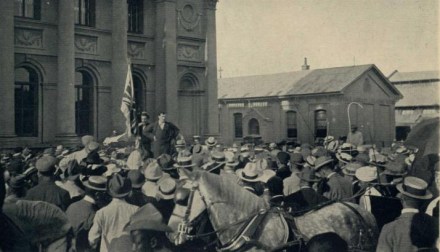
img-310

Churchill addresses the crowd at Durban following his escape from Pretoria and return via Portuguese East Africa (Mozambique)

Becoming a ‘Caesar’

In Durban, Sir Redvers Buller was preparing his next push to relieve the siege at Ladysmith, Winston decided he wanted to re-engage his military commission and get into the fight properly as a British Army officer.  His problem, his contract with the Morning Post,which did not allow him as a correspondent to take part in soldiering, and Buller who had a strict military only doctrine.  So, he struck a unique agreement with Buller, he would do both jobs, the Morning Post would pay him and the British Army would not.  In another first, Churchill became the world’s first ’embedded’ journalist.
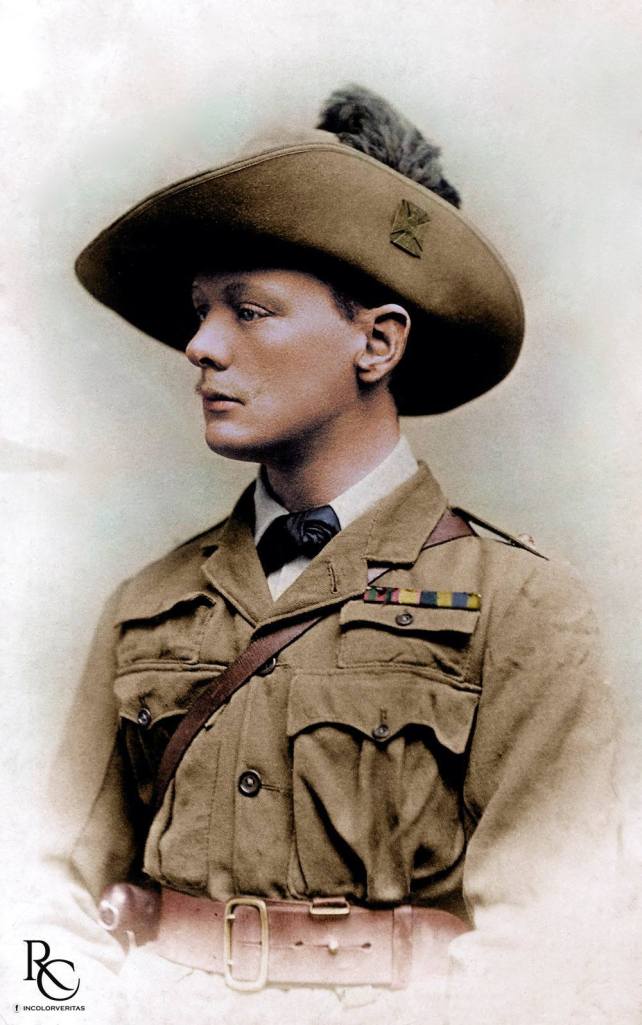
22467705_732497103616836_9219497881391366999_o

Colourised portrait of Winston Churchill as part of the South African Light Horse

With that he eagerly found himself back in uniform and off to war, with a lieutenant’s commission in the South African Light Horse.  In his words; “I stitched my badges of rank to my khaki coat and stuck the long plume of feathers from the tail of the sakabulu bird in my hat, and lived from day-to-day in perfect happiness”.

Churchill took part in the famous battle of Spionkop outside Ladysmith from 23-24 January 1900, he acted as a courier to and from the summit at Spionkop and Buller’s headquarters and made a statement about the scene:“Corpses lay here and there. Many of the wounds were of a horrible nature. The splinters and fragments of the shells had torn and mutilated them. The shallow trenches were choked with dead and wounded.”

He fought a number of skirmishes and battles to relieve Ladysmith, watching the final attack on the Boer position by the Irish Brigade, a desperate affair and out of twelve hundred Irish who assaulted, both colonels, three majors, twenty officers and six hundred soldiers had fallen killed or wounded.  The path to Ladysmith was clear, and Churchill was front and forward riding into Ladysmith in triumph, he said; “We all rode together into the long beleaguered, almost starved-out, Ladysmith. It was a thrilling moment”.

This highlights another inconveniently overlooked fact of The South African War (especially in context of Boer and Black concentration camps later in the war), British civilians, women and children included, suffered heavily under Boer siege tactics, they were forced to live in nearby caves and bunkers (in Ladysmith) and in mine shafts (Kimberley) to avoid the indiscriminate shelling of their cities, many died of shrapnel and disease brought about from the ravages of war.  At near starvation they were emancipated.  They were described by their liberators as ‘ghosts’. Churchill’s account of entering Ladysmith recalls; “Suddenly from the brushwood up rose gaunt figures waving hands of welcome”.

Besides his harrowing images at Ladysmith, in Churchill’s writings during the campaign, he chastised British hatred for the Boer, calling for them to be treated with “generosity and tolerance” and urging a “speedy peace”.  His call was to fall on deaf ears, especially Kitchener’s who only got he ‘speedy peace’ part.
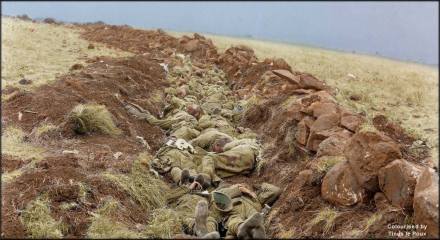
23847272_1499827570053847_6859845416546278573_o

British dead in their tench on top of Spionkop, colourised by Tinus Le Roux

Fighting on into the Orange Free State Republic, he was nearly captured again when he found himself well forward and isolated observing Boer movements, they attacked his position and his horse bolted under fire, Winston ran for his life under heavy fire with bullets whizzing around him, his savour came when another officer rode up to him, gave him a stirrup, hoisted him up, the horse was wounded but they still rode with Winston in tandem out of immediate danger.

He was front and forward again when the British eventually marched on Pretoria in June 1900.  He watched the last Boer fighting forces leaving Pretoria on a train and he and his cousin, the Duke of Marlborough, took the opportunity to get ahead of the rest of the troops and he rode into Pretoria like a conquering Caesar.  He immediately found his way to the State Model School POW prison, the very prison he had escaped from at the beginning of the war, here he demanded and received the surrender of 52 Boer prison camp guards.  The relieved British officers in the prison produced a British Union Jack (flag), they took down the Transvaal ‘Vierkleur’ and hosted the British Union flag – the first time a British flag re-appeared flying over Pretoria since Pretoria was annexed by Britain as a colony at the invitation of the Boers (see 1st Anglo-Boer War) in 1880, twenty years earlier.
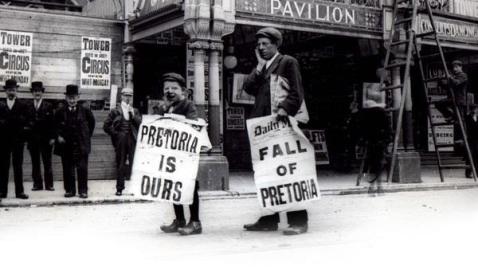
14516334_10154528497944476_6692268421857196301_nAfter the victory in Pretoria, Winston returned to Cape Town and sailed for Britain in July 1900, on the very same ship he had arrived on, the Dunottar Castle. While he had still been in South Africa, his Morning Post despatches had been published as London to Ladysmith via Pretoria, and they sold like wildfire.  He arrived a national hero, nearly god-like, adored by millions.

A future fan base
Churchill 1904

Portrait of a young Winston Churchill during his MP days, 1904

There’s a lot not to like about Churchill, his warmongering nature and ability to lie at will, dithering between politician, journalist and army officer all for personal advancement for starters.  But there’s a lot to like in addition when you consider this.

What a Victorian Boy’s Own adventure! Think about it; the story starts with bang! The hero heads off to war on an urgent sea passage to the Cape Colony, braving high seas and a tropical storm to get to Durban.  In Natal he then single-handedly saves an entire British armoured train and its troop from certain death.

Captured by a skilful and determined enemy, he then escapes a POW prison in Pretoria with a ‘dead or alive’ bounty on his head, the subject of an extensive man-hunt for 300 miles and eventually – intrigue, he’s smuggled out the country to freedom by a group of traitors.

He promptly then re-joins the fight and takes part in the epic Battle of Spoinkop, then he’s on to relieve the starved and besieged British folk in Ladysmith riding in triumph. He then fights his way up Africa to take the enemies ‘prize,’ the capital city of Pretoria.

In a perfect ending to the adventure our hero races in to relieve imprisoned British comrades from the same prison he escaped from, and it all ends with the raising the first British Union Flag of the war flying high above the conquered capital.

In all the hero risks being shot in the head on more than five separate occasions, bravery on an almost unsurpassed level – all for Queen and Empire.

You could not make this stuff up! How Churchill did not earn a Victoria Cross is a matter of conjecture (and a topic of many discussions). To the average Victorian prepubescent boy this was an epic ‘Boy’s Own’ adventure, the difference with fiction, it was all true – and a generation of Churchill fans was born.

A fall from Grace

With a stellar career in front of him, as World War 1 churned on Churchill found himself as the 1st Lord of Admiralty, he asked the Prime Minister “Are there not other alternatives than sending our armies to chew barbed wire in Flanders?” Churchill, believed he had the solution for breaking the impasse—a second front.

Churchill fancied himself a military strategist, he said. “I have it in me to be a successful soldier. I can visualize great movements and combinations,” He proposed attacking the Dardanelles in Turkey and opening a second front.  This was Churchill’s ‘soft underbelly of Europe’ theory – and ironically he made the same mistake with the Italy Campaign of the Second World War, and like Italy later, Turkey proved a ‘tough old gut’ in World War One.

The Gallipoli campaign was an outright failure, the Battle of Gallipoli became a slaughter and quickly morphed into a stalemate just as bloody, just as pointless as that on the Western Front.

In May 1915, Churchill was demoted to an obscure cabinet post. “I am the victim of a political intrigue,” he cried to a close friend. “I am finished!”
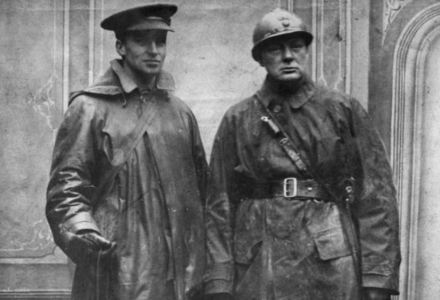
Churchill-in-French-Helmet

Churchill (right), back from the trenches in WW1 wearing a French Adrian helmet; the officer to his left is Maj. Archibald Sinclair

Displaying his typical dogmatic determination, he resigned to make good his character, and he did this is a most remarkable way, he joined the Army again and chose to spend his time in his ‘political wilderness’ fighting in front line trenches in France, slogging in the blood and mud as a Lt. Colonel with the Royal Scots Fusiliers. After several brushes with death, he returned to politics in 1917 as the Munitions Minister, from his experiences in the front lines he wrote of the urgent need for the armoured ‘tracked caterpillars’ to traverse the mud and ‘no-mans land’ – his involvement with a group of innovators to resolve the problem led to the development of the battle tank and warfare was forever changed.

Destiny 

Churchill became the Chancellor of Exchequer (Cabinet Minister) in 1924 upon re-joining the Conservative Party. Churchill was outspoken on a number of issues, such as the danger of Germany’s re-armament after World War One. His warnings against Hitler were largely ignored, but at the outbreak of the Second World War, his foresight was acknowledged, and he became the war-time Prime Minister. His speeches and military strategy were a great encouragement to the British, and he is regarded today as one of the greatest Britons of his time.

It is largely due to Churchill’s leadership during the Second World War that Britain was not invaded by Hitler’s Nazi forces at the on-set of the Battle of Britain, that Britain (and Western Europe for that matter) is the modern European democracy with the freedoms it enjoys today is largely thanks to Churchill (whether his detractors, of which there are many, like it or not, it remains a fact), and here’s another obscure fact – South Africa had a big role in shaping Churchill, his ‘adventure’ in South Africa took him from a minor politician to a political giant with a near demigod status, even failures like Gallipoli could not unseat his destiny – South Africa both directly and indirectly shaped this future.

Churchill

Winston Churchill (Colorised by Mads Madsen)

Related Works and Links

Winston Churchill and Louis Botha: The Battle of Spionkop shaped 3 future leaders – Churchill, Botha & …. Gandhi

The 1st Boer War; Boers; ‘Don’t forget Majuba, boys’. Brits; ‘No fear, Boere, no fear’.

Winston Churchill and Jan Smuts: A true statesman, Jan Smuts addressing the British Parliament – 1942

Winston Churchill and Jan Smuts: “The force of his intellect has enriched the wisdom of the whole human race”- the death of Jan Smuts.

Winston Churchill and Tobruk; “Defeat is one thing; Disgrace is another!” South Africa’s biggest capitulation of arms – Tobruk

Winston Churchill and Smuts; Two fellow members of The South African Legion – Churchill and Smuts

The Transvaal; Vive la rue du Transvaal, vive la France


Written and Researched by Peter Dickens

References and extracts

My Early Life. A Roving Commission. Author: Churchill, Winston S, published October 1930. The Daring Escape That Forged Winston Churchill by Christopher Klein – for the History Channel, November 2016. Winston Churchill’s World War Disaster by Christopher Klein – for the History Channel. Churchill’s capture and escape – November-December 1899, blog by Robin Smith. The Churchill Factor: How One Man Made History by Boris Johnson.

Smuts Barracks; Berlin

Not only did Jan Smuts have a Kibbutz named after him in Israel, as well as pub named after him in London, the famous ‘Smuts Barracks’ in Berlin was also named after him.  The barracks were the home to an SS Panzer Division during the Second World War and was occupied by the British after the war, the barracks is particularly well-known because it was on constant high alert during the Cold War and Berlin Wall divide.

Smuts Barracks was situated on Wilhelmstraße, a street in the Spandau district of Berlin, and the base of the British armoured contingent to Germany, it’s located next to what was the famous ‘Spandau Prison’ . Also in Wilhelmstraße, Spandau Prison was completed in 1881. It was occupied by seven Nazi war criminals, convicted in the Nuremberg Trials after World War 2, including Rudolf Hess, who remained its only prisoner there for many years until he committed suicide. After Hess’ death the prison was demolished and replaced by a shopping centre.

Berlin, Smuts, 1 RTR (2)

Smuts Barracks (above and below), taken during 1 RTR’s tour of duty between Feb 67 and Jan 69.

The British armoured squadron based at Smuts Barracks consisted of 18 modified Chieftain tanks, painted in their renown urban camouflage, and were at a constant state of readiness. This “bombed up” state, ensured a speedy counter attack should the Soviet Union (Russia and East Germany mainly) breach the Berlin wall.

The last unit/squadron to be based here was C Squadron, The 14th/20th Royal King’s Hussars (1989-1993), a Cavalry Regiment of the Royal Armoured Corps. The squadron bar was known as the “Lion and Bear”.

Berlin, Smuts, 1 RTR

RTR at Smuts Barracks

Between 1948 and 1952, the Smuts Barracks was used by the following Regiments stationed in Germany:

Feb 1948 Sqn, 11 Hussars (armoured cars)
May 1949 ‘A’ Sqn, Royal Dragoons (armoured cars)
Mar 1950 ‘A’ Sqn, Royal Horse Guards (armoured cars)
Feb 1951 Sqn, 3rd Hussars

In Feb 1952 a permanent unit was formed, designated 1st Independent Sqn Royal Tank Regt. It was disbanded December 1957. Between December  1957 and Aug 1962, the squadron came from the APC (Armoured Personnel Carrier) regiment in BAOR:

Dec 1957 ‘B’ Sqn, l4lh/20th Hussars
Nov 1960 ‘C’ Sqn, 4th Royal Tank Regt

Another permanent unit was established in March 1963, designated Independent Sqn Royal Tank Regt; it was disbanded November 1965.

After that date, the squadron normally came from the training regiment at Catterick:

Feb 1965 Sqn, Queens Own Hussars
Feb 1967 A Sqn, 1st Royal Tank Regt
Jan 1969 Sqn, 9th/l2th Lancers
Dec 1970 Sqn, 1st Queen’s DG
Dec 1972 ‘A’ Sqn, 4th Royal Tank Regt
Dec 1974 ‘B’ Sqn, 5th Royal Inniskilling DG
Dec 1976 ‘B’ Sqn, Royal Scots DG
Apr 1979 ‘D’ Sqn, Royal Hussars
Feb 1981 ‘D’ Sqn, 4th/7th DG
Apr 1983 ‘D’ Sqn, Queens Own Hussars
May 1985 ‘B’ Sqn, 14th/20th Hussars

From 1985, the squadron came from the 14th/20th Hussars who were based at Münster:
Jan 1988 ‘C’ Sqn took over. The squadron was withdrawn in 1991.

30425700_2124617117767275_8530343007735181590_o

Jan Smuts

Also based at Smuts Barracks  were 38 (Berlin) Field Squadron RE. 38 Field Company was stationed in West Germany as part of 23 Field Engineer Regiment when in 1957 it was amalgamated with the RE Troops Berlin to become 38 (Berlin) Field Squadron Royal Engineers. The Squadron remained in Berlin providing engineer support to the Berlin Brigade until 1994 when it was disbanded as part of options for change.

Smuts Barracks was also the home of the Sapper Berlin Field Squadron (38 Fd Sqn RE).

So there you have it, another legacy of Jan Smuts and an island of South Africa’s contribution to the Second World War and the Cold War after it.  The Barracks is now closed and under private ownership.

Related work and links

Jan Smuts: A Kibbutz called Jan Smuts

Jan Smuts: “The force of his intellect has enriched the wisdom of the whole human race”- the death of Jan Smuts.


Researched by Peter Dickens.  Large reference, photos and extract from BAOR Locations – Smuts Barracks on-line.