
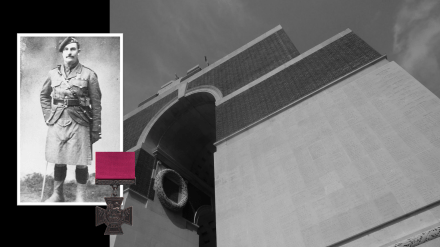
The story of Alexander Young VC.
A lot has been written on the extreme sacrifice at the Battle of Delville Wood during the Somme offensive of 1916, and lets also remember the extreme courage of these South Africans, a young country, the Union of South Africa formed just 6 years prior in 1910 after the devastation of the South African War (1899-1902) i.e. Boer War 2 … and here Afrikaner and English heritage South Africans were fighting shoulder to shoulder in one of the most most desperate engagements in the history of World War 1, and the most heroic and desperate battle in South African’s entire military history – then and even now, and that’s saying something as there have been quite a few notable actions in between.
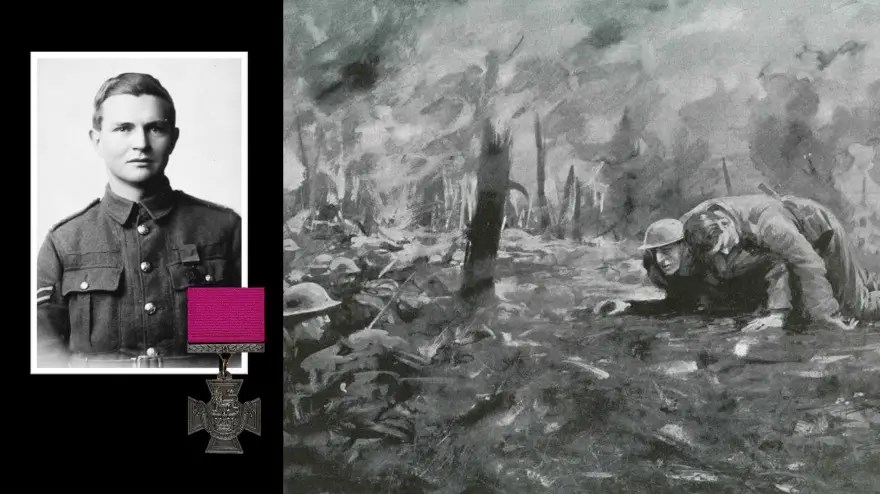
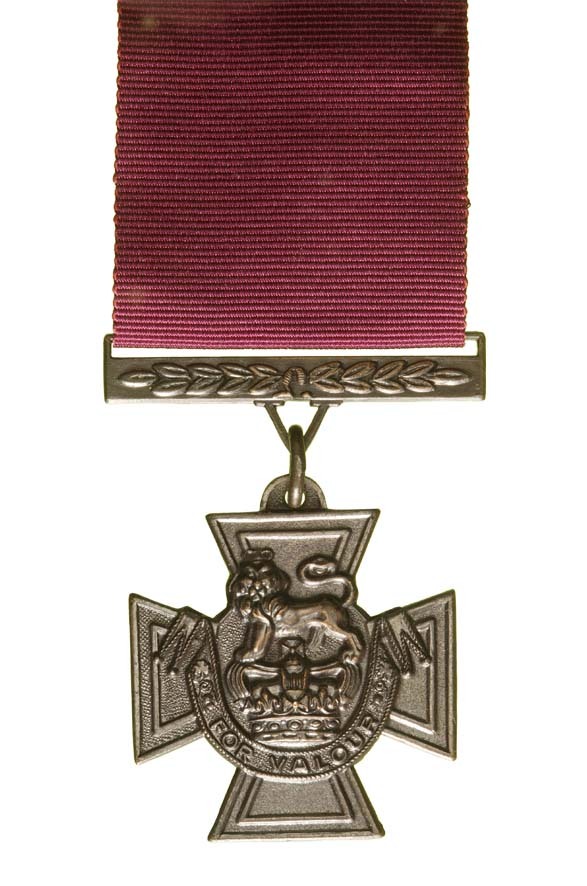
If there was courage to be rewarded from this desperate South African action on the Somme, the Battle of Delville Wood saw one South African individual rise above to an unprecedented level of gallantry and was awarded The Victoria Cross (VC) – the highest award for valour in the British and Imperial Forces (later Commonwealth) – that was Cpl William Faulds serving in the 1st South African Infantry Brigade. For his full story follow the link to this Observation Post Delville Wood’s Victoria Cross – William Faulds
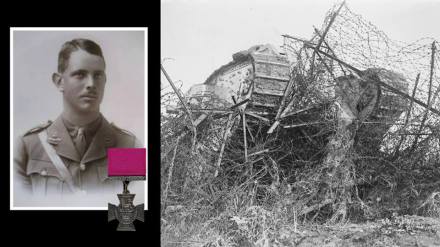
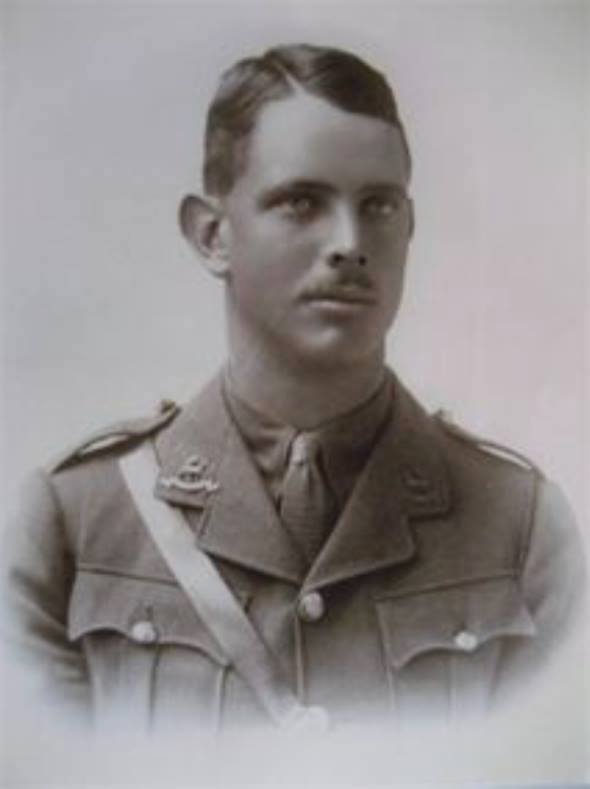
However, there is a missing South African Victoria Cross from the Somme Offensive and Battle of Delville Wood, one not usually recognised or known about in South Africa, and one that is not often referenced in the narrative of Delville Wood, his name is Lt. Alexander Young VC of the 4th South African Infantry Brigade (South African Scottish).
The ‘missing’ story of Lt. Alexander Young VC – 4th South African Infantry
Lieutenant Alexander Young VC is ‘missing’ in more ways than one, not only from our general conciseness as South Africans, but he is also literally missing too – his body has never been found.
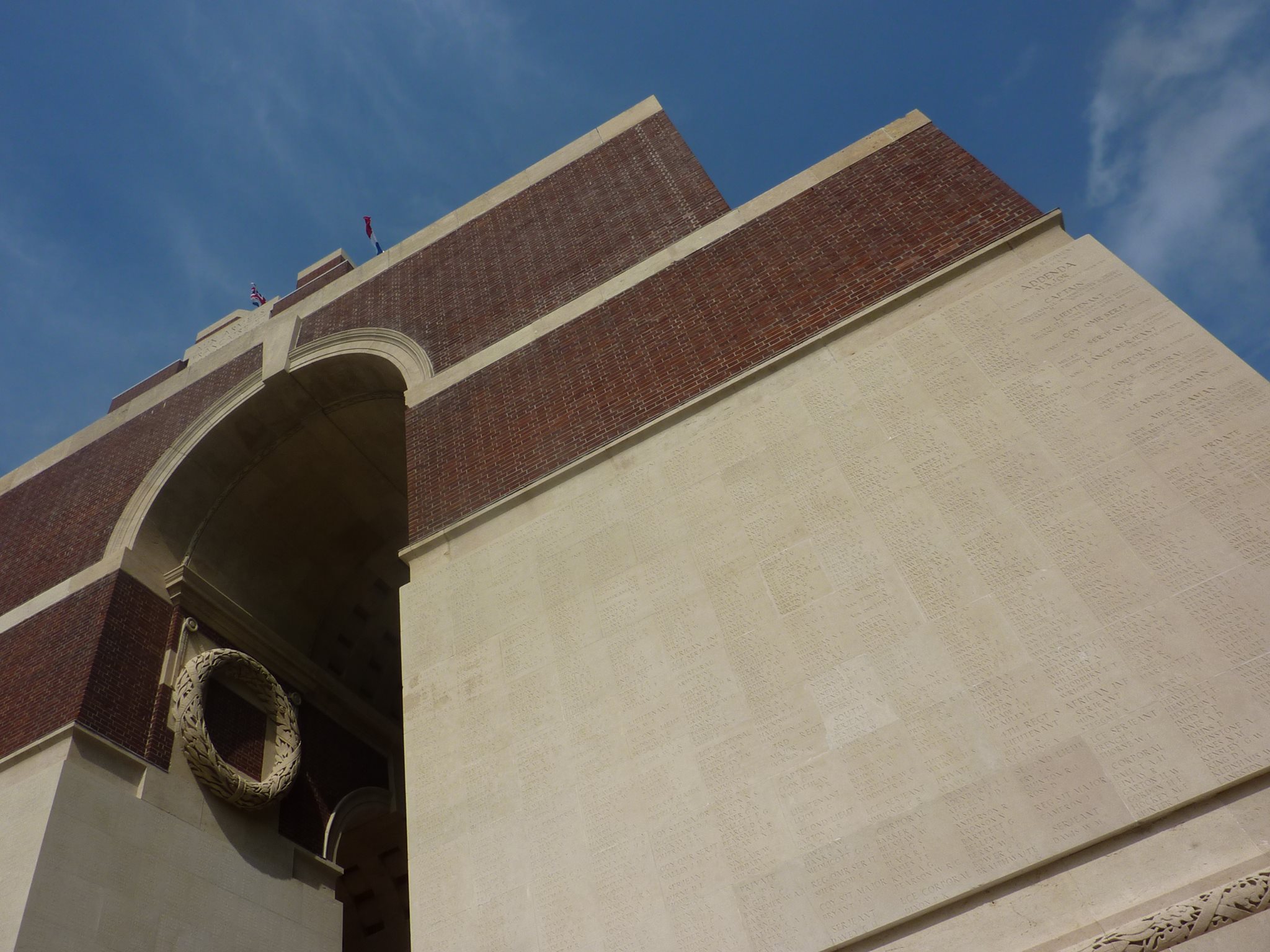
You can however find him today on the ‘Thiepval Memorial to the Missing in the Somme’ in France – his name is on Pier 4, Face C, alongside all the other missing South Africans from the Somme Offensive and Battle of Delville Wood who have no known grave.
So, why don’t we as South Africans know much about this missing South African Victoria Cross? Well, the first reason is that the Irish regard it as their Victoria Cross as Alexander Young was born in Ireland, the second reason is his Victoria Cross was awarded to him for actions, as a Cape Colony colonialist serving in the Cape Colony Police, during The South African War (1899-1902) i.e. Boer War 2 – and not World War 1 (1914-1918) which took place after the Union of South Africa was formed in 1910.
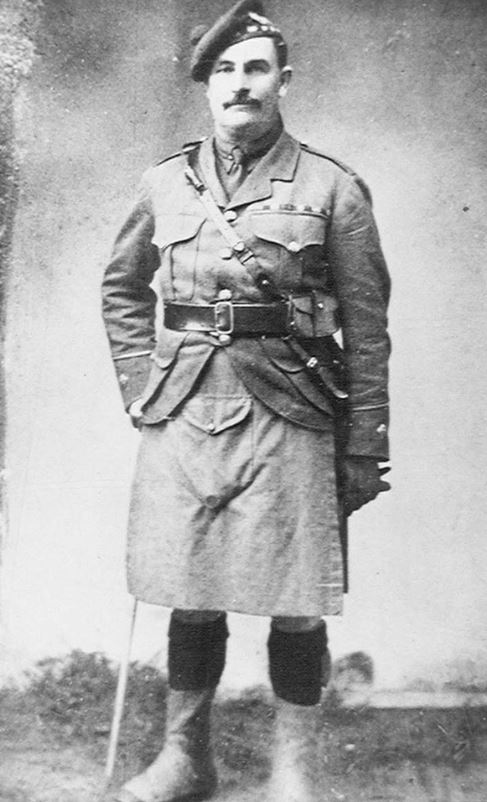
All that aside, Alexander Young VC was a South African to his bones and an incredibly brave one at that – not only fighting for the British Army, but also fighting as Cape Colony Mounted Policeman as their Regimental Sergeant Major and then ultimately fighting as a Commissioned Officer in the Union of South Africa’s forces during World War 1. He saw action and served in India, Egypt, Sudan, Zululand, South Africa, German South West Africa, East Africa and France – his impressive array of decorations and medals include: The Victoria Cross, The Queen’s South Africa medal, The King’s South Africa medal, The Zulu Rebellion medal and then his three WW1 medals – The 1914-1915 Star, British War Medal, and the Victory Medal.
That he was a very remarkable South African is beyond doubt, and this is his story and the story of his Victoria Cross (large extracts courtesy The South African War Graves Project):
Ireland and British Army (early years)
Alexander Young was the son of William and Annie Young, of Ballinamana, Co. Galway. He was born in Ballinona, Galway, Ireland on the 27th January 1873. Educated at the Model School in Galway, Young showed great prowess as a horse rider in his youth and when he was only seventeen, he joined the Queen’s Bays at Renmore. He soon gained the attention of his superiors, was sent to India as a riding instructor, and then served as a sergeant major with Lord Kitchener during the 2nd Sudan War (1896-1898).
South African War (1899-1902)
Sgt Maj Alexander Young became recognised as one of the best horseman in the British Army and as a rough rider was unexcelled. It was after he had been injured by a horse that he retired from the British Army and came to the Cape Colony in August 1899 when The South African War (1899-1902) i.e. Boer War 2 broke out, here he joined colonial forces, attesting in the Cape Mounted Police, and as a skilled horseman he was soon picked to form one of a mounted bodyguard for Lord Milner on an official visit to the Transkei.
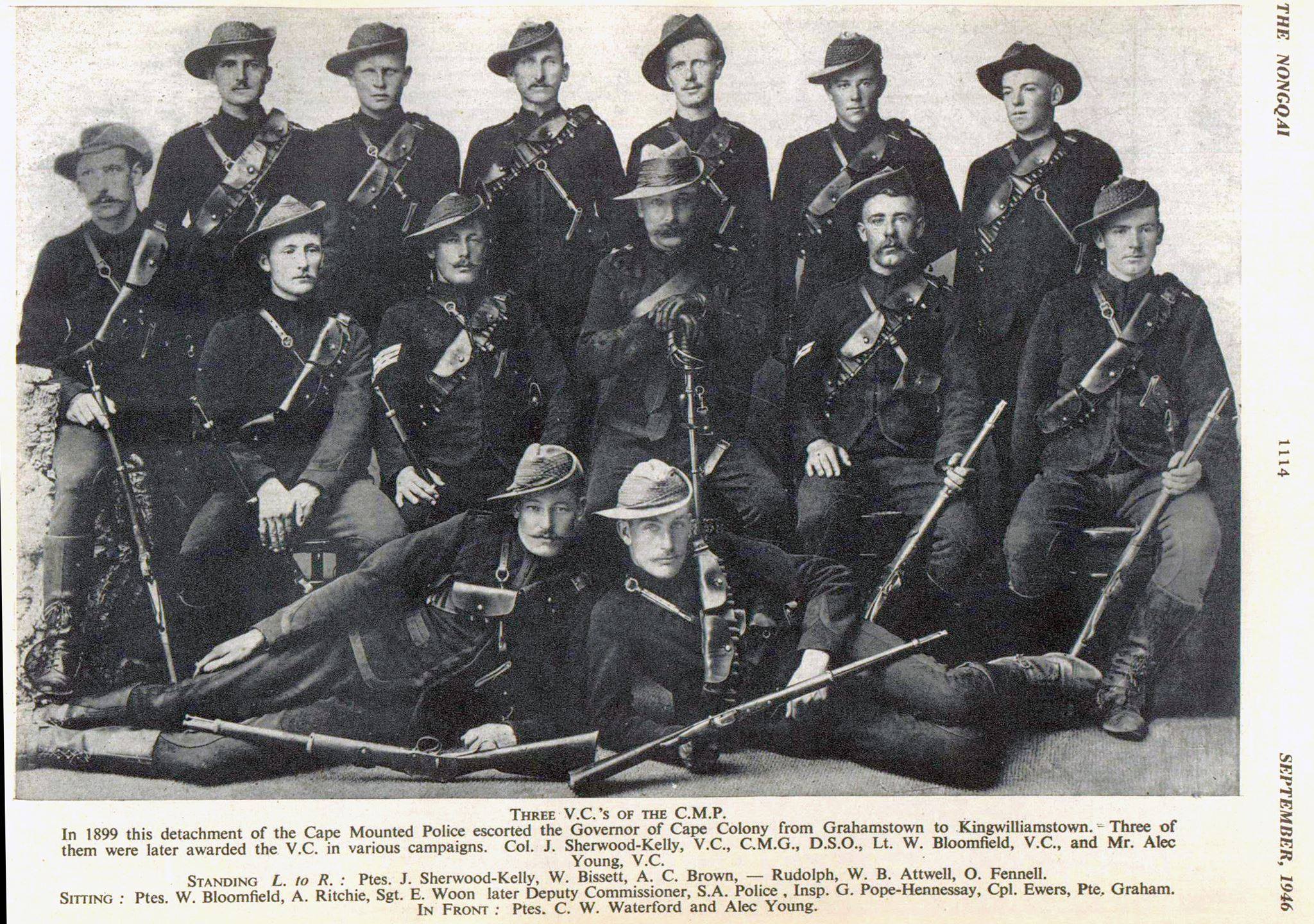
Now this is an interesting photograph of these Cape Mounted Policeman escorting Lord Milner from Grahamstown to King Williamstown in 1899 – in just this single tiny detachment of Policemen there are three future recipients of the Victoria Cross. It says a lot for the calibre of soldier South Africa has bred (The three men are: Colonel J. Sherwood-Kelly VC, CMG DSO, received his VC during the First World War, Lieutenant W. Bloomfield VC, also First World War and finally our man, Sergeant Major Alexander Young VC, who received his during the South African War).
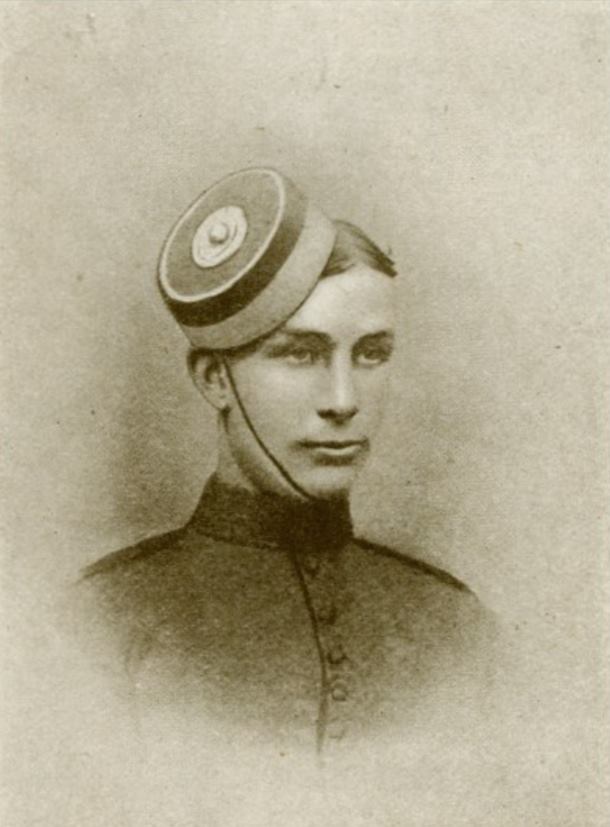
Now stationed at King William’s Town, Sgt Maj. Young saw action whilst serving with General W. F. Gatacre at Stormberg Junction (December 1899) which was routed by Boers, he escaped and was mentioned in dispatches for his coolness in saving Bethulie bridge in March 1900.
Alexander Young’s day in the military history annuals for the highest valour would come on the 31st August 1901 when he took part in the engagement at Ruiterskraal and led a small body of men against a hill held by Republican forces under Commandant J.L.P. Erasmus.
When the Boers tried to escape, he closed in on them, succeeded in taking prisoner Erasmus (who had fired at him point-blank three times) and was awarded the Victoria Cross for his heroic deed. His Citation in the London Gazette on 8thNovember 1901 reads:
“Towards the close of the action at Ruiter’s Kraal on the 13th August, 1901, Sergeant-Major Young, with a handful of men, rushed some kopjes which were being; held by Commandant Erasmus and about 20 Boers. On reaching these kopjes the enemy were seen galloping back to another kopje held by the Boers. Sergeant-Major Young then galloped on some 50 yards ahead of his party and closing with the enemy shot one of them and captured Commandant Erasmus, the latter firing at him three times at point blank range before being taken prisoner.”
German South West Africa and Bambatha Rebellion
Young remained with the Cape Mounted Police until 1906, when he joined the German forces in German South-West Africa and saw service during the Herero uprising (January 1904 to March 1907). For this he was decorated by Kaiser Wilhelm II. During the last phase of the Bambatha Rebellion (February-June 1906) he served in Natal and Zululand, after which he turned to farming.
1st World War
When the First World War (1914-1918) broke out he took up his old position of Regimental Sergeant-Major in the Cape Mounted Police, and served under General Louis Botha in German South-West Africa campaign, thereafter he was promoted to the rank of Lieutenant and was subsequently active again during the East Africa campaign under General Jan Smuts, joining the Natal Light Horse.
He was amongst the first to respond to the call for South African troops to head to Europe and he transferred his commission to the 4th South African Infantry (the South African Scottish), he would however first see action against the Senussi in Egypt, he was again in the thick of it with the 4th South African Infantry in France during the Somme Offensive of 1916 and was later wounded in the crucible which was the Battle of Deville Wood in July 1916.
On recovering, he returned to take part in the later stages of the Somme Offensive under Captain T. H. Ross, he was tragically Killed in Action just before the battle of Warlencourt by German bombs and flame-throwers during an attack on his ‘Snag Trench’ on the 19th October 1916.
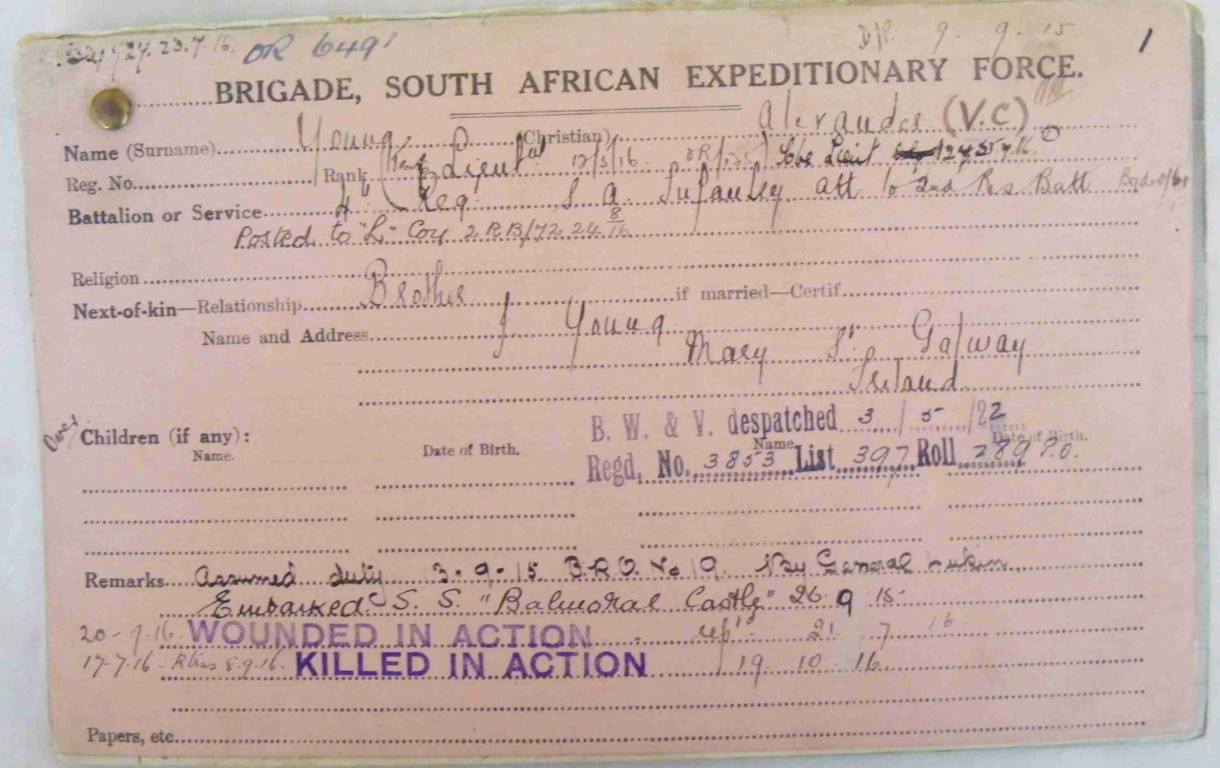
His body has never been identified and his mortal remains are known only to his God. Thiepval Memorial is unique in that it is both a British and South African monument, recorded on its walls are all the ‘missing’ during all the battles of the Somme offensive – a staggering: United Kingdom 71,341, South Africa 832. Total 72,173.
The Thiepval Memorial is one of the most visited Commonwealth War Graves Commission sites in the world. On the first day of the Battle of the Somme (1 July 1916) almost 20,000 men under British command died. By the time the battle was over, 141 days later, more than a million people on all sides were killed, wounded, or went missing.
For the British and South Africans with no known grave, the Thiepval Memorial stands in their honour.
In Conclusion
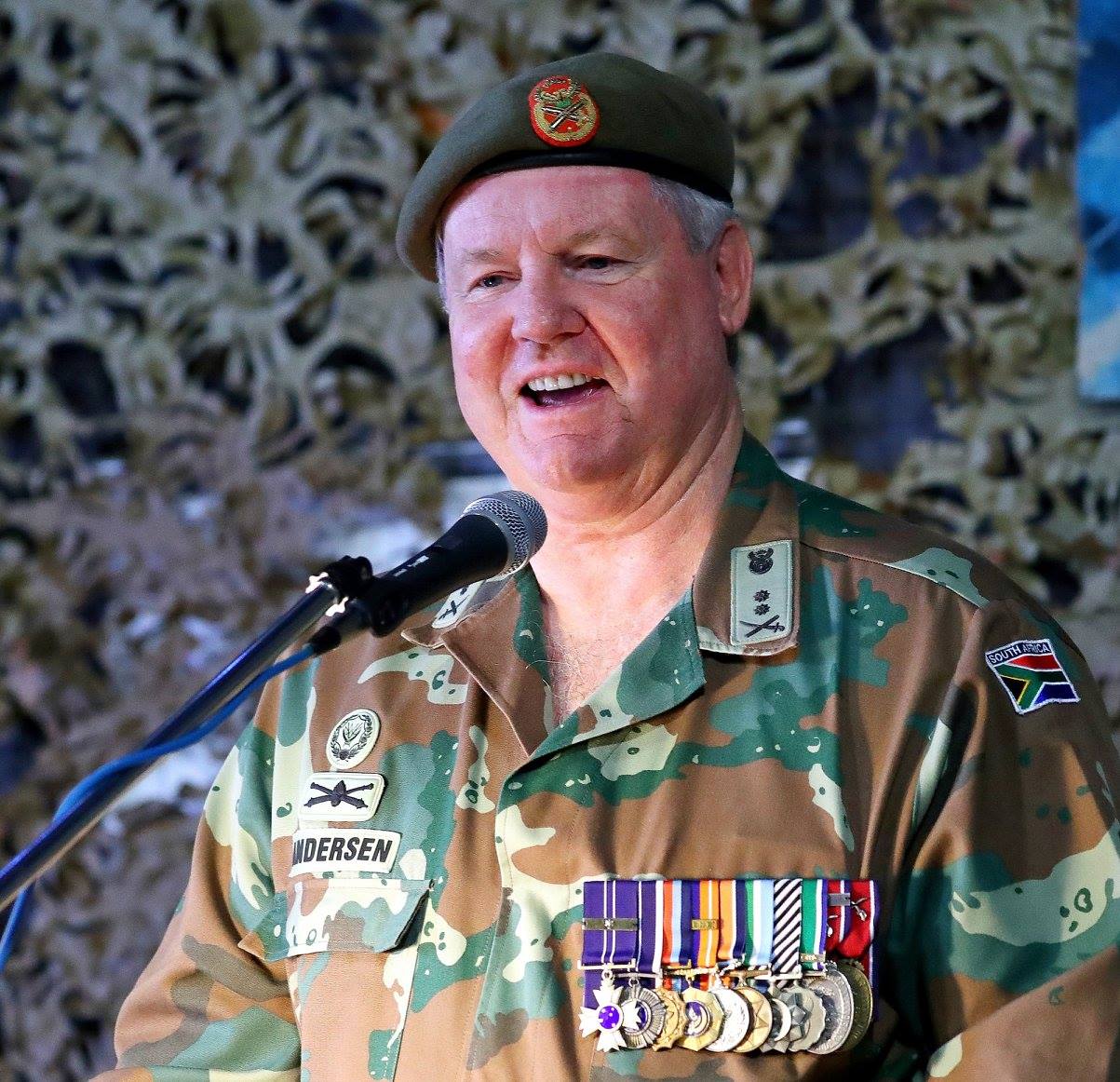
I had the privilege of officiating and commanding the remembrance parade at Thiepval Memorial to mark the centenary of the Battle of Delville Wood. During my speech I referenced Lt. Alexander Young VC and pointed out the panel on which his name is recorded.
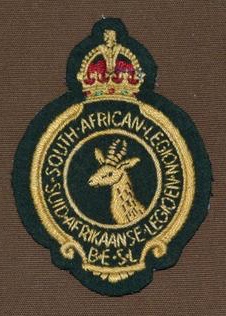
It is with deep appreciation and honour, that on the 10th July 2016, South African military veterans of The South African Legion, Memorable Order of Tin Hats, The Royal British Legion – South African Branch and just about every single CMVO Registered South African Veterans Association, with Rhodesian veterans in addition could ‘stand-to’ on top of Thiepval Memorial 100 years later – with banners flying and heads bowed – whilst we remembered the sheer sacrifice and the many brave South African men, men like Alexander Young VC.
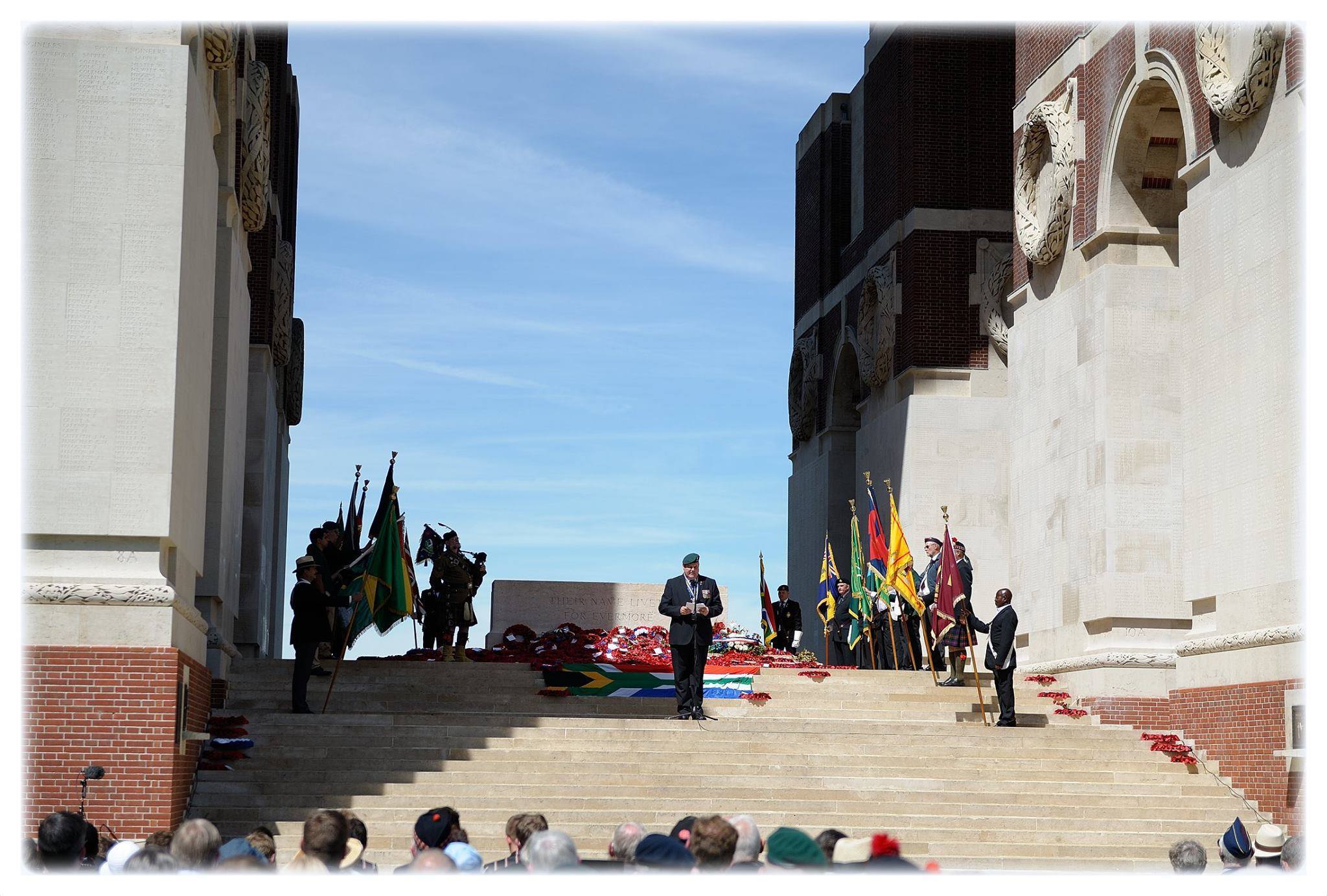
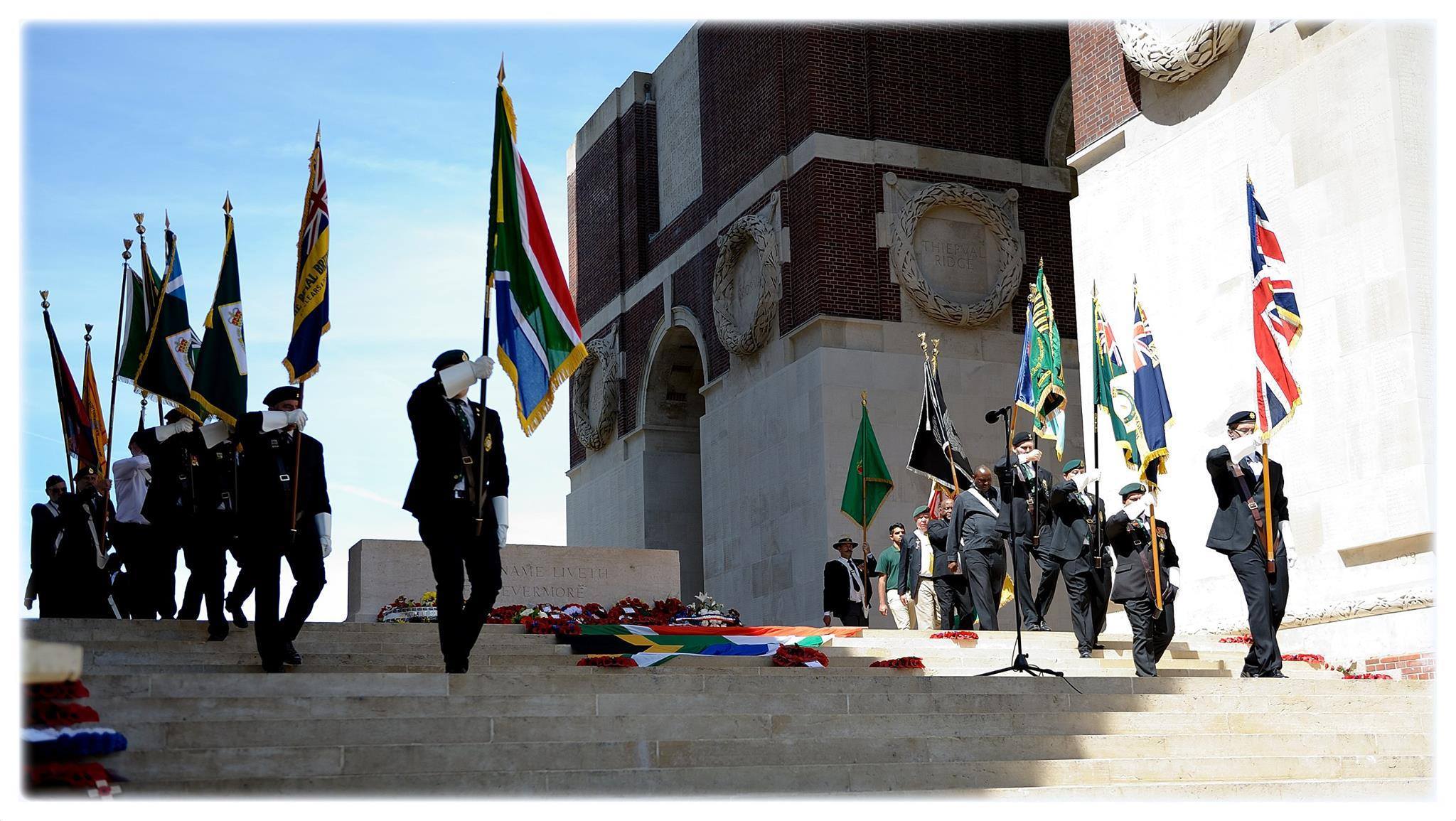
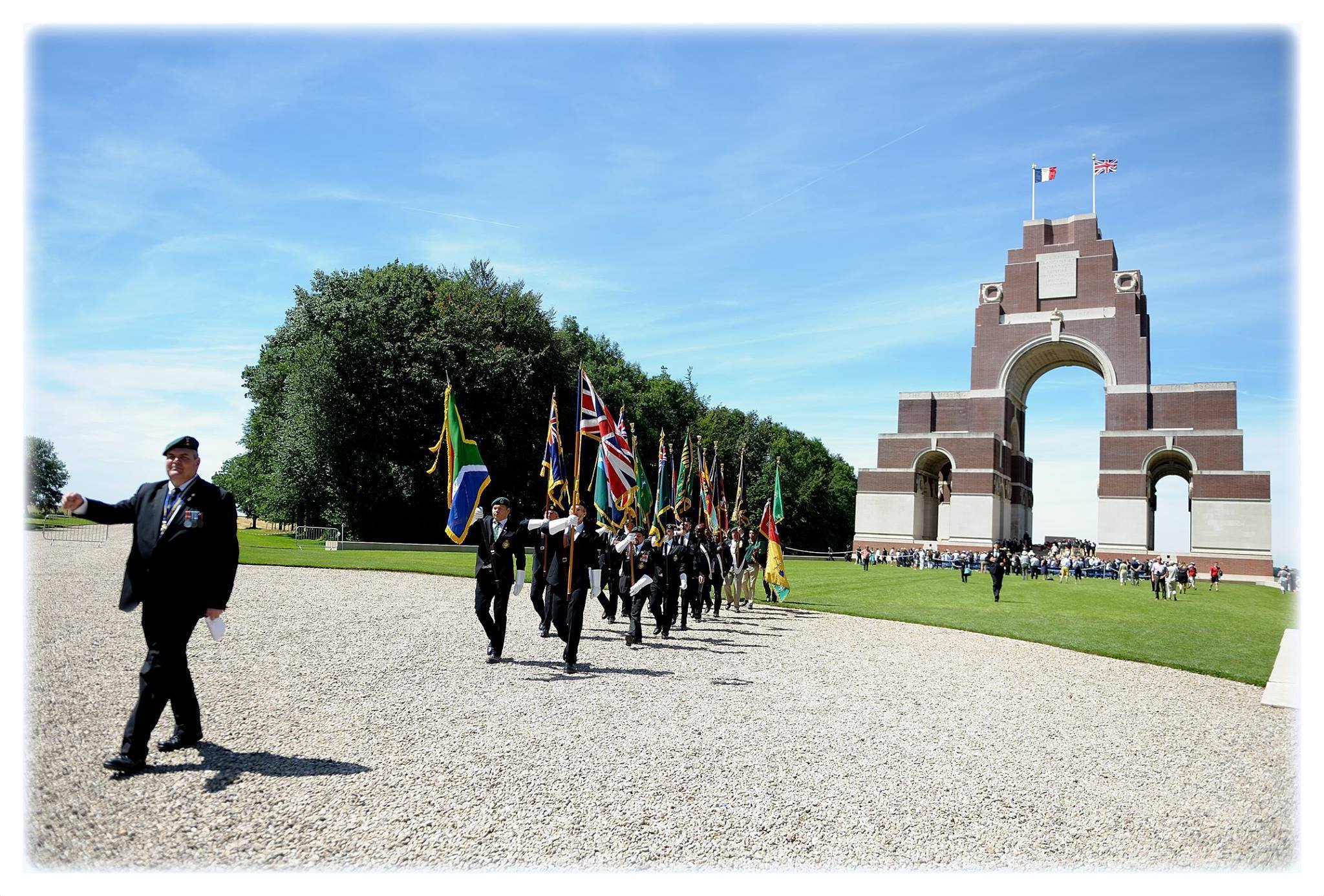
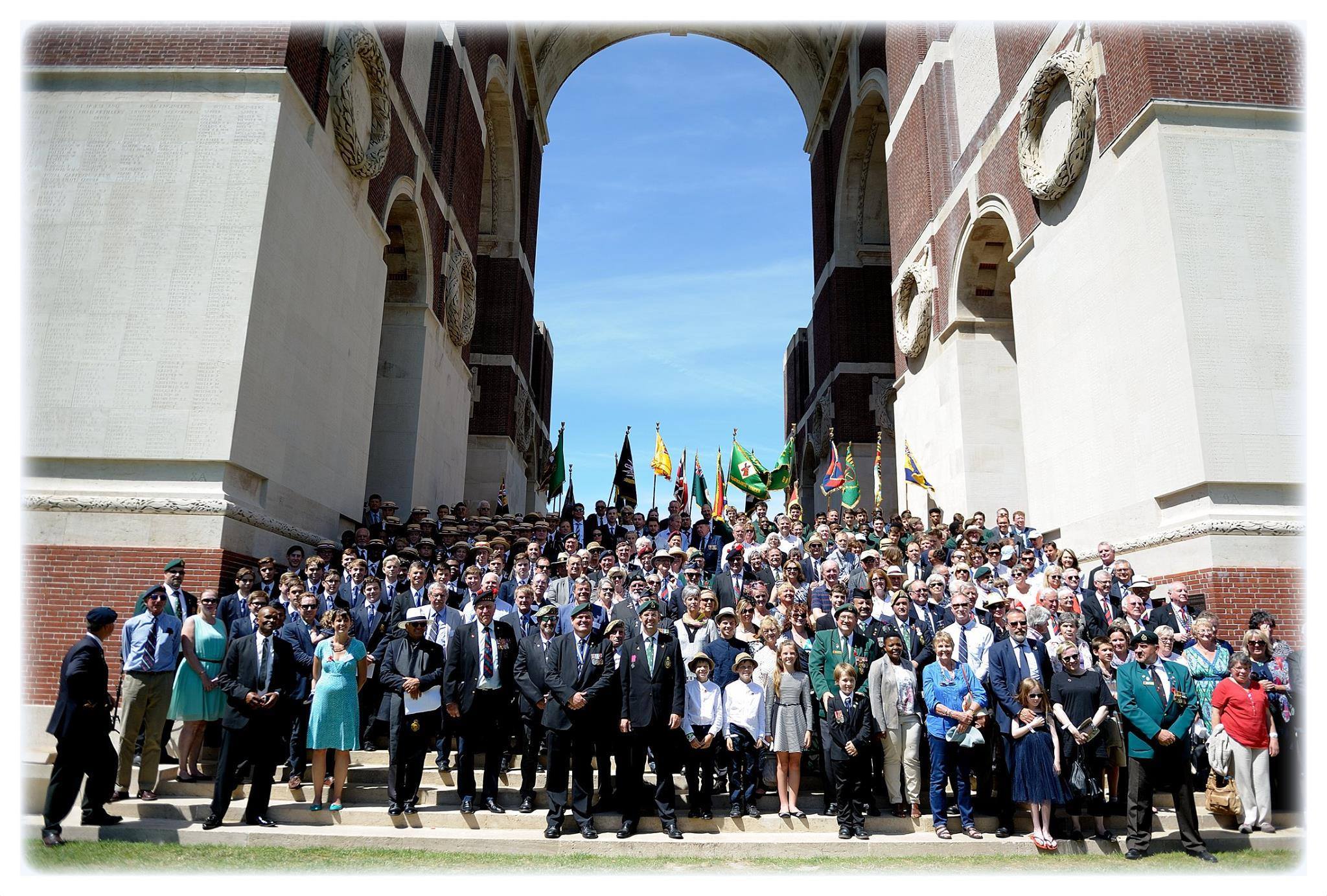
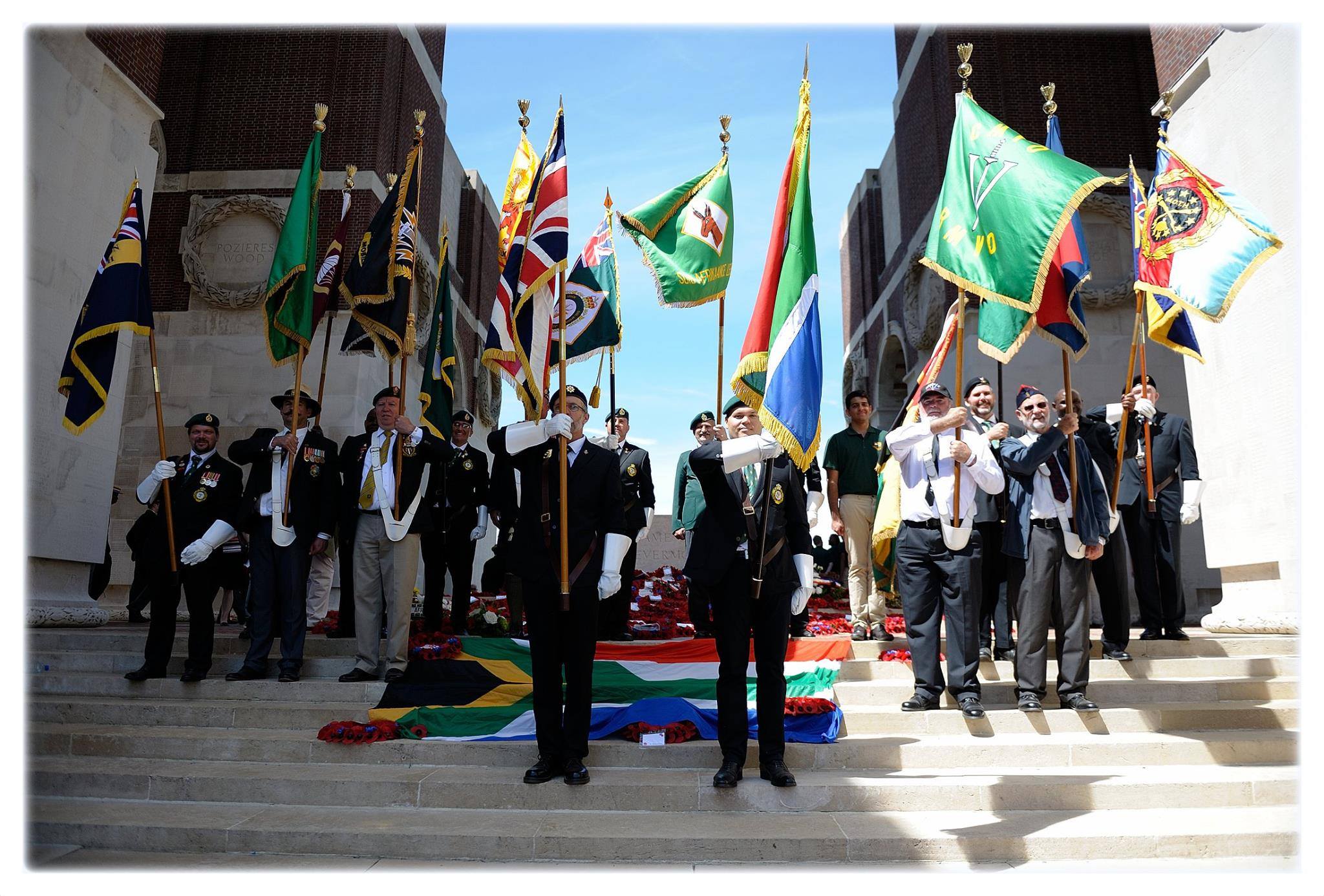
To see the full Thiepval 100th Centenary South African service, video, speeches and photographs, follow this Observation Post link: ‘Springbok Valour’… Somme 100 & the Delville Wood Centenary
Researched and Written by Peter Dickens
References and extracts from The South African War Graves Project
Commonwealth War Graves Commission
Thank you to Brigadier Hennie Heymans for this remarkable photograph artefact of the Cape Mounted Police.
The artist`s impression of the action at Deville Wood for which William Faulds was awarded the Victoria Cross. From the book “Deeds that thrill the Empire” Vol 5
Thiepval 2016 photos thanks to Theo Fernandes
Related Work:
William Faulds VC: Delville Wood’s Victoria Cross – William Faulds
Sherwood-Kelly VC: “…. a Herculean of Irish-South African origin with a quite remarkable disregard for danger”.
Thiepval Memorial: ‘Springbok Valour’… Somme 100 & the Delville Wood Centenary
Delville Wood: Delville Wood’s ‘Weeping Cross’
Delville Wood: The Black Watch and the Delville Wood Lament
Deville Wood: A South African soldier’s diary captures the horror of Delville Wood
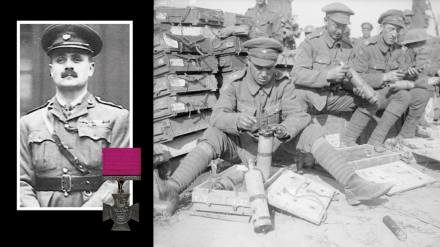
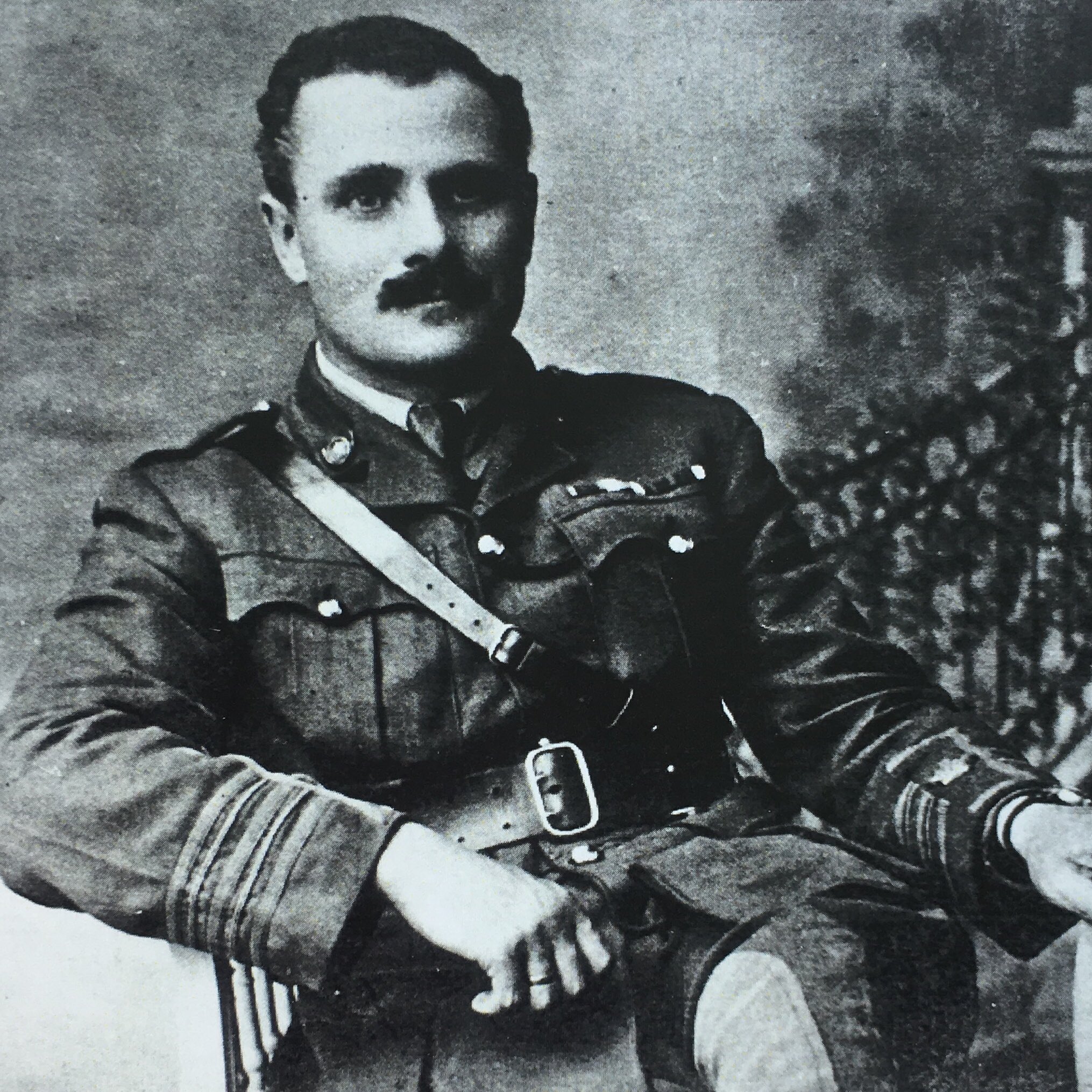
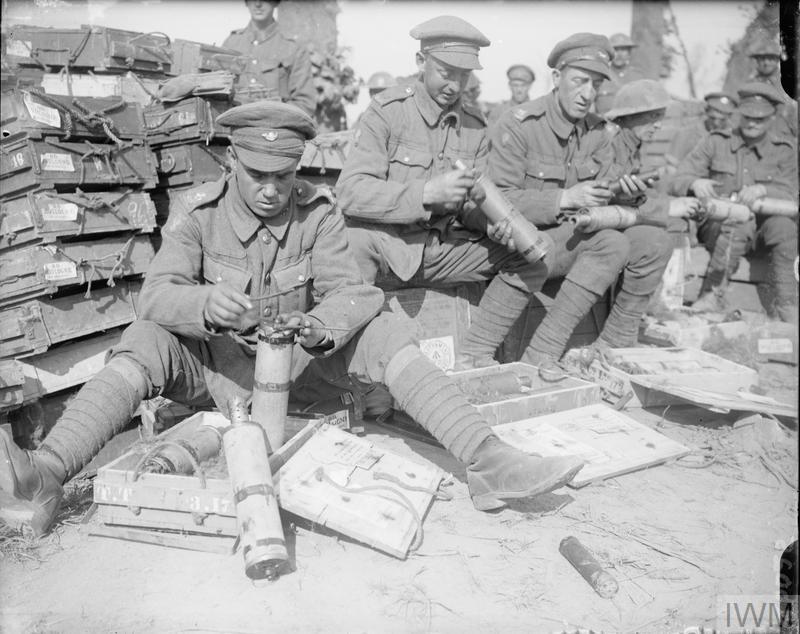
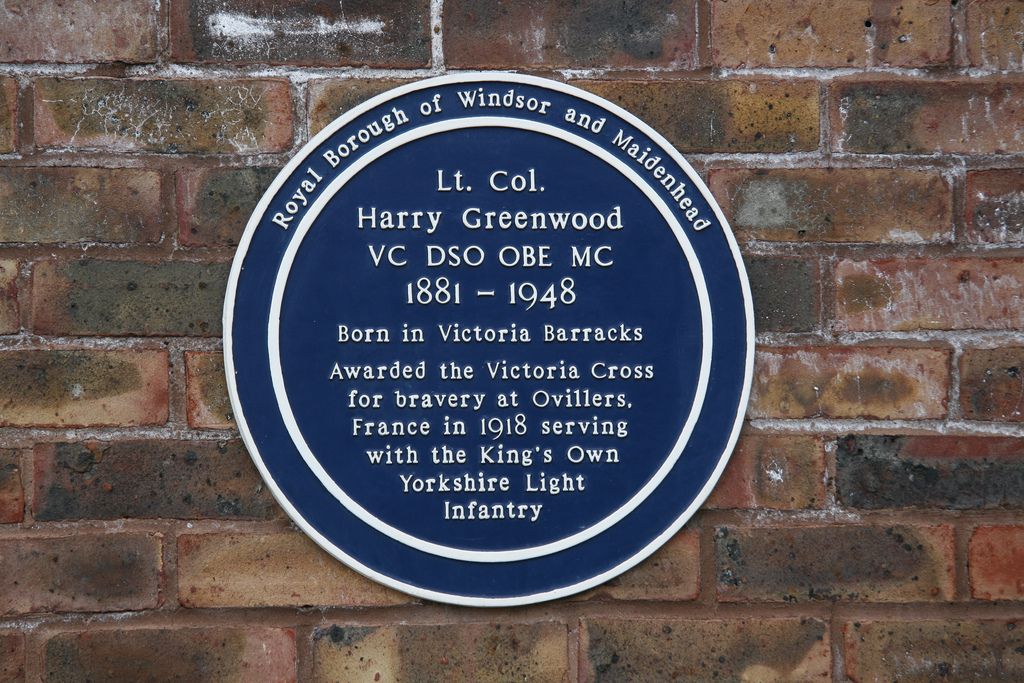
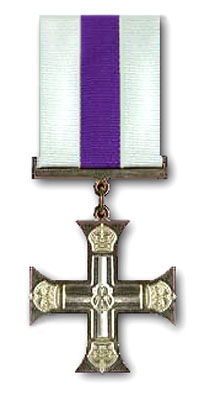 His string of remarkable acts of bravery began when he was awarded the Military Cross (MC) i
 Harry Greenwood’s battalion was by this stage very short of machine gunners owing to casualties, Harry Greenwood, along with an Non-Commissioned Officer rushed out from their defences with total disregard to the incoming enemy fire, he found a fellow British officer and some men hiding in a hollow with a heavy machine-gun, Greenwood then ordered them to carry it back to his lines, being all the time under intense fire. The gun was then used on the enemy to very great effect.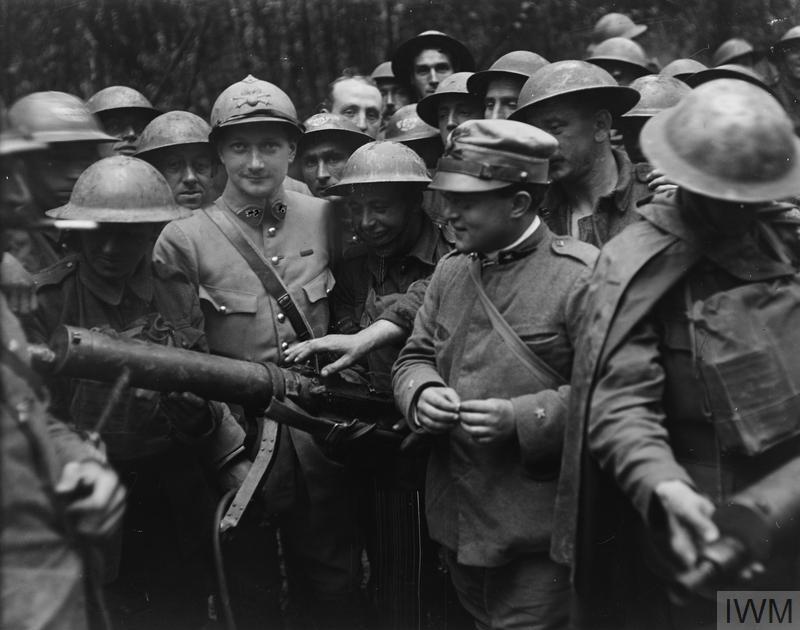
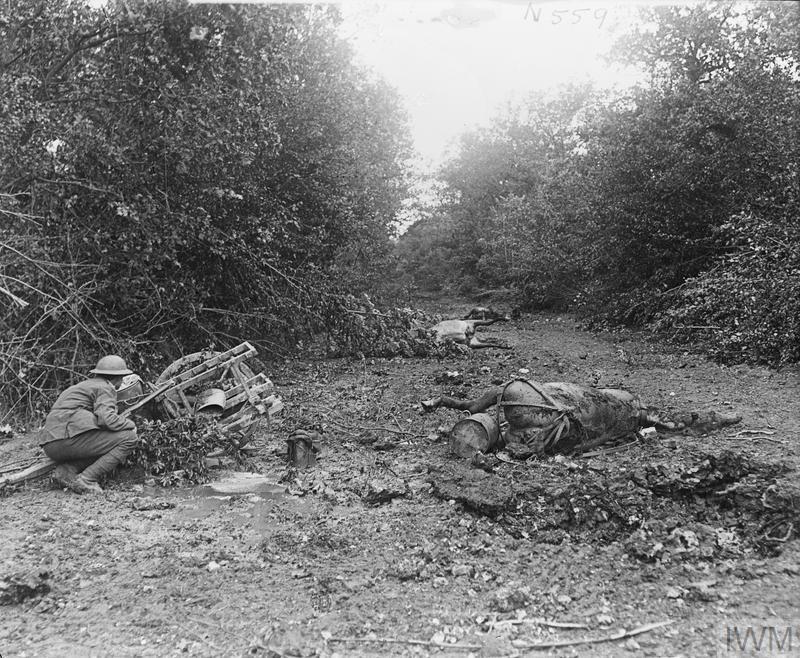
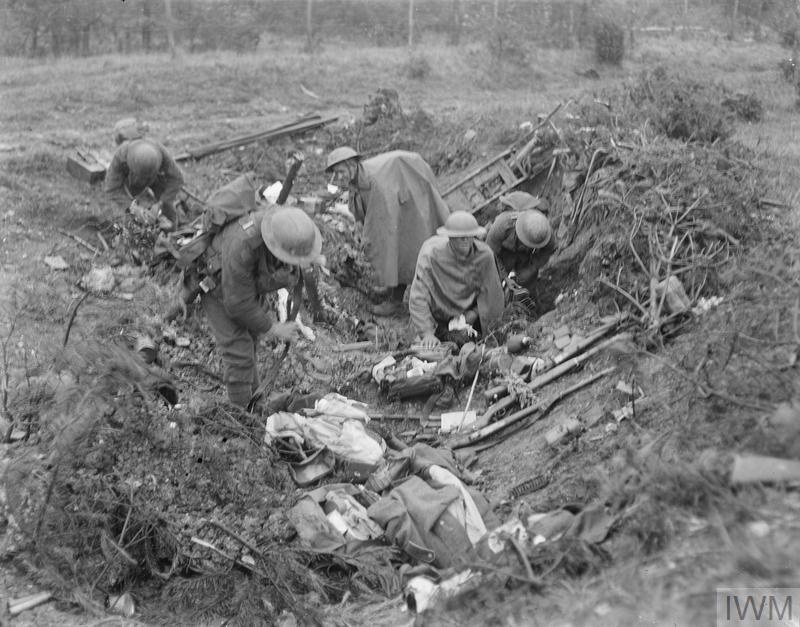
 When the advance of his battalion on the 23rd October was checked, and many casualties caused by an enemy machine-gun post, Lieutenant Colonel Greenwood single-handed rushed the post and killed the crew. At the entrance to the village of Ovillers, accompanied by two battalion runners, he again rushed a machine-gun post and killed the occupants. On reaching the objective west of Duke’s Wood his command was almost surrounded by hostile machine-gun posts, and the enemy at once attacked his isolated force. The attack was repulsed and, led by Lieutenant Colonel Greenwood, his troops swept forward and captured the last objective, with 150 prisoners, 8 machine-guns and one field gun. During the attack on the Green Line south of Poix Du Nord, on 24th October, he again displayed the greatest gallantry in rushing a machine-gun post, and he showed conspicuously good leadership in the handling of his command in the face of heavy fire. He inspired his men in the highest degree, with the result that the objective was captured, and, in spite of heavy casualties, the line was held. During the further advance on Grand Gay Farm Road, on the afternoon of 24th October, the skilful and bold handling of his battalion was productive of most important results, not only on securing the flank of his brigade, but also in safeguarding the flank of the division. His valour and leading during 2 days of fighting were beyond all praise.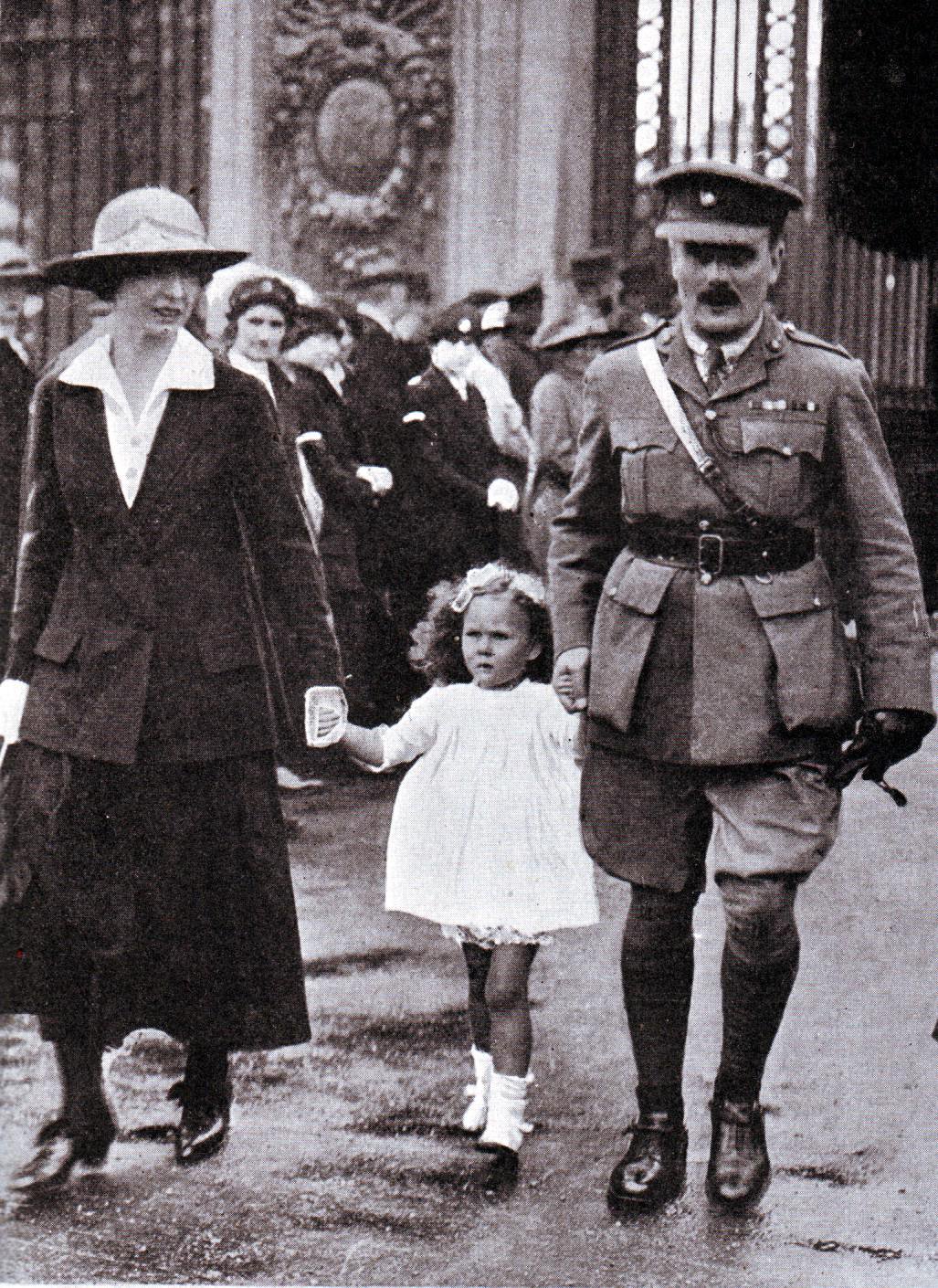
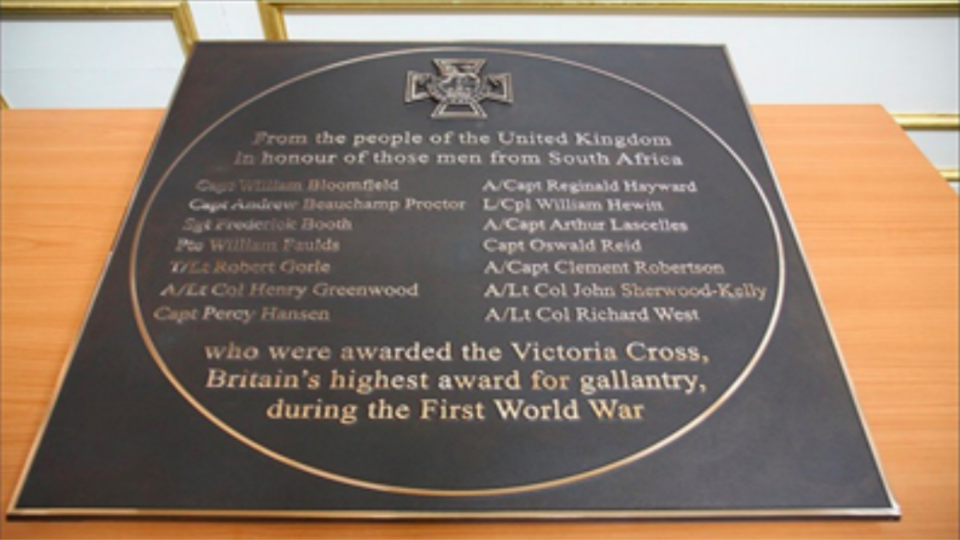

 Early Life
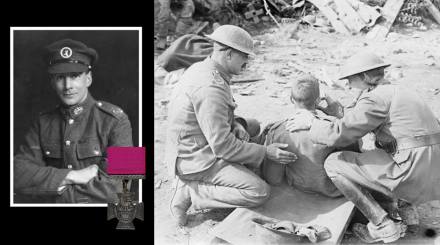
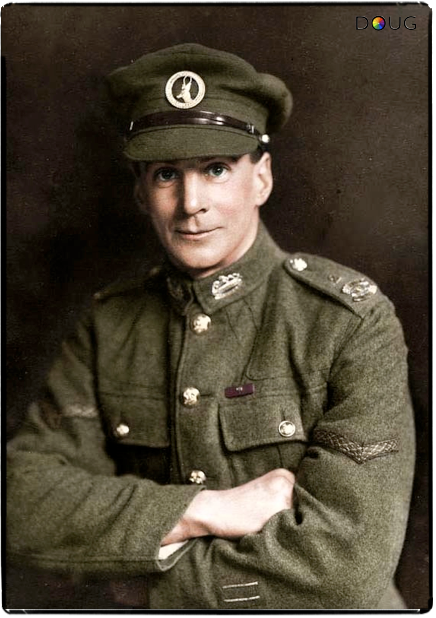
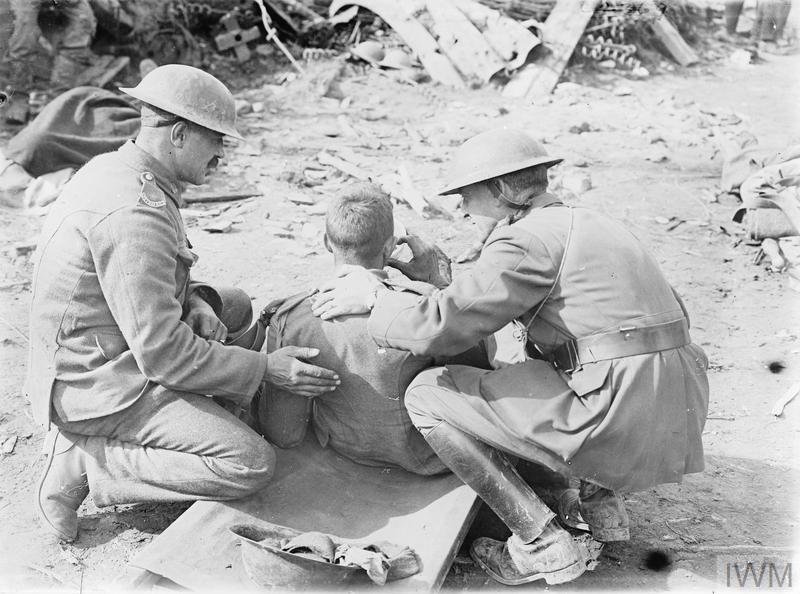


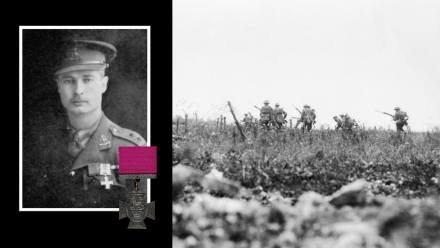
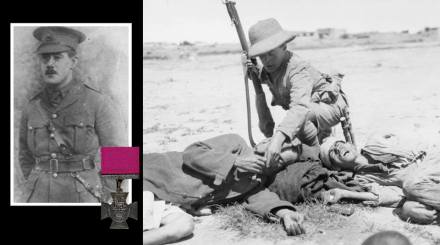
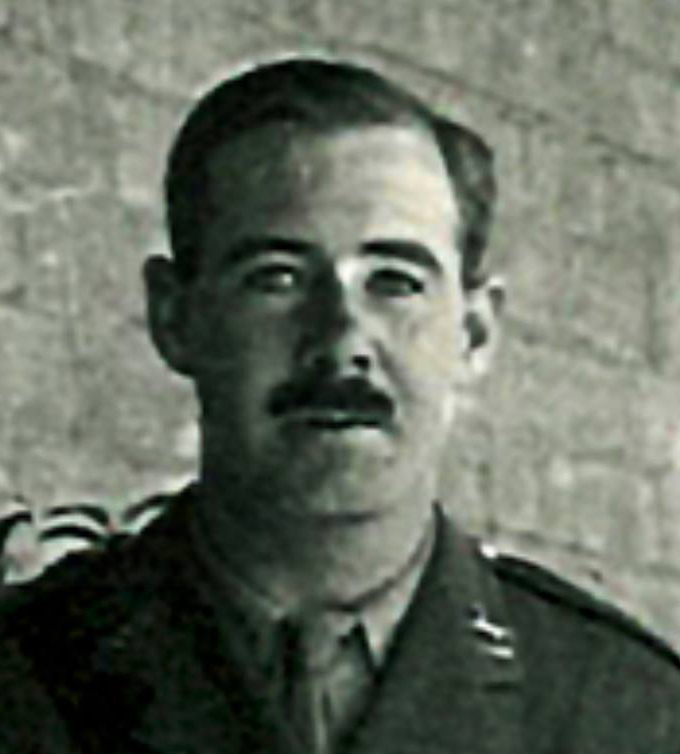
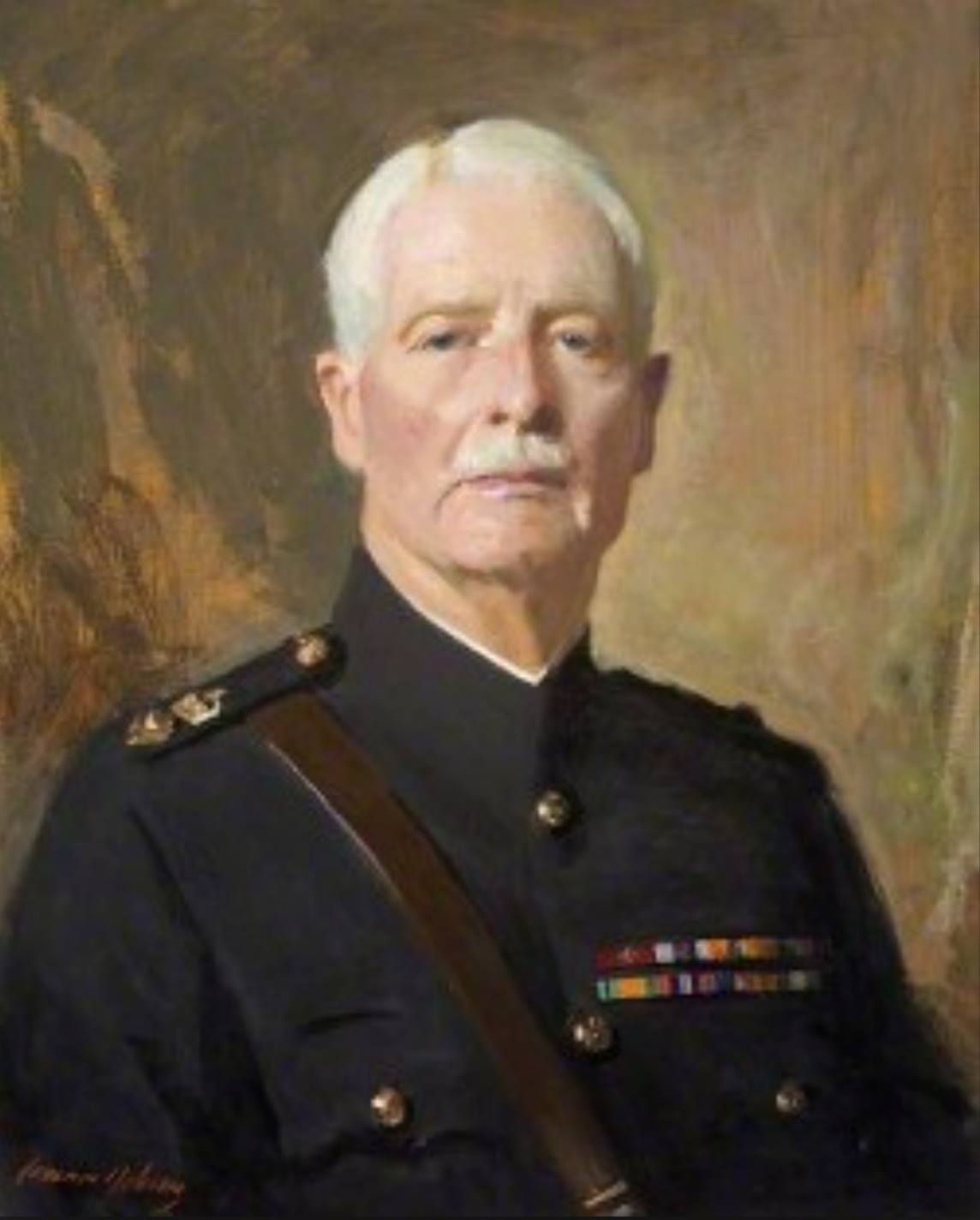 This South African’s Victoria Cross turns 100 on the 21/22 March 2018, so today we honour another true South African hero and Victoria Cross recipient, and this man, Captain Reginald Frederick Johnson Hayward VC MC & Bar is one very extraordinary South African.
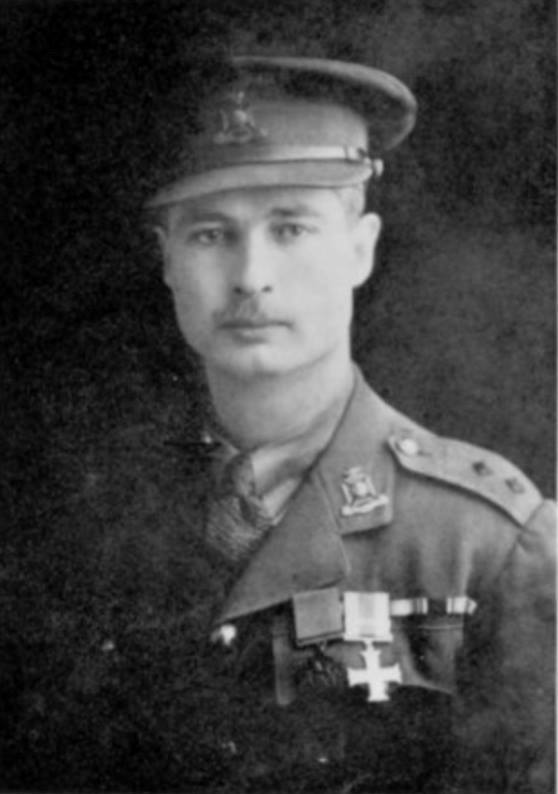 Reginald worked at the British Broadcasting Corporations (BBC) Publications Department from 1947 to 1952 and as games manager of the Hurlingham Club from 1952 to 1967.
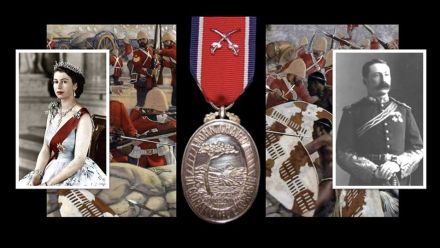
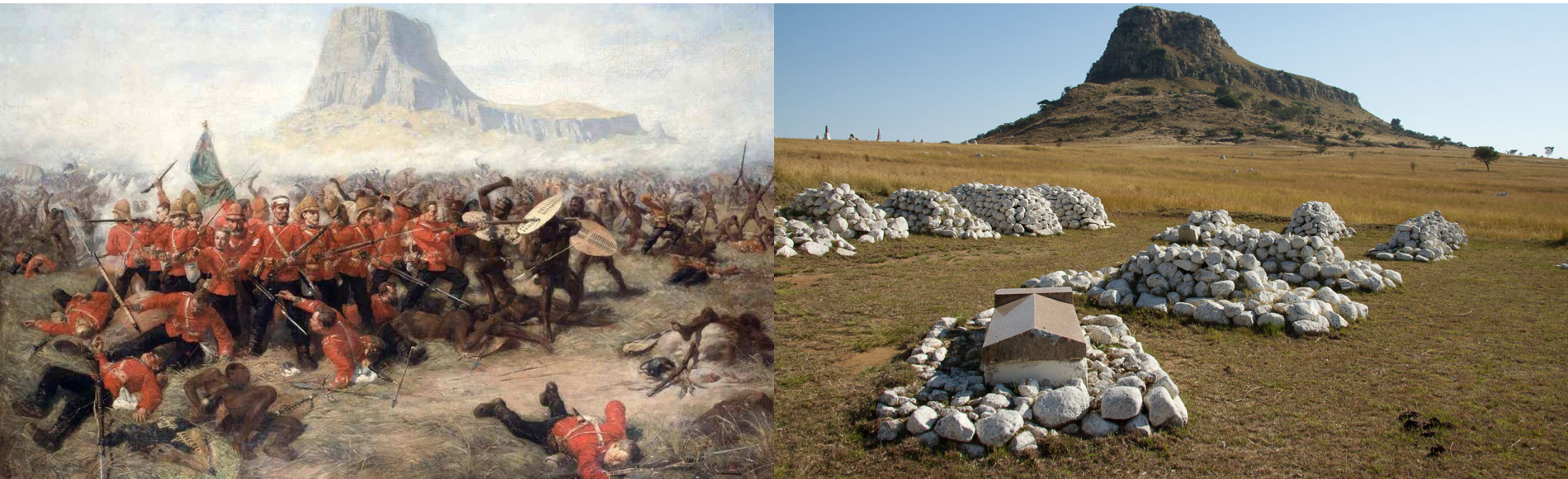
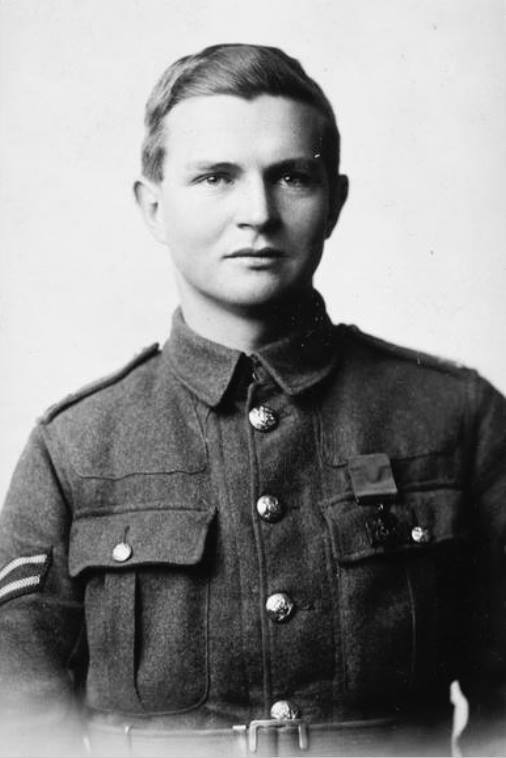 William Faulds, a young man who won a Victoria Cross, the highest award for gallantry, at Delville Wood is quite literally a case of a normal young South African placed in an extraordinary circumstance, only to emerge with that “X” factor which sets him apart, and that’s quite something considering everyone around him can in their own right can take the mantle of the ‘bravest of the brave’, such was the nature of the battle.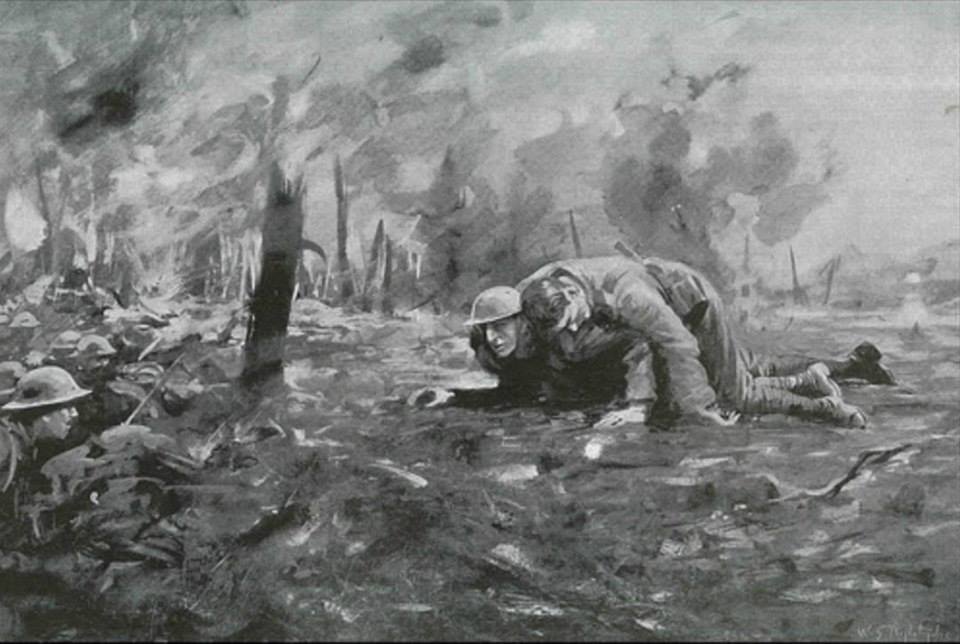


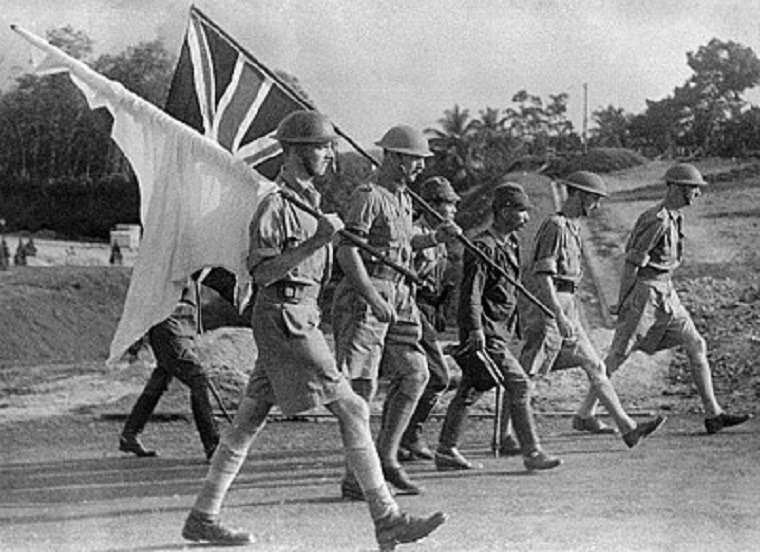
 Following the war, having reached the rank of temporary captain, Anderson was demobilised in February 1919 and lived the life of a gentleman farmer in Kenya, marrying Edith Tout, an Australian, in February 1931.
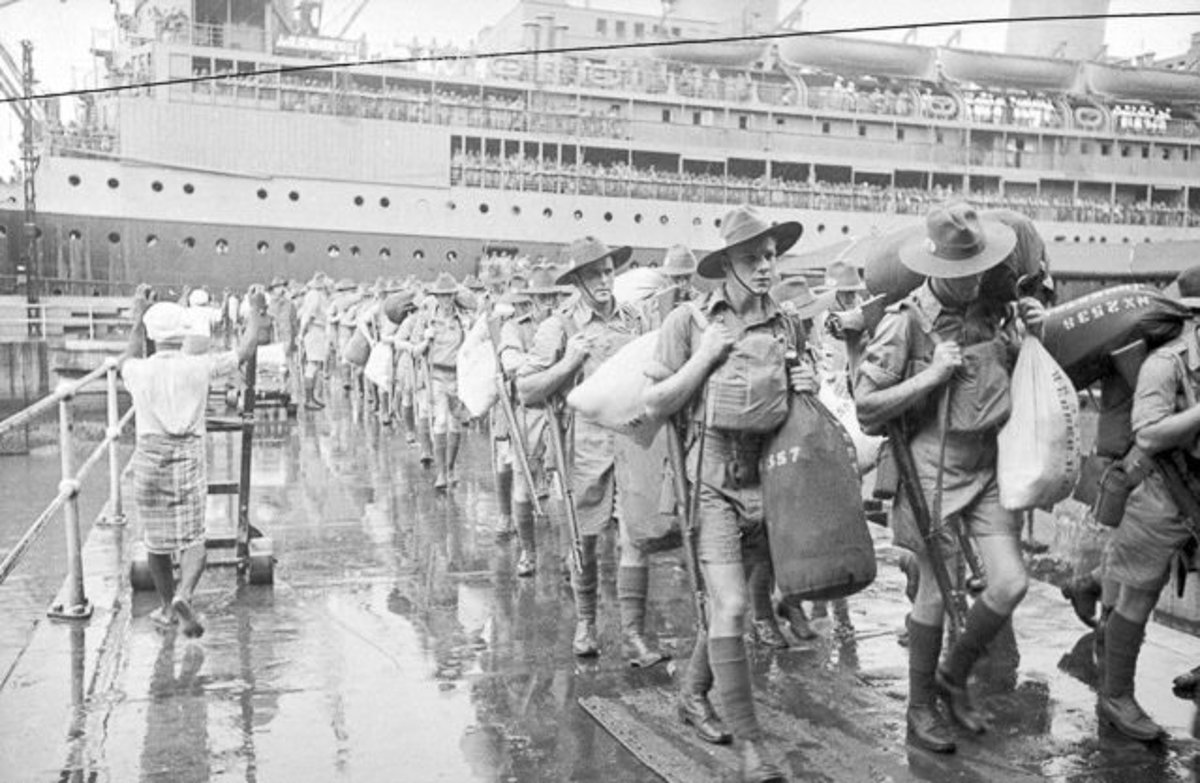 By July 1940, Anderson was assigned to the newly formed part of the 22nd Brigade of the 8th Division and deployed to Malaya to reinforce the Australian garrison there against concerns of Japanese military build up.




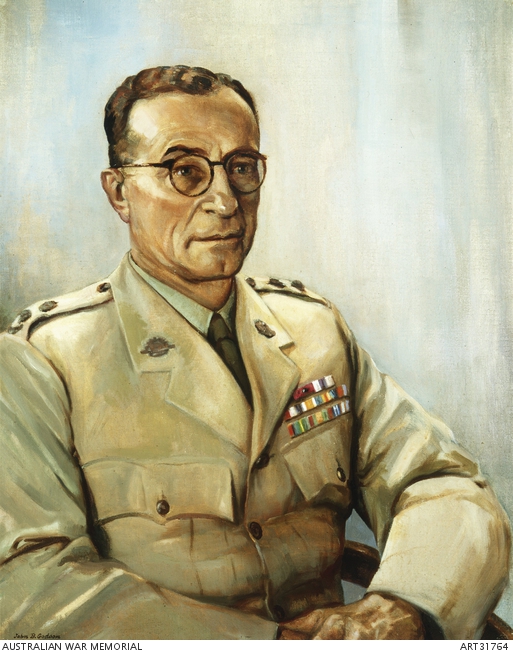 Charles Anderson entered into Australian politics in 1949 winning House Representative for the Division of Hume as a member of the Country Party – twice between 1949 and 1961. A career as a politician he served in parliament as a member of the Joint Committee on the ACT (Australian Central Territory) and also for foreign affairs.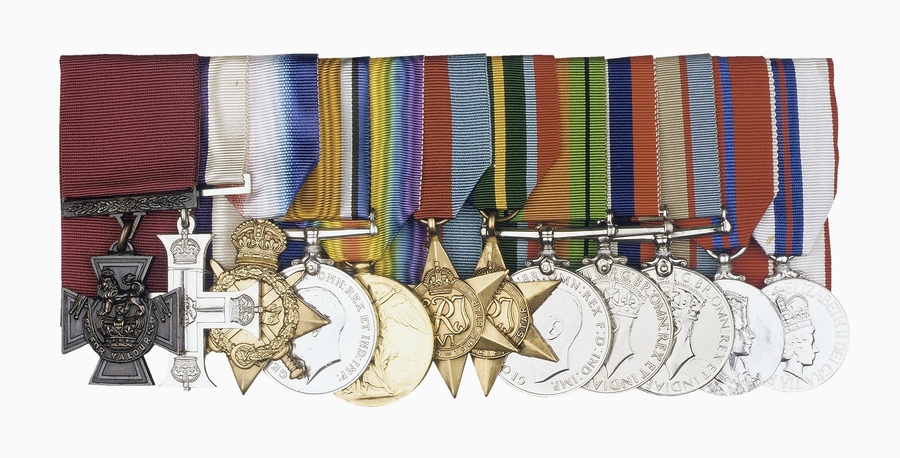
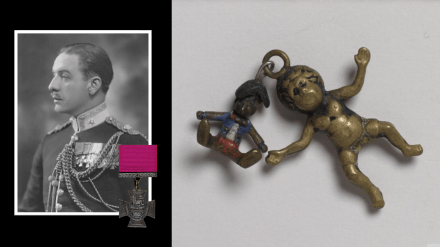
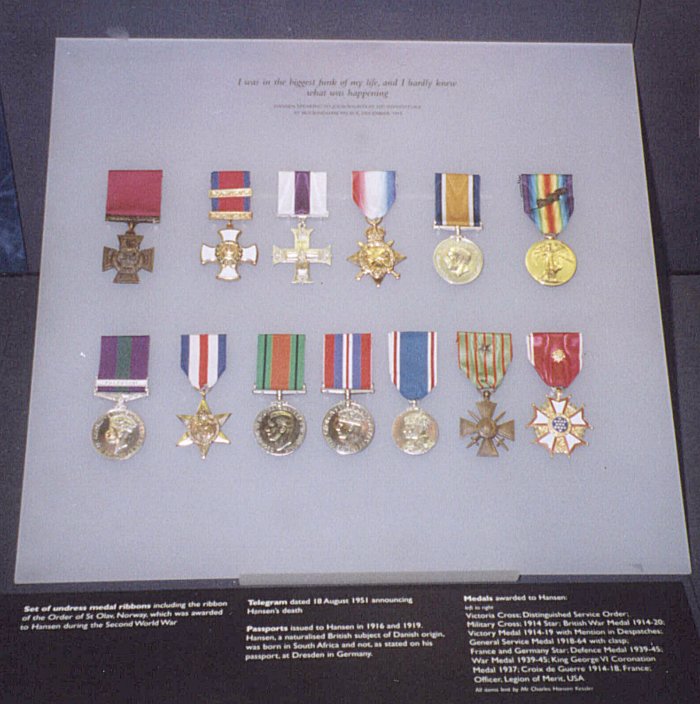
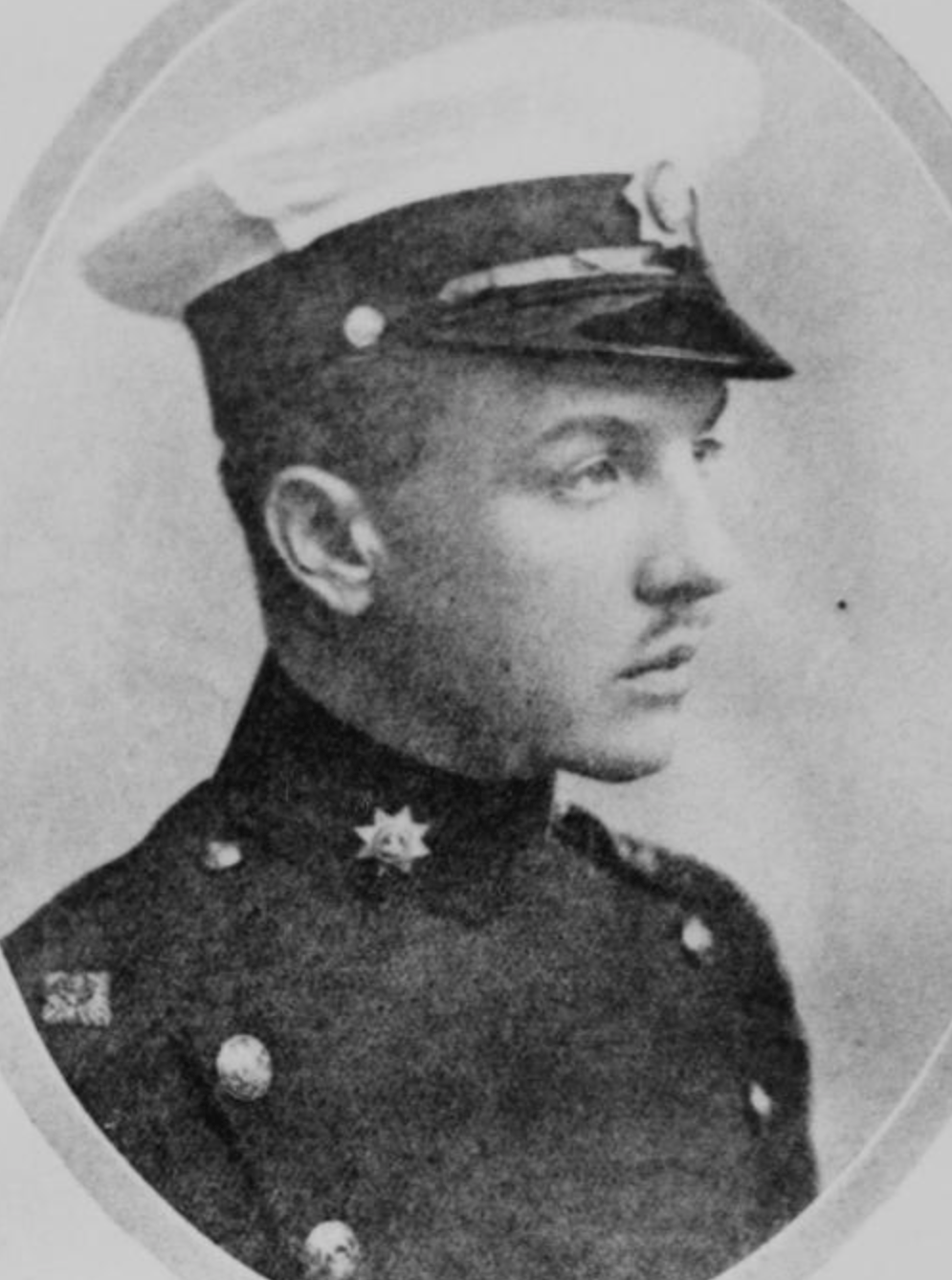 Winning a Victoria Cross for gallantry and surviving the ordeal has some luck associated to it, and this lucky charm of a VC winner is testament of this. Every Anzac Day we recall the Gallipoli campaign, and we remember the heroes of the campaign – Australian, New Zealand, British and even in modern times the Turkish heroes too.
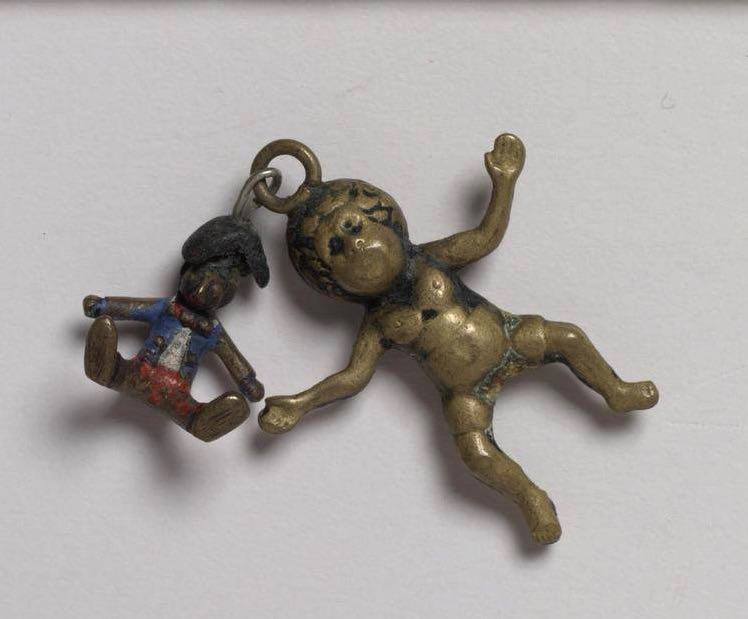 By the 4th March 1911 he was commissioned as a 2nd Lieutenant in the 6th Battalion of the Lincolnshire Regiment. He rose to the rank of Captain and by the summer of 1915 he was with his Regiment landing on the shores of Gallipoli. Carrying a lucky charm into battle (see featured image), It would be here that he would earn his Victoria Cross.

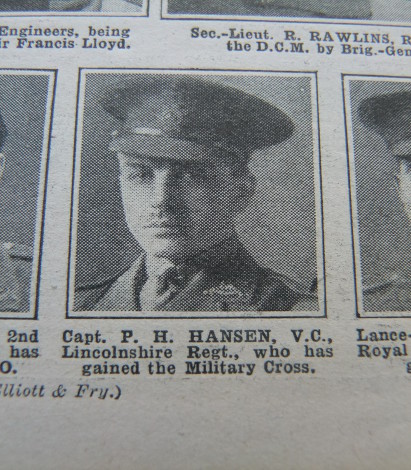 “For conspicuous gallantry at Suvla Bay on 9th September, 1915. He made a reconnaissance of the coast, stripping himself and carrying only a revolver and a blanket for disguise. He swam and scrambled over rocks, which severely cut and bruised him, and obtained some valuable information and located a gun which was causing much damage. The undertaking was hazardous. On one occasion he met a patrol of 12 Turks who did not see him, and later a single Turk whom he lulled. He returned to our lines in a state of great exhaustion”.

 The Observation Post