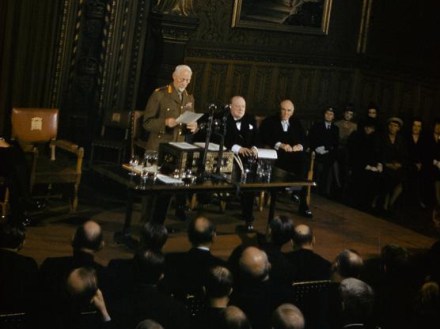
A true statesman, Jan Smuts addressing the British Parliament – 1942

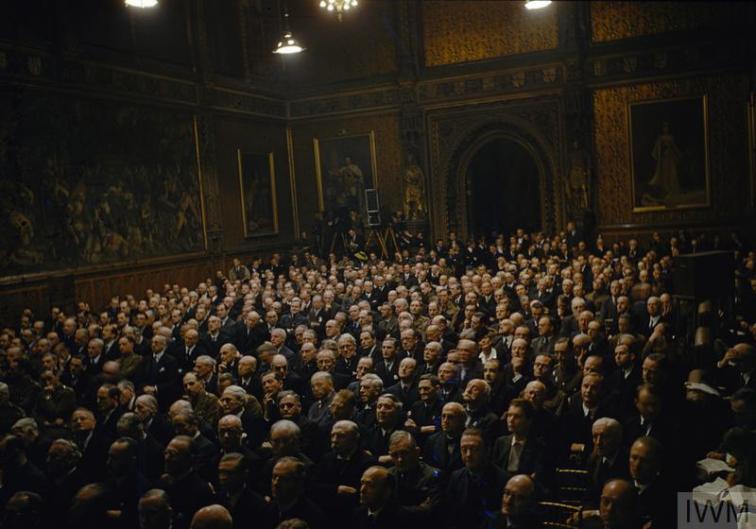
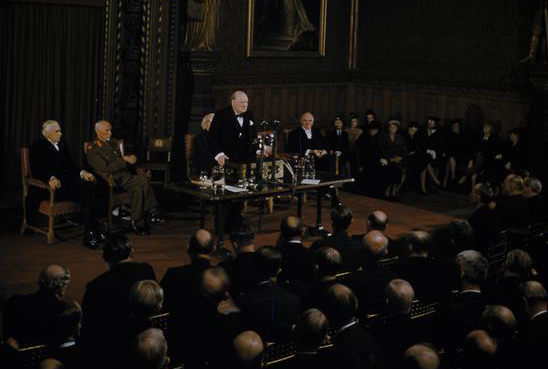
Field Marshal Jan Smuts, at the invitation of Winston Churchill addressing both houses of the British Parliament on the 21st October1942. This speech is historic, never before was any Commonwealth Statesman given the privilege of addressing both houses of Parliament (the Commons and the Lords), and the results are astounding – not only was Smuts publicly praised by Winston Churchill at the end of his speech, the entire Parliament breaks into hoorays and sings “he’s a jolly good fellow” in praise of the man and his life’s work.  This speech is well worth viewing and here it is, in full.

Two great South Africans have the privilege of statues outside the British Houses of Parliament in London, both having addressed this house at Westminster, and they stand in Westminster square for good reason. This was a period when Jan Smuts took his broken country from the Boer War, unified it and built it into an international powerhouse – at this occasion Smuts receives the praise due a visionary world leader.

The vast majority of both English and Afrikaans speaking South Africans backed Smuts at the time, however his legacy – like any great man’s legacy – is tainted by his opposition – The National Party, who, when they came into power served to demonise him over decades – so much so that he remains an enigma to many South Africans today. Except when you find gems like this film clip – which can bring him back into living memory.

Look out for Smut’s comments on the necessity to rid the world of Nazism, his insightful summary of Hitler’s policy in Europe and for his views on he formation of the United Nations – to which he is founding signatory.

smuts 5

To think that Smuts was a South African War Boer General, and both he and General Louis Botha understood that the salvation and re-building of their shattered people lay with their former enemy. Their vision of unity built South Africa from a fractious grouping of colonies and tiny states into a significant and unified nation – a regional economic power-house. The fact that his former enemy stood up in praise of this man and his achievement speaks volumes.

Jan Smuts is literally the “father of the nation” that is South Africa today and it’s a great pity he is so misunderstood. As anyone who watches this video will see, thanks to this remarkable man, South Africans by the end of World War 2 stood with heads held high, chests swollen with pride, praised by the free world and revered by great men.

winston:smuts

Visit of Field Marshal Jan Smuts, to the House of Commons 21 Oct 1942. The Prime Minister, Mr Winston Churchill, calls on the assembly in the House of Commons to acclaim Field Marshal Smuts, after his address. IWM Copyright.

History unfortunately would dramatically change course for South Africa a couple of years later, when in 1948 the National Party narrowly edged its way into power in the general elections with a proposal called Apartheid.  South Africa has swung from ‘Pariah State’ far right racial politics to ‘Junk Status’ economic leftist politics in response to the secular race politics – with very little regard for Smuts’ centralist or “centre ground” reconciliatory politics since.


To read more about Smuts and some of his lifetime achievements and body of work, click on this link “The force of his intellect has enriched the wisdom of the whole human race”- the death of Jan Smuts.

Written  by Peter Dickens.  Footage copyright – British Pathé. Image/s copyright – The Imperial War Museum

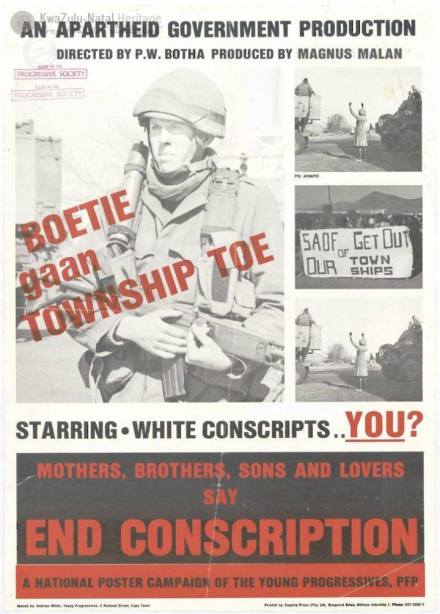
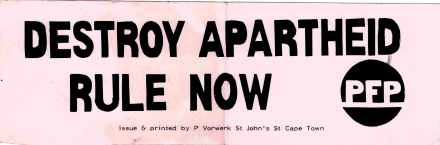
PFP (now the DA) anti-SADF conscription poster

So here’s an interesting poster doing the rounds in military veteran social media groups, with all the South African veterans branding it as a ECC (End Conscription Campaign) poster with the usual ho-hum “they ran away to the UK” and “where are these liberals now that the country has dipped to junk status” rhetoric.

But again I despair as its NOT a ECC (End Conscription Campaign) poster. This time its a PFP (Progressive Federal Party) youth league i.e. “Young Progressives” poster. The PFP as many know is the predecessor (Grandfather) of the Democratic Alliance – the DA, the same organisation most these military veterans now vote for and strongly support … go figure!

01-12-11-1dd-4

The Progressive Federal Party (PFP), formed in 1977 advocated power sharing in federal constitution in place of the National Party’s policy of Apartheid.  Its leader was Colin Eglin, who was succeeded by Frederick van Zyl Slabbert and then Zach de Beer.  It held out as the official political “white” opposition to Apartheid and the National Party for just over a decade and its best known parliamentarian was Helen Suzman.

The Democratic Party (DP) was formed on 8 April 1989, when the Progressive Federal Party (PFP) merged with the smaller Independent Party and National Democratic Movement.  The DP contested the 1994 elections as the mainstream democratic alternative to the ANC, the IFP and the National Party.

The Democratic Alliance (DA) was formed when additional parties were added to the Democratic Party (DP) in June 2000 to form a bigger alliance against the ANC.

For reference, these are “End Conscription Campaign” posters, note the ECC logo comprising symbolically of a broken chain:

Like the PFP’s “Young Progressives”, The End Conscription Campaign (ECC) was another organisation made up of primarily “white” anti-apartheid supporters.  The ECC was a university/student organisation allied to the United Democratic Front and composed of conscientious objectors and supporters in opposition to serving in SADF under the National Service Conscription regulations laid out for all “white male adults”.

The ECC served to undermine the SADF by finding loopholes in the laws which enabled legal objection to conscription and targeted South Africa’s “English” medium universities during the 1980’s.

The irony now, is that where the country’s “centre” democrats so dogmatically fought the Apartheid government they now fight the ANC government with the same veracity.  So to answer the old SADF military veterans questions of “where are all these ‘libtards’ (liberals) who refused army service now that the country is in the toilet after hitting junk status?” Well, many are still in South Africa in the form of the DA, still very active in anti-ruling party politics, still driving centre democratic political philosophy, still holding rather large “Anti-Apartheid” credentials (whether the ANC and EFF like it or not) and funnily if you regularly put a Big X next to the ‘DA’ in an election – you are now one of them.

Many of odd twists and turns of inconvenient South African history that makes it so very interesting.

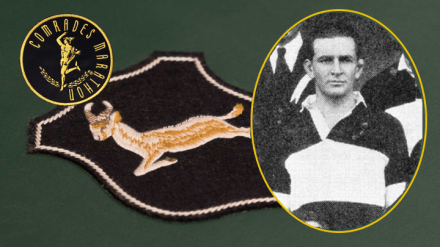
Comrades legend, Springbok and war veteran – the remarkable Bill Payn

So, which Springbok rugby player and war veteran also has a top ten Comrades finish running in his rugby boots and then went on to play a game of rugby the next day?  This is one very remarkable man and he comes from a time when men were cut from a different cloth, read on for the story of the legendary Cecil “Bill” Payn.

Bill Payn was born on 9 Aug 1893 in Harding, South Africa, he was christened Cecil, the son of James Herbert Payn. He was a very well known personality, a much loved teacher, and a sportsman. He taught at Durban High School for boys for 40 years or more, only having a break during his army service in the First and Second World Wars. He was particularly well known in Natal and Rhodesia and was described as big hearted and kindly “Big Bill” and stood 6 ft 3 in in his socks. He was a battle-field hero and an ex PoW.

His life was dedicated to helping others, whether his fellow prisoners of war, team mates, school pupils or every day friends and acquaintances. He was a Springbok rugby player and at cricket bowled with distinction. He was a boxer, an athlete and shone at baseball. He was truly a great and kindly man, he died suddenly at age 66 on the 31st Oct 1959.  Ever generous he even left money for his friends to have a drink after his funeral.

Top 10 Comrades finisher in his rugby boots

In summary of his Comrades achievement, Bill came 8th in the 1922 Comrades Marathon. A Springbok rugby player, he ran one of the most famous races in the history of the Comrades.  Bill Payn hosted Arthur Newton the evening before the race, and after a number of stiff drinks, was persuaded by Arthur to enter (Arthur went on to win the race).

Bill arrived on time for the start, wearing his rugby boots. At Hillcrest he stopped for the first time to take in a breakfast of bacon and eggs. Not much further a fellow runner, “Zulu” Wade, invited Payn for a chicken curry. This they consumed and then continued on to Drummond, where they celebrated reaching the halfway mark by drinking a beer at the hotel. Wade didn’t continue, but Payn did. A lady spectator en route helped him keep his energy levels up by providing him with oranges, peach-brandy, water and tea. He finished eighth. On the next day Payn took part in a club rugby match, but because his feet were blistered from the long run in rugby boots, he elected to play the match in his running shoes.

The first Comrades Marathon race was a down run from Pietermaritzburg whilst the first up run from Durban to the provincial capital took place in 1922 and consisted of a field of just over 100 athletes.  In those days the Comrades took place on mainly sand and gravel roads (which in part was more conducive to wearing studded rugby boots).

World War 1

Bill Payn played provincial rugby over a period of eighteen seasons losing four years whilst serving overseas in the First World War. He did have the opportunity then of representing South Africa in the Imperial Services Tournament held in Britain before returning home. In all, he represented Natal in fifty nine matches.

An “all rounder”

Bill had a natural affinity for all sports, a true “all-rounder,” attaining provincial colours in five sports, he represented Natal at cricket, boxing, baseball and athletics in addition to his main sport of rugby. However sport was but one of his interests, he was an outstanding English scholar and a leading South African expert in the science of Etymology.

Bill Payn also received Springbok colours and played in two tests on the flank in the 1924 series but later after his own playing days were over he was to have an important role in the development of a post World War Two Springbok rugby legend.

The 1922 Comrades Marathon in Bill’s own words

Bill Payn’s own words on the 1922 Comrades Marathon are now legendary and well worth the read, an abridged version of that day by Bill goes as follows:

`On a bleak May morning I toe’d the line at the start when some civic dignitary fired a pistol and then very sensibly buggared off back to his warm bed. When the shot rent the air, off we sped – like a crowd of Armenian refugees fleeing from the wrath of the Turkish army. Shall I ever forget that infernal run. It was not very long before I realised that I was prey to an all consuming thirst, so clamant indeed, that I could not refuse any man who offered me a drink. At Hillcrest my feet were giving me so much pain that I took off my rugby boots and found a mass of blisters had formed on the soles of both feet, some kind follower provided me with brilliantine with which I anointed my feet and then repaired to the hotel for a huge plate of bacon and eggs. This done and much refreshed I ran up Botha’s Hill where at the top I found a friend who was also taking part, but he was in a very bad state so we sat down next to the road and exchanged notes and took stock of ourselves and the situation we were in. I fear that we did not move with the freedom of young athletes but rather resembled two old ducks, suffering from some distressing gynaecological disorder.

Fortunately at that stage my friend’s supporter arrived on the scene with a wicker basket which contained a delicious curried chicken set on a huge bed of rice. This we shared equally and then set off together in happy companionship for Drummond and here we bent our steps to a pleasant oasis – the pub – where I lined a dozen beers up on the counter determined not so much to celebrate a victory but rather to drown our sorrows. Whilst we were busy at this, one of the camp followers arrived on the scene and urged us both to continue as there were only five runners in front of us. My friend could not continue so I set off alone for Pietermaritzburg.

Somewhere along Harrison Flats I noticed a frail little woman with pink cheeks standing at the side of the road. She held up in one hand a bottle and in the other a glass. I stopped, and with old world courtesy bowed low saying `Madame your servant to command’. `Tis peach brandy’, she volunteered, `and I made it myself’. I gulped down a full tumbler of this home-made brew and in a second realised that I had swallowed a near-lethal dose of the rawest liquid I had ever tasted. I am still convinced that to this charming little woman must go full credit for inventing the first liquid fuel for jet engines. Fortunately I was facing Maritzburg and I was propelled along the way. I was too far gone in my cups even to ponder on whether this assistance did not breach the prescribed laws of amateur marathon running.

On the outskirts of Pietermaritzburg I was hailed by my wife’s family who were taking tea on the veranda. I went off the road and joined them in their tea and cakes. While we were thus happily engaged, two of my ‘hated’ rivals went past and so it was that I ended the course number eight. In the changing rooms I discovered that the soles of my feet were now two huge pads of blood blisters. My brother-in-law then arrived and he had the uncanny insight to my most immediate needs, for he gave me a bottle of champagne, for which I was most grateful. Shortly thereafter a rugby friend arrived and chided me as to whether I had forgotten that I was due to play a first league rugby match the next day and that our team needed me. Cadging a lift on the back of his motorbike we went back down to Durban and on the following day I played full back in a pair of old `tackies’.

This account by Bill Payn does not appear possible but it has been vouched for in every detail by Arthur Newton, the friend who persuaded Bill to enter the race in the first place and who was himself destined to become a legend in the world of marathon running.
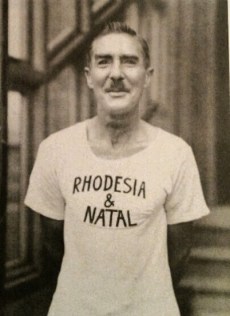
newton-6

Arthur F. H. Newton, winner of the first “up” version of the Comrades in 1922 in a time of 8:40:00.

Bill Payn’s description of the race is filled with humour which so characterised his outlook on life. To illustrate this aspect there is a classic story told of Bill when he was captaining his club’s first cricket side in the premier league and they were not having a very good season with the bat. He placed an advertisement in the local Natal newspaper which read,

“Join Stanford Hill and bat twice on a Saturday afternoon”

His Passion for Rugby

Of all his sporting interests, rugby was his greatest love and he devoted many years of his life to the administration of the sport and coaching young players in the enjoyment of the game. He was the founder of Natal schools rugby and became a father figure to organisation serving on its executive from 1933 – with a gap for the war years – right through until he passed away in 1959. It is interesting to note his thoughts on the game of rugby and why people are keen to play the game.

Quoting him again `Why do men love to play rugby, is I feel sure, that it is the simulacrum – in simple terms it means an image of – of war as waged in the medieval days when battles were marked by the two cardinal virtues of courtesy and courage’.

His very close friend and fellow schoolmaster, Isak Van Heerden, who was to become the Springbok coach in the 1960’s, when commenting on Bills outlook on the game said

“He looked upon the game as a friendly and controlled war, feeling that man still has his primitive instincts and one of the strongest is the love of a good fight, which no amount of civilisation has been able to eradicate. Bill saw the game merely as a natural desire of a healthy man to pit his strength and skill against that of another and that rugby was the best possible outlet. He worshipped the game for the companionship amongst friends and for the opportunities that it allowed for comaradieship with opponents after the match was over”.

Cecil “Bill” Payn’s Test summary: Tests: 2 Tries: 0
First Test: 16 Aug 1924 Age:31 Flank against Britain at Kingsmead, Durban
Last Test: 23 Aug 1924 Age:31 Flank against Britain at Wanderers, Johannesburg

World War 2

Bill Payn was very much a man of Natal being educated at Maritzburg College and after qualifying as a teacher spent much of his working career teaching at Durban High School for Boys, but in 1939 ,at the age of forty six he once again set off for war serving as a gunner in North Africa.

Whilst in action in the Western Desert he was awarded the Military Medal, receiving a personally signed letter of commendation from the Commander-in- Chief of the Allied Forces, General Alexander.

General Harold Alexander (right), pictured here in 1942 as Commander-in-Chief, Middle East, surveys the battlefront from an open car and the Military Medal warded Payne (left).

Taken as a Prisoner of War (POW)

Later in the campaign the Allied troops were forced to retreat from Gazala back towards El Alamein. With the German Army closing in around them Bill made two desperate efforts to escape but was captured on each occasion, imprisoned first at Benghazi in Libya, he was struck down with acute dysentery and lost substantial weight, he eventually recovered and was transferred to a POW camp near Rome.

Bill’s strength of character was such that he looked on prison life as a challenge refusing to be restricted and to quote him again

“Life is always life if one can laugh and that captivity is what your heart makes of it.”

He accepted the conditions of imprisonment refusing to acknowledge their limitations, preferring to see in them an opportunity for fulfilment, the enrichment of character and to be of service to his fellow prisoners.

Using his ability in developing mental pursuits he kept many of his fellow inmates highly amused and was in great demand as a speaker with a range of subjects stretching from discussing the complete works of Shakespeare, a set of which he had with him in camp, to his talk on whales and their habits which was also a great favourite. He continued to teach, and was again in demand, conducting classes for those Prisoner’s of War who were taking correspondence courses.

A fellow prisoner wrote of him that his most outstanding characteristic was his unquestionable spirit which knew no bounds. Although he was no longer a young man, when the Italian war effort collapsed, Bill and two companions managed to escape into the mountains of Italy and were on the run for over two weeks, diverting enemy troops from the front, to search for them. Eventually they were recaptured by German troops and sent to prison camps first in Austria, then Poland and eventually to Germany itself.

Whilst he was busy keeping the spirits of his fellow prisoners up intellectually, his love of sport also played an important role in their well being with Bill forever arranging rugby and cricket matches, even teaching the prisoners from the other Allied nations the art of jukskei!.

Informal “Tests” between “Springbok” and “All Blacks” POW

It was while they were in Stalag XX-A near Thorn (Toruń) in occupied Poland which contained an equal number of young New Zealanders and South Africans crazy about their rugby that Bill Payn’s organisational ability was shown off at its very best.

A rugby ball was received through the Red Cross and Bill proposed a series of `test’ matches between the rugby worlds greatest rugby rivals. He roped in two able assistants, Peter Pienaar, the son of the 1921 Springbok captain to New Zealand and Billy Millar Jnr, whose father led the 1912/13 Springboks to the United Kingdom.

With Bill Payn as the driving force, they arranged practices and made up the jerseys, and served on the `Springbok’ selection panel. The making Springbok jerseys is a story in itself, with Red Cross vests being boiled together with the olive green Russian battle dress which were freely available, to obtain the green. The gold was more problematical but an ingenious solution was found, the S.A. Medical staff boiled up a solution of anti-malaria tablets to achieve the right result. It was important to look the part. The rugby field was marked off with yellow clay lines on the vast sandy parade ground and with army boots considered too lethal, the players played with bare feet in the middle of the Polish winter.

Aaron “Okey” Geffin

It was during this period that Bill came across another young South African who had been playing for the Pirates Rugby Football Club in Johannesburg before the war, and he had been captured at Tobruk. He was a strong, talented prop forward who also had a useful boot on him.

Bill encouraged him to work hard at this aspect of his game whilst stuck in the POW camp and to concentrate on his accuracy with his place kicking. The young soldier was none other than `Okey Geffin’ who five years later was to become a legend in the annals of South African rugby as well as an immense thorn in the flesh of the 1949 All Black side under Fred Allen.
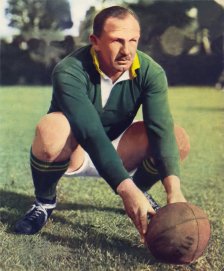
Ockey Geffin 49

Aaron “Okey” Geffin (28 May 1921 – 16 October 2004), considered the greatest Jewish rugby player of all time,nd he was inducted into the International Jewish Sports Hall of Fame in 1998.

While in Stalag XX-A Okey Greffin said of Bill Payn,

“We used to scrum for hours on end, and he coached me. Payn arranged rugby games in camp: South Africa against the New Zealanders. Our gear was dyed underpants and vests, but no boots. We played barefoot. Payn encouraged my development and told me I would be a Springbok if I continued to play after the war.”

He spent three years in POW camps in Italy and Germany, as well as Poland, where he practised his kicking barefoot near a mass grave of Polish victims of the Nazis.

Geffin was one of the few prop forwards in the game to kick for goal. The Springboks won ten matches in a row, including a 4–0 whitewash of New Zealand on their 1949 tour to South Africa. Prop Okey Geffin helped kick the Springboks to victory—they won all four Tests despite the All Blacks scoring more tries in three of them.

Back to Bill Payn’s story, and his personal account of the Comrades Marathon which reflected both his humour and his tenacity. It was his friend, Izak van Heerden who perhaps summed Bill up best of all when he said, `

He was always seeing a humorous situation and playing upon it. He was a merry companion, a real friend and a great champion of the game of rugby‘.

Related work and links

Comrades Marathon; A ‘Living’ War Memorial, The Comrades Marathon

Comrades Marathon; Why the Comrades Marathon is called the ‘Comrades’

Living War Memorials; A war memorial in Cape Town which saves children’s lives


Written and Researched by Peter Dickens. References:  Maritzburg College Old Boys Association, wikipedia.  Main reference article – author unknown.

“… I am not worthy to stand in the shoes of so great a man”

Jan Smuts’ history is well documented but let me share something that is less known about the man himself.

It’s a common misconception that Jan Smuts and Mahatma Gandhi’s relationship was one of animosity. It is a little known fact that both men actually respected each other, remaining life long admirers of one another.

Gandhi tried, at all times, to look for the positive in Smuts and said of him that he had a “high place among the politicians of the British Empire and even of the world”.

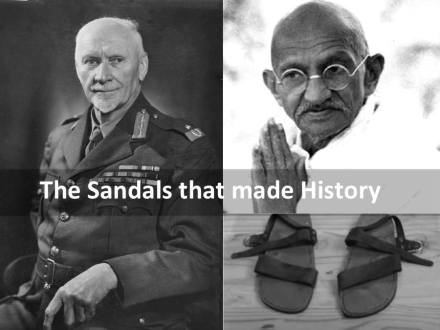
Rather famously, when Gandhi finished his work in South Africa and left with his wife in July 1914, just before he departed, he sent General Smuts a gift of a pair of sandals he made himself.

Gandhi had learnt to make sandals at Tolstoy Farm, a cooperative colony he set up near Johannesburg, from which he ran his campaign of satyagraha (non-violence).

Jan Smuts wore the sandals every summer at his farm, next to the town of Irene, and then returned the sandals to Gandhi on Gandhi’s seventieth birthday, remarking:

“I have worn these sandals for many a summer, even though I may feel that I am not worthy to stand in the shoes of so great a man”.

Smuts went on to say:

“It was my fate to be the antagonist of a man for whom, even then, I had the highest respect”.

A replica of the sandals can be found at the Constitution Hill Museum in Johannesburg.  Appropriately and oddly enough a statue of Jan Smuts stands just opposite a statue of Mahatma Gandhi on Parliament Square in London, in recognition of two world visionaries and their impact in the development of the modern political sphere.

South African sacrifice on the HMS Neptune

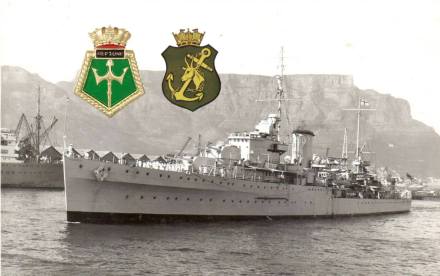
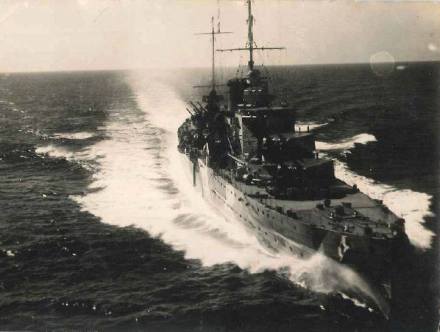
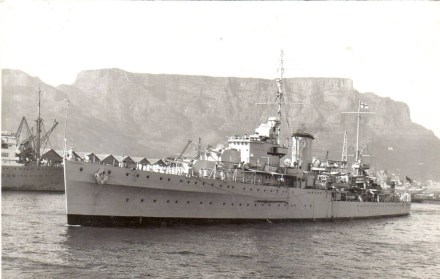
This image of HMS Neptune with Table Mountain in the background says a lot about the South African naval personnel seconded to serve on Royal Navy vessels and their supreme sacrifice.

As Simonstown was a British naval base during the Second World War thousands of naval ratings and officers who volunteered to serve in the South African Navy – known as the South African Navy Forces – landed up on British vessels. So when one was sunk, as HMS Neptune was, inevitably there is a very long honour roll of South Africans. Read on for their story.

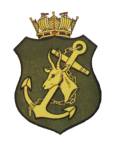
HMS Neptune was a Leander-class light cruiser commissioned into the Royal Navy on 12 February 1934 with the pennant number “20”.

12565523_539251039577966_1096634432449409870_n

HMS Neptune at sea in her heyday.

Force K, operating in the Mediterranean, including HMS Neptune, was sent out on 18 December 1941, to intercept an Axis forces convoy (German and Italian) bound for Tripoli,

neptune1On the night of 19 – 20 December, HMS Neptune, leading the line, struck two mines, part of a newly laid Italian minefield. The first struck the anti-mine screen, causing no damage. The second struck the bow hull. The other cruisers present, HMS Aurora and HMS Penelope, also struck mines.
While reversing out of the minefield, Neptune struck a third mine, which took off her propellers and left her dead in the water. HMS Aurora was unable to render assistance as she was already down to 10 knots (19 km/h) and needed to turn back to Malta. HMS Penelope was also unable to assist.

The destroyers HMS Kandahar and HMS Lively were sent into the minefield to attempt a tow. The former struck a mine and began drifting. Neptune then signalled for Lively to keep clear. (Kandahar was later evacuated and torpedoed by the destroyer Jaguar, to prevent her capture.)

Neptune hit a fourth mine and quickly capsized, killing 737 crew members. The other 30 initially survived the sinking but they too died. As a result, only one was still alive when their carley float was picked up five days later by the Italian torpedo boat Achille Papa.

The loss of HMS Neptune was the second most substantial loss of life suffered by the Royal Navy in the whole of the Mediterranean campaign, and ranks among the heaviest crew losses experienced in any naval theatre of World War II.

12549098_539250899577980_5498989727764062490_n

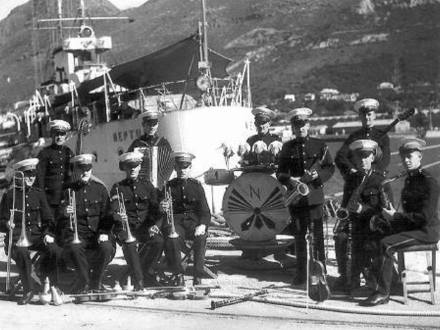
The Royal Marine band on the jetty by the stern of HMS Neptune at Simon’s Town in July 1940

This is the honour roll of South Africans lost that day lest we forget the heroism and sacrifice of these brave South African men.

22308811_10155537271456480_3745202244434378650_nADAMS, Thomas A, Able Seaman, 67953 (SANF), MPK
CALDER, Frank T, Ordinary Seaman, 67971 (SANF), MPK
CAMPBELL, Roy M, Able Seaman, 67318 (SANF), MPK
DIXON, Serfas, Able Seaman, 67743 (SANF), MPK
FEW, Jim, Able Seaman, 67744 (SANF), MPK
HAINES, Eric G, Able Seaman, 67697 (SANF), MPK
HOOK, Aubrey C, Able Seaman, 67862 (SANF), MPK
HOWARD, Harold D, Signalman, 67289 (SANF), MPK
HUBBARD, Wallace S, Able Seaman, 67960 (SANF), MPK
KEMACK, Brian N, Signalman, 67883 (SANF), MPK
MERRYWEATHER, John, Able Seaman, 67952 (SANF), MPK
MEYRICK, Walter, Ordinary Signalman, 68155 (SANF), MPK
MORRIS, Rodney, Ordinary Signalman, 68596 (SANF), MPK
RANKIN, Cecil R, Signalman, 67879 (SANF), MPK
THORP, Edward C, Signalman, 67852 (SANF), MPK
THORPE, Francis D, Able Seaman, 67462 (SANF), MPK
WILD, Ernest A, Able Seaman, 67929 (SANF), MPK

Other South Africans who had enlisted into the Royal Navy were also lost, these include (and by no means is this list definitive) the following:

OOSTERBERG, Leslie W, Stoker 1c, D/KX 96383, MPK
TOWNSEND, Henry C, Stoker 1c, D/KX 95146, MPK

May they Rest in Peace, these brave men whose duty is now done.

12593632_539245742911829_3970406589148419503_o

HMS Neptune in Cape Town harbour


Researched by Peter Dickens, Sources – Wikipedia.  Casualty Lists of the Royal Navy and Dominion Navies, World War 2 by Don Kindell


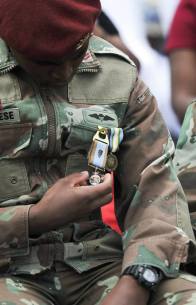
Cpl. Ngobese joins a proud legacy of bravery in 7 Medical Battalion Group

Celebrating South African heroes – here Corporal Mandla Maxwell Ngobese from 7 Medical Battalion Group – South African Military Heath Service looks down on his newly presented decoration for bravery – the Nkwe ya Boronse (Bronze Leopard) decoration for valour and joins a proud tradition of this special unit.

Elements of 7 Medical Battalion partook in the Battle of Bangui in the Central African Republic. The battle has been described by military analysts as one of the hardest-fought actions ever by the South African Army. During this battle which lasted from 22 March 2013 – 24 March 2013 a company of about 200 South African paratroops supplemented by a small number of Special Forces members was attacked, near their base in the outskirts of Bangui, by a reb10676374_353960348107037_5707337649502288620_nel force estimated to be up to 3000 strong. During this action 13 South African paratroopers were killed and a further 27 wounded. Rebel losses are estimated to have been well over 800. For their actions during this battle three members of 7 Medical battalion; Sergeant Mampa Serole Colman, Corporal Ngobese Mandla Maxwell and Corporal Nkoana Molatelo Alphina were awarded the Nkwe ya Boronse decoration for valour on 21 February 2014,
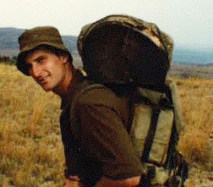
Also, together with 1 Parachute Battalion and 5 Special Forces Regiment, 7 Medical Battalion Group received battle honours for the first time.

7 Medical Battalion Group is the specialist Airborne Medical Battalion of the South African Military Health Service. The Battalion’s main task is to render medical support to the South African Special and Airborne Forces

These men join a proud tradition of recipients for valour from this Battalion, starting with Corporalfidler Bruce Andrew Fidler in 1985.  Bruce, also from 7 Medical Battalion Group was attached to 44 Parachute Regiment during Operations in Southern Angola.  A true hero who laid down his life for his friends. His unit was ambushed and in the ensuing firefight, he was captured by enemy forces on 15 September 1985 and subsequently Reported Missing.
Bruce was brutally tortured and interrogated by the enemy before being executed but he never once revealed the presence of his nearby unit thereby enabling the 7 Medical Battalion Group Surgical Team of between 5 and 10 doctors to successfully evade capture and reach South African lines. His remains were repatriated back to South Africa in June 1992. Corporal Bruce Fidler was posthumously awarded the Honoris Crux for his bravery and selfless devotion above and beyond the call of duty in the face of brutal torture. He was 21.

The Nkwe ya (Leopard) series – Bronze, Silver and Gold decoration series for the highest bravery in the military replaced the Honoris Crux – Bronze, Silver and Gold decoration series from 2003.

Thank you to Graham Du Toit for the reference on Bruce Fidler.

WW2 SAAF Pilot drives for show and putts for dough – Lt. Bobby Locke

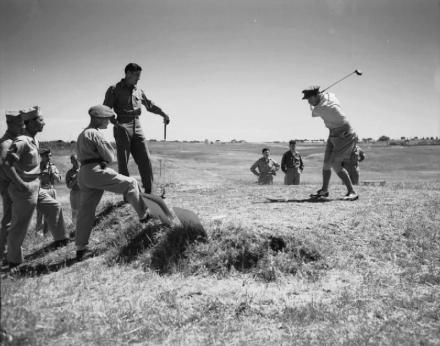
With a very special Masters finishing this weekend and Sergio Garcia achieving what has become one of golf’s truly special wins (especially on fellow Spaniard Seve Ballesteros’  birthday)  .. I am now reminded of a very famous South African golfer and war veteran – Bobby Locke, seen here taking some time off at a Services Golf Tournament held in Rome.

When World War 2 interrupted Locke’s burgeoning career as a golfer, he joined the South African Air Force as a bomber pilot, serving in both the Mediterranean and the Western Desert theatres of combat.

At the end of the war Locke returned to golf, famously playing in a series of matches in the USA against Sam Snead.  Bobby Locke’s legacy is remarkable, triumphant and tragic. He was a four-time Open Champion Champion and winner of 72 professional tournaments, but a car accident in 1960 damaged him physically and mentally and had an ultimately devastating affect on his wife and daughter.

In terms of the game of golf Locke quickly realised: “No matter how well I might play the long shots, if I couldn’t putt, I would never win”.  He therefore became a magnificent putter, in many people’s opinion (including Gary Player’s) the best there has ever been.

His unorthodox playing style translated to his putting, trapping the ball and imparting a hooking, top spin to it.  He later coined the often used golfing maxim: “You drive for show but putt for dough”.

It was on the greens that this remarkable South African truly excelled. He used an old rusty putter with a hickory shaft and employed his unorthodox technique, echoing his wider approach to life. He was an extrovert who sported baggy plus fours with shirt and tie on course. He liked singing music-hall numbers and played the ukulele.

Bobby – or “old muffin face” as he was known (because he never changed expression) was inducted into the World Golf Hall of Fame in 1977.  He was only the second non-USA or United Kingdom entrant after his fellow South African Gary Player (1974) to be inducted.

Featured photograph above shows: Lieutenant Bobby Locke whilst serving in the South African Air Force, playing a shot while Private Tommy Bolt, the American golfer looks on – note: on this occasion as he is in the Air Force he is not playing in his legendary baggy plus fours.

Feature image – Imperial War Museum Collection copyright.  Reference Bobby Locke: From Triumph to Tragedy by Fergus Bisset.

Article researched by Peter Dickens

The South African Battle of Britain “Few” – David Haysom DSO DFC

Celebrating South Africa’s ‘Few’ who tool part in the Battle of Britain.  Here we see South African Durban High School Old Boy, Wing Commander Geoffrey David Leybourne Haysom DSO DFC, during the Battle of Britain in the leading Hurricane. Read on for his remarkable story.

17342899_1927732494122406_1106496970131963423_n

David Haysom was born in Durban, South Africa in 1917. He was educated at Durban High School (DHS) and then went on Natal University College and Edinburgh University in 1936, where he gained a BSc. He intended to continue his studies in medicine, but after enjoying a chance opportunity to fly an airplane, flying became his passion. He gave up medicine in early 1937 and enrolled as a cadet officer in the Royal Air Force. He was commissioned in late 1937 and began his initial training on 18th March 1937.

Haysome went to No. 1 RAF Depot Uxbridge on 18th May for a short induction course before being posted to 2 FTS Brize Norton on 5th June. After completing his training he joined the staff of the School of Naval Co-operation at Ford on 8th January 1938. He joined 79 Squadron at Biggin Hill on 1st November 1938.

Haysom was detached from 79 Squadron to the School of Air Navigation St. Athan on 6th May 1940 for No. 6 Short Navigation Instructors Course. He rejoined 79 Squadron on 31st May.

Near Abbeville on 8th June 1940 Haysom shot down a Me109 over Le Treport. He was appointed ‘B’ Flight Commander on 17th June with the rank of Acting Flight Lieutenant. He took temporary command of the squadron from 7th to 11th July after the CO, S/Ldr. JDC Joslin, was killed.

On 15th August Haysom claimed a Me110 shot down, on the 28th he made a forced-landing at Appledore Station, near Tenterden, when his glycol system was damaged in combat over Hythe.

On 30th August he probably destroyed a Me109, on the 31st shot down another and on 1st September damaged a Do17. Haysom shot down a Ju88 on 20th November 1940 which had been photographing damage caused in the German raid on Coventry.

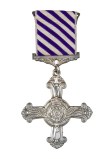
DFCLGOn 1st April 1941 he destroyed a He111 and on the 4th he shared in damaging another. He was awarded the Distinguished Flying Cross DFC (gazetted 29th April 1941) and commanded 79 Squadron from June to 25th September 1941, when he was posted away to 51 OTU at Debden for Controller duties.
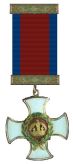
His DFC Citation:
“This officer has been engaged on operational flying since the war began. He has displayed great keenness in his efforts to seek and engage the enemy and has destroyed at least five of their aircraft.”

In mid-1942 Haysom was posted to the Middle East and he joined 260 Squadron on 19th July, possibly as a supernumerary to gain experience on Kittyhawks. Three days later he was promoted to Acting Wing Commander, to become Wing Leader 239 Wing in the Western Desert. At the end of his tour Haysom was awarded the Distinguished Service Order DSO (gazetted 16th February 1943), being then credited with at least six enemy aircraft destroyed.

His DSO citation:

“Wing Commander Haysom has been on operational flying since the commencement of the war. He has destroyed at least six enemy aircraft and has twice been shot down himself. He has led his wing on many fighter-bomber and long distance flights. He has always displayed the utmost determination. The success achieved by the wing has been largely due to this officer’s skill and courage.”

Distinguished_Service_Order_correctHe went on to the Italian Campaign where he was working in operations command, and privy to the Ultra Secret. Here he devised the air-born strategic planning system that became known as “Rover David”  – an instant success that was used against enemy aircraft in the invasion of 1944. (Called “Rover Joe” it is still used by the United States Air Force, which acknowledges David Haysom as the originator of the air support system.
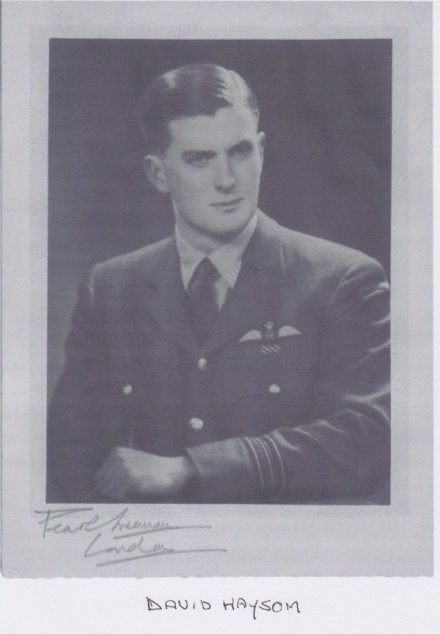
He ended the war at the rank of Group Captain (the Royal Air Force equivalent of Colonel in the Army) and was released from the RAF in 1946.

A typically unassuming hero, he never spoke to his children of his war experience, he never considered himself a hero or boasted about being an fighter ace. He died in 1979.

17349695_1927735394122116_8126666736147316385_o

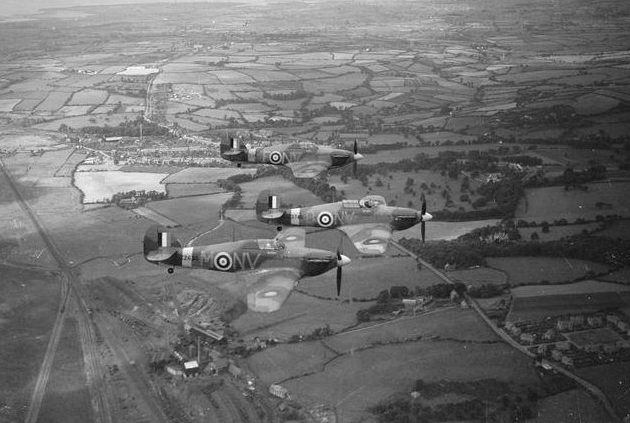
The featured image shows three Hawker Hurricane Mark IIBs of No 79 Squadron RAF based at Fairwood Common, Glamorgan, flying in ‘vic’ formation above South Wales. The pilots were, the South African Commanding Officer, Squadron Leader G D Haysom (leading aircraft, Z3745 ‘NV-B’), and his flight commanders, Flight Lieutenant R P Beamont (nearest aircraft, Z2633 ‘NV-M’), and Flight Lieutenant L T Bryant-Fenn (furthest aircraft, Z3156 ‘NV-F).


Researched by Peter Dickens.

Image copyright – Imperial War Museum. Geoffrey David Leybourne Haysom – Spitfire Society Trust ZA by John Mackenzie

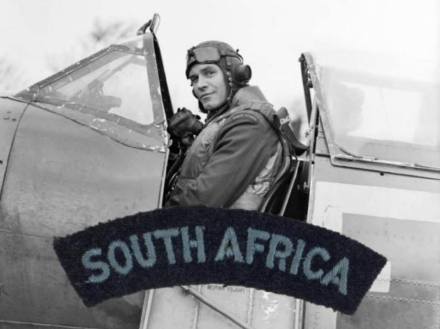
The RAF ‘South Africa’ title worn during The Battle of Britain

This is a famous ‘Battle of Britian” photograph of Squadron Leader Adolph “Sailor” Malan from South Africa sitting in a Royal Air Force Spitfire,  have a close look at his shoulder tab.

It’s a shoulder title issued to Royal Air Force (RAF) officers from South Africa, being ‘SOUTH AFRICA’ embroidered in light blue onto a RAF blue/grey arc of fabric.

During the Second World War many from Empire and Dominion countries joined the Royal Air Force, as did men from occupied countries such as Poland

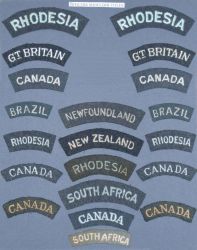
Shoulder titles were worn to signify the wearer’s country of origin. The titles were usually embroidered in pale blue capitals on a black background, or red on khaki drill for tropical kit.

raf_nat_18mTitles for officers were usually curved, and rectangular for other ranks. Excluding those worn by personnel from occupied countries, there were 42 titles issued officially, plus a number of unofficial ones.
The wearing of such titles was abolished in the RAF April 1948. A title for South Africa was authorised in March 1941.


Researched by Peter Dickens. Images – Imperial War Museum copyright, collection of titles as shown in the collection shown courtesy Alex Bateman

The feisty South African minesweeper that went down fighting – HMSAS Parktown

22308811_10155537271456480_3745202244434378650_nSouth Africa lost four ships during WW2, all of them minesweepers.  The second one to be lost was the HMSAS Parktown and it has a truly extraordinary fighting legacy.
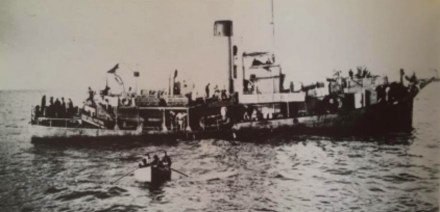
A small whaler converted to a minesweeper, the “tiny boat” HMSAS Parktown sailed into action in April 1942 in company of another “tiny boat” – the HMSAS Langlaagte, sailing  from Cape Town to the Mediterranean and joining the 167th Minesweeping Group working from Alexandria, Egypt.

Service in the Mediterranean

Parktown had arrived in the Mediterranean from South Africa during May and had sailed from Alexandria on 9 June as part of the escort for a convoy bound for Tobruk. During the passage the convoy is attacked and Parktown is involved in the gallant rescue of 28 survivors from a ship that had been sunk, many of whom are badly burnt. After their arrival in Tobruk on 12 June Parktown and her consort, a fellow South African ship the HMSAS Bever under the command of Lt P A North, are tasked to keep the approaches to Tobruk clear of mines.

parktown

HMSAS Parktown

Fall of Tobruk 

At that time Tobruk was under siege and by 20 June it is clear that a crisis of some kind is imminent. Late that same afternoon Parktown and Bever are ordered to enter harbour to embark evacuation parties. At 20:00 that evening they watch the Axis forces entering the western end of town and then reach the harbour shortly afterwards.

These two South African minesweepers were to distinguish themselves during the Allied evacuation from Tobruk fighting their way out of the harbour.  The Bever and Parktown fought side by side as they were loading up with as many Allied and South African troops and equipment as they could take, all the time whilst Rommel’s German forces closed in around them. The rapidity of the attack caused great confusion, however, the ships still manage to embark most of the men allocated to them before they sail.

On 20 June 1942 General Rommel’s “Deutsch-Italienische Panzerarmee” (German and Italian Tank Army) attacked the Tobruk garrison from the south and south east. By 18:00, the German and Italian forces had overrun the main defence lines and were closing on the harbour and all Allied ships were ordered to embark personnel for evacuation.

The escape 

By 19:00 German tanks and armoured cars were within the town and started shelling the ships in the harbour. HMSAS Bever received a direct hit as she cast off.  Next is The Parktown and her escape is also quite remarkable.

Using her machine guns she checks the advance of the enemy land forces whilst embarking a further 60 men, even though hit by shell fire. As she is casting off, more men keep arriving and several try to swim to the ship. A few are hauled on board, some assisted by one of the ship’s company, Able Seaman P J Smithers, who swims to their assistance. However in the confusion of sailing A/B Smithers is left behind to be captured and placed in an Italian POW camp.

As the last Allied ship to leave Tobruk, Parktown attracts a tremendous concentration of fire as she steams out at full speed. Although she is hit several times, no hit causes fatal damage to the ship and only one man, an army NCO, is killed.

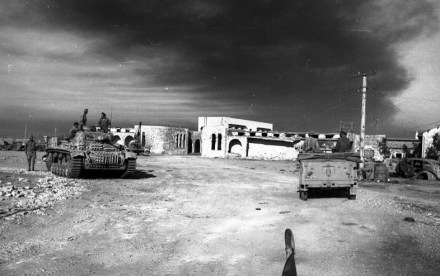
Tobruk, Rommel, Bayerlein, Panzer III

Rommel and his Panzers enter Tobruk

The Fall of Tobruk

Under cover of a smoke screen laid by a motor torpedo boat, but still receiving shell-fire from the town, the two ships left the harbour for the open sea. During the night off Tobruk port the Parktown and Bever became separated and the Parktown goes to the assistance of a disabled tug, also crowded with men.

The sinking of the HMSAS Parktown

After taking it in tow Parktown is only able to make five knots (9.3 Km/h) and thus gets left behind by the rest of the fleet. At daybreak on the 21 June they are still only 50 miles from Tobruk and can see the coast 14 miles away with a heavy fog bank to seaward.  At 06:45 Parktown’s crew sighted what they described as an Italian “MAS” torpedo boat (E-Boat), which had been directed to the slow moving vessel by a German reconnaissance aircraft.  The Parktown then turns north towards the fog bank, only to be confronted by four more E-boats at close range. Fire is immediately opened by both sides.

The E-boats using their higher speed and longer range guns open the range and attack from different directions. Even though Parktown, having only one 20mm Oerlikon, was heavily out matched, one or two of the E-boats appear to be hit by her fire and end up temporarily out of control.

However, within 30 minutes, completely outnumbered and outgunned the Parktown suffers sufficient damage to put her completely out of action.  The Captain, Lieutenant Leslie James Jagger and the coxswain are killed by a direct hit to the Bridge as well as a Royal Navy officer on passage.  Within 15 minutes Parktown was stationary with a hole in the boiler, half of the crew and evacuated soldiers as casualties, out of ammunition and with the upper deck on fire. The only surviving officer, Sub-Lieutenant E R Francis, although himself severely wounded, takes charge and orders the ship to be abandoned as a fire is spreading rapidly and no guns remain in action.

In the aftermath it is noticed that the E-boats appear to be firing at the men in the water, however a plane, which was thought to be German, appears and heads towards the E-boats where it then circles over them and opens fire on them, after which they make off at high speed.

The remaining crew and soldiers abandoned ship and clung to carley floats. At this time, an aircraft drove off the hostile ships. The tug which had been in tow had not been engaged by the E-boats and managed to rescue some of the survivors and some of the remaining survivors were rescued by an Allied Motor Torpedo Boat (MTB) which found them close to the burning minesweeper. The Allied MTB then sank the burning wreck of the Parktown with depth charges before returning to Mersa Matruh that evening.

Accounts on the final hour of the Parktown differ:

Orpen states that the Italian ships were driven off by a South African aircraft. He also records there being four Italian torpedo boats involved in the action.

Du Toit states that there were six Italian torpedo boats involved and that the aircraft was in fact a German aircraft which erroneously attacked the Italian ships.

Harris supports the fact that there were four torpedo boats and states that the German aircraft deliberately attacked the Italian vessels as they were firing on survivors in the water.

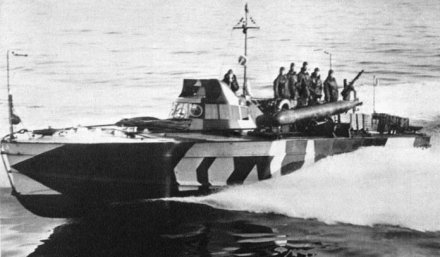
MAScamo

Camouflaged Italian World War II MAS that sunk the HMSAS Parktown (Motoscafo Armato Silurante – Italian: “Torpedo Armed Motorboat”)

Out of her complement of 21, Parktown suffered 13 casualties; five killed and eight seriously wounded.

Decorations and awards won

In this action alone the HMSAS Parktown’s crew would amass the following decorations and awards (we will leave the account of the HMSAS Bever to another post on her and her loss in November 1944 specifically):

Distinguished Service Order, D.S.O 
Sub-Lieutenant Ernest Rowland Frances (H.M.S.A.S. Parktown).
Comes from Krugersdorp. Age 34. Was in Training Ship General
Botha, 1923-23. Badly wounded during Tobruk withdrawal.

Distinguished Service Medal, D.S.M.
No 66921. Leading-Stoker John Charles Rohlandt (H.M.S.A.S. Parktown).
Home. address, 12, Hillyard-street. Woodstock.
No 71431. Leading-Stoker Leslie Ronald Mitchell (H.M.S.A.S. Parktown).
Home address. 16, Wesley-street. Observatory. Before war was
employed by Customs Department, Cape Town
No. 71048. Able-Seaman George Kirkwood (H.M.SA.S. Parktown).
Comes from Maraisburg. Transvaal. Was a miner in peace time.

Mentioned in Dispatches (Posthumous)
Lieutenant Leslie James Jagger (H.M.S.A.S. Parktown) Came from Johannesburg, was killed during this operation.

No. 71464. Stoker Andrew Henry Jooste (H.M.S.A.S. Parktown). Comes from Vrededorp Johannesburg. Age 21. A gold miner before joining Seaward Defence.

The honour roll  – HMSAS Parktown (SANF),

The following South African men were lost with the sinking of the Parktown (MPK means “missing presumed killed”)

BROCKLEHURST, Peter S, Able Seaman, 70457 (SANF), MPK
COOK, John A, Stoker 1c, 70256 (SANF), MPK
JAGGER, Leslie J, Lieutenant SANF, 70016 (SANF), MPK
MCEWAN, William A, Steward, 69686 (SANF), MPK
TREAMER, Arthur P, Petty Officer, 71109 (SANF), MPK

May these brave South Africans Rest in Peace, their duty done.

supporting-poppy-appeal

For more Observation Post stories on South African minesweepers lost in World War 2, please visit the following links:

HMSAS Southern Floe: The HMSAS Southern Floe was the SA Navy’s first ship loss & it carries with it a remarkable tale of survival.

The HMSAS Bever: “Under a hail of shells”; Recounting the bravery and loss of HMSAS Bever

The HMSAS Treern: The last South African Navy ship to be lost in action; HMSAS Treern


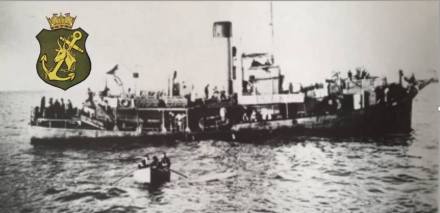
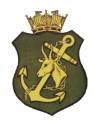
Researched by Peter Dickens. References: Article essence copied from Wikipedia, Military History Journal Vol 9 No 1 – June 1992. THE STORY OF A WARSHIP’S CREST by F V Demartinis and Day-to-Day in the SA Navy by Chris Bennett (social media). SOUTH AFRICAN NAVAL FORCE
Ship Histories, Convoy Escort Movements, Casualty Lists 1939-1947