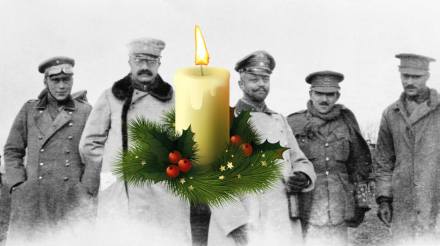
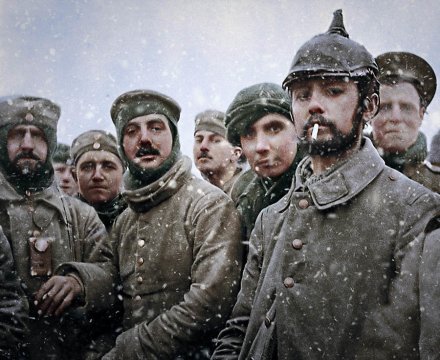
Just over 100 Years ago, on the 25th December, a remarkable Christmas Day Truce took place during World War 1. The two belligerent armies facing one another in the trenches of the western front heard Christmas carol singing in the opposing trenches and simultaneously and spontaneously approached one another for an informal and impromptu truce – a brief peace to extend a hand of goodwill and mutually enjoy Christmas together.
As this informal truce played out, the men from both opposing sides, initially very weary of one another, gradually ventured out from the safety of their defences and gathered in the middle, known as “no mans land” (or otherwise known as the killing zone). A true Christmas miracle was beginning to unfold.
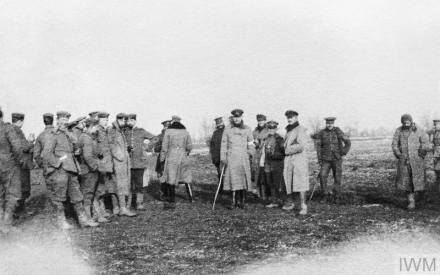
British and German troops meeting in No-Man’s Land during the unofficial Christmas truce. (British troops from the Northumberland Hussars, 7th Division, Bridoux-Rouge Banc Sector).
Here in the middle of what was a place of absolute slaughter they exchanged gifts and played games of football. Items swapped as gifts included things like insignia, wine, food and chocolate, there is no record of who won the football games (not that it mattered at all), just that games all along the front were enjoyed between both sides using impromptu goal posts.
This remarkable photograph survives of the occasion British and German soldiers fraternising at Ploegsteert, Belgium, on Christmas Day 1914, front of 11th Brigade, 4th Division. London Rifle Brigade with troops of the 104th and 106th Saxon Regiments.
They all returned to their respective trenches to continue the wholesale slaughter that was the Western Front in WW1, but for a short Christmas Day, the spirit of Christmas prevailed and shone a light of hope and peace in what was most certainly the deepest hell of war.
Such is the power of the Christmas spirit and quite remarkable that the sentiment of this day – the power of goodwill and humanity to all – still prevails, and that is quite something.
Sadly things reverted to normal the next day and the carnage of World War 1 trench warfare continued, but this day stands testimony of the natural goodwill of man and the goodness of this most special day on the Christian calendar.
This commercial made in conjunction with the Royal British Legion and Sainsbury’s in 2014 captures this most wonderful moment of man’s goodwill and triumph over adversary and destruction.
Merry Christmas from The Observation Post and may we all remember the true spirit of Christmas which shone through so powerfully on this remarkable day.
Written by Peter Dickens. Image copyrights to the Imperial War Museum. Commercial video copyright, Sainsburys.
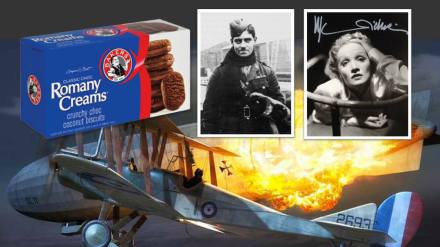
Grab your packet of Romany Creams from the pantry, bite into South Africa’s top-selling chocolate biscuit then settle down and to read some very rich South African World War 1 history. History is often connected by remarkable ‘golden threads’ and this one takes you on a wonderful journey – all the way from shooting down Zeppelin’s bombing England to your favourite tea time ‘choccy biccy’.
Our story starts with a young South African, Ian Vernon Pyott. Ian was the son of a Scotsman named John Pyott. John, was born in Dundee, Scotland and was a baker’s apprentice at aged 10. Due to ill-health, John was advised to move to a better climate – so he packed off to Cape Town, South Africa and in 1880 he moved to Port Elizabeth where he manufactured sweets, cakes and jams before later moving into bread and biscuits. On 1 December 1900, Pyott converted his business into a limited liability company and named it “Pyott Limited”. Highly successful, between 1898 and 1924, the Company was to receive no fewer than 70 medals at various exhibitions across the country
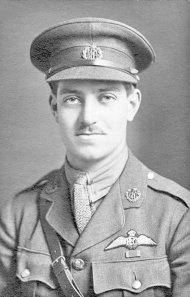
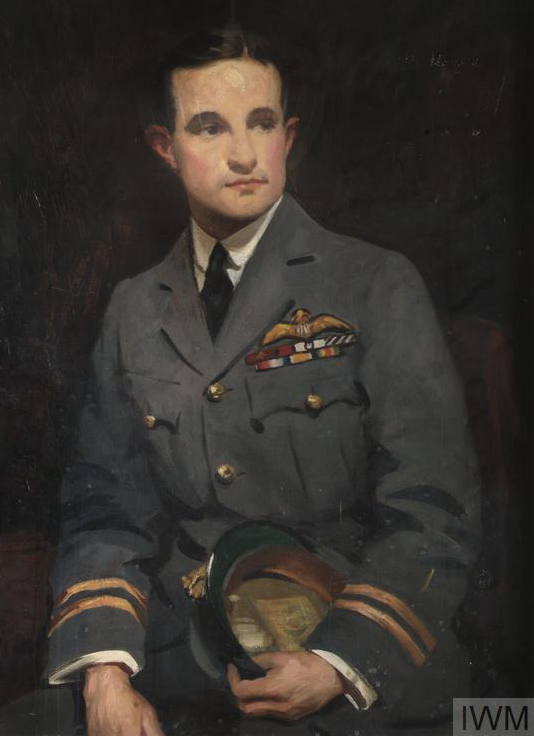
Captain Ian Vernon Pyott DSO
Capt. Ian Pyott DSO
Ian Pyott was born in Port Elizabeth, South Africa, on August 31, 1895. He grew up in Port Elizabeth. He was educated at Grey High School, South Africa and Watson’s College in Edinburgh, Scotland, returning to South Africa after completing his education here he trained as a miller in the family owned ‘Pyott Limited’ business.
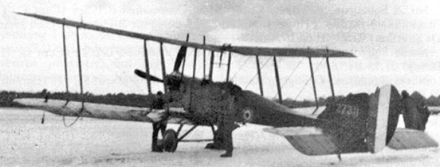
At the outbreak of hostilities which was to become World War 1, Ian Pyott returned to England in February 1916, enlisting in the Machine Gun Corps ‘MGC (Tanks)’. He transferred into the Royal Flying Corps (RFC) three months later in June, after attending flying school, he was posted to 36 Squadron’s ‘A’ Flight, based at Seaton Carew and assigned to fly a two-seater Royal Aircraft Factory BE 2c, No 2738 biplane.
Little did he know that in a couple of months he was about to become one of the heroes of the war. He was about to meet a German Zeppelin airship on a high altitude night bombing raid, November 27, 1916, designated number L-34.
Two groups of Zeppelin airships set out from Germany to bomb England that fateful night, with the first group of five ships crossed into England near Scarborough while the second group of four flew toward the Tyne River mouth.
Zeppelin L-34 was massive, 148 metres long and a diameter of about 15 meters (on average).
Lt. Ian Pyott was flying out of Seaton Carew aerodrome, he was on his second patrol of the night. Tasked with looking for Zeppelin airships and destroying them, he took off at 10.30pm and although his BE 2C normally carried an observer he flew solo this time, this weight saving allowed him more fuel and therefore more flying time.
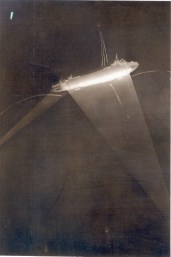
L34 Caught in Search-Lights
L-34 crossed the coastline into England in the neighbourhood of Blackhalls, a handful of miles north of Hartlepool. Turning Southwards towards Tees it was spotted and searchlights brought to bear on it. Once spotted L-34 immediately started dropping bombs in an attempt to neutralise the search-lights. In all it dropped 13 bombs near Elwick – a little village just west from West Hartlepool. The bombing proved ineffectual with minimum damage on the ground (two cows were injured).
Now under attack from anti-aircraft fire L-34 turned seawards passing over the thickly populated area of West Hartlepool. At this stage Lt. Pyott had been in the air for 1 hour when he saw the Zeppelin heading in his direction.
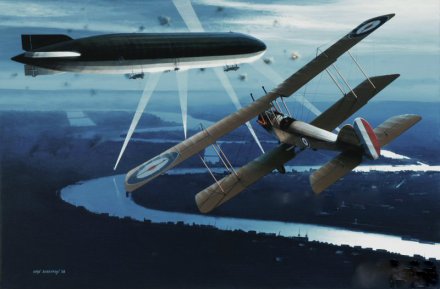
He reported that he was at 9800 feet and the Zeppelin was a couple of hundred feet below him, he attacked the Zeppelin at right angles to the middle of the airship, firing all the way and then flying underneath it. The airship turned east and Pyott and the Zepplin’s machine gunners dueled for about 5 more miles. Eventually Pyott got some tracer rounds into left side of the Zepplin’s envelope and the Zepplin was rapidly engulfed in frames. On fire, it continued east over Hartlepool, broke in half and plunged nose first into the Trees river mouth.
The virtually instantaneous combustion of 45,000 cubic metres of hydrogen on board used to inflate the airship ensured there were no survivors, only two bodies were found, the rest sadly incinerated or lost.
Death of L 34
Shooting down a Zeppelin was a very big deal in World War 1, they were heavily armed, flew at incredibly high altitudes for the day and very formidable. When Pyott landed, all the members of his base ran out to cheer him, he promptly collapsed, not due to injury, but because he was frozen stiff from fighting at such a high altitude. They took him from the cockpit and carried him aloft on their shoulders in victory, taking him off to warm up no doubt.
Following the victory Ian Pyott was to become a national hero, wined and dined by the British elite.
Lt. Ian Pyott besides the BE 2c he was piloting when he shot down Zeppelin L34
Just over a week later, 15th December 1916, it was announced in the press that Pyott had been awarded a ‘Companion of the Distinguished Service Order’ (DSO), in part his citation read “in recognition of conspicuous gallantry and devotion to duty connection with the destruction of an Enemy Airship”.
Pyott was also promptly promoted to Captain. His proud father, the Bakery owner of Pyotts Limited in Port Elizabeth, sailed from South Africa to be present when King George V presented Capt. I.V. Pyott his DSO at Buckingham Palace.
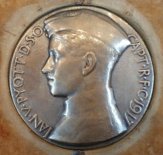
Such a big deal was made of this victory, that a special commemorative coin was even stamped to celebrate Capt. Pyott’s actions and resultant DSO. Zeppelins were so feared by the British public they were branded ‘Baby Killers’ as the bombing of civilians carried with it such a public outrage. The commemorative medal carried Capt Ian Pyott’s profile, the year and the letters DSO, it was presented to him at Hendon Aerodrome in England by none other than General Jan Smuts.
But there was more to come from this very brave South African. He was again Mentioned in Despatches (London Gazette 25 January 1917), whilst subsequently serving with No 55 Squadron on the Western Front. He also claimed another air victory on 23 April 1917 while returning from a bombing raid, a formation from No 55 Squadron was attacked by nine hostile aircraft that dived upon them. Pyott and his observer, 2nd Lt A D Taylor, in DH4 A2147, claimed an German Albatros scout plane over Boue.
Marlene Dietrich
Marlene Dietrich
So where does the Hollywood Superstar actress and singer, Marlene Dietrich, fit into all of this? Simply put the Commander of Zeppelin L-34 on that fateful night in September 1916, was Marlene’s uncle.
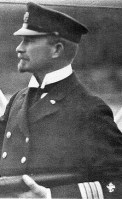
Kapitanleutnant Max Dietrich commanded Zeppelins in his short career, and was regarded as a particularly experienced commander, in all he had a total of 41 sorties in Zeppelins. Because only two bodies were recovered from L-34, Marlene and her family lived for a little time in the hope that Max Dietrich could somehow have survived.
She said of the incident,
“We knew the Zeppelins had gone out on an errand of war, but we did not know their destination. My uncle never came back. My aunt was broken-hearted, but she would not believe her husband had really gone. She insisted that he would come back. But the years passed, and there was no news. At last she lost hope and bowed to the hand of fate. It is very sad but of course, in Germany my Uncle Max was mourned as a hero. He gave his life for his country”.
Max Dietrich
Marlene Dietrich, was born in Berlin and came from a strong military family. She was a Hollywood superstar actress and singer who held both German and American citizenship. Her performance as Lola-Lola in The Blue Angel (1930) brought her international fame. Marlene Dietrich starred in many Hollywood films, significantly Morocco (1930), Shanghai Express (1932), and Desire (1936).
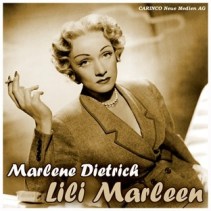
During World War 2, she became the ‘darling’ for both British and German troops, whilst holding this rather unique position she recorded a popular German love song by Lale Andersen called ‘Lili Marleen’ in English, it was done as a morale boost for American, British and Commonwealth troops and it became an instant hit.
Especially for the South Africans, The song was published in South Africa in a wartime leaflet, with an anonymous English translation, as ‘Lili Marleen: The Theme Song of the Eighth Army and the South African 6th Armoured Division’ (quite ironically).
In a wonderful turn of fate, it was not unusual in the Second World War for British, American and South African troops to be heard singing along to the English version of Lili Marleen on a record player and for German troops to be singing along to her German version on the opposite lines within hearing distance of one another.
Romany Creams
So how do Romany creams fit into this story? Well, after the war our hero Capt. Ian Pyott returned to South Africa and took up a position in his Dad’s bakery business.
John Pyott died in 1947. His other son, Robert, became Chairman and held this position until his death in 1964. During this period, the decision was made to concentrate solely on biscuits and from October 1949, Pyott Limited thus specialised, enabling it to increase its biscuit range even further. Following Robert Pyott’s death, his brother, our Zeppelin shooting hero, Ian Pyott, was appointed to the position of Chairman and Managing Director.
The early 50s saw the beginning of the fight for market share between the three major competitors in the biscuit industry – Bakers, Baumanns and Pyotts.
Under Ian Pyott, in mid 1965, Pyott Limited collaborated with Cadbury’s Chocolates in Port Elizabeth to produce a chocolate variation of a traditional English treat known as “Gypsy creams”, which consisted of two round-topped biscuits sandwiched together with a creamy white filling. Gypsy Creams were not a very big seller for any of the British manufacturers.
Innovative as ever, the biscuit part was shaped the same as for “Gypsy Creams”, but the biscuit part (referred to as the shell) was improved and it was sandwiched with a chocolate filling instead, no doubt provided by Cadbury’s Chocolates.
The line immediately proved a winner. They chose the name “Romany” to carry the ‘Gypsy’ connotation across from Gypsy Creams (named after the Romany travelling community).
Bakers Ltd then made a competitive product and called it Tuscany Creams, but it was Pyott’s Romany Creams that really held the market.
In 1969, Ian Pyott, was now getting old and he resigned from the position of Managing Director of Pyott Limited. He died shortly afterward in 1972 whilst the company was been sold to Nabisco Inc. Many buy-outs and takeovers later, what was Pyott Limited found itself part of the Anglovaal Industries Group.
In 1994 Bakers, Pyotts and Baumanns were regrouped under the collective title of “Associated Biscuits”. In 1996, the member companies of National Brands Ltd. (NBL) were combined into a single company. This transformation included combining Willards with Associated Biscuits to form the Biscuit and Snack Division of National Brands.
Today, the familiar Pyott’s logo on Romany Creams has been replaced with their old competitor’s logo – the Baker’s logo. The range of flavours has expanded and the packaging design has changed, but the ‘original’ flavour chocolate Romany Creams developed by one dapper, Zeppelin shooting South African fighter pilot and war hero, Capt. Ian Pyott DSO, are still the best seller.
In Conclusion
I’ll bet the modern Marketing Managers at National Brands have little to no idea of the heritage this product has. Wouldn’t it be nice, if in the centenary of the end of WW1, that a special commemorative packaging be designed to Capt. Ian Pyott DSO and his legacy re-presented to a South African public largely unaware of the WW1 heroes this country has, and what they have given to the country.
I hope you have munched your way through the entire packet of Romany Creams by now and richer in chocolate and sugar no doubt, but you also are much richer in the knowledge now that you bitten into the type of fantastic journey South African military history has to offer. History that often lies so hidden away because seismic political events in South Africa have over-taken it. Think of it as a ‘secret filling’ that will make for an interesting titbit to impress your friends with, next time the Romany Creams appear on a coffee table.
Written and researched by Peter Dickens
Enjoyed this, have a look at another famous South African military history treat, the Hertzoggie vs. the Smutsie.
My sincere thanks to Sandy Evan Hanes for pointing out this interesting golden thread to me. References: Wikipedia, Shooting Down of Zeppelin L-34 by Ivor Markman. On-line discussion forums. South African Legion Facebook group forum.
In the company of extremely brave men of the 1st South African Infantry Brigade, tasked with holding a wood against all odds, in what was the ‘fire hell battle on the Somme’ – the Battle of Delville Wood, it is quite something to stand out as the “bravest of the brave”.
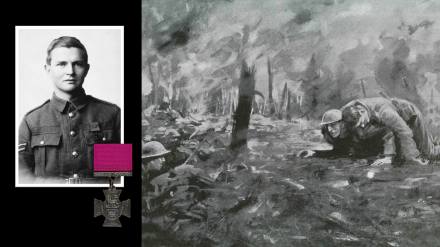
William Faulds, a young man who won a Victoria Cross, the highest award for gallantry, at Delville Wood is quite literally a case of a normal young South African placed in an extraordinary circumstance, only to emerge with that “X” factor which sets him apart, and that’s quite something considering everyone around him can in their own right can take the mantle of the ‘bravest of the brave’, such was the nature of the battle.
To put his action into context, the South Africans holding Delville Wood on the Somme in 1916 were shelled by the Germans at a rate of 500 rounds per minute, into their positions which occupied a small wood only a square kilometer in size. In inadequate trenches (the wood’s roots prevented digging them deeply enough), when shelling stopped long enough they were faced with German Imperial troop attacks of such ferocity that the bayonet and hand to hand fighting became the only means to survive.
When the South Africans were relieved on 20th July 1916, just 5 days after entering the wood, of the 1,500 South African infantry men initially sent in, there were only 142 survivors still holding the wood.
So what does this young man do, a man who had worked at Midland Motor Garage in Craddock and who had only just turned 21, what makes him react differently and stand out in the midst of all the universal gallantry and carnage on an epic level? Here is his story:
Young William ‘Mannie” Faulds from Craddock, together with his brother, Paisley and some school chums joined up with the South African forces to fight during World War One. Arthur Schooling (his best friend), and William both enlisted together and went everywhere together. Together they even fought under the command of General Louis Botha during the South West African Campaign and then again in Egypt, before the two of them shipped out to fight in the Battle of the Somme in France.
During the Battle of Delville Wood (part of the Somme Campaign), on 16th July 1916, Arthur Schooling was shot dead in no-man’s land (the ‘killing zone’ between the South African and German lines), leaving a very distraught and shocked William Faulds feeling utterly helpless. On the same day, 16th July, Lt. Arthur Craig (1st Battalion Bravo Company) was also shot and lay wounded close to the body of Arthur Schooling in the killing zone (no-man’s land).
Pte. William Faulds dug deep to find the bravery for this, and along with Pte. Clifford Baker and Pte. Alexander Estment, all three took matters into their own hands to rescue their officer. In broad daylight at 10:30am, they climbed out from behind the relative safety of the defences and crawled to their severely wounded Lieutenant, then they ‘piggy-backed’ him back to safety. Pte. Baker was badly wounded in the attempt. Lt. Craig survived thanks to these three brave ‘Springboks’ and recovered his wounds later in the Richmond Hospital, London.
William Faulds and Alexander Estment returned to their positions in the wood and continued fighting in what can only be described as combat in the extreme. The initial act of gallantry alone was quite something, but there was still more in young Faulds, and it’s here that we start to see ‘X’ factor that makes a Victoria Cross recipient different from the rest.
Because just two short days later, he was faced with exactly the same situation again – a critically wounded comrade in no-man’s land, but this time William Faulds was alone, and once again he put his life on the line, exposed himself by leaving the relative safety of the trenches (such as it was) and entered no-man’s land (the ‘killing zone’) under intense incoming artillery fire, to rescue another yet another of his comrades and alone carried him from certain death, for nearly half a mile, to a medical station.
Victoria Cross
His citation for his Victoria Cross says everything:
“For most conspicuous bravery and devotion to duty. A bombing party under Lieut. Craig attempted to rush across 40 yards of ground which lay between the British and enemy trenches. Coming under very heavy rifle and machine gun fire the officer and the majority of the party were killed or wounded. Unable to move, Lieut. Craig lay midway between the two lines of trench, the ground being quite open. In full daylight Pte. Faulds, accompanied by two other men, climbed over the parapet, ran out, and picked up the officer, and carried him back, one man being severely wounded in so doing.
Two days later, Private Faulds again showed most conspicuous bravery in going out alone to bring in a wounded man, and carrying him nearly half a mile to a dressing station, subsequently rejoining his platoon. The artillery fire was at the time so intense that stretcher-bearers and others considered that any attempt to bring in the wounded man meant certain death. This risk Private Faulds faced unflinchingly, and his bravery was crowned with success (London Gazette 9 September 1916)”.
With that, William Faulds became the first South African born recipient of the Victoria Cross (VC) during World War 1. It was this extra rescue, the repetition of bravery in the extreme which set him apart from his two comrades involved in the first rescue of Lt. Craig, no doubt equally extraordinary – both Clifford Baker and Alexander Estment were awarded the Military Medal (MM) for bravery.
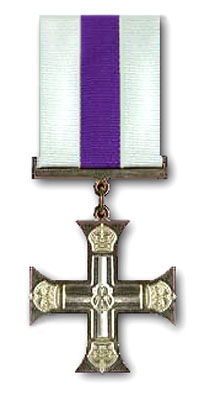
William Faulds continued to fight, and again showed bravery and leadership in the extreme, and was later awarded the Military Cross (MC), a lessor award to the Victoria Cross, but no less important. He received it for leading men during German attacks at Heudecourt, enabling rest of Battalion to withdraw with only slight losses.
Military Cross
His second citation for the Military Cross says everything and reads:
“In the retirement from the line east of Hendicourt, 22 March 1918, he was commanding one of the platoons which formed the rear-guard. He handled his men most ably, and exposed himself freely. Though the enemy pressed hard, he, by his fearless and able leadership, checked them, and enabled the remainder of the battalion to withdraw with slight loss”.
He was eventually wounded and captured by the German Forces on 24th March 1918 at the Battle of Marrieres Wood. He was released as a prisoner-of-war after the Armistice on 11 November 1918 and returned to South Africa.
Post War
On his return he was promoted to a Lieutenant and took up a civilian job as a mechanic with De Beers Diamond Mine. In 1922 he re-enlisted with the Kimberley Regiment and was made a Captain. Later he moved to Rhodesia (now Zimbabwe) and in 1937 he was member of Southern Rhodesia contingent at the King’s Coronation.
Not without a sense of humour, when his daughter was born he expressed the wish of having her named Victoria Faulds (falls). His wife objected strongly to what would have stacked up to become potential ridicule for the young girl and she was christened “Joy” instead.
William Faulds died on the 16th August 1950 in Salisbury (now Harare) and is buried in the Salisbury Pioneer Cemetery. His Victoria Cross was held by the Museum of Military History in Saxonwold, South Africa, and such is the nature of our disregard for national heroes and treasures, it was stolen from the museum in October 1994.
Researched by Peter Dickens
References: The VC and the GC, The Complete History, published by Methuen and The VC and GC Association in 2013. Three of South Africa’s WW1 Delville Wood heroes – by Miss Joan Abrahams.
The painting is an artist`s impression of the action at Deville Wood for which William Faulds was awarded the Victoria Cross. From the book “Deeds that thrill the Empire” Vol 5. Insert Artwork: Men in the Trenches, near Hendicourt by Adrian Hill, Imperial War Museum copyright
In addition to the famous Capt. Andrew Beauchamp-Proctor VC, DSO, MC & bar, DFC, there were also other significant South African World War 1 flying aces, and this man, who came from Kimberley, Capt. Andrew Cameron Kiddie DFC is one of them, he was a World War I flying ace and before and after the war he was the local Kimberley baker.
Andrew Cameron “Dixie” Kiddie was born in Kimberley on 7 November 1889, his father being Andrew Cameron Kiddie (Senior), a baker from Dundee, Scotland who came to South Africa in 1885. Kiddie Senior bought the bakery in Kimberley from a Mr Roy in 1895 after having worked there for some 9 years and changed the name to ‘Andrew Kiddie and Sons’.
Having served with the 18th South African Mounted Rifles in 1914/15, Andrew Kiddie went to England to join the Royal Flying Corps. as a 2nd Lieutenant, Kiddie received Royal Aero Club Aviator’s Certificate 3719 on a Maurice Farman biplane at military school, Brooklands on 17 October 1916. Posted to 32 Squadron in 1917, he scored his first victory flying a DH5. Later that year, he served as an instructor with the Home Establishment. Among his students was future ace Ira Jones.
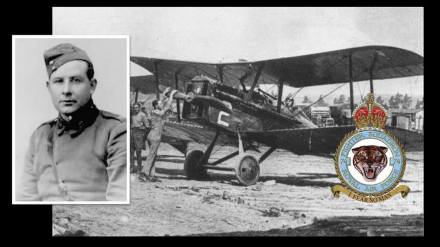
In the spring of 1918, Kiddie was back in France flying the SE5a with 74 Squadron, the famed “Tigers”. On the morning of 8 May 1918, just days after scoring his second victory, Kiddie’s flight of six SE5As was pounced on by ten Fokker Tri-Planes. With a badly damaged aircraft, Kiddie was the only pilot to make it back to the aerodrome.
74 Squadron SE5A flown by Maj Edward Mannock VC, DSO & Two Bar, MC & Bar
He went on to become a flight commander in the summer of 1918 and scored thirteen more victories by the end of the war. He was awarded the Distinguished Flying Cross, the citation reading:
A gallant officer, who has proved himself resolute and courageous in aerial combats. He has to his credit six enemy machines and one balloon shot down in flames.
He was also awarded the Belgian Croix de Guerre. After the war and his father’s death in 1920, Andrew Cameron “Dixie” Kiddie took over the local bakery in Kimberley.
He died in Kimberley on 27 June 1964 and is buried in the West End cemetery.
Although his parents and everyone in Kimberley knew him as “Cam”, in the RFC and the RAF he was known as “Dixie”.
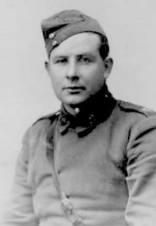
Pictured is AC “Dixie” Kiddie, the 74 Squadron RAF badge, and senior pilots of 74 Squadron March-June 1918. Seated are: Edward “Mick” Mannock, Keith Caldwell, Everard (adj.), and Wilfred Young, while standing are Ben Roxburgh-Smith and Andrew Kiddie.
Another South African flying ace was to follow Kiddie as a ‘Flying Tiger’ and lead the “Tiger” (74) Squadron during World War 2, that was the famous ‘Sailor Malan’, but that’s another story and ironically he also rests today under a Kimberley sky (see link Sailor Malan – Fighter Ace & Freedom Fighter!). Not only was Sailor Malan the Tiger Squadron’s Squadron Leader, another South African was also destined to lead the 74 Squadron when it entered the jet age – Air Vice-Marshal John Howe (see link Forget Tigers, The Royal Air Force’s 74 Squadron has a legacy of South African Lions! )
As South Africans we have also produced another famous Baker who went on to become a World War 1 aviation hero, he was the originator of Romany Creams, a very well known South African baked treat. His too is another fascinating story, for more on Capt. Pyott follow this link Connecting Zeppelins, Marlene Dietrich and South Africa’s favourite biscuit – Romany Creams!
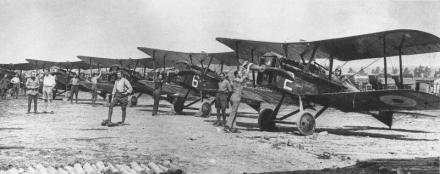
No 74 Squadron, Clairmarais, France, summer 1918
Researched by Peter Dickens. Sources include Wikipedia, The Aerodrome, and the Diamond Fields Advertiser. Kimberley Calls and Recalls.
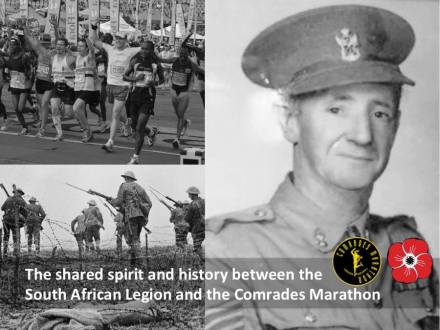
Did you know that “The Comrades Marathon” has a shared spirit and a shared history with The South African Legion of Military Veterans?
As the oldest military veterans organisation in South Africa, the South African Legion was formed at the 1921 Empire Conference (28 February to March 4) in Cape Town as the British Empire Services League (BESL, South Africa) by joining two organisations together – the “Returned Soldiers and Sailors Association” and the “Comrades of the Great War”, which co-incidentally is the organisation after which the term “Comrades” in Comrades Marathon is given. In the course of history the “BESL South Africa” came to be called “The South African Legion of Military Veterans”.
In the same year – 1921 – Vic Clapham, a World War 1 veteran himself approached the “Comrades of the Great War” with a vision that would result in the worlds greatest ultra marathon nearly one hundred years later.
His idea was that if infantrymen, drafted into the armed forces from sedentary jobs, could endure forced marches over great distances, trained athletes could cover the distance between the two cities of Pietermaritzburg and Durban without great difficulty. Clapham, like the Legion, also wanted to remember those who had fallen in the war, and he felt the best way to honour this was by the ultimate testing of body and mind, and triumphing.
The Natal athletics body was not interested in the idea of a ultra marathon, and thought Clapham was quite mad, so undaunted by the set-back Clapham approached the British Empire Services League of South Africa (now known as the South African Legion), and asked permission to stage the race under their auspices. They ultimately agreed and financially underwrote the first race.
The first 1921 Comrades Marathon was run by Vic Clapham and included a field of 34 runners, of them Sixteen runners completed the 87, 9km (55 mile) downhill race from Pietermaritzburg to Durban. The race was won by Bill Rowan who finished in a time of 8:59:00 and his name is now given to the sub 9 hour medal in today’s race.
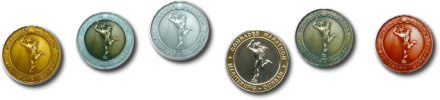
Left to Right “Modern” Comrades medals
A gold medal for the top 10 finishers
A Wally Hayward for a sub-6 hour time
A Silver for a sub-7:30 time
A Bill Rowan for sub-9
A Bronze for sub-11 and finally
A Vic Clapham for sub-12
Although The Comrades Marathon is an independent commercial concern now, The South African Legion has continued its association to the Comrades Marathon over the years and encourages all participants to wear a Remembrance Poppy in recognition of this history and the sacrifice of the fallen. In this respect the Comrades Marathon is still in fact a “living memorial” to the Great War (World War 1).
World War 1 and here we see this stunning and timeless photo of some very unsung heroes – South African Native Labour Corps men sitting around a brazier at their camp near the Western Front – Dannes, France – March 1917. Funnily it’s a scene which would not look too dissimilar to a construction camp in South Africa on a cold winters morning today.
The Black African contribution to World War 1 has been heavily downplayed in South Africa’s accounts of the war on the Western Front (and for that matter all “western” accounts of the war), however in all – 83 000 black South Africans and 3 000 Cape Coloureds answered the call – a total of 85 000 “non-white” men complemented the 146 000 white servicemen – serving in all sorts of roles, ranging from policing, carriage driving, stretcher bearing, cooking, engineering earth and wooden defences, felling trees for fuel, on-loading and off-loading cargo … the list goes on. 42% of the serving South Africans during WW1 were Black or “Coloured”, a fact that is has been very overlooked in the past, and remains relatively unknown to this day.
Funnily in any military outfit today non-combat support roles are viewed as an intrinsic part of the military – medics, engineers, “Loadies”,”drivers,”military” policemen etc. and they are not viewed any differently in terms of veteran status. Yet the prejudice and politics of the time viewed these men differently, withholding medals and recognition due to them.
To say that World War 1 for South Africans was a “whites only” conflict is to fundamentally misunderstand the politics of the day. The sanitation of South African Military History to support the “white” narrative remains one of the hardest things to redress as people (Black and White) just simply cannot see past decades of historical indoctrination.
The South African Native Corps cemetery at stands in stark testimony of the sacrifice of South African “Black” men to the cause of World War 1 on the Western Front. Over 300 Black South African soldiers of the SANLC and Cape Coloured Corps lie buried at the cemetery outside Arques-la-Bataille in France alone, and that’s without considering the over 600 Black South African SANLC soldiers lost on the SS Mendi to a watery grave. Here the dead really speak volumes.
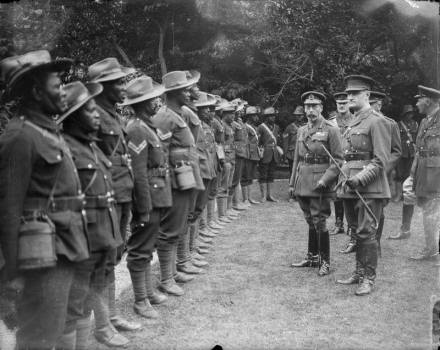
King George V who is seen inspecting N.C.O.’s of the South African Native Labour Corps at Abbeville, 10 July 1917.
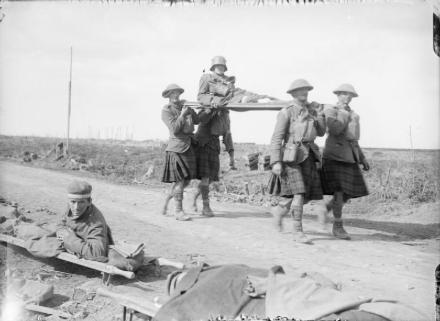
Rare photo of frontline South Africans in World War 1, and also one which shows compassion. This photo was taken from the Battle of Menin Road Ridge on the 21st September 1917. Here four South African “Scottish” from the 4th South African Infantry Regiment are carrying a wounded German on a stretcher to a medical station. Other wounded German prisoners are seen in the foreground.
The Battle of the Menin Road Ridge 20th to 25th September 1917 was an offensive operation, part of the Third Battle of Ypres on the Western Front, it was undertaken by the British 2nd and 5th Armies in an attempt to take sections of the curving ridge, east of Ypres, which the Menin Road crossed. This action saw the involvement of the South African Brigade – along with British, Newfoundland and Australian formations.
The attack was successful along its entire front, though the advancing troops had to overcome formidable entrenched German defensive positions which included mutually supporting concrete pill-box strongpoints and also resist fierce German counter-attacks. A feature of this battle was the intensity of the opening British artillery support and “leap frog” tactic used by the British to consolidate taken ground.
The South African Brigade saw most of its action at Borry Farm, easily overrunning the German strong points, except for four pill-boxes around Potsdam House, which were eventually attacked on three sides and captured, after inflicting heavy casualties on the attackers. The South African Brigade was also badly hit by German machine-gun fire from Hill 37, however in the end the South Africans managed to capture Bremen Redoubt and Waterend House in the Zonnebeek valley and extend a defensive flank.
Do note that the South Africans are wearing the “Murray of Atholl” (modern) kilts which was the dominant tartan worn by the South African Scottish in the 4th South African Infantry Regiment – Company A was made up of Cape Town Highlanders, Company B Transvaal Scottish and Company C was also Tvl Scottish in the main whereas Company D was made up of various caledonian regiments from the Orange Free State and Natal.
The tradition of the Murray of Atholl was carried over to The Transvaal Scottish Regiment and is still worn to this day, hopefully the SANDF will see its way clear to keeping the traditions of its fighting men and their sacrifice.
Image copyright and reference: Imperial War Museum
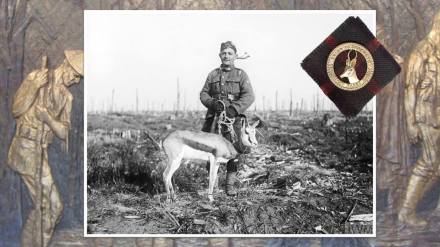
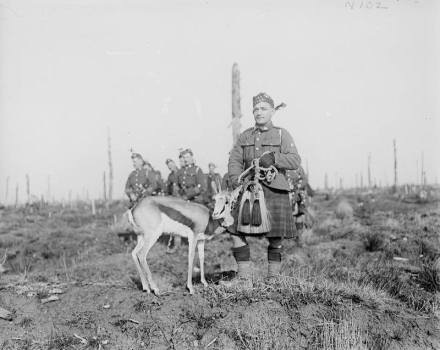
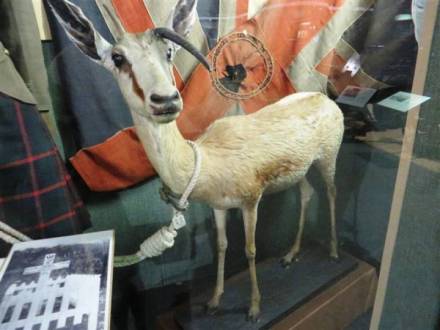
The feature image shows ‘Nancy’ the 4th Regiment mascot of the South African Forces, seen here at a drum head service at Delville Wood on the 17th February 1918 Delville Wood was the site of such huge South African sacrifice and carnage. The story of Nancy is quite extraordinary.
Nancy is the only animal in South African military history to be accorded full funeral honours and to be buried in an Allied war cemetery. This is the story of famous Springbok mascot of the 4th South African Infantry Regiment who died of pneumonia at Hermeton in Belgium during the severe winter of 1918 during World War I.
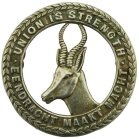
No more appropriate mascot could have been found. The SA Brigade badge was a Springbok head, surrounded by a circle with the motto: “Union is Strength – Eendracht Maakt Macht”.
At her funeral, the firing party fired their volley. As the echoes died slowly away on this quiet afternoon, the regimental bugler, Private A E Petersen, stepped forward; a few seconds later the familiar notes of the Last Post sounded. Once or twice the bugler faltered but nobody seemed to notice. Bugler Petersen sounded the last note and there were tears in his eyes as the officers saluted, then trudged back to their cold and muddy trenches around the village.
Nancy began her army career in March 1915, when her owner, Mrs McLaren Kennedy of the farm Vierfontein in the Orange Free State, took her to Potchefstroom. Nancy was the family pet and was just over a year old when Mrs Kennedy volunteered her for war service.
“I feel,” she wrote to General Tim Lukin, “that if Nancy were adopted by a South African regiment as a mascot, she would keep the memories of South Africa alive.” A few days later she had a reply. It was a telegram from General Lukin: “Delighted with your offer,” it said. “Please bring her.”
And so began Nancy’s army training. She was put in the charge of Private Petersen and during the following six months was taught to respond to all the regimental calls, as well as conduct herself with dignity on the parade ground and on ceremonial occasions.
Photo taken of Nancy as the Transvaal Scottish arrived in France disembarking in Marseille.
At the beginning of September, the regiment was ordered to entrain for Cape Town prior to sailing in HMT Balmoral Castle for service overseas. Mrs Kennedy was invited to Potchefstroom to say farewell to Nancy.
On their arrival in England, the regiment continued its training, and set sail for Egypt early the following year. The heat and rolling sand dunes were more to Nancy’s liking than the English winter. At Mex Camp in Alexandria, where her unit was completing its training, Nancy was always the centre of admiring crowds.
And then one morning she failed to turn up for parade. She had parted her rope leash and was absent without leave. By midday, her disappearance was regarded as serious, she was posted up in regimental orders as AWOL, and the news of her absence had spread to all the camps in the area. That afternoon, Bugler Petersen was given a special pass to proceed to Alexandria, in case Nancy had made for the city. At sundown a despondent Bugler Petersen returned to camp, but he would not give up the search.
With Nancy still AWOL the following morning, the matter became serious – both from a sentimental and a morale point of view. All parades were cancelled and a house-to-house search was started. There had been a suspicion that Nancy may have met her end as dinner to some Egyptian family. The search ended at sundown when the men returned dejectedly to their camp. It was on the third day, as the men were parading for their midday meal, that the sound of cheering broke out in the lines. Earlier a `patrol` of skirling pipers was sent out; each piper went in a different direction into the desert in the hope that the music of the bagpipes would succeed where all else had failed. As all regimental calls in the camp had been sounded on the pipes and Nancy had already learnt how to step it out in an orderly fashion in front of the pipe band when on parade. The pipe music worked like magic.
The next moment Nancy appeared, prancing as if nothing was amiss. Where she had been remained a mystery, despite the fact that thousands of troops had kept a look out for her.
After the Egyptian campaign, Nancy accompanied the regiment to France and disembarked with them at Marseilles in April 1916. Owing to a contagious sickness which broke out on the Oriana, the regiment was put into quarantine until May, when they left for Steenwerck, the Brigade Headquarters. A month later, the regiment was moved to the village of Sailly-le-Sac, about two miles behind the front lines. It was here that Nancy, who had been under heavy fire on scores of occasions, became a casualty when the Germans began the heavy bombardments during the Battle of the Somme.
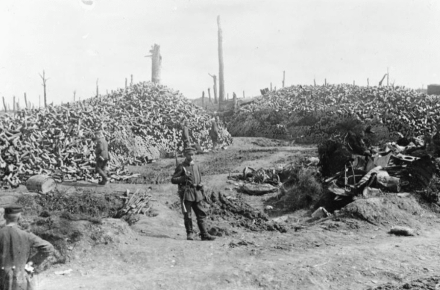
German soldier is overseeing the shell case dump opposite Delville Wood, gives an indication on just how heavily the South Africans were bombarded .Woerner Eugen Collection
While the SA Brigade had been near Armentieres, a shell had exploded in the transport lines where Nancy had been tethered close to the Quarter Master`s store. In fright she had bolted and broken her left horn against a wall. This horn was permanently out of alignment and started to grow downwards at an angle. However, there was no sick leave for Nancy, just “light duty”. They could not give her kitchen fatigues so she was allowed to roam about the headquarters.
The highlight of Nancy’s distinguished military career and war record happened on 17 February 1918 when she attended her last ceremonial parade. She proudly led four battalions of the South African Brigade to the first Delville Wood service, prancing on her thin little legs. It’s as if she knew that she was the darling of every soldier on parade and of those they were coming to honour.
The parade was not only the last for Nancy but it was also the last for General Lukin in France.
Nancy caught pneumonia during the severe winter of that year and, although devotedly cared for by Bugler Petersen and all the medical personnel of the headquarters, died on November 26. Her death was announced in General Orders – probably the only occasion in military history that this was done. All parades were cancelled. There were only a few of the original members of the regiment still on active service and they were detailed to form the firing party.
Nancy’s head and skin were sent to London to be treated, and then dispatched to Sir William Dalrymple who had it mounted and presented to the regiment. From the wall of the Officers’ Mess at the Transvaal Scottish Regimental Headquarters, she kept a critical eye over the officers. She has since been promoted and is now a member of the War Museum in Johannesburg.
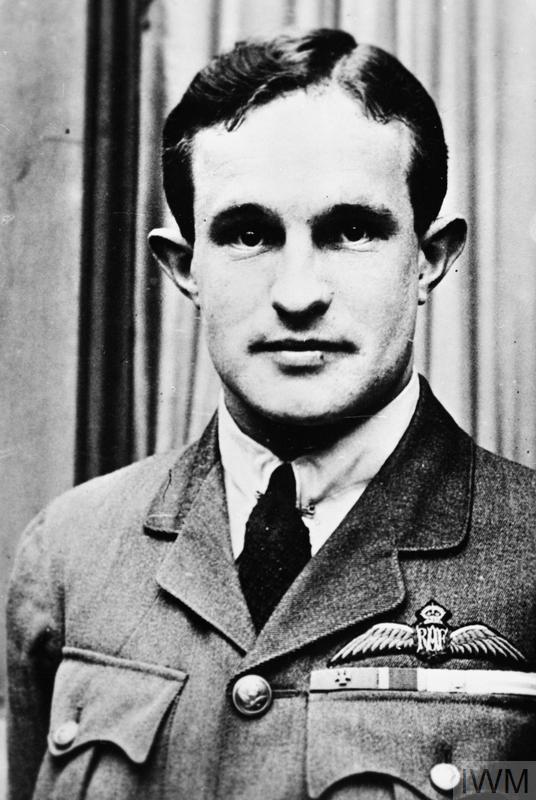
Honouring South African heroes and this is one of South Africa’s greatest – in fact he is the highest decorated South African in our military history. Many people don’t know that South Africa has its own World War 1 flying ace and Victoria Cross winner, and this ‘small’ hero comes with some very ‘big’ credentials, he is regarded as the all time highest decorated South African in terms of sheer seniority of the bravery decorations he won (there is a distinction between ‘most’ decorated i.e. number of decorations and medals – and the ‘highest’ decorated).
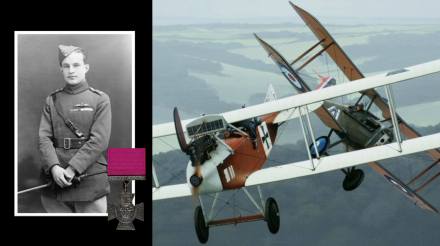
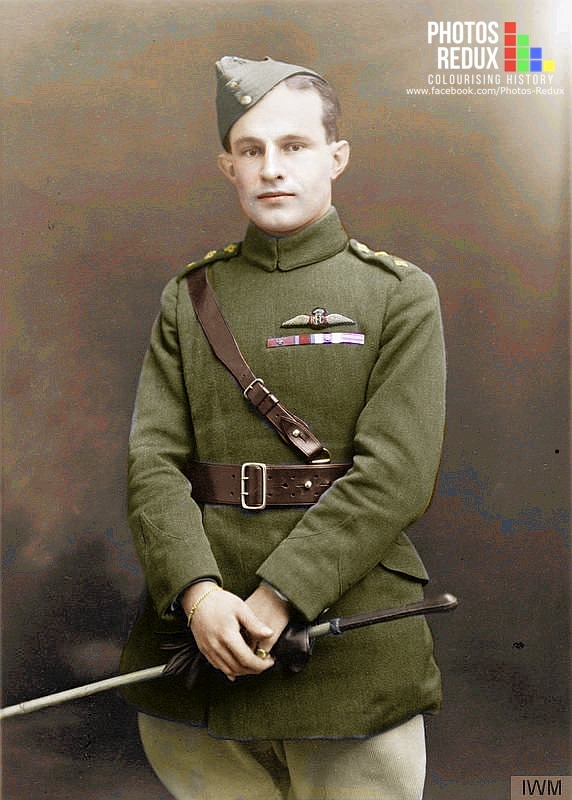
Andrew Beauchamp-Proctor, known to his colleagues and friends simply as ‘Proccy’, was South Africa’s leading First World War flying ace, claiming a staggering 54 aerial victories to his name.
He was born on 4 September 1894 in Mossel Bay, South Africa, and was studying engineering at the University of Cape Town when war broke out. He joined the Union of South Africa Army – the Duke of Edinburgh’s Own Rifles and took part in the German South West Africa campaign, before being demobilised in August 1915 with an honorable discharge. He promptly went to work with the South African Field Telegraph and re-enrolled in university. He managed to complete his third year of college before re-enlisting again, this time with the Royal Flying Corps (he was one of “The Thousand” – the first South Africans to go to England for combat service on the Western Front).
Royal Flying Corps
Andrew Beauchamp-Proctor joined the Royal Flying Corps in March 1917, he was commissioned upon his arrival in England and underwent pilot training. Despite being only 5′ 2″ tall, so short that he had to use two leather cushions in order to see out of a standard cockpit, he proved an excellent pilot and on completion of training was posted to 84 Squadron in late July 1917. The squadron, commanded by Major William Sholto Douglas (who would later become OC Fighter Command during the Second World War) was equipping with the then-new S.E.5a.
On 23 September 1917, the 84 Squadron went to France and became one of the most effective scout squadrons in the RFC/RAF (Royal Air Force) during 1918. The squadron would be credited with a victory total of 323 aerial victories, and would produce 25 aces. However, Beauchamp-Proctor would be pre-eminent, with almost triple the number of successes of the second leading ace. He was not particularly esteemed as a flier, but was a deadly shot.
Beauchamp-Proctor’s piloting skills can be judged by the fact he had three landing accidents before he ever shot down an enemy plane. He continued to fly the SE5 with modifications to the aircraft’s seat and controls, something his Philadelphia-born American squadron mate, Joseph “Child Yank” Boudwin, who stood only two inches taller also had to use. The alterations to relatively primitive controls could have contributed to Beauchamp-Proctor’s poor airmanship.
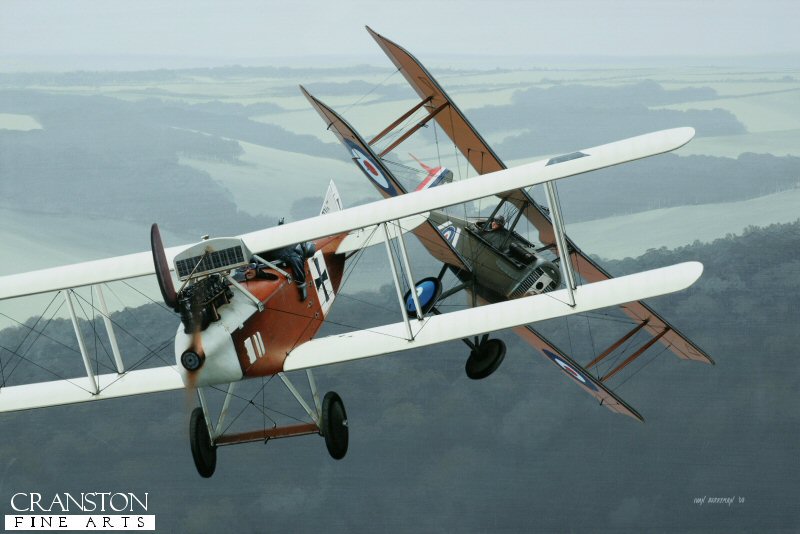
Captain Andrew Beauchamp-Proctor by Ivan Berryman
His initial confirmed victory did not come until the turn of the year. On 3 January 1918, he sent a German two-seater ‘down out of control’. He then claimed four more victories in February, becoming an ace on the final day of the month. Only one of his five victories resulted in the destruction of an enemy; the others were planes sent down as ‘out of control’.
March brought four more victories; three of them were scored within five minutes on 17 March. He tallied one kill in April.
Among his 11 victories for the month of May were 5 on 19 May. On that morning, he knocked an enemy observation plane out of the battle; fifteen minutes later, he destroyed a German Albatros D.V. scout. That evening, at about 6:35 PM, he downed three more Albatros D.Vs. By 31 May, his roll had climbed to 21 victims—16 fighters and five observation aircraft. By this point, he had destroyed six enemy planes single-handed, and shared the destruction of two others. He drove ten down out of control, and shared in another ‘out of control’ victory. Two of his victims were captured. Certainly a creditable record, and like many other aces, with no conquests over balloons.
The next day marked a change of focus for him; he shot down an observation balloon. Balloons, guarded by anti-aircraft artillery and patrolling fighter airplanes, were very dangerous targets. Commonly they were hunted by coordinated packs of fighters. For the remainder of his career, he would choose to try to blind the enemy by concentrating on shooting down kite balloons and observation aircraft. Also notable is the drop in his “out of control” victories; from here on out, the record shows destruction after destruction of the enemy. His June string would only run to 13 June, but in that time, he would destroy four balloons, an observation two-seater and a fighter. Only one fighter went down out of control. On 22 June, he was awarded the Military Cross (MC).
July would pass without incident. On 3 August, he was granted one of the first ever Distinguished Flying Crosses (DFC).
The break in his victory string lasted almost a month, as he went on home leave and helped a recruitment drive for the RAF. On 8 August, he returned and resumed with tally number 29, another balloon.
On 9 August, Beauchamp-Proctor was leading No. 84 Squadron on a patrol over their base at Bertangles, with the diminutive American Joseph “Child Yank” Boudwin and a ‘Giant’ – the six-foot-four tall fellow South African from Germiston – Hugh ‘Dingbat’ Saunders as his wingmen (‘Dingbat’ Saunders would go to become another South African ace, Air Marshal and Knight of the realm – but that is a different story for another day).
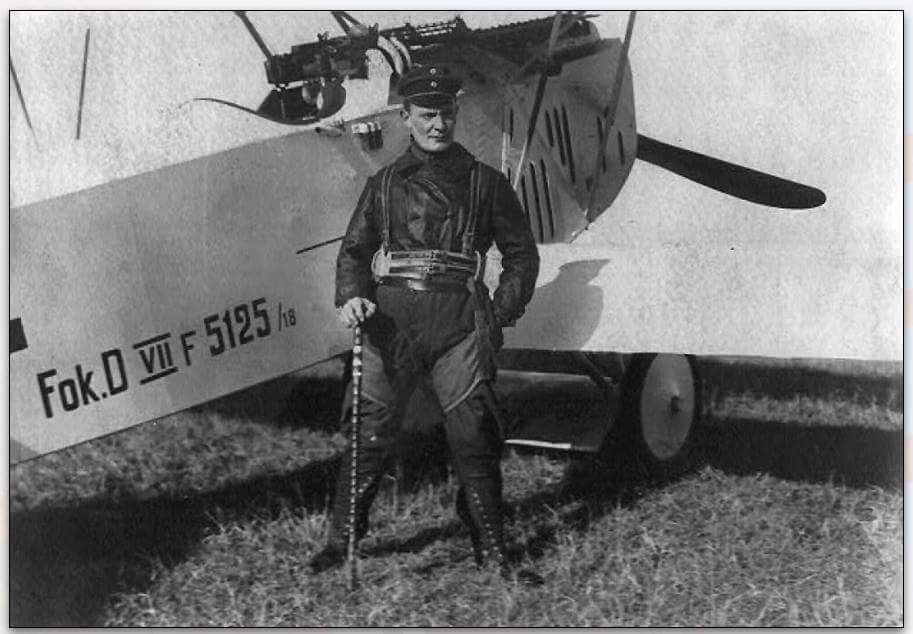
This unusual threesome of two very short chaps ‘Proccy’ and ‘Child Yank’ ‘and one very tall chap ‘Dingbat’ got involved in a heated engagement at 2:00 pm, that involved them in combat against Fokker D.VII fighters of JG I , led that day by the future Nazi Reichsmarschall Hermann Göring.
Hermann Göring in his Fokker D.VII fighter during WW1
After World War 1, Hermann Göring was to become Adolf Hitler’s right hand man and one of the most powerful figures in the Nazi party that ruled Germany from 1933 to 1945 and took Germany to its darkest place in history. But that was well in the future, over the western front battlefields of World War 1 Göring was a veteran fighter pilot, and fighter ace, he was even a recipient of the The Blue Max (the highest German bravery award). He was also eventually the last commander of the famous ‘flying circus’ Jasta 1, the fighter wing once led by ‘The Red Baron’ Manfred von Richthofen.
Unfortunately for both our two South Africans ‘Proccy’ and ‘Dingbat’ and the American ‘Child Yank’ – and the entire world really, none was unsuccessful at bagging Herman Göering and adding him to their kill totals.
‘Proccy’ would eventually claim an additional 14 aircraft, and by the end of the month of August with his claims list extended to 43. One memorable day was 22 August; he attacked a line of six enemy balloon over the British 3rd Corps front. He set the first one afire with his machine guns and forced the other five to the ground, the observers taking to their parachutes. His 15 kills for August would include 5 balloons, all destroyed, and two more two-seater planes. He was now up to 43 victories.
His September claims would be all balloons – four of them.
In the first few days of October, he would destroy three more balloons and three Fokker D.VII fighters, one of which burned. Another D.VII spun down out of control.
On 8 October, he was hit by ground fire and wounded in the arm, ending his front line service. In all ‘Proccy’ Beauchamp-Proctor’s victory total was 54; two (and one shared) captured enemy aircraft, 13 (and three shared) balloons destroyed, 15 (and one shared) aircraft destroyed, and 15 (and one shared) aircraft ‘out of control’ His 16 balloons downed made him the leading British Empire balloon buster.
On 2 November, he was awarded the Distinguished Service Order, followed by the Victoria Cross on 30 November. His Victoria Cross citation explains in detail:
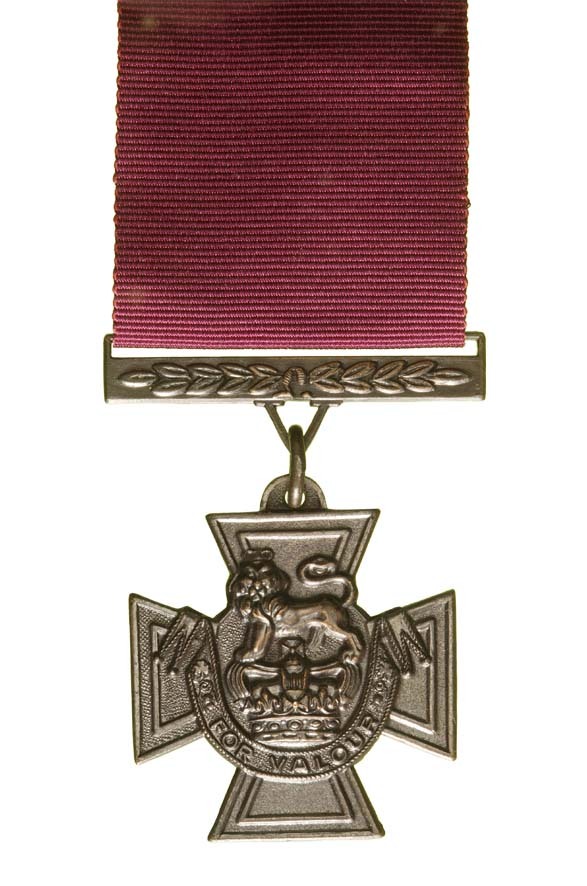
Victoria Cross (VC)
Between 8 August 1918, and 8 October 1918, this officer proved himself victor in 26 decisive combats, destroying 12 enemy kite balloons, 10 enemy aircraft, and driving down 4 other enemy aircraft completely out of control. Between 1 October 1918, and 5 October 1918, he destroyed 2 enemy scouts, burnt 3 enemy kite balloons, and drove down one enemy scout completely out of control.
On 1 October 1918, in a general engagement with about 28 machines, he crashed one Fokker biplane near Fontaine and a second near Ramicourt; on 2 October he burnt a hostile balloon near Selvjgny; on 3 October he drove down, completely out of control, an enemy scout near Mont d’Origny, and burnt a hostile balloon; on 5 October, the third hostile balloon near Bohain. On 8 October 1918, while flying home at a low altitude, after destroying an enemy 2-seater near Maretz, he was painfully wounded in the arm by machine-gun fire, but, continuing, he landed safely at his-aerodrome, and after making his report was admitted to hospital.
In all he has proved himself conqueror over 54 foes, destroying 22 enemy machines, 16 enemy kite balloons, and driving down 16 enemy aircraft completely out of control. Captain Beauchamp-Proctor’s work in attacking enemy troops on the ground and in reconnaissance during the withdrawal following on the Battle of St. Quentin from 21 March 1918, and during the victorious advance of our Armies commencing on 8 August, has been almost unsurpassed in its brilliancy, and as such has made an impression on those serving in his squadron and those around him that will not be easily forgotten.
Capt. Beauchamp-Proctor was awarded Military Cross on 22 June 1918; D.F. Cross on 2 July 1918; Bar to M.C. on 16 September 1918; and Distinguished Service Order on 2 November 1918
The bravest of the brave
To make him the ‘highest’ decorated South African in history, as there is already a small group of South Africans who won the ‘highest decoration’ i.e. Victoria Cross in World War 1 (14 officially in total) and World War 2 (5 in total), Beauchamp-Proctor would also need to have another ‘next’ most senior decoration, he did this with obtaining a Distinguished Service Order (DSO) and a Military Cross (MC). This puts him on the same level as Percy Hansen, who also won a VC, DSO and MC, the difference, the one which places Beauchamp-Proctor at the top, is that he won the Military Cross twice (with bar) in addition to another decoration – the Distinguished Flying Cross (DFC).
The citations for these decorations are impressive enough on their own, there are as follows:
Military Cross (MC)
For conspicuous gallantry and devotion to duty. While on offensive patrol he observed an enemy two-seater plane attempting to cross our lines. He engaged it and opened fire, with the result that it fell over on its side and crashed to earth. On a later occasion, when on patrol, he observed three enemy scouts attacking one of our bombing machines. He attacked one of these, and after firing 100 rounds in it, it fell over on its back and was seen to descend in that position from 5,000 feet. He then attacked another group of hostile scouts, one of which he shot down completely out of control, and another crumpled up and crashed to earth. In addition to these, he has destroyed another hostile machine, and shot down three completely out of control. He has at all times displayed the utmost dash and initiative, and is a patrol leader of great merit and resource.
MC citation, Supplement to the London Gazette, 22 June 1918
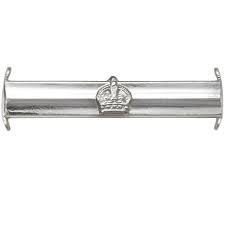
Military Cross (MC) Bar
For the award of a Bar to the Military Cross ( MC ) i.e. winning a second Military Cross in addition to Andrew Beauchamp-Proctor’s first MC.
For conspicuous gallantry and devotion to duty while leading offensive patrols. He has lately destroyed three enemy machines, driven down one other completely out of control, and carried out valuable work in attacking enemy troops and transport on the ground from low altitudes. He has done splendid service.
London Gazette, 18 September 1918
Distinguished Flying Cross (DFC)
Lt. (T./Capt.) Andrew Weatherby Beauchamp-Proctor, M.C. A brilliant and fearless leader of our offensive patrols. His formation has destroyed thirteen enemy machines and brought down thirteen more out of control in a period of a few months. On a recent morning his patrol of five aeroplanes attacked an enemy formation of thirty machines and was successful in destroying two of them. In the evening he again attacked an enemy formation with great dash, destroying one machine and forcing two others to collide, resulting in their destruction.
DFC citation, Supplement to the London Gazette, 3 August 1918
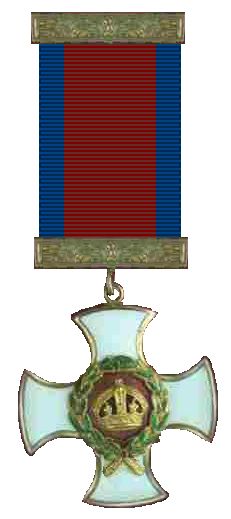
Distinguished Service Order (DSO)
A fighting pilot of great skill, and a splendid leader. He rendered brilliant service on 22 August, when his Flight was detailed to neutralise hostile balloons. Having shot down one balloon in flames, he attacked the occupants of five others in succession with machine-gun fire, compelling the occupants in each case to take to parachutes. He then drove down another balloon to within fifty feet of the ground, when it burst into flames. In all he has accounted for thirty-three enemy machines and seven balloons.
DSO citation, Supplement to the London Gazette, 2 November 1918
That’s a lot of hefty decorations for gallantry and bravery and it makes Beauchamp-Proctor ‘the bravest of the brave’ when it comes the very bravest men South Africa has ever produced.
Post War
He was discharged from hospital in March 1919 and embarked on a four-month-long lecture tour of the USA, before returning to England and qualifying as a seaplane pilot with a permanent commission as a Flight Lieutenant in the RAF.
After his VC investiture at Buckingham Palace in November 1919 he was awarded a year’s leave, and this enabled him finish his BSc degree in Engineering.
Beauchamp-Proctor died during a training accident at RAF Hendon in England, on the 21st June 1921 whilst preparing for an air-show. His aircraft went into a vicious spin after performing a slow loop, and he was killed in the ensuing crash. At least one observer remarked that the loss of control and subsequent crash of the aircraft could have been linked to Proctor’s diminutive size, as noted earlier because of his size, Beauchamp-Proctor had to sit on a cushion to operate his aircraft and the cushion fell out during the loop, rendering him in a difficult position to adequately operate his aircraft and recover the manoeuvre. He was buried in Mafeking (his home town) in South Africa, following a state funeral.
In Conclusion
There still exists a little confusion over Beauchamp-Proctor’s given name. For decades he was listed as “Anthony” but more recent scholarship indicates “Andrew”, which is the name on his tombstone. Whether ‘Proccy’ was an Andrew or Anthony, it matters not a jot, this man epitomised ‘dynamite in a small package’ – ‘Proccy’ was and still remains the bravest of all South Africans to have been awarded gallantry decorations – without any doubt – the ‘Bravest of the Brave’.
Links to other South African World War 1 Victoria Cross recipients
Image copyright Imperial War Museum Collection. Portrait by Cowen Donson, Imperial War Museum collection copyright. Painting Captain Andrew Beauchamp-Proctor by Ivan Berryman – Granston Fine Art. Colourised IWM portrait, thanks to Photos Redux
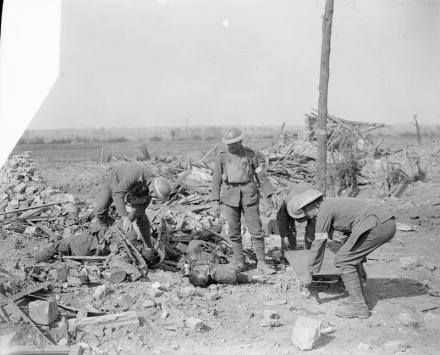
Probably about the most disturbing and hard hitting photograph that I am likely to post, but it brings home why we remember on Remembrance Sunday and on Armistice Day and why the date and time 11am, on the 11th day in the 11th month is so significant and what it means. This is the day and time the guns fell silent on the western front in 1918, it’s at this time on this day that we recount the massive sacrifice made in war – not just for WW1, but for all war.
This is the capture of Meteren by the 9th Division. Stretcher-bearers of the Royal Scots Fusiliers collecting the dead after The South African Brigade attack on the 20th July 1918.
It is our privilege as veterans to carry the torch of remembrance, we carry the thread that binds us all the way to these fallen South Africans lying in the mud and devastation that was World War 1. It’s this torch that we carry that marks all of our fallen in 1918, our fallen in 1945 our fallen in 1989 and it’s the same torch that marks our fallen in 2015 – it binds everyone who has served their country – and it stands as the marker of sacrifice. As veterans, to hold this responsibility is a great honour and we are indeed a privileged few.
Rest in Peace brothers … We WILL Remember.
Photograph – Imperial War Museum copyright. Posted by Peter Dickens

 Such a big deal was made of this victory, that a special commemorative coin was even stamped to celebrate Capt. Pyott’s actions and resultant DSO. Zeppelins were so feared by the British public they were branded ‘Baby Killers’ as the bombing of civilians carried with it such a public outrage. The commemorative medal carried Capt Ian Pyott’s profile, the year and the letters DSO, it was presented to him at Hendon Aerodrome in England by none other than General Jan Smuts.
 Especially for the South Africans, The song was published in South Africa in a wartime leaflet, with an anonymous English translation, as ‘Lili Marleen: The Theme Song of the Eighth Army and the South African 6th Armoured Division’ (quite ironically).
 Innovative as ever, the biscuit part was shaped the same as for “Gypsy Creams”, but the biscuit part (referred to as the shell) was improved and it was sandwiched with a chocolate filling instead, no doubt provided by Cadbury’s Chocolates.
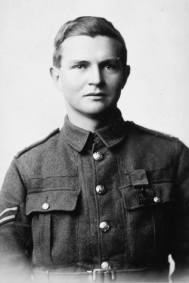 William Faulds, a young man who won a Victoria Cross, the highest award for gallantry, at Delville Wood is quite literally a case of a normal young South African placed in an extraordinary circumstance, only to emerge with that “X” factor which sets him apart, and that’s quite something considering everyone around him can in their own right can take the mantle of the ‘bravest of the brave’, such was the nature of the battle.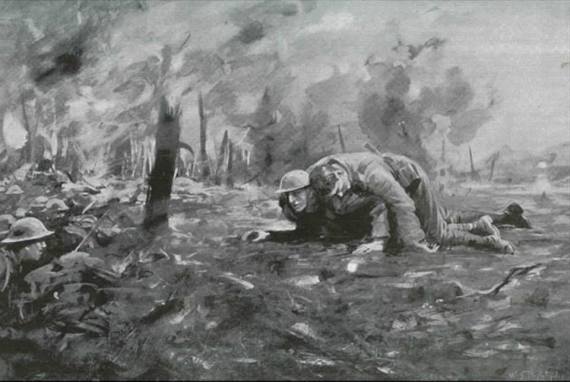



 In addition to the famous


 Although The Comrades Marathon is an independent commercial concern now, The South African Legion has continued its association to the Comrades Marathon over the years and encourages all participants to wear a Remembrance Poppy in recognition of this history and the sacrifice of the fallen. In this respect the Comrades Marathon is still in fact a “living memorial” to the Great War (World War 1).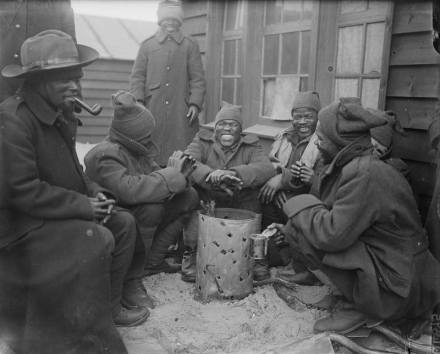
 No more appropriate mascot could have been found. The SA Brigade badge was a Springbok head, surrounded by a circle with the motto: “Union is Strength – Eendracht Maakt Macht”.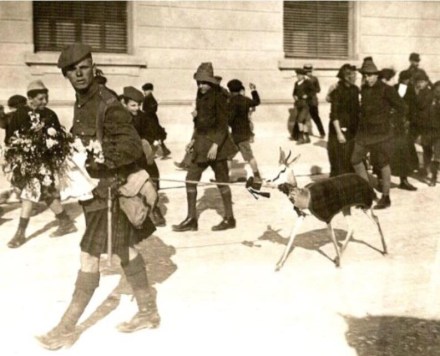



 The Observation Post