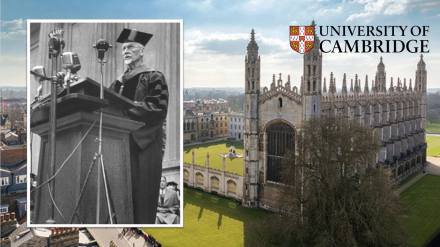
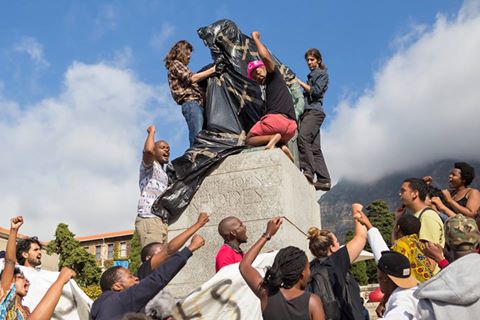
To the University of Cambridge’s eternal shame!

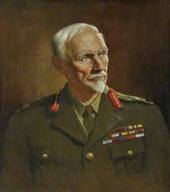
To the eternal shame of the University of Cambridge, the bust and portrait of Britain’s wartime ally and its first real foreign Chancellor – Jan Smuts – was removed from public view at Christ’s College.  It’s an act of political correctness gone all wrong, and a foreboding sign of things to come – The University of Cambridge has fallen foul of its own history and Jonathan Swift’s quote rings true “Some men when weeding out prejudices, eradicate virtue, honesty and religion”.

38461319_10156850258851844_3197418975084412928_n

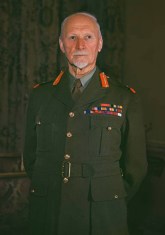
Field Marshal Jan Smuts

Cowering to the ‘Rhodes Must Fall ‘campaigners – a bunch of zealot, racist and militant far left radicals based in South Africa who very controversially removed the statue of Cecil John Rhodes’ statue from the University of Cape Town, the University of Cambridge has now capitulated and quietly removed the portrait and bust of Field Marshal Jan Smuts from their public spaces and insidiously placed them out of sight.

The act of removing Smuts came from pressure from a bunch of ‘anti-colonial’ students – and since removing Smuts from the public area of the Old Schools building, which houses the main university offices, the Old Schools has carried posters from the first election after Nelson Mandela’s release from prison in 1990 – making an anti-apartheid political statement.

So what’s odd about this act?  For starters Jan Smuts and his party were the opposition party to the National Party and their tenets of Apartheid, so they have got the history completely wrong and have incorrectly painted Smuts with an Apartheid brush.  The University of Cambridge simply does not even understand the history and has bowed to a skew and incorrect version been banded about buy these ‘anti-colonial’ students.

So what’s wrong with being an anti-colonial student and banishing statues of Colonialism in England?  Well, if we agree this precedent we’ll have to remove every single statue of every single great British and Colonial icon involved in Imperialism and Colonialism.  It’s a foreboding sign when a leading learning institution like the University of Cambridge does this and sets the precedent.

The same group of zealot anti-colonial students a year or so ago attempted to get Cecil John Rhodes’ statue removed from Oxford University and we rightly told to get lost – but not the University of Cambridge, they have succumbed to this growing modern trend of re-writing history with 21st Century hindsight and removing those bits they think are ‘offensive’ from it.

So whose next?  Winston Churchill cut his political teeth in South Africa and was the Colonial Secretary who along with Smuts ushered in the newly formed state of South Africa, with all its 19th Century Imperialist tenets and race laws, stamped by The House of Commons.  Do we now remove statues of Winston Churchill?  But why stop at Churchill?  What about all the other British Colonialists involved in South Africa – Sir Alfred Milner, Sir John Cradock, Sir John Sprigg, John Xavier Merriman, Lord Charles Somerset, Lord Kitchener, Field Marshal Buller, Lord Roberts and even Field Marshal Haig.

27750066_10157896552586509_8943591612808349712_n

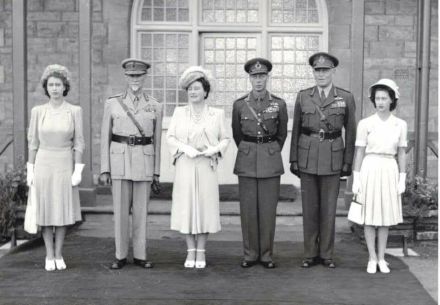
Jan Smuts shoulder to shoulder with King George VI, the Queen Mother and the future Queen Elizabeth II

But why even stop at the Colonial ‘masters’ of South Africa and the Field Marshal’s of the South African War (1899-1902)?  What about the Royalty who guided colonial policy in South Africa? So lets remove Queen Victoria, King George V, King George VI and even Queen Elizabeth II who was the reigning monarch when South Africa was still a Union and the country fell under her dominion.  In 1947 preceding her father’s death, King George VI and Princess Elizabeth visited South Africa to give support to Jan Smuts and his government (and to give support to Smuts for the landmark 1948 General Elections so as to prevent the Apartheid nationalists from taking power and losing South Africa as a Dominion in the Commonwealth of Nations – which unfortunately for all of us the Apartheid Nationalists won).

21731360_2020995841462737_816238144166127637_n

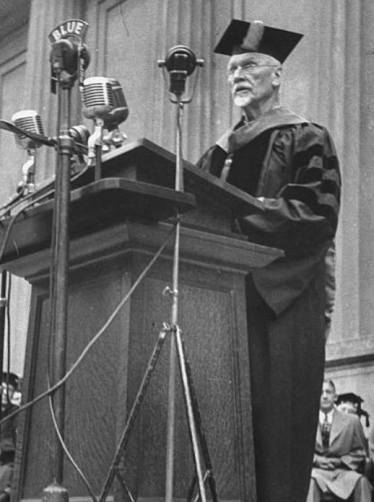
Smuts’ acceptance speech after he was made a Chancellor at the University of Cambridge

The academic elite at the University of Cambridge are at best very naive, even as to their own academic history of Jan Smuts. Smuts was elected the University of Cambridge’s Chancellor in 1948 and a memorial fund in his name was set up when he died two years later.  As Cambridge Chancellor he was the first ‘foreign’ Chancellor of the University not of Royal stock in its very long history of 800 years.

Aside from a Prime Minister and British Field Marshal, Smuts was also an accredited philosopher, his work on Holism brought him high acclaim from his Philosopher peers.  Holism can be defined as “the fundamental factor operative towards the creation of wholes in the universe” and was published in 1926.  For Smuts it formed the grounding behind his concepts of the League of Nations and United Nations – both institutions he helped form.

Whilst studying law at Christ’s College at the University of Cambridge, he was rated as one of the top three students they have ever had (Christ’s College is nearly 600-year-old).  The other two were John Milton and Charles Darwin. Smuts graduated from Christ’s College with a first-class degree in law in 1894 and is regarded as the brightest legal mind ever to read law at the University of Cambridge.

His intellect was unsurpassed, to pass an exam at Cambridge he learnt Greek (fluently) in just 6 days. His wife was no intellectual slouch either, later in life Jan Smuts and his wife ‘Ouma’ Smuts used to tease one another when one would recite a Bible verse and the other would be expected to recite the following one, from memory, in Greek!

The University of Cambridge’s ‘Smuts Memorial Fund’ was established after the death of Jan Smuts to support the advancement of Commonwealth Studies. A range of funding opportunities are available to both staff and students for this purpose including research grants, PhD scholarships and library grants. A number of Fellowships across the University are supported by the Fund including the Smuts Visiting Research Fellowship.  It is with extreme irony that some of these ‘anti-colonial’ students are supported in their studies and funded by the very man whose memory they eradicate.  Talk about hypocrisy – there it is right there!

rhodes-must-fall

The removal of Rhodes’ statue from UCT by the same student movement. The Rhodes foundation is a primary financial supporter of the University and also issues Rhodes Scholarships to Oxford University to disadvantaged students.

Whats next for the academia line up of the University of Cambridge’s Chancellors whose pasts are tainted by a British Imperialist upbringing and held the mainstream views at the time on race – or better still those Royal Chancellors who promoted serfdom and servitude under Royal rule prior to historical reformations?  By the time they have finished removing all these Chancellors who reigned over the last 800 odd years of the University of Cambridge – the University will be bare of any history.

But what about Smuts’ unwavering support of the United Kingdom when it was at its own urgent crisis.  Smuts took South Africa to war in support of Great Britain in both World War 1 and World War 2, the result is sacrifice from South Africa to retain the United Kingdom’s sovereignty and modern democracy – sacrifice of literally tens of thousands of South Africans in battlefields all over the world, lying along-side their British comrades in arms – the cold headstones of the Commonwealth War Grave’s Commission stand solemnly in testament.  All done in honour of Smuts’ commitment to democracy, liberty and humanity.

Without Smuts the United Kingdom would not have the original founder of the Royal Air Force, which celebrates it centenary this year, it would not have the Statesman who stood shoulder to shoulder with Winston Churchill on D-Day and the liberation of Europe, the very man who tempered and guided Churchill and acted as the King’s liaison at the most critical phase of the war.  Smuts even came up with the concept of Commonwealth of Nations and guided King George VI and Great Britain out of its edicts of ‘Empire’ when dealing with a ‘new world’ Commonwealth and its Colonies post war.


Smuts was the only foreign Statesman to receive a standing round of applause from both houses of Parliament and the first foreign statesman to address both houses  – there is very good reason that his statue stands next to Churchill’s on Parliament Square.  Has the United Kingdom completely lost sense of its history and politics, and now bows to a small and vocal bunch of ‘anti-colonial’  students – the tail wagging the dog?  It seems so.

What happened to open debate in a University environment?  Where all stakeholders are consulted and put their arguments forward before a key decision is made on the removal of a historical figure, a leading University like the University of Cambridge made no such effort to approach the Smuts foundation and family in South Africa.  Instead a unilateral decision was taken by a minority of elitist academics imposing their views on others, now that is not the ‘open’ and democratic society which the University is meant to represent.

The University’s official response reads like a piece of political correct pandering. The response from the university’s governing council: “In retrospect, there are often once-lauded ideas and individuals whose standing, reputation and behaviour assume different and usually uncomfortable contemporary significance.”

Again – whose next in the ‘uncomfortable’ figures from the past who lauded ideas not palatable in a modern context, Churchill called Gandhi a “Half Naked Fakir”.

The removal of Smuts at the University of Cambridge is an offence to the thousands of South African men and women who have sacrificed their lives to serve crown in South African forces, and the tens of thousands of South Africans who also served in British Armed Forces.  It is the darkest day in the University’s history when it expunged its own heritage in the name of ill-considered political correctness and disgraces an entire generation of South Africans who held Smuts’ ideals of liberty and freedom in their hearts. It is a warning to come – shame on Christ’s College and shame on the University of Cambridge.


Written by Peter Dickens

Reference:  The Sunday Times The Sunday Times “Cambridge students topple bust of Britain’s wartime ally Jan Smuts”

Related work links:

Jan Smuts’ death: “The force of his intellect has enriched the wisdom of the whole human race”- the death of Jan Smuts.

Jan Smuts and Churchill – Operation Overlord:  Jan Smuts, Winston Churchill and D-Day

Winston Churchill admiration of Smuts: Churchill’s Desk

South Africa was represented at the formal surrender of Japan in 1945

To many South Africans  ‘VJ’ day – Victory over Japan celebrations – the official end of the 2nd World War is seen as American, Australian and British endeavour and not really a South African one – but they could not be more wrong.  Little do they know that South Africa had official representation at the surrender – and for a very good reason.

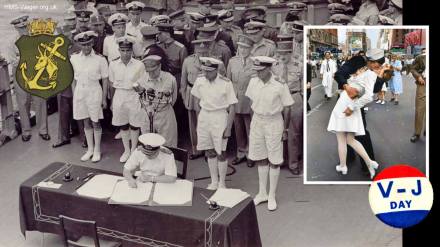
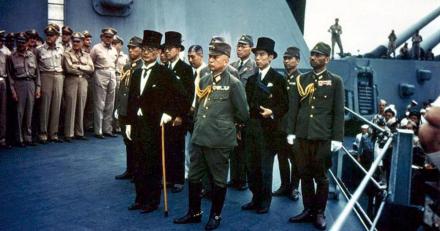
1945-Original-V-J-DAY-WWII-Pin-pinback-buttonThe 2nd of September is a significant day in the history of the world, it’s the day Japan formally surrendered to finally end World War 2. The ceremony took place on the USS Missouri in Tokyo Bay in 1945, and the South Africans where right there too, represented by Cdr A.P. Cartwright, South African Naval Forces.

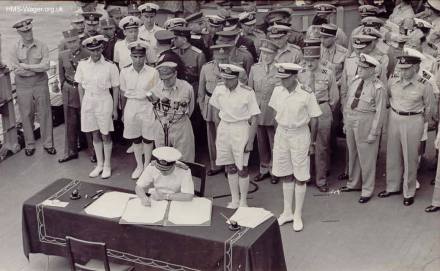
Cdr A.P. Cartwright is seen here, overseeing the signature of Admiral Sir Bruce Fraser on behalf of the United Kingdom on the Instrument of Surrender. He’s standing in the row of four naval officers left and right of General Douglas MacArthur (behind the microphone), Cdr A.P. Cartwright is on the far left.

14188569_632244966945239_7093365706945182504_o

Cdr Cartwright was the senior South African officer on the staff of the American Admiral Chester Nimitz, the Allied commander-in-chief in the Pacific Ocean.

The ceremony aboard the deck of the USS Missouri lasted 23 minutes and was broadcast throughout the world.  This old newsreel footage captures the moment and is the only footage on the net taken from the angle which shows Cdr Cartwright standing with the British delegation at their ceremony (please excuse the poor sound quality).


General Douglas MacArthur’s speech summarised the sentiment perfectly, he said; “We are gathered here, representatives of the major warring powers—to conclude a solemn agreement whereby peace may be restored. The issues involving divergent ideals and ideologies, have been determined on the battlefields of the world and hence are not for our discussion or debate. Nor is it for us here to meet, representing as we do a majority of the people of the earth, in a spirit of distrust, malice or hatred. But rather it is for us, both victors and vanquished, to rise to that higher dignity which alone befits the sacred purposes we are about to serve, committing all our people unreservedly to faithful compliance with the obligation they are here formally to assume

It is my earnest hope and indeed the hope and indeed the hope of all mankind that from this solemn occasion a better world shall emerge out of the blood and carnage of the past—a world founded upon faith and understanding—a world dedicated to the dignity of man and the fulfillment of his most cherished wish—for freedom, tolerance and justice.

The terms and conditions upon which the surrender of the Japanese Imperial Forces is here to be given and accepted are contained in the Instrument of Surrender now before you.

As Supreme Commander for the Allied Powers, I announce it my firm purpose, in the tradition of the countries I represent, to proceed in the discharge of my responsibilities with justice and tolerance, while taking all necessary dispositions to insure that the terms of surrender are fully, promptly and faithfully complied with.”

ae2

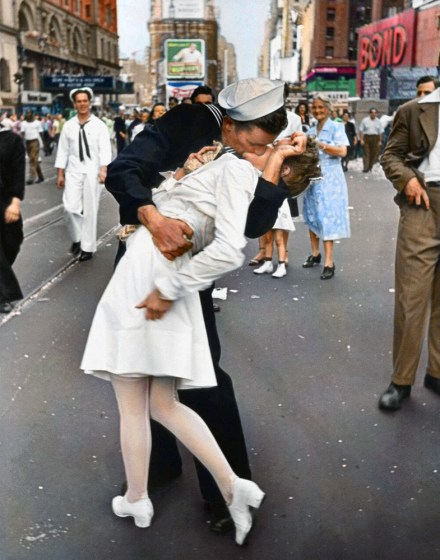
Alfred Eisenstaedt’s iconic “V-J Day in Times Square” now colourised brings life the general sentiment and relief felt world over at the surrender of Japan.

When the assembled representatives of the Allied Powers and of Japan had finished signing the agreements, General MacArthur, MacArthur saved his very best for last, words that put a closure not only to the ceremony, but to the entire war itself. He stated:

Let us pray that peace be now restored to the world and that God will preserve it always. These proceedings are closed.

22308811_10155537271456480_3745202244434378650_nA total of 297 South African Naval Forces (SANF) personnel were killed in action during World War II, and that excludes many South Africans serving directly on British ships as part of the Royal Navy.   Many of these South Africans were lost in actions against the Japanese – especially during Japan’s ‘Easter Raid’ against the British Eastern Fleet stationed at Ceylon (now Sri Lanka) which sank the HMS Dorsetshire and HMS Cornwall on the 5th April 1942 and the HMS Hollyhock and HMS Hermes on the 9th April 1942 – with the staggering loss of 65 South African Naval  personnel seconded to the Royal Navy and on board these 4 British fighting ships.  It was and remains the South African Navy’s darkest hour, yet little is commemorated or know of it today in South Africa, and this is one of the reasons why a SANF official was represented at the formal surrender of Japan.

The South African Navy acquitted itself very well during World War 2.  In all South African Naval Forces (SANF) personnel in World War 2 received 321 awards for gallantry and distinguished service. SANF officers and ratings served in nearly every major naval operation of the war as well as large contingents fulfilling duties in the Asian theatre of operations against Imperial Japan.

26f441651a326d14a6d2

The Japanese representatives on board the USS Massouri,for the signing were the following: Foreign Minister Mamoru Shigemitsu, General Yoshijirō Umezu, Chief of the Army General Staff, Major General Yatsuji Nagai, Katsuo Okazaki (Foreign Ministry), Rear Admiral Tadatoshi Tomioka, Toshikazu Kase (Foreign Ministry), Lt. General Suichi Miyakazi, Rear Admiral Ichiro Yokoyama, Saburo Ota (Foreign Ministry), Captain Katsuo Shiba (Navy) and Colonel Kaziyi Sugita

Related Work and Links:

The complete SA Navy Sacrifice during World War 2 The South African Navy’s ‘elephant in the room’

The Japanese Easter Raid and South African Sacrifice The South African Navy’s ‘darkest hour’ is not recognised and not commemorated

South African Naval Forces against Japan South African Navy at war against …. Imperial Japan!!


Written and Researched by Peter Dickens. Reference: Military History Journal, Vol 10 No. 3′ South Africa and the War against Japan 1941-1945′, wikipedia.  Image reference HMS Wager’s commemorative website http://www.hms-wager.org.uk. Alfred Eisenstaedt “V-J Day in Times Square”

South Africa’s role in giving D-Day the green light

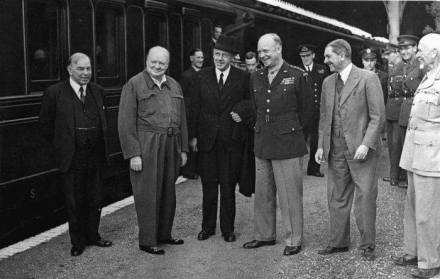
What would be a surprise to many is that aside from the key-note planners of Operation Overlord (D-Day), three key Commonwealth Prime Ministers were included in the final planning sessions for D-Day – Canada, New Zealand, Rhodesia and South Africa, and it all took place in a secret railway siding in the middle of the quaint English countryside.

11393080_456535191182885_8598385993022380044_n

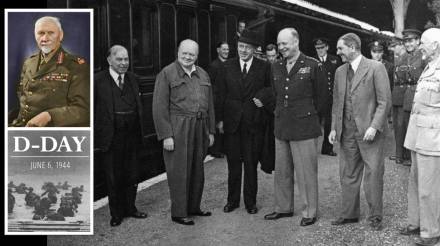
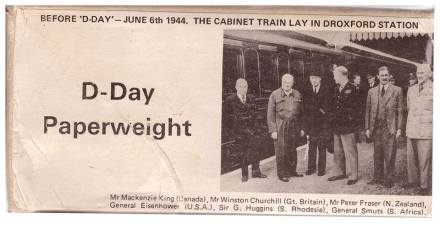
On the 2 June 1944, a quiet little railway siding in Hampshire – Doxford, became the location for a highly secret meeting in a specially converted train carriage. The special train was Sir Winston Churchill’s train and temporary Operational HQ called ‘rugged’, the meeting was to agree this next most critical stage of the war.

On this day, in this unassuming train station the “Council of War” convened to decide the outcome of the war for the Western Allies. The Allied Supreme Commander General D. Eisenhower, Winston Churchill, the Allied High Command General Staff and the Prime Ministers of South Africa – Field Marshal Jan Smuts, Canada – William Lyon Mackenzie King, New Zealand – Peter Fraser, Southern Rhodesia – Sir Godfrey Huggins and the Free French Army – General De Gualle – all assembled for the only time during the war to make their most momentous decision, and “D day was on”.

The occasion was commemorated by paperweights cut from the line (called ‘the Churchill line’ after the war) and issued by the Sadler Rail Coach Limited for Droxford Station.

10930895_456531221183282_6814879340665934426_nSo there you have it, both South Africa and even Rhodesia played a key role in agreeing Operation Overlord plans and signing off on this most critical date – D-Day, 6th June 1944 – the date which changed the course of Western Europe’s modern history.


Written and Researched by Peter Dickens. A big thanks you to Colin Ashby whose grandfather made the commemorative paperweights and provided the images.

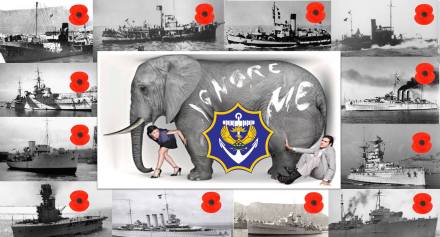
The South African Navy’s ‘elephant in the room’

There is a very big elephant in the room when it comes to the South African Naval fraternity’s commemoration and remembrance undertakings.  Very often in the veteran fraternity and South African Navy circles there’s a raging argument – why does the South African Navy and SANDF only commemorate the sinking of the SS Mendi during World War 1 when scant attention is given to the sinking of the SAS President Kruger?  It’s ‘political’ is the universal chant of disbelief and failed honour, a travesty of the African National Congress’ (ANC) rhetoric of constantly vanquishing the ‘old’ navy and SADF statutory forces.

But they are ignoring a very big ‘elephant’, something that began as a travesty long before the ANC came to power in 1994.  It’s an elephant that sits squarely at the door of the old Apartheid Nationalist government and is entirely their doing.  When they came to power they began vanquishing anyone who supported ‘Britain’ during World War 2 as some sort of traitor, made worse because the South African Navy was so intrinsically tied to the Royal Navy via the Simonstown agreement that they never really instituted memorials or commemorations to honour them.  To the old Afrikaner nationalists, especially when it came to the Navy, this was ‘Britain’s problem’ to remember any sacrifice prior to 1948 or even prior to 1957 for that matter when the naval base at Simonstown was formally handed over by Britain to South Africa.

As a result the scope of our World War 2 sacrifice barely gets a mention in the ‘Mendi vs. President Kruger’ argument.   In fact the scope, the size of this sacrifice will come as a surprise to many South Africans – including our Naval veterans fraternity and current Navy personnel.

The ‘elephant’ of sacrifice 

To give you an idea of just how BIG this ‘elephant in the room is, lets cover the Honour Roll – it far outstrips any South African Naval sacrifice in the post world war era.  Yet the South African Navy and the current government gives absolutely no attention to it, not at all – not one single official South African Navy (SAN) parade or ceremony.  Not even a dedicated Naval memorial is given to these men.

We start with South Africa’s own ship’s lost in World War 2, all of them minesweepers. (Note on the honour roll when reading it SANF means the member was part of the ‘South African Naval Forces’ and MPK means ‘Missing Presumed Killed’).

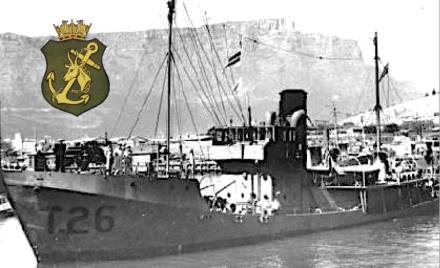
The first South African ship lost in the Mediterranean near Tobruk was the HMSAS Southern Floe with its remarkable tale of a single survivor (see this link for a full story – click here: The HMSAS Southern Floe was the SA Navy’s first ship loss & it carries with it a remarkable tale of survival.).
22255175_2031587787070209_7222583497041407214_o

HMSAS Southern Floe

The Honour Roll of sacrifice on the HMSAS Southern Floe as follows:

ANDERS, John, Steward, 69637 (SANF), MPK
BOWER, Robert, Stoker 1c, 69935 (SANF), MPK
BRAND, Leslie A, Able Seaman, 69828 (SANF), MPK
CAULFIELD, Patrick, Steward, 69802 (SANF), MPK
CHANDLER, Charles R D, Cook (S), 69613 (SANF), MPK
CHENOWETH, Richard, Stoker 1c, 67420 (SANF), MPK
FAIRLEY, Alexander E, Sub Lieutenant SANF, MPK
FRIEDLANDER, Cecil A, Able Seaman, 114703 (SANF), MPK
GARDINER, Elliott, Able Seaman, 67260 (SANF), MPK
GREENACRE, John H, Leading Seaman, 69677 (SANF), MPK
HEASMAN, Gratwicke E E, Engine Room Artificer 4c, 69784 (SANF), MPK
HOGG, Roy S, Sub Lieutenant, SANF, MPK
INNES, Ian Mck, Sub Lieutenant, SANF, MPK
LEWIS, John Edward Joseph, :Lieutenant, 70019 (SANF), MPK
MARSH, Reginald H Y, Able Seaman, 69911 (SANF), MPK
MITCHELL, William N, Able Seaman, 69787 (SANF), MPK
NEL, Eloff R, Able Seaman, 69635 (SANF), MPK
NICHOLSON, Douglas O, Able Seaman, 66833 (SANF), MPK
PUGH, John R, Able Seaman, 66877 (SANF), MPK
RYALL, David R, Able Seaman, 69999 (SANF), MPK
SHIMMIN, William, Leading Stoker, 69661 (SANF), MPK
SIENI, Joseph F, Able Seaman, 69788 (SANF), MPK
SNELL, Harold W, Leading Telegraphist, 69827 (SANF), MPK
STANLEY, Gordon J, Able Seaman, 66963 (SANF), MPK
WALTON, Dudley N, Sub Lieutenant, SANF, MPK

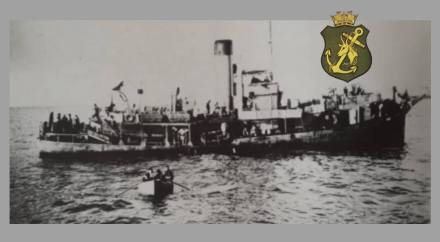
The second ship lost was the HMSAS Parktown, which went down fighting during the Fall of Tobruk in Libya, with the HMSAS Bever fighting at her side out the port (see this link for a full story – click here: The feisty South African minesweeper that went down fighting – HMSAS Parktown).
22338860_2031564033739251_5340447182618900385_o

HMSAS Parktown

The Honour Roll of sacrifice when the HMSAS Parktown sank on 21 June 1942 as follows:

BROCKLEHURST, Peter S, Able Seaman, 70457 (SANF), MPK
COOK, John A, Stoker 1c, 70256 (SANF), MPK
JAGGER, Leslie J, Lieutenant SANF, 70016 (SANF), MPK
MCEWAN, William A, Steward, 69686 (SANF), MPK
TREAMER, Arthur P, Petty Officer, 71109 (SANF), MPK

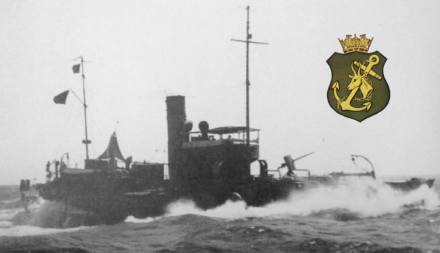
The third ship to be lost was the HMSAS Parktown’s sister ship, the HMSAS Bever which went down later in the war during the liberation of Greece when it struck a mine, and carries with its story a tale of miraculous survivors (see this link for a full story – click here“Under a hail of shells”; Recounting the bravery and loss of HMSAS Bever).
22382495_2032040210358300_7081028369939492800_o

HMSAS Bever

The Honour Roll of sacrifice on 30 November 1944 when the HMSAS Bever sank as follows:

ARMERANTIS, Sideris, Stoker 1c, 282953 V (SANF), MPK
DE PACE, Luigi S, Petty Officer, 66539 V (SANF), MPK
DE REUCK, Leslie B, Telegraphist, 75320 V (SANF), MPK
DREYER, Peter, Leading Cook (S), 585236 V (SANF), MPK
HIGGS, George E, Stoker 1c, 562712 V (SANF), MPK
HUSBAND, Charles A, Stoker 1c, 280098 V (SANF), MPK
KETTLES, John D, Engine Room Artificer 3c, 562458 (SANF), MPK
LAWLOR, Robert J, Act/Chief Motor Mechanic 4c, P/KX 127225, MPK
LINDE, Carl M, Able Seaman, 71194 V (SANF), MPK
LYALL, John D R, Stoker 1c, 562179 V (SANF), MPK
MATTHEWS, William R, Leading Wireman, 562794 V (SANF), killed
PHILLIPSON, Joseph H, Signalman, 181160 V (SANF), MPK
RODDA, Harold J, Stoker 1c, 70451 V (SANF), (served as Harold J Andresen), MPK
SCRIMGEOUR, Quintin, Petty Officer, 69691 (SANF), MPK
TRUSCOTT, E (initial only) W, Able Seaman, 585184 V (SANF), MPK
WHITE, Claude, Leading Seaman, 586420 V (SANF), MPK
WILLIAMS, Desmond, Able Seaman, 70433 V (SANF), killed

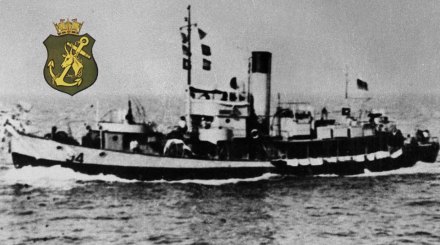
The final minesweeper to be lost was the HMSAS Treern, it was tragically lost right at the end of the war with only one single survivor, and it remains the last South African vessel to be lost in action, even to this day, yet hardly anyone is aware of her history (see this link for a full story – click hereThe last South African Navy ship to be lost in action; HMSAS Treern).
29573017_2117629285132725_2322544546561300519_n

HMSAS Treern

The Honour Roll of sacrifice on the 12 January 1945 when HMSAS Treern sank follows:

ANDERSON, Robert D, Engine Room Artificer 2c, 71067 V (SANF), MPK
BARKER, Ronald E, Sub Lieutenant, SANF, MPK
BLAKE, Robert E, Petty Officer, P 6572 (SANF), MPK
BROWN, Ian H, Able Seaman, 71719 V (SANF), MPK
BYRNE, Patrick, Lieutenant, SANF, MPK
DAVIE, William, Stoker 1c, 70681 V (SANF), MPK
ENGELBEEN, Leslie C, Able Seaman, 562235 V (SANF), MPK
JACOBZ, Frank H, Stoker 1c, 70374 V (SANF), MPK
MATTHEWS, George A, Stoker 1c, 70728 V (SANF), MPK
MCINTYRE, William G, Cook (S), 585360 (SANF), MPK
MCLARTY, William D, Leading Stoker, 562246 V (SANF), MPK
MCLEAN, Godfrey, Able Seaman, 562455 V (SANF), MPK
NILAND, St John E, Able Seaman, 209905 (SANF), MPK
PERRY, Desmond A, Petty Officer, 71211 (SANF), MPK
REID, Kenneth H, Signalman, 562143 V (SANF), MPK
SALCOMBE, Francis R, Stoker 1c, 58589 V (SANF), MPK
STAPELBERG, Willem J, Steward, 562221 V (SANF), MPK
SUTTON, Donald A, Able Seaman, 70426 (SANF), MPK
SUTTON, George A M, Leading Seaman, 586403 V (SANF), MPK
TRAFFORD, William O, Able Seaman, 71222 V (SANF), MPK
VILJOEN, Dennis A, Telegraphist, 70984 V (SANF), MPK
WHITE, Charles W, Petty Officer, 562200 V (SANF), MPK
WULFF, Emil F, Leading Seaman, 562466 V (SANF), MPK

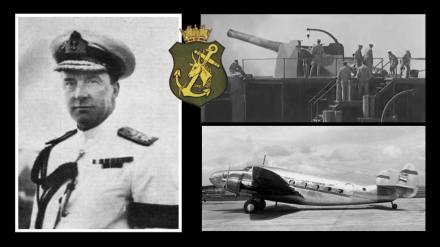
Then there is the loss of Rear Admiral Guy Hallifax, the most senior South African Naval Officer to be lost during World War 2, he counts himself as one of the founders of the modern South African Navy and yet he is hardly remembered at all. (see this link for a full story Guy Hallifax, the most senior African Naval officer lost during WW2).  He is recorded here:
29744562_2115978645297789_5909854157341665498_o

Director of South African Forces

HALLIFAX, Guy W, Rear Admiral, SANF, air accident, killed

Then, consider these South African Naval Force casualties on other South Africa ships and in other South African operations during the war:

LUCAS, E W R, Chief Engineman, 66756 (SANF), died 4 October 1939
NICOLSON, Andrew, Cook, 63827 (SANF), died 13 October 1939
BESTER, A T, Leading Stoker, 6640 (SANF), died on the HMSAS Africana
HUGHES, T J, Stoker, 71383 (SANF), died 10 May 1941
CASSON, William, Able Seaman, 252935 V (SANF), died on the HMSAS Tordonn
HOLT, Albert E, Telegraphist, 69576 (SANF), killed on the HMSAS Southern Maid
VAN NOIE, Norman, Able Seaman, CN/72134 (SANF), died 20 September 1941
ST CLAIR-WHICKER, Willie H, Able Seaman, 67292 (SANF), died on 21 September 1941
SMITH, P, Able Seaman, CN/72263 (SANF), died 7 April 1942
RUITERS, Walter, Stoker, CN/72081 (SANF), died 21 July 1942
MURPHY, J, Able Seaman, CN/72256 (SANF), died 16 August 1942
FROST, M L, Able Seaman, CN/71804 (SANF), died on the HMSAS Receiffe
PETERSON, W J, Able Seaman, CN/72184 (SANF), died 4 September 1942
REHR, Cecil, Able Seaman, 69877 (SANF), died on the HMSAS Roodepoort
CARLELSE, Frederick, Able Seaman, CN/72004 (SANF), died on the HMSAS Soetvlei
PETERS, Norman, Leading Stoker, 66847 (SANF), died 3 January 1943
DELL, Rodney, Able Seaman, 68866 (SANF), killed 24 March 1943
HENDERSON, Alexander P, Chief Engine Room Artificer, 562099 (SANF), killed at Benghazi, Libya
JAMES, H, Steward, CN/72252 (SANF), died 9 May 1943
ORGILL, C B, Able Seaman, CN/71947 (SANF), died 14 May 1943
LA CHARD, Edwin, Lieutenant Commander, SANF, died 20 May 1943
LUCAS, A W, Able Seaman, 152875 (SANF), died 28 May 1943
BATEMAN, T, Chief Engine Room Artificer, 71627 (SANF), died 30 June 1943
ROBBERTS, Kaspar, Petty Officer, P/5285 (SANF), died 1 July 1943
BOSHOFF, Christofel J, Able Seaman, 70339 (SANF), killed on HMSAS Blaauwberg
LENZ, William, Able Seaman, 69544 (SANF), died on 29 August 1943
BESTEL, Emmanuel A N M, Lieutenant, SANF, died on 21 September 1943
HARLE, Paul A, Petty Officer, 71796 (SANF), died on 3 October 1943
STEELE, Ewen, Able Seaman, 71272 V (SANF), killed on HMSAS Southern Sea
BETTS, Robert, Able Seaman, 68900 (SANF), died 18 November 1943
PAGE, Robert, Sub Lieutenant, SANF, died 29 November 1943
MCLEAN, Richard, Stoker, 562567 (SANF), died 29 November 1943
HARRIS, R H, Telegraphist, 330488 (SANF), died 16 December 1943
NICHOLLS, John, Yeoman of Signals, 66824 V (SANF), died 19 December 1943
FLORENCE, John, Stoker, CN/71982 V (SANF), died 18 January 1944
DANIELS, Adam, Stoker, 72034 (SANF), died 28 January 1944
RAVENS, Albert, Able Seaman, CN/72213 V (SANF), died 31 March 1944
DE KLERK, John, Ordinary Seaman, 585868 V (SANF), died 4 May 1944
BOTHA, Herkulas, Cook, 562093 V (SANF), died 8 May 1944
BISSETT, Alexander, Lieutenant, SANF, died 16 June 1944
JENKINS, Edward G, Engine Room Artificer, 66720 V (SANF), died 14 September 1944
KEMP, Thomas, Able Seaman, CN/71015 V (SANF), died 20 September 1944
WATSON, George, Lieutenant, SANF, died 15 October 1944
BOSWELL, Louis F W, Chief Engine Room Artificer, 69756V (SANF), MPK on the 14 November 1944 on the HMSAS Treern
ABRAHAMS, Henry, Able Seaman, CN/719204 (SANF), died 19 November 1944
BERMAN, Nicholas, Ordinary Seaman, 616728V (SANF), died 22 November 1944
DIXON, Robert, Able Seaman, CN/584276 (SANF), died on 11 January 1945
TREISMAN, Gerald, Steward, 584730 V (SANF), died on 10 February 1945
LAMONT, J, Steward, 71402 (SANF), died 24 February 1945
HORNE, P D, Chief Petty Officer, 66661 V (SANF), died 31 March 1945
POVEY, Leonard, Able Seaman, 71182 V (SANF), died 31 March 1945
PFAFF, C E, Petty Officer Stoker, 562721 V (SANF), died 20 April 1945
CHRISTIAN, J W, Able Seaman, CN/71965 (SANF), died 5 May 1945
SIMON, Frederick, Stoker, CN/72046 V (SANF), died 8 May 1945
VAN AARDT, S, Stoker, CN/721490 (SANF), died 22 May 1945
CLARE, Frederick W, Chief Petty Officer, 69599 V (SANF), died 3 June 1945
KEOWN, R J, Able Seaman, CN/71845 (SANF), died 9 June 1945
WELCOME, J J, Able Seaman, CN/72270 (SANF), died 19 July 1945
VAN WYNGAARDT, F A, Able Seaman, 585610 V (SANF), died 21 July 1945
HEARD, George A, Lieutenant, SANF, died on the HMSAS Good Hope
COOK, W, Leading Stoker, 70527 V (SANF), died 8 August 1945

As if the above loss of South African Navy personnel is not large enough and the lack of recognition by the Navy not bad enough, there is an even bigger ‘elephant in the room’, a key factor completely overlooked by the South African Naval fraternity and the Navy itself, and that’s the South African Navy personnel seconded to the British Royal Navy and lost in the Royal Navy’s ships and shore facilities during the Second World War.

South African Naval personnel were lost on the following significant British vessel losses. Consider this very big ‘elephant in the room’ for a minute, because its getting BIGGER.  The losses of these Royal Navy ships carries long lists of South African sacrifice.

We start with all the ships containing South African Naval Forces personnel sunk during the Imperial Japanese Air Force ‘Easter Sunday’ raid on the British fleet in Colombo (this is regarded as the British ‘Peal Harbour’ just off modern day Sri Lanka) and it’s the darkest hour in terms of losses for South African Navy, yet it is neither recognised as such nor is it remembered.  (See this link for more depth:  The South African Navy’s ‘darkest hour’ is not recognised and not commemorated)

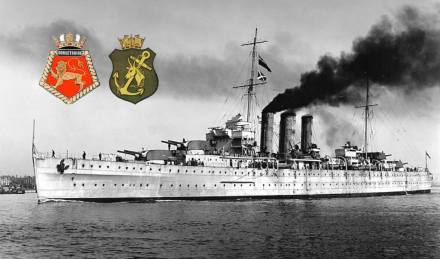
During this attack Japanese airman flying Japanese  D3A-1 ‘VAL’ dive bombers flying from the Japanese Imperial fleet, dropped their bombs on the HMS Dorsetshire, who had a very large contingent of South African Naval personnel, she simply blew up when a  detonated an ammunition magazine and contributed to her rapid sinking.  Click here for a full Observation Post report on her sinking: “They machine gunned us in the water”; Recounting South African Sacrifice on the HMS Dorsetshire
29352408_2115130958715891_1241973539881913227_o

HMS Dorsetshire

The Honour Roll of South African Naval sacrifice on the 5 April 1942 when HMS Dorsetshire sank follows:

BELL, Douglas S, Ty/Act/Leading Stoker, 67243 (SANF), MPK
BRUCE, Alexander M, Stoker 2c, 67907 (SANF), MPK
CONCANON, Harold Bernard, Surgeon Lieutenant (Doctor)
EVENPOEL, Albert, Stoker 2c, 67909 (SANF), MPK
GEFFEN, Sender, Stoker 1c, 68035 (SANF), MPK
HOWE, Horace G, Ordinary Seaman RNVR, 68680 (SANF), MPK
KENDRICK, George, Stoker 2c, 67910 (SANF), MPK
MCINTYRE, Norman G, Able Seaman, 67446 (SANF), MPK
MCLELLAN, Robert, Ordinary Telegraphist, 67897 (SANF), MPK
MILNE, Lawrence Victor, Able Seaman
MORROW, Douglas E, Able Seaman, 67989 (SANF), MPK
ORTON, Charles P, Able Seaman, 68009 (SANF), MPK
REDMAN, Roland A, Leading Stoker, 67406 (SANF), MPK
SCOTT, William J, Able Seaman, 68007 (SANF), MPK
SEVEL, Harry, Stoker 1c, 68100 (SANF), MPK
VAN ZYL, David Isak Stephanus, Stoker 1st Class
WILLETT, Amos A S, Stoker 1c, 67240 (SANF), MPK
WILLIAMSON, Walter N, Able Seaman, 67803 (SANF), MPK

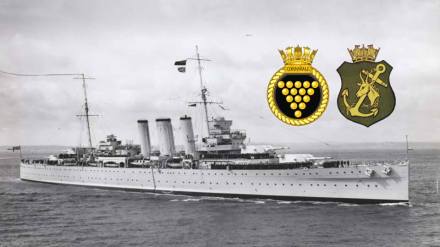
The second British ship in this particular Japanese air attack, on the same day and within range of one another was the HMS Cornwall, also stuffed full of South African Naval personnel seconded to her. The HMS Cornwall was hit eight times by the same dive bombers who sank the Dorsetshire and sank bow first in about ten minutes.
29542625_2113775675518086_7029672198895321022_n

HMS Cornwall

The Honour Roll of South African Naval sacrifice on the 5 April 1942 when HMS Cornwall  sank follows:

BESWETHERICK, Hedley C, Ordinary Seaman RNVR, 86671 (SANF), MPK
BOTES, John S, Stoker 2c RNVR, 68924 (SANF), MPK
COMMERFORD, Noel P, Able Seaman RNVR, 66493 (SANF), MPK
CRAWFORD, Cecil E, Act/Engine Room Artificer 4c RNVR, 67922 (SANF), MPK
DU PREEZ, Charles P H, Able Seaman, 68175 (SANF), MPK
DUTTON, Charles C, Stoker 2c RNVR, 68949 (SANF), MPK
HANSLO, Raymond F, Able Seaman RNVR, 68295 (SANF), MPK
KEITH, Kenneth I B, Able Seaman RNVR, 66742 (SANF), MPK
KENYON, Graeme A B, Able Seaman RNVR, 68002 (SANF), MPK
KIRSTEN, Monty G W, Able Seaman RNVR, 68917 (SANF), MPK
LAW, Edward, Act/Engine Room Artificer 4c RNVR, 66760 (SANF), MPK
MCDAVID, William K, Stoker 2c RNVR, 69138 (SANF), MPK
MITCHELL, William A, Stoker 1c RNVR, 68796 (SANF), MPK
PALMER, Walter A, Able Seaman RNVR, 68344 (SANF), (rescued, aboard HMS Enterprise), Died of Wounds
SPENCE, Noel W, Ordinary Seaman RNVR, 68732 (SANF), MPK
SQUIRES, John E, Ordinary Seaman RNVR, 68728 (SANF), MPK
STEPHEN, Eric B, Ordinary Seaman RNVR, 68861 (SANF), MPK
SWANN, Lawrence T, Stoker 1c RNVR, 68710 (SANF), MPK
THORPE, Maurice, Stoker 2c RNVR, 69140 (SANF), MPK
VERSFELD, Peter H S, Able Seaman RNVR, 68859 (SANF), MPK
VINK, Benjamin F, Ordinary Seaman RNVR, 68860 (SANF), MPK
WILLSON, Gerald F, Stoker 2c RNVR, 69006 (SANF), MPK
WRIGHT, Thomas H, Able Seaman RNVR, 68039 (SANF), MPK

In earlier incidents on HMS Cornwall two South Africans lost their lives they are also remembered here:

AINSLIE, Roy, Petty Officer, 66382 (SANF), died on 5 September 1940
HAWKINS, Reginald D, Able Seaman, 66700 (SANF), died of illness 4 March 1942

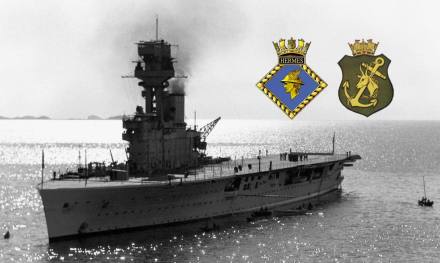
The Easter Raid later offered a great prize for the Japanese, an aircraft carrier, the HMS Hermes, this massive aircraft carrier was sunk a week later by the Japanese near Colombo (now Sri Lanka), the pride of the British Pacific fleet became an inferno after it was dived bombed a number of times.  It too had a long association with South Africa and a very big contingent of South African Naval Personnel. (see this link for a in-depth article on the South African Navy sacrifice abound her “Dante’s Inferno”; Recounting South African sacrifice on the HMS Hermes).
22290016_2032097947019193_784550767658191370_o

HMS Hermes

The Honour Roll of South African Naval sacrifice on the 9 April 1942 when HMS Hermes  sank follows:

BRIGGS, Anthony Herbert Lindsay Sub-Lieutenant (Engineer) Royal Navy (South African national), MPK
BRYSON, Neil W, Ordinary Telegraphist, 69147 (SANF), MPK
BURNIE, Ian A, Able Seaman, 67786 (SANF), MPK
CLAYTON, Frederick H, Act/Engine Room Artificer 4c, 68102 (SANF), MPK
DE CASTRO, Alfred T, Stoker 1c, 67914 (SANF), MPK
KEENEY, Frederick W, Able Seaman, 67748 (SANF), MPK
KEYTEL, Roy, Able Seaman, 67296 (SANF), MPK
KIMBLE, Dennis C, Act/Engine Room Artificer 4c, 67600 (SANF), MPK
KRAUSE, Frederick E, Able Seaman, 68321 (SANF), MPK
RAPHAEL, Philip R, Able Seaman, 67841 (SANF), MPK
RICHARDSON, Ronald P, Able Seaman, 67494 (SANF), MPK
RILEY. Harry Air Mechanic 2nd Class, Fleet Air Arm, Royal Navy (South African national), MPK
TOMS, Ivanhoe S, Able Seaman, 67709 (SANF), MPK
VICKERS, Colin P, Able Seaman, 68296 (SANF), MPK
VORSTER, Jack P, Able Seaman, 67755 (SANF), MPK
WHITE, Edward G, Stoker, 68026 (SANF), MPK
WIBLIN, Eric R, Able Seaman, 67717 (SANF), MPK
YATES, Philip R, Supply Assistant, 67570 (SANF), MPK

Included is also a South African who served with the Royal Navy’s Fleet Air Arm on the HMS Hermes.

RILEY, H, Air Mechanic, Fleet Air Arm, HMS Hermes, died 9 April 1942

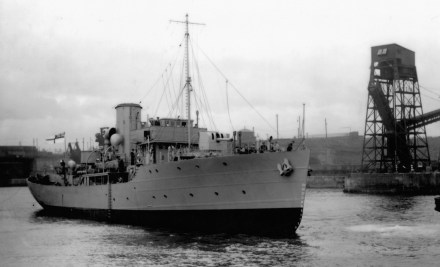
Next on the list of ships lost during the Easter Raid which contained a high number of South African Naval personnel on board was HMS Hollyhock, sunk on the same day as the HMS Hermes by the same Japanese Dive Bombers on the 9th of April. Click here for a full Observation Post report on her sinking  “She immediately blew up”; Recounting South African sacrifice on the HMS Hollyhock
hmshollyhock_sunderland

HMS Hollyhock

The Honour Roll of South African Naval sacrifice on the 9 April 1942 when HMS Hollyhock sank follows:

ANDERSON, Henry G, Able Seaman, 67501 (SANF), MPK
BASTON, Douglas T, Act/Engine Room Artificer 4c, 68600 (SANF), MPK
BUITENDACH, James M, Stoker 2c, 69223 (SANF), MPK
JUBY, Kenneth J, Ordinary Seaman, 69211 (SANF), MPK
LEACH, Peter A D H, Stoker 2c, 69225 (SANF), MPK

It was not just the Japanese Imperial Fleet, the German Navy also took its toll on the Royal Navy, and once again we find South African Naval Personnel seconded to serve on these famous ships sunk during the war.

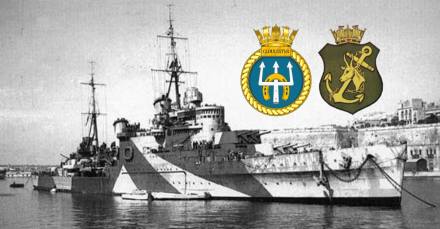
We start with the HMS Gloucester lost on the 22 May 1941 during action off Crete. They HMS Gloucester, along with HMS Greyhound and HMS Fiji were attacked by German “Stuka” Dive Bombers. The Greyhound was sunk and Gloucester was attacked and sunk while they attempted to rescue Greyhounds survivors in the water (see this link for a full story – click here A “grievous error”; Recounting South African Sacrifice on the HMS Gloucester).
22339137_10155537268831480_5862589716331636321_o

HMS Gloucester

The Honour Roll of South African Naval sacrifice on the 22 May 1941 when HMS Gloucester sank follows:

ANGEL, Walter J H, Able Seaman, 67351 (SANF), MPK
AUSTIN-SMITH, John R, Ordinary Seaman, 67336 (SANF), MPK
BAGSHAW-SMITH, Philip R, Ordinary Seaman, 67337 (SANF), MPK
BAGSHAWE-SMITH, Sydney Q, Able Seaman, 68454 (SANF), MPK
BARBER, Edgar F, Able Seaman, 67302 (SANF), MPK
BRUCE, John, Able Seaman, 67355 (SANF), MPK
CARTER, Frederick G, Able Seaman, 67345 (SANF), MPK
CHILTON, Ronald H D, Ordinary Seaman, 67335 (SANF), MPK
EDWARDS, Ronald E, Ordinary Seaman, 67384 (SANF), MPK
ELLIOT, Edward R, Leading Seaman, 66584 (SANF), MPK
GERAGHTY, Herbert C, Able Seaman, 67338 (SANF), MPK
GROGAN, Graham B, Able Seaman, 67343 (SANF), MPK
JAMES, Victor F, Ordinary Seaman, 67303 (SANF), MPK
JENSEN, Niels P, Able Seaman, 67347 (SANF), MPK
MCCARTHY, Henry F, Ordinary Seaman, 67223 (SANF), MPK
MOORE, Albert, Able Seaman, 67416 (SANF), MPK
SLATER, Bryan M, Able Seaman, 67358 (SANF), MPK
SMITH, Matthew S, Able Seaman, 67359 (SANF), MPK
SONDERUP, Arthur W, Able Seaman, 67356 (SANF), MPK
STADLANDER, Rowland C, Stoker 1c, 67400 (SANF), MPK
STOKOE, Cyril A M, Act/Leading Seaman, 67264 V (SANF), MPK
SYMONS, Maurice M, Able Seaman, 68245 (SANF), MPK
THOMPSON, Walter E H, Able Seaman, 67360 (SANF), MPK
VAN DYK, Cecil H, Able Seaman, 67404 (SANF), MPK
WEBBER, Reginald, Able Seaman, 67361 (SANF), MPK
WILLIAMS, Dastrey S, Leading Seaman, 67047 (SANF), MPK
WRIGHT, Gerald V, Act/Ordnance Artificer 4, 67375 (SANF), MPK

The HMS Gloucester was involved in earlier combat on the 8 July 1940 when it was bombed, the South African casualties are remembered here:

ALLISON, Oswald H, Able Seaman RNVR, 67349 (SANF), killed
NOWLAN, Francis C, Able Seaman RNVR, 67409 (SANF), DOW

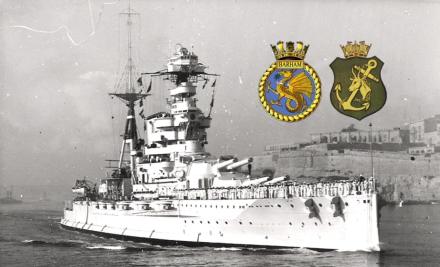
Tragedy struck the South African Naval Forces seconded to the HMS Barham when she was torpedoed by the German submarine U-331,  Three torpedoes hit HMS Barham’s port side causing it to list heavily and spread fire towards the ammunition storages. Only 2 and a half minutes passed from the torpedo impact until the ship rolled onto its side and capsized as the aft magazine exploded in an almighty explosion (see this link for a full story – click here “She blew sky high”; Recounting South African sacrifice on the HMS Barham!)
22339419_2031977060364615_9062815383740904129_o

HMS Barham

The Honour Roll of South African Naval sacrifice on the 25 November 1941 when HMS Barham sank follows:

BAKER, Dennis E W, Ordinary Seaman, 68617 (SANF)
GLENN, Paul V, Ordinary Seaman, 68906 (SANF)
HAYES, Richard T, Ordinary Seaman, 68499 (SANF)
MORRIS, Cyril D, Ordinary Seaman, 68932 (SANF)
UNSWORTH, Owen P (also known as R K Jevon), Ordinary Seaman, 69089 (SANF)
WHYMARK, Vivian G, Ordinary Seaman, 69024 (SANF)

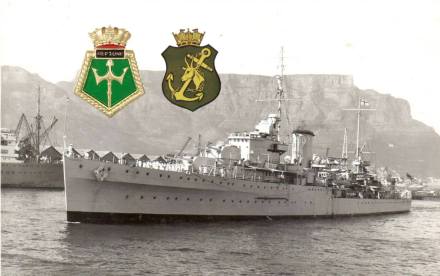
The Italians also took a toll of British shipping, again with ships with a South African contingent and this is brought to home on the 19 December 1941, when the HMS Neptune, struck four mines, part of a newly laid Italian minefield. Neptune quickly capsized (see this link for a full story – click here South African sacrifice on the HMS Neptune).
22339007_2031610797067908_1193987764492810300_o

HMS Neptune

The Honour Roll of South African Naval sacrifice on the 19 December 1941 when HMS Neptune sank follows:

ADAMS, Thomas A, Able Seaman, 67953 (SANF), MPK
CALDER, Frank T, Ordinary Seaman, 67971 (SANF), MPK
CAMPBELL, Roy M, Able Seaman, 67318 (SANF), MPK
DIXON, Serfas, Able Seaman, 67743 (SANF), MPK
FEW, Jim, Able Seaman, 67744 (SANF), MPK
HAINES, Eric G, Able Seaman, 67697 (SANF), MPK
HOOK, Aubrey C, Able Seaman, 67862 (SANF), MPK
HOWARD, Harold D, Signalman, 67289 (SANF), MPK
HUBBARD, Wallace S, Able Seaman, 67960 (SANF), MPK
KEMACK, Brian N, Signalman, 67883 (SANF), MPK
MERRYWEATHER, John, Able Seaman, 67952 (SANF), MPK
MEYRICK, Walter, Ordinary Signalman, 68155 (SANF), MPK
MORRIS, Rodney, Ordinary Signalman, 68596 (SANF), MPK
RANKIN, Cecil R, Signalman, 67879 (SANF), MPK
THORP, Edward C, Signalman, 67852 (SANF), MPK
THORPE, Francis D, Able Seaman, 67462 (SANF), MPK
WILD, Ernest A, Able Seaman, 67929 (SANF), MPK

Other South Africans who had enlisted into the Royal Navy were also lost on HMS Neptune, these include (and by no means is this list definitive) the following:

OOSTERBERG, Leslie W, Stoker 1c, D/KX 96383, MPK
TOWNSEND, Henry C, Stoker 1c, D/KX 95146, MPK

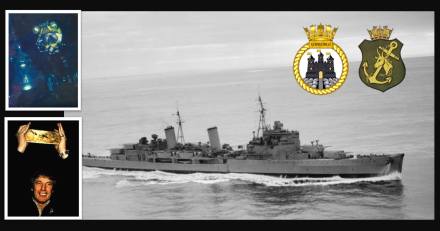
On the 30 April 1942, on her return leg from Murmansk, the HMS Edinburgh was escorting Convoy QP 11 when a German Submarine U-456  torpedoed into her. The Edinburgh was carrying gold in payment by the Soviets for war equipment and she is the subject of a remarkable gold salvage after the war.  Again, she had a compliment of South African Naval Personnel (see this link for a full story – click here “Gold may shine; but it has no true light” South African sacrifice on the HMS Edinburgh).
26910028_2075715645990756_5684443428071508079_o

HMS Edinburgh

The Honour Roll of South African Naval sacrifice on the 30 April 1942 when HMS Edinburgh sank follows:

DRUMMOND, Valentine W, Able Seaman, 68043 (South African Naval Forces), Missing Presumed Killed
VAN DORDRECHT, William H, Able Seaman, 67851 (South African Naval Forces), Missing Presumed Killed

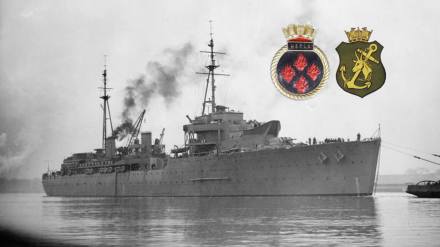
On the 12 November 1942, the HMS Hecla was torpedoed by a German submarine, U-515 hitting her in the engine room. The U-boat then hit the ship with three coups de grâce sinking the vessel west of Gibraltar.  Again there is South African Naval casualty list (see this link for a full story – click here “Every man for himself” … South African sacrifice and the sinking of HMS Hecla).
22254708_2031604957068492_8321068020269303236_o

HMS Helca

The Honour Roll of South African Naval sacrifice on the 12 November1942 when HMS Helca sank follows:

BENNETT, John F, Act/Engine Room Artificer 4c, 330351 (SANF), MPK
LLOYD, George H, Act/Engine Room Artificer 4c, 330353 (SANF), MPK
PEERS, Charles V, Able Seaman, 562653 (SANF), MPK
SMITH, Ian R, Electrical Artificer 4c, 68478 (SANF), MPK

And there’s more …. many South Africans served on a variety of Royal Navy ships and many were lost, here’s an indication which just captures South African Naval Forces personnel alone, let alone those who volunteered directly for the Royal Navy, the Honour Roll follows:

ANDERSON, Richard W N, Able Seaman, 86082 (SANF), killed 21 May 1941 on HMS Syvern
WESTON, Grant E, Ordinary Seaman RNVR, 68498 (SANF), killed 27 August 1941 on HMS Phoebe
RASMUSSEN, Victor J S, Leading Telegraphist, 66920 (SANF), MPK 24 November 1941 on HMS Dunedin
ADAMSON, William D, Ordinary Seaman RNVR, 69001 (SANF), MPK 10 December 1941 on HMS Repulse 
BECKER, Stanley H, Able Seaman, 67474 (SANF), road accident, killed 5 January 1942 on HMS Carnarvon Castle
DRURY, Frederick, Ordinary Seaman, 68315 (SANF), MPK 29 January 1942 on HMS Sotra
SCOTT, Clifford, Ordinary Telegraphist, 66973 (SANF), MPK 26 March 1942 on HMS Jaguar
BUCHANAN, Alexander, Able Seaman, 67934 (SANF), died 20 April 1942 on HMS Birmingham
COMMERFORD, Terence, Ordinary Seaman, 330258 (SANF), died 21 June 1942 on HMS Express
PRICE, David, Able Seaman RNVR, P/68529 (SANF), MP 6 July 1942 on HMS Niger
TROUT, A (initial only) N, Able Seaman, CN/72133 (SANF), died 4 August 1942 on HMS Stork
JOHNSTONE, Henry N, Lieutenant Commander (E), SANF, 66727, died 18 August 1942 on HMS Birmingham
BAWDEN, Wilfred R, Stoker 2c RNVR, 330425 (SANF), DOWS 16 September 1942 HMS Orion
NIGHTSCALES, Norman, Writer, 68148 (SANF), MPK 30 December 1942 on HMS Fidelity
GITTINS, Victor L, Ordinary Seaman, 69325 (SANF), died 27 January 1943 on HMS Assegai (training base)
PLATT, Ronald M, Petty Officer, 67160 V (SANF), accident, killed 26 February 1943 on HMS President III (shore establishment)
CROSSLEY, Alfred H, Sub Lieutenant, SANF, MPK 7 March 194 on HMS Saunders
DE KOCK, Victor P De C, Ty/Lieutenant, SANF, MPK7 March 194 on HMS Saunders
LOUW, Joseph, Stoker, CN 72175 (SANF), illness, died 2 December 1943 on HMS Stork
ATKIN, William B, Lieutenant SANF, illness, died 26 January 1944 on HMS Northern Duke
SHIELDS, Eric E M, Lieutenant, SANF, died 12 April 1944 on HMS Pembroke IV
HOWDEN, Russell K, Ty/Sub Lieutenant, SANF, MPK 4 January 1945 HMS ML 1163, Harbour Defence Motor Launch
CLARKE, Reginald E, Ty/Lieutenant Commander, SANF, air crash, MPK 24 July 1945 on HMS Adamant
LIDDLE, John, Lieutenant, SANF, MPK 8 August 1945 on HMS Barbrake

Then let’s consider the South African Naval Personnel serving in the Royal Navy’s Fleet Air Arm (the Royal Navy’s own Air Force separate to the Royal Air Force), and here the following South Africans are on the FAA Honour Roll (excluding Air Mechanic Riley from the Fleet Air Arm, recorded on the HMS Hermes loss).  For a full story of these South Africans lost in the FAA see this link – click here South African sacrifice in the Royal Navy’s Fleet Air Arm
29749326_2118787738350213_2325924304510116485_o

BOSTOCK, R S, Lieutenant, Royal Navy Fleet Air Arm 800 Squadron, HMS Ark Royal, died 13 June 1940
BROKENSHA, G W, Lieutenant, Royal Navy Fleet Air Arm 888 Squadron, HMS Formidable, died 11 August 1942
CHRISTELIS, C, Sub/Lieutenant, Royal Navy Reserve FAA 803 Squadron, HMS Formidable, died 1 August 1942
JUDD, F E C, Lieutenant Cmdr, Royal Navy Fleet Air Arm 880 Squadron, HMS Indomitable, died 12 August 1942
LA GRANGE, Antony M, Sub Lieutenant (A), SANF, Fleet Air Arm (Royal Navy)1772 Sqn HMS Indefatigable, air operations, MPK 28 July 1945
MACWHIRTER, Cecil J, Ty/Sub Lieutenant (A), Fleet Air Arm (Royal Navy) 851 Squadron HMS Shah, air crash, SANF, MPK 14 April 1944
O’BRYEN, W S, Sub/Lt Royal Navy Fleet Air Arm 762 Squadron, HMS Heron, died 26 November 1942
WAKE, Vivian H, Ty/Lieutenant (A), FAA Fleet Air Arm (Royal Navy) 815 Squadron HMS Landrail, air crash, SANF, MPK 28 March 1945

Finally there are South African Naval personnel found in the Merchant Navy, to which they were also seconded and again the Honour Roll lists:

SS Tunisia, ship loss
ADAMS, Douglas E H, Act/Able Seaman RNVR, 66378 (SANF), (President III, O/P), MPK
ST La Carriere, ship loss
DORE, Frank B, Act/Able Seaman RNVR, 67218 (SANF), (President III, O/P), MPK
SS Laconia, ship loss
ROSS, Robert, Stoker 2c, 69119 (SANF), (Victory, O/P), DOWS
SS Llandilo, ship loss
CRAGG, Ronald F, Able Seaman (DEMS), 66488 (SANF), (President III, O/P), MPK
SS Ceramic, ship loss
MOSCOS, John G, Leading Writer, 66786 (SANF), (SANF, O/P), MPK
SS Empress of Canada, ship loss
COCHRANE, Joseph, Engine Room Artificer 3c, P 68947 (SANF), (Pembroke, O/P), MPK
SS Empire Lake, ship loss
FLINT, John M, Act/Able Seaman (DEMS), P 562749 (SANF), (President III, O/P), MPK

More names…
Logo_of_the_Royal_NavyNow consider this, we have not even begun to scratch properly at the honour roll, this above list is still highly inaccurate with many names missing.  We have no real idea of the thousands of South Africas who volunteered and died whilst serving in The Royal Navy Reserve and the Royal Navy itself, in fact we’ve barely got our heads around it.  Fortunately a handful of South Africans are working on it, almost daily, but it’s a mammoth task as these names are found on Royal Navy honour rolls and it’s a matter of investigating the birthplace of each and every British casualty.  The records of South African volunteers joining the Royal Navy lost to time really.

In conclusion

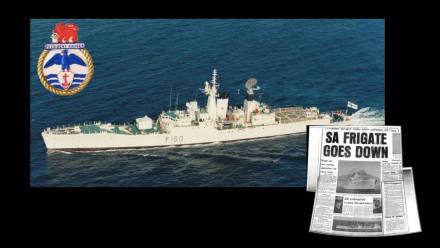
The only other ship the South African Navy has lost since the HMSAS Treern at the end of the Second World War in a more modern epoch was the SAS President Kruger, and unlike the Treern, whose loss was in combat, the Kruger’s loss was due to a tragic accident at sea (see “Out of the Storm came Courage” … the tragedy of the PK).
PK

These combat losses were one thing, however the same erasing of history is currently happening with the accidental loss in more recent times of SAS President Kruger (the PK), the ‘old’ SADF were very embarrassed by the loss (in effect by tragedy and circumstance we sank our own flagship) and the SADF never really got around to undertake a National Parade to commemorate and remember it.  Also in comparison to the bigger picture the loss of 16 South African Navy personnel on the PK is very small indeed, however no less important – and here’s the inconvenient truth, they were ‘swept under the rug’ by the old SADF and remain conveniently swept under the rug by the new SANDF.

On the World War 2 losses, the incoming ANC government from 1994 have fared no better than the old Nat government – they have merely lumped all the wartime combat losses of the HMSAS Southern Floe, the HMSAS Parktown, the HMSAS Bever and the HMSAS Treern into a ‘colonial’ issue not of their history or time, and as for the SAS President Kruger that was part of the ‘Apartheid’ forces in their minds, and as such to be vanquished.

The net result is the South African Navy simply does not have any national parades to commemorate or recognise any of its major losses at sea.  The South African Army at least has the Delville Wood Parade (the South African Army’s biggest singular combat loss, a WW1 incident), the South African Air Force has the Alpine 44 Memorial Parade (the SAAF’s biggest tragedy, a WW2 incident), the South African Navy …. nothing!

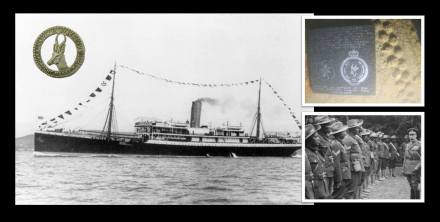
Instead the South African Navy (SAN) focuses on the loss of the Mendi as a SAN Maritime loss, even though the Mendi was under commission to the Royal Navy, and rather inconveniently the South Africa Navy did not really exist in World War 1, it was only really created just before World War 2.  Then again, the SS Mendi was also carrying South African Army troops in the form of the South African Labour Corps, not South African Navy personnel (the SAN didn’t exist in any event).
26758619_2077180812510906_3821944940761603220_o

The Mendi is a both a wartime and political tragedy,  The silence and subsequence recognition is a national healing one (see Let us die like brothers … the silent voices of the SS Mendi finally heard ).  As such it’s now a National Memorial Parade, part of ‘Armed Forces Day’ and one for the entire SANDF to commemorate and remember – and rightly so.  But is it a SA Navy specific commemoration – not really – no.

In all this the Navy still dogmatically refuses to host its own National Commemoration to its own naval actions and tragedies, it’s just too politically inconvenient, and wouldn’t it be nice if South African Navy can see past it and see its Naval sacrifice on its own ships, and those of SAN personnel on Royal Navy ships and finally just institute an ‘All at Sea’ Naval Memorial Parade in Remembrance or erect a full Naval memorial (similar to the erected by the Royal Navy in Portsmouth)?

Very small ‘All at Sea’ commemorations are done by the odd South Africa Legion branch and odd MOTH Shellhole, on a very local basis – driven by a tiny group of individuals.  Nobel in their undertakings no doubt, but these remain very small private initiatives attended by only a handful and is it really enough?

As demonstrated, The South African Navy’s honour roll for World War 2 is a staggering and very long list – it’s an elephant, a very big one at that and it’s a growing elephant, even to this day.  It’s well time we seriously look at ourselves, examine our values as to what constitutes sacrifice for the greater good of man and acknowledge it properly.


Written and Researched by Peter Dickens.  The honour roll extracted from ‘Casualty Lists of the Royal Navy and Dominion Navies, World War 2’ by Don Kindell.  Additional names gleaned from honour rolls published by Col Graham Du Toit (retired).


“Wounded 27 times”; When re-naming a fighting ship makes sense!

We are usually up in arms when things get re-named in South Africa, as more often than not it’s usually a political motivation that underpins it ahead of actually honouring South Africans highly deserving of it.   But now and again we get it right, and the renaming of the SAS Oswald Pirow in 1997, a South African Navy fighting strike craft, to her new name the SAS René Sethren is a case in point.

So why was Oswald Pirow singled out to get his name taken down from an honour bestowed on him and who the heck is René Sethren?  It’s almost guaranteed that most modern South Africans would have no clue who Sethren was, most would properly just assume he was this or that ‘struggle hero’.

Far from it, Rene Sethren is a hero all South Africans can stand very proud of, but more of him later, what’s the issue with Oswald Pirow?

Oswald Pirow

In a nutshell Oswald Pirow was an Afrikaner Nationalist who served as a Minister of Parliament and Minister of Defence under the nationalist Hertzog coalition.  He was pivotal in creating South African Airways and famously prosecuted Nelson Mandela in the Treason Trial.

But he had a very dark side, he was also an ardent full-blown Nazi, prior to World War 2 he launched the Nazi New Order ideology in South Africa, he adored and met both Hitler and Mussolini, and his disposition to Nazism as an ideology did not end with the end of the war, in fact with the election of the National Party in 1948 he felt more empowered in his beliefs and it ramped up somewhat.

10460708_459305080905896_5196244094119877880_n

Oswald Pirow (in civilian dress) inspecting Nazi German forces

After the war Pirow went into collaboration with the infamous British Fascist Party leader Oswald Mosley to write a joint paper on the separate development of white and black races in all of Africa along the lines of white supremacy and black subjugation – the idea to feed ‘white’ African southern states from ‘black’ North African states with exploited migrant labour.

So, naming a South African strike vessel after him was going to be very controversial, it applauded all the old South African Navy veterans and serving personnel who went to war against the very ideology Oswald Pirow followed.  They had watched thousands of South Africans make massive sacrifices including the ultimate one, fighting on British and South African vessels against Nazism, and now they watched an insular nationalist government name a fighting vessel after an ardent flag waving Nazi.

505808586

Oswald Pirow and Oswald Mosley

Not a military man either, Pirow had never served in the military other than to be a Minister of Defence, he had no military credentials and he was hated by the South African jewish community, the war veteran community and South African black community – in fact ‘hated’ would be an understatement.

Hardly a ‘hero’, the naming of his SAN Strike Craft vessels after Ministers of Defence called ‘Minister Class’ would be controversial from the get-go, a simple case of political one-upmanship and the case of Oswald Pirow the nationalists would be seen as rubbing the South African navy veterans noses in it for supporting Britain in World War 2.

So, no surprise really as to why the ‘Minister Class’ of defining strike craft and Oswald Pirow’s name had to go. But thankfully, this time in a breath of fresh air, the South African Navy decided on a simple hero, and not political one-upmanship, when it came to re-naming the SAS Oswald Pirow.  They chose CPO (Stoker) René Sethren, but who the heck is he and what did he do?

René Sethren

sethrenChief Petty Officer (Stoker) René Sethren CGM has a story which is simply jaw dropping to say the least. René Sethren left school after Std 7, a keen boxer and highly astute he joined South Africa’s fledgling navy as a stoker in 1940, rising in rank eventually to Chief Petty Officer (Stoker).
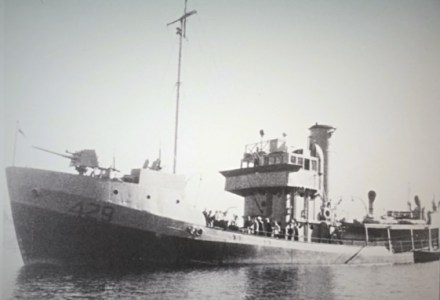
On the 30th June 1941, a small flotilla of ships including South African mine-sweepers is on convoy from Mersa Matruh approaching Tobruk in the midst of the fighting around Tobruk between Rommel’s German and Italian Axis forces and the British and Commonwealth Forces, with South Africans right at the centre of it defending Tobruk and El Alamein.

As they close in on the coast the convoy comes under fire from German shore batteries and is also attacked by a number of German Stuka dive bombers, JU87’s and Messerschmidt 109’s.

Enter one small South African ship, HMSAS Southern Isles, a converted whaler, performing anti submarine, patrol and general support duties in the Mediterranean during the Second World War, and its stoker René Sethren.

34302702_10156203070971480_3394612786343444480_n_Fotor

HMSAS Southern Isles

Five German JU-88’s attacked the HMSAS Southern Isles, luckily with no real damage, then came a little lull in the fighting, during which a single JU-87 which had been attacking a convoy merchant called the ‘Cricket’ nearby made a close pass to the HMSAS Southern Isles and was shot down by the Southern Isles’ rear gun.

But that was not the end of it, a bigger and more fierce attack was to come.  The convoy came under attack from 50 enemy aircraft, 8 of which were concentrated on any one ship in the convoy.   The commander of the HMSAS Southern Isles described it as “The sky appeared to rain bombs”.

As a result of this action there are by then a number of casualties on the upper deck. In order to assist those fighting off the attacking Stuka aircraft Chief Petty Officer (Stoker) René Sethren is sent up from his normal station shovelling coal in the engine room, he had been at this task for a 12 full hours.  René is also a qualified reserve machine gunner and he was urgently needed, his best friend who had been manning the ships’ twin Lewis anti-aircraft machine gun was dead lying next to gun. René immediately took over the gun, standing on ammunition boxes to train his gun he starts a non stop volley of fire against the attacking German aircraft.

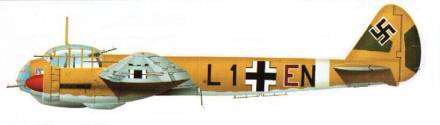
At this stage a German JU88 aircraft joined the Stuka attack and strafed the ship’s upper deck with its machine guns. Sethren is seen to fall after he was hit by machine gun bullets from the JU88 (he had 8 separate bullet wounds  – read that again – shot 8 times).

ju-88-7

Junkers JU-88

Notwithstanding his wounds he muscles up some superhuman strength and stands up, and unbelievably he again engages the attacking aircraft with the Lewis gun. At the conclusion of the battle Rene Sethren is found to have more than just the eight bullet wounds, in fact medics count a total of 27 wounds in one arm, both legs and his side.

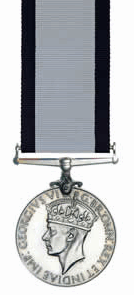
Conspicuous_Gallantry_Medal_(Flying)_(UK)For his actions he is awarded the Conspicuous Gallantry Medal – the highest award won by a South African rating in World War 2, the only South African to be awarded this medal and one of only 243 men who had been awarded the medal prior to that day since its introduction in 1855.
Rene Sethren received his gallantry decoration from King George V. His wounds are so extensive he spends 18 months recovering in hospital, his boxing career over and because of his injuries he is unable to ever go to sea again.

In conclusion

Wow, now that is a man we can stand around of, that is the sort of person we can name a fighting ship after.  No politics, just pure gallantry from a simple rating, an engine stoker – an inspiration to any person serving in the navy.  In every respect the right person to re-name the SAS Oswald Pirow strike craft after.

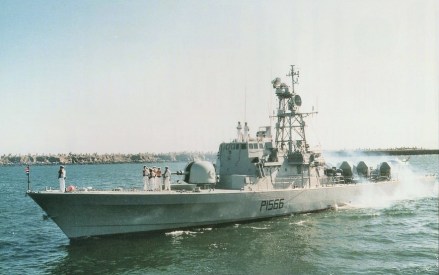
The Warrior Class South African Ship René Sethren started on her final voyage in October 2001 leaving  Durban harbour for the South African Navy’s fleet headquarters in Simonstown to be finally decommissioned after 22 years of service, with a fitting name to a proud fighting legacy.

s-l1000_Fotor

SAS René Sethren

Related Work and Links

Oswald Pirow;  South Africa’s ‘Neuordnung’ and Oswald Pirow

Tobruk; “Defeat is one thing; Disgrace is another!” South Africa’s biggest capitulation of arms – Tobruk

HMSAS Parktown; The feisty South African minesweeper that went down fighting – HMSAS Parktown

HMSAS Treern;  The last South African Navy ship to be lost in action; HMSAS Treern

HMSAS Bever; “Under a hail of shells”; Recounting the bravery and loss of HMSAS Bever

HMSAS Southern Floe; ‘A sole survivor and a ship’s crest’; the South African Navy’s first loss – HMSAS Southern Floe

Military Heroes; Tainted “Military Heroes” vs. Real Military Heroes


Written and researched by Peter Dickens.  References, Day by Day SA Naval History by Chris Bennett. Allan du Toit’s  ‘South African Fighting Ships Past and Present’.

VE – Day’s flags of honour

8th May 1945 – Victory In Europe Day, also known as VE – Day – the war in Europe is declared over. VE Day is a day to mark the formal acceptance by the Allies of World War II of Nazi Germany’s unconditional surrender of its armed forces.

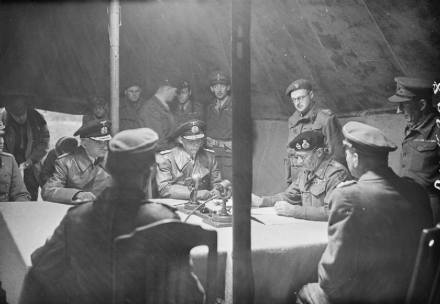
Just a few days before the designated ‘VE-Day’ on 4 May 1945 just east of Hamburg, Field Marshal Sir Bernard Law Montgomery, Commander of the 21st Army Group accepted the unconditional surrender of key German forces in Western Europe.

31959929_1725767320838326_7902641877910814720_n

The surrender preceded the end of World War 2 in Europe, which was later signed in a tent at Montgomery’s HQ on the Timeloberg hill at Wendisch Evern. A second German Instrument of Surrender ahead of the official ending World War 2 in Europe was signed on 7 May at Reims in France and signed again on 8 May with the Supreme High Command of the Red Army (Soviet Union), French and United States representatives in Berlin.

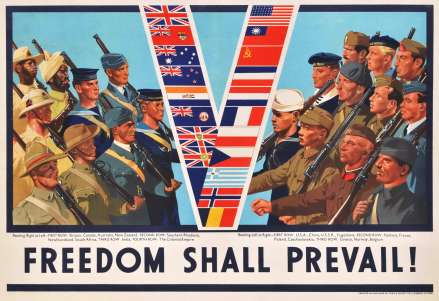
The 8th of May was declared as VE – Day, and an intensely proud day celebrated by the Allies the world over followed, including South Africa (Russia celebrates it the day after on the 9th).  The ‘V for Victory’ sign used to drive support for the Allied cause throughout the war made a full appearance everywhere, and so did the great nation’s flags who had fought so hard, and with such sacrifice to get to this day.

10259794_10153711964401480_1609297100934913427_n

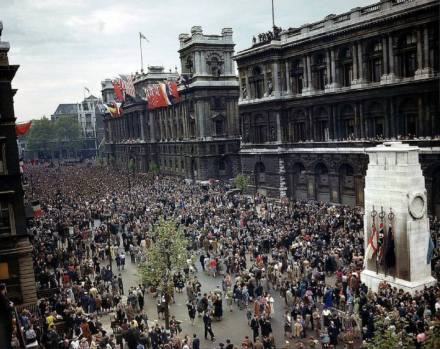
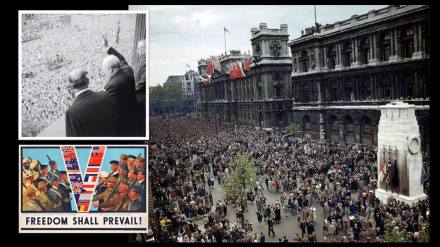
If you examine the picture of Whitehall closely, all the key nations in support and Allied with Great Britain, massive flags proudly flown from Whitehall next to one another – they included the flag of the United States of America and the flag of the Soviet Union.

In sequence the flags of the key commonwealth countries who had committed so much in resources, people and lives are also seen, these included Canada, Australia, India, New Zealand and South Africa, and you can see it here, the ‘Orange, White and Blue’ flag of the Union.

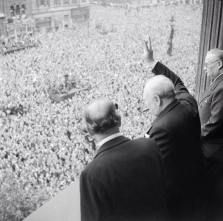
Winston Churchill appeared in Whitehall on he Ministry of Heath balcony to address the masses of people assembling there, in part be said;

11050253_445187798984291_7988015998947365041_n“I say that in the long years to come not only will the people of this island but of the world, wherever the bird of freedom chirps in human hearts, look back to what we’ve done and they will say “do not despair, do not yield to violence and tyranny, march straightforward and die if need be-unconquered.” Now we have emerged from one deadly struggle-a terrible foe has been cast on the ground and awaits our judgment and our mercy.”
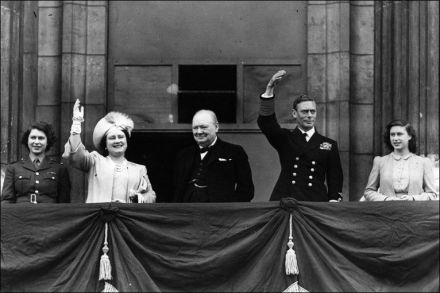
His views were echoed by King George VI when Winston Churchill appeared alongside him,  the Queen mother and a young Princess Elizabeth (soon to be Queen Elizabeth II) in her uniform.  She had joined the war effort as a subaltern in the women’s Women’s Auxiliary Territorial ServiceKing George said;

“I thank with a full heart those who bore arms so valiantly on land and sea, or in the air; and all civilians who, shouldering their many burdens, have carried them unflinchingly without complaint.”

31956176_1725765230838535_1877600895395430400_n

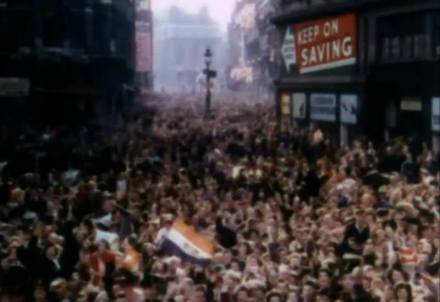
What followed was two solid days of partying in central London and the world over.  It had been South Africa’s war too, and South Africans were right at the centre of this massive party in London  – and rightly so. This still from colour film footage shows the street party and general revelling at Piccadilly Circus in London – and it’s marked by some South Africans in the centre proudly waving the South African Union national flag and rejoicing the end of the war in Europe.

11210502_445788838924187_3293832895299064234_n

Some people (in fact many) in South Africa would say, oh no not THAT flag (referring the Orange, White and Blue or ‘OBB’)!  But that is to completely misunderstand what this flag meant to the world in 1945 and not 1994.

The South African Union flag was the flag of Smuts’ Union and not really the preferred flag of Malan’s Republic, in fact between Verwoed and Vorster both had proposed re-designing the South African Union flag in line with their ideologies and those of the ‘Republic’ state they created and not Smuts’ despised ‘Union’ (many in Nationalist caucus literally hated the British Union “Jack’ on the flag, they called it the ‘blood-vlek’ as it reminded them of the sufferings of the Boer nation under the British in the 2nd Anglo-Boer War and wanted it removed); for more on this rather ‘inconvenient’ history of South Africa’s national flags see the link at the end of this article.

In fact it’s a great pity the Apartheid government didn’t follow through with their endeavours to change the flag in 1961 and 1971 respectively, when they drove at issue of the Republic they created.  In 1945, South Africa was a Union and a Dominion in the British Commonwealth and this flag, along with Smuts as Head of State was honoured and highly respected the world over, especially at the end of World War 2.

At the time the South African Union flag stood for the almighty sacrifice of South Africans and Jan Smuts’ call to fall behind the Allied nations to rid the world of Nazi and Fascist tyranny. A war against what Smuts referred to as Hitler’s ‘Crooked Cross’ (swastika) an unchristian ideology and heinous symbology.

CL182-68

The South African Union Flag in 1945 also stood for freedom and victory over ‘violence and tyranny’ as Churchill had aptly referred to in his speech on VE Day, at the time it stood firmly behind this ideal and was flown proudly. That the flag was to be carried over and soiled by the Nationalists and their Apartheid ideology after the war from 1948 and now stands as a symbol of ‘hate’ is unfortunate history.

Old flags have their place, and the South African Union flag should have ended with the Union in 1961 as it symbolised that time, with all its own ups and downs and its own forms of ‘race’ politics, but also its greatest achievement which won it high acclaim – and that was ‘VE-Day’, the Union epoch was in fact very different to the Apartheid epoch in just about every respect.  Also lets face it the Nationalists didn’t bathe themselves in glory with a pinnacle of achievement anywhere close to ‘VE – Day’.

Also,  South Africa is also not alone in this line-up at Whitehall in VE Day of having its flag changed – the flags of the Soviet Union, India and Canada all changed in the wake of new politics and social orders after World War 2.

In any event, we stand on the 8th May and remember Smuts’ South African Union and the lofty role it performed in bringing peace and freedom to the world in 1945, a ‘little country’ by comparison standing shoulder to shoulder with some of the greatest men and super-powers in the world, on an occasion that changed the destiny of almost every country around the world.  A day many South Africans stood with their heads held high and applauded the world over.

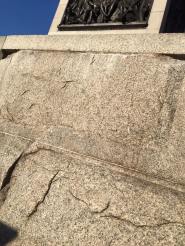
12549123_10153755844686480_5840912786017399781_nA beacon of fire symbolising this freedom was lit in Trafalgar Square on VE – Day, by a bunch of very happy and inebriated Canadian servicemen burning war bond advertising boards, it burned so bright, so strong and was so hot it cracked a part of the granite base of Nelson’s Column, a subtle reminder to this day, if you look carefully, to the sheer magnitude of the occasion and what it meant to a relieved and ecstatic British public, Commonwealth and Allied nations and the world at large.
Video

In conclusion, this short Associated Press news reel captures VE-Day perfectly:

Related Work

The South African National Flag; The inconvenient and unknown history of South Africa’s national flags

Churchill’s Heroes; Churchill’s Desk


Written by Peter Dickens.  Reference and thanks to the ‘British and Commonwealth Forces’ Facebook page.  Image of Churchill at Whitehall from the Imperial War Museum. Video commercial copyright Associated Press.

Smuts Barracks; Berlin

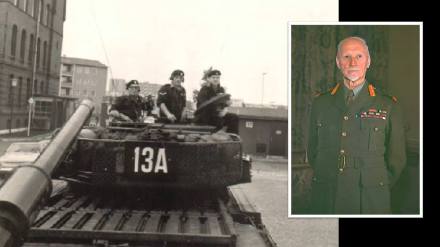
Not only did Jan Smuts have a Kibbutz named after him in Israel, as well as pub named after him in London, the famous ‘Smuts Barracks’ in Berlin was also named after him.  The barracks were the home to an SS Panzer Division during the Second World War and was occupied by the British after the war, the barracks is particularly well-known because it was on constant high alert during the Cold War and Berlin Wall divide.

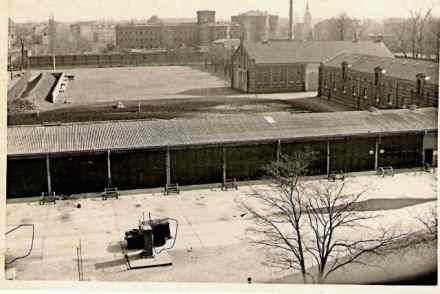
Smuts Barracks was situated on Wilhelmstraße, a street in the Spandau district of Berlin, and the base of the British armoured contingent to Germany, it’s located next to what was the famous ‘Spandau Prison’ . Also in Wilhelmstraße, Spandau Prison was completed in 1881. It was occupied by seven Nazi war criminals, convicted in the Nuremberg Trials after World War 2, including Rudolf Hess, who remained its only prisoner there for many years until he committed suicide. After Hess’ death the prison was demolished and replaced by a shopping centre.

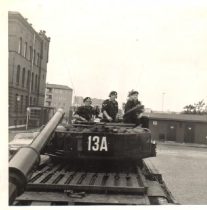
Berlin, Smuts, 1 RTR (2)

Smuts Barracks (above and below), taken during 1 RTR’s tour of duty between Feb 67 and Jan 69.

The British armoured squadron based at Smuts Barracks consisted of 18 modified Chieftain tanks, painted in their renown urban camouflage, and were at a constant state of readiness. This “bombed up” state, ensured a speedy counter attack should the Soviet Union (Russia and East Germany mainly) breach the Berlin wall.

The last unit/squadron to be based here was C Squadron, The 14th/20th Royal King’s Hussars (1989-1993), a Cavalry Regiment of the Royal Armoured Corps. The squadron bar was known as the “Lion and Bear”.

Berlin, Smuts, 1 RTR

RTR at Smuts Barracks

Between 1948 and 1952, the Smuts Barracks was used by the following Regiments stationed in Germany:

Feb 1948 Sqn, 11 Hussars (armoured cars)
May 1949 ‘A’ Sqn, Royal Dragoons (armoured cars)
Mar 1950 ‘A’ Sqn, Royal Horse Guards (armoured cars)
Feb 1951 Sqn, 3rd Hussars

In Feb 1952 a permanent unit was formed, designated 1st Independent Sqn Royal Tank Regt. It was disbanded December 1957. Between December  1957 and Aug 1962, the squadron came from the APC (Armoured Personnel Carrier) regiment in BAOR:

Dec 1957 ‘B’ Sqn, l4lh/20th Hussars
Nov 1960 ‘C’ Sqn, 4th Royal Tank Regt

Another permanent unit was established in March 1963, designated Independent Sqn Royal Tank Regt; it was disbanded November 1965.

After that date, the squadron normally came from the training regiment at Catterick:

Feb 1965 Sqn, Queens Own Hussars
Feb 1967 A Sqn, 1st Royal Tank Regt
Jan 1969 Sqn, 9th/l2th Lancers
Dec 1970 Sqn, 1st Queen’s DG
Dec 1972 ‘A’ Sqn, 4th Royal Tank Regt
Dec 1974 ‘B’ Sqn, 5th Royal Inniskilling DG
Dec 1976 ‘B’ Sqn, Royal Scots DG
Apr 1979 ‘D’ Sqn, Royal Hussars
Feb 1981 ‘D’ Sqn, 4th/7th DG
Apr 1983 ‘D’ Sqn, Queens Own Hussars
May 1985 ‘B’ Sqn, 14th/20th Hussars

From 1985, the squadron came from the 14th/20th Hussars who were based at Münster:
Jan 1988 ‘C’ Sqn took over. The squadron was withdrawn in 1991.

30425700_2124617117767275_8530343007735181590_o

Jan Smuts

Also based at Smuts Barracks  were 38 (Berlin) Field Squadron RE. 38 Field Company was stationed in West Germany as part of 23 Field Engineer Regiment when in 1957 it was amalgamated with the RE Troops Berlin to become 38 (Berlin) Field Squadron Royal Engineers. The Squadron remained in Berlin providing engineer support to the Berlin Brigade until 1994 when it was disbanded as part of options for change.

Smuts Barracks was also the home of the Sapper Berlin Field Squadron (38 Fd Sqn RE).

So there you have it, another legacy of Jan Smuts and an island of South Africa’s contribution to the Second World War and the Cold War after it.  The Barracks is now closed and under private ownership.

Related work and links

Jan Smuts: A Kibbutz called Jan Smuts

Jan Smuts: “The force of his intellect has enriched the wisdom of the whole human race”- the death of Jan Smuts.


Researched by Peter Dickens.  Large reference, photos and extract from BAOR Locations – Smuts Barracks on-line.

South African sacrifice in the Royal Navy’s Fleet Air Arm

18301541_655088058024408_5990826112865938099_n

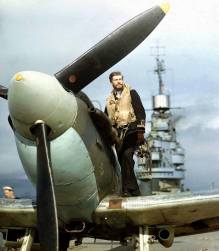
FAA pilot standing on the wing of a Seafire (adapted Spitfire with arrest capability). Note the “beard”  and his wings on his sleeve above his rank.

The Fleet Air Arm (FAA) is a lessor known service in the bigger picture of World War 2, but no less important.  In essence the Fleet Air Arm is the Royal Navy’s own Air Force, designed solely to be launched either at sea from aircraft carriers and ships or from shore bases on maritime based operations and in defence of the Royal Navy specifically.

The Royal Air Force was an independent arm of service from the Navy, it worked in conjunction with the Navy and the Army in joint commands, however it also worked in conjunction with the Navy’s own Air Force – the Fleet Air Arm.

The Fleet Air Arm is interesting as it flew a wide variety of very unique fixed wing aircraft in World War 2, and rotary wing aircraft post war (helicopters).  The FAA aircraft in World War 2 were usually a little different to the ‘landed’ cousins as they to be specially adapted for operating at sea, they also had to be a lot more robust and made to ‘fold-up’ to store them on deck.  They were even given different names, for the same equivalent Royal Air Force and US Air Force aircraft, an example is the famous ‘Spitfire’ had its named changed to ‘Seafire’ when serving with the FAA along with its special additions (like assesting or catapult hooks).

Even lessor known is the fact that the Fleet Arm has had a number of South Africans serve in it, and it all ties back to the strong Naval ties Britain – and the Royal Navy specifically – had with South Africa, especially as the Naval Base at Simonstown is near Cape Town, South Africa, and it was British sovereign territory during the war (a status that existed well in the 1960’s).

Like the South African Naval Forces personnel (SANF) finding themselves seconded to the Royal Navy or South Africans joining the Royal Navy directly as Royal Navy volunteer reserve – South African branch (RNVR), so too did many South Africans find themselves in the Royal Navy’s FAA either as SANF personnel or RNVR personnel.

It also unfortunately follows that when tragedy strikes the Royal Navy and its Air Force, there are South African losses.  So, lets look at each of the South African men specifically lost serving the Fleet Air Arm, honour them by telling a little about their story, the squadrons they belonged and the unique FAA aircraft they flew.  By looking at the sacrifice it will also give us a small insight into this very unique history of the FAA.

Fleet-Air-Arm

A unique book was written and illustrated by Derrick Dickens called ‘Stringbag to Shah’ on the history of the Fleet Air Arm, illustrated because many of the aircraft used by the FAA were not recorded in colour, or at best obscure with no record of paint schemes etc – and he wanted to bring these unique aircraft to living in vivid colour using his artwork.  We’ll be using this unique catalog with the permission of the copyright owner.

In all there were 9 men according to current records (this can change as more research has been done on the honour roll) who were South African and died serving in the Fleet Air Arm.  So lets start with the first South African man lost.

HMS Ark Royal

BOSTOCK, R S, Lieutenant, Royal Navy Fleet Air Arm 800 Squadron, HMS Ark Royal died 13 June 1940

FAA2

Blackburn Skua during Norway Operations by Derrick Dickens

At the time of Lt. Robert Bostock’s death, the HMS Ark Royal (a massive aircraft carrier), operated a number of FAA squadrons from its flight deck.  In June 1940, FAA 800 Squadron was operating as part of the reaction force to the German invasion of Norway, 800 and 803 had dive-bombed the German Cruiser Königsberg on 10 April 1940 and sank it, flying the ‘Skua’.

800 squadron embarked on Ark Royal later that month, with the carrier providing air cover to the fleet and to Allied troops. 800 Squadron’s Skua’s claimed six Heinkel He 111  bombers shot down.  On 13 June 1940, Ark Royal launched a dive bomber attack against the German Battleship Scharnhorst with 800 Squadron losing four Skuas out of six, along with Lt Bostock (our South African) and the Squadron’s Commanding Officer, Captain R.T. Partridge.

FAA1

FAA Blackburn Skua B-24 by Derrick Dickens

“Too big too slow. too late, this was the Blackburn Skua and the reputation that followed it. Slow and big it certainly was by the standards of the day, It towered above the ground on a spindly under carriage, and was indeed a large piece of ironmongery to expect the under powered Perseus engine to hoist into the air. But considering the radical nature of its design by British standards at the time of its conception the Skua was competent enough, maintaining Blackburn’s name for rugged naval aircraft, and adequately fulfilling the demands of the specifications that had given it birth, but as a combat aircraft it was not very successful” (Stringbag to Shah by Derrick Dickens).

The next South African man lost was not a FAA pilot or navigator, he was a FAA aircraft mechanic;

HMS Hermes 

RILEY, H, Air Mechanic, Fleet Air Arm, HMS Hermes, died 9 April 1942

At the time of Air Mechanics Riley’s death the HMS Hermes (also an aircraft carrier) was searching for the Japanese Imperial Fleet off Ceylon (now Sri Lanka) during the infamous Japanese ‘Easter Sunday Raid’ on Colombo – the Royal Navy’s own ‘Pearl Harbour’ and the South African Navy’s ‘Darkest Hour’ because of all the ships were lost with large South African Naval personnel on board – see this Observation Post link for the full story by clicking this link; The South African Navy’s ‘darkest hour’ is not recognised and not commemorated).

While sailing south off Batticaloa on the East Coast of Ceylon, HMS Hermes and its accompanying flotilla was by Japanese Carrier-Borne dive-bombers from the Imperial Japanese Task Force in the process of attacking the Naval Base at Trincomalee.

Approximately 70 Japanese aircraft were despatched to bomb the HMS Hermes which became an inferno and sank within ten minutes of being hit by numerous aircraft bombs.

At the time of her sinking the HMS Hermes was the home to No. 814 Squadron of the Fleet Air Arm flying the famous ‘Fairey Swordfish’ torpedo bomber, and these were the aircraft that Air Mechanic Harry Riley son of Alfred and Mary Ellen Riley, of Springs, Transvaal, South Africa, would have worked on.

FAA3

FAA Fairey Swordfish ‘Stringbags’ by Derrick Dickens

“Stringbag’ so named because of all the wires and stays. Archaic in appearance even when it first flew, the venerable Swordfish was the Fleet Air Arm’s premier torpedo-bomber at the outbreak of World War II and was destined to become a naval legend.

 Having arrived at a stage of World War II when a biplane, was a very rare sight, despite appearances, this beautifully ugly aircraft was no anachronism, for the Fairey Swordfish, as it was named, had then a still vital role to play in World War II. The Swordfish had the distinction in fighting the Axis from the very first days of the war until victory for the Allies in Europe had been assured.

Swordfish first saw action in the Norwegian campaign, and went on to see service in the Mediterranean, the Western desert, Iraq, the Battle of the Atlantic, and in support of convoys bound for Russia, attacks on the French fleet at Oran in July 1940 following the D-Day evacu­ation, and attacks on the Italian fleet at Taranto, and the German battleship Bismarck. The Swordfish is credited with the destruction of a greater tonnage of enemy shipping than any other allied aircraft during World War II. In so doing, the Swordfish outlived and outfought aircraft which had been designed to replace it in service, and during this period created a record of the machine achievement in association with human courage that makes pages of the Fleet Air Arm’s history a veritable saga.” (Stringbag to Shah by Derrick Dickens).

The next South African man lost with FAA was lost from HMS Formidable.

HMS Formidable

CHRISTELIS, C, Sub/Lieutenant, Royal Navy Reserve FAA 803 Squadron, HMS Formidable, died 1 August 1942

FAA 803 squadron at the time of Sub/Lt. Christelis’ death was equipped with the Fairey Fulmar II and operated from Ceylon (now Sri Lanka) against the Japanese (also participating in the infamous sea battles surrounding Japanese Imperial Navy’s Easter Sunday raid against the Royal Navy), joining the HMS Formidable from April 1942. Sub/Lt. Cornelius Christelis was the son of Christos and Eleni Christelis, of Germiston, Transvaal, South Africa.

FAA4

FAA Fairey Fulmar Mark II

“The first eight-gun fighter to enter service with the Fleet Air Arm, the Fulmar two-seat shipboard general-purpose fighter was designed at a time when the Admiralty held the view that navigational aids were inadequate to ensure the safe return of a single-seat fighter to its carrier in inclement weather, and that a navigator was, therefore, indispensable”.(Stringbag to Shah by Derrick Dickens).

The next South African man lost with FAA was also lost from HMS Formidable from FAA No. 888 Squadron around the same time as Sub/Lt. Christelis.

HMS Formidable

BROKENSHA, G W, Lieutenant, Royal Navy Fleet Air Arm 888 Squadron, HMS Formidable, died 11 August 1942

Lt Brokensha had an extensive career with the Fleet Air Arm, he flew Skua II with FAA 803 Squadron, taking part in Operation “Duck” on 17th April 1940 in defence of HMS Suffolk returning from Norway and from HMS Glorious he took part in numerous operations over Norway were he was even Mentioned in Despatches.  From HMS Ark Royal he took part in numerous operations including attack on Scharnhorst in Trondheim Harbour on the 13 June 1940, for which he earned DSC.  By 1942 he was posted to 888 Squadron flying Martlets as Senior Pilot, joining HMS Formidable on 1st February 1942.  His death is a little mysterious, he is recorded as  missing overboard from HMS Formidable, at night on the 11th August 1942.

FAA 888 squadron’s Marlet Mk II aircraft are an interesting addition to the Fleet Air Arms rich history, as they are essentially American Grumman Wildcats with a Royal Navy spin.

FAA 6

FAA Martlet Mk II by Derrick Dickens

“The Royal Navy’s effect upon the F4F Wildcat was considerable. The Fleet Air Arm introduced it to combat a year before Pearl Harbor, and exerted influence in its armament fit which ran con­trary to opinion in US Navy squadrons. The Wildcat was the first truly modern fighter flown from British carriers, and represented an enormous leap forward in Royal Naval aviation” (Stringbag to Shah by Derrick Dickens).

The next South African man lost with the FAA was a very senior officer, a Lieutenant Commander on the HMS Indomitable.

HMS Indomitable

JUDD, F E C, Lieutenant Cmdr, Royal Navy Fleet Air Arm 880 Squadron, HMS Indomitable, died 12 August 1942

At the time of Lt Cmdr Judd’s death, the HMS Indomitable and its fleet of 880 Sea Hurricanes was involved with Operation Pedestal which revolved around securing supplies to Malta in the central Mediterranean.  In early August the Royal Navy were engaged in heavy combat with German and Italian aircraft bombing their ships securing these vital supplies to the besieged island of Malta.  The date Lt. Cmdr Judd died was a particularly heavy day of combat when 4 waves of German and Italian aircraft attacked the British Fleet, on 12th August the HMS Indomitable’s 880 Squadron FAA Sea Hurricane fighters had been in heavy aerial combat with Axis forces, with crew losses and in the evening the HMS Indomitable’s defensive screen was breached and she was hit by two 500 kg bombs; a 500 kg bomb penetrated the un-armoured portion of the flight deck, killing 50 and wounding 59 men causing damage that required her to withdraw from the fight.

FAA7

Sea Hurricane Mk II by Derrick Dickens

“That the Hawker Hurricane occupied a vital place in Britain’s history cannot be denied. Put simply, the Hurricane saved Great Britain in 1940; it was the right aircraft, at the right time, and flown by the right pilots. No one can deny the excel­lence of the Spitfire, nor that it one of the great fighting aircraft of World War II. Yet, outdated though the Hurricane may have appeared by comparison, its simplicity of concept and opera­tion was such that it could be — and was – dispatched to any of the danger spots that spread like cancer during those first three years of the war when events threatened to engulf the Allied nations with disaster.

Overshadowed by the Spitfire, the Hurricane was slower, less manoeuvrable and half a generation older in terms of technology. What mattered was that it was available in numbers and could be adapted to a variety of roles. One of which was a carrier-based fighter version which the Navy dubbed the ‘Sea Hurricane’ (Stringbag to Shah by Derrick Dickens).

The next South African man lost was from the Fleet Air Arm’s No. 762  Squadron on the HMS Heron

HMS Heron

O’BRYEN, W S, Sub/Lt Royal Navy Fleet Air Arm 762 Squadron, HMS Heron, died 26 November 1942

At the time of S/Lt O’ Bryen’s death the HMS Heron and 762 Squadron were raining units.  The HMS Heron is not a ship or carrier, it’s a shore base and one of the last of the Fleet Air Arm’s bases still in Operation now re-named Royal Naval Air Station Yeovilton in Somerset, England. It was used primarily during World War 2 as the home of No1. Naval Air Fighter School and later the Aircraft Direction Centre. The 700-series squadrons are generally experimental or training squadrons, which produce trained aircrew for the operational 800-series squadrons.

S/Lt William Stanislaus O’Bryen, the son of John and Ivy O’Breyen of Fynnland, Natal, South Africa is buried at the Fleet Air Arm’s Church in Yeovilton which contains a small number of FAA members killed in aviation accidents whilst training at HMS Heron.

It is unclear from records what aircraft S/Lt O’Bryen was involved with, however one of the more famous aircraft flown at HMS Heron used to train young pilots by the middle of the war was the famous Seafire, a naval adaption of the iconic Spitfire.

FAA8

FAA Seafire MK 1B by Derrick Dickens

“The Seafire which in fact was little more than a “navalised” Spitfire, it was without any doubt the most effective British built naval fighter of World War 2, even though it had the reputation of not being suitable for the rigours of carrier operations. To some degree, this reputation was deserved for the Spitfire was of lightweight design, never intended for naval service, but it filled a gap till the specialist naval types in the shape of the Corsair and Hellcat arrived, in the mean time serving in major campaigns in the Far East, Africa and Europe” (Stringbag to Shah by Derrick Dickens).

The next South African man lost was from the Fleet Air Arm’s No. 851 Squadron on the HMS Shah, and he in fact was a member of the South African Navy, having been seconded to the FAA.

HMS Shah

22308811_10155537271456480_3745202244434378650_nMACWHIRTER, Cecil J, Ty/Sub Lieutenant (A), Fleet Air Arm (Royal Navy) 851 Squadron HMS Shah, air crash, SANF, MPK 14 April 1944
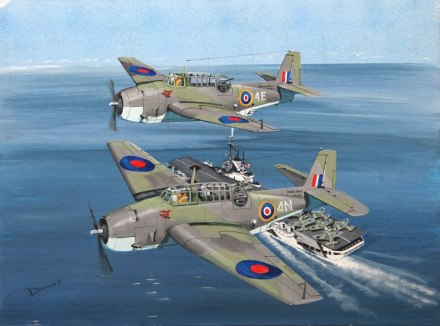
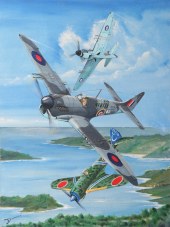
At the time of S/Lt Macwhirter’s death the HMS Shah had just completed an operation to the United States to collect equipment and airframes for twelve Avenger aircraft allocated to 851 Naval Air Squadron (FAA) on the 14th.  The Shah sailed for Melbourne, departing Australia on 8th February 1944 for Cochin.  On the 23rd February she disembarked her ferry load of American fighters; this included the Avenger airframes earmarked for 851 squadron.

851 squadron was to remain ashore until 6th March before rejoining the ship. The next two weeks would be spent working up her air department and flight deck parties; this was the first opportunity for flying operations to be carried out.  HMS Shah arrived in Colombo on February 19th and 851 was flown off to RNAS Colombo Racecourse. Aircraft were embarked as required when further training; it was on such training that 851 suffered its first operational loss when Avenger FN813 stalled and ditched in the sea off the West coast of Ceylon while conducting a night anti submarine exercise on April 14th killing all three crew members, including S/Lt Cecil John Macwhirter, our South African son of Samuel and Elizabeth MacWhirter.

FAA9

FAA Tarpon (Avenger) Mk 1 by Derrick Dickens

“When the Grumman Avenger first joined the Fleet Air Arm in 1943 it was very aptly named after a big ugly bird, the Tarpon. No 832 was the first Tarpon squadron to be formed and  in December 1942 they  sailed on HMS Victorious to America to commence training on the new torpedo bomber at the US Naval Air Station, Norfolk, Virginia They were equipped with US navy aircraft as the British machines were not ready Their first embarkation was on USS Saratoga and they landed up in the Pacific theater in April 1943. A month later they re-embarked on HMS Victorious for a period of operations in the Solomons. The FAA retained the name Tarpon until January 1944, when the name was changed back to the original American Avenger and  became known as Avenger 1s” (Stringbag to Shah by Derrick Dickens).

The second last South African to be lost fighting in Fleet Air Arm was with 1772 Squadron (FAA) on the HMS Indefatigable, he was also a member of the South African Navy and seconded to the Fleet Air Arm.

HMS Indefatigable 

LA GRANGE, Antony M, Sub Lieutenant (A), SANF, Fleet Air Arm (Royal Navy)1772 Sqn HMS Indefatigable, air operations, MPK 28 July 1945

FAA10

FAA Firefly Mk 1 by Derrick Dickens

In July 1945 1772 Naval Air Squadron, flying Fireflies, boarded HMS Indefatigable and joined the British Task Force 37 which then joined the US Task Force 38 in the northern Pacific for the final assault on the Japanese Mainland. The combined Task force comprised 14 Fleet Carriers, 25 Cruisers , at least five battleships, 75 Destroyers, and many other craft…. and 1300 aircraft. This was the largest naval force ever gathered in one area in history. The American Fleet comprised at least three-quarters of that combined fleet.

Many raids and bombardments took place in these last days of the war and losses were considerable despite the fact that the Japanese forces were very depleted by this time. The previous engagement had been largely American again and of course the European war had ended. This was the final massive battle against the remaining island possession occupied by the Japanese, Okinawa. Noteworthy in this engagement, which cost many American lives, was the Kamikaze and the Indefatigable received one Kamiikaze strike on its deck, killing several personnel.

The HMS Indefatigable went on to join the Americans in Tokyo Bay for the Peace Treaty signing.  S/Lt. Antony Michael La Grange, the son of Mrs. I. B. La Grange, of Albertinia, Cape Province, South Africa is remembered on the Plymouth Memorial.

FAA11

FAA Firefly Mk IV by Derrick Dickens

“The Fairy was conceived in the late “thirties”, blooded on the mid “Forties” withdrawn from production in the mid “Fifties” and finally retired in the mid sixties such was the 25 year lifespan of one of the most versatile aircraft to lift off a carrier deck. Combining performance, handling, maneuverability, and firepower never before displayed by a previous ship board aircraft, it wrote its own history due to its adaptability for roles and weapon loads unforeseen at the time of the creation of this handsome fighter – reconnaissance aircraft. The Firefly saw relatively limited action during World War Two, never the less it earned for itself a place in naval aviation history, for although the longevity of the Firefly was to be superceded, and its remarkable versatility was to remain peerless.  1,702 Fireflies were built over a period of 14 years, the most of them in post world war two guise which differed greatly in role and different in appearance from the original aircraft which made its operational debut on HMS Indefatigable, taking part on the attacks on the German battleship Tirpitz” (Stringbag to Shah by Derrick Dickens).

The final South African to be lost in World War 2 flying for the Fleet Air Arm was also a member of the South African Navy seconded to the FAA on HMS Landrail.

HMS Landrail

22308811_10155537271456480_3745202244434378650_nWAKE, Vivian H, Ty/Lieutenant (A), FAA Fleet Air Arm (Royal Navy) 815 Squadron HMS Landrail, air crash, SANF, MPK 28 March 1945
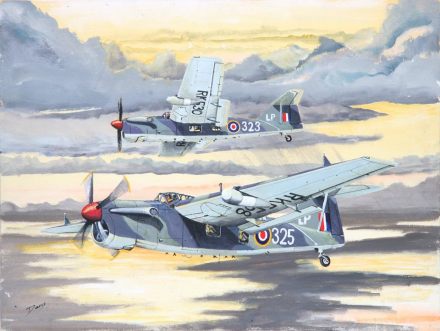
By the time of Ty/Lt. Wake’s death, 815 Squadron had been reformatted in November 1944 at HMS Landrail, a shore base now called RNAS Machrihanish located 5 km west of Campbeltown on the western side of the Kintyre Peninsula in Scotland.

FAA 815 Squadron by this stage was flying Barracudas on anti-submarine operations, and doing DLT (deck landing training) on HMS Campania in preparation for the final operations in the Far East against Imperial Japan.

FAA12

FAA Barracuda Mk V

“The Barracuda was a large ugly beast of an aeroplane, when its wings were folded it looked like some prehistoric bird straight out of Jurassic Park. Un-pretty, big bulky, solid and generally disliked by the aircrew, they were used to good effect in 1944 during attacks on the Tirpitz, which was lying crippled in Kaafjord, North Norway, after being damaged in an attack by midget submarines. From April 1944 Nos. 810 and 847 began operations in the pacific theatre on board HMS Illustrious. Barracudas were also heavily involved in dive bombing attacks on Japanese land and maritime targets, as well as raids against Japanese targets in Sumatra. They continued to support the Allies advance until the end of the war

Towards the end of the war a major redesign of the Barracuda was undertaken to provide an interim aircraft for use in the war against Japan, until the Fairey Spearfish became available. This development resulted in the Barracuda TR Mk V”. (Stringbag to Shah by Derrick Dickens).

In Conclusion

HRH Prince PhilipThe best way to summarise the Fleet Air Arm, its commitment and sacrifice is in fact found in the forward of Derrick Dickens’ Stringbag to Shar’ written by none other than the Admiral of the Fleet, HRH Prince Philip, Duke of Edinburgh K.G., K.T., O.M., G.B.E.
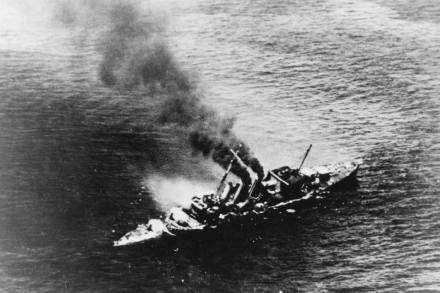
“When you look at the difficulties experienced by the pioneers of aviation Lord Cayley, the Wright brothers, Hiram Maxim and Colonel ‘Buffalo’ Bill; Cody – to get a machine to take off from mother earth and to fly through the air, it is not surprising that many people considered them to be extremely foolhardy, if not actually insane. To the far-sighted, the use of aircraft in war may have seemed obvious, it really needed the conviction of a saint to visualise the practical use of aircraft in a war at sea.

This splendid book traces the chequered history of naval aviation, and the extraordinary vision and determination of the designers, builders and pilots of naval aircraft against every sort of discouragement. It also illustrates the remarkable imagination of those who helped to develop all the ancillary equipment, such as aircraft carriers, catapults, arrestor wires, angled decks, ‘ski-jumps’, and all other gimmicks that enabled naval aviation to make a solid impact on the war at sea.

Looking through the illustrations in this book, it seems almost unbelievable that men could be found, not just to fly them, but to inflict damage on the enemy, and return to tell the tale.

The contribution of naval aviation to the war at sea during WW1 and WW2, may not have made the headlines in quite the same way as land-based aircraft, but, as the final days of the war against Japan demonstrated, the participation of naval aircraft was crucial to the ultimate allied victory”.

Related Work and Links

Related work of South Africans serving in the Royal Navy’s Fleet Air Arm

HMS Hermes “Dante’s Inferno”; Recounting South African sacrifice on the HMS Hermes

Dick Lord Dick Lord – the combat legend who took learnings from the Royal Navy’s Fleet Air Arm to the SAAF

Easter Raid The South African Navy’s ‘darkest hour’ is not recognised and not commemorated


Written and Researched by Peter Dickens, references from Wikipedia, The Commonwealth War Graves Commissioned, SAAF and RAF Honour Roll compiled by Graham du Toit, BBC People’s War, Fly Navy – HMS Shah, Fleet Air Arm Officers Association, CASUALTIES BY DATE and SHIP Compiled by Don Kindell sourced on the Royal Naval History Homepage.

Large extracts and paintings taken from “Stringbag to Shar 1938 to 2006” Compiled by Derrick Dickens. All the images used in this book are photographs of original paintings
by the author. These images may not be used anywhere else without the
specific permission of the copyright owner – Mr Peter Dickens. Images © Derrick Dickens 2008. (All original paintings).

“A terrific explosion lifted the ship out of the water”

Recounting South African sacrifice on the HMS Cornwall

This is an image of the HMS Cornwall under attack just prior to her sinking, it was taken by the Japanese attack aircraft. A number of South African Navy personnel were lost with this ship whilst seconded to the Royal Navy during World War 2.

11227764_471697846333286_6697642980063770182_n

As Simonstown in South Africa was a British Naval base thousands of South Africans in WW2 served in the Royal Navy as well as in the South African Naval Forces (SANF). The loss of a heavy Cruiser the size of the HMS Cornwall is bound to include a South African honour roll and unfortunately this one does. Read on for their story.

HMS Cornwall Short History

hms_cornwall_F99_emb_n12997HMS Cornwall was a heavy cruiser of the Kent-subclass of the County-class. When World War 2 began in September 1939,  Cornwall was transferred from her pre-war China Seas operations to the Indian Ocean and joined Force I at Ceylon.
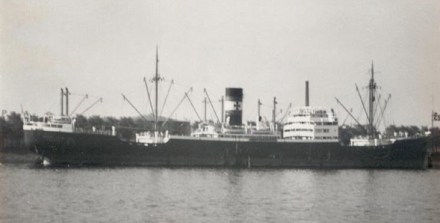
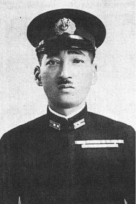
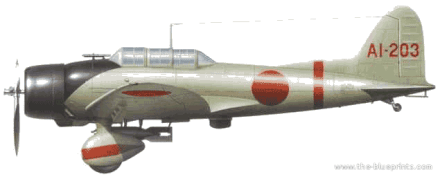
On 5th October 1939, she was involved in the search for the German pocket battleship Admiral Graf Spee. Between the 8th  and 14th February 1940, she was docked at the Selborne dry dock at Simonstown, South Africa.  Its was here that she would have taken onboard a large contingent of South Africans either volunteering for the Royal Navy or seconded to the Royal Navy as members of The South African Naval Forces stationed there.

In September 1940, together with HMS Delhi, she intercepted Vichy-French light cruiser Primauguet and tanker Tarn, forcing them to return to Casablanca, Morocco. By January 1941, HMS Cornwall returned to the Selborne dry dock in South Africa for refitting, at the same time taking on more South African personnel.

Sinking of the German Auxiliary Ship Pinguin

The HMS Cornwall was on patrol in the Indian Ocean of Seychelles when she engaged and sank the German ship ‘Pinguin’ on the 8th May 1941, Pinguin was known to the German Navy as Schiff 33, and designated HSK 5. The most successful commerce raider of the war, she was known to the British Royal Navy as Raider F.

Unfortunately, without the knowledge of Cornwall’s crew, Pinguin sank along with 200 Allied prisoners of war in addition to 232 Germans lost (60 German crew members and 22 Allied prisoners were rescued). She returned to Durban, South Africa to repair her stern, which was damaged during the battle against Pinguin; the repairs lasted until 10th  June 1941.

HK Pinguin

HK Pinguin

On the 25th November 1941, Cornwall intercepted the Vichy-French merchant vessel Surcouf in the Indian Ocean off the east coast of Somalia. Surcouf was originally en route to Djibouti with food, but was forced to sail to Djibouti instead.

Between January and March 1942, Cornwall escorted convoys between Ceylon and the Sunda Strait in the Dutch East Indies. In March 1942, she was sent to Colombo, Ceylon in preparation for a possible Japanese attack into the Indian Ocean.

The Easter Sunday Raid

With Japan’s entry into the war, and especially after the fall of Singapore, Ceylon (now Sri Lanka) became a front-line British base. The Royal Navy’s East Indies Station and Eastern Fleet was moved to Colombo and Trincomalee.

Admiral Sir James Somerville was appointed as the commander of the British Eastern Fleet, and he decided to withdraw main component the fleet to Addu Atoll in the Maldives, leaving a small force to defend Ceylon (Sri Lanka) consisting of an aircraft carrier, the HMS Hermes, two heavy cruisers – the HMS Cornwall and HMS Dorsetshire, one Australian Destroyer the HMSAS Vampire and the flower class corvette, the HMS Hollyhock.

The Royal Navy’s own ‘Pearl Harbour’

The Imperial Japanese Navy, in much the same way and with the same objectives that were used at Pearl Harbour against the American fleet planned a decisive attack of the British Eastern Fleet to end their presence in the North Indian and Pacific oceans.  Unaware that the main body of the British fleet had moved to the Maldives, they focused their plan on Colombo (the commercial capital of modern-day Sri Lanka).

The planned Japanese attack was to become collectively known as the Easter Sunday Raid and the Japanese fleet comprised five aircraft carriers plus supporting ships under the command of Admiral Chuichi Nagumo.

In an almost exact copy of the raid on the American fleet at Peal Harbour (as if no learnings were made by the Allies), on 4 April 1942, the Japanese fleet was located by a Canadian PBY Calatina aircraft, the Catalina radioed the position of the Japanese Fleet to The British Eastern Fleet which alerted the British to the impending attack before it was shot down by six Japanese Zero fighters from the carrier Hiryu,

However, despite the warning Nagumo’s air strike on Colombo the next day, Easter Sunday 5th April 1942 they did manage to achieved near-complete surprise (Pearl Harbour was also attacked on a weekend). The British Radar installations were not operating, they were shut down for routine maintenance (another parallel with the attack on Peal Harbour).

Easter Raid

Captain Mitsuo Fuchida

The first attack wave of Japanese planes took off in pre-dawn darkness (30 minutes before sunrise) from the aircraft carriers Akagi, Hiryu and Soryu, moving about 200 miles south of Sri Lanka. The first attack wave of 36 fighters, 54 dive bombers, and 90 level bombers was led by Captain Mitsuo Fuchida the same officer who led the air attack on Pearl Harbour.

The Heavy Cruisers, HMS Cornwall and HMS Dorsetshire set out in pursuit of the Japanese. On 5 April 1942, the two cruisers were sighted by a spotter plane from the Japanese cruiser Tone about 200 miles (370 km) southwest of Ceylon. A wave of  Japanese dive bombers led by Lieutenant Commander Egusa took off from Japanese carriers to attack Cornwall and Dorsetshire, 320 km (170 nmi; 200 mi) southwest of Ceylon, to sink the two ships.

In the attack, the Japanese airman flying Japanese  D3A-1 ‘VAL’ dive bombers, then dropped 9 bombs on the HMS Cornwall itself ( 250- and 550-pound bombs) and six near misses, the HMS Cornwall becoming dead in the water within minutes, the HMS Cornwall sank in about 12 minutes after the first hit (and Dorsetshire suffered the same fate).

aichi-d3a1-mod-22-val

An eye-witness account from a South African officer on board the Cornwall recounts the ferocity and speed of the attack:

Sub-Lieutenant R. Ellis Brown, son of the mayor of Durban, said he was down below in the control room of the high angle guns when the warning was flashed that aircraft were attacking.

“Almost immediately afterwards there was a terrific explosion and the ship lifted out of the water and listed to port, “ he said. “This was followed almost immediately by another hit. The lights went out and I continued on to the sick bay. I went forward from there to contact the control officer and shortly after I left, a bomb dropped on the sick bay, killing most of the men there. I could not get through on account of the flames, so went to the aft deck. Here we managed to get a whaler and also five or six floats. We got the men off and I looked up and saw a dive-bomber coming down at me. I saw the bomb released at about 700 feet and it appeared to be coming straight at me. Although I knew that if a bomb appeared to be coming straight at you it would actually fall far beyond. I must say I did not like it one bit. The men jumped into the water and finally the two other officers and myself left on this deck followed them.”

Sub-Lieutenant Ellis Brown said that the men were in the water for about 30 hours. The wounded were placed in a motor boat which had floated off when Cornwall sank. The remainder stayed in the water, hanging on to debris and floats. To the discomforts the men suffered in the water was added the horror of knowing they were in shark-infested waters.  He recalls, “We saw several fins cutting the water but as soon as they came near, the men would kick and shout and they would make off.”


DorsetshireCornwall

Japanese combat photograph showing the Royal Navy heavy cruisers HMS Dorsetshire and HMS Cornwall on fire and sinking


HMS Cornwall was sunk in position 01º54’N, 77º45’E. All boiler and engine rooms were out of action within minutes, thereby resulting in a lack of power to the pumps and fire fighting equipment. In all the men spent 30 hours in the water, before a combined rescue of the HMS Dorsetshire men (also in the water) and HMS Cornwall’s men by the HMS Enterprise, HMS Paladin and HMS Panther. In total 192 of Cornwall’s men were lost, of a very high proportion – 23, were South African.  Here is the South African Naval Forces honour roll (MPK means ‘Missing Presumed Killed’) from the sinking;.

HMS Cornwall – South African Navy Personnel Lost, Honour Roll

22308811_10155537271456480_3745202244434378650_nBESWETHERICK, Hedley C, Ordinary Seaman RNVR, 86671 (SANF), MPK
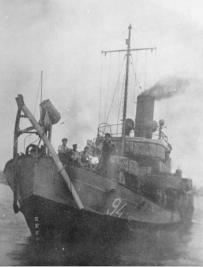
BOTES, John S, Stoker 2c RNVR, 68924 (SANF), MPK
COMMERFORD, Noel P, Able Seaman RNVR, 66493 (SANF), MPK
CRAWFORD, Cecil E, Act/Engine Room Artificer 4c RNVR, 67922 (SANF), MPK
DU PREEZ, Charles P H, Able Seaman, 68175 (SANF), MPK
DUTTON, Charles C, Stoker 2c RNVR, 68949 (SANF), MPK
HANSLO, Raymond F, Able Seaman RNVR, 68295 (SANF), MPK
KEITH, Kenneth I B, Able Seaman RNVR, 66742 (SANF), MPK
KENYON, Graeme A B, Able Seaman RNVR, 68002 (SANF), MPK
KIRSTEN, Monty G W, Able Seaman RNVR, 68917 (SANF), MPK
LAW, Edward, Act/Engine Room Artificer 4c RNVR, 66760 (SANF), MPK
MCDAVID, William K, Stoker 2c RNVR, 69138 (SANF), MPK
MITCHELL, William A, Stoker 1c RNVR, 68796 (SANF), MPK
PALMER, Walter A, Able Seaman RNVR, 68344 (SANF), (rescued, aboard HMS Enterprise), Died of Wounds
SPENCE, Noel W, Ordinary Seaman RNVR, 68732 (SANF), MPK
SQUIRES, John E, Ordinary Seaman RNVR, 68728 (SANF), MPK
STEPHEN, Eric B, Ordinary Seaman RNVR, 68861 (SANF), MPK
SWANN, Lawrence T, Stoker 1c RNVR, 68710 (SANF), MPK
THORPE, Maurice, Stoker 2c RNVR, 69140 (SANF), MPK
VERSFELD, Peter H S, Able Seaman RNVR, 68859 (SANF), MPK
VINK, Benjamin F, Ordinary Seaman RNVR, 68860 (SANF), MPK
WILLSON, Gerald F, Stoker 2c RNVR, 69006 (SANF), MPK
WRIGHT, Thomas H, Able Seaman RNVR, 68039 (SANF), MPK

In earlier incidents on HMS Cornwall two South Africans lost their lives they are also remembered here:

AINSLIE, Roy, Petty Officer, 66382 (SANF), died on 5 September 1940
HAWKINS, Reginald D, Able Seaman, 66700 (SANF), died of illness 4 March 1942

Some South Africans may not accounted in the above list as they may have been Royal Navy personnel having volunteered to serve in the Royal Navy, there is a long list of South Africans not accounted on the Navy’s honour rolls because of the complication of citizenship, the position of the South African Union in supporting the war and the nature of Simonstown as British territory.

Related work 

The Japanese Easter raid was to bring a terrible toll on not only the Royal Navy, but also on the South African Navy whose personnel were involved.  It remains the South African Navy’s darkest days, as not only were the HMS Cornwall and HMS Dorsetshire full of SANF personnel, so too were the other two ships sunk later in this engagement on the 9th April 1942 by the same Japanese raiders – the HMS Hermes, see related article by clicking this link (“Dante’s Inferno”; Recounting South African sacrifice on the HMS Hermes) and HMS Hollyhock, see related article by clicking this link ( “She immediately blew up”; Recounting South African sacrifice on the HMS Hollyhock).

The HMS Dorsetshire is featured in a full Observation Post article, follow by clicking this link (“They machine gunned us in the water”; Recounting South African Sacrifice on the HMS Dorsetshire).

In Conclusion

This history is lost to most South Africans, however good work is now been done to try and correct and up-date these honour rolls and recount the full depth of South Africa’s involvement in warfare at sea during World War 2.  We, as South Africans, do however have an excellent tradition at the Selborne Graving Dock, the dry docks in Simonstown, allowing visiting crews to paint their ships emblems on the docks walls, it is an excellent record of many of the proud Royal Navy fighting ships who visited our shores in World War 2 and on whom many South Africans served.  Next time you are there look out them, including the HMS Cornwall.

Their names have not been forgotten.

3397451999_8e45bbe5a4_b


Written and researched by Peter Dickens, with extracts taken from Wikipedia, Force-z survivors official webpage, the British Broadcast Corporation account on the war (BBC)  WW2 The Peoples War. Casualty Lists of the Royal Navy and Dominion Navies, World War 2 by Don Kindell.

The last South African Navy ship to be lost in action; HMSAS Treern

It is not known now to many modern South Africans, but the South African Navy lost four ships in total during WW2, all of them minesweepers.  Hardly recognised today all these ships carried with them tales of great bravery,

The first ship lost in the Mediterranean near Tobruk was the HMSAS Southern Floe with its remarkable tale of a single survivor (see The HMSAS Southern Floe was the SA Navy’s first ship loss & it carries with it a remarkable tale of survival.).

The second ship lost was the HMSAS Parktown, which went down fighting during the Fall of Tobruk in Libya, with the HMSAS Bever fighting at her side out the port (see The feisty South African minesweeper that went down fighting – HMSAS Parktown).

The third ship to be lost was the HMSAS Parktown’s sister ship, the HMSAS Bever which went down later in the war during the liberation of Greece when it struck a mine, and carries with its story a tale of miraculous survivors (see “Under a hail of shells”; Recounting the bravery and loss of HMSAS Bever).

The final minesweeper to be lost was the HMSAS Treern, it was tragically lost right at the end of the war, and it remains the last South African vessel to be lost in action, even to this day, yet hardly anyone is aware of her history.

So lets examine this last combat loss, and why it is that we tend to overlook all this sacrifice at sea in the South African Navy’s vessels during the Second World War.

The second minesweeping flotilla prepares for the Mediterranean 

27797891_2090641777831476_3648925428113256571_o

HMSAS Treern

On the 12 May 1941, the HMSAS Treern (under the command of Lt. H H Cook) is commissioned, she is a whaler now converted for wartime service.  Now a magnetic minesweeper she is given her number T451 and allocated the pennant number 94.

By the beginning of November 1941, there is a small flotilla of South African minesweepers ready for deployment in the Mediterranean in support of Allied combat operations there.  The HMSA Ships, Bever, Gribb, Seksern, Imhoff, Treern, Parktown and Langlaagte, all are former whale catchers of about 260 tons and built between 1926 and 1930, and all are ready to go as part of the 166th Minesweeping Group in the Mediterranean.   Each minesweeper is fitted with one 3 inch gun plus smaller QF guns, depth charges and LL sweeps.  They are the second group of South African minesweepers to sail from Durban for the Mediterranean.

The liberation of Greece 

The Treern has a long record of service conducting duties alongside Allied shipping, she spends almost the entire war in the combat zone, towards the end of the war she finds herself under the command of Lt. P Byrne assisting in the liberation of Greece sailing in the Aegean Sea – the end of the war in Europe and surrender of Germany is a tantalising four months away.

Treern

HMSAS Treern

By January 1945 the situation in the Greek Islands was somewhat confused. Initially the task of the Allies appeared to be a straightforward one; simply the supply and distribution of food and other essentials and the opening up of communications which, from the nature of the country, was largely by sea. However, internal dissension (which the retreating German forces had done their best to promote) considerably complicated and delayed the Allied take over.

ELAS

The Greek People’s Liberation Army or ELAS was the military arm of the left-wing National Liberation Front (EAM) during the period of the Greek Resistance until February 1945, then during the Greek Civil War.

HMSAS Treern, with orders to relieve HMSAS Seksern at Volo, arrived there at noon on 27 December 1944 only to find the harbour deserted and therefore anchored in the bay whilst radioing for instructions. Soon afterwards an emissary from ELAS (Greek People’s Liberation Army) arrived, ELAS was one of the factions in the internal dissension in Greece caused by the vacuum created by the German occupiers retreating from Greece.

The ELAS emissary informed the HMSAS Treern that Volo was under ELAS control and then asked the Captain what his intentions were.

The ELAS emissary eventually agreed to let the ship remain there for the night. Next morning Treern left for Skiathos where she met up with the British destroyer, HMS Musketeer, considerably to the relief of both captains, and came under the orders of the Musketeer.

In the town of Volo a somewhat lukewarm ELAS control prevailed – political fervour being influenced by the presence of the destroyer and her 4.7-inch guns, under cover of which all local craft, arriving and leaving, were interrogated and searched for arms.

mus

Treern assisted in this duty for the next few days before being attached to a small naval force then operating against the ELAS in the Gulf of Volo and along the north-east coast of Euboea.

The loss of the HMSAS Treern

On the morning of 12 January whilst off the northern shore of the Trikiri Channel and towing a caique laden with fuel for motor launches then lying off Volo. At about 08:30 there is a huge explosion, presumably caused by a mine, which destroys Treern almost immediately with a very heavy loss of life.

Only one man survives 

The only survivor, Stoker J.J. Bosch, later states that he was in the port waist, while most of the other men off duty were watching a pig being slaughtered on the boat-deck above him. Suddenly he felt a tremendous concussion and found himself somersaulting through the air into the water. On coming to the surface he found a life buoy floating near him and saw the last few feet of the ship’s bows disappear below the surface.

At the same time another mine exploded about 100 yards away, presumably a sympathetic detonation caused by the first explosion. One of his legs had been injured, but the caique picked him up and about an hour later transferred him to HMS Musketeer.

Honour Roll

MPK means ‘Missing Presumed Killed’.  SANF stands for ‘South African Naval Forces’.

22308811_10155537271456480_3745202244434378650_nANDERSON, Robert D, Engine Room Artificer 2c, 71067 V (SANF), MPK
BARKER, Ronald E, Sub Lieutenant, SANF, MPK
BLAKE, Robert E, Petty Officer, P 6572 (SANF), MPK
BROWN, Ian H, Able Seaman, 71719 V (SANF), MPK
BYRNE, Patrick, Lieutenant, SANF, MPK
DAVIE, William, Stoker 1c, 70681 V (SANF), MPK
ENGELBEEN, Leslie C, Able Seaman, 562235 V (SANF), MPK
JACOBZ, Frank H, Stoker 1c, 70374 V (SANF), MPK
MATTHEWS, George A, Stoker 1c, 70728 V (SANF), MPK
MCINTYRE, William G, Cook (S), 585360 (SANF), MPK
MCLARTY, William D, Leading Stoker, 562246 V (SANF), MPK
MCLEAN, Godfrey, Able Seaman, 562455 V (SANF), MPK
NILAND, St John E, Able Seaman, 209905 (SANF), MPK
PERRY, Desmond A, Petty Officer, 71211 (SANF), MPK
REID, Kenneth H, Signalman, 562143 V (SANF), MPK
SALCOMBE, Francis R, Stoker 1c, 58589 V (SANF), MPK
STAPELBERG, Willem J, Steward, 562221 V (SANF), MPK
SUTTON, Donald A, Able Seaman, 70426 (SANF), MPK
SUTTON, George A M, Leading Seaman, 586403 V (SANF), MPK
TRAFFORD, William O, Able Seaman, 71222 V (SANF), MPK
VILJOEN, Dennis A, Telegraphist, 70984 V (SANF), MPK
WHITE, Charles W, Petty Officer, 562200 V (SANF), MPK
WULFF, Emil F, Leading Seaman, 562466 V (SANF), MPK

In Conclusion

Successive generations of South Africans have not been exposed to the gallantry of South African servicemen at sea, many remain blissfully unaware of all the heroic actions of South African fighting ships during World War 2.

Little remains of this history, and it now has to ‘dug up’ from recent research conducted by Chris Bennet and Allan du Toit, very little to nothing is available in public on-line records such as Wikipedia, such is the degree to which it has been wiped from the South African national consciousness.

The reason for this is political, the incoming Nationalist government after the war in 1948 regarded all of South Africa’s and Smuts’ exploits during World War 2 as one of treachery (siding with the ‘hated’ British), so no large-scale Naval commemorations or recognition ceremonies were ever undertaken by the South African Navy to maintain this memory.


Researched by Peter Dickens.  Reference: Large extracts taken from Day by Day SA Naval History by Chris Bennett. Casualty Lists of the Royal Navy and Dominion Navies, World War 2 by Don Kindell. Images of South African vessels courtesy Allan du Toit and reference from his book ‘South African Fighting Ships’.