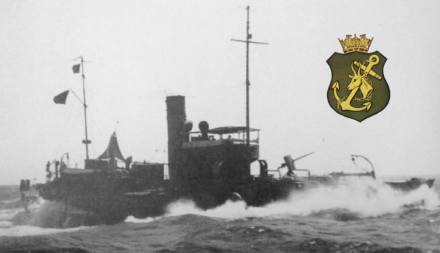
“Under a hail of shells”; Recounting the bravery and loss of HMSAS Bever

The third South African ship to be lost in the Mediterranean during the Second World War was the HMSAS Bever.  She was the brave little minesweeper who had earlier fought her way out of Tobruk with her sister ship – the  HMSAS Parktown.  She had a very proud legacy from her actions in Tobruk and her loss later in the war was deeply felt, so let’s have a look at another brave South African whaler, converted to a fighting ship, punching way above her weight.

On the 10 October 1941, the little whaler ‘Hektor 10’ was commissioned in South Africa as His Majesty’s South African Ship (HMSAS) Bever for wartime service as a minesweeper.

Barely a month later, on the 1 November 1941, she joined the small flotilla of South African minesweepers sailing from Durban for the war in North Africa.  This flotilla was made up of the HMSAS Bever, HMSAS Gribb, HMSAS Seksern, HMSAS Imhoff, HMSAS Treern, HMSAS Parktown and HMSAS Langlaagte.

All were former whale catchers of about 260 tons built between 1926 and 1930 and each was fitted with one 3 inch gun plus smaller QF guns, depth charges and LL sweeps.  They are the second group of South African minesweepers to sail from Durban for the Mediterranean.

Little would they know that all of them would make a significant difference to the war effort – and sadly, three of the four ships South Africa would lose during the war would come from this flotilla – the HMSAS Parktown, the HMSAS Bever and the HMSAS Treern.  The first South African minesweeper had already been lost in the combat zone by this stage – the HMSAS Southern Floe (see The Southern Floe was the SA Navy’s first ship loss, but it also carries a remarkable tale of survival.)
17546669_10154957768326480_68053892438750609_o

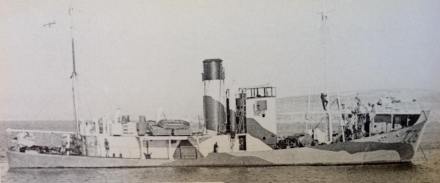
HMSAS Southern Floe

The fall of Tobruk

The HMSAS Bever and HMSAS Parktown sailed from Alexandria, Egypt on the 9 June 1942 as part of a escort for a convoy bound for Tobruk. During the passage they see combat for the first time when the convoy is attacked and the HMSAS Parktown is involved in the gallant rescue of 28 survivors from a ship that had been sunk, many of whom are badly burnt.

After their arrival in Tobruk on 12 June 1942, the HMSAS Parktown and her consort, HMSAS Bever (at this stage under the command of Lt P A North), are tasked with keeping the approaches to Tobruk clear of mines.
parktown

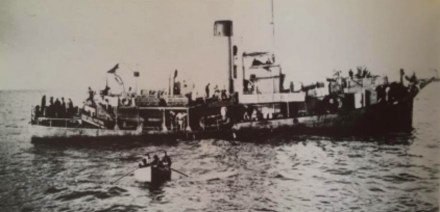
HMSAS Parktown

In 1941 the Australians had held Tobruk for 9 months, until Rommel’s withdrawal of his Axis forces to the west.  Tobruk secured, by 1942 the Allied Middle East Command decided to leave a smaller ‘temporary’ force to hold Tobruk while a new strike force was built up near the frontier.  The task of defending Tobruk was left to the South Africans. The new  garrison was to be formed by the 2nd South African Infantry Division with General Klopper, a major general of 1 month’s standing, given command of Tobruk.  In addition, units of British and Indian detachments fell under South Arican command defending Tobruk.

It is generally understood that by this stage Tobruk’s defences were in a poor shape with much of the armour and artillery taken away to the new frontier, the Western and Southern sides of the port were well defended by the South Africans, but the East side was weak, and it proved to be fatal.

As usual, Rommel had devised a ruse for capturing Tobruk. Only his infantry approached the western perimeter, while his mobile forces swept on past, to give the impression that the German and Italian armour was heading straight for the Egyptian border (sending radio messages to that effect to complete the ruse).  He then swung his mobile armoured forces around and attacked Tobruk from its weak point – the eastern perimeter.

Rommel’s zero hour was 05h20 on 20 June 1942. As dawn broke long black lines of tanks, trucks and infantry slowly started to move forward. As it grew louder and closer to Tobruk waves of German Stukas and Ju 88’s aircraft appeared overhead (Rommel pressed every single Axis airplane in service in North Africa into taking Tobruk).

As the heavy artillery began to fire, the planes released their bombs and quickly got out of the way for the next wave, operating a shuttle service between the defence perimeter and El Adem airfield, 10 miles away. They pounded a gap open 600 yards wide. Behind them, under cover of artillery barrage and half-hidden by smoke and dust, German and Italian sappers raced forward to lift mines and bridge the tank traps with tanks and infantry racing through the gaps. As they move forward, they lit green, red and purple flares and the Stukas dropped their bombs just ahead of the advancing, multi-coloured smoke screen while the other planes and artillery blasted the South African rear (the seaward side of the port) with shells and bombs.
Tobruk, beschädigte Häuser, Soldaten

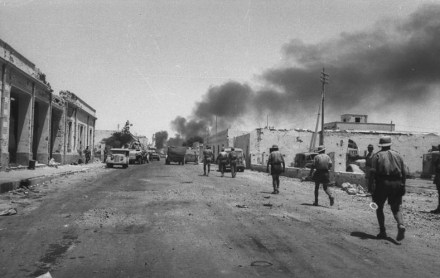
Surrounded South African troops going into captivity as Tobruk falls

Inside Tobruk the situation was chaotic. General Klopper – his HQ’s bombed out, his radio and telephone wrecked and his code booked destroyed, lost the last vestige of control.  It became clear that a crisis was imminent. Late that same afternoon HMSAS Parktown and HMSAS Bever were ordered to enter harbour to embark evacuation parties and get as many Allied troops out as they can.

By 20:00 that evening the two minesweepers watch the Axis forces entering the town and then reach the harbour shortly afterwards. The rapidity of the attack causes great confusion, however, the two brave little South African minesweepers still manage to embark most of the men allocated to them before they sail under a hail of artillery and gunfire.

“It was like hell”

The account is best described by an ordinary South African, Stoker Petty Officer (SPO) Turner who was on the HMSAS Bever (‘Jerry’ means the Germans).

“At the end of the fifth week we had been there, Jerry started a terrific push which carried him through almost to Tobruk. We had some very nasty air raids, but the warning came one night when a shell whistled over us and landed behind the town. We knew then that they had brought up big guns and were going to shell us out of the place.

Our ship (HMSAS Bever) and our partner ship (the HMSAS Parktown) continued their work through a week of this shelling and I can assure you it was very uncomfortable.

Then we were informed that Tobruk was besieged, as Jerry had completely surrounded us. On Saturday, June 2O, it happened, and that date will be impressed on my memory as long as I live. It was early morning and we were just pulling away to start our daily job, when the shells started coming over with a vengeance.

They had found their range and planted their shots just where they wanted them, in the town, on the quay, round the wrecks, at the oil berth – and we were sailing along with this lot falling around us:

Then bombers appeared on the scene. We went out, did our job, and returned to our anchorage. This went on until about three clock in the afternoon. The target area was mostly the quay and wharfs.

Then Stukas appeared over the hill and started giving our troops the works. It was like hell. Shells, level bombing and dive-bombing – and there we were at anchor in the centre of it all, expecting any moment to stop something and be blown sky high.

At about four o’cock Jerry broke through our lines and our lads had to retire. This was all done in an orderly manner, and they burned everything they had to abandon. Then we received orders to go to the quay, which all the available ships did and picked up what men we could under a hail of shells. As we pulled away, a shell got us in the funnel. The quay was blown up and Jerry tanks entered the town.

Sandy and I, down in the engine room, gave her all she had and she never travelled faster in her life. Meanwhile a motor launch laid smoke screen for us. Jerry tanks opened up on us from the shore and in all we received four hits by explosive shells.

It was a miracle that we were not blown to bits, because the tanks along the shore were following us with their fire. At the harbour entrance the fire was even more concentrated and only God Himself took us past that. We lost the steward in our dash. As he tried to help a man out of the water into the boat, an exploding shell killed him.

The last I saw of Tobruk” concludes Stoker Petty-Officer Turner “was flashes and flames and a great pall of smoke on the horizon, as the troops continued giving Jerry everything they had till the end.”

Tobruk, Rommel und Bayerlein, Hafen

Erwin Rommel surveys Tobruk after capturing it

Fighting their way out

Fighting bravely next to the HMSAS Bever was the HMSAS Parktown, both these South African vessels received order to embark as many men as possible from shore and to await sailing orders. Late that afternoon Bever was instructed to sail.  Parktown would follow later.

Heavily laden with men clinging to all parts of ship, HMSAS Bever put to sea. By that stage at least six German tanks had taken up a position on shore with their guns covering the harbour. The minute HMSAS Bever began to move out of the harbour she was heavily engaged by the tanks and received several direct hits.

The Bever’s commander, Lt Peter Allan North was later awarded the Distinguished Service Cross for gallantry as he decided to take the ship out himself and ordered all men below decks. One man disobeyed the order, a steward who came up on deck to help a soldier who was trying to climb aboard, the two of them were killed instantly by an incoming tank shell.

The Bever cleared the harbour but the attack did not stop there as German bombers swooped in on her, with all her guns blazing the Bever beat off the air assault.

The HMSAS Parktown was the next to leave Tobruk with hundreds of the men from the garrison aboard.  Her fight out the harbour however met with tragedy.  During the night just off Tobruk port the Parktown and Bever became separated as the Parktown goes to the assistance of a disabled tug, also crowded with men.

After taking the tug in tow the HMSAS Parktown’s speed is slowed.  At daybreak on the 21 June the Parktown came under attack by Italian “MAS” torpedo boats (E-Boats), directed to the slow-moving vessel by a German reconnaissance aircraft.  Fighting all the way with all guns blazing the Parktown was eventually overwhelmed by the faster E-Boats and sunk with the loss of many lives.

For a full account of this brave action by the HMSAS Parktown please feel free to read the Observation Post  The feisty South African minesweeper that went down fighting – HMSAS Parktown)

The HMSAS Bever eventually safely reached Mersa Matruh with holes through her funnels, with mast rigging shot away and riddled with splinter holes.

Awards and Citations for the crew of HMSAS Bever

The following awards and decorations to officers and men of HMSAS Bever were bestowed by King George VI.

Distinguished Service Cross. Lieutenant Peter Allan North (H.M.S.A.S. Bever). Comes from Amanzimtoti. Natal. Age 28. Before the war employed in Geduld Mine. Rand. Served in Training Ship General Botha.

Distinguished Service Medal. No. 69628. Petty Officer Alan Sidney Hargreaves (H.M.S.A.S. Bever). Home address, 8. Worcester-road. Sea Point. Age 26. Served in Training Ship General Botha.

Mentioned in Dispatches. No. 132522. Engine-room Artificer Alexander James McCall (H.M.S.A.S. Bever) Home address, 7, Antrim-road Three Anchor Bay. Engineer in private life.

22520227_2035612373334417_1329303744284136988_o

HMSAS Bever

After Tobruk

By November 1944 HMSAS Bever had been in the Mediterranean for nearly two years, by now the war in the Mediterranean had over to the European mainland and the liberation of Greece and conquest of Italy were underway.

Accompanied by another South African minesweeper HMSAS Seksern and a flotilla of other converted trawlers, the Bever arrives in the Gulf of Nauplia (south of the Gulf of Athens) late on 29 November 1944 from Herakleon in Crete, about 160 miles to the south-east.  On that first evening, two motor launches carrying out a skimming sweep destroy several mines and clear a narrow channel enabling the flotilla to anchor for the night.
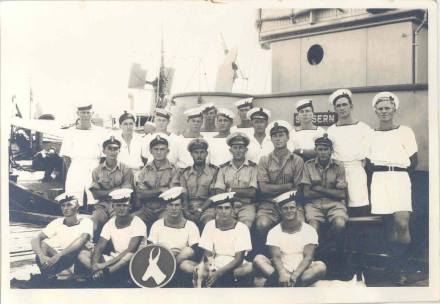
1891559_464422300374999_2454611779820884_o

Ships company HMSAS Seksern Benghazi 1943

The loss of the HMSAS Bever

Next morning (30 November) the clearance continued, with HMSAS Seksern being used as a mark-ship owing to the low visibility (mist and rain-squalls). So many mines now explode in the sweeps that progress soon slowed down and finally halted at about 14:00 whilst four of the ships hove to in order to repair their gear. HMSAS Bever, stationed astern of the trawlers to deal with unexploded mines, also stopped.

At 14:30, while manoeuvring her engines to keep in position, the HMSAS Bever struck a mine with the inevitable result for so small a ship: the bridge collapsed while the after-part disintegrated, its fragments mingling with a huge discoloured geyser which shot up many times higher than the ship’s masthead; and by the time the spray and steam had blown clear, nothing remained but the fore-part which turned over and sank a few seconds later.

Although the normal practice had been followed of making all hands not actually on duty below, remain on deck, considering the rapidity of Bever’s destruction, it is remarkable that eight men were to survive and be picked up alive. The captain and second-in-command were literally blown off the bridge, ending up in the water some distance away. The other survivors appear to have left the ship in much the same manner. One man died of his injuries soon after but the remainder, after receiving first-aid treatment, all recovered satisfactorily.
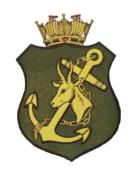
22308811_10155537271456480_3745202244434378650_nThe brave men of the HMSAS Bever sacrificed that day are outlined on the honour roll below (MPK means “Missing Presumed Killed”):

ARMERANTIS, Sideris, Stoker 1c, 282953 V (SANF), MPK
DE PACE, Luigi S, Petty Officer, 66539 V (SANF), MPK
DE REUCK, Leslie B, Telegraphist, 75320 V (SANF), MPK
DREYER, Peter, Leading Cook (S), 585236 V (SANF), MPK
HIGGS, George E, Stoker 1c, 562712 V (SANF), MPK
HUSBAND, Charles A, Stoker 1c, 280098 V (SANF), MPK
KETTLES, John D, Engine Room Artificer 3c, 562458 (SANF), MPK
LAWLOR, Robert J, Act/Chief Motor Mechanic 4c, P/KX 127225, MPK
LINDE, Carl M, Able Seaman, 71194 V (SANF), MPK
LYALL, John D R, Stoker 1c, 562179 V (SANF), MPK
MATTHEWS, William R, Leading Wireman, 562794 V (SANF), killed
PHILLIPSON, Joseph H, Signalman, 181160 V (SANF), MPK
RODDA, Harold J, Stoker 1c, 70451 V (SANF), (served as Harold J Andresen), MPK
SCRIMGEOUR, Quintin, Petty Officer, 69691 (SANF), MPK
TRUSCOTT, E (initial only) W, Able Seaman, 585184 V (SANF), MPK
WHITE, Claude, Leading Seaman, 586420 V (SANF), MPK
WILLIAMS, Desmond, Able Seaman, 70433 V (SANF), killed

The end of a very gallant South African fighting ship. May they all Rest In Peace.
supporting-poppy-appeal


Researched by Peter Dickens, extracts taken from the Military History Journal, Volume 9, Number 1 – June 1992  THE STORY OF A WARSHIP’S CREST by F V Demartinis. Extracts also taken from Day by Day SA Naval History by Chris Bennett. Casualty Lists of the Royal Navy and Dominion Navies, World War 2 by Don Kindell. Images of South African vessels courtesy Allan du Toit and reference from his book ‘South African Fighting Ships’.
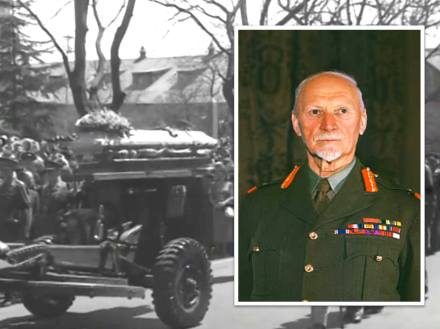
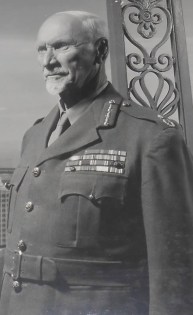
“The force of his intellect has enriched the wisdom of the whole human race”- the death of Jan Smuts.

smutsThere are still a handful of conservative ‘Afrikaner nationalist’ white people in South Africa who would still toe the old Nationalist line on Smuts, that he was a ‘verraaier’ – a traitor to his people, his death welcomed.  However, little do they know that many of the old Nationalist architects of Apartheid held Smuts in very high regard.
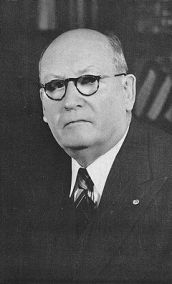
DF Malan, on the day of Smuts’ death, 11th September 1950, was the Prime Minister of South Africa, his Nationalist party had defeated Smuts’ United party two years earlier in 1948 whilst pushing the Nationalist proposals to further entrench racial segregation with a concept they called Apartheid.  Smuts on the other hand, foresaw the need to extend the ideas of ‘Union’ which had brought Afrikaner and Briton together to include Black South Africans. On voting rights, he had made his views clear to Hertzog as early as 1920 when in a private meeting he proposed a Qualification Franchise (not a Universal one though) for black South Africans (Hertzog was an ardent Nationalist and rejected the idea outright).

Smuts was born into a system of ‘Empire’ and that was the socio-political sphere everyone understood, including Smuts.  Over time Smuts’ views on racial segregation gradually evolved from the generally understood divided evolution edicts of his day (based on where nations stood on the ‘civilisation’ continuum).  On the international stage by the mid 1940’s, when Smuts was outside of the pressures of South Africa’s race politics (even from inside of his own political party) and not toeing his party’s line, here his views started to really shape up.

By the middle of World War 2 he had taken on a deep sense of individual liberty for all mankind, emancipation and freedom from any sort of oppression (including State).  These views, based on what he termed man’s universal “spirit” for freedom forged by two world wars, they were consolidated in his work on the United Nations and exposed on an international stage in a number of speeches.

Back in South Africa after the war, as a precursor to these views on universal liberty, Smuts had already changed from his old positions on segregation and proposed ‘integration’ instead of ‘separation’ and he had also already promised black community leaders greater political representation if they supported his war effort, voting rights under Smuts were already secure for South Africans of Indian origin and the Cape Coloured community.  On the Nationalists proposals of Apartheid he once said:

“The idea that the Natives must all be removed and confined in their own Kraals is in my opinion the greatest nonsense I have ever heard”.

The nationalists touted a fear of ‘black danger’ under this more democratically minded Smuts if he won, and it struck a cautionary chord with many white voters and the Nationalists won the day, surprisingly and against the odds, and not by a majority mind – but on a constitutional seat basis.

On losing the election Smuts made one of his greatest speeches in 1949 at the inauguration of the Voortrekker Monument to a largely Afrikaner crowd, it says everything of where he stood on integration and the future of South Africa, he said:

“Only on the basis of taking from the past what was beautiful could ‘fruitful co-operation and brotherhood’ between the two white communities be built. And only on this basis could a solution be found for the greatest problem which we have inherited from our ancestors, the problem of our native relations”. He went on to say, that this was “the most difficult and the final test of our civilization.’

Simply put, the country’s white community at Smuts’ death was very split down the middle on the issue of ‘Apartheid’ and what it would bring, the majority of South Africans did not favour it and they had heeded Smuts’ warnings of what entrenched race politics would bring to South Africa’s future.

The death of Jan Smuts

240px-DFMalanPortret

DF Malan

DF Malan was attending a National Party political rally to the party faithful and whipping up support for the edicts of Apartheid when Smuts’ died.   An aide walked up to him and handed him a note with the news of Smuts’ death, what he does next would surprise even the hardest right-wing Afrikaner Nationalist.

Instead of gleeful celebration of the demise of this most hated enemy of the Apartheid cause, the man repeatedly called a ‘traitor’ by the Nationalists, a man who had the ‘blood’ of Jopie Fourie on his hands, the ‘hansopper’ and ‘joiner’ turncoat who favoured the union of the Afrikaner with the hated British to heal South Africa over and above separationist Afrikaner rule, the King’s ‘hanskakie’ puppet, old ‘slim Jannie’ who put global interests and governance ahead of his ‘volk’ (white Afrikaner peoples) – no Dr. Malan’s reaction to the news was somewhat different to what most people now would even think.

DF Malan immediately turned pale, he slowly sat down, slumped over and cupped his hands to his face. He had lost a lifelong and very close friend.  Their political positions aside, Malan had a deep sense of admiration for his old friend.

He had to be helped up to stand at the microphone, where he announced that “a great figure of our time” has just died, he called the Nationalists to silence and then cancelled the rally.  His colleagues reporting that they had never seen Malan so distressed.

DF Malan’s reaction says a lot about Smuts, the importance he had in the formation of South Africa, he was the original ‘reconciler’ of the warring nations in South Africa, his idea of union based his philosophy of holism – all parts of the sphere make the whole, made the state of South Africa as we know it, he was quite literally the ‘father’ of the South African nation, and now he was lost.


The universal appreciation of Smuts at the time, both by his supporters and his detractors, would see a nationwide and even worldwide outpouring of grief, Smuts’ funeral was something else, a funeral not seen since in South Africa and only seen again when Nelson Mandela died.

To even begin to contemplate Smuts’ importance to not only South Africa, but to the free world consider what Winston Churchill wrote to Isie (Ouma Smuts), his wife, expressing his condolences, and what he wrote sums up the loss perfectly.

“There must be comfort in the proofs of admiration and gratitude that have been evoked all over the world for a warrior-statesman and philosopher who was probably more fitted to guide struggling and blundering humanity through its suffering and perils than anyone who ever lived in any country during his epoch.”

In his lifetime, Smuts had advanced to a level of greatness that is more substantive and more far-reaching to the modern human race than any South African before and even after him (with all respect to Nelson Mandela and his legacy).

Add to this what King George VI wrote Ouma Smuts and you start to see a pattern.  He wrote:

“the force of his intellect has enriched the wisdom of the whole human race”.

To understand his impact to humankind by way of an obituary to his milestone accolades, consider the following:

The birth of South Africa

The establishment of the state of South Africa in 1910. His proposal of ‘Union’ with the British colonies of the Cape and Natal brought South Africa out of the devastation of the Boer War and the resultant decimation of the Boer nation. Despite winning the war, in just four years of Colonising everything, Britain had handed all control of her colonies in South Africa to an independent parliament to Westminster, able to make its own laws to forge its own destiny, headed up by two Boer Generals of which Smuts was one.

The Boers had lost their two small Republics to war and now, thanks to Smuts’ skill and British confidence in his vision and him, the Boer commanders were very quickly back in governance of both their ‘old’ Republics and in addition, both the British Colonies as well – without a shot been fired.  To quote Smuts ‘they gave our country back’.  He reflected that at no time in Britain’s long history had such a ‘miracle of trust and magnanimity’ ever happened.

British ‘meddling’ and ‘warmongering’ in South Africa would never happen on the same scale again, and in fact they were making reparations for the damage they had caused by way of economic support.

The League of Nations and United Nations

He played a key role in the establishment of the League of Nations, the exact design and implementation of which relied upon Smuts, he even drafted the outlines for the The Treaty of Versailles. His outline was not fully followed and he warned the League of a future calamity with Germany – how prophetic he was.

With the demise of the League of Nations (the USA left it), Smuts still held the view that a more robust world peace body was required involving all nations holding each other to account.  He later urged the formation of a new international organisation for peace: The United Nations (UN).

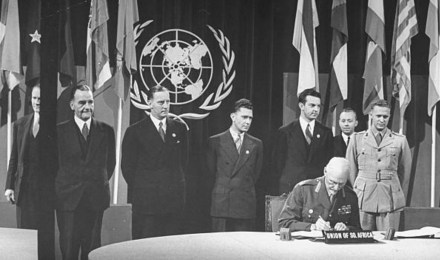
Smuts wrote the first draft of the preamble to the United Nations Charter, and was the only person in history to sign the charters of both the League of Nations and the United Nations (see earlier Observation Post link Jan Smuts drafted the Preamble to the United Nations Charter).

21731730_2020994458129542_6028296406653483655_o

Smuts signing the United Nations Charter

The British Commonwealth of Nations

He sought to redefine the relationship between the United Kingdom and her colonies, he helped establish the concept of a ‘British Commonwealth of Nations’ based on devolved British authority instead of a ‘British Empire’ and by doing so he served to end Britain’s ‘Empire. He in fact came up with the term ‘Commonwealth’ and it was to his recommendations that the King listened.

The birth of Israel

In 1932, the kibbutz Ramat Yohanan in Israel was named after him. Smuts was a vocal proponent of the creation of a Jewish state, and spoke out against the rising anti-Semitism of the 1930s.  His relationship with the Jews and Israel did not stop there, he was one of the driving forces behind the Balfour Declaration which established the state of Israel (see earlier Observation Post A Kibbutz called Jan Smuts.)

World Wars and Military Milestones

He became South Africa’s only Field Marshal, having taken South Africa to both World Wars on the side of democracy and freedom.  The Second World War alone launched the manufacturing might of South Africa largely due to the support of the war effort.  By the end of WW2, South Africa, a muddle of small colonies and republics just 40 years earlier, now stood as a key contributing world player.

He was the only person with in-depth military experience to join The British War Cabinet, at the insistence of the King, during World War 1 (the rest were Politicians) and in so played a key role in guiding the outcome of World War 1.

He gave birth to the idea of an independent Air Force free from Navy or Army control in 1917, that saw the formation of the Royal Air Force (RAF), the oldest independent air arm in the world and in addition carried this over to form The South African Air Force, the second oldest. Modern military construct now still follows The Smuts Report on the use of air power (see earlier Observation Post links Centenary of the ‘Smuts Report’, the instrument which gave birth to the Royal Air Force,).

Smuts had a long string of successful military command, notwithstanding his Command of a Boer Commando during the Anglo-Boer war, evading defeat for the entire duration of the war.  He founded the South African Defence Force after Union, commanded UDF forces alongside Botha in taking German South West Africa during WW1, the first ‘Allied’ victory of the war.  He went on to command all the British and Commonwealth Forces in the East African campaign during WW1, chasing General Paul Von Lettow-Vorbeck’s forces all over East Africa, and in so doing he captured Dar-es-Salaam, the German East Africa capital. However, to really put Smuts in perspective, when he heard that his old enemy, General Paul von Lettow-Vorbeck had fallen into destitution after WW2, it was Smuts who personally extended aid and food to him (to Smuts war was not a personal thing amongst soldiers).

During the Second World War he was appointed to the British King’s Privy Council.   The King was even warm to an idea proposed by Jock Colville (Churchill’s Private Secretary) that should Prime Minister Winston Churchill die during the war, Smuts would replace him, however this idea was never tested as Smuts would have need to have been made a peer and constitutional issues would have prevented it.  Whether possible or not it does give an idea of just how close Smuts was to Churchill and how indispensable he had become (see related Observation Post: Churchill’s idols; Napoleon, Nelson &…Smuts!).

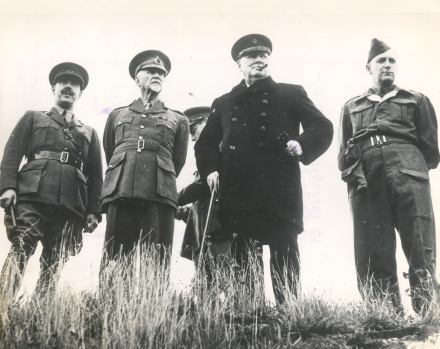
Again, as a member of the British War Council, he played a key role in the outcome of World War 2 and the Allied Victory.  He even accompanied Winston Churchill shoulder to shoulder to oversee Operation Overlord (D Day) and the liberation of France and subsequently Western Europe.

smuts2

Smuts and Churchill in France overseeing Operation Overlord (D Day)


Many historians would now even point to the notion that Churchill regarded Smuts’ advice above anyone else’s advice on his war effort and strategy (see related Observation Posts Jan Smuts, Winston Churchill and D-Day and Smuts’ keen sense of smell detects Germans hiding nearby).

Domestic acclaim

hobhouse

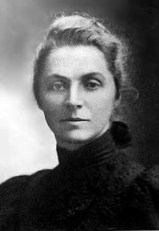
Emily Hobhouse

The deep-seated pain of the Boer War concentration camps and how it affected Afrikaner identity was also something that Smuts actively addressed (Ouma Smuts was herself interned in a concentration camp, and Smuts had also tragically lost family to the system).  He became a friend and confidant of Emily Hobhouse in addressing the issue with the British over many years. The Magnolia seeds she gave him in friendship now stand as a full botanical statement to this outside his house in Irene.

He brought the government to take measures to bring the treatment of Indians in South Africa into line with the provisions of the United Nations, putting them to the same equality and status of the ‘Cape Colourds’ who already enjoyed an equal universal franchise in South Africa at the time.  In doing so he became a life-long admirer of Mahatma Ghandi, who in turn also regarded Smuts as one of the greatest statesmen of his time.

To illustrate this admiration, Before Gandhi returned to India in 1914, he presented General Smuts with a pair of sandals made by Gandhi himself. In 1939, on Gandhi’s 70th birthday, Smuts returned the sandals with the following message:

“I have worn these sandals for many a summer, even though I may feel that I am not worthy to stand in the shoes of so great a man.”

(see earlier Observation Post story “… I am not worthy to stand in the shoes of so great a man”).

In domestic policy, Smuts instituted a number of social security reforms. Old-age pensions and disability grants were extended to ‘Indians’ and ‘Africans’ respectively (although there were still differences in the level of grants paid out). He also instituted the Workmen’s Compensation Act of 1941 and the Unemployment Insurance Act of 1946.

International acclaim

55bfc5b0ef884389cd7a9bddf3645bd8Smuts was honoured by many countries and on many occasions, as a standout Smuts was the first Prime Minister of a Commonwealth country (any country for that matter) to address both sitting Houses of the British Parliament – the Commons and the Lords during World War 2.  To which he received a standing ovation from both houses.
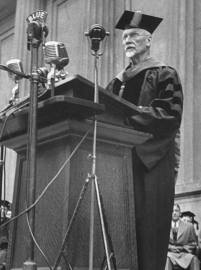
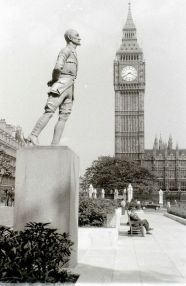
Such was the admiration of Smuts that his statue stands outside Westminster on Parliament Square in London for his contribution to world politics and as a great reformer.

Now he stands alongside the likes of Ghandi, Mandela and Abraham Lincoln as the only other ‘foreign’ statesmen honoured in the square.  Whilst, ironically, in South Africa his legacy has taken an absolute battering and his statues removed.

Take the time to listen to Smuts’ speech to both houses of Parliament, note his views on all mankind’s basic freedoms and what he envisions as the future by way of fundamental reforms.  Also note the short praise by Winston Churchill when Smuts concludes his speech and the reaction of the British Parliament, a reaction that has not been seen in British politics since, it is very unique.


Charity

In 1921 Smuts, along with Field Marshal Haig, established The Royal Commonwealth Ex-Services League (RCEL) in Cape Town.  The RCEL sought to consolidate war veteran’s charities all over the world to care for the returning military service personnel in the Commonwealth.  It saw the establishment or re-purposed institutions which now play a significant role in care for servicemen worldwide, The Royal British Legion, The Royal Canadian Legion, The Returned Services League Australia and The South African Legion to name a few.

He also made South Africa available to Jewish orphans escaping the Pogroms of Eastern Europe (despite resistance from South African nationalists).  For a full story on this remarkable chapter, see an earlier Observation Post 200 Jewish orphans saved, the story of Jan Smuts and Issac Ochberg

He again made South Africa available to Polish orphan children escaping the Nazi German and Soviet invasion of Poland in 1939, establishing a grateful and thriving small Polish community in South Africa (see earlier Observation Post South Africa provides sanctuary for Polish refugee children during WW2 ).

Academia

Smuts was also an accredited philosopher, his work on Holism brought him high acclaim from his Philosopher peers.  Holism can be defined as “the fundamental factor operative towards the creation of wholes in the universe” and was published in 1926.  For Smuts it formed the grounding behind his concepts of the League of Nations and United Nations.

Smuts was also an accredited Botanist, his books and illustrations on South African grasses (veld) are still regarded as the definitive work.

21731360_2020995841462737_816238144166127637_nWhilst studying law at Christ’s College at Cambridge University, he was rated as one of the top three students they have ever had (Christ’s College is nearly 600-year-old).  The other two were John Milton and Charles Darwin.

His intellect was unsurpassed, to pass an exam at Cambridge he learnt Greek (fluently) in just 6 days. His wife was no intellectual slouch either, later in life Jan Smuts and Ouma Smuts used to tease one another when one would recite a Bible verse and the other would be expected to recite the following one, from memory, in Greek!

In 1948, Smuts was elected Chancellor of the University of Cambridge, the first real non-Briton outside of British Royalty to be elected to the position in the 800 year-old history of Cambridge University.

Vision

Smuts’ idea of ‘Union’ and vision for South Africa was that of a ‘United States of South Africa’ including countries like Namibia, Botswana and Zimbabwe in the Union.  It was to be a significant player on the world stage drawing on Africa’s vast resources to see it as a leading political and economic power block (much like the USA is now).  Can you imagine if Botswana and Rhodesia voted to join the Union (they chose not to at the time), what a different history we would have seen in Southern Africa – ‘Apartheid’ may never have happened just for starters.

A humble man

Personally, Smuts was a God-fearing, frugal and humble man. He chose as his house an old rickety, uninsulated, fully corrugated iron, transportable military head office.  He preferred to sleep outside on the ‘stoup’ (veranda) on a small single hard wood bed, his garden was the natural veld. There were no stately mansions or ‘Nkandla’ with ‘fire pools’ for Smuts and he would not have had it anyway.

Legacy

The National Party in a sinister move, gradually and over the long period of Apartheid insidiously smeared Smuts and his legacy, erasing from the general consciousness of just what a great South African Smuts had become. Modern South Africans grew up with almost no regard for Smuts, and if you had to ask a young Black South African today who Smuts was he’ll probably say he was one of the white Apartheid monsters, the white English children will have no idea and the White Afrikaans ones may remember something about him been traitor to Afrikaners.  A student in Canada studying world politics would have a better grip on Smuts than a South African student.

Luckily this is beginning to change, and landmark Biographies are being written now which start to fully explore who and what Jan Smuts was, and it is both fascinating and eye-opening.  It is very hard to sum up all the greatness Smuts was to attain, and certainly for his time his deeds set him well apart from any of the other Statesmen South Africa has produced, certainly if you consider all the subsequent South African Premiers other than Mandela. We have a wonderful story in Smuts, and what we have a character of force – a polyglot, philosopher, botanist, intellectual, lawyer, politician, statesmen, reformer and warrior –  a story and a man who is best summed up by Alan Paton who said:

“Even the great thought he was great.”


Written and Researched by Peter Dickens.  References: Jan Smuts reconsidered Hermann Giliomee 26 January 2016, Richard Steyn’s Smuts: Unafraid of Greatness 2015.  Video footage copyright Associated Press.  My deep thanks to Philip Weyers for the Smuts family insight and access.

This article serves to highlights Smuts’ achievements by way of an Obituary.  There are other issues any national leader faces that highlight decisive but ‘unpopular’ action depending on the affected party’s point of view.  For more related articles in The Observation Post on  Jan Smuts please have a look at this link:

South Africa’s very own Communist Revolution – The Rand Revolt of 1922


Four Israeli pilots stopped the Egyptian invasion of Tel Aviv. One was a South African.

When Israel became an independent nation on May 14, 1948, the armies of four Arab neighbours — Egypt, Syria, Lebanon and Iraq — immediately invaded the new country to prevent its creation. Desperate to defend themselves the Israelis lacked many modern weapons and aircraft.

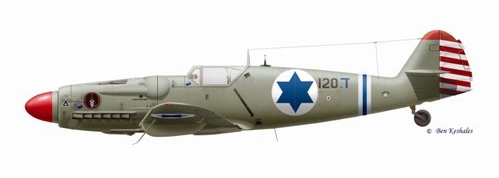
The Israelis did however have a small fleet of Avia S-199 fighters, made in Czechoslovakia with parts left over from the WW2 German Lufwaffe. The aircraft was poorly constructed and it was extremely unpopular with pilots who called it a Mezek (mule), another name for it was the ‘Messer’ (meaning ‘Knife’ and because the frame was that of the WW2 German Bf109G Messer-schmitt) the engine came from a Luftwaffe Heinkel He-111H bomber, and the Israeli pilots sarcastically also called it a ‘Messer-shit’.

messer01.jpg
Avia S-199

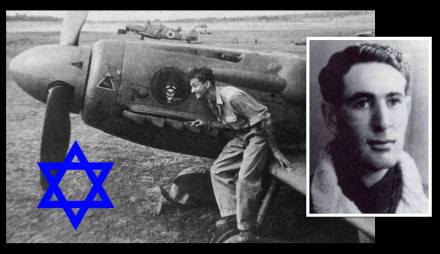
Within this tiny newly formatted Israeli Air Force were a number of very brave Jewish pilots, from the world over, some with WW2 combat experience.  One such pilot was a South African, Eddie Cohen.  This is his story.

Edward (Eddie) (Shlomo) Cohen came from South Africa.  He was the only child of Victor, Edward Cohen was born in Johannesburg on 2nd July 1922 into a well-to-do family. He grew up in an assimilated background, completed high school and began his studies at the University of the Witwatersrand.

21167942_10155437209216480_169900570387994980_o
Eddie Cohen

World War II changed his plans, and he joined the South African Air Force (SAAF), qualifying as a fighter pilot with the rank of Lieutenant.  He flew with 2 Squadron, SAAF and subsequently 4 Squadron SAAF in Italy during the war.

Upon his discharge from the SAAF at the end of the war, he did not return to his university studies, and took an office job in his father’s business in Johannesburg. He loved playing sports with his friends: rugby, tennis and golf. He was also very fond of music and excelled at that, too.

His meetings with Zionist friends aroused his interest in his religious roots, and their beliefs awoke something in him which led him to follow in their footsteps to Palestine.

He arrived in Palestine in 1947 and joined his friends at Kibbutz Ma’ayan Baruch. On a trip to Tel Aviv, he bought a number of books on archaeology and the history of Palestine, and in these scholarly works he found a new life, and began to take an interest in Judaism and his historical homeland.  He wrote to his mother:

“Today, Shabbat, I spent the whole day studying the history of the Jews and surrounding nations, using the Bible and other books. It is the most interesting study I have ever undertaken, as the area around this part of the world was the cradle of western civilization. My greatest regret is that I did not think of studying this branch of history earlier in my life, as so much can be learnt from it…”

Later, in 1947, the survival of the Zionist settlers called Eddie back into military service, he joined ‘Sherut Avir’, the forerunner of the Israeli Air Force, which formed on the 27th of December 1947.  Eddie Cohen, Boris Senior, Ezer Weizman, Modi Alon, and six others made up the new Tel Aviv Squadron.

On January. 15, 1948, Eddie Cohen took part in the Sherut Avir’s first co-ordinated multiple-plane mission: a pre-dawn aerial resupply of the besieged Gush Etzion settlements, using outdated Tiger Moths and Cargo planes.

Eddie Cohen was then trained at Ceske Budejovice in Czechoslovakia as one of ten pilots earmarked for the initial S-199 training course. He flew back to Israel on May 20 with the other graduates and the first batch of Avia S-199 fighters.

On 29 May 1948, Cohen flew in the first S-199 mission, regarded as the first mission of the newly formatted Israeli Air Force (IAF). The Egyptian advance on Tel Aviv had been stalled by a blown bridge 32 km south Tel Aviv by the lightly armed remnants of the Israeli Givati Brigade.

The Israeli Defence Force issued Operation Order No. 26 to the IAF Command that very same day and ordered an attack (even though the first Avia S-199 fighters were theoretically air-worthy they were not yet properly tested).  Four pilots, Eddie Cohen (South African), Modi Alon (Israeli), Ezer Weizman (Israeli) and Lou Lenart (American) took off from Ekron at 19:45 in their Avia’s bombed up with two 70-kg bombs each, and armed with ‘untested’ cannons and machines guns, they set off bound for the Egyptian army column near Ashdod.

Lou Lenart Israeli Air Force
Lou Lenart

Of the mission, Lou Lenart said, “There is no making light of this moment. Behind us is Israel, the Jewish people hanging on by a thread. Ahead of us is the enemy, advancing to destroy everything we love.”

The four pilots alone faced 6,000 Egyptian troops — consisting of seven infantry battalions, six hundred vehicles (including tanks), and formidable anti-aircraft weapons.

Lenart and Modi Alon shared unofficial command of the new fighter squadron and Lenart led the first mission. The wingman pair of Lenart and Alon took off first, followed by Weizman and Cohen. Lenart, however, was unfamiliar with the country and once in the air realized he didn’t know the way to Ashdod. The first two S-199s had no radios so he used hand signals to indicate direction requirements to Alon, who in turn pointed in the proper direction.  In order to avoid any enemy fighters the formation flew over the sea (west of the column) and turned east when it reached Ashdod.


Israeli Air Force Ezer Weizman
Ezer Weizman with his S-199

They spotted the Egyptian column between Ashdod and Gas’ser Ishdod, which had just stopped on the southern side of the destroyed bridge.  At this point all four pilots using machine guns and cannons strafed the concentrations of Egyptian armed forces and bombed them.

Once ammunition and bombs had been exhausted they all headed back to Ekron, Eddie Cohen had a radio and was in radio contact with base. On his way back he reported that all was OK, that he saw the base and that he was about to land. From Ekron, he was not observed and he did not land there. At another nearby air base at Chatzor an aircraft was observed engulfed in flames trying to crash-land about two and a half kilometers away from Chatzor.

The Israeli army at Chatzor dispatched two infantry platoons immediately to rescue the pilot but the Egyptian forces were the first to reach the location. Eddie Cohen had mistaken Chatzor for Ekron and tried to land there with his damaged airplane.

Tragically Eddie Cohen was killed in the crash. Eddie’s S-199 had taken an anti-aircraft gun hit which started a fire that he apparently hadn’t initially noticed.

The bold strike left the Egyptian forces dumbfounded and vulnerable. That night, Jewish ground troops took advantage of the situation by attacking the Egyptians’ flank. The Egyptians were thrown into disorder. Israeli intelligence intercepted this dispatch from their brigade commander to Cairo: “We were heavily attacked by enemy aircraft and we are scattering.”

Despite the loss of Eddie and one aircraft, the mission was a success, it seems that the attack had a profound psychological effect on the Egyptian forces, and they halted their advance completely. The bridge where they stopped was later named ”Ad Halom” bridge, meaning ”no further”.

The Egyptian Army later deflected to the east, in order to link with other Arab forces besieging Jerusalem. Tel Aviv was saved, and so was too was the new nation of Israel.

Israeli Air Force, David Ben-Gurion, Modi Alon
Modi Alon (centre with sunglasses) and David Ben-Gurion (right)

After the Israeli War of Independence finished, in prisoner exchanges with the Egyptians for the remains of the Fallen, Eddie’s body was identified by the then Chief Army Chaplain, Rabbi Shlomo Goren, and in 1949 Israel recovered Eddie Cohen’s remains near the small airfield, at the time of his death in Egyptian hands. Edward Cohen’s mother came from Johannesburg for the re-interment at the Mount Herzl military cemetery on the 8th of November 1951.

Eddie Cohen Is regarded as the first combat casualty of the first fighter squadron (101 Squadron) of the new Jewish State of Israel, and is a national hero in Israel (in South Africa he is hardly remembered at all).  On 29th September 1949, on the orders of the Israeli Chief of Staff, Edward Cohen was posthumously promoted to the rank of Flight Commander in the IAF.


Researched by Peter Dickens. Source: The Jerusalem Post, the history of 101 squadron and wikipedia

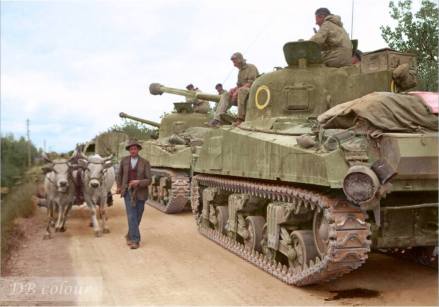
Pretoria Regiment Sherman tanks in Italy – Operation Olive

Great ‘colourised’ image of Sherman Firefly tanks of ‘C’ Squadron, Pretoria Regiment somewhere in Italy in 1944 during Operation Olive. The Pretoria Regiment fought as part of 11th South African Armoured Brigade, 6th South African Armoured Division.

Operation Olive has been described as the biggest battle of materials ever fought in Italy. Over 1,200,000 men participated in the battle. The battle took the form of a pincer manoeuvre carried out by the British Eighth Army and the U.S Fifth Army against the German 10th Army (10. Armee) and German 14th Army (14. Armee).

In mid 1944 two Allied brigades took the Chianti highlands, Radda, Maione. The Guards took it by night, supported by the tanks of the Pretoria Regiment. By 20 July, General Kirkman insisted that the 6th South African Armoured Division lead the crossing of the Arno river but lost some tanks on the gravel due to heavy mining when supporting the 4th Infantry Division. Its flanks were guarded by the 8th Indian Infantry Division. Eventually, it crossed the river and captured Mercatale, defended by the German 356th Infantry Division who were supported by Tiger tanks.

IMG010small

South African 6th Armoured Division crossing the River Arno

Despite delaying actions by the German Parachute Division, the South Africans reached the Paula line on 28 July. Eventually, by Alexander’s decision, Florence was to be bypassed by the spearhead which constituted the South African and New Zealand Divisions. The Imperial Light Horse/Kimberley Regiment was the first to enter the city. Afterwards, the 6th South African Armoured Division was withdrawn into Eighth Army reserve near Siena. There it was resupplied, completed, and waited for a possible reinforcement of the U.S. Seventh Army for the assault of southern France in August, but was replaced at the last minute by the British 6th Armoured Division and resumed its operations in Italy.

The war was certainly not over for the South African 6th Armoured Division. It took part in the consolidation of the Arno bridgehead in September and prepared to assault the Gothic line. In the process, the Division was ordered to advance along Route 64 leading to Vertago and Bologna and to capture the twin peaks of Sole and Capara. Meanwhile, the Guard brigade met heavy resistance from the well dug-in German Lehr Brigade and two battalions of the German 362nd Infantry Division.

The 11th Armored Brigade was forced to fight dismounted due to the terrain. Finally, the German forces retreated to the Green line, and Operation Olive officially ended on 21 September 1944.


Caption courtesy WW2 Colourised Images and Wikipedia. Colourised Image copyright “Color by Doug”

Britain never ‘stood alone’!

It’s widely reported now that Britain “stood alone” at the beginning World War 2, especially after the Battle at Dunkirk. However this is not strictly true (for a short while after the fall of Dunkirk, it may have felt like it, but it was not the case) very quickly coming to aid Britain “in her hour of need” and reinforce her troops, airman and seamen were the armed forces of the British Commonwealth – and not only the armed forces but also the raw materials and industry of the likes of Australia, India, South Africa and Canada – an all in effort to aid the United Kingdom, push back the advances of Fascist and Nazi thinking and change the course of European history.

It’s generally misunderstood – but within a day of the United Kingdom and France declaring war on Germany on 3 September 1939, New Zealand, Rhodesia and Australia had declared war on Germany as well. It was just 3 short days later that an independent parliament in South Africa declared war on Germany on the 6th September 1939 (very early on if you think about it – the sixth country to declare war on Nazism). Quickly followed by Canada’s independent parliament who just four days after South Africa’s declaration also declared war on Germany – 10th September 1939.

ec870169d927bce4a8e213eb015ec886On the eve of World War II the Union of South Africa found itself in a unique political and military quandary. Though closely allied with Great Britain as a co-equal Dominion under the 1931 Statute of Westminster with the British king as its head of state, South Africa had as its Prime Minister on 1 September 1939 Barry Hertzog, the leader of the pro-Afrikaner anti-British National party that had joined in a unity government as the United Party.
Herzog faced a problem: South Africa had a constitutional obligation to support Great Britain against Nazi Germany. The Polish-British Common Defence Pact obligated Britain, and in turn its dominions, to help Poland if attacked by the Nazis.

After Hitler’s forces attacked Poland on the night of 31 August 1939, Britain declared war on Germany (3 September). A short but furious debate unfolded in South Africa, especially in the halls of power in the Parliament of South Africa, that pitted those who sought to enter the war on Britain’s side led by the pro-Allied, Afrikaner, ex-Boer War General, and former Prime Minister Jan Smuts, against then-current Prime Minister Barry Hertzog, who wished to keep South Africa “neutral”, if not even pro Nazi Germany in the hopes Germany would win (as Germany had sided with the Boer Republics during the Boer war there was a groundswell in the Afrikaner right politics in support of Nazi Germany).

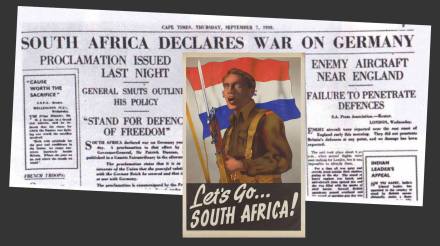
On 4 September 1939, Hertzog’s motion to remain out of the war was defeated in Parliament by a vote of 80 to 67, he resigned, and Smuts became Prime Minister of South Africa and declared South Africa officially at war with Nazi Germany and the Axis.

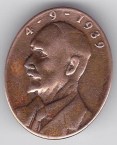
12509723_536128123223591_2929433976375636116_nTo celebrate Smut’s victory in Parliament that day a special button/lapel badge was made inscribed with 4-9-1939 for the party faithful.
Smuts immediately set about fortifying South Africa against any possible German sea invasion because of South Africa’s global strategic importance controlling the long sea route around the Cape of Good Hope.

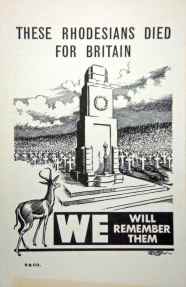
RhodesianPostcard001A very interesting part of the sequences of declarations of war against Germany, was that of Southern Rhodesia (now Zimbabwe), and it stands out as a unique one.  The Southern Rhodesian government almost immediately followed the British declaration of war with their own.  They can even be said to hold the mantle as the very first of the British Dominions and Colonies to stand by Britain in their hour of need.  Steadfast and swift in support of their ‘motherland’ – The United Kingdom, no quibble about it either, as there was no long parliamentary debate over the issue – it came without even a second thought on the matter. In all 26 000 Rhodesians volunteered to fight during World War 2.
The irony is that when Rhodesia ‘stood alone’ in an armed onslaught in the 60’s the country to abandon them was in fact the United Kingdom, forcing them to declare unilateral independence of Britain.  A fact not missed on the rather cynical ‘old Rhodesians’ today who remember their WW2 sacrifices with a very real sense of treachery, and it’s a fact missed on the British public today.

Today, some South Africans often point to Britain ‘abandoning’ South Africa when its armed insurrection started in the mid 1960’s as well.  However they are quick to forget that the very ‘anti-British’ National Party took South Africa out of the British Commonwealth of Nations in 1961 and strained all ties.  South Africa ‘stood alone’ on the Nationalists policy of Apartheid and there was nothing the British could really do about it. However to the Rhodesians there is deep cause for unhappiness as they never wanted to abandon any of their British ties whatsoever.

1551745_243308472505559_1055161002_nIn terms of the semantics of the ‘term ‘standing alone’ after Dunkirk, in many cases the Commonwealth countries did not have immediate operational readiness to come alongside the UK in the summer of 1940.  However we must remember that the Battle of Britain (when Britain really ‘stood alone’) was an air battle, where a ‘few’ pilots held off the German assault – and alongside the 2353 British pilots stood 574 pilots from other countries – 24%, – a quarter of the combat force.  Most of them came from the Commonwealth countries (342 pilots in total including Rhodesians and South Africans). So Britain never really ‘stood alone’ in that context either.
So, in conclusion, the idea that following Dunkirk, Britain stood alone against a tidal Nazi onslaught is quite incorrect.  However due to changing geo-politics, what is dissapointing now is that memory of the sacrifice of men and women from countries like India, Kenya, South Africa and Rhodesia are fading fast in the general populations – in their own countries and in the United Kingdom.

Written and researched by Peter Dickens


Source – wikipedia and Encyclopaedia Britannica

Delville Wood’s Victoria Cross – William Faulds

In the company of extremely brave men of the 1st South African Infantry Brigade, tasked with holding a wood against all odds, in what was the ‘fire hell battle on the Somme’ – the Battle of Delville Wood, it is quite something to stand out as the “bravest of the brave”.

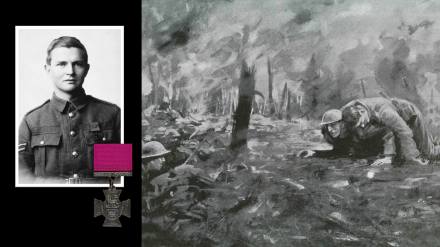
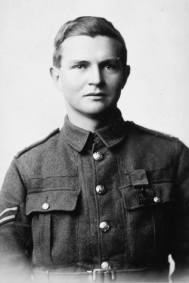
1911905_370191666483905_473364888597967759_nWilliam Faulds, a young man who won a Victoria Cross, the highest award for gallantry, at Delville Wood is quite literally a case of a normal young South African placed in an extraordinary circumstance, only to emerge with that “X” factor which sets him apart, and that’s quite something considering everyone around him can in their own right can take the mantle of the ‘bravest of the brave’, such was the nature of the battle.
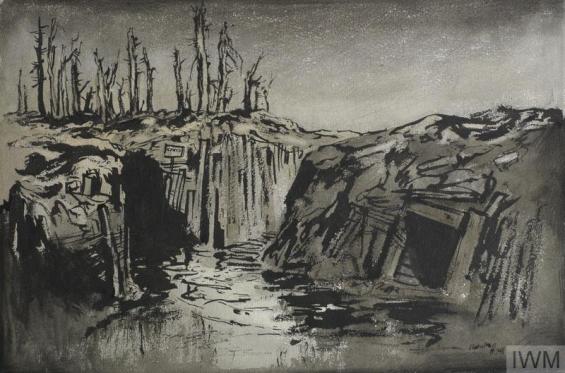
To put his action into context, the South Africans holding Delville Wood on the Somme in 1916 were shelled by the Germans at a rate of 500 rounds per minute, into their positions which occupied a small wood only a square kilometer in size.  In inadequate trenches (the wood’s roots prevented digging them deeply enough), when shelling stopped long enough they were faced with German Imperial troop attacks of such ferocity that the bayonet and hand to hand fighting became the only means to survive.

When the South Africans were relieved on 20th July 1916, just 5 days after entering the wood, of the 1,500 South African infantry men initially sent in, there were only 142 survivors still holding the wood.

So what does this young man do, a man who had worked at Midland Motor Garage in Craddock and who had only just turned 21, what makes him react differently and stand out in the midst of all the universal gallantry and carnage on an epic level?  Here is his story:

Young William ‘Mannie” Faulds from Craddock, together with his brother, Paisley and some school chums joined up with the South African forces to fight during World War One.  Arthur Schooling (his best friend), and William both enlisted together and went everywhere together. Together they even fought under the command of General Louis Botha during the South West African Campaign and then again in Egypt, before the two of them shipped out to fight in the Battle of the Somme in France.

During the Battle of Delville Wood (part of the Somme Campaign), on 16th July 1916, Arthur Schooling was shot dead in no-man’s land (the ‘killing zone’ between the South African and German lines), leaving a very distraught and shocked William Faulds feeling utterly helpless.  On the same day, 16th July, Lt. Arthur Craig (1st Battalion Bravo Company) was also shot and lay wounded close to the body of Arthur Schooling in the killing zone (no-man’s land).

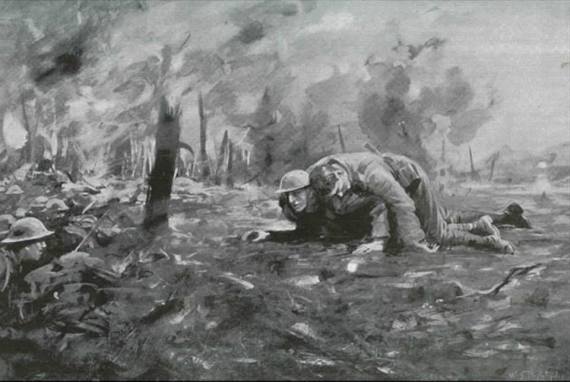
Pte. William Faulds dug deep to find the bravery for this, and along with Pte. Clifford Baker and Pte. Alexander Estment, all three took matters into their own hands to rescue their officer. In broad daylight at 10:30am, they climbed out from behind the relative safety of the defences and crawled to their severely wounded Lieutenant, then they ‘piggy-backed’ him back to safety.  Pte. Baker was badly wounded in the attempt. Lt. Craig survived thanks to these three brave ‘Springboks’ and recovered his wounds later in the Richmond Hospital, London.

William Faulds and Alexander Estment returned to their positions in the wood and continued fighting in what can only be described as combat in the extreme.  The initial act of gallantry alone was quite something, but there was still more in young Faulds, and it’s here that we start to see ‘X’ factor that makes a Victoria Cross recipient different from the rest.  

Because just two short days later, he was faced with exactly the same situation again – a critically wounded comrade in no-man’s land, but this time William Faulds was alone, and once again he put his life on the line, exposed himself by leaving the relative safety of the trenches (such as it was) and entered no-man’s land (the ‘killing zone’) under intense incoming artillery fire, to rescue another yet another of his comrades and alone carried him from certain death, for nearly half a mile, to a medical station.

Victoria Cross

His citation for his Victoria Cross says everything:

“For most conspicuous bravery and devotion to duty. A bombing party under Lieut. Craig attempted to rush across 40 yards of ground which lay between the British and enemy trenches. Coming under very heavy rifle and machine gun fire the officer and the majority of the party were killed or wounded. Unable to move, Lieut. Craig lay midway between the two lines of trench, the ground being quite open. In full daylight Pte. Faulds, accompanied by two other men, climbed over the parapet, ran out, and picked up the officer, and carried him back, one man being severely wounded in so doing.

Two days later, Private Faulds again showed most conspicuous bravery in going out alone to bring in a wounded man, and carrying him nearly half a mile to a dressing station, subsequently rejoining his platoon. The artillery fire was at the time so intense that stretcher-bearers and others considered that any attempt to bring in the wounded man meant certain death. This risk Private Faulds faced unflinchingly, and his bravery was crowned with success (London Gazette 9 September 1916)”.

10922597_393363950833343_6005614638364482408_n

With that, William Faulds became the first South African born recipient of the Victoria Cross (VC) during World War 1.  It was this extra rescue, the repetition of bravery in the extreme which set him apart from his two comrades involved in the first rescue of Lt. Craig, no doubt equally extraordinary – both Clifford Baker and Alexander Estment were awarded the Military Medal (MM) for bravery.

William Faulds continued to fight, and again showed bravery and leadership in the extreme, and was later awarded the Military Cross (MC), a lessor award to the Victoria Cross, but no less important. He received it for leading men during German attacks at Heudecourt, enabling rest of Battalion to withdraw with only slight losses.

Military Cross

His second citation for the Military Cross says everything and reads:

“In the retirement from the line east of Hendicourt, 22 March 1918, he was commanding one of the platoons which formed the rear-guard. He handled his men most ably, and exposed himself freely. Though the enemy pressed hard, he, by his fearless and able leadership, checked them, and enabled the remainder of the battalion to withdraw with slight loss”.

large_000000

He was eventually wounded and captured by the German Forces on 24th March 1918 at the Battle of Marrieres Wood. He was released as a prisoner-of-war after the Armistice on 11 November 1918 and returned to South Africa.

Post War

On his return he was promoted to a Lieutenant and took up a civilian job as a mechanic with De Beers Diamond Mine. In 1922 he re-enlisted with the Kimberley Regiment and was made a Captain. Later he moved to Rhodesia (now Zimbabwe) and in 1937 he was member of Southern Rhodesia contingent at the King’s Coronation.

Not without a sense of humour, when his daughter was born he expressed the wish of having her named Victoria Faulds (falls).  His wife objected strongly to what would have stacked up to become potential ridicule for the young girl and she was christened “Joy” instead.

William Faulds died on the 16th August 1950 in Salisbury (now Harare) and is buried in the Salisbury Pioneer Cemetery.  His Victoria Cross was held by the Museum of Military History in Saxonwold, South Africa, and such is the nature of our disregard for national heroes and treasures, it was stolen from the museum in October 1994.


Researched by Peter Dickens

References: The VC and the GC, The Complete History, published by Methuen and The VC and GC Association in 2013. Three of South Africa’s WW1 Delville Wood heroes – by Miss Joan Abrahams.

The painting is an artist`s impression of the action at Deville Wood for which William Faulds was awarded the Victoria Cross. From the book “Deeds that thrill the Empire” Vol 5. Insert Artwork: Men in the Trenches, near Hendicourt by Adrian Hill, Imperial War Museum copyright

Cruel history, Italian tankers in inferior tanks were actually very courageous!

You may have heard the joke the old South African World War 2 North African campaign veterans used to often tell about ‘Italian Bravery’ – how many gears does an Italian tank have?  Answer; one forward and four in reverse!

History is very cruel to these very brave Italian tankers fighting alongside Nazi German forces and the likes of Rommel against the South Africans, British and Allied forces.

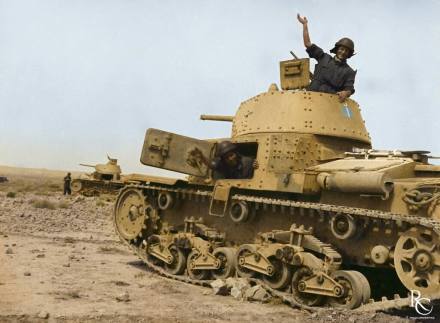
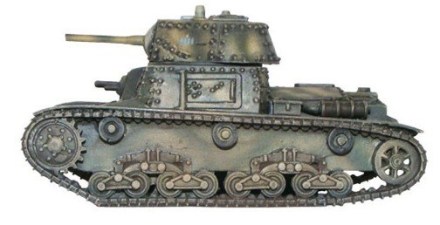
Weighting only 14 tons, by Allied standards the Italian M13/40 tank was seen as a light tank. For the unfortunate crews who manned it, it was nothing short of a death-trap.

Its semi-automatic 47 mm Ansaldo 47/32 gun could penetrate 1.7 inches (43mm) of armour at 550 yards (503 m), making it more than adequate to deal with most allied tanks -saved for the cumbersome Matildas- and its diesel engine had a low probability of catching fire when hit, but it lacked power which made the M13/40 a slow moving target, specially off-road.

WGB-IT-102-5
Although it had armour deemed adequate by 1940 standards, this was made of low quality steel which lacked tensile strength, resulting in a higher probability to shatter when hit, spraying the crew inside with deadly pieces of metal from their own armour.

To these men in dark blue overalls, destined to fight on unequal terms, history has often been cruel. Nevertheless, time and again, they charged gallantly against a superior adversary, often paying the ultimate price for their courage.

Note on the main featured image: The number 3 on the turret and the rectangle with a white stripe identifies this tank as the 3rd tank of first Platoon. The rectangle background colour identified the Company, the number of stripes the Platoon.

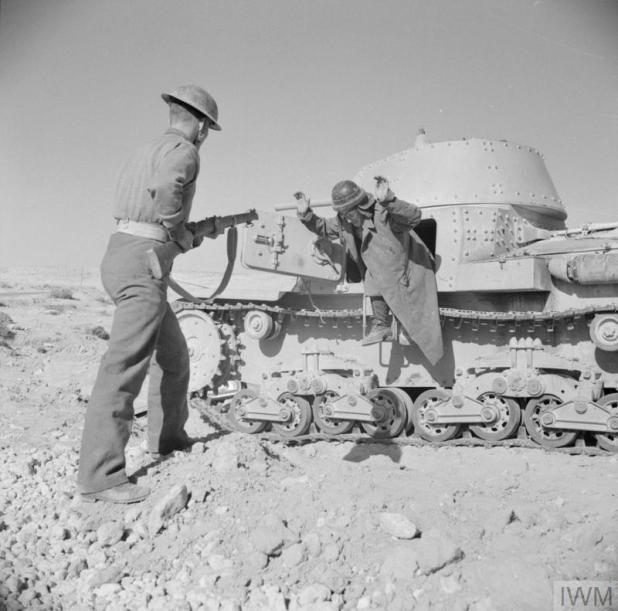
These Italian tanks were easy prey to the British, South African and other Commonwealth and Allied forces, here a member of the crew of an Italian M13/40 tank giving himself up near Gazala. His captor might be a soldier of the Polish Independent Carpathian Rifles Brigade (part of the British and ‘Allied’ forces in North Africa).

iti

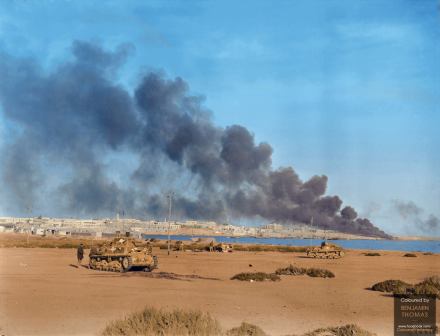
As courageous the Italian tankers in these tanks were, so too were the Australian ones, as captured kit, including tanks were always handy as they afforded more protection than not having the convenience of armour at all.  Here’s an interesting colourised photograph of the re-taking of Tobruk by the Allied forces.

Note the port installations as they burn again over the harbour on 24 January 1941. Of interest to this article, note in the foreground, here later version M11/40 (on the left) and M11/39 (on the right) Italian tanks can be seen, under new ‘ownership’. White kangaroo symbols can be seen on the tanks, now the possessions of the 6th Australian Division.

30729702_836630043176023_1104169962190143488_o

Related Work and Links

Tobruk; “Defeat is one thing; Disgrace is another!” South Africa’s biggest capitulation of arms – Tobruk

Tobruk; The feisty South African minesweeper that went down fighting – HMSAS Parktown

Tobruk; Job Maseko; one very remarkable South African war hero


Researched and Written by Peter Dickens.  Original’s source of feature photograph unknown, feature image, colourising and caption by “In colour veritas”.  Insert image – Imperial War Museum copyright. Colourised Australian M11 tanks by Benjamin Thomas, Photographer: Lieutenant L.B. Davis, No. 1 Army Film & Photographic Unit – Imperial War Museum.

German POW’s hitch a ride on a South African armoured car

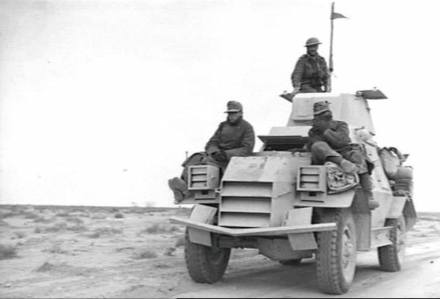
Amazing image taken at Fort Capuzzo in Libya during WW2 – December 1941. Two German Afrika Corps soldiers – now Prisoners of War (POW) – hitch a ride into captivity on the front of a 2nd South African Division Marmon-Herrington Armoured Car.

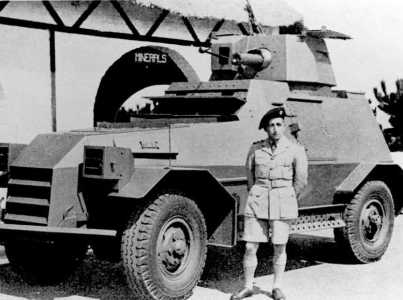
The Marmon-Herrington Armoured Car was a series of armoured vehicles produced in South Africa and adopted by the British Army, other Commonwealth Forces (India used them) and South African army during World War II.  Highly popular as they could be adapted into all sorts of roles and configurations, some captured examples even made their way into the German army and other Axis forces during the war.


MarmonHerringtonMkIII

Marmon-Herrington Mk III

Featured image Copyright Australian War Memorial


“We fought as one, black and white”; the South African Native Military Corps ‘at arms’

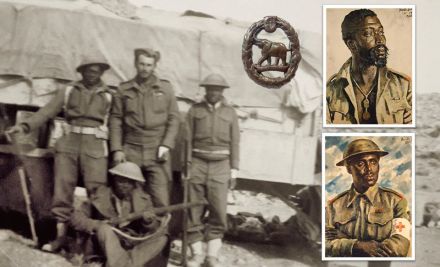
Now what is truly remarkable about this photograph?  Well it shows a bunch of armed South African soldiers during World War 2 who by all accounts never carried a firearm and by directive were not allowed to either.  These are members of the South African Native Military Corps (NMC), and it’s proof positive that there is no such thing as skin colour or ‘Segregation’ legislation when under fire.

sanmmc

This photograph was taken by Warren Loader’s Grandfather Noel Edgar Fuller while serving with The Royal Durban Light Infantry (DLI) B Coy in North Africa during WW2. What makes this photo remarkable is the DLI L/Cpl is standing next to three armed members of the South African Native Military Corps (NMC).

So, visual proof that .303 Lee Enfields were issued to some members of the NMC, but what is the validity of this rare photograph?

Official Policy

163497_146794905490250_702739084_nDuring the Second World War the South African government of the day held out that members of the NMC could only function in non-combatant roles, and were not allowed to carry firearms whereas funnily members of the Cape Corps (Cape Coloured members) where fully armed and enrolled in combatant roles.  In terms of the race politics of the day, on the arming of Black soldiers at the beginning of war, Smuts’ government had to bow to the pressures of his opposition, the Nationalists, led by DF Malan.
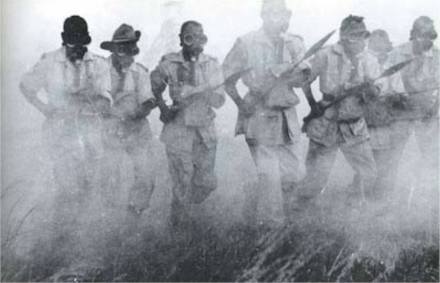
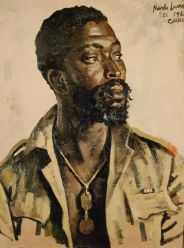
The Nationalists were vociferously opposed to black South Africans in the army at all, even unarmed. As Dr D.F. Malan was to be quoted in Parliament: “To every Afrikaner, the use of black troops against Europeans is abhorrent.”

Faced with all this opposition in Parliament from the official opposition bench Smuts had little choice, he needed men to fight, and had to tap South Africa’s black population for resources.  So he found a way by striking compromise, they could carry traditional weapons in the form of spears and knobkerries.

The president of the ANC in the war years, Dr AB Xuma, responded: “They are expected to fight aeroplanes, tanks and enemy artillery with knobkerries and assegais. What mockery.”

Arming the Native Military Corps with Spears 

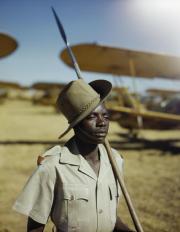
So, in a counter-intuitive move to the National Party’s objections and statements to the Smuts government, the Native Military Corps were trained in traditional weapons (other than firearms) which they were allowed to carry.  This was a long spear, and bear in mind spears are very deadly (as the British fighting at the Battle of Isaldwana found out) – but lets face it, spears were very out of date in the context of modern war, but they pressed on and in training the South African Native military corps even trained to charge with the spear, even through tear-gas screens.

24955656_2059510197611301_4990790189144305175_o

South African Native Military Corps members charging with traditional spears into a teargas screen

Secretly arming the some Native Military Corps members with Firearms 

All this political segregation and racial discrimination became quite irrelevant when serving in combat areas and in many instances serving Regiments, Units and Sections of the South African Army quite quickly issued firearms to their NMC ‘support’ members – and this photo of DLI members stands testament of such practice.

Thier lives – Black or White, depended on it, and logic prevailed.  As is often the case in combat, the man who joins you in the fight is your brother – irrespective of the colour of his skin – in combat there is no such thing as racial segregation in a foxhole.

The caption written on Noel Edgar Fuller’s photo is “our Lance Corporal and his two native pals”. Quite a lot can be seen and said to this remarkable snapshot into the attitude of the time versus the attitude of soldiers.

Job Maseko MM

Job-Maseko

Job Maseko MM

In addition to snapshots like Noel’s one, there are actual accounts of South African Native Military Corps getting into the fight at the Fall of Tobruk, and it produced one highly decorated South African from the SA NMC.

During the Fall of Tobruk, over 1200 NMC members found themselves in a frontal attack by Rommel and his Axis forces.  Many of them were quickly issued rifles and ammunition and got into the fight alongside their white compatriots. Job Maseko was one and he ferried ammunition to the other NMC members who had been issued rifles and were in the thick of the fighting.

After the Fall of Tobruk (South Africa’s greatest capitulation of arms, Job found himself and other NMC members taken prisoner of war.  Made of stern stuff, whilst been put to work by the Germans on the Tobruk dock loading and off-loading Axis suppliers, Job secretly created a bomb using a condensed milk tin, cordite taken from bullets and an extremely long fuse.  His intention, sink a ship!

Job placed his home-made bomb deep inside the bowels of a German freight ship (and “F” Boat) that was docked in the harbour at Tobruk.   He skilfully placed it next to fuel barrels for maximum effect, lit the fuse and made good his escape.  Had he been caught, as a Black POW,  he would have certainly been put to death if not tortured first.

Job waited and later the ship shuddered from a huge internal explosion and sank almost immediately into the harbour.

He later escaped from Tobruk and walked, for three long weeks though the desert and through enemy lines, all the way to El Alamein, he intended joining the battle there as he had fixed an old German radio he had found which informed him about General Montgomery’s epic and tide turning battle at El Alamein.  We still await the full historical account of this remarkable man as very little is known to this day, rest assured historians are now writing it.

Sergeant Petrus Dlamini

Now consider this remarkable first hand account of armed Native Military Corps soldiers in the thick of the fight at El-Alamein

The Germans ran away. Now we were having short magazine guns, we pushed them. They said we went 300 miles … (we were in the) 8th Army led by (British Field-Marshal Bernard). Montgomery. Those Germans never came back. We fought as one; black and white soldiers.” — Sergeant Petrus Dlamini speaking about the battle of El Alamein to filmmaker Vincent Moloi

After 1948 this history was held back from the ‘White’ population and to a very large degree from the ‘Black’ population for political expediency ,it is only been recounted now with the very few remaining NMC members.  In effect South Africans were denied the opportunity to know their own history.

All that is starting to change now. From their recollections we know that, although black soldiers left South Africa armed only with spears, when they got “Up North” (to the North and East African campaigns) many were armed with rifles.  We also know now some even fought alongside white soldiers in the thick of battle.

Sergeant Petrus Dlamini spoke of being at Sidi Rezegh, Mersa Matru, Tripoli, Garowe in then Abyssinia and El Alamein before he went by boat to Italy with the South African 1st Division. He remembered doing guard duty in North Africa.

He says: “There, at Garowe, we were guarding as a sentry. We were guarding with assegai.” But just a few months later, Dlamini adds: “It was said — I heard a rumour — that the superiors [commanding officers] of South Africa, England and Australia said we must be given guns. Those guns were taken from the Italians in Kenya. They gave them to us and we were taught how to put ammunition and we were training with guns”.

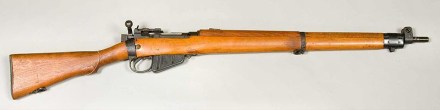
Lee enfield

Short Magazine .303 Lee Enfield No. 4 Mk 1, standard issue

“Then we went to El Alamein and they took these [Italian] guns that were not right and they gave us short magazine Lee-Enfield .303. We got them at El Alamein.”  The Lee-Enfield .303 short magazine was the standard rifle issued to all British and Commonwealth troops.

This has been verified in an article in the South African Historical Journal by historian LWF Grundling, who says: “Recruits received rifle musketry training, which was seriously handicapped by the defective Italian rifles with which they were issued.”

30806253_2129588687270118_9148612884307489711_o

General Sir Pierre van Ryneveld

According to this research it was General Sir Pierre van Ryneveld himself who instructed the commanding officers in North Africa to arm black soldiers with Lee-Enfield rifles before El Alamein.  No small player, General Sir Pierre van Ryneveld was the Chief of General Staff (which today is known as Chief of the South African National Defence Force) and led the South African war effort in the Second World War.

But this does not seem to have been mentioned in despatches (possibly because of the petty race political ramifications back in South Africa of the Nationalists).

Sergeant Dlamini said: “In the front line we were accompanied by whites. When we go to fight the Germans we were mixed.”

He spoke vividly of the battles he was in. Moloi recorded his description of the battle of El Alamein.

“It was like bees, those German planes together with our planes, the Royal Air Force and the South African Air Force. Many died there. Shots were like falling rain. They would hit here and here where you are sitting. When you are sleeping in your trench you would hear sounds of bombs all the time, when you wake up you would see those injured and those who are dead.”

Dlamini says they were with the 8th Army. as they pushed the Afrika Korps and Axis forces out of Africa, he goes on “It [the 8th Army] pushed. Ai! Man! It was terrible, soldiers were lying dead, black and white, but the Germans were retreating and we kept following them. The Germans ran away. Now we were having short magazine guns. We pushed them. They said we went 300 miles … 8th Army led by Montgomery. Those Germans never came back. They went down together with the Italians you see.”

998120_170186736484400_630113539_n

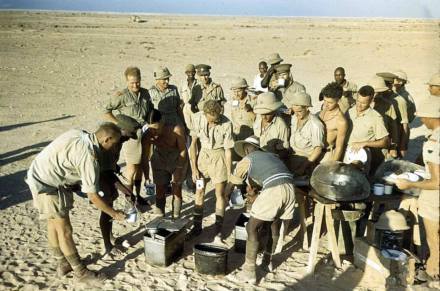
Rare original colour photograph of a NMC Field Kitchen in North Africa campaign, note the high degree of integration of the South African soldiers represented.

Dlamini added: “We were one. We fought as one; black and white soldiers. Here in South Africa (before we went up north) we were treated differently. Blacks were sleeping this side, whites on the other side. When we arrived in Egypt we mixed. If we made a queue, in front would be a white person, behind would be a black person then a white person. We were one.”

And, perhaps explaining why he had not spoken of his experiences before, he added: “You know the heart of a soldier. Your feelings die. You are always angry.”

Besides Moloi’s interviews with Dlamini, and with several other black World War II veterans, almost no records of the wartime experiences of black soldiers exist. And as it’s probably too late now to collect more, Moloi’s transcribed and translated interviews are a national treasure.

Lucas Majozi DCM

581520_199581196878287_2116978767_n

Lucas Majozi DCM

Adding to Job Maseko’s gallantry, another NMC man was to attain hero status during the Second World War was Lucas Majozi, a man who performed a feat very similar to Pvt. Desmond Doss (who has a movie ‘Hacksaw Ridge’ made over his gallantry and US ‘medal of honour’), and like Doss, as an unarmed medic Lucas time and again exposed himself and walked into the hell of machine gun fire as an unarmed medic to rescue a large number of critically injured ‘white’ South African soldiers on the battlefield during the Battle of El Alamein, so much so he became riddled with bullets himself and eventually collapsed.

This is South Africa’s own ‘hacksaw ridge’ and movies should be made of it, Lucas Majozi should be elevated to the highest accolades of gallantry we have to offer today.  He remains the NMC with the highest decoration to this day – the Distinguished Conduct Medal.

Politically inconvenient ‘Sacrifice’

600x951It’s an often ignored fact and statistic – one which most certainly the National government after 1948 did not want widely published, lest national heroes be made of these ‘Black’ men.  Simply put the ‘Black’ contributions to World War 1 and World War 2 were quite literally erased from the narrative of the war after 1948 and dismissed by the incoming Apartheid government as ‘traitors’ (a tag also suffered by their ‘White’ counterparts) for serving the ‘British’.
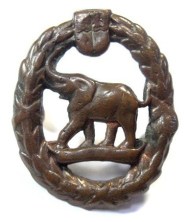
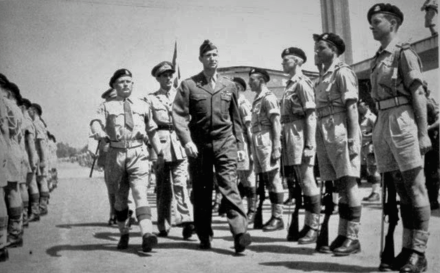
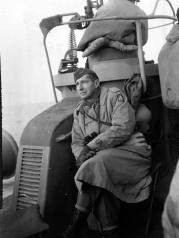
Bear in mind when reviewing what this actually means to the prevailing opinions by many South Africans of the war (White and Black)  – approximately 40% of the standing South African servicemen in WW2 where persons of “colour”.  In all more than 146,000 whites, 83,000 blacks, and 2,500 people of mixed race served in the standing forces of the Union of South Africa at this time.  Mull that over for a minute.

The sacrifice of the men of the Native Military Corps no less significant – if you think that as ‘non combatants’ this corps came through unscathed by war, also think again – this is the honour role of those NMC members who laid down their lives during the war, their sacrifice is literally quite eye-opening:

In total approximately 1655 Native Military Corps members died during World War 2, read that again – One Thousand Six Hundred and Fifty Five ‘Black’ South African soldiers died during World War 2.  That’s almost three times the number who died on the SS Mendi during World War 1, and that’s only from one ‘Corps’.

Put into context, nearly as many South Africans died during the entire 23 years of fighting during the Border War in the 70’s and 80’s when approximately 2013 South African service personnel died – from all arms of the military …. yet, here we are talking about only ‘one’ single Corps of Black South Africans and only five years of conflict.  Consider that the book shelves on South African history are stuffed full of books on the Border War and not one single book is dedicated to the history of the South African Native Military Corps in World War 2.  There is also almost nothing by way of definitive work on the unit history on the internet.

In Conclusion

It must be noted that this policy of arming NMC was not a universal one and only seemed to have been actioned with certain members in front line units or when combat situations demanded it, in reality reason finally prevailed.

It also seems that once high intensity combat operations abated these rifles were handed back. For the most part many NMC members went through the war in non-combatant roles and unarmed in roles like supply truck drivers, medics, chefs, bomb loaders, engineering labour (rail and bridge-building) etc.

It is unfortunate that after the war, and when the Nationalists ascended to power in 1948, that the NMC was disbanded and history scrubbed.  They were excluded from national parades and would sit under a tree and tell their stories to anyone prepared to listen.  Their stories really becoming fable in the Black community only, any record of NMC using weapons was generally written out the state’s historical narrative, interviews with them disregarded and these priceless historical nuggets are only starting to re-surface now in a post Apartheid epoch.

269A86C0B4724B0689CF66931FBE0163

NMC Insignia

The history of the South African Native Military Corps needs to resurface – it’s screaming out for more definitive works and information access – this featured photograph alone calls for it.  We need to fundamentally rethink who and what has been sacrificed to military conflict by South Africans of all ethnic origins, we need to completely re-dress how we honour them and we need to take some serious perspective.

Related Work and Links:

Native Military Corps Dress and Bearing: Dress and Bearing of the South African Native Military Corps

Job Maseko; Job Maseko; one very remarkable South African war hero.

Lucas Majozi; “With bullets in his body he returned … into a veritable hell of machine gun fire”; Lucas Majozi DCM

Skin colour in combat;  Skin colour is irrelevant in a foxhole!

Native Military Corps honour roll;  NMC Honour Roll, Delville Wood official website


Written by Peter Dickens.  Image copyright of NMC members holding weapons to Warren Loader, used with his kind permission.  Paintings of Job Maseko and Lucas Majozi by Neville Lewis copyright.  Quotes obtained from ‘Memories of black South African soldiers who bore arms and fought in War II’ by Marilyn Honikman

General Mark Clark’s praise of the South Africans

WW2 – In December 1944 an American General – General Mark Clark – took overall command of Allied ground troops in Italy (15th Army Group). This included taking overall command of the South African 6th Armoured Division, and he said this in praise of the South Africans:

“It was a battle-wise outfit, bold and aggressive against the enemy, and willing to do whatever job was necessary. In fact, after a period of severe day and night fighting, the 6th had in an emergency gone into the line as infantrymen. When the snow stalled their armour they dug in their tanks and used them as artillery to make up for our shortage in heavy guns. Whenever I saw them, I was impressed by the large number of decorations and honours they had earned the hard way. Their attacks against strongly organised German positions were made with great élan and without regard for casualties. Despite their comparatively small numbers, they never complained about losses. Neither did Smuts, who made it clear that the Union of South Africa intended to do its part in the War – and it most certainly did”.

General Mark C. Clark, Calculated Risk. p. 391

The featured image shows General Clarke inspecting South African troops at the end of the war during a parade in Monza,  Italy (held on the famous Monza race track).

G10154203_282011528635253_3582423716020249574_neneral Mark Clarke was ultimately made the Supreme Commander of the AFHQ in the Mediterranean, replacing Field Marshal Sir Maitland Wilson, He was promoted to the four-star rank of General on March 10, 1945, aged 48, the youngest in the United States Army. Clark led the 15th Army Group in the Spring 1945 offensive in Italy codenamed Operation Grapeshot, which brought the war in Italy to an end, and afterwards he accepted the German surrender in Italy in May and became Commander of the Allied Forces in Italy at the end of World War 2 in Europe.