Centenary of the ‘Smuts Report’, the instrument which gave birth to the Royal Air Force

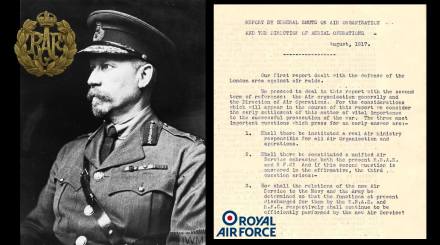
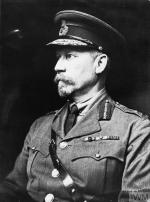
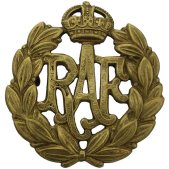
August 2017 marks the centenary of the report to form the Royal Air Force (RAF), the idea of an independent Air Force from Navy or Army control is now officially 100 years old, and one key South African statesman, General Jan Smuts, gave birth to it.

smuts ww1

Smuts in WW1

Today, if you walk into the Royal Air Force Private Club in Mayfair, London you are greeted by a bust of Jan Smuts in the foyer, it stands there as an acknowledgement to the man who founded what is now one of the most prestigious and powerful air forces in the world – The RAF.

So how did it come to be that a South African started The Royal Air Force and why the need to have a separate and independent arm of service?

Simply put, during World War 1, the British Army and the Navy developed their own air-forces in support of their own respective ground and naval operations. The Royal Flying Corps had been born out of the Air Battalion of the Royal Engineers and was under the control of the British Army. The Royal Naval Air Service was its naval equivalent and was controlled by the Admiralty.

However, the use of air power in World War 1 was developing beyond the immediate tactical use of aircraft by the Navy and the Army. In Great Britain the civilian population had been on the receiving end of extensive German bombing raids dropped from flying Zeppelin airships, the public outrage and the psychological effects of this bombing was having a significant impact on British politicians.

In reaction to this, the politicians proposed the creation of a long-range bombing force both as a retaliation and also as a means of disrupting enemy war production. There were also continuing concerns about aircraft supply and priorities between the services.

The British Prime Minister, Lloyd George asked General Jan Smuts to join his War Cabinet (the supreme authority governing Great Britain and her Empire’s forces in World War 1). Lloyd George then commissioned General Jan Smuts to report on two issues:

Firstly to look into arrangements for Home Defence against bombing and secondly, air organisation generally and the direction of aerial operations.  Smuts is generally accredited with improving British air defence and answering the first priority.

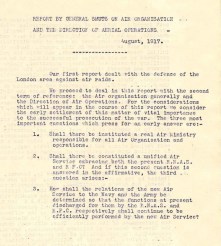
7960001505000118_fillHowever it was ‘Smuts report’ of August 1917 in response to the second of these questions that led to the recommendation to establish a separate Air Service. In making his recommendations Smuts commented that

“the day may not be far off when aerial operations with their devastation of enemy lands and destruction of industrial and populous centres on a vast scale may become the principal operations of war, to which the older forms of military and naval operations may become secondary and subordinate”.

Given this new dimension he commented that it was important that the design of aircraft and engines for such operations should be settled in accordance with the policy which would direct their future strategic employment. On these grounds he argued there was an urgent need to create an Air Ministry and that this Ministry should sort out the amalgamation of the two air services.

The War Cabinet accepted this recommendation to amalgamate the two separate air forces under one single and independent Air Force.  Smuts was then asked to lead an Air Organisation Committee to put it into effect. The Air Force Bill received Royal assent from the King on the 29 November 1917, which gave the newly formatted Air Force the prefix of ‘Royal’ (up to that point the idea was to call it the ‘Imperial Air Force’).

Imp Cabinet WW1

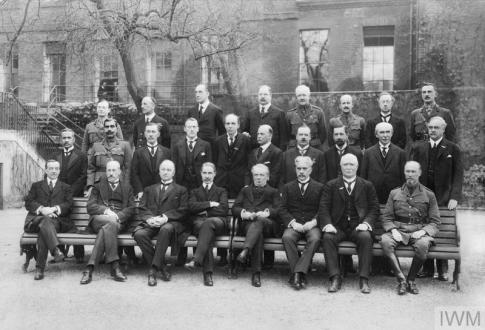
The War Cabinet during WW1, Smuts seated bottom, far right

The RAF was officially formed on the 1 April 1918 with the amalgamation of the Royal Naval Air Service and  the Royal Flying Corps. Following which Lord Rothermere was appointed on 3 January 1918 as the first Secretary of State for Air and an Air Council established.

To emphasise the merger of both army and naval aviation in the new service, to appease the ‘senior service’ i.e. the Navy, many of the titles of officers were deliberately chosen to be of a naval character, such as Flight Lieutenant, Wing Commodore, Group Captain and Air Commodore.

Royal Air Force WW1

Royal Air Force

The newly created Royal Air Force was the most powerful air force in the world on its creation, with over 20,000 aircraft and over 300,000 personnel (including the Women’s Royal Air Force). It now qualifies as the oldest independent Air Force in the World.

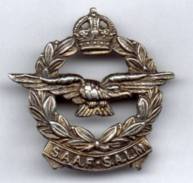
General Smuts was to take his recommendations and findings across to form an independent South African Air Force (SAAF).  Smuts appointed Colonel Pierre van Ryneveld as the Director Air Services (DAS) with effect from 1 February 1920 with instructions to establish an air force for the South African Union. This date is acknowledged as marking the official birth of the SAAF.  The SAAF now qualifies as the second oldest independent Air Force in the world.

20934838_2008825072679814_8165602951617956277_o

South African Air Force

In a nutshell, both the RAF and SAAF as we know them today, were given to us by Jan Smuts as a founding father.  Funnily, Smuts was often criticised domestically as ‘Slim’ Jannie (clever little Jan), a term Smuts hated as it was coined by the Hertzog Nationalists to mean that Jan Smuts was too clever for his ‘volk’ (peoples) and therefore out of touch, it was done for political expediency at Smuts’ personal expense.  Smuts disliked the term as it as it ironically belittled the Afrikaner and positioned his people as ‘simpletons’, something Smuts fundamentally disagreed with, and something they most certainly are not.

That said, domestically Smuts’ political adversaries in the opposition National Party carried on with this belittling ‘Slim Jannie’ nickname to further criticise his ability to command at a strategic level, stating that his approach was too ‘intellectual’ for effective command.

All modern military strategy is formulated on joint arms of service with an independent air arm. You only have to look to any modern military construct of any military superpower today to see just what a visionary and strategist Jan Smuts was. The proof of his ability to command strategically is in the pudding.  Smuts’ ground-breaking report in August 1917 now guides all modern strategic military planning by simple way of how the arms of service are now constructed (Army, Navy, Air Force i.e. ground, sea, air), how they co-ordinate with one another and how they are commanded.


Written and researched by Peter Dickens.  References – Birth of the Royal Air Force (Royal Air Force Museum), Imperial War Museum and Wikipedia.  Images copyright, Imperial War Museum.

A South African soldier’s diary captures the horror of Delville Wood

The Diary of Walter Giddy

World War 1, Battle of Delville Wood, what better way to understand the carnage witnessed than by reading the writings of the young South Africans tasked to “hold the wood at all costs”.
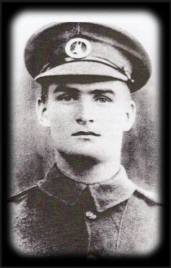
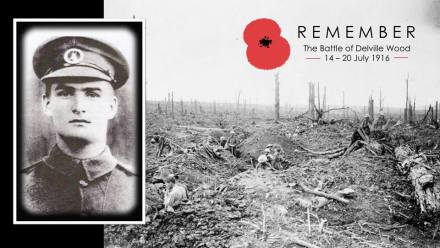
11659454_467187503450987_8539553676263314124_nWalter Giddy was born at Barkly East, Cape Province, South Africa, in 1895. He was the third son of Henry Richard Giddy and Catherine Octavia Dicks/Giddy. Walter was schooled at Dale College in King Williamstown. He voluntereed, together with friends, for overseas military service in 1915. He served in the 2nd S.A. Infantry Regiment. Having survived the battle of Delville Wood, he was killed by shrapnel on the 12th April 1917 near Fampoux. Walter Giddy is commemorated by a Special Memorial in Point du Jour Military Cemetery, Athies.

His diary was copied by his younger sister Kate Muriel Giddy/Morris.

Extracts from Walter’s Diary

4th July 1916
Still lying low in Suzanne Valley. The artillery are quietly moving up. We shifted up behind our old firing line, where the advance started 2 or 3 days ago. The dead are lying about. Germans and our men as well, haven’t had time to bury them. The trenches were nailed to the ground, and dead-mans-land looked like a ploughed field, heaps must be buried underneath…

5th July 1916
… it rained last night and we only have overcoats and waterproof sheets, but I cuddled up to old Fatty Roe, and slept quite warmly. There are no dug-outs where we are at present, and the shells are exploding uncomfortably near.
Had a man wounded last night for a kick off. The Huns are lying in heaps, one I noticed in particular had both legs blown off, and his head bashed in. Some have turned quite black from exposure. They are burying them as fast as possible. Brought an old fashioned power horn, Hun bullets, nose-caps of shells, etc., back with me, but I suppose they’ll be thrown away.

6th July 1916
Told to hold ourselves in readiness, expecting an attack. Received draft (£5) from Father.

7th July 1916
Made to sleep in the trench on account of the Hun shells flying a bit too near, had a cold rough night, but things have quietened a bit this morning, so we are back in our little shack made out of waterproofs. Bloody Fritz, he had started shelling the road, about 400 yards away and directly in line of us. A Frenchie was standing on the parapet and was excitedly beckoning to us. He’d put up his hands and point to a communication trench ahead. Couln’t make out what the beggar was driving at, so we ran up to him, and ahead were dozens of Hun prisoners filling out of the trench. It rained so hard our shack was just a mud-pool, busy drying our kit.

8th July 1916
3rd S.A.’s were relieved by the Yorks who went over this morning 400 strong and returned 150 strong. Then our S.A. Scottish went over with a couple of the Regiments and took the wood, and I believe lost heavily, but are still holding the wood.

Seaforth, Black Watch, Cameron, P.A., G.P.S. are going over in the morning, so there will be some bloodshed, if they get at close quarters with cold steel. Hun sent over some Tear Shells, which made our eyes smart, but were too far to cause much trouble. Two of our companies were up to the firing line, and T. Blake, of our platoon, acting as guide, had his jaw bone shattered, and another man had his head blown off. Three guns of the 9th R.F.A. were put out of action, they say the Huns have “smelt a rat”, and brought 12″ and 9.2 guns up, so I guess we shall have a lively time. I’d love to see the four “Jock” Regiments go over in the morning. The Huns hate them like poison, yet I do no think their hate exceeds their fear. For them, 100 and more prisoners have been brought in, past us. The Huns were sending shells over our heads, all day, one dropped in the valley, below, killing two and wounding five of the R.F.A.

9th July 1916
Shall never forget it, as long as I live. Coming up the trench we were shelled the whole time, and to see a string a wounded making their way to a dressing station, those who can walk or hobble along ; another chap had half of his head taken off, and was sitting in a huddled up position, on the side of the trench, blood streaming on to his boots, and Jock lay not 5 yards further with his stomach all burst open, in the middle of the trench. Those are only a few instances of the gruesome sights we see daily. A I am writing here, a big shell plonked into the soft earth, covering me with dust, one by one they are bursting around us. I am just wondering if the next will catch us (no it was just over). Oh ! I thought one wound get us, it plonked slick in our trench and killed old Fatty Roe, and wounded Keefe, Sammy who was next to me, and Sid Phillips, poor beggar, he is still lying next to me, the stretcher bearers are too busy to fetch him away.
10405542_874163019269673_4645022932964781731_n

The Manchesters had to evacuate the wood below us, and we the one along here. I’m wondering if we will be able to hold this wood, in case of an attack, as our number is so diminished. I’ve seen so cruel sights today. I was all covered in my little dug out, when old Sammy was wounded, had a miraculous escape.

10th July 1916
Still hanging on, and the shells flying round, three more of our fellows wounded, out of our platoon. Took Fatty Roe’s valuables off him and handed them over to Sergeant Restall… We have no dug-outs, just in an open trench. Of course we’ve dug in a bit, but its no protection against those big German shells… Harold Alger has been badly knocked about. I’m afraid he won’t pull through, arm and leg shattered by shrapnel. I had a lucky escape while talking to Lieutenant Davis, a piece of shrapnel hit on my steel helmet, and glanced past his head. He ramarked “That saved you from a nasty wound”, (referring to the helmet). The S.A. lads in our platoon have stuck it splendily, it has been a tough trial this.
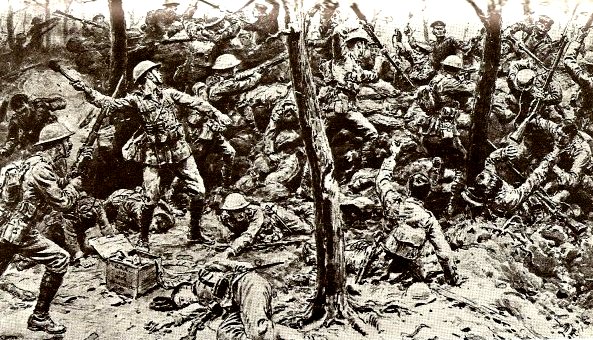
combat
We heard cries from the wood further down, and Geoghan and Edkins went to investigate, finding three wounded men lying down in the open. They had been lying there three days among their own dead, and had been buried a couple of times by their own shells, and the one brought in had been wounded again. They asked for four volunteers to bring in the other two, so off we went. It was an awful half hour, but we were well repaid by the grateful looks on their haggard faces. Poor old Geoghan was hit, his head was split off by shrapnel. Four of us buried him this morning.

11th July 1916
We were relieved by our own Scottish, and are back at our former camping ground, but I do feel so lonely, out of our mess of 5, only 2 of us left and my half section gone as well. We were right through the Egyptian Campaign tog, as half sections.

A Yorkshire man brought a prisoner over this morning, while we were still in the trenches, and he halted to have a chat. Our Corporal could speak German, so he gave the prisoner a cig. and he told us all we wanted to know. He was a Saxon and was heartily sick of the war, and our artillery was playing up havoc with their infantry, since the beginning of the Battle of the Somme. I didn’t say anything, but their artillery had given our men as much as they could bear.

12th July 1916
About 2 miles back and still the Huns had the neck tu put a shell into us, killing one man and wounding another. The Rev. Cook was killed while helping to carry in wounded. I have just been watching the Huns shelling the wood we came out of yesterday. It looks as though the wood is on fire, the smoke rising from the bursting shells. The Scottish (ours) relieved us too, and we lost 16 out of our platoon in it. It was a cruel three days, espacially when Manchester were driven out of the woods, 700 yards, in front of us, we were expecting the Huns over any minute, but the Huns would have got a warm reception. Then the Bedfords retook the wood, the full morning, which strengthened our position.

13th July 1916
Allyman found us again bending. I thought we were so safe for a bit. A shell planked out into the next dug-out to mine, killing Smithy and wounding Edkins, Lonsdale, Redwood and Bob Thompson, 3 of them belonging to our section. Only 3 of us left in Sammy’s old section. It’s a cruel war this. Just going up to dig graves to bury our dead. We buried Private Redwood, Smith and Colonel Jones, of The Scottish. General Lukin was at the funeral, he did look so worried and old.

14th July 1916
News very good this morning. our troops driving the Huns back, and the cavalry have just passed, they look so fine. The Bengal Lancers were among them, so I was told. We’re under orders to shift at a moment notice. It rained heavily this morning. I hope it does not hamper the movements of the cavalry. If this move ends as successfully as it has begun, it will mean such a lot to the bringing of the war to an end. Our chaps are getting so tired of the mud and damp. There’s such a change in the sunburnt faces of Egypt, and this inactivity makes one as weak as a rat. The cavalry have done excellent work, now it remains to us infantry to consolidate the positions. We’re just ready to move forward…

15th/16th July 1916
We (South African Brigade) went into Delville Wood and drove the Huns out of it, and entrenched ourselves on the edge, losing many men, but we drove them off, as they wound come back and counter attack. Then snipers were knocking our fellows over wholesale, while we were digging trenches, but our chaps kept them off. I got behind a tree, just with my right eye and shoulder showing, and blazed away.

We held the trench, and on the night of the 16th July they made a hot attack on out left, 16 of them breaking through, and a bombing party was called to go and bomb them out (I was one of the men picked). We got four and the rest of them cleared out. It rained all night, and we were ankle deep in mud, rifles covered with mud, try as we would, to keep them clean.

17th-20th July 1916
The Huns started shelling us, and it was just murder from then until 2 o’clock of the afternoon of the 18th, when we got the order to get out as best you can. I came out with Corporal Farrow, but how we managed it, goodness knows, men lying all over shattered to pieces, by shell fire, and the wood was raked by machine guns and rifle fire. Major McLeod of the Scottish was splendid. I have never seen a pluckier man, he tried his level best to get as many out as possible. We fall back to the valley below, and formed up again. I came on to camp and was ordered by the Doctor to remain here, having a slight attack of shell shock. I believe the 9th took the wood again, and were immediately relieved, but the lads are turning up again in camp, the few lucky ones. If it was not for a hole in my steel helmet, and a bruise on the tip, I would think it was an awful nightmare…The lads stuck it well, but the wood was absolutely flattened, no human being could live in it.

Major McLeod was wounded, and I gave him a hand to get out, but he would have I was to push on, as I would be killed. Many a silent prayer did I sent up, for strength to bring me through safely. I found a Sergeant of the 1st all of a shake, suffering from shell shock, so I took his arm and managed to get him to the dressing station. Just shaken hands with my old pal John Forbes. He is wounded in the arm and is off to Blighty. I quite envy him.

A sad day of S.A… They say we made a name for ourselves but at what a cost. All the 9th are resting on a hillside. Small parties of 25 to 40 men form the companies, which were 200 strong a short two weeks ago. We have taken back several miles…
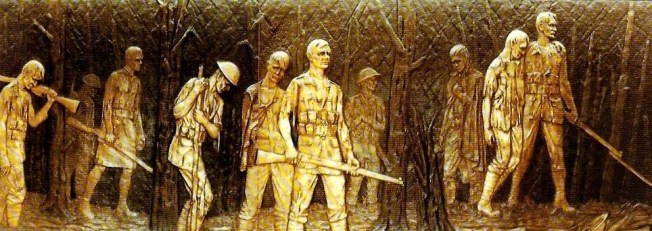
19983702_10155267786011480_4967119870372002441_o
21st July 1916
Had a bathe in the Somme, and a change of underwear, now lying on the green hillside listening to our Division band, a happy day for the lads that were lucky enough to come through.

22nd July 1916
… General Lukin had us gathered round him, and thanked us for the splendid way in which we fought in Delville and Bernafay Woods. He said we got orders to take and hold the woods, at all costs, and we did for four days and four nights, and when told to fall back on the trench, we did it in a soldier like way. He knew his boys would, and he was prouder of us now, than even before, if he possibly could be, as he always was proud of South Africans. All he regretted was the great loss of gallant comrades, and thanked us from the bottom of his heart for what we had done.
supporting-poppy-appeal

Related Links and Work

Springbok Valour – Battle of Delville Wood Centenary ‘Springbok Valour’… Somme 100 & the Delville Wood Centenary

In Flanders Fields (Afrikaans) ‘In Flanders Fields’ translated into Afrikaans for the Somme 100 commemoration, July 2016

William Faulds VC Taking gallantry at Delville Wood to a whole new level; William Faulds VC MC

The Battle of Delville Wood 500 shells/min fell on the Springboks … “the bloodiest battle hell of 1916”

Mascots at Delville Wood: Nancy the Springbok Nancy the Springbok

Mascots at Delville Wood: Jackie the Baboon Jackie; The South African Baboon soldier of World War One


Posted by Peter Dickens

With the courtesy of the nephew of Walter Giddy, John Morris of Knysna, South Africa, and his daughters Kathy Morris/Ansermino of Vancouver, Canada, and Wendy Morris/Delbeke of Deerlijk, Belgium

Feature image: Illustrated London News Lithograph by the Spanish artist – José Simont Guillén (1875-1968)

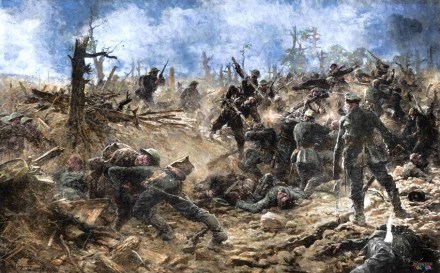
Insert illustration: Frank Dadd from a description of the Battle of Delville Wood by a British Officer. The Graphic Aug 19, 1916

Insert Image:  Brass relief depicting a group of South Africans leaving Delville Wood after the battle, located at the Delville Wood Museum in France.  Brass by sculpter Danie de Jager.

Walter Giddy image and post content courtesy The Delville Wood memorial – website www.delvillewood.com 

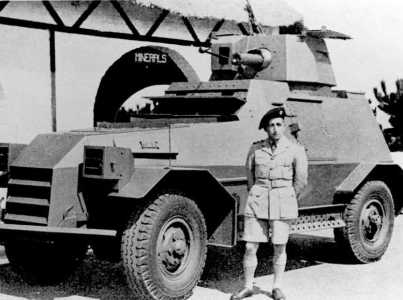
German POW’s hitch a ride on a South African armoured car

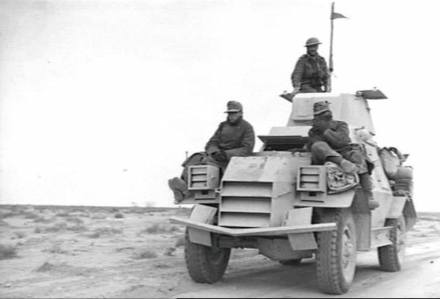
Amazing image taken at Fort Capuzzo in Libya during WW2 – December 1941. Two German Afrika Corps soldiers – now Prisoners of War (POW) – hitch a ride into captivity on the front of a 2nd South African Division Marmon-Herrington Armoured Car.

The Marmon-Herrington Armoured Car was a series of armoured vehicles produced in South Africa and adopted by the British Army, other Commonwealth Forces (India used them) and South African army during World War II.  Highly popular as they could be adapted into all sorts of roles and configurations, some captured examples even made their way into the German army and other Axis forces during the war.


MarmonHerringtonMkIII

Marmon-Herrington Mk III

Featured image Copyright Australian War Memorial


‘Bake-off’ South African style!

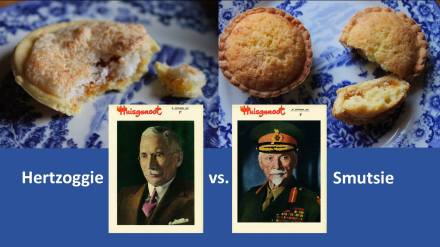
The politics of the jam tart. At one stage the politics of division between Jan Smuts’  politics of reconciliation’ and Barry Hertzog’s ‘politics of separation’ even entered into the kitchen, and this is one very hot political cup cake.

In 1924 during the General Election women showed their political support from the kitchen. During this time the little jam tart in honour of JBM Hertzog or the ‘Hertzoggie’ started to grace the tea tables of staunch  National Party supporting women.

Going head to head in the bake off with a jam tart of their own, women supporting Jan Smuts’ South African Party came up with the ‘Smutsie’ or the Jan Smuts Cookie (also known as a General Smuts cookie).

The irony is that they are baked in nearly the same way with an apricot jam filling, the difference is in the topping. The Smutsie cookie has a creamed butter and sugar topping (similar to a penuche frosting) whereas a Hertzoggie has a much paler macaroon-style of topping made of egg white and coconut.

It is said that those supporting the one style of cookie refused to bake or eat the opponents offering.  Such was the intense political rivalry and deep division between the two.

The recipe of the Smutsie seems to have varied over time and from what I can see the Sugar Butter topping has been lost from more recent recipes, whereas the Hertzoggie has been quite popular and commonly found. So, here’s a challenge to the bake-off enthusiasts out there – rejuvenate the Smutsie with its original topping!

This is one for the ‘The Great South African Bake-off  2018’ challenge I would love to see, one half doing a take on the Hertzoggie using ‘ouma se resepte’ and the other half sprinting around the kitchen frantically stealing each others recipes trying to figure out a Smutsie.  All the while both groups shout ‘veraaier’ at one another.  How South African is that!

A Smutsie with a penuche frosting as a topping, now that’s the Smutsie for me …. although I am told that a Hertzoggie made on a braai (yup, a braai – believe it) is to die for. As a ‘Soutie’ married to a ‘Boertjie’ to keep peace in the house I might just find the safe political middle ground and go with her excellent Springbok rugby player inspired  … Jan Ellis Pudding.


Written by Peter Dickens

Gandhi was a man ó peace, but he was also a man ó war!

It is strange to think of Mahatma Gandhi as having served in the military, but in many ways his military service and witness to war in South Africa shaped the future icon of peace and tolerance which he was to become.

Gandhi is generally quite misunderstood, like Smuts and Churchill, he was a man born in a period of ‘Empire’, the ideals of that period – its systems of governance and politics was fundamentally different to what we understand in the context of modern politics and individual freedoms.  ‘Empire’ was the way the world worked then, literally – it dictated geo politics and trade.

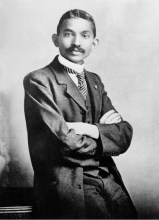
48934-OGJmNDllZjVjOAIn this context rose a young, British educated lawyer – Mohandas Karamchand Gandhi who emigrated to the British Colonies in Southern Africa to make a name for himself and start a new life.  He was at the start of his life quite supportive of British policies in South Africa and those of British empire and expansion.
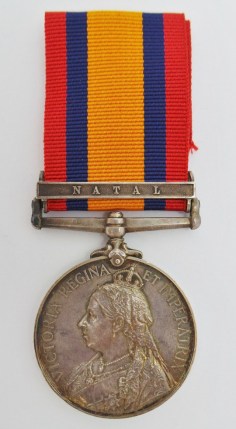
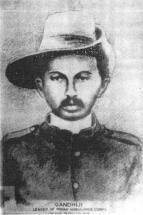
Historians and political pundits have forever struggled to explain why the apostle of peace and non-violence had rendered support to the British Empire in the Boer War, the 1906 Natal Rebellion and the First World War.

What is clear by his own writings was that his intentions in supporting the British Army in Southern Africa was to buy the Indian population in Southern Africa more political concession and representation based on endorsement and participation in British war efforts.

The Boer War

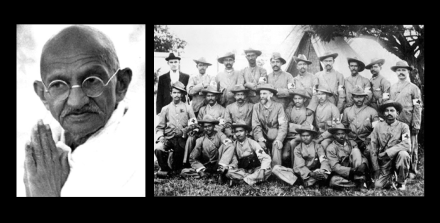
Gandhi actually played a pivotal role in the Boer War, forming  Natal Indian Ambulance Corps under the British Military.  He even raised the money to form the Corps from the local Indian Community.   It consisted of 300 “free” Indians and 800 indentured labourers (Indians were encouraged to emigrate to South Africa as labourers under contract, once the specified dates of the contract finished they were “free” to own land and make their own way as citizens).

The Boer War was officially declared by the Boers in October 1899 when they invaded the British Colonies of Natal and the Cape.  This attack led to the Siege of Ladysmith and the Garrison stationed there.   In an urgent response the British authorities recruited the Natal Volunteer Ambulance Corps of about 1100 local White men. At the same time Gandhi pressed for his Indian stretcher-bearers to be allowed to serve.

Battle of Colenso

Dubbed “Black Week”, from 10–17 December 1899, the British Army, unprepared for the Boer invasion, completely outnumbered and outgunned suffered three devastating defeats by the Boer forces, starting at Stomberg, then Magerfontein and finally ending the black week at Colenso.  In all the British lost a total of 2,776 men killed, wounded and captured.

It was the Battle of Colenso on 15 December 1899, that the Natal Volunteer Ambulance Corps first saw action, removing the wounded from the front line and then transported them to the railhead.

Battle of Spion Kop 

56419-12802
After Colenso, the first full attempt to relieve Ladysmith by the British was met with absolute disaster at Spion Kop (or Spionkop) for the British. Spion Kop (Afrikaans: Spioenkop meaning “spy hill”) is a mountain located near the town of Ladysmith, 27 km to the South West.

On the 23rd January 1900, the British climbed up the Spion kop hill at night and in dense mist. They surprised the small Boer piquet there and drove them off the kop at bayonet point. The Boer piquet retreated down the hill to their camp waking up their fellow Boers by screaming “Die Engelse is op die kop.” (The English are on the hill.). At that time a half-company of British sappers began to entrench their position on the hill with a mere 20 picks and 20 shovels (oddly – while almost 1,000 soldiers stood around idle).

As dawn broke, the British discovered that they held only the smaller and lower part of the hilltop of Spion Kop, while the Boers occupied higher ground on three sides of the British position. The British had no direct knowledge of the topography of the summit and the darkness and fog had compounded the problem. Furthermore, the British trenches were inadequate for all defensive purposes. Because the summit of the kop was mostly hard rock, the trenches were at most 40 centimetres (16 in) deep and provided an exceptionally poor defensive position – the British infantry in the trenches could not see over the crest of the plateau and the Boers were able to fire down the length of the crescent-shaped trench from the adjacent peaks.

By the end of the battle, the British suffered 243 fatalities; many were buried in the trenches where they fell. Approximately 1,250 British were either wounded or captured. The Boers suffered 335 casualties of which 68 were dead.

During the battle, the Natal Volunteer Ambulance Corps (including Gandhi) moved into the frontline to collect the wounded.

There is an account of Ghandi’s bearing during the Battle of Spion-Kop. Vera Stent described the work of the Indians in the Illustrated Star of Johannesburg, July 1911, as follows:

ghandi7“My first meeting with Mr. M. Gandhi was under strange circumstances. It was on the road from Spion Kop, after the fateful retirement of the British troops in January 1900.

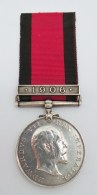
The previous afternoon I saw the Indian mule-train moved up the slopes of the Kop carrying water to the distressed soldiers who had lain powerless on the plateau. The mules carried the water in immense bags, one on each side, led by Indians at their heads. The galling rifle-fire, which heralded their arrival on the top, did not deter the strangely-looking cavalcade which moved slowly forward, and as an Indian fell, another quietly stepped forward to fill the vacant place. Afterwards the grim duty of bearer corps, which Mr. Gandhi organised in Natal, began.

It was on such occasions the Indians proved their fortitude, and the one with the greatest fortitude was the subject of this sketch [Mr. Gandhi]. After a night’s work, which had shattered men with much bigger frames I came across Gandhi in the early morning sitting by the roadside – eating a regulation Army biscuit. Everyman in Buller’s force was dull and depressed, and damnation was heartily invoked on everything. But Gandhi was stoical in his bearing, cheerful, and confident in his conversation, and had a kindly eye. He did one good… I saw the man and his small undisciplined corps on many a field during the Natal campaign. When succour was to be rendered they were there.”


34 Indian leaders were awarded the Queen’s South Africa Medal for actions in the Boer War. Gandhi’s is held by the Nehru Memorial Museum in New Delhi.

In a strange twist, the Battle of Spion Kop was to forge three major world leaders who were all present on the battlefield, Gandhi, Botha and Churchill.  Mahatma Gandhi would go on to become the Indian leader and reformer, Louis Botha would go on to forge The Union of South Africa and become its first Prime Minister and Winston Churchill would become the great wartime Prime Minister of the United Kingdom during the Second World War.  To read more see Observation Post Spionkop shaped 3 future leaders – Churchill, Botha & …. Ghandi

1906 Natal Rebellion

44277-10198The Zulu uprising in Natal during 1906 was the result of a series of culminating factors and misfortunes; an economic slump following the end of the Boer War, simmering discontent at the influx of White and Indian immigration causing demographic changes in the landscape, a devastating outbreaks of rinderpest among cattle and a rise in a quasi-religious separatist movement with a rallying call of ‘Africa for the Africans’.
The agricultural mainstay of the economy of Natal had been adversely affected by the depletion of the Black workforce to the more lucrative work in the mines of the Witwatersrand.  The imposition of Hut Tax was a further burden and then the introduction of a Poll Tax on each male over 18 years in Natal and Zululand by the cash-strapped government was to be the final straw turning discontent into open rebellion.

The enforced collection of this tax was deeply resented by many Blacks, it raised tensions considerably within Natal and resulted in a series of incidents and finally the murder of a farmer and the deaths of two Natal policemen in January 1906. This caused the Governor Sir Henry McCullum to declare Martial Law on the 9 February and the militia were called out.

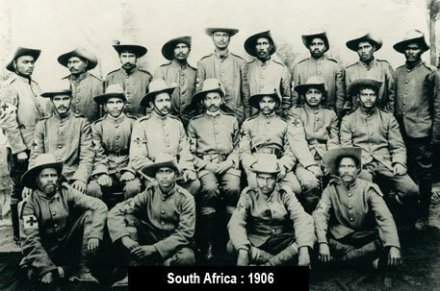
By this time Gandhi had attained the rank of Sergeant Major and encouraged the British to recruit Indians. He argued that Indians should support the war efforts to legitimise their claims to full citizenship. The British accepted Gandhi’s offer to let a detachment of 20 Indians volunteer as a stretcher-bearer corps to treat wounded British soldiers. This corps was commanded by Gandhi and operated for about two months.

For his action Gandhi was awarded another medal, the Natal Rebellion 1906 medal.

gandhi SA

Gandhi seated centre row 4th from the left

The experience however taught him it was hopeless to directly challenge the overwhelming military power of the British army, he decided it could only be resisted in a non-violent fashion, driven by the purity of heart.

Peaceful Resistance

In 1910, the same year the South African Union was established, Gandhi established an idealistic community called ‘Tolstoy Farm’ near Johannesburg.  It was here, based on his wartime experience and unsuccessful experiences of collaborative politics with the British, that he nurtured his policy of peaceful resistance.

gandhi

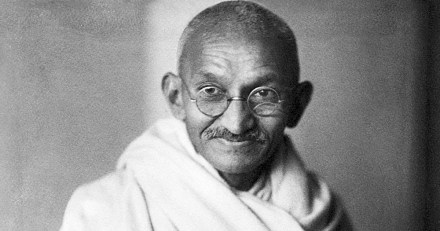
In all Mahatma Gandhi spent 22 years of his life in South Africa, a significant period of time, and there is no doubt the region’s politics and violence forged the man he had become by the time he returned to India in 1915.  On arrival in India he brought with him an international reputation as a leading Indian nationalist, theorist and organiser. He joined the Indian National Congress and was introduced to Indian issues, the rest as they say … is history.


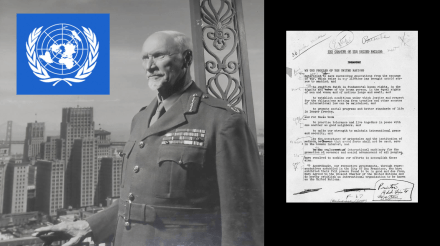
Jan Smuts drafted the Preamble to the United Nations Charter

Imposing photograph of Jan Smuts at the San Francisco Conference in 1945 – the historic conference which founded the United Nations (UN).

One of Jan Smuts’ last acts as the Prime Minister for South Africa was the establishment of the United Nations. In fact he wrote the original opening lines of the Preamble to the United Nations Charter as …

“The High Contracting Parties, determined to prevent a recurrence of the fratricidal strife which twice in our generation has brought untold sorrow and loss upon mankind..”

Not only did Smuts do the first draft of the Preamble to the United Nations Charter, he also played a key role in putting together the United Nations Charter itself. Smuts even presided over the first meeting of Commission II, General Assembly of the United Nations on 30 May 1945, held at the San Francisco Opera House.

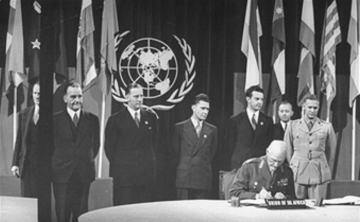
Jan Smuts was also present at the historic signing ceremony of the United Nations Charter on the 26th June 1945 and signed the Charter on behalf of South Africa.


Screen Shot 2017-04-28 at 09.23.10

Subsequent to these historic meetings and ceremonies in San Francisco the Charter and United Nations as we know it came into full existence on the 24 October 1945.

Now, this was truly one of South Arica’s most philanthropic leaders, a man years ahead of his time, only to have his legacy tarnished by successive political posturing after his death five years later in 1950, which continues even to this day.

By the time of Smuts’ death in 1950, even the United Nations, which South Africa had played such a pivot role in establishing in 1945, was at loggerheads with the “new” South African Nationalist government which came to power over Smuts’ party in 1948.   From that date onward the United Nations started to pass resolution after resolution in damnation of the then newly elected National Party’s policy of Apartheid.

During the next 46 years in the United Nations, South Africa went from the heady heights of a founding signatory of The United Nations to the lows of a pariah state – and this forever diminished and damaged South Africa’s influence in the United Nations and as a leader in future global politics. Something Jan Smuts even foresaw in 1948 and warned the country against, but to no avail.

However, history is the ultimate decider and Jan Smut’s track record of achievements cements the simple fact that he remains one of the greatest men the country has ever produced.

J_Smuts_sign

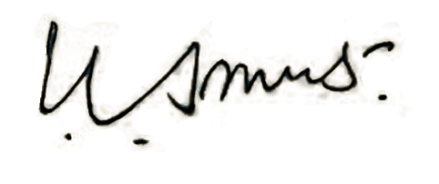
Jan Smuts’ signature 

Springboks and Diggers … part of the Anzac ‘mateship’ legacy

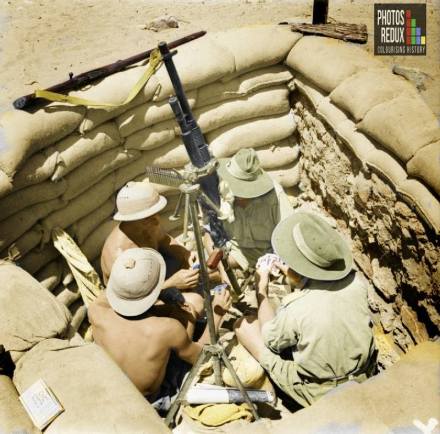
Iconic image (now colourised) of Commonwealth forces in North Africa during World War 2. Easily identified by their distinctive headgear, South African and Australian soldiers enjoy a game of cards in a gun pit. The South Africans where know as ‘Springboks’ and the Australians known as ‘Diggers’ – a nickname they both inherited during World War One.

The distinctive headgear as shown is quite interesting, so too the unique military bond and history of that exists between South Africa and the Anzac alliance, Australia and New Zealand.

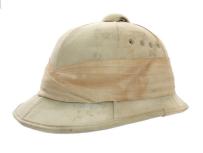
SA PithSouth African.  The South Army (and Air Force) was issued with a “Polo” style “Pith” helmet.  Made from cork it was not intended to protect the head from flying bullets and shrapnel, that was the purpose of the British Mk 2 Brodie helmet (also issued to South Africans). The pith helmet was worn mainly as sun protection when not in combat.
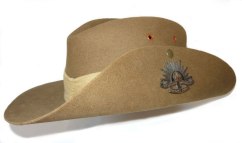
slouch-hat-ww2Australia.  The Australian army wore the “slouch hat”, also intended for sun protection when not in combat, like the South Africans they where issued with the British “Brodie” Mk2 steel helmet when in combat.
The “slouch” hat also has a little South African history to it.  The word ‘slouch’ refers to the sloping brim. The brim is made from rabbit-fur felt or wool felt and is always worn with a puggaree.

History has it that the origins of the Slouch Hat began with the Victorian Mounted Rifles; a hat of similar design had been worn in South Africa by the Cape Mounted Rifles for many years before 1885. The design of the Victorian Mounted Rifle hat originated from headgear of native police in Burma where Lieutenant-Colonel Tom Price had recognised its value.

The Victorian hat was an ordinary bush felt hat turned up on the right side. The intention of turning up the right side of the hat was to ensure it would not be caught during the drill movement of “shoulder arms” from “order arms”.

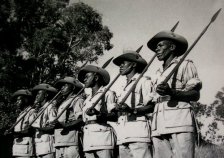
sagaieIn addition to Australians, believe it or not some South African units also wore the “slouch hat”.  Most notable was the South African Native Military Corps members, who made up about 48% of the South African standing army albeit in non frontline combat roles during both WW1 and WW2.  The legacy of the “slouch” in the modern South African National Defence Force is however now on the decline and little remains now of its use, a pity as it would be a gracious nod to the very large “black” community contribution to both WW1 and WW2.
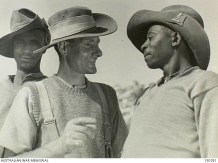
150281In an iconic Australian War Memorial photograph to demonstrate this unique association,  a Australian soldier working on the Beirut-Tripoli railway link is seen here chatting with two members of a South African Pioneer Unit (SA Native Military Corps) also working on the railway. The photo is designed to show off their similarities of dress and bearing and promote mutual purpose.
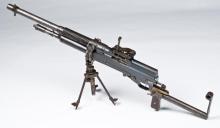
Of interest – The Gun in the pit

8493892_2Interestingly the gun in the pit is not South African standard issue.  Instead it is a British made Hotchkiss Portative MK 1, which was used by the Australians, dating back to World War 1, so it is probably their gun pit.  Of French design the MK I was a .303 caliber machine gun, used in ‘cavalry/infantry’ configuration, with removable steel buttstock and a light tripod. This gun is normally fed from either flexible “belts” or strips like you see in the featured image. Normal Hotchkiss Portative strips hold 30 rounds each.
Camaraderie 

Because of mutual historic, military, language, British Dominion and cultural ties here was certainly was plenty of camaraderie between the South Africans and the Anzac Australians and New Zealanders during the war. Lots of informal rugby and cricket matches were played at any good opportunity, games of cards (seen here), exchanging of “souvenirs” (especially badges, sun helmets and slouch hats), occasional punch ups in Cairo pubs fuelled by beer which were soon forgotten and forgiven.  Generally good old good old fashioned soldierly fun and “band of brothers” stuff.

Tobruk

Because the South Africans were responsible for the “fall of Tobruk” in World War 2, a city the Australians fought to hold with such tenacity before handing it over to the South Africans to defend, as a South African you might also come into some light-hearted but pointed “sledging” from an Australian military veteran, even to this day.

ANZAC Remembrance

Modern South Africa does not extensively praise, idolise and remember her statutory armed forces and the origins of their fighting legacy anything near the Australians and New Zealanders do to their forces now.   This has manifested with the inclusion of hundreds of South African veterans residing in Australia in National Anzac Day parades held around Australia and New Zealand, and it is because of this unique bond forged by our forefathers in WW1 and WW2 that they are welcomed with open arms.


Researched and written by Peter Dickens, with deep gratitude for the colorised photo of the Diggers and Springboks by Photos Redux – Imperial War Museum copyright.

Related work and links

Tobruk; “Defeat is one thing; Disgrace is another!” South Africa’s biggest capitulation of arms – Tobruk

Diggers and Springboks WW1; Springboks and Diggers … part of the Anzac ‘mateship’ legacy

Gallipoli; One Lucky Charm wins the Victoria Cross, DSO and MC


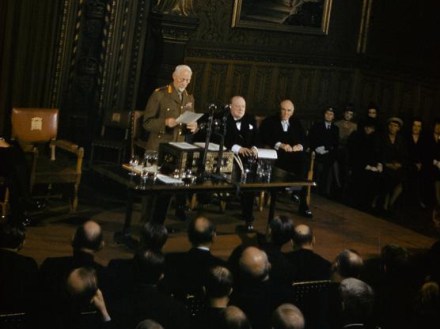
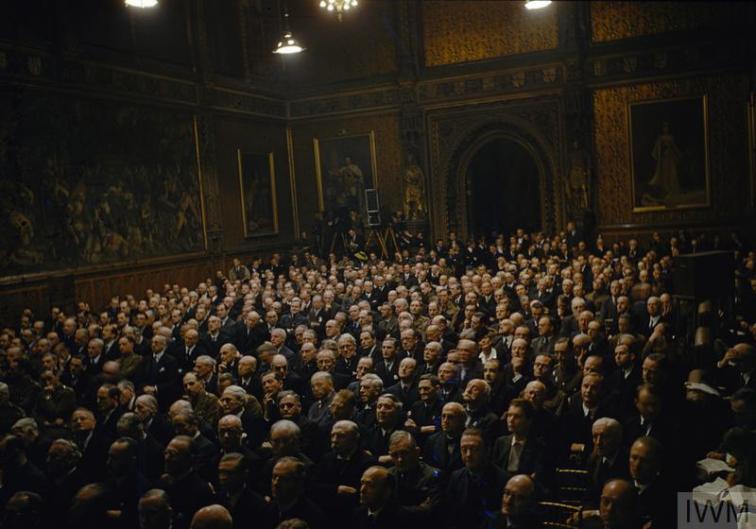
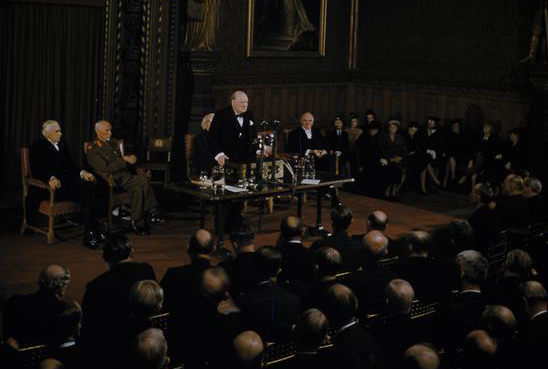
A true statesman, Jan Smuts addressing the British Parliament – 1942

Field Marshal Jan Smuts, at the invitation of Winston Churchill addressing both houses of the British Parliament on the 21st October1942. This speech is historic, never before was any Commonwealth Statesman given the privilege of addressing both houses of Parliament (the Commons and the Lords), and the results are astounding – not only was Smuts publicly praised by Winston Churchill at the end of his speech, the entire Parliament breaks into hoorays and sings “he’s a jolly good fellow” in praise of the man and his life’s work.  This speech is well worth viewing and here it is, in full.

Two great South Africans have the privilege of statues outside the British Houses of Parliament in London, both having addressed this house at Westminster, and they stand in Westminster square for good reason. This was a period when Jan Smuts took his broken country from the Boer War, unified it and built it into an international powerhouse – at this occasion Smuts receives the praise due a visionary world leader.

The vast majority of both English and Afrikaans speaking South Africans backed Smuts at the time, however his legacy – like any great man’s legacy – is tainted by his opposition – The National Party, who, when they came into power served to demonise him over decades – so much so that he remains an enigma to many South Africans today. Except when you find gems like this film clip – which can bring him back into living memory.

Look out for Smut’s comments on the necessity to rid the world of Nazism, his insightful summary of Hitler’s policy in Europe and for his views on he formation of the United Nations – to which he is founding signatory.

smuts 5

To think that Smuts was a South African War Boer General, and both he and General Louis Botha understood that the salvation and re-building of their shattered people lay with their former enemy. Their vision of unity built South Africa from a fractious grouping of colonies and tiny states into a significant and unified nation – a regional economic power-house. The fact that his former enemy stood up in praise of this man and his achievement speaks volumes.

Jan Smuts is literally the “father of the nation” that is South Africa today and it’s a great pity he is so misunderstood. As anyone who watches this video will see, thanks to this remarkable man, South Africans by the end of World War 2 stood with heads held high, chests swollen with pride, praised by the free world and revered by great men.

winston:smuts

Visit of Field Marshal Jan Smuts, to the House of Commons 21 Oct 1942. The Prime Minister, Mr Winston Churchill, calls on the assembly in the House of Commons to acclaim Field Marshal Smuts, after his address. IWM Copyright.

History unfortunately would dramatically change course for South Africa a couple of years later, when in 1948 the National Party narrowly edged its way into power in the general elections with a proposal called Apartheid.  South Africa has swung from ‘Pariah State’ far right racial politics to ‘Junk Status’ economic leftist politics in response to the secular race politics – with very little regard for Smuts’ centralist or “centre ground” reconciliatory politics since.


To read more about Smuts and some of his lifetime achievements and body of work, click on this link “The force of his intellect has enriched the wisdom of the whole human race”- the death of Jan Smuts.

Written  by Peter Dickens.  Footage copyright – British Pathé. Image/s copyright – The Imperial War Museum

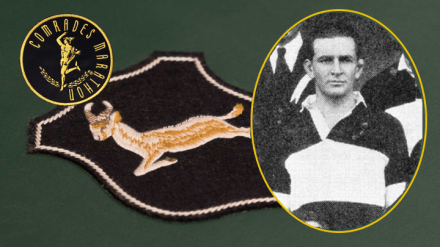
Comrades legend, Springbok and war veteran – the remarkable Bill Payn

So, which Springbok rugby player and war veteran also has a top ten Comrades finish running in his rugby boots and then went on to play a game of rugby the next day?  This is one very remarkable man and he comes from a time when men were cut from a different cloth, read on for the story of the legendary Cecil “Bill” Payn.

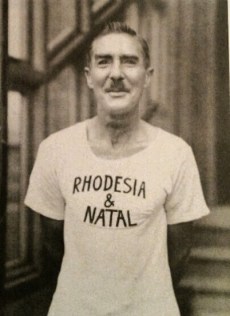
Bill Payn was born on 9 Aug 1893 in Harding, South Africa, he was christened Cecil, the son of James Herbert Payn. He was a very well known personality, a much loved teacher, and a sportsman. He taught at Durban High School for boys for 40 years or more, only having a break during his army service in the First and Second World Wars. He was particularly well known in Natal and Rhodesia and was described as big hearted and kindly “Big Bill” and stood 6 ft 3 in in his socks. He was a battle-field hero and an ex PoW.

His life was dedicated to helping others, whether his fellow prisoners of war, team mates, school pupils or every day friends and acquaintances. He was a Springbok rugby player and at cricket bowled with distinction. He was a boxer, an athlete and shone at baseball. He was truly a great and kindly man, he died suddenly at age 66 on the 31st Oct 1959.  Ever generous he even left money for his friends to have a drink after his funeral.

Top 10 Comrades finisher in his rugby boots

In summary of his Comrades achievement, Bill came 8th in the 1922 Comrades Marathon. A Springbok rugby player, he ran one of the most famous races in the history of the Comrades.  Bill Payn hosted Arthur Newton the evening before the race, and after a number of stiff drinks, was persuaded by Arthur to enter (Arthur went on to win the race).

Bill arrived on time for the start, wearing his rugby boots. At Hillcrest he stopped for the first time to take in a breakfast of bacon and eggs. Not much further a fellow runner, “Zulu” Wade, invited Payn for a chicken curry. This they consumed and then continued on to Drummond, where they celebrated reaching the halfway mark by drinking a beer at the hotel. Wade didn’t continue, but Payn did. A lady spectator en route helped him keep his energy levels up by providing him with oranges, peach-brandy, water and tea. He finished eighth. On the next day Payn took part in a club rugby match, but because his feet were blistered from the long run in rugby boots, he elected to play the match in his running shoes.

The first Comrades Marathon race was a down run from Pietermaritzburg whilst the first up run from Durban to the provincial capital took place in 1922 and consisted of a field of just over 100 athletes.  In those days the Comrades took place on mainly sand and gravel roads (which in part was more conducive to wearing studded rugby boots).

World War 1

Bill Payn played provincial rugby over a period of eighteen seasons losing four years whilst serving overseas in the First World War. He did have the opportunity then of representing South Africa in the Imperial Services Tournament held in Britain before returning home. In all, he represented Natal in fifty nine matches.

An “all rounder”

Bill had a natural affinity for all sports, a true “all-rounder,” attaining provincial colours in five sports, he represented Natal at cricket, boxing, baseball and athletics in addition to his main sport of rugby. However sport was but one of his interests, he was an outstanding English scholar and a leading South African expert in the science of Etymology.

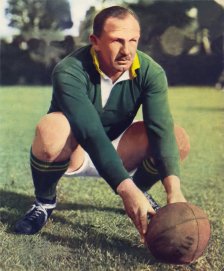
Bill Payn also received Springbok colours and played in two tests on the flank in the 1924 series but later after his own playing days were over he was to have an important role in the development of a post World War Two Springbok rugby legend.

The 1922 Comrades Marathon in Bill’s own words

Bill Payn’s own words on the 1922 Comrades Marathon are now legendary and well worth the read, an abridged version of that day by Bill goes as follows:

`On a bleak May morning I toe’d the line at the start when some civic dignitary fired a pistol and then very sensibly buggared off back to his warm bed. When the shot rent the air, off we sped – like a crowd of Armenian refugees fleeing from the wrath of the Turkish army. Shall I ever forget that infernal run. It was not very long before I realised that I was prey to an all consuming thirst, so clamant indeed, that I could not refuse any man who offered me a drink. At Hillcrest my feet were giving me so much pain that I took off my rugby boots and found a mass of blisters had formed on the soles of both feet, some kind follower provided me with brilliantine with which I anointed my feet and then repaired to the hotel for a huge plate of bacon and eggs. This done and much refreshed I ran up Botha’s Hill where at the top I found a friend who was also taking part, but he was in a very bad state so we sat down next to the road and exchanged notes and took stock of ourselves and the situation we were in. I fear that we did not move with the freedom of young athletes but rather resembled two old ducks, suffering from some distressing gynaecological disorder.

Fortunately at that stage my friend’s supporter arrived on the scene with a wicker basket which contained a delicious curried chicken set on a huge bed of rice. This we shared equally and then set off together in happy companionship for Drummond and here we bent our steps to a pleasant oasis – the pub – where I lined a dozen beers up on the counter determined not so much to celebrate a victory but rather to drown our sorrows. Whilst we were busy at this, one of the camp followers arrived on the scene and urged us both to continue as there were only five runners in front of us. My friend could not continue so I set off alone for Pietermaritzburg.

Somewhere along Harrison Flats I noticed a frail little woman with pink cheeks standing at the side of the road. She held up in one hand a bottle and in the other a glass. I stopped, and with old world courtesy bowed low saying `Madame your servant to command’. `Tis peach brandy’, she volunteered, `and I made it myself’. I gulped down a full tumbler of this home-made brew and in a second realised that I had swallowed a near-lethal dose of the rawest liquid I had ever tasted. I am still convinced that to this charming little woman must go full credit for inventing the first liquid fuel for jet engines. Fortunately I was facing Maritzburg and I was propelled along the way. I was too far gone in my cups even to ponder on whether this assistance did not breach the prescribed laws of amateur marathon running.

On the outskirts of Pietermaritzburg I was hailed by my wife’s family who were taking tea on the veranda. I went off the road and joined them in their tea and cakes. While we were thus happily engaged, two of my ‘hated’ rivals went past and so it was that I ended the course number eight. In the changing rooms I discovered that the soles of my feet were now two huge pads of blood blisters. My brother-in-law then arrived and he had the uncanny insight to my most immediate needs, for he gave me a bottle of champagne, for which I was most grateful. Shortly thereafter a rugby friend arrived and chided me as to whether I had forgotten that I was due to play a first league rugby match the next day and that our team needed me. Cadging a lift on the back of his motorbike we went back down to Durban and on the following day I played full back in a pair of old `tackies’.

This account by Bill Payn does not appear possible but it has been vouched for in every detail by Arthur Newton, the friend who persuaded Bill to enter the race in the first place and who was himself destined to become a legend in the world of marathon running.

newton-6

Arthur F. H. Newton, winner of the first “up” version of the Comrades in 1922 in a time of 8:40:00.

Bill Payn’s description of the race is filled with humour which so characterised his outlook on life. To illustrate this aspect there is a classic story told of Bill when he was captaining his club’s first cricket side in the premier league and they were not having a very good season with the bat. He placed an advertisement in the local Natal newspaper which read,

“Join Stanford Hill and bat twice on a Saturday afternoon”

His Passion for Rugby

Of all his sporting interests, rugby was his greatest love and he devoted many years of his life to the administration of the sport and coaching young players in the enjoyment of the game. He was the founder of Natal schools rugby and became a father figure to organisation serving on its executive from 1933 – with a gap for the war years – right through until he passed away in 1959. It is interesting to note his thoughts on the game of rugby and why people are keen to play the game.

Quoting him again `Why do men love to play rugby, is I feel sure, that it is the simulacrum – in simple terms it means an image of – of war as waged in the medieval days when battles were marked by the two cardinal virtues of courtesy and courage’.

His very close friend and fellow schoolmaster, Isak Van Heerden, who was to become the Springbok coach in the 1960’s, when commenting on Bills outlook on the game said

“He looked upon the game as a friendly and controlled war, feeling that man still has his primitive instincts and one of the strongest is the love of a good fight, which no amount of civilisation has been able to eradicate. Bill saw the game merely as a natural desire of a healthy man to pit his strength and skill against that of another and that rugby was the best possible outlet. He worshipped the game for the companionship amongst friends and for the opportunities that it allowed for comaradieship with opponents after the match was over”.

Cecil “Bill” Payn’s Test summary: Tests: 2 Tries: 0
First Test: 16 Aug 1924 Age:31 Flank against Britain at Kingsmead, Durban
Last Test: 23 Aug 1924 Age:31 Flank against Britain at Wanderers, Johannesburg

World War 2

Bill Payn was very much a man of Natal being educated at Maritzburg College and after qualifying as a teacher spent much of his working career teaching at Durban High School for Boys, but in 1939 ,at the age of forty six he once again set off for war serving as a gunner in North Africa.

Whilst in action in the Western Desert he was awarded the Military Medal, receiving a personally signed letter of commendation from the Commander-in- Chief of the Allied Forces, General Alexander.

General Harold Alexander (right), pictured here in 1942 as Commander-in-Chief, Middle East, surveys the battlefront from an open car and the Military Medal warded Payne (left).

Taken as a Prisoner of War (POW)

Later in the campaign the Allied troops were forced to retreat from Gazala back towards El Alamein. With the German Army closing in around them Bill made two desperate efforts to escape but was captured on each occasion, imprisoned first at Benghazi in Libya, he was struck down with acute dysentery and lost substantial weight, he eventually recovered and was transferred to a POW camp near Rome.

Bill’s strength of character was such that he looked on prison life as a challenge refusing to be restricted and to quote him again

“Life is always life if one can laugh and that captivity is what your heart makes of it.”

He accepted the conditions of imprisonment refusing to acknowledge their limitations, preferring to see in them an opportunity for fulfilment, the enrichment of character and to be of service to his fellow prisoners.

Using his ability in developing mental pursuits he kept many of his fellow inmates highly amused and was in great demand as a speaker with a range of subjects stretching from discussing the complete works of Shakespeare, a set of which he had with him in camp, to his talk on whales and their habits which was also a great favourite. He continued to teach, and was again in demand, conducting classes for those Prisoner’s of War who were taking correspondence courses.

A fellow prisoner wrote of him that his most outstanding characteristic was his unquestionable spirit which knew no bounds. Although he was no longer a young man, when the Italian war effort collapsed, Bill and two companions managed to escape into the mountains of Italy and were on the run for over two weeks, diverting enemy troops from the front, to search for them. Eventually they were recaptured by German troops and sent to prison camps first in Austria, then Poland and eventually to Germany itself.

Whilst he was busy keeping the spirits of his fellow prisoners up intellectually, his love of sport also played an important role in their well being with Bill forever arranging rugby and cricket matches, even teaching the prisoners from the other Allied nations the art of jukskei!.

Informal “Tests” between “Springbok” and “All Blacks” POW

It was while they were in Stalag XX-A near Thorn (Toruń) in occupied Poland which contained an equal number of young New Zealanders and South Africans crazy about their rugby that Bill Payn’s organisational ability was shown off at its very best.

A rugby ball was received through the Red Cross and Bill proposed a series of `test’ matches between the rugby worlds greatest rugby rivals. He roped in two able assistants, Peter Pienaar, the son of the 1921 Springbok captain to New Zealand and Billy Millar Jnr, whose father led the 1912/13 Springboks to the United Kingdom.

With Bill Payn as the driving force, they arranged practices and made up the jerseys, and served on the `Springbok’ selection panel. The making Springbok jerseys is a story in itself, with Red Cross vests being boiled together with the olive green Russian battle dress which were freely available, to obtain the green. The gold was more problematical but an ingenious solution was found, the S.A. Medical staff boiled up a solution of anti-malaria tablets to achieve the right result. It was important to look the part. The rugby field was marked off with yellow clay lines on the vast sandy parade ground and with army boots considered too lethal, the players played with bare feet in the middle of the Polish winter.

Aaron “Okey” Geffin

It was during this period that Bill came across another young South African who had been playing for the Pirates Rugby Football Club in Johannesburg before the war, and he had been captured at Tobruk. He was a strong, talented prop forward who also had a useful boot on him.

Bill encouraged him to work hard at this aspect of his game whilst stuck in the POW camp and to concentrate on his accuracy with his place kicking. The young soldier was none other than `Okey Geffin’ who five years later was to become a legend in the annals of South African rugby as well as an immense thorn in the flesh of the 1949 All Black side under Fred Allen.

Ockey Geffin 49

Aaron “Okey” Geffin (28 May 1921 – 16 October 2004), considered the greatest Jewish rugby player of all time,nd he was inducted into the International Jewish Sports Hall of Fame in 1998.

While in Stalag XX-A Okey Greffin said of Bill Payn,

“We used to scrum for hours on end, and he coached me. Payn arranged rugby games in camp: South Africa against the New Zealanders. Our gear was dyed underpants and vests, but no boots. We played barefoot. Payn encouraged my development and told me I would be a Springbok if I continued to play after the war.”

He spent three years in POW camps in Italy and Germany, as well as Poland, where he practised his kicking barefoot near a mass grave of Polish victims of the Nazis.

Geffin was one of the few prop forwards in the game to kick for goal. The Springboks won ten matches in a row, including a 4–0 whitewash of New Zealand on their 1949 tour to South Africa. Prop Okey Geffin helped kick the Springboks to victory—they won all four Tests despite the All Blacks scoring more tries in three of them.

Back to Bill Payn’s story, and his personal account of the Comrades Marathon which reflected both his humour and his tenacity. It was his friend, Izak van Heerden who perhaps summed Bill up best of all when he said, `

He was always seeing a humorous situation and playing upon it. He was a merry companion, a real friend and a great champion of the game of rugby‘.

Related work and links

Comrades Marathon; A ‘Living’ War Memorial, The Comrades Marathon

Comrades Marathon; Why the Comrades Marathon is called the ‘Comrades’

Living War Memorials; A war memorial in Cape Town which saves children’s lives


Written and Researched by Peter Dickens. References:  Maritzburg College Old Boys Association, wikipedia.  Main reference article – author unknown.

Let us die like brothers … the silent voices of the SS Mendi finally heard

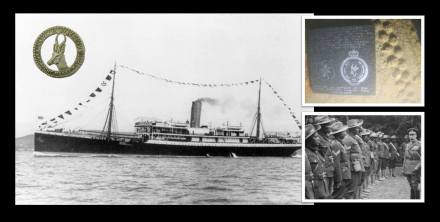
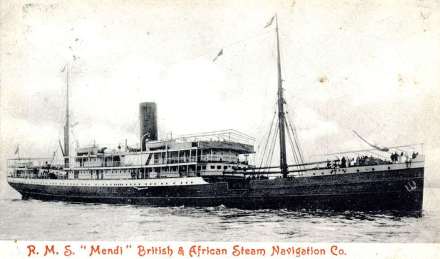
On 21 February 1917, during World War I, this chartered troopship – the SS Mendi – containing a full battalion of South African Native Labour Corps men and officers on its way to the western front was rammed in fog conditions in the English Channel. The SS Mendi sank in 25 minutes with the loss of 616 South Africans and 30 British.

mendi-image-courtesy-of-john-gribble-collection

The greatest tragedy was yet to come as due to racial prejudice this event was somewhat down-played through the years and not enough recognition given to these men, something the South African Legion and the South African National Defence Force is now working very hard at redressing.

The accidental ramming of SS Mendi Troopship by SS Darro on a cold foggy morning eleven miles off Isle of Wight, on 21st February 1917, became an almost unparalleled wartime tragedy for South African forces.

ss_darro

SS Daro

Darro, at almost three times Mendi’s weight, travelling ‘full ahead’ in fog conditions – not using her fog horn to warn shipping in the area or the appropriate lights – she rammed the troop ship with such force the SS Mendi sunk and was resting on the sea-bed within 25 minutes. The violent impact, nearly at right angles, left a gaping 20ft tear amidships instantly trapping more than 100 soldiers below decks who were unable to escape the rapidly rising water as the ship quickly listed to starboard.

Her crew, consisting 29 sailors, failed to launch sufficient life rafts for the 811 strong contingent of 5th Battalion South African Native Labour Corps (SANLC). In the dense fog and inadequate rescue effort that followed, many remained aboard the ship, unwilling to commit to an icy plunge.

They were reportedly exhorted by the Chaplain Rev Isaac Dyobha who called them together to die like warriors and brothers – what he said is now legendary.

He said “Be quiet and calm, my countrymen, for what is taking place now is exactly what you came to do. You are going to die, but that is what you came to do. Brothers, we are drilling the drill of death. I, a Xhosa, say you are all my brothers, Zulus, Swazis, Pondos, Basutos, we die like brothers. We are the sons of Africa. Raise your cries, brothers, for though they made us leave our weapons at our home, our voices are left with our bodies.”

They took off their boots, picked up imaginary spears and shields and performed an African war dance, a dance of death.

Thus, together, as brothers they chanted and danced on the tilting deck, facing death with unparalleled bravery until finally being sucked into the vortex created by the sinking ship.

The reference to weapons was to the fact that the South African Government had agreed to send black men to assist the Allied forces as labourers, but, due to policies of the time, they insisted they could not be given weapons.

Mendi

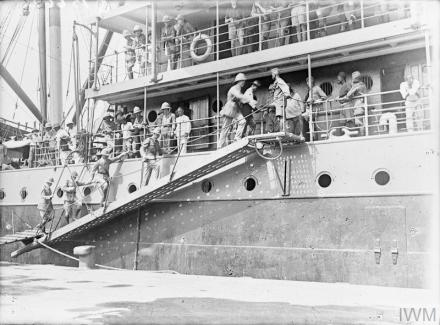
British officers going aboard the Mendi in Calabar, November 1916.

There were many more individual acts of bravery and selflessness in those terrifying early morning hours in the freezing water. A catalogue of failures exacerbated the final outcome, the Darro for example made no effort at all to rescue the men in the water, and ultimately it was that many of these brave men had no experience of the sea combined with extended exposure to the frigid February waters, off St Catherine’s Light, that accounted for the unusually high death toll.

Fewer than 200 of the 840 souls aboard the SS Mendi survived. The total toll on human lives lost that day reached a staggering 646.

The sinking was described first hand by Captain Lewes Hertslet of the Royal Army Medical Corps who survived the sinking when he was pulled out of the water by black South African troops and gave his account of the incident in 1940.

“I remember the jump into the bitter cold sea, the sinking below the surface, and the coming up again, the swimming to the boat that had been let down from our ship, and then cut adrift,  I felt my hands gripping the side as the rowers drew alongside us.” Hertslet remembers himself saying “Goodbye, my strength has gone” and then feeling the strong hands of a black trooper gripping his wrists and holding him up. “Then several others caught me around the chest and shoulders and dragged me, nearly dead, into the boat and so I am saved. Nearly 200 others were also saved, and all of us who are still alive remember the Bantu and Europeans who went bravely to their deaths on that black day of the last war.”

Although the then Prime Minister Louis Botha brought the South African Parliament to attention in remembrance of the tragedy and the impact to the community, convention and prejudice meant this dreadful tragedy was not afforded appropriate recognition by respective Governments in South Africa and the United Kingdom. South African officials during these years demonstrated their unwillingness to highlight black people’s wartime contributions by withholding medals and reasonable post-war recompense to ‘non-combatant men’ deemed somehow less valuable.

Particularly poignant was that South African Labour Corps men, drawn from a broad spectrum of backgrounds, had readily volunteered their services to support the British Crown’s war effort on the Western Front in the hope it would win them greater political concessions at home. The reality was that remarkably little changed for 7 decades.

After World War 1, none of the black servicemen on the Mendi, neither the survivors nor the dead, or any other members of the South African Native Labour Corps, received a British War Medal or a ribbon. Their white officers did (i.e. commissioned and non commissioned South African Labour Corps officers – whites only).

The War Medal was issued by the British to all who participated in World War 1 fighting for Britain and her Empire. The decision not to award it to Black South African servicemen was a South African government decision and South African government alone. Black members of the South African Labour Corps from the neighbouring British Protectorates of Basutoland (modern Lesotho), Bechuanaland (Botswana) and Swaziland did receive medals, as the government in these territories approved the issue.

Initial approaches are now been made to the British government by the SANDF Attache in London to see if this issue can be redressed and medals struck (this initiative and continuous drive must come from the South African government, time will tell whether they will achieve this), a memorial “commemorative” medal have also been struck for surviving family members and will make up part of the Centenary commemoration of the sinking of the SS Mendi.


The British War Medal with King George V bust, the medal in question and King George V who is seen here inspecting N.C.O.’s of the South African Native Labour Corps at Abbeville, 10 July 1917.

The shipwreck has recently been awarded World Heritage and War Grave status and an increasing number of Memorials are testament to contemporary recognition for, and acknowledgement of the sacrifices made by not only the 607 South African Labour Corps men lost that day on His Majesty’s service but also many thousand silent black South African citizens who risked everything to join Europe, ‘like brothers’.

12728864_547649455404791_260877941339324195_n

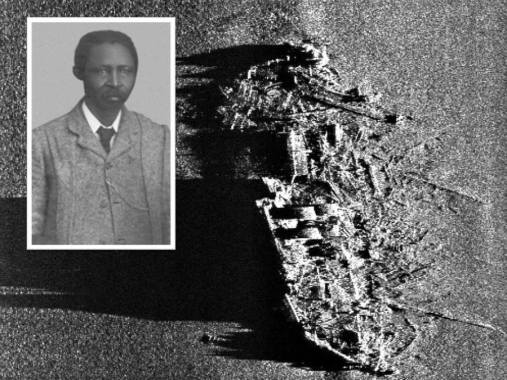
Rev. Isaac Williams Wauchope Dyobha (1852-1917) – see insert picture, our hero who called all to the death dance on the SS Mendi was a rather remarkable man – he was a prominent member of the Eastern Cape African elite in the late 19th and early 20th centuries, a Congregational minister, political activist, historian, poet and ultimately the legendary hero in the Mendi disaster.

As a Lovedale student he joined a missionary party to Malawi, he was instrumental in founding one of the first political organisations for Africans, a staunch ally of John Tengo Jabavu and an enthusiastic campaigner for the establishment of the University of Fort Hare. For over 40 years, from 1874 to 1916, he was a prodigious contributor to newspapers, submitting news, comments, announcements, poetry, hymns, history and biography, travelogues, sermons, translations, explications of proverbs and royal praise poems. He used nom de plume Silwangangubo, Dyoba wo Daka and Ngingi and published The Natives and their Missionaries in 1908.

1947484_257837754385964_1327099841_n

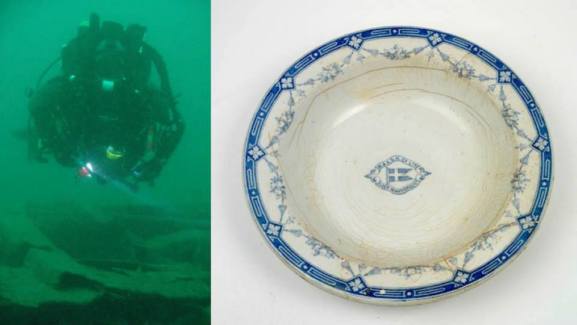
This is a recent picture of a diver on the wreck of he SS Mendi and an artefact recovered from the wreck.

The Mendi sinking is considered one of the greatest tragedies in the history of the South African military, and was one of the worst maritime disasters of the 20th century in British waters.

For South Africans this is especially important as there are very few physical reminders of this tragedy, such as this photograph BASNC plate courtesy of David Wendes.

Some small things can be seen on the wreck, such as some of the plates that the men would have eaten off. It was the crest of the British and African Steam Navigation Company on some of these plates that allowed divers to identify the wreck as the Mendi.

For many years in South Africa the only memorial to these men was a life ring with the words “SS Mendi” on it on a railing in Simonstown, South Africa and the Hollybrook Cemetery Memorial which listed all the names of the SS Mendi missing in Southampton, England.

Happily this suppression of Black South African contribution to WW1 is no-longer the case, after 1994 memorial statues to the SS Mendi memorials now exist in Pretoria, Cape Town and Johannesburg.  Memorial services are held countrywide and form part of the SANDF’s Armed Forces Day (Mendi Day).  Awards and decorations for Bravery in the name of the Mendi have been issued, and the South African Navy has named two ships – the SAS Mendi (a Valour class Frigate) and the SAS Isaac Dyobha (a Warrior class Strike-craft).  Memorial services are also regularly held overseas in Southampton England and Noordwijk Netherlands.  A dedicated exhibit now also takes up place at Delville Wood in France.

The image to the left of the Atteridgeville memorial is Her Majesty Queen Elizabeth II and President Nelson Mandela unveiling the memorial to the SS Mendi in Soweto, South Africa.

The immediate recognition of this event by the British government in 1995 was one of the first acts by the Queen on her return to South Africa – she had last been in South Africa in 1947 and was prevented from visiting again as South Africa had “resigned” from the Commonwealth in the intervening years of Apartheid.

Once South Africa rejoined the Commonwealth in 1994, such was the importance and urgent need to recognise this tragic event as a fundamental building block to nation building it took centre stage of Royal visit not seen in South Africa for 47 years.

The Centenary of the sinking of the SS Mendi passed in February 2017, and after all was said and done by way of ceremonies aboard the SAS Amatola and at Hollybrook in England and all the speeches and praises by visiting politicians to the United Kingdom completed, it was the military veterans (who were largely left out of the fanfare), who continue to carry this flame of remembrance for their ‘brothers’.

This point was most poignantly expressed by The South African Legion of Military Veterans in deed, after the SANDF and fanfare returned home, the SA Legion performed a most subtle but very striking dedication when the wreck was dived in an official dedication ceremony held in August 2017 by the SA Legion; England Branch Chairman – Claudio Chistè (a ex SA Navy Diver) doing the honours.  They then placed a plaque on the wreck itself in dedication and in permanent memory of their ‘brothers’.

Continue reading