The South African Navy’s ‘darkest hour’ is not recognised and not commemorated

1200px-Emblem_of_the_South_African_NavyHere’s a question for many,  in what action did the South African Navy (SAN) experience its greatest single loss of personnel, the largest sacrifice of South African life in a single  sea battle  – in essence when and what was the South African Navy’s ‘darkest hour’?

I’ve asked this question of senior South African military personnel, including the South African Navy as well as the South African Naval fraternity, the veterans – and the bottom line is … nobody knows.

Some immediately say it was the Mendi, as the remembrance of the Mendi is now the South African Navy’s key responsibility, but the loss of the SS Mendi in World War 1 was not a loss of South African Navy personnel (the South African Navy did not exist in WW1 and the Royal Navy was in charge of this particular troop ship full of South African ‘Army personnel’) and the loss of the Mendi was an accident at sea and not a combat action.

za)nv81Most (actually the majority) of SAN officers and veterans would say it was the loss of the SAS President Kruger (16 souls) but that would also be very wrong, both in terms of scale and action, the SAS President Kruger loss was also an accident at sea and not a combat action.

A tiny handful of SAN officers and vets who have a little knowledge of World War 2 might venture to answer the question by stating the loss of any one of the four South African minesweepers sunk during the war as the ‘darkest hour’ of the war.
22308811_10155537271456480_3745202244434378650_nThese are the HMSAS Southern Floe (24 souls) or the HMSAS Parktown (5 souls), or the HMSAS Bever (17 souls) or the HMSAS Treen (23 souls) – getting warm but that too would be wrong, as these did not happen over a defined period of the war that would warrant a ‘darkest hour’ in Churchill’s definition of the phrase (Churchill coined the term).

Nope, the largest loss of South Africans in a single sea battle, its ‘Darkest Hour’ took place fighting against Imperial Japan from the 5th to the 9th April 1942 … yup, the Japanese – believe it, and by the end of this particular naval engagement at sea a grand total of 65 South African souls were lost.  Now how many people know that!

The reason to ‘forget’!

So why does nobody know about this, why is this incident not ‘recognised,’ why is nobody ‘commemorating’ it and what exactly happened?

Simply put, it’s because they all died fighting whilst seconded to four British war ships in an action in the Pacific called ‘The Easter Sunday Raid’ – and it involved the sinking of the HMS Cornwall and HMS Dorsetshire in a single day – and later the sinking of HMS Hermes and HMS Hollyhock a few days later by the Japanese Imperial Navy.  But why should that be an issue and a reason to ‘forget’?
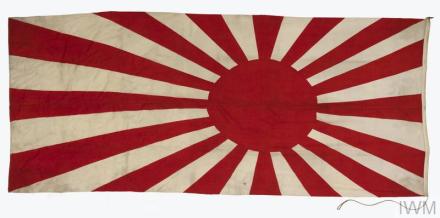
Imperial Japanese ensign

Japanese Imperial Fleet Ensign from World War 2

Again the simple answer is because just three short years after World War 2 the National Party in a stunning and unexpected election win over Jan Smuts’ United Party, came into power with their proposal of ‘Apartheid’ and making South Africa a ‘Republic’ independent of Britain – and they hated the British or anything to do with Britain.  The Nationalists had grounded an entire Afrikaner identity and a country’s ‘nationalism’ on two events – The Great Trek and The 2nd Anglo-Boer war, both of which carried a history of either British betrayal or British atrocity.

During the Second World war these nationalists either openly sided with Nazi Germany and in many cases (by their tens of thousands in fact) even joined Neo-nazi South African parties and/or adopted national socialist movement (Nazism) ideology publicly, some (including a future Nationalist South African President) embarked on sedition and terrorism to undermine the war effort (see “Mein Kampf shows the way to greatness for South Africa” – The Ossewabrandwag).

Bottom line, to the Nationalists thinking anyone who took part in Smuts’ campaign for South Africa to fight in the Second World War was a traitor to their ‘Volk’ (peoples).  In their minds they went to fight ‘Britain’s war’ alongside the hated British – traitors all (even though an unprecedented 1 in 4 white South African males volunteered to fight in WW2 – half of them Afrikaners).

For the Nationalists commemorating the sinking of South African ships fighting alongside British ones in World War 2 was bad enough.  However, commemorating and remembering the South African loss whilst fighting on His Majesty’s British ships themselves would be, for the nationalist government at least, an unforgivable betrayal.
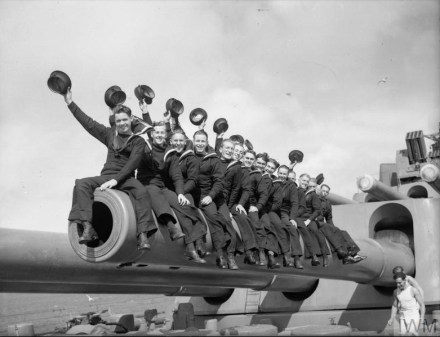
SANF

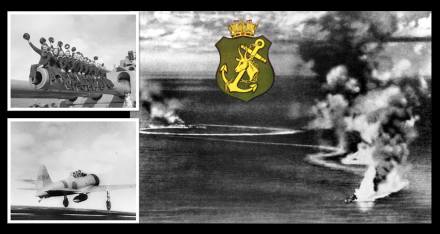
Members of the South African Royal Naval Volunteer Reserve serving on board HMS Nelson. The group is sat on one of the 16 inch gun barrels.

For this reason, the sinking of South African ships lost in World War 2 was not really extensively commemorated by the ‘old’ South African Defence Force  (SADF).  The SADF came into existence once the Nationalists declared South Africa a ‘Republic’ and replaced Smuts’ old ‘South African Union Defence Force (UDF) with a reformed military entity.  The sinking of HMSAS ships are only ‘remembered’ in small pockets of veteran South African Legion branches and MOTH shell-holes.

It is also for this reason that the SADF and the South African Navy did not ever commemorate the South African losses on British Ships, it is the reason why this particular ‘darkest hour’ in the South African Navy’s history is not recognised or remembered at all, which is utterly unforgivable as this is the very institution who supplied the men to The Royal Navy in the first place.

It is made worse in the modern epoch, by the newly reformatted South African National Defence Force’s Navy after 1994, which has not only lost the link thanks to the Nationalists, but also does not attempt to re-kindle it, party because of lack of knowledge, but also because it suits the African National Congress’ political agenda not to remember this association (commemorating or remembering a time when South Africans went to war for the ‘Colonials’ does not suit their current narrative).

So, let’s start addressing this betrayal of our armed forces personnel and understand what happened to qualify this as the South African Navy’s ‘darkest hour’, who is on this honour roll and what’s been done about in now?

What happened? 
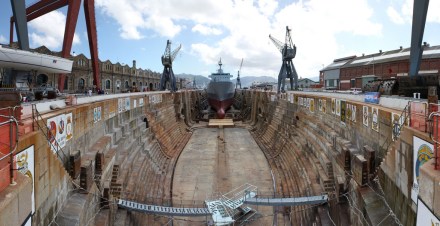
3397451999_8e45bbe5a4_b

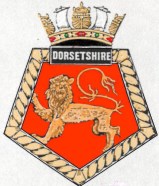
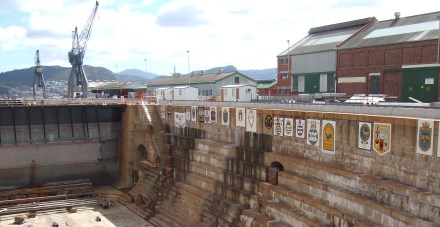
Simonstown Dry Docks, when next there look out for the ships emblems of the Dorsetshire, Cornwall, Hermes and Hollyhock

As Simon’s Town was a Royal Navy base during World War 2 (British soil in the middle of South Africa), men volunteering for the “South African Naval Forces” (SANF) to fight in World War 2 where either allocated to Royal Navy ships (titled HMS – His Majesty’s Ship) or on South African Navy ships (tilted HMSAS – His Majesty’s South African Ship), therefore whenever a large Royal Navy ship was lost during the war it is almost guaranteed that a number of South African Naval Personnel (SANF) were lost with it.

When large HMS ships are lost in an action on the same action the number of South African naval personnel lost just rockets – and this is the case with the sinking of the HMS Cornwall, HMS Dorsetshire, HMS Hermes and HMS Hollyhock.

The Japanese Easter Raid of 1942
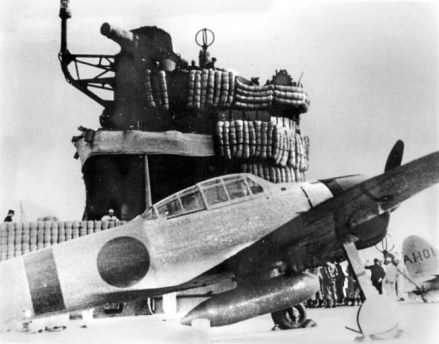
Zero

A Mitsubishi A6M Zero fighter plane takes off from the deck of the Japanese aircraft carrier Akagi, part of the Japanese Naval force in the Indian Ocean

With Japan’s entry into the war, and especially after the fall of Singapore, Ceylon (now Sri Lanka) became a front-line British base. The Royal Navy’s East Indies Station and Eastern Fleet was moved to Colombo and Trincomalee.

Admiral Sir James Somerville was appointed as the commander of the British Eastern Fleet, and he decided to withdraw main component the fleet to Addu Atoll in the Maldives, leaving a small force to defend Ceylon (now Shri Lanka) consisting of an aircraft carrier, the HMS Hermes, two heavy cruisers – the HMS Cornwall and HMS Dorsetshire, one Australian Destroyer the HMSAS Vampire and the flower class HMS Hollyhock.

The Imperial Japanese Navy, in much the same way and with the same objectives that were used at Pearl Harbour planned a decisive attack of the British Eastern Fleet to end their presence in the North Indian and Pacific oceans.  Unaware that the main body of the British fleet had moved to the Maldives, they focused their plan on Colombo.

The planned Japanese attack was to become collectively known as the Easter Sunday Raid and the Japanese fleet comprised five aircraft carriers plus supporting ships under the command of Admiral Chuichi Nagumo.

In an almost exact copy of the raid on the American fleet at Peal Harbour (as if no learnings were made by the Allies), on 4 April 1942, the Japanese fleet was located by a Canadian PBY Calatina aircraft, the Catalina radioed the position of the Japanese Fleet to The British Eastern Fleet which alerted the British to the impending attack before it was shot down by six Japanese Zero fighters from the carrier Hiryu,  However, despite the warning Nagumo’s air strike on Colombo the next day, Easter Sunday – 5th April –  achieved near-complete surprise (Pearl Harbour was also attacked on a weekend). The British Radar installations were not operating, they were shut down for routine maintenance.
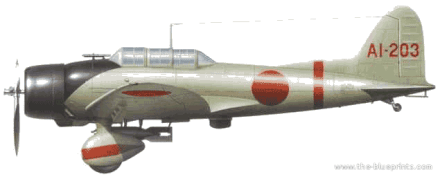
aichi-d3a1-mod-22-val

The Japanese high command had planned the bombing of Colombo very much like the Pearl Harbor operation (many of the same planes and pilots participated in both strikes); but most of the British Eastern Fleet was at Addu Atholl in the Maldives, so when the Japanese attacked at Colombo there were only three ships there.

The sinking of the HMS Cornwall and HMS Dorsetshire.

The day before, 4 April, when the Japanese carrier fleet was spotted, the two heavy cruisers the HMS Cornwall and HMS Dorsetshire set out for Addu Atoll in pursuit of the Japanese. On 5 April 1942, the two cruisers were sighted by a spotter plane from the Japanese cruiser Tone about 200 miles (370 km) southwest of Ceylon.

As part of the engagement known as the Easter Sunday Raid, a wave of dive bombers led by Lieutenant Commander Egusa took off from Japanese carriers to attack Cornwall and Dorsetshire, 320 km (170 nmi; 200 mi) southwest of Ceylon, and sank the two ships.  Both the Dorsetshire and the Cornwall had long associations with South Africa and had large contingent of South African Naval Personnel on board.
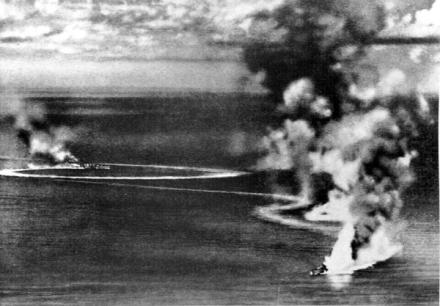
DorsetshireCornwall

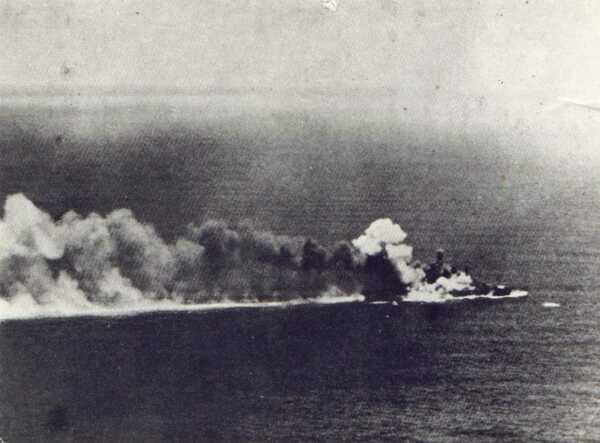
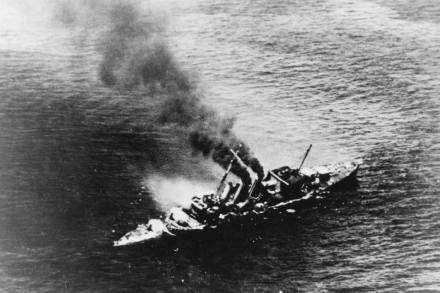
Japanese combat photograph showing the Royal Navy heavy cruisers HMS Dorsetshire and HMS Cornwall on fire and sinking

In the attack, the Japanese airman flying Japanese  D3A-1 ‘VAL’ dive bombers, a total of 53 dive bombers in the attack wave, dropped 10 bombs on the HMS Dorsetshire itself (250- and 550-pound bombs) and 8 near misses, all in the span of 8 minutes.  One of the bombs detonated an ammunition magazine and contributed to her rapid sinking.  Of the two British cruisers, the HMS Dorsetshire sank first, with her stern going first at about 13:50, the HMS Cornwall was hit eight times and sank bow first about ten minutes later.

For a full story on the HMS Dorsetshire and her long association with South Africa, see this Observation Post by clicking this link: “They machine gunned us in the water”; Recounting South African Sacrifice on the HMS Dorsetshire
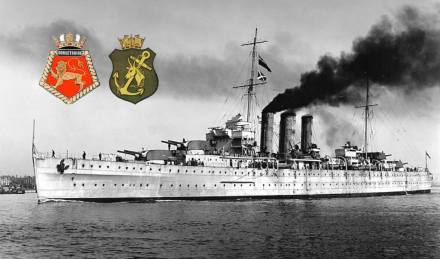
29352408_2115130958715891_1241973539881913227_o

For a full story on the HMS Cornwall and her long association with South Africa, see this Observation Post by clicking this link: “A terrific explosion lifted the ship out of the water”; Recounting South African sacrifice on the HMS Cornwall
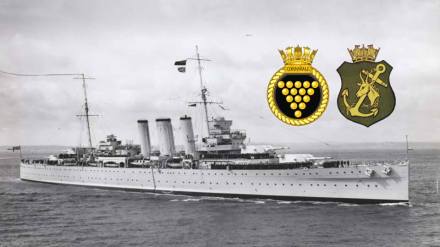
29542625_2113775675518086_7029672198895321022_n

British and Allied losses were 424 men killed; 1,122 survivors spent thirty hours in the water before being rescued by HMS Enterprise and two British destroyers.

The sinking of the HMS Hermes and HMS Hollyhock

If the above losses qualify a dark day for the South African Navy it then becomes the SAN’s ‘darkest hour’, when in the same Japanese Operation, only a couple of short days later, on 9 April 1942, the Japanese focussed their attack on the harbour at Trincomalee and the British ships off Batticaloa. The HMS Hermes left the Royal Naval Base of Trincomalee, Ceylon escorted by the Australian Destroyer HMAS Vampire and HMS Hollyhock looking to engage the Imperial Japanese fleet which had attacked Colombo.

While sailing south off Batticaloa on the East Coast of Ceylon, this British flotilla was also attacked by the Japanese Carrier-Borne dive-bombers from the Imperial Japanese Task Force now in the process of attacking the Naval Base at Trincomalee.

Approximately 70 Japanese aircraft were despatched to bomb the HMS Hermes which sank within ten minutes of being hit by numerous aircraft bombs. HMAS Vampire was also sunk by bombs a short while later.
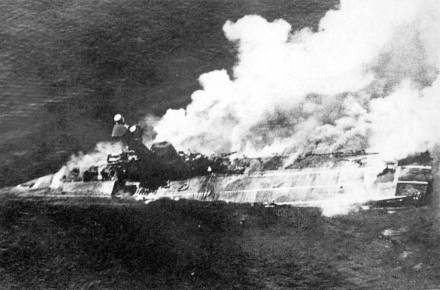
13086706_580301575472912_9134783755502643981_o

HMS Hermes ablaze and sinking

The HMS Hollyhock was about 7 nautical miles from the HMS Hermes escorting a tanker, the RFA Athelstane when the Hermes came under attack.  The Hollyhock came under attack by the same Japanese aircraft and it too was bombed and sunk.

Once again, the HMS Hermes also had a very large South African Naval Forces contingent seconded to it on board, and the same applied to the HMS Hollyhock, and therefore once again there is a large of loss of South African life in this action against the Imperial Japanese fleet.

For a full story on the HMS Hermes and her long association with South Africa, see this Observation Post by clicking this link “Dante’s Inferno”; Recounting South African sacrifice on the HMS Hermes
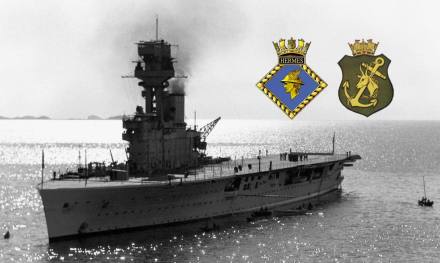
22290016_2032097947019193_784550767658191370_o

For a full story on the HMS Hollyhock and her long association with South Africa, see this Observation Post by clicking this link “She immediately blew up”; Recounting South African sacrifice on the HMS Hollyhock
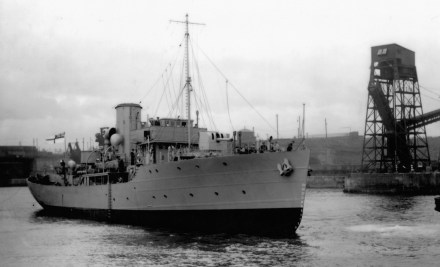
hmshollyhock_sunderland

HMS Hollyhock

The Honour Roll

Total South African Naval Force (SANF) losses on the HMS Cornwall and HMS Dorsetshire in the single day of action were as follows (MPK means “missing presumed killed”):

HMS Cornwall

BESWETHERICK, Hedley C, Ordinary Seaman RNVR, 86671 (SANF), MPK
BOTES, John S, Stoker 2c RNVR, 68924 (SANF), MPK
COMMERFORD, Noel P, Able Seaman RNVR, 66493 (SANF), MPK
CRAWFORD, Cecil E, Act/Engine Room Artificer 4c RNVR, 67922 (SANF), MPK
DU PREEZ, Charles P H, Able Seaman, 68175 (SANF), MPK
DUTTON, Charles C, Stoker 2c RNVR, 68949 (SANF), MPK
HANSLO, Raymond F, Able Seaman RNVR, 68295 (SANF), MPK
KEITH, Kenneth I B, Able Seaman RNVR, 66742 (SANF), MPK
KENYON, Graeme A B, Able Seaman RNVR, 68002 (SANF), MPK
KIRSTEN, Monty G W, Able Seaman RNVR, 68917 (SANF), MPK
LAW, Edward, Act/Engine Room Artificer 4c RNVR, 66760 (SANF), MPK
MCDAVID, William K, Stoker 2c RNVR, 69138 (SANF), MPK
MITCHELL, William A, Stoker 1c RNVR, 68796 (SANF), MPK
PALMER, Walter A, Able Seaman RNVR, 68344 (SANF), (rescued, aboard HMS Enterprise), Died of Wounds
SPENCE, Noel W, Ordinary Seaman RNVR, 68732 (SANF), MPK
SQUIRES, John E, Ordinary Seaman RNVR, 68728 (SANF), MPK
STEPHEN, Eric B, Ordinary Seaman RNVR, 68861 (SANF), MPK
SWANN, Lawrence T, Stoker 1c RNVR, 68710 (SANF), MPK
THORPE, Maurice, Stoker 2c RNVR, 69140 (SANF), MPK
VERSFELD, Peter H S, Able Seaman RNVR, 68859 (SANF), MPK
VINK, Benjamin F, Ordinary Seaman RNVR, 68860 (SANF), MPK
WILLSON, Gerald F, Stoker 2c RNVR, 69006 (SANF), MPK
WRIGHT, Thomas H, Able Seaman RNVR, 68039 (SANF), MPK

HMS Dorsetshire

BELL, Douglas S, Ty/Act/Leading Stoker, 67243 (SANF), MPK
BRUCE, Alexander M, Stoker 2c, 67907 (SANF), MPK
CONCANON, Harold Bernard, Surgeon Lieutenant (Doctor)
EVENPOEL, Albert, Stoker 2c, 67909 (SANF), MPK
GEFFEN, Sender, Stoker 1c, 68035 (SANF), MPK
HOWE, Horace G, Ordinary Seaman RNVR, 68680 (SANF), MPK
KENDRICK, George, Stoker 2c, 67910 (SANF), MPK
MCINTYRE, Norman G, Able Seaman, 67446 (SANF), MPK
MCLELLAN, Robert, Ordinary Telegraphist, 67897 (SANF), MPK
MILNE, Lawrence Victor, Able Seaman
MORROW, Douglas E, Able Seaman, 67989 (SANF), MPK
ORTON, Charles P, Able Seaman, 68009 (SANF), MPK
REDMAN, Roland A, Leading Stoker, 67406 (SANF), MPK
SCOTT, William J, Able Seaman, 68007 (SANF), MPK
SEVEL, Harry, Stoker 1c, 68100 (SANF), MPK
VAN ZYL, David Isak Stephanus, Stoker 1st Class
WILLETT, Amos A S, Stoker 1c, 67240 (SANF), MPK
WILLIAMSON, Walter N, Able Seaman, 67803 (SANF), MPK

But, unfortunately there is more.  As in the same Japanese Operation, just a couple of days later saw the loss of the HMS Hermes and HMS Hollyhock (also lost in a single day), the honour roll of South Africans on board these two fighting ships who were lost is as  follows:

HMS Hermes

BRIGGS, Anthony Herbert Lindsay Sub-Lieutenant (Engineer) Royal Navy (South African national), MPK

BRYSON, Neil W, Ordinary Telegraphist, 69147 (SANF), MPK
BURNIE, Ian A, Able Seaman, 67786 (SANF), MPK
CLAYTON, Frederick H, Act/Engine Room Artificer 4c, 68102 (SANF), MPK
DE CASTRO, Alfred T, Stoker 1c, 67914 (SANF), MPK
KEENEY, Frederick W, Able Seaman, 67748 (SANF), MPK
KEYTEL, Roy, Able Seaman, 67296 (SANF), MPK
KIMBLE, Dennis C, Act/Engine Room Artificer 4c, 67600 (SANF), MPK
KRAUSE, Frederick E, Able Seaman, 68321 (SANF), MPK
RAPHAEL, Philip R, Able Seaman, 67841 (SANF), MPK
RICHARDSON, Ronald P, Able Seaman, 67494 (SANF), MPK
RILEY. Harry Air Mechanic 2nd Class, Fleet Air Arm, Royal Navy (South African national), MPK
TOMS, Ivanhoe S, Able Seaman, 67709 (SANF), MPK
VICKERS, Colin P, Able Seaman, 68296 (SANF), MPK
VORSTER, Jack P, Able Seaman, 67755 (SANF), MPK
WHITE, Edward G, Stoker, 68026 (SANF), MPK
WIBLIN, Eric R, Able Seaman, 67717 (SANF), MPK
YATES, Philip R, Supply Assistant, 67570 (SANF), MPK

Included in this Honour Roll is also a South African serving with the Royal Navy’s Fleet Air Arm on the HMS Hermes.

RILEY, H, Air Mechanic, Fleet Air Arm, HMS Hermes, died 9 April 1942

HMS Hollyhock

ANDERSON, Henry G, Able Seaman, 67501 (SANF), MPK
BASTON, Douglas T, Act/Engine Room Artificer 4c, 68600 (SANF), MPK
BUITENDACH, James M, Stoker 2c, 69223 (SANF), MPK
JUBY, Kenneth J, Ordinary Seaman, 69211 (SANF), MPK
LEACH, Peter A D H, Stoker 2c, 69225 (SANF), MPK

 Lest we forget the tremendous sacrifice of our countrymen in this world war for the liberation of human kind.

Why is it important we get this history right?
Logo_of_the_Royal_NavySo there we have it, the South African Navy’s biggest single loss in a single day – 41 souls, a ‘black day’ and added together with the HMS Hermes and HMS Hollyhock , we see a complete total of 65 South African souls lost in one single engagement at sea – qualifying a very ‘black week’ – The Easter Sunday Raid and this then marks the Easter period as the South African Navy’s ‘Darkest Hour’.

But is this correct – is this the full complement of South Africans lost in the incident?  The answer unfortunately is – probably not.

Whilst the honour rolls distinguish the South African Naval Forces personnel seconded to British ships, they do not distinguish the South Africans who joined the Royal Navy directly in either Simonstown or in the United Kingdom – of which there were thousands and those who lost their lives are now listed under the Royal Navy’s honour roll.

The ‘old’ South African Defence Force (SADF) did not maintain these records, nor was a honour roll tracked by the South African Navy and simply put, when the Nationalists broke the formal ties with the United Kingdom and the Commonwealth, and after the resultant four decades in the ‘wilderness’ during the Apartheid epoch – many of these names are now ‘lost’.to all of us as South Africans.

To find out which of these are South Africans requires research into each and every case on the Royal Navy’s record – a momentous task which some dedicated people looking into this are only now beginning to get their heads around.  Here we must thank the likes of Glenn Knox, David Bennet, Allan du Toit, Cameron Kinnear and Graham Du Toit and a handful of others for sterling work recovering this history.

So, in all likelihood more than just ’64’ South Africans died in this action, and why is this important for us to know who they were? Read this letter I received when I published this honour roll and action in a previous article on the HMS Dorsetshire it says everything as to the importance of this work:

Letter from Chris Crossley

Hi Peter,
Just another story for you! This post you put up on the Legions page has some amazing history which you wouldn’t know about but I am happy to share with you to show my gratitude for these “nuggets” of info you share with us.

My wife, Tracy, was an adopted child who after 35 years found her birth parents. Wonderful people they turned out to be and we are building a relationship with them that is priceless. As things go, curiosity led us to find out about family history and Tracy’s birth Dad told us about an uncle of his that was lost during the war. He was in the SAN and went down with “some” ship somewhere. He was married at the time and his wife, on hearing the news that her husband was lost at sea (MIA) never gave up on the hope of his return to Durban because he was never seen and not confirmed deceased. Because of this, she never remarried and passed away many years later, remaining faithful to her husband. Her husband was Roland Redman who served with the SA Navy volunteers on the HMS Dorsetshire that your story includes. His name is included in the Role of Honour for the Dorsetshire.

None of the wider family have ever known what happened to him and the facts and details of his service were not known by the surviving family members either. This last Saturday evening, I was talking to my wife’s birth Dad when he recounted the scant details he had of his uncle. I went on line and found your article and shared it with him on fb. Well he was overcome by this information as well as other members of his family and now for the first time in seventy odd years the facts of Uncle Roland, his service and his sacrifice are now known and cherished by his family left behind.

As an historian, I am sure this story will be something that you can cherish as your post has made a huge difference to some wonderful people! Thank you.

Chris Crossley

See When “nuggets” of history make a BIG difference

In Conclusion 

Now, with this letter in mind, I cannot think of a better reason to get this history right and establish the correct commemorations and full honour roll.  We owe it to our countrymen whose sacrifice brought us international freedom and liberty – it is our duty to carry this flame of remembrance and rid ourselves of the divisive and petty politics of one-upmanship played out by politicians with agendas (nationalists and the ANC) – this politicisation shrouds our most honourable history and only serves to dishonour the sacrifice of our South African servicemen and women – which is by its very nature is as ‘unforgivable’ as it is ‘dishonourable’.

Related work and Links:

For related work in the Observation Post on the above story, click on the following links:

SS Mendi: Let us die like brothers … the silent voices of the SS Mendi finally heard 

HMSAS Southern Floe:  ‘A sole survivor and a ship’s crest’; the South African Navy’s first loss – HMSAS Southern Floe

HMSAS Parktown: The feisty South African minesweeper that went down fighting – HMSAS Parktown)

HMSAS Bever  “Under a hail of shells”; Recounting the bravery and loss of HMSAS Bever

HMSAS Treern: The last South African Navy ship to be lost in action; HMSAS Treern

SAS President Kruger:  “Out of the Storm came Courage” … the tragedy of the PK

South Africans lost on other Royal Navy ships:

HMS Barham: “She blew sky high”; Recounting South African sacrifice on the HMS Barham!

HMS Edinburgh: “Gold may shine; but it has no true light” South African sacrifice on the HMS Edinburgh

HMS Gloucester: A “grievous error”; Recounting South African Sacrifice on the HMS Gloucester

HMS Helca: “Every man for himself” … South African sacrifice and the sinking of HMS Hecla

HMS Neptune: South African sacrifice on the HMS Neptune


Written and Researched by Peter Dickens.  References Wikipedia. CASUALTIES BY DATE and SHIP Compiled by Don Kindell sourced on the Royal Naval History Homepage.  Image copyright of Royal Navy, SA Naval Reserve, Imperial War Museum.  Japanese Imperial Ensign object, Imperial War Museum copyright.


The Royal Air Force’s 100th Birthday and its founder – Jan Smuts

Jan Smuts

Jan Christian Smuts by Marie Vermeulen Breedt

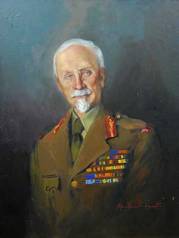
If you enter the Royal Air Force club located at 128 Piccadilly, London you are greeted in the foyer by a famous South African statesman – Jan Smuts.  A bust of Jan Smuts stands at the entrance, and for very good reason – he founded the Royal Air Force, an Air Force which turned 100 years old on the 1st April 2018.

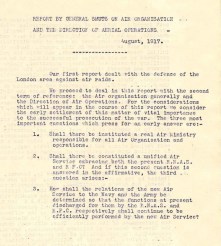
It was on the ‘Smuts Report’ submitted by in August 1917 that the plans for a separate arm of service, an air service – independent of the services of the Navy and Army were laid down by Prime Minister Llyod George’s war cabinet.  The Smuts Report is the ‘Instrument’ by which the Royal Air Force (RAF) was formed.

Smut’s prophetic words in this report still ring true “the day may not be far off when aerial operations with their devastation of enemy lands and destruction of industrial and populous centres on a vast scale may become the principal operations of war, to which the older forms of military and naval operations may become secondary and subordinate”.

7960001505000118_fill

The Smuts Report

The War Cabinet accepted Smuts’ recommendation to amalgamate the two separate air forces (Royal Flying Corps and the Royal Naval Air Service) under one single and independent Air Force.  Smuts was then asked to lead an Air Organisation Committee to put it into effect. The Air Force Bill received Royal assent from the King on the 29 November 1917, which gave the newly formatted Air Force the prefix of ‘Royal’ (up to that point the idea was to call it the ‘Imperial Air Force’).  To see more on Smuts and the centenary of the Smuts report follow this link (Centenary of the ‘Smuts Report’, the instrument which gave birth to the Royal Air Force )Royal Air Force WW1The RAF came together on the 1st April 1918, a date recognised as the RAF’s officially recognised birthdate. On its creation the RAF, in the final year of World War 1, it was the most powerful air force in the world with over 20,000 aircraft and over 300,000 personnel.
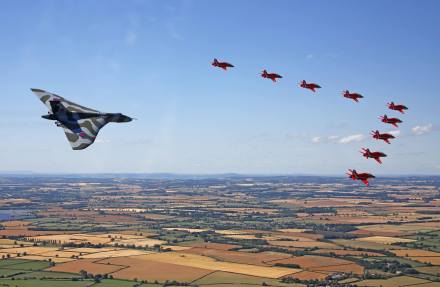
The Second World War proved to be the Royal Air Force’s ‘finest hour’ when the tiny airforce held back the entire German Nazi advance on the United Kingdom during ‘The Battle of Britain’, leaving the United Kingdom and its Allies to eventually liberate Europe.  A time when Winston Churchill aptly christened the men of the RAF as the ‘few’ and famously said;

Never in the field of human conflictwas so much owed by so many to so few”.

Many South Africans have served in the Royal Air Force and continue to serve.  Some famous ones include Andrew Beauchamp-Proctor VC, Andrew Cameron Kiddie, Sailor Malan, Roger Bushell, Zulu Lewis, Dutch Hugo, Pat Pattle, JJ Le Roux, Dingbat Saunders, John Nettleton VC, Edwin Swales VC, John Howe and many more.

Today the Royal Air Force is a little smaller, but no less effective. The RAF maintains an operational fleet of aircraft described by the RAF as being “leading-edge” in terms of technology. This largely consists of fixed-wing aircraft, including Fighter and Strike aircraft, airborne early warning and control aircraft, ISTAR and SIGINT aircraft, aerial refuelling aircraft and strategic and tactical aircraft.  The majority of the RAF’s rotary wing aircraft form part of the tri-service Joint Helicopter Command.

The majority of the Royal Air Force personnel are based in the UK, with many others serving on operations – principally over Iraq and Syria and others are based at long Erving overseas bases on the Ascension Islands, Cyprus, Gibraltar and the Falkland Islands.

Recent large scale operations and interventions, after the ‘Cold War’ by the Royal Air Force include the 1991 Gulf War, the 1999 Kosovo War, the 2001 War in Afghanistan, the 2003 War in Iraq and the 2011 Intervention in Libya.

Here is to salute ‘those magnificent men in their flying machines’ and their South African founder – Field Marshal Jan Smuts on their 100th Birthday.

29749639_1687310501350675_8873665093682912211_o

Related Work and links

For more realted work and links on South Africans in the Royal Air Force, follow these Obervation Post Links:

Sailor Malan : Sailor Malan; Fighter Ace & Freedom Fighter!

Zulu Lewis: The South African pilot who earned ‘Ace in a Day’ – TWICE! Albert ‘Zulu’ Lewis DFC and Bar

JJ Le Roux: The South African fighter ace who ended Rommel’s war

Edwin Swales VC: Maj. Edwin Swales VC – a true South African hero’s legacy now under threat

Roger Bushell: The Great Escape … was led by a South African!

John Nettleton VC: John Nettleton VC – an unknown South African Victoria Cross recipient

Pat Pattle: One of the greatest Allied fighter pilots of WW2 was a little known South African! Meet Pat Pattle.

John Howe: Forget Tigers, The Royal Air Force’s 74 Squadron has a legacy of South African Lions!

Ian Pyott: Connecting Zeppelins, Marlene Dietrich and South Africa’s favourite biscuit – Romany Creams!

Cameron Kiddie: Kimberley’s local baker was also a WW1 Flying Ace

Andrew Beauchamp-Proctor VC: South Africa’s own WW1 Flying Ace

Dutch Hugo: “Dutch” Hugo another Afrikaner hero who is celebrated as one of “The Few”

Albie Gotze LdH: “This bastard is going to kill me”; Albie Götze’s Legion d’Honneur


Written and Researched by Peter Dickens.  Reference Wikipedia.  Oil Painting of Jan Christian Smuts by Marie Vermeulen Breedt.

Guy Hallifax, the most senior African Naval officer lost during WW2

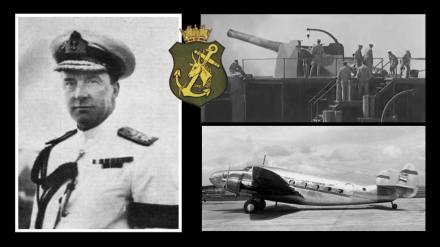
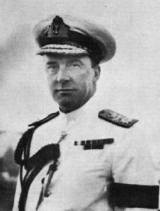
29662349_2114964258732561_5863672511395231607_oThis Easter we also remember Rear Admiral Guy Hallifax, the most senior South African Naval officer  to lose his life during World War 2.  His contribution to the Navy is significant as he literally is one of the founding fathers of the modern South African Navy as we know it.
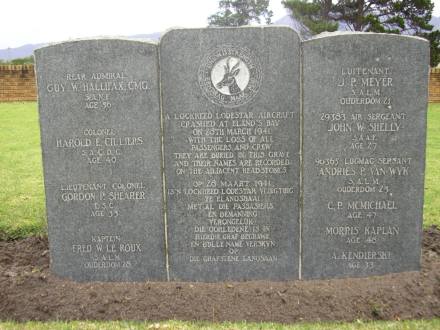
Guy Hallifax served in the Royal Navy from 1899 to 1935, and ended his RN career on the staff of the last British Governor-General of South Africa, the Earl of Clarendon.  Remaining in South Africa, at the outbreak of World War 2 in 1939, he was recruited by the South African government to form a Navy, which was to be named the ‘Seaward Defence Force’.

As the first Director of the Seaward Defence Force, he established a small fleet of minesweepers and anti-submarine vessels for coastal defence, and organised naval detachments in the major ports.  In his work, the South African seaward defence forces became a formidable institution by 1943, please take the time to watch this short Pathé newsreel which captures it.

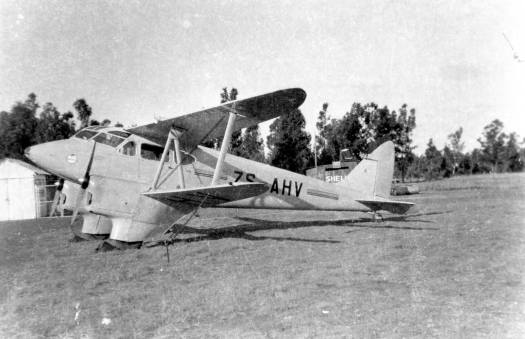
In March 1941, Guy Hallifax flew in a small de Havilland Dragon Rapide to Walvis Bay, a small South African naval territory in South West Africa (now Namibia), for a staff visit to the base.   Uncomfortable with the old bi-plane Dragon Rapid, he elected to return in a heavier, modern and more powerful Loheed Lodestar.  This is Dragon Rapid he flew to Walvis Bay in – courtesy the SA Naval Museum.

10514263_10154387948540147_7537883925917828340_o

The de Havilland Dragon Rapide used by Guy Hallifax to fly to Walvis bay

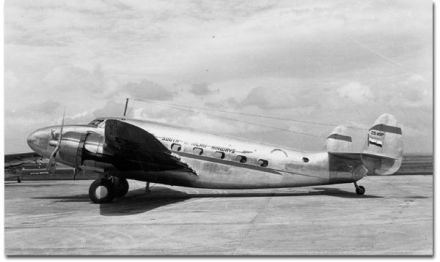
On the 28th March 1941, when Rear Admiral Guy Hallifax returned from his staff in a civilian registered South African Airways Lockheed 18-08 Lodestar, Registration ZS-AST en-route to Cape Town, which tragically flew into the high ground near at Baboon Point near Elands Bay (Elandsbaai) in dense fog. All on board were killed which including Rear Admiral Guy Hallifax and three civilians.

189aa4e8838281b5ce39efb5921ae90c

Similar SAA Lockheed 18-08 Lodestar to ZS-AST

They are all buried in a mass grave in the Plumstead cemetery, the grave is cared for by the Commonwealth War Graves Commission.  Here is his final resting place.

10506815_10204393630786316_1096154183815390699_o


Written and Researched by Peter Dickens.  References Wikipedia and the SA Naval Museum, with thanks to Glenn Knox.  Video copyright Pathé news , also referenced is Day by Day SA Naval History: By Chris Bennett.

“They machine gunned us in the water”; Recounting South African Sacrifice on the HMS Dorsetshire

This is an image of the HMS Dorsetshire listing and burning just prior to her sinking, it was attacked by the Imperial Japanese Navy using carrier borne dive bombing aircraft. A large number of South African Navy personnel were involved in the battle and were lost with this ship whilst seconded to the Royal Navy during World War 2.

rotate

As Simonstown in South Africa was a British Naval base thousands of South Africans in WW2 served in the Royal Navy as well as in the South African Naval Forces (SANF). The loss of a heavy Cruiser the size of the HMS Dorsetshire is bound to include a South African honour roll and unfortunately this one does – a very long one at that, especially given this particular Battle Cruiser’s long association with South Africa.

The sinking of both the HMS Cornwall and the HMS Dorsetshire in the Indian Ocean by the Japanese on 5th April 1942 is linked.  Not only that they were sunk within range of one another on the same day, but also in terms of the relationship of these two ships had with South Africa and the number of South Africans on board.  This is further linked to the sinking of the HMS Hermes and HMS Hollyhock later in the same engagement with the Japanese, with similar relations and consequences to the South African Navy.

So, let’s focus on the HMS Dorsetshire today, a hero in the sinking of the German Battleship Bismarck and the extraordinary link between this ship and South Africa.

HMS Dorsetshire Short History

1399036_810766838985484_5239559498358212933_oThe HMS Dorsetshire  was a heavy cruiser and after commissioning in 1930 became the flagship of the 2nd Cruiser Squadron Atlantic Home Fleet.  Before the war, from 1933 until 1936, HMS Dorsetshire served on the Africa Station. Her first recorded docking in the Selborne dry dock at Simonstown, South Africa was on 5 January 1934.
When the Second World War broke out HMS Dorestshire had joined the China station and in October 1939 she was joined into the hunt for the German pocket battleship Admiral Graf Spee along with the HMS Cornwall.  Both were withdrawn from the China station and despatched to Ceylon to form Force I.

In December 1939 the HMS Dorsetshire and HMS Cornwall arrived in South Africa where they embarked many South African volunteers, drawn mainly from Royal Navy Volunteer Reserves (RNVR – South African Division) and South African Naval Reserve Force.

The HMS Dorsetshire was called into pursuit of the German ‘pocket battleship’ Admiral Graf Spee, which having left Wilhemshaven on 21 August 1939  had reached the eastern part of the South Atlantic in early October 1939. In this region she managed to sink three British ships, Newton Beach, Ashlea and Huntsman on 5, 7 and 10 October respectively some 1,000 nautical miles north west of Cape Frio in Namibia, and then the Trevanion 630 miles north west of Walvis Bay on 22 October.

Admiral Graf Spee then continued on south and rounded the Cape passing some 400 miles south of Cape Agulhas. On 15 November she sank the small tanker Africa Shell a mere 10 miles off the coast of Mozambique before moving once again around the Cape keeping at least 300 miles off shore passing Cape Agulhas once more on 3 December 1939.

When the German Battleship ‘Admiral Graf Spee’ was discovered and pursued by the British Royal Navy, the Graf Spee was sent to the River Plate estuary in South America and because of the potential fall-out should it be sunk or captured the Captain was ordered by the German High Command to scuttle his vessel after leaving the Montevideo harbour – without encountering the Royal Navy.

In February 1940 while in the Atlantic, the German supply freighter Wakama was stopped by Dorsetshire in the area off Cabo Frio and her crew scuttled also her . On 2 March 1940 she left the Falklands with wounded from the cruiser HMS Exeter en-route to Cape Town, South Africa. On the 11th , the wounded and the prisoners from the German freighter were all put ashore.

She was then docked again at Simonstown’s Selborne dry dock, prior to sailing back to United Kingdom.  This short movie Pathé news reel captures the HMS Dorsetshire in South Africa and its well worth a quick look:

On May 25th, the cruiser arrived in Plymouth in the UK, and at the end of the month sailed for Freetown to commence operations around Dakar in pursuit of the Vichy French Battleship Richelieu.  She sailed on again to South Africa and was dry docked in Durban on the 4th September, on the 20th September she arrived back in Simonstown, where a day later she sailed for Sierra Leone.

November saw her in the Indian Ocean where she bombarded Zante in Italian Somaliland. In December Dorsetshire docked once again in the Selborne dry dock in South Africa and later that month she was ordered to search for the German pocket Battleship Admiral Scheer.

On 18 January 1941, HMS Dorsetshire captured the Vichy French freighter Mendoza and escorted the ship to Takaradi. In March 1941, Dorsetshire was once again docked in the Selborne dry dock in South Africa.  Late in May 1941, whilst in the North Atlantic on convoy covering duties, HMS Dorsetshire together with the cruiser HMS London were tasked to search for the German Battleship ‘Bismarck’.

The sinking of the Bismarck

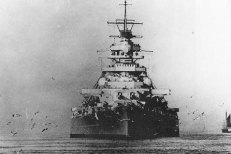
bismarck

The Bismarck

At the time she was ordered to search for the Bismarck on 26th May 1941 the HMS Dorsetshire was some 360 nautical miles (670 km) south of  the Bismarck’s actual location. HMS Dorsetshire steamed at top speed, though heavy seas until she encountered the destroyer HMS Cossack, which had been engaging the Bismarck during the night, the German battleship’s gun flashes could be seen six miles away by early morning.

The HMS Dorsetshire then took part in the Bismarck’s final battle,  The battleships HMS Rodney and HMS King George V neutralised Bismarcks main battery early in the engagement,  the HMS Dorsetshire and other warships closed in to join the attack.  The HMS Dorsetshire opened fire at a range of 18,00 meters. In the course of the engagement, she fired 254 shells from her main battery.  In the final moments of the battle, she was ordered to move closer and torpedo the Bismarck and fired three torpedoes, two of which hit the crippled battleship.

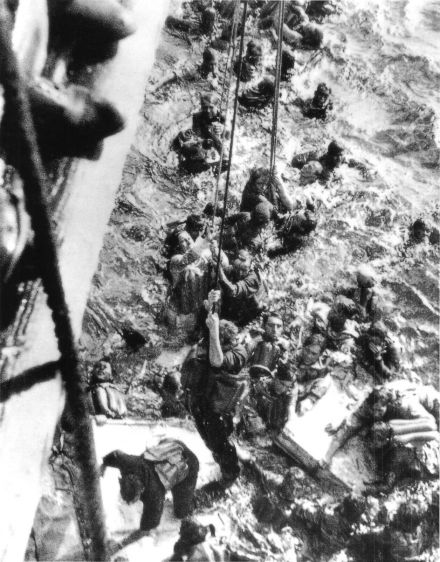
Bismarck survivors

Survivors from Bismarck are pulled aboard Dorsetshire on 27 May 1941

The Germans had by this time also detonated scuttling charges, which also with the damage inflicted by the British Royal Navy, caused the Bismarck to rapidly sink just before midday on the 27th May 1941. 

The HMS Dorsetshire and the destroyer HMS Maori were tasked to pick up survivors. A reported U-boat sighting forced the two ships to break off the rescue effort, after picking up only 110 men: 85 aboard Dorsetshire and 25 aboard Maori.

African Duties and Raiders

In late August, HMS Dorsetshire left Freetown and participated in the unsuccessful search for the German heavy cruiser Admiral Hipper, On the 4th November HMS Dorsetshire sent to investigate reports of a German surface raider in the South Atlantic with no result.

After arriving again in Cape Town on 9 December 1941, having sunk a German U Boat supply ship the ‘Python’ whilst she was refuelling a pair of German U-boats.

Beginning 1942, HMS Dorsetshire, under the command of Augustus Agar was assigned to the Eastern Fleet in the Indian Ocean.

The Easter Sunday Raid

With Japan’s entry into the war, and especially after the fall of Singapore, Ceylon (now Sri Lanka) became a front-line British base. The Royal Navy’s East Indies Station and Eastern Fleet was moved to Colombo and Trincomalee.

Admiral Sir James Somerville was appointed as the commander of the British Eastern Fleet, and he decided to withdraw main component the fleet to Addu Atoll in the Maldives, leaving a small force to defend Ceylon (Sri Lanka) consisting of an aircraft carrier, the HMS Hermes, two heavy cruisers – the HMS Cornwall and HMS Dorsetshire, one Australian Destroyer the HMSAS Vampire and the flower class corvette, the HMS Hollyhock.

The Royal Navy’s own ‘Pearl Harbour’

The Imperial Japanese Navy, in much the same way and with the same objectives that were used at Pearl Harbour against the American fleet planned a decisive attack of the British Eastern Fleet to end their presence in the North Indian and Pacific oceans.  Unaware that the main body of the British fleet had moved to the Maldives, they focused their plan on Colombo (the commercial capital of modern-day Sri Lanka).

The planned Japanese attack was to become collectively known as the Easter Sunday Raid and the Japanese fleet comprised five aircraft carriers plus supporting ships under the command of Admiral Chuichi Nagumo.

In an almost exact copy of the raid on the American fleet at Peal Harbour (as if no learnings were made by the Allies), on 4 April 1942, the Japanese fleet was located by a Canadian PBY Calatina aircraft, the Catalina radioed the position of the Japanese Fleet to The British Eastern Fleet which alerted the British to the impending attack before it was shot down by six Japanese Zero fighters from the carrier Hiryu.

A6M2_on_carrier_Akagi_1941

A Mitsubishi A6M Zero fighter plane takes off from the deck of the Japanese aircraft carrier Akagi, part of the Japanese Naval force in the Indian Ocean

However, despite the warning Nagumo’s air strike on Colombo the next day, Easter Sunday 5th April 1942 they did manage to achieved near-complete surprise (Pearl Harbour was also attacked on a weekend). The British Radar installations were not operating, they were shut down for routine maintenance (another parallel with the attack on Peal Harbour).

Easter Raid

Captain Mitsuo Fuchida

The first attack wave of Japanese planes took off in pre-dawn darkness (30 minutes before sunrise) from the aircraft carriers Akagi, Hiryu and Soryu, moving about 200 miles south of Sri Lanka. The first attack wave of 36 fighters, 54 dive bombers, and 90 level bombers was led by Captain Mitsuo Fuchida the same officer who led the air attack on Pearl Harbour.

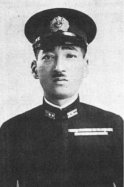
The Heavy Cruisers, HMS Cornwall and HMS Dorsetshire set out in pursuit of the Japanese. On 5 April 1942, the two cruisers were sighted by a spotter plane from the Japanese cruiser Tone about 200 miles (370 km) southwest of Ceylon. A wave of  Japanese dive bombers led by Lieutenant Commander Egusa took off from Japanese carriers to attack Cornwall and Dorsetshire, 320 km (170 nmi; 200 mi) southwest of Ceylon, to sink the two ships.

In the attack, the Japanese airman flying Japanese  D3A-1 ‘VAL’ dive bombers, a total of 53 dive bombers in the attack wave, dropped 10 bombs on the HMS Dorsetshire itself (250- and 550-pound bombs) and 8 near misses, all in the span of 8 minutes.  One of the bombs detonated an ammunition magazine and contributed to her rapid sinking.  Of the two British cruisers, the HMS Dorsetshire sank first, with her stern going first at about 13:50, the HMS Cornwall was hit eight times and sank bow first about ten minutes later.

aichi-d3a1-mod-22-val

An eye-witness account from a South African Seaman on board the HMS Dorsetshire recounts the ferocity and nature of the Japanese attack:

Seaman WJ Spickett of Cape Town South Africa who was on lookout duty on Dorsetshire saw the whole action from start to finish.

“We were steaming to keep a rendezvous and when about 400 miles off land, a seaplane which we could not identify, started shadowing us. This was about 10 o’clock in the morning. Dorsetshire and Cornwall were steaming fast, keeping about four miles apart. At 20 minutes to two we spotted a large formation of between 40 and 60 aircraft coming towards us. Within a few minutes they were overhead — so high they were mere specks. Then they came straight for us in formations of three, diving at such a steep angle that it was impossible for our guns to get at them.

I saw the first bomb, a silvery flash in the sunlight, come straight for us. It was a direct hit, blasting our aircraft platform to pieces. In that first attack, I think 10 bombs were dropped. We were steaming at high-speed but eight of those 10 were direct hits. The other two were near misses. The ship listed badly and within 10 minutes of the first bomb being dropped we got orders to abandon ship.

We got away two whalers and a skiff and several rafts. There were hundreds of us in the water and then three planes came over and added to the horror of these moments ‘. Many were killed and wounded in this attack but apparently it was just a gesture of victory for it was not repeated.”

This witness account of machine gunning the survivors in the water is verified by a number of survivors including the Engineering Officer Lieutenant E. A. Drew, who said that whilst in the water they were “subjected to machine gun fire from the large number of Japanese planes that hung around until the ship sank”.

DorsetshireCornwall

Japanese combat photograph showing the Royal Navy heavy cruisers HMS Dorsetshire and HMS Cornwall on fire and sinking

Survival and Sacrifice 

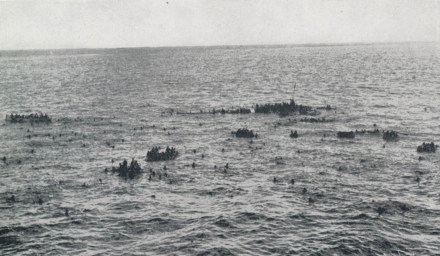
In all the survivors of the sinking of both the Cornwall and Dorsetshire spent over 30 hours in the water clinging to debris or huddled in life rafts.  Many seriously injured and burned and during the night ‘space’ was made available on the tiny rafts and flotsam for many clinging onto them as many of their colleagues succumbed to their wounds.  Being the Indian ocean there are also tales of sharks circling the men and even taking them.  Harrowing would be an understatement.

Between the two ships, 1,122 men out of a total of 1,546 were picked up by the cruiser HMS Enterprise and the destroyers HMS Paladin and HMS Panther the next day. In this action, of the 424 members of the ships’ companies of the two cruisers who lost their lives, over 42 were South Africans.

HMS_'Dorsetshire'_survivors_after_sinking_by_Japanese_aircraft_Indian_Ocean

Survivors from the HMS Dorsetshire and HMS Cornwall in the water

Because of his ship’s long association with South Africa, a very high proportion of the losses were from the South African Naval Forces. Here is the South African Naval Forces honour roll (MPK means ‘Missing Presumed Killed’) from the sinking;

HMS Dorsetshire – South African Navy Personnel Lost, Honour Roll

22308811_10155537271456480_3745202244434378650_nBELL, Douglas S, Ty/Act/Leading Stoker, 67243 (SANF), MPK
BRUCE, Alexander M, Stoker 2c, 67907 (SANF), MPK
EVENPOEL, Albert, Stoker 2c, 67909 (SANF), MPK
GEFFEN, Sender, Stoker 1c, 68035 (SANF), MPK
HOWE, Horace G, Ordinary Seaman RNVR, 68680 (SANF), MPK
KENDRICK, George, Stoker 2c, 67910 (SANF), MPK
MCINTYRE, Norman G, Able Seaman, 67446 (SANF), MPK
MCLELLAN, Robert, Ordinary Telegraphist, 67897 (SANF), MPK
MORROW, Douglas E, Able Seaman, 67989 (SANF), MPK
ORTON, Charles P, Able Seaman, 68009 (SANF), MPK
REDMAN, Roland A, Leading Stoker, 67406 (SANF), MPK
SCOTT, William J, Able Seaman, 68007 (SANF), MPK
SEVEL, Harry, Stoker 1c, 68100 (SANF), MPK
WILLETT, Amos A S, Stoker 1c, 67240 (SANF), MPK
WILLIAMSON, Walter N, Able Seaman, 67803 (SANF), MPK

HMS Dorsetshire – South African’s lost serving in the Royal Navy, Honour Roll

CONCANON, Harold Bernard, Surgeon Lieutenant (Doctor)
MILNE, Lawrence Victor, Able Seaman
VAN ZYL, David Isak Stephanus, Stoker 1st Class
WILLETT, Amos Alfred Sidney ,Stoker 1st Class

Note: Some more South Africans may not accounted in the above list as they may have been Royal Navy personnel having volunteered to serve in the Royal Navy, there is a long list of South Africans not accounted on the Navy’s honour rolls because of the complication of citizenship, the position of the South African Union in supporting the war and the nature of Simonstown near Cape Town as ‘British territory’ and not South African.

Related work 

The Japanese Easter raid was to bring a terrible toll on not only the Royal Navy, but also on the South African Navy whose personnel were involved.  It remains the South African Navy’s darkest days, as not only were the HMS Cornwall and HMS Dorsetshire full of SANF personnel.  For a full article on the HMS Cornwall, click on this link (“A terrific explosion lifted the ship out of the water”; Recounting South African sacrifice on the HMS Cornwall).

So too were the other two ships sunk later in this engagement on the 9th April 1942 by the same Japanese raiders, with similar South African naval personnel losses  – the HMS Hermes, see related article by clicking this link (“Dante’s Inferno”; Recounting South African sacrifice on the HMS Hermes) and HMS Hollyhock, see related article by clicking this link ( “She immediately blew up”; Recounting South African sacrifice on the HMS Hollyhock).

In Conclusion

This history is lost to most South Africans, however good work is now been done by a handful of individuals to try and correct and up-date these honour rolls and recount the full depth of South Africa’s involvement in warfare at sea during World War 2.

That the history is lost is due to the political expediency of the National Party, who on acent to power after WW2, effectively wiped it clean of the national consciousness – branding our World War 2 veterans as ‘traitors’ instead of ‘heroes’ for serving a British cause in their estimation. It is further lost to the new generations due to the slow up-take in recognition if this history by the African National Congress (ANC) government, again for their own political expediency.

That the darkest days of the South African Navy – The Easter Raid of 1942, is not even officially acknowledged or even remembered by The South African Navy in our modern day is testament to this and the subject of a future Observation Post article.

We, as South Africans, do however have an excellent tradition at the Selborne Graving Dock, the dry docks in Simonstown, allowing visiting crews to paint their ships emblems on the docks walls, it is an excellent record of many of the proud Royal Navy fighting ships who visited our shores in World War 2 and on whom many South Africans served.  Next time you are there look out them, including the HMS Dorsetshire.

Simonstown Dry DocksTheir names have not been forgotten.


Researched by Peter Dickens.  Background on HMS Dorsetshire extracted from U Boat.net.  Wikipedia.  News reel copyright British Pathé. British Broadcast Corporation account on the war (BBC)  WW2 The Peoples War. Casualty Lists of the Royal Navy and Dominion Navies, World War 2 by Don Kindell. Extracts fro ‘Day to Day SA Naval History’ by Chris Bennett.  Thanks also to Graham Du Toit for his excellent research into the Honour Roll including South Africans serving in the Royal Navy.


“A terrific explosion lifted the ship out of the water”

Recounting South African sacrifice on the HMS Cornwall

This is an image of the HMS Cornwall under attack just prior to her sinking, it was taken by the Japanese attack aircraft. A number of South African Navy personnel were lost with this ship whilst seconded to the Royal Navy during World War 2.

11227764_471697846333286_6697642980063770182_n

As Simonstown in South Africa was a British Naval base thousands of South Africans in WW2 served in the Royal Navy as well as in the South African Naval Forces (SANF). The loss of a heavy Cruiser the size of the HMS Cornwall is bound to include a South African honour roll and unfortunately this one does. Read on for their story.

HMS Cornwall Short History

hms_cornwall_F99_emb_n12997HMS Cornwall was a heavy cruiser of the Kent-subclass of the County-class. When World War 2 began in September 1939,  Cornwall was transferred from her pre-war China Seas operations to the Indian Ocean and joined Force I at Ceylon.
On 5th October 1939, she was involved in the search for the German pocket battleship Admiral Graf Spee. Between the 8th  and 14th February 1940, she was docked at the Selborne dry dock at Simonstown, South Africa.  Its was here that she would have taken onboard a large contingent of South Africans either volunteering for the Royal Navy or seconded to the Royal Navy as members of The South African Naval Forces stationed there.

In September 1940, together with HMS Delhi, she intercepted Vichy-French light cruiser Primauguet and tanker Tarn, forcing them to return to Casablanca, Morocco. By January 1941, HMS Cornwall returned to the Selborne dry dock in South Africa for refitting, at the same time taking on more South African personnel.

Sinking of the German Auxiliary Ship Pinguin

The HMS Cornwall was on patrol in the Indian Ocean of Seychelles when she engaged and sank the German ship ‘Pinguin’ on the 8th May 1941, Pinguin was known to the German Navy as Schiff 33, and designated HSK 5. The most successful commerce raider of the war, she was known to the British Royal Navy as Raider F.

Unfortunately, without the knowledge of Cornwall’s crew, Pinguin sank along with 200 Allied prisoners of war in addition to 232 Germans lost (60 German crew members and 22 Allied prisoners were rescued). She returned to Durban, South Africa to repair her stern, which was damaged during the battle against Pinguin; the repairs lasted until 10th  June 1941.

HK Pinguin

HK Pinguin

On the 25th November 1941, Cornwall intercepted the Vichy-French merchant vessel Surcouf in the Indian Ocean off the east coast of Somalia. Surcouf was originally en route to Djibouti with food, but was forced to sail to Djibouti instead.

Between January and March 1942, Cornwall escorted convoys between Ceylon and the Sunda Strait in the Dutch East Indies. In March 1942, she was sent to Colombo, Ceylon in preparation for a possible Japanese attack into the Indian Ocean.

The Easter Sunday Raid

With Japan’s entry into the war, and especially after the fall of Singapore, Ceylon (now Sri Lanka) became a front-line British base. The Royal Navy’s East Indies Station and Eastern Fleet was moved to Colombo and Trincomalee.

Admiral Sir James Somerville was appointed as the commander of the British Eastern Fleet, and he decided to withdraw main component the fleet to Addu Atoll in the Maldives, leaving a small force to defend Ceylon (Sri Lanka) consisting of an aircraft carrier, the HMS Hermes, two heavy cruisers – the HMS Cornwall and HMS Dorsetshire, one Australian Destroyer the HMSAS Vampire and the flower class corvette, the HMS Hollyhock.

The Royal Navy’s own ‘Pearl Harbour’

The Imperial Japanese Navy, in much the same way and with the same objectives that were used at Pearl Harbour against the American fleet planned a decisive attack of the British Eastern Fleet to end their presence in the North Indian and Pacific oceans.  Unaware that the main body of the British fleet had moved to the Maldives, they focused their plan on Colombo (the commercial capital of modern-day Sri Lanka).

The planned Japanese attack was to become collectively known as the Easter Sunday Raid and the Japanese fleet comprised five aircraft carriers plus supporting ships under the command of Admiral Chuichi Nagumo.

In an almost exact copy of the raid on the American fleet at Peal Harbour (as if no learnings were made by the Allies), on 4 April 1942, the Japanese fleet was located by a Canadian PBY Calatina aircraft, the Catalina radioed the position of the Japanese Fleet to The British Eastern Fleet which alerted the British to the impending attack before it was shot down by six Japanese Zero fighters from the carrier Hiryu,

However, despite the warning Nagumo’s air strike on Colombo the next day, Easter Sunday 5th April 1942 they did manage to achieved near-complete surprise (Pearl Harbour was also attacked on a weekend). The British Radar installations were not operating, they were shut down for routine maintenance (another parallel with the attack on Peal Harbour).

Easter Raid

Captain Mitsuo Fuchida

The first attack wave of Japanese planes took off in pre-dawn darkness (30 minutes before sunrise) from the aircraft carriers Akagi, Hiryu and Soryu, moving about 200 miles south of Sri Lanka. The first attack wave of 36 fighters, 54 dive bombers, and 90 level bombers was led by Captain Mitsuo Fuchida the same officer who led the air attack on Pearl Harbour.

The Heavy Cruisers, HMS Cornwall and HMS Dorsetshire set out in pursuit of the Japanese. On 5 April 1942, the two cruisers were sighted by a spotter plane from the Japanese cruiser Tone about 200 miles (370 km) southwest of Ceylon. A wave of  Japanese dive bombers led by Lieutenant Commander Egusa took off from Japanese carriers to attack Cornwall and Dorsetshire, 320 km (170 nmi; 200 mi) southwest of Ceylon, to sink the two ships.

In the attack, the Japanese airman flying Japanese  D3A-1 ‘VAL’ dive bombers, then dropped 9 bombs on the HMS Cornwall itself ( 250- and 550-pound bombs) and six near misses, the HMS Cornwall becoming dead in the water within minutes, the HMS Cornwall sank in about 12 minutes after the first hit (and Dorsetshire suffered the same fate).

aichi-d3a1-mod-22-val

An eye-witness account from a South African officer on board the Cornwall recounts the ferocity and speed of the attack:

Sub-Lieutenant R. Ellis Brown, son of the mayor of Durban, said he was down below in the control room of the high angle guns when the warning was flashed that aircraft were attacking.

“Almost immediately afterwards there was a terrific explosion and the ship lifted out of the water and listed to port, “ he said. “This was followed almost immediately by another hit. The lights went out and I continued on to the sick bay. I went forward from there to contact the control officer and shortly after I left, a bomb dropped on the sick bay, killing most of the men there. I could not get through on account of the flames, so went to the aft deck. Here we managed to get a whaler and also five or six floats. We got the men off and I looked up and saw a dive-bomber coming down at me. I saw the bomb released at about 700 feet and it appeared to be coming straight at me. Although I knew that if a bomb appeared to be coming straight at you it would actually fall far beyond. I must say I did not like it one bit. The men jumped into the water and finally the two other officers and myself left on this deck followed them.”

Sub-Lieutenant Ellis Brown said that the men were in the water for about 30 hours. The wounded were placed in a motor boat which had floated off when Cornwall sank. The remainder stayed in the water, hanging on to debris and floats. To the discomforts the men suffered in the water was added the horror of knowing they were in shark-infested waters.  He recalls, “We saw several fins cutting the water but as soon as they came near, the men would kick and shout and they would make off.”


DorsetshireCornwall

Japanese combat photograph showing the Royal Navy heavy cruisers HMS Dorsetshire and HMS Cornwall on fire and sinking


HMS Cornwall was sunk in position 01º54’N, 77º45’E. All boiler and engine rooms were out of action within minutes, thereby resulting in a lack of power to the pumps and fire fighting equipment. In all the men spent 30 hours in the water, before a combined rescue of the HMS Dorsetshire men (also in the water) and HMS Cornwall’s men by the HMS Enterprise, HMS Paladin and HMS Panther. In total 192 of Cornwall’s men were lost, of a very high proportion – 23, were South African.  Here is the South African Naval Forces honour roll (MPK means ‘Missing Presumed Killed’) from the sinking;.

HMS Cornwall – South African Navy Personnel Lost, Honour Roll

22308811_10155537271456480_3745202244434378650_nBESWETHERICK, Hedley C, Ordinary Seaman RNVR, 86671 (SANF), MPK
BOTES, John S, Stoker 2c RNVR, 68924 (SANF), MPK
COMMERFORD, Noel P, Able Seaman RNVR, 66493 (SANF), MPK
CRAWFORD, Cecil E, Act/Engine Room Artificer 4c RNVR, 67922 (SANF), MPK
DU PREEZ, Charles P H, Able Seaman, 68175 (SANF), MPK
DUTTON, Charles C, Stoker 2c RNVR, 68949 (SANF), MPK
HANSLO, Raymond F, Able Seaman RNVR, 68295 (SANF), MPK
KEITH, Kenneth I B, Able Seaman RNVR, 66742 (SANF), MPK
KENYON, Graeme A B, Able Seaman RNVR, 68002 (SANF), MPK
KIRSTEN, Monty G W, Able Seaman RNVR, 68917 (SANF), MPK
LAW, Edward, Act/Engine Room Artificer 4c RNVR, 66760 (SANF), MPK
MCDAVID, William K, Stoker 2c RNVR, 69138 (SANF), MPK
MITCHELL, William A, Stoker 1c RNVR, 68796 (SANF), MPK
PALMER, Walter A, Able Seaman RNVR, 68344 (SANF), (rescued, aboard HMS Enterprise), Died of Wounds
SPENCE, Noel W, Ordinary Seaman RNVR, 68732 (SANF), MPK
SQUIRES, John E, Ordinary Seaman RNVR, 68728 (SANF), MPK
STEPHEN, Eric B, Ordinary Seaman RNVR, 68861 (SANF), MPK
SWANN, Lawrence T, Stoker 1c RNVR, 68710 (SANF), MPK
THORPE, Maurice, Stoker 2c RNVR, 69140 (SANF), MPK
VERSFELD, Peter H S, Able Seaman RNVR, 68859 (SANF), MPK
VINK, Benjamin F, Ordinary Seaman RNVR, 68860 (SANF), MPK
WILLSON, Gerald F, Stoker 2c RNVR, 69006 (SANF), MPK
WRIGHT, Thomas H, Able Seaman RNVR, 68039 (SANF), MPK

In earlier incidents on HMS Cornwall two South Africans lost their lives they are also remembered here:

AINSLIE, Roy, Petty Officer, 66382 (SANF), died on 5 September 1940
HAWKINS, Reginald D, Able Seaman, 66700 (SANF), died of illness 4 March 1942

Some South Africans may not accounted in the above list as they may have been Royal Navy personnel having volunteered to serve in the Royal Navy, there is a long list of South Africans not accounted on the Navy’s honour rolls because of the complication of citizenship, the position of the South African Union in supporting the war and the nature of Simonstown as British territory.

Related work 

The Japanese Easter raid was to bring a terrible toll on not only the Royal Navy, but also on the South African Navy whose personnel were involved.  It remains the South African Navy’s darkest days, as not only were the HMS Cornwall and HMS Dorsetshire full of SANF personnel, so too were the other two ships sunk later in this engagement on the 9th April 1942 by the same Japanese raiders – the HMS Hermes, see related article by clicking this link (“Dante’s Inferno”; Recounting South African sacrifice on the HMS Hermes) and HMS Hollyhock, see related article by clicking this link ( “She immediately blew up”; Recounting South African sacrifice on the HMS Hollyhock).

The HMS Dorsetshire is featured in a full Observation Post article, follow by clicking this link (“They machine gunned us in the water”; Recounting South African Sacrifice on the HMS Dorsetshire).

In Conclusion

This history is lost to most South Africans, however good work is now been done to try and correct and up-date these honour rolls and recount the full depth of South Africa’s involvement in warfare at sea during World War 2.  We, as South Africans, do however have an excellent tradition at the Selborne Graving Dock, the dry docks in Simonstown, allowing visiting crews to paint their ships emblems on the docks walls, it is an excellent record of many of the proud Royal Navy fighting ships who visited our shores in World War 2 and on whom many South Africans served.  Next time you are there look out them, including the HMS Cornwall.

Their names have not been forgotten.

3397451999_8e45bbe5a4_b


Written and researched by Peter Dickens, with extracts taken from Wikipedia, Force-z survivors official webpage, the British Broadcast Corporation account on the war (BBC)  WW2 The Peoples War. Casualty Lists of the Royal Navy and Dominion Navies, World War 2 by Don Kindell.

“Superhuman powers of endurance and courage” Reginald Hayward VC

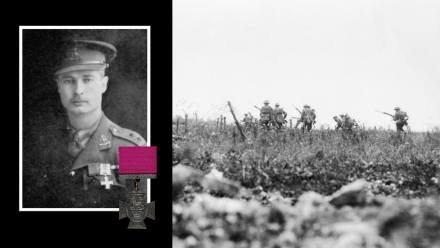
29060739_2111661739062813_6833898184469216994_oThis South African’s Victoria Cross turns 100 on the 21/22 March 2018, so today we honour another true South African hero and Victoria Cross recipient, and this man, Captain Reginald Frederick Johnson Hayward VC MC & Bar is one very extraordinary South African.
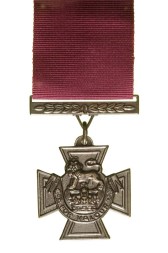
“Bravery” is an often over used word, then you read about a South African who won the Military Cross for Bravery, not once but twice and then goes on to win a Victoria Cross. Now this Hilton College old boy is a “brave” man cut from a different cloth, “superhuman” in fact (as is noted in his VC citation) and this is his story.

Reginald Hayward, was the son of a stockbreeder family, Frederick and Gertrude Hayward, he was born on 17 June 1891 at the Beersheba Mission Station near Swartruggens, East Griqualand in South Africa.  He was educated at Hilton College and represented Natal against English Rugby teams in 1911. Serving with the cadets he became Regimental Sergeant Major.

After leaving school Reginald attended  Durban Business College from 1909-1910 and continued to excel as sportsman especially in rugby, football and cricket. In May 1912 he travelled to England and began studying at the Royal College of Veterinary Surgeons and captained their Rugby XV in 1913. He also played for Rosslyn Park Club and for Middlesex.

When the 1st World War broke out be volunteered and in May 1912 Reginald arrived in the United Kingdom and joined the 6th Battalion Wiltshire Regiment and was commissioned as a 2nd Lieutenant on 29 September 1914.

The Somme Offensive 1916

Later the same year he was promoted to temporary Lieutenant and in March 1915 joined the 1st Battalion Wiltshire Regiment in France where during October 1916 he was involved in action at Stuff Redoubt, Thiepval, France during which he was awarded the Military Cross for conspicuous gallantry and initiative, gazetted on 8th October.

Wounded during the action he briefly returned to London to have the piece of shrapnel removed from his eye.

Wiltshire4

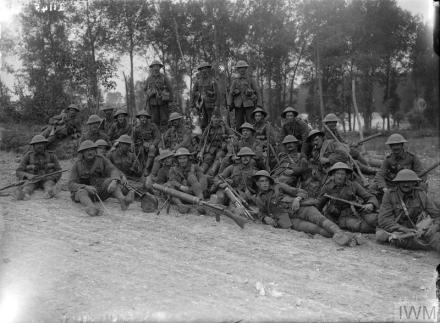
Officers and men of the 1st Battalion, Wiltshire Regiment, after their return from the fighting at Thiepval, photographed at Bouzincourt, September 1916

On 19 December 1916 Reginald was promoted to Temporary Captain and on 22 December 1916 was promoted to the substantive rank of Lieutenant. During the battle of Messines Ridge in Belgium on 07 June 1917 he was awarded a bar to his Military Cross which was gazetted on 18 September.

The Spring Offensive 1918

On 21 March 1918 the Germans launched their Spring offensive against the section of Front manned by British Third and Fifth Armies running from Roeux on the River Scarpe east of Arras in the north to the River Oise west of La Fere in the south, as the crow flies a distance of about 50 miles, but over double that on the ground. 6th Corps held the British Line south of Arras. From the previous evening, German troops had begun probing British positions at this point. 13th Battalion Alexandra, Princess of Wales’s Own (Yorkshire Regiment) were in the line from St -Leger, just east of the road south from Arras to Bapaume, along the road south to Mory.

Spring

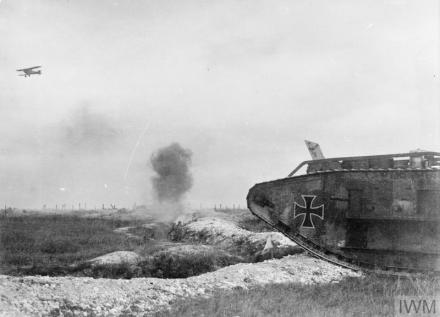
Captured British tank with German markings crossing a trench. Note a biplane flying over the battlefield during the German’s Spring Offensive of 1918

It was here on the morning of 21 March 1918 that Temporary Second Lieutenant E F Beal gallantly repelled a German incursion, helping to stabilize the situation until he was killed. However, German pressure was relentless and the British were pushed back. As the enemy advances steadily towards Bapaume, 1st Battalion The Wiltshire Regiment was moved to the north of Fremicourt, a village east of Bapaume and just south of the Cambrai road. 4th Corps was trying to hold a line between Vaulx and Morchies to the north of the road. It was for his gallantry in the fighting which followed that Acting Captain R F J Hayward was awarded the VC.

Just to get a measure of the man and this Victoria Cross, on 21/22 March 1918 near Fremicourt, France, while commanding a company, Captain Hayward displayed “almost superhuman powers of endurance”. In spite of the fact that he was buried, three times wounded in the head, rendered deaf and had his arm shattered, he refused to leave his men, instead he motivated them as he continued to move across the open fields of fire from one trench to another with absolute disregard for his own safety – all the time under ceaseless enemy attack.  His actions directly attributed to his Regiment holding their defensive line and stemming the enemy advance.  

Imagine that, an officer with multiple serious wounds running out into open hell-fire time and again keeping his men in place and fighting, his action alone changing the tide of the battle – that’s the stuff of a Victoria Cross.

Here is his citation and it says everything about the action and his courage:

medalCITATION
For most conspicuous bravery in action. This officer, while in command of a company, displayed almost superhuman powers of endurance and consistent courage of the rarest nature. In spite of the fact that he was buried, wounded in the head, and rendered deaf on the first day of operations, and had his arm shattered two days later, he refused to leave his men (even though he received a third serious injury to his head), until he collapsed from sheer physical exhaustion.

Throughout the whole of this period the enemy was attacking his company front without cessation, but Captain Hayward continued to move across the open front from one trench to another with absolute disregard of his own personal safety, concentrating entirely on re-organising his defences and encouraging his men.

It was almost entirely due to the magnificent example of ceaseless energy of this officer that many determined attacks on his portion of the trench system failed entirely.

The surviving Wiltshires, three officers and 54 NCO’s and men, were gathered at Bihucourt, north-west of Bapaume, on 24 March. Hayward had been evacuated with the other wounded the night before.

When the German offensive had opened on the 21st, 8th Battalion The Gloucestershire Regiment mounted an unsuccessful counter-attack at Doignies to try to contain the enemy advance south of the Cambrai-Bapaume road. They were then withdrawn west to Velu Wood. By the 23rd, the German advance had reached this point and the Glosters, together with the 10th Battalion The Royal Warwickshire Regiment was ordered to cover the further withdrawal of British forces. Bapaume itself was abandoned to the Germans.

wiltshire10

Composite battalion made up of surviving troops of the Wiltshire, Warwickshire Regiments, Northumberland Fusiliers and others at the end of the first phases of the German Spring Offensive. Seen here resting by the roadside. Caestre, 17 April 1918.

Post World War 1

The war would grind on for a couple of more months and end in November 1918. Reginald survived his injuries and the war and in 1919 he became the Adjudant of the 1st Battalion Wiltshire Regiment and later that same year, along with Lieutenant S. J. Parker MC DCM carried the 1st Battalion’s Regimental Colours at the Peace Parades in London and Paris.

Over the period 1919 to 1921 he served in Dublin, Egypt and Palestine and on 27 September 1927 he was promoted to the substantive rank of Captain. On 04 April 1935 he was transferred to the Reserves. On 09 July 1938 Reginald marries Linda Angus (nee Bowen in the Christ Church, Burbage, Buxton, Derbyshire.

World War 2

When the Second World War started in 1939, Reginald was called back into full-time service and served as Commander of the Royal Army Service Corps Anti-Aircraft Command (CRASC). Over the period 1945 to 1947 he was Commandant of Prisoner of War Camps where after he retired on 09 July 1947 as an Honorary Lieutenant Colonel.

Later Life

10999432_417568698412868_2379871863135790696_nReginald worked at the British Broadcasting Corporations (BBC) Publications Department from 1947 to 1952 and as games manager of the Hurlingham Club from 1952 to 1967.
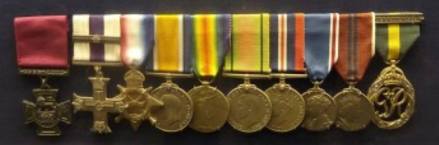
His Victoria Cross investiture, along with his Military Cross, was on 24 October 1918 by King George V at Buckingham Palace. His Victoria Cross is held at the Royal Gloucestershire, Berkshire and Wiltshire Regiment Museum in Wiltshire.

Apart from his Victoria Cross and Military Cross with Bar he was awarded the 1914 – 1915 Star, British War Medal 1914 – 1920, Victory Medal 1914 – 1919, Defence Medal 1939 – 1945, Coronation Medal 1937, Coronation Medal 1953 and Territorial Efficiency decoration.

Reginald died on 17 January 1970 in Chelsea, London and was cremated on 23 January 1970 in the Putney Vale Crematorium, London while his ashes are scattered in the Garden of Remembrance. He is commemorated in the St Mary’s Church, Limpley Stoke, Wiltshire. His medals are now held at The Rifles Museum, Salisbury, Wiltshire.

29351890_2111661702396150_7208896205117593485_o


Original content courtesy Charles Ross, additional research and content by Peter Dickens

Extract published with the kind permission of The VC and the GC, The Complete History, published by Methuen and The VC and GC Association in 2013.  Information obtained from VC on-line (The comprehensive guide to Victoria Cross and George Cross).  Images were referenced IWM Imperial Museum Copyright.

Mast image shows The Wiltshire Regiment on the advance over trenches at Thiepval during the Battle of the Somme.  Copyright Imperial War Museum.

The ‘Two comma Four’!

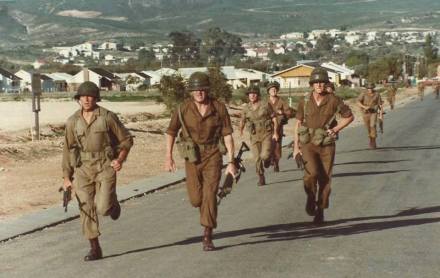
Most military veterans will remember the 2.4 km run, it’s a test that is permanently burned into memory; the “two comma four” run is a fitness threshold and has to be completed in under 12 minutes.  No easy run, especially when you consider the run is done in military fatigues with boots, webbing, assault rifle and helmet.

At all phases of South African military training, from basics onwards and even after training the 2.4 km run was used to establish the fitness and readiness of all serving personnel (so too a little cheating as this author was to find out when senior officers were called out to complete the run – only to run around a wall and wait till the younger and fitter officers to come back and rejoin them).

Those national servicemen who did “Junior Leaders” (JL’s) officers or non-commissioned officers course as part of their National Service were expected to meet this minimum standard of 12 min or less for this run, running with rifle, webbing and helmet to complete their ‘officers course’.

“Pah” I hear some runners out there say – easy! So here’s a challenge – map out a 2.4 Km run, find a pair of leather sole shoes or boots (no nice running shoes), then add 18 kg odd in lead weights to a backpack (this will simulate the weight of the “helmet”, “rifle” and “webbing”) – and then head out for a sub 12 minutes and let us know how you get along.

For interest the 1.5 mile (2.4 km) test is known as “The Cooper test”, originally designed by Kenneth H. Cooper in 1968 for US military use to test for physical fitness.


Written and researched by Peter Dickens

Albie Götze’s Legion d’Honneur

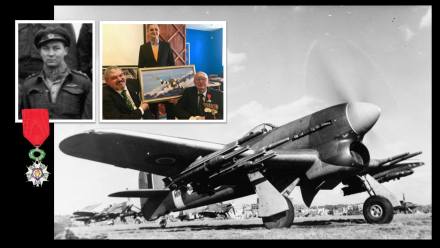
AG8.jpg.opt310x457o0,0s310x457At a ceremony held in Cape Town on the 13th February 2018, the Ambassador of France to South Africa, his excellency Christophe Farnaud, bestowed the signet of Chevalier de l’Ordre de la Legion d’Honneur (Knight in the Legion of Honour), France’s highest honour on one of the last surviving South African D Day veterans, General Albert (Albie) Götze.
So how is it that Albie Götze is awarded France’s highest honour and how did it come about?  In a nutshell, the French government decided that all World War 2 ‘Allied’ veterans who took part in the D Day landings and liberation of France should be given their highest honour for military and civil merit, the  Légion d’honneur, (LdH) and they announced this on the 70th anniversary of D-Day in June 2014 as a special thank you those who fought and risked their lives to secure France’s liberation during the Second World War.

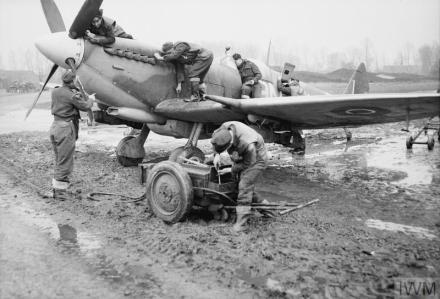
Simply put, Albie ‘was there’ on D-Day.  As a young South African Air Force pilot he was seconded to the Royal Air Force and he took part in D-Day operations flying a Spitfire doing beach sweeps and patrols.

DDay2

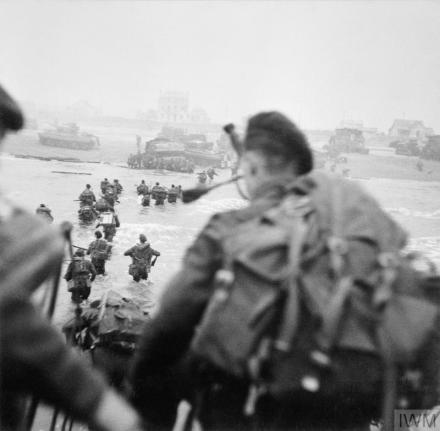
Iconic image which captures the moment, Commandos of 1st Special Service Brigade land on Queen Red beach, Sword area, c. 0840 hours, 6 June 1944 (D-Day)

Albie Götze’s story is something else, he was born in January 1923 in Prieska, a tiny town on the south bank of the Orange River, situated in South Africa’s Northern Cape.   In mid 1942 he volunteered to take part in World War 2 and  joined the South African Air Force and subsequently was selected for fighter pilot training.

After he finished  flying training he was sent to the Middle East  where he was seconded to the Royal Air Force and joined up with RAF No.127 Spitfire squadron in April 1944.

In April 1944, the squadron moved to England in preparation for Operation Overlord where it was assigned to 132 Wing (Norwegian) of the 2nd Tactical Air Force and operated as a UK defence unit. They flew patrols and bomber escorts to mainland Europe as well as some fighter-bomber work. During this time Götze was involved with shooting down four German V-1 flying bombs.

Albie5

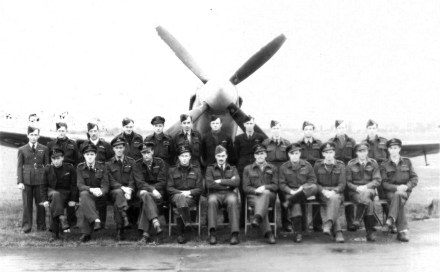
Albie with 127 squadron, seated 2nd from the right.

127 Squadron arrived at North Weald on 23 April 1944, where it was equipped with the Spitfire IX. Operations began flying fighter-bomber missions over France on 19th May 1944.  The squadron played its part in the D Day landings and subsequent days, and Albie and his colleagues found themselves flying sweeps of the landing beaches, escorting bombers, armed recces and dive bombing specific targets.

On 21st August 1944 127 Squadron moved to the European continent where it flew fighter-bomber missions from various airfields in France, Belgium and Holland, eventually basing itself at B.60 Grimbergen, in Belgium.  Albie flew his last Spitfire mission for 127 Squadron from B.60 on the 03 August 1944.

127 Albie2

No 127 Squadron Spitfire XVIE (RR255/9N-Y) has its daily inspection in a sea of mud at Grimbergen (B-60).

Later in August 1944, owing to the high attrition and demand for pilots flying Hawker Typhoons, Albie was transferred to RAF No.137 squadron flying this notorious Typhoon ground attack aircraft. In Typhoons he participated in Operation Market Garden and other Rhine crossing operations.

Operation Market Garden (17–25 September 1944) was an unsuccessful Allied military operation, fought in the Netherlands and Germany, using mainly airborne and land forces with air support to liberate the Dutch cities of Eindhoven and Nijmegen but failed in keeping their further positions in and around the city of Arnhem with its strategically important bridge over the river Rhine, the action there resulted in high rates of attrition of Allied forces trying to hold one side of the bridge, forcing an eventual withdrawal.

RAF 137 Squadron almost always operated at low altitude (“on the deck”) and was mainly employed  to attack targets such as armour, anti-aircraft installations, specific buildings, transports and enemy personnel. For this reason, flying in the Typhoon squadron was dangerous and high risk. According to Albie, flying the Typhoon at this time was regarded by Allied officers as the “most dangerous job that these buggers could ever have volunteered for”.

AG2light_Fotor

137 ‘Rocket’ Typhoon Squadron, 24 December 1944, Albie is in the middle row, third from the right.

The losses were extreme and hence replacement pilots were usually filled with volunteers.  To illustrate just how dangerous this was, Albie goes on to say “we lost a 151 pilots flying this thing (Typhoons), on Operation Market Garden alone, in just one single day we lost 21 pilots on Typhoons”. Combat was brutal in its simplicity, according to Albie it was as simple as “That guys gotta be shot down (the enemy), not me!”

The Typhoon missions, although very dangerous were also very formidable.  Albie describes that aside from the rocket firing capability it could also deliver a wall of lead, consider this own words “Can you imagine yourself flying over there, (Typhoons) have two 20mm guns, each one has 4 bloody spouts .. now, the 20mm shoots 600 shots a minute, can you imagine 600, 4 of them, that’s 2400, and there’s not just that one, there’s another Typhoon behind him (the wingman), that is 4800 bullets you have coming towards you (as the enemy)”

Albie’s aircraft was hit on occasions and he made a few crash landings with damaged aircraft.  He recalls on such incident as if it was yesterday, it is a very brave account of combat flying, honest, harrowing and even a little funny (in the darkest manner of ‘military humour’).  He picks up the story:

“I got shot one day, as a matter of fact I was watching this guy shooting at me,  with a 88 mm, he shot at me and I looked and I said to myself ‘this bastard is going to kill me’ … he shot me at the back of the fuselage, but, the 88mm did not explode for some unknown reason, God must have said ‘I not gonna put this fuse on’,  But it did cut my trim-wire to my rudder and all it does is that your aircraft just rolls over and you go strait in, but fortunately I was able to ‘catch it’ (arrest the aircraft roll with opposite ailerons);

… but I could only fly at an angle  a friend radioed and said ‘Albie are you in trouble?’, I said to him ‘yes’, I can’t see out, at this time as I got down into the cockpit and grabbed hold of the rudder bar in order to keep on flying, otherwise I would go down.  He said “I will fly on top of you”, been down there you can’t see out of the cockpit, all I could see was up, he brought me home like that, him flying on top (as a visual marker), me underneath.   When I did the crash landing, that scoop on ‘the typhoon’ is full of oil and it sparked and catches fire quickly, I was so scared, before the plane came to a stop, I was out of the cockpit and I ran so fast that the ambulance could not catch me”.

Typhoons of 137 squadron.

Hawker Typhoon Mk IBs of No. 137 Squadron RAF on the ground at B78/Eindhoven, Holland, as another Typhoon flys over.

After the war Albie participated as a navigator in the Berlin Airlift of 1949 where they flew around the clock supply flights from West Germany – for which he recently received a campaign medal from a grateful Royal Air Force and Her Majesty’s Armed Forces.

The Berlin Air Lift was an extraordinary event where Allied crewmen risked their lives to save the citizens of Berlin after World War 2.  The new ‘Soviet’ states (East and Central European states drawn into the advancing Soviet/Russian army) in a bid to remove Allied presence from within what was known as the  ‘Communist Iron Curtain’ initiated a blockage to Berlin, the Allied forces had half the control of Berlin, a city now situated far inside the newly defined ‘East Germany’.

The Soviet’s blocked the land-bridge to the city, literally starving the Allied part of the city of food, fuel and supplies, the only way to keep citizens in fuel and food was to fly it in and create a ‘air-bridge’.  A number of SAAF pilots and South African pilots seconded to the RAF took part in this very humanitarian mission, in essence they saved the city.

In 1951 Albie completed a combat tour with SAAF No. 2 squadron to Korea as part of a US Air Force formation where he flew F-51D Mustangs, and he has again received recent honours and thanks from the South Korean government for his involvement in the Korean War. To many, the South African participation in the Korean War is relatively unknown, but as part of United Nation contributions to the war effort South Africa sent a squadron to South Korea to fight in the Korean War.  2 Squadron SAAF (known as the ‘Flying Cheetahs” was sent and they were initially based at K10, Chinhae Airbase in South Korea during the war.

At the beginning of the Korean War fully armed SAAF F51D Mustangs set off from this base (K10) in ground support roles, mainly in close support of American troops.  Bombing enemy defensive positions in close support of ground troops is often sarcastically referred to as “mud moving” and highly dangerous as the aircraft has to get right into the battle at very low altitude and speed. The high attrition of South African pilots lost in this role during the war is again testimony to that (see. The SAAF’s Mustangs baptism of fire and the urgent need for jet powered fighters).

Albie had a long and successful career in the SAAF, serving in South West Africa (Namibia) during the Border War and ended with the rank of Brigadier General. He was responsible for the introduction and implementation of the South African air defence system with the underground head station at Devon. He was also responsible for the system to be fully computerised.

Albie was also the personal secretary of the State President of South Africa for 4 years and he retired from the Air Force in 1978.

Albie’s Legion d’Honneur 

Getting Albie his due recognition and his Legion d’Honneur (LdH) from the French government for his participation in Operation Overlord was also a journey in its own right.

27973069_2091903491038638_7646372930993449915_n

Peter Dickens (left), the French Ambassador to South Africa his excellency Christophe Farnaud (middle) and Albie Götze (right) – note his LdH pinned by the Ambassador above his medals

It started when Tinus Le Roux, a renowned SAAF historian and filmmaker, contacted the author of this article – Peter Dickens and asked if the South African Legion’s branch in England could follow-up on Albie’s LdH application, he had assisted Albie with it and there had been no response on the application for some months and they were concerned.  Quick to the mark Cameron Kinnear, also from The South African Legion engaged Lorie Coffey at Project 71, a veteran’s charity in the United Kingdom, to look into the matter.

bokclear3Indeed there had been an administrative oversight and Albie’s LdH application was kick-started again by the South African Legion, and finally Project 71 was able to get a LdH issued by the French Ambassador to the United Kingdom, her excellency Sylvie Bermann.
saafa6-600x400-91With an LdH finally in hand, and in South Africa,  Philip Weyers from the South African Air Force Association (SAAFA) was contacted to arrange a suitable medal parade for a handover, Philip and SAAFA were also able to engage the French embassy in South Africa, who very keenly agreed to undertake the official presentation to General Götze.
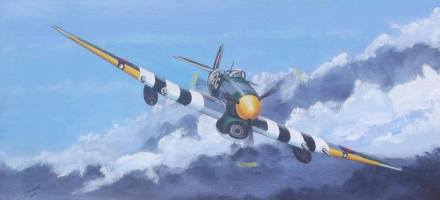
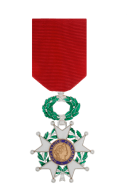
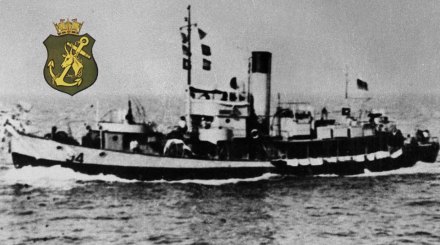
After all the ceremonies and official presentations were done, the French invited all to attend a small lunch, it later turned out that the French Ambassador to South Africa, his excellency Christophe Farnaud, was a keen modeller of aircraft and had built Typhoon models as a child.  The Ambassador stayed to the end of the lunch to see a print of a painting of a Typhoon by the late Derrick Dickens presented to Albie in appreciation by his son, Peter Dickens. Looking at the painting Albie opened up with all sorts of harrowing tales of fighting and flying in a Typhoon much to delight of the Ambassador and the remaining guests and journalists.

23915838_2053483801547274_4371377376881378737_n

Typhoon ‘full frontal’ by Derrick Dickens

It was a journey, and highly rewarding, the right man received the right recognition and it was awarded in the right way.  It is a journey that we as Legionnaires stand by our motto ‘not for ourselves, but for others’ and we are proud to have played a role.

Albie’s testimony 

LH HI

The Legion d’honneur

Albie’s tour of service is well worth a watch, and this short documentary produced by Tinus Le Roux on his tour is an outstanding capture of one of South Africa’s D Day heroes , a snippet of history that needs to be preserved and told and retold, take the time to watch it and feel free to share it.

There are very few of these South African’s left, lest of which our D-day veterans, national (and international) heroes of which there are only a precious three left in South Africa, and Albie is one of these men – the last of an outstanding legacy of South African men whose bravery and honour literally saved the world from a world of extreme evil empires and ideologies, Albie’s LdH and France’s greatest honour well-earned.


Written by Peter Dickens.  Image copyright, Karen Dickens, references attributed to Dean Wingrin and Tinus Le Roux.  Video interview with Albie copyright and sincere thanks to Tinus Le Roux.  Painting ‘Typhoon Full Frontal” artist Derrick Dickens, copyright Peter Dickens.  Images were referenced copyrighted to the Imperial War Museum.  Albie’s personal images used with thanks to Albie Götze and Tinus Le Roux, copyright Albie Götze.

The featured image shows Typhoon Mark IB, MN234 ‘SF-T’, of No 137 Squadron RAF with a full load of 60-lb. rocket-projectiles beneath the wings, running up on an engine test at B78/Eindhoven, Holland – copyright Imperial War Museum.


The last South African Navy ship to be lost in action; HMSAS Treern

It is not known now to many modern South Africans, but the South African Navy lost four ships in total during WW2, all of them minesweepers.  Hardly recognised today all these ships carried with them tales of great bravery,

The first ship lost in the Mediterranean near Tobruk was the HMSAS Southern Floe with its remarkable tale of a single survivor (see The HMSAS Southern Floe was the SA Navy’s first ship loss & it carries with it a remarkable tale of survival.).

The second ship lost was the HMSAS Parktown, which went down fighting during the Fall of Tobruk in Libya, with the HMSAS Bever fighting at her side out the port (see The feisty South African minesweeper that went down fighting – HMSAS Parktown).

The third ship to be lost was the HMSAS Parktown’s sister ship, the HMSAS Bever which went down later in the war during the liberation of Greece when it struck a mine, and carries with its story a tale of miraculous survivors (see “Under a hail of shells”; Recounting the bravery and loss of HMSAS Bever).

The final minesweeper to be lost was the HMSAS Treern, it was tragically lost right at the end of the war, and it remains the last South African vessel to be lost in action, even to this day, yet hardly anyone is aware of her history.

So lets examine this last combat loss, and why it is that we tend to overlook all this sacrifice at sea in the South African Navy’s vessels during the Second World War.

The second minesweeping flotilla prepares for the Mediterranean 

27797891_2090641777831476_3648925428113256571_o

HMSAS Treern

On the 12 May 1941, the HMSAS Treern (under the command of Lt. H H Cook) is commissioned, she is a whaler now converted for wartime service.  Now a magnetic minesweeper she is given her number T451 and allocated the pennant number 94.

By the beginning of November 1941, there is a small flotilla of South African minesweepers ready for deployment in the Mediterranean in support of Allied combat operations there.  The HMSA Ships, Bever, Gribb, Seksern, Imhoff, Treern, Parktown and Langlaagte, all are former whale catchers of about 260 tons and built between 1926 and 1930, and all are ready to go as part of the 166th Minesweeping Group in the Mediterranean.   Each minesweeper is fitted with one 3 inch gun plus smaller QF guns, depth charges and LL sweeps.  They are the second group of South African minesweepers to sail from Durban for the Mediterranean.

The liberation of Greece 

The Treern has a long record of service conducting duties alongside Allied shipping, she spends almost the entire war in the combat zone, towards the end of the war she finds herself under the command of Lt. P Byrne assisting in the liberation of Greece sailing in the Aegean Sea – the end of the war in Europe and surrender of Germany is a tantalising four months away.

Treern

HMSAS Treern

By January 1945 the situation in the Greek Islands was somewhat confused. Initially the task of the Allies appeared to be a straightforward one; simply the supply and distribution of food and other essentials and the opening up of communications which, from the nature of the country, was largely by sea. However, internal dissension (which the retreating German forces had done their best to promote) considerably complicated and delayed the Allied take over.

ELAS

The Greek People’s Liberation Army or ELAS was the military arm of the left-wing National Liberation Front (EAM) during the period of the Greek Resistance until February 1945, then during the Greek Civil War.

HMSAS Treern, with orders to relieve HMSAS Seksern at Volo, arrived there at noon on 27 December 1944 only to find the harbour deserted and therefore anchored in the bay whilst radioing for instructions. Soon afterwards an emissary from ELAS (Greek People’s Liberation Army) arrived, ELAS was one of the factions in the internal dissension in Greece caused by the vacuum created by the German occupiers retreating from Greece.

The ELAS emissary informed the HMSAS Treern that Volo was under ELAS control and then asked the Captain what his intentions were.

The ELAS emissary eventually agreed to let the ship remain there for the night. Next morning Treern left for Skiathos where she met up with the British destroyer, HMS Musketeer, considerably to the relief of both captains, and came under the orders of the Musketeer.

In the town of Volo a somewhat lukewarm ELAS control prevailed – political fervour being influenced by the presence of the destroyer and her 4.7-inch guns, under cover of which all local craft, arriving and leaving, were interrogated and searched for arms.

mus

Treern assisted in this duty for the next few days before being attached to a small naval force then operating against the ELAS in the Gulf of Volo and along the north-east coast of Euboea.

The loss of the HMSAS Treern

On the morning of 12 January whilst off the northern shore of the Trikiri Channel and towing a caique laden with fuel for motor launches then lying off Volo. At about 08:30 there is a huge explosion, presumably caused by a mine, which destroys Treern almost immediately with a very heavy loss of life.

Only one man survives 

The only survivor, Stoker J.J. Bosch, later states that he was in the port waist, while most of the other men off duty were watching a pig being slaughtered on the boat-deck above him. Suddenly he felt a tremendous concussion and found himself somersaulting through the air into the water. On coming to the surface he found a life buoy floating near him and saw the last few feet of the ship’s bows disappear below the surface.

At the same time another mine exploded about 100 yards away, presumably a sympathetic detonation caused by the first explosion. One of his legs had been injured, but the caique picked him up and about an hour later transferred him to HMS Musketeer.

Honour Roll

MPK means ‘Missing Presumed Killed’.  SANF stands for ‘South African Naval Forces’.

22308811_10155537271456480_3745202244434378650_nANDERSON, Robert D, Engine Room Artificer 2c, 71067 V (SANF), MPK
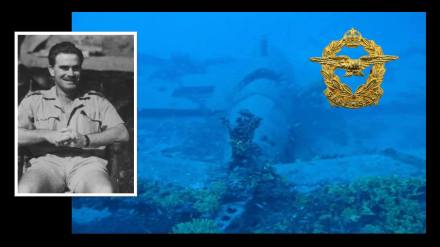
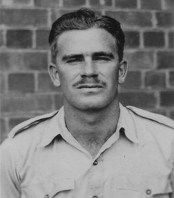
BARKER, Ronald E, Sub Lieutenant, SANF, MPK
BLAKE, Robert E, Petty Officer, P 6572 (SANF), MPK
BROWN, Ian H, Able Seaman, 71719 V (SANF), MPK
BYRNE, Patrick, Lieutenant, SANF, MPK
DAVIE, William, Stoker 1c, 70681 V (SANF), MPK
ENGELBEEN, Leslie C, Able Seaman, 562235 V (SANF), MPK
JACOBZ, Frank H, Stoker 1c, 70374 V (SANF), MPK
MATTHEWS, George A, Stoker 1c, 70728 V (SANF), MPK
MCINTYRE, William G, Cook (S), 585360 (SANF), MPK
MCLARTY, William D, Leading Stoker, 562246 V (SANF), MPK
MCLEAN, Godfrey, Able Seaman, 562455 V (SANF), MPK
NILAND, St John E, Able Seaman, 209905 (SANF), MPK
PERRY, Desmond A, Petty Officer, 71211 (SANF), MPK
REID, Kenneth H, Signalman, 562143 V (SANF), MPK
SALCOMBE, Francis R, Stoker 1c, 58589 V (SANF), MPK
STAPELBERG, Willem J, Steward, 562221 V (SANF), MPK
SUTTON, Donald A, Able Seaman, 70426 (SANF), MPK
SUTTON, George A M, Leading Seaman, 586403 V (SANF), MPK
TRAFFORD, William O, Able Seaman, 71222 V (SANF), MPK
VILJOEN, Dennis A, Telegraphist, 70984 V (SANF), MPK
WHITE, Charles W, Petty Officer, 562200 V (SANF), MPK
WULFF, Emil F, Leading Seaman, 562466 V (SANF), MPK

In Conclusion

Successive generations of South Africans have not been exposed to the gallantry of South African servicemen at sea, many remain blissfully unaware of all the heroic actions of South African fighting ships during World War 2.

Little remains of this history, and it now has to ‘dug up’ from recent research conducted by Chris Bennet and Allan du Toit, very little to nothing is available in public on-line records such as Wikipedia, such is the degree to which it has been wiped from the South African national consciousness.

The reason for this is political, the incoming Nationalist government after the war in 1948 regarded all of South Africa’s and Smuts’ exploits during World War 2 as one of treachery (siding with the ‘hated’ British), so no large-scale Naval commemorations or recognition ceremonies were ever undertaken by the South African Navy to maintain this memory.


Researched by Peter Dickens.  Reference: Large extracts taken from Day by Day SA Naval History by Chris Bennett. Casualty Lists of the Royal Navy and Dominion Navies, World War 2 by Don Kindell. Images of South African vessels courtesy Allan du Toit and reference from his book ‘South African Fighting Ships’.

Finding Geater’s Beaufighter

gtr70The feature image is Major Arthur Geater’s Bristol Beaufighter which was found in Sept 2013 after being undiscovered for 69 years since it was ditched and sank.  The discovery is a story itself, but so too is Arthur’s.
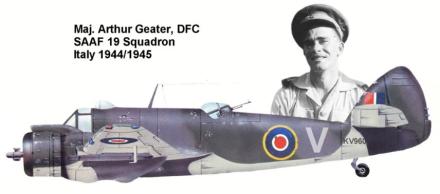
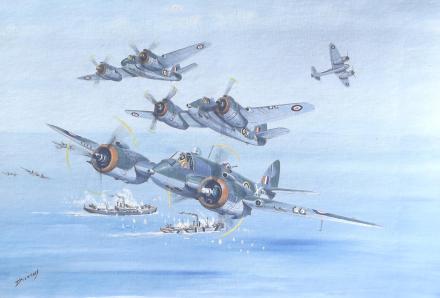
Reginald Arthur Geater joined the South African Air Force (SAAF) during the Second World War and qualified as a twin-engine pilot, he also served for a long period as instructor and in 27 transport/maritime squadron, flying Venturas and Dakotas.

He was eventually sent to Italy in mid 1944 for operational service with 19 squadron, flying the rocket firing Bristol Beaufighter. During his operational service he flew mostly sorties to targets in the Balkans. Missions consisted of  rocket attacks against enemy shipping, motorised transports,  gun emplacements, buildings and rolling stock.

Arthur Geater s cr.jpg.opt856x378o0,0s856x378

His operational tour was very eventful. On his very first combat sortie Arthur was shot down over the sea. He and his navigator survived the ditching and he was eventually able to returned to his squadron after a short ordeal behind enemy lines staying with locals on Greek Islands.  So what happened?

914204_534880923228975_2046368776_o

Painting by Derrick Dickens, SAAF Beaufighters attacking German ships in the Mediterranean. Acrylic on canvass – copyright Peter Dickens.

The attack and ditching 

In the afternoon of September 12, 1944  Bristol Beaufighter KV930 of 19 SAAF (South African Air Force) Squadron took off from Biferno (Italy), along with three other aircraft. On his very first mission was our hero for today, Arthur Geater along with his navigator  Stan Dellow seconded from the Royal Air Force.  Their mission was a simple one, search for enemy shipping amongst the Greek Islands and destroy them.

The sortie of four SAAF Beaufighters comb an area of Greek Islands looking for German military vessels, the search are spans from Preveza in northwestern Greece, located at the mouth of the Ambracian Gulf, then across to Lefdaka Island, then over to Kefalonia island with their mission finally taking them as far as Zakynthos Island.

Late in the afternoon at approximately 17:05 hrs. they reach the northern tip of Ithaki Island and spot a German vessel, it is a “Siebel” ferry, and it was hiding from air attack in one of the fjord-like coves of the island.

Bundesarchiv_N_1603_Bild-054,_Schwarzes_Meer,_Siebelfähre_mit_8,8cm_Flak_ArM

German Navy Siebel ferry

The Siebel ferry was a shallow-draft catamaran landing craft operated by Germany’s Wehrmacht (Army) during World War 2. It served a variety of roles (transport, flak ship, gunboat, convoy escort, minelayer) in the Mediterranean, Baltic and Black Seas as well as along the English Channel. They were originally developed for Operation Sea Lion in 1940, the abortive German invasion of England.

The SAAF Beaufighters immediately started their attack, but were greeted with strong anti-aircraft fire from the heavily armed Siebel. Geater’s Beaufighter was hit with both engines receiving hits from multiple Anti-Aircraft rounds.  Oil and thick smoke erupted from the engines and Arthur Geater took the decision to ditch the aircraft in a controlled sea ‘landing’ before it became an uncontrolled one.

The Siebel sustained heavy damage and according to German records and was eventually beached to avoid sinking.

Remarkably an image of the attack also survives, and here you can see the German ship (ferry) that shot Arthur down from a photograph taken during the attack from the SAAF 19 Squadron Officer Commanding’s gun camera.

10920094_399294666906938_4358318858316847831_o

Geater successfully managed to ditch the aircraft and both he and the navigator climbed out the sinking Beaufighter and took to an inflatable dinghy which was on board for just such an eventuality.

Local Greek Islanders who saw the Beaufighter ditch rushed to their fishing boats to rescue the two Allied airmen. Keen as punch to do their bit in the war, and with a disdain for their German occupiers, the local Greeks took great pride in rescuing Allied airmen, one local remembered the time and said, “we would row as fast as possible and would even get into a fight with the other Greeks rushing to the scene in order to reach the airmen first!”

Within thirty minutes of ditching the two Allied  airmen were saved by Greeks and taken to Ithaki island, where they were provided with both food and shelter.  Arthur Geater’s adventure was not to stop there, whilst the two airmen were moved in a small fishing boat to another hiding place on the island, they were stopped at sea by a German patrol combing the area trying to locate the airmen.

Stan Dellow could not swim and remained on the boat, Arthur Geater could and he dived into the water and swam to freedom.  Stan Dellow survived the war, but was caught and spent the rest of the war as a POW (Prisoner of War) at the Sagan POW camp in Poland.

Arthur Greater got away and managed link up with the Greek resistance in Ithaki he eventually managed to return to Italy and re-joined his Squadron.  He was never shot down again and stacked up a number of successful sorties against enemy rolling stock, shipping and buildings.  He even participated in a daring SAAF raid when a German mine layer ship, the “KuckKuck” was sunk.

ss7Arthur was awarded the Distinguished Flying Cross for his exceptional service. After the war he had a long and successful career in the printing industry and passed away on 3 November 1992.
Finding Geater’s Beaufighter

Makis Sotiropoulos

Makis Sotiropoulos with his sonar equipment

Makis Sotiropoulos, an experienced scuba diver living on Ithaki Island, as a boy he had heard the story from the local Greek Island elders about “the aircraft which fell out the sky in 1944″ and he took to the challenge of finding it.  After many years of research and obtaining eyewitness reports he surveyed the area using sonar.

In September 2013 his search came to an end when then distinct shape of an aircraft, sitting at the seabed was mapped by the sonar.  Major Geater’s Bristol Beaufighter was found.  The wreck was dived and confined it was indeed the SAAF Bristol Beaufighter ditched on that fateful hat day.

The exact position of the aircraft wreck is however not shared publicly now, and for good reason as it is within diving limits and modern-day trophy hunters and looters would strip the aircraft clean.  According to Makis Sotiropoulos “this aircraft should remain as it was on the day it was ditched. We have the moral obligation to keep the Beaufighter out of harm’s way, as many relic hunters and looters would make a fortune out of her parts, thus destroying History”.

1235336_518448284897858_1783305813_n

For prosperity, here are some of the underwater pictures of this most remarkable story and equally remarkable find.


Written an Researched by Peter Dickens.  Thanks to Tinus Le Roux and to Julie Geater for all the information and images.  Extracts from Tinus Le Roux’s dedication website SAAF WW2 Pilots Arthur Geater and from Found and identified: The Beaufighter KV930 shot down on 12 September 1944 By Pierre Kosmidis.

Photos and historical research: Makis Sotiropoulos and George Karelas. Diving and Research Team: Makis Sotiropoulos, Dionyssis Giannatos, Vassilis Medogiannis

Artwork by Derrick Dickens, SAAF Beaufighters  – copyright Peter Dickens.  Schematic artwork by Tinus Le Roux, copyright.